Gradiva by André Masson

After my last two blogs looking at the exquisite artistry of the American landscape painter, Frederic Church, I am going to give you something completely different today.   I was going to facetiously say that I was moving from the sublime to the ridiculous but I know that labelling Surrealism as “ridiculous” is a rather facile and childish statement.   Not being an artist, I would be curious to know if the upbringing of an artist and how life has treated them has any bearing on their painting style.  For example, Frederic Church came from a happy and financially sound family background and lived close to a very picturesque countryside and in some ways the works he produced mirrored not just the environment around him but the peace and tranquillity of his mind.   My featured artist today probably felt little of that peace and tranquillity in his life and that may account for some of the disturbing images he produced.  My artist today is André Masson and the painting of his I want to look at is entitled Gradiva which he completed in 1939.  It is not just about a painting but about a German novel and a renowned Austrian neurologist who was hailed as the founding father of psychoanalysis and along the way I will delve into the world of automatism in art!

André Masson
André Masson

Andre Masson was born in January 1896, in Balagny-sur-Thérain, in the northern French province of Oise, about sixty miles north of Paris.  Although born in France, because of his father’s business, he spent most of his childhood in neighbouring Belgium.  The family relocated to Lille in 1903 and then later moved to the capital Brussels.  In 1907, aged 11, he enrolled at the Académie Royale des Beaux-Arts et l’École des Arts Décoratifs in Brussels where he received tuition from the Belgian painter and muralist, Constant Montald, who would later teach the likes of Rene Magritte and Paul Develaux.   It was on Montald’s advice that Masson decided to leave Belgium and travel to France.  In 1912, Masson moved to Paris and attended the illustrious Parisian art college, École Nationale Supérieure des Beaux-Arts where he attended Paul Albert Baudoin’s studio to study fresco painting.   In 1914 he was awarded a scholarship from the École des Beaux-Arts and this allowed him to travel to Italy, along with his fellow art student, Maurice Albert Loutreuil.    Whilst in Italy, Masson studied the art of fresco and discovered the works of Paolo Uccello.

These were exciting times for the youth of the day.  Art Nouveau, Impressionism and Symbolism were dominating the art scene and the music of Wagner and the thoughts of Nietzsche were often foremost in their minds.  Like many of his fellow art students of the time, André was a person who railed against convention and authority and had many run-ins with the police.  He embraced vegetarianism and would often be seen walking bare-footed along the streets.  He avidly read the great works of literature and philosophy and became a follower of the German poet and philosopher, Friedrich Nietzsche.

In 1914, France entered the First World War and there was a call to arms.  Many of the young eagerly put themselves forward to support their country.   Some, like Masson, looked on the fight that lay ahead in terms of a grand Wagnerian battle with little concern about their own mortality.  In an interview he gave the American magazine Newsweek in 1965 André Masson said that when war was declared he volunteered because he wanted to experience “the Wagnerian aspects of battle”.  Like many who marched off patriotically to the front line, they were mere “cannon fodder” and would never return home.   Although Masson, an infantryman, was not killed in the war, in April 1917, he was badly injured during the Second Battle of the Aisne when several French army battalions stormed the German lines on the Chemin des Dames ridge.  (It is interesting to note that one of the German soldiers at this battle was Adolph Hitler!)

The battle was short-lived and, for the French, it ended catastrophically in a matter of a few weeks.  Thousands of French troops were slaughtered.  Many others mutinied and the career of the French army’s Commander-in Chief, Richard Nivelle was destroyed. The attack, which Masson had taken part in proved disastrous and he was gravely wounded and lay helpless on the battlefield all night and it was not until the following day that stretcher bearers were able to reach him and take him to a field hospital.   The wound to his chest and abdomen was of such severity that Masson remained in hospital for the next two years.   Not only did he suffer horrendous physical injuries but the battle and his witnessing the death and maiming of many of his colleagues left him mentally scarred and he had to undergo a long period of psychiatric rehabilitation to treat the devastating effect it all had on his mind.   His patriotic rush to serve his country resulted in constant physical pain, nightmares and insomnia for the rest of his life and he was advised by psychiatrists to stay away from the noise and chaos of cities.

In April 1919 Masson went to Céret, a town which lies in the Pyrénées foothills in south-west France.   Céret was, around this time, a popular meeting place for artists, such as Picasso, Modigliani, Andre Derrain and Matisse.  Whilst living there Masson met Odette Cabale, who became his wife. Odette became pregnant and Masson decides to return to Paris where his parents could assist her.  In 1920 their daughter Lily was born. Masson sets up a studio at 45 Rue Blomet in Paris which soon became a local meeting place for aspiring artists as well as some influential people such as the author Ernest Hemmingway and the writer and art collector Gertrude Stein.

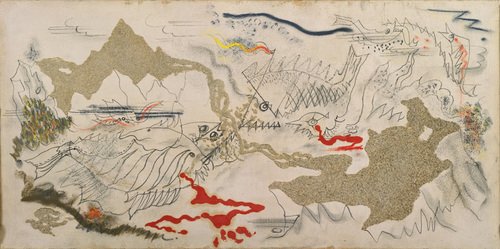
Battle of the Fishes by André Masson (1926)

In 1924 the German-born art historian, art collector and art dealer, Daniel-Henri Kahnweiler, organised Masson’s first solo exhibition at his Galerie Simon. One of the viewers at the exhibition was André Breton and he bought a work by Masson entitled The Four Elements.   Breton was the founder of the Surrealist Movement and later that year published Manifeste du surrealism, his Surrealist Manifesto, in which he had defined surrealism as “pure psychic automatism”.   Masson, who had been invited to join Breton’s group of Surrealists, was influenced by the ideas Breton had put forward and began to experiment with “automatic drawing” or automatism.  Automatism was a way of creating drawings in which artists smother conscious management of the movements of their hand, and by doing so, allow their unconscious mind to take over.  Breton and his Surrealists believed automatism in art was a higher form of behaviour.   For them, automatism could express the creative force of what they believed was the unconscious in art.   Masson’s work could be categorised as a semi-abstract variety of Surrealism, which is experimental use with unusual, such as sand.  His so-called sand pictures were works which his automatic drawing would be first put on the canvas using glue.  Then before the glue had dried he would sprinkle coloured sand over it.  The canvas would then be shaken and the sand would only remain on the glue.  One of his most famous and most successful  “sand paintings” is Battle of the Fishes, which he completed in 1926 and is now housed in the MOMA in New York.  I read a piece about this work which described it as:

” a work which a primordial eroticism is revealed through an imagery of conflict and metamorphosis, poetically equating the submarine imagery with its physical substance…”

Is that how you see it ????????

In 1925, Masson participated in the first Surrealist exhibition, at the Galerie Pierre, alongside Picasso, Ernst, Klee, Man Ray. However, André Masson fell out with Breton and his Surrealists mainly due to Breton’s authoritarian leadership of the group and his dogmatic attitude.  Masson also came round to the fact that automatism was becoming too much of a constraint on his art and so in 1929 he severed ties with the group.  It was that same year that Masson and his wife Odette parted company after almost ten years of marriage.

Masson spent some time in the Provencal hills around the town of Grasse, where he met Matisse.  In 1934 Masson returns to Paris but that February he is alarmed by the right-wing Fascist riots which take place in the city that February.  He decided to flee the turmoil that has beset the French capital and headed south to Spain and the city of Barcelona.  He was accompanied by Rose Maklès, sister of the wife of his best friend and the well-known author Georges Bataille. In December 1934 André and Rose married in Tossa de Mar on the Costa Brava, and in June 1935 their son Diego was born, later, in September 1936. a second son Luis was born.   Masson’s decision to relocate to Spain, to avoid the chaos of riots in Paris, was an unfortunate one as in October 1934 the Spanish city was hit by a violent insurrection of its people and Masson and his family became trapped in a friend’s house which was at the heart of the city and which was being subjected to constant shelling and sniper fire.  This was just the scenario his psychiatrists had told him to avoid when he was discharged from hospital at the end of the First World War.  The situation deteriorated further in 1936 with the start of the Spanish Civil War and Masson and his family quickly headed back to France.  His return to France also coincided with his return to the Surrealist fold as he and André Breton settled their differences and the following January, Masson exhibited works at the Surrealist Exposition of Paris which was held at Georges Wildenstein’s Galérie Beaux-Arts.

The year 1939 was marked by the start of the Second World War and in January 1940 the German army marched into Paris.   Masson found himself in a precarious situation.   His artwork had already been deemed as degenerate by the Nazis.  The Nazis looked upon the Surrealist Movement and its artists as having close ties to the Communists and to top all that,  Masson’s wife Rose was Jewish.  He realised that for he and his family, in order to survive, had to flee France.  From Paris they headed south to Auvergne and then on to Marseille.  Here a group of Americans led by Varian Fry, a journalist, had set up a European Rescue Committee which helped Jews and Germans blacklisted by the Nazi authorities to escape to the USA.   Varian Fry hid the refugees at the Villa Air-Bel, a chateau on the outskirts of Marseille and then took them via Spain to neutral Portugal, or shipped them from Marseille to Martinique and from there on to the USA, which was Masson escape route.

André Masson and his family, along with some of his artwork, landed in America in 1941 and one would think that his troubles were over but alas the US Customs thought differently as when they examined his drawings they declared five of them to be pornographic and tore them to pieces right in front of the artist’s eyes !!!   For a short while he lived in New York before moving to Connecticut.   In 1945, with the war over, the Masson family returned to France, where they lived for a while with his wife’s sister, Simone.  In 1947 they moved to the small town of Le Tholonet, which lies close to Aix-en-Provence in southern France.   He continued to paint and received many lucrative commissions including one from the French Culture Ministry to paint the ceiling at the Parisian Théatre Odéon.  A series of solo and retrospective exhibitions of his work are held all over Europe and America.  He visited Rome and Venice in the 1950’s and from these trips, he produced a beautiful series of coloured lithographs of Italian landscapes.

Masson’s wife Rose died in August 1986 and Masson himself died in Paris in October 1987 aged 91.

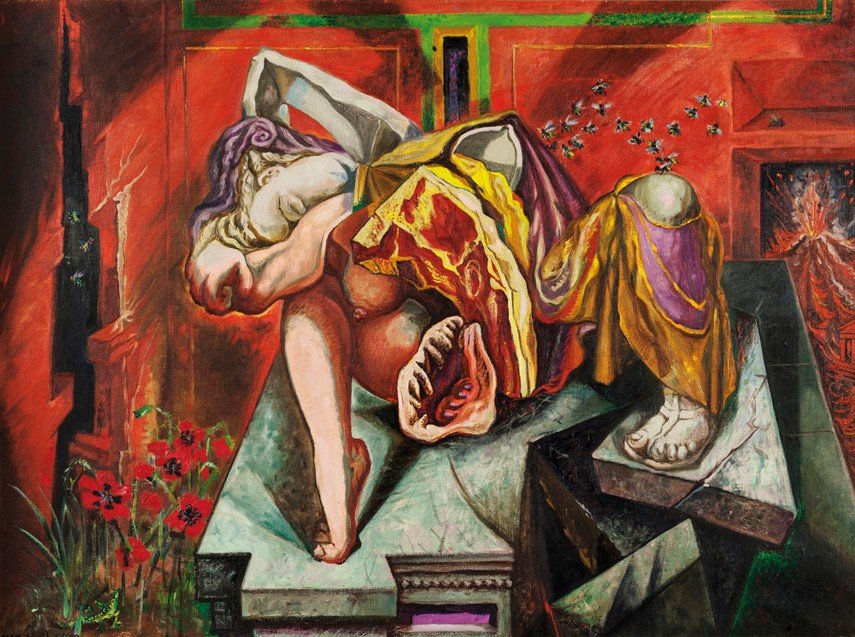
Gradiva by André Msson (1939)

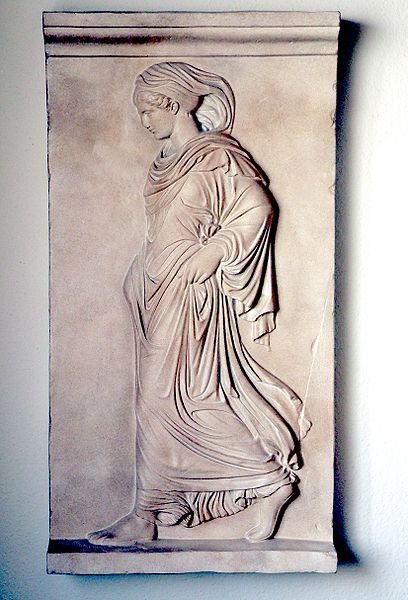
The painting of André Masson I have chosen today is entitled Gradiva which he completed in 1939.  So who is Gradiva?   Gradiva, is Latin for “the woman who walks and in the Vatican Museum, there is a Roman bas-relief (a projecting image with a shallow overall depth), of Gradiva.    This sculpture depicts a young robed woman who we see raising the hems of her skirts so as to be able to stride forward at pace.  This sculpture was the basis for the novel written by the German author Wilhelm Jensen, entitled Gradiva.    He originally published his fictional tale, it in a serialised form, in the Viennese newspaper, Neue Freie Presse in 1902.

Bas-relief of Gradiva

It is the story of Norbert Hanold, a young archaeologist who became totally obsessed with a woman who did not even exist. He had visited the Vatican museum when he was struck by the beauty of a bas-relief of young Roman woman, very light on her feet, whom he baptized “Gradiva” (she who walks). He purchased a reproduction of the sculpture, which he hung on the wall of his workroom. He becomes fixated by the image and mystery of this enigmatic young woman. One night he dreams that he is in Pompeii in AD 79, just before the eruption of Mt. Vesuvius. There he meets Gradiva.  He desperately tries to warn her about the horrific events that are about to occur, but he finds himself powerless to rescue her.  After waking, he is overcome by the longing to meet Gradiva. He immediately sets off for Pompeii, where he meets a young woman, very much alive, whom he believes is Gradiva. In the course of the meetings that follow, he tries to rationalise his fixation for the girl by interpreting signs such as the fact that Gradiva appears at noon, the ghost hour, and other such signs. Gradiva, in turn, seeks to cure him by gradually revealing her identity to him. Through this adventure, Norbert finally sees Gradiva for who she really is: his neighbour and childhood friend Zoe Bertgang (“Bertgang” is the German equivalent of “Gradiva”), who also travelled to Pompeii.  For years he had not seen her and had no desire to see her, but without realising it Norbert was still in love with her and he had substituted his love for Zoe with his love for Gradiva, the young woman of the bas-relief. Happily, his fixation for Gradiva finally yields to reality, and Norbert is cured.

In 1906, Sigmund Freud had been made aware of this story by Carl Jung , who believed Freud would be interested in the dream sequences of the story.  Freud, who frequently cited his Interpretation of Dreams which he published in 1900, suggested in his review of Jensen’s novel that even dreams invented by an author could be analyzed by the same method as real ones. He fastidiously analyzed the two dreams which were the basis of Jensen’s story, and linked them to happenings in Norbert’s life. By doing this Freud attempted to demonstrate that dreams were substitute wish fulfilments and established that they constituted a return of the repressed.   According to the pschoanalysist, the source of Norbert Hanold’s fixation was his repression of his own sexuality, which caused him to forget, his past love, Zoe Bertgang, in order to keep him from recognizing her.  This he termed as “negative hallucinations”.  Freud concluded that the way Zoe treated Norbert when they met in Pompeii was in the manner of a good psychoanalyst, cautiously bringing to consciousness what Norbert forgot through repression.

As an interesting footnote to the Freud story, four months after he published his essay on Gradiva and Jensen’s story, he visited Rome and during the trip he went to see the bas-relief representing “Gradiva” at the museum of the Vatican, the very same one that had inspired Jensen to write his story. Just as Norbert Hainold, the character in Jensen’s story had done, Freud bought a copy of the bas-relief of Gradiva and hung it in his office in Vienna, at the foot of his divan. There it remained until he left Vienna, and took it with him to London in 1938, where it can be found on the wall of his London study which forms part of the Freud Museum.

In today’s featured painting, Masson  iconography for Gradiva (The Metamorphosis of Gradiva) is a Freudian illustration drawn directly from the Jensen story.  In the painting we see a large woman, half flesh, half marble sprawled on a marble plinth, the base of which is starting to crumble.  Her legs are splayed apart and between them we see a beef steak and a gaping shell-like vagina.  To the right of her, on the wall in the background, we see the erupting volcano.  To the left of her we see a large crack in the side wall signifying that the building she is in, is about to collapse.  Another strange addition to the painting is a swarm of bee-like creatures which seem to swarm in arc-like fashion behind the figure of the woman, similar to the arc formed by the way her marble arm arches over her head.  Why depict bees?   The whole of the painting is bathed in a flickering reddish light which highlights a clump of poppies which can be seen in the left foreground of the work.  I have tried to explain some of the iconography of this painting but I will leave you to try and figure out if there are more hidden meanings to what you see before you.

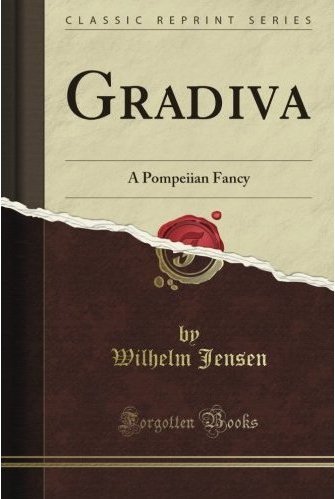
The novel, Gradiva by Wilhelm Jensen

Finally for those of you who would like to read the complete version of Wilhelm Jensen’s Gradiva then you can get a copy from Amazon.com:

http://www.amazon.com/Gradiva-Pompeiian-Fancy-Classic-Reprint/dp/B0094OOP36

or  Amazon.co.uk:

http://www.amazon.co.uk/Gradiva-Pompeiian-Fancy-Classic-Reprint/dp/B0094UEIIW/ref=sr_1_1?ie=UTF8&qid=1364119670&sr=8-1

I must apologise for the length of this blog but once I got started researching the life of the painter, the painting itself and the story of Gradiva I was loathed to cut anything out.   Not being a master of the art of précising, I don’t think I would make a good journalist !!!!!

Frederic Edwin Church, Part 2

For those of you who have just landed on this page I suggest you go back to my previous blog which looks at Frederic Church’s early life and talks a little about his exhibition at the National Gallery, London which I visited last week.

Our Banner in the Sky by Frederic Edwin Church (1861)

Another beautiful and moving historical painting by Frederic Church which was on display at the exhibition and which I found very moving was a small oil painting entitled Our Banner in the Sky which Frederic Church completed in 1861.  I stood before this work, fascinated by the way in which Church had cleverly depicted the image of the Stars and Stripes American flag in tatters against an amazing daybreak landscape with its red and white bands of clouds.  Church had painted this shortly after the attack on Fort Sumter by General Beauregard and his Confederate troops in January 1861 , which signalled the start of the American Civil War, which tragically went on to cost so many American lives.   In the work we see a bare and tall tree slightly leaning over, which acts as a flagpole for the flag which blends in with the early morning sky.  In it, we see the North Star depicted through a patch of blue sky.  Church has cleverly managed to create a highly patriotic scene which in some ways connects the American landscape with the Northern cause.  It was a heartfelt cry for unity which sadly was not listened to. It was such a popular work that the Manhattan art dealer, Goupil & Co. commissioned Church to produce a chromolithograph of the work and, within a few months, hundreds of copies were bought up by the public.

Isabel Carnes Church by Frederic Church (1860)

It was during the New York exhibition of his Andes painting that Frederic Church met Isabel Carnes.  In 1860 just three months before his marriage to Isabel, Church bought some 126 acres of farmland, close to the towns of Hudson and Catskill and situated on a south sloping hill, overlooking the Hudson River.  He was familiar with this site as he had visited the area whilst on a painting trip with Thomas Cole in 1845.   As he still lived in New York, this new acquisition would be the family country get-away.   Church employed the foremost architect of the time, Richard Morris Hunt, to construct a cottage and design this ferme ornée.  The term means an ‘ornamented farm’, and describes a country estate laid out partly according to aesthetic principles and partly for farming.  Church and his wife referred to the small cottgae on the estate as their Cosy Cottage and it was surrounded by gardens and orchards and Church even had a section of marshland drained so as to build his own expansive ten acre lake.  Over time he bought up more of the adjoining land and eventually his estate encompassed 250 acres.

Fern Walk, Jamaica by Frederic Church (1865)

He and his wife lead a settled and happy life and he spent most of his time tending to his farm but his happiness was shattered in March 1865 when both his young children contracted diphtheria and died a week apart.  In an attempt to counteract the intense grief suffered after their children’s death, he and his wife along with some friends travelled to Jamaica where, for five months, Frederic immersed himself in a painting frenzy whilst his wife collected numerous species of ferns which she would later bring back home and which would form part of her fern garden.  Isabel’s interest in ferns and Frederic’s love of depicting nature in his painting were combined in his 1865 work entitled Fern Walk, Jamaica in which Church depicts a narrow path winding through luxuriant plants and ferns.  The shades of greens and browns which he used in depicting the native flora is breathtaking.  Frederic Church loved his stay in Jamaica.  He loved sketching plein air in the tropical light and, on his return to America, would often encourage other landscape artists to venture on painting trips to the Caribbean island.  In a letter he wrote to the landscape artist, Charles de Wolf Bramwell, he extolled the Fern Walk area of the island, writing:

“…the vegetation, next to that on the Magdalena River, the finest I ever saw –– The ferns, especially in the region known as Fern Walk — excelled every place…”

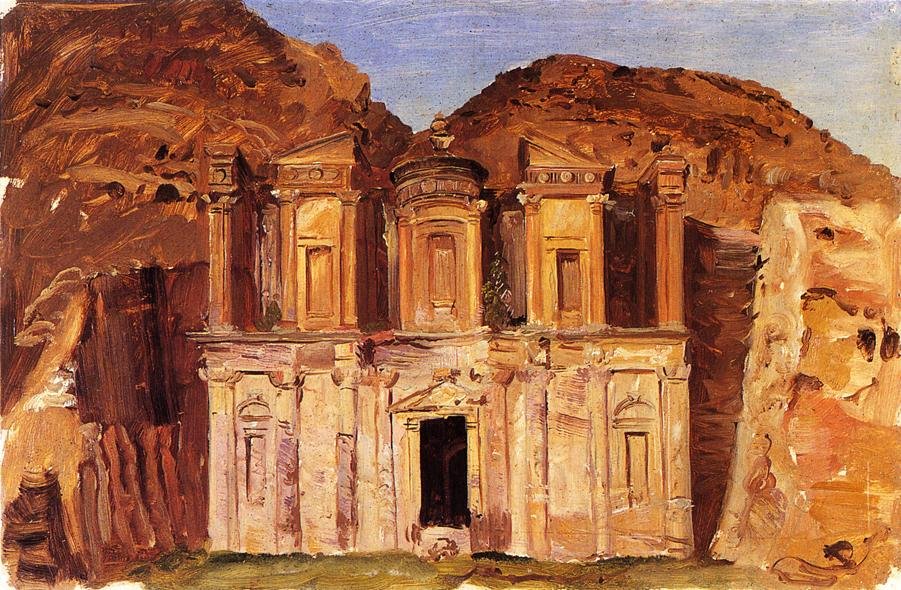
Ed Deir, Petra Jordan by Frederic Church (1868)

The couple returned home from Jamaica and in 1866 Isabel Church gave birth to a son, Frederic Junior.   The following year Frederic and Isabel, along with their son and Isabel’s mother, set off on a two-year long journey of Europe and the Holy Land.   They visited Jerusalem and from there headed to Jordan where Church, after an arduous ten day journey by mule, arrived at the ancient city of Petra.  During the long trip Church continually sketched and painted.  It was a trip which was fraught with danger from not only local bandits, but from the native porters which were helping Church’s party get to their destination.  These Arabs were very superstitious about his sketching but were eventually won over by his skill.  He finally arrived at Petra and made the long climb up above the city to the monastery of Ed Deir, which in the first century AD was a Nabatean temple.   Frederic Church completed his beautiful oil and graphite painting entitled Ed Dier, Petra, Jordan,   Unbelievable at it may sound but Church completed the work in just one sitting, in 1868.

Königsee by Frederic Church (1868)

From the Holy Land, Frederic Church returned to Europe visiting Rome and Athens and also the Bavarian Alpine region, Switzerland and Austria which had always been a popular venue for landscape painters.  Church was drawn to this area as he was always searching for beautiful vistas to paint.   He liked the area as he believed there was a marked similarity between the geography of the area and that of the rugged American landscapes which he knew so well.  In July 1868 he visited the Königsee, the beautiful Upper Bavarian lake which nestles amongst steep-sided cliffs.  Sheltered from the weather,  the surface of the lake is often mirror-like reflecting the surrounding mountains.   He completed a beautiful work entitled Königsee that month and it is a poignant reminder to me of the times I have visited the lake and stood in awe before it, mesmerised by its beauty.

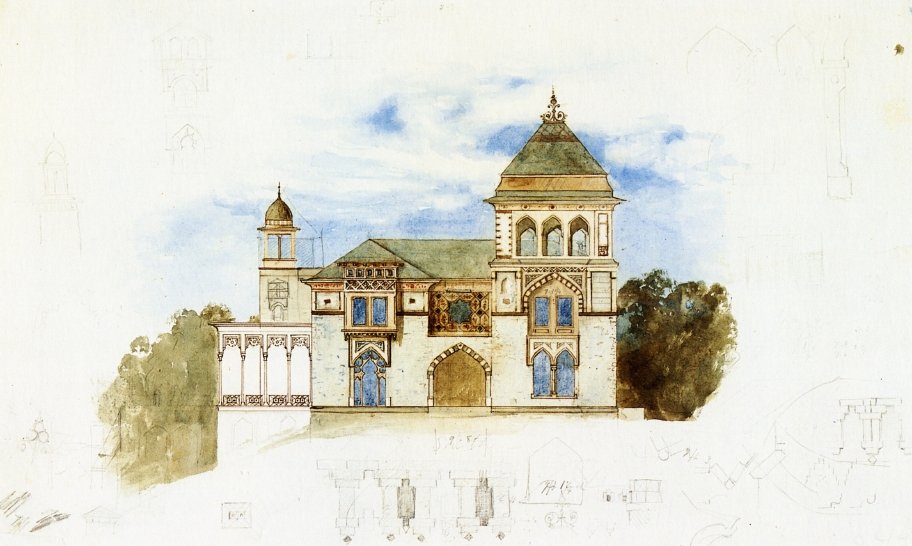
South West Facade of Olana by Frederic Church (1870)
South West Facade of Olana
A watercolour by Frederic Church (1870)

Frederic Church in 1867 was becoming homesick and wanted to return to America and his country estate.  Since he bought it seven years earlier he had been constantly planning the landscape design for the land and the architectural design for a large house on the top of the hill.  Richard Morris Hunt, his architect, had submitted plans for a large French chateau-style house and Church had liked the idea and agreed to the design.   However having returned from his tour of the Levant and studied the architecture of the area, he changed his mind.  He decided to discharge Hunt and take on the British-born American architect and landscape designer Calvert Vaux who was based in Manhattan and had in 1858, along with Frank Law Olmstead had won a design competition to improve and expand New York’s Central Park.

Olana Historic Site
Olana Historic Site

Frederic Church and Vaux worked on the plans for the design of the house which was to be the centrepiece of  Church’s estate, which he and his wife Isabel named Olana after a fortress-treasure house in ancient Persia which like Church’s estate also overlooked a river valley.  The building project was completed in 1872.

As Church got older he spent more and more time on his farm and concentrated his time running the estate.  From the 1870’s onwards Church suffered badly from rheumatoid arthritis which badly affected his right arm curtailing much of his art work although he did teach himself to paint with his left hand.  Frederic Church died in 1900, aged 74 and is buried in Spring Grove Cemetery in Hartford, Connecticut.

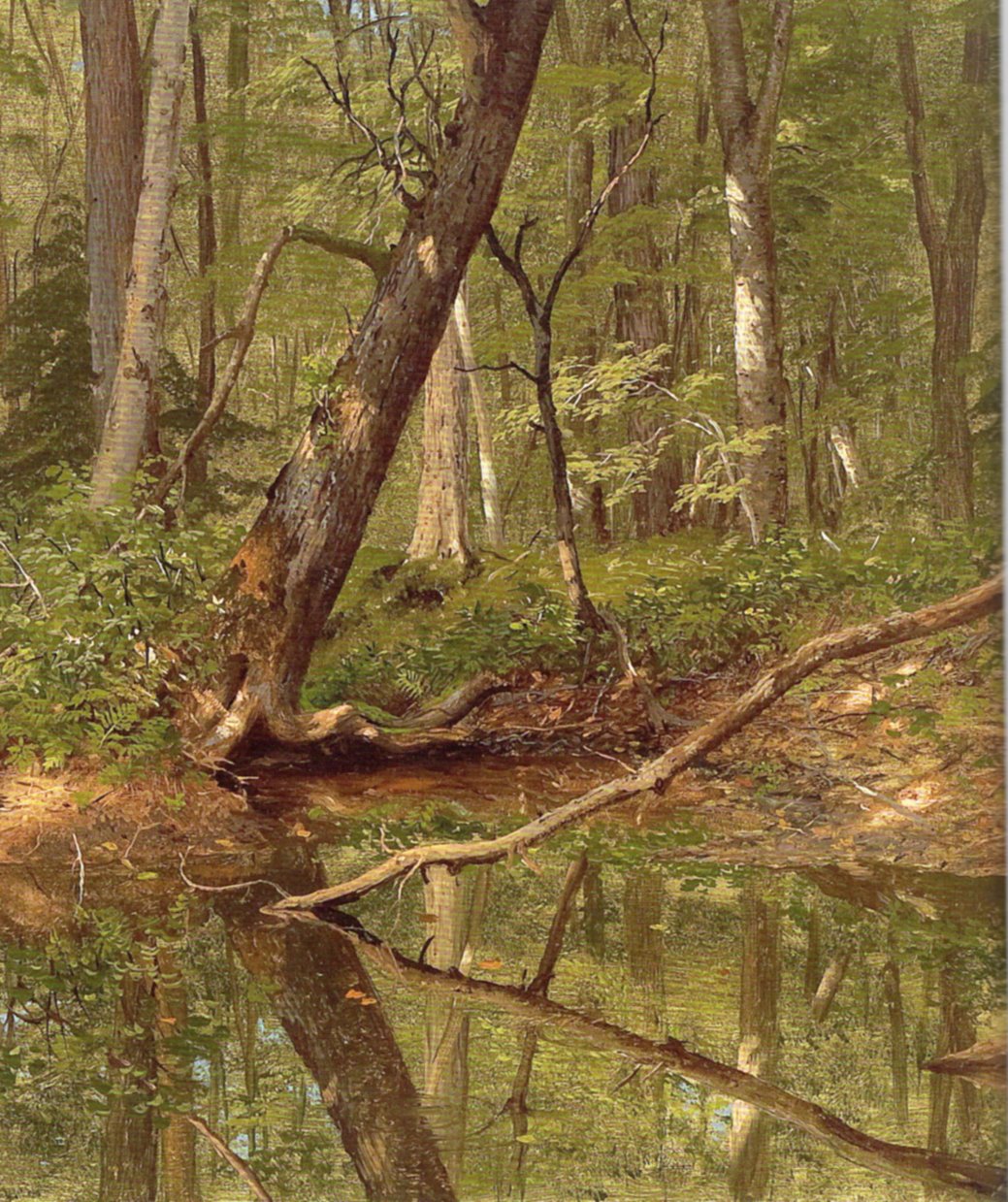
Forest Pool by Frederic Church (1860)

I will finish this blog with a look at the painting by Frederic Church, which most impressed me at the exhibition.  It is entitled Forest Pool and was completed by Frederic Church around 1860.  It was almost the first work I came across as I entered the exhibition room and I had to keep coming back to it in order to savour its beauty.   I stood before it and could not believe the quality of the painting.  Such beautifully drawn details.  Such beautiful colour and tones.  The work was a close-up view of a dense forest and a small forest pool.   Every square inch of the work is covered in rich shades of green and brown and although it was a study for a larger painting, it seems as if it is a finished work.  The artist has delightfully depicted the tranquillity of the forest scene with the calm surface of the pond offering up reflections of the trees and their branches and spots of sunlight.  If you look closely at the upper middle part of the composition you will just be able to make out a hint of blue sky which is otherwise blocked by the screen of trees.

The Frederic Church exhibition at the National Gallery is worth going to see for this painting alone.

Frederic Edwin Church, Part 1

Last weekend I spent a two day break in London attending the christening of my grandson and pottering around a couple of galleries visiting their current exhibitions.   I had tickets for the Boccacio exhibition at the National Gallery and whilst there I decided to call in to their small but excellent Frederic Church exhibition, Through American Eyes: Frederic Church and the Landscape Oil Sketch, which is running until April 28th.   It was a veritable gem of a show and as the publicity stated,

 “…[ it was an invitation to] step into a world of wild natural phenomena with the landscape oil sketches of celebrated American landscape painter, Frederic Church…

 It is a free-to-enter exhibition and one you should try and visit.   I want to dedicate the next two blogs to the nineteenth century American painter Frederic Church, and look at some of his paintings, some of which were at the exhibition.  Church was a master of the plein-air oil sketch and I ask you to accompany me on a journey looking at his life and sampling some of his exquisite artistic gems.

Frederic Church was born in Hartford, the state capital of Connecticut, in May 1826.  He came from a privileged background.  His father, Joseph, who came from a very prosperous family, was a jeweller, silversmith and a Hartford insurance adjuster and the Church household lived an affluent lifestyle.  Frederic, who was brought up in a devout Protestant Congregationalist household, showed a propensity for art whilst at school and through a family neighbour, Daniel Wadsworth, was fortunate enough to be introduced to Thomas Cole, the English-born American landscape artist, who is regarded as the founder of the Hudson River School.  Thomas Cole, who up until then had never taken a pupil under his wing, agreed to take Frederic on as his pupil.   Frederic studied under Thomas Cole in his Catskill studio between 1844 and 1846 during which time he and his tutor would go off on painting trips to the Catskill Mountains and the Berkshires, a highland region in western Massachusetts, west of the Connecticut and lower Westfield Rivers .

Hooker and Company journeying through the Wilderness in 1636  from Plymouth to Hartford by Frederic Church (1846)
Hooker and Company journeying through the Wilderness in 1636 from Plymouth to Hartford
by Frederic Church (1846)

Frederic flourished under Cole’s guidance and, within a year, he had his painting, a scene from early New England history, Hooker and Company journeying through the Wilderness in 1636 from Plymouth to Hartford shown at New York’s National Academy of Design annual exhibition.  The scene recounts the June 1636 journey made by the prominent Puritan religious leader, Reverend Thomas Hooker as he left the Boston area with one hundred men, women, and children and set out for the Connecticut valley. The group traveled over one hundred miles through the wilderness and reached their destination in early July. Many members of the Hooker party settled in Hartford, while some located to nearby Wethersfield and Windsor, and others traveled north and settled Springfield, Massachusetts.    It was through this painting that Church combined his love for ancient landscapes with an acknowledgement of his cultural origins.  The following year Church was elected as the youngest Associate of the National Academy of Design and was promoted to Academician the following year.  That year he sold his first major oil painting to the Wadsworth Atheneum in Hartford, an art museum which had been founded by Daniel Wadsworth.

 After completing his apprenticeship with Cole, Frederic Church moved to New York and set up his own studio in a space which he rented in the Art-Union Building, which was at the centre of the city’s art world, and he began to teach art.   During the spring and autumn months he would leave the city and set out on painting trips throughout New England, particularly Vermont.  Over the months he would build up a large collection of sketches of the beautiful scenery he witnessed, which he would then bring back to his New York studio and during the dark and cold months of winter he would convert them into beautiful landscape paintings.    His landscape artistry was much admired and his landscape works featuring New York and New England vistas sold well.  Frederic Church’s landscape paintings differed from the moral and religious allegorical ones which had been the hallmark of his tutor, Thomas Cole’s landscape works,  for Church wanted to concentrate on the true beauty of nature.  His depictions of storms, sunsets and waterfalls in the Catskill Mountains encapsulated the beauty and spirituality of the American wilderness.  It could well be the case that Frederic Church had read the words of the great English art critic John Ruskin who laid out his ideas of what a young artist should seek to achieve in their landscape works.  Ruskin wrote:
 “…For young artists nothing ought to be tolerated but simple bona fide imitation of nature….. Their duty is neither to choose, nor compose, nor imagine, nor experimentalize; but to be humble and earnest in following the steps of nature, and tracing the finger of God…”

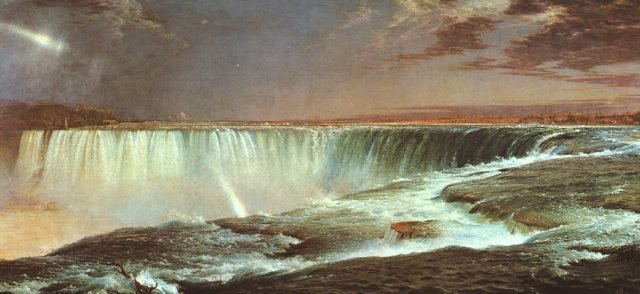
Niagara by Frederic Church (1857)

During a two year period, 1854 to 1856, Frederic Church travelled extensively visiting Nova Scotia, and journeying throughout Maine, New Hampshire, and Vermont, and it was around this time that he visited the Niagara Falls.   The Falls, by this time, had become a great tourist attraction and a favourite destination for artists.  Whilst at the Falls he completed a number of oil sketches which he would utilise when he painted his large-scale works of the Falls in 1857 and 1867.   Frederic Church’s great breakthrough came when, in 1857, he exhibited his painting Niagara It was a large work measuring 107cms x 230cms (see My Daily Art Display Sept 9th 2011) and it visually stunned all who saw it.   Without doubt, the late 1850’s were the high point of Church’s career.  Artistic triumph followed artistic triumph.

 Frederic Church had, like many others,  become fascinated with the translated writings of the celebrated Prussian naturalist and explorer Alexander von Humboldt, which were based on his five-year expedition in the New World at the start of the nineteenth century.  It was in one of his works, Kosmos  that Von Humboldt implored artists to travel and paint equatorial South America.   In 1853, along with his friend, the young entrepreneur Cyrus West Field, who had financed the trip, Church set off on the first of two expeditions following Humboldt’s footsteps, chiefly in Colombia;  the second trip, in 1857, in company with the American Creole landscape painter, Louis Remy Mignot.   Together, the artists travelled from Panama to Ecuador, where they spent 10 weeks painting village and mountain scenes.

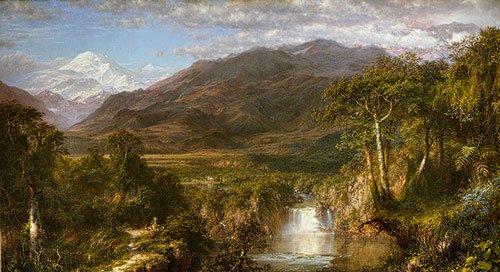
The Heart of the Andes by Frederic Church (1859)

From his trips to South and Central America, Frederic Church amassed a large collection of sketches from which, on his return home, he completed large and spectacular oil paintings.  One of these works was his ten-foot wide work entitled The Heart of the Andes which he completed in 1859.   This elaborate and highly structured painting was his most ambitious work.  In this painting Church managed to depict the variety of earthly life as seen by the lush green foreground.   The painting took pride of place in a New York exhibition, housed in an elaborate window-like frame and illuminated in a darkened room by concealed skylights.  Can you just imagine what nineteenth century viewers made of this extraordinary painting exhibited in such an extraordinary setting?   People thronged to see the painting and it was estimated that more than twelve thousand people visited the exhibition in three weeks and were happy to part with a quarter each to see it.  For that admission fee, the public were provided with opera glasses so that they could examine the painting in detail.  The painting was then shipped to England where once again people flocked to see it.  Church eventually sold it for $10,000, at that time the highest price ever paid for a work by a living American artist.

Iceberg Flotante by Frederic Church (1859)

In 1859 Church took a voyage north along the coast of Newfoundland and Labrador in search of icebergs.  On this trip he was accompanied by the Reverend Louis L. Noble, an author who was to write about their trip together in his 1861 book, After Icebergs with a Painter: A Summer Voyage to Labrador and Around Newfoundland.  During their voyage of discovery Frederic Church and Noble would hire a boat to take them up close to these awe-inspiring floating icebergs to allow Church to sketch these remarkable and majestic floating white giants.  Frederic Church managed to capture the breath-taking beauty of these white giants in a number of his paintings, one of which was his work entitled Iceberg Flotante which he completed in 1859

The Icebergs by Frederic Church (1861)

I particularly like his 1861 painting entitled The Icebergs, in the foreground of which we see a broken masthead lying cross-like on the ice.  Not only is this a beautiful landscape work but it is a kind of historical painting as the inclusion of the masthead is a reference to the tragic loss of Sir John Franklin’s doomed British expedition party which had been attempting to cross the last un-navigated section of the North-West Passage in 1847.  Sadly, the two ships of the expedition became icebound in Victoria Strait, close to King William Island in the Canadian Arctic.  Despite the British Admiralty’s sending numerous search parties to find the ships, the entire expedition party, including Franklin himself and his 128 men, was lost.

……………………………………………….to be continued in my next blog.

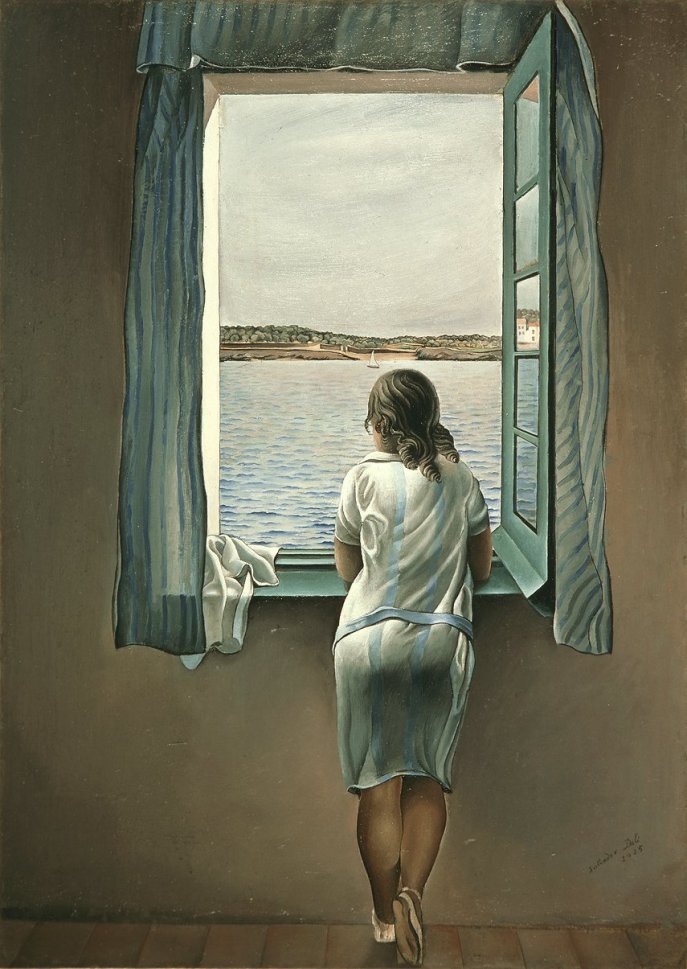
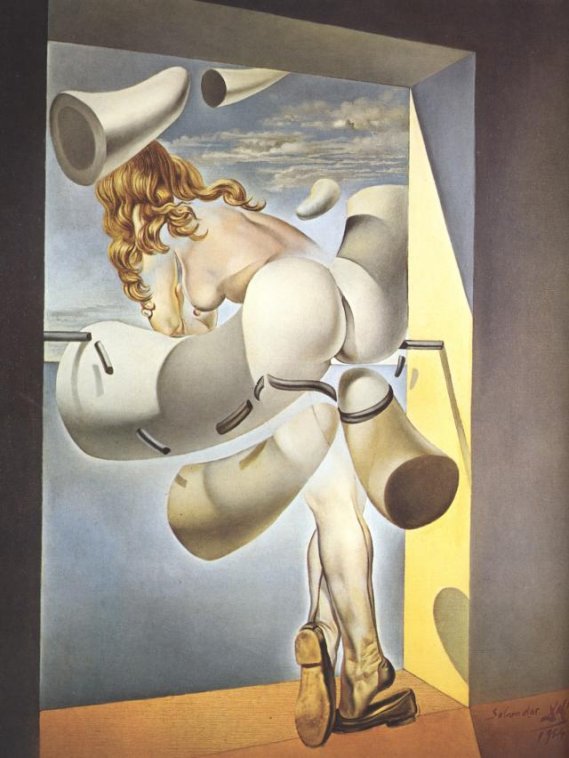
Figure at a Window by Dali (1925) and Young Virgin Autosodomized by her Own Chastity by Dali (1954)

Figure at a Window by Dali (1925)

My blog today looks at two paintings by the same artist, completed twenty-nine years apart.  There is an obvious a similarity about the works and yet they could not be more different.   As a non-painter, it is this difference in style which intrigues me.   The artist in question is Salvador Domingo Felipe Jacinto Dalí i Domènech, better known simply as Dali.

Dali was born in 1904 in Figueres, a Spanish Catalonian town close to the border with France.  He was born into a middle-class background.  His father, Salvador Dalí i Cusí, was a lawyer and notary and a fierce Catalan federalist.  His mother was Felipa Domenech Ferrés, a demure and pretty Barcelona girl, two years younger than her husband.   Felipa’s mother had been a talented craftsman, who had run a long-standing family establishment that specialized in making objets d’art.  Felipa Domenech before her marriage to Dali’s father in 1900 used to help her mother in the workshop and developed a considerable skill as a designer of `artistic objects’.    She was deft with her fingers, and was accomplished in drawing.  She would spend time fashioning delicate wax figurines out of coloured candles which was a source of amusement to her son.

It has been recorded that young Dali was both an intelligent and a precocious child.  His father was a strict disciplinarian and, thankfully for Dali, this was countered by the love he received from his mother, who often indulged her young son in his artwork and his many eccentricities.  This coddling of her son was probably partly due to her fear that she would lose him to illness as she did her first son.  It was not just his mother who spoilt him as he was the centre of attention of his maternal grandmother, Maria Ana Ferrés and his aunt Catalin.  His mother doted on him and at the first sign of illness he was allowed to take to his bed.  In her controversial book about her brother entitled Salvador Dali, Seen through the eyes of his sister,  Dali’s sister wrote how her mother only rarely let young Salvador out of her sight and would often sit by his bedside for hours at night as he slept for if he awoke and found himself alone, he would cause quite a commotion.   However his father’s relationship with his son was quite different.  He would never tolerate his son’s so-called eccentricities and often punished him.   Dali would often turn to his mother for affection after being chastised by his father and this would further annoy his father who looked upon Dali’s closeness to his mother as a kind of threat to the affection she gave to him, her husband and in consequence the father-son relationship deteriorated.  I am sure psychologists would consider this triangle of affection to have caused some of Dali’s future mental turmoil.

Dalí had had an older brother who was born nine months before him.  He had also been named Salvador but had died of gastroenteritis in infancy, just nine months before the artist was born.  The naming of their second son the same as their deceased son (as was the case with Vincent van Gogh and his deceased elder brother) may have played on Dali’s mind and he once recounted the story of the time, when he was just five years old, that his parents took him to the grave of his older brother and told him he was his brother’s reincarnation. Dali later wrote of this event and of his dead brother, saying:

“…[we] resembled each other like two drops of water, but we had different reflections.  ” He ” was probably a first version of myself, but conceived too much in the absolute…”

In 1908 his sister Ana Maria was born and it is her who features in the first of today’s paintings.  Dali started school at the age of four, attending the Escuela Pública (public school) in Figueres.   This was not the local Catholic school which he could have attended but his father who held an anti-Catholic sentiment decided to send him to the local state school.   Dalí had an aversion to school life, found concentrating during lessons very difficult and he spent most of his time daydreaming.  This lack of attention to his school work and his seemingly lack of progress with his academic work after the first year annoyed his father and caused him to have a re-think about his son’s schooling.  He eventually decided to have his son transferred to a private Catholic school, one run by the brothers of the French La Salle order,  where all of his classes were taught in French. This had a profound effect on Dali’s future life as although at home he spoke Catalan, he had been taught Spanish at that early school.  With his transfer to this new French speaking school, French was to become the language that he would use during his artistic career.  Dali was still not happy with life at school, maybe because he was bullied but also to him, being confined in a small classroom, which he looked upon as a kind of gaol, was very claustrophobic.

What Dali liked was the school holidays when the family would spend time together in the seaside town of Cadaqués, where his father had been born and where the family had a small holiday house.  It was during these long summer holiday periods that he felt free from the constraints of school life, free to paint and draw pictures of his family and his beloved Catalan coastline and it was whilst holidaying at Cadaqués that he met the artist, Ramón Pichot, who was a family friend .  Pichot was an artist who painted mostly in the style of the Impressionists, but more importantly to Dali, Pichot also liked to experiment with some styles of the Catalan avant-garde.

On February 6th 1921 Dali’s mother Felipa died of breast cancer.  The death of his mother hit the sixteen year old Dali very hard.  It was a very traumatic time in his life.  He described the time as:

“…the worst blow of my life.  I worshipped her;   she was unique….. Weeping and with clenched teeth I swore that with all the power of the holy light which would one day circle my glorious name I would rescue my mother from death and from fate…”

Dali’s father quickly married his deceased wife’s sister Catalin who had already been living with the family for the past eleven years.

Ramón Pichot continued to mentor Dali during his youth and it was he who managed to persuade Dali’s father to let his son leave school and enrol at the San Fernando Academy of Art in Madrid.  In the autumn of 1922, Dali along with his father and sister travelled to Madrid and Dali sat a gruelling six day entrance examination which comprised of the candidates having to prepare drawings of a classical sculpture.  Dali passed the exam and aged 18,  he became a student at the Academy.   Life at the Academy was so different to life at school and Dali revelled in the freedom of self-expression.   Whilst there he made a number of friends including Federico García Lorca, who would become one of Spain’s leading poets and dramatists  and Luis Buñuel, who became an international film maker and film director half a century later.   Whilst at the Academy Dalí experimented with a number of painting styles, mainly avant- garde, such as Cubism, Futurism and Purism, which he studied through reading articles and studying reproductions in art journals. Dali started exhibiting his work in galleries in Barcelona and Madrid and was allowed two solo exhibitions.  He would also exhibit work at exhibitions with other Catalan modernists. His work was greeted with acclaim which boosted his confidence.  He believed that he was progressing steadily in the art world but he believed such progression was, in a way, being nullified by the type of artistic tuition he was receiving at the Academy.  He felt that neither the tutors nor the art syllabus was sufficiently challenging enough.   His dissatisfaction led to him often criticising and openly challenging the authorities at the Academy which eventually lead to him being asked to leave in 1926.

I will leave Dali’s life story at this point to concentrate on the first of my two featured paintings, entitled Figure at a Window, which Dali completed in 1925.   The painting is not one which we would immediately attribute to Dali.  Like many of his early works it features two of Dali’s favourite depictions – the Catalan coastline and a member of his family.    This early work by Dali, completed when he was twenty-one years of age, is one of Dali’s best known and most important early oil on canvas works.  Dali used his sister Ana Maria as his model.  She would remain the artist’s only female model until his beloved Gala came along in 1929.   Salvador’s relationship with his sister was very close, even more so when their mother died in 1921 and in some ways she took over the role of the mother who had to constantly cope with the ever discontented son.    The work we see is the height of tranquility.  This serene and peaceful feeling one gets when one studies the work is a result of Dali use of the predominant colours of light blues and lavenders.   There is a stress-free intimacy about the painting, which would soon disappear from his works.  We cannot see the face of the girl.  She has her back to us as she leans against the sill of the open window.  She gazes out at the bay at Cadaques, the seaside resort much loved by Dali.   This viewpoint, while lending the picture an air of intrigue, ensures that the viewer’s eye is drawn, like the girl’s, to the landscape ahead.

Girl from Ampurdam by Dali (1926)

Although this is simply a painting of his sister looking out of a window with a view across a stretch of water, there is something about the way he has depicted the girl and the way she is dressed which adds a modicum of sensuality to the painting.  The clothes Ana Maria wears cling tightly against her and one cannot help but notice the way the tight fitting dress accentuates the swell of her buttocks.  It is interesting to note that a year later Dali painted The Girl of Ampurdam in which we once again see the rear view of a girl, standing in a provocative pose which again accentuates the curvature of the cheeks of her bottom.  It is not certain whether Ana Maria was the model for this painting but once again we can be in no doubt as to the part of the female anatomy that appealed to Dali the most !   Ana Maria commented about the way in which Dali portrayed her and also incorporated the Catalan landscape:

“…During the hours I served him as model, I never tired of looking at the landscape which already, and forever, formed part of me. He always painted me near a window. And my eyes had time to take in all the smallest details….”

Young Virgin Autosodomized by her Own Chastity by Dali (1954)

And now to the second painting, which although in complete contrast to the first, I am sure you can recognise a certain similarity.  In this second work, which has the bizarre and somewhat tasteless title, Young Virgin Autosodomized by her Own Chastity, the tranquillity and the innocent peacefulness of the first painting is nowhere to be seen.   Why would an artist suddenly change the atmosphere of the painting?  Why would he want to depict the violation of the female, who held a similar pose to the one in the earlier painting, which had been modelled by his sister?

For the answer to that maybe we need to consider a couple of books, one an autobiography and one a biography.  In 1942 Dali published his autobiography entitled, The Secret Life of Salvador Dalí  and seven years later in 1949 his sister, Ana Maria published her own biography of her brother, Salvador Dali as Seen by his sister.   Unfortunately Dali’s autobiography was a somewhat sanitised version of his life story and was quite different to the way in which his sister viewed him in her book.   Dali was horrified by Ana Maria’s version of his life and the way in which he lived it.  He felt it cast him in an unflattering light and viewed her words as a blatant betrayal and sadly his perceived view of her disloyalty led to the total collapse of their relationship.   So incensed was he by this betrayal by his sister that in 1954 he decided to paint another version of his 1925 Figure at the Window which had featured her.  He called his new painting Young Virgin Autosodomized by her Own Chastity.  The figure of the young woman was, according to Robert Descharnes 2002 Dali biography, Dalí, L’héritage infernal, based upon a photograph published in a 1930’s pornographic magazine.

In the painting we once again have a rear view of a woman who is looking out over a stretch of water  at a distant landscape.  She is depicted leaning over a rail with horned shaped objects being pointed at her. One of these horns has positioned itself as the one which will sodomize her. These horned shaped objects are phallic-like in shape.  So what do the horns symbolise?  According to one of his biographers, the rhinoceros horns in the painting were symbolic and that  a rhinoceros is a very forceful animal as well as a very dangerous one.  The one thing about a rhinoceros, though, is that they do not attack unless provoked. This adds another element to the painting. Is it that Dali was provoked by his sister’s autobiography to paint this work?   If the woman is being sodomized, is it because she brought it upon herself?    The railing, which she is bent over and which is shattered by one of the larger phallic horns, symbolizes a chastity belt and its destruction symbolizes the destruction of her chastity.

One would wonder who would want to own such a disturbing painting.   However we do know who owned it up until February 2003 at which time he sold it at Sotheby’s London auction.   It was none other than Hugh Heffner who had, on behalf of Playboy Enterprises, sold it for two million pounds.  It had been hanging in the entryway to the dining room of the Great Hall in his Playboy Mansion in Los Angeles.

 I am not sure it is the kind of painting I would like to have hanging in the dining room of our Bed & Breakfast establishment.

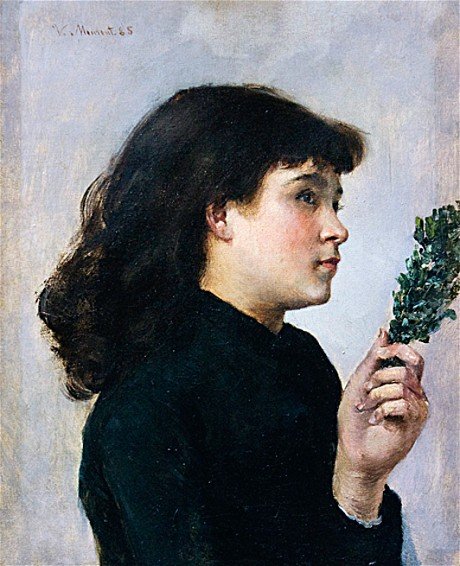
Victorine Meurent

Le Jour des Rameaux by Victorine Meurent (c.1880)

The painting above, Le Jour des Rameaux or Palm Sunday, is unique in as much as it is the only surviving painting by my featured artist.  It was recovered in 2004 and can now be found hanging in the local museum of Colombes, a suburb of Paris.  The artist who completed the work in the 1880’s is Victorine Meurent.  “Victorine who? “, do I hear you say.  If you haven’t heard the name as an artist, you may have heard of her as an artist’s model.

Victorine Meurent was born into a working class family in Paris in 1844.  It is thought that her father worked as an engraver, a patinator of bronze, and her mother worked as a milliner. Little is known of Victorine’s teenage years but it is known that she had a musical aptitude being able to play various instruments, such as the guitar and violin.   It is also thought that she must have shown an interest in art as it is believed that in 1860, at the age of sixteen, she worked as a model at the Senlis studio of the French history painter, Thomas Couture, and it was here she probably received her first artistic tuition.      Two years later, in 1862, she met Édouard Manet.  One account tells of their meeting at Couture’s studio, another version of the meeting was that Manet saw her walking down a Paris street carrying her guitar.  Whatever the circumstances of that first encounter, there was an immediate rapport between these two very different characters.  She was a young unsophisticated girl from a poor background eking out a living as an artist’s model whilst at the same time struggling to become an artist in her own right.   Édouard Manet, on the other hand, was twelve years her senior, a wealthy painter who came from an aristocratic background.   So what could the two offer each other?  I suppose it is obvious.  For her, Manet could provide her with employment as his model and at the same time offer her some drawing tuition.  For him, being a painter, he was always on the lookout for a good looking young female model and Victorine with her eye-catching long unruly red hair was just what he liked.  She was small, slightly dumpy in stature, which often led her to be given the nickname, la Crevette, the shrimp.   She was not what one would describe as an elegant beauty but she appealed to Manet.  It was almost a marriage made in heaven and she would, for the next ten years, become Manet’s favourite model.

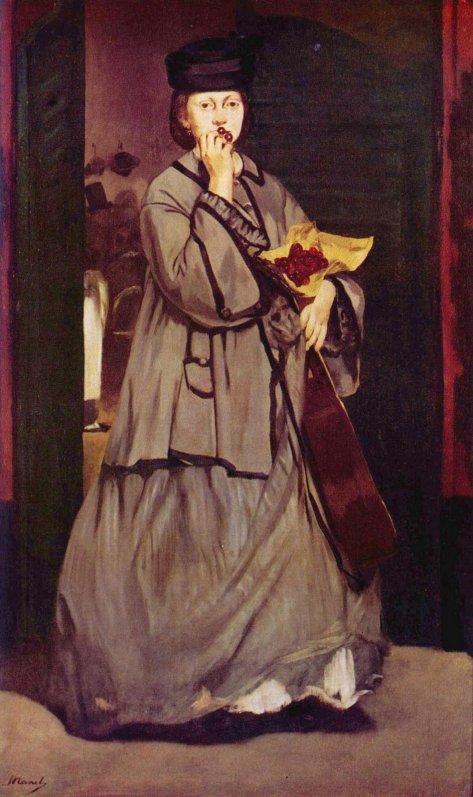
Street Singer by Edouard Manet (1862)

The first time Manet used Victorine as a model was for a painting in 1862.   The painting is entitled Street Singer, which is now owned by the Museum of Fine Arts, Boston.  The woman we see depicted is modelled by Victorine.  She is hurriedly leaving a café, with her guitar securely tucked under her arm.  She is dressed in a drab brown gown alluding to the fact that she was poor and did not have the money to buy a new one.  She has been performing her music at the café and appears to be in a hurry to get to her next musical appointment.   Although she has no time to loiter, she quickly glances towards us and, at the same time, crams cherries into her mouth.  This gesture once again alludes to the fact that she is not one of Paris’ refined ladies.  She is too busy to stop and soon will disappear amongst the bustling Parisian crowd.    This painting by Manet was in some ways a new kind of art.  It was not the academic art which depicted women in scenes from the bible or from mythological stories.  This art of his depicted real life, real people and as he himself said:

“…You must be of your time and paint what you see…”

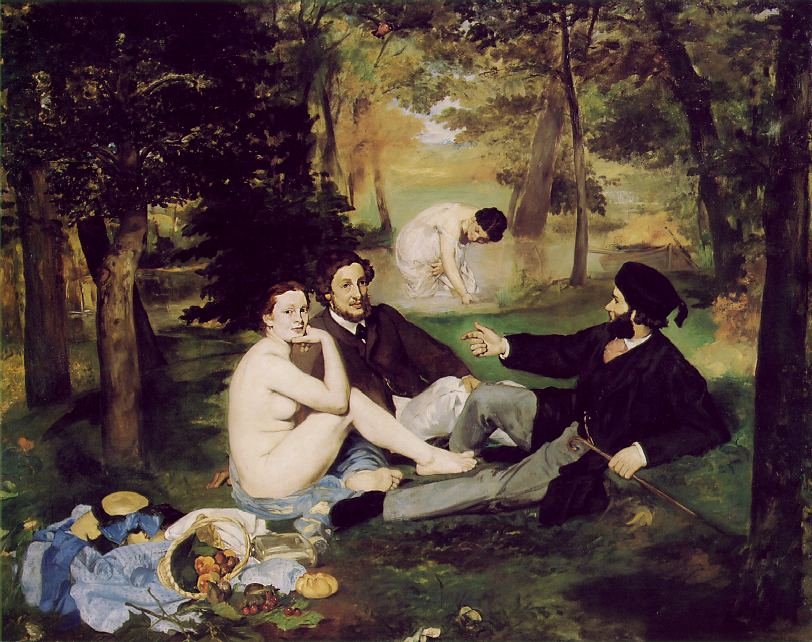
Probably the two most famous or maybe infamous works by Édouard Manet, and which also featured Victorine Meurent,  were the nude portrayals of her in his 1862 painting Olympia (see My Daily Art Display Oct 12th 2011) and his 1868 painting, Le Déjeuner sur l’herbe (My Daily Art Display Oct 23rd 2010)

Le Déjeuner sur l'herbe by Édourad Manet (1862-1863)
Le Déjeuner sur l’herbe by Édourad Manet (1862-1863)

The larger version of Le Déjeuner sur l’herbe  can be found at the Musée d’Orsay whilst a smaller version is housed in the Courtauld Gallery in London.   We see her completely naked with two fully clothed men lounging on the grass having just partaken of a picnic with two gentlemen friends.   The painting caused a furore and Victorine was caught up in the public scandal which followed the exhibition of the work.  It was said that respectable men hurried their wives past the naked depiction of Victorine before they themselves returned for a closer look !!!   Emperor Napoleon III who visited the exhibition was vociferous in his condemnation of the work saying that it was disgusting.

What particularly shocked the public was that she was portrayed as a naked woman who exhibited no mortification at her compromising position alongside two fully clothed men.  The man sitting next to Victorine was modelled by Manet’s brother-in-law, Ferdinand Leenhoff, and the man laying back opposite her is a composite of Manet’s two younger brothers, Eugène, who went on to marry the artist Berthe Morisot, and his other brother Gustave.  If we looked at historical paintings of the time, naked women who were depicted as nymphs or goddesses were more likely to be shown shrinking from the viewer in order to reach some piece of clothing to hide their nudity. In Manet’s picture, the young woman makes no attempt to hide her nudity.  She just sits there, seemingly bored by her companions and what they had to say and appears to have been lost in thought until we came on to the scene.  Now she fixes us with her gaze and we are made to feel uncomfortable as we take on the role as voyeurs.  It was maybe not just Victorine’s state of undress that shocked the public but her haughty and reproving gaze that caused the upset.   This painting had been rejected by the jurists of the 1863 Paris Salon and so Manet had to turn to the Salon des Refusés for inclusion in their exhibition.

Olympia by Édouard Manet (1863)

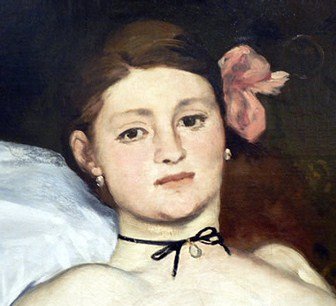
As Le Dejeuner sur l’herbe shocked the public and caused such a stir one may have been forgiven for thinking that Manet, with his model, Victorine Meurent would tone down his next work.    Far from toning down the subject of his next painting, he shocked the public even more with his following work which he completed in 1863, and which was entitled Olympia.  If we recall Le Dejeuner sur l’herbe we have to admit that there was no hint of sexual activity having taken place at the picnic.  The furore was caused by a naked woman being depicted next to two clothed gentlemen and if we, the viewers, wanted to accept a sexual connotation to the depiction then that was more of what was in our mind and not what was depicted on the canvas.   However Olympia went a step further by depicting the lady, modelled by Victorine, as a courtesan awaiting her next client.  The bedclothes she lies upon are still rumpled from her previous sexual encounter.   Her black maidservant has just brought her flowers from her next eager client but the courtesan ignores them and just looks out at us, a sign that the flowers meant nothing to her and it was simply a case of business is business.  One can just imagine how the visitors to the exhibition felt when they saw this work.  It is believed that this depiction of a female nude by Manet was the first time an artist had depicted a naked female.

The face of OlympiaAlthough similar to Giorgione’s Sleeping Venus Manet’s work did not hide the nudity as part of a mythological scene.  Another reason for the public’s condemnation of the work was the fact that Victorine’s face is clear.  Manet has not depicted the naked woman with just an indistinct face.  The face is real and by doing this Manet has humanized his courtesan or prostitute and it is that which upset the viewing public.  Maybe the gentle folk of Paris did not want to be reminded that prostitution existed and flourished in their fair city.  Courtesans had been depicted before in 19th century paintings but it was Manet’s unabashed and honest depiction of a prostitute lounging in bed, naked except for a pair of slippers and a necklace, which shocked the Parisians.

Gare Saint-Lazare or The Railway by Édouard Manet (1873)

The Manet painting I like the most which also featured Victorine was his 1873 work entitled Gare Saint-Lazare often known as The Railway (My Daily Art Display Nov 9th 2011).   This was the last painting by Manet featuring Victorine and can be seen at the Royal Academy’s current exhibition Manet, Portraying Life.

Although Victorine Meurent was used as a model in those three paintings,  were they accurate portraits of the model?   Not really and one must remember they were never supposed to be portraits of her but if we really want to see what she looked like at the age of eighteen we should take a look at Manet’s 1862 portrait of her, Victorine Meurent.  She is not a Society beauty and yet Manet has afforded her all his time to depict her beautifully in this portrait.  The first thing that strikes you about this young woman is her red hair.   We do not see the flowing locks we knew she had as her hair is held in place by a blue ribbon bow.  Her eyelashes are much lighter than the colour of her hair.  They are almost blonde and are somewhat difficult to detect.  There is a strange blankness about her expression.  It is a look of indifference.  Her lips are pressed tightly together.  She has a square jaw and a cleft chin.  We look at her face and wonder what she was thinking when Manet was painting her portrait.  Her forehead and left cheek are lit by an external light source which comes from her right.

During the time she was Manet’s model, she also worked as a model for Manet’s artist friends, Edgar Degas and the Belgian artist, Alfred Stevens who it is rumoured would later become her lover.  The Manet-Victorine Meurent partnership ended shortly after the artist had completed The Railway.  Victorine, by then, had taken up formal art lessons and her love of art leaned towards academic art which was anathema to Manet and may have caused the two to go their own separate ways.  In 1876 she had her self portrait exhibited at the 1876 Salon.  This was the same Salon that rejected two of Manet’s works, The Laundress and The Artist.  Manet was so annoyed by that decision that he opened his studio to the public to exhibit the refused paintings and other works.  Three years later in 1879 Victorine Meurent had her painting, Bourgeoise de Nuremberg au XVIe siècle, accepted at the Salon.  This time Manet’s works, Boating and The Greenhouse were also accepted for the exhibition.  Victorine managed to have her works accepted at six different annual Salons.

Victorine remained and worked in Paris, but times got harder for her and there is no doubt that she was suffering financial hardship.  In total desperation, it is said that in August 1883, five months after Manet’s death, she approached Manet’s widow for financial help.  She told Madame Manet that her late husband, Édouard, had promised to provide her with some money if he ever was successful in selling the paintings for which she had posed. At the time Victorine had declined Manet’s offer but had told him that she would remind him of it once her career as an artist’s model was over. Her appeal for money to Manet’s widow fell on barren ground and Victorine was never recompensed.   According to Édouard Manet’s biographer, Adolphe Tabarant, Victorine, in the 1890’s spent a lot of time around Montmartre drinking heavily, and telling stories about her and Manet to anybody who would listen to her and buy her a drink.   It would appear that things got somewhat better for Victorine for in 1893 as it is recorded that  she was again exhibiting her artwork, this time at the Palais de l’Industrie.

In 1903, aged 59 she was made a member of the Société des Artistes Français.     Three years later she left central Paris and moved to the northern suburb of Colombes where she lived with a friend, Marie Dufour.  The local census records show that Marie Dufour worked at different times as a secretary and a piano teacher and Victorine was listed as an artist.  Meurent died on March 17, 1927 aged 83.  After the death of Marie Dufour, in 1930, the contents of the house were liquidated; in the late 20th century, elderly neighbours recalled the last contents of the house, including a violin and its case, being burnt on a bonfire.
Many rumours still surround the life of Victorine Meurent.  She was rumoured to have plumbed the depths through drink and unsavoury tales abound regarding her sexual habits and her sexuality but I would rather just think of her as Manet’s muse and inspiration who, as a young girl, became part of some of his greatest works of art.

Kees van Dongen, his life, his family and his art

Portrait of Guus Preitinger by Kees van Dongen (1910)

Last Thursday I embarked on my monthly pilgrimage to London to visit a couple of art galleries and take a look at two new art exhibitions and it was during those visits that I found a few paintings which I will include in my forthcoming blogs.  Two of my featured paintings today were not in a specific exhibition but were in the permanent collection of The Courtauld Gallery, which is a veritable gem when it comes to medium sized galleries and one you should put on your “to visit” list the next time you are in the capital.  Today I am highlighting some works by the Fauvist Kees van Dongen, which feature his wife and daughter.

Cornelis Theodorus Marie van Dongen, better known as Kees van Dongen, was born in January 1877 at Delfshaven, which is now a suburb of Rotterdam.    At the end of 1892, he enrolled as a student on a five-year course at the Akademie voor Beeldende Kunsten (Academy of Visual Arts) in Rotterdam, now known as the Willem de Kooning Academy, named in memory of the famous Dutch artist Willem de Kooning.    As a student he also needed to earn some money and so he carried out some illustrative work for the local newspaper, Rotterdamsche Nieuwsblad.  His own artistic work in these early days was greatly influenced by the Dutch artist, Rembrandt and many of his works displayed the dark tones of the great Dutch master.

It was whilst he was at this Academy that he became very friendly with another art student, Juliana Augusta “Guus” Preitinger.  Guus had been born in Cologne but early in her life the whole family had relocated to Rotterdam and eventually they all became Dutch citizens.  She revealed a great aptitude for drawing in her childhood years and her family supported and encouraged this artistic talent and had her enrol at the Academy.  On completion of their studies, Kees and Guus decided to move from The Netherlands and seek their fortune in the European capital of art, Paris.  Guus went off to Paris first in search of employment and Kees followed in 1899.   Shortly after arriving in Paris van Dongen met Félix Fénéon, the art critic and Parisian anarchist who had become a great supporter of a new group of French artists lead by Georges Seurat, whom he had christened, Neo-Impressionists.  Van Dongen and Fénénon became great and long lasting friends.

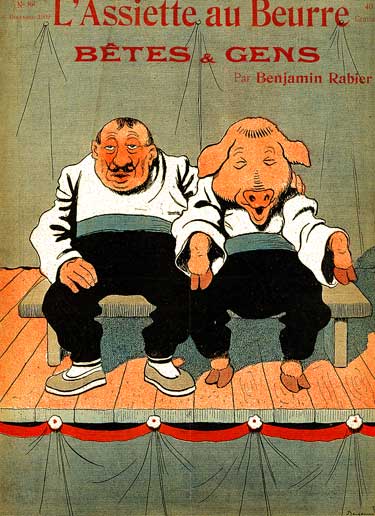
Between 1900 and late 1903, van Dongen did very little painting, probably due to financial difficulties. Through the good offices of Théophile Steinlen, a Swiss-born French Art Nouveau painter and printmaker, who worked for the satirical papers of the day,  L’Assiette au beurre, Le Rire, L’Indiscret and Le Frou-Frou , he managed to get some work for van Dongen on these periodicals and with the money van Dongen earned as an illustrator he managed to set up house with Guus Preitinger.

L'Assiette au Beurre magazine cover of 1902
L’Assiette au Beurre magazine cover of 1902

Van Dongen’s began to take an interest in the social and political affairs of Paris.  He especially took a great interest in the environment and lifestyle of the city’s prostitutes and courtesans.   He spent a lot of his time producing illustrations for political and social publications especially the journal L’Assiette au beurre, which was the most remarkable and resilient of cartoon journals of social protest in France during the first decade of the twentieth century.  It was a journal which looked at things such as the corruption of politicians and the country’s violence against the poor and the downtrodden.   Van Dongen illustrated an entire issue of L’Assiette au beurre (dated 26 October 1901) which was devoted to the subject of prostitution from the perspective of the conditions of the prostitutes and the tone of the edition indicated their belief that prostitution in contemporary Paris was a phenomenon symptomatic of the degeneration of the bourgeoisie.

In June 1901, Kees van Dongen and Guus Preitinger married.  Their first child, a son, was born that December but died when only two days old.    In 1904, Kees van Dongen was sponsored by Paul Signac and Maximilien Luce, to exhibit at the Salon des Indépendants and in that same year he had a major breakthrough with his art when he was granted gallery space at Ambroise Vollard’s establishment.  Vollard, one of the major art dealers in Paris, was a champion of avant-garde art and allowed van Dongen to show almost a hundred of his works, most of which were his early works depicting scenes from Holland, the Normandy coast and Paris.  The following year, van Dongen exhibited two of his works at the Salon des Indépendants, and at the infamous 1905 Salon d’Automne exhibition.  The Salon d’Automne was founded two years earlier by a group of artists and poets that included Renoir, Eugène Carrière, Georges Rouault and Édouard Vuillard, under the leadership of the Belgian architect, Frantz Jourdain.   They set up their Salon in direct competition to the conservatism of the official Paris Salon and the Salon des Independents and welcomed any artist who wished to join.   The decision on what would be allowed into their exhibition was, like the Paris Salon, to be decided by their own jury, which was selected by drawing straws from the new group’s membership, and it was their intention to give the decorative arts the same respect accorded the fine arts.   Their 1905 exhibition, which included the two works by van Dongen, was probably their best known for it was at this show that one of the visitors was the art critic Louis Vauxcelles, who on entering a room set aside for paintings by Matisse, Vlaminck, Albert Marquet, André Derrain and van Dongen, he commented on the “violence” of their works and their uninhibited use of pure non-naturalistic colours.   Seeing a traditional sculpture uncomfortably situated in this room amidst these hotly coloured paintings, Louis Vauxcelles joked to Matisse that it was like “a Donatello among the fauves [wild beasts]”. This group of painters was from that day on known as the Fauves and Fauvism as such was born.
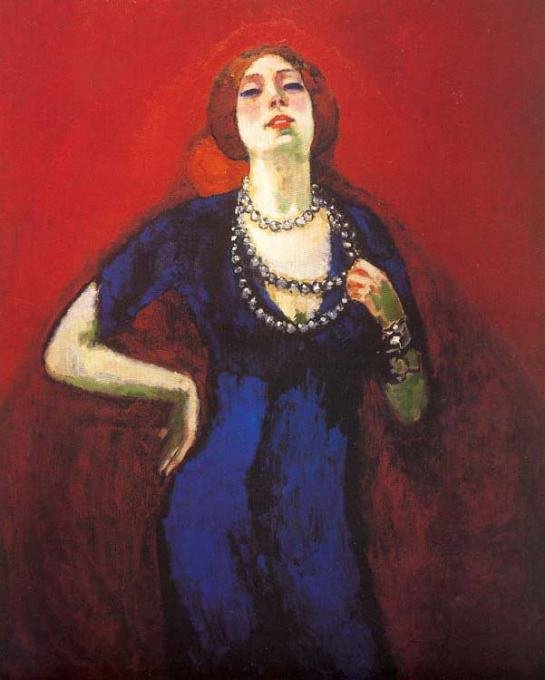
In April 1905 Kees van Dongen and his wife Guus had a daughter whom they named Augusta but would always be known as Dolly.   The family moved to the Montmatre district which was a favourite haunt of the artistic community.   They moved into an apartment in the somewhat dark and squalid building on the heights of Montmatre, nicknamed Le Bateau Lavoir.  Pablo Picasso  and his companion Fernande Olivier had a studio next to theirs and the two artists became close friends.   Fernande Olivier referred to the strong ties between the two artists and their respective entourages in her memoirs Picasso and His Friends and In Love with Picasso.    In the latter she recalled how Picasso loved Kees and Guus’ daughter Dolly.  She wrote:

“…Pablo loved little Gusie and played with her without getting bored, she could get him do whatever she wanted. I didn‘t know at the time that he could take so much pleasure in being with children. We would have liked to have a child, but as this wish was never realized, we had to be content with the little Van Dongen…”

Fernande Olivier by Kees van Dongen (1905)

It was whilst living here that Picasso painted his famous Les Demoiselles d’Avignon.   Many other artists moved into the apartment block and  it soon became a meeting place for all the contemporary artists of the time. Although the paintings by van Dongen continued to show the power and passion of Fauvism, by 1907 most of the other Fauvists had moved on and had begun to explore new styles.  Van Dongen produced a series of portraits of Picasso’s “lover” Fernande in a wide range of styles, and she established herself as his preferred model, alongside his wife Guus.   His painting at this time was turning increasingly to women, and the often erotic depictions were out of step with the time, and would often provoke a somewhat prudish reaction

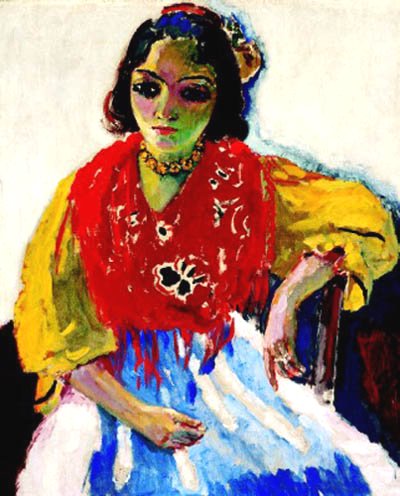
Gypsy by Kees van Dongen (1911)

In 1907 van Dongen had met the German Expressionist  Max Pechstein who was visiting the French capital.   Pechstein was one of the most prominent artists of German Expressionism. He was hailed by some of his contemporaries as the leading member of the Dresden-based Die Brücke group.  Their meeting led in 1908 to Van Dongen being invited to exhibit alongside the group.   His works went on to influence a number of its members.  In the winter of 1910-1911 van Dongen visited Spain and Morocco. This was his first time he had been able to observe, first-hand, Moorish architecture, with its palaces and the mosques with their fascinating minarets, the contrast of dark passages and dazzling white walls baked by a scorching sun. What fascinated Van Dongen was the look of the Andalusian people, the movement of the bodies of the flamenco dancers as they danced to the wild rhythms of their tambourines and the colours of the flower-embroidered Manila shawls.  After his travels, an exhibition of his works was held at the Galerie Bernheim Jeune in June 1911 under the title Hollande, Paris, Espagne, Maroc and this further established the reputation of the works which were influenced by his travels through the southern lands.

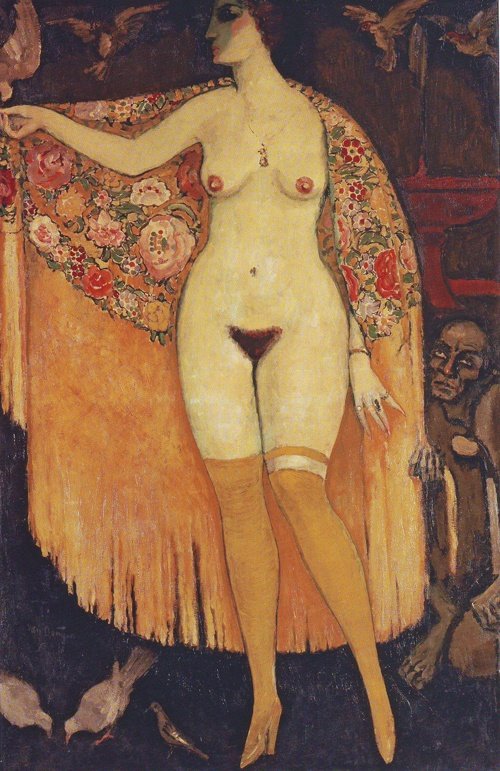
Tableau by Kees van Dongen (1913)

It was around this time van Dongen began to develop a reputation as a socialite.  He often hosted masquerade parties at his new home, which was an apartment in Montparnasse.  His lifestyle and his art was the talk of the Paris fashionista. His paintings now often depicted licentious nudes and other such erotic subjects, which often caused uproar among critics and admirers alike. One such painting was a nude portrait of his wife Guus which he completed in 1913 and was entitled Tableau (also known as The Beggar of Love or Nude with Manila Shawl).  The figure crouching on the floor to the right is of Kees who is admiring and bowing before the beauty of his wife.   He exhibited the work at the 1913  Salon d’Automne and the work was considered so scandalous and immoral that the police removed it from the gallery.  Van Dongen condemned its removal saying:

“…For all those who look with their ears, here is a completely naked woman. You are prudish, but I tell you that our sexes are organs that are as amusing as brains, and if the sex was found in the face, in place of the nose (which could have happened), where would prudishness be then? Shamelessness is really a virtue, like the lack of respect for many respectable things…” 

Portrait de Mme Jasmy by Kees van Dongen (1916)

In 1914, Guus took her daughter Dolly to Rotterdam for the summer to see their families. However the outbreak of World War I prevented them from returning to Kees in Paris until 1918.   In 1917, Kees van Dongen, whilst living alone in Paris, started a relationship with a married socialite, the fashion director  Léa Alvin also known as Jasmy Jacob.   She proved to be the conduit between van Dongen and the upper classes and through her introductions, came numerous portraiture commissions.  When Guus and Dolly returned to Paris it was not long before Guus heard rumours about her husband’s infidelity.  This proved to be the final straw in the break-up of their marriage and they eventually divorced in 1921.   Guus Preitinger died in 1946.

In 1926 he was awarded the Legion of Honour and the following year the Order of the Crown of Belgium.  In 1929 van Dongen became a French citizen.  He and his art, were the toast of French society.  He cut an ostentatious and colourful figure in Paris. His lifestyle was full of controversy and his extravagant nightly studio parties were attended by film stars, masqued politicians and artists.   He spent most of his time completing portraiture commissions.   He was the typical society artist who lived a bohemian lifestyle and who brought added colour and excitement to the Parisian upper classes.  He was only too well aware how to please his female sitters, saying:

“…The essential thing is to elongate the women and especially to make them slim. After that it just remains to enlarge their jewels. They are ravished……….Painting is the most beautiful of lies…”

His success as a society portraitist enhanced his reputation as an artist with the French bourgeoisie, especially the society women, and his numerous commissions allowed him to live a carefree and affluent lifestyle.

In 1938 he met Marie-Claire Huguen, who two years later bore him a son, Jean Marie.  At that time van Dongen was 63 years old !!   The couple finally married in 1953, and this new second family gave van Dongen new purpose, a new life. He carried on working on his portraiture work which was much in demand and he also continued with his illustrative work for books by the likes of Voltaire, Proust and Kipling.  The latter years of his life was spent with his family in Monaco where he died at home in 1968 at the age of 91.

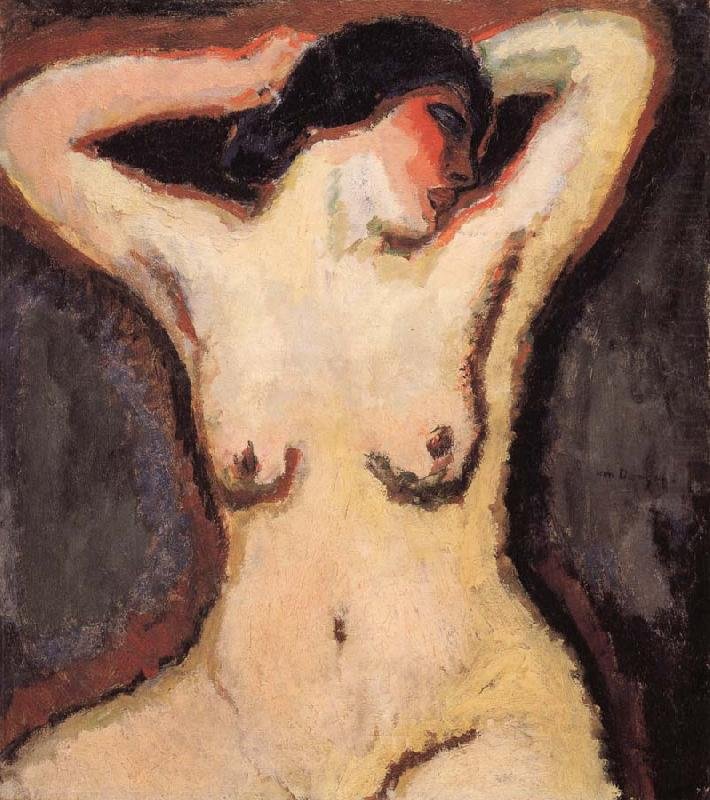
The Torso or The Idol by Kees van Dongen (1905)

One of the paintings by Kees van Dongen, which  I saw at London’s Courtauld Gallery was entitled Torso, sometimes known as The Idol, which he completed in 1905 and was one of two portraits of his wife, Guus Preitinger,  which he exhibited at that year’s Salon d’Automne.    It is a large and somewhat “in your face” painting.  There is an overt sexuality about this work.  It is a depiction of complete sexual abandonment.   Guus lies back with her hands behind her head.  Her arms form two triangles of space either side of her head.  The curvature of her arms mirrors the curvature of her hips in the lower half of the work.   Prominently depicted in the very centre of the painting are her nipples.  It is if the artist wants them to have pride of place.  Van Dongen has used various shades of red and pink to depict the flushed cheeks of her face.  Could it be she was embarrassed by the artist, her husband’s, gaze as he painted her image?   Her pale body is set off dramatically against the heavy black and brown lines which he has used to outline her torso and her breasts.  The paleness contrasts with the dark background.  I found it a rather disturbing painting.  It did not have the beauty of many depictions of the female nude I have seen before.   There was something very rough, almost unpleasant about the full-frontal depiction and in some ways this diminished the sense of eroticism.  In my opinion, the female body in this painting has not been put on a pedestal for us to adore its beauty.  That is just my opinion and I am sure many of you will beg to differ.  However, when I stood in front of this work, it had the same affect on me as when I stood before many of Egon Schiele’s nude or semi nude portraits.

Portrait of Dolly by Kees van Dongen (c.1912)

One of Kees van Dongen’s favourite models for his paintings was his daughter Dolly and she appears in many of his portraits.  In the one at the Courtauld Gallery she is probably just seven years old.  This a portrait of a child, his young daughter but by the way she is given an open pose, and the way he has given her red cheeks, painted lips and large eyes, there is something of an adult feel to the painting.

I came across a couple of fascinating videos on the internet, one of which was a sub-titled interview with van Dongen’s daughter Dolly, aged 82, made in 1987 in which she talks about her father and his paintings.  I am sure you will find it interesting.

 http://www.arttube.nl/en/video/Boijmans/Dolly#.UTWlQ6KeMsJ

The Naples Series by Thomas Jones

Buildings in Naples by Thomas Jones (1782)

To start My Daily Art Display blog today I want to first look at the fascinating happening which occurred during the late seventeenth century to early eighteenth century and which was known as the Grand Tour.   It was a journey which would see travellers visit places such as Paris, Venice, Florence and culminate with the arrival at the cultural Mecca which was Rome, where they would visit the sites of ancient ruins such as the Forum and the Coliseum.  It was also to be a journey of artistic enlightenment.  The seasoned 18th century British traveller, Charles Thompson, put it succinctly when he extolled the virtue of the Grand Tour and the expectation of what would be savoured by the Grand Tourists:

 “…being impatiently desirous of viewing a country so famous in history, which once gave laws to the world; which is at present the greatest school of music and painting, contains the noblest productions of statuary and architecture, and abounds with cabinets of rarities, and collections of all kinds of antiquities…”

For some, such as artists and art scholars, it was a chance to revel in the art history of past times.  For others who were “art virgins” they would be accompanied by teachers who would give them an understanding of art and architecture.  For most it was a chance to return home with souvenirs and the ability to regale tales about their journey at fashionable dinner parties.   It was a sort of “gap year finishing school” for young gentlemen.  They would receive an all-round full cultural education.   There would be opportunities for them to hone their dancing and fencing skills and polish up on their foreign languages.  For the travellers on the Grand Tour, and it was usually young men who made the trip as the journey would be physically demanding, there were a few prerequisites.  They had to be wealthy as the Tour would last many months, even years, and the cost of their travel plus that of any accompanying teachers had to be paid for as well as the cost of the many souvenirs they would accumulate during the journey which would enhance the family’s collection back home.  By souvenirs, I am not talking about a plastic effigy of a famous building, but a landscape painting from a great artist of the time or a piece of antiquity that the dealer had probably pillaged from one of the many historical sites.  This then meant that most of the travellers came from the privileged classes.  It would have been expected that the traveller would also have a thorough grounding in Greek and Latin literature although they would often be accompanied by their tutors and have been taught the basics en route.

Like you and I, when we go on holiday we like to bring back mementos of our travels but more importantly we want to bring back photos of the places we visited and people we were with or whom we met.  Of course in the Grand Tour days of the 17th and 18th century there were no cameras to record the Tourists’ travels and so artists benefited from the patronage of Grand Tourists eager to procure mementos of their travels.   Some Grand Tourists even invited artists from home to accompany them throughout their travels, and by so doing, they could orchestrate exactly what scenes they wanted painting, whether it be ancient ruins or grand palaces, or people, who were part of their party, or just interesting people they met have met en route.

It is with this long preamble that I move closer to my featured artist.  I attended a talk at a small local museum last week which was all about a very rich and privileged young man, Sir Watkin Williams Wynn, 4th Baronet, who set forth at the age of 19, on his Grand Tour in 1768.  He returned home the following year and the total cost of his tour, including all the items he had purchased, came to £8643 and to put this into context a very good annual wage at the time was considered to be £100.  The year Sir Watkins Williams Wynn had his twenty-first birthday he asked the fashionable landscape painter, Richard Wilson, to become artist-in-residence at the Wynstay estate and Wynn had a large pavilion erected which overlooked the River Dee so as to allow Richard Wilson to paint the beautiful scenes featuring the Welsh hills which could be seen in the distance.

I am sorry to drag you through this sort of “seven degrees of separation” formula but trust me, I am getting closer to my featured artist.  Just hang in there a little longer !  My featured artist today is not Richard Wilson but one of his pupils, Thomas Jones who spent some time in Italy and who completed a series of unusual (for that time) paintings of the city.  It was a copy of one of these works which I saw as I walked around the Sir Watkins Williams Wynn’s Grand Tour exhibition which I found fascinating and as it was such an unusual depiction for its time, I had to find out more about the painter, hence today’s blog.

Thomas Jones was born at Trefonnen, a small township in the Radnorshire parish of Cefnllys in 1742.  He was the second of sixteen children, seven of whom died in childhood, to Thomas and Hannah Jones.  His father was a land owner in Trefonnen and his wife inherited a house and an estate at Pencerrig, near Builith Wells, where the family went to live.  Thomas Jones went to school at Christ College, Brecon when he was eleven years old and it was here he developed his love for pictures and drawing.  In 1758, at the age of sixteen he moved to one of Dr. Daniel William’s schools at Llanfyllin in Montgomeryshire, where he was taught by the well-known master Jenkin Jenkins.  The following year Thomas Jones was accepted as a student at Jesus College, Oxford.  The fees for attending Oxford University were funded by Jones’ maternal uncle, John Hope,  who believed that a university education would lead to his nephew entering the church.  His stay at the university was cut short with the death of his uncle at the end of 1761 and Thomas Jones decided that his future did not lie in religion nor a life at sea which was often a chosen profession for the younger sons of the landed gentry.  He believed his future was in art.

Buildings in Naples with the North-East Side by Thomas Jones (1782)

In November 1761, Thomas Jones left Wales and moved to London where he enrolled at the William Shipley’s Drawing School.  This was an establishment named after the great artist and social reformer, William Shipley, who some years earlier had founded a London arts society that would become The Royal Society of Arts, or to give it its full name, the Royal Society for the encouragement of Arts, Manufactures & Commerce, (RSA).  It was at this school that Jones was taught by the draughtsman and drawing tutor Henry Pars.    During this period in London, Jones also attended the St Martin’s Lane Academy where he studied life drawing.  Reluctantly he realised that his ability at painting figures was not good enough and he decided to concentrate on landscape painting.  All he needed now was a good landscape painter to tutor him.  As far as Thomas Jones was concerned, the best landscape painter of the time was his fellow countryman, the Welsh landscape painter, Richard Wilson.   Wilson, who is now considered the father of British landscape painting,  had himself started off studying to become a portraitist in London but had switched to the landscape genre of painting on the advice of the Italian painter, Francesco Zuccarelli, whom he met whilst living and working in Italy between 1750 and 1757.

In March 1763 Thomas Jones managed to persuade Richard Wilson to take him on as a student.  Wilson agreed to tutor him for two years for a fee of fifty guineas.  Once his tuition period with Wilson was over, he dedicated the next ten years to landscape painting in Wales and around London.  In 1765 Jones began to submit some of his works to the Society of Artists exhibitions.  This society would eventually become the Royal Academy.   In the late 1760’s a change in style in his landscape work could be detected.  At this time he began to adopt what we now term the “grand manner” by which we mean his landscape works incorporated mythological scenes or scenes from history or literature à la Claude Lorrain.   As Jones was not an accomplished figure painter he often relied on the help and collaboration from artists such as John Hamilton Mortimer, who was a British figure and landscape painter and known for his romantic paintings set in Italy.  Thomas Jones had by 1776 exhausted all his commissions and the sales of his work were falling so he decided that September to embark on his keenly anticipated journey to Italy.  He first visited and settled in Rome and stayed there for two years carrying out a number of lucrative commissions, often for wealthy English men who were on their Grand Tour.  His reputation as a landscape artist grew and he was part of the city’s hectic cosmopolitan art-scene. Following a dispute over commission with an art dealer he decided to leave the Eternal city in September 1778 and travel south to the capital of the Kingdom of the two Sicilies, Naples.  His first stay in the city lasted five months before he returned to Rome.  It was during his sojourn in Rome that he met a Danish widow called Maria Moncke who became his lover, although for the sake of respectability he always referred to her as his “maid servant”.  The couple moved back to Naples in April 1779, where Jones believed there was more scope for painting commissions.   Later, Maria gave birth to two daughters in Naples, Anna Maria in 1780 and Elizabetha in 1781.

In Naples, Jones found lodgings in a house close to the harbour which had the advantage of having a roof terrace opposite the Dogana Del Sale. It is from this very vantage-point, and from the window of his studio that he made a set of small beautifully, highly finished oil studies of the neighbouring buildings and it is these cityscape views I am featuring today. At first glance they may seem mundane and just uninteresting views from out of his window, but I love them.  They are so different to his other works and those of many artists of that time, so much so, I felt I had to make them known to you.   These works were done by Jones for his own pleasure and were never intended for exhibition or sale. However, today they are looked upon as some of the most ground-breaking pictures of their time.   In some ways they have a modern look about them.  They could have been contemporary cityscapes but remember, he painted these works almost two hundred and fifty years ago.  It was this Naples series, which he completed just before his return to Britain in 1783, on which Thomas Jones’ modern reputation is based.

The Cappella Nuova outside the Porta di Chiaia, Naples, by Thomas Jones (1782)

The Cappella Nova outside the Porte did Chiai, Naples was a small oil on hand-made laid paper, measuring just 20cms x 23cms which Thomas Jones painted in May 1782.  In his diary/memoirs of May 12th 1782 he wrote about the new lodging he had temporarily moved into and from where he painted this work:

“…The Room which I was in possession of at the Convent, was large and commodious for such a place, and as it was on the ground floor and vaulted above, very cool and pleasant at this Season of the Year – The only window it had, looked into a Small Garden, and over a part of the Suburbs, particularly the Capella nuova, another Convent, the Porta di Chaja, Palace of Villa Franca, and part of the Hill of Pusilippo, with the Castle of S. Elmo & convent of S. Martini &c all of which Objects, I did not omit making finished of in Oil upon primed paper…”

This compelling view was painted from the roof terrace of the artist’s lodgings opposite the Dogana del Sale in Naples. It shows a rooftop view of the city, but the painting is dominated by the humble Neapolitan house opposite – the real subject of this work.

Jones has captured in minute detail the texture of the crumbling wall, the half-shuttered windows and doorway, all bathed in sunlight. This is one of a number of oil sketches that surfaced on the art market in 1954 and completely changed Jones’s reputation. The sketches are characterized by their humble subjects and compositional cropping, and it is this which give them a startlingly modern appearance. These works show the artist painting his daily surroundings. They were not for exhibition or sale, but simply personal works, made for his own enjoyment.  Today they are prized as some of the most innovative pictures of their time.

A Wall in Naples by Thomas Jones (1782)

Another small oil sketch Thomas Jones completed in 1782 was entitled A Wall in Naples, which measured just 11.2cm x 15.8cm.  It is about the size of a postcard and is dwarfed by larger works in the room in which it hangs in the National Gallery of London.   It is a strange work which just depicts a decaying expanse of late 18th century Neapolitan house wall, broken up by a closed wooden balcony door, a glazed and dust covered window which allows us no view of the interior.  There is a short washing line hanging over the balcony, on which there seems to hang various coloured items of undergarments.  The wall we see before us almost blocks out the entire view, except for a small rectangle of blue sky in the top right of the painting.  One can only wonder what made Thomas Jones depict such an uninspiring view and one can understand why this work like the others were simply for his own edification and would never, in the artist’s mind, be destined for an exhibition.   We can only wonder why Jones chose this wall for his painting.  Was it because of the various textures of the pitted and pock-marked surface or maybe its decrepit state having been battered by weather appealed to him.    What are the square holes dotted around the surface of the wall?   Are they places where once there had been beams which had supported floors?

During the same year Thomas Jones painted his Naples series he received news that his father had died and so feeling slightly homesick, he decided the following year to end his six year stay in Italy and return by ship to England with his lover Maria and their two daughters.  On returning to London in November 1783, he was horrified to discover that much of his possessions and paintings he had left behind in London had been destroyed or ruined by damp.  Jones once again set about painting but now as he was receiving an annual income from his father’s estate, he did not need the money from the sale of his works and his artistic output slowly decreased.

Since returning to England, he made a number of journeys back to Wales and the Pencerrig estate where he was brought up and which was now owned by his elder brother, Major John Jones.  In 1787 his brother died and having no descendents the estate passed to Thomas Jones.  Thomas eventually married Maria in September 1789 in London.  By all accounts the decision to marry his lover and “maid servant” was not solely his decision for it is believed that his mother “laid down the law”.  Thomas Jones painted less and less in the latter years of his life as so much time was taken up looking after his beloved Pencerrig estate.  In 1791 he was elected High Sheriff of Radnorshire.  Thomas Jones died in 1803 and was buried at the family chapel at Caebach, Llandrindod Wells

His autobiography, Memoirs of Thomas Jones of Penkerrig, went unpublished until 1951 but it is now recognised as an valuable source of information on the 18th-century art world.

Zinaida Serebriakova – Part 2.

My blog today continues with a look at the life of the Russian painter, Zinaida Serebriakova.  At the end of my last entry I told you that she and her family’s life had been turned upside down by the onset of the October Bolshevik Revolution in 1917.  Lenin, who was the leader of the Bolsheviks, wanted to keep the peasant classes on his side so when he made his attempt to overthrow the provisional Russian government, he ensured the neutrality of the peasants by offering them land, owned by the aristocracy.  The Revolution saw the riches, property and lands owned by the aristocratic classes being taken from them by the Bolsheviks and redistributed to the peasants.   That October, Serebriakova had been living at her family estate of Neskuchnoye when the Bolshevik forces descended upon her and her family.  When it was all over the reserves of Neskuchnoye had been plundered and the family was left without food.   Zinaida was left with nothing – no income, no husband, for he had been dragged off by the Bolsheviks and jailed and would die of typhus, which he contracted during incarceration, two years later.  Notwithstanding the fact that she was penniless and had no means to earn money, she was responsible for the upbringing of her four children as well as having to care for her widowed mother.    Zinaida was forced to give up oil painting in favour of the less expensive techniques of charcoal and pencil sketching

Zinaida eventually managed to get some work at the Kharkov Archaeological Museum, where she made pencil drawings of the exhibits.   In December 1920 she and her family went to live with her grandfather who had an apartment in Petrograd.    Petrograd had formerly been known as St Petersburg but when World War I broke out in August 1914 it was decided to change the name of the Russian capital from the Germanic  St. Petersburg to the more Russian equivalent, Petrograd.  It was not until 1991, with the collapse of the Soviet Union, that the city reverted back to the name of St Petersburg.   Because of a Bolshevik dictate which stated that all inhabitants of private apartments had to share their living space with other people, Zinaida found herself sharing her lodgings with artists from the Moscow Art Theatre.

In Ballet Dressing Room (Big Ballerinas) by Zinaida Serebriakova (1922)

Serebriakova’s work during this period focused on theatre life. It was around this time that her daughter Tatyana became interested in ballet and her mother managed to get her enrolled at the prestigious ballet school of the Imperial Mariinsky Theatre, the home of the Russian Ballet, where Zinaida’s uncle, Alexander Benois was the scenic director.   Much of Zinaida’s time was absorbed by the theatre and she produced a series of exquisite pastels on the balletic life at the theatre.  Many of her works showed young ballerinas in their dressing room preparing to go on stage.

In 1924 Zinaida Serebriakova got the offer of work in Paris and with some financial help from her uncle Alexander Benois, she left St Petersburg and headed to the French capital, leaving behind her four children with her ailing mother.  A few years later Zinaida managed to bring her son Alexander and her daughter Katya to live with her in Paris but her son Yevgenyi and her daughter Tatiana had to remain in Russia with their grandmother, and it was not until 1960 that she was able to have Tatiana visit her in Paris.

Zinaida was now one of many Russian exiles living in Paris who could not return to her homeland.   She earned a living by painting society portraits. Her children also often featured in her work, and her daughter often posed in the nude.   She also painted other female models, reclining in her studio with patterned wraps and decorative drapes. These works were of a very informal nature and often highly erotic.  According to her daughter Ekaterina these nude studies were probably the most intimate images of the female body in Russian art.   She later wrote:

“…The female nude was mother’s favourite subject. While she was in Russia young peasant women would pose for her. In Paris her friends would come over to her studio, drink a cup of tea, then they would stay and pose for her. They were not the professional models that you might find in Montparnasse and maybe this is the reason why they are so natural and graceful…”

Sleeping Nude (Katya).by Zinaida Serebriakova (1934)

Zinaida completed one of her best known nude studies of her daughter, Ekaterina, in 1934, entitled Sleeping Nude (Katya).  It was a veritable masterpiece which is similar in imagery to the sleeping Venuses of the Venetian masters, the nymphs of Boucher and the bathers of Cabanel and Renoir.  In this work, Zinaida does not offer us some anonymous heroine from Greek mythological tales but presents us with an innocent young girl, who lies before us, totally relaxed, her cheeks flushed from sleep.  It is so natural and it is even more endearing knowing that the model for this painting was her twenty-two year old daughter, Katya who had modelled for her mother for the previous fifteen years.

Sleeping Girl in the Blue (Katyusha on a Blanket)by Zinaida Serebriakova (1923)
Sleeping Girl in the Blue (Katyusha on a Blanket)
by Zinaida Serebriakova (1923)

In 1923, before Zinaida left for Paris she had painted a nude study of the then ten-year old Katya, entitled Sleeping Girl in the Blue (Katyusha on a Blanket), in which we see her young daughter, in all her innocence, sprawled across a blue blanket.

Zinaida’s uncle Alexander Benois, an artist, art critic and co-founder of the art magazine and movement Mir iskusstva (World of Art), commented on the way his niece had portrayed her naked young women.  He wrote:

“…[Her nude studies were] not by a generalised sensuality but by something specific, which we recognise from our literature, from our music, from our personal experiences. This is truly the flesh of our flesh. Here is that grace, that comfortable languor, that cosy, domesticated side to Eros – all of which are actually more alluring, more subtle and sometimes more perfidious, more dangerous than what Gauguin found on Tahiti and in search of which blasé Europeans left their pampered life at home and set off in the footsteps of Pierre Loti, across the whole of the white, yellow and black world…”

Zinaida Serebriakova’s nudes were always dignified, self-assured and classically beautiful.  She created the most sensual and intimate images of the female body in the Russian art and remained true to the Neo-Romantic tradition and her classical training.  At an exhibition of Russian art at the Midi Fair in Brussels in 1928, people noted Serebriakova’s ‘nude’ oeuvre and it was here that she met the industrialist, the Belgian nobleman, Baron de Brouwer.   So impressed was he with her work that he became her patron and commissioned her to paint portraits of his family.

Reclining woman (Etude de femme hadija) Marakech by Zinaida Serebriakova (1932)

De Brouwer also financed her painting trip to Morocco where he owned a plantation.  Zinaida set off for North Africa on her own and fell in love with the colour and light Morocco afforded her.  The baron had wanted her to bring back paintings of the area and its people.  He had also said that he had wanted to some nude studies of the Arab women but Zinaiad found this very difficult to achieve.  She wrote:

“…He (Brouwer) wants nude paintings of the lovely native women, but it’s a fantasy hardly worth dreaming about – even in their veils which cover everything but their eyes nobody will pose for me. There is no question of a nude…”

However she did return with many paintings of the area and the Arab and Berber women, some of whom she had even managed, with much haggling and offers of financial rewards, to get some to pose in the nude but it was difficult.  She wrote of this time:

“…As soon as you sit to draw the women walk away – Arabs don’t wish to be drawn, so they immediately close up their shops or charge up to 10 or 20 francs for tea an hour!…”

De Brouwer was delighted with the works Zinaida brought back from North Africa, so much so, that he commissioned her to paint a series of murals for his villa Manoir du Relais in Pommeroeul near Mons, in Belgium.  Zinaida customized the theme of this mural series to that which appealed to her patron.  The baron had a love of classical art, which of course was ideal for somebody like Zinaida who had a talent for painting portraits of the naked human form.  She set about the commission and decided to paint four separate vertical panels each displaying a standing nude,  each with their allegorical attributes which in some way would mirror the leisure activities and talents of de Brouwer.

Jurisprudence by Zinaida Serebriakova (1937-8)

One of the figures would be Jurisprudence, which would represent the baron’s career as a lawyer.  A second would be Flora, which would symbolize his passion for gardening, his plantations and his love of flowers.   Light, would be another figure which referred to his role as a director of power and gas plants and finally Art which would embody his interest and patronage of the arts.  For Zinaida there could only be one possible candidate for the role of model for the four nudes, which would be depicted on the four vertical panels.  It was to be her daughter Katya.  Her stance in each panel was to be different turning slightly for each depiction.  A further two large horizontal panels (145cms x 710cms) were also created and these depicted four maps in cartouches.  Zinaida left the painting of these to her son, Alexander, and these were of Flanders, Morocco, India and Patagonia. Next to the maps Zinaida had added half-seated female nudes which were initially intended to represent the four seasons, but she later changed their titles to the countries represented on the maps they adorned. Years later, Zinaida wrote about this commission:

“…The assignment was to paint decorative geographical maps in the 18th-century style, single-tined (my son did the maps); and I painted in the corners of the maps, against that background, the images of the ‘four seasons’ (summer with a sheaf, spring with flowers, etc.), and four figures standing in ‘niches’ on another wall. I painted all this in Paris and, unfortunately, did not see how all this looked on the walls, because the house was not quite ready yet, and the residents were yet to move in … during the war the area was a battlefront, and de Brouwer’s summer house was destroyed…”

Even more pleasing to Zinaida’s was the comments by her artist brother Yevgeni Lanceray, who on seeing photographs of the paintings wrote to her:

“…I love them..You have exactly that which others around you do not – an understanding of composition. The panels are excellent in the simplicity of their execution, completeness of shape, and so monumental and decorative. You completely understand the form of objects. Particularly difficult, I think, is the panel Jurisprudence… It is especially elegant and richly executed. In everything is simplicity and parsimony, so to speak, of decoration and attributes. I envy you your ease, your flexibility, and how broad and accomplished is your representation of the body…”

Nadezhda Tregub of the Tretyakov Gallery in Moscow wrote about the four nude figures:

“…These murals can be considered entirely cosmopolitan works: they were accomplished on a commission from Belgium, by an artist from Russia who worked in France, and who drew on the major achievements of all European art…”

Sadly the baron and his wife did not have much time to enjoy the murals which were completed in 1937/8 as both died during the Second World War, and it was also thought that their house had also been destroyed. In fact this assumption was incorrect as the house remained standing and even changed ownership a number of times. The murals also remained untouched for over 70 years, but curiously the owners did not recognise the work as being done by Zinaida.  They thought they had been executed by an unknown Flemmish artist.

In 1966 a large exhibition of Zinaida Serebryakova’s works was mounted in Moscow, Leningrad and Kiev and the critics loved what they saw.  In September of the following year Zinaida died in Paris, at the age of eighty-two. She was buried in the Sainte-Geneviève-des-Bois Russian Orthodox cemetery in Paris.  The cemetery is a burial place for more than 10,000 Russian emigrants, including the celebrated ballet dancer, Rudolf Nureyev.

Zinaida Serebriakova. Part 1

House of Cards (1919)by Zinaida Seberiakova
House of Cards (1919)
by Zinaida Seberiakova

One of the most pleasing aspects of this blog for me is discovering artists I had never heard of before.  It is an even greater pleasure when the “new-to-me” artist is a female for I am often made aware in my look at the lives of painters, the difficulty it has been for a female artist to attain credit for her ability.  In the past I have looked at works by Artemisia Gentileschi, Frida Kahlo, Gabriele Münter and Vigée Le Brun, to mention just a few, and I have been mesmerised by their works and the passion that went into them.   In my next couple of blogs, I want to introduce you to Zinaida Serebriakova, one of the greatest Russian female artists, whose life story is enthralling and whose works are entrancing.

Zinaida Serebriakova, née Lanceray, was born in 1884, on the family estate of Neskuchnoye, near Kharkov, which now lies in Ukraine. She is descended from two great wealthy and powerful Russian dynasties.  On her father’s side there was the Russian Lanceray dynasty and on her mother’s side was the great Franco-Russian Benois family dynasty.  Zinaida’s father was the sculptor, graphic artist, and painter, Yevgeny Lanceray, who died when she was just two years of age and her mother was Ekaterina Benois.  Zinaida had two brothers, Nikolai and Yevgeny who also excelled artistically and many of her ancestors excelled artistically so it comes as no surprise when she showed both and interest and talent for drawing and painting.

Country Girl by Zinaida Serebriakova (1906)

Zinaida spent her childhood and youth split between living in St. Petersburg, where her grandfather the architect Nicholas Benois lived, and at the family estate of Neskuchnoye.    Her initial artistic tuition came in 1901 after she had completed her grammar school education the previous year, when at the age of seventeen, she enrolled at the Princess Tenisheva Art School in St Petersburg, where the lead tutor was the distinguished Russian painter and sculptor, Ilya Repin.  The following year she travelled to Italy and in 1903 she began a two year apprenticeship at the St Petersburg studio of the Russian portraitist Osip Braz.  Living in St. Petersburg she was able to visit the Hermitage Museum and gaze in wonderment at the classical paintings of the Masters.   Of all those artists which she admired, the one who stood out the most for her and was to influence her future work was her countryman, Alexey Gavrilovich Venetsianov.  He was famous for his paintings which focused on the simple life of ordinary people and the struggle for survival of the peasant classes.  He often painted portraits of the peasants and Zinaida was captivated by the innocence and virtuousness of his imagery and many of her future works would incorporate scenes from peasant life.  An example of this is the early work which she completed in 1906 entitled Country Girl.

Boris Serebriakov by Zinaida Serebriakova (c.1905)

Apart from seeing these works by Venetsianov, she was fortunate to live at Neskuchnoye and savour the beauty of the surrounding countryside and the tranquillity of country life.  She also spent much of her time completing portraits of her family members.  In 1905, Zinaida Lanceray married Boris Serebriakov, who was her first cousin.  They had met at Neskuchnoe whilst he was studying engineering and he would later become a railroad engineer.  Zanaida and her husband went off to Paris where she continued her art studies at the Académie de la Grande Chaumière in Paris.  This art establishment which was founded three years earlier by the Swiss painter Martha Stettler operated as a ‘free’ academy, where art students, both professional and amateur alike could enter to draw and paint at will.

At the Dressing Table (Self Portrait) by Zinaida Serebriakova (1909)

Her popularity as an artist took off shortly after she exhibited her Self Portrait at the exhibition held by the Union of Russian Artists in 1910.  It was a work she had completed the previous year and showed her image, as seen in a mirror, seated at her dressing table, combing her hair.  The painting can be seen at the Tretyakov Gallery in Moscow.  Her uncle Alexander Benois wrote about this work:

“…A young woman lives in a remote country area … and has no other pleasure, no other aesthetic enjoyment on winter days that seclude her from the whole world, than to see her gay young face in the mirror and to watch the play of her bare arms and hands with a comb … Her face and everything else in the picture is young and fresh. There is not a trace of modernistic refinement. But the simple, real-life atmosphere, illuminated by youth, is joyous and lovely…”

 In 1916 Zinaida’s uncle, Alexander Benois was commissioned to decorate the Kazan Railway Station in Moscow and he invited her to help him by becoming part of his team. Serebriakova took on the theme of the Orient: India, Japan, Turkey, and Siam were represented allegorically in the form of beautiful women.  It is recognised that the work she produced between 1914 and 1917 were some of her best.

Bleaching Cloth by Zanaida Serebriakova (1917)

She created a series of works, the theme of which was the rural life she witnessed all around her.    In 1917 she completed one such painting entitled Bleaching Cloth which in some way is her homage to the female peasant workers.  Against a background formed by a blue sky and partly veiled by light greyish white clouds, we see the women hard at work in the fields with their bales of cloth.   The red, green and brown colour of the peasants’ clothes gives the painting a beautiful vibrancy and the figures seen against a very low horizon gives the depicted peasants a commanding and grandiose quality.    The work, measuring 142cms x 174cms,  was a testament to Zinaida’s talent as a monumental artist.  The painting is now held at the Tretyakov Gallery in Moscow.

The year 1917 proved to be her annus horriblis and changed her life and that of her family forever.   The Russian Revolution led by the Bolsheviks under the leadership of Lenin started in October of that year and soon spread throughout the country.  The Bolsheviks believed that the working classes would, at some point, liberate themselves from the economic and political control of the ruling classes.  It was an uprising by the “have-nots against those who had” and as such the family estate owned by Zinaida’s family, where she was living was a target.  Much of the estate was taken over or destroyed.  All the reserves of Neskuchnoye had been plundered which resulted in the family suffering from hunger.  Her husband had been taken away by the Bolsheviks and was incarcerated in jail where he died of typhus in 1919.  Zinaida was left without any money and yet was responsible for her four children and her sick widowed mother.

This was a traumatic time in Zinaida’s life and it was in that very year that her husband died that she completed one of her most famous works and which is my featured painting of the day, entitled House of Cards which depicts her four orphaned children, Alexandre, Ekaterina, Eugene and Tatyana playing cards.  It is a tragic painting featuring her children, who probably could not understand what had happened to dramatically change their way of life.  Their safe and privileged existence had suddenly collapsed like a house of cards.

In my next blog I will take you through the story of the rest of Zinaida Serebriakova’s life story and have a look at some of her later works.

I and the Village and The Birthday by Marc Chagall

I and the Village by Marc Chagall (1911)

Having just completed my four part look at the quartet of Scottish Colourists I am turning to a painter from the same era but one who could not be more different in style.  For my blog today I want to look at the early life of and two fascinating paintings by the Russian-Jewish artist, Marc Chagall.  He was a painter of poetic, surreal images that to him, represented a topsy-turvy world, combining fantasy and spirituality with a modernist style

house
Chagall’s family home in Vitebsk

 Marc Chagall, a name he did not use until 1915 when he arrived in Paris,  was born Moishe Segal on the 7th of July 1887 in the small Jewish shetl of Liozna part of the town of Vitebsk, which was in the Russian Empire but now is situated in Belarus.   He was the eldest of nine children born into a Hasidic Jewish family.  His parents led a simple yet spartan life.  His mother Feige-Ite ran a small grocery shop from their home.  His grandfather worked as a teacher and a cantor in a local synagogue and had secured a position for Marc Chagall’s father as a clerk at a wholesale herring merchants but in Marc Chagall’s autobiography, My Life, he criticised his grandfather for his father’s placement and derided the job description of “clerk”.  He wrote:

“…My grandfather, a teacher of religion, could think of nothing better than to place my father – his eldest son, still a child – as a clerk with a firm of herring wholesalers, and his youngest son with a barber. No, my father was not a clerk, but, for thirty-two years, a plain workman. He lifted heavy barrels, and my heart used to twist like a Turkish pretzel as I watched him carrying those loads and stirring the little herrings with his frozen hands……Sometimes my father’s clothes would glisten with herring brine. The light played above him, besides him. But his face, now yellow, now clear, would sometimes break into a wan smile…”

 Chagall would always remember those early days of hardship and how hard his father worked to provide for his family.  In his 1922 autobiography, My Life, Chagall recalled those difficult times:

 “…Day after day, winter and summer, at six o’clock in the morning, my father got up and went off to the synagogue. There he said his usual prayer for some dead man or other. On his return he made ready the samovar, drank some tea and went to work. Hellish work, the work of a galley-slave. Why try to hide it? How tell about it? No word will ever ease my father’s lot… There was always plenty of butter and cheese on our table. Buttered bread, like an eternal symbol, was never out of my childish hands…”

 As a young child, Chagall went to the local heder, an elementary Jewish school in which children were taught to read the Torah and other books in Hebrew. Later he transferred to the local secular secondary school and it was here that young Chagall started to show an interest in art.  The fact that he, as a Jew, was allowed to go to the local secular school was in itself rather unusual as according to government dictates at the time, Jewish children were not allowed to study at secular schools.  In 1906 when Marc was nineteen years of age and with help from his mother, and despite his father’s protests, he enrolled at a private school of drawing, Artist Pen’s School of Drawing and Painting run by Yethuda Pen.  Yethuda Pen was a talented Jewish artist and art teacher and one of the outstanding figures of the Jewish Renaissance in Russian and Belarusian art.   Chagall remembers the day he first cast his eyes on the school and how it impressed him.  He recounted the time in his autobiography:

“…I learned about Pen when I was riding on a streetcar.  It was crossing the Cathedral Square and I saw a banner – white letters on blue: Artist Pen’s School. ‘What a cultured city is our Vitebsk,’ I thought...”

Later, in 1921, Chagall told his former tutor, Penn, about the day he first entered the college, accompanied by his mother, for an interview for a place on Penn’s art course and how nervous he was.  He wrote:

 “…I recall how, as a boy, I climbed the steps of your studio. And the tremor with which I awaited you: you were to decide my fate in my mother’s presence. I know how many other young boys in Vitebsk and the entire gubernia [administrative district] had their fates decided by you. For dozens of years your studio was the first to lure people in town… You have trained a vast generation of Jewish artists…”

He remained only a few months at Penn’s art school and in 1907 with little money, he left Vitebsk and headed for Saint Petersburg.  Chagall had already seen and felt the full force of the anti-Semitic Russian laws in his home town but they paled into insignificance compared to the discriminatory policies against Jews in Saint Petersburg.  However for Chagall these legal hardships and the fact that he had little money to live on, was of little consequence as he was now able to immerse himself in the whirlpool of artistic life.  These were also revolutionary times and the revolutionary mood of the Russian people against their Tsarist ruler could be seen in every-day life, through avant-garde magazines and art exhibitions which pioneered new and modern western art.  The art world was waking up to the new art of the French Fauves, the German Expressionists and the Italian Futurists.  This was an exciting time for the young Russian artist, Chagall, and this new art would greatly influence him.  Although he absorbed this new art and knew about the various artistic groupings, he was his own man and he wanted to stand alone and create his own unique artistic style.  The one thing Chagall was determined about was that he would never ever forget his childhood background and the people of Vitebsk.  He would never forget his family’s or his poor but happy upbringing and the family’s lowly status.  He would never forget the hand to mouth existence and the importance of the land and the farms that provided food for its people.  He would never forget the onion-shaped cupolas of the churches, the wooden houses with the grass roofs which helped insulate them.  His home town of Vitebsk was tattooed on his very heart and he would always remember it in his art with great affection.

Whilst living in St Petersburg Marc Chagall earned a living by working at the editorial office of the Russian-Jewish periodical, Voskhod.   He also carried on with his artistic studies first at the school of the Society for the Encouragement of Art Society of Art Supporters where he studied under the Russian painter and stage designer Nikolai Roerich and the following year he enrolled as a student at the Yelizaveta Zvantseva’s School of Drawing and Painting where one of his teachers was the great Russian artist and costume designer Leon Bakst.  Bakst had lived in Paris from 1893 to 1897, where he studied at the Académie Julian, and he would eventually persuade Chagall to head for the French capital, the then art capital of the world,  so as to best continue his artistic studies.

Bella Rosenfeldcourtesy of http://www.marcchagallart.net/
Bella Rosenfeld

In 1909, Chagall met Bella Rosenfeld who lived in his home town and had been visiting friends in St. Petersburg.   It was love at first sight and within a short time they had become engaged.   Although both Marc and Bella were from Vitebsk, their social worlds could not have been more different and for that reason Bella’s parents were very unhappy with the liaison.  Bella’s parents, Shmule and Alta Rosenfeld were extremely wealthy and ran a very successful jewellery business back in Vitebsk and had managed to put Bella through the best education culminating at the University of Moscow.  She was particularly interested in the workings of the theatre and in art, and whilst studying at university, she contributed articles to a Moscow newspaper.  Chagall’s love for Bella, who became his wife in 1915, was deep and enduring and in his autobiography he wrote with passion about his true love:

“… Her silence is mine, her eyes mine. It is as if she knows everything about my childhood, my present, my future, as if she can see right through me; as if she has always watched over me, somewhere next to me, though I saw her for the very first time. I knew this is she, my wife. Her pale colouring, her eyes. How big and round and black they are! They are my eyes, my soul…”

In 1910, Chagall held his first solo exhibition, which was in the editorial office of the St Petersburg avant-garde magazine Apollon.  One of the visitors to the exhibition was Maxim Vinaver, a lawyer and deputy of the State Duma.  Vinaver, who was one of the outstanding figures in Russian Jewry of his time. He played a distinguished role as a Jewish communal leader, as well as one of the leaders of the Liberal Cadet Party. He was always a champion of the Jewish cause and as a deputy in the Russian Duma, Vinaver organized the Society to Secure Equality for the Jews in Russia.  Impressed by the talent of Chagall, he became his patron and gave him a monetary scholarship and with this financial assistance Chagall was able to go to Paris to carry on his artistic studies.  It was on arriving in the French capital that Moishe Segal adopted the French-sounding pseudonym, Marc Chagall.

I will leave the life story of Marc Chagall at this stage of his life and return to it in a later blog but for now I want to look at two of his paintings.  The first painting, and one of his most famous, is entitled I and the Village, which he completed in 1911, whilst living in Paris.  It is currently housed in the Museum of Modern Art in New York.

The painting on first sight is, like many of his works, unfathomable and one has to look carefully at all the elements depicted to try and understand what was going on in Chagall’s mind as he put brush to canvas.  It is a dream-like image with many overlapping elements.  This lively composition and the geometrical structures, such as lines, angles, triangles, circles, and squares clearly displays aspects of Cubism.  Some would have us believe that Chagall’s assortment of large and small circular forms are meant to depict the sun’s revolution within our solar system as well as the earth’s revolution around the sun, and the moon’s revolution around the earth. The moon being in the lower left of the painting is causing an eclipse of the sun.  However, maybe like me, this cosmic interpretation of the painting is possibly a step too far!

It is a collage of various objects.  It portrays the artist’s memories of the Hasidic Community of Vitebsk in which he was brought up, a peasant community, which relied heavily on the land and their animals for food. There are human and animal elements in the work which are both fragmented and randomly assembled to produce an abstract composition. The colours Chagall uses are vibrant and he has produced a severe contrast between the red, the green and the blue which he has liberally used.

Let us look more closely at the work and see if we can unravel the meaning of some of its elements.  If you look at the top right hand corner of the work you can make out a small town.  There is a church with its onion-shaped cupola and some brightly coloured houses some of which are upside down.   This inclusion, as he did in many of his works, is probably Chagall’s home town of Vitebsk and the fact that some of the houses are upturned could well be his way of illustrating that it is his town as visualised by him in his dream.  In front of the row of houses is man dressed in black with a scythe over his shoulder, presumably returning home after a hard day’s work in the fields.  In front of him is an upturned woman.   The woman, according to some descriptions is playing a violin.  However although people playing violins feature in many of Chagall’s works I beg to differ as far as this woman is concerned.  I have studied pictures of the painting, inverted it to see her better, and have concluded she is simply a peasant woman swinging her arms as if dancing.  I will let you decide.  This dream-like depiction of the peasant woman whether a violinist or a dancer could be a reference to the importance that music and dance played for entertainment for the people of Chagall’s erstwhile small Jewish community.

eye contact
Eye contact

The two main elements of the painting are, on the right, a green-faced man wearing a cap and on the left an animal.   The green colour of his face is an example of Fauvism where the colour used is not the one we would normally associate with in reality.  On the left is the head of an animal, possibly a horse or goat or cow.  On its cheek Chagall has painted an image of smaller goat or cow being milked.  If you look carefully you will see Chagall has drawn a line between the eye of the man and the eye of the animal and this probably refers to the close relationship, the inter-dependence between a peasant and his animal – a kind of “seeing eye to eye”, understanding the important relationship between man and beast.  The man, who wears a cross around his neck,  clutches hold of a small flowering branch, the seeds from which seem to be scattering, which could allude to the sowing of seed in the ground.

The Birthday by Marc Chagall (1915)

The reason why I chose Chagall for my blog today was because it was Valentine’s Day and I wanted to feature a painting which in some ways was the essence of true love between two people.  I could have gone for The Kiss by Gustave Klimt or Francesco Hayer or some other erotic and sensuous painting but I came across the painting by Chagall entitled Birthday and in a way it said everything to me about the love between two people.   Chagall painted the picture in 1915,  the year he married his beloved Bella Rosenfeld.  For Chagall his relationship with her was everything he could have wanted and I believe the couple in the painting are Marc and Bella.

Bella with White Collar by Marc Chagall (1917)

Chagall painted Bella in many of his works and I believe this is one of them.  The painting depicts the man and the woman.  Although the woman’s face is clearly defined the man’s face is somewhat of a blur.   In the work we see them both seemingly elevated by their love for each other.  For them it was possible to float above the reality of the world and just enjoy each other’s company.  Look at the feet of the man and the woman.   They seem to be pointing in opposite directions.   Maybe he has given her the bunch of flowers and has walked past her but realises that the flowers without a kiss is not enough and so he literally bends over backwards to please his loved one by offering up a kiss.  She holds the flowers that he has given her and purses her lips in readiness for his kiss but he has walked past her.  However before disappointment can set in he returns, lips ready to kiss his beloved girl!  What could be more romantic?  However there is much more to this work of art than the two lovers.  Look at the amount of detail Chagall has put into the painting.  See how he has depicted the seeds of the watermelon which lies on the counter, the exotically detailed Indian blanket which lies on the bed and the blue lace fabric which hangs below the window.

I end by wishing you all a Happy Valentine’s Day and hope that your loved one manages to bend over backwards for you !!!

The photo of Chagall’s home and Bella Rosenfeld were courtesy of http://www.marcchagallart.net/