Peter Paul Rubens and Hélène Fourment

Rubens, His Wife Helena Fourment  and Their Son Frans by Rubens (c.1636)
Rubens, His Wife Helena Fourment and Their Son Frans by Rubens (c.1636)

This superb portrait by Rubens of his wife Hélène and their three year old son, Frans can be seen at the Metropolitan Museum of Art in New York.   Frans is the only one of their children featured which makes us think that Rubens did not see this work as a family portrait but had more to do with his desire to show off the beauty of his second wife.   Look how Rubens has depicted himself and his son in this work.  They both look lovingly at Hélène.  She is the wife to one and the mother to the other.  This in a way is Rubens’ intimate tribute to his wife.  In the background we see a caryatid, (the sculpted female figure which is serving as an architectural support taking the place of a column or a pillar), which along with the fountain in the right background, symbolise fecundity

In my last blog I had reached the year 1626, a distressing time in Peter-Paul Rubens’ life for this was the year his first wife and true love, Isabella Brandt died.  Rubens was left alone with his three children, Clara Serena, Nikolas and Albertus.  He was still employed as court painter at the court of Archduke Albert VII, the Archduke of Austria and Governor General of the Habsburg Netherlands and his wife and consort, the Archduchess Isabella Clara Eugenia.  It was in 1621, when her husband, Albert, died that the Archduchess Isabella Clara Eugenia, became the Governor of the Netherlands on behalf of the King of Spain.  She was also keen to use Rubens’ ambassadorial skills and she sent him on a number of diplomatic missions to the Spanish and English courts to see if a solution could be found for the troubles besetting the Spanish Netherlands with the breakaway of the Seven United Provinces.  His skill as a diplomat was well appreciated by both sides and he was knighted by King Philip IV of Spain in 1624 and six years later received a similar honour from Charles I of England.  Notwithstanding his diplomatic brief, he continued to paint and received a number of royal commissions.

Hélène Fourment  with a Carriage by Rubens (c.1639)
Hélène Fourment with a Carriage by Rubens (c.1639)

In this 1639 painting Hélène Fourment with a Carriage by Rubens, which is housed in the Louvre, we see his wife Hélène leaving their palatial home in Antwerp followed by her six year-old son Frans, who was born in 1633. We view the scene from a low level which affords Hélène a more regal and majestic stance as she awaits her carriage.   Hélène, dressed like a lady of high society.  She is dressed in a long black satin gown, in the wealthy and lavish Spanish style.  She wears a small headdress with the pom-poms attached to large veil of black gauze.  Rubens has contrasted the black of the dress with the bright white satin which form the puffed sleeves which are in turn accentuated by the gold braid.  More colour is then added as we note the rosy pink of her cheeks and the purple sleeve bows and silk belt at her waist.    She waits in front of a porch of their home with its columns and pilasters. The building had been designed by her husband, imitating an Italian palazzo.   Hélène’sleft hand lies by her side whilst her right hand is raised in a gesture of modesty which belies her sumptuous clothes.  Frans follows his mother, dressed in a red suit with a flat white collar.    One must remember that Rubens at this time in his life was extremely affluent having been court painter at the Habsburg court and was also head of a thriving studio which was inundated with commissions from all over Europe.  At the bottom left of the painting we see a two-horsed carriage awaiting mother and son.  Besides a mode of transport the two-horsed carriage symbolised conjugal harmony.  This is probably the last known portrait of Hélène by Rubens.

In 1630, at the age of 53, and four years after the death of his first wife, Isabella, Rubens married the 17 year-old daughter of his friend and tapestry merchant, Daniel ‘Le Jeune’ Fourment.   His new wife, Hélène Fourment, went on to give him 5 children, two daughters, Clara Johanna and Isabella Helena and two sons, Frans and Peter-Paul.  A fifth child, a third daughter Constance Albertine, was born eight months after Rubens died.   My blog today looks at some of the many paintings by Rubens which featured his second wife, Hélène,   many of which were portraits but she also featured in some of his allegorical and classical works.  

Finally in August 1634, Rubens managed to relinquish his diplomatic work for the Habsburgs and in 1635 he bought himself a country estate, Het Steen, which was situated between Antwerp and Brussels.  It was here that he spent much of the latter part of his life.  Around 1636 Rubens completed a work entitled The Rainbow Landscape which was an imaginary artistic reconstruction of his own estate.  It was a maginificent estate which included a castle, draw-bridge, tower, moats, a lake and a farm and gave him the right to be known as Lord of Het Steen. One can just imagine the joy it must have brought  Rubens to spend his last quiet and tranquil years with his family at this idyllic place.    At Het Steen, Rubens finally managed to enjoy the fruits of his long and hard-working career, and it was during these last years that he spent time painting landscapes.

In his later years, Rubens was increasingly troubled by arthritis which caused a swelling of the joints in his hands, which forced him to reluctantly give up painting altogether.   Rubens died from heart failure on May 30th 1640, a month short of his sixty-third birthday.  He was buried in Saint Jacob’s church, Antwerp. The artist left behind eight children, three with Isabella and five with Hélène.

Het pelsken (the little  fur) by Peter Paul Rubens (c.1638)
Het Pelsken (the little fur) by Peter Paul Rubens (c.1638)

The final painting I am showing you by Rubens, featuring his wife Hélène Fourment, is probably one of the strangest depictions a man could make of his beloved.   The work was completed around 1638 when Rubens was 61 and Hélène was just 27.   It is a life size painting of his wife, entitled Het Pelsken (The Little Fur), which is the title given to it by Rubens in his will.   It is also sometimes referred to as Hélène Fourment in a Fur Coat.  In the painting, Hélène is depicted nude except for a fur coat, which could well have belonged to her husband.  This was a private work by Rubens.  It was one of his favourite works and he would neither give it away, nor sell it nor exhibit it.

Venus de Medici
Venus de Medici

It was simply done by him for his own pleasure.  It is an outstanding painted depiction of nakedness.  It could well be that Rubens modelled his depiction on the Venus Pudica (modest Venus) of the life-size Venus de Medici, the Hellenistic marble sculpture which depicts the Greek goddess of love, Aphrodite, and which is housed in the Uffizi Gallery in Florence.

Hélène stands before us on a red cloth, almost naked.   She is portrayed with curly dishevelled hair.  She just about holds on to the wrap which seems to be about to fall from her body and leave her completely naked.  She clutches at it in a manner that both of her arms are wrapped around the front of her.  Her left hand covers her pelvic region whilst her right hand holds the fur coat in position on her left shoulder and by doing so her right arm cradles and uplifts her breasts.  Her nipples seem to have hardened and her face has a rosy glow to it which may indicate the pleasure she is experiencing as her husband stares out at her.  There is a look of defiance about her expression.  Is this look intended to be one of provocation as she exposes her body to her husband or is it that she is fed up with standing in such a pose and becoming cold?  In some ways we are fascinated by what we see before us and yet in other ways, because of the personal nature of the painting we feel as if we are intruding into a private husband/wife moment and we feel we should look away.  It is a truthful portrayal of his wife.  He has not tried to idealise his wife’s body.  She is a woman with a womanly figure and Rubens’ depiction of her is an honest portrayal of her and there can be no doubt that he found what he saw, very pleasurable.

In his will he left the painting to his wife with the stipulation that it should never be sold to pay for death duties.  Hélène carried out his wish and it was not sold until after she died in 1658.  The painting is currently housed in the Kunsthistoriches Museum in Vienna.


Peter Paul Rubens and Isabella Brant

Honeysuckle Bower by Rubens (c.1609)
The Honeysuckle Bower by Rubens (c.1609)

This painting, which is housed in the Alte Pinakothek, Munich is entitled The Honeysuckle Bower and was painted by Rubens the year he married Isdabella Brant.  It is a full-length double portrait of the happy couple who have the honeysuckle bower as the backdrop.  The honeysuckle symbolises devoted affection and is a symbol of love and generosity and this is a loving portrait of the couple as they sit hand-in-hand in the shade afforded to them by the bower.   Rubens has depicted himself as an elegant and chivalrous husband relaxing, legs crossed, perched atop of a balustrade.  He looks over his wife from his high position.  He looks thoughtful but at peace with his world.    His beloved wife sits close to him on a grassy bank, at a slightly lower level.  She is wearing a brocade bodice and a dark red skirt.  There is a ruff around her neck and atop her head is a Florentine hat.   Both husband and wife lean slightly towards each other in another sign of affection.  Life is good for them both and this is symbolised by the flourishing flora which we see all around them.  Life just couldn’t be better!

In my last couple of blogs I looked at the artistic collaboration between Rembrandt von Rijn and his wife Saskia von Uylenburg and later the artistic collaboration with his mistress Hendrickje Stoffels.   In my next two blogs I want to look at the artistic partnership between artist/model, husband/wife,  of the great Flemish painter, Peter Paul Rubens and his two wives.  Today I will tell you a little about Rubens’ early life and examine portraits which depicted his first wife Isabella Brant.  In the following blog I will show some of his works featuring his second wife, Hélène Fourment.

Peter Paul Rubens was born in Siegen in Germany in June 1577.  He was one of seven children of his father Jan Rubens, who was an Antwerp lawyer, and his mother Maria Pypelinckx.   Jan Rubens was a practicing Calvinist and because of his strong Protestant beliefs the family were persecuted during the Catholic rule of the Spanish Netherlands under the Duke of Alba.  For their own safety Jan, Maria and their family left Antwerp in 1568 and travelled to Cologne.  Whilst there, Jan Rubens acted as a legal adviser to Anna of Saxony, the second wife of William the Silent, Prince of Orange.  Their close business relationship culminated in an adulterous affair and Anna gave birth to an illegitimate daughter, Christina.  Her husband banished her and her daughter Christina to Beilstein Castle.  Their marriage was annulled in 1571.   As a result of his affair, Jan Rubens was incarcerated in Dillenburg prison for two years.   His wife must have been very forgiving for it was through her constant pleading to the authorities that her errant husband was released but exiled to the town of Siegen.   It was whilst the family was staying in Siegen that Maria gave birth to her sons, Filips and Peter-Paul.  In May 1578 Jan and his family had their Siegen exile rescinded and they returned to Cologne where Jan Ruben died in March 1587, when Rubens was ten years of age.  Jan Rubens was buried in the Church of Saint Peter in Cologne and for one to understand the love Maria had for her wayward husband one has just to look at an inscription she had carved on the headstone of the grave.  It read:

“…Sacred to the Memory of Jan Rubens, of Antwerp, who went into voluntary exile and retired with his family to Cologne, where he abode for nineteen years with his wife Maria, who was the mother of his seven children. With this his only wife Maria he lived happily for twenty-six years without any quarrel. This monument is erected by said Maria Pypelings Rubens to her sweetest and well-deserved husband…”

In 1589, aged twelve, Rubens went back to Antwerp with his mother and siblings, where he was brought up in the Catholic religion.   Rubens attended a Latin school in Antwerp where he was taught both Latin and Greek and studied classical literature.  He also became proficient in English, Spanish, Italian, French, Dutch and German.  At the age of thirteen he became a court page to a noble-woman, Marguerite de Ligne, Countess of Lalaing. It was an important position for one so young and it gave him a taste of court life and life in noble and court circles.  The Countess, who had no children, used to refer to herself as his “other mother,” and gave him all the attention that was possible.   Rubens’ life at the court was split between school work which was given to him by a Jesuit priest in the mornings, while in the afternoons another priest would come in order to teach the ladies of the court foreign languages and young Rubens was always present during these lessons.   After a year at court, his mother had him return to the family home.   His mother wanted the best for him and thought that her son would be best served if he should have a career in the Church but was also mindful of the stories relating to the great Italian artists and the power they wielded due to their connections with their country’s leaders and so she and her son settled on the idea that he should become a painter.  His early artistic tuition came when he worked for three leading Flemish painters of the time, the landscape painter, Tobias Verhaecht, the Mannerist, Adam van Noort, and the Latin scholar and classically educated humanist painter Otto van Veen, sometimes referred to by his Latin name, Octavius Vaenius.   Following a four year apprenticeship, Rubens, in 1598 aged twenty-one, was accepted as a Master in the Antwerp Guild of St. Luke, the city’s painters’ guild and this allowed him to work independently and receive pupils.

Portrait of Isabella Brant by Rubens (c.1620-5)
Cleveland Museum of Art

In 1600, Rubens travelled to Italy. His first stop-over was Venice where he encountered the paintings of the triumvirate of Venetian Masters, Titian, Veronese, and Tintoretto.  From there he moved on to Mantua where he received painting commissions at the court of Duke Vincenzo I of Gonzaga who had seen his artistic work when he had visited Venice.  Thanks to financial backing from the Duke he was able to journey to Florence, stopping off at Rome.  In Florence he came into contact with the works of art of Michelangelo, Leonardo da Vinci and Raphael Sanzio.  He was also impressed and greatly influenced by the works of Caravaggio.   The Duke of Mantua had asked Rubens to make copies of some of Raphael’s works and bring them back to the court.     Rubens returned to the Mantua court and in 1603 he was sent on the first of many diplomatic missions, this one to the court of Philip III in Madrid, bearing gifts from the Gonzagas.  Now living at the court in Madrid he was able to examine the extensive collection of art work which the ruler’s father, Philip II had amassed, including numerous works by Raphael and Titian.  Rubens remained in Madrid for a year before returning once again to Mantua.  He was soon on his travels again, visiting Rome and Genoa.

In 1608, whilst in Rome, Rubens received a letter from his family telling him that his mother Maria was gravely ill.  He immediately left Italy and unbeknown to him, he would never return to that country.  He set off for Antwerp but sadly his mother passed away before he reached her.   Although Rubens was keen to return to Italy he received an offer he couldn’t refuse.   In September 1609, Rubens was appointed the court painter by Archduke Albert VII, the Archduke of Austria and Governor General of the Hapsburg Netherlands and his wife and consort, the Archduchess Isabella Clara Eugenia.  It was not just as a painter that the rulers had employed him but for his talent as a diplomat and ambassador.   His recompense for such a position was a salary of 500 livres plus all the perks that came with the job of somebody working in the royal household.  Another benefit was that he was exempt from all the regulations and bureaucracy arising from the regulations of the guild of St Luke.

Isabella Brandt by Rubens (c.1626) Uffizi Gallery, Florence
Isabella Brandt by Rubens (c.1626)
Uffizi Gallery, Florence

The Portrait of Isabella Brandt, which is housed in the Uffizi Gallery in Florence was completed by Rubens around 1625.  It is one of a number of portraits of his wife that he completed during their seventeen years together.  It is a half-length portrait against the dark background of a red curtain and a column.  Isabella smiles out at us.  It is an engaging yet hesitant smile.  This portrait of his wife is considered to be one of Rubens’ masterpieces of portraiture.  In 1705, the painting, along with others, was donated by the Palatine Elector of the Rhine, Johann Wilhelm, to his brother-in-law, Grand Prince Ferdinando de’ Medici.  Of the Rubens portrait of his wife, Ferdinando wrote to his brother-in-law:

 “…it surpasses the imagination and is a prodigy of that famous brush…”

Rubens, although at the royal court in Brussels, was also allowed to set up his own studio in Antwerp and it was whilst in Antwerp that he met and married Isabella Brant.  Isabella, who was fourteen years younger than her husband, was the daughter of Jan Brant, an important Antwerp city official, and Clara de Moy.  The wedding took place on October 3rd 1609 in Saint Michael’s Abbey, Antwerp and in 1610, they moved into a new house and studio that he designed.  This Italian-styled villa in the centre of Antwerp , which is now the Rubenshuis museum, was designed by Rubens and also housed his workshop, where he and his apprentices worked on various works of art. One of his most famous apprentices was Anthony van Dyck, who would later become the leading Flemish portraitist of the time and both Master and pupil collaborated frequently on works of art.  Other collaborators with Rubens were the animal and still-life painter Frans Snyder and Jan (Velvet) Brueghel the Elder the flower painter and son of Pieter Bruegel the Elder.   Rubens and his wife went on to have three children, a daughter Clara Serena and two sons, Nikolas and Albertus.

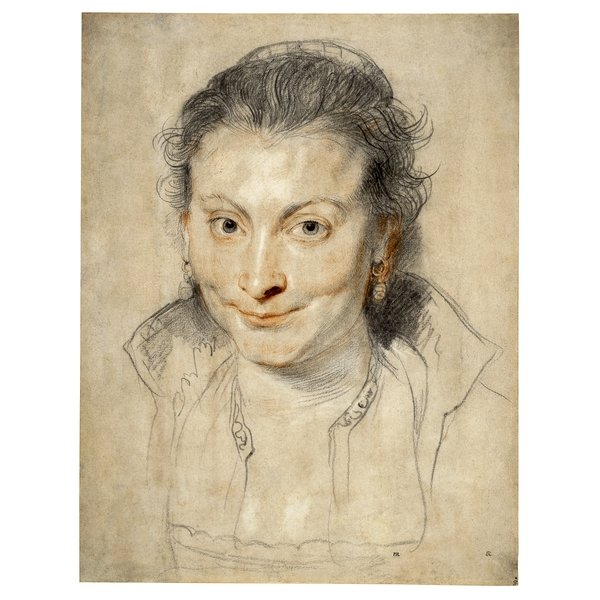
Portrait sketch of Isabella Brandt by Rubens (c.1621)

My final offering is a portrait drawing of Isabella Brant completed by her husband around 1621 and which is held at the British Museum.   This portrait of Rubens’s first wife, Isabella Brant is drawn in coloured chalks with a pale brown wash and white heightening.   The artist used the red chalk in an effort to highlight the warm flesh of his wife’s face and ears. Again a subtle hatching using both red and black chalks he has cleverly produced the shadows on her face. The sketch concentrates on Isabella’s head and face and her shoulders and the high collar of her dress have just been sketched as a sort of afterthought.  Isabella smiles at us, as she no doubt smiled at her husband as he sketched her.  She has a radiant smile which somehow gives us the impression she would have been a likeable person to have met.  Her marriage to Rubens was one of love and mutual respect and her death due to the plague in 1626, at the age of 35, deeply saddened him.  In Ruth Saunders Magurn’s  collection of translated letters of Rubens, entitled The Letters of Peter Paul Rubens, she highlights the extent to which Rubens mourned the death of Isabella in an extract from a letter he wrote to his friend, the French scholar, Pierre Dupuy, dated July 15th 1626, a little over three weeks after Isabella died.   Of his late wife, Rubens wrote:

“…Truly I have lost an excellent companion, whom one could love – indeed had to love, with good reason – as having none of the faults of her sex.   She had no capricious moods, and no feminine weaknesses, but was all goodness and honesty…”

I think it is a delightful sketch but not everybody agrees.     In Jeremy Wood’s 1998 book entitled Some Early Collectors of Rubens Drawings in England, he quotes a one-time owner of the sketch, the notable portrait painter and art theorist, Jonathan Richardson, who described Rubens’ sketched portrait of his wife:

“…[her] face is one of the most disagreeable I have ever seen and I am sure it is more so than was necessary for the likeness, however ugly she really was…”

 I guess beauty is in the eye of the beholder !!!

Rembrandt, Geertje Dircx and Hendrickje Stoffels

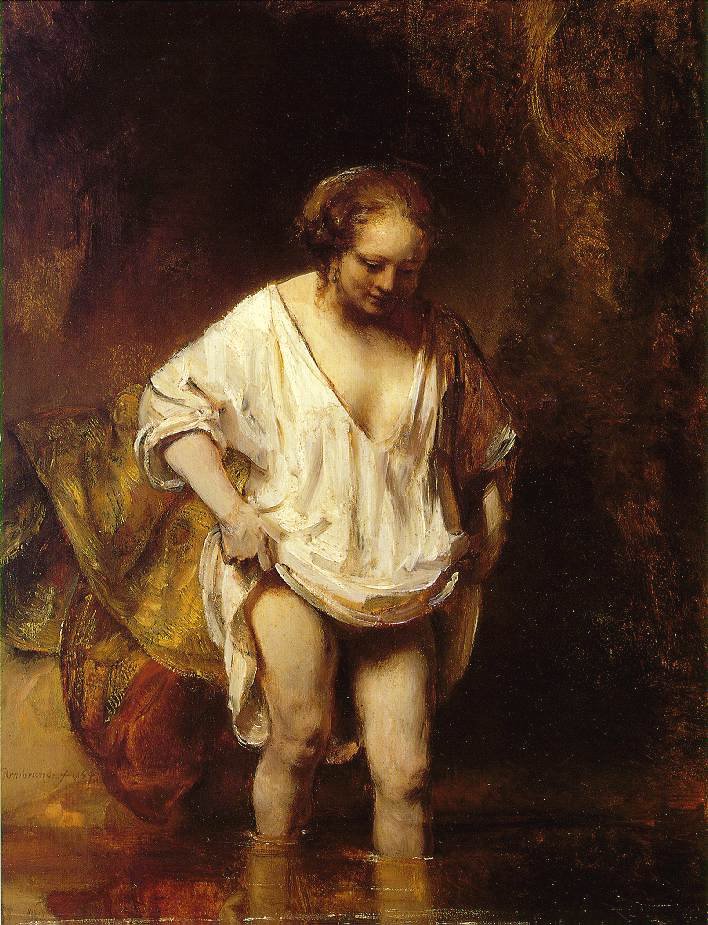
Woman bathing in Stream  by Rembrandt (1654)
Woman bathing in a Stream by Rembrandt (1654)

It is thought that the woman in the painting is Hendrickje Stoffels, who was Rembrandt’s maid and who shared the second part of the artist’s life.  Later she would become his lover and would remain by his side until the day he dies.  At the time of this painting Hendrickje was pregnant with Rembrandt’s child.

We see her before us, immersing herself in the water.  She looks down at her reflection in the water.  She is completely absorbed in what she sees.   Behind her we see a richly-coloured red dress which she has left behind before entering the water.   She has rolled up her skirt up and she hesitatingly and gingerly steps into the cold water of a stream. She seems completely unaware that we are observing her.  For us it is an intimate moment as we study her.  It is not simply a woman bathing in a stream.  Look how Rembrandt has allowed the light to fall on her, illuminating her skin and chemise.  The painting can be seen in the National Gallery, London.

I concluded my last blog about Rembrandt von Rijn and his wife Saskia van Uylenburgh with her death from consumption just before her thirtieth birthday.  In today’s blog I will look how, even from her grave, Saskia managed to have an effect on Rembrandt’s life and I want to move on and look at two other ladies who entered Rembrandt’s life, one of whom featured in a number of his paintings and is thought to have modelled for one of his more famous paintings, Woman Bathing in a Stream.  That lady was Hendrickje Stoffels.

With Saskia’s death in June 1642, the thirty-six year old Rembrandt was left alone with his nine month old son Titus.  He needed help with bringing up his son and so living in the household at the time was Geertje Dircx who had been acting as Titus’ wet nurse.  It is more than likely she was living in the house since Titus was born and before Rembrandt’s wife, Saskia, died.    Geertje was born in Edam around 1610, where she had been brought up by her father, Dirck Pieters and her mother, Jannetje Jans.  She had married a ship’s bugler, Abraham Claesz, in 1634 but he had died following year.   It is thought that she had received little education and could neither read nor write.  There is a great deal of conjecture about Rembrandt’s relationship with Geertje who was just four years his junior.  Was she more than just the wet nurse for Rembrandt’s son?  Did she and the artist have a sexual relationship?  If theirs was a very close relationship then why did they not marry?  By all accounts she was not a woman of great beauty as the Dutch painter and biographer of artists from the Dutch Golden Age, Arnold Houbraken, described her as:

“…a little farm woman……rather small of person but well made in appearance and plump of body….”

For the answer to the question of marriage between the two, we have to consider the power Saskia wielded, even from her grave.

What we do know is that for some reason, a few weeks before her death, Saskia had drawn up a new will and in it she left her share of hers and Rembrandt’s combined estate, not to Rembrandt, but to their baby son Titus, which would be given to him when he came of age.   However, Saskia’s will also stated that any interest accrued from her part of their joint estate could be used by Rembrandt as he was the father and guardian of their son.  As strange as the terms of the will seem, it was legally binding.  So what were the possible reasons for the terms of her will which she signed a fortnight before she died?   Was she concerned by the way Rembrandt spent their money on property and his art collection?  Maybe, as Rembrandt was having a very successful period selling his art work, she didn’t think he needed her money and therefore she would rather it was invested for her son to reap its benefit when he was older.  Unfortunately for Rembrandt he was soon to need this money as his success as an artist, which had provided him with a life of prosperity, was soon to dip and his financial position became ever more serious.  However what was probably more surprising about the will was a codicil which stated that if Rembrandt should marry again all Saskia’s money would be returned to her family, the Uylenburghs.  So you can see that Saskia still controlled Rembrandt from her grave!

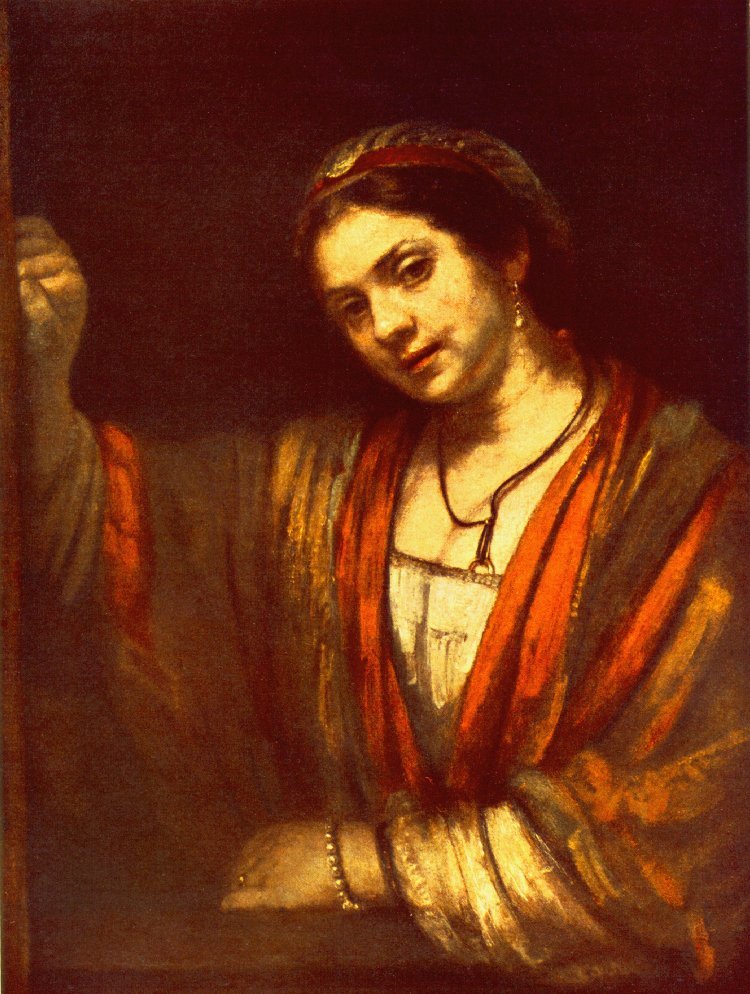
Hendrickje Stoffels(Young Girl at the Window) by Rembrandt (1657)

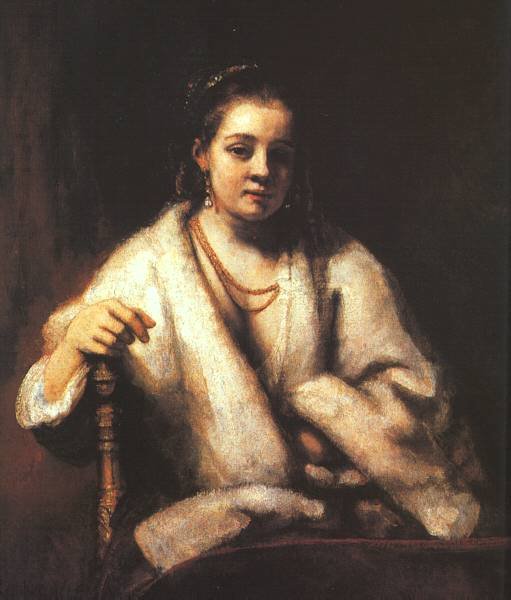
Hendrickje Stoffels (Young Girl at the Window) was painted by Rembrandt in 1657.  It was painted in the same year he completed a portrait of his son Titus (Titus Reading) and it was during this time that the artist concentrated his portraiture work on people or family who lived nearby.  Hendrickje, although uneducated and lacked the ability to read or write, was the perfect companion for Rembrandt.  She supported him during his troubled times when he was mired down in bankruptcy proceedings.  She also stuck with him despite the adverse comments from “respectable” neighbours and the Reform Church about her “state of whoredom” for being his live-in lover.  She was determined to support Rembrandt through thick and thin and in this portrait of her we see that grim determination and her steadfast composure as she stands at the window of their house in Breestraat, Amsterdam.  This portrait hangs in the Gemäldegalerie, Berlin.

Before he felt the full force of pecuniary embarrassment, Rembrandt had another problem to solve, which was probably self-inflicted.  Around about 1647, Rembrandt hired in a young maidservant, Hendrickje Stofefll.  Hendrickje was the daughter of an army sergeant based in the garrison town of Bredevoort.   In 1646, when she was just twenty years of age, her father was killed, the victim of an explosion of the gunpowder tower in Bredevoort.  Hendrickje’s mother remarried the following year and her daughter was left to fend for herself.  She moved to Amsterdam where she became a maidservant and later that year took up employment in Rembrandt’s house.   Hendrickje was sixteen years younger than Geertje, who lived in the household as nurse to Rembrandt’s son, Titus.  The two women did not get on well together.  Hendrickje had characteristics which Geertje lacked.  She was a quiet girl with a very pleasant manner and had the youthful looks which Geertje had lost.  Although Hendrickje was twenty years younger than Rembrandt he was charmed by her as was his son Titus who was six years old when Hendrickje entered the household.  Geertje soon became jealous at the way Rembrandt and Hendrickje became ever closer and she must have been horrified at the turn of events.

Portrait of Hendrickje Stofells by Rembrandt (c.1656)
Portrait of Hendrickje Stoffels by Rembrandt (c.1656)

This portrait of his mistress, entitled Portrait of Hendrickje Stoffels, was completed by Rembrandt around 1656 and can now be found in the National Gallery, London.  There is a sense of intimacy between artist and subject in this work.  Look closely at the expression on Hendrickje’s face.  It is one of poise and yet there is a degree of sensuality about the way she affectionately looks at Rembrandt, her lover and father of her child, as he concentrates on her portrait.  One of the strange things about this work is that the signature and the date on the portrait were believed to have been added at a later date.

Hell hath no fury as a woman scorned is a maxim that summed up Geertje’s feelings, which led to her subsequent and somewhat foolhardy actions.  Tensions in the Rembrandt household surfaced, culminating in the dismissal of Geertje.  She then decided to take Rembrandt to court for refusing to honour his unwritten agreement to marry her.  Knowing as we do the nature of Saskia’s will, in respect of Rembrandt re-marrying along with the unfavourable financial consequences for him if he was to remarry, there is little likelihood that he would ever have seriously proposed marriage to Geertje.  Whether she had at one time been his lover is of course another matter!   Rembrandt tried to come to a financial settlement with Geertje but she kept holding out for an ever more lucrative settlement.  In the end the case went to court on October 23rd 1649 at the city’s Town Hall and the Commissioners of Marital Affairs, who sat in judgement, were told that Rembrandt had slept with Geertje, but that he had not made a promise to marry her. Their decision was to award Geertje an annuity of 200 guilders in alimony, a sum he continued to pay until 1655.  However there was another  twist to this saga. Geertje was found guilty of stealing Saskia’s jewelry which was part of Rembrandt’s estate.  One of the prosecution witnesses was none other than Hendrickje Stoffels.  Geertje was sent to the Spinhuis in Gouda (A spinhuis was a house of correction, a kind of workhouse) where she remained for five years.

Rembrandt and Hendrickje Stoffels lived together quite happily as lovers but in June 1654 the Council of the Reformed Church of Amsterdam got wind of this relationship and summoned Rembrandt and Hendrickje to stand before them.  Rembrandt was not a practicing churchgoer so the matter against him was dropped.    Hendrickje however was accused of whoredom and of living with a man, unwed.  Being six months pregnant there was little point in denying the charge.  Her fate was to suffer banishment from attending any special church occasions.  She gave birth to Rembrandt’s daughter, Cornelia, on October 30th 1654.  The name could well have been chosen because it was the name of Rembrandt’s mother or more poignantly because it was the name of the two daughters of Saskia and Rembrandt, who survived just a few weeks.

Hendrickje Stoffels died in July 1663, aged 37 and was buried in a rented grave in Amsterdam’s Westerkerk (West Church) on July 24th 1663.  She was probably a victim of the bubonic plague which had swept through the city that year and had lasted for more than two years killing 10% of the city’s population.

Rembrandt van Rijn died on 4 October 1669 aged 63.   He is buried in an anonymous rented grave in Amsterdam’s Westerkerk on the 8th October.  His son Titus died one year earlier, aged 27.

Rembrandt van Rijn and Saskia van Uylenburg

Saskia in Arcadian Costume by Rembrandt (1635)
Saskia van Uylenburgh in Arcadian Costume by Rembrandt (1635)

Saskia van Uylenburgh in Arcadian Costume was painted by Rembrandt in 1635,  The painting is housed in the National Gallery, London.  Saskia who was twenty-three years old at the time and who had been married to Rembrandt for just twelve months, poses as Flora, goddess of spring.   Rembrandt has dressed her as a deity of youth, rebirth and beauty, along with her rustic shepherdess’s staff . Sadly as we look on the happy smile on her face it is hard to believe that this young women would die seven years later, shortly before reaching the age of thirty. 

My Daily Art Display today looks at some works of the great Dutch painter Rembrandt van Rijn.  Today’s blog is not so much about him but of a woman who featured in many of his paintings, his first wife Saskia Uylenburgh.

Saskia van Uylenburgh was born on August 2nd 1612 in Leeuwarden, the capital city of the Dutch province of Friesland where her father, Rombertus Uylenburg was the mayor as well as the justice of the Court of Friesland.  He had married Saskia’s mother, Siuckien Ulckedr Aessinga and they had three sons, Rombertus, Edzart and Ulricus and five daughters, Antje, Hiskia, Jelke, Tietcke and Saskia who was the youngest.  Her father was fifty-eight years old when Saskia was born.  Saskia’s uncle, Gerrit, the brother of her father, emigrated with his family to Krakov, Poland.  He was the father of the art dealer Hendrick van Uylenburgh who was to play an important part in Rembrandt’s early artistic career.  Saskia experienced an affluent upbringing, living in a large family home and her parents were able to offer their children a comfortable lifestyle.  Sadly when Saskia was just seven years of age her mother died and five years later her father passed away.  So at the age of twelve, Saskia was orphaned and was brought up by her elder sisters, and brothers.  Within four years of their father’s death all Saskia’s sisters had married and moved away from the family home. By 1628, Saskia, who was only sixteen years of age, was now the only unmarried daughter.  The family home was sold and Saskia went to live with her sister Hiskia and her husband, Gerrit van Loo in Sint Annaparochie, a small town in the municipality of het Bilde and Gerrit became Saskia’s guardian.  The van Loo household was a very welcoming place to Saskia and because of the affluence of her brother-in-law; she led a comfortable and contented lifestyle.  However, in 1632 Saskia and the van Loo family had to hurriedly leave het Bilde due to unrest in the town and they moved to Leeuwarden.

   Saskia as Flora  by Rembrandt (1634)
Saskia as Flora
by Rembrandt (1634)

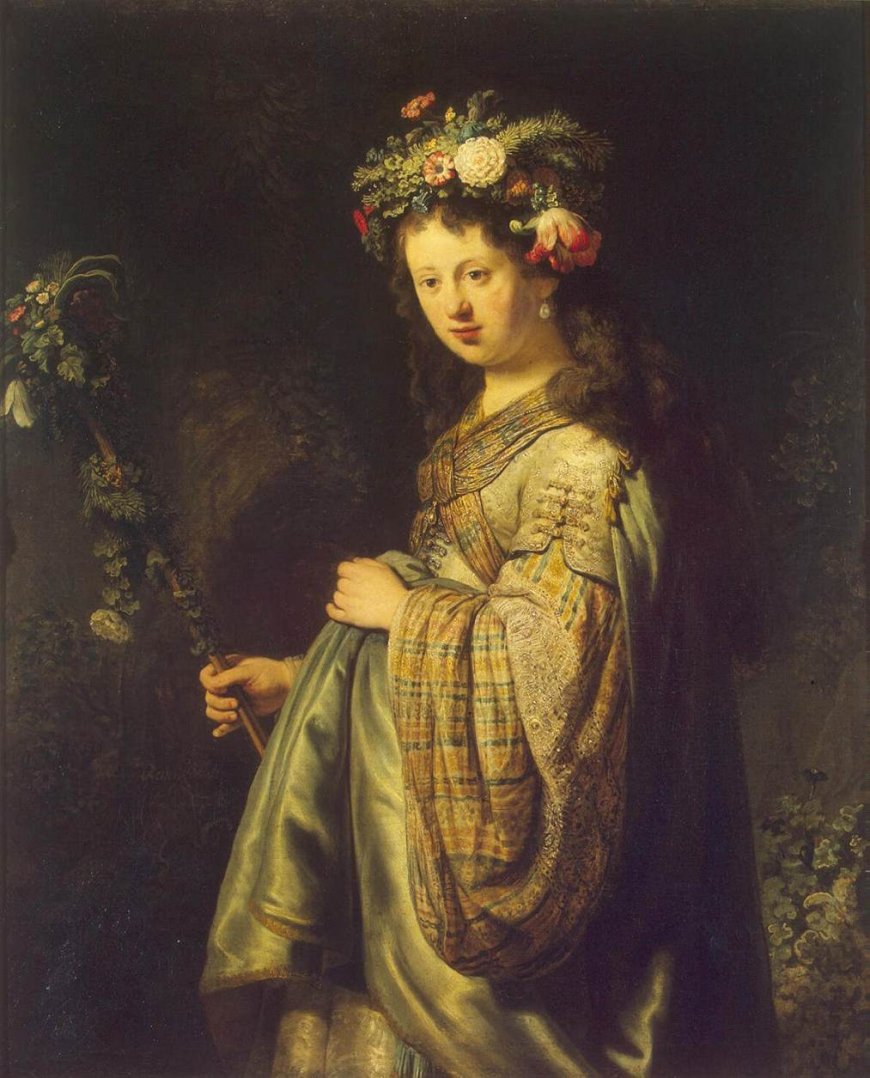
Saskia as Flora was the first portrait Rembrandt did of his wife dressed as Flora, the Roman goddess of fertility and the season of spring and flowers.     He completed the portrait in 1634 and it can now be found in the State Hermitage Museum in St Petersburg.  Rembrandt has portrayed his wife as a young goddess in a somewhat rustic setting.  His new wife is festooned with flowers.  She is dressed in a splendid and extravagant costume.  This idyllic and pastoral setting was very popular with the upper-class Dutch society in the early seventeenth century.  They had a love of all things to do with the romantic ideal of life in the countryside which they perceived as unadulterated bliss.  The style of dress she wore for this portrait was often seen in local theatres during performances of pastoral plays. 

Meanwhile, Rembrandt (Rembrandt Harmenszoon van Rijn to give him his full name), and who was six years older than Saskia, was born in Leiden in the Dutch Republic, on July 15, 1606.     His father, Harmen Gerritszoon van Rijn, was a miller, and in 1589, aged twenty-one, had married Cornelia Neeltje Willemsdr. van Suijttbroeck , the Catholic daughter of a baker.  The couple went on to have nine children , two of whom died in infancy. Rembrandt was the 8th child and his modest family upbringing was in direct contrast to that of his more affluent upbringing of his future wife, Saskia.  However despite their modest means, Rembrandt’s parents were determined to give Rembrandt the best education they could afford and in 1613, when he was seven years old, he was enrolled at Leiden’s Latin school.  He remained there for seven years and in 1620, aged fourteen years of age he enrolled at the University of Leiden.   Rembrandt was less than impressed by the subjects he was being taught at the university and soon left to study art.  He managed to gain an apprenticeship with the Leiden landscape painter, Jacob  Isaacszoon van Swanenburgh, and he remained with him for three years.   In 1624, Rembrandt went to Amsterdam where he was apprenticed for six months with the Dutch history painter, Pieter Lastman.  In late 1624 Rembrandt left Amsterdam and returned to Leiden where he opened a studio which he shared with his friend and colleague Jan Lievens.  The two young artists collaborated in over two dozen works, including paintings, etchings and drawings.  In 1628, Constantijn Huygens, a scholar poet and diplomat wrote about his cultural visit to Leiden and his visit to Rembrandt and Lieven’s studio.  He wrote of his meeting with “a noble pair of young painters who worked together side by side”.  He watched them collaborate and commented:

“…Lievens was superior in invention and a certain grandeur in his daring themes while Rembrandt surpasses Lievens in his sure touch and in the liveliness of emotion…”

That said, it was Lievens that Huygens turned to for his portrait !

The Lievens/Rembrandt partnership lasted until 1631 at which time Rembrandt moved to Amsterdam and Lievens to England.  In 1631 Rembrandt met Hendrick Uylenburgh, the cousin of Saskia, whose father had moved his family from  Friesland to Krakov.  Hendrick had been trained as a painter but had also been trained as a buyer of works of art.  In 1625 he had moved to Amsterdam  and the following year bought the art studio and business premises of the Dutch portrait painter Cornelis van der Voort who had died in late 1624.  Rembrandt, the artist, and Hendrick Uylenburgh, the art dealer formed a business partnership which was mutually beneficial and Rembrandt moved into Uylenburgh’s house.    Uylenburgh secured the artistic commissions, often portraits of the well-to-do Amsterdam folk and Rembrandt completed them.  It was through this partnership that Rembrandt met Hendrik’s cousin Saskia in 1633.

Saskia van Uylenburgh The Artist's Bride of Three Days  by Rembrandt (1633)
Saskia van Uylenburgh
The Artist’s Bride of Three Days
by Rembrandt (1633)

One of the first works of art by Rembrandt to feature Saskia was a silverpoint portrait on prepared vellum of her entitled Saskia van Uylenburgh, which is housed at Berlin’s Staatlich Museen.  She wears a broad straw hat which is decorated with flowers and she holds a flower in one hand.  Her expression is one of happiness as she leans forward and stares lovingly at her husband-to-be.  The portrait has an inscription by Rembrandt, in Dutch:

“…This was made when my wife was 21 years old, the third day after our betrothal – 8th of June 1633…”

Following a twelve month betrothal, Rembrandt and Saskia were married on July 22nd 1634 at the parish church of St Anna in Friesland.   It is interesting to note that none of Rembrandt’s family went to the wedding so one must presume they were not enamoured by his choice of wife or maybe some time in the past, Rembrandt had, for some reason,  severed links with his family.   As was the case in those days Saskia brought a substantial dowry to the marriage, which caused some consternation with her relatives as early on the marriage they believed that Rembrandt was too free with Saskia’s money, frequently moving home and buying ever more expensive ones.  However Rembrandt was not concerned as his artistic career seemed to have taken off.  He was earning well from the sale of his paintings, especially his portraiture of the city’s bourgeoise, who often had to be added to a long waiting list of Rembrandt’s commissions.  He was also bringing in money by tutoring aspiring artists who were not put off by his high tuition fees.     After the wedding, the happy couple went to live at the home of Saskia’s cousin and Rembrandt’s partner, Hendrik and remained there until Saskia became pregnant with their first child.

Saskia with a Red Flower by Rembrandt (1641)

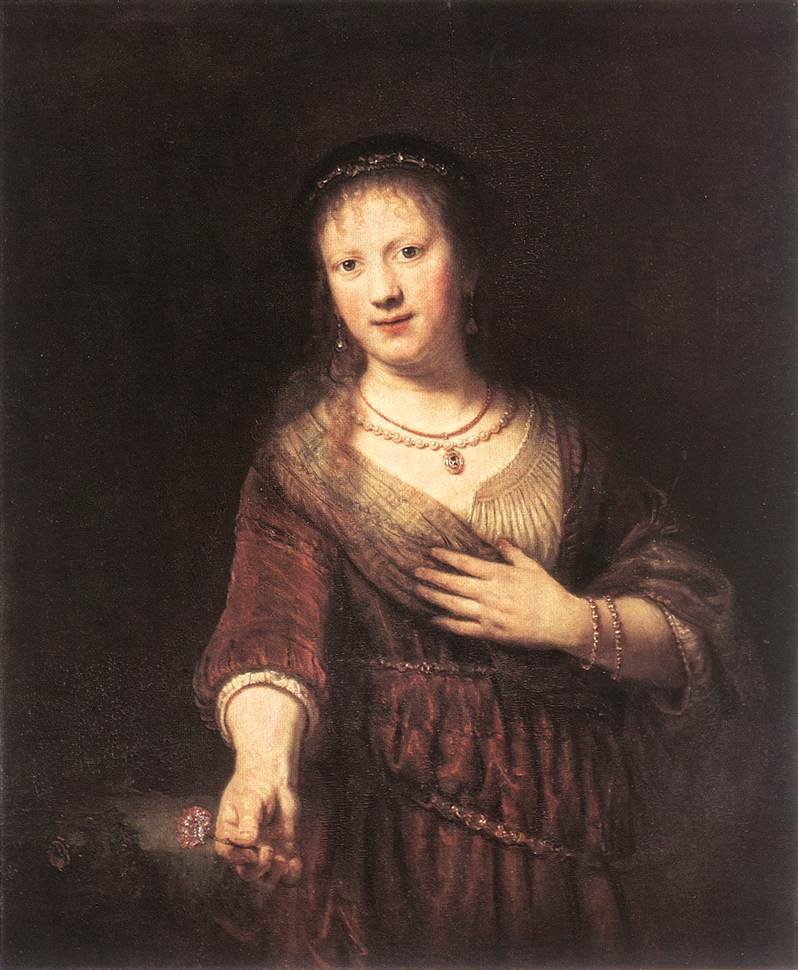
In Saskia with a Red Flower, which Rembrandt painted in 1641, we see Saskia looking towards us, although at the time she would have been looking directly at her husband as he painted.  Look at the tender and loving expression on her face.   Look how her left hand is place upon her heart as a gesture of adoration, a simple symbol of love and loyalty towards her husband.  In her right hand she holds a red flower which she offers her husband.  The painting is housed in the Gemäldegalerie Alte Meister in Dresden.

Although the financial situation of the couple could not have been better their personal life was about to be shattered.  In December 1635 Saskia gave birth to their first child, a son whom they baptised Rumbartus.  Sadly he died aged two months.  In July 1638 Saskia gave birth to a daughter who they named Cornelia after Rembrandt’s mother but the baby died in the August, aged three weeks.  Saskia gave birth to another daughter, once again christened Cornelia, on July 29th 1640 but she only survived less than a month dying in August.  One can only imagine the torment and suffering, both mentally and physically, Saskia must have endured during this period of her life.

     Titus Reading  by Rembrandt (1657)
Titus Reading
by Rembrandt (1657)

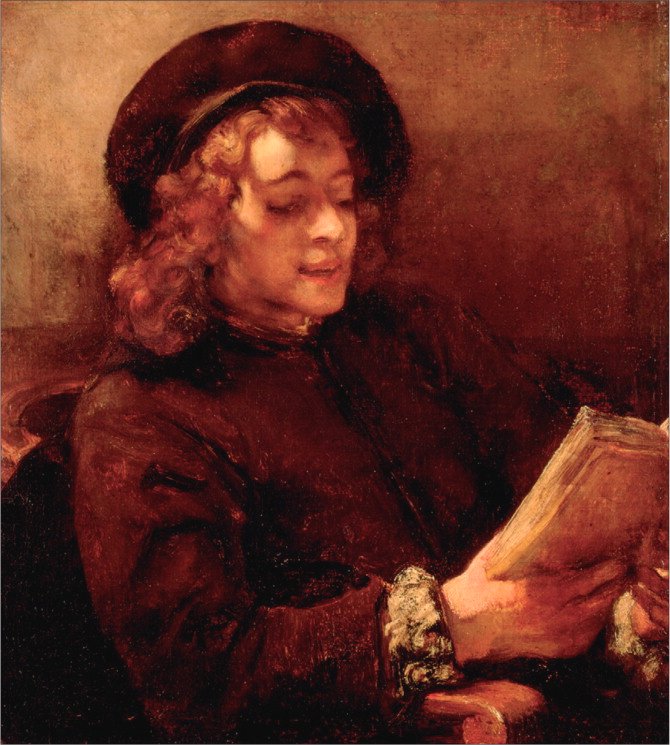
On September 22nd 1641 Saskia gave birth to a son, Titus, who survived childhood, became a painter like his father and lived to the age of twenty-seven.  However the physical suffering from all those pregnancies took a toll on Saskia’s health and she died on June 14th 1642, a few months before her thirtieth birthday.  The cause of death was recorded as consumption.

In my next blog I will look at the repercussions on Rembrandt of Saskia’s death and look at a painting of a woman who was to play an important part in his later life.

The Holy Family paintings by Joos van Cleve

Self portrait by Joos van Cleve (1519) Museo Thyssen-Bornemisza, Madrid
Self portrait by Joos van Cleve (1519)
Museo Thyssen-Bornemisza, Madrid

The artist I am featuring today is the early Netherlandish painter Joos van der Beke, better known as Joos van Cleve because he is thought to have been born in the Lower Rhine region of Kleve, possibly the Rhine-river town of Wesel, which lies on the current Dutch-German border.  The year of his birth is believed to be around 1485.  There are various accounts of his early life, much of which are contradictory, but it is thought that his initial artistic training began when he worked in the Kalkar studio of the Dutch painter, Jan Joest van Kalkar, between 1505 and 1509.

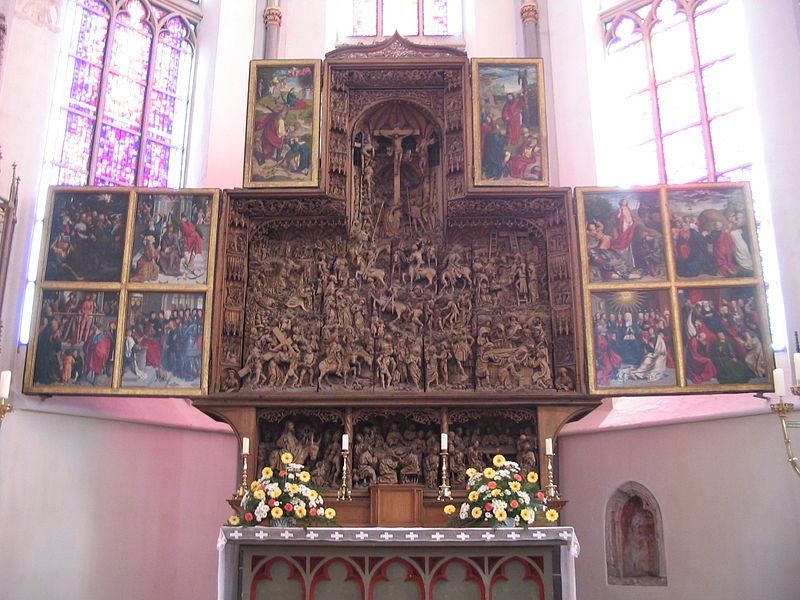
The High Altarpiece in the Kalkar church of St Nicholai  by Jan Joest
The High Altarpiece in the Kalkar church of St Nicholai by Jan Joest

It was during his time with Joest that he worked with his master on the twenty-panelled high altarpiece in the Kalkar church of St Nicholai which is considered to be Joest’s greatest work.   From Kalkar, it is believed Joos van Cleve lived around the Ghent-Bruges area and the next we hear of him is in 1511 where he is mentioned in records as a free-master in the Antwerp’ Guild of St Luke, the city’s painters guild, and on a number of occasions he would hold the position of co-deacon of the guild as well as being appointed Dean of the St Luke’s Guild in 1519, 1520 and 1525.

Centre panel of triptych Death of the Virgin  by Joos van Cleve (c.1515)
Centre panel of triptych
Death of the Virgin
by Joos van Cleve (c.1515)

He set up his own studio in Antwerp and over the next twenty years he took on a number of apprentices.  His studio became the most famous in the city and he was inundated with painting commissions, many of which found their way to the leading European royal, ecclesiastic and merchant houses.  One of these lucrative commissions came in 1515, from the Nicasius and Georg Hackeney, wealthy merchants of Cologne, for a religious triptych which became known as the Death of the Virgin and which is currently housed in Cologne’s Wallraf-Richartz-Museum.  It was from this work that Joos also became known as Master of the Death of the Virgin. It was works like this which brought the Flemish tradition to Cologne, and in so doing brought to bear an extensive influence on the Cologne school of art.

The centre panel of the wide-format triptych is a scene depicting a number of apostles gathered around the bed of the dying Virgin Mary. Of these people, only John and Peter are identifiable.   Peter stands before the bed.  On the floor is a stool on which lies a Gothic rosary.  On the two wings of the triptych there is a depiction of an open river landscape with continuous horizons as well as portraits of the commissioners of the work, Nicasius and Georg Hackeney with their patron saints.

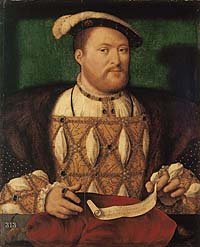
Henry VIII by Joos van Cleve (1535)

Besides his religious works, Joos van Cleve was an accomplished portrait painter.  He was so talented that the king of France at the time, Francis I, summoned him to Paris to work at the French court, during which time he painted a number of portraits of the king, his wife, Eleanor of Austria and members of the court.  It is thought that Joos van Cleve also travelled to England around 1534.  This belief is based on a fact that he painted a portrait of the forty-four year old monarch, Henry VIII, dated 1535, which is now part of the Royal collection.

Little is known about his family life except that in 1519 Joos van Cleve met and married his first wife, Anna Vijts.  The couple had two children, both born in Antwerp.  The birth records of the children show them listed as  “vander Beke, alias van Cleve” and that their father was registered as an Antwerp burgher which possibly indicates that Joos had registered as an Antwerp citizen in order to be able to work in the city.  Joos and Anna had a son, Cornelis, who was born in 1520 and two years later in 1522, Anna gave birth to their daughter, Jozijne.  Their son, Cornelis became a talented portrait painter in his own right.  He helped his father in his workshop and would, after his father’s death, run the business   Cornelis was later known as Sotte Cleve (Mad Cleve) after becoming insane at the age of thirty-four.    Joos van Cleve also allegedly had an illegitimate daughter, Tanneken, from his relationship with Clara van Arp.   In 1531, three years after the death of his first wife, Anna, Joos married Katlijne van Mispelteren.  The couple had no children.   The exact date of Joos van Cleve’s death is uncertain but it is known that on November 10th 1540 he wrote his last will and testament and it is believed he died shortly afterwards.  In April 1541 his wife, Katlijne, was listed as a widow.

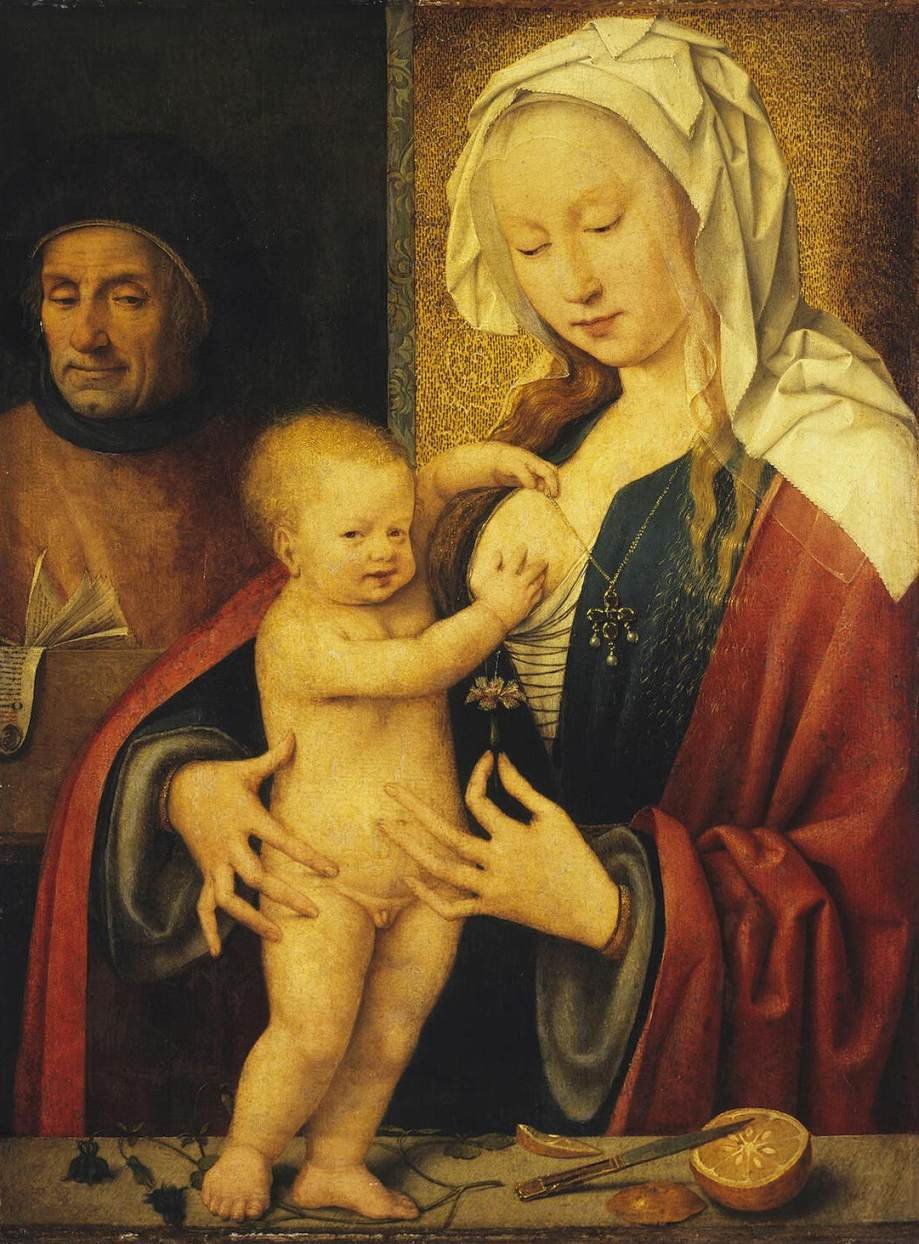
     The Holy Family  (St Petersburg version)      by Joos van Cleve
The Holy Family
(St Petersburg version)
by Joos van Cleve

The works of art produced by Joos van Cleve merge the emotions of the Italian Renaissance with the exactitude and lucidity of early Netherlandish art. He was also an astute business man who knew the paintings people liked.   An example of this is in the way he painted many versions of his most popular subject, The Holy Family.  One of these versions is in the Hermitage Museum in Saint Petersburg.  In this work we see a half length composition of the Virgin with the upright Christ Child standing on a stone parapet.  To the left, and somewhat in the background, is Saint Joseph.  The Virgin protects the Child from falling by embracing him with her Mannerist elongated hands.  The pose we see before us is often referred to in Latin, as Maria Lactans, “the virgin’s nursing breast”, or “the lactating virgin”, which was the primary symbol of God’s love for humanity.

    The Holy Family  (Academy of Fine Arts, Vienna)  by Joos van Cleve (c.1515)
The Holy Family
(Academy of Fine Arts, Vienna)
by Joos van Cleve (c.1515)

In the Academy of Fine Arts in Vienna there is another version of The Holy Family, completed around 1515 and in this rendering we see that Joos van Cleve has added a landscape panorama behind the bespectacled foster-father, Joseph, who seems to be positioned outside the room as he reads his book which rests on the window sill.   Again we have the Child standing upright on the parapet held by his mother.  Once more, we notice the depiction of the hands circling the child in an Antwerp Mannerism style.   To emphasize the close mother-child relationship Joos van Cleve has once again gone for the Maria lactans motif but showing it in a somewhat playful fashion.

    The Holy Family  (Metropolitan Museum of Art, New York)  by Joos van Cleve (c.1513)
The Holy Family
(Metropolitan Museum of Art, New York)
by Joos van Cleve (c.1513)

The Metropolitan Museum of Art, in its Friedsam Collection, has a yet another of Jan van Cleve’s versions of The Holy Family which was painted around 1513.  In this version the Christ Child is sitting on the parapet and his lips are tight on the breast of the Virgin as he suckles.  On the parapet we see a glass of wine and a plate of fruit which are symbolic of Christ’s incarnation and the sacrifice of his life which will come in the future.  Again in the background to the left of the mother and child we have Saint Joseph.  In this version he seems less detached and is not concentrating on reading from a book, although he is holding an unfurled scroll.

   The Holy Family (Currier Museum in Manchester, New Hampshire )  by Joos van Cleve (c.1520)
The Holy Family
(Currier Museum in Manchester, New Hampshire )
by Joos van Cleve (c.1520)

The Currier Museum in Manchester, New Hampshire has another version of Joos van Cleve’s The Holy Family, completed around 1520.  It is a small painting measuring 74cms x 56cms.  In front of the mother and child there is, not the stone parapet which we had seen in the other versions, but a table covered by a green felt cloth.   It is a beautiful work which is full of finely detailed still-life objects on the table.   Joos van Cleve has adroitly depicted a variety of objects of differing textures varying from a glass vessel to the ermine lining of Mary’s robe.   In this painting the Christ Child lies across his mother’s lap clutching an amber-coloured string of beads.  As the beads are fixed on the string in five groups of ten we can be almost certain that they represent a rosary.  On the table is a glass jar which symbolises the purity of the Virgin.  This symbolism comes from the fact that light passes through the vessel without breaking it similar to the impregnation of the seed which entered Mary womb without her hymen being breached.    There is a cross reflected in the jar and this is a reminder of how the Christ Child will die and the wine in the jar symbolises the blood of Christ which will be shed during his suffering.   Also on the table there is a folded piece of embroidery, known as a sampler.  In the left of the painting we have Joseph.  He is reading a scroll version of the Magnificat which comes from Luke’s Gospel (1:46-55) and which relates to Mary’s holy stature of Luke:

  “…For behold, henceforth all generations will call me blessed, for He who is mighty has done great things for me and holy is His name…”


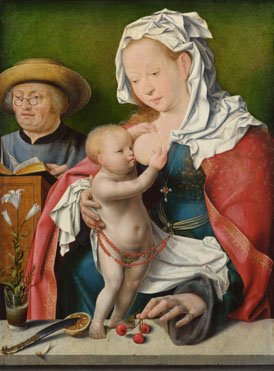
   The Holy Family  (National Gallery, London)  by Joos van Cleve (c.1515-20)
The Holy Family
(National Gallery, London)
by Joos van Cleve (c.1515-20)

The final version of Joos van Cleve’s The Holy Family I want to show you is the one in London’s National Gallery.   This version was completed between 1515 and 1520.  In this work the figures are depicted close together giving a sense of intimacy, albeit Joseph is set back and does not engage with Mary or the Child.   This depiction and positioning of Joseph symbolizes his subordinate, albeit contributory, role in the family relationship.  The depiction of Mary is somewhat an idealized and heavenly one but there are definite earthly characteristics about the bespectacled, grey-haired Joseph with his double chin.   Again the Maria Lactans depiction of the Virgin reinforces the human characteristic of the child and adds to the intimate and cherished relationship between mother and baby.  The Christ Child stands on a smooth stone parapet which is shown in the foreground of the painting.  Wrapped around him, almost like a restraint, is the string of beads of an orange rosary.  On this ledge Joos van Cleve has depicted a number of inanimate objects which are symbolic.  We see the Virgin holding a stalk with three red cherries which symbolise paradise.  The glass vase to the left contains a stem of white lilies which symbolizes the purity of the Virgin.  It is believed the piece of lemon which has been cut open by the knife which rests upon it may represent the weaning of the child.

In all the Holy Family paintings Joos van Cleve has depicted the Virgin and the Christ Child in a similar fashion whereas his depiction of Saint Joseph standing in the background varies  from painting to painting.  I wonder why that was.  Did he reconsider the role of Saint Joseph differently and thus altered his image?

Virgin and Child with Saints by Rogier van der Weyden

Sketch of Madonna and Child with Saints

Do you like jigsaw puzzles?  Do you like a mystery?    I hope so as today my featured paintings are just part of an artistic and mysterious jigsaw puzzle.  I will be looking at the three remaining pieces of an original oil on wood work of art and a sketch which may give a clue as to what the original complete painting may have looked like.  From the three remaining pieces which still exist, one can tell it must have been a truly beautiful work of art.  The artist who painted the work was the great early Netherlandish painter Rogier van der Weyden.  I featured one of his best known works entitled The Descent from the Cross in My Daily Art Display on November 15th 2010 and today I am pleased to feature another of his fine works.

Rogier van der Weyden was born in, what is now, the Belgium town of Tournai around 1399.  His name at that time was actually Rogier de le Pasture which literally translated meant Roger of the Pasture.   His father Henri de le Pasture was a knife manufacturer.  At the age of 26 he married Elisabeth Goffaert, the daughter of a Brussels shoemaker, and they had four children.  In 1436 he was given the position of stadsschilder, (painter to the town), of Brussels, a post especially created for him.  It was whilst living in Brussels, which was then a Dutch-speaking town that he began to use the Dutch version of his name: Rogier van der Weyden.

The complete painting I am featuring today was entitled Virgin and Child with Saints, but it does not exist anymore.   However three parts of the work have survived.  One of these is entitled The Magdalen Reading and is housed at the National Gallery in London.  The other two pieces entitled Head of Saint Joseph and Head of Female Saint (St Catherine?) are to be found in the Museu Calouste Gulbenkian in Lisbon.  It is believed that all three pieces were once part of a large Sacra Conversazione painted by Rogier van der Weyden some time between 1435 and 1438A Sacra Conversazione is an Italian phrase which literally translates to “holy conversation”.  The phrase is designated to works of art, normally altarpieces, which depict the Virgin and Child flanked by attendant saints, who are grouped in a single panel, rather than a multi-panelled polyptych.  From the fifteenth century the sacra conversazione began to replace the polyptych.   The word “conversazione” alludes to the characters in the painting being in intimate conversation with one another.  This depiction of the saints communing with each other was unusual as normally in religious works of the time the saints would be shown simply meditating or reading and it was not until a century later that they took on a more animated quality.

Although the original and complete painting does not exist any longer we have some idea what it looked like as there exists a drawing of the almost complete work in the National Museum of Fine Arts in central Stockholm which was drawn by a follower of Rogier van der Weyden.  Although it is an incomplete sketch, it gives one an idea of what the original finished painting looked like.   In this drawing we see standing on the left a bishop saint with a mitre on his head.  In his left hand he holds his crosier, his pastoral staff, and his right hand is raised as he makes a blessing.    If you look to the right of this figure you can see there is a narrow vertical gap with a few curved but faint vertical lines and it is in this gap that art historians believe was the lower part of the kneeling figure of the female saint, Saint Catherine of Alexandria, a fourth century martyr, whose head and shoulders appear in the Lisbon painting. 

Head of Female Saint (St Catherine?) by Rogier van der Weyden ? (before 1438)

However, some art historians, who have studied the three pieces of the painting, have come to the conclusion that the depiction of Saint Catherine may not have been painted by van Weyden himself.  The Scottish art historian, Lorne Campbell, an expert on early Netherlandish paintings, wrote in his 2004 book, Van der Weyden, that the depiction of the head of Saint Catherine was “obviously less well drawn and less successfully painted than the figure in the Magdalen “and as far as he was concerned the image of Saint Catherine may have been painted by one of the members of van Weyden’s workshop. 

The next figure along in the sketch is a bearded barefooted figure holding an open book.  This is thought to be John the Baptist.  Seated to the right of him is the Virgin who holds the Christ Child in her lap.  The Christ Child is wriggling himself out of his mother’s grasp as he tries to look at another book which the kneeling man, on the right, is showing him.  This man is believed to be John the Evangelist.  As I said earlier, this drawing seems to be an unfinished sketch of the original painting, not just because of the empty space between the bishop and John the Baptist but more importantly because it does not show what is believed to have been the complete right hand side of the original painting, part of which forms the work held in London’s National Gallery entitled The Magdalen Reading.   Because the sketch does not show the right hand section of the original painting it is believed that this was the first section to have been cut from the original.

The Magdalen Reading by Rogier van der Weyden (before 1438)

So let us examine both the sketch and the Magdalen Reading painting and see if we can envisage the two being joined.    Look at the robes of the figure kneeling in the extreme right of the sketch.  See how they lie along the floor but suddenly stop at the edge of the sketch.   Look carefully at how the folds of this robe in the black and white sketch compare with the folds of the red robe on the floor to the left in the Magdalen Reading, close to where we see the bottom of a stick or cane which is being held by somebody who is not fully shown in the painting.  The stick touches the red flowing robes which are almost certain to be the robes of the kneeling John the Evangelist of the sketch.

So now we have what we believe is the bottom right hand part of the original painting in the guise of The Magdalen Reading.  This fragment of the original painting depicts a woman with pale skin and high cheekbones.   This is Mary Magdalen.  She sits piously reading a holy book, the cover of which includes a chemise of white cloth, which protects the precious tome.  We see her deep in contemplation as she reads. According to art historian, Lorne Campbell, the book she is reading looks similar to a 13th century French Bible.   She seems quite oblivious to those around her.  Her head is tilted so that her eyes are shyly turned from us, the viewer.    She sits on a red cushion and leans back slightly and relaxes against a kind of wooden sideboard.   On the floor by her side is a white alabaster jar.  This is her traditional attribute in Christian art as the Gospels tell of her bringing spices in it to the tomb of Jesus.  Look how beautifully van Weyden has portrayed her.  She wears a long green robe which is pulled tightly below her bust by a dark blue sash.  From beneath the robe we catch a glimpse of the gold brocade of her underskirt which is hemmed with many jewels.  Van Weyden has spent much time in depicting detail, such as the many folds of her green robe, or the rosary beads dangling from Saint Joseph’s hand. 

In the background we have a view through a window which overlooks a canal in the distance.  On this side of the canal positioned on the wall of the garden there is an archer and across the canal we catch sight of a figure walking along the opposite canal bank.  The background and the headless torso are visible to us today but that was not always the case as the background of the painting had been over-painted with a thick layer of brown paint.   It was not until the painting was cleaned in 1956 that the figure behind Mary Magdalen, the red robe of the kneeling figure on the left and the landscape view through the window were revealed. 


Head of St Joseph by Rogier van der Weyden (before 1438)

But what about the top right hand part of the original painting.   For this we must go to the painting held in Lisbon’s Museu Calouste Gulbenkianand study their painting entitled Head of Saint Joseph.   If you place this painting above the Magdalen Reading painting you can see that the head and shoulders of the man in the Lisbon painting fit perfectly with the lower torso of the “head-less” figure shown standing to the side of Mary Magdalen in the London painting.  The man in the Lisbon painting has been identified as Saint Joseph and if you look carefully at his right shoulder you will see a slight hint of a red sleeve which can be clearly seen continuing on the “headless” torso in the Magdalen Reading painting.  In one hand he holds a walking stick or cane and in the other he holds rosary beads made of rock crystals.   So we now have managed to place the three individual paintings into the one work…….or do we?

I raise the hint of doubt as not all art historians agree that the three are part of one whole, especially when it comes to the head of Saint Catherine.  Let us look more closely at the Lisbon painting, Head of Female Saint (St Catherine?).  Look carefully at the background and the window opening behind her and that of the one shown in the background of the Magdalen Reading painting.  They are different in design, one is plain and one is bevelled and this to some art historians, such as Martin Davies, who wrote about the painting in his work Rogier van der Weyden’s Magdalen Reading and John Ward, who wrote an article about the painting entitled A Proposed Reconstruction of an Altarpiece by Rogier van der Weyden in the Art Bulletin (vol. 53, 1971. 27–35), means that Head of the Female Saint was not part of the original work. 

Notwithstanding whether I believe the three paintings once formed part of one original work, I only wish I could have seen the work as a whole before it was split up.

The Portraiture of Christen Købke

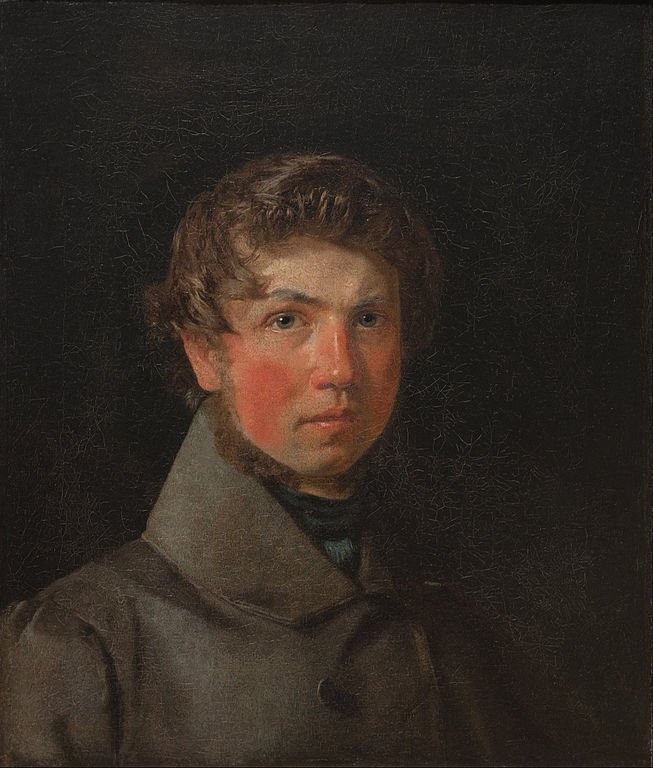
Self Portrait by Christen Købke (1833)

Today, as I promised in my last blog, I am going to continue looking at the life of the Danish painter Christen Købke and concentrate on some of his intriguing and exquisite portraiture work.

Portrait of the Artist's Wife,Susanne Cecilie Købke by Christen Købke (c.1836)
Portrait of the Artist’s Wife,Susanne Cecilie Købke by Christen Købke (c.1836)

In my last blog, I had reached the year 1836 in the life of Købke and he had just completed a series of works featuring the Frederiksborg Castle.   A year later, in November 1837, Købke married Susanne Cecilie Købke, whom he called Sanne, and shortly afterwards painted a portrait of his young bride.  The following August after gaining a travel stipend awarded to him by the Royal Danish Academy, Købke leaves his wife and home and along with the Danish decorative artist, Georg Christian Hilker, sets off on a two year painting expedition around Europe.  On their way to Italy they call at Dresden and Munich and pass through Austria before arriving in Rome on December 8th 1838.  It is in the Italian capital that Købke meets up with many other Danish artists living in the Eternal City as well as the sculptor and medallist, Frederik Krohn, his brother-in-law, who had married his sister Susanne.  In May 1839 Købke, along with Hilker and another Danish artist, Constantin Hansen journey to Naples and later to Capri where they stay until the end of that year painting out in the open air.  The following year Købke spends months examining the ruins of Pompeii where he completes a series of sketches and paintings.

View of Marina Picola on Capri by Christen Købke (1846)

In September 1840 Købke returns home to Copenhagen and in June 1841, Købke’s wife Susanne gives birth to their first child, a son, Hans Peter Carl.  In 1842 Købke applies for membership to the Royal Danish Academy which accepts his proposal of a landscape work featuring Capri as his membership piece.   He was given two years in which to complete the painting.  In 1843 Købke’s father, Peter, dies.  By the end of 1844 Købke has still to complete his membership piece for the Academy but fortunately they give him a two year extension.  In 1845 his second child was born, a daughter, Juliane Emilie.   In 1846 he had finally finished the painting entitled View of Marina Picola on Capri and submits it to the Academy.  To his amazement and disappointment the Academy rejects the work. 

Christen Købke's gravestone
Christen Købke’s gravestone

On February 7th 1848, Christen Købke died of pneumonia, aged 37 albeit his family maintained that the rejection of his painting by the Academy was a contributing factor in his death.  Købke was buried in Assistens Cemetery in Copenhagen.   He left behind his wife Susanne and children Hans and Juliane.  His wife died the following year and his children were looked after by Købke’s sister Sophie.


Today’s blog concentrates on some of Købke’s portraiture.   Portraiture is not simply the representation of a specific individual or individuals.  It is not just documentary evidence of a person’s features.  A good portrait looks into the soul of the person and can be used to define who the person is and by so doing the finished work gives us a clear and coherent sense of the real person we see before us on the canvas.   If one thinks about a media outlet, such as a newspaper office, and think about the use of their photograph archives.   Take an example of an editorial the newspaper wants to put out an article about a celebrity.  They go to their photo archives and pick a photo which corroborates the story that they are writing.   In other words, the picture  gives one an idea about that person’s character but of course we need to remember that the newspaper can manipulate their story by cleverly using a photograph simply to prove their point, whether it be true or false.  This is the same with portraiture.  The portrait artist is able to manipulate his or her work so that the finished depiction can present certain characteristics or status of the sitter, which the sitter wants us to see. The portraitist can also add objects to the portrait so as to represent an idea, such as wealth by adding luxury furnishings or by depicting the sitter in expensive clothing.  They can add smouldering candles or a skull to create a Vanitas painting in which they want us to contemplate the passing of time and our own mortality.  In other words, the secret to great portraiture is not just how well the finished likeness is to the sitter but about how much it tells us about the sitter, about his or her place in society and their character.


As far as the Academic “pecking order” was concerned portraiture was secondary to History Painting in the painting genres.  Portraiture has been around since the Ancient Egyptians with their wall paintings depicting their gods and their Pharoes.  We saw portraiture in the form of sculptures and on the coinage in Ancient Greek and Roman times.  The Renaissance brought us portraits of the royalty, nobility and religious leaders and later we were to see portraits of the nouveau riche and the bourgeoisie classes.  In present times the art world is flooded with portraits of so-called “celebrities”.  All the sitters for these portraits wanted the artist to create a portrait which would confirm their new position in society.

Christen Købke’s portraits differ from many of his contemporaries as he liked to depict the sitter in such a way so that we could read their character from their expressions.  He had decided what their character was and translated that into the painting.  Some of his best portraiture was a simple head and shoulder depiction with no external accoutrements such as furniture or items which could be used to tell the story of the sitter.  The story of the sitter was in the face – the facial expression was to tell its own story.  His works were the culmination of his probing of the personality of the sitter.  Throughout his life, Købke was to complete numerous portraits.  The majority were single-figure portraits whose image was full of character.  However this intense searching for character in a person and his disinterest in having tell-tale inclusion of items advertising their status was in some ways counterproductive as for many would-be major portrait commissions that was just what sitters wanted and Købke’s modus operandi could well explain his lack of many lucrative commissions.  When we look at many of his portraits they are of family members, friends and acquaintances and not for rich fee-paying clients.  It was their loss as his outstanding talent as a portrait artist cannot be questioned.

His self-portrait, at the start of this blog, was the only one he ever painted and it was completed around 1833 when he was twenty-three years old.  It is a head and shoulder pose against a plain dark background which can thus not distract our eyes from looking directly at the sitter.  Although now in his early twenties there is a boyish look to him and that is enhanced by his ruddy-red cheeks, a facial quality which allegedly went down well with the local Italian girls when he visited their country some years later.  He has an engaging countenance and a look of sincerity.

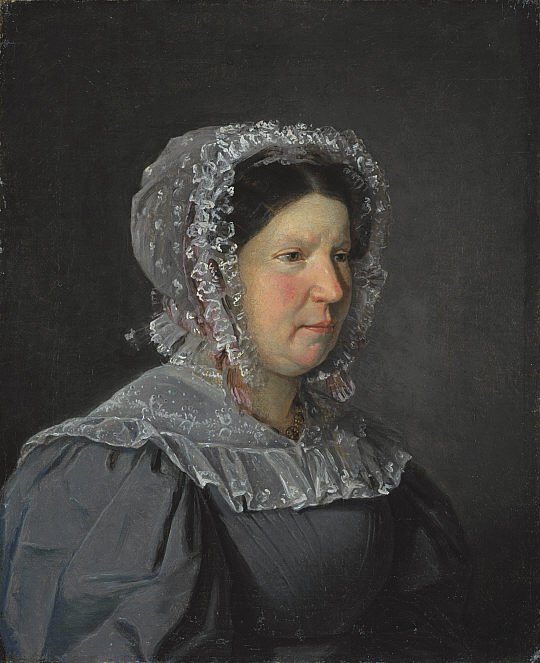
Portrait of the Artist's Mother, Cecilia Margrete, née Petersen by Christen Købke (1829)
Portrait of the Artist’s Mother, Cecilia Margrete, née Petersen by Christen Købke (1829)

Købke also painted his parents portraits.   Portrait of the Artist’s Mother, Ceilia Margarete, née Petersen was completed in 1829 when he was nineteen years of age. Six years later, he completed a portrait of his father, entitled Portrait of the Artist’s Father, Master Baker Peter Købke.  

Portrait of Inger Margrethe Høyen, née Schrøder, The Art Historian N.L. Høyen's Mother by Christen Købke (1832)
Portrait of Inger Margrethe Høyen, née Schrøder, The Art Historian N.L. Høyen’s Mother by Christen Købke (1832)

One of my favourite portraiture works of Købke was one he completed in1832.  It was a portrait of Inger Høyen, who was the mother of his friend and mentor, the art historian, Niels Høyen.   The portrait, simply entitled Portrait of Inger Margrethe Høyen née Schrøder, was completed by Købke in 1832.  It is a beautifully painted work brimful of characterisation.  It is a very sympathetic depiction of an old lady.  Inger was a prosperous, self-made woman, the daughter of a Jutland gardener who went on to marry a man who worked as a distiller in a local brewery and who would later go on to run his own distillery.  By all accounts she was a mild-mannered but astute person who possessed an imaginative quality.  Look how Købke has portrayed her.  Notwithstanding the wrinkles of time on her face he has clearly depicted her as a woman with a caring and an unassuming nature, an unpretentious character whose face radiates charm and kindness.

Portrait of the Landscape Painter, Frederik Sødring by Christen Købke (1832)

The final portrait I want to show you by Købke differs from most of his portraiture as there is a background to the painting and has objects included in the depiction which were there as an aid to telling the story of the sitter and his friendship with the artist.   It is a carefully crafted work and needs to be studied carefully.  As I told you in the last blog, Købke, in 1832, just before completing his Academy training, rented a studio with his friend and fellow student, Frederik Sødring in Toldbodvej, which was close to the Citadel.  The street is now renamed Esplanaden.  It was in that same year that Købke painted his friends portrait as he sat in their studio.  The painting is entitled Portrait of a Landscape Painter Frederik Sødring.  What is amazing about this painting is that Købke was just twenty-three years of age when he completed this work. He gave the portrait to Sødring as a twenty-third birthday present and on the reverse of the canvas there is an inscription written by Sødring:

“…Presented to me by my friend!  Ch: Købke on my birthday 31 May 1832…”


It is an intimate portrait done by friend, of a friend.  I am struck by Sødring’s youthful ruddy cheeks.   Before us we see Sødring relaxing, partly slouched in an upright wooden chair, in a somewhat  inelegant fashion.  I wonder how the sitter and artist decided on the pose.   Despite his somewhat ungainly posture, there is an air confidence about him.   In his left hand he holds his palette whilst in his right hand, which rests on his leg, he holds a palette knife. He is ready to start painting.   Sødring is wearing a striped shirt and brocaded silk waistcoat with a black velvet collar.   Look how well the folds of the crisp cotton shirt and the brocade are beautifully painted by the artist.   What did Købke want the painting tell the world about his friend and their friendship?  Can you imagine the conversation between the two artists during the hours the portrait was being painted?  

Købke has also managed to give us the impression that their studio was not pristine but somewhat untidy, somewhat cluttered – a working space.  The setting appears “stage-managed” and items have been added to the portrait which mean something to the two men.   Behind the sitter we see a door with an ornate brass latch and on the door is hanging an oval mirror.  Why would you hang a mirror on a door?   Maybe the answer is in the reflection we can see in the mirror of an easel and a picture frame.  By including these images in this way it allowed Købke to not have to fill the painting with the actual easel or have his friend sitting before it.  The depiction of mirrored reflections within a painting was used by many artists, especially the Dutch and Flemish painters.  Famous paintings incorporating mirrored reflections include the Arnolfini Portrait by Van Eyck and Velazquez’s painting Las Meninas.

Also on the doors are a number of copper engravings, some of ancient Roman ruins and one of a cow.  After Købke’s death in February 1848 an itinerary was made of all his works and those of other artists he had collected.  Amongst the list was five etchings by Paulus Potter, the Dutch painter, who was famous for his depiction of cows and the one we see in the Sødring portrait is more than likely to be one of those.  Below the mirror we see an accomplished still life depiction on a mahogany table incorporating a potted ivy plant and some sketch books.  The ivy is a plant which always clings to its support, and in art symbolises attachment and undying affection and its inclusion in the painting is probably a reminder of the close friendship between the two aspiring artists, Sødring and Købke.  The items placed on the table are of different textures and subtle colours which add an element of contrast.  Amongst them is an eye-catching red box, which because of its vibrant colour, captures our attention and draws our eyes towards the table and its contents.  To the right of the seated artist, leaning against the panelled wall, is a portable artist’s folding stool which alludes to Sødring’s artistic forte, plein air landscape paintings.  The painting is housed in the Hirschprung Collection, the Copenhagen art museum which is located close to the much larger Danish National Gallery.  The works of art in this smaller museum concentrate on paintings of the Danish Golden Age from 1800 to 1850.

 Sadly during Købke’s lifetime his artistic work was not appreciated and he received few commissions.  His life was relatively short and his total output was small compared to many of his contemporaries and much of it was held by family members.  However, as is often the case, Købke is now looked upon by art historians as one of the most distinguished Danish painters of his time.  He is now thought of as one of the most gifted among the Danish Golden Age painters.


I am ending this blog on a personal note.   My first blog was published on November 9th 2010 and today’s blog is my 500th !   Back at the start of this venture I had no idea that I would complete so many but as long as I get enjoyment out of researching the works and the artists I will try to carry on a little longer.   I was always determined that my blog should not just be a painting and its title.  I wanted to write more about the subject of the painting, the life of the artist and a little about the history of the time.   When I look back at the early blogs I see I wrote far fewer words but I was able to publish more often.  However, recently, it has been my intention to write in more depth and publish less blogs and although the “Daily” in the title of my blog is now a misnomer I feel the “more in-depth but less frequent” publications are for the best.  I would like to thank the many of you who have favourably commented on the blogs and to the couple of people I have upset with my words, I apologise.

The Frederiksborg Castle paintings by Christen Købke

Frederiksborg Castle in the Evening Light by Christen Købke (1835)

The featured painter in my next two blogs is the Danish artist, Christen Købke, who lived in Denmark in the first half of the nineteenth century, a period which was to become known as den danske guldalder (the Danish Golden Age).  The paintings I am looking in this blog feature the Frederiksborg Palace, sometimes referred to as the Frederiksborg Castle, the majority of which was built as the royal residence of King Christian IV the ruler of the joint kingdoms of Denmark and Norway between 1602 and 1620.

Christen Købke was born in May 1810 in Copenhagen.  He had an unremarkable upbringing.  He came from a well-to-do family, at the head of which was his father, Peter Berendt Købke and his mother Cecilie Margrete Købke (née Petersen).  Christen was one of eleven children, five boys and six girls.  His father Peter, like his father before him, was a baker and owned a bakery in the town of Hillerød, some twenty miles north of Copenhagen, which was also the location of the Frederiksborg Castle.  At the age of five, the Købke family moved to Copenhagen where his father had been awarded a fifteen year contract to serve as head baker to the large military Citadel, known as the Kastellet.  This was a very lucrative contract for it had a guaranteed clientele and secured the family’s future prosperity.

By all accounts, Christen was a sickly child and various illnesses would trouble him throughout his life.  When he was eleven years old he contracted rheumatic fever and was bedridden for a number of months, following which came a long period of convalescence.  It was during this enforced resting period that Christen started to sketch and began to formulate the idea of becoming an artist.   His parents supported their son’s desire to study art and in May 1822 just after his twelfth birthday, they arranged for him to begin studying at the Royal Danish Academy of Fine Arts, which was housed in the Charlottenborg Palace, close to Købke’s home in the Citadel.  It was a slow process and it was not until he was in his fifth year at the establishment that he began figure and life drawing.  However one should remember his young age and accept that the time at the academy allowed him to mature and develop at a slow and calculated pace.  His lessons covered such things as the theory of perspective, mathematics, anatomy, history, mythology and the history of art.  It was an all-round education for prospective artists and its art students included the German painter, Caspar David Friedrich and Johan Christian Dahl.

Initially he studied under the tutorship of the eighty-year old Christian Lorentzen and later in 1828, after Lorentzen’s death, he was taken on by the Danish painter, Christoffer Eckersberg,  for his final four years at the academy.  Under the tutelage of Eckersberg, Købke’s art thrived and by the end of his studies he had become a gifted artist.  With the help of Eckersberg, he had mastered the art of working from nature.  In 1832 just before the end of his academic training he, along with a fellow student, the landscape painter, Frederick Hansen Sødring, rented a studio close to the Kastellet.  It was to be their artistic base from which they were to launch their artistic careers.  During his time at the Academy Købke received a number of awards for his work.   He never achieved a gold medal but was presented with the Academy’s small silver medallion in 1831 and a large silver medallion in 1833.

In 1933 his father’s contract with the military came to an end and he, at the age of 62, decided to retire and so, along with his family, moved from the Citadel to a large and grand house in Blegdammen, which was situated just outside the ramparts of the Citadel.

My featured works by Købke depict the magnificent Fredriksborg Castle, which lies some twenty miles north of Copenhagen.  It is located on three small islands in the middle of the Slotsøen, the Palace Lake, and is surrounded by large formal Baroque-style gardens.  Købke’s paintings of the castle were completed between 1834 and 1836.

Shortly after Købke had finished at the Academy he visited Fredriksborg Castle where he met the art historian, Neils Høyen.  Høyen at the time was living in the castle, cataloguing the royal portrait collection.  Høyen was to be a great influence on the life of Købke. He was an art critic and art historian, who vigorously promoted Danish nationalistic art, whether it was through literature or works of art.   He, like Købke, had studied at the Academy and later returned there and gave lectures to the students.  In 1836 he became the first Professor of Art History at the University of Copenhagen.  More importantly he was a founder member of the Kunstforeningen, the Copenhagen Art Union in 1827 and in 1847 he established the Nordic Art Society.     The Art Union, amongst other things, would sponsor competitions.  In its competition of 1834 one of the subjects for that year’s competition was landscape painting, which highlighted a Danish locale. Another that same year called for an interior or exterior view of a noteworthy or characteristic Danish building or public place.  Høyen persuaded Købke to paint views of the Fredriksborg Castle and submit them for the competition.  For Høyen, this would also be an opportunity for Købke to record, through his art, a piece of Danish national heritage.

One of the Small Towers on Frederiksborg Castle by Christen Købke (1834)

Købke completed the first of the castle paintings in 1834.  It was a work which just depicted a close-up of one of the small towers of the castle and was entitled One of the Small Towers on Frederiksborg Castle. It was a small work just measuring 26cms x 19cms.  In this painting we have a birds-eye view of the roof of the castle and see a large stork perched on one of the chimney tops, eyeing his or her mate as they fly off over the fields.  Købke so liked the finished work that he produced a larger version of it, which he gave to his parents and which hung on the wall of their dining room.  It is currently housed in the Danish Museum of Art and Design in Copenhagen.

Roof Ridge of Fredericksborg Castle with View of the Lake by Christen Købke (1834)

Shortly after the completion of those painting Købke finished his large work (177cms x 171cms) entitled Roof Ridge of Fredericksborg Castle with View of the Lake.  There is emptiness about this work as the majority of the canvas is virtually taken up by a sky which is both uninspiring and unimaginative.   In fact all that we see is the roof line, a chimney, and a tower.  Further afield we have the lake and the small town of Hillerød.   These paintings did not fulfill Høyen’s criteria that art should record the country’s national treasures and yet people recognized the castle from the simple isolated details in the painting so maybe they did partly follow Høyen’s dictates.

Frederiksborg Castle by J.C Dahl (1814)

However, Købe’s third painting of the castle, and the one shown at the top of the blog, entitled Frederiksborg Castle in the Evening Light, fulfilled Høyen’s romantic nationalist ambitions.   It is a magnificent work measuring 72cms x 103cms.  The castle had been the subject of paintings by many artists before Købke.  He, like many before him, decided to chose the view as seen from the other side of the lake.  Johan Christian Dahl, the Norwegian artist, had painted the same view in 1814 and 1817.
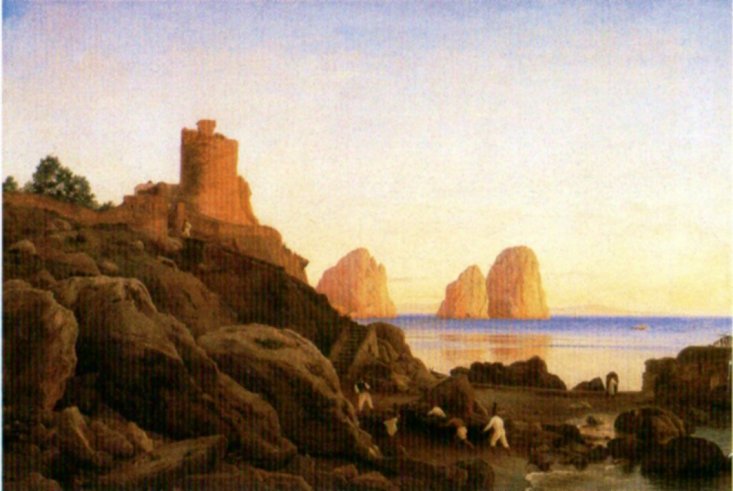
It had been a very trying period in Købke’s life.  The time deadline for producing a work for the Fine Art Society exhibition along with the technical challenges thrown up by the work took their toll on him both physically and mentally.  He wrote to his sister, Conradine, during this time telling her of the problems he was having and the stress it was causing.  It would appear that she was the most sympathetic of his family members and a good listener and it was with her he liked to stay when he found the stress unbearable.  In his letter to her, he wrote:

 “…I am taking my refuge with you tonight, as I know with you I will find a friendly place and I need to do so once in a while to unburden my mind….I have difficulties lately as my spirit has been under pressure, mainly because of the burden of my work and the bad weather and is always the case with me my body suffers from this…”

Whether he had some doubts as to whether the work would do well in the exhibition one will never know but we do know he started a second version which he was going to enter in to the exhibition instead of his initial painting but he failed to complete it in time for the exhibition deadline so he put forward his original offering.   Alas, it did not win.  There were some critical comments about errors of perspective in the work and maybe that is why his contemporary, Jørgen Roed, carried off the first prize.   However, Købke had the consolation that the Society purchased the work.

 Frederiksborg Castle.  View near the Møntbro Bridge by Christen  Købke (1836)

Frederiksborg Castle. View near the Møntbro Bridge by Christen Købke (1836)

The final depiction of Frederiksborg Castle by Købke, which is my favourite was completed in 1836 and entitled Frederiksborg Castle.  View near the Møntbro Bridge.  This work depicts just part of the castle.  Unlike the other works this is not one of architectural accuracy as Købke has use artistic license to change some of the landscape, removing a promontory from the lake and adjusted the foliage in the foreground enabling us to get a clear view of the castle foundations as seen through the arches of the bridge, which in reality was not possible.  I like the colours used.  The sky is a delicate and pale blue.  The trees and the foliage are painted in restrained and somewhat muted greens whilst the brickwork of the castle walls has a pinkish-red tone.

So Høyen was well pleased with nationalist subject matter depicted in Købke’s Frederiksborg Castle works but what of the artist himself.  What did he think of Høyen’s views on nationalistic art?  From a passage in a letter to a friend we can see he was at best confused by Høyen’s views and somewhat cynical.  He wrote:

 “…What have politics, nationality and taxes to do with painterly effects and beautiful lines?   What does national art mean?   Does it mean politically Danish from border to border and all things within those boundaries?  Or does it mean Nordic, including Nordic history and the Sagas?…. No, just as the same sun shines over the entire world, art has no boundaries; it serves only beauty and truth…”

 In my next blog I will look at the latter years of Christen Købke’s life and his beautifully crafted portraiture.

The War Series by George Bellows

Massacre at Dinant by George Bellows (1918)

Another exhibition I recently attended whilst in London was one which showcased some of the works by the influential American realist painter, George Bellows.  To me, before I saw this collection of his work, the art of George Bellows was all about his wonderful boxing match scenes and the haunting look at the Pennsylvania Station excavation in New York so I was delightfully surprised by the amazing variety of his works, which were on view.  Today I want to look at a series of paintings and lithographs he completed in 1918, which highlighted German atrocities in the First World War.   Some of these works were on display at the Royal Academy exhibition.  The paintings, when they were first exhibited, shocked the people who saw them and the series caused some controversy, which I will talk about later.

The story behind his War Series paintings was of the German invasion of Belgium during the First World War and depicted some of the atrocities carried out by the invading German troops.  The Belgian town of Dinant, which lies on the Meuse River, was overrun by the German Third Army, led by Lieutenant General Baron Max Klemens von Hausen on August 23rd 1914.  Dinant fell to the German invaders but according to German reports some of the German soldiers, whilst repairing a bridge in the town, were fired upon by locals.  A swift and bloody retribution followed.  The German troops rounded up 612 local residents in the main town square.  This group consisted of men women and children.  In the double Pullitzer Prize Winner, Barbara Tuchman’s 1963 book The Guns of August, she wrote that among those executed that day was Felix Fivet, aged just three weeksold.  The town was then ransacked by the occupying army.

Unlike how it is nowadays, there were no television crews following the battle to send back live feeds of the war with all its brutality.  There were no newspaper pictures of the massacre of Dinant, so how did Bellows and the world hear about this horrific event?  A month after the atrocities in Dinant, the Belgian Government put out three reports on German war crimes committed during the invasion of their country.   The contents of these reports shocked all those who read them and in Britain both Parliament and the newspapers clamoured for an independent British commission to be set up to investigate the atrocities.  The British Prime Minister at the time, Herbert Asquith, bowed to public opinion and set up an inquiry.  In December 1914, James Bryce was asked to chair what was termed, the “German Outrages Inquiry Committee”, which would look into all material and take witness statements appertaining to the massacre of Belgium citizens and to the complicity of the German officers into the behaviour of their troops during the summary executions of civilians.  James Bryce, 1st Viscount Bryce, was a British academic, historian and Liberal politician and had been, from 1907 to 1913, the British Ambassador to the United States of America and was on friendly terms with the then Presidents, Theodore Roosevelt and Woodrow Wilson.

The report of the Committee was published on May 12th 1915 and the conclusion was that atrocities had been committed by the German army in order to strike terror into the civil population which would, in turn, dishearten the Belgian troops.  The Germans believed that it would quash resistance and extinguish the very spirit of self-defence. The Commission also stated that the German report of the townsfolk firing on German troops was simply used to justify the murder of large numbers of innocent civilians.   However, there was one problem with the compiling of the Commission’s report and this was the documenting of the 1200 eye witness accounts which had been correlated by a team of English lawyers.  A large number of these were excluded as the committee were mindful that their findings had to be reliable, credible and truthful.   For that to happen, the Committee stated that many of the depositions collected had to be omitted, although they were probably true, as they believed that it was much safer not to place reliance on them.   The committee ended their report by concluding:

“…Our function is ended when we have stated what the evidence establishes, but we may be permitted to express our belief that these disclosures will not have been made in vain if they touch and rouse the conscience of mankind, and we venture to hope that as soon as the present war is over, the nations of the world in council will consider what means can be provided and sanctions devised to prevent the recurrence of such horrors as our generation is now witnessing…”

The report was translated into many languages and circulated throughout the world.   Some later historians believed that the Bryce Commission report was a piece of propaganda and that the lurid accounts of German atrocities were designed to bolster the resolve of those already fighting in the war and to encourage those countries, including the powerful USA, to end their neutrality.

America had declared its neutrality in 1914 with Woodrow Wilson making his speech to the nation on August 18th 1914.  In the speech he said:

“…I venture therefore my fellow countrymen to speak a solemn word of warning to you against that deepest, most subtle, most essential breach of neutrality which may spring out of partisanship, out of passionately taking sides.   The United States must be neutral in fact as well as in name during these days that are to try men’s souls.  We must be impartial in thought as well as action, must put a curb on our sentiments as well as upon every transaction that might be construed as a preference of one party to the struggle before another…”

The United States of America finally gave up its stance of neutrality in April 1917.

So what has this report to do with the George Bellow paintings?  The answer is that Bellows based the depictions in his paintings on the Bryce Commission report.   In 1918 Bellows created a series of works, known as his War Series, depicting German war atrocities in order to stir outrage and embolden America in World War I.   The set consisted of five large paintings, which were his largest works ever completed.   Besides these oil paintings he also completed 20 lithographs and 42 drawings about the Great War.   At the time war paintings tended to focus on the heroic victors and glory in battles won and so Bellow’s War Series was a complete turnaround and many found them offensive.

Another artist, Francisco de Goya, a century earlier, had produced works highlighting the brutality of war.  In all he completed eighty-two etchings between 1810 and 1820 but,for political reasons, they were never exhibited until 1863, some thirty-five years after Goya’s death.  They depicted not only the atrocities of the French army which had invaded Spain but the inhuman treatment men inflicted on their fellow men.  Prints of these works by Goya would have been on display at galleries in New York and it is very likely that George Bellows would have seen them.

One Can't Look by Francisco de Goya (1863)
One Can’t Look by Francisco de Goya (1863)

In Bellow’s work, Massacre at Dinant, we see the foreground is littered with the dead bodies of women and children.  In the background we see the skies darken at the moment of death.  In the centre of the painting we see the clergy with their arms stretched aloft beseeching an end to the killings.  Their pleas fall on deaf ears and they are powerless to prevent the massacre.  It is a brutal depiction and horrifies all who stand before it. Although Bellows has not depicted any German soldiers in the painting, if one looks to the far left of the work one can see their bloody bayonets and rifles appearing on the scene.   This depiction of the “approaching” rifles could be taken directly from one of Goya’s lithographs entitled One Can’t Look (No se puede mirar), in which we see the bayoneted rifles just coming into the right hand side of the etching.

The Barricade by George Bellows (1918)

Another painting from his War Series was entitled The Barricade, in which we see a line of naked human beings, arms held aloft, acting as human shields for the uniformed German soldiers, with their guns raised, who stand and crouch behind them.   As a propaganda piece it worked well evoking both pity and rage in the mind of the viewer.  The message to the American public was clear – can we stand by and let this kind of thing happen or should we join the battle and end such atrocities.

Return of the Useless by George Bellows (1918)

In his painting Return of the Useless, Bellows depicted Germans soldiers unloading sick and disabled labour-camp prisoners from a rust-red boxcar.   These were Belgian citizens who were being returned home as they were no longer physically fit to work for the Germans.   Box-cars were familiar sights on the American railroads but this work depicted the box-car as a transport system for German prisoners.    Look how Bellows has cleverly used the same colour, red, for the rusty box-car as he used for the flushed face of the German soldier who is venting his anger on the fallen and cowering man and the bloodied skin of some of the prisoners.  Cast your eyes towards the interior of the box car.  Here we see an elderly man supporting a young female who is on the point of collapse.  Another woman sits on the floor her arms wrapped around a child.  A young woman is stepping out of the boxcar and her arms are raised in horror as she watches the German guard bring down the butt of his rifle on to the fallen man, who pathetically looks up and begs for mercy.

The Germans Arrive by George Bellows (1918)

The Germans Arrive, another painting in the series, was based on an actual account from the Bryce Commission and gruesomely illustrated  a German soldier restraining a young Belgian teenager whose hands had just been severed.   This and the other paintings in the series suffered much criticism accusing Bellows of taking liberties when capturing on canvas, the horrific scenes of war. One notable detractor was the American artist and author,  Joseph Pennell, who argued that because Bellows had never been at the battlefront and therefore had not witnessed at first hand the events he painted, he forfeited the right to paint them. Bellows responded sarcastically that he had not been aware that the great Leonardo da Vinci “had a ticket of admission to the Last Supper”.

The final painting in his War Series is entitled Murder of Edith Cavell.   Edith Cavell was head of the Training School for Nurses in occupied Brussels.

Murder of Edith Cavell by George Bellows (1918)

On August 5th 1915, she was arrested for assisting Belgian, British, and French soldiers to escape from the country. Two months later, she was shot by the German authorities. News of her execution spread round the world, and in October of that year, The New York Times published 41 stories and her case became a cause célèbre.   George Bellows included this incident in a series of 12 lithographs and one full scale painting for his War Series.    In 1959 the Princeton University Art Museum found and acquired Bellow’s finished, full-size drawing (53.5 x 68.5 cm.) for this print. It is interesting to note that Bellows did not complete the oil painting of the scene until after he had finished the full scale drawing and lithograph print.  The painting now belongs to the Springfield Art Museum in Springfield, Massachusetts.

The work depicts a dark and somewhat chaotic prison cell with its grates and bars covering the windows and door.   We see on the flight of stairs leading down to the room the angelic figure of Cavell, dressed in white with her hand to her breast, enacting the classic gesture of humility.  Behind her and to the left, on a landing, we can see some soldiers and a priest clutching his bible. At the foot of the stairs there are more soldiers, one of whom holds a sword.   On the floor in the foreground we see some wounded prisoners lying on the floor guarded by soldiers in the left foreground.

George Bellow’s War Series paintings and lithographs, which he completed in the summer of 1918 whilst he was residing at his home in Middletown, Rhode Island, were ambitious in nature in the beloved tradition of grand manner history works.  His intention was to stir up both the public’s outrage and sympathy.  However the credibility of the images depicted in these paintings went hand in hand with the credibility of the Bryce Commission Report and that was to be called into question after the war had ended.  Many of the reports of German atrocities were then looked upon as merely Allied propaganda, simply designed to bolster the resolve of those Allied nations which were participating in the war and to encourage those nations to commit to the war effort , which up until then, had preferred to remain neutral,   Later, many Americans believed that their country had been tricked and manipulated into joining the conflict and unfortunately for George Bellows he and his War Series were regarded as part of this deception.  In 1925, the American art critic and historian, Virgil Barker commented on the series saying:

“…[they were] ill-judged in their appeal to the passion of hatred as anything produced in America’s most hysterical war years…”

However I will close with a more favourable comment on the War Series.  The art critic G.D.Cotton saw the initial exhibition and wrote about the works in the American Art News in September 1918.  He commented:

“…[the works] are brutal, full of horror, but reeking with truth, which adds to their poignancy.   After one has recovered from the shock of the subject themselves one sees that the pictures are full of strange beauty, conceived in bigness of vision that is rare and inspiring.  The whole exhibition is one to stiffen the spines of the enlisted men who are here and make them realize what they face ‘Over There’…

I can sincerely recommend you go and see the George Bellows exhibition at the Royal Academy of Arts, London which runs until June 9th 2013.  See what you make of these War Series paintings and lithographs and at the same time, take in many of Bellow’s other beautiful works.

Paul Delvaux’s Sleeping Venus

Sleeping Venus by Paul Delvaux (1944)

In my last blog I looked at the life of André Masson, the French-born Belgian Surrealist and one of his paintings, which in some ways mirrored the physical and mental suffering he had to endure for most of his life.  Today my featured artist is the Belgian Surrealist painter, Paul Delvaux would never accept that he was a Surrealist or that his art followed the dictates of Surrealism.  In fact Delvaux was totally averse to being labelled with and sort of “–ism”.  Delvaux’s life could not be more different to that of Masson.  Delvaux’s dreamlike, somewhat gentle paintings I believe reflected his inner peace and contentment.

He was born in September 1897 in the home of his grandparents in Antheit-les-Huy, a small town in eastern Belgium.  He was the elder son of an affluent bourgeois family.  He was his mother’s favourite son and some say she molly-coddled and over-protected him.  His father was an Appeal Court lawyer and his younger brother André followed in his father’s footsteps and became part of the Belgian judicial system.

As a young child, in the summer he would go and stay with his four maiden aunts who lived in the nearby town of Wanze.  One of these ladies, his Aunt Adele, encouraged his early love of music, literature and art and when he was ten years old, for his first communion gift, she gave him a beautifully illustrated copy of Jules Verne’s Voyage to the Centre of the Earth.  This edition contained detailed engravings and illustrations by the French painter Édouard Riou, who collaborated with Jules Verne on many of his novels.  In Guy Carels 2004 biography of Delvaux entitled, Paul Delvaux – His Life, he quotes Delavaux’s comments about his youth and his passion for reading adventure novels:

 “…My overriding passion was the books of Jules Verne…. I was completely fascinated by the engraving of Riou showing Otto Lidenbrock the wise geologist from Journey to the Centre of the Earth. I reproduced this for the first time in 1939 in the Phases de la Lune I (Phases of the Moon I)….”

Delvaux attended the Athénée de Saint-Gilles School in Brussels, where he studied both Latin and Greek and it was at this time that he became acquainted with Homer’s great epic, the Odyssey with its adventures of Odysseus, the legendary Greek king of Ithaca.  It is often said that childhood memories play a part in one’s future life but one recollection by Delvaux of his early schooling was to have an influence on many of his later works.   It was one of his earliest memories of the music room of his primary school in which there were two full-sized skeletons, that of a man and a monkey.  The sight of the two skeletons frightened him and he never forgot them and skeletons would often appear in his art work.

 Such tales of adventure featured prominently in his early childhood sketches.   He completed his regular school education at the age of eighteen and much to his father’s disappointment it was obvious that Paul was not going to enter the legal system.   His parents decided that if their son wasn’t to study law then he should study architecture and so they had him enroll on the architecture course run by the Brussels Académie Royale des Beaux-Arts.   Paul Delvaux did not enjoy the course, which consisted of copying the plans and elevations of classical buildings but little did he realise at the time that this training would play a major part in his future works of art.  Much to his parents’ disappointment, but to his own relief, Delvaux had to abandon the course as he failed to pass the exam in mathematics, which was a prerequisite for the continuation of the course.  His time on the course was not completely wasted as his understanding of linear perspective like the classical architecture was to feature in many of his future paintings.

 Paul Delvaux had always wanted to study art so that he could take it up professionally although that was not the future his parents had in mind.   His stroke of good fortune came in the summer of 1919 when he was almost twenty-two years of age.  He was on a family holiday at the Belgium seaside resort town of Knokke-le-Zoute.  One day whilst painting a seascape watercolour he was noticed by a professional artist who was so enamoured by his work he spoke to Paul’s parents and persuaded them to let their son attend the Brussels Académie des Beaux-Arts and pursue his desire to become a professional artist.  They reluctantly agreed and Paul Delvaux enrolled in the decorative painting class, which was run by Constant Montald, who also taught the featured artist of my last blog, Andre Masson and it was whilst on this course that Delvaux would once again immerse himself into the world of ancient Greece and Rome.  Another of his artistic instructors at the Académie was Jean Delville, the Belgian Symbolist painter.

For Auderghem by Paul Delvaux (1923)

Delvaux remained at the Academy for four years and during this time he completed almost a hundred works of art, mainly of the naturalistic landscape genre, often depicting scenes of his home town on the river Meuse, with its castle, Le Fort de Huy, perched on a high cliff above the river.  One of Delvaux’s early works was entitled For Auderghem,  which he completed in 1923 and depicts the railway bridge in the town of Auderghem, which is located to the southeast of Brussels, and lies along the Woluwe valley at the entrance to Forêt de Soignes.   In 1925 Delvaux held his first solo exhibition and two years later set up his first studio in his parent’s house.  At this time in his life he had no interest in Modern art, which he considered to be merely a “hoax” and instead, preferred the works of the Flemish Expressionists such as Frits van den Berghe, Gustave de Smet and Constant Permeke, whose paintings featured themes such as the countryside and village life.

 All this was to change in the 1930’s when he veered towards the art of the Surrealists.  He was never a member of André Breton’s group but was greatly influenced by the dreamlike works of Giorgio de Chirico which he saw in a Paris exhibition in 1926.  He was particularly interested in de Chirico’s painting style known as Pittura Metafisica, (Metaphysical art) which had been extremely popular between 1911 and 1920.  Another artist, a fellow countryman, whose art was to have a great influence on Delvaux, was René Magritte.  Delvaux found his work both amusing if somewhat disconcerting.

Delvaux’s work took on strangeness about it from the mid 1930’s with the introduction of nude figures in a world which the intimacy of nakedness is portrayed in very public settings.  There was none of the automatism we saw in Masson’s paintings in my last blog.   Delvaux’s works seem to be, although bizarre, very calculated and lack the spontaneity of Masson’s “subconscious” works.

Delvaux’s mother died in 1933 and four years later, his father died and it was in that same year, 1937, that he married Suzanne Purnal.  The marriage was a disaster.  However, some believe the emotional turmoil of their marriage resulted in Delvaux’s best works.  Delvaux had been very much in love with Anne-Marie de Martelaere but the relationship foundered because of his parents’ disapproval of her. Whether his marriage to Suzanne was a “rebound” thing, one may never know.  However, ten years later in 1947, completely by chance whilst visiting St Idesbald, he met his first-love Anne-Marie who had never married.  Delvaux left his wife Suzanne and went to live with Anne-Marie and the pair married in October 1952.

The Crucifixion by Paul Delvaux (1952)

In 1950, Paul Delvaux became professor of painting at the Ecole Nationale de la Cambre in Brussels and he would teach there until 1962.  In 1952 he received the commission to create the wall frescos at the Ostend casino.  In 1952 Delvaux created one of his most controversial works, The Crucifixion.  The painting which is in the Royal Beaux-Arts Museum in Brussels shows a skeleton Christ on a cross between two skeletal crucified robbers.  Standing beneath the crucified trio is the centurion also depicted as a skeleton.    When this work was shown at the 1954 Venice Biennale it caused a furore.   Cardinal Roncalli, who would later become Pope John XXIII, was horrified and Delvaux was accused of blasphemy.  However Delvaux was unrepentant stating:

“…Through the skeleton, I represent a different kind of being in a kind of medieval mystery play which is perhaps profane, but never profanatory – the idea of sacrilege never entered my mind – it was put there by others…”

This skeleton painting is considered to be one of the most powerful and the most unforgettable in contemporary art.

Paul Delvaux Museum at St Idesbald

Paul Delvaux received many honours during his life.  In 1955, he received the Italian Reggio Emilia-award.  In 1956, he was admitted to the Royal Academy of Sciences, Letters and Fine Arts of Belgium.  In 1966 he received the Belgian State Prize for his work of art together and he was appointed Chairman of the Royal Academy of Fine Arts.  In 1982 the Paul Delvaux Museum opened in Saint Idesbald.   Delvaux died in Veurne, Belgium in 1994, at the age of 97.

Delvaux painted three versions of his Sleeping Venus.  The first he completed in 1932.    It is thought that the influence on the artist for this depiction was a visit in 1932 when he visited the Brussels Fair at which he came across the Pierre Spitzner’s Grand Musée Anatomique et Ethnologique, a travelling museum run by Pierre Spitzner,  which was a sort of travelling wax museum.    The centrepiece of the exhibition was a wax anatomical model of a sleeping woman, which opened to reveal her internal organs.  This bizarre Spitzner Sleeping Venus had a mechanical movement which was to emulate breath.   As if by magic, her chest rose and fell as she lay there, dressed in her white nightgown.    Delvaux didn’t exhibit the work until after his mother died, in 1933.  The painting received poor reviews and later Delvaux would destroy it.

The Sleeping Venus by Paul Delvaux Second version (1943)
The Sleeping Venus by Paul Delvaux
Second version (1943)

A second Sleeping Venus was completed by Delvaux in 1943.

 My featured painting today was his final version of Sleeping Venus, which he completed in 1944.  The setting is a Greco-Roman one.  The darkly coloured work is a dream-like depiction.  In the centre foreground, in a strange half-light, we have a female nude sleeping on a chaise longue.  However it is the characters which surround her which are the most puzzling.  Are we to believe they are part of the naked woman’s dream?  Who are the other naked women in the scene who seem to be visibly moved in prayer?   At the foot of the chaise longue we have one of Delvaux’s favourite inclusions – a skeleton (remember his fixation on skeletons since his primary school days).  Could it be that the sleeping woman’s dream is about death?  But if that was the subject of her subconscious why does she seem to be in a very relaxed state of sleep and not somebody who is experiencing a nightmare as she contemplates her mortality.  Another favourite feature often depicted in Delvaux’s paintings is present in this work – that of classical temple-like structures, which harks back to his early classical architectural training. Another common feature in this work which we see in a lot of his other works is his inclusion of a barren lifeless and petrified landscape.  To the left of the sleeping Venus is a fully-clothed lady whose pose is similar to that of a catwalk model!   Her expression, like many of the women in Delvaux’s works, is impassive.  She, like other females in his paintings, does not connect with us.   They have a haunting quality about them but as in a number of paintings by Delvaux there is a definite disconnect between the figures depicted.  All have a dream-like appearance.   It is almost as if he has added figures to the works without any reasoning behind the addition.

 Delvaux himself talked about his depictions of the Sleeping Venus in an interview he gave in which he described his first visit to the Spitzner Museum:

“…In the middle of the entrance to the Museum was a woman who was the cashier, then on one side there was a man’s skeleton and the skeleton of a monkey, and on the other side there was a representation of Siamese twins. And in the interior one saw a rather dramatic and terrifying series of anatomical casts in wax which represented the dramas and horrors of syphilis, the dramas, deformations.  And all this in the midst of the artificial gaiety of the fair. The contrast was so striking that it made a powerful impression on me … All the ‘Sleeping Venuses’ that I have made, come from there. Even the one in London, at the Tate Gallery. It is an exact copy of the sleeping Venus in the Spitzner Museum, but with Greek temples or dressmaker’s dummies, and the like. It is different, certainly, but the underlying feeling is the same…”

There is no doubt that there is a strange quality to many of Delvaux’s works and art historians have tried to figure out what is going on within the paintings.  They give their own interpretations and look for hidden symbolism but maybe we should be guided by the words of the artist himself as to his Sleeping Venus which he completed in 1944 during the Nazi flying-bomb attacks on his home town of Brussels.  Delvaux wrote about the painting in a letter:

 “…I remember that I placed my picture each evening when the painting session was over perpendicularly to the window thinking naively that, if a bomb should fall, it would be better protected in this position…….It is my belief that, perhaps unconsciously, I have put into the subject of this picture a certain mysterious and intangible disquiet – the classical town, with its temples lit by the moon, with, on the right, a strange building with horses’ heads which I took from the old Royal Circus at Brussels, some figures in agitation with, as contrast, this calm sleeping Venus, watched over by a black dressmaker’s dummy and a skeleton….I tried in this picture for contrast and mystery….It must be added that the psychology of that moment was very exceptional, full of drama and anguish… I wanted to express this anguish in the picture, contrasted with the calm of the Venus…”

Unlike the works of his contemporary André Masson, which I looked at in the previous blog, although Delvaux’s works with his naked women, skeletons, classical architecture are strange, even bizarre, there is something soothing about them unlike the disturbing works of Masson.  Could it be the fact that Masson and Delvaux’s lives were so different and their life experiences translated into the types of works they produced?