Portrait of Giovanna degli Albizzi Tornabuoni by Domenico Ghirlandaio

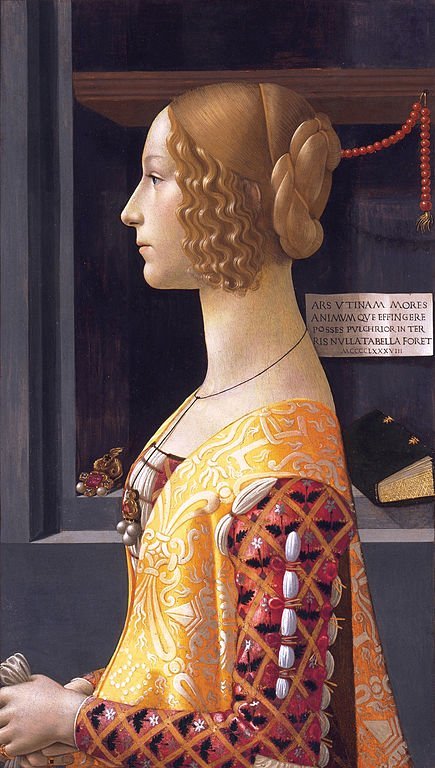
Portrait of Giovanna degli Albizzi Tornabuoni by Domenico Ghirlandaio (1488)

When you walk around an art gallery I wonder how long you spend in front of each painting.  I suppose it depends on the type of painting and whether it is part of a crowded special exhibition when you are jostled from one painting to the next by a crowded sea of viewers.  I suppose it also depends on your time management as if you are coming to the end of your allotted time you tend to jump from one picture to the next in a desperate attempt to not miss a single one, although in a way your hurried state probably means that the last few painting remain just a blur in your mind.   So why do I ask this question about time management and carefully appreciating the paintings before us?   The answer is that during a recent visit to the Thyssen-Bornemisza Museum in Madrid I had left the room, which housed the fifteenth century art collection till last and I was constantly aware that my time at the museum was running out.   I found myself flitting from one painting to another and I have to admit by doing so I failed to take in the beauty of the works in that section of the gallery.   That was until I came across two stunning works which I could hardly drag myself away from.  They were just such beautiful paintings.  Yes, I know beauty is in the eye of the beholder but for me they were truly exquisite.   I stood before them, totally mesmerised by their intrinsic charm and so I am dedicating my next two blogs to those two 15th century works. 

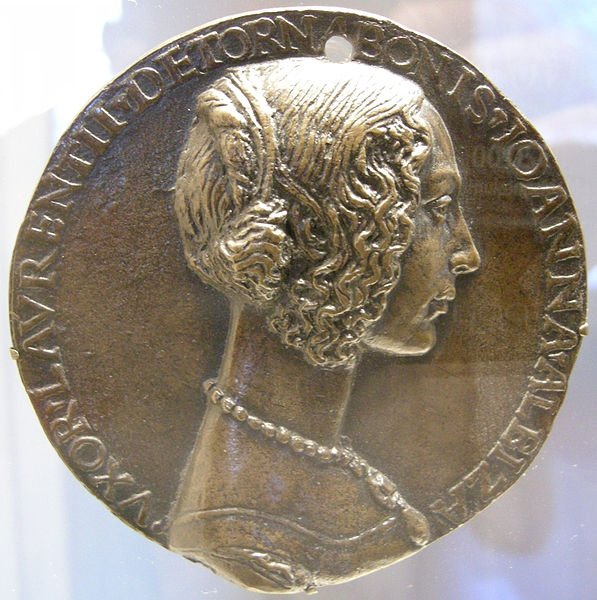
The Wdding Medalion
The Wdding Medalion

Today I want to offer you a beautifully crafted portrait by the 15th century Italian artist Domenico Ghirlandaio entitled Portrait of Giovanna degli Albizzi Tornabuoni which he completed in 1490 and which is now part of the permanent collection at Madrid’s Thyssen-Bornemisza Museum.   Giovanna was the wife of Lorenzo Tornabuoni who came from the wealthy Florentine banking family and whose father, Giovanni was Domenico Ghirlandaio’s patron.  We know this is the image of Giovanna as at the time of her marriage to Lorenzo a series of bronze portrait medals with her image were made to commemorate the event and the likeness of the figure on the medal and in the painting is undeniable.   Lorenzo and Giovanna married in June 1486 but sadly she died giving birth to her second son in 1488, at just twenty years of age.  As the portrait was completed after she died, it is thought that it could be looked upon as a kind of remembrance painting.   The painting hung in her husband’s private rooms in the Tornabuoni Palace.

We see Giovanna before us, half-length, in a somewhat rigid profile.  In her hands she clasps a handkerchief.  Giovanna is dressed in the most sumptuous way.  She wears a giornea which is an open-sided over-gown, which is brocaded.  The design on the brocade features the letter “L” and a diamond.   The “L” is her husband, Lorenzo’s initial and the diamond was the Tornabuoni family emblem.  There is no doubt that she is one of Florence’s élite by the way she wears her hair in the very latest Florentine fashion.  The jewels she wears around her neck comprise of two rings and pendant which were given to her by Lorenzo’s family as a wedding gift.  If you look closely at the pendant she wears you will also notice a matching brooch designed in the shape of a dragon which lies on a shelf behind her.   The jewel with its dragon, two pearls and a ruby formed a set with the pendant hanging from a silk cord around her neck.   Behind her, on the shelf, is a prayer book which is thought to be the libriccino da donna (little ladies’ book).  Above the book hangs a string of coral beads which have been identified as a rosary.   Ghirlandaio’s inclusion of this prayer book and the rosary in the painting was testament to Giovanna’s religious beliefs and her piety. 

What did Ghirlandaio think of his sitter?  Will we ever know?  Actually the answer lies within the painting itself because just behind Giovanna’s neck we can see attached to the shelf a cartellino.   A cartellino (Italian for small piece of paper) was a piece of parchment or paper painted illusionistically, often as though attached to a wall or parapet in a painting.  On the cartellino added by Ghirlandaio in this painting are the words:

ARS UTINAM MORES

ANIMUMQUE QUE EFFINGERE

POSSES PULCHRIOR IN TERRIS NULLA TABELLA FORET


which translates to:


“…Would that you, Art, could portray her character and spirit ;  for then there would be no fairer painting in the world..”.

At the bottom there is the date:

“MCCCCLXXXVIII”. (1488)

By these words there is no doubt Ghirlandaio is excusing himself to Giovanna for his belief that he has not been able to show her real inner beauty.  These are fine words from our artist but in fact they were not quite his own as they are a slight variation on the words of an epigram (a short and concise poem) of the Latin poet Marcus Galerius Martial, whose works were all the rage with the Florentine aristocracy of the day.

My featured artist today was born Domenico di Tommaso Curradi di Doffo Bigordi.  The name was derived in part from his father’s surname Curadi and the surname of his grandfather Bigordi.  He was born in Florence in 1449, the eldest child of Tommaso Bigordi and Antonia di ser Paolo Paoli.  His father was a goldsmith and was well-known for creating metallic garland-like necklaces which were worn by the ladies of Florence, and it was for that reason that Domenico was given the nickname Il Ghirlandaio (garland-maker).   Domenico worked in his father’s jewellery shop and it was during his time there that he started sketching portraits of customers and passers-by.   According to the famous biographer of artists, Giorgio Vasari, Domenico’s father decided to afford his son some formal artistic training and had him apprenticed to the Florentine painters, Alesso Baldovinetti and later Andrea del Verrocchio.

Domenico will always be remembered for his exquisite detailed narrative frescos in which he would incorporate portraits of the local aristocracy resplendent in their finery.  Many of his frescos appeared in local Florentine churches.  In 1482, he also completed a Vatican commission for Pope Sixtus IV – a fresco in the Sistine Chapel entitled Calling of the First Apostles.  The frescos he will probably be best remembered for were two major fresco cycles, which he completed with the help of his brothers, Davide and Benedetto along with his brother-in-law, Bastiano Mainardi, who was one of Domenico’s pupils.


The Resurrection of the Boy by St. Francis by Girlandaio
The Resurrection of the Boy by St. Francis by Ghirlandaio

The first of these frescos was for the Sassetti Chapel in the church of St Trinita in Florence.  It had been commissioned by Francesco Sassetti, a rich and powerful banker who worked for the Medici family.  This cycle of frescos was in six parts and depicted the life and times of St. Francis of Assisi, who was Sassetti’s patron saint. Seen within the frescos were a number of portraits of members of the Sassetti family along with some of the leading figures from the Medici family.  To look at the two families within the frescos one would be forgiven for coming to the conclusion that the Sassettis and the Medicis were very close, which of course was precisely the allusion Francesco Sassetti had wished to convey.  Alas for him, the close bond between the two families was all in his mind!

Visitation by Domenico Ghirlandaio

The second fresco cycle, Ghirlandaio’s last, and many art historians believe was his greatest, was commissioned to decorate the Capella Maggiore of the Santa Maria Novella Church in Florence by another banker, Giovanni Tornabuoni, who was related by marriage to the Medicis.   There was a connection between the two fresco cycles as Sassetti had the rights to decorate the Capella Maggiore of the Santa Maria Novella Church and he had wanted to have the frescos in the church depict the life of St Francis.   However the church was in trust to the Dominican order and they refused to allow such a design, so it was then that Sassetti decided to have the St Francis frescos painted instead in the Sassetti Chapel of the St Trinita Church in Florence and he sold the rite to decorating the Capella Maggiore to Giovanni Tornabuoni

 Ghirlandaio had not even completed the Sassetti fresco cycle when he was given this second large scale commission and he had to bring in most of the workers from his large Florentine studio to help him in this four-year project which was finally completed in 1490.  

The reason for talking about this fresco cycle is that I want you look closely at Ghirlandaio’s fresco, the part entitled Visitation.  Look at the third woman from the right.  Do you recognise her?   It is a full length portrait of Giovanna Tornabuoni who was the wife of Lorenzo Tornabuoni whose father, Giovanni was the commissioner of the fresco work and who was also my subject of today’s featured work.

The painting had a number of owners but in 1907 the American millionaire financier and philanthropist and founder of the J.P. Morgan bank,  J. Pierpont Morgan bought it in 1907.  It is believed that he adored the painting as it reminded him of his first wife, Amelia Sturgis, who like Giovanna had died very young.  She died of tuberculosis at the age of twenty-six, just four months after she and J.P. had married.   It entered the Thyssen-Bornemisza collection from the Morgan Library, New York, in 1935.

Whereas J.P. Morgan had his painting on view in his home to remind him of his wife I have a print of it on my breakfast room wall to remind me of Giovanna’s beauty as I serve guests with their breakfasts.

Jan Siberechts English Country Houses and Landscapes

My Daily Art Display today continues examining the life of the seventeenth century Flemish painter Jan Siberechts and taking a look at some of the paintings he completed after he moved his home to England.  In my previous blog I talked about Siberechts’ early landscape paintings which followed the style of the Dutch Italianate artists of the time.  Then, in the early 1660’s, he worked on a number of paintings depicting Flemish rural life and the life of the peasant community.

View of Longleat by Jan Siberechts (1675)

In 1672, at the age of forty-five, Siberechts’ life changed.   Two years earlier, George Villiers, the second Duke of Buckingham, whilst on business in the southern Netherlands came across some of Siberechts’ work.  He was so enamoured by what he saw that he invited the artist to come to England and help decorate his Italianate mansion, Cliveden, which was situated on the bank River Thames near the town of Windsor and which he had built six years earlier.  Jan Siberechts agreed to move home to England and became just one of the hundreds of Dutch and Flemish artists who came to Britain in the seventeenth century to ply their trade.

View of Longleat by Jan Siberechts (1678)

Siberechts’ work at Cliveden enhanced his reputation in England as a talented artist and his birds-eye views of stately homes became much sought after.  His recognised artistic ability and his connection with Villiers, led him to be awarded numerous painting commissions from the aristocracy and he was often referred to as being the “father of British landscape painting.

Wollaton Hall and Park by Jan Siberechts (1695)

These aristocratic commissions from around England were often for paintings of their stately homes.  One such example was his 1695 work entitled Wollaton Hall and Park which was in Nottinghamshire and the home of Thomas Willoughby, 1st Baron Middleton.  Another commission in 1694 was for a painting of Chatsworth, the Derbyshire country house of William Cavendish, the 1st Duke of Devonshire.

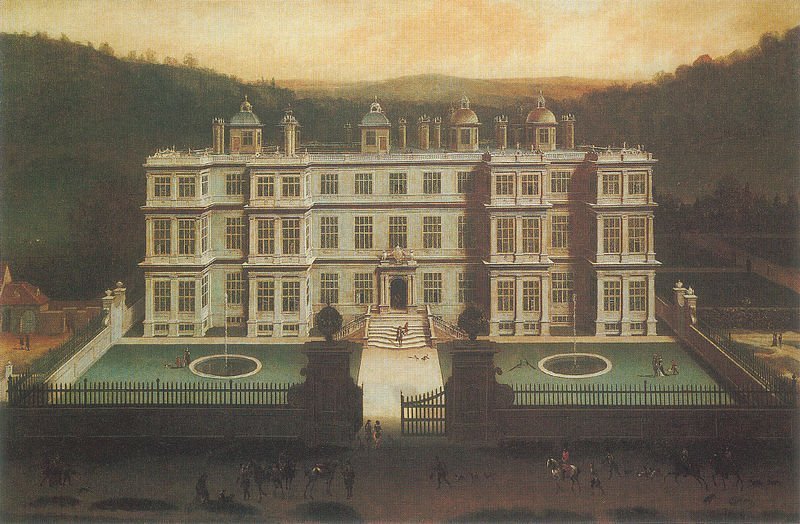
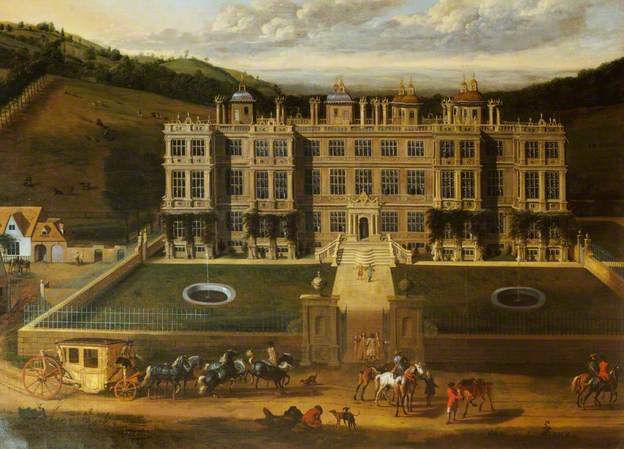
Siberechts received a commission in 1675 from Thomas Thynne.  The painting, entitled View of Longleat, depicted his stately home.   The work still hangs in the house.  Three years later Siberechts completed another painting of the building and this is now part of the Government Art Collection.   These depictions of country houses and country estates were very popular with their aristocratic owners and Siberechts was inundated with similar commissions.   In the foreground of this painting we see the aristocratic owners along with their horses, portrayed as huntsmen readying themselves for the hunt.

Another example of this type of work by Jan Siberechts is his 1696 topographical landscape painting entitled View of a House and its Estate in Belsize, Middlesex which he completed in 1696.   In the painting we see a birds-eye view of the The Grove, the house and estate of Sir Francis Pemberton, a leading figure of the English judiciary.  He, along with his wife and seven children, lived there until his death in 1697 just one year after Siberechts had completed the work.   Pemberton had bought the neighbouring Dorchester House and its estate around 1688.  He then demolished that house to make way for his extensive vegetable gardens and orchards.  The all-embracing gardens can be seen surrounding the manor house in Siberechts’ painting.

Landscape with Rainbow, Henley-on-Thames by Jan Siberechts (c.1690)

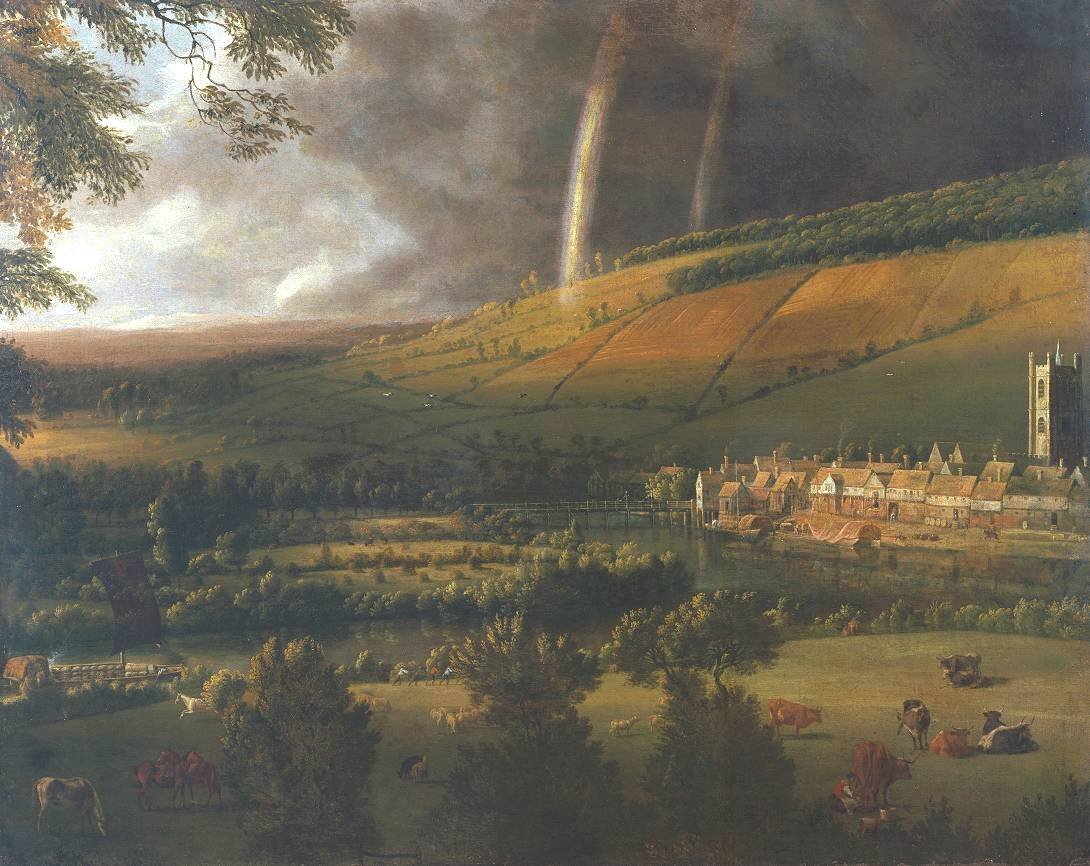
Jan Siberechts spent a good deal of time travelling around the English countryside fulfilling commissions to paint palatial residences.  Such paintings were interspersed with works featuring hunting scenes and views of the rural landscape.  My last offerings today are also from the 1690’s when Siberechts completed a series of five landscape paintings featuring the town of Henley and the Thames Valley.    There is no record of who commissioned the works but it could well have been one of the many rich merchants who owned land around the town of Henley.     The works were different to his earlier ones featuring stately homes for in this series Siberechts concentrated on the landscape of the area with its pastureland and woods and also included views of the River Thames and the boats which plied their trade along this busy waterway.  One of the best known of these, entitled Landscape with Rainbow, Henley-on-Thames, can be seen at Tate Britain.  It is a beautifully crafted painting.   In the foreground we have cattle and horses grazing in pastureland which slopes down towards the tree-lined banks of the River Thames.  On the left we can see a laden barge, piled high on deck with its cargo, being manoeuvred along the waterway by four men in the field, who laboriously drag the floating hulk towards the warehouses of Henley.  To the right of the painting we see the busy little town of Henley-on-Thames with its high-towered 13th century church, St Mary the Virgin, rising amidst the dwelling places.  The church still stands today.  The background to the right is filled with rising hills, more pastureland and the occasional woods above which are a double rainbow and a dark and threatening rain cloud which is emptying its contents on the fields below.  In the left background of the painting the view has opened up more and we catch a glimpse of the distant hills.

Henley from the Wargrave Road by Jan Siberechts (1698)

Another painting in the series was Siberechts 1698 work entitled Henley from the Wargrave Road which hangs in its own room in the Henley Gallery of the River & Rowing Museum, Mill Meadows in Oxfordshire.  This work is a veritable masterpiece which is in a way a historical record of the time depicting the life of the town, its surrounding countryside, and the importance of the commercial trade using the river.  Siberechts has depicted the 17th century buildings of Henley with its old wooden bridge with stone flood arches, the Church and the mill on the river.  In the foreground we can see farm workers busy haymaking in the riverside meadows and a cart fully loaded with hay heading down the country lane towards the town of Henley.  It is interesting to look back at the paintings of Jan Siberechts which I have featured in my last two blogs.  They are so different.  There is a certain simplicity and charm to his 1660’s rural life works but his artistic talent cannot be denied when we study some of his later works which he completed during his days in England.

Jan Siberechts died in London in 1703, aged 76.


The Pastoral Scenes of Jan Siberechts

The Ford by Jan Sieberechts (1672) Szépmûvészeti Múzeum, Budapest
The Ford by Jan Sieberechts (1672)
Szépmûvészeti Múzeum, Budapest

My Daily Art Display today features the 17th century Flemish painter, Jan Siberechts.  I will also look at some of Siberechts works and look how his style of painting changed during his lifetime.  In today’s blog I will concentrate on his rural life paintings and in my next blog I will look at how his painting style changed when he went to England. 

Jan Siberechts was born into a family of artists in Antwerp in January 1627, first training with his father, who was a sculptor.  Little is known of his early life and upbringing except to say that in 1648, at the age of twenty-one, he became a master in the Guild of St Luke in Antwerp and four years later, in 1652, he married.   Siberechts’ early works, up until around 1660, were mainly landscapes which were heavily influenced by the Dutch Italianates.  The Dutch Italianates were a group of seventeenth-century Dutch artists who painted landscapes of Italy.  Many of these painters had travelled to and lived in Italy whilst others who had never made the journey to Italy were simply stimulated by the works of those who did.   Many young Dutch painters made the arduous journey, often by foot, over the Alps to Italy, whereas others travelled by sea. The favourite destination for these intrepid travellers was usually Rome, but some journeyed to Venice, and a few to Genoa. 

Many of these artists would make copious sketches during their sojourn in Italy and in the case of those who crossed the Alps on foot, they would pictorially record their arduous journey through the breathtaking mountain passes and then, once they arrived back home to their studios, they would produce this Italianate art.  Such works of art, which were extremely popular with the Dutch and were in great demand in what was then a booming Dutch art market. These Dutch Italianate painters enthused over the golden light of Mediterranean skies which they encountered in Italy.   The countryside around Rome (campagna) was a constant source of inspiration and featured in many of the works of the Dutch Italianates.   Some of the leading Dutch Italianate painters during the lifetime of Siberechts were artists, such as Nicolaes Berchem, Jan Both, Karel du Jardin, and Jan Weenix.  Because Siberechts’ early works reveal the influence of the Dutch Italianates some art historians believe that he may have made the journey to Italy but there is no firm proof of this assertion.   Many believe Siberechts remained in Antwerp until 1672 at which time he accepted an invitation to travel to England and so it could be that he was simply influenced by the finished works of the Dutch Italianate painters which were offered up for sale in Antwerp.  

Shepherdess by Jan Siberechts (1660's) Hermitage, Saint Petersburg, Russia
Shepherdess by Jan Siberechts (1660’s)
Hermitage, Saint Petersburg, Russia

Siberechts style changed around 1661 when he became interested in depicting scenes from the Flemish countryside and the rustic life of the peasants.  His initial landscape work with its occasional small figures changed and, in his work now, the figures in his landscape settings were larger and took on a paramount importance. 

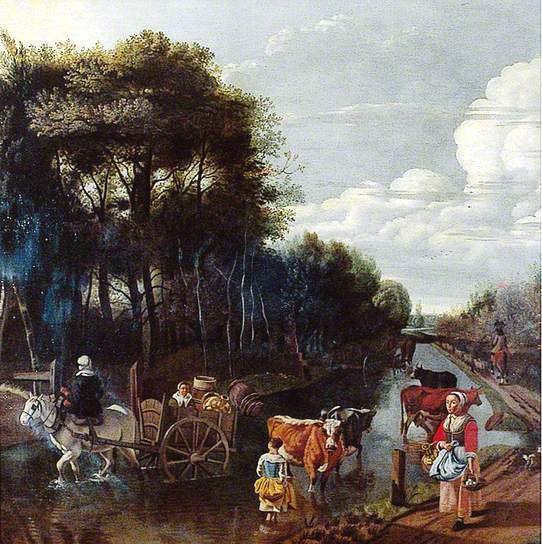
Landscape with a Road, a Cart and Figures by Jan Siberechts Norfolk Museums & Archaeology Service (Norwich Castle Museum & Art Gallery)
Landscape with a Road, a Cart and Figures by Jan Siberechts
Norfolk Museums & Archaeology Service (Norwich Castle Museum & Art Gallery)

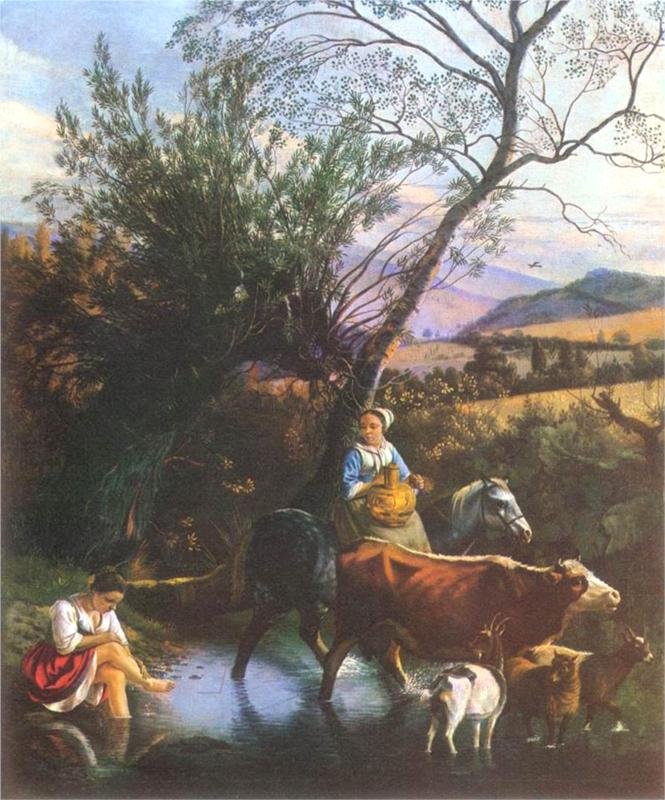
Often the countryside scenes depicted in these paintings incorporated country roads which had been partly flooded forming fords and peasant women going about their daily routine, carrying goods, such as hay or vegetables, to or from market, often by horse and cart.  In other paintings we see the women tending to their livestock along a river bank.  

The Wager by Jan Siberechts (1665) Koninklijk Museum voor Schone Kunsten, Antwerp
The Wager by Jan Siberechts (1665)
Koninklijk Museum voor Schone Kunsten, Antwerp

In Siberechts’ countryside depictions his female figures were much larger than corresponding figures in most paintings of this genre. The female figures we see in Siberechts’ paintings are not willowy, weak women but strong robust females who were quite able to hold their own against their men-folk when it came to working on the farm.  The presence of water in Siberechts’ scenes gave him the chance to show off his artistic ability of depicting reflections on the water surface and the glittering of the light on moving water.  The inclusion of water into his peasant scenes also gave Siberechts an excuse for showing us a sensual glimpse of bare female thighs as they washed and cooled down their bare legs in the fords or streams.  The colours Siberechts used in these landscape works were often quite similar.  He would utilise whites, reds and yellows for the clothes of the women and these colours would contrast against the various greens he used to depict surrounding plants and vegetation.  Often there would be no background as such to these paintings as the dense foliage in the middle ground obscured our view of any background. 

I like these works.  There is a certain quaintness about them.  As you will see in my next blog the paintings Siberecht did whilst in England couldnt be more different.

The Mancorbo Canal in the Picos de Europa by Carlos de Haes (1876)

The Mancorbo Canal in the Picos de Europe by Carlos de Haes (1876)

My Daily Art Display blog today incorporates the two things I enjoy most in art; landscape paintings and discovering a painter I had, up till now, never heard of.   Today I am featuring the nineteenth century Belgian born Spanish landscape painter Carlos de Haes.

Carlos de Haes was born in Brussels in January 1826.  He was born into a dynasty of merchants and financiers and was the eldest of seven children.  When he was nine years old his family moved to Malaga where he grew up and went to school. His initial artistic training was under the tutelage of Luis de la Cruz y Ríos, the Spanish miniaturist painter, who had once been the court painter of King Ferdinand VII.    In 1850, at the age of twenty-four, he returned to Belgium and studied for five years under the Belgian landscape painter Joseph Quineaux.  It was the influence of Quineaux which drew de Haes into the world of landscape painting and sketching and painting en plein air.  During his five year stay in Brussels he managed to travel to France, Holland and Germany constantly sketching the varied landscapes he came across.  It was also around this time that he became interested in the works of the contemporary Realist artists.    In 1855 after completing his art course he returned to Spain and went to live in Madrid and became a naturalised Spaniard.   In 1856 he put forward a number of his landscape works for exhibition in Madrid’s Exposición Nacional, where they were very well received.   The following year, 1857, at the age of thirty-one, Carlos de Haes won the competition for the chair of landscape painting at theReal Academia de Bellas Artes de San Fernando (Royal Academyof Fine Arts of San Fernando), with his work entitled Royal Palace from the Casa de Campo.  The Academy was an establishment which would half a century later be home to the likes of Dalí and Picasso.   In 1861 de Haes was made Académico de mérito. 

During his tenure at the Academy, de Haes set about putting together a set of regulations for his students governing landscape painting and rules for future landscape competitions.  He was insistent that his students mastered the art of en plein air sketching and painting instead of just producing historical landscapes which they had conjured up in the studio.  This, he believed prevented the true study of nature, and he asserted that the en plein air aspect was of paramount importance when contemplating a landscape work.   Haes encouraged his students to interpret nature directly and by working out in the open he insisted that they understood how the changing light changed how they viewed the vegetation and the terrain.  He did however countenance using the studio to fine tune the painting and make final adjustments.  Haes’ insistence that his students should produce a truthful depiction of the landscape, captured by painting en plein air, points towards his interest in the new Realism form of art, which claimed that artists should represent the world as it was, even if it meant breaking artistic and social conventions.   

During the next ten years Haes spent most of his time painting landscapes which featured the Spanish Pyrenees and the Guadarama mountains in central Spain.  One of his students who accompanied him on his sketching journeys was Aureliano Berruete who would become one of the foremost Spanish painters.

Carlos de Haes became ill in 1890 and died in Madrid in 1898.  He bequeathed his mostly small-format paintings to his pupils, who gave them to Spanish museums, the majority of which are now housed in the Casón del Buen Retiro, part of the Prado Museum in Madrid.

My featured painting today by Carlos de Haes was one which I saw when I recently visited the Prado in Madrid.  It was completed by him in 1876, although the preparatory sketch for the work was dated in situ in 1874.  It was exhibited at that the 1876 National Exhibition in Madrid and was subsequently purchased by the Spanish state.  Carlos de Haes had been travelling with Aureliano Berruete around the wild and rugged Cantabrian rural area of Liébana when they came across this spectacular view.   The oil on canvas painting, measuring 168cms x 123cms is entitled The Mancorbo Canal in the Picos de EuropeThe Picos de Europa is a range of mountains 20 km inland from the northern coast of Spain and this landscape painting by de Haes depicts the awesome and craggy vista of the mountain range which was one of Carlos de Haes’ favourite type of spectacular and breathtaking views.   At the bottom of the painting, although it somewhat difficult to pick them out, there are three cows and their herder.

I stood before this beautiful painting and was awestruck by its beauty and its realistic quality.  So, if you ever make it to the Prado be sure to find this work.

Joaquín Sorolla (part 3)

In my final look at the Spanish artist Joaquín Sorolla I want to show you some of his portraiture work which featured his family and finally take a look at the house in which he and his family lived and which would later become a museum in his honour.

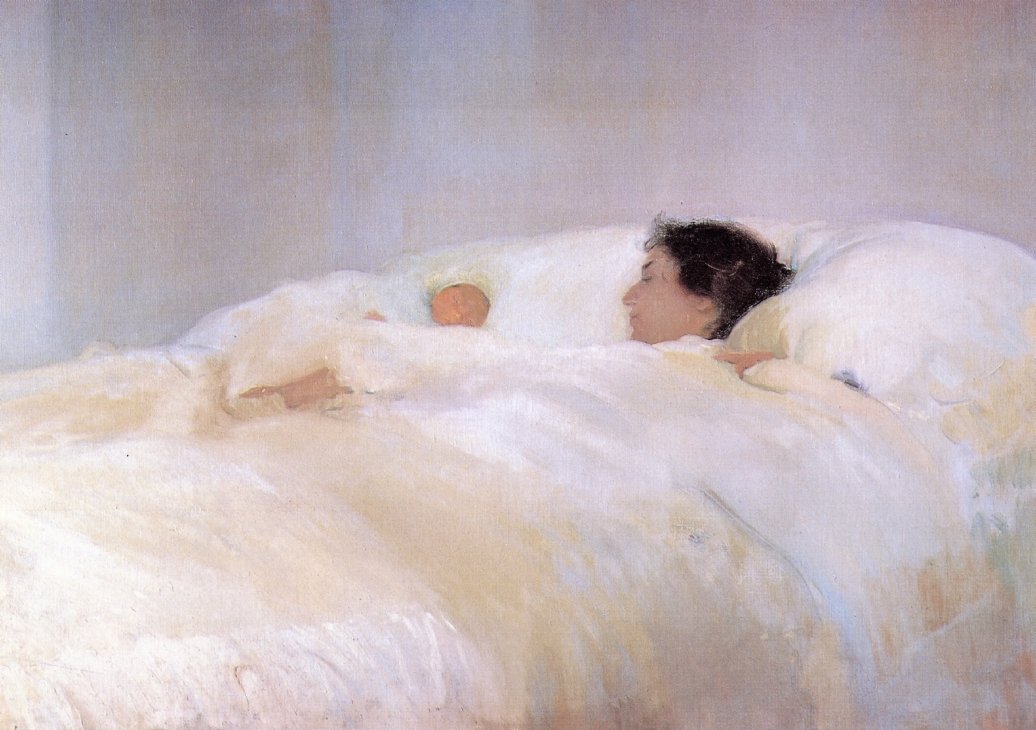
Mother by Joaquin Sorolla (1895)

One of the most moving family portraits by Sorolla was of his wife Clotilde, laying in bed with their new born baby, their youngest child, Elena.  The painting is simply entitled Mother and was completed in 1895.   His wife looks lovingly towards her daughter who is swaddled in a mass of white bedding contrasted by the artist’s yellow/green tonal shading of the bed clothes. 


My Family by Joaquín Sorolla (1901)

In 1901 Sorolla completed a portrait of his family entitled My Family, which somehow reminds us of Diego Velazquez’s Las Meninas, where the painter showed in the background a mirror that reflects the upper bodies of the king and queen. They appear to be placed outside the picture space in a position similar to that of the viewer.  In Sorolla’s painting we see his image, palette in hand, in a mirror in the background.  The main figures in the painting were those of his family.  His wife Clotilde stands to the left in a long red dress along with her children.   Elena, the youngest, sits on the chair was five years old at the time. Their nine-year old son Joaquín sits on a stool sketching a picture of his sister whilst their elder daughter, Maria, who would have been eleven when her father completed the work, holds the board which her brother is using to support his sketch.

Maria by Joaquín Sorolla (1900)

One of Sorolla’s favourite subjects was his eldest child, Maria and over the years he would capture her in many of his portraits.  In 1900 he captures her sitting on a chair dressed in a white tunic with her hands entwined on her lap.  The painting is entitled Maria.  The whiteness of her dress is enhanced by touches of blue.   In the background there is a wall with decorative and colourful tiles 

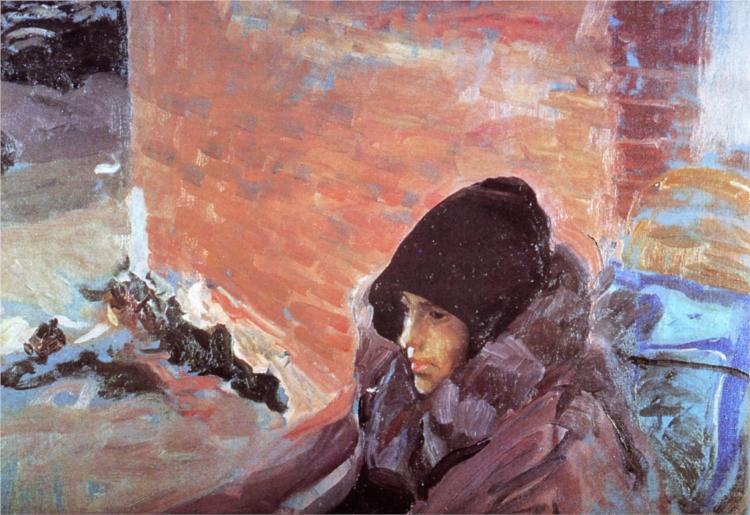
Maria Sick by Joaquín Sorolla (1907)

Six years later he completed another two portraits of Maria.  The first, entitled Maria Sick, completed in 1907 depicts his daughter sitting outside, well wrapped up in heavy but warm clothes.  She was recuperating in the mountains outside of Madrid having come down with an illness.   Sorolla himself was supposed to have been in Germany at this time, to be present at the one-man exhibition of his work at Berlin, Dusseldorf and Cologne organised by the Berlin gallery owner, Eduard Schulte.  However Sorolla refused to leave his daughter at a time when she was so unwell.


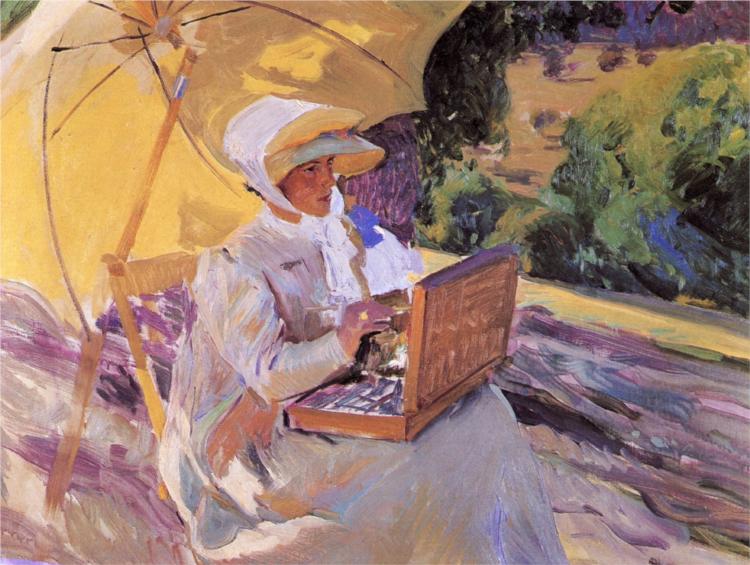
Maria painting in El Pardo by Joaquín Sorolla (1907)

That same year, following the recovery from her illness, her father painted another portrait of her, entitled Maria Painting in El Pardo.  The work depicts his daughter seated on a hill top, close to the royal palace, painting en plein air. 

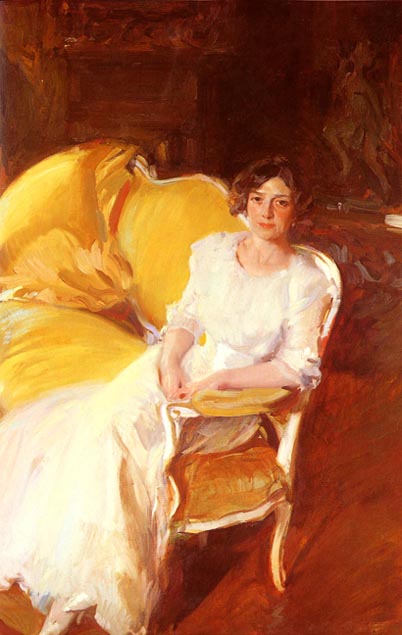
Clotilde Sitting on the Sofa by Joaquín Sorolla (1910)

However Joaquín Sorolla’s favourite muse was his beloved wife Clotilde whom he had married in 1888.   She featured in a large number of his works.  I particularly like the one he painted in 1910 entitled Clotilde Sitting on the Sofa.  Art historians believe that the painting was influenced by the works of the American painter John Singer Sargent.  His wife leans against the arm of a sofa, dressed in a full length gown.


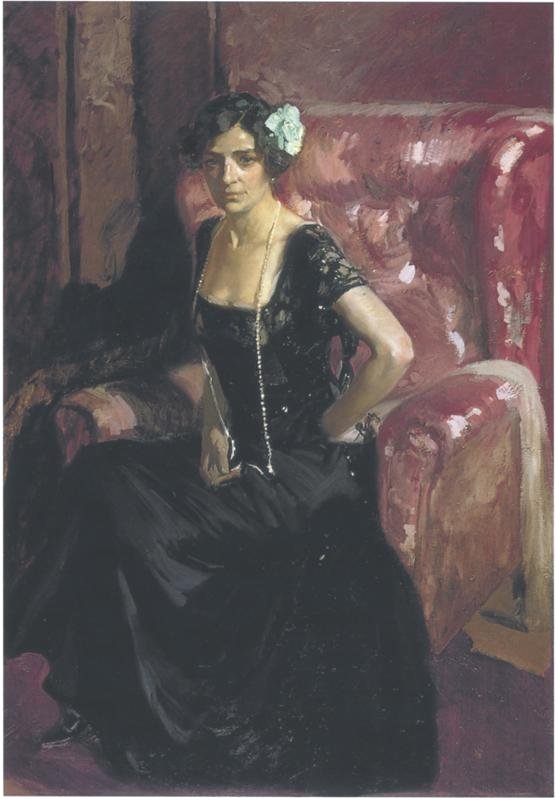
Clotilde in Evening Dress by Joaquín Sorolla (1910)

Another beautiful painting of his lovely wife was completed that same year entitled Clotilde in Evening Dress and from it, it is plain to see that Sorolla had married a beautiful and enchanting person.  We see her sitting upright in a plush, well upholstered red chair, dressed in a black evening dress with a blue flower tucked behind her ear.  She is the personification of a Spanish lady.

Sorolla had a one-man exhibition in the Grafton Galleries, London in 1908 and it is whilst in London that he met Archer Milton Huntington, who was the son of Arabella Huntington and the stepson of the American railroad tycoon and industrialist Collis Huntington.   Archer Huntington was a lover of the arts and the founder of the Hispanic Society of America which was based in New York.  The Hispanic Society of America was, and still is, a museum and reference library for the study of the arts and cultures of Spain and Portugal as well as those of Latin America.  Huntington arranges for Sorolla to have a major one-man exhibition at the Society in 1909 and it proved to be a resounding success so much so that the exhibition travelled to many American cities.  Huntington then commissioned Sorolla to paint 14 large scale mural paintings, oil on canvas, depicting the peoples and regions of Spain.  On receiving Huntington’s commission in 1911, Sorolla spent the next eight years travelling  throughout the regions of Spain making hundreds of preparatory sketches before completing what was to become known as Vision of Spain.   Sorolla was clear in his mind what Huntington expected and how he would achieve it, for he said:

“…I want to truthfully capture, clearly and without symbolism or literature, the psychology of the region.   Loyal to the truth of my school I seek to give a representative view of Spain, searching not for philosophies but for the picturesque aspects of the region…”

The fourteen murals were installed on December 1922 in the newly renovated western extension to the Hispanic Society’s Main Building, which is now known as the Sorolla Room. They were not officially inaugurated until January 1926. 

Panels from “Vision of Spain,” Joaquín Sorolla’s panoramic mural, during reinstallation at the Hispanic Society of America in New York City.

The Hispanic Society building had problems with their roof and it got so bad that in 2007 the museum had a full make-over and the picture above shows the re-installation of the fourteen paintings.

His eight years on this project was at the expense and detriment of his other work and sadly nearing the end of this project his health began to deteriorate and in June 1920 he suffered a stroke which ended his painting career.  One can only imagine how devastated Sorolla must have been not being able to paint.   Three years later in August 2010 Sorolla died in Cercedilla, a small town in the Sierra de Guadarrama, north-west of Madrid.  His body was taken and buried in the town of his birth, Valencia.

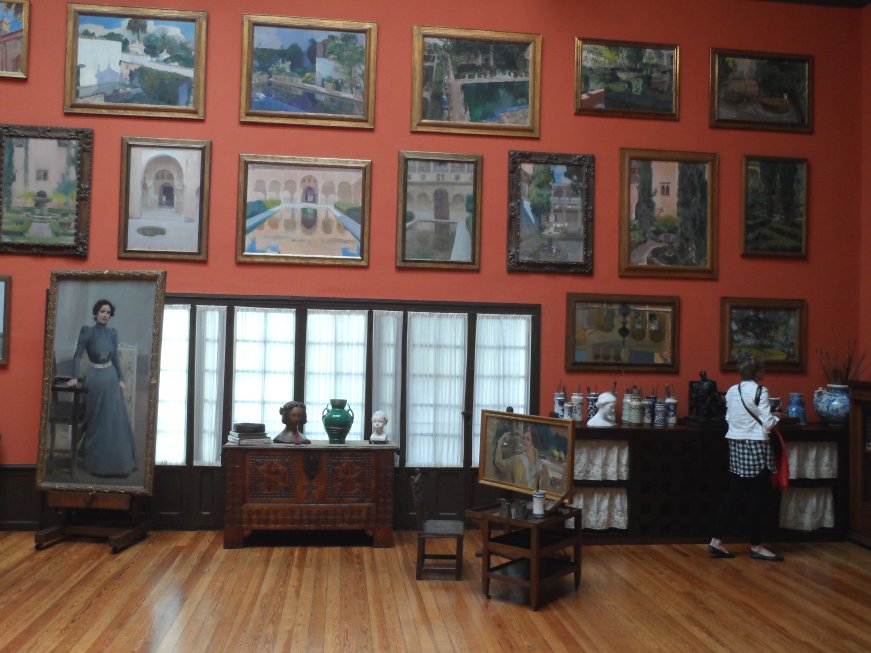
Room inside Sorolla Museum

I cannot end this trilogy of blogs about Joaquín Sorolla without mentioning the Sorolla Museum which was the artist’s home from 1911. 

Room inside Sorolla Museum

It is a five minute walk from the Ruben Dario Metro station and I do urge you to visit it if you are in Madrid.  You will not be disappointed. 

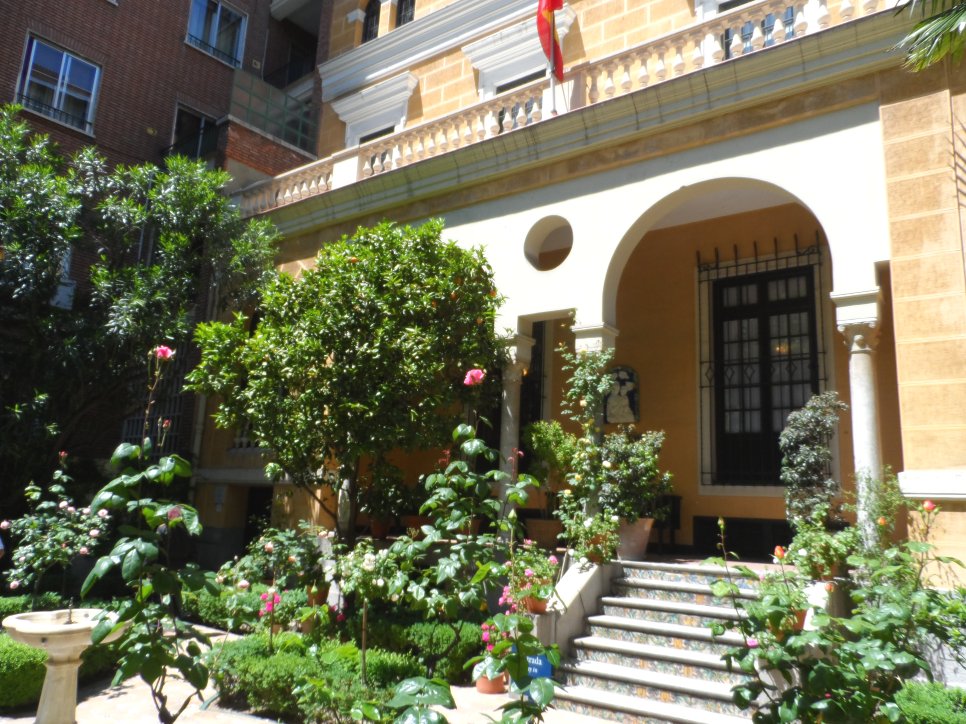
Museum entrance
Museum entrance

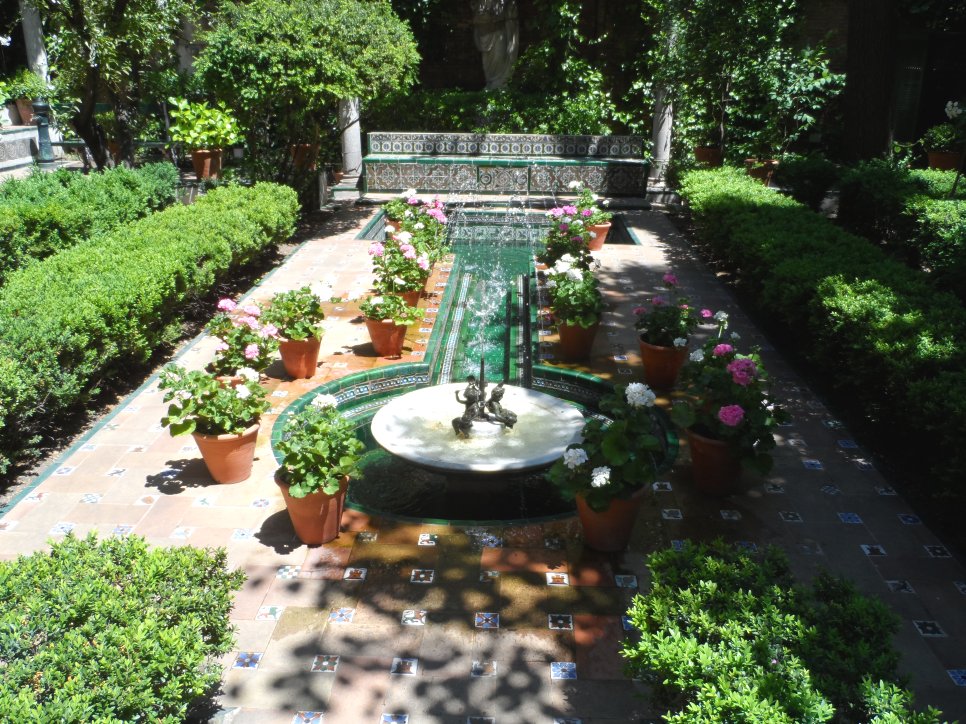
There are so many of the artist’s beautiful paintings on show and the gardens are a delight.

Museum Gardens
Museum Gardens

Joaquín Sorolla (part 2)

Portrait of Joaquín Sorolla by José Jiménez Aranda (1901)

By 1885, Joaquín Sorolla had settled down to life in Rome but during that year he also spent the spring and summer in Paris.  At this time in the French capital, the Impressionists were in the ascendancy after they and their art had been criticised and they had had to survive an initial period of ridicule, commercial failure and outright denunciation.    However, the Impressionists had now managed to establish their status some eleven years after they held their first Impressionist exhibition at Nadar’s studios and whilst Sorolla was in Paris he saw much of thire work but it was not the Impressionist painters who would influence him.   Whilst in the French capital he visited the retrospective exhibitions of two non-Impressionist painters, the French Naturalist painter, Jules Bastien-Lepage, who had died the previous year, and Adolf von Menzel the German painter who, along with Caspar Davisd Friedrich, was considered one of the two most prominent German artists of the 19th century and was also the most successful artist of his era in Germany.

Sorolla returned to his home town of Valencia on two occasions during the late 1880’s and on the second visit in 1888 he proposed to and married Clotilde Garcia del Castillo the daughter of his mentor, the photographer Antonio Garcia.  Joaquín and Clotilda had first met in 1879 when he had started work in her father’s workshop.   Joaquín finally returned from Italy and in 1890 the couple settled in Madrid.   Sorolla style of painting became more individualistic with him tending towards social realism works. 

Another Marguerite by Joaquín Sorolla (1892)
Another Margarita by Joaquín Sorolla (1892)

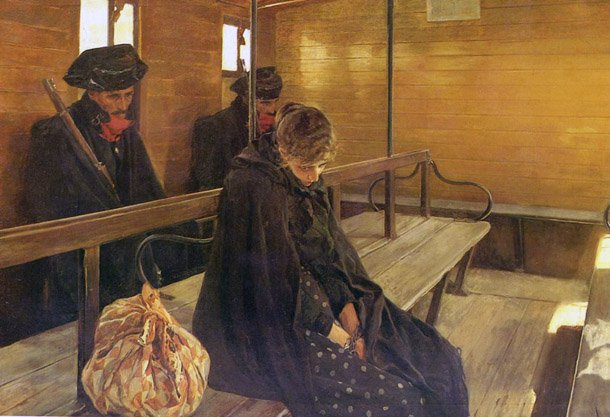
For a good example of a social realism work by Sorolla one only has to look at his beautifully executed painting entitled Another Margarita which he completed in 1892.  He exhibited the work at the Madrid National Exhibition that year and was awarded a first-class medal.  This was also Sorolla first major painting to be exhibited in America and it was awarded the first prize at the Chicago International Exhibition, where it was acquired and subsequently donated to the Washington University Museum in St Louis.    The story behind the depiction is of a woman who has been arrested for suffocating her small son and Sorolla actually witnessed the woman being transported to jail.  There is an air of gloom about the manacled woman as she sits slumped on the wooden bench of the train carriage being watched by her two guards who sit behind her.  In contrast to the dark and depressing depiction of the three individuals, the carriage itself is lit up by the warm light which streams through the windows at the rear of the compartment and which bathes the entire space.

The Return of the Catch by Joaquin Sorolla (1894)

His realist art also embraced what the Spanish termed costumbrismo, which was the pictorial interpretation of local everyday life, mannerisms, and customs.   This kind of art depicted particular times and places, rather than of humanity in an abstract form.   In many instances costumbrismo was often satirical and often moralizing, but it was careful not to offer or even imply any particular analysis of the society it depicted, unlike proper realism art.  In less satirical works costumbrismo took on a romantic folklore flavour.  A fine example of this type of work was a painting entitled The Return of the Catch which Sorolla completed in 1894 and which received critical acclaim when it was shown at the 1895 Paris Salon.   It was subsequently acquired by the Musée du Luxembourg.  He painted a number of similar pictures depicting Valencian fisherman at work bathed in the dazzling Mediterranean light such as his 1894 painting entitled Return from Fishing and his 1903 painting, Afternoon Sun.

Sad Inheritance by Joaquín Sorolla (1899)

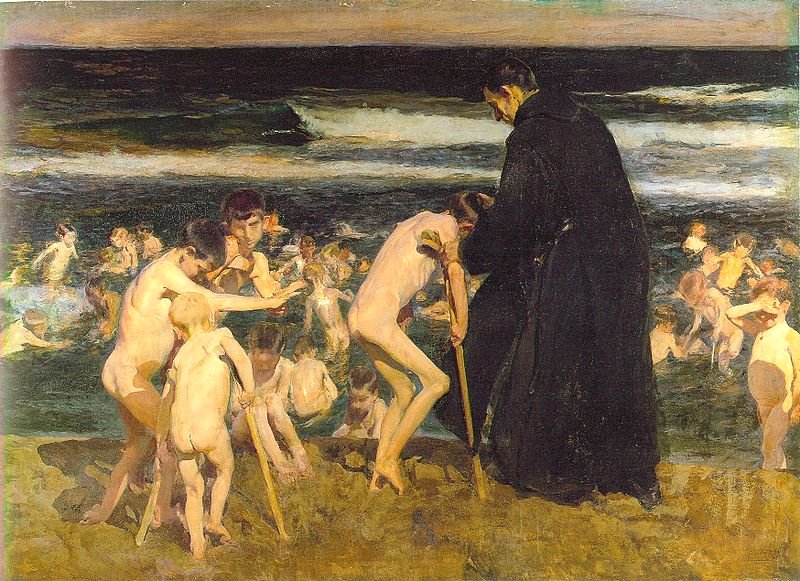
By 1895 Joaquín and Clotilda had three children.  Their daughter Maria was born in 1890, their son Joaquín in 1892 and their youngest child Elena in 1895.  In 1899 Sorolla painted what was to become his most famous and most moving picture.  It was entitled Sad Inheritance and I talked about this work in My Daily Art Display of Jan 31st 2011.  It is a poignant work featuring a monk and a group of children, crippled by polio, who are seen bathing in the sea at Valencia.   Sorolla received his greatest official recognition for this work of art, the Grand Prix and a medal of honour at the Universal Exhibition in Paris in 1900, and a year later he received the medal of honour at the National Exhibition in Madrid in 1901.

In my third and final blog about Joaquín Sorolla I will feature some of his family portraits, look at the Sorolla Museum in Madrid and conclude the life story of this wonderful Spanish artist.

Joaquín Sorolla (part 1)

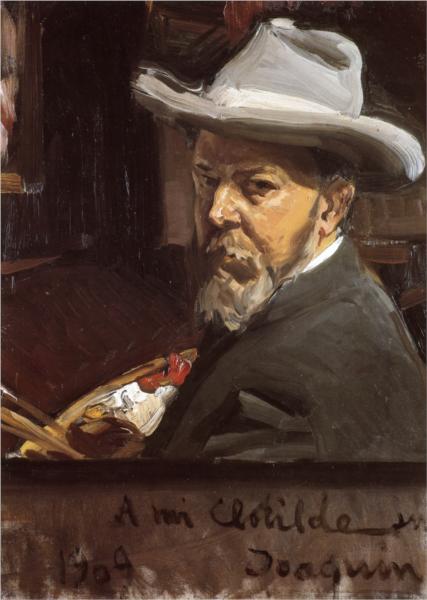
Self Portrait by Joaquín Sorolla (1909)

I have said on a number of occasions that when one is in a large city which has one or maybe two famous large art museums, and when one is time-limited, one should search around and look for a smaller gallery which may have hidden treasures to offer.  The art on display in smaller museums can be taken in on one visit and there is no feeling of having to rush from room to room, constantly looking at ones watch to try and see as much as one can and ultimately seeing very little.  Madrid is famous for its three large art museums the Prado, the Thyssen-Bornemisza and the Queen Sophie but once again thanks to my daughter, who was my travelling companion on this trip, I discovered a pure gem of a museum – The Sorolla, which was just a few stops on the Metro from the city centre.  In my blogs I want to offer you a taste of what you would get if you visit the museum dedicated to one of Spain’s best loved artists, show you some of the Spanish painters work and look at his life story.

Joaquín Sorolla y Bastida was born into a humble household in Valencia in February 1863.  His parents were Joaquín Sorolla Gascón and Concepción Bastida who were retailers.  Joaquín and his younger sister Concha were orphaned in 1865 when both their parents died from the cholera epidemic which had swept through and ravaged the Spanish city.  Joaquín and Concha went to live with their maternal aunt, Isabel Bastida and her husband José Piqueres, a locksmith by trade.  Joaquín’s early schooling was not a success with the young boy being inattentive during lessons and was happy to doodle and draw in his exercise books to pass the time away.  His lack of progress at the school came to the attention of his uncle who withdrew him and took him on as an apprentice at his workshop.  However, owing to his love of drawing, when Joaquín was fourteen years old, his uncle arranged for him to attend drawing classes in the evening at the city’s Escuelade Artesanos where his artistic ability astounded his teachers, including the sculptor Cayetano Capuz.   The following year, 1878, he enrolled on a three-year course at Valencia’s prestigious Escuela de Bellas Artes de San Carlos.  It was whilst attending the art school that he met and became friends with a fellow student, Juan Antonio Perez.  He was soon introduced to Juan’s family.  Juan’s father, Antonio Garcia Perez was a photographer and was very impressed with Sorolla’s art work, so much so that he gave him a job at his photography studio as an illuminator.  This opportunity allowed Sorolla to leave his uncle’s workshop and concentrate on his artwork and discover the world of photography.  He learnt all about the framing of a subject and the manipulation of light which would prove a boon to him when he started to paint seaside and beach scenes.   This “new world” of photography fascinated many artists of the time and the likes of the French pair of Impressionists, Degas and Caillebotte were accomplished amateur photographers.

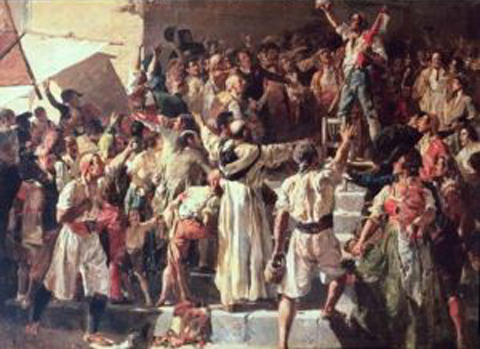
The Shout of the Palleter by Joaquín Sorolla (1881)

 Joaquín won many awards whilst studying at Escuela de Bellas Artes de San Carlos and at the end of his time there, and buoyed by his success, he sent off three seascapes to the Madrid National Exhibition.   He travelled to Madrid on a couple of occasions and visited the Prado where he painted copies of the great Masters.   In 1884, in the hope of attaining a monetary scholarship from the Valencia Provincial Council, he submitted a number of paintings to them, one of which was entitled The Shout of the Palleter, which was a historical painting recording the event in Valencia when one of its inhabitants Vincent Doménech in 1808, incensed by the French occupation of his country stood in the square urging people to rebel against the French tyranny.  He uttered his famous words:

“…Jo, Vicent Doménech, un pobre palleter, li declare la guerra a Napoleó. ¡Vixca Ferran sèptim! ¡Muiguen els traïdors!…”

(I, Vincent Doménech, a poor and simple worker, declare war against Napoleon.  Long live Ferdinand.  Death to the traitors.)

Sorolla painted the picture in the bullring of Valencia which he transformed into a huge studio and which was bathed in brilliant sunlight.  The stage-managed scene was a triumph and the Valencia Provincial Council awarded him a three-year scholarship to study art at the Spanish Academy in Rome. 

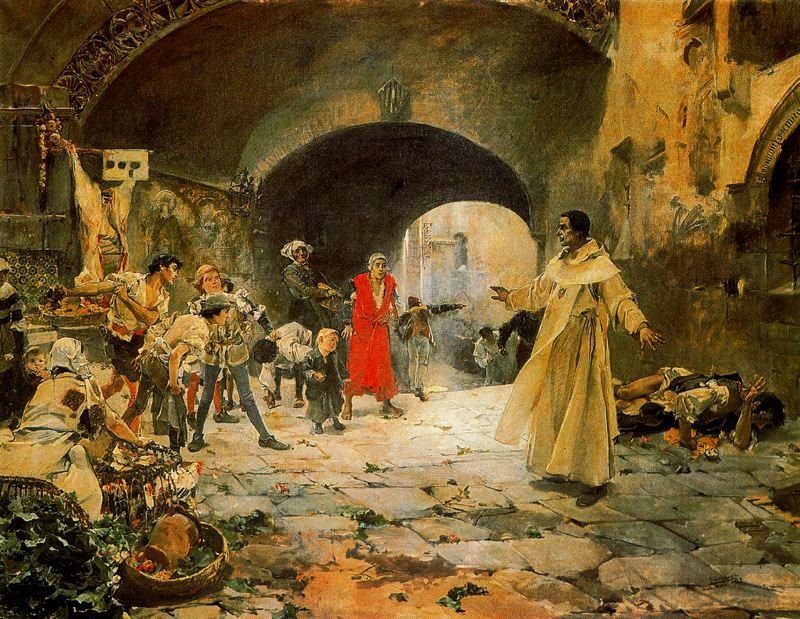
Father Jofré Protecting a Madman by JoachínSorolla (1887)

One of the conditions attached to the scholarship was that he regularly sent back work to the Council to prove that he was making good use of his time.   One of the paintings he duly sent back to Valencia was his 1887 work entitled Father Jofré Protecting a Madman.  This historical painting was based on the story of Father Joan-Gilabert Jofré, a friar of the Valencian Mercedarian Order, who, on  February 24, 1409, was on his way from the convent of the Plaza de la Merced to the Cathedral of Valencia.   On his way there he passed along the street of Martín Mengod,  the ancient street of the silver workers, next to the church of Santa Catalina.  On entering the street he was greeted with a great commotion.   Before him, he saw a group of children who were hitting and making fun of a mentally ill man who lay on the ground before them.   In those days it was believed by many that somebody who was mentally ill was possessed by the devil.  Father Jofré immediately berated the children and took the helpless man with him to the convent of the Order of Mercy, where he was given shelter and cure for his wounds.  Father Jofré would go on to found the world’s first lunatic asylum.

After his three year scholarship came to an end, Joaquín Sorolla continued to live in Rome and for a time in Assisi but on two occasions between 1885 and 1889 he returns to his home city of Valencia.


…….to be continued.

Hyperrealism or Photorealism or Superrealism

Untitled (4 VWs) by Don Eddy (1971)

Last week I decided to escape the cold and dreary weather of Britain.  It can be so depressing to look out each day on black clouds, heavy rain and suffer the inclement weather which rushes in from the Atlantic.   Although I like being by the sea when I go away, I thought the water temperature even in the Mediterranean might not be quite bearable for somebody so delicate as moi, so I decided to go for a warm/hot city break which would afford me the chance to visit some excellent art galleries and so I headed for Madrid.  I have flown to Madrid on a number of occasions but have always driven away from the capital’s airport on my way to other destinations so this was my first proper visit to the Spanish city.   I had planned my “must see and must do” list before I went and had the Prado and the Thyssen-Bornemisza museums on the list but in fact I came across another gem which I will tell you about in my next blog.

Today I want to talk you about an exhibition I went to see at the Thyssen-Bornemisza museum.  I have to be honest with you and say that even when I was standing in line to pay my museum entrance fee I had no intention of paying extra to see their special exhibition entitled Hyperrealism 1967-2012.  There were posters all around advertising the event with what looked like a photograph of four highly-polished VW Beetle cars (see above).  I immediately, and wrongly, jumped to the conclusion that the exhibition was a one of modern photography which is not what I want to see in a museum of art.  However thanks to my daughter, who loves modernity in art and who had accompanied me on this short holiday, I was dragged into the rooms which held this display.

Telephone Booths by Richard Estes (1967)

I have to tell you I had never seen anything quite like it.  This was not a display of photographs but a large exhibition of works of Hyperrealism art often referred to as Photorealism art.  There are so many –isms in art.  I thought I knew them all and in fact I have the book …isms , Understanding art,  by Stephen Little, which discusses them all from Classicism to Sensationalism but even he had not touched on Hyperrealism.  So what are Hyperrealism and Photorealism?  The Oxford Dictionary of Art lists them under the name Superrealism and states that

“…it is an art form where the subjects are depicted with a minute and impersonal exactitude of detail…”

  It appears that Photorealism is the accepted artistic term in German and English speaking countries whereas Hyperrealism is the preferred term for this form of art in countries speaking Romance languages.  Whatever the term, this genre of art first emerged in the late 1960s  when a group of artists in the USA began to paint objects and scenes from daily life with a high degree of realism, using photography as the basis for their works.  The leading lights of the movement in those early days were Richard Estes, John Baeder, Robert Bechtle, Tom Blackwell, Chuck Close and Robert Cottingham.   This new movement attained international recognition in 1972 when their art appeared in the German city of Kassel at its Documenta 5 exhibition in the city’s Neue Gallerie.  The works of art at this exhibition were mostly by up-and-coming American artists.  In a way their works were a protest against abstract art which was dominating the art scene and the intellectual world since the mid 1940’s.  It was the era of the Abstract Expressionists, the Minimalists, the painters of Op Art and the Conceptual artists.  The emergence of Photorealism or Hyperrealism in the late 60’s was like new art movements of the past,  challenging current artistic practices and by doing so distancing themselves from what they considered to be the mainstream art genre of that time. The exhibition in Kassel caused an uproar.  The art critic of the Frankfurter Allgemeine Zeitung edition of July 8th 1972 reviewed the exhibition and was vehemently ctitical of what he saw, saying:

“… These are decorative objects for the dining room, or some even for the bedroom produced following the latest doctrines, pedantry in place of genius and the results are the most pedantic decorative objects imaginable…”

A few months earlier another writer reviewed a Photorealism exhibition held in New York and wrote;

“…if there is an obscene art, then it is that selling itself as the latest movement of the avant garde…”

The article went even further with its condemnation of the rapidly growing interest of the public for this new art genre.  The writer sought to bring shame on the buyers of this art by saying:

“…The buyers are snapping up this production-line Galatea as fast as its prolific Pygmalions can create her, dragging her home, like sailors with their inflatable dolls, for their aesthetic reassurance…”

The works of the Photorealists were painted with such intricate precision and with such meticulous detail that their finished paintings looked like photographs themselves.   The critics of this genre maintained that Photorealism was not art but simply the virtuosity of a copyist whose main aim was an accurate mimicking of reality, which was simply producing a stereotyped image of it.  The critics of this art even deemed it to be anti-intellectual.

The exhibition I went to see at the Thyssen Bornemisza Museum consisted of  sixty-six works by three generations of Hyperrealist artists and had been organised by the Institut für Kulturaustausch (German Cultural Exchange Institute.   It was an exhibition which offered visitors an insight into Hyperrealism and the history of the movement.  I have chosen two of my favourite works from this exhibition to feature in today’s blog.  One work is by a Second Generation of Hyperrealists,  Rod Penner, and the other by a young lady, born in London who is one of the new breed of Hyperrealists, Raphaella Spence.

House with Snow by Rod Penner (1998)

The first work I have chosen is entitled House with Snow and was completed by Rod Penner in 1998 and is one of many he did which focused on the streets and single family homes in small towns in Texas.      Rod Penner was born in Vancouver in 1965 and currently lives and works in the small mid-Texan town of Marble Falls. He attended Kwantlen College in Canada before receiving a Bachelor of Arts in 1986 from Oral Roberts University, Tulsa, Oklahoma.  The work is a culmination of his visit to the location, photographing the scene, often using digital video stills.   It measures 91cms x 137cms and depicts a small single-family home in winter.  It is a truly remarkable work of art and I had to keep going up close to it to make sure it was not an actual photograph.

Canal Grande by Raphaella Spence (2007)

My second offering and probably my favourite is by a young British woman, Raphaella Spence.  It is entitled Canal Grande and was completed in 2007.  Raphaella was born in London in 1978 but she spent the first eight years of her life with her family in France.   The family went back to London where she continued her schooling.  At the age of twelve she was once again on her travels as the family relocated to Italy and went to school in Rome at the St. George’s British International School.   Raphaella love of art and the beautiful Umbrian countryside led her towards the creation of Photorealist landscape works.  In 2000 at the age of twenty-two she held her first solo exhibition in Italy which was well received and gained her public recognition.  Three years later she held a solo exhibition of her work at the Bernarducci. Meisel.Gallery in New York and ever since her works have been in ever increasing demand for exhibitions.  Many of her works are housed in galleries around the world both public and private and are often part of corporate collections.  Her works bring new perspectives to the artistic style of Photorealism.  She photographs her subjects with her 66-megapixel camera, and her cityscapes are often photographed as she flies over them in a helicopter.  Once she has the photographs she transfers the images to canvas, pixel by pixel, and the result is a spectacular pin-sharp hyperrealist painting.  I just could not believe the detail in her painting

I hope I have whetted your appetite to see this wonderful exhibition and look fiurther into the world of Hyperrealism or Photorealism.  You have a chance to view the exhibition I went to see in Madrid as it is on tour.  The dates are:


Painted Illusions: Hyperrealism 1967-2012,

Thyssen – Bornemisza Museum,  Madrid,  

April 8th  to June 30th 2013

Birmingham Museum and Art Gallery, Birmingham, England

November 20, 2013 – March 30, 2014

George Bellows, his wife and children

Emma at the Piano by George Bellows (1914)

George Bellow’s depiction of his wife sitting at the piano entitled Emma at the Piano was completed in 1914.  It is a beautiful portrayal of his wife, dressed in a rich blue coloured coat which along with the dark background adds to our awareness of the sense of intimacy of the scene.  The depiction captures the moment when Emma has stopped playing and turns her gaze towards her husband as he paints her image.  The painting belongs to the Chrysler Museum of Art, Norfolk.

Just recently I have looked at paintings done by Rubens and Rembrandt of their wives.  Thinking about it as a non-artist, I suppose there is logic behind an artist portraying his or her partner.  In most cases the portrait done by the artist would be a labour of love and pride.  I am returning to this theme in My Daily Art Display today when I look at the portraits George Bellows did of his wife Emma and their children.

George Wesley Bellows was an only child, born in Columbus, Ohio on August 12th 1882 to Anna and George Bellows.  He was brought up in a conservative Methodist household with his mother’s sister Elinor, whom he called Aunt Fanny, and who would leave the family home to get married when George was eight years of age.    Also living at home was his eighteen year old half-sister Laura, from his father’s first marriage.  Laura would also leave to get married, when George was two years of age.  This left him as the only child of the household.  At the age of fifteen he attended the Central High School in Columbus where he excelled at sport.  In the summer of 1900 George worked as an illustrator at the local Columbus Dispatch newspaper.  The following fall, he enrols at Ohio State University where he studied English.  It was here that his English professor, Joseph Taylor got him interested in the arts.  Throughout his time at the university he continued his love of sport, playing both basketball and baseball.   He regularly contributed drawings to the college publications and in his second year began to take art classes.  In 1903 he receives a cash prize for his still life painting which was on display at the Ohio State Fair.  The following year, 1904 was his graduation year but George failed to sit his final exams and left the university in the spring.  During that summer he gains employment as a sports writer at two local newspapers, the Ohio State Journal and the Columbus Dispatch and again that year wins himself more money from his works of art which were displayed at that year’s Ohio State Fair.  Although his mother who was devoutly religious and had always wanted George to become a minister in the church, he told his father that he wanted to go to New York, study art at the New York School of Art and become a professional artist.  He even turned down the opportunity to become a professional baseball player.  His father was supportive and gave him a $50 monthly allowance.

Emma in a Purple Dress by George Bellows (1919)

Emma in the Purple Dress was completed by Bellows in 1919 and can be found at the Los Angeles County Museum of Art

George Belows arrived in New York in September 1904 and took lodgings at the YMCA.   He enrolled at the New York School of Art, which had originally been known as the Chase School of Art, so named after its director and founder was William Merritt Chase, the American Impressionist painter.   It was at this establishment he first met his charismatic art tutor and one of the most influential teachers of the time, the painter, Robert Henri.  Henri would become the leading figure of the artistic group known as The Eight and a prominent member of the Ashcan School of American Realist painters.  It was Henri that roused his students to move away from the genteel scenes which were common in art and favoured by the establishment, such as the National Academy of Design.  Henri urged them to look towards depicting more rugged and harsh cityscapes in their paintings.  It was a plea for them to look towards modernity and realism in their art.  Bellows took up the challenge and many of his works at the time depicted vast public transportation projects such as the building of the Pennsylvania Railroad Station and the Queensboro Bridge which spans the East River in New York.

However the most important person George Bellows met when he arrived at the art school was a fellow student, Emma Louise Story.  Emma was two years younger than George and was the daughter of William Edward Story, a successful New Jersey linen and lace merchant, and Catherine Elizabeth Story (née Anderson).  George and Emma soon became great friends and that Christmas George spent Christmas in the Story household in Upper Montclair, New Jersey.  George Bellows continued to love playing sport and in the summer of 1905 played semi-professional baseball in Brooklyn.

George Wesley Bellows and Emma Louise Story married on September 23rd 1910 at St George’s Episcopal Church in the Bronx.  This close and loving partnership brought Bellows a renewed interest in portraiture, especially family portraiture and this love would remain with him for the rest of his life.  Bellows was very much in love with his wife and in a letter to her, he wrote:

“…Can I tell you that your heart is in me and your portrait is in all my work?   What can a man say to a woman who absorbs his whole life?…”

Anne in White by George Bellows (1920)

His love for his wife was equalled by his love for his children.  George and Emma had two daughters, Anne and Jean.  Anne was born on September 8th 1911 and Jean was born on April 23rd 1915.  For an artist who gave the world paintings depicting the harshness of city life, the brutality of the boxing ring and the atrocities of war, he could also depict a charming tenderness in his portraiture, especially those featuring his children as he witnessed their journey through youth.  One such work was completed in 1920 entitled Anne in White, which featured his eight year old daughter Anne, and is housed in the Carnegie Museum of Art in Pittsburgh.  This painting measuring 134cms x 109cms has the young girl sitting in a small rocking chair.  Her left hand falls to her side clutching the brim of her dark blue hat with its long ribbon trailing out before her.  Her young face is framed by the thick locks of her hair.  Her posture is one of grace and elegance.  Her eyes have the darkness which Bellows frequently used in his portraiture.  Bellows had delightfully and skilfully captured his young daughter’s look of innocence.   In her right hand she holds a highly-coloured fan on her lap.  Her position in the painting is midway between a background consisting of a heavy curtain on the left and a window through which we observe a verdant spectacle of nature on the right.  It is a juxtaposition of domesticity as denoted by the drapery and liberty offered by the outside world.

Elinor, Jean and Anna by George Bellows  (1920)
Elinor, Jean and Anna by George Bellows (1920)

In that same year, 1920, Bellows completed another portrait which featured his daughter Anna.  It was group family portrait entitled Elinor, Jean and Anna.   This work by Bellows is now considered to be one of the most accomplished group portraits in modern art.  In Charles Hill Morgan’s 1965 book George Bellows, Painter of America,  he quotes art critics as saying:

“…[Bellows] has lifted portraiture out of the status of a mere profession, and conferred upon it a genuinely aesthetic distinction…”

At the centre of the group sits the petite figure of his eight year old daughter, Anna in her white dress with its starkly contrasting wide black sash wrapped tightly around her waist.  In front of her, open on her lap, is an art book.  On either side of her, and in total contrast to this diminutive figure of his daughter, sits monumental figures dressed in black.  These two elderly ladies are attired in widows’ garb.  On the left is Elinor, Bellows’ Aunt Fanny, who was at the time was in her early eighties.   She had lived with Bellows and his parents when he was young and had fostered in him an interest in art.  Bellows always remembered those early years living with Elinor.   Her left hand lies palm-upwards , laid out directing us to look at the young girl and the art book with its still-life picture of a flower.   It is as if Elinor is inviting us to join the group or it could be that Bellows wanted there to be a connection in the painting between Elinor and the art book to remind himself that it was Elinor who had first nurtured in him his love for art.    Bellows always remembered with great fondness his early days living at home with Elinor.  In a letter to his cousin, Laura Daggett, he wrote:

“…Aunt Fanny will always remain to me a beautiful and important vision of my babyhood.  It gives me a great sensation to have her bring to me a drawing which I had made as a little kid…”

On the right of the portrait is Anna, George Bellows’ mother, who was in her late seventies.  The work is in some ways a connection between the old and young of Bellows generation with the artist being the conduit between the two generations.

Lady Jean by George Bellows (1924)

My final offering is Bellows’ portrait of his younger daughter, Jean which he completed in 1924 entitled Lady Jean, and which is now housed in the Yale University Art Gallery, New Haven.   This was to be Bellows’ last major portrait of a family member.  In the work we see his nine year old daughter Jean dressed in a nineteenth century Southern costume with its long frilled skirt that forms a slight train.  The dress had been given to her mother, who used to lend it to her children when they wanted to dress up.   The neckline and cuffs of the old-fashioned pale-blue dress are enhanced by ribbons.  On her head Jean wears a  black hat with its veil retracted.  Her right hand is covered with a lace mitt, whilst the other mitt dangles from her left hand which also clutches a small purse.  Jean’s love of dressing up and performing before her parents led her to eventually become an actress, appearing on Broadway opposite such stars as the great Helen Hayes.

George Bellows was suddenly taken ill at his studio in New York on January 2nd 1925.  He was rushed to hospital where it was diagnosed that he was suffering from a ruptured appendix and he was immediately operated on.  Sadly on January 8th he died of peritonitis, aged forty-two.   It was said that he died at the height of his fame and prowess as a painter but this, in some ways, is demeaning and suggests he had reached his best but who is to know to what artistic heights he would have risen to had he lived longer.  I recently returned for a second visit to an exhibition of his work at London’s Royal Academy and I was taken by his words which were printed in large letters on the wall at the exit.  They came from motivational words he had once offered his students just a few years before his death.  To them he said:

Try it every possible way.

Be deliberate.  Be spontaneous.

Be thoughtful and painstaking.

Be abandoned and Impulsive intellectual and inspired, calm and temperamental.

Learn your own Possibilities

Vanitas Still-life with a Portrait of a Young Painter by David Bailly


Vanitas Still-life with a Portrait of a Young Painter by David Bailly (1651)

Vanitas is an explicit genre of art in which the artist uses gloomy and moody symbolic objects in order that the viewer becomes very aware of the brevity of life and the inevibility of death.   The origins of the term vanitas can be traced back to the Latin biblical adage from the Book of Ecclesiastes (1:2):

“…vanitas vanitatum omnia vanitas…”

which when translated means:

“…vanity of vanities; all is vanity…”

This specific artistic genre was very popular in the 16th and 17th century especially in the Netherlands, Flanders and France.

My Daily Art Display blog today looks at one of the works by the great Dutch still life and vanitas painter David Bailly.   Bailly was born in Leiden in 1584.  His father, Pieter, a Flemish immigrant from Antwerp, was a writing master.  Being a practicing Protestant he had fled from the Catholic Spanish rule of his homeland to the safer, more tolerant Northern Netherlands, eventually settling in the town of Leiden.  It was whilst living here that he married Willempgen Wolphaertsdr. and the couple went on to have four children, Anthony,  Anna, Neeltgen and David.  In 1592 David’s father took up the position as writing master at the University of Leiden.  He remained there until 1597 at which time he changed careers and became fencing master at a school run by the mathematician Ludolph van Cuelen, which was an establishment set up to train aspiring army officers in the various facets of warfare.

David’s initial training in drawing came from his father and in 1597, at the age of thirteen, he trained at the Leiden studio of the Dutch draughtsman and copper engraver, Jacques de Gheyn II.  David Bailly soon came to believe that his future did not lie as a draughtsman but as a painter and he was somewhat fortunate to live in the town of Leiden which was the home of many established and aspiring artists.  The leading artist in Leiden at the time was Isaac van Swanenburgh, who with his three sons, had set up a thriving studio in the town.  However it was not to this family concern that young David sort employment and tuition but instead his father arranged his son to become an apprentice to the painter and surgeon, Adriaen Verburgh.   In 1602 David moved to Amsterdam and became an apprentice in the city studio of the very successful portraitist and art dealer, Cornelius van der Voort. 

At the end of 1608, then aged twenty-four, David Bailly, now a journeyman painter, set off on his own Grand Tour, all the time seeking out commissions.  He travelled around Europe visiting a number of German cities such as Frankfurt, Nuremburg and Augsburg before crossing the Tyrolean Alps into Italy where he visited Venice and Rome.  In all, his journey lasted five years and it was not until 1613 that he returned to the Netherlands.

Once back home his work concentrated on drawing and painting portraits and vanitas still-life works and would often, as is the case in today’s featured work, combine the two genres.  His portraiture at the time consisted of many works featuring some of the students and professors of the University of Leiden.  He built up a very illustrious clientele which was testament to his artistic ability.  Bailly also had a number of pupils, two of whom were his nephews Harmen and Pieter van Steenwyck, who rank amongst the best still-life Dutch Golden Age painters.  In 1642 David Bailly married Agneta van Swanenburgh.  The couple did not have any children.  In 1648, he along with other artists including Gabriel Metsu, Gerard Dou, and Jan Steen founded the Leidse Sint Lucasgilde  – Leiden Guild of St Luke.  David Bailly died in Leiden in October 1657, aged73.

The painting I am featuring today is entitled Vanitas Still Life with a Portrait of a Young Painter which was completed by David Bailly in 1651 when he was sixty-six years of age and six years before he died.  It is now housed in the Stedelijk Museum De Lakenhal in Leiden.    It is a fascinating painting full of symbolism.  To the left of the painting we have, what some believe, is a self-portrait of the artist himself, but of course as we know Bailly’s age when he painted the work we know this was a depiction of himself as a young man in his early twenties.    In his right hand he holds a maulstick, or mahlstick, which is a stick with a soft leather or padded head, used by painters to support the hand that holds the brush.  In his other hand he holds upright on the table a framed oval portrait of himself as he was at the time of painting this work.  So in fact the man sitting on the left of the painting and the man in the frame are one and the same and the inclusion of both images in the painting simply reminds us of the transience of life.    

Behind the framed self-portrait we have another oval painting, that of a young woman and this has always interested art historians.  It is believed to be a portrait of his wife Agneta in her younger days.  However at the time the painting was completed Bailly’s wife was gravely ill, in fact, it could well be that she had already died.  Look closely at the wall in the right background, just behind the half empty fluted glass, can you make out a ghost-like portrait of a woman, en grisaille, painted on it, across which drifts the smoke from the extinguished candle?  This is another classic vanitas symbolisation.  This could well be alluding to the fact that his wife had died from contracting the plague.  On the table we also see a standing figure of Saint Stephen bound to a tree, pierced with arrows.  So what is the connection with St Stephen and the other objects on the table?   One theory is that there was a link between Saint Stephen and the plague, which killed so many people in Europe, including Bailly’s wife.    The infections produced by the bubonic plague caused people to compare the “random attacks” of the plague with attacks by arrows and these folk desperately sort out a saint who was martyred by arrows, to intercede on their behalf and so prayers were offered up to St Stephen for him to intercede.   

This is a vanitas still-life painting and we see the usual vanitas symbolism amongst the objects depicted in the work of art.   Vanitas works allude to the transience of life.  Time passes.  It cannot be halted.  We all must eventually die.  Look at the background of the painting.  Look at the angle of the wall as it vertically divides the painting.  To the left, the painting is brightly lit and we have the young man, the aspiring artist, with his unused artist’s palettes hanging on the wall.  To the right of the vertical divide, the room is in shadow and we have the portrait of the old artist.  On the vertical line we have a bubble, which is a classic metaphor for the impermanence and fragility of life. 

There are many other items to note.   On the wall we see a print of Franz Hals 1626 painting, The Lute Player.  There is a plethora of objects on the table including a picture of a bearded man which could have been a portrait of Bailly’s father or maybe one of his teachers.  On the table, there are also many noteworthy items indicating death such as the skull, the extinguished candle, the tipped-over Roemer glass, the grains of sand of an hour glass running down and the wilting flowers.  There are also reminders of the luxuries of life which are of little use to us once we are dead, such as the coins and the pearls as well as items that have once helped us to relax and add to our enjoyment such as the pipe and the book, as well as the art in the form of paintings and sculpture. Sadly, pleasure and wealth are short-lived and ultimately unimportant.   This is about the temporality of life.    Overhanging the table in the foreground is a scroll with the words:
VANITAS VANIT(AT)VM

ET OMNIA VANITAS

which remind us of the words from the  book of Ecclesiastes I quoted at the start of this blog.

So the next time you decide to have somebody take your photograph, think carefully what you would place by your side or on a nearby table so as to convey a subtle and symbolic message to the people who will view the photograph in years to come.