Famous Views of the Sixty odd Provinces by Utagawa Hiroshige. Part 2.

Title Page for the series Famous Places in the Sixty-odd Provinces of Japan by Hiroshige

Hiroshige was born in Edo (now Tokyo) in 1797 and grew up in a minor samurai family. His father was part of the firefighting force assigned to Edo Castle. It was here that Hiroshige was given his first exposure to art.   In 1811, young Hiroshige entered an apprenticeship with the celebrated Toyohiro Utagawa. After only a year, he was bestowed with the artist’s name Utagawa. He soon gave up in his role in the fire department to focus entirely on painting and print design. Hiroshige’s artistic genius went largely unnoticed until 1832.  In Hiroshige Utagawa’s groundbreaking series of Japanese woodblock prints.  The 53 Stations of the Tokaido which he produced between 1832 and 1833, he captured the journey along the Tokaido road, the highway connecting Edo to Kyoto, the imperial capital. With the Tokugawa Shogunate relaxing centuries of age-old restrictions on travel, urban populations embraced travel art and Hiroshige Utagawa became one of the most prominent and successful ukiyo-e artists.

Chikugo Province, The Currents Around the Weir by Hiroshige. Print from Hiroshige’s Famous Views of the Sixty-odd Provinces series.

Chikugo River

The Chikugo Province can be found in southern Japan in Fukuoka Prefecture. In this print by Hiroshige, the Chikugo River can be seen flowing through the foreground, as it separates Chikugo Province on the left from Chikuzen Province to the seen in the bottom right. The village of Haki appears within the trees of the far bank, as the mountains rise above the pink clouds of sunset. The river is a much-loved spot for fishing and the choice of fish is the Ayu.  The Ayu often referred to as the is one of Japan’s best summer foods, known for its delicate flavour is found in Japan’s rivers.  It is a small, slender fish that thrives in spotless and clear water. This characteristic has earned it the elegant nickname “the queen of clear rivers” in Japan.

Satsuma Province, Bo Bay, The Two-sword Rocks by Hiroshige Print from Hiroshige’s Famous Views of the Sixty-odd Provinces series

In the print entitled Satsuma Province, Bo Bay, The Two-sword Rocks we are treated to a remarkable view of the “Two-sword Rocks” in Bo Bay, which are two rock pillars extend skywards from the water, as viewed from Mount Use. Two boats are depicted in the print, one a ferry which transports a couple of passengers across the river passing close to the strange rock formations.  Many other smaller rocks forming small islands can be seen in the distance as well as white-sail boats on the rosy coloured horizon.   This was another example of Hiroshige using a vertical print.

Bitchu Province, Gokei by Hiroshige Print from Hiroshige’s Famous Views of the Sixty-odd Provinces series

The small waterfalls in the Makadani River

The Bitchū Province was a province of Japan situated on the Inland Sea side of western Honshū, in what is today western Okayama Prefecture.  This is another of Hiroshige’s beautiful landscape prints which depicts the Gokei Valley with the Makidani River rushing through, crashing over many waterfalls on its relentless journey.  Like the previous print we see the rock formations reaching vertically towards the sky. On the left of the river, we see tiny citizens walking along the riverbank. Hiroshige forgoes the fiery shades of fall but concentrates on emphasizing the monumentality of the landscape through the scale of the travellers and trees. The minute size of the pedestrians, who walk along the riverbank, gives us a sense of how big the valley sides are and how it emphasizes the enormous granite peaks along the valley.

Izumo Province, Taisha, Depiction of Hotohoto by Hiroshige Print from Hiroshige’s Famous Views of the Sixty-odd Provinces series

Izumo Taisha Shrine (Izumo Grand Shrine)

Beneath a canopy of cedar, three women pass through the grounds of the Izumo Grand Shrine. The great Shrine of Izumo Taisha is one of the most important ancient shrine in Japan. It was said to be the oldest, known to have existed at least the 7th Century, according to Japan’s oldest chronicles. The main building was built on 1744 and apparently has undergone 25 reconstructions.  It was dedicated to the kami Okuninushi, the deity of earth and the harmony of nature, agriculture, and medicine. He was also believed to bring happiness and harmony to human relationships, that is why it magnetizes lots of young women who wish to be married.  In the print we see that fog has reduced most of the scene to silhouette, the women carry trays laden with auspicious symbols of the New Year. Hotohoto is a New Year’s celebration local to the region. The festival takes its name from the onomatopoeia of knocking on a door. There are different traditions associated with this festival, including leaving rice cakes (mochi) on the doorstep for a god’s messenger to replace with a straw craft, or children going door-to-door to receive mochi and small gifts. Today, the former Izumo Province belongs to modern Shimane Prefecture.

Tanba Province, Kanegasaka by Hiroshige. Print from Hiroshige’s Famous Views of the Sixty-odd Provinces series

Tanba Province was one of the old provinces of Japan, located in San’indo. It covered the middle part of the present Kyoto prefecture, At the bottom of Hiroshige’s print we can see a narrow path which rises sharply along the mountainside before it disappears beyond the horizon. The area is located on a connecting road to northern Kyoto.  As one can see, it is a difficult and dangerous upward climb which was ultimately thought too steep for travel.

Meiji-period tunnel

To solve the problem the Meiji-period tunnel built in its place still stands today. In the top right of the print one can see that Hiroshige has depicted the arch between two rock formations as a stone beam.  It is thought that he came to know about this structure through travel guides (meishoki) or other paintings of Kanegasaka. Today, the former Tanba Province belongs to central Kyoto Prefecture and east-central Hyogo Prefecture.

Sado Province, The Goldmines by Hiroshige Print from Hiroshige’s Famous Views of the Sixty-odd Provinces series.

In Hiroshige’s print of the Sado goldmines we see a lush green forest which gives way to the rocky entrance to the mine. Miners dot the foreground as the mountainside opens into three mining shafts, each internally reinforced with wood. While the island had been known for its gold since the 12th century, the gold from Sado became an important source of wealth for the Tokugawa shogunate during the Edo period. Though the local economy prospered from the mines in the 17th century, by Hiroshige’s time the veins were running dry and the working conditions had significantly declined. The mines finally closed in 1989. Today, the former Sado Province corresponds to Sado Island in Niigata Prefecture

Doyu no Warito goldmine on Sado Island

Doyu no Warito is a relic of opencast mining from the Edo Period (1603-1867), which is said to be a pit in the early stages of the development of Sado’s gold and silver mines. As the digging went deeper and deeper to extract more gold ore, the mountaintop was split into a V-shape. The crack on the summit reaches approximately thirty metres in width and seventy-four metres in depth. The mountain with the crack holds a mother lode of gold, stretching about ten metres wide, called the Doyu Vein, and after the Meiji Period (1868-1912), large-scale development was carried out under the Warito. Today, the former mining area is a tourist attraction and has been nominated as a World Heritage Site.

I will conclude this blog with a quote from Charles Holmes’:

“…Hiroshige can be of service to us in another way. He is perhaps the artist through whom the great Japanese masters may best be approached by Europeans. The originality and force of his design, the brilliancy of his colour, his fairly successful realism, and more than all, his evident seriousness, his open sympathy with what has seemed admirable to our romantic tastes, render him attractive at once. His great predecessors are more reticent, more abstract, more remote from us. It is hardly surprising, then, that the painter who, in our own times, has assimilated most perfectly the spirit of Japan should have received this inspiration in the main from Hiroshige. To have a share with Velasquez in the making of Mr. Whistler’s style is no slight honour, and among the artists of modern Japan – the Japan of the last fifty years – there is no other who deserves it so well...”


Apart from various Wikipedia sites the information for this blog came from:

ISSUU – Hiroshige: Famous Places in the 60-odd Provinces -Ronin Gallery

Fuji Arts

Viewing Japanese Prints

The Woodblock Prints of Utagawa HiroshigeAppreciation by Charles Holmes

Utagawa Kuniyoshi and Nichiren. Part 2.

Nichiren’s journey continues……………………………

The Mantram “Namumyohorengekyo” Appears to Nichiren in the Waves near Sumida on the Way to Exile on Sado Island. One of the ten Utagawa Kuniyoshi’s Sketches of the Life of the Great Priest series.

Nichiren continued his journey into forced exile on Sado Island with a sea voyage from the mainland to the island. During the sea voyage across the Sea of Japan his boat is hit by a storm, said to have been conjured up by Susanoo-no-Mikoto, a kami associated with the sea and storms, which was likely to capsize the boat.

Nichiren casts a spell the first line of the Lotus Sutra, “Namu Myōhō Renge Kyō (Devotion to the Mystic Law of the Lotus Sutra as seen written on the waves.

Nichiren’s crew were terrified fearing death but Nichiren remained steadfast and cast a spell on the raging sea by reciting the first line of the Lotus Sutra, “Namu Myōhō Renge Kyō (Devotion to the Mystic Law of the Lotus Sutra) and these words appear on the waves. The words are a pledge, an expression of resolve, to embrace and demonstrate our Buddha nature. It is a promise to ourselves that one will never acquiesce in the face of problems and that one will overcome sorrow and pain. The sea immediately became calm. You will notice that depiction of the curling wave resembles Hokusai’s great 1831 print entitled The Great Wave off Kanagawa.

It was a similar wave depictions Utagawa Kuniyoshi used in his 1847 series entitled Tametomo s ten heroic deeds as seen above.

In the Snow at Tsukahara, Sado Island. One of the ten Utagawa Kuniyoshi’s Sketches of the Life of the Great Priest series.

The sixth print in the series is looked upon as the greatest example of Utagawa Kuniyoshi’s work and depicts the exiled monk, Nichiren, in his red robes, climbing, by himself, up a hill covered in snow. He had been earlier exiled by the regent Hojo Tokimune for his outspoken views on mainstream Buddhism and taken to Sado Island where he was abandoned in a cemetery with only a makeshift shelter to protect him from the elements in the midst of a harsh winter. An icy wind whips through his loose garments. He struggles to ascend, and his bare legs are ankle-deep in the snow. Utagawa uses a snowstorm to represent the cold reality the exile is facing. Behind him and to his right the houses in the village are visible.

Bunpô sansui gafu (Album of Landscapes by Bunpô) 1824.

It is believed that Utagawa Kuniyoshi’s landscape was influenced by the Japanese artist Kawamura Bunpō, and was based on a design from his book, Bunpō sansui gafu (A Book of Drawings of Landscapes by Bunpō). The Metropolitan Museum of Art in New York which has this print in its collection refers to it as a “masterpiece of ukiyo-e printmaking prints”. They describe it as a particular masterpiece of ukiyo-e printmaking as it creates a perfect resonance between pictorial and emotional presentation. The severe snowstorm symbolizes the hardships Nichiren underwent during his exile. The monk demonstrates his strength of spirit by persevering in his uphill struggle.

Claude Monet was an avid collector of Japanese prints and it is thought that some of his snowy winter landscapes were influenced by Japanese woodcut prints. When he died, Monet left behind 231 Japanese prints decorating his house at Giverny, one of which was Utagawa Kuniyoshi’sprint, In the Snow at Tsukahara, Sado Island.

The Rock Settling a Religious Dispute at Ōmuro Mountain on the Twenty-eighth Day of the Fifth Month of 1274. One of the ten Utagawa Kuniyoshi’s Sketches of the Life of the Great Priest series.

The setting for the seventh print of the series is in Komuroyama. We see Nichiren has managed to suspend in the air a large rock which has been hurled towards him by a member of the Yamabushi, a Japanese mountain ascetic hermit. This action by Nichiren was achieved by the sheer will of his spiritual power. A different versions of the story exists in which it is said that a member of a competing Buddhist school invited Nichiren to a contest to see who had the greater religious power to control the levitation of a rock. According to this legend, the man was able to lift the rock but Nichiren prevented him from lowering it. Upon losing the contest, the story goes, the man left his sect and became a Nichiren’s follower.

Nichiren Praying for the Repose of the Soul of the Cormorant Fisher at the Isawa River in Kai Province. One of the ten Utagawa Kuniyoshi’s Sketches of the Life of the Great Priest series.

In the eighth print of the series, we see Nichiren in his red robes, seated in prayer, sitting atop a cliff overlooking a river. Below is a small fishing craft used by fishermen who use trained cormorants to catch the fish. Two men sit in the boat, their hands also clasped in prayer. Nichiren had an affinity towards fishermen as his father was once one. However, at this time, a number of Buddhist sects showed prejudice towards fishermen as they killed (fish) for their own consumption. The story of Nichiren and the cormorant fisherman was the basis of the kabuki play Nichiren shônin minori no umi (Nichiren and the waters of Dharma), and Kuniyoshi had also featured it in a series of 10 landscape prints published around 1831.

The Priest Nichiren praying for the restless spirit of the Cormorant Fisherman at the Isawa river by Yamamoto (Yamamoto Shinji)

The woodcut print artist Tsukioka Yoshitoshi a few years later returned to the theme of Nichiren and the cormorant fishers with his own work, a triptych, entitled The Priest Nichiren praying for the restless spirit of the cormorant fisherman at the Isawa River. On the left panel is the ghost of the fisherman Kansaku, who had died as a result of fishing in a sacred area, and in 1274 appeared to Nichiren in a dream and begged him to save his lost soul. On waking, the priest found himself on the bank of the Isawa river in the Province of Kai, and there he prayed for Kansaku’s soul. Kansaku’s ghost is attended by several of the cormorants that he used to catch fish for him (tight metal collars were placed round the cormorants necks so that they could not swallow the fish before he had collected it).

Nichiren presiding over a crowded service in a temple hall, a dragon emerging in a dark cloud from the inert body of a woman lying prostrate before him. One of the ten Utagawa Kuniyoshi’s Sketches of the Life of the Great Priest series.

The ninth print of the series is a depiction of Nichiren’s 1277 encounter with a dragon. He was at Mount Minobu praying along with many of his supporters at a prayer assembly in the temple. Suddenly a beautiful woman appeared on the floor in front of him and interrupted his prayers.
Nichiren performs an exorcism on the woman in the temple, bringing forth a dragon which frightens the people gathered at the assembly. To calm the assembled people Nichiren holds aloft his Buddhist scriptures demanding that the woman should show her true self at which point she transforms into a shichimen daimyōjin (seven-faced dragon). Following her revealing her true identity, she vanishes.

The Saint’s Efforts Defeat the Mongolian Invasion in 1281. One of the ten Utagawa Kuniyoshi’s Sketches of the Life of the Great Priest series.

The final print in the series focuses on the war between the Mongol-led Yuan dynasty of China and Japan in 1281 when that summer the Mongols invaded Japan. This was the second time the two regimes had clashed. The first time the two nations fought was seven years earlier when the Mongol’s first invasion of Japan occurred in 1274. In the battle, a storm fortuitously aided the Japanese defence, as it helped to sink part of the Mongol fleet. Legend has it that Nichiren predicted the Mongol invasion in his book  Risshō Ankoku Ron.   It was the fierce storm which put an end to the Mongol invasion and Nichiren was given credit for conjuring up the storm. However, it should be remembered that Nichiren often predicted that Japan would be destroyed for ignoring him and his teachings about the Lotus Sutra. The woodblock print depicts the Japanese soldiers being driven back the Mongol invasion. Mongol ships continue the battle by launching fire stones from catapults towards the shore, but the ships appear to be sinking due to the storm and power of Nichiren’s prayers.

Utagawa Kuniyoshi received a commission in 1831 for this new print series in remembrance of the 550-year anniversary of the death of Nichiren, the founder of Nichiren Buddhism. The finished prints were later used for Nichiren Buddhist religious materials.

Statue of Nichiren Daishonin on the outskirts of Honnoji, in the Teramachi district of Kyoto.

Nichiren was born on 16th of the second month in 1222, which is 6 April in the Gregorian calendar and died outside of present-day Tokyo, on October 13th 1282. According to legend, he died in the presence of fellow disciples after having spent several days lecturing from his sickbed on the Lotus Sutra.

In 1856 Utagawa Kuniyoshi suffered from palsy, which caused him much difficulty in moving his limbs. It is said that his works from this point onward were noticeably weaker in the use of line and overall vitality. He died in his home in Genyadana in 1861 aged 63.

The Tokaido Road Trip. Part 1.

Leaving Edo

The next three blogs today are all about a journey.  I hope you will join me on this journey and look at the artwork associated with the long trek.  Most of you will have heard of the Camino de Santiago or in English, The Way of St James, which has a number of various starting points, but all paths on the Camino pilgrimage route lead to the Spanish town of Santiago de Compostela, where the remains of St James, (Sant Iago), were discovered in the ninth century. I will be guiding you along the Tokaido Road as seen and recorded in woodblock prints by the Japanese artist Utagawa Hiroshige.

The Tōkaidō Road,  which literally means the Eastern Sea Road, was once the main road of feudal Japan. It ran for about five hundred kilometres between the old imperial capital of Kyoto, the home of the Japanese  Emperor  and the country’s de facto capital since 1603, Edo, now known as Tokyo, where the Shogun lived.

The Tokaido mainly followed the Pacific coast and places where mountains suddenly meet the sea. It then ran across the mountains, and around the southern end of Lake Biwa, to Kyōto.

Memorial portrait of Utagawa Hiroshige by Utagawa Kunisada I (1858)

Hiroshige completed fifty-five woodcut prints 0f the fifty-three stop-over stations plus the two termini, which later became post-towns established along it.  These consisted of horse and porter stations, along with providing a range of lodgings, food, etc, establishments for the use of travellers. The horses were mainly for use by official messengers, but in some cases travellers wearied by their long journey could also hire horses.

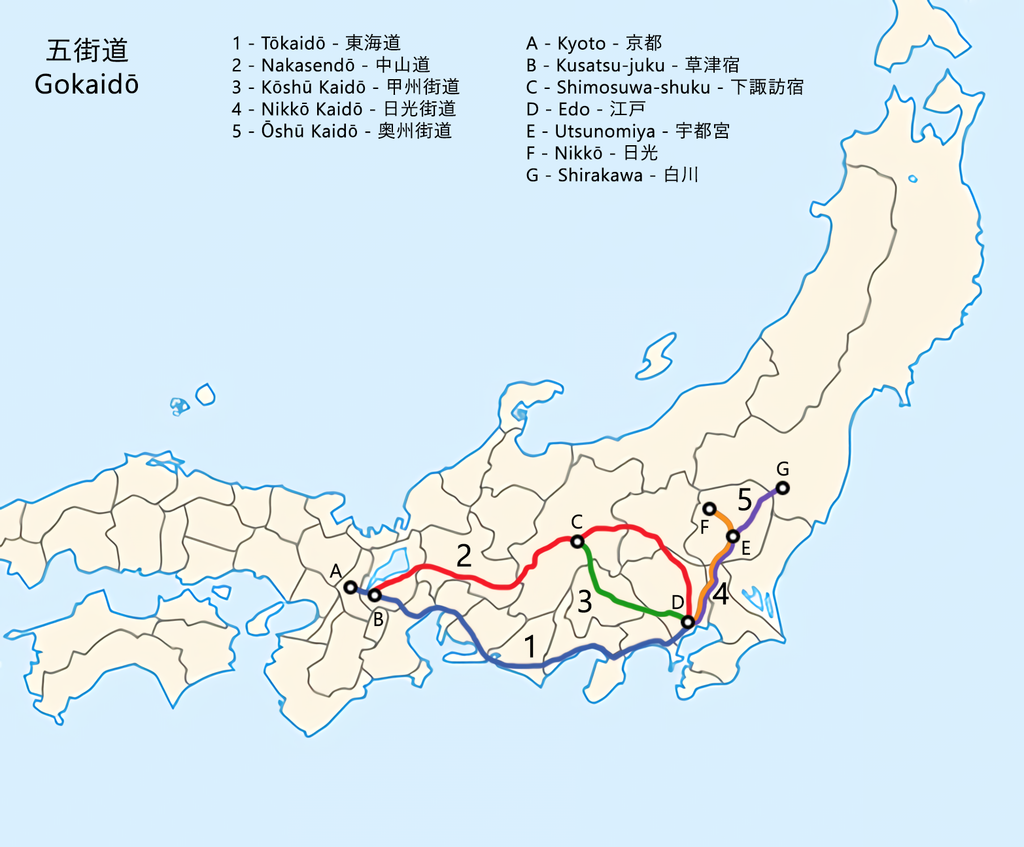
The Five Routes (五街道, Gokaidō)

The Five Routes (Gokaidō), sometimes translated as “Five Highways”, were the five centrally administered routes that connected Edo, the de facto capital of  Japan, with the outer provinces during the Edo period (1603-1868).  Two of these routes appeared in a series of woodblock prints completed by Utagawa Hiroshige. In this blog we will be following his journey along the Tōkaidō Road.

No.1. Nihon Bridge: Morning Scene.

In 1832 Hiroshige travelled with an entourage of the Shogun’s officials from Edo to Kyoto along the Tokaido Road. This journey proved to be an eye opening and life changing experience for him. One has to remember that Hiroshige was an urban man of Edo, and his life had been centred around Edo. This journey he undertook along the Tokaido, entering rural villages and observing the beauty of his country made a great impression on the artist, so much so that he immediately returned to Edo once the journey had been completed and started on his woodblock series using the sketches he had made during the long trek.   They were then published as the Fifty-three stations of the Tokaido or Hoeido Tokeido.  The publication earned him great critical acclaim during his lifetime and for future generations.   Hiroshige was part of an official delegation which was tasked with transporting horses, a gift from the shogun Tokugawa leyasu, the hereditary commander-in-chief in feudal Japan, to the imperial court of the Emperor Ayahito.  The horses were a gift from him which symbolised the power structure in Japan and how the shogun recognised the divine rights of the emperor.

Travelling along the Tokaido Road had some restrictions and checkpoints, known as seki, were set up by the Tokugawa government, where guards stood watch, and turned back those who did not have the appropriate passes. Even in the city of Edo there were restrictions and each section of the city, known as machi was closed off by wooden gates called kido.  These gates were shut every night, and re-opened early in the morning and so a traveller wishing to start on the first stage of the Tokaido route, at the Nihon-bashi literally “Japan Bridge” in the heart of Edo would have to wait until the kido at the bridge was opened.

Nihonbashi: Daimyō Procession Setting Out

Hiroshige’s journey started in the eighth month of 1832 at the Nihonbashi starting point. It was also from here that the Daimyō Procession started their annual pilgramige. Among the travellers on the Tōkaidō were the processions of the great daimyō, powerful Japanese magnates, and  feudal lords who, from the 10th century to the middle 19th century, ruled most of Japan from their vast, hereditary land holdings. They were subordinate to the shogun.  They were directed to spend every other year at the Shōgun’s court to prevent them from organizing rebellions, and the group travelled back and forth in huge processions numbering hundreds of people.

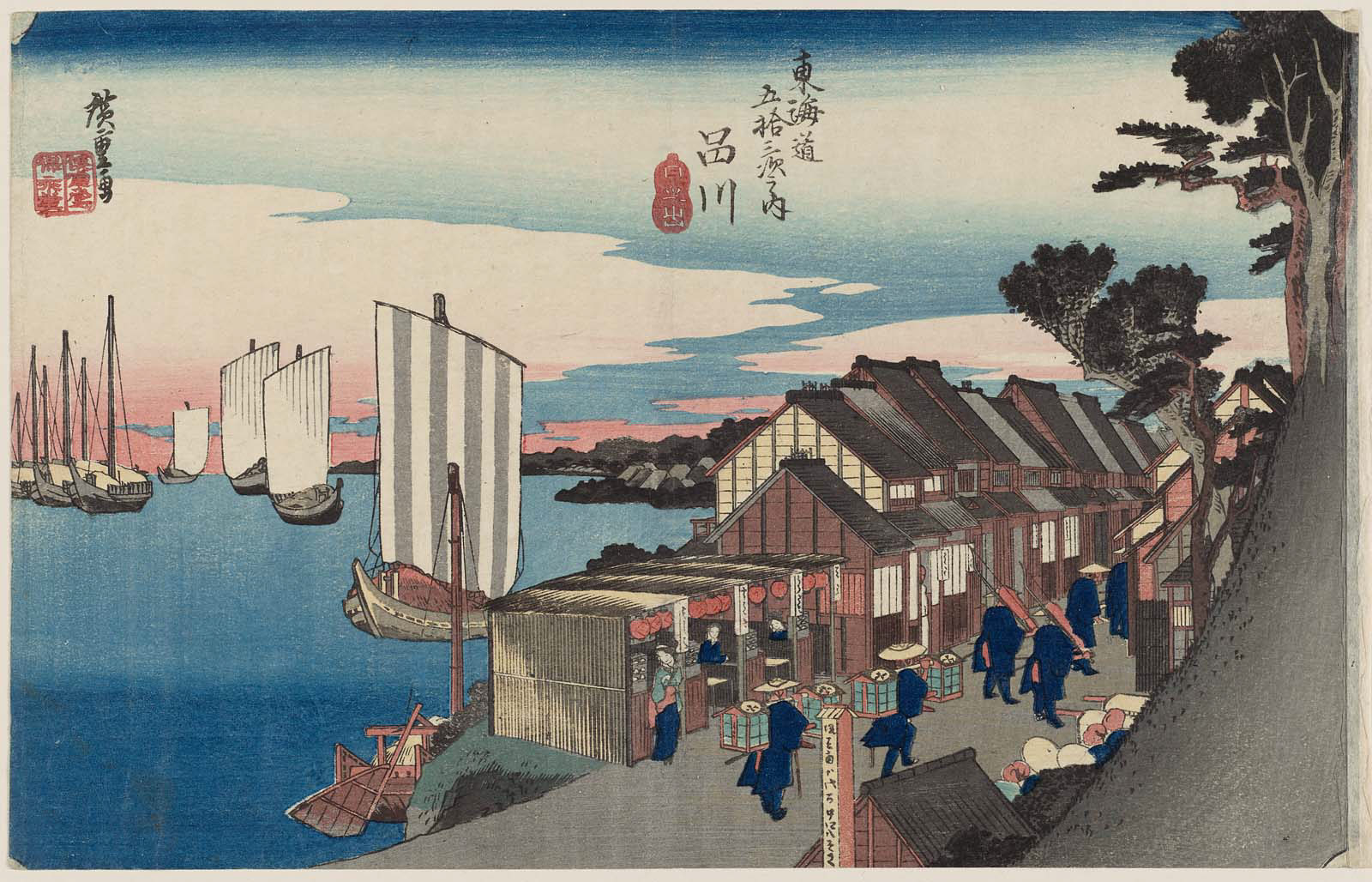
No.2.  Shinagawa: Sunrise by Hiroshige

The first stop-off point on Hiroshige’s journey along the Tokaido Road journey was at Shingawa, a suburb of Edo.

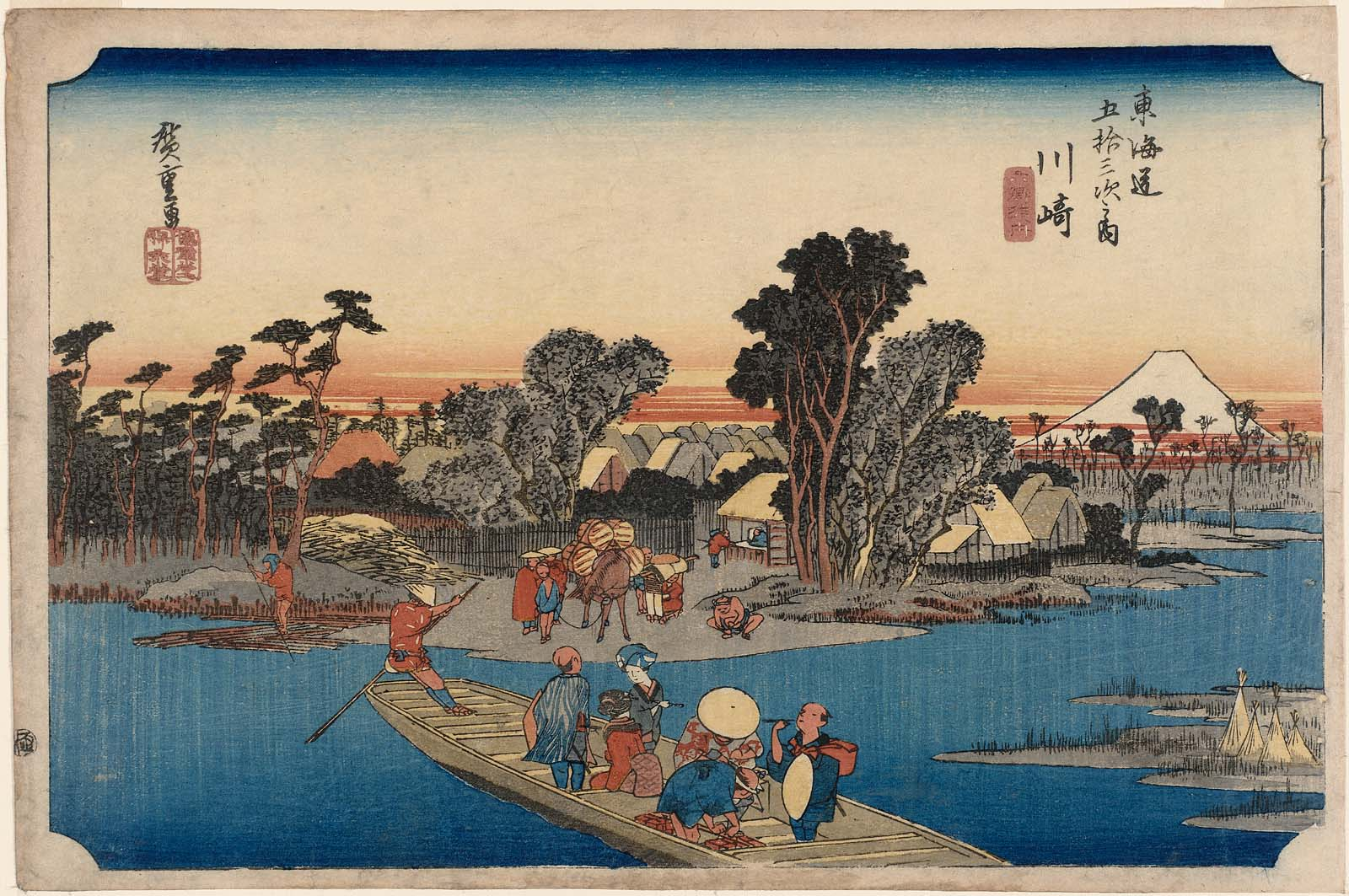
No.3. Kawasaki: The Rokugo Ferry by Hiroshige (1833).

In the third of the series we see the Rokugo Ferry at Kawasaki depicted.  It is a tranquil river scene in which we witness a ferry carrying six passengers.  On the Kawasaki shore we see future passengers along with their horse who have to wait for the ferry’s return.  Mount Fuji appears in the upper-right of the print.

No.4. Kanagawa: View of the Embankment by Hiroshige (c.1833).

The fourth of the fifty three woodcuts was of travellers arrival at Kanagawa.

The setting of the woodcut print is the town of Kanagawa and it is an evening scene.  We see the weary travellers slowly ascending the hill, being propositioned by young girls who try to entice them into the tea-houses.

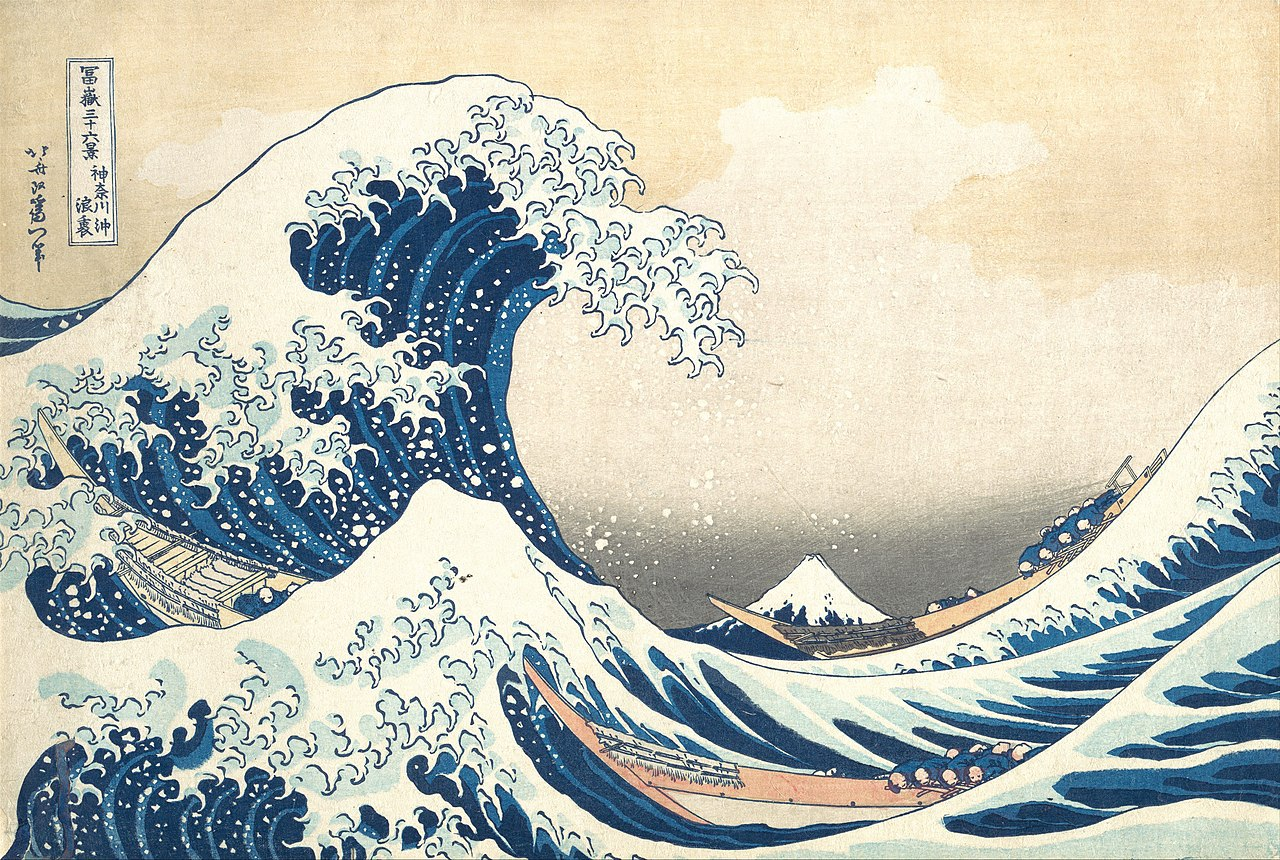
The Great Wave off Kanagawa by Hokusai’s  (c. 1829–1832)

Kanagawa is also the famous setting for Japan’s most famous artwork – Hokusai’s print entitled The Great Wave off Kanagawa. In 1923 the town was devastated by the Great Kanto earthquake.

No.5. Hodogaya: Shinmachi Bridge by Hiroshige.

The next stop for Hiroshige was at the lay-over station of Hodogaya on the bank of the Katabira River.  This town, now a suburb of Yokohama, was formed by combining the towns of Katabira, Godo, Iwama and Hodogaya. For that reason, the Katabira Bridge across the Katabira River was called the Shinmachi Bridge (meaning New Town Bridge). Begging Zen priests of the Fuke sect and palanquin bearers are seen crossing the bridge, and beyond them women of the small restaurants stand around and chat.

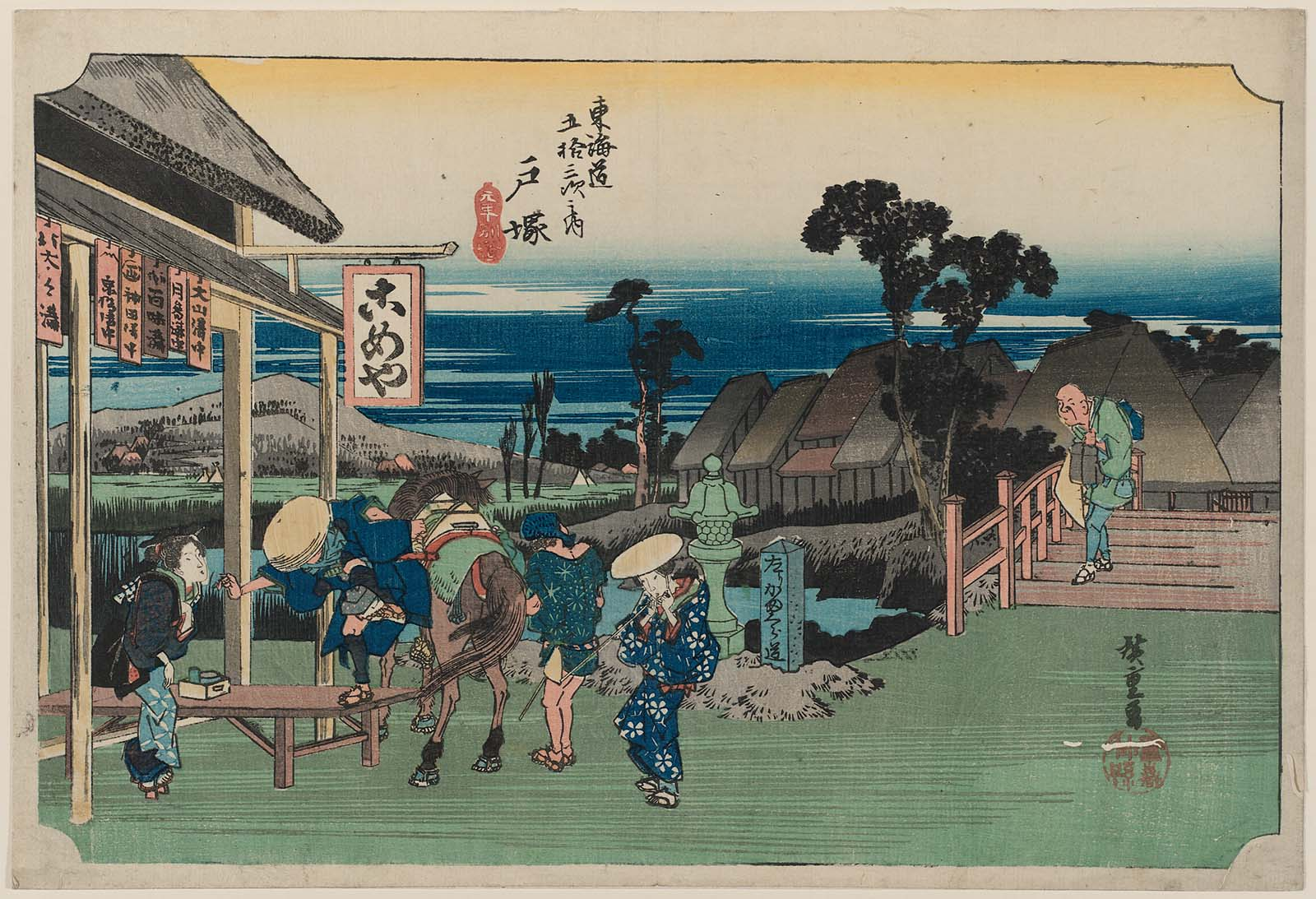
No.6. Totsuka: Motomachi Fork by Hiroshige

The next layby station on Hiroshiga’s journey is another suburb of Yokohama called Totsuka.  In this print we see a man dismounting from his horse in front of an open tea-house, while a waitress stands by to receive him. Beyond this station, the highway was lined with finely shaped pine trees.

No.7. Ōiso: Tora’s Rain by Hiroshige

Once Hiroshige and his party had departed from Totsuka and passed through Fujisawa and Hiratsuka the travellers arrived at Ōiso, a coastal town located in Kanagawa Prefecture.   In his depiction of Ōiso, dark black skies dominate and we see a small group of travellers entering the town sheltering from the downpour.  To the right of the road we can see Mount Korai and to the left we have a sea view.  The inclement weather is highlighted by the menacing black cloud which hovers above the horizon in the yellowish sky. The town of Ôiso at one time had been the home of Ôiso no Tora, also known as Tora Gozen. She was a courtesan based at the Chôtei brothel in Ôiso and the mistress of Soga no Juro and features in numerous kabuki plays.  Soga and his younger brother Goro slew Kudō Suketsune, avenging the death of their father.  Shortly afterwards the two brothers were executed.  This historical event later featured in many Noh and puppet theatre.  According to the stories, following Jûrô’s death, Tora became a nun and devoted the remainder of her life to praying for his soul.  Tora Gozen was later metamorphosed into a stone, which is one of the sites that can be seen in Ôiso. It is said that she cried on the 28th day of the Fifth Month, the day of Juro’s death and the title of the woodcut Tora’s Rain is reference to this event.

No.10. Odawara: The Sakawa River by Hiroshige (c.1833)

Hiroshige and the travellers left Oiso and headed south-west towards their next stop, Odawara but to reach that stop-over town they had to cross the Sakawa River. In those days travellers made the crossing on the backs of waders, or for the very rich traveller, they would cross the water seated in a palanquin or litter. On the middle-ground on the right of the print we can see the low-lying town of Odawara. Further to the right we observe the fifteenth-century castle of Odawara which nestles below a tree-covered hill.

No.11. Hakone: View of the Lake by Hiroshige (c.1833)

Having left Odawara Hiroshige and the travelling party headed for Hakone and Mishima.  To reach Hakone the travellers had to trek through mountainous regions close to their destination.  The mountains close to Hakone rose more than a thousand metres and the way to Hakone was a constant up and down and then circling Lake Ashi through the Hakone Pass to reach the Hakone stop-off station.  The woodcut print depicts Lake Ashi on the left and in the distance we can make out Mount Fuji silhouetted against a reddish sky.  The presence of Mount Fuji is all about artistic licence as from the position we are looking from, the mountain would not have been visible.

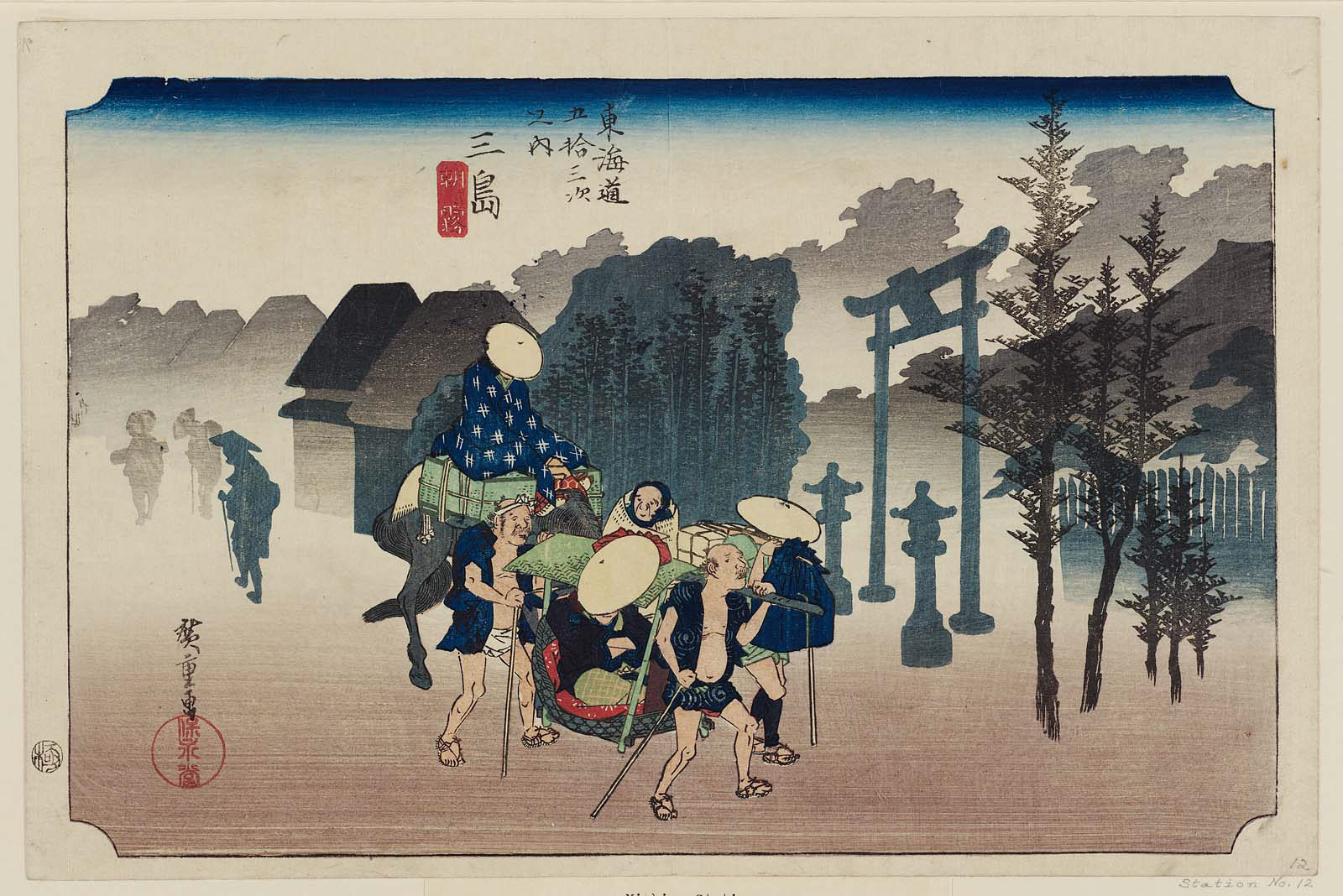
No.12. Mishima: Morning Mist by Hiroshige (c.1833)

The next stop on the Tokaido Road is the town of Mishima. During the time of Hiroshige, Mishima prospered as an inn town on the old Tokaido Road, a gateway to Mt. Fuji, Hakone and the Izu peninsula.  In the woodcut print we can see a small company of travellers passing through the town.  In the depiction, through the morning mist, we can clearly see two stone lanterns of the Mishima shrine.  To the left we see the roofs of the town and a few further figures.  As the shrine is on the right-hand side of the road the travellers are heading to Edo and the party is carrying a palanquin which would come in use for the journey ahead over the mountain pass.

Mount Fuji seen across a Plain: Numazu by Hiroshige (c.1852)

No.13. Numazu: Twilight by Hiroshige (c.1833)

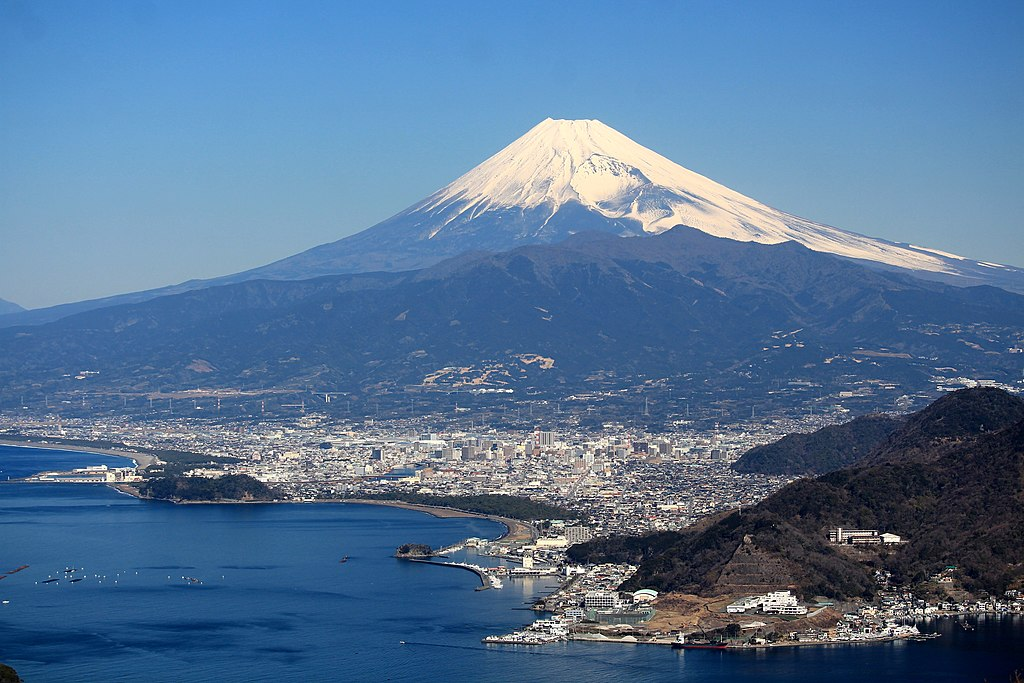
Present day Numazu with Mount Fuji in the background

Having passed through the mountains of Hakone Hiroshige’s party descend down to the plain which gives them the perfect view of the imposing Mount Fuji. The background of the upper print, completed in 1852 by Hiroshige, is a yellow sky with the smaller Mount Ashitaka on the right. In the right foreground we can just make out the castle of Numazu which was completed in 1579 and two hundred years later it was destroyed and rebuilt.

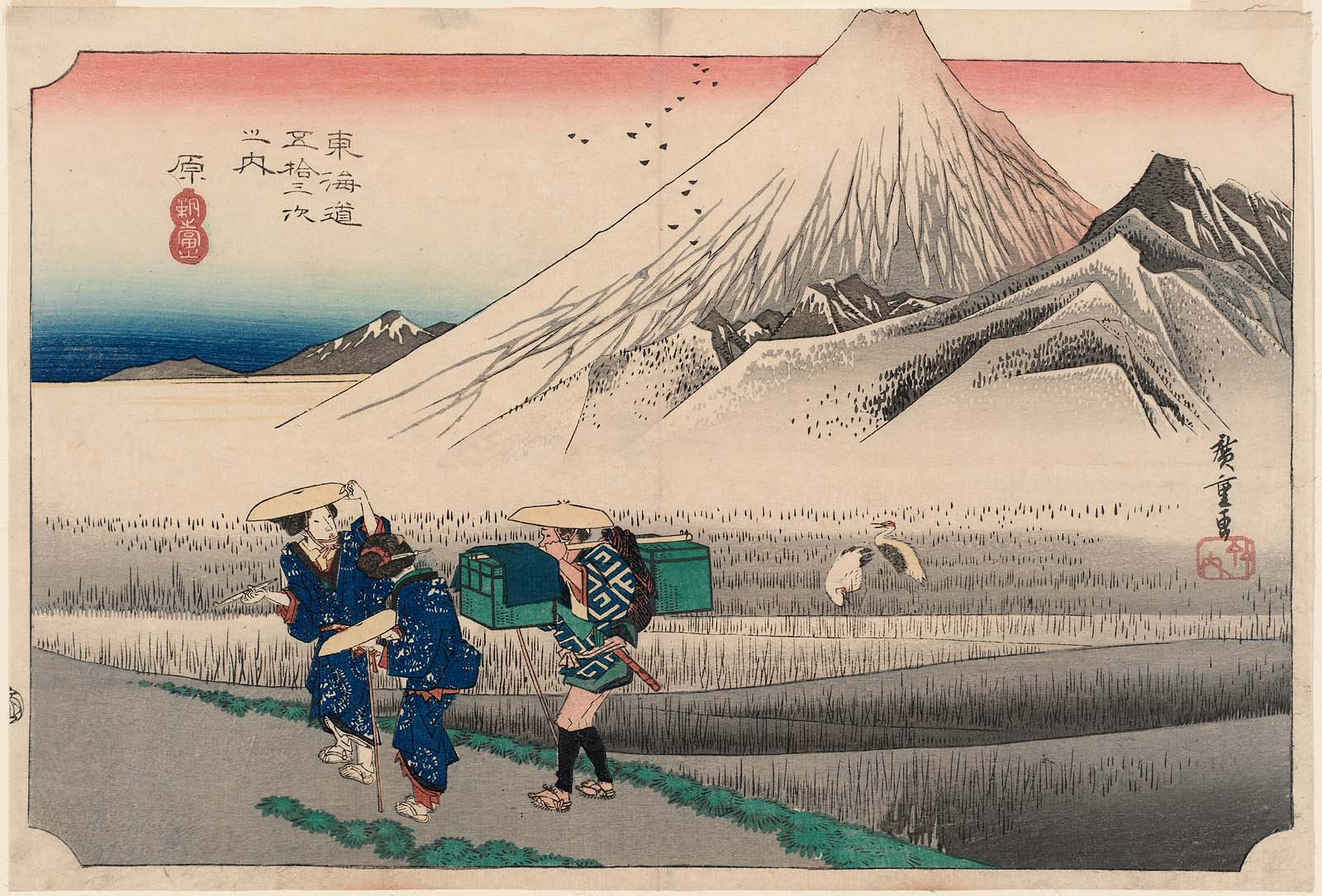
No.14. Hara: Mount Fuji in the Morning by Hiroshige (c.1833-34)

At Hiroshige’s next layby station at Hara, which literally means “field”, the view of Mount Fuji is virtually unobstructed. It is here that one gets the best view of the majestic mountain.  The mountain’s imposing height is emphasized as its peak extends beyond the frame of the picture. This was a technique used by Hiroshige in many of his prints depicting the mountain.  Two women, accompanied by a male attendant in traveling dress, seem awestruck by the breath-taking view.  The early morning sun reddens the sky.  To the right of Mount Fuji is Mount Ashitakayama.  The small party depicted in this painting are en route to the next stop over point, Yoshiwara,  The area around Hara is dotted with ponds and pools which are habitat for eels and the presence of two cranes in the field is evidence that they are hunting for food from one of these pools.  The jacket of the porter bears a pattern that later appears regularly on Hiroshige’s prints as his seal, consisting of two signs for “Hiro”.

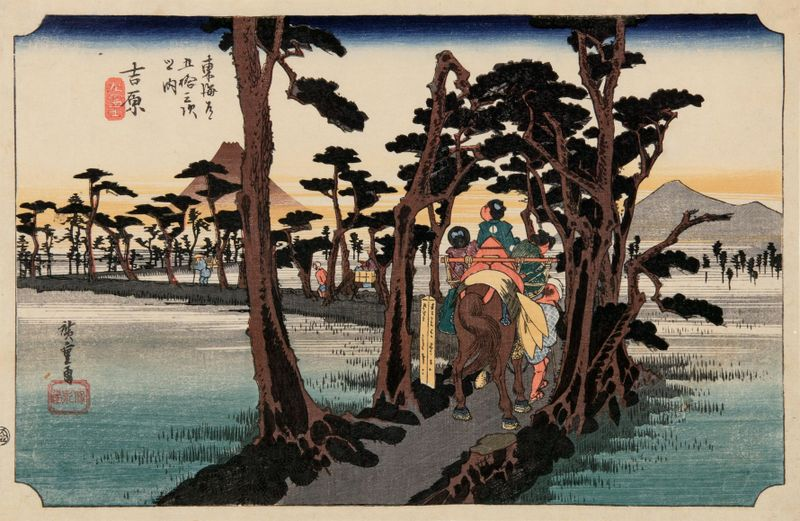
No.15. Yoshiwara: Mount Fuji on the Left by Hiroshige. (1833).

No.16. Kanbara: Night Snow by Hiroshige (c.1833)

Deep snow covers the slope of Kanbara in the evening and we can see fresh flakes falling on the houses. Trees, and mountains create a quiet scene only broken by the perceived crunch of the travellers’ footsteps in the snow. Two travellers wearing cloaks and hats trudge up the hill.  To the left of them there is another man dressed in blue holding an umbrella and a walking stick.  The mountains in the background and the houses in the middle ground stand out against a grey sky.  Once again Hiroshige has added a dark strip along the upper edge of the painting to denote that it is evening.  This painting is another case of artistic licence as it rarely snows in the Kanbara area, which is in present-day Shizuoka.

Hiroshige’s journey along the Tokaido Road continues in Part 2 of the blog.

Félix Vallatton. Part 2. The Nabis, woodcuts and the “dreadful nudes”

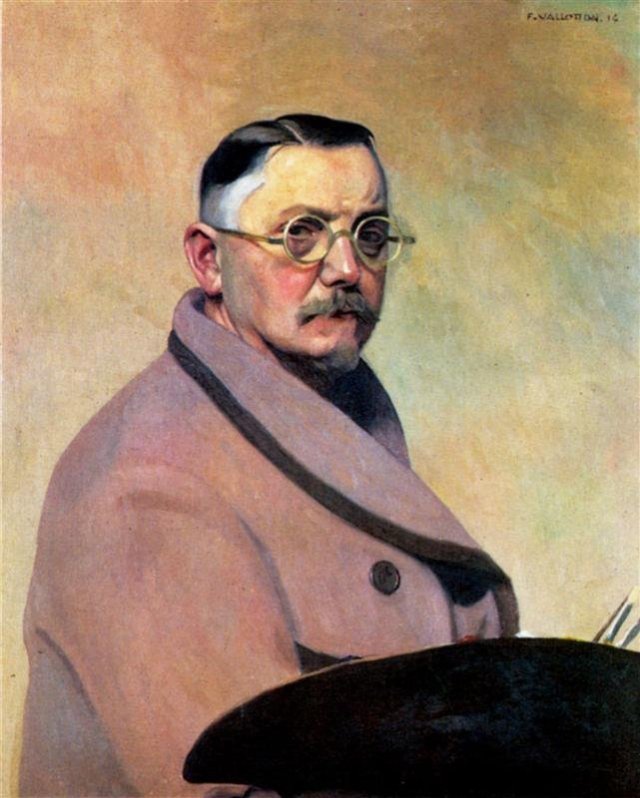
Self-portrait with the dressing gown by Félix Vallotton (1914)

During the 1890’s Vallotton, besides painting and writing art criticism, spent much of his time working with woodcuts.  The woodcuts he produced were looked upon as being very innovative and established him as a leading exponent of this type of art.  Japonism was sweeping through the French art world during the last part of the nineteenth century and Vallotton’s work was influenced by the Japanese woodcut In 1890 there had been a large exhibition of ukiyo-e prints at the École des Beaux-Arts and like many people in France, Vallotton built up a collection of these prints.

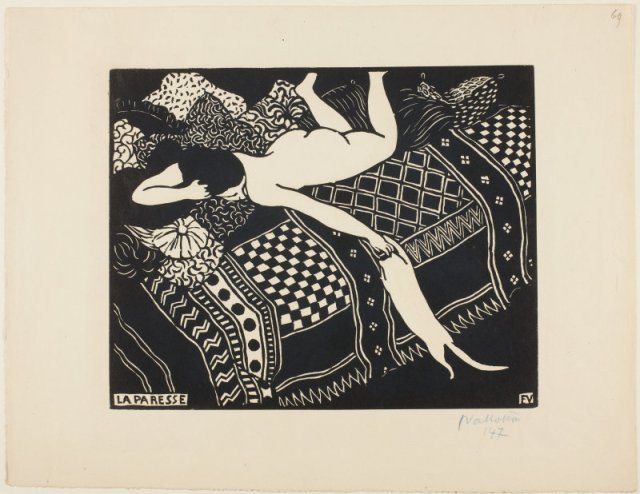
La Paresse by Félix Vallotton (1896)

Vallotton’s subjects ranged from domestic scenes to street crowd demonstrations in which police are depicted clashing with anarchists and from portrait heads to bathing women.  In his 1896 woodcut entitled La Paresse (Laziness) he depicts a naked women relaxing face down on a bed whilst stroking a cat.

Le Mensonge (The Lie) by Félix Vallatton (1896)

The high point of his woodcuts was probably reached in 1898 when he produced a series of ten interiors entitled Intimités (Intimacies), for the La Revue blanche, the avant-garde French art and literary magazine, which was published between 1889 and 1903 and had many influential contributors such as Toulouse Lautrec.  The set of woodcuts dealt with the tensions between men and women and they proved so successful that they were circulated in magazines and books in Europe and America.

This set of woodcuts was a great success and for many critics there was a greater appreciation of them in comparison to his paintings.  The ten woodcuts were dark with some white lines cut through the black background.  Vallotton, through his woodcuts, wanted to bring out the continuing tensions between man and woman and that was further enhanced by the evocative titles he gave the individual works, such as Le Mensonge (The Lie), L’Argent (The Money) and L’ Irreparable (The Irreparable).  In a way it was his way of denigrating love between man and woman, blaming the woman for being insincere and scheming creatures who often brought an element of spitefulness and dominance into a relationship.

Bathers on a Summer Evening by Félix Vallotton (1892)

Around 1892 Vallotton became associated with the Nabis art movement.   The group came about around 1888 and was composed of disaffected artists who had passed through the Académie Julian and been subjected to the rigid representational methods being taught at that establishment.  Founder members of the Nabis, which was a Hebrew word meaning prophet, were Pierre Bonnard, Édouard Vuillard and Maurice Denis.  The Nabis were inspired by the broad planes of unmediated colour, using thick and bold outlines that were seen in Japanese prints.

Clair de lune (Moonlight) by Félix Vallotton (1895)

Two examples of Vallotton’s take on the Nabi style art were his 1893 work entitled Das Bad. Sommerabend (Bathers on a Summer Evening), and his 1895 symbolist work Moonlight which can be found at the Musée d’Orsay

Bathers on a Summer Evening depicts women bathing in an open-air brick pool.  The painting was exhibited at the 1893 Salon des Indépendents exhibition and its subject caused a furore but at the same time it successfully enhanced Vallotton’s reputation as an artist.  In some way this painting is looked upon as a caricature of the traditional paintings of Salon artists such as Seurat and Renoir .  The painting is housed in the Kunsthaus, Zurich.

Mme. Felix Vallotton by Félix Vallatton (1899)

In 1899 Félix Vallotton married Gabrielle Rodrigues-Henriques née Bernheim.  Gabrielle was the daughter of Alexandre and Henriette Bernheim and was one of six children.   Alexandre Bernheim came from Besancon and was an art dealer and friend of a fellow countryman of Besancon, Gustave Courbet.   Gabrielle was eighteen months older than Félix Vallatton and had married Gustave Rodrigues Henriques in February 1883 and the couple had three children, Max, Joseph and Madeleine.  Gustave died in 1894 at the young age of 34 leaving his widow financially comfortable.  Gabrielle and Félix married five years later in 1899.  Félix wrote to his brother Paul and told of his relationship with Gabrielle.  He wrote:

“…I love her very much which is the main reason for this marriage, and she loves me also, we know each other very profoundly, and we trust each other.  In short, I regret nothing and I nourish the highest hopes…”

In 1899, the year of his marriage to Gabrielle he painted a picture of her sitting at a table.

As I mentioned in my last blog about Vallatton, what drew me to him was the headline of a 2007 essay in The Guardian newspaper by the writer Julian Barnes:

The neglected, enigmatic Swiss artist Félix Vallotton was a fine painter of still lifes, landscapes and portraits. Shame about his dreadful nudes, writes Julian Barnes

I was intrigued to find out what was “dreadful” about Vallatton’s portrayal of nudes.

Models Relaxing by Félix Vallatton (1905)

In 1905 Vallatton’s neo-classical style painting Models Relaxing was exhibited at the Ingres retrospective at the Salon d’Automne in Paris.

Le bain turc by Ingres (1863)

One of Ingres’ works Turkish Bath was also on view at the exhibition.  It is said that Vallatton was moved to tears by this Ingres’ work and maybe that was the reason that two years later, in 1907, Vallatton completed his own painting entitled Turkish Bath.

The Turkish Bath by Félix Vallatton (1907)

The women in his painting were not hand maidens of a harem but were women of the 1900’s with their fashionable hairstyles.

The Rape of Europa by Félix Vallatton (1908)

Controversy was not far away when his nude paintings were exhibited,  At the beginning of the twentieth century  one exhibition of his work only allowed over 18 years of age visitors to enter and witness the naked women !  Depicting his nudes as part of mythology did not decrease the censure of the critics.  An example of this is his 1908 painting entitled The Taking of Europe which is housed in the Kunstmuseum Bern.

Perseus Slaying the Dragon by Félix Vallatton (1910)

Another of Vallatton’s paintings featuring a nude but with mythological connotations was his version of the story of Perseus slaying the dragon, a story which had featured in many pasintings before.  Vallatton completed his up-to-date version of Perseus Slaying the Dragon in 1910 and it is now owned by the Musée d’Art et d’Histoire de Genève .

Woman with a Black Hat by Félix Vallatton (1908)

Vallatton painted hundreds of pictures featuring nude or semi-nude females and the one I like the most is his 1908 work entitled Woman with a Black Hat.  The woman’s face is flushed as if she is embarrassed to appear semi naked before the artist.  It adds to he vulnerability and in a way enhances her beauty.

Landscape Semur by Felix Vallotton (1923)

Vallatton kept a register of all the works he completed and by the time of his death the list catalogued almost 1600 works.  I have looked at his portraits and his penchant for painting nude females but of all his works, for me, his landscapes stand out.  It was in his latter years that Vallatton produced most of his landscape works, such as Landscape Semur which he completed in 1923.

Square in Les Andelys with the Chateau Gaillard by Félix Vallatton (1924)

Another interesting painting was completed a year later in 1924 and entitled The Chateau-Gaillard in Andelys.  Since 1909, Vallatton had a summer home in Honfleur and in 1924 whilst en route to his summer residence he passed through the small village of Andelys which lay on the banks of the Seine.  He had first visited the village eight years earlier.  The village is dominated by the ruins of Chateau Gauillard, a fortress built by Richard the Lionheart in 1196.  It is situated on a hill overlooking Andelys.  The ruins fascinated Vallatton who produced a number of paintings and sketches featuring the once mighty fortress.  The painting is housed in the Musée A.G. Poulain de Vernon in Vernon, a town about 30 kilometres south of Andelys.

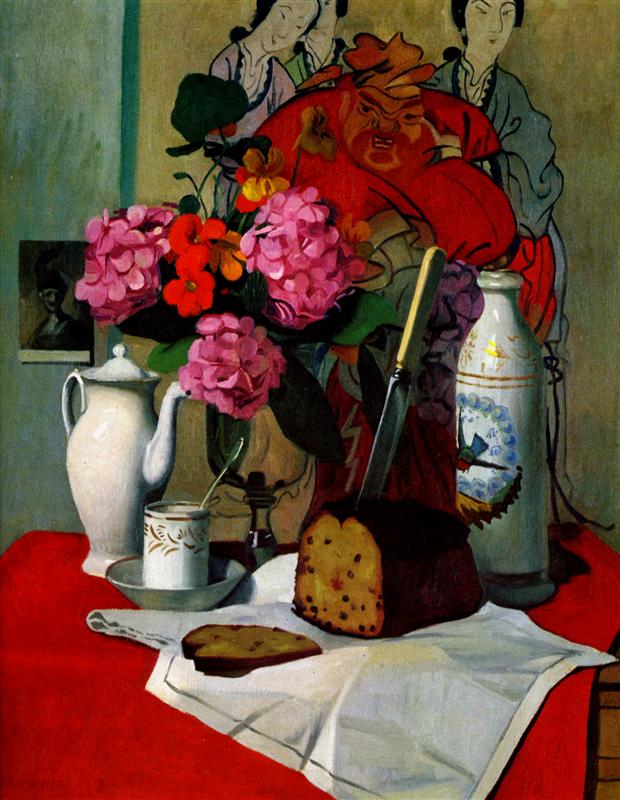
Nature morte a la peinture chinoise by Félix Vallatton (1925)

Another art genre that interested Vallatton in the early twentieth century was Still Life painting.  In 1925 he completed a work entitled Nature morte a la peinture chinoise (Still Life with Chinese painting).  Like many still life paintings the artist has challenged himself by having to paint a white napkin, with all its creases and folds, looking as if it is laying over the edge of the table.  The Chinese painting mentioned in the title can be seen in the background.

Parrot Tulips by Felix Vallotton

One of my favourite still life paintings by Vallotton was a work entitled Parrot Tulips.  I love the richness of the colours used and love to study the way Vallotton has depicted the individual items which crowd the scene.

Vallotton’s life came to a close at the end of 1925.  His brother Paul’s daughter Marianne recalled the time:

“...It was the end of of the year 1925 and the weather was grey and gloomy, but in accordance with our old custom, we were getting ready to celebrate Christmas, when on 21 December my father received a letter , whose opening lines I quote:

‘ …My dear Paul, after examining me twice, they have decided to operate.  It has been arranged for next Saturday morning the 26th.  It would be nice if you could be here, for various reasons…’ “

Félix Vallotton died three days after his operation on December 29th, three days before his sixtieth birthday.  According to Marianne Vallotton his last words to her father, his brother Paul were:

“…Don’t you think this is an amusing way to celebrate the centenary of the death of Jacques-Louis David?…”

The French painter died on December 29th 1825.

There were just so many apintings to include but so little time or space to accommodate them.  To see more I can recommend the excellent book on the life of Félix Vallotton by Nathalia Brodskaïa entitled Félix Valloton, The Nabi from Switzerland.  It was from this biography that I have been able to put together these two blogs on this talented Swiss painter.

Earlier I had mentioned the headline of an essay in The Guardian newspaper written by Julian Barnes.  It is said that in a few years time he will be curating an exhibition of Félix Vallotton’s work at the Royal Academy in London and it will certainly be an exhibition not to be missed.