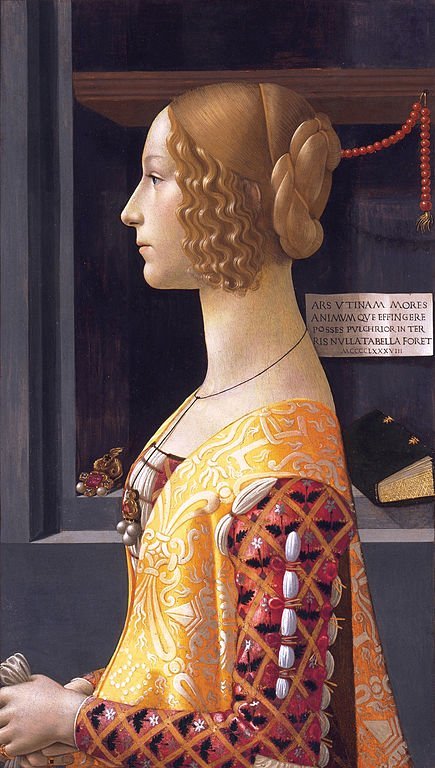
Portrait of Giovanna degli Albizzi Tornabuoni by Domenico Ghirlandaio

Portrait of Giovanna degli Albizzi Tornabuoni by Domenico Ghirlandaio (1488)

When you walk around an art gallery I wonder how long you spend in front of each painting.  I suppose it depends on the type of painting and whether it is part of a crowded special exhibition when you are jostled from one painting to the next by a crowded sea of viewers.  I suppose it also depends on your time management as if you are coming to the end of your allotted time you tend to jump from one picture to the next in a desperate attempt to not miss a single one, although in a way your hurried state probably means that the last few painting remain just a blur in your mind.   So why do I ask this question about time management and carefully appreciating the paintings before us?   The answer is that during a recent visit to the Thyssen-Bornemisza Museum in Madrid I had left the room, which housed the fifteenth century art collection till last and I was constantly aware that my time at the museum was running out.   I found myself flitting from one painting to another and I have to admit by doing so I failed to take in the beauty of the works in that section of the gallery.   That was until I came across two stunning works which I could hardly drag myself away from.  They were just such beautiful paintings.  Yes, I know beauty is in the eye of the beholder but for me they were truly exquisite.   I stood before them, totally mesmerised by their intrinsic charm and so I am dedicating my next two blogs to those two 15th century works. 
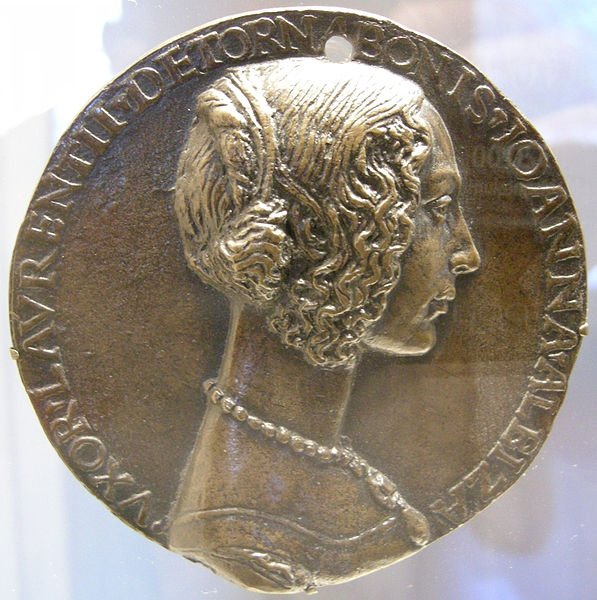
The Wdding Medalion
The Wdding Medalion

Today I want to offer you a beautifully crafted portrait by the 15th century Italian artist Domenico Ghirlandaio entitled Portrait of Giovanna degli Albizzi Tornabuoni which he completed in 1490 and which is now part of the permanent collection at Madrid’s Thyssen-Bornemisza Museum.   Giovanna was the wife of Lorenzo Tornabuoni who came from the wealthy Florentine banking family and whose father, Giovanni was Domenico Ghirlandaio’s patron.  We know this is the image of Giovanna as at the time of her marriage to Lorenzo a series of bronze portrait medals with her image were made to commemorate the event and the likeness of the figure on the medal and in the painting is undeniable.   Lorenzo and Giovanna married in June 1486 but sadly she died giving birth to her second son in 1488, at just twenty years of age.  As the portrait was completed after she died, it is thought that it could be looked upon as a kind of remembrance painting.   The painting hung in her husband’s private rooms in the Tornabuoni Palace.

We see Giovanna before us, half-length, in a somewhat rigid profile.  In her hands she clasps a handkerchief.  Giovanna is dressed in the most sumptuous way.  She wears a giornea which is an open-sided over-gown, which is brocaded.  The design on the brocade features the letter “L” and a diamond.   The “L” is her husband, Lorenzo’s initial and the diamond was the Tornabuoni family emblem.  There is no doubt that she is one of Florence’s élite by the way she wears her hair in the very latest Florentine fashion.  The jewels she wears around her neck comprise of two rings and pendant which were given to her by Lorenzo’s family as a wedding gift.  If you look closely at the pendant she wears you will also notice a matching brooch designed in the shape of a dragon which lies on a shelf behind her.   The jewel with its dragon, two pearls and a ruby formed a set with the pendant hanging from a silk cord around her neck.   Behind her, on the shelf, is a prayer book which is thought to be the libriccino da donna (little ladies’ book).  Above the book hangs a string of coral beads which have been identified as a rosary.   Ghirlandaio’s inclusion of this prayer book and the rosary in the painting was testament to Giovanna’s religious beliefs and her piety. 

What did Ghirlandaio think of his sitter?  Will we ever know?  Actually the answer lies within the painting itself because just behind Giovanna’s neck we can see attached to the shelf a cartellino.   A cartellino (Italian for small piece of paper) was a piece of parchment or paper painted illusionistically, often as though attached to a wall or parapet in a painting.  On the cartellino added by Ghirlandaio in this painting are the words:

ARS UTINAM MORES

ANIMUMQUE QUE EFFINGERE

POSSES PULCHRIOR IN TERRIS NULLA TABELLA FORET


which translates to:


“…Would that you, Art, could portray her character and spirit ;  for then there would be no fairer painting in the world..”.

At the bottom there is the date:

“MCCCCLXXXVIII”. (1488)

By these words there is no doubt Ghirlandaio is excusing himself to Giovanna for his belief that he has not been able to show her real inner beauty.  These are fine words from our artist but in fact they were not quite his own as they are a slight variation on the words of an epigram (a short and concise poem) of the Latin poet Marcus Galerius Martial, whose works were all the rage with the Florentine aristocracy of the day.

My featured artist today was born Domenico di Tommaso Curradi di Doffo Bigordi.  The name was derived in part from his father’s surname Curadi and the surname of his grandfather Bigordi.  He was born in Florence in 1449, the eldest child of Tommaso Bigordi and Antonia di ser Paolo Paoli.  His father was a goldsmith and was well-known for creating metallic garland-like necklaces which were worn by the ladies of Florence, and it was for that reason that Domenico was given the nickname Il Ghirlandaio (garland-maker).   Domenico worked in his father’s jewellery shop and it was during his time there that he started sketching portraits of customers and passers-by.   According to the famous biographer of artists, Giorgio Vasari, Domenico’s father decided to afford his son some formal artistic training and had him apprenticed to the Florentine painters, Alesso Baldovinetti and later Andrea del Verrocchio.

Domenico will always be remembered for his exquisite detailed narrative frescos in which he would incorporate portraits of the local aristocracy resplendent in their finery.  Many of his frescos appeared in local Florentine churches.  In 1482, he also completed a Vatican commission for Pope Sixtus IV – a fresco in the Sistine Chapel entitled Calling of the First Apostles.  The frescos he will probably be best remembered for were two major fresco cycles, which he completed with the help of his brothers, Davide and Benedetto along with his brother-in-law, Bastiano Mainardi, who was one of Domenico’s pupils.


The Resurrection of the Boy by St. Francis by Girlandaio
The Resurrection of the Boy by St. Francis by Ghirlandaio

The first of these frescos was for the Sassetti Chapel in the church of St Trinita in Florence.  It had been commissioned by Francesco Sassetti, a rich and powerful banker who worked for the Medici family.  This cycle of frescos was in six parts and depicted the life and times of St. Francis of Assisi, who was Sassetti’s patron saint. Seen within the frescos were a number of portraits of members of the Sassetti family along with some of the leading figures from the Medici family.  To look at the two families within the frescos one would be forgiven for coming to the conclusion that the Sassettis and the Medicis were very close, which of course was precisely the allusion Francesco Sassetti had wished to convey.  Alas for him, the close bond between the two families was all in his mind!

Visitation by Domenico Ghirlandaio

The second fresco cycle, Ghirlandaio’s last, and many art historians believe was his greatest, was commissioned to decorate the Capella Maggiore of the Santa Maria Novella Church in Florence by another banker, Giovanni Tornabuoni, who was related by marriage to the Medicis.   There was a connection between the two fresco cycles as Sassetti had the rights to decorate the Capella Maggiore of the Santa Maria Novella Church and he had wanted to have the frescos in the church depict the life of St Francis.   However the church was in trust to the Dominican order and they refused to allow such a design, so it was then that Sassetti decided to have the St Francis frescos painted instead in the Sassetti Chapel of the St Trinita Church in Florence and he sold the rite to decorating the Capella Maggiore to Giovanni Tornabuoni

 Ghirlandaio had not even completed the Sassetti fresco cycle when he was given this second large scale commission and he had to bring in most of the workers from his large Florentine studio to help him in this four-year project which was finally completed in 1490.  

The reason for talking about this fresco cycle is that I want you look closely at Ghirlandaio’s fresco, the part entitled Visitation.  Look at the third woman from the right.  Do you recognise her?   It is a full length portrait of Giovanna Tornabuoni who was the wife of Lorenzo Tornabuoni whose father, Giovanni was the commissioner of the fresco work and who was also my subject of today’s featured work.

The painting had a number of owners but in 1907 the American millionaire financier and philanthropist and founder of the J.P. Morgan bank,  J. Pierpont Morgan bought it in 1907.  It is believed that he adored the painting as it reminded him of his first wife, Amelia Sturgis, who like Giovanna had died very young.  She died of tuberculosis at the age of twenty-six, just four months after she and J.P. had married.   It entered the Thyssen-Bornemisza collection from the Morgan Library, New York, in 1935.

Whereas J.P. Morgan had his painting on view in his home to remind him of his wife I have a print of it on my breakfast room wall to remind me of Giovanna’s beauty as I serve guests with their breakfasts.

Frederic Edwin Church, Part 1

Last weekend I spent a two day break in London attending the christening of my grandson and pottering around a couple of galleries visiting their current exhibitions.   I had tickets for the Boccacio exhibition at the National Gallery and whilst there I decided to call in to their small but excellent Frederic Church exhibition, Through American Eyes: Frederic Church and the Landscape Oil Sketch, which is running until April 28th.   It was a veritable gem of a show and as the publicity stated,

 “…[ it was an invitation to] step into a world of wild natural phenomena with the landscape oil sketches of celebrated American landscape painter, Frederic Church…

 It is a free-to-enter exhibition and one you should try and visit.   I want to dedicate the next two blogs to the nineteenth century American painter Frederic Church, and look at some of his paintings, some of which were at the exhibition.  Church was a master of the plein-air oil sketch and I ask you to accompany me on a journey looking at his life and sampling some of his exquisite artistic gems.

Frederic Church was born in Hartford, the state capital of Connecticut, in May 1826.  He came from a privileged background.  His father, Joseph, who came from a very prosperous family, was a jeweller, silversmith and a Hartford insurance adjuster and the Church household lived an affluent lifestyle.  Frederic, who was brought up in a devout Protestant Congregationalist household, showed a propensity for art whilst at school and through a family neighbour, Daniel Wadsworth, was fortunate enough to be introduced to Thomas Cole, the English-born American landscape artist, who is regarded as the founder of the Hudson River School.  Thomas Cole, who up until then had never taken a pupil under his wing, agreed to take Frederic on as his pupil.   Frederic studied under Thomas Cole in his Catskill studio between 1844 and 1846 during which time he and his tutor would go off on painting trips to the Catskill Mountains and the Berkshires, a highland region in western Massachusetts, west of the Connecticut and lower Westfield Rivers .

Hooker and Company journeying through the Wilderness in 1636  from Plymouth to Hartford by Frederic Church (1846)
Hooker and Company journeying through the Wilderness in 1636 from Plymouth to Hartford
by Frederic Church (1846)

Frederic flourished under Cole’s guidance and, within a year, he had his painting, a scene from early New England history, Hooker and Company journeying through the Wilderness in 1636 from Plymouth to Hartford shown at New York’s National Academy of Design annual exhibition.  The scene recounts the June 1636 journey made by the prominent Puritan religious leader, Reverend Thomas Hooker as he left the Boston area with one hundred men, women, and children and set out for the Connecticut valley. The group traveled over one hundred miles through the wilderness and reached their destination in early July. Many members of the Hooker party settled in Hartford, while some located to nearby Wethersfield and Windsor, and others traveled north and settled Springfield, Massachusetts.    It was through this painting that Church combined his love for ancient landscapes with an acknowledgement of his cultural origins.  The following year Church was elected as the youngest Associate of the National Academy of Design and was promoted to Academician the following year.  That year he sold his first major oil painting to the Wadsworth Atheneum in Hartford, an art museum which had been founded by Daniel Wadsworth.

 After completing his apprenticeship with Cole, Frederic Church moved to New York and set up his own studio in a space which he rented in the Art-Union Building, which was at the centre of the city’s art world, and he began to teach art.   During the spring and autumn months he would leave the city and set out on painting trips throughout New England, particularly Vermont.  Over the months he would build up a large collection of sketches of the beautiful scenery he witnessed, which he would then bring back to his New York studio and during the dark and cold months of winter he would convert them into beautiful landscape paintings.    His landscape artistry was much admired and his landscape works featuring New York and New England vistas sold well.  Frederic Church’s landscape paintings differed from the moral and religious allegorical ones which had been the hallmark of his tutor, Thomas Cole’s landscape works,  for Church wanted to concentrate on the true beauty of nature.  His depictions of storms, sunsets and waterfalls in the Catskill Mountains encapsulated the beauty and spirituality of the American wilderness.  It could well be the case that Frederic Church had read the words of the great English art critic John Ruskin who laid out his ideas of what a young artist should seek to achieve in their landscape works.  Ruskin wrote:

 “…For young artists nothing ought to be tolerated but simple bona fide imitation of nature….. Their duty is neither to choose, nor compose, nor imagine, nor experimentalize; but to be humble and earnest in following the steps of nature, and tracing the finger of God…”

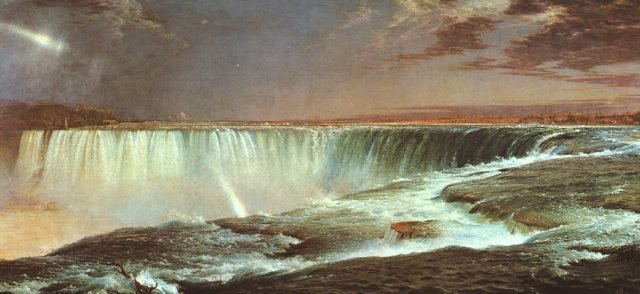
Niagara by Frederic Church (1857)

During a two year period, 1854 to 1856, Frederic Church travelled extensively visiting Nova Scotia, and journeying throughout Maine, New Hampshire, and Vermont, and it was around this time that he visited the Niagara Falls.   The Falls, by this time, had become a great tourist attraction and a favourite destination for artists.  Whilst at the Falls he completed a number of oil sketches which he would utilise when he painted his large-scale works of the Falls in 1857 and 1867.   Frederic Church’s great breakthrough came when, in 1857, he exhibited his painting Niagara It was a large work measuring 107cms x 230cms (see My Daily Art Display Sept 9th 2011) and it visually stunned all who saw it.   Without doubt, the late 1850’s were the high point of Church’s career.  Artistic triumph followed artistic triumph.

 Frederic Church had, like many others,  become fascinated with the translated writings of the celebrated Prussian naturalist and explorer Alexander von Humboldt, which were based on his five-year expedition in the New World at the start of the nineteenth century.  It was in one of his works, Kosmos  that Von Humboldt implored artists to travel and paint equatorial South America.   In 1853, along with his friend, the young entrepreneur Cyrus West Field, who had financed the trip, Church set off on the first of two expeditions following Humboldt’s footsteps, chiefly in Colombia;  the second trip, in 1857, in company with the American Creole landscape painter, Louis Remy Mignot.   Together, the artists travelled from Panama to Ecuador, where they spent 10 weeks painting village and mountain scenes.

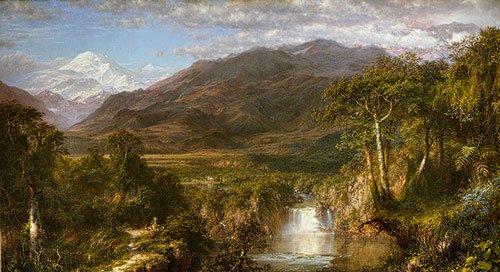
The Heart of the Andes by Frederic Church (1859)

From his trips to South and Central America, Frederic Church amassed a large collection of sketches from which, on his return home, he completed large and spectacular oil paintings.  One of these works was his ten-foot wide work entitled The Heart of the Andes which he completed in 1859.   This elaborate and highly structured painting was his most ambitious work.  In this painting Church managed to depict the variety of earthly life as seen by the lush green foreground.   The painting took pride of place in a New York exhibition, housed in an elaborate window-like frame and illuminated in a darkened room by concealed skylights.  Can you just imagine what nineteenth century viewers made of this extraordinary painting exhibited in such an extraordinary setting?   People thronged to see the painting and it was estimated that more than twelve thousand people visited the exhibition in three weeks and were happy to part with a quarter each to see it.  For that admission fee, the public were provided with opera glasses so that they could examine the painting in detail.  The painting was then shipped to England where once again people flocked to see it.  Church eventually sold it for $10,000, at that time the highest price ever paid for a work by a living American artist.

Iceberg Flotante by Frederic Church (1859)

In 1859 Church took a voyage north along the coast of Newfoundland and Labrador in search of icebergs.  On this trip he was accompanied by the Reverend Louis L. Noble, an author who was to write about their trip together in his 1861 book, After Icebergs with a Painter: A Summer Voyage to Labrador and Around Newfoundland.  During their voyage of discovery Frederic Church and Noble would hire a boat to take them up close to these awe-inspiring floating icebergs to allow Church to sketch these remarkable and majestic floating white giants.  Frederic Church managed to capture the breath-taking beauty of these white giants in a number of his paintings, one of which was his work entitled Iceberg Flotante which he completed in 1859

The Icebergs by Frederic Church (1861)

I particularly like his 1861 painting entitled The Icebergs, in the foreground of which we see a broken masthead lying cross-like on the ice.  Not only is this a beautiful landscape work but it is a kind of historical painting as the inclusion of the masthead is a reference to the tragic loss of Sir John Franklin’s doomed British expedition party which had been attempting to cross the last un-navigated section of the North-West Passage in 1847.  Sadly, the two ships of the expedition became icebound in Victoria Strait, close to King William Island in the Canadian Arctic.  Despite the British Admiralty’s sending numerous search parties to find the ships, the entire expedition party, including Franklin himself and his 128 men, was lost.

……………………………………………….to be continued in my next blog.

Élisabeth-Louise Vigée Le Brun and Marie Antoinette

Marie-Antoinette of Austria, Queen of France
by Élisabeth Vigée Le Brun (1778)

I had intended this blog to be the concluding look at the life and some of the works of Élisabeth-Louise Vigée Le Brun but instead I am just concentrating this blog on a couple of the portraits Élisabeth did of the Queen consort Marie Antoinette and look at Élisabeth’s life up to her forced exile from France.  My next blog will conclude Élisabeth’s life story.

At the end of my last blog we had reached 1775 and Élisabeth’s step father had retired from his jewellery business and the family had moved to an apartment in a large property, Hotel de Lubert, which was situated on the rue de Clery.    The Hotel de Lubert was also where the painter and art dealer Jean-Baptiste Pierre Le Brun had his gallery.  Soon after settling into her new home, Élisabeth took a great interest in the beautiful masterpieces which filled Le Brun’s apartment and gallery.   She recalled this time in her memoirs saying:

“…I was enchanted at an opportunity of first-hand acquaintance with these works by great masters.  Monsieur Lebrun was so obliging as to lend me, for purposes of copying, some of his handsomest and most valuable paintings. Thus I owed him the best lessons I could conceivably have obtained…”

Six months after moving in to her new home Le Brun proposed marriage to Élisabeth.   She was not physically attracted to him but was concerned about her family’s financial future, hated living with her stepfather and after much persuasion from her mother, who believed Le Brun was very rich, agreed to Le Brun’s proposal.  Even on her wedding day on January 11th 1776, Élisabeth had her doubts about the wisdom of her decision for she later wrote:

“…So little, however, did I feel inclined to sacrifice my liberty that, even on my way to church, I kept saying to myself, “Shall I say yes, or shall I say no?” Alas! I said yes, and in so doing exchanged present troubles for others…”

Élisabeth’s fears were soon borne out for although she termed her husband as being “agreeable” he had one great character flaw – he was an inveterate gambler and soon his money and that which Élisabeth earned from her commissions was frittered away.  However before the money had run out, Élisabeth and her husband bought the Hotel de Lubert in 1779, and her Salons, which she held there became one of Paris’ most fashionable pre-revolutionary venues for artists and the literati.  Two years later, on February 12th 1780, her only child Jeanne Julie Louise was born.   In 1781 she and her husband left Paris and journeyed to Flanders and the Netherlands and it was during this trip that she saw some of the works by the great Flemish Masters and these paintings inspired her to try new painting techniques. During their time in Flanders she carried out various portraiture commissions for some of the nobility, including the Prince of Nassau.

It was back in the year 1779 that Élisabeth first painted a portrait of Marie-Antoinette, Louis XVI’s queen consort.  It was at a time when the lady had reached the pinnacle of her beauty.  In her memoirs Élisabeth described Marie-Antoinette:

“…Marie Antoinette was tall and admirably built, being somewhat stout, but not excessively so. Her arms were superb, her hands small and perfectly formed, and her feet charming. She had the best walk of any woman in France, carrying her head erect with a dignity that stamped her queen in the midst of her whole court, her majestic mien, however, not in the least diminishing the sweetness and amiability of her face. To anyone who has not seen the Queen it is difficult to get an idea of all the graces and all the nobility combined in her person. Her features were not regular; she had inherited that long and narrow oval peculiar to the Austrian nation. Her eyes were not large; in colour they were almost blue, and they were at the same time merry and kind. Her nose was slender and pretty, and her mouth not too large, though her lips were rather thick. But the most remarkable thing about her face was the splendour of her complexion. I never have seen one so brilliant and brilliant is the word, for her skin was so transparent that it bore no umber in the painting. Neither could I render the real effect of it as I wished. I had no colours to paint such freshness, such delicate tints, which were hers alone, and which I had never seen in any other woman…”

Both the artist and sitter formed a relaxed friendship and in her first portrait (above) the queen is depicted with a large basket, wearing a satin dress, and holding a rose in her hand. The painting was to be a gift for Marie-Antoinette’s brother, Emperor Joseph II, the Holy Roman Emperor, and a further two copies were made, one of which she gave to the Empress Catherine II of Russia, the other she would keep for her own apartments at Versailles.  In all, Élisabeth painted more than thirty portraits of the queen over a nine year period

Élisabeth’s friendship with Marie-Antoinette and her royal patronage served her well as in 1783,  her name had been put forward by Joseph Vernet for election to France’s Académie Royale de Peinture et de Sculpture.   As her morceau de réception (reception piece) she submitted an allegorical history painting entitled La Paix qui ramène l’Abondance (Peace Bringing Back Prosperity).  She also submitted a number of her portraits. The Académie however did not categorise her work within the academy categories of either portraiture or history.  Her application for admission was opposed on the grounds that her husband was an art dealer, but because of Élisabeth’s powerful royal patronage, the Académie officials were overruled by an order from Louis XVI.  It is thought that Marie Antoinette put considerable pressure on her husband on behalf of her painter friend.

Having royal patronage and being great friends with Marie-Antoinette was a boon when the Royalty was loved by its people but once the people turned against Louis XVI and his queen, as happened during the French Revolution, then any friends the royal couple had were equally detested and at risk from the mob.  Attacks on Élisabeth Vigée Le Brun’s character had started back in late 1783 when the newspapers wrote stories about an alleged affairs she had with the Finance Minister, Charles Alexandre, Vicomte de Calonne, the Comte de Vaudreuil and the painter François Menageot.  The rumours persisted and it all came to a head in 1789 when fictitious correspondence between Élisabeth and Calonne was published in the spring.  Rumours about her lavish lifestyle abounded, even though they were not altogether true.  She was now starting to realise that having close connections to the monarchy, which she had once considered to be advantageous, was becoming a dangerous liability.

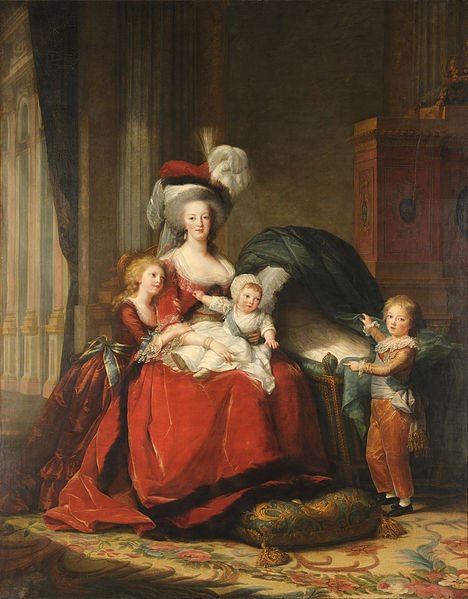
Marie Antoinette and her Children
by Élisabeth Vigé Le Brun (1788)

Élisabeth Vigée Le Brun’s last portrait of Marie-Antoinette was completed in 1788 and entitled Marie Antoinette and her Children.  The setting is a bedroom or a private chamber within the Royal palace.  Marie Antoinette is seated with her feet on a cushion.  This depiction of her posture symbolizes her status and high position in society.  She has a young infant on her lap and her son and daughter are either side of her.  In the painting we see her son, Louis-Joseph, Le Dauphin, standing to the right. Louis-Joseph suffered from bad health all his young life with the onset of early symptoms of tuberculosis and he died of consumption in 1789, a few months before his eighth birthday.   On the Queen’s lap sits Louis-Charles, Duc de Normandie, who on the death of his elder brother, became the second Dauphin. Following the guillotining of his father Louis XVI,  he became known as Louis XVII. This young boy was imprisoned in The Temple, a medieval Parisian fortress prison, where he died in 1795, aged ten, probably from malnutrition but rumour also has it that he was murdered.  Standing on the Queen’s right is Marie Therese Charlotte de France, Madame Royale.  She was Marie-Antoinette’s eldest child.  She too was imprisoned in The Temple but was the only member of the Royal family to survive the ordeal.  She remained a prisoner for over a year but Austria arranged for her release in a prisoner-exchange on the eve of her seventeenth birthday, in December 1795.  In the painting we can also see depicted an infant’s cradle which Louis-Joseph points to and lifts the covers showing it as being empty.  This empty cradle is a reference to Princess Sophie, Marie Antoinette’s other daughter, who was born in 1786 and died of convulsions two weeks before her first birthday.  This very poignant painting still hangs at Versailles.

On the night of October 6th 1789, following the invasion of Versailles by Parisian mobs and the arrest of the royal family, Élisabeth Vigée Le Brun left the mayhem of Paris with her daughter and governess in a public coach and headed for Italy.  She had hoped to return to France in the near future when the situation had settled down but in fact she never set foot back in France for twelve years.

My next blog will look at the latter part of Élisabeth’s life and I will regale you with my tale of infidelity which was the reason for featuring Élisabeth-Louise Vigée Le Brun in the first place !!


The Entry of Emperor Rudolf of Habsburg into Basle,1273 by Franz Pforr

The Entry of Emperor Rudolf of Habsburg into Basle, 1273 by Franz Pforr (1809)

In my last blog I looked at a painting by Johann Friedrich Overbeck entitled The Painter Franz Pforr, which was a friendship portrait he did of his good friend and fellow Nazarene, Franz Pforr.  Today I am switching my attention to Franz Pforr himself and looking at one of his most famous works.

Franz Pforr was born in Frankfurt am Main in 1788, a year before the birth of Friedrich Overbeck.  He came from an artistic background with his father, Johann Georg Pforr, who had started his working life as a miner but due to a serious accident in the mines turned his attention to art and originally worked as a porcelain painter before concentrating his efforts as a landscape artist and skilled painter of horses.  Franz Pforr’s uncle, Johann Heinrich Tischbein the Younger, a great friend of the writer Goethe, was part of the great Tischbein artistic dynasty and an art professor at the Kassel Academy of Art.

Franz Pforr received his initial art tuition from his father an uncle before, like Overbeck, attending the Akademie der Bildenden Künste in Vienna (Vienna Academy of Fine Arts) in 1805.  During the war between Austrian and France in 1805, Pforr volunteered as a guard in the Viennese militia.   The conflict affected the young artist’s health and he suffered a nervous breakdown, and would suffer from bouts of depression for the rest of his life.  It was probably during these mental upheavals that Pforr turned to religion using it as a crutch to see him through his mental torment.   In 1806 he returned to the Academy and resumed his academic studies and for a time saw himself as war artist, recording famous battles on canvas.

The Academy director at the time was Heinrich Füger who believed the art course should concentrate on the Neo-Classicisal style of painting.  Pforr, like Overbeck, was very disillusioned with the Academy’s artistic tuition and its lack of spirituality and so, in response to this, the two twenty year-old aspiring artists formed the Lucasbund, or Brotherhood of St. Luke (St Luke was the traditional patron saint of artists), deliberately recalling the guilds and the trade organizations of the late Middle Ages.   When Napoleon Bonaparte’s troops entered the city in 1809 the Academy was closed down.  The following year, 1810, along with Overbeck, Ludwig Vogel and Johann Hottinger, members of their Lucasbund, Franz Pforr moved to Rome and set up home at the deserted Sant’ Isidoro monastery.  They began to wear their hair long, and wore anachronistic medieval monk-like habits. The members of the group took vows of poverty and chastity almost as if they saw their group not simply as an artistic association but a religious one.   They still referred to themselves as the Brotherhood of Saint Luke but because of the way they look and acted most everyone else called them the “Nazarenes”.  The agenda of the Nazarenes was to reject the whole legacy of Baroque and Neoclassical art that was the dominating art of the day.  These young German artists sought inspiration in Italian painters of the early Renaissance, such as Raphael Sanzio as well as the German art of Albrecht Dürer who were to be their artistic benchmarks. Most of all they wanted their art to have a sense of spirituality.  They wanted it to be more honest, truthful, and sincere art similar to that of the late Middle Ages and Early Renaissance.  The subjects of their works of art were dominated by religious themes.

The Nazarenes disbanded in 1820 but for Franz Pforr his life with the group ended eight years earlier as he contracted tuberculosis and died in Albano Laziale, a suburb of Rome, in 1812.

The artwork of Franz Pforr calls to mind a sort of fairy-tale medievalism, awash with bright colours and picturesque details.  This can be seen in today’s featured painting by Pforr which he completed before he travelled to Rome, entitled The Entry of Emperor Rudolf of Habsburg into Basle, 1273.

This large medieval subject is consciously painted in a historical manner.  The subject of the painting is the entry into Basle of Rudolf of Habsburg and it is a pictorial tale of German pride and the country’s defiance of Napoleon Bonaparte.  Rudolf, who had inherited his father’s estates in the Alsace region, had also forcefully taken possession of the cities of Strasbourg and Basle and vast tracts of land in the western part of Switzerland.  It was in 1273, as he was laying siege to the Swiss city of Basle, that he heard that he had been elected to become the new German king by the prince-electors of the Holy Roman Empire,.  He would be crowned Rudolph I in Aachen cathedral in October of that year.    If we look to the horseback rider just left of centre we can see the black double-headed Habsburg eagle emblazoned on the back of his gold-coloured jacket.  The inclusion of this Habsburg eagle was thought to be Franz Pforr’s idea of defiance against Napoleon Bonaparte, who had been at war with the Germans and had occupied Pforr’s home town, Frankfurt in 1805.   Pforr was also affected again by Napoleon Bonaparte in May 1809 for he was a student at the Vienna Academy when Napoleon entered and occupied the city and the art establishment was closed down.

Self portrait of Franz Pforr

Another interesting aspect of Pforr’s painting is the way he has included himself in the scene as part of Rudolph’s entourage.  We see him on horseback riding some way behind the king.  He is the young man, wearing a black beret, and has turned in the saddle and is looking his over his shoulder at something happening at the rear of the procession.  In Cordula Grewe’s 2009 book entitled Painting the Sacred in the Age of Romaniticism she writes about how the Nazarene artists would often identify with their subjects and by doing so somehow identify with their own situation.  She goes on to talk about the interpretation of Pforr’s inclusion of himself saying:

“…Pforr’s mixture reflects the Nazarenes’ general obsession with temporality, as it serves to fold biblical into post-biblical time and, further differentiating the play of temporalities, to forge a link between medieval past and actual present. Pforr’s self-portrait marks the intersection of these various time axes.  His horse carries him forward in Rudolf’s wake… on his way towards the procession’s final destination, the town’s medieval cathedral.   Yet, while Pforr’s body moves towards a moment of historical completion, his gaze disengages with this view into the glorified but lost past of perfect piety.  As the only figure looking backwards, he gazes towards the right, fixing his eyes upon a point beyond the picture frame.  Pforr looks into the future.  In him, the picture’s two central aspects converge: his gaze unites the insight into God’s order (typology) with an understanding of the moral lessons that can be learned from history (a history past and yet available through the archetype)…”

Before us we see flattened perspectives.  The figures in the painting, in some ways, look uncoordinated often with head and shoulders portrayed at impossible and unrealistic angles.  There is almost a child-like innocence about the painting.   It is indeed a colourful painting but the colours are of a slightly muted and weak nature as was the case in many of the Nazarene works of art.   There is not the vibrancy and brightness of the colours used by the artists of the English nineteenth century Pre-Raphaelite movement, which was greatly influenced by the art of the Nazarenes.

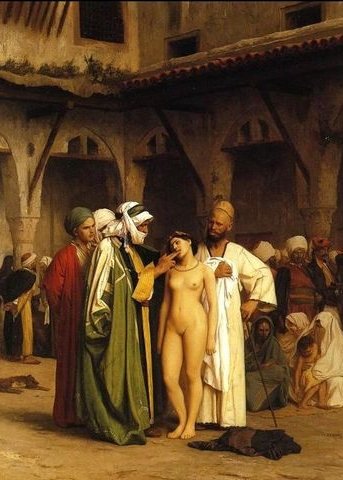
The Slave Market by Jean-Léon Gérôme

The Slave Market by Jean-Léon Gérôme (1866)

Today I am returning to the nineteenth century French academicism painter and sculptor Jean-Léon Gérôme, looking at his early life and featuring one of his works.  I had previously featured this artist in My Daily Art Display of February 10th 2011 when I talked about his painting entitled A Roman Slave Market.

Jean-Léon Gérôme was born in 1824, in Vesoul; a small town close to the city of Besançon and near to the French-Swiss border.  He was the eldest son of Pierre Gérôme, who was a goldsmith by trade, and his wife Claude Françoise Mélanie Vuillemot, a daughter of a merchant. He initially attended school locally in Vesoul where he was looked upon as a star pupil and attained a good deal of academic success culminating in being awarded first prize in chemistry, and an honourable mention in physics.  From the age of nine he took drawing lessons under the tutelage of Claude-Basile Cariage and when he was fourteen years of age he received formal art tuition and was viewed as a great up-and-coming talent and he received a prize from the school for one of his oil paintings.    At the age of sixteen, with his school days behind him, he set out for Paris with a letter of introduction to the French painter Paul Delaroche who at this time was at the height of his fame.   Delaroche’s artistic style was a blend of the academic Neo-classical school and the dramatic subject matter favoured by the Romantics.  This combination was to become known as the historical genre painting style. Gérôme was to be greatly influenced by the paintings and the tuition he received from Delaroche.

In 1845, after three years of studying under Delaroche and having just returned to Paris after a visit to his home in Vesoul, Gérôme discovered that Delaroche had closed his studio.   Delaroche had just suffered the loss of his wife, Louise, whom he deeply loved and whom he had depicted in many of his paintings.   Gérôme discovered him to be in the depths of depression following the death of his wife and was about to close his atelier and journey to Italy. Gérôme asked if he could accompany him.  Delaroche agreed and the two of them along with a couple of other of Delaroche’s students, one of which was the English painter Eyre Crowe, set off on their painting trip.

Gérôme stayed in Italy and visited Naples where he viewed the ruins of Pompeii and Herculaneum which were to become the foundation for his gladiatorial depictions.  His sojourn in Italy was cut short in 1844 when he contracted typhoid fever and he had to return home to Versoul where his mother nursed him back to health.  Later that year, fully recovered, he returned to Paris and entered the atelier of the Swiss painter and teacher Charles Gleyre.   Gleyre was to guide many young aspiring artists who would become famous household names, such as Monet, Renoir, Bazille and Whistler.  From the studio of Gleyre, Gérôme went on to attend the École des Beaux-Arts.

Meanwhile, Delaroche, who had remained in Rome, returned to Paris to work on an important commission.  Delaroche offered Gérôme a position as his assistant on the commission and so Gérôme left Gleyre’s studio to work with his former master.  He remained as Delaroche’s assistant for just on a year. Whilst working alongside Delaroche, he was encouraged to prepare paintings for the Salon exhibitions and within a short time, his talent as an artist was recognised and he was commissioned to paint a reproduction for the Queen. This was to be the start of many official and lucrative commissions. In 1846 Jean-Léon Gérôme began to work on one of his most famous paintings – Young Greeks Attending a Cock Fight.  Gérôme had just suffered the setback at the École des Beaux Arts of not achieving his main aim that of winning Prix de Rome prize, which would have given him a scholarship to travel to and study in Rome.  He was probably questioning his own ability and was somewhat hesitant to submit his painting to the Salon jurists, but on Delaroche’s insistence, he did and it was accepted into the 1847 Salon and hailed a great success.  One of those to take a liking to his work was the art critic and poet, Théophile Gautier, who would later support Gérôme throughout most of his career.  Gautier’s commendation of The Cock Fight made Gérôme famous and his artistic career was well and truly launched.

Gérôme travelled extensively visiting Turkey in 1855 to make studies for a large official commission, and two years later journeyed to Egypt in preparation for the Salon of 1857 in which his first Egyptian genre paintings were shown.   In the 1860’s he returned to Egypt and also visited Judea, Syria and the Holy Places.   Gérôme was fascinated with the Near East and many of his subsequent works highlighted the Near East culture and traditions and it was to mark the start of his career as an Orientalist or a peintre ethnographique.

The painting by Jean-Léon Gérôme which I am featuring today was completed by him in 1866 and is entitled The Slave Market.  It is without doubt one of Gérôme’s most provocative works.  The scene is set in a market place in a Near East country, more than likely, Egypt.  The idea for this painting and others featuring the slave market probably came to Gérôme during his Near East travels, when slavery was still practiced.  However the open air slave market as shown in this painting did not exist in the mid-nineteenth century and so this should be viewed as an idealised depiction.  The artist has put a great deal of effort into details of the costumes worn by the traders as well as the way in which he has carefully depicted, in detail, the architecture of the surrounding buildings.  In the centre of the painting we see a nude woman who is being offered up as a slave and is surrounded by a group of prospective buyers.  One of these men, dressed in a gold and green covered cloak, examines the “goods” on offer.  His left hand holds the back of the woman’s head whilst the fingers of his right hand are forced into her mouth so he could better examine her teeth.  Behind the woman stands the seller and from the smile on his face he seems assured that he is about to be paid handsomely for the woman.  There can be no doubt that prospective buyers of this painting were not totally absorbed by the way the artist depicted the clothes worn by the prospective buyers or with the architecture of the building in the background.  They were sold on the erotic nature of the painting.  Viewers were able to be vociferous in their condemnation of the slave trade whilst enjoying the sight of the female body.

The painting was acquired by Sterling and Francine Clark in 1930 and is part of the Sterling and Francine Clark Art Institute in Williamstown, Massachusetts collection but is currently (until September 23rd) on view at the Royal Academy, London.

View at Narni by Jean-Baptiste-Camille Corot

View at Narni by Corot (1826)

Today I want to focus on the early life of one of the greatest nineteenth century French landscape painters, Jean-Baptiste-Camille Corot.  He was one of the leaders of the Barbizon School and a master of plein air painting.   The Barbizon school, which existed between 1830 and 1870, acquired its name from the French village of Barbizon, which is situated close to the Fontainebleau Forest.  It was here that an informal group of French landscape painters gathered.  Other great luminaries from this group were Théodore Rousseau, Jean-François Millet, Charles-François Daubigny and Constant Troyon, to mention but a few.

Corot was born in Paris in 1796.  He was one of three children.  He had an older sister Annette Octavie and a younger sister Victoire Anne.   His father, Louis Jacques Corot, a Burgundian, was a cloth merchant and his mother, of Swiss origin, Marie Françoise Corot née Oberson, came from a wealthy wine merchant family of Versailles.  Camille’s parents were members of the so called bourgeois class, characterized by their sound financial status and their related culture, which their money allowed them to enjoy.    Following their marriage his father managed to purchase the hat shop, which his mother had worked in and he then gave up his career and helped her manage the business side of the shop whilst she carried on with her design work.   The family lived over the shop, which was situated on the fashionable corner of Rue du Bac and Quai Voltaire, at the end of the Pont Royal Bridge. From the windows of his room above the shop, Corot was able to see the Louvre and the Tuileries.  It could well be that the beautiful views Corot witnessed from his room had an influence on his art.  Their shop was very popular with the Parisians who always wanted to have the latest in fashion accessories.    It was a very successful business venture and on account of his parents’ affluence, Corot, unlike many of his contemporaries, never had to endure the hardships brought about by poverty.

His parent enrolled Camille in the small elementary school in the Rue Vaugirard in Paris and he remained there until he was ten years old.    The following year, 1806, his parents then sent him to the Lycée Pierre-Comeille College in Rouen.   During the time there, Corot lodged with the Sennegon family, who were friends of his father. The Sennegon family were great lovers of country walks and they would often take Camille Corot with them.  Over the five years he lived with the Sennegon family, Camille too built up a love for the countryside and nature and it was this love which would influence his work as a landscape painter and it was this very region that Corot depicted in his early paintings

Corot left Rouen and the Sennegon family home and, at the age of nineteen, he completed his formal education at a boarding school in Poissy, near Paris,.  Corot was not remembered as a clever student.  He never won any academic awards and did not show any interest or ability in art.   After leaving college his father arranged a number of apprenticeships for his son with a number of cloth merchants but Camille never settled and disliked the business practices inherent in that line of work.   Corot had discovered another love which soon consumed him and his time – Art.   In 1817, Corot started to spend all of his evenings painting, attending the art school, Académie Suisse in Paris.

Corot’s country home at Ville-d’Avray

In the same year, his father purchased a country home at Ville-d’Avray, eight miles west of the centre of Paris. Camille loved the house and the surrounding area with its woods and small lakes.  Again, as was the case when he lived in Rouen, Corot was able to appreciate the beauty of nature and the urge to record what he saw in his sketches and paintings.   Ville-d’Avray and the surrounding area were to be the focus of many of Corot’s en plein air paintings throughout his life time.   His bonding with nature, once again, only served to reinforce his desire to paint. The countryside around Ville-d’Avray provided Corot with an immense amount of subjects for his “en plein air” paintings all his life.  Étienne Moreau-Nélaton an artist and art collector and contemporary of Corot commented on Corot’s love of the Ville d’Avray when he said:

“…Providence created Ville-d’Avray for Corot, and Corot for Ville-d’Avray…”

In 1822, by the time Camille was twenty-six years of age, he had spent almost eight years working for various cloth merchants and had enough of this life.  In Vincent Pomarède & Gérard de Wallens, 1996 book Corot: Extraordinary Landscapes they quote Corot’s recollection of his conversation with his father:

“…I told my father that business and I were simply incompatible and that I was getting a divorce…”

The one thing that Camille did gain from working with textiles at the cloth merchants was it taught him about colours, patterns, textures and design and it could be that it was then that he began to explore painting as a possible career.   His father had equally  had enough of his son carping about working for fabric dealers and so asked him that if he wasn’t to follow him in his trade then what did he want to do.  Camille’s answer was unequivocal – he wanted to be an artist.

However, to do this, Camille needed some extra financial help.  Sadly, a year earlier, his younger sister, Victoire-Anne, had died and her annual family’s allowance of 1500 francs could now be made available to finance Camille’s artistic ambitions. This modest funding was to support Camille comfortably for the remainder of his life.   His parents were not happy with their son’s decision to become an artist, believing life as such led to just one thing – poverty.

With the financial assistance from his parents, Corot established an artist’s studio at No. 15 Quai Voltaire, a road which ran along the banks of the River Seine and was located close to his family home.  He, like many aspiring artists of the time, studied the works of the Masters in the Louvre and was initially tutored by the French painter, Achille-Etna Michallon.   After the passing of Michallon, in 1822, Corot moved on to the studio of the French historical landscape painter,  Jean-Victor Bertin.   It was under the auspices of this painter that Corot started combining the French neoclassical with the English and Dutch schools of realistic landscape art in his paintings.  Corot at the same time began sketching nature en plein air in the forest of Fontainebleau near Paris and in Rouen.

In 1825 Corot decided that to enhance his artistic ambitions he had to follow the well trodden route of artists and head for Italy.  Here he wanted to study the landscape of the Italian countryside around Rome, the Campagna.  He remained in the area for almost three years and in 1826 he took a painting trip to the Nar Valley and the hill top town of Narni which brings me to My Daily Art Display’s featured paintings by Corot entitled View at Narni, which is currently housed in the National Gallery of Canada in Ottawa and the preliminary oil sketch, The Bridge at Narni, which can now be seen in the Louvre.  This was initially painted by him as a study for that final work.   Painters in France at the time were encouraged to paint outdoors (en plein air) but the results were not looked upon as the finished works but merely as aides-mémoire for how the light and the atmosphere was at the time.  The artists would then take these sketches to their studios where he or she would complete the finished Classically-balanced composition.  The preliminary sketches were then just filed away and were never exhibited.  Now of course, these plein air sketches are very valuable and of great significance as they highlight the immediate and unmediated perception of the scene as seen through the eyes of the artist.  It is therefore interesting to look at the differences between the preliminary topographically true vision of a landscape and the finished work which may in some way have been somewhat idealized in order to boost the artist’s chance of selling the painting.

Today I am featuring both Corot’s preliminary sketch and the completed painting depicting the Bridge at Narni.  He came upon the town of Narni, on the River Nera in September 1826.  This Roman Bridge of Augustus was built in 27 BC, and was one of the two tallest road bridges ever built by the Romans. The Narni Roman Bridge was 160 m long and its remaining arch is 30 m high.  Corot was not the first artist to incorporate the bridge in one of his paintings as his erstwhile tutors, Achille-Etna Michallon and Edouard Bertin both completed works which depicted the structure.

The Bridge at Narni by Corot (1826)
Preliminary oil sketch

If we look at the preliminary oil sketch above we can tell it is a first attempt as the foreground is formless in detail.  Maybe this is due to the fact that as a plein air artist he was not concentrating on the details close to where he stood or sat at his easel.  His concentration would be solely focused on what he saw in the mid-ground and the background and he would have been absorbed by the aspects of light and shade at the very time he was putting brush to canvas.  This sketch of Corot’s was highly acclaimed by artists and critics alike for its naturalness and for its captivating breadth of vision.

When Corot returned to Paris the following year he set to work on his final oil painting of the bridge at Narnia.  He decided to put forward two paintings for exhibiting at the 1827 Paris Salon.  He wanted them to be two contrasting works.  One would depict a morning landscape whilst the other would depict an evening landscape.  For the morning landscape he submitted his final View at Narnia, the one shown at the start of this blog, whilst putting forward The Roman Campagna (La Carvara) as the evening landscape scene.  This latter painting is presently housed in the Kunsthaus, Zurich.  This final rendition of the painting, View at Narni, is much larger, at 68cm x 93cm than his preliminary oil sketch, Bridge at Narni, which only measures 34cms x 48cms.

When Corot set about “transferring” the details from his preliminary sketch on to the canvas for his final version he had to tread a fine line when it came to topographical integrity and idealised perfection.  This was the normal practice of landscape artists of Corot’s day.   It was expected of the landscape painter not to just depict a photo-like depiction of a scene, but bring to the painting what the likes of Claude had done before – a neoclassical ennoblement.

In Peter Galassi’s 1991 book, Corot in Italy, he talked about Corot’s desire to emulate the great landscape painters of earlier times and he knew he had to find a way to reconcile traditional painting objectives with those of plein air painting:

“…So deeply did Corot admire Claude and Poussin, so fully did he understand their work, that from the outset he viewed nature in their terms….In less than a year (since his arrival in Rome) he had realized his goal of closing the gap between the empirical freshness of outdoor painting and the organizing principles of classical landscape composition..”

The artist had to bring an academic approach to bear on his initial vision.  Look how Corot has changed the foreground from being a steep slope in his preliminary sketch, which was how it was, to terracing and as was often the case in academic landscape works he has added a path, in the left foreground, and on it we see some sheep and goats.   Corot has added shepherds tending their flock and near to the cliff edge, he has added a couple of umbrella pine trees synonymous with and symbolic of the Roman countryside.    This final version has now become a typical example of a Neoclassical landscape.

Corot must have liked the final version, for it remained with him and hung in his bedroom until he died.  The art historian of the time, Germain Bazan, commented on the difference between the two versions saying of the original plein air oil sketch:

“…a marvel of spontaneity in which there is already the germ of Impressionism, [while] the Salon picture, even though it is painted in beautiful thick paint and with great delicacy, is nonetheless a rather artificial Neoclassical composition…”

Kenneth Clark compared the two saying that of the two versions:

“… it [the preliminary sketch] is as free as the most vigorous Constable ; the finished picture in Ottawa is tamer than the tamest imitation of Claude…”

I will leave you to decide whether you prefer the original, topographically accurate sketch or the somewhat idealized final version.   Below is how the bridge appears today.

The Narni Bridge

Maga’s Daughter by Andrew Wyeth

Maga’s Daughter by Andrew Wyeth (1966)

Today I am returning to an artist I first featured almost twenty months ago.  The artist in question is Andrew Wyeth and in My Daily Art Display of January 3rd 2011 I looked at his famous work entitled Christina’s World.  It is an extremely poignant painting and one which will always linger in my memory.  I do recommend you go and have a look at it and see what you think.  My featured painting today is a beautiful portrait which Andrew Wyeth completed in 1966 and is entitled Maga’s Daughter.   The reason for the title will become apparent when you read the life story of Andrew and his wife Betsy.

Andrew Wyeth was born in 1917 in the town of Chadds Ford, Delaware County Pennsylvania.  His mother was Carolyn Brenneman Wyeth (née Bockius), a lady from Wilmington.  His father was Newell Convers (N.C.)Wyeth, an artist and one of America’s greatest illustrators.  N.C. Wyeth had moved from Massachusetts as a young man to study with the illustrator Howard Pyle in Chadds Ford and it was here in 1908 that he and Carolyn married.  He then built his home and studio on an eighteen acre homestead close to the site of the Brandywine battlefield, where in 1777 the Continental army led by George Washington fought the British army in the American Revolutionary War.  The couple went on to have three daughters and two sons of which,  Andrew was the youngest.   All the children were extremely talented. The eldest child, Henrietta is considered by many art scholars to be one of the great women painters of the 20th century.  Carolyn Wyeth, the second daughter was also an artist whilst the youngest daughter, Ann, was a talented musician.  Andrew Wyeth’s elder brother, Nathaniel, was a mechanical engineer and inventor.

Andrew Wyeth’s father although wanting to devote his time to painting had to, for financial reasons, concentrate on his work as an illustrator.   It was a well paid profession and the family lived a comfortable lifestyle.  As a child, Andrew never kept well, one illness followed another and consequently he spent a lot of time at home and his father had to provide him with home tutoring.   There was a marked difference between father and son.  His father was a big man and had boundless energy which was in marked contrast to his frail and delicate son.   Later in life Andrew Wyeth remembered those days closeted at home with his father.  He wrote:

“…Pa kept me almost in a jail,” Wyeth recalled, “just kept me to himself in my own world, and he wouldn’t let anyone in on it. I was almost made to stay in Sherwood Forest with Maid Marion and the rebels…”

Before Andrew Wyeth had reached his teenage years his father had achieved celebrity status as an illustrator having illustrated Robert Louis Stevenson’s famous book, Treasure Island.  Following on from this success he illustrated other famous novels such as James Fenimore Cooper’s Last of the Mohicans and Daniel Defoe’s Robinson Crusoe.   Andrew Wyeth was taught art by his father, who inspired his son’s love of rural landscapes, sense of romance, and instilled in him a feeling for the Wyeth family artistic traditions. From an early age, the youngster soon began to enjoy drawing and with his father’s guidance, he quickly mastered figure study and watercolour techniques. Andrew soon became fascinated by art history and loved to look at works by not only the Renaissance Masters but native born American artists, such as Winslow Homer.  In 1937, when he was twenty years of age, Andrew had his first one-man exhibition of watercolours at the Macbeth Gallery in New York City. It was a resounding success and all the works exhibited were sold.  It was now that he was certain in his own mind that a career as an artist was all he wanted.  This immediate success which he achieved did not reassure him as like many talented people he was exceedingly self-critical.  He was irritated by some of his work believing it to be too facile.

It was in 1939 that Andrew Wyeth met Betsy Merle James.  Betsy James was born in the village of East Aurora in New York State in 1922.  Her father, Merle James, a trained artist, worked as a printer for the newspaper, Buffalo Courier-Express.  Her mother was Elizabeth “Maga” Browning (hence the title of today’s featured painting).   Betsy grew up as the youngest of three girls.  In the 1930’s the family spent their summers with their friends on Bird Point, a promontory jutting out into the Atlantic Ocean, close to the town of Cushing, Maine.   The next door neighbours were Alvaro Olson, a blueberry farmer and his sister Christina .  This was the Christina of Wyeth’s famous painting Christina’s World. As a young girl Betsy became great friends with Christina.  In 1939, on Andrew Wyeth’s twenty-second birthday, while spending the summer in Maine, the seventeen year old Betsy James and the twenty-two year old Andrew Wyeth met.  At this initial meeting Betsy James took Andrew to Cushing to introduce him to her long-time friend Christina, who had been crippled by polio in childhood.   Strangely, at this first meeting, it was not Christina who made the greatest impression on Andrew Wyeth but the weather-beaten, three-story, steep-roofed, clapboard house, built on a coastal promontory which was her home.  However later Christina and Andrew became good friends and she featured in many of his paintings including three beautiful portraits entitled, Christina Olson (1947), Miss Olson (1952), and Anna Christina (1967). Christina even allowed him to convert one of the rooms in their farmhouse into a studio.

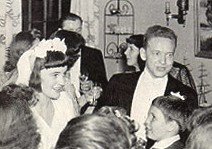
Betsy and Andrew’s wedding day (1940)

Andrew and Betsy dated all that summer and in the fall, when Betsy went off to the Colby Junior College in New Hampshire, they faithfully corresponded with each other.  They were in love and the following year they married and set up home in an old schoolhouse which lay on the Wyeth family land.  Although Betsy was not an artist, Andrew continually sought her judgement on his work.  Sales of Andrew Wyeth’s works of art grew steadily and Betsy managed the business side leaving her husband to concentrate solely on his art.  Betsy had a strong character and exerted almost as much influence on her husband as his father.  In the early days of her marriage, she believed that she had to battle with Andrew’s father to gain her husband’s  attention.  She once commented to Richard Meryman, Andrew Wyeth’s biographer, on her battle with her father-in-law:

“I was part of a conspiracy to dethrone the king — the usurper of the throne. And I did. I put Andrew on the throne…”

In 1943 the couple had their first child, a son Nicholas.  A second son, James followed three years later and would become a renowned artist in his own right.  Eighteen years after the couple married and settled in to life in the school house, they moved and bought an old 18th century gristmill on the banks of the Brandywine River in Pennsylvania.  Whilst her husband spent days on end painting, Betsy set about restoring the old mill, converting it into a home and a studio.

The featured painting today is Maga’s Daughter by Andrew Wyeth, which he completed in 1966.  It is a portrait of his beloved wife Betsy, whose mother was Elizabeth “Maga” James .  She posed in a three-quarter view.  She stands erect.  Her bearing is one of dignified pride as she averts her eyes away from the viewer.  Atop her head is an antique riding hat with its drawstrings dangling freely on either side of her face, almost if they were acting as a frame of a picture.  She wears a drab-coloured, high collared dress which almost blends in with the slightly lighter coloured background.  There is a faint flush of colour to her cheeks and a smile is forming on her lips.  What beautiful eyes she has, lit by the unseen light source to the left of the painting.

What was Andrew Wyeth thinking as he painted this portrait?  Actually we know,  for he told us:

 “…It’s my wife, Betsy. I had worked a long time on this and knew it wasn’t working. At the time I was on board of trustees of the Smithsonian Institution – quite prestigious. But Betsy didn’t like it, telling me that my work would suffer because of all these boards. I left for Washington one morning, and Betsy got furious, really flew into a rage. All the way down I kept thinking of that colour rising up high into her cheeks. I knew I had captured her. The colour of those cheeks under her coal black hair and that hat gives the portrait a real edge. Really caught her. It’s more than a picture of a lovely looking woman. It’s blood rushing up. Portraits live or not on such fine lines! What makes this, is that odd, flat Quaker hat and the wonderful teardrop ribbons and those flushed cheeks. She could be a Quaker girl who’s just come in from riding… ”

Andrew & Betsy Wyeth, October 15, 2008

On January 16, 2009, Andrew Wyeth died in his sleep at his home in Chadds Ford, Pennsylvania, after a brief illness. He was 91 years old.  Andrew and Betsy Wyeth had been married sixty nine years

Musée Marmottan Monet in Paris

Musée Marmottan Monet

For my blog today I am not showcasing an artist or a painting but a small museum , the Musée Marmottan Monet, which I visited last week when I was in Paris and I hope that for any of you who are intending to visit the French capital and want to take in some of its artistic heritage you will make time to visit this museum.  I can assure you that you will not be disappointed.  The museum is situated at 2 rue Louis Boilly in the vibrant and colourful 16th arondissement and is easy to get to as there are two nearby Metro stations, La Muette and Ranelagh.

I have often advocated that when one goes to London one should not always head for the major art galleries such as the National Gallery or the two Tate galleries as they are so big that one has no hope of seeing everything in one session and trying to often means that you skimp on the time each painting deserves.  A better plan of action if your time is limited is to go and visit one of the smaller galleries.  In London one has the Wallace Collection, the Courtauld Gallery and the Dulwich Picture Gallery, to mention just a few.  So to practice what I preach, when I was in Paris last week I didn’t revisit the Louvre or the Musée d’Orsay, instead I visited, for the first time, the Musée Marmottan Monet and it was unquestionably a most worthwhile visit.

The building was originally constructed as a hunting lodge for the Duke of Valmy and a few years later was sold to Jules Marmottan which on his death along with all his belongings was bequeathed to his son Paul.  Paul Marmottan later built a small pavilion in the courtyard as the original building was too small to house all of his paintings, furniture and bronzes.  Paul Marmottan bequeathed his home and collection to the Académie des Beaux-Arts, which opened up the house and collection as the Museum Marmottan in 1934.

If you like the work of the Impressionists and in particular the works of Claude Monet then look no further as this museum houses the largest collection of Monet’s work in the world and this is partly due to the fact that Monet’s youngest son Michel donated his father’s paintings from Giverny to the museum.  The building originally had two floors, the ground floor and an upper floor but to exhibit all the works they had to build a large underground room.  A number of bequests to the museum over the years have filled the building with beautiful and priceless art treasures.

The Duhem Collection was bequeathed to the museum by the daughter of the French painter, Henri Duhem.  These included works by Boudin, Caillebotte, Corot, Gaugin,  Monet and Renoir.  In 1980 an amazing group of illuminations spanning the 13th to 16th century was donated to the museum by Daniel Wildenstein.  The collection is exceptional for both the quantity and quality of the works.  There are over three hundred miniatures.  In 1996 the museum received an extraordinary donation from Annie Rouart.  Her husband was Denis Rouart, the grandson of Berthe Morisot and Eugène Manet.  Among the paintings given to the museum by Annie Rouart were masterpieces by Degas, Manet, Monet and Renoir and of course works by the famous female Impressionist Berthe Morisot.

Berthe Morisot Exhibition

For those of you who love the work of Berthe Morisot, and I include myself in that particular fan club, there is currently running a brilliant exhibition of her work.  It is housed in the basement.   It opened on March 8th and runs until July 1st 2012.  It presents the first major retrospective of the work of Berthe Morisot to be held in Paris for almost half a century.  One hundred and fifty paintings, pastels, watercolours and drawings in red chalk and charcoal, from museums and private collections all over the world, retrace the career of the Impressionist movement’s best-known woman painter. Works which have been selected for the exhibition cover the whole of Berthe Morisot’s artistic career, from her earliest works around 1860, to her untimely death at the age of 54, in 1895.  In my next few blogs I will feature a few  of the many paintings I saw when I walked around the museum.

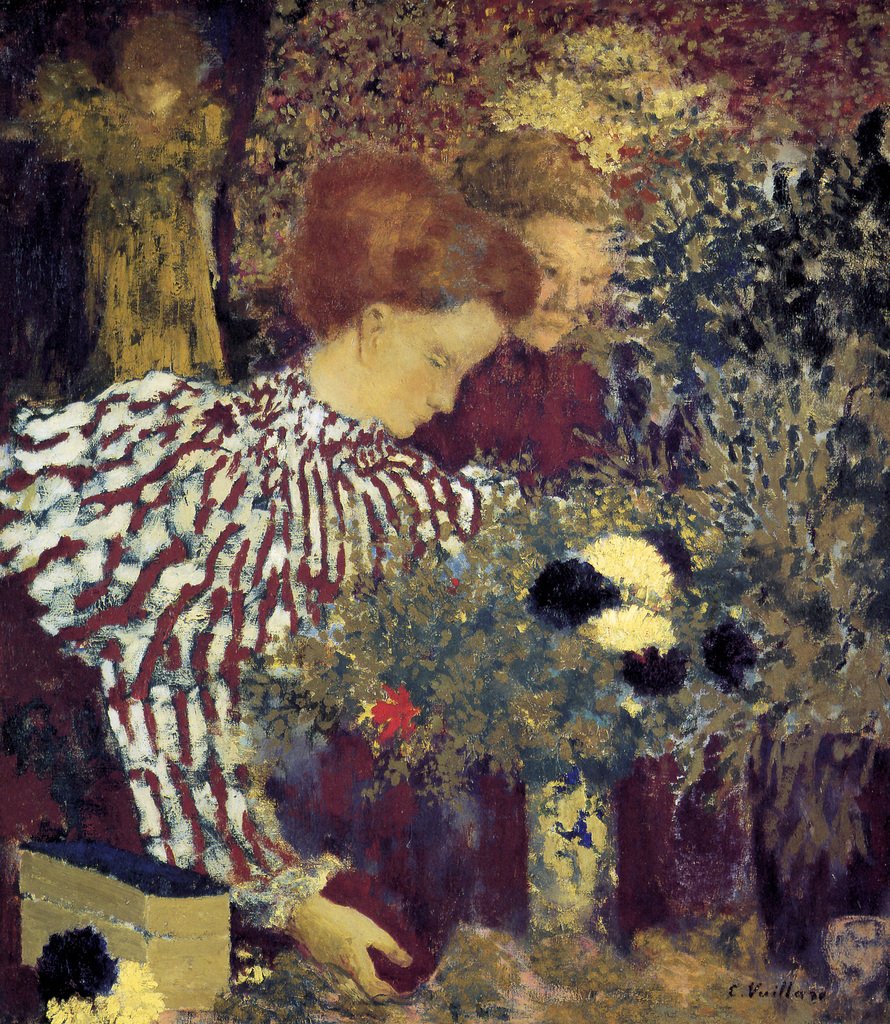
Le Corsage Rayé by Jean-Édouard Vuillard

Le Corsage Rayé by Édouard Vuillard (1895)

Today I am featuring a work by the French painter and printmaker, Jean-Édouard Vuillard.  Vuillard was born in 1868 in Cuiseaux, a commune in the region of Bourgogne in eastern France.  His father was a retired sea captain and his mother a seamstress.  When he was nine years old the family moved to Paris where his mother established a dressmaking workshop in their apartment.  In1883, when Édouard was fifteen years old his father died.  Following the death of his father Édouard received a scholarship so that he could continue with his secondary education at the Lycée Condorcet.  It was here that he met and became friends with another aspiring artist, Ker Xavier Roussel.  Vuillard left the school the following year and he and Roussel continued their artistic education at the studio of Diogène Maillart, which was formerly the studio of Eugene Delacroix.

In 1887, at the age of nineteen, Vuillard finally managed to be accepted at the Ecole des Beaux-Arts.  He had tried twice before but on each occasion failed to pass the entrance exam.  In 1889 he enrolled at the Académie Julian where he met Maurice Denis, Pierre Bonnard, Paul Ranson and Paul Sérusier.  It was Vuillard along with this group of young art students that formed the artistic grouping which came to be known as Les Nabis.  The French term nabi refers to a person inspired to speak the word of God and is clearly related to the Hebrew term for prophet (nebia) and the Arabic term  for prophet (nábi) .  The actual term was first used by the poet Henri Cazalis who drew a parallel between the way these painters aimed to revitalize painting (as prophets of modern art) and the way the ancient prophets had rejuvenated Israel.

In 1898 Vuillard set off on his European travels, visiting Venice and Florence and the following year made a trip to London.  In 1890 Vuillard put forward some of his paintings for the 1890 Salon.  He was both devastated and angered by the rejection of his works by the Salon jurists and vowed never to put forward any of his future works for Salon consideration.  Until the turn of the century Vuillard worked in theatrical circles, illustrating theatre programmes for the Théâtre Libre and even helped to set up the Théâtre de l’Oeuvre , with Aurélien Lugné-Poë which presented the work of the young French Symbolist playwrights and introducing major foreign dramas.  Vuillard continued to illustrate theatre programmes and design and paint theatrical settings.  In 1901 Vuillard had some of his works exhibited at the Salon des Indépendents and two years later put forward some paintings for the Salon d’Automne, an exhibition staged as a reaction to the conservative policies of the official Paris Salon.

Vuillard continued to live with his widowed mother and did so until her death in 1928.  A large number of his paintings had domestic themes or depictions of dressmaking scenes which would be set in the rooms of their house.  Often in these works Vuillard and his fellow Nabi painter, Pierre Bonnard, used domestic interior scenes as a setting for their paintings.  They were at pains to depict these domestic interiors with all their warmth, comfort and tranquil seclusion.  This type of subject matter became known as Intimism.  These paintings were marked by a gentle humor, and were finished in the subtle variety of soft, blurred colours.  The works would capture the light and atmosphere of the occasion but unlike Impressionism they would often embellish and distort the natural colour so as to communicate mood.  Many of his portraiture also retained the sense of Intimism with its calm domesticity.  Vuillard continued to receive numerous commissions from private patrons to paint portraits and decorative works as well as frescoes for public buildings. These commissions for public paintings included the decorations in the foyer of the Théâtre des Champs-Élysées and murals in the Palais de Chaillot and in the League of Nations in Geneva.  In his later years Vuillard concentrated on portraiture.

Jean-Édouard Vuillard died in La Baule, in the Loire-Atlantique department in western France, in 1940, aged 71.

My Daily Art Display’s featured oil on canvas painting is entitled Le Corsage Rayé,  which Vuillard completed in 1895 and can now be seen in the Collection of Mr and Mrs Paul Mellon at the National Gallery of Art in Washington.  The work was one of a set of five paintings, known as The Album,  based on household subjects, and commissioned by the Polish-born lawyer, journalist and art collector, Thadée Natanson, the publisher and co-founder of an artistic and literary journal called La Revue Blanche.  He was also a champion of Vuillard’s art and he and his wife were close friends of the artist.   The set of oil paintings were depictions of deep-coloured and richly textured interior scenes of varying formats, representing young bourgeois women engaged in simple domestic activities.  The set were to hang in the various rooms of Natanson’s Paris apartment.  In the case of this work it shows a woman arranging flowers.  The woman who modeled for this work is almost certainly Natanson’s wife, the concert pianist, Misia Godebska.

The woman dominates the painting with her puffed sleeved vintage dress in red and white stripes. No doubt the many years Vuillard watched his mother complete dresses in her studio aided him in the depiction of the woman’s clothing. The woman we see before us is arranging flowers in a vase. It is interesting to note that Vuillard has depicted the flowers not with an explosion of colour but has portrayed them with dull earthy colours.  This reason for this one presumes is so that they do not in any way detract from the clothing of the woman which Vuillard wants to be the focus of our attention.     Behind the woman we see another woman, dressed in what looks like a red uniform and is probably one of the woman’s servants.  Although this is a simple scene of domesticity the presence of the servant in some ways heightens the status of Misia.

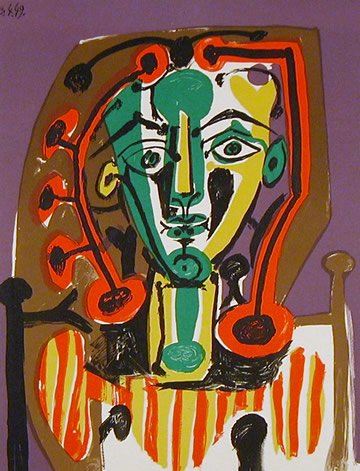
Le Corsage Rayé by Picasso

I end this entry by mentioning Picasso.  There are two reasons for this.  Firstly, Picasso made a drawing in 1949 entitled Le Corsage Rayé and his lithographer, Fernand Mourlot had the image recreated in a 300 copy edition.  I thought you would like to compare it with today’s featured work.   The second reason for mentioning Picasso as my next two entries will feature works by the artist and although I am not a fan of his later works I am fascinated by some of his earlier paintings and enthralled by the early part of his life.

The paintings were sold at auction by Thadée Natanson in 1908,  several years after he and his wife Misia were divorced.

My next blog will be about four days away as I am about to embark on my annual pilgrimage to Paris and soak up the atmosphere of the French capital and hopefully take in a gallery visit.  I am also hoping, depending on the weather, to visit La Maison Fournaise (see My Daily Art Display August 2nd 2011) and Giverny.

au revoir !

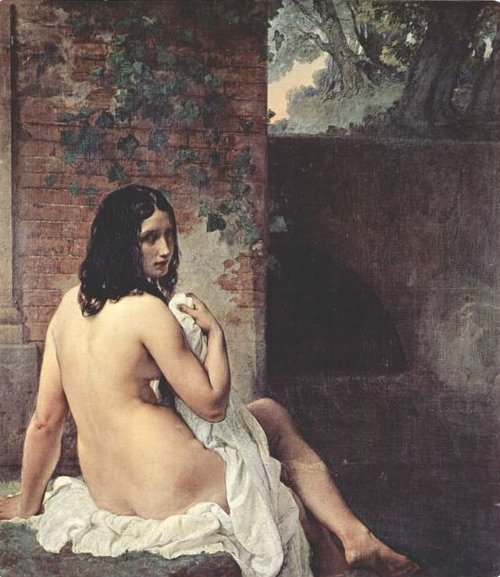
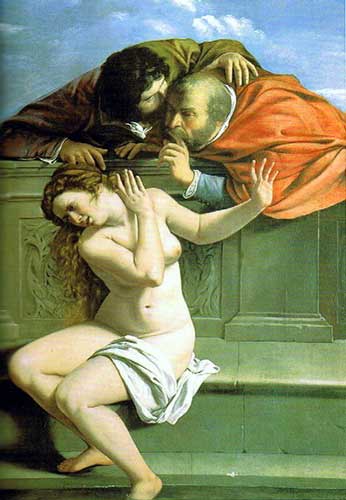
Susanna at her Bath by Francesco Hayez

Susanna at her Bath by Francesco Hayez (1850)

For an artist to have two favourite subjects for his paintings, biblical stories and female nudity, one would have thought combining the two would be somewhat difficult, if not risky.  However my featured artist today, the leading Romantic painter and portraitist of his time, Francesco Hayez, has, on a number of occasions, achieved that very thing.

Francesco Hayez was born in Venice in 1791.    He was the youngest of five sons.  His father was a French fisherman originally from Valenciennes and his mother, Chiara Torcella came from island of Murano, situated in the Venetian lagoon.  He was born into an impoverished household but fate took a hand in his life as Francesco was brought up in the household of his mother’s sister whose husband, Giovanni Binasco was a wealthy antiquarian and an avid art dealer and art collector.  It is more than likely that his uncle’s love for art transferred to his nephew, who in his childhood days developed a love of drawing.   Hayez’s uncle further developed Francesco’s love of art by gaining him a position as an apprentice in a studio of an art restorer.  His uncle then arranged for Francesco to study art under the tutelage of the Italian historical and allegorical painter, Francesco Maggiotto where he learnt about the Neo-Classical style of painting.  From the age of eleven to fifteen he studied the use of colour in classes run by the Bergamo painter, Lattanzio Querena, a skilful portraitist and copyist of 16th century Venetian paintings.

At the age of seventeen, Francesco Hayez was able to be enrolled at the Accademia di Belle Arti di Venezia where he studied under the historical and portrait painter, Teodoro Matteini.  It was whilst at the Academia that he won a painting competition, the prize being the chance to study for one year at one of the leading art establishments, Academia di San Luca in Rome.  Although his prize was for a one-year study period, Francesco Hayez, remained in the Italian capital for almost five years and spent much time studying the works of Raphael in the four Stanze di Raffaello (“Raphael’s rooms”) in the Vatican Palace.   He then moved on to Naples in order to fulfill a commission he had received from Joachim-Napoléon Murat, who at the time was the King of Naples, and brother-in-law to Napoleon Bonaparte.

Hayez moved to Milan in 1823 when he was thirty two years of age.   He was appointed Professor of Painting at the Accademia di Brera and soon became part of the academic and aristocratic life of the city.  It was around this time that he concentrated his art work on history paintings and portraiture and regularly exhibited his works at the annual Brera exhibitions.  In the mid 1830s he attended the famous Salon, which became known as the Salotto Maffei, as it was hosted by Clara Maffei, a leading Milan society hostess of the time.  Salon was the name given to gatherings of people under the roof of an inspiring host, held partly to amuse one another and partly to refine taste and increase their knowledge of the participants through conversation.  Clara’s salon was always well attended by well-known writers, artists, scholars, musical composers such as Verdi and people who were pro-Risorgimento (the political and social movement that wanted all the different states of the Italian peninsular united into one single state of Italy).  Hayez received many commissions from the men in the forefront of the fight for Italian independence and unification, one of these was his good friend Teodoro Arese, who in Hayez’s 1828 painting, Count Francesco Teodoro Arese in Prison, he depicted Arese in chains as a reminder of Arese’s imprisonment in 1821, as a result of his struggle against the government.

The paintings of Hayez were often dominated by biblical themes but Hayez had also developed an interest in the history of his country and began to incorporate contemporary political and social figures in historical backgrounds.  The sense of patriotism which he depicted in his portraiture was always well received by his patrons.   In 1850 he was appointed the director of the Academy of Brera and it is the Pinacoteca di Brera (“Brera Art Gallery”) which now houses one of the most famous of Hayez paintings, The Kiss (see My Daily Art Display Jan 6th 2011).

As I stated at the start of this blog, besides his love of historical and  biblical paintings, one of his other favourite themes was that of the semi-clothed, or the naked female. He often incorporated these within oriental themes or scenes from harems, such as his 1867 painting, Odalisque. By doing this he and other artists were able, in some way, to counter any possible negative comments by people offended by naked flesh.

Penitent Mary Magdalene by Francesco Hayez (1825)

What was more controversial was his 1825 portrayal of a naked repenting, Mary Magdalene, entitled Penitent Mary Magdalene, which surprisingly depicted such a well-known religious figure in a full-frontal nude pose.  Hayez’s reasoning behind such a depiction, which was not the normal portrayal of Mary Magdalene recanting her sins, was that it was to remind us of Mary Magdalene’s somewhat erotic and dubious past.

My featured Hayez painting today has also religious connotations but is unlike many similar depictions.  The work, which he completed in 1850, is entitled Susanna at her Bath and is housed in the National Gallery, London.  It has allowed the artist to combine his love of biblical stories and the portrayal of a well-endowed female nude.  The story of Susanna and the Elders comes from Chapter 13 of the Old Testament Book of Daniel

The story revolves around a Hebrew wife named Susanna who was falsely accused by two lecherous voyeurs.  Whilst bathing one day in her garden and having dispensed of the services of her attendants, two lustful elders secretly observe her.  On making her way back to her house, they accost her, threatening to claim that she was meeting a young man in the garden unless she agrees to have sex with them.  She is horrified at their suggestion and refuses to be blackmailed.  The two lechers carry out their threat and inform the authorities about her affair with an illicit lover.  She is arrested and about to be put to death by stoning for promiscuity when a young man named Daniel interrupts the proceedings, shouting that the two elders should be questioned to prevent the death of an innocent. The two men are questioned separately and their stories do not agree. The court then realises that the two elders have made false accusations against Susanna.   The false accusers are put to death and virtue triumphs.

The Susanna in Hayez’s painting is the same Susanna but unlike other depictions of the event we do not see the two elders and accordingly Hayez has not included the words “the Elders” in the title of his work.  Hayez has preferred to concentrate all his artistic ability in his depiction of the nubile and beautiful young woman.  Although the two men are not seen by us we notice the accusatory expression on Susanna’s face as she looks over her shoulder and catches a glimpse of her voyeurs.  It is a truly beautiful painting and Hayez’s portrayal of the voluptuous Susanna with her pale skin and pursed lips is remarkable.  Look into her eyes.  It is as if she is looking straight through us.  We ourselves feel accused of staring at her naked flesh.  We can just imagine her unwavering stare as she browbeats the two old lechers.  The background to the right is dark and contrasts with the pale white skin of her leg and this chiaroscuro effect adds to the painting.

Susanna and the Elders by Artemisia Gentileschi (1610)

This painting depicting the biblical scene portrays Susanna’s character as being quite hard, determined and dare I say slightly brazen.  If you want to see a slightly different depiction of Susanna, in which she is shown as being vulnerable, frightened and devastated by the overtures of the two lechers then you must look at the painting Susanna and the Elders by my favourite female artist, Artemisia Gentilesschi.  She completed the work in 1610 and rather than showing Susanna as a coy or flirtatious person as often depicted by male artists, including Hayez, Artemisia looks on the event from the female perspective and deftly portrays the vulnerability of Susanna, showing her as being both scared and repulsed by the demands of the two men who menacingly loom over her.  It is one of the few Susanna paintings showing the sexual assault by the two Elders as a traumatic event. Artemisia Gentileschi at the time of her painting was having a torrid time with her boyfriend who two years later would rape her and Artemisia had then to endure the trauma and mortification of the rape trial.