Famous Views of the Sixty odd Provinces by Utagawa Hiroshige. Part 1.

Memorial Portrait of Utagawa Hiroshige by Utagawa Kunisada (c.1858) This portrait of the artist Hiroshige shows him as he looked just before his death, with the robes and shaven head of a Buddhist priest. At the age of sixty, two years before his death of an undetermined long illness, he took monks vows.

Utagawa Hiroshige or Andō Hiroshige, born Andō Tokuta in 1797 was a Japanese ukiyo-e artist, considered the last great master of that tradition.

In March 2023 I began a three-blog series looking at his woodcut prints of Hiroshige entitled The Tokaido Road Trip. The Tōkaidō Road,  which literally means the Eastern Sea Road, and was once the main road of feudal Japan. It ran for about five hundred kilometres between the old imperial capital of Kyoto, the home of the Japanese  Emperor  and the country’s de facto capital since 1603, Edo, now known as Tokyo, where the Shogun lived.

Today I want to start a two-blog series looking at one of Hiroshige’s great print collection series entitled Famous Views of the Sixty-odd Provinces (Rokujuyoshu meisho zue) and whisk you away on a pictorial journey around Japan courtesy of the great Japanese master ukiyo-e print artist, Utagawa Hiroshige.   Ukiyo-e is a genre of Japanese art that flourished from the 17th through 19th centuries. Its artists produced woodblock prints and paintings of such subjects as female beauties; kabuki actors and sumo wrestlers; scenes from history and folk tales; travel scenes and landscapes; flora and fauna; and erotica.

Yamashiro Province, The Togetsu Bridge in Arashiyama by Hiroshige. Print from Hiroshige’s Famous Views of the Sixty-odd Provinces series.

Togetsu Bridge

The first print I am offering depicts the Togetsu Bridge which straddles the Katsura River.  The 150-metre-long structure has been a landmark in Western Kyoto’s Arashiyama District for over four hundred years. It is known for its natural beauty. Changing colour throughout the year with blushing pink in the spring and ablaze in reds, oranges, and yellows each autumn. The bridge has often been used in historical films.  It is also the site of an important initiation for local children. Young boys and girls (the latter clad in kimono) first receive a blessing from a local temple and then make their way across the bridge under orders to do so without looking back. If one ignores this instruction, it is said to bring bad luck as a result, so the stakes are high.

Kawachi Province: Mount Otoko in Hirakata  by Hiroshige. Print from Hiroshige’s Famous Views of the Sixty-odd Provinces series.

The series represents a further development of Hiroshige’s landscape print design, including some of his most modern compositions. The striking new use of a vertical format allowed Hiroshige to experiment with the foreground and background contrasts typical of his work, drawing the viewer in while at the same time implying a sense of great distance.  In the depiction we see the Yodo River curving below, the rugged peak of Mount Otoko breaks through the clouds. Mount Otoko was home to the Iwashimizu Hachimangu Shrine, one of Japan’s most important Shinto sites and a popular pilgrimage destination. The use of bokashi (color gradation) infuses the scene with a rich atmosphere. Bokashi is the Japanese term which describes a technique used in Japanese woodblock printmaking. It achieves a variation in lightness and darkness (value) of a single colour or multiple colours by hand applying a gradation of ink to a moistened wooden printing block, rather than inking the block uniformly. This hand-application had to be repeated for each sheet of paper that was printed.  The best-known examples of bokashi are often seen in 19th-century ukiyo-e works of Hokusai and Hiroshige, in which the fading of Prussian blue dyes in skies and water create an illusion of depth.   In later works by Hiroshige, an example of which is the series One Hundred Famous Views of Edo, most prints originally featured bokashi such as red-to-yellow-to-blue colour sunrises.

Izumi Province, Takashi Beach by Hiroshige. Print from Hiroshige’s Famous Views of the Sixty-odd Provinces series.

Takashi Shrine

The high vantage point of this design allows for a sweeping panorama and an expansive view of the beautiful coastline.  In the foreground of this print, nestled amongst the pine trees on the side of a lush green hill, is the Tagashi Shrine, which  is nestled among the pine trees and pilgrims follow the track to the holy place.  Looking further down the pine-covered slope we can see Osaka Bay which reaches out to the horizon in the background whilst waves can be seen crashing onto Takashi Beach.  Hiroshige used the technique known as kimetsubushi to enhance the colours.  Kimetsubushi  was a technique used to enhance the expressive application of colours in woodblock printing and involved the intentional use of woodgrain (visible in traditional printing blocks, which were cut parallel to the grain of the tree). Called kimetsubushi (“uniform grain printing”), the process involved working the surface of the wood with stiff brushes or rubbing with pads to roughen the surface and thereby impress the paper with the grain pattern in areas of relatively uniform or “flat” colour.

Owari Province, Tsushima, Tenno Festival by Hiroshige. Print from Hiroshige’s Famous Views of the Sixty-odd Provinces series.

Festival Owari Tsushima Tenno

Festival Owari Tsushima Tenno

The setting of this print is the Tenno River and we see from above, as night begins to fall over the mountains and hills, the river is illuminated by the hundreds of lanterns decorating the boats which are part of the Tenno Festival.  The festival, which has existed for more than five hundred years, is held on the fourteenth and fifteenth days of the sixth month on the lunar calendar and the highlight of the celebration is the sailing of the illuminated boats. It is one of the three major river festivals in Japan and nationally renowned. To cater for the crowds visiting the festival, temporary teahouses have sprung up on the riverbank.

Sagami Province, Enoshima, The Entrance to the Caves by Hiroshige Print from Hiroshige’s Famous Views of the Sixty-odd Provinces series.

On the left edge of the print we can just see the side of Mount Fuji.  In the foreground waves can be seen crashing against the rugged cliffs of Enoshima, a small offshore island, about 4 km in circumference, Below the lush green of the cliffs above, the cave entrance in the lower right temps the viewer into the darkness of the cave. Hewn by the waves over time, this cave system housed a shrine to Benzaiten, a goddess associated with fortune and artistic success.  The caves attracted many pilgrims, and the entire island was considered a sacred site. In addition to the usual travellers, this small island attracted many celebrities and ambitious individuals.

Pilgrimage to the Cave Shrine of Benzaiten by Hiroshige (c. 1850)

Three year before Hiroshige embarked on his Famous Views of the Sixty-odd Provinces series he completed another woodcut print of Cave Shrine of Benzaiten at Enoshima.

Hida Province, Basket Ferry by Hiroshige Print from Hiroshige’s Famous Views of the Sixty-odd Provinces series.

Detai; of Hida Province Basket Ferry

The Basket Ferry (detail) by Hiroshige

The Hida Province, Basket Ferry is illustrated in one of Hiroshige’s woodcut prints.  Travellers are ferried above a swift flowing river using an ingenious rope and basket system which is fixed between two sheer cliffs.  In the depiction we see the jagged cliffs rise up all around as the sun sets behind the mountain range beyond. It is a beautifully coloured print which once again is detailed with fine bokashi shading.  It is not thought that Hiroshige ever tried this “ferry” but it is more likely that he found these details in the designs of others, perhaps an illustration by his teacher Utagawa Toyohiro in his 1809 novel The Legend of the Floating Peony.

Shinano Province, The Moon Reflected in the Sarashina Paddy-fields, Mount Kyodai by Hiroshige. Print from Hiroshige’s Famous Views of the Sixty-odd Provinces series

As clouds encircle the base of Mount Kyodai reflections of the full moon seem to leap through the paddy-fields, each watery surface reflecting its likeness in this atmospheric composition. The Just above the fields, Choraku Temple sits in the shadow of “Granny Rock.”  This place is also significant in that it was the location of the signing of the Treaty of Shimoda in 1855, which officially established diplomatic relations between Bakumatsu Japan, the final years of the Edo period when the Tokugawa shogunate ended, and the Russian Empire.

………to be continued.


Apart from various Wikipedia sites the information for this blog came from:

ISSUU – Hiroshige: Famous Places in the 60-odd Provinces -Ronin Gallery

Fuji Arts

Viewing Japanese Prints

Utagawa Kuniyoshi and Nichiren. Part 1.

In March 2023 I took you on a Japanese journey The Tokaido Road Trip and today I want you to join me on another such voyage of discovery through a series of ten Japanese woodblock prints in ink and color on paper made by Japanese artist Utagawa Kuniyoshi, one of the last the great Masters of ukiyo-e.  Kuniyoshi was born on 1 January 1st 1798, the son of a silk-dyer, Yanagiya Kichiyemon. It is thought that he helped in his father’s business as a pattern designer, and those days helped to influence him some with regards to his rich colour usage and textile patterns in his prints

Self-portrait of Utagawa Kuniyoshi from the shunga album Chinpen shinkeibai, (1839)

The ukiyo-e movement came to prominence in Japan between the 17th and 19th century. It was a form of art and one of the first times in Japanese history when art ended the adherence of social class and developed into an art form that appealed to the lowborn, who had money, as well as the rich aristocrats.

The Ghost of Asakura Togo, Woodblock Print by Utagawa Kuniyoshi

The subjects most found in these woodblock prints were travel, beautiful prostitutes, and kabuki actors, the 19th century Japanese equivalent of movie stars. Many of his popular prints were often not really something that the aristocracy would want to display in their residences, but such depictions as in his print, The Ghost of Asakura Togo, were just the thing that appealed to everyday Japanese urbanites who were searching for some excitement in their lives.

The portrait of Nichiren Daishonin was painted in the 14th-15th Century, and is kept at Nichiren Shu’s Head Temple, Kuon-ji.

This is the story of Nichiren Dashonin, a Japanese Buddhist priest and philosopher who lived in the thirteenth century and it was his controversial teachings which form the basis of Nichiren Buddhism, a branch of Mahayana Buddhism. Nichiren was born on February 16th 1222 and died on October 13th 1282. Nichiren, also known as Koso, was a Buddhist priest who had various miracles attributed to him and who founded the Nichiren sect of Buddhism, of which Utagawa Kuniyoshi was an adherent.

It was his controversial declaration that only the Lotus Sutra, which is regarded as one of the world’s great religious scriptures and most influential texts contained the highest truth of Buddhist teachings suited for the Third Age of Buddhism. He maintained that the sovereign of Japan and its people should support only this form of Buddhism and eradicate all others. Nichiren on three occasions remonstrated with the government, underlining his wish to guide people with ‘the Lotus Sutra’. However, on each occasion his pleas were rejected.

For twenty years between 1233 and 1253 Nichiren engaged in an intensive study of all of the ten schools of Buddhism which were prevalent in Japan at that time as well as the Chinese classics and secular literature. During these years, he became convinced of the pre-eminence of the Lotus Sutra and in 1253 returned to the temple where he first studied to present his findings. Here Nichiren introduced his teachings supporting a complete return to the Lotus Sutra as based on its original Tendai interpretations arguing that the people and their leaders who followed this form of Buddhism would experience peace and prosperity whereas rulers who supported inferior religious teachings invited disorder and disaster into their realms. However, his teachings angered Kamakura Shogunate and he experienced severe persecution and was exiled.

In 1831, Utagawa Kuniyoshi received a commission to produce a set of prints in remembrance of the 550-year anniversary of the death of Nichiren. The set was known as the Sketches of the Life of the Great Priest or Concise Illustrated Biography of Monk Nichiren.

Tōjō Komatsubara, Eleventh day of Eleventh month, 1264 by Utagawa Kuniyoshi

Tōjō Kagenobu, a steward of Tōjō Village in the Nagasa District of Awa Province in Japan was a passionate believer in Nembutsu, a fundamental devotional practice in the Pure Land school of Buddhism, which Nichiren had criticised ten years earlier. Tōjō Kagenobu was so infuriated by Nichiren’s severe criticism of the Pure Land (Jōdo) school that he attempted to have Nichiren seized. For this reason, he had harboured hatred for Nichiren and watched vigilantly for an opportunity to kill him. On November 11th, 1264, while Nichiren was travelling to Komatsubara, the home of his disciple, Kudo Yoshitaka. It was following his return to Awa, the year after he was pardoned from his exile to Itō on the Izu Peninsula. Tojo Kagenobu saw his chance to eliminate Nichiren. He and hundreds of his warriors, including horsemen and swordsmen, ambushed Nichiren at Komatsubara in the Awa Province in November 1264. In the depiction we see Nichiren holding up his mala (rosary), with its sparkling crystals which confused his attackers. Nikkyo, his student and disciple, is seen in the background, crouching. During the bitter fighting, two of his followers were killed and although Nichiren received a sword cut upon his forehead and a broken left hand, he managed to escape. The incident became known by the Nichiren Budhists as the “Komatsubara Persecution“. Tojo Kagenobu, who had led the attack is said to have gone mad and died within three days of this incident.

Nichiren Prays for Rain at the Promontory of Ryozangasaki in Kamakura in 1271

Japan experienced a major drought in the summer of 1271. The government asked Ninshō, a Japanese Shingon Risshu priest and the founder of the Gokuraku-ji, a Budhist temple in Kamakura, to conduct rain rituals. Nichiren, then only a lowly monk, disparaged Ninshō’s supporters, venturing that even he would follow Ninshō if he made it rain in a week. Nichiren was proved right as it did not rain, and he took advantage of the challenge to take on new followers for himself. In the woodblock print we see Nichiren as he prays for rain and is immediately rewarded with a downpour. This event takes place in Kamakura in 1271. The print itself is viewed as the second-greatest design in this famous series. Before us we have a dramatic depiction – the drama in the the heavy downpour, the drama in the waves and drama in Nichiren’s acolytes as they look on, astounded by the miracle they have witnessed. The umbrella at the top of the scene extends into the upper margin and is often trimmed.

Nichiren Saved from Execution at Takinoguchi in Sagami Province 

Nichiren’s incessant attacks on the other Buddhist schools led to Hōjō Tokimune, the de facto ruler of Japan, exiling Nichiren to Sado Island under the supervision of Hōjō Nobutoki, the constable of Sado in 1261. However, this threatened exile did not stop Nichiren continuing his attacks on the other factions of Buddhism. The original plan was that Nichiren was to be escorted to Echi, to the residence of Homma Shigetsura, Hōjō Nobutoki’s deputy; from there he was to be taken directly to Sado Island. But Hei no Saemon, a government official and affirmed enemy of Nichiren decided to have him executed as he was being escorted to Homma’s residence. An attempt was made to behead Nichiren at Tatsunokuchi, but it was unsuccessful. Legend has it that as the executioner’s sword was about to come down on Nichiren’s neck, it broke in half. Various other supernatural happenings were alleged to have occurred to prevent and thwart his death. In this third print of the series Nichiren is seen in prayer, kneeling beside a pine tree which is growing close to the ocean. His executioner stands behind him. It depicts him about to be executed when the rays from the sun destroy the executioner’s sword, averting his death. Nichiren’s exile was later carried out as it had been originally planned.

The Star of Wisdom Descends on the Thirteenth Night of the Ninth Month

The fourth print of the portfolio is entitled The Star of Wisdom Descends on the Thirteenth Night of the Ninth Month and depicts Nichiren holding his rosary, standing before an old plum tree, in which appears a shining apparition of the Buddha. Behind him are two officials and a group of armed men. The scene is illuminated by the full moon which bathes the entire vista. Raymond A Bidwell the collector of oriental art and porcelain, wrote an article in 1930 for Artibus Asiae, a semi-annual publication of original scholarly articles, entitled Kuniyoshi III in which he likened Kuniyoshi’s depiction with that of Christian art:

“…the same spirituality and relationship of man to God as was expressed by the Italian primitives in their pictures of God appearing to the saints… Nichiren and the rough soldiers who have him in custody see in adoration and consternation a vision of The Buddha standing in the branches of a leafless plum tree on a clear moonlight night. The intense beauty of the evening sky and moon against the lace like branches of the aged and gnarled plum tree, make you feel that God must manifest himself directly…”

Bidwell’s conclusion was that Kuniyoshi transcended the Italian painters in his successful approach. Raymond A. Bidwell would later go on to donate the largest collection of Kuniyoshi prints in the U.S. to the Springfield Museum of Fine Arts.

…….to be continued.


Most of the information for this site came from various Wikipedia pages.

The Tokaido Road Trip. Part 3.

The end is in sight

The Tokaido Road

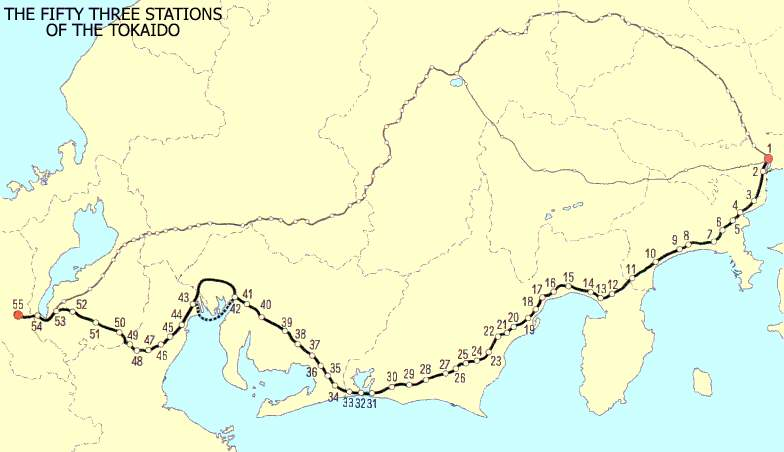
Hiroshige’s journey is over two-thirds complete. In the last blog he and his party had arrived at Arai and now the Tokaido Road travellers head in a westerly direction, following the coast as it approaches Shiomizaka,

No.37. Akasaka: Inn with Serving Maids by Hiroshige

Along with the preceding post stations of Yoshida and Goyu, the one at Akasaka was well known for its meshimori onna. Meshimori onna, which literally translates to “meal-serving woman,” is the Japanese term for the women who were hired by the hatago inns on the Tokaido Road post stations. At first their role was that of simply maidservants on the payroll of the inns, but as the traffic along became busier and the kaidō (road) grew,  competition between the inns increased, and the ladies were often engaged in prostitution.  However, in 1718 the Tokugawa shogunate laid down a law which stated that the number of meshimori onna working at each inn would be limited to two and this was seen as tacit permission to employ a limited number of prostitutes.  Hiroshige’s print depicts a typical inn and it is divided in half by a sago palm in the centre of the work. To the left we see travellers partaking of an evening meal.  On the right, we see prostitutes  putting on make-up and preparing for the evening entertainment.

No.38. Fujikawa: Scene at Post Outskirts by Hiroshige

At its peak, Fujikawa was once a large stop over town with 302 buildings. Its total population was approximately 1,200 people. In this ukiyo-e print by Hiroshige the artist has depicted a daimyō procession on their trek along the Tokaido Road entering the post station.  We see three commoners kneeling as the lord’s retinue passes by.  A line of old pine trees extend for approximately a kilometre mark the location of the Tōkaidō Road.

No.39. Okazaki: Yahagi Bridge by Hiroshige

Okazaki was a part of the thriving castle town which encircled Okazaki Castle, the headquarters for Okazaki Domain. The thirty-ninth print of the series depicts the Yahagibashi bridge.  This magnificent structure was one of the few bridges that people were permitted to use on the Tokaido Road by the Tokugawa shogunate.  It was one of the longest bridges built in Japan during the early Edo period. On the opposite bank of the river we can see Okazaki Castle.

No.40. Chiryū: Early Summer Horse Fair

Chiryū was the thirty-ninth of fifty-three stations of the Tōkaidō and counting the print featuring the Edo starting point at Nihonbashi, the fortieth of the woodblock series.  Reaching this point meant the travellers had trekked for three hundred and thirty kilometres and would have probably taken, on average, two weeks.  The town was famed for its horse market which took place in late April and early May.  Tall pine trees can be seen and the shogun, Tokugawa Ieyasu, ordered that the post station plant pine trees along through route of the highway before and after the town.  These all survived until the Isewan Typhoon of 1959 which destroyed most of them.

No.41. Narumi: Famous Arimatsu Tie-dyed Fabric

 The woodblock print depicts travellers passing by open-fronted shops selling tie-died cloth. Clothing such as the yukata kimono, the unlined kimono for summer use, which was a local speciality of the region.

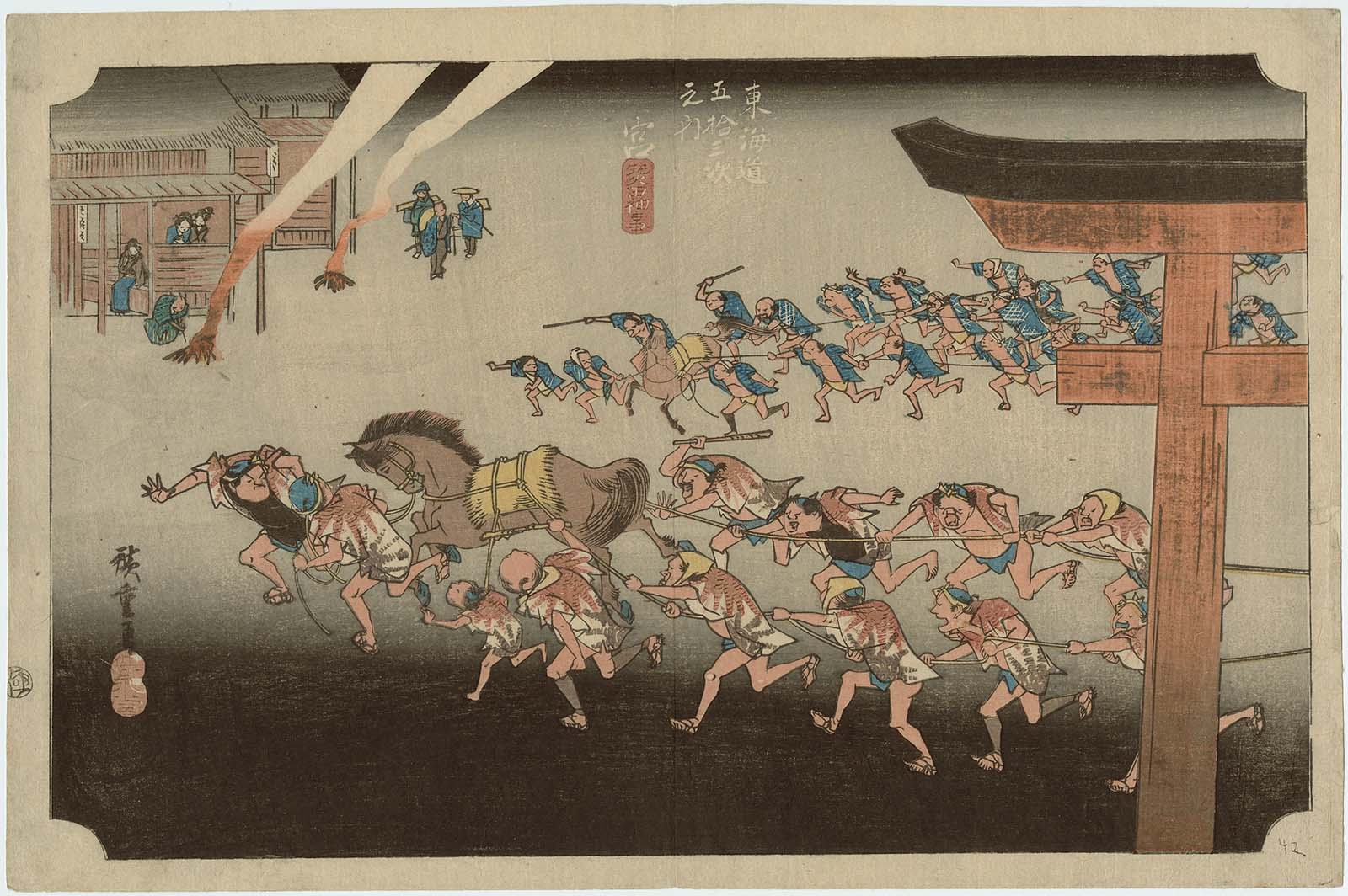
No.42. Miya: Festival of the Atsuta Shrine

The Tokaido Road post station at Miya also acts as a post station on the The Nakasendō, the Central Mountain Route, also known as the Kisokaidō, which was one of the five routes of the Edo period, that connected Edo and Kyoto.  Hiroshige’s print depicts two gangs of men dragging a portable shrine cart which is just out of the picture, past a huge torii gate. The torii gate is the symbol of a Shinto shrine, and the name of the town, “Miya” also means a “Shinto shrine. The shrine in question is the famous Atsuta Shrine, one of the most famous in Japan and a popular pilgrimage destination in the Edo period.

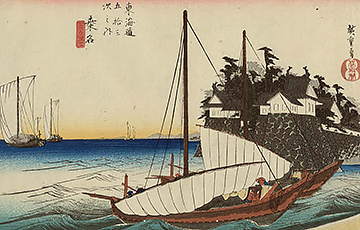
No.43. Kuwana: Shichiri Crossing

The Kuwana post station was found in the castle town of Kuwana Domain, which was a major security installation on the Tōkaidō Road for the Tokugawa shogunate. The actual post station could be found located on the western shores of the Ibi River. Hiroshige’s print of Kuwana depicts two large ships of the Shichiri no watashi ferries about to set sail with travellers from in front of Kuwana Castle, whilst in the background we can see other ships sailing away on their voyages.

No. 44. Yokkaichi: Mie River by Hiroshige

Hiroshige’s ukiyo-e print of Yokkaichi  illustrates a stormy day and we see a man running after his hat which has been blown from his head.  Another man crosses a small bridge over the Sanju River  The roofs of the small group of huts which form the post station can be seen in the middle of a marsh are almost hidden by the reeds.

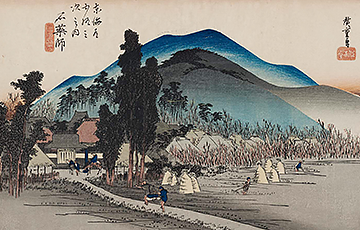
No. 45. Ishiyakushi: Ishiyakushi Temple by Hiroshige

The Ishiyakushi post station derived that name from the nearby Buddhist temple which is said to have been founded in 726 AD by the shugendō monk Taichō. According to the temple legend, Kūkai carved an image of Yakushi Nyorai on a huge boulder that was found in the forest, and Taichō later built a temple around this image. A settlement gradually developed around the temple.  Utagawa Hiroshige’s ukiyo-e print of Ishiyakushi depicts the temple in the midst of a grove of trees on the left and a village on the right.  Rising in the background are the Suzuka Mountains.  In the foreground we can see bales of rice which means that this is an Autumn depiction and tells us that this post station is at the heart of the countryside.

No.46. Shōno: Driving Rain

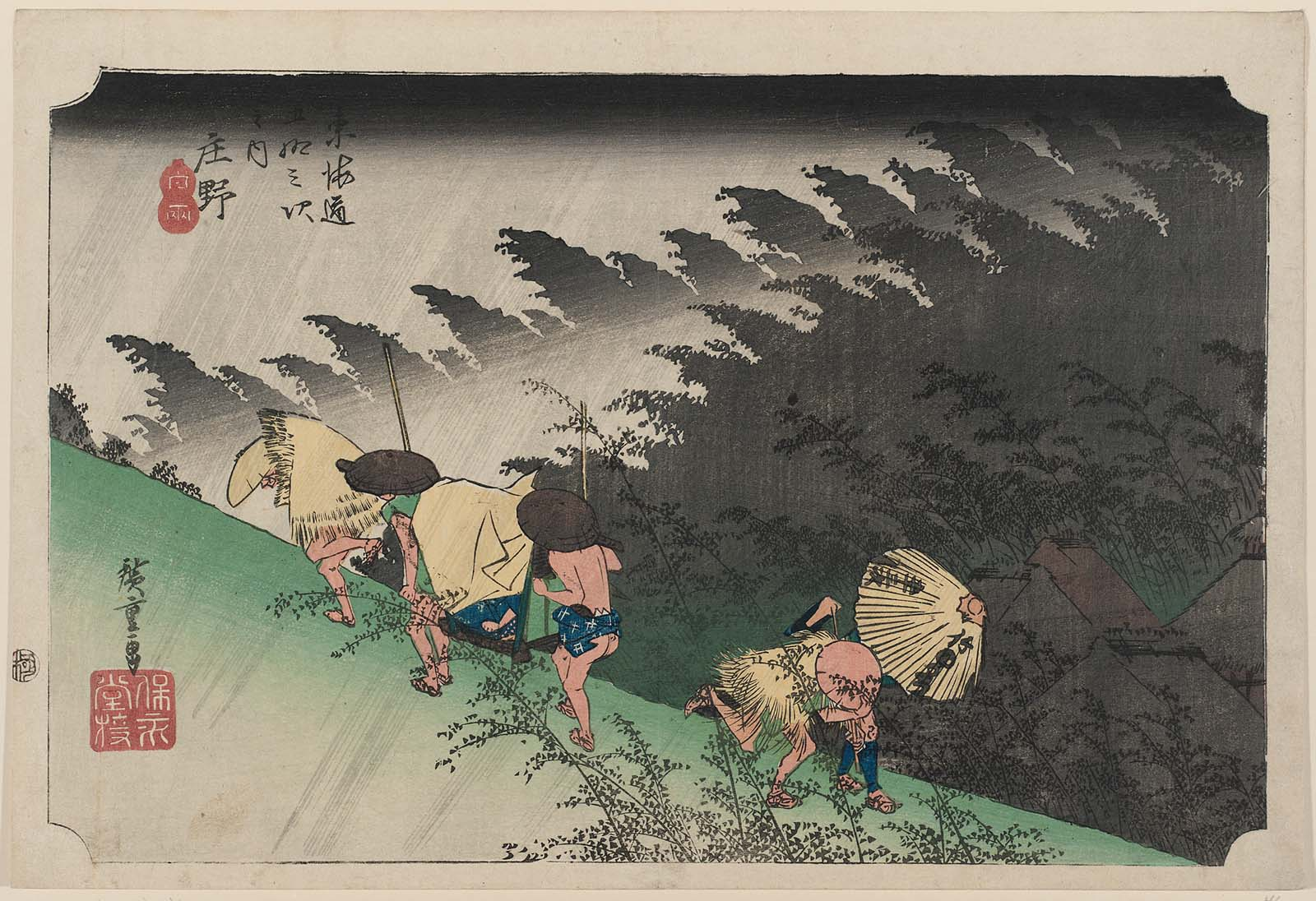
The weary travellers are suddenly caught out by torrential downpour as they arrive at the town of Shōno in Ise Province. On the right we see two men heading down hill, one holding an umbrellas and the other wearing a hat and cloak. There are two inscriptions on the umbrella. One is Takenouchi who was the publisher of the series of prints and the other is Gojūsan-tsugi, which was part of the Japanese name of the Tokaido Road woodblock series Tōkaidō Gojūsan-tsugi no uchi. To the left of these men we see another man wearing a hat and a cloak walking uphill followed by two litter-bearers. The falling of heavy rain is depicted like a grey curtain.

No.47. Kameyama: Clear Weather after Snow

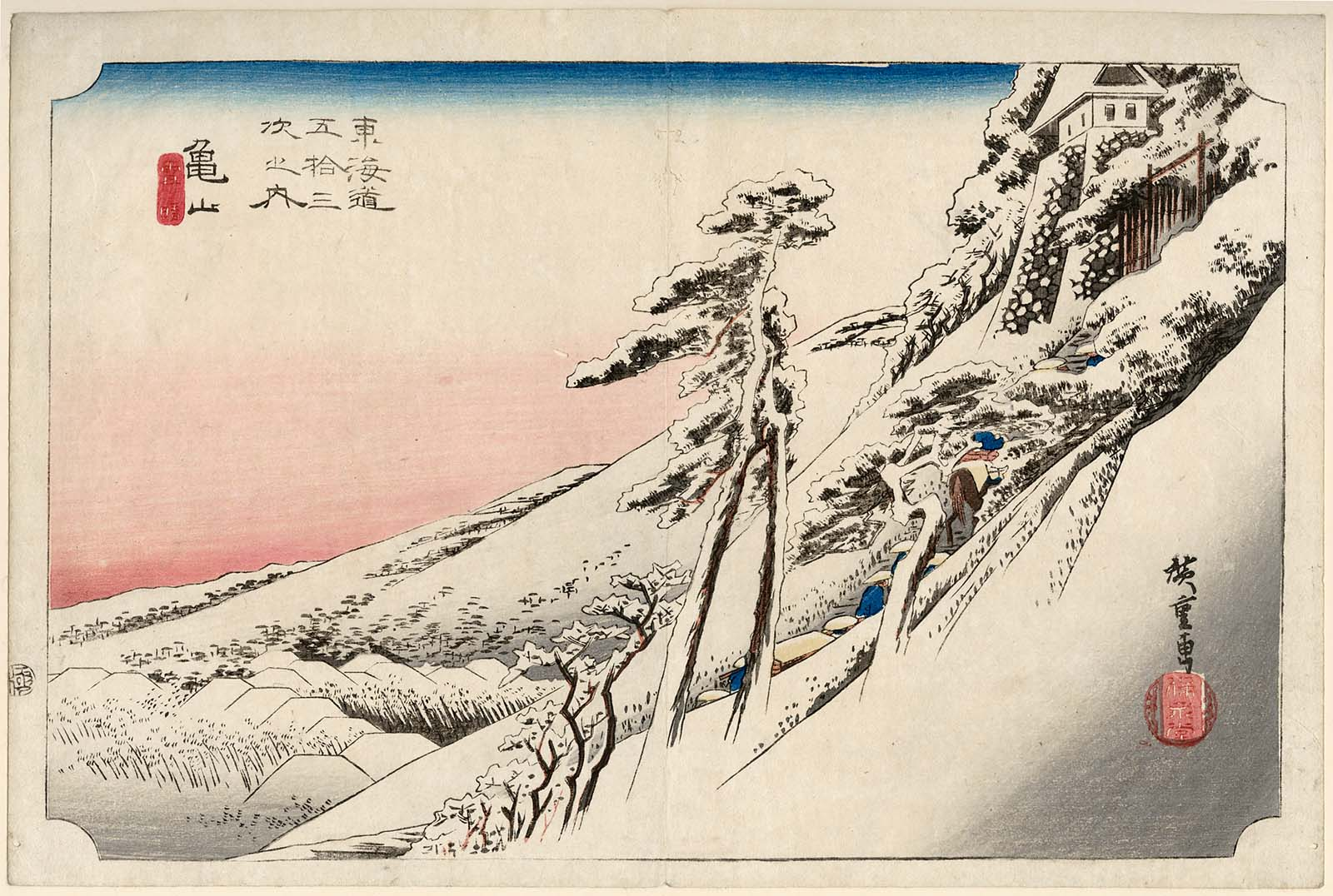
The procession of travellers continue on an upward trajectory. The steep path takes them past the castle of Ishikmawa daimyo and we can just see the town of Kameyama in the valley to the left. The castle was home to the Ishikawa clan,  daimyō of Ise-Kameyama Domain.  The setting is early sunrise and the sky is reddened by the early morning sun. Kameyama was a well fortified city from the middle of the sixteenth century at the time of the building of the castle. In 1854, twenty years after Hiroshige’s woodblock print series was published, the castle was destroyed by the great Ansei earthquake. However in 1855 Hiroshige produced a vertical woodblock series of the Tokaido Road journey and in that series, despite the destruction of the castle, it is depicted in an unblemished state !

No.48. Seki: Early Departure of a Daimyō

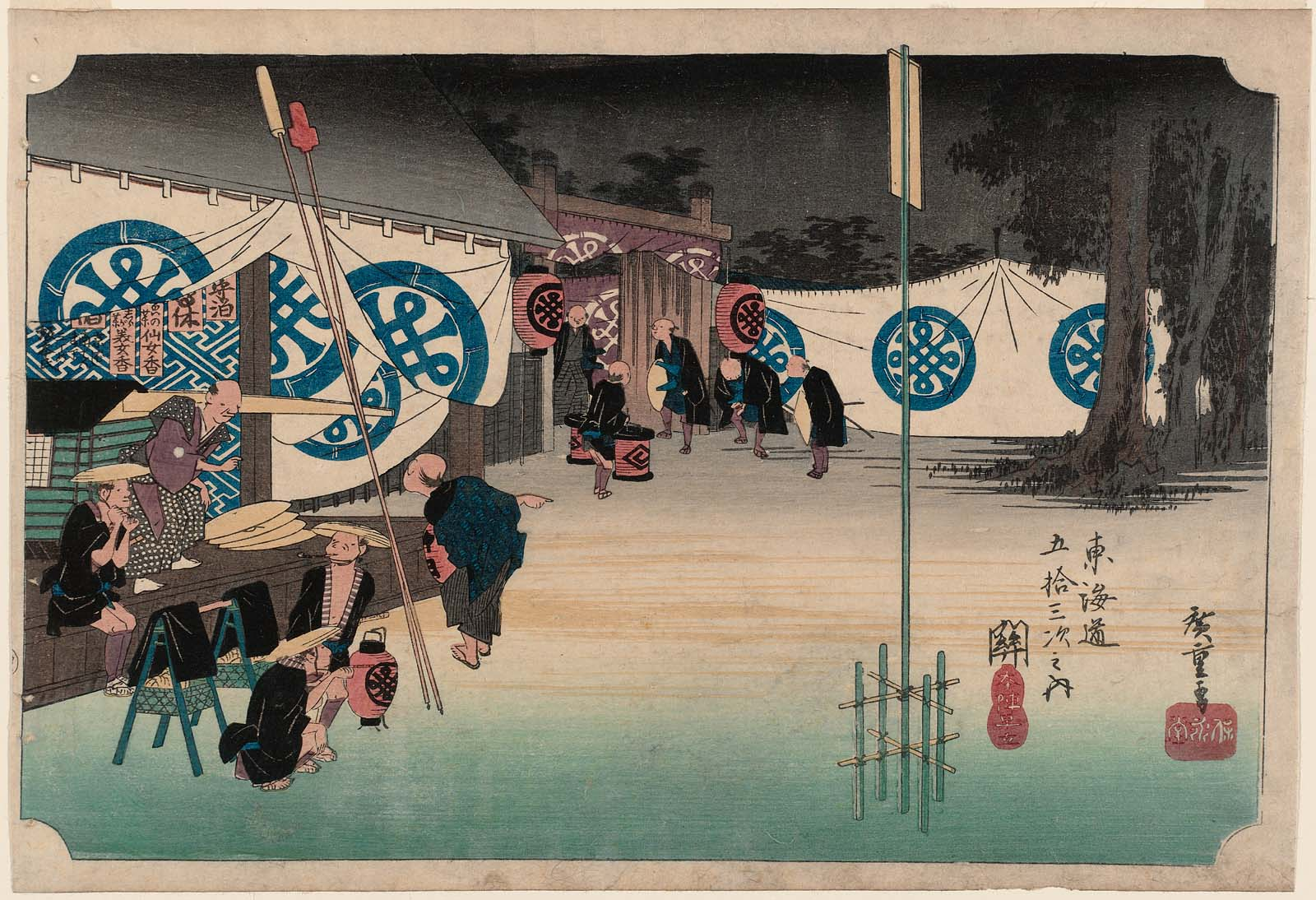
The next depiction in the Tokaido series is that of the inn at Seki where the travellers had rested for the night. It is early the next morning and still somewhat dark. The people prepare to set off on the day’s travels. The innkeeper dressed in his traditional kamishimo, a formal kimono for men, stands on the verandah issuing instructions to one of his servants. To the left of the table we see a palanquin (litter) on the ground with the palanquin bearers standing by. The banners we see hanging around the courtyard of the inn probably bear the emblem of the daimyō who has spent the night at the inn. You can see some small brown signs hanging above the head of the innkeeper – they are advertising the availability at the inn of the famous Senjoko and Biojoko brands of white face-powder.

Snow landscape with a gate: Seki by Hiroshige (1855)

The town of Seki also appeared in the 1855 version of Hiroshige woodblock series of the Tokaido Road, the so-called Reisho Tokaido. In this depiction it is late afternoon on a snowy day and we see a few travellers passing the gate to the pilgrim’s route to Iso.

No.49. Sakanoshita: Fudesute Mountain by Hiroshige (c.1833)

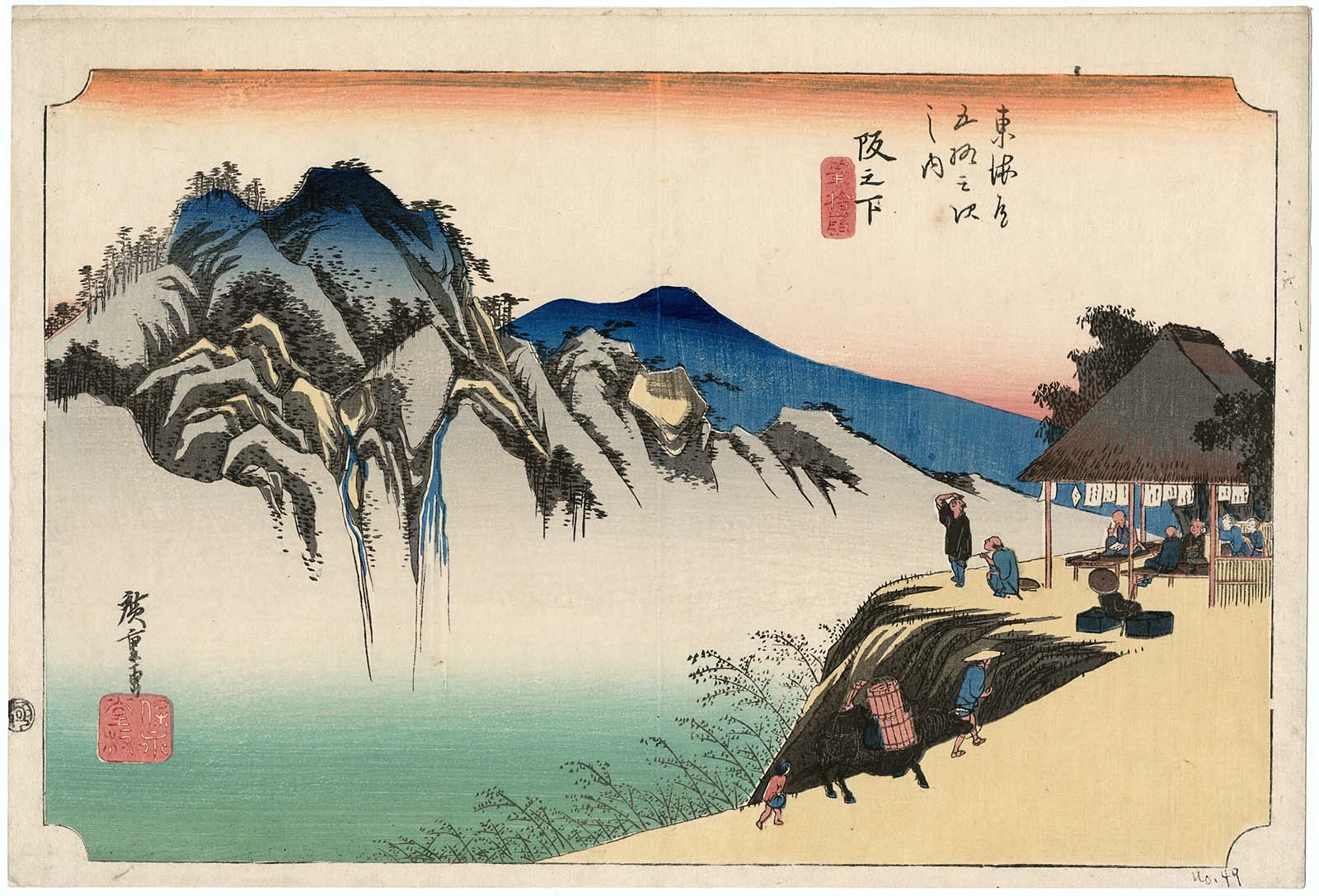
Having left Seki, the travellers move deeper inland and have reached the summit of the Fudesute Mountain. The mountain derives its unusual name from an incident in which the celebrated artist Kano Motonobu threw away (sute) his brushes (fude) when he could not capture the beauty of the mountain in a painting.  

Another version by Hiroshige of Fudesute Mountain at Sakanoshita.

No.50. Spring Rain at Tsuchiyama by Hiroshige (c.1833)

The fiftieth print in the series depicts a daimyō procession.  They are enduring torrential rain as they traverse the crossing surrounded by a raging torrent which rushes below a wooden bridge. The post station, with its darkly coloured buildings, partly hidden by trees, are seen to the left of the picture.

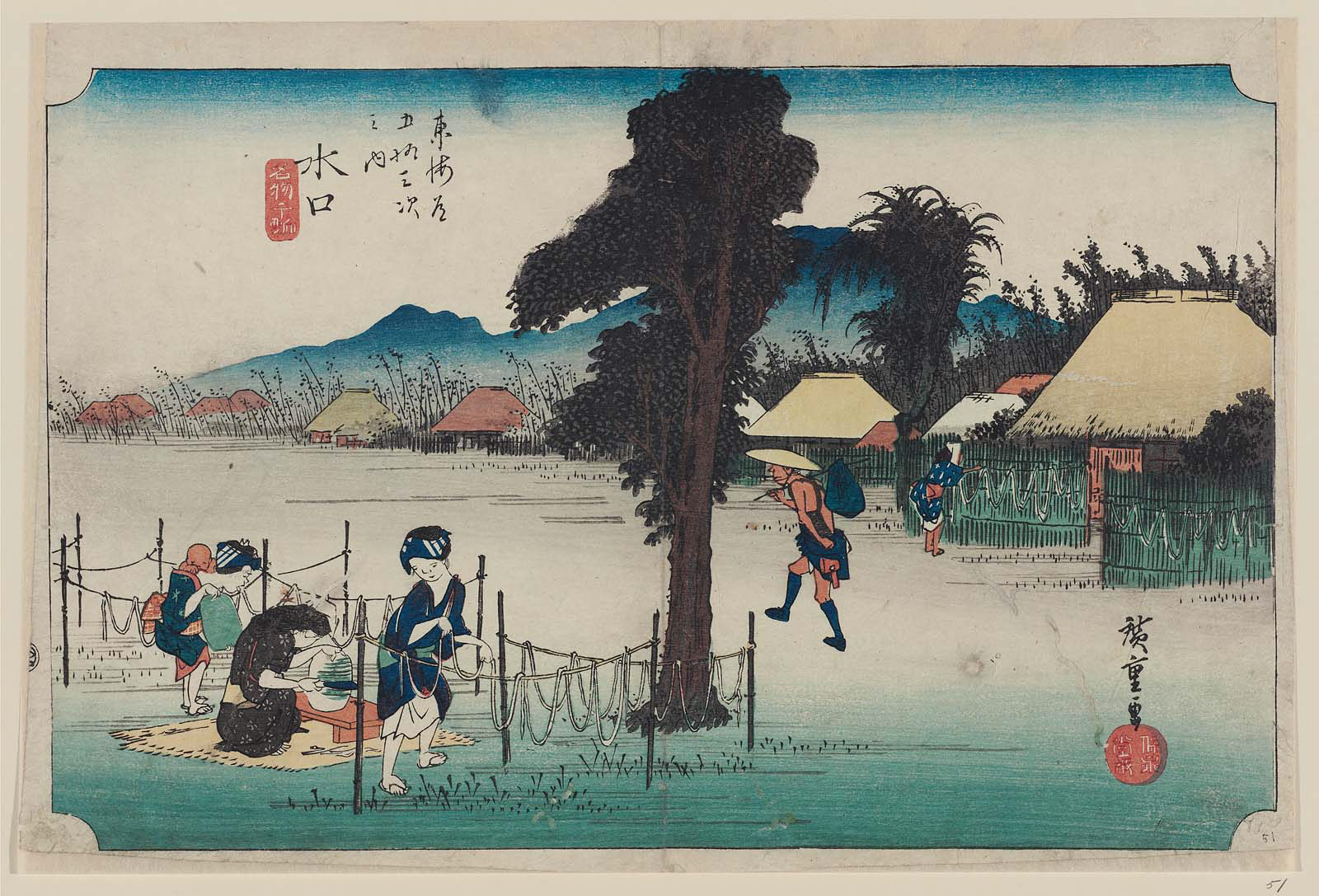
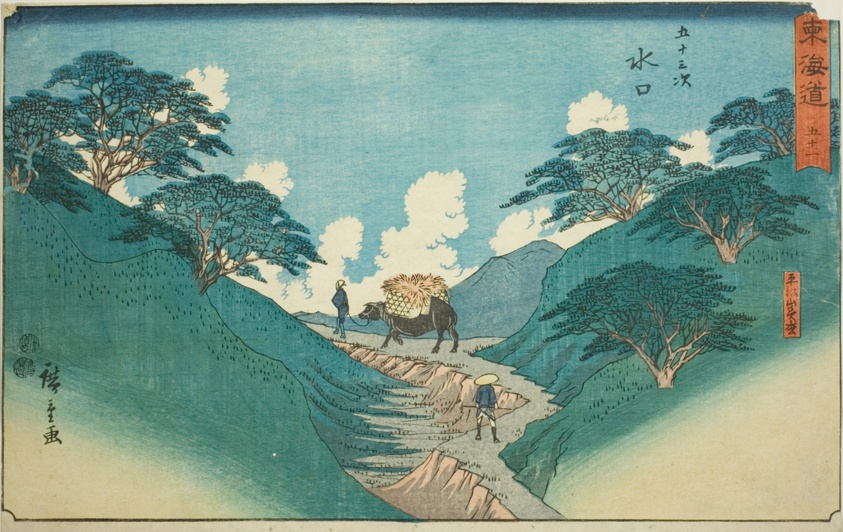
Below are two prints made by Hiroshige of the remote Minakuchi layby station. One was part of the 1833 series and the other from the later series which was published around 1852 and known as the Reisho Tokaido or the Marusei Tokaido..

No.51. Minakuchi: Famous Dried Gourd by Hiroshige (c.1833)

In the 1833 print we see a lone traveller walking through the village of Minakuchi. In the foreground we observe women peeling and drying gourds In the background there is a range of hills. This resting station is located in a desolate rural area and was famous for its production of dried gourd shavings which were often used for Japanese dishes. These women we see are busy producing them. One is shaving a gourd, one, with a baby slung on her back, is helping the shaver, whilst another one is drying the shaved gourd on a rope.

The beautiful pines at Hiramatsuyama by Hiroshige (1851-2)

In this 1852 edition of the Reisho Tokaido we see a peasant leading an ox laden with produce making their way slowly along the winding uphill path. Another man follows. The setting of this print is the steep road leading to the next stop-over point at Ishibe and just to the left of the Tokaido Road. This hill between the villages of Harimura and Kojibukuro, although it only reaches an elevation of two hundred and twenty-eight metres, is known as Mount Hiramatsu. The striking thing about the depiction are the pine trees on either side of the road. Normally pine trees along the side of the road have been planted but these are said to have grown there on their own accord. Note in the background the white clouds depicted by Hiroshige. These cumulus clouds were a Western element, one which only rarely appeared in Hiroshige’s prints.

No. 52. Ishibe: Megawa Village by Hiroshige

Utagawa Hiroshige’s ukiyo-e Hōeidō edition print of Ishibe does not actually show the post station at all, but instead we see a tea house known as Ise-ya, which was located at Megawa no Sato, on the road between Kusatsu and Ishiba.  This shop was well-known for its tokoroten, a sticky sweet made from agar, and kuromitsu, a black sugar syrup. We see depicted in the print a group of travellers who seem to be dancing and cavorting in front of the shop.  They are observed by three women who are wearing travelling hats and walking sticks.  A couple of other travellers, some distance further down the road, are seen to be heavily laden, and struggling with their trek.

No.53. Kusatsu: Famous Post House by Hiroshige (1833)

The post station on the Tokaido Road at Kusatu was also a post station for the The Nakasendō (Central Mountain Route), also known as the Kisokaidō, both being one of the five routes of the Edo period.  Looking at the print we observe a busy scene within the post station itself in front of the open-fronted Yōrō-tei, a tea house in which many patrons are probably partaking in their famous Ubagamochi, a sweetened sticky rice cake which was a speciality of Kusatsu.   In front of the tea house, on the road itself, we see a passenger in an open kago (palanquin) holding desperately on to a rope as the porters rush him to his destination  Moving in the opposite direction we see a larger green, covered kago, and this is probably transporting a high status passenger.

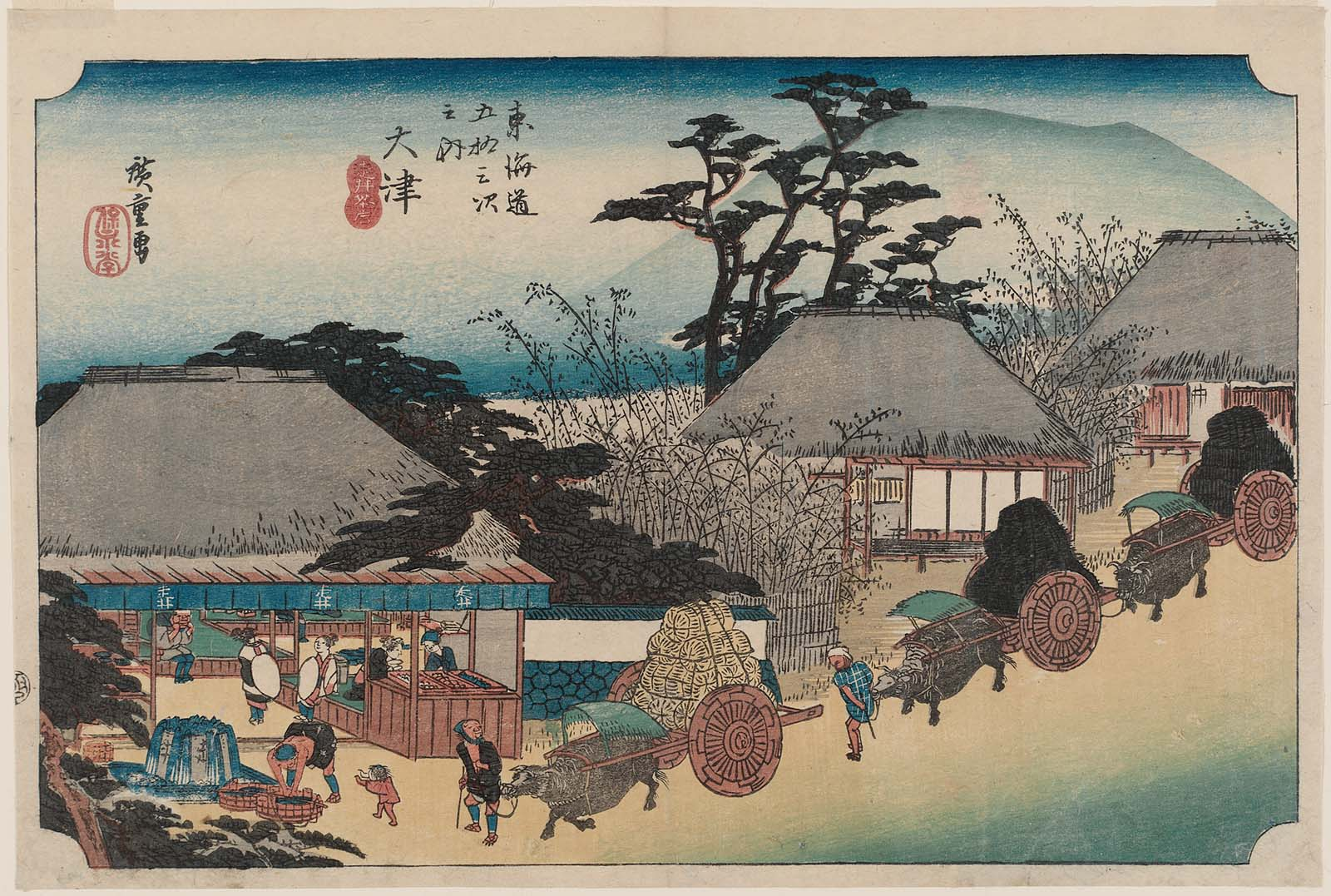
No. 54. Ōtsu: Hashirii Teahouse by Hiroshige

The Ōtsu post station was the last of the fifty-three stations of the Tōkaidō as well as the last of the sixty-nine stations of the Nakasendō. In Hiroshige’s 1833 depiction we see oxcarts, heavily laden with bushels of rice or charcoal descending the street. The oxcarts pass in front of the open front of the Hashirii teahouse, which was a popular resting point on the highway, and was well known for its delicacy known as Hashirii Mochi, a sweet rice cake, which is still a local specialty of Ōtsu.  In front of the teahouse is a well from which fresh water gushes out.

No. 55. Kyōto: The Great Bridge at Sanjō by Hiroshige

Finally the weary travellers arrive at the Great Sanjō Bridge over the Kamo River in Kyoto, the imperial capital and the terminal of the Tōkaidō. The bridge is well known because it served as the final location for journeying on both the Nakasendō and the Tōkaidō, two of the famous “Five Routes” for long distance travelers during the Edo period in Japan’s past. In the background we can see houses, temples, and villas at the foot of Higashiyama. Mount Hiei, which is an important Buddhist centre, is silhouetted in distance.

That is the end of our 500 kilometres journey. Most of the pictures came from the website: The Fifty-three Stations of the Tōkaidō Road

(https://hiroshige.org.uk/Tokaido_Series/Tokaido_Great.htm)

The information about the journey came from the usual internet sources and a great book I found in a second-hand bookshop entitled Hiroshige, a Royal Academy of Arts, Publication, produced at the time of their 1997 exhibition of Hiroshige’s work.

Toyohara Kunichika

The Great Wave off Kanagawa by Hokusai (1829-1832)

When I think about Japanese printmakers I think about the three eighteenth century masters of that genre.  There was Hokusai with his well known print The Great Wave off Kanagawa.

Rain Showers at Shōno.by Hiroshige

Then there was Hiroshige with his many prints, including one of my favourites, Rain Shower at Shōno.

Fukaku Shinobu Koi by Kitagawa Utamaro (c.1794)

The third of the great eighteenth century printmakers which I call to mind is Kitagawa Utamaro who was one of the most highly regarded designers of ukiyo-e woodblock prints and paintings, and is best known for his bijin ōkubie “large-headed pictures of beautiful women” of the 1790s. One of Utamaro’s most famous works being Fukaku Shinobu Koi which set an auction record of €745,000 in 2016. The woman depicted in the title of the print, Fukaku Shinobu Koi means deeply hidden love and the woman has blackened her teeth, a tradition known as ohaguro, the Japanese custom which normally signifies a married woman, but maybe she is not, as her eyebrows are unshaved which would also signify as her being married.  It could be that she is still young and only recently married.  In her hair she has an ornate kanzashi hairpin with a flower design on it.   This type of hairband was often associated with maiko (trainee geisha).  The young woman looks down and holds a kiseru tobacco pipe in her right hand.  Look at her countenance.   She stares off, her shoulders raised, eyes narrowed, and tiny lips pursed, as if in a deep, emotional mid-sigh.

The other day I had the opportunity to see a small exhibition of Japanese prints by Kunichika at the Lady Lever Gallery on Merseyside, He was the most celebrated print designer of the nineteenth century and so I am dedicating this blog to some of his prints as well as looking at the mystical and colourful world of life in Edo and the magic of Kabuki.  For the unitiated in Japanese life and culture let me start by talking about Edo, Ukiyo-e and Kabuki.

Bijin and a child among flowering sedges under a misty full moon in Ueno Park by Kunichika (1880)

Kyoto, which had been the historic capital of Japan, was replaced by Edo, a castle town centred around the Edo Castle.  Edo became the de facto capital of Japan from 1603 and the seat of the Tokugawa shogunate, the military government of Japan. The period ruled by the Tokugawa shogunate from 1603 to 1868 became known as the Edo period.  This Tokugawa military government brought in social segregation by underlining a hierarchal class system which positioned the warriors at the top, followed by farmers, craftsmen, and then merchants at the bottom. The rulers also organised and built walled areas in the cities where theatres, teahouses, and brothels were licensed and which came to be known as the “pleasure districts.”  For the Japanese people the Edo period was a relatively peaceful time domestically and the regime’s isolationist policy in relationship to the rest of the world, maintained peace in the country. From this was born an art form that reflected this Japanese lifestyle and which found a new audience amongst a rising Japanese middle class and this art known as Ukiyo-e, was born as an evolution of yamato-e, a previous style of painting. Ukiyo-e depended upon collaboration between four people. The artist, using ink on paper, drew the image that was then carved by a craftsman into a woodblock. A printer then applied pigment to the woodblock, and a publisher oversaw and coordinated the process and marketed the works.

Kunichika in 1897, aged 52.

The artist I am featuring today is Kunichika Toyaharo, who was born Yasohachi Oshima on June 30th, 1835 in the Kyobashi district of Edo, which nowadays days is known as Tokyo.

 His father, Ōshima Kyujū was the proprietor of a public bathhouse. His father was a poor businessman, and he lost the bathhouse sometime in Yasohachi’s childhood. The boy’s mother, Arakawa Oyae, was the daughter of a teahouse proprietor. At that time, commoners of a certain social standing could ask permission to alter the family name and so to distance themselves from the father’s failure, the family took the mother’s surname, and the boy became Arakawa Yasohachi.

Around the age of twelve, Kunichika became a student of the ukiyo-e master Chikanobu.      A year later he entered the studio of Utagawa Kunisada the most popular, prolific and commercially successful designer of ukiyo-e woodblock prints in 19th-century.  It was at this point in time that Yasohachi Oshima received his artist name – Kunichika. The name derives from the names of his two masters – Kunisada and Chikanobu.

Kunichika was reputed to be a rather bohemian artist. He married in 1861 and had one child with his wife – a daughter named Hana. Although there is no definitive account of their marriage, it is known that they broke up but it is not known who left whom.  What is known is that he was a philanderer and led a nomadic life very rarely staying in one place for any period of time.  It is said that he once actually bragged that he had moved one hundred and seven times during his life.  His heavy drinking habits and time spent in brothels is well documented by his contemporary artists, Kyosai Kawanabe and Kiyochika Kobayashi and reading between the lines Kunichika was probably an alcoholic with  loose morals who could not control his spending habits.

According to Kanichika’s biographer, Amy Reigle Newland in her 1999 book, Time present and time past: Images of a forgotten master: Toyohara Kunichika, 1835–1900, Kunichika got into trouble in 1862 when he made a “parody print” in response to a commission for a print illustrating a fight at a theatre. This angered the students who had been involved in the fracas. They ransacked Kunichika’s house and tried to enter Kunisada’s studio by force. His mentor revoked Kunichika’s right to use the name he had been given but relented later that year. Decades afterwards Kunichika described himself as greatly “humbled” by the experience.

Kunisada Memorial by Kunichika (1864)

To get an idea of Kunichika’s status in the studio of Kunisada when his mentor died in 1864, of all his apprentices, Kunichika was tasked with producing memorial prints of his late master, one of which was a diptych.

A Scene from Bancho Sarayashiki (The Dish Manor at Bancho) by Kunichika (1863)

Kunichika embraced modern subjects and his prints reflected the great social and political change which was taking place at the time in Japan. He will be best remembered for his depictions of the Kabuki theatre, and his prints encapsulated the drama and excitement of scenes from popular plays and famous actors.  Kabuki, which literally means the art of song and dance, is a world-renowned form of traditional Japanese performance art. It incorporates music, dance, and mime with elaborate costumes and theatre sets.  Kabuki dramas depict stories which came from regional myths and history.  Kabuki is a bizarre visual display which focuses more on looks than the story itself. The elements which go into the production, such as costumes, lighting, props, and set design compliment aspects of the actual performance such as song and dance. All are presented in grandiose fashion to create a single, spectacular show.

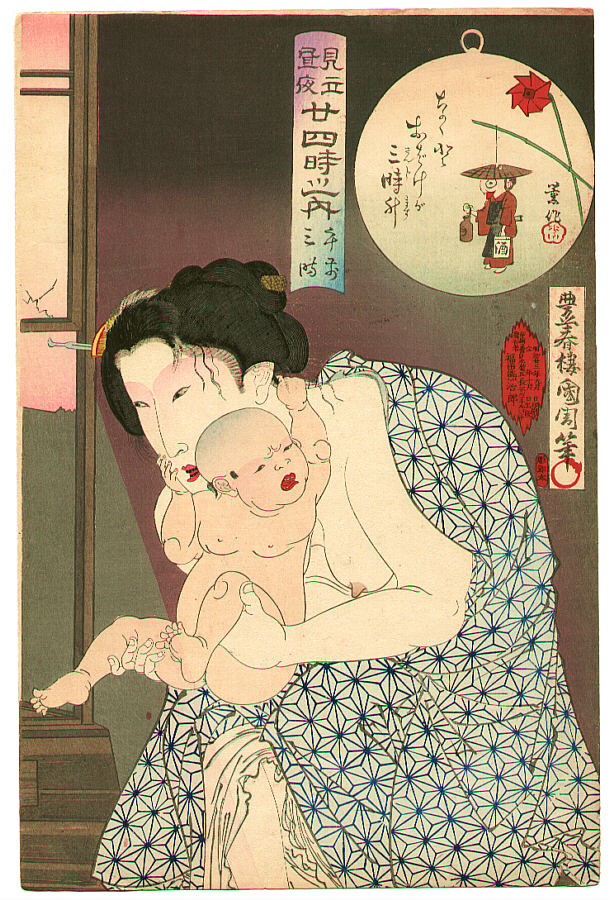
Mitate Chuya Niju-Yo Ji no Uchi” (Allusion to the Twenty-four Hours of the Day) by Kunichika Mitate Chuya Niju-Yo Ji no Uchi” (Allusion to the Twenty-four Hours of the Day). – Babysitting at 3 a.m.

Kunichika produced a set of twenty-four prints featuring each hour of the day.  This series is regarded as Kunichika’s finest, completed bijin series.  Bijin is a Japanese term which literally means “a beautiful person” and is synonymous with bijyo meaning “beautiful woman”.  The prints are a fascinating collection of beauties in different aspects of lives and full of intriguing word-puns and allusions. Th one above is set at 3 o’clock in the morning and we see a mother trying to get her baby to sleep.

Niwaka Festival at 9 p.m. – Scenes of the Twenty-four Hours by Kunichika
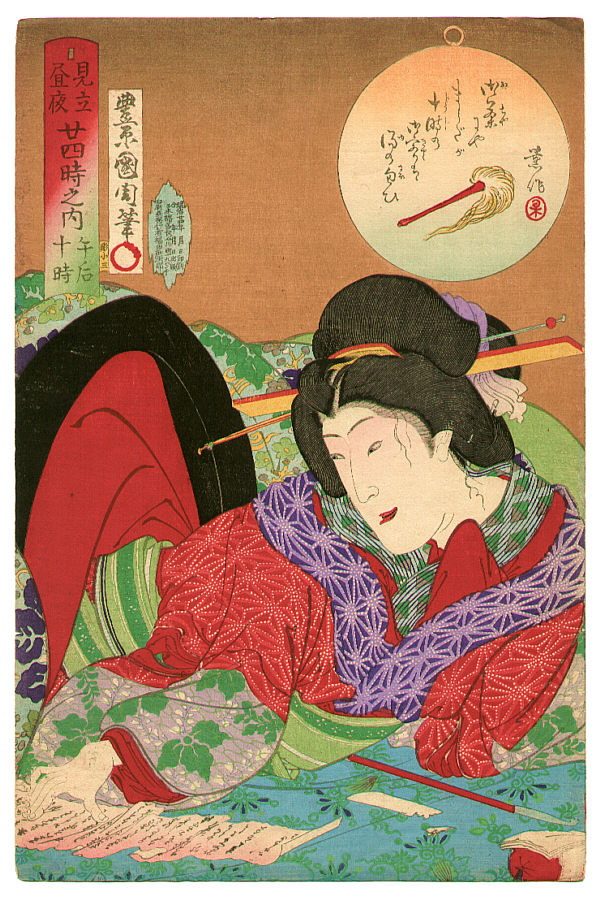
Courtesan at 10 p.m. – Scenes of the Twenty-four Hours by Kunichika

The prints are a fascinating collection of beauties in different aspects of lives. At 10 o’clock in the evening we see a courtesan waiting for her client.

Scenes of Famous Places Along the Tokaido Road Station 77: Tenryugawa, 1863 by Kunichika

Another interesting set of prints was completed in 1863 and us known as The Tokaido Road Processional series. The print above is one of a series of about one hundred and sixty woodblock prints the authorities commissioned seventeen of the leading ukiyo-e artists of the time  The series is a collaborative effort of the various print designers of the Utagawa School in one quite unique effort.   What is probably fascinating about the series is despite the differing ages and styles of the artists who contributed to this project, from twenty-four-year-old Tsukioka Yoshitosh to the Master himself, Kumisada, who was seventy-seven, there is a homogeneity about them and it is very difficult to distinguish between them.  Kunichika completed seven of this series

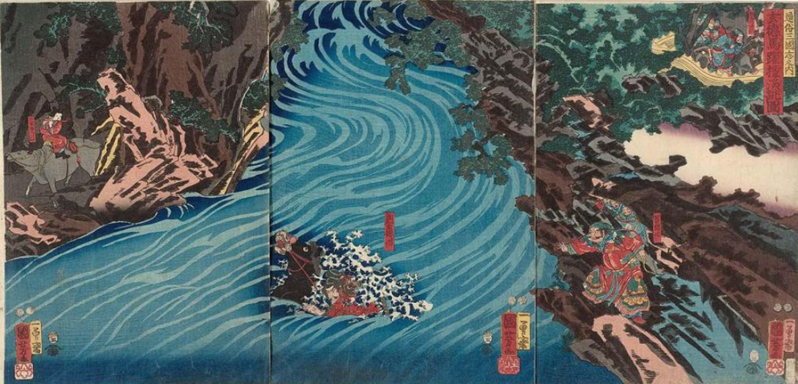
Utagawa Kuniyoshi triptych Xuande Leaping into the Gorge of Tan (1853)

Whilst Kunichika was still attending Kunisada’s Kameido studio he was also being influenced by Kunisada’s colleague and rival Kuniyoshi, in the way he has added the swirling motifs of the water taken directly from the Kuniyoshi triptych Xuande Leaping into the Gorge of Tan. In Kunichika’s 1863 print, Scenes of Famous Places Along the Tokaido Road Station 77: Tenryugawa, he depicts figures in a boat in the foreground set against the swirling waves of the seashore.

The background to the depictions is the journey made by Shogun Tokugawa lemchi, Japan’s military leader, who had travelled along the Tokaido Road from the military capital, Edo, (Tokyo) to the Emperor in the imperial capital, Kyoto, for a crisis meeting concerning foreign incursions into their country.  The road was an important and busy road used by samurai, officials and merchants during that time. Along the road, there were outposts, inns, temples and shrines at the service of weary travellers. The prints depict the Shogun’s entourage at various beauty spots on the Tokaido Road.

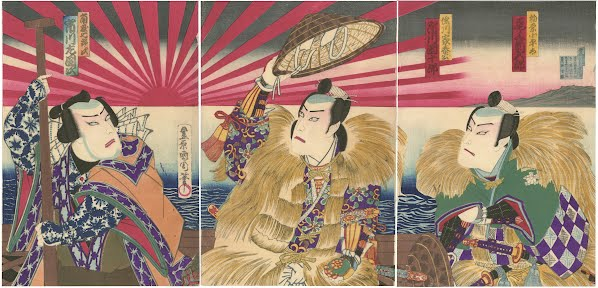
Onoe Kikugorō V, Ichikawa Danjūrō IX and Ichikawa Sadanji I
(in the play Matsu no sakae Chiyoda no shintoku)
by Toyohara Kunichika, 1878

Kunichika was a lover of Kabuki theatre and fascinated by the actors.  Many of his prints feature the leading actors of the time and snippets of the plays themselves. This woodblock triptych print from 1878 features the three greatest actors of the time, Onoe Kikugorō V playing the role of Kashiwabara Koheita, Ichikawa Danjūrō IX in the role of Tokugawa Ieyasu  and Ichikawa Sadanji I in the role of Kakuya Shichirōji in the play Matsu no sakae Chiyoda no shintoku, which was written by Kawatake Mokuami and staged at the Shintomi-za in June 1878. The play, a historical drama, was a portrayal of the life of first Tokugawa shogun, Tokugawa Ieyasu, and was the first commercial production in the Shintomi-za.  The play ran for forty-two days, and attracted a total of forty-nine thousand theatre goers.

Ghost of Shinchunagon Taira no Tomomori by Kunichika (1867) 

Many of the kabuki plays were based on historical tales of the past and Kunichika captured one such story in his 1867 woodcut print entitled Ghost of Shinchunagon Taira no Tomomori.  The main character was played by the well-known kabuki actor Otani Tomoemon V.  He took on the character of the ghost of Taira no Tomomori, who committed suicide after his defeat at the Battle of Dan-no-ura by tying himself to an anchor and jumping into the sea. In the print, he is depicted with the anchor behind him, a rope entwined around it.  His face a pale blue to indicate that he is a ghost. His long, wet hair falls over his shoulders, and blood flows from wounds to his head and body. He wears a fine suit of armour with the butterfly crest of the Taira family on the chest plate. A terrific, expressive image with incredible fine detail in the hair.

The actor Ichikawa Sandanji as a Suikoden hero

Another of Kunichika’s prints featuring a “great” of the world of kabuki actors is of the actor Ichikawa Sandanji playing the role of a Suikoden hero.  Ichikawa Sadanji I belonged to the triumvirate of stars who dominated the Kabuki world during the Meiji era (1868-1912).  The two others “greats” were Ichikawa Danjûrô IX and Onoe Kikugorô V.

Making A Wish At The Shrine by Kunichika (1869)

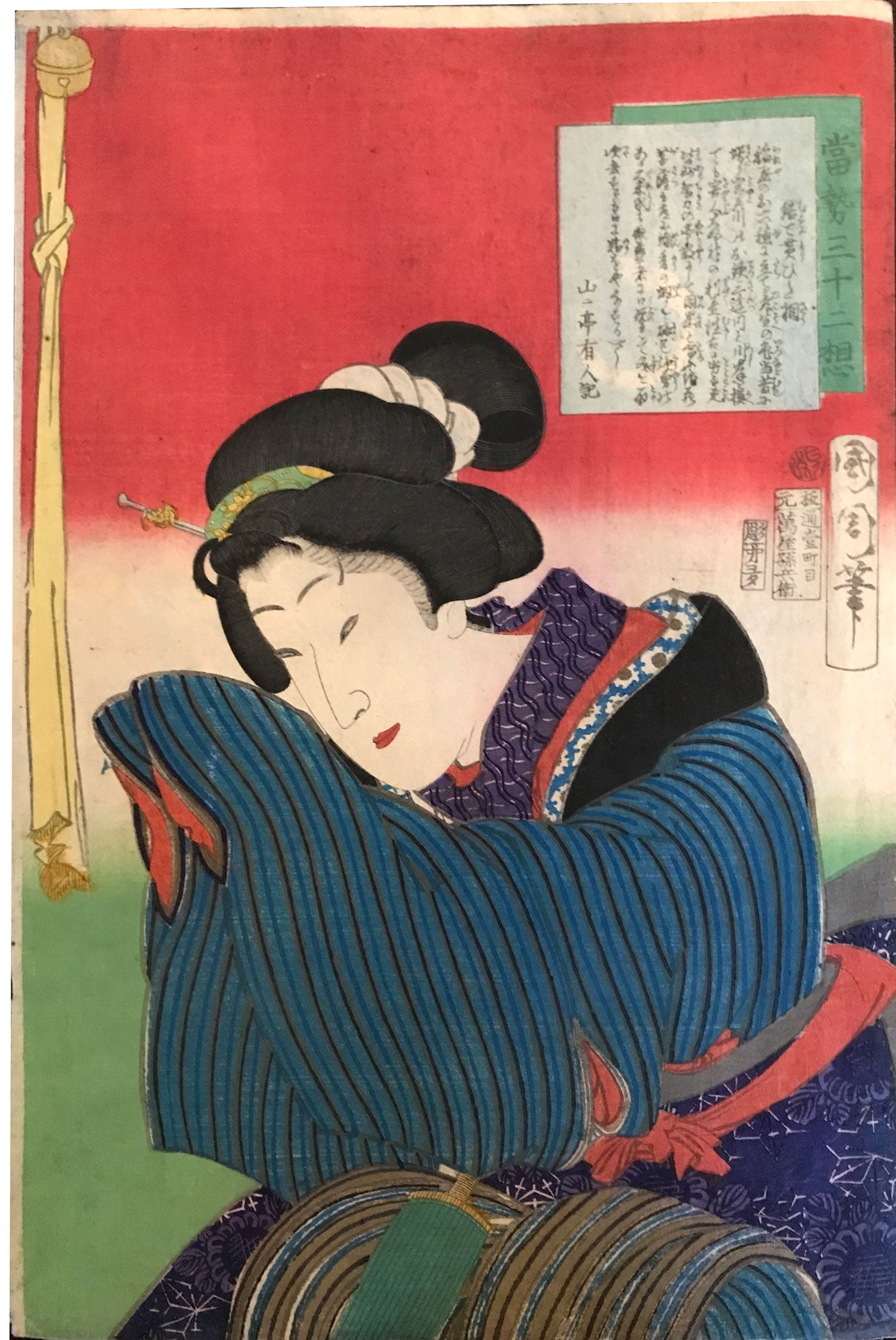
My final offering of Kunichika’s woodblock prints is his 1869 work entitled Making A Wish At The Shrine. It is one print from the Tosei Sanju-ni So (Thirty-two Fashionable Physiognomies series), which was one of Kunichika’s major works. The series showcased typical Ukiyo-e beauties but their facial expressions and gestures were livelier and more personalized. These down-to-earth beauties were the harbinger of what became known as Meiji realism which became increasingly popular during the mid – late Meiji period. 

Lady Lever Gallery
Port Sunlight Village, Wirral CH62 5EQ
Kunichika: Japanese Prints
15 April – 4 September
The first exhibition held in a national gallery outside Japan to focus on one of the most important 19th century Japanese print makers.