Peder Balke. Part 2 – The great Norwegian journey and disillusionment

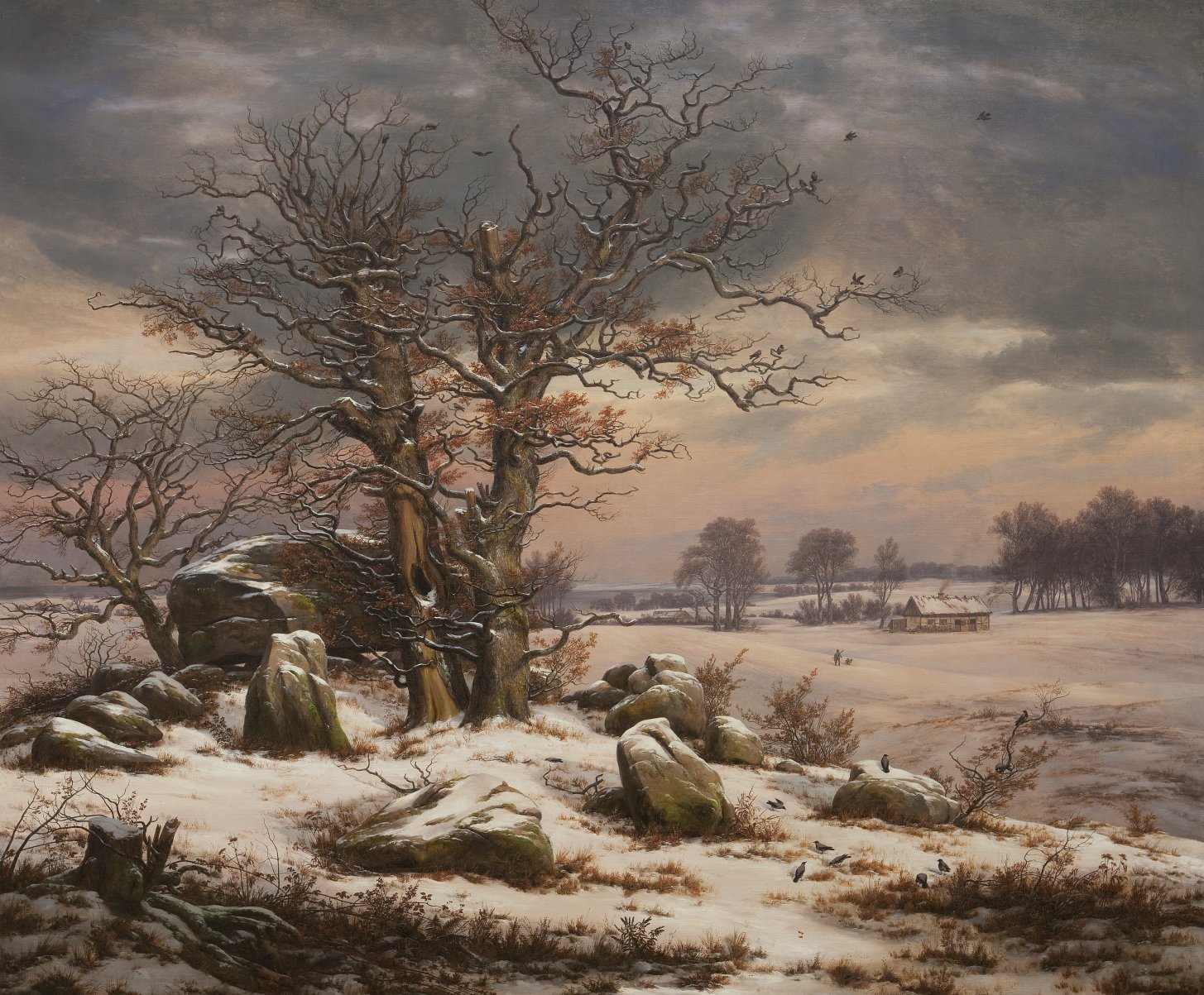
Winter Landscape. Near Vordingborg, by Johan Christian Dahl  (1827)
Winter Landscape. Near Vordingborg, by Johan Christian Dahl (1827)

Balke returned to Christiania in 1830 and stayed with Professor Rathke and in that May travelled to Copenhagen and was fortunate to be able to view royal collections of art.  Of all the works he saw, Balke was most impressed by a winter landscape painted by Johan Christian Dahl, entitled Winter Landscape. Near Vordingborg, which he completed in 1827.  The large (173 x 205cms) work of art depicts a somewhat oppressive atmosphere with its undertones of death, symbolised by the dolmen behind the lifeless branches of the two oak trees. A dolmen is a type of single-chamber megalithic tomb, usually consisting of two or more upright stones supporting a large flat horizontal capstone.  Nature is depicted in the form of its icy winter garb.  He wrote of the painting to Rathke saying that it was the most life-like painting he had ever seen.  The fact that he had managed to see the works of the great Masters at the royal collection, although influencing him, also depressed him somewhat as to his own ability.  He wrote:

“…I sometimes felt a certain heaviness of heart and lack of courage when I compared my own insignificance with these true masterpieces; quietly and I admit somewhat superficially I calculated how much I would have to learn and how many ordeals I would have to go through before I would be able to achieve a mere fraction of the perfection in aptitude and skill in execution exuded by these paintings…”

North Cape by Peder Balke (1945)

Balke was determined to succeed and in the summer of 1830 having returned to Norway from Copenhagen he set off on foot on an artistic journey through the Telemark region and over the mountains to western Norway and then north to Bergen returning to Christiania via the Naeroydalen valley and the town of Gudvangen.  He later recalled his short time spent in the area around Gudvangen, writing:

“.. I first arrived late at night, because I became so engrossed in admiring the sublime beauty of Naeroydalen that I hardly knew whether what surrounded me was real or supernatural.  So fascinating and uplifting did my youthful imagination, with its passion for the beauties of nature….”
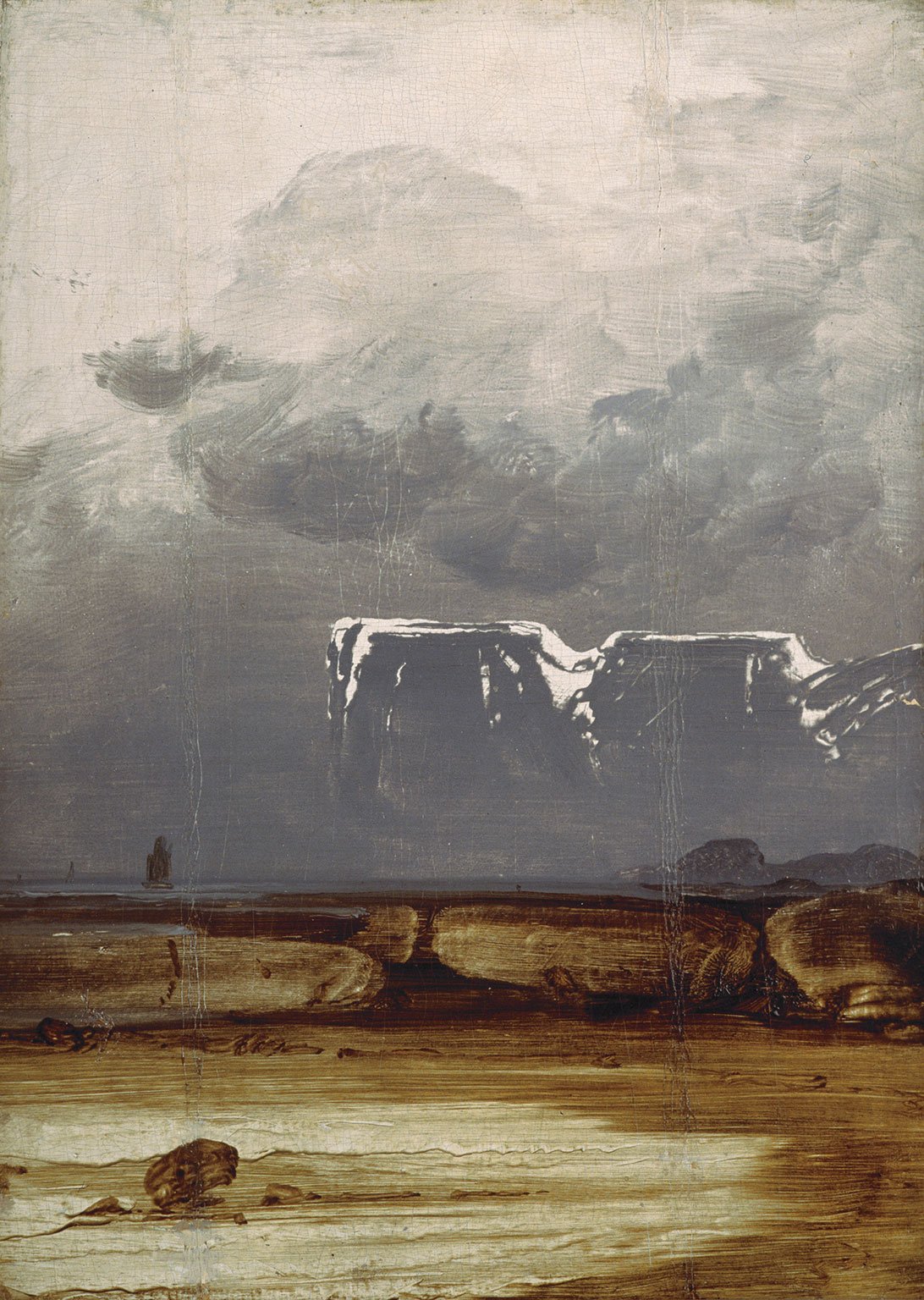
From North Cape by Peder Balke (c.1860's)
From North Cape by Peder Balke (c.1860’s)

Two years later, in April 1832, Balke set off another artistic journey.  This time, setting off in his own carriage he went to Trondheim where he was to catch a boat to the north of the country.  His planned journey hit a snag when he arrived late in Trondheim and missed the boat.  He had to wait a further seven weeks for the next boat but spent the time sketching the town and the surrounding areas.  Peder Balke finally embarked on his northbound boat trip, passing the Lofoten Islands and arrived at Tromso.  From there the boat went further north to Hammerfest and then proceeded around the North Cape to Vardø and Vadsø.  He was the first Norwegian painter to record the harsh beauty of the northern landscape.  Eventually Balke and the boat returned to Trondheim.  During the long journey Balke had completed a large collection of sketches of the places he had seen and many were used in his many seascape and moonscape works of art which he worked on when he returned to Stockholm.  He sold many of his paintings to wealthy Norwegians and Swedes as well as members of the royal family.  In 1834, now, financially secure, Peder married Karen Eriksdatter, the woman he had been secretly engaged to for several years, but had been too poor to marry.

The Severn Sisters by Peder Balke (1847)

The couple settled in Christiania and Balke, now accepted, not simply as a decorator but as a landscape artist, tried to establish himself and sell his artworks.  However competition at the time was too great and the sales he had hoped for never materialised.  However, in 1835, he managed to sell another of his works to the king and with that money he decided on fulfilling his dream of travelling to Dresden and work with the Norwegian artist, J C Dahl.   Many Norwegian artists had trodden this path, including Thomas Fearnley (see My Daily Art Display November 24th & 28th 2012).  With help from a friend, Balke set off for Germany and reached Berlin in the winter of that year.  He remained in Berlin for several weeks and was able to visit the Royal Museum and whilst in the German city he saw paintings by the German romantic landscape painter, Casper David Friedrich.  It was this artist who was going to have a great and lasting influence on Balke.

Ship in Breaking Waves by Peder Balke (c.1849)

Balke left Berlin and travelled to Dresden via Leipzig.  He received a great welcome from Johan Dahl who helped him find accommodation.  J C Dahl introduced Balke to Casper David Friedrich and Balke was able to watch the two great artists at work.  In a letter to Rathke, dated March 29th 1836, he wrote about watching J C Dahl at work:

“..to see Dahl paint, I know with which colours and have seen how he uses them, and though I at present cannot proceed successfully in the same manner I hope that with time I will also reap the benefit.  What I regret most is my lack of studies from nature.  Dahl certainly has several thousands of them, of all kinds.  He has told me there is no other way to become a real painter than by painting from nature, which admittedly has been my intention, and I shall now try to see whether I can make up for what I have hitherto neglected, in Norway, though not in Germany – there is no nature here…”
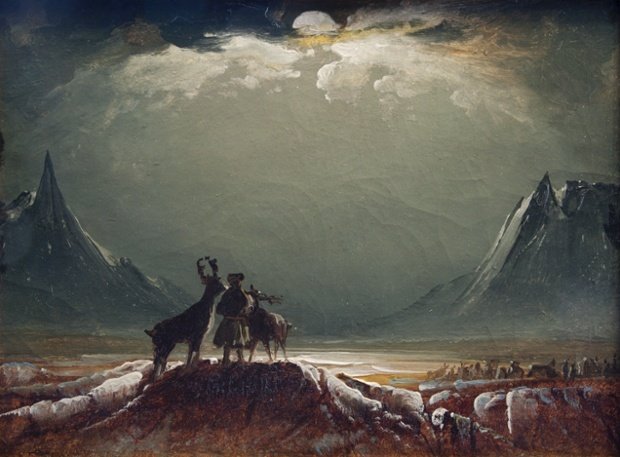
Sami with Reindeer Under the Midnight Sun by Peder Balke, (c.1850)

Balke left Dresden but returned in the 1840’s to work once again with J C Dahl.  Landscape art was popular in Norway and Balke managed to sell many of his works but things were to change when a number of young Norwegian landscape artists having returned from studying at the Dusseldorf Academy, which at the time was looked upon as the most modern art-educational institute.  The teaching of landscape art was more to do with what was termed “cautious Realism” rather than Balke’s Romantic landscapes which suddenly became less fashionable.  He had to endure much criticism with regards his work which had once been loved by his people.  In an article in a 1944 edition of Morgenbladet, the eminent art critic Emil Tidemand scathingly wrote about Balke’s paintings:

“… There is no question here of a grandiose, poetic perception: no not even the simplest technical demands of drawing, perspective, clarity, strength and depth of colour have been met……………….This is not a representation of nature – his whole production is merely the mark of a dirty palette handled without discrimination…”

Old Trees by Peder Balke (c.1849)

Maybe it was the vitriolic criticism which made Balke realise that there would be no hope of becoming financially secure through his art sales in Norway and so in 1844 he, along with his pregnant wife and three young children, left their homeland and travelled to Paris via Copenhagen and Germany  There was also another reason to visit Paris and this was that Balke was well aware that the country’s ruler Louis-Philippe had, as a young prince in exile in 1795, travelled along the Norwegian coast from Trondheim to the North Cape just as he had done.  As Balke did not speak French he asked a friend to write a letter on his behalf to the king in which he reminded the king of his exile and his Norwegian journey and that his nine sketches of the area would remind the king of that journey.  Louis-Philippe was intrigued and summoned Balke to the palace.  Balke and the king immediately became close and the two would meet regularly and reminisce about their travels to the North Cape
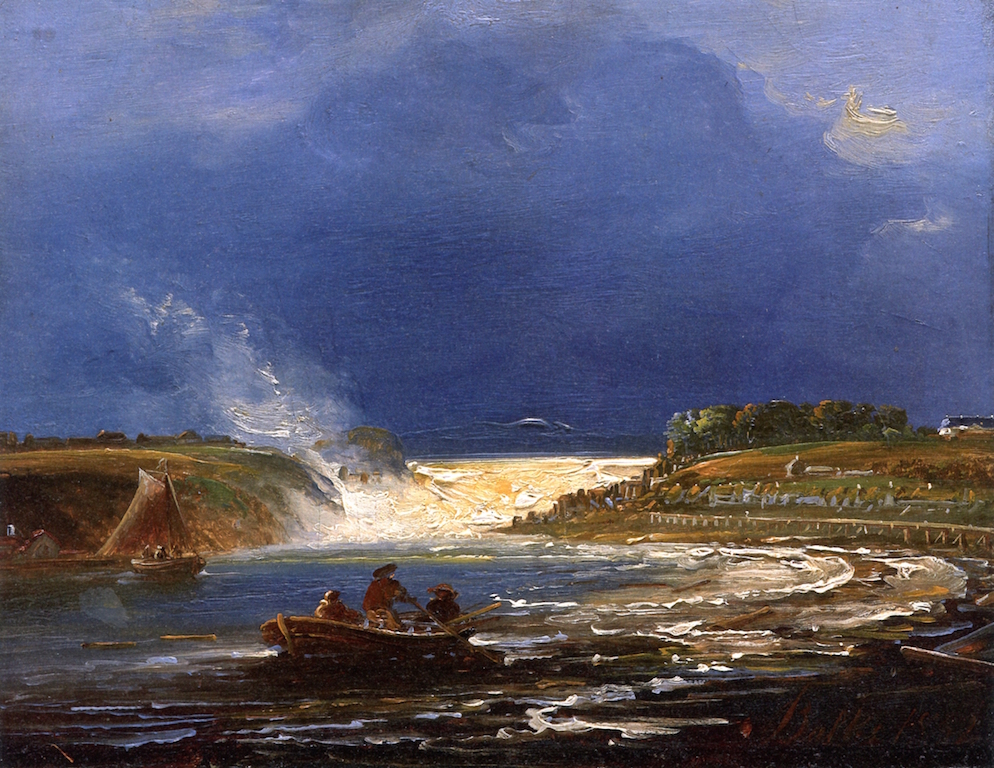
A View of the Sarpsfoss Waterfalls, Norway by Peder Balke (c.1859)

Louis-Philippe commissioned a set of paintings derived from the sketches.  Balke’s financial future seemed to have been rescued and he set to work on the commission.  Alas fate was to take a hand in the form of the February Revolution of 1848 which saw the downfall of Louis-Philippe.  Balke realising the dangers of being close to the unpopular ruler decided in late 1847 that he and his family would have to hurriedly leave Paris which meant he had to abandon, what was to have been a very lucrative commission.  Balke moved back to Dresden.  Shortly after his arrival in the German city in 1848 his young son Johann died.  His death came around the same time that his wife gave birth to their daughter Frederikke.  Sales of his art in Dresden were hard to come by and so he decided to leave his family with a friend and head back to Christiania.  He managed to sell some of his work, one of which was The North Cape by Moonlight but still the Norwegian people favoured the Dusseldorf School of landscape painting and so Balke returned to his family in Dresden.  In the Spring of 1849 he and his family moved to London where Balke believed his art would be more appreciated.  London had fallen under the spell of Joseph Mallord William Turner and his marine paintings and so Balke believed his works of art would do well.  He was proved right and managed to sell more of his works of art.

Balkeby  1860-70
Balkeby
1860-70

In the autumn of 1850 Balke and his family moved back to Christiania.  In 1855 his good friend and benefactor Professor Rathke died and left Balke a sizeable amount of money which Balke used to buy eight acres of land just outside the city limits at a place known as Vestre Aker.  He virtually abandoned his career as an artist of large scale landscape works, concentrating on small scale paintings which he believed would be bought by the middle class.  He now concentrated on his property portfolio and in particular the development of housing for workers in his newly attained property in the suburb of Balkeby, He dabbled in local politics championing the cause of pensions for men and women, and also of grants for artists. His painting was now just a hobby and for his own pleasure.
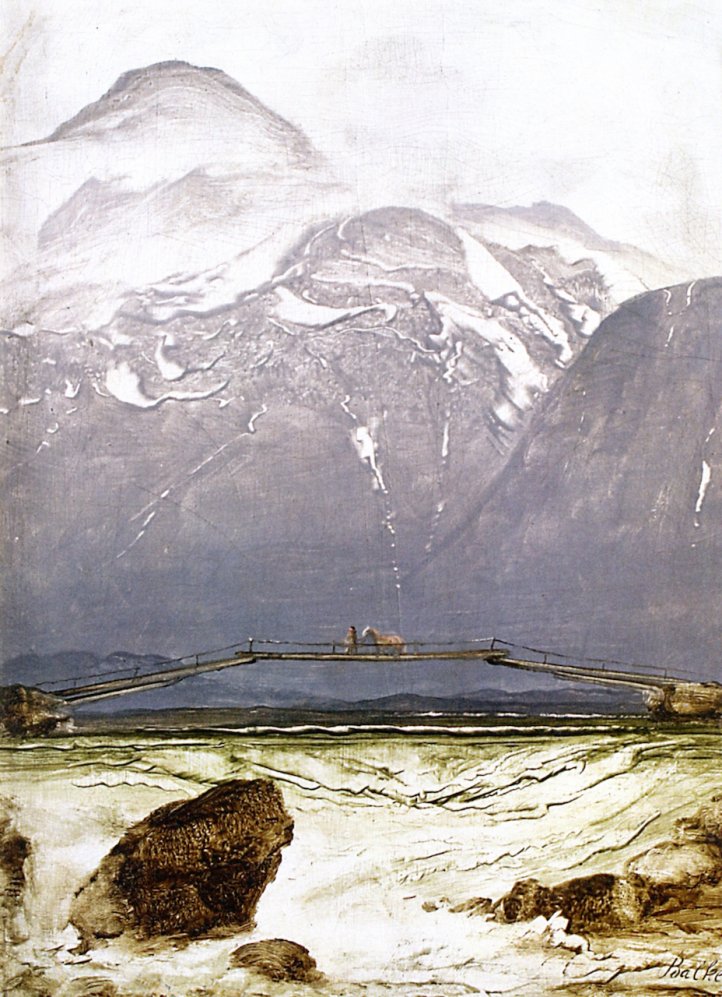
The Old Bridge by Peder Balke (c.1869)

Balke, as you may realise, was an unlucky man and more bad luck came in June 1879 when his beloved Balkeby went up in flames.  Nearly every house, including his own, was burnt to the ground.  Four years later Balke suffered a stroke, and he died in Christiania on February 15th 1887 aged 82.  The obituaries that followed after his death were all about his political work and little was said about Balke the artist.  Maybe his penchant for ignoring criticism and sticking to what he believed in was apparent in the obituary which appeared in the magazine Verdens Gang in March 1887.  It emphasised Balke’s pugnacity:

“…Fearless and straightforward as he was, it would never occur to him to defer to people in an argument.  He considered only the matter in hand and did not bother in the least about who was for or against him.  This does not always result in popularity…”

I can recommend an excellent book about the artist and his work entitled Paintings by Peder Balke, from which I derived most of my information about this Norwegian painter.

Peder Balke. Part 1 – His early life and struggles to become a painter

Peder Balke (1804-1887)
Peder Balke
(1804-1887)

I suppose if you are a landscape or seascape artist it is ideal to be living amongst glorious scenery or rugged coastlines which inspire you to paint and is much better than having to move to an artist colony in some idyllic area to find inspiration.   The artist I am featuring today was fortunate enough to come from a country of amazing natural beauty which he often depicted in his works of art.  Today let me introduce you to the nineteenth century Norwegian painter, Peder Balke, who specialised in landscape and seascape paintings with a romantic and dramatic connotation.

Peder Balke was the younger son of Anders Thoresen and Pernille Pedersdatter and born August 28th 1804.  He was christened Peder Andersen on November 4th.  Information about his early years was given by Balke in a dictated version of his life story, seventy years later.  He reminisced:

“… I was born on the island of Helgøya, in Nes in the country of Hedmark on 4 November 1804 in poverty, my situation in life being therefore less than enviable.  Yet the nearly influence of an affectionate and conscientious mother with constant good advice and exemplary admonitions was of the greatest benefit to my youthful and perhaps exceptionally lively temperament – for it is in these years of one’s development that the seeds are sown of both good and evil, though only later in life does one value their significance correctly…”

Christiania Viewed from Ekeberg by Peder Balke (c.1829)

He did not have an easy start to life his family being part of the lowest ranks of the peasant society.  His parents were simple farm labourers working on a farm called Svennerud on the island of Helgøya, which lies in the middle of Lake Mjøsa, , some 60 kilometres north of Christiania (now Oslo)  and is Norway’s largest and one of the deepest lakes in the country.  The family owned nothing.  They had no lands to grow their own crops.  They were simply impoverished land-less servants of the farmer.   The family predicament was one his father could not tolerate and when Peder was young, he abandoned the family and is never mentioned in his son’s dictated autobiography.  In 1812, when Peder was eight years old, because Norway and Denmark were in an alliance with France, their ports were blockaded by the British, as part of Britain’s war against Napoleon.  This prevented much needed corn from entering the country and this, along with a severe and early frost of 1812 which destroyed the Norwegian corn harvest, meant that for the next two years the country suffered a terrible famine.  This severe time was remembered well by Balke who wrote:

“….wretched times, when war and years of hardship oppressed people and it goes without saying that this suffering and national scourge affected the poor most severely.  My mother, who had to look after herself and two children- for I had a brother who was seven years older than me ……like so many others we had therefore to resort to substitutes which are less easy for humans to digest, and I and my brother went into the forest to remove bark from the trees, which was dried and ground and Mother baked bread with it.  It goes without saying that food of this kind resulted in disease such as dysentery etc…”

The Mountain Range 'Trolltindene' by Peder Balke (c.1845)
The Mountain Range ‘Trolltindene’ by Peder Balke (c.1845)

Being from such a peasant class there was no possibility of schooling for Balke but his mother taught him to read and write.  When he was old enough he would try to earn some money for the family by helping out on the neighbourhood farms, but pay was poor, and he would also go fishing to bring food to the table.

It was thought Peder’s maternal grandfather was an painter/decorator and that was the first influence on him.  Another relative, Anders Skraedderstuen, who had a nearby smallholding was also a painter and took on seventeen year old Peder as an apprentice for two years.  Peder was employed to paint but also learn the skills involved in fine interior decorations.  There was always work for him as the farm owners were becoming richer and building themselves large homes which they needed decorating.  Peder travelled extensively from farm to farm to carry out commissions.  One such farm was the Vestre Balke farm at Toten which was owned by Anders Balke.  The Balke family took to Peder and soon he was not just looked upon as a workman but as a son.  This close tie pleased Peder and it was at this time that he changed his surname to Balke.  Although now living with his “new family” he always remembered to go back and visit his mother and help her out financially.

Landscape with Mill and Rapids by Peder Balke (1840)

In winter there were no commissions to be had so it was then that Balke travelled to Christiania to buy paints, stencils and the latest in ornaments ready for the following summer.  At this time there was no place in the capital where Balke could study art but he did manage to find rooms in a house owned by Ole Nielsen in Gudbrandsdalen.  Nielsen was a talented painter and over a period of seven months he taught Balke the fundamentals of drawing and painting.  Balke recalled the time later in his autobiographical notes:

“…From this kind man I received many tips hitherto unknown to me that had an appreciable effect on my later evolution in the profession of painter…”

Moonlight on the Coast at Steigen by Peder Balke (1842)

Life and business were good for Peder Balke, so much so, he employed several apprentices but as in life itself there were always ups and downs and the “down” at this time was the threat of military service.  Balke did not want anything to do with this and tried all sorts of ploys to get himself out of fighting for his country.  His eventual get-out was by becoming a qualified craftsman and seeking citizenship in Christiania.  So, in 1826, aged twenty-two, Balke left Toten and moved to the capital and was accepted as a journeyman by the Lubeck-born painter and engraver, Heinrich August Grosch and studied to become a master painter of the town, thus acquiring citizenship and best of all, be exempt from military service providing he completed his two year course to the satisfaction of Grosch.   Balke tired of working for Grosch switched to working for Jens Funch.  In 1827, with the money he had saved, he enrolled in an elementary drawing class at the Royal School of Drawing and received tuition at the Kongelige Tegneskole from the former military officer and painter Captain Jacob Munch, who was pleased with Balke’s progress.  With his savings almost gone, Balke returned to Toten and asked his benefactor Anders Balke for some financial help.  Anders and two other farm owners decide to financially back Balke, in the form of a letter of guarantee for a sum of money which Balke needed to continue his studies and in return he promised to decorate their farm buildings.

Winter Landscape. Near Vordingborg, by Johan Christian Dahl  (1827)
Winter Landscape. Near Vordingborg, by Johan Christian Dahl (1827)

Balke returned to Christiania and with the letter of guarantee met with Professor Jens Rathke a renowned natural scientist and professor at the university who was well known for his generosity.  He agreed to take the letter of guarantee and lend Balke the funds he needed.   Balke was to late recall that he was never asked to repay the sum he had borrowed and commented on Rathke’s invaluable support:

“… For that as well as for all the other kindnesses that man bestowed on me I have always been and always will be grateful to him…”

Jens Rathke also persuaded Balke to take a trip around large parts of central Norway in order to study nature.  Balke first toured the Telemark area in the south east of the country an area which he later recalled had awakened his profound interest in Norway’s wonderful natural life, and the astonishing beauty it reveals in all directions.  Later he explored central Norway and the Gudbransdalen Valley.  He continually recorded his travels with a large number of sketches which he would later combine in his paintings.

Seascape by Peder Balke (c.1860)

In 1829, military service still loomed large as Balke had not managed to qualify as a painter-decorator within the prescribed two year period.  His only course of action to avoid military service was to try and enrol at an academy and study landscape painting.  Rathke advised Balke to apply to the Stockholm Academy and agreed to finance Balke’s application.  Balke studied for a short time under the Swedish landscape painter, Carl Johan Fahlcrantz.  Whilst in Stockholm Balke visited the summer residence of the country’s ruler Karl Johnan in Djurgärden where he viewed the king’s art collection and was much enamoured by a painting by the German landscape painter, Johan Christian Ezdorf.  Ezdorf, who was also a student of Fahlcrantz, had a great love for the Nordic scenery and often depicted it in his works of art.

Balke was enjoying life in Stockholm and in his memoirs he wrote:

“…I used the time to pay frequent visits to the city’s art academy and art galleries, as well as a number of private collections of paintings where I was made welcome, and I also executed some small paintings which I had the satisfaction of selling…”

In my next blog I will continue to look at the life and works of Peder Balke and examine the reasons why he gave up being a professional artist in favour of politics.

I can recommend an excellent book about the artist and his work entitled Paintings by Peder Balke, from which I derived most of my information about this Norwegian painter.


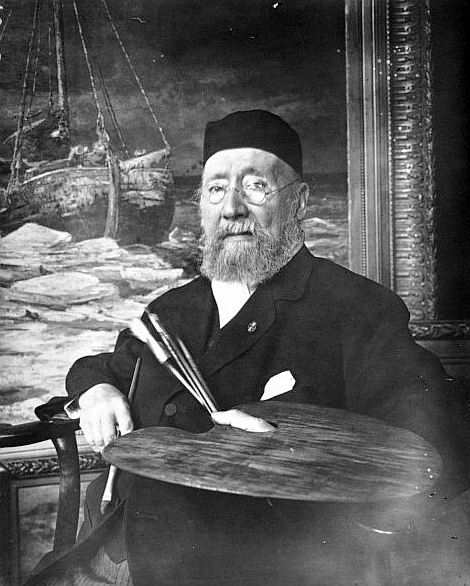
Hendrik Willem Mesdag – his seascapes and Panorama Mesdag

Hendrik Willem Mesdag (1913)

The person I am featuring today was an artist of great talent, an avid art collector and an owner of a museum, which housed many of the works he had collected during his lifetime.  I talked briefly about him in my previous blog which was dedicated to his friend Jozef Israels.  Let me introduce you to the marine painter, Hendrik Willem Mesdag.

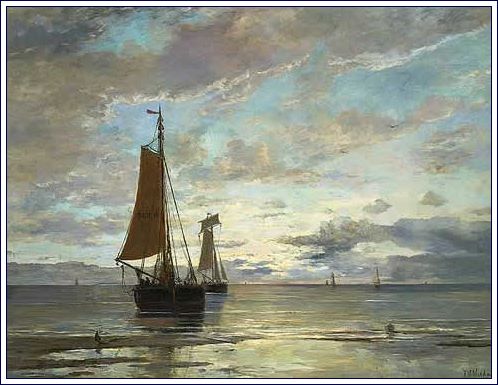
Along the Dutch Coast by Hendrik Mesdag (1882)

Mesdag was born in Groningen in February 1831.  His father Klaas was a banker and was also active in politics and his mother was Johanna Wilhelmina van Giffen, who came from a wealthy family of silversmiths.  She died when Hendrik was four years old.  Hendrik had two brothers, Gilles and Taco and a sister, Ellegonda.  As schoolchildren, both he and his older brother showed and early artistic talent and their father, who was also an amateur artists, decided to send them for some artistic training.  They both received drawing lessons from Bernardus Buijs who had also taught Jozef Israels and later received drawing tuition from Hinderikus Egenberger.  However, for Hendrik, once he left school at the age of nineteen, art became just an enjoyable pastime, and his future, like that of his father, lay in banking.  Hendrik Mesdag joined his father’s bank where he remained for the next sixteen years.

Fishing Boats in the Surf by Hendrik Mesdag

In April 1856, when Hendrik was twenty-five years old, he married Sientja van Houten, who would later become an accomplished artist in her own right.  She was one of seven children brought up by a wealthy family.  Her father owned a large sawmill just outside Groningen.  Her cousin was the renowned painter Lawrence Alma-Tadema.

Along the Dutch Coast by Hendrik Mesdag

Hendrik’s love of art during his days as a banker did not diminish, in fact in 1861 he enrolled as a pupil at the Academie Minerva, a Dutch art school based in Groningen.  In 1863 Sientje gave birth to their son Nicolaas, who was called Klaas.  Hendrik’s love of art and his desire to become a full-time professional artist came to a head in 1866 when he decided to give up his work as a banker and concentrate on his art.  To give up a lucrative job took courage but it also required funding and for this he had to thank his wife who had received a sizeable inheritance when her father died and she was able to support him financially.

Pinks in the breakers by Hendrik Mesdag (1880)

Lawrence Alma-Tadema advised Hendrik to go to Brussels to study art and in the autumn of 1866 he goes to the Brussels for three years and studied art under the tutorship of Willem Roelofs, the Dutch painter and watercolourist.  Fate played a hand in the artistic life of Mesdag in 1868 when he and his family went to Norderney for a holiday.  Norderney is one of the East Frisian islands off the North Sea coast.  It is here that Mesdag realises his love of the sea and seascapes and when he returns to Brussels he starts collecting paintings which depict the sea and it is from this time that he decides he wants to be a seascape artist.

Gales in Scheveningen by Hendrik Mesdag (1894)

Once he completes his three year study course in Brussels in 1869, the family move to The Hague where the sea views at the nearby coastal village of Scheveningen, would be plentiful.  Hendrik was admitted to The Hague’s Pulchri Studio Painters’ Society.   The society was formed in 1847 and was a result of mounting dissatisfaction among the young artists in The Hague who complained about their being little or no opportunities for training in art and developing their artistic skills and so the Pulchri Studio was established.  It was also to be an artistic talking-shop where artists could exchange views and ideas.

Les Brisant
Les Brisant

It was in 1869 that Mesdag worked on his painting Les Brisants de la Mere du Nord (Breakers of the North Sea) which, when it was exhibited at the Paris Salon in 1870,  was awarded the gold medal.  In September 1871, tragedy struck Hendrik and Sentije when their eight year old son Klaas, their only child, died.  It was from that time onwards that Sientje took up painting.

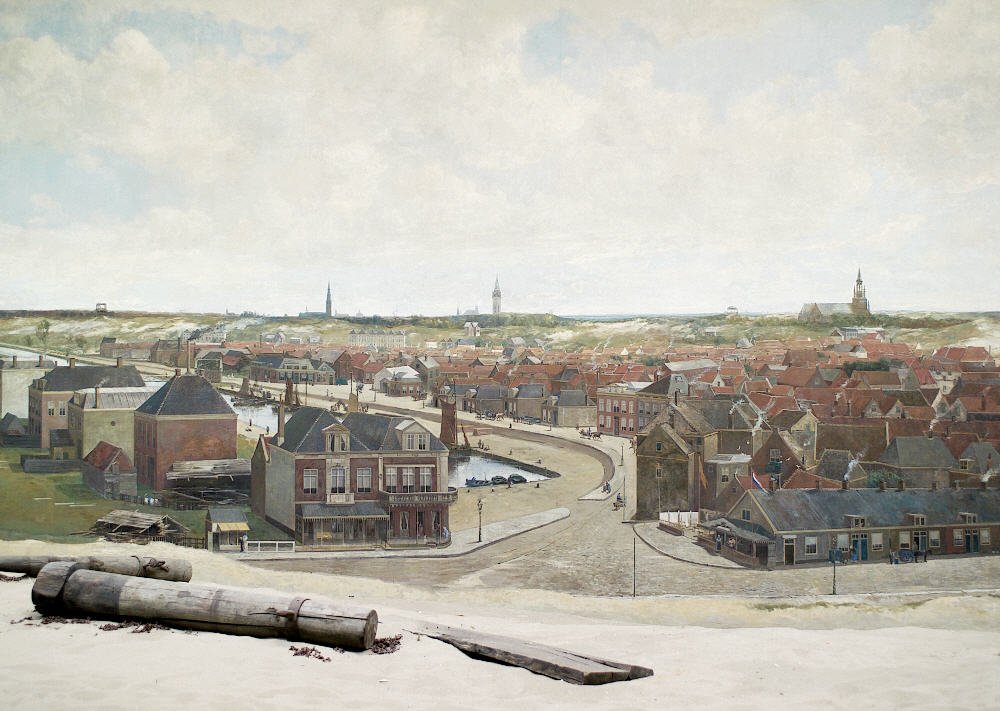
Detail from Panorama Mesdag

Hendrik Mesdag’s collection of paintings had grown so large that it filled his house and in 1878 he decided to build a museum in the garden, next to his house, to accommodate his ever-growing collection.  That same year, his father Klaas died aged 85.  Although most of the works of art by Hendrik Mesdag were seascapes and paintings depicting bomschuiten (fishing boats) one of his most famous works came about in 1879 when he received a commission from a group of Belgian entrepreneurs to paint a panorama.  A panorama or panoramic painting was a massive work of art, which depicts a wide and all-encompassing view of a particular subject.  They could be depictions of a battle, historical event or a landscape and were very popular in the nineteenth century, a time before television or the cinema.  The commission was simple  –  the group wanted Mesdag to complete a painting without any borders !  The Belgians gave Mesdag free rein on the subject of the panorama and he was allowed to pick his team of artists to complete the task.  The commission intrigued Mesdag and he agreed to it and formed a team of artists which included Théophile de Bock and twenty-three-year-old George Hendrik Breitner, who was still a student at The Hague Academy , the artist, Bernard Blommers , as well as his wife Sientje.

Detail from Panorama Mesdag

Mesdag decided this was an opportunity to depict his beloved coastal village of Scheveningen.

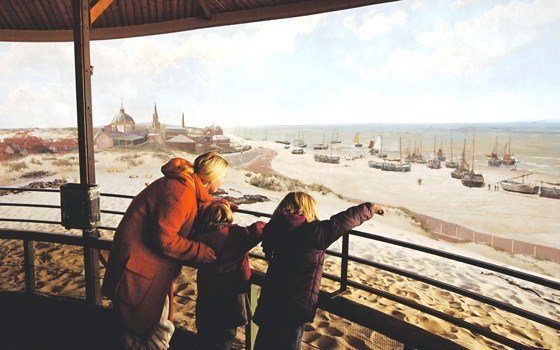
In March 1881, Mesdag and his team of painters set to work on the panorama.  They made numerous sketches of the town and the surrounding coast and slowly over the next  four and a half months the panorama often referred to as Panorama Mesdag  evolved.  The work when completed was 14 metres high with a circumference of 120 metres, a square footage of 1600 square metres.  The finished work was housed in a purpose-built museum in The Hague and could be viewed from an observation gallery in the centre of the room.  When one stood at this central observation point, it was if one was standing on top of a high sand dune and one could observe the sea, the beaches and the coastal village of Scheveningen.  The museum housing the panorama was opened to the public on August 1st 1881 but after five years it went bankrupt.  Mesdag , who was concerned as to the fate of his panoramic painting, bought the museum and kept it open despite it losing money year on year.

Panorama Mesdag as seen from central observation platform

It is still open to the public and it is still one of the The Hague’s greatest tourist attractions.  Can you imagine what it would be like to stand on that central observation platform – take a look now at http://panorama-mesdag.nl/   and see this wonderful work, which is the largest circular canvas in Europe.

In his later years Mesdag received many honours. In 1889, he was elected chairman of Pulchri Studio Painters’ Society, the society he joined twenty years earlier, and remained in that post until 1907. He received the royal distinction of Officer in the Order of Oranje-Nassau in 1894.  In February 1901 Mesdag is promoted to Commander of the Order of the Dutch Lion.

Hendrik Willem Mesdag  and his wife Sientje Mesdag-van Houten, (1906)
Hendrik Willem Mesdag and his wife Sientje Mesdag-van Houten, (1906)

In March 1909 his beloved Sientje died, aged 74.  Two years later in 1911, Hendrik Mesdag is taken seriously ill and although he recovers, his health slowly deteriorates.  Hendrik Willem Mesdag died in The Hague in July 1915, aged 84.

One may compare the seascapes and depictions of fishing boats with the artist, Jozef Israels, whom I looked at in my last blog.  Israels’ depictions were often full of angst and doom and gloom whereas Mesdag’s works were simply depictions of what he saw, without any need to have the works populated by people and all had a story behind them.   I end with a quote from the author, Frederick W Morton who wrote an artcle in the May 1903 edition of the American art journal, Brush and Pencil .  He wrote about Mesdag’s seascapes:

“…Other artists have painted more witchery into their canvases, more tenseness and terror.  A Mesdag has not the glint of colour one finds in a Clays or the awful meaning one reads in Homer.  On the contrary, many of his canvases are rather heavy in tone and are works calculated to inspire quiet contemplation rather than to excite nervous.  But he is a great marine-painter because he thoroughly knows his subject – he has sat by it, brooded over it, studied it in its every phase – and by straightforward methods, without the trick of palette or adventitious accessories, has sought to make and has succeeded in making his canvases convey the same impression to the spectator that the ocean conveyed to him…”

———————————————-

Much of the information for this article came from the Mesdag Documentation Society and their excellent website Mesdag.com (http://www.mesdag.com/index.html)

John Peter Russell. Part 2 – Belle Île, Monet and Matisse

In the first part of my blog about the Australian painter, John Peter Russell, I told you about his early life in Australia and how his father and brothers had started a foundry and engineering works in Sydney.  He then went to England and was apprenticed at a Lincoln engineering company, qualified as an engineer but on the death of his father and the inheritance he subsequently received, gave up his engineering career to become an artist.  He studied at the Slade School in London and the Atelier Cormon in Paris. 

Les Aiguilles, Belle-Île by John Peter Russell ((1890)

Russell had previously made painting trips to the Breton isle of Belle Île in 1883 and 1886 and fell in love with the island scenery and the light which offered up the myriad of colours of the island’s nature and the surrounding seas.  For Russell, his aim was to capture in his paintings the unadulterated purity of nature’s colour that the light highlighted at different times of the day.  To do this Russell realised that making quick preliminary sketches, later to be finished in his studio, would lose the purity of the colour and so he decided that the work had to be completed en plein air if he was to capture the true colour that the light had offered him.  He was not alone with this idea as many of the French Impressionists came to the region in search of the rugged beauty offered up by the island.  For these artists the island of Belle Île offered them a remote and secluded painting haven with its spectacular cliff configurations and outlying rock structures which had been shaped and whittled away by the unrelenting ferocity of the sea.  

Russell summed up his love for Mother Nature and capturing in his works the changing light he experienced on the island when he said:

“…I am a painter of nature, of nature’s moods, of sunlight and the changing temper of the sea”

His good friend the sculptor Auguste Rodin wrote to him about this love of colour, light and his desire to capture every facet of nature’s moods, saying:

“…I am very happy, dear friend, for you that you cling so enthusiastically to nature.   I am sure that your art is now full of sincerity and movement…”

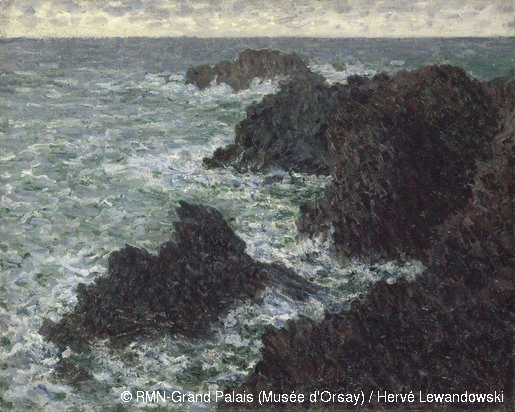
The Rocks at Belle-Ile, The Wild Coast by Monet (1886)

One of the most famous Impressionist artists who spent time on Belle Île was Claude Monet.   He lived on the island from September to the end of November of 1886, in the tiny village Kervilahouenne.  The story goes that Russell met Monet one day, in the late summer of 1886, when Monet was perched high up on a windswept cliff top painting a seascape.   Russell approached him and looked over his shoulder at his painting.  On recognising Monet’s painting style Russell asked him:

Ne seriez vous Claude Monet, le prince des impressionists?”

(aren’t you Claude Monet, prince of the impressionists?). 

Monet was both amused and somewhat flattered by the question and this led him to allow Russell to sit awhile and paint with him and so an artistic friendship was formed.   There can be no doubt that Monet’s work influenced Russell.  Although the Australian artist believed in the Impressionist philosophy that the painting should be about light, Russell thought that form should not be disregarded.  Monet was fascinated and in love with the island’s wild coastal scenery.  He was in awe of the stark wilderness of the island’s landscape and, at first, quite unsettled by the frequent variations in the weather conditions.   He knew that the best depictions would be the views of the sea and the rugged cliffs and often had to battle, with an obstinate determination, taking his life into his own hands, to try and gain the best painting position on the cliff edge, notwithstanding the state of the weather at the time.  Monet wrote to his friend and fellow Impressionist Gustave Caillebotte of his joy at being on Belle Île and the artistic challenges it offered:

“…I am in a wonderfully wild region, with terrifying rocks and a sea of unbelievable colours; I am truly thrilled, even though it is difficult, because I had got used to painting the Channel, and I knew how to go about it, but the Atlantic Ocean is quite different…”

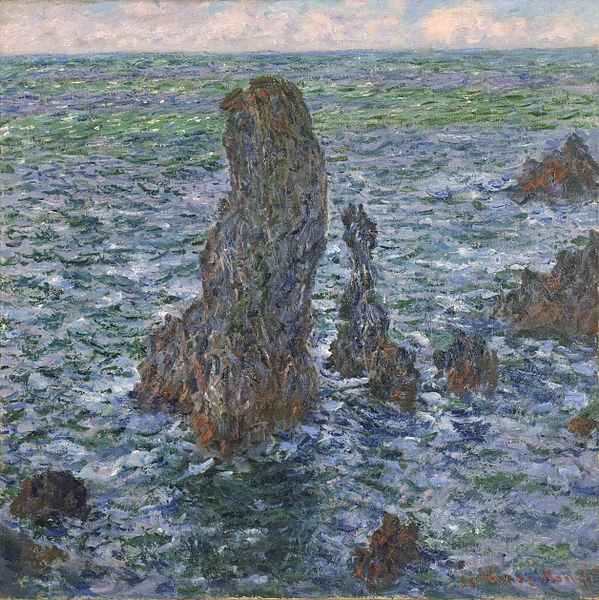
The Pyramides at Port-Coton by Monet (1886)

Monet completed a set of works in 1886, featuring the coastal scenery of Belle Île but when he presented them to his Paris art dealer, Paul Durand-Ruel, the latter was taken aback by the change in Monet’s work as seen in these new canvases.  These were very different from the artist’s Normandy paintings of a decade earlier.   Gone were the paintings bathed in sunlight for these Belle Île works were much more sombre and dark and Durand-Ruel was concerned as to whether they would sell.  In one such work, The Pyramides at Port-Coton, which Monet completed in 1886, he has magnificently captured the dark craggy rock formations which have been formed by the slow but persistent erosion by the sea and which now stand out like ancient pyramids.  The dark colour of these rock formations contrast with the superbly coloured waves which we see buffeting them.  Durand-Ruel quizzed Monet about the wisdom of the change in style but the artist was adamant about having variety in his works, saying:

“… I’m inspired by this sinister landscape, precisely because it is unlike what I am used to doing;   I have to make a great effort and find it very difficult to render this sombre and terrible sight…”

The art world, like Durand-Ruel were astounded in 1887 when Monet’s Belle Île paintings were first exhibited.

Les rochers de Belle-Ile, la Côte sauvage by Monet (1886)

Another of Monet’s Belle Île paintings completed around the same time is entitled Les rochers de Belle-Ile, la Côte sauvage [The Rocks at Belle-Ile, The Wild Coast] which can be found at the Musée d’Orsay in Paris.   This painting is one of five Monet completed featuring Belle Île.   It is in landscape format, unlike the other four, and in it Monet has depicted the never-ending clash between the forces of nature, the sea, and the rocks which try valiantly to withstand its ferocity.  Monet has used blues, greens and violets for the sea with white for the tops of the waves to give the stormy sensation. 

La Pointe de Morestil par mer calme by John Peter Russell (1901)

In Paris Russell had become great friends with Auguste Rodin and through that friendship had met, in 1885, the sculptor’s favourite model, Marianna Mattiocco, whom the sculptor once described as “the most beautiful lady in Paris”.  Russell and Marianne married in 1888 and it was now time for Russell to fulfil his much discussed desire – to move away from hustle and bustle of city life in Paris and move permanently to his beloved Belle Île.   The year before he had written to his friend and fellow Australian artist, Tom Roberts and told him of his dream:

‘…I am about to build a small house on Belle-Ile, off Brittany. The finest coast I’ve ever seen…”

Russell and his wife moved from Paris to set up home on Belle Île in 1888.  He was the first non-native to settle on the island and when he had built his new home, a large manor house, the islanders referred to it as Le Chateau de l’Anglais.  The completion of their large and spacious new home, with Russell’s studio facing  the Atlantic Ocean, was not just a place for the family to live it was to be the hub of Russell’s summer artist’s colony. Russell set to work on his own paintings of the shores of Belle Île and he would often depict the same type of scenes that Monet had done in 1886.  Russell had the same ideas as Monet.  He wanted to depict the coastline at different times of the day in different weather conditions always seeking the nuances of changing light.  Monet once said that Russell’s Belle Île paintings were better than his own ! 

ROCHERS À BELLE-ÎLE by Matisse (1896)

Ten years after settling down on Belle Île, Russell played host to another up-and-coming artist, Henri Matisse, during the three summers of 1895 to 1897.   Russell spent many hours with Matisse and it is said that he introduced Impressionism to him.  They spent hours discussing the importance of light and how light and colour could be captured at different times of the day and under different weather conditions.  He also introduced Matisse to the work of his friend from Atelier Cormon, Vincent Van Gogh, who at this time was still to be recognised as a great artist.  Matisse always recognised the debt he owed John Peter Russell and in later life said:

“…Russell was my teacher, and Russell explained colour theory to me…”

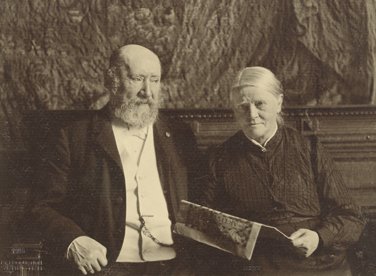
In 1908 Russell’s wife Marianna died.   Russell was devastated by his loss.  It is believed that such was his grief that he destroyed four hundred of his works of art.   He buried Marianne next to Le Chateau de l’Anglais and decided his time at Belle Île was at an end and so returned to Paris.  Later, along with his daughter Jeanne, (Madame Jeanne Jouve), a Paris singer, they travelled extensively through southern France and the Ligurian coast of Italy and for a time he set up home in the Italian coastal village of Portofino.  Russell returned to live in Paris and in 1912, married his daughter’s friend, the American singer Caroline de Witt Merrill, whose stage name was Felize Medori. Russell and Caroline set up home in Italy and later Switzerland before moving to England where his sons were serving in the Allied forces.  Six years later, in 1921, Russell returned to Australia, and the following year he travelled to New Zealand where he helped one of his sons to set up a business on a citrus farm. In 1923 Russell returned to Australia and bought himself a fisherman’s cottage at Watson’s Bay on Sydney Harbour. John Peter Russell died in April 1930, aged 71.  The cause of death was a heart attack which struck him down whilst moving some heavy rocks outside his home.  He was survived by his second wife Caroline, their son and six children from his first marriage to Marianna. 

Russell was not one to have his paintings exhibited like his fellow artists of the time, such as Monet and van Gogh and so he is less well known but for those that knew him and his painting there was never any doubt about his ability as an artist.  Rodin, in one of his last letters to Russell, acknowledged his reputation and his legacy.  He wrote:

“…Your works will live, I am certain. One day you will be placed on the same level with our friends Monet, Renior, and Van Gogh…”


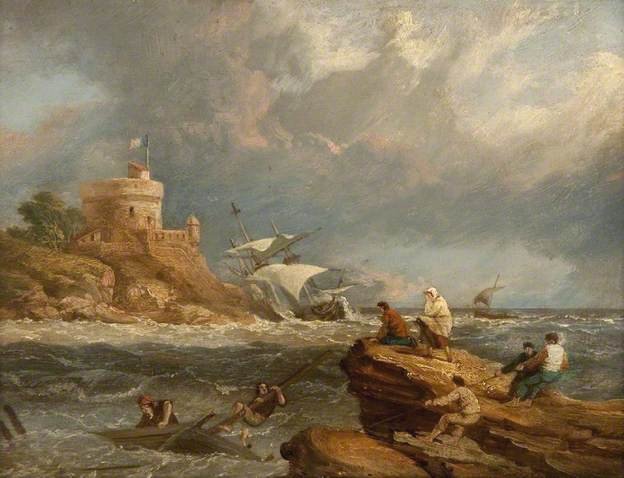
Rocky Seascape with Shipwreck by Clakson Frederick Stanfield

Rocky Seascape with Shipwreck by Clarkson Frederick Stanfield

In my last blog I featured a painting of a lighthouse by Edward Hopper and talked about how these structures over the years had helped seafarers find their way around coasts and enabled them to safely navigate treacherous waters.  However sadly for some they were not enough to prevent maritime disasters and all too often ships would, because of mechanical failure, horrendous weather conditions or human error, suffer the indignity of being grounded on rocks.  I remember all too well an Atlantic port we used to sail into, which had a very tricky entrance to it and was often pounded by the ferocious ocean waves.  As a stark reminder as to the care in which the entrance had to be approached there was an abandoned wreck of a ship on the sandbank at the mouth of the river entrance,  which did not quite make it and which was being gradually eaten away by sea and wind erosion.  I often thought, as I helped to steer the ship along the curving channel with a ferocious following sea lifting the ship’s stern in all directions, what must have been going through the minds of the people on the bridge of that abandoned ship that day, as they realised they were not going to make it safely into the tranquillity and safety of the harbour.  So today I have decided to feature a painting of a shipwreck by one of the great Victorian artists, Clarkson Frederick Stanfield.  Although there is a majestic beauty about this seascape, there is also a sense of sadness as I look at the plight of the sailors.

 The artist who painted today’s featured work is Clarkson Frederick Stanfield, who was born at the end of 1793 in Sunderland, England.   He was the youngest of five children.  His parents were James Field Stanfield and Mary Hoad.   His father was born in Dublin and initially trained for the priesthood in France, but abandoned his “calling” and returned to Liverpool and became a merchant seaman.  He sailed on a ship which was engaged in the slave trade and after his experience on the slave ship, which he described as “a floating dungeon”, he quit the life at sea, came ashore and became both an actor and playwright and an energetic supporter of the campaign to abolish the slave trade.   It is documented that he was the first ordinary seaman involved in the slave trade to write about its horrors.  In 1788 he wrote vividly describing his experiences on the voyage from Liverpool to Benin in West Africa and it was published as a series of letters addressed to Stanfield’s friend and a leading anti-slavery campaigner, the Reverend Thomas Clarkson.  It was from him that young Stanfield received his Christian name.  Clarkson Stanfield’s mother, Mary, who was both an actress and artist, taught painting and must have instilled the love of drawing into her son but sadly she died when he was just seven years old.  His father remarried to Maria Kell, a year later.

 In 1806, Clarkson Stanfield worked as an apprentice to a heraldic and coach painter in Edinburgh but left that employment two years later and, at the tender age of fifteen, decided to go off to sea and joined a small coal-carrying merchant vessel.  Four years later in 1812 he was press-ganged into the Royal Navy.  For some reason, during his stint in the navy he used the alias “Roderick Bland”.  Whilst in the Navy, Stanfield managed to keep his hand in artistically by painting theatre scenery for some naval productions as well as some painting and sketches.   In December 1814 he fell from the rigging of a naval vessel he was working on and had to be discharged from the Navy as being “unfit for duty”.    The following year he returned to sea on a merchant navy ship and sailed to China.  After returning home on leave, he had every intention of carrying on with his sea-going career but for some reason it never materialised.

 It was now 1816 and he found himself without a job and needing to earn some money and so he reverted back to his artistic work and managed to get employment at London’s Royalty theatre as a scene painter.  Soon after working in the theatre he met Mary Hutchinson whom he married in 1818 and the couple went on to have two children, a son, Clarkson William and a daughter, Mary Elizabeth.  Within a month of the birth of her daughter Mary Hutchinson died.   Clarkson Stanfield married again in 1824.  This time his wife was Rebecca Adcock and they went on to have ten children, eight sons and two daughters.  His second son from this marriage, George Clarkson Stanfield, was a pupil of his father, and painted the same type of subjects.

Clarkson Stanfield continued to work in various London and Edinburgh theatres and he gained a reputation as one of the finest scene painters in the land.   The Times reviewed his work in December 1827 stating:

  “…When our memory glances back a few years and we compare in “the mind’s eye”, the dingy, filthy scenery which was exhibited here – trees, like inverted mops, of a brick-dust hue – buildings generally at war with perspective – water as opaque as the surrounding rocks, and clouds not a bit more transparent – when we compare these things with what we now see, the alteration strikes us as nearly miraculous. This is mainly owing to Mr. Stanfield. To the effective execution of the duties belonging to the scenic department, he brought every necessary qualification – a knowledge of light and shade which enabled him to give to his scenes great transparency and a ready and judicious taste for composition, whether landscape, architecture or coast, but more especially for the last…”

 Despite most of his time being taken up working in the theatres he never gave up his painting of pictures.  He first exhibited some of his seascape work in 1820, and was immediately recognised as a marine painter of great promise.   When the Society of British Artists was founded in 1823, he was one of the founder members and later in 1829 became its President.  It was also in that year that he submitted his first painting to the Royal Academy, of which he was elected Associate of the Royal Academy and a Royal Academician in 1832 and 1835 respectively.  He loved to exhibit his work and, in all, he exhibited over a hundred works at the Royal Academy, and forty-nine at the British Institution from 1844 to 1867.

 In late 1834 he resigned as scene painter for Drury Lane and from then on devoted most of his time to his own paintings.   His output included works in both oil and watercolour and he specialised in shipping, coastal and river scenes.  Sadness struck the Clarkson household in 1838 when his eldest son from his second marriage, Harry, died just short of his twelfth birthday.  It was a terrible blow to Stanfield and many believe that his turning to the Roman Catholic religion was partly down to his search for solace and inner peace after his son’s death.    He made a number of European trips taking in Holland, France and Italy and while travelling, he would build up a large and extensive collection of sketches.  During this period, he completed many paintings depicting views of Venice and Dutch river scenes.

 During the last decade of his life he was beset with poor health. His rheumatism and bad leg often prevented him from going out of his house and the pain was so intense that for long periods he was unable to work.   He died in Hampstead, London in May 1867 aged 73.  One of his last visitors to call on him the day he died was his great friend Charles Dickens who he had met thirty years earlier.  After Clarkson Stanfield died, Dickens wrote of him, paying this glowing tribute:

 “…He was the soul of frankness, generosity and simplicity.  The most genial, the most affectionate, the most loving and the most lovable of men. Success had never for an instant spoiled him . . . He had been a sailor once; and all the best characteristics that are popularly attributed to sailors, being his, and being in him refined by the influence of his Art, formed a whole not likely to be often seen…”

The depth of friendship between Dickens and Stanfield can also be seen in a passage from a letter Dickens sent to Stanfield’s son, George shortly after his father’s death.  He wrote:

“…No one of your father’s friends can ever have loved him more dearly than I always did, or can have better known the worth of his noble character…”

The featured painting today is entitled Rocky Seascape with Shipwreck which is held at the Glasgow Museum.   In it we see dark storm clouds above the ferocious seas which are buffeting the large stricken sailing ship which has grounded on the rocks at the foot of a steep cliff, atop of which is a fort.  This structure could have been at the mouth of the river, which lead inland to the safety of a port.   A smaller sailing boat stands off from the stricken vessel,  probably trying to assist any sailors who are adrift in the choppy seas.  In the foreground we see two sailors desperately clinging on to what looks like the remnants of a sinking boat which may have once belonged to the large grounded vessel.  One of the sailors hangs on to the mast and is struggling to keep out of the water.   Three men perched on the rocks in the foreground are trying to pull this small boat towards them to give the unfortunate sailors a chance to leap onto the rock.  A woman also stands nervously on the rock, her hands covering her eyes, not daring to view the attempted rescue.  Maybe one of the men in peril is her husband or son.  A man kneels on the rock in front of her peering down at the stricken seaman, probably shouting words of encouragement.

The sea, in many ways, is something to fear and I have spent many times on ships which have been battered unmercifully by huge seas during ferocious storms and I end this blog with a quote from Joseph Conrad’s book The Mirror of the Sea in which he wrote:

“…The sea has never been friendly to man.  At most it has been the accomplice of human restlessness…”

Frigates by Johan Barthold Jongkind

Frigates by Johan Jongkind (1853)

My featured artist today is the nineteenth century Dutch painter and one who is considered to be the forerunner of Impressionism.  His name is Johan Barthold Jongkind.

Jongkind was born in 1819 in the small Dutch town of Lattrop in the Dutch province of Overijssel, close to the German border, although much of his early life was spent in the harbour town of Vlaardingen, which lies on the River Meuse, and where his father, Gerrit Adrianus Jonkind, was a local tax collector.  His father and mother, Wilhelmina, had ten children of which Johan was the eighth.  At the age of sixteen, once he had finished his education, he went to work as a junior clerk in a notary’s office.  A year later in 1836 his father died and Johan moved from Vlaardingen to The Hague where he enrolled at the Academy of Arts to study drawing under the tutelage of the director of Andreas Schelfhout, the Dutch Romantic painter, etcher and lithographer, who was renowned for his landscape works and who, by the end of his life, was looked upon as the leading Dutch landscape painter of the nineteenth century.

He spent almost nine years working at the Schelfhout’s studio training as a landscape painter and studying the great works of the Dutch Golden Age painters who plied their trade between the late sixteenth and mid to latter part of the seventeenth century, such as Jacob von Ruisdael, Meindert Hobbema and Aelbert Cuyp.  It was during this time that Jongkind developed the love of en plein air painting.  The early works of Jongkind depicted themes popular in the Netherlands at the time, harbour scenes with boats as well as canals , windmills and winter scenes featuring skaters on the frozen waterways.  His works grew in popularity and one of the admirers of his paintings was the leader of the French Romantic School, the landscape and seascape painter, Eugène Isabey.  Isabey had accompanied Alfred Emile de Nieuwkerke, who was the directeur des Beaux-Arts in Paris, to The Hague for the unveiling of the equestrian statue of William the Silent in front of the Paleis Noordeinde.  Isabey invites Jongkind to Paris to study in his studio and in 1846, with the financial support from the Prince of Orange, the young Dutch artist headed to the French capital where he remained for ten years.

Jongkind not only studied with Isabey but also with the French painter, François-Edouard Picot.   He also met many of the landscape painters of the Barbizon School with whom he often worked with and exhibited his works alongside theirs.  Despite his initial traditional training as a Dutch landscape artist, his painting technique evolved and soon his works took on a new range of colour and he became fascinated with the pictorial representation of light.  It was this interest in light which would become essential in the development of Impressionism.

When Jongkind had first arrived in Paris he discovered the river Seine and this became a new source of inspiration for his art. He also depicted many aspects of Paris life but preferred to concentrate on the industrial modernity and urban development of the capital rather than the touristy scenes of the crowded city.   His style is often likened to Naturalism, which is the representation of the world with a minimum of abstraction or stylistic distortion.  It is the depiction of realistic objects in a natural setting and is characterised by convincing effects of light and surface texture.

It was whilst in France that he fell in love with the Normandy and Brittany coast which he visited whilst on a painting and sketching trip with Isabey.  He would return to the area many times during his life and some of his best watercolour works incorporate the beautiful and strong lighting found along the Atlantic shoreline.  One of his great artistic successes came in 1850 when he exhibited his work View of Honfleur port at the Paris Salon exhibition.  It received great acclaim from the art critics.

For Jongkind, the streets of Paris were not paved with gold and he spent nine financially difficult years in Paris and had no choice but to live a bohemian existence. He had a number of his paintings rejected by the Salon jurists.  He put forward three of his paintings for inclusion at the 1855 World Exhibition but was disappointed at the lack of interest for his works.  He was now starting to feel dejected and depressed at the way his life was going.   In 1855 his mother died and the thirty-six year old artist returned to The Netherlands and set up home in Rotterdam and with this change of country came his change in painting style as he returned to a more traditional Dutch style of art which he had initially be trained in, during his early life.  Jongkind remained in Holland for five years but the sale of his paintings in his homeland were disappointing.   The only art he managed to sell was to a French art dealer and one of his first patrons, Pierre-Firmin Martin.   Martin’s gallery was on the rue Mogador and he routinely bought works from artists such as Jean-Baptiste-Camille Corot, Jean-FrançoisMillet, Theodore Rousseau, Constant Troyon, and Charles-François Daubigny.   Martin was such a great support figure for these artists that they called him Père or Father in English. Jongkind would send Père Martin a painting and in return he would receive a 100 franc note.  However Jongkind could not survive alone on this and as a result he found himself getting deeper and deeper in debt and so in 1860 he decided to return to Paris where he believed the sale of his works would improve and where his standing as a painter was much greater.  He said at the time:

“…It is Paris where I am recognized as a painter…”

However to return to Paris he needed money and he had none.  However through his Parisian friends led by Comte Doria and Père Martin they put on an auction of their works and managed to raise 6046 francs which was used to bring back their friend to Paris.

Jongkind settles down in Montparnasse in Paris.  His friendship with the art dealer Père Martin continued and it was whilst attending one of his dinners that Jongkind was introduced to Joséphine Fesser-Borrhee, a Dutch lady who taught art at a home for Parisian girls.   This lady who was to shape the rest of Jongkind’s life was an interesting character.  She like him, was born in 1819.   She had been abandoned by her parents and brought up in a children’s home. Although known as Marie Borrhée she would later take the name of Joséphine.    At the age of twenty she arrived in Paris, where she was taught to draw, and later she went on to teach in a home for young girls.   Having had a very difficult childhood she was ideally placed to understand the temperament of her troubled friend, Jongkind,  who in many ways was something of an orphan himself.  Jongkind had immediately taken to Joséphine and shortly after their first meeting at the house of Père Martin; he wrote her a letter in which he commented:

“…When I saw you arrive, it was as if my mother and father were coming to fetch me!…”

She was married to Alexander Fesser with whom she had a son, Jules.   It was the Fesser family and especially Joséphine, who through their kind hospitality and friendship, enabled Jongkind to recover both his physical and mental health  and in doing so had a great impact on the quality of his artistic work.  Jonkind and Fesser would travel around France but on many occasions he would return to Normandy.  It was here in 1862 he met Claude Monet.  Monet once described Jongkind’s and his works of art and chided him for his long-standing inability to master the French language saying:

“….a good-hearted, shy man who butchered French and whose art was too new and too artistic to be, in 1862, appreciated to its true value…”

For the next years, the influence of the Normandy coast showed through Jongkind’s abundant production of etchings and paintings. In Normandy, Jongkind became a close friend of Monet a mixed with the likes of Corot, Diaz, Boudin, Sisley and many of the other great artists who used to gather at the Farm Saint-Simeon run by Mère Toutain.

Joséphine Fesser was to become Jongkind’s guardian angel and companion for life and although she remained married to her husband Alexandre she became Jongkind’s mistress.   She was a very caring person and brought a soothing stability and balance to his life. The sale of his art works grew and Jongkind, reputation as an artist, gained in popularity. The number of his commissions increased and with the rise in his art sales his finances improved and with that came a sort of mental calmness, free from worry, and his personality blossomed.   Through Joséphine,  Jongkind had discovered the Dauphiné region of south-east France.  He soon got himself into an annual routine of spending the summer months there and returning to Paris in the winter months.

The first exhibition of the Impressionists in the studio of the photographer Nadar was held in 1874 and although asked to exhibit some of his works, Jongkind declined as by this time in his life, due to his poor health and intemperance he had given up submitting his paintings to major art exhibitions.  Joséphine’s husband died in 1875 and after his death, Madame Fesser remained with Jongkind in Paris. During the late 1870’s when Jongkind was in his fifties his health started to deteriorate and he spent more time in the warmer climes and fresher air of the Dauphiné.

From 1878 until his death in 1891 Jongkind and Joséphine Fesse live in la Côte-Saint-André near Grenoble.  During the last year of his life Jongkind was beset with mental problems, suffering from bouts of depression and paranoia which led him back to alcohol dependence. His mood swings caused by the excess consumption of alcohol led him to be banned from most of the cultural and social activities of the town.  He died in Saint-Rambert hospital close to Grenoble on February 9th 1891 aged 71.  Joséphine Fesser outlived him by just a few months. They are both buried in the small cemetery of La Côte-Saint-André, on the outskirts of the town.

My featured work today by Johan Jongkind is entitled Frigates.  In the painting we see a seaside port which is an idealised view made up of many sites, which was a technique often used by many Dutch landscape painters.   It was completed in 1853, just a couple of years before he left Paris to return to The Netherlands.  The painting highlights his great ability to depict atmosphere and light effects.  Look how well he has depicted the reflections of the ships in the rippling water of the harbour.  Art historians believed that it was Jongkind’s  mastery of light in his works that was to influence the likes of the young Impressionist painter Claude Monet.

The painting is normally housed in the Sterling and Francine Clark Art Institute in Williamstown, Massachusetts but is now part of the exhibition From Paris: a Taste for Impressionism, which is being held at the Royal Academy in London.   This wonderful exhibition of works by Monet, Manet, Sisley, Renoir and many others is on until September 23rd 2012

The Life Line by Winslow Homer

The Life Line by Winslow Homer (1884)

When I was flicking through my ever increasing number of art books and catalogues I came across a painting which immediately immersed me in a wave of nostalgia and reminded me of a time almost forty years ago.  I will tell you why at the end of this blog.  My featured artist today is one of the best loved American landscape and marine painter of the nineteenth century.  His name is Winslow Homer.

Winslow was born in Boston Massachusetts in 1836.  His mother, Henrietta Homer (née Benson) was a talented watercolour artist and acted as Winslow first art teacher. Both she and his father Charles Savage Homer hailed from New England.  Winslow had two brothers, one, two years older, Charles Savage Junior, and one, five years younger, Arthur.   He was brought up in an educated middle-class home by his parents in Cambridge Massachusetts.  By all accounts he led a very happy childhood walking in the countryside, fishing and playing with his brothers and his many cousins.  His father was quite a volatile man who changed jobs many times necessitating the uprooting of his family home on each occasion.  Although never a successful business man Winslow’s father, ever the optimist, always believed that things would soon come good and his fortune would be made.  It is therefore no surprise that when Winslow was just thirteen years of age his father gave up the family hardware business, left the family and joined the California Gold Rush.  Needless to say, all his dreams came to nought and after further spells in England and France in his futile attempt to gain some financial support for his money-making ideas he returned home to his family where he had to financially rely on his wife and family.

Winslow Homer graduated from high school and his father arranged for him to become an apprentice to J.H.Bufford a leading Boston commercial lithographic company.   Lithography was a very lucrative business at the time and was in great demand.   Winslow Homer not only learnt to draw but he developed a good business sense.  Although Winslow learnt all about lithography he found the work monotonous and wanted to concentrate on his real love – painting.  It could well have been his mother’s encouragement that finally turned him from being a journeyman illustrator to becoming “his own man” and so in 1857, on his twenty-first birthday, he left Buffords after being with them for two years. One thing his apprenticeship had taught him was that he wanted to be his own boss.  In Elizabeth Johns 2002 biography on Winslow Homer entitled, Winslow Homer, The Nature of Observation she quotes Homer’s comments regarding his days as an apprentice:

“…it was too fresh in my recollection to let me care to bind myself again.  From the time that I took my nose off that lithographic stone, I have had no master and never shall have any…”

Homer turned down the offer of employment from the magazine Harper’s Weekly but did work for them for a number of years on a freelance basis whilst continuing his career as a freelance illustrator.     He exhibited at the National Academy of Design from 1863 to 1866, and in 1867, and at the age of forty-one,  he embarked on a trip to Paris where he lived for a year and exhibited at the Exposition Universelle.  Whilst in the French capital he continued to supply Harper’s Weekly with scenes depicting Parisian life.  Despite the change in style of French art, Winslow Homer remained faithful to his love of paintings of peasant life and was a great admirer of Millet and his works of art.

Throughout the 1870s, Homer continued painting mostly rural or idyllic scenes of farm life, children playing, and young adults courting.   In 1875, Homer gave up working as a commercial illustrator and declared that he would continue to exist solely on the money he made from his paintings.   Homer started painting regularly with watercolours in 1873 whilst staying in Gloucester, Massachusetts.  From the beginning, his technique was natural, fluid and confident, demonstrating his innate talent for a difficult medium.    In 1877, Homer exhibited for the first time at the Boston Art Club with the oil painting, An Afternoon Sun, and from that first offering until 1909, the year before he died, he exhibited at the Boston Art Club on a regular basis.

Homer became a member of The Tile Club, which was a group of thirty-one notable New York painters, sculptors and architects who met between 1877 and 1887. The group was inspired by William Morris and the English Arts and Crafts movement and they created hand-painted ceramic tiles and promoted the decorative arts.  This group of artists and writers met frequently to exchange ideas and organize outings for painting, as well as foster the creation of decorative tiles. For a short time, Winslow Homer designed tiles for fireplaces.

Winslow Homer travelled to England in 1881 and settled in Cullercoats a Tyneside coastal village on the northeast coast.  Whilst there, he completed many paintings depicting the lives of working men and women.  His works often depicted the ferocity and relentless power of the sea and the men and women who braved those unforgiving elements of nature.  It was whilst staying at Cullercoats that on October 21st 1881 he witnessed the sinking off Tynemouth of the vessel, Iron Crown,  and the daring rescue of its crew by the local life saving society and it is from that memory, which is captured in Winslow’s painting, The Life Line.  The wreck of the Iron Crown at Cullercoats involved the volunteer Life Brigade who managed to rescue four of the crew using a rocket and breeches buoy. The local artist George Edward Horton, a member of the Bewick Club and the Cullercoats Colony of artists later recalled his first encounter with Wilmslow Homer:

“…As I stood watching the rescue operations a little cab turned up with an old Cullercoats fisherman on the dicky: out stepped a dapper medium sized man with a watercolour sketching block and sat down on the ways. He made a powerful drawing with some watercolour and some pastel….”

During the night of the disaster, Winslow Homer made sketches as he stood on the beach.  Immediately following the incident he painted an austere and dramatic canvas in oils depicting sailors huddled against the sea wall as they waited to find out the fate of their companions who were still in the raging seas.  Early during the rescue of the Iron Crown the life savers used a contraption known as a breeches-buoy to reach the stricken sailors.  Two years later in 1883,  when Homer was back in America at Atlantic City on the New Jersey coast, he went to talk to the local life-saving crews and asked them about this breeches-buoy device and watched a demonstration of the use of it for rescue from the sea.  With what he had seen with his own eyes two years earlier and what he had subsequently learnt when he got back home, he painted his large, impressive, and immediately popular painting The Life Line in 1884, which was just one of several paintings he completed at this time on the rescue theme.

The Life Line does not depict a specific rescue but it was intended as a general representation of the distress and heroism that were inexorable aspects of life by and on the high seas.  This work of art by Winslow Homer is all about the age-old themes of peril at sea and the power of nature, but at the same time honours modern heroism and yet at the same time encompasses the thrill of unexpected intimacy between strangers, in this case, the male rescuer and the female who is being saved, and who are being thrown together by the catastrophe.

Look carefully at the painting and what often strikes the viewer on their initial perusal of the scene is the fact that the face of the male rescuer is obliterated by the lady’s red scarf.  How strange is that?  Homer did this as he believed nothing should distract the viewer from the whole image – the actual rescue.  It was Homer’s belief that the intensity of the painting would be increased if we just focused our attention on the physical strength and brute force of the rescuer as he holds on tightly to the woman inching his way back to the shore.  The two dangle in the breeches-buoy in the trough between mountainous waves.  The woman being rescued lies unconsciously in his grasp.  Her head is thrown back.  Her arms lie limply by her side.  Her clothes have been drenched and torn by the ferocity of the sea.  She lies there in the man’s arms having been rescued from the ship, which we just catch a glimpse of with its tattered sails in the top left of the painting.

This is truly a terrifying depiction of a rescue at sea.  When Winslow Homer’s The Life Line was first exhibited at the National Academy of Design in New York in 1884 it became an instant sensation.   Some critics, at the time of the painting being exhibited, commented on its powerful sensuality.  For them the depiction of the man and the woman in the painting, had it not been part of a life and death situation, may well have been lovers locked in an intimate embrace.  The sensuousness and sexuality of the image exhibits itself in the wet clothes clinging to the woman’s flesh with their drenched bodies clutched tightly together.  Some were shocked by Homer’s exposing of the woman’s bare knees!!!  Homer’s composition propels us into the midst of the action with colossal waves rolling past, drenching the semiconscious woman and her anonymous saviour. Homer’s painting, The Life Line was immediately recognized by critics as a major contribution to American art, portraying a heroic, contemporary subject with both painterly virtuosity and detailed observation.

This masterpiece by Winslow Homer can be found at the Philadelphia Museum of Art and will feature in their upcoming exhibition entitled Shipwreck! Winslow Homer and “The Life Line” which runs from September 22nd to December 16th 2012.

Finally I have to tell you why this painting brought on a wave of nostalgia for a time forty years earlier.  It was in the early 70’s that I sat the first of my nautical exams and at the oral part of it I was asked by the examiner to describe how, if I was on a sinking ship, would I rig a breeches-buoy.  Thankfully I never had to put the theory into practice!

Calais Pier by Joseph Mallord William Turner

Calais Pier by Turner (1803)

I am fast approaching my 300th edition of this blog and many of you may think it strange that in all that time I have never featured an artist much loved by many, Joseph Mallord William Turner.  In some ways, of course, it is an omission but I have to be honest and state that Turner is not one of my favourite artists.  Yes, I am aware that statement is artistic anathema and pictorially sacrilegious but everybody’s likes and dislikes are different.  I am a person who loves detail and clarity in a painting and the haziness” of a lot of Turner’s painting is just not for me.  I was at a local gallery the other day and when asked which was my favourite painting on display, I pointed to a mountain scene and the person who asked me to decide commented that it was too much like a photograph for his liking.  There lies my dilemma.  I don’t want a framed photograph on my wall but I do want clarity of detail.  I am happy with an idealised landscape.  I just want to study the intricate details of the artist’s work.

Less about my likes and dislikes and on to today’s offering which is one of Turner’s paintings, which is without the haziness that I dislike.  It is entitled Calais Pier and was completed by Turner in 1803 and is in the safe keeping of the National Gallery in London.  I touched briefly on Turner’s life a few days ago when I featured the artist Thomas Girtin, a friend and contemporary of Turner.  I know many books have been written about Turner’s life but let me briefly go through the life of today’s artist

Turner was born in 1775 in Covent Garden, London.  His father, William Gay Turner was a wig maker and when they became unfashionable he became a barber.  His mother was Mary Mallord Marshall.  His mother and father had married in 1773 and a year after Turner was born his mother gave birth to his sister, Mary Ann.  Sadly and with devastating consequences she died in 1786, at the age of eight.  Her death virtually destroyed her mother who became mentally unstable and eventually in 1799 she was committed to the Bethlem Royal Hospital Mental Hospital (Bedlam) where she died in 1804.

Because of his mother’s mental problems, and the problems arising from her condition, the young Turner left home for about a year and went to live in Brentford with his mother’s brother, Joseph William Mallord Marshal.  Whilst living with his uncle’s family he attended the John White’s School.  It was during the time when he was being brought up by his uncle’s family that Turner started to show an interest in art.    For holidays he would often be taken to Margate and it was around this time, 1786, that eleven year old Turner first signed and dated his drawings of the seaside town and the surrounding areas.    These early drawings of his were often proudly displayed by his father in his shop window.   After early schooling, Turner, aged fourteen, was accepted as a student at the Plaister Academy of the Royal Academy of Art schools in 1789 where he studied for exams which would afford him membership of the Royal Academy itself.  After just one year, when he was fifteen he was accepted into the Royal Academy, which at the time was headed by Sir Joshua Reynolds, the great English painter, and who was on the selection panel of the artistic establishment.  Turner went on to have his first painting, a watercolour entitled The Archbishop’s Palace, Lambeth,  accepted into the Academy’s Summer Exhibition in 1790 and six years later he had his first oil painting entitled Fisherman at Sea  shown at the exhibition.  Turner exhibited some of his work at almost every subsequent Royal Academy Summer Exhibitions for the rest of his life.

After leaving the Royal Academy Schools, Turner embarked on many European journeys, visiting Paris where he studied in the Louvre, visiting Switzerland and Italy where he spent some time in Venice.  He also often travelled around Britain with his friend and fellow artist, Thomas Girtin.  During one of his British journeys when he was twenty-two, he visited Otley, Yorkshire and met and became great friends with Walter Fawkes, a wealthy landowner and Member of Parliament, who was to become one of Turner’s patrons and who commissioned many works from the artist.

Although Turner never married, he did have two children by his mistress Sarah Danby whom he met in 1799.  Sarah, a widow nine years his senior, gave birth to two of his children, Evelina in 1801 and Georgiana in 1811.  Art historians would have us believe that Turner over time became very eccentric and only had a handful of close friends.  However, he was always close to his father and for thirty years his father lived with Turner.  His father died in 1829 and this devastated and depressed the artist.  Not only had his father been supportive of him he would often act as his studio assistant.

In 1833, on one of his journeys back to Margate, Turner met Sophie Caroline Booth who had been recently widowed and lived in the town.  They became lovers and in the 1840’s she bought herself a small cottage in Chelsea and Turner went to live with her.  He was to remain with her until his death at the house of his lover in December 1851.   He was buried in St Paul’s Cathedral and lies next to Sir Joshua Reynolds.

I chose the featured painting today, Calais Pier as I have been associated with the sea and ships almost all my life and I am only too aware of the ferocity of the seas around the British and Channel coasts and so in some way it was a return to my seafaring past when I was in ships and had to watch helplessly when my ship battled against the ferocity of a storm and the mountainous seas which the winds had whipped up.  This painting by Turner is based on his own experience of rough weather during his first ferry crossing to France in 1802 at which time he made many sketches of the crossing from Dover to Calais.  We need to remember that in those days there was no such thing as weather forecasts and so vessels would put to see and were at the mercy of the weather.

We have before us a sombre scene of vessels being wildly buffeted by the gale-force wind and giant waves.  In the centre of the work with the dark sails we see the Dover-Calais ferry crammed full of people.  The English flag flutters wildly at the top of the mast.  Next to it, with the white sail, is a French fishing boat which looks to be perilously close to the English ferry.  The sails and the deck of this vessel are spectacularly lit up by a shaft of sunlight which has managed to penetrate the black storm clouds.  Pulling away from the quay and heading into the rough seas, we see another small boat with its fishermen.  One of its crew can be seen remonstrating wildly towards the other fishing boat, maybe to alert them to the dangers of colliding with the ferry.  It seems a foolhardy act for the men to set sail in the little boat considering the ferocity of the storm or risk being crushed by the waves against the pier itself.  It is almost as if maybe the storm has taken everybody by surprise.  On the pier we see people trying to carry on as normal.  Women wearing local hats and wearing wooden clogs gather the morning catch of what looks like skate and set about gutting the fish.

This is wonderfully dramatic painting and whereas we are use to being able to see and hear the rough seas and the sound of violent storm on television, in the days of Turner it was just the magic of the artist who could bring such things to the attention of people.  Turner has magically given us an insight into the happenings during a storm at sea.  We can almost hear the people shouting to be heard.  We see the wild billowing of the ships’ sails and see and sense the sound of the crashing of the waves against the pier.  We almost feel that we are there on the Calais Pier.

Turner exhibited the painting at the Royal Academy in 1803 but like many of his works it was not well received.  Many thought it was an unfinished work especially the foreground.