Isabella by John Everett Millais

Lorenzo and Isabella by John Everett Millais (1849)

My favourite Pre-Raphaelite artist is, without doubt, John Everett Millais and I have featured a number of his paintings in previous blogs.  As you know, as I have mentioned it before, I like paintings with a story behind what is depicted by the artist and so merging my two favourite aspects of art I am delighted to present you with Millais’ painting entitled Isabella, also sometimes referred to as Lorenzo and Isabella or The Pot of Basil.  Some of you may know the story and poem behind this early work of art by the Pre-Raphaelite painter but for those who do not, let me lead you through the background of this work and to the medieval allegorical tale, Decameron, written around 1352 by Giovanni Boccaccio.   The word Decameron comes from the combination of two Greek words; déka meaning ‘ten’ and hēméra  meaning ‘days’ and thus decameron means ‘ten day event’.

The Decameron is set in Italy around the 1350’s at the time of the Black Death.  It tells of a group of ten people, seven young women and three young men who escape from the plague-ridden town of Florence and head into the hills of Fiesole and a deserted villa where they stay for a fortnight.  In order to while away the evenings, each one of the group had to tell a story on each night for ten days.  No story would be told on the one day set aside for the chores around the villa nor would a story be narrated on the holy days and thus in all ten stories would be told on the ten evenings making a total of 100 tales.  The stories are sometimes of a bawdy nature and range from the erotic to the tragic.   Each of the ten young people is made King or Queen of the company for one of the ten days in turn. This gives him or her, the right to choose a theme and a topic for the ten stories that day.

The painting I am featuring today is based on a story told by one of the young women, Filomena, on the fourth day and that days theme for all the stories was that they mus be tales of love that ends tragically.  She tells the story of Lisabetta and her three brothers who live a very rich life togetherthanks to the wealth they have inherited after the death of their father.  She has fallen in love with their manager Lorenzo and it was not long before they became lovers.  Her affair with Lorenzo was kept a secret from her brothers but, unbeknown to her, her eldest brother saw his sister sneak into Lorenzo’s bedchamber.  He was horrified as it was he and his brothers’ plan to marry her off to a wealthy nobleman and increase their own wealth.   He informed his brothers as to what he had witnessed and they hatched a plot to kill Lorenzo.  Days passed without incident until one day the brothers asked Lorenzo to accompany them on a trip, during which they murdered him and buried his body.  On returning home they told their sister that Lorenzo had been sent away on business.  A long time passes without any sign of Lorenzo and Lisabetta is heartbroken.  One night Lorenzo appears to her in a dream and shows her where he is buried. She goes there and disinters the body and brings away his head.  She takes the severed head wraps it in a fine napkin and buries it into a flower pot over which she plants basil, and other sweet herbs.  Each day she sheds tears over the pot which nourish the herbs.  Eventually the brothers get to hear about this pot of herbs, take it from her and discover the head of Lorenzo, which they re-bury.  Isabella is once again heartbroken, grows weak from sorrow and eventually dies of grief.

A narrative poem by John Keats, entitled, Isabella or the Pot of Basil, written in 1818, is adapted from this story in which the girl is  not now Lisabetta but Isabella.  When the painting was exhibited at the Royal Academy in 1849 the following stanzas from Keats’ poem was included in the catalogue:

Fair Isabel, poor simple Isabel!
Lorenzo, a young palmer in Love’s eye!
They could not in the self-same mansion dwell
Without some stir of heart, some malady;
They could not sit at meals but feel how well
It soothed each to be the other by.
These brethren having found by many signs
What love Lorenzo for their sister had,
And how she lov’d him too, each unconfines
His bitter thoughts to other, well nigh mad
That he, the servant of their trade designs
Should in their sister’s love be blithe and glad
When ’twas their plan to coax her by degrees
To some high noble and his olive trees.

To read the poem in full go to: http://www.bartleby.com/126/38.html

I stood before this painting a week ago when I visited the Walker Art Gallery in Liverpool and one could not help but be moved by this beautiful work of art.  The Pre-Raphaelite brotherhood members were fascinated by the poetry of Keats and Holman Hunt and Dante Rossetti intended to produce a series of etchings for book illustrations of Keats’s ‘Isabella’.   John Millais worked up his drawings into this large painting which he completed in 1849.  This was his first major painting and what is more remarkable is that he was only nineteen years of age.

The doomed lovers

The setting for the painting is a meal table around which sat a number of people including the three brothers, Isabella and Lorenzo.  The brothers have just found out about their sister’s affair with Lorenzo but have said nothing to her although they are already formulating a plan in their minds as to how to kill Lorenzo.  Isabella, wearing grey, sits at the right and is being handed a blood orange on a plate by her doomed lover, Lorenzo.   A cut blood orange is symbolic of the neck of someone who has just been decapitated and this alludes to the time in the future when Isabella will cut off the dead Lorenzo’s head after finding him buried. The sedate portrayal of mealtime is broken as we see Isabella’s eldest brother, hunched over, rocking forward on his chair as he furiously kicks out at a frightened dog while cracking a nut. His face is contorted in anger as he lashes out at the helpless animal.  Next to him sit his two brothers.  Their demeanour is much calmer and there is certain smugness about their expressions for they are aware of their brother’s plan to kill Lorenzo.  Observe the brother who holds up his glass of wine.  Observe how he is slyly and surreptitiously glancing at Lorenzo and Isabella.  He can see the look of desire in Lorenzo’s eyes as he studies his lover who has demurely avoided his penetrating gaze.

Millais has exaggerated the intensity of the painting by juxtaposing colours and tones.  Look at how Millais has contrasted the white towel draped over the arm of the servant, standing on the far right of the picture, with his black tunic.  The legs of this servant adorned in yellow stockings almost merges with the background colour of the floor and the marble base of the balustrade.

What I like about the work is how Millais has made each one of the diners different and each having very distinctive characteristics.  Common among Pre-Raphaelite works is Millais attention to detail.  Look at the plates on the table.  Each has an exquisite pattern.    Another distinctive Pre-Raphaelite feature is the inclusion of images and patterns within the image as a whole. Each of the majolica plates has a distorted picture glazed into its surface. Look too at the bench seat Isabella is sitting on.  See how Millais has gone to pains to depict the seat. The base of the bench on which Isabella sits contains an intricate carving depicting a kneeling figure, below which we see the letters PRB, which stand for Pre-Raphaelite Brotherhood.

Sketch of Dante Rossetti for the Lorenzo and Isabella painting (courtesy of George Landow)

The people sitting around the table were modelled by Millais’ friends.  The wife of his half-brother was the model for Isabella.   William Rossetti, Dante Rossetti’s brother, was Lorenzo, who sits next to Isabella; Dante Rossetti is the model for the man at the far end of the table on the right with a wine glass held to his mouth.    The older man on the right-hand side of the table dabbing his mouth with a serviette is none other than John William Millais, the artist’s father.   Walter Deverell, a fellow artist and student of Dante Rossetti and Frederic Stephens, an art critic, and one of the two ‘non-artistic’ members of the Pre-Raphaelite Brotherhood sat for the other two brothers who sit on the left hand side of the table.  Amusingly, the brother who kicks out at the dog is painted from memory of a John Harris, a person who had bullied John Millais when they were together at the Royal Academy Schools.

Millais has symbolised Lorenzo and Isabella’s love for each other by including a depiction of the white rose and passion flower entwined in the arch above their heads, and also by them sharing a blood orange.  We see the dog with its head on Isabella’s lap which is a sign of Lorenzo’s devotion for her and of course the fact that her brother aims a kick at the dog symbolises his feeling for Lorenzo.  In this painting we have no doubt that death will soon follow and of course we know it will be the death of Lorenzo.  Millais has included some symbols of death in the painting, for instance the brother holding up his glass of blood-red wine as he contemplates the end of Lorenzo.  Other symbols of death are the hawk, which perches on the back of an empty chair, pecking at a white feather which is a symbol of peace.  We see below the arm of the nearest brother a salt cellar lying on its side with the salt, which is considered a symbol of life, scattered on the tablecloth.  This spilt salt symbolises the spilt blood which will soon occur when the brothers kill Lorenzo.  Note how the salt is covered by the shadow of the brother’s forearm, thus implicating him in the heinous crime which is soon to happen.  Look at the right background and on the top of the balustrade we see a large pot containing basil and this may be the one in which Isabella will place Lorenzo’s severed head.   When you stand close up to the actual painting you can just make out designs on the majolica plates on the table.  On one there is the scene of David beheading Goliath whilst another shows Prometheus having his entrails pecked out by an eagle.  All of which is a reminder of the violence that is soon to follow.

The picture was sold to a tailor for £150 and a new suit.

Home from the Sea by Arthur Hughes

Home from the Sea by Arthur Hughes (1862)

For my work of art today, I am crossing the Channel from France and featuring an English Victorian artist who was associated with the Pre-Raphaelite Brotherhood.  His name is Arthur Hughes and he was born in London in 1832, the son of Edward and Amy Hughes.  When he was six years of age he attended the Archbishop Tenison’s Grammar School and it was here that he showed the first signs of his artistic talent.  In 1846, aged fourteen he enrolled in the School of Design at Somerset House where he studied under Alfred Stevens.  From there he enrolled in the Antique Schools at the Royal Academy and whilst a student there won a silver medal for a “Drawing from an Antique” competition.  In 1850 he exhibited his first work entitled Musidora, at the Royal Academy.  It was also in this year that he first encountered Alexander Munro, Ford Madox Brown and Dante Rossetti, all artists of the Pre-Raphaelite Brotherhood.  Hughes was soon converted to Pre-Raphaelitism adopting many of their ideas in his own work.  Hughes was also greatly influenced by the works of John Everett Millais although he never met him until two years later, in 1852, when they were both exhibiting paintings at the Academy with the same title, Ophelia !  The year 1850 was to prove a very significant year for Arthur Hughes for another reason – he met and fell in love with a woman, Tryphena Foord and eventually in 1855 they married.  It was a very long courtship period of over five years between their first meeting to their nuptials.  During this time Hughes completed many paintings which were both romantic but wistful, both sad but tender and the tone of these works could well have been as a result of his long wait to get married.  Tryphena was the model for many of his  paintings.  The couple had a long and happy life together and went on to have six children, two of whom are present in today’s featured work.  Many of his pictures were of ordinary scenes of life. They were painted with great delicacy and feeling and were often in greens and mauves.

In 1857 he joined in on a joint commission with Edward Burne-Jones, Rossetti, William Morris and others to paint murals on the walls of the Oxford Union Debating Hall which is now the Library.  It was this commission that influenced much of Hughes’ later works and can be seen by the way he softened his colours and added a mystical overtone similar to that seen in the works of Dante Rossetti.   Many of his subsequent works featured Arthurian legends and religious themes.  Besides his time spent on his paintings he also worked on book illustrations for many writers and poets including Keats, Tennyson, Christina Rossetti and Thomas Hughes whose  famous book was Tom Brown’s School Days.  Arthur Hughes was one of the leading illustrators of his time.  He also worked as an art examiner in London and later taught art at the Working Men’s College

He died in London in December 1915, almost a recluse.  During his lifetime he produced over seven hundred paintings and drawings and almost eight hundred book illustrations.  Friends of his would tell you that his main attributes were his modesty and self-effacement.  Like all of us, he had many disappointing times during his life.  He suffered a number of ill-merited rejections at the Royal Academy and despite all his artistic accomplishments, he was disappointed to never having been elected an Associate of the Royal Academy.  He is now regarded as being the best of the younger Pre-Raphaelite followers.

Study for A Mother's Grave by Arthur Hughes

My featured painting today is a very poignant one and is entitled Home from the Sea which he finally completed in 1862 and exhibited at the Academy the following year.  He actually started it six years earlier and the original title of the painting when first exhibited in 1857 was  A Mother’s Grave.   It is known, because of the existence of a study for the original work,  that in the original painting there was just the figure of the boy kneeling over his mother’s grave.   However, there was much criticism over the way Hughes had painted the boy and so he re-worked the painting, adding the figure of the girl.

The painting is set in the graveyard of the Old Chingford Church, Essex.  In the background we see the white walls of the church reflecting the brightness of the sun.  It is not however the church that our eyes immediately focus on but the figures in the foreground which are in shadow.  Before us we have a young sailor boy who has just returned home from a voyage at sea only to find out that his mother has died whilst he was away.  His hat and belongings, wrapped in a knapsack lie abandoned on the ground.  Kneeling besides him we see a girl, possibly his sister, also mourning the death of their mother.

The depiction of the girl was posed for by his daughter Tryphena.   She wears a  black funerary outfit.  Her facial expression is one of pain over her loss.  She kneels on the ground with her hands folded in front of her.  Her eyes are downcast and in some ways her mourning is both constrained  and controlled, possibly because she did not want to further add to the sadness of the boy who has prostrated himself on the ground.

We cannot see the facial expression of the young sailor boy who is still in his uniform. However, we see his hands are clasped in prayer as he prays for the soul of his mother.  This is not just a story of a boy’s loss of a parent but there are things in the painting which symbolise the transience of life and all things ephemeral, like the dog roses and the dandelion seeds as well as the spiders web which is wet with dew, and which can be seen in the tree branches above the girl’s head.  The sense of loss is also highlighted again by Hughes for if we look towards the church in the background we see a ewe searching desperately for her lamb which is hidden from her view by a tombstone.

The painting was exhibited at the Royal Academy in 1863 with the present title of Home from the Sea.  One cannot but be moved by this churchyard scene full of pathos as we empathize with the children’s suffering at their loss.

The painting itself, as well as the preliminary study, can be found at the Ashmolean Museum, Oxford.

The Irish Girl and The English Boy by Ford Madox Brown

Manchester Art Gallery exhibition

The other day I went to Manchester to see the Ford Madox Brown exhibition at the Manchester Art Gallery.  The exhibition opened on September 24th and runs until January 29th 2012 and I strongly recommend you make the effort to visit the city and take in this superb show which displays 140 public and private works from this talented 19th century painter.  I have already  featured two of Ford Madox Brown’s paintings, The Last of England (June 15th) and Manfred on the Jungfrau (July 21st), the former I saw when I visited the Birmingham Art Gallery and the latter which I had hoped to view when I went to Manchester a few months ago had been withdrawn from the gallery for some restoration work prior to this new exhibition.   Both of these works are on show at the current Manchester Exhibition.

I will, in the coming months, review more of Ford Madox Brown’s works,  which I saw at the exhibition, but I need to space them out a little otherwise I will be accused of featuring one artist too often.

Like most people, I had seen many of Ford Madox Brown’s paintings before, in books or on the internet, but what I had not realized was that he had completed many portraits of which a number were on display at the exhibition.  However, there is nothing more true than the saying “you cannot please all the people all the time” for as I researched today’s blog and was still buoyed up with my admiration for Brown’s portraits,  I came across the Daily Telegraph’s art critic’s, Alastair Smart, view of the exhibition and his assessment of some of the paintings, especially his portraiture.  He wrote:

“…Despite the show’s claims to the contrary, Brown’s portraits and biblical dramas aren’t up to much either: his figures are just too awkward in facial gesture, one toothy contortion after another…”

How disappointing to read that when I was still so enthused with what I had seen.  I loved his small portraits.  I did get some consolation however when I re-read the opening line of his article which stated quite bluntly:

“….First, a confession: I utterly loathe the Pre-Raphaelites. Oh, what a mawkish, melodramatic and clichéd bunch…”

The journalist did however go on to qualify his bold statement by saying that he realized Ford Madox Brown was not a member of the Pre-Raphaelite Brotherhood but countered that by telling us that he did have a close association with the three founder members.  Guilty by association ?  Having said all that I will not be deflected from my proposed look at two of Brown’s small portraits, which I loved, even if the knowledgeable art critic disliked them. 

The Irish Girl by Ford Madox Brown (1860)

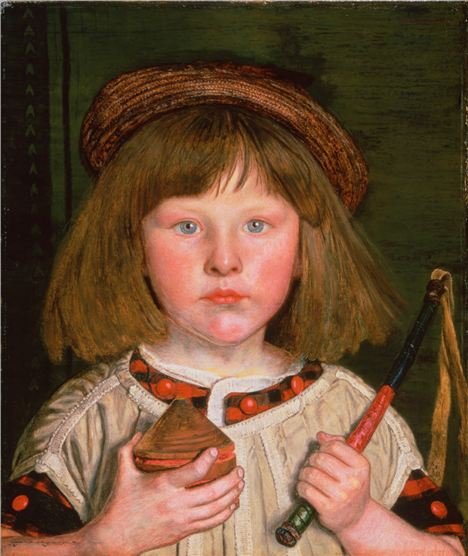
For My Daily Art Display today I am featuring two portraits, The Irish Girl and The English Boy as they were hung next to each other at the exhibition and in some ways they are connected.  It was the coming together of these “two old friends”, who were separated forty-seven years ago.  The man, who commissioned the paintings, was a Leeds stockbroker called Thomas Edward Plint, who was a patron of Ford Madox Brown, and an important Pre Raphaelite art collector.  In 1850, he had commissioned Brown to paint Work, and out of that commission came the painting, The Irish Girl, which also happens to be featured on all the exhibition publicity material.  To my mind this is a beautiful and haunting painting.  This small (almost 28cms square) oil on canvas work was completed by Brown in 1860 and is normally to be found exhibited at the Yale Centre of British Art.  The Yale Center for British Art, which is in New Haven, Connecticut, is a public art museum and research institute for the study of British art and culture. It was presented to Yale University by Paul Mellon who was in the Class of 1929 at Yale.  The Centre houses the largest collection of British art outside the United Kingdom.

In comparison to the portrait of the young English boy the young girl looks slightly nervous and somewhat troubled.  She has real beauty.  There is nothing idealized about this portrait.  Her haunting loveliness is plain to see and yet the difference between her and the English boy could not be starker.  Unlike the boy, she looks worldly–wise.  Her jet black hair, her dazzling brown eyes and her painted red lips are all part of her exquisiteness.   She has tilted her head a little to one side and her eyes focus on something off to the side.  When Ford Madox Brown was looking for Irish models for his painting Work he came across this young girl selling oranges and couldn’t pass up the opportunity to paint her portrait.   We see the fingers of her hand appearing from inside her red paisley shawl which is tightly wrapped around her and the colour of which complements the colour of her lips.  Between her fingers, she is gently holding a sprig of cornflowers. 

The English Boy by Ford Madox Brown (1860)

The portrait which hung next to the Irish Girl was entitled The English Boy and was the companion piece to the Irish Girl.  In this case the young child depicted was no stranger to Brown.  It was his five year old son, Oliver, and this too was painted in 1860.  It is slightly larger than the Irish Girl, measuring 39cms x 33cms.  This portrait is owned by the Manchester Art Gallery, which acquired it in 1932.  Although a companion piece to the Irish Girl they couldn’t be more different.  In this portrait,  the young child stares straight at us with a self-assured gaze.   It is a deadpan expression and we wonder what is going through his mind.   His cheeks are slightly flushed and this colouring in some way matches the red shawl and lips of the Irish Girl.   He wears a white smock over a red checked dress and on top of his head, sitting at a slightly jaunty angle, is a brown straw hat.  In his hands he clutches on tightly to the popular child’s toys of the time, a top and whip.  The way in which he holds the toys in some way reminds us of royal paintings where the subject holds a sceptre and orb.

Despite what our knowledgeable journalist would have us believe I don’t find these portraits in any way awkward in facial gesture.  I find them to be simply fascinating studies of two young children.

The Annunciation by Dante Gabriel Rossetti

The Annunciation by Rossetti (1850)

My Daily Art Display today is, like my last offering, another painting depicting a scene from the Bible.   The scene is The Annunciation and has featured in paintings by many of the Renaissance Masters.  However this painting by the Pre-Raphaelite artist Dante Rossetti has some subtle differences from these earlier works by the likes of Fra Angelico, Raphaello Santi, El Greco, van Eyck and Botticelli.

The story of the Annunciation is probably known by most and it is documented in the bible in the book of Luke (1: 26-38)

26 In the sixth month of Elizabeth’s pregnancy, God sent the angel Gabriel to Nazareth, a town in Galilee, 27 to a virgin pledged to be married to a man named Joseph, a descendant of David. The virgin’s name was Mary. 28 The angel went to her and said, “Greetings, you who are highly favoured! The Lord is with you.”

29 Mary was greatly troubled at his words and wondered what kind of greeting this might be. 30 But the angel said to her, “Do not be afraid, Mary; you have found favour with God. 31 You will conceive and give birth to a son, and you are to call him Jesus. 32 He will be great and will be called the Son of the Most High. The Lord God will give him the throne of his father David, 33 and he will reign over Jacob’s descendants forever; his kingdom will never end.”

34 “How will this be,” Mary asked the angel, “since I am a virgin?”

35 The angel answered, “The Holy Spirit will come on you, and the power of the Most High will overshadow you. So the holy one to be born will be called[a] the Son of God. 36 Even Elizabeth your relative is going to have a child in her old age, and she who was said to be unable to conceive is in her sixth month. 37 For no word from God will ever fail.”

38 “I am the Lord’s servant,” Mary answered. “May your word to me be fulfilled.” Then the angel left her.

The painting I am featuring today is entitled The Annunciation which Rossetti painted in 1850.  That was not its original title given to it by the artist, Gabriel Rossetti.  He had originally decided to call the painting Ecce Ancilla Domini meaning “behold the handmaid of the Lord” but at the last moment changed his mind.  In the painting, Rossetti has just used the three primary colours, red, blue and yellow along with white.  The use of these colours by the artist is symbolic.  We have white for feminine purity, blue for the Virgin Mary, red for the Passion of Christ and yellow or gold which symbolises holiness.   There are other things in the painting which are symbolic.   The Angel Gabriel holds a lily and in the foreground we see a red cloth on to which we can see that Mary has embroidered white lilies.  Maybe this signifies the young girl’s decision to live a very pure life.

The Girlhood of Mary Virgin by Rossetti (1849)

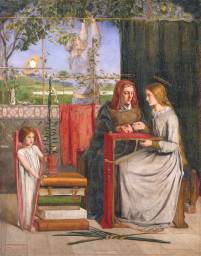
Mary and her mother, St Anne, can be seen embroidering that very cloth in Rossetti’s painting The Girlhood of Mary Virgin which he painted a year earlier.   Lilies symbolize purity, chastity, and innocence and white lilies represent the purity of the Virgin Mary.  In most paintings of the Annunciation we see the Angel Gabriel presenting Mary with a white lily when he announced to her that she would give birth to the Son of God.

The setting Rossetti has given this scene is very unusual.  In Renaissance paintings of The Annunciation we look at settings which are sumptuous.  Tapestries and heavy velvet curtains often abound.  Light frequently can be seen entering the scene through exquisite stained glass windows lighting up elaborate furnishings and floor coverings.  Rossetti chose not to go down that line.  As we look upon the scene the first thing that strikes us is the claustrophobic compactness of Mary’s room.  It could almost be termed minimalistic in its accoutrements.  Look at the window opening on the back wall.  There was no attempt by Rossetti to give a feeling of depth to this painting by depicting a town somewhere in the far distance.  The window opening is plain and uncovered and through it we just see part of a solitary tree against a blue sky, the colour of which mirrors that of the colour of the screen at the end of Mary’s bed.

In most depictions of this scene we see Mary dressed in blue robes quietly and in some cases joyously receiving the news that she will give birth to the Christ child.  However Rossetti has depicted Mary’s mood differently.  We see Mary dressed in a white shift dress shrinking back from the Angel Gabriel.  Rossetti has added the colour blue which is associated with the Virgin Mary in the form of a blue cloth screen hanging behind her.

Rossetti has also included a dove which embodies the Holy Spirit.  He has depicted the golden-haired Angel Gabriel without wings, which was the norm for Annunciation paintings.  Gabriel’s face is in shade and his facial features are almost hidden from us.    He can be seen in this painting hovering just above the floor with flames all around his feet.  I wonder if I am just imagining it but it looks as if he is pointing the lily stem at Mary’s womb.  It is little wonder that the combination of his words and this action make the young girl almost cower and recoil against her bedroom wall.

Take a while and look at Mary’s expression.  How do you read Rossetti’s depiction of this young woman?  Look at her facial expression.  This is not one of acquiescence or pleasure.  This is a look almost of horror at what she has just been told.    This terrified look adds a great deal of power to Rossetti’s  painting.  Mary herself in Rossetti’s painting looks much younger than we are used to seeing in similar scenes.  She exudes a youthful beauty but only seems to be a mere adolescent with her long un-brushed auburn hair contrasting sharply with her white dress.  She is painfully thin and her hesitance and sad look tinged with fear endears her to us.  We can empathize with her situation.  Rossetti through this painting wants us to put ourselves in the position of Mary at hearing the news of what has been mapped out as her future.  The various Christian religions would have us believe that Mary has been honoured by being chosen as the future Mother of God but Rossetti is asking us to consider carefully whether this young girl, Mary, has been given a wonderful opportunity or whether her life has been saddled with an onerous responsibility.  You need to study her face and decide for yourself.  The model for Mary was Christina Rossetti, the poet, and the artist’s sister

I believe a number of the “standard” Annunciation paintings were meant to inspire us to lead a “good” life and for that reason we see the Virgin Mary delighted to be given the role as Mother of God.  The “standard” depiction of Mary with her happy smiling face leads us to believe that leading a pure and holy life will give us similar pleasure.  However Rossetti’s depiction of the Annunciation questions Mary’s happiness to accept her future role in life.  It is a role that will take away many of the pleasures a young girl would be looking forward to enjoying as she enters adulthood.

I suppose how you look at the painting and how you interpret what you see will depend on your religious belief.

A Flood by John Everett Millais

A Flood by Millais (1870)

I begin My Daily Art Display today with an extract from The Illustrated London News newspaper telling of the disastrous flooding which occurred in Sheffield on Saturday March 19th 1864

The Illustrated London News
Saturday, March 19, 1864

“… In arguably the greatest tragedy ever to befall Sheffield — indeed one of Britain’s worst disasters, in terms of loss of life — almost 250 people perished, possibly more, when a reservoir dam burst in the hills a few miles from the town, shortly before midnight on the night of 11th March 1864. The entire reservoir is said to have emptied in only 47 minutes, as in excess of a hundred million cubic feet of water (between 600 and 700 million gallons, or — as noted in one of the articles — two million tons weight) crashed down the Loxley and lower river valleys, destroying almost everything in its path and inflicting terrible damage to property and livelihoods in its wake. …..”

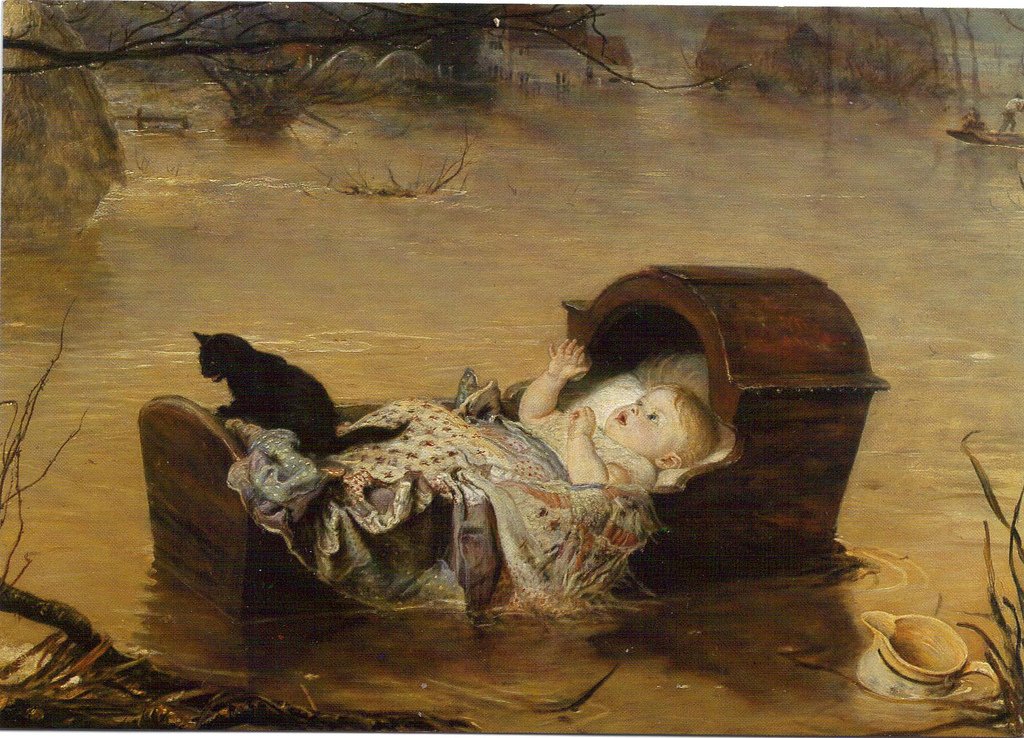
John Everett Millais painted The Flood in 1870.  It is believed that he was motivated to paint his flood scene by the tragic events which occurred  in Sheffield in March 1864 when a dam collapsed in the middle of the night and the ensuing flood killed hundreds of villagers who lived downstream of the dam.    Among the many local newspaper reports there was one telling of a baby, still in its cradle, being swept away in the swift flowing waters.

In the painting, we see the baby wide awake with little idea of what is happening around him or her.  The baby just looks upwards and seems mesmerised by the raindrops which cling to the thin branches of a tree.   The wide-eyed and open-mouthed expression of the baby would in normal circumstances cause us to smile at the child’s inquisitiveness but unlike the baby, we are only too aware of its fate.  On the other hand, the black cat, which is sharing the ride on the cradle, is conscious of the peril and it too is also open-mouthed as it howls in fear of its life.   A household jug floats alongside the cradle reminding us of the devastating affect the raging water had as it swept unchecked in and out of the small impoverished village dwellings.

In the background on the left we can see a bridge almost submerged by the flood water and further to the right there is a house on the river bank and we can observe the water level has already reached the height of the ground floor windows.  To the right in the background men in a boat can be seen drifting quickly and uncontrollably on the tide of muddy water.

The painting hangs in the Manchester Art Gallery and it was intetersting to hear various comments from people as they studied the painting.  Some thought, as they looked at the smiling baby, that it was a charming picture whilst others tended to focus on the event itself and the probable drowning of the young child and found the painting rather disturbing.

You see, it is all in the eye of the beholder !

Manfred on the Jungfrau by Ford Madox Brown

Manfred on the Jungfrau by Ford Madox Brown (1842)

My Daily Art Display today once again has a connection with a number of blogs I have done earlier.  On July 14th I showcased The Funeral of Shelley by Fournier and one of the mourners at this event was the English Romantic poet Lord Byron who is centre stage in today’s offering.  On June 15th I featured the artists Ford Madox Brown and today he is once again the artist who painted today’s work. Finally, this is yet another work of art which has a connection with a poem.  My Daily Art Display painting today is entitled Manfred on the Jungfrau and is by the English painter Ford Madox Brown.

Ford Madox Brown, although his parents were English, was born in Calais in 1821.   His father, Ford Brown was a ship’s purser in the navy and his mother, Caroline Madox, came from an old Kentish family.  He initially studied art in Belgium, in Bruges, Ghent and Antwerp.  One of his teachers was the Belgian painter Gustave Wappers.  Madox Brown also spent time in France and Italy before coming to England in 1845.  He married his first wife Elisabeth Bromley in 1841, who was his cousin, and they went on to have a daughter, Lucy.   In that same year he had his first painting exhibited at the Royal Academy.   In the winter of 1845 he travelled to Switzerland and Rome.  During his time in the Italian capital he visited the studios of a group of German Romantic painters who had been sarcastically termed the Nazarenes as they would go around dressed in flowing robes and wearing their hair long, in a biblical-like style.  The aim of their artistic style was simply to add a kind of honesty and spirituality to their paintings which they believed had been missing from contemporary works of art and in some ways it was a reaction against Neoclassicism and the rigidity of Academicism.  Their philosophies would influence the Pre-Raphaelite movement

In 1846 Elizabeth Bromley died of consumption.  Five years later Madox Brown married for the second time, this time to Emma Hill.  The couple already at that time had a two-year old daughter, Catherine.  In 1848 he met, for the first time, Daniel Rossetti and Holman Hunt, two of the founders of the Pre-Raphaelite Brotherhood.  Ford Madox Brown was never a member of the Pre Raphaelite Brotherhood although he was closely associated with the group of artists and in fact Rossetti approached him and asked to be allowed to work under his tutelage at his studio.   Madox Brown had a varied career but although he was highly thought of by his contemporaries, he never achieved popular success.  Madox Brown painted many historical pictures and for most of the 1880’s he worked on subjects of local social history for Manchester Town Hall.   Ford Madox Brown died in 1893, three years after the death of his wife Emma.

So what has the painting to do with Lord Byron?   The Manfred of the painting’s title was the central character and romantic hero in Lord Byron’ famous dramatic poem Manfred and the painting depicts a scene from the poem.   The twenty-four year old poet, Lord Byron, had returned to London after a long period of travelling around Portugal, the Mediterranean and Aegean Sea Europe, in 1812 and had the first two parts of a four-part narrative poem published.  They were hailed by the literary critics as masterpieces and Byron became an overnight success and a leader of the social and literary circles of London.  However his fall from grace came shortly after with his well publicized affair with the married socialite Caroline Lamb, who famously said of Byron that he was “mad, bad and dangerous to know”.   The affair, which lasted six months, was broken off by Byron but his spurned lover continued to pursue him.   Byron turned his affections to Annabella Millbank.  She was so different in character to Caroline Lamb.  She was from a wealthy family, very well educated and a somewhat prim religious woman with very strict morals.  After two years of being pursued by Byron she agreed to marry him in 1814.  The marriage was doomed to failure because of the complete difference in their characters.

In 1815, Byron’s financial situation was dire as he refused to sell his work as he fervently believed the sums offered were too small.  He struggled to sell property to bolster his finances and he became depressed with life in general.  He drank heavily and became violent towards his wife.  His wife actually believed he was going mad.   Byron had an affair with a chorus girl that year despite his wife being pregnant with their first child, a daughter Ada, who was born in the December of 1815.  His then turned to his half sister, Augusta Leigh, the daughter from Byron’s father’s first wife, for friendship but this led to what many believe was an incestuous relationship.    Finally the marriage split asunder and the couple separated in January 1816.  The separation was bitter amidst rumours of marital violence, adultery with an actress and incest, all of which scandalised the public.  Incest at the time was a very serious offence and it is believed that Byron’s hasty departure from the country that year was because of his fear of prosecution.

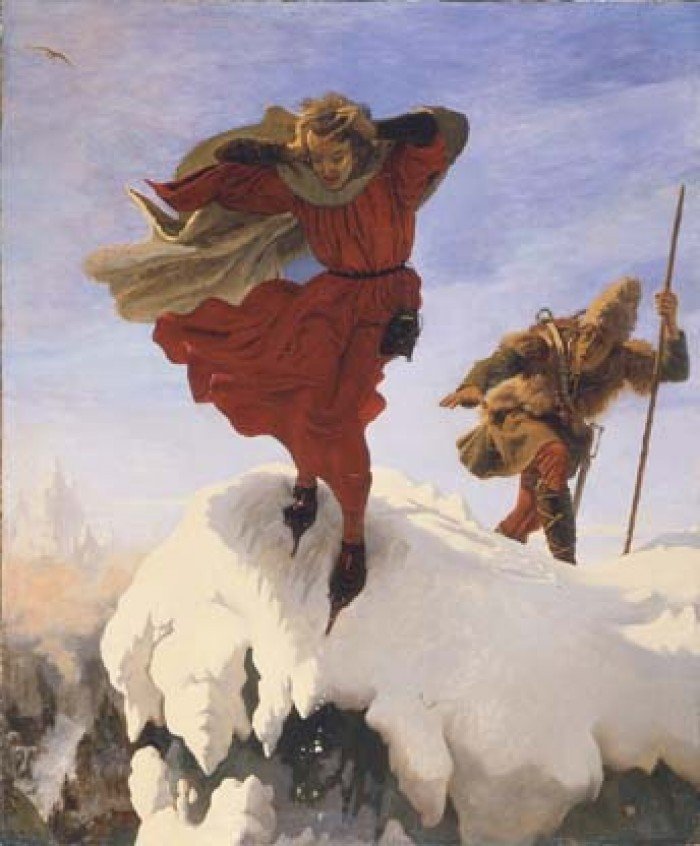
So what has all this to do with today’s painting?  Whilst Byron, who was now living at the Villa Diodati in Switzerland, toured the Bernese Alps he wrote most of his great dramatic narrative poem Manfred.  The poem recounts the tale of this Alpine nobleman who had an incestuous relationship with his sister, Astarte, and who not being able to come to terms with this relationship, committed suicide.  Manfred is wracked with guilt blaming himself for her death and conjures up seven spirits from whom he seeks forgetfulness so as the death of his sister would cease to haunt him.  They cannot help and he himself attempts suicide and one of these attempts is portrayed in Ford Madox Brown’s painting in which we see Manfred about to hurl himself off the top of the mountain, the Jungfrau.  The poem tells of this time:

“..And you, ye crags upon whose extreme edge
I stand, and on the torrent’s brink beneath
Behold the tall pines dwindled as to shrubs
In dizziness of distance, when a leap,
A stir, a motion, even a breath, would bring
My breast upon its rocky bosom’s bed
To rest for ever – wherefore do I pause?
…Thou winged and cloud-cleaving minister,
Whose happy flight is highest into heaven,
Well may’st thou swoop so near me…
…How beautiful is all this visible world!
How glorious in its action and itself!…”

 His suicide attempt fails as a fur-clad chamois hunter, whom we see in the painting standing behind Manfred, rescues him before he can leap to his death.  In the painting, Madox Brown depicts the tormented Manfred holding his head in his hands with his face contorted with anguish as he prepares to end his life.  His red robes, which flutter violently in the mountain wind, contrast starkly with the clear blue sky.  In the background to the left we can just make out a castle, which to me, resembles Neuschwanstein, the Disney-like edifice which we see on so many pictures and postcards.

It cannot be just coincidental that Byron having had an incestuous affair with his step sister should write a poetic story about another incestuous relationship and its dire consequences and many believe that his poem was about himself and his earlier relationship which scandalised society.

I had hoped to see the painting yesterday when I visited the Manchester Art Gallery but alas it has been taken down for some restoration work in preparation for the forthcoming Ford Madox Brown exhibition which will be held in this gallery in September.  I will return then and cast my eye over Manfred and his tortured state of mind.

The Martyr of Solway by John Everett Millais

The Martyr of Solway by Millais (1871)

I visited the Walker Gallery in Liverpool yesterday and I am never disappointed by the paintings on permanent show there.  It is such a diverse collection which cannot fail to please everybody who visits, no matter what their artistic proclivity.  My Daily Art Display today features a stunning painting by John Everett Millais entitled The Martyr of the Solway which he painted in 1871.

So who was the martyr of Solway and why was she killed in such a barbaric fashion?   The “Margaret” depicted by Millais was Margaret Wilson, who was born in 1667 in Glenvernoch in Wigtownshire.  She was a young and devout Presbyterian who was a member of the Covenanters, a Scottish Presbyterian movement of the 17th century in Scotland who signed the National Covenant in 1638 to confirm their opposition to the interference by the Stuart kings in the affairs of the Presbyterian Church of Scotland.  The Stuart kings embraced the belief of the Divine Right of the Monarch.   However, not only did they believe that God wished them to be the infallible rulers of their kingdom – they also believed that they were the spiritual heads of the Church of Scotland.    This latter belief was anathema to the Scots.   Their belief was quite simple – no man, not even a king, could be spiritual head of their church. Only Jesus Christ could be spiritual head of a Christian church.
The account of the martyrdom of the eighteen year old Margaret  Wilson and the events leading up to her death are set down in an account by the Rev.C.H.Dick’s  entitled Highways and Byways in Galloway and Carrick, which was published in 1916.  In it he wrote:
“….Upon the 11th of May,1685 came the wicked execution of two excellent women, Margaret McLachlan and Margaret Wilson, near Wigtown, in South West Scotland .  Margaret Wilson, eighteen, and her sister, Agnes, not yet thirteen years old, were the daughters of Gilbert Wilson, tenant of Glenvernoch in the parish of Penninghame. They conformed to Episcopacy. Adherents to the Covenants, the girls fell into the hands of the persecutors, and were imprisoned.

Upon their release, they left the district and wandered through Carrick, Galloway, and Nithsdale with their brothers and some other Covenanters. But on the death of King Charles, there was some slackening of the persecution, and the girls returned to Wigtown.

An acquaintance, Patrick Stuart, betrayed them. He proposed drinking the king’s health; this they modestly declined: upon which he went out, informed against them, brought in a party of soldiers, and seized them.   They were thrown in the thieves’ hole, and after they had been there some time, were removed to the prison where Margaret McLauchlan was.

Margaret Maclachlan was a woman of more than ordinary knowledge, discretion, and prudence, and for many years of singular piety and devotion: she would take none of the oaths now pressed upon women as well as men, neither would she desist from the duties she took to be incumbent upon her, hearing presbyterian ministers when providence gave opportunity, and joining with her Christian friends and acquaintances in prayer, and supplying her relations and acquaintances when in straits, though persecuted. It is a jest to suppose her guilty of rising in arms and rebellion, though indeed it was a part of her indictment. She was very roughly dealt with in prison, and was allowed neither fire nor bed although she was sixty-three years of age.

All the three prisoners were indicted “for rebellion, Bothwellbridge, Ayr’s Moss, and being present at twenty field-conventicles”.   None of them had ever been within many miles of Bothwell or Ayr’s Moss. Agnes Wilson could be but eight years of age at Ayr’s Moss, and her sister but about twelve or thirteen; and it was impossible they could have any access to those risings:

When the Abjuration Oath was put to them, they refused it, the assize found them guilty, and the sentence was that “upon the 11th instant, all the three should be tied to stakes fixed within the flood-mark in the water of Blednoch near Wigtown, where the sea flows at high water, there to be drowned”.

Gilbert Wilson secured the liberation of the younger girl under a bond of a hundred pounds sterling. The sentence was executed on Margaret Maclachlan and Margaret Wilson.  The two women were brought from Wigtown, with a numerous crowd of spectators. Major Windram with some soldiers guarded them. The old woman’s stake was a good way in beyond the other, and she was first despatched, in order to terrify the other to a compliance with such oaths and conditions as they required. But in vain, for she adhered to her principles with an unshaken steadfastness.

When the water was overflowing her fellow-martyr, some about Margaret Wilson asked her, what she thought of the other now struggling with the pangs of death. She answered, what do I see but Christ (in one of his members) wrestling there. Think you that we are the sufferers? No, it is Christ in us, for he sends none a warfare upon their own charges.

When Margaret Wilson was at the stake, she sang the 25th Psalm from verse 7th, downward a good way, and read the 8th chapter to the Romans with a great deal of cheerfulness, and then prayed.   While at prayer, the water covered her: but before she was quite dead, they pulled her up, and held her out of the water till she was recovered, and able to speak; and then by Major Windram’s orders, she was asked, if she would pray for the king.

She answered, ‘She wished the salvation of all men, and the damnation of none.’

One deeply affected by her words said, ‘Dear Margaret, say God save the king, say God save the king.’

She answered in the greatest steadiness and composure, ‘God save him, if he will, for it is his salvation I desire.’

Whereupon some of her relations near by, desirous to have her life spared, called out to Major Windram, ‘Sir, she hath said it, she hath said it.’

Whereupon the major came near, and offered her the abjuration, charging her instantly to swear it, otherwise return to the water.

Most deliberately she refused, and said, ‘ I will not, I am one of Christ’s children, let me go.’

Upon which she was thrust down again into the water.

The name of the man by whose information the women were arrested is well known, and his memory execrated still. One of his descendants getting into an altercation was thus taunted: ‘I wadna like to have had a forebear who betrayed the martyrs; I wadna be coomed o’ sic folk’.

The gravestone of Margaret Wilson

Margaret Wilson was buried in the churchyard at Wigtown.

X Ray picture of original painting

In the painting, we see the young woman with flame-coloured hair chained to the rocks.  She wears an open-necked blouse and tartan skirt.  She looks downward and to her left, her lips pursed.  Her eyes avoid our gaze and she seems lost in thought.  It is interesting to note that what we see in today’s painting is not we would have seen in Millais’ original completed work.  Art conservators have x-rayed the painting and found out that Millais had originally painted the upper torso of the young woman naked.  However when the painting was exhibited in 1871 there were strong puritanical views on nudity in paintings and Millais’ work offended Victorian sensibilities.  It was badly received and was the butt of many negatively critical reviews.

The Knight Errant (repainted version)

This had also happened a year earlier when Millais exhibited his work The Knight Errant in 1870 depicting a naked woman tied to a tree being rescued by a knight and which was roundly condemned for its nudity.  It could not be sold and had to be repainted.  Millais actually then cut out the canvas on which was her head and upper torso, added a new piece of canvas and re-painted the damsel in distress.   He did not clothe the naked woman but instead of her gaze being fixed on the knight, her upper torso was altered so that she was now  modestly turned away from him.   This in fact was Millais’ one and only painting of a nude woman.

For his painting of the Martyr of Solway, Millais realised that it was in his best interest to change the painting and deflect any further criticism so he re-painted the head and upper torso and the result was the clothed woman, as we see her today.

It is a most captivating painting.  I suppose in reality the calm and thoughtful face of the young woman as portrayed by Millais is unrealistic as I am sure the incoming tide must have been a terrifying experience and yet we see neither fear in her eyes nor her facial expression.  However this lack of facial contortion brought on by panic and trepidation allows us to observe the beautiful face of this young woman.

Clothed or naked – was Millais right in changing his original concept?  If Millais had painted the picture today one presumes he may not have had to clothe her upper torso but would that have added or detracted from the finished article?

The Blind Girl by John Everett Millais

The Blind Girl by Millais (1854-56)

Another day, another painting, another offering from the Pre-Raphaelite Brotherhood.  My Daily Art Display for today is one of John Everett Millais’ finest works of art, entitled The Blind Girl which he painted in 1856.  In it we have a fusion of the elements of figure and landscape painting depicting, in the foreground, two girls sitting near a roadside against the backdrop of an expanse of wide, open fields with a distant view of a town.

Begging plea

The elder of the two girls, with her eyes closed, is blind.  She is homeless and forced to beg for sustenance by playing her concertina, which we see on her lap.  Her wretched plight is emphasized even more by the sheet of paper hanging around her neck with the words “PITY THE BLIND”.   Millais has chosen as his subject for this painting the social evil of the day – vagrancy among children and the disabled.  Millais hoped that his painting would elicit sympathy from its viewers for the plight of this blind girl and those like her.  There is a stillness and tranquility about the girl and this is borne out by the fact that we see a tortoiseshell butterfly resting on her shawl.

The younger girl, who is partly perched on the lap of the blind girl, and whom we believe maybe her sister, does not look out at us but is looking back at the double rainbow and the enchanting landscape below this phenomenon.  Some art historians have interpreted Millais’ depiction of the double rainbow as a Christian symbol of hope and one must remember that at the time Millais was still influenced by his former patron John Ruskin and it was Ruskin’s belief that there was a connection between the beauty of nature and the divine handiwork of God.   It is an enchanting scene we see before us and has luminosity brought on by the aftermath of what has probably been a heavy downpour of rain.  The rain has made the grass looks so green and its fresh appearance tempts us to sniff the air so as to take in the delights of the countryside.

Look at the way the two girls are depicted by Millais.  See how the younger girl snuggles within the shawl of the blind girl.  I wonder whether Millais meant us to look at their positioning and think of the Madonna and Child.  Whereas we would expect the sighted girl to look after the blind girl there appears to be a role reversal in this painting.  Maybe the blind girl is comforting her young companion who may have been frightened by the storm which has just passed.  Maybe the young girl is peeking around the blind girl’s shawl at a point in the distance where there had once been flashes of lightning and the rumble of thunder.  Take a moment to study the blind girl.  See how she seems to be trying to compensate her loss of sight through her other senses – the sense of touch.   See how, with one hand, she grips the hand of her young companion and with the other she fingers a blade of grass.  It is interesting to note how meticulous Millais has painted each individual blade of grass near to the hand of this blind girl.  She is also doing what so many of us do when the sun is shining – we close our eyes and face the sun and absorb the warmth of its rays.  The girl is taking pleasure in her surroundings, the warmth of the sunlight, the sounds of the birds and the smells emanating from the countryside all around her.

The background of this picture is a view of Winchelsea, a small village in East Sussex, located about two miles south-west of the coastal town of Rye.   The village stands on the site of a medieval town, founded in 1288, to replace an earlier town of the same name, sometimes known as Old Winchelsea, which was lost to the sea.   It is known that Millais, along with his fellow artists, Holman Hunt and Edward Lear visited the town in 1852.   It is recorded that Millais completed the middle ground of the painting whilst in Perth, Scotland where he had taken his new bride, Effie, the former Mrs Ruskin, in the summer of 1855.  The history of the painting chronicles that the last thing to be painted was the amber-coloured skirt, which the blind girl is wearing and which Effie cajoled an old woman into lending it to her.  Effie recorded the incident, writing:

“…She swore an oath and said what could Mrs Millais want with her old Coat, it was so dirty, but I was welcome.  I kept it two days and sent it back with a shilling and she was quite pleased…”

For his models for this painting, Millais used Matilda Proudfoot as the blind girl and Isabella Nichol as her younger sister. Originally Millais had used his wife Effie as the model for the blind girl but later he decided to use Matilda.

The Liverpool Academy awarded this painting its annual prize in 1857.    It was well received and is now looked upon as one of Millais’ finest works of art.  His Pre-Raphaelite colleague, Dante Rossetti declared it to be:

“…One of the most touching and perfect things I know….”

John Ruskin his former mentor and patron described The Blind Girl:

“…’The common is a fairly spacious bit of ragged pasture, and at the side of the public road passing over it the blind girl has sat down to rest awhile. She is a simple beggar, not a poetical or vicious one, a girl of eighteen or twenty, extremely plain-featured, but healthy, and just now resting, not because she is much tired but because the sun has but this moment come out after a shower and the smell of grass is pleasant….”

One interesting technical aspect of the painting is Millais’ depiction of the double rainbow.  When he showed the painting for the first time, somebody made him aware of his technical error as he had painted the two rainbows with their colours in the same order but he was advised that with double rainbows the inner rainbow of the two inverts the order of the colours.  Later Millais, in order to satisfy scientific accuracy, re-painted the inner rainbow.

A Dream of the Past – Sir Isumbras at the Ford by John Everett Millais

A Dream of the Past – Sir Isumbras at the Ford by Millais (1857)

My Daily Art Display painting of the day is one by John Everett Millais, entitled A Dream of the Past – Sir Isumbras at the Ford, which he completed in 1857.  It depicts an ancient knight on horseback carrying two children of a poor woodcutter across a river.  The character of Sir Isumbras comes from the 14th century medieval romance written in Middle English.   The actual scene we see before our eyes was not part of the original tale but more than likely came from a romance written in fake medieval verse based on the original and penned by Millais friend, the art critic Tom Taylor. 

The original poem tells the story of the humbling of the once arrogant knight.  The scene is set by the art critic and member of the Pre- Raphaelite Brotherhood, Frederic Stephens.  Stephens was not an artist but in today’s terminology, he would be described as the Pre-Rapaelite’s public relations man.  It was his job to communicate the aims of the Brotherhood to the public.  Of this painting, he wrote:

“….Sir Isumbras at the Ford was the subject of the picture Millais made his leading work in the year 1857.   It represented an ancient knight, all clad in golden armour, who had gone through the glories of this life — war honour, victory and reward, wealth and pride. Though he is aged and worn with war, his eye is still bright with the glory of human life, and yet he has stooped his magnificent pride so far as to help, true knight as he was, two little children, and carries them over a river ford upon the saddle of his grand war-horse, woodcutter’s children as they were. The face of this warrior was one of those pictorial victories which can derive their success from nothing less than inspiration. The sun was setting beyond the forest that gathered about the river’s margin, and, in its glorious decadence, symbolised the nearly spent life of the warrior…”.

This painting is a classic example of the Pre-Raphaelites’ interest in topics about medieval chivalry.  The old knight in his gleaming golden armour has helped the two children cross the stream.  The girls stares into the face of the knight with a worried expression whilst the young lad, with the wood strapped to his back, looks out at us, as he desperately clings on to the knight.   The bright and vivid colours of the children’s clothes is typical of the colours used in Pre-Raphaelite paintings

When Millais exhibited the painting it received hostile reviews and was condemned by many art critics of the time.  The leading art critic of the day, and former patron of Millais, John Ruskin, savagedly criticised the artist and the painting declaring it to be a “catastrophe”.  Millais was criticised for painting the “ugly” horse out of proportion to the figures on its back and by doing so had given the illusion that the three figures are almost floating above the animal’s back.   He also criticised Millais for how he had painted the foreground lighter than the exposed hills in the background, saying that the artist had “made errors in pictorial grammar”.   I suppose it has to be remembered that Millais, two years earlier, had married Ruskin’s wife Effie, after she had been granted an annulment of her marriage to Ruskin on the grounds that it had never been consummated.  This whole affair was splashed across the London press and had caused a scandal.   Ruskin never forgave his former protogé Millais.  Millais must have listened to the torrent of criticism as he repainted parts of it before exhibiting it in an exhibition in Liverpool. For all its criticism and the large number of detractors, this painting inspired many other artists to depict gallant knights rescuing beautiful maidens.

A Nightmare by Frederick Sandys (c.1857)

Finally let me finish with another Pre-Raphaelite painter, Frederic Sandys who satirised Millais’ painting with his print entitled A Nightmare,  in which he caricatured  Millais as the knight and his fellow artists Gabriel Dante Rossetti and Holman Hunt as the children and Sandys adds more scorn on the trio by turning the horse into a donkey which has been branded on its flank with the letters “J  R” – the initials of Ruskin !

The Scapegoat by William Holman Hunt

The Scapegoat by William Holman Hunt (Lady Lever Gallery) 1854

Normally I try and publish my daily blog in the morning but today I am late, but for a very good reason.  I think we all agree that to stand in front of the actual painting is vastly more satisfying than looking at it on the internet or in a book, so although I had made notes for today’s blog I decided that I would go and see the actual painting before publishing my thoughts.

My featured artist today is William Holman Hunt, the English Pre-Raphaelite painter.  In 1854 he had just completed The Light of the World,  which to this day, remains one of the best known religious paintings of the 19th century.  Hunt wanted to carry on painting religious subjects but decided that any future paintings involving biblical subjects should be painted in the very places where they happened.  So in 1854 Hunt decided to journey to the Holy Lands.  This was typical of Hunt’s thoroughness, and also typical of the rational, scientific spirit of the age.     Another reason for the journey was that it was also at this point in his life when he was suffering a crisis of religious faith and he believed that such a visit to the Holy Lands may bring him a better understanding of his faith.  However, his move away from his friends, Millais and Rossetti effectively marked the beginning of the end of the Pre-Raphaelite Brotherhood which they had founded six years earlier.  

The subject of today’s featured painting in My Daily Art Display is entitled The Scapegoat and the subject is derived from the Talmudic tradition of driving a sacrificial white goat out into the wilderness on the Day of Atonement (Yom Kippur).  A strip of red wool was bound to the goat’s horns, in the belief that it would turn white if the appeasement was accepted.  This also harked back to the Book of Isaiah 1:18:

Come now, let’s settle this,” says the LORD. “Though your sins are like scarlet, I will make them as white as snow. Though they are red like crimson, I will make them as white as wool.

Hunt regarded the Old Testament scapegoat as a forerunner of the New Testament Christ whose suffering and death similarly expunged man’s sins.

Hunt travelled first to Jerusalem in June 1854 and then in the October on to Oosdoom, a place on the southern edge of the salt-encrusted shallows of the Dead Sea.  In his diary Hunt described this setting as:

 ‘“…never was so extraordinary a scene of beautifully arranged horrible wilderness. It is black, full of asphalte scum and in the hand slimy, and smarting as a sting — No one can stand and say that it is not accursed of God…”

Hunt saw the Dead Sea as a ‘horrible figure of sin’,  believing as did many at this time, that it was the original site of the city of Sodom.    Here he remained painting the landscape, the mountains of Edom, and the lake which would become the background of the painting.  He also made preliminary sketches of the goat.  However the goat proved to be a “fidgety model” refusing to stand still.  Bad weather forced Hunt to head back to Jerusalem.   He had not completed the picture of the goat so brought it, some Dead Sea mud and stones back to his studio in Jerusalem so as to complete the work. However, on the journey back the goat died.  Hunt bought another goat and proceeded to have it stand in a tray of salty Dead Sea mud and stones which he had brought back to his studio and continued with the painting.  To complete the details of the painting he bought a skeleton of a camel and the skull of an ibex both of which he incorporated into the painting. 

The Scapegoat by William Holman Hunt (Manchester Art Gallery) 1854

He made two copies of the painting, one (above) of which is a smaller version with a black goat and a rainbow symbolising hope and forgiveness of sins and this can be found in the Manchester Art Gallery, and the other (at the top of the page) hangs in the Lady Lever Gallery, Port Sunlight.  

Inscription along top of frame

The Lady Lever Art Gallery painting has an inscription engraved onto its frame, which was designed by Hunt himself.   It was intended to compliment the painting.  The seven stars at the top may have come from the apocalyptic text mentioning the seven stars that fell on the day of wrath or it may indicate the Book of Revelation’s “ancient” Christ who held seven stars in his right hand.   On the top of the frame, as wel,l is the inscribed a scriptural text from Isaiah 53:4:

” Surely he hath borne our Griefs, and carried our Sorrows:

yet we did esteem him stricken, smitten of GOD, and afflicted. “

and on the bottom part of the frame are the words from the Book of Leviticus 16:22:

“And the Goat shall bear upon him all their Iniquities unto a Land not inhabited.”

 Hunt submitted the painting to the Royal Academy exhibition of 1856 where it was greeted with puzzlement and derogatory remarks.  The landscape colour was described as “lurid”.  Hunt was not put off by that comment and the purple colour of his mountains subsequently became the hallmark of much of his landscape painting.

John Ruskin, the foremost art critic of the time, commented:

‘…This picture, regarded merely as a landscape, or as a composition, is a total failure.   Mr Hunt …in his earnest desire to paint the Scapegoat has forgotten to ask himself first, whether he could paint a goat at all…’

His Pre-Raphaelite Brethren commented differently.  Dante Gabriel Rossetti said of the painting:

“…a grand thing, but not for the public…”

Ford Madox Brown wrote in his diary:

“….Hunt’s Scapegoat requires to be seen to be believed in. Only then can it be understood how, by the might of genius, out of an old goat, and some saline encrustations, can be made one of the most tragic and impressive works in the annals of art….”.

You must make up your own mind about this work of art.  I side with Ford Madox Brown. I stood in front of the painting this afternoon and was moved by the tragic and heart-rending depiction of the goat as it stumbles alone along the salt-encrusted shoreline, to what we know will inevitably culminate in its lonely death.  

I love the way in which Hunt’s use of colour to depict the Jordanian mountains in the background.    This was certainly one of the most original painting by Holman Hunt.  Maybe one should say it was one of his most peculiar works of art.  People are divided in their views.  Whilst some admire the painting for its exceptional and powerful image in such an unusual setting, others dislike it and wonder why the artist spent so much time and effort on such a gloomy subject.

I will let you be the judge.