Seymour Joseph Guy

At the Opera by Seymour Joseph Guy (1887)

I was looking at the website of a person who had commented on one of my blogs and I was fascinated by a painting he had posted.  I had to find out more about it and the artist who had painted it.  The title of the work is At the Opera and the creator of the work was the nineteenth century English-born,  American genre painter, Seymour Joseph Guy.  Genre paintings are works, which depict one or more persons going about their every day life.  They could be scenes in the kitchen, at the market or in a tavern and they are nearly always realistic depictions, lacking any sense of idealisation.  They are “warts and all” depictions of life.  Seymour Joseph Guy’s later works, which were often quite small “cabinet pieces”, concentrated mainly on depictions of children.  His works were meticulous in detail.

 Seymour Joseph Guy was born in 1824 in England, in the south London borough of Greenwich.   His father was Frederick Bennett Guy who owned an inn as well as a number of commercial properties.   His mother was Jane Delver Wilson.  Seymour had an elder brother, Frederick Bennett Guy Jnr. and a younger brother, Charles Henry.  When Seymour was five years old, his mother died and he and his brothers were brought up by their father.  Four years later their father died and the executors of their late father’s will were John Locke who was the owner of the inn called the Spanish Galleon and a local cheese merchant and friend of Seymour’s father, John Hughes.   It is the thought that the three orphaned boys came under the legal guardianship of one of these gentlemen.  Seymour’s schooling was at a local school in Surrey and it was during these early informative years that he took an interest in art and he liked to spend time drawing dogs and horses.   He enjoyed drawing so much that, when he was thirteen years old, he made it known that he would like to become an artist, or maybe a civil engineer.  This choice of career did not go down well with his guardian who actively discouraged the teenager, going as far as stopping his pocket money so he couldn’t buy any pencils and sketchbooks and that he believed would force his charge to abandon his artistic plans.  Seymour was not to be put off and despite his lack of pocket money; he managed to earn enough to buy his own drawing materials by becoming a part time sign-painter.
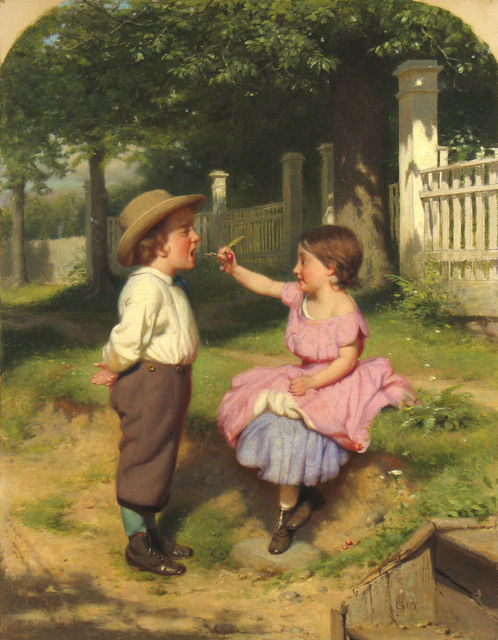
Open Your Mouth and Shut Your Eyes by Seymour Joseph Guy (c.1863)

Seymour Guy continued with his ambition to become a painter and in his late teenage years received some artistic tuition from Thomas Butterworth.  Butterworth, who had served as a seaman in the Royal Navy during the Napoleonic wars period, lived in Greenwich and was a marine painter.  His guardian decided that a good career for Seymour, and in line with his artistic ambitions, would be to become an engraver.  However the cost of an apprenticeship to learn the engraving trade was prohibitive and this proposed profession had to be abandoned and instead his guardian arranged for Seymour to begin a seven-year apprenticeship at an oil and colour firm which oversaw the making of pigments, preparing binders, as well as combining the two skills in order to make paint either by hand-grinding them or using a steam driven machine.   This was a valuable experience for Seymour as he learnt the intricacies and expertise of mixing various pigments which he would himself use in the future for his own paintings.

In 1845 Seymour’s legal guardian died. It was also a time, when having reached the age of twenty-one, the brothers’ late father’s estate was split between them.  In Seymour’s case this also coincided with the end of his seven-year apprenticeship at the colour factory.    Seymour Guy was twenty-one years of age and now had sufficient money to pursue his dream of becoming a professional painter.  A friend offered to sponsor him to enable his entrance to the Royal Academy but instead he decided to work on his own and so he obtained a copying permit and took his easel and brushes to the British Museum where he copied some of the works of art.  Understanding that working alone was not the answer to learning about art he also enrolled at the studio of the portrait and historical painter, Ambrosini Jerome, who had received a number of commissions from the English royal family.  Seymour Guy was to work with Jerome for the next four years.
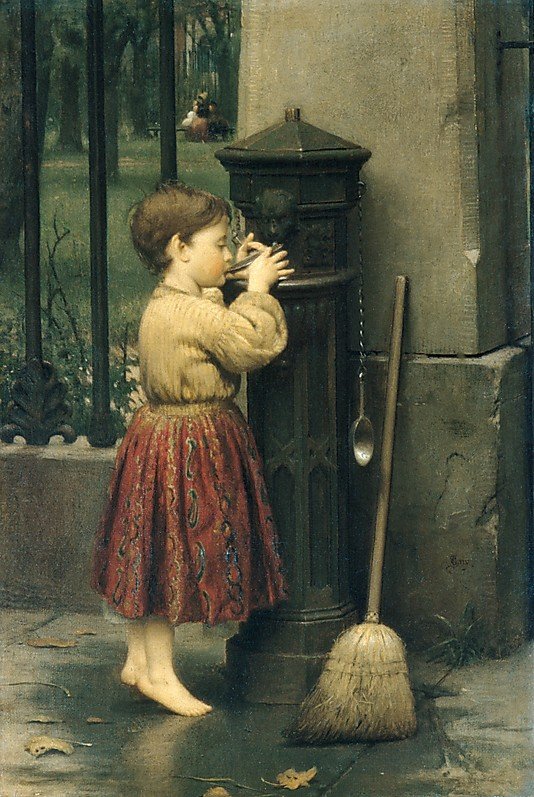
The Crossing Sweeper by Seymour Joseph Guy (c.1860's)
The Crossing Sweeper by Seymour Joseph Guy (c.1860’s)

In 1852, aged twenty-eight, Seymour married Anna Maria Barber, who was the daughter of William Barber, an engraver.  The couple went on to have nine children, many of whom were used by Seymour as models for his genre paintings.  Two years later in 1854, Seymour moved his family from London to New York and settled in Brooklyn.  Here he set up his studio in Brooklyn Heights, played a leading role in the art life of the city and founded the Sketch Club and it was during these early times in Brooklyn that he met and became a close friend of another genre painter, John George Brown.  Brown who was also English-born had left his home in Durham and immigrated to America in 1853.  This close bond of friendship probably stemmed from them both being English born, and both genre painters who liked to concentrate on small-scale works which gave them the opportunity to demonstrate their intricate minute workmanship.   In those early days in Brooklyn Seymour Guy also completed a number of portraits of leading local figures.

In 1861, the two friends, Seymour Guy and John Brown, decided to move their studios from Brooklyn to the more fashionable Manhattan.  Seymour Guy had his studio on Broadway whilst John Brown moved into the Tenth Street Studio Building. Two years later Guy decided to leave his Broadway studio and move into the Tenth Street Studio Building.  The Tenth Street Building, which was on 51 West 10th Street, between Fifth and Sixth Avenue, was constructed in 1857 and was the first modern facility designed exclusively to the needs of artists.  Soon it became the hub of the New York art world and would remain so for the rest of the nineteenth century.  It was to be the home for many famous American artists including Winslow Homer, Frederic Edwin Church, William Merritt Chase and Albert Bierstadt.
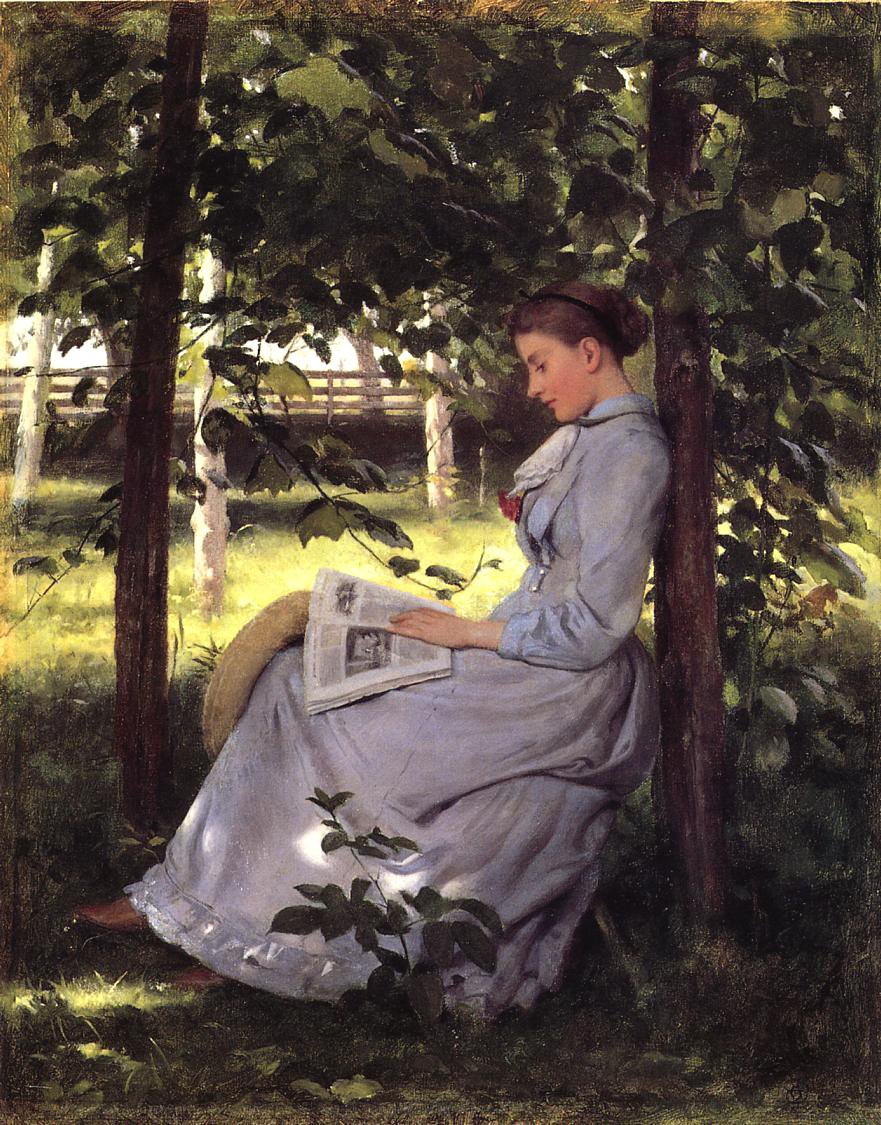
Summer Issue by Seymour Joseph Guy (1861)

The genre work of John Brown with its depiction of young children in rural settings influenced Seymour Guy for around about 1861 he too started to produce similar depictions. Around this time, the two artists made a number of ferry trips across the East River,  to escape the manic setting of the big city, to the tranquil setting of Fort Lee in New Jersey.  The two artists liked the peace and quiet so much that they decided to quit Manhattan and move home to the New Jersey countryside.  Brown went in 1864 and Seymour Guy followed with his family two years later.  Seymour Guy and his family lived the quiet existence in the country for seven years until in 1873 when they moved back to Manhattan where they remained for the rest of their life.

Seymour Joseph Guy died in 1910, aged 86, by which time his art was out of vogue and he was almost completely forgotten as an artist.   During that first decade of the twentieth century Guy’s health had begun to fail and his role as an artist seemed simply to have acted as an elder statesman to younger artists who sought out his vast knowledge about the art and the craft of painting. One of the most complimentary eulogies to him following his death appeared in the Century Association’s annual journal, which stated:

“…He is remembered with deep affection by artists who came to him as to an older man of recognized position. He was most genial, cordial, and ready to place himself and the methods of his art at their disposal, rejoicing in their companionship and keeping himself young through participation in their pursuits. For twenty-two years he was of the rare artistic fellowship of The Century, though of late years, through the infirmities of age, seldom here…”

The Contest for the Bouquet.  The Family of Robert Gordon in Their New York Dining-Room  by Seymour Joseph Guy (1866)
The Contest for the Bouquet. The Family of Robert Gordon in Their New York Dining-Room by Seymour Joseph Guy (1866)

In 1866 Seymour Guy completed a painting entitled The Contest for the Bouquet: The Family of Robert Gordon in Their New York Dining-Room, which is a combination of a group portrait and a genre work.  It is a conversation piece sometimes referred to as a narrative painting.  Seymour had received the commission from the head of the family, Robert Gordon, a British-born financier and an avid collector of American art, who was also a founding trustee of the New York Metropolitan Museum of Art.  The commission was for the portrait of Gordon’s wife, Frances, and four of their children.  In this charming family portrayal we see the three older children of Robert Gordon playfully fighting to gain hold of a small floral corsage.  The elder boy, who is by far the tallest, holds the flowers aloft out of the reach of his sister whilst his brother stands on a chair to help him reach the “prize”.   To the right we can see the youngest child sitting on her mother’s lap, clinging to her, in order to avoid her three siblings.  The setting is the family dining room and appears to be around breakfast time as the three older children are already dressed in their school clothes.

The Story of Golden Locks by Seymour Joseph Guy

The final two paintings I am featuring were set in the same room.  The painting The Story of Golden Locks by Seymour Guy was completed around 1870 and in it we see a young girl reading the story of Goldilocks to two young boys, probably her brothers.  The storyteller is very animated and for the two young listeners it has probably turned the story telling into a somewhat nightmarish tale.  Look at their faces.  They are wide-eyed, unsure whether they want to hear more.  Maybe the frightening shadow of the girl’s head on the curtain above their bed has added to their trepidation.  On the chair next to the bed is the girl’s doll which lies in a drawer and this is thought to allude to the fact that the storyteller has finished with children’s toys and is transitioning between childhood and womanhood.

Making a Train by Seymour Joseph Guy (1867)

My final selected work by Seymour Guy was completed in 1867 and is entitled Making a Train.  There is an innocence about this painting although I am sure its content, the semi-nudity of a female child, would be criticised as being too salacious if it had been exhibited now.  In the same attic room as the setting for the previous work we see a young girl standing by her bed with a dress which has been lowered so that it drags along the ground like the train of a ball gown.  She looks over her shoulder to see the finished effect.   The painting is lit up by the light from an oil lamp which sits on a book on a wooden chair, to the right of the picture.  Once again Guy is depicting this young girl as moving from childhood to womanhood.  In the cabinet to the left of the picture we see a doll which has been put away.  This is the end of the era of playing with toys.  Now the interest is in fine clothing.  Her small breasts are both an evocation of her child-like innocence but also the start of her journey towards being a young woman.  In an era when realist painters liked to portray children as often sickly, dirty and poor street urchins many would have found favour with this work which depicts the young, clean, and healthy girl enjoying dressing-up.  It is thought that Seymour Guy’s daughter Anna modelled for this work.

For a further and much more detailed look at the life of Seymour Joseph Guy have a look at the website below, from which I got most of my information:

http://www.themagazineantiques.com/articles/seymour-joseph-guy/

Adélaïde Labille-Guiard

Self portrait of Adélaïde Labille-Guiard )

In my last blog I looked at the life of the eighteenth century French artist, Anne Vallayer-Coster and featured a number of her exquisitely painted floral still-life works.   In today´s blog I am looking at the life and works of a contemporary of hers, the talented French miniaturist and portrait painter, Adélaide Labille-Guiard.

Adélaïde Labille was born in Paris in April 1749, the youngest of eight children, to Marie-Anne Saint-Martin and Claude-Edme Labille.  Her father was a marchand du corps de la mercerize (a haberdasher) and he and his wife owned a haberdashery shop, La Toilette, in the rue Neuve des Petits-Champs, at the heart of the capital.  Their home was also situated on this street.   The shop became very popular and by the 1760’s it had built up an élite clientele.  One interesting fact about the family shop was that in 1761 a young girl, Jeanne Antoinette Bécu, applied to work in it, was taken on and became friends with Adélaïde.  Whilst there she met the comte du Barry, became his mistress, left the shop and would later become la maitresse-en-titre, the chief mistress of Louis XV.

Giving birth to eight children took its toll on Adélaïde´s mother and she was often laid low with one illness after another.  In 1768, when Adélaïde was nineteen years old, her mother died.  Little is known about Adélaïde’s siblings except that one of her older sisters, Félicité, married the painter and art collector, Jean Antoine Gros in 1764.  However in a letter Adélaïde wrote to Comtesse d´Angiviller in 1783, she said she was the only surviving member of the family.

The Sculptor Augustin Pajou by Adélaïde Labille-Guiard (1783)

So what made Adélaïde want to become an artist?  One reason could be the location of the family home, which was close to the Palais Royale and had become the hub of theatres, music halls and dance halls but was also home to a large collection of professional artists as it was close to the Louvre, which at the time was the headquarters of the Académie Royale.  The most talented artists of the time, who were willing to comply with the strict guidelines of the Académie, had become members of this august establishment but many others painters who failed to be accepted into the halls of the institution had become members of the city’s trade guild, the Academy of Saint Luke.  It is thought that Adélaïde may have got her earliest artistic tuition from some of her artistic neighbours, one of whom was the Swiss-born painter of portrait miniatures, François-Élie Vincent, a member of the Guild of Saint Luke, who also lived in rue Neuve des Petits-Champs.  In 1769, Adélaïde, aged twenty, joined his classes and it was during this time as Vincent’s apprentice that she was able to exhibit some of her work at the Académie de Saint-Luc.   This was also the year she married.  Her husband was Louis-Nicolas Guiard who was an official in the Treasury of the Clergy and who lived on the same street as Adélaïde.  The ceremony took place at the local church of St Eustace on August 25th 1769.  The marriage contract recorded that Adélaïde was a professional painter at the Académie de Saint-Luc.

Madame de Genlis by Adelaide Labille-Guiard (1780)

Five years on, in 1774, Adélaïde had moved on artistically to work with pastels under the tutelage of the distinguished seventy year old French pastelist, Maurice-Quentin de la Tour who had his studio a few blocks away from Adélaïde’s home.  It is believed that Adélaïde had been introduced to him by one of his former students and a neighbour of hers, the Swedish portraitist Alexander Roslin.  Roslin, an Academician since 1753, was married to the painter, Marie Suzanne Giroud, and was a great believer in women’s right to become artists and was aware of the problems they had in trying to progress as professional painters.  Art historians believe that Roslin was the person who would later put forward Adélaïde’s name to become a member of the Académie Royale.

Three years on, around 1777, she started to work in oils and her introduction to, and tuition in this painting media came from François-André Vincent the son of her former tutor.  He was to become a leader of the neoclassical and historical movement in French art.  They became very close and such closeness fuelled rumours of a romantic tryst between the two artists.  Whether such rumours damaged her marriage or whether there were other reasons, the couple went their own separate ways in 1777 and her child-less marriage to Guiard ended in legal separation in 1779.  Adélaïde however kept signing her work Labille-Guiard. The relationship between Adélaïde and Vincent is examined in the 2012 book by Elizabeth Mansfield, entitled The Perfect Foil: François-André Vincent and the Revolution in French Painting and in it she suggests that the pair had been very close as far back as 1769 when she worked in his father’s studio, but the fact that he was a Protestant found little favour with Adélaïde’s father and so marriage was not a possibility.  However following the separation from her husband and after the reformation of divorce laws, the couple were able to marry in 1800. 


Portrait of François André Vincent by  Adélaïde Labille-Guiard (1795) Louvre, Paris
Portrait of François André Vincent by Adélaïde Labille-Guiard (1795)
Louvre, Paris

Adélaïde’s second husband François-André Vincent, being a talented artist and having the right connections, became a student at the Académie Royal in 1765, three years later won the prestigious Académie prize, Prix de Rome and was awarded a four-year scholarship at the Palazzo Mancini, the French Academy school in Rome.  On his return to Paris in 1782 he was made a full Academician.   For Adélaïde, her artistic journey was far more difficult.  Females wishing to become artists struggled to receive artistic training unless they had family members who were artists and who had their own studios but this was not the case for Adélaïde whose father was a merchant.  However as I said earlier she did eventually secure artistic tuition and with the support of Roslin she became a member of the Académie Royale on May 31st 1783, the same day in which Élizabeth Vigée-Lebrun was received into the Academy.  The addition of these two females to the Academy brought the number of female Academicians to four.  Anne Vallayer-Coster, the floral and still life painter and the miniaturist, Marie-Thérèse Réboul, also known as Madame Vien being the other two Academicians.  A royal decree had set a cap of four female Academicians at any one time.  The French Arts Minister, comte d’Angiviller, had obtained the royal ruling and had stated that such a cap would be sufficient to honour the talent of female artists but added condescendingly that they could never be useful to the progress of the arts!

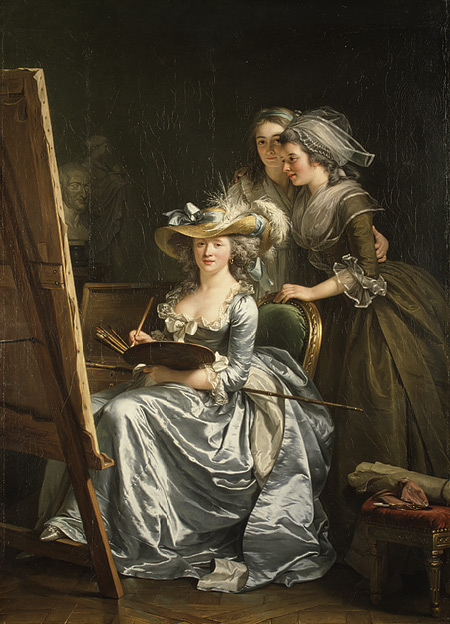
Self-Portrait with Two Pupils, Mademoiselle Marie Gabrielle Capet and Mademoiselle Carreaux de Rosemond by Adélaïde Labille-Guiard (1785)

In 1780 Adélaïde had set up her own studio and had accepted a group of women pupils, several of whom went on to become successful portraitists. By 1784, her reputation as a gifted art teacher was firmly established and one of her most famous works, which is now housed in the Metropolitan Museum of Art in New York, is her 1785 work entitled Self–Portrait with Two Pupils, Mademoiselle Marie Gabrielle Capet and Mademoiselle Carreaux de Rosemond, which highlights her role as a tutor. The work has often been construed as a piece of propaganda, symbolising the dispute over the role of women in the Academy. She has portrayed herself in her studio which is richly furnished and this was her way of denoting her favourable financial situation.  She is seated in front of a large canvas and behind her stand two of her students, Marie Gabrielle Capet and Mademoiselle Carreaux de Rosemond, who have been depicted in much plainer clothes.  Adélaïde wears a sumptuous and expensive low cut gown and large plumed hat neither of which would have been worn by an artist at work but is more likely to be a declaration of her femininity, and the fact that she is an artist who moved in high society.  The feminist stand on art education was further enhanced by the inclusion of her two female students both of whom would become great artists in their own right.  In the background she has included the bust of the Vestal Virgin as an additional emphasis of the feminist mood of the time.  One can tell by this work that she had a great belief in herself as an artist.  So if she wanted to paint a self-portrait, why include two other people in the work?  The reason for their inclusion is probably two-fold.  First of all, because she was a strong proponent of the education of women artists, it is her statement of belief that females should receive artistic tuition and secondly she is demonstrating her ability as a group portraitist and this painting received critical acclaim when it was exhibited which led to many commissions for family group portraits.  This was indeed a clever self advertisement by the artist.  One of the pupils in the painting, Marie Gabrielle Capet, became Adélaïde’s close friend and her favourite student.  She became a miniaturist and pastel portraitist in her own right and lived with Adélaïde Labille-Guiard before and after the artist’s marriage to Vincent.  After Adélaïde died Marie Gabrielle Capet remained in the house and continued to care for Adélaïde’s husband.

Marie Adélaïde de France, Known as Madame Adélaïde daughter of Louis XV and Marie Leszczyńska by Adélaïde Labille-Guiard (1787)

Labille-Guillard was an extremely talented portraitist and unlike her fellow Academician, Lebrun, she received portrait commissions from both sides of society, members of the aristocracy as well as revolutionary figures.  She also received royal commissions and one of her royal patrons was Princess Marie Adélaïde, the aunt of Louis XVI and through this received an annual government pension of 1000 livres.  Labille-Guiard painted the portrait of the princess and her sister, Princess Victoire-Louise, as well as a portrait of the sister of Louis XVI, Princess Élisabeth. Because of these royal commissions to paint portraits of female family members of Louis XVI, she came to be known as Peintre des Mesdames.  She would normally have been also allowed a studio at the royal court but because her pupils were female that was not to be.  However such royal patronage, in some ways, made Labille-Guiard politically vulnerable at the time of the French Revolution of 1789 and she was made to destroy a number of her portraits of court members of the fallen monarchy and for a time she decided, for her own safety, to leave Paris.   At the Salon exhibition of 1791 she exhibited portraits of two prominent members of the French National Assembly, Maximilien Robespierre and Armand, duc d’Aiguillon.

In 1795 Adélaïde was granted artists’ lodgings at the Louvre and had her government pension enhanced to 2000 livres.  As a member of the Académie Royale she continued to regularly exhibit her portraits at the Salon until 1800.   Adélaïde Labille-Guiard died in April 1803, aged 54.

Whilst researching the life of Adélaïde Labille-Guiard I came across a book entitled Adélaïde Labille-Guiard – Artist in the Age of Revolution by Laura Auricchio.  It is from this literary work that I gleaned most of the information regarding her life.   I can highly recommend the book if you want to find out more about the artist and study some of her exquisite works.

Jean-Marc Nattier

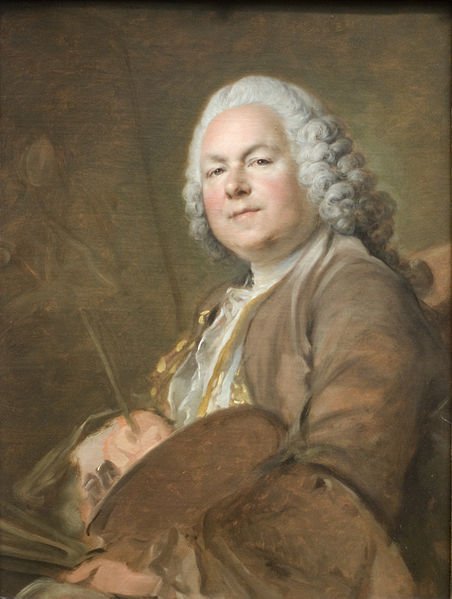
Jean-Marc Nattier by Louis Tocqué (c.1742) Toqué was taught by Nattier in the 1720's and married Nattier's daughter Marie in 1747.
Jean-Marc Nattier by Louis Tocqué (c.1742)Toqué was taught by Nattier in the 1720’s and married Nattier’s daughter Marie in 1747. 

The career you decide on as a teenager is often a logical follow-on from what one or both your parents did or what they were interested in.  There are cases when parents are disappointed that their children don’t follow their career footsteps, no matter how much they try to cajole them.  Musicians beget musicians, lawyers, beget lawyers and of course artists beget artists.   The father, mother and godfather of the painter featured in my blog today were all artists and so one should not be surprised to find that their sons became interested in all things artistic.  Of course to be interested in art and be good at art are two completely different things but my featured painter today was one of France’s most talented 18th century historical painter and portraitist.  He was Jean-Marc Nattier. 

Nattier was born in Paris in March 1685.  He was the second son of Marc Nattier a portrait painter and Marie Nattier (née Courtois) who was a miniaturist.  His father and his godfather were his first art tutors.  His godfather was Jean Jouvenet, a history painter, who specialised in religious scenes.  When he was fifteen years of age his father arranged for him to enrol in the drawing classes at the Académie royale de peinture et de sculpture of Paris and soon the establishment recognised the artistic talent of  Jean-Marc for in 1700 he was awarded the Premier Prix de Dessin.

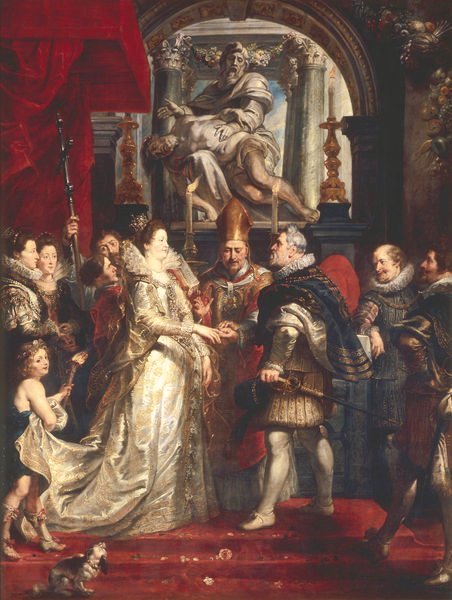
The Wedding by Proxy of Marie de' Medici to King Henry IV by Rubens (1622-1625) Part of the Marie de' Medici cycle
The Wedding by Proxy of Marie de’ Medici to King Henry IV by Rubens (1622-1625)
Part of the Marie de’ Medici cycle

Nattier’s father had a royal licence to reproduce Rubens’s famous cycle of paintings known as the History of Marie de’ Medici, which was, at that time, housed in the Le Galerie du Palais du Luxembourg, Paris.  It is now housed in the Louvre.   Before he died, he arranged for the licence to be taken over by Jean-Marc and his brother, another artist,  Jean-Baptiste Nattier.  Nattier and his brother spent much time making drawings of this cycle of paintings.  The cycle consisted of twenty four monumental allegorical paintings of the French dowager Queen by the Flemish painter Peter Paul Rubens who began painting them in 1622 and which took him two years to complete.  It was a set of narrative paintings, commissioned by Maria de’ Medici, the widow of Henry IV of France, who, on her husband’s death, took control of the country until their thirteen year old son Louis XIII reached the age of thirteen.   Twenty-one of these works tell the story of her life, her struggles and triumphs as a widow, mother and ruler.  The other three paintings were portraits of her and her parents, Francesco I de’ Medici the Grand Duke of Tuscany and Joanna, Archduchess of Austria.  It was presumably in her mind that such a set of paintings about her would immortalize her in French history. Jean-MarcNattier, over time, made a series of drawings of this cycle of paintings which were turned into engravings by the leading engravers of the time.  The drawings appeared in 1710 under the title La Galerie du Palais du Luxembourg and  proved extremely popular.  Jean-Marc Nattier’s artistic ability was now recognised. 

Portrait of Tsar Peter by Jean-Marc Nattier (1717)

Through the good auspices of his uncle, Jean Jouvenet, Jean-Marc Nattier was offered the chance to visit Rome and study at the prestigious Académie de France à Rome.  Unlike his elder brother, John-Baptiste, however, he declined the offer and instead of heading to Italy, remained in Paris to further his career.  

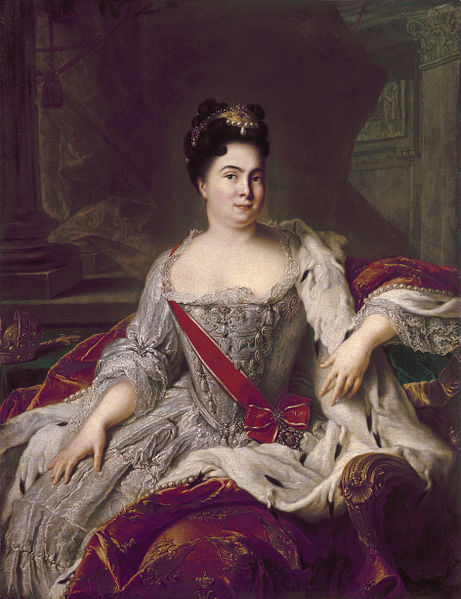
Catherine I of Russia by Jean-Marc Nattier (1717)

In 1717, Nattier, at the age of thirty-two, travelled to Amsterdam where he was commissioned to paint portraits of the visiting Russian Tsar, Peter the Great and his second wife, the Tsarina, Catherine. Both portraits are housed at the Hermitage in St Petersburg.

Battle of Poltava by Jean-Marc Nattier (1717)

The Tsar, obviously pleased with the portraits then commissioned Nattier to produce two historical paintings depicting the 1709 Battle of Poltava and the 1708 Battle of Lesnaya, two of the major conflicts between Russia and Sweden in the Great Northern War which he completed in 1717. 

The Tsar was delighted with the history paintings and invited him to come to Russia and work at the Russian court but the Frenchman declined the offer and returned to the French capital.  Nattier remained in Paris for the rest of his life . 

Perseus Petrifies Phineas and his Companions with the head of Medusa by Jean-Marc Nattier (1718)

Nattier’s work between 1715 and 1720 focused on historical paintings such as his Great Northern War paintings (above) and he was received into the Académie Royale as a history painter on the strength of these works and in particular one he completed in 1718 entitled Perseus Petrifies Phineas and his Companions with the head of Medusa.   The painting is based on Book V of Ovid’s Metamorphoses,  which tells the tale of  Andromeda, who was betrothed to her uncle, Phineas, until Perseus rescued her from the sea monster, Cetus,  and in return for saving her life she agreed to marry him instead.    At their wedding celebrations Phineas and his followers burst in and attacked Perseus and the wedding guests.  Andromeda came to his aid but he was heavily outnumbered.  Perseus then unveils his ultimate weapon, the severed head of the gorgon, Medusa, that petrifies all those who look at it.  Perseus thus transforms all his attackers into statues and utters the words to Phineas:

“…You shall not suffer by the sword.  Rather I will cause you to be an enduring monument through the ages and you will always be seen in my father-in-laws palace, so that my wife may find solace in the statue of her intended…”  

Phineas tried to avert his eyes but it was too late.  His neck hardened, the tears on his cheek were turned to stone and he was turned into marble.  In Nattier’s painting we see the intruders on the left already turned to stone whilst those in the right foreground try to avert their eyes from the Medusa’s severed head which is being held aloft by Perseus.  Throughout the painting we see the bright flashes of highly polished armour.  There are also the gleaming  silver salvers and decorative pitchers which lie on the floor in the foreground that were being used for the wedding feast.  These random reflections catch our eye and have our gaze dart around the painting.  This attention-dispersing effect is known as the papillotage

Nattier’s was forced to move from historical paintings to the more lucrative genre of portraiture around 1720 when he, and numerous French citizens, lost most of their money they had invested in the government’s Mississippi Company, set up by Louis XIV’s financial adviser, the Scotsman, John Law.  The collapse of the company became known as the Mississippi Bubble.  Nattier was in a state of financial ruin and urgently needed to recoup his lost money and the most lucrative art genre was portraiture, although this form of art came low down in the academic hierarchy of genres.   Artists of the time who made money from their portraiture were frowned upon by the art establishment who considered that the portraitists had lost all artistic credibility.  Nattier was loathed to give up on his favoured genre of history painting, which he knew the art academies of 17th century Europe considered the highest intellectual achievement for an artist.   He was extremely unhappy that he was about to sell his soul for the financial gain of portraiture but “needs must”.   However to retain some artistic credibility he decided that his portraiture would revive the genre of allegorical portraiture and by depicting his sitters as characters from Greek and Roman mythology, history or biblical tales then he was not completely abandoning history painting.  Initially his portraiture clientele came from the Parisian bourgeoise but later in the 1730’s he began to work on portraits of the ladies of the Royal court and in the 1740’s he was commissioned to paint portraits of the Royal family of Louis XV.  

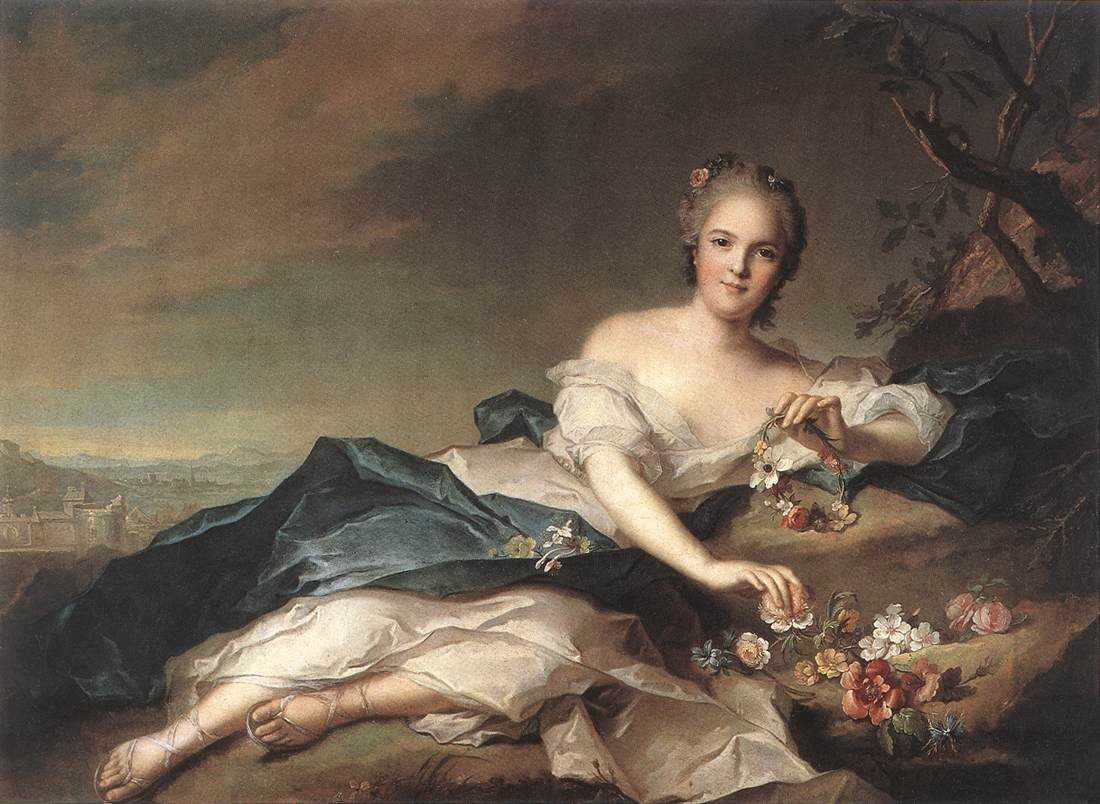
Henriette of France as Flora by Jean-Marc Nattier (1742)

Females liked this type of portraiture as artists could then depict them in roles outside their normally constrained and often boring professions, and elevate their status to that of Goddesses.  Nattier realised that with a little help from props and artificial settings the finished painting moved a tad closer to the much vaunted and more credible history painting genre.  His finished works pleased the female courtiers as besides elevating them to the status of Goddesses he would cleverly beautify his sitters without losing their true likeness.  Examples of this allegorical portraiture can be seen in his 1742 painting entitled Henriette of France as Flora.  The painting had been commissioned by Henriette’s mother, Maria Leczinska, the wife of Louis XV.  Nattier had transposed the princess into the mythological figure of the Roman goddess of flowers and the season of spring, Flora. 

Marie Adelaide of France by Jean-Marc Nattier (1745)

Three years later in 1745 he completed another allegorical portrait for Maria Leczinska.  This time it was a portrait of another of her daughters, Marie Adelaide, which was entitled Marie Adelaide of France as Diana.  Diana was the Roman goddess of hunting and in the painting we see Marie Adelaide sitting on the ground, one hand wrapped around her bow whilst the other hand withdraws an arrow from its quiver.  Both the paintings of Louis XV’s daughters can now be seen at the Uffizi Gallery in Florence.

Portrait of Queen Marie Leszczyńska by Jean-Marc Nattier (1748)

In 1748 Nattier received a commission to paint Louis XV’s wife, Maria Leszczynska, who was the daughter of the former King of Poland.  Louis and Maria’s marriage was an arranged one and fifteen year old Louis and twenty-one year old Maria met for the first time on the eve of their wedding.   It started off as a very happy marriage and the couple went on to have ten children.   There were complications with the birth of the last child, Princess Louise, in 1737 and from that time on the couples sex life was at an end and they slept in separate rooms.   It was around this juncture in their married life that Louis  began to have a series of love affairs including his famous one with Madame de Pompadour.   The portrait by Nattier of the Queen was a change of portraiture style.  This was not the usual allegorical portrait that he had been carrying out over the last twenty years, but a simple depiction of a forty-five year old married woman.  Marie had asked that she be depicted in habit de ville (day dress).   She wanted simplicity and that is exactly what Nattier gave her.  We see her seated with her left hand on top of an open bible which makes us aware of her strong religious beliefs.  She looks relaxed and at ease with herself.  She was a homely-type of person and Nattier has depicted her just so.  There is a natural quality about this work which must have pleased the queen.

Jean-Marc Nattier had married Marie-Madeleine de la Roche in 1724 and the couple went on to have four children, one of whom, Marie, married Louis Tocqué in 1747.  Tocqué who was only ten years younger than his father-in-law and had at one time been a student of his and they were colleagues at the Académie Royale.  Louis Tocqué and Jean-Marc Nattier were two of the most celebrated portraitists of the 18th century.

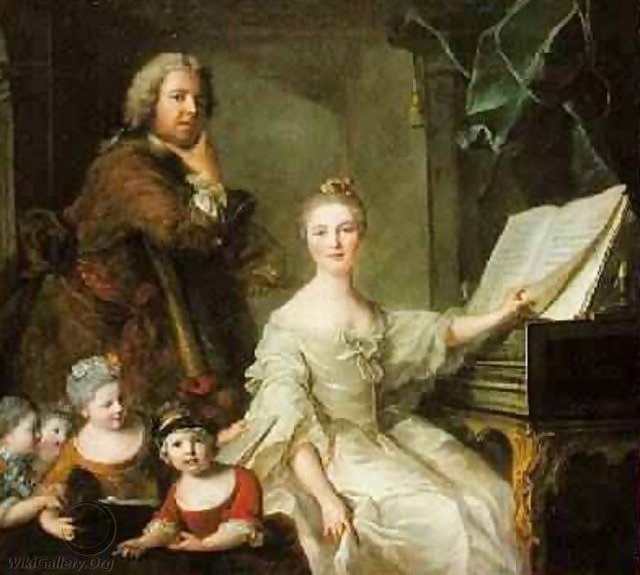
Self-Portrait with his Family, by Jean-Marc Nattier

Nattier completed a family portrait of himself, his wife and their four children which depicts them well dressed and quite affluent looking.  The painting would have been from the 1730’s when Nattier had started to recover from his financial losses a decade before.  

Jean-Marc Nattier’s health deteriorated in 1762 and he was forced to stop painting.   The popularity of his work had started to wane in the last decade of his life and he died a poor man.  

Jean-Marc Nattier  died in Paris in November 1766, aged 81.

The Three Portraits of Ria Munk by Gustav Klimt

I suppose the most challenging and distressing period of one’s life is when somebody close to us, somebody we love, dies.  It is both a traumatic and painful time when suddenly we feel the loss of someone we loved.  Later, we want to cling to memories of the dead person.  We want to remember them forever.  We do not want to ever forget that person who had so touched our lives.   How do we do that?   Within days of our loved one dying, we are offered the chance to see the deceased one last time as they lay in rest in the funeral parlour.   I have done that on a number of occasions and regretted it.  I probably did it more out of duty than out of a desire to see the body of the dead person.  The face of the deceased I looked down upon was not the way I wanted to remember them.  It makes no difference how well the mortician has waved his or her magic wand over the deceased, the face of the person is pallid and lifeless and only our mental capacity and power of imagination can change that image.  Ultimately, our fondest recollection of the deceased person is almost always through photographs, which sadly, like our recollections, fade over time.  Even after photography became the medium of remembrance, a painting of a person acted as an aide-mémoire and in today’s blog I want to look at how one family wanted to remember their deceased daughter. 

Ria Munck on her Deathbed by Gustave Klimt (1912)
Ria Munk on her Deathbed by Gustav Klimt (1912)

My blog today is about a mother’s love for her dead daughter and her desire to hold on to her memories of her beautiful girl through a posthumous painting.   The mother in question was Aranka Pulitzer Munk.  She was the niece of Joseph Pulitzer, the man who, through the  provisions in his will, set up the Pulitzer Prize for Journalism.   Aranka married Alexander Munk, a wealthy Polish industrialist in 1882 and the couple went on to have three daughters, Lili, Maria (Ria) and Lola.  The daughter that is featured in today’s blog is the second-born girl, Ria, who was born in November 1887.  Ria was an extremely beautiful young woman and in 1911, when she was twenty-four years old, she had become the lover of the forty-year old German poet and writer Hanns Heinz Ewers.  This was never going to be a good match for Ewers reputation as a libertine was well known and wherever he went, scandals followed.  However maybe it was this that drew Ria to the latter-day “bad boy” character.  They eventually became betrothed and despite Ria entering this arrangement with a sizeable dowry, Ewers called it off.  According to the book Gustave Klimt by Jane Rogoyska and Patrick Bade, Ewers wrote Ria a letter that December, in which he described her as “a hopeless romantic and out of touch with reality”.     As one can imagine, Ria was devastated and could not come to terms with the break-up and at noon on December 28th she took a gun and shot herself through the heart. 

Whereas now, the tabloid papers would be full of the scandalous story of the suicide of the daughter of a wealthy family, the suicide of Ria Munk was of little import in the local press.  On the contrary, Viennese society looked upon suicide following a broken relationship as almost the norm.  There was even a sense of romanticism about it, similar to cases of death at the end of a duel which was fought over someone’s honour.  The Viennese society seemed to be in awe of the pomp and ceremony of grand funeral processions which followed on from such deaths.  The famous Austrian writer and journalist, Stefan Zweig  summed it up in his 1943 autobiography, The World of Yesterday, when he wrote:

“…‘In Vienna, even funerals found enthusiastic audiences and it was the ambition of every true Viennese to have a lovely corpse, with a majestic procession and many followers; even his death converted the genuine Viennese into a spectacle for others. In this receptivity for all that was colourful festive and resounding, in this pleasure in the theatrical, whether it was on the stage or in reality, both as theatre and as a mirror of life, the whole city was at one…” 

That may in the case but one can only imagine the devastation and heartbreak felt by her parents.  Her mother, Aranka, decided that she wanted a posthumous portrait painted of her daughter.  Aranka’s sister was Serena Lederer (neé Pulitzer) and she was one of Gustav Klimt’s main patrons and he had painted her portrait in 1899 and a portrait of her daughter, Portrait of Elisabeth Bachofen-Echt in 1916.  Serena Lederer and her husband August had built up the largest collection of the Austrian artist’s works and so it was logical for Aranka to ask her sister to speak to Klimt about the portrait commission, Klimt was, at that time, the most sought after portraitist in Vienna.  It was also around this time in Viennese society that the death-mask portrait and the death-bed portrait had grown to become in vogue with city’s privileged classes, and so following the tragedy of her daughter’s suicide, Aranka Munk decided that she would commission a death-bed portrait of her beloved Ria and arranged, through her sister, to have Klimt  paint it. 

Presumably with the help of photographs, Klimt completed the death-bed portrait of Ria Munk in 1912 and it was entitled Ria Munk am Totenbett (Ria Munk I),   Ria Munk on her Deathbed (Ria Munk I).  The background of the work is dark blue and is in stark contrast to the red carnations which form part of the garland of flowers, which frame Ria’s beautiful face.   Looking at the work we see Ria lying peacefully with her head on a white pillow.  Surrounding the pillow there are some white carnations.  There is no indication that Ria has died a violent death.   This painting is all about Ria’s beauty.  Her chest is covered in orange, red and purple fabric, which hide from us the bullet wound.  She is at peace.  Klimt has painted her with pink cheeks. As yet her facial features have not begun to sink into her skull.   Her mouth is partly open which make us think that she is just asleep.    She is surrounded by flowers and many people draw a similarity to Klimt’s depiction of her and the depiction of the tragic heroine in John Everett Millais’ 1852 painting, Ophelia.   It is a lovely portrait which exudes an aura of peace and serenity but there was also something about it that made her parents to reject it.  Aranka Munk decided the work, although beautiful, was too death-like and too distressful to behold.   Aranka then belatedly decided that she wanted the aide-mémoire of her daughter to be a painting of how she remembered her when she was alive.  She wanted to evoke memories of her daughter’s vivaciousness and exuberance, rather than the peaceful but solemn one of Ria, depicted by Klimt as she lay on her death bed and so, according to Erich Lederer, Serena Lederer’s son, Klimt was again commissioned to paint a second portrait of Ria.  In 1913, Aranka gave Klimt some more photographs of her daughter and asked him for another portrait, one that would encapsulate her beauty and her joie de vivre. 

Die Tänzerin (Ria Munk II) by Gustave Klimt (1916)
Die Tänzerin (Ria Munk II) by Gustav Klimt (1916)

There are some questions about this second portrait that remain unanswered.    The one fact we do know was whatever the artist gave Aranka, she rejected it.   Why did she reject it?   Was the painting above the one Klimt handed over to Aranka Munk?  If we look at the painting which bears the title Ria Munk II, then it is not difficult to see why a mother would be horrified and subsequently reject such a semi-naked portrait of her late daughter.   However we are not sure that the portrait we see before us was the painting Klimt gave her, in fact we can almost be certain that it was not.  Would Klimt really believe that a grieving mother would welcome such a semi-nude depiction of her daughter?  Although we have no way of knowing what Klimt’s second portrait of Ria Munk, which he gave to Aranka looked like, what we do know is that it was rejected by her.  Another fact we know about this second commission from Ria’s mother was that Klimt struggled with it.  We know this from a postcard he sent to his life-long friend, the Viennese fashion designer Emilie Flöge, in 1913.  He wrote of his problem with the commission:

“…the Munk portrait… wouldn’t come together! Can’t make it a likeness!…”

Following Aranka’s rejection of the painting, Klimt took it back to his studio, and altered it.  The altered and finished version is more erotic and depicts a bare-breasted portrait of a dancer.  It is now beleived that the dancer could have been Johanna Jusl, who was not only a dancer with the Vienna Hofoper but was also one of Klimt’s models.  His amended version, which we see above, depicts a lady, bare-breasted and exuding an overt sensuality, which one presumes would not have been present in the painting he offered Aranka Munk.   She stands in a full-frontal pose but her head is coyly turned away. Her cheeks have a faint rose tinge to them.  The elongated horizontal shape of her eyes gives her an oriental look.  There is a delicate tinge of light blue on her face and neck which confers upon her a ghost-like appearance. Next to her is a table upon which there is a vase of poppies.  Behind her, to the right, there is a vast floral display whilst in the left of the work we see oriental figures portrayed on a green background.  Her highly colourful and garish patterned  dress, which is open to her waist exposing her breasts, seems to become one with the background.  Below the hem of the dress we catch sight of lace-edged black pantaloons below which we see her shapely white-stocking legs and high-heeled shoes with their decorative bows.  There is a definite oriental-feel to this work and we know Klimt was fascinated by orientalism.  In Frank Whitford’s 1990 book, Klimt, he tells the story of a young aspiring artist, Egon Schiele, visiting Klimt’s studio in the Vienna district of Heitzing and how Schiele describes the studio as being dominated by Far Eastern Art and artefacts as well as Japanese woodblock prints.  Klimt had also a large collection of kimonos, a large red Japanese suit of armour and a number of exquisite Chinese costumes.  So was Klimt’s love of orientalism unusual?  In 1923, Anton Faistauer, a Viennese painter wrote a book entitled ‘Neue Malerei in Osterreich’ and in it he discussed  Klimt and orientalism, he wrote:

“…for Europeans Klimt is an outsider… (and) it would be better not to compare him at all to western ways. He is incomprehensible to the West, to the French and Germans, and his art, for now, is rejected there… He is conceivable only in Vienna, better still in Budapest or Constantinople. His spirit is entirely oriental. Eroticism plays a dominant role in his art, and his taste for women is rather Turkish… He is inspired by the decorations of Persian vases and oriental carpets, and especially delights in the gold and silver of his canvases…” 

The work, with the title Die Tänzerin (Ria Munk II) – The Dancer (Ria Munk II), the title originating from Erich Lederer, remained in Klimt’s studio and he never sold it.  It is now part of the collection of the Neue Galerie in New York. 

Frauenbildnis (Ria Munk III) by Gustave Klimt (1918)
Frauenbildnis (Ria Munk III) by Gustav Klimt (1918)

The third portrait of Ria Munk, entitled Frauenbildnis ( Ria Munk III), which Klimt began around 1917, was one of the largest and greatest full-length female portraits by him.  It was, like a number of Klimt’s  later works found in his studio, unfinished, when he died in February 1918.  The woman in the painting, with her pink cheeks and dark eyes is standing sideways on but is turning to face us, the viewer.  Unlike the previous portrait, there is demureness in the way she holds her robe closed.  She seems totally at ease.  There is an aura of self-confidence about the young lady.  She proffers us a dreamy smile.  There is no hint of seductiveness about her expression that we saw in the earlier portrait. As was the case in many of his earlier full length female portraits of women from Vienna’s high society such as Portrait of Adele Bloch Bauer II (1912), Portrait of Eugenia (Mäda) Primavesi (c.1914) and Friedericke Maria Beer (1916), he once again morphs his subject into a highly colourful and decorative background.   The background of this work consists of a multitude of flowers such as roses and tulips, floral patterns and oriental-looking designs. The painting is incomplete, especially with regards the dress and the foreground, which we see are just traces of the charcoal preliminary sketch.

Shortly after Klimt’s death, and because her daughter’s portrait had been commissioned by Aranka Munk, it was given to her.  Aranka, who had divorced her husband in 1913, was now living in the summer at her lakeside villa at Bad Aussee in the Austrian state of Styria and it was here that she kept this third portrait of her daughter Ria.  It remained there until 1941.  Aranka, being Jewish, was then forced to sell part of the property to neighbours in 1941.   The Gestapo later seized her remaining property, and her apartment in Vienna, in 1942.    Aranka was deported to Lodz in German-occupied Poland in October 1941 and was put to death on November 26th, a day before her 79th birthday. Her daughter, Lola, was also sent to a concentration camp, at Chelmno, Poland, where she died in September 1942.

The year the villa and its contents were seized by the National Socialists, the Frauenbildnis ( Ria Munk III), portrait passed into the hands of the art collector and dealer William Gurlitt.  In 1953 the Frauenbildnis painting was among a number of important paintings that Gurlitt sold to the Neue Galerie der Stadt Linz, which in 2003 became known as the Lentos Museum. The painting subsequently remained in the Lentos Museum, Linz until June 2009.  It was then, after years of legal challenges that Linz city council finally voted to return the Klimt painting to its rightful owners and it was thus given up by the Lentos Museum to Aranka Munk’s descendents, who were living in Europe and America.  The following year, June 2010, the descendents put the work in Christie’s London auction where it sold for £18.8 million. 

Whilst I was working on this blog news broke out about a $1 billion art hoard discovery at a Munich apartment of an 80-year-old recluse, Cornelius Gurlitt.

Does the surname ring a bell ??????

John Peter Russell. Part 1. Van Gogh and portraiture

John Peter Russell
John Peter Russell

Last week I watched a documentary on television about the death of Vincent van Gogh.  You have probably seen something similar or read a book on his somewhat mysterious death.   Did he commit suicide?  Was it an accident?  Was he murdered?  Why was the gun never found?  What, if anything, did Doctor Gachet have to do with his death?  Why did both Doctor Gachet and Vincent’s brother Theo allow Vincent to lie in agony for three days at his lodgings with the bullet still in his body rather than rush him to hospital to have it removed?  However the subject of my blog today is not about Van Gogh’s death.  During the documentary it showed a portrait of the great artist and said that it was Van Gogh’s favourite depiction of himself.   What really stimulated my curiosity was to hear that the portrait was completed by a friend of his, an Australian painter by the name of John Peter Russell.  I had never heard of this artist and I could not comprehend how an Australian artist could feature in the Dutchman’s life and so I decided to find out more about him.  In this first of my two part blog on Russell I want to look at his early life and a couple of his portraits including the one of van Gogh.   So come with me on a voyage of discovery and learn about how a former foundry worker in Australia came to paint a portrait of the great Dutch Master.

The story begins at the beginning of the 19th century in Kirkcaldy, Scotland.  It was here that John Peter Russell’s grandfather, Robert Russell, had his foundry and engineering works. Robert and his wife Janet Russell (née Nicol) had eleven children, one of whom, John, was our featured artist’s father.   In 1830 Robert’s business hit financial problems due to a downturn in demand and he decided to immigrate to Canada.  His intended destination changed on the advice of a friend and instead of heading west to Canada he and his family took the steamer Anne Jamieson and sailed to Van Diemen’s Land (now Tasmania) and arrived in the port of Hobart in June 1832.  Robert Russell along with his sons, Robert, Peter and John started up an engineering works in Tasmania which proved very successful.  In 1838 in order to expand the business the family moved to Sydney and established the firm, Russell Brothers with an engineering works and a foundry on the banks of the Tank Stream, a tributary of Sydney Cove. 

John Russell married and English girl, Charlotte Elizabeth Nichol, and they went on to have four children of which John Peter Russell, the subject of today’s blog, was the eldest.   He was born in June 1858 in the Sydney suburb of Darlinghurst.  John Peter was educated at the Goulburn School in Garrooriagang, a private boarding school for the “sons of gentlemen”.  After completing his education in 1876, the eighteen year old travelled to England and was apprenticed at the engineering company, Robey & Co. of Lincoln and eventually became a qualified engineer.   It was also around this time that he began to take an interest in sketching and painting.   In 1879 John Peter Russell’s father died and left his children a sizeable inheritance. 

In 1881, John Peter Russell who thanks to his inheritance was financially sound and did not need to continue as an engineer.   He decided to pursue his love of art and enrolled at the Slade School of Fine Arts at the University College of London.  Whilst at the Slade he studied under the Dijon-born French painter and sculptor, Alphonse Legros.  Legros would delight his students by showing them his quick preliminary oil sketches (known as ébauches) of the head portraits he had done and it was this type of painting which grabbed Russell’s interest. 

In August 1883, after completing his art course at the Slade, Russell decided to set off on his travels.  His fellow travellers were his brother Percy, an architect, Tom Roberts, a fellow aspiring artist who would later become a leading figure of the Australian Heidelberg School of Impressionism and who, like Russell, had emigrated with his family from the UK to Australia when he was fourteen years of age.  Tom Roberts had returned to his birthplace, London, to study art at the Royal Academy Schools.  Another person in the travel party was the physician and friend William Maloney who would later become a Labour MP.    Their first port of call was Spain where they encountered two Spanish art students Laureano Barrau, who would become a leading Spanish Impressionist painter and the Catalan painter Ramon Casas who would later be known for his paintings depicting crowd scenes. 

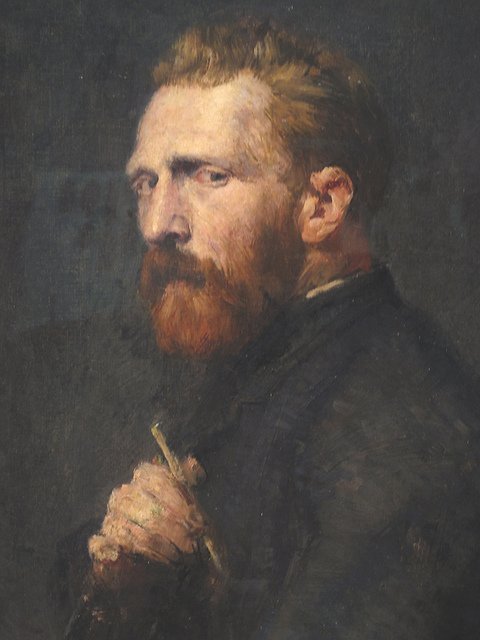
In 1885 Russell went to live in Paris and for the next eighteen months studied at the Atelier Cormon, which was run by the French painter, Fernand Cormon.  It was an “academic” studio in which Cormon endeavoured to instil in his students the necessary artistic “rules” which would ensure that their paintings found favour with the Paris Salon jurists.  Many great painters, such as Émile Bernard, Louis Anquetin, and Toulouse Lautrec studied under Cormon during Russell’s tenure.  Russell who had studied portraiture at the Slade School of Art was still interested in portraiture and would often paint portraits of his friends and fellow students.    In March 1886 whilst Russell was attending the Atelier Cormon another student enrolled – Vincent van Gogh.  Vincent had moved to Paris and went to live with his brother Theo in his apartment in rue Laval on Montmartre in order to study at Cormon’s studio.   A great and long-lasting friendship developed between Van Gogh and Russell.  In October 1886, Russell finally persuaded Van Gogh to sit for him.  The resulting work was the beautiful crafted portrait of the Dutchman which I spoke about at the beginning of the blog. 

Vincent van Gogh by John Peter Russell, 1886

Although Russell had painted portraits of his friends it is believed that he wanted to paint Van Gogh’s portrait as the depiction of the Dutchman’s face would be a challenge with its craggy and somewhat haggard appearance.     Russell had seen some of Van Gogh’s own head and shoulder portraits and self portraits and liked the way the Dutchman had used an academic style in his portraiture, incorporating darkened background as a contrast to the lighter skin tones and so decided to use this same technique on his own depiction of van Gogh.  He has given Van Gogh such a penetrating gaze as he stares out at us which in some ways makes us feel slightly uncomfortable.  It is almost a censorious gaze as if he is questioning our presence.    What I think adds to the beauty of this portrait is how Russell has got van Gogh to look over his shoulder for the pose and of course to remind every one of the sitter’s profession he had the Dutchman hold a paintbrush.  Vincent van Gogh was delighted with Russell’s finished portrait.   On September 6th 1889, ten months before his death, Vincent wrote to Theo and in it he mentioned the Russell portrait: 

“……….Afterwards, what are we beginning to glimpse timidly at the moment that is original and lasting – the portrait. That’s something old, one might say – but it’s also brand new. We’ll talk more about this – but let’s still continue to seek out portraits, above all of artists, like the Guillaumin and Guillaumin’s portrait of a young girl, and take good care of my portrait by Russell, which means a lot to me.….”

The painting, which is at the Van Gogh Museum in Amsterdam, has itself darkened over the years as on a recent microscopic examination it was discovered that, above the head of van Gogh, there had been inscribed in red the words:


                                       VINCENT

                                                                      AMITIÉ


                                      J.P.RUSSELL  PINTOR

 Paris 1886


Also according to the Museum curators, a friend of John Peter Russell and van Gogh, the British artist Archibald Standish Hartrick, had seen the original portrait soon after it had been completed and he said that Vincent was depicted in the portrait wearing a striped blue suit !   According to the museum curators there is a hint of blue near the mid base of the work.

Russell and Van Gogh were great friends for the short time they were together and after they went their separate ways they continued to correspond.  One of the last letters Vincent wrote to Russell on February 1st 1890 just five months before his death and when he was in the mental hospital in St Rémy.

My dear friend Russell

Today I’m sending you a little roll of photographs after Millet  which perhaps you may not know.  In any event, it’s to recall us, my brother and myself, to your good memory. Do you know that my brother has since married and that any day now he’s expecting his first-born? May it go well – he has a very nice Dutch wife.  How it pleases me to write to you after a long silence.   Do you remember the time when, almost simultaneously, you I think first and I afterwards, met our friend Gaugin?    He’s still struggling on – and alone, or almost alone, like the good fellow he is. Am sure, though, that you don’t forget him.  He and I are still friends, I can assure you, but perhaps you’re not unaware that I myself am ill, and have more than once had serious nervous crises and delirium. This was why, having had to go into an asylum for the insane, he and I separated. But prior to that, how many times we talked about you together!   Gaugin  is currently still with one of my fellow-countrymen called De Haan, and De Haan praises him a great deal and doesn’t find it at all bad to be with him.  You will find article on canvases of mine at the Vingtistes.   I assure you that I myself owe a lot to things that  Gaugin told me as regards drawing, and hold his way of loving nature in high, very high esteem. For in my opinion he’s worth even more as a man than as an artist. Are things going well with you? And are you still working a lot?  Although being ill isn’t a cause for joy, I nevertheless have no right to complain about it, for it seems to me that nature sees to it that illness is a means of getting us back on our feet, of healing us, rather than an absolute evil.  If you ever come to Paris,  take one of my canvases from my brother’s place if you wish, if you still have the idea of making a collection for your native country one day.  You’ll remember that I’ve already spoken to you about it, that it was my great desire to give you one for this purpose. How is our friend  MacKnight?   If he’s still with you, or if there are others with you whom I’ve had the pleasure of meeting, give them my warm regards. Above all, please remember me to Mrs Russell and believe me, with a handshake in thought,

Yours truly,

Vincent van Gogh

c/o Doctor Peyron

St-Rémy en Provence.

Head of Mrs. John Peter Russell (Marianna Mattiocco della Torre) by Auguste Rodin

Whilst living in Paris, Russell had become very friendly with two Parisian sculptors, Auguste Rodin and Emmanuel Frémiet and it was whilst visiting their studios that he encountered one of Rodin and Frémiet’s’ favourite models, Marianna Mattiocco della Torre. Rodin had, in 1888, encapsulated her beauty in a bronze bust entitled  Head of Mrs. John Peter Russell (Marianna Mattiocco della Torre) and Frémiet had used Marianna as the model for his bronze life-sized Jeanne d’Arc statue which is at the Place des Pyramides in Paris. 

Equestrian statue of Joan of Arc by Emmanuel Frémiet (1899)

Marianne who was born in Cassino, Italy was in her early twenties when she met Russell in 1885 and three years later, on a cold Parisian day in February 1888, John Peter Russell and Marianna Mattiocco became husband and wife.  By the end of the year the happy couple had left Paris and set up home at Belle Isle, the largest of the Breton islands, off the west coast of Brittany.  It was here that Russell had their home built and because he was the first non-Frenchman to settle on the island his house was known as Le Chateau Anglais. 

Dadone by John Peter Russell (1900)

The second portrait by John Peter Russell I want to show you is entitled Dadone and was completed around 1900.  The question is who or what is Dadone?  The word “dadone” I believe, but I am by no means certain, is an old fashioned Italian slang for “ancestor” or literally “old one” and therefore indicates that the subject has some sort of family relationship with Russell. 

Les deux Mattiocco by John Peter Russell (1902)

The answer to the question can be found in a double portrait which was painted by Russell a few years later, entitled Les deux Mattiocco which has, at the top of the work, the inscription ‘Maria Peppa-Y-Pascal Mattiocco’.  The painting, which depicts an elderly couple, is of Russell’s father and mother-in-law, Pasquale and Maria Mattiocco.   

The date of the Dadone painting is thought to be 1900 as there is a preliminary sketch for the work in existence, inscribed, ‘JPR 00’ dating it at 1900 and it is thought that the final painting was completed shortly afterwards.

In the painting, Dadone, we see an inscription in the top right corner of the work:

Dadone

        J R

                Fecit

The inscription indicates the title of the work, the initials of the artist and the word “fecit” meaning he or she made it and the word is used formerly on works of art next to the artist’s name. 

This beautifully crafted portrait by Russell is an affectionate and personal depiction of his wife’s father.  The main colours used by Russell in this work are white, blue and greys profile.  The bony structure of his head is framed by the imperious greying hair and beard, which along with dark bushy eyebrows give his father-in-law such a distinguished appearance.  His eyes are dark and there is a hint of tiredness about them, which has been brought on by age. 

In my next blog, the second part of my look at the life and work of John Peter Russell, I will examine his newly found interest in seascapes and landscapes once he had moved out of Paris and went to live on the Breton island of Belle-Ile where he met with many artists such as Monet and Matisse. 

For further information regarding Russell’s friendship with Vincent van Gogh there is a book you may like to read.  As yet I haven’t read it but I am sure it would be fascinating.  It is:

A Remarkable Friendship:  Vincent van Gogh and John Peter Russell by Anne Galbally

There is also an interesting short video on YouTube about the Van Gogh portrait and the inscriptions that were originally on it:

http://www.youtube.com/watch?v=R6z46c93SXQ

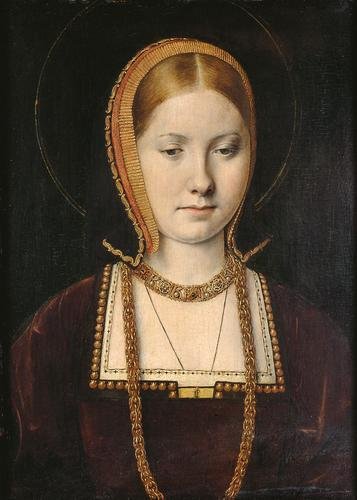
Portrait of an Infanta, Catherine of Aragon by Juan de Flandes

Portrait of an Infanta, Catherine of Aragon by Juan de Flandes (c.1496)

Today, as promised, I am featuring another beautiful and yet quite simple portrait that I came across when visiting the Thyssen-Bornemisza Museum in Madrid.  The work was one of many which hung amongst other fifteenth century paintings.   The reason it stood out for me was because of the beauty and innocence of the eleven-year old sitter whose life and future had been mapped out for her at the age of three.  She was born into an age when planned betrothals and marriages between royal houses was the norm.  Her life, like that of her mother, was to be a life of great turmoil.  The girl in my featured painting is Catherine of Aragon who was the daughter, and youngest surviving child of Queen Isabella I of Castile and her husband King Ferdinand II of Aragon. 

Catherine was born in December 1485 in the small town of Alcalá de Henares some twenty miles from Madrid.  She was the youngest of five children having one brother, John and three sisters, Isabella, Joanna and Maria.    Even at the tender age of three plans were being formulated by her parents to arrange a beneficial betrothal for her.  Not necessarily beneficial to her but beneficial to her country and her parents.  Catherine’s parents were cousins and belonged to the House of Trastámara, a powerful dynasty of kings in the Iberian Peninsula.  Isabella was the half sister and heiress to Henry IV of Castile and Ferdinand was the son of John II of Aragon.  The two of them were betrothed and went on to marry in 1469 in an attempt to consolidate two of the main royal houses, for in 1474 on the death of Isabella’s half brother Henry, she became Queen of Castile and through a prenuptial agreement based on jure uxoris (literally,by right of his wife”) Ferdinand became, not the Prince Regent, but the King of Castile.  Five years later when his father died Ferdinand also became King of Aragon and this unification became the basis of what we know as modern Spain.

According to two of her biographers, Alison Weir (The Six Wives of Henry VIII) and Antonia Fraser (The Wives of Henry VIII), Catherine was “quite short in stature with long red hair, wide blue eyes, a round face and a fair complexion”.   Catherine, through her mother’s side of the family, was connected to the English royal family and so her parents turned to the English royal house for a suitable husband for their daughter.   They also believed that an alliance with England would safeguard them against the predatory French.  Their efforts to find a husband for their daughter found favour with Henry VII the current ruler of England who believed a liaison with the Catholic rulers of Spain and the house of Trastámara would be very advantageous for the English House of Tudor.  And so, in 1488, when Catherine was just three years of age, she was betrothed to King Henry VII’s oldest son Arthur, the Prince of Wales, who at the time was two years of age !   In May 1499 Catherine and Arthur were married by proxy.  She was still six months away from her fourteenth birthday and he was a few months short of his thirteenth birthday.  It was not until 1501 that Catherine left Spain and travelled to London to meet her future husband Arthur although they had been corresponding for a number of years.  They married that November and went to live in Ludlow Castle but five months after the ceremony Arthur died of what was termed “sweating sickness” which was a highly virulent disease that had reached epidemic proportions in England at that time.  Catherine was also struck down by the illness but survived. 

The rest of Catherine of Aragon’s life, her marriage and divorce from Henry VIII, Arthur’s brother, has been well documented and I will not speak more about her life.  The portrait that I am featuring today is a painting of the young girl herself, entitled Portrait of an Infanta, Catherine of Aragon.  It was completed around 1496 when she was about eleven years old.  The artist was the Flemish painter, Juan de Flandes.  Little is known about the artist except that his name would indicate he was born in and spent his early life in Flanders.  It is not until 1496 that we have some documented evidence of his life for his name appears as a court painter in the royal household accounts of Queen Isabella of Castile.   It is thought that Juan de Flandes had, like many other European painters, come to Spain and to the royal household of Isabella and Ferdinand and along with them had worked on a number of religious paintings, including the forty-seven small (each approximately 21cms x 16cms) panelled polyptych entitled The Polyptych of Isabella the Catholic, which has since been split up into its many parts and which only twenty-seven survive. 

Juan de Flandes never returned to his homeland and worked for the royal Spanish household until Isabella died in 1504.  From there he moved to Salamanca where, for the next three years, he worked on the main altarpiece for the city’s university chapel.  During this period he also received commissions for work on an altarpiece for the Salamanca cathedral.   Then four years later, in 1509 he lived in Palencia with his wife.  In Palencia, he again completed a number of commissions for the Catholic Church.   Juan de Flandes is thought to have died in 1519 aged 54. 

My featured painting is a beautiful work which captures Catherine’s beauty and innocence and comes before the traumatic and sad life which she was to endure.   There is even some doubt that the portrait is of Catherine.  Some say that it could be of her sister Joanna but at the time of the painting (1496) Joanna would have been seventeen years of age and the girl in the painting does not look that old.   Also if we look at the work we can see she is delicately holding a rose and this is thought to symbolise her future intended connection with the English House of Tudor, the Tudor Rose.  Other art historians such as the Elisa Bermejo tend to believe that the rose is just symbolic of the youthfulness of the sitter whilst others believe that it is indeed Catherine and this painting was just a betrothal portrait. 

Portrait of Young Catherine of Aragon by Michael Sittow (C. 1504) Kunsthistoriches Museum, Vienna
Portrait of Young Catherine of Aragon
by Michael Sittow (c.1504)
Kunsthistoriches Museum, Vienna

One of the other Nertherlandish-style  painters who was at Queen Isabella’s court with Juan de Flandes was Michael Sittow and he too painted a portrait of the young Catherine, some seven years later, and one can see a definite likeness between his and Juan de Flandes’ portraits. 

I love Juan de Flandes’ portrait of the young Catherine and stood before it for many minutes contemplating what was going through the young girl’s mind as she sat before the artist, totally unaware of what life in the future held for her.

Joaquín Sorolla (part 3)

In my final look at the Spanish artist Joaquín Sorolla I want to show you some of his portraiture work which featured his family and finally take a look at the house in which he and his family lived and which would later become a museum in his honour.

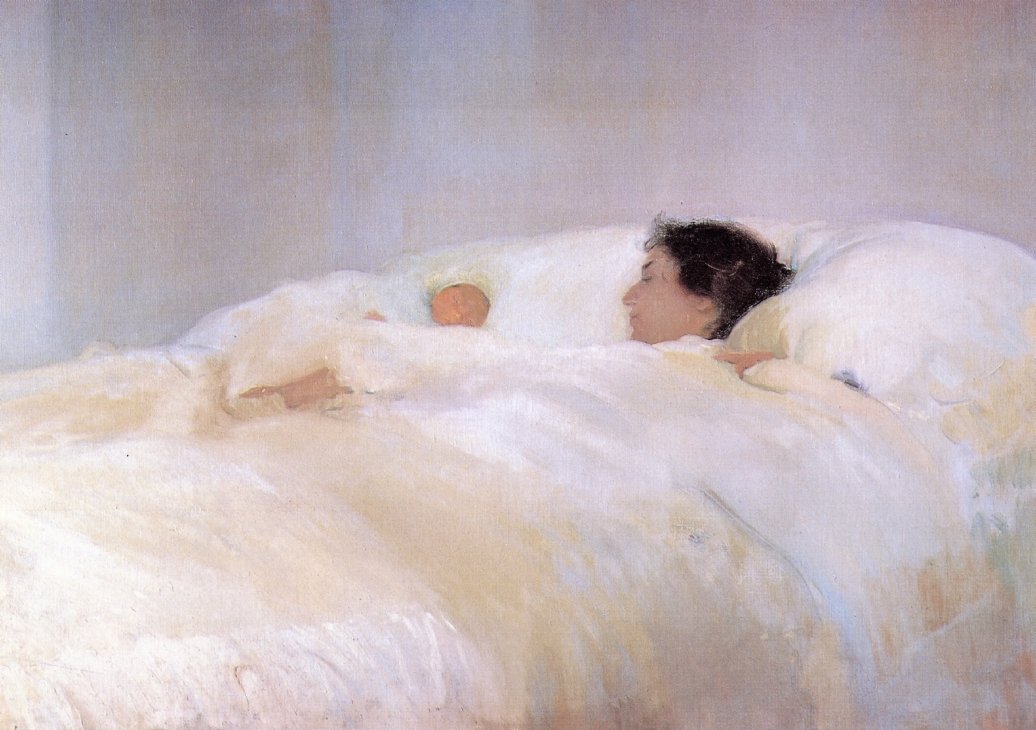
Mother by Joaquin Sorolla (1895)

One of the most moving family portraits by Sorolla was of his wife Clotilde, laying in bed with their new born baby, their youngest child, Elena.  The painting is simply entitled Mother and was completed in 1895.   His wife looks lovingly towards her daughter who is swaddled in a mass of white bedding contrasted by the artist’s yellow/green tonal shading of the bed clothes. 


My Family by Joaquín Sorolla (1901)

In 1901 Sorolla completed a portrait of his family entitled My Family, which somehow reminds us of Diego Velazquez’s Las Meninas, where the painter showed in the background a mirror that reflects the upper bodies of the king and queen. They appear to be placed outside the picture space in a position similar to that of the viewer.  In Sorolla’s painting we see his image, palette in hand, in a mirror in the background.  The main figures in the painting were those of his family.  His wife Clotilde stands to the left in a long red dress along with her children.   Elena, the youngest, sits on the chair was five years old at the time. Their nine-year old son Joaquín sits on a stool sketching a picture of his sister whilst their elder daughter, Maria, who would have been eleven when her father completed the work, holds the board which her brother is using to support his sketch.

Maria by Joaquín Sorolla (1900)

One of Sorolla’s favourite subjects was his eldest child, Maria and over the years he would capture her in many of his portraits.  In 1900 he captures her sitting on a chair dressed in a white tunic with her hands entwined on her lap.  The painting is entitled Maria.  The whiteness of her dress is enhanced by touches of blue.   In the background there is a wall with decorative and colourful tiles 

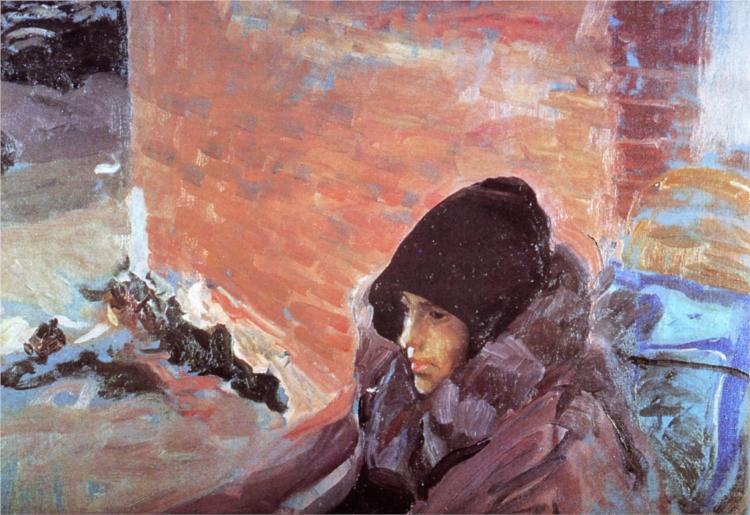
Maria Sick by Joaquín Sorolla (1907)

Six years later he completed another two portraits of Maria.  The first, entitled Maria Sick, completed in 1907 depicts his daughter sitting outside, well wrapped up in heavy but warm clothes.  She was recuperating in the mountains outside of Madrid having come down with an illness.   Sorolla himself was supposed to have been in Germany at this time, to be present at the one-man exhibition of his work at Berlin, Dusseldorf and Cologne organised by the Berlin gallery owner, Eduard Schulte.  However Sorolla refused to leave his daughter at a time when she was so unwell.


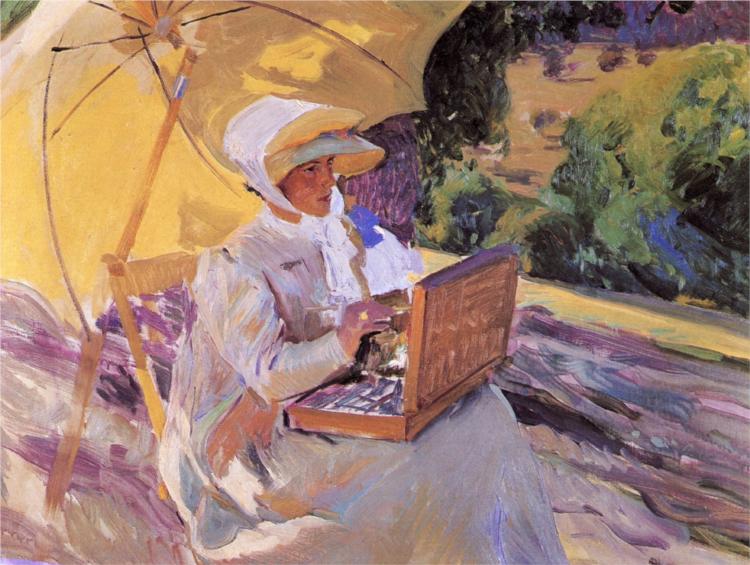
Maria painting in El Pardo by Joaquín Sorolla (1907)

That same year, following the recovery from her illness, her father painted another portrait of her, entitled Maria Painting in El Pardo.  The work depicts his daughter seated on a hill top, close to the royal palace, painting en plein air. 

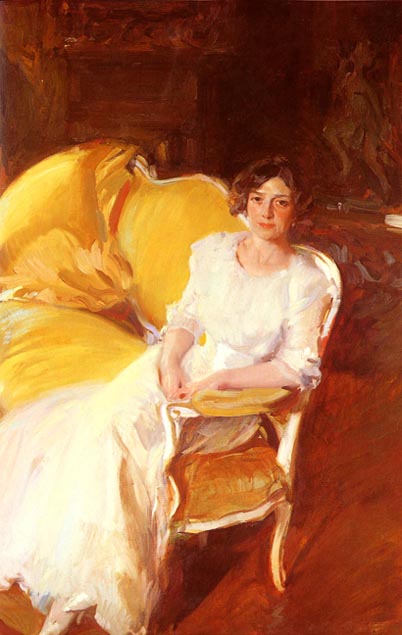
Clotilde Sitting on the Sofa by Joaquín Sorolla (1910)

However Joaquín Sorolla’s favourite muse was his beloved wife Clotilde whom he had married in 1888.   She featured in a large number of his works.  I particularly like the one he painted in 1910 entitled Clotilde Sitting on the Sofa.  Art historians believe that the painting was influenced by the works of the American painter John Singer Sargent.  His wife leans against the arm of a sofa, dressed in a full length gown.


Clotilde in Evening Dress by Joaquín Sorolla (1910)

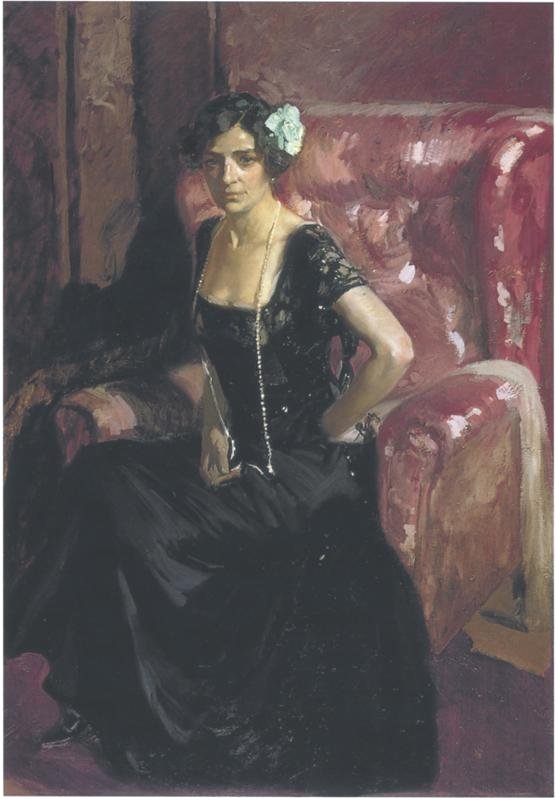
Another beautiful painting of his lovely wife was completed that same year entitled Clotilde in Evening Dress and from it, it is plain to see that Sorolla had married a beautiful and enchanting person.  We see her sitting upright in a plush, well upholstered red chair, dressed in a black evening dress with a blue flower tucked behind her ear.  She is the personification of a Spanish lady.

Sorolla had a one-man exhibition in the Grafton Galleries, London in 1908 and it is whilst in London that he met Archer Milton Huntington, who was the son of Arabella Huntington and the stepson of the American railroad tycoon and industrialist Collis Huntington.   Archer Huntington was a lover of the arts and the founder of the Hispanic Society of America which was based in New York.  The Hispanic Society of America was, and still is, a museum and reference library for the study of the arts and cultures of Spain and Portugal as well as those of Latin America.  Huntington arranges for Sorolla to have a major one-man exhibition at the Society in 1909 and it proved to be a resounding success so much so that the exhibition travelled to many American cities.  Huntington then commissioned Sorolla to paint 14 large scale mural paintings, oil on canvas, depicting the peoples and regions of Spain.  On receiving Huntington’s commission in 1911, Sorolla spent the next eight years travelling  throughout the regions of Spain making hundreds of preparatory sketches before completing what was to become known as Vision of Spain.   Sorolla was clear in his mind what Huntington expected and how he would achieve it, for he said:

“…I want to truthfully capture, clearly and without symbolism or literature, the psychology of the region.   Loyal to the truth of my school I seek to give a representative view of Spain, searching not for philosophies but for the picturesque aspects of the region…”

The fourteen murals were installed on December 1922 in the newly renovated western extension to the Hispanic Society’s Main Building, which is now known as the Sorolla Room. They were not officially inaugurated until January 1926. 

Panels from “Vision of Spain,” Joaquín Sorolla’s panoramic mural, during reinstallation at the Hispanic Society of America in New York City.

The Hispanic Society building had problems with their roof and it got so bad that in 2007 the museum had a full make-over and the picture above shows the re-installation of the fourteen paintings.

His eight years on this project was at the expense and detriment of his other work and sadly nearing the end of this project his health began to deteriorate and in June 1920 he suffered a stroke which ended his painting career.  One can only imagine how devastated Sorolla must have been not being able to paint.   Three years later in August 2010 Sorolla died in Cercedilla, a small town in the Sierra de Guadarrama, north-west of Madrid.  His body was taken and buried in the town of his birth, Valencia.

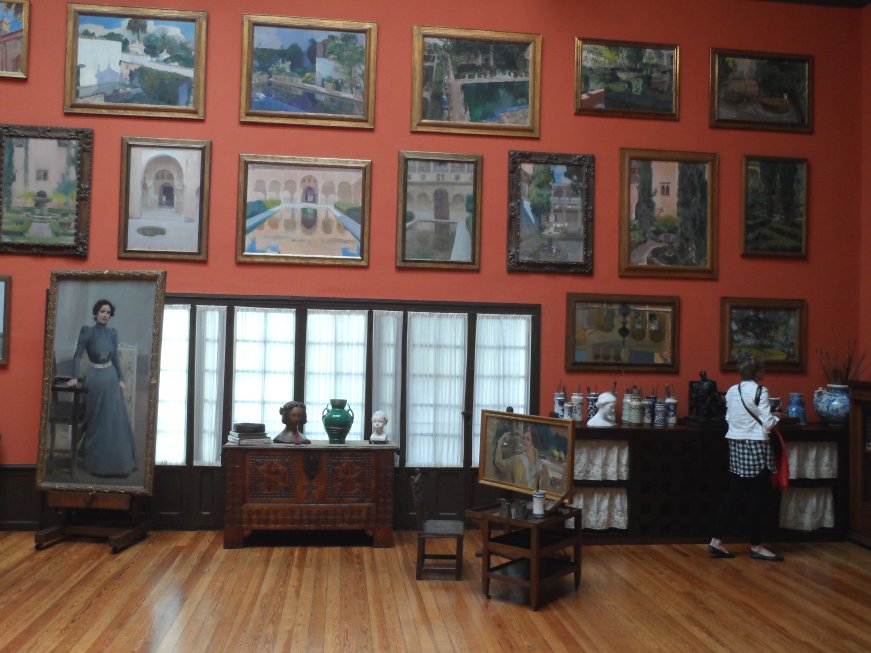
Room inside Sorolla Museum

I cannot end this trilogy of blogs about Joaquín Sorolla without mentioning the Sorolla Museum which was the artist’s home from 1911. 

Room inside Sorolla Museum

It is a five minute walk from the Ruben Dario Metro station and I do urge you to visit it if you are in Madrid.  You will not be disappointed. 

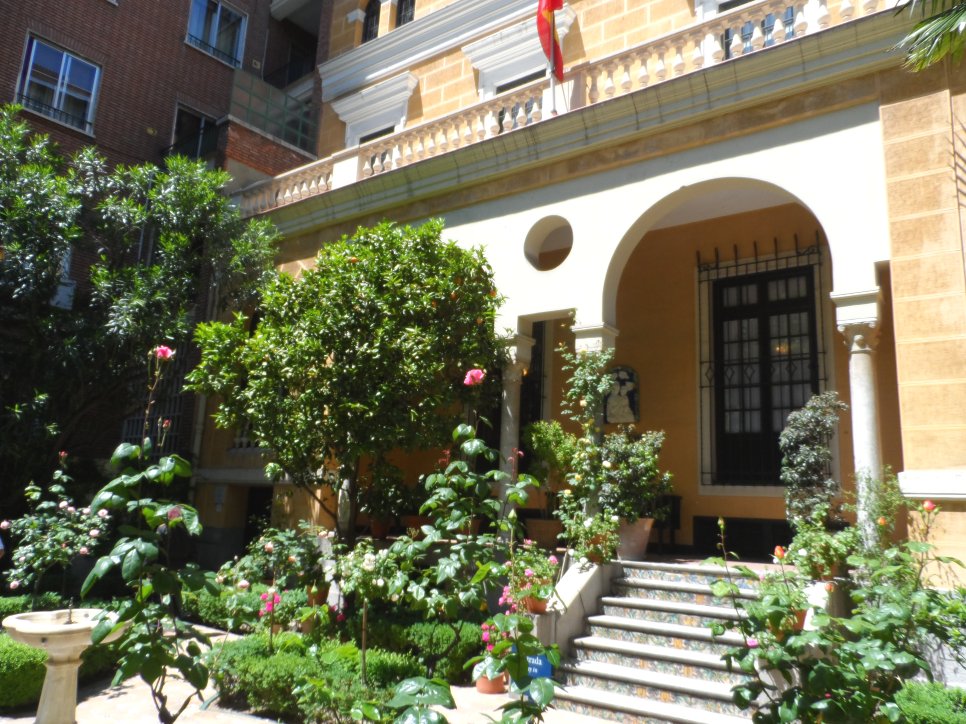
Museum entrance
Museum entrance

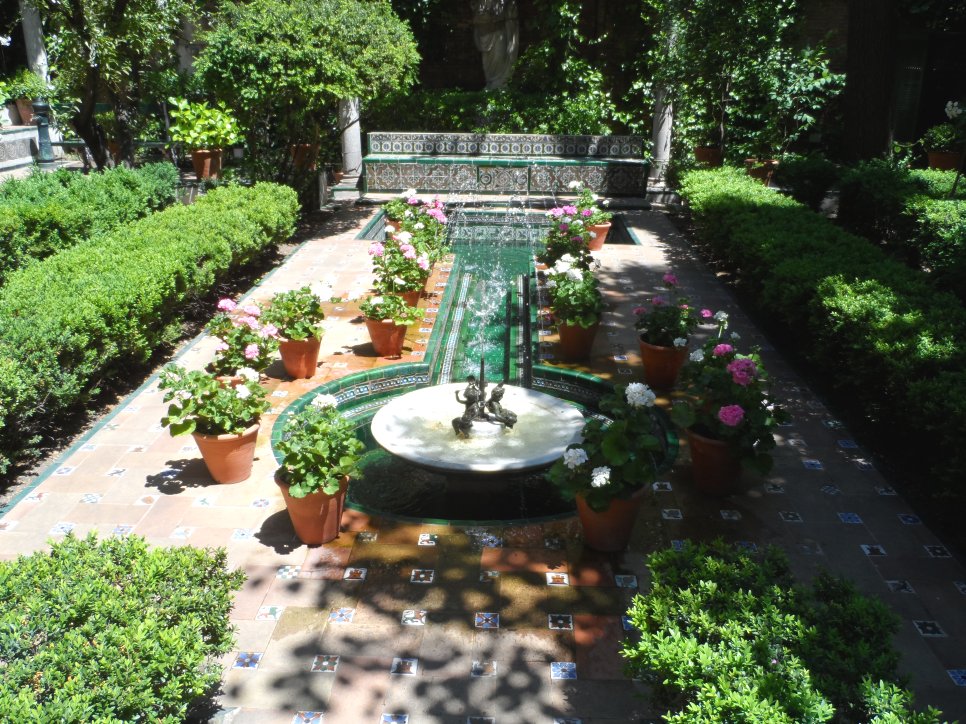
There are so many of the artist’s beautiful paintings on show and the gardens are a delight.

Museum Gardens
Museum Gardens

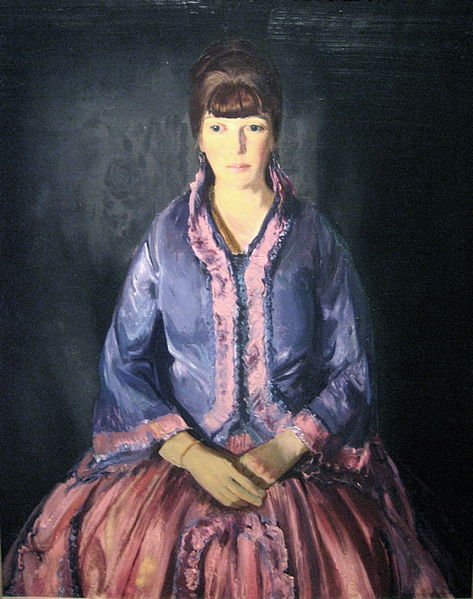
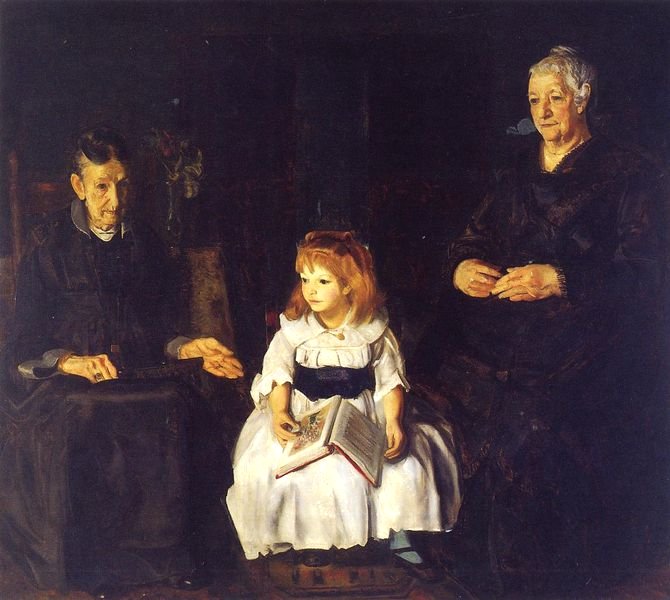
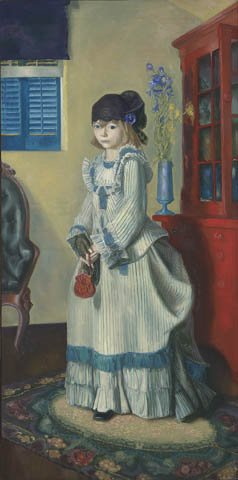
George Bellows, his wife and children

Emma at the Piano by George Bellows (1914)

George Bellow’s depiction of his wife sitting at the piano entitled Emma at the Piano was completed in 1914.  It is a beautiful portrayal of his wife, dressed in a rich blue coloured coat which along with the dark background adds to our awareness of the sense of intimacy of the scene.  The depiction captures the moment when Emma has stopped playing and turns her gaze towards her husband as he paints her image.  The painting belongs to the Chrysler Museum of Art, Norfolk.

Just recently I have looked at paintings done by Rubens and Rembrandt of their wives.  Thinking about it as a non-artist, I suppose there is logic behind an artist portraying his or her partner.  In most cases the portrait done by the artist would be a labour of love and pride.  I am returning to this theme in My Daily Art Display today when I look at the portraits George Bellows did of his wife Emma and their children.

George Wesley Bellows was an only child, born in Columbus, Ohio on August 12th 1882 to Anna and George Bellows.  He was brought up in a conservative Methodist household with his mother’s sister Elinor, whom he called Aunt Fanny, and who would leave the family home to get married when George was eight years of age.    Also living at home was his eighteen year old half-sister Laura, from his father’s first marriage.  Laura would also leave to get married, when George was two years of age.  This left him as the only child of the household.  At the age of fifteen he attended the Central High School in Columbus where he excelled at sport.  In the summer of 1900 George worked as an illustrator at the local Columbus Dispatch newspaper.  The following fall, he enrols at Ohio State University where he studied English.  It was here that his English professor, Joseph Taylor got him interested in the arts.  Throughout his time at the university he continued his love of sport, playing both basketball and baseball.   He regularly contributed drawings to the college publications and in his second year began to take art classes.  In 1903 he receives a cash prize for his still life painting which was on display at the Ohio State Fair.  The following year, 1904 was his graduation year but George failed to sit his final exams and left the university in the spring.  During that summer he gains employment as a sports writer at two local newspapers, the Ohio State Journal and the Columbus Dispatch and again that year wins himself more money from his works of art which were displayed at that year’s Ohio State Fair.  Although his mother who was devoutly religious and had always wanted George to become a minister in the church, he told his father that he wanted to go to New York, study art at the New York School of Art and become a professional artist.  He even turned down the opportunity to become a professional baseball player.  His father was supportive and gave him a $50 monthly allowance.

Emma in a Purple Dress by George Bellows (1919)

Emma in the Purple Dress was completed by Bellows in 1919 and can be found at the Los Angeles County Museum of Art

George Belows arrived in New York in September 1904 and took lodgings at the YMCA.   He enrolled at the New York School of Art, which had originally been known as the Chase School of Art, so named after its director and founder was William Merritt Chase, the American Impressionist painter.   It was at this establishment he first met his charismatic art tutor and one of the most influential teachers of the time, the painter, Robert Henri.  Henri would become the leading figure of the artistic group known as The Eight and a prominent member of the Ashcan School of American Realist painters.  It was Henri that roused his students to move away from the genteel scenes which were common in art and favoured by the establishment, such as the National Academy of Design.  Henri urged them to look towards depicting more rugged and harsh cityscapes in their paintings.  It was a plea for them to look towards modernity and realism in their art.  Bellows took up the challenge and many of his works at the time depicted vast public transportation projects such as the building of the Pennsylvania Railroad Station and the Queensboro Bridge which spans the East River in New York.

However the most important person George Bellows met when he arrived at the art school was a fellow student, Emma Louise Story.  Emma was two years younger than George and was the daughter of William Edward Story, a successful New Jersey linen and lace merchant, and Catherine Elizabeth Story (née Anderson).  George and Emma soon became great friends and that Christmas George spent Christmas in the Story household in Upper Montclair, New Jersey.  George Bellows continued to love playing sport and in the summer of 1905 played semi-professional baseball in Brooklyn.

George Wesley Bellows and Emma Louise Story married on September 23rd 1910 at St George’s Episcopal Church in the Bronx.  This close and loving partnership brought Bellows a renewed interest in portraiture, especially family portraiture and this love would remain with him for the rest of his life.  Bellows was very much in love with his wife and in a letter to her, he wrote:

“…Can I tell you that your heart is in me and your portrait is in all my work?   What can a man say to a woman who absorbs his whole life?…”

Anne in White by George Bellows (1920)

His love for his wife was equalled by his love for his children.  George and Emma had two daughters, Anne and Jean.  Anne was born on September 8th 1911 and Jean was born on April 23rd 1915.  For an artist who gave the world paintings depicting the harshness of city life, the brutality of the boxing ring and the atrocities of war, he could also depict a charming tenderness in his portraiture, especially those featuring his children as he witnessed their journey through youth.  One such work was completed in 1920 entitled Anne in White, which featured his eight year old daughter Anne, and is housed in the Carnegie Museum of Art in Pittsburgh.  This painting measuring 134cms x 109cms has the young girl sitting in a small rocking chair.  Her left hand falls to her side clutching the brim of her dark blue hat with its long ribbon trailing out before her.  Her young face is framed by the thick locks of her hair.  Her posture is one of grace and elegance.  Her eyes have the darkness which Bellows frequently used in his portraiture.  Bellows had delightfully and skilfully captured his young daughter’s look of innocence.   In her right hand she holds a highly-coloured fan on her lap.  Her position in the painting is midway between a background consisting of a heavy curtain on the left and a window through which we observe a verdant spectacle of nature on the right.  It is a juxtaposition of domesticity as denoted by the drapery and liberty offered by the outside world.

Elinor, Jean and Anna by George Bellows  (1920)
Elinor, Jean and Anna by George Bellows (1920)

In that same year, 1920, Bellows completed another portrait which featured his daughter Anna.  It was group family portrait entitled Elinor, Jean and Anna.   This work by Bellows is now considered to be one of the most accomplished group portraits in modern art.  In Charles Hill Morgan’s 1965 book George Bellows, Painter of America,  he quotes art critics as saying:

“…[Bellows] has lifted portraiture out of the status of a mere profession, and conferred upon it a genuinely aesthetic distinction…”

At the centre of the group sits the petite figure of his eight year old daughter, Anna in her white dress with its starkly contrasting wide black sash wrapped tightly around her waist.  In front of her, open on her lap, is an art book.  On either side of her, and in total contrast to this diminutive figure of his daughter, sits monumental figures dressed in black.  These two elderly ladies are attired in widows’ garb.  On the left is Elinor, Bellows’ Aunt Fanny, who was at the time was in her early eighties.   She had lived with Bellows and his parents when he was young and had fostered in him an interest in art.  Bellows always remembered those early years living with Elinor.   Her left hand lies palm-upwards , laid out directing us to look at the young girl and the art book with its still-life picture of a flower.   It is as if Elinor is inviting us to join the group or it could be that Bellows wanted there to be a connection in the painting between Elinor and the art book to remind himself that it was Elinor who had first nurtured in him his love for art.    Bellows always remembered with great fondness his early days living at home with Elinor.  In a letter to his cousin, Laura Daggett, he wrote:

“…Aunt Fanny will always remain to me a beautiful and important vision of my babyhood.  It gives me a great sensation to have her bring to me a drawing which I had made as a little kid…”

On the right of the portrait is Anna, George Bellows’ mother, who was in her late seventies.  The work is in some ways a connection between the old and young of Bellows generation with the artist being the conduit between the two generations.

Lady Jean by George Bellows (1924)

My final offering is Bellows’ portrait of his younger daughter, Jean which he completed in 1924 entitled Lady Jean, and which is now housed in the Yale University Art Gallery, New Haven.   This was to be Bellows’ last major portrait of a family member.  In the work we see his nine year old daughter Jean dressed in a nineteenth century Southern costume with its long frilled skirt that forms a slight train.  The dress had been given to her mother, who used to lend it to her children when they wanted to dress up.   The neckline and cuffs of the old-fashioned pale-blue dress are enhanced by ribbons.  On her head Jean wears a  black hat with its veil retracted.  Her right hand is covered with a lace mitt, whilst the other mitt dangles from her left hand which also clutches a small purse.  Jean’s love of dressing up and performing before her parents led her to eventually become an actress, appearing on Broadway opposite such stars as the great Helen Hayes.

George Bellows was suddenly taken ill at his studio in New York on January 2nd 1925.  He was rushed to hospital where it was diagnosed that he was suffering from a ruptured appendix and he was immediately operated on.  Sadly on January 8th he died of peritonitis, aged forty-two.   It was said that he died at the height of his fame and prowess as a painter but this, in some ways, is demeaning and suggests he had reached his best but who is to know to what artistic heights he would have risen to had he lived longer.  I recently returned for a second visit to an exhibition of his work at London’s Royal Academy and I was taken by his words which were printed in large letters on the wall at the exit.  They came from motivational words he had once offered his students just a few years before his death.  To them he said:

Try it every possible way.

Be deliberate.  Be spontaneous.

Be thoughtful and painstaking.

Be abandoned and Impulsive intellectual and inspired, calm and temperamental.

Learn your own Possibilities

Peter Paul Rubens and Hélène Fourment

Rubens, His Wife Helena Fourment  and Their Son Frans by Rubens (c.1636)
Rubens, His Wife Helena Fourment and Their Son Frans by Rubens (c.1636)

This superb portrait by Rubens of his wife Hélène and their three year old son, Frans can be seen at the Metropolitan Museum of Art in New York.   Frans is the only one of their children featured which makes us think that Rubens did not see this work as a family portrait but had more to do with his desire to show off the beauty of his second wife.   Look how Rubens has depicted himself and his son in this work.  They both look lovingly at Hélène.  She is the wife to one and the mother to the other.  This in a way is Rubens’ intimate tribute to his wife.  In the background we see a caryatid, (the sculpted female figure which is serving as an architectural support taking the place of a column or a pillar), which along with the fountain in the right background, symbolise fecundity

In my last blog I had reached the year 1626, a distressing time in Peter-Paul Rubens’ life for this was the year his first wife and true love, Isabella Brandt died.  Rubens was left alone with his three children, Clara Serena, Nikolas and Albertus.  He was still employed as court painter at the court of Archduke Albert VII, the Archduke of Austria and Governor General of the Habsburg Netherlands and his wife and consort, the Archduchess Isabella Clara Eugenia.  It was in 1621, when her husband, Albert, died that the Archduchess Isabella Clara Eugenia, became the Governor of the Netherlands on behalf of the King of Spain.  She was also keen to use Rubens’ ambassadorial skills and she sent him on a number of diplomatic missions to the Spanish and English courts to see if a solution could be found for the troubles besetting the Spanish Netherlands with the breakaway of the Seven United Provinces.  His skill as a diplomat was well appreciated by both sides and he was knighted by King Philip IV of Spain in 1624 and six years later received a similar honour from Charles I of England.  Notwithstanding his diplomatic brief, he continued to paint and received a number of royal commissions.

Hélène Fourment  with a Carriage by Rubens (c.1639)
Hélène Fourment with a Carriage by Rubens (c.1639)

In this 1639 painting Hélène Fourment with a Carriage by Rubens, which is housed in the Louvre, we see his wife Hélène leaving their palatial home in Antwerp followed by her six year-old son Frans, who was born in 1633. We view the scene from a low level which affords Hélène a more regal and majestic stance as she awaits her carriage.   Hélène, dressed like a lady of high society.  She is dressed in a long black satin gown, in the wealthy and lavish Spanish style.  She wears a small headdress with the pom-poms attached to large veil of black gauze.  Rubens has contrasted the black of the dress with the bright white satin which form the puffed sleeves which are in turn accentuated by the gold braid.  More colour is then added as we note the rosy pink of her cheeks and the purple sleeve bows and silk belt at her waist.    She waits in front of a porch of their home with its columns and pilasters. The building had been designed by her husband, imitating an Italian palazzo.   Hélène’sleft hand lies by her side whilst her right hand is raised in a gesture of modesty which belies her sumptuous clothes.  Frans follows his mother, dressed in a red suit with a flat white collar.    One must remember that Rubens at this time in his life was extremely affluent having been court painter at the Habsburg court and was also head of a thriving studio which was inundated with commissions from all over Europe.  At the bottom left of the painting we see a two-horsed carriage awaiting mother and son.  Besides a mode of transport the two-horsed carriage symbolised conjugal harmony.  This is probably the last known portrait of Hélène by Rubens.

In 1630, at the age of 53, and four years after the death of his first wife, Isabella, Rubens married the 17 year-old daughter of his friend and tapestry merchant, Daniel ‘Le Jeune’ Fourment.   His new wife, Hélène Fourment, went on to give him 5 children, two daughters, Clara Johanna and Isabella Helena and two sons, Frans and Peter-Paul.  A fifth child, a third daughter Constance Albertine, was born eight months after Rubens died.   My blog today looks at some of the many paintings by Rubens which featured his second wife, Hélène,   many of which were portraits but she also featured in some of his allegorical and classical works.  

Finally in August 1634, Rubens managed to relinquish his diplomatic work for the Habsburgs and in 1635 he bought himself a country estate, Het Steen, which was situated between Antwerp and Brussels.  It was here that he spent much of the latter part of his life.  Around 1636 Rubens completed a work entitled The Rainbow Landscape which was an imaginary artistic reconstruction of his own estate.  It was a maginificent estate which included a castle, draw-bridge, tower, moats, a lake and a farm and gave him the right to be known as Lord of Het Steen. One can just imagine the joy it must have brought  Rubens to spend his last quiet and tranquil years with his family at this idyllic place.    At Het Steen, Rubens finally managed to enjoy the fruits of his long and hard-working career, and it was during these last years that he spent time painting landscapes.

In his later years, Rubens was increasingly troubled by arthritis which caused a swelling of the joints in his hands, which forced him to reluctantly give up painting altogether.   Rubens died from heart failure on May 30th 1640, a month short of his sixty-third birthday.  He was buried in Saint Jacob’s church, Antwerp. The artist left behind eight children, three with Isabella and five with Hélène.

Het pelsken (the little  fur) by Peter Paul Rubens (c.1638)
Het Pelsken (the little fur) by Peter Paul Rubens (c.1638)

The final painting I am showing you by Rubens, featuring his wife Hélène Fourment, is probably one of the strangest depictions a man could make of his beloved.   The work was completed around 1638 when Rubens was 61 and Hélène was just 27.   It is a life size painting of his wife, entitled Het Pelsken (The Little Fur), which is the title given to it by Rubens in his will.   It is also sometimes referred to as Hélène Fourment in a Fur Coat.  In the painting, Hélène is depicted nude except for a fur coat, which could well have belonged to her husband.  This was a private work by Rubens.  It was one of his favourite works and he would neither give it away, nor sell it nor exhibit it.

Venus de Medici
Venus de Medici

It was simply done by him for his own pleasure.  It is an outstanding painted depiction of nakedness.  It could well be that Rubens modelled his depiction on the Venus Pudica (modest Venus) of the life-size Venus de Medici, the Hellenistic marble sculpture which depicts the Greek goddess of love, Aphrodite, and which is housed in the Uffizi Gallery in Florence.

Hélène stands before us on a red cloth, almost naked.   She is portrayed with curly dishevelled hair.  She just about holds on to the wrap which seems to be about to fall from her body and leave her completely naked.  She clutches at it in a manner that both of her arms are wrapped around the front of her.  Her left hand covers her pelvic region whilst her right hand holds the fur coat in position on her left shoulder and by doing so her right arm cradles and uplifts her breasts.  Her nipples seem to have hardened and her face has a rosy glow to it which may indicate the pleasure she is experiencing as her husband stares out at her.  There is a look of defiance about her expression.  Is this look intended to be one of provocation as she exposes her body to her husband or is it that she is fed up with standing in such a pose and becoming cold?  In some ways we are fascinated by what we see before us and yet in other ways, because of the personal nature of the painting we feel as if we are intruding into a private husband/wife moment and we feel we should look away.  It is a truthful portrayal of his wife.  He has not tried to idealise his wife’s body.  She is a woman with a womanly figure and Rubens’ depiction of her is an honest portrayal of her and there can be no doubt that he found what he saw, very pleasurable.

In his will he left the painting to his wife with the stipulation that it should never be sold to pay for death duties.  Hélène carried out his wish and it was not sold until after she died in 1658.  The painting is currently housed in the Kunsthistoriches Museum in Vienna.


Peter Paul Rubens and Isabella Brant

Honeysuckle Bower by Rubens (c.1609)
The Honeysuckle Bower by Rubens (c.1609)

This painting, which is housed in the Alte Pinakothek, Munich is entitled The Honeysuckle Bower and was painted by Rubens the year he married Isdabella Brant.  It is a full-length double portrait of the happy couple who have the honeysuckle bower as the backdrop.  The honeysuckle symbolises devoted affection and is a symbol of love and generosity and this is a loving portrait of the couple as they sit hand-in-hand in the shade afforded to them by the bower.   Rubens has depicted himself as an elegant and chivalrous husband relaxing, legs crossed, perched atop of a balustrade.  He looks over his wife from his high position.  He looks thoughtful but at peace with his world.    His beloved wife sits close to him on a grassy bank, at a slightly lower level.  She is wearing a brocade bodice and a dark red skirt.  There is a ruff around her neck and atop her head is a Florentine hat.   Both husband and wife lean slightly towards each other in another sign of affection.  Life is good for them both and this is symbolised by the flourishing flora which we see all around them.  Life just couldn’t be better!

In my last couple of blogs I looked at the artistic collaboration between Rembrandt von Rijn and his wife Saskia von Uylenburg and later the artistic collaboration with his mistress Hendrickje Stoffels.   In my next two blogs I want to look at the artistic partnership between artist/model, husband/wife,  of the great Flemish painter, Peter Paul Rubens and his two wives.  Today I will tell you a little about Rubens’ early life and examine portraits which depicted his first wife Isabella Brant.  In the following blog I will show some of his works featuring his second wife, Hélène Fourment.

Peter Paul Rubens was born in Siegen in Germany in June 1577.  He was one of seven children of his father Jan Rubens, who was an Antwerp lawyer, and his mother Maria Pypelinckx.   Jan Rubens was a practicing Calvinist and because of his strong Protestant beliefs the family were persecuted during the Catholic rule of the Spanish Netherlands under the Duke of Alba.  For their own safety Jan, Maria and their family left Antwerp in 1568 and travelled to Cologne.  Whilst there, Jan Rubens acted as a legal adviser to Anna of Saxony, the second wife of William the Silent, Prince of Orange.  Their close business relationship culminated in an adulterous affair and Anna gave birth to an illegitimate daughter, Christina.  Her husband banished her and her daughter Christina to Beilstein Castle.  Their marriage was annulled in 1571.   As a result of his affair, Jan Rubens was incarcerated in Dillenburg prison for two years.   His wife must have been very forgiving for it was through her constant pleading to the authorities that her errant husband was released but exiled to the town of Siegen.   It was whilst the family was staying in Siegen that Maria gave birth to her sons, Filips and Peter-Paul.  In May 1578 Jan and his family had their Siegen exile rescinded and they returned to Cologne where Jan Ruben died in March 1587, when Rubens was ten years of age.  Jan Rubens was buried in the Church of Saint Peter in Cologne and for one to understand the love Maria had for her wayward husband one has just to look at an inscription she had carved on the headstone of the grave.  It read:

“…Sacred to the Memory of Jan Rubens, of Antwerp, who went into voluntary exile and retired with his family to Cologne, where he abode for nineteen years with his wife Maria, who was the mother of his seven children. With this his only wife Maria he lived happily for twenty-six years without any quarrel. This monument is erected by said Maria Pypelings Rubens to her sweetest and well-deserved husband…”

In 1589, aged twelve, Rubens went back to Antwerp with his mother and siblings, where he was brought up in the Catholic religion.   Rubens attended a Latin school in Antwerp where he was taught both Latin and Greek and studied classical literature.  He also became proficient in English, Spanish, Italian, French, Dutch and German.  At the age of thirteen he became a court page to a noble-woman, Marguerite de Ligne, Countess of Lalaing. It was an important position for one so young and it gave him a taste of court life and life in noble and court circles.  The Countess, who had no children, used to refer to herself as his “other mother,” and gave him all the attention that was possible.   Rubens’ life at the court was split between school work which was given to him by a Jesuit priest in the mornings, while in the afternoons another priest would come in order to teach the ladies of the court foreign languages and young Rubens was always present during these lessons.   After a year at court, his mother had him return to the family home.   His mother wanted the best for him and thought that her son would be best served if he should have a career in the Church but was also mindful of the stories relating to the great Italian artists and the power they wielded due to their connections with their country’s leaders and so she and her son settled on the idea that he should become a painter.  His early artistic tuition came when he worked for three leading Flemish painters of the time, the landscape painter, Tobias Verhaecht, the Mannerist, Adam van Noort, and the Latin scholar and classically educated humanist painter Otto van Veen, sometimes referred to by his Latin name, Octavius Vaenius.   Following a four year apprenticeship, Rubens, in 1598 aged twenty-one, was accepted as a Master in the Antwerp Guild of St. Luke, the city’s painters’ guild and this allowed him to work independently and receive pupils.

Portrait of Isabella Brant by Rubens (c.1620-5)
Cleveland Museum of Art

In 1600, Rubens travelled to Italy. His first stop-over was Venice where he encountered the paintings of the triumvirate of Venetian Masters, Titian, Veronese, and Tintoretto.  From there he moved on to Mantua where he received painting commissions at the court of Duke Vincenzo I of Gonzaga who had seen his artistic work when he had visited Venice.  Thanks to financial backing from the Duke he was able to journey to Florence, stopping off at Rome.  In Florence he came into contact with the works of art of Michelangelo, Leonardo da Vinci and Raphael Sanzio.  He was also impressed and greatly influenced by the works of Caravaggio.   The Duke of Mantua had asked Rubens to make copies of some of Raphael’s works and bring them back to the court.     Rubens returned to the Mantua court and in 1603 he was sent on the first of many diplomatic missions, this one to the court of Philip III in Madrid, bearing gifts from the Gonzagas.  Now living at the court in Madrid he was able to examine the extensive collection of art work which the ruler’s father, Philip II had amassed, including numerous works by Raphael and Titian.  Rubens remained in Madrid for a year before returning once again to Mantua.  He was soon on his travels again, visiting Rome and Genoa.

In 1608, whilst in Rome, Rubens received a letter from his family telling him that his mother Maria was gravely ill.  He immediately left Italy and unbeknown to him, he would never return to that country.  He set off for Antwerp but sadly his mother passed away before he reached her.   Although Rubens was keen to return to Italy he received an offer he couldn’t refuse.   In September 1609, Rubens was appointed the court painter by Archduke Albert VII, the Archduke of Austria and Governor General of the Hapsburg Netherlands and his wife and consort, the Archduchess Isabella Clara Eugenia.  It was not just as a painter that the rulers had employed him but for his talent as a diplomat and ambassador.   His recompense for such a position was a salary of 500 livres plus all the perks that came with the job of somebody working in the royal household.  Another benefit was that he was exempt from all the regulations and bureaucracy arising from the regulations of the guild of St Luke.

Isabella Brandt by Rubens (c.1626) Uffizi Gallery, Florence
Isabella Brandt by Rubens (c.1626)
Uffizi Gallery, Florence

The Portrait of Isabella Brandt, which is housed in the Uffizi Gallery in Florence was completed by Rubens around 1625.  It is one of a number of portraits of his wife that he completed during their seventeen years together.  It is a half-length portrait against the dark background of a red curtain and a column.  Isabella smiles out at us.  It is an engaging yet hesitant smile.  This portrait of his wife is considered to be one of Rubens’ masterpieces of portraiture.  In 1705, the painting, along with others, was donated by the Palatine Elector of the Rhine, Johann Wilhelm, to his brother-in-law, Grand Prince Ferdinando de’ Medici.  Of the Rubens portrait of his wife, Ferdinando wrote to his brother-in-law:

 “…it surpasses the imagination and is a prodigy of that famous brush…”

Rubens, although at the royal court in Brussels, was also allowed to set up his own studio in Antwerp and it was whilst in Antwerp that he met and married Isabella Brant.  Isabella, who was fourteen years younger than her husband, was the daughter of Jan Brant, an important Antwerp city official, and Clara de Moy.  The wedding took place on October 3rd 1609 in Saint Michael’s Abbey, Antwerp and in 1610, they moved into a new house and studio that he designed.  This Italian-styled villa in the centre of Antwerp , which is now the Rubenshuis museum, was designed by Rubens and also housed his workshop, where he and his apprentices worked on various works of art. One of his most famous apprentices was Anthony van Dyck, who would later become the leading Flemish portraitist of the time and both Master and pupil collaborated frequently on works of art.  Other collaborators with Rubens were the animal and still-life painter Frans Snyder and Jan (Velvet) Brueghel the Elder the flower painter and son of Pieter Bruegel the Elder.   Rubens and his wife went on to have three children, a daughter Clara Serena and two sons, Nikolas and Albertus.

Portrait sketch of Isabella Brandt by Rubens (c.1621)

My final offering is a portrait drawing of Isabella Brant completed by her husband around 1621 and which is held at the British Museum.   This portrait of Rubens’s first wife, Isabella Brant is drawn in coloured chalks with a pale brown wash and white heightening.   The artist used the red chalk in an effort to highlight the warm flesh of his wife’s face and ears. Again a subtle hatching using both red and black chalks he has cleverly produced the shadows on her face. The sketch concentrates on Isabella’s head and face and her shoulders and the high collar of her dress have just been sketched as a sort of afterthought.  Isabella smiles at us, as she no doubt smiled at her husband as he sketched her.  She has a radiant smile which somehow gives us the impression she would have been a likeable person to have met.  Her marriage to Rubens was one of love and mutual respect and her death due to the plague in 1626, at the age of 35, deeply saddened him.  In Ruth Saunders Magurn’s  collection of translated letters of Rubens, entitled The Letters of Peter Paul Rubens, she highlights the extent to which Rubens mourned the death of Isabella in an extract from a letter he wrote to his friend, the French scholar, Pierre Dupuy, dated July 15th 1626, a little over three weeks after Isabella died.   Of his late wife, Rubens wrote:

“…Truly I have lost an excellent companion, whom one could love – indeed had to love, with good reason – as having none of the faults of her sex.   She had no capricious moods, and no feminine weaknesses, but was all goodness and honesty…”

I think it is a delightful sketch but not everybody agrees.     In Jeremy Wood’s 1998 book entitled Some Early Collectors of Rubens Drawings in England, he quotes a one-time owner of the sketch, the notable portrait painter and art theorist, Jonathan Richardson, who described Rubens’ sketched portrait of his wife:

“…[her] face is one of the most disagreeable I have ever seen and I am sure it is more so than was necessary for the likeness, however ugly she really was…”

 I guess beauty is in the eye of the beholder !!!