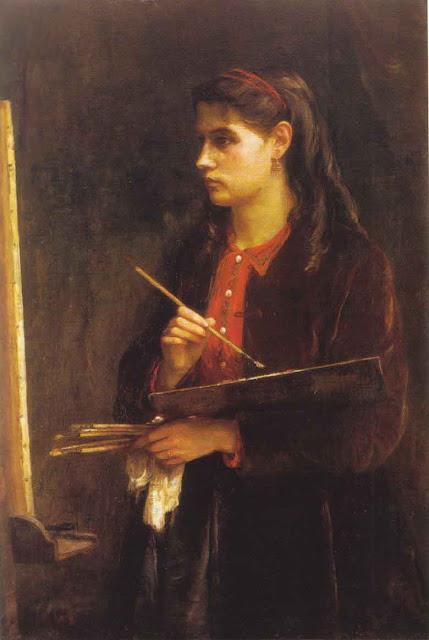
Berthe Morisot by Edma Morisot

Berthe Morisot by Edma Morisot (1865)

For the next few blogs I want to look at the life and works of Berthe Marie Pauline Morisot and some of the paintings other artists have done of her.  As I told you in my last offering I visited the Musée Marmottan Monet last week whilst in Paris and they were currently staging a retrospective of her work.  I have already featured one of her works, Le Bercau (The Cradle) in My Daily Art Display of August 10th 2011 and briefly told you about her life.  Today I am going to look again at her early life and feature a painting, not by the artist herself,  but a stunningly portrait of her, painted by her sister, Edma.

The world of French art between 1839 and 1841 was surely blessed as it was in that two-year period that the world witnessed the birth of four of the greatest French artists.  Paul Cezanne was born in January 1839, Claude Monet was born in November 1840 and Berthe Morisot and Pierre-Auguste Renoir were born in January and February 1841 respectively.  Berthe Morisot was born in Bourges, a city in central France.  She had distant roots in French art as she was an indirect and distant descendent on her father’s side of none other than the French Rococo painter Jean-Honoré Fragonard and the French 18th century female painter, Marguerite Gérard.  Berthe was one of four children.  She had two sisters, Marie-Elizabeth Yves born in 1838, known simply as Yves and Marie Edma Caroline born in 1839, known simply as Edma.  She also had a younger brother, Tiburce, born in1848.  Berthe was brought up in a successful and financially secure household.  Her mother was Marie-Cornélie Thomas, who came from a family of high level government officials, chief treasurers and paymasters of the province.   Her father was Edmé-Tiburce Morisot, who was an architectural graduate and who at the age of twenty-six founded an architectural journal.  However the venture collapsed when his co-founders absconded with all the money and left Tiburce to face the creditors.  He eventually had to hurriedly leave town, leaving all his furniture and possessions to his landlord in lieu of rent, and fled to Greece.  A year later in 1835 he returned to France penniless but his good looks and charm won him the hand of Marie-Cornélie in marriage.  She was sixteen years old and he was thirteen years older.   Marie’s father, who was the personnel director at the Ministry of Finance, managed to arrange employment for Tiburce Morisot as subprefect at the city of Yssingeaux, in the Haute-Loire region.  Tiburce worked hard and soon impressed his employers.  Promotions followed and at the time of his daughter Berthe’s birth, he was the prefect of the Department of Cher, the monarch’s chief administrator for the entire province.

In 1848 when Berthe was just seven years of age, because of the Third French Revolution which eventually led to the creation of the French Second Republic, Berthe’s father decided to move his family from Bourges to the Parisian suburb of Passy.   When Berthe was aged sixteen years of age, her mother, Marie-Cornélie Morisot decided to enrol her three daughters in private drawing classes.  At that time the prestigious École des Beaux-Arts would not admit female students and maintained that sexist doctrine until the last few years of the nineteenth century.  The sisters’ first tutor was Geoffroy-Alphonse Chocarne who taught the girls the fundamentals of drawing.  Yves love of art waned quickly and she gave up on her art tuition after a few months leaving just Edma and Berthe to carry on with their artistic studies.

Edma and Berthe then enrolled to study with Joseph Guichard, who had once been a student of Ingres and now lived in the same street in Passy as the Morisot family.  Guichard taught the girls all about classical art in the academic tradition.  He was there tutor from 1857 and 1860 and in 1858 Berthe registered as a copyist at the Louvre.  It was under the guidance of Guichard that Berthe Morisot first experimented in oil painting.  En plein-air,  painting outdoors in natural light,  became very important to the Impressionist painters and those from the Barbizon School and the two girls told Guichard that they wanted to learn more about that technique and so, in 1863, in consultation with Jean-Baptiste Camille Corot, a leader of the Barbizon School of painters it was arranged that the girls would study under Achille Oudinot, the French landscape painter.  In the spring of 1864 after seven years of intensive artistic training Berthe and Edma Morisot were admitted to the official Salon.  Berthe would exhibit at the Salon regularly and Edma would until her marriage in 1869 at which time she virtually gave up painting.

It is said that behind every great woman, there is another woman, often a close relative.  In nineteenth century England we saw it with the likes of the talented Bronte sisters who had each other for constructive critical support.  Although Morisot’s upbringing in a wealthy household bears no resemblance to the upbringing of the Bronte sisters,what she did have in her formative years, similar to the Bronte sisters, was the luxury of having a very loyal and supportive sister.  Standing unwaveringly behind Berthe was her sister Edma.  The sisters’ artistic collaboration came to an end in 1869, when Edma married her husband, Adolphe Pontillon, a naval officer.  In some ways Edma regretted the end of their artistic partnership and the close friendship which came with it.  They kept in contact by letter and in one Edma wrote:

“…I am often with you in thought, dear Berthe.  I’m in your studio and I like to slip away, if only for a quarter of an hour, to breathe that atmosphere that we shared for many years…”
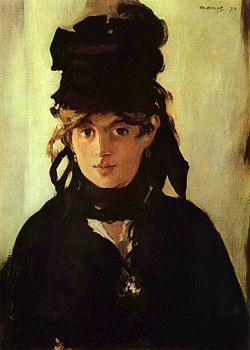
Berthe Morisot with a Bouquet of Violets by Édouard Manet (1872)

And so I come to today’s featured painting.  There have been many portraits painted of Berthe Morisot , probably the best known being the one of her entitled, Berthe Morisot with a Bouquet of Violets which was painted by her brother-in-law, Édouard Manet in 1872 and which is housed in the Musée d’Orsay.  I have always thought that his has made her look rather dowdy, so today I have featured one of my two favourite portraits of the artist.  This one is simply entitled Berthe Morisot and was painted by her sister Edma in 1865 and is held in a private collection.  This beautiful portrait in some ways bears out the close relationship between the sisters and reveals the shared interest both had in painting.  In this work Edma has depicted her sister Berthe holding her palette and brush concentrating earnestly at the picture she is painting.  Look how well Edma has captured the intensity in Berthe’s expression.  Our eyes are immediately drawn to the face of Berthe, which is bathed in light and which contrasts well with the darkened background and also echoes the whites of the side of the canvas and the rag she holds.  This painting of Berthe Morisot depicts her indisputable beauty which often other portraits fail to achieve.  This is indeed a portrait of an extremely delightful young woman in her mid-twenties and one I fell in love with when I first saw it.

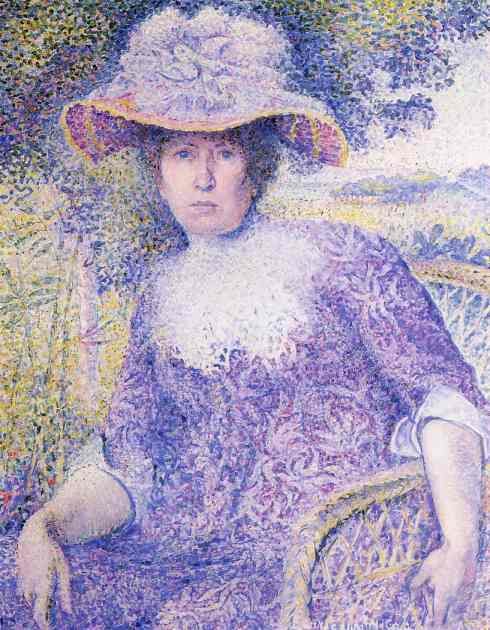
Madame Hector France (Portrait of H.F.) by Henri Edmond Cross

Madame Hector France (Portrait of H.F.) by Henri Edmond Cross (1891)

Today I want to look at the life of Delacroix and a couple of his paintings.  However I am not talking about Eugène Delacroix but the artist Henri-Edmond-Joseph Delacroix who was born in Douai a commune in the Nord département in Northern France, in 1856, some fifty-eight years after the great French Romantic painter.

Henri-Edmond-Joseph Delacroix was the only surviving child of a French father, Alcide Delacroix and a British mother, Fanny Woollett.  The family moved to Lille when Henri was nine years of age.  He showed an interest in drawing when he was young and his parents sent him to Carolus-Duran, the Lille painter, for private drawing and painting lessons when he was just ten years of age. He was encouraged as a youth to develop his artistic talent by his father’s widowed cousin, Dr Auguste Soins, who paid for much of Henri’s artistic training.   He spent a short time in Paris when he was nineteen, studying under the tutelage of the French realist painter, François Bonvin before returning to Lille.  In 1878 he enrolled on a three-year course at the Écoles Académiques de Dessin et d’Architecture in Lille and studied under the painter, Alphonse Colas.  Three years later he returned to Paris and studied in the atelier of Émile Dupont-Zipcy.

Henri began exhibiting his work in 1881 but so that he and his work would not be confused with the late romantic artist Henri-Eugène Delacroix he decided to change his name to “Henri Cross” which was a reduced English version of his surname (croix).  In 1886 he changed the signature on his paintings to Henri Edmond Cross so that there would be no confusion between him and the glass paste sculptor Henri Cros.  Henri Cross’ artwork changed in 1883 after travelling south to Provence and meeting up with Claude Monet.  His early works which had been mainly realist portraiture and still-life works had been predominately dark in colour but suddenly it all changed and his paintings took on the lighter colours and tones of the Impressionists.

The following year, 1884, was a milestone in French art.  Up until then any artist wanting to progress in their chosen career relied completely on having their works exhibited at the Paris Salon and for that to happen they had to submit their paintings to the Salon jurists to see if they considered their works good enough to be exhibited.  The jurists were, at this time, increasingly conservative in their views of what art was acceptable and were not receptive to the works proffered by the Impressionist artists whose works had moved away from the traditional academic style.  The Impressionists would often have their paintings rejected by the Salon jurists or if they did manage to have a paintings accepted it would be hung in such a way that it was almost hidden from view.  In 1863 the jurists rejected a surprisingly high percentage of paintings and this caused a furore amongst the “discarded” artists.

The following summer a number of these disgruntled artists, such as Seurat, Signac,  Albert Dubois-Pillet, Odilon Redon and today’s featured painter, Henri Cross, got together and formed the Société des Artistes Indépendants (Society of Independent Artists) and based the society on the premise sans jury ni récompense, (No jury nor awards).  They held their own inaugural exhibition, Salon des Indépendants, in May 1884 and Henri Cross exhibited some of his paintings.  In 1888 he visits the Cote d’Azur for the first time and paints in Eze and Nice and it is in this year that he meets Irma Clare, the subject of today’s paintings.  In 1891 he became Vice-President of the Society.  He had by this time become one of the leading figures of the Neo-Impressionism movement.

Henri Cross’ health was poor and he suffered badly from rheumatism.  He decided to move to the warmer climes of the South of France.   He initially settled in a rented house in Cabasson, near Le Lavandou, but later went to live in Saint-Clair, a small hamlet just outside of St Tropez, where he stayed for the rest of his life, except for his two visits to Italy, when he journeyed to Tuscany and Umbria in 1903 and 1908 and his trips to Paris to the annual Salon des Indépendants.  Paul Signac followed him south the next year and settled in St TropezIt was during this period that Cross was introduced to the revolutionary artist, Henri Matisse.  Henri Cross’ close working relationship with Paul Signac, led to him being introduced to the artistic technique, known as pointillism.  Pointillism is the methodical and scientific technique which juxtaposed small dots of pure colour together to maximize luminosity. The dots appear to intermingle and blend in the observer’s eye.

My Daily Art Display featured painting today was completed by Henri Cross in 1891 and is housed in the Musée d’Orsay.  It is entitled Madame Hector France (Portrait of H.F.) and is a fine example of the artist’s use of the pointillism technique with its screen of small regular dots over a densely painted ground.   Henri Cross exhibited the work at the Salon de la Société des Artistes Indépendants in 1891 and was looked upon as his first major work which adopted the Neo-Impressionist style.

The subject of this impressive portrait is Irma Clare the wife of Hector France, a novelist who was best known for his 1886 French language collection of tales about European adventurers and veiled temptresses, under the marvellous title Musk, Hashish and Blood.  Irma appears to be on a terrace, having just escaped from a dazzling soiree which is the source of light emanating from the right.  This is almost a life-size portrait of the lady and the light of the summer’s night is suggested through the sparkling glow of the lamps which hang from the tree branches in the background.  It is a conventional society portrait.  Irma is adorned with the most sumptuous and elegant gown.  Wearing this full length gown she almost gives us the impression that she is gliding elegantly across the painting.  Her hair sparkles and its colouring almost merges with the night air which surrounds her

In the foreground we have a mottled pink and white rhododendron which, along with the way the artist has depicted the chair at an angle and the receding floor tiles, gives the painting added depth.  As we have seen in paintings I have featured by Monet and other Impressionists, the Japanese influence had taken hold in late nineteenth century France and it is more than likely that the floral display we see in this painting comes from the influence of Japanese prints which were all the rage in France as does the frieze of white Japanese fans we see in the middle-ground.

In May 1893, two years after the painting was exhibited, Mrs Hector France became Mrs Henri Edmond Cross, the wife of the artist.  For some people the coupling of the two was a coupling of opposites.  He was looked upon as a secretive man who was always serious whereas Irma was seen as more frivolous, high-spirited and somewhat shallow.  They lived in Saint-Clair and one of their neighbours was the Belgian Neo-Impressionist painter, Théo van Rysselberghe and his wife Maria.  She was unequivocally critical of Irma.  In the biography Henri-Edmond Cross: études et l’oeuvres sur papier by Françoise Baligand, Raphaël Dupouy, and Claire Maingon, she is quoted as describing Irma as “petty, base of nature and an idle gourmand”.  This was not the universal opinion of her as others such as the French artist and friend of the couple, Charles Angrand, found Irma very hospitable and during the latter part of Henri Cross’ life, a very caring person as far as her husband was concerned.

Portrait of Madame Cross by Henri Edmond Cross (1901)

Once settled and living around St Tropez, Henri Cross turned more and more to landscape painting using vivid colours but he would still complete the occasional portrait of his beloved wife as was the case in 1901 when he completed the work entitled Portrait of Madame Cross, seated in the garden, looking slightly older, bedecked in a large hat and a floral gown.  This painting is also housed at the Musée d’Orsay.

By 1907 Henri Cross’ health deteriorated.  His eyesight was being affected by the eye disease iritis and his arthritis was becoming more debilitating.  In 1909 whilst visiting Paris he was diagnosed as suffering from terminal cancer.  He returned home to Saint-Clair and died in May 1910 aged 54.  Henri Cross is buried in Le Lavandou.

Mr and Mrs Edwin Edwards by Henri Fantin-Latour

Mr and Mrs Edwards by Henri Fantin-Latour (1875)

Who should be my next featured artist and what the next featured painting should be are the decisions I have to make each day.    Often I will make my choice when I flick through one of my art books or maybe I will be inspired by an artist or painting I have seen on one of my gallery visits but often or not the decision will come from research I have made into a previous painting.  My Daily Art Display featured artist and painting today comes from a little bit of all those.  In my last blog I looked at Manet’s Music at the Tuileries Gardens and listed a number of Manet’s friends the artist had added into his work.  One of these was the floral painter Henri Fantin-Latour.  Last week when I was wandering around the National Gallery in London I stood before one of his non-floral paintings entitled Mr and Mrs Edwin Edwards and my curiosity was immediately pricked.  Who were Mr and Mrs Edwards and why should this French artist paint the portraits of this English couple?   I knew then that sooner or later I had to feature this painting in one of my blogs and do some research into the background behind the work and the sitters.  So come with me on this journey of discovery and find out more about this couple.

Edwin Edwards was born in the small market town of Framlington in the heart of the Suffolk countryside in 1823.  He was the youngest of four sons of Charles Edwards and Mary Kersey.  He was educated at Dedham in Essex and went on to study law.  He became a legal practitioner in the admiralty and prerogative courts attaining the impressive position of King’s Proctor and Examiner of the Courts of Civil Law and the High Court of Admiralty.  When he was twenty-four he published a book entitled A treatise on the jurisdiction of the High Court of Admiralty of England.   In 1852 he married Elizabeth Ruth Escombe.  The couple had no children.  Despite having a busy and lucrative legal career Edwin Edwards had a great love for art and in 1861, aged thirty-eight years of age and with support from his wife, he decided to forego his legal career and become a full time artist.

Edwin Edwards had started painting using the medium of watercolours but later moved on to oil painting.  However his real love was etching and he had been influenced by the French artist and etcher Alphonse Legros.  He installed a press at his house in Sunbury, where his wife Ruth became skilled at printing. During the 1860s and 70s their home was a meeting place for French and British painters and etchers.  It was whilst he was in Paris  to arrange for the printing of his first plates that he was introduced to Henri Fantin-Latour by the English painter Matthew White Ridley.  Edwards and Fantin-Latour soon became great friends and the French artist would visit London and stay with the Edwards family in their Sudbury home.  Edwin Edwards and his wife bought many of Henri Fantin-Latour’s flower paintings, and found other buyers among their wealthy circle of friends thus securing the French artist a regular and steady income. Between 1864 and 1896 Fantin-Latour painted over 800 floral portraits, and almost all were purchased in England.

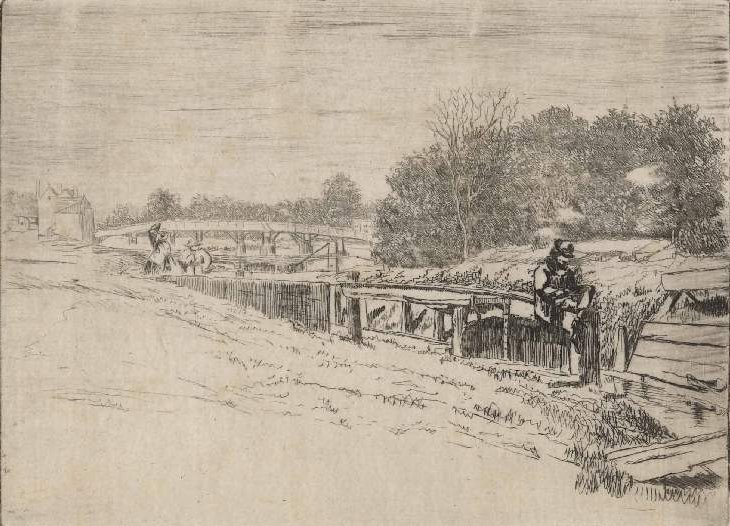
Molesey Lock by Edwin Edwards (1861)

In 1861 Edwards made an etching trip along the River Thames with James McNeil Whistler, Fantin-Latour and Whistler’s brother-in-law, Francis Seymour Hayden, an English surgeon, who later dedicated his life to etching and printmaking and it was during this trip that Edwin Edwards completed a portrait of Whistler sketching, seated, at Molesey lock.   In all, Edwards completed over three hundred and fifty etchings consisting of scenes of the Thames at Sunbury, English cathedral cities, the wild Cornish coast, and countryside scenes in Suffolk, many of which are now housed in the Fitzwilliam Museum, Cambridge.  He also published a three-volume work entitled ‘Old Inns of England,’ which were illustrated with a number of his etchings.

From 1861 until his death in 1879, aged 56, he was a prolific exhibitor of his work.  He exhibited fifty four works at the Royal Academy and over a hundred of his works at various other exhibitions.

My Daily Art Display featured painting is simply entitled Mr and Mrs Edwin Edwards by Henri Faintin-Latour.  The painting belongs to the Tate but is presently on loan to the National Gallery, London.  When Fantin-Latour first visited and stayed with Edwards and his wife in 1861 he began a portrait of Mrs Edwards but did not finish it until three years later when he again stayed with the couple.  It was not until the end of 1874 that Fantin-Latour embarked on the double portrait of Edwin Edwards and his wife and the couple visited his Paris studio for the formal sittings.  He wrote to Edwards and said that he intended to portray him, seated at a table in his studio, etching.  The background would have a number of canvases on the wall and that his wife would be portrayed standing behind him, overseeing his work, like a “guardian angel, the inspiring Muse”.   In reality the painting was much simpler than Fantin-Latour had originally envisaged.  The background as you see is plain and not adorned with other paintings.  Instead of being depicted etching,  Edwin Edwards is seen seated at an angle with his left arm resting on a folio of prints whilst studying an etching he holds in his right hand.  Mrs Edwards as was Fantin-Latour’s original idea stands behind her husband.  Does she look like a guardian angel?  It is hard to interpret her mood.  It seems one of aloofness and displeasure and seems somewhat unhappy with the situation.  I think she actually dominates the double portrait and would some up her appearance as “she who must be obeyed” !!!!!!!!!!!!!!

Henri Fantin-Latour exhibited the work in the Paris Salon of 1875 and it gained a second class medal.  This award was very beneficial to Fantin-Latour because from then on he was termed by the Paris Salon as hors concours, which meant that in future, any exhibits he put forward for inclusion at future Salon exhibitions did not have to first be passed by the Salon jury.

The Tribuna of the Uffizi by Johan Zoffany

The Tribuna of the Uffizi by Johann Zoffany (1772-77)

Johan Zoffany was born Johannes Josephus Zoffaly in Frankfurt-am-Main in 1733.  His father Anton Zoffaly was a court cabinet maker and architect to Alexander Ferdinand, Prince of Thurn and Taxis and it was at the Prince’s court that young Johan was brought up.  When the Prince took up residence in Regensburg, Zoffany served as an apprentice to the local painter, Martin Speer.  In 1750, at the age of 17 when he had completed his apprenticeship Johann travelled to Rome and studied with the portrait painter, Agostino Masucci.  In 1757, now back in Germany, Zoffany was commissioned by the Elector of Trier to paint frescoes and paintings for his new palace at Trier and his Ehrenbreitstein Palace in Koblenz.

In 1760 Zoffany travelled to London.  Here he was initially employed by Benjamin Wilson, the painter and printmaker and it was from his connection with Wilson that Zoffany came to the attention of one of Wilson’s patrons, the actor and theatre impresario, David Garrick, and he commissioned Zoffany to paint a number of theatrical works which featured the actor in famous theatrical roles.  Garrick also had Zoffany paint some conversation pieces of he and his wife set in the grounds of his Hampton estates.  The term Conversation Piece is an informal group portrait, often full length but usually small in scale in a domestic interior or garden setting and was a very popular art genre in 18th century England.   They would often portray a group of people apparently engaged in genteel conversation or some activity.  Usually the group would be members of a family, but sometimes friends would be included.  In some conversation pieces groups of friends or members of a society were depicted.  It was for these works that Zoffany made his name in England.

Zoffany’s fame spread among the London elite and commissions started to roll in for his portraiture and conversation pieces.  One such commission came from the Prime Minister, John Stuart, the 3rd Earl of Bute, who wanted Zoffany to paint portraits of his three sons and another portrait of his three daughters.  It was thanks to Bute that Zoffany was introduced to King George III and his wife Queen Charlotte in 1763.  Both were impressed by his work and commissioned Zoffany to paint portraits of their family.  The Royal Academy of Arts had been founded in December 1768 through a personal act of King George III.  Its task was to promote the arts of design in Britain through education and exhibition.  There were originally thirty four founder members, with Sir Joshua Reynolds its first President.  The rules stated that there would be forty Academicians.  In a Council of the Royal Academy in November 1769 it was reported to those present that “his Majesty had been pleased to appoint Mr Johan Zoffany to be one of the forty Academicians”.  Zoffany was now a Nominated Member of the Academy.

The Portraits of the Academicians of the Royal Academy by Johan Zoffany (1771-2)

George III also set him a task to paint a group portrait of the Royal Academy members which Zoffany duly completed in 1772 and was entitled The Portraits of the Academicians of the Royal Academy.  Zoffany himself is seen with brush and palette in his hand at the far left of the painting.  The king and his wife were delighted with the painting and Queen Charlotte commissioned Zoffany to paint an even larger and more elaborate conversation piece set in the Tribuna of the Uffizi, which would depict the art treasures held within the octagonal room.   Zoffany travelled to Italy to carry out the commission in 1772 and did not complete the ambitious work until 1777.

Zoffany returned to England with his masterpiece but was distressed to find that his genre of conversation pieces had gone out of vogue and his work was no longer required by his wealthy and fashionable clients.  He could have reverted to his other artistic forte, that of portraiture, but at the time he had many very successful rivals for that type of work, such as Thomas Gainsborough and Joshua Reynolds as well as the emerging “new kid on the bloc” George Romney.

By 1783 Zoffany had all but given up hope of receiving commissions for his work in England and decided to travel to India in his search for rich patrons.   For the next six years Zoffany bided his time in the sub-continent travelling between Calcutta and Lucknow completing commissions he received from the wealthy British colonials and the local Lucknow aristocracy.  Once again he had the opportunity to carry on with his beloved conversation pieces.  Such was the popularity of his work that he was inundated with commissions and by the time he returned to England in 1789 he had made his fortune.

Zoffany died in 1810, aged 77.  He was one of the greatest exponents of the English Conversation piece with its Rococo flamboyance and will also be remembered for the charm of his theatrical works depicting scenes from popular plays of the day.

My Daily Art Display featured painting today by Zoffany is looked upon as one of his greatest works.  It is his grand conversation piece entitled The Tribuna of the Uffizi, which he started in 1772 and completed in 1777.   Going to Italy at the behest of his Royal patrons, George III and his wife Queen Charlotte, to paint this work had not been his original plan as in 1772 he had hoped to secure a passage on Captain Cook’s vessel when he set sail on his second voyage to the South Seas but the offer of a sea voyage never materialised and so he took up the commission from Queen Charlotte to travel to Florence and record in a painting the collection of art and sculpture which the Grand Duke of Tuscany had put together in the Tribuna of the Uffizi Gallery in Florence.  Queen Charlotte had envisaged this work would be a pendant to Zoffany’s earlier work owned by the English rulers entitled Academicians of the Royal Academy which he completed in 1772 and was well received by the royal family.

The Tribuna was an octagonal room within the Uffizi Gallery, designed in the late 1580’s by Bernardo Buontalenti in which the art collection of Francesco de’ Medici would be housed.  In 1737 it came into the possession of Pietro Leopoldo, Grand Duke of Tuscany.  The commission was a great challenge to the talents of Zoffany as the Tribuna art collection was one of the greatest in all Europe.  Was it a true reproduction of what was there at the time?   Not quite, as Zoffany had to experiment and alter the perspective of the room in order to incorporate all the various pieces of sculpture and in some cases he had to reduce the size of individual pieces.  The collection of art in the Tribuna during the time Zoffany was painting it was also going through a slight reorganisation and this gave him the excuse to make his own decision as to what would be on display.   In doing so he omitted some paintings which were actually on display and added others which although housed in the Uffizi were never hung in the Tribuna.  One of these was Titian’s Venus of Urbino which we see in the central foreground.  There were also a number of paintings by Guido Reni which were housed in the Pitti Palace but were transported to the Uffizi just for Zoffany to copy!

There are twenty five paintings shown in this work.  How many can you identify?   All I will tell you is that amongst them there are six by Raphael, three by Guido Reni, two by Titian, two by Rubens and one each by Carracci, Corregio and Holbein.

Besides the works of art, sculptures and other artefacts, the painting is populated by no fewer than twenty two men all of whom were either connected with the Uffizi Gallery or were a miscellany of Grand Tourists.  So who were these Grand Tourists and what was the Grand Tour?  The Grand Tour was the traditional trip around Europe taken by mainly upper-class wealthy young European men, although primarily the term is associated with the British elite and nobility.   It reached the height of its popularity in the seventeenth and eighteenth century and it was a kind of rite of passage for this wealthy elite.   One amusing aspect of Zoffany’s inclusion of the men was that during the many years he worked on the painting he would add and remove people as he saw fit and would tell some of the travellers they had to sit for him as the George III had specifically asked for their portrait to be included.  Of course that was never the case.  The one thing Zoffany was adamant about was that he would not portray a woman within the group.  It is thought that this could be due to the fact that he incorporated some lewd visual jokes into the painting.   Look at the group of men to the right who are staring at and fascinated by the backside of the Venus de Medici.  This sculpture had been well-known for the lewd comments made about it by the Grand Tourists.  In Vicci Coltman’s book entitled Classical Sculpture and the Culture of Collecting in Britain since 1760 she quotes a comment made by Charles Townley, the English country gentleman and antiquary who had made a couple of Grand Tours whilst Zoffany was painting his masterpiece.  Townley had said that he had been told that:

“…the sight of the Venus in the Florence Gallery will give you some yammering after a Tuscan Whore…”

It was not just the heterosexual innuendos that made Zoffany’s painting risqué, but his addition of two well known homosexuals, Thomas Patch, in the right foreground in conversation with another homosexual, Sir Horace Mann.  Patch is pointing at the sculpture The Wrestlers and their addition in the painting was to prove a step too far.

Zoffany returned to England in 1779 and delivered the painting to his royal patrons.   Queen Charlotte was horrified to see the room cluttered by so many men and worse still to incorporate lewd innuendos of both a heterosexual and homosexual nature.  She was especially shocked that Zoffany had included portraits of the two infamous homosexuals into the scene.  George III reluctantly paid for the work but had it placed out of sight in a room in Kew Palace.  The artist Joseph Farrington was active in the social, cultural, and professional art world of his time and he kept a daily diary from 13 July 1793 until his death, missing only a few days. This diary often referred to the London art world. The diary eventually constituted 16 volumes and in one of the volumes Farrington recounts a conversation between George III and the artist William Beechey in which he quotes the king as saying of Zoffany’s Tribuna of the Uffizi:

“…[The King] expressed wonder at Zoffany having done so improper a thing as to introduce the portraits of Sir Horace Man[n], [Thomas] Patch, & others, who were considered as men addicted to improper practices – He sd. The Queen wd. Not suffer the picture to be placed in any of Her apartments…”

It is thought it was not so much that Zoffany took it upon himself to add the twenty two Grand Tourists into the painting but it was the character of some of them that shocked and offended George III and his Queen.  Zoffany never again received a royal commission and from that day on lost their patronage.

This is a beautiful work and one of unbelievable detail.  I stood before it yesterday when I visited the preview of the Johan Zoffany RA, Society Observed exhibition at the Royal Academy in London.  If you are in London you should make a point on visiting this exhibition which runs until June 10th.

Tomorrow I will give you the answer to the names of the paintings and the artists who painted them

The Copley Family, by John Singleton Copley

The Copley Family by John Singleton Copley (1777)

In my last blog I looked at the English portraitist James Sharples and talked about how he took his family from England to America in search of patrons and their lucrative commissions.  He was just one of many European artists who decided that the way to make a fortune from their art was by crossing the Atlantic.  He of course had not only to compete against the new immigrant artists who had also made the journey but he also had to compete for work against America’s own painters.  Today in My Daily Art Display I am focusing my attention on of those great 18th century American artists, John Singleton Copley, who in fact moved across the Atlantic in the opposite direction, from Boston to London.

John Singleton Copley was born in 1738 in Boston, Massachusetts.  Both his parents, Richard and Marie were of Irish descent and had arrived in America just two years before he was born.  His mother ran a tobacco shop which was on the Long Wharf pier at the port.  His father, who was also a tobacconist, suffered from poor health and went to the West Indies around about the time of his son’s birth in the hope that the warmer climate may help,  but he died there in 1748, although the actual year of his death is contested.   His mother remarried when Copley was 10.  She married the engraver, painter, and schoolmaster Peter Pelham and it was believed that he gave young John Copley his first artistic tuition.   Pelham made his living by selling his portraits and engravings and even ran evening classes in arithmetic and writing as well as a dance class.  Another tutor of Copley was the Scottish born portrait painter John Smybert who had left his homeland and had come to America in 1826.  Both Copley’s tutors died when he was just thirteen years of age and so his artistic tuition was handed over to Joseph Blackburn, an English portrait painter, who had left home and worked in Bermuda and in colonial America.  Blackburn worked in Boston and eventually set up a studio in the town.  Although this master-student partnership started well it ended in acrimony.  The master (Blackburn) realised his student (Copley) was becoming a far better artist than himself and jealousy ended the arrangement. 

Boy with a Squirrel by John Singleton Copley (1765)

In 1776 Copley had sent his painting, entitled Boy with a Squirrel, to London, for the Society of Artists Exhibition.  The painting featured his step-brother, Henry Pelham with his pet squirrel.  It was the first work of art painted in America to be exhibited abroad and it was well received by the critics and on the strength of this work he was made a Fellow of the Society of Artists of Great Britain.  Benjamin West, the American artist who had moved to London in 1763,  invited Copley to do as he had done and move to Europe to continue his artistic studies.  For Copley, the invite was tempting and in some ways made him more unhappy with his present situation.  He was aware of his talent and the lack of artistic stimulation in Boston.  In the book Letters & Papers of John Singleton Copley and Henry Pelham, 1739-1776, there is one letter which Copley wrote to the American artist, Benjamin West:

“…In this Country as You rightly observe there is no examples of Art, except what is to [be] met with in a few prints indifferently executed, from which it is not possible to learn much…”

However although the invite to leave America was tempting Copley was aware that his portraiture was selling well and he had a good standard of living, mixing with the aristocracy who were his patrons and so he decided to stay in Boston and wrote back to Benjamin West in 1768 explaining his reasons:

“…I should be glad to go to Europe, but cannot think of it without a very good prospect of doing as well there as I can here. You are sensable that 300 Guineas a Year, which is my present income, is a pretty living in America. . . . And what ever my ambition may be to excel in our noble Art, I cannot think of doing it at the expence of not only my own happyness, but that of a tender Mother and a Young Brother whose dependance is intirely upon me…”

Susanna Farnham Clarke (Mrs Susanna Copley) by John Singleton Copley

However, although not wanting to move to England himself, he continued to send his art work to London where his artistic reputation was on the rise.   In 1769 John Copley married Susanna Farnham Clarke, whose father was one of the richest Boston merchants and a very wealthy and powerful business man, the Boston agent for the prestigious Honourable East India Company.   Copley and his wife were very happy and his wife’s beauty was portrayed in a number of her husband’s paintings.  The Copley’s marriage lasted for forty-five years and they went on to have six children.
Copley’s early works were in oils but he then began to dabble with pastels.  By the age of nineteen Copley had built up a reputation as an outstanding portraitist.  However Copley wanted to branch out and tackle historical paintings which at the time were very popular and the market for them was excellent.  Copley’s family connections and his wife’s relatives were Loyalists, staunch supporters of British Colonial rule.  Copley’s father-in-law was the merchant to whom the cargo of tea was consigned which sparked the infamous Boston Tea Party in December 1773 and this incident and what followed drove Susanna Clarke’s father to the brink of bankruptcy.

The unstable political climate worsened by the day, leading in 1774 to the rise of patriotism and the birth of the Patriots, the supporters of the colonists of the British Thirteen United Colonies who would within eighteen months rebel against British control.  Copley’s lucrative work started to dry up and it was because of his fear of an oncoming war that Copley decided to take up Benjamin West’s invitation to come to England.  His clear intention was to return to America as soon as the troubles were over, at a time when there would be a resurgence of his once-thriving art business and he would be looked upon once again as America’s leading portrait painter.  He set sail for England from Boston on June 1st 1774 leaving his mother, wife and children in the care of his step brother, Henry Pelham.  Copley had fully intended to return soon to America but the long and bloody War of Independence which eventually broke out in 1775 forced him to postpone his return. After the war ended, Copley financial situation no longer permitted a return, and the painter ended up staying in Britain forever.

On his arrival in England in 1774 Copley sought out Benjamin West who introduced him to Sir Joshua Reynolds both of whom were founder members of the Royal Academy of Art.  Copley set off in September of that year on a nine month European tour taking in Paris before moving to Italy and from there journeying north into Germany and the Low Countries.  In 1775 whilst still in Europe, Copley became alarmed at the deteriorating political situation in America and for the safety of his family.  In a letter to his step brother, Henry Pelham, he wrote:

“…if the Frost be severe and the Harbour frozen, the Town of Boston will be exposed to an attack;  and if it should be taken all that have remained in the town will be considered as enemies to the Country and ill treated or exposed to great distress…”   

Having also been alarmed about the situation at home, Copley’s wife and children, unbeknown to her husband,  had already left Boston at the end of May 1775 and arrived in London where they stayed with her brother-in-law.  Her father and her brothers followed shortly after.  Copley returned from his European trip and he and his wife set up home in London where Copley remained for the rest of his life.  By the start of the nineteenth century, life for Copley the artist, was becoming problematic.  He was still painting but sales were declining probably due to the Napoleonic Wars.  The house his family were living in was expensive to run and the cost of putting his son, John Jnr. through law school was proving costly.  The problem for Copley was that he couldn’t equate the fall of his earning power with the necessity to rein back his expenditure.  He became very depressed with life and by 1810 his health was concerning those around him.  At a dinner party in August 1815 Copley suffered a stroke and although he seemed to be recovering, he suffered a second seizure the following month and died in September 1815, aged 77.

On his death, Copley was deep in debt and his barrister son, John, who would later become Lord Lyndhurst and Lord Chancellor of Great Britain, had to settle his father’s financial affairs, maintain his parents home and look after his mother, Susanna, until she died in 1836.

In My Daily Art Display today I am featuring the large oil on canvas painting entitled The Copley Family, by John Singleton Copley, which he completed in 1777 and is now housed in the National Gallery of Art in Washington.  It measures 184cms x 229 cms (72 inches x 90 inches).  He started this group portrait painting a year after his family had arrived from America and settled in London and shortly after he himself had returned from his artistic tour of Europe.  Although an accomplished portraitist, this was the first time Copley had executed a group portrait.  The figures are almost life-size and his talent as a portraitist ensure that they all have a life-like appearance.

Copley himself is seen standing at the back of the family group grasping a sheaf of sketches and stares out at us in a manner which gives the impression that he is about to introduce the members of the Copley family to us.  Copley’s father-in-law, the once prosperous merchant, Richard Clarke is seated on the left of the painting, stern-faced avoiding our gaze, holding the youngest of his grand-daughters, Susanna.  To the right of the painting we see Copley’s wife Susanna, cradling her son John.  Look at how Copley has captured the look of love and tenderness in his wife’s face as she gazes down at her son.  On the far right of the painting and to his wife’s left, her daughter, Mary, vies for her attention.  Standing upright and in a formal pose is Copley’s eldest child, his daughter Elizabeth.  It is interesting to note that in those days boys wore dresses like their sisters until they were about six or seven years of age and old enough to wear breeches.

Copley had decided on the setting of the painting so as to give an air of classical refinement.  He has achieved that by the inclusion in the painting of elegant and fashionable furnishings and as we look over the shoulders of his sitters we see the ancient and classical Arcadian landscape à la Claude Lorrain and this background setting could well have come from paintings Copley had seen during his travel around Italy.  This group portrait of a family is of greater intimacy as it is the father who has lovingly depicted the scene.

Bronze statue of John Singleton Copley in Copley Park, Boston

John Singleton Copley’s hometown Boston has memorialised their artist by naming a city square after him, Copley Square, located in the Back Bay district of the city.  The square-shaped park at the centre is a mass of greenery and on the north side is the bronze statue of the artist.

The Sharples Family

My Daily Art Display today is not about a single painting but about a talented artistic family of English portrait painters.  This was a veritable dynasty of artists of the highest quality.  The head of the family was James Sharples who was born in Lancashire around 1751.  Originally his family had intended that James should study for the Catholic priesthood and he was sent to France for his initial training.   The theological path that his parents had wanted him to follow was not for James and he returned to England.    Instead James followed his chosen profession, that of an artist. At the age of twenty-eight, whilst living in Cambridge, he had four of his pictures accepted for the 1779 Royal Academy Exhibition.  Two years later he moved to Bath where he set himself up as a portrait painter and art teacher.

He and his first wife had a son, George.  Little is known of him but it is thought he could have also been an artist as in the 1815 Royal Academy Exhibition there was a painting by a “G Sharples of London”.  With his second wife James fathered a second son, Felix who eventually came to live with James and his third wife Ellen Wallace.  Ellen Wallace, who was of French extraction, lived in Bath and came from a Quaker family.   She was born in 1769 and was eighteen years younger than James.  They had met whilst she was attending one of his art classes.   James and Ellen Sharples married in 1787 and went on to have two children of their own, James Jnr. born in 1788 and Rolinda born in 1793, both of whom became artists.

George Washington by James Sharples (1796)

Around 1794 James, his wife Ellen and the three children, James, Felix and Rolinda set off for America.  It is thought that James believed that in America it would be possible to make a good living by painting portraits of the leading American figures of the time.  The sea voyage did not go to plan as their ship, according to Ellen Sharples’ diaries, was captured by a French privateer and James and the family were taken to Brest where they were kept prisoners for seven months.  The following year they were eventually released and continued on with their voyage to America, and eventually arrived in New York.   Sharples started working in New York and Philadelphia, which was the then seat of government and a place full of eminent people, including local and national politicians.  It is known that in the execution of his work Sharples  made us of an instrument known as a physiognotrace.  This was a device which was designed to trace a person’s profile in the form of a silhouette.

Slowly but surely, Sharples built up commissions for his portraiture.  The whole family then embarked on a painting tour of New England picking up lucrative commissions which often entailed making reasonably priced copies of his original portraits of American political leaders, such as George Washington, Thomas Jefferson, James Madison and John Adams.   Around 1797 when the family was living in Philadelphia, Ellen Sharples  began to draw portraits professionally.   At this time, there was a  great demand for reasonably priced copies and Ellen’s career of copying her husband’s original portraits on commission flourished and she could command virtually the same price for her miniatures as her husband charged for his mini-portraits. It was not just the mother and father who had artistic talents as their three children under their parents’ tutelage soon became accomplished artists in their own right and were soon able to contribute work for the family business.  Portraiture in America at that time was highly competitive not only because of home-grown American artists but more so from European painters who, like Sharples, had travelled to America in search of their fortune.   This intense competition made it necessary for artists to travel and look for clients rather than wait at home for clients to come knocking upon their doors.   James Sharples often had to drag his family from place to place in search of commissions.

James and Ellen Sharples soon built up reputations as talented portraitists who concentrated on small scale pastel portraits and whose work was in great demand and slowly but surely they became financially secure.  James Sharples died of heart trouble in 1811, aged 60 and Ellen and her two children, James and Rolinda returned to England.  Felix Sharples, who was at this time twenty-five years old, chose to stay in America, working as a portrait artist, where he died in 1830 aged 44.

Charles and Catherine Darwin by Ellen Sharples (1816)

Ellen, along with James and Rolinda settled down in Clifton, just outside Bristol and the three of them set up a family business producing small-scale pastel portraits for clients. Rolinda Sharples began to work in oils and she moved away from being a miniaturist and ventured into the highly competitive world of full-scale portraiture and history paintings depicting groups of people.  Rolinda was elected an honorary member of the Society of British Artists in 1927 and was one of the first female artists to attempt multi-figure compositions, which formed part of the pictorial historical records of the time.

The Stoppage of The Bank by Rolinda Sharples (1831)

The painting above entitled The Stoppage of the Bank by Rolinda Sharples was completed in 1831.   The background to this painting relates to the happenings in 1825 when England had just recovered from the Napoleonic Wars and the country’s economy started to boom.   In the euphoria of this boom, even the most clear-headed of  bankers made risky loans ( a familiar story ??).  The bubble burst in April 1825 and the stock market crashed.   By the autumn a number of country banks had failed causing panic.   It was a financial catastrophe, which led to widespread ruin and misery for the unfortunate people who had all their capital invested in the failed banks.  This is the setting, which Rolinda Sharples illustrates in her painting.   The scene before us takes place in a fictional street, called Guinea Street but which had a great similarity to the real Corn Street in Bristol.   On the right of the painting is a bank whose closure is causing shock and consternation to the people waiting outside attempting to get their money.  Behind, we see the famous Dutch House which stood on the corner of Wine Street and High Street until destroyed in the Blitz. The church in the centre background is All Saints Church.  Rolinda Sharples used some artistic licence when she placed the church in that position, one presumes it was for artistic effect.

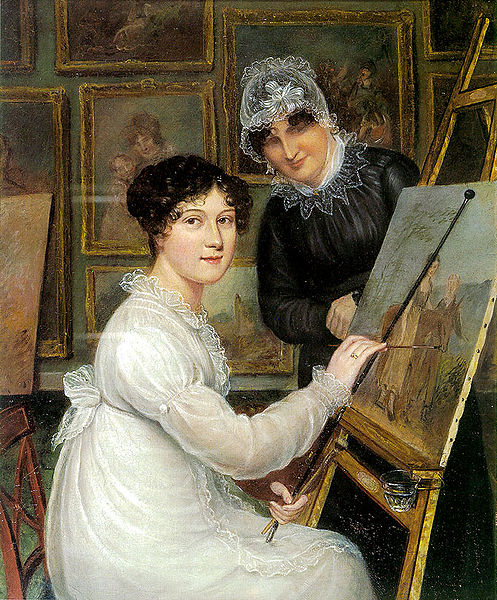
The Artist and her Mother by Rolinda Sharples (c.1820)

Both Rolinda and her brother James predeceased their mother.  Rolinda died of breast cancer in 1838, just forty-five years of age and James Jr. died of tuberculosis in 1839.  Ellen Sharples, the last of the Sharples family, died in 1849 aged 80.

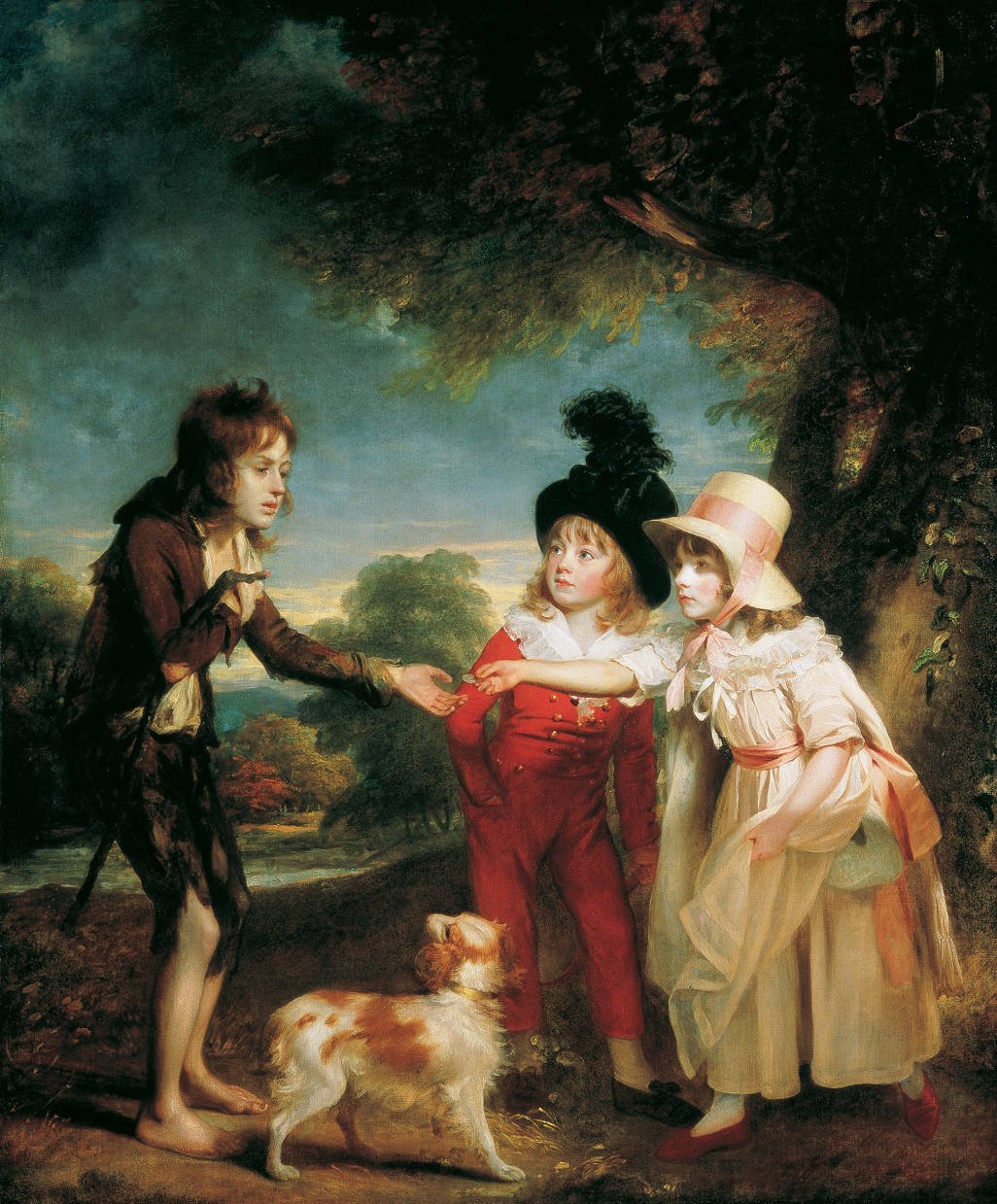
Portrait of Sir Francis Ford’s Children Giving a Coin to a Beggar Boy by Sir William Beechey

Portrait of Sir Francis Ford’s Children Giving a Coin to a Beggar Boy by Sir William Beechey (c.1793)

The artist I am featuring in My Daily Art Display today is the English portrait painter, Sir William Beechey.  William Beechey was born in Burford Oxfordshire in 1753.  He was the eldest of five children of William Beechey and Hannah Read who both came from Dublin.  Young William Beechey was not brought up by his mother and father but by his uncle Samuel Beechey who was a lawyer and it was his intention to have William study law and made arrangements for him to be articled to a solicitor in nearby Stow-on-the-Wold and later in London.  Whilst in London training to become a lawyer William made friends with some students from the Royal Academy Schools.  In 1772, despite the displeasure of his uncle, William managed to gain a release from the solicitor’s articles and achieved admission to the Royal Academy schools.

Some historical records of his life state that at around this time William Beechey married Mary Ann Jones and the  couple went on to have three daughters and two sons, one of whom was his son, Henry William Beechey who became an explorer and artist.  William Beechey first put forward paintings for inclusion at the Royal Academy Exhibition in 1776 and continued to submit works to their annual exhibitions for the next seven years.  At this time, most of his work consisted of what was then termed as “small portraiture”.

In 1772 he left London and moved to Norfolk, living in Norwich and for a short time, Great Yarmouth.  This move out of the capital city would appear to have been a strange one for London was an ideal place to sell his work but the author, William Roberts explained the reason for going to Norwich in his 1907 biography of the artist, entitled Sir William Beechey R.A.

 “…he was invited to spend a month in that city, where he found himself in the immediate receipt of so many commissions in that town and neighbourhood that he was induced to take up his abode there altogether…”

He was still submitting and having his works of art accepted  by the Royal Academy for their exhibitions but they received little mention.  However in 1788 he submitted two framed works which incorporated fifteen smaller portraits.  The Royal Academy jury, who decided on which paintings would be allowed to be exhibited at the Exhibition, rejected his two submissions because the R.A. rules stipulated that all paintings must be framed separately.  An art dealer Benjamin Vandergucht took the two works and exhibited them in his own gallery.  The phrase “there is no such thing as bad publicity” kicked in as the press heard about the R.A. rejection of Beechey’s works and wrote the story of the R.A.’s rebuff.  Beechey had managed to obtain free and excellent publicity for his art work.

Beechey had returned to live in London.  A number of his contemporary portraitist had died, such as Gainsborough or ceased painting, such as Joshua Reynolds and so there was a great demand for his portraiture.  It was at about this time that Beechey moved away from miniature portraiture and started to concentrate on life-sized portraits.  His first wife, Mary died in 1793 and that same year he remarried.  His second wife was a miniature painter, Anne Phyllis Jessop, a lady some eleven years his junior.  The couple went on to have eighteen children!  The final breakthrough for Beechey in his artistic career was receiving royal patronage which came in 1793.  King George III and his wife loved Beechey’s portraiture style.  In a round-about way, Beechey had the Royal Academy to thank for this for they rejected another of his works, a portrait of a courtier.  The nobleman was so incensed when he heard that his portrait was not to appear at the R.A. Exhibition that he took the painting and showed it to the king and queen.  They thought it was a magnificent work of art and a generation of royal patronage began and Beechey was made the queen’s portrait painter.   One will never know fully how this influenced the Royal Academy but by a strange coincidence the R.A. elected Beechey as an Associate of the Royal Academy that same year.  This was also the year that the R.A. conferred the same honour to his portraitist rival John Hoppner.

An art critic of the Monthly Mirror journal wrote about William Beechey’s work and that of his rivals of the time, John Hopper and Thomas Lawrence:

“…Beechey has fewer eccentricities than his competitors—for he never distorts his figures for the sake of extravagant attitude—he is less fantastic in his design and less exuberant in manner, in short, he has more nature than [Hoppner and Lawrence]. … Beechey, who is more fixed and determinate, both in his colouring and outline, studies only to be chaste…”

Beechey’s work was often described as being delicate and lacking extravagance and it was these very qualities that appealed to his patrons and clients who disliked the ostentation and flamboyance of his two main rivals.  It was also these virtues of Beechey that appealed to King George.  King George was vociferous in his praise of Beechey, much to the chagrin of John Hoppner.  William Beechey was elected as an Academician of the Royal Academy in 1798 and in that same year, on King George’s specific instructions, he exhibited his great and mammoth masterpiece, measuring 14ft x 17 feet, entitled His Majesty Reviewing the Third Dragoon Guards and the Tenth Light Dragoons in which he depicted King George reviewing his household troops.    Sadly this beautiful work of art was destroyed during the 1992 fire in Windsor Castle.  The king was so delighted with the work that in May 1798 he conferred a knighthood on Beechey.  The knighthood was the first such honour to go to an artist since Joshua Reynolds was knighted back in 1769.  Sir William Beechey’s artistic rivals were astounded by this royal award!  Beechey remained a favourite of King George III.

Sir William Beechey continued to exhibit work at the annual Royal Academy exhibitions until his death in January1839, aged 85.

The featured painting fo My Daily Art Display today is by Sir William Beechey and is entitled Portrait of Sir Francis Ford’s Children Giving a Coin to a Beggar Boy, which he completed around 1793 and is housed at the Tate Britain in London.  The beggar in the painting is not depicted as a dirty and scruffy sad-looking urchin as we have seen in works such as The Beggar Boy by Murillo (My Daily Art Display, January 25th 2011) as this would have upset the sensibilities of the Victorian public.  There were many portraits of beggars during the late 18th century, most of which could almost be considered as being “prettified” versions of reality.  Such pictures would be more likely to home in on, not the pathetic state of the begging child, but of the kindness of the charity givers.  So is this just another one of these charitable depictions.  Well actually I am not so sure but then maybe I am just a cynic. Why?

We have to suppose that  when a patron approaches an artist to paint a picture, they know what sort of painting they want.  They know not only who or what is to be depicted but they will make the decision as to how something or someone is to be portrayed.  They will know whether there is to be a certain reasoning behind the depiction other than what is visible at a first glance to the casual observer.  By now you must be used to looking at the paintings I have featured and together we have delved into the interpretations and symbolism of the works.  So now let us look a little closer at what William Beechey has painted and try and work out if there was a reason for such a portrayal.

The first thing to consider is who had commissioned the painting.  The client was Sir Francis Ford.  Ford was the heir of a Barbados planter of the third generation.  His family originally came from Devon. In 1793, he was elected as Member of Parliament for Newcastle-under-Lyme and the day he was elected he was given a baronetcy. He was now a member of William Pitt’s administration but was in favour of procrastination as far as the abolition of the slave trade was concerned.   He disagreed with the government over the slave trade question and did not seek re-election as an MP.

Besides being a politician he was a plantation owner with estates in Barbados and the Dutch colony of Essequibo.  Being a plantation owner he needed labour to work his estates and thus was a great advocate of slavery.  However in England in 1793, at the time of this painting, there was the start of a movement against slavery and a steady outcry with regards the terrible conditions of the plantation slaves, although it would be another forty years before slavery was abolished in the British Empire.

In the painting we see portraits of Thomas Ford’s son and daughter giving a coin to a beggar boy.  Could it be that Sir Francis Ford wanted to remind the people of Victorian England that there were beggars in their own country, who were in desperate need of food and lived in unacceptable conditions, and that the English public should show more concern about the fate of their own “home-grown” poor rather than worry about the living and working conditions of the plantation slaves in some far-off distant lands.  Could Sir Francis Ford be stating in a roundabout way that “only those without guilt have the right to cast the first stone”!  Was Thomas Ford using the artistic talents of Beechey as that of a spin doctor?

Sir Thomas Ford died in Barbados in 1801.

Girl with a White Dog by Lucian Freud

Girl with a White Dog by Lucian Freud (1950-51)

A few days ago I visited my two children in London and went on a few gallery visits.  I had managed to get tickets for my daughter and myself for the David Hockney Exhibition at the Royal Academy which was really a great experience and one which everybody should try and get to.  I will feature a painting from the exhibition later this week.  The other exhibition I had wanted to see and which had just opened was an exhibition of Lucian Freud’s Portraits which was being held at the National Portrait Gallery.  Unfortunately I could not get a ticket for the days I was in the capital so I have booked to go next month.  Today I am going to look at one of my favourite paintings of his entitled Girl with a White Dog, which he completed in 1951.  First let me tell you a little about Lucian’s early life and that of the sitter for this painting, his first wife, Kathleen Garman and look back on the famous, or maybe I should say, infamous Garman sisters.

Lucian Freud, who is the grandson of Sigmund Freud, the pioneer of psychoanalysis, was born in Berlin in 1922.  His father, Ernst Freud, an Austrian Jew, was an architect and his mother Lucie (née Brach) was the daughter of a grain merchant.  On the rise to power of Adolf Hitler in Germany in 1933, Lucian and his parents moved to Britain and lived in a house in St John’s Wood, London.  During his school years, he attended Dartington Hall Boarding School in Totnes Devon.    This was, at the time, an unusual seat of education.  It was a very progressive establishment in which there was a minimum of formal classroom activity and the children learnt by involvement in estate activities. From there he attended the Bryanston Independent School in Dorset.

In 1939 he became a British national and that year he enrolled at the Central School of Art and Design, which fifty years later would merge with the St Martins School of Art and become, as we know it today, the Central Saint Martins College of Arts and Design, which is widely regarded as one of the leading Art and Design institutions in the world.  His stay at the college was only brief as he moved on to the Cedric Morris’ East Anglican School of Painting and Drawing in Dedham.  This was a far more radical establishment which gave free rein to its students.  The school was destroyed by fire and a new location for the school was established in Benton End on the outskirts of Hadleigh in the county of Sussex.

Lucian Freud served as a merchant seaman in an Atlantic convoy in 1941 before being invalided out of service in 1942.  From 1942 to 1943 he attended Goldsmiths, University of London, an establishment which specialises in the arts, humanities and social sciences.  At the age of 24, Freud began his European travels, painting in France and Greece.  Some of his early work had already been published in the Horizon arts magazine and in 1944 the Alex Reid & Lefevre Gallery in London staged the first solo exhibition of his paintings.

In 1948 Lucian married Kitty Garman, the subject of today’s featured painting.   Kitty was the second illegitimate child of the distinguished British sculptor, Jacob Epstein’s and his lover Kathleen Garman.  Jacob Epstein and his wife Margaret (née Dunlop) did not have any children of their own but they looked after a young girl, Peggy Jean, the product of Jacob Epstein’s earlier affair with Dorothy (Meum) Lindsell Stewart.  Margaret Epstein and the young girl lived across London with Jacob, while Kathleen Garman lived with her younger sister, Helen, in an unheated studio in Bloomsbury and her and Jacob’s infant son, Theo.    Margaret Epstein was aware of her husband’s affair with Kathleen Garman and despite her husband’s numerous previous affairs with women which never lasted, she felt threatened by Kathleen.  She realised that Kathleen was more than a lover, she was almost a  parallel wife. From the beginning, Mrs Epstein disliked her intensely, realising  that she would be her greatest rival.   It came to a head in 1923 when according to Cressida Connolly in her book The Rare and the Beautiful: The Lives of the Garmans:

“…Mrs Epstein took Kathleen into a room and locked the door before producing a pearl-handled pistol from under her capacious skirts… and shot her. The bullet hit Kathleen just to the right of her left shoulder blade, whereupon Mrs Epstein panicked and ran out of the room, leaving the bloodied Kathleen to stagger out into the street alone…”

Jacob Epstein visited Kathleen in hospital and paid her medical bills. The bullet wound to her shoulder left  a large scar and Kathleen Garman was never afterwards able to wear sleeve-less dresses. To protect the reputation of Jacob Epstein, Kathleen Garman refused to press charges against his wife.

Despite this incident and the pleadings of his wife, Epstein refused to give up Kathleen, who remained in her one-room London studio as Epstein’s lover and bore him three illegitimate children; a son, Theo, in 1924, and two daughters,  Kitty in 1926 and Esther in 1929.  Epstein had another affair with one of his students, Isabel Nicholas, and this resulted in the birth of a son Jackie in 1934.  Isabel gave up her son to the Epsteins and he was also looked after by Margaret Epstein.   Kathleen Garman never knew about Epstein’s parallel affair with Isabel or about the boy Jackie until several years later.

The cramped conditions of the studio Kathleen Garman was living in proved unsuitable for bringing up young children and Kitty was sent to live with her maternal grandmother, Margaret (née Magill), in Herefordshire.  Esther, the youngest daughter was later dispatched to a family friend.   Kitty Garman stayed on with her grandmother Margaret when the household moved to South Harting, Sussex, and only went back to live with her mother in London when she was in her late teens.  She then enrolled at the Central School of Arts and Crafts to study painting under Bernard Meninsky. According to Kitty, her mother was constantly critical of her artistic efforts. Kitty recalled her mother’s attitude:

 “…I think she wanted her daughters to excel, but she didn’t want us to succeed, because she had to be the queen.   I was frightened of her because of her temper and she did say searingly sarcastic things…”

In 1949, Epstein’s wife, Margaret fractured her skull in a fall on the steps of her home and died.  This allowed Kathleen Garman to move into Epstein’s home in Hyde Park Gate.

By the early 1950’s Kitty Garman’s marriage to Lucian was in trouble and it ended abruptly after the artist’s affair with the society girl and writer Lady Caroline Blackwood was exposed.        Kitty Garman’s marriage to Lucian Freud ended in divorce in 1952 and Lady Caroline Blackwood became his second wife in 1957.  Shortly after the ending of her marriage to Lucian, Kitty was at a party where she met Wynne Godley, and economist, whom she married in 1955.

Lucian Michael Freud died aged 89 on July 20th 2011.  His first wife and sitter for today’s painting, Kathleen (Kitty) Eleonara Wishart (née Godley, née Freud) died aged 74 on January 11th 2011.

Kitty Garman, a brunette, was by all accounts, hauntingly beautiful and the subject of many paintings.  My Daily Art Display featured painting today is entitled Girl with a White Dog which Lucian Freud commenced in 1950 and  completed in 1951.  When not lent out to external exhibitions this work of art resides at the Tate Britain Gallery, London.  This is the last of the series of portraits of his first wife, Kitty, which Freud had started at the end of the 1940’s.  Kitty had given birth to Lucian and her first child, Annie in 1948 and their second child Annabel was born in 1952, the year the painting was purchased by the Tate.

One can only marvel at the way Freud has handled the contrast of the fabrics and textures.  On the one hand we have the smooth white hairs of the dog and on the other hand we have the fuller texture of the yellow dressing gown, which contrasts also with the smoothness of the  striped silk bedspread on which she sits.    In the painting we see Kitty Garman sitting curled up on what looks like a low settee dressed in a dressing gown with its long plaited and tasselled tie.   Lying next to her, with its head in her lap, is one of a pair of white bull terriers the couple were given as a wedding present.  Look at the wonderful amount of detail Freud has put into his depiction of the dog.  He would often use animals in his compositions and often they would feature both pet and owner.

Kitty left hand hangs down and her fingers rest on the settee and on one of the fingers  we can see her wedding ring.   Her right hand is pressed against the bathrobe, cupping her left breast.  Her right arm is strategically placed under her right breast with her wrist adding to its uplift and fullness.  Her expression is difficult to translate.  She seems somewhat frightened and concerned about something.  Her eyes are large and staring.  In some ways we feel a little uncomfortable when we look at her.  Her brow is narrow which adds to her look of anxiety and sadness.  It could well be that Freud’s liaison with Caroline Blackwood at the time of this painting was taking a toll on Kitty.  Is her look one of calmness or one of desolation?  I will let you decide.

Un atelier aux Batignolles (A Studio at Les Batignolles) by Henri Fantin-Latour

Un atelier aux Batignolles (A Studio at Les Batignolles)

Today I am looking at a work of art by the French painter, Henri Fantin-Latour, or to give him his full name, Ignace-Henri-Jean-Théodore Fantin-Latour.  The family was of Italian ancestry and the “Fantin” part of the name came from the fact that some of the ancestors hailed from the southern Italian town of San-Fantino.  In the 17th century, a Jean Fantin added “Latour” to the name of Fantin.

Henri was born in Grenoble in 1836.  His father, Theodore Fantin-Latour, originally from Metz, was a society portraitist painter.   In 1841 the family moved to Paris.  Having shown a liking for drawing at an early age, he received his initial artistic training from his father.  Then at the age of fourteen, he enrolled on a three-year course at the École de Dessin of the French artist and drawing instructor, Lecoq de Boisbaudran.  Following this, he spent a short time at the École des Beaux-Arts in Paris.  During his art student days he spent most of his time at the Louvre copying the painting of the old Masters as well as making many visits to the Musée de Luxembourg to study and copy the works of Eugene Delacroix.  In 1861, after he graduated from the art schools he worked for a time at the atelier of Gustave Courbet and supported himself by earning money as a copyist.

During his time copying paintings at the Louvre he came across and became friends with a number of the future Impressionists, such as Edgar Degas, Édouard Manet and Berthe Morisot.   In 1858, he struck up a special friendship with the American-born artist James Whistler and along with French-born English painter Alphonse Legros he founded the art group known as the Société des Trois.   Whistler, who had moved to London, invited Henri over for a visit which he accepted and through the good auspices of his two friends Whistler and Legros he was introduced to the art world of London.  This was the first of many trips to London made by Fantin-Latour.  One very important introduction whilst there was to Edwin Edwards, who had trained as a lawyer but also practiced as an artist and etcher.  He acted as Henri Fantin-Latour’s agent in England and found him many buyers for his floral paintings as well as a number of patrons.

Henri Fantin-Latour had started painting a number of works of art featuring floral still-lifes and these were well received in London although strangely enough never popular in France during his lifetime.  Henri Fantin-Latour exhibited a number of his works at the Paris Salon in 1861 and 1862  and later in 1863, at the Salon des Refusés, and  he exhibited regularly at the London Royal Academy.  Although he had been close friends to a number of the Impressionists, he never put up any of his paintings for their eight Impressionist Exhibitions.  The reason for that decision was probably due to the fact that although he counted them as friends, he disagreed with their artistic theories and philosophy.  His artistic style was more conservative.

Henri-Fantin Latour will always be remembered for his luxurious floral paintings but he was an artist who painted many group portraits and it through these works that we get an insight into the friendship between the now-famous artists, poets, musicians and writers of that era.  During his time as an artist he also completed no fewer than twenty three self-portraits.

In 1875, aged thirty nine, Henri Fantin-Latour married a fellow painter, Victoria Dubourg and the couple spent their summers at the country estate of his in-laws at Buré.  In 1879 Henri Fantin-Latour was awarded the Legion d’Honneur medal.  Henri Fantin Latour died in 1904, aged 68 and was buried in the Cimetière du Montparnasse in Paris.

The painting I am featuring today was not one of Fantin-Latour’s beautiful floral works of art but instead I am going to look at one of his group portraits. It is very like a painting I featured in My Daily Art Display on November 10th 2011 entitled Bazille’s Studio; rue de la Condamine by Frédéric Bazille, who also actually appears in today’s painting.

My painting today is entitled Un atelier aux Batignolles (A Studio at Les Batignolles) and he completed it in 1870.  Batignolles is part of the 17th arondissement of the city of Paris.  At the time of Fantin-Latour, this was a cultural hive of activity and served as a base for young painters such as Édouard Manet and many of his artist friends who, because of the locality, became known as Le groupe des Batignolles.  The painting today is a kind of “who’s who” of that group.   It is more than just that.  In some ways it is Henri Fantin-Latour paying homage to his friend Manet.

We are in the atelier of Édouard Manet and we see him sitting at his easel. He concentrates on the man sitting in the other chair, the subject of his painting, Zacharie Astruc.  Astruc was a painter, poet, sculptor and art critic who had rallied to support the likes of Courbet and Manet and the Impressionist group of painters when they were constantly being criticized.   Standing around and watching the artist at work are some of his friends.  At the far left of the painting, seen standing directly behind Manet is the German painter Otto Schölderer.  Next to him, wearing a hat, is Auguste Renoir.  Further to the right of the painting and almost in the background, are Emile Zola, the writer who also championed the cause of the Impressionists in their struggle with the Salon and its condemnation of this new grouping of artists, Edmond Maître another supporter of the Impressionist painters and who was, at the time, a civil servant at the town hall.  Almost hidden in the corner of the painting is Claude Monet.   Standing tall and upright behind the chair with a full beard is the twenty-six year old, Frédéric Bazille, who two months after this painting was completed was killed in the Franco-Prussian War.  There is a  formal air to this group portrait.  The men are all dressed in somber dark suits and their expressions are serious and unsmiling.   All these young artists had suffered at the hands of the art critics of the day.  They and their paintings were accused as being frivolous and contrary to what the art establishment was used to.  It is possibly for that reason that Henri Fantin-Latour decided to depict the gathering so formally and with an air of respectability.  Could this desire to show how these young artists had not completely put the antique traditions of the Academics of the Salon behind them be the reason why the artist has included a statuette of Minerva on the table at the left of the painting?  In my last blog regarding Monet and Camille Doncieux I mentioned that all things Japanese were the rage in Paris and France in the late nineteenth century.  Look how Fantin-Latour has positioned a Japanese stoneware vase next top Minerva in the painting.

This work by Henri Fantin-Latour is almost a historical painting.  It records for us a time in history when these characters were leaving their mark.  Each one of them is posing for posterity.  Zola once wrote about the struggle these artists had to endure and the way in which Édouard Manet tried to rally them when they became dispirited.  He wrote:
“…Around the painter so disparaged by the public has grown up a common front of painters and writers who claim him as a master…”

Henri Fantin-Latour put forward the painting to be exhibited at the 1870 Salon  The painting was accepted and he was awarded a  medal by the salon for this work of art.  In spite of his close relationship with the Impressionist painters he never followed their artistic techniques.  He remained a traditionalist and remained faithful to that traditional technique. In the latter part of his career he painted less and concentrated on lithography.

Did you wonder whether Manet was actually painting a picture of Zacharie Astruc as depicted in today’s featured work?  Who knows, but coincidentally, Manet did complete a portrait of Astruc four years earlier in 1866, which now hangs at the Kunsthalle in Bremen………………….

Portrait of Zacharie Astruc by Manet (1866)

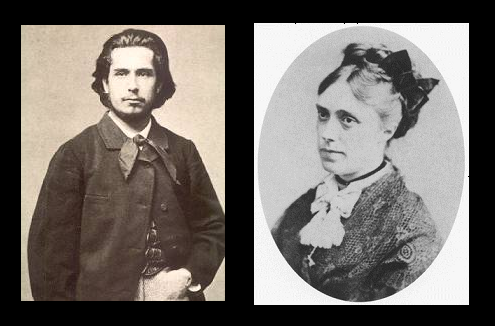
Camille Doncieux and Claude Monet (Part 2)

Claude Monet and Camille Doncieux

In my last blog I looked at the first meeting of Camille Doncieux and Monet.  It occurred in 1865 when Frédéric Bazille, a good friend of the twenty-five year old Monet, introduced him to Camille Doncieux who was still in her teens.  Camille, who was of humble origins, worked as an artist’s model.  Monet soon made her his number one model and shortly afterwards the two became lovers. The couple, because of the poor sales of Monet’s works of art, lived in depressing poverty.   Today I complete the story of Camille and Monet and look at a few more paintings the artist completed depicting Camille.

From the 1860’s till the end of that century, France was in love with all things Japanese.  This Japonisme as it was called had inspired both artists and the public.  Monet was not immune from this trend which swept his country.  Besides his art, he had two other hobbies.  He loved gardening and he loved to collect Japanese art, especially the Japanese woodblock prints.   In all he had built up a collection of over two hundred of these.  He had also accumulated a number of Japanese fans, kimonos and screens, some of which can still be seen at his house in Giverny.

 The most palpable and undeniable proof of Monet being influenced by the art and culture of Japan is his oil on canvas painting, Madame Monet en Costume Japonais (La Japonaise), which he completed in 1875 and which currently hangs in the Boston Museum of Fine Arts. This work was in complete contrast to his earlier works.   Large-scale figure paintings had usually been looked upon as a major challenge for an artist.  Camille is depicted dressed in an elaborate kimono, holding a Japanese fan in her hand.   It is interesting to note that Camille is wearing a blond wig so as to emphasize her Western identity. Her kimono is sumptuously embroidered and the background is adorned with numerous Japanese fans. These accoutrements could, at the time, be bought for a few centimes in many of the Parisian shops and even the larger department stores had exclusive sections for all things Japanese.

In the painting Camille’s pose is of a conventional style and it is believed that Monet did this so as to enhance the chance of selling the work.   Because of this, there is a somewhat loss of spontaneity about it.  The scene looks very contrived.   However the brilliance of the colours he used is breathtaking.   Monet exhibited this work at the Second Impressionist Exhibition in 1876, where it attracted much attention.  Maybe Monet was saddened and felt somewhat guilty by the compromise he had made with this work solely to make it more attractive to potential buyers.  He later described it as “trash” and “a concession to the popular taste of its time”.

On June 28th 1870, Camille and Claude were married in a civil ceremony performed at the town hall of the eighth arrondissement of Paris. The French painter Gustave Courbet was one of the witnesses. Although Camille’s parents were present at the ceremony, Monet’s family were horrified by their son’s choice of partner and would not accept Camille Doncieux as their daughter in law, nor would they acknowledge their grandchild, Jean-Armand-Claude who had been born in August 1867.   Monet’s parents even tried to bribe their son into leaving his wife with the threat of their allowance to him being stopped if he continued the liaison.  However Monet chose his wife over money and refused to abandon Camille and Jean.   As a result, his allowance was cut off and his financial situation worsened and the three of them suffered extreme financial hardship, sometimes unable to afford food and often unable to afford paint.   He carried this burden for many years, and struggled greatly with poverty and the stress caused by Camille’s poor health, and his inability to pay for her medical care.   After the wedding and just before the start of the Franco-Prussian War the family travelled to London and Zaandam before returning to France and setting up home in Argenteuil, a town to the west of Paris.

Camille Holding a Posy of Violets by Monet 1877

In 1876, Camille Monet fell ill with what is believed to have been the beginnings of cervical cancer.   In Monet’s 1877 painting Camille Holding a Posy of Violets, which he completed that year, one can see the toll the disease has had on her health. Her face looks pale and haggard.  She looks tired and older. It was around this time that Monet received a commission from a patron Ernest Hoschedé and for a short time his finances took a turn for the better.  However in 1877 all this changed when Hoschedé went bankrupt and his art collection was auctioned off. This was a blow to the Impressionists, whom Hoschedé had supported,  and especially Monet.   The bankrupted Hoschedé and his family moved to a house in Vétheuil with Monet, Camille and Jean. However Ernest Hoschedé spent most of his time in Paris before fleeing to Belgium to avoid his creditors.   There soon followed speculation that Monet may have been carrying on an affair with Alice Hoschedé.    Some art historians have translated the look on Camille’s face in this painting as one of disgust with her husband and his liaison with Alice Hoschedé.  This was the last painting Monet did of Camille whilst she was alive.

Camille on her Deathbed by Monet (1879)

On March 17th 1878, Camille gave birth to her second son, Michel.  The birth of Michel further weakened Camille.   Over the next twelve months Camille’s health deteriorated and on August 31 1879, a priest was called to the house to administer the last rites and to sanction her marriage to Monet, although they had been married in a civil ceremony nine years earlier.   Camille’s death on September 5th 1879 devastated Monet. She was just thirty-two years of age.   Monet painted a picture of his wife on her death bed and the work can be seen at the Musée d’Orsay.  Monet remembered the time well writing to a friend telling him of his urge to paint that last portrait of Camille:

“…I caught myself watching her tragic forehead, almost mechanically observing the sequence of changing colours that death was imposing on her rigid face. Blue, yellow, grey and so on… my reflexes compelled me to take unconscious action in spite of myself…”

Monet included lots of blue and gray in this painting, as well as yellow,orange and red and in some people’s opinion the use of these colours made the painting too light. Light, coming from the right hand side, shines on the face of his deceased wife.   We do not get a very clear view of Camille although we can just make out her face and that she is wearing a shroud.

After Camille Monet’s death in 1879, Monet and Alice along with the children from the two respective families continued living together at Poissy and later Giverny. Ernest Hoschedé died in 1891, and, in 1892, Alice and Claude Monet were married.   Little is known about Camille Doncieux Monet mainly because Monet’s alleged mistress and second wife, Alice Hoschedé, was so jealous of Camille that she demanded that all photographs, mementos and letters between Monet and Camille were destroyed.  She was determined that Camille’s very existence was denied.

Why did she hate Camille so much?    Maybe she realised that Camille Doncieux was the one and only true love of Claude Monet.

Claude and Camille by Stephanie Cowell

If you would like to read a fictional account of the relationship between Camille Doncieux and Claude Monet then I suggest you read:

Claude and Camille: A novel on Monet by Stephanie Cowell