Peder Balke. Part 1 – His early life and struggles to become a painter

Peder Balke (1804-1887)
Peder Balke
(1804-1887)

I suppose if you are a landscape or seascape artist it is ideal to be living amongst glorious scenery or rugged coastlines which inspire you to paint and is much better than having to move to an artist colony in some idyllic area to find inspiration.   The artist I am featuring today was fortunate enough to come from a country of amazing natural beauty which he often depicted in his works of art.  Today let me introduce you to the nineteenth century Norwegian painter, Peder Balke, who specialised in landscape and seascape paintings with a romantic and dramatic connotation.

Peder Balke was the younger son of Anders Thoresen and Pernille Pedersdatter and born August 28th 1804.  He was christened Peder Andersen on November 4th.  Information about his early years was given by Balke in a dictated version of his life story, seventy years later.  He reminisced:

“… I was born on the island of Helgøya, in Nes in the country of Hedmark on 4 November 1804 in poverty, my situation in life being therefore less than enviable.  Yet the nearly influence of an affectionate and conscientious mother with constant good advice and exemplary admonitions was of the greatest benefit to my youthful and perhaps exceptionally lively temperament – for it is in these years of one’s development that the seeds are sown of both good and evil, though only later in life does one value their significance correctly…”

Christiania Viewed from Ekeberg by Peder Balke (c.1829)

He did not have an easy start to life his family being part of the lowest ranks of the peasant society.  His parents were simple farm labourers working on a farm called Svennerud on the island of Helgøya, which lies in the middle of Lake Mjøsa, , some 60 kilometres north of Christiania (now Oslo)  and is Norway’s largest and one of the deepest lakes in the country.  The family owned nothing.  They had no lands to grow their own crops.  They were simply impoverished land-less servants of the farmer.   The family predicament was one his father could not tolerate and when Peder was young, he abandoned the family and is never mentioned in his son’s dictated autobiography.  In 1812, when Peder was eight years old, because Norway and Denmark were in an alliance with France, their ports were blockaded by the British, as part of Britain’s war against Napoleon.  This prevented much needed corn from entering the country and this, along with a severe and early frost of 1812 which destroyed the Norwegian corn harvest, meant that for the next two years the country suffered a terrible famine.  This severe time was remembered well by Balke who wrote:

“….wretched times, when war and years of hardship oppressed people and it goes without saying that this suffering and national scourge affected the poor most severely.  My mother, who had to look after herself and two children- for I had a brother who was seven years older than me ……like so many others we had therefore to resort to substitutes which are less easy for humans to digest, and I and my brother went into the forest to remove bark from the trees, which was dried and ground and Mother baked bread with it.  It goes without saying that food of this kind resulted in disease such as dysentery etc…”

The Mountain Range 'Trolltindene' by Peder Balke (c.1845)
The Mountain Range ‘Trolltindene’ by Peder Balke (c.1845)

Being from such a peasant class there was no possibility of schooling for Balke but his mother taught him to read and write.  When he was old enough he would try to earn some money for the family by helping out on the neighbourhood farms, but pay was poor, and he would also go fishing to bring food to the table.

It was thought Peder’s maternal grandfather was an painter/decorator and that was the first influence on him.  Another relative, Anders Skraedderstuen, who had a nearby smallholding was also a painter and took on seventeen year old Peder as an apprentice for two years.  Peder was employed to paint but also learn the skills involved in fine interior decorations.  There was always work for him as the farm owners were becoming richer and building themselves large homes which they needed decorating.  Peder travelled extensively from farm to farm to carry out commissions.  One such farm was the Vestre Balke farm at Toten which was owned by Anders Balke.  The Balke family took to Peder and soon he was not just looked upon as a workman but as a son.  This close tie pleased Peder and it was at this time that he changed his surname to Balke.  Although now living with his “new family” he always remembered to go back and visit his mother and help her out financially.

Landscape with Mill and Rapids by Peder Balke (1840)

In winter there were no commissions to be had so it was then that Balke travelled to Christiania to buy paints, stencils and the latest in ornaments ready for the following summer.  At this time there was no place in the capital where Balke could study art but he did manage to find rooms in a house owned by Ole Nielsen in Gudbrandsdalen.  Nielsen was a talented painter and over a period of seven months he taught Balke the fundamentals of drawing and painting.  Balke recalled the time later in his autobiographical notes:

“…From this kind man I received many tips hitherto unknown to me that had an appreciable effect on my later evolution in the profession of painter…”

Moonlight on the Coast at Steigen by Peder Balke (1842)

Life and business were good for Peder Balke, so much so, he employed several apprentices but as in life itself there were always ups and downs and the “down” at this time was the threat of military service.  Balke did not want anything to do with this and tried all sorts of ploys to get himself out of fighting for his country.  His eventual get-out was by becoming a qualified craftsman and seeking citizenship in Christiania.  So, in 1826, aged twenty-two, Balke left Toten and moved to the capital and was accepted as a journeyman by the Lubeck-born painter and engraver, Heinrich August Grosch and studied to become a master painter of the town, thus acquiring citizenship and best of all, be exempt from military service providing he completed his two year course to the satisfaction of Grosch.   Balke tired of working for Grosch switched to working for Jens Funch.  In 1827, with the money he had saved, he enrolled in an elementary drawing class at the Royal School of Drawing and received tuition at the Kongelige Tegneskole from the former military officer and painter Captain Jacob Munch, who was pleased with Balke’s progress.  With his savings almost gone, Balke returned to Toten and asked his benefactor Anders Balke for some financial help.  Anders and two other farm owners decide to financially back Balke, in the form of a letter of guarantee for a sum of money which Balke needed to continue his studies and in return he promised to decorate their farm buildings.
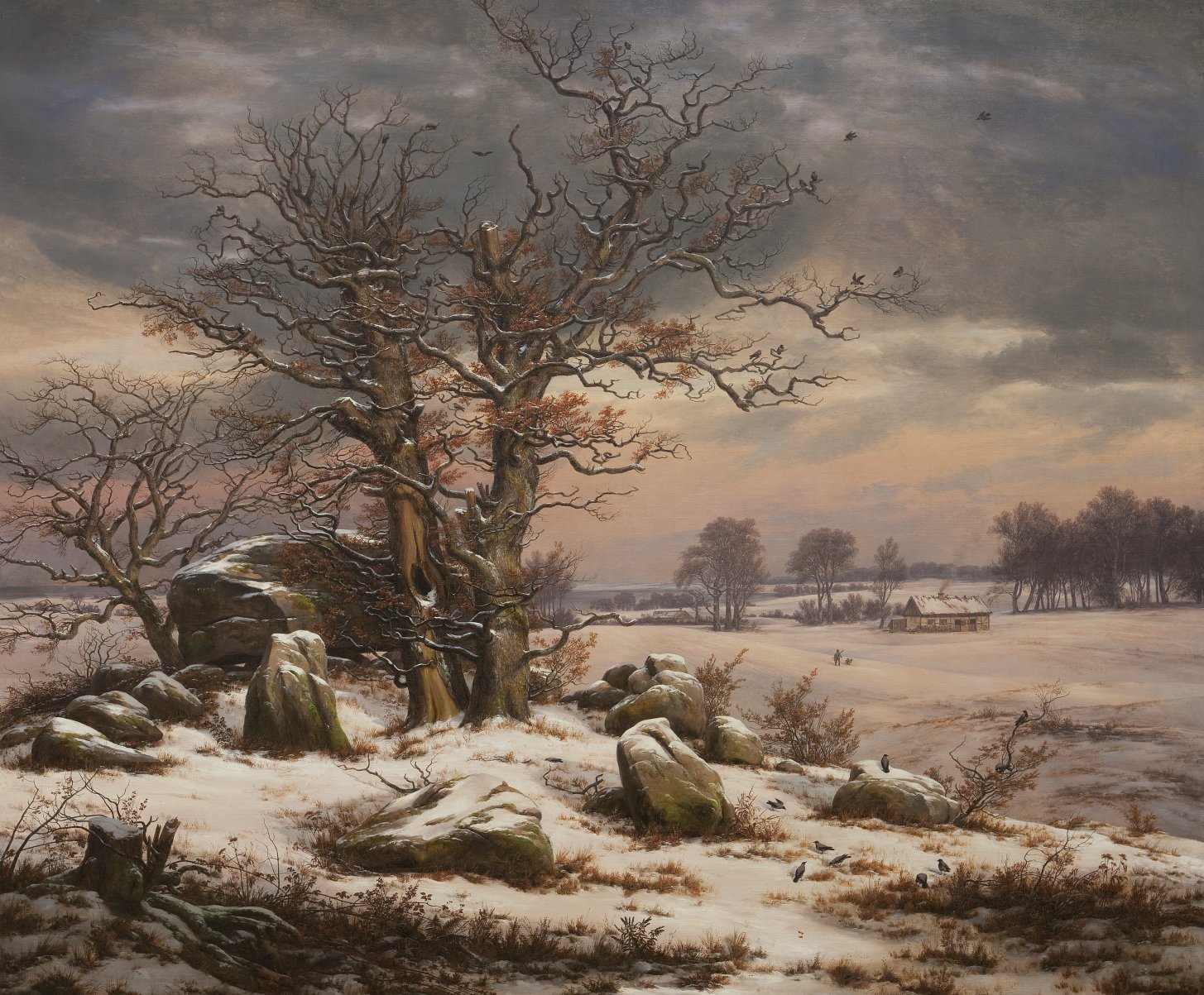
Winter Landscape. Near Vordingborg, by Johan Christian Dahl  (1827)
Winter Landscape. Near Vordingborg, by Johan Christian Dahl (1827)

Balke returned to Christiania and with the letter of guarantee met with Professor Jens Rathke a renowned natural scientist and professor at the university who was well known for his generosity.  He agreed to take the letter of guarantee and lend Balke the funds he needed.   Balke was to late recall that he was never asked to repay the sum he had borrowed and commented on Rathke’s invaluable support:

“… For that as well as for all the other kindnesses that man bestowed on me I have always been and always will be grateful to him…”

Jens Rathke also persuaded Balke to take a trip around large parts of central Norway in order to study nature.  Balke first toured the Telemark area in the south east of the country an area which he later recalled had awakened his profound interest in Norway’s wonderful natural life, and the astonishing beauty it reveals in all directions.  Later he explored central Norway and the Gudbransdalen Valley.  He continually recorded his travels with a large number of sketches which he would later combine in his paintings.

Seascape by Peder Balke (c.1860)

In 1829, military service still loomed large as Balke had not managed to qualify as a painter-decorator within the prescribed two year period.  His only course of action to avoid military service was to try and enrol at an academy and study landscape painting.  Rathke advised Balke to apply to the Stockholm Academy and agreed to finance Balke’s application.  Balke studied for a short time under the Swedish landscape painter, Carl Johan Fahlcrantz.  Whilst in Stockholm Balke visited the summer residence of the country’s ruler Karl Johnan in Djurgärden where he viewed the king’s art collection and was much enamoured by a painting by the German landscape painter, Johan Christian Ezdorf.  Ezdorf, who was also a student of Fahlcrantz, had a great love for the Nordic scenery and often depicted it in his works of art.

Balke was enjoying life in Stockholm and in his memoirs he wrote:

“…I used the time to pay frequent visits to the city’s art academy and art galleries, as well as a number of private collections of paintings where I was made welcome, and I also executed some small paintings which I had the satisfaction of selling…”

In my next blog I will continue to look at the life and works of Peder Balke and examine the reasons why he gave up being a professional artist in favour of politics.

I can recommend an excellent book about the artist and his work entitled Paintings by Peder Balke, from which I derived most of my information about this Norwegian painter.

 

The Skagen Painters, Part 2 – Mr and Mrs Krøyer

Double Portrait of Maria and P.S. Krøyer by Maria and Peter Severin Krøyer (1890)

As promised in my last blog featuring the Skagen husband and wife painters, Michael and Anna Ancher, My Daily Art Display today features another married couple who resided in Skagen, Denmark and were leading lights of the Skagen artist commune.   Their names were Marie and Peder Severin Krøyer. 

Marie Martha Mathilde Triepcke was one of three children born to German parents in the Danish capital of Copenhagen in June 1867.   She developed an early love for art and following normal schooling she decided that her future lay as an artist.  For a female to train to become an artist in Denmark in those days was very difficult as women were not allowed to enrol on art courses at the Danish Royal Academy of Art and so she had to study drawing and painting at private schools.  One of these art schools was the Kunstnernes Frie Studieskoler,  a Copenhagen art school which had opened in 1882 as a protest against  the policies and rigid dictates of the Royal Danish Academy of Fine Arts  and by so doing offered an alternative to the Academy’s rigid educational program.  The artist who looked after the new students was the Danish painter, Kristian Zartman.  Another teacher at the art school when Maria attended was the young artist Peter Severin Krøyer.   During her time at these private art establishments she received tuition in model drawing as well as some landscape, still life and portraiture. She and other artists, both male and female, were encouraged to spend time in the countryside and paint en plein air.  In 1887, when she was twenty years of age she made her first trip to Skagen which had by this time become home to  a flourishing artist colony. 

Two years later in December 1888 at the age of twenty-one she left Denmark and travelled alone to Paris to live and further her artistic education.  She studied at a number of studios including those of the French painters, Gustave Courtois and Alfred Roll.  One of the studios she worked in was run by the French painter, Pierre Puvis de Chavannes and it was whilst working in his atelier she became great friends with a fellow co-worker Anna Ancher, who along with her husband Michael, featured in my last blog.  Marie soon became one of the Parisian “Scandinavian artistic-set” and one of these fellow artists was Peter Severin Krøyer whom she had met before in Copenhagen.   Who knows why, but suddenly the relationship between Peter and Marie intensified and they fell in love.  It was a whirlwind romance because in July 1889, within six months of their Paris meeting they were married. 

Peter Severin Krøyer was sixteen years older than Maria.   Although he is often looked upon as a Danish painter, in fact he was born in the Norwegian town of Stavanger in July 1851.   His entry into the world was not without trauma as when he was just a young baby; he was taken from his mother, Ellen, as she was considered unfit to look after her son due to being mentally ill.  Peter went to live in Copenhagen where he was brought up by his maternal aunt and her husband.  At the age of nine, because of his love of drawing, they arranged for him to attend art classes at a private school.  A year later, he was enrolled at the Copenhagen Technical Institute.  From there he attended the Royal Danish Academy of Art and in 1870, at the age of nineteen, he completed his formal studies.  He, like many aspiring artists, began exhibiting his work at the Charlottenborg Palace in Copenhagen and his big breakthrough came in 1874 when the tobacco magnate Heinrich Hirschsprung bought one of his works.  Hirschsprung would become one of Peter Krøyer’s patrons and funded his early European travels.   This connection with Hirschsprung also had a connection with his wife-to-be Marie, as her childhood school friend was Ida Hirschsprung whose uncle was Heinrich and it was through Ida that Marie came into social contact with the Hirschsprungs and their circle of friends including  Peter Krøyen. 

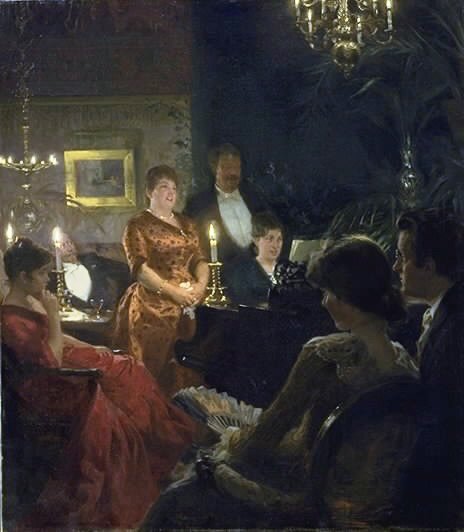
The Duet by Peter Krøyer (1877)

Marie Triepcke actually sat for Krøyen for his 1877 painting entitled The Duet.  She is the woman in red at the left of the painting.

For the next five years Krøyer travelled extensively visiting Spain and Italy as well as spending summer months in Brittany, all the time honing his artistic skills.  During the late 1870’s he would also come across the “new kids on the block” – the young French impressionists such as Monet, Sisley, Degas and Renoir.  However Krøyer was more attuned to the academic painters of the time.   After roaming for those five years he finally returned “home” to Denmark and in late 1881 and in the summer of 1882 he went to Skagen.  He was so enamoured by this area that he bought himself a home there and it was here that he spent his summers before returning to his Copenhagen apartment in the winter months to work in his studio.    Between 1882 and 1904 Krøyer was a leading figure at the newly founded Kunstnernes Frei Studieskoler where he oversaw the life drawing classes which allowed students to draw and paint images of live nudes, an art form which, at the time, was not allowed at the Royal Danish Academy of Fine Arts.

Marie Krøyer returned to Skagen with her husband Peter in 1891 and became part of the Skagen artists’ commune.  Once married, her artistic output lessened for she was concentrating on interior design and floral still-life painting which could be incorporated into interior design.  Another reason could have been her feeling artistically inferior in comparison to her husband, or maybe she was just overwhelmed by the burden of motherhood and looking after the house and her husband.  She was quite disheartened for she was quoted as once saying:

“…I sometimes think that the whole effort is in vain, we have far too much to overcome … what significance does it really have if I paint, I shall never, never achieve anything really great … I want to believe in our cause, even if at times it may be terribly difficult…”

    In 1895 she gave birth to a daughter, Vibeke and the family moved to a cottage in Skagen Vesterby where she spent time designing the interior of their home.  Her life with her husband became very challenging due to a decline in his mental health and his frequent incarceration in mental homes.   Her husband’s eyesight also began to gradually fail in 1900.      In 1902 during a journey to Italy Marie met the Swedish composer and violinist Hugo Alfvén.  She and Alfvén became lovers but Krøyer refused to give his wife a divorce.  This changed in 1905 when he found out that his wife was pregnant with Alfvén’s child.  Once divorced, Marie moved from Denmark and went to live with her husband and their baby daughter Margita in Tällberg, Sweden. 

The couple had a new home built there, which became known as Alfvénsgården, and Maria created the interior design and furnishings of the building.  The couple lived together unmarried for seven years before finally marrying in 1912 and their life together lasted twenty-four years until in 1936 they divorced.  Marie retained her beloved Alfvénsgården and remained there until she died in Stockholm in May 1940, a few weeks before her 73rd birthday.  On her death the house reverted to her daughter Margita and when Margita died the house went to Vibeke, Marie’s daughter from her marriage to Peter Krøyer. 

Peter Severin Krøyer died in November 1909, aged 58, at which time his sight had completely failed and he was blind. 

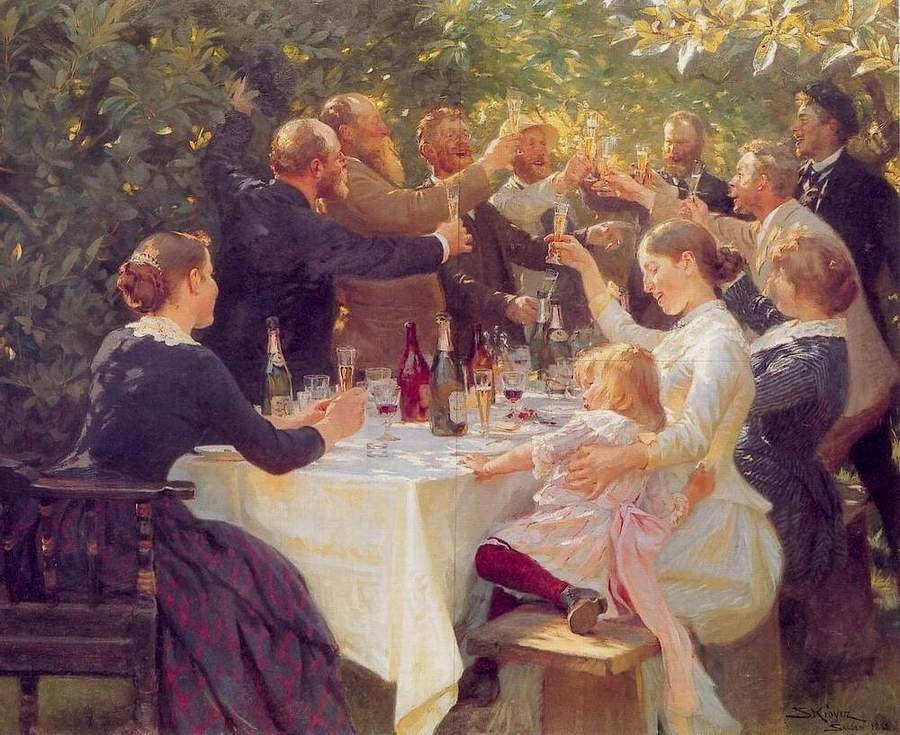
Hip, Hip Hurrah; An Artist's Party on Skagen by Peter Krøyer (1886)
Hip, Hip Hurra by Peter Krøyer (1886)

One of Krøyer’s best known works entitled Hip Hip Hurrah: An Artist’s Party on Skagen came about from his love of photography and his newly bought camera which he purchased in 1885.  It was during a garden party at the house of Michael and Anna Ancher that he took the photograph which captured the celebrating guests.  Delighted with the photograph, Krøyer decided to convert it into a large scale painting and wanted to bring in his models to Ancher’s garden so as to do some preliminary sketches.  Michael Ancher would not go along with the plan and would not countenance the intrusion of the artist and his models into his private garden so Krøyer had the table moved to his garden and set about the work.  It took him three years to complete the “stage-managed” work which in some ways resembles Renoir’s 1881 Luncheon of the Boating Party (see My Daily Art Display Aug 2nd 2011).  The garden party guests are seen celebrating and raising their glasses in a toast.  In the painting we have many of the leading members of the Skagen artist colony.  With her back to us is Martha Johansen who was along with Maria Triepcke and Anna Ancher one of the triumvirate of great female Skagen painter.  Standing on the far side of the table are the Skagen painters Viggo Johansen, the Norwegian Christian Krogh and dressed in brown Krøyer himself.  The man in the white suit is Degn Brøndum, Michale Ancher’s brother in law.  Next to him is Michael Ancher.  On this side of the table we have the Swedish painter Oscar Björck, and the Danish painter Thorvald Niss.  The lady leaning back is Helene Christensen, the local schoolteacher and wife of painter Karl Madsen and closest to us, dressed in white is Anna Ancher and her four year old daughter Helga.  As in many of the Skagen paintings the feature of this work is not the people but the Skagen sunlight which streams through the trees casting shadows on the white tablecloth and shimmers on the bottles and glasses. 

Self Portrait by Marie Krøyer (1889)

In contrast to Peter Krøyer’s depictions of his beautiful wife Marie, often seen strolling along the Skagen beaches, Marie’s 1889 Self Portrait is much more sombre and severe.  Half her face is in shadow in this work and it could reflect her state of mind at the time she painted the work. 

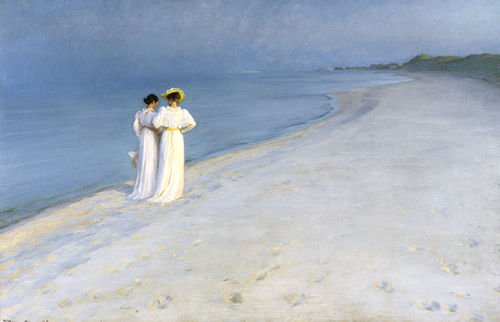
Summer Evening on Skagen's Southern Beach by Peter Krøyer (1893)
Summer Evening on Skagen’s Southern Beach by Peter Krøyer (1893)

In contrast to this dark portrait we have Peter Krøyer’s painting entitled Summer Evening on Skagen’s Southern Beach which he completed in 1893.  The idea for this work came to Krøyer during one of the many dinner parties he attended after which the diners would take twilight stroll along the shoreline.  It is an idyllic setting and we see Peter’s wife Marie.  Once again like paintings I featured by Michael Ancher and his wife the colour blue featured a lot in Krøyer’s painting during his stay in Skagen.  This twilight period when day starts to lose out to night was often referred to the “blue hour” which was how they say saw the sky and sea merge into one shade of blue.

Brøndum’s dining room with (left to right) Degn Brøndum (brother of Anna Ancher), Hulda Brøndum (sister of Anna Ancher), Anna Ancher, Marie Krøyer, P.S. Krøyer, and Michael Ancher, ca. 1890s; Image courtesy of Skagens Museum

I finish this blog with a photograph of my four Skagen artists, which I have featured in my last two blogs, sitting around a dining table at the Brondum hotel once owned by Anna Ancher’s parents

The Grindelwald Glacier by Thomas Fearnley

Grindelwald Glacier by Thomas Fearnley (1838)

Today I am concluding my look at the life of Thomas Fearnley and for those of you have just landed on this page,  my introduction to the Norwegian artist’s life was the subject for My Daily Art Display blog of November 24th.

The date is 1832 and that September, Fearnley, who along with his fellow artists, the Dane, William Bendz and the German painter Joseph Petzl, had just left the Bavarian Alpine village of Ramsau and were beginning their long and strenuous trek on foot over the Alps to Italy.  So why had this Norwegian artist and his friends set off on this gruelling journey?  Why did Fearnley spent most of his life wandering around Europe?   The answer probably lies in the fact that although the Norwegian landscape offered many beautiful vistas to paint, there were few commissions to be had from wealthy patrons in his native Norway.  Whereas in the art capitals of Europe such as Paris, London, Rome and Munich there were a large number of affluent patrons who would pay generous sums for landscape works.

Fearnley and his travelling companions headed for Rome but first stopped off in Venice in the late October of 1832.  The three travellers split up at this point as Fearnley was determined to carry on until he reached the Italian capital whereas Bendz wanted to stay in Venice.  As I told you in my last blog, William Bendz took ill in Venice but left the city and went to Vicenza where his health deteriorated rapidly and he died of typhoid, just ten days after he had parted from his friends.  Fearnley finally arrived in Rome in November 1832, just before his 30th birthday.  He settled down in the Italian capital, living amongst the Danish and German artistic community.  Fearnley made Rome his base for the next three years but was constantly setting off from there on his artistic trips.  In 1883, along with a Danish friend, he left the capital on a long walking tour of Sicily and on his way back to Rome, visited Naples, Sorrento and Capri.  This journey along the Amalfi coast had been carried out by his erstwhile mentor John Christian Dahl, ten years earlier.

Fearnley loved the practice of en plein air oil sketching and he followed earlier practitioners of this kind of art such as Claude-Joseph Vernet, Pierre-Henri Valenciennes and the Welsh artist Richard Wilson, all of whom had pioneered en plein air sketching whilst they were based in Rome.  The other aspect of this art, which Fearnley believed in, was to select views for painting that were “fresh”, even unorthodox rather than painting views which had been done so many times over by other landscape artists.  Another aspect of art which fascinated Fearnley was how various meteorological conditions affected the light and the view of the landscapes.  He strived for a true depiction of the skies and the cloud formations and was only too aware of the fast change in what he was looking at, due to varying changes in the weather conditions.   Having left the colder, duller and wetter climate of Northern Europe and Scandinavia he was now able to appreciate and take advantage of the warmer, sunnier climes of Italy which allowed him a greater opportunity to paint outdoors for lengthy periods of time.

In 1835, after his three year sojourn in Italy, Fearnley decided to move on.  He travelled north via Florence to Switzerland where he spent most of the summer studying the breathtaking Alpine scenery and especially the glaciers at Grindelwald, which would be depicted in his famous 1838 large studio oil painting entitled The Grindelwald Glacier, which is My Daily Art Display’s featured painting today.  From this Alpine area he once again moves north, crossing the Alps, heading for Paris, arriving in September of that year.  Whilst in Paris, he exhibits three of his works, including the “yet to be completed” Grindelwald Glacier painting.  During Fearnley’s stay in Rome he had met and befriended a number of wealthy English art lovers.  Many were rich aristocrats who were taking part in the Grand Tour.   It could have been this that made him decide to travel from Paris to London in the spring of 1836.  Whilst in the English capital, Fearnley took in the Royal Academy May Exhibition and at this exhibition he would have seen major works by the likes of Turner, Constable, David Wilkie and William Etty.  However the artist who most impressed Fearnley was the English landscape painter Augustus Wall Callcott.   This R.A. Exhibition was a special one as there were more than 1200 paintings being exhibited and it was the last one to be held at Somerset House.  Whilst in England Fearnley made a number of painting trips and in August 1837 he, along with his fellow artist friend, Charles West Cope, visited the Lake District.  He visited Derwentwater, Coniston and Patterdale, all the time recording the views in oil sketches.   In 1838 Fearnley became the founder member of the Etching Club, an artists’ society founded in London.  The club published illustrated editions of works by authors such as Oliver Goldsmith, Shakespeare, and Milton.  Other well known artists who became members of this club were the Pre-Raphaelite painters, William Holman Hunt and John Everett Millais.

In 1838, Fearnley exhibited his now completed work The Grindelwald Glacier at the Royal Academy.    His wanderlust continued unabated and he leaves London in the summer for Germany.  He first visits Berlin and then on to Dresden where he once again meets up with his former mentor and teacher J C Dahl. He makes a brief stop-over in Switzerland before returning to his homeland, Norway, where he lives in the capital Christiania for the next two years.   Fearnley became a member of the Christiania Art Society.  On July 15th 1840,  he married Cecilia Catharine Andresen, the daughter of one of his patrons from previous years, the banker and Member of Parliament Nicolai Andresen.   In the autumn the couple went to Amsterdam, where they stayed for one year, and where their only child, a son Thomas, was born.  During their stay Fearnley becomes infected with typhus and on January 16th 1842 he died, aged just 39 years old.   He was buried in a Munich cemetery but 80 years later his son took the initiative to have his father’s remains brought back to Norway, and in 1922 the tomb was moved to Our Saviour’s Cemetery in Oslo.

Fearnley’s painting, which at the time was entitled The Upper Grindelwald Glacier, Canton Berne, Switzerland,  was started in 1836 and although not finished was shown at the Paris Salon that year.  It was two years later in 1838 that the painting appeared at the Royal Academy Exhibition, which was being held in its new home at the National Gallery, the R.A. having just moved from Somerset House that year.  This beautiful painting is dated 1838 which leads us to believe that the original work started in 1836 was re-worked in late 1838 whilst the artist was in London.  This large studio work derives from a number of oil sketches which Fearnley made in late 1835 whilst he was in the Grindelwald valley.  The spectacular view we are looking at is of the upper Grindelwald glacier, which lies on the northern side of the Bernese Alps.  In the middle ground we can just make out a lone shepherd silhouetted against the stunning white ice peaks of the glacier.  In the foreground of the work we see that Fearnley has put a lot of effort into depicting the flora, amongst which are dotted the shepherd’s flock.  Although my attached picture might not clearly show it, the artist’s signature “Fearnley” is on the rock in the right foreground, next to a fern ! Coincidence or a witty visual play on his name?

Ramsau by Thomas Fearnley

Ramsau by Thomas Fearnley (1832)

I have said on a number of occasions that one of the joys of visiting art galleries is when you suddenly come across one you did not know existed.  It is always a pleasure to go to the large and famous galleries such as the Louvre, Prado, and London’s National Gallery to name just a few but I find it exhilarating when I come across, often by accident, the smaller, more hidden-away ones such as London’s Wallace Collection or the Musée Marmottan Monet Gallery  in the 16th arrondissement of Paris.   I had visited Birmingham before and visited the Birmingham Museum and Art Gallery but a fortnight ago I decided to visit the city again and have a look at the Barber Institute of Fine Arts which is on the University of Birmingham campus.   If I had not decided on that visit I would never have come across a divine portraiture work of Élisabeth Vigée Le Brun which I enthused about in my last blog and which was part of their permanent collection.  However the reason for me going to the gallery was to see an exhibition of the Norwegian painter Thomas Fearnley and today I want to talk a little about the life of this artist and look at one of the paintings which was in the exhibition.

Thomas Fearnley, although an English-sounding name, was Norwegian.  He was a romantic painter who was born in 1802 in Frederikshald, Norway, a small town in the south east of the country, a few miles from the Norwegian-Swedish border.  The town has since been renamed Halden.  The Fearnley family maintained its custom of naming its eldest sons Thomas and so both his father and grandfather were named Thomas.  His grandfather was an English timber merchant from Heckmondwike, a small mill town near Leeds, and who with his family moved to Norway in 1753 as a representative for a trading company based in the English seaport of Hull.  Fearnley’s father Thomas was also a merchant and married Maren Sophie Paus, a woman from the important Norwegian Paus dynasty.  Thomas was the eldest of their eight children.

Thomas Fearnley’s father owned a shop in Frederikshald and earned his money as an importer/exporter, importing woollen and cloth goods from England and exporting Norwegian lumber.   At the age of five, young Thomas went to live with his maternal aunt, Karen and her husband, Georg Frederik Hagemann in Christiania, (now known as Oslo).  The couple had no children of their own and were delighted to have Thomas live with them.  When Thomas was twelve years old he was enrolled as a pupil in the cadet corps of the Military Academy.  At the Academy, one of the subjects Thomas was taught was drawing.  It was soon clear that he had a talent for drawing and excelled in these lessons.  However he achieved less in his other subjects especially in the military training and he left the Academy in the spring of 1819.

As his father and his father’s father before him had all been merchants, it was expected that Thomas would follow suit and at the age of sixteen, for a while, he took on the role of a young merchant in his uncle’s business.  However Thomas had not given up his love of drawing and every evening he would attend an elementary art class in Christiania, where he spent time copying still lifes and portraits painted by various artists.

To become an artist in Norway was quite difficult as there were no major art academies where aspiring artists could learn their trade.  It could well be this factor, which forced Fearnley to travel extensively through Europe visiting major art institutions.  In late 1821 he travelled to Copenhagen and enrolled at the Royal Danish Academy of Fine Arts.  It was here that he came across Dutch landscape paintings of Nordic scenes by the likes of Jacob van Ruisdael.  It was these seventeenth century works, which influenced Fearnley and it was these depictions of Nordic landscapes, which would play an important role in Norwegian art and Norwegian artists such as Thomas Fearnley.

In 1823, aged twenty-one, Fearnley left Copenhagen and went to live in Stockholm where he attended the Drawing Class at the Royal Swedish Academy of Fine Arts enrolling on a four-year course.  During this period Thomas received a number of commissions for his landscape work including a three-painting commission from the country’s royal family.  During his time at the Academy, he would take the opportunity, during summer breaks in the art course, to travel back to Norway to sketch the wild and rugged landscape of his homeland.  It was at this juncture in his artistic career that he completed his first en plein air oil sketch.  It was also during one of these visits to western Norway, in 1826, that he first encountered another artist on an art tour.  He was Johan Christian Dahl, who would become the first great romantic painter in Norway, and one of the great European artists of all time.  Dahl is now looked upon as the founder of the “golden age” of Norwegian painting.

Fearnley’s four-year art course at the Copenhagen Academy ended in 1829 and Fearnley continued with his European travels, this time going to Dresden.   It was in this city that Fearnley again meets Dahl and they soon become friends and Thomas received some artistic tuition from him.  One of Dahl’s other artistic friends and near neighbour was the German artist Casper David Friedrich.  Fearnley spent time studying Friedrich’s work and one can see in a number of Fearnley’s landscape works a characteristic employed by Friedrich – figures in the paintings are seen from behind.  Fearnley studied the different ways in which Dahl and Friedrich worked.  J C Dahl used rapid brushstrokes in his paintings whilst Casper Friedrich was much slower and more methodical and his landscapes often had religious connotations.  The study of these two great artists was to influence Fearnley’s art in the future.

From Dresden Fearnley travelled to Prague, Nuremberg and the lake district of Salzburg before finally settling in Munich in 1830.  He was to remain in the Bavarian city for two years often travelling south to the foothills of the Bavarian Alps on painting trips.  Following his two-year sojourn in Munich he and two other fellow artist Wihelm Bendz and Joseph Petzl set off on foot at the end of August 1832 on their 700 kilometre trek to Italy, passing through the Bavarian alpine village of Ramsau, which is the setting for my Daily Art Display’s featured painting today.  The en plein air oil on paper, laid on canvas, sketch was completed by Thomas Fearnley within a week in 1832 and is simply entitled Ramsau.  This was the first painting I came across when I entered the gallery of the Barber Institute of Fine Arts, which was staging Thomas Fearnley’s exhibition In front of Nature.   It was, by far, my favourite of all his works on show and was of great interest to me as I have visited the picturesque Alpine village of Ramsau on a number of occasions when I toured around Berchtesgadener Land in southern Bavaria.

The sketch is dated September 20th 1832 and diaries kept by Wilhelm Bendz record that it was the last day the intrepid trio stayed in the village before heading across the Alps to Italy.  In the picture we can see the road winding and disappearing around a corner of the village before we catch a glimpse of it again as it heads off towards their destination, the snow-covered Alps.  There is a beautiful stillness about this picture.   In the left middle ground we see a solitary farmer collecting hay, which will be needed for the harsh and bitterly cold winter, which is fast approaching.  In the background we see the majestic snow-capped mountain, Hoher Göll, which straddles the border between the German state of Bavaria and the Austrian city of Salzburg.  This en plein air work would have taken Fearnley several sittings during the week-long stay, on each occasion adding another layer of colour.

A Church at Ramsau, Austria by Wilhelm Bendz (c.1830)

It is interesting to note that whilst the intrepid trio were in Ramsau William Bendz also completed an en plein air oil sketch of the village from almost the same vantage point used by Fearnley.  Bendz was principally a figure painter and this landscape work of his is a comparative rarity.  You will see from Bendz’s picture that unlike the deliberate and carefully detailed picture painted by Fearnley over a seven-day period, the foreground and some other areas of Bendz’s work were hastily sketched in and the work would probably have been completed within a day or two.  William Bendz’s work, which was dated September 1830, two years earlier than Fearnley’s sketch, and entitled The Church of Ramsau, Austria, can be found in Oxford’s Ashmolean Museum.

In my next blog I will conclude my look at the life of Thomas Fearnley and follow his journey through Europe visiting the Neapolitan and Amalfi Coasts as well as visiting England and travelling around the Lake District.

To end on a slightly sad note, Fearnley’s companion on his trek to Italy, which started in September 1832, Wilhelm Bendz, made it to Venice but soon after, in the November of that same year, on reaching Vincenza, he took ill and died from a lung infection.  Bendz had noted in his diary that the road to Rome was hard, the weather conditions unfavourable and at times extremely harsh and the walking very strenuous and the exertion obviously took the ultimate toll of him.

The Sick Child by Edvard Munch

The Sick Child by Edvard Munch (1907) The Tate, London

If I was to mention the name Edvard Munch to most people they would automatically think of his famous painting entitled The Scream and although I will look at that masterpiece in a future blog, today I want to concentrate on his very poignant painting entitled Det syke barn (The Sick Child) which he completed in 1886.  The version you see above is one he completed twenty years after he painted the original and is now to be found in the Tate Gallery, London.  However I look more closely at the painting, I would like to delve into the early life of Munch and by so doing, it may give one an insight into the man and his paintings.

Edvard Munch was born on December 12th, 1863, on a farm, in the village of Ådalsbruk in Løten, Norway.  His father, Christian Munch, the son of a clergyman, was a military doctor, who in 1861 had married Laura Catherine Bjølstad, a woman half his age.  The couple had two sons, Peter Andreas and Edvard and three daughters, Johanne Sophie, Laura Catherine and Inger Marie.     In 1864, when Edvard was just one year old, the family moved to Kristiania (now known as Oslo) as his father had been offered the post of medical officer at the Akershus Fortress.  In 1868, when Edvard was still not five years of age, his mother died of tuberculosis.  Following her death the five children were brought up by their father and their aunt Karen.  Edvard proved to be a sickly child, especially during the cold harsh Norwegian winters.   He suffered from chronic asthmatic bronchitis and had several serious attacks of rheumatic fever and would often have to be kept off school and it was during these times when he was at home confined to his bed that Edvard developed a love of sketching.  Whilst at home his father would tutor him in history and literature.  There can be no doubt as to Christian Munch’s devotion to his children but there was a down-side to this dedication and attentiveness.  Christian Munch was an extremely religious man.  He was a orthodox Christian and a great believer and follower of pietism.  The Pietist movement combined the Lutheranism of the time with the Calvinism emphasis on individual piety and living a vigorous Christian life.  Edvard always remembered his father’s strict religious beliefs and in Sue Prideaux’s 2005 book on Munch entitled Edvard Munch: Behind the Scream, she quotes Munch:

“…My father was temperamentally nervous and obsessively religious—to the point of psychoneurosis. From him I inherited the seeds of madness. The angels of fear, sorrow, and death stood by my side since the day I was born…”

Edvard Munch, like his siblings had to suffer their father’s religious fanaticism and he would often tell them when they were naughty that their mother was looking down upon them and weeping with sadness at their behaviour.  Combine his father’s behaviour with his own illnesses as a child and it is no wonder that young Edvard and some of his siblings experienced nightmares and death-like hallucinations.  Death was never far away from Edvard.  His favourite sister, Johanne Sophie, died of tuberculosis in 1877 when he was fourteen years old.  One of his younger sisters was diagnosed with a mental illness at an early age and Edvard’s brother Andreas who was the only one of the children to marry, died a few months after his wedding.  All this affected Edvard and in Arne Eggum’s 1984 biography of the artist, he quotes Munch as saying:

“…I inherited two of mankind’s most frightful enemies—the heritage of consumption and insanity…”

To supplement his meagre army pay, Christian Munch tried to set up in private practice but this failed and he and his children suffered a poverty-stricken lifestyle which made it necessary to move from home to home in ever worsening conditions.  Many of Edvard Munch’s early drawings and watercolours were of the interiors of their various homes.    In 1879 he followed his father’s wishes by entering the Technical College to become an engineer. However the illnesses Munch had suffered during his childhood continued and, as was the case with his time at school, he had frequent absences from the college due to his ailments.  He fell so far behind in his studies that in the autumn of 1880 he left the college, deciding engineering was not for him. There was an entry in his diary of November 7th 1880:

‘….My decision is now namely to be a painter…”

In the following year he enrolled at the Royal School of Art and Design where he stayed for one year.  He and a few of his fellow art students then set up and rented a studio in a building which housed other painters.  One of these painters was the Norwegian artist, Christian Krohg, who offered to tutor these young aspiring painters.  Krohg was a leading figure in the changeover from romanticism to naturalism, characterized by Norwegian art in this period.   Edvard Munch exhibited his first painting at the end of 1883 at the Industry and Art Exhibition in Oslo.

In 1885 Munch received money to study for three weeks in Paris and the following year he began to work on today’s featured painting, The Sick Child.

My featured painting today by Munch was completed in 1886 when he was just twenty-three years of age and remains one of his most important works.  Munch himself describe this work as “a breakthrough in my art”  Munch created numerous versions of the painting and as I said at the beginning, the painting you see before you today is the fourth version, which he painted in 1907, and which is currently being exhibited at the Tate Gallery, London.   In the painting, the central character is that of a stricken young girl propped up in bed by a thick white pillow and covered by a heavy blanket.  She is dying of tuberculosis.  Her red hair is tousled and uncombed.  This is not just the death of any girl.  This is the death of Edvard Munch’s elder sister, Johanne Sophie, who was dying slowly, in fever, often hallucinating, and begging for someone to rescue her from the jaws of death. Edvard was both distressed and terrified by his own helplessness. His father even with his medical knowledge could not do anything to save his daughter. In the eyes of young Edvard’s both God and his father were both guilty of letting Sophie die.  From this time on, death became a constant companion in the young artist’s life and there can be no doubt that this early traumatic childhood experience influenced all of Munch’s art.   Munch later, he said of this feeling:

“…Sickness, insanity and death were the angels that surrounded my cradle and they have followed me throughout my life…”

This work of art is all about the fragility of life.  As she lies back on the pillow the young girl seems to be focusing on the black drape at the right of the painting.  Maybe Munch wanted to have us interpret this as her staring at death itself.  Next to the bed of the dying girl we see a distraught female, clutching one of her hands in theirs, offering what little comfort she can at this heartrending time.  Look how the supportive friend, who holds the hand of her dying friend, is affected by the situation. Her head is bowed and her eyes are averted from the face of the dying child.   She cannot bear to witness the fear and suffering in the child’s eyes.

I have often said in earlier blogs that I wondered what was going through the artist’s mind when he or she was painting a certain picture.  In this case we can almost feel the pain and the sadness of the artist as he portrayed his dying sister.  Anybody who has suffered the loss of a family member must know what was going through Munch’s mind as he had to recall such a harrowing scene.

There is a history to this version of the painting.  It was bought by the city of Dresden in 1928, where it was displayed in the city art gallery.  Ten years later the Nazis regime declared that the art of Edvard Munch was ‘degenerate’ and, in November 1938, all his works in German public collections were collected in Berlin for sale by auction. Today’s featured painting and many others by Munch were rescued by a Norwegian art dealer, Harald Holst Halvorsen, who returned them safely to Oslo. The painting was then acquired by Thomas Olsen in 1939, who donated it to the Tate.

Were the critics as moved by this poignant painting when it was exhibited at the Autumn Exhibition in Kristiana in 1886?    Alas the painting shocked the critics and the public alike and a storm of indignation and protest broke out.   It is very important to try and understand the people’s hostile reaction;   they were simply not accustomed to see this kind of painting. For them, art was still synonymous with beauty, harmony, good shape, and for them the sight of suffering, ugliness and pain in a painting was just not acceptable.  Edvard Munch however was not put off by the condemnation and criticism.  He came back to the painting time and time again over the following twenty years, re-painting it but never once toning down the sadness and the emotion which, I am sure you agree, makes it a beautiful and moving work of art.  Death, illness and mental anguish were subjects that would from then on continue to figure significantly in Edvard Munch’s future paintings.

Mother and Child by the Sea by Johan Christian Dahl

Mother and Child by the Sea by Johan Christian Dahl (1840)

You would be forgiven for thinking today’s painting is by Caspar David Friedrich as it has all the hallmarks of similar paintings by the German Romantic painter.  My Daily Art Display today is in fact a painting by Johan Christian Dahl, who was the leading Norwegian landscape painter of his time.  The work is entitled Mother and Child by the Sea which he completed in 1840.

Dahl was born in Bergen Norway in 1788, son of a fisherman.  He studied art at school and thanks to a group of wealthy Bergen citizens who sponsored him and gave him funds, he was able to travel to the Danish capital, Copenhagen, where, at the age of twenty-three, he enrolled at the Royal Danish Academy of Fine Arts. Seven years later, in 1818, Dahl left Copenhagen for a European tour of the major art centres in Germany and Italy.  He never forgot his homeland and made many journeys back to Norway where he made many sketches of the country’s rugged landscape.  In 1824 he became professor at the Dresden Academy of Fine Arts.  Whilst living in Dresden he became part of a celebrated artistic circle which included Casper David Friedrich and with these fellow artists shaped the era of German Romantic painting which began in the second half of the 18th century.  Friedrich and Dahl when they first met immediately hit it off and they became great friends.  Friedrich helped Dahl find lodgings and buy canvas and paint.  When Dahl moved into the house where Friedrich lived, they became even closer friends. They were godfathers to each other’s children, they sent paintings together to the various exhibitions, and when one had visitors, these were taken to see the works of the other. The two friends were regarded as the typical pair of complementary artists, Friedrich was the idealist painter and Dahl the naturalist painter, but both truly committed to Romanticism. They were considered a pair to such an extent that they were always mentioned together in the exhibition reviews and people tended to order companion pieces from them.  They had differing artistic techniques.   Dahl would start his subject directly on to canvas, composed from the various drawings and studies scattered around him, at great speed and with his studio full of visitors. Friedrich began his painting only after days of meditation when the entire scene stood clearly before his inner eye. He then worked in successive thin glazes, in order to have the whole composition visible at every stage in the process. Friedrich preferred an empty studio where nothing distracted his contemplation, and when he was painting the sky in his landscapes, nobody dared to speak to him.

Johan Dahl had quite a sad personal life.  He first married in 1820 and they had four children but sadly his wife, Emilie, died giving birth to their son, Siegwald in 1827.  In 1829 his son Alfred and daughter Marie died of scarlet fever.  He remarried in January 1830 to one of his art students, Amalie von Basserwitz, but she too died in childbirth that December.  This left Dahl, with the help of his housekeeper, to bring up his two children from his first marriage, Siegwald and Caroline.   Dahl, himself, died in Dresden in 1857, aged 69.  Over seventy years later his remains where brought back to his Norwegian homeland and buried in the cemetery of St Jacob’s church in Bergen.

The painting today was Dahl’s second version of the scene and was completed the same year as his great friend Casper David Friedrich died and in some way may have been Dahl’s tribute to the German Romantic artist   It depicts a woman with her child standing on a rocky coastal landscape pointing to a boat out at sea.  The scene is illuminated by moonlight.  Dahl, like many artists during the Romantic period, painted a number of pictures with moonlight over water and of this setting he once wrote:

“…The special thing I have succeeded in doing in this piece is the faint light cast by the moon over all the scenery, a peace that is spread all over the area, which makes it solemn and beautiful. The light in the clouds, the moon, the reflections in the water, in short a certain dimness that predominates it, if I dare say it, which must both be and not be, and shows that it is night…”

The mother and child await the arrival of the boat and the homecoming of the child’s father, one of the two figures we can just make out on the deck of the craft, which moves towards them across the glassy calm sea.  It is a tranquil night.  The moon peeks through an opening of the clouds, lighting up a patch of the otherwise dark sea causing a pearlescent shimmer over the water.  There is an air of optimism about this painting as the moon lights up the scene and we see the excitement of the child at his father’s safe return.  There is a magical feel to this work of art.