Spring Ice by Tom Thomson

Spring Ice by Tom Thomson (1916)

The exhibition I visited back in November at the Dulwich Picture Gallery was entitled The Group of Seven and Tom Thomson.   The reason for the Group not including Thomson himself was, although he was closely connected to and had greatly influenced the seven members of the Group, he died before they had formed this artistic association in 1920.

Tom Thomson, who was born into a large western Ontario farm family in Claremont, Ontario, was the son of John and Margaret Thomson.  It is interesting to note that unlike many early stories of artist’s lives, Thomson never showed an early interest in art.  In his youth, he was far more interested in music and literature.  At the age of twenty-two, he worked as an apprentice in an iron foundry owned by a friend of his father.  It is possible that Thomson took advantage of his father’s connection with the owner and failed to fulfil his part of the apprenticeship as within a year he had been sacked because of his lack of time management.  Thomson then decided that the excitement of military life was for him and applied to fight in the Second Boer war but was rejected on medical grounds.   Later he would be turned down again by the Canadian military when he tried to enlist and fight in the First World War.

In 1901, aged twenty-four, he was admitted into a business college at Chatham but stayed there for less than a year, at which time he went to Seattle where his brother George had a business school.  It was in this American city that he worked as a photoengraver and designed commercial brochures and spent a lot of his free time sketching and fishing.

Thomson returned to Canada in 1905 and two years later joined Grip Limited, a leading Toronto artistic design company.  It was whilst working there that he met some of the future members of the Group of Seven.   Apart from Lawren Harris, who came from a wealthy background and enjoyed an independent income, all the artists, who formed the Group of Seven, supported themselves at one time or another as commercial artists or graphic designers producing lettering and layout as well as illustrations for magazine and books.  Thomson and his newly found friends, who all loved to sketch and paint, would often go off together at the weekends on sketching trips.

One of Thomson’s favourite destinations on his painting trips was Algonquin Park, a forestry reserve north of Toronto, which stretches between Georgina Bay on the west and the Ottawa River to the east.  It is a vast stretch of pristine wilderness and an ideal location for landscape artists.   Thompson first journeyed there on a sketching expedition in 1912 returning home clutching numerous sketches of the areas he visited.   These sketching trips up north were a bit of a logistical nightmare as the artists had, as well as carrying food, shelter and cooking utensils, had also to carry their painting and sketching materials and this culminated in an almost impossible burden.  The weather conditions for en plein air painting or sketching was not conducive for the artists due to the cold and wet and this necessitated them having to try and paint or sketch with speed in changing light.

My Daily Art Display featured painting today is one of Tom Thomson’s early works which he completed in 1916 and which is entitled Spring Ice.   The 1915 study for this painting, in the form of a small oil on cardboard sketch, as well as the finished oil on canvas painting are normally housed at the National Gallery of Canada in Ottawa.  One should remember that many artists looked upon their preparatory sketches as works in their own right and not just as a preparation for the finished article.  Thomson made some subtle changes to his finished painting in comparison to his contemporary sketch.  Although the positioning of the land, trees and lake remain the same, the colours on the final canvas are noticeably different.  In the finished work Thomson has used much brighter pastel colours and by doing so has cleverly brought to us a hint of spring.   Also, whereas the sketch had a square shape, the oil on canvas work was wider and horizontal in shape.  This added width allows us to get a better view of the blue waters of the lake.   One can imagine the difficulty Thomson endured to capture the scene.  Probably squatting down on the thawing earth, balancing his sketch box on his knee so as to obtain a low-level view of the lake.  Can you imagine how cold it must have been and how cold his fingers must have been in the chilling air?  It was those same frosty conditions which bit unmercifully at his limbs that prevented the ice flows from melting as they moved slowly in the water.   We can see that there is a long time to go before the warmth of summer arrives to add warmth to the ground and tease the vegetation from the earth.  We are still in spring and the trees have yet to open up their buds to the elements.

Artists like those of the Group of Seven had to endure great hardships in the cause of producing a realistic representation of nature.  They had to paint quickly to capture the scene with its many moods as the light from the sun or moon changed.  The mood for this painting is one of serenity and tranquillity and one can understand why artists like Thomson put up with the harsh conditions so as to record the beauty of nature.

Thomson’s life ended suddenly and in mysterious circumstances.  It was the summer of 1917 and he had been out alone in a canoe on Canoe Lake in Algonquin Park when he disappeared.  His empty canoe was spotted later that day.  Thomson was an expert fisherman, canoeist and hiker, and when his body was found eight days later in the lake it seemed incongruous that he could have died accidentally.  To this day the circumstances of his death have remained shrouded in mystery. The official cause of death was given as “accidental drowning”.   The investigation claimed there was a fishing line wrapped around his legs and he had suffered a blow to his head before he died.  As with all deaths in unusual and suspicious circumstances, the conspiracy theorists have had a field day, putting forward numerous scenarios, which ultimately led to the artist’s death.  Murdered by a neighbour, killed in a drunken brawl over money he owed his assailant, and killed by the father of a girl whom he had got pregnant were just a few of the many suggested circumstances that led to the artist’s demise.  Maybe closer to the truth was the belief that it was a simple accident or that he had committed suicide during one of his many bouts of depression.  We will probably never know the truth but the one thing we do know with great certainty is that on that lake in July 1917, Canada lost one its great artists, aged just forty.
A Moonlight Effect by Paul Sandby

Landscape painting became the most inventive form of art in Britain during the late eighteenth and early nineteenth century.  Traditionally, paintings of the British landscape had been a way of showing off magnificent country houses, and were often commissioned by wealthy landowners to show off their estates and wealth.  However in the late eighteenth century the landscape became the subject of a more poetic vision. There was a growth in the urban middle-class and for them landscape art provided a romantic ideal of the landscape as the source of timeless values which could be enjoyed by anyone.  Landscape paintings were now being viewed as portraying idyllic places of rest and solace.  Landscape art in the 18th century did however have its detractors.  The Swiss-born artist Henry Fuseli, when once lecturing his art students, identified landscape art as a low branch of painting.  He described it:

“…the tame delineation of a given spot;   what is commonly called Views is  little more than topography; ….a kind of map-work”……”

My featured artist today would not have agreed with Fuseli’s description, as he was one of England’s great landscape artists.  His name is Paul Sandby.  Sandby was born in Nottingham in 1731.  His father Thomas was a framework knitter and he had a brother, also named Thomas, who was ten years older than him.  The boys had a comfortable upbringing and it is thought that they both received drawing tuition from Thomas Peat, a Nottingham-based land surveyor.  Both boys showed great aptitude and in 1747 Paul, then aged sixteen, left Nottingham to take up employment as a military draughtsman.  After the Battle of Culloden the English felt the need to map the Scottish landscape with detailed records of forts and castles and Paul Sandby was involved in the survey and from his office at Edinburgh Castle, where he worked as a mapmaker, he developed his landscape drawing technique.

After his work in Scotland he went on to paint much of Britain. In 1752, he, along with his brother, took up a post producing landscapes of the royal estates at Windsor.   Importantly in 1770, he travelled through Wales and was one of the first artists to paint landscapes of that country.  He popularised the area by not just exhibiting paintings but widely circulating printed images and developing an innovative print method, aquatint, a variant of etching, which echoes the washes of watercolour rather than relying on pure lines.   He returned to Wales in 1773 and toured the south of the country along with Sir Joseph Banks, the naturalist and botanist.  This sketching trip resulted in the 1775 publication of XII Views in South Wales.  A further twelve views were added the following year.

In 1757, Sandby  married Anne Stogden.   In 1768, the same year as his election as a Royal Academician, he was appointed chief drawing master to the Royal Military Academy at Woolwich, a position he held for over thirty years,.  His son Thomas Paul was eventually to succeed him in that post.

 Unfortunately for Sandby the public fell out of love with his fresh and uncomplicated natural style of paintings, which he embraced, and he was ultimately forced to petition the Royal Academy for financial support to supplement his modest pension. He died in 1809, his obituary describing him as the ‘father of modern landscape-painting in watercolours’.  He is buried in St George’s Burial Ground London.

Gainsborough praised Sandby as one of the first artists to paint what he termed “real views”, ones which were topographically accurate as opposed to idealised compositions.  There was a large gap between the topography and the ideal landscapes.  The topographer accurately recorded what he saw whereas the ideal landscape artist manipulatesd his landscape for aesthetic ends.  Paul Sandby endeavoured to bridge that gap.  He kept faith with his topographical skills but managed to bring expression and sensitivity to his work.  He did this by carefully choosing the viewpoint for the composition.  He also liked to incorporate realistic human figures in his works.  Throughout his career Sandby only ever used the medium of watercolour.

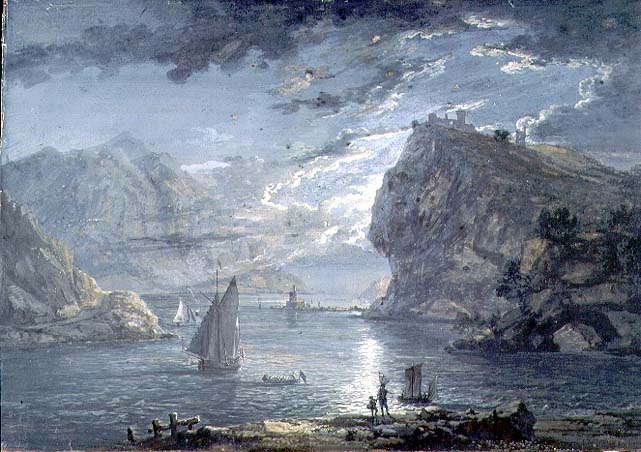
My Daily Art Display featured painting today is entitled A Moonlight Effect which Paul Sandby completed around 1790 and which can be found in the Nottingham City Museums and Galleries.  This is one of a number of paintings Sandby completed which depicted a place or a building as seen by moonlight.  In the 1770’s the early romantic painters, such as Joseph Wright of Derby and William Hodges, had taken a special interest in the portrayal of moonlight effects; and the image of the moon and of moonlight became one of the great romantic images.  For the romantic artist, who saw himself as alienated from society, the moon was often seen as an image of constancy and hope in a changing world, and it adequately depicted that longing and yearning or an unattainable perfection which lies at the heart of romanticism.

I love this painting with its silvery moonlight. 

Maybe you will have noticed that My Daily Art Display has not quite been a “daily” offering recently.  The reason for that is not because I am losing interest or having difficulty to find yet another painting, albeit it is getting harder.  The reason is that I have been trying to build up a reserve stockpile of blogs for when I am away on holiday in case I don’t have the time to research and compose a blog.  Today we are setting off to Hong Kong and Australia for a three-week break.  I am hoping I will still have access to the internet when I am away so that I can send out one of my “reserve” blogs, at least every other day.  I am hoping to take in a couple of art galleries when I am away and I am looking forward to seeing the depth of art on offer.


Dedham Vale and The Vale of Dedham by John Constable

My Daily Art Display today features two paintings by the same artist, with almost the same titles, but completed twenty six years apart.  The artist is one of the greatest landscape painters of England.  His name is John Constable.  Before we look at the two works of art let me give you a potted history of his life.

John Constable was born in East Bergholt, a small village on the River Stour in Suffolk in 1776, the fourth of six children.  His descendents were farmers and his father Golding Constable was an affluent corn merchant who owned considerable amounts of property in the area.  He owned water mills at Flatford and Dedham, two windmills in East Bergholt and even a small ship The Telegraph, which was moored at Mistley, North Essex, and which he used to transport his grain to London.  It was in East Bergholt that two years before John Constable was born his father built himself a large house and lived there with his wife Ann Constable (née Watts), whom he married in 1748.  The couple had six children, three sons, Golding, John and Abram and three daughters, Ann, Martha and Mary.

John Constable was fortunate with his upbringing, being afforded all the advantages of a wealthy family.  His education consisted of a short spell at a boarding school in Lavenham, which proved far too strict, then followed a period at the local day school in Dedham.  John had always enjoyed sketching and this love of this was helped by the local plumber, John Dunthorne, who would take the young boy out on sketching trips around the nearby area. 

As is the case in many life stories of artists, this desire of his son to become an artist did not go down well with his father who believed artists rarely made much money and instead had wanted John to study for a career in the church.  However this, because of his grades, proved to be a forlorn hope.  After that his father decided that John should come into his corn merchant business.  Although John was the second son, his elder brother Golding was mentally handicapped and could not take an active part in the family business and so John was the obvious choice as the future successor.  John did go into the family business but lasted just a year, at which time his younger brother, Abram, was of the age and had the will to become an active member of his father’s business.

The real turning point for John as far as art was concerned came when he was nineteen years old and he and his mother went to visit neighbours.   At this get-together John was introduced to Sir George Beaumont, an amateur artist and wealthy art collector.  Beaumont used to carry around with him, in a specially made wooden box, the latest paintings he had acquired and the day Constable met him he had with him his newly acquired Claude Lorrain painting Hagar and the Angel.  John Constable could not get over its beauty and was totally in awe of the way Claude had depicted the landscape.  The two art lovers spent much time that day discussing art and the works of Claude and the likes of the English landscape artists, John Cozens, and Thomas Girtin.  Sir George Beaumont was very impressed by young Constable’s enthusiasm and knowledge of art.  Constable knew then that he wanted to be a full time artist.  During a visit to Middlesex he met John Thomas Smith, the painter and engraver, later known as Antiquity Smith, because of the book he wrote, Antiquities of London and its Environs.   It was Smith who taught Constable the basic techniques of painting but warned him of the financial drawbacks of becoming a full-time artist.  In 1798 Constable met Joseph Farrington, who had once been a pupil of Richard Wilson.  Farrington goes on to teach Constable the techniques of this great Welsh landscape painter.

Fortunately in 1799, his father relented on his stance about his son studying art and as he now had his other son, Abram, to assist him,  he gave John some money and arranged for him to go London where he enrolled as a probationer at the Royal Academy School.  John was very homesick missing the beautiful countryside of his home and was disillusioned with the continuous copying of the old Masters.  To make things worse he realised that landscape art, which was what he loved, was not held in high regard by the Academy, who only held in high esteem history painting and portraiture.

I am going to conclude the story of Constable’s life at this juncture in his life, aged twenty-three still hell-bent to become an artist but unhappy with his start at the Royal Academy schools.  My next blog will conclude his life story, the tale of his love for a woman and the problems he had with her family but now I want to look at today’s two featured landscape paintings.

In 1802, at the age of twenty-six John Constable completed his first major work entitled Dedham Vale which is now in the Victoria and Albert Museum in London.  This, like most of Constable’s paintings, was a scene from the area around the Stour Valley.  I started off this blog by saying that Constable was one of the greatest landscape painters of England but maybe his accolade should be that he was the greatest landscape painter of the Stour Valley and Suffolk as he rarely travelled to other parts of Britain, let alone Europe,  unlike other landscape artists, who would travel extensively painting the beauty of the likes of the Lake District or Wales or the Roman Campagna. 

Dedham Vale by John Constable (1802)

Dedham Vale was painted by Constable in 1802 and now hangs in the Victoria and Albert Museum in London.  The scene we see before our eyes is one of complete tranquility.  Sadly for many, including Constable, it was also the start of a period of change in Britain and even in that area with the onset of  creeping industrialization,  such peace and serenity would soon be a thing of the past.  Even Constable’s beloved Stour valley would be home to the hubbub of a textile manufacturing area. 

We see before us, looking down from Gun Hill in the east, a flattish landscape of Dedham Vale pierced with a number of small waterways, some of which are natural, others man-made.  The lower reaches of the River Stour is in the middle ground of the painting and it can be seen wending its way eastwards towards the sea.   In the central background we see the gothic tower of Dedham Church and the village of Dedham and further back in the hazy distance we can just make out the town of Harwich.

The Vale of Dedham by John Constable (1828)

Twenty six years later in 1828 he returned to this scene for his last major painting of the Stour Valley entitled The Vale of Dedham, which is now housed in the National Gallery of Scotland in Edinburgh.  Maybe the fact that he returned to this scene so many years later is testament to his love for the area.  This later painting of the same view has some subtle differences.  The meandering river heading towards Dedham has got wider and now has a bridge across it.  In the foreground the old stump of the tree is sprouting some new saplings and by drawing our eye to it our attention focuses on the distant landscape.  However what was a more contentious addition to the scene was Constable’s inclusion of a gypsy mother nursing her child besides a fire.  Critics said that the addition did not add to the landscape and the inclusion was just the artist’s way of making the scene more picturesque.  However Charles Rhyne, Professor Emeritus, Art History at Reed College, Oregon,  wrote in his book Studies in the History of Art,  when discussing Constable’s landscapes, that according to an ordnance survey map,  a well was located in this area, and that this would have made it a natural camping site for gypsies.

Graham Reynolds, the art historian and author, also talked about the controversial inclusion of the gypsy in the painting.  In his book about Constable, he pointed out that gypsies were frequently to be seen in East Anglia and that the inclusion of this detail did not infringe Constable’s rule that only actual or probable figures should appear in his landscape paintings. By including the gypsy mother and child in this painting, he said that Constable enlivened the image, with the gypsy’s red cloak providing a contrast to the green of the vegetation.  It should be remembered that Suffolk had been affected by the agricultural depression and social unrest during the 1820s, and the inclusion of the gypsy in the painting may reflect the instability of rural life at this time and Constable’s sympathy with the cause of ordinary people.   Note how the gypsy is wearing a bright red shawl or coat.  Constable always believed that even the smallest touch of bright red in a painting highlighted and animated the green of the surroundings and he often used this technique in his other paintings.  Maybe that is another reason for the inclusion of the gypsy.

This second painting of Dedham Vale was well received by the Royal Academy when Constable exhibited it in 1828 under the title of Landscape.  Six years later he exhibited it again, this time at the British Institution under a different title.  This time he called it The Stour Valley.  People loved it and art critic of the The Morning Post (March 10th 1834) wrote:

“…..We must consider this picture as one of the best which we remember to have seen from Mr. Constable’s pencil. It is a work of great power both of colour and light and shade, and is executed with considerable freedom and dexterity of execution…” 

Which version did you prefer?

Winter Scene by Joos de Momper

Winter Scene by Joos de Momper (c.1630)

“…Why, sir, Claude for air and Gaspar for composition and sentiment; you may walk in Claude’s pictures and count the miles. But there are two painters whose merit the world does not yet know, who will not fail hereafter to be highly valued, Cuyp and Mompers…”

Richard Wilson

In an earlier blog about the Welsh landscape painter, Richard Wilson, I told you how he believed that although the landscape works of Claude Lorrain and Gaspar Dughet were lauded, he spoke about the, as yet, unknown talents of Aelbert Cuyp and Joos de Momper and so I thought it was time to take a look at the life of Joos de Momper the Younger and one of his greatest works.

Joos de Momper also known as Josse de Momper was born in 1564 in Antwerp.  He was just one of an outstanding artistic dynasty.  His great grandfather, Jan de Momper I,  was a painter in Bruges; his son, and our featured artist’s grandfather, Josse de Momper I, was also known as an artist and dealer who moved from Bruges to Antwerp, where his son, and Joos’ father,  Bartolomeus de Momper , inherited both occupations, as well as being an engraver. Bartholomeus’s sons Josse de Momper II and Jan de Momper II were both landscape painters, but Josse the younger, today’s featured painter, was the exceptional artist of the family.

He received his initial artistic training under the guidance of his father, Bartholomäus de Momper.   In 1581, when he was seventeen years of age, de Momper’s father, who was at that time Dean of the Antwerp painters’ guild, The Guild of St Luke, enrolled him as a vrijmeester (master) into that association.   It is believed that around this time Joos travelled to Italy.  Records show that an artist in Treviso, Lodewijk Toeput, was his teacher .  Another reason for believing that the young artist had visited Italy is that so many of his paintings featured mountain scenes and as he spent most of his life in Antwerp, to have such a knowledge of mountains, almost certainly meant that he had at one time crossed the Alps into Italy.   So did he go to Italy?   A further clue to whether de Mompers was ever in Italy came in 1985  when the frescoes in the church of San Vitale in Rome, previously attributed to Paul Bril, were attributed to Joos de Momper the Younger.

Records show that in 1590, the twenty-six year old artist was back in Antwerp as it was in this year and in this city that he married Elisabeth Gobyn.  The couple had ten children.  The painting dynasty was to continue with two of the  couples’ sons, Gaspard and Philips both becoming notable artists.  Gaspard de Momper and Philips de Momper I,  both became painters although little is known of their work, except that Philips executed the figures in some of his father’s paintings; he also spent some years in Rome, where he had travelled with Jan Breughel the Younger

 In 1594 De Momper collaborated with two other Flemish painters Adam van Noort and Tobias Vwerhaecht as well as the Flemish architect Cornelis Floris on the decorative programme to celebrate the entry of the Archduke Ernest into Antwerp.   Shortly after this de Momper was invited to become one of the Archduke’s court painters, a position he took up at the court of the Archduke and Archduchess Albert and Isabel Clara Eugenia, the sovereign rulers of the Spanish Netherlands. In 1611, de Momper was made Dean of the Guild of St Luke in Anterp.

Most of de Momper’s paintings, like the one we are going to look at today, featured landscapes and his work was very well received. His landscapes were sometimes topographically accurate whilst others would be idealised fantasy ones, but all sold well.    His work was highly regarded and he is considered to be the most important Flemish landscape artrist of his time.  The timeline of great Flemish painters puts him coming after Pieter Bruegel, whose works greatly influenced him, and before Peter Paul Rubens.  

My Daily Art Display today features a painting simply entitled Winter Landscape and was painted by Joos de Momper the Younger around 1630 and can now be seen in the North Carolina Museum of Art.  This is a winterscape with a number of figures,  which were believed to have been painted, not by de Momper, but by Pieter Bruegel’s son Jan.  I love this work as it is so “busy”.  Besides the beauty of the landscape in winter we have a dozen people depicted carrying on with their daily duties.  Pieter Brueghel the Elder’s influence is clearly evident in this winter landscape.    Joos de Momper was known for his use of Mannerist colors in many of his landscapes, but in the more realistic pictorial representations, such as today’s painting, he used more natural colors.   Momper’s has managed to deliver a scene with such aesthetic appeal. 

Woman by cart

In this village landscape before us, the houses and people, which in his mountain landscapes were mere accessories, are now in some way the main focus of our attention.   Look at the woman in red who stands by the cart.  Look how the artist has depicted her struggling and straining with an arched back to lift the barrel on to the cart.  Look how her face is reddened by the physical effort.  To the right of her we see a mother and two children in a line.  The mother is carrying a bundle of firewood on her head whilst her son tags behind with a token few sticks of kindling.  Following up at the rear is the young daughter, with her arms outstretched shrieking, as she is being left behind.

Man with baskets

It is a scene full of activity and I love to cast my eyes around the painting to discover what is happening.  At the barn we see a man repairing a cart whilst the white horse stands passively to the side.  In the left midground we see a man bent over surveying what looks like two large wicker baskets.  I am not sure what he is doing but whatever is going through his mind, he seems fascinated by them.  Besides the people in the painting, look at the way the artist has elegantly painted the trees which have shed their leaves and which stand tall and unbowed in this cold but still winter’s day.

In the background on the right we have the nearby town.  It is separated from our main scene by a river, the water of which seems partly frozen over.  Fishermen are at the river trying to catch something for their meal in the small parts that have yet to be frozen. 

Town and bridge

The way to the town is accessed by a small wooden bridge and we see a man with his dogs making his way over it and heading into town..

I hope you have enjoyed this painting and thanks to Richard Wilson, I have discovered a new Flemish artist and one day I will return to him and look at another of his works.

Finally my thanks go to Universal Pops’ Photostream on Flickr for the details of the painting.  His photographic site is quite amazing and well worth a visit.

http://www.flickr.com/photos/universalpops/

Winter Scene by Isack van Ostade

Winter Scene by Isack von Ostade (c.1646)

Over the next two blogs I am going to take a look at two Flemish artists who besides being highly talented were brothers.   They were the van Ostade brothers.  Today I am going to feature Isack, who was the lesser known of the two, maybe because he only lived to the age of twenty-eight.

Isack van Ostade was born in Haarlem in 1621.  He was a Dutch landscape and genre painter.  Genre paintings were ones depicting scenes of daily life and were particularly popular in 17th century Holland.  Isack and his brother Adriaen, who was eleven years older, were the sons of Jan Hendricx Ostade, a weaver from the town of Ostade, close to the city of Eindhoven.  Despite being born in Haarlem both he and his brother took the name “van Ostade” as their family name.  Isack studied painting under the guidance of his elder brother until he was almost twenty-one years of age at which time he independently set up his artistic business.  He started off painting subjects similar to his brother and his work was always viewed as not as accomplished as the works of Adriaen van Ostade.  Realising this, Isack decided to stop painting the genre scenes and concentrate more on landscape work in the fashion of Salomon van Ruysdael, the Dutch Golden Age landscape artist.

In his earlier paintings the figures were the key feature but in his later works his landscape becomes increasingly significant.  His change to landscape painting paid off and this coupled with his skill at figure painting ensured the popularity of his winter scenes in which we would see groups of animated people in wintery landscape settings.  These winter scenes like my featured painting today, Winter Scene, were his speciality.  He painted this picture around 1645 and it now hangs in the National Gallery in London.  It is quite similar to the painting, Winter Landscape with Wooden Bridge which another Dutch painter, Philips Wouwerman completed fifteen years later.

The painting we see before us is beautifully picturesque and we view the scene from low down which allows us to see the old rickety wooden bridge outlined against a silvery grey winter sky with its dark snow bearing cloud approaching the area.  The scene is populated by peasants.  Some, like the youngsters, are enjoying themselves sledging and skating on the frozen river whilst others, the adults, are hard at work as we see the man encouraging his old white horse to drag the laden cart up the riverbank and we watch old man as he slowly climbs the steps of the bridge, his back straining under his load of firewood.   

Sadly fewer than three dozen winter landscapes of Isack van Ostade are known today.  He died in 1649 at the early age of twenty-eight.  He had few, if any, pupils yet his influence on the succeeding generation of Haarlem painters was great and the likes of Philips Wouwerman  owed a lot to this young man.

Holt Bridge on the River Dee by Richard Wilson

Holt Bridge on the River Dee by Richard Wilson (c.1762)

My Daily Art Display today features the 18th century Welsh landscape painter Richard Wilson.  He was born in 1714 in Penegoes, a small village in what is now the county of Powys.  His father was a rector at the local church and the family background could be considered as being well respected and of quite high social standing. It was through his father that his young son received a classical education.  The family was connected with some of the elite characters in the local society.  Wilson’s early artistic aspirations were encouraged by his mother’s nephew, Sir George Wynne, who had made his fortune out of lead mining and who supported Richard Wilson financially in London for many years from 1729.  Wilson was sent to London when he was sixteen years of age to take up a six year apprenticeship with a little known artist, Thomas Wright.  Wynne, besides arranging the apprenticeship, gave the young Wilson money to set up a studio in London and bankrolled the aspiring artist until he started selling some of his works.

In the 1740’s Wilson began to have success in selling his paintings and gained several wealthy patrons including the prominent Lyttleton Family who commissioned many family portraits.  This entry into “high society” led him to become a Society portrait painter and his many commissions brought him financial security, so much so he moved into a larger studio in the fashionable Convent Garden area of London.  In 1750 with financial help from a member of the Lyttleton family he set off on the Grand Tour.  This so-called Grand Tour, which was so popular in the 17th and 18th century, was the traditional trip of Europe undertaken by mainly upper-class young men from Europe, especially the British nobility and landed gentry.   Its aim was to be an educational rite of passage.

Wilson visited Venice in 1750 and stayed there for several months where he had the chance to study the works of the Old Masters such as Titian.  During hs soujorn in Venice, he met and became friends with the Venetian landscape artist and rococo painter, Francesco Zuccarelli.  It was Zuccarelli who persuaded Richard Wilson to move away from portraiture and concentrate more on landscape painting.  Wilson was also befriended by an English art collector, William Lock.   Lock and Wilson left Venice in 1751 and travelled through Italy eventually ending up in Rome where Wilson remained for six years.  His base was the Piazza di Spagna. This was a favourite meeting place for artists, both foreign and local and was also a popular haunt for the English Grand Tourists.  These tourists were extremely wealthy and were always looking to take home souvenirs from their great journey and as this was at a time before the invention of photography, what could be better than a painting of the Italian countryside and Richard Wilson was therefore in the ideal spot to sell his classical styled landscape works.  The artists, who most inspired Wilson, were the great French landscape painters Claude Lorrain and Gaspar (Dughet) Poussin.

Wilson returned to England in 1757 and, now quite wealthy, set himself up in a large studio in London.  He was the leading light, along with Sir Joshua Reynolds and Francis Hayman in establishing the Society of Artists in 1760 and later became one of the founding members of the Royal Academy of Art in 1768.  He staged many exhibitions of his work at the Academy and his reputation as a landscape artist grew and his works commanded very high prices.

Sadly, as in lots of cases of a rise to fame, there comes the inevitable fall and Richard Wilson and his reputation tumbled dramatically.  Sucked in by his increasing wealth and fame, Wilson became arrogant and rude.  He insulted a number of his wealthy patrons including George III and soon they deserted him.  His spectacular fall from grace made him turn to drink and soon he became an alcoholic, despite the help he received from the few friends who stayed loyal.  His career was over and he had no choice but to leave London and return to his family home in Wales, penniless.  Wilson spent the last years of his life at Colomendy Hall, the residence situated a few miles from Mold, which was owned by his aunt, Catherine Jones.  He died there in 1782 , a few months short of his 68th birthday, and was buried in the churchyard of St Mary’s  in Mold.

St Mary's Church, Mold

His grave, on the north side of the church, has the following Welsh inscription: (below is the English translation): 

From life’s first dawn his genius shed its rays,

And nature owned him in his earliest days

A willing suitor; skilled his lines to impart

With all the love and graces of his art;

His noble works are still admired and claim

The first reward of an enduring fame.

Richard Wilson's gravestone

My Daily Art Display featured painting today is Holt Bridge on the River Dee by Richard Wilson which he completed around 1762 and now hangs in the National Gallery in London.   This is an idealised landscape as it is not topographically accurate but notwithstanding that, it is a wonderful landscape painting.    Holt Bridge joins the village of Holt in Denbighshire to the village of Farndon in Cheshire. The tower of St Chad’s in Farndon is on the right and the outskirts of Holt on the extreme left.  It is strongly influenced by the works of Claude Lorrain as we know the artist was a great admirer of the French landscape artist.  However, for him there were two other landscape artists of note.  According to W.T.Whitley’s book Artists and their Friends in England 1700-1799, Wilson told a fellow artist William Beechey:

“…Why, sir, Claude for air and Gaspar for composition and sentiment; you may walk in Claude’s pictures and count the miles. But there are two painters whose merit the world does not yet know, who will not fail hereafter to be highly valued, Cuyp and Mompers…”

I have featured Albert Cuyp in a number of my blogs and you will know that he is one of my favourites painters and in the near future I will feature the beautiful work of Joos de Momper, the great Flemish landscape painter.

Road by the Edge of a Lake by Jan Both

Road by the Edge of a Lake by Jan Both (1637-41)

Today I am looking at a landscape painting by the Dutch painter and etcher Jan Dirksz Both.  The artist was born in Utrecht around 1618, the younger brother of Andries Both, who was one of a group of genre painters who worked in Rome in the 17th century and who brought to the Italians the sixteenth century Netherlandish art which depicted peasant subjects.  They were known as the bamboccianti.  The term came from the nickname Il Bamboccio, which translated means “ugly doll” or “ugly puppet”, and was a nickname given to the Dutch painter and leader of the group, Pieter van Laer, because of his physical deformity, as well as the puppet-like figures in his paintings.

It was whilst the two Both brothers were working in Rome that Jan Both met the French landscape artist Claude Lorrain and a fellow Dutch painter Herman van Swanevelt, and it was with these two painters that he collaborated on a series of landscape works.   It was from Claude that he acquired the skill of rendering effects of golden or silvery light and this technique was hugely influential after he returned to Holland in 1642.  Originally Jan Both produced the popular genre paintings and scenes from the everyday life of the streets of Rome but on his return to Utrecht he concentrated all his artistic efforts on Italianate landscape paintings, which were characterised by the golden glow of sunlight.  His brother Andries, on the other hand, preferred the genre painting in the manner of Pieter van Leer.   Like Jan and Andries Both, throughout the 17th century, a steady stream of Dutch painters made the long and demanding trek to Italy, which was, at that time, acknowledged as the home of art.  Aspiring artists from many European countries would descend on Rome in order to study the great masters of the Renaissance and the contemporary painters of the Baroque.  The Dutch who had come from a colder harsher climate with its gloomy and overcast skies were thrilled by the beauty of a sunny Italy.  They marveled at the light, and the myriad of colours offered by the Italian landscapes.   The Dutch artists depicted these wonderful Roman Campagna landscapes in their paintings along with the ruins of earlier civilizations which were dotted throughout the countryside.  This group of 17th century Netherlandish painters were known as the Dutch Italianates.

Jan returned to Utrecht around 1641.  He became the main pioneer of Italianate landscape painting in 17th-century Holland.   He introduced to Dutch landscape paintings a style based on the work of Claude Lorrain, which he had witnessed in Rome. Later this Italianate landscape style of his was developed by other artists such as Nicolaes Berchem and Aelbert Cuyp.  This Italianate style of landscape painting when transferred to the native Dutch landscapes was very popular and much in demand in Holland.  His landscape paintings became more refined over the years and he would often produce large works of idealised landscapes drenched in the golden light of the Mediterranean.

The painting of Jan Both, which I am featuring today, is entitled Road by the Edge of a Lake which he completed between 1637 and 1641 dating back to his Italian sojourn.  It currently hangs in the Dulwich Gallery, London.  The earth has a subtle red tinge to it which mirrors that found in Italy.  There is a tranquillity about this painting as we see the herdsman slowly weaving their way home towards the golden sunset.  The slanting light from the falling sun produces long shadows even from the smallest of molehills we see on the herdsmen’s trail.  This painting incorporates a typical golden sunset, which Jan Both probably learnt from Claude Lorrain when he was in Italy.  Look at the tones and colours of his sky.  Look how the artist has depicted the background, with its bright yellows and yet it also has a misty quality about it, which is what we would experience if we looked towards the setting sun on a clear day.  Move your eyes to the background on the right and the colour changes to a bluer tone and the mistiness gradually disappears.  The way the artist has depicted the background is a seamless continuity of the bright but misty yellowish haze to the clarity of blue sky.  I also like the way the artist has captured the way the sunlight falls on the leaves of the trees and even the individual blades of grass which borders on to the path to the left of the herdsman.

It is interesting to note that some art historians believe that Jan’s brother Andries may have had a hand in this painting.  They come to this conclusion when they studied the figures of the herdsme.  These reminded them of the figures seen in many of Pieter van Laer’s paintings and as I told you earlier, Andries Both was a dedicated follower on Il Bamboccio.

It is a magical painting and one can almost feel the warmth from the setting sun.  It is no wonder the Dutch liked to hang this type of painting on the walls of their houses as they sat inside by their fires and shivered with the cold of a Dutch winter’s day.

Ideal Landscape near Rocca Canterana by Carl Philipp Fohr

Ideal Landscape near Rocca Canterana by Carl Philipp Fohr

My Daily Art Display today looks again at a German painter who was born at the end of the 18th century and is acknowledged as one of the most significant landscape painters of German Romanticism.  His name is Carl Philipp Fohr.

Fohr was born in Heidelberg in 1795.   His first art tuition was under the tutelage of Carl Rottmann, the genre and veduta painter, when he was aged thirteen.  It is said that when Fohr was fifteen years old the Darmstadt Court Councillor, Georg Wilhelm Issel, discovered him sketching at Stift Neuberg near Heidelberg and it was because of that and because Issel recognised the young man’s artistic potential, the following year Issel invited Fohr to come to Darmstadt and he provided him with both encouragement and financial support to continue with his artistic studies.   From 1813 Fohr received a number of commissions for paintings for the Grand Duchess Wilhelmina of Hesse, and it was for her that Fohr produced the Sketchbook of the Neckar Region, which consisted of a collection of watercolours of views and historical subjects of the region and a year later produced a similar sketchbook of the Baden area.  Such was the quality of his work that Fohr received an annual pension of 500 guilders from the Grand Princess. 

In 1815 Fohr became a student of landscape painting at the Kunstakademie in Munich, and it was here that his breakthrough into an independent and original drawing style came about.   He only remained at the Academy for a year as in 1816 he decided to embark on a walking adventure through Northern Italy which was to eventually take him to Rome.   It was whilst there that he came in contact with the group of artists, known as the Nazarene Brotherhood.  The brotherhood’s original members were six Vienna Academy students, four of whom, Friedrich Overbeck, Franz Pforr, Ludwig Vogel, and Johann Konrad Hottinger, moved to Rome in 1810, where they occupied the abandoned monastery of Sant’Isidoro.   Later they were joined by Peter von Cornelius, Wilhelm von Schadow, and others who at various times were associated with the movement.   The Nazarenes believed that all art should serve a moral or religious purpose; they admired painters of the late Middle Ages and early Renaissance and rejected most subsequent painting which were beloved by the European academies, believing that it abandoned religious ideals in favour of artistic virtuosity. They also thought that the mechanical routine of the academy system could be avoided by a return to the more intimate teaching situation of the medieval workshop.   For this reason, they worked and lived together in an almost monastic existence.    So where did the name, Nazarenes, come from?   Actually it was a derisory nickname they acquired because of their affectation of biblical style of hair and dress. The main aim of the Nazarenes was to revive the medieval art of fresco painting.   Fortune looked down favourably on the group as they received two important commissions to carry out the fresco decoration of the Casa Bartholdy in 1816 and a year later to carry out similar work in the Casino Massimo in Rome and their beautifully skilled work on the two projects brought their work to international attention.   However by the time the second project had been completed the Nazarene Brotherhood had all but disbanded.  The legacy of this group was that of honest expression of deeply felt ideals and it was to have an important influence on subsequent movements, particularly the English Pre-Raphaelites of the mid-19th century.

So where did Fohr go next for inspiration?   Sadly, Fohr’s life ended in tragic circumstances when in 1818, at the young age of twenty-three he drowned whilst swimming in the River Tiber.  Even sadder was the fact that his legacy to the world was only five oil paintings.

Today’s featured painting is The Ideal Landscape near Rocca Canterana and is one of Fohr’s best-known paintings, which he completed in 1818, the year of his death.   The painting shows a rocky pastoral landscape in the central mountains of Italy.  In the foreground, we can see a path which winds past craggy rocks and old, gnarled trees.   On this path we see a country girl dressed in some sort of festive costume.  In her arms she carries a young child, whilst hand in hand with another child, who is balancing a jug on her head.   If you look to the right middle-ground, under the trees, we can see a group of pilgrims who are heading towards a distant and illuminated valley.  The woman and children have just been passed by two shepherds who are heading for what Fohr has depicted as a peaceful, hilly region rimmed by steep mountains.

This painting is so like the old Arcadian landscape paintings of the past, which emerged in the Renaissance and which were inspirational to later artists who wanted to depict a “paradise on earth” theme to their works.  Fohr’ paradise on earth is emphasised by his inclusion of the pilgrims which alludes to the Christian Heaven.   The people in Fohr’s painting, who we see wandering around the landscape symbolise the journey we have to make on this earth before we die and  Fohr, in a way, is trying to remind us of the transience of all earthly things and the journey into the future, which some believe is the true goal and reason for human existence.

The picture in some ways is very simplistic but I hope you like it.

Funeral at Bettws Church by David Cox

Funeral at Bettws Church by David Cox (1852)

We are now at the height of the summer holiday season and work at my Bed & Breakfast place is becoming more hectic and I am finding that I have less free time on my hands to devote to the blog.  I sometimes wonder whether my blog should have been entitled My Every Other Day Art Display!   Having said that I spent yesterday afternoon walking around Betwys y Coed, a small town in a very scenic area of North Wales, and it was during this walk that I came across a very old, 14th century church.  What was even more fascinating was its connection with an English mid-nineteenth century artist and a series of his painting.  The artist in question is David Cox and the oil painting, which he completed in 1852,  is entitled Funeral at Bettws Church.

David Cox was born in Birmingham in 1783.  His father was a simple blacksmith and the family lived in a poor area of the city and were, as we would euphemistically put it these days, “financially challenged”.  His first art tuition came from Joseph Barber, the English landscape painter, who as Birmingham’s first drawing master had set up an academy in the city to train aspiring artists.   Cox  eked out a small wage by working as a theatre scenery painter.  At the age of twenty-one, Cox went to live in London and continued his artistic training, this time under the tutelage of the English watercolourist, John Varley.  He made some visits to North Wales and started a job as a commercial artist; producing illustrations to accompany travel writer Thomas Roscoe’s two volumes of Wanderings and Excursions in Wales.

To survive financially, David Cox also took odd jobs in the art world’s Grub Street, as a scene painter, by selling views of London and the River Thames to booksellers at two guineas the dozen.  Grub Street was famous for its concentration of impoverished writers, artists and aspiring poets.   Its bohemian society was set amidst the impoverished neighborhood’s low-rent flophouses, brothels, and coffeehouses.   Cox also enhanced his income by teaching art, spending some time as a teacher at a boarding school for young ladies.  He even published a book on art.

He later moved south of the Thames and settled into life at Dulwich where he taught a number of art students.  Cox exhibited at the Royal Academy for the first time in 1805.  Four years after moving to London he married Mary Ragg who was the daughter of his landlady.  A year later in 1809, the couple had their first child, a son, David Jnr.  In 1814 to escape city life he and his family moved to rural Herefordshire and took up residence in the county town of Hereford where he taught at a girl’s school.  In the late 1820’s he travelled extensively through Western Europe and in 1827 the family moved back to London.  David Cox was now in his forties and had, by now, built up a reputation as a fine landscape painter and the sale of his works was increasing.

In 1841, Cox gave up teaching and moved back to his birthplace, Birmingham, this time to the small town of Harborne, a few miles south of the city.  It was throughout the 1840’ and 1850’s that David Cox would make annual pilgrimages to North Wales where he enjoyed the beautiful rugged scenery and revelled in the many opportunities the area gave him for his landscape subjects.  He fell in love with the Vale of Clwyd and the village of Betws-y-Coed in Conwy and his paintings of this area inspired the 19th Century Birmingham School of artists to follow in his footsteps.  Soon artists from around the country descended on this small Welsh village.   Many believe it was during this period that he completed some of his finest watercolours.  Suprisingly enough it was until the mid 1850’s that Cox started painting in oils.  David Cox died in Harborne in 1858, aged 75.

The sheer range of David Cox’s work is amazing and many considered him to be an equal to some of his more famous contemporaries such as Turner, Constable and Richard Bonnington.  Cox was noted for his skill in encapsulating in his paintings the unpredictable British weather, which was no more apparent than in North Wales.  He is probably best known for his many works associated with the small town of Betws y Coed which nestles at the edge of the Snowdonia National park and sits alongside the River Conwy.

With artists like Cox and their portrayal of the beautiful landscape around Betws y Coed, the village  began to draw in artists from many parts and it became both an artist’s colony and a favourite tourist spot.  Many of the artists flocked to Betws-y-Coed to learn more from David Cox, who made his home at the Royal Oak Hotel each summer.  He actually painted the original pub sign.   The surrounding area offered not only the remarkable scenery but it offered an insight into Welsh history as it was supposedly near the site of the massacre of the bards by King Edward I.

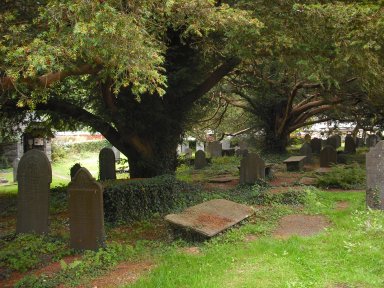
In the painting before us we see a group of mourners attending a funeral, standing outside the gates of St Michaels Church, Betwys y Coed.  The original church would have been built in the latter part of the Celtic Church era around the eighth and ninth century.  Nothing visible remains of that earliest ‘Bettws’ church which derives its name, Bettwys, meaning ‘Bede House’, as in rosary beads and thus meaning a “house of prayer”.   The whole church seems to have been rebuilt during the 14th–15th century This is still the oldest building in Betws y Coed today with parts surviving from the 14th or 15th century.  It was mostly rebuilt and enlarged, with the addition of a vestry and north transept in 1843.     However, even after enlargement, it still could not cope with the rising numbers of worshippers and it became redundant as a village church with the building of St Mary’s Church in 1873.   Although the church is now officially closed for regular public worship, a service is normally held on St Michael’s Day (29th September) and a candle-lit Carol Service at Christmas tide.  The Church houses an excellent quality 14th century stone effigy of Gruffydd ap Dafydd Goch – a close relative of the last Welsh Prince of Wales – Llewellyn ab Gruffydd.   A rustic oak pulpit has the date 1697 upon it, but some say that date is graffiti, and that the pulpit dates to an earlier period. The Church font is dated from the 13th century, although the pillar is from a later date.  In the churchyard there are many 18th century gravestones, some leaning against the church walls, and there are still even 17th century grave stones to be seen.

Many of the visitors to Betws-y-Coed in Victorian times were artists, and they were drawn to St Michael’s Church, which stands besides the river Conwy and was frequently the subject of paintings done by artists from the new artists’ colony,  which thrived in the second half of the nineteenth century.  Today’s featured oil painting by David Cox entitled Funeral at Bettws Church, which he painted in 1852, is a prime example. The painting is housed in the Bury Art Gallery.  In it we see the small church of St Michael in the background framed by two massive yew trees.  It is said to depict the funeral of the daughter of the landlord of the Royal Oak, where Cox used to stay.  The death of this young girl would have affected the whole village. The sunset setting of this painting makes it very atmospheric. Cox was not known for his symbolism but this is very symbolic, with the setting of the sun and little children gathering poppies – symbolic of death.

Welsh Funeral by David Cox

David Cox painted a number of similar paintings, one, a watercolour,  entitled The Welsh Funeral  (1848), which  is at Birmingham Art Gallery and there is the initial preparatory chalk sketch of the funeral painting at the Ashmolean Museum at Oxford.

The massive yew trees

One noticeable change to the vista now is the fact that the yew trees have grown and spread even more and when you stand at the gated entrance to the church and graveyard, it is now almost impossible to see the church between the two enormous trees.

Present day church

So my walking trip yesterday did have artistic connotations but is also the reason for no blog.  My thanks go to Anne Hammond who introduced me to this beautiful little church and its connection with today’s featured artist and who led our small party of intrepid walkers on this voyage of discovery.

Die Teufelsbrücke or the Devil’s Bridge by Karl Blechen

Pont Valentré at Cahors

I will start My Daily Art Display today with a look at a local folklore that of the Devil’s Bridge.  Like most folklore there is not simply one version of the tale but many different versions of it depending on which country the structure is situated.   The first time I came across this phenomenon was when I visited Cahors in France and went to see the spectacular 14th century Pont Valentré Bridge.

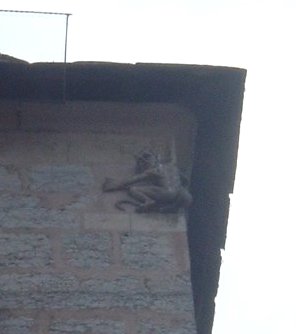
The Devil clinging to one of the towers of the Pont Valentré

Built in 1308 and completed seventy years later it became associated with the legend of the Devil’s Bridge and the architect Paul Gout made reference to this by placing a small sculpture of the devil at the summit of one of the towers.

The folklore of the Devil’s Bridge is all about the Devil, a bridge builder and his bridge.  The main gist of the story is that a bridge builder sets about building a bridge across a river or river gorge, but at some point in the building of the structure the bridge builder realises he hasn’t the strength or time to complete the task and has to turn to the Devil for assistance.  The price levied by the Devil for his assistance is that he should receive the first soul that crosses it.

Die Teufelsbrücke by Karl Blechen

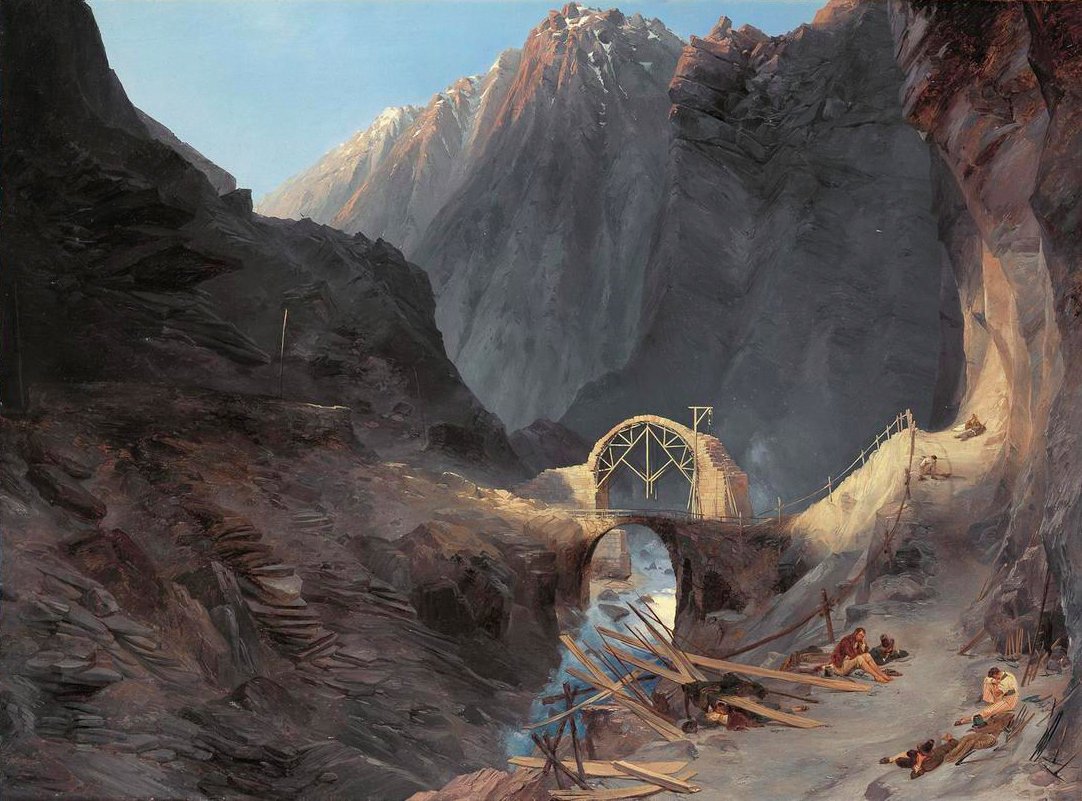
In my featured painting, Teufelsbrücke or Devil’s Bridge painted by the German Romantic artist, Karl Blechen, in 1832.  In the painting we see the Devil’s Bridge straddling the Swiss River Reuss as it passes through the Schöllenen Gorge on its way to Lake Lucerne.   The legend of this particular Devil’s Bridge states that the river was so difficult to cross that a Swiss goat herdsman asked the Devil to make a bridge. The Devil duly appeared, but required that if he should construct the bridge, the soul of the first to cross it would be given to him. The herder agreed, but instead of crossing the bridge first and risk losing his soul he drove a goat across ahead of him, thus tricking the devil.   The Devil was so angry that he had been duped he fetched a rock with the intention of smashing the bridge, but an old woman drew a cross on the rock and this prevented the Devil from being able to lift it.    The rock is still there and, in 1977, 300,000 Swiss Francs were spent to move the 220 ton rock by 127 m in order to make room for the new Gotthard road tunnel.

Karl Blechen was born in Cottbus in 1798.   His father was a local tax collector and Karl started his working life as a minor bank official.  It was not until he was aged twenty four that he began to study art.  In 1822 he enrolled at the Akademie der Künste, Berlin (Academy of the Arts).  Later when he was working in Dresden as an apprentice in an art studio he was befriended by two artists also based in the city , the German painter, Caspar David Friedrich and the Norweigen artist, Johan Christian Dahl who were leaders in the fields of art known as Romanticism and Realism.   My Daily Art Display has featured some of their works and they are well worth viewing.   Their styles would influence Blechen in his future works.   In 1828 he travelled to Italy where he remained for a year studying art and in particular, oil painting.  It was here that he was introduced to the en plein air style of painting and was influenced by the works of English landscape painter, Turner who was also in Italy at this time and by the French landscape painter, John-Baptiste Corot, who at this period in time, lived in Italy.  He returned to Germany and in 1831 and was awarded a professorship at the Berlin Academy.   Despite this academic recognition the sales of his work were disappointing and this depressed him.  His depression and mental state deteriorated and four years later, at the age of thirty-seven he was diagnosed as being mentally unstable.  Blechen died in 1840 in Berlin, a broken man, aged forty-two.

When Karl Blechen visited Italy his journey fostered an interest on visual phenomena and how light and colour effects landscapes.  A number of his paintings were categorised as being of a Romantic genre.  The Romantic artists, of which Blechen was one, applauded individualism, subjectivism, irrationalism, imagination, emotions and nature – emotion over reason and senses over intellect.  Whilst Blechen was returning back to Germany he travelled along the St Gothard’s pass and the Teufelsbrücke was still being built.  This Devil’s Bridge depicted by Blechen in his painting is enclosed by snow-capped mountains which soar into the sky and below them we can see the raging torrents of the Reuss River.  I think what I like most about this painting is the beautiful way in which Blechen has depicted the sunlight penetrating a gap in the mountains to light up the bridge and some of its builders.  It is as if somebody has switched on a spotlight to illuminate the scene.  In the central mid ground we see the arch of the old bridge and the partly constructed arch of the new one with its scaffolding.   The illuminated partly-built new arch is dwarfed by the mountains and one wonders whether its frailty and exposed position will be able to withstand the forces of nature when gale force winds relentlessly charge down the valley.    There is also a sensation of remoteness about the scene.  We are aware that we are miles from civilisation but can marvel in the savagery of nature.  In the right foreground we see some of the bridge builders taking a well earned rest from their labours amongst all their building materials.

Karl Blechen has managed to create an image which is both awe-inspiring and beautiful and one which makes us realise how small we are in comparison to our surroundings.   This awesome painting by Karl Blechen, which I have featured today,  hangs in
the Bavarian State Picture Collection housed in the Neue Pinakothek in Munich.