Samuel Palmer. Part 2 The Shoreham Ancients, William Blake and later life

Samuel Palmer by George Richardson (1829)

Samuel Palmer was seventeen years old when he met the painter John Linnell and they would remain friends for life, a period stretching almost sixty years, albeit on occasions their relationship was somewhat strained during Palmer’s marriage to Linnell’s daughter. Linnell was born in London in 1792.  His background was very different to the middle-class prosperity of Palmer’s family.  His father, although a respectable carver and gilder, was not a wealthy man and whereas Palmer, who lived in the semi-rural outskirts of London, and was indulged and pampered by his parents, Linnell had to survive the murkiness of the depressing bleak streets of Bloomsbury.   Linnell was a landscape artist and portrait painter who found himself constantly in competition with the great John Constable.  At the time Linnell met Palmer the latter had rather lost his way artistically. Palmer wrote honestly about his worries regarding his art:

“…by the time I had practised for about five years I entirely lost all feeling for art … But it pleased God to send Mr. Linnell as a good angel from Heaven to pluck me from the pit of modern art…”

John Linnell inspired Palmer.  He offered artistic advice and instruction.   He took him to art galleries and introduced him to other artists, most notably William Blake who was to have a profound influence on Palmer.

The Rising of the Lark by Samuel Palmer (c.1839)

Linnell’s mentoring of Palmer was of great importance as it was Linnell who brought to the attention of Palmer  the artists of the late Gothic and early Renaissance periods, such as Albrecht Dürer, and the fourteenth century muralists, Francesco Traini, Buonamico Buffalmacco and Benozzo Gozzoli who were responsible for decorating the cemetery, Camposanto Monumentale in Pisa, Italy.
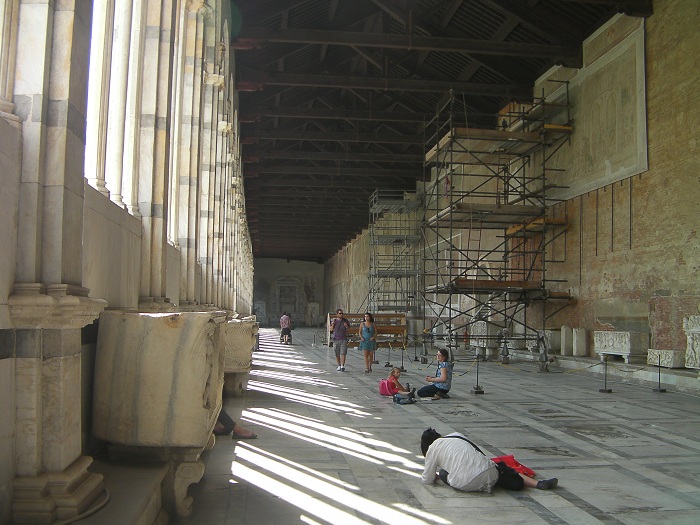
Interior hallway of Campo Santo showing restoration work of some of the murals

This magnificent building was said to have been built around a shipload of sacred soil from Golgotha, brought back to Pisa from the Fourth Crusade in the 12th century.  An inscription near the right gate tells us that the construction of the Camposanto started in year 1277 and finished in the late 15th century.

Another influence on Palmer around this time was the works of art of Henry Fuseli.  The National Gallery in London was not built until 1824 so Palmer would spend time at the Dulwich Gallery (opened in 1817) copying the works of the Masters and was fortunate to be allowed to view the private collection of the German merchant and insurance agent Carl Aders which included many works by artists of the Primitives movement.  However one of the greatest influences on Palmer was William Blake.  Blake was introduced to him by Linnell in 1824, who at the time, because of his art work, was viewed by many of the art establishment as an obscure and impoverished figure and thought to be just a harmless madman.  Palmer had always been a visionary and this was enhanced once he entered the world of William Blake
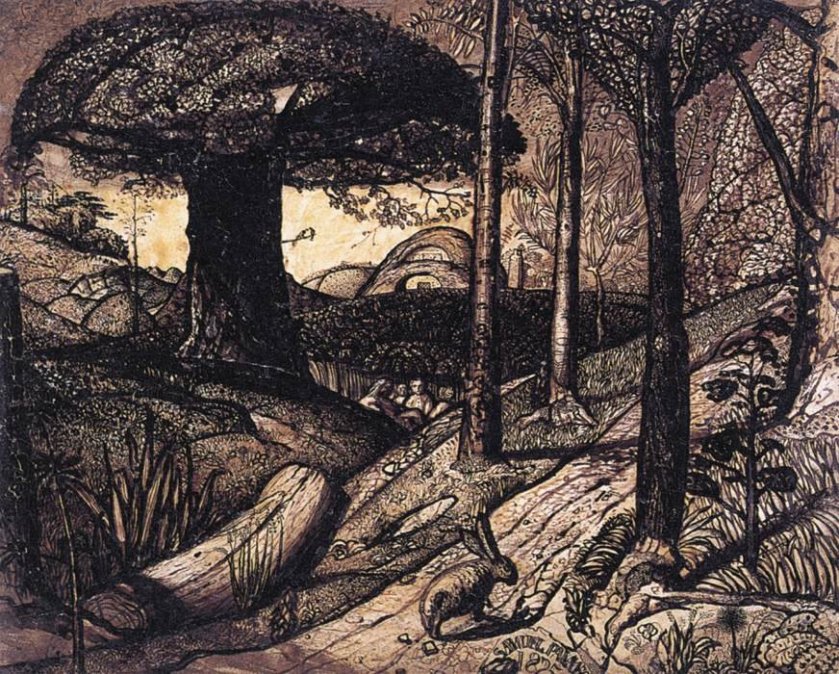
Early Morning by Samuel Palmer (1825)

In 1824, Palmer’s health once again deteriorated.  He suffered from asthma and bronchitis, and so he decided to follow his mother’s old remedy of leaving London and heading to the South Coast.  He visited the Kent village of Shoreham, and two years later he moved there permanently, buying himself a small run-down house, which he called Rat Abbey maybe because of his fellow dwellers in the old building!  A short time later, his father sold up his book selling business and left London and joined his son in Shoreham.  He rented half of a large house with the name Waterhouse which was situated on the banks of the River Darent.  Samuel Palmer’s nurse, Mary Ward, and his brother William joined Samuel snr. and also came to live there. The Water House proved to be of use to Samuel as it often housed visiting guests and fellow artists when there was no room at Rat Abbey.  Finally in 1828 Samuel Palmer left his small house and went to live with his father at Water House and stayed there for the rest of his time in Shoreham and it was during those heady days in Shoreham that Samuel first encountered John Linnell’s daughter Hannah whom he would later marry.  Palmer loved his new home and we can witness his contentment shown in his autobiographical letter published in The Portfolio art journal of that time.  He wrote:

“…Forced into the country by illness, I lived afterwards for about seven years at Shoreham, in Kent, with my father, who was inseparable from his books, unless when still better engaged in works of kindness. There, sometimes by ourselves, sometimes visited by friends of congenial taste, literature, and art and ancient music wiled away the hours, and a small independence made me heedless, for the time, of further gain; the beautiful was loved for itself …”

It was during his time in Shoreham that he founded, along with George Richmond and Edward Calvert, an artistic group of painters that were all inspired by William Blake.  The group were known as The Ancients or the Shoreham Ancients.  They were an artistic brotherhood who would meet both in Shoreham at Palmer’s home and at Blake’s apartment home in London.  This like-minded group of painters were followers of William Blake and were attracted to archaism in art, a style which has the deliberate intention to emulate a style of the past to suit contemporary vision.  With the exception of Palmer, most of the members of the “brotherhood” were former students of the Royal Academy, who had broken away from the confines of academic teaching and concentrated on their idealized vision of the past.
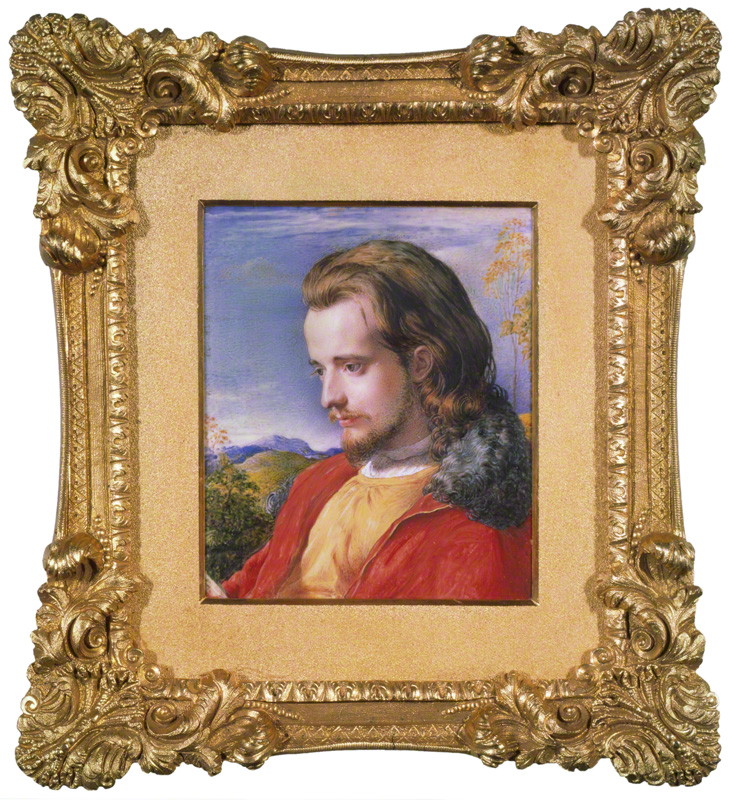
Samuel Palmer by George Richmond, watercolour and body colour on ivory, 1829
Samuel Palmer by George Richmond, watercolour and bodycolour on ivory, 1829

The Ancients were in existent around the same time as another art group was formed in Rome by some nineteenth century German painters.  They were known as the Nazarenes a derisory title which was used against them by detractors because of the biblical manner in the way they dressed and their Christ-like long hair and beards.  Samuel Palmer used to wear revivalist-type clothes and in a portrait in the National Portrait Gallery in London we see him with long hair and a full beard wearing a round-necked pleated smock under a coat.  It was during this time that critics believe that Samuel Palmer created his best works of art.  They were small landscapes which were almost composed of just a single colour using watercolour or ink. The depictions enforced Palmer’s religious belief which identifies God with the universe, or regards the universe as a manifestation of God and all the food derived from the fields were gifts from God.

An example of a Samuel Palmer painting of this time and type is one he completed in 1825 entitled The Valley Thick with Corn which is part of the six so-called Oxford Sepias, a group which now belongs to the Ashmolean Museum in Oxford.   The six pictures were completed between 1825 and 1835 at a time when Palmer found inspiration in the landscape around his home village of Shoreham.  The area was inspirational for him and it allowed him to produce, what some believe to be, some of the greatest English pictures of the 19th century.
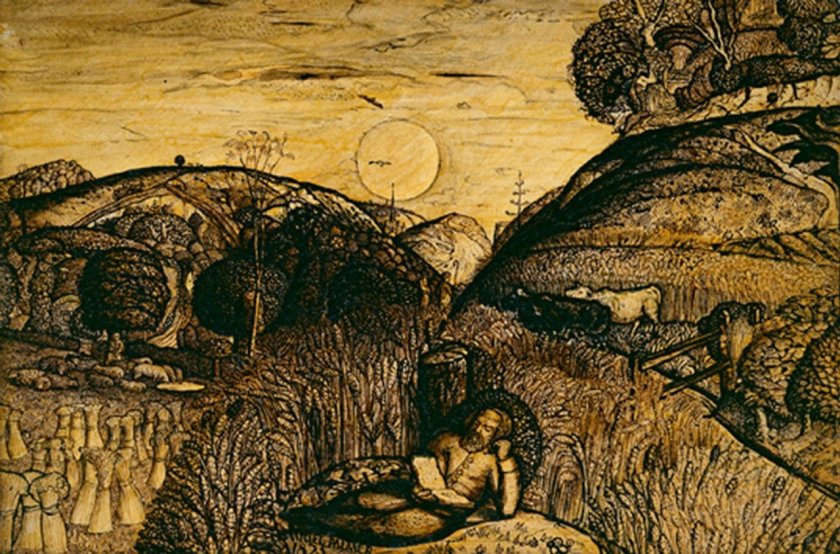
The Valley Thick with Corn by Samuel Palmer (1825).

The Valley Thick with Corn is a beautiful brown ink pen drawing which has been finished off with a layer of varnish.  This coating has aged over the years and has now given the work a rich yellow-brown finish.  The setting for the painting is undulating cornfields.  The darkness of the picture suggests it is late evening with the full moon rising over distant rounded hills and a tall thin church spire. A horse drawn cart can just be made out in the top left of the picture, as it trundles up a steep track.   In the foreground we see an elderly bearded man dressed in what looks like Elizabethan clothes lying on the ground surrounded by ears of corn.  He is stretched out and rests on his elbow.  On his lap lies an open book so he could be reading, albeit he looks as if he has fallen asleep.  Behind and to the right of him we see two cows slowly making their way through the cornfields.  To the left, in the mid ground, we see upright sheaves of corn which have been harvested and awaiting collection and behind them are sheep tended by the shepherd who sits under a tree and plays music to them on his pipes.

In a Shoreham Garden by Samuel Palmer (1830)

In 1829 Palmer completed his work entitled In a Shoreham Garden.  It is a wonderful work at a time which is looked upon as the height of Palmer’s achievements. The picture is a small watercolour heightened with gouache on stiff smooth cardboard often referred to as Bristol Board.  The work, measured just 28 x 22 cms and remained in Palmer’s own collection, no doubt in memory of Shoreham, the village he had loved so much.   It now resides in Oxford’s Ashmolean Museum.  It is full of light and colour with the dominating feature being an apple fruit tree in full blossom on the end of a path within a walled garden.  The tree is loaded with flowers.  In fact, besides the side of a wooden building in the right foreground the picture is an abundance of colourful flowers, bushes and trees which reach up to the sky.  In the background we see a lady wearing a long flowing red dress gazing out to something out of view to the right of the painting.  It is thought that the painting was a scene from the garden of his and his father’s Water Garden house.  It is now part of the V&A collection.

The Magic Apple Tree by Samuel Palmer (1830)

What is thought to be a companion piece to In a Shoreham Garden is one of his other 1830 works, The Magic Apple Tree.

Cornfield by Moonlight, with the Evening Star by Samuel Palmer (c.1830)

Around 1830, Palmer also completed a work entitled Cornfield by Moonlight, with the Evening Star.  It was a small painting measuring just 19 x 30cms.  The painting is now considered one of Palmer’s finest moonscape paintings.  We see a man carrying a staff, dressed in a long smock and wearing a wide brimmed hat walking through a cornfield with his dog.  In the foreground there are again sheaves of corn.  The sky is dark, lit up by a waxing sickle moon and an evening star, which could be, because of its brightness, the planet Venus.  The light emitting from the moon is probably much stronger than it would be for such a moon but it serves to illuminate the land.  There is no documentation to tell us the location of the scene but the rolling hills we see was characteristic of the Shoreham area.

In 1835, after ten years in the Kent village, Palmer left Shoreham and went to live back in London.   He had hoped to earn some money by selling some of the work he had accumulated whilst at Shoreham and he also hoped that he would be able to make some money by teaching art in the capital.

Samuel Palmer and Linnell’s eldest daughter, Hannah, married on 20th September, 1837 after an engagement which lasted several years.  Linnell had always been supportive of the match unlike his wife who was somewhat opposed to the liaison.  Samuel Palmer, funded by his new in-laws, and his new wife Hannah set off on their honeymoon to Italy in October 1837, a journey which would last two years and one that Palmer’s mother-in-law was vehemently opposed to..
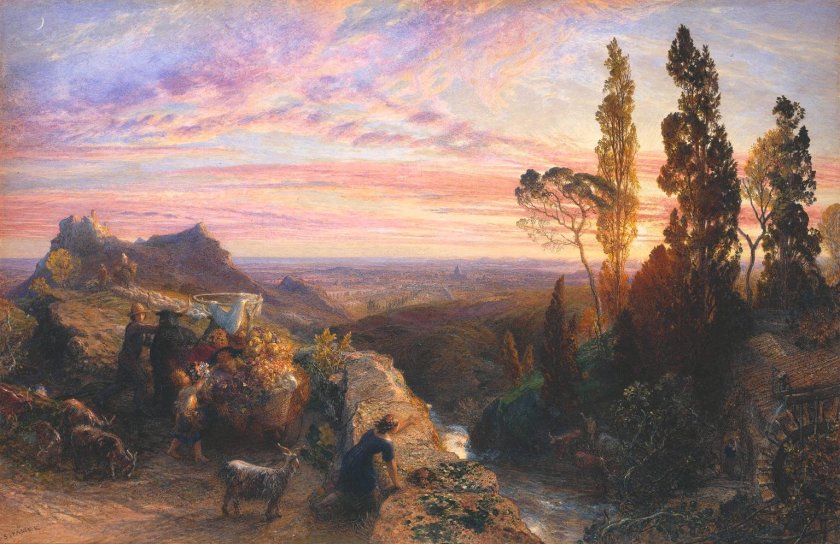
 Dream in the Apennines by Samuel Palmer (1864)
Dream in the Apennines by Samuel Palmer (1864)

A later painting by Samuel Palmer, one of his largest watercolours measuring 94 x 130cms, may have come from sketches he made during the honeymoon.  It was exhibited in 1864 and entitled Dream in the Apennine.  The depiction is a view of Rome as seen from the south-east.  It is now owned by the Tate in London.  When it was first exhibited it came with a note which read:

“…Suddenly, at a turn in the mountain road, we looked for the first time on that Plain; the dispenser of law, the refuge of philosophy, the cradle of faith. Ground which Virgil trod and Claude invested with supernatural beauty was sketched – but with a trembling pencil...”

In the foreground we see a young girl peering over the edge of a stone wall at the fast flowing river below.  She is throwing stones into the valley below.  There are goats standing behind her which may well be in her charge.  Behind and to the left of the girl we see a fully laden cart being pulled by a pair of mighty oxen which are being controlled by a young man.  A small child rushes towards the cart to add a few more bunches of flowers to the already filled large wicker baskets.  In the distance, on the plain we can see the Eternal city and the dome of St Peter’s Basilica.
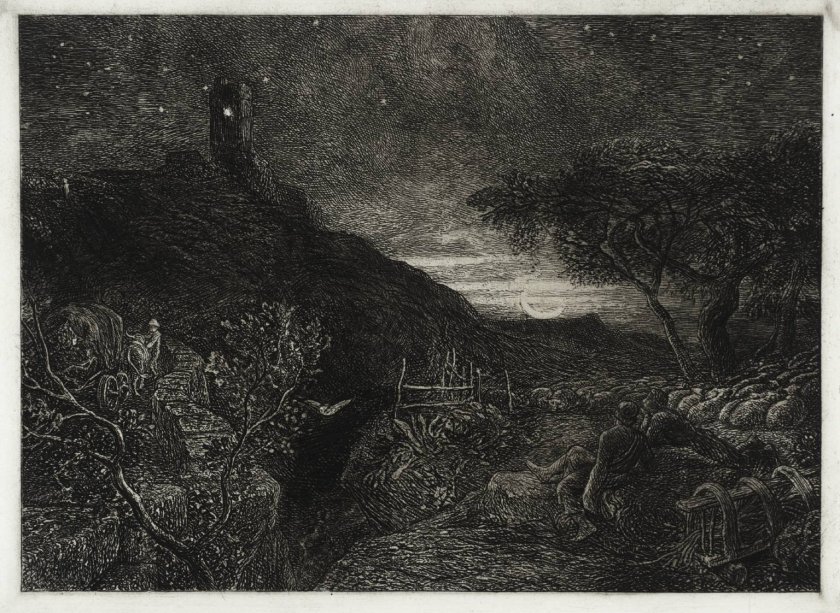
The Lonely Tower by Samuel Palmer (1879)

The last work of Samuel Palmer which I am looking at was an etching which he completed in 1879 entitled The Lonely Tower.  The scene before us was first exhibited as a watercolour at the Watercolour Society by Palmer in 1868.  Along with the watercolour there was a quotation from Il Penseroso (The Serious Man), a poem by Palmer’s favourite poet, John Milton.

“…Or let my lamp at midnight hour,

Be seen in some lonely tower,

Where I may oft outwatch the Bear,

With thrice great Hermes…”

Palmer and his family were living at Furze Hill House in Reigate and from his study he could look out towards Leith Hill and the folly, built in 1765 which is at its summit.  It could be this that he saw when he painted The Lonely Tower.    It is a depiction of a remote hilltop tower standing on the edge of a cliff with its single light shining out against a darkening sky.  It is now the remains of what once had a greater purpose.  We see a crescent moon against a horizon which is filled with clouds and stars which sparkle brightly.   Below and to the left of the light we see a man struggling to get his ox-cart up a steep track.  On the opposite side of the deep ravine we see two shepherds gazing up at the light and the night sky.  Flying over the ravine we see a barn owl. It is such an atmospheric and haunting picture. The Irish poet W B Yeats referred to the work in his poem Phases of the Moon:

“…He has found, after the manner of his kind,

Mere images; chosen this place to live in

Because, it may be, of the candle-light

From the far tower where Milton’s Platonist

Sat late, or Shelley’s visionary prince:

The lonely light that Samuel Palmer engraved,

An image of mysterious wisdom won by toil;

And now he seeks in book or manuscript

What he shall never find…”

This was by far the most evocative of Palmer’s late works.

Leith Hill Folly
Leith Hill Folly

Hannah and Samuel’s first son was born on January 27th 1842.  He was named Thomas More Walter George Palmer, Thomas More, after the famous fifteenth century statesman and philosopher who was councillor to Henry VIII, and George after Samuel’s good friend George Richmond.  He was a boy who grew to be a studious young man during which time he survived many boyhood scrapes whilst in Grammar school prior to going to Oxford University.  Sadly his father’s dream that his son would get to Oxford was dashed when the young man’s health deteriorated in 1859 and eighteen months later, after a long and painful illness, died on July 11th 1861.  He died at the tender age of nineteen.  Both Hannah and Samuel were devastated.  Samuel Palmer never got over his loss.  In his work The Lonely Tower the Great Bear star constellation depicted in the sky in the background is said to be as it was on the night his son died and as he looked skyward in grief. It was forever engraved on his mind.

The couple had another son Alfred Herbert Palmer who was born in 1860.  He went on to publish a biography of his father The Life and Letters of Samuel Palmer in 1892.
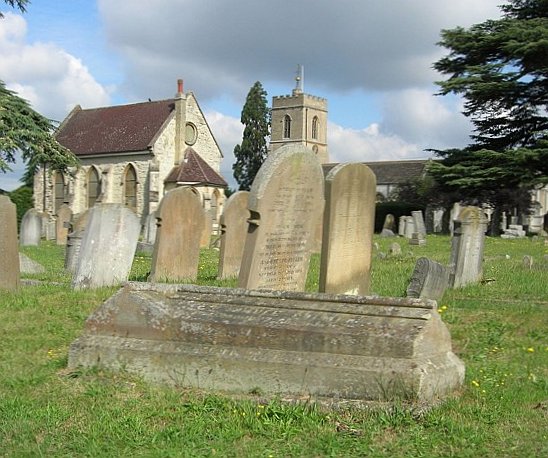
Samuel Palmer's grave in St Mary Magdalene Church Reigate
Samuel Palmer’s grave in St Mary Magdalene Church Reigate

Samuel Palmer died on May 24th 1881 aged seventy-six.  Palmer’s father-in-law and mentor John Linnell died six months later.  Palmer’s wife Hannah died twelve years later and the two are together in a cemetery in St Mary Magdalene churchyard in Reigate.  A strange twist to this story is the fact that in 1909, many of Palmer’s Shoreham works were destroyed by his surviving son Alfred, who burnt a great quantity of father’s sketchbooks, notebooks and original works. His reasoning behind the destruction was that he believed that nobody would not be able to make head nor tail of the material and that he wished to save it from a more “humiliating fate”.   Alfred Herbert Palmer died in 1931.

Samuel Palmer in Old Age by John Linnell

There is so much about Samuel Palmer I haven’t included in the two blogs but I hope that there is enough in them to tempt you to read more about the artist and I recommend an excellent book which will tell you all you about the great man.  It is written by Rachel Campbell-Johnston the chief art critic and poetry critic for the Times.  The book is entitled Mysterious Wisdom.  The Life and work of Samuel Palmer.
Samuel Palmer Part 1. The Early years, portraiture and the rural idyll

The Prospect by Samuel Palmer (1881)

My featured artist today is one of the great English landscape painters, draughtsmen and etcher of the nineteenth century.  He was a major player in the art of Romanticism.  His landscape works were special, conjured up by his inventive and far-sighted imagination.   There was a magical feel about his work.  Palmer was not just an ordinary every day painter; his works were poetical and he himself, through his art, seemed to have the ability of a mystical seer. Let me introduce you to Samuel Palmer.

At the time of Samuel Palmer’s birth there was a worrying tension brought on by conflict.  It was a troubling time.  It was a time of tumult in Europe.  Sixteen years earlier France had been affected by the storming of the Bastille and the fall of the rich and the nobility of the ancient regime.  Initially, there was probably a delighted sense of schadenfreude in the minds of many in England, including the “establishment” at the fall from grace of what they perceived was the cruel and greedy French aristocracy but soon that enthusiasm dwindled with the thought that such revolutionary behaviour may cross the English Channel.  In 1793, twelve years before Samuel was born France declared war on Britain, a war which would last more than two decades.  Although the battlefields were not in England Napoleon Bonaparte used another weapon against the British by blockading European ports and by so doing deprive Britain of lucrative trade.  The war however proved fortuitous to Samuel’s family who were hatters and hats were in great demand since the government, to add to their much needed war chest, had imposed a hair powder tax and this ended the era when elegantly puffed and powdered coiffures which were once de rigueur, now could not be afforded.  The fashion was now for the “topper”, the nickname given to top hats.

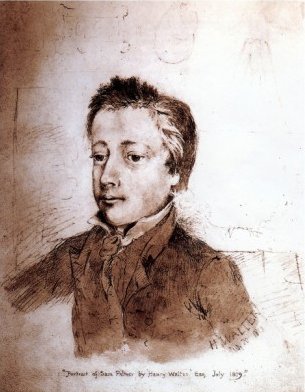
Portrait of Samuel Palmer by Henry Walter (1819)

Samuel’s father, also named Samuel, had set forth to study to become a surgeon but his squeamish nature put an end to that dream and he ended up in his father, Christopher Palmer’s, millinery business.  Samuel Snr. was somewhat of a dreamer and this along with his love of books led him to forego the safe and lucrative job as a hatter to set himself up as a bookseller.  This decision did not go down well with his family as the trade of a bookseller seemed a lowly trade not fit for a “gentleman”.  Samuel Snr. was, besides being a dreamer, a very determined person and cared little about status and the financial position of his family.

Samuel Palmer Snr. met and fell in love with Martha Giles and they married in October 1803.  Samuel Palmer, their first child, was born in Newington, London on winter Sunday morning, on January 27th 1805.  The couple lived in Surrey Square in Newington, which at the start of the nineteenth century, was a semi rural area populated with lush gardens, fields and orchards.  It was a haven for those who loved the countryside; a love young Samuel would have all his life.  It was a time when survival at birth was somewhat of a lottery with a third of babies not surviving to see their first birthday and amongst the poor and deprived the survival rate would drop even further.  However Samuel Palmer was lucky in as much as he was born into a prosperous middle-class family.

Early Morning by Samuel Palmer (1825) Pen and ink and wash, mixed with gum arabic, varnished,
Early Morning by Samuel Palmer (1825)
Pen and ink and wash, mixed with gum arabic, varnished,

Samuel was not a healthy child and his mother and grandmother would often take him to the Georgian seaside resort of Margate in the hope that sea air would improve his health.  This once fishing town was a favourite of Turner.  It was during his boyhood stays in Margate that he would listen to his grandmother’s tales of ghosts and restless spirits who wandered around the town.  Stories of such apparitions would remain with Samuel and would interest him all his life.  His mother’s continued concern about her son’s physical health led her to employ a live-in nurse, Mary Ward, who set about improving his health by improving his diet.   It was also this lady who was to have such an influence on the young boy.  Unlike most servants who were illiterate Mary was well read with the Bible and Jacob Tonson’s pocket illustrated book of Milton’s poems being her favourites.  She, like Samuel’s father, loved books and would often read Milton’s poems to Samuel.  When Mary died she bequeathed the book of poems to Samuel who would carry it round with him wherever he went.  Of Milton’s poems, Samuel wrote:

“…I am never in a “lull about Milton”…….nor can tell how many times I have read his poems… He never tires….I do believe his stanzas will be read in heaven…”

Samuel gained a brother in 1810 with the birth of William, who was to be the only other surviving child of Samuel Snr. and Martha.  Samuel Palmer did not have many boyhood friends as he was more than satisfied to immerse himself in his books, including works by Dickens, which featured the English capital.  It was a trait, which delighted his father.  Samuel would often go for walks on Dulwich Common with either his father or his nurse during which they would often read to him as they strolled the countryside.  His love for reading and the joy books brought him can be seen in one of his letters (The Letters of Samuel Palmer – Raymond Lister, 1974) in which he wrote:

“…There is nothing like books of all things sold incomparably the cheapest, of all pleasures the least palling, they take up little room, keep quiet when they are not wanted and, when taken up, bring us face to face with the choicest men who ever lived at their choicest moments…”

Samuel, maybe because of his poor health, tried to avoid the necessity of going into the heart of London with all its pollution from coal fires and the often dank fogs emanating from the Thames.  He was a lover of the countryside and being of poor health abhorred the polluted city life.

In May 1817, at the age of eleven, Samuel was sent to Merchant Taylors’ public school.  This was a prestigious institution founded back in 1561 but for Samuel it was a nightmare.  Samuel who had been cosseted by both his mother and nurse and had a quiet solitary home life, which suited his nature, suddenly was thrust into a maelstrom of lively and loud boys in which a pale-faced asthmatic boy fared badly.  Samuel disliked the public school system with all it entailed and in another of his letters he wrote:

“…the fag crawls to be kicked, and, in his turn, kicks the fag who crawls to him………it perfectly represents and so admirably prepares for the requirement of public life for what is statesmanship but successful crawling and kicking….”

His time at Merchant Taylors lasted only six months as his pleading to come back home was answered in the Autumn of 1817.

The death of Samuel’s mother in 1818 came as a harsh blow to her thirteen year old son.  He struggled to cope with the loss and shed many tears.  The loss of his mother came at the same time as he and his father considered what career he should follow.  Samuel favoured becoming an author.  He had already written some prose and poetry and although the latter never attained the quality required to have them published his stylistic prose gave him hope of a fulfilling career.  However it was not to be as his father believed, because of his son’s early talents as a draughtsman that the visual arts should be the career his son should follow.  The family’s decision that Samuel should follow a career in art was thought to have been down to a belief that it was what his mother would have liked her son to do.

Entrance of the Meuse: Orange-Merchant on the Bar, Going to Pieces; Brill Church bearing S. E. by S., Masensluys E. by S. by J W Turner (1819)

The family employed William Wate, a run-of-the-mill landscape artist, to tutor Samuel.  In 1819, when Samuel was just fourteen, he made his first visit to the Royal Academy Summer Exhibition.  He was amazed by the colour in Turner’s painting of the Entrance of the Meuse and fascinated by Turner’s Liber Studiorum, a series of his landscape and seascape compositions which were published as prints in etching and mezzotint, has been once described as perhaps comprising of ‘the pith of all that is best in his life and work’.

At this time Palmer was just a developing artist who was still learning the basic skills of art through Wate’s tuition.

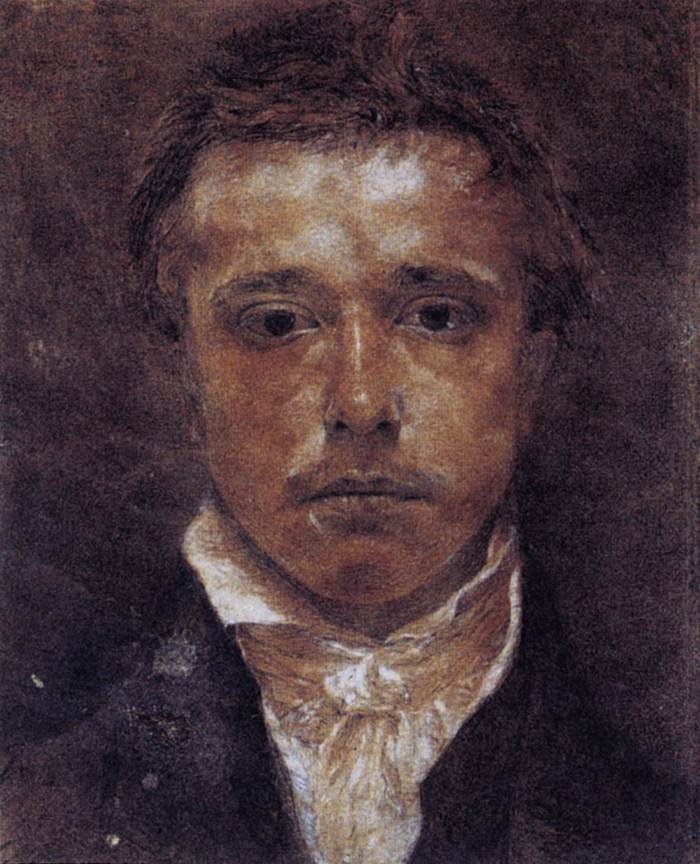
Samuel Palmer a Self-Portrait (1826)

I recently attended a portraiture workshop at which the guest artist and presenter talked about how the portrait he would produce would not necessarily be a photographic image of the sitter but how he envisaged the model.  With those words still in my head I gaze at Samuel Palmer’s self portrait which he completed around 1826 when he was twenty years of age.  Is this how he envisioned himself?  There is something quite disturbing about this self-portrait.  Palmer gazes directly towards us but it is a blank stare as if he is looking through us.  The question that immediately springs to mind is what is he thinking about.  What is going on in his mind as he looks into the mirror?   It is not an image one would associate with an aspiring artist who is looking forward to the future.  What is troubling him?  Look at his physical appearance.  He has not readied himself for the painting.  It is more of a “this is who I am, take it or leave it” stance.  He is unshaved.  His thick hair looks uncared for.  The collar of his shirt is crooked but he knows all this as he puts brush to canvas.  Maybe he wants us to disregard his physical appearance and concentrate on what could be on his mind.  We are looking at the face of a troubled dreamer.  We are looking at a man whose vivid imagination would influence his art and those who view some of his imaginative paintings will be transported into a magical world which in her book Mysterious Wilderness, The Life and Work of Samuel Palmer, the author Rachel Campbell-Johnston describes the artist and some of his works:

“…It is a place in which magical shines through the material, in which nature and heaven are intertwined, in which God in all his mildness blesses man’s harvests and the darkness of night can be innocent and day.  This is not the haunt of any workaday painter.  It is the home of the artist as mystic and seer and poet…”

The Shearers by Samuel Palmer (1834)

One of his best known works is The Shearers which he completed in 1835.  It is a painting which is rich in colour.  There is the juxtaposition of golden sparkling light and gloomy shadow.  I have already said the Palmer was looked upon as a seer and this painting was his vision of paradise.  Raymond Lister in his book, Catalogue Raisonné of the works of Samuel Palmer describes the work and a similar one entitled The Sleeping Shepherd which uses the same setting of the entrance to the barn we see in the above work:
“…A group of richly textured and abundantly coloured paintings of this period includes some of Palmer’s greatest and most attractive work. Such work reached its ultimate expression in The Shearers and The Sleeping Shepherd…”

Geoffrey Grigson, in his 1960 book Samuel Palmer’s Valley of Vision, wrote of the work:

“…Great richness of technique was used to realise The Shearers. In this Palmer combined oil and tempera so as to render every nuance of texture from the light on the distant hills and in the sky to the detailed depiction, almost Dutch in its realism, of the group of implements on the right. There is also an advance in the drawing of the figures, the shearers and their helpers; rarely if ever before this had Palmer portrayed figures so convincingly in movement…”

The setting of the painting is the great barn,  the doors of which are open and we look out at the scene before us.  The doors and the roof beam in some way form a frame for the painting.  A group of six people work in the shade of the trees outside the barn, three men and three women can be seen in the mid-ground.  The men are in the process of shearing the sheep whilst the women collect and bag the wool.  In the background we see an expanse of rolling hills which are lit up by the rays of the sun which light up the beautiful countryside.  Samuel Palmer never forgot his walks with his father over the hills and through the fields of Dulwich.   The idea for the painting must have been in his mind years earlier because he once wrote about his plans for depicting such a scene:

“…A group of different sex and age reaping, might be shewn in the foreground going down a walk in the field toward the above cottage island, and over the distant line that bounds this golden sea might peep up elysian hills, the little hills of David, or the hills of Dulwich or rather the visions of a better country which the Dulwich fields shew will to all true poets…”

Still life detail
Still life detail

In a way the painting is not just a rural landscape scene but part is also a still-life work in the way Palmer has painted the farming equipment inside the barn which we see on the right hand side along with a wide brimmed straw hat which the artist’s son, Alfred, said was one of his father’s most cherished possessions and an item which would appear in many of Samuel Palmer’s works.

In my next blog I will continue to look at the life of Samuel Palmer and explore the help he received from the landscape artist and portraitist John Linnell and  how he was so influenced by William Blake, the poet and painter who was an influential figure in the history of the poetry and visual arts of the Romantic Age.

Félix Vallatton. Part 2. The Nabis, woodcuts and the “dreadful nudes”

Self-portrait with the dressing gown by Félix Vallotton (1914)

During the 1890’s Vallotton, besides painting and writing art criticism, spent much of his time working with woodcuts.  The woodcuts he produced were looked upon as being very innovative and established him as a leading exponent of this type of art.  Japonism was sweeping through the French art world during the last part of the nineteenth century and Vallotton’s work was influenced by the Japanese woodcut In 1890 there had been a large exhibition of ukiyo-e prints at the École des Beaux-Arts and like many people in France, Vallotton built up a collection of these prints.

La Paresse by Félix Vallotton (1896)

Vallotton’s subjects ranged from domestic scenes to street crowd demonstrations in which police are depicted clashing with anarchists and from portrait heads to bathing women.  In his 1896 woodcut entitled La Paresse (Laziness) he depicts a naked women relaxing face down on a bed whilst stroking a cat.

Le Mensonge (The Lie) by Félix Vallatton (1896)

The high point of his woodcuts was probably reached in 1898 when he produced a series of ten interiors entitled Intimités (Intimacies), for the La Revue blanche, the avant-garde French art and literary magazine, which was published between 1889 and 1903 and had many influential contributors such as Toulouse Lautrec.  The set of woodcuts dealt with the tensions between men and women and they proved so successful that they were circulated in magazines and books in Europe and America.

This set of woodcuts was a great success and for many critics there was a greater appreciation of them in comparison to his paintings.  The ten woodcuts were dark with some white lines cut through the black background.  Vallotton, through his woodcuts, wanted to bring out the continuing tensions between man and woman and that was further enhanced by the evocative titles he gave the individual works, such as Le Mensonge (The Lie), L’Argent (The Money) and L’ Irreparable (The Irreparable).  In a way it was his way of denigrating love between man and woman, blaming the woman for being insincere and scheming creatures who often brought an element of spitefulness and dominance into a relationship.

Bathers on a Summer Evening by Félix Vallotton (1892)

Around 1892 Vallotton became associated with the Nabis art movement.   The group came about around 1888 and was composed of disaffected artists who had passed through the Académie Julian and been subjected to the rigid representational methods being taught at that establishment.  Founder members of the Nabis, which was a Hebrew word meaning prophet, were Pierre Bonnard, Édouard Vuillard and Maurice Denis.  The Nabis were inspired by the broad planes of unmediated colour, using thick and bold outlines that were seen in Japanese prints.

Clair de lune (Moonlight) by Félix Vallotton (1895)

Two examples of Vallotton’s take on the Nabi style art were his 1893 work entitled Das Bad. Sommerabend (Bathers on a Summer Evening), and his 1895 symbolist work Moonlight which can be found at the Musée d’Orsay

Bathers on a Summer Evening depicts women bathing in an open-air brick pool.  The painting was exhibited at the 1893 Salon des Indépendents exhibition and its subject caused a furore but at the same time it successfully enhanced Vallotton’s reputation as an artist.  In some way this painting is looked upon as a caricature of the traditional paintings of Salon artists such as Seurat and Renoir .  The painting is housed in the Kunsthaus, Zurich.

Mme. Felix Vallotton by Félix Vallatton (1899)

In 1899 Félix Vallotton married Gabrielle Rodrigues-Henriques née Bernheim.  Gabrielle was the daughter of Alexandre and Henriette Bernheim and was one of six children.   Alexandre Bernheim came from Besancon and was an art dealer and friend of a fellow countryman of Besancon, Gustave Courbet.   Gabrielle was eighteen months older than Félix Vallatton and had married Gustave Rodrigues Henriques in February 1883 and the couple had three children, Max, Joseph and Madeleine.  Gustave died in 1894 at the young age of 34 leaving his widow financially comfortable.  Gabrielle and Félix married five years later in 1899.  Félix wrote to his brother Paul and told of his relationship with Gabrielle.  He wrote:

“…I love her very much which is the main reason for this marriage, and she loves me also, we know each other very profoundly, and we trust each other.  In short, I regret nothing and I nourish the highest hopes…”

In 1899, the year of his marriage to Gabrielle he painted a picture of her sitting at a table.

As I mentioned in my last blog about Vallatton, what drew me to him was the headline of a 2007 essay in The Guardian newspaper by the writer Julian Barnes:

The neglected, enigmatic Swiss artist Félix Vallotton was a fine painter of still lifes, landscapes and portraits. Shame about his dreadful nudes, writes Julian Barnes

I was intrigued to find out what was “dreadful” about Vallatton’s portrayal of nudes.

Models Relaxing by Félix Vallatton (1905)

In 1905 Vallatton’s neo-classical style painting Models Relaxing was exhibited at the Ingres retrospective at the Salon d’Automne in Paris.

Le bain turc by Ingres (1863)

One of Ingres’ works Turkish Bath was also on view at the exhibition.  It is said that Vallatton was moved to tears by this Ingres’ work and maybe that was the reason that two years later, in 1907, Vallatton completed his own painting entitled Turkish Bath.

The Turkish Bath by Félix Vallatton (1907)

The women in his painting were not hand maidens of a harem but were women of the 1900’s with their fashionable hairstyles.

The Rape of Europa by Félix Vallatton (1908)

Controversy was not far away when his nude paintings were exhibited,  At the beginning of the twentieth century  one exhibition of his work only allowed over 18 years of age visitors to enter and witness the naked women !  Depicting his nudes as part of mythology did not decrease the censure of the critics.  An example of this is his 1908 painting entitled The Taking of Europe which is housed in the Kunstmuseum Bern.

Perseus Slaying the Dragon by Félix Vallatton (1910)

Another of Vallatton’s paintings featuring a nude but with mythological connotations was his version of the story of Perseus slaying the dragon, a story which had featured in many pasintings before.  Vallatton completed his up-to-date version of Perseus Slaying the Dragon in 1910 and it is now owned by the Musée d’Art et d’Histoire de Genève .

Woman with a Black Hat by Félix Vallatton (1908)

Vallatton painted hundreds of pictures featuring nude or semi-nude females and the one I like the most is his 1908 work entitled Woman with a Black Hat.  The woman’s face is flushed as if she is embarrassed to appear semi naked before the artist.  It adds to he vulnerability and in a way enhances her beauty.

Landscape Semur by Felix Vallotton (1923)

Vallatton kept a register of all the works he completed and by the time of his death the list catalogued almost 1600 works.  I have looked at his portraits and his penchant for painting nude females but of all his works, for me, his landscapes stand out.  It was in his latter years that Vallatton produced most of his landscape works, such as Landscape Semur which he completed in 1923.

Square in Les Andelys with the Chateau Gaillard by Félix Vallatton (1924)

Another interesting painting was completed a year later in 1924 and entitled The Chateau-Gaillard in Andelys.  Since 1909, Vallatton had a summer home in Honfleur and in 1924 whilst en route to his summer residence he passed through the small village of Andelys which lay on the banks of the Seine.  He had first visited the village eight years earlier.  The village is dominated by the ruins of Chateau Gauillard, a fortress built by Richard the Lionheart in 1196.  It is situated on a hill overlooking Andelys.  The ruins fascinated Vallatton who produced a number of paintings and sketches featuring the once mighty fortress.  The painting is housed in the Musée A.G. Poulain de Vernon in Vernon, a town about 30 kilometres south of Andelys.

Nature morte a la peinture chinoise by Félix Vallatton (1925)

Another art genre that interested Vallatton in the early twentieth century was Still Life painting.  In 1925 he completed a work entitled Nature morte a la peinture chinoise (Still Life with Chinese painting).  Like many still life paintings the artist has challenged himself by having to paint a white napkin, with all its creases and folds, looking as if it is laying over the edge of the table.  The Chinese painting mentioned in the title can be seen in the background.

Parrot Tulips by Felix Vallotton

One of my favourite still life paintings by Vallotton was a work entitled Parrot Tulips.  I love the richness of the colours used and love to study the way Vallotton has depicted the individual items which crowd the scene.

Vallotton’s life came to a close at the end of 1925.  His brother Paul’s daughter Marianne recalled the time:

“...It was the end of of the year 1925 and the weather was grey and gloomy, but in accordance with our old custom, we were getting ready to celebrate Christmas, when on 21 December my father received a letter , whose opening lines I quote:

‘ …My dear Paul, after examining me twice, they have decided to operate.  It has been arranged for next Saturday morning the 26th.  It would be nice if you could be here, for various reasons…’ “

Félix Vallotton died three days after his operation on December 29th, three days before his sixtieth birthday.  According to Marianne Vallotton his last words to her father, his brother Paul were:

“…Don’t you think this is an amusing way to celebrate the centenary of the death of Jacques-Louis David?…”

The French painter died on December 29th 1825.

There were just so many apintings to include but so little time or space to accommodate them.  To see more I can recommend the excellent book on the life of Félix Vallotton by Nathalia Brodskaïa entitled Félix Valloton, The Nabi from Switzerland.  It was from this biography that I have been able to put together these two blogs on this talented Swiss painter.

Earlier I had mentioned the headline of an essay in The Guardian newspaper written by Julian Barnes.  It is said that in a few years time he will be curating an exhibition of Félix Vallotton’s work at the Royal Academy in London and it will certainly be an exhibition not to be missed.

Arnold Böcklin. Part 1 – early years and landscape painting

Self Portrait by Arnold Bocklin (1862)

Paintings can elicit all kinds of feelings from the observer.  Some of the realist and critical realist paintings elicit a feeling of sadness and guilt.  Some paintings extract from us a sense of fear, whilst others bring forth a feeling of wonderment when we look upon a beautiful landscape or the portrait of a beautiful woman.  The artist I am featuring in my next two blogs produced a painting, which, to me, was one of the most haunting and evocative paintings I had ever seen.  The artist is the Swiss-born painter, Arnold Böcklin and the painting was entitled Die Toteninsel (Isle of the Dead).  He completed five versions of the work between 1880 and 1886.  I will look at this work in the second part of this blog.

Another reason for looking at some of the works by Böcklin is because I just returned from a three-day trip to Munich and instead of visiting the city’s major galleries such as the Pinakothek der Moderne and the  Alte Pinakothek, I headed for the Schack Gallery which houses a notable collection illustrating the development of German painting in the 19th century. The history of the gallery is that its founder, Count Adolf Friedrich von Schack, was a generous patron of the arts, purchasing and commissioning numerous works by many leading 19th-century German painters including Moritz von Schwind, Carl Spitzweg, Franz von Lenbach, and the Swiss born artist, Arnold Böcklin. Von Schack’s collection now forms part of the Bavarian State Collection.  This small gallery is a little gem and has an amazing collection of copies of works by the likes of Titian by German painters.

Ruined Castle by Arnold Böcklin (1847)

Arnold Böcklin was born in October 1827 in Basel.  In 1841, aged 14, Böcklin went to art school at the Zeichenschule Basel, which was run by the painter, Ludwig Adam Kelterborn.   A Zeichenschule was a drawing school where pupils were given the technical and artistic training of Craft Trade Association  His father was Christian Frederick Böcklin, who worked in the silk trade and his mother was Ursula Lippe.  In 1845, Böcklin, aged 18, studied art for two years at the Düsseldorf Academy under Johann Wilhelm Schirmer, the German historical landscape painter.  Böcklin initially painted landscapes and one of his early works was entitled Ruined Castle which he painted in 1847 and which is now housed in the Nationalgalerie, Berlin.

Das Hünengrab by Arnold Böcklin (1847)

Another atmospheric landscape work Böcklin completed in 1846 was one entitled Das Hünengrab (Megalithic Grave).

Böcklin excelled in his studies during his time at the Düsseldorf Academy and he was sent off on painting trips to Belgium with his friend and fellow student Rudolph Koller, where he was tasked with copying paintings by the Flemish and Dutch masters which were housed in museums in Antwerp and Brussels.  One of his favourite painters was said to be Peter Paul Rubens.  He returned home to Basel and then went to Geneva where he worked alongside the Swiss painter Alexandre Calame, a landscape artist, who specialised in Alpine scenes.

From Basel he set off on another painting trip, this time to Paris, where he remained for several months, sharing an apartment with his friend and fellow artist, Rudolf Koller.  Whilst here, he busied himself copying works of the Old Masters and some of his contemporaries, which were held in the Louvre.   He was influenced by the works of Thomas Couture and the landscapes of Jean-Baptiste-Camille-Corot.   However the year was 1848 and Paris was not the safest place to be because of the February and June revolutions and so Böcklin left the French capital.

After a short spell of military service Böcklin got married.  His bride was Luise Schmidt but sadly she died before their first wedding anniversary.  In February 1850, heartbroken following the death of his wife, Böcklin travelled to Rome.  It was here that he was befriended by the Dresden-born artist Heinrich Franz-Dreber who introduced him to a group of German artists living in Rome, who called themselves the Tugenbund   (the League of Virtue).  He also became friends with Oswald Achenbach, who at the time was looked upon as one of the leading European landscape painters and Anselm Feuerbach, the German Neoclassical painter.

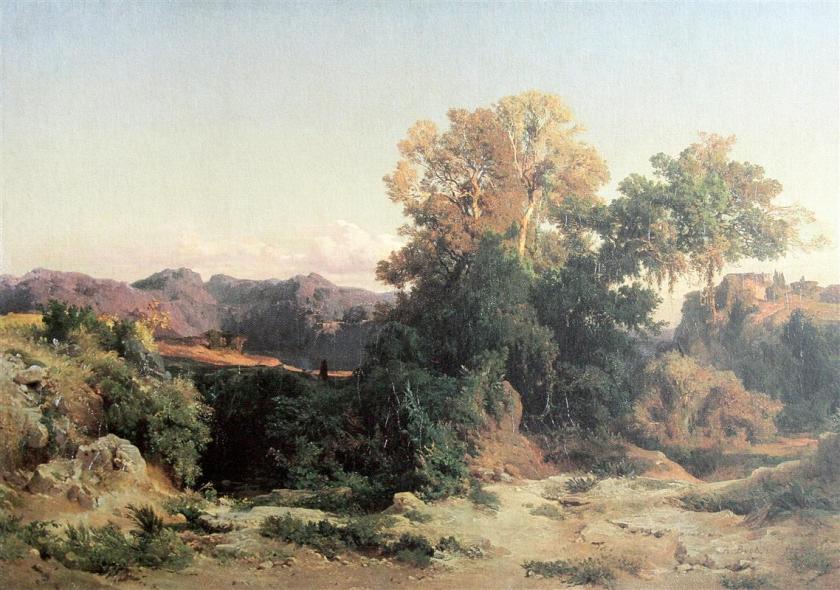
Landscape from the Alban Hills by Arnold Böcklin (1851)

During his stay in Italy, Böcklin would spend the summers with some of his fellow artists in the Alban Hills, some forty-five kilometres east of the Italian capital, and it was there that they set up home in the village of Olevano.  One of Böcklin’s first painting he completed in Italy was Landscape from the Allban Hills which he completed in 1851.  This work of art is now housed in the Staatliche Kunsthalle in Karlsruhe.

Roman Landscape (Römische Landschaft) by Arnold Böcklin (1852)

The following year, 1852, Böcklin produced another landscape painting featuring the Roman Campagna.  It was entitled Römische Landschaft (Roman Landscape), which can now be seen at the Brooklyn Museum.   Unlike some of his contemporary landscape artists, who had sketched and painted views of the Roman countryside, Böcklin overcame the urge to add famous landmarks.  He believed that such an addition detracted from flora and fauna and it was his intention to enhance the view of nature.  This painting was a simple landscape work with a small figure of a woman, seen in the middle ground, undressing prior to going for a swim in the pool.  She is just a mere white dot in the painting which gives viewers an idea of the enormity of nature with its huge old trees and cloud-filled sky.  He wanted his painting to be all about details of the foliage and rock formations.  It is believed that earlier studies for this painting included more than one bather and a satyr but Böcklin decided that these extra figures detracted from the “message” and so he painted over them.  Böcklin wanted viewers to understand the immenseness of nature and how light and shade can alter tonal qualities .

In 1853, three years after arriving in Rome, Böcklin married for the second time.  His second wife was a young Italian woman, Angela Rosa Lorenza Pasucci, the daughter of a papal guard.  The couple went on to have fourteen children.

Böcklin changed his style of painting in the mid 1850’s when he began to include themes from Classical mythology and whereas his painting before concentrated on what he had seen they began to be about what he imagined.  Some believe that there was another reason for this change of style – money, or lack of money.  Böcklin needed to sell more of his paintings to survive and so he had to focus on what travellers passing through Rome wanted to see in his works.  These travellers wanted to buy paintings featuring Classical Roman sites.

Pan in the Reeds by Arnold Böcklin (1858)

In 1859 Böcklin was in Munich and exhibiting some of his works at the Munich Kunstverein.   It proved to be a great success for Böcklin as one of the works which he had completed the previous year, his second version of Pan im Schilf  (Pan in the Reeds), was bought by King Maximillian II, the ruler of Bavaria.  Fourteen of his other paintings were purchased by Friedrich Graf von Schack, the Munich art collector.   Furthermore, in 1860, through the auspices of von Schack,  Böcklin was offered the post of Professor of Landscape Painting at the newly founded Kunstschule in Weimar

In my next blog about Arnold Böcklin I will look at the paintings he completed later in his life which designated him as a Symbolist painter.  Symbolism is defined as an art genre characterised by a rejection of direct, literal representation in favour of evocation and suggestion.  Symbolism produced imaginary dream worlds populated with mystifying figures from biblical stories and Greek mythology as well as unbelievable, often monstrous, creatures.

Mr and Mrs Wachtel and their Californian dreams

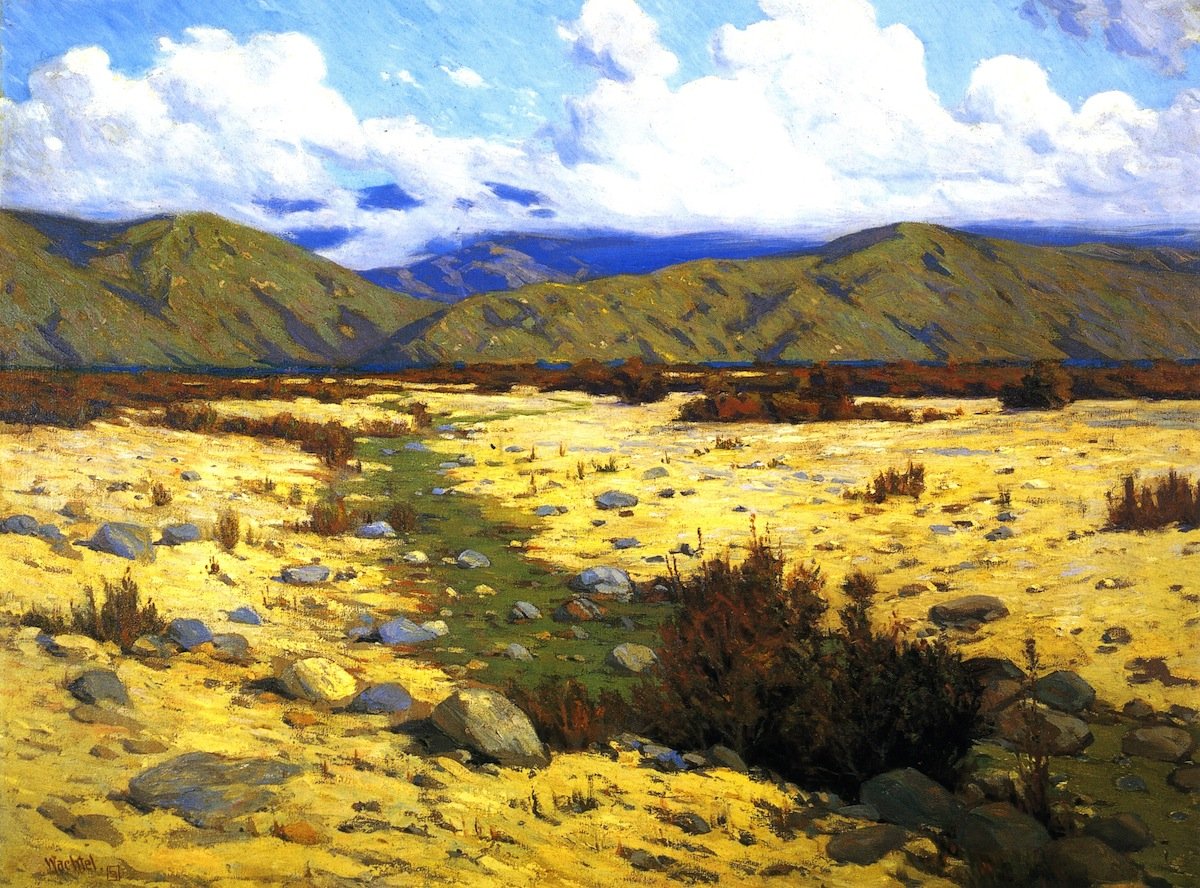
Elmer Wachtel
Elmer Wachtel

I often come into contact with American tourists who stay at my Bed & Breakfast and I always ask them where is the best place in America as far as climate is concerned and I nearly always get the same answer – the area around the coastal town of San Diego.  In my blog today I am looking at two landscape artists, husband and wife, who concentrated their work around the beautiful areas of Southern California.  Let me introduce you to Mr and Mrs Wachtel.

Spring Landscape by Elmer Wachtel

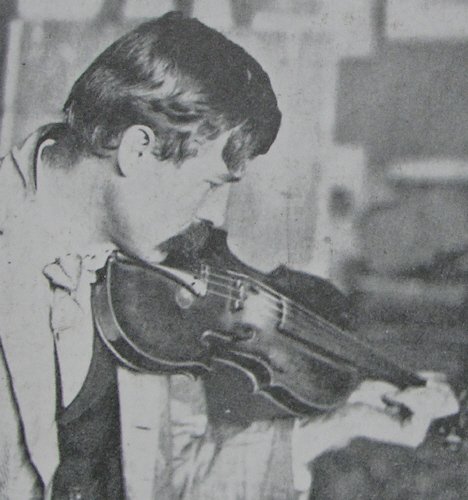
Elmer Wachtel was the older of this married couple, born in Baltimore, Maryland on January 21st 1864 but it was not until 1882, when he was eighteen years of age and had completed schooling, that he crossed country to live in California.  His new home was to be San Gabriel, California where his brother was foreman of the Rose Ranch.  He had married the sister of the artist Guy Rose.  Guy Rose was a student of John Bond Francisco who had settled in Los Angeles. Francisco had become a major cultural figure, performing as a violinist, painting, teaching and entertaining in his home and his studio on Albany Street. He combined his two great loves art and music and helped form the Los Angeles Symphony Orchestra in 1897 and served as their first concertmaster.  Studying with Francisco, Elmer had found the ideal “fit” as he was interested in art and was also an exceptionally talented musician, having taught himself to play the violin.  In fact he was such a talented musician that he at one time was the first violinist of the Los Angeles Philharmonic Orchestra, which was founded by William Andrews Clark, Jr., a millionaire and amateur musician.

Desert, River, Mountains by Elmer Wachtel

It was not until 1894 that Elmer decided to enrol at an art establishment to learn more about drawing and painting and he moved back east to New York where he joined the Art Students League which had been founded in 1875 by a group of artists, both male and female.  They had all been students at the National Academy of Design in New York City.  Many of these aspiring artists decided to break away from the Academy citing the reason that the Academy’s art tuition was too conservative and unsympathetic to their new and modern ideas about art.  Whilst here, Wachtel studied under William Merritt Chase, the American painter and leading American exponent of Impressionism.

Valley Afternoon by Elmer Wachtel (c.1910)

Elmer returned to California in 1896 and stayed at the San Francisco home of William Keith, the Scottish-American painter who was famous for his Californian landscapes and in fact was often referred to as the “Dean of California painters”.  Elmer Wachtel eventually left San Francisco and returned home to Los Angeles.  During this period, he supplemented his income as an artist and an art teacher and by playing his violin in a number of orchestras.

California had been opened up to folk from the East by the Santa Fe railroad in the late nineteenth century and many of these travellers from the East were artists who wanted to experience the beautiful Californian landscapes and the natural light which bathed these lands.  One such visitor was Marion Kavanaugh.

Marion Kavanagh Wachtel

Marion Kavanaugh was born on June 10th 1876 in Milwaukee.  She came from an artistic background.  Her mother, Jean, was an accomplished and well respected artist and her great grand-father a Royal Academician.   She received the most thorough art education studying in the School of the Art Institute of Chicago under John Vanderpoel, the Dutch-American artist and teacher and was tutored in New York, like Elmer Wachtel, by William Merritt Chase.  Following the completion of her studies she taught art in some Chicago public schools and later attained a post as tutor at the Art Institute of Chicago where she taught for two years but life in the classroom was not for Marion.  Slowly she built up a reputation as a portraitist and an accomplished painter of child portraits.  Marion Kavanaugh had now built up a reputation as one of America’s great watercolourist and her skill as a landscape artist and tonalist was much admired.  Tonalism is a style of painting in which landscapes are depicted in soft light and shadows, often as if through a coloured or misty veil.

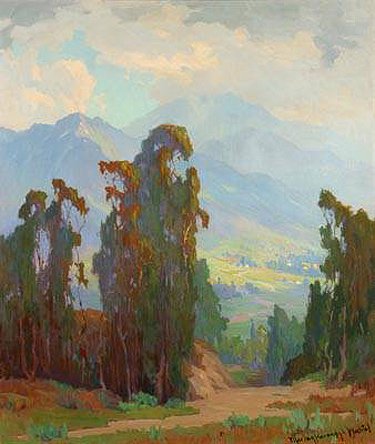
Foothill Eucalyptus Landscape by Marion Wachtel

In 1903, Marion received a commission from one of the vice presidents of the Santa Fe Railroad to paint murals of Western landscapes for the company’s San Francisco ticket offices, in return he offered free passage to California on one of the company’s trains .  To achieve that commission she travelled west and visited many sites all the time making sketches along the way which she found would be conducive for her commission.  She stopped off at New Mexico, Arizona and California. Whilst in California she called in at the Cooper Ranch in Santa Barbara where she stayed for several months as a guest of the owner, the entrepreneur and agriculturist, Ellwood Cooper.  Cooper commissioned her to paint some landscape scenes around his ranch.  It was during this commission that she began to paint the eucalyptus trees which were found close by and it was these beautiful trees that were to appear in many of her works of art.

Brook in Sierra Landscape by Marion Kavanagh Wachtel

Many of the paintings she completed for Ellwood Cooper were exhibited and they won critical acclaim.  One person who viewed her work was none other than William Keith.  Some believe that Marion Kavanaugh worked for a short time with him and that he suggested she visited Elmer Wachtel in Los Angeles and studiywith him.  She agreed to the suggestion and so in 1903 Marion Kavanaugh and Elmer Wachtel met for the first time.  Even though the circumstances of their first meeting may be just conjecture, what is certain is that there was a definite chemistry between the two artists for one year later in 1904, forty-year old Elmer Wachtel and twenty-eight year old Marion Kavanaugh married in Chicago.   After her marriage to Elmer, Marion took his name but also added her maiden name after dropping the “u” from it and became known as Marion Kavanagh Wachtel.  The couple returned to California and settled down in the Mount Washington area, close to Pasadena where they built themselves a home and a studio.  The couple lived in the Mount Washington area of Los Angeles until 1921.  They then moved to the Arroyo Seco area close to Pasadena.

Monterey Coast by Marion Kavanagh Wachtel

They spent almost twenty-five years travelling around together painting, en plein air, the various landscapes in the south west of the United States. Often they would be seen painting and sketching the awe inspiring Southern California landscape and they travelled great distances to capture the views and light conditions which they translated into spectacular paintings.  They traversed and painted the coastline between Gaviota and Conception Lighthouse (just north of Santa Barbara, California), the Cooper Ranch (north of Santa Barbara), Matilija Canyon and Ojai, California. They would head further south to the San Luis Rey River and the Cerisa Loma Ranch which was close to San Diego and in 1908 they hiked their way across the arid deserts of Arizona and New Mexico availing themselves of the opportunity to capture on canvas the historic pueblo villages on the Moki and Navajo reservations.

Lake Mary, Sierra Nevada by Marion Kavanagh Wachtel

Marion worked in watercolours unlike her husband who worked in the medium of oils.  She was a member of many art societies such as the American Watercolour Society and the California Watercolour Society and on two occasions in the 1920’s Marion Kavanagh Wachtel was granted one-woman exhibitions at the Los Angeles Museum of History, Science and Art.

Their happy marriage came to an abrupt end in August 1929 when Elmer Wachtel died, aged 65, while on a Mexican painting trip in GuadalajaraFollowing her husband’s death, Marion gave up painting  and exhibiting for a number of years.  When she returned to her beloved art, besides using her favourite painting medium, watercolours, she began to dabble in oils, the favourite medium of her late husband.  She exhibited her works on both coasts of America and became a very popular and revered landscape artist.

Marion Kavanagh Wachtel died at her home in Pasadena on May 22nd 1954.

Henry Herbert La Thangue – the pictorial documenter of rural life

Henry Herbert La Thangue  (photo c.1893)
Henry Herbert La Thangue
(photo c.1893)

A few blogs ago I looked at the life and works of George Clausen and termed his art as rustic realism and today I want to delve into the life and the art work of another such painter, the English realist rural landscape artist Henry Herbert  La Thangue.

Henry Herbert La Thangue was born in Croydon, Surrey on January 19th 1859. He attended the renowned public school, Dulwich College, where two of his contemporary school friends were fellow aspiring artists Stanhope Forbes and Frederick Goodall. He enrolled briefly at the Lambeth School of Art in 1873 before enrolling on a five year course at the Royal Academy schools in 1874. The culmination of his studies at the Academy came in December 1879 when he won a gold medal for his work as well as a three year travelling scholarship to study in Paris at the studio of Jean-Léon Gérôme at the prestigious Ecole des Beaux-Arts.  It was during this time, whilst staying in the French capital, that he became influenced by the works of Whistler and the many paintings he saw at the Salon by artists who favoured rustic naturalism. He was also influenced by the landscape works of the en plein air artists of the Barbizon school. So how did the Barbizon School come into being ?

The Last Furrow by Henry Herbert La Thangue (1895)

As far as the French Academy was concerned aspiring artists should be taught in the Neoclassical tradition and copy the style of the painters of the Renaissance and Classical era.  Landscape art was not looked upon as an important genre unless the landscape , usually an idealized version, was combined with some historical connotation.  In 1816 the Academy even encouraged this genre by introducing a Prix de Rome in paysage historique (landscapes with a historical nuance), the winner of which would travel to Rome to live and paint at the Villa Medici.  By making this award the Academy had hoped to encourage artists to paint not just landscapes but by adding the historical aspect to the work it would ensure history painting would not die.  It actually had the opposite effect as many artists turned to simple landscape work and this desire was further enhanced when in 1824 John Constable’s landscape works were exhibited at that year’s Salon.

The Plough Boy by Henry Herbert La Thangue (c.1900)

In the warm summer months artists would leave the French capital and move to the tranquillity of the Parisian countryside around the Forest of Fontainebleau with its dense forest and meadowlands.  Small hamlets were situated around the periphery of the forest which made ideal stopping-off places for the artists and one such hamlet was Barbizon which proved to be the ideal temporary home for many landscape painters, such as Théodore Rousseau and Constant Troyon, who had rejected the Academic tradition of historical landscape painting and embraced a more realistic representation of the countryside and life in the country.  Later in the 1840’s, artists such as Jean-François Millet and Charles-François Daubigny came to Barbizon.

The Boat Builder's Yard by Henry Herbert La Thangue (1881)
The Boat Builder’s Yard by Henry Herbert La Thangue (1881)

In 1881 after completing his studies at the Ecole des Beaux-Arts, La Thangue travelled to Brittany, another popular region with landscape painters, and worked alongside the English landscape painter, Stanhope Forbes.  Whilst here, he met the renowned master of rustic realism, Jules Bastien-Lepage.  That year, he visited the small coastal commune of Concale, east of St Malo and completed his painting entitled The Boat Builder’s Yard. He remained in Brittany until mid 1882 and the following year he travelled south to the Rhone Valley commune of Donzère with his friend, the sculptor James Havard Thomas.

Resting after the game, Kate La Thangue by Henry Herbert La Thangue

When he returned to England in 1884, La Thangue first lived at South Walsham on the edge of the Norfolk Broads before moving to Rye in East Sussex for a brief time in 1885.   This was an eventful period in La Thangue’s life for in 1885 he married the actress, Kate Rietiker.  It was also at this juncture in his life that he became interested in politics surrounding art and art establishments.  La Thangue was a radical thinker and believed fervently that the Royal Academy had to change.  La Thangue proposed that it should be a more democratic society open to all and based on the principles of ‘universal suffrage’  Much was written about his views in the press but ultimately nothing changed.  La Thangue remained unhappy with the administration of the hallowed society and so he, along with a number of his like-minded contemporaries, having failed in their attempt to revolutionise the establishment, founded the New English Art Club in London in 1885 as an alternate venue to the Royal Academy

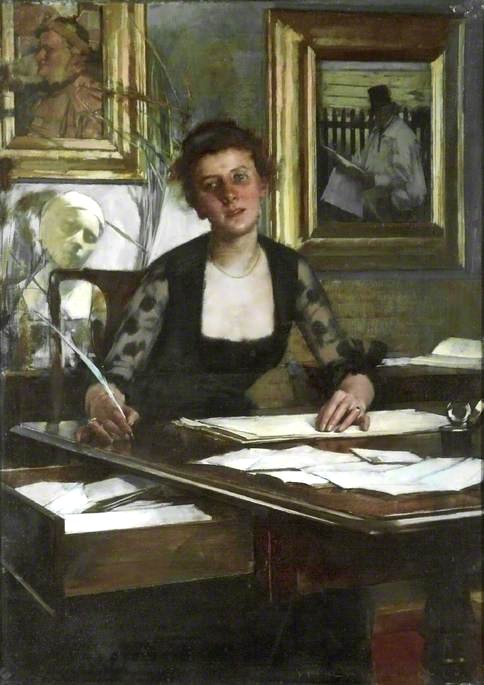
Portrait of the Artist's Wife by Henry Herbert La Thangue
Portrait of the Artist’s Wife by Henry Herbert La Thangue

In 1886, despite his misgivings surrounding the Royal Academy, he continued to exhibit works at the art establishment.  The Royal Academy was not the sole outlet for his works as the paintings were also exhibited Royal Society of British Artists and the Grosvenor Gallery, which had opened in 1877 by Sir Coutts Lindsay, and was a welcoming home for those painters, such as Edward Burne-Jones and Walter Crane, whose works the more conservative Royal Academy shunned.  His paintings could also be seen at the New Gallery which was founded in Regent Street in 1888 by Comyns Carr and Charles Edward Hallé who had once been co-directors of the Grosvenor Gallery but because of all the Grovesnor Gallery problems, had resigned and set up this new gallery.  The New Gallery was also a home for the works of the Pre-Raphaelite and  Aesthetic movement artists and artists such as Lawrence Tadema-Alma, William Holman Hunt, Lord Leighton and George Frederic Watts exhibited works at this establishment.  La Thangue also exhibited at the Royal Institute of Painters which he had joined in 1883.

The Return of the Reapers by Henry Herbert La Thangue (1886)

In the summer of 1886, La Thangue  moved home to the Norfolk countryside and the small fenland village of South Walsham.  During these years La Thangue produced head studies of farm hands and fisherfolk and it was whilst living here that he completed his landscape painting entitled Return of the Reapers.  This was a typical example of La Thangue’s rustic realism style.  La Thangue was probably influenced by the works of the French artists Jules Bastien-Lepage and Gustave Courbet and the en plein air works of the French Impressionists.

Study of a Boy with a Black Hat, before a Cornfield by Henry Herbert La Thangue

Five years later La Thangue left Norfolk and moved home south to the neighbouring county of Suffolk and the coastal village of Bosham just a few miles from the town of Chichester.  He carried on painting rural scenes, often large-scale works, with their realism connotations.

I

The Man with the Scythe by Henry Herbert La Thangue (1896)

n 1896 he completed a work The Man with the Scythe, which is now housed in the Tate Britain gallery in London.  This proved to be a controversial work.  At first glance one ponders as to the reasoning behind the title.  However, look closely and in the background you can make out a man carrying a scythe but this is not just a country scene with a man off to work in the fields whilst the mother tends her daughter.  This is a more solemn and symbolic piece,  as what we are witnessing is a mother horrified to discover that her young daughter has died,.  At the very instant of her tragic discovery a man arrives at the gate carrying a scythe, which is one of the traditional symbols of death, often referred to as the ‘grim reaper’.    This tragic and somewhat melodramatic depiction by La Thangue was a definite change in his subject matter and may have been influenced by the pair of paintings by Frank Holl in 1877 entitled Hush and Hushed (See My Daily Art Display Feb 9th 2012)

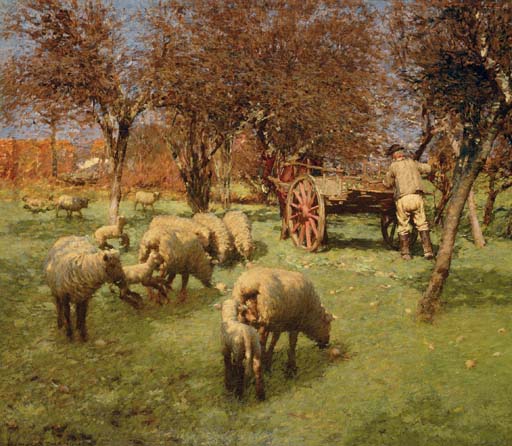
The March Month by Henry Herbert La Thangue

His English base from 1898 and into the early 1900’s was in the West Sussex village of Graffham.  His painting motifs still concentrated on rural life.  His works, depicting both arable and livestock farming, documented life in the fields from the harrow and the harvest, to  animal husbandry and fruit growing.  He was always searching for the perfect portrayal of the countryside and countryside practices during the different seasons.  In his painting entitled The March, completed around 1900,  he depicted the orchard near his house which was also used as nursery areas during lambing time.   We see the farmer scattering turnips from his cart which would feed the sheep and fatten up the lambs.  It could be that this depiction by La Thangue was influenced by the famous novelist and gentleman-farmer Rider Haggard, a contemporary of the artist, for in his 1899 book A Farmer’s Year  he talked about fattening lambs:

“….’The flock is being penned at night on the three-acre [field] with a view to improving the bottom of his young pasture which has grown somewhat thin. In the daytime they run out to one or other of the meadows, where root is thrown to them, and every night they are shut in a new fold on the three-acre and receive a ration of corn, hay and beet…”

Selling Chickens in Liguria by Henry Herbert La Thangue (1906)

At the turn of the century La Thangue became more and more interested with the work of the French Impressionist painters and their fascination with light and in 1901 he travelled to Provence.  From 1903 to 1911 he spent much of his time in the Italian region of Liguria building up a large collection of work. Despite La Thangue’s earlier outspoken criticism of the Royal Academy he became an Associate of the Royal Academy in 1898 and became a full Member in 1912.

Violets for Perfume by Henry Herbert La Thangue (ca. 1913)

His diploma work for the Royal Academy was one entitled Violets for Perfume.  The notable English artist, George Clausen (see My Daly Art Display May 30th & June 8th 2015) wrote about La Thangue’s work:

“…Sunlight was the thing that attracted him: this and some simple motive of rural occupation, enhanced by a picturesque surround…”

This work stemmed from his time in Provence and depicts a woman tipping a basket of freshly picked violets onto a muslin sheet in preparation for perfume making. All through his artistic career La Thangue developed his subject matter from labourers working in fields, vineyards and orchards. The depiction of the lady working in this work highlighted the back-to-basic work practice.  Gone was the mechanised practice of harvesting which La Thangue disliked and which he saw creeping into the rural life of England, destroying the old-fashioned rural practices which he had so loved to paint.

A Mountain Frontier by Henry Herbert La Thangue (1910)

In 1914, just prior to the beginning of the Great War, the Leicester Galleries in London  staged a one-man exhibition of La Thangue’s southern European landscape works,  which concentrated on his paintings completed whilst he was in Provence and Liguria.  One of the works exhibited was entitled A Mountain Frontier which La Thangue completed around 1910.  The exhibition was a great success and praised by the critics.  The artist William Sickert wrote about La Thangue’s skill as a painter in the May 1914 issue of the British literary magazine The New Age stating:

“…What renders La Thangue’s work particularly interesting is that while using the language of the day in painting, that is to say an opaque mosaic for recording objective sensations about visible nature, he is using it in a personal manner…”

Sickert went on to write that La Thangue, through his talent at developing relations of colour with a warm colour at the base,  was able to build on it a series a series of beautiful and interesting sensations of nature which is what he,  and not somebody else, had to say.

A Ligurian Bay by Henry Herbert La Thangue

In the 1920’s after the Great War had ended La Thangue returned to Liguria and the motif of his paintings changed from the arable land of the English countryside to the sunlit orange groves and gardens of Italy.  La Thangue spent those days in southern Europe painting en plein air directly on to large canvases.  This belief is based on the fact that very few smaller versions of his paintings or sketches exist.

Wreck of the S.S. Manuka December 16th 1929

Henry Herbert La Thangue died on December 21st 1929, just a few weeks before his seventy-first birthday.  Less than a week before his death La Thangue had been devastated and depressed when he was given the news that a vessel, the S.S. Manuka, during a voyage from Melbourne/Bluff/Dunedin was wrecked on Nugget Point near Long Point, South Otago.  Part of the cargo on the vessel was two of La Thangue’s paintings.  La Thangue was never to know, that five days after his death, the paintings were recovered and said to have been in “reasonable condition”.

 His wife Kate died in 1941.

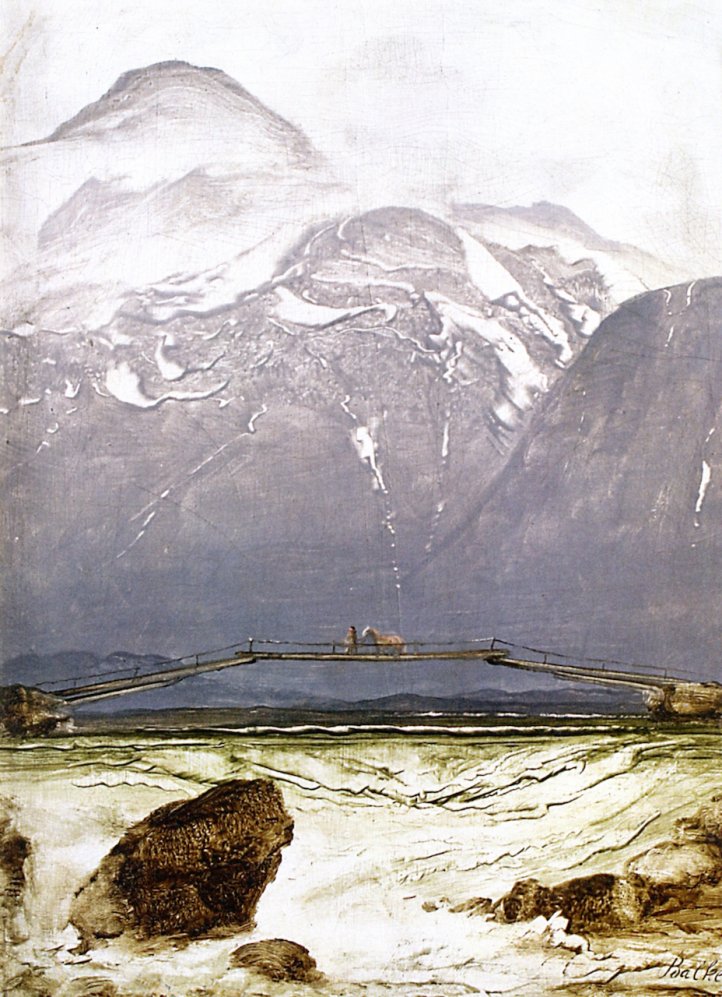
Peder Balke. Part 2 – The great Norwegian journey and disillusionment

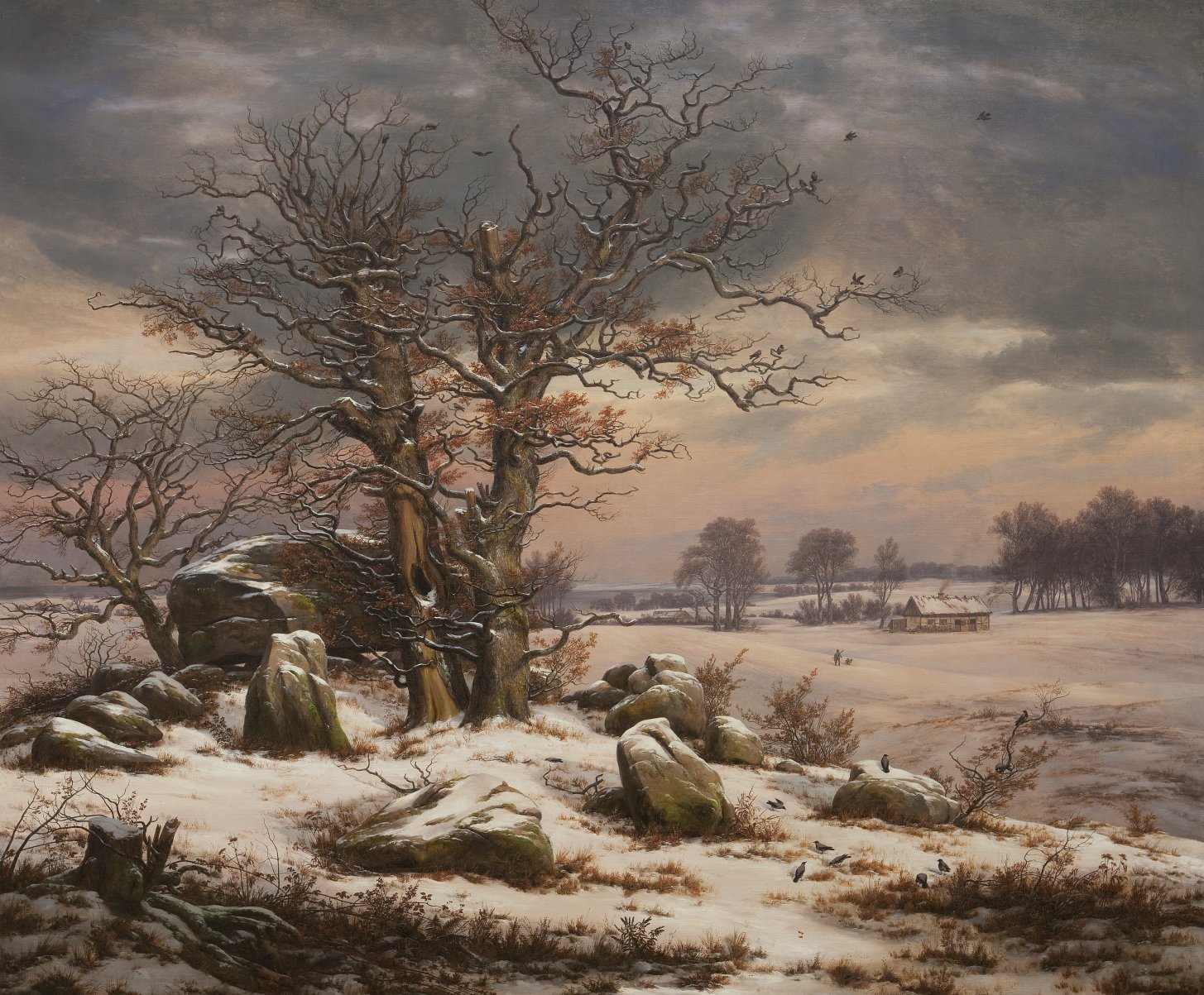
Winter Landscape. Near Vordingborg, by Johan Christian Dahl  (1827)
Winter Landscape. Near Vordingborg, by Johan Christian Dahl (1827)

Balke returned to Christiania in 1830 and stayed with Professor Rathke and in that May travelled to Copenhagen and was fortunate to be able to view royal collections of art.  Of all the works he saw, Balke was most impressed by a winter landscape painted by Johan Christian Dahl, entitled Winter Landscape. Near Vordingborg, which he completed in 1827.  The large (173 x 205cms) work of art depicts a somewhat oppressive atmosphere with its undertones of death, symbolised by the dolmen behind the lifeless branches of the two oak trees. A dolmen is a type of single-chamber megalithic tomb, usually consisting of two or more upright stones supporting a large flat horizontal capstone.  Nature is depicted in the form of its icy winter garb.  He wrote of the painting to Rathke saying that it was the most life-like painting he had ever seen.  The fact that he had managed to see the works of the great Masters at the royal collection, although influencing him, also depressed him somewhat as to his own ability.  He wrote:

“…I sometimes felt a certain heaviness of heart and lack of courage when I compared my own insignificance with these true masterpieces; quietly and I admit somewhat superficially I calculated how much I would have to learn and how many ordeals I would have to go through before I would be able to achieve a mere fraction of the perfection in aptitude and skill in execution exuded by these paintings…”

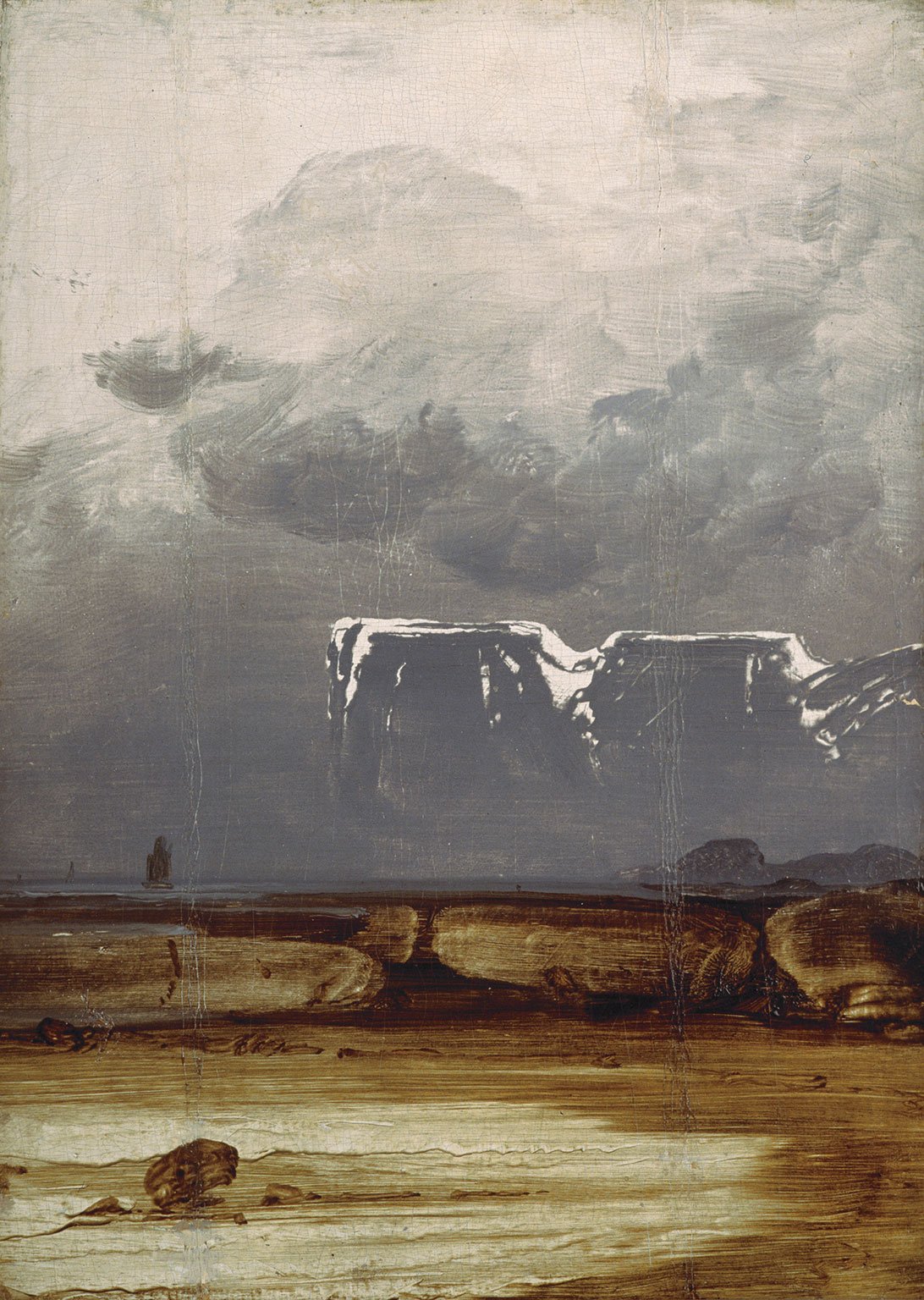
North Cape by Peder Balke (1945)

Balke was determined to succeed and in the summer of 1830 having returned to Norway from Copenhagen he set off on foot on an artistic journey through the Telemark region and over the mountains to western Norway and then north to Bergen returning to Christiania via the Naeroydalen valley and the town of Gudvangen.  He later recalled his short time spent in the area around Gudvangen, writing:

“.. I first arrived late at night, because I became so engrossed in admiring the sublime beauty of Naeroydalen that I hardly knew whether what surrounded me was real or supernatural.  So fascinating and uplifting did my youthful imagination, with its passion for the beauties of nature….”

From North Cape by Peder Balke (c.1860's)
From North Cape by Peder Balke (c.1860’s)

Two years later, in April 1832, Balke set off another artistic journey.  This time, setting off in his own carriage he went to Trondheim where he was to catch a boat to the north of the country.  His planned journey hit a snag when he arrived late in Trondheim and missed the boat.  He had to wait a further seven weeks for the next boat but spent the time sketching the town and the surrounding areas.  Peder Balke finally embarked on his northbound boat trip, passing the Lofoten Islands and arrived at Tromso.  From there the boat went further north to Hammerfest and then proceeded around the North Cape to Vardø and Vadsø.  He was the first Norwegian painter to record the harsh beauty of the northern landscape.  Eventually Balke and the boat returned to Trondheim.  During the long journey Balke had completed a large collection of sketches of the places he had seen and many were used in his many seascape and moonscape works of art which he worked on when he returned to Stockholm.  He sold many of his paintings to wealthy Norwegians and Swedes as well as members of the royal family.  In 1834, now, financially secure, Peder married Karen Eriksdatter, the woman he had been secretly engaged to for several years, but had been too poor to marry.

The Severn Sisters by Peder Balke (1847)

The couple settled in Christiania and Balke, now accepted, not simply as a decorator but as a landscape artist, tried to establish himself and sell his artworks.  However competition at the time was too great and the sales he had hoped for never materialised.  However, in 1835, he managed to sell another of his works to the king and with that money he decided on fulfilling his dream of travelling to Dresden and work with the Norwegian artist, J C Dahl.   Many Norwegian artists had trodden this path, including Thomas Fearnley (see My Daily Art Display November 24th & 28th 2012).  With help from a friend, Balke set off for Germany and reached Berlin in the winter of that year.  He remained in Berlin for several weeks and was able to visit the Royal Museum and whilst in the German city he saw paintings by the German romantic landscape painter, Casper David Friedrich.  It was this artist who was going to have a great and lasting influence on Balke.

Ship in Breaking Waves by Peder Balke (c.1849)

Balke left Berlin and travelled to Dresden via Leipzig.  He received a great welcome from Johan Dahl who helped him find accommodation.  J C Dahl introduced Balke to Casper David Friedrich and Balke was able to watch the two great artists at work.  In a letter to Rathke, dated March 29th 1836, he wrote about watching J C Dahl at work:

“..to see Dahl paint, I know with which colours and have seen how he uses them, and though I at present cannot proceed successfully in the same manner I hope that with time I will also reap the benefit.  What I regret most is my lack of studies from nature.  Dahl certainly has several thousands of them, of all kinds.  He has told me there is no other way to become a real painter than by painting from nature, which admittedly has been my intention, and I shall now try to see whether I can make up for what I have hitherto neglected, in Norway, though not in Germany – there is no nature here…”

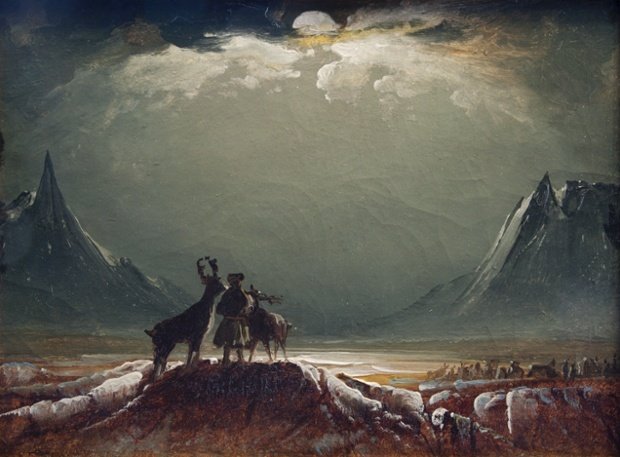
Sami with Reindeer Under the Midnight Sun by Peder Balke, (c.1850)

Balke left Dresden but returned in the 1840’s to work once again with J C Dahl.  Landscape art was popular in Norway and Balke managed to sell many of his works but things were to change when a number of young Norwegian landscape artists having returned from studying at the Dusseldorf Academy, which at the time was looked upon as the most modern art-educational institute.  The teaching of landscape art was more to do with what was termed “cautious Realism” rather than Balke’s Romantic landscapes which suddenly became less fashionable.  He had to endure much criticism with regards his work which had once been loved by his people.  In an article in a 1944 edition of Morgenbladet, the eminent art critic Emil Tidemand scathingly wrote about Balke’s paintings:

“… There is no question here of a grandiose, poetic perception: no not even the simplest technical demands of drawing, perspective, clarity, strength and depth of colour have been met……………….This is not a representation of nature – his whole production is merely the mark of a dirty palette handled without discrimination…”

Old Trees by Peder Balke (c.1849)

Maybe it was the vitriolic criticism which made Balke realise that there would be no hope of becoming financially secure through his art sales in Norway and so in 1844 he, along with his pregnant wife and three young children, left their homeland and travelled to Paris via Copenhagen and Germany  There was also another reason to visit Paris and this was that Balke was well aware that the country’s ruler Louis-Philippe had, as a young prince in exile in 1795, travelled along the Norwegian coast from Trondheim to the North Cape just as he had done.  As Balke did not speak French he asked a friend to write a letter on his behalf to the king in which he reminded the king of his exile and his Norwegian journey and that his nine sketches of the area would remind the king of that journey.  Louis-Philippe was intrigued and summoned Balke to the palace.  Balke and the king immediately became close and the two would meet regularly and reminisce about their travels to the North Cape

A View of the Sarpsfoss Waterfalls, Norway by Peder Balke (c.1859)

Louis-Philippe commissioned a set of paintings derived from the sketches.  Balke’s financial future seemed to have been rescued and he set to work on the commission.  Alas fate was to take a hand in the form of the February Revolution of 1848 which saw the downfall of Louis-Philippe.  Balke realising the dangers of being close to the unpopular ruler decided in late 1847 that he and his family would have to hurriedly leave Paris which meant he had to abandon, what was to have been a very lucrative commission.  Balke moved back to Dresden.  Shortly after his arrival in the German city in 1848 his young son Johann died.  His death came around the same time that his wife gave birth to their daughter Frederikke.  Sales of his art in Dresden were hard to come by and so he decided to leave his family with a friend and head back to Christiania.  He managed to sell some of his work, one of which was The North Cape by Moonlight but still the Norwegian people favoured the Dusseldorf School of landscape painting and so Balke returned to his family in Dresden.  In the Spring of 1849 he and his family moved to London where Balke believed his art would be more appreciated.  London had fallen under the spell of Joseph Mallord William Turner and his marine paintings and so Balke believed his works of art would do well.  He was proved right and managed to sell more of his works of art.

Balkeby  1860-70
Balkeby
1860-70

In the autumn of 1850 Balke and his family moved back to Christiania.  In 1855 his good friend and benefactor Professor Rathke died and left Balke a sizeable amount of money which Balke used to buy eight acres of land just outside the city limits at a place known as Vestre Aker.  He virtually abandoned his career as an artist of large scale landscape works, concentrating on small scale paintings which he believed would be bought by the middle class.  He now concentrated on his property portfolio and in particular the development of housing for workers in his newly attained property in the suburb of Balkeby, He dabbled in local politics championing the cause of pensions for men and women, and also of grants for artists. His painting was now just a hobby and for his own pleasure.

The Old Bridge by Peder Balke (c.1869)

Balke, as you may realise, was an unlucky man and more bad luck came in June 1879 when his beloved Balkeby went up in flames.  Nearly every house, including his own, was burnt to the ground.  Four years later Balke suffered a stroke, and he died in Christiania on February 15th 1887 aged 82.  The obituaries that followed after his death were all about his political work and little was said about Balke the artist.  Maybe his penchant for ignoring criticism and sticking to what he believed in was apparent in the obituary which appeared in the magazine Verdens Gang in March 1887.  It emphasised Balke’s pugnacity:

“…Fearless and straightforward as he was, it would never occur to him to defer to people in an argument.  He considered only the matter in hand and did not bother in the least about who was for or against him.  This does not always result in popularity…”

I can recommend an excellent book about the artist and his work entitled Paintings by Peder Balke, from which I derived most of my information about this Norwegian painter.

Peder Balke. Part 1 – His early life and struggles to become a painter

Peder Balke (1804-1887)
Peder Balke
(1804-1887)

I suppose if you are a landscape or seascape artist it is ideal to be living amongst glorious scenery or rugged coastlines which inspire you to paint and is much better than having to move to an artist colony in some idyllic area to find inspiration.   The artist I am featuring today was fortunate enough to come from a country of amazing natural beauty which he often depicted in his works of art.  Today let me introduce you to the nineteenth century Norwegian painter, Peder Balke, who specialised in landscape and seascape paintings with a romantic and dramatic connotation.

Peder Balke was the younger son of Anders Thoresen and Pernille Pedersdatter and born August 28th 1804.  He was christened Peder Andersen on November 4th.  Information about his early years was given by Balke in a dictated version of his life story, seventy years later.  He reminisced:

“… I was born on the island of Helgøya, in Nes in the country of Hedmark on 4 November 1804 in poverty, my situation in life being therefore less than enviable.  Yet the nearly influence of an affectionate and conscientious mother with constant good advice and exemplary admonitions was of the greatest benefit to my youthful and perhaps exceptionally lively temperament – for it is in these years of one’s development that the seeds are sown of both good and evil, though only later in life does one value their significance correctly…”

Christiania Viewed from Ekeberg by Peder Balke (c.1829)

He did not have an easy start to life his family being part of the lowest ranks of the peasant society.  His parents were simple farm labourers working on a farm called Svennerud on the island of Helgøya, which lies in the middle of Lake Mjøsa, , some 60 kilometres north of Christiania (now Oslo)  and is Norway’s largest and one of the deepest lakes in the country.  The family owned nothing.  They had no lands to grow their own crops.  They were simply impoverished land-less servants of the farmer.   The family predicament was one his father could not tolerate and when Peder was young, he abandoned the family and is never mentioned in his son’s dictated autobiography.  In 1812, when Peder was eight years old, because Norway and Denmark were in an alliance with France, their ports were blockaded by the British, as part of Britain’s war against Napoleon.  This prevented much needed corn from entering the country and this, along with a severe and early frost of 1812 which destroyed the Norwegian corn harvest, meant that for the next two years the country suffered a terrible famine.  This severe time was remembered well by Balke who wrote:

“….wretched times, when war and years of hardship oppressed people and it goes without saying that this suffering and national scourge affected the poor most severely.  My mother, who had to look after herself and two children- for I had a brother who was seven years older than me ……like so many others we had therefore to resort to substitutes which are less easy for humans to digest, and I and my brother went into the forest to remove bark from the trees, which was dried and ground and Mother baked bread with it.  It goes without saying that food of this kind resulted in disease such as dysentery etc…”

The Mountain Range 'Trolltindene' by Peder Balke (c.1845)
The Mountain Range ‘Trolltindene’ by Peder Balke (c.1845)

Being from such a peasant class there was no possibility of schooling for Balke but his mother taught him to read and write.  When he was old enough he would try to earn some money for the family by helping out on the neighbourhood farms, but pay was poor, and he would also go fishing to bring food to the table.

It was thought Peder’s maternal grandfather was an painter/decorator and that was the first influence on him.  Another relative, Anders Skraedderstuen, who had a nearby smallholding was also a painter and took on seventeen year old Peder as an apprentice for two years.  Peder was employed to paint but also learn the skills involved in fine interior decorations.  There was always work for him as the farm owners were becoming richer and building themselves large homes which they needed decorating.  Peder travelled extensively from farm to farm to carry out commissions.  One such farm was the Vestre Balke farm at Toten which was owned by Anders Balke.  The Balke family took to Peder and soon he was not just looked upon as a workman but as a son.  This close tie pleased Peder and it was at this time that he changed his surname to Balke.  Although now living with his “new family” he always remembered to go back and visit his mother and help her out financially.

Landscape with Mill and Rapids by Peder Balke (1840)

In winter there were no commissions to be had so it was then that Balke travelled to Christiania to buy paints, stencils and the latest in ornaments ready for the following summer.  At this time there was no place in the capital where Balke could study art but he did manage to find rooms in a house owned by Ole Nielsen in Gudbrandsdalen.  Nielsen was a talented painter and over a period of seven months he taught Balke the fundamentals of drawing and painting.  Balke recalled the time later in his autobiographical notes:

“…From this kind man I received many tips hitherto unknown to me that had an appreciable effect on my later evolution in the profession of painter…”

Moonlight on the Coast at Steigen by Peder Balke (1842)

Life and business were good for Peder Balke, so much so, he employed several apprentices but as in life itself there were always ups and downs and the “down” at this time was the threat of military service.  Balke did not want anything to do with this and tried all sorts of ploys to get himself out of fighting for his country.  His eventual get-out was by becoming a qualified craftsman and seeking citizenship in Christiania.  So, in 1826, aged twenty-two, Balke left Toten and moved to the capital and was accepted as a journeyman by the Lubeck-born painter and engraver, Heinrich August Grosch and studied to become a master painter of the town, thus acquiring citizenship and best of all, be exempt from military service providing he completed his two year course to the satisfaction of Grosch.   Balke tired of working for Grosch switched to working for Jens Funch.  In 1827, with the money he had saved, he enrolled in an elementary drawing class at the Royal School of Drawing and received tuition at the Kongelige Tegneskole from the former military officer and painter Captain Jacob Munch, who was pleased with Balke’s progress.  With his savings almost gone, Balke returned to Toten and asked his benefactor Anders Balke for some financial help.  Anders and two other farm owners decide to financially back Balke, in the form of a letter of guarantee for a sum of money which Balke needed to continue his studies and in return he promised to decorate their farm buildings.

Winter Landscape. Near Vordingborg, by Johan Christian Dahl  (1827)
Winter Landscape. Near Vordingborg, by Johan Christian Dahl (1827)

Balke returned to Christiania and with the letter of guarantee met with Professor Jens Rathke a renowned natural scientist and professor at the university who was well known for his generosity.  He agreed to take the letter of guarantee and lend Balke the funds he needed.   Balke was to late recall that he was never asked to repay the sum he had borrowed and commented on Rathke’s invaluable support:

“… For that as well as for all the other kindnesses that man bestowed on me I have always been and always will be grateful to him…”

Jens Rathke also persuaded Balke to take a trip around large parts of central Norway in order to study nature.  Balke first toured the Telemark area in the south east of the country an area which he later recalled had awakened his profound interest in Norway’s wonderful natural life, and the astonishing beauty it reveals in all directions.  Later he explored central Norway and the Gudbransdalen Valley.  He continually recorded his travels with a large number of sketches which he would later combine in his paintings.

Seascape by Peder Balke (c.1860)

In 1829, military service still loomed large as Balke had not managed to qualify as a painter-decorator within the prescribed two year period.  His only course of action to avoid military service was to try and enrol at an academy and study landscape painting.  Rathke advised Balke to apply to the Stockholm Academy and agreed to finance Balke’s application.  Balke studied for a short time under the Swedish landscape painter, Carl Johan Fahlcrantz.  Whilst in Stockholm Balke visited the summer residence of the country’s ruler Karl Johnan in Djurgärden where he viewed the king’s art collection and was much enamoured by a painting by the German landscape painter, Johan Christian Ezdorf.  Ezdorf, who was also a student of Fahlcrantz, had a great love for the Nordic scenery and often depicted it in his works of art.

Balke was enjoying life in Stockholm and in his memoirs he wrote:

“…I used the time to pay frequent visits to the city’s art academy and art galleries, as well as a number of private collections of paintings where I was made welcome, and I also executed some small paintings which I had the satisfaction of selling…”

In my next blog I will continue to look at the life and works of Peder Balke and examine the reasons why he gave up being a professional artist in favour of politics.

I can recommend an excellent book about the artist and his work entitled Paintings by Peder Balke, from which I derived most of my information about this Norwegian painter.


Fred Elwell. Part 3 – Landscapes and Mrs Elwell

Fred Elwell by Dame Laura Knight

As far as art was concerned, Fred Elwell was a master of many art genres.  In my last blog I looked at his superb portraiture and in this blog I want to feature some of his landscape paintings as well as introducing you to his wife, another landscape painter.

In telling his life story I had reached the year 1896.  Fred Elwell had returned from Paris and had tried to forge himself a successful career in London but it had not worked out for the twenty-six year old artist and in this year he had been rescued by his father who brought him back to the family home in the East Yorkshire town of Beverley.  Although Elwell had left England and studied in Antwerp and Paris he had always made many trips back home to Beverley.  He had returned for good to the beauty of Yorkshire, not as a student painter but now as an accomplished artist and he was pleased to test himself and his artistic skills by setting out to paint the magnificent local landscape and some of the fine local buildings.

Beverley Minster from the Hall Garth by Fred Elwell (1900)

One such painting, which he completed in 1900, was of Beverley Minster and was entitled Beverley Minster from the Hall Garth.

His year in London and his struggle to survive had taken a toll on him so the first thing the family had wanted him to do was to relax and enjoy the tranquillity of the Yorkshire countryside.  Elwell also enjoyed the freedom offered by sailing and he would often take a small boat and cruise along Beverley Beck which joined the River Hull.  Many like-minded painters would do the same as the clarity of light and the beautiful countryside including the East Riding flatlands surrounding the river was an idyllic setting for landscape artists.  On occasion he would tie up the boat alongside a jetty and would welcome visitors to look at his artwork and, by so doing, would often receive commissions.  Elwell’s love of landscape painting coincided with the English public’s change of attitude of what they wanted to see in a work of art.  Depictions of city life were becoming less popular, displaced by depictions of the tranquillity of the countryside.  This was a period when people wanted to “go back to nature”.  They worked in cities but hankered for the fresh air of the countryside.  They wanted to soak up country life by sailing along inland waterways or get themselves horse-drawn caravans and lose themselves in the peacefulness and serenity of the rural areas.

In 1899, Elwell set himself up in a studio in Wood Lane in the centre of Beverley.  It had once been home to the local theatre and later a meeting house for the local Quakers and it was in that year that Elwell launched his first solo exhibition.  It was a great success for here was the local boy making good.  Locals flocked to see their “own son” and what he had achieved.

One day in 1904 Fred Elwell had a visitor to his studio. The visitor introduced himself as George Alfred Holmes.  Holmes, an oil broker, was a well respected member of the Beverley community.  He asked Elwell whether he could paint a portrait of his wife, Mary.  Mary Dawson Bishop, the daughter of a wealthy shipping merchant, was born in Liverpool in 1874.  Her father died when she was very young and the family moved to Manchester.    Her late father’s wealth ensured that Mary received the best education that money could buy and she was educated at Ellerslie College, which was described as a ‘fairly exclusive school’, and the college would undoubtedly have provided instruction in painting and drawing.  In 1896 she married George Holmes.

A pen and ink sketch of a canoe-yawl by George Holmes

Elwell agreed and made many visits to the home of George and Mary Holmes and soon the three became good friends.  Holmes and Elwell had one thing in common, they both loved boats.  Holmes was a founder member of the local Humber Yawl Club and Fred Elwell owned his own boat.  It was a small twenty-two foot sailing houseboat which had the strange name of Callathumpian.  This too was a canoe-yawl but had been adapted with a large deckhouse.  George and Mary would often visit Fred on his boat and go for days out sailing the boat along the many tributaries and canals.

Mary Dawson Holmes by Fred Elwell (1904)

Elwell completed the Portrait of Mary Dawson Holmes in 1904 and had it exhibited at the Royal Academy that year.  It is an exquisite work of portraiture with the sitter depicted as a lady of gracious sophistication.  Her clothes are reminiscent of the French fashion of the time.   She wears a tight-fitting dress finished off with a fine white lace collar.  Her head is tilted slightly to one side.  She holds an upright stance.  She has dark almond-shaped eyes.  Look at her expression.  It gives little away.  What do you make of it?  Is there an unwillingness, a reticence to pose or is this reserve due to her modesty or shyness?

Detail from Les Parapluies by Renoir (1880-6)

The way she stands and the fact that she is holding a basket is the reason why many people have compared the painting with one of Renoir’s ladies depicted in his painting of 1886, Les Parapluies, which Elwell may have seen.

Mary and Fred Elwell also some had a common interest – art, for she was a talented painter and he encouraged her to submit some of her work to the Royal Academy for inclusion at their annual exhibition.  She had two works accepted and Fred also had his portrait of her included at the same exhibition.   It is believed that Fred, George and his wife Mary would often travel to Europe, visiting Venice and Switzerland where Fred Elwell and Mary Holmes would take the opportunity to sketch and paint the local landscapes.

In 1910 George and Mary bought their dream home in Beverley.  It was known as Bar House.  It was a house that afforded the occupants beautiful views of the surrounding areas.  It even had its own tower from where one could watch the local racehorses training on the Gallop around Westwood, close to Beverley racecourse.  Sadly the joy of moving to their beautiful home was tinged with sadness as shortly after taking up residence her husband George became ill, so much so, he had to retire from his Hull shipping business.  As his health deteriorated he had to give up his beloved sailing.  Mary and Fred’s became more distressed with George’s health as he became more and more incapacitated.   His illness eventually was diagnosed as being terminal.  Knowing he was dying George spoke privately to Fred and asked him to look after his wife once he had died.  George Holmes died in August 1913, aged just 58.

Fred Elwell and Mary Dawson Holmes married on October 1st 1914, two months after the start of World War I.

 ……………………… to be continued

  Fred Elwell was a multi-talented painter and in this blog I want to feature some of his landscape works and those of his wife, Mary.

Upper Reaches of the River Hull by Fred Elwell (c.1905)

One of his early landscape works was Upper Reaches of the River Hull which he painted in 1905.   The work now hangs in the Beverley Art Gallery.  Its original owner was John Brown of Beverley who was a local tailor and provided suits for Elwell and could well have taken the painting in part payment for tailored clothing.  It is a beautiful work of art and features Elwell’s favourite area, the flatlands on either side of the River Hull, which he would have seen so many times from his boat.  Harvest is over and the stooks of corn sit up proudly in the newly harvested cornfield.

Corsican Landscape by Fred Elwell (1927)

The next painting was completed by Fred in 1927 and entitled, Corsican Landscape.   This landscape work, which has a distinct feel of Impressionism, depicts a farm in the centre ground along with grazing cattle and a few figures, all of which are surrounded by a mountain range which, on the left hand side, have been partially lost in shadow.  I particularly like the colours Elwell has given to his tall trees ranging from green and golds to the black-shaded ones which have lost the light of the sun.

Corte Corsica by Mary Dawson Elwell

Mary Elwell completed a painting, around the same time depicting and probably during the same holiday, of the Corsican landscape, entitled Corte, Corsica.   It is a depiction of the hillside town of Corte, in northern Corsica.  Again, like Elwell’s Corsican landscape, the town is in the centre ground, surrounded by mountains.  The buildings are painted white and yellow with red terracotta roofs.  In the foreground we see a river cascading down a shallow waterfall.  The contrast between the blue of the water and the whiteness of the boulders it flows over adds to the beauty of the work.

Zermatt by Fred Elwell (c.1938)

Another foreign landscape work by Fred Elwell was completed in 1937, entitled Zermatt.  The oil on wood panel painting is a typical Swiss-style landscape dominated by the church and its tower on the right, with the clock showing seven o’clock.  On the left we can see some chalets which disappear down the hillside.  In the background we have mountains, some in full sunlight others in full shade.  Fred and Mary Elwell loved this Swiss Alpine region and spent many happy journeys between 1937 and 1939 in the surrounding region completing a number of works in the region of Zermatt and the Matterhorn. On the outbreak of World War II they had to make a hasty retreat back to England.

Pigs in Barn by Fred Elwell (1937)

One amusing anecdote accompanies this work.  Elwell did not sell it to a dealer or art lover for a vast sum of money.  He sold it to a neighbouring pig farmer, a Mr Symmons and all Elwell wanted in return was a number of photographs of the Symmons’ pigs !!  These he used in another work he completed that year, entitled Pigs in Barn.

Brick Bridge, Swinemoor by Fred Elwell (c.1943)

The next work by Fred Elwell probably brought back fond memories of his childhood.  It is entitled Brick Bridge and features a brick-built bridge which straddles the Barmston Drain.  In Fred Elwell’s days this was a favourite place for Beverley folks to come and enjoy a swim on a hot summer’s day.  The picture was painted in 1943 during the Second World War and was the only place the people from Beverley could go for a swim as troops had commandeered the local swimming pool.  Again there is a hint of Elwell’s use of Impressionistic techniques with dabs of various colour representing reflections on rippled water and also the blurring effect of some of the features as if we are looking at the scene through the hazy atmosphere of a summer afternoon.

Bathers at Asnières by Georges Seurat (1884)

The painting by Elwell could well have been influenced by the work of the French artist, Georges Seurat, Bathers at Asnières which like Elwell’s work has people relaxing on the riverbank as well as in the water and in the background is the horizontal structure of a bridge crossing the water which in both paintings creates a horizontal axis. In the case of Elwell’s work the bridge almost hides the horizon from our view whereas in Seurat’s work our eyes leave the bathers in the foreground and follow the river towards the bridge and the industry on the far side of it.

In my next blog I will be complete the life story of  Fred Elwell and take a look at some of his genre paintings.

Once again let me recommend an excellent book on the life and works of Fred Elwell.  Most of the information for this blog was gleaned from this book which I bought in Harrogate.  It is entitled Fred Elwell RA – A Life in Art by Wendy Loncaster & Malcolm Shields.

Alexsei Savrasov – the lyrical landscape artist

Portrait of Alexei Savrasov by Vasily Perov (1878)

My last two blogs featured the life and works of the great nineteenth century landscape painter, Isaac Levitan.  Whilst I was researching his early life as a student at the Moscow School of Painting, Sculpture and Architecture I came across the name of Alexei Kondratyevich Savrasov who was one of Levitan’s tutors.  Having a rest from writing about Levitan, I had a look at some of the works of Savrasov, who had influenced Levitan and amongst them I came across the most exquisite painting and the one Savrasov was probably most famous for; but more about that later.

Alexei Savrasov was born on 12 May 1830 into the family of a Moscow merchant.  As a young boy he developed the love of drawing and by the age of twelve he was experimenting with painting gouache and watercolour landscapes and during his early years he managed to exchange his paintings with vendors for chicken feed.  He persuaded his father to let him study art and at the young of eight he attended the painting school.

In 1844, when Savrasov was fourteen years of age, and plans for his future career had to be discussed with the family.  His father was adamant that his son should follow him and become a merchant and thus end all the time his son spent painting which his father regarded as just a hobby.    However for Alexei, his heart was set on becoming an artist.  Alexei eventually had his way and enrolled at the Moscow School of Painting, Sculpture and Architecture and in 1848 he was fortunate to join the special studio of perspective and landscape painting which was run by Karl Rabus, who was the Professor of Landscape painting.  Alexei loved the genre of landscape painting and began to specialise in it. Soon he was widely acknowledged by the tutors as the best student of landscape painting in the School.    During the last years at the painting school, Savrasov, received a bursary from a well-known Moscow art patron and member of the Moscow Art Society, Likhachev, which enabled him to go on a painting and sketching trip to Odessa, where he captured the beauty of the local landscape.

View of the Kremlin from the Krymsky Bridge in Inclement Weather by Alexei Savrasov (1851)

In 1850 Savrasov graduated from the Moscow School of Painting receiving the official title of “unclassed artist”.  One of the first paintings Savrasov completed after leaving the art school was entitled View of the Kremlin from Krymski Bridge during Inclement Weather.  The storm clouds rush from the right to the left of the painting pushed relentlessly by the strong winds which have caused the branches of the trees to bend towards the river.  The sun has pierced the clouds and illuminated the Kremlin in the background of the painting.  In the foreground of the painting we see that the sun has lit up a small patch of land where the water from the Moskva River laps the sandy ground.  A woman, pail in hand, rushes past.  Her hand clutches her coat to hold it closed while  the wind whips at her skirt which is billowing in the gale.

View in the Neighbourhood of Oranienbaum by Alexei Savrasov (1854)

Savrasov travelled to the Ukraine in 1852 and steadily built up a portfolio of sketches and paintings and with them he started to develop a reputation as an up and coming artist.  Two years later, in 1854, he received a painting commission for several works of art for the Russian Art Academy from the Grand Duchess Maria Nikolayevna,   She was one of the daughters of Emperor Nicholas I of Russia.    She was an avid and well-known art collector and President of the Russian Academy of Arts in St Petersburg.  To carry out his commission, Savrasov moved from Moscow to the Gulf of Finland, close to St Petersburg.  Two of the paintings he produced, View in the Neighborhood of Oranienbaum and Seashore in the Neighborhood of Oranienbaum, are now looked upon as excellent examples of the genre known as romantic landscapes   These works of art by Savrasov allowed him to depict, with great fondness, the charm and appeal of a summer evening at the sea, with the moistness associated with the sea air in the shade of ancient rocks, whilst envisioning the twilight which we observe under the spread­ing branches of trees.  The works Savrasov produced during this period, and these two works in particular, earned him the title of Fellow of the Russian Art Academy.

Alexi Savrasov had studied at the Moscow School of Painting, Sculpture and Architecture for ten years from 1844 to 1854, some of the time under the tutorship of Karl Rabus.  When Rabus died in 1857 Savrasov was asked to take over Rabus’ landscape class which he did and remained in post until 1882.  During his tenure he took many students under his wing, including the subject of my last blog, Isaac Levitan.  Savrasov was an excellent teacher and much loved and admired by his students.  In 1857 Savrasov married Sophia Hertz, the sister of art historian and archaeologist, K. Hertz; the couple went on to have several children. In their home they entertained artists and collectors including the famous art collector and patron of the arts, Pavel Tretyakov, who gave his name to the Moscow Art Gallery.

After leaving the Moscow School of Art in 1862, Savrasov took up the suggestion made to him by the Art Amateurs’ Society and left Russia on a painting expedition of Europe.   He travelled to that year’s World Fair in London, where he exhibited his painting View of the Surroundings Oranienbaum, and was amazed by what he saw and was unstinting in his praise, writing:

“…no academies in the world could so advance an artist as the present world exhibition…”

View of the Swiss Alps from Interlaken by Alexsei Savrasov (1862)

On the way back home he visited Paris, Switzerland, Copenhagen, Berlin, Dresden, Leipzig.  During his European travels the two landscape painter whom he admired the most were the English artist, John Constable and the Swiss landscape painter Alexandre Calame.   One of the paintings he completed in 1862 originated from his travels through Switzerland.  It was entitled View of the Swiss Alps from Interlaken and was completed in 1862.

Rafts by Alexei Savrasov (1868)

I particularly like his painting entitled Rafts which he painted in 1868.

Elk Island in Sokolniki by Alexi Savrasov (1869)

However the painting of his which drew the most acclaim in this period was a beautiful landscape work entitled Elk Island in Sokolniki, which he finished in 1869 and for which he was awarded the first prize at a painting competition organised by the Moscow Art Amateurs’ Society.  Elk Island straddles the boundary between the centre of Moscow and its suburbs to the north of the city.  It is home to a remarkable variety of animal and plant life.  The area was believed to have been a favourite place for Ivan the Terrible to enjoy falconry and bear-hunting. The area was given the name Elk Island in the early 17th century, when documents say that the place was used for hunting “all manner of game birds, and especially elk”.

Caves Monastery near Nizhny Novgorod by Aklexei Savrasov  (1871)
Caves Monastery near Nizhny Novgorod by Aklexei Savrasov (1871)

In December 1870 Savrasov, his wife and family went to live in Yaroslavl which lies on the Volga, three hundred kilometres north of Moscow.   Whilst there he produced the beautiful work of art entitled  Caves Monastery near Nizhny Novgorod, which is now housed in the Gorky State Art Museum in Nizhny Novgorod.  It was one of the largest canvases Savrasov ever painted.    The left hand side of this wide panoramic view is taken up by the confluence of the Oka and Volga Rivers with the blue lagoons whilst the right hand side of the painting depicts the Pechersky Voznesensky monastery.  The original monastery is believed to have been founded around 1330 by St. Dionysius, who, along with several followers, arrived in Nizhny Novgorod from Kiev Pechersk Lavra also known as the Kiev Monastery of the Caves, (pechery meaning ‘caves), hence the title of the painting.  On arrival at Nizhny Novgorod they dug a cave on the shoreline of the Volga and later it became the site of a monastery and church.  The original monastery was destroyed by a landslide in 1597; but in the same year a new monastery was built a short distance upstream.

Detail from Caves Monastery near Nizhny Novgorod

In the right foreground, we see suburban homes with their small gardens awash with greenery which contrasts with the towering white stonework of the monastery.

The Rooks have Come Back by Alexei Savrasov (1871)

The last work of Savrasov, which I am showcasing, is the one I talked about at the start of this blog.  Its beauty and simplicity immediately struck me and I was reminded of one of my favourite artists Pieter Breugel the Elder who had a propensity of including rooks or magpies in his winter scenes, such as his 1565 painting The Hunters in the Snow.  This painting by Savrasov entitled The Rooks have Come Back was completed in 1871 at the height of his artistic career.

Members of the Peredvizhniki group (Savrasov,with beard, standing, third from left)

A year earlier he had became a member of the Peredvizhniki group, often known as  The Wanderers or The Itinerants who were a group of Russian Realist artists, who like many artists throughout Europe railed against the Academic restrictions and decided to go off on their own and set up artists’ cooperative.   The Wanderers eventually evolved into the Society for Travelling Art Exhibitions.  It is a simple painting with an equally simple theme – the birds returning home in Spring.  It was a transitional depiction.  A transition of nature from winter to spring heralded by the return of the rooks. This landscape work with all its simplicity was termed a lyrical landscape painting later to be termed a mood landscape painting and Savrasov was one of the founding exponents of this type of landscape art.  His pupil Isaac Levitan would continue with this style.  Of this painting the artist, art critic and leader of the Russian Democratic Art movement, Ivan Kramskoi,  wrote:

“…The Rooks Have Come Back was the best he’d ever seen; and despite the fact that there were similar landscapes painted by other renowned Russian artists, only “The Rooks” mirrored the artist’s soul.

Savrasov’s former pupil and fellow landscape painter Isaac Levitan declared the painting:

“…to be “very simple, but beneath the simplicity there is the tender artist’s soul, who loves nature and values it…”

Although the year 1871 and this painting marked the height of Savrasov’s fame it also marked the beginning of the end of the great man for in  February 1871 Savrasov’s life took a tragic turn with the sudden death of his baby daughter.  This was the third child he and his wife had lost.  Maybe it was “the straw which broke the camel’s back” as Savrasov never recovered from this loss and descended into deep depression and despite friends who tried to help him he took to alcohol to ease the pain..  His work suffered and by 1882 he could no longer hold down the post of professor at the Moscow Art School and was sacked.   His wife eventually left him and took their children with her,  His bad manners and unpleasant demeanour caused friends and family to eventually desert him and his alcoholism and lack of sales of his work culminated  in the 1880’s with him living the life of a pauper.  In 1890 Savrasov went to live with Evdokiya Morgunova, and the couple had two children.

Savrasov's grave in Vagankovo Cemetery, Moscow
Savrasov’s grave in Vagankovo Cemetery, Moscow

Alexei Savrasov died in September 1897 in a city hospital, in a ward for paupers. When it came to his funeral, the doorkeeper of the Moscow School of Painting, Sculpture and Architecture and Pavel Tretyakov, who later founded the Tretyakov Gallery in Moscow, were the only people to attend Savrasov’s funeral .

I will leave you with a quote from his pupil Isaak Levitan, who wrote of his mentor:

“…One of the most profound Russian landscape-artists has passed away. With him, lyricism came to land­scape painting, and boundless love for one’s na­tive land. Yes, Savrasov was the father of Rus­sian landscape painting, and this undisputed merit of his will never be forgotten in the field of Russian art…”