The Hunt in the Forest by Paolo Uccello

Hunt in the forest by Paolo Uuccello (c.1470)

When I visited the Claude Lorrain exhibition at the Ashmoleon Museum in Oxford last month,  I had time to look around their permanent collection of painting.  To my mind they have one of the best collections on offer with works from artists of different nationalities and from different eras.  I strongly recommend you visit this gallery for I know you will not be disappointed.

The painting I am featuring in today’s My Daily Art Display is one by Paolo Uccello entitled The Hunt in the Forest which he completed around 1470.  Hunting was a very popular pastime for the aristocracy in those days.  The depiction of hunting in art goes back to the Ancient Greeks when it can be seen on their tableware.  During the time of the Romans, many hunting scenes can be found on their sarcophagi and in Medieval times hunting scenes could be found in their manuscripts, wall paintings and tapestries.  There were many forms of hunting in the Medieval times, such as hunting with hawks, which took place mainly in the spring and summer and the boar and bear hunting which took place during winter.

Cassone (chest) with spalliera (backboard)

It is believed that this work of art you see before you was a one-off painting and not part of a series.  It is of an unusual size, measuring 63cms tall x 165cms wide.  With those dimensions it could well have been intended for the front panel of a cassone, a Renaissance marriage chest or a spalliera, the back of a Tuscan bench or settle, or the headboard or footboard of a bed.  The spalliera paintings were very popular at the time this painting was completed.  Therefore we are probably safe to assume that this work was painted for a wealthy family to be seen by guests as they entered the house and went into the camera, the reception room which was also often the bedroom, where the spalliera or cassone would be in pride of place.

 So what do we see before us?  Is it a painting of a real hunt or is it an imaginary scene?  Art historians tend to believe the latter is correct as hunts such as these would have had a number of different species of dogs each trained to carry out a specific task in the hunt.  There would be dogs which were good at following scents.  There would be another species of dog which were fast running and capable of catching and bringing their quarry to ground.   In this painting we only have the one type of dog.   In the painting we also only see one type of deer, the roebuck, and that would be unlikely to be the case in a real hunt.  The setting for the hunt is also very questionable.  The scene is dark and it appears that the hunt is taking place at twilight or during the night and this is not the normal time of day set aside for hunting.  Hunting, especially in forests, would normally take place during the day when the maximum amount of sunlight can filter through the trees.

The view we have before us is also one of organised chaos !  The hunters seem to be converging upon each other from two sides while the dogs and the hunted animals seem to be disappearing into the central distance.  There seems to be no attempt by the hunters to enact a carefully co-ordinated plan to capture their prey.

I love the vibrant colours in this painting.  Look how Uccello has given the leaves on the trees golden highlights.  I love the bright livery of the horses and the colourful clothing of the aristocratic hunters atop their horses, ably being assisted by the beaters.  On the livery of the horses we see many examples of a golden crescent moon emblem which could be a sort of homage to Diana the Roman goddess of hunting (Artemis the Greek goddess of hunting) who was often seen wearing a crown shaped as a crescent moon.

The aristocracy liked to have hunting scenes adorning the walls of their mansions.  Hunting, in some way, like chivalric jousting tournaments, was akin to battle and those taking part in such events were looked upon as being fearless and athletic.  Men who organised such hunts (maybe not in this case!) were looked upon as being tactically astute and great leaders and just the qualities which were needed for those who were to lead armies into battle.  In those days hunting was a very prestigious pastime and strangely, sometimes looked upon as an allegory of love.

The one question, which has yet to be answered and one can only guess at it, is who commissioned Uccello to carry out this work.  We know that this was Uccello’s last major painting before he died in Florence in 1475 and historians think the painting was completed around about 1470.  Art historians have come up with a couple of ideas but none our conclusive.  I have already mentioned the crescent moon emblems on the horses livery and as well as being associated with Diana they were also the emblem of the Strozzi family.  The Strozzi clan were an ancient and noble Florentine family who played an important part in the public life of Florence and this painting may have been commissioned by one of them.  The other possibility was that Uccello painted this picture whilst he was still living in Urbino and before he returned to Florence.  We know that he was in Urbino from 1465 to 1469 and if that was the case he could well have been commissioned by his patron, the Duke of Urbino, Federico da Montefeltro whose palace was full of works of art.

This is undoubtedly a masterpiece and as we look at the painting we can almost hear the noise made by the hunters crashing through the undergrowth and the baying of their animals as they chase after their unfortunate quarry.  It is an exciting painting full of vitality and colour.  The artist encourages us to stare into the depth of the forest and our eyes alight on Uccello’s distant vanishing point in the central background but no sooner do we stare into the distance than our eyes dart back to the foreground, seduced by the colours and the rhythm of the hunt. 

I just love this work and it is even better to stand in front of the original.
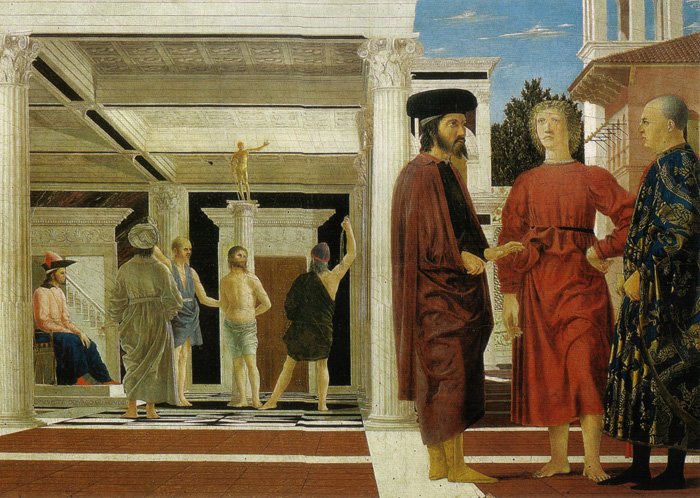
Flagellation of Christ by Piero della Francesca

The Flagellation of Christ by Piero della Francesca (c.1460)

My Daily Art Display today has me in a quandary.  When I choose a painting for the day I have to spend a number of hours researching the artist, the painting and the subject of the painting and then try and collate all I have discovered into a meaningful and yet not too verbose blog.  Sometimes I struggle to find the information I need from the hundreds of art books I have hoarded, the internet and the local library.  On other occasions, like today, I was overwhelmed by the vast amount of information there was with regards the work of art and now I have the difficult task of trying to filter out what I don’t need.  In this case, I also have to contend with the many varied and conflicting interpretations of what we are actually looking at.  The one thing which is common to all that I have read about the work of art is the praise upon praise which has been heaped on it and yet when I look at it, I struggle to appreciate or understand its so-called “greatness”.  However I will let you decide and if you want to comment and tell me that like Kenneth Clarke, the art historian, who declared it to be the “Greatest Small Painting in the World”,  you also believe it to be one of the greatest paintings of all time, then tell me why you think that.

Before I talk about the painting, let me first look at the life of this Early Renaissance painter and mathematician, Piero della Francesca.   Yes, you read that correctly – mathematician, for as well as being a revered painter, he is now looked upon as the greatest mathematician of the 1400’s.   Piero was born in 1415 in the town of Borgo Santo Sepolcro, now Sansepolcro, eighty kilometres east of Florence.  His father Benedetto de’ Franceschi was a tradesman and his mother was Romana di Perino da Monterchi.  At an early age he began his artistic apprenticeship and at the age of fourteen he and another apprentice, Domenico Veneziano worked on frescoes for the Sant’ Egidio Church in Florence.  It was during this time spent in Florence that Piero would have probably come into contact with the great Florentine artists of the time such as Fra Angelico, Mantegna and the architect, Brunelleschi.

Records show that Piero had returned home to San Sepolcro by 1442 and three years later had received a large commission from the Compagnia della Misericordia, a confraternity of Borgo San Sepolcro, for a polyptych as an altarpiece for the local church, Church of the Misericordia,.  The confratentiy had asked Piero to complete the work in three years, setting the anticipated completion date as 1445.  Piero however did not feel constrained by this suggested timeline and any way he had many other projects on the go at the time and in the end did not complete the altarpiece until 1462, some seventeen years late!

Piero della Francesca travelled widely around Italy completing commissions for frescoes including some papal work in Rome.  At the age of fifty-four he moved to Urbino, where for almost the next twenty years he worked for Count Federico III da Montefeltro, the Lord of Urbino (see My Daily Art Display for March 23rd).  It was during his stay at Urbino that he completed today’s featured work, The Flagellation of Christ, somewhere between 1455 and 1460. 

In his later years, around 1482, Piero della Francesca was living in Rimini where he had a studio.  As he grew older he had given up painting, the artist biographer Vasari put this down to his failing eyesight but this has since been contradicted because it is known that he wrote and completed a mathematical treatise in 1485, when he was seventy years of age.  It could be that his love of mathematics had overtaken his love of painting.  He died in 1492, aged seventy seven at his home in San Sepolcro.

 The Flagellation of Christ is an oil on panel painting and one of the most famous paintings completed by Piero della Francesca.  It is one he painted during his first visit to Urbino.  Look closely at the painting.  The setting is the portico of Pontius Pilate’s palace in Jerusalem.  Are we looking at one scene divided into an outdoor and indoor location or are the two scenes we observe, depictions of two different times?    The latter is a popular theory.  It is generally agreed that the inner depiction of the flagellation is set at the time of Christ but the outdoor setting in the right foreground, with the three men, is set in the fifteenth century.  One pictorial argument favouring the time separation of the two scenes is that the background scene is illuminated from the right whilst the outdoor scene with the three men is illuminated from the left.

The whole scene is dominated by architecture with a stunning use of perspective which adds a sense of realism and manages to draw our eyes towards the small figure of Christ despite the fact that the actual flagellation takes place in an open gallery in the middle ground of the work.   Also in the flagellation scene, we have Pontius Pilate seated on the left and possibly King Herod with his back to us.   In the foreground on the right hand side we see three figures, who appear not to be paying any attention to what is happening behind them. So who are all the various people featured in the painting?  It would be great if there was a clear cut answer to that question but different experts have different ideas and so I had better offer you a few alternatives and let you pick which one sounds the most probable to you.

One theory put forward about the reason for the commissioning of this work is that that the painting was an attempt to favour the reconciliation between the two Christian churches, of the East and of the West, because of an impending attack by the Turks on Constantinople. Both the presence of the character in the centre, dressed after Greek fashion, and an inscription on the frame convenerunt in unum would seem to support this interpretation.

We know that the painting was commissioned by the then Duke of Urbino, Federico da Montefeltro.  The conventional interpretation of this painting and the one which is still upheld in Urbino as the true interpretation of the work, is that the three men in the right foreground of the painting are, in the centre, the Duke of Urbino, Oddo Antonio da Montefeltro, the predecessor of Federico, the commissioner of the work, and is flanked, on each side by his advisors, Manfredo dei Pio and Tommaso di Guido dell, Agnello.    All three were dead.  Oddo Antonio was assassinated a few months after coming to power because of the unpopularity of his laws and his advisors suffered a similar fate.  Another interpretation is that Oddo Antonio is in the centre and the characters either side of him were his assassins, Serafini and Riccardelli.  A third suggestion is that this is simply a dynastic painting commissioned by Federico in which he has his three predecessors depicted.

There are more possibilities and books and treatises have been written about the painting with various suggestions as to the identity of each of the characters  but I will leave it there and if you want to look deeper into the interpretation of the painting, do so and I will be interested to see what you find out.  So back to my original question which still puzzles me; why is this painting by Piero della Francesca look on as being “a great work”?    Is it the artistic quality of the painting or is it the mathematical quality of the perspective which has art historians tell us it is a gem?

Self Portrait by Tommaso Minardi

Self Portrait by Tommaso Minardi (1807)

From a French Modernist painter I am moving to an Italian Romantic painter.  Today I am featuring Tommaso Minardi and looking at his painting entitled Self Portrait, which he painted in 1807.

Tommaso Minardi was born in Faenza in 1787, an Italian city some fifty kilometres south-east of Bologna.  As a teenager he studied art and design at a private school, as a pupil of Giuseppi Zauli.  Minardi was granted an annual stipend by Count Virgilio Cavina of Faenza and in addition, he received financial assistance in the form of a stipend, from the Congregazione di S Gregorio of Faenza.  Thanks to this five year stipend from his patron, Minardi, who was not yet sixteen years of age, moved to Rome to continue his artistic studies.  The terms of this five year grant were such that the young man had to send one completed work of art back to Faenza each year.   His paintings Socrates and Alcibiades and Supper at Emmaus were two of his works he sent back to his patron in Faenza.  At the age of twenty-three he entered a painting into an annual competition run by the Bologna Academy of Fine Arts and he won and his reward was financial stability for the next three years.

Whilst in Rome he studied art but was also employed by the painter and engraver Giuseppe Longhi, who was an exponent of Neoclassicism and for his employer he did reproduction drawings of Michelangelo’s Last Judgement in the Sistine Chapel.  

In his thirties Minardi began to teach art and in 1819 he was appointed director of the Academy of Fine Arts in Perugia.  Three years later he became professor of drawing at the Accademia di San Luca in Rome, a position he held for over thirty-five years.  Besides his own painting and teaching, Minardi began to take an interest in local politics and he spent much of his time working tirelessly for the protection and restoration of the capital city’s great heritage.  Tommaso Minari died in Rome in 1871, aged eighty-three.

My Daily Art Display’s featured painting today entitled Self Portrait depicts the artist himself, sitting on a matress which is on the floor.  He is wrapped in a coat in what looks like a very unassuming room.   The room we see him in is termed a mansard room but is known more commonly as an attic room with its sloping ceiling.  It is a typical student-type apartment at the top of a very large house.  On the back wall of the room we can just make out a painting and besides the bed is a bookcase crammed with books and papers.  More books and documents can be seen strewn on a desk to the right of the painting.  The room is lit up from two sources, light streaming in through windows on either side.  On a cabinet to the artist’s left is a human skull and on the floor in the left foreground there is skull of an animal.  What are we to make of this?  What was Minardi’s symbolic reasoning for including these two items?   Was the human skull to have the meaning related to Vanitas paintings, that human life passes quickly and we are but mere mortals, or is it just a  theatrical prop used by the artist to induce a feeling of melancholia into the work.  Are we meant to sympathise with this depiction of him, a poor, sad young art student in his small cramped abode, clutching a heavy coat around his body for warmth.  Is this a depiction of a poor young artist struggling for recognition, and desperate to attain financial security?  Remember Minardi was only twenty years old when he painted this work and had yet to become a successful artist.  So maybe this is how the artist viewed his current “lot in life” – life as a bohemian student in his dingy top floor attic room in the Eternal city.

I wonder whether this paining in any way inspired the French novelist and poet, Henri Murger, when he wrote a work published in 1851 entitled  Scènes de la vie de bohème and which was later used by the librettists Luigi Illica and Giuseppe Giacosa for Puccini’s 1896 opera La Bohème.  Was our struggling artist, Tommaso Minardi, in today’s painting the forerunner of the struggling painter Marcello, in La Bohème ?

I like the painting for its emotive qualities and I am heartened by the fact that Minardi did eventually make good and went on to live a prosperous life.

Portrait of Two Friends by Pontormo

Portrait of Two Friends by Pontormo (c.1524)

Today My Daily Art Display focuses on a double portrait by Jacopo Carrucci, the Italian Mannerist painter, who was better known simply as Pontormo, the name of the town in Italy where he was born.  I featured one of his paintings on January 14th.  The painting entitled Portrait of Two Friends was completed by Pontormo around 1524.  Today, I am not just offering you a painting but I am attempting to unravel the mystery of the painting or to be more precise, the small piece of paper which is held by one of the men depicted in the portrait.

Look closely at the painting.  It is quite a dark painting with the two men sombrely dressed, almost all in black, standing against a plain grey background.  Light coming from the left illuminates the two faces and the hands belonging to the man on the left who holds up and points to a page of writing.    This older man on the left is side-on to us but still manages to look at us.  His gaze is not as forceful as that of the younger man and he seems to be quite pensive and preoccupied with a myriad of thoughts.  The younger of the two men stands on the right and looks out at us.  His is a strangely challenging and intense gaze.

Page of writing

When you look at this painting what are the first questions you want answering?  I am assuming you want to know who the two men are but I wager, you also want to know even more about what is written on the piece of paper and what does it have to do with the two men.    Maybe you are also wondering why the artist would have portrayed one of the men pointing to the writing on the piece of painting.  What is so important about the Latin words we see on the unfolded sheet?

If you look at the writing closely you will just be able to make out that the last written word on the paper is the Latin word Amicitia, which means “friendship”.  Actually the text comes from the Roman statesman and author Marcus Tulius Cicero’s treatise on friendship entitled Laelius de Amicitia or simply Amicitia.   So now you know where it came from but what is written?  A translation of the words on the paper is:

“…In short, all other objects of desire are each, for the most part, adapted to a single end – riches for spending; influence for honour; public office for freedom for reputation; pleasures for sensual enjoyment and health for freedom from pain and full use of the bodily functions; but friendship embraces innumerable ends; turn where you will it is ever at your side; no barrier shuts it out; it is never untimely and never in the way.  Therefore we do not use the proverbial “fire and water” on more occasions than we use friendship…”

Cicero was writing about his own understanding of friendship in a way that would have meaning to people who read the book in later years.  The author considers the meaning of friendship.   He itemises which  qualities make for a good friendship and at the same time clarifies what characteristics illustrate a bad friend, and it provides examples from his personal life. Throughout the book, Cicero stresses the importance of virtue in friendship and how a friendship cannot be a true one without such a quality.   The work is written in dialogue form.   The participants in this dialogue chosen by Cicero are Gaius Laelius who was a close friend  of his and Laelius’s two sons-in-law, Gaius Fannius and Quintus Mucius Scaevola.   So now we have a translation of the Latin words on the paper and we know a little more about the book they came from but we still do not know what it has to do with our two men in the painting.  To answer that question one needs to delve into Vasari’s The Lives of the Artists in which the author writes:

“…Pontormo portrayed two of his close friends in a single picture: one was the son-in-law of Beruccio Bicchieraio and another, whose name is also unknown to me…”

That might not exactly tell us who the two men are but we do know that Pontormo at one time worked at the studios run by his tutor and master, Andrea del Sarto and that del Sarto had a friend Domenico di Jacopo who was a glassmaker by trade and because of that was nicknamed Bicchieraio (Italian for glassmaker).  Maybe it is a leap of imagination too far,  but let us remember that the Latin words on the piece of paper were from a dialogue between a father and his two sons-in-law and we now know that one of the sitters in today’s painting was a son-in-law of Becuccio Bicchierario.  Furthermore, we know he had a second son-in-law and thus we may be able to deduce that the two men looking out at us are the husbands of two of Bicchieraio’s daughters, who probably Pontormo came across through his association with his old master, Andrea del Sarto.  It is also probable that the glassmaker commissioned Pontormo to paint the two men in his daughters’ lives and by adding the piece of written paper he was drawing a parallel to Cicero’s Amicitia and the requirements for true friendship which he hoped would be in place between his daughters and their husbands..

So there you have the solution to the mystery of the painting, or do you?  Well notwithstanding my step by step reasoning for what we see in today’s work and whether you believe my reasoning.   I believe it to be a classical study and that little bit of paper, to me, adds a little spice to the offering.

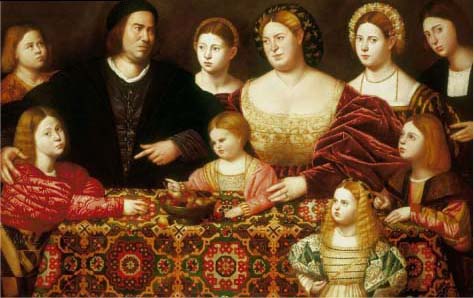
A Family Group by Bernardini Licinio

A Family Group by Bernardino Licinio (1524)

Bernardino Licinio was born in Venice around 1489 during the Italian High Renaissance.  It is thought that he could have trained as an artist in the workshop of Giovanni Bellini, the founder of the Venetian School of Painting.  Although being influenced by his “master”, Licinio soon developed his own down-to-earth style of realism painting.  When he had finished his artistic apprenticeship, Licinio set up his own workshop and produced a number of half length panels of the Virgin and Child, some altarpieces and group portraits one of which is featured in My Daily Art Display for today.  It is simply entitled A Family Group and was painted by Licinio in 1524.

In the painting we see nine members of a family.  It was once thought that it was an actual portrait of Licinio’s own family but there has been no documented evidence that he was ever married.  Licinio was famous for his group portraits and a few years after today’s painting he completed two similar works, namely, Arrigo Licinio and his Family (1535) and Portrait of a Sculptor with Five Apprentices(c. 1530) and all three are looked upon as his greatest works. 

Small-patterned Holbein carpet

 The members of the family are grouped around a table on which we see a Turkish table carpet, known as a small-patterned Holbein named after its characteristic geometric design.  These carpets are of Ottoman origin and so named because Hans Holbein used to often incorporate them into his paintings.  The “small pattern” terminology referred to the small size of the motifs.  These were expensive carpets and in paintings often symbolised wealth and in this case we are being subtly told that this family did not have any financial problems.

What I like about this family portrait is its realistic quality.  How many times have you wanted a family photograph taken with your children only to be thwarted by arguments between the young ones?  This is exactly what Licinio is recording in the painting.  The young boy in the elaborately painted striped hose, seated at the end of the table on the left, has just taken an apple from the bowl and of course this was the very one which his siblings had wanted.  Sounds familiar?   We can see the father, dressed in black, attempting to mediate in the argument.  His wife, in the gold and cream low-cut dress, is listening intently to his proposed solution. 

The determined child

My favourite character in the painting has to be the young girl standing in front of the table in the right foreground.  Look how she stands defiantly, arms akimbo, lips pouted as she demands justice.  Although she maybe the youngest of the siblings she demands to be heard. The one aspect of the painting which art critics have commented on is that there seems to be no face-to-face interaction between family members.  They fail to relate to each other. 

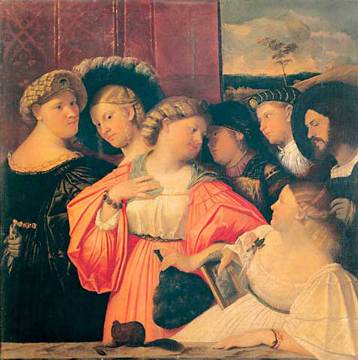
Seven Members of the Albani Family by Cariani

Compare this with, for example, Lotto’s 1547 family painting, Portrait of Giovanni della Volta with his Wife and Children, which has a similar bowl of fruit on a carpeted table but where there is an interaction between the family members or Giovanni Cariani’s Seven Members of the Albani Family (above) where everybody seems so animated.     Licinio’s family group seem to be just a collection of individuals who have no connection with each other.  The difference in style of the two portraits reminds me of two photographs a family photographer has taken.  In one he has instructed everybody to be still and look at the camera.  The result is a wooden photo, which often occurs in a formalised event where everybody has to stand still and look at the camera and not at each other.   In the other the photographer has let things develop naturally before he presses the camera button without warning.

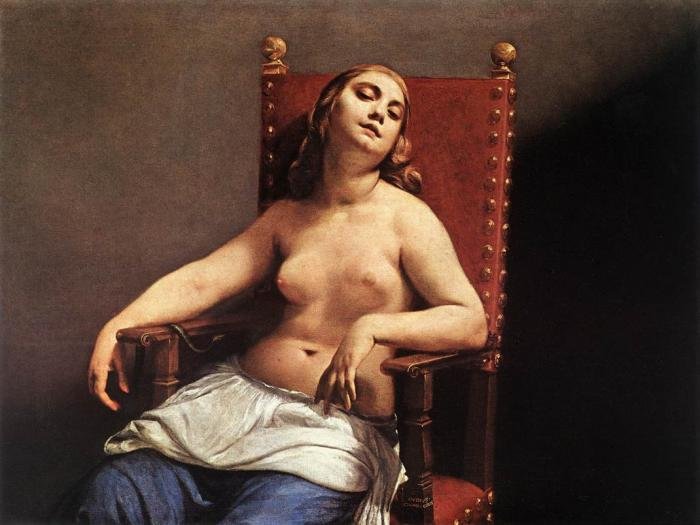
The Death of Cleopatra by Guido Cagnacci

The Death of Cleopatra by Guido Cagnacci (1660)

 My Daily Art Display today features not one but two paintings.  Both are by the same artist Guido Cagnacci and both have the same theme, namely, the death of Cleopatra. 

Guido Cagnacci was an Italian painter of the late Baroque period belonging to the Bolognese School which rivalled Florence and Rome as centres of painting.    He was born in 1601 in  Santarcangelo di Romagna, a town in the province of Rimini  where he spent the early part of his life.  Later, he spent time in Rome where he met fellow artists Simon Vouet, Guernico and was a pupil of Guido Reni.  It is also believed that during this time he may also have studied under an ageing Ludovicio Carracci.  He moved back east to Venice in 1650 and started to paint very sensual scenes with seductive, half-naked girls as his subject.  These erotic paintings were very popular and much sought after by collectors at the time and his popularity spread .  In 1658 he journeyed to Vienna where he gained the patronage of Emperor Leopold I and that was his ticket to fame and riches.  His later paintings featured semi-naked women as Lucretia, Cleopatra and even Mary Magdalene.

The painting above entitled The Death of Cleopatra was completed by him in 1660 and now hangs in the Brera Gallery in Milan.   This painting is charged with sensuality and we see Cleopatra slumped in an upright chair, naked down to the waist.  She has been bitten by the asp which we see trapped between the arm of the chair and her right arm.   Her eyes are almost closed as she drifts towards unconciousness.  Her head has fallen back against the red leather of the chair.  The curls of her golden hair reach down to her shoulder.  Even at the point of death she retains her beauty.  Her facial expression is one of tranquility and not one contorted with pain.  In her final moments she loses none of her radiance.

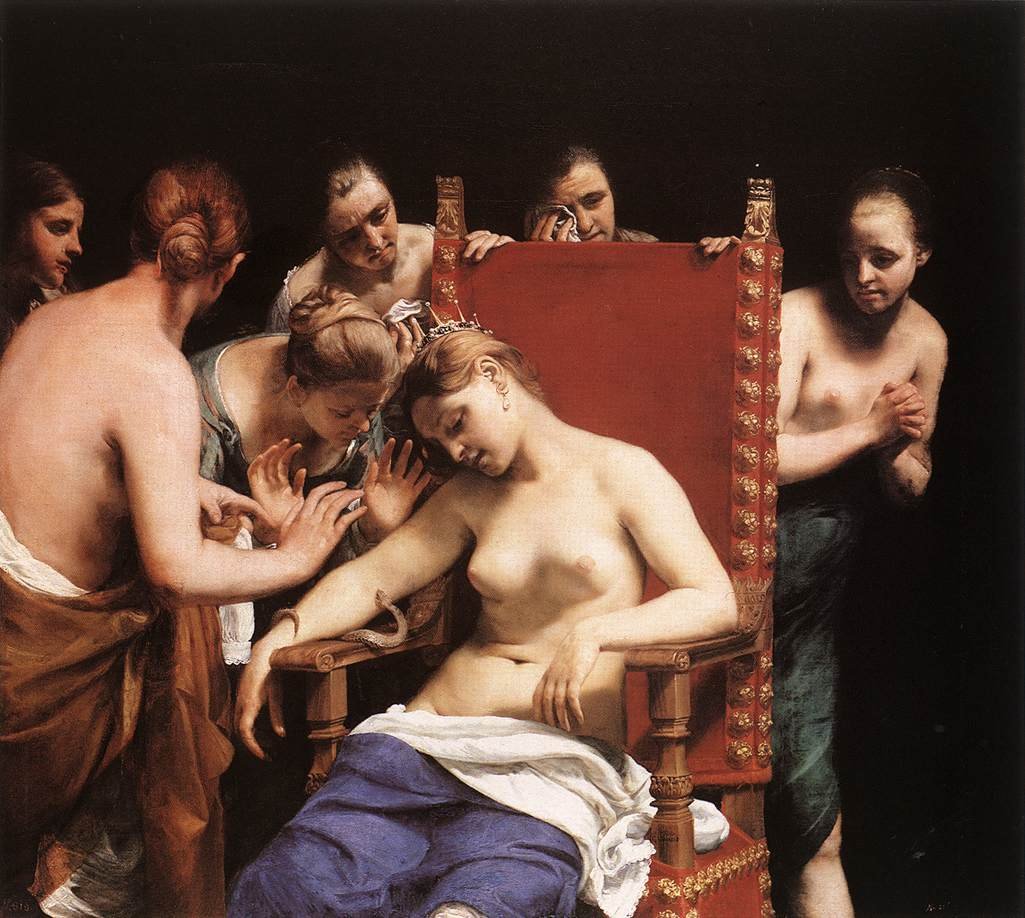
Death of Cleopatra by Cagnacci (1658)

The second painting by Cagnacci which I am featuring entitled The Death of Cleopatra was painted two years before the first one I featured.  It was completed around 1658 and now hangs in the Kunsthistoriches Museum in Vienna.

In this painting we see Cleopatra, not alone, but with six of her handmaidens.  Look at the contrast between Cleopatra and her handmaidens.  See how Cagnacci has shown the realism of the weeping servants.  The faces of some are contorted with anguish whilst others just dissolve into tears for the plight of their mistress.   The handmaiden in the left  foreground points towards the snake, said to be an asp,  and like the woman next to her holds up her other hand to shield herself from any attack from the creature.  But look at Cleopatra.  Cagnacci has once again painted her half slumped in the chair this time with her head fallen to one side.   Once again we see the small snake trapped between the arm of the chair and her arm.  Maybe the squeezing of the snake’s body has caused it to strike.   Again as was the case in the first painting, Cleopatra seems at peace with the world and once again there are no facial expressions which would lead us to believe that her death had been in any way painful.

It is that very last point about the peaceful look on Cleopatra’s face that brings me to an interesting point of view made by the German historian and author of a best-seller entitled Cleopatra,  Christoph Schäfer, who has researched the death of Cleopatra caused by the snake.   He has looked back at historical texts and one report, written about 200 years after Cleopatra’s death, stated that Cleopatra died a quiet and peaceful death, and this is exactly how Cagnacci has portrayed the victim in both his paintings, which does not correlate with death by asp bite – a  long, painful and disfiguring way to go.

Schäfer’s other findings have also destroyed our long-held beliefs re the 2000 year-old legend of the Queens death,  for he also highlights the fact that the story of Cleopatra, which we are used to, is highly unlikely.  His examination of ancient texts in Alexandria revealed that Egyptians knew a lot about poisons, and one papyrus reported that Cleopatra tested these poisons on herself.  He also states that Cleopatra died in the middle of an Egyptian summer, so temperatures would most likely have been too high for an asp to stay still enough to bite.  Of course in our two paintings Cagnacci has shown the snake trapped under her arm and unable to wriggle free!   Having discussed his thoughts with a toxicologist, Schäfer concluded that the most likely method of death was a drug combination of opium, wolfsbane and hemlock, which was known at that time to induce a painless death.

I will end here and let you decide how Cleopatra died,  but do not let the different theories detract from these two beautiful paintings

St George and the Princess of Trebizond by Pisanello

St George and the Princess of Trebizond by Pisanello (1436-38)

When I was travelling around Italy last week the one thing I noticed, which was different from here in Great Britain, was the fact that most of the churches were open to visitors even if some, especially in tourist areas, had admission fees.   In my country most of the churches are locked up unless a service is in progress for fear of vandalism or theft.  The one exception to this open-policy was Milan cathedral which for some reason would not let individuals inside, just admitting pre-booked guided parties.  I have no idea the reason behind this and my lack of ability to speak Italian put me off questioning the very large armed policemen, who stood guard at the door.

The other difference between the churches I visited in Italy and the ones in my country was that the Italian churches seemed to all have frescoes and paintings adorning their walls whereas the churches I have visited here, although often architecturally attractive and have beautiful stained glass windows, one rarely comes across works of art.  Maybe that again is to do with possible vandalism and theft.  During my short vacation I visited Verona and after the obligatory visit to “Juliet’s balcony” I decided to visit a couple of the churches and I am so glad that I did.

I visited the church of Santa Anastasia and it was here I came across a wonderful fresco above the entrance to the Pellegrini Chapel which is just to the right of the main altar and which according to the guide book was done by an artist called Pisanello.  I decided that when I returned home I would find out a little more about the artist and his fresco and feature it in My Daily Art Display.  So here is what I found out.

Antonio di Puccio Pisano is thought to have been born in Pisa around 1395 and was to become one of the great fresco painters of the early Italian Renaissance and the Quattrocento, which was the collective name given to the cultural and artistic events of 15th century Italy and includes the artistic styles of the late Middle Ages and the early Renaissance.  He was educated in Verona and it has been documented that he worked in Pisa, Venice, Florence and Verona.  Pisanello’s subjects include Arthurian legends and other courtly stories. They reflect the chivalric ideals of his noble patrons. The decorative nature of his work comes from the work of early 15th century artists such as Gentile da Fabriano, a leading exponent of the International Gothic genre.  Pisanello and Gentille collaborated on the frescoes of the Palazzo Ducale in Venice and they both worked at the court of the Gonzaga princes in Mantua.  Pisanello returned to Verona around 1436 and started work on the Pelligrini Chapel in the church of Santa Anastasia, which is the work of art I am featuring in My Daily Art Display today.

The fresco is entitled St George and the Princess of Trebizond and was completed in 1438.  It is based on what was a favourite subject of the period, Saint George, the Princess and the Dragon.  The fresco is in the crown and spandrels of the arch at the entrance to the chapel.  Sadly the fresco in the left-side spandrel has deteriorated badly.  It shows a barely discernible scene of the dragon’s lair where the creature had devoured its prey and all that was left were the bones of the victims which are surrounded by hideous animals which are scavenging the remains.

In the right spandrel we see the heroic St George with his curly golden hair, who has just dismounted from his horse after his gallant rescue of the princess.  The rescued damsel stands side on to us.  There is regality about her stance.  Her head is held high and just take a look at the splendour of her dress with its long train.   Both the Princess and her rescuer are dressed in the finest clothes of the day.  Unfortunately the gold and silver used in the fresco has fallen away over time but one can only imagine how spectacular the fresco would have been when Pisanello had completed it. 

It is interesting to note the way he has painted the two horses one of which we see from behind, the other seen head-on.  There is a perspectival foreshortening of the animals and this painting technique was starting to become popular with artists at this time.   The background is dominated by an enchanting city with its Gothic towers and ornate stonework.    In the left-hand background we see two hanged men swinging on the gallows.  Maybe they were thieves or traitors.  In the foreground we have a ram, what looks like a golden-coloured boar and a dog.

Whilst I was looking around the church I came across a girl on some scaffolding meticulously carrying out restoration work on another of the church’s frescos and it brought to mind the age-old argument as to whether frescoes should be restored or should they be left to slowly decay and thus one sees the original and not a “touched-up” offering.

Feast in the House of Simon by Bernado Strozzi

Feast in the House of Simon by Bernardo Strozzi (c.1630)

Whilst I was wandering around the narrow streets of Venice, crossing over the many quaint little bridges I had a sort of plan of what I wanted to see.  I had to have a look St Mark’s square and cross the Rialto Bridge but I also had two artistic destinations I wanted to visit.  First was the Basilica of Santa Maria della Salute which was the church at the heart of yesterday’s blog but most of all I wanted to visit the Accademia Galleries which houses a collection of the best works of art by Venetian painters.  I finally found the building and I was luck as apparently it was “Cultural Week” and the entrance fee had been waived.  The first room I entered was full of what they termed “The Primatives” and was a large collection of late 14th century and early 15th century altarpieces.

It was when I went into the other rooms that I was taken aback by the paintings.  It was simply breathtaking.    It was the sheer size of them which was overwhelming.  In all the galleries around the world which I have visited, I have never seen such a large collection of gigantic paintings.   Some, including the painting I am featuring today, were in excess of 7 meters in width and there was the Veronese painting Feast in the House of Levi which was in excess of 13 meters in width and almost 6 meters high.   These large paintings simply overpowered you and you sat before them in total shock.  You could only imagine how long the artists had taken to paint them.  One room just had the complete nine painting cycle of the Legend of St Ursula, the fourth I featured in My Daily Art Display on March 22nd.  As each of the nine was so big I spent almost an hour following the tale of St Ursula and studying all the marvelous detail laid out on each canvas.  It was a remarkable experience.  The final room I went through on my way to the exit had amongst its collection the famous and very beautiful Tempest by Giorgione which I featured on March 4th.  This is a lovely painting much smaller than the mammoths I had been admiring earlier but still a gem. I was completely spellbound by this gallery visit and I suggest you add this gallery to your “must visit” list.  You will not be disappointed.

Back to today’s offering in My Daily Art Display.  It was one I saw during my visit.  I could have picked so many from the wonderful collection but for today I have chosen a painting by Bernard Strozzi entitled Feast in the House of Simon which he completed around 1630.

The painting was acquired by the gallery in 1911 and comes from the chapel of Palazzo Gorleri in Genoa.  It is thought that it was painted for the parlour of the Santa Maria in Passione monastery at Diano, Genoa.  The story behind the painting is from the New Testament:

“…When Jesus was on his travels to preach, a Pharisee called Simon invited him to a meal.
When Jesus arrived at the Pharisee’s house and took his place at table, suddenly a woman came in, who had a bad name in the town. She had heard he was dining with the Pharisee and had brought with her an alabaster jar of ointment. She waited behind him at his feet, weeping, and her tears fell on his feet, and she wiped them away with her hair; then she covered his feet with kisses and anointed them with the ointment.
After this scene, Simon the Pharisee wondered whether Jesus was really the prophet everyone told he was, because surely Jesus would have seen that this woman had a bad name and would not have let her touch him. But Jesus retorted with a parable and he showed the difference of welcoming he had received from Simon as compared to the welcome of the woman. Simon had poured no water over Jesus’ feet and Simon had not anointed Jesus’ head.
Jesus said: “For this reason I tell you, Simon, that her sins, many as they are, have been forgiven her, because she has shown such great love. It is someone who is forgiven little who shows little love”. Then he said to the woman: “Your sins are forgiven…..”

The artist has distributed the various characters around the painting, not randomly but with care so as to tell various parts of the story behind the painting.  There is so much going on within the painting which as you know is what fascinates me.  We see Mary Magdalene kneeling at the feet of Christ with her porcelain urn of water in preparation to her washing the feet of Christ.   There is also humour in the painting.  Look how the man behind Christ’s right shoulder is remonstrating with the dog which is about to attack the cat.  It appears the cat has managed to escape the clutches of the dog by jumping upon the table much to the displeasure of a young servant, who has raised a stick and is just about to whack the cat away.  The banquet table lies diagonally across the painting.  Our eyes fix on Jesus who is vociferously defending Mary Magdalene whilst Simon is seen half getting out of his chair as he stares on incredulously at the sight of Mary at the feet of Jesus.  There is a splendor of colour which brings the painting alive.  Look at the servant carrying the tray of fruit – see how he is lit up by the bright background of the sky.

This is an awesome painting and I can only hope that like me, one day you will be able to stand before it and absorb its beauty.

Portrait of a Young Man by Moretto da Brescia

Portrait of a Young Man by Moretto da Brescia (c. 1545)

Today I am moving away from the interpretive type of allegorical paintings,  which I featured yesterday  and which is a genre I really like.  Today, although staying with an Italian artist, I am returning to portraiture.  Today’s artist is Moretto da Brescia who featured in My Daily Art Display on December 17th.

Moretto da Brescia was born Alessandro Bonvicino around 1498 at Rovato, a town in the province of Brescia in Lombardy. He studied first under Fioravante Ferramola of Brescia and later with Titian in Venice.    He was the leading Brescia painter of the day and concentrated his works on religious subjects mainly producing altarpieces and other religious works.  Today’s painting in My Daily Art Display is simply entitled Portrait of a Young Man which Moretto completed around 1450 and which now hangs in the National Gallery London.

The subject of today’s painting is thought to be Count Fortunato Martinengo Cesaresco who was a member of a branch of Brescia’s most important noble family.  He was also a leading literary figure in Brescia and was founder of the Accademia dei Dubbiosi in 1551 and friend of the Venetian humanist and Italian theorist of paintings, Lodovicio Dolce.  The count married in 1542 and this portrait could well have been done around the time of his betrothal and been a gift for his bride.   

The painting has a background almost completely dominated by a heavy maroon and gold brocade curtain with its pomegranate and carnation design.  The count is depicted lavishly if somewhat flamboyantly dressed in this portrait, .  There is no doubting his wealth and nobility.   On the table to the left of him are some rare ancient coins, one of which is in an open ivory case, which gives the impression that he may have been a collector of such items.  Lying next to them is also a bronze oil lamp in the shape of a sandalled foot.  Hanging over the edge of the table we can see a pair of grey leather gloves.  He is half sitting, half slumped as he rests his right elbow on a couple of pink tasselled taffeta cushions whilst his right hand supports his face.  Look at his face.  What does his facial expression convey to you?  To my mind we are not looking at a happy contented man.  Wealth has brought him neither satisfaction nor happiness.   It is a look of a man who is melancholic and his eyes seem to suggest that he does not know how to lift his depression.   Does he know what is causing this depression or is he one of those unfortunate people who feel depressed but are not sure what has brought about such depression?   Maybe we get an incline of his problem.  On his black velvet cap is a cap badge with the Greek words which translate as:

“Alas I deserve too much”

So how do we translate those words in relation to the Count?    Is it referring to his dilemma as a collector that he knows no matter how wealthy he is, he will never be able to possess all the prized items he needs for his collection to be complete.  All collectors will empathise with this sentiment.  Some art historians would rather put a more romantic slant on his melancholic expression and the inscription on his cap badge.   They believe that as this painting was a gift to his wife he is indicating pictorially to her that no matter how much treasure he owns, nothing will take away the pain of separation from his beloved. 

This is a sumptuous painting and a magnificent portrait.  However, I will leave you to decide what is causing his anguish.

An Allegory with Venus and Cupid by Il Bronzino

An Allegory with Venus and Cupid by Bronzino (c. 1545)

Agnolo di Cosimo di Mariano, usually known as Il Bronzino (probably because of his dark complexion), was born in Monticello, a town south east of Florence, in 1503.  His early artistic training was as a student of Raffaellino del Garbo, the Florentine painter of the early Renaissance.  From his tutelage Il Bronzino went on to study under Jacopo Pontormo who was one of the founders of Florentine Mannerism.  The plague hit the area where they lived and so Bronzino and Pontormo moved north to Certosa where they continued to collaborate on a series of frescos.  Master and pupil got on well which was surprising as Pontormo was known to be a curmudgeonly and melancholy old man.  Il Bronzino established his own reputation as a great artist in his late twenties and in 1530 he was working for the Duke of Urbino.  Two years later he returned to Florence where he concentrated on portraiture and some fresco work.  At the age of 37 he was made court painter to Còsimo di Giovanni degli Mèdici, the de facto ruler of Florence and his wife Eleanora of Toledo for whom he decorated the chapel in the Palazzo Vecchio with fantastic coloured frescoes of astonishing incoherence and they were filled with the usual Mannerist exaggerated distortions.

It was about this time (c.1545) that Il Bronzino completed the painting which I am featuring in My Daily Art Display today.  It is an oil on wood painting entitled An Allegory with Venus and Cupid.  It is believed that Il Bronzino was commissioned to do this by Cosimo de’ Medici as a gift for King Francis I of France.  This is a complex painting full of hidden meanings and open to a great deal of interpretation.  Many art historians have submitted long and complex theses with regards to the meaning of this many faceted work of art.  So let us take a look at the painting and see what we can glean from Il Bronzino’s  enigmatic and complex painting.

First of all we need to identify the characters within the scene.  The leading individual at the centre of the painting is Venus, the goddess of love and beauty, holding the golden apple in her left hand, which she had been given to her by Paris for being the fairest of all the goddesses.  To the left of her and slightly behind her is her son Cupid. 

The incestuous kiss

They are entwined in an incestuous act.  His right hand is fondling his mother’s breast at the same time as he plants a kiss on her mouth.  Is she seducing her adolescent son who by now would appreciate her sexuality?  Which of them do you think is controlling the situation?  But look more closely at Venus and her son.  Although they are exchanging a kiss they have other thoughts on their minds.  Venus is reaching behind Cupid removing an arrow from his quiver whilst he is trying to remove her crown with his left hand.
To the right of Venus with an anklet of bells is the smiling nude putto who represents Foolish Pleasure.   He dances towards them with a somewhat lascivious expression, scattering flowers, blissfully unaware of the thorn which pierces his right foot.    

Deceit

Behind him is a female dressed in green and purple robes holding in her right hand a sweet honeycomb which she is offering up as a gift.  However beware as this Fraud or Deceit and as the saying goes she is “fair of face but foul of body”.  Why do we believe this?  Well look at her left hand and you can just make out the sting in her serpentile tail which she tries to hide behind her back. 

Above Fraud and Foolish Pleasure we see a bald bearded elderly man, whose well-muscled arm is holding up an exquisite ultramarine coloured cloth behind all the characters in this scene.  He is Father Time and he has an angered expression as he looks across at the half-completed head of Oblivion

Suffering or Syphillis

Below this unusual unfinished head is the very disturbing figure of Suffering or Jealousy.  He clutches his head and we can see that his face is distorted in pain.  Art historians now believe this character could represent Syphilis which had reached epidemic proportions in Europe at this time. 

So there you have it, seven strangely portrayed characters but why did Il Bronzino paint them like he has done.  The painting, as I  said earlier, was thought to be for King Francis I of France who was notoriously lecherous and maybe this is why the painting has a predominately erotic feel to it.  He was also known to like heraldry and obscure symbolism so this in a way may have been a puzzle for him to fathom out.  But remember Il Bronzino was a painter of the Mannerism genre and this ambiguous imagery with its erotic overtones is typical of the Mannerist period of art.  His wealthy noble patrons would also have liked the silky-smooth textures, masks and the jewels on display in this painting.

If you like paintings with hidden meanings and varied interpretations then this painting is for you.  Look at it carefully and see if you can see any other hidden clues as to its meaning.

 Enjoy !