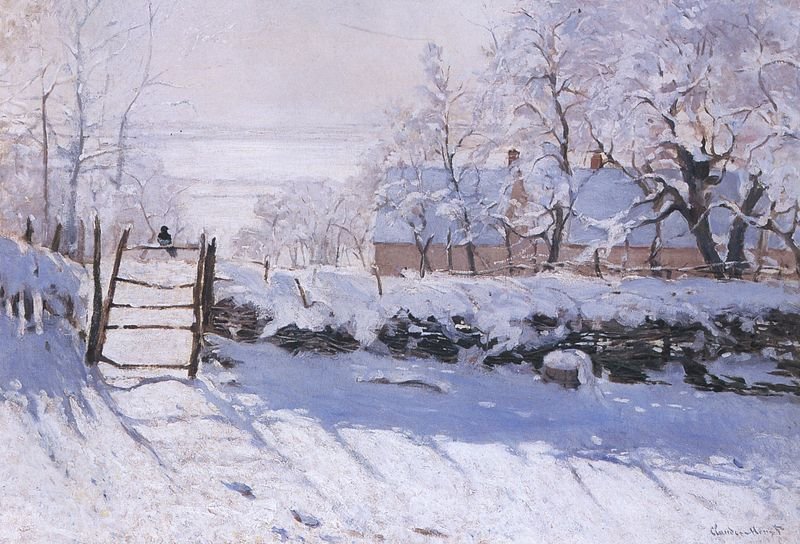
The Magpie by Claude Monet

The Magpie by Claude Monet (1868)

Being in a much milder, wetter and windy climate it is always a novelty to see snow except atop distant mountains and for those of you are knee-deep in it, you have my sympathy, as I tend to agree with those who say snow is fine when viewed on a greetings card but not when one has to trudge through it.  However there is nothing as beautiful as a painted snow scene and for My Daily Art Display featured painting today I am featuring a beautiful depiction of a snow scene by Claude Monet entitled The Magpie, which is reputed to be one of the most popular paintings in the Musée d’Orsay collection.

Monet painted this work during the winter of 1868-9 whilst he was living at Étretat with his wife Camille and his one-year old son Jean.  He had left Paris and one of the reasons for his departure from the capital was given by him in a letter to his artist friend, Frederic Bazille:

“…In Paris one is too preoccupied with what one sees and hears, however strong-minded one may be, and what I shall do here will at least have the virtue of being unlike anyone else’s work, because it will simply be the expression of my personal experiences…”

Monet had been going through a very tough and trying period in his life.  Although his painting Woman in Green was exhibited in the 1866 Salon his offering of Women in the Garden the following year was rejected by the jury of the Salon.   None of the pictures he sent in the spring to the International Maritime Exhibition at Le Havre were sold and worse still, the canvases were seized by his creditors.   His lover, Camille Doncieux, whom he had met in 1865, had become pregnant and in August 1867 gave birth to their son, Jean-Armand-Claude.   Although his father had finally and reluctantly come around to his son’s chosen profession as an artist, he was totally against his son’s liaison with Camille and told him that he would only offer him financial help if he left Camille.  Monet’s financial situation in Paris had become dire and he survived on hand-outs from his friends.  His money problems and now the impending arrival of his child, which was yet another mouth to feed, were so bad that in 1868 he had attempted suicide by throwing himself off a bridge into the River Seine.  Penniless, Monet was forced to return home alone to his father’s house in Sainte-Adresse, a small coastal town west of Le Havre, and there he lived with his aunt, abandoning Camille in Paris.  To add to all these financial and family problems he suffered partial loss of his sight in July 1867 which prevented him from painting and sketching out of doors.

His luck finally changed in 1868 when he fortuitously received some timely aid from his very first patron, a shipowner and art collector, Louis-Joachim Gaudibert, who supported him by commissioning him to paint three full-length life-sized portraits.  Two were of Guadibert himself and the third one of his wife,  (Portrait of Madame Gaudibert).  He also managed to sell his painting Camille to Arsène Houssaye, the editor of the magazine L’Artiste, for 800 francs. Now, finally, with some money in his pocket he was able to return to Paris to once again be with Camille.  Gaudibert also helped Monet rent a house in Étretat for his family in late 1868. Recovering from an episode of depression, Monet joined Camille Doncieux and Jean at the house in Étretat in October 1868.  He wrote to Bazille about his change of fortune:

“…Thanks to this gentleman of Le Havre who’s been helping me out, I’m enjoying the most perfect peace and quiet and I look forward to do some worthwhile things…”

It was whilst he lived here that Monet painted the many famous scenes of the cliffs at Étretat and it was in December 1868 that he painted today’s featured work, The Magpie.  Although en plein air painting may be a joy in the sunny warm days of summer, it becomes a challenge in the cold harsh winter days but Monet was not deterred by this and never let the elements confine him to working indoors.  In fact he often claimed that he preferred the countryside in winter.  Monet loved to experience the differing effects light had on the countryside and for him the understated difference of shadows upon the snow covered ground presented him with a different challenge from the sun on green grass and blue water.  It would mean a complete change of palette with more emphasis on the whites, greys and violets.  He wrote to Frederic Bazille extolling the virtues of his surroundings and the freedom to paint en plein air:

“…I spend my time out in the open, on the shingle beach when the weather is bad or the fishing boats go out, or I go into the countryside which is very beautiful here, that I find perhaps still more charming in winter than in summer and, naturally I work all the time, and I believe that this year I am going to do some serious things…”

Before us we have Monet’s oil on canvas winter landscape scenes of the countryside close to Étretat.  It is entitled La Pie (The Magpie).  It is a prime example of the natural effet de neige (effect of snow).   It was one of the earlier snowscapes that Monet painted.  In all he completed over hundred snowscape paintings. The snow lies upon the ground.  A solitary magpie perches on the top rung of a wooden hurdle gate.  Its black and white feathers, along with the dark bark of the trees, contrast starkly against the snowy landscape and, despite the small size of the bird, it become the focus of the work. Its inclusion in the scene in some ways breathes life into the painting. The source of light comes from the background and dramatically creates blueish gray shadows of the wattle fencing on the pristine snow in the foreground.   Monet and the Impressionists, instead of making the shadows in their paintings a conventional black, preferred  to use coloured shadows as they believed that adding colour represented the actual, changing conditions of light and shadow as one would see in nature.  However this idea did not set well with the Salon jurists and this work by Monet was rejected when he submitted it for exhibition at the 1869 Salon.    There is a beautiful luminosity about this work.  In summery paintings the sky would normally be lighter in colour and tone in comparison to the ground colour but of course in winter this all changes and as we see in this work the sky is darker than the snow-covered ground.  Look at the way Monet has depicted the snow.  It is not pure white but more a tinted white and where the shadows straddle the snow-covered ground in the foreground we have patches of gray-blue.  We can also see darker spots in the snow of the foreground indicating that the snow is not as deep here and the ground below it is showing through the whiteness.

The painting is considered by art historians as one of Monet’s best and most accomplished snowscapes.  Monet once revealed that he wanted to paint not things in themselves but the air that touched things – the enveloping air.  I will leave you with a quote from a Harper’s Magazine article entitled The Enveloping Air in which the author John Berger wrote:

“… Monet once revealed that he wanted to paint not things in themselves but the air that touched things – the enveloping air.   The enveloping air offers continuity and infinite expansion.  If Monet can paint the air, he can follow it like following a thought.  Except the air operates wordlessly and when painted, is visibly present only in colours, touches, layers, palimpsest, shades, caresses, scratches……… Like many innovative artists, Monet, I believe, was unclear about what he had achieved.  Or, to be more precise, he could not name his achievement.  He could only recognize it intuitively

Classical Greek Landscape with Girls Sacrificing Their Hair to Diana on the Bank of a River by Pierre-Henri de Valenciennes

Classical Greek Landscape with Girls Sacrificing Their Hair to Diana on the Bank of a River by Pierre-Henri de Valenciennes (1790)

As an artist, he has been spoken of as the father of French Neoclassical landscape painting and an artist, who was for landscape painting what Jaques-Louis David was for history painting, so how can I ignore this eminent and much honoured French painter.

My featured artist today is Pierre-Henri de Valenciennes, who was born in Toulouse in 1750.   He studied at the Academy of Painting, Sculpture and Architecture of Toulouse, under the tutelage of the local history painter and pastelist, Jean-Baptiste Despax, an artist who had spent much of his life in the decoration of churches and monasteries in and around the French city.  It is probably from him that Valenciennes became familiar with the iconography of conventional classical and biblical subjects.  Another of Valenciennes’ early teachers was the miniaturist, Guillaume Gabriel Bouton.

When Valenciennes was nineteen years of age his work came to the attention of Mathias Du Bourg, a prominent and wealthy Toulouse lawyer, merchant and councillor at the Toulouse parliament, who became his patron.  In 1769 Du Bourg invited Valenciennes to accompany him on a trip to Rome where he stayed for two years before returning home.  At the end of that year, 1771, Valenciennes went to live in Paris and, through the recommendation of Du Bourg, managed to get himself a placement in the studio of Gabriel-François Doyen, who at the time was one of the leading French history painters.  Another person Du Bourg introduced Valenciennes to was Etienne-François, comte de Stainville, Duc de Choiseul, a French military officer, diplomat and statesman who became another of Valenciennes’ patrons.  Valenciennes would often spend time at the country estate of his new patron and soon developed an interest in the native landscape.

In 1777, Valenciennes made another trip to Italy and this time remained there for almost eight years.  He travelled extensively around what was then termed the Kingdom of the two Sicilies, which was the largest of the Italian States, prior to Italian unification and extended south of Rome and included the island of Sicily.  Valenciennes also found great pleasure in journeying around the campagna, the low-lying area which surrounds Rome.  He did return once to Paris in 1781 where he met and received tuition from Claude-Joseph Vernet.   Vernet strongly urged him to work en plein air.  In 1787, Valenciennes applied to become a member of the Académie Royale and following a short probationary period and the submission of his reception piece, a historical and imaginary landscape work entitled Cicero Uncovering the Tomb of Archimedes, he was accepted into the hallowed institution.   His painting was one of two Salon works which he had accepted at the Paris Salon that year.  From this first submission to the Paris Salon, Valenciennes would exhibit annually, large landscape works there until 1819, the year of his death.  Valenciennes quickly established his reputation at the Salon as a painter of paysage historique (historical landscapes inspired by mythology and Greek antiquity). These large-scale works which represented imaginary visions of the classical past, earned Valenciennes the title, “the David of landscape.”

Once he established himself at the Academy, he opened his own studio in 1796.  At this time, the European Academies believed in a strict hierarchy in figurative art, which had originally been postulated for painting in 16th century Italy and which still held good two centuries later. The hierarchy was:

History painting which also included works which had narrative religious mythological and allegorical subjects

Portrait painting

Genre painting which were scenes of everyday life

Landscape painting and cityscapes and cityscape

Animal painting

Still life painting

Many artists would not accept the Academy’s hierarchal approach and would invent new genres and by doing so, raised the lower subjects to the importance of history painting. Joshua Reynolds, the English portraitist, achieved this by inventing the portraiture style that was known as the Grand Manner in which his works flattered his sitters by likening them to mythological characters.   The French artist, Jean-Antoine Watteau invented a genre that was known as fetes gallants in which he would depict scenes of courtly amusements which took place in Arcadian setting.  These often had a poetic and allegorical quality, which, as such, were considered to elevate them within the hierarchy.  Valenciennes, like many landscape artists before him such as Nicolas Poussin and Claude Lorrain, endeavoured to elevate the status of their landscape work by incorporating mythological figures into their works.

Claude had ennobled his paintings of the Roman countryside by adding biblical and classical narrative references and by doing this enforced an idealized vision of balance and harmony on the world before him. This emphasis on timeless landscapes augmented with historical vignettes could be seen in Valenciennes’ large salon landscape paintings.  Valenciennes was adamant that the status of landscape painting should be elevated.  In his efforts to see this through he put out a famous treatise entitled Élémens de perspective pratique à l’usage des artistes (Reflections and Advice to a Student on Painting, Particularly on Landscape) in which he gave landscape painting the full practical and theoretical examination it was due but which up until then had been denied.  This work remained the most influential treatise on landscape painting for decades to come.   Things did change in the nineteenth century France with French landscape painting undergoing a remarkable transformation from a minor genre, rooted in classical traditions, to a primary vehicle for artistic experimentation.

In 1812 Valenciennes was appointed Professor of Perspective at the École Impérial ses Beaux-Arts, a position he held for the next four years.  During his time at the art school he managed to nurture an up and coming set of French landscape artists, such as Nicolas Bertin, Achille Michalon and Jean-Baptiste Deperthes.  In 1816 the Académie even encouraged Valenciennes’ favoured painting genre, paysage historique (historical landscape painting), by presenting a special Prix de Rome award for the best landscape painting.   Much to Valenciennes’ delight the first winner of the award went to Michallon, one of his students.

Pierre-Henri de Valenciennes died in Paris in 1819, aged 68 and is buried in the Parisian Père Lachaise Cemetery.

My featured work today by Valenciennes is one he completed in 1790 and exhibited at the Salon the following year along with six other landscape paintings.  It is entitled Classical Greek Landscape with Girls Sacrificing Their Hair to Diana on the Bank of a River.

When young girls wanted to marry, they were asked to lay their personal belongings of their virginity on an altar to Artemis (Diana). They were such things as toys, dolls, and locks of hair. This represented their transition from childhood to adulthood closing the door of the domain of the virgin goddess forever.  In ancient times, hair, and the way it was worn, identified class and status. Young girls and unmarried women wore their hair long and loose but once they were married it was coiled upon their heads; prostitutes and women of easy morals coifed their hair in elaborate ringlets and curls. The girls’ short hair now identified them as virgins dedicated to perpetual chastity in the image of Diana, with a consequential curtailment of fertility.  When he painted this picture in 1790, Valenciennes was at the height of his artistic career and had already established himself as the master of the paysage historique genre.

In the foreground of this work we can see a small lake.  To the right of the lake there is a marble statue of the goddess Diana, under a leafy arbour, holding her bow with a small stag standing by her side.   On the far side of the lake we can see a circular altar, which looks very much like the base of a large column.  Around this altar we see three young women.  On the altar we can see hair that two have laid down as a sacrifice to Diana whilst we see the third woman in the process of cutting off locks of her hair.  In the middle ground we can just make out two other women standing in an open sunlit plain pointing towards a stream on the left middle ground where we can just make out more women who are in the process of drying their washed clothes on a large stony outcrop.  The building behind the plain is a circular fort along with its high stone walls which divide the composition into two diverse zones.

On the other side of the walls of the fort, to the left, we can see a range of desolate and infertile hills extending into the distance. The Temple of the Sibyl can also be seen atop a mountainous outcropping at left of composition.  If we look closely at the hinterland and beyond, on the other side of the wall, we can make out a number of impressive buildings which extend across the plain.  In this beautiful landscape painting, the viewer’s eyes quickly pass over the small figures shown in the foreground and are lifted to the expansive and idyllic natural space that stretches into the distance.   Even the statue of the goddess directs her attention to the landscape. So even though Valenciennes has added a touch of mythology to his work he seemed more interested in the natural landscape which he hopes will occupy most of our gazes.

The painting is housed at the Mount Holyoke College Art Museum in South Hadley, Massachusetts which was founded in 1876 and was one of the first collegiate museums in the United States.

Portrait of Countess Golovine by Élisabeth-Louise Vigée Le Brun

Portrait of Countess Golovine
by Élisabeth Vigée Le Brun (c.1797-1800)

Today is the third and final part of my look at the life of one France’s greatest female portraitists, Élisabeth-Louise Vigée Le Brun, but as to why I came to showcase this particular artist I have to make a terrible admission.   I have been unfaithful once again.  My undying and faithful love for a beautiful woman has now fallen by the wayside, not once, but twice.  Last week I looked at a woman and in my mind I told her that she was the most beautiful and the most alluring creature I had set my eyes upon.  What worries me is that this is the third time I have uttered these words in the last couple of years.  How can I be so fickle?

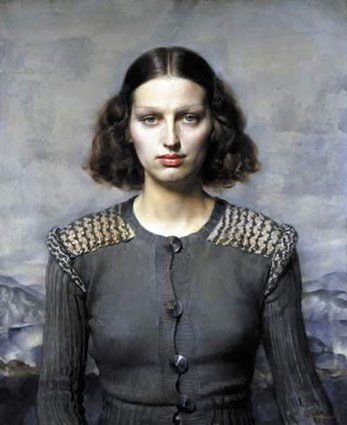
Jeunesse Dorée by Brockhurst

Ok, before you press the escape button, horrified by my infidelity, let me say that my love or is it infatuation is not for an actual woman but for a woman in a painting.  It all started back on May 16th 2011 when I told you about the time I stood before the painting Jeunesse Dorée.  I was rooted to the spot at the gallery, staring at Gerald Brockhurst’s portrait of Kathleen Woodward, the lady who was his beloved muse and who modelled for this painting.  I couldn’t take my eyes off her face.  There was something magnetic about the way she stared out at me.  I have since visited the gallery on a number of occasions just to pay homage to this beautiful woman.

Virgin Annunciate by Antonello da Messina

So that was that.  I was convinced that no other woman would compare with Kathleen’s beauty or so I thought.  However, almost a year later, (My Daily Art Display May 1st 2012), I came across a painting by Antonello da Messina entitled Virgin Annunciate.  As the title states, this was a painting of the Virgin Mary but the model the artist used for Mary was a humble Sicilian girl and for once the Virgin Mary portrayed in a painting, appeared simply as a young girl.  The model the artist had used for this work was a stunningly beautifully girl.  Words failed me as I looked into her eyes.  She had the most gorgeous face.  She had such an innocent air about her, which of course was befitting such a depiction.  There was such an unsullied loveliness about her that for a moment in my mind I discounted the haunting visage of Kathleen Woodward of Jeunesse Dorée, and yet how could I be so capricious?

And so my undying love of beauty had been transferred from a young English woman to a young Sicilian girl but I was determined that it was going to stop there, and so it would until I went to the Barber Institute of Fine Arts at Birmingham University a fortnight ago and “met” Countess Varvara Nikolaevna Golovina as portrayed by my featured painter, Élisabeth-Louise Vigée Le Brun.  Before I tell you more about the sitter and eulogise about her physical beauty, let me complete Élisabeth’s life story.

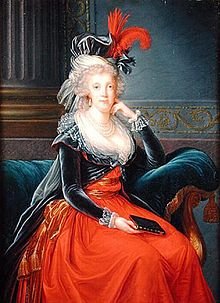
Maria Carolina by Élisabeth Vigée Le Brun (1791)

The French Revolution had begun and in October 1789, the Palace of Versailles had been stormed by a mob and the Louis XVI and his wife Marie Antoinette had been detained.  Élisabeth, because of her connections with Marie Antoinette, had to hurriedly leave France with her daughter and her daughter’s governess and head for the safety of Italy.  She visited Turin, Bologna, and Rome where her paintings met with great critical acclaim and she was elected to the Roman Accademia di San Luca.  From Rome she moved on to Naples.  Her artistic reputation preceded her and she received many commissions, including royal ones from the Queen of Naples and her husband King Ferdinand IV.  Look closely at the portrait (right) of the Queen, Maria Caroline.  Does she remind you of somebody from my last blog?  There is a very close resemblance with Marie Antoinette and this should not be too surprising as they were sisters.

During her European journeys, Élisabeth gained a travelling companion, who would remain alongside her and her daughter for the next nine years.  His name was, Auguste Jean-Louis Baptiste Rivière, a painter, who had also fled revolutionary Paris and made his way to Turin, where he had met up with Madame Vigée Le Brun and her daughter. Thereafter, he accompanied them and their servants on their trek across Europe and into Russia. During this time the two artists often worked in tandem, Vigée Le Brun painting life-size portraits, some of which were copied in miniature or simply on a small scale by Rivière. She wrote of him in her memoirs:

“…M. de Rivière was an astonishing actor in comic roles. Moreover he possessed every kind of talent, which caused the painter Doyen to remark that M. de Rivière was a little nécessaire de voyage literally a travelling case, but in French a play on words, meaning that he was a necessary adjunct during her voyages. The fact is that he was a fine painter and he copied all of my portraits in the form of large miniatures in oil. He sang very agreeably, played the violin and the bass viol and could accompany himself at the piano. He was endowed with intelligence, perfect tact and such a good heart that despite his distractions, which were frequent and numerous, he was able to oblige his friends with as much enthusiasm as success. M. de Rivière was short, svelte, and he never lost his youthful appearance, so that even at the age of sixty his thin waist and his bearing led one to think he was thirty…”

In 1795, Vigée Le Brun left Vienna and travelled to Russia where she was received by the nobility and painted portraits of numerous aristocrats including the last king of Poland Stanisław August Poniatowski and members of the family of Catherine the Great.  Catherine was not initially happy with Vigée Le Brun’s portrait of her granddaughters, Elena and Alaxandra Pavlovna, because of the amount of bare skin the short sleeved gowns revealed.  However, in order to please the Empress, Vigée Le Brun added sleeves giving the work its characteristic look. This alteration seemed to please the Empress who subsequently agreed to sit herself for Vigée Le Brun.  The proposed portrait never came to fruition as Catherine died in 1796 of a stroke before this work was due to begin.  While in Saint Petersburg, Vigée Le Brun was made a member of the Academy of Fine Arts of Saint Petersburg.   However less pleasing to Élisabeth was her daughter Julie’s decision to marry a Russian nobleman.

And so to My Daily Art Display’s featured work, entitled Portrait of Countess Golovine.  It is of Varvara Nikolaevna Galitzin, the daughter of Lieutenant General Prince Nicholas Feodorovitch Galitzin and his wife, née Prascovia Ivanovna Chouvaloff.  She spent the first fourteen years of her life on her father’s estate of Petrovska, near Moscow. After his death, she and her mother went to live in Saint Petersburg in a house on the Nevsky Prospect next to that of her uncle, Ivan Ivanovitch Chouvaloff.   She was named maid-of-honour at the Imperial court in 1783.   In spite of her mother’s opposition, she married the handsome wealthy but profligate Count Nicholas Nikolaevitch Golovin.   For a time she lived in Paris in the society of the old French aristocracy, but returned to Russia when Napoleon seized power.   Élisabeth and the countess formed a close friendship and in the artist’s memoirs, she wrote of her sitter:

“…Countess Golovin was a charming woman, whose wit and talents were enough to keep us amused, for she received few visitors. She drew very well and composed delightful love songs that she sang while accompanying herself on the piano. Moreover she was on the lookout for all the latest European literature with which she was familiar as soon as it was known in Paris…”

In the painting we see the Countess almost entirely enveloped in the red cloak which is embroidered with a neoclassical design. She wears a deep gold headband.  She stares out at us.  Her eyes are fixed on ours with unwavering, and somewhat unnerving frankness.  What made me lose my heart to this woman was the captivating way her left hand, which grasps her shawl, sweeps up wards clutching the material to her body.  Her loosely flowing auburn hair cascades down on to her shoulder. There is a ray of light falling at an angle from left to right which cuts the background diagonally into dark and light sections and by doing this the artist has emphasised the drama of the pose. There is an aspect of spontaneity about the pose and it is this aspect of the portrait which totally seduced me.

The painting was acquired by the Barber Institute of Fine Arts in Birmingham in 1980 where it hangs today.

After a sustained campaign by  Élisabeth’s ex-husband and other family members to have her name removed from the list of counter-revolutionary émigrés, she was able to return to France in 1802, during the reign of Emperor Napoleon I.   Her husband died in 1813 and six years later she suffers the tragedy of the death of her daughter.  She recalled these times in her memoirs:

“…I must now speak of the sad years of my life during which, in a brief space, I saw the beings dearest to me depart this world. First, I lost M. Lebrun. True that for a long time I had entertained no relations whatever with him, yet I was none the less mournfully affected by his death. You cannot without regret be separated forever from one to whom so close a tie as marriage has bound you. This blow, however, was far less than the cruel grief I experienced at the death of my daughter. I hastened to her as soon as I heard of her illness, but the disease progressed rapidly, and I cannot tell what I felt when all hope of saving her was gone. When, going to see her the last day, my eyes fell upon that dreadfully sunken face, I fainted away. My old friend Mme. de Noisville rescued me from that bed of sorrow; she supported me, for my legs would not carry me, and took me home. The next day I was childless! Mme. de Verdun came with the news, and vainly tried to soften my despair. All the wrong-doing of the poor little one vanished – I saw her again, I still see her, in the days of her childhood. Alas! she was so young! Why did she not survive me?…”

She bought a house in Louveciennes, Île-de-France, and lived there until the house was seized by the Prussian Army during the Franco-Prussian War in 1814.   She then moved to Paris where she remained until her death in her apartment at the Hotel Le Coq, rue Saint Lazare, at the age of 86,  on March 30th 1842 .  Her body was taken back to Louveciennes and buried in the Cimetière de Louveciennes near her old home.  On her tombstone were the words:

“Ici, enfin, je repose…”

(Here, at last, I rest…).

In all, Vigée Le Brun painted over 660 portraits and 200 landscapes which are in galleries and museums all over the world.   In 1835 she published her memoirs.

For a full account of Élisabeth’s life you should try and get hold of her autobiography, Memoirs of Madame Vigée Lebrun translated by Lionel Strachey.  There is an internet version to be found at:

http://digital.library.upenn.edu/women/lebrun/memoirs/memoirs.html#XVIII

Élisabeth-Louise Vigée Le Brun and Marie Antoinette

Marie-Antoinette of Austria, Queen of France
by Élisabeth Vigée Le Brun (1778)

I had intended this blog to be the concluding look at the life and some of the works of Élisabeth-Louise Vigée Le Brun but instead I am just concentrating this blog on a couple of the portraits Élisabeth did of the Queen consort Marie Antoinette and look at Élisabeth’s life up to her forced exile from France.  My next blog will conclude Élisabeth’s life story.

At the end of my last blog we had reached 1775 and Élisabeth’s step father had retired from his jewellery business and the family had moved to an apartment in a large property, Hotel de Lubert, which was situated on the rue de Clery.    The Hotel de Lubert was also where the painter and art dealer Jean-Baptiste Pierre Le Brun had his gallery.  Soon after settling into her new home, Élisabeth took a great interest in the beautiful masterpieces which filled Le Brun’s apartment and gallery.   She recalled this time in her memoirs saying:

“…I was enchanted at an opportunity of first-hand acquaintance with these works by great masters.  Monsieur Lebrun was so obliging as to lend me, for purposes of copying, some of his handsomest and most valuable paintings. Thus I owed him the best lessons I could conceivably have obtained…”

Six months after moving in to her new home Le Brun proposed marriage to Élisabeth.   She was not physically attracted to him but was concerned about her family’s financial future, hated living with her stepfather and after much persuasion from her mother, who believed Le Brun was very rich, agreed to Le Brun’s proposal.  Even on her wedding day on January 11th 1776, Élisabeth had her doubts about the wisdom of her decision for she later wrote:

“…So little, however, did I feel inclined to sacrifice my liberty that, even on my way to church, I kept saying to myself, “Shall I say yes, or shall I say no?” Alas! I said yes, and in so doing exchanged present troubles for others…”

Élisabeth’s fears were soon borne out for although she termed her husband as being “agreeable” he had one great character flaw – he was an inveterate gambler and soon his money and that which Élisabeth earned from her commissions was frittered away.  However before the money had run out, Élisabeth and her husband bought the Hotel de Lubert in 1779, and her Salons, which she held there became one of Paris’ most fashionable pre-revolutionary venues for artists and the literati.  Two years later, on February 12th 1780, her only child Jeanne Julie Louise was born.   In 1781 she and her husband left Paris and journeyed to Flanders and the Netherlands and it was during this trip that she saw some of the works by the great Flemish Masters and these paintings inspired her to try new painting techniques. During their time in Flanders she carried out various portraiture commissions for some of the nobility, including the Prince of Nassau.

It was back in the year 1779 that Élisabeth first painted a portrait of Marie-Antoinette, Louis XVI’s queen consort.  It was at a time when the lady had reached the pinnacle of her beauty.  In her memoirs Élisabeth described Marie-Antoinette:

“…Marie Antoinette was tall and admirably built, being somewhat stout, but not excessively so. Her arms were superb, her hands small and perfectly formed, and her feet charming. She had the best walk of any woman in France, carrying her head erect with a dignity that stamped her queen in the midst of her whole court, her majestic mien, however, not in the least diminishing the sweetness and amiability of her face. To anyone who has not seen the Queen it is difficult to get an idea of all the graces and all the nobility combined in her person. Her features were not regular; she had inherited that long and narrow oval peculiar to the Austrian nation. Her eyes were not large; in colour they were almost blue, and they were at the same time merry and kind. Her nose was slender and pretty, and her mouth not too large, though her lips were rather thick. But the most remarkable thing about her face was the splendour of her complexion. I never have seen one so brilliant and brilliant is the word, for her skin was so transparent that it bore no umber in the painting. Neither could I render the real effect of it as I wished. I had no colours to paint such freshness, such delicate tints, which were hers alone, and which I had never seen in any other woman…”

Both the artist and sitter formed a relaxed friendship and in her first portrait (above) the queen is depicted with a large basket, wearing a satin dress, and holding a rose in her hand. The painting was to be a gift for Marie-Antoinette’s brother, Emperor Joseph II, the Holy Roman Emperor, and a further two copies were made, one of which she gave to the Empress Catherine II of Russia, the other she would keep for her own apartments at Versailles.  In all, Élisabeth painted more than thirty portraits of the queen over a nine year period

Élisabeth’s friendship with Marie-Antoinette and her royal patronage served her well as in 1783,  her name had been put forward by Joseph Vernet for election to France’s Académie Royale de Peinture et de Sculpture.   As her morceau de réception (reception piece) she submitted an allegorical history painting entitled La Paix qui ramène l’Abondance (Peace Bringing Back Prosperity).  She also submitted a number of her portraits. The Académie however did not categorise her work within the academy categories of either portraiture or history.  Her application for admission was opposed on the grounds that her husband was an art dealer, but because of Élisabeth’s powerful royal patronage, the Académie officials were overruled by an order from Louis XVI.  It is thought that Marie Antoinette put considerable pressure on her husband on behalf of her painter friend.

Having royal patronage and being great friends with Marie-Antoinette was a boon when the Royalty was loved by its people but once the people turned against Louis XVI and his queen, as happened during the French Revolution, then any friends the royal couple had were equally detested and at risk from the mob.  Attacks on Élisabeth Vigée Le Brun’s character had started back in late 1783 when the newspapers wrote stories about an alleged affairs she had with the Finance Minister, Charles Alexandre, Vicomte de Calonne, the Comte de Vaudreuil and the painter François Menageot.  The rumours persisted and it all came to a head in 1789 when fictitious correspondence between Élisabeth and Calonne was published in the spring.  Rumours about her lavish lifestyle abounded, even though they were not altogether true.  She was now starting to realise that having close connections to the monarchy, which she had once considered to be advantageous, was becoming a dangerous liability.

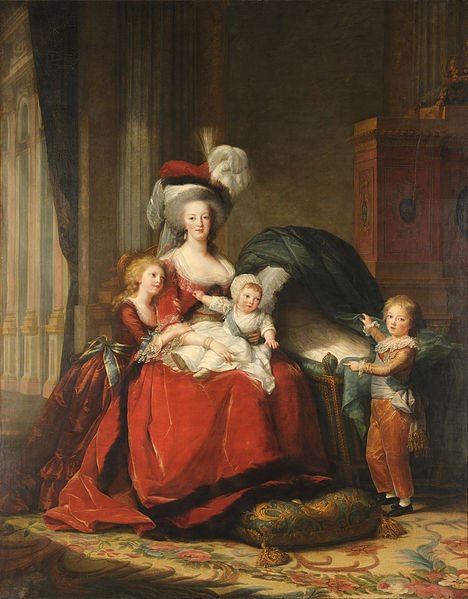
Marie Antoinette and her Children
by Élisabeth Vigé Le Brun (1788)

Élisabeth Vigée Le Brun’s last portrait of Marie-Antoinette was completed in 1788 and entitled Marie Antoinette and her Children.  The setting is a bedroom or a private chamber within the Royal palace.  Marie Antoinette is seated with her feet on a cushion.  This depiction of her posture symbolizes her status and high position in society.  She has a young infant on her lap and her son and daughter are either side of her.  In the painting we see her son, Louis-Joseph, Le Dauphin, standing to the right. Louis-Joseph suffered from bad health all his young life with the onset of early symptoms of tuberculosis and he died of consumption in 1789, a few months before his eighth birthday.   On the Queen’s lap sits Louis-Charles, Duc de Normandie, who on the death of his elder brother, became the second Dauphin. Following the guillotining of his father Louis XVI,  he became known as Louis XVII. This young boy was imprisoned in The Temple, a medieval Parisian fortress prison, where he died in 1795, aged ten, probably from malnutrition but rumour also has it that he was murdered.  Standing on the Queen’s right is Marie Therese Charlotte de France, Madame Royale.  She was Marie-Antoinette’s eldest child.  She too was imprisoned in The Temple but was the only member of the Royal family to survive the ordeal.  She remained a prisoner for over a year but Austria arranged for her release in a prisoner-exchange on the eve of her seventeenth birthday, in December 1795.  In the painting we can also see depicted an infant’s cradle which Louis-Joseph points to and lifts the covers showing it as being empty.  This empty cradle is a reference to Princess Sophie, Marie Antoinette’s other daughter, who was born in 1786 and died of convulsions two weeks before her first birthday.  This very poignant painting still hangs at Versailles.

On the night of October 6th 1789, following the invasion of Versailles by Parisian mobs and the arrest of the royal family, Élisabeth Vigée Le Brun left the mayhem of Paris with her daughter and governess in a public coach and headed for Italy.  She had hoped to return to France in the near future when the situation had settled down but in fact she never set foot back in France for twelve years.

My next blog will look at the latter part of Élisabeth’s life and I will regale you with my tale of infidelity which was the reason for featuring Élisabeth-Louise Vigée Le Brun in the first place !!


Self Portraiture by Élisabeth-Louise Vigée Le Brun

Over the next two blogs I want to introduce you to and look at the life of one of the finest 18th century French female portraitist, Élisabeth-Louise Vigée Le Brun.  In my initial blog about her I want to examine her early life and show you three of her self portraits and in the following blog I will conclude her life story and tell you about her friendship with Marie-Antoinette, her exile from the land of her birth and relate how I was once again unfaithful having been seduced by a new beauty !  Sounds interesting ?

Self Portrait in a Straw Hat (age 22)
by Élisabeth-Louise Vigée Le Brun (1782)

Today’s artist was born Élisabeth-Louise Vigée in April 1755 on the rue Coquilliere in Paris, just six months before another baby girl was born in the palace of Emperors of Austria in Vienna, a priveleged child, who would become the queen of the French nation and also play a large part in Élisabeth’s life.  That Viennese baby was Marie-Antoinette.   But let me return to Élisabeth.  Élisabeth was the daughter of Louis Vigée, a portraitist and professor at the Academie de Saint Luc .  Her mother, Jeanne Maissin was a hairdresser by trade.  At the age of 3 months, she was sent to a small farm near Épernon, where she was looked after by relatives.  She stayed with them until she was six years old.  Following this, she attended the convent school, Couvent de la Trinite in the Faubourg Saint Antoine district of Paris, as a pensionnaire, (a boarder) where she remained until she was twelve years old.  It was here that she first displayed her young talent for drawing and painting.  In her memoirs she wrote about her time at the boarding school, her love of drawing and the trouble it often got her into but also the pleasure her father had in her interest in art.  She wrote:

“….During that time I scrawled on everything at all seasons; my copy-books, and even my schoolmates’, I decorated with marginal drawings of heads, some full-face, others in profile; on the walls of the dormitory I drew faces and landscapes with coloured chalks. So it may easily be imagined how often I was condemned to bread and water. I made use of my leisure moments outdoors in tracing any figures on the ground that happened to come into my head. At seven or eight, I remember, I made a picture by lamplight of a man with a beard, which I have kept until this very day. When my father saw it he went into transports of joy, exclaiming, “You will be a painter, child, if ever there was one!…”

On returning to live at home on a permanent basis, her father gave Élisabeth her first drawing lessons when she was allowed to attend his drawing classes which he gave to students in his studio.  Sadly his tuition did not last long as Louis Vigée died on May 9 1767 in his apartment on the rue de Clery.   To lose her father at the age of twelve was a traumatic experience for Élisabeth and she recalled the moment:

“…I had spent one happy year at home when my father fell ill. After two months of suffering all hope of  his recovery was  abandoned. When he felt his last moments approaching, he declared a wish to see my brother and myself. We went close to his bedside, weeping bitterly. His face was terribly altered; his eyes and his features, usually so full of animation, were quite without expression, for the pallor and the chill of death were already upon him. We took his icy hand and covered it with kisses and tears. He made a last effort and sat up to give us his blessing. “Be happy, my children,” was all he said. An hour later our poor father had ceased to live…”

Self Portrait with her Daughter (Maternal tenderness)
by Élisabeth-Louise Vigée Le Brun (1786)

Élizabeth’s father had, on his death, left the family penniless and his widow had to find ways of clearing their debts and pay for her son’s schooling and it is with that in mind that, in December of that same year, 1767, she married a wealthy jeweller, Jacques François Le Sevre and the family moved to an apartment on the rue Saint Honore facing the Palais Royal.    However any thoughts she had that her rich husband would solve the family’s financial problems were soon dashed as he turned out to be miserly with his money and just provided the bare minimum for his wife and her son.  Élisabeth, by this time, had been earning her own money from commissions but was made to hand it over to her step-father for him to use as he saw fit.

Élisabeth began taking drawing lessons with her friend Blaise Bocquet from the history painter and Academician, Gabriel Briard, who had a studio in the Louvre.  During her training she copied the paintings of the Old Masters at the Louvre and the Palais-Royal, which housed the magnificent Orléans art collection, and during this period she encountered the French artist, Claude Joseph Vernet.  He would often give her artistic advice and encourage her and more importantly introduced her to prospective important and wealthy patrons.  She also met the Abbé Arnault, of the French Academy.  She later described him as a man of strong imaginative gifts, with a passion for literature and the arts and recalled how his conversation enriched her with ideas.     It was the studying of the Old Masters’ paintings which furthered her knowledge of anatomy, perspective, and the other important aspects of history painting which she was not allowed to formally study, simply because of her gender.  She spent a great deal of time copying the heads in some of the pictures by Rubens, Rembrandt and Van Dyck, as well as several heads of girls in paintings by Jean-Baptiste Greuze.  She was a great admirer of Greuze’s portraiture because, from them, she learnt about his use of  the demi-tints when portraying flesh colouring.

By this time Élisabeth had decided that her future lay in her art and she would strive to become a successful painter.  However her choice of career was problematic simply because she was a female.  As a female, she was excluded from formal academic training and artistic competitions and this factor alone gave her a distinct disadvantage in comparison to the training afforded to her male contemporaries.  At this time in France, the most prestigious type of painting was history painting but to achieve a reputation as a great history painter one had to undergo an all-embracing formal artistic education into the likes of the technique of painting the nude male and how to best arrange figures within a painting for it to be accepted as an acceptable narrative work.  However for reasons of modesty, females were not allowed to paint nude males and so as this formal training was not yet available to aspiring female artists, they had to settle for painting portraits, landscapes and genre works.  She now decided to specialise in portraiture.

Self Portrait with Daughter (à la Grecque)
by Élisabeth-Louise Vigée Le Brun (1789)

In 1774, aged nineteen, Élizabeth applied to join the Academy of Saint Luke where her father had taught. She was accepted and that year she exhibited several of her works at their Salon.  Her portraiture and the way in which she depicted her sitters in a flattering manner was very popular and much in demand.  In 1775 she married a wealthy art dealer and amateur painter, Jean-Baptiste-Pierre Le Brun.  The marriage was a marriage of convenience orchestrated by her mother.  Five years later, the couple had their only child, Jeanne Julie Louise, born on February 12th 1780.  It was not a love match, but more of a mutually-beneficial pact that benefitted them both.  .  Her husband marketed her work and endorsed her artistic career while also profiting from her artistic output.  It worked well and the couple became quite affluent and lived a luxurious lifestyle, which allowed them to mix socially with the highest circles of society. Soon Élisabeth and her husband would hold fashionable soirées at their home.  Their guests included artists, writers, and important members of Parisian society.  In 1776 she finally managed to achieve her ultimate aim.  She secured her first royal commission when she was asked to paint a series of portraits of King Louis XVI’s brother, the Comte de Provence.  Before long she even caught the attention of the king and queen themselves and Élisabeth was summoned to the court in 1778 to paint her first portrait of the Marie Antoinette. Marie Antoinette had had her portrait painted by many artists but neither she nor her mother, Marie-Thérèse were ever fully satisfied with the results.  However, they both approved of Élisabeth’s depiction which, although it admirably conveys her royal status, it was actually much more simplified and natural than most of the earlier official portraits of the queen.  This portrait marked the start of a close relationship between Élisabeth and Marie-Antoinette.  This relationship greatly enhanced the reputation of the artist and led to many wealthy commissions. Louis XVI was equally impressed by her artistic work and in Wendy Slatkin’s book, Women Artists in History, she quotes Louis XVI’s comments about Élisabeth and her work:

“…I know nothing about painting, but you have made me love it…”

Élisabeth was a devoted royalist and idolized Marie Antoinette and the rest of the royal family.  It was however this close friendship with Marie-Antoinette which was to alter the course of her life.

Portrait of Susan Lumsden by Rubens

I have included three self portraits in this intial blog about the artist Élisabeth-Louise Vigée Le Brun.   The first one entitled Self Portrait with Straw Hat was completed in 1782 and is held in a Swiss private collection.  Élisabeth exhibited this work at the 1783 Académie royale de peinture et de sculpture (Royal Academy of Painting and Sculpture), Paris.  Of this painting the artist wrote:

“…I was so delighted and inspired by Rubens’ Le Chapeau de Paille that I completed a self portrait whilst in Brussels in an effort to achieve the same effect.  I painted myself wearing a straw hat with a feather and a garland of wild flowers and holding a palette in one hand...”

For a more comprehensive look at Rubens’ Le Chapeau de Paille, also known as Portrait of Susanna Lunden go to My Daily Art Display of March 11th 2011.

Lady Hervey and her Daughter by Angelika Kauffmann

The second self portrait I have featured was completed by Élisabeth in 1786 and is entitled  Madame Vigée-Le Brun and Her Daughter, Jeanne-Lucie, known as Julie (1718–1819).  The painting is thought to have been inspired by a work by Angelika Kaufmann, entitled Lady Hervey and her Daughter which depicted Elizabeth Drummond, Lady Hervey and her daughter Elizabeth Catherine Caroline Hervey later to become The Honourable Mrs Charles Rose Ellis.  The work by Vigée Le Brun is one of maternal tenderness and is somewhat reminiscent of the sentimental pictures of Jean-Baptiste Greuze which Élisabeth had studied in her younger days.


The third portrait in this blog is entitled Madame Vigée-Le Brun et sa fille, Jeanne-Lucie-Louise, dite Julie (Madame Vigée-Le Brun and her daughter Jeanne-Lucie-Louise, known as Julie) and is often referred to as Self Portrait with Daughter (à la Grecque).  It is currently housed at the Louvre in Paris.

Réunion de famille (Family Reunion) by Frédéric Bazille

Family Reunion by Frederic Bazille (1867-69)

Often when I am driving down a large highway and see that the traffic flow in the opposite direction has stopped resulting in a formidable two or three mile tailback and I go further on, past the hold-up, around a bend in the road, and see cars heading towards the stopped traffic, the drivers of which are completely oblivious to what is around the bend.  They are happily driving on.  Life for them is good.  Maybe they are heading home or heading for a destination they have been counting down time to reach.   They have great plans with regards what they will do when they reach their destination.   It is at times like these that I think about life and death and the way we, like the driver and passengers of the cars heading unwittingly towards the tail-back.  We are happily going about our business, completely unaware of what is about to happen to us in a few minutes, or a few hours, or a few days or a few months hence.

So why do I start my art blog in such a fashion?   The reason is that for my next two blogs I am featuring works by two young artists who had their whole lives ahead of them and who must have believed theirs was to be a successful and happy future and yet because of a conscious decision they both made, their lives would end suddenly in the theatre of war.  Today I am going to once again look at the life and works of the nineteenth century French painter Frédéric Bazille and in the following blog I want to introduce you to an artist, who you may not have come across before, the English Victorian painter Brian Hatton.

Jean Frédéric Bazille was born in Montpellier at 11, Grand’rue in 1841. His father was Gaston Bazille and his mother was Camille Victorine Bazille (née Viliars).  Gaston Bazille was a wine merchant, senator and president of the Agricultural Society of Herault.  He was the head of an affluent and cultured upper middle-class Protestant family.  He and his wife had three children, Suzanne the eldest, followed by Jean Frédéric and Claude Marc.  Whilst living in Montpellier, Bazille became acquainted with a friend of his father, a local art collector Alfred Bruyas.  Bruyas was also a close friend and patron of the artist Gustave Courbet and, over time, he had built up a sizeable art collection with works by Jean-François  Millet, Jean-Baptiste-Camille Corot, Eugène Delacroix and of course, many by his friend Courbet.   Young Frédéric Bazille often had the chance to examine these precious works and was fascinated with and inspired by the collection.   This was to be the start of the young man’s love affair with art.  He began to paint and sketch but his father told him that if he wanted to continue with his art he had to agree to continue with his studies. He graduated from high school in Montpellier, where he obtained a degree in 1859, and as he would do anything to continue with his art, he went along with his father’s wishes and began his medical studies at the Faculty of Montpellier.

To continue with his medical studies, Bazille had to move to Paris and so in November 1862 he travelled to the capital.   Whilst in Paris, Bazille, unbeknown to his father, spent more time sketching and painting than getting on with his medical studies.    In late 1862, Bazille enrolled at the private art studio of Charles Gleyre, the Swiss historical painter.   Whilst at this atelier he met and became friends with fellow aspiring artists, Claude Monet, Auguste Renoir, Alfred Sisley and James McNeil Whistler.   Monet and Renoir would become close friends of Bazille’s and they were to influence his artistic style and approach toward art, particularly through the practice of en-plein air painting and directly observing life and nature.  During this time, a frequent meeting place for these artistic friends was the Café Guerbois in Paris, where new ideas and theories were discussed passionately.    Bazille, unlike Monet, had no money problems.  He came from a well-off family and he would often pay for many a round of drinks.   Bazille also paid for studio rent and art supplies and always helped ease the financial worries of the likes of Monet by buying some of their paintings and by doing so ensured that his new-found friends would be saved from complete financial despair.

When Gleyre’s studio closed the following year Bazille decided to leave Paris and follow his friends whilst he waited on the results of his medical exams.  In 1863 he went and lived alongside Monet at Chailly and learnt the en plein air painting technique in the Forest of Fontainebleau.  In 1864, he found out that he had failed his medical exams, much to his father’s disappointment.   Bazille gave up any idea of entering the medical profession and, from this time on, he concentrated all his efforts on his painting.

France declared war on Prussia on 19 July 1870 but the other German states quickly joined on Prussia’s side and France was soon defeated.  In August 1870, at the age of 28, Frédéric Bazille, against the wishes and advice from his friends, enlisted in the Third Regiment of the Zouave.    Zouave was the title given to certain light infantry regiments in the French army which trained in Algeria.   One must remember that Bazille was a wealthy man and could, if he had so wanted, not have gone to war, for in those days, even if he had been drafted, he and his family could have paid for another person to substitute for him. However Bazille chose to serve his country.   Bazille died on November 28th 1870 at the Battle of Beaune-la-Rolande, near Orléans.  Bazille’s biographer, François Daulte wrote about the incident:
“... The company halted on the top of ridge overlooking Beaune. It was greeted with a hail of Prussian bullets. The first of the men advancing toward the town fell like flies …….. In the general chaos women and children were escaping from the town and running towards isolated farm buildings which would offer some protection …….. Bazille’s turn came and he charged, crying: “Don’t shoot! Women and children!” He was hit by two bullets to the arm and chest. He fell, face down in the earth, fifty metres from the château where Corot had painted one of his masterpieces…”

Bazille died on the battlefield just eight days before his twenty-ninth birthday.   His family was devastated and his father travelled to the battlefield a few days later to take his body back for burial at Montpellier.

My featured painting today is probably Frederic Bazille’s most famous work, entitled Réunion de famille also called Portraits de famille (Family Reunion also called Family Portraits) which he completed in 1867 and altered slightly two years later.  It is a large painting, measuring 152cms x 230cms.  The subject of the work is an extended family gathering at Bazille’s family’s country estate at Méric, near Montpellier during the summer of 1867.  The sun is shining brightly but the people are safeguarded from the harsh rays of the sun by the very large tree on the terrace, the foliage of which filters the sunlight, which allows the artist to cleverly depict the very sophisticated light and shadow effects against the subjects, their clothing and surroundings.  Look at the strong contrasts of the bright colours between that of the landscape and the sky in comparison to the shaded areas under the tree.  As the sunlight manages to filter through the leaves it manages to light up some of the pale clothing contrasting it against the darkness of the jackets, shawl and apron.  It illustrates how Bazille’s liked painting in the light of the South of France.

In this painting, Bazille has depicted various figures in a tableaux-type style.  Although there is a peaceful feeling about this depiction, it is just a group of figures.  There is a lack of interaction between the family members with all the figures stiffly-posed and all, except the father, looking towards us as if we were the photographer recording this family get-together.  The photographer aspect of this painting may not be as far-fetched as it seems as it is known that around about this time Frédéric’s brother Marc married Suzanne Tissié and it could well be that Frédéric was in some ways recording the family get-together a few days after this wedding.  There is an air of confidence about the demeanours of the people depicted, which probably came with their affluent status in society.  In the picture Bazille has included ten extended family members and he even added himself in the painting.  He is not in a prominent position.  He has squeezed himself into the far left of the painting, which may infer that he was somewhat reluctant to include himself.    Next to him stands his uncle by marriage, Gabriel des Hours-Farel.  Seated on a bench with their back to him is his mother, Camille, and father, Gaston, whilst at the table is his aunt, his mother’s sister, Élisa des Hours-Farel and her daughter Juliette Thérèse.     Standing by the trunk of the tree with their arms linked are Bazille’s cousin Thérèse Teulon-Valio, the married daughter of Gabriel and Élisa des Hours-Farel,  and her husband, Emile.  On the right of the painting, standing by the terrace wall is Marc Bazille, Frédéric’s brother with his wife of a few days, Suzanne Tissié and his sister Suzanne.    The Bazille and des Hours families used to spend every summer on the magnificent estate of Méric, in Castelnau-le-Lez, a village near Montpellier. The house and its grounds were slightly higher up, overlooking the village.

Two years later, after it was shown in the Salon, Bazille re-worked parts of the painting, replacing little dogs, which had been in the foreground, with a somewhat contrived still life made up of a furled umbrella, a straw hat and a bunch of flowers.

The painting was accepted by the French Salon of 1868, which slightly embarrassed Bazille as his friend Monet had failed to get any of his works accepted by the Salon jurists that year.  Bazille didn’t gloat much about his inclusion in the Salon, stating that his being chosen over Monet was “probably by mistake.”  Bazille’s is often now looked upon as a dilettante, an amateur who flirted with avant-gardism but lacked application and so remained a follower rather than a leader. However some of his contemporaries would disagree, Camille Pissaro described him as:  “one of the most gifted among us.”

Bazille produced many beautiful works of art during his short lifetime and who knows what he may have accomplished if he had not patriotically decided to fight for his country and sadly, within a year of painting today’s picture he was lying dead on a battlefield.

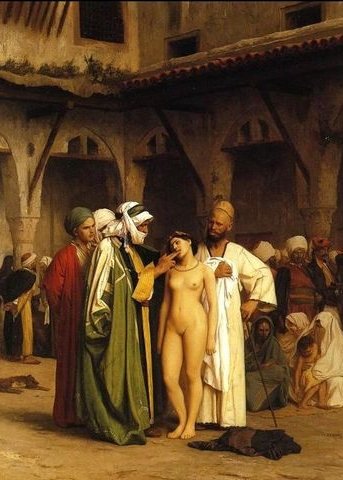
The Slave Market by Jean-Léon Gérôme

The Slave Market by Jean-Léon Gérôme (1866)

Today I am returning to the nineteenth century French academicism painter and sculptor Jean-Léon Gérôme, looking at his early life and featuring one of his works.  I had previously featured this artist in My Daily Art Display of February 10th 2011 when I talked about his painting entitled A Roman Slave Market.

Jean-Léon Gérôme was born in 1824, in Vesoul; a small town close to the city of Besançon and near to the French-Swiss border.  He was the eldest son of Pierre Gérôme, who was a goldsmith by trade, and his wife Claude Françoise Mélanie Vuillemot, a daughter of a merchant. He initially attended school locally in Vesoul where he was looked upon as a star pupil and attained a good deal of academic success culminating in being awarded first prize in chemistry, and an honourable mention in physics.  From the age of nine he took drawing lessons under the tutelage of Claude-Basile Cariage and when he was fourteen years of age he received formal art tuition and was viewed as a great up-and-coming talent and he received a prize from the school for one of his oil paintings.    At the age of sixteen, with his school days behind him, he set out for Paris with a letter of introduction to the French painter Paul Delaroche who at this time was at the height of his fame.   Delaroche’s artistic style was a blend of the academic Neo-classical school and the dramatic subject matter favoured by the Romantics.  This combination was to become known as the historical genre painting style. Gérôme was to be greatly influenced by the paintings and the tuition he received from Delaroche.

In 1845, after three years of studying under Delaroche and having just returned to Paris after a visit to his home in Vesoul, Gérôme discovered that Delaroche had closed his studio.   Delaroche had just suffered the loss of his wife, Louise, whom he deeply loved and whom he had depicted in many of his paintings.   Gérôme discovered him to be in the depths of depression following the death of his wife and was about to close his atelier and journey to Italy. Gérôme asked if he could accompany him.  Delaroche agreed and the two of them along with a couple of other of Delaroche’s students, one of which was the English painter Eyre Crowe, set off on their painting trip.

Gérôme stayed in Italy and visited Naples where he viewed the ruins of Pompeii and Herculaneum which were to become the foundation for his gladiatorial depictions.  His sojourn in Italy was cut short in 1844 when he contracted typhoid fever and he had to return home to Versoul where his mother nursed him back to health.  Later that year, fully recovered, he returned to Paris and entered the atelier of the Swiss painter and teacher Charles Gleyre.   Gleyre was to guide many young aspiring artists who would become famous household names, such as Monet, Renoir, Bazille and Whistler.  From the studio of Gleyre, Gérôme went on to attend the École des Beaux-Arts.

Meanwhile, Delaroche, who had remained in Rome, returned to Paris to work on an important commission.  Delaroche offered Gérôme a position as his assistant on the commission and so Gérôme left Gleyre’s studio to work with his former master.  He remained as Delaroche’s assistant for just on a year. Whilst working alongside Delaroche, he was encouraged to prepare paintings for the Salon exhibitions and within a short time, his talent as an artist was recognised and he was commissioned to paint a reproduction for the Queen. This was to be the start of many official and lucrative commissions. In 1846 Jean-Léon Gérôme began to work on one of his most famous paintings – Young Greeks Attending a Cock Fight.  Gérôme had just suffered the setback at the École des Beaux Arts of not achieving his main aim that of winning Prix de Rome prize, which would have given him a scholarship to travel to and study in Rome.  He was probably questioning his own ability and was somewhat hesitant to submit his painting to the Salon jurists, but on Delaroche’s insistence, he did and it was accepted into the 1847 Salon and hailed a great success.  One of those to take a liking to his work was the art critic and poet, Théophile Gautier, who would later support Gérôme throughout most of his career.  Gautier’s commendation of The Cock Fight made Gérôme famous and his artistic career was well and truly launched.

Gérôme travelled extensively visiting Turkey in 1855 to make studies for a large official commission, and two years later journeyed to Egypt in preparation for the Salon of 1857 in which his first Egyptian genre paintings were shown.   In the 1860’s he returned to Egypt and also visited Judea, Syria and the Holy Places.   Gérôme was fascinated with the Near East and many of his subsequent works highlighted the Near East culture and traditions and it was to mark the start of his career as an Orientalist or a peintre ethnographique.

The painting by Jean-Léon Gérôme which I am featuring today was completed by him in 1866 and is entitled The Slave Market.  It is without doubt one of Gérôme’s most provocative works.  The scene is set in a market place in a Near East country, more than likely, Egypt.  The idea for this painting and others featuring the slave market probably came to Gérôme during his Near East travels, when slavery was still practiced.  However the open air slave market as shown in this painting did not exist in the mid-nineteenth century and so this should be viewed as an idealised depiction.  The artist has put a great deal of effort into details of the costumes worn by the traders as well as the way in which he has carefully depicted, in detail, the architecture of the surrounding buildings.  In the centre of the painting we see a nude woman who is being offered up as a slave and is surrounded by a group of prospective buyers.  One of these men, dressed in a gold and green covered cloak, examines the “goods” on offer.  His left hand holds the back of the woman’s head whilst the fingers of his right hand are forced into her mouth so he could better examine her teeth.  Behind the woman stands the seller and from the smile on his face he seems assured that he is about to be paid handsomely for the woman.  There can be no doubt that prospective buyers of this painting were not totally absorbed by the way the artist depicted the clothes worn by the prospective buyers or with the architecture of the building in the background.  They were sold on the erotic nature of the painting.  Viewers were able to be vociferous in their condemnation of the slave trade whilst enjoying the sight of the female body.

The painting was acquired by Sterling and Francine Clark in 1930 and is part of the Sterling and Francine Clark Art Institute in Williamstown, Massachusetts collection but is currently (until September 23rd) on view at the Royal Academy, London.

View at Narni by Jean-Baptiste-Camille Corot

View at Narni by Corot (1826)

Today I want to focus on the early life of one of the greatest nineteenth century French landscape painters, Jean-Baptiste-Camille Corot.  He was one of the leaders of the Barbizon School and a master of plein air painting.   The Barbizon school, which existed between 1830 and 1870, acquired its name from the French village of Barbizon, which is situated close to the Fontainebleau Forest.  It was here that an informal group of French landscape painters gathered.  Other great luminaries from this group were Théodore Rousseau, Jean-François Millet, Charles-François Daubigny and Constant Troyon, to mention but a few.

Corot was born in Paris in 1796.  He was one of three children.  He had an older sister Annette Octavie and a younger sister Victoire Anne.   His father, Louis Jacques Corot, a Burgundian, was a cloth merchant and his mother, of Swiss origin, Marie Françoise Corot née Oberson, came from a wealthy wine merchant family of Versailles.  Camille’s parents were members of the so called bourgeois class, characterized by their sound financial status and their related culture, which their money allowed them to enjoy.    Following their marriage his father managed to purchase the hat shop, which his mother had worked in and he then gave up his career and helped her manage the business side of the shop whilst she carried on with her design work.   The family lived over the shop, which was situated on the fashionable corner of Rue du Bac and Quai Voltaire, at the end of the Pont Royal Bridge. From the windows of his room above the shop, Corot was able to see the Louvre and the Tuileries.  It could well be that the beautiful views Corot witnessed from his room had an influence on his art.  Their shop was very popular with the Parisians who always wanted to have the latest in fashion accessories.    It was a very successful business venture and on account of his parents’ affluence, Corot, unlike many of his contemporaries, never had to endure the hardships brought about by poverty.

His parent enrolled Camille in the small elementary school in the Rue Vaugirard in Paris and he remained there until he was ten years old.    The following year, 1806, his parents then sent him to the Lycée Pierre-Comeille College in Rouen.   During the time there, Corot lodged with the Sennegon family, who were friends of his father. The Sennegon family were great lovers of country walks and they would often take Camille Corot with them.  Over the five years he lived with the Sennegon family, Camille too built up a love for the countryside and nature and it was this love which would influence his work as a landscape painter and it was this very region that Corot depicted in his early paintings

Corot left Rouen and the Sennegon family home and, at the age of nineteen, he completed his formal education at a boarding school in Poissy, near Paris,.  Corot was not remembered as a clever student.  He never won any academic awards and did not show any interest or ability in art.   After leaving college his father arranged a number of apprenticeships for his son with a number of cloth merchants but Camille never settled and disliked the business practices inherent in that line of work.   Corot had discovered another love which soon consumed him and his time – Art.   In 1817, Corot started to spend all of his evenings painting, attending the art school, Académie Suisse in Paris.

Corot’s country home at Ville-d’Avray

In the same year, his father purchased a country home at Ville-d’Avray, eight miles west of the centre of Paris. Camille loved the house and the surrounding area with its woods and small lakes.  Again, as was the case when he lived in Rouen, Corot was able to appreciate the beauty of nature and the urge to record what he saw in his sketches and paintings.   Ville-d’Avray and the surrounding area were to be the focus of many of Corot’s en plein air paintings throughout his life time.   His bonding with nature, once again, only served to reinforce his desire to paint. The countryside around Ville-d’Avray provided Corot with an immense amount of subjects for his “en plein air” paintings all his life.  Étienne Moreau-Nélaton an artist and art collector and contemporary of Corot commented on Corot’s love of the Ville d’Avray when he said:

“…Providence created Ville-d’Avray for Corot, and Corot for Ville-d’Avray…”

In 1822, by the time Camille was twenty-six years of age, he had spent almost eight years working for various cloth merchants and had enough of this life.  In Vincent Pomarède & Gérard de Wallens, 1996 book Corot: Extraordinary Landscapes they quote Corot’s recollection of his conversation with his father:

“…I told my father that business and I were simply incompatible and that I was getting a divorce…”

The one thing that Camille did gain from working with textiles at the cloth merchants was it taught him about colours, patterns, textures and design and it could be that it was then that he began to explore painting as a possible career.   His father had equally  had enough of his son carping about working for fabric dealers and so asked him that if he wasn’t to follow him in his trade then what did he want to do.  Camille’s answer was unequivocal – he wanted to be an artist.

However, to do this, Camille needed some extra financial help.  Sadly, a year earlier, his younger sister, Victoire-Anne, had died and her annual family’s allowance of 1500 francs could now be made available to finance Camille’s artistic ambitions. This modest funding was to support Camille comfortably for the remainder of his life.   His parents were not happy with their son’s decision to become an artist, believing life as such led to just one thing – poverty.

With the financial assistance from his parents, Corot established an artist’s studio at No. 15 Quai Voltaire, a road which ran along the banks of the River Seine and was located close to his family home.  He, like many aspiring artists of the time, studied the works of the Masters in the Louvre and was initially tutored by the French painter, Achille-Etna Michallon.   After the passing of Michallon, in 1822, Corot moved on to the studio of the French historical landscape painter,  Jean-Victor Bertin.   It was under the auspices of this painter that Corot started combining the French neoclassical with the English and Dutch schools of realistic landscape art in his paintings.  Corot at the same time began sketching nature en plein air in the forest of Fontainebleau near Paris and in Rouen.

In 1825 Corot decided that to enhance his artistic ambitions he had to follow the well trodden route of artists and head for Italy.  Here he wanted to study the landscape of the Italian countryside around Rome, the Campagna.  He remained in the area for almost three years and in 1826 he took a painting trip to the Nar Valley and the hill top town of Narni which brings me to My Daily Art Display’s featured paintings by Corot entitled View at Narni, which is currently housed in the National Gallery of Canada in Ottawa and the preliminary oil sketch, The Bridge at Narni, which can now be seen in the Louvre.  This was initially painted by him as a study for that final work.   Painters in France at the time were encouraged to paint outdoors (en plein air) but the results were not looked upon as the finished works but merely as aides-mémoire for how the light and the atmosphere was at the time.  The artists would then take these sketches to their studios where he or she would complete the finished Classically-balanced composition.  The preliminary sketches were then just filed away and were never exhibited.  Now of course, these plein air sketches are very valuable and of great significance as they highlight the immediate and unmediated perception of the scene as seen through the eyes of the artist.  It is therefore interesting to look at the differences between the preliminary topographically true vision of a landscape and the finished work which may in some way have been somewhat idealized in order to boost the artist’s chance of selling the painting.

Today I am featuring both Corot’s preliminary sketch and the completed painting depicting the Bridge at Narni.  He came upon the town of Narni, on the River Nera in September 1826.  This Roman Bridge of Augustus was built in 27 BC, and was one of the two tallest road bridges ever built by the Romans. The Narni Roman Bridge was 160 m long and its remaining arch is 30 m high.  Corot was not the first artist to incorporate the bridge in one of his paintings as his erstwhile tutors, Achille-Etna Michallon and Edouard Bertin both completed works which depicted the structure.

The Bridge at Narni by Corot (1826)
Preliminary oil sketch

If we look at the preliminary oil sketch above we can tell it is a first attempt as the foreground is formless in detail.  Maybe this is due to the fact that as a plein air artist he was not concentrating on the details close to where he stood or sat at his easel.  His concentration would be solely focused on what he saw in the mid-ground and the background and he would have been absorbed by the aspects of light and shade at the very time he was putting brush to canvas.  This sketch of Corot’s was highly acclaimed by artists and critics alike for its naturalness and for its captivating breadth of vision.

When Corot returned to Paris the following year he set to work on his final oil painting of the bridge at Narnia.  He decided to put forward two paintings for exhibiting at the 1827 Paris Salon.  He wanted them to be two contrasting works.  One would depict a morning landscape whilst the other would depict an evening landscape.  For the morning landscape he submitted his final View at Narnia, the one shown at the start of this blog, whilst putting forward The Roman Campagna (La Carvara) as the evening landscape scene.  This latter painting is presently housed in the Kunsthaus, Zurich.  This final rendition of the painting, View at Narni, is much larger, at 68cm x 93cm than his preliminary oil sketch, Bridge at Narni, which only measures 34cms x 48cms.

When Corot set about “transferring” the details from his preliminary sketch on to the canvas for his final version he had to tread a fine line when it came to topographical integrity and idealised perfection.  This was the normal practice of landscape artists of Corot’s day.   It was expected of the landscape painter not to just depict a photo-like depiction of a scene, but bring to the painting what the likes of Claude had done before – a neoclassical ennoblement.

In Peter Galassi’s 1991 book, Corot in Italy, he talked about Corot’s desire to emulate the great landscape painters of earlier times and he knew he had to find a way to reconcile traditional painting objectives with those of plein air painting:

“…So deeply did Corot admire Claude and Poussin, so fully did he understand their work, that from the outset he viewed nature in their terms….In less than a year (since his arrival in Rome) he had realized his goal of closing the gap between the empirical freshness of outdoor painting and the organizing principles of classical landscape composition..”

The artist had to bring an academic approach to bear on his initial vision.  Look how Corot has changed the foreground from being a steep slope in his preliminary sketch, which was how it was, to terracing and as was often the case in academic landscape works he has added a path, in the left foreground, and on it we see some sheep and goats.   Corot has added shepherds tending their flock and near to the cliff edge, he has added a couple of umbrella pine trees synonymous with and symbolic of the Roman countryside.    This final version has now become a typical example of a Neoclassical landscape.

Corot must have liked the final version, for it remained with him and hung in his bedroom until he died.  The art historian of the time, Germain Bazan, commented on the difference between the two versions saying of the original plein air oil sketch:

“…a marvel of spontaneity in which there is already the germ of Impressionism, [while] the Salon picture, even though it is painted in beautiful thick paint and with great delicacy, is nonetheless a rather artificial Neoclassical composition…”

Kenneth Clark compared the two saying that of the two versions:

“… it [the preliminary sketch] is as free as the most vigorous Constable ; the finished picture in Ottawa is tamer than the tamest imitation of Claude…”

I will leave you to decide whether you prefer the original, topographically accurate sketch or the somewhat idealized final version.   Below is how the bridge appears today.

The Narni Bridge

The Melun Diptych by Jean Fouquet

The Melun Diptych by Jean Fouquet (c.1450)

In my last blog I looked at an altarpiece by Michael Pacher and discussed terms such as diptych, triptych and polyptych, which all referred to panel paintings which were hinged together.  Although we looked at a triptych altarpiece this form of art was not only used in the depiction of religious personages.   There were many commissions for the diptych when it came to secular portraiture.  Often it would be the portrait of the husband on one panel with the portrait of his wife on the other.  The diptych was quite a common format in the Early Netherlandish paintings of the 15th and 16th centuries. In my blog today I want to look at a fifteenth century diptych, known as the Melun Diptych, which was the work of the great French painter and manuscript illustrator, Jean Fouquet.  Although the attached photograph above shows the two paintings as a diptych, the two panels are now separated.  Up until 1775, the diptych remained in the church of Notre Dame in Melun. However the church fell on hard times and needed money to help pay for the building’s restoration.  The elders of the church decided to raise funds for the building work by selling the diptych.  The right wing with the Madonna and Child was sold to the mayor of Antwerp and it has remained in the Belgian city ever since.  It is now housed in Koninklijk Museum voor Schone Kunsten, Antwerp (The Royal Museum of Fine Arts).    The left hand panel of Chevalier and St Stephen was purchased by Clemens Brentano, the German poet and novelist in 1896.  This panel is now housed in Staatliche Museen, Berlin.   Each of the wood panels measure 93cms x 85cms.

Jean Fouquet was born in Tours, a town in the Loire Valley, around 1420.  It is thought that Fouquet’s initial artistic training was at a studio in Paris, where he was educated in the ways of a manuscript illuminator and painting of miniatures.   It is also believed that he may have worked as an apprentice in the Bourges workshops of the Netherlandish painter, Jacob de Littemont, who was the court painter to Charles VII and later, Louis XI, a position that Fouquet himself would hold in 1475.    His first recorded painting dates back to 1440, and was entitled The Court Jester Gonella, who was the court jester of Nicholas III d’Este.  I featured that painting in My Daily Art Display of December 14th 2010.

Portrait of Charles VII by Jean Fouquet (c.1445)

In 1445 he completed one of his first very large panel portraits entitled Portrait of King Charles VII.  It was the portrait of the French ruler, Charles VII.  The king is painted between drawn curtains. The artist has painted the king in three-quarters profile and the inscription on the frame “le trés victorieux roy de France” reminded everybody that this was the ruler who brought the Hundred Years’ War to a triumphant end.   Ironically it was one of the few battlefield victories achieved by the ruler.

In 1446, Fouquet accompanied a French delegation, as court painter on a mission to Rome, as records of the trip where chronicled by the Italian artist Antonio Filarete.  The following year, Fouquet completed the commission to produce a portrait of Pope Eugenius IV with his two nephews, which was hung in the sacristy of the Dominican convent of Basilica of Saint Mary Above Minerva in Rome.  It was probably this connection with the Dominican convent that led him to be introduced to the great Italian Renaissance painter and Dominican friar, Fra Angelico, who was at that time working on the frescoes in the chapel of Saint Peter,

When Fouquet returned to France in 1448, he opened a workshop in Tours and married.   He worked for the French court and carried out commissions for King Charles VII, the king’s treasurer Etienne Chevalier, and the king’s chancellor Guillaume Jouvenel des Ursins. A number of these commissions were miniatures, such as the Book of Hours of Étienne Chevalier.  In 1475, Jean Fouquet became the court painter to Louis XI.   Fouquet died in Tours in November 1481.

My Daily Art Display featured painting today is the Melun Diptych, so named as its original resting place was the cathedral at Melun, a town in the south-eastern suburbs of Paris.   This was a commission Fouquet received from Etienne Chevalier.  Estienne Chevalier came from Melun and worked for the government.  His initial posting was as French Ambassador to England in 1445.  Six years later he became Treasurer to Charles VII of France. Once Fouquet had completed the diptych, Chevalier presented it to his home town.  The diptych was made to be placed above the tomb of Chevalier’s wife, Catharine Bude, in the Collegiate Church of Notre-Dame, in Melun.  As I said in my introduction the diptych doesn’t exist anymore as a hinged pair and sadly, another thing we cannot see is the original framing.  According to a description of the paintings by Denis Godefroy, a seventeenth century historian, the original frames were covered in blue velvet. Around each picture were strands of gold and silver thread, in which the donor’s initials were woven in pearls. There were also gilded medallions on which stories of the saints were represented.

The Left wing of the diptych
Etienne Chevalier and St Stephen

Let us first look at the left hand panel of the diptych.  On the left wing of the diptych, Etienne Chevalier had himself painted next to his patron saint, Stephen (“Etienne” when translated into the English language is “Stephen).  Chevalier kneels in a red robe with his hands clasped in prayer.  The red colour of the robe indicates the status of Chevalier as it was the most expensive coloured dye and was reserved for high-ranking magistrates.   Next to him we have Saint Stephen wearing the dark robes of a deacon with its gold trim.  Stephen’s right arm is draped around the shoulders of Etienne Chevalier in a protective manner.   In the left hand of the saint there is a book, on which a jagged stone is lying.  This symbolises his martyrdom (St Stephen was stoned to death).  The background consists of Italian Renaissance style architecture with pilasters, in between which are inlaid marble panels.  The floor is made of neutral coloured tiles, which allows a glaring contrast with the highly coloured clothing of then two figures.  On the wall, receding in perspective, the name of Estienne Chevalier (IER ESTIEN ) is inscribed.   The two men look to their left at the Madonna and Child, who is portrayed on the right wing of the diptych and in some way if we look at the two panel paintings of the diptych together, it appears that St Stephen is introducing Etienne Chevalier to the Madonna and Child.  The plunging perspective Fouquet has used in this painting has in some way moved the two characters closer to us and they dominate the work.

The Right wing of the diptych
Madonna and Child

Now let us look at the right hand wing of the diptych, which is entitled Madonna and Child.  The first thing that strikes the observer is the strange and vibrant colouring used in the painting.  The unnatural colours have been attributed to represent the heraldic colours of the French king, being red, white, and blue.   It is generally agreed by art historians that the features of the Madonna are those of Agnès Sorel.  She was a favourite mistress of Charles VII and bore him three daughters.  She was known by the nickname, Dame de beauté.  In 1450, Charles was away on a campaign at Jumièges.  Agnès Sorel was at her home in Chinon, which the king had provided for her, but she wanted to be with Charles to give him some moral support.    Despite being pregnant with their fourth child and it being a cold mid-winter day, she journeyed from her residence to join Charles at the village of Le Mesnil-sous-Jumièges.  It was here that she suddenly became ill and died at the age of 28.   While the cause of death was originally thought to be dysentery, in 2005 French forensic scientist Philippe Charlier examined her remains and determined that the cause of death was mercury poisoning, but offered no opinion about whether she was murdered.   Agnès Sorel held great influence over the king and many historians believe that this made her many enemies, including the king’s son, the future king, Louis XI, and it could well be that she had been deliberately poisoned by her enemies.  However this theory does not receive unanimous agreement as historians point out that, at that time, mercury was sometimes used in cosmetic preparations or to treat worms and that might have brought about her death.

However there is another theory about the identification of the lady in the painting.  Jan Schafer in his 1994 book, Jean Fouquet an der Schwelle zur Renaissance, stated that he believed that the woman in the painting could have been Etienne Chevalier’s wife, Catherine Bude, over whose tomb the diptych was hung in Notre Dame, Melun.

This right-hand panel depicts the Virgin and Child seated on a jewelled throne with its marble panels and adorned with large gold tassels.  The Virgin and Child are surrounded by red and blue coloured cherubs and seraphims, which greatly contrast with the pale skin of the Virgin and child. The Madonna wears a blue dress, white mantle and a jewel-encrusted crown.  Once again we have the colour combination of red, white and blue.  The bodice of the dress is unlaced, giving us a view of her perfectly spherical left breast, which she has offered to the Child on her knee.  She has the bulging shaved forehead which was fashionable at that time. Her facial and skin tone, as well as the body of the Infant Jesus, are of a pale grey-white colour, as if painted in grisaille (painted entirely in monochrome or near-monochrome).  The colour Fouquet has used to depict her skin and the grey-blue colour he has used to depict her robe gives the Madonna a look of lethargy and sleepiness. The child ignores the proffered breast and instead looks at and points towards Chevalier and St Stephen.

The prominent Dutch historian Johan Huizinga wrote about this panel in his 1919 book entitled Herfsttij der Middeleeuwen which was translated five years later as The Waning of the Middle Ages.  He condemned the work as “blasphemous libertarianism”.  In his book he wrote about how he considered this painting a fine example of decadence in the late Middle Ages, when religious feelings came close to erotic ones. He wrote:

“…No instance of this dangerous association of religious with amatory sentiments could be more striking than the Madonna ascribed to Foucquet…”

“…The bizarre inscrutable expression of the Madonna’s face, the red and blue cherubim surrounding her, all contribute to give this painting an air of decadent impiety in spite of the stalwart figure of the donor…”

“..There is a flavour of blasphemous boldness about the whole, unsurpassed by any artist of the Renaissance…”

And so the two halves of the diptych were split up and never re-united.  Well actually they were, for in 1904, France borrowed the panels from Berlin for an exhibition of French primitives.

There are many unanswered questions with regards to these paintings and the background to their composition:

Was the Madonna based on Agnès Sorel or Catharine Bude?

Did Agnès Sorel die of dysentery during the birth of her stillborn fourth child or was she murdered on the orders of Charles VII’s son, the future King Louis XI?

Was there a third panel and in fact what we are seeing is two parts of a triptych?  The third panel was rumoured to be depicting Etienne Chevalier’s wife Catharine.

Besides Agnès Sorel being King Charles VII’s mistress was she also the mistress of Etienne Chevalier?

I am sure you will agree that we have before us today two beautiful wood panel paintings and the story behind them is fascinating.

James Tissot and Kathleen Newton

Kathleen Newton in an Armchair by James Tissot (1878)

My blog today is the second part of the life of the French painter James Tissot.  In my last offering I looked at one of his beautiful and unusual religious paintings and I told you a little about the life of the artist but purposely left out his relationship with the special lady in his life, which I wanted to save for today.

In 1870 France was in turmoil.  The Franco-Prussian war had broken out, which was the conflict between France, under Napoleon III and the Kingdom of Prussia and was the final straw in the conflict between the two nations.  France was defeated and Paris was eventually occupied by the Prussian army.  Tissot was a member of the Garde Nationale which was tasked with defending the French capital and later became a member of the Paris Commune, which was a quasi-government that briefly ruled Paris and acted as protectors of the Parisians and their property from March to May in 1871.   However, Tissot, whether through business reasons or concerns he had for his personal safety, decided to leave his homeland and that year went to England where, through his art, he had built up a network of friends and business contacts.  One of these was Thomas Gibson Bowles, the proprietor of the popular magazine Vanity Fair.  Bowles not only provided Tissot with a place to stay in London but he also employed him as a caricaturist on the magazine.  Whilst in London Tissot also exhibited at the Royal Academy.  As was the case when he was in France, Tissot depicted in his paintings many of the chic ladies of London and he was a genius in the way he depicted them bedecked in the most expensive and sumptuous clothing which he carefully detailed.   These paintings were very popular and soon, through their sales, he managed to buy his own house in St John’s Wood, which, at that time, had become a popular and much sort after enclave for artists.  Tissot was not only admired as a great artist by the London Society but through the auspices of Thomas Bowles he was given entry into the social and artistic circles of London.

This particular time, 1874, was the starting point for the French Impressionists and his friend Degas tried to persuade Tissot to exhibit at their first exhibition but he declined the offer.  His decision to refuse to exhibit did not in any way cut him off from his Impressionist friends as he remained great friends with Berthe Morisot who visited him at his London home and also he remained very friendly with Edouard Manet.  The following year, 1875, the two travelled to Venice on a painting trip. It was around 1875 that he first met Kathleen Newton, a stunningly beautiful divorcee and it was Tissot’s relationship with her that afforded him, as an adult, his only period of a real family life.  She would dominate the subject matter of his paintings.

A Type of Beauty by James Tissot (1880)

Kathleen Irene Ashburnham Kelly was born in 1854 and brought up in Lahore and Agra.  She was the youngest of five children and came from an Irish Catholic family.   Her grandfather, Charles Kelly, left Ireland and practiced medicine in London. His son, and Mary’s father, Charles Frederick Kelly joined the East India Company and was stationed in Lahore where he worked as a clerk.  He married Flora Boyd, whose family came from the North of Ireland, and the couple had five children, Charles (Charley), Frederick WD (Freddie), George Lloyd (George), Mary Pauline (Polly) and Kathleen Irene (Kate).   In 1858, Charles Kelly, who had now added the family name “Ashburnham” to his own name, was transferred to Agra.   Kathleen’s father finally achieved the rank of chief adjutant and accountant officer in Agra and eventually retired around 1865, left India and returned with his wife and daughters to live in London.  When Kathleen was sixteen she travelled back to India to marry Isaac Newton, who was a surgeon attached to the Indian Civil Service. This was to be an arranged marriage orchestrated by her father and she had little or no input into the choosing of her future husband.

During the sea passage to India she was befriended by a Captain Palliser of the Bengal Rifles regiment who was returning to the sub-continent to rejoin his regiment.  (Other versions of her life state that Palliser, although a captain, was a naval officer).  Their friendship grew during the long sea passage and they became lovers and despite his pleas to her to cancel her wedding plans, she and Isaac were married in January 1870.  Being a devout Catholic, Kathleen decided to tell the local priest of her affair with Captain Palliser.  For him to forgive her of her sins the priest told her she should first tell her husband about this relationship.  She took the priests advice and told her husband who was horrified and as their marriage had not been consummated; her husband immediately instigated divorce proceedings on the grounds that his wife had not been a virgin on her marriage day.  Kathleen returned to England, the sea passage being paid for by the lovestruck Captain Palliser, who accompanied her, as a gesture of good will for her agreeing to be his mistress.  Their affair continued and she became pregnant but still refused to marry him.    When she arrived back in England she went to stay with her father, who was at the time courting a widow.  Kathleen’s daughter Muriel Mary Violet Newton was born there on 20 December 1871, which was also the same day as her Decree Nisi came through.   Later Kathleen and her daughter Violet went to live with her sister Polly and her husband at Hill Road, St John’s Wood.

Mavourneen (Portrait of Kathleen Newton) by James Tissot (1877)

It was about four years later around 1875, that James Tissot, who was also living in St John’s Wood, London, met Kathleen Newton née Kelly.  The next step in their relationship came in March 1876 when Kathleen gave birth to a son, Cecil George Newton Ashburnham, who it is believed had been fathered by Tissot. Kathleen and James Tissot became lovers and she moved in with Tissot.  (It should be noted that census records cast some doubt whether they lived together and it is thought that Kathleen’s two children spent most or all of their time living with their aunt Polly and her family).   For Tissot, as was the case with Captain Pallister some five years earlier, he was smitten by this stunningly beautiful young woman.  His terms of endearment for her were mavoureen (Irish Gaelic for my love) and his native French phrase ravissante Irlandaise (lovely Irish).  Kathleen Newton became the love of Tissot’s life, his muse and adored lover.  Tissot described his time with Kathleen as one of “domestic bliss” and the happiest times of his life.  He completed many paintings featuring Kathleen of which I have featured some in my blog today.

A Winter’s Walk by James Tissot (1878)

There was one great setback with his relationship with Kathleen for James Tissot.  Although it was not uncommon for successful and wealthy men to keep a mistress they did not, like Tissot, parade them around openly and advertise their liaison.   Tissot’s open and very public display of his affair with Kathleen shocked the London society which had once welcomed him with open arms and he had to choose between his social life and Kathleen.   For Tissot there was no question as to which course of action he would choose.  Kathleen was the love of his life and he chose her over life amongst London society.  He and Kathleen settled down to a life of domesticity and were happy to mix with their many artistic friends who continued to support them.  They never married and this may be due to their rigid Roman Catholic upbringing and beliefs.

Kathleen Newton in the Garden by James Tissot

This charming painting shows Kathleen sitting on a rug in the garden next to her daughter Violet.  The other small girl holding the parasol is her niece, Lillian Hervey. Sitting on the wall is her sister, Mary Hervey (Polly), who you can see ruffling the hair of Cecil George Newton who is thought to be the son of James Tissot.

————————————————————————————————————————————–

In the late 1870s Kathleen’s health started to deteriorate with the onset of tuberculosis.  Tissot remained devoted to her.  In 1882, Kathleen’s health declined rapidly with the onset of consumption.  The illness gave her great pain and Tissot was visibly distraught by the physical state of his wife and her sufferings.   Kathleen was aware that she was dying and she was saddened to witness how heartbroken her husband was, witnessing her long lingering death and so in November 1882, aged just twenty eight, she took an overdose of laudanum and died.  Sadly because she had committed suicide she was not able to be buried in consecrated ground.

The Garden Bench by James Tissot (1882)

The painting above shows Kathleen Newton and her children, Cecil George and Violet and her niece, Lilian Hervey, the daughter of her sister Polly.  Although Tissot exhibited the painting, he would not sell it and kept it with him as a memorial until his death.

————————————————————————————————————————————–

One week after Kathleen’s death, Tissot left his London home at St John’s Wood, and never returned to it. The house was later bought by the artist Alma-Tadema.  Tissot was inconsolable and never really recovered from Kathleen’s death. Tissot never married and like many people who are devastated by the loss of a loved one he turned to Spiritualism, and on a number of occasions tried to contact his beloved Kathleen.

This somewhat sad story about a French artist and his fallen women is one of the great 19th century English love stories.   My interest in James Tissot was born out of a comment I received from Lucy Paquette who said she was publishing an eBook this autumn, entitled Hammock, a novel based on the life of James Tissot.  I hope, like me, you will be looking out for this publication.

Patricia O’Reilly has also written a novel about Kathleen Newton entitled A Type of Beauty: The Story of Kathleen Newton (1854-1882) which I am hoping to buy as novels based on lives of artists or one of their paintings always fascinate me.