Madame de Ventadour with Portraits of Louis XIV and his Heirs by The French School

Madame de Ventadour with Portraits of Louis XIV and his Heirs by The French School (c. 1715-1720)

For My Daily Art Display today I am returning to French art and a painting which is attributed to the French School around 1720.  The title of the work is Madame de Ventadour with Portraits of Louis XIV and his Heirs. It has all the grandeur and splendour one would expect in the pre-Revolution days when French life was controlled by the Monarchy.

I suppose the first thing I should talk about is who are all these people standing before us with their dignified regal poses?  In the painting we see four adults and a child in what is meant to look like an elegantly decorated room in the Palace of Versailles.  In the right background we can see the lavish gardens of the palace.  The people in the painting pose like actors playing to an audience and maybe we are that audience who marvels open-mouthed at such opulence.  Seated centre stage, as befits the most important person of the group, is King Louis XIV, the King of France.   Leaning on the back of his chair is his son, Louis, the Grand Dauphin and heir to the French throne.  On the right dressed sumptuously in a red velvet coat with gold brocade is the Dauphin’s eldest son and Louis XIV’s grandson, Louis, Duc de Bourgone who is second in line to the French throne.  The lady on the left is the lady of the title of the painting, Madame de Ventadour, who was the governess to the royal children and finally, the child in front of her, who is actually a boy despite the dress, and he is the great grandson of Louis XIV, Louis, the Duc d’Anjou, who would later become King Louis XV.  Two other personalities are present in the painting but only in the form of busts.  On the plinth in the left background we have the bust of King Henri IV, the deceased head of the Bourbon dynasty and on the plinth to the right we have the bust of King Louis XIII the deceased King of France and Louis XIV’s father.  Madame de Ventadour can be seen to the left of the painting but more about her later.

Louis XIV’s father Louis XIII had an arranged marriage with Anne of Austria when he was only fourteen years of age.  Anne suffered four miscarriages and the Royal couple waited twenty-eight years for their first child, Louis, to be born in 1638.  Five years after the birth of his son, Louis XIII died.  An amusing anecdote is related regarding the deathbed scene of the forty-one year old Louis XIII and his five year old son.  The dying man asked his son did he know who he was, the little boy replied:

“….Louis the Fourteenth, Father….”

To which his father quickly retorted:

“…You are not Louis the Fourteenth, yet….”

Louis came to the throne as Louis XIV on the death of his father at the age of four and ruled France for just over seventy-two years from 1643 to 1715 and as such, it is one of the longest recorded reigns of any European monarch.  He was known as the Sun King as he identified himself with the Sun God Apollo and it was probably in his honour that the picture of Apollo riding his chariot, which we see on the rear wall, was incorporated into the painting.

As the title of the painting states, this is a painting depicting Louis XIV’s heirs.  Actually we are looking at members from four generations.  We have the king seated, his son with the white wig, his grandson with the red coat and his great grandson the small child.   So why did this little boy, the king’s great grandson, become the next king on the death of his great grandfather?    The reason is simple but in some ways tragic.   Louis XIV lived a very long life, dying just four days before his seventy-seventh birthday in 1715.  His eldest son, the man standing behind his chair in the painting died of smallpox in 1711, aged 49.  The next in line for the throne would have been Louis XIV’s grandson, the Duc de Bourgogne, the man in the painting wearing the red coat, but he, his wife and one of their sons died of a measles epidemic in 1712.  This meant the little five year old boy, Louis duc d’Anjou, who we see in the painting with his governess Madame de Ventadour became Louis XV.

But why is this lady included in this royal portrait?  Like many of her family, Madame de Ventadour was the Gouvernante des enfants royaux, (Governess of the Children of France).  She became the royal governess in 1704.  It was amusing to read about her husband, Louis, Duke of Ventadour for though through marriage she became a duchess, she had a lot to put up with.  In L C Syms’ book of 1898 entitled Selected Letters of Madame de Sévigné  (Madame de Ventadour’s daughter) one letter described the Duke de Ventadour  as being

“horrific — very ugly, physically deformed, and sexually debauched”

However, she was credited as having saved the life of the soon to be Louis XV at a time when his elder brother, father and mother all succumbed to the deadly disease. The family was treated by the royal doctors, who bled them in the belief that it would help them to recover; instead, it merely weakened them and reduced their chances of survival.  She decided that she would not allow the same treatment to be applied to the two year old Duke of Anjou so Madame de Ventadour locked herself up with three nursery maids, and refused to allow the doctors near the boy.

The painting was commissioned to celebrate the role of the lady in ensuring the continuation of the Bourbon dynasty.  It is interesting to see how the seated king and the young child point to each other.  Maybe that symbolises the connection between great grandfather and his great grandson in as much as the crown passed between these two and circumvented the other two men in the painting.   If we want to look at symbolic connections in this painting, look how the bust of Louis XIII on the right hand pedestal, the seated Louis XIV and the little boy, Louis XV, the three consecutive French monarchs,  are connected by an imaginary diagonal line – just a coincidence ?

The painting can be seen by visiting the Wallace Collection in London.

Portrait of Jacobus Blauw by Jacques-Louis David

Portrait of Jacobus Blauw by Jacques-Louis David (1795)

The artist and the subject of this painting had one thing in common – they were both revolutionaries.  The artist Jacques-Louis David was both an artistic and political revolutionary.

Artistically, David was a revolutionary in as much he condemned the French Royal Academy and its standards and the way it functioned.  In the 1780’s, he continually voiced his disapproval of the rule-bound world of the Academy and Academicism.  His art was different to that which had been so fashionable since the start of the eighteenth century and which was termed Rococo.  Rococo was a light-hearted and often gently erotic artistic style which was well suited to the excesses of the royal regime prior to the Revolution.  David’ style of painting became free of Rococo mannerisms and developed a heroic style which was heavily influenced by his study of antique sculptures during his time in Rome.   His style was to become known as Neoclassicism and harked back to the Classical past which could be looked upon as a means to understanding the contemporary world.  This Neoclassical art tended towards a high moral seriousness and was in complete contrast to the frivolity of Rococo art which was condemned by the French Revolutionists.

Politically, David was an active sympathiser of the French Revolution and he served on various committees and even voted for the execution of Louis XVI.   Artistically he was looked upon as the foremost painter of the Revolution.    As with many of the revolutionaries of that time, life was good for them, as long as the people they supported remained powerful.  In David’s case he was a great friend and supporter of Maximillien Robespiere, one of the most influential figures of the French revolution and a leading light in the period which was commonly known as the Reign of Terror.    However, after the fall of Robespierre and his execution in 1794, David was imprisoned.  He was released on the plea of his wife, who had previously divorced him because of his Revolutionary sympathies; she being a Royalist.  The couple remarried two years later.

The sitter for this painting was Jacobus Blauw.  Blauw, albeit a respectable middle-class man, was also a revolutionary and one of the leaders of the Dutch Patriots.  He went on to be a judge, politician and diplomat..  He was a political envoy from the Netherlands who had rebelled against the feudal relationship with Prince William of Orange and had asked France to assist in the overthrow of the government.

Although David made his name with large heroic narrative pictures on themes from antiquity, some of his finest works are portraits of contemporaries and todays featured painting is a good example.  David has managed to bring authentic realism to this severe composition.  When the French army invaded the Netherlands, Blauw was sent to Paris as Ministre Plénipotentiare (envoy) of the new Batavian Republic to negotiate a peace settlement with the French and get them to recognise the new republic.

David has made interesting use of contrasting colour.  We have a pale grey background, a red chair and a pink cloth lying on the table as well as the turquoise coloured table covering itself.  We see Blauw in a half-length portrait seated at a table writing an official document.  The paper on the table before him is inscribed:

J. BLAUW, minister Plénipotenttiaire aux Etats Généraux des provinces unies.

Blauw sits upright at the table with his short-cropped powdered hair and this contrasts in style to the powdered wigs which were fashionable with the aristocracy of the time.  He has a lively expression on his face as he looks up at us with quill in hand almost as if we have interrupted him as he writes his letter.  This supposed interruption of course gives the artist the chance to paint Blauw in a full-face view.   He is dressed simply, which is befitting a republican.  His blue coat is of a plain design and around his neck he has a soft white cravat.  The brass buttons of his coat glisten with a hint of red as the light falls upon them.   It is probably difficult to see it in the attached picture but if you look closely you will see that the artist has inscribed his name “L.DAVID  4” in the folds of Blauw’s brown coat which seems to have slipped off the back of the chair.  The “4” refers to the date, year four of the French Revolution, i.e. 1795.
Bluaw was delighted with the portrait and in his letter to David he expresses his satisfaction:

“..Mes voeux sont enfin satisfaits, mon cher David.  Vous m’avez fait revivre sur la toile..”

(My wishes were finally satisfied, my dear David. You made me live again on the canvas)

The sitter obviously knew the artist for the letter continues:

“…j’ai voulu posséder un de vos chefs d’oeuvre, et j’ai voulu plus encor avoir dans ce portrait un monument éternel de mon étroite liaison avec le premier peintre de l’Europe..”

(I wanted to own one of your masterpieces, and I wanted to have more in this portrait an eternal monument of my close association with the first painter of Europe)

We must believe that Blauw was aware of David’s revolutionary activities and that will have won the admiration of a fellow revolutionary.  The two had another thing in common; they both suffered for their great causes.

I love this portrait.  I love the way Blauw is portrayed – dignified and assertive.  He is almost too beautiful to be a man.  The way David has portrayed his sitter lends us to believe that the artist respected him and that there was a bond between the two men, a kind of reverence between fellow revolutionaries.

Le Bercau (The Cradle) by Berthe Morisot

Le Bercau (The Cradle) by Berthe Morisot (1872)

Today I am returning to the Impressionists.  For most people, if they were asked to reel off the names of Impressionist artists, the likes of Monet, Cezanne, Degas, Renior and Pissarro would easily trip off the tongue.   With a little more contemplation the names of Sisley and Caillebotte may come to mind.  Of course looking at the list they have, besides Impressionists, one thing in common – they are all men.  However the Impressionist painters were not all men.  They had three talented female artists amongst their ranks and this triumvirate was called le trios grandes dames by the French art critic and historian, Gustave Geffroy, in his book Histoire de l’Impresssionnisme, La Vie artistique.

There was Marie Bracqemond who exhibited at three of the eight great annual Impressionist exhibitions in Paris.  There was the American-born Mary Cassatt who spent most of her adult life in Paris and exhibited at four of the Impressionist exhibitions, which were held in Paris between 1874 and 1886.  Then finally there was Berthe Morisot, who is my featured artist of the day, and who exhibited her work at all except one of the eight Exhibitions and that was because she was giving birth to her daughter.  She was not just a token female of the art group; she was one of the great organisers and a leading light of the Impressionist group.   Morisot and Cassatt are also thought of as the most important female painters of the nineteenth century.  The art world up to this time was dominated by male artists and even now there is a patronising attitude to 19th century female artists that they were “followers” of their contemporary male painters instead of giving them the credit they deserve.  Even today when Impressionist works by Morisot and Cassatt are not looked upon and judged on their own merit but are instead compared to the works of their mail contemporaries, such as Degas and Manet.   Female artists in those days were also hamstrung by convention in which they were not supposed to draw or paint nudes.  The role of women in those days was simple – look after their men folk and have their babies and if the woman wanted to draw or paint then this was looked on as a mere hobby and not a career option.  However along came Berthe Morisot, a very independent person and a free spirit, whose desire to become an artist was supported by her family.  She also had another thing going for her – she was an extremely beautiful woman.

Berthe Marie Pauline Morisot was born in 1841 in Bourges in central France.  Her family were very successful and wealthy.   Her father Edme Tiburce Morisot had studied art at the Ecole de Beaux- Arts, but eventually gave up the idea of becoming a full-time painter and instead became a prominent government official.   He married his sixteen year-old bride Marie Cornelie Thomas in 1835 and they had four children.  Berthe was the youngest of three sisters, the other two being Marie Edma Caroline and Marie Elizabeth Yves and she had a younger brother Tiburce.

She and her sisters Edma and Yves set their hearts on being painters and their family were very supportive. It was an artistic family with Berthe’s grandfather, Jean-Honoré Fragonard being one of the greatest Rococo painters of his time. Their parents arranged art lessons for them but soon Yves lost interest in art and dropped out of the lessons.  In 1857 Berthe and her sister Edma studied drawing under Geoffery-Alphonse Chocrane.  A year later they studied under the tutelage of Joseph-Benoît Guichard and he would take them to the Louvre where they copied the paintings of the Masters and that year they were registered with the museum as copyists.   It was around about 1861 that the two sisters, whilst working in the Louvre, met another young painter, Edouard Manet and this was to prove to be the start of a very long friendship.   From 1862 to 1868 Morisot studied art under the guidance of the French landscape and figure painter Camille Corot who taught her the finer arts of landscape painting and the en plein air method of painting.  It was during this time that she became friends with an Impressionist painter Henri Fantin-Latour, whose speciality was still life paintings incorporating flowers.

The two Manet brothers, Edouard and Eugène and the two Morisot sisters, Berthe and Edma became very close friends and it was through Berthe Morisot that Edouard Manet was introduced to the other Impressionist painters.  It is also believed that it was through Morisot that Manet embarked on the en plein air method of painting.  Edouard Manet used Morisot as a model on a number of occasions and the portrait of Berthe Morisot we see the most is one done by Manet, entitled Berthe Morisot with a Bouquet of Violets.  Berthe Morisot was not just a talented artist, she was also extremely beautiful.  She and Manet were leading lights of the Impressionist Movement and it was she and Camille Pissarro who were the most consistent exhibitors at the eight Impressionist Exhibitions.  In 1874 and Manet became her brother-in-law when Berthe married Eugène Manet.   Four years later she gave birth to a daughter, Julie.

Édouard Manet is seen as the most important single influence on the development of her artistic style.  Over time the Master/Pupil status of Manet and Morisot changed to the point when they were looked upon as equals and Morisot developed her own style.   Morisot was by this time becoming a successful artist and had her first works; two landscape paintings, exhibited at the Paris Salon in 1864 at the age of twenty-three.  She continued to exhibit her works there for the next ten years.

Morisot’s paintings focused on everyday life and often reflected the cultural restrictions experienced by females in the nineteenth century.  Her works of art, like today’s painting, often concentrated on simple domestic scenes and in her works she would utilise family friends or relatives as models.  Her works were set in many different locations such as in the garden, besides the river but there was a constant theme, that of the joys of family life.  She battled against the two prejudices which were levelled against her art – her gender and her wealth.  Being a female, social convention would not allow her to paint nudes or men and thus she had to concentrate on landscapes and paintings of women and children.   Coming from a wealthy family and having financial stability left her open to the charge that she was merely a dilettante whose art was just a hobby.

Eugène Manet, her husband, died in 1892 and three years later Berthe Morisot died of pneumonia in 1854. at the age of 54 and was buried in the Cimetière de Passy, Paris.

The painting today, Le Bercau (The Cradle) was painted by Berthe Morisot in 1872.  In the picture we see a mother looking at a baby who lies asleep in a crib.  Morisot’s sister Edma was the model for the woman and the baby asleep in the crib was Edma’s daughter Blanche.  This painting was the first of her many works which featured motherhood and the everyday life of contemporary women, which was her most favourite subject for her works of art.

There are some interesting things about how mother and child are depicted by Morisot.  Look how the left hand of the mother mirrors the left hand of the baby in the way that it touches her face.  There is a diagonal line in the painting running from the baby’s arm through to the mother’s arm almost like an attachment between mother and child.  The diagonal continues with the way the artist has added a fold in the wispy curtain in the background.    There is a great sense of intimacy between mother and child as she looks down lovingly at the infant having carefully drawn back the net curtain to get a better view of her beautiful child.  We, on the other hand,  are just allowed to see the baby through the mesh of the curtain.  The painting reflects the love between mother and child.  She is positioned by the crib to be able to comfort the baby if she should wake.  This is an extremely moving painting.  Its depiction of the look of endearment on the mother’s face and the peaceful look on the baby’s sleeping face is superb.  It is very touching but I believe the painting as a whole avoids over-romanticizing the subject or making it mawkish.

The painting was exhibited at the first Impressionist Exhibition at Félix Nadar’s photographic studio at Boulevard des Capucines in 1874 and she was the first woman to exhibit with the group.  This has always been looked upon as one of Morisot’s finest paintings.  The painting remained in the Morisot family until 1930 when it was sold to the Louvre where it remained until it was transferred to the Musée d’Orsay, where it hangs today.

I will finish with the words of her brother-in-law, the artist Manet, who said of Morisot:

“…This woman’s work is exceptional. Too bad she’s not a man….”

One final bit of trivia – on her death certificate under the heading “Profession” the entry simply stated “No Profession”.  Why ?  Simply because she was a woman !


The Floor-scrapers by Gustave Caillebotte

The Floor Scrapers by Gustave Caillebotte (1875)

Although I am sure people love to see the paintings of the so-called “Masters”, I believe it is good to look at the works of lesser known artists and by doing so, one can discover hidden gems.  After Renoir’s famous painting Luncheon of the Boating Party,which I featured yesterday,  I decided today that I would look for a painter, who until yesterday had been unknown to me.  However, I do understand that this may be due to my simple lack of artistic knowledge and in fact the artist is well known to you, if so, I apologise!

It is often the case that when I am researching a painting I come across another artist, whom I have never heard of, and that is the reason for my choice of artist today.  Amongst the guests at Renoir’s luncheon was his friend and lesser known Impressionist, Gustave Caillebotte and I decided to make him my artist of the day and I want to look at his unusual painting entitled Les raboteurs de parquet [The Floor Planers].

Caillebotte was born in Paris in 1848 and brought up in a very respectable and very wealthy upper-class family environment.  His father, Martial had inherited the family textile business.  Martial Caillebotte had been widowed twice before he met and married Gustave’s mother, Céleste.  When Gustave was eighteen his father moved the family home from Paris to the town of Yerres, a south-eastern suburb of Paris on the Yerres River,  an area which was familiar to the family as they had spent many summers there.

Gustave studied law when he was twenty years old and passed all his exams two years later. That year, he was drafted into army to fight in the Franco-Prussian War.  It was after the war and on leaving military service that Gustave wanted to concentrate on art and study painting.  He set up an artist’s studio in the family home and in 1873 he entered the École des Beaux-Arts in Paris.  The following year his father died and in 1878 his mother passed away, at which time the three brothers shared the family fortune.  It was also around this time that Gustave met and became friends with Edgar Degas and came into contact with the Impressionists, a group of artists who had rebelled against Academicism art and academic painters, whose works were exhibited in the Paris Salon.  This group of artists had their own Impressionist exhibitions, the first of which was held in 1874.

In 1876 the Impressionists held their second exhibition and Caillebotte exhibited eight of his paintings including today’s featured work, The Floor Scrapers, which he completed in 1875.  The style of this work belongs to the Realism genre but unfortunately for Gustave the art establishment only considered peasants and farmers from the countryside as acceptable subjects in works of art which highlighted the realism of working-class life.

The Floor-scrapers, sometimes known as The Floor-strippers  was painted in the artist’s family home.  It is a painting which depicts working class people hard at work and although that in itself was not an unusual subject for French paintings as it had been done many times before but the difference was that in previous French paintings, the depiction of the hardships of the working class was all about working class farmers or country peasants.  This painting depicts the urban working class and as such it was one of the first such representations.  Caillebotte presented his painting for the exhibition at the Paris Salon in 1875 but it was rejected.  The Jury of the Salon were shocked by its crude realism and some went so far as to describe it as being vulgar and offensive.  The artist was both disappointed and angered by their stance and decided that exhibiting his works at the Paris Salon was not going to be the future course for his paintings.  Instead, he decided to align himself with another group of French artists, who like him, were disillusioned by the narrow views of the academics and had formed themselves into their own artistic group – the Impressionists.

The work of art today is simply a painting depicting men hard at work.  Here we see three men stripping the varnish off the floor of the artist’s new apartment.  There is neither a moralising message nor is there a left wing political message.  Caillebotte is merely showing the men hard at work carrying out a strenuous task.  This is why the artist was looked upon as one of the most gifted French realist painters of his time.  Look how Caillebotte has depicted the musculature of the upper body of his three workers as they perform their back-breaking task on their hands and knees.  See how the artist has made the light of the late afternoon streams through the long balcony window and illuminate their backs.   It harks back to the heroes we saw centuries earlier when we looked at the paintings of the heroes of Antiquity. France, like Britain, had just gone through an Industrial Revolution and with urbanization came a new social class which was termed la classe ouvrière or working class and it was in complete contrast to the bourgeoisie.  The hard working men we see in Caillebotte’s painting may have been brought up in the countryside and therefore they were used to exhausting and strenuous work and had moved to the city to seek their fortunes.

At the time of this painting, France was in its Second Empire stage and Paris was undergoing massive change under the Haussmann’s Renovation of Paris which was the great modernisation plan for the city which had been commissioned by Napoleon III.  The project encompassed all aspects of urban planning, both in the centre of Paris and in the surrounding districts: streets and boulevards, regulations imposed on facades of buildings, public parks, sewers and water works, city facilities, and public monuments. The planning was influenced by many factors, not the least of which was the city’s history of street revolutions.  This was a time of great change and in a way Caillebotte wanted to change art and what had been previously unacceptable, he wanted to be accepted but he was a little ahead of his time as far as this painting was concerned.  There is a great contrast in colours used in the painting from the light blue walls to the dark browns of the floor and the men’s clothes.   I note that a bottle of wine and a glass has been added – a French prerequisite to help with a day’s work !

Luncheon of the Boating Party by Pierre-Auguste Renoir

Luncheon of the Boating Party by Auguste Renoir (1881)

My Daily Art Display today features one of the best known Impressionist paintings.  It is Luncheon of the Boating Party by Renoir which he painted in 1881.  Although I would rank Impressionism outside my top three favourite art genres, I was fascinated by this painting and the story behind it.

Maison Fournaise (c.1890)

I suppose firstly I should examine the setting for the painting, which is the balcony at the Maison Fournaise.  This building is situated on the ÎlIe de Chatou, an island situated across from the small town of Chatou, which is situated on the right bank of the Seine.   Boating on the Seine became a very popular form of recreation in the middle of the eighteenth century and whereas Argenteuil, a little way upstream from Chatou, where the Seine is wider and with its more prevalent winds, attracted sailors, the Îlle de Chatou was the ideal spot for rowers.  Alphonse Fournier, who was a river toll collector and a part-time boat carpenter, set up his boat building workshop along with his boat rental business in 1857.  Alphonse also used to organise boat regattas and water festivals.   At the same time, his wife, an accomplished cook, opened a restaurant next door.  This restaurant, combined with the boat rental facility and its many organised boating events, was a very popular family-run business.   Their daughter Louise-Alphonsine, who became a popular and well-known artist’s model, greeted the clients whilst their son Jules-Alphonse charmed the ladies and assisted them into the boats.  Artists visiting Maison Fournaise were never short of potential models for as Renoir wrote:

“…..I was constantly spending my time chez Fournaise-there I found as many beautiful girls as one could ever wish to paint!…..”

The Island of Chatou had other thing going for it.  Rail travel allowed Parisians easy access to this area in the countryside.  If you look carefully under the awning you can just make out, at the top left, the blue-gray outline of the Chatou railroad bridge, part of the government’s recently completed transportation projects that had made access to this riverside destination possible to everybody, not just to the members of the upper class.

La Maison Fournaise, today.

The setting also radiated   peace and tranquillity along with its ideal light conditions and proved a haven for artists with the likes of Claude Monet, Alfred Sisley, Berte Morisot, Edouart Manet and Camille Pissaro often visiting the location.   Auguste Renoir was also a regular caller and he once described his love of the establishment in a letter to friend:

“…You could find me anytime at Fournaise’s. There, I was fortunate enough to find as many splendid creatures as I could possibly desire to paint……….. I can’t leave Chatou, because my painting is not finished yet. It would be nice of you to come down here and have lunch with me. You won’t regret the trip, I assure you. There isn’t a lovelier place in all Paris surroundings….

The Fournaises’ two businesses flourished until 1906 when Madame Fournaise closed the restaurant and four years later Alphonse Fournaise wound down his boat rental enterprise.  Then, unfortunately, over the years,  the deserted premises started to fall into disrepair.  Madame Fournaise died in 1937.  By the 1970’s the buildings were at the point of complete dereliction.  However in 1977 the town of Chatou bought the building and five years later it listed it as a building of historic significance, joining the register of Les Monuments Historiques and restoration work began with the support from The Friends of Maison Fournaise and The Friends of French Art.   Currently the building is a museum, La Fournaise Museum, and in 1990 a restaurant reopened on the premises

So now we know the setting for the painting let me introduce you to some of the people featured in this wonderful painting.  As in a number of Renoir’s paintings, he liked to include portraits of his friends.

The Participants
  1.  Aline Charigot, seen holding a dog, was a seamstress and part time model for Renoir.  Aged twenty-seven at the time of the painting met Renoir in 1880 and they were married in 1890, despite a thirteen year age difference.  The couple had three children, Pierre, Jean (who became the well-known filmmaker) and Claude.  Despite being much younger than Renoir she died four years before him in 1915, aged 61 and was buried in the churchyard at Essoyes in the Champagne-Ardennes region of France which was her childhood home.  Renoir who died a few months before his seventy-ninth, in Cagnes, was laid to rest alongside his beloved wife.
  2. Jules-Alphonse Fournaise, wearing a straw boater and sportsman’s T shirt leans against the balustrade.  He was the son of the owner of Maison Fournaise and was in charge of the boat rentals.
  3. Louise-Alphonsine Fournaise, leaning against the balustrade is the daughter of the owner of the establishment and a war widow.
  4. Baron Raoul Barbier, sporting a brown bowler hat, has his back to us as he engages the proprietor’s daughter in conversation.  Formerly a cavalry officer and war hero later became mayor of colonial Saigon.  The two loves in his life were women and horse racing.
  5. Jules Laforgue, a Symbolist poet, journalist on the La Vie Moderne newspaper and private secretary to Charles Ephrussi (No.8)
  6. Ellen Andrée, seen drinking from her glass. Aged 24 at the time of the painting, she was a Parisian actress and mime at the Folies Bergère and sometime artist’s model for Renoir, Manet and Degas (See My Daily Art Display June 7th where the actress has modeled for the Degas painting).
  7. Angèle Leault, some time Parisian actress and singer and also a market flower seller.
  8. Charles Ephrussi, wearing a top hat and in conversation with his secretary.  Russian-born Ephrussi was a wealthy art collector and historian as well as being editor of the prestigious art magazine, Gazette des Beaux-Arts.  He was a great supporter of the Impressionist painters.
  9. Gustave Caillebotte, in the right foreground with a cigarette in his hand.  He was a good friend of Renoir and a well-known painter in his own right.  He was a collector of Impressionist paintings and also one of Renoir’s wealthy patrons.  Renoir’s prominent positioning of Caillebotte was not accidental but was a measure of his importance to Renoir.  He lived in a house overlooking the Seine, not far from Chatou.  Caillebotte  was trained as an engineer, built boats and was a great sportsman.  This maybe accounts for Renoir’s youthful portrayal of him (he was 33 at the time of the painting) in his boating attire, consisting of a sleeveless white T shirt and blue flannel pants.  On his head is a flat-topped straw hat around which a blue ribbon is tied.  This indicates that Caillebotte was a member of the privileged Cercle Nautique de la Voile boating club.  He was godfather to Renoir’s eldest son, Pierre.
  10. Adrien Maggiolo , Italian journalist on Le Triboulet newspaper.
  11.  Eugène-Pierre Lestringuez, official at the Ministry of the Interior and close friend of Renoir who often modeled for his paintings.
  12.  Paul Lhote, wearing a straw hat in conversation with Lestringuez and the actress Jeanne Samary.  He was a writer of short fiction and a journalist and close friend of Renoir.
  13.  Jeanne Samary, holding her black-gloved hands to her ears.  Actress at the Coméie-Francais in Paris.

With this group of people we can see that Renoir was illustrating the nature of Maison Fournaise which welcomed customers from a variety of social backgrounds from the wealthy aristocrats to the humble actors.   With the new rail system in place along with the shortened working week, everyone, no matter what their occupation, was able to escape the city and enjoy the pleasures of the Parisian suburbs at the weekends.  The forty year old artist in producing this large masterpiece depicted the modern life of Parisians as they relaxed.  Renoir’s painting captures the idyllic atmosphere as his friends wine and dine on the riverside terrace.  Renoir gathered most of the participants in the painting together early on so that he could organize the composition.  Later he worked on the individual figures as and when they were able to model for him.  It was a grueling time for the artist and Renoir felt the pressure on him to complete the work.  He had a love-hate relationship with the work commenting once:

“… I no longer know where I am with it, except that it is annoying me more and more….”

He made many changes to the work before he was completely satisfied. The final result was a veritable gem of Impressionism.

The Execution of Lady Jane Grey by Paul Delaroche

The Execution of Lady Jane Grey by Paul Delaroche (1833)

My Daily Art Display today is all about a 19th century French painter and a 16th century Queen of England, who reigned for just nine days.  The painter in question is the French Academic painter Hippolyte Delaroche, better known as Paul Delaroche, who was to become one of the most popular History painters of his time.  He was brought up in a wealthy household and began his artistic career under Antoine-Jean Gros, the French History and neoclassical painter, famous for his life-size historical paintings.

Delaroche exhibited his first painting at the age of twenty-five and it was at this exhibition he met and became friends of Théodore Géricault and Eugene Delacroix.  These three artists were to form the great triumvirate of Parisian historical painters.  The historical works of Delaroche exuded drama which was so popular with the French people.  His paintings depicted historical events which occurred in his homeland and portrayed great characters in French history such as Joan of Arc (Joan of Arc in Prison), Napoleon,  Napoleon abdicating at Fontainbleau (1845) and Marie Antoinette (Marie Antoinette leaving the Convention after her sentence) as well as historical events which took place across the Channel in England such as Elizabeth I,  Death of Queen Elizabeth (1828),  the execution of Archbishop Laud, Strafford Led to Execution (1836) and The Execution of Lady Jane Grey (1833), today’s featured painting.

Louise Vernet

On June 30th I featured a painting by Claude-Joseph Vernet and looked at the Vernet artistic family tree.  A person on the lower branch of the tree was the artist’s grandson Horace Vernet and it was his young daughter, Louise, whom Delaroche married.  Anne Elizabeth Louise Vernet, some seventeen years his junior was to become the love of his life and Delaroche went on to paint many portraits of her, including Head of an Angel (1835).  Tragically, in 1845, Louise died of a fever at the age of thirty-one and Delaroche never recovered from his loss.  He made a beautiful but haunting graphite sketch of his dead wife entitled Louise Vernet on her deathbed  (1845),  which is now housed at the Walters Art Museum in Baltimore.  It is a wonderfully poignant drawing in which we see Louise laying blissfully in profile.  The pale skin and her lifeless body signifying she has died and although her body had suffered the ravages of fever,  Delaroche’s portrait offers us nothing but an angelic beauty.

The paintings of Delaroche were soon turned into reproductive prints which allowed his great works, which had been exhibited at the Paris Salon, to be circulated internationally.  Delaroche died in Paris in 1856

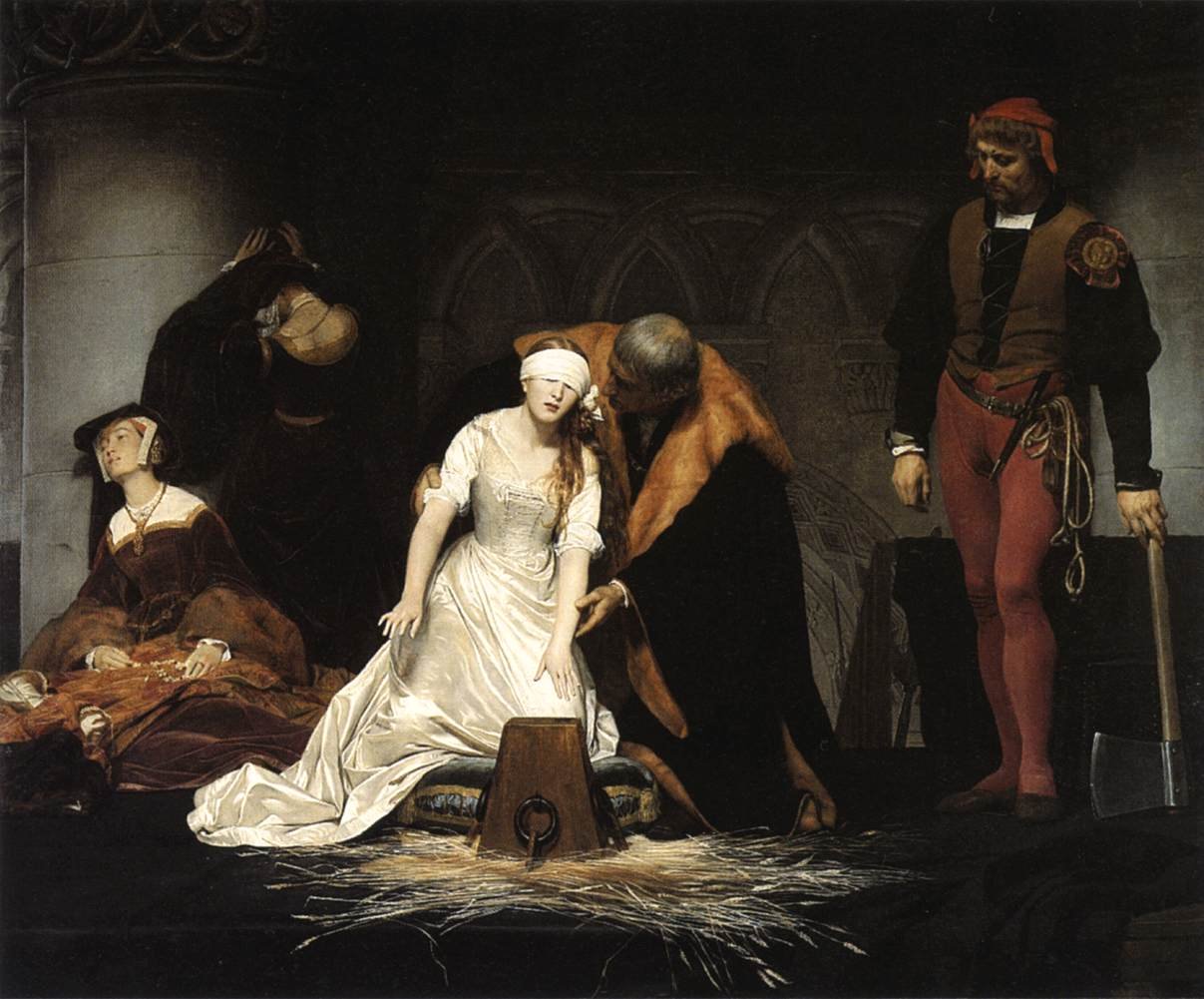
Today’s featured painting is entitled The Execution of Lady Jane Grey which he completed in 1833.  The Execution of Lady Jane Grey, which is depicted in this work of art, occurred almost three hundred years earlier.  It was first exhibited at the Paris Salon in 1834 where it caused a sensation.  It is very large oil on canvas painting almost 250cms x 300cms.  During the 1820’s and 1830’s in France,  a kind of “Anglo-mania” swept the country and this interest in English history had, in part, been fuelled by the novels of Sir Walter Scott and his tales of the battles and conflicts between Roundheads and Cavaliers during the Civil War,  which in some ways mirrored what happened during the violent and turbulent times of the French Revolution.  The setting for the painting is the morning of February 12th 1554.   The painting depicts the last moments in the life of the seventeen-year old Jane Grey, who was the great granddaughter of Henry VII and who was proclaimed Queen of England upon the death of young King Edward VI, a Protestant like herself.  She was young, intelligent and a political pawn whose destiny was out of her control and her reign only lasted for nine days in 1553.  Due to the plotting of the followers of Henry VIII’s Catholic daughter, Mary Tudor, she was convicted of high treason and sentenced to death in the Tower of London.

The painting has a few historical inaccuracies as we know that Lady Jane Grey was actually executed outdoors on Tower Green and not inside a chamber of the Tower of London.  She was also not dressed in a white satin dress along with the depicted whalebone corset and for a beheading her hair would not have been allowed to fall to her waist but instead would have been tucked up high above the head.  However let us not quibble about historical accuracy and rather just let us feast our eyes on this very dramatic painting.

In the painting we have five figures.  The central character of the painting is the tragic figure of the blindfolded Lady Jane Grey, in her under garments, who has just knelt down on a cushion behind the block where soon her neck will rest.  On either side of the block we see iron rings to which her wrists will be bound.   Look how she gropes with her outstretched arms, her hands in front of her, trying to locate the wooden block.  She is being gently guided to the executioner’s block by the elderly Lieutenant of the Tower, who at the time, was Sir John Brydges.  We get the feeling that he feels sadness for the young girl’s plight and his attentiveness and concern as depicted by Delaroche adds more pathos to the painting.  His hulking figure attired in a black coat, lined with orange-brown fur, looms over her and is a perfect contrast to the white attire of his charge ,which would soon be splattered with her blood.  Her sad figure with its golden-red hair is being illuminated from above.  It is a very dark painting with the exception of this lighting, which highlights the young girl and is in some way like a spotlight on a dark stage focusing light on an actor.   To the left we see two of her ladies-in-waiting, beside themselves with grief.  One, who is so distraught, has slumped to the floor, her eyes closed, her head turned away from her mistress.  She is clutching the outer garments of her mistress.  The other, who cannot bear to witness the execution weeps uncontrollably.  Her hands are above her head, grasping the grey column.  Her face is pressed hard against the stony structure.  The executioner stands in his blood-red hose to the right, the fingers of his left hand loosely holding the handle of the axe.   A pile of straw painted in the finest of detail, lies before the executioner’s block, in readiness to catch and soak up the victim’s blood.  Look how the artist has cleverly painted the straw which looks like it is almost falling out of the painting.  We can almost imagine that by leaning forward we could pull out a piece.

As we look at the painting we experience a myriad of feelings – horror of what is about to happen, compassion and pity for the fate of the young girl, despair that such a thing could take place in a civilised society.  The way Delaroche has painted the scene makes us feel that we are there, standing in front of the victim.  We are actual witnesses at the execution.   We are simply voyeurs who cannot change history.  We cannot prevent the neck of the young girl being severed by the executioner’s axe.  It is interesting to note how none of the five figures in the painting look towards us.  They are not aware of our presence.

Whether the painting is factually inaccurate does not lessen its greatness nor does it any way diminish the standing of the artistic genius who has created a work that tugs at our emotions.

A Storm with a Shipwreck by Claude-Joseph Vernet

A Storm with a Shipwreck by Claude-Joseph Vernet (1754)

I spent the last couple of days in London and whilst there visited a couple of art displays.  Unfortunately, with previous commitments tying up my time on one day I had a limited exposure to the beautiful world of art.  I normally would have spent some time at the National Gallery or one of the Tates but because I had only a short period and because I wanted to visit the Royal Academy Summer Exhibition I decided I had to limit myself to one gallery and so I decided to go somewhere new.  It was for these reasons I ended up on the steps of the Wallace Collection and although my time was restricted, I was completely blown-away by the art on display.  This is a beautiful jewel in the art crown of London, just a few minutes’ walk from the great Emporiums of M&S and Selfridges and everybody who visits London should visit this gallery and savour the magnificent art they have on display.

My Daily Art Display today features one of the many works of art I saw at the gallery.  It is entitled A Storm with a Shipwreck and was painted in 1754 by Claude-Joseph Vernet.  The Vernet family tree reads like a “Who’s Who” of distinguished French painters.  The head of the family was Antoine Vernet (1689-1753) was a prosperous artisan painter in Avignon and to whom many decorated coach panels are attributed. He had four sons, all of whom were painters, Claude Joseph,  Jean-Antoine,  Antoine-Francois and Antoine Ignatius.  He was grandfather to the artist Antoine-Charles Joseph, known as Carle Vernet and great grandfather to the painter Horace Vernet.  Of his three sons, Claude-Joseph Vernet (1714-89) earned a reputation throughout Europe as a great landscape and marine artist, receiving the commission from Louis XV for the series of paintings, Ports of France.   Jean-Antoine Vernet (1716-1755) also painted seascapes, and (Antoine-) Francois Vernet (1730-79) was a decorative painter.  Jean-Antoine Vernet had a son, Louis Francois, who along with Antoine-Francois’s son, Joseph Vernet the Younger, were both active sculptors in Paris.  Today’s featured artist Claude-Joseph Vernet had a son Carle who followed in his father’s footsteps and became known for his pictures of horses and battle scenes, though his achievement was overshadowed not only by his father’s but by that of his son Horace Vernet, a prolific and highly successful painter, especially of battle scenes. The Vernet family was connected by marriage to several other notable French artists, Carle becoming father-in-law of Hippolyte Lecomte and Horace that of Paul Delaroche; Carle’s sister Emilie married the architect Jean-Francois-Thérese Chalgrin.

When I saw today’s painting of a shipwreck at sea I was immediately transported back in time to my days at sea and the many horrendous storms I had to endure.  However this seascape also reminded me of the many times we had to bring our small vessel into the Portuguese port of Oporto.  The flow of water along the river Duoro, which is controlled by dams in the river high up in the Spanish mountains, ends its 727kms journey as it forces its way through the town of Oporto before pouring itself out into the Atlantic Ocean.  For many years the flow had not been strong enough to clear the sandbank and silting at the river mouth and the passage from ocean to river was a hazardous dog-leg, which was made even more difficult with the Atlantic rollers buffeting the stern of vessels as they headed for the narrow channel entrance.  I will always remember the tension on the bridge of the vessel as we tried to steer a course through the narrow entrance along the winding channel, hampered by following seas buffeting the stern of vessel making the ship slew from side to side.  Tension was further heightened as one looked at the sandbank which almost completely straddled the entrance and perched on top of it was a wreck of a ship which had failed to successfully navigate its way through the narrow entrance.  This was almost forty years ago and I am sure things have changed.

Vernet had just returned to France in 1753 after spending the previous twenty years in Italy.   Madame de Pompadour’s brother, the Marquis de Marigny, when he had been appointed Surintendant des bâtiments (Cultural Minister) under Louis XV, commissioned Vernet to paint a series of views for the crown of the major French ports.   Vernet had just started his first commission in Marseilles in 1754 when Marginy commissioned today’s work.    Vernet loved the sea and seascapes but his most favourite subject was his dramatic portrayal of shipwrecks and all the emotions that went hand in hand with such disasters.

As we look at the painting we see a dreadful storm and shipwreck scene.  Torrential rain is pouring down on the battered remains of the wrecked ship and its hapless survivors.   The white-crested seas push the broken ship further onto the jagged rocks.  In the background, we can see another ship which is being unmercifully tossed about on the stormy sea but remains out of harm’s way.  In the foreground we see survivors just about clinging to life as they lie on the rocks.   Some are being helped to drag themselves out of the stormy waters and onto the slippery rocks to escape the jaws of certain death.  To the right we see a fort perched on a rocky outcrop.  A tree with its roots embedded in the rocks clings perilously to its elevated position in the face of gale-force winds.  Along the walls leading up to the fort, we see spectators looking down on the unfolding drama.

Some of the survivors

Like a number of his paintings, Vermet has cleverly utilised the effects of light in order to create visual excitement.  He has cleverly contrasted the darkness of the sea and the rocks with the blue sky which is emerging from behind the black storm clouds.   Venet’s figure drawing and his mastery of the portrayal of human emotions through gestures was his forte and you need to stand close up to the painting to take in the minutiae of the details

The Broken Pitcher by Jean-Baptiste Greuze

The Broken Jug by Jean-Baptiste Greuze (1771)

This is my second painting featuring the artist Jean-Baptiste Greuze, the first being on June 28th.  However today’s painting is very different in comparison to my first offering.

Greuze was born in Tournus, a Burgundian town on the banks of the River Saône in 1725, the sixth of nine children.  He came from a prosperous middle-class background and studied painting in Lyon in the late 1740’s under the successful portrait painter, Charles Grandon.   At the age of twenty-five, Greuze moved to Paris where he entered the Royal Academy as a student.  During this period he developed a style of painting which was described as Sentimental art or Sentimentality.     I believe we could define sentimentality as an emotional disposition that idealizes its object for the sake of emotional gratification and that it is inherently corrupt because it is grounded in cognitive and moral error. Sentimental art can thus be defined as art that, whether or not by design, evokes a sentimental response.

Greuze was accepted as an Associate member of the Academy after he submitted three of his paintings A Father Reading the Bible to His Family, the Blindman Deceived and The Sleeping Schoolboy.    These three works were about life amongst working class folk and were moralising pictorial stories and, in some ways, are reminiscent of the works by William Hogarth some two decades earlier.  It was Hogarth’s genre of art that depicted scenes from the lives of ordinary citizens and which were calculated to teach a moral lesson.

Greuze was pleased to have achieved admission to the prestigious Academy but he wanted more.  He wanted to be recognised as a historical painter.  From the 17th century, Art Academies of Europe had formalised a hierarchy of figurative art and the French Académie royale de peinture et de sculpturehad a central role in this listing.  According to them this was the hierarchical order, with the most prestigious at the top:

History Painting

(including narrative religious mythological and allegorical subjects)

Portrait Painting

Genre painting

 or scenes of everyday life

Landscape

Animal painting

Still Life


In 1789 he put forward his work, Septimius Severus Reproaching Caracalla, as a history painting but it was rejected by the Academy as they considered him to be a “mere genre painter”.    The Academy did not consider his works fell into the category of historical paintings and this rebuff so annoyed Greuze that he refused to submit any more of his works for the Academy’s exhibitions.  The fact that the Academy downgraded his works did not in any way affect their popularity with the public who couldn’t get enough of these “sentimental” paintings and the sale of his works continued strongly.  In fact, the sales of his works were so popular that the money kept pouring in and so Greuze had no more need to exhibit his works at the Academy.

During the late eighteenth century in France, Rococo art thrived and the likes of Fragonard, Watteau and Boucher had almost taken over the French art scene.  It was all the rage with its mythological and allegorical themes in pastoral settings and its elegant and sometimes sensuous depictions of aristocratic frivolity.  At the time, this brand of light-hearted, and now and again erotic works, were much in demand with wealthy patrons.  So in some ways the French art world received a shock when Greuze’s pompously moralising rural dramas on canvas countered the frivolity of the artificial world of Rococo art.

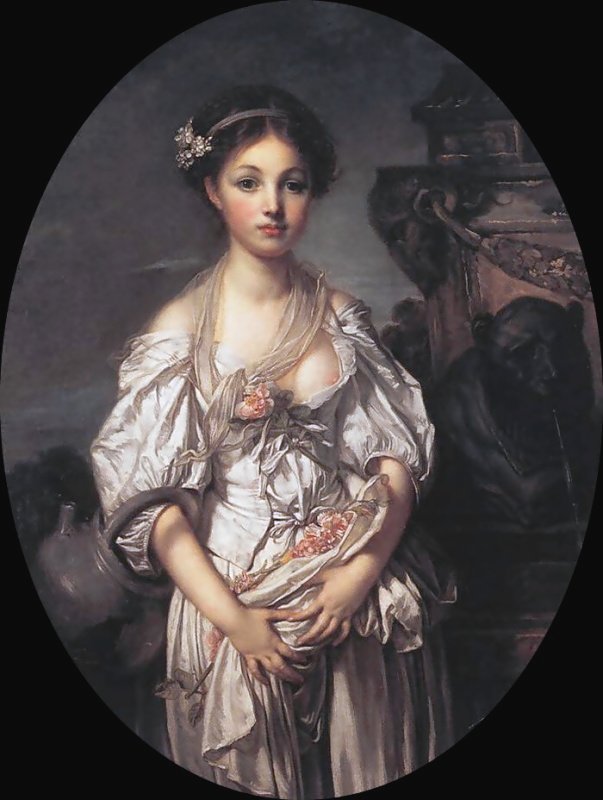
The majority of Greuze’s later works consisted of titillating paintings of young girls.  His paintings contained thinly disguised sexual suggestions under the surface appearance of over-sentimental innocence.  My Daily Art Display featured painting today entitled The Broken Jug is a classic example of this style of art.  In the picture we see a three-quarter length portrait of a young girl.  She has blue eyes, light hair, pink cheeks, very red lips, and her dress is white. She still exudes the innocence of childhood but we need to look closer at this portrait.   How old do you think she is?  Look closely at her facial expression.  What can you read into it?  Do you think she looks serious?  Do you think there is a slight look of alarm in her eyes?  Is there a look of sadness in her expression?  What has happened?

Look at the way she is dressed.  It looks as if it was a special dress for a special occasion, look at the flowers in her hair, maybe she has just returned from a party, but why are her dress and her appearance so dishevelled?  On her arm she carries a pitcher which is broken but she has not discarded it.  She clings lovingly to it.  It must have been a prized possession of hers and maybe she hopes to be able to remedy the break.  How did it break?  Was she running away from something and tripped, breaking the pitcher, which may explain her dishevelled appearance.  Maybe her worry is based on how she is going to explain away the breaking of the pitcher to her parents and pleading that it was a simple accident and beyond her control.  Is it as simple as this?

Let me suggest another possibility to this story.   I am not convinced this is all about a broken pitcher.  Let us consider an alternative theory.  Look at her dishevelled appearance.  Look at her silk scarf adorned with a rose which has lost some of its petals.  See how the scarf has been dragged down and is now no longer wrapped around her slender neck.  Look how the top of her dress has been pulled down exposing her left breast and nipple.  Look how she struggles to gather up flowers in the folds of her dress.  Has she been involved in a struggle with a lover and the tryst has got out of hand?   Is her beloved broken pitcher just an allegory and this is not about a broken jug at all but it is about her broken hymen and the loss of her virginity and the fear of telling her parents what has happened?

Could The Broken Pitcher by Jean-Baptiste Greuze be alluding to loss of virginity or am I reading something into this painting which does not exist?

The Funeral of Shelley by Louis Édouard Fournier

The Funeral of Shelley by Louis Édouard Fournier (1889)

The painting I am featuring in My Daily Art Display today interests me on three counts.  Firstly, I stood in front of the original two days ago when I visited the Walker Gallery in Liverpool.   Secondly, I made many trips on ships to La Spezia in Italy and suffered the ferocity of the storms in the Gulf of Genoa as well as spending many afternoons with glasses of chilled wine on the beachfronts at Lerici and Viareggio, which is the setting for the painting.  Last but not least, our country is currently embroiled in newspaper scandals and journalistic wrongdoings and I am reminded of the cynical journalistic saying that one doesn’t want to let truth ruin a good story.  When I look at today’s painting and realise how Fournier has not let the truth interfere with his pictorial rendition of the story of Shelley’s funeral.  He has depicted the setting not based on true happenings but what in his mind made a “good painting”.  The painting, which hangs in the Liverpool Walker Gallery, is entitled The Funeral of Shelley and the artist, Louis Édouard Fournier which he completed  in 1889 and which was to become one of his most famous works.

Firstly, let me give you a brief outline on the life and death of the famous poet.   Percy Bysshe Shelley, born in 1792, the eldest of six children, was to become one of the greatest English Romantic poets of all time.  His fame was further enhanced by his close friendship with his fellow giants of the poetic world, John Keats and Lord Byron.  Shelley continually courted scandal and would have been a great asset and a target for the current tabloid press and paparazzi.  He endured an unhappy existence at Eton College where he was continually ostracised by his fellow students. He performed poorly but still managed to be accepted at the University College Oxford.  His tenure there was curtailed after just a year when he was expelled for publishing a controversial pamphlet entitled The Necessity for Atheism.

Four months after his expulsion from the university, which destroyed his relationship with his father, he eloped and married a sixteen year-old schoolgirl Harriet Westbrook.  Although the couple had a daughter, Ianthe, the marriage was a disaster, mainly due to Shelley’s attitude to life and to his wife.  After three years of marriage, Shelley abandoned his pregnant wife and ran away with another young girl, Mary Wollstonecraft Godwin, the sixteen year old daughter of William Godwin, one of the forefathers of the anarchist movemen,t and her stepsister Claire Clairmont.  The three travelled to France and eventually settled in Switzerland.

In 1816 Shelley’s first wife drowned herself in the Serpentine in Hyde Park London and three months later Mary Godwin became the second Mrs Shelley.  Two years later the Shelleys left England and went to live in Italy.  They moved around the country and for the next three years lived in a number of Italian cities including Rome and Venice and finally settled in Pisa.

In July 1822 Shelley travelled from Lerici in his 20ft schooner, Don Juan to Livorno to meet up with his friend and author,Leigh Hunt, who had just arrived in Italy in order to discuss a new literary project they were launching.  The seven hour trip was made in good weather and Shelley, his ex-Royal Navy friend, Edward Williams and a young deckhand Charles Vivian made Livorno safely.  However their return journey proved very different as the boat was hit by a violent storm three hours into the voyage.  The sailing ship sank and the reason for this is still a matter of conjecture.  Possibly the small vessel was undermanned and unable to cope with the adverse weather, possibly poor navigational and seamanship decisions were made by those on board or maybe it was down to a poor boat design.  Notwithstanding all these suppositions, the boat was engulfed by large seas and sank fifteen miles off Viareggio and all on board drowned, their bodies were found washed ashore ten days later.   Italian quarantine regulations stipulated cremation of such bodies and thus Shelley’s body was cremated on the beach at Viareggio.

So now let us look at Fournier’s painting.  The setting is a bleak windswept beach on what looks like a dull overcast and gray day and by the way the people are dressed in heavy coats, an extremely cold day.  The centre of the painting is taken up by a lit funeral pyre atop of which, lying on his back as if asleep, is the peaceful-looking dead poet.   There are a number of mourners or helpers in the background but standing near the burning pyre we see three men and just to the left of this group is a woman on her knees in prayer.  A coach can be observed in the background.   The woman is Shelley’s widow Mary and the three men, from left to right, are his friends and fellow authors, Edward John Trelawney, Leigh Hunt and Lord Byron.  So before us we have a true pictorial account of the cremation of Shelley on the cold windswept Viareggio beach, or do we?

Actually, we don’t.   Fournier has used a great deal of “artistic licence” to create a very moving painting but factually it is incorrect on a number of counts and we know this from the writings of Edward Trelawney who attended the cremation.  The day of Shelley’s cremation was a hot humid summer day with clear blue skies and little wind and not the cold windswept one as Fournier has depicted.  Shelley was cremated on the beach at Viareggio but the depiction of him lying on top of the burning pyre almost as if asleep is false as his body had been in the water for ten days.  It was bloated and a lot of his flesh had been eaten away from those parts of his body which had not been still covered by his clothes.  It was known that Mary Shelley was not present at the cremation, as was the English custom, for health reasons.  For Shelley’s wife Mary, life had not been easy.  Her mother died ten days after giving birth to her and she herself lost three of her four children with childhood illness and in fact at the time of Shelley’s drowning she was still recovering from a miscarriage which almost ended her own life.   Edward Trelawney in his book, ‘Recollections of the Last Days of Shelley and Byron’ wrote that Leigh Hunt never moved out of the carriage and Lord Byron was so shocked by the sight of the body and because of the oppressive high temperature of the day withdrew and went swimming in the sea.

Shelley had in many English circles made himself very unpopular with his subversive and atheistic views and utterings and his death at the time was not greeted with universal sorrow.  In the conservative newspaper of the time, The Courier, his demise was reported with some sarcasm stating:

“….Shelley, the writer of some infidel poetry, has been drowned, now he knows whether there is a God or not….”

In the course of looking at numerous paintings I have seen many idealised landscapes which are made up of various settings morphed into one beautiful location.  We have seen portraits which have been altered to flatter the sitter so I suppose we should not condemn Fournier out of hand for his depiction of the Shelley’s funeral as his soul aim was to create a moving and poignant pictorial account of that special day and this I believe he has achieved.

The Souvenir by Jean-Honoré Fragonard

The Souvenir by Jean-Honoré Fragonard (1778)

My Daily Art Display featured artist of the day is Jean-Honoré Fragonard, the French painter whose scenes of frivolity and gallantry are the finest examples of the Rococo spirit.  The Rococo style of art was characterised by lightness, grace, playfulness and intimacy and emerged out of France around the beginning of the 18th century and in the following century spread throughout Europe.  The actual word rococo is thought to have been used disapprovingly by a pupil of Jacques-Louis David, who ridiculed the taste which was in vogue in the mid-18th century.  He combined the artistic genres of rocaille, which prospered in the mid 16th century and was applied to works that depicted fancy rock-work and shell-work, and barocco (baroque) genre.

Fragonard was a pupil of Jean-Baptiste Chardin for a short time and later studied under the French pastoral painter Francois Boucher.   He went on to win the Prix de Rome in 1752 which eventually allowed him to travel to Italy where he remained between 1756 and 1761.  Whilst in Italy he developed a high admiration for the works of the artist Giambattista Tiepolo.  During his travels around the Italian countryside he made many drawings of the Italian landscape.  He was particularly taken with the Villa d’Este, which was situated at Tivoli near Rome and its Italian Renaissance gardens, parts of which were to feature in many of his future paintings.

In 1765 he became a member of the Académie in Paris with his historical picture in the Grand Manner entitled Coroesus Sacrificing himself to Save Callirhoe.   By 1767 his style had changed and his works became more erotic.  One example of this I featured in My Daily Art Display of March 29th when I gave you his beautiful work entitled The Swing, which is now housed in the Wallace Collection in London.    In 1769 Fragonard married Marie-Anne Gérard who was a miniaturist and history painter.  Marie-Anne’s sister Marguerite Gérard, studied under Fragonard and was to become one of the greatest French female artists.  Fragonard and his wife had a daughter, Rosalie, two years later and she was often used as a model in her father’s paintings.  The following year his son, Alexandre-Évariste, was born and he would also go on to be a talented painter and sculptor.

After his marriage, he also painted children and family scenes. His works were now almost all painted for private commissions from his wealthy private patrons.  One such patron was Louis XV’s mistress, the beautiful Madame du Barry.   For her he painted a set of four pictures entitled The Progress of Love, and art historians believe they were his greatest masterpieces.  Sadly these paintings in his usual light-hearted Rococo style were, by 1773, the year he completed them, not looked on as being in vogue and they were returned to him.   The appetite for Rococo works had almost died and with that Fragonard’s commissions began to dry up and he tried his hand at the “in vogue” Neoclassicism style but he was never able to replicate his Rococo achievements with this new style.  Disheartened with the new turn of events, Fragonard left Paris in 1773 and went journeying around Europe visiting Austria Italy and Germany before returning home the following year.

His reliance on wealthy patrons, often members of Louis’s cour,t took a major blow with the onset of the French Revolution.  Fragonard lost their patronage and in many cases his patrons lost their lives.  As he was associated, through patronage, with the rich and noble he decided it was best to move with his family away from Paris and the bloody revolution and he went to Grasse, a commune in the south of the country where he was given shelter by his friend Alexander Maubert.  He eventually returned to Paris and through the auspices of the Neoclassical painter, Jaques-Louis David, a staunch and important supporter of the French Revolution, got Fragonard a position at the newly-opened Louvre.   David had been helped by Fragonard when he was a young and struggling painter and it had been time to return the favour.

Fragonard could never achieve the heights he reached during the Rococo period and died, virtually penniless, of a stroke in 1806 at the age of 74.

My featured painting today by Jean-Honoré Fragonard is entitled The Souvenir, which he completed in 1778.  In the painting we see a young girl carving something on the trunk of a tree.  According to the 1792 sale catalogue, the girl is Jean-Jacques Rousseau’s heroine Julie whom he wrote about in his novel of the same name, although its original title was Lettres de deux amans habitans d’une petite ville au pied des Alpes (“Letters from two lovers living in a small town at the foot of the Alps”).  The figure of the girl which we see in profile is framed by the arching branches of the large tree.  Her hair is decorated with pink ribbons and we see her upper body silhouetted against a white-grey sky.

The young girl has just received a letter from her lover which we see lying on the ground.  So delighted with its contents and so besotted by her lover, she is carving his initials into the bark of the tree.  By her side, sitting on a pedestal, which bears the artist’s name, is her pet spaniel, a symbol of fidelity.  Her dog watches her intensely as her knife digs into the bark.  There is an enchanting innocence about the girl and we wonder how the relationship with her lover will progress.  Will their true love for each other triumph or will her innocent trust in true love end in sorrow?   Fragonard has painted her sumptuous pink and white dress with great skill.  Look how he has carefully and meticulously painted the folds of the satin material with all its different shading.

This is quite a small painting measuring a mere 25cms x 19cms but it is delightful and a thoroughly captivating work by the French master of Rococo spirit and who was once described as “the fragrant essence of the 18th century”.  The painting by Fragonard mirrors the French literary and social happening of the eighteenth century known as sensibilité, which reached its peak between 1760 and the French Revolution.  It was de rigueur for paintings to depict softer emotions of love, pity, sympathy and grief, a type of emotional sensitivity.

Although we are fully aware that Rococo art is in some ways a false impression of what life was like for the majority,  do we not sometimes want to dream about what a perfect life would have been like rather than be bombarded by reality with Social Realist art, which constantly reminds us of poverty and suffering?