Two Women Chatting by the Sea by Camille Pissarro

Two Women Chatting by the Sea by Camille Pissarro (1856)

Jacob Abraham Camille Pissarro was born to Abraham Gabriel Pissarro and Rachel Pissarro (née Manzano-Pomié ) in 1830 on the island of St Thomas in the Danish West Indies, now known as the US Virgin Islands.  His father, a Sephardic Jew, held French nationality, but was of Portuguese descent.  He originally came to the Caribbean to sort out the business affairs of his uncle who had recently died.  He ended up staying in St Thomas, took over the running of the dry store business and married his late uncle’s widow, Rachel.   This found no favour with the small local Jewish community, maybe because he had married his late uncle’s wife or maybe because his new wife and Camille’s mother,  was a native Creole, a Dominican of Spanish descent, and not of the Jewish faith.  Camille and his siblings because of this were excluded from the Jewish school on the island and had to attend the all-black primary school.

Pissarro’s father and mother went on to have four children.  Camille was the third son and he and his parents and siblings lived a comfortable existence in a large and spacious apartment over the family shop on Dronnigens Gade, the main street, of Charlotte Amalie, the capital of St Thomas.    At the age of twelve, so as to ensure he had a good education, Camille was sent to France to attend a boarding school in Passy, a small town in a district of Paris , on the right bank of the Seine.  It was whilst studying in Paris that the young Camille developed a love for art and would often visit the Louvre.  After five years studying in France,  Camille Pissarro returned home to Saint Thomas where his father was hoping he would enter the family business.  However the young Pissarro was unimpressed at having to act as a cargo clerk at the harbour and had other ideas for his future.  During his time at the harbour he would spend most of his time sketching.  It was whilst sketching one day that he met Fritz Melbye, a Danish marine painter who was also living on St Thomas.  He liked the enthusiasm Pissarro had for sketching and painting and he began to mentor him and eventually persuaded him that he should become a full time artist.  Pissarro was delighted and much to his father’s chagrin in 1852 gave up the family job and went off with Melbye to Venezuela where the two of them based themselves in Caracas and stayed for two years sketching and painting landscapes and village scenes.  Pissarro once reflected on his decision to leave his comfortable home and his position in the family business saying:

“…I abandoned all I had and bolted to Caracas to get clear of the bondage of bourgeois life…”

In 1854, he returned home to Saint Thomas and his parents realised that any attempt to persuade the son to settle down would be fruitless and so they gave him their blessing to seek his fortune as an artist and the following year he left Saint Thomas for the last time and went to live in Paris.  He went initially to stay with the French branch of his family who gave him financial support, in order to have him follow a more serious artistic training.

His first position was to act as an assistant to his friend Fritz Melbye’s brother and Danish artist, Anton.  In 1856 he attended private art classes at the École des Beaux-Arts and at the age of thirty-one registered as a copyist at the Louvre.  He was influenced in his early days in Paris by the likes of Courbet, Corot, Millet and Daubigny.  He also attended the prestigious Académie Suisse which was an art establishment in Paris.  The Swiss Academy did not offer courses, but provided the aspiring young artists with models made it possible for them to study nudes together, and in this way helped the usually poverty-stricken young painters who found the price of a model being too high for a sole artist.  It was also a great meeting place for the young artists to discuss their work and their personal ideas.   It was here that he met the future Impressionists Claude Monet, Armand Guillaumin and Paul Cézanne and through them was introduced to the likes of Renoir and Sisley.

Even though now living in Paris his early paintings were of the Caribbean and he was still influenced by Anton Melbye to such an extent his early exhibits at the Paris Salon bore the signature “Pupil of A. Melbye”  a moniker he used until 1866.  Studying at the Academies was not all together to Pissarro’s liking and he railed against having to work in the traditional and prescribed manner set down by these institutions and having to follow the official line when it came down to getting works exhibited in their official exhibitions.  He felt that their official standards were subduing his creativity and he decided to look elsewhere for help and inspiration which he eventually found when he was being tutored by Camille Corot.  It was their mutual love of rural scenes which endeared Corot to Pissarro and it was Corot that first introduced Pissarro to the technique of outdoor painting, en plein air.  Pissarro would spend much time around the countryside on the outskirts of Paris.  He would make many painting trips around Montmorency and Pontoise building up his landscape portfolio.

A few years after he had arrived in Paris his parents left their business in Saint Thomas leaving the running of it to their manager and moved to Paris.  They hired a maidservant by the name of Julie Vellay, the daughter of a Burgundian wine producer.   Camille struck up a relationship with Julie in 1860 and she was to become the love of his life and his constant companion.  In 1863, following a miscarriage the previous year, they had their first child, Lucien.  Just over a year later their daughter Jeanne was born.

The style of Pissarro’s works with their natural settings did not now find favour with the Salon juries and the pretence of grandeur the Salon jurists required in works if they were to be allowed into the Salon exhibitions.  A turning point came in 1863 when all the works by Pissarro and his like-minded contemporaries such as Monet, Cézanne and Guillaumin where rejected for the forthcoming exhibition by the Salon jury.  According to the author, Ross King, in his book, The Judgement of Paris, only 2217 out of 5000 paintings were accepted into the Paris Salon exhibition by the Salon jury.  The French ruler at the time Emperor Napoleon III voiced concern at the time for this wholesale refusal to allow so many works enter the official Salon exhibition and decreed that the rejected painters could have their works hung in an annex the regular Salon, the Salon des Refusés (Exhibition of Rejects).  He wanted the public to judge the works which had been rebuffed by the Salon jurists.   Artists who had their works hung in the 1863 Salon des Refusés exhibition included Pissarro, Manet, Whistler and Cézanne.

The Franco-Prussian War broke out in 1870 and Pissarro moved his family to Norwood on the outskirts of London and it was here he met the Paris art dealer, Paul Durand-Ruel, a man who would, from then on, organise the sale of Pissarro’s works.  It was also the art dealer that reacquainted Pissarro with Monet and the two French artists spent their time in London studying the work of the great landscape painters, Turner and Constable.  It was in 1871 whilst still in London that Pissarro married his lover Julie Vellay who was expecting their third child.   That year, after the war had ended, he and his family returned to their home in Louveciennes and much to his horror most of the works in his studio, which he had completed in the previous twenty years, had been destroyed by the invading Prussian soldiers.

I will leave Pissarro’s life story at this point and conclude it in my next blog but for today I want to end by looking at one of Pissarro’s early paintings.  My Daily Art Display featured oil on canvas painting is entitled Two Women Chatting by the Sea which he completed in 1856 around the time he left his homeland for the final time.  The painting had been owned by Mr and Mrs Paul Mellon, the late American philanthropist and his wife and was given to the National Gallery of Art in Washington in 1985.  Unfortunately,  according to their website it is not currently on view.  It is amazing the high percentage of paintings that all large museums have in their vaults, waiting their turn to go on display.  It is just a shame that there is not more wall space available for us to see these hidden gems.

Olympia by Édouard Manet

Olympia by Édouard Manet (1863)

My Daily Art Display today continues with the life of Édouard Manet.  Yesterday we had reached 1864 the year when he exhibited his work entitled The Dead Christ with Angels at the Paris Salon and for which he was heavily criticised.  So did Manet, after the criticism and ridicule of his 1864 painting, submit a less contentious work the following season in 1865?  The answer is simply a resounding NO.  He entered two paintings into the 1865 Salon and in fact one of the paintings entitled Olympia, was one he had completed two years earlier and it was this one which caused an even greater furore with both the public and critics alike. The fact that Manet had completed the painting two years earlier but had not exhibited it makes one wonder whether Manet himself had doubts about the wisdom of launching such a contentious painting on the Parisian public.  His concern was well founded as it was considered the most shocking of all the works exhibited that year.  Olympia by Manet is My Daily Art Display featured painting today.

Before us we see an almost nude woman lying on a bed with a pink orchid tucked behind her left ear.    At the end of the bed, by the naked woman’s feet, we can just make out a small black cat.  In fact the inclusion of the small furry animal often had people naming the painting, Venus with a Cat.  The model for the painting was Victorine Meurent.  Victorine was also, besides being a famous model for painters,  an artist in her own right and one who exhibited a number of works at the prestigious Paris Salon.  Ironically in 1876, one of her paintings was included in the Salon’s juried exhibition (exhibitions at which the works of art are only displayed if selected by a jury) and the painting which Manet put forward for selection was rejected.

The subject of the oil on canvas painting caused a sensation.  So what shocked the critics?  Was it the nudity?  If that was the case, then why, as surely paintings of nudes were quite common at that time.   The problem was not the nudity but the fact that the critics believed the naked woman that Manet had depicted could be identified as a demi-mondaine.  These were ladies who had a reputation of enjoying an extravagant lifestyle of fine food and clothes, all of which had been achieved because of the steady income they made in cash and gifts from their various lovers.   In other words she was identified as a high-class prostitute and the Parisian public was very uncomfortable with the scale of prostitution in their city. 

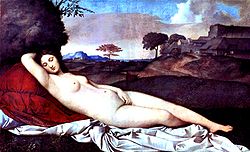
Venus of Urbino by Titian

There can be no doubt that Manet’s inspiration for this painting came from Titian’s Venus of Urbino and Giorgione’s Sleeping (Dresden) Venus (see My Daily Art Display for Feb 15th).  Maybe Manet wanted to update and be more innovative with his “Olympia”.   Not all critics condemned his effort.  A few praised him for his “bold step into modernism”.  However there are differences in the way Manet has portrayed his woman in comparison with Titian’s Venus and it is these differences which led to the outcry.

Sleeping (Dresden) Venus by Giorgione

The contention that Manet’s woman was merely a high class prostitute was brought about by the way she wore an orchid in her hair, her pearl earrings, her bracelet, and her expensive oriental shawl on which her body rests,  all of which gave rise to the belief that her wealth was gained from the “service” she offered her lovers.  Her skin is bright white in colour and there is a severe shift from light to shadow in this painting.  Look how she stares towards us with her black eyes.  This is not a demure gaze.  It is a challenging, contemptuous and provoking look, in some ways daring us to find fault with her appearance.  Her hand is placed over her vulva and in a way she is saying that this is only to be had by the men she chooses.  It is in some way a signal that she will choose who she will bed.  Around her neck she wears a narrow black ribbon which when contrasted with the paleness of her neck adds sensuality to her pose.  Her upswept hair held in place by the orchid adds to the eroticism.  Her slipper is half on and half off her foot in a slovenly fashion. 

Her black servant, Laure, stands by her side.  She is attired in the typical fashion servants of a courtesan would dress.  She is holding a bouquet of flowers which the naked woman seems to ignore.  They are probably a gift from a lover who may have just arrived.   Maybe her eyes are not on us but on the door through which her lover is about to emerge.

As I said earlier we have the strange black cat sitting on the end of the bed.  In Titian’s Venus of Urbino he had included a dog which symbolized fidelity and added a kind of gentility to the scene.  Manet would have none of this sentimentality and added his black cat which because of its habits was taken as a symbol of laziness, lust and prostitution.  A coincidence?  Or did Manet know exactly what he was doing when he include the animal in his painting?

The painting when exhibited was one which the observer either loved or hated.  There were no half-measures.  The painting could not be ignored.  The critics labeled it immoral and vulgar and his friend Antonin Beaudelaire commented that the picture had created such anger that it was in danger of being destroyed by an over-zealous and offended observer.  In 1890 the French government acquired the painting with a public subscription, which had been organized by Claude Monet, and it now hangs in the Musée d’Orsay in Paris.

 I will let you decide whether what you see before you is Venus, an old-style Titian-like goddess or a nineteenth century Venus whose name was Olympia.   Maybe you prefer to simply believe Manet has depicted a high class prostitute awaiting her next client but whatever you decide I think you will agree that it is a fine work of art.

The Dead Christ with Angels by Édouard Manet

The Dead Christ with Angels by Édouard Manet (1864)

Today, My Daily Art Display returns to the French painter of contemporary urban life and who was a leading figure in the shift from Realism to Impressionism and was looked upon as one of the founding fathers of Modernism.  So many –“isms” !   We have seen examples of these three -isms before but let me just do a recap of the meaning of these terms.

Realism was prevalent in the mid to late nineteenth century and this movement believed that painters should represent the world exactly as it was, even if it was at the expense of some artistic and social principles.  It was looked upon at the time as very controversial and often the works were viewed as being morally wrong and wicked because they challenged and broke the conventional standards of what was termed “good taste”.

Impressionism had its origins in France between 1860 and 1900 and soon spread to other western countries.   In a way it was, in some ways, a rejection of Academicism which promoted the Classical ideals of beauty and artistic perfection and which had a stringent hierarchy within the visual arts favouring the grand narrative and historical paintings.  The Impressionist painters and Impressionism wanted nothing to do with such Academic traditions but preferred to emphasise an accurate depiction of light in its changing qualities and looking how light changed with the time of day.  They would often paint outdoors (en plein air).   The Impressionist style of painting can be typified by its attention on the common impression produced by a scene or object and the way the artists tended to use unmixed primary colors and small brushstrokes in order to imitate real reflected light.

Finally Modernism, which was a very broad movement that also began around the latter years of the nineteenth century, and was a type of art that reflected modern times and did not keep looking back at times past.  The Modernist artists believed that the modern world they lived in was fundamentally different to what had gone before and that art needed renew itself and move on.  It was all about the artist’s vision of the future.

My featured artist today is Édouard Manet.  He was born in Paris in 1832 and was brought up in a wealthy, upper class household.  He was the eldest son of Auguste Manet, a judge and the Chief of Staff at the Ministry of Justice and Eugénie-Desirée Fournier, the daughter of a diplomat and goddaughter of Charles Bernadotte, the Swedish crown prince.  His father had hoped that young Édouard would follow him into the legal profession.  However even though he was well educated, Manet did not particularly shine academically but he did show a predisposition toward drawing and the arts.  In 1844, aged twelve years old, he enrolled at the College Rollin, a secondary school where he became friends with Antonin Proust, who would, in the future, become the French Minister of Fine Arts.   It was also around this time that Manet’s uncle, Charles Fournier, encouraged his enjoyment of the arts and the two of them along with Antonin Proust, would go on trips to the Louvre.

Manet had set his heart on going to sea and twice sat the entrance exam to a naval training school but in both cases failed.  He did however manage, with help from his father, to get a trip on the training ship Guadeloupe voyaging to Rio in 1848 and returning home in June the following year.   His father had by this time given up any hope of his son entering the legal profession and acquiesced to his son’s desire to become an artist.   For a six-year period, beginning in1850, Manet studies in the studios of Thomas Couture the Academic and History painter.  His relationship with his master was very strained and they would frequently clash.  It was around this time that he registers as a copyist at the Louvre and studies the works of the old masters, such as Velazquez and Goya.  Although impressed with their paintings, he believed that his works should reflect the ideas and ideals of the present time and not like theirs, keep harking back to the past.   Manet was a great friend and constant companion of Charles Beaudelaire, the great poet and art critic who was credited with coining the term modernité to designate the brief short-lived experience of life in an urban metropolis and he believed that art must be held accountable to capture the experience.  His advice to Manet about his art was that he should depict a contemporary realism, and had to become “le peintre de la vie moderne.

The year 1852 was the start of a change for Paris and Parisiennes as the great modernization of the city started on the direct orders of Napoleon III, under the supervision of Baron Georges- Eugène Haussmann.  The infrastructure often going back to medieval times had become inadequate, roads were too narrow and buildings were becoming unsafe.  In the great renovation programme, streets were widened and lengthened, houses pulled down to make way for new ones, shop fronts replaced.  All this work was labour-intensive and thousands of jobs were created people poured into the city from the outlying countryside to gain employment.  The whole of the social and cultural life of Paris changed with such a migration of labour.  Paris became one of the most beautiful and culturally progressive cities in the world and it was this modernity that Manet wanted to record in his works of art.

I will leave Manet’s biography at this point in his life and will conclude it in a later blog but for today I want to look at one of his earlier paintings entitled The Dead Christ with Angels, which he completed in 1864 and which can now be found at the Metropolitan Museum of Art in New York.  This was the first of a number of paintings by Manet that had religious subject matter. The biennial and later, annual Parisian Salons were considered the most expedient way for an artist to make himself known to the public, and Manet submitted paintings to Salon juries throughout his career.  He submitted today’s featured painting in 1864 exhibition.

The inscription indicates Manet’s source, but the passage he cited describes Mary Magdalene finding Christ’s tomb empty except for the two angels whereas his painting shows the two angels with Christ.  If that wasn’t bad enough Manet realised, albeit too late, when the painting was already on its way to the 1864 Salon Exhibition that he had made an even greater mistake with regards the accuracy of the biblical tale he had depicted.   Can you spot it?

In his painting he has painted the wound on the left side of Christ and not, as convention would have it, on his right side.   He immediately contacted his friend Baudelaire and told him of this error, and his friend advised him to correct the position of the wound in the painting before the exhibition opening.  He warned Manet that if he didn’t then his critics would have a field day, adding, “take care not to give the malicious something to laugh at.”   Manet’s submissions to the Salon of 1864 were again condemned by critics, for his painting of Christ and the Angels as they put it showed “a lack of decorum”.   The critics further denounced the work for its realistic touches, such as the cadaverous body of Christ and the seemingly human angels.  They argued that the painting totally lacked any sense of spirituality; the figure of the battered Christ was said to more closely resemble the body of a dead coal miner than the son of God.

Manet did not repaint the wound, and as Beaudelaire had foreseen, the critics derided his error. Only the writer, Émile Zola, gave the painting the respect it deserved.  Zola felt that Manet’s intention was to emphasize the reality of the corpse, even though he called attention to its holiness by including a halo.

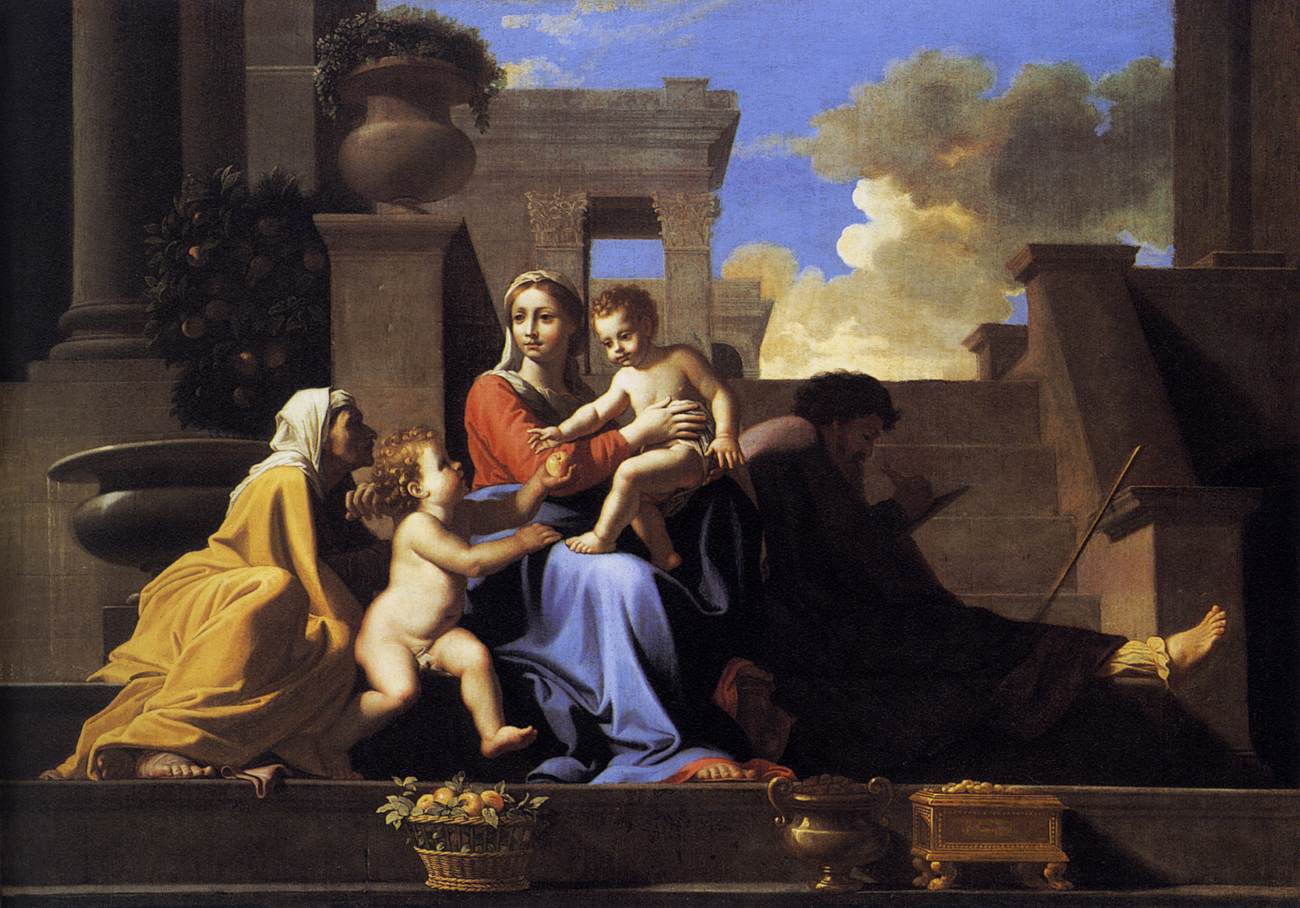
Madonna of the Steps by Nicolas Poussin

Madonna on the Steps by Poussin (National Gallery of Art,Washington) 1648

“..Poussin is without question one of the greatest of all French painters whose influence on the development of European Art from the 17th Century onwards cannot be overstated. Like Titian before him and his contemporaries Caravaggio and Velazquez, he developed a personal, innovative and highly rigorous style of outstanding originality.  His work has been deeply influential on generations of artists up to the present day…”

Richard Knight, International Co-Head of Old Masters and 19th Century Art at Christie’s

My Daily Art Display today once again features a work, in fact two works, by the great French classical painter, Nicolas Poussin.  The two paintings in question are both entitled Holy Family on the Steps or sometimes referred to Madonna of the Steps and both were completed in 1648.  The painting is considered a masterpiece of 17th-century art and the pinnacle of the artists refined classical style.  One is housed in the Washington Gallery of Art and the other in the Cleveland Museum of Art.  They are similar paintings but the Washington version looks somewhat lighter in colour.  The big issue was which gallery had the original and which gallery had the copy.  The painting which is in the Cleveland collection and was purchased in 1981.   X-radiographs, published in 1982, proved that it was the original of the two versions, the other in the National Gallery of Art, Washington must then be the copy.   Up until then, the Washington picture was thought by some art historians to be the original.  The Washington Gallery was far from pleased with the adjudication and in 1994 Earl Powell  III, Director of the National Gallery of Art, Washington, DC, was embroiled in controversy when he delayed the public acknowledgement that the Museum’s  Madonna on the Steps” by Poussin was no longer thought by scholars to be by the master.  It should be said that Anthony Blunt the British historian, art expert and an authority on the works of Poussin believed that the Washington painting was the original.

However notwithstanding who is right and who is wrong the painting dating from Poussin’s mature period is a beautiful work of art.  The arrangement of the figures harks back to works by the High Renaissance artists such as Raphael Sanzio and Andrea del Sarto.  The painting is a merging of the Classical, with its architecture and the Christian with its religious theme.  The figures are placed in a triangular format with the heads of Mary and the Christ Child at its apex. Before us,  we see, seated on the steps, Mary, holding the Christ Child, Saint Elizabeth holding her son John the Baptist and seated behind them, Joseph.  Poussin has included some symbolic features to the painting.  To the left of the seated figures we see an urn overflowing with water which is symbolic of the stream of life and the passing of time and our inevitable death.   Behind the urn we have an orange tree which is regarded as a symbol of purity, chastity and generosity and is often depicted in paintings of the Virgin Mary.    On top of the walled side of the staircase we have a myrtle bush which has been, since early times, used as the symbol of love.  In Roman mythology the myrtle was considered sacred to Venus, the goddess of love.

At the front of the painting, on a lower step we see the gifts Mary has received from the three Magi at the time of the birth of the Christ child.  Usually when the Christ Child holds an apple it is symbolizes the fruit of salvation.  There is also a connection with Christ and Adam going back to the passage from the Song of Solomon (2:3):

 “…As the apple tree among the trees of the wood, so is my beloved among the sons. I sat down under his shadow with great delight, and his fruit was sweet to my taste…”

The passage has been interpreted as an allusion to Christ.  As Christ is the new Adam, so, in tradition the Virgin Mary is the new Eve and for this reason an apple being placed in the hands of Mary, symbolises salvation.

Joseph sits on the steps behind Mary.  He is almost completely lost in the shadows.  By Joseph’s foot we see a measuring stick which in some ways indicates that Joseph was not just a humble carpenter but more of an artisan.  The steps which they are all resting on can be interpreted as the stairway to heaven and the light of God is shining brightly above the summit of the steps.  There are actually a number of light sources in this painting which cast various shadows.

The Martyrdom of Saint Erasmus by Nicolas Poussin

The Martyrdom of Saint Erasmus by Nicolas Poussin (1629)

Today My Daily Art Display looks again at an artist who many believe was the greatest French painter and the leader and dominant inspiration of the classical tradition in French painting.  His name is Nicolas Poussin. 

 Poussin was born of a noble but impoverished peasant family in Les Andelys, small town in Normandy in 1594.  In his youth he studied Latin, and this was to have great influence in his future works of art.  In his late teenage years he met an artist, Quentin Vartin, who had come to Les Andelys to carry out a church commission.  It was then that Poussin showed the visiting artist some of his artistic work who then agreed to give the youngster some artistic tuition.  In 1612 Poussin left Les Andelys and went to Paris and studied art at the studios of the Flemish portrait painter Ferdinand Elle and the French painter George Lallemand.  French art and the way it was taught and learnt by young aspiring artists had yet to change and apprenticeships with established artists was still the only way young men would learn to become painters.  It would soon change in France when academic training for up and coming artists would supplant this old system.  It was not until 1648 that the Académie royale de peinture et de sculpture was founded by Cardinal Mazarin.  The purpose of this academy was to professionalize the artists working for the French court and give them a stamp of approval.

Around 1623 Poussin met Giovanni Battista Marino in Paris.  Marino was court poet to Marie de Medici at Lyon.  The poet was very impressed with Poussin’s work and urged him to travel to Rome to widen his artistic experience.  Poussin had already made two unsuccessful attempts to go to the Eternal City but in 1624, aged thirty, he made it to Rome and initially lodged with the French painter, Simon Vouet.  Life in the city proved difficult as Poussin was always short of money.  However he was befriended by Cassino dal Pozzo, a wealthy antiquarian and secretary to Cardinal Francesco Barberini, who were both to become Poussin’s earliest patrons.  It was in 1628 that Poussin received two major commissions; the first was from Barberini, for a pair of large history paintings, The Death of Germanicus and The Destruction of the Temple at Jerusalem.  The paintings were well received.  The following year a commission from the Vatican for an altarpiece resulted in The Martyrdom of Saint Erasmus which is My Daily Art Display featured painting today.   The work was not greeted with universal acclaim in fact it was a comparative failure with the art critics of Rome.   It could well have been the fact that Poussin was French and that the Italians did not take to his attempt to compete with the Italian masters of the Baroque style on their own ground.   After this Poussin ceased competing for large public commissions and would paint only for private patrons and even then would confine his work to formats which were seldom larger than five feet in length.   

In 1630 he became ill.  It is believed that he contracted venereal disease.  He was taken to the house of his friend Jacques Dughet, whose daughter Anna Maria cared for him.  Poussin and Anna Maria married in 1630 but the couple never had any children.   Anna’s brother, Gaspard Dughet studied art as a pupil of Poussin and was later to take Poussin’s surname as his own.

By now news of his achievements filtered back to his home country and the court of Louis XIII and the powerful Cardinal Richelieu.  He was summoned by the court to return and reluctantly he had to acquiesce to the royal command and in 1640 he returned to Paris.  He was offered commissions for types of work he was not used to nor really competent to carry out, including the decoration of the Grande Galérie of the Louvre palace.  Worse still, the works he did complete did not bring forth the admiration he had anticipated, so annoyed at the lack of acclaim, he left Paris in 1642 and returned to Rome.   Ironically after his death, Poussin’s style of painting was accepted and acknowledged and in the late seventeenth century it was glorified by the French Academy.

Poussin was never a well man and his health started to decline more rapidly when he was in his mid fifties and with it came problems with his hands which suffered from ever worsening tremors.    In his later paintings one could detect the unsteadiness of his hand. He died in Rome in 1665 aged seventy-one and was buried in the church of San Lorenzo in Lucina, his wife having predeceased him.

And so to today’s painting, The Martyrdom of Saint Erasmus, which Poussin completed in 1629.  Nicolas Poussin’s altarpiece depicting the Martyrdom of St. Erasmus was commissioned in 1628 for the for the altar of the right transept of Saint Peter’s Basilica, the Chapel of St. Erasmus, in which relics of the Saint are preserved.  It was part of the ongoing decoration of the great basilica.  The commission had been initially given to Pietro da Cortona but was then assigned to Poussin in 1628 who used the preparatory sketches of Cortona’s as a basis for the work.  Poussin was probably obliged to produce not only a preliminary compositional drawing but also a painted modello, a model, to give his patrons a clear idea of his intentions

In the painting of Saint Erasmus, also known by his Italian name, Saint Elmo, we see the subject in the foreground.   He was the bishop of Formiae, Campagna, Italy, and suffered martyrdom in 303 AD, during Diocletian’s persecution of the Christians.  The setting is a public square.  The painting shows the almost naked Erasmus being disembowelled.   To the left of him we see a priest dressed in white robes talking to Erasmus and pointing upwards to the statue of Hercules, a pagan idol that Erasmus had refused to worship and which resulted in his martyrdom.  In the left mid ground we see a Roman soldier on horseback who is overseeing the execution.  It is a horrific and gruesome scene.  We see Erasmus’ executioner, dressed in a red loin cloth, extracting the intestines of the martyr who is still alive, and they are being fed on to what looks like the rollers of a ship’s windlass, which is being slowly turned.  Above we see two angels descending, one of who is carrying a palm and crown which are the symbols of martyrdom.   

The painting remained in the basilica until the eighteenth century at which time it was replaced by a copy in mosaic and the original transferred to the pontifical palace of the Quirinal. It was then taken to Paris in 1797 following the Treaty of Tolentino between France and the Papal States during the French Revolutionary Wars.  It returned to Italy in 1820 and it became part of the Vatican Art Collection of Pius VI.

Let me end this blog with two pieces of trivia.   When a blue light appears at mastheads of ships before and after a storm, the seamen took it as a sign of Erasmus’s protection.   This phenomenon is known as “St. Elmo’s fire”.    Erasmus is also appealed to when suffering from stomach cramps and colic. This probably comes about due to the way the saint met his death!

For another of Poussin’s paintings, Rinaldo and Armida, look at my blog of March 8th.

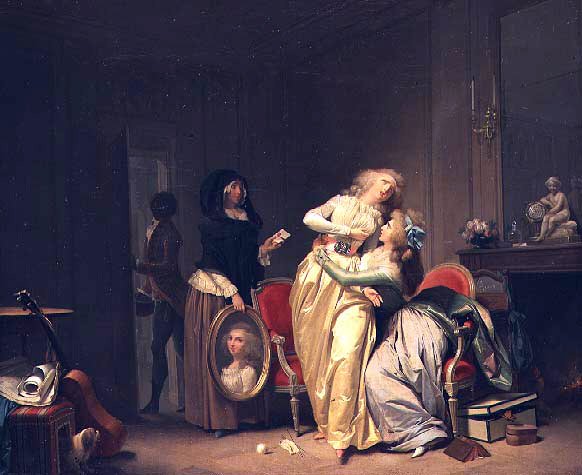
The Sorrows of Love by Louis-Léopold Boilly

The Sorrows of Love by Louis-Léopold Boilly (1790)

After three days of struggling with a small electronic notebook and the vagaries of foreign WiFi to publish my blogs I am back home to the comfort of my own PC and a fast WiFi.  In just over two months time we are off to Hong Kong and Australia for three weeks and I dare not think about how I am going to cope with trying to publish the blog but time will tell.

Today, My Daily Art Display is featuring a new painter to my blog.  He is the French portraitist and genre painter Louis-Léopold Boilly.  Boilly was born in La Bassée, a small town in the Nord department of Northern France, not far from Lille, in 1761.  He was brought up in a simple household, his father being a wood-carver.  He was a self-taught painter and started to turn out works when he was still only twelve years of age.  He showed some of his drawings and paintings to the local Augustinian friars and so impressed by them that in 1777, the bishop of Arras extended an invitation to Boilly to come and study in his bishopric.  The young Boilly painted prolifically producing more than three hundred small works of portraiture during that period.

In 1787 Boilly, now a much admired and renowned artist, moved to Paris but these were troubled times in the capital city with the start of the French Revolution.  His early works dwelt for the most part on amorous and moralizing subjects.   My Daily Art Display painting today entitled The Sorrows of Love, completed in 1790, is like many of his works of that period.    In the late 1790’s, after specializing in interior genre scenes, Boilly decided to switch to depictions of urban life and this gave us the chance, through his works, to witness life in Paris during that time.   Apart from the artistic merit of his compositions, he offers us a direct, candid view of Paris and the customs of its people.  His paintings were often awash with figures.  His paintings were often humorous and in a way displayed Boilly’s droll appreciation of Parisian urban life.

Throughout his career, Boilly was respected as a fine portraitist and received many commissions from the middle classes and the famous.   He had also made a name for himself as an artist who liked to paint somewhat titillating images, which were, at the time, very popular with patrons, who took their pleasures by enjoying the roguish side of life.  Boilly first encountered problems with his works in 1794, when one of his paintings, Lovers and the Escaped Bird,  was considered more than just erotic but that it was termed obscene by the Committee of Public Safety and that  the “crime” carried the penalty of a prison sentence as well as a very large fine.  He only escaped incarceration, when members of the Committee, on searching his studio, discovered more patriotic works, such as The Triumph of Marat, and that was enough to release the errant artist.  After this brush with officialdom, Boilly quickly toned-down his works.

In 1833 he was decorated as a chevalier of the nation’s highest order, the Legiond’Honneur.  Boilly died in Paris in 1845, aged 83 and his long life spanned the times when his country and his life was ruled by the royal monarchy of Louis XVI, the French Revolution, the Napoleonic Empire and the restoration of the Bourbon monarchy.

Today’s featured wok by Boilly is entitled The Sorrows of Love and in it we see a young lady being supported by her confidante.  She exhibits an exaggerated and shocked demeanour.  Her overstated affectation of grief reminds one of the demeanours of an actor hamming up a part in a play.  So what has brought on this distress expressed in the most dramatic way by the lady?  Look at the maid, wearing the black cowl.  In one hand she has an unopened letter which she offers the distraught woman.  It is not the content of the letter that is upsetting the lady as she recognises her own handwriting on the cover.  It is an unopened love letter being returned to her from her lover, who no longer reciprocates her love.  Not only is her love letter returned but in the maid’s right hand we can see that she is holding a head and shoulder portrait of the lady herself, which one presumes she gave to the man in her life, but tragically for her, this too is being returned as unwanted.   One must presume that the colour of the maid’s cowl is not just a coincidence and it is probably symbolic of the death of the love affair between her mistress and her lover.  The ending of the affair has occurred in a brutal fashion.  No letter of explanation, just a return of what is no longer wanted.

The Suitor’s Gift is in the same tradition of bourgeois genre scenes, which examine the many sides of love.  These works were greatly sought after by the public and collectors alike, and it seems probable, therefore, that the present work was completed to satisfy a taste for these subtle, yet highly charged scenes.  Before us we can witness Boilly’s skill at capturing the split-second of a seemingly every-day episode, whilst filling the scene with inner feeling, subtlety and mystery.

Interior at Nice by Henri Matisse

Interior at Nice by Henri Matisse (1920)

Yesterday I managed, with great difficulty to get away My Daily Art Display blog regarding Carl Philipp Fohr.  The difficulty was due to my present location, a hotel in Nice, where I am using their Wifi.   I was given the choice to let Internet provider, Orange, regulate the internet site so as to prevent me accessing “inappropriate material” or going for a “free –for-all”.   As an upstanding citizen, I chose the censored route but found myself barred from accessing my own site to publish a new blog.  I then had to re-think my strategy and agree to be open to all uncensored access in order to access my blog !!!!.  With my agreeing to a lack of censorship by Orange France I made it to my site but I am still wondering why my blog is grouped with the “XXX sites” – maybe the nude paintings has “done for me”!!!!

So by that introduction, you can gather I am not at home in North Wales enjoying this year’s summer with its torrential rain and gale force winds.  My wife Kathy had decided to desert me and go off to Tuscany with her friends who were all celebrating  60th birthdays and I was left all alone.    I had thought of remaining at home,  à la Cinderella and look after our Bed & Breakfast establishment but as I had a lull in bookings for three days, I decided to head off to one of my favourite destinations – Nice, in the south of France, for a few days of sun and good food.  Whilst I was here I thought I would look around some of the local art galleries.  I have been here numerous times but as you know, I am not a great Modern Art follower so I avoided their excellent Modern Art Gallery and instead I headed for the first time to the Henri Matisse Gallery at Cimiez, about five miles inland, and it was for that reason that I decided to make My Daily Art Display Today all about the great French Modernist painter, Henri Matisse.

Henri-Emile-Benoit Matisse was born in Le Cateau-Cambrésis, in France in 1869.  His early days were spent in Bohain-en-Vermandois , in Picardy, where his parents owned a florists.  At the age of eighteen he went to Paris to study law and after he had achieved his qualifications returned to his home town to work as a court administrator.  It was not until he was twenty years of age that he took up painting and that was when he was at home recovering from appendicitis and his mother gave him some artist’s materials so as to occupy his time whilst recuperating.  That small gift from his mother changed his life and much to the chagrin of his father, who wanted him to carry on in the legal profession, Matisse gave up law and went to Paris to study art at the Académie Julien where he studied under the great French painter William-Adolphe Bouguereau at the Académie Julian and later at the Académie des Beaux Arts under Gustave Moreau.  With his initial training he became competent in painting still-lifes and landscapes.   Matisse was influenced greatly by the French Masters, like Chardin, who was his favourite and the Rococo painters Poussin and Watteau as well as some of the new modern artists like Manet.

In 1896 and again in 1897, Matisse visited the painter John Peter Russell, an Australian Impressionist painter who had studied art in London and Paris, where one of his fellow students was Toulouse-Lautrec, and who had also become friends with both Monet and Vincent van Gogh.   Russell was an extremely wealthy man who, after his studies in Paris, moved to Brittany and settled at Belle-Île-en-Mer a small island off the coast where he established an artist’s colony.

Matisee fathered a daughter Margueritte with his lover and model, Caroline Joblau, in 1894.  Four years later he married, not to Caroline, but to Amelie Parayre who with Matisee brought up his daughter.  The couple went on to have two sons, Jean in 1899 and Pierre, born a year later.  Matisee and his bride honeymooned in London on the recommendation of the French Impressionist, Camille Pissaro and whilst there he combined his honeymoon with the chance to study the paintings of Turner.

In 1917, aged 48, Matisse came to Nice to recover from a bad bout of bronchitis.  He loved the town and said of it:

“….I decided never to leave Nice, and remained there nearly my entire existence…”

Of the town of Cimiez, where the Matisse Museum I visited is situated about five miles inland from the coast, Matisse said of it:

“…Most people come here for the light and the picturesque.  I am from Northern France;  what struck me were the great flashes of colour in January and the luminous daylight…”

Of the ambience of Nice and the pleasure it brought him, Matisse said:

“…When I realized I would see that light every morning I could not believe my happiness…”

Henri Matisse died in Nice in 1954, a month short of his eighty fifth birthday and was buried in the cemetery at Cimiez.   

The painting I have chosen was not at the Matisse Museum in Nice which I visited today but hangs in the Art Institute in Chicago and is entitled Interior at Nice, which he painted in 1920 and which I thought would be an appropriate choice as he, like me, loved the town.  Matisse used a very vertical canvas for this painting. He accentuated this with the window curtain coming from the very top of the canvas down to below the middle.  Matisse played with the perspective of the picture to give more excitement. We are looking down on the furniture in the foreground almost as if we were positioned high in the air.  The floor in this painting is almost a copy of the floor in his 1919 work “The Artist and his Model“, which hangs in the National Gallery of Canada in Ottawa.   Both are done in the same style and colour, but give a totally different feeling to each painting.  In today’s painting the warm floor serves as a  refuge against the dark cool of a winter’s evening outside.  In “The Artist and his Model“, the hue of the red floor is needed for added drama against all the other colours containing the same value and in some way heightened the feeling we got as we looked at the naked model posing for the artist.

So what was my impression of the Matisse Museum and the paintings and drawings which were being exhibited?  The obvious answer is that if you were a Matisse fan you would be pleased with what was on offer and how it was exhibited.  I went there with an open mind.  I went there determined to rid myself of any preconceived ideas as I had not been a lover of his work.  Over the years I have, when I see art that baffles me in its simplicity, educated myself to comment (just to myself) that “I don’t like it” and steer away from the crass comment “ a child of six could have done that”.  Maybe whether I liked what I saw can be answered by saying that as a hoarder of exhibition catalogues I left the museum without buying anything – please forgive me Henri !!!

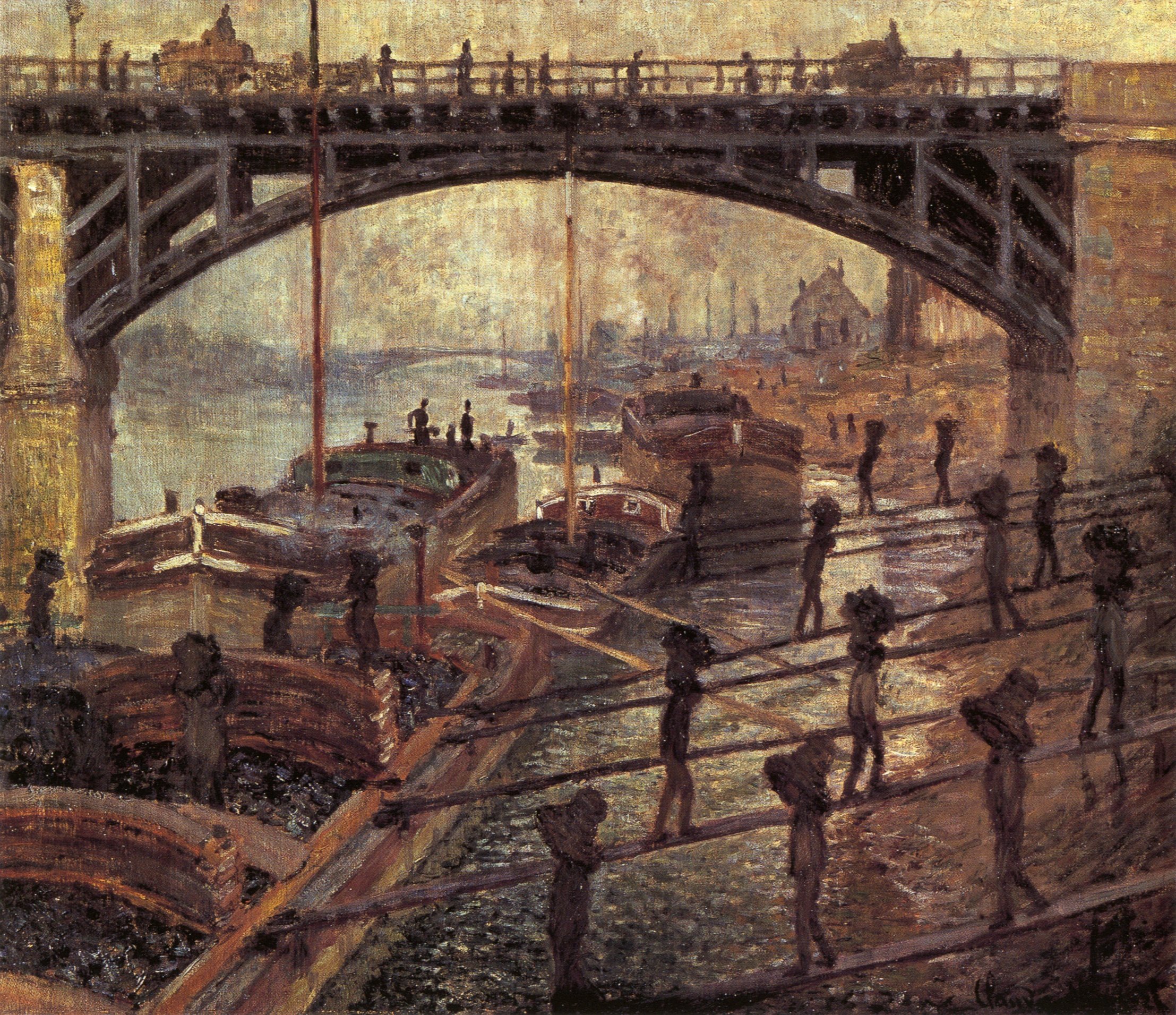
Les Charbonniers by Claude Monet

Les Charbonniers by Claude Monet (c.1875)

When I think of Impressionism and Impressionist paintings I think of light airy scenes.  I think of lily ponds and flowering arches at Givenchy.  I think of colourful young things boating on the mirror-like waters of the Seine.  I think of people sitting on the banks of the Seine staring out at blue cloudless skies.  I think of fashionable people promenading along the Grand Jatte in gorgeous sunlight.  I associate Impressionism and the paintings associated with that particular “–ism” as being light, colourful and full of smiling faces on the people as they relax from the rigours of their working lives.

That all changed when I came across the work of the Impressionist, Caillebotte and his Floor Scrapers (see August 3rd).  Today, I am featuring another darker and more sombre painting by one of the greatest Impressionist painters of all time, Claude Monet.  He painted today’s painting in 1875 when he was thirty five years old and living at Argenteuil.  It is entitled Les Charbonniers (The Coalmen) or sometimes referred to as Les déchargeurs de charbon (Men unloading coal).

Before us is a view of the docks at the Quai de Clichy, a little downriver from Paris.  Framed at the top of the painting in the background, we can just make out through the haze, the broad arch of the Pont de Clichy railway bridge, one which Monet would have crossed many times as he took the train from Argenteuil to Paris.   It is also a bridge which he featured in a number of his paintings.  Horses and carts can be seen crossing the nearer bridge, the Pont d’Asnières.  These carts will transport the coal from the quayside to nearby factories, the chimneys of which we can just make out in the distance as they pump out their smoky pollutants.   Also on the bridge we see a few pedestrians gazing down at the unloading operation.

It is a dark and atmospheric picture.  We do not have the brightness of a summer’s day.  It is a dull grey wintery day with a smoke-filled sky.  We see the men struggling with their heavy bags of coal perched on their shoulders as they struggle up the narrow wooden ramps between ship and quay over the murky waters of the Seine, balancing like tightrope walkers on a high wire.  The wooden walkways bend ominously under the strain of man and his load.  We can just imagine the ominous groaning and creaking of the wood as it takes the strain.  Hour upon hour these men will trudge mechanically back and forth until all the coal has been discharged from the boat.  This is a labour intensive operation.  Les charbonniers have an unenviable job with its physical strain on the body coupled with the inhalation of coal dust into their lungs.  In the holds of the vessel itself we see men filling baskets with coal ready for the charbonniers to take them ashore.  These men will probably not live to an old age.  Unfortunately for them, the invention of quayside cranes and cargo escalators had yet to be realised.  This discharge of the coal from the boat would be a long operation, as fully loaded, the coal barge could probably transport about 300 tons of coal, which could take anything up to two weeks to manually unload.

The sailing barge has probably brought its cargo of coal from the mines in Belgium and Northern France along the Canal de Saint-Quentin which connects the rivers Oise, Escaut and Somme.  The canal, a great feat of engineering, was opened by Napoleon Bonaparte in 1810.

The painting by Monet is simply a depiction of urban life and he might not have intended it as a political treatise with regards the conditions suffered by some working class people.  However the artist has given the painting a dark and solemn ambience which emphasizes the plight of some of the lowest paid workers.  This work was one of 29 works Monet presented in the fourth Impressionist exhibition.

The Barque of Dante by Eugène Delacroix

The Barque of Dante by Delacroix (1822)

When I first saw today’s featured painting I was immediately reminded of Géricault’s Raft of Medusa, which was My Daily Art Display on June 10th.  There was something about the look of suffering and desperation on the faces of the men on Géricault’s sinking raft that I could see on the faces of Delacroix’s men in today’s painting.  My Daily Art Display today looks at the painting entitled Dante and Virgil in Hell by Eugène Delacroix.  The painting is also known as The Barque of Dante and was painted by the French artist in 1822.   

The painting is based on Canto VIII of the Inferno, the first part of the 14th century epic poem the Divine Comedy written by the Italian poet Dante Alighieri.  The poem is an allegory recording the journey of Dante through Hell along with his guide, the Roman poet Virgil.  According to the poem Hell is made up of nine concentric circles of suffering located within the Earth.  Each circle representing one sin and is the place where those who have committed that sin and who are unrepentant will end up and receive an appropriate punishment.  The sinners of each circle are punished in a fashion befitting their crimes.  Each sinner is made miserable for all of eternity by the key sin they have committed. The circles represent a gradual increase in wickedness, culminating at the centre of the earth, where Satan is held in bondage.

The painting by Delacroix is based on the fifth circle and is all about the sin of Wrath.  The first circle is nominated as Limbo and the people in there have simply never been baptised into the Church.  The ninth circle is Treachery which is looked upon as the most heinous of sins.  I was amused to note that those unfortunates that had committed the sin of Lust were only allocated  the second circle – maybe for a hot blooded Italian, like Dante Alighieri, lust was hardly a sin at all !!!

The Fifth Circle of Hell is the swamp-like water of the river Styx and in its murky waters, the angry people fight each other on the surface, and the morose and brooding people lie gurgling beneath the water. The character in the poem, Phlegyas, the guardian of the river, reluctantly transports Dante and Virgil across the River Styx in his skiff.  This lower part of Hell where the characters in the painting find themselves is the marshy swamp that lies outside the walls of the city of Dis, the City of the Dead, which houses the lower parts of Hell, and which we see burning in the left background of the painting.

Delacroix and Géricault comparison

At the beginning I said I saw a similarity between Géricault’s Raft of Medusa painting and this painting by Delacroix.  I actually managed to find a picture which also highlights the likeness in the facial expression of a man in each work.  The main picture, on the right, is of the man in the left foreground of today’s painting as he lies in the water and shown in the inset we have the face of the man who is in the centre of the Géricault’s raft looking sky-wards.  Go back to my earlier blog on Géricaults painting and see if you agree.  Some three years after Géricault completed his Raft of Medusa painting in 1819, Delacroix completed what was his first major work and one which he exhibited in the 1822 Salon, the art exhibition of the Académie des Beaux-Arts in Paris.  The oil on canvas painting which measures 189cms x 246cms now hangs in the Louvre.

Dante is given a steadying hand by Virgil as they falteringly stand up in the boat as it ploughs its way through the choppy water of the River Styx, which is heaving with the tormented souls who have been trapped in this fifth circle of hell for their sins of wrath.  The Neo-Classical style which was prevalent at the time can be seen in the way Delacroix has grouped his figures.  The main characters are set in the centre of the painting whilst the subsidiary figures are painted much lower down on a horizontal plane, each holding a classical pose which gives the artist a chance to concentrate on their musculature.  Look how the artist has depicted the gale-force weather condition the boat party have to endure.  See how Delacroix has depicted the blue garment of Phlegyas as he rows his boat.  Although wrapped around his body it flies wildly in the face of the strong wind which roars in from the left of the painting.  The guardian of the river is using every ounce of his strength as we see the muscles of his broad back ripple as he pulls on the oar.  He seems to be sure-footed as he has made this rough crossing many times.  Dante holds his right arm aloft to try and steady himself against the wind’s ferocity, whilst Virgil takes his other hand in an attempt to steady him against the onslaught.   The boat has slewed around and is a little off course as it tries to reach the fiery City of Death.

Look at the characters in the water.  A couple lay back exhausted whilst the others display the anger and hatred which has conspired to send them to this part of Hell.  Look at the piercing demonic eyes of the man that clings to the front of the boat and the staring rage of the man in the water in the right foreground as he seems to be attacking another with his teeth as his adversary grips him by the back of his neck.

The head and demonic face by Delacroix

Look carefully at the man clinging to the gunwale on the far side of the small boat.  See how the muscles and sinews in his arm are almost at breaking point as he tries to heave himself on board.  His reddened eyes are demonic.  It is a frightening depiction of a face and Delacroix admitted that it was his best depiction of a head in the painting.

I am interested to look at the contrast in expressions between our two main characters, Dante and Virgil.  Whereas Dante has a look of horror and fear on his face, Virgil’s facial expression is one of calm and tranquillity as if he is completely detached from what is going on around him. There is also a stark contrast of colours used by Delacroix.  Dante’s red cowl and the fiery inferno of Hell in the background is in sharp contrast to the blue of Phlegyas’ flowing blue robe.

There is such raw emotion in this painting.  We are looking at a world of insanity.  We see before us the rage of angry men who have yet to come to terms with their fate.  We almost wrap our arms around ourselves to protect us from the storm we view and this fifth circle – the circle of Wrath.  Delacroix had worked non-stop for very long hours for nearly three months to have this painting ready for the April opening of The Salon in 1822 and by the time he had completed this work he was totally exhausted.  The work was exhibited with the title:

“…Dante et Virgile conduits par Phlégias, traversent le lac qui entoure les murailles de la ville infernale de Dité…”

Which translated was:

“Dante and Virgil led by Phlegyas, across the lake surrounding the infernal city walls of Dis”

But later came to be known as its present title The Barque of Dante.  The painting received mainly favourable reviews and a few months later it was bought by the French State for 2000 Francs and it was housed in the Musée du Luxembourg but in 1874 transferred to its present location, The Louvre.

Mademoiselle Lange as Danaë and Mademoiselle Lange as Venus by Anne-Louis Girodet

Mademoiselle Lange as Danaë by Anne-Louis Girodet (1798)

My Daily Art Display today has the slight whiff of scandal about it, or to be more precise, about the sitter for the painting.  It is a tale of two paintings, a disgruntled sitter and a furious artist.   The title of today’s featured works are Mademoiselle Lange as Danaë and Mademoiselle Lange as Venus and the artist who painted both these rather erotic works in 1799 was the French painter and illustrator, Anne-Louis Girodet de Roucy-Trisson but more commonly known as Anne-Louis Girodet.  Here was an artist whose works straddled the rationalism of Neoclassicism and the flights of fantasy associated with Romanticism.

Girodet was born in Montargis, a small town some 100 kilometres south of Paris in 1767.   He had an unhappy start to life with both his parents dying when he was young and he then came under the guardianship of Doctor Trioson who took care of his well-being and education.  Later Girodet would add the surname of his guardian to his own in recognition to everything the doctor had done for him when he was young.  There is a train of thought that the good doctor was actually Girodet’s natural father.   Initially Girodet studied to become an architect and had a desire to follow a military career but finally he decided that the life of an artist was for him.

He studied with Jacques-Louis David and in 1789 was awarded the Prix de Rome by the Royale de Peinture et de Sculpture and with that came the scholarship to travel to Italy and stay at the Academy of France in Rome.  Girodet remained in Rome for five years.

He returned to Paris in 1793 and concentrated on portraiture and was well known for his glorifying portraits of Napoleon Bonaparte.  One of his best known and most controversial portraits is one of the painting I am featuring today.  He also spent a lot of time doing illustrations for books.  In 1815 his erstwhile guardian Doctor Trioson died and Girodet inherited a fortune and for the rest of his life he spent little time painting and concentrated on writing poetry.  Girodet died in Paris in 1824, aged 57.

So that was a little bit about the artist and now to delve into the much more colourful life of the sitter of this painting, Anne Françoise Elisabeth Lange.  She was born in Genoa in 1772.  Her mother and father were both musicians who with their company of players, travelled throughout Europe performing in musical shows.  The young Anne Françoise soon became a young child performer.  At the age of sixteen she made her first performance at the famous Comédie-Francais as a pensionnaire, and five years later she was promoted to the position of a sociétaire.  It is an interesting theatrical hierarchy.  A pensionnaire is promoted to a societaire by a decree of the Ministry of Culture, from names put forward by the general administrator of the Comédie-Française.  Once one has achieved the rank of a sociétaire, an actor automatically becomes a member of the Société des Comédiens-Français and receives a share of the profits plus they also receive a number of shares in the Société to which he or she is contractually linked.

Triumph followed triumph in her rolls and soon she became a notable performer in Paris.  The turning point came in 1793 when she appeared in a play which had Royalist connotations and as Paris was in the clutch of the Revolution anything alluding to royalty or the monarchy was taboo and the theatre was shut down and the play’s author and the actors were arrested.  She spent two periods incarceration and narrowly escaped the guillotine thanks to having friends in “high places”.

Elisabeth Lange bore a daughter, Anne-Elisabeth Palmayre  to her wealthy lover, Hoppé, a wealthy banker from Hamburg and two years later bore a son to another lover, Michel-Jean Simons, a Belgian supplier to the French army, whom she later married, after which her acting career virtually came to an end.  Disaster struck Simms’ business and he was ruined almost leaving the family destitute.  Michel-Jean Simons died at the family’s Swiss home in 1810 and his wife Elisabeth Lange died six years later in Florence.

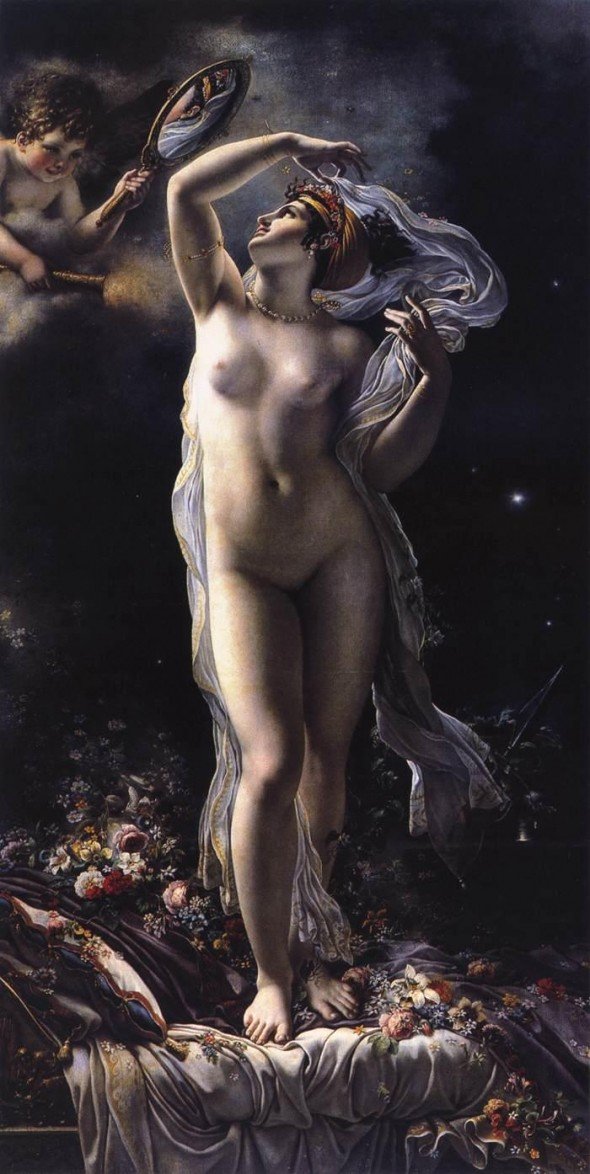
Mademoiselle Lange as Venus by Anne-Louis Girodet (1798)

Miss Lange was both very talented and extremely beautiful.  She had approached the artist, Girodet, to paint her portrait.  He duly obliged and depicted her as Venus, in which she held the pose seen in depictions of the Birth of Venus but in this painting it is Cupid who holds the mirror up to Venus for her to study her reflection.  He exhibited the painting at the 1798 Salon exhibition but the sitter was horrified by her depiction and demanded that Girodet should remove it from the exhibition and from public view.  Furthermore she refused to pay Girodet the agreed amount for the painting.  The artist was furious and in an act of revenge took the painting out of the exhibition, removed it from its frame and ripped it up.  He then sent the pieces to Mademoiselle Lange.  However his revenge was not complete as he decided to paint another portrait of Elisabeth Lange but this time showing her in a very unfavourable light.  He rushed off a satirical painting of Mademoiselle Lange as Danaë  in just a few days.   Eighteenth-century artists sometimes portrayed people as mythological characters to highlight their virtues but this time Girodet wanted to highlight Mademoiselle Lange’s vices.   Danaë was one of the mortals loved by the Greek god Zeus, who transformed himself into a shower of gold and fell upon her. Girodet shows Miss Lange as a prostitute greedily catching and gathering the gold coins in a sheet.   In the painting Girodet has featured a turkey with peacock feathers wearing a wedding ring, symbolizing her final lover and husband Michel-Jean Simons whom she married for his fortune, and to the bottom right we have a bizarre mask with the features of another of her lovers, Lord Lieuthraud, with a gold piece stuck in one of its eye sockets.  Look at the mirror she holds.  It is cracked and this symbolises her inability to see herself as she is, or how Girodet saw her – vain, adulterous and avaricious.

This painting is now at the Minneapolis Institute of Arts.