What Our Lord Saw from the Cross by James Tissot

What Our Lord Saw from the Cross by James Tissot

My blog today is the first of a two part look at the life and art work of Jacques-Joseph Tissot, later to be known as James Tissot.  In this first part I will look at his life and a religious painting with a difference, which was one of a series he completed  between 1886 and 1894.   In my next blog I will introduce you to the “love of his life”, who featured in a number of his later works.

Jacques-Joseph Tissot was born in 1836, in Nantes, a French seaport on the north-west coast of France.   Tissot was the second of four sons born to Marcel Théodore Tissot, an affluent linen merchant and successful businessman, who owned a country house, Château de Buillon, close to the town of Besançon and Marie Tissot, née Durand, a clothes and hat designer who helped in her husband’s business.  Tissot was brought up in a very religious household with both his parents being devout Roman Catholics.   At the age of twelve he was sent away to a Jesuit boarding school in Belgium, in the town of Brugelette, which in those days was one of the leading seats of learning for children of the Roman Catholic faith and attracted many pupils from different countries.  In her 1985 biography, Tissot by Krystyna Matyjaszkiewicz, she points out that it was at this college that Tissot first came into contact with English children.  She wrote:

“…Pupils at Brugelette included Catholics from England, and it may have been through friendships at Brugelette that Tissot became interested in all things English and began to style himself James, the name he was using by 1854. When new laws enabled the Jesuits in 1850 to open a college at Vannes in Brittany Tissot returned to France and attended school there, subsequently moving to another in Dôle (near Besançon), a bastion of Catholicism….”

His early family life would later have a bearing on some of his paintings such as his beautifully crafted depictions of ships which he would have seen in the local harbour of Nantes and his devout religious upbringing would have given him an interest in religious paintings.

By the time he was seventeen years of age, Tissot had decided to become an artist, much to the annoyance of his father, who had hoped his son would follow in his footsteps and run the family business.  His father eventually relented and in 1855, aged 19, Tissot went to Paris, lodging with an artist friend of his mother, Jules-Élie Delaunay.  He then worked in the studios of the French academic painters, Jean-Hippolyte Flandrin and Louis Lamothe who had learnt their trade as pupils of Ingres.  During his stay in Paris, he would, like many aspiring artists, spend a great deal of time at the Louvre copying the  works of the Old Masters and it was around this time that he met other contemporary artists such Degas, who also had once studied under Lamothe, the American artist, James McNeill Whistler and Édouard Manet.   Four years after arriving in Paris, Tissot exhibited five of his works at the 1859 Paris Salon.

Within a relatively short time he became an admired painter and received a number of commissions for wealthy patrons.  There was also a change in Tissot’s painting style from his medieval-styled works to everyday life seen through his portraiture.  He would depict modern Parisian women as they went about the city and its suburbs and he would spend time perfecting the way he depicted their style of dress, and such an interest in this aspect probably harked back to the days spent with his family clothing business and admiring his mother’s talents as a designer.  Much later in his life, in 1885, there was a major exhibition of his work at the Galerie Sedelmeyer, Paris, where he showed 15 large paintings in a series called La Femme à Paris.  These paintings represented different types and classes of women, shown in their professional and social contexts.

Because I want to save the middle part of Tissot’s life and his love affair with Kathleen Newton, until my next blog, I am going to skip to the year 1885 which is the year in which the artist experienced a re-conversion to Catholicism. It is said that one day, during a church service, he had a vision of Jesus tending to people in a ruined building. It was, Tissot believed, his Road to Damascus.   It was this return to his Roman Catholic beliefs which led him to spend the rest of his life illustrating the Bible. It is not unusual for us to hear of people being struck by this “born again Christian” phenomena but in the case of James Tissot many of his friends found his sudden return to Roman Catholicism, at a time when there had been a French Catholic revival and a coinciding surge in purchasing religious paintings, just too much of a fortuitous coincidence !!  Nevertheless, from then on Tissot devoted himself to painting religious subjects. He totally immersed himself in all things religious and painted works connected with bible.  His biographer, Krystyna Matyjaszkiewiczn wrote of Tissot’s religious fervour:

“…Tissot set off for Palestine on 15 October 1886, his fiftieth birthday.  He returned to Paris in March 1887 with sketchbooks full of drawings and a burning compulsion to illustrate the life of Christ. The idea developed into publishing images of events, places, people, and incidental detail, with extracts from the Gospels and biblical commentaries. Tissot made further visits to Jerusalem in 1888 and 1889. By April 1894 he had completed 270 watercolours, which were displayed at the Champ de Mars, Paris, to awe and amazement…”

Tissot travelled to the Holy Land and this marked the beginning of a 10-year campaign to illustrate the New Testament.  He would return to Palestine and back to Jerusalem and the surrounding area in 1888 and 1889 to make further studies of the landscape and the people.   The culmination of the project resulted in his The Life of Christ collection which was a compilation of 350 watercolours that depicted detailed scenes from the New Testament, from before the birth of Jesus through to the Resurrection, in a chronological narrative.  Two hundred and seventy of them were exhibited at the Paris Salon of 1894.     It is reported that these works of art caused a sensation. Men were described as reverently doffing their hats whilst women wept and knelt before the pictures.  Some women even crawled like penitents through the show.   The exhibition of his biblical works moved to London in 1896 and New York at the end of 1898 before the entire collection was purchased by the Brooklyn Museum in 1900.   In 1897 a French version of the profusely illustrated Tissot Bible was published and a year later an English version was available.   This further enhanced the artistic reputation of Tissot and made him very wealthy.   In the last few years of his life, Tissot worked on paintings depicting scenes from the Old Testament, eighty of which were exhibited in Paris.  He had, by this time, retired to Château de Buillon, the residence he inherited on the death of his father.   Tissot was never to complete the series of Old Testament works as he died at his chateau in Doubs, France in 1902, aged 66.

My featured painting today is one of the biblical scenes from the New Testament completed by James Tissot during the period 1886-1894.   It is an opaque watercolour over graphite on gray-green woven paper entitled What Our Lord Saw from the Cross.  It is regarded as one of the most memorable of the series of biblical images by the French painter.  It is totally different from the normal crucifixion scene paintings when, in almost all cases, we look up at the figure of Christ hanging from the cross.  In Tissot’s painting, we are the eyes of Christ and it us who looks down from the cross at the people below.  By doing this Tissot has allowed us to imagine ourselves in Christ’s place and by doing so we are able to empathise with him and maybe we can imagine what was going through his mind as he looked down upon friends, who had come to lend their support, and his enemies who have participated in his death and had come to gloat at his predicament.

From our viewpoint we look downwards at the crowd.   We see Mary Magdalene, in the immediate foreground, with her long red tresses swirling down her back, kneeling below the feet of Christ, which we can just see at the bottom centre of the painting. Further back we see the Virgin Mary clutching her breast, while John the Evangelist looks up with hands clasped. Some Roman soldiers are looking on, including a centurion who is clad in red. He has a downcast and remorseful expression on his face and Tissot has no doubt placed him at the scene reminding us of the passage in Luke’s Gospel 23:47 which stated:

“…Now when the centurion saw what was done, he glorified God, saying, Certainly this was a righteous man…”

The men on horseback in the right mid ground of the painting are Jewish scribes. They have a look of satisfaction on their faces for Christ was their rival.  These were the very men who had put pressure on Pilate to have Christ crucified.   Their plan had succeeded and their rival had been removed.  Look towards the centre of the background and one can see that Tissot has depicted the entrance to a tomb, the very place in which the body of Christ will be laid to rest after he has been brought down from the cross.

This is truly a remarkable work of art and I would love to go to the Brooklyn Museum to see the complete series.

In my next blog I will tell you about Tissot’s beloved Kathleen Newton, an Irish divorcee, and look at some of his portraits of this woman, who was the love of his life.

The Stonebreakers by Gustave Courbet

The Stone Breakers by Gustave Courbet (1849)

For my third look at Realism art and Social Realism art I am going back to the land of its inception, France.   The emergence of this form of art came about in France around 1848, the year King Louis-Philippe lost the French crown and was replaced by Louis-Napoleon Bonaparte, who became President of the French Second Republic.  The monarchy had gone, even if it was just for a few years, as Louis-Napoleon had himself crowned Napoleon III.  With the change of ruler came the promise of greater democracy. The French people were excited with the change and were now baying for this pledged greater democracy under the new regime.  Realism in art also arrived with the Realist artists who democratised their art by depicting in their paintings subjects from everyday lives of the working class.   These painters rejected what had gone before them.  They neither wanted to paint idealized pictures, which had no bearing on reality but was what was being taught and expected from the students at the École des Beaux-Arts, the state-sponsored art academy and exhibited at the official Salons, nor did they want to carry on with the exotic themes of Romanticism.

For these Realist artists, they wanted their paintings to be a direct reflection on modern life.  The great French painter and leading proponent of Realism art, Gustave Courbet, described what art should be, saying:


“…painting is an essentially concrete art and can only consist in the representation of real and existing things..,”

Gustave Courbet is my featured artist today and I wanted to look at his painting The Stonebreakers.  Sadly it no longer exists as it was destroyed by Allied bombing on a transport convoy in February 1945, whilst it was being transported to the Königstein Castle, near Dresden, for safe keeping along with 154 other paintings.   When The Stonebreakers was exhibited in Paris at the Salon of 1850, it was attacked as un-artistic, crude, and socialistic, so let us look at why this view was taken by the critics.

Courbet wanted to depict the lifestyle of working class people in his paintings.  However, he wanted to depart from the idealized depiction of these poor farm workers and peasants who in the past had always been depicted smiling happily as they got on with the most arduous and often dangerous jobs, for little remuneration.   The problem of course with this artistic style was although it appealed to people who sympathised with the lot of the working class, the buyers of art were often the rich and upper classes, who through association were the very people who treated their workers badly.   His Realism art works were looked upon as being anti-authoritarian and politically threatening.  When he put forward two of his large paintings A Burial at Ornans and The Painter’s Studio for inclusion in the 1855 Salon, the Salon jurists rejected them. Courbet was so angered by the jurists’ decision that he withdrew his eleven accepted submissions and displayed the paintings privately in his Pavillon du Réalisme, not far from the official international exhibition.   In his exhibition catalogue, which described his works, he wrote an introduction which, in essence, was a Realist manifesto.  He stated:

“…his goal as an artist was to translate the customs, the ideas, the appearance of my epoch according to my own estimation…”

The realist paintings of Courbet found no favour with the Establishment.  Courbet’s critics firmly believed that he was bringing about an artistic and moral decline by painting what they deemed distasteful and inconsequential subjects on a grand scale. They accused him of nurturing a “cult of ugliness” against much beloved concepts of Beauty and the Ideal.   His critics even went as far as to state that this Realism was nothing less than the enemy of art.  However there were some high placed supporters of Courbet’s work.  The French socialist politician at the time, Pierre-Joseph Proudhon, an advocate of workers’ associations and co-operatives as well as individual worker / peasant possession over private ownership or the nationalization of land and workplaces, saw The Stonebreakers painting and commented:

“… The Stonebreakers was an irony directed against our industrialized civilization … which is incapable of freeing man from the heaviest, most difficult, most unpleasant tasks, the eternal lot of the poor...”
The Stonebreakers was painted by Gustave Courbet in 1849 and shows two peasants breaking rocks into gravel to be used as a base in the construction of roads. One appears to be in his sixties and the other much younger.  The painting could not be described as colourful.  Courbet has used monotonous colours and by doing so has reflected the languishing tone of the painting.  We are not distracted by a colourful landscape.  Our eyes are fixed upon the two men as they carry on with their backbreaking work.    In no way was Courbet’s depiction of the men idealized or romanticized.  What we see is the gritty uncompromising truth.  The job of a stonebreaker was considered the lot of the lowest in French society.   Their differing ages symbolizes the circle of poverty, which will haunt the lower classes throughout their lives.  Those born into poverty would remain so for the rest of their life.   It is a glimpse into the world of the rural unskilled labourer.   The workers are dressed in ragged clothes.  Their ragged clothes and the little meal laid out in the right midground of the work underline their impoverishment. Look how Courbet has depicted the boy as he struggles with the heavy basket of gravel.  It is almost beyond the boy’s strength while the old man exhaustedly bends his knee to work.   One is now too old and almost lacks the strength to wield the hammer whilst the other is almost too young and almost lacks the strength to carry his burden.  This is realist art at its finest.  Courbet has not resorted to ancient heroes for his portrayal of heroism he has taken two simple men whose lot in life was manual labour and who were carrying out their task as best they could.

Despite Realist art not being favoured by the bourgeoisie or the Academies, it found an audience in France who was showing an interest in the plight of the working poor especially following the labourers uprising against the bourgeois leaders of the newly established Second Republic in 1848.  Their demands were simple – a redistribution of property and better working conditions.  The labourers’ uprising lasted just three days and many lives were lost. They did not achieve their demands but suddenly the plight of the working class labourer was centre stage and Courbet’s painting which came a year after the failed uprising could not have arrived at a more fortuitous time.

Peasant Girl Lighting a Fire. Frost, by Camille Pissarro

Peasant Girl Lighting a Fire. Frost by Camille Pissarro (1888)

My Daily Art Display’s featured painting today is entitled Peasant Girl Lighting a Fire. Frost, which was painted by Camille Pissarro in 1888 and can now be found in the Musée d’Orsay in Paris.  At this time Pissarro was still a leading light of the Impressionist movement, a movement he had helped to form.   However it was two years prior to this work that Pissarro began to become interested in the experimental work of young artists, who had adopted the fragmented brushstroke technique which Georges Seurat and Paul Signac were trying out, known as pointillism , a technique Pissarro used in parts of this painting.  For a more in depth look at pointillism see My Daily Art Display October 21st 2011 for a painting by Georges Seurat and November 29th 2011 for a painting by Paul Signac. Pissarro had been introduced to Seurat and Signac in 1885 and in the following years he began to work in the pointillist style which had then been adopted by the Neo-Impressionists.  By the time Pissarro was in his sixties he found that this pointillism technique too restricting and in the last ten years of his life he returned to a purer Impressionist style.
Camille Pissarro was fifty-eight years of age when he completed today’s featured work of art.  Ten years earlier his style of painting was such that he would portray nature in his landscapes by a myriad of smaller comma-like brushstrokes built up on the surface of the canvas such as his 1877 work, The Red Roofs (see My Daily Art Display of November 30th 2010).  Pissarro was concerned that these works lacked clarity and so he decided to change the way he worked.  He spent time working in collaboration with Degas, who was, of all the Impressionists, a great believer and advocate of figure painting and the primacy of the human figure at the expense of landscape background.  It was maybe the views of Degas that led to Pissarro to complete some works in which the human being(s) took pride of place in the painting, as is the case with today’s featured work.

The painting depicts two peasant girls working in a field in a cold and frosty winter morning and we see one of them tending a fire.  Pissarro often painted peasant women at work.  Two fine examples of this are his 1881 work entitled Girl with a Stick and the 1893 painting entitled Woman with a Green Shawl.  His portrayal of peasants received some criticism for copying the ideas of Jean-François Millet but Pissarro firmly contested such a notion.  However in general art critics looked upon his works as true representations of peasant life.  Look at the beautiful way in which Pissarro has depicted the landscape.  At the time of this painting Pissarro was extremely interested in the pointillism technique of Seurat and Signac and he used this method to present us with a sumptuous backdrop to the two girls.  The painting has a light and airy feel to it and there is a subtle delicate nature to the work.  The work was painted in Eragny just north-west of Paris where Pissarro and his family lived for a time.

In the far distance we can see the low hills topped by irregular spaced bushy trees.  In the middle ground, we observe grazing cows in the meadow, a line of poplar trees at the foot of the hills and possibly a hidden stream running horizontally across the mid ground.   Notwithstanding the backdrop, the focus of the painting is on the two girls in the foreground, who almost appear to stand next to us.  The scene is lit up by the sun, somewhere out of sight, to the left, which throws off long blue shadows across the field.  It is a wintry sun and still low in the sky, hence the long shadow of the girl in the foreground, which disappears off the painting to the right.    Although it emits light, the sun gives off little warmth and so our two young workers are wrapped up well.  The temperature is even colder due to the wind chill factor.  Look how the girls skirt and the smoke from her small fire are blown horizontally by the wind which comes from the left of the painting.  One can imagine how cold it is with the driving wind on a wintry day. We almost shiver as we look at this work of art.

The girls are both well wrapped up against the morning’s wintry chill.  The girl on the right, who seems no more than a child, is warming her hands by the fire.  She wears a blue dress and a thick dark brown coat.  She has a dark woolen hat on her head which is pulled down to protect her ears from the icy wind.   The older girl, who is closest to us and because of her height, is the main focus of our attention.  She has taken a branch from the pile behind her, and is about to break it up and add it to the fire.  She wears a pink skirt with a blue apron.  She too has protected her head, wearing a white scarf tied beneath her chin.  Her final layer of protection is a pink and white shawl from which emerge long black sleeves of her dress.

The colour combinations Pissarro uses to achieve the colour we see is fascinating.  The girls pink dress is made up of a combination of yellow, blue and pink.  The green grass of the meadow is achieved by using a combination green, blue, yellow, pink and white.  The only orange Pissarro used was for the flames of the fire.

Pissarro fled the traumas of the Franco-Prussian War in 1871 and, like Monet, went to live in London.   It was whilst in London that he saw a number of paintings by Turner.  Pissarro later commented on Turner’s works and was amazed by the way Turner succeeded in conveying the snow’s whiteness, not just by the use of white alone but by combining a host of multi-coloured strokes, dabbed in, one against the other, which when looked at from a distance, created the desired effect.  It is in this painting that Pissarro has, without the actual presence of snow, managed to give us a crystalline frost of a cold winter’s morning encapsulated in an aura of diamond blue.

A Girl in a Kitchen (La chercheuse de puce) by Nicolas Lancret

A Girl in a Kitchen by Nicolas Lancret (c.1720-30)

Today I am featuring the French painter, draughtsman and art collector, Nicolas Lancret, who was born in Paris in 1690.  To begin with, Lancret trained as an engraver but soon afterwards became an apprentice to the history and religious painter Pierre Dulin.  Dulin was later to become a professor of art at  Académie royale de peinture et de sculpture in Paris.  Throughout his early artistic training Lancret was influenced by and greatly admired the works of the Jean-Antoine Watteau the late Baroque painter and one of the leading artists in the new Rococo style of artwork.  In 1708, at the age of eighteen, Lancret enrolled at the Académie royale de peinture and in 1711 he competed unsuccessfully for the Prix de Rome prize.  His stay at the Académie ended when he was expelled for quarrelling.    It was Lancret’s love of Watteau’s work that made him part from his tutor Dulin and serve under Claude Gillot, the French genre and decorative painter, who had Watteau as his assistant in 1703.  Once Lancret began to work in the studio of Gillot his artwork changed from the history painting he had learnt whilst with Dulin to the Rococo style with all its scenes of graceful figures at leisure in elegant garden settings similar to the works of Watteau whom Lancret met around 1712.

In 1719 he was the first painter to be accepted into the Académie Royale as a painter of fête galantes, a category that had been created by the Academy in 1717.  Fête galante, which means “courtship party”, is a French term used to describe a type of painting which first came very popular in the early eighteenth century France.  Watteau had submitted his reception piece, ‘The Embarkation for the Island of Cythera (See My Daily Art Display, February 22nd 2011)  to the Académie Royale in 1717 and the critics of the time described it as characterising une fête galante.  These fêtes galantes paintings were usually small in size and recorded the lives of stylishly dressed men and women engaged in amorous but well-mannered play in a garden or parkland surroundings.

Lancret’s art work became very popular and he received numerous commissions from wealthy patrons especially after the death of Watteau in 1721.  Frederick the Great owned more than twenty-six of his paintings but his main patron was the ruler of France, Louis XV,  who, from the 1725,  continued to buy Lancret’s work until the artist died almost twenty years later.  He was one of the most prolific and imaginative genre painters of the first half of the eighteenth century in France and he had the ability to insert lively genre images into an allegorical framework.  His portraiture work was different to many of the time as he liked to treat his portraits as genre scenes.  Lancret exhibited works regularly at the Paris Salon.

Lancret remained single for much of his life and did not marry until 1741 when he was fifty-one years of age.  He married the 18 year old grandchild of Edmé Boursault, the French dramatist and writer.  Although one may be dismayed by the age difference of the couple it is believed that Lancret decided to marry the young girl after finding her and her dying mother living in poverty in an attic room and on hearing that the daughter was soon to be compelled to enter a convent. The marriage was a short-lived as Lancret died of pneumonia in Paris in 1743, aged fifty three.

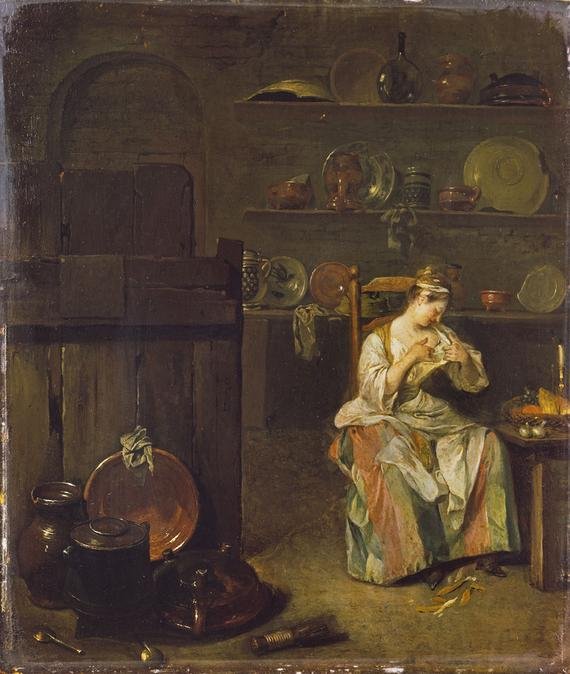
My Daily Art Display featured painting today is not a fête galante work but a genre piece which I saw recently at the Wallace Collection in London.  The painting is entitled A Girl in a Kitchen (La chercheuse de puce) which Lancret completed in the 1720’s.  It is very reminiscent of the Dutch genre paintings of the previous century.  We see before us a young woman seated in a kitchen.  The first question which comes to mind as we look at her is what is she doing?  The subtitle of the painting La chercheuse de puce, reveals all, as translated it means “the seeker out of fleas”.  Unbelievable as it may seem the girl is inspecting herself for fleas !!!   The reason for this activity was that during the eighteenth century, amongst the poorer classes, infestation in the household with fleas was quite common.  However the depiction of the girl touching her exposed breasts during her inspection was probably Lancret’s way of titillating the observer.  The girl sits before us with her corset unlaced, inspecting her body.  Kitchen scenes in poor and peasant households were popular with the Dutch art collectors but the addition of the bare-breasted girl with its erotic connotations adds a typical French flavour to the depiction.

In some ways this painting is a kind of plagiarism as it is thought that although Lancret painted the girl and the still-life on the table next to her, the interior was painted by a Dutch artist much earlier.    The erotic element of the painting is not the only “Frenchness” about the work of art.  She sits there in her French silk skirt, semi-laced corset and delicate pointed slippers and she has been added by Lancret to this Dutch seventeenth-century interior.  It is not known which Dutch artist had painted the interior.  There were many art collectors  in France who paid good money for these Dutch genre scenes.  However Lancret, the master of fêtes galantes paintings, wanted to add some colourful and picturesque feminine interest into those more dark and somber Dutch paintings and, as was the case in today’s work, he is known to have embellished works by the Dutch landscape and peasant scene painter, Herman Saftleven and the Dutch Golden Age and sill-life painter, Willem Kalf.

I will leave you to ponder over whether the original Dutch interior needed the little bit of colour and bare flesh that Nicolas Lancret has given us.

Une loge aux Italiens (A Box at the Theatre des Italiens) by Eva Gonzalès

Une loge aux Italiens (A Box at the Theatre des Italiens) by Eva Gonzalès (1874)

I had intended this offering to be my previous blog but when I researched into today’s featured artist and her painting I saw there was a connection between this work of hers and a similar one completed by Renoir in that same year.  My Daily Art Display featured artist today is Eva Gonzalès and the work I want to look at is entitled Une loge aux Italiens (A Box at the Theatre des Italiens) which she completed in 1874.

Eva Gonzalès was born in Paris in 1849.  Her father was the novelist and playwright, Emmanuel Gonzalès, a Spaniard but naturalised French.  Her mother was a Belgian musician.  From her childhood she was immersed in the literary world as her parents house was often used as a meeting place for critics and writers.

Eva began her artistic career in 1865, at the age of sixteen, when she began to study art.  Initially she studied under Charles Joshua Chaplin, the French society portraitist, who ran art classes specifically for women in his atelier and who, the following year, would teach the American female artist Mary Cassatt.

Portrait of Eva Gonzalès by Manet

Just before her twentieth birthday in 1869 she became a pupil of Édouard Manet and also used to model for him and many of the other Impressionist artists.  It was whilst at his studio that she met Berthe Morisot who was also working with Manet and posing for some of his works.  There would seem to have been an intense  rivalry between the two females.  According to Anne Higonnet’s book Berthe Morisot, Morisot wrote to her sister about Gonzalès and Manet’s attitude towards her saying:

“… Manet preaches at me and offers me the inevitable Mlle Gonzalès as an example; she has bearing, perseverance, she knows how to carry something through, whereas I am not capable of anything.   In the meantime, he begins her portrait again for the twenty-fifth time; she poses every day, and every evening her head is washed out with black soap.  Now that’s encouraging when you ask people to model…”

Repose by Édouard Manet

One can easily detect Berthe Morisot’s jealousy of Eva Gonzalès in that passage.  The painting referred to by Berthe Morisot was entitled Portrait of Eva Gonzalès which Manet was working on and which he exhibited in the 1870 Salon.  It is now housed at the National Gallery, London.  At the same time that he was painting the portrait of Eva Gonzalès he was also painting a work entitled Repose which was a portrait of Morisot and which he also exhibited at the 1870 Salon, as almost a companion piece.  This portrait of Morisot can be seen in the Rhode Island School of Design, Museum of Art, Providence, Rhode Island.  As you can see by the passage above, Morisot was annoyed by Manet’s painting of Gonzalès.   What rankled Morisot the most was probably how Manet had portrayed the two young ladies.    So what could have annoyed Morisot about Manet’s depiction of her?  Look at the two paintings.  Both young women, both wear similar clothing, both have been portrayed as young and pretty but the one big difference is that Morisot is depicted half laying back on the sofa in what one could describe as a languid and idle pose whereas Eva is portrayed as a budding artist actively at work.   What also should be kept in mind is that Morisot did not look upon herself as merely a “pupil” of Manet.  For Morisot,  her relationship with Manet was almost as equals rather than master and pupil.  In her relationship with Manet, she was also much more forceful and self-confident than Gonzalès, who was more of a willing disciple of Manet and who would put up with Manet’s abrupt manner,  whilst continually absorbing his teaching.   Of course there was another significant difference between the two young women – age!   Eva was more than eight years younger than Morisot.

Unlike Morisot, but like her mentor Manet, Eva Gonzalès decided not to exhibit any of her work at the controversial Impressionist Exhibitions but she has always been grouped with them because of her painting style.   However, she did regularly have her work shown at the annual Salon exhibitions in the 1870’s.  Her works received mixed comments.  The critics who were supporters of the Impressionist artist liked her work.

Portrait of Jeanne Gonzalès in Profile by Eva Gonzalès

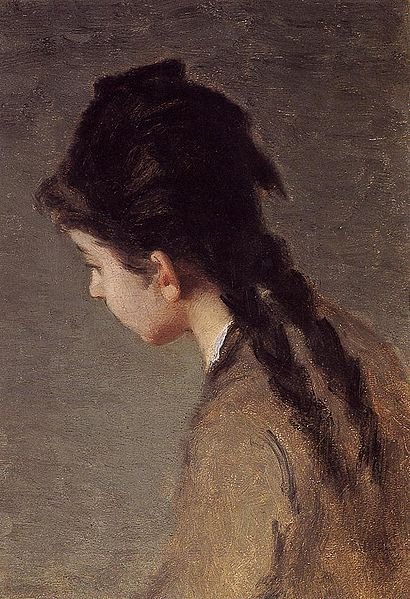
In 1869 Eva married Henri Charles Guérard, an etcher, lithographer  and printmaker, who was a close friend and sometime-model for Édouard Manet and who modelled for some of his wife’s paintings along with his sister-in-law Jeanne (La femme en rose, Jeanne Gonzelès).  In 1883, a month after her 34th birthday, she gave birth to a son, John.  Sadly, her life was cut short when she died following complications of childbirth.  It was believed to have been Puerperal Fever.    Her death came just six days after the death of her one-time mentor Édourad Manet.   Two years after her death a retrospective of Gonzalès’ work was held at the Salons de La Vie Moderne in Paris where over eighty of her paintings were put on display.

Five years later, in 1888, Henri-Charles Guérard  married Eva’s younger sister, Jeanne Gonzalès, also an artist.   My featured painting by Eva Gonzalès is entitled Une loge aux Italiens (A Box at the Theatre des Italiens) and you can obviously see the similarity between her painting and my previous offering entitled La Loge by Pierre-Auguste Renoir.  I decided to feature his first and then let you compare her painting with his.

As I discussed in my last blog, the auditorium of a  theatre and especially the theatre box were fashionable places for an exchange of society chit-chat and gave the theatregoers the opportunity to be seen at their best.  The subject of the theatre and theatre goers was a subject frequently chosen by the Impressionists, such as Cassatt and Degas but probably the most celebrated of this genre was Renoir’s La Loge (The Theatre Box) and it is interesting to compare it with this work by Eva Gonzalès which she completed in the same year, 1874.  This painting by Gonzalès was submitted to the Salon jurists for inclusion in the 1874 Salon but was refused.   Eva Gonzalès then made some changes to the painting and five years later submitted it to the 1879 Salon and this time it was accepted.  The critics loved the work.

There are some similarities to this painting of hers and that of her former tutor Édouard Manet in the way she, like him, chose to paint a modern-day subject and the way her painting, like some of his, shows a total contrast between the light colours of the clothing of the subject and the pale creamy skin of the female and the dark background.   In stark contrast to the dark velvet edge of the box , we see her white-gloved hand with its gold bracelet casually resting along it.   There is also an uncanny similarity between the bouquet of flowers that rests on the edge of the theatre box to the left of the woman in Gonzalès’ painting and the bouquet of flowers which Manet depicted in his painting, Olympia (see My Daily Art Display October 12th 2011).  The two people who were sitters for Eva’s painting were her husband, Henri Guérard and her sister Jeanne who as I said before was to become Henri’s second wife.

As was the case in Renoir’s painting we are left to our own devices as to what is going on within the theatre box. We need to make up our own minds as to what the relationship is between the man and the woman and to their social standing in society.  There is little symbolism to help us interpret the scene.  We just have to use our own imagination and sometimes that adds to the joy os looking at a work of art.

La Loge by Pierre-Auguste Renoir

La Loge by Renoir (1874)

Today’s featured work of art was not my original intended offering.  That sounds somewhat strange but actually there is logic to my decision.  I was researching a painting when I came across today’s work and there seemed, at least in my mind, a good reason to offer you today’s painting before I showcased my original work.

The French word La Loge in the context of a theatre means the theatre box and it has been the subject of a number of paintings.  Today I want to look at La Loge by Pierre-Auguste Renoir which he completed in 1874 and now hangs at The Courtauld Gallery in London.  Today this work of art by the Impressionist painter is looked upon as one of the most significant works of the Impressionist movement.  At the time of this painting it was estimated that over 200,000 theatre tickets were sold every week in Paris.  However, going to a Parisian theatre in the nineteenth century was not just about taking in the latest plays by the likes of Victor Hugo or Alexandre Dumas or the less formal vaudeville shows which were also very popular at the time, it was about being seen by other theatregoers.  Men would accompany and flaunt their wives or lovers.  Proud fathers would show off their daughters and “out-of-towners” would take the opportunity of dressing up and sample the Parisian lifestyle.   It was an almost indoor form of promenading, which was the leisurely walking in public places dressed in one’s finery and carried out as a social activity.  Attending  the theatre was a chance to showcase one’s most expensive clothes and accoutrements as well as parading one’s latest beau.  What could be more satisfying than to flaunt one’s wealth or one’s new lover?  It was a question of seeing and being seen and going to the theatre dominated the cultural life of the city.  As well as seeing actors on the theatre stage the theatregoers were actually quietly performing on their own  social stage.

Being seen

The way Renoir has depicted the scene in the theatre box sums up this attitude.  We see a lady and gentleman seated in their box.  Take a look at their demeanour.  Are they depicted as locked in concentration at what is happening on the stage below?  No they are not.  The lady stares out at us with her gloved hand holding her opera glasses and resting it on the lavish velvet frontage of the box whilst her other hand clasps a black fan and a white lace handkerchief in her lap.  Protocol of the day demanded that ladies must wear gloves on formal occasions.

Her face is now not hidden from view by her opera glasses.  She is revealing her face to all who may wish to gaze at her.   So how would you describe her?  Is there a delicate elegance about her or does she look rather brash.  She is without doubt beautiful and has little trepidation about letting people admire her from afar.  She wears a lavish dress, one she has probably saved for this very outing.  This is her tenue de premiere or opening-night attire.  Her costume would often be referred to as a robe à la polonaise or polonaise which was popular in the late eighteenth century and saw a was revival a hundred years later in the 1870’s.  It consisted of a fitted overdress which extended into long panels over an underskirt.  The magic of Renoir’s painting is that from a far one can see the three dimensional form of the dress with all its folds and yet up close it was just a series of brushstrokes.  It is almost magical the way the artist has painted this work.

The elegant dress oozes a sense of wealth but that is not the only thing which advertises the financial situation of the couple.   The style of the dress also oozes the ladies sensuality.  Note the position of the rose which immediately draws our eyes to the décolletage which emphasizes her cleavage. The low-cut neckline was a popular feature of evening gowns of that era.   Another rose placed in her hair once again draws our eyes to her simple but elegant coiffure.

Look at her neck and the pearl necklace she is wearing.  Also we can just make out a pair of diamond earrings dangling from her ears and if we look at the hand which holds her opera glasses we note a gold bracelet around her slender wrist.  The wealth is there for us to see but more importantly it is there for the other theatregoers to note.

This is a summation of the “seen and being seen” philosophy.  She is wanting to be seen in all her finery whilst he is concentrating on seeing.  Renoir used one of his regular models, Nini Lopez, as the model for the lady.

Seeing

The sitter for her male companion in the theatre box was Edmund Renoir, the brother of the artist.  He, like the lady, is dressed elegantly in his formal clothes.  Renoir has depicted him wearing a white shirt with a starched cravat, black trousers and gold cufflinks.  His attire, which is typical of that of the wealthy male theatregoer also exudes a sense of affluence but its plainness and subdued colour allows the more colourful female to be the centre of attention.

The aspect of this painting which we cannot be sure about and I will leave you to decide is whether we are seeing a husband and wife out for an evening at the theatre or are we looking a wealthy man accompanied by an elegantly dressed courtesan.  Can we deduce the truth from looking at the painting but beware of falling into the trap of being too judgemental !!!

Renoir exhibited this painting in the First Impressionist Exhibition which was held in the former studio of the photographer Nadar at 35 boulevard des Capucines in Paris on April 15, 1874.  This work, which gives us an insight into Parisian life in the late nineteenth century, is now hailed as a masterpiece of art and one of the most significant works of the Impressionist movement.  At the time it was exhibited it helped establish the reputation of Renoir.  The painting gives us an insight into life in the French capital during the late nineteenth century.

Le Corsage Rayé by Jean-Édouard Vuillard

Le Corsage Rayé by Édouard Vuillard (1895)

Today I am featuring a work by the French painter and printmaker, Jean-Édouard Vuillard.  Vuillard was born in 1868 in Cuiseaux, a commune in the region of Bourgogne in eastern France.  His father was a retired sea captain and his mother a seamstress.  When he was nine years old the family moved to Paris where his mother established a dressmaking workshop in their apartment.  In1883, when Édouard was fifteen years old his father died.  Following the death of his father Édouard received a scholarship so that he could continue with his secondary education at the Lycée Condorcet.  It was here that he met and became friends with another aspiring artist, Ker Xavier Roussel.  Vuillard left the school the following year and he and Roussel continued their artistic education at the studio of Diogène Maillart, which was formerly the studio of Eugene Delacroix.

In 1887, at the age of nineteen, Vuillard finally managed to be accepted at the Ecole des Beaux-Arts.  He had tried twice before but on each occasion failed to pass the entrance exam.  In 1889 he enrolled at the Académie Julian where he met Maurice Denis, Pierre Bonnard, Paul Ranson and Paul Sérusier.  It was Vuillard along with this group of young art students that formed the artistic grouping which came to be known as Les Nabis.  The French term nabi refers to a person inspired to speak the word of God and is clearly related to the Hebrew term for prophet (nebia) and the Arabic term  for prophet (nábi) .  The actual term was first used by the poet Henri Cazalis who drew a parallel between the way these painters aimed to revitalize painting (as prophets of modern art) and the way the ancient prophets had rejuvenated Israel.

In 1898 Vuillard set off on his European travels, visiting Venice and Florence and the following year made a trip to London.  In 1890 Vuillard put forward some of his paintings for the 1890 Salon.  He was both devastated and angered by the rejection of his works by the Salon jurists and vowed never to put forward any of his future works for Salon consideration.  Until the turn of the century Vuillard worked in theatrical circles, illustrating theatre programmes for the Théâtre Libre and even helped to set up the Théâtre de l’Oeuvre , with Aurélien Lugné-Poë which presented the work of the young French Symbolist playwrights and introducing major foreign dramas.  Vuillard continued to illustrate theatre programmes and design and paint theatrical settings.  In 1901 Vuillard had some of his works exhibited at the Salon des Indépendents and two years later put forward some paintings for the Salon d’Automne, an exhibition staged as a reaction to the conservative policies of the official Paris Salon.

Vuillard continued to live with his widowed mother and did so until her death in 1928.  A large number of his paintings had domestic themes or depictions of dressmaking scenes which would be set in the rooms of their house.  Often in these works Vuillard and his fellow Nabi painter, Pierre Bonnard, used domestic interior scenes as a setting for their paintings.  They were at pains to depict these domestic interiors with all their warmth, comfort and tranquil seclusion.  This type of subject matter became known as Intimism.  These paintings were marked by a gentle humor, and were finished in the subtle variety of soft, blurred colours.  The works would capture the light and atmosphere of the occasion but unlike Impressionism they would often embellish and distort the natural colour so as to communicate mood.  Many of his portraiture also retained the sense of Intimism with its calm domesticity.  Vuillard continued to receive numerous commissions from private patrons to paint portraits and decorative works as well as frescoes for public buildings. These commissions for public paintings included the decorations in the foyer of the Théâtre des Champs-Élysées and murals in the Palais de Chaillot and in the League of Nations in Geneva.  In his later years Vuillard concentrated on portraiture.

Jean-Édouard Vuillard died in La Baule, in the Loire-Atlantique department in western France, in 1940, aged 71.

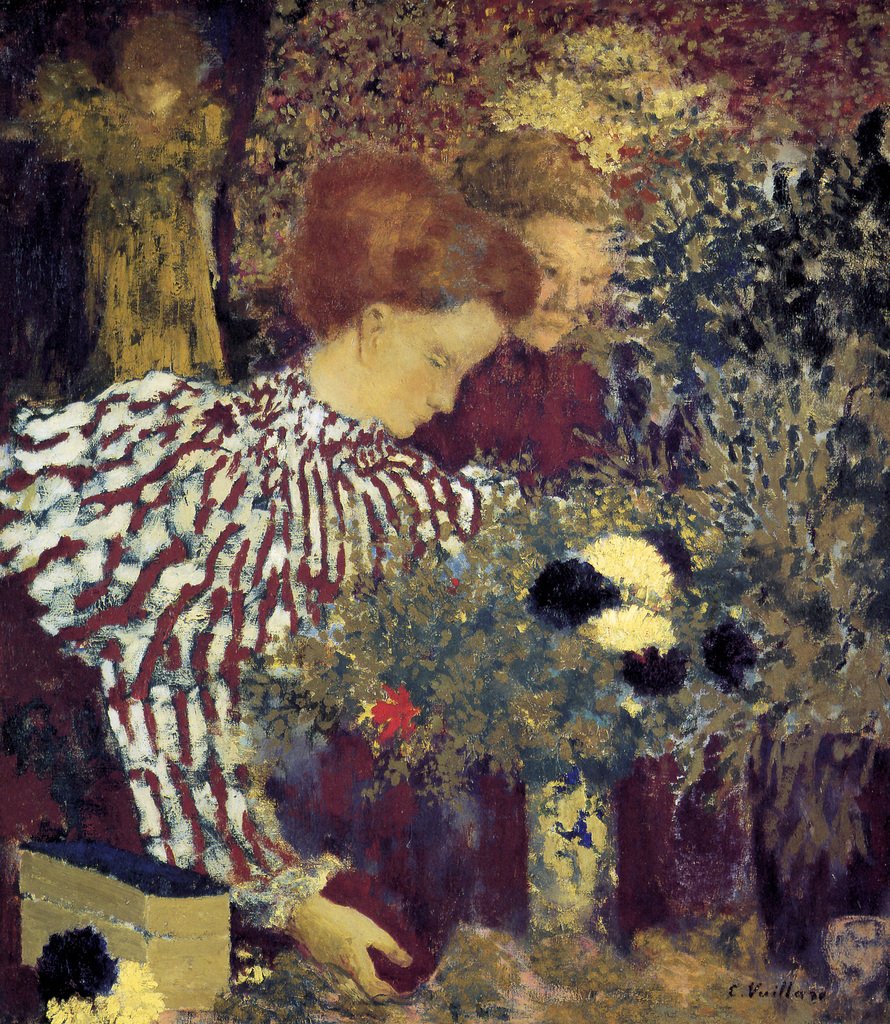
My Daily Art Display’s featured oil on canvas painting is entitled Le Corsage Rayé,  which Vuillard completed in 1895 and can now be seen in the Collection of Mr and Mrs Paul Mellon at the National Gallery of Art in Washington.  The work was one of a set of five paintings, known as The Album,  based on household subjects, and commissioned by the Polish-born lawyer, journalist and art collector, Thadée Natanson, the publisher and co-founder of an artistic and literary journal called La Revue Blanche.  He was also a champion of Vuillard’s art and he and his wife were close friends of the artist.   The set of oil paintings were depictions of deep-coloured and richly textured interior scenes of varying formats, representing young bourgeois women engaged in simple domestic activities.  The set were to hang in the various rooms of Natanson’s Paris apartment.  In the case of this work it shows a woman arranging flowers.  The woman who modeled for this work is almost certainly Natanson’s wife, the concert pianist, Misia Godebska.

The woman dominates the painting with her puffed sleeved vintage dress in red and white stripes. No doubt the many years Vuillard watched his mother complete dresses in her studio aided him in the depiction of the woman’s clothing. The woman we see before us is arranging flowers in a vase. It is interesting to note that Vuillard has depicted the flowers not with an explosion of colour but has portrayed them with dull earthy colours.  This reason for this one presumes is so that they do not in any way detract from the clothing of the woman which Vuillard wants to be the focus of our attention.     Behind the woman we see another woman, dressed in what looks like a red uniform and is probably one of the woman’s servants.  Although this is a simple scene of domesticity the presence of the servant in some ways heightens the status of Misia.

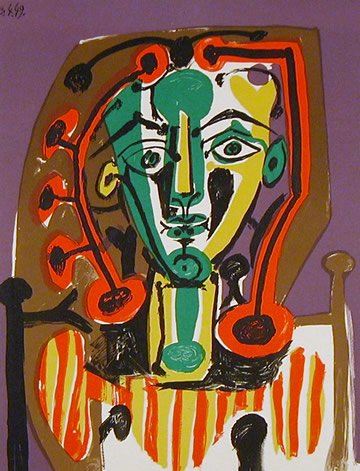
Le Corsage Rayé by Picasso

I end this entry by mentioning Picasso.  There are two reasons for this.  Firstly, Picasso made a drawing in 1949 entitled Le Corsage Rayé and his lithographer, Fernand Mourlot had the image recreated in a 300 copy edition.  I thought you would like to compare it with today’s featured work.   The second reason for mentioning Picasso as my next two entries will feature works by the artist and although I am not a fan of his later works I am fascinated by some of his earlier paintings and enthralled by the early part of his life.

The paintings were sold at auction by Thadée Natanson in 1908,  several years after he and his wife Misia were divorced.

My next blog will be about four days away as I am about to embark on my annual pilgrimage to Paris and soak up the atmosphere of the French capital and hopefully take in a gallery visit.  I am also hoping, depending on the weather, to visit La Maison Fournaise (see My Daily Art Display August 2nd 2011) and Giverny.

au revoir !

Madame Hector France (Portrait of H.F.) by Henri Edmond Cross

Madame Hector France (Portrait of H.F.) by Henri Edmond Cross (1891)

Today I want to look at the life of Delacroix and a couple of his paintings.  However I am not talking about Eugène Delacroix but the artist Henri-Edmond-Joseph Delacroix who was born in Douai a commune in the Nord département in Northern France, in 1856, some fifty-eight years after the great French Romantic painter.

Henri-Edmond-Joseph Delacroix was the only surviving child of a French father, Alcide Delacroix and a British mother, Fanny Woollett.  The family moved to Lille when Henri was nine years of age.  He showed an interest in drawing when he was young and his parents sent him to Carolus-Duran, the Lille painter, for private drawing and painting lessons when he was just ten years of age. He was encouraged as a youth to develop his artistic talent by his father’s widowed cousin, Dr Auguste Soins, who paid for much of Henri’s artistic training.   He spent a short time in Paris when he was nineteen, studying under the tutelage of the French realist painter, François Bonvin before returning to Lille.  In 1878 he enrolled on a three-year course at the Écoles Académiques de Dessin et d’Architecture in Lille and studied under the painter, Alphonse Colas.  Three years later he returned to Paris and studied in the atelier of Émile Dupont-Zipcy.

Henri began exhibiting his work in 1881 but so that he and his work would not be confused with the late romantic artist Henri-Eugène Delacroix he decided to change his name to “Henri Cross” which was a reduced English version of his surname (croix).  In 1886 he changed the signature on his paintings to Henri Edmond Cross so that there would be no confusion between him and the glass paste sculptor Henri Cros.  Henri Cross’ artwork changed in 1883 after travelling south to Provence and meeting up with Claude Monet.  His early works which had been mainly realist portraiture and still-life works had been predominately dark in colour but suddenly it all changed and his paintings took on the lighter colours and tones of the Impressionists.

The following year, 1884, was a milestone in French art.  Up until then any artist wanting to progress in their chosen career relied completely on having their works exhibited at the Paris Salon and for that to happen they had to submit their paintings to the Salon jurists to see if they considered their works good enough to be exhibited.  The jurists were, at this time, increasingly conservative in their views of what art was acceptable and were not receptive to the works proffered by the Impressionist artists whose works had moved away from the traditional academic style.  The Impressionists would often have their paintings rejected by the Salon jurists or if they did manage to have a paintings accepted it would be hung in such a way that it was almost hidden from view.  In 1863 the jurists rejected a surprisingly high percentage of paintings and this caused a furore amongst the “discarded” artists.

The following summer a number of these disgruntled artists, such as Seurat, Signac,  Albert Dubois-Pillet, Odilon Redon and today’s featured painter, Henri Cross, got together and formed the Société des Artistes Indépendants (Society of Independent Artists) and based the society on the premise sans jury ni récompense, (No jury nor awards).  They held their own inaugural exhibition, Salon des Indépendants, in May 1884 and Henri Cross exhibited some of his paintings.  In 1888 he visits the Cote d’Azur for the first time and paints in Eze and Nice and it is in this year that he meets Irma Clare, the subject of today’s paintings.  In 1891 he became Vice-President of the Society.  He had by this time become one of the leading figures of the Neo-Impressionism movement.

Henri Cross’ health was poor and he suffered badly from rheumatism.  He decided to move to the warmer climes of the South of France.   He initially settled in a rented house in Cabasson, near Le Lavandou, but later went to live in Saint-Clair, a small hamlet just outside of St Tropez, where he stayed for the rest of his life, except for his two visits to Italy, when he journeyed to Tuscany and Umbria in 1903 and 1908 and his trips to Paris to the annual Salon des Indépendants.  Paul Signac followed him south the next year and settled in St TropezIt was during this period that Cross was introduced to the revolutionary artist, Henri Matisse.  Henri Cross’ close working relationship with Paul Signac, led to him being introduced to the artistic technique, known as pointillism.  Pointillism is the methodical and scientific technique which juxtaposed small dots of pure colour together to maximize luminosity. The dots appear to intermingle and blend in the observer’s eye.

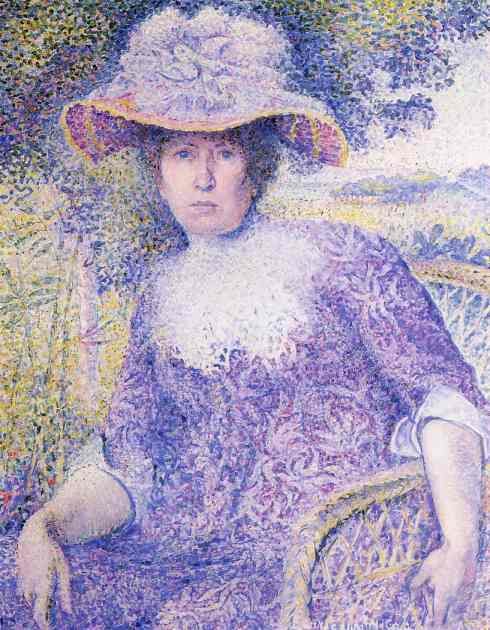
My Daily Art Display featured painting today was completed by Henri Cross in 1891 and is housed in the Musée d’Orsay.  It is entitled Madame Hector France (Portrait of H.F.) and is a fine example of the artist’s use of the pointillism technique with its screen of small regular dots over a densely painted ground.   Henri Cross exhibited the work at the Salon de la Société des Artistes Indépendants in 1891 and was looked upon as his first major work which adopted the Neo-Impressionist style.

The subject of this impressive portrait is Irma Clare the wife of Hector France, a novelist who was best known for his 1886 French language collection of tales about European adventurers and veiled temptresses, under the marvellous title Musk, Hashish and Blood.  Irma appears to be on a terrace, having just escaped from a dazzling soiree which is the source of light emanating from the right.  This is almost a life-size portrait of the lady and the light of the summer’s night is suggested through the sparkling glow of the lamps which hang from the tree branches in the background.  It is a conventional society portrait.  Irma is adorned with the most sumptuous and elegant gown.  Wearing this full length gown she almost gives us the impression that she is gliding elegantly across the painting.  Her hair sparkles and its colouring almost merges with the night air which surrounds her

In the foreground we have a mottled pink and white rhododendron which, along with the way the artist has depicted the chair at an angle and the receding floor tiles, gives the painting added depth.  As we have seen in paintings I have featured by Monet and other Impressionists, the Japanese influence had taken hold in late nineteenth century France and it is more than likely that the floral display we see in this painting comes from the influence of Japanese prints which were all the rage in France as does the frieze of white Japanese fans we see in the middle-ground.

In May 1893, two years after the painting was exhibited, Mrs Hector France became Mrs Henri Edmond Cross, the wife of the artist.  For some people the coupling of the two was a coupling of opposites.  He was looked upon as a secretive man who was always serious whereas Irma was seen as more frivolous, high-spirited and somewhat shallow.  They lived in Saint-Clair and one of their neighbours was the Belgian Neo-Impressionist painter, Théo van Rysselberghe and his wife Maria.  She was unequivocally critical of Irma.  In the biography Henri-Edmond Cross: études et l’oeuvres sur papier by Françoise Baligand, Raphaël Dupouy, and Claire Maingon, she is quoted as describing Irma as “petty, base of nature and an idle gourmand”.  This was not the universal opinion of her as others such as the French artist and friend of the couple, Charles Angrand, found Irma very hospitable and during the latter part of Henri Cross’ life, a very caring person as far as her husband was concerned.

Portrait of Madame Cross by Henri Edmond Cross (1901)

Once settled and living around St Tropez, Henri Cross turned more and more to landscape painting using vivid colours but he would still complete the occasional portrait of his beloved wife as was the case in 1901 when he completed the work entitled Portrait of Madame Cross, seated in the garden, looking slightly older, bedecked in a large hat and a floral gown.  This painting is also housed at the Musée d’Orsay.

By 1907 Henri Cross’ health deteriorated.  His eyesight was being affected by the eye disease iritis and his arthritis was becoming more debilitating.  In 1909 whilst visiting Paris he was diagnosed as suffering from terminal cancer.  He returned home to Saint-Clair and died in May 1910 aged 54.  Henri Cross is buried in Le Lavandou.

Mr and Mrs Edwin Edwards by Henri Fantin-Latour

Mr and Mrs Edwards by Henri Fantin-Latour (1875)

Who should be my next featured artist and what the next featured painting should be are the decisions I have to make each day.    Often I will make my choice when I flick through one of my art books or maybe I will be inspired by an artist or painting I have seen on one of my gallery visits but often or not the decision will come from research I have made into a previous painting.  My Daily Art Display featured artist and painting today comes from a little bit of all those.  In my last blog I looked at Manet’s Music at the Tuileries Gardens and listed a number of Manet’s friends the artist had added into his work.  One of these was the floral painter Henri Fantin-Latour.  Last week when I was wandering around the National Gallery in London I stood before one of his non-floral paintings entitled Mr and Mrs Edwin Edwards and my curiosity was immediately pricked.  Who were Mr and Mrs Edwards and why should this French artist paint the portraits of this English couple?   I knew then that sooner or later I had to feature this painting in one of my blogs and do some research into the background behind the work and the sitters.  So come with me on this journey of discovery and find out more about this couple.

Edwin Edwards was born in the small market town of Framlington in the heart of the Suffolk countryside in 1823.  He was the youngest of four sons of Charles Edwards and Mary Kersey.  He was educated at Dedham in Essex and went on to study law.  He became a legal practitioner in the admiralty and prerogative courts attaining the impressive position of King’s Proctor and Examiner of the Courts of Civil Law and the High Court of Admiralty.  When he was twenty-four he published a book entitled A treatise on the jurisdiction of the High Court of Admiralty of England.   In 1852 he married Elizabeth Ruth Escombe.  The couple had no children.  Despite having a busy and lucrative legal career Edwin Edwards had a great love for art and in 1861, aged thirty-eight years of age and with support from his wife, he decided to forego his legal career and become a full time artist.

Edwin Edwards had started painting using the medium of watercolours but later moved on to oil painting.  However his real love was etching and he had been influenced by the French artist and etcher Alphonse Legros.  He installed a press at his house in Sunbury, where his wife Ruth became skilled at printing. During the 1860s and 70s their home was a meeting place for French and British painters and etchers.  It was whilst he was in Paris  to arrange for the printing of his first plates that he was introduced to Henri Fantin-Latour by the English painter Matthew White Ridley.  Edwards and Fantin-Latour soon became great friends and the French artist would visit London and stay with the Edwards family in their Sudbury home.  Edwin Edwards and his wife bought many of Henri Fantin-Latour’s flower paintings, and found other buyers among their wealthy circle of friends thus securing the French artist a regular and steady income. Between 1864 and 1896 Fantin-Latour painted over 800 floral portraits, and almost all were purchased in England.

Molesey Lock by Edwin Edwards (1861)

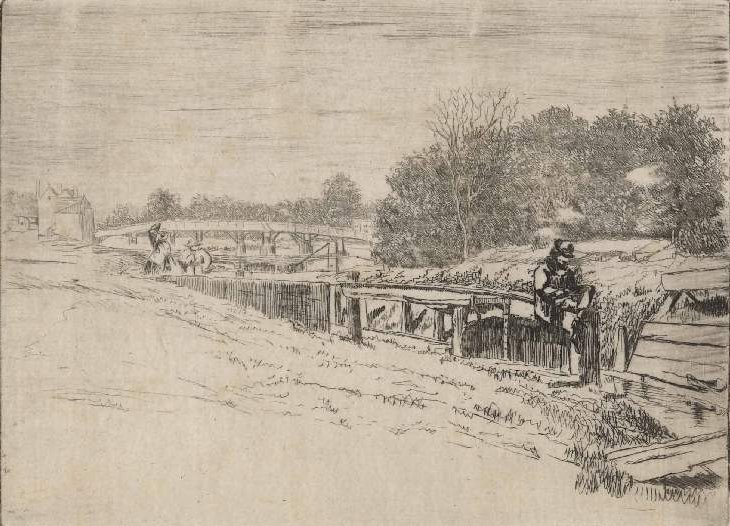
In 1861 Edwards made an etching trip along the River Thames with James McNeil Whistler, Fantin-Latour and Whistler’s brother-in-law, Francis Seymour Hayden, an English surgeon, who later dedicated his life to etching and printmaking and it was during this trip that Edwin Edwards completed a portrait of Whistler sketching, seated, at Molesey lock.   In all, Edwards completed over three hundred and fifty etchings consisting of scenes of the Thames at Sunbury, English cathedral cities, the wild Cornish coast, and countryside scenes in Suffolk, many of which are now housed in the Fitzwilliam Museum, Cambridge.  He also published a three-volume work entitled ‘Old Inns of England,’ which were illustrated with a number of his etchings.

From 1861 until his death in 1879, aged 56, he was a prolific exhibitor of his work.  He exhibited fifty four works at the Royal Academy and over a hundred of his works at various other exhibitions.

My Daily Art Display featured painting is simply entitled Mr and Mrs Edwin Edwards by Henri Faintin-Latour.  The painting belongs to the Tate but is presently on loan to the National Gallery, London.  When Fantin-Latour first visited and stayed with Edwards and his wife in 1861 he began a portrait of Mrs Edwards but did not finish it until three years later when he again stayed with the couple.  It was not until the end of 1874 that Fantin-Latour embarked on the double portrait of Edwin Edwards and his wife and the couple visited his Paris studio for the formal sittings.  He wrote to Edwards and said that he intended to portray him, seated at a table in his studio, etching.  The background would have a number of canvases on the wall and that his wife would be portrayed standing behind him, overseeing his work, like a “guardian angel, the inspiring Muse”.   In reality the painting was much simpler than Fantin-Latour had originally envisaged.  The background as you see is plain and not adorned with other paintings.  Instead of being depicted etching,  Edwin Edwards is seen seated at an angle with his left arm resting on a folio of prints whilst studying an etching he holds in his right hand.  Mrs Edwards as was Fantin-Latour’s original idea stands behind her husband.  Does she look like a guardian angel?  It is hard to interpret her mood.  It seems one of aloofness and displeasure and seems somewhat unhappy with the situation.  I think she actually dominates the double portrait and would some up her appearance as “she who must be obeyed” !!!!!!!!!!!!!!

Henri Fantin-Latour exhibited the work in the Paris Salon of 1875 and it gained a second class medal.  This award was very beneficial to Fantin-Latour because from then on he was termed by the Paris Salon as hors concours, which meant that in future, any exhibits he put forward for inclusion at future Salon exhibitions did not have to first be passed by the Salon jury.

Music in the Tuileries Gardens by Édouard Manet

Music in the Tuileries by Édouard Manet (1862)

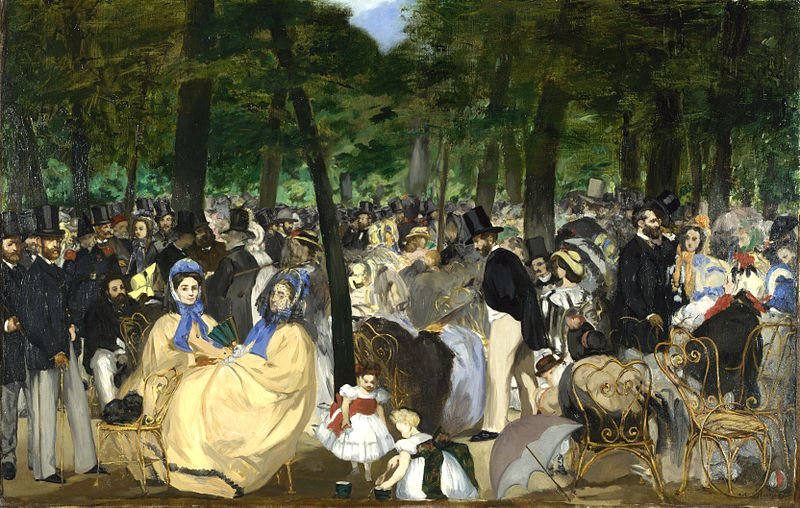
In my last blog I looked at the painting Afternoon at the Tuileries Garden by Adolph Menzel which he completed in 1867.  He had visited Paris that year and attended the second Exposition Universelle and it was during this stay that he completed a number of sketches of the Tuileries Gardens.  On returning to his home in Berlin he completed this  work.  When it was exhibited, he pointed out that the painting was all done from his memory of the times when he walked around the Gardens watching the weekend promenading of the bourgeois.  However,  there is a train of thought that believes his work was not just based on his memories but was very much influenced by a painting he saw, when in Paris, by Édouard Manet, which was completed in 1862 entitled Music in the Tuileries Gardens.  This is My Daily Art Display featured work today and I will let you decide whether Manet’s painting had any bearing on Menzel’s work.

Music in the Tuileries Garden,s like the Menzel work, hangs, in the National Gallery, London.  The work depicts a fashionable Parisian crowd promenading and socialising in the Gardens as they listen to music played by a band, albeit Manet has not included the musicians in the painting.  The Jardin des Tuileries lies between the Louvre and the Place de la Concorde, and it was the favourite place for people to idle away their leisure time.   The way in which people spent their free time in the capital became one of Manet’s favourite subjects for his paintings.  Manet’s close friend going back to his childhood,  Antonin Proust, the politician and journalist, often recalled the many times he witnessed Manet walking along the Parisian boulevards in search of interesting aspects of city life, which he could depict in his paintings. Manet and his companion, the poet, Charles Beaudelaire,  could often be seen in the afternoons, strolling through the Tuileries Gardens, a favoured gathering place for the beau monde, who wanted “to see and be seen”.  Manet completed numerous sketches of these “beautiful people” as well as the working nannies, who were spending a pleasant afternoon with their little charges.

This was Manet’s first major work on this theme.  The Tuileries Gardens were created for Catherine de Medici who, on the death of her husband King Henry II of France, decided to move her home to the Louvre Palace.  She then had built a separate new palace with gardens modelled after the gardens of her native Florence.  These were the Tuileries Gardens and were opened to the public in 1667 and became a public park following the French Revolution.  As we look at the people in the scene we can imagine the enjoyment they were having whilst they socialised and listened to the music.  Leisure time and recreational activities such as listening to music in a park on a Sunday afternoon was all part of this newly quoted term, modernity.

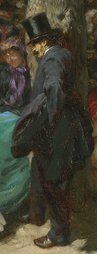
Manet's man
Menzel's man

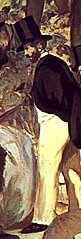
Menzel’s work is far more detailed than Manet’s painting.  If we compare the two works there are some similarities but Menzel also maintained some differences.     Both depict families enjoying their leisure time.  Look at foreground and slightly right of centre of today’s painting by Manet.  There is a man with the top hat bending down in conversation with a lady.   He is almost the same character, in the same pose leaning against a tree, we saw yesterday in Menzel’s work.  The theme of both paintings is similar – bourgeois Parisians at leisure but as I have just said there are also some differences in the two works.  Menzel’s depiction of what is happening is somewhat more realistic.

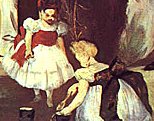
Manet's children
Menzel's children

In his work we saw children in the foreground playing with a bucket and spades but they are not dressed in their “Sunday best” clothes and look somewhat dirtied by their playing on the ground. Now compare that with the children in Manet’s painting.  They too have buckets and spades but these children,  like their adult counterparts , are dressed in their best clothes and are behaving much more demurely.   Also in Menzel’s work we witnessed a small child being dragged off screeching by a woman, probably her mother.  We also saw dogs skirmishing but in Manet’s work there is no such unsavoury incidents happening, which would otherwise shatter the beautiful tranquillity of the scene.

Manet has included the portraits of many of his friends into the lively social gathering, some of whom are fellow artists.  Manet has painted himself at the far left of the painting partly hidden by the figure of Comte Albert de Balleroy, the wildlife artist, seen here holding a walking stick, who shared a studio with Manet.  Another artist also included is Henri Fantin-Latour, best known for his flower paintings.  Manet has added portraits of his brother Eugène, who was the husband of the Impressionist painter, Berthe Morissot.  Several cultural figures of the time are featured in the painting such as the French poets Baudelaire and Théopile Gautier and the travel writer Baron Taylor.  Other intellectuals who have found their way into the painting are the art critic Champfleury and the bearded sculptor Zacharie Astruc who sits at the table and behind him stands the journalist Aurélien Scholl.  Two women sit facing us in the foreground.  The younger of the two, on the left, is Madame Lejosne, the wife of the Commandant in whose house Manet met Baudelaire and the fledgling painter Frederic Bazille.  The other lady is Heminie d’Alcain, the wife of Jacques Offenbach.  Offenbach is the bespectacled man with a moustache who sits in front of a tree to the right of centre of the middle ground, between Eugène Manet and the painter, Charles Monginot who we see doffing his hat to a lady .

Menzel’s work was far more detailed and with his painting your eyes darted from place to place surveying different incidents.  In some ways this painting, by Manet, as did Cezanne’s Large Bathers ( My Daily Art Display March 13th))have an “unfinished” look about them but this is all to do with their style of painting.  So what did the critics think of this work by Manet when it was first exhibited in 1863?   It received very mixed reviews.   On one hand, many of the artists who were soon to be known as the Impressionists, like Claude Monet and Frederic Bazille, were delighted with   Manet’s depiction of the Parisian scene.  However the conservatives among the art critics were less than complimentary.   Paul Mantz, the art historian and  art critic, who would later become Director General of Fine Arts and a member of Supreme Council of Fine Arts was particularly ruthless in his condemnation stating that Manet’s composition struck him as being disorganised and formless, while the broken play of light that animates its surface with such an eloquently restless quality roused him to declare that “this is not colour, but the caricature of colour”.

I have had a number of comments added to the Large Bathers blog strongly disagreeing with my assertion that Cezanne’s work had an unfinished look to it and therefore I will not dare comment about the finish of this work.   Emile Zola explained the “unfinished” look of Manet’s painting, countering such criticism, saying:

“…You are to imagine a crowd of people, a hundred characters perhaps, moving about in the sunlight under the trees in the Tuileries; every character is simply a blot of colour, hardly given form at all, and the details are only lines and black dots. If I had been there I should have asked the amateur [observer of the painting] to move away to a respectful distance; he would then have seen that the patches of colour were alive, that the crowd was speaking, and that the picture was one of the characteristic productions of the artist, the one picture in fact in which he had most loyally obeyed his eyes and his temperament…”

As with most of the Impressionist works of art, the best view you get is if you stand back from the work to see its exquisiteness.  Close up one just sees brushstrokes but at a distance one discovers the true beauty of the work.

So which painting do you like best, the one by Adolph Menzel or the one by Édouard Manet?