Winter Scene by Joos de Momper

Winter Scene by Joos de Momper (c.1630)

“…Why, sir, Claude for air and Gaspar for composition and sentiment; you may walk in Claude’s pictures and count the miles. But there are two painters whose merit the world does not yet know, who will not fail hereafter to be highly valued, Cuyp and Mompers…”

Richard Wilson

In an earlier blog about the Welsh landscape painter, Richard Wilson, I told you how he believed that although the landscape works of Claude Lorrain and Gaspar Dughet were lauded, he spoke about the, as yet, unknown talents of Aelbert Cuyp and Joos de Momper and so I thought it was time to take a look at the life of Joos de Momper the Younger and one of his greatest works.

Joos de Momper also known as Josse de Momper was born in 1564 in Antwerp.  He was just one of an outstanding artistic dynasty.  His great grandfather, Jan de Momper I,  was a painter in Bruges; his son, and our featured artist’s grandfather, Josse de Momper I, was also known as an artist and dealer who moved from Bruges to Antwerp, where his son, and Joos’ father,  Bartolomeus de Momper , inherited both occupations, as well as being an engraver. Bartholomeus’s sons Josse de Momper II and Jan de Momper II were both landscape painters, but Josse the younger, today’s featured painter, was the exceptional artist of the family.

He received his initial artistic training under the guidance of his father, Bartholomäus de Momper.   In 1581, when he was seventeen years of age, de Momper’s father, who was at that time Dean of the Antwerp painters’ guild, The Guild of St Luke, enrolled him as a vrijmeester (master) into that association.   It is believed that around this time Joos travelled to Italy.  Records show that an artist in Treviso, Lodewijk Toeput, was his teacher .  Another reason for believing that the young artist had visited Italy is that so many of his paintings featured mountain scenes and as he spent most of his life in Antwerp, to have such a knowledge of mountains, almost certainly meant that he had at one time crossed the Alps into Italy.   So did he go to Italy?   A further clue to whether de Mompers was ever in Italy came in 1985  when the frescoes in the church of San Vitale in Rome, previously attributed to Paul Bril, were attributed to Joos de Momper the Younger.

Records show that in 1590, the twenty-six year old artist was back in Antwerp as it was in this year and in this city that he married Elisabeth Gobyn.  The couple had ten children.  The painting dynasty was to continue with two of the  couples’ sons, Gaspard and Philips both becoming notable artists.  Gaspard de Momper and Philips de Momper I,  both became painters although little is known of their work, except that Philips executed the figures in some of his father’s paintings; he also spent some years in Rome, where he had travelled with Jan Breughel the Younger

 In 1594 De Momper collaborated with two other Flemish painters Adam van Noort and Tobias Vwerhaecht as well as the Flemish architect Cornelis Floris on the decorative programme to celebrate the entry of the Archduke Ernest into Antwerp.   Shortly after this de Momper was invited to become one of the Archduke’s court painters, a position he took up at the court of the Archduke and Archduchess Albert and Isabel Clara Eugenia, the sovereign rulers of the Spanish Netherlands. In 1611, de Momper was made Dean of the Guild of St Luke in Anterp.

Most of de Momper’s paintings, like the one we are going to look at today, featured landscapes and his work was very well received. His landscapes were sometimes topographically accurate whilst others would be idealised fantasy ones, but all sold well.    His work was highly regarded and he is considered to be the most important Flemish landscape artrist of his time.  The timeline of great Flemish painters puts him coming after Pieter Bruegel, whose works greatly influenced him, and before Peter Paul Rubens.  

My Daily Art Display today features a painting simply entitled Winter Landscape and was painted by Joos de Momper the Younger around 1630 and can now be seen in the North Carolina Museum of Art.  This is a winterscape with a number of figures,  which were believed to have been painted, not by de Momper, but by Pieter Bruegel’s son Jan.  I love this work as it is so “busy”.  Besides the beauty of the landscape in winter we have a dozen people depicted carrying on with their daily duties.  Pieter Brueghel the Elder’s influence is clearly evident in this winter landscape.    Joos de Momper was known for his use of Mannerist colors in many of his landscapes, but in the more realistic pictorial representations, such as today’s painting, he used more natural colors.   Momper’s has managed to deliver a scene with such aesthetic appeal. 

Woman by cart

In this village landscape before us, the houses and people, which in his mountain landscapes were mere accessories, are now in some way the main focus of our attention.   Look at the woman in red who stands by the cart.  Look how the artist has depicted her struggling and straining with an arched back to lift the barrel on to the cart.  Look how her face is reddened by the physical effort.  To the right of her we see a mother and two children in a line.  The mother is carrying a bundle of firewood on her head whilst her son tags behind with a token few sticks of kindling.  Following up at the rear is the young daughter, with her arms outstretched shrieking, as she is being left behind.

Man with baskets

It is a scene full of activity and I love to cast my eyes around the painting to discover what is happening.  At the barn we see a man repairing a cart whilst the white horse stands passively to the side.  In the left midground we see a man bent over surveying what looks like two large wicker baskets.  I am not sure what he is doing but whatever is going through his mind, he seems fascinated by them.  Besides the people in the painting, look at the way the artist has elegantly painted the trees which have shed their leaves and which stand tall and unbowed in this cold but still winter’s day.

In the background on the right we have the nearby town.  It is separated from our main scene by a river, the water of which seems partly frozen over.  Fishermen are at the river trying to catch something for their meal in the small parts that have yet to be frozen. 

Town and bridge

The way to the town is accessed by a small wooden bridge and we see a man with his dogs making his way over it and heading into town..

I hope you have enjoyed this painting and thanks to Richard Wilson, I have discovered a new Flemish artist and one day I will return to him and look at another of his works.

Finally my thanks go to Universal Pops’ Photostream on Flickr for the details of the painting.  His photographic site is quite amazing and well worth a visit.
http://www.flickr.com/photos/universalpops/

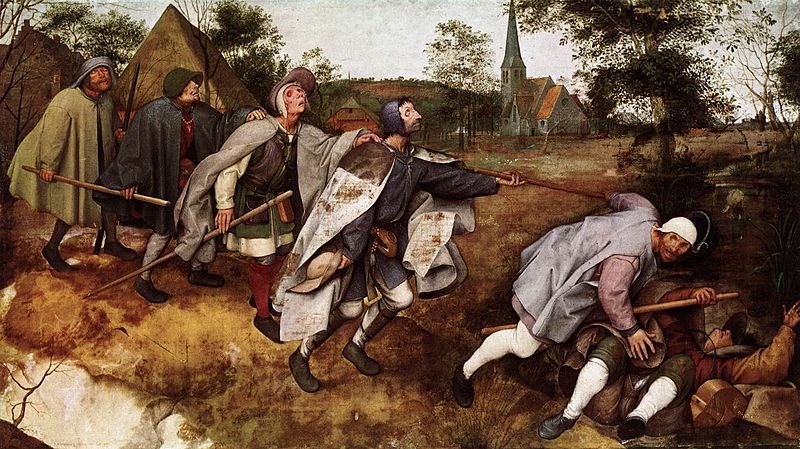
The Parable of the Blind by Pieter Bruegel the Elder

The Parable of the Blind by Pieter Bruegel the Elder (1568)

Yesterday when I featured the painting by John Singer Sargent, entitled Gassed, I was immediately reminded of a painting by one of my favourite artists, the Flemish genius, Pieter Bruegel the Elder.  His painting was entitled The Parable of the Blind and he completed it in 1568 a year before his death.   Breugel at the time of the painting was about forty three years of age.  His date of death is known to be 1569 but his date of birth is only approximated as being between 1525 and 1530.  He was by the time he completed this work of art a well established and well respected painter.

The title of Bruegel’s painting derives from a passage in the New Testament (Matthew 15:14) in which Christ is comparing spiritual blindness to physical blindness and talking about inner blindness to religion of some people.   It all came about as Jesus had told his disciples that it was not necessary to wash hands before eating. This remark was overheard by the Scribes and Pharisees and they were infuriated, as it was a patent infringement of Jewish law. When the disciples reported this to Jesus, he replied:

“…They are blind guides leading the blind, and if one blind person guides another, they will both fall into a ditch….”

Before us we see a line of six men walking along a dirt track.  They are a bunch of unkempt, unshaven peasants.  They are painted in a frieze-like procession and the line of men surges diagonally, top left to bottom right of the painting which otherwise had been beautifully balanced both horizontally and vertically.   They move together in a group ensuring they do not lose contact with each other as they can be seen holding the same stick in pairs or in some cases each has a hand on the shoulder of the man in front.  However their strategy did not work and we see that the leading blind man has fallen into a ditch and the second man in the line is now tripping over his fallen leader.

The second man

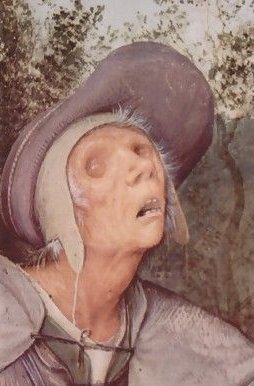
Look at the fear in the face of the second man as starts to fall.  As we look at the figures we know that their forward motion is unstoppable and we are all fully aware of what is likely to happen next.  The fallen leading man and the stumbling of the next two disrupt the calm and tranquil Brabant landscape.

I love how Bruegel has depicted the expressions on the men’s faces.  The mouth of the second man is open and he is probably shouting out a curse as he stumbles over the legs of the leader who lies on his back in the ditch bemoaning his fate.  The third man has a look of horror on his face as he feels the stick he is holding with the second man is suddenly tugged forward.  The three men at the rear have yet to stumble but are no doubt alarmed by the cries from their forward colleagues.

The fourth man blindly looking to heaven

The fourth man looks upwards with blind eyes maybe praying for help.

The church in the background shows a likeness to the Sint-Anna church in the village of Sint-Anna-Pede but art historians do not believe that the background is an actual landscape but that Bruegel had painted and idealised landscape taking little bits of different locations and merging them.  Look closely at the line of men.  Look how there is a gap between the second and third man and in that gap we have a clear sight of the solidly-built church.  Was this intentional?  If so what meaning should we put on this aspect of the painting?  Could it be that the artist is comparing the solid structure of the church as a solid faith in God in comparison with those people who do not want to see or acknowledge God and this Bruegel depicts by painting the blind men stumbling along the path they have chosen, similar to the stumbling of people who choose a path in life without their God.?  We see the brilliance of Bruegel’s art as he depicts the men in various stages of falling and one must marvel at the expressions on the various men’s faces.  The expressions on the faces range from trust to surprise and shock.

The Pieter Brueghel the Younger version

It is a beautifully crafted painting and it is interesting to note that Bruegel’s elder son, Pieter Brueghel the Younger, made a copy of his father’s painting soon after his father died.  The same six blind men stumble along, some of whom have been given lighter-coloured clothing and in this picture we see animals and fowl in the well preserved field in front of the church in comparison to the desolate looking field in his father’s painting.

The Five Children of Charles I by Sir Anthony van Dyck

The Five Children of Charles I by Sir Anthony van Dyck (1637)

Antoon van Dyck, or as we better know him, Anthony van Dyck, was born in Antwerp in 1599.   He came from a wealthy Flemish family, his father being an affluent silk merchant, and whether it was because of his prosperous upbringing or his inherent artistic talent, even at a young age it was recorded that he was, besides being very gifted, an extremely precocious boy.  He studied art under Hendrick van Balen, the Flemish Baroque painter, who also tutored up and coming artists such as Frans Snyders and Jan and Peter Bruegel the Younger.  He started producing quality works of art at the age of fifteen and three years later was accepted into the Guild of St Luke, the Antwerp painter’s guild as a free master.   At the age of eighteen he became chief assistant to the great Rubens whom he stayed with for three years during which time he continued the output of his own paintings and slowly but surely enhanced his own reputation.  Rubens said on a number of occasions that van Dyck was the most talented artist he had ever trained.

In 1620 he was invited to England to work for the then monarch King James I of England (King James VI of Scotland), who had been told that the young van Dyck was in the employment of the master, Peter Paul Rubens, and that the young man’s talent and works were exceptional and were almost on par with the great master himself.  During his stay in London, van Dyck came across works of Titian which were part of the art collection of the Earl of Arundel, one of the king’s courtiers.  Van Dyck remained in London for six months before returning home.  At the end of 1621 he moved to Italy and stayed there for six years studying the works of the Italian masters whilst visiting many of the Italian art capitals such as Rome and Genoa. It was whilst in Italy that van Dyck developed and perfected his skill as a portraitist.

In 1627 van Dyck once again returned to his birthplace, Antwerp but was only to stay there for one year before accepting an invitation to return to London by the new English monarch, Charles I, who had acceded to the throne two years earlier.   King Charles was one of the greatest art collectors of all the English monarchs amassing an unbelievable collection of works of the great masters, some of which had been purchased and brought to England by his agents with the help of van Dyck,  who also sent the monarch some of his own paintings.  Charles loved art and would invite the artists such as Gentileschi and Rubens to his court where he would commission new works.

In 1632 van Dyck returned to London where he joined the royal court, received a house as well as a country retreat, a monetary retainer and was knighted.  He soon became the favourite painter of King Charles and his wife Queen Henrietta Maria and over the years carried out numerous portraits of the couple and their family and it is around this time, actually 1637, that van Dyck completed today’s featured painting.

My Daily Art Display today is Sir Anthony van Dycks’ painting entitled The Five Eldest Children of Charles I.    When one looks at a painting of a male sitter one often describes it as a handsome and debonair portrayal of a man and if the sitter is a female, one often terms it as a beautiful and attractive portrayal of the lady.  However, the portraits of children and animals can often be termed differently and one of the favourite descriptions is “cute”, and this certainly sums up today’s portrayal of the monarch’s children and their large pet dog.

Queen Henrietta Maria, a catholic, was the youngest daughter of King Henry IV of France and she gave birth to nine children, two of which were stillborn.  At the time of van Dyck’s painting the royal couple had five children, Charles, Mary, James, Elizabeth and Anne.  Today’s painting is hailed as one of the greatest group portraits of all time.  The children are portrayed as children and not as was often the norm, tiny adults.   We have in the centre with his arm resting on the family pet mastiff, Charles who would become King Charles II.   Van Dyck has surprisingly afforded him an unusual air of authority for one so young.  He looks out at us with a thoughtful countenance.  The very large dog sitting calmly by his side adds even more gravitas to the young boy, the future King Charles II.

To his right we see two children standing side on to us.  Their look is somewhat shy and demure as they gaze out at us. The taller of the two on the far left is the six year old Mary, Princess Royal, whilst although looking like her little sister, is in fact her younger brother James who would later become King James II of England.

Elizabeth and Anne

On the opposite side of the painting we see a young girl cradling a baby, with the small spaniel at her feet.  This is the two year old Princess Elizabeth and the baby, who had been born that year, is Princess Anne.   The round, somewhat chubby rosy cheeks of the pair, contrasts well with their linen white caps and the string of pearls around Elizabeth’s neck.  Tragically neither Elizabeth nor Anne lived long.   Elizabeth, after the fall from power of her father during the two Civil Wars, spent her last eight years held as a prisoner of Parliament.  She died of tuberculosis aged 14, a year after her father’s execution.  Her mother always maintained that she had died of a broken heart caused by the untimely death of her father.    Baby Anne died aged 3, and like her sister, the cause of death was tuberculosis.

Above the seated girl we have an exquisite still life behind which we see a far-off landscape which was often a trademark of van Dyck’s portraits.    There is a tranquil elegance about this painting.  The children seem contented, even happy and thus it is sad to realise that twelve years on from the completion of this family portrait, their happy family life would be shattered with the premature death of Elizabeth and the execution for treason of their father, Charles I.

So what do you think of the painting?   The nineteenth-century Scottish portrait painter Sir David Wilkie was in no doubt with regards its quality describing it thus:

 “……the simplicity of inexperience shows them in most engaging contrast with the power of their rank and station, and like the infantas of Velasquez, unite all the demure stateliness of the court, with the perfect artlessness of childhood….”

Mary Neville, Baroness Dacre by Hans Eworth

Mary Neville, Baroness Dacre by Hans Eworth (c.1555-1558)

My Daily Art Display today is a story of three people, the artist the woman who sat for her portrait and the man shown in a picture within the painting.  The featured artist today is the sixteenth century Flemish painter, Hans Eworth (Ewouts), who spent most of his artistic life in England.  The lady in the painting is Mary Fiennes, Baroness Dacre and the young man in a picture within the picture is her late husband, Thomas Fiennes, 9th Baron of Dacre.

Before I tell you the story of the painting let me linger awhile and talk about the artist himself.  Hans Eworth was born in or around Antwerp.  His date of birth is believed to be between 1520 and 1525.  Little is known about his early upbringing but the English art historian and one-time director of the National Portrait Gallery in London, Sir Lionel Cust, in his 1913 essays to the Walpole Society, draws a connection between Hans Eworth and a “Jan Euworts” who was known to have been a member of the Guild of St Luke in Antwerp in 1540.  In Karen Hearn’s short biography of Eworth published in 2000 and  according to Julius Friedrich’s in his book published in 1891, De Secte Der Loisten of Antwerpsche Libertijnen, 1525-1545, a Janne Ewouts and Claes Ewouts, painter and mercer (dealer in textile fabrics and fine cloths) were “expelled” from catholic Antwerp for heresy in the summer of 1544.  They lost their homes and property but were very lucky not to have lost their lives as the punishment in those days for heresy was ane extremely painful execution.

Eworth, like thousands of others fleeing Flanders because of its religious persecution, settled in London.   He continued painting and it is believed that one of his most important patrons was Queen Mary I (Mary Tudor) of whom he did many portraits of the monarch between 1554, the year after she was crowned queen and the year of her death 1558.  He was a prolific portrait painter but only about thirty of his paintings survive.  He was also known for his decorative painting and set designs for masques and pageants at the court of Queen Mary and her successor, Queen Elizabeth I.  He continued his artistic work until his death in London in 1574

The painting featured today is his portrait painting which he completed around 1558, entitled Mary Neville, Baroness Dacre.    She was the daughter of George Nevill, 5th Baron Beragvenny and his third wife Mary.  She married the English aristocrat Thomas Fiennes, and on his father’s death in 1528 became the next in line for his grandfather’s title who was the 8th Baron of Dacre.  He eventually became 9th Baron of Dacre in 1534 on the death of his grandfather and as well as the title,  inherited the family home of Hestmonceux Castle in Sussex.  The couple were married two years later in 1536 and went on to have three children, the eldest, Thomas who died of the plague at the age of 15, Gregory and Margaret.

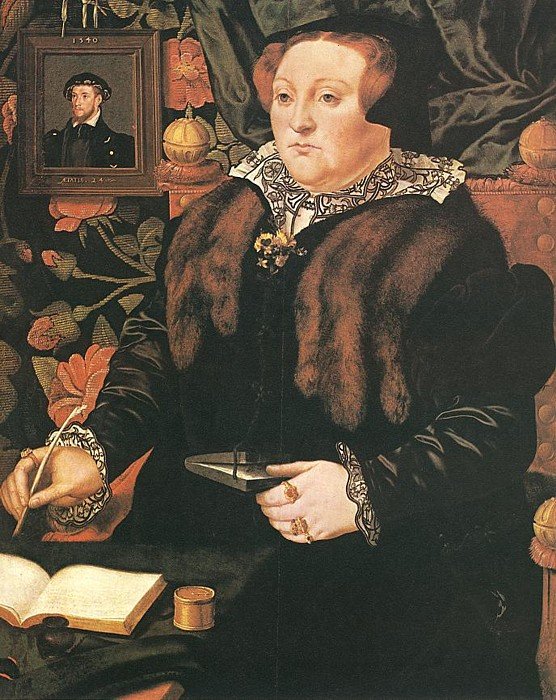
That is not the end of thestory of their lives but let us now look at Eworth’s portrait of Mary and by doing so we will discover what happened to the family.  In front of us we have Mary sitting up straight in a richly upholstered chair with its red velvet back and arms.  This alone was symbolic of the sitter’s wealth.  She is dressed in a black gown which has a beaver collar and puffed sleeves.  Her dress is of satin and the collar and cuffs of her chemise are ornately embroidered.   It is Blackwork Embroidery, which was popular during the Tudor times.  It was often termed “Spanish work” because it was thought that Henry VIII’s first wife, Catherine of Aragon brought many such embroidered works with her from Spain.

In her right hand she holds a quill pen hovering over the pages of a notebook which lies upon a green-baize covered table.  In her left hand we see a partly opened notebook in which we can see some hand-written words.  On the table we see other implements used in those days for writing, the pot of ink and an ornate golden sand-shaker with a clock motif.   The Tudors dealt with a large black wet inky mistake soaking its way into a thick layer of paper by sprinkling clean sand onto the text to soak up the ink. The inky sand could then be flicked away from the paper, and any residual stain removed by gently scraping it off with a knife.

If you look at the flowers at her breast you will note they are a mix of forget-me-nots, rosemary, violas and pinks.  Forget-me-nots symbolise true love and memories and Rosemary which is often included in funeral wreaths symbolising remembrance and in wedding bouquets as a symbol for fidelity. It’s said that if you touch a lover with a sprig of rosemary, they’ll be faithful!    Violas often symbolise melancholy and pinks are symbolic of marriage.

So why the use of these symbols in the portrait by the artist?  Maybe the answer lies to the background to the left where we see, against a floral tapestry, a framed portrait of her late husband.  The inscription on the top part of the frame is “1540”, the date of the portrait and inscribed on the bottom “ÆTATIS. 2 4”,  which means “at the age of 24”.   So, what does it all mean?  Why did she want the picture of her young husband included in the portrait?  Why was he not with her?

The answer is simple but sad.  On 30 April 1541 Dacre along with a party of gentlemen including his brother-in-law went to poach on the neighbouring estate lands of Sir Nicholas Pelham of Laughton.    During the “adventure” the party were discovered by some of the servants of Sir Nicholas, one of whom was the gamekeeper, John Busbrig.   The meeting of adversaries went from verbal abuse to a fight during which Busbrig was fatally wounded and subsequently Dacre, although he did not strike the fatal blow and in fact was in another part of the estate at the time was held responsible for the death and along with several others was charged with murder.   Dacre originally entered a plea of not guilty but was later persuaded to change it to guilty and throw himself upon the King’s mercy in the hope of a reprieve.  However his strategy failed and he was hanged at Tyburn on 29 June 1541.

An account of the execution was reported in the Hall’s Chronicle, a periodical of the time, simply stating:-

“…….he was led on foot between the two sheriffs of London from the Tower through the city to Tyburn where he was strangled as common murderers are and his body buried in the church of St Sepulchre ….”.

Not only did her husband lose his life but the family lost their hereditary title and had their lands forfeited which left them destitute.  Despite numerous protestations from his widow it was not until ten years later in 1558 when Elizabeth I came to the throne that the hereditary title was restored to the family and Gregory, her second son was made 10th Baron Dacre.

Maybe the sumptuousness of her clothes and the splendour of the backdrop to this portrait suggest that almost ten years have passed since the execution of her husband and the forfeiture of the property and maybe life had become better for the widow.  In fact, in the same year her husband was executed, the widow managed to obtain an Act of Parliament in order to provide a dower for her from out of her late husband's estates.  A dower was a provision accorded by law to a wife for her support in the event that she should survive her husband (i.e., become a widow).  In her case the dower handed down to her by the Act of Parliament stated:

“.....the said Mary for the relief of her and her children &c is contented & pleased that it be enacted by His Highnes with the assent of this present parliament, & by authority of the same, that the said Mary Fynes shall possess & enjoy for the term of her natural life, from Michaelmas last past, the Manors of Burham & Codham co. Kent-of Fromquinton & Belchwell co. Dorset, of Nashall co. Essex, & all their rights & privileges &c. the said attainder....”

Courtesy of http://www.tudorplace.com.ar/


Mary Neville married twice more and had six children by her third husband.

The Embarkation at Margate of Elector Palatine and Princess Elizabeth by Adam Willaerts

The Embarkation at Margate of Elector Palatine and Princess Elizabeth by Adam Willaerts (1623)

Another day another Dutch artist but we move from the countryside and animals to sea and ships.  My featured artist today is the Flemish painter Adam Willaerts, who was actually born in London.  Born to Flemish parents in 1577 he was a painter of the Dutch Golden Age, a period in Dutch history, approximately spanning the 17th century, in which Dutch trade and science, military, and art were some of  the most admired and highly-praised in the world.  The reason of his birthplace being in England was because his parents had to flee Antwerp to avoid religious persecution.  They returned to their Flemish homeland in 1585 and Adam remained there for the rest of his life.  He spent the majority of his time in Utrecht where he became a member of the local Guild of St Luke.   The Guild of Saint Luke was the most common name for a city guild for painters and other artists in early modern Europe, especially in the Low Countries. They were so called in honour of the Evangelist Saint Luke, who was the patron saint of artists.

The Arrival of the Elector Palatine at Flushing by Adam Willaerts (1623)

Willaerts was known for his paintings of rivers and coastal landscapes but in particular his depictions of grand arrivals or departures of ships carrying dignitaries, which is exactly what is shown in my featured painting in today’s My Daily Art Display.  This is one of a series of paintings produced to document the marriage of Frederick V, Elector Palatine, to Princess Elizabeth, daughter of James I and Anne of Denmark, in 1613.   It was painted ten years after the event in 1623 by Adam Willaerts in and is entitled The Embarkation at Margate of Elector Palatine and Princess Elizabeth.  The painting was acquired by Queen Victoria in 1858 and can now be seen in the Queens Gallery at Buckingham Palace. 

The Arrival at Vlissingen of the Elector Palatinate Frederick V by Hendrick Cornelisz Vroom (1623)

One presumes that the painting was commissioned in the Netherlands around the same time that other artists such as Hendrik Cornelisz Vroom in 1623 and Cornelis Claez van Wieringen in 1628 were commissioned to paint similar works. 

Embarkation of the Elector Palatine in the Prince Royal at Dover 25 April 1613 by Claes van Wieringen (1628)

So who were these people and what were they doing in the south-east English port of Margate ?  Frederick, or to give him his Germanic title, Friedrich V, was the protestant Elector Palatine of the Rhine and for a short time King Fredrick I of Bohemia.  His wife was Princess Elizabeth the daughter of the protestant King James VI of Scotland (and simultaneously King James I of England).  In 1619 Frederick accepted the crown of Bohemia and ruled in Prague for one winter (hence his name the ‘Winter King’) before being defeated in 1620 by the Imperial army.  The couple arrived as exiles in the Netherlands in 1622 and were formally deprived of the Palatinate by imperial edict in 1623.

Princess Elizabeth married Frederick in London on February 14th 1613 and after prolonged celebrations sailed from Margate on 25 April 1613 for Heidelburg and Prague, via the port of Flushing (in Dutch: Vlissingen).  The couple were seen off by James I and Anne of Denmark both of whom can be seen in the foreground of the painting; they then were rowed out by bargemen in livery and brought aboard the sailing vessel, Prince Royal, which we can see lying at anchor awaiting the arrival of its distinguished guests.  The vessel, Prince Royal was built in 1610 by Phineas Pett for Henry Prince of Wales, the king’s eldest son.  This in all probability explains its “HP” monograms, Henry’s initials, (Henricus  Princeps)  and the Prince of Wales feathers as well as a figurehead of St George on a horse.  Prince Henry did not attend his sister’s wedding to Friedrich as he died of typhoid fever, aged 18, a year before the event. The painting depicts a scene of pomp and ceremony as King James I sees off his daughter Princess Elizabeth and her husband.  The beach scene with its mass of figures is typical of Willaert’s works.  The ship lies in the centre of the picture surrounded by a blaze of natural, but highly suggestive white light.

Critics of the painting were less than enthused by the depiction of the choppy sea with one describing it as “a rolling vegetable patch, with cresting waves emerging like florets of broccoli sprouting from the soil”. 

Rather harsh but if you zoom in on the waves there is that look as described by the critic!!!!

The Four Elements: Fire by Joachim Beuckelaer

The Four Elements: Fire by Joachim Beuckelaer

My Daily Art Display offering for today is the fourth and final painting in Joachim Beuckelaer’s set of pictures, which he painted in 1569-1570 entitled The Four Elements.   Today’s painting is entitled The Four Elements: Fire.  The Ancient Greeks believed that the cosmos was made up of four elements, namely, Earth, Air, Fire and Water and thus the reasoning behind the artist’s four-picture set.   The painting today moves away from the market stalls where we saw women buying vegetables, poultry and fish and that were featured in the previous three works of art.  Instead, today we move to a kitchen scene in which the produce that has been bought at the various market stalls will be cooked.  To do the cooking one needs fire, hence the subtitle to this painting.

This painting, like the other three was completed in Beuckelaer’s studio for an Italian patron.  This genre of painting was very popular with the local populace.  The abundance of food in the paintings did not mirror life in the Netherlands at the time as the locals lived under the oppressive regime of the Duke of Alba, a Spanish general who was the governor of the Spanish Netherlands and who was renowned for his cruelty and atrocities against the Flemish and Dutch people.

We look at the kitchen scene from a slightly elevated position.  This is a busy kitchen.   Probably more than just busy, I think it borders on disarray, almost chaos by the look at the tumbling kitchen bowls in the centre of the composition.   Whilst the women are hard at work, the only male in the picture, who is probably a servant or steward drinks to excess and if not careful will end up in the fire!  The two women with him seem less than amused at his antics.  Beuckelaer’s forte is his still life paintings.  Look carefully at the produce.  See how he has exquisitely painted the various dead poultry and the sides of ham.  No detail has been spared.  Look at the way he has painted the earthenware kitchen utensils, some glistening in the sunlight which streams through the kitchen window.

On the floor we can see mussel shells.  These sometimes have erotic connotations when seen in paintings.  However there may be another meaning to the scattering of these shells in the kitchen scene.  The Dutch Golden Age painter of allegories, Adriaen van de Venne said that because mussels stay in their shells they “can be compared to the blessed women-folk who speak modestly and virtuously and always look after their household.   So maybe Beuckelaer’s inclusion of the shells on the floor was a tribute to the hard working women in his kitchen scene.

Jesus at the house of Martha and Mary

Finally if you look through the door on the left-hand side, you can see another kitchen scene.  This is the Biblical story which Beuckelaer has introduced into each of his four paintings.  This scene is set in the kitchen of the house of Mary and her sister Martha in which we see Jesus who has come to visit them.  The story according to the Bible is that Martha complains to Jesus that although she is working hard in the kitchen, all Mary does is stand around listening to his words.  Jesus reproached her saying that Mary’s contemplation was in fact a more important form of her work.

This biblical story was often told to servants in the sixteenth century with sole purpose of stopping them complaining about the amount of servile work they had to carry out.  I am not sure that this “parable” would find much favour in present day workers!

So now you have seen all four paintings in The Four Elements set.  Some may think the colours rather garish and the scenes at the produce stalls and in the kitchen somewhat chaotic but this painting genre was very popular at the time of Beuckelaer and to be honest I find them both fascinating and of great quality.

The Four Elements: Air by Joachim Beuckelaer

The Four Elements: Air by Joachim Beucklaer (1570)

Over the last few days I have featured the set of four paintings by the Flemish artist Joachim Beuckelaer entitled The Four Elements.  On the first day the painting was subtitled “Water” and yesterday the subtitle of the painting was “Earth”.  Today I am featuring the third painting of the set with the subtitle “Air”  which was painted in 1570.

In the “Water” painting we were shown a fish market and the connection with the Element of Water was that of the habitat of the food.  The same went for the “Earth” painting when we saw the fruits and vegetables of the earth.  Today with the subject “Air” we are treated to the sight of the “food” which occupies the air above ground, namely birds, fowl and rabbits.  We are also treated to the sight of products which come indirectly from the land such as eggs and cheeses.  We are at a poultry market and there is an abundance of food on offer.  During Beuckelaer’s lifetime he painted numerous “market scenes” and at that time the art market was flooded with such a genre.  Unfortunately for the artist once the art market became saturated with such paintings their value declined and the real value of Beuckelaer’s work did not become apparent until after his death.

In the painting we see the rosy-cheeked stall holder sitting alongside the produce.  It is a well-stocked market stall with a variety of dead fowl and small birds.  We can also see inside a green wicker cage some live hens.  The man at the stall, wearing the leather jerkin, has hold of a hen by its feet having just taken it out of the cage to show it to a would-be purchaser.  To the left we observe a well dressed woman.  She too is holding a hen in her right hand whilst her left hand rests atop a copper flagon which may contain milk or wine.

In the central background we see a road leading to the sea with a small cargo boat just setting sail with the crewman starting to hoist the sails.  On the quay we can just make out some barrels which have been off-loaded from the craft.

The Prodigal Son

So where is the Biblical story, which the artist is known to have incorporated into each of the four paintings?   In this painting it is not as obvious.  If however you concentrate on this road leading to the sea you will spot on the left hand side just behind some baskets of produce a man and a woman.  She has her hand on his arm greeting him.  He is leaning backwards against her, almost slumped.  This was the Biblical addition of the painting by Beuckelaer, symbolising the Prodigal Son returning home.  To me it seems as if he is inebriated and has just about made back home!

Once again we have before us a very colourful painting, full of activity.  I get great pleasure looking around the painting at the various charactyers and their expressions and try and work out what is happening and what the artist had in his mind as he put paintbrush to canvas.

To get a much better view of this painting I suggest you try the National Gallery Website (below) and then you can zoom in on aspects of the painting.  The website is:

http://www.nationalgallery.org.uk/paintings/joachim-beuckelaer-the-four-elements-air

The Four Elements: Earth by Joachim Beuckelaer

The Four Elements Earth by Joachim Beuckelaer (1569)

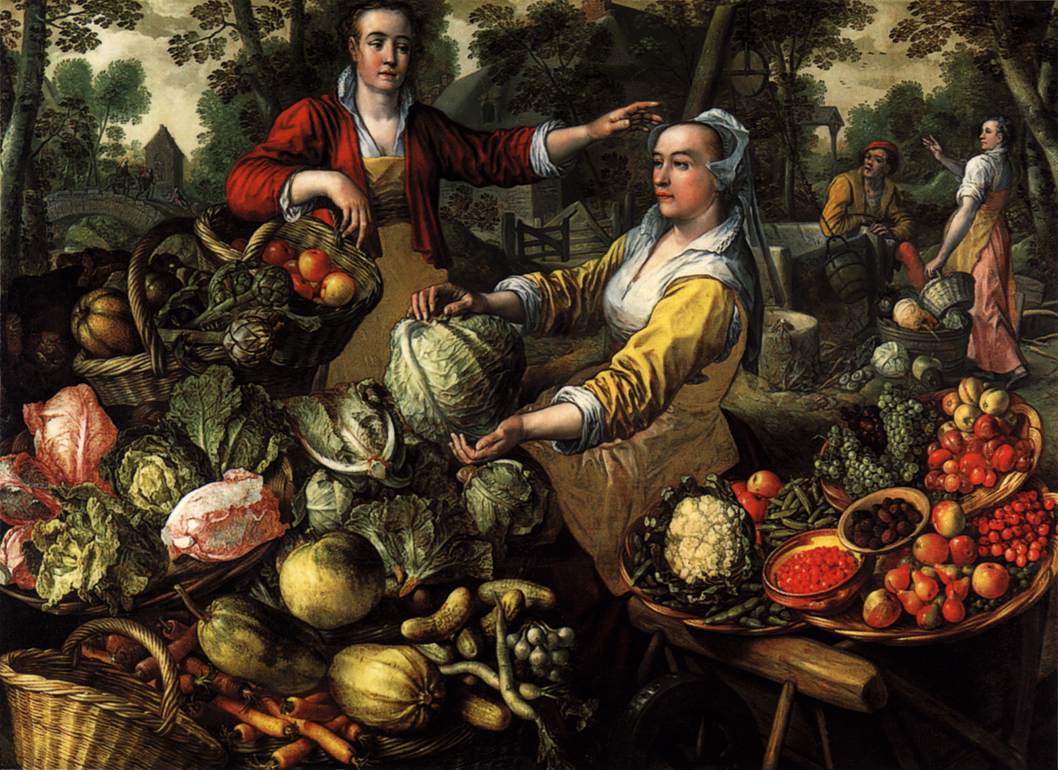
Today I am featuring the second of a set of four paintings entitled The Four Elements.  This painting completed by Joachim Buckelaer in 1569 is entitled The Four Elements: Earth.  In this painting we are again standing in front of a market stall.   This time the scene is set in the countryside, outside a large thatched-roof farmhouse, and before us we can see laid out an abundance of fruit and vegetables, symbolising “Earth” as this is where the produce has come from.  It was common practice in Dutch and Flemish paintings of the 16th and 17th century to symbolise the Elements by reference to the natural world.  Although I have not attempted to count them, I believe there are sixteen different varieties of fruit and vegetables on display in the painting.  The painter has used some “artistic licence” when he painted the various fruit and vegetables as not all would be available at the same time of year and of course there was no such thing as refrigeration in the seventeenth century.  It is truly a depiction of a “land of plenty” where there is no place for hunger.

The spectrum of colours used by the artist has enhanced the painting.  The fruit is painted with such realism.  They look so succulent and they lay there tilted slightly towards us to give us an even better view of everything and tempt us to try some of the produce.   You almost want to move forward and pick a grape or sample a mulberry.  All seems so mouth-watering which is a testament to the artist’s great ability to paint still-life subjects.

It is difficult to decide who are the buyers and who are the sellers in the painting.  Before us, we have the two young females in their colourful attire.  The lady in the red jacket with her sleeves rolled up has rosy cheeks which has probably come from working outside so much.  The lady with the lace cap and yellow sleeved dress would seem to be dressed slightly better than the others and may hold the position of head cook in a wealthy household who has come down to choose the best produce for the ingredients needed for the meals she is about to prepare.  I love the way the way Beuckelaer depicts the vegetables tumbling from her hands.  It makes you almost want to rush forward and catch the errant cabbage before it hits the ground.  To the right of the main figures we see a young man and woman by a well and one wonders if they are the stall holders who use the water from the well to wash the fruit before putting it on display.  The man stares out at us with his elbow on the edge of the well as he takes a rest.

Mary and Joseph crossing the bridge.

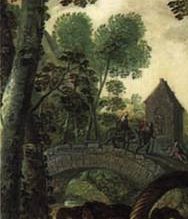
Once again the artist has included a scene from the bible into the painting.  Look to the left background and you can see in the distance, a small arched bridge, on which Mary and Joseph are crossing.  Joseph leads the way on foot guiding the mule on which sits Mary with the infant Jesus and is a portrayal of the Holy Family’s Flight into Egypt to avoid the clutches of King Herod.

I love this painting and I love how Beuckelaer has painted the produce.  It is so life-like.  The colours he has used enhance the painting and make it look so real.

The Four Elements: Water by Joachim Beuckelaer

The Four Elements: Water by Joachim Beuckelaer (1569)

Over the next four days I want to show you a set of four paintings by the Flemish painter Joachim Beuckelaer.  His favoured painting genres were still lifes and market and kitchen scenes.  Beuckelaer was born in Antwerp in 1533 and was the nephew of Pieter Aertsen the Dutch historical painter whom he trained under.  By his late twenties Beucklaer was a master painter in his own right although a number of his paintings were based on themes used by Aertsen, the general opinion was that the standard of the former pupil’s work was greater than that of his master.  Both Aersten and Beuckelaer were renowned for their paintings depicting scenes from inside a kitchen and of scenes at the market both of which always included many still-life depictions of food.  As is the case of my featured paintings over the following days, Beuckelaer would also include a relevant biblical subject within the painting of domestic life and maybe it was intention to compare the stress of physical life on this earth and spiritual life.  It is interesting to note that the religious subject in each painting is consigned to the background of each work of art.
The set of paintings I am featuring over the next few days is entitled The Four Elements,  which Beuckelaer painted between 1569 and 1570 and they take as their theme the four classical elements of Earth,  Water,  Air and Fire.  It is thought that the set of paintings  were destined for an Italian patron.
Today I am featuring The Four Elements: Water, which was completed by Beuckelaer in 1569.  Here in front of us is a scene at a fish market.  The artist has depicted twelve different identifiable varieties of fish.  Some art historians believe that the twelve represent the twelve disciples.  It is thought that he was the first painter to depict the market fish stalls at Antwerp.  Before us we gaze at the stall holders and we start to feel a little uncomfortable with the way they stare out at us.  The older lady to the left has a resigned expression on her face as if it is “just another day selling fish”.  She is not smiling.  She looks tired as she holds out the tray of fish for us to examine.  The man to the right, who maybe her son, rests his right hand on a trestle table as he proudly shows us the underbelly of a large fish.  It is interesting to look at the left background and see how Beuckelaer has used steep perspective in the way he depicts the bustling street going off into the distance.

However what is more fascinating and in some ways more bizarre is what we see though the central arch in the background.  This is not part of the landscape to the rear of the fish market but is in fact a scene from the bible.  It is the time when Christ appeared to the disciples.  This was the third sighting of Christ since the Resurrection and the scene is based on the Gospel by Luke 5: 1-11, in which we are told that Jesus told the despondent fishermen, including Simon Peter, who were washing their nets after a fruitless days fishing, to “put out to the deep water and once again let down their nets”.  Peter questioned the merit of this advice but did so and they caught innumerable fish and this has been referred to as the Miracle of the Fishermen.

This is a picture, which has a wonderful array of colours , fascinating characters and  along with the other three works makes for a beautiful set of paintings.

Landscape with a Marsh by Paul Bril

Landscape with a Marsh by Paul Bril (1590)

My apologies for a lack of a post yesterday but I was touring the Italian Lakes and ended up in a non-WiFi hotel.  This is the last day of my short break and I am at Milan airport awaiting a flight home.

I will start today’s blog with a question.  What do you like best about an art gallery visit?  Maybe that is a kind of obvious question but to many people galleries mean different things.  I will go to a gallery sort of prepared as to what I want to see, especially if it is a large gallery and I have no hope of seeing everything.  I am a great believer in the premise that if you try to see too much, you end up seeing very little.   It is like going on holiday and trying to visit too many places.  You do visit them all but you miss the soul of the places.  You miss the hidden gems of a town and so if you rush around a gallery, you miss their hidden gems and you miss the opportunity of carefully studying great works of art.   So back to my original question, what do you like best about art galleries? 

For me a visit to an art gallery is not complete without visiting the gallery shop.  My bookcase shelves groan at the weight of art books and gallery catalogues I have placed on them over the years.  However to take away a piece of the gallery to read and study at your own convenience is an absolute must.  Unfortunately when I have taken home gallery catalogues and read them I often kick myself for not reading the details of a painting before I actually stood in front of the paintings itself and thus would avoid the realization that I have missed something.

However most of all when I go to a gallery I like to discover a new artist, whom I have never heard of.   To see a beautiful painting by an artist unknown to me is like finding a gold nugget during a walk in the countryside.  You admire the landscape on your walk but then this little extra find makes your day.  At the art gallery it is the same.  You enjoy the paintings of well-known Masters but all of a sudden you come across a new name.   For from that discovery you can then learn about the artist and search for his or her other paintings.   It simply opens up a new window in your world.   When I was looking around the  Biblioteca Ambrosiana in Milan a few days ago, I came across a painting by Paul Bril and artist I had not heard of before.  Yes, I can just imagine some of you groaning at my lack of knowledge, but that is how it is and I, like everybody,  has to build up an artistic knowledge!

Paul Bril was a Flemish landscape painter and was born in Antwerp in 1550.  His brother Matthijs was also a landscape artist.  Paul, who received Papal Favour, a form of Papal patronage, lived and worked mostly in Rome. His brother died when he was quite young and Paul continued with his fresco work.  Paul was also a painter of small cabinet paintings.  These were small paintings, characteristically no larger than about two feet in either dimension, but often much smaller. The expression is especially used of paintings that show full-length figures at a small scale, as opposed to a head painted nearly life-size, and these cabinet pictures are painted very precisely, with a great amount of “finish”.   From the fifteenth century onwards wealthy collectors of art would keep this type of painting in a cabinet, hence the name, in a relatively small and private room to which only those with whom they were on especially intimate terms would be admitted.

The painting on display for My Daily Art Display is one I saw at the Biblioteca Ambrosiana in Milan and is entitled Landscape with a Marsh which he completed in 1590.  It is quite small in size, measuring 26cms x 35cms but its size does not detract from its beauty.   It is a haunting landscape with just a few wading birds or ducks present at the pool.  The water is still but appears crystal clear.  The silvery-green colours add a picturesque tranquility to the scene.  Wouldn’t you like just to sit on the bank of the pool and let the world pass you by?  I know I would.