Theodoor Rombouts

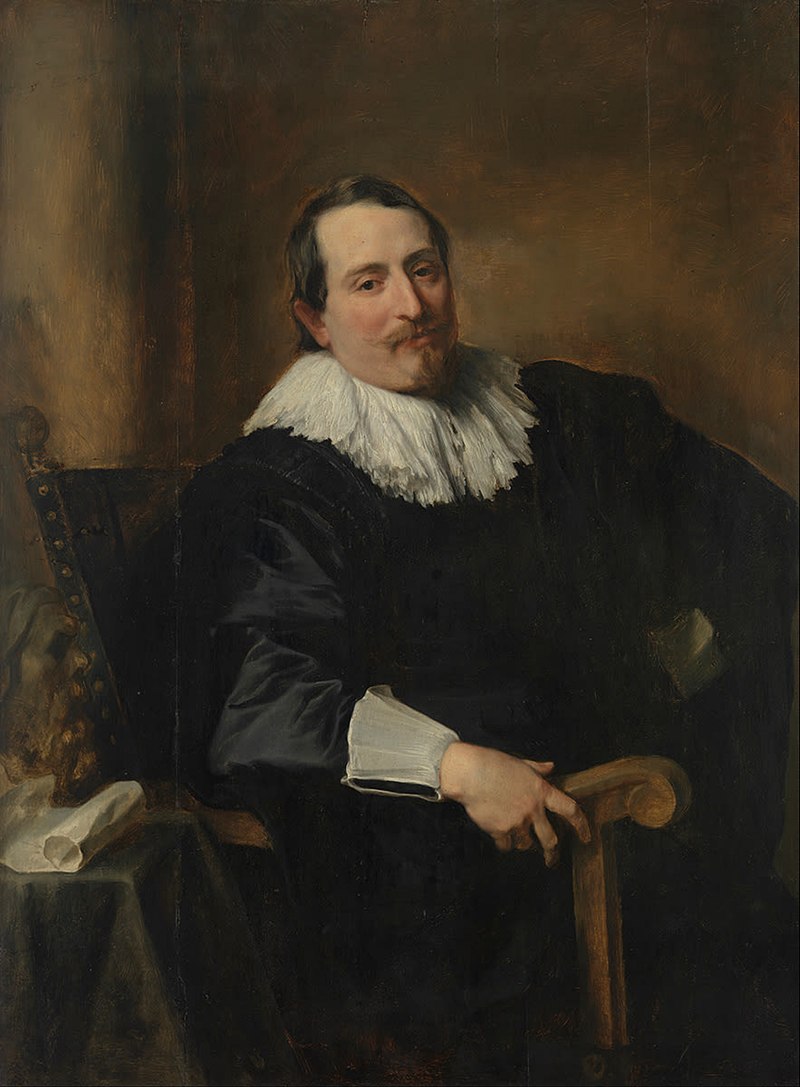
Portrait of Theodoor Rombouts by Anthony van Dyck

In my last two blogs regarding the Groeninge museum in Bruges, I looked at the works of the Flemish Primitive painters.  In this edition of the blog I want to showcase the life and works of an early seventeenth century Flemish painter known for his Caravaggesque genre scenes depicting lively dramatic gatherings.  Maybe because he lived in Antwerp at the same time as the great Rubens he and his artwork was overshadowed but I hope you will see that the man was an artistic genius.  Let me introduce you to Theodoor Rombouts.
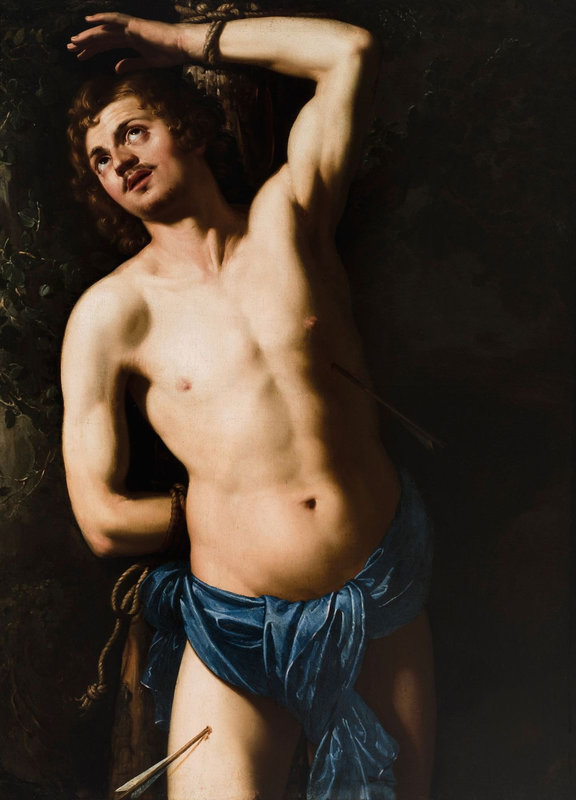
St Sebastian by Theodoor Rombouts (c.1626)

Rombouts was born in Antwerp on July 2nd 1597.  He was the son of Bartholomeus Rombouts, a wealthy tailor, and Barbara de Greve.  In 1608, at the age of eleven, Theodor studied art for a year as a pupil of Frans van Lanckvelt before being tutored by the Flemish artist, Abraham Janssens, the dean of the Antwerp Guild of St Luke and who had studied in Rome at the time of Caravaggio. He was one of the first Flemish followers of Caravaggio.

Young Soldier by Theodoor Rombouts (1624)

In 1616, aged nineteen, Theodore Rombouts also travelled to Rome where he remained until 1625.  He was recorded as living in the Roman parish of Sant’Andrea delle Fratte, along with two other Flemish painters, Francesco Tornelli  and Robert d’Orteil.  It is thought that while on a visit to Florence he met the Caravaggist Bartolomeo Manfredi and worked for Cosimo II de’ Medici. It was during his stay in the Italian capital that Rombouts was inspired by the revolutionary painter Michelangelo Merisi da Caravaggio and his most important follower Bartolomeo Manfredi and the two would influence Rombouts’ painting style.   In 1622 he also travelled to Pisa.
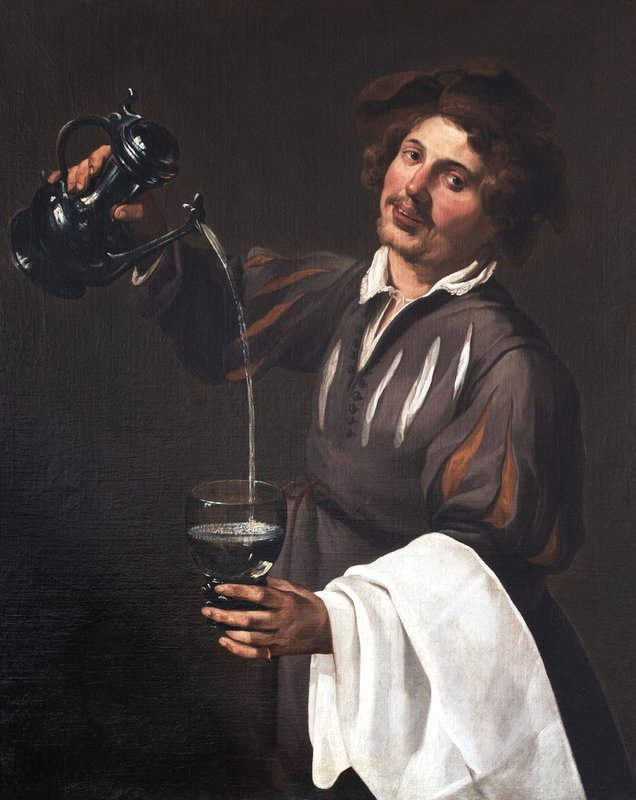
The Cup-bearer (Allegory of Temperance) by Theodoor Rombouts (c.1632)

In 1625, on his return to Flanders, Rombouts entered the Guild of St. Luke in Antwerp as an independent master. Now in Flanders, he concentrated on his genre painting which he could sell at the open market, in a style of strong contrasts of light, with figures of great articulacy, both evoking great energy and yet with natural movement.  The excellence of his work and its popularity resulted in him being looked upon as the leading Flemish Caravaggian of his time.
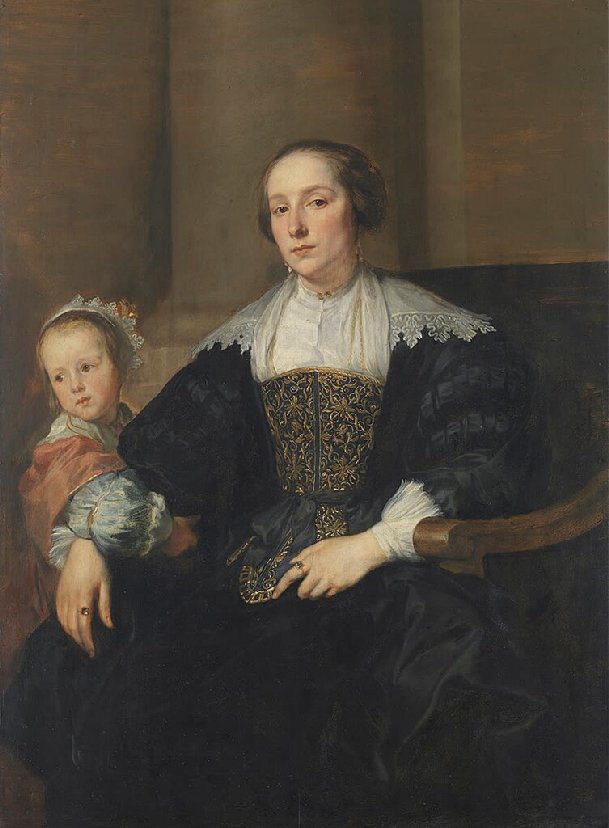
Portrait of Anna van Thielen, wife of the painter Theodor Rombouts with their daughter Anna Maria (c.1630)

In 1627 Rombouts married Anna van Thielen, who was from a noble family and the sister of Jan Philip van Thielen, who was the son of a minor nobleman by the name of Liebrecht van Thielen. Jan Philip became a well-known Flemish painter who specialized in flower and garland paintings.  He would eventually assume his father’s title of Lord of Couwenberch.  Jan Philip van Thielen became Rombout’s pupil in 1631 and became a talented still life painter.  There was a strange twist to Rombout’s marriage as Anna and her family were not from Antwerp but from the Mechelen area, and so he had to obtain, prior to the wedding ceremony, a dispensation from the Antwerp City Council to consummate the marriage outside Antwerp so that he would not forfeit his Antwerp citizenship rights.  In 1628 the couple had a daughter, Anna Maria.
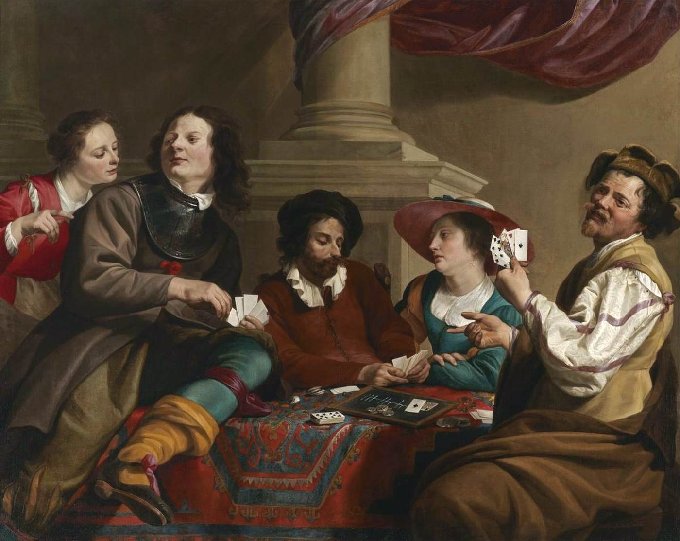
Card Players in an Interior by Theodoor Rombouts

Theodor Rombouts was the primary exponent of Flemish Caravaggism,that became a popular artistic phenomenon that reached its zenith in the 1620s. Besides his religious works, he is probably best known for his large-scale secular works which portrayed groups of cheerful folk partaking in musical merriment and card-playing characters who had often been affected by heavy drinking.  These people depicted wearing theatrical costumes were posed for best effect and set in chiaroscuro lighting typical of the Flemish Caravaggisti, also known as the Antwerp Tenebrosi.  Tenebrism, from Italian word tenebroso meaning dark, gloomy, and mysterious, also occasionally called dramatic illumination, is a style of painting using especially pronounced chiaroscuro, where there are violent contrasts of light and dark, and where darkness becomes a dominating feature of the image.
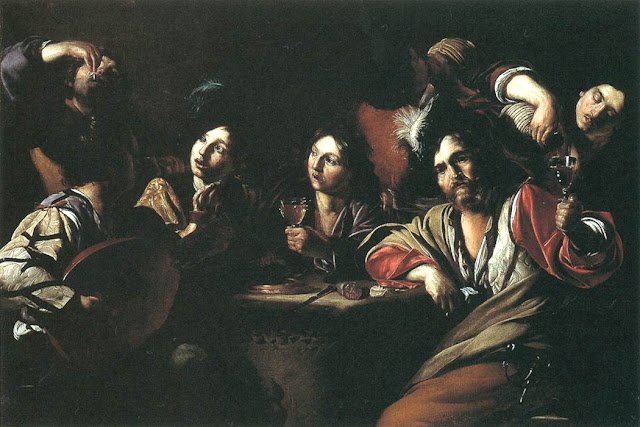
Tavern Scene with Lute Player by Bartolomeo Manfredi (c.1621)

Rombouts’ work entitled Card Players in an Interior, is a prime example of his Caravaggesque genre scenes. Recalling the jovial genre scenes of Bartolomeo Manfredi’s depiction of merriment in a tavern in his 1621 work, Tavern Scene with Lute Player, one can see a similar marked sense of monumentality to Rombouts’ five figures who are positioned around a carpeted table, engaged in a game of cards. The individuals are both realistic and expressive and the whole depiction has natural feel about it.

Rombouts introduces what is known in art terms as repoussoir to the depiction.  The word Repoussoir comes from the French verb répousser, which means “to push back” and it has been used for centuries by artists who want to focus attention and add interest to their art. They achieve this by placing certain types of objects or figures close to the painting’s edges, which guide the viewer’s eyes towards your central theme.  In this painting our eyes are being led towards the central bearded figure who stares down at his hand of cards, and it is thought to be a self-portrait of Rombouts. Rombouts also included a portrait of his wife, Anna, in the hatted figure seated beside him.

The Backgammon Players by Theodoor Rombouts (1634)

Rombout’s inclusion of self-portraits and portraits of family members in some of his paintings was not unusual as these additions were often seen in Dutch and Flemish genre painting.  In his 1634 painting entitled The Backgammon Players, which is part of the collection of the North Carolina Museum of Art, in Raleigh, Rombouts has included himself, the lavishly dressed soldier, his wife and his young daughter.

The Tooth Puller by Theodoor Rombouts (c.1625)

One of my favourite secular painting by Rombouts is his 1625 work entitled The Tooth Puller which can be seen at the Museo del Prado in Madrid. The depiction is of a tooth-puller who is treating a long-suffering patient surrounded by a large group of inquisitive onlookers who could well be the tooth-puller’s next patient.   They look on with a mixture of inquisitiveness and alarm, bordering on panic.  Like Caravaggio, Rombouts was interested in depicting ordinary folk enduring or enjoying everyday life.  The tooth-puller’s certificates lie on the table for his patients to see but his experience is substantiated by a collar of teeth worn around his neck.

The Lute Player by Theodoor Rombouts (c.1625)

One of Rombouts’ popular single figure painting is The Lute Player which is part of the John G. Johnson Collection at the Philadelphia Museum of Art.  It depicts a lute player tuning his instrument.  Lute players were often mocked for the undue amount of time they dedicated to tuning their instruments. Look how Rombouts has depicted the intensity of concentration on the face of the street musician which highlights the complexity of the task.  Some believe that this tuning of the instrument symbolises striving for harmony in love. The depiction of a stringed instruments could also symbolize temperance, especially when shown in the company of a tankard and a pipe, as depicted by Rombouts.

The Lute Player by Caravaggio (c.1596)

The subject of a lute player was very popular in the seventeenth century and was often depicted in a Caravaggio-style as can be seen in Dirck van Baburen’s 1622 painting entitled The Lute Player or Singing Man with Lute which is part of Centraal Museum in Utrecht collection. 
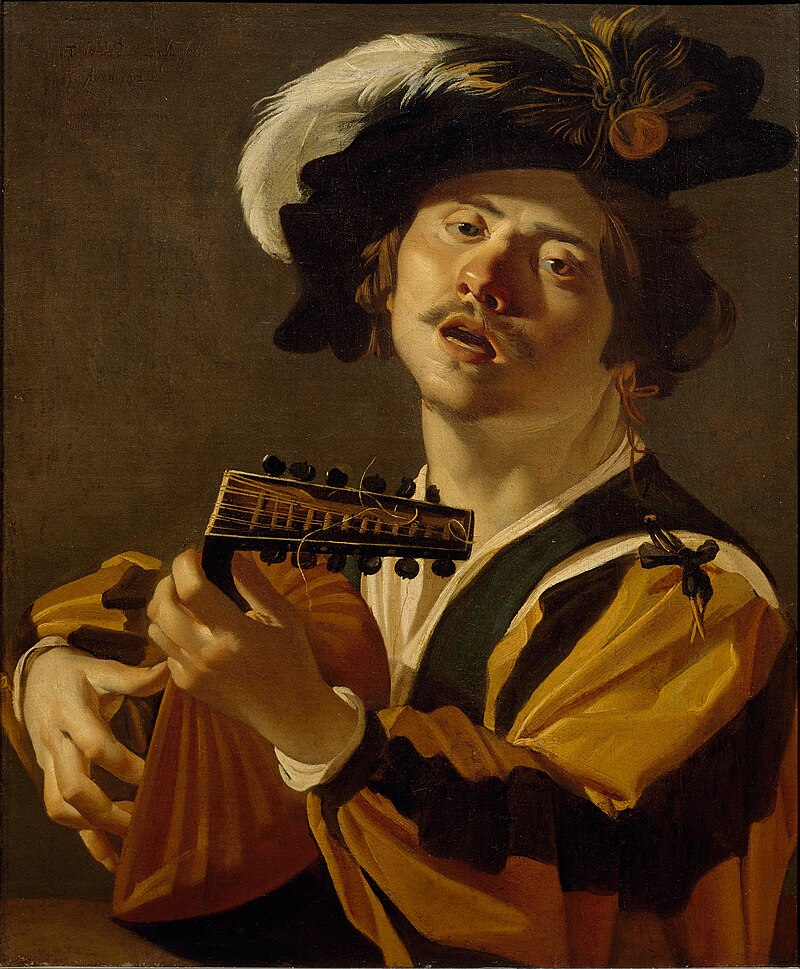
The Lute Player or Singing Man with Lute by Dirck van Baburen (1622)

Von Baburen, like Rombouts, had spent time in Rome and had seen many of Caravaggio’s works of art. 
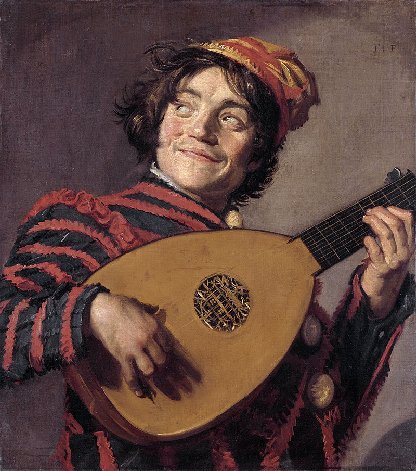
Lute Playing Jester by Frans Hals (1623/1624)

The half-figure image of a single musician became very popular in the Dutch Republic and other artists copied the style such as Frans Hals with his 1623 version of the Lute Playing Jester.
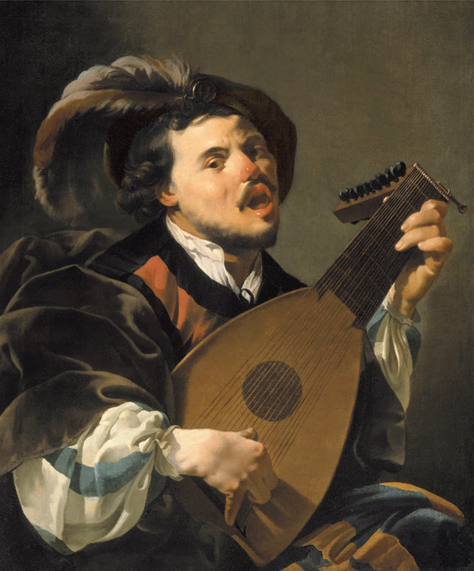
The Singing Lute Player by Hendrick Terbrugghen (1624)

and the Utrecht Caravaggesque painter Hendrick Terbrugghen with his 1624 painting entitled The Singing Lute Player.

Allegory of the Five Senses by Theodoor Rombauts (1632)

In 1632 Rombouts completed his multi-figured work entitled Allegory of the Five Senses which can be seen at the Museum voor Schone Kunsten in Ghent.  The art loving public in the 16th and 17th century were fascinated by symbolic works of art especially those where the artist has also displayed his or her virtuosity as a painter.  In the painting, Allegory of the Five Senses, we see five men depicted.  Each of them symbolizes one of the five senses. The elderly man on the left with glasses propping up a mirror represents Sight. Next to him is a man playing the chitarrone, a type of bass lute, and he symbolises Sound. The blind man in the centre of the painting represents the sense of Touch. Further to the right we see a jovial man with a glass of wine in his hand.  He portrays Taste.  At the far right we have an elegant young man smoking a pipe and holding a bag of garlic.  He represents Smell. The Ghent bishop, Antoon Triest, who also owned several paintings by Dutch masters, purchased this canvas from Rombouts.

The Denial of St. Peter by Theodoor Rombouts (c.1625)

Besides his genre paintings Theodoor Rombouts completed a number of large religious works during his lifetime.  Around 1625, after just returning from Rome, Rombouts completed his religious work entitled The Denial of St. Peter.  The narrative painting had a wide horizontal format (94 x 206cms) and the depiction was based on the biblical story about the testing of St Peter’s resolve in supporting Christ.  In the painting we see the servant girl questioning St Peter.  According to the bible Mark 14: 66-70:

“…While Peter was below in the courtyard, one of the servant-girls of the high priest came by. When she saw Peter warming himself, she stared at him and said, “You also were with Jesus, the man from Nazareth.” But he denied it, saying, “I do not know or understand what you are talking about.” And he went out into the forecourt. Then the cock crowed. And the servant-girl, on seeing him, began again to say to the bystanders, “This man is one of them.” But again, he denied it. Then after a little while the bystanders again said to Peter, “Certainly you are one of them; for you are a Galilean…”
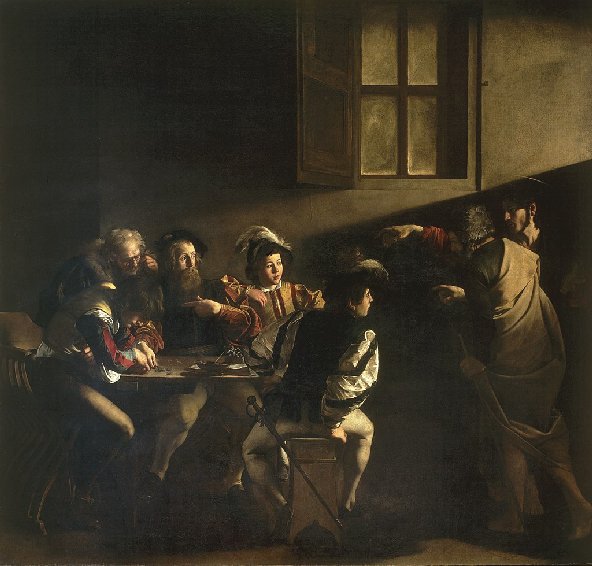
The Calling of St Matthew by Caravaggio (c.1600)

The influence of Caravaggio can be seen in this painting and the setting of the figures reminds one of Caravaggio’s  work The Calling of St Matthew which he completed around 1600 and is hanging in the Contarelli Chapel in San Luigi dei Francesi in Rome, and was probably seen by Rombouts.

Christ driving the Money-changers from the Temple by Theodoor Rombouts (c.1637)

Another of Rombouts’ religious works, Christ driving the Money-changers from the Temple, features the events in the Temple as related in Mark’s Gospel (Mark 11:15-17) in the New Testament:

“… On reaching Jerusalem, Jesus entered the temple courts and began driving out those who were buying and selling there. He overturned the tables of the money changers and the benches of those selling doves and would not allow anyone to carry merchandise through the temple courts. And as he taught them, he said, “Is it not written: ‘My house will be called a house of prayer for all nations’ But you have made it ‘a den of robbers…”

It depicts a furious Christ erupting in anger, his self-made whip in his hand, as he furiously attacks the merchants when he discovered that the holy site of the temple was being used as a market hall and money changer’s office.  Look at the wide range of emotions etched on the faces of the proponents.

Between 1628 and 1630 Rombouts was deacon of the Guild in Antwerp. In 1635, two years before his death, Rombouts collaborated with other artists on the programme of the decorations of the Joyous Entry of Cardinal-infante Ferdinand in Antwerp, which was led by Rubens. Theodoor Rombouts died in Antwerp on September 14th 1637, aged 40, shortly after the completion of this collaborative project.
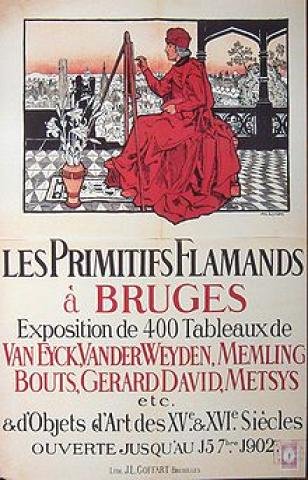
Groeningen Museum Bruges. Part 2.

In 1902, a major exhibition of Flemish Primitive works entitled Les Primitifs flamands et l’art ancien was held in Bruges.  Almost four hundred paintings, including works by (or attributed to) Jan van Eyck, Rogier van der Weyden, Dieric Bouts, Hans Memling, Gerard David and Quentin Massijs, were on show. The exhibition drew in more than 35,000 visitors. It is believed that never before had so many Flemish paintings from the 15th and early 16th centuries been on display together.   If you manage to visit the Groeningen Museum in Bruges you will be able to see many works by the Flemish Primitives.

Portrait of a Theologian with his Secretary by Jacob van Oost the Elder (1686)

The first painting I am looking at in this blog is the dual portrait entitled Portrait of a Theologian and his Secretary by Jacob van Oost the Elder which he completed in 1668 and is part of the Groeninge Museum in Bruges.

Jacob van Oost the Elder was the leading artist of 17th-century Bruges. He painted many altarpieces in the churches of Bruges and he was also exceptionally gifted as a portrait painter as one can see in this work. Van Oost was born in Bruges, and trained there by his elder brother, Frans. He entered the Guild of Saint Luke in 1619, and became a Master two years later. He took a trip to Rome in the 1620s and on his return to Bruges in 1628, his work was influenced Caravaggio, albeit the depiction of his paintings were of a contemporary Netherlandish setting.

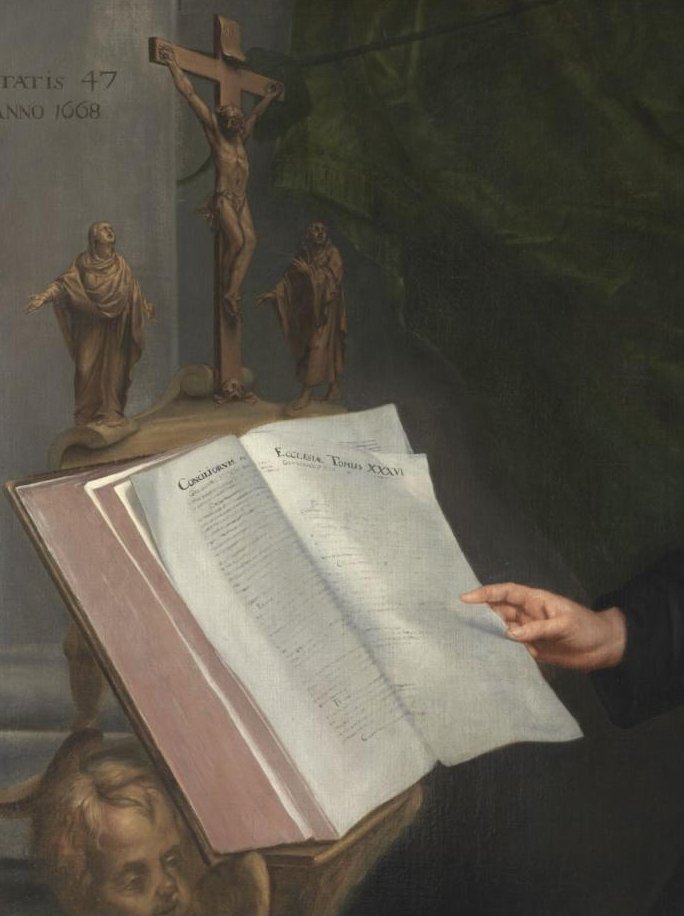
The work depicts a theologian, probably a Jesuit, reading the council’s decisions and comments on them to his secretary. His secular secretary takes notes. On the left of the painting we see a lectern, which is decorated with a sculpture of a Calvary group, and open on it is volume thirty-six of the collected Council Decrees. On the right of the painting we see a work table bedecked with a richly coloured tablecloth, at which the priest and the secretary are seated. On top of the table are study accoutrements, such as a globe and a book. Behind the two men is a bookcase with editions of the Bible and literature in the fields of theology and canon law.

Thomas Wentworth, Earl of Strafford, with Sir Philip Mainwaring by Anthony van Dyck

Once again, in this depiction we are reminded of the influence of Anthony van Dyck portraiture, such as his 1640 painting entitled Thomas Wentworth, Earl of Strafford, with Sir Philip Mainwaring, also the Caravaggesque treatment of the light, with its characteristically heavy contrasts between light and shade, in this case between the open book on the lectern and the black clothes of the English statesman and the lightness of his face in comparison to the dark background.

Portrait of a Bruges Family by Jakob van Oost the Elder (1645)

Portrait of a Bruges Family is another painting by the Bruges born painter Jakob van Oost.   He had been commissioned to paint a family portrait.  This work is regarded as a masterpiece of high Baroque painting. For the man who commissioned the work, it is a vanity painting in which he is asking the viewer to recognise his status, his wealth and his handsome family.  He stands before us his arm outstretched.  The focal point of this painting is the wealthy man who draws our attention to his assets. He points towards the estate he owns which stretches into the distance.  He is surrounded by his family and standing next to him is his wife.  We also see the children’s maid and the gardener and by catching a glimpse of the terrace he is standing on we know that his house will be palatial.  Van Oost has made his viewpoint low which adds to the imposing air of the central figure.  It is a painting which carefully exudes two facts for us to take in.  Firstly, the portrait is a glorification of family life based on love and fertility and secondly, it is a work of art which affirms the family’s social status.  In the seventeenth century the wealthy bourgeois yearned to be accepted into the realms of the aristocracy and one way of elevating themselves to that social status was to buy an estate that came with a title of nobility and we can clearly see the man in the portrait aspired to that elevated status.

What is fascinating about this painting, albeit you will probably not be able to see it clearly in the attached picture, is that the painting is signed and dated on the lower right on the parapet.  However, even more bizarre is that the painter has incorporated the age of the various figures in the work.  The man is 46 as we can see written on the heel of his shoe.  His wife is aged 26 and this figure appears on her fan and the boy who stands close to her is 3 as can be seen written on his hat.  The girl sitting on the steps sits on a cushion is 15 as shown on her basket and the young man is 17 as shown on his boot.  The baby who is being carried by the nursemaid has the figure 1 inscribed on his hand.   The ages of the various children suggest that there have been two separate marriages and the lady holding hands with the central figure is probably the mother of the two youngest children.  This work of art is considered to be one of van Oost’s greatest masterpieces.   It would be interesting to find out if anybody visits the museum and looks closely at the painting whether they can see the numbers inscribed in the painting

The next offering was once a triptych by the Belgian artist, Jan Provoost, and belonged to the former Dominican monastery in Bruges. Sometime before 1861 the front and back sides of the wing panels were separated by sawing them apart lengthwise.   The four panels are now displayed separately. The original central panel is missing. 

Jan Provoost was born in the Belgian town of Mons around 1463.  By 1491 he had married the widow of the miniaturist and painter, Simon Marmion and in 1494 he settled in Bruges.  He simultaneously headed up two workshops, one in Bruges, where he was made a burgher, the other in Antwerp, which was then the economic centre of the Low Countries. Provost was also a cartographer, engineer, and architect.

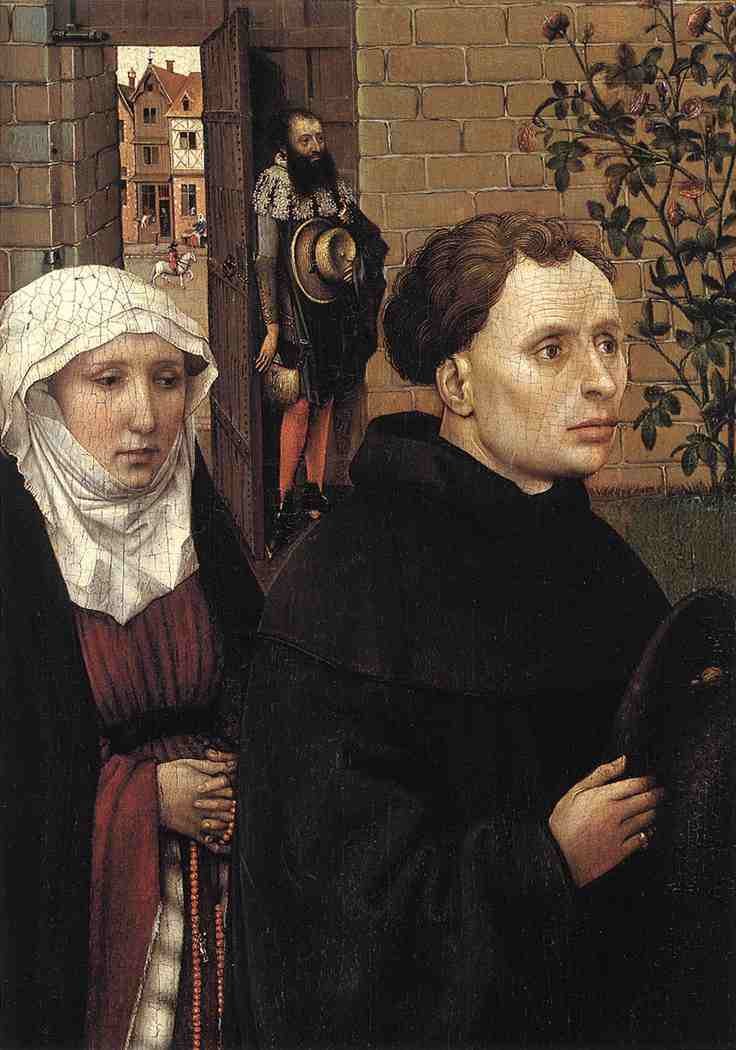
Inner wings of the original Triptych (c.1515)

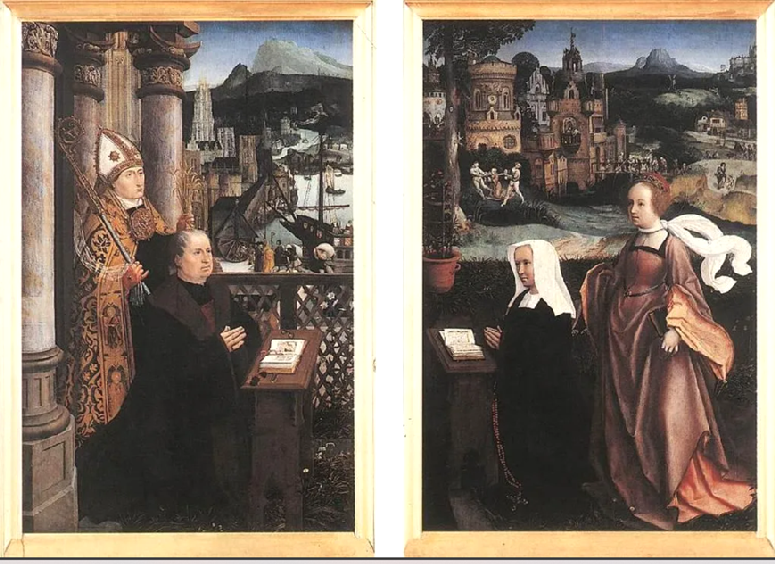
The wealthy, but unknown, donors who commissioned the triptych are depicted on the original inner wing panels kneeling in prayer in a small, enclosed garden.  The background scenes include episodes in the lives of their patron saints, Nicholas of Myra and Godeliva who are also depicted in the panels.  Behind each of the saints are pictorial episodes from their lives.

The depiction in the background of the left hand panel we can just see men carrying sacks of food as they walk along the quayside next to a sailing vessel. When the people of Myra, a Lycian city in Ancient Greece in what is today the provinces of Antalya in Turkey, faced starvation, Bishop Nicholas had a shipload of grain that was destined for Alexandria distributed among the people. When the vessel completed its onward journey and arrived at Alexandria the cargo was found to have been miraculously replenished.

The right hand panel depicts the female donor along with her patron saint, Godeliva of Gistel and in the background we can see how the saint met her death. The story goes that she accepted an arranged marriage as was the custom, but her husband and family turned out to be abusive. Eventually he had her strangled by his servants. The large white scarf around the saint’s neck is to remind us of the manner of her death.

Outer (reverse)wings of the Triptych (c.1515)

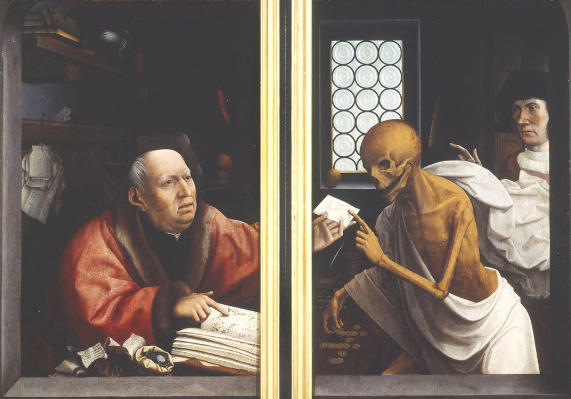
Originally when the triptych was closed it showed the images Death and the Miser. These two rear sides form a continuous scene and depict a moneychanger who points to a line in an accounting register. Death lays down some tokens and points to the text held out to him by the moneychanger, presumably a promissory note. It is possibly that the man in the doorway with a raised finger could be the artist himself.

The Pandreitje in Bruges by Jan Antoon Garemijn (1778)

The world of art constantly changed.  Leaving the 15th- and 16th-century Northern Renaissance period, once known as the Flemish Primitives and moving on a quarter of a century, through the bombastic art of the Baroque period we arrive at the time when light-hearted charming, themed art of the Rococo period had gained in popularity.  In France, Antoine Watteau, Jean Honoré Fragonard and François Boucher held centre stage and defined the French Rococo period spanning from the reign of Louis XIV “The Sun King” to that of Napoleon Bonaparte.  They created soft-coloured dreamworld paintings set in idyllic surroundings exuding a light poetic atmosphere.  The Flemish Rococo artists never attained the aristocratic elegance of their French counterparts although they did manage to produce fresh bourgeois drawing-room style works. 

Portrait of Jan Antoon Garemijn by Charles-Nikolas Noel (1771)

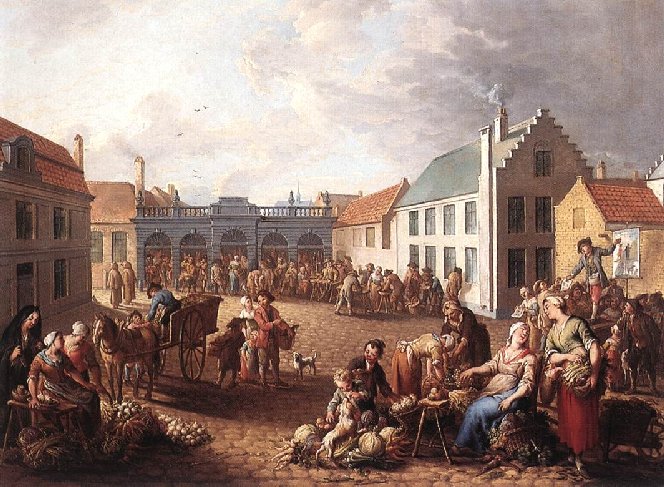
The most talented of these Flemish artists was Jan Antoon Garemijn.  The Groeningemuseum houses his portrait and also a number of his beautiful works including one entitled The Pandreitje in Bruges which he completed in 1778. The Pandreitje was a square in Bruges used as a vegetable market. In the foreground we see women who have come to town from their rural homes bringing with them their vegetables which they hope to sell.  In the background, occupying the porticos of the prison building are the butchers selling their wares. 

On the left of the square we see a street entertainer singing songs and cracking jokes to keep the marketgoers entertained.  He is also depicted selling mannekensbladen, a kind of 18th century Flemish illustrated paper which is full of sensational stories.  Behind him is an advert for the paper he is trying to sell which bears the incomplete inscription:

DERLYCKL VAN- 1778

(Wonderful stories of 1778)

Garemijn always paid attention to detail in his paintings of market scenes, such as this one, which offered an idealised image of the common people without the symbolism and moralising undertone that earlier artists would insert into their genre works.  There was no hint of social criticism in this work.

Another painting housed in the Groeningemuseum is one I featured in one of my early blogs of 2011 and so I won’t repeat it but I will give you a link to the page. The painting and the story behind it, The Judgement of Cambyses and the Flaying of Sisamnes by Gerard David, was one of my most popular posts and it is well worth a visit.

Following these last two blogs featuring works housed in the Groeningemuseum I hope you will be able to visit one day in the future.

Groeningemuseum Bruges. Part 1.

Groeningemuseum, Bruges

If you ever manage to travel to Belgium and visit the city of Brugge (Bruges) then I entreat you to drop in at the Groeninge Museum which lies in the heart of the historic city.  It is at this establishment that you will be able to see works of art by Jan van Eyck, Hans Memling, Hugo van der Goes, Gerard David, Hieronymus Bosch, Ambrosius Benson, Lancelot Blondeel, father Pourbus and his sons and their contemporaries. These Masters came from the Low Countries and often worked in Bruges and completed assignments there in the late 15th and early 16th centuries. This museum is a home for many beautiful pieces of art produced by the Flemish Primitives. The painting of the 15th and early 16th centuries in the Southern Netherlands is an important highlight in the history of art. These painters are commonly referred to as Flemish primitives. The Flemish Primitive period flourished especially in the cities of Bruges, Ghent, Mechelen, Leuven, Tournai and Brussels, all of which are in present day Belgium.   The period began around the 1420s with painters such as Robert Campin and Jan van Eyck and lasted until the death of Gerard David in 1523, although many art historians believe it did not end until around 1566 or 1568 with the advent of the Dutch Revolt. Moreover, the Flemish primitives emphasise a previously unseen religious eloquence that accompanies a new tradition in painting. The painting commissions of the time not only came from the various courts and religious institutions, but also from the towns and cities and their citizens. It was a time when artists, for the first time, had attained a very important standing in the society. Several of their works are looked upon as highpoints in the history of European art.  In this blog I will introduce you to some of these fabulous paintings which can be found in this wonderful museum.

The Virgin and Child with Canon Joris van der Paele by Jan van Eyck (c.1436)

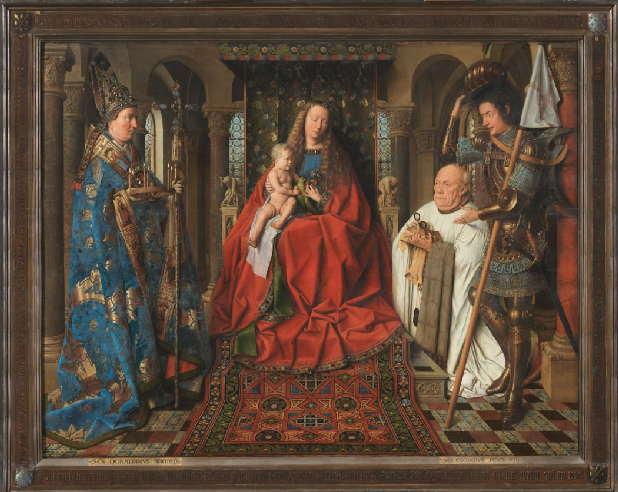
One of the great examples of early Netherlandish painting is the body of work by artists who were active in the Burgundian and Habsburg Netherlands during the 15th and 16th century Northern Renaissance period. The first work of art I am featuring is the large (122 x 158cms) oil on oak panel by Jan van Eyck entitled Virgin and Child with Canon Joris van der Paele which he completed around 1436. The painting depicts the the Virgin Mary enthroned at the centre of the semicircular space, which most likely represents a church interior, with the Christ Child on her lap. The Virgin’s throne is decorated with carved representations of Adam and Eve, Cain and Abel, prefigurations of the Crucifixion and Resurrection of Jesus, and scenes from the Old Testament. To the left in dark blue robes is Saint Donatian the patron saint of the church for which the panel was painted. The saint is dressed in brightly coloured vestments. This work is noted for the fine attire, including wonderful representations of furs, silks and brocades, and the detailed religious iconography. Kneeling down, as he piously reads from a book of hours, is Canon Joris van der Paele and standing behind him is St George, the canon’s patron saint.

Canon Joris van der Paele

Van der Paele had worked as a scriptor in the papal chancery in Rome.  From there he took up various posts in the Church before relocating to Bruges, his birthplace, in 1425.

Around the frame of the painting is a Latin inscription which once translated states:

“…Master Joris van der Paele, canon of this church, had the painting made by Johannes van Eyck, painter; and he founded two chantries, to be tended by the canons, 1434; the painting was, however, completed in 1436…”

The word “chantry” derives from Old French chanter and from the Latin cantare (to sing).   Its medieval derivative cantaria means “licence to sing mass”.  It is the prayer and liturgy in the Christian church for the benefit of the dead, as part of the search for atonement for sins committed during their lives.  In this case it indicates that Joris van der Paele donated a substantial amount of money to the authorities of St Donation’s Church in Bruges for them to dedicate an annual mass to his memory in perpetuity.  The painting would then have been hung alongside or above the church altar.

Death of the Virgin by Hugo van der Goes (c.1481)

The painting The Death of the Virgin is thought to have been the last work painted by Hugo van Goes before he died around 1482/1483.  It is thought that van der Goes was born in Ghent around 1442.  He enrolled in the city’s painter’s guild in 1467 and worked in the city for ten years during which time he received many lucrative commissions from the city, the Church and the Burgundian court.  In 1477 he left Ghent and went to live in Rouge-CloÎtre in the Forest of Soignes near Brussels.  Sadly, he suffered from many bouts of depression which culminated in a mental breakdown in 1481.  Following convalescence he returned to painting and completed this exquisite work of art which is believed to have been for Ter Duinen Abbey, a Cistercian monastery at Koksijde, in what is now Belgium.

Detail from Death of the Virgin by Hugo van der Goes

The depiction is the artist’s interpretation of the event with the vision of heaven above Mary’s deathbed.  The figures we see in the main picture are those filled with sorrow and the sense of despair at the death of the Virgin Mary.  Hugo van der Goes was looked upon as the most “modern” of the Flemish Primitive painters and this is borne out in this painting in which he has produced such realistic and expressive rendering of the figures and the movement and intensified feelings that pervade the composition.  The mystical, religious spirit along with the strong sense of emotion make this work one of the great masterpieces of 15th century painting.

Hans Memling was born in Germany, at Seligenstadt near Aschaffenburg, and it is thought that he received his first art education in Cologne.  He then travelled to the Netherlands but probably spent his early life in Mainz. By 1465 he had moved to Bruges and was the leading artist there for the rest of his life.  By 1480 he had bought himself a large stone house in the city and was taking on pupils.  Memling was listed among the wealthiest citizens on the city tax accounts. Sometime between 1470 and 1480 Memling married Anna de Valkenaere who bore him three children.

 Portrait of the family Moreel, 1482 by Hans Memling (Royal Museums of Fine Arts of Belgium, Brussels)

It is in the area of portraiture that Hans Memling appears to have been the most successful and had gained a vast number of aristocratic clientele who lived in Bruges. One of his lucrative commissions came from Willem Moreel, a prominent Bruges politician, merchant and banker and his wife Barbara van Vlaenderberch. He had painted their portraits in 1482. His figurative depictions are painted with an exactness, a precision and a concern for detail which bring them strongly to life.

The Triptych of Willem Moreel by Hans Memling (1484)

One such commissioned work of art was the Triptych of Willem Moreel. Moreel and his wife had commissioned Memling to paint a triptych altarpiece for the altar of the Saints Maurus and Giles in the Church of St. James in Bruges, a church in which Moreel and his wife wished eventually to be buried.

Central panel of the Moreel Triptych

The central panel of the triptych depicts the large figure of St. Christopher, who according to medieval legend, carried the Christ Child across a river on his shoulder. In the distance, up in the rocks in the left background we see the light from the hermit’s lamp guiding the saint. The two figures on either side of St Christopher do not belong in the legend but may have been added by Memling to balance the composition. To the left we see the former monk, St Maurus, holding his crook and open book and to the right is St Giles, a Benedictine hermit with an arrow in his arm and a deer at his side. It is interesting to note that the inclusion of the deer and the arrow which is in most depictions of the saint, as it harks back to the legend that Giles  finally withdrew deep into the forest near Nîmes, where, in the greatest solitude, he spent many years, his sole companion being his beloved deer, which in some stories sustained him on her milk.  His retreat was finally discovered by the king’s hunters, who had pursued the deer to its place of refuge. An arrow shot at the deer wounded the saint instead, who afterwards became a patron of the physically disabled.

The left hand panel of the Moreel Triptych

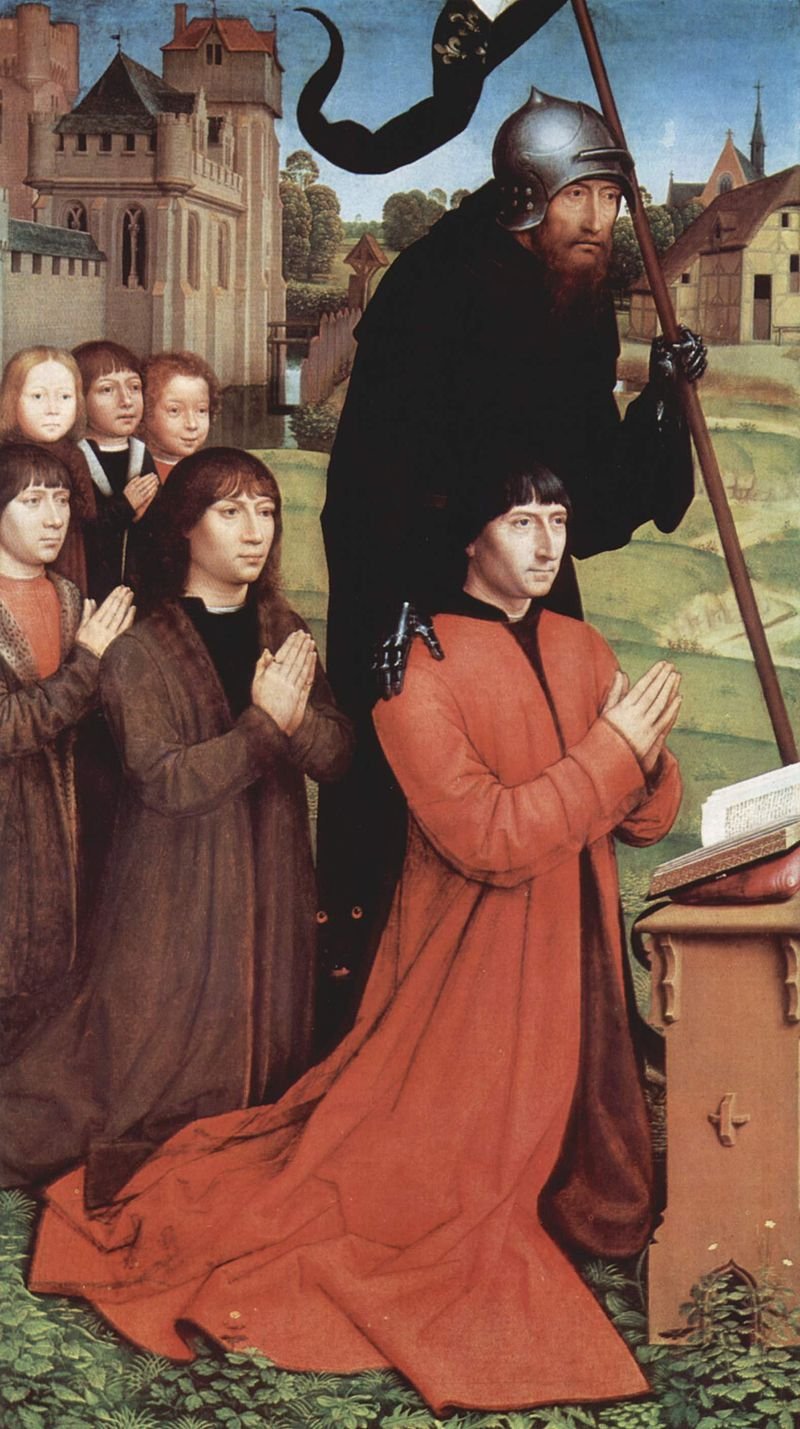
The left hand panel of the triptych continues with the magnificent landscape background. The depiction of the left hand panel has multiple figures. It depicts the Willem Moreel kneeling, hands clasped in prayer. His hair is short in a “bowl cut” and over his black jerkin, he wears a fur-lined tabard which is without a belt or fastenings, which was very fashionable in the 1480s. Behind him are his five male children, who are also shown kneeling. Of Moreel’s sons, two are known to have died in infancy leaving Willem the oldest, with his two remaining siblings, John and George. Moreel and his sons are being presented by Saint Wilhemus van Maleval, who stands among them, dressed in a fur-lined black coat over army clothing.   He places his hand on Willem’s shoulder as he directs and presents him to St.Christopher in the centre panel.

Right hand panel of the Moreel Triptych

On the right interior wing of the triptych is the depiction of Barbara Moreel with eleven of her thirteen daughters, who all kneel in prayer before an open book. Barbara wears an hennin, a headdress in the shape of a truncated cone, which was worn in the Late Middle Ages by European women of the nobility, a damask silk dress with a white collar, and a wide red belt with a golden buckle. The women are being presented by Saint Barbara, who was the patron saint of Moreel’s wife.  The saint is depicted standing before the tower where she was, according to legend, imprisoned and executed.

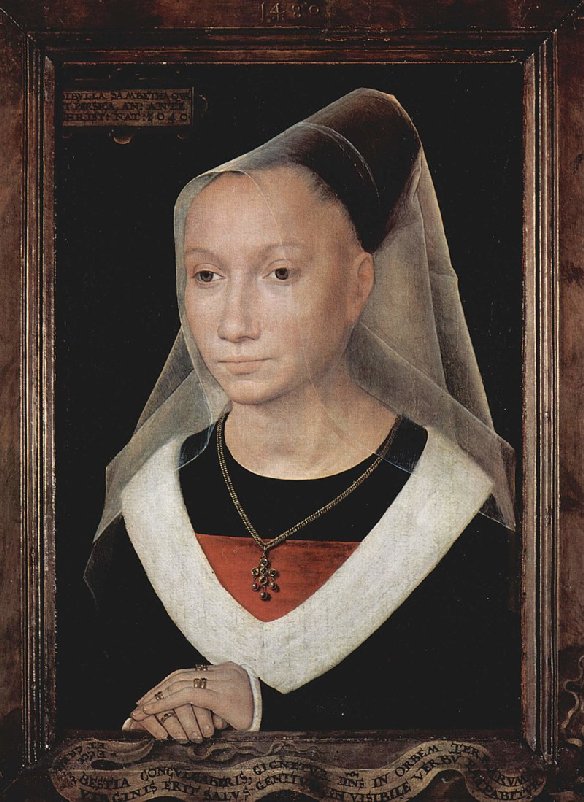
Sibylla Sambetha (Catherine Moreel ?) by Hans Memling (1480)

Barbara Moreel’s eldest daughter, Catherine, kneels directly behind her mother.  She also wears a black dress and it is known that later in her life she became a Dominican nun.  Besides completing portraits of Moreel and his wife, he had also painted a small oil on oak panel portrait entitled Sibyla Sambetha, in 1480.   The painting is now in the Hans Memling Museum at the Old St. John’s Hospital in Bruges. The girl in the light brown clothing, black V-neck and transparent veil has been identified as Maria from her name written in her headband, and is their second-born daughter, given her linear position in the painting.

Exterior panels of the Moreel Triptych when closed

The outer part of the two wings, seen when the triptych is closed has grisaille depictions of John the Baptist with his lamb and staff.  On the other wing we have Saint George in his full armour, slaying the dragon with a lance depicted on the right outer wing.  It is believed that these two panel paintings may have been completed much later around the time of the deaths of Willem and Barbara Moreel and dated as around 1504 by a number of art historians.  It was thought that Moreel’s sons, Jan (John) and Jaris (George), probably commissioned them as the final, successful, effort to have their parents interred within the chapel space.

One strange aspect to the Moreel Triptych is the fact that not all of the daughters depicted in the right hand panel were painted by Memling.   The art historian and former curator of the Groeningemuseum, Dirk De Vos, has identified at least six females who are later additions, layered over the original landscape. The explanation for these additions, which were probably added by members of Memling’s workshop, were that the daughters were born after the 1484 completion date of the triptych.   The left-hand panel depicting Moreel and his sons underwent a similar update.

………to be continued.

Dutch and Flemish Golden Age painters.

Like many others, I am a lover of the artwork of the Dutch Golden Age painters.  The Dutch Golden Age was a period in the history of the Netherlands, which spanned the era from 1588 and the birth of the Dutch Republic to 1672, Rampjaar (Disaster Year) which was the year of the outbreak of the Franco-Dutch War.  During this period, it was considered that Dutch trade, science, and art and the Dutch military were among the most acclaimed in Europe.  We all know about the lives and works of the famous artists of that era, such as Rembrandt, Vermeer, Jan Steen, Frans Hals and Judith Leyster to name but a few.  In my blog today I want to look at the lives and works of the lesser-known painters of that era.

Izaak van Oosten was a Flemish Baroque landscape and cabinet painter who worked out of Antwerp.  Izaak was born in Antwerp in December 1613 and was the son of an art dealer with the same name.  His father had become a master in the Antwerp Guild of St. Luke in 1617. Very little is known about his upbringing or his early artistic training as there is no record of which master or masters he studied under.  Izaak became a master in the Antwerp Guild of St. Luke in 1652.

Landscape with a Wagon and Travellers passing through a Village by Izaak van Oosten

There is something joyful about paintings depicting skaters on frozen rivers and lakes.  It is all before global warming and I am sure that now, many of the rivers and lakes retain their fluidity even in the depths of winter.  The painting I am showcasing is entitled Skaters on a Frozen Lake at the Edge of Town and it was painted by the Dutch Golden Age landscape painter Cornelis Beelt.  Cornelis Beelt was a Dutch Golden Age landscape painter who was  one of the chief figures in the Haarlem school of landscape painting, but was also well-known for his genre paintings of towns, markets and villages.  Beelt was born in Haarlem during the first decade of the seventeenth century.

Skaters on a Frozen Lake at the Edge of Town by Cornelis Beelt (c.1652)

The setting is a clear winter’s day and crowds of locals gather besides a country inn keen to enjoy the sport on the ice. Young and old, rich and poor are attracted to this pastime. In the foreground a group of well-dressed men and women stands on the ice and chat. An old lady with her hands in a fur muff sits in a splendid arreslee (sleigh which is drawn by a horse and which is decorated with a fine plumed harness. Close by young children propel themselves across the ice on small prikslees (sledges).

Beach of Shevingen by Cornelis Beelt

There is a strange thing about this painting which unfortunately is not visible from the attached picture. Beelt signed his painting in an unusual manner, one which he had also done on his painting Beach of Shevingen. He signed his name on the plank of wood in the foreground. However , at a later time, his signature was scrubbed out and replaced by the inscription J.V.Ostade f.1653 and this was judged to be an attempt by a less than honest art dealer to ascribe the work to a more famous name, Isaac van Ostade, so as to have a better chance of selling the painting, even though Ostade had died in 1649 !

The phrase ‘cabinet d’amateur’, in French, is an ancient term which referred to a room or part of a room in an art collector’s house where he or she displayed the paintings they had purchased.  These display areas were before the rise of public galleries.  Some where simple cabinets which contained their owner’s beloved works and some where floor to ceiling displays of their paintings.  The phrase cabinet d’amateur should not be viewed as that of an “amateur collector” but that of an “art lover”.  A German term for such a place is often referred to as a kunstkammer. In Italian it might be called a Gabinetto, Studiolo or Camerino.

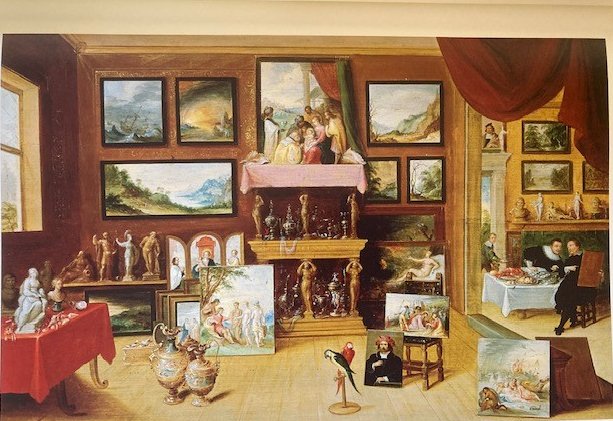
Two collectors dining in a gallery surrounded by paintings and works of art, with two parrots in the foreground. by Frans Fancken the Younger

The painting connected with this term is one by the Flemish painter, Frans Francken the Younger and described as Two collectors dining in a gallery surrounded by paintings and works of art, with two parrots in the foreground. Frans Francken the Younger was the most famous of an Antwerp dynasty of painters; he trained with his father, Frans the Elder, and joined the Antwerp guild in 1605. He was a painter of religious and historical subjects as well as being the inventor of the genre – the cabinet painting.

On the right-hand side of the painting we see two men deep in discussion about a painting one of them is holding up but we do not know who is the owner of this kunstkammer.  The presence of a kunstkammer in one’s house was a sign of wealth, intelligence and social status.  In the main part of the painting, we see an ornate sideboard supported by classical caryatids.  A caryatid is the name given to a sculpted female figure serving as an architectural support taking the place of a column or a pillar supporting an entablature on her head.  A light-pink fringed cloth covers the top shelf of the sideboard on which two large shells are placed either side of the painting, The Adoration of the Magi.   Richly decorated goblets and covered urns are displayed on two of the sideboard shelves. On the floor we see two parrots depicted sitting on a perch.  The import of exotic foreign birds testified to the owner’s wealth.   We see a large red velvet curtain falls from the ceiling which when released would act as a separator of the two rooms.  Everything in the room exudes the wealth of the owner which would have been the raison d’être for the owner of the cabinet d’amateur commissioning the work.

The Cabinet of the Collector by Frans Francken the Younger (c.1617)

A similar painting by Frans Francken the Younger is in the Royal Collection entitled The Cabinet of the Collector which he completed around 1617. Amongst the paintings on view in the kunstkammer is a landscape by Joos de Momper,  a still life of an everyday table set for a meal; and a small, nocturnal Flight into Egypt. Other religious painting depicted are one featuring St Augustine who is trying to comprehend the idea of the Trinity and sees a baby struggling to pour the entire sea into a pool in the sand with a shell – both tasks being equally beyond the scope of man. The drawings, one framed and one in an open book are two studies for Michelangelo’s Sistine ceiling and a preparatory drawing for Raphael’s Madonna della Perla which emphasise the intellectual side of painting.. There are also letters on the table, no doubt signifying an intelligent characteristic of the painting’s owner.  Also displayed are exotic weaponry which is a reminder of the importance of travel and trade and a handful of Roman coins and a bowl of modern ones, which were not anything to do with wealth but more likely a celebration of the achievements of great men.

For me, the most interesting part of the work is seen beneath the arch to the right.  In the background a church is demolished and nearby donkey-headed men with cudgels destroy a pile of objects associated with learning, science, the arts and sport. According to Karel van Mander, the sixteenth century Flemish poet, painter and art historian, a man with a donkey head is a symbol of Ignorance. The episodes depicted here recall two historical events: the Beeldenstorm, an outbreak of iconoclasm carried out by Protestants in 1566; and the ‘Spanish Fury’, the sack of Antwerp in 1576.

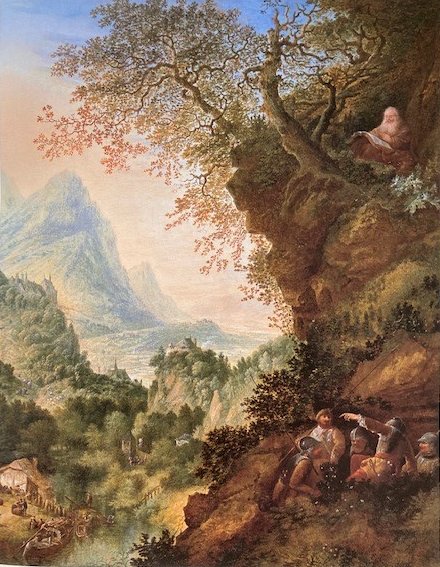
A Rhineland Landscape with a Hermit and Soldiers by Jan Griffier the Elder

Jan Griffier the Elder, who was born in Amsterdam around 1645, was a painter and printmaker, who produced views of Rhineland landscapes as well as spending time, around 1660, in England where he produced many landscape works featuring the English countryside.  One of his most beautiful landscapes is referred to as A Rhineland Landscape with a Hermit and Soldiers. The painting dramatically depicts a steep mountain landscape with a meandering river below which slowly flows through wooded crags which are surmounted by castles.  If we look to the left foreground, we can see a men loading barrels of wine onto a small boat.  The main figures in this painting are on the right-hand side.  We see a group of soldiers lying down, concealed among the ferns and flowers.  One of the group points down to the boat which is being loaded.  Are they planning to raid the operation?  Above them, sitting on a rock by a large oak tree in peaceful isolation, is a hermit, who is meditating.  It is an interesting painting with plenty to focus on, but what is it all about ?

Floral Still life Floral by Gaspar van den Hoecke

There is something that fascinates me about floral still life paintings.  I think it is just the effort and patience the artists must have put in to produce such beautiful works.  My next featured painting is a small (70 x 50cms) floral still life attributed to the Flemish Baroque painter, Gaspar van Hoecke, who was born in Antwerp around 1580.

Gaspar van den Hoecke was best known for his small religious cabinet pieces but during his early period around 1610 his work focused on still life floral paintings.  The vase of flowers sits on a wooden tabletop.  This dense grouping of flowers fills almost two thirds of the painting.  The profusion of flowers doesn’t allow the artist to depict twigs and leaves between individual flowers.  On the table we see a caterpillar of the swallow-tailed butterfly which is next to it.  Also on the table there is a silver medal with the head of Pope Pius V which had been created in 1571.   Just above it is a gold coin which is a rare example of a byzantine solidus made during the era of Anastasius, the Eastern Roman Emperor. 

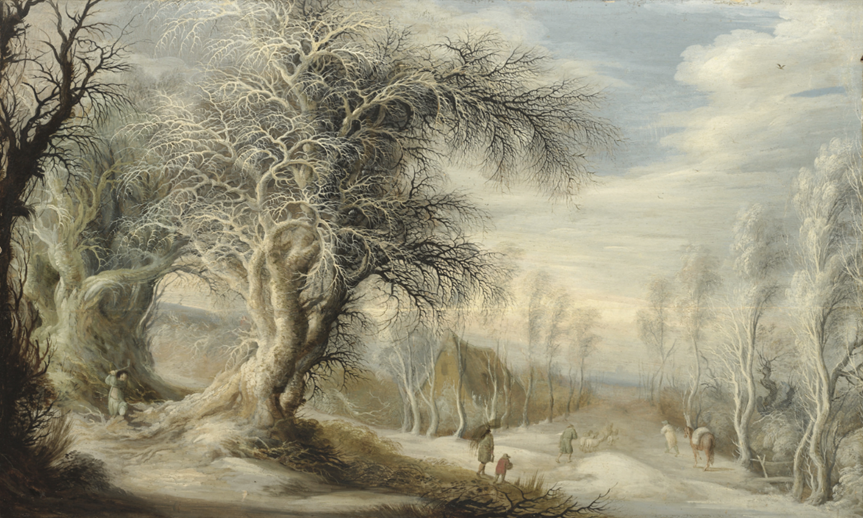
Winter Landscape with a peasant walking through snow by Gysbrecht Leytens

The Flemish painter Gijsbrecht Leytens was born in Antwerp in 1586. As a teenager, he began his apprenticeship with Jacob Vrolijck.  In 1611 he joinied the Antwerp Guild of Saint Luke as a master. In 1615 he became a member of the Olijftak, a chamber of rhetoric that dates back to the early 16th century in Antwerp, when it was a social drama society which drew its membership primarily from merchants and tradesmen and provided public entertainment at prestigious events.  Gijsbrecht was a captain in Antwerp’s Civic Guard between 1624 and 1628.  His work followed the style of 16th and 17th century Flemish and Dutch great landscape paintings, which had brought recognition to such masters as Pieter Brueghel the Elder, Hendrick Avercamp, Gillis Van Coninxloo, Joost de Momper and Denijs Van Alsloot.

Winter landscape with a woodsman and travelers by Gysbrecht Leytens

However, it was Gijsbrecht Leytens’ determined personal style that brought him to the public’s attention.   Many of his paintings were simply attributed to “The Master of the Winter Landscape” and only in the 1940’s attributed to him.  Leytens has an easily recognisable style not just because he focuses on snowy winter scenes but because of the way he depicts intricate and curious intertwining designs created by the bare branches and twigs which form a large part of his depictions.   He was described as a poet of the frost in the way he conveys the cold nakedness of the sun on a countryside caught in the ice. No-one before him, nor after him, either in Flanders or elsewhere, expressed this with such intensity. The fundamental and unique quality of his art also resides in the extreme refinement of the subtle colour harmonies apparent in his paintings at all times.

Old Man Reading a Letter by Willem van Mieris (1729)

The depiction of the reading of a letter has featured in many paintings over the years.  Such attention to what is written in the letter adds to the back-story of the artwork and often our imagination runs riot as we try to fathom out the sentiment expressed in the pages of the letter.  My next painting is one by the Dutch artist Willem van Mieris who was born in Leiden in the Northern Netherlands in June 1662.  His artistic tuition came from his father Frans van Mieris who was a genre painter.  Throughout his career Willem was successful and had the support of a number of patrons who constantly supplied him with commissions.  He was equally at home painting genre scenes and portraiture as well as being a skilled landscape painter, etcher, and draughtsman.  He was the active leader of, and once became dean of, the Leiden Guild of St. Luke in 1693. A year later, in 1694, he established a drawing academy in Leiden along with the painter Jacob Toorenvliet.

In this work we see an elderly gentleman seated  at a table in a darkened interior deep in concentration as he reads a handwritten document.  He wears an opulent-looking gown which is made of richly embroidered material and which is evocative of the fashion for Japanese dress at the time.  Upon his head is a hat made of rich blue velvet and lined with a extravagant swathe of fur.  In the dark background we can just make out shelves filled with books.  Couple that with the paraphernalia on the table, such as an inkwell, sealing wax and quill pen tells us that this a gentleman of great learning, maybe a lawyer.  Lawyers were often depicted in paintings reading documents and letters.

I hope this blog will encourage you to delve into the world of Dutch and Flemish painters where you will find so many talented artists.

Clara Peeters – The Queen of Still Life paintings

I suppose painters challenge us with trompe l’oeil aspect of their depictions partly as a joke, as in the case of M C Escher and partly as an outward show of their technical brilliance. Trompe l’oeil (trick of the eye) is often incorporated in still life paintings and in many facets of a still life work we can appreciate the expertise of the artist.  The words still life derive from a Dutch word stilleven while the French prefer nature morte and Italian, natura morta meaning dead nature.  Still life paintings are those which depict inanimate objects, whether they be such things as musical instruments, kitchen utensils and tableware as well as portrayal of dead animals, foliage or musical instruments etc.  Often the inclusion of an inanimate object in a painting has a symbolic meaning whilst at other times it is simply art for art’s sake.

What Is Vanitas
Vanitas Still Life with a Skull and a Quill (1628) by Pieter Claesz

The term memento mori, a Latin phrase meaning ‘remember you must die’ is often a term used when describing certain types of still life works.  Paintings, for example, which may include a portrait with a skull but other symbols commonly found are hour glasses or clocks, extinguished or guttering candles, fruit, and flowers.  Closely related to the memento mori picture is the vanitas still life.  I find the depiction of these inanimate objects fascinating and feel that they are completed by the most talented artists. 

Basket of Flowers by Balthasar van der Ast (1622)

Unlike me, the French Academy of the seventeenth century did not agree.  According to the French Academy their hierarchy of genres (or subject types) for art established in the seventeenth century, still life paintings were ranked at the bottom – fifth after history painting, portraiture, genre painting (scenes of everyday life) and landscape. It is thought that still life and landscape paintings were considered lowly because they did not involve human subject matter.

Still Life with Jug, Berkemeyer and Smoking Utensils_Pieter Claesz_17th century
Still Life with Jug, Berkemeyer and Smoking Utensils by Pieter Claesz (1640)

We know people buy portraiture to remember someone.  People buy landscapes and seascapes for their beauty and often to remind themselves of places they loved to visit.  Genre paintings were scenes of everyday life which often were also pictorial tales of morals and sometimes the realist genre paintings told of harsh times suffered by the less fortunate.  But who would buy still life paintings?  I suppose a beautiful flower arrangement depicted in a floral still life lights up a room but what about still life paintings which depict dead animals, food and expensive homeware?  Buyers of such work may believe that the painting reflects their affluence or hunting prowess.

The spoils of the chase guarded by a dog by Jan Fyt (c.1630)

When you look through the list of sixteenth and seventeenth still life painters, very few women’s names appear and yet there are a few.  The most obvious are the seventeenth century artists, Rachel Rausch with her floral still life works and Judith Leyster.   Today I want to look at the life and works of the greatest female still life painters, Clara Peeters.  She was by far the best-known female Flemish artist of this era and one of the few women artists who became a professional artist in seventeenth-century Europe, and she achieved that status despite constraints on women’s access to artistic training and membership in guilds.

Still Life Self portrait by Clara Peeters (c.1610)

Clara Peeters was born in Antwerp but when it comes to her date of birth there is some confusion.  It is known that a Clara Peeters, the daughter of Jean (Jan) Peeters was baptized on May 15th 1594 in the Church of St. Walburga, Antwerp and other records indicate that Clara Peeters and Henric Joosen were married in the same church on May 31st 1639.  So is that Clara Peeters the famous artist?  Although she is a major figure in the history of European still life painting, almost nothing is known about Clara Peeters’s life with certainty. Early researchers confused her with other women bearing the same relatively common name, ranging from an Antwerp heiress to an Amsterdam prostitute.  Also, we have to be wary of jumping to conclusions as Peeters was a very common name in Antwerp.

Still Life by Clara Peeters (1607)

Another factor which casts doubt on the birthdate of 1594 as her paintings, which were dated 1607, would mean she completed them she was just thirteen years of age and that is extremely unlikely so the conclusion is Clara was born in the 1580’s.

Still Life with Fish, a Candle, Artichokes, Crab, and Prawns by Clara Peeters (1611)

At a point in time when she was living in Amsterdam Clara Peeters produced one of her still life masterpieces in 1911.  It was entitled Still Life with Fish, a Candle, Artichokes, Crab, and Prawns.  Before us we see what looks like a wooden table upon which is a selection of seafood, such as boiled crabs and shrimp, several freshwater fish including two carp, a roach, several ide or orfe, and a northern pike.  Behind the food there is a dark glass goblet, a brass candlestick with an unlit but partially burnt out candle, a Rhenish stoneware jug, a copper strainer with a brass colander in which are two artichokes. 

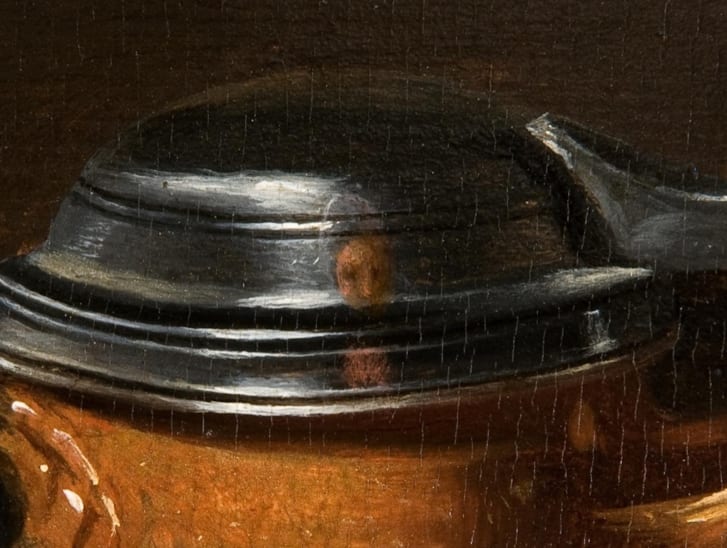
The reflected face

Although you will not see it in the main picture if you were able to take a close look at the lid of the jug you would see a reflection/self portrait of Clara wearing a large headpiece.  She, like a number of famous artists, included her own portrait in a number of her paintings.

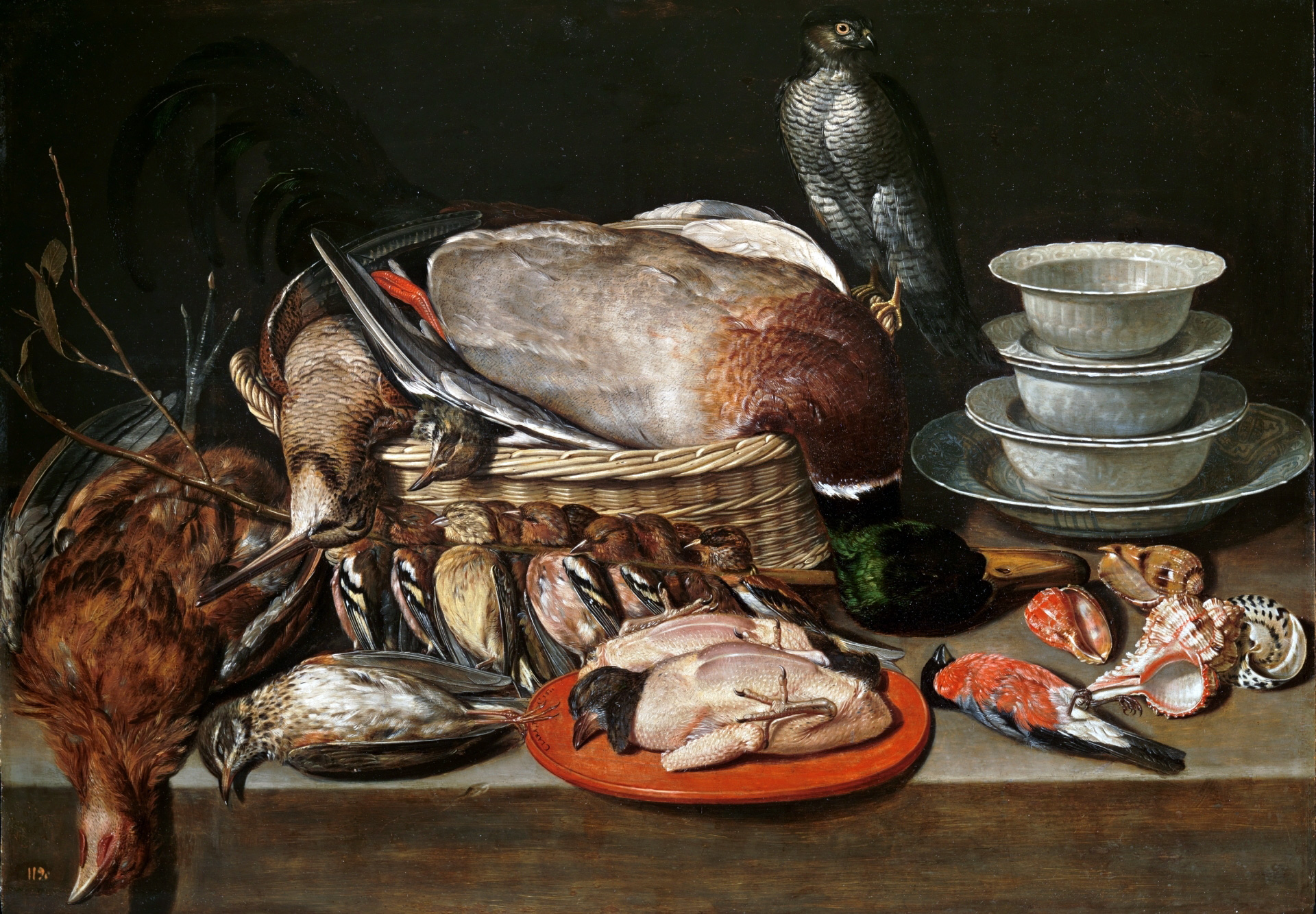
Still Life with Sparrow Hawk, Fowl, Porcelain and Shells, zoomed in
Still life with Sparrow Hawk, Fowl, Porcelain and Shells by Clara Peeters (1611)

Another painting in the Prado collection by Clara Peeters is her 1611 work entitled Still Life with a Sparrow Hawk, Fowl, Porcelain and Shells and is thought to have been in the Spanish royal collection.  In this work we see a life-sized Eurasian sparrow hawk balanced on the edge of a wicker basket.  Due to its large size we believe it to be the female of the species.  Sparrow hawks would typically be used in the gardens surrounding a palace or a city, and not only by men but also by women and children learning the art of falconry.  Lying lifeless in the basket is a large mallard, and a woodcock.  At the left, with its head hanging from the table is a hen.  A dead thrush lies on the table.  The small red bird to the right is a common bullfinch.   The bullfinch often appeared in Clara’s still life paintings and this could well be because of its vivid red colouring and in this work contrasts well with the green head of the mallard.  Along the side of the wicker basket are a line of dead finches, hanging by their necks.    One question you might ask yourself is why have one live bird depicted among so many dead ones.  I think the reason is that the smaller dead birds could well be the prey of the living sparrow hawk.  Again in this painting, as it was in the previous one, note how Clara has contrasted the soft feathered bodies of the birds with the harder and finer surfaces of the shells and porcelain dishes.

Kraak bowl (c.1600)

The several plates and bowls of white kraak porcelain are stacked on top of a blue and white kraak plate, an item which appeared in a number of Peeters’ paintings.  In this painting the blue colour of this dish has faded and this is probably due to the cobalt-based pigment used.  Kraak ware or Kraak porcelain is a type of Chinese export porcelain produced mainly in the late Ming Dynasty, in the Wanli reign.   It was among the first Chinese export wares to arrive in Europe from the late sixteenth century via Portugal and Spain, and spread throughout the continent mainly through Habsburg networks.  It often featured in Dutch Golden Age paintings of still life subjects which included foreign luxuries.

Image result for still life with flowers, gilt goblet, almonds, dried fruits, sweets, biscuits, wine and a pewter flagon
Still life with flowers, a Silver Gilt Goblet, Dried Fruits, Sweetmeats, Bread Sticks, wine and a Pewter Flagon by Clara Peeters (1611)

For the less squeamish but keeping to the subject of food I give you Clara Peeters’ 1621 painting entitled Table with Cloth, Salt Cellar, Gilt Standing Cup, Pie, Jug, Porcelain Plate with Olives and Cooked Fowl.  There are no dead animals on this table, just simple and tasty fare.  The arrangement of inanimate objects would appear random when in fact Peeters probably spent much time with the arrangement.  Firstly, she would want what was placed on the table to look like an everyday table set for a feast.  However, she would ensure that none of the objects blocked the view of another. The glass in the background containing the red wine is a fluted façon de Venise glass and was the type that was being manufactured in Antwerp by Italian glassblowers at the time. It is probable that the red wine had been imported from France, Italy or Spain. At the time of the painting much of food in the Dutch capital, such as wine, oil, salt, raisins and figs had come from Spain.  In this painting we see these fruits, together with almonds and sugar candy, in a large wide bowl known as a bianchi di Faenza vessel, a type of earthenware made in Faenza, an Italian city in the province of Ravenna, in the late sixteenth and early seventeenth centuries..

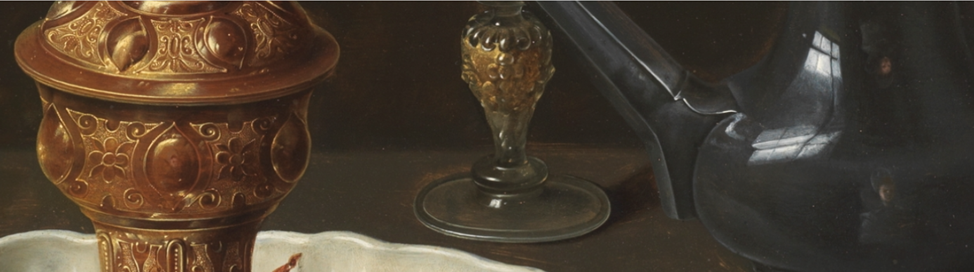
Reflections

Look carefully at the gilt goblet and the pewter flagon.  These are objects that appear in other of her still life paintings and also once again, she painted her self-portrait – three times in the raised parts of the goblet and four times in a vertical line on the pewter jug. This inclusion of herself portraits in some of her works is believed to be a form of a proclamation that she was a female painter and proud to be one in a profession dominated by men.

Clara Peeters - Still Life with Cheeses, Almonds and Pretzels.jpg
Still Life with Cheeses, Almonds and Pretzels by Clara Peeters (1615)

The Still Life with Cheeses, Almonds and Pretzels which she completed in 1615 is one of Clara Peeters’ best works and is part of the Mauritshuis collection. The depiction features a stone table top on which is a tin plate with three cheeses on it.  Above the cheeses is a smaller plate of butter shavings. In the foreground, on the left there are two pretzels, next to which is a knife with a beautifully decorated silver handle, three almonds and a blue-white plate of Wan Li porcelain filled with dried figs, almonds and raisins.  In the background we see a stoneware jar and a partially gilded lidded glass à la façon de Venise.  On the right side of the table there is also a sandwich and two raisins.  It is a meticulous depiction even down to small damages to some of the items and the hole in the cheese where a testing tube had been inserted.  As with all her still life works she has a remarkable ability to depict textures.  Look how she has depicted the crumbly nature of the dark green cheese and the softness of the shavings of butter as well as the reflective quality of the wine glass.  Her colour palette consists mainly of delicately harmonised yellow and reddish-brown shades and by doing this she has added warmth to the depiction but it is contrasted by the cool blue and white bowl at the right foreground.  The dark background and the way she has placed the objects in close proximity to each other offers a scene of intimacy.

The ornate knife

Look at the knife in the foreground that overhangs the edge of the table. The blade has an Antwerp mark, but more of interest is the ornate handle, which is decorated with ornaments and figures that signify love and marriage.  Although not clear in the picture, at the top a vignette of entangled hands with a burning heart and below it the allegorical figures of Faith and Temperance.  This type of knife, along with a matching fork in a pouch, was given as a wedding cutlery as a gift at weddings.  Even more interesting is the side of this bridal knife, on which Clara has put her name in the form of an engraved inscription, which is unusual as it is one of the few still lifes that she has signed her name in full, rather than her usual signature on her paintings “CLARA P”.    Maybe the reason for the full name on the knife handle was because it was her own wedding gift. However, whether she ever married is still unknown. 

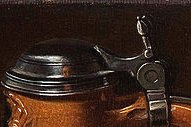
Face of Clara in the lid of the jug

Once again we see the added personal touch to this still life work for if you take a closer look you can uncover in the metal lid of the stone jug the reflection of a face with a white cap: this is Clara herself and as in other paintings by her this reflection appears to be a secondary “signature”.  This incorporation of a self portrait in a painting soon caught on and many other artists followed suit.

Florero (2)
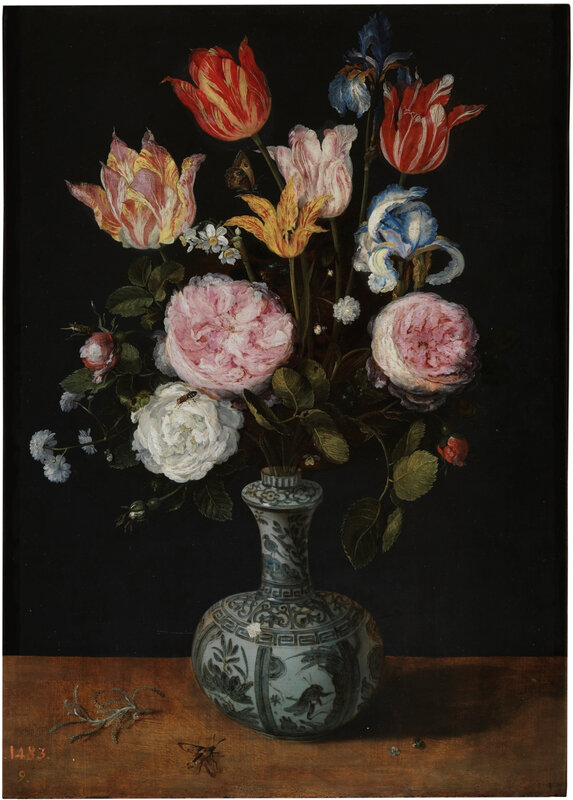
Vase of Flowers by Jan Brueghel the Elder (Jan Velvet Brueghel), 1609

Paintings depicting vases of flowers were very popular at the time.  One of the leading exponents was Jan Breughel the Elder.

Bouquet of Flowers by Clara Peeters (c.1612)

One of Clara Peeters’ floral still life paintings is in the Met Museum of New York. The painting depicts a luxurious bouquet of flowers in a roemer glass, which stands on a low stone shelf. The painting is awash with primary colours which make it stand out against a plain dark background.  The bunch is a mix of late spring and early summer blooms and include roses, tulips, narcissi, carnations, and irises. We see that some of the flowers have shed their petals which now lie on the pitted ledge.  Clara Peeters was an expert when it came to depicting reflective surfaces, an example of this is her depiction of the glass with its ornamented base and serrated foot. We see a butterfly perched on the stem of a fallen flower and in a way, this brings to life this still life work.

One has to presume that Clara Peeters’ choice of still life paintings is a result of the restrictions imposed on female artists. Female artists rarely followed an art education, certainly never being allowed to paint naked models, a must-do requirement if you wanted to become a history painter.  On the other hand, everyday objects were within reach of female painters.  Peeters’ still life artwork was in great demand with the buying public.  Already in the first half of the 17th century there was work by her in collections in the Northern Netherlands as well as her still lifes in the royal collection in Madrid. As was explained at the beginning of this blog the date of her birth is not precisely known.  It is the same for the date of her passing but it is presumed to be sometime after 1657.

The Wilson and the Ferrieres Collection

The Wilson Cheltenham Museum and Art Gallery
The Wilson
Cheltenham Museum and Art Gallery

When I have to travel to meetings in the UK and have an overnight stay, I try and go to local art galleries and see what is on offer.   I am often somewhat disappointed with the collections.  I suppose I expect too much.  It is my own fault.  I should realise I am not going to find a hidden Uffizi or Prado in a provincial town as I am aware that building up an art collection is a costly affair in this day and age.  So, to my great surprise and pleasure, yesterday I discovered a real gem.  I was in Cheltenham for a meeting and had the afternoon free so decided to go and find their art gallery.   It is called The Wilson and it has a small but wonderful collection of paintings many of which are from an era I particularly love – seventeenth and nineteenth Dutch and Flemish works of art.  My blog today is all about the gallery and some of these paintings.

Baron Charles Conrad Adolphus du Bois de Ferrieres

For a gallery to become established it obviously needs a collection of paintings and this almost always means it has to have a benefactor who has bequeathed the gallery a large number of works of art.  The regency spa town of Cheltenham and The Wilson had the second Baron de Ferrieres to thank for their foreign painting collection.  He died in Cheltenham in 1864 and left his large art collection to his son the third Baron, Charles Conrad Adolphus du Bois de Ferrieres, who in 1898 donated forty-three paintings and a sum of £1000 to the town of Cheltenham to set up a gallery to house the works of art, and so it was his generosity that today’s gallery began life and was able to house such a rich collection of work.

Trees, Castle and Skating Figures by Marinus Adrianus Koekkoek the Elder

The first painting I am showcasing is entitled Trees, Castle and Skating Figures by Marinus Adrianus Koekkoek the Elder (1807-1868).  Marinus Adrianus Koekkoek the Elder was a 19th-century Dutch landscape painter who was born in Middelburg and was the son of the painter, Johannes Hermanus Koekkoek who gave him his early art lessons.  Marinus had two brothers, Barend Cornelis and Hermanus who were also artists.  Koekkoek was primarily based in Hilversum and Amsterdam, where he later died.

Fortified Building on the Banks of a Canal by Cornelis Springer

Fortified Building on the Banks of a Canal is another fine example from the Ferriers collection.  It was painted around 1850 by the Dutch landscape artist, Cornelis Springer who was born in Amsterdam in 1817.  Springer became a member of the Amsterdam painters collective Felix Meritis and won a gold medal for a painting of a church interior in 1847. He was the most skilled of the Dutch townscape painters in the nineteenth century.  He consistently strived for topographical accuracy in his townscapes and this he achieved by many hours studying the design plans of the original buildings.  His townscapes have a meticulous style with attention to light and atmospheric conditions.  In this work Springer has somewhat abandoned his normal detailed depiction of the buildings an sought to concentrate the light and atmosphere which makes the depiction more Romantic that topographically correct.

Dutch Street Scene by Adrianus Eversun

Adrianus Eversen was a pupil of our previous painter, Cornelis Springer and spent most of his life painting in Amsterdam.  He, like Springer, was known for his townscapes and street scenes.  However, unlike Springer most of his townscapes lacked topographical accuracy.  In his painting, Dutch Street Scene, which he completed in 1858, we see a row of buildings which the artist has depicted with architectural accuracy but the setting was probably just a figment of his imagination rather than a real street.  He completed many paints of this ilk which were simply entitled “Dutch street scenes”.

A fête champêtre was a popular form of entertainment in the 18th century, and took the form of a kind of garden party. This form of entertainment was especially prevalent at the French court where at Versailles large areas of the park were landscaped with follies, pavilions and temples to have the capacity for such revelries.

Fête Champêtre: Cavaliers and Women Round a Gaming Board by Joseph le Roy

The term fête champêtre comes from the French expression for a “pastoral festival” or “country feast” and this may be construed as being a simplistic form of entertainment, but in the eighteenth century, a fête champêtre was usually a very graceful and stylish form of entertainment which would sometimes involve whole orchestras hidden from sight amongst the trees and participants would be in fancy dress.  Joseph Anne Jules Le Roy (1853-1922), the Parisian-born painter, was a specialist in military scenes and animals and in this painting of his we see those two themes.  In his painting, Fête Champêtre: Cavaliers and Women Round a Gaming Board we see depicted the fête champêtre in the grand manner with the people dressed in Flemish seventeenth century costumes.

Fête champêtre (Pastoral Gathering) by Jean-Antoine Watteau (1721)

This was different to the sumptuous costumes depicted by the French artist, Jean-Antoine Watteau’s in his 1721 painting, Fête champêtre (Pastoral Gathering). 

A Flemish Fair by of Isaac Claesz. Van Swanenburgh

The next painting which is also part of the Ferrieres Collection comes from an earlier period.  This is thought to be a late sixteenth century work and is attributed to Isaac Claesz. Van Swanenburgh.  He was a Dutch Renaissance painter who was born in Leiden in 1537 and died in the same town in 1614.  The work, entitled A Flemish Fair, reminds me of works by one of my favourite artists, Pieter Bruegel the Elder, who was a contemporary of Isaac Claesz. Van Swanenburgh.  The depiction of fairs in paintings was very popular in the last decade of the sixteenth century.

Ruins over the River Birchel at Zutphen by Everhardus Koster

Everhardus Koster (1817-1892) was a Dutch painter who specialized in sea and river scenes.  He studied at Frankfurt-am-Main’s Stadelsches Kunstinstitut and would later become a member of the Amsterdam Academy and for twenty years was the director of Het Pavijoen in Haarlem, he served as Director of the various museums that were formerly housed in the Villa Welgelegen.  One of his paintings, Ruins over the River Birchel at Zutphen is part of the Ferrieres Collection.

Willem van Mieris (1662-1747) was the most successful genre painter of his generation and a leader of the painters of Leiden. He was a master of cabinet pieces. In this painting, A Hurdy-Gurdy Player Asleep in a Tavern, which is dated 1690, the setting is the interior of an inn.  Van Mieris has meticulously depicted the numerous details of the inn itself as well as the table laden with food.   Not only is this a genre painting but it is also an extremely talented example of a still life featuring a meal of herring and plaice, a bun of bread and the brown German stoneware jug on the table and let’s not forget the authentic portrayal of the hurdy-gurdy. So what is the painting all about?

A Hurdy-Gurdy Player Asleep in a Tavern by Willem van Mieris

Surrendering to the effects of alcohol he has imbibed, the old hurdy-gurdy player has fallen asleep with his instrument on his lap.  The sleeping musician, a simple beggar, is dressed in rags.  Behind him the female maidservant holds aloft a pouch of money which she may have just taken from the sleeping musician.  She is ecstatic.  Two other tavern revellers look on in the background.  Hurdy-gurdy players were a frequent theme in Dutch peasant painting. They were people who would liven up happy gatherings with the primitive and penetrating sound of their instrument.  Willem shared his liking of depicting lively tavern scenes such as this one with his father Frans van Mieris the Elder. Willem painted several hurdy-gurdy players set in an inn.

The Artist’s Wife, Evelyn, seated reading by Gerald Gardiner

Besides the Dutch and Flemish paintings bequeathed to The Wilson there were some interesting works that the museum had acquired over time.   The Artist’s Wife, Evelyn, seated reading is a work by Gerald Gardiner.  Gardiner worked at the Cheltenham School of Art teaching drawing and painting from 1927 until his death in 1959.  It is a painting which exudes the quiet domestic atmosphere of life at home.  This work was painted at the Bisley home of Gerald and Evelyn Gardiner and is an example of the artist’s depiction of a night-time scene with his wife enjoying the company of her book, showing up the light, reflections and shadows which are cast by the gas lamp and fire as his wife reads.  It wonderfully encapsulates an atmosphere of domestic bliss and, for us, nostalgia as we see Evelyn reading a book by gas-light in front of the fire. Gardiner was particularly interested in painting night-time scenes and here he balances a powerful composition and the subtle effects of light. Gerald Gardiner was born in 1902. He studied at Beckenham School of Art and the Royal College of Art where he was awarded an Associateship with Distinction in 1926. In 1927 he was appointed second master at the Cheltenham School of Art, in charge of the drawing and painting department, later becoming Painting Master, where he worked until his death

Village Gossip by Stanley Spencer (c.1939)

Stanley Spencer was one of the most original artists of the modern age and it was good to see one of his works hanging in The Wilson.  Spencer’s paintings have special characteristics; we are urged to work out the story behind each painting and the work on show, Village Gossip is no exception.   It was painted around 1939 whilst he was on holiday in the Gloucestershire village of Leonard Stanley.  I will leave you to work out what you think is going on this painting.  Look at the body language of the woman on the right with her arms tightly folded across her chest.  Look at the accusing stance of the elderly man and woman on the left.  Even the small girl points towards the young man in an accusatory gesture. He bows his head in a somewhat remorseful manner.  What is he being accused of?

There were so many other excellent works of art on show at The Wilson and if ever you are in or around Cheltenham, I urge you to pay it a visit.

The Mérode Altarpiece by Robert Campin

The Merode Altarpiece by Robert Campin (c.1432)

I travel a lot around Europe and during my stays in the various towns and cities I always try and spend some time in the local art galleries.  The one thing that I do enjoy, which is not often afforded to me in my own country, is the ability to visit local churches in which, especially in France and Italy, one can find beautiful works of art, frescoes and exquisite altarpieces.  In this blog I want to look at one of the great altarpieces of the fifteenth century.  It was not a huge work of art destined for a church or cathedral but a small devotional work which was to be placed in a room of a wealthy merchant, who had commissioned the altarpiece.   The altarpiece I am referring to is an Annunciation triptych known as the Mérode Altarpiece.  The work, which was completed sometime between 1425 and 1428, is now part of the Metropolitan Museum collection in New York and the exquisite and beautiful work is attributed to the early Netherlandish painter, Robert Campin and his workshop assistants.

Robert Campin is often referred to the Master of Flémalle.  The title “Master of….” was term often used by art historians to attribute an anonymous work or even groups of works.  It was a common attribution used in the nineteenth century by German art historians when discussing Early Netherlandish paintings.    So how did Campin end up with his title?   It is believed that it was due to the fact that three paintings in the Städliches Kunstinstitut in Frankfurt were said to have come from the abbey of Flémalle, a town close to Liège, but have since been attributed to Campin.

Robert Campin was born around 1375 but it is not until thirty years later that his name appears in records.   It seems that he settled in Tournai, the Walloon town of Belgium.  Tournai is unlikely to have been his birthplace as records show that in 1410 he bought citizenship of the town, which he would not have had to do if it had been his birthplace.  Some would have us believe he was born in Valenciennes, now a French town bordering Southern Belgium.  This assertion is based upon the fact that the name Campin was very common surname at the time in that town.  In the records, Campin’s profession was given as a Master Painter and we know he became a free master of the local Corporation of Goldsmiths and Painters and in 1423 became the sub-dean of the society and later held the post of Eswardeur.  During his early years at Tournai, Campin worked for the municipality painting banners and he went on to be employed to paint sculptures in various churches, including the town’s Church of St Brice, and a number of municipal buildings, notably the Halle des Doyens in Tournai .  This colouring of sculptures was termed polychromy.  He had a good working relationship with the local sculptors including the famous sculptor, Jacques de Braibant.

Robert Campin was good at what he did and soon he and his work became very popular and he received many commissions.  His wealth grew and through his commissions and his investments Campin owned a number of properties in Tournai.  His standing in the community was high.  He was warden of the church of St Pierre as well as procurator of the Convent of the Haute-Vie.  All was going so well for Campin.  He was running a large successful workshop and had skilled apprentices including a young painter, Rogier de le Pasture who is believed to be Rogier van der Weyden. So life was good until he got involved in local politics and the disturbances in the city between two political factions.  Sadly for him he backed the losing side and for his part in the 1429 disturbances and his reluctance to testify against the leaders of the uprising he was sentenced to go on a pilgrimage to Saint-Gilles in Provence.  Such a sentence was common in those days as it was thought that during such a pilgrimage one could think about one’s wrong-doings.  The local authorities never forgave Campin for his part in the uprising and for a number of years hounded him.

It came to a head three years later, in July 1432.   Campin was in trouble again.  This time it was because of his adultery.  He was married to Ysabiel de Stocquain but at this time was living with another woman, Leurence Polette.  The courts took a dim view of this sexual liaison and he was charged with adultery and was once again sentenced to go on a twelve-month pilgrimage.  This would have ended his artistic work and the closure of his workshop but this time he was saved from this banishment.  His saviour was none other than Margaret of Burgundy, the Countess Dowager of Hinault and the powerful daughter of Philip the Bold and wife of William of Bavaria and his pilgrimage sentence was reduced to a fine.   Maybe it was one court appearance too many for after this last incident little was heard of Campin in the archives of Tournai and his lucrative commissions dwindled.  Robert Campin died in Tournai in 1444.

And so to the featured work of art by Robert Campin and his workshop assistants, the oil on oak panel entitled The Annunciation Triptych often referred to as The Mérode Altarpiece which was completed around 1432 and is now housed in the Cloisters museum and gardens, a branch of The Metropolitan Museum of Art in New York, which is given over to the art and architecture of medieval Europe that largely date from the twelfth through the fifteenth century.  The building and its cloistered gardens are located in Fort Tryon Park in northern Manhattan.  Although termed an altarpiece, because of its small size (centre panel is 64cms x 63cms and each wing is just 64cms x 27cms), this was never destined for the altar of a church or cathedral.  This was destined for a devotional room in a private house.  It is one of Campin’s greatest works. It is thought that originally the painting which comprised of just the central panel was completed around 1430 and then later on the request of the prospective buyer, two hinged wings were added and the work became a devotional triptych.  It is also understood that the paintings depicted on the wings were painted by different artists, probably Campin’s assistants at his workshop.

The centre panel (The Annunciation) by Robert Campin

The centre panel is a depiction of the Annunciation, which was a common subject for paintings in the fifteenth century.   In this depiction Campin has decided the setting of the scene should be a place of domesticity recognisable to people of his time and not set in some palace-like location.  The setting is not, as often depicted, the bed chamber of Mary but a living room.  Maybe Campin wanted observers of this altarpiece to empathise with Mary and for that she needed to be looked upon as an ordinary young woman – hence no halo!  The room is clean and tidy and in some ways defines Mary as a diligent and house-proud female.  Look closely at this panel and the first thing which may strike you as being strange is the depiction of Mary.  She is sitting on a cushion on the floor and not on the bench to her left.  This could be to illustrate her humility. She is totally absorbed in reading a book but is so careful not to dirty the tome by touching it and so she holds it in a white cloth.   She is wearing a long red dress and Campin has cleverly depicted the folds of the dress with the light playing on them so that they form a bright white star.  As she sits and reads from her book she seems quite oblivious to the presence of the Angel Gabriel who is to her right dressed in the vestments of a deacon.  Between Gabriel and Mary there is a sixteen-sided table which some art historians believe alludes to the sixteen main Hebrew prophets.  On the table there is an open book and a scroll, which could have been reference works which were used by Mary as she read her book.   The act of reading what was probably a religious work and the presence of a reference book and scroll open on the table portray Mary as a learned and devout woman.

There is a blue patterned majolica pitcher on the table in which there is a lily.  The lily represents the purity of Mary.   Margaret Freeman, Curator of The Cloisters, comments on the symbolism of the lily quoting St Bernard who wrote:

“…Mary is the violet of humility, the lily of chastity, the rose of charity and the glory and splendour of the heavens…”

Detail of central panel

We see a highly-polished bronze fifteenth century Flemish candlestick holder with its newly extinguished candle on the table.  The flame, which had once been present, represented God and now it is gone, to be replaced by the tiny Christ Child which enters the room on the rays of the sun which beam through the window at the left of the painting.  It is a symbol of the Incarnation.

15th century Flemish bronze hanging-laver

In the left background we see, hanging in an alcove, a highly polished bronze laver.  This was the implement originally used by priests when they washed their hands and feet before entering into and coming out of a holy place.  Campin’s depiction is of a 15th century Flemish laver. Once again the highly polished laver and candle holder are testament to Mary being a hard working woman who took pride in her house.

The central panel’s Annunciation scene depicts the Angel Gabriel announcing to Mary that she is about to conceive the Christ Child. The Holy Spirit, in the form of the Christ Child, which impregnates Mary, appears descending towards Mary on rays of light emanating from the round window to the left of this centre panel.

Christ Child descending into room on a beam of light

When I first looked at this centre panel I completely missed the small figure of the Christ Child with a wooden cross on his back reminding us of the future crucifixion.   So why this inclusion?   It has been included in this depiction of the Annunciation as what we see before us is also about the Incarnation, the point in time when God becomes man.

Lion finial
Lion finial

There are other little pieces of iconography which are easily missed.  Look at the bench seat which Mary rests against.  Look at the small carved lions on the top of the arms of the bench.  These carvings are known as finials and mark the top or end of some object.  Some art historians believe that such an inclusion of the finials refers back to the throne of Solomon.  These finials have appeared in many paintings – take a look at the top of the arms of the seat in the background of Van Eyck’s Arnolfini Portrait.
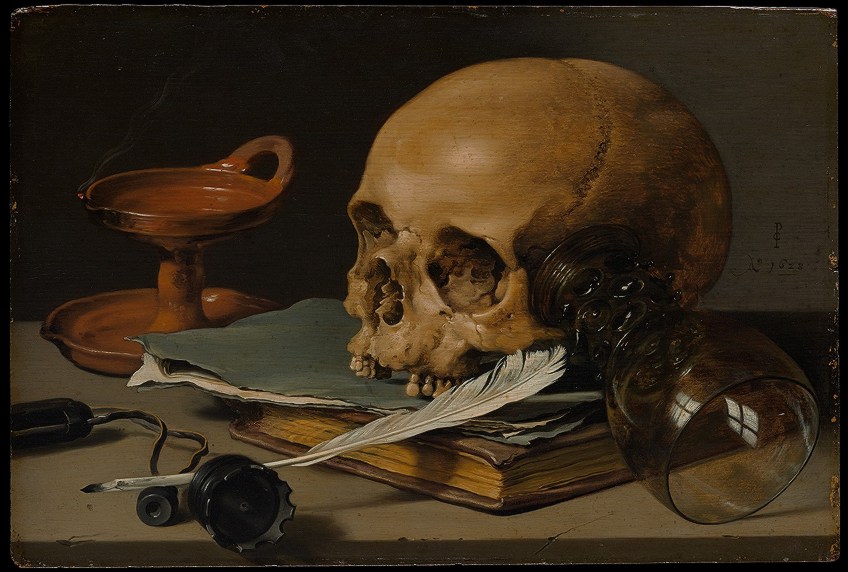
The left panel
The left panel – the donor and his new wife

Now look at the left hand panel of this triptych and we see a man and a woman kneeling down in prayer.  It is generally agreed that the man is the person who commissioned Campin to produce the work and the lady next to him is his new wife, so new that it is thought she was added later. – but who are they?  The answer seems to come from various clues dotted around the triptych.  If you look back at the central panel and the transom of the left hand window at the back of the room you will see a coat of arms.   This was the coat of arms of the Engelbrecht or Ingelbrecht family of Mechelen who according to records were living in Tournai at the time the altarpiece was being painted and the man was Jan Engelbrecht, a wealthy and prosperous businessman.  The painting is thought to have been a wedding gift for his wife and one reason why he commissioned a depiction of the Annunciation could be because of the family name Engelbrecht which translated means “angel brings”.  Behind the couple we see a man wearing a straw hat.  He is wearing the badge of Mechelen and is believed to be a Mechelen town messenger.

Right panel of triptych - Saint Joseph at work
Right panel of triptych – Saint Joseph at work

In the right-hand panel, we see Saint Joseph, who we know was a carpenter.  Again, like the central panel, there is an air of domesticity about the depiction with Joseph busying himself with his carpentry.  He sits at his bench busily drilling holes in a piece of wood.  On the table next to him we see all the tools of his trade.  Art historians believe each has its own symbolic meaning – the saw refers to the implement that St Peter used to cut off the ear of Malchus, during Christ’s betrayal and arrest; the log alludes to the cross of the crucifixion; the nails, hammers, chisels, pliers and screwdrivers are all likely references to the instruments of the Passion.

Mousetrap and tools
Mousetrap and tools

Also on the table there is a mousetrap and another on the window ledge, which Joseph has previously made.  According the American art historian, Meyer Schapiro, Joseph fashioning mousetraps had a theological meaning and talks about how Saint Augustine used the mousetrap metaphor to explain the redemption of man by Christ’s ultimate sacrifice.  He explained the necessity of the Incarnation and that human flesh was the bait for the devil who by seizing it brings about his own ruin. Saint Augustine wrote:

“…The devil exulted when Christ died, but by this very death of Christ the devil is vanquished as if he had swallowed the bait in the mousetrap.  He rejoiced in Christ’s death, like a baliff of death.  What he rejoiced in was his own undoing.  The cross of Lord was the Lord’s mousetrap; the bait by which he was caught was the Lord’s death…”

View from window of St Joseph's workshop
View from window of St Joseph’s workshop

In my last blog I looked at some works by Joachim Patinir in which he combined biblical scenes with landscapes and townscapes but for Patinir the landscape was the most important part of the depiction.  Look now how Campin has in some way combined a small townscape with this religious work. Look at the scene as seen through the window behind Saint Joseph.  The window of Joseph’s workshop overlooks a city square around which are various houses, churches and shops. This is not a depiction of a town in the Holy Land at the time of Mary but of a town in 15th century Flanders.  It could be that Campin had incorporated a scene from his birthplace, Valenciennes or Tournai or possibly Mechelen, which was the town of the commissioner of this work.

So that is the Annunciation triptych or the Merode Triptych and I suppose the only question you have is why “Mérode Triptych” and not The Engelbrecht Triptych?  The answer to that is simple.  In the nineteenth century, this altarpiece was owned by Augustine Marie Nicolette, princess van Arenberg, having been given it by her father as a wedding present when she married Charles Antoine Ghislain de Mérode.

Joachim Patinir – the early landscape artist.

Joachim Patinir  c.1480 -1524
Joachim Patinir
c.1480 -1524

When I visit local art galleries around my neighbourhood they are packed with landscape works from various local artists.  As it is Wales a few sheep and the odd shepherd are “thrown in” as a prerequisite for Welsh landscape paintings.  My featured artist today was one of the earliest landscape painters and although his paintings often incorporated religious themes which were commonplace in northern Renaissance art, his forte was his splendid detailed, visually fascinating landscapes.   He is considered one of the first modern landscape specialists. Let me introduce you to the great sixteenth century Flemish landscape painter Joachim Patinir (often referred to as Patenier) of whose style the English art historian Kenneth Clarke described as:

“…the first painter to make landscapes more important than his figures…”

So how well thought of as an artist was this sixteenth century painter? Felipe de Guevara was a sixteenth century Spanish humanist, art writer, patron of the arts and a connoisseur of Netherlandish painting and in his manuscript of 1560, which two hundred years later, was published in book form, Comentarios de la pintura, he wrote that he regarded Patinir as on being par with the great Netherlandish painters Jan van Eyck and Rogier van der Weyden.  Praise indeed!  So who was this man who achieved such great standing?

In all biographies the opening paragraph usually contains a date of birth and it is at this point, with this artist, that one hits a brick wall as his actual date of birth is unknown and his birth date, which often varies from book to book, is somewhat of an educated guess.

According to the 1521 diary of Albrecht Dürer, who described Patinir as the good painter of landscapes there was, at that time, a portrait of Patinir as a man in his forties and that would then put Joachim Patinir’s birth date somewhere around 1480.  If Patinir’s birth date is uncertain so is his birthplace albeit the consensus of opinion is that he was born in either the town of Dinant or the nearby village of Bouvignes on the River Meuse.  It is interesting to note that Dinant is situated at a point on the River Meuse where the river cuts deeply into the western Condroz plateau.  The town lies in a steep sided valley sandwiched between the rock face and the river and the spectacular landscape around this town came to influence Patinir in his landscape works.

The first concrete facts we have of him was that he was serving an apprenticeship in the Antwerp Guild of Painters in 1515, a city in which he was to live all his life.  During his time he met and worked with other great Netherlandish artists of the time such as Gérard David, Hieronymus Bosch, Quentin Matsys

The Temptation of St Anthony by Joachim Patinir  (c. 1520-24)
The Temptation of St Anthony by Joachim Patinir (c. 1520-24)

My first offering of Patinir’s work is one entitled Landscape with the Temptation of Saint Anthony Abbot which he completed somewhere between 1520 and 1524 was one of the few paintings which was signed by the artist. The painting now resides at the Museo Nacional del Prado. This work of art was not a solo effort by him, but a collaboration with Quentin Matsys, who painted the figures, which we see in the foreground.  St Anthony, who had given up his worldly possessions and devoted himself to a contemplative life, is depicted sitting on the ground.  He is surrounded by temptation in the form of three courtesans who try to seduce him.  One of the women holds out an apple which symbolises temptation reminding us of the story of Adam and Eve in the Garden of Eden.  A demon-like monkey pulls at his clothes.   Lying on the ground we see a discarded rosary symbolising the possible abandonment of faith.  Although our eyes are initially drawn to the large figures in the foreground and as we try to work out what is going on, they soon move to take in the wondrous landscape in the middle ground and background which is a setting for various events in the life of the saint. Cast your eyes to the central middle ground and one can make out Anthony and his hut which is under attack by an army of demons.  To the right of that scene we see St. Anthony sitting at the water’s edge of a lake on which is the royal barge carrying the queen and her ladies-in-waiting, some of whom are naked; all part of a seduction scene.  The rocky landscape and the river hark back to the geography of his birthplace.  The painting was acquired by the Spanish king, Philip II in 1566 and was hung in the Escorial Palace.

Landscape with St Jerome by Joachim Patinir (c. 1517)

Patinir often incorporated hermit-style life depiction in his landscape works.  This was a very popular subject in Northern European devotional works of art. This next painting focuses on these two elements.  It is his Landscape with St Jerome painting, which he completed around 1517, and which also can be found in the Prado in Madrid.  The work combines an extensive landscape background, with its vibrantly coloured and decidedly naturalistic vista, with the tale of Saint Jerome.  In this work we see the moment in time when Saint Jerome, seen huddled under a rocky outcrop, removes the thorn from the paw of the lion.  Patinir’s depiction of the saint is not as we would expect to observe him.   Jerome, who was a cardinal in the Catholic Church and eminent theological scholar, was often depicted alone, dressed in his red ceremonial robes, studiously at work in his room.  However, in this work Jerome is dressed in the rags of a hermit living outside his battered wooden shelter.  As was the case in the first painting I featured, our eyes soon leave Jerome and the lion and focus on the way Patinir has beautifully depicted, in great detail, the landscape which surrounds the saint. Perched on rocky plateau is a monastery, supposedly a depiction of the one at Bethlehem where Jerome once worked.   The painting seems to have three well defined colour patterns.  The foreground is the darkest made up of various tones of brown and black depicting Jerome’s shelter attached to the high and dark rocky outcrop.  The middle ground is full of green of differing shades from the dark greens of the tree foliage to the lighter greens of the fields further away which surround a small village.  The background is predominantly lighter with blues and greys depicting the sea and the far-off mountains although to the left we see the black clouds of an approaching storm.  This change in colours from the darkness of the foreground to the lightness of the background creates perspective in the work.  Once again the high craggy outcrops hark back to the geography of his birthplace, Dinant which nestled snugly between the high rocky cliffs which protruded out towards the River Meuse.

Charon crossing the River Styx by Joachim Patinir (1524)

My third offering is fundamentally a landscape work and yet this has a mythological connotation.  It is entitled Charon Crossing the River Styx and was completed by Patinir around 1524.  Again, like the two previous works, it can be found in Madrid’s Prado museum.  This is not a devotional work and was probably originally commissioned by a wealthy merchant and scholarly connoisseur who was also an avid art collector.  The painting is divided into three vertical parts, the centre of which is the River Styx and the outer parts represent the banks on either side of this great mythological waterway.   The River Styx was one of the five rivers that separated the world of the living from the world of the dead. In Greek mythology, it was written that the River Styx wound around Hades nine times. The name of the river derives from the Greek word stugein which means hate, and so, Styx, was the river of hate. To the left of the river is the swamp-like and rugged bank of Paradise and to the right of the river is that of Hell

Charon and the Soul
Charon and the Soul

Our eyes immediately home in on the sandy-coloured boat and its occupants which are midway between the two banks.  The boatman is Charon, the old ferry man who ferries the dead onto the underworld, and we see him crossing the river Styx towards the underworld, where the dragon-tailed three-headed dog, Cerebus, stands guard, allowing all souls to enter but none to leave. We can see Cerebus curled up in his lair at the entrance to the gates of Hell, which is depicted in the right background of the painting, burning brightly.

The Angel pointing the way

Along with Charon in the boat is the soul of a recently deceased person. The soul is looking around and has to decide on to which bank it wants to disembark.  If you look carefully at the left bank you will notice an angel perched on a mound pointing towards another waterway and another land.  This water is the Fountain of Life and it is part of Paradise.  We can see peacocks and ravens on this land and these symbolise Resurrection and Redemption.  The angel is canvassing that this should be the soul’s land of choice.  Now, if we look on the right bank that also seems to be calm and peaceful with birds flying around the trees.  Cerebus is out of sight but on the ground near the foot of the trees is a small monkey which is a symbol of the devil and that for the soul in the boat should be warning enough.  Unfortunately, looking at the way Charon is steering the boat, the soul has made the wrong choice!  The background story is interesting but for me the beauty of this work is not the characters in it but the artist’s depiction of the landscape.

Landscape with Saint John the Baptist Preaching by Joachim Patinir

My fourth and final offering of works by Joachim Patinir is entitled Landscape with Saint John the Baptist Preaching and one version of this work can be found in the Musées Royaux des Beaux-Arts de Belgique – Brussels, but the one below is from the collection of  the Philadelphia Museum of Art and in the lower right hand corner of this version we see a crest.   It is the crest of the wealthy Rem family and it could well be the wealthy merchant, Lucas Rem, the sixteenth century Augsburg merchant and art collector had this version painted for himself and had the family crest added to it.

Landscape with Saint John the Baptist Preaching by Joachim Patinir with the Rem Crest

In the painting, we have a bird’s eye view of St John the Baptist preaching to a group of followers but what I like most about the painting is the beautifully depicted imaginary landscape which acts as a backdrop to the religious scene,   Once again it crosses my mind that the religious story plays a secondary role to Patinir’s depiction of the landscape.  Once again we see a similar landscape to that in his other works – tall rocky outcrops closely bordering on to a river, which because of the religious nuance of the painting could have represented the River Jordan and on the left bank, although not clear in this picture, is a depiction of the baptism of Christ, in the Jordan river, by John the Baptist.

We observe St John, bent over, leaning heavily against a sturdy branch of a tree.  It is almost as if he is leaning against a lectern or pulpit rail as he looks down upon his followers who sit entranced by his words.  In the foreground to the left of the painting we see a tree which is dying around which is a vine.   This is thought to allude to the Tree of Knowledge in the Garden of Eden which withered and died once Adam had taken a bite of the apple offered to him by Eve.  According to legend, the tree eventually came back to life once Jesus Christ had died on the cross and in so doing, had atoned for the sins of the world.

Both John the Baptist and his audience are in the shade as the bright light we see lighting up the meandering river, which wends its way towards the horizon, is incapable of penetrating the thick tree canopy above the group.  As was the case in the earlier painting, Patinir has used different colour combinations to craft perspective.  Dark browns and greens in the foreground around the people gradually change to lighter greens of the banks of the river and then in the distance lighter blues and greys become the dominant colours.

Bayard Rock, Dinant
Bayard Rock, Dinant

There is a fascinating delicacy about Patinir’s landscape work and as I have said before this favoured landscape depiction of the artist probably stemmed from what he remembers of his birthplace around Dinant and the rock structure there known as the Bayard Rock, which looms above the town and the River Meuse.

In German, Patinir would be classified as a painter of Weltlandschaft which translated means world landscape.  The Weltlandschaft painters completed works depicting panoramic landscapes as seen from a high viewpoint.  These works of art typically included mountains and lowlands, water, and buildings. As in Patinir’s works, the subject of each painting is usually a Biblical or historical narrative, but the figures included in the work are secondary to their surroundings and they were often made-to-order by secular patrons.  The landscapes in these works were not geographically accurate.  In her 2005 book, Seventeenth-century Art and Architecture, Anne Sutherland Harris, a professor of Art History, describes this form of art:

“…They were imaginary compilations of the most appealing and spectacular aspects of European geography, assembled for the delight of the wealthy armchair traveller…”

So again I ask – was Patinir a religious painter who liked to add a landscape background to his work or was he a landscape painter who liked to add, or get somebody else to add, figures appertaining to religious and mythological stories?  Perhaps his friend Albrecht Dürer had the answer to this conundrum when he described his friend as:

“…der gute Landschaftmaler…

(the good painter of landscapes)

Georgia O’Keefe. Part 1 – The early years and the “Specials”

Georgia Totto O'Keefe photograph by Alfred Stieglitz (1918)
Georgia Totto O’Keefe
photograph by Alfred Stieglitz (1918)

If I was to ask you who was the most quintessential American artist, I wonder whom you would choose. Would you go for one of the nineteenth century Hudson River School artists such as Frederic Church, Asher Durand and Thomas Cole or would you select one of the pioneering and tenacious American female painters who fought hard to gain a foothold in the male dominated world of art, such as Mary Cassatt and Elizabeth Jane Gardner. Perhaps you would decide on one of the great twentieth century painters such as Andrew Wyeth or Edward Hopper or the folk artist Grandma Moses. Then of course, let us not forget, there is John Singer Sargent and James McNeill Whistler and naturally there are the modern greats of American art such as Rofko, Warhol, Pollock and de Kooning. I suppose it is impossible to single out one from the list of artists who paint in so many different genres. However, for me, the painter who symbolises America is Georgia O’Keefe and in my next blogs I will look at her life and feature some of her best-loved paintings.

The O'Keefe farmhouse. outside Sun Prairie, near Madison, Wisconsin
The O’Keefe farmhouse.
outside Sun Prairie, near Madison, Wisconsin

Georgia Totto O’Keeffe was born on November 15, 1887, the second of seven children. She was the eldest of five girls and had a younger and elder brother. Her father, who was of Irish descent, was Francis Calyxtus O’Keefe, who ran a successful farmstead on the outskirts of the village of Sun Prairie, Wisconsin, along with his wife Ida Ten O’Keefe (née Totto), whose maternal grandfather was a Hungarian count. The farm was spread over 1700 acres of land on which they raised cattle, horses and grew crops. When Georgia was five years of age she attended the small one-roomed South Prairie Town Hall school. She progressed well and she and her siblings were constantly being pushed to learn by their mother, who would read stories to her children and play the piano for them. In fact Georgia went on to play both piano and violin.

At the age of eleven Georgia developed an interest in drawing and painting and so her mother arranged private art tuition for her and two of her sisters, Ida and Anita. Georgia revelled in what she learnt, She then attended the Sacred Heart Academy in nearby Madison as a boarder and in a conversation with a friend and fellow 8th grade pupil she talked about her future dreams:

“…I am going to be an artist!…..I don’t really know where I got my artist idea…I only know that by that time it was definitely settled in my mind…”

The O'Keefe's house in Williamsburg
The O’Keefe’s house in Williamsburg

In 1902 her family moved to Williamsburg, Virginia but Georgia, who was fifteen years old, stayed behind for a short time with her aunt. Soon after she re-joined her parents in Peacock Hill, a suburb of Williamsburg and enrolled as a boarder at the private Chatham Episcopal Institute for Girls. She continued to love art and her artistic talent was recognised by all and her fellow students elected her art editor of the school yearbook. In her yearbook was written the telling verse:

“…O is for O’Keefe.

an artist divine.

Her paintings

are perfect and

drawings are fine…”

In 1905, Georgia, now seventeen years of age, graduated from high school and enrolled at the Art Institute of Chicago. It was here that she honed her skills as an artist and studied composition, anatomy and life drawing. Her anatomical drawing class tutor was John Vanderpoel, the Dutch-American artist and teacher, who was best known as an instructor of figure drawing and whose 1907 book, The Human Figure, became a standard art school resource. Georgia O’Keefe excelled at the Academy and all was going well until the summer of the following year when she went home and contracted typhoid and was so ill that she was unable to rejoin the Academy. She had to remain at home to recuperate for more than twelve months.

Dead Rabbit with Copper Pot by Georgia O'Keefe (1908)
Dead Rabbit with Copper Pot by Georgia O’Keefe (1908)

When she finally got her health back in 1907, she decided to resume her art career but instead of returning to Chicago she enrolled at the Arts Student League of New York which was one of the top art colleges of the time. One of her tutors was William Merritt Chase, who was one of the foremost art teachers of his generation. At this institution aspiring young artists were trained in the European tradition, namely, learning to paint portraits and still-lifes. Once again her artistic talent shone through and the following year she won the League’s William Merritt Chase still-life prize for her oil painting Untitled (Dead Rabbit with Copper Pot). Her prize was a scholarship to attend the League’s outdoor summer school at Lake George, in upstate New York, east of the Adirondack Mountains.

In 1908 things changed for Georgia. The Arts Student League of New York wanted to keep to the European tradition of art tuition, copying in the style of the Old Masters. It was a conservative formula and one will never know whether it was this rigid mimetic way of teaching art that disillusioned Georgia, but at the end of her year’s tuition in the autumn of 1908, she decided that she no longer wanted to become a professional artist. Another reason for giving up on her art studies was that her father’s business had collapsed and the family was in need of an extra income and so Georgia gave up her studies and embarked on a career as a commercial artist in Chicago where she spent her time designing adverts and company logos. She did not paint another picture for four years.

Georgia O'Keeffe, aged 30
Georgia O’Keeffe, aged 30

This artistic drought ended in 1912 when she attended a summer course at the University of Virginia in Charlottesville where one of the classes was run by Alon Bement of the Teachers College, Columbia University, in New York City. It was Bement who introduced O’Keefe to the radical thinking of his colleague, Arthur Wesley Dow, the head of the Faculty of Fine Arts at New York’s Columbia University Teachers College. Dow believed in the Modernist approach to art and postulated that rather than just copying nature, art should be created by the various elements of composition such as line, mass and colour. He put his thoughts into words in his 1899 book entitled Composition: A Series of Exercises in Art Structure for the Use of Students and Teachers. He summed his thoughts up in the introduction to the second edition of the work which came out in 1912. He wrote:

“…Composition … expresses the idea upon which the method here presented is founded – the “putting together” of lines, masses and colors to make a harmony. … Composition, building up of harmony, is the fundamental process in all the fine arts. … A natural method is of exercises in progressive order, first building up very simple harmonies … Such a method of study includes all kinds of drawing, design and painting. It offers a means of training for the creative artist, the teacher or one who studies art for the sake of culture…”

Georgia O’Keefe who had tired of the mimetic teachings of the academy was enthralled by Dow’s ideas and her love for art was rekindled. In 1912, she moved to Amarillo, Texas, where she had accepted a position as supervisor of art in the city’s public schools. She took up a post in the August of 1912 as an art teacher at City Public School of Amarillo but she returned to the University of Virginia’s to attend the summer course the following year; this time as an assistant to Bement and in the autumn of 1914 she went back to New York and enrolled for two semesters at Columbia University Teachers’ College where she studied under Dow himself. It was around this time that she discovered the work of Arthur Garfield Dove. Dove, an American modernist painter, who has often been labelled as the first American abstract artist. He placed great emphasis on the artist’s subjective experience of his surroundings and on the intrinsic emotional power of colour and line rather than just copying from nature. To Georgia this was not just a revelation but it was the kind of art, which she believed in and it was to influence her art for the rest of her life. For her, it was inspirational, and she happily set off on a new artistic journey. She was excited at the new ideas which flooded her brain and described how she felt:

“…I said to myself ‘I have things in my head that are not like what anyone has taught me – shapes and ideas so near to me – so natural to my way of thinking that it hasn’t occurred to me to put them down.’ I decided to start anew – to strip away what I had been taught – to accept as true my own thinking……. I was alone and singularly free, working into my own, unknown – no one to satisfy but myself…”

You can sense her joy. You can sense her feeling of casting off the shackles of rigid academic teaching. You can sense the elation in the way she saw her future.

Drawing XIII by Georgia O’Keeffe, 1915

In September 1915, she accepted a teaching post at Columbia College, South Carolina and it is around this time she begins to experiment with her art, producing a series of amazing cutting-edge charcoal abstract drawings. One such drawing was entitled Drawing XIII which was completed in 1915. In this work we see that the image is sub-divided into three parallel sections. The left hand section has wavy vertical lines which reminds one of a meandering river although some say it is more like a vertical flickering flame reaching upwards. The central part of the work consists of four rounded bulbs which if we continue with our thoughts of nature could then be construed as round top hills. An alternative to this premise is that they are four densely foliated trees. The right hand section comprises of a series of jagged lines which could be a representation of mountains and so in a way this drawing may be a bird’s eye view of a range of mountains and a flowing river with trees separating the two.

Early No. 2 by Georgia O'Keefe (1915)
Early No. 2 by Georgia O’Keefe (1915)

Another of her charcoal works was entitled Early No. 2 which she also completed in 1915. O’Keefe has followed the advice of Arthur Dow and focused on the lines, shapes and tonal values which she, like Dow, believed were the fundamentals of the picture. Her reasoning behind these early drawings being in black and white and devoid of colour was her belief that colour would distract viewers from what she had hoped to create. It was all about curves and geometrical shapes and the clever balance between areas of the work which were light and shaded.

No. 12 Special by Georgia O'Keefe (1916)
No. 12 Special by Georgia O’Keefe (1916)

Georgia O’Keefe was proud of her first foray into this new world of art and she would often refer to these early drawings as “Specials” indicating how much they meant to her. She mailed some of these drawings to her friend, Anita Pollitzer, who had been a Columbia classmate of hers. Pollitzer, who was now a photographer in May 1916, took them to show the internationally reknowned photographer and art impresario, Alfred Stieglitz, who had his gallery, 291, at 291 Fifth Avenue, New York. Stieglitz was impressed with what he saw and described them as:

“…the purest, finest sincerest things that have entered ‘291’ in a long while…”

Special No. 15 by Georgia O'Keefe (1916)
Special No. 15 by Georgia O’Keefe (1916)

Unbeknown to O’Keefe, Stieglitz exhibited her drawings at his gallery alongside works by other artists. When O’Keefe found out about this, she was not best pleased but later forgave him. This initial collaboration between artist and gallery owner was to be a turning point in Georgia O’Keefe’s artistic life.

…………….to be continued.


Portrait of an Infanta, Catherine of Aragon by Juan de Flandes

Portrait of an Infanta, Catherine of Aragon by Juan de Flandes (c.1496)

Today, as promised, I am featuring another beautiful and yet quite simple portrait that I came across when visiting the Thyssen-Bornemisza Museum in Madrid.  The work was one of many which hung amongst other fifteenth century paintings.   The reason it stood out for me was because of the beauty and innocence of the eleven-year old sitter whose life and future had been mapped out for her at the age of three.  She was born into an age when planned betrothals and marriages between royal houses was the norm.  Her life, like that of her mother, was to be a life of great turmoil.  The girl in my featured painting is Catherine of Aragon who was the daughter, and youngest surviving child of Queen Isabella I of Castile and her husband King Ferdinand II of Aragon. 

Catherine was born in December 1485 in the small town of Alcalá de Henares some twenty miles from Madrid.  She was the youngest of five children having one brother, John and three sisters, Isabella, Joanna and Maria.    Even at the tender age of three plans were being formulated by her parents to arrange a beneficial betrothal for her.  Not necessarily beneficial to her but beneficial to her country and her parents.  Catherine’s parents were cousins and belonged to the House of Trastámara, a powerful dynasty of kings in the Iberian Peninsula.  Isabella was the half sister and heiress to Henry IV of Castile and Ferdinand was the son of John II of Aragon.  The two of them were betrothed and went on to marry in 1469 in an attempt to consolidate two of the main royal houses, for in 1474 on the death of Isabella’s half brother Henry, she became Queen of Castile and through a prenuptial agreement based on jure uxoris (literally,by right of his wife”) Ferdinand became, not the Prince Regent, but the King of Castile.  Five years later when his father died Ferdinand also became King of Aragon and this unification became the basis of what we know as modern Spain.

According to two of her biographers, Alison Weir (The Six Wives of Henry VIII) and Antonia Fraser (The Wives of Henry VIII), Catherine was “quite short in stature with long red hair, wide blue eyes, a round face and a fair complexion”.   Catherine, through her mother’s side of the family, was connected to the English royal family and so her parents turned to the English royal house for a suitable husband for their daughter.   They also believed that an alliance with England would safeguard them against the predatory French.  Their efforts to find a husband for their daughter found favour with Henry VII the current ruler of England who believed a liaison with the Catholic rulers of Spain and the house of Trastámara would be very advantageous for the English House of Tudor.  And so, in 1488, when Catherine was just three years of age, she was betrothed to King Henry VII’s oldest son Arthur, the Prince of Wales, who at the time was two years of age !   In May 1499 Catherine and Arthur were married by proxy.  She was still six months away from her fourteenth birthday and he was a few months short of his thirteenth birthday.  It was not until 1501 that Catherine left Spain and travelled to London to meet her future husband Arthur although they had been corresponding for a number of years.  They married that November and went to live in Ludlow Castle but five months after the ceremony Arthur died of what was termed “sweating sickness” which was a highly virulent disease that had reached epidemic proportions in England at that time.  Catherine was also struck down by the illness but survived. 

The rest of Catherine of Aragon’s life, her marriage and divorce from Henry VIII, Arthur’s brother, has been well documented and I will not speak more about her life.  The portrait that I am featuring today is a painting of the young girl herself, entitled Portrait of an Infanta, Catherine of Aragon.  It was completed around 1496 when she was about eleven years old.  The artist was the Flemish painter, Juan de Flandes.  Little is known about the artist except that his name would indicate he was born in and spent his early life in Flanders.  It is not until 1496 that we have some documented evidence of his life for his name appears as a court painter in the royal household accounts of Queen Isabella of Castile.   It is thought that Juan de Flandes had, like many other European painters, come to Spain and to the royal household of Isabella and Ferdinand and along with them had worked on a number of religious paintings, including the forty-seven small (each approximately 21cms x 16cms) panelled polyptych entitled The Polyptych of Isabella the Catholic, which has since been split up into its many parts and which only twenty-seven survive. 

Juan de Flandes never returned to his homeland and worked for the royal Spanish household until Isabella died in 1504.  From there he moved to Salamanca where, for the next three years, he worked on the main altarpiece for the city’s university chapel.  During this period he also received commissions for work on an altarpiece for the Salamanca cathedral.   Then four years later, in 1509 he lived in Palencia with his wife.  In Palencia, he again completed a number of commissions for the Catholic Church.   Juan de Flandes is thought to have died in 1519 aged 54. 

My featured painting is a beautiful work which captures Catherine’s beauty and innocence and comes before the traumatic and sad life which she was to endure.   There is even some doubt that the portrait is of Catherine.  Some say that it could be of her sister Joanna but at the time of the painting (1496) Joanna would have been seventeen years of age and the girl in the painting does not look that old.   Also if we look at the work we can see she is delicately holding a rose and this is thought to symbolise her future intended connection with the English House of Tudor, the Tudor Rose.  Other art historians such as the Elisa Bermejo tend to believe that the rose is just symbolic of the youthfulness of the sitter whilst others believe that it is indeed Catherine and this painting was just a betrothal portrait. 

Portrait of Young Catherine of Aragon by Michael Sittow (C. 1504) Kunsthistoriches Museum, Vienna
Portrait of Young Catherine of Aragon
by Michael Sittow (c.1504)
Kunsthistoriches Museum, Vienna

One of the other Nertherlandish-style  painters who was at Queen Isabella’s court with Juan de Flandes was Michael Sittow and he too painted a portrait of the young Catherine, some seven years later, and one can see a definite likeness between his and Juan de Flandes’ portraits. 

I love Juan de Flandes’ portrait of the young Catherine and stood before it for many minutes contemplating what was going through the young girl’s mind as she sat before the artist, totally unaware of what life in the future held for her.