The Forerunner by Eleanor Fortescue-Brickdale

The Forerunner by Eleanor Fortescue-Brickdale (1920)

Today I am going to continue looking at the life of Eleanor Fortescue-Brickdale and feature another of her paintings.   Whilst most of the Pre-Raphaelite Brotherhood continued to be household names even though it was more than a century after their deaths, not all those who followed in their footsteps are as well recognised today as they were at the height of their fame.

When Eleanor was growing up she would have been aware of the art of the Pre-Raphaelite Brotherhood as there were still commemorative exhibitions and books being published about their work.   There is no doubt that even at that early age the publicity surrounding the art work of the Pre-Raphaelite Brotherhood would have influenced Eleanor.   She was a painter, who continued the Pre-Raphaelite tradition, reworking romantic and moralising medieval subjects in naturalistic and often intense colour and elaborates detail.

In my last blog I had reached 1895 and Eleanor had just been accepted at the Royal Academy Schools in London having previously studied art at St John’s Wood School.   Whilst attending the Royal Academy School she met Byam Shaw and their friendship and working relationship endured for almost twenty-five years until his untimely death, aged forty-six in 1919.  Byam Shaw was a painter, decorator and illustrator, who was the same age as Eleanor, and had been born in Madras in 1872.   Byam was to become a big influence on her artistic work and like Eleanor he had been commissioned to do numerous pen and ink drawings and watercolours for books.

Whilst at the art school, Eleanor Fortescue-Brickdale won a £40 prize in 1896 for her design for the decoration of a public building and, the following year, she made her debut with a black and white work in the RA’s exclusive Summer Exhibition.  Following this success she progressed to colour illustrative work and by the end of the century she was making a name for herself as a painter with oils which she began exhibiting at the Royal Academy and in my last blog I featured the first oil painting she had exhibited there, entitled The Pale Complexion of True Love.  In 1899 she received a commission for a number of watercolours from Charles Dowdeswell who with his brother, Charles, were art dealers who owned the Dowdeswell and Dowdeswell art gallery in New Bond Street, London.   She completed the commission in 1901 by producing forty-five watercolours and her work was shown at the Dowedswell gallery under the Shakespearean title Such Stuff as Dreams are Made of.  The press greeted the exhibition as a spectacular success and her work was immediately likened to that of the Pre-Raphaelite Brotherhood painters of the 1850’s.  In the June 1901 issue of The Artist, her exhibition was reviewed:

“…Rarely, if ever has a woman painter made a great reputation as quickly and as thoroughly as Miss Eleanor Fortescue-Brickdale, whose series of watercolour drawings has, during last month, drawn the whole of artistic London to the Dowdeswell Galleries……She combines great technical skill with extremely felicitous, quaint imagination and rare poetic feeling…. [This exhibition] should be sufficient to secure her a leading position among the women artists of this country…”

All but two of her works were sold and with the money she received she acquired her own studio in Holland Park, in west London, which was the home of many artists.   This was to be her artistic base for the rest of her life.  She had been living at home with her sister Kate and her mother Sarah.  Her father had been killed in a climbing accident in the Alps in 1894.  In 1908 Eleanor, her mother and sister moved house and went to live in West Kensington where she would remain for the next thirty years.  Her mother died the following year.

Her name as an artist was indelibly made after the Dowdeswell exhibition and numerous journals and newspapers wrote about her and her work.  In 1905, despite the large number of painting commissions she received, she decided to take up teaching art and, along with her old artistic friends Byam Shaw and Rex Vicat Cole, taught one day a week at the art school of King’s College for Women. By 1909 these three were looked upon and advertised as leading the art courses at the college.  However the following year Cole and Shaw were disillusioned with the teaching at the college and, along with Eleanor, they left.  They set up their own art school known as the Byam Shaw School of Art.  Shaw and Cole were the joint principals and Eleanor Fortescue-Brickdale was in charge of the Watercolour and Composition sections.    In 2003, this school of drawing and painting was integrated with Central Saint Martins, but maintained its individual title and teaching approach.

Eleanor carried on with her work as an illustrator of books and was never short of commissions.  She was a hard and diligent worker.  Maybe she worked too hard as in the early 1920’s she was struck down with a long and unexplained illness which prevented her working and affected her eyesight.  It was this problem with her eyesight that made her concentrate on larger works rather than the finely detailed watercolours in which she had specialised.  The appearance of her works at various exhibitions started to decrease and it was during this time that she made a number of glass designs which were seen in churches around the country, and which no doubt mirrored the stained-glass work of the Pre-Raphaelite painter Burne-Jones.  One such window, which she designed in 1928, was for the Bristol church of All Saints’ Clifton commemorated the passing of her brother John in 1921.

Eleanor Fortescue-Brickdale remained artistically active well into her sixties although she bemoaned the fact that in her mind, Pre-Raphaelitism was no longer wanted.  In 1938, aged sixty-six she suffered a stroke which put an end to her art.  She died seven years later in March 1945, aged 73.

For my featured painting today I have chosen a work by Eleanor Fortescue-Brickdale which I saw last week at the Lady Lever Museum exhibition of her work.  It was a painting which immediately caught my eye and I was curious to know what it was all about.  The work, which she completed in 1920, is entitled The Forerunner and has the subtitle:  Leonardo da Vinci showing a model of his flying machine to Ludovico Sforza, Duke of Milan, and his Court.

The Forerunner title derives from a novel entitled The Romance of Leonardo Da Vinci: The Forerunner by Dmitry Merezhkovsky and was a fictional tale about the conflicted life of Leonardo da Vinci: genius on the one hand,  counterbalanced by the pagan world, in conflict with the fanatical religious climate in which he lived.

The painting is set in the court of Ludovico Sforza, the Duke of Milan and depicts Leonardo, the artist, theoretician, designer and scientist, demonstrating his model flying machine to his patrons Ludovico Sforza and his wife, Beatrice d’ Este.   In the painting, Beatrice d’ Este is seated on the left and appears totally indifferent to Leonardo’s presentation.  On the other side of Leonardo stands the Duke.  He seems bemused and somewhat sceptical of what Leonardo is showing him and what he is being told.   Leonardo had a troubled relationship with his patron Ludovico Sforza.   The Duke had rubbished many of Leonardo’s ideas and on occasions failed to pay Leonardo for his commissioned work.  There was also little love lost between Leonardo and the Duchess, Beatrice d’ Este, as she was angry with the artist for painting a portrait of her husband’s mistress, Cecilia Gallerani, a painting, which we know as Lady with an Ermine.  In this painting Fortescue-Brickdale has included Cecilia in the painting standing next to the seated duchess and to her left is the Duchess of Albano.  Positioned behind the seated duchess, in a hooded monk’s habit, is Girolamo Savanarola, a much feared Dominican friar and preacher who was known for his prophecies of civic glory and calls for Christian renewal. He denounced clerical corruption, despotic rule and the exploitation of the poor.  In a way his addition to the painting is a reminder of his and the Church’s antagonism towards scientific advancement.  Savonarola was to become very powerful in Florence after the fall of the Medici family in 1494.  For all those in the painting who doubted the wisdom of Leonardo’s new invention there was one avid believer.   In the centre of the painting, with his back to us, Eleanor Fortescue-Brickdale has added the small figure of a boy who looks up at Leonardo, mesmerised by what the great man holds in his hands.  The boy is Ludovico’s son Cesare.

It is a sumptuous painting measuring just 60cms high and 122 cms long.  Brickdale’s interest in the subject reflects her enthusiasm for Renaissance art and her fascination with Leonardo da Vinci.   Another possible explanation for the choice of the theme of this painting could be due to Eleanor having personal connections with Charles Rolls the aviator and the fact that she had always shown an interest in aeroplane technology.

The painting was bought by Lord Leverhulme in 1920.  In the Walker Art Gallery in Liverpool there is a preliminary watercolour study for ‘The Forerunner’ .

The Pale Complexion of True Love by Eleanor Fortescue-Brickdale

The Pale Complexion of True Love
by Eleanor Fortescue-Brickdale (1898)

Today I want to look at the life of Pre-Raphaelite painter, Mary Eleanor Fortescue-Brickdale, who was born thirty-four years after the original seven English Pre-Raphaelites painters formed an artistic group, known as the Pre-Raphaelite Brotherhood, whose aim it was to reject classicism and return to the vibrant colours and complex details of earlier Italian and Flemish art. But while the Brothers were starting to go their own way artistically and the Brotherhood was heading for extinction, their ideas were not.

When I visited the Pre-Raphaelites: Victorian Avant-Garde at the Tate Britain a week ago I was struck by just the few paintings on display which had been painted by women.  There were a couple of watercolours by Dante Rossetti’s model and mistress, Elizabeth Siddall.  There were some early photographs taken by Julia Margaret Cameron and some embroidery by Jane Burden who later became Mrs Jane Morris, but little else from any other female Pre-Raphaelite painters.  So it was very pleasing to find that a local art gallery, not too far from me, The Lady Lever Gallery in Port Sunlight, Wirral had just put on a small exhibition of work by a feminine Pre-Raphaelite painter entitled A Pre- Raphaelite Journey which showcased the art of Mary Eleanor Fortescue-Brickdale.  In my next couple of blogs I want to look at the life of this gifted female artist and feature some of her paintings.

Mary Eleanor Fortescue-Brickdale was born in the prosperous London suburb of Upper Norwood, Surrey in 1872.   She was brought up in an affluent household which, besides the family, also housed four live-in servants and a governess.  Eleanor was the youngest of five children.  Her father Matthew was a Lincoln Inn’s barrister who had married Sarah Anna Lloyd, the daughter of a judge from Bristol.   At this juncture in Victorian England, parents expected their sons to prosper at school and go onto university, after which they would secure well paid, high status professions.  Daughters were not expected to achieve any great academic status but would harness all their efforts into securing a “good” marriage.  Mary Eleanor Fortescue-Brickdale’s two brothers achieved all that was expected of them.  Both Charles and John Fortescue-Brickdale graduated from Oxford University, following which Charles, like his father became a lawyer and John followed a career in medicine.  Of the three daughters, Anne had died at the age of six leaving Eleanor and Kate to fulfill their parents’ plans of finding themselves “good” husbands.  However, unlike their brothers, they were not to realize their parent’s wishes as neither married.

The Fortescue-Brickdale family had tentative ties to the world of art with Eleanor’s father being a fellow Oxford university student of John Ruskin and later Eleanor’s brother Charles, who was an amateur artist, would attend Ruskin’s lectures at Oxford.  Eleanor had originally shown an interest in painting and drawing but merely as a pastime.  As she grew older, she began to take art more seriously and consider it as a possible future profession.  In 1889, aged seventeen, Eleanor enrolled at the Crystal Palace School of Art, Science and Literature.  It was not considered a prestigious art school and did not have any famous painters on the staff but it was close to where Eleanor lived and so was deemed fit for purpose.  The school was open to both boys and girls but the science classes were only for young men whilst the art classes were solely for young women.  The only mingling of the sexes occurred in the music classes.

In 1894, tragedy was to strike the Fortescue-Brickdale family with Eleanor’s father being killed whilst climbing in the Swiss Alps.  Eleanor having gained a basic knowledge of art and artistic techniques whilst at the Crystal Palace School of Art, realised that to become a professional artist she needed to attend a much more professionally run art establishment and in the mid 1890’s she enrolled at the St John’s Wood Art School.  The aim of this school was to train students for the Royal Academy Schools and it was very successful at this, as between 1880 and 1895, 250 out of 394 students admitted to the Royal Academy had come from St John’s Wood Art School and furthermore, of the 86 prizes awarded to students by the Royal Academy, 62 had been ex-pupils of St John’s Wood Art School.   To achieve entry to the Royal Academy Schools as a probationer one had to submit certain prescribed pieces of work.  If the submitted works were considered acceptable, the candidate then had to endure a three month probationary period before being allowed on to a full-time course.   In January 1895, on her third attempt to become a probationer, Eleanor was admitted.  Despite the initial problems of being accepted as a probationer, her work during her probationary period was looked upon as being so good that she was allowed to embark on a full-time course after just three weeks.

Eleanor managed to cover the costs of her first year at the Academy by selling some of her work which she used to work on before and after attending the Academy School.  Although this was a financially good option for her,  it made her days very long.  Two years later in 1897 she was awarded a prize for her design work and the recognition she received for this led to a number of commissions, including one from her brother Charles’ legal practice, and one for illustrating a book entitled A Cotswold Village, which was written by her brother-in-law, J Arthur Gibbs.  Soon she became one of the most visible female artists of her time.  One must remember that Eleanor was a single woman, had not gone to a public school instead had been home educated, did not go to university and so lacked the opportunity in later life to cultivate connections with ex students.  The one thing that was going for her was the sector of society in which she grew up.  Their neighbourhood family friends included well-to-do bankers and lawyers, landed families who had houses in town, all of which needed decorating and acquiring paintings to hang on their walls.  These were people with disposal incomes.  They were also readers of upper-class publications such as Country Life and The Ladies Field and Eleanor managed to find work at these magazines using her well-loved artistic design skills.  She contributed illustrations to these magazines for over ten years and from people seeing and admiring her work she began to build up a sizeable patronage

In 1898 she had her first major work of art entitled The Pale Complexion of True Love accepted for the Royal Academy Exhibition of that year.  This is my featured painting of the day.  The title of the work is taken from Act 3 Scene IV of Shakespeare’s pastoral comedy, As You Like It, when the elderly shepherd, Corin speaks of the shepherd, Silvius’ unrequited love for the shepherdess, Phebe:

“…If you will see a pageant truly play’d,
Between the pale complexion of true love
And the red glow of scorn and proud disdain,
Go hence a little and I shall conduct you,
If you will mark it…”

The first thing that strikes you with this painting is the sumptuous red of the lady’s gown.  It is interesting how the artist has used such a bright spectrum of colours.  To many people, the Pre-Raphaelite painters use of bright colours is too garish and lacks subtlety.  To others it is this vibrancy of colour which enhances the work.   I will let you decide which camp you find yourself in.

In my next blog I will continue the life story of Eleanor Fotrtescue-Brickdale and look at another of her paintings.

Une loge aux Italiens (A Box at the Theatre des Italiens) by Eva Gonzalès

Une loge aux Italiens (A Box at the Theatre des Italiens) by Eva Gonzalès (1874)

I had intended this offering to be my previous blog but when I researched into today’s featured artist and her painting I saw there was a connection between this work of hers and a similar one completed by Renoir in that same year.  My Daily Art Display featured artist today is Eva Gonzalès and the work I want to look at is entitled Une loge aux Italiens (A Box at the Theatre des Italiens) which she completed in 1874.

Eva Gonzalès was born in Paris in 1849.  Her father was the novelist and playwright, Emmanuel Gonzalès, a Spaniard but naturalised French.  Her mother was a Belgian musician.  From her childhood she was immersed in the literary world as her parents house was often used as a meeting place for critics and writers.

Eva began her artistic career in 1865, at the age of sixteen, when she began to study art.  Initially she studied under Charles Joshua Chaplin, the French society portraitist, who ran art classes specifically for women in his atelier and who, the following year, would teach the American female artist Mary Cassatt.

Portrait of Eva Gonzalès by Manet

Just before her twentieth birthday in 1869 she became a pupil of Édouard Manet and also used to model for him and many of the other Impressionist artists.  It was whilst at his studio that she met Berthe Morisot who was also working with Manet and posing for some of his works.  There would seem to have been an intense  rivalry between the two females.  According to Anne Higonnet’s book Berthe Morisot, Morisot wrote to her sister about Gonzalès and Manet’s attitude towards her saying:

“… Manet preaches at me and offers me the inevitable Mlle Gonzalès as an example; she has bearing, perseverance, she knows how to carry something through, whereas I am not capable of anything.   In the meantime, he begins her portrait again for the twenty-fifth time; she poses every day, and every evening her head is washed out with black soap.  Now that’s encouraging when you ask people to model…”

Repose by Édouard Manet

One can easily detect Berthe Morisot’s jealousy of Eva Gonzalès in that passage.  The painting referred to by Berthe Morisot was entitled Portrait of Eva Gonzalès which Manet was working on and which he exhibited in the 1870 Salon.  It is now housed at the National Gallery, London.  At the same time that he was painting the portrait of Eva Gonzalès he was also painting a work entitled Repose which was a portrait of Morisot and which he also exhibited at the 1870 Salon, as almost a companion piece.  This portrait of Morisot can be seen in the Rhode Island School of Design, Museum of Art, Providence, Rhode Island.  As you can see by the passage above, Morisot was annoyed by Manet’s painting of Gonzalès.   What rankled Morisot the most was probably how Manet had portrayed the two young ladies.    So what could have annoyed Morisot about Manet’s depiction of her?  Look at the two paintings.  Both young women, both wear similar clothing, both have been portrayed as young and pretty but the one big difference is that Morisot is depicted half laying back on the sofa in what one could describe as a languid and idle pose whereas Eva is portrayed as a budding artist actively at work.   What also should be kept in mind is that Morisot did not look upon herself as merely a “pupil” of Manet.  For Morisot,  her relationship with Manet was almost as equals rather than master and pupil.  In her relationship with Manet, she was also much more forceful and self-confident than Gonzalès, who was more of a willing disciple of Manet and who would put up with Manet’s abrupt manner,  whilst continually absorbing his teaching.   Of course there was another significant difference between the two young women – age!   Eva was more than eight years younger than Morisot.

Unlike Morisot, but like her mentor Manet, Eva Gonzalès decided not to exhibit any of her work at the controversial Impressionist Exhibitions but she has always been grouped with them because of her painting style.   However, she did regularly have her work shown at the annual Salon exhibitions in the 1870’s.  Her works received mixed comments.  The critics who were supporters of the Impressionist artist liked her work.

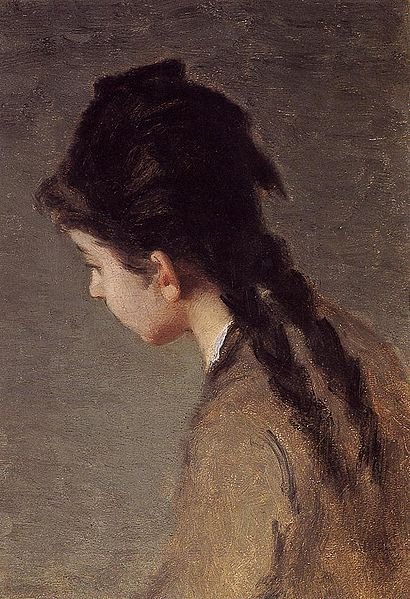
Portrait of Jeanne Gonzalès in Profile by Eva Gonzalès

In 1869 Eva married Henri Charles Guérard, an etcher, lithographer  and printmaker, who was a close friend and sometime-model for Édouard Manet and who modelled for some of his wife’s paintings along with his sister-in-law Jeanne (La femme en rose, Jeanne Gonzelès).  In 1883, a month after her 34th birthday, she gave birth to a son, John.  Sadly, her life was cut short when she died following complications of childbirth.  It was believed to have been Puerperal Fever.    Her death came just six days after the death of her one-time mentor Édourad Manet.   Two years after her death a retrospective of Gonzalès’ work was held at the Salons de La Vie Moderne in Paris where over eighty of her paintings were put on display.

Five years later, in 1888, Henri-Charles Guérard  married Eva’s younger sister, Jeanne Gonzalès, also an artist.   My featured painting by Eva Gonzalès is entitled Une loge aux Italiens (A Box at the Theatre des Italiens) and you can obviously see the similarity between her painting and my previous offering entitled La Loge by Pierre-Auguste Renoir.  I decided to feature his first and then let you compare her painting with his.

As I discussed in my last blog, the auditorium of a  theatre and especially the theatre box were fashionable places for an exchange of society chit-chat and gave the theatregoers the opportunity to be seen at their best.  The subject of the theatre and theatre goers was a subject frequently chosen by the Impressionists, such as Cassatt and Degas but probably the most celebrated of this genre was Renoir’s La Loge (The Theatre Box) and it is interesting to compare it with this work by Eva Gonzalès which she completed in the same year, 1874.  This painting by Gonzalès was submitted to the Salon jurists for inclusion in the 1874 Salon but was refused.   Eva Gonzalès then made some changes to the painting and five years later submitted it to the 1879 Salon and this time it was accepted.  The critics loved the work.

There are some similarities to this painting of hers and that of her former tutor Édouard Manet in the way she, like him, chose to paint a modern-day subject and the way her painting, like some of his, shows a total contrast between the light colours of the clothing of the subject and the pale creamy skin of the female and the dark background.   In stark contrast to the dark velvet edge of the box , we see her white-gloved hand with its gold bracelet casually resting along it.   There is also an uncanny similarity between the bouquet of flowers that rests on the edge of the theatre box to the left of the woman in Gonzalès’ painting and the bouquet of flowers which Manet depicted in his painting, Olympia (see My Daily Art Display October 12th 2011).  The two people who were sitters for Eva’s painting were her husband, Henri Guérard and her sister Jeanne who as I said before was to become Henri’s second wife.

As was the case in Renoir’s painting we are left to our own devices as to what is going on within the theatre box. We need to make up our own minds as to what the relationship is between the man and the woman and to their social standing in society.  There is little symbolism to help us interpret the scene.  We just have to use our own imagination and sometimes that adds to the joy os looking at a work of art.

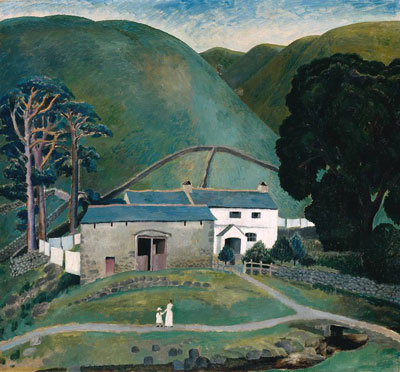
Farm at Watendlath by Dora Carrington

Farm at Watendlath by Dora Carrington (1921)

It often occurs that I stumble across and interesting subject for My Daily Art Display when I am researching another artist.  I came across today’s featured artist when I was delving into the life story of Mark Gertler and his painting Gilbert Cannan and his Mill in my last blog.  I should probably state up front that today’s blog is more about the artist and her fascinating social life than her featured painting.

Dora de Houghton Carrington was born in Hereford in 1893.  She was the second of the two daughters and fourth of the five children of Samuel Carrington and his wife, Charlotte de Houghton.  In 1902, aged 9, the family moved to Bedford and Dora attended the local girl’s high school.  The school’s ethos at the time was that the pupils should concentrate their studies on the Arts such as music and art with a healthy amount of sport thrown in rather than the normal but more commonplace subjects.  Dora showed an aptitude for drawing and her teachers persuaded her parents to pay for her to attend extra drawing classes in the afternoons.  One’s childhood often shapes the way we are in later life and the author Vanessa Curtis wrote about Dora’s differing relationship she had with her mother and father:

“…Although Carrington adored and revered her father, sketching him almost obsessively, she did not admire her fussy, martyr-like mother, who crammed the house with ornaments and devoted herself to charity work and religious causes….”

It is quite obvious that Dora’s mother had a suffocating influence on her children, especially her daughter.  Dora’s brother, Nicholas wrote of his mother extreme views on sex and  religion:

“..The first was extreme prudishness. Any mention of sex or the common bodily functions was unthinkable. We were not even expected to know that a woman was pregnant. Even a word like confined was kept to a whisper. The second was church-going and behaviour on Sunday. We all came to hate the whole atmosphere of a Sunday morning. The special clothes, the carrying of prayer books, the kneeling, standing and murmuring of litanies…”

In 1910, aged 17, she enrolled at the Slade School of Fine Art in London. There can be no doubt that once Dora Carrington was free of her home life and the puritanical views of her domineering mother, she rebelled.  She cut her hair to a bob which gave her a somewhat androgynous appearance. She entered into many intense and sometimes sexual relationships both with women and homosexual and heterosexual men.   She also decided that she wanted to be known simply by her father’s surname, “Carrington”.   Carrington fared well at the Slade and won several awards for her work.  One of her fellow students was Mark Gertler, who was totally besotted with Carrington and it was through him that Carrington met Lady Ottoline Morrell, the “society queen” and he introduced Carrington to the Bloomsbury Group, a group of writers, intellectuals, philosophers and artists.    Lady Ottoline and her husband Philip had a house in Bloomsbury, Central London and a country house in Garsington, Oxford where they would hold weekend parties for their friends, many of whom, like Stanley Spencer, Gertler and Carrington were aspiring artists.

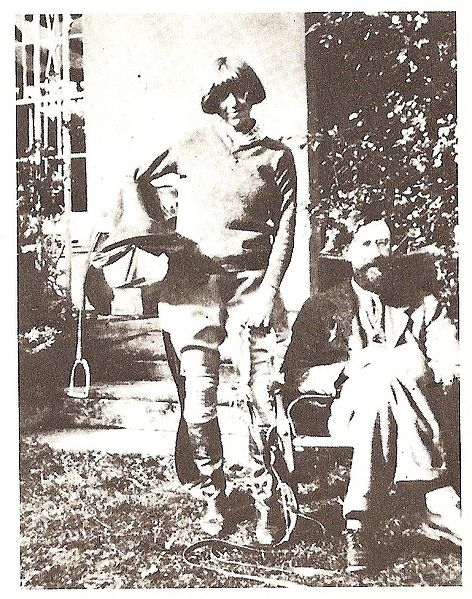
Carrington and Lytton Strachey

The Morrells were prominent pacifists and during World War I they invited conscientious objectors, such as the artist Duncan Grant and the writers Clive Bell and Lytton Strachey to take refuge at Garsington.  Carrington met Strachey, a writer and founder member of the Bloomsbury Group in 1915. Strachey was a homosexual but this did not stop Carrington falling in love with him.  This was a love that was to last almost twenty years.  Gertler felt no threat from Carrington’s love for the openly gay Strachey but in 1917 when Strachey bought a house and Carrington moved in with him, Gertler was devastated and realised that his love for Carrington was irrevocably unrequited and doomed.

Lytton Strachey and Ralph Partridge

Carrington’s father died in 1918 leaving her a small inheritance that allowed her to feel more independent.  That same year, Carrington was introduced to Ralph Partridge, a friend of her brother Noel.  Partridge like many men before him was besotted with Carrington, even though he was aware of Carrington’s love and devotion to Lytton Strachey.  Despite this knowledge, and knowing that Carrington would never give up Strachey, he married her in 1921 and along with Lytton Strachey, they bought and moved into Ham Spray House just outside the town of Hungerford.  It was here that they spent the rest of their lives.  It was a happy period for Carrington who carried on with her artwork and looking after the two men in her life.  Unfortunately, over time, Strachey suffered frequent bouts of illness and had to be cared for by Carrington.

Frances Partridge née Marshall

In 1926 Ralph Partridge started an affair with Frances Marshall, a writer friend and member of the Bloomsbury Group and went to live with her in London. His marriage with Carrington was all but over, but never in the eyes of the law.  Partridge did however still visit her most weekends.   Carringotn in the meantime had a number of extra-marital affairs with both males and females.  The most famous being her affair with Gerald Brenan, an army man and friend of her husband.  She also had a tempestuous love affair with Henrietta Bingham, the daughter of the American ambassador in London

In 1931 Strachey became seriously ill with stomach trouble and the doctors could not decide as to what was causing the illness.  By the end of that year doctors had given up hope of curing him.  In a fit of deep despair at the thought of losing her beloved friend she attempted to kill herself but was saved by her husband Partridge.  For the next month she watched as Strachey moved slowly towards death.  In January 1932 the end came for Strachey and, following an autopsy, it was discovered that he had been suffering from stomach cancer.  Carrington was devastated and her friends tried to rally round to support her but it was to no avail as in March 1932 she shot herself with a gun she had borrowed from a neighbour.  Her husband found her just before she died.  She died just a fortnight before her thirty-ninth birthday.

The painting I am featuring today entitled Farm at Watendlath was completed by Carrington in 1921. Newly-wed Carrington and her husband along with Lytton Strachey and some of their artist friends spent a summer holiday here that year.   One of their holiday companions was her future lover and friend of her husband, Gerald Brenan.  She would often return to spend other painting holidays around this area and she and her friends were frequent visitors to the farm which is near to Keswick in the Lake District.  The house we see in the painting faces Watendlath Beck, which flows from Watendlath Tarn into Derwentwater. A stuffed stag hanging inside was known as ‘Mr Wordsworth’  The two female figures we see in the painting are unknown and it has been suggested by some art historians that this depiction of female figures, dwarfed by a fertile and undulating landscape, relates to the artist’s sense of being overwhelmed by her own womanhood.  However, I find that interpretation hard to believe.

Her life story, in many ways, is tinged with sadness.  Her relationship with Lytton Strachey could not have fulfilled all her dreams and she would have constantly have had to compromise.  Yet, I am sure she had times of great joy and maybe we should look at this painting and remember that at the time she painted this, she had just married and she was at a place she loved with companions whose company she enjoyed and who in return where devoted to her.

The painting which can be found at the Tate Gallery London was presented to that establishment by her brother Noel Carrington in 1987.

Charles Beale by Mary Beale

Charles Beale by Mary Beale (c.1675)

For My Daily Art Display today, I am staying with an English artist but instead of a landscape painter and a man as was the case yesterday I am focusing on a lady artist, one of the most important portrait painters of 17th century England and who has been described as the first professional female English painter.  Her name is Mary Beale and the subject of today’s portrait painting is her husband Charles.

Mary Beale was born in 1633, in Barrow in the county of Suffolk.    Her father was the Reverend John Craddock, who was the local puritan rector.  He was an amateur painter and was acquainted with all the local artists, one of whom was Peter Lely, a portrait painter.  Although Mary Beale was never a pupil of Peter Lely there is no doubt that throughout her life she was influenced by his artistic style.  Her mother was Dorothy Brunton who sadly died when Mary was just ten years of age.

In 1652, at the age of eighteen, she married Charles Beale, a cloth merchant and amateur artist and she went to live with him in Covent Garden, London. The Beales had two sons who survived past childhood, Bartholomew and Charles.  Her husband, Charles became deputy clerk of the patents office in about 1660, by which time Mary had begun to study portraiture.   In 1664, the Beales moved away from London.  Charles had lost his job at the patents office and so they had a loss of income and they decided life would be cheaper in the country, so they moved to a farmhouse in Allbrook in Hampshire.  A second reason for the move was for their own safety as that year saw the onset of the Great Plague in London which was to kill a fifth of the population of London.

In 1670, Mary and her family, returned to London and she set up a studio in Pall Mall.  Here she painted many portraits of the aristocracy and local gentry.  Her husband, not only acted as her assistant, but looked after the business side of her artistic venture and her son Charles trained as an artist in his mother’s studio.  Her work was very popular and she received many commissions.   In her husband’s diary he recorded that in the 1670’s his wife received no fewer than 140 commissions for portraits.   Having returned to London she became reacquainted with Peter Lely who had been made the Court Artist to Charles II and many of Mary’s commissions were to paint copies of Lely’s works.

Mary Beale died in 1699, and was buried at St James’s, Piccadilly. Her husband died in 1705.  The Beales’ first child Bartholomew died when he was young.  Her second son also called Bartholomew studied portraiture but eventually gave up any thoughts of being a full time artist and took up medicine.  Her third son Charles jnr. became a painter specialising in miniatures.

The painting today, simply entitled Charles Beale, is a portrait of her husband.  She has portrayed him as a poet and clothed him accordingly in a style of unkempt abandon.  His disheveled state was that of the preserve of poetic and melancholic genius.  I love the informality of this painting with the sitter’s relaxed pose dressed in a brown gown underneath which we can see an open-necked chemise.  This portrait is in direct contrast to the portraiture norm when the sitter is expected to be shown in a strong courtly pose. This is a portrait that exudes casualness and familiarity which of course one expects of a husband’s portrait carried out by his loving wife.   This portrait has done away with the use of background drapery or Arcadian imagery which was so popular at the time and would no doubt have been included if this had been a commissioned work.  It is an engaging and intimate portrait.  The couple were very much in love and in his notebooks he always referred to his wife as his “Dearest and most Indefatigable Heart”.  There was great equality in their relationship and the fact that after losing his job he “worked” for his wife, which was acting against all contemporary notions of married life. Religious, social and medical teaching stressed the secondary role to be played by women, whose place was determined forever by Eve’s original Sin.   But Charles had no qualms about his position of apparent subservience.  Mary was a firm believer of equality between a husband and his wife and between man and woman outside of marriage.  She even put down her thoughts on the subject in 1660 when she wrote Essay on Friendship.  In Tabitha Barber’s book Mary Beale she quotes Mary’s thoughts on the subject of friendship and equality between husband and wife, writing:

“…This being the perfection of friendship that it supposes its professors equally, laying aside all distance, & so levelling the ground, that neither hath therein the advantage of other…”’

Regarding the relationship in marriage between husband and wife, Mary wrote:

“…In marriage, God had created Eve as ‘a wife and Friend but not a slave…”

Mary Beale painted numerous portraits of her husband Charles which is testament to the deep affection between them.

This painting presently hangs in a private collection.

Le Bercau (The Cradle) by Berthe Morisot

Le Bercau (The Cradle) by Berthe Morisot (1872)

Today I am returning to the Impressionists.  For most people, if they were asked to reel off the names of Impressionist artists, the likes of Monet, Cezanne, Degas, Renior and Pissarro would easily trip off the tongue.   With a little more contemplation the names of Sisley and Caillebotte may come to mind.  Of course looking at the list they have, besides Impressionists, one thing in common – they are all men.  However the Impressionist painters were not all men.  They had three talented female artists amongst their ranks and this triumvirate was called le trios grandes dames by the French art critic and historian, Gustave Geffroy, in his book Histoire de l’Impresssionnisme, La Vie artistique.

There was Marie Bracqemond who exhibited at three of the eight great annual Impressionist exhibitions in Paris.  There was the American-born Mary Cassatt who spent most of her adult life in Paris and exhibited at four of the Impressionist exhibitions, which were held in Paris between 1874 and 1886.  Then finally there was Berthe Morisot, who is my featured artist of the day, and who exhibited her work at all except one of the eight Exhibitions and that was because she was giving birth to her daughter.  She was not just a token female of the art group; she was one of the great organisers and a leading light of the Impressionist group.   Morisot and Cassatt are also thought of as the most important female painters of the nineteenth century.  The art world up to this time was dominated by male artists and even now there is a patronising attitude to 19th century female artists that they were “followers” of their contemporary male painters instead of giving them the credit they deserve.  Even today when Impressionist works by Morisot and Cassatt are not looked upon and judged on their own merit but are instead compared to the works of their mail contemporaries, such as Degas and Manet.   Female artists in those days were also hamstrung by convention in which they were not supposed to draw or paint nudes.  The role of women in those days was simple – look after their men folk and have their babies and if the woman wanted to draw or paint then this was looked on as a mere hobby and not a career option.  However along came Berthe Morisot, a very independent person and a free spirit, whose desire to become an artist was supported by her family.  She also had another thing going for her – she was an extremely beautiful woman.

Berthe Marie Pauline Morisot was born in 1841 in Bourges in central France.  Her family were very successful and wealthy.   Her father Edme Tiburce Morisot had studied art at the Ecole de Beaux- Arts, but eventually gave up the idea of becoming a full-time painter and instead became a prominent government official.   He married his sixteen year-old bride Marie Cornelie Thomas in 1835 and they had four children.  Berthe was the youngest of three sisters, the other two being Marie Edma Caroline and Marie Elizabeth Yves and she had a younger brother Tiburce.

She and her sisters Edma and Yves set their hearts on being painters and their family were very supportive. It was an artistic family with Berthe’s grandfather, Jean-Honoré Fragonard being one of the greatest Rococo painters of his time. Their parents arranged art lessons for them but soon Yves lost interest in art and dropped out of the lessons.  In 1857 Berthe and her sister Edma studied drawing under Geoffery-Alphonse Chocrane.  A year later they studied under the tutelage of Joseph-Benoît Guichard and he would take them to the Louvre where they copied the paintings of the Masters and that year they were registered with the museum as copyists.   It was around about 1861 that the two sisters, whilst working in the Louvre, met another young painter, Edouard Manet and this was to prove to be the start of a very long friendship.   From 1862 to 1868 Morisot studied art under the guidance of the French landscape and figure painter Camille Corot who taught her the finer arts of landscape painting and the en plein air method of painting.  It was during this time that she became friends with an Impressionist painter Henri Fantin-Latour, whose speciality was still life paintings incorporating flowers.

The two Manet brothers, Edouard and Eugène and the two Morisot sisters, Berthe and Edma became very close friends and it was through Berthe Morisot that Edouard Manet was introduced to the other Impressionist painters.  It is also believed that it was through Morisot that Manet embarked on the en plein air method of painting.  Edouard Manet used Morisot as a model on a number of occasions and the portrait of Berthe Morisot we see the most is one done by Manet, entitled Berthe Morisot with a Bouquet of Violets.  Berthe Morisot was not just a talented artist, she was also extremely beautiful.  She and Manet were leading lights of the Impressionist Movement and it was she and Camille Pissarro who were the most consistent exhibitors at the eight Impressionist Exhibitions.  In 1874 and Manet became her brother-in-law when Berthe married Eugène Manet.   Four years later she gave birth to a daughter, Julie.

Édouard Manet is seen as the most important single influence on the development of her artistic style.  Over time the Master/Pupil status of Manet and Morisot changed to the point when they were looked upon as equals and Morisot developed her own style.   Morisot was by this time becoming a successful artist and had her first works; two landscape paintings, exhibited at the Paris Salon in 1864 at the age of twenty-three.  She continued to exhibit her works there for the next ten years.

Morisot’s paintings focused on everyday life and often reflected the cultural restrictions experienced by females in the nineteenth century.  Her works of art, like today’s painting, often concentrated on simple domestic scenes and in her works she would utilise family friends or relatives as models.  Her works were set in many different locations such as in the garden, besides the river but there was a constant theme, that of the joys of family life.  She battled against the two prejudices which were levelled against her art – her gender and her wealth.  Being a female, social convention would not allow her to paint nudes or men and thus she had to concentrate on landscapes and paintings of women and children.   Coming from a wealthy family and having financial stability left her open to the charge that she was merely a dilettante whose art was just a hobby.

Eugène Manet, her husband, died in 1892 and three years later Berthe Morisot died of pneumonia in 1854. at the age of 54 and was buried in the Cimetière de Passy, Paris.

The painting today, Le Bercau (The Cradle) was painted by Berthe Morisot in 1872.  In the picture we see a mother looking at a baby who lies asleep in a crib.  Morisot’s sister Edma was the model for the woman and the baby asleep in the crib was Edma’s daughter Blanche.  This painting was the first of her many works which featured motherhood and the everyday life of contemporary women, which was her most favourite subject for her works of art.

There are some interesting things about how mother and child are depicted by Morisot.  Look how the left hand of the mother mirrors the left hand of the baby in the way that it touches her face.  There is a diagonal line in the painting running from the baby’s arm through to the mother’s arm almost like an attachment between mother and child.  The diagonal continues with the way the artist has added a fold in the wispy curtain in the background.    There is a great sense of intimacy between mother and child as she looks down lovingly at the infant having carefully drawn back the net curtain to get a better view of her beautiful child.  We, on the other hand,  are just allowed to see the baby through the mesh of the curtain.  The painting reflects the love between mother and child.  She is positioned by the crib to be able to comfort the baby if she should wake.  This is an extremely moving painting.  Its depiction of the look of endearment on the mother’s face and the peaceful look on the baby’s sleeping face is superb.  It is very touching but I believe the painting as a whole avoids over-romanticizing the subject or making it mawkish.

The painting was exhibited at the first Impressionist Exhibition at Félix Nadar’s photographic studio at Boulevard des Capucines in 1874 and she was the first woman to exhibit with the group.  This has always been looked upon as one of Morisot’s finest paintings.  The painting remained in the Morisot family until 1930 when it was sold to the Louvre where it remained until it was transferred to the Musée d’Orsay, where it hangs today.

I will finish with the words of her brother-in-law, the artist Manet, who said of Morisot:

“…This woman’s work is exceptional. Too bad she’s not a man….”

One final bit of trivia – on her death certificate under the heading “Profession” the entry simply stated “No Profession”.  Why ?  Simply because she was a woman !