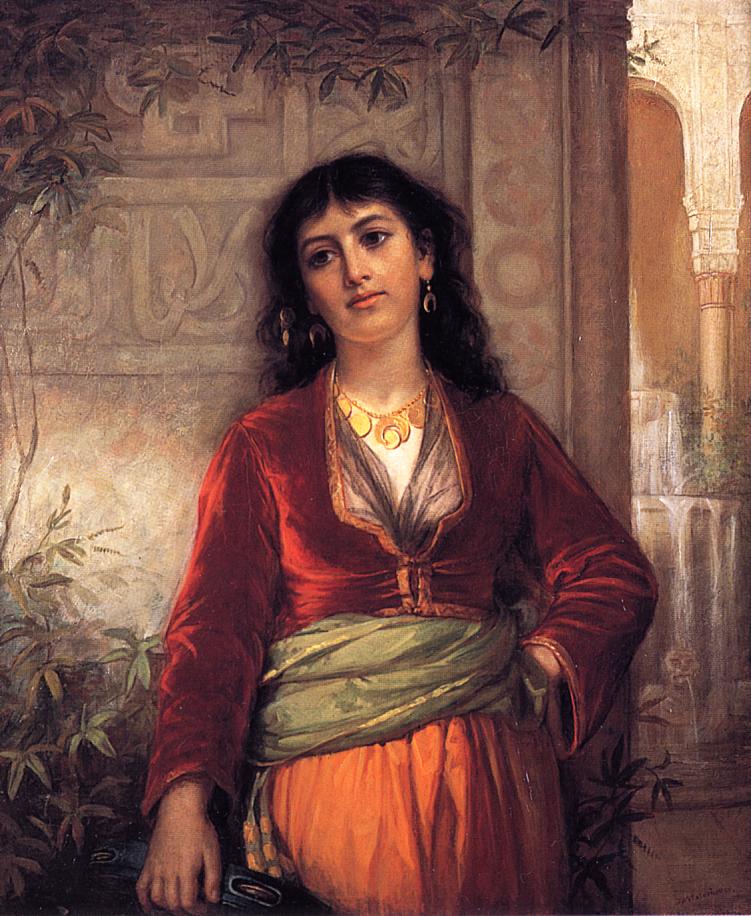
John William Waterhouse. Part 2.

Marriage and women destined to suffer.

Portrait of the Artist’s Wife by John William Waterhouse (1885)

In 1883 John William Waterhouse married Esther Maria Kenworthy, a noted flower painter. She was the daughter of James Lee Kenworthy, an artist and schoolmaster from Ealing and Elizabeth Kenworthy who was also a schoolteacher. Waterhouse was thirty-four-years-old and Esther was eight years younger. The marriage took place at the Church of England parish church in Ealing, and thereafter Waterhouse’s wife used the name Esther Kenworthy Waterhouse. At the beginning of their married life the couple lived close by a purpose-built artistic colony in Primrose Hill, where the houses also had studios. Primrose Hill Studios, built in 1877, was a development of twelve artist houses around a quadrangle in a mews off Regent’s Park. Waterhouse already rented a studio at No. 3 Primrose Hill Studios, which he had leased since 1878, and later moved to a much bigger studio at No.6.

Self portrait by William Logsdail

One of the Waterhouses’ neighbours at the Primrose Hill Studios was the prolific Antwerp-trained English landscape, portrait, and genre painter, William Logsdail. The Primrose Hill Studios complex was, as Logsdail later recalled, a place that the artists around the courtyard ‘formed a happy family, in and out of each other’s studios during the day, and in the evening swapping stories over the cards and whisky or dining at “the Bull and Bush” on Hampstead Heath’.
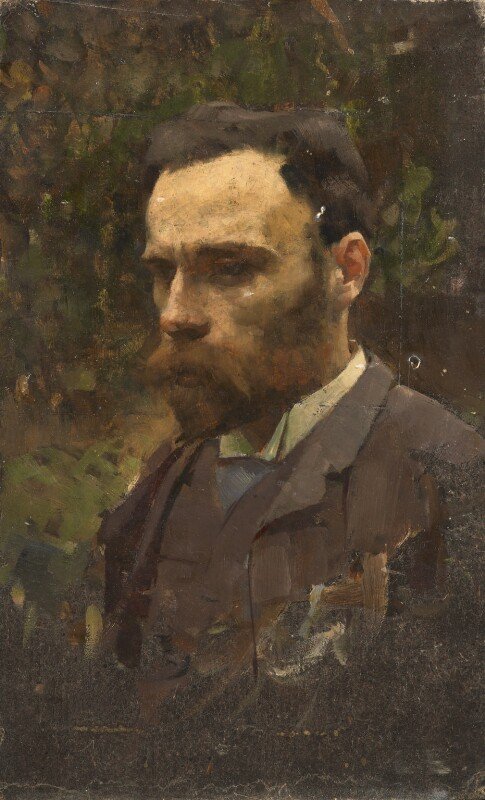
John William Waterhouse by William Logsdail (1887)

Logsdail recorded in 1917 that he used friends and colleagues from the Primrose Hill Studios – including four members of the Waterhouse family – to act as models for parts of his London cityscape paintings. It is the connection and friendship between Waterhouse and Logsdail, which brought about questions as to who painted the small oil on board portrait of Waterhouse in 1887. At first, it was looked upon as a self-portrait but in 2002 Peter Trippi, the leading authority on Waterhouse, questioned the attribution, suggesting that the sketch was not a self-portrait but in fact it had been painted by William Logsdail, In the painting we see that Waterhouse’s features half-hidden under a thick reddish-brown moustache and beard. The portrait went to auction, run by John Physick, Waterhouse’s great-nephew, at the Canterbury Auction Galleries, in May 2011. Even then, it was deemed as a self-portrait by Waterhouse.   However, in Trippi’s words this head is ‘absolutely a modern-life image made by a trusted colleague or friend’. It is the first example of Logsdail’s work to enter London’s National Portrait Gallery Collection. The attribution to Logsdail has now been established beyond doubt.

St Eulalia by John William Waterhouse (1885)

In 1885 John William Waterhouse was elected as an Associate of the Royal Academy. This election to full membership status came shortly after he exhibited a painting, the depiction of which was one that engendered great discussion with regards its depiction. The work was entitled Saint Eulalia, who was a twelve-year-old martyr. When the work was exhibited it came with a note from Waterhouse:

“…’Prudentius says that the body of St. Eulalia was shrouded “by the miraculous fall of snow when lying in the forum after her martyrdom…”

Aurelius Prudentius Clemens was a Roman Christian poet who was born in Northern Spain and who practiced law, as well as holding two provincial governorships.  He was awarded a high position by the Roman emperor Theodosius but tiring of court life, he devoted the rest of his time, from about 392, to writing poems on Christian themes.

Eulalia of Mérida was a devout Christian girl, aged between twelve and fourteen years old who lived in Mérida, Spain, and who was killed during the Persecution of Diocletian around 304AD. The Diocletianic persecutions, sometimes referred to as the Great Persecution, was the last and most severe persecution of Christians in the Roman Empire. In 303 AD, the four Roman Emperors, Diocletian, Maximian, Galerius, and Constantius set out a series of pronouncements withdrawing the legal rights of Christians and ordered them to observe the traditional religious practices. The story goes that Eulalia ran away to the law court of the governor Dacian at Emerita, and stubbornly professed herself a Christian. She then went on to insult the pagan gods and emperor Maximian, and defied the authorities challenging them to martyr her.
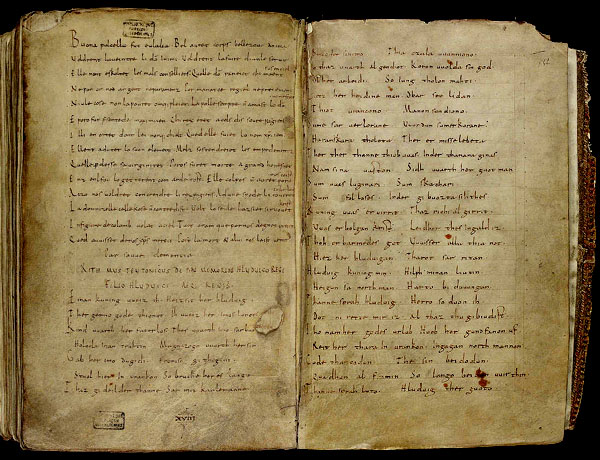
Manuscript of the Sequence of Saint Eulalia written in 880 AD.

The story is told in a book of twenty-nine verses, The Sequence of Saint Eulalia, also known as the Canticle of Saint Eulalia, which is a ninth century biography of Saint Eulalia and tells how she resisted pagan threats despite being tortured. Finally, she was executed and became a Christian martyr. Below is a translation of a passage of The Sequence of Saint Eulalia.

Eulalia was a good girl,
She had a beautiful body, a soul more beautiful still.
The enemies of God wanted to overcome her,
they wanted to make her serve the devil.
She does not listen to the evil counsellors,
(who want her) to deny God, who lives up in heaven.
Not for gold, nor silver, nor jewels,
not for the king’s threats or entreaties,
nothing could ever persuade the girl
not to love continually the service of God.
And for this reason she was brought before Maximian,
who was king in those days over the pagans.
He exhorts her — but she does not care —
to abandon the name of Christian;
She gathers up her strength.  And subsequently worship his god.
She would rather undergo persecution
Than lose her spiritual purity.
For these reasons she died in great honor.
They threw her into the fire so that she would burn quickly.
She had no sins, for this reason she did not burn.
The pagan king did not want to give in to this;
He ordered her head to be cut off with a sword.
The girl did not oppose that idea:
She wants to abandon earthly life, and she calls upon Christ.
In the form of a dove she flew to heaven.
Let us all pray that she will deign to pray for us
That Christ may have mercy on us
And may allow us to come to Him after death
Through His grace.

For some, this painting by Waterhouse the pictorial story was a too  gory and disturbing subject and for some it was too much to behold.  Many of the public who had never heard of Eulalia were shocked by the story and depiction. For Waterhouse it was all about women being subjected to a horrible and undeserved fate, some of whom we will see in later paintings. Before us we see the foreshortened body of Eulalia which in itself often received criticism from critics of the time. As we look along the body from her head to her feet, our eyes are led  to a void of snow which in a way underlines the young girls isolation. Her arms are outstretched forming a cross as if she has been taken down from a crucifixion and laid upon the floor which, of course, mirrors the fate of Christ. Hovering above her are white doves, one of which in the story of her martyrdom is said to have come from the dead girl’s mouth on its journey to heaven. This frightened away the soldiers from her body and allowed a miraculous snow to cover her nakedness, its whiteness indicating her sainthood. Look how Waterhouse has depicted Eulalia’s hair spread out like a fan. For Waterhouse, a woman’s hair was an object of male attraction. Although the painting shocked many who saw it at the 1885 Royal Academy Exhibition it secured Waterhouses election as a full member of the Academy. For all the painting recounts the martyrdom of a young virgin, Waterhouse was careful not to depict on her body the result of the savagery and butchery of her torture that preceded her death, instead he managed to secure the purity and innocence of her body.

Mariamne by John William Waterhouse (1887)

Waterhouse’s fascination with doomed women can be seen in his 1887 painting entitled Mariamne. The story comes from an account in Josephus’ book Jewish Antiquities. Josephus was a first-century Romano-Jewish historian who was born in Jerusalem. In his book, Josephus recounts the story of Mariamne the Hasmonean, who he describes as a magnificently beautiful and dignified Hasmonean princess and the second wife of Herod the Great and sister-in-law of Salome. Herod feared the power of the Hasmoneans which led him to execute all the leading Hasmonean family members, including his wife, Mariamne, whom Herod had executed at the behest of sister Salome on a trumped-up charge of infidelity. The painting by Waterhouse was the largest he ever made, measuring 259 x 180cms. It is a wonderful painting full of fascinating narratives. Art critics of the time likened it to a scene from a play. The main figure of the work is the white-robed figure of Marianme who we see descending a marble staircase. Her hands are chained having been condemned to death by a group of elders seen lurking in the shadows in the background. Their decision being based on their loyalty to their king and not because they believed the charge of infidelity. To the right we see a man in crimson robes seated, listening intently to the whisperings of the women by his side. There is one line of thought that the interior painted by Waterhouse is reminiscent of the interior of his contemporary, Alma-Tadema’s Grove End Road, St John’s Wood studio/house. The painting was exhibited in Paris, Chicago and Brussels over the next ten years and by the beginning of the twentieth century Waterhouse had become world renowned.

The Lady of Shalott by John William Waterhouse (1888)

Another of Waterhouse’s works featuring a doomed and maligned female is probably his best known. It is The Lady of Shalott which he completed in 1888. The Lady of Shalott is a character from Tennyson’s 1832 poem and recounts the story of a woman who is suffering under a curse of isolation. The woman’s home is a tower on a lonely island called Shalott. Running down past the island is a river which emanates from the castle of King Arthur’s and wends its way down to the town of Camelot. She had been incarcerated in her room, under a curse that barred her to go outside or even look directly out of the window in the tower. The curse forbids her to see the world other than that reflected images in her mirror.

She knows not what the curse may be,
And so she weaveth steadily,
And little other care hath she,
The Lady of Shalott.

 She would spend her time sitting below the mirror weaving a tapestry of scenes that she could only observe in the reflection of the mirror. One day she looks into the mirror and catches a glimpse of the reflected image of the handsome knight Lancelot.

All in the blue unclouded weather
Thick-jewell’d shone the saddle-leather,
The helmet and the helmet-feather
Burn’d like one burning flame together,
As he rode down to Camelot.

She is overwhelmed by his beauty and cannot resist looking at him directly. She is stricken by love and lust and turns to look out of her window. For her disobedient act the mirror cracks and she is cursed.

Out flew the web and floated wide—
The mirror crack’d from side to side;
“The curse is come upon me,” cried
The Lady of Shalott.

The lady leaves the tower and goes to the riverbank where she finds a boat. It is this point in the tale that is captured by Waterhouse’s painting. The lady is just about to slip the chain holding the boat to the shore. We see the lady in the boat, sitting on the tapestry she has just been weaving. There is a pensive air about her facial expression. She seems slightly fearful as she starts her journey. Her lips are parted as she sings, maybe to ward off her anxiety as she leaves the island and floats down the river towards Camelot.

And down the rivers dim expanse
Like some bold seer in a trance,
Seeing all his own mischance —
With a glassy countenance
Did she look to Camelot.
And at the closing of the day
She loosed the chain, and down she lay;
The broad stream bore her far away,
The Lady of Shalott.

At the front of the boat is a lantern and a crucifix. Besides the crucifix we see three candles. Candles symbolise life, and in this painting, we see two have blown out and one is flickering in the strong breeze, signifying that the lady has little time left. This is not just the starting point of the journey. It is almost her last moments before she dies never having reached Camelot.  Look at the sumptuous colours Waterhouse has used in the painting contrasting the stark white of her clothing. The painting was further enhanced by Waterhouse’s inclusion of naturalistic details such as the pied flycatcher which rests on the reed bed and the many water plants which were native to English rivers at the time.

The Lady of Shalott by John William Waterhouse (1894)

Waterhouse completed two further paintings with the motif of The Lady of Shalott. The one he painted in 1894 is part of the Leeds Art Gallery collection. In this work Waterhouse captures the moment as the lady turns and rises from her chair, clutching her weaving shuttle, hesitating before the sight of Lancelot as the curse begins to take place and the mirror starts to crack. The tip of Lancelot’s lance points to the crack. Behind her we see the cracked mirror and the reflection of the knight. Look at her facial expression. It is a piercing gaze. It is a combination of anxiety and yearning, a yearning to free herself from captivity. It is an act of defiance on her part. It is her assertion that she should be free. For Tennyson the poem was an allegorical tale about the transition from innocence, repression to sexual revelation. Look how the golden thread used in her weaving has wrapped around her torso and how she is breaking free of its restraints as if she is a white moth emerging from its silk cocoon, which metaphorically is her sexual awakening following her catching sight of the famous knight. Behind her, in the right background of the work Waterhouse has once again depicted candles being extinguished by the wind signifying the coming of her death.
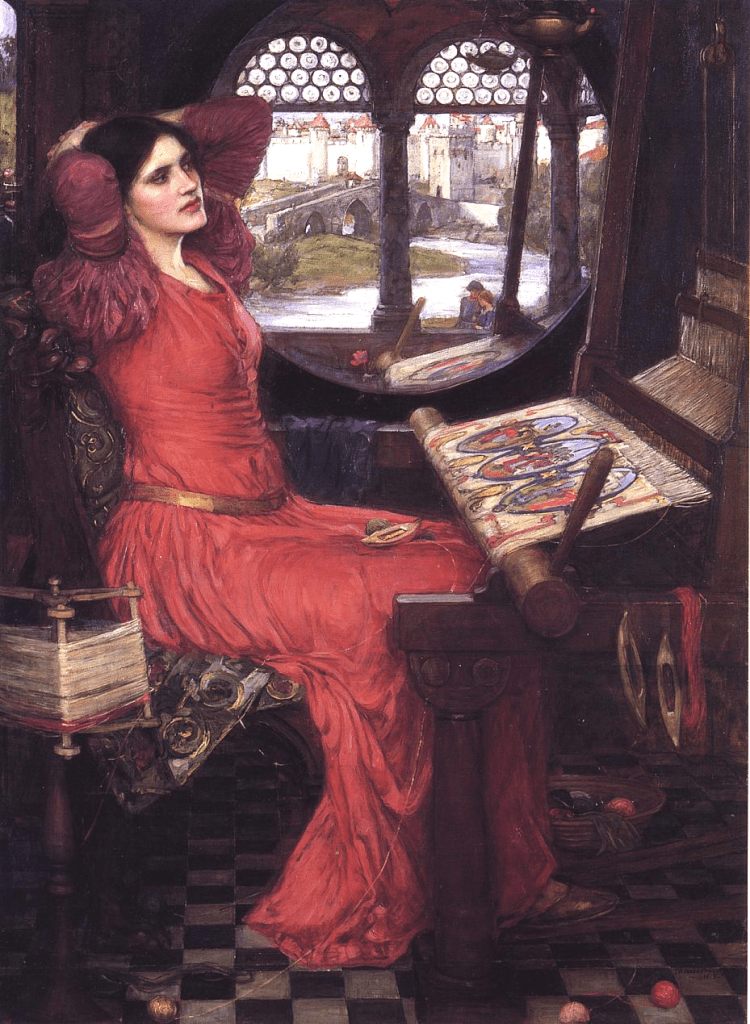
I am Half Sick of Shadows, said the Lady of Shalott by John William Waterhouse (1915)

Waterhouse’s final version of the Lady of Shalott was painted in 1915 entitled I am Half Sick of Shadows, said the Lady of Shalott. This is the point in the poem before Lancelot appears as a reflection in her mirror. It is from this stanza that the painting gets its sub-title:

But in her web she still delights
To weave the mirror’s magic sights,
For often thro’ the silent nights
A funeral, with plumes and lights
And music, came from Camelot:
Or when the moon was overhead
Came two young lovers lately wed;
‘I am half sick of shadows,’ said
The Lady of Shalott.

Again, we see the lady in solitary confinement in her tower. She is stretching upwards with her hands behind her head in a rather sensual pose. She is thinking about love and contemplating her dash for freedom. In preliminary sketches for this painting, Waterhouse had portrayed the lady sitting exasperatingly slumped in the chair with her hand covering her face. In front of her is her loom and to her left we see her large mirror.

It is important to look carefully at the mirror to see how Waterhouse has carefully chosen what is reflected in it. It reflects the arches of the tower’s windows creating a “heart” shape which symbolises what the lady dreams of – love and to be loved. But, like the mirror itself, this will soon be shattered. The river is reflected in the mirror reminding us that this is the ladies escape route. Camelot is also reflected in the mirror. This is where Sir Lancelot rides to and from. The reflection at the bottom of the mirror is of the two young lovers. There is a look of frustration on the lady’s face, no longer satisfied by her weaving. Frustrated by her lack of freedom. The sight of the two lovers in the mirror is frustrating her.  She realises she must escape captivity and does not fear the consequences.

Waterhouse had been fascinated by Tennyson’s poem for almost thirty years and these three paintings are testament to him wanting to delve into the meaning of the work and express it pictorially.

..………………..to be continued.
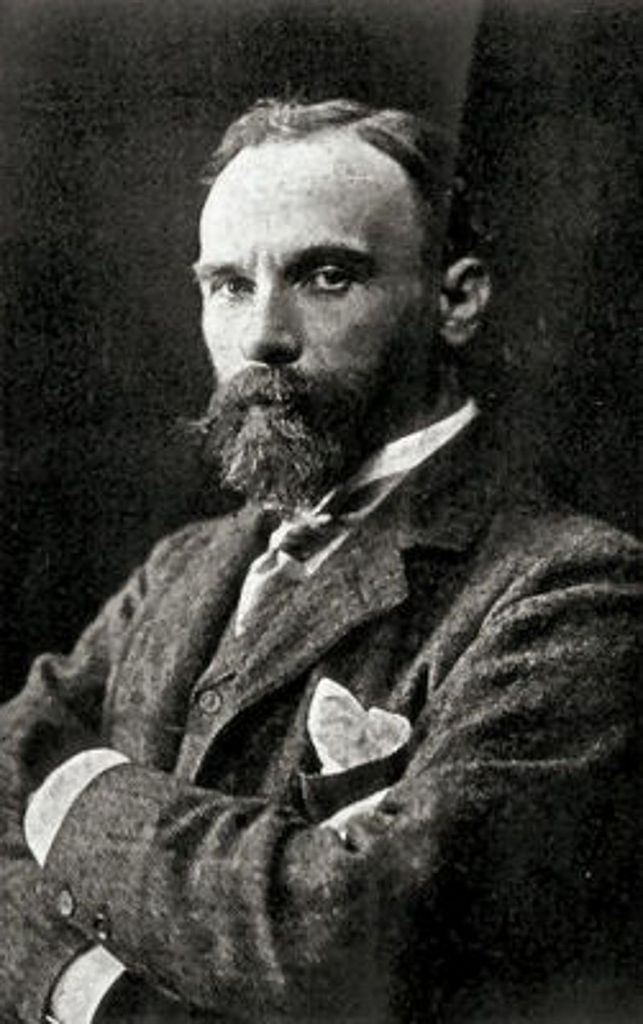
John William Waterhouse. Part 1

John William Waterhouse (c.1886)

The artist I am looking at in my next series of blogs is the very popular late 19th and early 20th-century British painter, John William Waterhouse, who was best known for painting in the Pre-Raphaelite style, a style which became increasingly popular during the Pre-Raphaelite movement which began in 1848. Waterhouse was a man who, through his paintings, we can see was fascinated by unhappiness, magical worlds and the exciting perils brought about by love and beauty. He was captivated by female beauty and intrigued by the power the women held over men.

The Slave by John William Waterhouse (1872)

Waterhouse was born in Rome on April 6th 1849. The year 1849 was an important year in English art as it was the year that members of the Pre-Raphaelite Brotherhood, which included Dante Gabriel Rossetti, John Everett Millais and William Holman Hunt, were first causing a pandemonium in the London art scene. John William Waterhouse was the first-born child of William Waterhouse and his second wife Isabella Waterhouse (née McKenzie). Both his parents were artists who had exhibited at the Royal Academy and worked in Rome. Waterhouse was given the nickname of “Nino” by his parents. Nino was short for Giovannino or “little John” and this nickname would remain with him throughout his life. When he was five years old his parents left Italy and moved to the London, where they moved into a newly built house in South Kensington, which was near to the newly founded Victoria and Albert Museum.  Three years after moving back to England, his mother died of tuberculosis at the age of 36, a disease which, seventeen years later, would take the lives of two of his younger brothers.

Gone, But Not Forgotten by John William Waterhouse (1873)

Waterhouse’s father remarried in 1860 and at this time he, his new wife and his son lived in Leeds. Waterhouse attended the local school and despite his favourite subject being Roman history, he had hopes of becoming an engineer. By 1870 the family was once again living in London and his father was earning a living by painting portraits assisted by his son. In 1880, at the age of 21, Waterhouse entered the Royal Academy Schools as a probationer in sculpture. His probationary period just lasted for six months, after which he was admitted as a student but he had now begun to concentrate on painting rather than sculpting. It was around this time that he began to exhibit some of his work at the Dudley Gallery and the Society of British Artists.

Undine by John William Waterhouse (1882)

One of Waterhouse’s early paintings was his 1882 work entitled Undine. Undine was the main character in the German novelist and playwright Friedrich de la Motte Fouqué’s 1811 classic fairy tale, Undine, in which he tells the story of this elemental water spirit, who marries a human in order to gain a soul.   Undine’s hair and body shape replicate the vertical flume of water from the fountain we see behind her. This connection between women and water will be repeated many times in Waterhouse’s later works. The female, Undine, was also the one of the first of Waterhouse’s many young female figures.

The Unwelcome Companion A Street Scene in Cairo by John William Waterhouse (1873)

During the 1870’s Waterhouse completed a number of Orientalist works. One of these works, which he completed in 1873, was his painting, The Unwelcome Companion: A Street Scene in Cairo. The painting was exhibited at the gallery of the Society of British Artists the following year. In 1951, the work was donated it to Towneley Art Gallery in Burnley. Waterhouse later depicted the same woman in the same dress in his work, Dancing Girl.  At this time there was a great demand for paintings featuring Near Eastern images. The great French painter, Jean-Léon Gérôme had become a worldwide celebrity for his Orientalist works. Coincidentally, whilst Waterhouse was studying at the Royal Academy Schools in London, Gérôme was also in the city having taken refuge there during the 1870 Franco-Prussian War and had been elected as an Honorary Foreign Academician at the Royal Academy and it is thought that the two artists could have met.   The depiction of the woman featured in the painting is quite similar to the females we see in some of Gérôme’s painting featuring the women of Cairo. In this work the woman holds a tambourine and so we must conclude that she is a dancer but she is a mystery as we cannot tell what she is thinking. The architecture, as seen in Waterhouse’s depiction of the arch column we see in the background, derives from the Alhambra Palace in Granada. It is known that Waterhouse had not visited Spain but his family did live close to the South Kensington Museum which housed architectural models of the interior of the Spanish palace and it is here that he probably made sketches.

Sleep and his Half-brother Death by John William Waterhouse (1874)

In 1874, Waterhouse had his first painting accepted for the Royal Academy’s Summer Exhibition. The painting, entitled Sleep and his Half Brother Death refers to Greek mythology and the Greek gods Hypnos (sleep) and Thanatos (death) who were brothers. It is a painting which links sleep and death. Two young men are seen lying on a bed. As our eyes move from the foreground to the background we are moving from life to death. Hypnos in the foreground is bathed in light whereas his brother, Thanatos is enveloped in darkness and from the title of the painting we know that Hypnos represents sleep whereas Thanatos personifies death. Hypnos also can be seen clutching a bunch of poppies from which is derived laudanum and opium for inducing sleep and dreamlike states.

John Arthur Blaikie, a journalist gave a brief critique of this painting in The Magazine of Art in 1886, wrote :

“…The two figures recline side by side on a low couch, beyond which are the columns of a colonnade open to the night and touched with moonlight. The interior is lit by a lamp, whose light streams on the foremost figure, Sleep, whose head hangs in heavy stupor on his breast, and his right hand grasps some poppies. By his side lies Death in dusky shadow, with head thrown back, and the lines of the figure expressive of easeful lassitude. At his feet is an antique lyre, while immediately in the foreground is a low round table… The two figures are both young, and the beauty of youth belongs to one as much as to the other… the strange likeness and unlikeness of the recumbent figures…”

The reason why twenty-five-year-old Waterhouse decided to paint this disturbing scene was probably because it was shortly after his two younger brothers died of tuberculosis.

Miranda by John William Waterhouse (1875)

At the 1875 Royal Academy Exhibition Waterhouse submitted his work Miranda. This marked the first time he depicted a heroine from a Shakespeare play, a thing he would do on a number of occasions later in his life. Miranda was the daughter of Prospero in the play, The Tempest. She was banished to the Island along with her father at the age of three, and in the subsequent twelve years has lived with her father and their slave, Caliban, as her only company In the depiction we see the young women, seated gracefully on a rock, gazing out at a ship on the horizon which she hopes is bringing Ferdinand, her future lover and rescuer, to the land where she has been exiled. But then the storm comes……..

Miranda in Waterhouse’s painting is not dressed in Shakespearean costume but wears classical clothes replicated from ancient Greece sculpture. Cords cross between her breasts and encircle her waist with an overfold of rumpling fabric. The hairstyle Waterhouse has given his female is also of classical style with two bands of circling ribbon, the ends of which flutter in the strengthening winds of the approaching storm.

Miranda by John William Waterhouse (1916)

Forty-one years later, in 1916, a year before his death, Waterhouse once again depicts Miranda in a painting. Whereas the earlier painting has Miranda looking out at Ferdinand’s ship which is a mere dot on the horizon, this painting depicts a later part of the  Shakespearean story. The storm or tempest has come and Ferdinand’s ship is much bigger and closer to the rocky shoreline where Miranda sits upon the rock. The ship is being battered by huge green and purple waves topped with white foam. The gale force winds whip through Miranda’s clothes and hair. In this work Miranda’s clothes are no longer of classical Greek style but now resemble clothes worn at the time of Shakespeare’s 1612 play. There is something much stronger about this latter Miranda with her fiery red hair loosened and flowing and the vivid colouring of her clothes which give her a much bolder aura than her earlier reflective and inhibited counterpart of 1875.

After the Dance by John William Waterhouse (1876)

The third year Waterhouse had a painting accepted for the Royal Academy’s Summer Exhibition was 1876. His painting, entitled After the Dance, was given a favourable hanging position on the wall of the gallery, just above eye-level, often referred to as “on the line” as this was the level at which most observers could best see the works of art. To achieve this positioning was an acknowledgement that the hanging committee looked upon him as an up-and-coming talent. This is a work quite clearly influenced by the great Lawrence Alma-Tadema who also had a painting with the same title in that year’s exhibition, although his work depicted a voluptuous nude bacchante lying asleep after wild revelry.  This large work (76 x 127cms) depicts a Roman interior, in which we see part of the atrium and a glimpse into the court beyond. The main figures are a young boy and a young girl, both dancers who are very tired after dancing and are both resting on cushions, the boy is sitting up, clutching a wilting flower, and the girl is drowsily stretched on the tessellated floor with a tambourine lying alongside her. In the left background we can see a group of adult minstrels seated on a marble bench.

An aulios

One holds an aulos or tibia which was an ancient Greek double-piped wind instrument, while the other rests his arm upon his lyre. One has to question the mood of the painting. The title, After the Dance, suggests merriment and yet before us we see two exhausted children and as a backdrop there is a very dark painting depicting a funeral procession. The expression on the children’s faces is not one of joy and excitement but one of exhaustion and a hint of melancholy. Maybe Waterhouse wanted his painting to be a critical comment with regards child labour.

…………………………….to be continued

Arthur John Elsley – the painter of idyllic life.

As in life itself, snobbery pervades the arts. When asked what our taste in literature is, does one admit to liking romantic fiction or, do we, to save face, rattle on about our love for the novels of Chekhov and Dostoyevsky. When it comes to our love in classical music, do we avoid saying we like the Strauss’ waltzes and the 1812 overture and, talk about our passion for Mahler and Schönberg so as to gain kudos, and to bolster our image as a music savant. Our taste in art and artists can be the same. I remember a collector of pre-Raphaelite paintings being somewhat apologetic about his taste in art maybe thinking that his love should be more on the lines of the great Masters or the avant-garde artists such as Pollock, Picasso and Miró. I remember being on a ship and talking to a passenger who was a well-known port wine producer and he was drinking a glass of port with a cube of ice in it and I queried whether that was the accepted way to drink the wine and he just said that he always drinks what he likes and how he likes it, so maybe we should not be backward in coming forward and saying what we like without fear of condemnation by the elitists of this world.

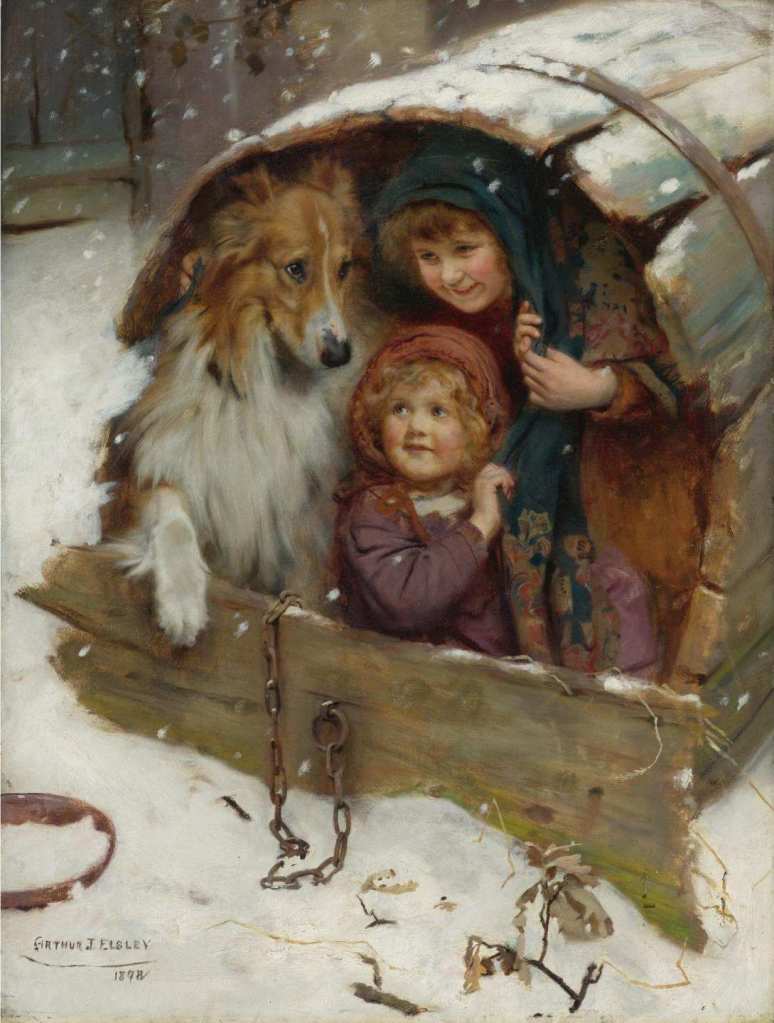
Weatherbound by Arthur John Elsley (1898)

So why this long introduction to today’s featured artist? The artist I am looking at today produces paintings which many would dismiss as “sugary” or “chocolate-boxy” and yet there is a wonderful beauty about his depictions. Let me welcome you to the world of the English painter of the late Victorian and Edwardian periods, Arthur John Elsley. During the middle of the nineteenth century, genre paintings featuring happy family life became very popular in England. The newly wealthy middle class chose in particular those genre paintings that depicted scenes of beautifully dressed young children with their pets in playful settings and this is exactly what Arthur John Elsley gave them. The paintings proved so popular that many were reproduced as prints, and others were often used in calendars, adverts, books and magazines.

Hold Up, Here He Comes by Arthur Elsley (1901)

Elsley was born in London on November 20th 1860. He was one of six children of John Elsley and Emily Freer. His father plied his trade as a coachman but had to give up the job and retire with the onset of tuberculosis. John Elsley was also an amateur artist and had achieved a standard which allowed him to exhibit his work, A Group of Horses, at the British Institution Exhibition of 1845. This Institution had been founded in 1804 for promoting the Fine Arts in the United Kingdom. Young Arthur Elsley, like his father, developed a love of art and on family trips to the Regent’s Park Zoo he would make sketches of the animals. In 1875, aged fourteen, Arthur Elsley enrolled at the South Kensington School of Art, which later became the Royal College of Art.

Mother’s Darling by Arthur Elsley

In 1876 Arthur Elsley was accepted into the Royal Academy Schools as a probationer. It was during his time here that he came under the influence of the historical and biblical painter, Edward Armitage, who was the Professor of Painting, Henry Bowler the Professor of Perspective and his professor of anatomy, John Marshall.

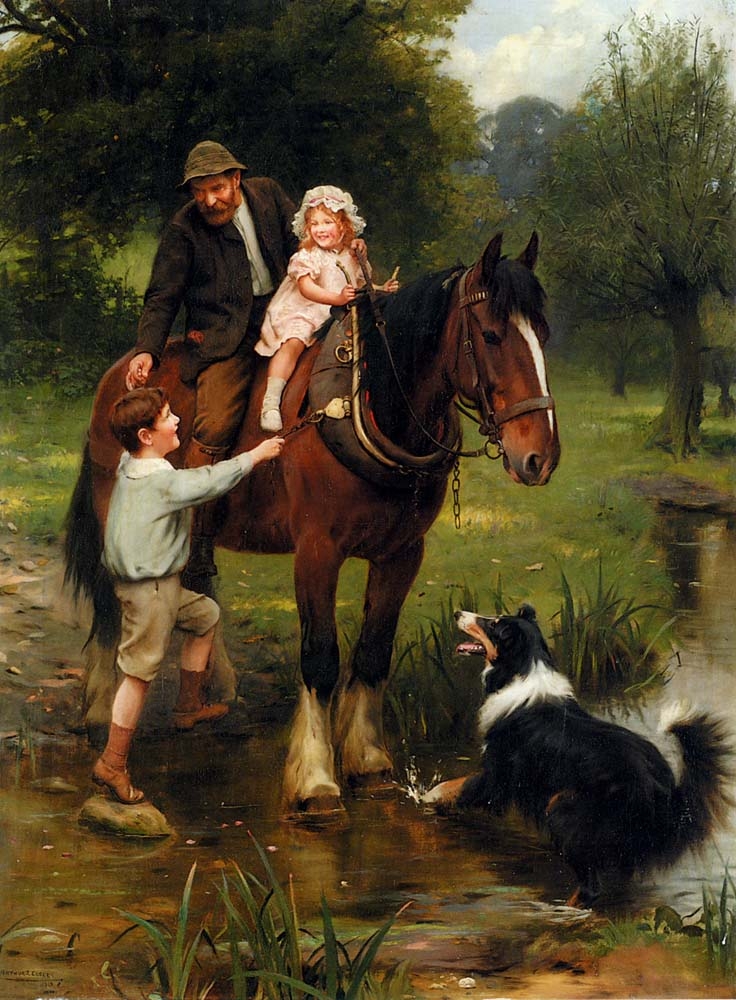
A Helping Hand by Arthur Elsley (1913)

Two years later in 1878 Elsley submitted his first painting (A Portrait of an Old Pony) and had it accepted at that year’s Royal Academy Exhibition. The one setback he had to contend with at this time was a problem with his eyesight which was brought on when he contracted measles. He remained at the Academy Schools until 1882 and on leaving he began to receive portrait commissions especially for ones featuring children with dogs and horses. Many of his portrait commissions came from the Benett-Stanford family of politicians who lived at Preston Manor in Brighton. His first known published work was a line engraving entitled April Floods In Eastern Counties printed in the Young England magazine in 1885.

Goodnight by Arthur Elsley (1911)

Elsley became friends with Solomon Joseph Solomon, a British painter, a member of the Royal Academy and founding member of the New English Art Club. He was also a friend of George Grenville Manton, and he and Elsley shared a studio in 1876. Manton specialised in portraiture but also painted genre subjects with Pre-Raphaelitesque subjects as well as large-scale religious works.

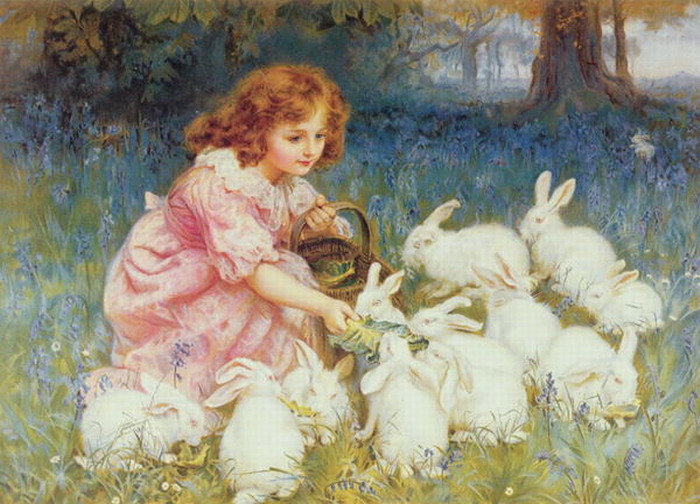
Feeding the Rabbits, also known as Alice in Wonderland by Frederick Morgan

It was through Manton that Arthur Elsley met Frederick Morgan, who was an English portrait artist and painter of domestic and country scenes. He was well-known for his idyllic genre scenes of childhood. This was also the art genre favoured by Elsley and in 1889 he moved into Morgan’s studio, and the two came to an artistic arrangement in which Elsley would paint the animals in Morgan’s paintings as this was his forte and was proving problematic for Morgan.

Their First Swim by Arthur Elsley (1897)

In the summer of 1891 the Great Exhibition was held in London. It was to be the first in a series of World’s Fairs, and within it there was exhibitions of culture and industry. The Great Exhibition was organized by Henry Cole and Prince Albert, husband of the reigning monarch, Queen Victoria. At this exhibition Elsley was awarded a silver medal in for his painting The Bailiff’s Daughter of Islington.

I’se biggest by Arthur Elsley (1892)

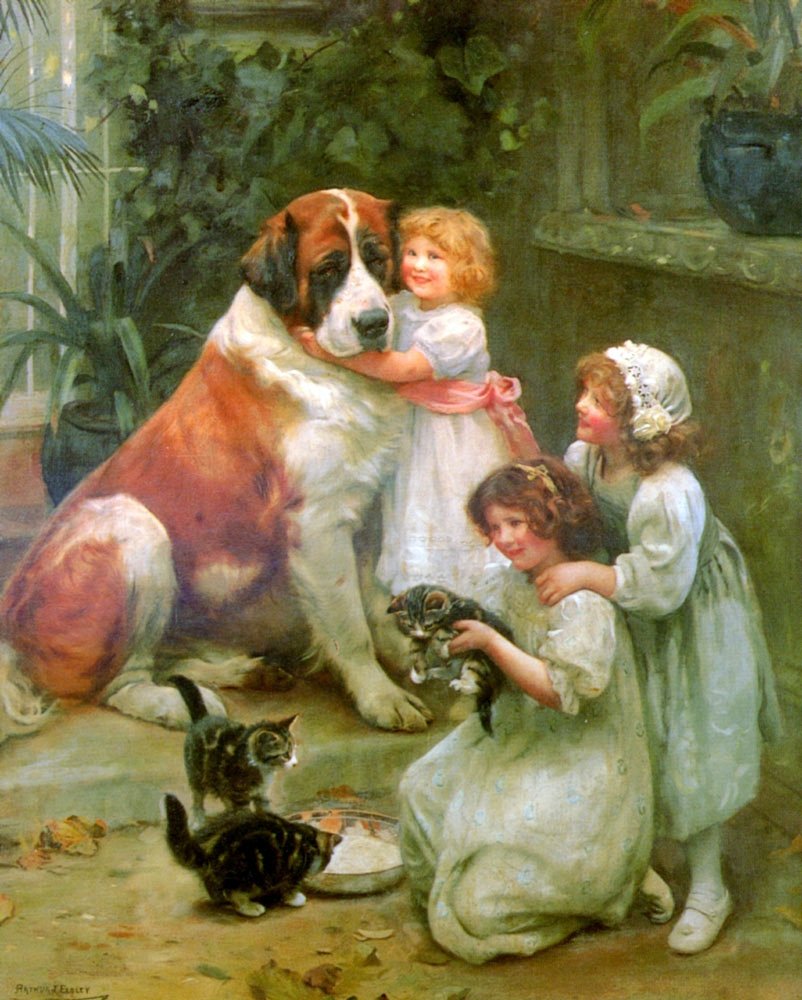
The following year his painting entitled I’se Biggest was published, and it was so popular that it had to be re-engraved to cope with public demand. Elsley depicted a young girl comparing her height with that of a large St. Bernard dog.  Terry Parker describes the depiction in his 1998 book, Golden Hours: Paintings of Arthur J Elsley, 1860-1952:

“…one of those simple and unaffected pictures which readily lend themselves to reproduction and has so much nature and so admirable a touch of humour in it that no doubt a great number of those who admire it at Burlington House will be delighted to have an opportunity of hanging a version of it upon their walls…”

The paintings of Elsley were so popular with the public that the Illustrated London News printed one of Elsley’s paintings, Grandfather’s Pet as their Christmas choice for 1893.

Victims by Arthur Elsley (1891)

Arthur Elsley married his second cousin Emily Fusedale on November 11th 1893. Emily, who was ten years younger than Elsley, had worked for Arthur for over ten years modelling for his paintings. This role, as artist’s model, was passed down to their daughter, Marjorie, who was born in 1903 and who as a young child, would appear in many of Elsley’s paintings. After the marriage Elsley set himself up in a new studio and continued with his paintings depicting young children and animals in idyllic countryside settings.

Suspanse by Charles Burton Barber (1894)

With the death of the leading Victorian painter of this genre, Charles Burton Barber, in 1894, Elsley took up the mantle as the most revered painter of children and pets.  The Illustrated London News, 25 January 1896, wrote:

“…Mr. Elsley appears more distinctly as a follower, though not an imitator, of Mr. Burton Barber, differing from him by allowing his children more than a pet at a time, and going beyond the limitations of a fox-terrier, or a collie. He has a keen sense of humour, especially in his treatment of puppies’ backs, which, as students of dog-life well know, are their most expressive features…”

The close relationship between Elsley and Morgan soured around the turn of the century when the latter accused Elsley of artistic plagiarism as he believed Elsley was using his ideas in his paintings.

The First World War broke out in 1914 and for its four-year duration Elsley contributed to the war effort by working on bomb-sights in a munition factory, which put a terrible strain on his already failing eyesight. Elsley’s output of paintings dwindled and he only managed to complete four during the first three years of the war, one of which was a portrait of his daughter, which, although he would not sell it, allowed it to be exhibited at the Royal Academy.

Never Mind by Arthur Elsley (1907)

Marjorie Elsley featured in many of her father’s paintings and I particularly like the one entitled Never Mind which he completed in 1907. The St Bernard dog we see in the painting featured in many of Elsley’s works.

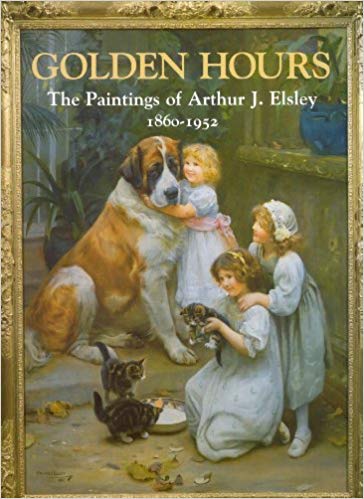
Golden Hours Paintings of Arthur J Elsley by Terry Parker

In his 1998 book, Golden Hours: Paintings of Arthur J Elsley, 1860-1952, Terry Parker, who interviewed Elsley’s only child and principal model, wrote:

“…Marjorie remembers that the St Bernard featured in Never Mind was owned by Miss Mumford, a nurse who lived at South Woodford ………..Elsley was the most popular ‘chocolate box’ artist of the late Victorian and Edwardian period. The appealing quality of his paintings were easily understood and presented a cosy, idealised world of happy, smiling children and their animals…”

In the years that followed, Elsley continued to paint mostly for pleasure and exhibited some of his works until 1927. His failing eyesight eventually curtailed his art work and by 1931 the only hobby he could still manage  were his love of woodwork, metalwork and gardening.

Arthur John Elsley (1860-1952)

Arthur John Elsley died at his home in Tunbridge Wells on 19 February 1952, at the age of 91. At the height of his career from 1878 to 1927, Elsley exhibited 52 works at the Royal Academy.

Gerald Leslie Brockhurst – painter of mesmeric beauty.

To capture beauty with a camera is complicated but with all the aids such as lighting, make-up and Photoshop, photographs of beautiful women are often seen in magazines and newspapers. However, to capture the same life-like beauty in a painting is solely down to the expertise of the artist. As a man, there is something utterly mesmeric when you stand in front of a painting and see before you unadulterated beauty.

Portrait of Charlotte du Val d’ Ognes by Marie-Denise Villers (1801)

I was reminded of this in a comment I received concerning the painting entitled Young Woman Drawing by the eighteenth century French artist Marie-Denise Villers, which I featured in my blog (January 21st 2011). The reader, who confessed to not being a lover of art, commented:

“…while walking through the MET this painting stopped me in my tracks. I love the thoughts that this painting invokes – Who is this woman that is examining me and what does she see? The history of this painting makes it that much intriguing to me and really sets the tone that this painting has nothing to do with the artist weather David or Villers; but more the subject – you. I would pay admission to The MET again just to enjoy this painting one more time. This painting is by far my favorite of the whole museum…”

My blog today is about a man who effortlessly brought beauty to his canvases although such a dedication had a problematic affect on his life. I want you to peruse his many paintings of beautiful women that led to his fame as a great portrait painter. Today I want to introduce you to Gerald Leslie Brockhurst.

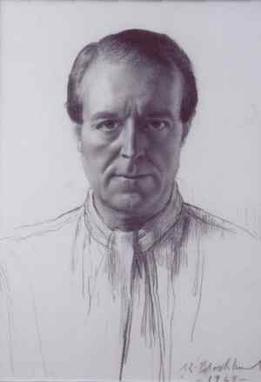
Self-Portrait, by Gerald Brockhurst (1949)

Brockhurst was born in the Birmingham suburb of Edgbaston, on October 31st, 1890. He was the youngest of four sons. His father, Arthur, a coal merchant, deserted the family and sought his fortune in America. Gerald attended a number of local schools but found it hard to settle down to school life. He struggled with his writing but excelled in sketching. Problems at school were exacerbated by recurring ear infections he frequently suffered from and which often left him bedridden. As a young boy, he showed a talent for drawing and having an aunt who lived in India, it gave him the opportunity to send her illustrated letters and this really fired-up his interest in art and soon his goal for the future was to become a painter. In 1901, just before his twelfth birthday, he was accepted into the Birmingham School of Art where he remained for five years. He prospered at the academy and the then headmaster of the Birmingham School of Art even announced he had discovered “a young Botticelli”.

Self portrait by Gerald Brockhurst (1905)

During this five-year period, he developed a love for portraiture. Testament to this fact was his self-portrait which he completed in 1905 when he was just fifteen years of age. The portrait is now housed in the Scottish National Portrait Gallery in Edinburgh.

Gerald Brockhurst won many awards at the Birmingham School of Art and later in 1907 he enrolled at the Royal Academy Schools, which was the oldest art school in the country, founded through a personal act of King George III in 1768. In 1912 Brockhurst gained the esteemed Gold Medal for General Excellence and a travelling scholarship.

Anais, an etching by Gerald Brockhurst

In 1913 Brockhurst met a young French woman, Anais Melisande Folin. She was an amateur artist and it is thought the two met at the home of Ambrose and Mary McEvoy, with whom she was very close. Anais, besides being an artist, sat for many of his early portraits. During his lifetime, Brockhurst made many portraits of celebrities and royalty, but his main sitters were his family and his wife.  The couple married in 1913 and a year later Brockhurst took up his travelling scholarship award and set off with Anais to France and Italy to study the paintings of the old Masters, in particular the work of Leonardo Da Vinci and Piero della Francesco whose stylistic and compositional ideas had a lasting effect on his career.

Ireland 1916 by Gerald Brockhurst (1916)

In 1915, Gerald and Anais moved to Ireland where they remained until 1919. Brockhurst painted a number of pictures on the west coast of Ireland. Whilst in Ireland the couple became friends with some established painters such as Augustus John and it is his influence which can be seen in Brockhurst’s 1916 work entitled Ireland, 1916 which is housed in the Hunterian Art Gallery, University of Glasgow. In this work his wife Anais is depicted in local costume against the Connemara mountains.

The Dancer (Anaïs) – etching by Gerald Brockhurst

It was during those years in Ireland that Brockhurst created many etched and painted portraits of his wife. From those works, we can see that he was truly in love with her and was fascinated by her beauty. His meeting with the Welsh artist, Augustus John proved very fortuitous as he introduced Brockhurst to his circle of friends. In fact, it was Augustus John who persuaded him to stage two major exhibitions of his works at Chelsea’s Chenil Gallery, in 1916 and again in 1919. These were the launchpad to Brockhurst’s artistic career and he and his wife left Ireland and went to live in London in 1920. Once in London he began to enter some of his etchings and drawings to the Royal Academy. In London, Brockhurst became one of the most successful and highly sought-after portrait painters, but he was also a highly skilled draughtsman and etcher.

Etchings of John Rushbury and his wife

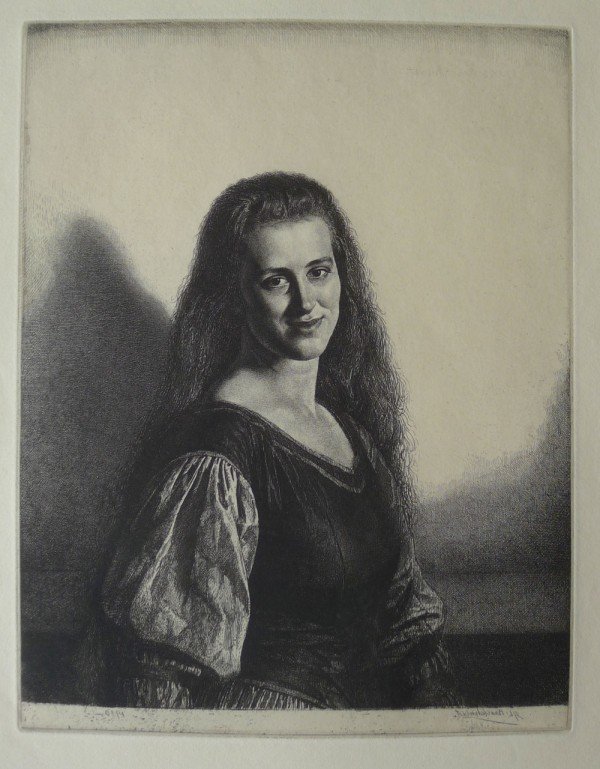
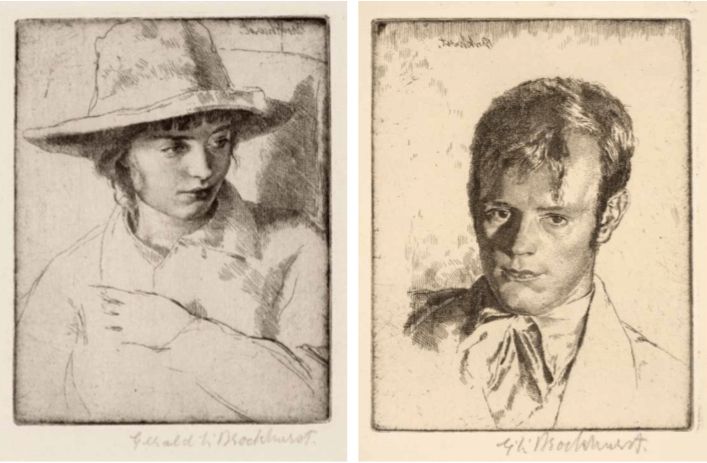
During the twenties and thirties, there was a voracious market for contemporary etching and Brockhurst quickly mastered the technique publishing his first prints in 1920. In 1921, Brockhurst was elected to membership in the Royal Society of Painter-Etchers and Engravers. One of his first etchings was of his friend and fellow Artist Henry Rushbury. Both had studied at the Birmingham School of Art and when Rushbury left Birmingham to live in London, he first shared a flat with Brockhurst who had already been living in the capital for five years. The etching on the left is entitled Yolande (Mrs Rushbury) and is a portrait of his friend’s wife. Although entitled Yolande, which was a “fancy” name made up by Brockhurst, her name was actually Florence! This etching with its minimal use of lines was described by critics as “a piece of the purest etching in the strictest sense of the word”.

During the next decade Brockhurst established himself as an outstanding and flourishing portrait painter, and also strengthened his reputation as one of the exceptional printmakers of his generation.

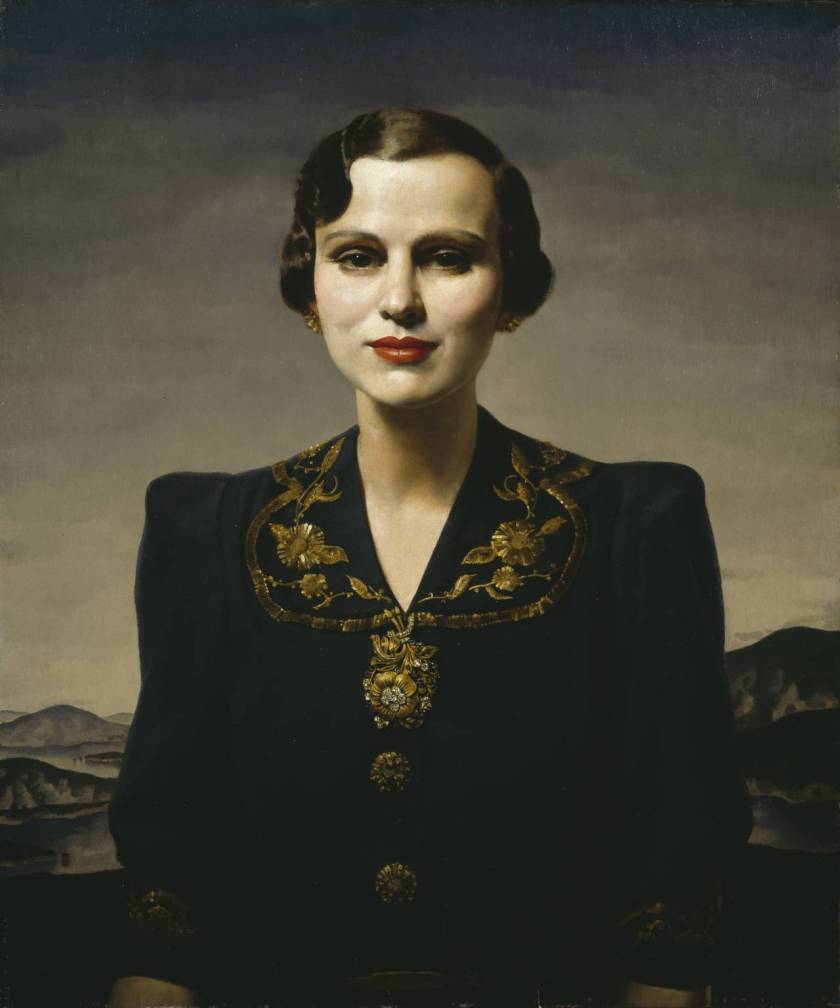
Portrait of Margaret, Duchess of Argyll by Gerald Leslie Brockhurst (c.1931)

By 1930 Brockhurst’s artwork was becoming increasingly popular and his reputation as a portrait artist was in the ascendancy, especially for his portraits of glamorous and beautiful women. Most of his portraiture was depictions in half-length format solely depicting the head, shoulders, and torso of the sitter. One of his most famous portraits, which can be found in Tate Britain, was that of Margaret, Duchess of Argyll. This smaller than life-size portrait(76 x 64cms) by Brockhurst depicts the socialite Margaret Whigham the only child of Helen Mann Hannay and George Hay Whigham, a Scottish millionaire. She would later become the Duchess of Argyll after her second marriage to Ian Douglas Campbell, 11th Duke of Argyll in 1951. When she sat for the painting around 1931, Margaret was nineteen years of age. She was leading a charmed life having been presented at Court in London in 1930 and was known as the debutante of the year. The background of the portrait is comprised of a dark sky and a landscape of mountains and lakes. Margaret was known to be passionately proud of her Scottish heritage, and Brockhurst has reflected this in the way he has painted the scenic backdrop, which evokes the lochs and mountains of Scotland. Margaret faces us, with her face, shoulders, and torso in view. She is wearing a dark dress, and Brockhurst has depicted the golden, floral embroidery in great detail using small brushstrokes. Look at the contrast between her pale, porcelain-like skin with its muted tones with the rest of her face such as her very dark eyes and eyebrows, which are so different in comparison with the whiteness of her face.

Gerald Brockhurst depicts his mistress, Kathleen Woodward, as Ophelia

Teaching in the Royal Academy Schools, at that time, was undertaken by a system of lectures delivered by Professors and Royal Academician Visitors, and in 1928, when Brockhurst was thirty-eight years old, he was appointed a Visitor to the Royal Academy Schools. It was at this time that he met the sixteen-year-old artist’s life model Kathleen Woodward. Brockhurst was immediately besotted by this youthful and exuberant beauty and she was to become his lifelong model and even though she, his muse, was just sixteen years of age and he was thirty-eight, the two soon became lovers. He renamed her Dorette. which is of Greek origin and means “gift”. This renaming of one’s muse was similar to what his fellow artist and friend, Augustus John had done, when he named his lover and muse, Dorothy McNeil, Dorelia.

Adolescence by Gerald Brockhurst (1932)

His new muse Dorette appeared in many paintings and etchings by Brockhurst but the one people remember the most was his audacious, some would say salacious, while others postulated that it was his greatest print masterpiece – Adolescence, which he completed in 1932. In the depiction we see his mistress, Kathleen Woodward, then nineteen years of age, sitting on a stool in front of her dressing table mirror. From the mirrored reflection we can see that Kathleen is studying her naked body. She seems unhappy with what she sees. It is the personification of teenage angst. It is a study of vulnerability. It is a kind of body dysmorphia in which, although the viewer sees a perfect body, the young woman is disappointed in what the mirror has revealed. The darkly lit depiction adds to the intense scene. It is a depiction which tip-toes along the narrow line separating art and erotica. What we see before us is undoubtedly the artist’s talent in his portrayal of a variety of surfaces, textures, and tones. To some, it is simply a study of beauty to others it is a disturbing, even distasteful depiction but it simply comes down to individual taste.

Jeunesse Dorée by Gerald Brockhurst (1934)

This brings me back to my opening lines when I talked about being mesmerised by beauty depicted in a painting. I first caught sight of the 1934 painting by Gerald Brockhurst entitled Jeunesse Dorée when I visited the Lady Lever Gallery in Port Sunlight, Merseyside, back in May 2011. In a way the painting was hidden away, hanging on the wall of the narrow mezzanine corridor above the main gallery. The title of the work comes from the French meaning “gilded youth” and the term is often applied to wealthy and fashionable society people. It was painted by Gerald Brockhurst in 1934 and exhibited at that year’s Royal Academy Summer Exhibition. It was subsequently purchased for £1000 by Lord Leverhume, for his Lady Lever Gallery on the very first day of the show.

Take a moment and study this beautiful portrait. It is a half-length portrait with an almost two-dimensional stark and rocky idealised landscape along with an immense sky as the background. There is a lack of depth to the background of this painting, which in a way projects the young girl towards us. This setting was consistent with his many portraits of the 1930’s and 1940’s but which was in contrast to the works of other portraitist who preferred to use realistic three-dimensional settings. He has used sombre colours. The young woman stares straight at us almost as if she is daring us to blink. As you look at her you wonder what is going through her mind. Her eyes are penetrating as if she is looking into your very soul. There is no hint of a smile on her full red lips. Her expression is inscrutable. This however does not detract from her beauty and her captivating sensuality. Her plain-coloured cardigan, echoing the shades of the background, clings tightly to her body. Her full breasts strain against the material and the buttons of the cardigan which hold them captive. It is no wonder that Brockhurst was seduced by her beauty and fell in love with her. Many who have stood before this portrait have also fallen in love with her, having been lost in her enigmatic loveliness. The art critic of the Daily Mail newspaper of the day reported on the painting and its admirers writing:

“…again, I saw people yesterday standing before the picture trying to fathom the secret of those curiously haunting deep-blue eyes…”

Lord Leverhulme lent the picture to the 1934 Liverpool Autumn Exhibition held at Liverpool Walker Art Gallery and this annual exhibition was looked upon as the equivalent of the Royal Academy shows. The curator at the Walker at the time, Charles Carter, wrote in the Liverpool Evening Express that ‘Jeunesse Dorée’ was “a picture of sensuality incarnate”.

The 1932 etching, Dorette by Gerald Brockhurst

Lord Leverhume’s determination to have the painting stemmed from his frustration the year before when he tried to buy Brockhurst’s 1932 etching Dorette, but due to the hesitancy of his Gallery Trustees on whether to fund the proposed acquisition, the sale was lost and it was bought by the Harris Museum and Art Gallery of Preston.

Portrait of Nancy Woodward by Gerald Brockhurst (c.1930’s)

During the thirties the market for prints had collapsed and Brockhurst reverted to painting. In his painting, Portrait of Nancy Woodward, we see a depiction of Dorette’s sister Nancy which Brockhurst completed in the 1930’s. This work is thought to be one of only two portraits that Brockhurst painted of Nancy. What looks like a domestic backdrop to the painting gives the impression of a close relationship he had with the sitter. Nancy strikes a self-confident pose at a time when her sister’s lover was suffering from public censure for his affair with his muse, Kathleen. The 1930’s proved to be a very turbulent time for Brockhurst. On the plus side Brockhurst was earning the highest income of any British portrait painter of the period and in 1937 he was elected to the Royal Academy.  However on the down-side, following the publishing of his Adolescence etching a newspaper article appeared exposing his affair with his model Kathleen Woodward.   The story created a scandal in England, and his wife Anais was furious and filed for divorce. Gerald Brockhurst was equally vehement with regards his wife’s action and counter-sued.

Wallis Simpson, Duchess of Windsor by Gerald Brockhurst (1939)

The adverse publicity in the British press from the divorce procedures which was finally granted to Anais in 1939, combined with the beginning of World War II led to Brockhurst fleeing England with his lover and emigrating to New Jersey where the two married. Brockhurst and Kathleen eventually settled in Franklin Lakes, New Jersey. In New York, Brockhurst’s fame as a portrait artist blossomed and commissions from his loyal patrons flowed in making him both famous and very wealthy.
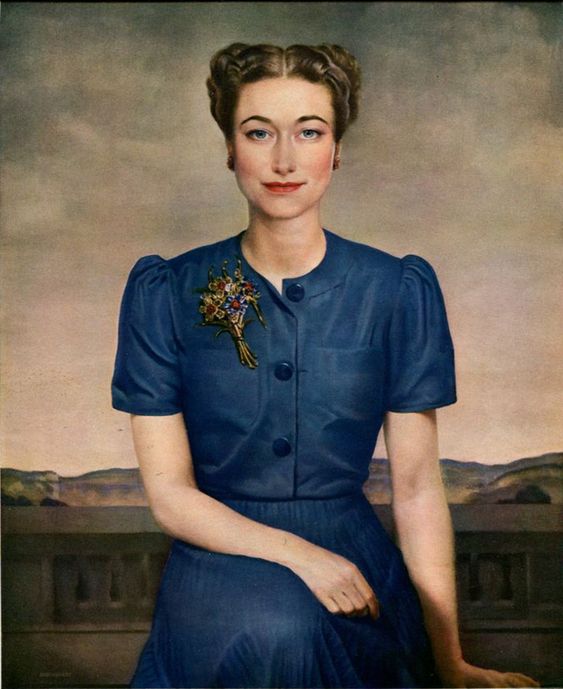
Merle Oberon sits for a portrait by Gerald Brockhurst (1937)

He was a prolific portraitist who completed in excess of six hundred works, many of rich and famous people such as J Paul Getty, Wallis Simpson, Merle Oberon, and Marlene Dietrich.

Gerald Leslie Brockhurst died in New Jersey on May 4th, 1978 aged 87. His second wife, Kathleen ‘Dorette’ Woodward, died in 1996.

Charles Spencelayh – English genre painter and portraitist

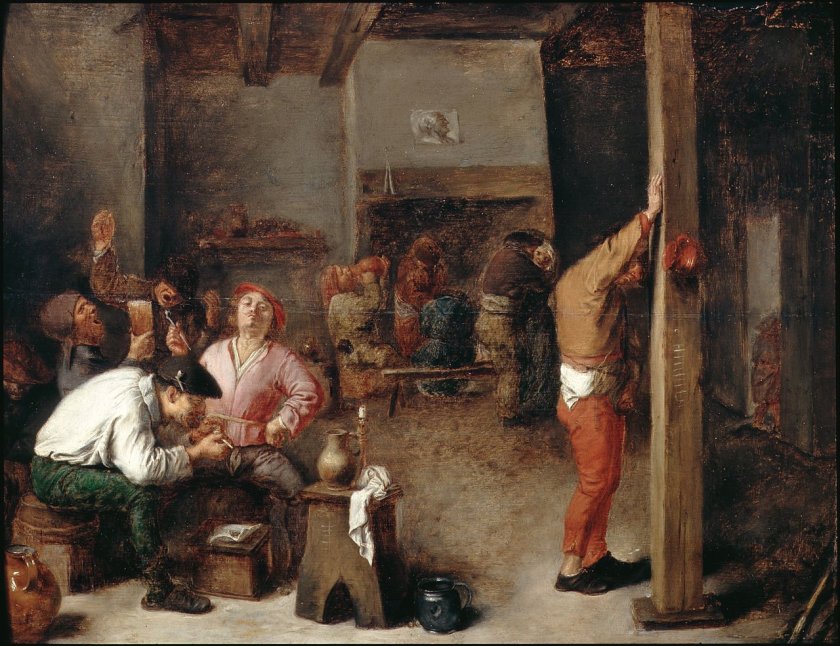
Interior of a Tavern by Adriaen Brouwer

The term genre painting relates to works depicting scenes of everyday life. Such depictions embrace scenes of ordinary people at work or enjoying their leisure time. This type of painting flourished in Protestant Northern Europe as an independent art form. The first great advocates of genre painting were the Dutch Realist artists of the 17th century, such as  Adriaen Brouwer with his riotous pub scenes, Adriaen Van Ostade, who painted genre scenes depicting peasants enjoying their home life or relaxing in an inn.

The Merry Family, by Jan Steen (1668)

My favourite has to be Jan Steen, who ran an inn and depicted people in their homes.

Woman Cleaning Turnips, by Jean-Baptiste-Siméon Chardin (ca. 1738)

In France there were genre paintings by the likes of Jean-Baptiste-Siméon Chardin who depicted servants and children. The harsher realities of working life featured in genre paintings of Jean-François Millet, Daumier, Courbet, van Gogh, and Degas whilst joyous life experienced in bars and cafés featured in works by Toulouse-Lautrec.

Charles Spencelayh at the Age of 33.

My featured artist today is the English genre painter and portrait painter Charles Spencelayh.   Genre paintings, as well as being a pleasure to observe, are an insight into everyday life before the era of cameras and television. The genre and Academic portrait paintings of Spencelayh looked at life during Victorian and Edwardian times and gives us a great insight into life and fashion in those times.

Boys Fishing by eight-year-old Charles Spencelayh (1873)

Charles Spencelayh was born in Rochester in Kent on October 27th 1865. He was the youngest of eleven children and was the son of Henry Spencelayh, an engineer and iron and brass founder who sadly died before his son was born. Charles’ first steps into the world of art came when he was given his first set of paints at the age of eight and he soon progressed to copying Old Masters. He studied art at the National Art Training School, South Kensington, which later became known as the Royal College of Art, where he won a prize for his figure drawing.

My Pet by Charles Spence;ayh (1890)

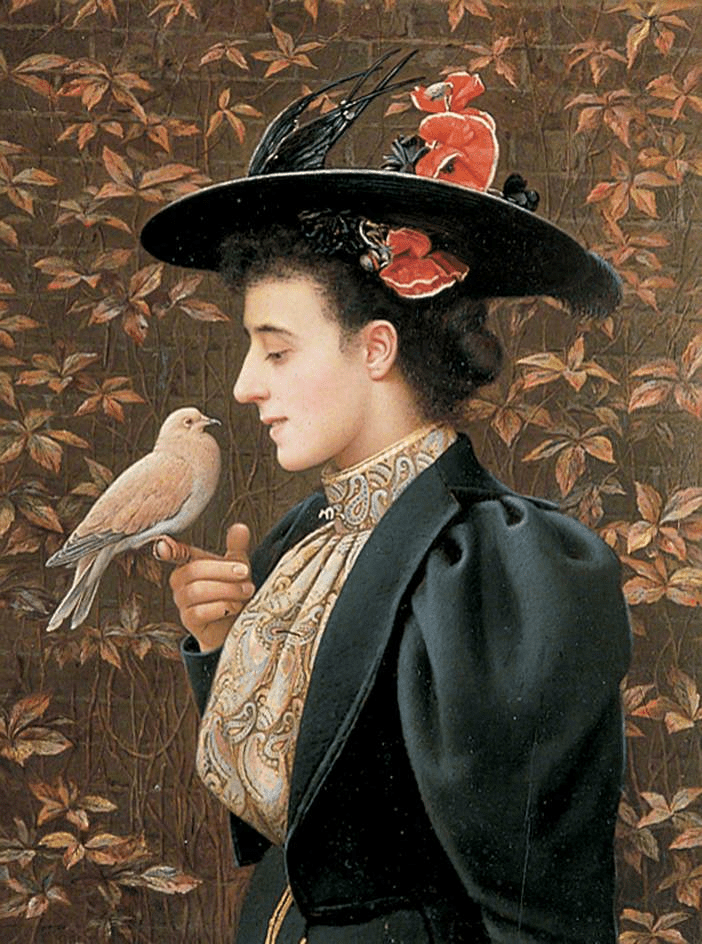
Charles Spencelayh married  Elizabeth Hodson Stowe, who worked as a governess, at St. Paul’s, Penge in 1890 and the couple started married life in Chatham.  According to the 1891 census Elizabeth’s occupation was given as a tobacconist. She appears in many of her husband’s paintings including My Pet which depicts Elizabeth, in profile, holding a dove.

Vernon Spencelayh by his father Charles

In 1891 the couple had their one and only child, a son, Vernon who went on to become a talented artist and ivory miniaturist, having been taught by his father. Vernon served as an officer in WW1 and was held as a prisoner of war in Germany. He, like his mother, appeared in a number of portraits by his father.

Private Vernon Spencelayh (1891-1980), West Yorkshire Regiment by Charles Spencelayh

Another fine portrait by Charles of his son, Vernon, in uniform is owned by The National Army Museum. This portrait by his father is a fond record of his son preparing to depart for war.   This Academic-style portrait of his son has an intensity and could almost be mistaken as a photograph.  Vernon Spencelayh’s regiment was the West Yorkshire Regiment, denoted by the motif of the white horse of Hanover on the cap badge. He was involved in a number of battles on the Western Front and at Gallipoli.

In 1896, Spencelayh became a founder member of the Royal Society of Miniature Painters, Sculptors and Gravers, a Society which was formed with the stated intention:

“…to esteem, protect and practice the traditional 16th Century art of miniature painting emphasising the infinite patience needed for its fine techniques…”

Queen Mary’s Doll House

During his lifetime Spencelayh exhibited 129 miniatures at their exhibitions. Probably one of his most famous miniatures was a postage stamp sized portrait of King George V for his wife, Queen Mary’s celebrated Doll’s House, designed by Edwin Lutyens, which was exhibited at the Wembley Exhibition of 1924 and now housed in Windsor Castle. Queen Mary’s and Princess Marie-Louise’s thank you letter was one of Spencelayh’s most treasured possessions.  Spencelayh was a favourite of Queen Mary, who was an avid collector of his work and she bought many of his paintings when they were exhibited at the Royal Academy Summer Exhibitions and she even commissioned one painting, which Spencelayh titled ‘The Unexpected’ due to his surprise at receiving such a request.

Rosie Levy taking afternoon tea at the Midland Hotel Manchester by Charles Spencerlayh (1925)

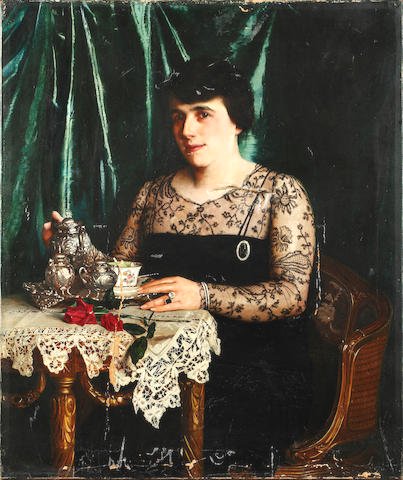
The high-points of Spencelayh’s artistic career were the years between the two World Wars. He had acquired a wealthy patron, Joseph Nissim Levy, a prosperous Manchester cotton merchant and during the 1920’s completed a number of portraits of Levy’s social circle. Mr. Levy’s admiration of the talented artist went so far as to give Spencelayh and his family use of a residence in Manchester. In 1924 Spencelayh painted an intimate portrait of Joseph’s wife titled Rosie Levy taking afternoon tea at the Midland Hotel Manchester. It is a masterpiece in the way Spencelayh has captured the folds of the rich fabric backdrop and the furnishings with their reflective surfaces.

The first Mrs Spencelayh (Elizabeth Hodson Stowe) by Charles Spencelayh

In the early 1930’s the Spencelayh’s moved south to Grove Park and Lee a suburb of south London, but sadly, his wife, Elizabeth died there in 1937 and was buried four miles away in Chislehurst Cemetery.

Why War? by Charles Spencelayh

Spencerlayh had his work exhibited at the Paris Salon, but most of his exhibitions were in Britain. For sixty years until his death in 1958 he exhibited more than 30 paintings at the Royal Academy, with his work entitled Why War winning the 1939 Royal Academy ‘Picture of the Year’. Spencelayh had fought in the First World War and in this painting, he depicts another veteran of that war in his darkened sitting room. He blankly stares into space. He is forlornly envisaging the onset of the Second World War. The artist has added so much detail in this painting that we can build up a picture of how the man lives. We see, on the table next to him, a new gas mask issued to him by Lewisham Council and lying on a chair is a newspaper, emblazoned across the front page is the story covering Chamberlain’s abortive mission to make peace with Hitler. Spencelayh’s talent as both a genre painter and portraitist and his training as a miniaturist allowed him to build up a pictorial story by his depiction of visual clues in painstaking detail.

It’s War by Charles Spencelayh (1942)

His 1942 painting It’s War brings home the hardship felt by many during the Second World War.  Painted in his studio with a large amount of props which he accumulated during his visits to bric-a-brac shops it depicts the hard times suffered by many during the conflict.  It is part portraiture, part genre and part still-life.  Its is testament to the genius of the man.

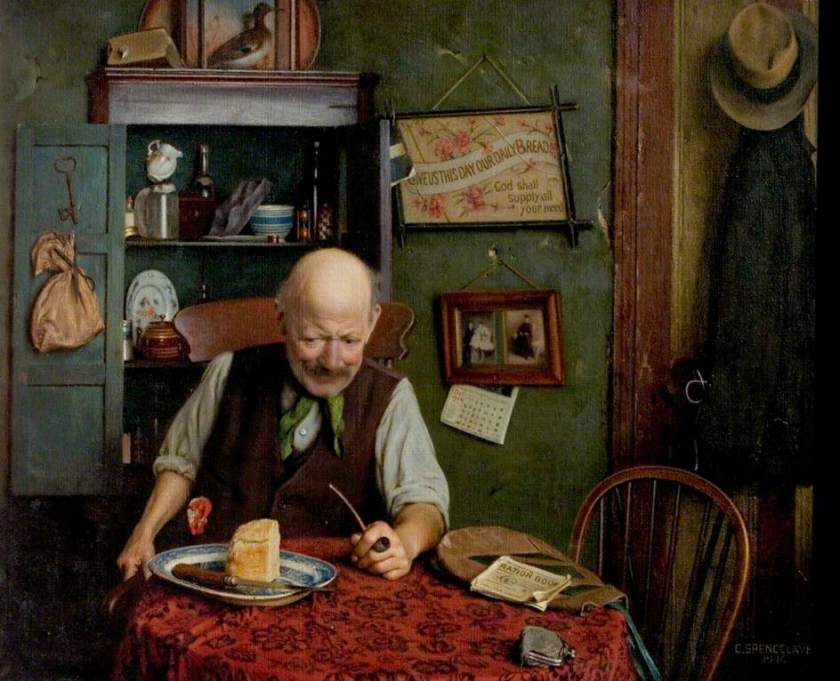
His Daily Ration by Charles Spencelayh

Although the War had ended and the Allies had been victors, Many in England had to suffer years of deprivation.  Food was rationed and hardships endured as is beautifully depicted in Spencelayh’s 1946 painting, His Daily Ration in which we see an elderly man staring at his meagre meal.

The Latest Addition by Charles Spencerlayh

One theme which appeared in many of Spencelayh’s paintings was of old men pottering around in junk shops or in cluttered rooms in their homes. These were classic Victorian genre works which were pictorial histories of the between-War days in England.

The Laughing Parson by Charles Spencelayh

Many of his subjects were of domestic scenes, painted with such definition that they are almost photographic. In his 1935 painting The Laughing Parson,  we see the parson dressed in a grey morning suit, resplendent with his “dog collar”. He is half slumped in his wing back armchair as he peruses the latest issue of the satirical Punch magazine. By the look on his face and his broad smile, something in the magazine has amused him.  Once again Spencelayh has added numerous items of furniture and accessories which tell us about life in those bygone days.
The Second Mrs Spencelayh by Charles Spencelayh

In 1940, Charles remarried, and his second wife, another Elizabeth and he continued to live in Lee but after a particularly fierce German bombing raid over London, they were rendered homeless. Worse still many of his paintings were destroyed. The couple then moved north to Olney were his wife’s family lived and soon after, setting up home in the Northamptonshire village of Bozeat where they remained for the rest of their lives. It was during those years at Bozeat that Spencerlayh produced some of his best loved paintings often featuring residents of the village who were often treated to a home-cooked meal as payment for modelling for one of his paintings.
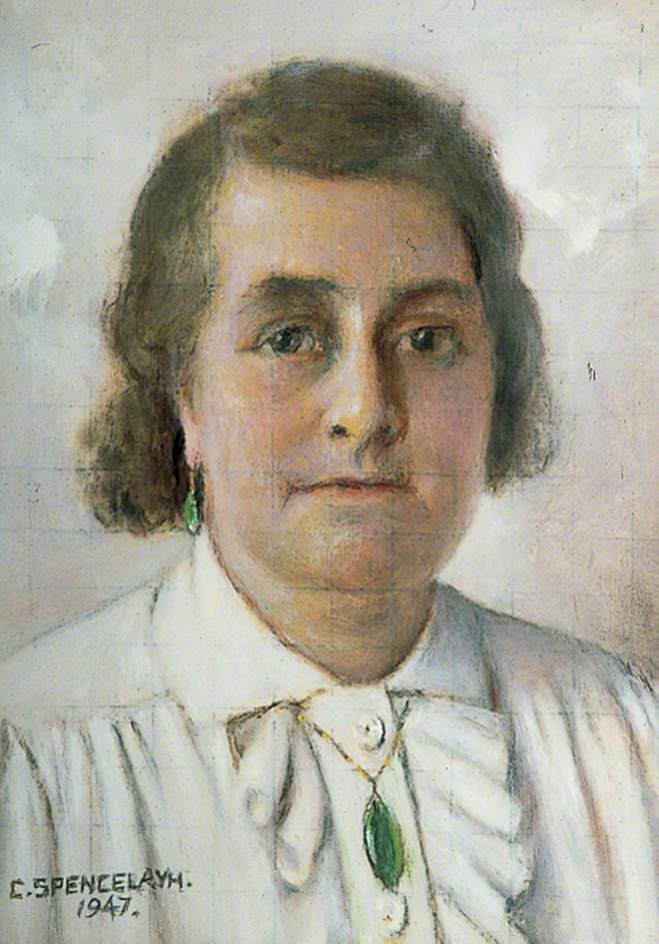
A Lover of Dickens by Charles Spencelayh (1947)

Spencelayh set up his studio with room-sized screens bedecked with patterned wallpaper and had a chest, full of props, with which he would “dress” the room.  Charles  ‘dressed’ the room using “props” from his collection, such as Toby jugs, stuffed birds, Windsor chairs, clocks and cheap watches as well as patriotic framed pictures of Lord Nelson and members of the Royal Family.  Look at the background of his 1947 work A Lover of Dickens.  The props he used to add meaning to the painting were arranged haphazardly to give a sense of everyday clutter.  Maybe the man lived on his own and a regime of “tidiness” was not forced upon him !

Fingerprints by Charles Spencelayh (1953)

By the late 1950’s his eyesight began to fail but that did not deter him and he continued to paint and in 1958, three of his works were accepted into the Royal Academy Summer, including a poignant work titled The Faded Rose. Sixty-six years earlier he had his first work exhibited, a miniature entitled Mrs Robins and he is considered to be one of the most prolific artists to show at the Royal Academy. Notwithstanding this, he was never made an Associate of the Academy, which baffled many including himself. He wrote to his Canadian agent, George Nuttall in 1956 about this unforgiveable omission. He commented jokingly:

“…I do not know, unless I am not old enough, or work not sufficiently good, which is my aim to yet improve although I cannot wear glasses to paint eventually this will stop my efforts I’m sure of it…”

Taking the Risk by Charles Spencelayh

Charles Spencelayh died, aged 92, in St Andrews Hospital, Northampton on June 25th, 1958 and after a funeral service conducted by his friend and executor the Reverend W.C. Knight in the 12th century church of St Mary the Virgin, Bozeat, he made his final journey back to Kent and was buried with his first wife in Chislehurst Cemetery.


Most of the pictures came from ARC and Art UK and Spencelayh’s biography came from a number of websites of galleries which house some of his paintings and the Chislehurst Society website:

Click to access CharlesSpencelayh.pdf


The talented Rayner childen. Part 3. Louise Rayner

In the “About” section of my blog I state quite categorically that I am not a painter. This has now changed in as much as I have now started to dip a paintbrush into paint and touch it to a canvas. Why? As people know my great interest is in art history but people always seem surprised that I have not rattled off a few masterpieces. They constantly ask me why I do not even try to paint. I have now started on that long artistic road and have fallen by the wayside so many times I often wonder why I persevere, but persevere I do. Having said so many times in my blog that I like detailed paintings I tried to emulate the great painters who seem to find it so easy to depict buildings but of course, as you will have guessed, I fail miserably. How artists manage to add so much detail in their work both amazes and frustrates me. Maybe I should paint a few coloured squares or a series of dots instead and then have a highfalutin reasoning behind my depiction! However, whilst I struggle on manfully with my efforts, I want to talk about and show you the work of a genius in this field of cityscape art. Let me introduce you to the English Victorian painter Louise Rayner.

Louise Rayner aged 27

Louisa Ingram Rayner was born in Matlock Bath in Derbyshire on June 21st, 1832. Her middle name, Ingram, came from her grandmother’s family. Whilst she was young she was always known as Louisa but as she grew older she preferred the name, Louise. She was the fourth of nine children. Louise had four sisters and one brother, all of whom became artists. Her father was Samuel Rayner an English landscape artist, who was known for his depictions of buildings and their interiors, including abbeys, churches and old mansions and her mother was Ann Manser Rayner who was an expert engraver of black marble.

The Bell Inn, Market Place, Ely by Louise Rayner

At the age of ten, she and her family left Derbyshire and returned to London and it was here that she would spend most of her early life. It was whilst on a family holiday in Herne Bay, when she was fifteen, that she took up drawing and, soon after, she began to study painting seriously, at first with her father who played a major part in her love of art and later under guidance from her father’s artist friends such as George Cattermole, who like her father worked for John Britton, an English antiquary, author and editor, Edmund Niemann, the highly successful British landscape artist who worked mostly in oils. Another of her father’s friends was David Roberts, the Scottish painter who completed long sketching and painting tours of the near East, the Holy Land and Egypt but also specialised in architectural and topographical scenes.

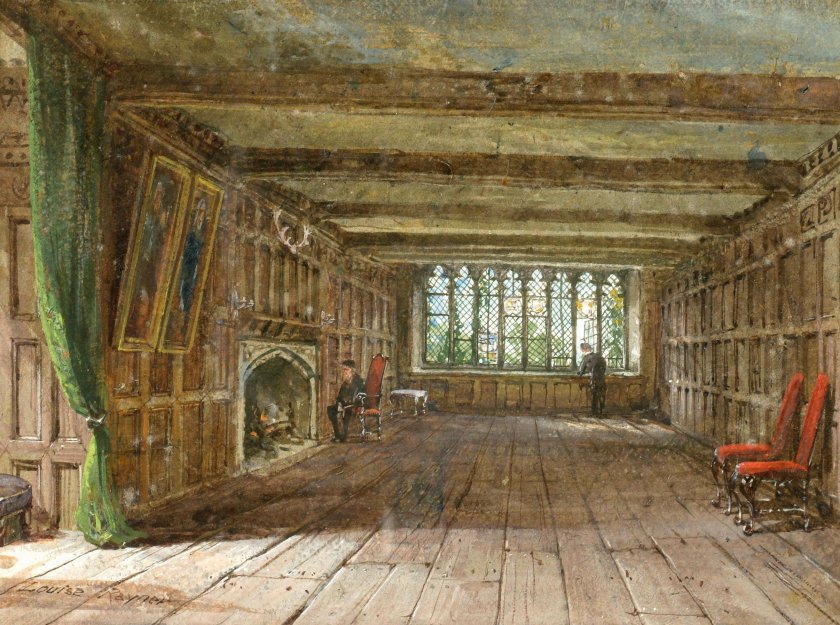
Interior of Haddon Hall by Louise Rayner

His influence on Louise Rayner is very apparent when we look at the first painting she submitted to the Royal Academy in 1852 entitled The Interior of Haddon Chapel, Derbyshire.

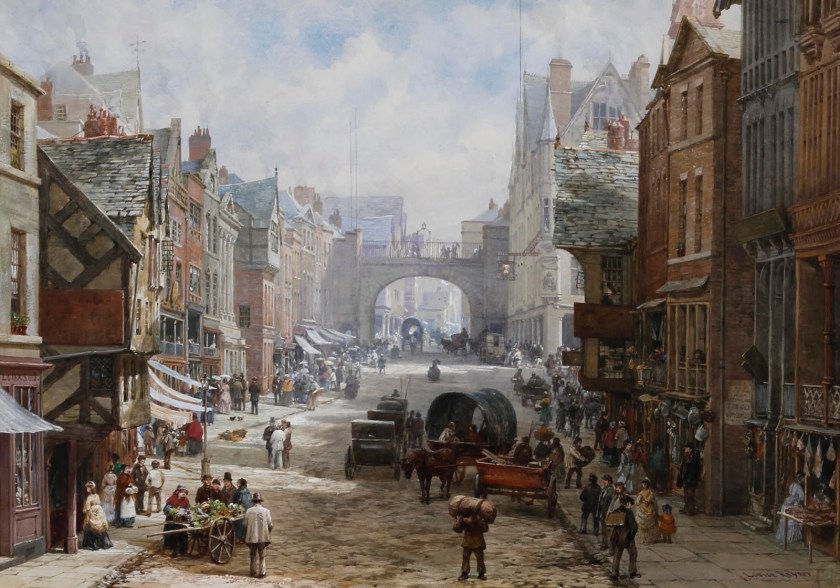
Eastgate Street, from east of the Cross looking towards the Eastgate by Louise Rayner

Louise Rayner, like David Roberts, depicted cities and their often crumbling buildings as well as stately homes and their surroundings. During her most active period, Louise, like her father before her, painted a large number of church interiors, and exteriors but what she would really become known for, was her depictions of ancient streets and picturesque yet dilapidated in many of the cities and towns of Britain and Northern France, all of which she always populated by numerous figures. She was a prolific painter and her works appeared at the Royal Academy exhibitions between 1852 and 1886.

Louise Rayner first began exhibiting her watercolour paintings in 1860 at the Society of Female Artists, which was founded three years earlier and has held an annual exhibition in London of the work of women artists ever since. Louise continued to live at the family home and in the early 1860’s this was located in Brighton.

Louise is first recorded as first visiting Chester in 1869. Her paintings from this period are very detailed and charming in a chocolate-box sort of way. They encapsulate the olde worlde charm of Chester and the other towns which she depicted. Most of her works feature people going about their daily business, such as street sellers and people out shopping.

Watergate Street Chester by Louise Rayner

However, midway through that decade, she went on sketching journeys which resulted in beautiful paintings of historical England and Wales. One of her favourite places to visit was the Roman town of Chester (Deva) and it is recorded that Louise was living in Chester at 2 Ash Grove, off the Wrexham Road, in Chester in 1869.

Aberconwy House by Louise Rayner                                                                  The painting shows both Aberconwy House and Conwy Castle in the background. Aberconwy House was originally a 14th Century merchant’s house. It is thought that Louise captured this image during one of her trips to the Welsh town around 1868.

What first grabbed my attention about the Rayner family was the picture above, a painting by Louise Rayner of Aberconwy House within the walled-town of Conwy.  It is a place I pass a number of times each week and up until two years ago, I lived just fifty yards from this building.

Aberconwy House this afternoon

..………and this is how looked this afternoon !

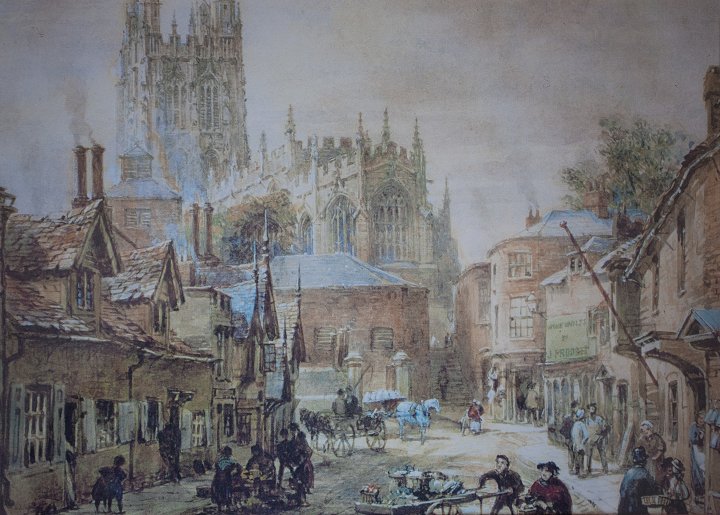
Street View Wrexham by Louise Rayner (c.1880’s)

Another Welsh town she visited and depicted in one of her paintings was Wrexham and above we have her work entitled Street View, Wrexham which she completed in the 1880’s.

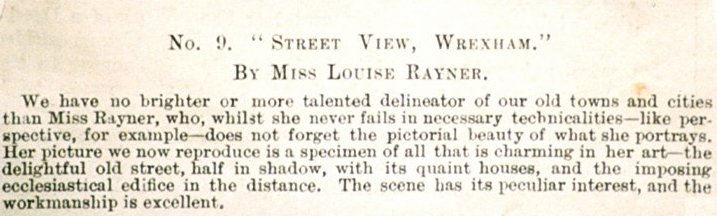
Newspaper clipping of 1898 following the exhibiting of the painting

Again the local newspaper’s art critic praised her work.

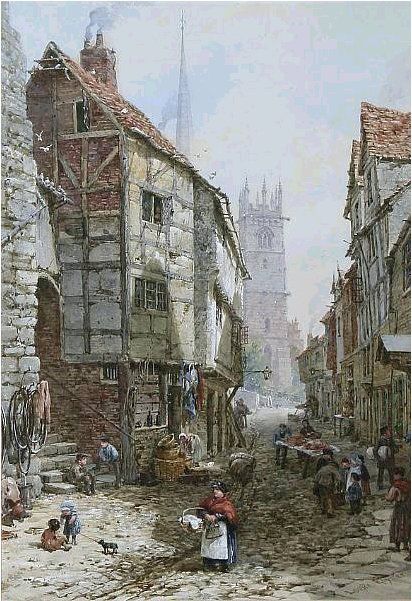
Fish Street, Shrewsbury by Louise Rayner                                       The depiction is of Fish Street, Shrewsbury, looking south-south-east. Not only do we have a hive of activity at street level but Louise has included some bird life up on the roofs. In the distance, two churches vie for attention. The spire is St. Alkmund’s Church, and the more prominent church is St. Julian’s.

Another of my favourite towns which I frequently visit is Shrewsbury and the town, as it used to be, is beautifully captured in Louise’s painting, Fish Street Shrewsbury.

Old Houses, Shrewsbury by Louise Rayner

Another depiction of the streets of Shrewsbury can be seen in her painting, Old Houses, Shrewsbury.

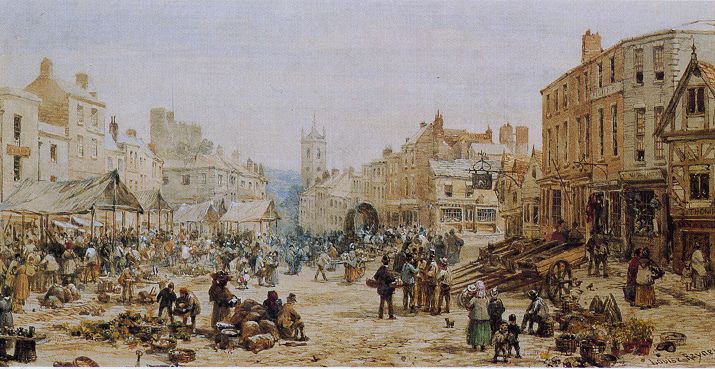
Dudley Market Place, 1870, by Louise Rayner

Louise and her younger brother Richard visited the area around the West Midland’s town of Dudley on one of their subject-seeking art expeditions in 1865 and five years later Louise produced this beautiful painting. The depiction is taken from Market Place and we look down Castle Street with Hall Street to the right. In the background, we can see the Church of St Edmund, locally known as the “bottom church” to differentiate from St Thomas’ parish church in High Street (not in the picture) which is known as “top church”. To the left, on the skyline, we can just make out the upper part of Dudley Castle.

Rheims Cathedral, France by Louise Rayner

Louise traveled extensively throughout Britain each summer during the 1870s and 1880s, but also took trips to northern France and in the picture above we see her depiction of a street in Rheims. The painting depicts Rheims Cathedral in the background. The beauty of this work lies in the drama of the architecture as we see the cathedral spire rising into the sky whilst below we see the street populated by locals. Look how she has used a blaze of sunlight, raking between the buildings, to highlight a man on the right trying to gain entrance to his house.

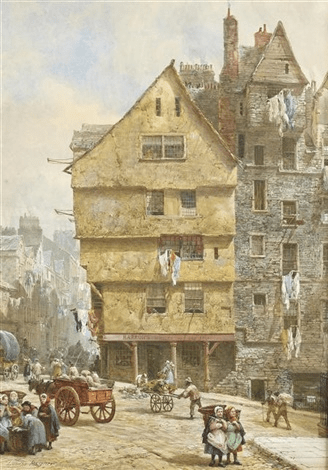
West Bow, Edinburgh by Louise Rayner

As it is for everyone, age takes its toll and as she grew older Louise’s artistic talent began to fade probably due to her failing eyesight, unsteady hands and the ability or enthusiasm to travel to towns to seek out new views for her work. Louise exhibited for the last time at the Royal Academy in 1886, and the last time anywhere in London in 1893. She had reached her peak well before she had almost decided to lay to rest her paint brushes at the age of 76 in 1908. The Rayner family dynasty was starting to come to an end. Frances Rayner Copinger died in 1889 and Louise’s mother, Ann, the following year. In 1890 Louise and her sister Margaret set up a teaching studio in Chester but on “retiring”, she and her sister went to live in Tunbridge Wells in 1910. In 1908 the youngest Rayner sibling, Richard, dies aged 65. On August 20th, 1920 her sister and companion Margaret died and Louise Rayner moved to Southwater Road, St Leonards on Sea, a seaside town close to Hastings, where she remained until her death on October 8th, 1924, aged 92.

The Close, Salisbury by Louise Rayner

What surprises me the most is that despite her intricate cityscape paintings, and watercolours, Louise Rayner is not seen as one of the great artists of the nineteenth century. Maybe it is because of the similarity of her work, but can you really get tired of a good thing?  I will leave the last word to Peter Watson, the art correspondent of The Observer newspaper, who wrote about Louise following his visit to the Christies Glasgow auction in November 1974. He wrote derisively about the event itself but praised Louise’s work.

“…Louise Rayner won’t be to everyone’s taste – very dense, detailed paintings-cum-drawings of Victorian streets teeming with life: cats fighting, dogs smelling, spivs spivving, washing hanging, flirts leering, babies vomiting, parents spanking. And not a give-away either (priced at several thousand) but they do have a lookatable quality which possibly justifies the price…”

I hope you have enjoyed the last three blogs charting the lives of the Rayner family.  Having just completed this one on Louise Rayner and her architectural cityscapes I am going to return to my own canvas, give up my aspirations of depicting a cityscape and just spray a few colours of paint on it and maybe a few zig-zags !!!!!!!


Besides the usual sources such as Wikipedia I got most of my information about the Rayner family from an excellent and comprehensive website entitled DudleyMall.

(http://www.dudleymall.co.uk/loclhist/rayner/samuel.htm)


The talented Rayner children. Part 2: Ann Ingram (Nancy) Rayner, Rhoda (Rose) Rayner and Frances Rayner Copinger

Ann Ingram (Nancy) Rayner

This is a detail from Nancy’s sister Rose’s 1856 painting Divided Attention and it is thought that it depicts Nancy at work, sitting here in fancy dress.

Samuel and Ann Rayner had nine children of which six excelled artistically like their parents. Having looked at the life of the parents in my previous blog I want to focus on the talents of their children.

Their first-born child was William but he died at childbirth and so the title of eldest child fell on to the shoulders of their daughter Ann Ingram Rayner who, to save confusion with her mother, was always known as Nancy. She was born in London in 1826 during the time when the family were living at 11 Blandford Street, Portman Square, Marylebone. A year after she was born, the family moved to Museum Parade in Matlock Baths, and her early years were spent in Derbyshire.

                              The Gleaners by Nancy Rayner (c.1850)                                            The painting entitled The Gleaners was painted by Nancy in 1850 and shown at the Old Watercolour Society Exhibition in 1850. Gleaners are people, usually done by the local poor, who gather grain or other produce left behind after the harvest, with or without the farmer’s consent. It was usually done by the to provide some extra food. The children depicted are likely to be seven-year-old Richard Rayner (the youngest of the Rayner children) on the left, along with one of his sisters. The sister was initially thought to be Margaret but the painting was a poor likeness of her in 1850. Instead the girl is now believed to be one of the few non-artists of the Rayner children, Grace Dorothy Rayner, who would have been eleven at the time the painting was completed.

Nancy started her artistic studies at the age of ten and soon proved to be very talented. In her teenage years she was probably influenced by contemporaries of her father such George Cattermole, a fellow draughtsman working for John Britton. Another was Octavius Oakley, who had developed into a specialist of portraits in watercolour and was, like Samuel Rayner, given commissions by the Duke of Devonshire. Oakley  tutored Nancy in the art of portraiture and Nancy’s ability at painting portraits was initially down to his work with her. Other luminaries who influenced Nancy were the Scottish painter, David Roberts who had been a long-standing friend of the Rayner family. When he returned from a sketching trip to Spain he gave Nancy one of his original pencil sketches. Samuel Prout, one of the masters of British watercolour architectural painting, was also a great inspiration to Nancy.

The Tambourine Woman by Nancy Raynard (1852)                        The painting, originally known as The Gypsey Woman, later The Tambourine Woman, was painted by Nancy Rayner in 1852 but has no signature of the artist on the work of art itself although a sticker with her name on it was found on the frame. There are many thoughts as to why she did not sign the work. Maybe Nancy wanted to remain anonymous because of the scandal of her father’s court case in 1851 which was causing great financial problems to the family.

Nancy was the first of Samuel’s children to become an Associate of the Old Watercolour Society. The Society albeit supportive of watercolourists was a male-dominated society for it was only the male Associates who could progress to become full members of the Society and share in its profits and become administrators. Female associates were barred from this transitioning. At the time of Nancy’s election as an Associate there were only three other Associate female painters, Maria Harrison, Eliza Sharp and Mary Ann Criddle who were also affected by this ruling. They were well in the minority as there were 26 male members and 17 male associates. After sustained pressure from the ladies with regards this unfair treatment the Old Watercolour Society changed the rules and appointed them Honorary Lady Members. However, they still were not allowed to share in the profits of the Society.

Nancy then had her first painting exhibited at the Royal Academy in 1848, at the age of twenty-two, and was elected a Member of the Old Watercolour Society two years later. The sale of her paintings went well and she received many commissions and patronage. Princess Mary, Duchess of Gloucester was known to be one of Nancy’s patrons.

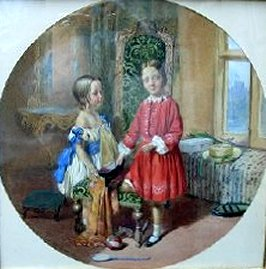
Portrait of the Gloucester Children by Nancy Rayner (1850)

Her 1850 painting entitled Summer Pastimes, which is also known as Portrait of the Gloucester Children depicts two young children playing. It is thought that the children are in fact the Duchess’s children or maybe her grandchildren as if you look at the window on the right you can see a flag flying over a castle tower, signifying that is part of the royal estate.

Nancy Rayner’s life came to an early end in November 1855 at the age of twenty-nine and so her artistic life was cut short. As a talented painter, maybe if she had lived longer, she would have been as famous as her father or her famous sister, Louise.

Rhoda (Rose) Rayner

Rose Rayner at the age of 31.

The second daughter of Samuel and Ann Rayner was Rhoda, known as Rose. She was born 1828 whilst her parents were living in the small Derbyshire town of Matlock Baths. Her artistic journey began as a teenager when she was taught how to create models using clay and she began to produce jugs and vases. Her late venture into the world of painting was probably due to her love of clay modelling and pottery and she would spend much time making and decorating her pottery figures. It was not until seven years later, around 1850, when she was twenty-one, that she began to paint with watercolours like her siblings. Four years later, in 1854, some of her paintings were seen at art exhibitions. One of the great artistic influences on Rose was the rise of the pre-Raphaelite painters.

Miss Catty by Rose Rayner (1854)                            The subject and title of this painting is Miss Catty. She is one of the daughters in the Catty family. Grace Dorothy Rayner who was ten years younger than Rose and one of three non-artists of the family. She had married Frederick Henry Bovil Catty in 1869.

Although her interests remained in watercolour painting and pottery her great love was teaching and it is thought that throughout her life she was involved in the private tuition of children whose parents could afford to give their children a good start in life. Rose was fortunate to be able to travel widely in Europe. The fact that she travelled so much and so far from home, like her trip to Russia in 1880 would mean that she had either become very prosperous or that she travelled as part of a wealthy family’s retinue.

Divided Attention by Rose Rayner (1856)                                   Rose Rayner painted Divided Attention in 1856. It is believed that it depicts her sister Nancy sitting before her easel with one of her many suitors watching her work. The signature at the bottom of the painting is “R.Rayner”

Rhoda Rayner exhibited at the Royal Academy and elsewhere between 1854 and 1866, and it is thought it was during this period that she began to call herself Rose.

In the late 1870’s life changed for her. The marriage between her younger sister Frances and her husband Charles Coppinger in 1866 had come to an end. Frances left her husband and went with her daughter Annette (Netta) back to live at her parents’ home in New Windsor. It was in 1879 that Samuel Rayner died and it is thought that Rose’s share of his inheritance allowed her the independence to live on her own at 103 Dalberg Road in the London borough of Lambeth and following Frances’ return home Rose offered to look after Netta who was eleven years old.

Russian Balloon Seller – Streets of Petrograd 1881 by Rose Rayner (1881)

In 1881 she completed a painting entitled Russian Balloon Seller, Streets of Petrograd. She had probably made preliminary sketches when she was visiting Russia in 1880 with her niece Netta and completed the work in her London studio.

Self portrait of Netta MacGregor                 The sketch above is a self-portrait of Netta dated 1920, two years after her marriage to Robert MacGregor.   It is signed in her married name A(nnette) F(rances) MacGregor and is an indication that like her aunts she had acquired great artistic talent. 

Rose and Netta were still living together in 1891 according to the census of that year. Their home was now Hampstead in London and the census gives Rose’s occupation as Artist, Figure Painter, Sculptor and Annette’s occupation as piano music teacher.

In 1908, Rose’s younger brother Richard died, aged 65 and Rose moved to a new house and went to live next door to Richard’s family in Orpington Kent. Her niece Netta worked in a hospital during the First World War where she met a Canadian, Robert MacGregor, and when the war ended the couple were married and went to live in Canada. Rose died aged 92, in Orpington, Kent, on January 12th, 1921, just a few months after Netta and Robert sailed for Canada. Rose was the longest-lived of all her sisters.

Frances Rayner Copinger

Frances Rayner aged 28.

Frances Rayner was the sixth child of Samuel and Ann Rayner. She was born in Piccadilly, London on August 19th, 1834 and along with her older brother Samuel and older sister Louise was christened at the Newman Street Apostolic Catholic Church in Marylebone the following February.

Port Dieppe by Frances Rayner (1884)                                                               It is thought that the portly figure with the white hair standing in the boat could have been Frances’ father Samuel but he died in 1879. However it is known that Frances had been in the Dieppe area in 1866 and she could have sketched the scene then but not painted it until later and not completed it until 1884.

Frances’ artistic path differed to those of her elder siblings as she never exhibited any of her paintings until she was twenty-five years of age, and then only on one occasion in 1861 did she have a painting of hers, a watercolour, Church of St Andre, Antwerp, appear in a London gallery.   It was exhibited in the Suffolk Street gallery in London. The one thing she had in common with her father was her love of architecture and especially the architecture of old religious buildings.

Kapellbrucke und Wasserthurm, Luzern by Frances Rayner                                           This is Frances’s painting of the Kapellbrucke und Wasserthurm, Luzern (Chapel Bridge and Water Tower in Lucerne, Switzerland), which is the oldest wooden bridge in Europe, spanning the River Reuss. In the lower left, though hardly visible, is Frances’s faint monogram and her married name Copinger.

One of her great loves was travel and she journeyed throughout Europe on a number of occasions and from these travels was born a number of paintings featuring places in Europe. Frances Rayner married Charles Copinger in February 1867. It was Copinger’s second wife, his first wife Mary had died in 1866. From his first marriage Charles had five children and with Frances he had a daughter Annette Frances who was born on October 26th, 1867 and a son Ernest Edwin born in 1871. Following her marriage, Frances and her husband lived in Brussels for some years, but by the time of the census in 1871 she and the family had returned to England and were living in the London borough of Islington. The census reports her occupation as an artist and her husband’s occupation stated as being a clergyman of the Catholic Apostolic Church. There was one other occupant of their household, Copinger’s sister Clara, who acted as a governess for the children.

Canterbury Baptistery by Frances Copinger (née Rayner)  Frances certainly favoured religious subjects for her paintings and this one is the Canterbury Baptistery, and was signed (deep in the flowers) “F. Copinger née Rayner 1884”

The marriage between Frances Rayner and Charles Copinger ended shortly after the birth of their son but there is no record of a divorce, which was very difficult to procure in those days. Notwithstanding that, Charles simply left Frances and went off to America and in Baltimore in 1878, with or without divorce, he married his third wife Mary Margaret May. They went on to have two daughters and a son. Charles Copinger died on May 9th, 1913.
After the breakdown of her marriage in the late 1870s, Frances left her husband and took the children to live with her mother and father but probably because of the problems of space in her family’s house, her daughter Annette went to live with Frances’ sister Rose. In the 1881 census Frances is noted as living with her son Ernest as a lodger in a house belonging to the Sevenoakes family in New Windsor on the outskirts of London.

Baron’s Chapel at Haddon Hall by Frances Copinger (née Rayner) 1883             Frances, like her sisters and father painted scenes depicting Haddon Hall. of the family.

Frances Rayner died in 1889, a year before the death of her mother, Ann. She was 55. At the time of his mother’s death, her son Ernest was about eighteen years of age. When Frances died Ernest went to live in Camberwell with his Aunt Grace who had married Frederick Catty in 1869 and the couple had five children of their own. Ernest became a merchant’s clerk when he was nineteen. He died in 1904

Of all the Rayner children the most talented was Louise and I will dedicate my final blog to her life and her beautiful works of art.


Besides the usual sources such as Wikipedia I got most of my information about the Rayner family from an excellent and comprehensive website entitled DudleyMall.
(http://www.dudleymall.co.uk/loclhist/rayner/samuel.htm)

It is really worthwhile you going to have a look at it.

I also gleaned information about Charles Copinger from the family blog :

http://www.copinger.org/page.php?file=1_34


Mary Adshead – the great muralist.

Mary Adshead

The artist I am showcasing today, Mary Adshead, was an exceptionally gifted person. She was an artist who moved seamlessly between easel painting and murals.   She was a portrait painter.  She painted on furniture and glass.  She was a postage stamp designer.  She was a book illustrator and devised and designed advertisements and stage sets but will probably be best remembered as a muralist.

Mary was born in Bloomsbury, London, on February 14th, 1904. She was the daughter and only child of Stanley Davenport Adshead and Annie Adshead. Her father was a well-known neo-Georgian architect and talented amateur watercolourist, who trained in Manchester and London and for four years was clerk of works for the vast mansion at Rosehaugh, Argyll, during which time he met his wife, Annie, who was the village school mistress. In 1909, Stanley became Associate Professor of Civic Design at the University of Liverpool, and in 1912 became the Lever Professor of Civic Design. He moved back to London in 1914 and became the first Professor of Town Planning at University College, London, and remained there until his retirement in 1935.

Stanley Davenport Adshead (1927)

From the age of six, Mary was determined to become an artist and spent much of her time drawing and she produced many sketchbooks of cartoons and illustrations to stories.  The family would spend their summer holidays in the New Forest. Her mother and father’s relationship was often stormy and Mary found herself acting as a go-between, passing messages from one parent to the other.  At the age of twelve, she attended Putney High School and remained there for three years.    At the age of fifteen she went to Paris with her mother and both lived in a hotel in the French capital for six months whilst Mary attended the Lycée Victor Dury.

Ludus Pro Patria by Puvis de Chavannes (c.1883)
This painting which is housed at the Walters Art Museum, Baltimore, replicates the central portion of a mural, Ludus Pro Patria (Patriotic Games), which was installed in the stairwell of the Musée de Picardie in Amiens, France

Whilst in Paris she visited many of the famous art galleries and was greatly influenced by the murals of Pierre Puvis de Chavannes.  In the Autumn of 1921, when she was seventeen years old, her father took her to meet Henry Tonks the principal at the Slade School of Art, which was part of the University College, London, where Stanley Adshead was a professor.  Henry Tonks, a former surgeon, had a reputation for being very harsh with his students and a fierce taskmaster.  Mary brought along a portfolio of work which she had put together whilst in Paris but Tonks was not impressed.  However through a lot of arm-twisting by her father Tonks agreed to allow her to enrol on his art course.  This was a great relief to Mary and her father who, because he was a professor at the UCL, would not have to pay for his daughter’s tuition.

Poster artwork; Country joys on Londons Underground, by Mary Adshead, 1926

During the early phase of her course Mary did not work as hard as she should and was happy to hang out with a set of wealthy girls who looked on the art and course as simply a pleasant hobby.  Soon she realised that she was wasting valuable time and began to knuckle down and Tonks began to be very impressed with her work. Mary and fellow student, Rex Whistler won the joint first prize in the Slade’s Summer painting competition in 1924 and as a result, when their time at the Slade came to an end, Henry Tonks arranged for them to undertake a joint mural commission at the Highway Boys’ Club in London’s East End.

Mary Adshead 1926 mural:
A Tropical Fantasy:
for Charles Reilly’s Dining Room
Mural (panel 1 of 6)

Once she had completed that commission, more followed and her next one, in 1924, was to create a mural based on a desert island theme, which became known as A Tropical Fantasy. It was commissioned by Charles Reilly, the professor of architecture at Liverpool University, and one-time colleague of Mary’s father.  It is now housed at the Liverpool University Victoria Art Gallery. It is one of just a few of her murals to survive. That same year she completed a large mural entitled The Housing of the People, which was exhibited at the 1924 British Empire Exhibition at Wembley.

Bank Underground station, advertising mural by Mary Adshead which was situated next to escalator (1926)

She designed posters for the Underground Group and London Transport in the period 1927-37 and also carried out decorative works at Bank and Piccadilly Circus Underground Stations.

An English Holiday – Village Inn, 1928


One of her most lauded and often considered as her finest work was a commission she received in 1928 from Lord Beaverbrook, the millionaire Canadian-British newspaper publisher and politician, for a mural to cover the walls of his dining room at his Newmarket House, Calvin Lodge. He had decided that the mural should depict scenes of Newmarket life such as the horse racing and the fair and should depict his well-known and famous friends and it was that last instruction which was to be the stumbling-block to this project.

An English Holiday – The Puncture by Mary Adshead (1928)

The resultant panels, collectively titled An English Holiday, were true masterpieces combining humour with an insight into a life of privilege and elegance. They were described at the time as being in ‘the manner of English 18th-century sporting prints and acquatints. The paintings were packed with activity.

Village Inn by Mary Adshead


In Village Inn, a gentleman cyclist flirts with a country maid. In another one we see Arnold Bennett playing the harmonium for a crowd of gypsies. In another we see Lady Louis Mountbatten waiting by her car, the tyre of which had punctured and is being offered assistance by a swaggering, bearded character who looks very much like the painter Augustus John. More bizarrely Churchill is depicted astride an elephant. All of the characters are making their way to the Newmarket racecourse to meet Lord Beaverbrook.


However, Lady Diana Cooper, a good friend of Lord Beaverbrook and who also appeared picnicking in one of paintings persuaded him not to install the murals. Her argument being that as he was so cantankerous and quarrelsome, he was bound to, sooner or later, argue with one or more of the people depicted in the murals and then he would be forced to look at their depictions every time he dined. He listened to her advice and returned the panels to Adshead and paid the two-thirds rejection fee.

The panels were reassembled and exhibited at the large Peter Jones Department store in Central London in 1930 before being rolled up and relegated to a cupboard in the Adshead’s house where years later all but three were destroyed by fire.

The Little Boy and his House by Stephen Bone and Mary Adshead

In 1929 Mary Adshead married the painter Stephen Bone, the son of the artist and etcher Sir Muirhead Bone. Stephen and Mary had been students together at the Slade. The couple went on to have three children, two sons, Quentin and Sylvester and a daughter, Christina.  Mary and Stephen collaborated on a couple of children’s books, namely The Little Boy and His House in 1936, The Silly Snail and Other Stories in 1942 and The Little Boys and Their Boats in 1953 in which Mary provided the illustrations.


Chateau Poulet, near Forcalquier, Haute Provence by Mary Adshead

During their early married life, the couple made many painting and sketching tours during their travels through Europe.  Mary received many commissions through her architect father and also through the good auspices of her father-in-law who was always singing her praises in his circle of artist friends.  Her father-in-law, Muirhead Bone was well known for helping young aspiring artists such as Stanley Spencer, Gwen John and Cristopher Nevinson.

Morning after the Flood by Mary Adshead (1928)

Mary Adshead’s first solo exhibition was held in 1930 at the Goupil Gallery and included the painting The Morning after the Flood which is now part of the Tate collection. This decorative painting by Mary Adshead was characteristic of the style taught at the Slade Art School when she was a student. The tutors at the Slade had students set out figurative compositions that had connections with Biblical tales. This work was set the day after the Great Flood when Noah’s boat with his family and animals had come to rest on dry land.  One art critic wrote that her figure painting combined a fashionable primitivism, loosely derived from Stanley Spencer with a fluency and humour rarely found among her contemporaries.

Self Portrait by Mary Adshead (1931)

Her talent as a portrait artist can be seen in her 1931 self-portrait.

Portrait of Daphne Charlton,by Mary Adshead (c.1935)

Other portraits she completed include one of Daphne Charlton, the painter who studied at the Slade and who was a close friend of Stanley Spencer.

One of her favourites was one she did of her three children.
Victoria Pier, Colwyn Bay prior to demolition (pre-2017)

There is actually connection between Mary Adshead and her father and a place near where I live. The connection is the Victoria Pier Pavilion at Colwyn Bay, North Wales. The original pier was started in 1899 and was completed two years later. A 600-seat ‘Bijou’ theatre was built at the pier head in 1917 for the purposes of light entertainment. This original pavilion was completely destroyed by fire in 1922. This disaster forced the owners, the Victoria Pier Company, into bankruptcy and the pier was taken over by Colwyn Bay Urban District Council which arranged to re-build the structure. Eleven years later this second pavilion was destroyed by fire and a second blaze a few months later destroyed the theatre.

The mural decorations by Mary Adshead in the auditorium of Colwyn Bay Pier

Not to be deterred by these two disasters, the Colwyn Bay Urban District Council set about rebuilding, and the third pavilion was opened on Tuesday 8 May 1934 at a cost of £16,000. Now to the connection !

Inside Victoria Pavilion, Colwyn Bay with murals by Mary Adshead and Eric Ravilious

The third pavilion was designed by architect Stanley Davenport Adshead, Mary’s father, and Mary and Eric Ravilious were commissioned to paint some Art Deco murals for the interior of the pier building. The pier was badly damaged by the gales and sea in 2017 and started to collapse and it was decided to dismantle the whole structure.

Sections of murals from Colwyn Bay pier pavilion

The Art Deco murals created by Eric Ravilious and Mary Adshead, back in 1934, from inside the pavilion, have all been successfully removed and are currently awaiting restoration.

Mary Adshead and Stephen Bone

Stephen Bone, Mary’s husband, was a landscape painter and for a while was very successful but later the market for his work dried up and he became depressed and began to look upon himself as a failure. Stephen Bone died of bowel and liver cancer on 15 September 1958 at St Bartholomew’s Hospital, London. He was just fifty-three years old.

Travelling with a Sketchbook by Mary Adshead

After the death of her husband, and with her children all grown up, Mary embarked on a tour of America. During the adventure she carried her sketchbook and filled it with drawings of her journey. When she returned to England she published a book about her travels entitled Travelling with a Sketchbook.

1952 8d Wilding definitive stamp designed by Mary Adstead

Between 1948 and 1963 she submitted designs for a number of Post Office stamp issues including the Universal Postal Union stamps of 1949, the Festival of Britain stamp of 1951 and four denominations of the Wilding definitive stamps of 1952, which featured the Dorothy Wilding photographic portrait of Queen Elizabeth II .  Adshead’s design for the 8d, 9d, 10d and 11d were chosen.


Mary Adshead
(1904 – 1995)

In her latter years, lameness caused by painting off ladders hampered her work and life, but, ever purposeful, she would crawl where she could not walk with a stick, curious glances notwithstanding.  Despite this affliction Mary Adshead remained an active working artist until the end of her life.  She died in London on September 3rd 1995, aged 91.

Hannah Gluckstein (Gluck) – Part 5, the latter years and the Heald sisters

Portrait of Gluck (c.1924) by photographer, Douglas

World War II started on September 3rd, 1939  and, by the end of that month Gluck’s Bolton House home had been commandeered by the Auxiliary Fire Service, but she was allowed to keep and occasionally stay at the studio. Whilst looking for a house to rent she went to stay with Nesta’s mother, Mrs Sawyer. These were troubled times for Gluck as witnessed by a passage from a letter she wrote to her mother on September 24th, 1939:

“…My looks say I am well, my spirit is a mess at the moment and my body and nerves almost at the end of their tether…”

Nesta and Gluck in Lenzerheide, Switzerland 1938-39

The thing which was causing Gluck’s despondency was not the perils of the war but her finances. Not just her finances, but the control of her finances, which had been denied her and put in the hands of The Family trustees, her younger brother Louis, her mother, and her cousin Sir Samuel Gluckstein. This rankled with her for the persona she had adopted was that of a man, a person of competency, influence, and potency, but to The Family, it was all a pretence, for in their eyes she was just a woman and thus, in their social classification, she was a person with no authority. Her father, who had looked upon his daughter as somewhat wayward and rebellious, had made sure that level-headed and wise people would control her finances thus avoiding the possibility that she would squander her money and become poverty stricken and eventually destitute.

Gluck was paid rent by the Auxiliary Fire Service for Bolton House and her trustees agreed for her to rent a small house, Millers Mead, which was in Plumpton just two minutes away from Nesta’s home. In the small garden there was a simple outhouse which she used as her studio. She employed a married couple to act as her servants. The annual rental cost was £218. In July 1941 the Auxiliary Fire Service vacated Bolton House and stopped paying the rent and so the financial burden fell back on Gluck and as Bolton House was left empty because Gluck remained at Millers Mead, it started to suffer through lack of occupancy and there was a cost to carry out expensive repairs. Her money was slowly but surely trickling away. She had the high cost of running three places, her Letter Studio in Lamorna, Bolton House and Millers Mead. In a letter to her on July 30th, 1941, one of the trustees, Sir Samuel Gluckstein wrote that she needed to limit her expenditure:

“…I am not endeavouring to read you a lecture but I am endeavouring to help you to avoid getting into financial distress…”

Gluck sent numerous letters to her trustees pleading for more money and more control of it but it was to no avail. Her mother, a trustee, seems to have been annoyed at these constant missives as can be seen in a very terse letter she sent to her daughter on May 25th, 1942:

“…I cannot either understand or cope with this continual correspondence with copy letters to Louis and Mr Dyer but I would like to make this perfectly clear…..Today everybody’s income has been reduced to exactly half….if you were to write a thousand letters you would not alter this, and I do think, in these very strenuous, nerve racking days, the less correspondence you and anyone has the better…..I do not get younger and these things make me very unhappy…”

The two other trustees were less tactful and did not hold back in their condemnation of her moaning about money, and her brother warned her that her attitude would finally break their brother/sister relationship. She met with Louis and her mother in August at the Trocadero but the meeting collapsed due to violent rowing between the participants. In a letter to her mother four months later Gluck wrote:

“…This talk was of a nature so disgusting and shocking to me that it became clear that I cannot discuss any matters connected with my Trust affairs without a witness and a shorthand writer…”

Portrait of Mrs Ernest Sawyer by Gluck (1939)

An impasse between her and her three trustees had reached an impasse.  Her income was important to her and whilst living in Millers Mead she received several portrait commissions including one from Nesta who wanted Gluck to paint a portrait of her elderly mother, Ethel Sawyer. The result was a depiction of an English gentlewoman with her veiled hat, no-nonsense smile, pearls, mayoral collar and bright, if somewhat watery, eyes. Gluck would paint a second portrait of Nesta’s mother in 1943 as she lay dying. This period of war and the death of loved ones was a time when people wanted portraits of their relatives, some of which would prove to be consoling images.

The Pleiades by Gluck (1941)

Gluck also carried on with her floral paintings and in 1943 produced a work entitled Pleiades depicting a tangle of pink convolvulus and grasses. This work was a real labour of love for Gluck spent hours in the garden crouching over the same patch of weeds despite suffering painful backache and the onset of arthritis in her hands. The details in the painting are remarkable, such as the drops of dew on the web. Can you see the grasshopper on the leaf? She worked on the painting on and off for two years and it became a burden. She wrote about it to her mother on August 16th, 1942:

“…if I don’t get it done before September is over I am dished – and there are two waiting prospective purchasers. Anyway I am not anxious to face it again a third year and the work in it is terrific. I can only do very little every day and it is a strain on the yes. It is certainly going to be worth it when finished, but when will it ever be finished?…”

The painting was finally finished in August 1943.

The Punt by Gluck (1937)
Gluck and Nesta also appear in The Punt (c. 1937), in which the couple embrace on a boat resting on the lake near the Obermers’ country property in Sussex. The work was rejected for Gluck’s 1973 exhibition at the Fine Art Society for being too suggestive.

Gluck’s relationship with Nesta started to unravel during the war years. Nesta sent fewer letters to her lover when they were apart and when home with her husband Seymour. Nesta’s visits to Gluck became fewer and shorter in duration. Gluck’s diary entries noted when Nesta came and how long she stayed. Cracks were beginning to appear in her relationship with Nesta. Gluck had moved to Plumpton to be near Nesta but with her time with Nesta diminishing rapidly she began to feel isolated in comparison to her former social life when she lived in Hampstead. One of the few people who visited her was her old friend Craig who stayed for a month in November 1943 but Craig noticed how Gluck seemed depressed. The depression was brought on by her deteriorating liaison with Nesta and the wrangling with the Family Trust who controlled her money and believed that she had to be more frugal. She was desperately unhappy and for her, life was all gloom.

Self portrait by Gluck (1942)

It was in 1942 that Gluck completed a self portrait and the way she has depicted herself is not one of happiness. There is no softness of expression. There is no expression of warmth or love in her eyes. She has depicted herself with her head tilted slightly backwards looking cheerlessly down on the viewer with a mutinous and antagonistic expression.

Chantry House, Steyning 2016

Gluck was working on several paintings during 1943, including one entitled Jerusalem and the floral painting Pleiades as well as two small landscapes and a triptych for Sussex Council of Churches. It was during the commission for the Sussex Council that she made several trips to the small West Sussex town of Steyning to see the council chairman, Bertram Nicholls. Whilst there she visited the Heald sisters, Nora Heald and Edith Shackleton Heald, at their home at Chantry House, in the town of Steyning, and would often stay their overnight or for a weekend break. Both Heald sisters were journalists. Nora was editor of The Lady and spent most of the week in a flat above the newspaper’s offices in London. Edith, the younger of the two sisters, was a correspondent for the London Evening Standard and tended to work from home. Gluck became a great friend of Edith, possibly due to a common issue, desolation. Gluck was deeply despondent due to her failing relationship with Nesta and Edith was very unhappy when her lover, the Irish poet, W.B.Yeats, died in January 1939. Gluck and Edith were able to console each other and Gluck spent the Christmas of 1943 with Edith at Chantry House – the first time in eight years that Gluck had not spent Christmas with “her darling wife” Nesta. Edith Heald tried to help Gluck through this distressing period and the two would often take trips along the south coast visiting the various English seaside towns. Soon Gluck was spending most of her days and nights at Chantry House although she never lost contact with Nesta.

Gluck received a commission from Wilfrid Greene to paint his portrait. Greene was resigning as Principal of the Working Men’s College and had been asked to present a drawing of himself to the College and he decided that Gluck should be the artist. On 16 July 1941 he was raised to the peerage as Baron Greene, of Holmbury St Mary in the County of Surrey. Gluck stayed at his Dorset home, The Wilderness, for a few days whilst working on the portrait.

Gluck’s doomed love affair with Nesta ended in 1944. Gluck had almost seen the break-up coming. What she wanted from Nesta was the sole access to her heart, her total commitment to the relationship.  Sadly, she latterly realised that this was never going to happen. Their love for each other was not equal. Nesta was never going to leave her husband who supplied the finances for her lavish lifestyle and this upset Gluck. To Gluck, their love for each other was one sided and although they corresponded and met in the following years, the “marriage” was over.

Gluck with Edith Heald.
Late 1940’s

Gluck could not bear to be alone and, after the break-up of her relationship with Nesta Obermer, she accepted Edith Heald’s invitation to come join her and her sister (plus the sisters’ servants!) and live in Chantry House. Gluck accepted and on October 6th, 1944 she moved in. Edith Weald was delighted with the decision, her sister less so. For Gluck the move and new home took away some of the disappointment with Nesta’s attitude. It solved her financial problems and the relationship with her trustees, as her Hampstead home,  Bolton House, was sold in 1945 and the money reverted to the Gluck’s Trust fund. She did however keep the studio but had a wall built separating it from Bolton House. In some ways she looked up to the sisters and the way they had both made their own way in a male-dominated industry without the reliance on someone else’s money. Gluck was now away from her mother and away from the temptations of London’s West End. It was the perfect working environment. What was once known as the Yeats’ Room in Chantry House became her study and a cottage in the grounds of Chantry House became her studio.

Study for a Portrait of Wilfred Arthur Lord Greene, Master of the Rolls by Gluck

Raynard Goddard the Lord Chief Justice approached Gluck with a commission. He had seen the sketch she had done of Wilfrid Greene and he wanted Gluck to produce a similar work but this time in oils to present to the Inner Temple. She agreed but because of illness she did not complete the painting until 1949.

Gluck and Edith Heald’s relationship changed from friendship to a lesbian affair and this did not please Nora Heald. It was not just Nora that viewed her sister’s relationship with Gluck as distasteful, some of her sister’s erstwhile friends found the situation unbearable and began to distance themselves. The living arrangements at Chantry House were becoming problematic and far from harmonious and there were frequent excruciating tensions and shrieking matches between the three residents. Gluck always sided with Edith against Nora and the latter felt betrayed. With all this turmoil Gluck only completed one painting in 1946, and to escape from the cauldron Edith and Gluck went to Lamorna for a month that summer. On returning home they found Nora no easier to live with. Nora did not dare invite her friends and work colleagues to Chantry House, after all, she was the editor of The Lady which did not countenance ladies being in lesbian relationships. Something had to give. Nora wanted Gluck out and Edith and Gluck wanted Nora out. Gluck wanted a home and Edith was determined to provide her with one. Add to this the fact that Nesta still called on Gluck and became jealous of her relationship with Edith.

In 1947, after some pressure from her trustees Gluck sold her Lamorna studio. The situation with the Chantry House ménage à trois was finally sorted with Nora reluctantly leaving. Gluck’s trustees agreed to pay Nora half the value of Chantry House and the linen, tableware and ornaments were equally divided between the two sisters. The ménage à trois became a ménage à deux.

Gluck working at Chantry House studio wearing a the silver cravat (1960’s)

Even though many years had passed since her break-up with Nesta, Gluck never recovered from losing her or from the upheaval to her life caused by the war. Add to that the permanent estrangement between her and her brother Louis who managed her trust fund after her mother died in 1958. In addition, both Edith and Gluck were getting older and began to suffer from a variety of illnesses in their latter years. Gluck’s periods of depression became longer and she painted very little. Whether it was a cause she wanted to focus her mind back on art, we will never know, but she had a love of quality painting materials and was unhappy with the standard of paints and canvases on offer and so she began a dogged decade-long battle with the British Board of Trade and commercial paint manufacturers, who, in her mind, were producing inferior products that threatened to deteriorate over time. Fortunately for her, this cause had the backing of the Arts Council of Great Britain, British Colour Manufacturers Association, and two important museums. After a long battle she succeeded and the British Standards Institution Technical Committee on Artists’ Materials was formed and this meant that for the first time, there were published standards regarding the naming and defining of pigments, cold-pressed linseed oil, and canvas.

The Fine Art Society, London 1973

After the victory, Gluck returned to painting using the special handmade paints supplied by a manufacturer who had taken Gluck’s standards as a challenge. In all, fifty-three of these pieces were exhibited in a solo show at the Fine Art Society in 1973, and they were very well-received. The exhibition was her first since 1937. She was buoyed by the success of the exhibition and optimistic about the future. However, the directors of the Fine Art Society did not concur. For them the future of Gluck and her work were not as she saw it. She was now eighty years of age, was not in good health, suffering from arthritis and heart problems, painted slowly and they believed that her optimism about her future was simply her antidote to counter her depression. However, some of her older paintings were later shown by the Fine Art Society in their mixed exhibitions.

Rage, Rage Against the Dying of the Light by Gluck (1973)

In 1973, Gluck completed her last painting and it  was one with an unusual title, Rage, Rage against the Dying Light which comes from the lines of a poem by Dylan Thomas:

“…Do not go gentle into that good night,
Old age should burn and rave at close of day;
Rage, rage against the dying of the light…”

Edith and Gluck

Edith Heald’s health deteriorated rapidly and it was agreed by her doctor that Gluck could not safely look after her and she was admitted to the Homelands nursing home in January 1975, aged ninety. Edith felt abandoned and betrayed. Gluck, who was not able to drive anymore, was chauffeured to the nursing home twice a week, to visit Edith, who according to Gluck seemed very sad and forlorn. Gluck was now living alone, albeit with her servants, and found the upkeep of Chantry House almost impossible. In the Autumn of 1975 Gluck returned to her cottage at St Buryan in Cornwall for the last time.

St. Buryan by Gluck (1968)

On October 11th, 1976, Gluck had Edith transferred from her Homelands nursing home she had been in for two years, to one close to Chantry House which would make it easier for her visiting her erstwhile friend but the move proved disastrous as within five weeks of the transfer Edith Heald died on November 5th, 1976. Gluck was in total shock on hearing of Edith’s death and blamed herself for having Edith transferred to her new nursing home. Two weeks after the funeral Gluck suffered another heart attack.
Gluck’s cousin Julia Samson visited her in January 1978 and recalls the event:

“…We talked and had tea. She thought of me as young and her sensibility wouldn’t have let her make a young person sad. I said I’ll come and see you next week. She didn’t say anything, just looked at me and her eyes were very very sad. There was a passion there inside. Perpetual liveliness…”

That next-week visit never came to fruition as Gluck died the next day, January 10th, 1978. She was 82. Her brother Louis broke off his Swiss holiday to attend the funeral of his sister and it was reported that his youngest son witnessed his father crying for the first time.

Nesta Obermer outlived Gluck by six years, dying at her French home in Vaud on October 3rd 1984 aged 91.


—————————————————–

Most of the information for this blog came from two excellent books – Gluck: Her biography by Diana Souhami.


Gluck Art and Identity  by Amy De La Haye (Author), Martin Pel (Author), Gill Clarke (Author), Jeffrey Horsley (Author), Andrew Macintos Patrick (Author)
 

Both are excellent reads and fill in all the gaps in the life of Gluck which I have passed over.

Hannah Gluckstein (Gluck) – Part 4 – Nesta Obermer and the Fine Art Society exhibitions of 1932 and 1937

Gluck in the Gluck Room at The Fine Art Society

In November 1932, the Fine Art Society in New Bond Street, London, hosted Gluck’s much heralded third solo exhibition. Constance Spry decorated the Fine Art Society galleries for the exhibition. All the paintings were hung in the main gallery which Gluck transformed into what became known as the Gluck Room. All her paintings were mounted in her own Gluck frames. This  frame was described in Jacob Simon’s 1996 book, The Art of the Picture Frame:

“…The essential feature of the Gluck frame’, according to a note in the catalogue of her 1937 Fine Art Society exhibition, ‘is that it becomes part of any wall whatever its character, colour or period… It can be painted the same colour as the wall, or covered with the same wall-paper, or made in any wall material…”

Chromatic by Gluck (1932)

Gluck designed the interior of the Gluck room.  It was a series of white panelled bays and pilasters which echoed the steps of the Gluck frames and this resulted in a unified effect of pictures and their setting. Modern furniture was added. Twenty-nine of Gluck’s paintings were shown at this exhibition, eleven of them were depictions of flowers with the pride of place going to her painting entitled Chromatic. Others on display were portraits of her mother, James Crichton-Browne, Margaret Watts and Georgina Cookson.

A Cornish Farmhouse by Gluck (Hannah Gluckstein) in its stepped white-painted ‘Gluck frame

There was also room for landscape paintings featuring her beloved Cornwall.

The Gluck Room at Fine Art Society 1932 exhibition

The exhibition was a great success and the visitors from all walks of life queued to see Gluck’s paintings. Even Queen Mary put in an appearance. So popular was the exhibition that the Fine Art Society extended its run for a month and added a few more of Gluck’s paintings. Newspaper and magazine reviews couldn’t have been better. In the journal, The Lady, the art critic wrote of Gluck’s sensitive brush and delicate sense of tone, colour and composition:

“…no one who loves painting should miss this exhibition. It is perhaps not irrelevant that it occurs at the tercentenary of Vermeer…”

1932 Fine Art Society Gluck catalogue

The Sunday Times regaled Gluck’s clarity of definition, clean light colour, feeling for stately design and Florentine dignity of composition, whilst The Times commented on Gluck’s suavity of workmanship. Most of the newspapers ran pictures of her work and gave passionate and affirmative reviews.

The Lady Mount Temple by Gluck (1936)

It was in early 1932 that another woman came into Gluck’s life. She was Ella Ernestine Sawyer, known as Nesta Sawyer.  Gluck and Constance Spry were invited to a dinner party at Broadlands, in Romsey, Hampshire by Molly Mount Temple. Broadlands was a Palladian mansion and the home to Molly and Wilfred Ashley, the 1st Baron Mount Temple and once the country residence of Lord Palmerston when he was prime minister. Molly Mount Temple, an imperious figure, was the second wife of Ashley and a regular client of Constance Spry. Constance arranged the flowers at Broadlands and Molly’s London town house, Gayfere House in Westminster. In 1936 Gluck painted the portrait of this commanding female entitled The Lady Mount Temple.  We see her imposing figure dressed by the Italian fashion designer, Elsa Schiaparelli in black and white.  Her head is cocked to one side with a haughty look of arrogance.  At that soirée, Molly introduced Nesta Obermer to Gluck.

Nesta was the daughter of a diplomat who had married the wealthy playwright Seymour Obermer in 1925 when she was thirty-one years of age. Before the marriage Nesta Sawyer had some of her literary works published under the name, Nesta Sawyer. Seymour Obermer, a widower, was some thirty years older than his wife. The couple led a glittering international life, wintering in Switzerland and spending the summers in Venice. For the elderly Seymour Obermer, his wife added a touch of style and elegance to his life. I suppose in today’s parlance she would be looked upon as his “trophy wife”. Diana Souhami summed up Nesta’s character in her biography of Gluck:

“…Strength and fearlessness were Nesta’s attributes. It was she who loved life to the full, charmed people with her glamour, generosity and understanding, had a go at everything – painting, writing, singing, drove fast cars, got her pilot’s licence, did yoga, got gold medals for skating and skiing and travelled the world…”

May 23rd 1932 was a special day for Gluck. This was the day that a chauffeur driven car whisked her off to Nesta’s home, The Mill House, which was in the East Sussex village of Plumpton. Gluck was to be Nesta and Seymour’s weekend guest. According to Gluck’s letters it was during this weekend that Nesta and Gluck fell in love. From then on, this day in May was looked upon as their anniversary date. From then on Gluck’s diary was full of entries about when the two women met, lunched, dined and sent and received each other’s letters. Gluck later looked upon the letters as the YouWe letters, letters which were affirmations of their romantic love that spanned the gap of frequent separation. Some of the hand-written love letters still survive but when the relationship ended Nesta destroyed many she had received from Gluck and sent some back to Gluck.

Constance Spry at work

In June 1936 Gluck and Nesta embarked on a lesbian relationship which was so intense and all-consuming that it caused a division between Gluck and her previous close friends such as former lover, Constance Spry.

This close relationship with Nesta was to lead to Gluck’s most famous painting, completed in 1936, known as Medallion or the YouWe painting. The work is a portrait of Gluck and Nesta Obermer and according to Gluck it came about after the two women went to see the Mozart opera, Don Giovanni at Glynbourne on June 23rd 1936. Nesta and Gluck sat in the third row of the stalls and Gluck recalled how she felt the intensity of the music which fused them into one person and matched their love. In her biography of Gluck, Diana Souhami describes the painting:
“…The gaze of aspiration and direction and the determined jaws have something of a feel of socialist revolutionary art. Nesta’s fair hair forms a halo around Gluck’s dark head…”

This dual-portrait depicts the artist and her lover, the American socialite Nesta Obermer. Gluck was forty-one and Nesta forty-three. The painting which was quite small (31 x 36cms) is the bringing together of Gluck with Nesta Obermer, whom she termed “her dear wife”.  The painting hung on a wall in Gluck’s Bolton House residence and it consoled her during the frequent weeks of separation while Nesta travelled the world with her American husband. For Nesta the painting was all about teasing people who, on looking at the depiction of the two women, began to wonder about the nature of their relationship. The depiction was a dichotomy of honesty and restraint. For Gluck this relationship with Nesta was one she believed would last forever. It was a relationship which would banish her loneliness but of course like many relationships there is often an end point.  The end point for Gluck’s relationship with Constance Spry came the day after Gluck and Nesta had attended the Glyndebourne opera.  Gluck had invited Constance to dinner at Bolton House and during that evening Gluck told her that they could no longer be lovers.  It was the end of the relationship.  Constance had been a great influence on Gluck.  She encouraged Gluck’s talent and introduced her into the heart of 1930’s English high society.

Gluck’s deep love and all-consuming passion for Nesta can be seen in a letter she wrote to her in the Autumn of 1936:

“…My own darling wife. I have just driven back in a sudden almost tropical downpour in keeping with my feelings at leaving you – my divine sweetheart, my love, my life. I felt so much I could hardly be said to feel at all – almost numb and yet every nerve ready to jump into sudden life…………..I love you with all my being now and for ever. Good morning dear heart and goodbye…”

Nesta was Gluck’s inspiration and in Gluck’s mind, her wife. In 1936, she wrote to Nesta:

“…Love, you are such an inspiration to me, and that you should be my darling wife too is all any man can expect out of life, don’t you agree?…”

Like all relationships there are good times and bad times. In 1937 Nesta Obermer was experiencing a lot of her own problems. Her elderly father was dying and her mother was becoming wary of her daughter’s relationship with Gluck, which she had been told by her daughter was just a casual relationship. Gluck was also starting to be concerned about her relationship with Nesta. She was jealous of Seymour and felt side-lined by his rightful claim on his wife’s time. She was starting to believe that her love for Nesta was much stronger than Nesta’s love for her. Gluck’s anticipation of receiving at least one letter a day from Nesta did not seem to be reciprocated by Nesta in her attitude to Gluck’s letters of love which she seemed to open “when she had time” unlike Gluck who almost opened Nesta’s letters before they exited the letterbox in her hallway. She mentioned this to Nesta in her letter but fearing that the tone of the missive would be seen as complaining, she ended by saying:

“…Don’t make any mistake – I know you love me, I know how you love me and I know that nothing like this can prevent me loving you, but my ears went back and I felt the armour close with a snap again round my heart which had become, I suddenly realised dangerously softened…”

The Village Church and Pond, Falmer, Sussex; by Gluck (1937)

Nesta was feeling the pressure from all sides as she wintered with her husband in St Moritz. Her father was dying (he died in April that year) and she felt guilty for not returning home to visit him as her mother pleaded for her to do. Gluck was becoming more needy, also wanting her to come back to England as she was barely surviving on just Nesta’s letters. Nesta’s husband Seymour wanted her to stay and in fact he wanted to lengthen their planned winter stay in Switzerland. It was almost certain that Gluck disliked Seymour’s hold on his wife and Seymour disliked Gluck’s influence on his wife and because of  all this, Nesta was being torn different ways by various people.

Fine Art Society 1937 Gluck exhibition catalogue with annotations

For Gluck her artistic life had to continue notwithstanding her often troubled relationship with Nesta and on November 16th 1937 her new solo exhibition at the New Bond Street premises of The Fine Art Gallery opened. Thirty-three of Gluck’s paintings were on show with others on stand-by. There was a mix of genre – portraiture featuring people who were in the news at the time, floral paintings and idealised landscapes. All were up for sale and the prices ranged from £2 to £300. As was the case with her 1932 exhibition, this one was hailed as a great success. In the November 24th 1937 edition of the Bystander, a British weekly tabloid magazine, the art critic wrote:

“…I do not remember for years seeing such a display of versatility. Gluck’s flower paintings would be her strong point if her landscapes were not so brilliant, and her landscapes might get the top marks if it were not for her portraits or her still life…”

Daily Sketch November 3rd 1937

Her paintings were reproduced in many of the national newspapers and magazines. The Times lauded her, commenting on….

“…the clearness of her sense of form, her subtle use of colour and curiously reserved emotional content…”

The art critic of the Daily Telegraph, T.W.Earp called her crowd scenes little gems of humorous perception. The Daily Sketch wrote a piece about Gluck describing her as having:

“…the profile of a Greek god with eyes that shone like black diamonds…”

Gluck spent the summer of 1938 holidaying with Nesta in Dorset, Devon and Cornwall.  Unbeknown to them, World War II was only a year away and this was going to cause Gluck a lot of hardship but even more depressing for Gluck was the slow unravelling of her relationship with her beloved Nesta.

..……..to be continued


Most of the information for this blog came from two excellent books – Gluck: Her biography by Diana Souhami.


For a much fuller account of Hannah Gluckstein’s life, treat yourself to these biographies.

Gluck Art and Identity


Another great read is Gluck: Art and Identity by Amy De La Haye (Author), Martin Pel (Author), Gill Clarke (Author), Jeffrey Horsley (Author), Andrew Macintos Patrick (Author)