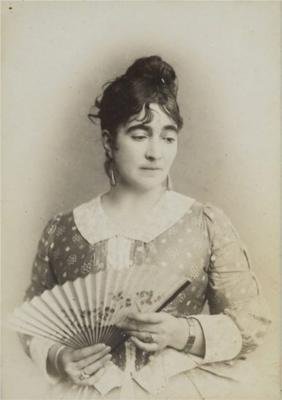
Marie Bracquemond

        Self Portrait  by Marie Bracquemond             (1870)
Self Portrait
by Marie Bracquemond
(1870)

I was reading the other day about the short list for the National Portrait Gallery – 2014 BP Award.  Apparently the judges, who decide on which works should be shortlisted, are not aware of the names of the artists when they make their selections.  For the first time in the twenty-five years of the competition, two of the portraits selected for the exhibition were works by a husband and wife, Henrietta Graham and Tim Hall and it made me wonder how well husband and wife artists co-exist and whether they were supportive of each other’s artistic efforts and style or were they occasionally critical and somewhat jealous of each other’s success.  My featured artist today was one half of a husband and wife duo but it is thought that the husband became so critical of his wife’s works and her style of painting that she eventually gave up art altogether.

Marie Bracquemond        (1840-1916)
Marie Bracquemond
(1840-1916)

The lady in question was born Marie Anne Caroline Quivoron in December 1840 in the small picturesque coastal village of Argenton-en-Landunvez, on the Brittany coast. She was of the same era as her female Impressionist contemporaries, Berthe Morisot, Mary Cassatt and Eva Gonzalez but her background was very unlike their more privileged and cultured upbringing.  Her mother’s first marriage was an arranged one to a sea captain.  It was neither a successful nor happy union.  However, it did not last long as he died shortly after the birth of his daughter, Marie Anne. Her mother was only a widow for a short period before marrying for a second time.  Her husband was a Monsieur Pasquiou.   Shortly after this second marriage, Marie, her mother and her mother’s new husband moved away from Britanny and went to live in the Jura, a mountainous region in the east of the country.  Then, soon after, they crossed over the border to take up residence in Switzerland.  Again their stay was short-lived and before long they moved back to central France and settled in Corrèze in the Auvergne, where Marie’s sister, Louise, was born.  According to what she told her son in later life, this was the happiest time of her childhood. They lived in a area surrounded by mysterious forests, fast-flowing streams and ancient ruined abbeys.  Living there was a truly magical time for her.  The family finally moved north and settled in Paris but later because of Marie’s health problems they were advised by the family physician, Doctor Hache, to move out of the polluted atmosphere of the city and settle in Étampes, a small town south-west of the capital where the air would be purer.

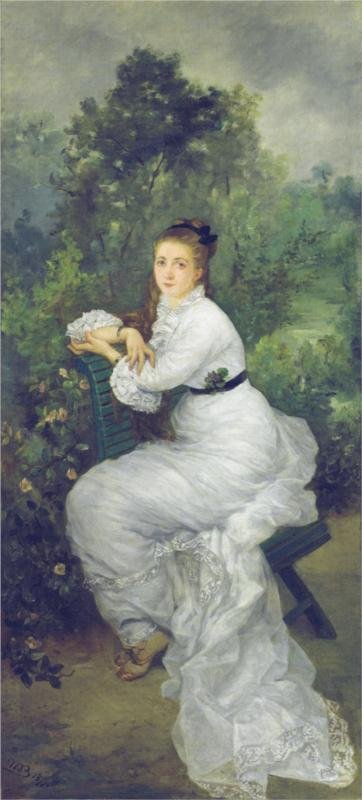
Woman in the Garden  (a portrait of her sister Louise)  by Marie Bracquemond
Detail from Woman in the Garden (a portrait of her sister Louise) by Marie Bracquemond
Woman in the Garden (Portrait of her sister Louise Quivoron) by Marie Bracquemond (1877)

Now a teenager, Marie developed a love for art and it was whilst living in Étampes that she received her first artistic tuition.  Her teacher was a Monsieur Wassor, an elderly man who gave art lessons to the young women of Étampes as well as earning money as an art restorer.  He got Marie to make copies of reliefs and plaster casts which he had scattered around his studio and he also got her to make copies of paintings he had accumulated.  When the summer came and the weather improved he would take Marie and other students outside to paint en plein air.  Her progress as an accomplished artist was swift and a measure of that is the fact at the age of seventeen she submitted a family portrait, which included her mother, her sister Louise and one of her elderly teachers, for inclusion at the 1857 Salon and it was accepted.

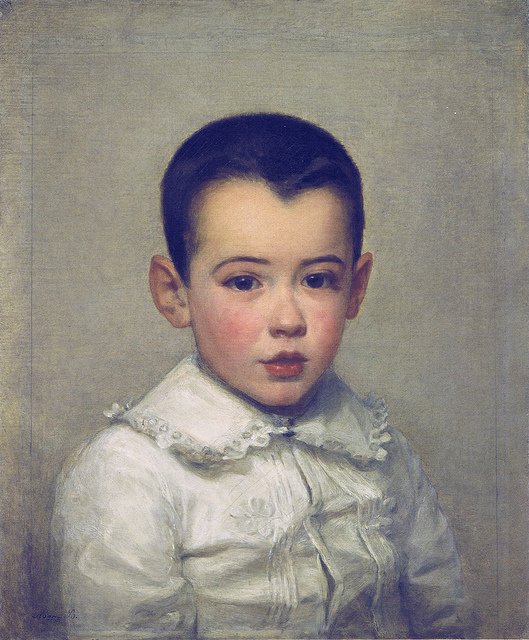
Pierre Bracquemond as child by Marie Bracquemond (1878)

Fate now took a hand in Marie’s future as the sister-in-law of the family doctor, Doctor Hache, was married to the Neoclassical painter, Jean-Auguste-Dominique Ingres and she arranged for Marie to meet her husband.  Ingres arranged for her to work with two of his students, Jean-Hippolyte Flandrin and Émile Signol and she learnt much from them.  Although grateful for Ingres’ help she was unhappy with the elderly artist’s disdain with regard female artists.  In a letter she wrote about Ingres’ contempt:

“…The severity of Monsieur Ingres frightened me.  I tell you, because he doubted the courage and perseverance of a woman in the field of painting.  He wished to impose limits.  He would assign to them only the painting of flowers, of fruits, of still lifes, portraits and genre scenes…”

For Marie, Ingres view on female artists was unacceptable.  Her determination to rail against Ingres’ criticism of female artists and his compartmentalising of the artistic genres suitable for female artists, materialised when she wrote of her split with the elderly painter:

“…There is in me a strong determination to overcome all obstacles.  I wish to work at painting, not to paint some flowers, but to express those feelings that art inspires in me…..All this will not come to pass in a year, but in any event, I do not wish to return to Monsieur Ingres…”

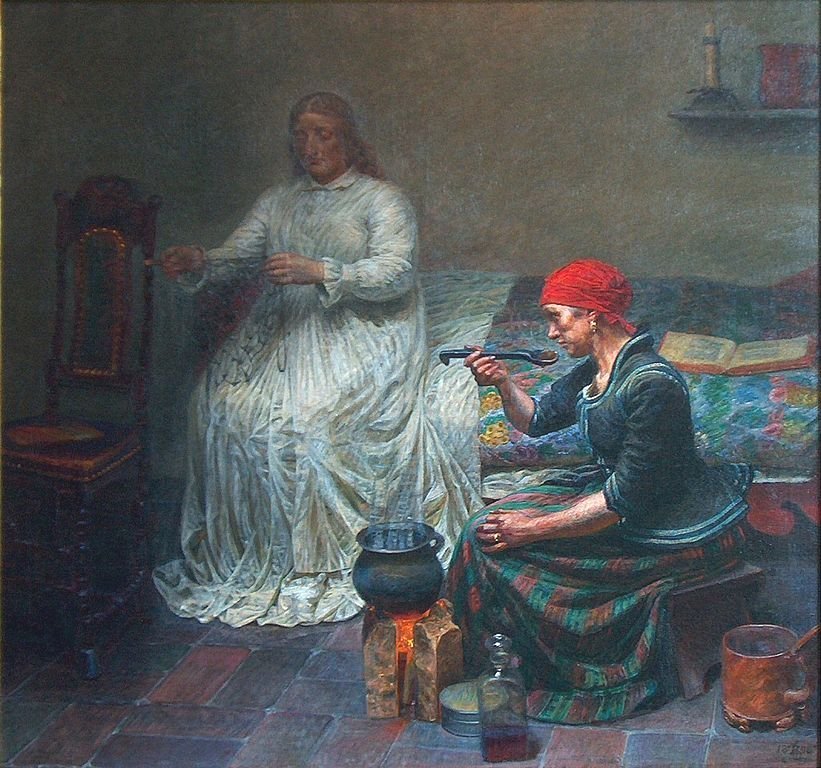
The Lady in White by Marie Bracquemond (1880)

Her artistic ability must have been well known as she soon received commissions including one from the court of Empress Eugenie, the Empress of France and wife of Napoleon III, which commissioned a depiction Cervantes in prison.   Following the successful conclusion of this commission she was approached by the Director-General of French Museums, Count de Nieuwerkerke, to work at the Louvre, making copies of the most famous paintings in the collection.   It was in 1867, whilst Marie was working in the Louvre copying a painting by Rembrandt, that a young man, Félix Bracquemond, an engraver and etcher, first caught sight and fell in love with this dark-haired beauty.  Félix, through his friend, Eugène Montrosier, was introduced to Marie.  A two-year courtship followed during which time Félix introduced Marie to all his artist friends, such as Millet, Corot, Degas, Rodin and Fantin-Latour and art critics and writers such as Edmond de Goncourt and Gustave Geffroy, and through them she received more and more commissions.   Unfortunately for Marie there was a problematic downside to this relationship.  Félix was not a particularly nice man.  He had a very off-hand brusque demeanour.  He was self-opinionated and later became über-critical of Marie’s artistic talent but despite Marie’s mother’s voiced concern over the relationship between Félix and her daughter, the couple were married in August 1869 and went to live in the rue de l’Université in Paris.  Marie was well aware of her husband’s unacceptable characteristics but presumably believed that all that would change when they were married.  It didn’t!  In 1870 Marie gave birth to their only child, Pierre.  Despite his uncompromising and offhand attitude Marie learnt a great deal from her husband and she exhibited works at the 1874 and 1875 Salon.

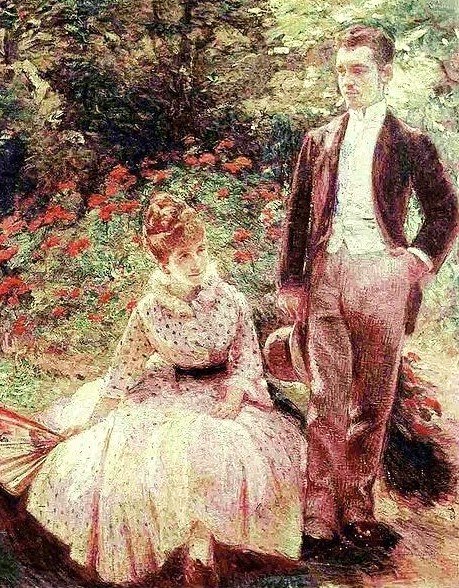
The Artist's Son and Sister in the Garden at Sèvres by Marie Bracquemond (1890
The Artist’s Son and Sister in the Garden at Sèvres by Marie Bracquemond (1890)

Haviland China was a factory set up in Limoges, France, by the American entrepreneur David Haviland and later was aided by his sons, Charles and Theodore.  The factory produced the finest china tableware.  In 1872 David’s son Charles, opened the Auteuil Studio in Paris, which attracted many of the great artists of the day, including Manet, Monet, and the Damousse brothers, all of whom greatly influenced Haviland’s floral designs.  It became known as the “French School”.   Félix Bracquemond, who had a reputation as a great ceramics decorator, was, in 1878, employed in the studio as the artistic director and Marie also worked there designing plates for dinner services.  In an article in the 1904 magazine Women in the Fine Arts, the writer, Clara Erskine Clement who was the author of Women in the Fine Arts from the Seventh Century to the Twentieth Century AD,wrote about Marie Bracquemond’s amazing ability:

“…Madame Bracquemond had the facility of employing the faience colours so well that she produced a clearness and richness not achieved by other artists.  The progress made in the Haviland faience in the 70’s was very largely due to Madame Bracquemond, whose pieces were almost always sold from the atelier before being fired, so great was her success…”

Faience is the conventional name in English for a tin-glazed earthenware.

One of Marie’s great accomplishments was to design and produce several dishes and a wide Faience panel of ceramic tiles entitled the Muses, all of which were exhibited at the Exposition Universelle in Paris in 1878; the preliminary sketch used for the design was shown at the Impressionist Exhibition of 1879 and among its greatest admirers was Edgar Degas.

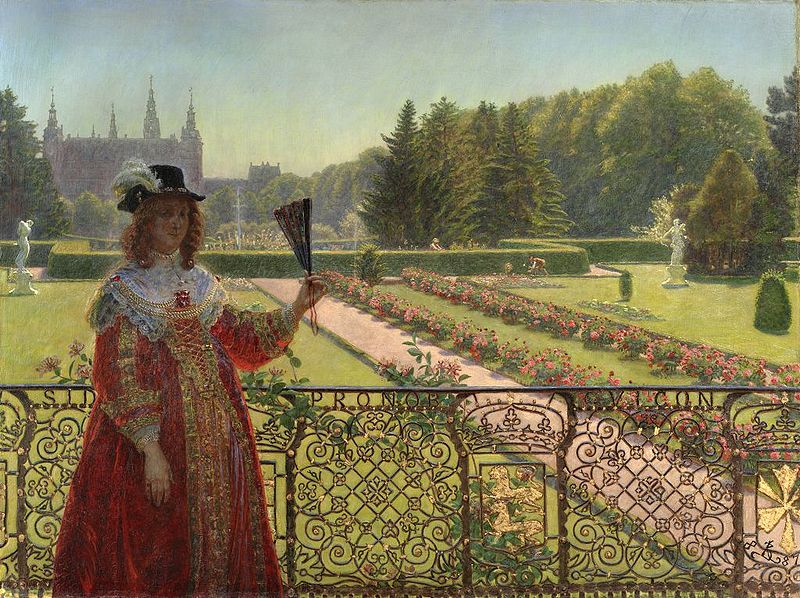
On the Terrace at Sèvres by Marie Bracquemond (1880)

It was around 1880 that there was a change in Marie’s artistic style.  Gone were the small muted works of art and in their place came larger works with a greater intensity of colour and more of her paintings were carried out en plein air allowing her to catch the nuances of the daylight which constantly changed..  This was the era of the Impressionists and Marie Bracquemond had become great friends of Edgar Degas, Claude Monet, Renoir and Gaugin these artists had become her artistic mentors.  She had been welcomed into the Impressionists’ fold and she exhibited works at three of their annual exhibitions, in 1879, 1880 and the final Impressionist Exhibition in 1886.  Three of her works completed in 1880 which clearly demonstrate her alteration of style to a noticeable Impressionist style, were The Lady in White, On the Terrace at Sèvres and Le Gouter (Afternoon Tea).

Le Gouter or Afternoon Tea by Marie Bracquemond (1880)

She was delighted with her art and its popularity but this delight was not shared by her husband, Félix, who resented her success and her close liaison with the Impressionists.   Their son Pierre, who loved his mother and was the No.1 fan of her work, later wrote about his father’s resentment.  According to Pierre, Félix was jealous of her achievement and rarely showed her works to visiting artists and friends.  He said that Félix now resented any criticisms Marie might venture about his paintings.  It appeared that the once close artistic relationship between Marie and Félix, with each offering constructive critiques regarding their works, was over.  Félix would often hide his new works from his wife but at the same time was openly critical with regards to her artistic efforts.  This uncomfortable atmosphere in the marital home and the constant friction between her and Félix finally took its toll in 1890 when Marie could not stand her husband’s attitude to her work any longer and except for a few examples completely gave up her painting.  One of her last works was the Impressionist-style work entitled The Artist’s Son and Sister in the Garden at Sèvres which she completed in 1890.  At the time of this painting the constant battle with her husband had made her become introverted and she became a virtual recluse, rarely leaving their Sèvres home. Her sister Louise did not like her brother-in-law finding him overbearing and boorish in the way he treated her sister.

Pierre Bracquemond painting a bouquet of flowers by Marie Bracquemond (1887)

Pierre Bracquemond who was taught by his father later became involved in works for Gobelin, a Parisian tapestry factory.  He then worked at a career as an interior decorator specialising in the designs of carpets and tapestries.  He also carried on his love of art concentrating on seascapes and nudes, chiefly employing the technique of encaustic paintiing, which was also known as hot wax painting, as it involved using heated beeswax to which colored pigments were added.   He also wrote many critiques with regards art and the teachings of his father on the subject.  There were also many manuscripts he had written about his parents Marie and Félix, some of which were never published.

Marie Bracquemond died in Paris on January 17, 1916.

Georges de la Tour. Part 2. Religious works and tenebrism

My featured artist today would often bring into play the tenebrism style in his works of art.  The term tenebrism comes from the Italian word tenebroso, meaning dark or gloomy and figuratively can be translated as “mysterious” and is a word used to primarily describe dark tonality in a work of art.  Tenebrism was developed to add a sense of drama to an image through a spotlight effect.  Tenebrist works of art first came on the scene in Rome around 1600 and some of the earliest examples were by Caravaggio.  The dark backgrounds to his works and the shadows cast across the subjects of his painting where in complete contrast to small areas of light, often from an unidentified source, which lit up part of the main depiction.  Caravaggio’s tenebrist style was taken up by a number of his Italian contemporaries such as the father and daughter painters Orazio and Artemisia Gentileschi and the great Dutch Master, Rembrandt von Rijn.  Many of the artists from outside Italy who came to Rome and Naples to study art also experimented with tenebrism.  Georges de la Tour was a masterful exponent of this style of painting.  In some ways his tenebrist style was slightly different from that of Caravaggio in as much as he would often include the source of light in his painting.  Although Georges de La Tour spent his entire artistic career in provincial France, far from cosmopolitan centers and artistic influences, he developed a poignant style as profound as the most illustrious painters of his day. In his lifetime his work appeared in the prominent royal collections of Europe. La Tour’s early training is still a matter for speculation, but in the province of Lorraine he encountered the artist Jean Le Clerc, a follower of the Italian painter Caravaggio.
Magdalen with the Smoking Flame by Georges De La Tour (1640)

One great example of Georges de la Tour’s tenebrist style can be seen in his work entitled Magdalene with the Smoking Flame which Georges De La Tour, completed in 1640 and which can now be found in the Los Angeles County Museum of Art.  In this work we see a depiction of Mary Magdalen, not as an aged woman living a hermit-style life in her grotto, but as a contemplative young woman.  This is a depiction of a vivacious young woman who sought the pleasures of the flesh in her early days.  Her arms and legs are bare.  There is a sense of melancholia and loneliness about her demeanour.  She sits with her left elbow resting on the table with her hand supporting her chin as she gazes fixedly at the burning flame.  Maybe she is mentally examining her past life.   Look how the artist has managed to achieve differing textures which have been brought to life by the light of the candle.  Observe the textural difference between her heavy red skirt and thin white, wrinkled blouse which contrasts with the blemish-free smoothness of Magdalene’s flesh.  On her knees rests a skull which is always looked upon as symbolising our own mortality and the inevitability of death.  On the table there are books of Scripture, a wooden cross and a leather scourge which alludes to Christ’s suffering and his eventual crucifixion.  These latter two items add to the sombre mood of the work.  However, besides Magdalene, the main subject of the work is the oil lamp which smokes and emits the light that brings a modicum of luminosity to the dark painting.  Flame from a candle is often looked upon as symbolising enlightenment and purification but in this depiction there is a smoky element to the flame which may lead us to believe that enlightenment and purification of Magdalene’s mind and soul are not yet complete.     Although our eyes too are drawn to the candle we should look at other aspects of the work and see the mastery of the artist in the way he depicts the various textures.   We have the well-polished skull and the leather cover of the books both of which reflect the candlelight.

Christ in the Carpenter's Shop by Georges de la Tour (1645)
Christ in the Carpenter’s Shop by Georges de la Tour (1645)

Another haunting work of Georges de la Tour in his tenebrist style is Christ in the Carpenters Shop, completed in 1645 and which hangs in the Musée du Louvre, Paris.  It is a depiction of Joseph, a descendant of the house of David, husband of Mary and “foster father” to Christ, who was a carpenter in Jerusalem. In Georges de la Tour’s depiction we see Joseph leaning forward, busy drilling a hole in a block of wood with his auger, the shape of which mirrors the shape of a cross.  He is in his workshop watched over by Jesus whose face radiates in the large frame.  Once again the depiction of the two characters is swathed in darkness with only their faces and upper bodies lit up by the flame of the candle held by the boy.

Jesus holding the candle

 Jesus is seated and holds a candle to illuminate what Joseph is doing.  It almost seems that it is the face of Jesus which is illuminating the scene and not the light of the candle.  The act of holding up the light for Joseph to see by has an allegorical reference to Jesus Christ being the Light of the World as mentioned in the New Testament (John 8:12):

“…I am the light of the world. Whoever follows me will never walk in darkness, but will have the light of life…”

The contrast between the two figures is striking.  The bearded Joseph, a large hulk of a man, is bent over towards his young helper in an almost threatening stance brought upon by the physical exertion of working the auger.   In total contrast Jesus is depicted as gentle youngster watching Joseph’s every move.  The candlelight illuminates the young face of Jesus.  There is purity and innocence in the way the artist has depicted the face of Jesus.  What is also fascinating about the depiction of the young Christ is the way de la Tour has depicted the luminescence of Jesus’ left hand which is shielding the flame. Although this is probably looked upon as a religious work because of its title, it could well have been a simple genre piece looking with strong realism at a young boy watching his father at work.  If we look at the floor, on which we see carpenter’s tools, a wooden ladle and a curled wood shaving.  It could almost be deemed as an excellent still-life work.

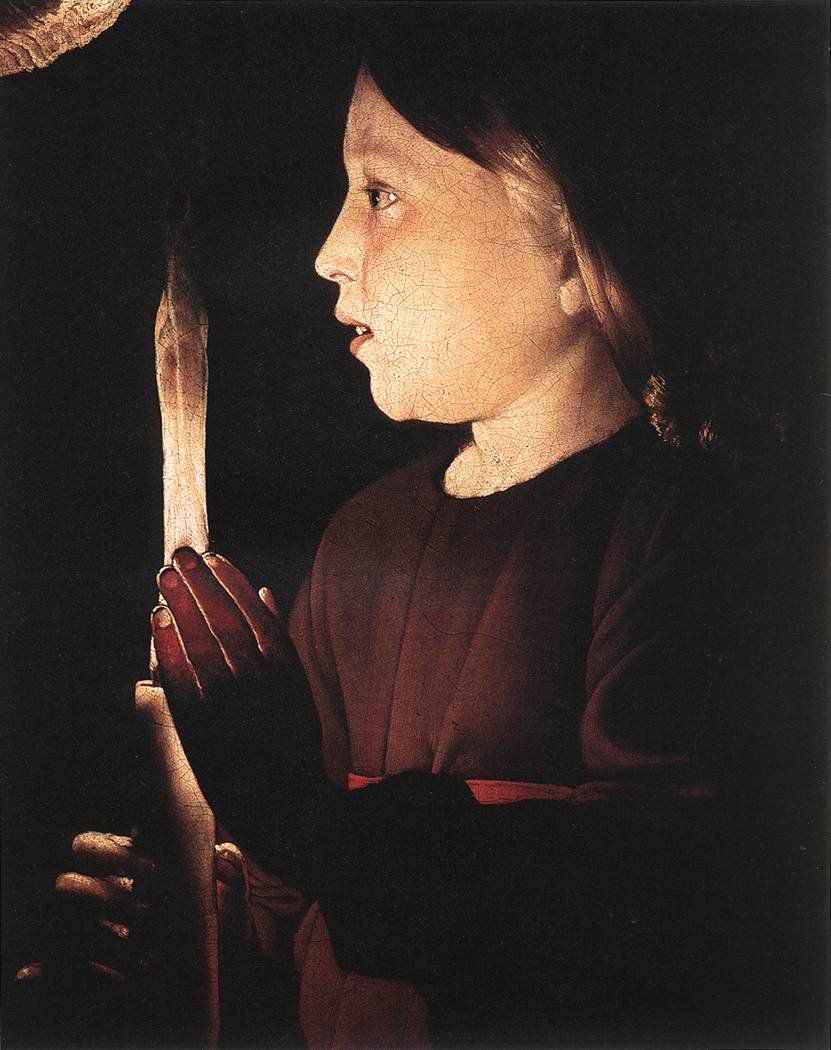
The Dream of St Joseph by Georges de la Tour (c. 1640)

The Dream of St Joseph was a work completed by Georges de la Tour around 1640.   The work was based on a dream that Saint Joseph had, as recounted in Matthew’s New Testament gospels.   According to Matthew, Joseph had three dreams.  One was to tell him he was to be Mary’s husband and the father of the Christ Child.  The second dream was to warn Joseph that he must take Mary and Jesus, leave Bethlehem and go to Egypt and the third and final dream the angel told Joseph to take his family back to Nazareth as all was now safe.  :

Matthew 1:20-21

 But after he had considered this, an angel of the Lord appeared to him in a dream and said, “Joseph son of David, do not be afraid to take Mary home as your wife, because what is conceived in her is from the Holy Spirit.  She will give birth to a son, and you are to give him the name Jesus, because he will save his people from their sins.”

Matthew 2:13

 “…When they had gone, an angel of the Lord appeared to Joseph in a dream. “Get up,” he said, “take the child and his mother and escape to Egypt. Stay there until I tell you, for Herod is going to search for the child to kill him…”

Matthew 2:19-20

 “…After Herod died, an angel of the Lord appeared in a dream to Joseph in Egypt  and said, “Get up, take the child and his mother and go to the land of Israel, for those who were trying to take the child’s life are dead…”

We are not sure as to which of the dreams is depicted in this painting and it matters not.  However some art historians who have researched the works of de la Tour have offered a different reasoning behind the work claiming that in early art catalogues the painting had a much simpler title, An Old Man Asleep, Woken by a Girl Carrying a Candle.  So is this a religious or secular work?  In the painting we see two people, an old man and a child.  The old man on the right is seated next to a small table.  His eyes are closed.  His mouth is slightly open.  He is asleep and possibly lost in a dream world.  His right elbow rests on the table and his head is resting in his right hand.  On his lap we see an open book with the fingers of his left hand still lightly gripping a page.   Standing in front of him is a child, probably a girl, dressed in the garb of a biblical character.

Dream-like apparition appearing to St Joseph

She stares at the sleeping man and has her arms outstretched in a prayer-like manner. There is something strange about her posture.  It is almost as if she is casting a spell over the sleeping man.   It is simply a depiction of a man and a child.  There are no sign of halos on the head of the child signifying her as an angel and so one can understand why some people cast doubts on the biblical connotation of the work.

What fascinates me about this work of art is the tenebrist style Georges de la Tour has used in his lighting of the depiction.  The light from the candle flickers and is partially hidden by the one of the girl’s outstretched arms but it still manages to light up her face in a haunting manner.  She becomes apparition-like which of course lends to the idea that she is in the old man’s dream.  Once again, as in the last painting the girl’s fingertips become translucent and the page held in the man’s hand is illuminated.   It is a fascinating work and I will leave you to decide whether you believe it is a religious work and hence it’s current title or whether it is simply a secular work of art and hence its original title.

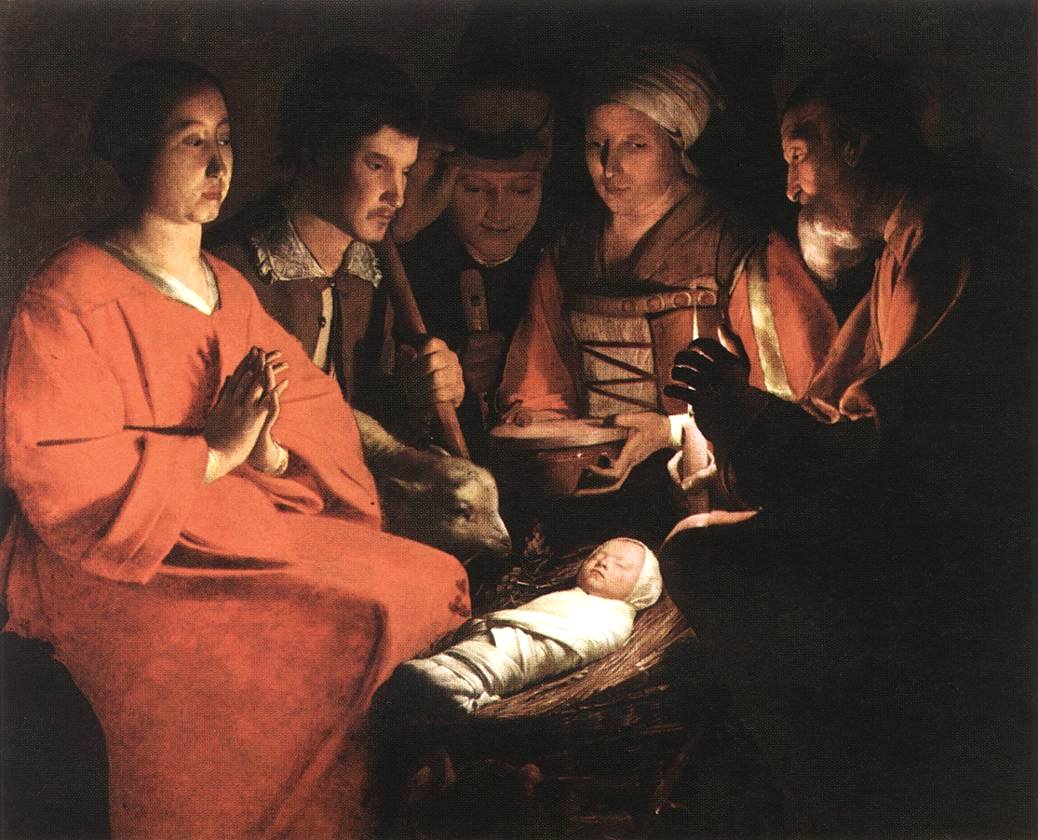
Adoration of the Shepherds by Georges de la Tour (1644)

There can be no such doubt with regards to my final featured work by Georges de la Tour.  The birth of Jesus and the presence of shepherds is a religious scene which has been depicted numerous times by different artists.   This painting, Adoration of the Shepherds, was completed by Georges de la Tour around 1644 and can now be found in the Louvre. The first thing we notice about this work is the amazing candlelight illumination which is associated with tenebrism.  As we look at the work we feel the tranquillity and contemplative mood of those around the newborn baby.   Mary is to the left of the painting, her hands clasped in prayer.   Opposite her is the elderly bearded figure of Joseph.  He holds a lit candle in his right hand whilst his left hand guards the flame from being extinguished.  Once again, as seen in previous works, the light from the candle filters through between the fingers of his hand.  His depiction of the visiting shepherds is a triumph of realism.  They crowd around the crib with their presents.  The one holding a staff has brought a sheep.  The one next to him, slightly in the background has brought a flute, which he clutches to his chest and the shepherdess, or it could be a serving girl, has come with food in the shape of a covered terrine.  Next to the crib the lamb chews at an ear of corn which is providing bedding for the infant.  There is a simplicity to this scene and this could well be due to the omission of the wealthy trio of visiting kings, dressed in their fine clothes, and holding their expensive gifts which are often included in depictions of the baby in the manger paintings.  It is thought that Georges de la Tour’s depiction emanates from the Christmas tradition when villagers dressed up as shepherds and shepherdesses to re-enact the Nativity scene and this premise is borne out by the way he has depicted the shepherds in fine contemporary clothing which is in contrast to the plain red gown worn by Mary.  Note the small shadow cast by the candlelight on her gown.  It is of a trèfle or trefoil, a three-leaved plant, which is part of the crib bedding and is probably a symbolic reference to the Holy Trinity.

In this and my previous blog I have featured two distinct types of paintings by Georges de la Tour and I will leave you decide which you prefer.

Georges de la Tour. Part 1

In my next two blogs I am looking at the life of the seventeenth century French artist, Georges de la Tour and featuring some of his works of art.   In this first blog I want to feature some of his genre paintings and in the second blog I will look at how he, like Caravaggio before him, was a master of tenebrism.

Georges de la Tour was born in 1593 in Vic-sur-Seille, a small town in the department of Lorraine in north-eastern France but which, at the time, was part of the Holy Roman Empire.  He was one of seven children born to his father Jean, a baker and mother Sybille.  Details of his early life are sparse but we know he married Diane le Nerf when he was twenty-four and they went on to have ten children.  Three years after marrying the couple moved to Lunéville, which was his wife’s home town, and was also just a short distance from Georges’ birthplace.  It was here that he spent the rest of his life.    He had quite a successful career and his paintings were bought by the likes of King Louis XIII, Cardinal Richelieu and the Duke of Lorraine whom he worked for between 1639 and 1642. He died in 1652 just short of his fifty-ninth birthday.

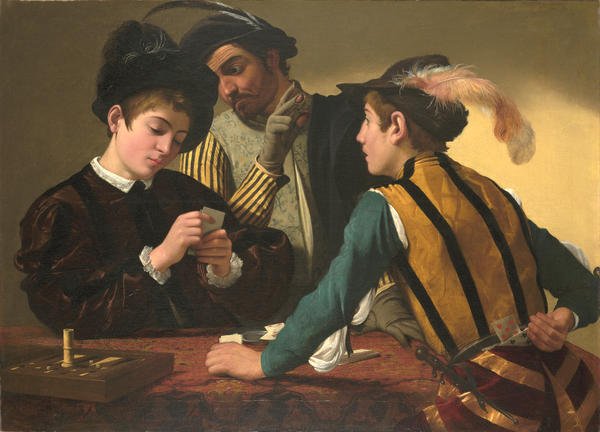
The Cardsharps by Caravaggio (c.1594)

Paintings featuring card players, and the perils of being cheated of your winnings, were not an unusual subject and one of the most famous was completed around 1594 by Caravaggio.  It was entitled The Cardsharps and now hangs in the Kimbell Art Museum in Fort Worth.   The boy on the right is the “cheater” and his older accomplice in the middle is giving him signs as to the cards held by his opponent.

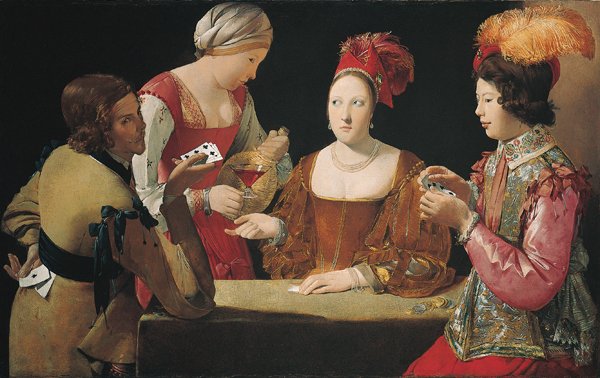
Le Tricheur à l'as de carreau or The Cheat with the Ace of Diamonds by Georges de la Tour (c. 1635)
Le Tricheur à l’as de carreau or The Cheat with the Ace of Diamonds
by Georges de la Tour (c. 1635)

The first of the Georges de la Tour paintings I want to showcase is one entitled Le Tricheur à l’as de carreau or The Cheat with the Ace of Diamonds which he completed around 1635 and is now to be found in the Louvre.   It is easy to see the similarity between this painting and the one painted forty years earlier by the Italian Master.  This seventeenth century work was put on show at the 1934 exhibition at the Musée de l’Orangerie in Paris entitled The Painters of Reality in France in the seventeenth century and it was through this memorable exhibition that French 17th century art was brought back to prominence and works by Georges de la Tour, who had almost been forgotten by French art lovers, once again became popular and his works following the exhibition were in great demand.

 The first thing we must decide on is what is going on.      On the right is a man dressed in the most expensive clothes carefully studying his hand of cards.    There is something about his appearance which makes us believe that he is slightly naive as his conspirators exchange sidelong glances.  He is slightly set apart from the other three characters.  Is he there at his own volition or has he been seduced into coming to the gambling den by the courtesan who sits next to him?  In a way it is a painting with a moral.  It is a depiction of a man who has to withstand three great inducements.   He has to withstand the temptations of lust brought on by the presence of the courtesan and serving maid, the temptation of alcohol which is being handed out to the card players and of course he has to resist the vice of gambling  French moral standards of the time frowned upon the three vices.  However he has put his moral standards to one side and for that, we know, by what we see happening before us, will be his undoing.

The courtesan is centre stage in the painting.  On the table by her is a small pile of money.  It is not as large as that of the guests but that will soon change.  Her clothes are sumptuous.  The plunging neckline of her costume no doubt titillates her male guest and probably distracts him from his game.  Her hair is topped by a fancy and fashionable feathered headdress.  Look at her eyes.  They are shifty.  Her whole expression, her whole demeanour, is one of deceitfulness.  Her right hand points to her co-conspirator probably advising him to play his hand.  We see him retrieving the ace of diamonds from under his belt, which will complete his winning hand.  The serving wench brings wine to the table and she too has a deceitful look about her as she casts a sidelong glance at the “mark”.  She knows what is going on.  She is part of the conspiracy.  The man, who is slightly in shadow and who is retrieving the ace of diamond looks out at us.  We have been drawn into this plot.  It is as if now we are also co-conspirators.

Cheat with Ace of Clubs by Georges de la Tour (c.1634)

A copy of this work which Georges de la Tour completed later can be found at the Kimbell Art Museum in Fort Worth Texas, the same gallery which owns the Caravaggio painting, Cheaters.   This painting is entitled Cheat with Ace of Clubs and once again is a moralistic painting warning people against the vices of lust, excess wine and gambling.  Like the painting in the Louvre the characters are the same, the shifty looks of the deceivers are the same it is just the suit of cards has changed from diamonds to clubs.

The Fortune Teller by Georges de la Tour (c.1630)

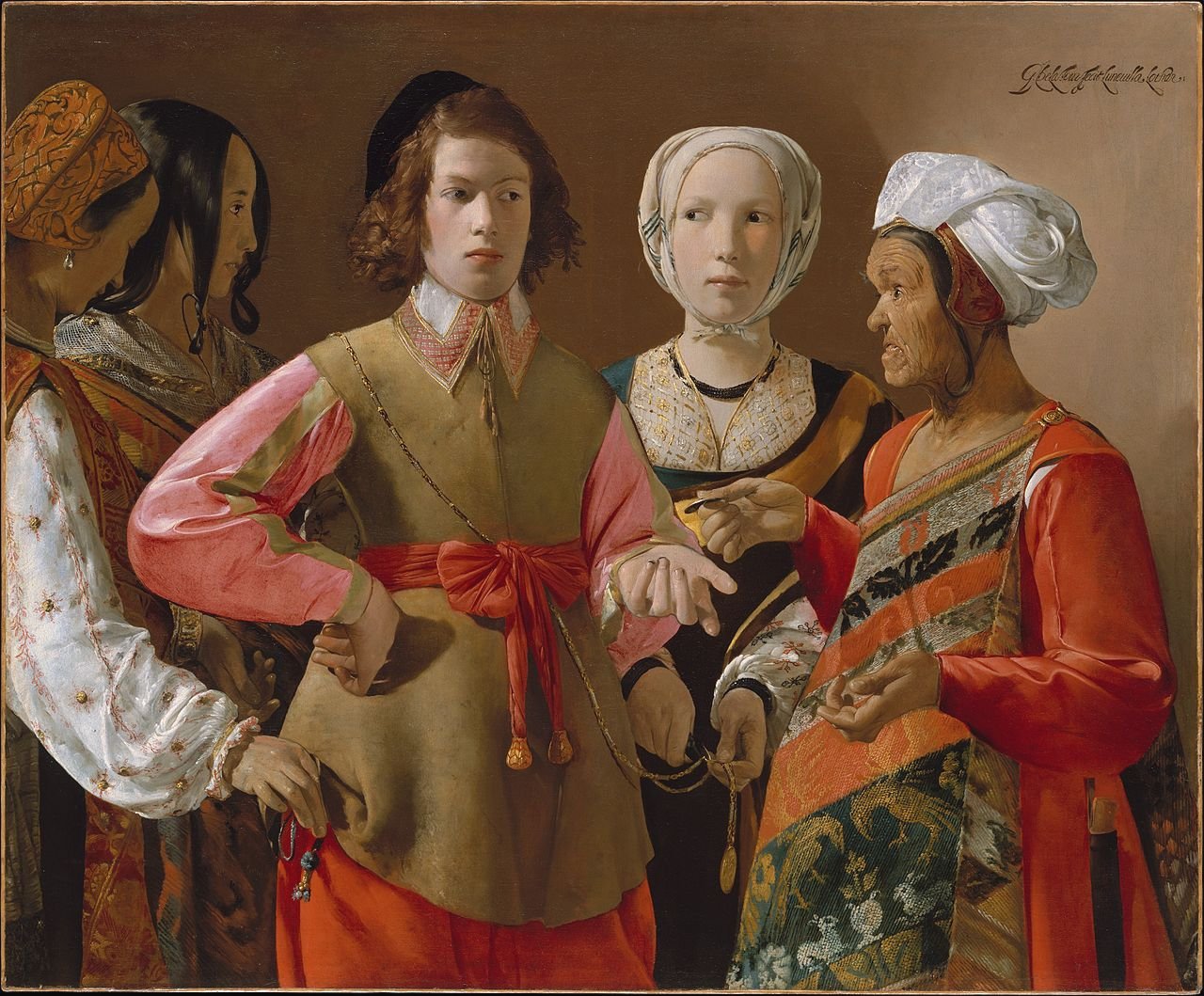
Four years before Georges de la Tour embarked on the theme of cheating at cards he focused on another piece of skulduggery – pick-pockets and con-artists.  The work in question was known as The Fortune Teller which he completed during the 1630’s and can now be found in the Metropolitan Museum of Art in New York.  In this work we see a naive young man standing between two young women.  He is well dressed and one is given the impression that he is also wealthy and ideal rich picking for the pick-pocket.   To the right of the painting is the wrinkle-skinned old crone who purports to be a fortune teller and has extracted a silver coin from the young man as payment for her telling him his fortune.  She is about to take the coin from his hand, and as part of the gypsy fortune-teller ritual, she will then cross his palm with it.   She, like the three younger women, are colourfully dressed and portrayed as gypsies.   As is often the case, even in today’s time, gypsies are pictorially portrayed in this work of art as thieves.  The crime is clearly there for us to witness as whilst the young man is engrossed in what the fortune teller has to say and at the same time as he hands over his fee the young lady on the right of the painting delicately removes the coin purse from the pocket.  However that is not all the young man is about to lose.  Look at the young woman between the fortune teller and the man.  She is more soberly dressed.  Look what she is doing with her hands.  She is just about to cut the gold medallion from its chain which is around the young man’s neck and right shoulder.  I like the way her eyes are fixed on his face in order to see if he is aware of what she was doing.

My final featured paintings by Georges de la Tour move away from the group genre scenes with the accompanying moral tale and focus on single portraits.  These are really exquisite works of art.  The subject of the next work of art is an elderly blind beggar and street musician trying to eke out a meagre living by playing a hurdy-gurdy. The hurdy-gurdy was the first stringed instrument to which the keyboard principle was applied. In France it was known as Viella a Roue , which literally translates to wheel fiddle and which describes the method by which sound is produced. The bowing action of the fiddle is replaced by a wheel cranked by a handle. The outer rim of the wooden wheel is coated with resin. When the crank is spun, the wheel turns and the gut strings vibrate.  The player of such an instrument was known as a vielleur.

Blind Hurdy-Gurdy Man by Georges de la Tour (c.1630)

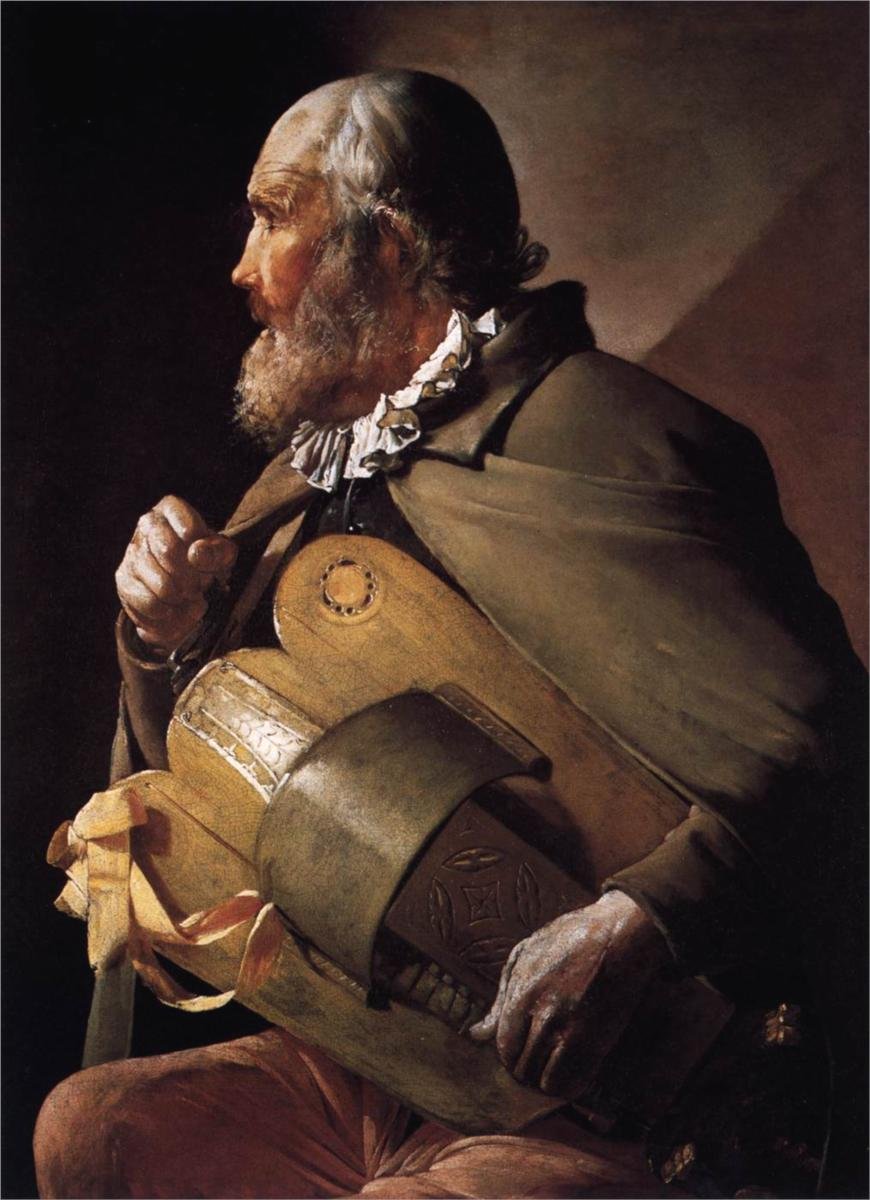
Georges de la Tour often painted several variations on the same subjects, and the depiction of a street musician was an example of this.  He painted the one shown above, entitled The Blind Hurdy-Gurdy Player, around 1630 and it can now be found in the Prado, Madrid.  The man is depicted in profile and, but for the title of the work, one would never have known that he was blind, although his eyes are closed.  He has a trouble-worn face and his forehead is heavily wrinkled.  His skin is swarthy from spending most of his time out on the streets.   He wears a thick grey-brown coat with a white lace ruff.  Look how the artist has spent time on depicting the texture of the musical instrument.

The Hurdy-Gurdy Player by Georges de la Tour (c.1630)

Another version of this work can be seen in the Musée des Beaux-Arts, Nantes in France.   This work entitled The Hurdy-Gurdy Player was also completed by de la Tour around 1630.  This is a more unsettling portrait of the beggar.  He looks unkempt and uncared for.  His facial expression is one of pain and anguish as he sings to the tune he plays on the hurdy-gurdy.  He wears the same heavy grey-brown coat with the white scarf or ruff.  On the floor in front of him, resting on a large stone, is his bright red hat with a plume of feathers and often this painting is referred to as The Hurdy-Gurdy Player with Hat.

The Hurdy Gurdy Player with a Dog by Georges de la Tour (c.1625)

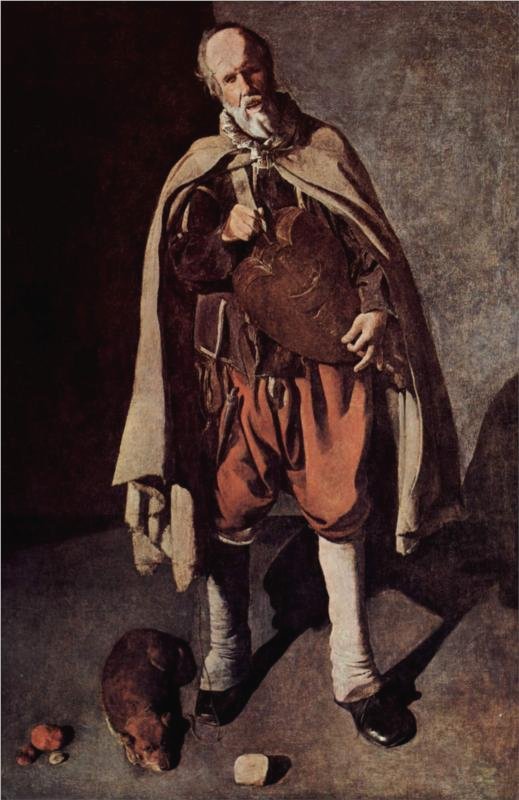
An earlier version, around 1625, on the same theme can be found in Bergues, the northern French town, close to the border with Belgium.   It is the Musée Municipal Bergues which houses The Hurdy-Gurdy Player with his Dog by Georges de la Tour.

In my next blog I will feature some of Georges de la Tour’s tenebrist paintings, a style which had been made popular by Caravaggio.

The Mérode Altarpiece by Robert Campin

The Merode Altarpiece by Robert Campin (c.1432)

I travel a lot around Europe and during my stays in the various towns and cities I always try and spend some time in the local art galleries.  The one thing that I do enjoy, which is not often afforded to me in my own country, is the ability to visit local churches in which, especially in France and Italy, one can find beautiful works of art, frescoes and exquisite altarpieces.  In this blog I want to look at one of the great altarpieces of the fifteenth century.  It was not a huge work of art destined for a church or cathedral but a small devotional work which was to be placed in a room of a wealthy merchant, who had commissioned the altarpiece.   The altarpiece I am referring to is an Annunciation triptych known as the Mérode Altarpiece.  The work, which was completed sometime between 1425 and 1428, is now part of the Metropolitan Museum collection in New York and the exquisite and beautiful work is attributed to the early Netherlandish painter, Robert Campin and his workshop assistants.

Robert Campin is often referred to the Master of Flémalle.  The title “Master of….” was term often used by art historians to attribute an anonymous work or even groups of works.  It was a common attribution used in the nineteenth century by German art historians when discussing Early Netherlandish paintings.    So how did Campin end up with his title?   It is believed that it was due to the fact that three paintings in the Städliches Kunstinstitut in Frankfurt were said to have come from the abbey of Flémalle, a town close to Liège, but have since been attributed to Campin.

Robert Campin was born around 1375 but it is not until thirty years later that his name appears in records.   It seems that he settled in Tournai, the Walloon town of Belgium.  Tournai is unlikely to have been his birthplace as records show that in 1410 he bought citizenship of the town, which he would not have had to do if it had been his birthplace.  Some would have us believe he was born in Valenciennes, now a French town bordering Southern Belgium.  This assertion is based upon the fact that the name Campin was very common surname at the time in that town.  In the records, Campin’s profession was given as a Master Painter and we know he became a free master of the local Corporation of Goldsmiths and Painters and in 1423 became the sub-dean of the society and later held the post of Eswardeur.  During his early years at Tournai, Campin worked for the municipality painting banners and he went on to be employed to paint sculptures in various churches, including the town’s Church of St Brice, and a number of municipal buildings, notably the Halle des Doyens in Tournai .  This colouring of sculptures was termed polychromy.  He had a good working relationship with the local sculptors including the famous sculptor, Jacques de Braibant.

Robert Campin was good at what he did and soon he and his work became very popular and he received many commissions.  His wealth grew and through his commissions and his investments Campin owned a number of properties in Tournai.  His standing in the community was high.  He was warden of the church of St Pierre as well as procurator of the Convent of the Haute-Vie.  All was going so well for Campin.  He was running a large successful workshop and had skilled apprentices including a young painter, Rogier de le Pasture who is believed to be Rogier van der Weyden. So life was good until he got involved in local politics and the disturbances in the city between two political factions.  Sadly for him he backed the losing side and for his part in the 1429 disturbances and his reluctance to testify against the leaders of the uprising he was sentenced to go on a pilgrimage to Saint-Gilles in Provence.  Such a sentence was common in those days as it was thought that during such a pilgrimage one could think about one’s wrong-doings.  The local authorities never forgave Campin for his part in the uprising and for a number of years hounded him.

It came to a head three years later, in July 1432.   Campin was in trouble again.  This time it was because of his adultery.  He was married to Ysabiel de Stocquain but at this time was living with another woman, Leurence Polette.  The courts took a dim view of this sexual liaison and he was charged with adultery and was once again sentenced to go on a twelve-month pilgrimage.  This would have ended his artistic work and the closure of his workshop but this time he was saved from this banishment.  His saviour was none other than Margaret of Burgundy, the Countess Dowager of Hinault and the powerful daughter of Philip the Bold and wife of William of Bavaria and his pilgrimage sentence was reduced to a fine.   Maybe it was one court appearance too many for after this last incident little was heard of Campin in the archives of Tournai and his lucrative commissions dwindled.  Robert Campin died in Tournai in 1444.

And so to the featured work of art by Robert Campin and his workshop assistants, the oil on oak panel entitled The Annunciation Triptych often referred to as The Mérode Altarpiece which was completed around 1432 and is now housed in the Cloisters museum and gardens, a branch of The Metropolitan Museum of Art in New York, which is given over to the art and architecture of medieval Europe that largely date from the twelfth through the fifteenth century.  The building and its cloistered gardens are located in Fort Tryon Park in northern Manhattan.  Although termed an altarpiece, because of its small size (centre panel is 64cms x 63cms and each wing is just 64cms x 27cms), this was never destined for the altar of a church or cathedral.  This was destined for a devotional room in a private house.  It is one of Campin’s greatest works. It is thought that originally the painting which comprised of just the central panel was completed around 1430 and then later on the request of the prospective buyer, two hinged wings were added and the work became a devotional triptych.  It is also understood that the paintings depicted on the wings were painted by different artists, probably Campin’s assistants at his workshop.

The centre panel (The Annunciation) by Robert Campin

The centre panel is a depiction of the Annunciation, which was a common subject for paintings in the fifteenth century.   In this depiction Campin has decided the setting of the scene should be a place of domesticity recognisable to people of his time and not set in some palace-like location.  The setting is not, as often depicted, the bed chamber of Mary but a living room.  Maybe Campin wanted observers of this altarpiece to empathise with Mary and for that she needed to be looked upon as an ordinary young woman – hence no halo!  The room is clean and tidy and in some ways defines Mary as a diligent and house-proud female.  Look closely at this panel and the first thing which may strike you as being strange is the depiction of Mary.  She is sitting on a cushion on the floor and not on the bench to her left.  This could be to illustrate her humility. She is totally absorbed in reading a book but is so careful not to dirty the tome by touching it and so she holds it in a white cloth.   She is wearing a long red dress and Campin has cleverly depicted the folds of the dress with the light playing on them so that they form a bright white star.  As she sits and reads from her book she seems quite oblivious to the presence of the Angel Gabriel who is to her right dressed in the vestments of a deacon.  Between Gabriel and Mary there is a sixteen-sided table which some art historians believe alludes to the sixteen main Hebrew prophets.  On the table there is an open book and a scroll, which could have been reference works which were used by Mary as she read her book.   The act of reading what was probably a religious work and the presence of a reference book and scroll open on the table portray Mary as a learned and devout woman.

There is a blue patterned majolica pitcher on the table in which there is a lily.  The lily represents the purity of Mary.   Margaret Freeman, Curator of The Cloisters, comments on the symbolism of the lily quoting St Bernard who wrote:

“…Mary is the violet of humility, the lily of chastity, the rose of charity and the glory and splendour of the heavens…”

Detail of central panel

We see a highly-polished bronze fifteenth century Flemish candlestick holder with its newly extinguished candle on the table.  The flame, which had once been present, represented God and now it is gone, to be replaced by the tiny Christ Child which enters the room on the rays of the sun which beam through the window at the left of the painting.  It is a symbol of the Incarnation.

15th century Flemish bronze hanging-laver

In the left background we see, hanging in an alcove, a highly polished bronze laver.  This was the implement originally used by priests when they washed their hands and feet before entering into and coming out of a holy place.  Campin’s depiction is of a 15th century Flemish laver. Once again the highly polished laver and candle holder are testament to Mary being a hard working woman who took pride in her house.

The central panel’s Annunciation scene depicts the Angel Gabriel announcing to Mary that she is about to conceive the Christ Child. The Holy Spirit, in the form of the Christ Child, which impregnates Mary, appears descending towards Mary on rays of light emanating from the round window to the left of this centre panel.

Christ Child descending into room on a beam of light

When I first looked at this centre panel I completely missed the small figure of the Christ Child with a wooden cross on his back reminding us of the future crucifixion.   So why this inclusion?   It has been included in this depiction of the Annunciation as what we see before us is also about the Incarnation, the point in time when God becomes man.

Lion finial
Lion finial

There are other little pieces of iconography which are easily missed.  Look at the bench seat which Mary rests against.  Look at the small carved lions on the top of the arms of the bench.  These carvings are known as finials and mark the top or end of some object.  Some art historians believe that such an inclusion of the finials refers back to the throne of Solomon.  These finials have appeared in many paintings – take a look at the top of the arms of the seat in the background of Van Eyck’s Arnolfini Portrait.

The left panel
The left panel – the donor and his new wife

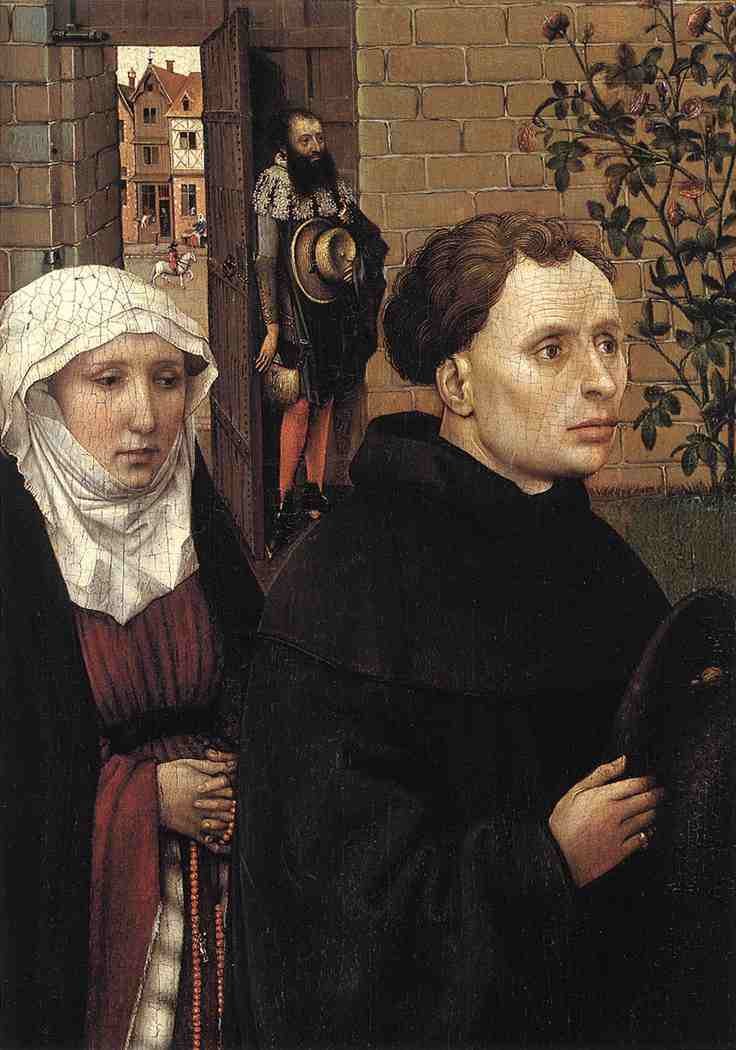
Now look at the left hand panel of this triptych and we see a man and a woman kneeling down in prayer.  It is generally agreed that the man is the person who commissioned Campin to produce the work and the lady next to him is his new wife, so new that it is thought she was added later. – but who are they?  The answer seems to come from various clues dotted around the triptych.  If you look back at the central panel and the transom of the left hand window at the back of the room you will see a coat of arms.   This was the coat of arms of the Engelbrecht or Ingelbrecht family of Mechelen who according to records were living in Tournai at the time the altarpiece was being painted and the man was Jan Engelbrecht, a wealthy and prosperous businessman.  The painting is thought to have been a wedding gift for his wife and one reason why he commissioned a depiction of the Annunciation could be because of the family name Engelbrecht which translated means “angel brings”.  Behind the couple we see a man wearing a straw hat.  He is wearing the badge of Mechelen and is believed to be a Mechelen town messenger.

Right panel of triptych - Saint Joseph at work
Right panel of triptych – Saint Joseph at work

In the right-hand panel, we see Saint Joseph, who we know was a carpenter.  Again, like the central panel, there is an air of domesticity about the depiction with Joseph busying himself with his carpentry.  He sits at his bench busily drilling holes in a piece of wood.  On the table next to him we see all the tools of his trade.  Art historians believe each has its own symbolic meaning – the saw refers to the implement that St Peter used to cut off the ear of Malchus, during Christ’s betrayal and arrest; the log alludes to the cross of the crucifixion; the nails, hammers, chisels, pliers and screwdrivers are all likely references to the instruments of the Passion.

Mousetrap and tools
Mousetrap and tools

Also on the table there is a mousetrap and another on the window ledge, which Joseph has previously made.  According the American art historian, Meyer Schapiro, Joseph fashioning mousetraps had a theological meaning and talks about how Saint Augustine used the mousetrap metaphor to explain the redemption of man by Christ’s ultimate sacrifice.  He explained the necessity of the Incarnation and that human flesh was the bait for the devil who by seizing it brings about his own ruin. Saint Augustine wrote:

“…The devil exulted when Christ died, but by this very death of Christ the devil is vanquished as if he had swallowed the bait in the mousetrap.  He rejoiced in Christ’s death, like a baliff of death.  What he rejoiced in was his own undoing.  The cross of Lord was the Lord’s mousetrap; the bait by which he was caught was the Lord’s death…”

View from window of St Joseph's workshop
View from window of St Joseph’s workshop

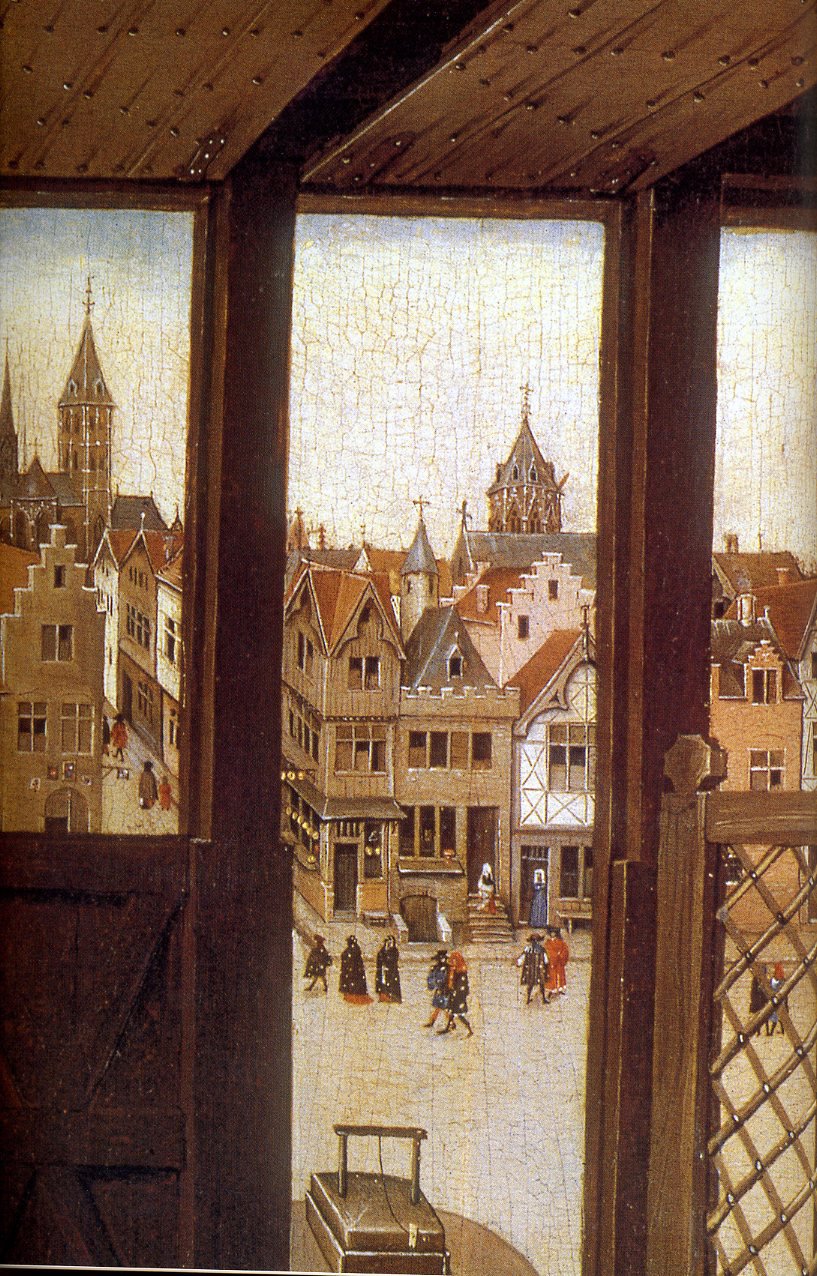
In my last blog I looked at some works by Joachim Patinir in which he combined biblical scenes with landscapes and townscapes but for Patinir the landscape was the most important part of the depiction.  Look now how Campin has in some way combined a small townscape with this religious work. Look at the scene as seen through the window behind Saint Joseph.  The window of Joseph’s workshop overlooks a city square around which are various houses, churches and shops. This is not a depiction of a town in the Holy Land at the time of Mary but of a town in 15th century Flanders.  It could be that Campin had incorporated a scene from his birthplace, Valenciennes or Tournai or possibly Mechelen, which was the town of the commissioner of this work.

So that is the Annunciation triptych or the Merode Triptych and I suppose the only question you have is why “Mérode Triptych” and not The Engelbrecht Triptych?  The answer to that is simple.  In the nineteenth century, this altarpiece was owned by Augustine Marie Nicolette, princess van Arenberg, having been given it by her father as a wedding present when she married Charles Antoine Ghislain de Mérode.

Joachim Patinir – the early landscape artist.

Joachim Patinir  c.1480 -1524
Joachim Patinir
c.1480 -1524

When I visit local art galleries around my neighbourhood they are packed with landscape works from various local artists.  As it is Wales a few sheep and the odd shepherd are “thrown in” as a prerequisite for Welsh landscape paintings.  My featured artist today was one of the earliest landscape painters and although his paintings often incorporated religious themes which were commonplace in northern Renaissance art, his forte was his splendid detailed, visually fascinating landscapes.   He is considered one of the first modern landscape specialists. Let me introduce you to the great sixteenth century Flemish landscape painter Joachim Patinir (often referred to as Patenier) of whose style the English art historian Kenneth Clarke described as:

“…the first painter to make landscapes more important than his figures…”

So how well thought of as an artist was this sixteenth century painter? Felipe de Guevara was a sixteenth century Spanish humanist, art writer, patron of the arts and a connoisseur of Netherlandish painting and in his manuscript of 1560, which two hundred years later, was published in book form, Comentarios de la pintura, he wrote that he regarded Patinir as on being par with the great Netherlandish painters Jan van Eyck and Rogier van der Weyden.  Praise indeed!  So who was this man who achieved such great standing?

In all biographies the opening paragraph usually contains a date of birth and it is at this point, with this artist, that one hits a brick wall as his actual date of birth is unknown and his birth date, which often varies from book to book, is somewhat of an educated guess.

According to the 1521 diary of Albrecht Dürer, who described Patinir as the good painter of landscapes there was, at that time, a portrait of Patinir as a man in his forties and that would then put Joachim Patinir’s birth date somewhere around 1480.  If Patinir’s birth date is uncertain so is his birthplace albeit the consensus of opinion is that he was born in either the town of Dinant or the nearby village of Bouvignes on the River Meuse.  It is interesting to note that Dinant is situated at a point on the River Meuse where the river cuts deeply into the western Condroz plateau.  The town lies in a steep sided valley sandwiched between the rock face and the river and the spectacular landscape around this town came to influence Patinir in his landscape works.

The first concrete facts we have of him was that he was serving an apprenticeship in the Antwerp Guild of Painters in 1515, a city in which he was to live all his life.  During his time he met and worked with other great Netherlandish artists of the time such as Gérard David, Hieronymus Bosch, Quentin Matsys

The Temptation of St Anthony by Joachim Patinir  (c. 1520-24)
The Temptation of St Anthony by Joachim Patinir (c. 1520-24)

My first offering of Patinir’s work is one entitled Landscape with the Temptation of Saint Anthony Abbot which he completed somewhere between 1520 and 1524 was one of the few paintings which was signed by the artist. The painting now resides at the Museo Nacional del Prado. This work of art was not a solo effort by him, but a collaboration with Quentin Matsys, who painted the figures, which we see in the foreground.  St Anthony, who had given up his worldly possessions and devoted himself to a contemplative life, is depicted sitting on the ground.  He is surrounded by temptation in the form of three courtesans who try to seduce him.  One of the women holds out an apple which symbolises temptation reminding us of the story of Adam and Eve in the Garden of Eden.  A demon-like monkey pulls at his clothes.   Lying on the ground we see a discarded rosary symbolising the possible abandonment of faith.  Although our eyes are initially drawn to the large figures in the foreground and as we try to work out what is going on, they soon move to take in the wondrous landscape in the middle ground and background which is a setting for various events in the life of the saint. Cast your eyes to the central middle ground and one can make out Anthony and his hut which is under attack by an army of demons.  To the right of that scene we see St. Anthony sitting at the water’s edge of a lake on which is the royal barge carrying the queen and her ladies-in-waiting, some of whom are naked; all part of a seduction scene.  The rocky landscape and the river hark back to the geography of his birthplace.  The painting was acquired by the Spanish king, Philip II in 1566 and was hung in the Escorial Palace.

Landscape with St Jerome by Joachim Patinir (c. 1517)

Patinir often incorporated hermit-style life depiction in his landscape works.  This was a very popular subject in Northern European devotional works of art. This next painting focuses on these two elements.  It is his Landscape with St Jerome painting, which he completed around 1517, and which also can be found in the Prado in Madrid.  The work combines an extensive landscape background, with its vibrantly coloured and decidedly naturalistic vista, with the tale of Saint Jerome.  In this work we see the moment in time when Saint Jerome, seen huddled under a rocky outcrop, removes the thorn from the paw of the lion.  Patinir’s depiction of the saint is not as we would expect to observe him.   Jerome, who was a cardinal in the Catholic Church and eminent theological scholar, was often depicted alone, dressed in his red ceremonial robes, studiously at work in his room.  However, in this work Jerome is dressed in the rags of a hermit living outside his battered wooden shelter.  As was the case in the first painting I featured, our eyes soon leave Jerome and the lion and focus on the way Patinir has beautifully depicted, in great detail, the landscape which surrounds the saint. Perched on rocky plateau is a monastery, supposedly a depiction of the one at Bethlehem where Jerome once worked.   The painting seems to have three well defined colour patterns.  The foreground is the darkest made up of various tones of brown and black depicting Jerome’s shelter attached to the high and dark rocky outcrop.  The middle ground is full of green of differing shades from the dark greens of the tree foliage to the lighter greens of the fields further away which surround a small village.  The background is predominantly lighter with blues and greys depicting the sea and the far-off mountains although to the left we see the black clouds of an approaching storm.  This change in colours from the darkness of the foreground to the lightness of the background creates perspective in the work.  Once again the high craggy outcrops hark back to the geography of his birthplace, Dinant which nestled snugly between the high rocky cliffs which protruded out towards the River Meuse.

Charon crossing the River Styx by Joachim Patinir (1524)

My third offering is fundamentally a landscape work and yet this has a mythological connotation.  It is entitled Charon Crossing the River Styx and was completed by Patinir around 1524.  Again, like the two previous works, it can be found in Madrid’s Prado museum.  This is not a devotional work and was probably originally commissioned by a wealthy merchant and scholarly connoisseur who was also an avid art collector.  The painting is divided into three vertical parts, the centre of which is the River Styx and the outer parts represent the banks on either side of this great mythological waterway.   The River Styx was one of the five rivers that separated the world of the living from the world of the dead. In Greek mythology, it was written that the River Styx wound around Hades nine times. The name of the river derives from the Greek word stugein which means hate, and so, Styx, was the river of hate. To the left of the river is the swamp-like and rugged bank of Paradise and to the right of the river is that of Hell

Charon and the Soul
Charon and the Soul

Our eyes immediately home in on the sandy-coloured boat and its occupants which are midway between the two banks.  The boatman is Charon, the old ferry man who ferries the dead onto the underworld, and we see him crossing the river Styx towards the underworld, where the dragon-tailed three-headed dog, Cerebus, stands guard, allowing all souls to enter but none to leave. We can see Cerebus curled up in his lair at the entrance to the gates of Hell, which is depicted in the right background of the painting, burning brightly.

The Angel pointing the way

Along with Charon in the boat is the soul of a recently deceased person. The soul is looking around and has to decide on to which bank it wants to disembark.  If you look carefully at the left bank you will notice an angel perched on a mound pointing towards another waterway and another land.  This water is the Fountain of Life and it is part of Paradise.  We can see peacocks and ravens on this land and these symbolise Resurrection and Redemption.  The angel is canvassing that this should be the soul’s land of choice.  Now, if we look on the right bank that also seems to be calm and peaceful with birds flying around the trees.  Cerebus is out of sight but on the ground near the foot of the trees is a small monkey which is a symbol of the devil and that for the soul in the boat should be warning enough.  Unfortunately, looking at the way Charon is steering the boat, the soul has made the wrong choice!  The background story is interesting but for me the beauty of this work is not the characters in it but the artist’s depiction of the landscape.

Landscape with Saint John the Baptist Preaching by Joachim Patinir

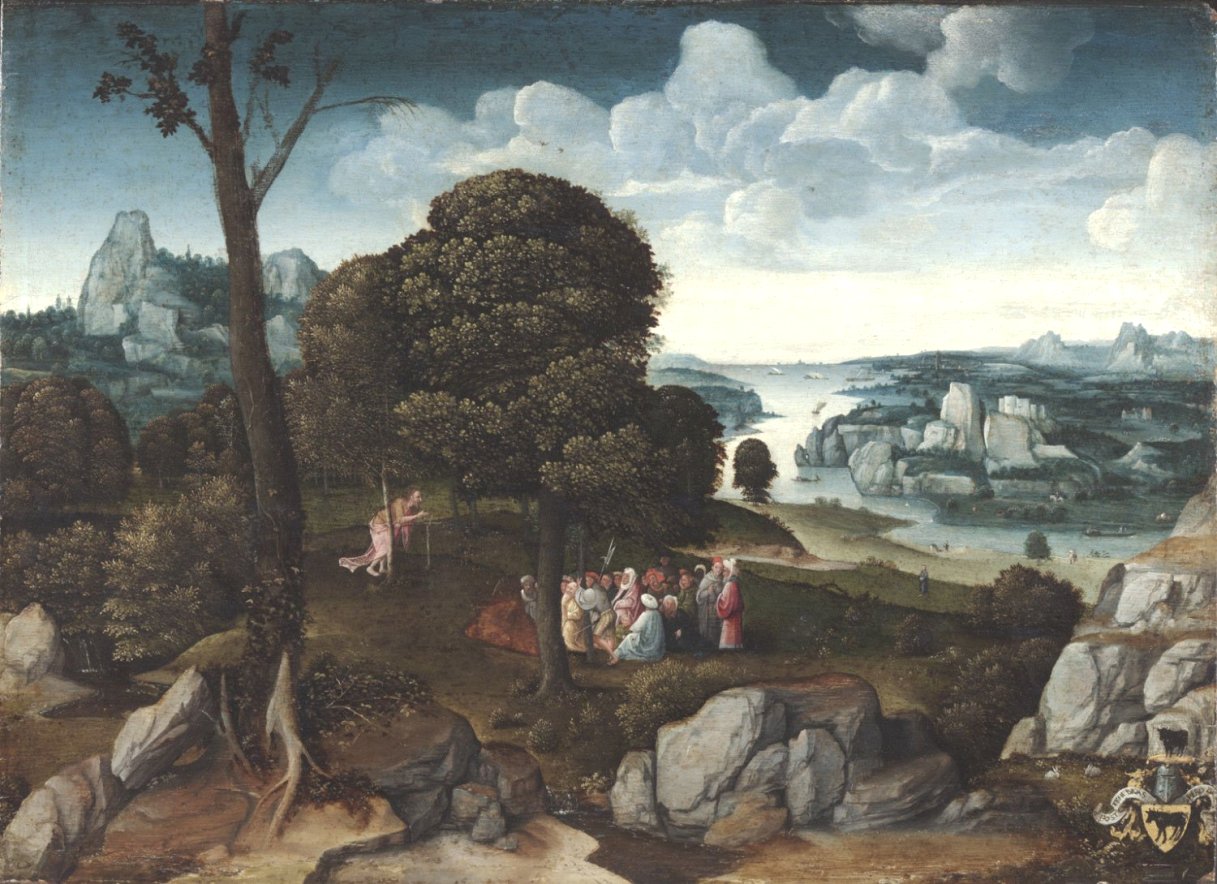
My fourth and final offering of works by Joachim Patinir is entitled Landscape with Saint John the Baptist Preaching and one version of this work can be found in the Musées Royaux des Beaux-Arts de Belgique – Brussels, but the one below is from the collection of  the Philadelphia Museum of Art and in the lower right hand corner of this version we see a crest.   It is the crest of the wealthy Rem family and it could well be the wealthy merchant, Lucas Rem, the sixteenth century Augsburg merchant and art collector had this version painted for himself and had the family crest added to it.

Landscape with Saint John the Baptist Preaching by Joachim Patinir with the Rem Crest

In the painting, we have a bird’s eye view of St John the Baptist preaching to a group of followers but what I like most about the painting is the beautifully depicted imaginary landscape which acts as a backdrop to the religious scene,   Once again it crosses my mind that the religious story plays a secondary role to Patinir’s depiction of the landscape.  Once again we see a similar landscape to that in his other works – tall rocky outcrops closely bordering on to a river, which because of the religious nuance of the painting could have represented the River Jordan and on the left bank, although not clear in this picture, is a depiction of the baptism of Christ, in the Jordan river, by John the Baptist.

We observe St John, bent over, leaning heavily against a sturdy branch of a tree.  It is almost as if he is leaning against a lectern or pulpit rail as he looks down upon his followers who sit entranced by his words.  In the foreground to the left of the painting we see a tree which is dying around which is a vine.   This is thought to allude to the Tree of Knowledge in the Garden of Eden which withered and died once Adam had taken a bite of the apple offered to him by Eve.  According to legend, the tree eventually came back to life once Jesus Christ had died on the cross and in so doing, had atoned for the sins of the world.

Both John the Baptist and his audience are in the shade as the bright light we see lighting up the meandering river, which wends its way towards the horizon, is incapable of penetrating the thick tree canopy above the group.  As was the case in the earlier painting, Patinir has used different colour combinations to craft perspective.  Dark browns and greens in the foreground around the people gradually change to lighter greens of the banks of the river and then in the distance lighter blues and greys become the dominant colours.

Bayard Rock, Dinant
Bayard Rock, Dinant

There is a fascinating delicacy about Patinir’s landscape work and as I have said before this favoured landscape depiction of the artist probably stemmed from what he remembers of his birthplace around Dinant and the rock structure there known as the Bayard Rock, which looms above the town and the River Meuse.

In German, Patinir would be classified as a painter of Weltlandschaft which translated means world landscape.  The Weltlandschaft painters completed works depicting panoramic landscapes as seen from a high viewpoint.  These works of art typically included mountains and lowlands, water, and buildings. As in Patinir’s works, the subject of each painting is usually a Biblical or historical narrative, but the figures included in the work are secondary to their surroundings and they were often made-to-order by secular patrons.  The landscapes in these works were not geographically accurate.  In her 2005 book, Seventeenth-century Art and Architecture, Anne Sutherland Harris, a professor of Art History, describes this form of art:

“…They were imaginary compilations of the most appealing and spectacular aspects of European geography, assembled for the delight of the wealthy armchair traveller…”

So again I ask – was Patinir a religious painter who liked to add a landscape background to his work or was he a landscape painter who liked to add, or get somebody else to add, figures appertaining to religious and mythological stories?  Perhaps his friend Albrecht Dürer had the answer to this conundrum when he described his friend as:

“…der gute Landschaftmaler…

(the good painter of landscapes)

Marianne North the botanical painter

Marianne North     1830-1890
Marianne North
1830-1890

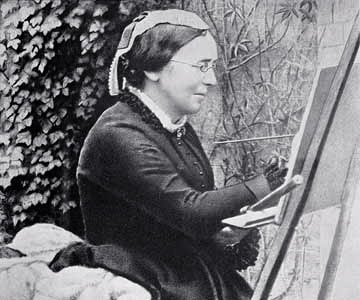
The artist I want to look at today could, I suppose, be labelled simply as a floral painter but in fact because of her desire for accuracy in floral detail she is often referred to as a botanical painter.  Even today, in the age of photography, botanical art still thrives and with so much destruction of habitats around the world, which nurtured rare flora, the necessity to record such species in detail is of paramount importance.  My featured artist today is the Victorian artist Marianne North.

The House at Hastings

Marianne North was born at Hastings Lodge in Hastings, England on October 24th 1830.  Her father Frederick North, an Old Harovian, was a wealthy landowner, local magistrate and, on a number of occasions, a Liberal Member of Parliament for Hastings.  His wife Janet (née Marjoribanks), was the daughter of Sir John Marjoribanks M.P., 1st Baronet of Lees in the County of Berwick.  She had been widowed when her first husband Robert Shuttleworth of Gawthorpe Hall in Lancashire died in a coaching accident 1818. She and her first husband had a daughter, Janet Shuttleworth.  Marianne North came from a long line of nobility and many of her ancestors’ portraits hung in the family dining room.  She was devoted to her father and in her autobiography, A Vision of Eden, she wrote of him:

“…My first recollections relate to my father.  He was from first to Last the one idol and friend of my life…”

Marianne had an elder brother, Charles and a younger sister, Catherine.  It is believed that she did not receive any formal education, except for a short period in a school in Norwich, which she hated.  Marianne was adamant that she taught herself all that was to be learnt, writing in her autobiography:

“…Walter Scott or Shakespeare gave me their versions of history, and Robinson Crusoe and some other old books my ideas of geography…”

Flowers of the Angel's Trumpet and humming birds, Brazil by Marianne North
Flowers of the Angel’s Trumpet and humming birds, Brazil by Marianne North

However the status and wealth of her father ensured that his children were well educated and often had the opportunity to mix with artists and musicians.  Marianne was said to have had a penchant for singing and as a child was given vocal lessons by Charlotte Helen Sainton-Dolby, the well-known English contralto, composer and singing teacher.  Unfortunately as a teenager her singing voice gave way and she began to concentrate on her other love – drawing and painting.  Life was good for Marianne.  As a young teenager, she had basked in a life of prosperity.  It was a privileged life.  Winters were spent at their Notting Hill house in London.  In the spring, they would move back to their large family home in Hastings.  During the summer months she and her family would either spend time on their farmhouse in Rougham, Norfolk, which had once been the laundry of Rougham Hall, once owned by her ancestors.  Alternatively, they would stay at Gawthorpe Hall in Lancashire which had been inherited by Marianne’s step-sister, Janet.  In the late summer of 1847 Marianne’s father took his family on a European tour which lasted almost three years.  Throughout this time Marianne studied flower painting, botany, and music.  On arrival back to London Marianne wanted to continue with her love of drawing and painting and it was arranged for her have some lessons in flower painting from a Dutch painter, Miss van Fowinkel and the English flower painter, Valentine Bartholemew, who had held the position of Flower Painter in Ordinary to the Queen from 1849 until his death thirty years later.

Marianne’s mother, Janet, who had increasingly become an invalid, died in January 1855.  The relationship between mother and daughter was nowhere as strong as the one between her and her father.  Marianne talked about her mother in her autobiography and commented:

“…On the 17th of January 1855 my mother died.  Her end had come gradually; for many weeks we felt it was coming.  She did not suffer, but enjoyed nothing, and her life was a dreary one.  She made me promise never to leave my father…”

Doum and Date Palms on the Nile above Philae, Egypt by Marianne North (c. 1880)

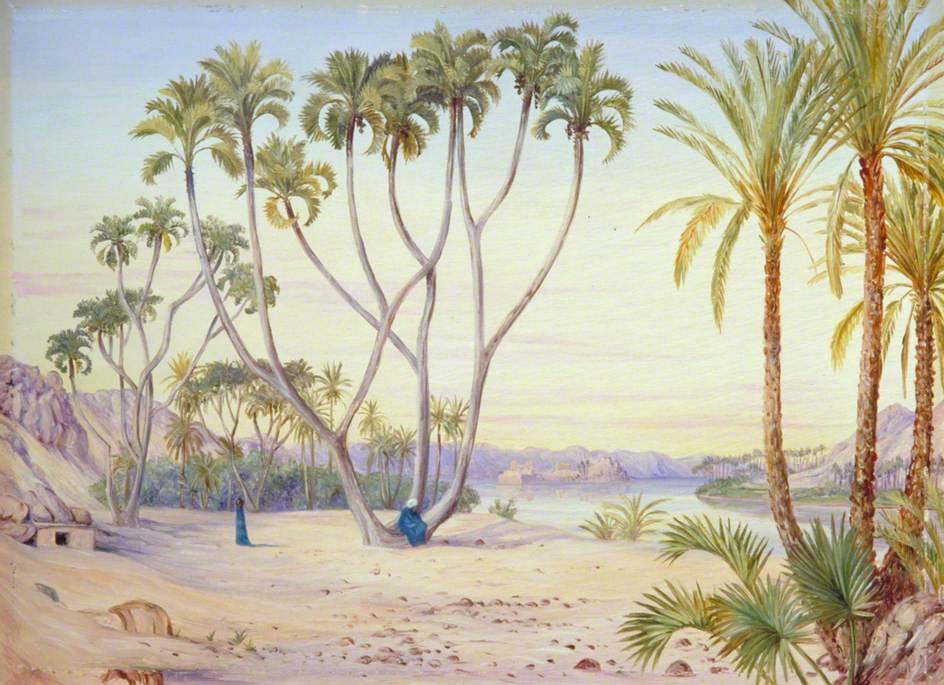
With her mother gone, Marianne, aged twenty-four, took on the role as the lady of the house, looking after her father and the running of the household.   Her father, who had been the Liberal MP for Hastings on a number of occasions, would during the parliamentary recess take his two daughters off on long trips around Europe.     One of their favourite destinations was the valleys around the southern slopes of Mont Blanc and Monta Rosa.    By this time Marianne’s brother Charles had married and his father had given him the old house in Rougham. Marianne’s sister Catherine had married in 1864 and her father, Frederick North, narrowly lost his Hastings parliamentary seat by just nine votes at the General Election in July 1865 and this gave him the opportunity to set off on another voyage of discovery with Marianne travelling through Europe and the Mediterranean isles of Corfu and Cyprus before reaching Syria and Egypt.

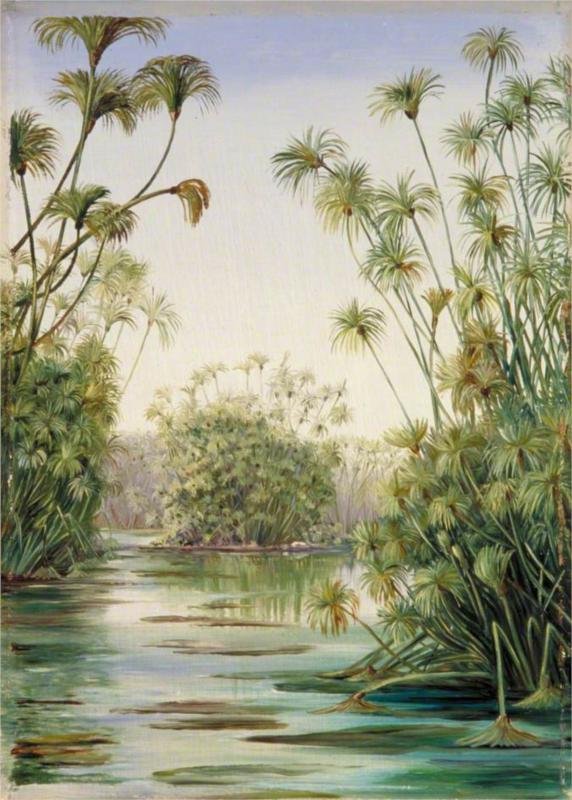
Papyrus Growing in the Ciane, Syracuse, Sicily by Marianne North (1870)

Three years after his defeat in the General Election Frederick North was re-elected as MP for Hastings in 1868.   Marianne’s father was sixty-eight years old and his health had begun to deteriorate but this did not stop him from taking a holiday to Southern Germany with Marianne.  However during their Bavarian sojourn, he became ill and Marianne was advised to take him back home to Hastings, which she did.  Frederick North died on October 29th.  Marianne was devastated for not only had she lost her father, she had lost her greatest friend.  She recalled his death in her autobiography, writing:

“…The last words in his mouth were, ‘Come and give me a kiss, Pop, I am only going to sleep’.  He never woke again and left me indeed alone…”

She recalled how much her father had meant to her and one can feel her deep sorrow.  She wrote:

“…For nearly forty years he had been my one friend and companion, and now I had to learn to live without him, and to fill up my life with other interests as I best might.  I wished to be alone, I could not bear to talk of him or anything else…”

The Aqueduct of Morro Velho, Brazil by Marianne North (1873)

Marianne North carried on with her two great loves, travelling and painting the flora she saw during those voyages of discovery.  In July 1871 she set off on a long journey which would last over two years.  She arrived in Canada, travelled on to the United States, and later the Caribbean island of Jamaica. From there, in 1872, she journeyed to Brazil where she spent much of her time drawing in a remote forest hut. She eventually returned to England in September 1873. Throughout her time on her travels she would be constantly sketching the flora of the area and the landscapes.

Roadside Scene under the Cocoanut Trees at Galle, Ceylon by Marianne North (c.1877)

In the spring of 1875 she was once again off on her travels.  This time she visited Tenerife, and later that year started her first round-the-world trip taking in the west coast of America, Japan, Borneo, Java, and Ceylon, and did not return home until March 1877.  Although she loved being in the house in Hastings and spent much time in the garden she had a wanderlust and in September 1878 this travel bug bit once again and she set off by ship to India, where she stayed for nearly six months,

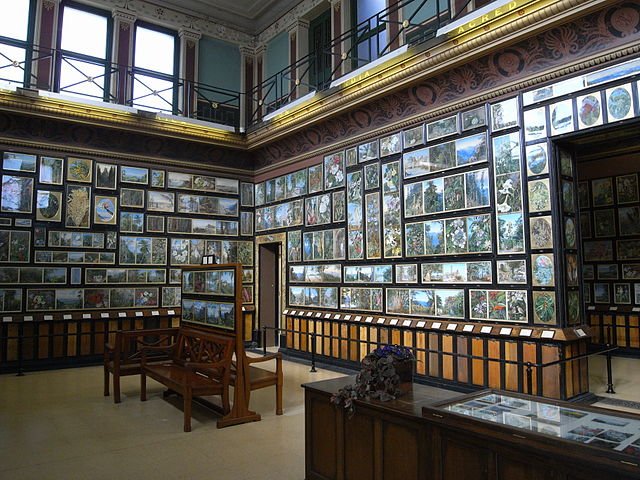
Marianne North Gallery, Kew Gardens, London

By this time Marianne had built up a large collection of drawings which she had completed during her extensive travels.  As they were so popular she held an exhibition of her work in a London gallery.  Having been overwhelmed by their popularity she came up with the idea that they should be housed in a permanent collection and with this in mind she approached Sir Joseph Hooker, the director of the Kew Botanical Gardens in London and offered to present them with her art works and to fund the building of a gallery to house them.  This was agreed and the architect James Fergusson submitted designs for the building and building work started in 1880.  Sir Joseph Hooker as well as being a director of Kew Gardens was a good friend of Charles Darwin and he was introduced to Marianne and it was on his suggestion that she should visit Australia, and New Zealand to discover and sketch the native flora and vegetation.  Marianne took up his suggestion and once again left her homeland and sailed to the antipodean.

Inside the Marianne North Gallery

On her return to England she set about arranging her paintings inside the newly completed gallery building at Kew and on July 9th 1882 it opened to the public as the Marianne North Gallery.

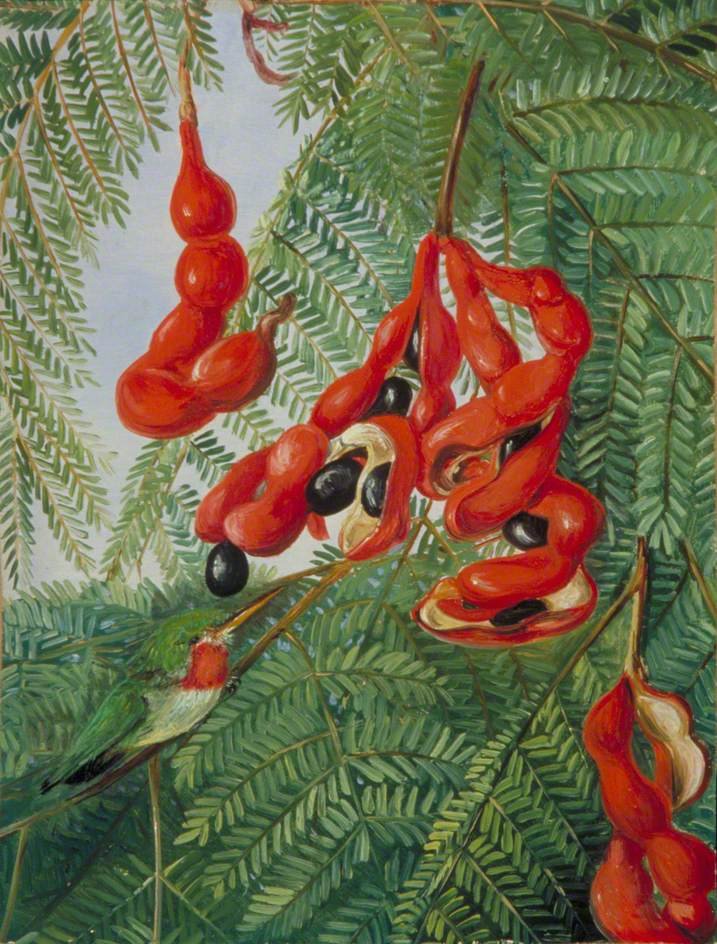
The Wild Tamarind of Jamaica with Scarlet Pod and Barbet by Marianne North (1872)

She resumed her travels visiting South Africa in 1883 and the following winter she was in the Seychelles.  All this travelling and having to endure constantly changing climatic conditions eventually affected her health and, during her later years, she was unable to live a pain-free existence.  She began to lose her hearing and in 1888 began to suffer from liver disease which finally claimed her life.  Marianne North died on August 30th 1890 aged 60.  Maybe it would be fitting to leave the last words to her sister Catherine who wrote about her sister:

“…The one strong and passionate feeling of her life had been her love for her father.  When he was taken away she threw her whole heart into painting and this gradually led her into those long toilsome journeys.  They no doubt shortened her life; but length of days had never been expected or desired by her, and I think she was glad, when her self-appointed task was done, to follow him whom she had faithfully loved…”

I have only been able to attach a few of Marianne’s numerous sketches and I am sure a visit to her gallery at Kew Gardens would be an amazing experience.  For those of you who might not be able to make that journey may I suggest you get hold of her autobiography, the book which I have been reading and from which I gleaned  most of the facts about this talented painter.   It was not an expensive book and well worth the money. It is called A Vision of Eden; The Life and Work of Marianne North.

Georgia O’Keefe. Part 3 – Floral paintings and sexuality

White Trumpet Flower by Georgia O'Keefe (1932)
White Trumpet Flower by Georgia O’Keefe (1932)

In my third look at the life and works of the American artist, Georgia O’Keefe, I want to concentrate on the art she is probably most remembered for, her flower paintings. The depiction of flowers in works of art has always been a popular genre. In past blogs I looked at two famous female artists, Rachel Ruysch (My Daily Art Display October 3rd 2011) and Judith Leyster (My Daily Art Display December 3rd 2013), who were amongst the greatest floral painters of their time. Also from the Netherlands there were the father and son floral painters, Jan van Os and Georgius van Os. At some time, many of the great names in art completed floral works, such as Manet’s lilacs, Monet’s lilies, Hokusai’s cherry blossom, Dürer’s tuft of cowslips, van Gogh’s sunflowers, Fantin-Latour’s roses and so on. So what is so special about O’Keefe’s floral depictions? The answer is that Georgia O’Keefe’s paintings featured close ups of parts of a flower rather than the whole flower and they are stand-alone depictions and not part of a still-life work. She seemed to integrate photographic methodologies such as cropping and close-ups into her floral works. She believed by enlarging the flower the true beauty of the specimen would be hard to ignore. Of her technique she once said:

“…A flower is relatively small. Everyone has many associations with a flower… still, in a way, nobody really sees a flower, really, it is so small….So I said to myself, I’ll paint what I see, but I’ll paint it big and they will be surprised into taking time to look at it, even busy New Yorkers [will] take time to see what I see of flowers. When you [referring to critics and others who wrote about these paintings] took time to really notice my flower you hung all your associations with flowers on my flower as if I think and see what you think and see of the flower, and I don’t…”

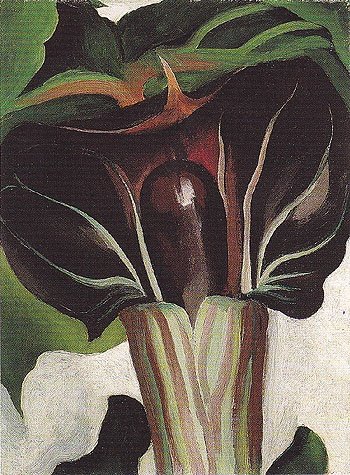
So where did all her ideas for depicting flowers in such a manner start? It could be that she remembered her art teacher she had at her convent school in Madison, back in 1901, when she was fourteen years old. The teacher brought in a wild flower, a jack-in-the-pulpit plant, and asked her teenage students to study it from all angles and told them of the importance of this close scrutiny. O’Keefe was fascinated and drew it from all different angles and then concentrated on drawing just parts of the flower rather than the whole specimen.  This was the beginning of her journey into floral painting.

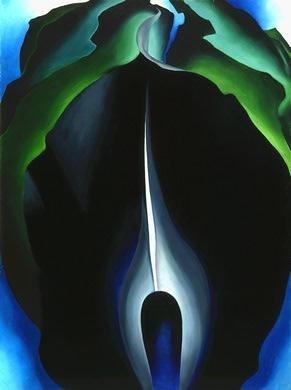
Jack in the Pulpit IV by Georgia O'Keefe (1930)
Jack in the Pulpit IV by Georgia O’Keefe (1930)

Almost thirty years after this classroom incident, in 1930, Georgia actually completed a series of six painting entitled Jack-in-the Pulpit, five of which can now be found in the National Gallery of Art in Washington. The first in the series began with the striped and hooded bloom and was a carefully detailed botanical depiction of the flower but as the series continued the depiction of the flower moved further away from a realistic depiction of it and became almost mass of colour.

Jack in the Pulpit No.1 by Georgia O'Keefe (1930)
Jack in the Pulpit No.1 by Georgia O’Keefe (1930)

As the series developed, the depictions became less detailed and more of an abstract rendering of the flower with the haloed pistil depicted against a sombre black, purple and gray background. The works shown above show the transition in the way she depicted the flower.   In fourth of the series one can see that it has less botanical detail than the first three works and is tending towards abstraction. O’Keefe explained the transition writing:

“…“I found I could say things with color and shapes that I couldn’t say in any other way – things that I had no words for…”

Red Canna  by Georgia O'Keefe (1924)
Red Canna by Georgia O’Keefe (1924)

It was around the early 1920’s during her summer visits to Lake George with Alfred Stieglitz that she started painting flowers in her own imitable style. She would concentrate on the head of the flower and “zoom in” on its centre and then enlarged it, so it completely filled the canvas, often cropping the depiction. She painted all types of flowers from the exotic black irises and red Canna lilies to the more mundane such as poppies, daffodils and roses.

The painting Red Canna Lilies, which she completed in 1924 and is now housed in the University of Arizona Museum of Art, has such great magnification it almost appears to be an abstract work of art with just a series of overlapping lines and a myriad of tones.

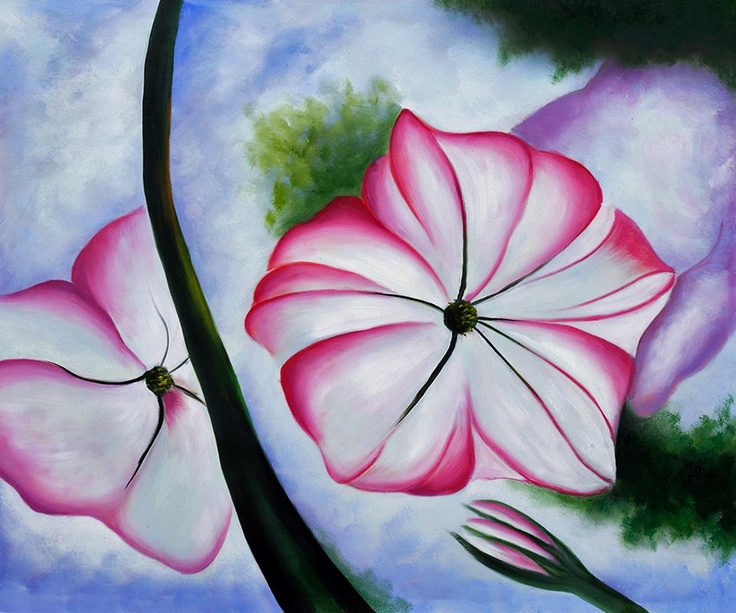
Petunia No.2 by Georgia O'Keefe (1925)
Petunia No.2 by Georgia O’Keefe (1925)

It was in 1924 that O’Keeffe began to make paintings in various sizes. The one thing they had in common was that all of them tended to focus on the centres of flowers. Petunia No. 2, which she completed that year, was one of her first large-scale flower paintings and she had it accepted into an exhibition organised by Alfred Stieglitz at the Anderson Galleries on Park Avenue, New York. The gallery was owned by the American publisher, Mitchell Kennerley and Stieglitz, who had not had his own exhibition space since 1917, borrowed rooms from Kennerley’s gallery and later in 1925 permanently rented a small room at the gallery which he called the Intimate Gallery. Stieglitz idea for the Intimate Gallery was that it should be a place for local artists to exhibit their work and by so doing create a sense of an artistic community, almost an artist’s cooperative. It was to be a less formal exhibiting place where patron and artists could mix and build up a good working and very personal relationship.

Stieglitz had gathered together a collection of works for his December 1925 exhibition, both artistic and photographic. He had called upon his friends to join him in supplying works for the exhibition. Including himself, there were seven contributors in all. They were John Marin, Marsden Hartley, and Arthur Dove, the modernist painters, the watercolourist Charles Demuth as well as his fellow photographer Paul Strand, and of course, not forgetting his wife, Georgia O’Keefe. The exhibition, at the time, was one of the largest exhibitions of American art ever organised and was entitled Alfred Stieglitz Presents Seven Americans: 159 Paintings, Photographs, and Things, Recent and Never Before Publicly Shown by Arthur G. Dove, Marsden Hartley, John Marin, Charles Demuth, Paul Strand, Georgia O’Keeffe and Alfred Stieglitz. The exhibition lasted for three weeks and had numerous visitors but few of the painting sold.

Two Calla Lily on Pink by Georgia O'Keefe (1928)
Two Calla Lily on Pink by Georgia O’Keefe (1928)

In the mid 1800’s an herbaceous perennial plant, native to southern Africa was introduced into America. It was the Calla Lily. It had such an exotic looking flower that it soon became a favourite subject of floral painters and photographers. Over time Georgia O’Keefe completed numerous renditions of the flower, so much so, the lily became her insignia in the eyes of the public, and the Mexican artist Miguel Covarrubias took up that theme in his caricature of O’Keeffe as “Our Lady of the Lily“, which appeared in the New Yorker in 1929. Two Calla Lilies on Pink was one of her painting depicting this exotic flower. She completed it in 1928 and is an amazing piece of floral art full of subtle merging of colours and tones. The flower petals lie against a pink background which enhances the beauty of the work. Look how O’Keefe has managed to merge a green colour in the white of the petals and by doing so cleverly highlighting them. Again these white and green tinged petals of the two flowers seem to be pierced by the emergence of two bright yellow pistils as they rise upwards. It was this kind of depiction with its sexual connotation that was to lead to controversy. How could floral paintings cause such controversy?

Grey Lines with Black, Blue and Yellow by Georgia O'Keefe (1923)
Grey Lines with Black, Blue and Yellow by Georgia O’Keefe (1923)

Another example of her work which some people believed lent credence to the sexual nuance of her paintings was one entitled Grey Lines with Black, Blue and Yellow which she completed around 1923 and is part of the Museum of Fine Arts in Houston collection. It is looked upon as one of her best works. Is it a floral painting? Is it a close up of the inner part of a flower? It is this ambiguity which is fascinating and has led some critics to argue that it is an abstract work and that the undulating folds are based upon female genitalia. Georgia O’Keefe was adamant that none of her floral works of art had anything to do with male or female genitalia and grew weary of those people who maintained the sexual link even after she had denied such a connotation. In Ernest Watson’s biography of Georgia, Georgia O’Keefe, American Artist, he tells how, in 1943, she dismisses the sexual association with her floral paintings even if it mean people paid closer attention to the works of art. She is quoted as saying:

“…Well – I made you take time to look at what I saw and when you took time to really notice my flowers you hung all your own associations with flowers on my flower and you write about my flower as if I think and see what you think and see of the flower – and I don’t…”

Some people will not accept what she has said and have ignored her denial of sexuality in her work. Randall Griffin, a Professor in the Department of Art History at Southern Methodist University in Dallas who specialises in American Art History, in his recent biography (Phaidon) on O’Keefe explained in a chapter entitled The Question of Gender:

“…It now seems abundantly clear that, in spite of her vehement denials, O’Keeffe meant some of her paintings (not just the flowers) to look vaginal…..Works such as Abstraction Seaweed and Water – Maine and Flower Abstraction overtly allude to female genitalia…”

So I guess I will leave you to form your own opinion as to the sexuality of her floral works.
In my final look at Georgia O’Keefe’s life and her paintings I will explore her life in the hot desert lands of New Mexico and how it influenced her art.

Georgia O’Keefe. Part 1 – The early years and the “Specials”

Georgia Totto O'Keefe photograph by Alfred Stieglitz (1918)
Georgia Totto O’Keefe
photograph by Alfred Stieglitz (1918)

If I was to ask you who was the most quintessential American artist, I wonder whom you would choose. Would you go for one of the nineteenth century Hudson River School artists such as Frederic Church, Asher Durand and Thomas Cole or would you select one of the pioneering and tenacious American female painters who fought hard to gain a foothold in the male dominated world of art, such as Mary Cassatt and Elizabeth Jane Gardner. Perhaps you would decide on one of the great twentieth century painters such as Andrew Wyeth or Edward Hopper or the folk artist Grandma Moses. Then of course, let us not forget, there is John Singer Sargent and James McNeill Whistler and naturally there are the modern greats of American art such as Rofko, Warhol, Pollock and de Kooning. I suppose it is impossible to single out one from the list of artists who paint in so many different genres. However, for me, the painter who symbolises America is Georgia O’Keefe and in my next blogs I will look at her life and feature some of her best-loved paintings.

The O'Keefe farmhouse. outside Sun Prairie, near Madison, Wisconsin
The O’Keefe farmhouse.
outside Sun Prairie, near Madison, Wisconsin

Georgia Totto O’Keeffe was born on November 15, 1887, the second of seven children. She was the eldest of five girls and had a younger and elder brother. Her father, who was of Irish descent, was Francis Calyxtus O’Keefe, who ran a successful farmstead on the outskirts of the village of Sun Prairie, Wisconsin, along with his wife Ida Ten O’Keefe (née Totto), whose maternal grandfather was a Hungarian count. The farm was spread over 1700 acres of land on which they raised cattle, horses and grew crops. When Georgia was five years of age she attended the small one-roomed South Prairie Town Hall school. She progressed well and she and her siblings were constantly being pushed to learn by their mother, who would read stories to her children and play the piano for them. In fact Georgia went on to play both piano and violin.

At the age of eleven Georgia developed an interest in drawing and painting and so her mother arranged private art tuition for her and two of her sisters, Ida and Anita. Georgia revelled in what she learnt, She then attended the Sacred Heart Academy in nearby Madison as a boarder and in a conversation with a friend and fellow 8th grade pupil she talked about her future dreams:

“…I am going to be an artist!…..I don’t really know where I got my artist idea…I only know that by that time it was definitely settled in my mind…”

The O'Keefe's house in Williamsburg
The O’Keefe’s house in Williamsburg

In 1902 her family moved to Williamsburg, Virginia but Georgia, who was fifteen years old, stayed behind for a short time with her aunt. Soon after she re-joined her parents in Peacock Hill, a suburb of Williamsburg and enrolled as a boarder at the private Chatham Episcopal Institute for Girls. She continued to love art and her artistic talent was recognised by all and her fellow students elected her art editor of the school yearbook. In her yearbook was written the telling verse:

“…O is for O’Keefe.

an artist divine.

Her paintings

are perfect and

drawings are fine…”

In 1905, Georgia, now seventeen years of age, graduated from high school and enrolled at the Art Institute of Chicago. It was here that she honed her skills as an artist and studied composition, anatomy and life drawing. Her anatomical drawing class tutor was John Vanderpoel, the Dutch-American artist and teacher, who was best known as an instructor of figure drawing and whose 1907 book, The Human Figure, became a standard art school resource. Georgia O’Keefe excelled at the Academy and all was going well until the summer of the following year when she went home and contracted typhoid and was so ill that she was unable to rejoin the Academy. She had to remain at home to recuperate for more than twelve months.

Dead Rabbit with Copper Pot by Georgia O'Keefe (1908)
Dead Rabbit with Copper Pot by Georgia O’Keefe (1908)

When she finally got her health back in 1907, she decided to resume her art career but instead of returning to Chicago she enrolled at the Arts Student League of New York which was one of the top art colleges of the time. One of her tutors was William Merritt Chase, who was one of the foremost art teachers of his generation. At this institution aspiring young artists were trained in the European tradition, namely, learning to paint portraits and still-lifes. Once again her artistic talent shone through and the following year she won the League’s William Merritt Chase still-life prize for her oil painting Untitled (Dead Rabbit with Copper Pot). Her prize was a scholarship to attend the League’s outdoor summer school at Lake George, in upstate New York, east of the Adirondack Mountains.

In 1908 things changed for Georgia. The Arts Student League of New York wanted to keep to the European tradition of art tuition, copying in the style of the Old Masters. It was a conservative formula and one will never know whether it was this rigid mimetic way of teaching art that disillusioned Georgia, but at the end of her year’s tuition in the autumn of 1908, she decided that she no longer wanted to become a professional artist. Another reason for giving up on her art studies was that her father’s business had collapsed and the family was in need of an extra income and so Georgia gave up her studies and embarked on a career as a commercial artist in Chicago where she spent her time designing adverts and company logos. She did not paint another picture for four years.

Georgia O'Keeffe, aged 30
Georgia O’Keeffe, aged 30

This artistic drought ended in 1912 when she attended a summer course at the University of Virginia in Charlottesville where one of the classes was run by Alon Bement of the Teachers College, Columbia University, in New York City. It was Bement who introduced O’Keefe to the radical thinking of his colleague, Arthur Wesley Dow, the head of the Faculty of Fine Arts at New York’s Columbia University Teachers College. Dow believed in the Modernist approach to art and postulated that rather than just copying nature, art should be created by the various elements of composition such as line, mass and colour. He put his thoughts into words in his 1899 book entitled Composition: A Series of Exercises in Art Structure for the Use of Students and Teachers. He summed his thoughts up in the introduction to the second edition of the work which came out in 1912. He wrote:

“…Composition … expresses the idea upon which the method here presented is founded – the “putting together” of lines, masses and colors to make a harmony. … Composition, building up of harmony, is the fundamental process in all the fine arts. … A natural method is of exercises in progressive order, first building up very simple harmonies … Such a method of study includes all kinds of drawing, design and painting. It offers a means of training for the creative artist, the teacher or one who studies art for the sake of culture…”

Georgia O’Keefe who had tired of the mimetic teachings of the academy was enthralled by Dow’s ideas and her love for art was rekindled. In 1912, she moved to Amarillo, Texas, where she had accepted a position as supervisor of art in the city’s public schools. She took up a post in the August of 1912 as an art teacher at City Public School of Amarillo but she returned to the University of Virginia’s to attend the summer course the following year; this time as an assistant to Bement and in the autumn of 1914 she went back to New York and enrolled for two semesters at Columbia University Teachers’ College where she studied under Dow himself. It was around this time that she discovered the work of Arthur Garfield Dove. Dove, an American modernist painter, who has often been labelled as the first American abstract artist. He placed great emphasis on the artist’s subjective experience of his surroundings and on the intrinsic emotional power of colour and line rather than just copying from nature. To Georgia this was not just a revelation but it was the kind of art, which she believed in and it was to influence her art for the rest of her life. For her, it was inspirational, and she happily set off on a new artistic journey. She was excited at the new ideas which flooded her brain and described how she felt:

“…I said to myself ‘I have things in my head that are not like what anyone has taught me – shapes and ideas so near to me – so natural to my way of thinking that it hasn’t occurred to me to put them down.’ I decided to start anew – to strip away what I had been taught – to accept as true my own thinking……. I was alone and singularly free, working into my own, unknown – no one to satisfy but myself…”

You can sense her joy. You can sense her feeling of casting off the shackles of rigid academic teaching. You can sense the elation in the way she saw her future.

Drawing XIII by Georgia O’Keeffe, 1915

In September 1915, she accepted a teaching post at Columbia College, South Carolina and it is around this time she begins to experiment with her art, producing a series of amazing cutting-edge charcoal abstract drawings. One such drawing was entitled Drawing XIII which was completed in 1915. In this work we see that the image is sub-divided into three parallel sections. The left hand section has wavy vertical lines which reminds one of a meandering river although some say it is more like a vertical flickering flame reaching upwards. The central part of the work consists of four rounded bulbs which if we continue with our thoughts of nature could then be construed as round top hills. An alternative to this premise is that they are four densely foliated trees. The right hand section comprises of a series of jagged lines which could be a representation of mountains and so in a way this drawing may be a bird’s eye view of a range of mountains and a flowing river with trees separating the two.

Early No. 2 by Georgia O'Keefe (1915)
Early No. 2 by Georgia O’Keefe (1915)

Another of her charcoal works was entitled Early No. 2 which she also completed in 1915. O’Keefe has followed the advice of Arthur Dow and focused on the lines, shapes and tonal values which she, like Dow, believed were the fundamentals of the picture. Her reasoning behind these early drawings being in black and white and devoid of colour was her belief that colour would distract viewers from what she had hoped to create. It was all about curves and geometrical shapes and the clever balance between areas of the work which were light and shaded.

No. 12 Special by Georgia O'Keefe (1916)
No. 12 Special by Georgia O’Keefe (1916)

Georgia O’Keefe was proud of her first foray into this new world of art and she would often refer to these early drawings as “Specials” indicating how much they meant to her. She mailed some of these drawings to her friend, Anita Pollitzer, who had been a Columbia classmate of hers. Pollitzer, who was now a photographer in May 1916, took them to show the internationally reknowned photographer and art impresario, Alfred Stieglitz, who had his gallery, 291, at 291 Fifth Avenue, New York. Stieglitz was impressed with what he saw and described them as:

“…the purest, finest sincerest things that have entered ‘291’ in a long while…”

Special No. 15 by Georgia O'Keefe (1916)
Special No. 15 by Georgia O’Keefe (1916)

Unbeknown to O’Keefe, Stieglitz exhibited her drawings at his gallery alongside works by other artists. When O’Keefe found out about this, she was not best pleased but later forgave him. This initial collaboration between artist and gallery owner was to be a turning point in Georgia O’Keefe’s artistic life.

…………….to be continued.


Kristian Zahrtman and Leonora Christina

Kristian Zahrtmann
Kristian Zahrtmann

My blog today is a mixture of art and history. It is about a late nineteenth century Danish painter Kristian Zahrtmann and his fascination with Leonora Christina, the daughter of King Christian IV of Denmark and Kirsten Munk. Zahrtmann was a painter, who produced landscapes, street scenes as well as many fine portraits but he was especially known for his history painting and especially paintings which featured legendary, and often tragic, females in Danish history.

Self portrait (1914)

Peder Henrik Kristian Zahrtmann was born in March 1843 in Rønne, a Baltic Sea town on the west coast of the Danish island of Bornholm. His mother was Laura Pouline Jesperson and his father, Carl Vilhelm Zahrtmann, was a doctor on the island. He was the eldest of nine children, having two sisters and six brothers. On completion of his normal schooling, at the age of seventeen, he left the Rønne Realskole and enrolled at the Sorø Academy on the Danish island of Zealand and it was here that he began to study painting under the tutorship of the Danish landscape painter and drawing master, Hans Hader. He graduated from the Academy in 1862 and a year later received his doctorate.

Following his graduation he went to live in Copenhagen and for the six months of the winter of 1863 he enrolled at the Technical Institute in Copenhagen where he studied drawing and design under the Danish artist, Christian Hetsch and architect Ferdinand Vilhelm Jensen. At the same time, he received private instruction from the genre painter Wenzel Ulrich. A year later he enrolled on a four-year course at the Royal Danish Academy of Art in Copenhagen. He graduated from the Academy in 1868 when he was twenty-five years of age and it was in this year that he first exhibited some of his first work at the Charlottenborg, the palace in which was situated the Danish Academy of Fine Arts.

Jammers Minde The hand written autobiography of Leonora Christina
Jammers Minde
The hand written autobiography of Leonora Christina

It was around this time that Zahrtmann became great friends with aspiring Danish painters Otto Haslund and Pietro Krøhn with whom he shared a studio. It was this friendship that in some way was the starting point of this blog about Zahrtmann and the 17th century Danish princess Leonora Christina for it was they who gave Zahrtmann, for his birthday, a copy of Jammers Minde, which literally translated means A Memory of Lament. It was a posthumous autobiography written by Leonora during her twenty-two year solitary incarceration in the Blue Tower in Copenhagen Castle and which was not published until 170 years later, in 1869. So who was Leonora Christina and why was the daughter of the king imprisoned for over two decades of her life?

Leonora Christina in the Blue Tower by Kristian Zahrtmann

To find the answer to this we need to go back to King Christian IV of Denmark-Norway who succeeded his late father, Frederik II, at the age of eleven and ascended to the throne eight years later. He married his first wife Anne Catherine in 1597, when he was twenty years of age, and the couple went on to have seven children, four of whom died in infancy. Anne Catherine died in 1612 and three years later, in December 1615, Christian IV remarried. His second wife was Kirsten Munk, the daughter of a wealthy court official, who had been living with her family at the royal palace in Copenhagen . Although she was of the nobility, she held no title and so when she married the widowed king, Christian, it was a marriage between people of different social classes and the marriage was termed a morganatic marriage (similar to the present day marriage between Prince William and the “commoner” Kate Middleton). This difference in class between husband and wife could well have been the reason why the wedding ceremony was a private affair and not a full-scale church wedding. Kirsten Munk bore the king twelve children, ten of whom survived infancy, two sons and eight daughters. Leonora Christina was the couple’s fifth child, born in July 1621.

Leonora Christina i Fængselet (Leonora Christina in Prison) by Kristian Zahrtmann (1875)

Leonora Christina, like four of her sisters, did not marry princes from one of the many European monarchies but instead her father allowed them to marry powerful and wealthy Danish noblemen in an attempt to assure their allegiance to the monarchy. Leonora’s husband, whom she married in 1636 when she was just fifteen years old, was the thirty-eight year old Corfitz Ulfeldt, the son of the Danish chancellor. They had actually been engaged since she was nine years old! Corfitz Ulfeldt held great powers at the royal court but became more and more ambitious and grasping and it was these traits along with some bad political decisions which had him and the king fall out. Christian IV died in February 1648 and it was two months before the king’s second son, Leonora’s half brother, Frederick, from his first marriage, was elected the new King of Denmark and Norway. He became King Frederick III. During that two month transition period Corfitz Ulfeldt, as Steward of the Realm, the country’s de-facto prime minister, virtually ruled Denmark.

Leonora Christina Ulfeldt by Gerard van Honthorst (1647)

Corfitz Ulfeldt’s avarice and naked ambition during his rise to power irritated the new king and a perceived plot against the new monarch by Ulfeldt caused the latter, out of fear for his life, to flee the country with his wife Leonora and their family. Ulfeldt then forged a close alliance with Charles X of Sweden, Denmark’s old enemy, and offered his financial support with money which was thought to have been embezzled from the Danish state. This money was to help Charles facilitate the war against Denmark which began in July 1657. At the end of the conflict in 1658, Sweden had won its most celebrated victory, and for the vanquished, Denmark/Norway, they had suffered a humiliating and costly defeats of all time, having to cede territory to Sweden under the Treaty of Brömseboro. Ulfeldt even took part in these treaty negotiations, during which he took great pleasure in denigrating his former homeland. This, however, was to be his ultimate undoing. Ulfeldt, now feted by the Swedish monarch, once again became too ambitious and fell out with Charles X, who ordered his arrest and was condemned to death. In 1660, Ulfeldt decided that the lesser of two evils was to escape from Sweden with his wife Leonora Christina and return to his homeland, Denmark, and try and make his peace with Frederick III. Frederick was not amused and had the couple imprisoned for a year. Their release came after Ulfeldt paid a hefty fine which saw him and his wife almost reduced to a poverty-stricken existence. Their imprisonment had been both degrading and cruel and once released Ulfeldt plotted his revenge on Frederick. His act of treason against the Danish monarch was discovered and he was condemned to death in absentia. He escaped the jaws of death but died in a Rhine boating accident during one of his flights from impending arrest.

Leonora Christina in the Garden of the Frederisborg Palace by Kristian Zahrtmann (1887)

So what happened to Leonora Christina? After her and her husband’s release from prison Ulfeldt persuaded Leonora to go to England, seek an audience with Charles II and see if she could recover money he had lent the English monarch. Charles was unwilling to help and had Leonora arrested at Dover on her way back to the Continent. She was eventually hand over to Frederick and the Danish state, which as they still could not find Ulfeldt, instead decided to punish his wife and had her locked away in solitary confinement in the infamous Blue Tower at Copenhagen’s Castle. The conditions in the prison were both degrading and vile. So why was she so severely punished for the wrongdoings of her husband? Throughout her incarceration she blamed her downfall and her imprisonment, not on her half brother, the monarch Frederik, but on his wife Sophie-Amalie and the queen’s desire for revenge. Why this animosity between Leonora and Sophie-Amelie?

Sophie Amalie von Braunschweig-Lüneburg  with a slave by Abraham Wuchters (c.1670)
Sophie Amalie von Braunschweig-Lüneburg with a slave by Abraham Wuchters (c.1670)

Leonora had been her father’s favourite daughter and when her mother, Kirsten Munk, was banished from Copenhagen by her husband for infidelity, Leonora took on the role and power as the First Lady of Denmark. When her father died and Frederick came to the throne things changed. When you are at the pinnacle there is only one direction one can go – down! Frederick married Sophie-Amalie of Brunswick-Lüneburg, who became Queen of Denmark and Norway. She and Leonora, who had seen her power usurped by another woman, became bitter enemies and she probably played a leading part in having Leonore incarcerated.

Leonora Christina paa Maribo Kloster (Leonora Christina at Maribo Cloister)  by Kristian Zahrtmann (1883)
Leonora Christina paa Maribo Kloster (Leonora Christina at Maribo Cloister)
by Kristian Zahrtmann (1883)

Leonora Christina’s sworn enemy, Sophie-Amalie died in February 1685 and one of Leonora’s daughters went to the king, Christian V, the son of the late Frederick III and Sophie-Amalie, and begged for the release of her mother. The king agreed and in May 1685 and she went to live at a monastery run by the nuns of the St. Birgitte-order. It was here that Leonora completed her autobiography, Jammers Minde, which she had started to write during her long imprisonment. Leonora Christina died in March 1698 and was buried in the crypt of the monastery which is now the church at Maribo on the Danish island of Lolland. It is believed that some time later her sons had her body removed from the church and laid to rest in a secret location where her husband had been interred. Leonora’s last years in imprisonment improved due to the attitude of the new king Christian V and his wife, the queen-consort, Charlotte-Amelie despite his mother, Sophie-Amelie’s everlasting vindictive nature. In her autobiography Leonora wrote about her indebtedness to the king and queen improved situation:

“…My most gracious hereditary King was gracious enough several times in former years to intercede for me with his royal mother, through the high ministers of the State. Her answer at that time was very hard; she would entitle them “traitors”’ and, “as good as I was, and would point them to the door. All the favours which the King s majesty showed me — the outer apartment, the large window, the money to dispose of for annoyed the Queen Dowager extremely; and she made the Kings majesty feel her displeasure in the most painful manner…”.

Dronning Sophie Amalies død, (The Death of Queen Sophie Amalie)  by Kristian Zahrtmann (1882)
Dronning Sophie Amalies død, (The Death of Queen Sophie Amalie)
by Kristian Zahrtmann (1882)

Zahrtman was fascinated by the book and completed a number of paintings of the way he envisaged Leonora during her captivity and like Leonora, Zahrtmann blamed Sophie-Amalie for Leonora’s downfall and the artist depicted the deathbed scene of Leonora’s nemesis. The state of the dying queen mother and the pain-wracked expression on her face presumably comforted Zahrtmann !

For anybody who would like to read the translation of Leonora’s autobiography I believe there is a Guttenburg e-book available:

 http://www.gutenberg.org/ebooks/38128?msg=welcome_stranger

Feast at the House of Levi by Paolo Veronese

Feast at the House of Levi by Paolo Veronese (1573)

The 16th century the art scene of Venice was dominated by three artists, Titian, Paolo Veronese, and Jacopo Tintoretto and it was these three painters who managed to tender for and win most of the public and religious commissions, which were on offer during that period.  My featured painting today was one of Veronese’s most controversial paintings.   It was intended to be a monumental work depicting the Last Supper but as you will now read that Veronese, three months after its completion, had to hastily change the title of the painting.  The work, which is now entitled Feast at the House of Levi, is a massive work of art measuring 555cms x 1280cms (18’6″ x 42’6″) and was far too big to be included in the recent Veronese Exhibition at the National Gallery, London but I have been fortunate enough to stand in front of this amazing work a few years ago when I visited the Gallerie dell’Accademia in Venice.  It is a truly magnificent painting.

Basilica di Santi Giovanni e Paolo, Venice

In 1573, Paolo Veronese, who was at the time forty-five years old, was awarded the commission to paint a depiction of the Last Supper for the rear wall of the refectory of the fourteenth century Basilica di Santi Giovanni e Paolo, sometimes known as the pantheon of doges, as twenty-five of them have been buried there. It is one of the largest churches in the city of Venice. The building of this great church started around 1333 but was not completed until November 1430 as the construction was halted on many occasions due to the never-ending plagues that the city suffered during the 14th century.  This painting by Veronese would replace Titian’s painting, The Last Supper, which had been lost in a fire in 1571.  According to the writing on the base of the pillars, to the left and right in the foreground of the painting, the work was completed by Veronese on April 20th 1573.  When I looked at some of the Veronese paintings at the National Gallery exhibition in my previous two blogs, I talked about the artist’s penchant for combining secular depictions in some of his religious works, such as his painting, Supper at Emmaus, and in today’s painting we can see that this theme was once again adopted, much to the horror of the Catholic Church.  So let us look in more detail at this immensely impressive work.

Dog looking at cat which appears under Last Supper table

In the painting we see a monumental triple-arch background through which one can see more magnificent buildings of Venice cityscape.  This was more than likely inspired by buildings designed by the great Italian architects of the time, Andrea Palladio and Jacopo Sansovino, who designed many of the Venetian buildings in the sixteenth century.   In the foreground of the painting and on either side of the depiction of Christ at the Last Supper, we witness a scene of great merriment, with jesters and blackamoors, along with the nobility of Venice enjoying their own sumptuous feast.  Veronese has simply combined the Last Supper with Christ and his Apostles with a typical Venetian dinner party.  The first thing that strikes you about this work is the large number of figures that have been included in the work, one could say, almost crammed into the work and because the work is somewhat cluttered by human beings, the depiction of Christ at the Last Supper seems almost lost in the melee and this is part of the reason why it did not find favour with the Church.  One realises that the artist must have derived great joy from including all these various figures, all doing different things and for him this maybe what the painting was about and that the Last Supper was just a bi-product of the work.  Maybe we can glean an understanding of Veronese’s modus operandi by his description of his work as an artist when he described what he did, saying:

“I paint and compose figures”

Jester with parrot
Jester with parrot

The Church’s displeasure of the completed work was not just that the depiction of the Last Supper, in the central background of the painting, seems almost to play a secondary and minor role in the work; it was that they were horrified by some of the numerous other characters who populated the work.  Veronese’s inclusion of this assortment of characters into such a famous religious scene was looked upon by the Church as being irreverent, bordering on blasphemous. One has to remember that this period marked the beginning of the Counter Reformation which was the Catholic Church’s attempt to strongly and vociferously oppose the Protestant Reformation and to move towards a re-definition of good Catholic values.  The Church was very wary about anything which could be perceived as mocking the Church and its values.  This counter-reformation movement attempted to elevate the moral and educational standards of the clergy and by so doing enable it to win back areas endangered by Protestantism.  So when Veronese added a plethora of people, some of whom seemed to be drunk, as well as dogs, a cat, midgets, and Huns to the depiction of Christ at the Last Supper at the house of Simon, the elders of the Church were horrified.  Veronese was summoned to appear before the Inquisition on July 18th 1573 which was sitting in the Chapel of S. Teodoro.

One of the first questions posed by his inquisitors was whether he knew why he had been summoned before them.  Veronese replied:

“…I fancy that it concerns what was said to me by the reverend fathers, or rather by the prior of the monastery of San Giovanni e Paolo, whose name I did not know, but who informed me that he had been here, and that your Most Illustrious Lordships had ordered him to cause to be placed in the picture a Magdalene instead of the dog; and I answered him that very readily I would do all that was needful for my reputation and for the honour of the picture; but that I did not understand what this figure of the Magdalene could be doing here…”

 The inquisitors were not pacified by his answer and began to question him in more detail.  They asked him why he had included two German soldiers seen on the stairway, standing guard bearing halberds, in the right foreground.  One has to remember it was the German Martin Luther, who initiated the Protestan Reformation fifty-five years earlier and it was he who had been a thorn in the side of the Catholic Church, constantly criticising the ways of the Catholic clergy and the Catholic doctrine.   The Inquisition wanted to know why such frivolous things as a dwarf with a parrot on his arm, a dog which sits before Christ’s table staring at the cat which has appeared under the tablecloth had been included in a deeply religious scene.  Veronese had all the answers ready.  As far as the German soldiers he answered:

German guards with halberds

“…We painters use the same license as poets and madmen, and I represented those halberdiers, the one drinking, the other eating at the foot of the stairs, but both ready to do their duty, because it seemed to me suitable and possible that the master of the house, who as I have been told was rich and magnificent, would have such servants…”

The inclusion of the two Germans in the painting was considered by the inquisitors an even greater sin than the other inclusions the inquisitors questioned Veronese again as to their inclusion.

“…Do you not know that in Germany and other countries infested by heresy, it is habitual, by means of pictures full of absurdities, to vilify and turn to ridicule the things of the Holy Catholic Church, in order to teach false doctrine to ignorant people who have no common sense?…”

Veronese realised he was now on dangerous ground but skilfully replied:

“… I agree that it is wrong, but I repeat what I have said, that it is my duty to follow the examples given me by my masters…”

Veronese was probably now becoming a little fearful at the way the questioning was going and so decided to go down the line of – if you think I have blasphemed with my painting, what about the much beloved Michelangelo’s work in the Vatican.  Veronese expanded:

“…In Rome, in the Pope’s Chapel, Michelangelo has represented Our Lord, His Mother, St. John, St. Peter, and the celestial court; and he has represented all these personages nude, including the Virgin Mary, and in various attitudes not inspired by the most profound religious feeling…”

Other diners

The Inquisitors however would not criticise Michelangelo’s work, merely saying that in the depiction of the Last Judgement, which Veronese was referring to, it was only natural that the people were without clothes and that the work had been inspired by the Holy Spirit.  They then turned on Veronese stating that there was no indication that his work had been so inspired by the Holy Spirit and that he needed to make some changes to it.  They then compared Michelangelo’s work with his and commented:

“…There are neither buffoons, dogs, weapons, nor other absurdities. Do you think, therefore, according to this or that view, that you did well in so painting your picture, and will you try to prove that it is a good and decent thing?..”

A little trickier was the question as to why he would include a jester with a parrot on his wrist in such a “sacred” work.  However, he was not to be browbeaten and simply answered:

“…He is there as an ornament, as it is usual to insert such figures…”

 Veronese did however agree with his inquisitors that there was only Christ and his twelve apostle present at the table during the Last Supper but forwarded the reason for the inclusion of so many characters.  He said that the painting was to be so large that he had to fill the space with something, saying:

“…when I have some space left over in a picture I adorn it with figures of my own invention…” 

The inquisitors countered Veronese’s argument by asking him whether he thought he had the right to mock the Last Supper by including irreligious figures, such as buffoons, dwarves, a dog, a cat and worst of all Germans.  Veronese replied:

“…No, but I was commissioned to adorn it as I thought proper; now it is very large and can contain many figures…”

The way in which Veronese had depicted the Last Supper seen in the central background was also criticised by the Inquisition.  This was not similar to the portrayal of Last Supper à la Leonardo.  Veronese’s table scene was more of an everyday festive scene and this was not lost on the inquisitors who wanted to know what was going on at the supper table.  They started by questioning Veronese as to who was sitting down with Christ.  He answered:

“…The twelve apostles…”

They then questioned what the person, Saint Peter, on the right hand of Christ was doing.  The artist responded:

“… He is carving the lamb in order to pass it to the other part of the table and Christ holds a plate to see what Saint Peter will give him…”

On questioning what a third person at the table was doing he merely commented:

“…. He is picking his teeth with a fork…”

In a desperate final attempt to justify the inclusion of all the extra people, both normal and strange, he pointed out that such elements that displeased the Inquisition, such as the dog, the dwarf, the blackamoors, the man with the nosebleed, who is seen holding a handkerchief at the left of the picture, were all in the foreground or the sides of the painting, and did not, in any way, form an incursion into the religious depiction of Christ at supper at the centre of the work.

Venetian guest arriving for supper

With a terrible sense of foreboding the questions came to an end and Veronese awaited his fate. So, it was much to his surprise that at the end of the interrogation Veronese was told that he was a free man.  However as the Inquisition could not accept his argument for adding what they termed “anti-conformist elements” he was given three months to correct the painting at his own expense.  They required him to paint out the dog, and replace it with the Magdalene.  He was also to expunge the German soldiers and it was all to be done within three months. Paolo Veronese, who had feared torture and even death because of his heretical depiction of the Last Supper, couldn’t believe his luck.  So how had he managed to escape the full force of the Inquisition?  Maybe the answer lay in the fact that the Inquisition had much reduced powers in Venice and the inquisitors knew that they could only threaten and not use the brutal methods of torture that was taking place in other countries such as Spain and Italy.  They simply wanted to frighten Veronese in the hope that he would think twice before he again combined secularity with religious scenes.  The Inquisition in Venice was also fully aware that every judgement they made was scrutinised by the Venetian Senate, who were ready to drastically curtail their powers, if they dared to take away the liberty of a Venetian subject and, of course,  Paolo Veronese was one such subject.

Date on column and reference to Luke's Gospel
Date on column and reference to Luke’s Gospel

Veronese never made any of the major changes to his painting that the Inquisition had demanded, but in deference to Ecclesiastical sensibilities and not wishing to push his luck, he added the inscription across the top of the pillars at the head of the staircases, the ones which also showed the date of completion.  The inscription read:

Fecit D.Covi Magnum Levi                       Luca Cap. V

This was in reference to a passage in Luke’s gospel of the New Testament (Luke 5: 27-29):

“…After this, Jesus went out and saw a tax collector by the name of Levi sitting at his tax booth. “Follow me,” Jesus said to him, and Levi got up, left everything and followed him.  Then Levi held a great banquet for Jesus at his house, and a large crowd of tax collectors and others were eating with them…”

He then merely changed the title of the work from The Last Supper to Feast at the House of Levi and by doing so was able to retain the dog and removed the need for it to be replaced by a repentant Magdalene prostrating herself on the floor before Christ.  Veronese’s decision not to make the changes pleased both the friars who loved the painting, and for the majority of Venetians who resented Rome’s inquisition.   The painting remained in the refectory of the Basilica di Santi Giovanni e Paolo until Napoleon Bonaparte’s troops marched into Venice in 1797 and he ordered it be taken back to Paris.   It was returned to Venice a decade later and remained in the church until 1815, at which time it was acquired by the Accademia Galleries in Venice, its current home.

One final thought as to why Veronese would add so many people into a religious scene.   A decade earlier, in 1563, he had completed a similar monumental religious commission for the monks, entitled the Wedding at Cana, which now hangs in the Louvre.  It is interesting to note that it was the monks who had asked him to squeeze as many figures into their painting, as possible.  This was however at a time when the Inquisition and the upholding of Counter-Reformation ideals had yet to reach Venice.