Balthus. Part 3 – Antoinette de Watteville and exile

Antoinette de Watteville and Balthus (1935)

This is the third part of my blog, looking at the life of Balthazar Klossowski (Balthus) and I want to look at his first true love, his first wife Antoinette de Watteville and his time in exile  during the Second World War.

The financial situation of the Klossowski family in the mid 1920’s was perilous, so much so, Balthus and his brother Pierre had to suspend their studies due to lack of money.  In 1924 Balthus joined his brother in Paris and a few months later their mother, Baladine, moved to the French capital where they lived in an apartment close to the Pantheon.    In 1926, aged eighteen years of age, Balthus journeyed to Italy and spent part of the summer in Florence where he set about copying some of the works of the Italian Masters.

As far as romance was concerned, Balthus’ great love was for a young girl, Rose Alice Antoinette de Watteville.  She was born in 1912 and was the sister of Robert de Watteville, who was a close friend of Balthus.  Balthus and Antoinette first met in 1924 when she was twelve years of age and he was nineteen.  Antoinette’s upbringing was one of opulence as the de Wattevilles family were descendents of one of the most established aristocratic families in Switzerland.   Balthus fell in love with this young girl but it was an unrequited love, but despite this, she and Balthus carried on exchanging many letters.  Antoinette’s family were unimpressed with Balthus, not just because he was a struggling artist but also because his family lineage was nothing compared to that of the de Watteville family.

The Bernese Hat by Balthus (1938)

In the 1930’s Balthus was concentrating on society portraits and in an attempt to win over Antoinette’s parents he completed a portrait of Antoinette, entitled The Bernese Hat.  The painting was devoid of any accoutrements that would imply Antoinette’s social and financial standing and the setting for the work was described as “severe”.

Much to the horror of Balthus, Antoinette married a diplomat in 1934 and so as not to upset her husband she asked Balthus to stop writing to her.  This was too much to take in for Balthus.  He was devastated and suffered what was termed an emotional breakdown, and he attempted suicide.  He was so depressed that he virtually gave up painting for a year. His mood only lightened when she started to write to him again and in Bern on April 2nd 1937 she married Balthus.  They went on to have two sons, Stanislaus, born in October 1942 and Thadée, born in February 1944 who co-authored a biography of their father which included many of the letters between Antoinette and Balthus.

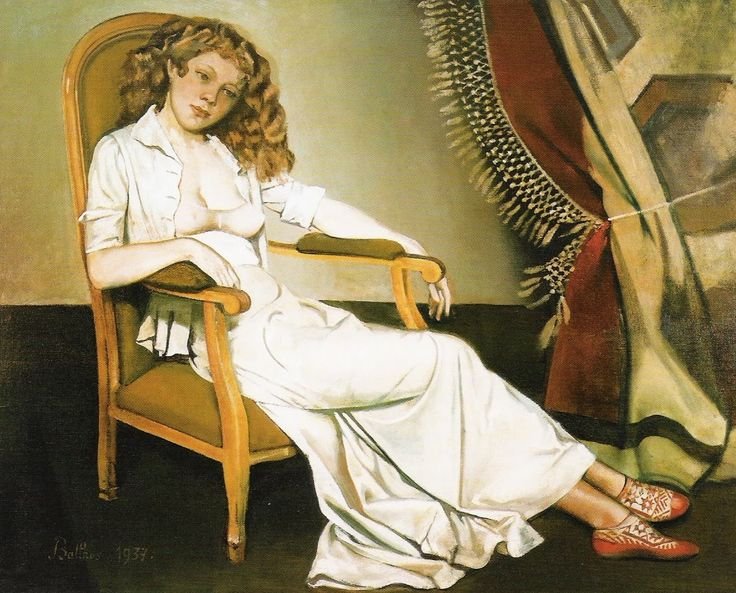
The White Skirt by Balthus (1937)

One of the first painting Balthus did of his wife was The White Skirt which he painted in late 1937, some months after they were married and the story of the painting has an unusual twist to it.  What we see in this provocative painting is Antoinette lounging in a chair.  She is dressed in a full length white tennis skirt that used to belong to her mother.  The jacket has fallen open and we cannot help but notice her semi-transparent bra which allows us to see her nipples which strain against the silky material.   There is an aristocratic self-confident grace about her pose and in some way this appealed to Balthus to know that he had married into the aristocracy, although he still believed himself to be of the de Rola aristocracy.  Balthus sold the painting to his friend the Paris art dealer Pierre Colle, who had introduced him to Derrain.  It is obvious that Balthus regretted that decision for he had now lost a painting which portrayed his aristocratic trophy, Antoinette.  Pierre Colle died in 1948 and Balthus approached his widow to have back The White Skirt painting.

Three Sisters by Balthus (1954)

She agreed but on one condition – that Balthus completed a painting featuring her three daughters, Marie-Pierre, Béatrice and Sylvia and she would then exchange it for the portrait of Antoinette which Balthus desperately wanted.  Balthus agreed to the exchange and completed one of the versions of the painting, The Three Sisters in 1954.

Champrovent
Champrovent

When the Second World War broke out in 1939 Balthus was called up to the French army and was sent into battle near the town of Saarbrucken in the Alsace region.  His time in the army lasted only a few months as he was invalided out with a leg injury and had also suffered a nervous breakdown.  He went to the Savoie region of France and Switzerland to recuperate and in March 1940 he returns to Paris and is demobilised.  In June 1940, the Germans occupied Paris and so Balthus and his wife Antoinette left the French capital and relocated in a seventeenth century manor house Champrovent  in the village of Vernatel close to the town of Chambery in the Savoie.  Here they shared a farmhouse manor with another family, the Coslins.

Still Life with a Figure by Balthus ( 1940)

The Coslin’s twelve year old daughter, Gertrude, appeared in the first painting completed by Balthus whilst they were in exile.  The painting, which was entitled Still Life with a Figure, is essentially a still life on a table composition.  We see the young girl in profile whose figure is cut off at the right hand side border and all we see of her is her head, her wavy reddish- blonde hair, and the yellow-green sleeve of her blouse.  She leans forward to look at the table.  Her left hand rests on the table whilst her right hand seems to draw back the red and gold brocade curtain.  She has a glowering facial expression as she stares at the meagre food that has been set aside for lunch.  At the far end of the table from her is an ornate stemmed Victorian silver fruit bowl which holds several green and red apples all of which still retain their stalks. A wine glass can be seen which may be half-filled with cider.  On the table, close to the girl, we see a chunk of home-baked bread, through which a black-handled knife has been thrust.   The setting for this painting was one of the rooms of the farmhouse, in which Balthus and Antoinette were staying, but not the parlour, which appeared in later paintings by Balthus (Salon I and Salon II).  The colourful wall and brocade curtain along with the deep claret of the tablecloth are in stark contrast to the plain dull walls of his Paris studio which was the background for many of Balthus’ paintings.  The painting can be seen in the Tate Gallery in London

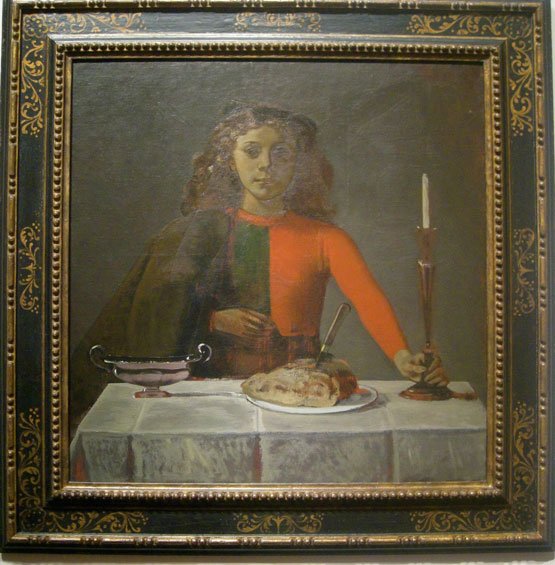
Girl in Green and Red by Balthus (1944)

Balthus completed many paintings featuring Antoinette.  One unusual one, which he completed in 1944 was entitled Girl in Green and Red.   At the time of this painting Antoinette was thirty-two years of age but Balthus’ depiction of her makes her look as if she is a teenager.  We see Antoinette wearing a green and red tricot with a brown cape over her right shoulder.  She said in a later interview that she had specially bought the tricot for the sitting.  Antoinette had blonde hair but in the painting Balthus had changed it to brown so it could match the colour of the cape.  As well as the two colours of the tricot, of which the red is highlighted, her face is made to look two toned by the same light source which emanates from the left of the painting.  Antoinette sits at a table.  On the table, which is covered by a white tablecloth, are a silver cup, half a loaf of bread, which has a black handled knife pushed into it, and a candlestick which she is grasping.   The bread and the protruding knife also appeared in his Still Life with a Figure painting of the same year.    The way Antoinette is portrayed in this painting has often been likened to that of a fortune teller about to read the tarot cards.  Balthus completed this work when he was living at 164 Place Notre Dame in the Swiss town of Fribourg where he and Antoinette had taken up residence from May 1942 and remained there until October 1945.  This painting was hailed by the Surrealists.  The picture marked one of Balthus’ closest approaches to Surrealism, a movement whose leaders admired and courted him. He rebuffed them,

To avoid the harsh Savoie winter conditions and the oncoming German armies Balthus and Antoinette left Vernatel in late 1941 and moved to Switzerland to be with her parents who were living in Bern.

Paysage de Champrovent by Balthus (1942-1945)

During Balthus’ eighteen month stay in Champrovent he set to work on two large landscape paintings which were companion pieces and which actually formed a continuous panorama of the countryside which Balthus would have looked out upon when he stepped out of his farmhouse residence.   Paysage de Champrovent  (Landscape of Champrovent) is a topographically correct view of the scene.  If we look carefully at the centre mid-ground we can make out the Chateau de la Petite Forêt and the Bois de Leyière.  Further back over the crest of the hill, but out of sight, is the Rhone valley.  In the distant background are the blue grey of the Colombier mountain range.  The setting is a late sunny summer afternoon and a girl lies in the field taking in the last of the sun.  The model for this painting was Georgette Coslin, the farmer’s daughter.

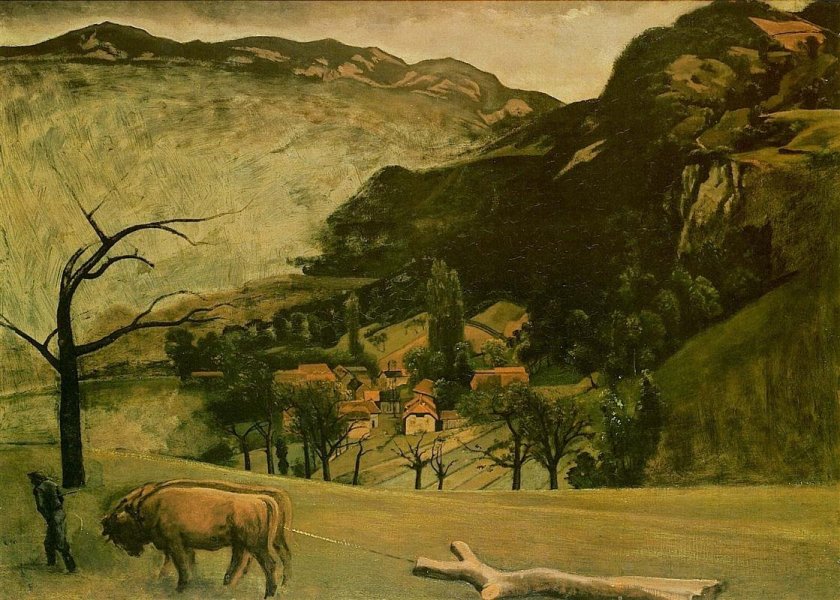
Vernatel Landscape with Oxen by Balthus (1942)

The companion piece is entitled Vernatel, Paysage aux Boeufs (Vernatel Landscape with Oxen).  The mountain range on the right is the Vacherie de la Balme and it overshadows the village of Vernatel in the valley.  The girl, now a grandmother, Geogette Varnaz (née Coslin) who was the model for the previous painting lives with her husband in this village.  This landscape is not topographically correct as the space behind Balthus’ large tree at the left of the painting there would have been another village, Monthoux.  This time, the setting is not a summer’s day but a November day and winter is fast approaching and the farmer needs to gather up his wood for the winter fires.  In the field in the foreground we see the farmer with his pair of oxen struggling to drag a tree trunk across the field.

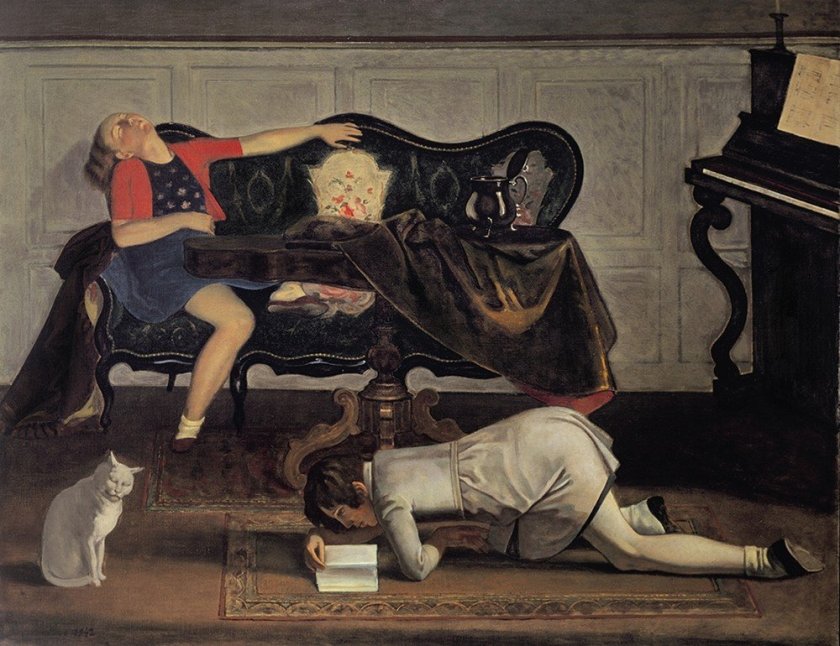
The Salon II by Balthus (1942)

Also whilst living at Champrovent he completed two paintings Salon I and Salon II both of which harked back to his 1937 work The Blanchard Children.  However instead of the plain, dull background setting of his Paris studio in that work, these two paintings have a more colourful backdrop of one of the rooms at Champrovent.  He started painting Salon I in 1941 but before its completion he worked on the second version which he completed in 1942.  The first version, Salon I, was not completed until 1943 when he and Antoinette were residing in Fribourg.

The Mountain by Balthus (1937)

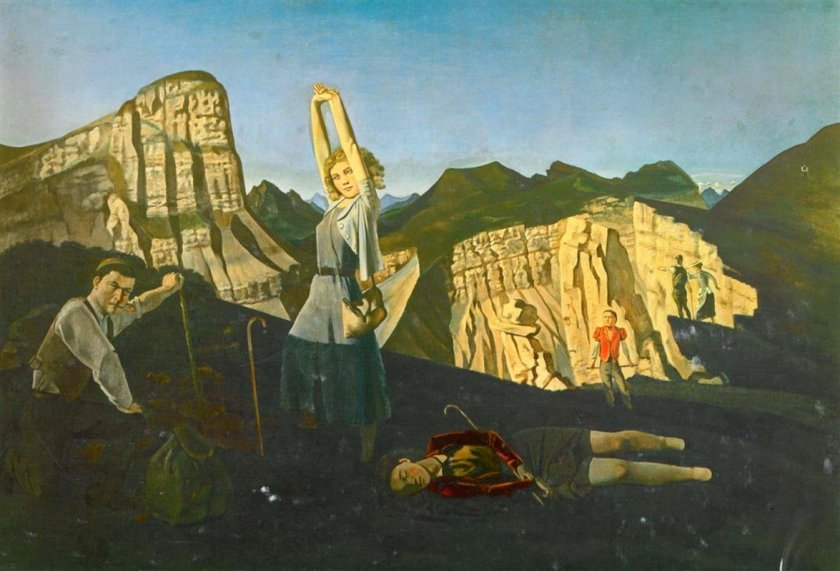
The Mountain is one of Balthus’s most important early works. It was completed by him in 1937, when he was twenty eight years of age and three years after his first one-man exhibition.    The finished work was not exhibited until 1939 under the title Summer.  This had meant to have been one in a set of four which featured the seasons of the year but Balthus never completed the other three paintings.  This work once again had Balthus labelled as a Surrealist painter.  There are seven figures in the painting all of whom are located on an imaginary plateau near the top of the Niederhorn, a peak of the Emmental Alps in the Bernese Oberland near Beatenberg, where Balthus lived in the late 1920’s and early 1930’s.  Look at the seven figures.  There is something very strange about them.  There appears to be no connection between them and yet they are supposed to be a hiking party.  Look at the different poses of the figures, some are walking, some are kneeling whilst the woman in the foreground looks as if she is lying on the ground asleep.  This portrayal of mixed activities makes them even more disconnected.   If anything this painting is a form of escapism for Balthus who hankered to be back in Beatenberg where he had many happy memories

The Game of Patience by Balthus (1943)

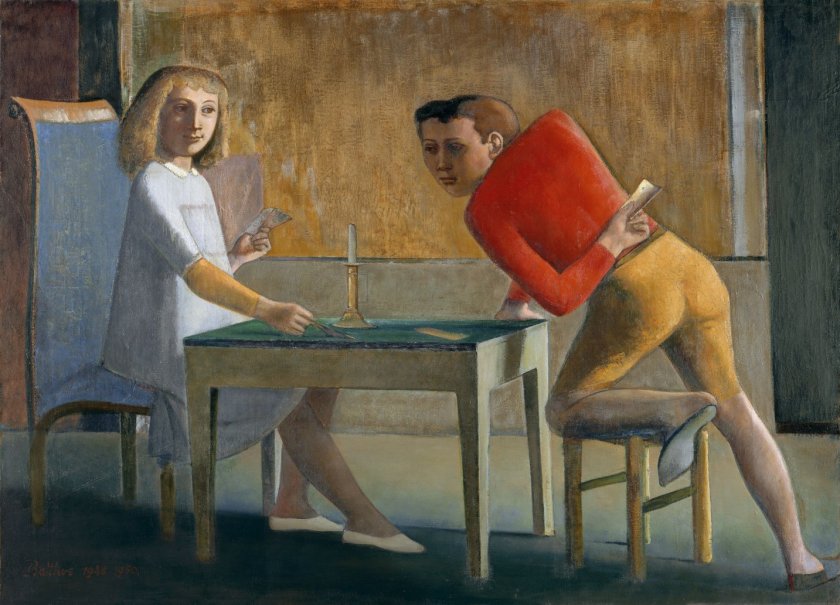
In 1943, Balthus was living in Switzerland avoiding the horrors of war and it was in that year that he completed his painting entitled The Game of Patience.  Balthus had discovered a new model for his work.  She was Janette Aldry and was a little older than the models Balthus had once used whilst living in Paris.  However Balthus liked using her as he reckoned she had the same melancholy demeanour of Thérèse Blanchard, his favoured model in the 1930’s.  In the painting we see the girl, with her right knee resting on a stool, bent over the elegant highly polished Louis Quinze table carefully studying the playing cards which are spread on it.   Her back is straight and she seems somewhat tense.  The girl is dressed in an red vest and dark green skirt similar to one which Thérèse wore in his 1938 portrait of her.  Behind the table on the left of the picture is a high backed Louis Quinze chair on which is an open box.  Under the table is a stool on top of which are some books,  The haphazard way the box lies on the chair and the pile of books which lie askew on the stool as well as the candlestick holder and cup which have been pushed to the extremities of the table are a sign of disarray caused by the young girl brought on by a sudden desire to play cards.  I read somewhere that some art historians have interpreted the painting and the tense and restlessness of the girl a s a metaphor for the restless people that were forced to leave places like France to the safe haven of Switzerland but just want to get back home.

In the final part of my look at the life and artwork of Balthus I will look at some of the paintings he completed in his latter years.

—————————————————————

Besides information about Balthus and his art gleaned from the internet I have relied heavily on two excellent books which I can highly recommend.

First there is the book Balthus Cats and Girls by the foremost expert on Balthus, Sabine Rewald.

Secondly, a very thick tome by Nicholas Fox Weber entitled Balthus, A Biography.

Balthus – Part 2 – Young girls and controversy

Self Portrait by Balthus (1940)

In my second part of my look at the life and works of Balthus I am going concentrate on his depiction of pubescent girls which were to shock both the public and critics alike when they first exhibited in 1934 at the Galerie Pierre in Paris.  I have in some earlier blogs discussed what is, to some, termed as beautiful erotic art whilst others look upon the depictions as unacceptable and pornographic.  Those paintings by the likes of Egon Schiele and Lucien Freud were depictions of adult female models but in the case of Balthus’ paintings the models he was using were pre-pubescent girls.  I leave it to each person to decide whether the depiction of these young girls was simply the work of an artist and therefore as art, was acceptable or whether there was something very offensive and disturbing about the paintings.  Everybody is entitled to their own opinion.

I need to remind you that the depiction of young girls naked or semi-naked in paintings is not just something that interested Balthus.  Many other well known artists used young girls as models and portrayed them in their works of art.

Little Girl by Otto Dix

There was Otto Dix, the German painter, and often talked about as the most important painter of the Neue Sachlichkeit, which was an artistic style in Germany in the 1920 which set out to confront Expressionism.  It was looked on as being a return to unsentimental reality and one which concentrated on the objective world, unlike Expressionism which was more abstract, romantic, and idealistic.  His 1922 painting Little Girl in front of Curtain, which can now be seen at the Minneapolis Institute of Art, was judged to have flown in the face of morality.  This painting of a young naked girl is portrayed in a realistic style, maybe too realistic as it details the blue veins of her body.  She looks emaciated and she stares past us with a haunted expression. Her childhood is probably a thing of the past as, sadly, is her innocence.  A pink flower clings to the curtain behind her, and in her hair we see a bright red bow.   The artist himself once said:

“…I will either become notorious or famous…”

This painting probably allowed Otto Dix to achieve his first goal.

Puberty by Edvard Munch (1894)

The great Norwegian painter, Edvard Munch, who is best known for his paintings entitled Scream, also produced a painting in 1894 featuring a pre-teen naked girl.  The painting which was entitled Puberty depicts a young pubescent girl, nude, sitting with her legs together.  There is an air of shyness about her and this could be that at her age she is starting to become aware of the changes to her body.

Standing nude young girl 2 by Egon Schiele (c.1911)

The celebrated Austrian Expressionist artist Egon Schiele who, at the time,  was living with his lover, Valerie Neuzil, in the small country town of Neulengbach, close to Vienna.  This was a quiet suburban setting full of retired officers and snooping neighbours.  Schiele was arrested in April 1912 on suspicion of showing erotic drawings to young children who posed for him, of touching the children while he drew them and of kidnapping one of the young girls who frequented his studio.  Some of the charges were dropped and he spent three days in jail.  A year earlier he produced the work entitled Standing Nude Young Girl 2.

The reason that I featured these three paintings was not that I considered them any sort of justification for Bathus’ portrayal of young girls but simply to point out that many artists have painted scantily-clad or naked young girls.

Balthus had been earning money with his portraiture, mainly of older society women, and he was very discontented with this.  He actually hated this type of work calling his finished portraits, “his monsters”.  In October 1935 Balthus moves to a new and larger studio at 3 cour de Rohan.  Just three blocks away was the rue de Seine and it was at No. 34 that the Blanchard family lived, mother, father who worked as a waiter in a nearby bistro, daughter Thérèse and son Hubert who was two years older than his sister.  When Balthus first caught sight of Thérèse she was just eleven years of age and having approached the family Thérèse agreed to model for him.  She was not a beautiful girl but she appealed to Balthus.

Thérèse by Balthus (1936)

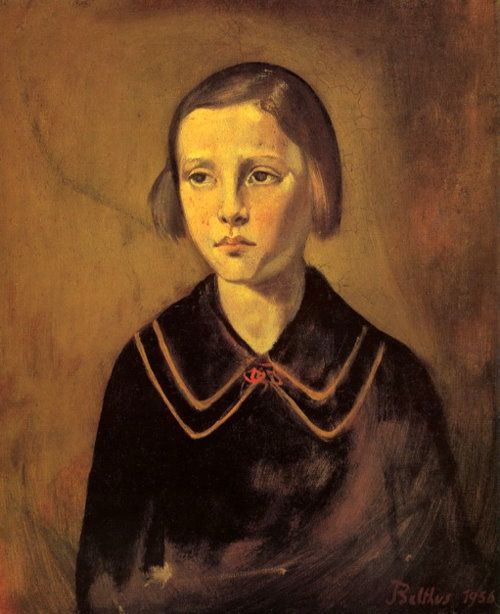
The first painting Balthus completed of Thérèse Blanchard was in 1936 and was simply entitled Thérèse.  Balthus would go on to use her as a model more than any other person.  In this work, Balthus has captured her moody and serious look and it was that aspect of her that attracted Balthus to his young model.  Her dark dress seems to go hand in hand with her mood and it is just the bright red piping on the collar of the dress which manages to liven up the portrait

Brother and Sister by Balthus (1936)

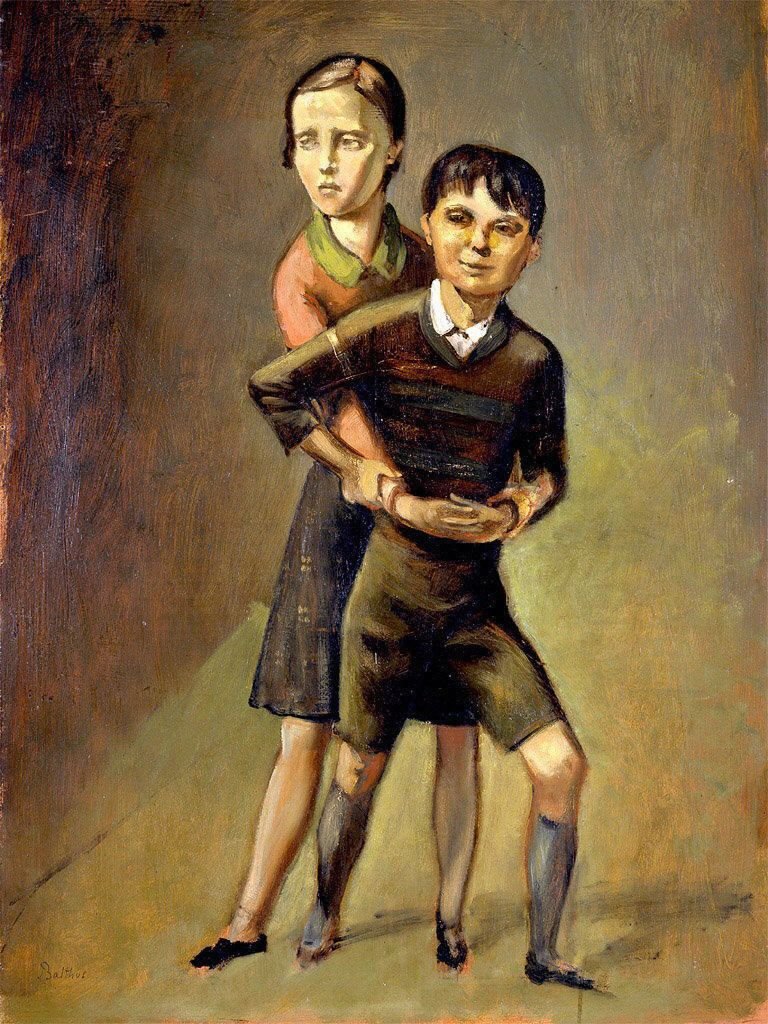
In that same year Balthus completed a painting of Thérèse and Hubert entitled Brother and Sister.  Once again Balthus has portrayed Thérèse’s expression as moody and sullen in contrast to the smiling happy face of her brother.  Thérèse’s arms are wrapped round the waist of her brother, not as a sign of sibling affection, but as she was trying to make him stand still for Balthus.  Their clothes are very plain.  Hubert seems to be wearing the attire of a schoolboy whilst his sister is wearing a simple plaid skirt and a red sweater with a green collar.

The Blanchard children by Balthus (1937)

In 1937 the two Blanchard siblings appear in a painting by Balthus entitled The Blanchard Children.  Thérèse is now twelve years old and her brother is fourteen years of age.  The setting is Balthus’ studio and one notices there are no childlike accoutrements such as toys, pens or books.  It is a very stark depiction.  This was not an oversight by Balthus but his belief that the starkness would intensify the dramatic effect of the picture.  If we look under the table, we can see a bag of coal sat in the corner. Why would Balthus add this?  The answer maybe that Balthus, whilst living in Germany, remembered what happened on the eve of the Feast of St Nicholas on December 5th when children put their shoes out in the hopes of some sweets in the morning.  The story goes that, St. Nicholas does not travel on his own but with his companion, Black Peter, who places coal in the shoes of the children who had been naughty !

Wuthering Heights illustration by Balthus

The strange posture of the two children is probably based on an illustration Balthus produced for Emily Bronte’s 1847 novel Wuthering Heights.  The illustration relates to Heathcliffe, partly kneeling on the chair, turning towards Cathy who is on her hands and knees partly under the table, writing her diary.  The painting was given to Balthus’ friend Picasso.

Thérèse with Cat by Balthus (1937)

The first controversial painting Balthus did with Thérèse as his model was completed in 1937 and entitled Thérèse with Cat.  It was a small work measuring 88 x 77cms (34 x 31 in).  Here once again we see the un-smiling Thérèse seeming to look at something behind us.  She looks slightly dishevelled with one sock down to her ankle and one sleeve pushed up her arm.  The red and the turquoise colour of her clothes stand out against the dark background.   Her left leg is raised and her foot rests on a stool and this pose means that her white underpants are visible to the viewer.  She has been asked to pose in a certain way and by the look of her expression she is well aware of how the artist looks at her.  A large cat lies on the floor next to Thérèse.  It appears to be the same cat that appeared with Balthus in the painting King of the Cats (see previous blog).  The painting is now housed in The Art Institute of Chicago.

The Victim by Balthus (1939 - 1946)
The Victim by Balthus (1939 – 1946)

One of his best known works is one he started just before the onset of World War II but was not completed until March 1946.  It was entitled The Victim. It was one of his largest paintings measuring 132 x 218 cms (52 x 86in) and it was because of that size of it that he had to leave it in his Paris studio when he and his wife, Antoinette, at the onset of war, moved to Champrovent in Savoie which had not been occupied by the Germans.  They later moved to Switzerland to live with Antoinette’s parents and did not return to his Paris studio until March 1946.  We see a life-sized ashen body of a naked woman lying on a white sheet which covers a low bedstead.  Is she merely asleep or is she dead?  Does the title answer the question?  The title comes from a novella written by Balthus’ friend, the writer Pierre Jean Jouve.  His 1935 book La Scène capitale contained two novellas, La Victime and Dans les années profondes.

Below the bedstead and in the right foreground of the painting we can just make out a knife lying on the dark floor, the blade of which points directly to her heart.  Although, through the painting’s title we gather that the girl is dead, there is no sign of a wound on her body and neither blood on her body nor on the knife.  Was she strangled?  So it is up to us to decide whether the girl is dead or simply in a trance but we must remember that Balthus started to paint this before war broke out and only concluded it a year after the end of the war and the atrocities of war would be fresh in the artist’s mind.  Another question is, who sat for this painting and the answer is in some doubt.  The shape of the girls face and the cut of her hair leads many to believe it is Thérèse Blanchard, the only doubt being that she had never before posed nude for Balthus

Thérèse Dreaming by Balthus (1938)

A year later (1938) Balthus completed Thérèse Dreaming, another but similar painting to to Thérèse and the Cat, again featuring the now thirteen year old Thérèse.  The setting is once again his studio and we see her sitting before us in a similar pose.  This is a much bigger painting, measuring 150 x 130cms (59 x 51 in).  This time he added a striped wallpaper (which did not exist in his studio) as a background and this time we can see the additional still life of a vase and a canister on a table.  The cat is once again part of the picture and we see it at the side of Thérèse lapping up some of its milk.  In the previous painting Thérèse was looking almost towards us but in this painting but in this work she has looked away, with her eyes closed, as if enjoying a daydream.  Thérèse’s clothes are unadorned and unfussy.  As Sabine Rewald wrote in her book Balthus Cats and Girls :

“…she appears the epitome of dormant sexuality.  Her white lace-trimmed slip surrounds her legs like a paper cornucopia wrapped around a bunch of flowers.  The cat lapping milk from a saucer serves as another tongue in cheek erotic metaphor…”

Since 1998 the painting has been housed in the Metropolitan Museum of Art in New York as part of the Jacques and Natasha Gelman Collection.

The Guitar Lesson by Balthus (1934)

By far the most controversial and notorious painting by Balthus was one he completed in 1934 entitled The Guitar Lesson.  It is a merging of sex and violence which shocked those who saw it.  It is an encounter between a dominating and tyrannical women, who is the music teacher, in her early twenties, and a young girl, her student, thought to be about twelve years old. The music lesson has been halted.  A guitar lies on the floor and the woman has thrown the girl across her lap and pulled her black dress up over her waist.  The fingers of the teacher’s left hand dig into the upper part of the girl’s inner thigh.  It is as if the teacher is strumming a human guitar.  The girl lies there, naked from her navel to her knees.  The lower parts of her legs are covered by white socks.  The music teacher has grabbed a chunk of the young girl’s long hair and is yanking her head downwards.   To save herself from falling and in an attempt to alleviate the pain caused by her hair being pulled, the girl has grabbed the collar of the music teacher’s grey dress which uncovers the woman’s full right breast.  Her nipple juts out which indicates to us that the teacher is sexually aroused by what she is doing.

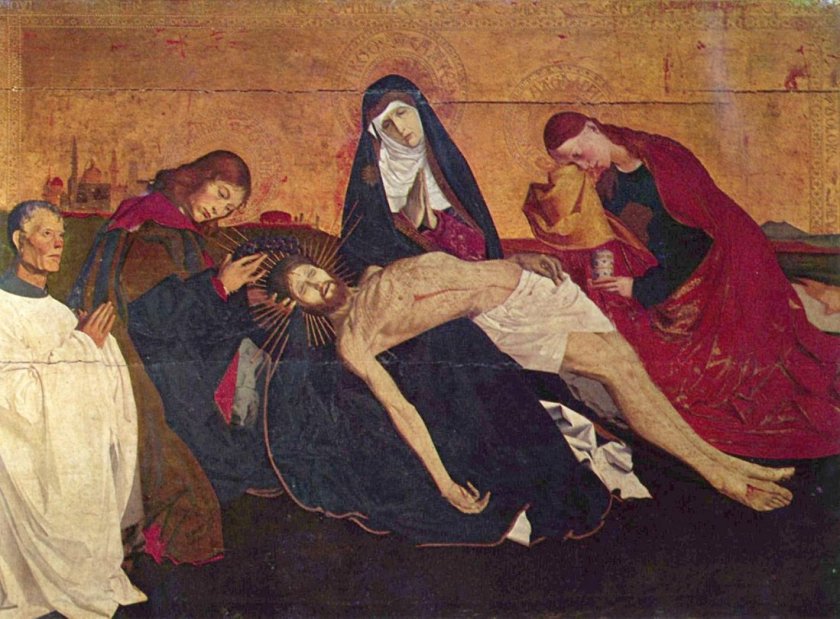
Pietà of Villeneuve-lès-Avignon by Enguerrand Quarton (c.1860)

The positioning of the girl lying across the thighs of the teacher has often been likened to the 1455 painting Balthus must have seen in the Louvre, Pietà of Villeneuve-les-Avignon by  Enguerrand Quarton.

Portrait der Schwester des Künstlers (Baladine Klossowski) by Eugen Spiro (1902)

The girl who posed for The Guitar Lesson was Laurence Bataille, the daughter of a concierge.  She would come to Balthus’ studio with her mother who acted as her chaperone.  The striped wallpaper background and the grey dress of the music teacher were the same as we see in Baladine Klossowski 1902 portrait by her older brother Eugen Spiro.  It was first shown at  Balthus’ one man exhibition in April 1934 at the Galerie Pierre in Paris.   The gallery owner, Pierre Loeb, and Balthus decided that the painting should be placed in the back room of the gallery, but covered up, so that it, in fact, became a “peep show” for a select “priveleged” number of visitors.  The provenance of the painting is quite interesting. It was bought by James Thrall Soby, an American author, critic and patron of the arts, in 1938.  He had intended to exhibit along with his other paintings at the Hartford’s Wadsworth Atheneum in Connecticut but because of the controversial nature of the painting it remained unseen in the museum vaults.  Soby realised that there was no point in owning a painting that could never be exhibited and so, in 1945, he exchanged it with the Chilean surrealist artist, Roberto Matta Echaurren, for one of his paintings.  Roberto Matta Echaurren’ wife Patricia left him and married Pierre Matisse but one of the things she took with her was this painting.  Pierre Matisse, the youngest child of  Henri Matisse owned a gallery in New York and the painting remained hidden away in the vaults.  In 1977, it appeared for a month at Pierre Matisse’s 57th Street gallery in New York. It was a sensation and the press reviews referred to the painting and the art critics of the various newspapers and magazines wrote about it but said that they could not show the painting as it would shock the readers.   After the one month long show it was never exhibited again.

When the 1977 exhibition closed the gallery offered it to New York’s Museum of Modern Art.  It was accepted by the museum but it was not put on show instead it was kept hidden away for five years in the basement.  In 1982 the Chairman of the Board of the MOMA, Blanchette Rockefeller, the wife of John D Rockefeller III, saw it at a small presentation of the works of art given to the MOMA by Pierre Matisse.  She was horrified by Balthus’ depiction terming it sacrilegious and obscene and demanded that it was returned to the Pierre Matisse Gallery immediately.  The Pierre Matisse gallery took it back and then sold it in 1984 to the film director, Mike Nichols. In the late 1980’s he sold it to the Thomas Ammann Gallery in Zurich.  They sold it on to an unknown wealthy private collector who I saw in one newspaper report, was the late Stavros Niarchos.  On his death in 1996 the painting became the property of his heirs.

In my next blog I will take a last look at the life of Balthus and share with you some more of his artworkwork.

—————————————————————————

Besides information about the life of Balthus and his art gleaned from the internet I have relied heavily on two books which I can highly recommend.

Firstly,  there is an excellent book  entitled Balthus Cats and Girls by the foremost expert on Balthus, Sabine Rewald.

Secondly, a very thick tome by Nicholas Fox Weber entitled Balthus, A Biography.


Balthus. Part 1. Mitsou and the King of the Cats

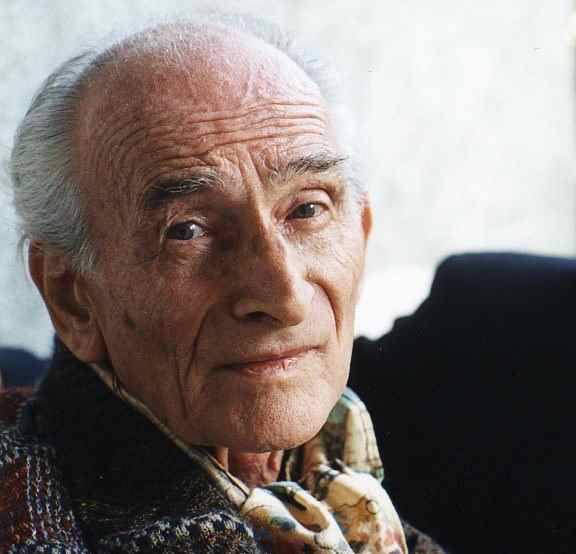
Balthus aged 88
Balthus aged 88

In my next few blogs, I am looking at the life and art of the French born painter Balthasar Klossowski de Rola, more simply known as Balthus.   Some of his artwork shocked the world and I have to warn you that some of his paintings you may find disturbing, and have often been termed offensive and disgusting.  These will appear in Part 2.

So what do we know about Balthus’ life?  The answer is “very little” and that is exactly how the artist wanted it to be.  As far as his life story was concerned, he wanted to preserve his anonymity, so much so, when negotiating with the Tate Modern, which was about to launch a retrospective of his work in 1968, he sent the curator of the exhibition a telegram which read:

“..NO BIOGRAPHICAL DETAILS.  BEGIN:  BALTHUS IS A PAINTER OF WHOM NOTHING IS KNOWN.  NOW LET US LOOK AT THE PICTURES.  REGARDS.  B…”

Balthus was born in Paris at the end of February 1908.  His father Erich Klossowski was a noted German historian and painter, who had come from a family which belonged to Polish nobility, and whose coat of arms was known as the Rola, which was used by a number of szlachta families.  The szlachta was a legally institutional privileged noble class and Balthus added the title “de Rola” to his name.  Balthus’ mother was Elisabeth Dorothea Spiro, but as a painter, used the name Baladine Klossowska.  She gave birth to two sons, Pierre in 1905 and Balthus in 1908.  Pierre went on to become a much heralded writer and philosopher.  Balthus and his family lived in rue Boissonade in Paris’ 14th arrondissement.  He and his brother had a privileged upbringing as his parents were part of the cultural elite in Paris and would entertain many of the cultural icons of the time such as the French writer and playwright, Jean Cocteau, André Gide, the Nobel prizewinning writer, and the French painter, Pierre Bonnard.  The family, who held German citizenship, along with Balthus’ uncle, the painter, Eugen Spiro, had to move out of Paris at the onset of World War I and they travelled to Berlin where Balthus’ father worked at the Lessing theatre as a stage and costume designer.

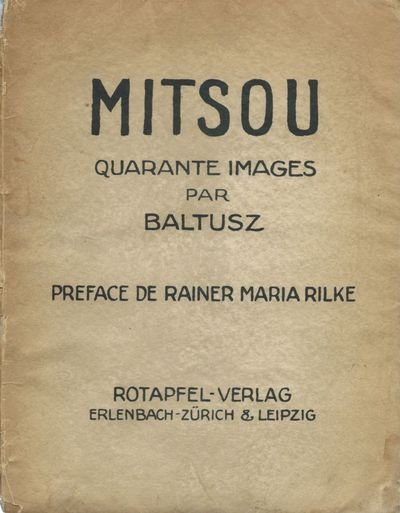
In 1917, Balthus’ mother and father separated and she took her sons, Pierre and Balthus, away from Berlin and set up home in Berne.  Later she and her two sons move to Conches, a small town just south of Geneva, and stayed with friends before renting a two-room apartment in rue Pré-Jerôme in 1920.  Balthus, as a child loved to draw and it was in 1919, whilst living in Conches, that, at the age of eleven, he produced a book of forty graphite and ink drawings.  The drawings were based on the experiences he had, when he fell in love with a stray cat which he called Mitsou and through his drawings he tells of his happiness derived from his feline friend and the sadness of losing his new friend.  It was in 1919 when Balthus’ mother Elisabeth first met Rainer Maria Rilke in Geneva.  He was a writer and poet.  They quickly became lovers, a relationship which lasted until he died of leukaemia in December 1926.  It was an unusual relationship as Rilke said he needed his own space when he worked and so the couple did not live together on a permanent basis.

Mitsou
Mitsou

On one of Rilke’s visits to the Klossowski home to see Elizabeth he saw the Mitsou drawings  done by her son, Balthus,  and was he was so impressed by them that  he offered to write the preface for the book and arranged for it to be printed in 1921 under the title Mitsou, Quarante images (Mitsou, Forty Images).  The set of forty drawings were an animated tale of how he found a cat on a park bench.

Finding the cat
Finding the cat

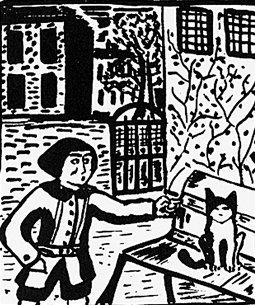
In the opening drawing of the set we see the boy tentatively leaning towards the cat making sure he doesn’t scare it off.  Look how Balthus has given the boy an air of astonishment as he looks at the cat, by shaping the mouth, raising the thick eyebrows and the angling the chin.  In complete contrast, the cat looks out at us in a statuesque sphinx-like way, totally unfazed by the boy’s approach.  Although the story is about him and the cat, Balthus has added other elements to the drawing.  The setting is a courtyard which is separated from a house by a wall and a gate.  He has also included vines climbing up the wall as a backdrop.

Losing the cat
Losing the cat

From this time on, Balthus love of cats was shown by the number of times he depicted felines in his artwork.  Drawing number 40 of Mitsou, the last one of the set, depicts Balthus crying when he realises the cat has run off and his feline friend has gone forever.

 In the summer of 1919 the family spend time in the picturesque Swiss village of Beatenberg which lies between the Bernese Alps and the still blue waters of Lake Thun.  It is whilst here that Balthus works as an assistant to the painter, Margrit Bey.  For next four summers Balthus and his family would return to Beatenberg and work alongside Margrit.  Between 1919 and 1921, during their stay in Conches both Balthus and his brother study at the College Calvin in Geneva.  For Balthus, the years between 1919 and 1921 were some of the best times he ever had and he was always pleased to recall those days

Rilke and Elisabeth Klossowska at Chateau Muzot (1923)

His mother was in love with Rilke and he was devoted to her.   Balthus also bonded with Rilke and he received nothing but compliments for his artwork from the writer.  To Balthus, Rilke was almost a surrogate father.

In April 1921 Baladine and her two sons move back to Berlin and go to live with her brother Eugen and later stay with her sister, Gina Trebicky.  Elisabeth had some of her paintings accepted for an exhibition of female artists at Galerie Fleckhtheim in Berlin and it is at this time that she is persuaded to change her name as an artist to Baladine.

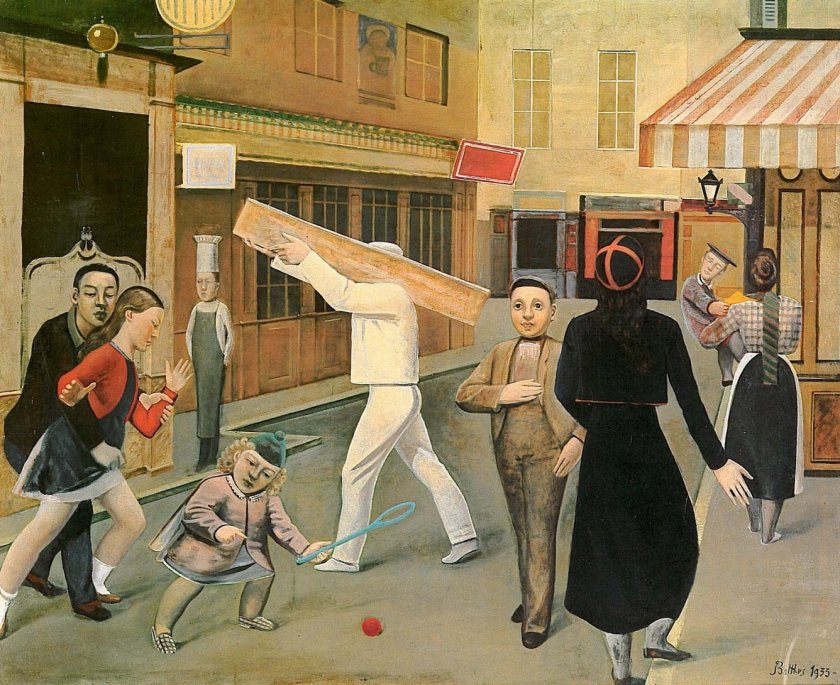
In 1934, Balthus produced his first large scale painting entitled The Street.  It measured 195 x 240cm (77 x 94 ins).  He had already painted another version of this five years earlier, just before he journeyed to Morocco but some of the characters had changed.  The setting in both works is the rue Bourbon-le Château.

The Street by Balthus (1929)

In this earlier version, seen above in black and white, we see a grandfather figure in top hat and topcoat holding firmly onto two young children as they cross the road.  The boy, in shorts, wears a hat with a pom-pom whilst the young girl dressed in a skirt and flowered hat.  In the later version this trio has been replaced by two other characters, which caused the outrage!

The Street by Balthus (1933)

The 1934 version was one of a number of his works of the time which shocked the audience at Balthus’ first solo exhibition which was held in the Galerie Pierre in Paris.  The people in the street seemed to have stopped and are frozen in mid-flow, almost trance-like.   For this work Balthus retained the baker, the workman crossing the road with a plank of wood on his shoulder along with the woman carrying a young child, albeit now looking like a little man.   In this version we also have a young girl, racquet in hand, chasing a ball across the street. Again although possessing the height of a child she seems to be more like a small woman.   Balthus was questioned about that but he simply refused to elaborate more than saying “she is simply a little girl”.  The same boy, as seen in the first version, is still strolling haughtily towards us but is set back slightly in comparison to the first version.  However the major change is the inclusion of the two figures in the left foreground.  These two replace the elderly gentleman and the two young children.  The man tries to grope the girl as she passes him by and she raises her arm maybe in shock or maybe to strike her assailant.

Pierre Loeb the owner of Galerie Pierre said that having looked at the painting described it as a scene of anguished phantoms sleepwalking in a strange dreamlike state.  Balthus believed Loeb’s comments were nonsensical and although Loeb exhibited Balthus’ art in his gallery bringing him to the notice of the public, Balthus loathed him and termed him a “typical outsider who lacked true vision of what really mattered to painters”.

The painting was bought from Galerie Pierre in 1937 by James Thrall Soby, an American author, critic and patron of the arts.  However the painting was so controversial and so many of his friends disliked the sexual connotation that Soby wrote to Balthus in 1955 and asked him to retouch the gesture of the figures on the left.  Soby was surprised when Balthus agreed and wrote:

“…I used to like shocking people, but now it bores me…”

When Soby died in 1979 this painting was bequeathed to the Museum of Modern Art in New York.

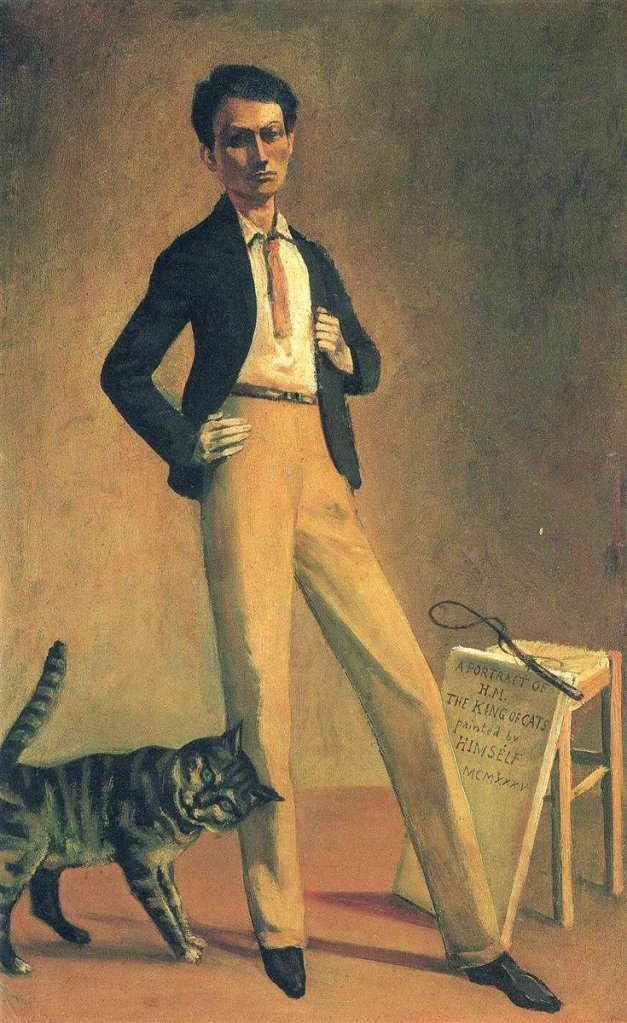
The King of the Cats by Balthus (1935)

I am concluding this first part of my look at the life and art of Balthazar Klossowski by showing you the painting, the title of which the artist gave himself.  This is just one of three self portraits completed by Balthus.  The title of the 1935 painting was King of the Cats. Balthus was twenty-seven years of age when he painted this work.  It was painted in his Paris studio in rue Furstenberg.  The studio, which he bought in May 1933 was a fifth floor attic room  It was also the first property he ever purchased and  he remained here until October 1935.

Balthus had always had a love of cats and in this work we see him standing in a somewhat arrogant and aloof pose, with his beloved cat lovingly rubbing itself against his leg.  Because the view of the artist is seen from below it elongates him and adds to his imperious stance.  He is dressed in saffron pants, white shirt and red tie and a black jacket.  On his feet is a pair of pointed black shoes.  On the floor, to his left, is a stone slab leaning against a high stool with the inscription:

A PORTRAIT OF

H.M.

THE KING OF THE CATS

Painted by

HIMSELF

MCMXXXV

Balthus has added a little humour to the painting by placing a lion tamer’s whip on top of the stool !

It was in that year that Balthus started to sign his letters “King of the Cats”, the first being a letter, written in January 1935, to his soon to be wife, Antoinette de Watteville.

There is an air of self confidence about the figure and this has been put down to 1935 being a good year for him after the turbulent times of 1934 when his first one-man exhibition at the Galerie Pierre, featuring many depictions of pre-teen girls in erotic poses,  scandalised the critics and public alike.  The fall out over these paintings made Balthus give up painting for almost a year.

In the second part of my look at Balthus I will focus on the paintings which caused such a furore when exhibited in Galerie Pierre in Paris.

Besides information about Balthus and his art gleaned from the internet I have relied heavily on two excellent books which I can highly recommend.

Sabine Rewald, Curator for Modern Art, Dept. Of Modern and Contemporary Art at The Metropolitan Museum of Art.
Sabine Rewald, Curator for Modern Art, Dept. Of Modern and Contemporary Art at The Metropolitan Museum of Art standing next to Balthus painting entitled Thérèse

First there is the book Balthus Cats and Girls by the foremost expert on Balthus, Sabine Rewald.

Secondly, a very thick tome by Nicholas Fox Weber entitled Balthus, A Biography.

Arnold Böcklin. Part 3 – The latter years. Portraiture and Symbolism

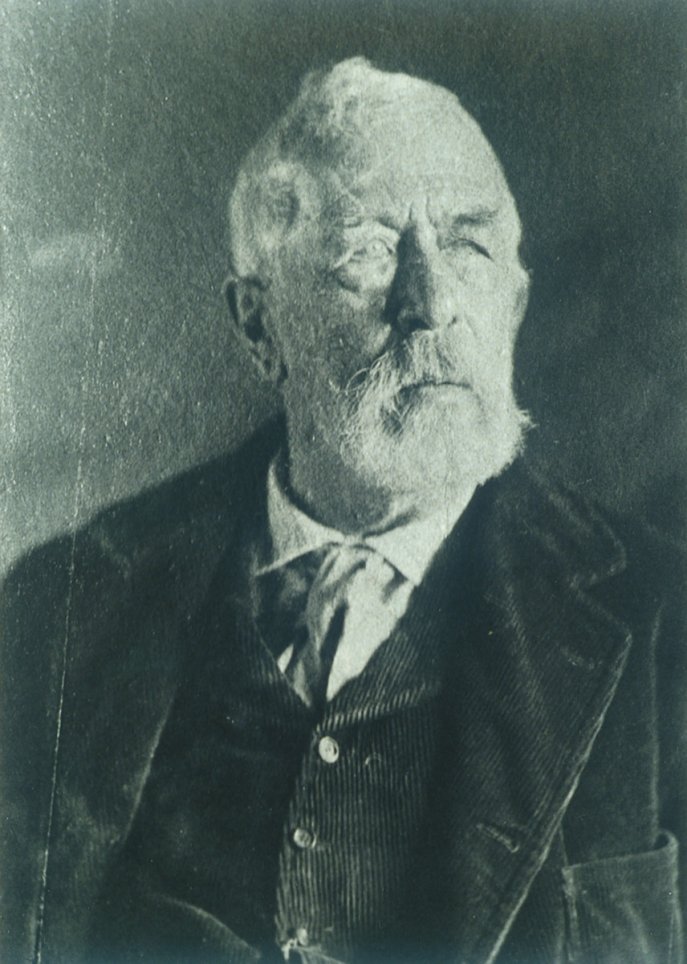
Photo of Arnold Böcklin (1900) aged 73

In my final part of the Arnold Böcklin story I want to look at his portraiture and some of his more evocative Symbolist works.  He completed many self portraits, two of which I have shown you at the start of the last couple of blogs.  His portraits also included ones of his second wife, Angela Rosa Lorenza Pasucci and their daughter Clara.

Portrait of Angela Böcklin as muse by Arnold Böcklin (1863)

In the first blog about Arnold Böcklin I mentioned his two wives.  He married Louise Schmidt in 1850 but she died a year later and then in June 1853, Böcklin married his second wife, a seventeen year old Italian girl, the daughter of a papal guard, Angela Rosa Lorenza Pasucci and she featured in a number of his works of art.  One such portrait was entitled Portrait of Angela Böcklin as a Muse which he completed in 1863.

Mrs Böcklin with Black Veil by Arnold Böcklin (1863)

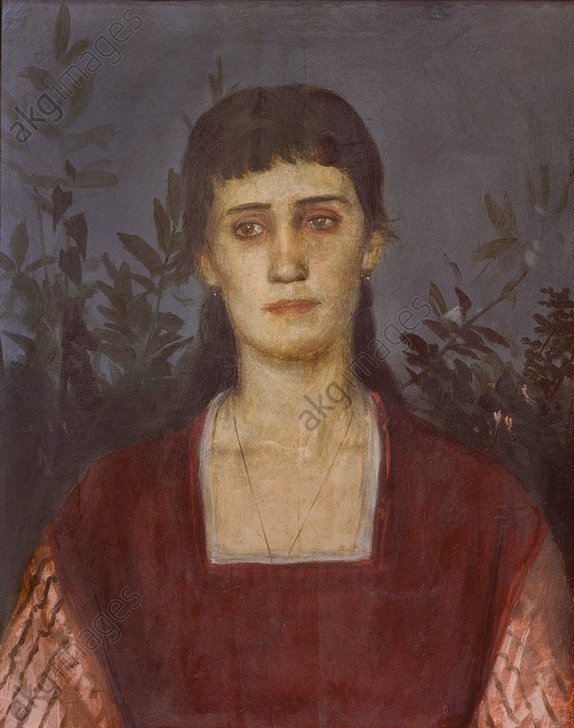
Böcklin completed another portrait of his wife that year entitled Mrs Böcklin with Black Veil.  This was a more sombre depiction of his wife.  It was painted when she was twenty-seven years of age.  It is only a small oil on canvas work within the stretcher frame just measuring 19 x 14 cms.  This was a painting he completed for himself.  There is a certain intimacy about the work.  The artists depicts his wife with a black veil on her head and this veil serves the purpose of being a frame for his wife’s face, the colour of which is in contrast to the simple olive green background.  Angela Böcklin seems to be very thoughtful, even slightly sad.  Maybe she is in mourning for we know she and Arnold had fourteen children but only eight of them survived him.   We take it for granted that we will die before our children but in the nineteenth century that was not always the case, in fact the opposite was often true, and although it was a common occurrence for children to die young we should never underestimate its tragic consequences.

Portrait of Clara Böcklin by Arnold Böcklin (1872)

In 1872 he completed one of a number of portraits of his daughter Clara.

Portrait of Clara Böcklin by Arnold Böcklin (1876)

In 1876, when she was twenty-one years of age, Böcklin painted another portrait of her.   It was also in this year that Clara married the sculptor, Peter Bruckmann.

Böcklin became somewhat fixated by death and this is borne out with his evocative painting Die Toteninsel, which I talked about in the previous blog.  This preoccupation, which could have been because of the loss of his children, was clearly seen in yet another of his self portraits, which he completed in 1872, shortly after the death of his young daughter, and was entitled Self Portrait with Death as a Fiddler.  It was completed whilst Böcklin was in Munich having just travelled back from Italy. It was in Italy that Böcklin began to add symbols into his paintings in order to suggest ideas.  The interesting thing about Symbolism in art is that we can each come to our own conclusions about what we see in a painting and unless the artist has spoken about the painting then we have as much right to postulate about an artist’s reasoning behind their work as the next person.  So having looked at the work, what do you make of it?  Let me make a few suggestions about what I think may have been in Böcklin’s mind when he put brush to canvas.

Self portrait with Death as the Fiddler by Arnold Böcklin (1872)

We can see that Arnold has portrayed himself with painting brush in one hand whilst the thumb of his other hand is hooked through the hole in the palette securing a piece of cloth.  However what is more interesting is the inclusion of the skeleton playing the fiddle in the background.   The question I pose is – what was Böcklin thinking about when he decided to include the skeleton?    We know that most paintings, which include a skull or skeleton, are Vanitas paintings.  A vanitas painting contains an object or a collection of objects which symbolise the inevitability of death and the transience of life.  Such paintings urge the viewer to consider mortality and to repent !  So, Böcklin’s inclusion of a skeleton is a reminder to him that he cannot take life for granted and that there is a very fine line between life and death.

Look at the juxtaposition of the artist and the skeleton.   Look how the skeleton appears to be whispering something in Böcklin’s ear and the artist in the painting turns his head slightly and leans back to listen.   He is staring out of the painting, but not at us.  He is staring out but his full attention is on what the skeleton is saying.   Maybe the skeleton is telling the artist something about his future?  Look also at the fiddle that the skeleton is playing.  It has only one string left.  Why paint the fiddle with just one string?   Is this something to do with the length of time Böcklin has on this earth?  Is it that at birth the violin had all four strings but, as time progressed, string after string broke and so, at the time of death, there are no strings?

The painting can now be seen at the Alte Nationalgalerie in Berlin.

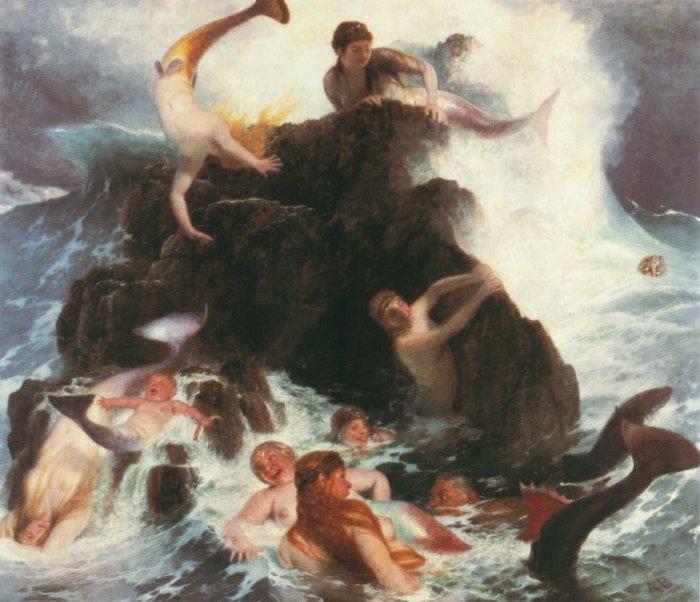
Naiads at Play by Arnold Böcklin (c.1862)

Other subjects that appeared in Böcklin’s paintings during his last period of creativity were the Naiads and Nereids or sea and water nymphs often referred to as female spirits of sea waters.  The next painting I am showcasing is entitled Naiads at Play which Böcklin completed around 1862 and now hangs in the Kunstmuseum Basel.  Böcklin’s biographer, Henri Mendelssohn described the painting, writing:

“…It fairly bubbles over with fun and merriment.  The scene represents a rock in the ocean, over which the waves dash in foam, tossing white spray high into the air.  Clinging fast to the wet rock face are the gleaming forms of naiads, their tails shining like jewels in the seething waters, as the waves dash, one on top of another, so do the creatures of the sea chase each other in their frolic, darting here and diving there, and tumbling heels over head from the rock into the ocean beneath, whose roar almost drowns their shrill laughter.  All is life and movement.  The sputtering triton and the luckless baby, holding in his convulsive clasp the prize he has captured, a little fish, rank among the inimitable creations of Böcklin’s art…”

Marie Joseph Robert Anatole, Comte de Montesquiou-Fézensac, a French Symbolist poet and art collector of the time, described Böcklin’s work, writing:

“…”This is the most astonishing of all Böcklin’s representations of the sea. The water gleams with hues as violent as those reflected by the Faraglioni, the red rocks which, seen from Capri, mirror their purple shadows in the blue waves. One of the naiads, with her back turned to us, seems to set the water on fire with the brilliancy of her orange-coloured hair, while all the naiads’ tails, wet and glistening, glow with the gorgeous hues of butterflies’ wings or the petals of brilliant flowers…”

Looking at the work one can understand the comments.  It is as if you were there, feeling the energy and almost feeling the spray on your face.  From this mythical subject, Böcklin has almost turned it into reality, such was his skill.

Plague by Arnold Böcklin (1898)

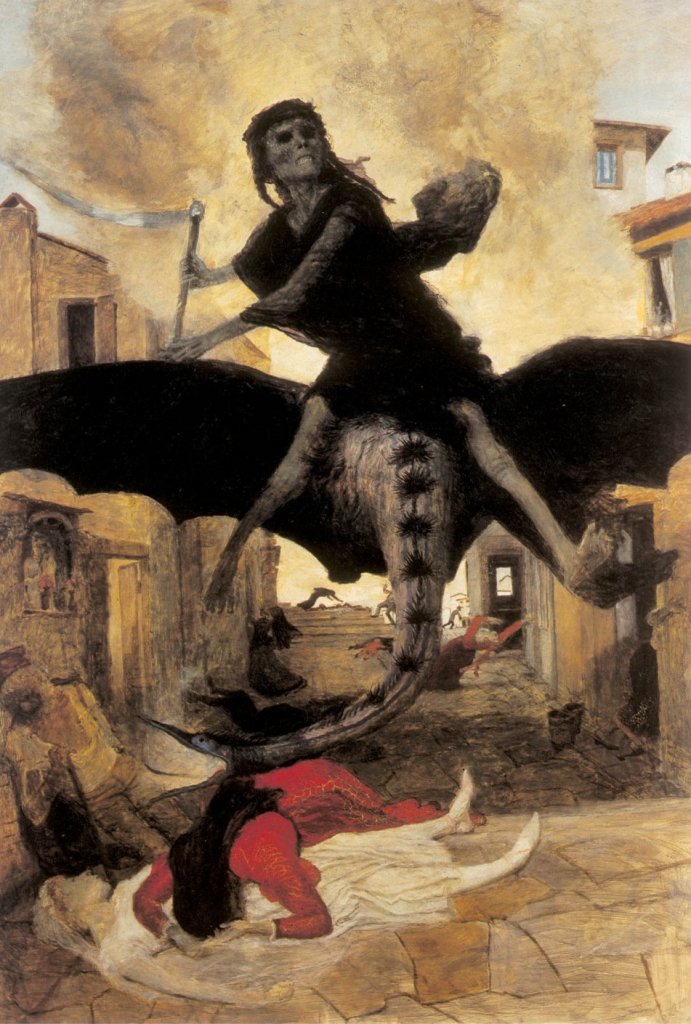
Another painting by the Swiss symbolist Böcklin which illustrates his fascination with nightmares, the plague and death was one he completed in 1898 entitled Plague.  It is a tempera on wood painting, which is now hanging in the Kunstmuseum Basel.   In the painting the setting is the street of a medieval town and we see the grim-faced Death, scythe in hand, riding a winged creature, which spews out miasma.  The colours Böcklin used in this painting are black and dull browns for the clothes of many of the inhabitants who desperately throw themselves out of the path of Death and shades of pale green which is often associated with death and putrefaction.  The one detail which is devoid of drab colours is that of the clothes worn by the woman in the foreground who lies across the body of the woman who has suffered at the hands of Death.  Her gold-embroidered red cloak signifies that she comes from a wealthy household and the painting reinforces the fact that Death takes both rich and poor.  The plague had ravished Europe throughout the 14th to 17th centuries.  It knew no boundaries of class or wealth.

Ruggiero and Angelica by Arnold Böcklin (c.1874)

Around 1874 Böcklin completed a painting entitled Roger and Angelica.  It can now be seen in the Nationalgalerie in Berlin. The scene, Roger rescuing of Angelica, is based on the 1532 epic romantic poem, Orlando Furioso by Ludivico Ariosto, which is all about the conflict between the Christians and the Saracens.  The painting depicts the main character, Ruggerio (Roger), a Saracen warrior, coming to the rescue of Angelica, the daughter of a king of Cathay.  She is chained to a rock on the shoreline and is about to be killed by the sea monster, the giant turquoise orc, which has wrapped itself around the helpless Angelica.  In the background we see Roger arriving astride his horse.  The battle with the orc is ended when Roger dazzles the sea monster with his shield allowing him the chance to place a magic ring on the finger of Angelica which protects her whilst he undoes the bonds which were tying her to the tree.

Grave of Arnold BöcklinArnold Böcklin moved around Europe, living in Munich, Florence and the small Swiss town of Hottingen which was close to Zurich but from 1892 onwards he settled down near Florence in the town of  San Domenico.  To mark his seventieth birthday a retrospective of his work was held in Basel, Berlin and Hamburg.  Böcklin died of tuberculosis, aged 73, in Fiesole, a small town northeast of Florence, in January 1902 and is buried in the Cimitero Evangelico degli Allori in southern Florence.

In my next blog I will be looking at the work of an artist who was known as the king of the cats as many of his paintings had an obligatory cat in the depiction.  However he was probably more remembered by his erotic paintings which featured pre pubescent girls in all manner of provocative poses.  In this day and age many of his works would struggle to be exhibited because of the age of his models.

Arnold Böcklin. Part 2 – Die Toteninsel

Self Portrait by Arnold Böcklin (1885)

As I said in my previous blog there was a distinct change in the subject and style of Böcklin’s art in the middle of the nineteenth century.   Gone were the realist and naturalist landscape works which concentrated on the beauty of nature; depictions which included very few things, such as people or animals, which he believed would detract from nature’s magnificence.  Around 1854 Böcklin’s paintings began to become idealised with mythological connotations.  My original intention had been to look at the life and works of Böcklin in two parts.  Firstly, his early landscape paintings and secondly, his later symbolist paintings.  However I decided that his most famous painting, Die Toteninsel, should have a blog of its own.

Arnold Böcklin left Italy in 1857 and returned to Basel and the following year he accepted a commission to paint the dining hall of the merchant and Royal Hanoverian Consul, Karl  Wedekind in Hannover.  Wedekind also went on to purchase some of Böcklin’s paintings.  Financial and health issues began to blight Böcklin’s life around this time.  However his financial problems were to change when he and his family moved to Munich where he exhibited a number of his paintings at the Munich Kusnstverein.   It proved to be a tremendous success.  Fourteen of his paintings were purchased by Friedrich Graf von Schack, the Munich art collector, who also offered him the position of Professor of Landscape Painting at the newly founded Kunstschule in Weimar.  After completing four years of teaching art, Böcklin had managed to save some money, enough to return to his beloved Italy in 1862.

Isle of the Dead (Basel version) by Arnold Brocklin (1880)
Isle of the Dead (Kunstmuseum Basel, First version) by Arnold Brocklin (1880)

I now come to the painting by Böcklin which is his most famous and most talked about work of art, Die Toteninsel (Isle of the Dead).   According to Franz Zelger in his 1991 book, Arnold Böcklin: Die Toteninsel, Selbstheroisierung und Abgesang der abendländischen Kultur, the subject for this haunting composition came about in 1880 when  Böcklin received a commission to paint a “picture for dreaming”.

The commission came from Marie Berna, an American-born widow of a German diplomat, Georg von Berna, who had died of diphtheria in 1865. She was to later marry Count Waldermar von Oriola in 1880 and became Countess of Oriola.

 It all came about when she visited Böcklin’s studio in Florence.  Whilst at his studio she saw an unfinished first version of this evocative painting which is now housed in the Kunstmuseum Basel. This first version is an oil on canvas painting measuring 110 x 156cms, which was commissioned by Alexander Günther.  The title of the painting seems to have changed over time but Böcklin, on completion of the first version sent a letter to Gunther and wrote:

“…Endlich ist die Toteninsel soweit fertig, dass ich glaube, sie werde einigermaßen den Eindruck machen…”

(finally with the Toteninsel finished I think it will make quite the impression).

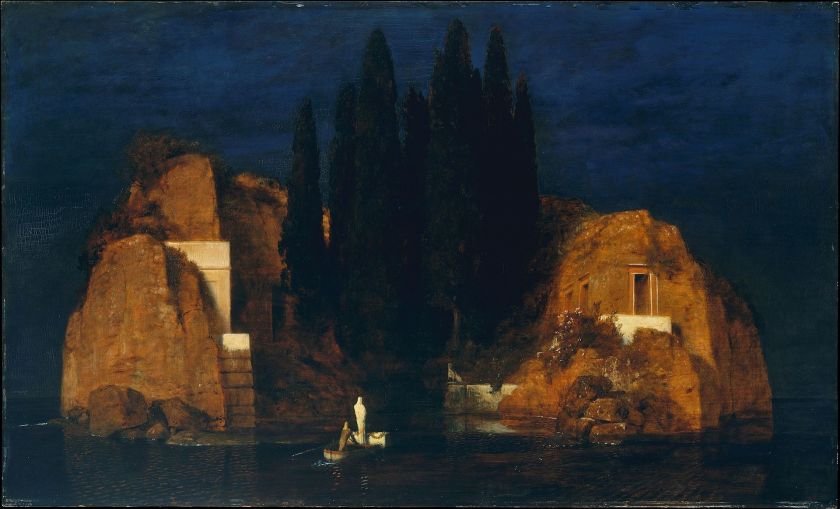
Isle of the Dead (Metropolitan Musum New York, Second version) by Arnold Böcklin (1880)
Isle of the Dead (Metropolitan Museum New York. Second version) by Arnold Böcklin (1880)

Marie Berna was fascinated by what she termed a dream image and immediately commissioned Böcklin to paint a version of this work.   Marie told Böcklin that it would be a painting in memory of her late husband and also be a “a picture for dreaming”.  She even made a special request that Böcklin should include in the work, besides the solitary figure who is rowing the boat, a draped coffin and a shrouded female figure standing up in the boat. Böcklin must have been persuaded that the additions Marie Berna had asked for would enhance the painting because he also added the shrouded female and draped coffin to the first version.  Although, to receive a commission was good news, Böcklin’s health, both physical and mental, was deteriorating.  His inability to have full use of his painting arm had lessened and that in itself caused him to have bouts of deep depression.

So what caused Böcklin to paint such a sombre picture, such as the Isle of the Dead?  Maybe the answer lies in a 1909 book his son, Carlo, co-wrote with Ferdinand Runkel, entitled Neben meiner Kunst. Flugstudien, Briefe und Persönliches von und über Arnold Böcklin.  His son wrote about his father’s physical and mental health at the time and the effort needed for him to carry on painting:

“…In the summer of 1880, the master’s painful afflictions precipitated a serious nervous depression. His lack of interest in working had been joined by fatigue and such a deep melancholy that those around him were seriously concerned about him. All manner of means were vainly sought to alleviate his bodily torments. …….. His heart and nerves had been adversely affected by an ample dose of salicylic acid that had become necessary. …..… As the last resort, his worried spouse hit upon the idea of a change of air, and Böcklin, who had always been a wanderer and derived his best artistic inspiration from the countryside, took up this idea with rapidly reviving spirits. In the company of (his pupil) Friedrich Albert Schmidt, he travelled to Ischia, the delightful island off the coast of Naples, in July, and sought the assuagement of his pains under the gleaming sun of the most beautiful summer sky and in the blue waves of the gulf. However, he was still with little hope on his departure, a downtrodden victim of his sufferings, and his final gloomy words to his wife were: “You will see me again in Florence either healthy or not at all.” …… Böcklin’s depressive mood at the time (was) so strong that, in his endless hours of agony, he seems often to have toyed with and considered the idea of taking his own life. The pain alone would not have disheartened this powerful man, but the rheumatic inflammation of his joints had also stricken his right shoulder, and, with his creative hand, with whose dexterity a new world had been created, Böcklin was only able to guide the brush in great pain and with great effort…”

Böcklin sent a letter to Marie Berna on June 29th 1880, in which he wrote:

“…The picture Die Gräberinsel (The Isle of Tombs) was dispatched to you last Wednesday. You will be able to dream yourself into the realm of the Shades until you believe you feel the soft, warm breeze that wrinkles the sea. Until you will shy from breaking the solemn silence with a spoken word….”

In this second version of the painting, which was given to Marie Berna, we see the figure of the widow dressed in white accompanying her husband’s draped coffin.  The boat heads towards a rocky isle with its high cliffs, into which are carved tomb chambers.  This second version, given to Marie Berna, was an oil on wood painting and slightly smaller than the first version, measuring 29 x 48in (74 x 122cms).  It was bought by the Metropolitan Museum of Art in New York in 1926

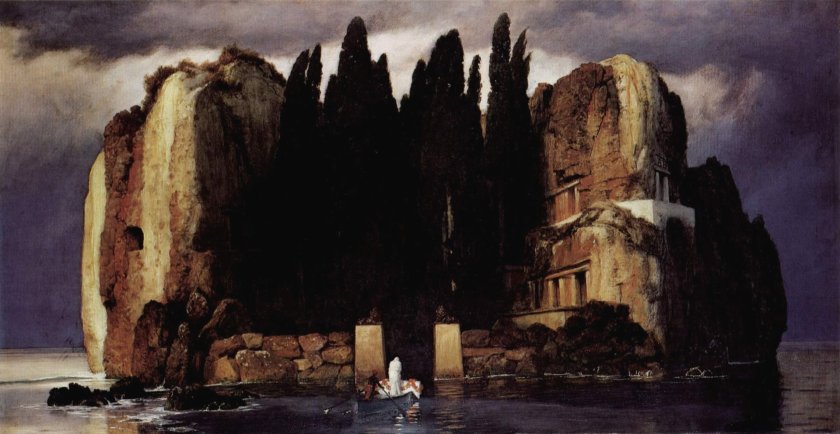
Isle of the Dead (Alte Nationalgalerie, Berlin. Third version) by Arnold Böcklin (1883)

Because of the success of the first two versions, Böcklin’s art dealer Fritz Gurlitt managed to persuade him to paint three more versions of Die Toteninsel but this time the suggestion was made that the sky should be much lighter.

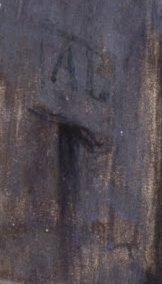
Initials A B on the Isle of the Dead (Third version) by Arnold Böcklin (1883)

If you look closely at the outer edge of the high rock on the right of the third version of the painting, you will see Böcklin’s initials, “A B”, over the lintel of the burial chamber. It is interesting to note that the provenance of this painting shows Gurlitt sold the painting in 1933 to one of Böcklin’s admirers – Adolph Hitler.  He had the painting hung at the Berghof in Obersalzburg and later moved it to the Reich Chancellery in Berlin.  This version is now housed at the Alte Nationalgalerie in Berlin.

Black and white photograph of the fourth version of Die Toteninsel (1844)

Böcklin painted the fourth version in 1884.  This work of art was bought by the entrepreneur and avid art collector Baron Heinrich Thyssen, the second son of the German industrialist August Thyssen, and it was kept in one of his banks.  Unfortunately it was destroyed during a World War II bombing raid and all that can be seen of this fourth version is a black-and-white photograph.

Die Toteninsel (Fifth version, Leipzig) by Arnold Bôcklin (1886)
Die Toteninsel (Museum der Bildenden Künste Leipzig. Fifth version) by Arnold Bôcklin (1886)

The fifth version of Böcklin’s painting, completed in 1886 resides at the Museum der Bildenden Künste in Leipzig.

In my third and final blog about Arnold Böcklin I will look at some of his portraiture as well as his Symbollst paintings.  Symbolism was a late 19th-century movement and thrived throughout Europe between 1886 and 1900 in almost every area of the arts. It began with literature, poetry and the theatre and later flourished in music and visual art.  There was a definite connection between Symbolism in art and Pre-Raphaelite and Romanticism and in some ways it was viewed as an antidote to realism and naturalism in which the artist sought to capture exactly what was before them, warts and all.  Symbolists, on the other hand try to find a profound reality from within their imagination, their dreams, and even their unconscious.  From being compartmentalised as being a realist landscape painter, Böcklin, because of his later works of art, was looked upon as a Symbolist.  In my final blog about Arnold Böcklin I will look at some of these works.

Vasily Perov. Part 2 – portraiture and humour

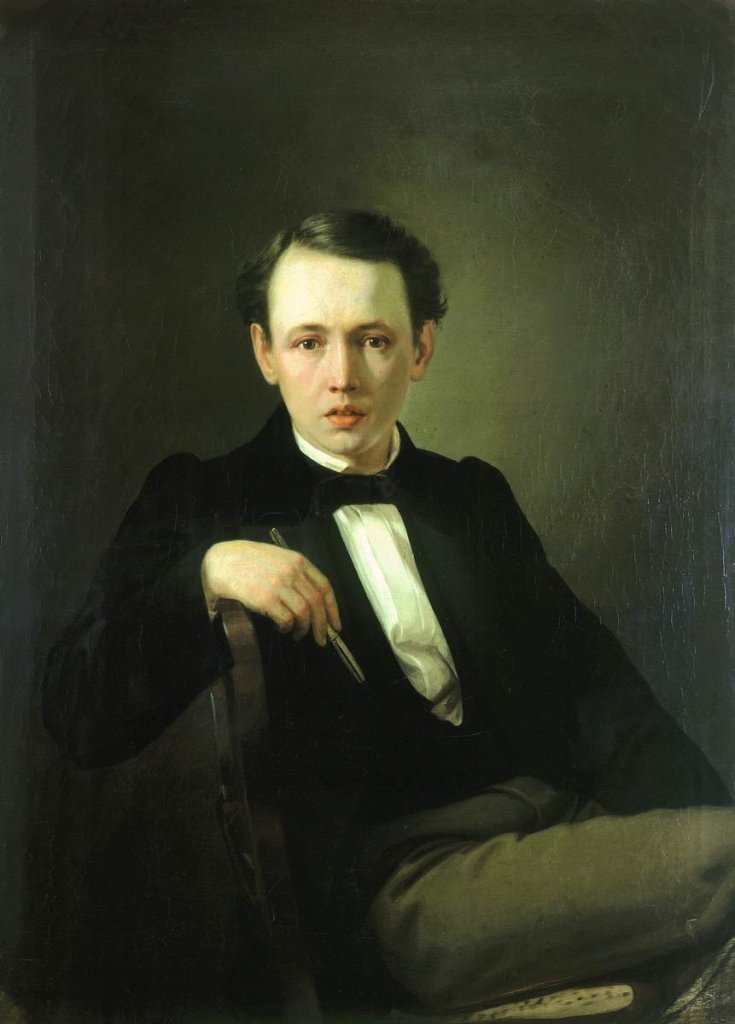
Self-Portrait (1851)

In my last blog I looked at Perov’s early life and his artwork which is often categorised as critical realism because of the way his paintings  focused on the peasants and how they had been let down by the Church, its clergy and the State.  For one of these works he was awarded the Gold Medal by the St Petersburg Imperial Academy of Arts and also a scholarship for him to travel to Europe and study European art.  He went to Paris where he spent a considerable amount of time but once again his art focused on poverty, this time, poverty in France.  Perov was now moving away from his anti-clerical depictions, and his barbed narrative works which poured scorn on the Church.  He now wanted to concentrate on the poor themselves and left the observer to decide on the reason for the poverty.

Savoyard by Vasily Perov (1863)

One of his most famous paintings, which he completed whilst in France, was one entitled Savoyard which he finished in 1863.  In Perov’s painting we see a young boy sat slumped on some stone steps.  The absence of any movement allows us to focus on the child without any distractions.  The child is asleep.  His feet stick out in front of him and this allows us to see the tattered hems of his trousers and because of the way is feet rest on the pavement we are given a view of the soles of his shoes, which are holed.  The painting itself is made up of dark sombre tones of smoky blue, green and grey.

Street Beggar by Gavarni

It is thought that Perov’s painting was influenced by the work of Paul Gavarni, a French engraver, who had his illustrations published in a collection of London sketches, featuring life in London at the time.  The sketches and accompanying illustrations were first published as a magazine series in 1848 and later they were collected in one volume, edited by essayist and journalist Albert Smith, which was first published in Paris, in 1862, a year before Perov’s arrival in the French capital.  It was entitled Londres et les Anglais.  One of the sketches was the Street Beggar and its thought that Perov had this in mind when he worked on the Savoyard.

Perov’s arrival in Paris in 1863 coincided with a great upheaval in French art.  The Hanging jury at that year’s Salon had been ruthless in their choice of paintings which could be admitted.  Those which were cast aside were ones deemed to have not been of the quality or type they wanted.  That year, the jury had been more ruthless than they had been in the past, rejecting two-thirds of paintings.  This resulted in vociferous protests from the artists who had had their works rejected.  It was so bad that Napoleon III stepped into the argument and placated the disgruntled artists by offering them a separate exhibition for their rejected works.  It became known as the Salon de Refusés (Exhibition of rejects) and that year this exhibition exhibited works by Pissarro, Fantin-Latour, Cezanne and included Manet’s Dejeuner sur l’herbe and Whistler’s Symphony in White,no. 1. 

The Arrival of the Governess at a Merchant's House by Vasily Perov (1866)
The Arrival of the Governess at a Merchant’s House by Vasily Perov (1866)

Perov returned home early from his European tour in 1865 and in 1866 produced a wonderful painting entitled The Arrival of the Governess at a Merchant’s House.  This was a move away from his focus on poverty and more to do with the fate of women.  In the painting we see a governess standing before the master of the house, a merchant who is to be her new employer.  This painting depicts the awkward encounter between the governess, who has probably graduated from a school for governesses, where they are taught to act like nobility, and the merchant who has no noble blood and is the face of the nouveau riche.   She presents herself well. She clutches a letter of introduction in her hands. She oozes an air of timidity and subservience, which is a trait that would be required if she was to become a member of the household.  However her demure stance with head bent down is befitting that of a lady.  She stands before, not only the master of the house, a bloated man, but behind him stands his family.  The children of the family are to be her pupils and by the looks of them she was going to be in for a difficult time.  The master of the house and his three children are dressed elegantly and the furnishings we see are fine and elegant and are part of merchant’s plan that they be elevated in status from mere merchants to something approaching nobility. Perov has changed the subject of his biting satire from the clergy of the Church to the oppressive merchant classes and the poor treatment they bestow on their employees.

Troika by Vasily Perov (1866)

The painting was purchased by thirty-four year old Pavel Tretyakov, a Russian businessman, patron of art, avid art collector, and philanthropist who gave his name to the Tretyakov Gallery in Moscow.   This work along with his Troika painting earned Perov the title of Academician.

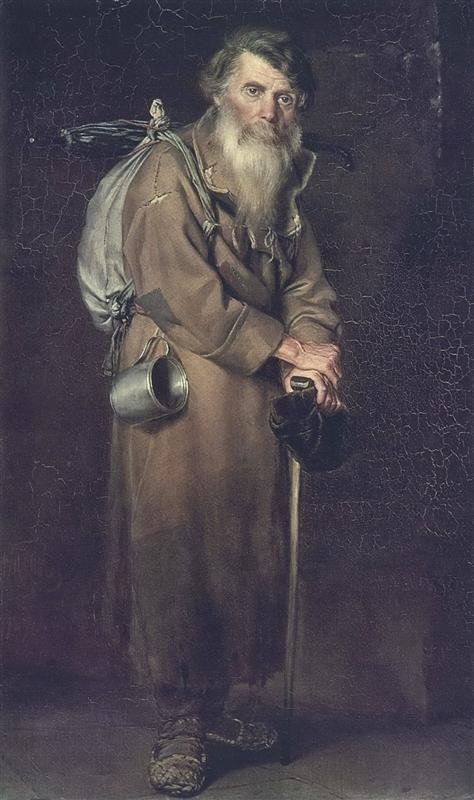
Wanderer by Vasily Perov (1870)

In the late 1860’s Perov began to concentrate on portraiture, initially of peasants and the title Wanderer was given to three of his works which featured peasants, all different and yet all emotive in their own way, one of which is shown above.  As Perov travelled around he came across a variety of fascinating characters and he was able present them on canvas and highlight their individualism and their way of life.

Portrait of the Author Feodor Dostoyevsky by Vasily Perov (1872)

In the early 1870’s Perov’s portraiture focused on cultural greats of Russia but it is interesting to note in these next two paintings they were totally devoid of any background accoutrements which would have added a sense of vanity in the sitter.  In 1872 he completed the Portrait of Dostoyevsky, a the Russian novelist, short story writer, essayist, journalist and philosopher. It was Dostoyevsky’s literary works which influenced Perov in the way they explored human psychology in the troubled political, social, and spiritual atmosphere in Russia during the 19th-century.

Portrait of the Playwright Alexander Ostrovsky by Vasily Perov (1871)

And in 1871 he finished his Portrait of Alexander Ostrovsky, a Russian playwright who was generally thought to have been the greatest writer of the Russian realistic period, which existed against the background social and political problems.  It started in the 1840’s under the rule of Nicholas I and lasted through to the end of the nineteenth century.   The painting is now housed in the Tretyakov Gallery, Moscow.

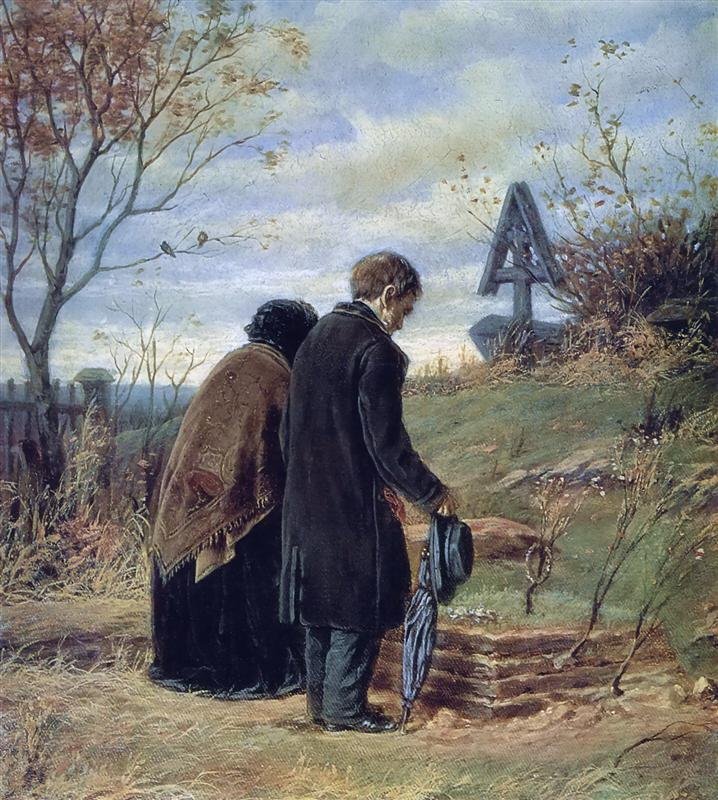
Old Parents Visiting the Grave of Their Son by Vasily Perov (1874)

In all his genre works he always managed to tug at your heart strings with his moving depictions.  Another of his heart-rending scenes was completed in 1874 and was entitled Old Parents Visiting the Grave of their Son.  It is said that nobody should suffer the agony of burying their children and in this work we feel the loss of the mother and father as they stand, heads bowed, at the side of the son’s grave.  This painting, like many of his other works, are to be found at the Tretyakov Gallery in Moscow.

Having received his academician’s degree in 1867, Perov went on in 1871 to gain the position of professor at Moscow School of Painting, Sculpture and Architecture.   It was through Perov’s teaching at Moscow School of Painting, Sculpture and Architecture that he managed to influence and nurture the young aspiring artists in his charge.  Many of the great Russian artists had been taught by him or were influenced by his style of painting

Amateur by Vasily Perov (1862)

As always I have the dilemma of which paintings to show you and which ones to leave out.  I just hope the blog will get you to search the internet for more of his works.   My final offering is one that features Perov’s sense of humour.  It is in complete contrast to his works which looked at poverty and the impoverished existence of the peasant classes.   It is a painting entitled Amateur which he completed in 1862.  It is both humorous and fascinating.   Before us we see a man slouched in a chair, chewing on the end of his maulstick, eyes narrowed as he looks at his work.  His wife stands beside him holding a baby.  She too is closely examining the canvas.    From the way the man is dressed along with the background details of the room we gather that this is an upper-middle class couple.  Another give away to the man’s social status is the way Perov has depicted him.  Well dressed, highly polished shoes and overweight.  Perov’s depiction of this man is similar to the master of the household, the merchant, whom he depicted in The Arrival of the Governess at a Merchant’s House- overweight, through all the food he had been able to buy and eat, whereas in most cases Perov portrayed the poor peasants as thin undernourished people.

Vasily Grigorevich Perov died of tuberculosis  in Kuzminki Village which is now part of Moscow and was laid to rest at Donskoe Cemetery.  He was fifty-eight years old.

Vasily Perov, Part 1 – the critical realist

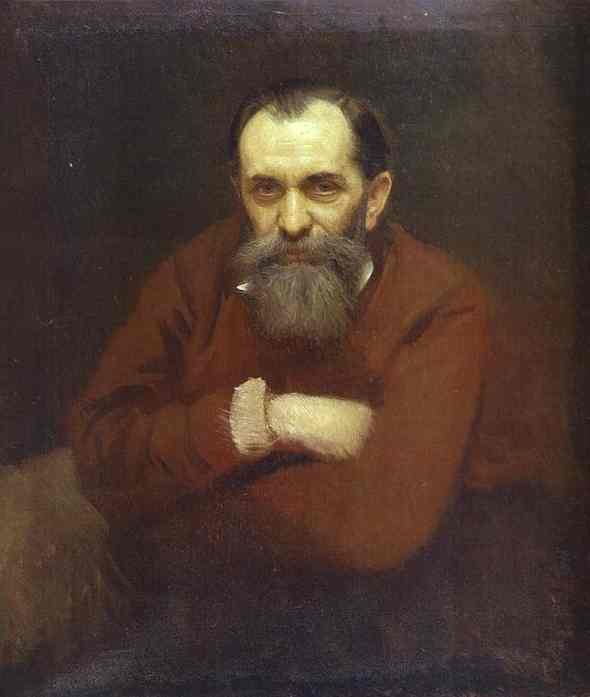
Portrait of Vasily Perov by Igor Kramskov (1881)

For my blog today, I am returning to Russia and featuring one of its greatest nineteenth century artists, Vasily Grigoryevich Perov.  He is known as one of the great critical realism artists of his time.

Perov was born in 1834 in the town of Tobolisk, a Siberian town, which lies east of the Urals.  Perov was the illegitimate child of Baron G K Kridiner, the provincial prosecutor for the region of Arzamas.  Perov, who was born prior to his mother and father’s marriage, was given the surname of his godfather, Vasilyev and yet, Perov himself disliked the name and had it changed to Perov, which was his nickname as a child as he was an excellent hand writer and a talented calligrapher.  Pero in Russian means pen.

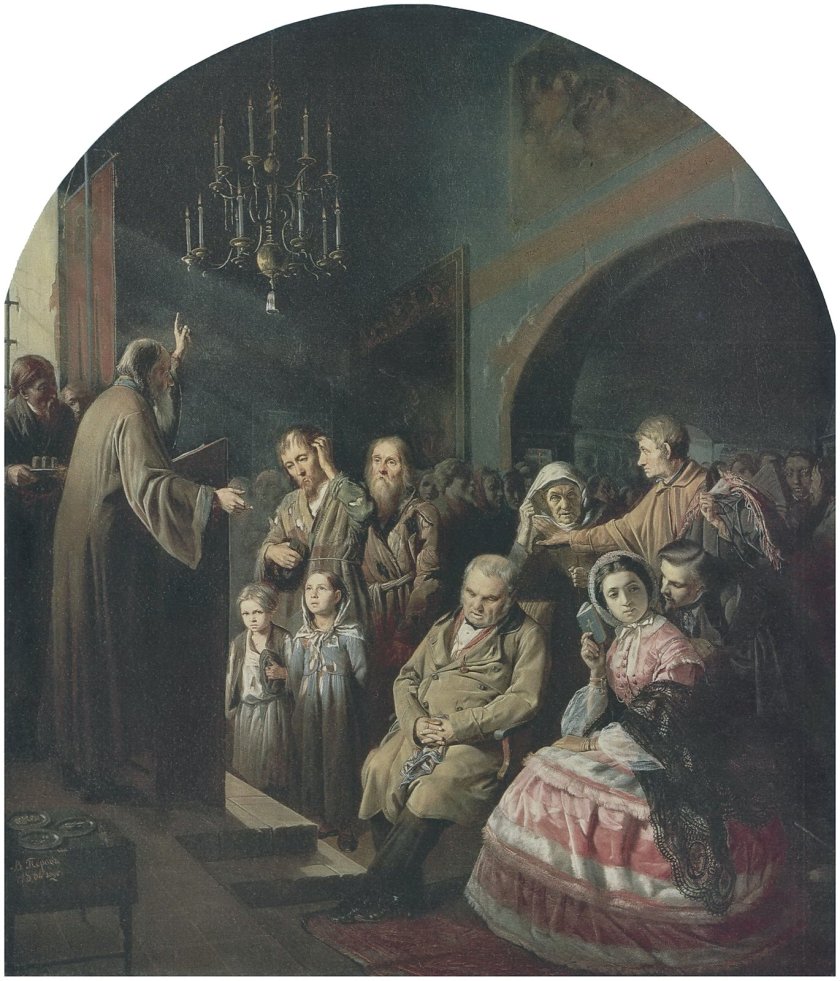
Sermon in a Village by Vasily Perov (1861)

In 1846, Vasily Perov received his first painting lessons, at the age of twelve, at the Alexander Stupin Art School in Arzamas. Stupin was a painter of the classicism genre, whose school was the first of its type in provincial Russia.  From there, in 1851, Perov moved to Moscow and entered the Moscow School of Painting, Sculpture and Architecture, which was one of the largest educational institutions in Russia.  It was here that he studied under Sergey Zaryanko, a Russian painter of Belarusian birth.   Whilst at the academy, he won a number of awards for his work from the St Petersburg Imperial Academy of Arts and his major award was when he won the Grand Gold medal for his diploma work in 1861.  The work was a set of preliminary sketches and the finished painting, Sermon in a Village.  He was also awarded a scholarship to travel abroad to enhance his knowledge of European art.

The Sermon in a Village is not simply a depiction of the congregation listening to a sermon.  In the centre foreground we see a nobleman asleep, head slumped forward on his chest.  He has no interest in the sermon.  He is just present to be seen.  Sitting next to him is his dutiful wife, prayer book in hand,  who plays coy as an admirer standing behind her flirts with her.  Look at the woman who stands behind the sleeping nobeleman.  She pulls her veil away from her ear and leans forward to try and hear the sermon.  Next to her one of the nobleman’s footmen tries to prevent her getting to close to his master. Earlier paintings depicting Russian clergy depicted them with veneration and the utmost respect so this mocking depiction of the church clergy by a young up and coming artist was frowned upon by the Establishment but it was accepted as an exhibit and won the artist, Perov, a European trip.

The Village Religious Procession at Easter by Vasily Perov (1861)

The preliminary sketches and painting, which won him the Gold Medal, were not his initial submission.  His original submissions were preliminary sketches for another of his works, The Village Religious Procession at Easter.  However the Academy rejected these because of their overt criticism of the Church and the clergy.  One needs to understand that Perov wanted to not only highlight the plight of the poor and the deprived, he wanted to condemn the role of the Church and its leaders who led a comfortable life and, in his mind, offered little comfort to the poor.  Despite the St Petersburg Academy’s rejection of his preliminary sketches for the The Village Religious Procession at Easter, he completed the work in 1861.

This oil on canvas work was his way of recording his belief that the clergy had forgotten their duty to parishioners.  It was blatantly an anti-clerical depiction.  The setting is a dull landscape.  The discordant movement of the participants in the procession together with the gloomy sunset accentuates the unattractiveness of the whole scene.  Before us, we see a drunken mix of clergy and their congregation embarking on a parade of icons through the village. Some of the people in the parade are carrying icons and gonfalons (a type of heraldic flag or banner, often pointed, swallow-tailed, or with several streamers, and suspended from a crossbar).  In the foreground of the painting, the peasants stagger past us towards a precipice with half-closed eyes.  It is as if they are all blind. We can make out a woman with an icon that has lost its face. A little further on, we observe the figure of a poor man carrying an icon upside down, albeit, we can still make out the “all-seeing” eye on the gonfalon and maybe Perov left it in to remind people that nobody can escape the Supreme Judgment.  The leader of this group is a drunken priest who we can see on the right, standing on the steps of the wooden building, hanging onto the upright structure to stop him falling.  We can also see, despite the desperate efforts of one of his helpers, that he has stepped on and crushed the Easter egg.  He has abandoned his “flock”.

Religious Procession in Kursk Province by Ilya Repin (1883)

The painting was exhibited at the Society for the Encouragement of Artists in St Petersburg but the curators were told to remove it on grounds that it was an “immoral” work, which criticised the Church and its clergy.  Even the press were banned from reproducing it in their newspapers; such was the power of the Church at the time.  Twenty years later Ilya Repin completed his famous work, Religious Procession in the Province of Kursk (See My Daily Art Display Aug 29th 2011), which again compared the lot of the downtrodden peasant class and the wealth of the clergy.

In 1862, Perov chose to go to France and also visited some German cities.  He returned home in 1864, even though his scholarship would have funded a longer stay in Europe.  Maybe he missed his homeland.

Perov lived through the 1860’s in Russia and was well aware of the social problems in his beloved country and he began to highlight the plight of the poor and downtrodden as well as contrast that to the wealth of the Russian church and its hierarchy.  Perov’s paintings carried strong social implication and thus his realistic depictions became an important landmark in the history of Russian painting.

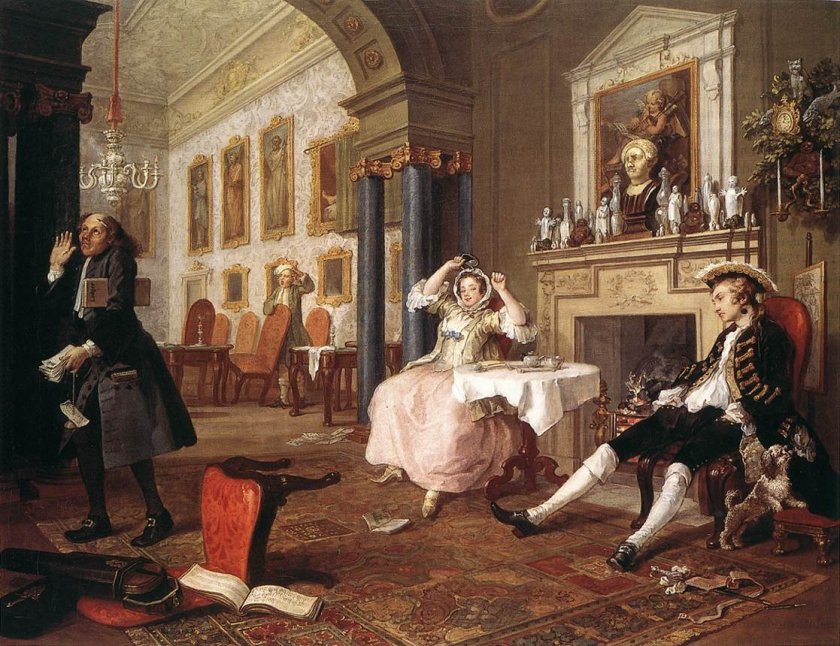
Marriage à la Mode by William Hogarth (c.1743)

Perov, at this time, had become influenced by the work of Pavel Fedotov,  who is now looked upon as the founder of critical realism in Russian art.  Perov was also aware of the genre scenes by the Old Dutch masters, often depicting poverty.  Another painter who influenced him was the English painter William Hogarth, the eighteenth century pictorial satirist and social critic whose work ranged from realistic portraiture to what is referred to as Sequential Art, which uses images arranged in sequence for graphic storytelling or to communicate information, a kind of narrative art. One example of this is Hogarth’s almost comic strip series which questioned the morals of the privileged (see – Marriage a la Mode – My Daily Art Display May 4th – 9th 2011).

On his return to Moscow he became one of the founder members of a group, known as the Peredvizhniki, often referred to as The Wanderers or The Itinerants.  This group of artists were influenced by the liberal ideas of the philosopher and critic, Nikolay Chernyshevsky and the philosopher, Vissarion Belinski.  They established the first Free Society of Artists in Russia. In a way it was a group, which felt it their duty to portray, through their art, the necessity of denouncing the social order in Tsarist Russia.  Other great Russian artists which were part of this group and have featured in My Daily Art Display were, Ilya Repin, Alexei Savrasov, Isaac Levitan and the landscape painter, Ivan Shishkin.  This group of young artists, who in protest at Academic restrictions formed themselves into a co-operative.  Perov’s influence on the art of the time, developing realism in art during the last five decades of the nineteenth century, cannot be underestimated.

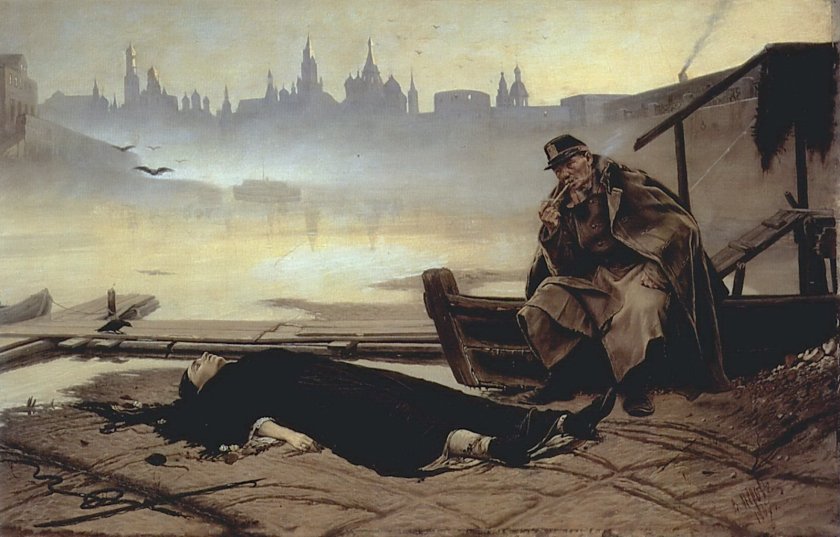
The Drowned Woman by Vasily Perov (1867)

The height of Perov’s success as a realist and genre painter came around the latter part of the 1860’s.  In 1867 Perov produced the highly emotive work entitled The Drowned Woman.    In Perov’s painting we see a policeman, who has just dragged the body from the river.  He is sitting, smoking his pipe, and looking down on the dead woman.  The artist wants us, like the policeman, to think what might have been the circumstances of the young woman’s death.  Had life been just too hard to bear?   The casualness of the policeman’s demeanour gives us the idea that the dragging of a lifeless body from the river was a common occurrence.  It should be remembered that what we see in Perov’s depictions of social inequality was mirrored in the literature of the time by the likes of Fyodor Dostoyevsky whose writing explored human psychology at a time of the difficult political and social mood of 19th-century Russia.

Found Drowned by George Frederic Watts (c.1850)

The subject of this work by Perov harks back to a work by the English realist painter, George Frederic Watts, and his 1855 work Found Drowned, a portrayal of a fallen woman, who drowned and whose body was discovered on the shores of the Thames.  (See My Daily Art Display July 4th 2011).

The Last Journey by Vasily Perov (1865)

In 1865 Perov produced another heart wrenching oil on canvas work entitled The Last Journey, which can now be seen in the Tretyakov Gallery in Moscow.  It is a depiction of both sorrow and condemnation.  There is an overwhelming sense of bereavement as we see a horse-drawn sleigh driven by an old woman.  We just see the back of her, hunched over, driving the horse.  She is taking the wooden coffin, which contains her recently deceased husband and breadwinner, to his final resting place.  Also on the sleigh are two children who, like the woman, face an uncertain future.  Their pet dog follows on.  The painting is gloomy matching the atmosphere of the story behind the depiction. Dark clouds are seen above the funeral cortege.  It is thought that Perov got the idea for this painting when he read the book, The Red Nose Frost, published in 1863 by Nikolai Nekrasov.  It is in two parts, the first part tells about a funeral of a young peasant and in the second part of the widow fight for survival in the forest. Nekrasov was a Russian poet, writer, critic and publisher.  His intensely empathetic poems about peasant life made him the hero of the freethinking and revolutionary circles of Russian intelligentsia.

Troika by Vasily Perov (1866)

I am completing this first part of my blog about Vasily Perov by featuring one of his greatest and certainly his largest genre painting (123 x 168 cms).  It has the simple title, Troika, which is the Russian word for “group of three”, and was completed in 1866 and now resides in the Tretyakov Gallery in Moscow.  It is a pictorial social commentary, which in this case, focuses on child labour.  We see children pulling a sled piled high with heavy barrels.  They face us.  Look at the way Perov has depicted their faces.  There is of course a child-like quality about them but one cannot fail to notice the pain and suffering their task is causing.  The air of gloom is added to by Perov’s background – The backdrop, the gloomy walls of the monastery create a mood of hopeless melancholy.  The children are being used and humiliated by this onerous task.

In my next blog I will showcase more of Perov’s paintings and look at the final years of his life.

Albert Joseph Moore. Part 3 – the conclusion.

Albert Joseph Moore (c.1870)

The Aesthetic art movement thrived in Britain and America during the 1860s to the 1880s.   The movement started in a small way in the studios and houses of a radical group of artists and designers, including William Morris and Dante Gabriel Rossetti.  In works of art the leading British exponents of this aesthetic movement were J.M.Whistler, Frederic, Lord Leighton and Albert Joseph Moore.  This style of art was also known as Art for Art’s Sake.  The Oxford  Dictionary defines Aestheticism as:

“… the term applied to exaggerated expression of the doctrine that art is self-sufficient   and needs serve  no ulterior purpose, whether moral, political or religious…”

It was influenced by Japanese art and culture.  It was not universally loved and the art critic Walter Hamilton wrote a book in 1862, The Aesthetic Movement in England, in which he mounted a famous defence of the Aesthetic Movement and wrote about the key figures associated with the movement and provided descriptions of contemporary responses to it.

Albert Moore was one of the principal originators of the Aesthetic Art Movement, and was considered by Whistler as one of the most original artists of his generation.  His  decorative paintings, which were true to the Aesthetic movement, championed pure beauty in their depiction but  lacked messages whether overt or subtle, and this type of art became very popular with collectors.  His depiction of women, in what is termed a Hellenic style, draped in their diaphanous clothing, was one which will always be linked with Moore.  Following the success he had with his work entitled The Marble Seat, he followed it up with a series of purely decorative paintings.  In all of these, the allure of the works was Moore’s depiction of the female form and the harmonious use of colour.

A Musician by Albert Moore (1865-6)

One of Albert Moore’s patrons, around this time, was James Leathart, a Newcastle lead manufacturer.  He had visited Moore at his studio in 1865 and whilst there saw an unfinished work by the artist entitled A Musician.  The work combines aspects of ancient Roman wall paintings, Greek sculpture and Japanese prints.  The figures in the painting are separated.  On the left side we have an active male musician playing the lyre and on the right we see his audience of two passive females.  This separation by gender was also present in his painting, The Marble Seat (see previous blog).

Leathart bought this work from Moore and It can now be seen at the Yale Centre for British Art, New Haven.  In 1867 he purchased from Moore his work Elijah’s Sacrifice.

Battledore by Albert Moore (1870)

Leathart was so pleased with his acquisitions that he commissioned Moore to produce a pair of classically draped figures, each bearing a shuttlecock and racket.  The two commissioned paintings were to feature two ancient games played by both men and women.  It was the precursor to jeu de volant, which was itself the precursor to badminton.  The simple titles to his paintings were Battledore and Shuttlecock.

In a letter to Leathart in November 1868, Moore wrote:

“…now fairly at work on your two pictures and propose to go on with them continuously until they are finished…”

Leathart went to Moore’s studios to see what progress Moore had made and viewed the preparatory sketch.  However Moore had a change of heart with regards the colours and tones he would use and in February 1869 he again wrote to Leathart to tell him that he had:

“…hit upon combinations of colour darker in character than the little sketch you saw some time ago…”

Now, Moore had a dilemma.  He wanted to press ahead with the final paintings but had to be sure that Leathart agreed to his proposed changes to the colours and in his letter to Leathart, he gave his reasons for the change but to avoid problems with his patron hinted that Leathart had the final say.  Moore wrote:

“… I think it is best to learn your views on the subject.  That is to say, if you have any particular desire that the pictures should be kept light in character – as for instance, for the sake of their effect in your room – I shall of course be ready to recur to something like the original scheme: at the same time I have reason to believe that the latter combination would succeed – having tried them in small sketches and I may say I should not hesitate to carry them out, were I the only person concerned…”

Leathart agreed to the changes.

Principles of Harmony and Contrast of Colours by M.E.Chevreul
Principles of Harmony and Contrast of Colours
by M.E.Chevreul

Moore was fascinated by colour combinations and how some worked better than others.   Whilst studying at the School of Design in York he had studied this very issue and was inspired by Michel Eugène Chevreul who had published a book in 1855 entitled The Principles of Harmony and Contrast of Colour.  Chevreul based his ideas on the study of the coloured threads in the Gobelin tapestries.

Shuttlecock by Albert Joseph Moore (1870)

In his work, Shuttlecock , Moore brought together the colours of orange and blue which Chevreul had written were “harmonies of contrasts”.  Although chromatically opposites, orange and blue combined to produce grey.  Look at the colour combinations on the mat which the female stands upon.   When the two paintings were exhibited at the Royal Academy in 1871 Moore was praised for his depiction of the figures but those who detected Moore’s scientific approach to colour combinations were less happy.  Other critics were unhappy with the fact that there was no message within the painting, no historical or biblical connotation to the depiction

Sea-gulls by Albert Moore (1871)

Along with Battledore and Shuttlecock Moore had a third painting accepted for the 1871 Royal Academy Exhibition.  The title of this third work was Sea-gulls.  This painting eventually came to fruition but not without some controversy.  Moore’s friend James Whistler got to hear of, and later saw the preliminary sketches for this painting through their mutual friend and patron Frederic Leyland and Whistler was concerned that they were very similar to preliminary sketches he had made for his own painting.  After lots of discussions between the two artists and an intermediary, William Nesfield, an architect and amateur painter, and a  friend of both Whistler and Moore, it was amicably decided that Moore exhibiting his Sea-gulls painting would not have an adverse effect on Whistler’s works.  The painting was exhibited at the RA even though, according to Moore,  it was unfinished.  On receiving the work back from the exhibition, Moore completed the work and it was sold to his patron, Frederic Leyland.

A Summer Night by Albert Moore (1864-90)

There are so many beautiful paintings done by Albert Moore that it is difficult to select a only a few for the blog.  However, the next painting by Albert Moore which I am featuring took almost six years to complete and it is a veritable beauty.  Moore started this large work (132 x 229 cms) in 1884 but did not complete it until 1890.  It was entitled A Summer Night.

The backdrop for this work was not Moore’s usual wall but a fascinating and beautiful display of floral garlands, all intertwined together.  In the far background, across the sea, we see the twinkling of shore lights of an island which has been lit up by moonlight.  Pale clouds can be seen in the dark sky.  In the upper left foreground, we can see orange-coloured ranunculus blooms weaved into the upper part of the silver filigree which is part of the open trellis-work.  The painting received a rapturous reception from the public when it was exhibited at the 1890 Royal Academy exhibition, despite the RA’s Hanging team banishing the work, high up on a wall in the fifth room, close by a door.

The fact that Moore’s work was often looked down upon by the art institution for his constant scientific manipulation of colours and for producing paintings without any hidden meanings was not lost on the forward-thinking art critic of the time, Claude Phillips, who had, for a long time been a great supporter of Moore.   In an article in the Academy in May 1890, he wrote:

“…no artist of purely British origins has the same mastery over the keyboard of tints and tones as this master of decoration and that such a painter should persistently be excluded from the ranks of the Academicians while that august body contains so many crude, perfunctory and unspeakably tiresome practitioners, is a riddle the solution of which had, perhaps, better not be attempted…”

The art critic George Moore (no relation to Albert Moore) castigated the Royal Academy for not electing to the Academy, either Albert Moore or his friend James Whistler.  In 1893, he caustically wrote:

“… Many Academicians will freely acknowledge that his [Albert Moore] non-election is a very grave scandal;  they will tell you that they have done everything to get him elected and have given up the task in despair……………..the two greatest artists living in England, will never be elected Academicians; and artistic England is asked to acquiesce in this grave scandal…”

The Loves of the Winds and the Seasons by Albert Moore (1893)

The last painting I am showing you was the last painting Albert Moore completed.  It was entitled The Loves of the Winds and the Seasons, which he completed in 1893.  Moore’s financial situation at the start of the 1890’s was dire and to make things worse is health was starting to decline.    In August 1892 Moore had been taken seriously ill and despite a number of operations he was made to suffer from a painful and incurable illness.  Moore would not let his pain or his advancing death stop him from painting and this last painting which he started in 1890, was completed nine days before his death.  The painting depicts the courtship of the four male winds with the four female seasons.  The female figure on the left is Summer and she watches the courtship of the South Wind and Autumn.  In the right background of the painting we see the North and East Winds quarrelling over Winter whilst they are all stood in a patch of snow.

Albert Joseph Moore died at 3am in his London studio in Spenser Street, Westminster on September 25th 1893, three weeks after his fifty-second birthday.   The cause of death was given as a sarcoma of the thigh and a recurrent sarcoma of the abdomen.  He made his brother Henry sole heir to his estate which amounted to just £1,184.  He was buried in the family grave in Highgate Cemetery, which was already occupied by his mother and his brother, John Collingwood Moore.

———————————————————————————

Most of the information I have used in this and the next blog have come from  two books, biographies of Albert Joseoph Moore. They are:

Albert Moore, his life and works, by Alfred Lys Baldry (1894)

Albert Moore by Robin Asleson (published by Phaidon)

Albert Joseph Moore. Part 2 – his portrayal of women.

Albert Joseph Moore (c.1870)

At the end of my last blog I had reached the point in Albert Moore’s life with him travelling to Rome with his brother John Collingham Moore just after his twenty-first birthday.  Whilst travelling around the Roman Campagna he was able to observe the effects of colour which were presented to him under local conditions of light and atmosphere.  He travelled to Naples and Pompeii and throughout his stay he would copy classical statuary and Renaissance paintings.   His stay in Italy was cut short after five months when he received news about his mother’s death on the twenty-eighth of January 1863.  Albert returned to London in the Spring and set up home in a studio at 12 Newman Street in West London and immersed himself in the many commissions he received.

Elijah's Sacrifice by Albert Moore (1863)
Elijah’s Sacrifice by Albert Moore (1863)

It was also here that he held a one-man show featuring some of his works of art, including the newly completed Elijah’s Sacrifice (see previous blog).  One visitor to this show was Frederick George Stephens, an art critic, and one of the two ‘non-artistic’ members of the Pre-Raphaelite Brotherhood.  He gave his approval to Albert’s paintings and expressed the joy of discovering new young artists.  He wrote in the February 1864 issue of the London literary magazine, Athenaeum, in his regular review of the Arts, Fine-Art Gossip:

“…a critic’s pleasantest office is to call attention to works, from their nature, do not catch the eye of everyone…”

The small exhibition in his studio proved a great success.  It was unusual for an artist to show works in their own studio but Albert needed the money and needed to market himself and attract buyers but it was also a declaration of his own independence.  Albert Moore knew that he could not solely rely on the Royal Academy to show his work as he was only too well aware of the vagaries of the RA Selection Committee, who had a penchant of choosing works by its own Academicians rather than featuring young artists who were not RA members.   Albert had first-hand experience of this when, in 1864, the Selection Committee had rejected his work Elijah’s Sacrifice.

The Marble Seat by Albert Moore (1865)

Whether Albert altered the painting is not known but in 1865 it was accepted by the RA Selection Committee!   Along with that work he also had accepted into that year’s Academy exhibition his painting entitled The Marble Seat.   It was a turning point in Moore’s career as the critics loved his two works.  The Marble Seat tells no story and does not illustrate any incident in history.  It is merely a composition of four figures, one male and three females, all of whom are grouped around a flat stone seat.    The background comprises of flowers including red tulips, trees and through the trees we are able to see a flat hinterland which leads to a range of blue hills.  The nude male stands to the right of the picture and we see him pouring wine into a cup.  The three girls, all dressed in almost transparent white draperies, over which are thicker orange, green and scarlet wraps, sit or lean against the marble seat.  The seat is positioned on green lawn which seems to twinkle with small white daisies.

Leading magazines raved about the works of this up and coming young artist.  According to the critics Moore and some other young painters were breaking new ground in modern British painting by treating the human figure on a monumental scale unlike other older and well established artists who preferred to stick to small-scale homely themes.

However not to be deterred by the vagaries of the R.A., Albert Moore joined a group of artists, which included his brother Henry Moore, the Jewish pre-Raphaelite painter, Simeon Solomon, John Everett Millais and the historical painter, Edward Poynter.  Ironically, both Millais and Poynter would later become presidents of the Royal Academy.  This group chose the Dudley Gallery in London as the venue for exhibiting their paintings.

Dancing Girl Resting by Albert Moore (1864)

In 1864 Moore’s one-man show included his painting entitled Dancing Girl Resting.  It was noted that since returning from Rome, Albert Moore’s painting style and subject choice had changed.  The “new” Albert Moore can well be seen in this beautifully crafted 1864 painting.  Before us we see a tall girl, with a red scarf twisted around her head and shoulders, dressed in a full-length diaphanous shift standing on a leopard-skin rug which kept her feet away from the cold tiles.  She is leaning against a warm grey marble wall on which hangs a lyre and an ornamental woven mat.  The combination of the rug, the marble tiles and woven textiles adds an air of decadence.  The art critic, Frederick Stevens, in his Fine-Art Gossip column in the February 1864 edition of the Athenaeum described the girl’s somewhat erotic stance:

“…panting through parted lips, with heaving bust, her arms akimbo, and hands upon her hips…”

There is sensuousness and something erotic about this work.  Although she is not naked, we can see the contours of her naked body through the gossamer-like shift.  Look at the beautiful way Moore has executed the many folds of the shift which gives it a feeling of movement even though the dancer is at rest.  Although the title talks about the dancer resting, it is the small figure of the dark-skinned girl, who besides a strand of beads is naked.  She can be seen slumped limply on the floor besides the dancer who looks more at rest.

Sappho and Erinna in a Garden at Mytilene by Simeon Solomon (1864)

It is thought that Albert Moore was starting to be influenced by his friend Simeon Solomon whose paintings around this time showed a certain sensuousness such as in his 1864 painting, Sappho and Erinna in a Garden at Mytilene.  In that painting we see Sappho embracing her fellow poet Erinna in a garden at Mytilene on the island of Lesbos. According to legend, Sappho was born at Lesbos in about 612BC. After having been exiled to Sicily she returned to the island and was at the centre of a community of young women devoted to Aphrodite and the Muses.

The Shulamite by Albert Moore (c.1865)

Philip Henry Rathbone was a Liverpool insurance underwriter and Liberal Council member.  He came from a very wealthy family of merchants.  He was also an avid art collector and one time was a member of the Hanging Committee of the Liverpool Autumn Exhibition.  Amongst his friends was James McNeil Whistler.  Rathbone bought both The Marble Seat and my next featured work of Albert Moore, The Shulamite. A  Shulamite is a female name in Hebrew and means peaceful.  The name corresponds to Solomon as Julia does to Julius. It is the figurative name of the bride in Solomon’s Song and the bridegroom is represented by Solomon which also means peaceful.  The large oil painting, measuring 210 x 96cms is now housed in the Walker Art Gallery in Liverpool.  The painting appeared at the Royal Academy in 1866 but although it had been passed by the conservative Hanging Committee it, along with some other “audacious” paintings, were given an adverse hanging placement.  This and the other works, although placed in the prestigious North Room, were placed so high on the wall they were almost invisible to visitors.  Some would say a revengeful act by the Hanging Committee!  The May 22nd issue of the Times carried an article by the art correspondent, who reported on the exhibition and noted the poor positioning of Albert Moore’s work, writing:
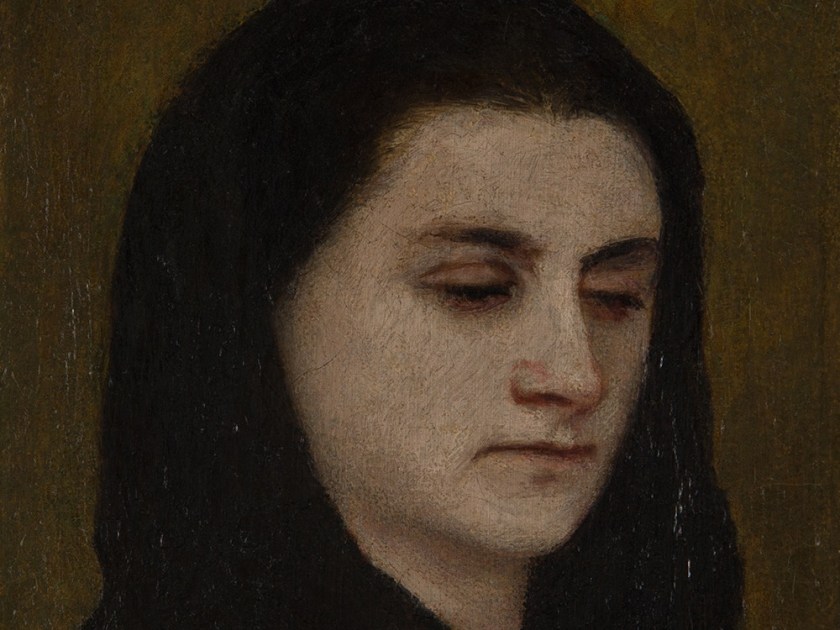
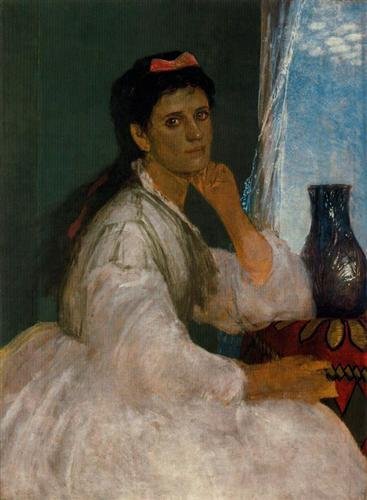
“……..suffers more from its elevation, for its merits are of a more delicate and subtle kind……its exquisite draperies, clothing exquisite form [are] wholly out of sight…”

The Last Supper Wall painting by Albert Moore (1865-66)

In 1865, Albert Moore received a commission to carry out some wall paintings for the Church of St Alban in Rochdale.  The commission had come his way through good auspices of his friend, the architect William Eden Nesfield, whom he had travelled with to Northern France, five years earlier.  These wall painings were painted in oils directly on to the plaster surface of the walls.  The commission took most of 1865 and 1866 to complete and to complete the commission, Moore had to move a large quantity of his materials from London to Rochdale by train.  His biographer, Alfred Lys Baldry, tells the amusing anecdote of the start of this journey from Albert’s studio to Euston Station:

“…so heavily did he load the cab which was conveying him from his studio in Russell Place to Euston Station, that in mid-journey the bottom came out, and he and his brother Henry, who was going to see him off, had to run along inside for some distance, until the attention of the driver could be called to the mishap….”

The wall paintings in St Alban’s Church occupy the whole of the upper chancel and consist of several separate subjects, two being The Last Supper and The Feeding of the Five Thousand. 

In the final part of my look at the life and works of Albert Joseph Moore I will showcase more works of art dedicated to female beauty.

———————————————————————————–

Again, most of the information I have used in this and the previous blog have come from  two books, biographies of Albert Joseph Moore. They are:

Albert Moore, his life and works, by Alfred Lys Baldry (1894)

Albert Moore by Robin Asleson (published by Phaidon)

Eric Henri Kennington, Part 2 – the Second World War Artist

Eric Kennington (1926)

At the end of Part 1 of this blog about Eric Henri Kennington we had reached a point in his life when he had travelled to Arabia to prepare sketches which would later be used in his friend, T. E. Lawrence’s 1922 book entitled Seven Pillars of Wisdom.

In 1922, Eric Kennington first met Edith Cecil when he received a commission to paint a portrait of her husband, William Charles Frederick Hanbury-Tracy, 5th Baron Sudeley, whom she married in August 1905.  They had no children.  Kennington and Edith fell in love and in 1922 she and her husband divorced and in September 1922 she married Eric Kennington.  The couple went on to have a son, Christopher, in March 1925 and a daughter, Catherine in February 1927.  It is said that both Eric and Edith remained on friendly terms with Edith’s ex-husband.

The 1922 book Seven Pillars of Wisdom by T E Lawrence

Eric Henri Kennington, as well as having been a war artist during the Great War, was also a revered portrait painter.   During his time in Arabia sketching and working on paintings for T E Lawrence’s autobiographical book, Seven Pillars of Wisdom, he met Field Marshal Allenby.  Allenby, at that time, was the High Commissioner for Egypt and was based in Cairo.

Edmund Henry Hynman Allenby, 1st Viscount Allenby by Eric Kennington (1926)

In March 1921 Kennington met Allenby at the Semiramis Hotel in Cairo and produced a pastel portrait of Allenby.   It is remarkable to think that this pastel work was completed by Kennington in less than an hour.

Effigy of T.E. Lawrence - 'Lawrence of Arabia' in St. Martin's Church, Dorset by eric Kennington (1926)
Effigy of T.E. Lawrence – ‘Lawrence of Arabia’ in St. Martin’s Church, Dorset by eric Kennington (1926)

Kennington and T.E.Lawrence (Lawrence of Arabia) had an enduring friendship up until the day Lawrence was killed in a motorcycle accident in May 1935.  After his friend’s death, Kennington spent years completing a full-length reclining stone effigy of his friend dressed as an Arab sheikh.  This beautiful tomb effigy which was completed in 1939, and can now be found in the church of St Martin’s in Wareham in Dorset

Head of T. E. Lawrence by Eric Kennington (1926)

Kennington also completed a bronze sculpture of the head of T.E.Lawrence in 1926 and the intrepid British archaeologist, military officer, and diplomat was delighted with the work.  He said:

“…Magnificent; there is no other word for it. It represents not me but my top moments, those few seconds when I succeed in thinking myself right out of things…”

At the outbreak of the Second World War in 1939 the War Artists Advisory Committee was formed as part of the Ministry of Information.  The chairman of the new committee was Sir Kenneth Clark.  Clark who had been a fine art curator at Oxford’s Ashmolean Museum,  had, in 1933 at age 30, become the director of the National Gallery and as such was, and still is, the youngest person ever to hold the post.   One of the artists he chose was Eric Kennington, as by this time, he had built up a reputation as a leading portrait artist.    Kennington became a war artist for the second time in December 1939.   His contract with the War Artists Advisory Committee was to produce pastel or charcoal portraits and for each one he would be paid 25 guineas.  Kennington agreed but said he would need a minimum of three hours per sitter.

General Sir Edmund Ironside, General Officer Commanding-in-Chief, Home Forces, May-July, 1940. by Eric Kennington (1940)

One of his first sitters was the Chief of the Imperial Staff, General Sir Edmund Ironside.  He completed the portrait in January 1940

Portrait of Stoker A.Martin of HMS Exeter by Eric Kennington

In 1940 Kennington was sent to Plymouth to sketch portraits some of the seaman who had served in the great 1939 sea battle of the River Plate.  One such portrait, which he completed in the April of that year, was of Andrew Martin, a senior stoker aboard HMS Exeter during the River Plate battle.  Kennington wrote a small piece to accompany the portrait.  He wrote:

“…Man of Action: instantaneous: 100 per cent reliable: expert technician. Much humour under thorough camouflage. Very gentle, sensitive, and great physical strength…”

The painting found favour with the art critic, Herbert Granville-Fell who wrote:

“…Kennington’s harsh iron technique has a force admirably suited to conveying unflinching and dauntless resolution in the faces of his seamen and soldiers. I know of no other artist who can so convincingly depict the salt of the earth, and evoke palpably, in a portrait, the very essence and savour of courage…”

Kennington, as was the case during the First World War,  soon clashing with his “employer” the War Artists Advisory Committee principally because of his personal dislike of Colin Coote, a journalist, who was the War Office representative on the committee.  In May 1940 the Home Guard, the Local Defence Volunteers was formed and Kennington decided to leave his role as a war artist for the War Artists Advisory Committee and join the Home Guard.

In July 1940, shortly after Kennington left the War Artists Advisory Committee the Committee held an exhibition of official war art at the National Gallery.  The art critics and public were both pleased with what they saw and in particular the works of Eric Kennington which were said to have been the most popular.  In particular his works depicting the generals and the sailors received the most praise.

Eric Kennington in his Home Gurad uniform

Kennington rose in its ranks and in July 1940 he was put in charge of a section of six countrymen in the south Oxfordshire countryside, defending an observation post he had set up to the north of his home in Ipsden.   We are so use to thinking of the Home Guard as the people we see on the very popular TV comedy series, Dad’s Army or maybe we have a romantic view of the brave men who protected our homes.  Apparently Kennington did not view the Home Guard or his fellow Home Guardsmen in such an idealised and romantic manner.  Kennington was very vociferous in his criticism of the equipment they were given and was also critical with regards the senior officers, of whom he said were tied up in bureaucracy.   He wrote to his older brother William:

“…The men, if not suitably motivated, did not report for duty in the evenings, but sloped off after roll call to go poaching, fishing, or playing cards in the pub…”

Sergeant Bluett, Cornwall Home Guard by Eric Kennington

For all his criticism of some of his fellow volunteers he completed some wonderful portraits of them, such as Sergeant Bluett of the Cornwall Home Guard which he completed in 1943.

Corporal Robertson, City of Edinburgh Home Guard by Eric Kennington (1943)

….and Corporal Robertson of the City of Edinburgh Home Guard which he also completed in 1943.  Both these paintings are housed in the Imperial War Museum.

The War Artists Advisory Committee in August 1940 not wanting to have lost such a great artist approached Kennington and asked him to return to the fold as a war artist.  The War committee was delighted that Kennington agreed to return.  The secretary of the Committee, Edmund Montgomery O’Rourke Dickey, wrote to Kenneth Clark about how Kennington’s work instilled hope in those who saw his portraits.  He wrote:

“…The best of this artist’s [Kennington] portraits of sailors in the exhibition at the National Gallery have, in the eyes of the public, a nobility not shared by any other work that’s on display at the National Gallery. These portraits typify the fighting man who’s going to win the war for us…”

Pilot Officer M J Herrick, DFC, by Eric Kennington (1941)

Kennington agreed to return as a war artist and the Committee offered him a commission to draw portraits of RAF personnel at a time when the Battle of Britain was at its fiercest and these men were often referred to as “fighting aces”.

Flight Lieutenant Lloyd Watt Coleman, DFC, by Eric Kennington (1940)

The pastel portraits were sensitive depictions of the air force heroes and many were used as illustrations in Kennington’s 1942 book Drawing the RAF.  There is a simplicity about these portraits but the underlying thought that these were some of the men who would fight for and save our country, was unmistakeable.

Air Chief Marshall Sir Charles Frederick Algernon Portal DSO & Bar by Eric Kenningtonn(1941)
Air Chief Marshall Sir Charles Frederick Algernon Portal DSO & Barn by Eric Kennington (1941)

One must remember that the War Arts Committee would give Kennington a list of people who were to appear in his portraits.  This caused a rift between Kennington and the Committee as Kennington believed that all the Committee wanted was portraits of senior officers and Kennington wanted to highlight some of the fighting men from the lower ranks.  Once again Kennington threatened to walk away from his position as a war artist but he was such a great portraitist that he was talked out of his impending resignation by none other than the Chief of the Air Staff, Sir Charles Portal.

Wing Commander Geoffrey William Tuttle OBE DFC by Eric Kennington (September 1941)

As he carried on with his portraiture commissions they were often exhibited at the National Gallery.  Previously they had been lauded as great works of art but occasionally they received some adverse criticism, such as piece written by the art critic of the Sunday Times, Eric Newton, who wrote:

“…Eric Kennington goes on and on with his over-life-size portraits of supermen. They are strident things whose assertiveness almost hurts the eyes.’ But then he did concede: ‘They do look like men who are going to win the war. Some are positively frightening. Dropped as leaflets over enemy country, I can imagine them being as effective as a bomb…”

Cover of Eric Kennington's book Tanks and Tank Folk
Cover of Eric Kennington’s book Tanks and Tank Folk

In November 1941, Eric Kennington was invited to Ripon, Yorkshire by Sir Percy Cleghorn Stanley Hobart, the General Officer Commanding of the 11th Armoured Division to sketch portraits of some of his men.  Whilst there Kennington completed over twenty portraits of the men and also this small (29 x 38cms) oil on board portrait of his host.  Many of the portraits Kennington did whilst at the Ripon barracks appeared in his 1942 book Tanks and Tank Folk and many featured in his solo exhibition held at the Leicester Galleries, London in September 1943

Seeing It Through, by Eric Kennington, (1944)

My final offering is a painting by Kennington which was used as one of the war posters in the series Seeing it Through.  It was not of  a fighting man or woman, but commemorated everyday heroism of normal people going about job in difficult and dangerous times.  Kennington preferred not to use models for this type of work and in this work he used the woman herself as the model.  It is of a young twenty year old woman, Mrs M.J. Morgan, who was a conductor on one London buses.  She had become one of the first generation of female bus conductors employed by London Transport in November 1940. She’d only just started her job as a “clippie” when the bus she was assigned to was caught in the blitz.  She became an instant heroine when she shielded with her own body two young children, and then helped passengers who’d been injured when the bus was riddled with shrapnel from a bomb exploding nearby.

Kennington remembered her well describing her:

 “…like a Rubens Venus’ and she had a complexion that was ‘edible as a peach…”

Beneath the portrait of the bus conductor was a short verse by the novelist and humorist, Alan Patrick Herbert:

“…How proud upon your quaterdeck you stand

Conductor- Captain  of the mighty bus!

Like some Columbus you survey the Strand

A calm newcomer in a sea of fuss

You may be tired – how cheerfully you clip

Clip in the dark with one eye on the street –

Two decks – one pair of legs – a rolling ship

Much on your mind and fat men on your feet !

The sirens blow, and death is in the air

Still at her post the trusty Captain stands

And counts her change, and scampers up the stair

As brave a sailor as the King commands.

A.P.Herbert


Eric Henri Kennington died in April 1960 aged 72.  He is buried in the churchyard in Checkendon, Oxfordshire, where he was once the churchwarden and he is commemorated on a memorial in Brompton Cemetery, London..