Christoffer Wilhelm Eckersberg. Part 3. Patrons and portraiture

In May 1816, Christoffer Eckersberg left Rome and headed home to Copenhagen.  During his homeward journey he stopped off at Dresden where he met up with the German Romantic painter, Casper David Friedrich.  Eckersberg finally arrived back in Copenhagen in August 1816.  His reputation as a leading painter of his time was all he could have wished for and soon commissions were rolling in.  Probably the most prestigious of these was a commission to paint four large works for the Throne Chamber of the magnificent baroque palace of Christiansborg which showed scenes from the history of the House of Oldenburg.  This commission earned him the nomenclature of “court painter”.
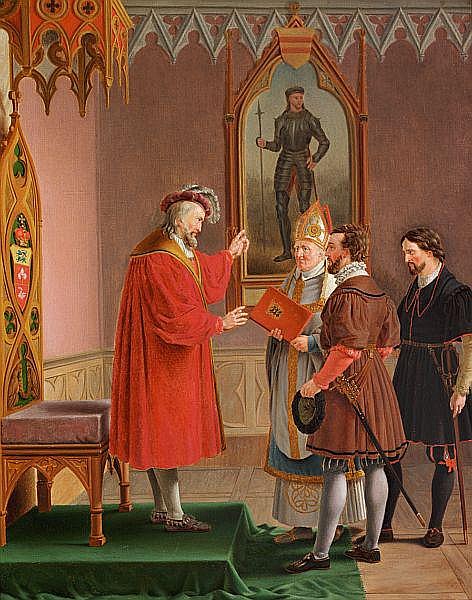
Duke Adolf declines the offer to be Danish king by Christoffer Eckersberg (1821) (43 x 39cms) Private collection
Duke Adolf declines the offer to be Danish king by Christoffer Eckersberg (1821)
(43 x 39cms)
Private collection

One of these works was Duke Adolf declining the offer to be King of Denmark which he completed in 1819.  The story behind this event is that in January 1448, King Christopher of Denmark, Sweden and Norway died suddenly and had no natural heirs. His death resulted in the break-up of the union of the three kingdoms, with Denmark and Sweden going their separate ways. Denmark had now to find a successor to the vacant Danish throne and so the Council of the Realm turned to to Duke Adolphus of Schleswig, as he was the most prominent feudal lord of Danish dominions. However Adolphus, who by that time was forty-seven years old and childless, declined the offer but instead supported the candidacy of his sister’s son, the Count Christian of Oldenburg.  Christian was elected King Christian I of Denmark and his coronation followed a year later in October 1449. In the painting we see Duke Adolphus declining the offer as he points to the portrait of his nephew, Christian, which is hanging on the wall in the background.

Mendel Levin Nathanson by Christoffer Eckersberg (1819) (32 x 28cms) Museum of National History at Fredericksborg Castle
Mendel Levin Nathanson by Christoffer Eckersberg (1819)
(32 x 28cms)
Museum of National History at Fredericksborg Castle

In October 1817 Eckersberg became a member of the Royal Academy of Fine Arts.  This allowed him to apply for any position as professor at the Model School of Charlottenborg, which was the home of the Royal Danish Academy of Fine Arts.  Whilst Eckersberg had been travelling around Europe he had been funded by a number of patrons and on his return home he decide to repay their generosity by completing portraits of them and their family.  One of Eckersberg’s most important and generous benefactors was Mendel Levin Nathanson.   He had arrived in Copenhagen aged twelve as a poor Jewish immigrant.  Nathanson rose to become a wealthy Danish merchant, editor, and economist who from an early age established himself in business.  At the age of twenty-six he became associated with the large Copenhagen banking firm of Meyer & Trier.  He was also a leading patron of the arts.   He was an author of books on economics as well as the country’s mercantile history but was probably best known for his advocacy of the Jewish cause. Nathanson was editor of the Berlingske Tidende one of the big three national newspapers from 1838 to 1858 and from 1865 to 1866.  Eckersberg completed the portrait of Nathanson in 1819.
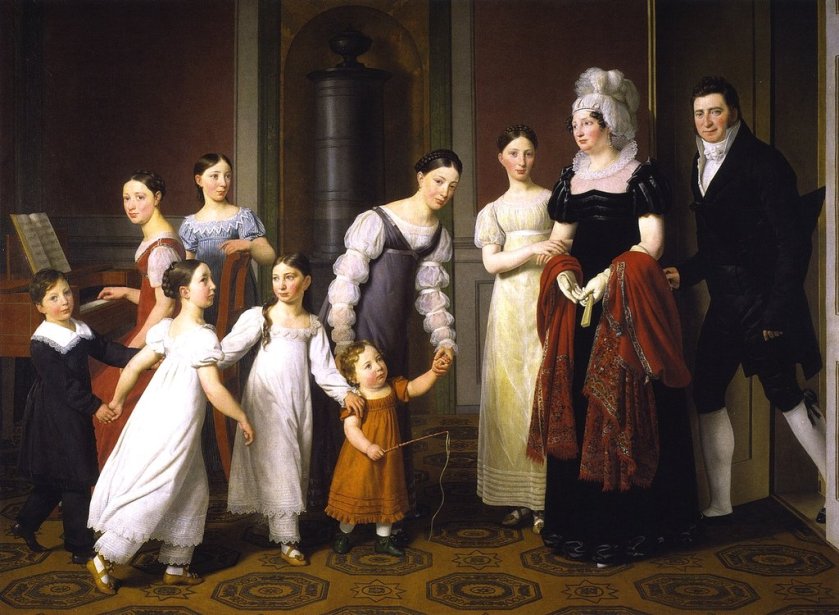
The Nathanson Family by Christoffer Eckersberg (1818) (126 x 173cms) Statens Museum for Kunst, Copenhagen
The Nathanson Family by Christoffer Eckersberg (1818)
(126 x 173cms)
Statens Museum for Kunst, Copenhagen

Another of Nathanson’s commissions for Eckersberg was to get the artist to complete a group family portrait, a task he completed in 1818.  The depiction was of Nathanson, his wife and their eight children.  It was simply entitled The Nathanson Family and the portrait was the most densely peopled and involved work ever attempted by Eckersberg.  Nathanson was quite specific about what he wanted the painting to reveal about himself and his family.  It was to be a depiction which would tell of his affluence and status in the country.

The Nathanson Family (Preliminary sketch) by Christoffer Eckersberg (1818)

Eckersberg’s original idea, as seen in a preliminary sketch, was to depict the whole family dancing, highlighting a close and harmonious family connection,  a family who enjoyed each other’s company but this idea failed to satisfy Nathanson.  For Nathanson the depiction must depict a family of stature and wealth.  It was paramount to depict his own prominent position in Danish society as a merchant and an integrated Jew.  He again spoke to Eckersberg to remind him how he wanted the family to be depicted.   The family members in the finished painting are shown, in a line, blatantly parading themselves before us in a stage-like manner.  On the left hand side the depiction focuses on the private life of the children, at play, dancing and one daughter is seen playing the piano.  The children’s activity is interrupted by the arrival home of Nathanson and his wife from an audience with the Queen having enjoyed the family tradition of some royal entertainment.  There is a sartorial elegance about the velvet-like clothing Nathanson and his wife are wearing and this of course brings home to the viewer of the painting the social and financial class of the couple.  The whole scene is a juxtaposition of two visual aspects of Nathanson’s life – the loving husband and father with his happy children and the successful businessman who has access to the Royal Court.  In the portrait Nathanson stares out at us inviting us into his house to witness all that belongs to him.  His wife stands next to him, somewhat aloof, as the children, who have  interrupted their playing to run and greet her.
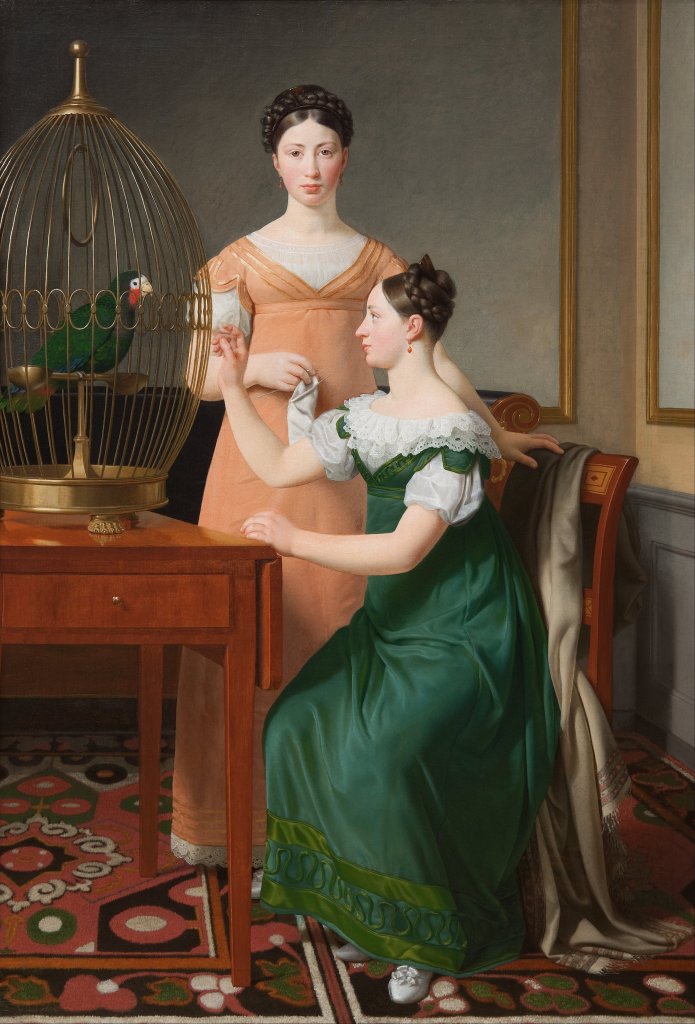
Bella and Hanna. Mendel Levin Nathanson's Elder Daughters by Christoffer Eckersberg (1820) (125 x 85cms) Statens Museum for Kunst in Copenhagen
Bella and Hanna. Mendel Levin Nathanson’s Elder Daughters by Christoffer Eckersberg (1820)
(125 x 85cms)
Statens Museum for Kunst in Copenhagen

In 1820 Eckersberg completed another portrait for Nathanson.  This time it is one depicting his two daughters, Bella and Hanna.   For many artists who have been asked to complete a portrait the decision as to how the sitter should be portrayed is a question which has to be carefully answered.  Should it be an en face depiction or a profile depiction?  In this work Eckersberg has solved the problem by having the daughter, who is standing, portrayed en face whilst the seated daughter is shown in profile.   Although it would not be that unusual to see the likeness of the two daughters in this case, could it be that Eckersberg has emphasized the similarities to such a degree that it almost looks as it is the portrait of a single person seen from two different angles.  On the table we see a parrot in a cage.  Is this just an additional ornamentation which lacks meaning?  Actually many believe it is symbolic and that it is all about the two young ladies who are at an age when marriage is on the horizon whilst other believe there is a definite similarity between the shape of the cage and the shape of the girls’ faces

Hans Christian Ørsted by Christoffer Eckersberg (1822) (53 x 43cms) Danish Museum of Science and Technology, Helsingør
Hans Christian Ørsted by Christoffer Eckersberg (1822)
(53 x 43cms)
Danish Museum of Science and Technology, Helsingør

Another of Eckersberg’s interesting portraits is Hans Christian Ørsted which he  completed in 1822.  It is a medium sized head and shoulder portrait which can now be found at the Danish Museum of Science and Technology in the eastern Danish town of Helsingør.  This is a good example of Eckersberg’s ability as a portraitist as to how he precisely and truthfully depicts his sitter.  It is a realistically accurate depiction of the man, as confirmed by his wife. The depiction of Ørsted facial expression is one of contemplation which concurs with the views that Ørsted was a great “thinker”.  Other than that expression on Ørsted’s face, it disregards the modus operandi of many portrait artists past and present who feel the need to incorporate into the portrait their perceived notion of the sitter’s psychological persona and by doing so they are happy to lose some of the physical accuracy of the person.   I know I am in the minority when I say, that for me, a portrait needs to be real and recognisable.   I am often told that as I am not an artist I do not understand portraiture !

Hans Christian Ørsted was an acclaimed international scientist born in 1777 who made the discovery that electric currents created magnetic fields which would later be known as Ørsted’s Law.  Eckersberg tells us more about the man, not by the way he “adjusts” the portrait but by using the tried and trusted method of including items in the portrait which relate to the man.  In his hand we see Ørsted holding a metal Chladni plate on which is sprinkled powder.  The powder has now formed a pattern on the surface of it, which is the result of a violin bow,  which can be seen on the table in the left foreground, being scraped against the edge of the plate.  The catalogue raisoneé of Eckersberg works does not indicate any payment for the portrait and it was probably a gift from Eckersberg to Ørsted as the two endured a long friendship after they had met in Paris years earlier.
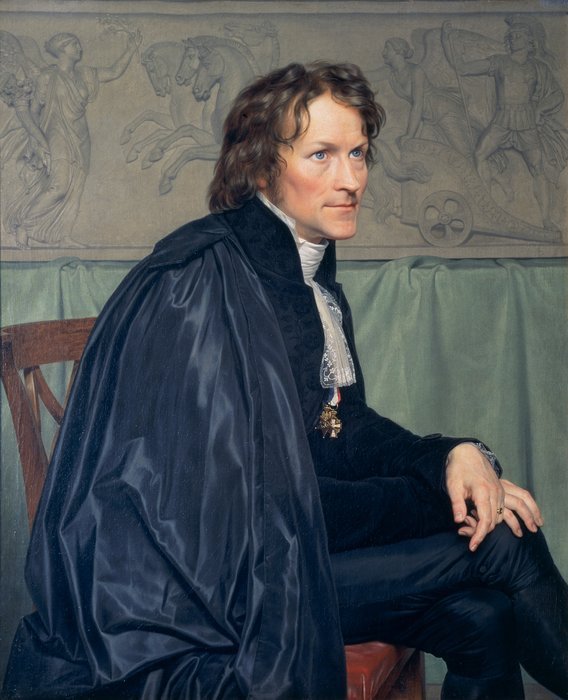
Portrait of Bertel Thorvaldsen wearing the habit and Insignia of the San Luca Academy by Christoffer Eckersberg (1814) (91 x 74cms) The Royal Danish Academy of Fine Arts
Portrait of Bertel Thorvaldsen wearing the habit and Insignia of the San Luca Academy by Christoffer Eckersberg (1814)
(91 x 74cms)
The Royal Danish Academy of Fine Arts

When Eckersberg stayed in Rome we know he stayed in a lodging house which also accommodated the great Danish sculptor Bertel Thorvaldsen and the two became good friends.  One of Eckersberg’s most famous and inspired portraits, which he completed in 1814, was of Thorvladsen.  It was entitled Portrait of Bertel Thorvaldsen wearing the habit and Insignia of the San Luca Academy.  At the time, Thorvaldsen was regarded as the most important sculptor in Rome and in 1804 he became a member of the Florence Academy of Art and a year later a member of the Danish Art Academy.  In this portrait, we see Thorvaldsen bedecked in the official robes of the Academia di San Luca in Rome, of which he had been a member since 1808. This prestigious academy was founded in 1577 and as such  is among the oldest academies in Europe with its roots being traced to the first statutes written in 1478 for the guild of painters named Compagnia di San Lucca. The robes we see Thorvaldsen wearing provide the portrait with the nuance of an artist who is continuing the work of a long Roman tradition.  There is no doubt that the message we can take from the way Eckersberg depicted his friend is the artist’s great admiration for the sculptor and all that he had achieved.  Eckersberg, like many admirers of Thorvaldsen, looked upon him as a visionary and the artist has tried to capture that aspect in the sculptor’s contemplative facial expression.  Such admiration for Thorvaldsen’s work can be seen by the way Eckersberg has included Thorvaldsen’s most famous piece of sculpture, the Alexander Frieze, which can be seen in the background.  Eckersberg was so happy with the finished portrait that he sent it to Denmark as a gift to the Copenhagen Academy.  This generous gesture probably had a more ulterior motive, that of proving of his artistic ability to the academicians.

The Double Portrait of Count Preben Bille-Braheand his second wife Johanne Caroline neé FalbeZ by Christoffer Eckersberg (1817) (61 x 50cms) Ny Carlsberg Glyptotek
The Double Portrait of Count Preben Bille-Braheand his second wife Johanne Caroline neé FalbeZ by Christoffer Eckersberg (1817)
(61 x 50cms)
Ny Carlsberg Glyptotek

Eckersberg’s many portraits were not just of male sitters.  Portraiture was a great way of making money and many commissions came to him when he returned to Copenhagen.  The next painting I am showcasing is The Double Portrait of Count Preben Bille-Braheand his second wife Johanne Caroline neé Falbe which he completed in 1817 and is now housed in the Ny Carlsberg Glyptotek in Copenhagen.  Eckersberg had been awarded the Academy’s Gold Medal in 1809 and with it came funds to cover the cost of European travel.  However the money did not become available to him until 1812 but he wanted to set off to Paris immediately and so had to turn to some wealthy sponsors to lend him the money he needed to start his journey.  One such benefactor was Count Preben Bille-Brahe, a wealthy Danish landowner.  On his return to Copenhagen Eckersberg repaid Count Preben Bille-Brahe’s generous support for his European journey by painting a double portrait of the count and his second wife, Double Portrait of Count Preben Billie-Brahe and his Second Wife, Johanne Caroline, neé Falbe.  Although their social status was to be part of the aristocracy, Eckersberg has managed a more commonplace depiction of the couple, which he used when he depicted the middle-class in his portraiture, enhancing the view that they were just real people.  Having said that, the male sitter with the ruddy cheeks looks resplendent in his brown tailcoat, the buff waistcoat with its lower fastening unbuttoned.

Jesus and the Little Children by Christoffer Eckersberg (c. 1810) Altarpiece for the Home Church at Funen
Jesus and the Little Children by Christoffer Eckersberg (c. 1810)
Altarpiece for the Home Church at Funen

Eckersberg had met Count Preben Bille-Brahe in 1810 during the first part of his European journey to Paris.  He stopped off at his benefactor’s estate on the island of Funen and received a commission from Count Preben Bille-Brahe to create an altarpiece for the Home Church which was part of the estate.  Eckersberg completed the painting for the altar whilst in Paris.  It was a biblical scene entitled Jesus and the Little Children.

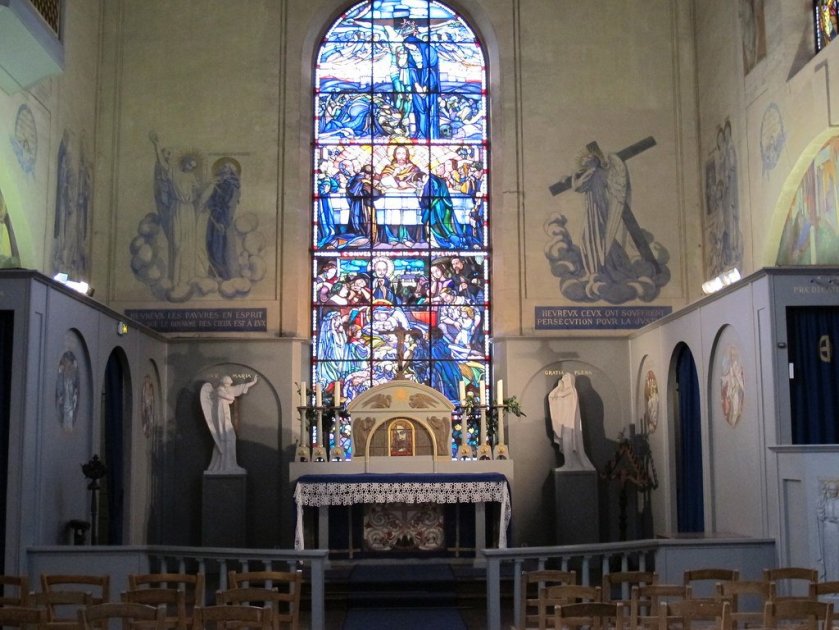
Home Church Funen
The interior of Home Church Funen

In my fourth look at the life and work of Christoffer Wilhelm Eckersberg I will concentrate on some of his female portraiture and his large number of nude paintings.

Christoffer Wilhelm Eckersberg. Part 2 – Rome (1813 – 1816)

C.W.Eckersberg by Christian Albrecht Jensen (1832)

In my last blog I talked about Christoffer Eckersberg travelling to Paris in 1810 where he studied under the tutelage of the French painter, Jacques-Louis David.  The year 1810 was an important year for Eckersberg for a completely different reason for it was in this year on July 1st that he married Christine Rebecca Hyssing.  The two had been lovers for a number of years and in September 1808 she had given birth to their son Erling Carl Vilhelm.  It is thought that the reason for the marriage was more to do with expediency and the desire to legitimise their son than love and devotion and it was soon after his marriage that Eckersberg left the marital home to travel to France.

Erling Eckersberg
Erling Eckersberg

The marriage was doomed to be a failure and in 1816 the couple’s divorce papers finally came through whilst Eckersberg was away on one of his travels. In my next blog about Christoffer Eckersberg I will look at his excuisite portraiture.would follow in his father’s footsteps studying at the Danish Art Academy in Copenhagen and at the age of twenty-six he, like his father, received the Academy travelling scholarship for three years and during which time he journeyed to Paris and Parma in Italy.

The Israelites Resting after the Crossing of the Red Sea by Christoffer Eckersberg

Christoffer Eckersberg left Paris in June 1813 and arrived in Rome in July.  He rented a room in a house which was also home to the Danish sculptor, Bertel Thorvaldsen.  History paintings continued to be his favoured genre and in 1812 he had received a commission from a Jewish merchant, Mendel Levin Nathanson to depict the crossing of the Red Sea by Moses and the Jewish people and for two years whilst he was in Rome he worked on the painting which was entitled The Israelites Resting after the Crossing of the Red Sea.  This large work which measures 203 x 283cms (80 x 112 ins) can be seen at the National Gallery of Denmark in Copenhagen.  The depiction is not the actual crossing itself but what happened after the event – the Israelites resting after their crossing.   In the book of Exodus (14: 26-29) it was written:

“…The Lord told Moses, “Stretch your arm toward the sea—the water will cover the Egyptians and their cavalry and chariots.” 27 Moses stretched out his arm, and at daybreak the water rushed toward the Egyptians. They tried to run away, but the Lord drowned them in the sea. 28 The water came and covered the chariots, the cavalry, and the whole Egyptian army that had followed the Israelites into the sea. Not one of them was left alive. 29 But the sea had made a wall of water on each side of the Israelites; so they walked through on dry land…”

 It is testament to Eckersberg’s artistic ability that he has been able to include such a large group of people in such a natural manner and once again he has added a landscape dimension to the biblical painting in the way the people are shown within a real landscape setting based on his studies and meticulous observations of nature which served as the basis for the depiction of the morning sun and cloud formations.  This methodology was contrary to the teachings he received from his professor,Abildgaard back at the Copenhagen Academy, whose landscape works were often somewhat murky and had no relevance to the time of day of the depiction.

Rome, at the time of Eckersberg’s sojourn, was a hive of artistic activity.  Many young artists had travelled from all over Europe to congregate in the Eternal City to be with like-minded painters and this offered them a chance to exchange views on art.  Many were inspired by what they learnt from their contemporaries who, like themselves, had escaped the clutches of their Academies and the strict academic training.  It was a chance for them to try out new artistic ideas.  For landscape artists it was a vital stage in their education and the one main decision many undertook was to paint plein air.  This technique allowed them to sit before their chosen subject in the open air and paint what they saw rather than just sketching out doors and then taking the sketches back to their studios for completion.  For these artists plein air painting afforded them the chance to capture on canvas the existing weather conditions and observe how that affected the light and shadow.  It also gave artists the opportunity to produce topographically correct depictions rather than idealized versions conjured up in their studios.  One of the founders of this en plein air idea around 1780 was the French painter, Pierre-Henri de Valenciennes who produced many oil studies en plein air, which were not meant for exhibitions but for his own private collection.

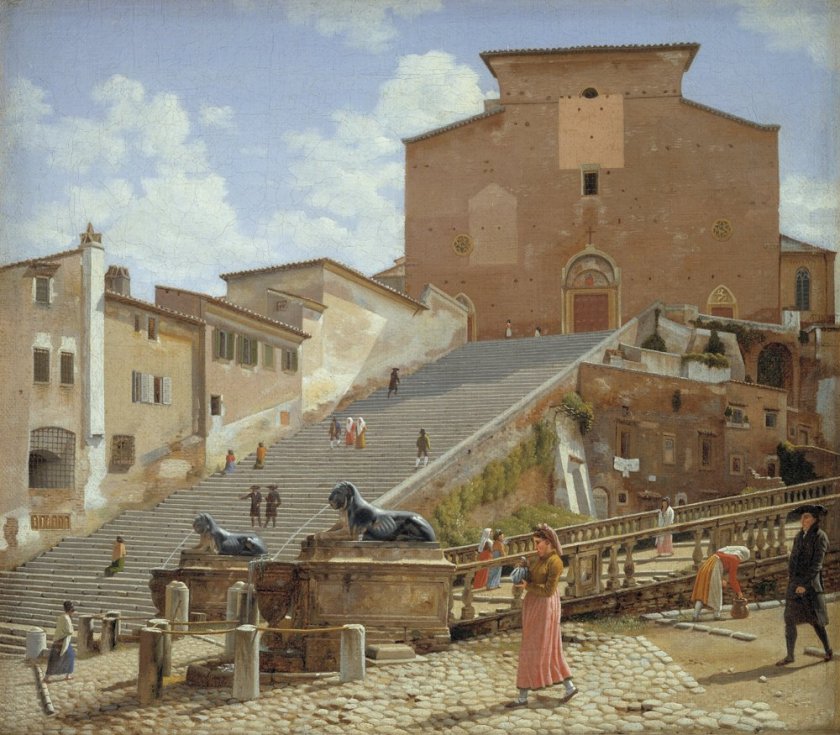
The Marble Steps leading to the Church of Santa Maria in Aracoeli in Rome by Christoffer Eckersberg (1816)

At this time in Rome, landscape and cityscape paintings, especially ones with the city’s most famous sights were in great demand with the tourists so much so it was a struggle for these artists to come up with a subject or a point of view of a subject which had not already been recorded artistically by a previous painter.  One of Eckersberg’s plein air paintings featuring a well-known building in Rome is The Marble Steps leading to the Church of Santa Maria in Aracoeli in Rome.  It was completed in 1816 and we can see that he took up a position with his easel at the foot of the Capitoline Hill and that allowed him to produce a composition of vertical and diagonal lines.  From the way and the direction of the shadow cast by the church we know the time of day was around ten in the morning and so Eckersberg would return numerous times at this time to build up the painting on the canvas.

View of the Capitoline Hill with the Steps that go to the Church of Santa Maria] d’Aracoeli) by Paranesi (c.1757)
View of the Capitoline Hill with the Steps that go to the Church of Santa Maria d’Aracoeli by Giovanni Piranesi (c.1757)

It is interesting to note that the structures we see in the painting were real and yet what was untrue about the depiction is what was left out – the omission of Michelangelo’s Palace which was atop the hill to the left of the church.  We know this by looking at Giovanni Piranesi’s etching of the same scene made half a century earlier, one from his collection entitled Vedute di Roma (Views of Rome).

View of the Cloaca Maxima, Rome by Christoffer Wilhelm Eckersberg (1814)

Many of Eckerberg’s paintings featuring the city of Rome avoided the iconic locations which featured in many of the other artists’ paintings.  He seemed to favour depicting less famous parts of the capital.  One such work which he completed in 1814 was entitled View of Cloacia Maxima which was bought by the NGA in Washington in 2004.  Cloacia Maxima, which means Greatest Sewer, is one of the world’s earliest sewage systems, thought to have been built around 600 BC as an open air canal.  It is a highly elaborate depiction packed with rich detail.  Some of the buildings we see are very old and many are decaying.  There is no uniformity in the architecture for most of the buildings would have been erected in different eras.  The viewpoint for this painting was the eastern slopes of the Palatine Hill looking towards the Capitoline, one of the Seven Hills of Rome.  It is a painting which depicts the transition from the “countryside” in the foreground which then leads towards the city itself.  It is a realistic depiction for although the foreground is a mass of verdant vegetation, it has been continually crossed by people on foot carving out rough paths.  Our eyes follow the two figures that walk down the path and lead us into the city.

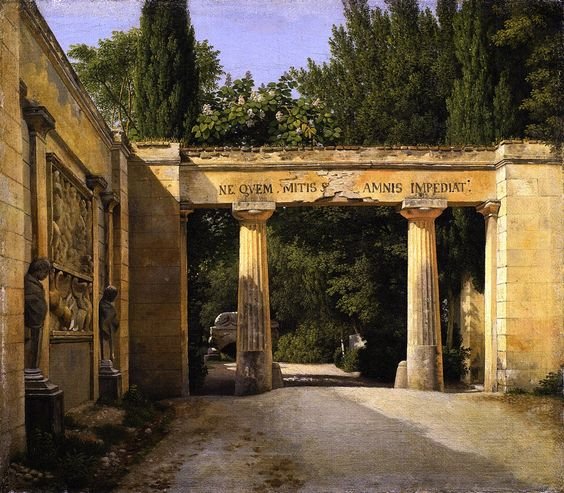
View of the Garden of the Villa Borghese in Rome by Christoffer Eckersberg (1814)

Even when Eckersberg chose a well known location for his painting, he chose to depict a view that in his mind didn’t become “yet another view” of a famous place.  In his painting View of the Garden of the Villa Borghese in Rome which he completed in 1814 he chose to depict part of the decaying and unexceptional 18th century aqueduct rather than the famous gardens themselves.  The ancient reliefs on the wall to the left are foreshortened and are almost unrecognisable. Having said that, it is a beautiful work, which combines a detailed depiction of the angular ruins of the aqueduct in the mid ground.  Our eyes follow the path which runs under the aqueduct arch to an area of the garden albeit it is hidden from view by the ancient arch itself and the trees.   Again, like the previous work, Eckersberg is making the comparison between the harshness of architecture and the softness of nature in a single painting.  The way the artist depicts the sunlit and shaded areas leads one to believe that this was another of Eckersberg’s plein air paintings.

A Courtyard in Rome by Christoffer Eckersberg (1814-16)
A Courtyard in Rome by Christoffer Eckersberg (1814-16) (34 x 28cms)

Another interesting painting during his stay in Rome is one entitled A Courtyard in Rome.  It is a depiction of a nondescript courtyard which could have been in any city so what made Eckersberg paint this one.  There is some conjecture about this and one line of thought is that it is the courtyard of Casa Buti a lodging house in which he and Thorvaldsen stayed.  If that was the reason for painting this scene then it would make it a more personal depiction and one he would have seen every day for three years.  However it and could equally be one he passed by one day when walking around the city and was just a random choice of depiction for the work.   There is nothing breathtaking about the scene and yet it is a beautifully crafted work.  It is interesting to note that the aspect of this scene, the loggia, which could have added colour and variety to the depiction, can barely be seen in the upper background.  The painting is housed in the art museum of the town of Ribe in western Denmark.

A View through Three of the North-Western Arches of the Third Storey of the Coliseum by Christoffer Eckersberg (c.1816)
A View through Three of the North-Western Arches of the Third Storey of the Colosseum by Christoffer Eckersberg (c.1816)

Probably the most famous of Eckersberg’s paintings was one he completed during his three year stay in the Eternal city and is entitled A View through Three of the North-Western Arches of the Third Storey of the Colosseum in Rome, which he completed around 1816.  It is a relatively small work just measuring 32 x 50cms and is currently housed in the Statens Museum for Kunst (National Gallery of Denmark) in Copenhagen.  Eckersberg had depicted the ancient monument in a number of sketches and paintings but he never depicted a view of the outer structure of the amphitheatre in its entirety unlike many other artists.  It was this painting that he will be remembered for.  He set up his easel high up on the third level of the Colosseum looking out across the city which we see through the three arches of the structure.  The background details of the city in the distance are so precise it is thought that he may have used a telescope to ensure accuracy.  Look at the foreground of the painting and the authentic way in which he precisely depicted the crumbling structure.  This aspect of the work encompasses a thoroughness not seen in many landscape works.  This attention to detail serves to highlight the slow disintegration of the ancient monument.   However the greatest attribute to this work is the way he has made the three arches of the Colosseum act as picture frames for the cityscape in the distance.   he painting is sometimes referred to as “The Beautiful Lie” for if we stood in front of the centre arch, as seen in the depiction, then we would not see views of the city of Rome depicted through the other two arches.  To see those views we would have to move to the left or right and look through other arches.  Eckersberg also rid himself of many of the intervening structures which he thought inconsequential and would detract from the beauty of the view.  However this straying from realism does not take anything away from the work.  Eckersberg just wanted his viewers to experience the beauty of Rome as he envisioned it.

In my next blog about Christoffer Eckersberg I will look at his exquisite portraiture.

Christoffer Wilhelm Eckersberg. Part 1. Early life

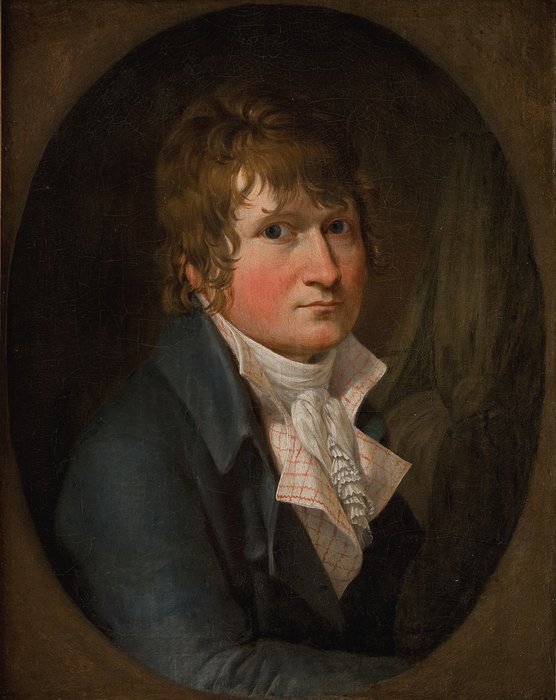
Self Portrait by Christoffer Eckersberg (1811)

Let me start this blog with a question.  When you look around a large art gallery how long do you stand before each painting?  Is it just a cursory glance or do you study the artistic technique of the artist and examine the brush strokes which many artists believe are like the painter’s fingerprints?   I suppose a lot depends on the size of the gallery with all the works on show at the major ones being impossible to see in one visit and of course one has to also take into account whether one is likely to return to the gallery on another occasion.  The reason for this question is that a fortnight ago we were in Hamburg, staying for three nights in a hotel opposite the Hamburger Kunsthalle which is said to be the largest art museum in Germany.  Such a large collection and such a limited time to feast our eyes on the many paintings so what was to be the strategy – rush and see as many as possible or be selective and miss out on many unknown painters?  Fortunately, I didn’t have to decide as when we arrived and looked out the hotel bedroom window there were many large signs unfurled telling people that the museum was still closed and would not open until May 1st after seventeen months of renovations!!!

Hamburger Kunsthalle Exhibition

However all was not lost as a small number of rooms had been opened for a visiting collection of the Danish artist Christoffer Wilhelm Eckersberg and this turned out to be one of the best exhibitions I had ever seen.  The exhibition entitled Eckersberg – Fascination with Reality contained about 90 paintings and 40 drawings and prints from all the artist’s creative periods, and included all of the artist’s major works.  Because people may have been waiting for the official re-opening of the museum to visit the exhibition, there were no crowds and it allowed time to study each one of Eckersberg’s works without any “gallery rage” caused by hordes of people pushing to get better views.  In my next few blogs I will look at the life of Eckersberg and showcase some of his historical paintings, his portraits, seascapes and landscapes which made him one of Denmark’s greatest artists.

Christoffer Wilhelm Eckersberg was born in 1783 in Blåkrog, a small Danish town in the parish of Varnæs in Southern Jutland.  Later the family moved a short distance to the town of Blans.  He lived with his mother, Ingeborg Nielsdatter and his father, Henrik Eckersberg, who was a carpenter and house painter.  Christoffer studied as a painter for three years from the age of fourteen under the guidance of Jes Jessen of Aabenraa, who was well known for his a floral paintings, portraiture and historical works.  When Eckersberg was seventeen, Christoffer became apprenticed to the Flensborg artist, John Jacob Jessen.  During these early years of training Christoffer had one goal in mind – to be accepted as a pupil at the Royal Danish Academy of Art in Copenhagen, which was inaugurated in 1754, and was the leading artistic establishment of Denmark.  During his early training he had put together a portfolio of his work and that along with some money given to him by local people of the village, he set off in 1803 for Copenhagen.  The entrants’ panel of the Academy were impressed by his portfolio of work, so much so that he was accepted into the Academy without having to pay a fee.

Whilst studying at the Academy Eckersberg was influenced by the works of the late portrait and landscape painter, Jens Juel, a court painter and professor at the Academy but who had died a year before Eckersberg’s arrival.  The other great influence was one of Eckersberg’s professors, Nickolai Abildgaard, a neo-classical and royal history painter.  The highlight of Eckersberg’s six year stay at the Academy came in his final year, 1809, when he was awarded the academy’s Gold Medal and with that came a stipend for travel to Rome which he received in 1812.  After completing his studies he concentrated on completing a number of historical, mythological and biblical paintings.

Loke and Sigyn by Christoffer Eckersberg (1810)

One such work was entitled Loki and Sigyn who were husband and wife characters in Norse mythology.  Sigyn was a goddess and the wife of Loki and the tale is about her role in assisting Loki during his period of captivity. The mythology around this pair of characters is rather gruesome.  The story goes that when the gods captured Loki, they turned one of Loki’s sons, Vali into a wolf. The wolf then ripped apart Narfi, Loki and Sigyn’s son. The boy’s entrails hardened into an iron chain, and the gods used this grotesque fetter to bind Loki in a cave deep beneath the earth. The gods then placed a snake above Loki that would drip venom onto his head.  In order to save her husband from the dripping venom from the snake’s mouth, Sigyn sat by Loki’s side with a bowl to catch the drops of venom so that they wouldn’t touch her husband’s head. Every so often, however, she would have to leave the cave to pour out the bowl. In her absence, a few drops of poison would fall onto Loki’s forehead. This caused him to writhe in agony, which in turn caused earthquakes on the earth’s surface.

Farm in Spejlsby on Møn by Christoffer Eckersberg (1810)

Prior to his European travels Eckersberg completed a commission for Frantz Christopher von Bülow, Chief of the General Staff for King of Denmark, Frederick VI.  The commission was a set of twelve scenes of the island of Møn, a Danish island in the Baltic Sea.  One of these paintings was entitled Farm in Spejlsby on Møn, a depiction of a rainbow over the farmstead in a small village on the north of the island.  The farm has been hit by a rainstorm and yet the farm itself is bathed in sunlight.  Neither of the milkmaids in the foreground seems to be phased by the storm as they chat away, nor is the man with the basket who casually strolls along the path towards the farmhouse.  It is thought that Eckersberg completed the work in his Copenhagen studio from a sketch he made the previous year.

View of Møns Klint and Sommerspiret by Christoffer Wilhelm Eckersberg (1809)Another landscape Eckersberg completed in 1809 featuring the island was entitled The Cliffs of the Island of Møn. View of the Summer Spire.  The chalk cliffs on the eastern coast of the island, known as Møns Klint, and the surrounding woodlands and pasture lands has attracted an estimated quarter of a million visitors every year and is the favourite location for artists as it was in the nineteenth century.  Christopher von Bülow had his Nordfeld estate near the cliffs so this was probably the reason for Eckersberg depiction.  It gave the artist the chance to depict the elements of nature which made the area so loved.  The high white limestone peak we see in the background is the Sommerspirit or Summer spire which rises to a height of 102 metres.  Unfortunately this natural wonder can no longer be seen as in January 1988 it crashed into the sea due to coastal erosion below its base.  Maybe there is a touch of humour in the painting as we Eckersberg depicting a petrified woman shrink back from the edge of the cliff in fear, despite the soothing overtones from her male companion.
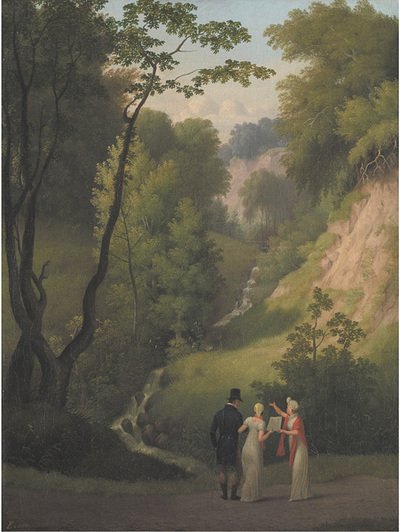
View of the Park of Liselund Manor on the Island of Møn by Christoffer Eckersberg ( 1809)

Another of his paintings depicting a scene on the island of Møn was View of the Park of Liselund Manor on the Island of Møn. This is acknowledged as one of the most romantic and picturesque views of the gardens at Liselund Manor.  Liselund is a landscaped park, in which there are several exotic buildings and monuments. The park is situated close to Møns Klint on the northeast side of the island.  The park was created in the 1790s by French nobleman Antoine de Bosc de la Calmette for his wife Elisabeth, commonly known as Lisa, and Liselund, roughly translated, means Lise’s grove.  The park is considered to be one of the finest examples in Scandinavia of Romantic English gardening.  Before us we see the cleft with the small waterfall which is framed by luxuriant trees.  In the foreground we see three visitors to the park fascinated by what they see before them.  The format of this landscape painting is unusual with it being portrait format instead of the usual landscape format.

Having completed his paintings of the island of Møn, Eckersberg set off on his Grand Tour of Europe, the first stop of which was Paris.  What Eckersberg soon learnt was that the new contemporary French painting of the time was so radically different to that of his Danish role models, Juel and Abildgaard. French paintings had a greater clarity of colour, bright light and clear-cut contours.  One of the stars of French art at this time was Jacques-Louis David and Eckersberg, through his patron had not only arranged for him to meet the great Neoclassical-style painter but had also had arranged for Eckersberg to be tutored by him in his life classes where students were taught how best depict the human body and the resulting change in a manifest change to Eckersberg’s style of history painting.

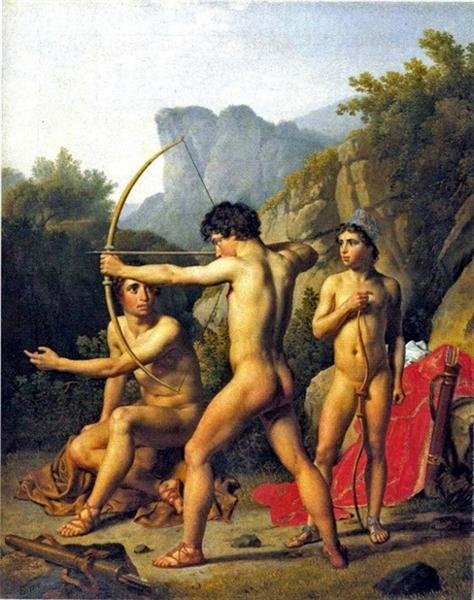
Three Spartan Boys by Christoffer Eckersberg (1812)

Eckersberg’s time spent in Jacques-Louis David’s life classes must have honed his skill for that type of art as in 1812 he produced Three Spartan Boys.  This was one of the first paintings in which he translated what he had learnt at those life classes of David.  A year after completion, the painting was exhibited in Copenhagen with the title, Three Spartan Youths Practicing Archery.  Etude from Nature.  The first part of the title ensures the painting is looked upon as a history painting but the second part of the title alludes to the fact that it is a modified and elaborated figure study.  See how the three youths strike different poses and we, as viewers, see them from different angles and thus admire the artist’s skill at his depiction of their bodies.  Note to the inclusion of a landscape background to this work.

Leonidas at Thermopylae by Jacques-Louis David

Such an inclusion could be the result of Eckersberg having studyed the works of Jacques-Louis David who would also add landscape backgrounds to his historical paintings, one example of which was his painting entitled Leonidas at Thermopylae which Eckersberg probably only saw an unfinished version as it was not completed until 1814.

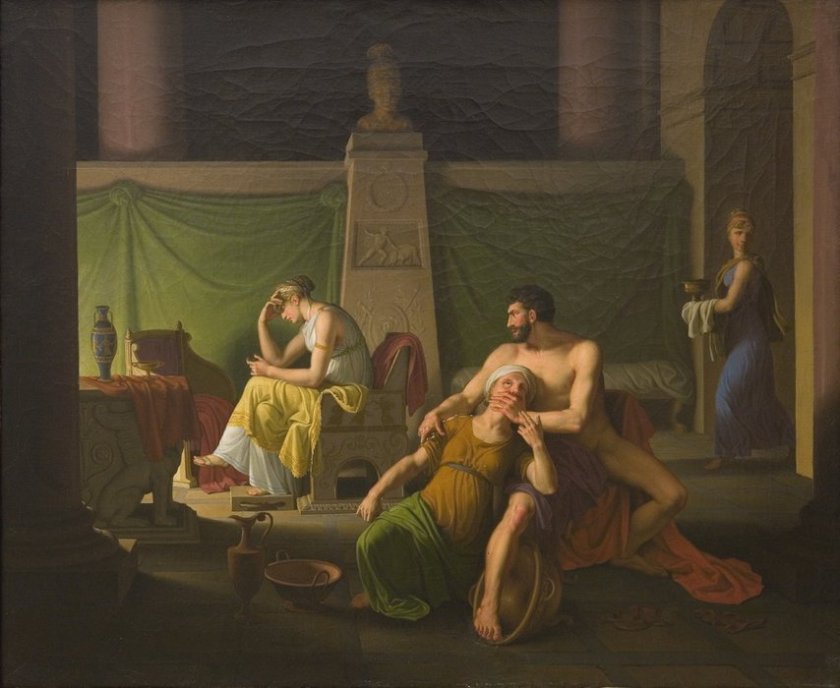
Odysseus' Homecoming. Scene from the Odyssey XIX song, by Christoffer Eckersberg (ca. 1812)
Odysseus’ Homecoming. Scene from the Odyssey XIX song, by Christoffer Eckersberg (ca. 1812)

Another of Eckersberg’s historical paintings at this time was one entitled Odysseus’ Homecoming. Scene from the Odyssey XIX song, which he completed around 1812.  Book XIX of the Odyssey tells of the return of Odysseus, in disguise as a poor beggar to his home and to his erstwhile wife Penelope.  Odysseus continually refers to Penelope as the honourable wife of Lord Odysseus.   Odysseus has a bath and helped by his old nurse Eurykeia who recognizes a scar on Odysseus’ thigh and therefore knows the beggar is her lost master. Odysseus grabs her by the throat and tells her to keep what she saw from all others or else he will kill her.   In his painting, Eckersberg captures the moment when the old nurse is about to blurt out Odysseus’ name and so he covers her mouth with his hand as he looks over to Penelope to see if she has been alerted to the nurse’s discovery but she has her head in her hand still grieving for her lost husband.

Pont Royal seen from Quai Voltaire by Christoffer Eckersberg (1812)

Whilst in Paris Eckersberg did complete a number of historical paintings but his love for landscape work was not forgotten and in November 1812 he produced a beautiful painting entitled Pont Royal seen from the Quai Voltaire from sketches he made that summer.  It is a view from the Left Bank of the Seine looking across the river towards the Louvre and the Tuilleries.  As a landscape it is a change of style for him. It is an early example of his use of linear perspective which allowed him to give a sense of depth to the depiction.  As an artist and recorder of a view, he has adopted a very soberly observed position.  The details in the work are given to us in far greater detail than his usual landscape style.  He portrays light shining in from the left casting numerous shadows and his depiction of the clouds bears witness to his careful inspection of nature.  The painting was exhibited at Charlottenborg in Copenhagen in 1814.
In my next blog I will follow Eckerberg’s journey to Rome and look at more of his works of art.

Samuel Palmer. Part 2 The Shoreham Ancients, William Blake and later life

Samuel Palmer by George Richardson (1829)

Samuel Palmer was seventeen years old when he met the painter John Linnell and they would remain friends for life, a period stretching almost sixty years, albeit on occasions their relationship was somewhat strained during Palmer’s marriage to Linnell’s daughter. Linnell was born in London in 1792.  His background was very different to the middle-class prosperity of Palmer’s family.  His father, although a respectable carver and gilder, was not a wealthy man and whereas Palmer, who lived in the semi-rural outskirts of London, and was indulged and pampered by his parents, Linnell had to survive the murkiness of the depressing bleak streets of Bloomsbury.   Linnell was a landscape artist and portrait painter who found himself constantly in competition with the great John Constable.  At the time Linnell met Palmer the latter had rather lost his way artistically. Palmer wrote honestly about his worries regarding his art:

“…by the time I had practised for about five years I entirely lost all feeling for art … But it pleased God to send Mr. Linnell as a good angel from Heaven to pluck me from the pit of modern art…”

John Linnell inspired Palmer.  He offered artistic advice and instruction.   He took him to art galleries and introduced him to other artists, most notably William Blake who was to have a profound influence on Palmer.
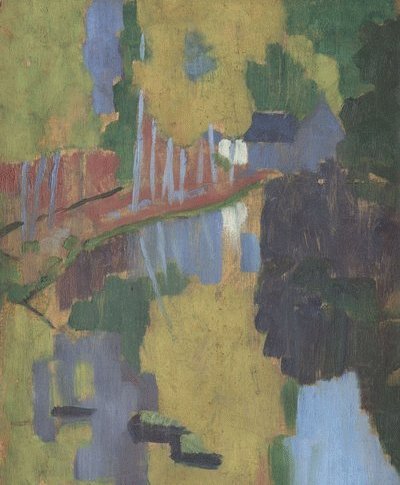
The Rising of the Lark by Samuel Palmer (c.1839)

Linnell’s mentoring of Palmer was of great importance as it was Linnell who brought to the attention of Palmer  the artists of the late Gothic and early Renaissance periods, such as Albrecht Dürer, and the fourteenth century muralists, Francesco Traini, Buonamico Buffalmacco and Benozzo Gozzoli who were responsible for decorating the cemetery, Camposanto Monumentale in Pisa, Italy.

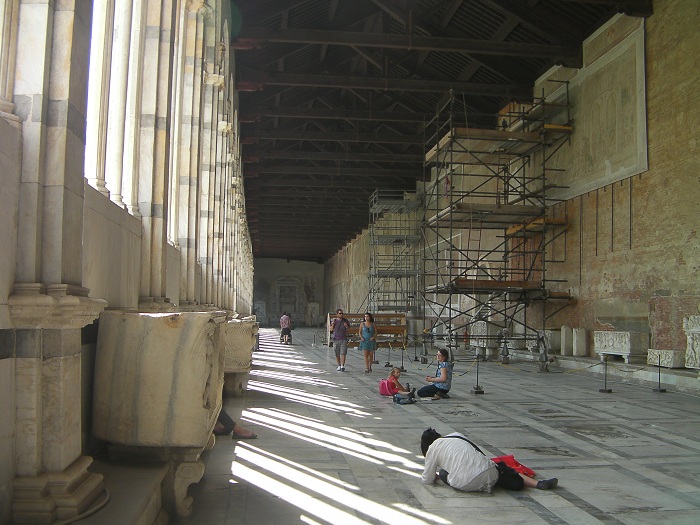
Interior hallway of Campo Santo showing restoration work of some of the murals

This magnificent building was said to have been built around a shipload of sacred soil from Golgotha, brought back to Pisa from the Fourth Crusade in the 12th century.  An inscription near the right gate tells us that the construction of the Camposanto started in year 1277 and finished in the late 15th century.

Another influence on Palmer around this time was the works of art of Henry Fuseli.  The National Gallery in London was not built until 1824 so Palmer would spend time at the Dulwich Gallery (opened in 1817) copying the works of the Masters and was fortunate to be allowed to view the private collection of the German merchant and insurance agent Carl Aders which included many works by artists of the Primitives movement.  However one of the greatest influences on Palmer was William Blake.  Blake was introduced to him by Linnell in 1824, who at the time, because of his art work, was viewed by many of the art establishment as an obscure and impoverished figure and thought to be just a harmless madman.  Palmer had always been a visionary and this was enhanced once he entered the world of William Blake

Early Morning by Samuel Palmer (1825)

In 1824, Palmer’s health once again deteriorated.  He suffered from asthma and bronchitis, and so he decided to follow his mother’s old remedy of leaving London and heading to the South Coast.  He visited the Kent village of Shoreham, and two years later he moved there permanently, buying himself a small run-down house, which he called Rat Abbey maybe because of his fellow dwellers in the old building!  A short time later, his father sold up his book selling business and left London and joined his son in Shoreham.  He rented half of a large house with the name Waterhouse which was situated on the banks of the River Darent.  Samuel Palmer’s nurse, Mary Ward, and his brother William joined Samuel snr. and also came to live there. The Water House proved to be of use to Samuel as it often housed visiting guests and fellow artists when there was no room at Rat Abbey.  Finally in 1828 Samuel Palmer left his small house and went to live with his father at Water House and stayed there for the rest of his time in Shoreham and it was during those heady days in Shoreham that Samuel first encountered John Linnell’s daughter Hannah whom he would later marry.  Palmer loved his new home and we can witness his contentment shown in his autobiographical letter published in The Portfolio art journal of that time.  He wrote:

“…Forced into the country by illness, I lived afterwards for about seven years at Shoreham, in Kent, with my father, who was inseparable from his books, unless when still better engaged in works of kindness. There, sometimes by ourselves, sometimes visited by friends of congenial taste, literature, and art and ancient music wiled away the hours, and a small independence made me heedless, for the time, of further gain; the beautiful was loved for itself …”

It was during his time in Shoreham that he founded, along with George Richmond and Edward Calvert, an artistic group of painters that were all inspired by William Blake.  The group were known as The Ancients or the Shoreham Ancients.  They were an artistic brotherhood who would meet both in Shoreham at Palmer’s home and at Blake’s apartment home in London.  This like-minded group of painters were followers of William Blake and were attracted to archaism in art, a style which has the deliberate intention to emulate a style of the past to suit contemporary vision.  With the exception of Palmer, most of the members of the “brotherhood” were former students of the Royal Academy, who had broken away from the confines of academic teaching and concentrated on their idealized vision of the past.

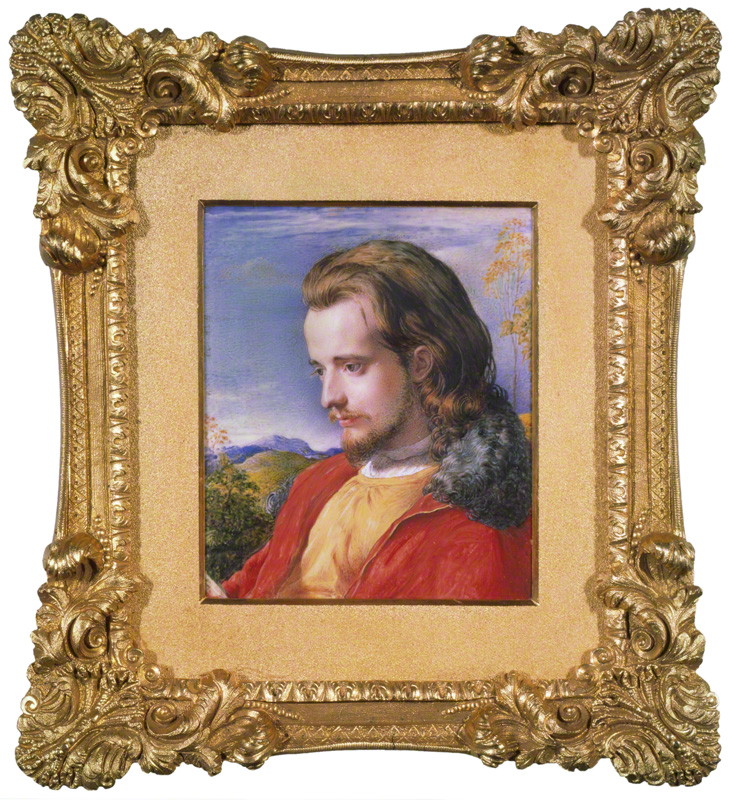
Samuel Palmer by George Richmond, watercolour and body colour on ivory, 1829
Samuel Palmer by George Richmond, watercolour and bodycolour on ivory, 1829

The Ancients were in existent around the same time as another art group was formed in Rome by some nineteenth century German painters.  They were known as the Nazarenes a derisory title which was used against them by detractors because of the biblical manner in the way they dressed and their Christ-like long hair and beards.  Samuel Palmer used to wear revivalist-type clothes and in a portrait in the National Portrait Gallery in London we see him with long hair and a full beard wearing a round-necked pleated smock under a coat.  It was during this time that critics believe that Samuel Palmer created his best works of art.  They were small landscapes which were almost composed of just a single colour using watercolour or ink. The depictions enforced Palmer’s religious belief which identifies God with the universe, or regards the universe as a manifestation of God and all the food derived from the fields were gifts from God.

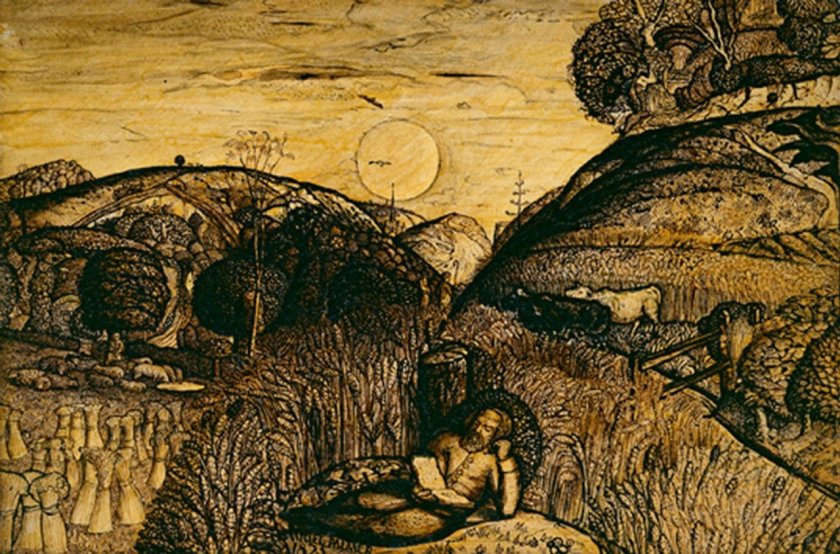
An example of a Samuel Palmer painting of this time and type is one he completed in 1825 entitled The Valley Thick with Corn which is part of the six so-called Oxford Sepias, a group which now belongs to the Ashmolean Museum in Oxford.   The six pictures were completed between 1825 and 1835 at a time when Palmer found inspiration in the landscape around his home village of Shoreham.  The area was inspirational for him and it allowed him to produce, what some believe to be, some of the greatest English pictures of the 19th century.

The Valley Thick with Corn by Samuel Palmer (1825).

The Valley Thick with Corn is a beautiful brown ink pen drawing which has been finished off with a layer of varnish.  This coating has aged over the years and has now given the work a rich yellow-brown finish.  The setting for the painting is undulating cornfields.  The darkness of the picture suggests it is late evening with the full moon rising over distant rounded hills and a tall thin church spire. A horse drawn cart can just be made out in the top left of the picture, as it trundles up a steep track.   In the foreground we see an elderly bearded man dressed in what looks like Elizabethan clothes lying on the ground surrounded by ears of corn.  He is stretched out and rests on his elbow.  On his lap lies an open book so he could be reading, albeit he looks as if he has fallen asleep.  Behind and to the right of him we see two cows slowly making their way through the cornfields.  To the left, in the mid ground, we see upright sheaves of corn which have been harvested and awaiting collection and behind them are sheep tended by the shepherd who sits under a tree and plays music to them on his pipes.

In a Shoreham Garden by Samuel Palmer (1830)

In 1829 Palmer completed his work entitled In a Shoreham Garden.  It is a wonderful work at a time which is looked upon as the height of Palmer’s achievements. The picture is a small watercolour heightened with gouache on stiff smooth cardboard often referred to as Bristol Board.  The work, measured just 28 x 22 cms and remained in Palmer’s own collection, no doubt in memory of Shoreham, the village he had loved so much.   It now resides in Oxford’s Ashmolean Museum.  It is full of light and colour with the dominating feature being an apple fruit tree in full blossom on the end of a path within a walled garden.  The tree is loaded with flowers.  In fact, besides the side of a wooden building in the right foreground the picture is an abundance of colourful flowers, bushes and trees which reach up to the sky.  In the background we see a lady wearing a long flowing red dress gazing out to something out of view to the right of the painting.  It is thought that the painting was a scene from the garden of his and his father’s Water Garden house.  It is now part of the V&A collection.

The Magic Apple Tree by Samuel Palmer (1830)

What is thought to be a companion piece to In a Shoreham Garden is one of his other 1830 works, The Magic Apple Tree.

Cornfield by Moonlight, with the Evening Star by Samuel Palmer (c.1830)

Around 1830, Palmer also completed a work entitled Cornfield by Moonlight, with the Evening Star.  It was a small painting measuring just 19 x 30cms.  The painting is now considered one of Palmer’s finest moonscape paintings.  We see a man carrying a staff, dressed in a long smock and wearing a wide brimmed hat walking through a cornfield with his dog.  In the foreground there are again sheaves of corn.  The sky is dark, lit up by a waxing sickle moon and an evening star, which could be, because of its brightness, the planet Venus.  The light emitting from the moon is probably much stronger than it would be for such a moon but it serves to illuminate the land.  There is no documentation to tell us the location of the scene but the rolling hills we see was characteristic of the Shoreham area.

In 1835, after ten years in the Kent village, Palmer left Shoreham and went to live back in London.   He had hoped to earn some money by selling some of the work he had accumulated whilst at Shoreham and he also hoped that he would be able to make some money by teaching art in the capital.

Samuel Palmer and Linnell’s eldest daughter, Hannah, married on 20th September, 1837 after an engagement which lasted several years.  Linnell had always been supportive of the match unlike his wife who was somewhat opposed to the liaison.  Samuel Palmer, funded by his new in-laws, and his new wife Hannah set off on their honeymoon to Italy in October 1837, a journey which would last two years and one that Palmer’s mother-in-law was vehemently opposed to..

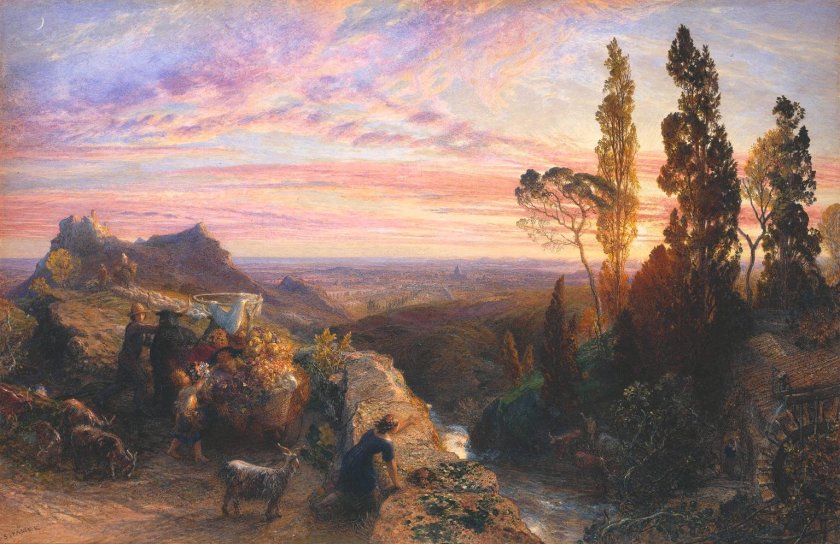
 Dream in the Apennines by Samuel Palmer (1864)
Dream in the Apennines by Samuel Palmer (1864)

A later painting by Samuel Palmer, one of his largest watercolours measuring 94 x 130cms, may have come from sketches he made during the honeymoon.  It was exhibited in 1864 and entitled Dream in the Apennine.  The depiction is a view of Rome as seen from the south-east.  It is now owned by the Tate in London.  When it was first exhibited it came with a note which read:

“…Suddenly, at a turn in the mountain road, we looked for the first time on that Plain; the dispenser of law, the refuge of philosophy, the cradle of faith. Ground which Virgil trod and Claude invested with supernatural beauty was sketched – but with a trembling pencil...”

In the foreground we see a young girl peering over the edge of a stone wall at the fast flowing river below.  She is throwing stones into the valley below.  There are goats standing behind her which may well be in her charge.  Behind and to the left of the girl we see a fully laden cart being pulled by a pair of mighty oxen which are being controlled by a young man.  A small child rushes towards the cart to add a few more bunches of flowers to the already filled large wicker baskets.  In the distance, on the plain we can see the Eternal city and the dome of St Peter’s Basilica.

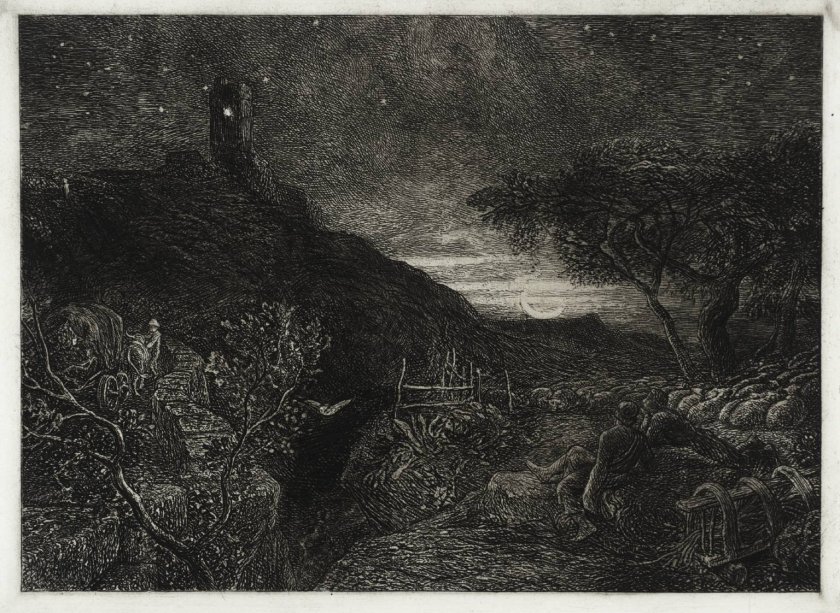
The Lonely Tower by Samuel Palmer (1879)

The last work of Samuel Palmer which I am looking at was an etching which he completed in 1879 entitled The Lonely Tower.  The scene before us was first exhibited as a watercolour at the Watercolour Society by Palmer in 1868.  Along with the watercolour there was a quotation from Il Penseroso (The Serious Man), a poem by Palmer’s favourite poet, John Milton.

“…Or let my lamp at midnight hour,

Be seen in some lonely tower,

Where I may oft outwatch the Bear,

With thrice great Hermes…”

Palmer and his family were living at Furze Hill House in Reigate and from his study he could look out towards Leith Hill and the folly, built in 1765 which is at its summit.  It could be this that he saw when he painted The Lonely Tower.    It is a depiction of a remote hilltop tower standing on the edge of a cliff with its single light shining out against a darkening sky.  It is now the remains of what once had a greater purpose.  We see a crescent moon against a horizon which is filled with clouds and stars which sparkle brightly.   Below and to the left of the light we see a man struggling to get his ox-cart up a steep track.  On the opposite side of the deep ravine we see two shepherds gazing up at the light and the night sky.  Flying over the ravine we see a barn owl. It is such an atmospheric and haunting picture. The Irish poet W B Yeats referred to the work in his poem Phases of the Moon:

“…He has found, after the manner of his kind,

Mere images; chosen this place to live in

Because, it may be, of the candle-light

From the far tower where Milton’s Platonist

Sat late, or Shelley’s visionary prince:

The lonely light that Samuel Palmer engraved,

An image of mysterious wisdom won by toil;

And now he seeks in book or manuscript

What he shall never find…”

This was by far the most evocative of Palmer’s late works.

Leith Hill Folly
Leith Hill Folly

Hannah and Samuel’s first son was born on January 27th 1842.  He was named Thomas More Walter George Palmer, Thomas More, after the famous fifteenth century statesman and philosopher who was councillor to Henry VIII, and George after Samuel’s good friend George Richmond.  He was a boy who grew to be a studious young man during which time he survived many boyhood scrapes whilst in Grammar school prior to going to Oxford University.  Sadly his father’s dream that his son would get to Oxford was dashed when the young man’s health deteriorated in 1859 and eighteen months later, after a long and painful illness, died on July 11th 1861.  He died at the tender age of nineteen.  Both Hannah and Samuel were devastated.  Samuel Palmer never got over his loss.  In his work The Lonely Tower the Great Bear star constellation depicted in the sky in the background is said to be as it was on the night his son died and as he looked skyward in grief. It was forever engraved on his mind.

The couple had another son Alfred Herbert Palmer who was born in 1860.  He went on to publish a biography of his father The Life and Letters of Samuel Palmer in 1892.

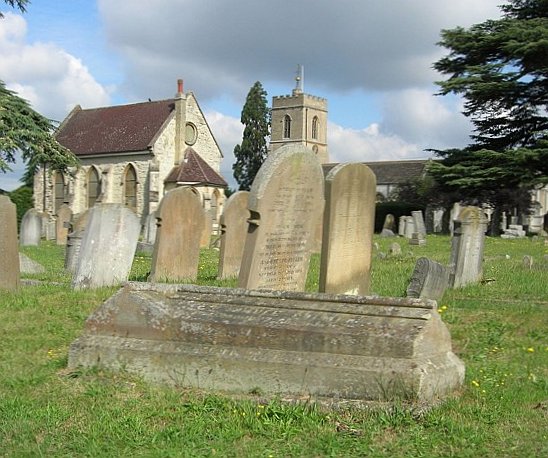
Samuel Palmer's grave in St Mary Magdalene Church Reigate
Samuel Palmer’s grave in St Mary Magdalene Church Reigate

Samuel Palmer died on May 24th 1881 aged seventy-six.  Palmer’s father-in-law and mentor John Linnell died six months later.  Palmer’s wife Hannah died twelve years later and the two are together in a cemetery in St Mary Magdalene churchyard in Reigate.  A strange twist to this story is the fact that in 1909, many of Palmer’s Shoreham works were destroyed by his surviving son Alfred, who burnt a great quantity of father’s sketchbooks, notebooks and original works. His reasoning behind the destruction was that he believed that nobody would not be able to make head nor tail of the material and that he wished to save it from a more “humiliating fate”.   Alfred Herbert Palmer died in 1931.

Samuel Palmer in Old Age by John Linnell

There is so much about Samuel Palmer I haven’t included in the two blogs but I hope that there is enough in them to tempt you to read more about the artist and I recommend an excellent book which will tell you all you about the great man.  It is written by Rachel Campbell-Johnston the chief art critic and poetry critic for the Times.  The book is entitled Mysterious Wisdom.  The Life and work of Samuel Palmer.

Samuel Palmer Part 1. The Early years, portraiture and the rural idyll

The Prospect by Samuel Palmer (1881)

My featured artist today is one of the great English landscape painters, draughtsmen and etcher of the nineteenth century.  He was a major player in the art of Romanticism.  His landscape works were special, conjured up by his inventive and far-sighted imagination.   There was a magical feel about his work.  Palmer was not just an ordinary every day painter; his works were poetical and he himself, through his art, seemed to have the ability of a mystical seer. Let me introduce you to Samuel Palmer.

At the time of Samuel Palmer’s birth there was a worrying tension brought on by conflict.  It was a troubling time.  It was a time of tumult in Europe.  Sixteen years earlier France had been affected by the storming of the Bastille and the fall of the rich and the nobility of the ancient regime.  Initially, there was probably a delighted sense of schadenfreude in the minds of many in England, including the “establishment” at the fall from grace of what they perceived was the cruel and greedy French aristocracy but soon that enthusiasm dwindled with the thought that such revolutionary behaviour may cross the English Channel.  In 1793, twelve years before Samuel was born France declared war on Britain, a war which would last more than two decades.  Although the battlefields were not in England Napoleon Bonaparte used another weapon against the British by blockading European ports and by so doing deprive Britain of lucrative trade.  The war however proved fortuitous to Samuel’s family who were hatters and hats were in great demand since the government, to add to their much needed war chest, had imposed a hair powder tax and this ended the era when elegantly puffed and powdered coiffures which were once de rigueur, now could not be afforded.  The fashion was now for the “topper”, the nickname given to top hats.

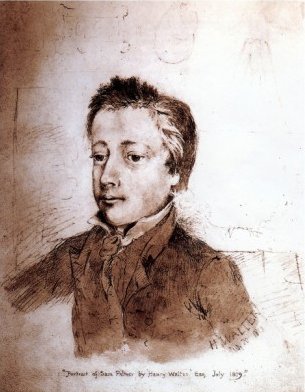
Portrait of Samuel Palmer by Henry Walter (1819)

Samuel’s father, also named Samuel, had set forth to study to become a surgeon but his squeamish nature put an end to that dream and he ended up in his father, Christopher Palmer’s, millinery business.  Samuel Snr. was somewhat of a dreamer and this along with his love of books led him to forego the safe and lucrative job as a hatter to set himself up as a bookseller.  This decision did not go down well with his family as the trade of a bookseller seemed a lowly trade not fit for a “gentleman”.  Samuel Snr. was, besides being a dreamer, a very determined person and cared little about status and the financial position of his family.

Samuel Palmer Snr. met and fell in love with Martha Giles and they married in October 1803.  Samuel Palmer, their first child, was born in Newington, London on winter Sunday morning, on January 27th 1805.  The couple lived in Surrey Square in Newington, which at the start of the nineteenth century, was a semi rural area populated with lush gardens, fields and orchards.  It was a haven for those who loved the countryside; a love young Samuel would have all his life.  It was a time when survival at birth was somewhat of a lottery with a third of babies not surviving to see their first birthday and amongst the poor and deprived the survival rate would drop even further.  However Samuel Palmer was lucky in as much as he was born into a prosperous middle-class family.

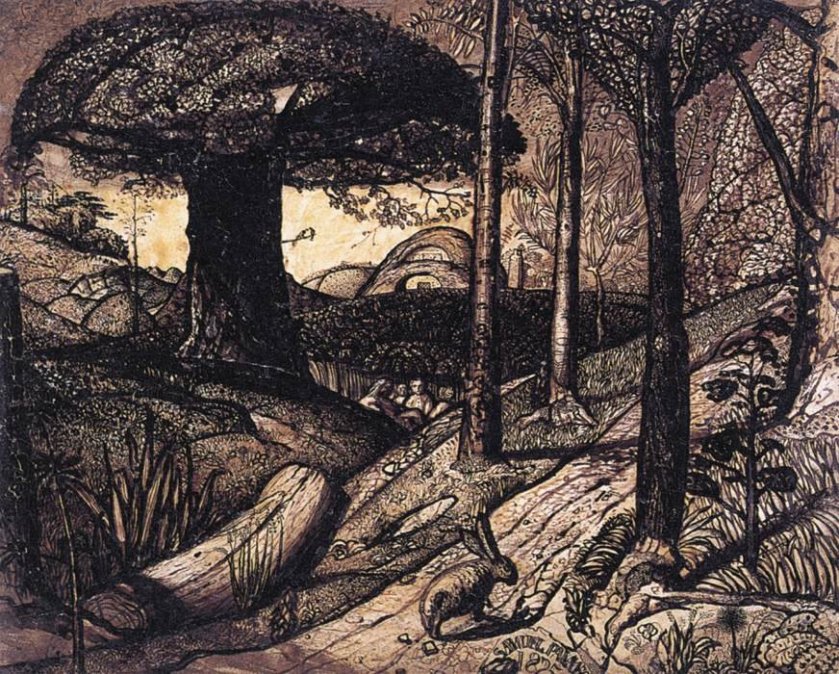
Early Morning by Samuel Palmer (1825) Pen and ink and wash, mixed with gum arabic, varnished,
Early Morning by Samuel Palmer (1825)
Pen and ink and wash, mixed with gum arabic, varnished,

Samuel was not a healthy child and his mother and grandmother would often take him to the Georgian seaside resort of Margate in the hope that sea air would improve his health.  This once fishing town was a favourite of Turner.  It was during his boyhood stays in Margate that he would listen to his grandmother’s tales of ghosts and restless spirits who wandered around the town.  Stories of such apparitions would remain with Samuel and would interest him all his life.  His mother’s continued concern about her son’s physical health led her to employ a live-in nurse, Mary Ward, who set about improving his health by improving his diet.   It was also this lady who was to have such an influence on the young boy.  Unlike most servants who were illiterate Mary was well read with the Bible and Jacob Tonson’s pocket illustrated book of Milton’s poems being her favourites.  She, like Samuel’s father, loved books and would often read Milton’s poems to Samuel.  When Mary died she bequeathed the book of poems to Samuel who would carry it round with him wherever he went.  Of Milton’s poems, Samuel wrote:

“…I am never in a “lull about Milton”…….nor can tell how many times I have read his poems… He never tires….I do believe his stanzas will be read in heaven…”

Samuel gained a brother in 1810 with the birth of William, who was to be the only other surviving child of Samuel Snr. and Martha.  Samuel Palmer did not have many boyhood friends as he was more than satisfied to immerse himself in his books, including works by Dickens, which featured the English capital.  It was a trait, which delighted his father.  Samuel would often go for walks on Dulwich Common with either his father or his nurse during which they would often read to him as they strolled the countryside.  His love for reading and the joy books brought him can be seen in one of his letters (The Letters of Samuel Palmer – Raymond Lister, 1974) in which he wrote:

“…There is nothing like books of all things sold incomparably the cheapest, of all pleasures the least palling, they take up little room, keep quiet when they are not wanted and, when taken up, bring us face to face with the choicest men who ever lived at their choicest moments…”

Samuel, maybe because of his poor health, tried to avoid the necessity of going into the heart of London with all its pollution from coal fires and the often dank fogs emanating from the Thames.  He was a lover of the countryside and being of poor health abhorred the polluted city life.

In May 1817, at the age of eleven, Samuel was sent to Merchant Taylors’ public school.  This was a prestigious institution founded back in 1561 but for Samuel it was a nightmare.  Samuel who had been cosseted by both his mother and nurse and had a quiet solitary home life, which suited his nature, suddenly was thrust into a maelstrom of lively and loud boys in which a pale-faced asthmatic boy fared badly.  Samuel disliked the public school system with all it entailed and in another of his letters he wrote:

“…the fag crawls to be kicked, and, in his turn, kicks the fag who crawls to him………it perfectly represents and so admirably prepares for the requirement of public life for what is statesmanship but successful crawling and kicking….”

His time at Merchant Taylors lasted only six months as his pleading to come back home was answered in the Autumn of 1817.

The death of Samuel’s mother in 1818 came as a harsh blow to her thirteen year old son.  He struggled to cope with the loss and shed many tears.  The loss of his mother came at the same time as he and his father considered what career he should follow.  Samuel favoured becoming an author.  He had already written some prose and poetry and although the latter never attained the quality required to have them published his stylistic prose gave him hope of a fulfilling career.  However it was not to be as his father believed, because of his son’s early talents as a draughtsman that the visual arts should be the career his son should follow.  The family’s decision that Samuel should follow a career in art was thought to have been down to a belief that it was what his mother would have liked her son to do.

Entrance of the Meuse: Orange-Merchant on the Bar, Going to Pieces; Brill Church bearing S. E. by S., Masensluys E. by S. by J W Turner (1819)

The family employed William Wate, a run-of-the-mill landscape artist, to tutor Samuel.  In 1819, when Samuel was just fourteen, he made his first visit to the Royal Academy Summer Exhibition.  He was amazed by the colour in Turner’s painting of the Entrance of the Meuse and fascinated by Turner’s Liber Studiorum, a series of his landscape and seascape compositions which were published as prints in etching and mezzotint, has been once described as perhaps comprising of ‘the pith of all that is best in his life and work’.

At this time Palmer was just a developing artist who was still learning the basic skills of art through Wate’s tuition.

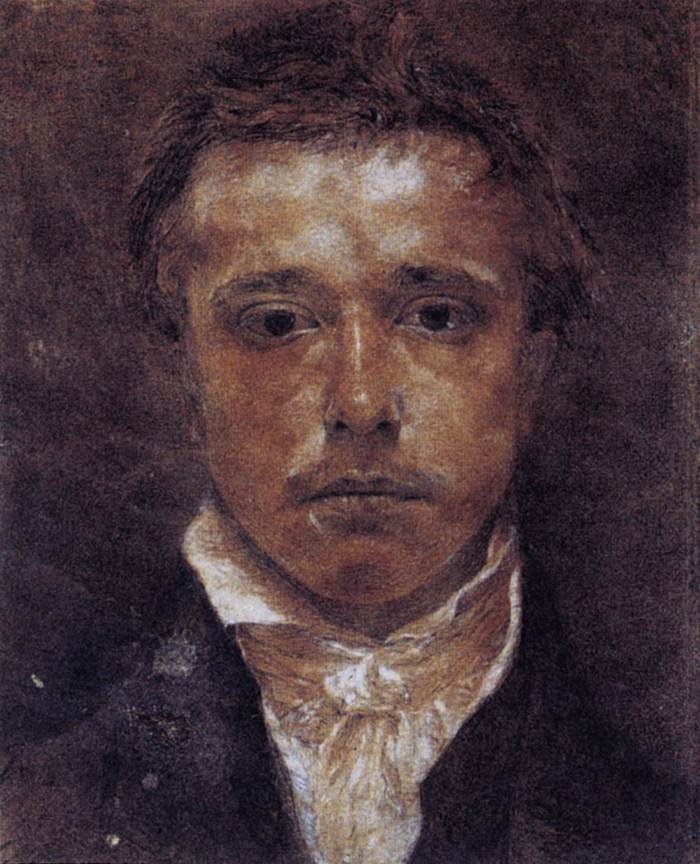
Samuel Palmer a Self-Portrait (1826)

I recently attended a portraiture workshop at which the guest artist and presenter talked about how the portrait he would produce would not necessarily be a photographic image of the sitter but how he envisaged the model.  With those words still in my head I gaze at Samuel Palmer’s self portrait which he completed around 1826 when he was twenty years of age.  Is this how he envisioned himself?  There is something quite disturbing about this self-portrait.  Palmer gazes directly towards us but it is a blank stare as if he is looking through us.  The question that immediately springs to mind is what is he thinking about.  What is going on in his mind as he looks into the mirror?   It is not an image one would associate with an aspiring artist who is looking forward to the future.  What is troubling him?  Look at his physical appearance.  He has not readied himself for the painting.  It is more of a “this is who I am, take it or leave it” stance.  He is unshaved.  His thick hair looks uncared for.  The collar of his shirt is crooked but he knows all this as he puts brush to canvas.  Maybe he wants us to disregard his physical appearance and concentrate on what could be on his mind.  We are looking at the face of a troubled dreamer.  We are looking at a man whose vivid imagination would influence his art and those who view some of his imaginative paintings will be transported into a magical world which in her book Mysterious Wilderness, The Life and Work of Samuel Palmer, the author Rachel Campbell-Johnston describes the artist and some of his works:

“…It is a place in which magical shines through the material, in which nature and heaven are intertwined, in which God in all his mildness blesses man’s harvests and the darkness of night can be innocent and day.  This is not the haunt of any workaday painter.  It is the home of the artist as mystic and seer and poet…”

The Shearers by Samuel Palmer (1834)

One of his best known works is The Shearers which he completed in 1835.  It is a painting which is rich in colour.  There is the juxtaposition of golden sparkling light and gloomy shadow.  I have already said the Palmer was looked upon as a seer and this painting was his vision of paradise.  Raymond Lister in his book, Catalogue Raisonné of the works of Samuel Palmer describes the work and a similar one entitled The Sleeping Shepherd which uses the same setting of the entrance to the barn we see in the above work:

“…A group of richly textured and abundantly coloured paintings of this period includes some of Palmer’s greatest and most attractive work. Such work reached its ultimate expression in The Shearers and The Sleeping Shepherd…”

Geoffrey Grigson, in his 1960 book Samuel Palmer’s Valley of Vision, wrote of the work:

“…Great richness of technique was used to realise The Shearers. In this Palmer combined oil and tempera so as to render every nuance of texture from the light on the distant hills and in the sky to the detailed depiction, almost Dutch in its realism, of the group of implements on the right. There is also an advance in the drawing of the figures, the shearers and their helpers; rarely if ever before this had Palmer portrayed figures so convincingly in movement…”

The setting of the painting is the great barn,  the doors of which are open and we look out at the scene before us.  The doors and the roof beam in some way form a frame for the painting.  A group of six people work in the shade of the trees outside the barn, three men and three women can be seen in the mid-ground.  The men are in the process of shearing the sheep whilst the women collect and bag the wool.  In the background we see an expanse of rolling hills which are lit up by the rays of the sun which light up the beautiful countryside.  Samuel Palmer never forgot his walks with his father over the hills and through the fields of Dulwich.   The idea for the painting must have been in his mind years earlier because he once wrote about his plans for depicting such a scene:

“…A group of different sex and age reaping, might be shewn in the foreground going down a walk in the field toward the above cottage island, and over the distant line that bounds this golden sea might peep up elysian hills, the little hills of David, or the hills of Dulwich or rather the visions of a better country which the Dulwich fields shew will to all true poets…”

Still life detail
Still life detail

In a way the painting is not just a rural landscape scene but part is also a still-life work in the way Palmer has painted the farming equipment inside the barn which we see on the right hand side along with a wide brimmed straw hat which the artist’s son, Alfred, said was one of his father’s most cherished possessions and an item which would appear in many of Samuel Palmer’s works.

In my next blog I will continue to look at the life of Samuel Palmer and explore the help he received from the landscape artist and portraitist John Linnell and  how he was so influenced by William Blake, the poet and painter who was an influential figure in the history of the poetry and visual arts of the Romantic Age.

Maurice Denis. Part 2 – Religion and his wife, Marthe

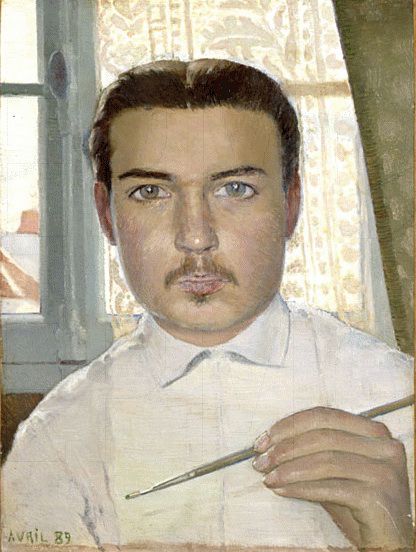
Portrait of the Artist Aged Eighteen by Maurice Denis

The year 1890 was the year Maurice Denis began to fall in love.  It was in this year that he met Marthe Meurier, a musician.  He had started to write a journal diary in 1884 and kept adding daily passages throughout his life.  In his diary entry for September 3rd 1891 he declared his happiness at being in love.  He wrote:

“…One feels more beautiful when one is in love.  The attitudes are easy and chaste.  Life becomes precious, discreet…”

And later the diary entry for November 8th 1891 shows his joy with being with Marthe and his love for her:

“…She is more beautiful than any picture, any representation, any subjective effect!  She exists outside of me, I am not the one who creates her…….Faith, love is an act of faith.  I believe in you Marthe…”

Le menuet de la Princesse Maleine ou Marthe au piano (Princess Maleine's Minuet or Marthe Playing the Piano). by Maurice Denis (1891)
Le menuet de la Princesse Maleine ou Marthe au piano (Princess Maleine’s Minuet or Marthe Playing the Piano).
by Maurice Denis (1891)

Denis would complete many portraits of his fiancé.  One of the first, completed in 1891, was entitled Le menuet de la Princesse Maleine ou Marthe au piano (Princess Maleine’s Minuet or Marthe Playing the Piano).  It is an interesting depiction of his fiancé.  She is in three quarter profile with her hands resting on the keys of the piano.  On the piano stand we see the frontispiece of some sheet music, the cover of which was designed by Maurice.  The Princess Maleine mentioned in the title of the painting was a character in a tragic and violent play written by Maurice Maeterlinck that year.  The book had obviously captured the imagination of Maurice’s fiancé as Denis wrote an entry in his diary that October:

“…She is reading again the Princess Maleine until two in the morning. She is pale, nervous, affectionate. Pains for me, and again doubts. Always doubts. Never mind, it’s life…”

The background wall is coloured using the technique known as pointillism, in which small, distinct dots of colour are applied in patterns to form an image.  This technique was developed by Georges Seurat and Paul Signac in 1886 (see My Daily Art Display Oct 21st 2011).  This painting is housed in the Musée d’Orsay.

Triple portrait of Martha by Maurice Dennis (1892)

Another interesting portrait of his fiancé was completed a year later in 1892.  It was entitled Triple Portrait de Marthe, fiancée.  In the painting we see three portraits of Marthe and by depicting Marthe’s images three times in the work Maurice had hoped to symbolise the different aspects of his fiancé’s personality.  He believed that a single portrait would only depict one characteristic whereas a multiple portrait gave him the chance to load the painting with many of her traits and, by doing so, depicting the uniqueness of his fiancé.

Triple Portrait of Yvonne Lerolle by Maurice Denis (1897)

Maurice Denis used the same technique later in 1897 when he completed Portrait d’Yvonne Lerolle en trois aspects (Triple Portrait of Yvonne Lerolle).  Yvonne was a friend of Denis and the daughter of Henri Lerolle and art patron and music publisher.  The artist recorded in his journal how he structured the painting, writing:

 “…Do the portrait of Y, making the foliage prominent and set the small tree further back so that it becomes more prominent and, at the same time, makes room for the smaller figures. 1. decide on a composition; 2. draw each part or essential element;  3. put the composition on to canvas with the modifications and patches of colour;  4. draw in chalk, charcoal, then in de-oiled paint, and in local colour;  5. rub down and then touch up. Give equal care to each operation. The advantage of this formula is that you only have to paint once and you can do each section individually…”

The description that accompanies the painting which is housed in the Musée d’Orsay states:

 “…Maurice Denis seems particularly fond of using “mise en abyme” as the image reduces: the paving stones in the foreground provide a reference point, as if everything beyond this becomes a variation on the image of the young woman. By portraying several phases in the life of Yvonne, Denis remains faithful to his love of allegorical representations of moments of existence, like those he had already done in the four paintings of his Seasons cycle (1891-1892, various locations). And, by reminding us, along with Mallarmé, Maeterlinck and Proust, that the true essence of a human being is the sum of his or her successive appearances, Denis reaches a pinnacle of Symbolist art…”

Mise en abyme is a formal technique in which an image contains a smaller copy of itself, in a sequence appearing to recur infinitely; “recursive” is another term for this.

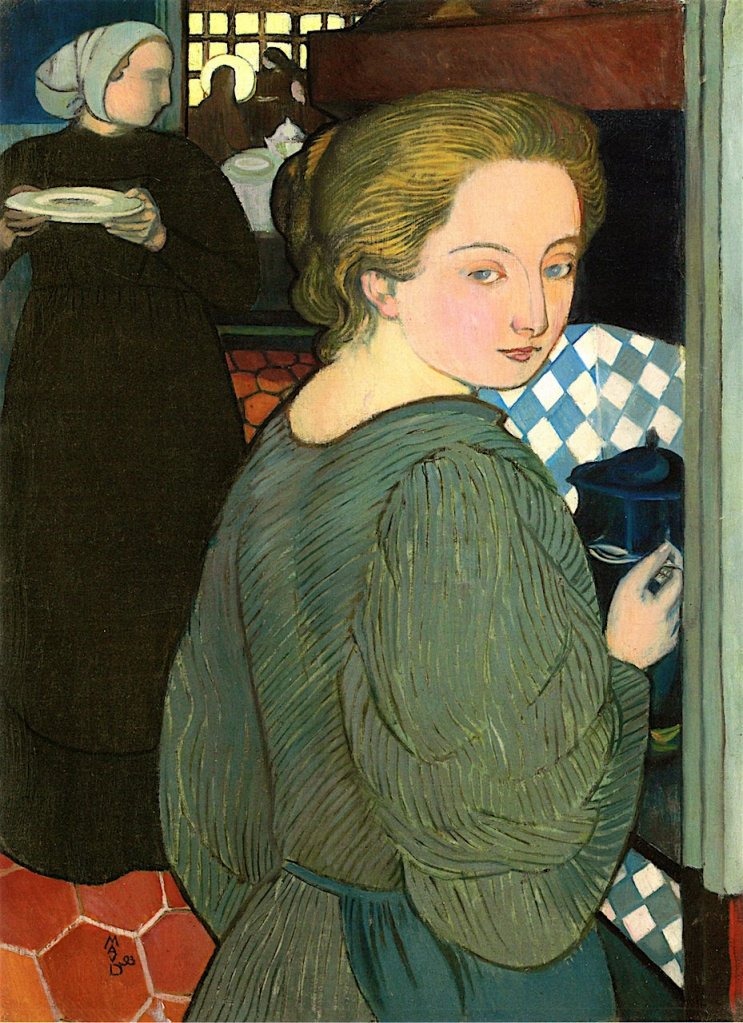
La Cuisinière by Maurice Denis (1893)

My next picture which I am showing you is La Cuisinière (The cook).  This also features Marthe Meurier, now his wife Marthe Denis,.  It was completed in 1893, the year the two were married.  Maurice Denis was brought up as a Catholic and one of the things that he must have found attractive about his future wife was her strong Christian beliefs.  Both were familiar with the Bible and although it may not be apparent at first sight, this picture has religious connotations.  It is typical of Denis’ early works being simply, as the Christie’s New York catalogue described it:

“…a plane surface covered with colors, a compositional tour-de-force in Denis’ oeuvre….. It also possesses a powerful narrative, one that carries several layers of meaning in the symbolist manner, pertaining to the artist, the cook, Brittany, the New Testament and the history of European painting…”

 After Maurice and Marthe married in June 1893 they honeymooned in a small rented house in the small Breton town of Perros-Guirec and the interior of the building features in this painting. Maurice decided to feature his wife working in the kitchen as he looked on her domestic expertise as a wonderful attribute.  He wrote in his journal the following year:

“…she carries out the essential household tasks with total dedication” while displaying her shy love and her taste for what is beautiful among humble domestic tasks…”

It is no coincidence that Maurice’s wife was named Marthe by her very religious parents.  It was the name of the woman in the New Testament who was known for her dedication at home.  We see Denis’ wife Marthe in the foreground working in the kitchen but look carefully at the background of the work and the silhouette against the window.  It is that of Jesus and Mary. Accoring to the bible, Jesus had come to visit the two sisters, Martha and Mary of Bethany.  In this painiting, Marthe Denis is portraying the character of Martha, who is hard at work in the kitchen.  The story according to the Gospel of Luke (10:38-42) sets the scene:

“… As Jesus and his disciples were on their way, he came to a village where a woman named Martha opened her home to him.  She had a sister called Mary, who sat at the Lord’s feet listening to what he said. But Martha was distracted by all the preparations that had to be made. She came to him and asked, “Lord, don’t you care that my sister has left me to do the work by myself? Tell her to help me!”

“Martha, Martha,” the Lord answered, “you are worried and upset about many things, but few things are needed—or indeed only one. Mary has chosen what is better, and it will not be taken away from her…”

However in this work, Denis has focused on the character of Martha rather than Mary.  The biblical tale focuses on Jesus’ support for Mary who was, rather than helping Martha with her kitchen chores, had chosen to just sit and listen to the words of Jesus.  As in most paintings depicting the threesome, Martha was cast as the bit player and although Jesus did not reproach her for complaining about her sister he said he could see no wrong in Mary’s choice not to help her sister.  Maurice Denis’ painting takes an opposing stand, casting Martha as the tireless worker who was looking after the needs of their respected visitor.  Having said all this, let us remember that this is first and foremost another portrait of Denis’ wife.

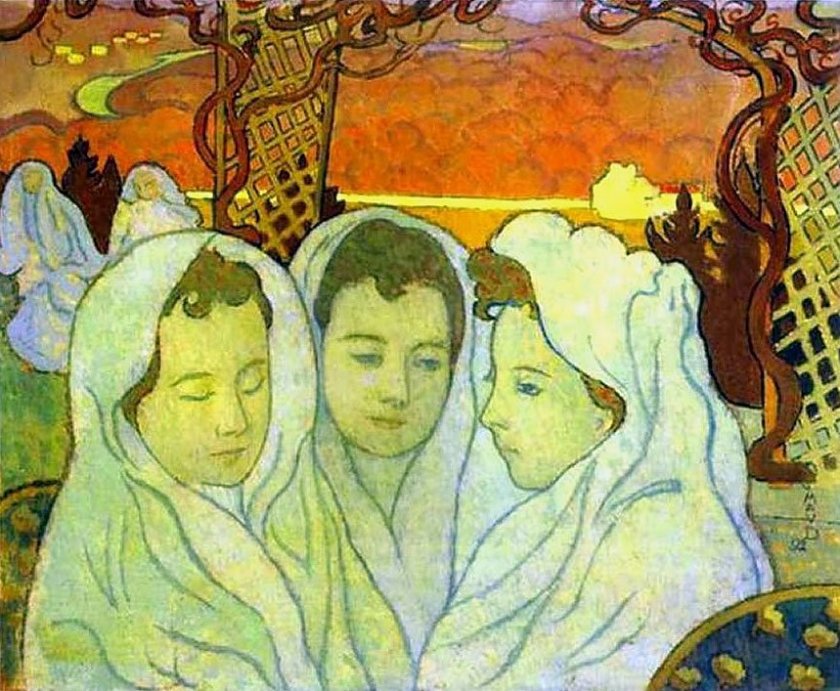
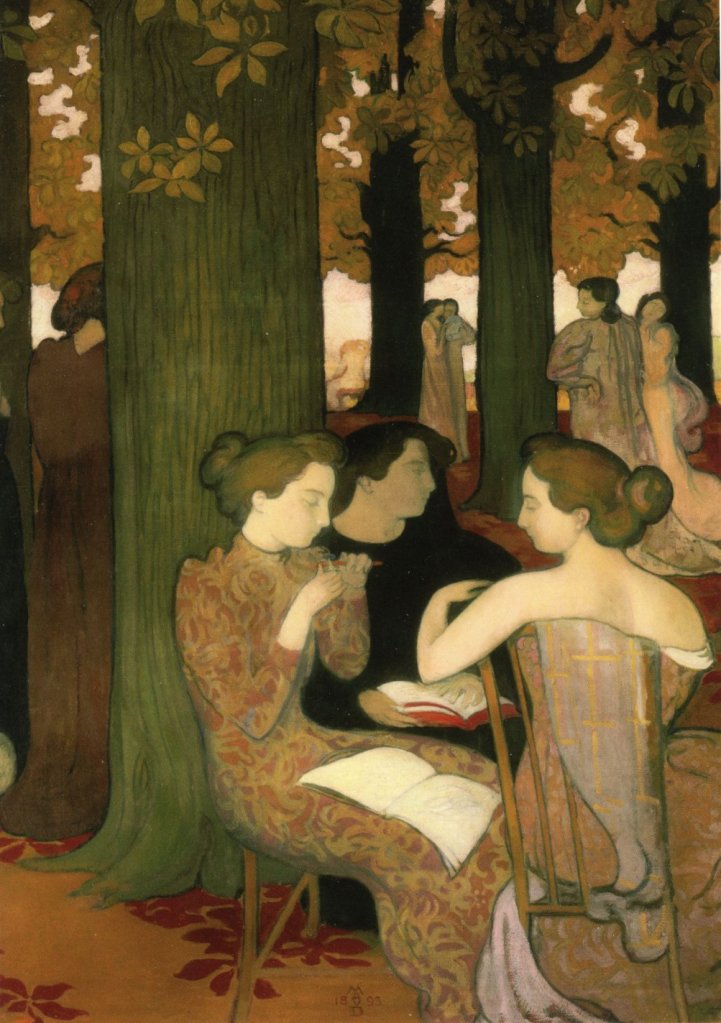
The Muses by Maurice Denis (1893)

On 12 June 1893 Denis married his great love, Marthe Meurier. The wedding reception was held on the terrace in front of the Pavilion of Henri IV in the forest of St-Germain-en-Laye, Paris, which had also been the setting for Denis’ major painting The Muses, completed earlier that year. This large decorative composition, measuring 171 x 138 cms, was both a significant representation of the artist’s style at the time, as well as a remarkable prefiguring of Art Nouveau, which emerged in the mid 1890s.  It is very noticeable in this painting that Denis had expanded his palette with much richer colours such as reds, greens and golds.  The Art Nouveau style can be seen in the way the artist has incorporated sinuous lines and decorative patterning of the trees, their trunks, and their leaves, which lie scattered on the ground like a carpet.  Maurice Denis had been commissioned to paint this work by Arthur Fontaine, a French government official.  The title of this painting, The Muses, derives from Greek mythology and refers to the nine goddesses of literature, science and the arts.  Each of the Muses had their own domain, one would be “in charge of” dance, one for comedy, one for literature and so on.  The Muses were considered the fund of knowledge which was embodied in the poetry, song-lyrics, and myths.  Denis used his wife, Marthe as a model for each of his three Muses in the foreground of this painting.  On the left of the trio we see Marthe with a sketchbook on her lap.  She is the Muse who is associated with art.  The depiction of Marthe with her bare back and shoulders on view to us, dressed in what looks like a ball gown, is the Muse of love.  The third Muse which Marthe portrays is dressed in black, her hair is covered with a veil and on her lap is an open religious book, maybe the bible or a book of prayers.  She is the Muse associated with religion.  In the background, amongst the trees, we see many more females walking about dressed in full length gowns and it is this which adds to the “otherworldly” character of the painting.

Decoration of the chapel of the College of the Holy Cross Vésinet by Maurice Denis (1899)

As I mentioned earlier both Maurice and Marthe Denis were devout Roman Catholics and much of his later art focused on religion.  He was determined to renew French church art.  French religious art had lost its popularity and was often cynically termed as the Saint-Sulpice style of art, named after the area in Paris surrounding the famous church which flooded the market with plastic religious relics.   After visiting Italy in 1910, Denis became greatly influenced by the works of the great Italian fresco painters of the 14th and 15th centuries and began to place emphasis on subject matter, traditional perspective, and modelling, which was contrary to the ideas of Les Nabis.  In November 1919 Maurice Denis and a contemporary of his, fellow artist George Desvallières, founded an artistic movement known as the Ateliers d’Art Sacré (Studios of Sacred Art).  The aim of this movement was to create church art once again and teach aspiring young artists to create paintings that would serve God and would decorate places of worship with tasteful religious works.   Maurice himself went on to complete works on canvas as well as murals for more than fifteen churches throughout France.  His artistic work was one of the chief forces in the resurgence of religious art in France.

Le Calvaire (La montée au Calvaire) by Maurice Denis (1889 )

One of his early religious works, which he completed in November 1889, is entitled Le Calvaire, or La Montée au calvaire (Calvary, also called Road to Calvary).  It is a painting of great simplicity.  The structure of the composition is a rising diagonal which runs from the bottom right of the painting with the group of women, black clad nuns, and moves diagonally up to the top left of the work to the top of the upright of the cross.  One is not given any pictorial detail of the women who slowly follow the procession.  They just merge together to form a black mass of people as is the gathering of the lance bearing Roman soldiers we see in the right background.  This anonymity of the women makes for a more haunting image.  In the mid-ground we see Jesus forced to his knees by the weight of the cross.  Mary his mother has moved to him, embraced him and offered her support.

The dome of the Theatre Champs-Élysées

In 1911 Maurice Denis was commissioned to carry out paintings and murals for the soon to be built Theatre des Champs-Elysées which opened in 1913.  The theatre is made up of three separate theatres.  The largest theatre was for symphony concerts and operas whilst the two smaller theatres stage repertory theatre.  The Art Deco building was designed by a talented group of artists.  The architect was initially Henry van der Velde but later taken over by August Perret and his brother.  Antoine Bourdelle looked after the bas relief sculpture work on the outside, Maurice Denis designed the massive cupola dome with its immense mural decorations whilst Édouard Vuillard was tasked with the paintings.

Maurice Denis' murals in L'Église du Saint-Espirit, Paris.
Maurice Denis’ murals in L’Église du Saint-Espirit, Paris.

One of the churches which Maurice Denis and some of the artists from the Ateliers d’Art Sacré, decorated, was the Église du Saint-Espirit which can be found in the 12th arrondissement of Paris.  The building was designed by Paul Tournon.  The construction began in 1928 and was completed seven years later.

The chapel at Le Prieuré

In 1918 Maurice Denis purchased the old General Hospital of Saint-Germain-en-Laye, which had been built by Louis XIV and Madame de Montespan.  Denis named it the Le Prieure (the Priory). Maurice’s wife Marthe died on August 22nd 1919 after being ill for several years.  Maurice Denis later painted murals on the walls of the chapel, which was part of the Le Prieuré, which he dedicated to her memory.

On February 2nd 1922, Denis married again.  His second wife was Elisabeth Graterolle, and she gave her husband two more children.   Maurice Denis died in L’hôpital Cochin in Paris after being taken there with injuries he sustained resulting from being hit by a truck on the Boulevard St Michel on November 13th 1943, just twelve days before what would have been his seventy third birthday.

There was so much more to write about this great French artists and so many more paintings I could have added but time and space dictate that I leave it there.  If you like what you have seen in my last two blogs, I hope you will take the opportunity to research further into the life and works of Maurice Denis.

Maurice Denis. Part 1 – Les Nabis

Self-Portrait with his Family in Front of Their House by Maurice Denis (1916)

Remember that a painting – before it is a battle horse, a nude model, or some anecdote – is essentially a flat surface covered with colours assembled in a certain order.

Maurice Denis

———————————————————————————-

Today I am looking at the life and some works by the great French painter, designer, printmaker and writer, Maurice Denis whose Christian upbringing had an influence on many of his works.  His writings on art theory and his paintings were to influence future painters and in some ways heralded the arrival of cubism, fauvism and abstract art.

Portrait of the Artist Aged Eighteen by Maurice Denis

Maurice Denis was born in November 1870 in the fishing port of Granville in the Manche department of north-west France.  This Normandy coastal town with its scenic coastline and its countryside hinterland were very picturesque and would feature in many of Denis works.  He was the only son of Constant Eugène Denis and Hortense Denis (née Hadde).  Maurice was born into a wealthy family and benefited from this by attending the best school and academies.

The Denis family, who had been living in Paris, had moved out of the French capital to avoid the Franco-Prussian war which culminated in the capital being besieged by the Prussian army in September 1870.  After the war the family returned to Paris and went to live in the western suburb of Saint Germain-en-Laye which was to be Maurice’s home town for the rest of his life.  In 1882, aged eleven, Maurice enrolled at the Lycée Condorcet, which was founded in 1803 and  was one of the four oldest and most esteemed high schools in Paris   Fellow students at the school were his future contemporary artists, Édouard Vuillard and Ker-Xavier Roussel and the future theatre director and set designer, Aurélien Lugné-Poe.  Maurice completed his secondary schooling in 1888 and due to his family’s financial status was able to enrol simultaneously in the École des Beaux Arts and the Académie Julian where one of his tutors was Jules Lefebvre.

Pluie en Bretagne by Maurice Denis (1889)

Also studying at the Académie Julian at that time was another aspiring artist, Paul Sérusier.  Sérusier, who was six years older than Denis, had also studied at the Lycée Condorcet high school.  During the summer of 1888 Sérusier had spent his time at Pont-Aven in Brittany, which was a popular meeting place for artists. It was during that summer stay that Sérusier met the French painters, Émile Bernard and Paul Gaugin.  Sérusier sat in on many conversations between Paul Gaugin, Louis Anquetin and Émile Bernard, the latter postulating many artistic theories which intrigued his listeners.  For Bernard, simplicity should be the key to paintings and both he and Gaugin would talk about what art genre should follow and differ from Impressionism which had been so popular during the late nineteenth century but it was around the late 1880’s that the Impressionist artists were starting to look at other styles of painting. Sérusier learnt about painting techniques whilst he was at Pont-Aven and one of the last paintings he did that summer was a small landscape work which he called The Aven River at the Bois d’Amour.  When he returned to Paris he explained to Maurice Denis and some of the other students that Gaugin had coached him during this painting and Sérusier quoted Gaugin’s words:

“…How do you see these trees? They are yellow. So, put in yellow; this shadow, rather blue, paint it with pure ultramarine; these red leaves? Put in vermilion…”

The Talisman, The Aven River at the Bois d'Amour by Paul Sérusier (1888)
The Talisman, The Aven River at the Bois d’Amour by Paul Sérusier (1888)

Gaugin’s advice to Sérusier was to strengthen the colour but at the same time make the form simpler.  Whereas Impressionists would want to paint what they saw and how natural light affected the scene, this was replaced by the artist searching for coloured equivalents.  Maurice Denis and some of his fellow students, Vuillard, Bonnard and Paul Ranson were fascinated by the work and the change of emphasis in the painting technique.  This to them was a new beginning.  They nicknamed Sérusier’s work “The Talisman”, as for them it was looked upon as a secret and magical object that would change their ideas on artistic technique.  This was an early example of Synthetism in art, a term used by Gaugin, often termed Cloisonnism , a term given to it by Édouard Dujardin, a writer and art critic, of the style developed by Bernard and Anquetin, inspired by both stained glass  and Japanese ukiyo-e prints.  It emphasized two-dimensional flat patterns which was totally different to the techniques used by the Impressionists.

Beauty in the Autumn Wood by Maurice Denis (1892)

Maurice Denis, Édouard Vuillard, Pierre Bonnard and Paul Ranson, the four students who had been amazed by the painting which Sérusier had brought back from Pont-Aven soon after formed themselves into art group and called themselves Les Nabis, which is a Hebrew word for “prophets”.  It was a kind of secret brotherhood committed to a type of pictorial Symbolism.  The term Les Nabis was thought up by the poet and physician, Henri Cazalis, who drew a parallel between the ways of the group of painters, as prophets of modern art, aspired to invigorate painting in the same way the ancient prophets had rejuvenated Israel. Other artists studying with Denis at Académie Julian, such as Odilon Redon, Félix Vallotton and Ker-Xavier Roussel also became part of Les Nabis.  This group of young artists were fundamentally opposed to the naturalism technique, the true-to-life style which involved the representation or depiction of nature and people with the least possible distortion or interpretation, which was taught by their Academy teachers.

Maurice Denis was a lover of art theory and at the time published an article, Définition du néo-tranditionnisme in August 1890 in the periodical, Art et Critique, in which he defended their new ideas on art and this became Les Nabi’s manifesto.  It was a definitive declaration which signified the founding philosophies of cubism and fauvism and set up the foundation for the theories of abstraction that would carry on expanding throughout the 20th century.  The article opened with the famous lines:

“…It is well to remember that a picture, before being a battle horse, a nude woman or some anecdote, is essentially a flat surface covered with colours assembled in a certain order…”

Nouvelles théories sur l'art moderne [et] sur l'art sacré, 1914-1921 by Maurice Denis
Nouvelles théories sur l’art moderne [et] sur l’art sacré, 1914-1921 by Maurice Denis

Denis would later, in 1922, publish a collection of  his historical and theoretical work in one book entitled Nouvelles théories sur l’art moderne, sur l’art sacré (New Theories of Modern and Sacred Art), often simply referred to as “Theories by Maurice Denis.”

Sunlight on the Terrace by Maurice Denis (1890)

Maurice Denis produced a small painting in 1889 entitled Sunlight on the Terrace which illustrated the style used by the Sérusier/Gaugin Talisman painting and the works on show at the 1889 Volpini Exhibition.    The story behind this exhibition and how it came into being is, to say the least, unusual.  The Académie des Beaux Arts was holding an official art exhibition as part of the Exposition Universelle, the world’s fair designed to flaunt French cultural and industrial might, and its signature attraction was the 300-meter tower of Gustave Eiffel.  Artists were invited to submit paintings for this exhibition which then had to be sanctioned by the selection jurists.  Gaugin and Les Nabis painters realised they would not be invited to submit their works for public viewing and decided to hold a “counter exhibition”.

Volpini Exhibition poster

This was made possible when the painter, Emile Schuffenecker, a friend of Gaugin, discovered that across from the main exhibition on the Champ de Mars was the Grand Café des Arts.  The owner of the café was Monsieur Volpini who was, at the time, arranging the inside furnishings for the café but was distraught to be informed that the large decorative mirrors he had ordered for the walls, and which were coming from Italy, had been delayed and so was delighted to be approached by Schuffenecker who offered to decorate the walls of the café with their paintings.  The exhibition was the initial showing of paintings which reflected the progressive ideas of Gauguin and other artists of the Pont-Aven School. The exhibition became known as the Volpini Exhibition.

A Studio at Les Batignolles, Un atelier aux Batignolles by Henri Fantin-Letour (1870)

In My Daily Art Display (February 3rd 2012) I looked at a painting completed in 1870 by Henri Fantin-Letour entitled A Studio at Les Batignolles.  It was a depiction of a group of artists at the atelier of Édouard Manet whom we see surrounded by his artist friends.  It was a painting which pictorially documented the group of popular artists of the time.

The next painting I am showing you was one done in a similar vein by Denis.  Although Les Nabis as a group had started to go their own ways around 1899 this painting by Maurice Denis entitled Homage to Cézanne was not completed until 1901.  It is a large work of art measuring 180 x 240cms which makes the figures almost life-sized. The setting for the work is the shop belonging to the art dealer Ambroise Vollard, which was in the Rue Laffitte, a street in the 9th arrondissement of Paris.  Les Nabis artists used to meet regularly at the home of one of their group, Paul Ranson and talk about their art and this painting was a reminder of those get-togethers.  In the background, hanging on the rear wall we can just make out works by Renoir and Gaugin.  This pictorial recorded meeting was to celebrate Paul Cézanne and on the easel in the centre of the painting is his 1880 still-life work Fruit Bowl, Glass and Apples.  The presence of this painting was another reminder of Paul Gaugin who owned the work but was not present as he had six years earlier set off for a new life in Martinique and Tahiti.  Gaugin had been a great fan of Cézanne describing him as:

“… an exceptional pearl, the apple of my eye…”

Homage to Cézanne by Maurice Denis (1900)
The gathered artists along with some art critics and art dealers are all dressed in black suits, which is strange attire for such a gathering of the avant-garde Nabis.  On the far left is Paul Sérusier, the leader of Les Nabis who is in conversation with the bearded painter Odilon Redon.  At the back on the left we have the painter Jean-Édouard Vuillard.  Behind him wearing a top hat is André Mellerio, a French art critic who endorsed the cause of Symbolism and was the biographer, and great friend of Odilon Redon.    Behind the easel to the right of Mellerio, and seen holding the easel’s upright, is the art dealer and host, Ambroise Vollard.  Further to the right is Maurice Denis, Paul Ranson, Ker-Xavier Roussel and on the far right with pipe in hand, Pierre Bonnard.  It is also interesting to note that Maurice Denis included his wife, Marthe in the painting, whom we see in the right background.

In my final look at the life and works of Maurice Denis I will be looking at his later works which would centre around his devout religious beliefs.

Alfred Jacob Miller and the Rendezvous

Self Portrait by Alfred Miller (c.1850)

It is often strange that a chance meeting or a chance happening can affect one’s life but for my featured artist today his life was changed when he met a man who offered him a chance to go on a “holiday adventure”.  Intrigued?   Then come and join me as I look at the life of the nineteenth century American painter Alfred Jacob Miller and explore the world of mountain men and the famous rendezvous of trappers.

Miller was born in Baltimore, Maryland on January 2, 1810.  Like many artists I have featured, as a child, he loved to paint and sketch.  Apparently when he was at school he loved to create caricatures of his teachers which often got him into trouble.  It is said that his first art lessons were given to him by the talented American portrait painter, Thomas Sully in Philadelphia.

Portrait of Colonel Alexander Smith by Alfred Jacob Miller (1833)

Miller worked on his portraiture and an example of this early work can be seen in his companion pieces Portrait of Colonel Alexander Smith and his wife Portrait of Lydia Lloyd Murray which he was commissioned to paint in 1833.

Portrait of Lydia Lloyd Murray by Alfred Jacob Miller (1833)

Colonel Alexander Smith served in the Morgan Volunteers which was a militia based in Baltimore part of the Maryland militia, a group of men which is probably the equivalent of the current National Guard.  Colonel Smith paid Miller $75 for the pair of paintings.  The two paintings are now housed in the Walters Museum in Baltimore.

Little is known about Miller’s early years except that his talent as an aspiring artist was blossoming.  In his 1832 book Six Months in America, the seasoned traveller and travel writer, Godfrey Vigne wrote:

“…At Baltimore I visited the studies of two very promising young artists: Mr Hubbard, an Englishman, is certainly the better painter; but has the advantage of four or five years of experience over Mr Miller, who is an American , quite a boy; and whom, I think, at least an equal genius.  He has had little or no instruction.  If sent to Europe as he certainly ought to be, I will venture to predict, that at some future period he will be an ornament to his native city; and which he certainly never will, or can be, if he does not leave it…”

Whether or not Vigne spoke to Miller about the advantages of travelling to Europe to study art is not known but it is quite likely.  The seeds must have been planted in Miller’s mind for in 1833, at the age of twenty-three, with the financial backing of his parents, he did leave the shores of America and head for Europe in order to enhance his knowledge of his true love, art.  Whilst in Europe, he visited Switzerland, the Italian cities of Bologna, and Rome where he studied religious art at the Gallerie Borghese.  He also made many sketching trips through the Lazio region, north of the Italian capital, Venice and spent a considerable amount of time in Paris, where he attended life classes at the École des Beaux Arts.  During his stay in the French capital, Miller like other visiting painters would spend time at the Louvre and other galleries copying the works of the Old Masters.

A Baltimore Watchman by Alfred Jacob Miller

Miller loved to sketch, in fact he was a prolific sketcher and filled many sketchbooks with his sketches, most of which were accompanied by his own captions.  Above the sketch, Baltimore Watchman,  on which, he scribbled in pencil:

“…Recollections” and “One of the Dogberry’s of 1825 Balto”.

Below the figure he scrawled:

“…”after crying the hour of ten, he slept soundly in his box– until roused again…”

The Two Friends by Alfred Jacob Miller

Many of his sketches depicted theatre life but also life in the home.  One poignant sketch of his was entitled The Two Friends.

Bridge of Sighs by Alfred Jacob Miller (c. 1834)

Another moving sketch was entitled Bridge of Sighs which shows a woman committing suicide by jumping from a bridge.  Miller’s scribbled notes at the bottom of the sketch are a quote from the Thomas Hood 1844 poem Bridge of Sighs:

 “…It was pitiful, near a whole city full, Friend, had she non….”

Thomas Hood’s poem also inspired the English painter, George Frederick Watts to complete his moving 1850 painting, Found Drowned (see My Daily Art Display, July 4th 2011)

Miller returned to Baltimore in 1834 and opened his own portrait studio but his portrait business was poor and so, in December 1836, he decided to relocate to New Orleans and ply his trade in that city.  Miller set up lodgings on the second floor of L. Chittenden’s dry-goods store on Chartres Street in New Orleans.  This also acted as his studio.  However, money was still tight as his optimism that commissions would soon roll in was unfounded and his financial plight was such that he painted the landlord’s portrait in lieu of his rent.  In return his landlord also allowed Miller to place some of his works of art in the shop window.  Maybe this was fate for Miller’s artwork attracted a passer-by who came into the shop and watched Miller at work.  The man was Captain William Drummond Stewart.  He was the second son of Sir George Stewart, seventeenth Lord of Grandtully and fifth baronet of Murthly.  William Stewart was a Scottish adventurer and retired British military officer, who had travelled around the American West in the 1830’s.  He told Miller that he was about to set off to attend the annual rendezvous of fur trappers and traders in the Rocky Mountains in the summer and needed an artist to accompany him and record the trip.

Attack by Crow Indians by Alfred Jacob Miller (1837)

Miller’s painting Attack by Crow Indians has a fascinating story to go with it.  Miller did not witness the scene himself, which happened during an earlier expedition of Captain Stewart’s who then recounted the story to Miller who converted his words into a painting..  In fact Miller made a number of versions of Stewart’s story.  The account of the story appears in the book entitled Broken Hand by LeRoy Hafen.  In it he tells of what happened a century earlier:

“…a band of young Crows invaded the camp while Fitzpatrick was away and Stewart was in charge. They carried off stock, pelts, and other property. They encountered Fitzpatrick on their return and stripped him of everything of value as well. As Stewart described the incident, the Crow medicine man had told the braves that, if they struck the first blow, they could not win. Thus, they had to provoke Stewart or someone in his party into striking the first blow. Stewart stood firm, refusing to strike. The Crows left, and the captain survived a situation in which he would have surely lost the battle. Fitzpatrick managed to talk the Crows into returning most of what they had taken…”

——————————————————————

These annual Rocky Mountain Rendezvous, which began in 1822 and went on for fifteen years, happened in various locations during the spring and early summer months.  The rendezvous was originally organised by a St. Louis businessman and politician William H. Ashley.  The idea was that the trappers, who lived in the wild collecting furs, would not have to leave the mountains to come to the cities to sell or exchange their wares for much needed rations but would instead exchange their produce at an annual fair in the mountain regions.  Ashley advertised for men who were willing to seek adventure as trappers and stay in the mountainous wilderness for up to two or three years.

Aricara by Alfred Jacob Miller

These “Rendezvous” were a kind of trading fair organised by the fur trading companies at which the trappers and so-called mountain men would exchange their furs and hides, which they had collected during the year, for supplies which would allow them to survive the harsh winters.  The fur trading companies would then move the furs and hides to places in the Pacific Northwest or the ports on the northern Missouri river.   It was a time of celebration when the trappers and their wives and children as well as Native Indians would come to the Rendezvous after a long season of hunting.  The fur trading companies, as well as bringing food, weapons and ammunition, would also bring whisky which no doubt enhanced the celebrations.  The trapper and mountain man, James Pierson Beckwourth, who narrated his life story, which was then made into a book in 1856 entitled  The Life and Adventures of James P. Beckwourth: Mountaineer, Scout and Pioneer, and Chief of the Crow Nation of Indians, told of the merriment:

“…“Mirth, songs, dancing, shouting, trading, running, jumping, singing, racing, target-shooting, yarns, frolic, with all sorts of extravagances that white men or Indians could invent…”

Where the Clouds Love to Rest by Alfred Jacob Miller (c.1850)

William Stewart had been present at four previous rendezvous but due to the failing health of his brother , the then lord of Grandtully and baronet of Murthly, he had an inclination that this 1837 one maybe his last and so believed that the event should be recorded pictorially by an artist – hence Alfred Jacob Miller.    Miller also knew he had little to lose by leaving New Orleans and so readily agreed to take part in the adventure.  The Rendezvous in the spring of 1837 was to take place on the banks of the tributary of the Green River an area which is at the centre of the Rocky Mountain region and is now part of Wyoming.  Stewart, Miller, representatives from the American Fur Company and the caravan of goods set off for St Louis in April 1837.  On arriving at St Louis, William Stewart introduced Alfred Miller to Governor William Clark, an American explorer, soldier, Superintendant of Indian Affairs and territorial governor.  His collection of artefacts and paintings by George Catlin, who was an American painter, author, and traveller who specialized in portraits of native Americans in the Old West.  They  had a great influence on Miller.  From St Louis the fur company’s caravan headed across what is now known as Kansas and finally arrived at the Platte River.  From there they headed into western Wyoming and finally arrived at their destination, the valley Horse Creek with its backdrop of the Wind River Mountains part of the Rocky Mountain range.

Antoine Clement the great Hunter by Alfred Miller

Throughout the journey Miller was continuously sketching the exquisite mountainous terrain, the people who were part of the caravan and of course the mountain men and Indians who had come to exchange their furs and hides.  At the rendezvous site the fur trappers and Indians were eagerly awaiting the arrival of the Fur Company’s caravan.  These people made excellent sitters for Miller’s portraits.  One such person whose portrait Miller completed was Antoine Clement who had been one of the scouts and buffalo hunters who had supplied the people on the travelling caravan with food during their journey.  Clement was a half caste, his father was French, his mother a native Indian.  All in all Miller’s stay at Horse Creek lasted three weeks and then after two weeks on a hunting trip with William Stewart they returned to New Orleans.

The Lost Greenhorn by Alfred Jacob Miller

One painting Miller converted from one of his sketches was The Lost Greenhorn.  The story behind the painting was given in Miller’s 1837 book entitled The West of Alfred Jacob Miller:

“…On reaching the Buffalo District, one of our young men began to be ambitious, and although it was his first journey, boasted continually of what he would do in hunting Buffalo if permitted. This was John (our cook), he was an Englishman and did no discredit to that illustrious nation in his stupid conceit and wrong-headed obstinacy. Our Captain, when any one boasted, put them to the test, so a day was given to John and he started off early alone. The day passed over, night came, – but so did not John. Another day rolled over, the hunters returning at evening without having met him. The next morning men were dispatched in different quarters, and at about two o’clock, one of the parties brought in the wanderer – crest fallen and nearly starved;- he was met by a storm of ridicule and roasted on every side by the Trappers. Thus carrying out that ugly maxim of Rochefoucault’s ‘There is always something in the misfortune of our friends not disagreeable to us’…”‘ 

Hunting Buffalo by Alfred Jacob Miller (c.1860)

Once back in the Louisiana city Miller set to work on his large collection of sketches he had made whilst at the rendezvous and completed an album of eighty seven of the watercolour sketches.   William Thompson Walters, an American businessman and art collector, whose collection was to form the basis of the Walters Art Museum in Baltimore where many of Miller’s paintings are housed, commissioned two hundred watercolours from Miller paying him twelve dollars per painting.  Each sketch was accompanied by Miller’s descriptive text.  It took Alfred Miller almost two years to complete the commission which William Walters then had bound in three leather volumes.

Indian Lodge by Alfred Jacob Miller (c.1860)

Miller was interested in the lifestyle of the Native Americans and his painting entitled Indian Lodge looks at the Indian lodge and its construction with its upright supports which act to hold the supporting bond timbers at differing heights and this design allows for a sloping circular roof.  There is an aperture at the centre of the roof which allows light to filter in and allows smoke from the fires to exit the space.   The painting depicts groups of Indians scattered around the large space, some standing, some seated some immersed in game playing.

William Stewart returned to the Rocky Mountains for the 1838 Rendezvous but whilst there he learnt of the death of his brother back in Scotland.  William Stewart had suddenly become the new laird of the family’s estates of Murthly, Grandtully, and Logiealmond.  Stewart, now Sir William Stewart, returned home to Scotland and commissioned Alfred Miller to paint a series of large oil paintings which would be on display at Murthly Castle.  In 1840, Miller was invited to stay at Murthly Castle by its new owner and whilst there he could continue with his paintings.  He accepted the invite and was Sir William’s guest until the autumn of 1841 at which time he returned to Baltimore where he was to live the rest of his life and where he established himself as a leading portraitist of the time.

After his 1837 Rendezvous expedition, Miller worked for many years converting many of his two hundred sketches he had made whilst out West  into oil paintings.  The public loved them and he received many commissions.  He also sold several of his works of art to Charles Wilkins Webber, the American explorer and writer who had them made into illustrations for his 1851 book The Hunter-Naturalist: Romance of Sporting; or, Wild Scenes and Wild Hunters.

In 1839 the Apollo Gallery in New York held an exhibition featuring eighteen of Miller’s large oil paintings depicting scenes from his 1837 expedition with Stewart.  The paintings were owned by Stewart who agreed to loan them to the gallery.  So popular was the exhibition that it was extended to allow more people to view Miller’s work.

Alfred Jacob Miller spent the next thirty years working hard on converting his sketches into oil paintings to satisfy all the commissions he received.  He also continued with his portraiture work.  He is now looked upon as one of the earliest and most significant painters to record pictorially the American West.  He was the only artist to go on a Rendezvous expedition and depict the fur traders, Native Indians  and mountain men.  His art played a major role in educating people back East about life in the American West.

Alfred Jacob Miller died in Baltimore in June 1874, aged sixty-four.

Artist's Studio - The Critic by Alfred Jacob Miller (1840)
Artist’s Studio – The Critic by Alfred Jacob Miller (1840)

I am going to conclude this blog with one of my favourite paintings of his.  It is not an American West landscape nor is it one of the mountain men or Native Americans.  It is a painting he completed around 1840 entitled Artist’s Studio – The Critic and in some way it is an amusing look at a cleaner who is appraising a painting which is in the studio of an artist in which she is the cleaner.  We see her pausing from sweeping the floor to look at a painting on the easel.

If you live near Baltimore and like what I have shown you it would be worth visiting the Walters Art Museum on Charles Street.  I would be interested to hear what you thought of the collection of Miller’s artwork.

Félix Vallatton. Part 2. The Nabis, woodcuts and the “dreadful nudes”

Self-portrait with the dressing gown by Félix Vallotton (1914)

During the 1890’s Vallotton, besides painting and writing art criticism, spent much of his time working with woodcuts.  The woodcuts he produced were looked upon as being very innovative and established him as a leading exponent of this type of art.  Japonism was sweeping through the French art world during the last part of the nineteenth century and Vallotton’s work was influenced by the Japanese woodcut In 1890 there had been a large exhibition of ukiyo-e prints at the École des Beaux-Arts and like many people in France, Vallotton built up a collection of these prints.

La Paresse by Félix Vallotton (1896)

Vallotton’s subjects ranged from domestic scenes to street crowd demonstrations in which police are depicted clashing with anarchists and from portrait heads to bathing women.  In his 1896 woodcut entitled La Paresse (Laziness) he depicts a naked women relaxing face down on a bed whilst stroking a cat.

Le Mensonge (The Lie) by Félix Vallatton (1896)

The high point of his woodcuts was probably reached in 1898 when he produced a series of ten interiors entitled Intimités (Intimacies), for the La Revue blanche, the avant-garde French art and literary magazine, which was published between 1889 and 1903 and had many influential contributors such as Toulouse Lautrec.  The set of woodcuts dealt with the tensions between men and women and they proved so successful that they were circulated in magazines and books in Europe and America.

This set of woodcuts was a great success and for many critics there was a greater appreciation of them in comparison to his paintings.  The ten woodcuts were dark with some white lines cut through the black background.  Vallotton, through his woodcuts, wanted to bring out the continuing tensions between man and woman and that was further enhanced by the evocative titles he gave the individual works, such as Le Mensonge (The Lie), L’Argent (The Money) and L’ Irreparable (The Irreparable).  In a way it was his way of denigrating love between man and woman, blaming the woman for being insincere and scheming creatures who often brought an element of spitefulness and dominance into a relationship.

Bathers on a Summer Evening by Félix Vallotton (1892)

Around 1892 Vallotton became associated with the Nabis art movement.   The group came about around 1888 and was composed of disaffected artists who had passed through the Académie Julian and been subjected to the rigid representational methods being taught at that establishment.  Founder members of the Nabis, which was a Hebrew word meaning prophet, were Pierre Bonnard, Édouard Vuillard and Maurice Denis.  The Nabis were inspired by the broad planes of unmediated colour, using thick and bold outlines that were seen in Japanese prints.

Clair de lune (Moonlight) by Félix Vallotton (1895)

Two examples of Vallotton’s take on the Nabi style art were his 1893 work entitled Das Bad. Sommerabend (Bathers on a Summer Evening), and his 1895 symbolist work Moonlight which can be found at the Musée d’Orsay

Bathers on a Summer Evening depicts women bathing in an open-air brick pool.  The painting was exhibited at the 1893 Salon des Indépendents exhibition and its subject caused a furore but at the same time it successfully enhanced Vallotton’s reputation as an artist.  In some way this painting is looked upon as a caricature of the traditional paintings of Salon artists such as Seurat and Renoir .  The painting is housed in the Kunsthaus, Zurich.

Mme. Felix Vallotton by Félix Vallatton (1899)

In 1899 Félix Vallotton married Gabrielle Rodrigues-Henriques née Bernheim.  Gabrielle was the daughter of Alexandre and Henriette Bernheim and was one of six children.   Alexandre Bernheim came from Besancon and was an art dealer and friend of a fellow countryman of Besancon, Gustave Courbet.   Gabrielle was eighteen months older than Félix Vallatton and had married Gustave Rodrigues Henriques in February 1883 and the couple had three children, Max, Joseph and Madeleine.  Gustave died in 1894 at the young age of 34 leaving his widow financially comfortable.  Gabrielle and Félix married five years later in 1899.  Félix wrote to his brother Paul and told of his relationship with Gabrielle.  He wrote:

“…I love her very much which is the main reason for this marriage, and she loves me also, we know each other very profoundly, and we trust each other.  In short, I regret nothing and I nourish the highest hopes…”

In 1899, the year of his marriage to Gabrielle he painted a picture of her sitting at a table.

As I mentioned in my last blog about Vallatton, what drew me to him was the headline of a 2007 essay in The Guardian newspaper by the writer Julian Barnes:

The neglected, enigmatic Swiss artist Félix Vallotton was a fine painter of still lifes, landscapes and portraits. Shame about his dreadful nudes, writes Julian Barnes

I was intrigued to find out what was “dreadful” about Vallatton’s portrayal of nudes.

Models Relaxing by Félix Vallatton (1905)

In 1905 Vallatton’s neo-classical style painting Models Relaxing was exhibited at the Ingres retrospective at the Salon d’Automne in Paris.

Le bain turc by Ingres (1863)

One of Ingres’ works Turkish Bath was also on view at the exhibition.  It is said that Vallatton was moved to tears by this Ingres’ work and maybe that was the reason that two years later, in 1907, Vallatton completed his own painting entitled Turkish Bath.

The Turkish Bath by Félix Vallatton (1907)

The women in his painting were not hand maidens of a harem but were women of the 1900’s with their fashionable hairstyles.

The Rape of Europa by Félix Vallatton (1908)

Controversy was not far away when his nude paintings were exhibited,  At the beginning of the twentieth century  one exhibition of his work only allowed over 18 years of age visitors to enter and witness the naked women !  Depicting his nudes as part of mythology did not decrease the censure of the critics.  An example of this is his 1908 painting entitled The Taking of Europe which is housed in the Kunstmuseum Bern.

Perseus Slaying the Dragon by Félix Vallatton (1910)

Another of Vallatton’s paintings featuring a nude but with mythological connotations was his version of the story of Perseus slaying the dragon, a story which had featured in many pasintings before.  Vallatton completed his up-to-date version of Perseus Slaying the Dragon in 1910 and it is now owned by the Musée d’Art et d’Histoire de Genève .

Woman with a Black Hat by Félix Vallatton (1908)

Vallatton painted hundreds of pictures featuring nude or semi-nude females and the one I like the most is his 1908 work entitled Woman with a Black Hat.  The woman’s face is flushed as if she is embarrassed to appear semi naked before the artist.  It adds to he vulnerability and in a way enhances her beauty.

Landscape Semur by Felix Vallotton (1923)

Vallatton kept a register of all the works he completed and by the time of his death the list catalogued almost 1600 works.  I have looked at his portraits and his penchant for painting nude females but of all his works, for me, his landscapes stand out.  It was in his latter years that Vallatton produced most of his landscape works, such as Landscape Semur which he completed in 1923.

Square in Les Andelys with the Chateau Gaillard by Félix Vallatton (1924)

Another interesting painting was completed a year later in 1924 and entitled The Chateau-Gaillard in Andelys.  Since 1909, Vallatton had a summer home in Honfleur and in 1924 whilst en route to his summer residence he passed through the small village of Andelys which lay on the banks of the Seine.  He had first visited the village eight years earlier.  The village is dominated by the ruins of Chateau Gauillard, a fortress built by Richard the Lionheart in 1196.  It is situated on a hill overlooking Andelys.  The ruins fascinated Vallatton who produced a number of paintings and sketches featuring the once mighty fortress.  The painting is housed in the Musée A.G. Poulain de Vernon in Vernon, a town about 30 kilometres south of Andelys.

Nature morte a la peinture chinoise by Félix Vallatton (1925)

Another art genre that interested Vallatton in the early twentieth century was Still Life painting.  In 1925 he completed a work entitled Nature morte a la peinture chinoise (Still Life with Chinese painting).  Like many still life paintings the artist has challenged himself by having to paint a white napkin, with all its creases and folds, looking as if it is laying over the edge of the table.  The Chinese painting mentioned in the title can be seen in the background.

Parrot Tulips by Felix Vallotton

One of my favourite still life paintings by Vallotton was a work entitled Parrot Tulips.  I love the richness of the colours used and love to study the way Vallotton has depicted the individual items which crowd the scene.

Vallotton’s life came to a close at the end of 1925.  His brother Paul’s daughter Marianne recalled the time:

“...It was the end of of the year 1925 and the weather was grey and gloomy, but in accordance with our old custom, we were getting ready to celebrate Christmas, when on 21 December my father received a letter , whose opening lines I quote:

‘ …My dear Paul, after examining me twice, they have decided to operate.  It has been arranged for next Saturday morning the 26th.  It would be nice if you could be here, for various reasons…’ “

Félix Vallotton died three days after his operation on December 29th, three days before his sixtieth birthday.  According to Marianne Vallotton his last words to her father, his brother Paul were:

“…Don’t you think this is an amusing way to celebrate the centenary of the death of Jacques-Louis David?…”

The French painter died on December 29th 1825.

There were just so many apintings to include but so little time or space to accommodate them.  To see more I can recommend the excellent book on the life of Félix Vallotton by Nathalia Brodskaïa entitled Félix Valloton, The Nabi from Switzerland.  It was from this biography that I have been able to put together these two blogs on this talented Swiss painter.

Earlier I had mentioned the headline of an essay in The Guardian newspaper written by Julian Barnes.  It is said that in a few years time he will be curating an exhibition of Félix Vallotton’s work at the Royal Academy in London and it will certainly be an exhibition not to be missed.

Félix Vallotton. Part 1- The early years and portraiture

Self portrait by Félix Vallotton (1897)

The artist whose paintings I am looking at in this blog is the Swiss-born artist and printmaker Félix Edouard Vallotton.

Vallatton was born in Lausanne, on the shores of Lake Geneva, in December 1865, three days before the New Year. His parents  and grandparents hailed from the little town of Vallorbe in the Swiss canton of Vaud.   His family’s social status was given as conservative middle class.  Félix’s father, Adrien owned a chandlery and grocery shop and would later branch out as a chocolatier and own and run a chocolate factory.   Félix and his older brother Paul lived at the family’s home in Lausanne, situated in the centre of town in the small town hall square, the Place de la Pelouse.  Family memories of the young Félix Vallatton told of him being a very delicate and sensitive child and because of this and the presence of the smallpox epidemics, which had ravaged Europe, he was probably cosseted by his family.  Félix, as a young boy enjoyed to draw and paint and besides his normal scholastic subjects, he attended evening classes for drawing.

Self portrait by Félix Vallotton (1885)

In 1882, at the age of sixteen, having completed his school education, he persuaded his father to take him to Paris so that he could learn more about painting and drawing.  He had passed the entrance exam to the École des Beaux Arts but decided that he would prefer to attend the Académie Julian because of its teaching of real art and naturalism.  His father managed to have his son enrol at the prestigious academy, which at the time had the most respected art tutors.  Félix was to study under three great French figure painters, Jules Joseph Lefebvre, Guillaume Bougereau and Gustave Boulanger.  As a student he was known to be hard working but very reclusive.  His tutors looked upon him as a model student and had great hopes that he would win the Prix de Rome prize as the outstanding student of the year.  For young Vallotton life was not all fun and games and monotony had begun to set in, even at this early stage.  He wrote to his brother Paul;

“…So far I have not seen much apart from some museums.  The botanical gardens, which did not make much impression on me, one or two theatres, which I visited with father, the Pantheon, which is magnificent and which affords a marvellous view on a fine day.  Every day I follow the very same route and see the very same things…”

In an early letter to his brother there is a hint of lack of self-confidence when he tells his brother how things are developing academically.  He wrote:

“…The professor is pleased with me, but I am not pleased with myself and sometimes feel sad……My heart sinks when I think of what I am about to study and realise that I am nothing compared with the great artists who startled the world at the age of fifteen…”

Vallotton may not be confident in his own ability but one of his tutor’s assessment of him was quite different.  Lefebvre told Vallotton’s father that:

‘…Monsieur, I hold your son in high esteem, and have only had occasion to compliment him up to now.  I think that, if I had such a son, I would not be worried about his future at all and would unhesitatingly be prepared, with the bounds of possibility, To make sacrifices over and over again, in order to help him…”

Lefebvre ended the conversation with a prediction:

“…I am so interested now in those who are prepared to work – your son is one of those and I repeat he will bring you fame…”

People who suffer from lack of self confidence, often need somebody to be there to boost their morale and Vallotton had that in the person of Charles Maurin, a fellow student at the Académie Julian, albeit eight years his senior.  Vallotton and Maurin became friends and part of a letter from Maurin to the younger Vallotton highlights the elder artist’s moral support.  He wrote to Vallotton:

“…Whatever you lack it is certainly not artistic flair.  It is rather some quality of character (please allow me to mention this to you).  (I would like you to be as open with me).  From your last letter it emerges that you lack strong will and you are creating difficulties for yourself.   But that is not the case.  You do have willpower but it does not manifest itself…”

Life as an art student in the big city was a struggle for Vallotton.  He had constantly to turn to his father for money to pay for lodgings, to buy food and pay for models.  He tried to find some work to help his financial situation but it was never enough.  In 1888 Felix wrote to his parents bemoaning his lot in life and one can sense an air of depression

“…I practically never go out.  I work from seven in the morning until five in the afternoon.  This has not produced any great results so far, everything must work out soon…”

Portrait of Monsieur Ursenbach by Félix Vallotton (1885)

In 1885, at the age of nineteen, Vallotton’s luck changed.  It was due to his portrait of one of his neighbours, Monsieur Ursenbach, a mathematician and Mormon.  That year, he submitted the Portrait of Mr Ursenbach to the Salon jury and with his former tutor, Jules Lefebvre, one of the jurists, the work was accepted and subsequently displayed.   It is an interesting work.  The setting for the portrait is the sitter’s colourless and featureless room.  Ursenbach can be seen sitting in his armchair in a stiffly upright pose, looking uncomfortable with a stern expression on his face.  His hands rest steadily upon his knees as he stares off to the left of the painting.  It is this unusual demeanour of Ursenbach which probably caught the eye of visitors to the Salon exhibition.  Critics were divided on its merits but for Vallatton himself when he later listed all his paintings in chronological order, this was the first on the list.

The Artist`s Parents by Félix Vallotton (1886)

Like many portrait artists before him, the young artist completed many portraits of his own family members.  His family portraits, such as the 1886 one of his parents, The Artist`s Parents,  featuring Alexis and Mathilde, were tender and showed the closeness he was to his parents.

Paul Vallotton by Félix Vallotton (1886)

In the same year that he completed the portrait of his parents he completed a portrait of his brother Paul.

Self portrait by Félix Vallotton (1891)

Over the years, he also painted many self portraits and one of my favourites is his 1891 painting, Mon portrait.  Portraiture was a way Vallotton began to earn money and he completed many commissions in Paris and back in his home town of Lausanne.  Many of his Paris commissions were attained through his Swiss ex-patriot friends who were living in the French capital.  One such friend and fellow student was the Swiss artist, Ernest Bieler and it was he who persuaded the artist and close acquaintance, Auguste de Molins, to write a letter of introduction on behalf of Vallotton to Renoir and Degas.  De Molins had known the Impressionists as he had exhibited works at the First Impressionist Exhibition.  In his letter to Degas, de Molins wrote:

“…My protégé is absolutely alone in Paris without any connections at all apart from his contacts at the studio, which is far from enough to satisfy his intellectual needs.  The studio is all very well, but there comes a time when close relations with a master are somewhat more important even far more important…”

Vallotton never used the letters of introduction.

Felix Jasinski in His Printmaking Studio - Felix Vallotton (1887)
Felix Jasinski in His Printmaking Studio – Felix Vallotton (1887)

In 1886 Vallotton met Felix Jasinski, an engraver and painted his portrait, entitled Felix Jasinski in His Printmaking Studio.  Jasinski went on to teach Vallotton all about the art of engraving and the two would work together on many projects.   Vallotton’s own catalogue of works began to list his engravings from 1887 and according to a letter to his parents in late 1889 he told them that he had begun to work on commissions for a publisher.  Money was to be made through his engraving work and by 1891 the amount of wood engravings completed by Vallatton was almost more that the number of paintings he had completed.

The Port of Pully by Félix Vallotton (1891)

His early works were not restricted to portraiture. Vallotton, being Swiss-born, loved to paint landscapes featuring the mountains and views of his homeland, especially around Lausanne and Lake Geneva.  Often they were for commissions given to him by Swiss people but often he would keep them for himself.  In 1891 he completed a painting, Port of Pully, one of the eastern suburbs of the city of Lausanne.  The painting depicts the lake front  located on the shores of Lake Geneva.

Outskirts of Lausanne by Félix Vallotton (1893)

Another beautiful landscape work by Vallotton was completed in 1893 and was entitled Outskirts of Lausanne.  In the painting we view Lake Geneva from a meadow.  The yellow and greens of the foreground are in contrast to the still blue water of the lake in the background.  There is an air of tranquillity about this depiction.  One can imagine sitting in the meadow, which is bathed in sunlight, and just relaxing and leaving the cares of the world behind.

The reason for me writing a couple of blogs about Félix Vallotton was that I was fascinated by the heading of a 2007 article in The Guardian newspaper by Julian Barnes which shouted out:

Better with their clothes on

The neglected, enigmatic Swiss artist Félix Vallotton was a fine painter of still lifes, landscapes and portraits. Shame about his dreadful nudes, writes Julian Barnes.

and so in my next blog I will continue with Vallotton’s life story and look at more of his paintings including some of his “dreadful nudes” !!!

Much of the material I have used for this blog came from an excellent book entitled Félix Vallotton by Nathalia Brodskia, an art historian attached to the hermitage Museum, St Petersburg.