Hyperrealism or Photorealism or Superrealism

Untitled (4 VWs) by Don Eddy (1971)

Last week I decided to escape the cold and dreary weather of Britain.  It can be so depressing to look out each day on black clouds, heavy rain and suffer the inclement weather which rushes in from the Atlantic.   Although I like being by the sea when I go away, I thought the water temperature even in the Mediterranean might not be quite bearable for somebody so delicate as moi, so I decided to go for a warm/hot city break which would afford me the chance to visit some excellent art galleries and so I headed for Madrid.  I have flown to Madrid on a number of occasions but have always driven away from the capital’s airport on my way to other destinations so this was my first proper visit to the Spanish city.   I had planned my “must see and must do” list before I went and had the Prado and the Thyssen-Bornemisza museums on the list but in fact I came across another gem which I will tell you about in my next blog.

Today I want to talk you about an exhibition I went to see at the Thyssen-Bornemisza museum.  I have to be honest with you and say that even when I was standing in line to pay my museum entrance fee I had no intention of paying extra to see their special exhibition entitled Hyperrealism 1967-2012.  There were posters all around advertising the event with what looked like a photograph of four highly-polished VW Beetle cars (see above).  I immediately, and wrongly, jumped to the conclusion that the exhibition was a one of modern photography which is not what I want to see in a museum of art.  However thanks to my daughter, who loves modernity in art and who had accompanied me on this short holiday, I was dragged into the rooms which held this display.

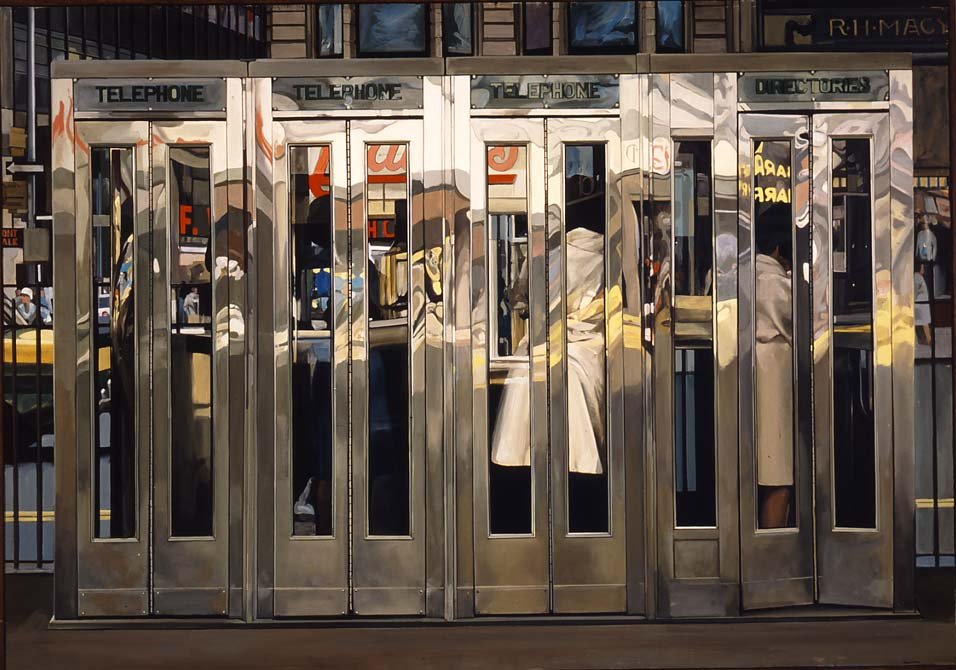
Telephone Booths by Richard Estes (1967)

I have to tell you I had never seen anything quite like it.  This was not a display of photographs but a large exhibition of works of Hyperrealism art often referred to as Photorealism art.  There are so many –isms in art.  I thought I knew them all and in fact I have the book …isms , Understanding art,  by Stephen Little, which discusses them all from Classicism to Sensationalism but even he had not touched on Hyperrealism.  So what are Hyperrealism and Photorealism?  The Oxford Dictionary of Art lists them under the name Superrealism and states that

“…it is an art form where the subjects are depicted with a minute and impersonal exactitude of detail…”

  It appears that Photorealism is the accepted artistic term in German and English speaking countries whereas Hyperrealism is the preferred term for this form of art in countries speaking Romance languages.  Whatever the term, this genre of art first emerged in the late 1960s  when a group of artists in the USA began to paint objects and scenes from daily life with a high degree of realism, using photography as the basis for their works.  The leading lights of the movement in those early days were Richard Estes, John Baeder, Robert Bechtle, Tom Blackwell, Chuck Close and Robert Cottingham.   This new movement attained international recognition in 1972 when their art appeared in the German city of Kassel at its Documenta 5 exhibition in the city’s Neue Gallerie.  The works of art at this exhibition were mostly by up-and-coming American artists.  In a way their works were a protest against abstract art which was dominating the art scene and the intellectual world since the mid 1940’s.  It was the era of the Abstract Expressionists, the Minimalists, the painters of Op Art and the Conceptual artists.  The emergence of Photorealism or Hyperrealism in the late 60’s was like new art movements of the past,  challenging current artistic practices and by doing so distancing themselves from what they considered to be the mainstream art genre of that time. The exhibition in Kassel caused an uproar.  The art critic of the Frankfurter Allgemeine Zeitung edition of July 8th 1972 reviewed the exhibition and was vehemently ctitical of what he saw, saying:

“… These are decorative objects for the dining room, or some even for the bedroom produced following the latest doctrines, pedantry in place of genius and the results are the most pedantic decorative objects imaginable…”

A few months earlier another writer reviewed a Photorealism exhibition held in New York and wrote;

“…if there is an obscene art, then it is that selling itself as the latest movement of the avant garde…”

The article went even further with its condemnation of the rapidly growing interest of the public for this new art genre.  The writer sought to bring shame on the buyers of this art by saying:

“…The buyers are snapping up this production-line Galatea as fast as its prolific Pygmalions can create her, dragging her home, like sailors with their inflatable dolls, for their aesthetic reassurance…”

The works of the Photorealists were painted with such intricate precision and with such meticulous detail that their finished paintings looked like photographs themselves.   The critics of this genre maintained that Photorealism was not art but simply the virtuosity of a copyist whose main aim was an accurate mimicking of reality, which was simply producing a stereotyped image of it.  The critics of this art even deemed it to be anti-intellectual.

The exhibition I went to see at the Thyssen Bornemisza Museum consisted of  sixty-six works by three generations of Hyperrealist artists and had been organised by the Institut für Kulturaustausch (German Cultural Exchange Institute.   It was an exhibition which offered visitors an insight into Hyperrealism and the history of the movement.  I have chosen two of my favourite works from this exhibition to feature in today’s blog.  One work is by a Second Generation of Hyperrealists,  Rod Penner, and the other by a young lady, born in London who is one of the new breed of Hyperrealists, Raphaella Spence.

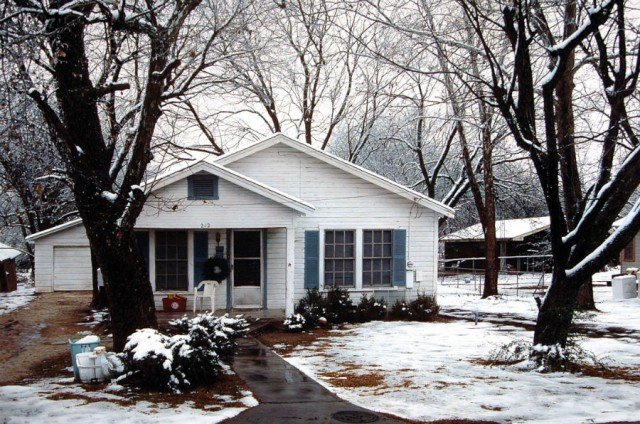
House with Snow by Rod Penner (1998)

The first work I have chosen is entitled House with Snow and was completed by Rod Penner in 1998 and is one of many he did which focused on the streets and single family homes in small towns in Texas.      Rod Penner was born in Vancouver in 1965 and currently lives and works in the small mid-Texan town of Marble Falls. He attended Kwantlen College in Canada before receiving a Bachelor of Arts in 1986 from Oral Roberts University, Tulsa, Oklahoma.  The work is a culmination of his visit to the location, photographing the scene, often using digital video stills.   It measures 91cms x 137cms and depicts a small single-family home in winter.  It is a truly remarkable work of art and I had to keep going up close to it to make sure it was not an actual photograph.

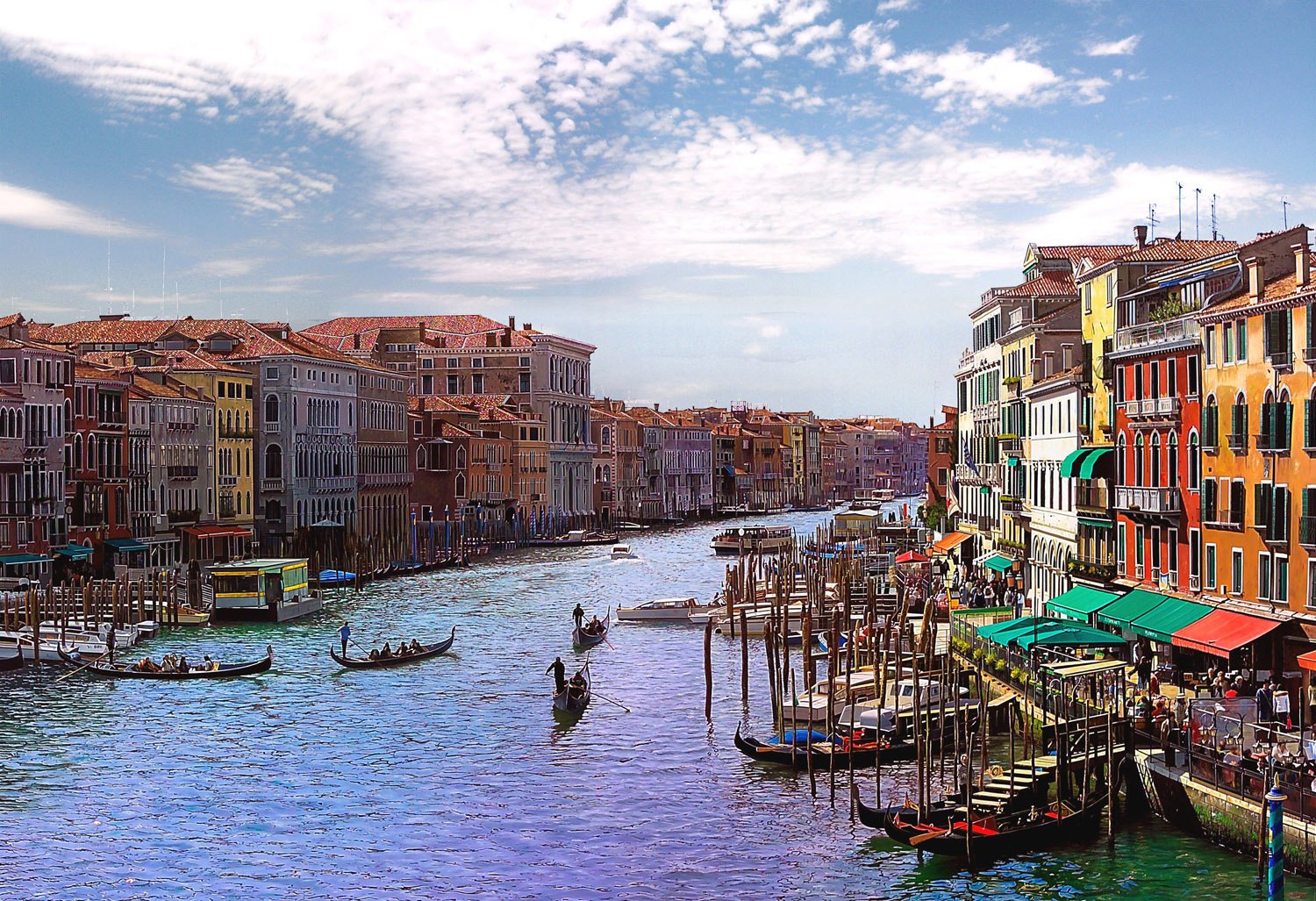
Canal Grande by Raphaella Spence (2007)

My second offering and probably my favourite is by a young British woman, Raphaella Spence.  It is entitled Canal Grande and was completed in 2007.  Raphaella was born in London in 1978 but she spent the first eight years of her life with her family in France.   The family went back to London where she continued her schooling.  At the age of twelve she was once again on her travels as the family relocated to Italy and went to school in Rome at the St. George’s British International School.   Raphaella love of art and the beautiful Umbrian countryside led her towards the creation of Photorealist landscape works.  In 2000 at the age of twenty-two she held her first solo exhibition in Italy which was well received and gained her public recognition.  Three years later she held a solo exhibition of her work at the Bernarducci. Meisel.Gallery in New York and ever since her works have been in ever increasing demand for exhibitions.  Many of her works are housed in galleries around the world both public and private and are often part of corporate collections.  Her works bring new perspectives to the artistic style of Photorealism.  She photographs her subjects with her 66-megapixel camera, and her cityscapes are often photographed as she flies over them in a helicopter.  Once she has the photographs she transfers the images to canvas, pixel by pixel, and the result is a spectacular pin-sharp hyperrealist painting.  I just could not believe the detail in her painting

I hope I have whetted your appetite to see this wonderful exhibition and look fiurther into the world of Hyperrealism or Photorealism.  You have a chance to view the exhibition I went to see in Madrid as it is on tour.  The dates are:


Painted Illusions: Hyperrealism 1967-2012,

Thyssen – Bornemisza Museum,  Madrid,  

April 8th  to June 30th 2013

Birmingham Museum and Art Gallery, Birmingham, England

November 20, 2013 – March 30, 2014

A Suffolk Farm by Edward Seago

A Suffolk Farm by Edward Seago

Last Sunday,  I went down to London to visit two of my children and my one and only grandchild and on the following afternoon I had scheduled a visit to the Royal Academy Summer Exhibition.  I had some spare time on Monday morning and had intended to visit a couple of galleries or museums but my best laid plans were thwarted because of an item of shopping I was looking for which proved elusive and the atrocious weather which put a damper on any thoughts I had of a pleasant stroll between artistic collections.  I had seen an advert for an exhibition, Samuel Palmer, His Friends and His Followers at The Fine Art Society which is situated in New Bond Street so I eventually ended up there like a drowned rat as my umbrella proved totally inadequate to counter the torrential rain.   I will look at one of the paintings from that exhibition in a later blog.  I left there and still had an hour to kill before I was due to attend the Royal Academy and as I had no intention of any further long walks in the downpour I ended up at the Richard Green Gallery just a few doors down from The Fine Art Society.  The gallery was in the process of hanging an Edward Seago exhibition but allowed me to take a look at what was already in place.  What a wonderful collection of art.

Edward Brian Seago was born in Norwich in 1910, the second son of Brian, a local coal merchant and Mabel Seago.   As a child he suffered quite a lot with ill health caused by a heart complaint, paroxysmal tachycardia, with which he was first diagnosed when he was eight years of age.   This illness meant that on a number of occasions he was reluctantly confined to his bed. As a result of this enforced confinement, he spent a lot of time painting skies and the surrounding landscape from his bedroom window.  Seago later remembered those times with a surprising fondness and called his enforced leisure, “spells of sheer delight”.  It was during these periods of imposed convalescence that the young Edward Seago realised his great enthusiasm and aptitude for painting.

His continued illness precluded him from any formal artistic training and, for the most, he taught himself.  He did however receive some artistic advice from the local East Anglian painters who were both impressed with his work.  They were Sir Alfred Munnings, who lived in Dedham close to the Essex/Sussex border and the landscape painter, Bertram Priestman, who remained a friend for the rest of Seago’s life.  Another of Edward Seago’s friends was the poet John Masefield with whom Seago collaborated on a number of publications.  Masefield would provide the poems whilst Seago provided the illustrations.  Two of the most successful collaborations were The Country Scene which was published in 1937 and Tribute to Ballet which was published the following year.  It was also Masefield that instilled in Seago the love and appreciation of English country life.

Seago’s landscape works were influenced by the landscape paintings of the Dutch Masters as there was a certain similarity between the landscape of The Netherlands and that of the East Anglian countryside.  Seago also was a great admirer of the landscape works of the English painter, John Constable and by the painters of the Norwich School founded by John Chrome in 1803.  However notwithstanding all these outside influences, his biographer James Reid, wrote:

“…While Seago’s subject matter evolved within a fundamentally traditional genre, his methodology, style and technique contributed to an innovative interpretation of the rural, urban and marine scene…

During the 1930’s Seago led a very varied existence.  He loved the freedom associated with a bohemian lifestyle and would often travel and work with circus folk, gypsies and ballet dancers but at the same time he kept in contact with the more refined aristocratic circles which provided him with generous patronage.  One such patron and friend was the politician and industrialist, Henry Mond, 2nd Lord Melchett, who was also an art connoisseur and collector.  Seago and Henry Mond travelled together to Venice in 1933.   Seago was astounded by the beauty of Venice which he later captured in many of his oil paintings.  He also had the opportunity to view the art works of the great Italian masters which were on show in the city.

Another of Seago’s close friends was Princess Mary, the Countess of Harewood, who was King George VI’s sister, and it was through this acquaintance that he was later to meet the present Royal Family who collected many of his paintings.  George VI also commissioned a portrait, and that royal patronage made Seago and his art,  very fashionable.    The Queen Mother bought so many of his works of art that eventually the artist gave her two a year – on her birthday and at Christmas.   Later, in 1956, he accompanied Prince Philip, the Duke of Edinburgh on the Royal Yacht Britannia, on a world tour and during one part of the voyage the ship sailed around the Antarctic.  Prince Philip and Edward Seago used to paint alongside each other on the deck of the Royal Yacht Britannia and the two developed a very close friendship.  Edward Seago’s paintings depicting the Antarctic were quite beautiful and were loved by art critics and the public alike.

He became a war artist in Italy during the Second World War and spent two years with General Alexander.  After the Second World War Edward Seago concentrated his art work on the East Anglian countryside with its cloud-filled skies, cattle grazing in the expansive flat fields as well as paintings which focused on the waters and the mudflats of The Broads and some of the barges which plied their trade along these inland waterways.  His beautiful landscape paintings would often incorporate man-made structures such as windmills, churches and farmhouses.  Seago loved East Anglia and its countryside and once wrote:

“…Perhaps one has to be born and bred there for it to really get into one’s blood.   But it has a powerful hold on me, and whenever I go, I feel a longing to return there…”

In 1968 Seago bought Ca Conca, a villa apartment in the elegant yachting resort of Porto Cervo on the Costa Smeralda, Sardinia. The terrace of his property offered fine views of the harbour to the right.   His life was suddenly cut short whilst on a painting tour of Sardinia when he was diagnosed as having a brain tumour, from which he died in London in January 1974 just before his sixty-fourth birthday.  In terms of commissions, he was the most successful artist of his day.

The painting I have featured today by Edward Seago is entitled A Suffolk Farm and epitomises the beauty of his landscape paintings and his love for the Suffolk countryside.  I urge you to visit the Richard Green Gallery (147 New Bond Street, London W1 2TS) which in honour of Her Majesty the Queen’s Diamond Jubilee, is presenting an exhibition of 41 paintings by Edward Seago.  The exhibition opened on June 13th and ends on Saturday, July 7th.   The gallery is open Monday to Friday from 10am to 6pm and on Saturday from 10am to 1pm.  I can assure you that you will not be disappointed and if you have a few pounds to spare then you will be pleased to know that all the works are up for sale.

The Marriage of Strongbow and Aoife by Daniel Maclise

The Marriage of Strongbow and Aoife by Daniel Maclise (1854)

Today I am moving from France to Ireland for my featured artist.  I will be looking at the life of the Irish painter Daniel Maclise and one of his historical paintings which will allow me to take you back in time to the twelfth century and regale you about a happening at that time in Irish History, but first let me tell you a little about the artist.

Daniel Maclise was born in Cork in 1806 into a poor but thrifty Scottish Presbyterian family. His father, after leaving the British Army, became a shoemaker. Maclise was educated locally in Cork and attended the Cork Institute where he studied drawing.   Whilst still a teenager  he was introduced to the art connoisseur, George Newenham, and the antiquarian and merchant, Richard Sainthill and it was through Sainthill that Maclise became interested in medals, coins, and aspects of heraldry and he would often illustrate coin catalogues for Sainthill.

In 1825, when he was nineteen years of age, Walter Scott the novelist and playwright visited a local bookstore in Cork and Maclise made a sketch of him which was subsequently lithographed and the copies sold.  This was to launch Maclise’s artistic career and enhanced his reputation as a portraitist.

Maclise travelled to London in 1827 and started to put together a portfolio of his work which he submitted to the Royal Academy as part of his submission to become a probationary student.  He was accepted into the R.A. the following year and stayed on for a further three years during which time he was awarded a silver medal and a gold medal for his historical painting, Choice of Hercules.  Whilst in London Maclise mixed in the company of men who appreciated his artistic skills and in particular Dr William Maginn, the founder and editor of Fraser’s Magazine, a general and literary journal for which Maclise contributed portraiture and caricatures.  He became a friend of Charles Dickens and contributed a number of book illustrations for his novels.

In 1848 he was back in London after a period of time spent in Ireland.  He presented a cartoon, sketch, and fresco specimens to the Fine-Art Committee of the Palace of Westminster for their official competition to paint frescoes in the House of Lords.   They liked his work and he was chosen to paint The Spirit of Chivalry for the House of Lords in 1848. One year later he painted a companion fresco entitled The Spirit of Justice.    His big break came along in 1858 when he was commissioned to paint two giant commemorative frescoes for the Royal Gallery of Westminster Palace, The Meeting of Wellington and Blücher and The Death of Nelson. These two mammoth works were to be the greatest achievement of Maclise’s public career but sadly they were also to cause the deterioration of his health.   The two works took Maclise seven years to complete and he worked tirelessly on completing them on time.   The passionate and concentrated effort which he put into these two great historic works affected him badly.   He would shut himself away and shun his erstwhile friends.  The Royal Academy even offered him the Presidency in 1865 but he declined the invitation.  His health declined rapidly and in 1870, aged 64, he died of acute pneumonia.

My Daily Art Display’s featured painting today by Daniel Maclise is entitled The Marriage of Strongbow and Aoife and was completed in 1854.  I suppose the first thing you need to know is who are these two characters, Strongbow and Aoife, and why are they the centre of attention in the painting.

Strongbow was the nickname given to Richard de Clare the 2nd Earl of Pembroke who was born in Tonbridge, Kent in 1130.  He was a Cambro-Norman knight, that is to say, he was a descendent of the Norman knights who had eventually settled in southern Wales after the 1066 Norman conquest of England by William the Conqueror.  He had become the Earl of Pembroke on the death of his father in 1848 and had lands around Pembroke.

However fate was to take a hand in his destiny.   King Henry I of England died in 1135 and his only surviving offspring was his daughter Matilda, who at the time was pregnant in Normandy with her third child.  This gave her cousin Stephen of Blois, grandson of William the Conqueror, the chance he needed to usurp the English throne and he became King Stephen I of England and ruled until his death in 1154.  On his death, Matilda’s eldest son Henry was crowned King Henry II of England.   Unfortunately for Richard de Clare he made a bad decision in 1135 as instead of supporting Matilda’s claim to the English throne he supported Stephen’s claim and when Matilda’s son became King Henry II of England he took his revenge on Richard de Clare by stripping him of the title of the Earl of Pembroke.  Unbeknown to Richard his future lay entwined in what was happening across the Irish Sea as in 1167, Dermot MacMurrough, the king of Leinster, was defeated by Turlough O’ Connor, the king of Connacht.   Dermont hastily rushed to England and asked King Henry II for help .  Henry could not send troops but asked Dermot to approach Richard de Clare to help him in his war against Roderic.   Richard agreed to help on condition that he was allowed to marry Dermont’s daughter, Aoife and succeed Dermont as King of Leinster on his death.  With Richard de Clare’s help, Dermot was able to defeat the king of Connacht’s forces, who poorly armed with only slings and stones, where no match for  Richard de Clare’s army which relied heavily on Welsh archers, which is why Richard, who was an expert bowman,  received the nickname ‘Strongbow’.   Richard married Aoife in 1170 and when Dermont died the following year he became the new king of Leinster.   However back in England King Henry II was concerned with their power Richard now exerted in Ireland and so in late 1171 Henry and his troops crossed the Irish Sea and Strongbow was forced to surrender Leinster to Henry. The land was later returned to Richard de Clare in return for the service of 100 of his knights.

My Daily Art Display featured painting today is the large romantic historical oil painting (309cms x 505cms) entitled The Marriage of Strongbow and Aoife which was completed by Daniel Maclise in 1854 and is housed in the National Gallery of Ireland in Dublin.   It depicts the ruins of the captured city of Waterford, which is the setting for the arranged marriage of the daughter of Diarmuid Mac Murrough the King of Leinster to Richard de Clare. In the foreground of the painting we see bodies of the vanquished enemy heaped on top of each other.  To the left we see the broken-stringed harp, the instrument which symbolises Ireland.   In the central midground we see Richard and Aiofe.  The victorious Richard de Clare takes his bride’s hand whilst we see his foot on top of a Celtic cross, symbolising the crushing of the Irish enemy.  This would be the start of a long period of subjugation by the English for the people of Ireland.  Facing Richard is Aoife, his bride-to-be, behind who stand a line of her bridesmaids.  Facing us in the central midground is the local religious dignitary who, with his hand raised heavenwards, blesses the couple.  The father of the bride, Diarmuid Mac Murrough, King of Leinster, stands to the right of the priest.  In the background above the ruins of the city we see wounded men and bodies being carried away by their colleagues whilst women weep and mourn the loss of their men folk.

A truly remarkable painting with so much going on.   It is one of those paintings which every time you revisit it, you see something that you had not noticed before.

Musée Marmottan Monet in Paris

Musée Marmottan Monet

For my blog today I am not showcasing an artist or a painting but a small museum , the Musée Marmottan Monet, which I visited last week when I was in Paris and I hope that for any of you who are intending to visit the French capital and want to take in some of its artistic heritage you will make time to visit this museum.  I can assure you that you will not be disappointed.  The museum is situated at 2 rue Louis Boilly in the vibrant and colourful 16th arondissement and is easy to get to as there are two nearby Metro stations, La Muette and Ranelagh.

I have often advocated that when one goes to London one should not always head for the major art galleries such as the National Gallery or the two Tate galleries as they are so big that one has no hope of seeing everything in one session and trying to often means that you skimp on the time each painting deserves.  A better plan of action if your time is limited is to go and visit one of the smaller galleries.  In London one has the Wallace Collection, the Courtauld Gallery and the Dulwich Picture Gallery, to mention just a few.  So to practice what I preach, when I was in Paris last week I didn’t revisit the Louvre or the Musée d’Orsay, instead I visited, for the first time, the Musée Marmottan Monet and it was unquestionably a most worthwhile visit.

The building was originally constructed as a hunting lodge for the Duke of Valmy and a few years later was sold to Jules Marmottan which on his death along with all his belongings was bequeathed to his son Paul.  Paul Marmottan later built a small pavilion in the courtyard as the original building was too small to house all of his paintings, furniture and bronzes.  Paul Marmottan bequeathed his home and collection to the Académie des Beaux-Arts, which opened up the house and collection as the Museum Marmottan in 1934.

If you like the work of the Impressionists and in particular the works of Claude Monet then look no further as this museum houses the largest collection of Monet’s work in the world and this is partly due to the fact that Monet’s youngest son Michel donated his father’s paintings from Giverny to the museum.  The building originally had two floors, the ground floor and an upper floor but to exhibit all the works they had to build a large underground room.  A number of bequests to the museum over the years have filled the building with beautiful and priceless art treasures.

The Duhem Collection was bequeathed to the museum by the daughter of the French painter, Henri Duhem.  These included works by Boudin, Caillebotte, Corot, Gaugin,  Monet and Renoir.  In 1980 an amazing group of illuminations spanning the 13th to 16th century was donated to the museum by Daniel Wildenstein.  The collection is exceptional for both the quantity and quality of the works.  There are over three hundred miniatures.  In 1996 the museum received an extraordinary donation from Annie Rouart.  Her husband was Denis Rouart, the grandson of Berthe Morisot and Eugène Manet.  Among the paintings given to the museum by Annie Rouart were masterpieces by Degas, Manet, Monet and Renoir and of course works by the famous female Impressionist Berthe Morisot.

Berthe Morisot Exhibition

For those of you who love the work of Berthe Morisot, and I include myself in that particular fan club, there is currently running a brilliant exhibition of her work.  It is housed in the basement.   It opened on March 8th and runs until July 1st 2012.  It presents the first major retrospective of the work of Berthe Morisot to be held in Paris for almost half a century.  One hundred and fifty paintings, pastels, watercolours and drawings in red chalk and charcoal, from museums and private collections all over the world, retrace the career of the Impressionist movement’s best-known woman painter. Works which have been selected for the exhibition cover the whole of Berthe Morisot’s artistic career, from her earliest works around 1860, to her untimely death at the age of 54, in 1895.  In my next few blogs I will feature a few  of the many paintings I saw when I walked around the museum.