Celebrating the Birth by Jan Steen

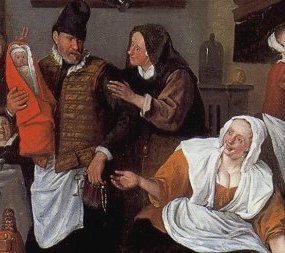
Celebrating the Birth by Jan Steen (1664)

I do my best to feature paintings by artists that people may not have come across before and I try not to feature the same artist too many times but sometimes I cannot help but revisit works by my favourite artists and today is no exception.  My Daily Art Display featured painting today is entitled Celebrating the Birth by Jan Steen which he completed in 1664.  I have showcased work by this artist three times before.  On February 16th 2011 we looked at a work entitled In Luxury, Look Out.  On April 27th 2011, I featured his painting The Effects of Intemperance and finally on August 26th 2011, I gave you The Life of Man so if you like today’s work why not go and have a look at some other of Jan Steen’s paintings.

Before us we have a simple scene of a couple celebrating the birth of their child, or do we?  In fact there is more to this painting than a simple celebration of the birth of a baby.  Look closely at the painting and see what is odd about the Steen’s depiction of the event and see if you can work out what is happening in the scene.  I will give you a hint.  Look at the man who stands behind the baby and the baby’s father.  Before I reveal the secret about the painting let me first tell you a little about the artist, Jan Steen.

Jan Havickszoon Steen was born in the Dutch town of Leiden in 1626.  He, like his artistic contemporary, Rembrandt, attended the local Latin School of Leiden. And a year later in 1646 he enrolled at the University of Leiden.  His professional artistic training started the following year and came from the German-born, Dutch Golden Age painter, Nicolaes Knupfer.  It is thought that he also could have studied with Adriaen van Ostade and it was this artist’s low-life genre work which was to influence Jan Steen’s early works.  At the age of twenty-two Steen along with his artist friend Gabriel Metsu and a number of local painters founded the painters’ Guild of St Luke of Leiden.

In 1648, Jan Steen moved to The Hague and worked as an assistant at the workshop of the celebrated landscape painter, Jan van Goyen.  Van Goyen was, like Jan Steen, born in Leiden.  He had moved from Leiden to The Hague in 1631 where he set up his workshop.  Steen was not only employed by van Goyen but was also taken in by van Goyen’s family and lived with him, his wife Annetie and their daughters.     Jan Steen became very friendly with Margriet, one of van Goyen’s daughters and they married in 1649 and the couple went on to have eight children.  Steen’s association with his father-in-law lasted until 1654.

In 1654 he and his family moved to Delft where he ran a brewery which his father had rented for him.  It was called De Roscam (The Curry Comb) but although Steen had a great artistic talent his business acumen was sadly lacking and the brewery failed.  In 1657 he went to live in Warmond,  a town close to Leiden and it was here that he met and became friends with the artist, Frans van Mieris.  Frans van Mieris was a painter of genre scenes which depicted the habits and actions of the wealthier classes.  It was this type of art by van Mieris and the works of Te Borch that weaned Steen off his low-life genre paintings and influenced him to paint more elegant genre scenes.  Jan Steen left Haarlem in 1660 and moved back to Haarlem where he stayed for the next ten years.  In 1669, near the end of this stay his wife died and the following year his father passed away.  After his father’s death in 1670 Jan returned once again to Leiden where he remained for the rest of his life.  He remarried that year and his second wife, Maria van Egmont,  gave Jan two children.

For the Dutch people, the year 1672 became known as the rampjaar(disaster year) as this was the year that saw the start of the Franco-Dutch War and the Third Anglo Dutch War, which culminated in the defeat of the Dutch States Army and large swathes of the Republic was conquered by the invading troops.   Because of these wars the art market collapsed and Steen needed another source of income so in 1673 he opened a tavern. His work in the tavern meant that his artistic output diminished in his later years.

Jan Steen died on New Year’s Day 1679 in Leiden

And so let us go back to the featured painting.  Have you worked out the “sub-plot” depicted in this painting yet?  Steen is best known for his humorous genre scenes, warm hearted and animated works in which he treats life as a vast comedy of manners and this work of his is no different.  We are looking at a lying-in room.  Whenever the lady of the house was about to give birth, one of the rooms was set aside for this purpose. The lying-in room was used for the actual delivery, and later to receive visitors.  The birth of a child was, as it is now, a cause for celebration.  It is greeted with both happiness and pride and in the 17th century in the case of the birth of a son, it became even more of a celebration for economic reasons as a son would often carry on his father’s business and would inherit the family possessions.

In this painting Steen has depicted a group of revellers celebrating the birth of a child.  One can imagine the elated atmosphere within the room with all its merriment and drinking.  The majority of people in the room are women as men, including the father, were considered inappropriate interlopers in this female sanctuary.  The mother is in the left background of the painting lying in her bed being fed some broth.  Another woman sits at the end of the bed drinking to excess.     The others present will probably be female relatives, maidservants and the midwife.  Normally one would expect, as in most works of art depicting such an event, that the mother of the newborn baby would be the main focus of attention.  However Steen has made the proud father the main focus of this painting.  However he is not the only man in the painting.  Look at the figure behind the baby.  We see another man as he is about to creep out of the room.  Actually it is a self-portrait of the artist himself.  It was not simply to break tradition to see the two men in the painting but Steen wanted to convey a little information about what has happened and to the nature of the husband and wife’s relationship.

Sign of the cuckold

Look more carefully and you will see something which was not visible until the painting was cleaned in 1983.  The man leaving the room has made a cheeky two-fingered gesture above the baby’s head.     This gesture can be seen by all those in the room except the proud father.   From the young man’s gesture, Steen has made us aware that the ‘father’ has been made a cuckold. The gesture illustrates the tradition of “cuckold’s horns, and that the horns, visible to all but the man himself, will grow on the head of a man whose wife has been unfaithful. The proud father stands right of centre having been presented with his child.  His pride on the birth of his child is plain to see.  He is totally unaware of the ridicule and stands before us, puffed up, beaming with pride as he shows off his child.  Nobody seems shocked by this audacious gesture which tells us that everyone in the room appears to know what the man does not: that the child is not his..  There are other sexually symbolic inclusions in Steen’s painting to suggest not just sexual impropriety but implying the husband was impotent, such as the bed warming pan, which lays prominently on the floor in the foreground.  The warming pan reminds us of the adage, the only warmth in the marriage bed is the warming pan.   In the right foreground we see broken egg shells scattered on the floor and again this is a reminder that the phrase, cracking eggs into a pan, was a contemporary euphemism for sexual intercourse.
The demand for money

Steen has been very unkind with his depiction of the father in this portrait.  We see him wearing an apron and carrying keys like a housekeeper would do, thus implying a lowering of his status in the household.   We also see the old midwife at his shoulder demanding money for her services and to the right of the man, sat on a stool, is a maid with her hand out, seemingly demanding payment for making the celebratory broth.  Steen’s final degrading of the man is his depiction of the limp and ineffectual sausage hanging by the fireplace which does not need me to explain the connotation of such an inclusion!!

There is a moralistic point to the painting.   It is a warning tale of what happens when an older man marries a much younger woman.   In a way Steen has no qualms about depicting the man as a cuckold.  Maybe the modern saying of there’s no fool like an old fool has its roots way back in time.
River Landscape with Apollo and the Cumaean Sibyl by Salvator Rosa

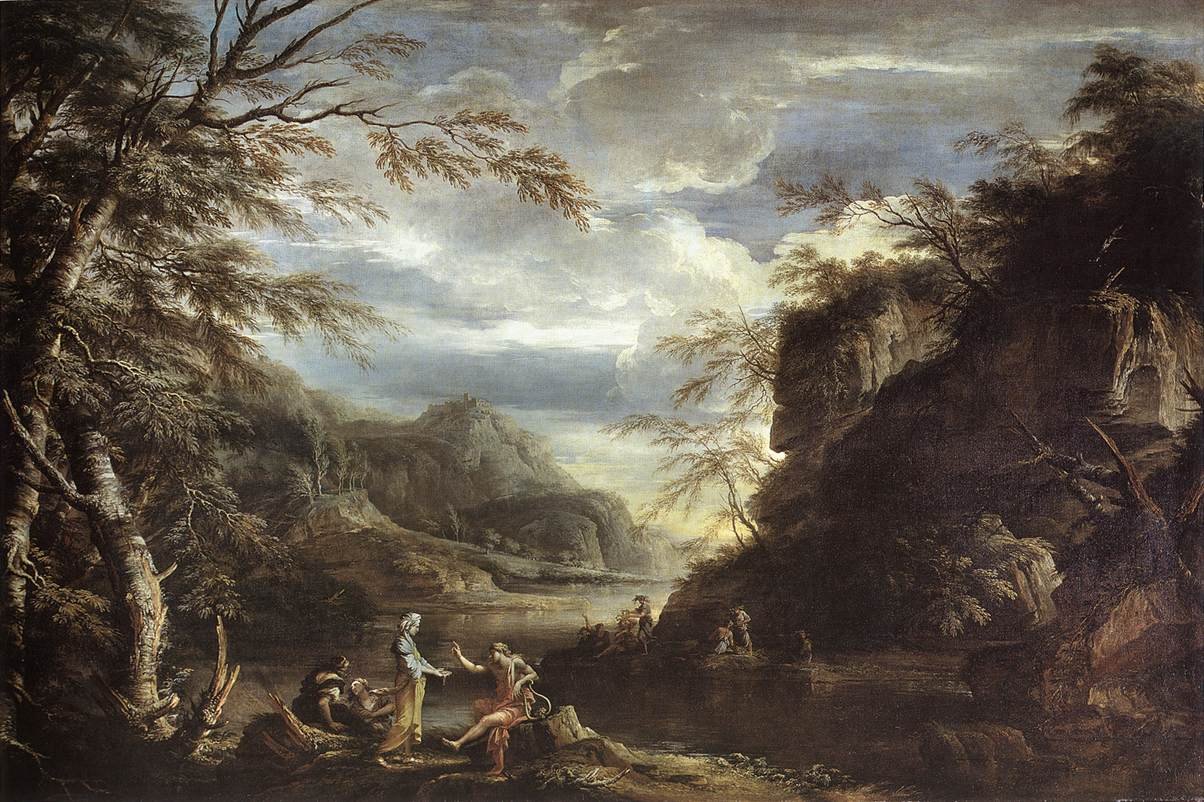
River Landscape with Apollo and the Cumaen Sibyl by Salvator Rosa (c.1655)

My featured artist today is the 17th century Italian Baroque painter Salvator Rosa.  He was born in 1615 in the small hill town of Arenella above the outskirts of Naples.  His father Vito Antonio was a land surveyor and had great ambitions for his son wanting him to become either a lawyer or take holy orders in the church and become a priest.  With this in mind he decided that his son should be afforded the best education and had him enter the convent of the Somaschi Fathers, a holy order of priests and brothers.  As we have seen in many biographies of artists, what the parents want for their children often differs from what the children themselves want and so it was the case for Salvator Rosa.  During his studies he had developed a love of art and with the support of his maternal uncle, Paolo Greco, he secretly began to learn to paint.  Rosa began his artistic training in Naples, under the tutelage of his future brother-in-law, Francesco Francanzano, who had trained under the influential Spanish painter, Jusepe de Ribera.  It is also believed that after this initial training, Rosa trained with the Naples painter, Aniello Falcone, who was also at one time apprenticed to Ribera.  Rosa greatly admired the works of Ribera and was influenced by them.

His father died when he was seventeen years old and, as he had been the breadwinner to Rosa’s large family, his mother struggled to feed her children let alone financially support her son Salvator with his artistic ambitions.  After his father’s death, Salvator Rosa continued to work as an apprentice with Falcone until 1634 when he relocated to Rome where he stayed for two years before returning home.

In 1638, aged 23 he went back to Rome where he was given accommodation by the Bishop of Viterbo, Francesco Brancaccio who treated him as his protégé and received commissions from the Catholic Church.  It was whilst in Rome that Rosa further developed his multi-talented skills, not just as an artist but as a musician, a writer and a comic actor.  He founded a company of actors in which he regularly participated.   He wrote and often acted in his own satirical plays, often political in nature and often lampooned the wealthy and powerful, and it was his devilish satire which gained him the reputation of a rebel, pitting himself against these influential people.  However his viperish-tongued satires made him some powerful enemies including Gian Lorenzo Bernini, the famous and powerful architect and who was at that time, the most powerful artist in Rome.  He, like Rosa, was also an amateur playwright and it was during the Carnival in 1639 that Rosa ridiculed Bernini’s plays and his stature as a playwright.  Eventually Rosa had made too many enemies in the Italian capital and decided it was just too dangerous to remain there.

From Rome he travelled to Florence where he was to remain for the next eight years.   One of his most influential Florentine patrons was Cardinal Giancarlo de’ Medici, himself a great lover and supporter of the Arts. Rosa worked for the Cardinal at his palace but was still allowed the freedom to paint his own landscapes and would go off and spend the summers in the Tuscan countryside around Monterufoli and Barbiano.    It was whilst living in Florence that Rosa did some work for Giovanni Carlo who was at the centre of the literary and theatrical life of Florence and Rosa soon became part of Carlo’s circle of friends.  Rosa used his own house as a meeting place for local writers, musicians and artists and it became known as the Accademia dei Percossi, or Academy of the Stricken.

He left Florence in 1646 being unhappy with the ever increasing restrictions put on him and his artistic and literary work by the Medici court  He went first back to Naples where he remained for three years before returning to Rome in 1649  where he believed his writings and paintings would win him even greater fame.  One of the problems Salvator Rosa had was his ever tempestuous relationship with his patrons and their demands.  He often refused to paint on commission or to agree a price beforehand.  He rejected interference from his patrons in his choice of subject.  In Francis Haskell’s book entitled, Patrons and Painters: Study in the Relations Between Italian Art and Society in the Age of the Baroque, he quotes from a letter Rosa wrote to one of his patrons, Antonio Ruffo, explaining his thoughts on his art and commissions:

“…I do not paint to enrich myself but purely for my own satisfaction.  I must allow myself to be carried away by the transports of enthusiasm and use my brushes only when I feel myself rapt…”

The 17th century Florentine art historian Filippo Baldinucci could not believe Rosa’s attitude to his patrons and wrote:

“…I can find few, in fact, I cannot find any, artists either before or after him or among his contemporaries, who can be said to have maintained the status of art as high as he did… No one could ever make him agree a fixed price before a picture was finished and he used to give a very interesting reason for this: he could not instruct his brush to produce paintings worth a particular sum but, when they were completed, he would appraise them on their merits and would then leave it to his friend’s judgement to take them or leave them….”

In his later years he spent much time on satirical portraiture, history paintings and works of art featuring tales from mythology.  In 1672 he contracted dropsy and died six months later.  Whilst on his deathbed he married Lucrezia, his mistress of thirty years, who had borne him two sons.   He died in March 1673 just a few months short of his fifty-eighth birthday.  After his father’s death forty years earlier Rosa had struggled financially but at the time of his death he had accumulated a moderate fortune.

Landscape painting had been regarded as a relatively lesser genre of painting in Italy at the time. But two French artists based in Rome, Claude Lorraine, who Rosa had befriended, and Nicholas Poussin, had done much to raise its status by setting scenes drawn from classical myth or biblical legend in grand Arcadian landscapes inspired by the nearby countryside. Rosa continued their tradition but with one subtle difference.  His landscape scenes depicted scenes of stormy desolation rather than calm pastoral beauty scenes of Claude and Poussin.  For My Daily Art Display today I am going to look at a painting by Salvator Rosa, which is a landscape but based on Roman mythology and Ovid’s book Metamorphoses.  It is the story of Apollo (often known as Phoebus) and the Cumaean Sibyl.   Cumae, which was the location of Italy’s earliest Greek colony, is on the Gulf of Gaeta near Naples and this location was probably known to Rosa.  The basis of the painting harks back to a conversation Aeneas had with the Cumaean Sibyl, who was a guide to the underworld of Hades, the entrance to which was the volcanic crater of Avernus.  Aeneas wanted to enter the underworld in order to visit his dead father Anchises.  Aeneas, with the help of his guide, the Cumaean Sibyl, found the aged ghost of his father.  It was at this time that the Sibyl recounted the story of her barter with the god Apollo, how she reneged on her promise and why she had become old and haggard:

“…“I am no goddess,” she replied, “nor is it well to honour any mortal head with tribute of the holy frankincense. And, that you may not err through ignorance, I tell you life eternal without end was offered to me, if I would but yield virginity to Phoebus for his love. And, while he hoped for this and in desire offered to bribe me for my virtue, first with gifts, he said, ‘Maiden of Cumae choose whatever you may wish, and you shall gain all that you wish.’ I pointed to a heap of dust collected there, and foolishly replied, `As many birthdays must be given to me as there are particles of sand.’  For I forgot to wish them days of changeless youth. He gave long life and offered youth besides, if I would grant his wish. This I refused, I live unwedded still. My happier time has fled away, now comes with tottering step infirm old age, which I shall long endure…”

The making of the bargain

Her mistake had been not only to ask Apollo for eternal life but also to ask for everlasting youth and beauty.  She aged over time.  Her body grew smaller with age and eventually was kept in an ampulla, a small nearly globular flask or bottle, with two handles.   Eventually only her voice was left.

The painting, entitled River Landscape with Apollo and the Cumaean Sibyl, depicting the meeting of the Cumaean Sibyl and Apollo, was painted by Salvator Rosa around 1655.  This is one of his finest works and highlights his ability as a landscape painter.  It is a desolate landscape scene.  Before us we have an isolated inlet of the sea, surrounded by towering cliffs of rough and rugged stone. On the right hand side of the painting we have a dark crag which towers against a stormy summer sunset.  From this jagged rock there are spindly trees sprouting from it at strange angles. In the foreground of the painting we see the god Apollo, seated on a tree stump with his lyre at his side, propositioning the beautiful Cumaean Sibyl, the turbaned woman who stands before him.    His hand is raised almost as if he is blessing the woman but it is his demonstrative act of granting her wish that she might live for as many years as there are grains of dust in the earth she holds out to him in her hand.   In return for the granting of her wish she would become his lover.   The Sibyl having been granted her wish, changes her mind, and refuses to surrender to Apollo’s advances.  Apollo cannot take back what he had given the young woman, but he was still able to punish the fickle girl, for, in devising her wish, she forgot to ask for eternal youth, and by refusing to grant her this he condemned her to grow older and older until at last she wasted away and only her voice was left.

The scene before us, depicted by Rosa, is purely imaginary, Rosa has included the cavern from which the Sibyl uttered her famous prophecies and which still exists in the dark, rocky area at the top right of the picture.  In the background we can see the inaccessible citadel perched high on a cliff.  The other characters we see in the scene are the nine muses, the goddesses of creative inspiration who were the handmaidens of Apollo. The painting is illuminated by the last rays of the setting sun light which light up the stormy sky in the distance. Look at how Rosa has managed to portray an aura of an ominous premonition.   The dramatic use of dark tones and chiaroscuro adds a feeling of foreboding about the scene.  The way he has depicted the wild landscape of bare rocks, splintered trees and a threatening stormy sky goes hand in hand with the story of retribution about to be dealt to the Cumaen Sibyl by Apollo for reneging on her promise to him.

Notwithstanding the darkness of the scene, it is still a beautiful landscape painting.  It is currently housed at the Wallace Collection, London.

The Fountain of Youth by Lucas Cranach the Elder

The Fountain of Youth by Lucas Cranach the Elder (1546)

Throughout time, mankind has always looked for ways to extend the longevity of life.  In modern times we have organ transplants, anti-aging creams and plastic surgery to either extend our life or if we accept the futility of that premise, then at least try and make oneself look younger.  We can now bathe in spas whose magical water quality are supposed to combat this disease or that disease and many who have bathed in these waters leave feeling cleansed and believe implicitly that the waters do heal them of their ailments and have rejuvenated them.  In past times there was always talk about the mythical Fountain of Youth in which the waters could reverse the ageing process.  Alexander the Great, who conquered most of the known world at the time, was thought to have been searching for a river that healed the ravages of age. Move forward to the 12th century and we hear of a puzzling letter sent to the Byzantine emperor Manuel I which started to circulate around Europe. It told of a magical kingdom in the East that was in danger of being overrun by infidels and barbarians. This letter was supposedly written by a king known as Prester John and talked about his kingdom which had rivers filled with gold and was the home of the Fountain of Youth.  Two centuries later, in 1513, it was recorded that the explorer, Ponce de León, was searching for the Fountain of Youth when he traveled to what is now Florida.   And so it goes on, this fascination with the mystical Fountain of Youth.

Artists have often recorded pictorially their take on this magical fountain and today I am going to take a look at one which was completed just over thirty years after Ponce de León’s voyage of discovery.  The painting, Der Jungbrunnen (The Fountain of Youth) is by the German artist Lucas Cranach the Elder which he completed in 1546.  It is about the human desire for immortality and eternal youth.  The old women in the painting crave to cast aside their worn outer shell, which is pale and wrinkled, and exchange their haggard looks by replacing their outer-self with a more acceptable younger version.

The examination

I like the mini-scene in the centre ground to the left of the pool where we see a man bent forward closely examining a naked woman.  What is that all about?  Is he an official or maybe a doctor who is examining how haggard the woman is to see if she fits the criteria for rejuvenation?  If this is the case, then for once to gain one’s admission to the pool old age and infirmity is requisite bargaining tool!

The Fountain

In many ways this simplistic depiction of the Fountain of Youth is quite amusing.  At the centre of the painting we observe a large square-shaped grey and white pool, at one end of which is the fountain.   The fountain gushes out water it has drawn from the spring below.  On the fountain there are statues of Venus and Cupid which, in some ways, is confirmation that this is more of a Fountain of Love and that maybe it is the power of love which is the rejuvenating factor.   The pool is populated by naked women.  Steps around the four sides of the pool lead down to the healing waters.  To the left of the painting we see elderly women, who have made the long and tiring journey, arriving in carts, on litters, in wheelbarrows or in one case piggy-backed on a man who can just about cope with her weight.  All want to bathe in the rejuvenating water.

Wheeled to the magical waters

The old women then alight from their transport, take off their clothes, examined and are helped into the square-shaped pool, the water of which is being topped up from the Fountain of Youth.   Once partly immersed in the magical waters the naked women begin to splash themselves with the water and frolic about, the cares of the world seemingly lifted from their shoulders.  Now that the women have regained their youthful looks they look at one another amazed by the change that has taken place.  They caress themselves or caress one another, hardly believing what they are seeing and feeling.  They comb their long flowing golden hair.  Their mood is one of triumph.  The power of the waters has worked.

In and out of the robing tent

If we now look to the right hand side of the pool we see that after having been immersed and had been revived by the recuperative powers of the waters, they step out of the pool, rejuvenated and once again young.  From the pool side, these gregarious young virgins are then directed towards a large tent in order to dress and after a short while they emerge as beautiful young ladies wearing the most exquisite clothes.  For them, the world has changed and they go off to dance or dine or find themselves a handsome young man whom they can take off to the seclusion of the bushes to……..

Although this undoubtedly is a humorous painting, I wonder whether Cranach intended to also moralize with his depiction.  On the left Cranach depicts the old women being brought to the waters by ordinary working-class types of people but note how, once rejuvenated and sumptuously dressed, the young women go off with the upper class nobility.  What happened to the poor men who almost carried their women to the pool?  Have they now been abandoned?  Another question the painting raises is why are there no men in the pool being rejuvenated?  Should we believe that in the 16th century it was only the women who sought rejuvenation?  Has nothing changed in the last five centuries?   Is the female current desire for rejuvenation by creams, potions and the surgeon’s knife any different to Cranach’s women immersing themselves in the Fountain of Youth?

One of the things I like about this painting is the number of mini-scenes taking place within the work.  Every time I look at the work, I notice something I had not seen before.  I saw this work of art when I visited the Gemäldegalerie in Berlin some time back, the same museum which houses the Netherländish Proverbs by Pieter Bruegel the Elder, another marvelous painting which is awash with mini scenes.

A Merry Company at Table by Hendrick Pot

A Merry Company at Table by Hendrick Pot (c.1630)

Two paintings today; one by the artist and one of the artist himself.  One of the pleasures I get from my blog is that besides discovering new artists and their paintings, I acquire an insight with regards the history and traditions of various countries , most of which I had little previous knowledge.  Maybe I should have concentrated more during my history lessons at school.   Recently I have featured Flemish artists and I looked briefly at Dutch and Flemish history during the time of Spanish occupation and rule.  Today, I am looking at a painting by the Dutch painter Hendrick Pot and exploring the world of the schutterij.  Don’t you know what the shutterij is or are?   Neither did I until I researched a painting by Pot but before I reveal the answer let me give you a brief biography of the artist himself.

Hendrick Gerritsz Pot was born in Haarlem around 1585.  His early artistic training was with Karl van Mander.  We probably know Karl van Mander not so much as an artist but for his writings.  He has often been termed the Dutch Vasari for his book entitled Schilderboek, published in 1604, which to this day, remains the main source for information on Northern European painters of the 1400s and 1500s and contains valuable original material about his Italian contemporaries.  He had arrived in Haarlem in 1583 and set up an informal academy with the Dutch engraver and painter, Hendrick Goltzius.  At this Academy, van Mander taught and developed the Haarlem Mannerist style.   Other artists who were trained by van Mander at his studio included Frans Hals.
In 1620 he was commissioned to do two paintings relating to William I of Orange, often referred to as William the Silent, who was one of the key leaders of the Dutch revolt against Spanish rule.  He was assassinated in 1584.  One of the paintings, entitled the Glorification of Willem I, was acquired by the city of Haarlem whilst the other entitled the Deathbed of Willem I was housed in the town hall of Delft.   In1630 Pot became Dean of the Haarlem Guild of St Luke.   He travelled to the court of Charles I in London in 1632 where he was employed as the court portraitist and during his one year sojourn at the court completed portraits of Charles I and his wife Queen Henrietta Maria.

In 1633 he returned he returned to Holland.  Many of Pot’s lucrative commissions were to paint group portraits of the local militias, known as schutterij.  So now you know – schutterij is the Dutch term for militia.  They were a voluntary city guard whose prime objective was to protect their town or city from attack and also to act in case of a fire breaking out within the town.   They were simply a defensive military support system for the local civic authority. The officers of the schutterij came from wealthy backgrounds and were appointed by the city magistrates. The captain of each group was normally a very wealthy inhabitant of the district, and the group’s ensign was a wealthy young bachelor and he could be recognised in the group portraits as the man wearing exceptionally fine clothes.   There was a special kudos to being a member of the schutterij as it often led to one being appointed to an important position within the town council.

At the time when the leaders of an individual schutterij stepped down or passed away and their replacements were sworn in, a local artist was commissioned to paint a new group portrait of the members. These group portraits were known as schuttersstukken and they often had the setting of a banquet which was held to welcome in the new leaders.     The artist commissioned to carry out the painting had a complex job on his hands.  This is not as it would be now when a photographer would get the group to stand as one and after a few minor adjustments shoot the film.  In the case of schuttersstukken the artist would paint each member separately so that each individual portrait within the group was as accurate as possible.  As a member of this militia, if one wanted to be included in the group portrait, one had to pay for the privilege and how much you paid the artist and your rank within the militia, would depend on where he positioned you within the group!  As I said before it was a very lucrative commission and there was a lot of competition for the right to carry out the group portrait.  Probably one of the most famous of the schuttersstukken was Rembrandt’s The Night Watch.   One thing that would help an aspiring artist to gain the painting commission was if he was a member of a schutterij.   Hendrick Pot was a lieutenant in a schutterij and that was the advantage he had over many of the other applicants.

The Banquet of the Officers of the St George Militia Company by Frans Hals

This leads me to my second painting of the day which is entitled The Banquet of the Officers of the St George Militia Company which Frans Hals painted around 1639 and included in the work is none other than Hendrick Pot with his militia sash who is seated at a table on the far right of the gathering, reading a book.

In 1648 Pot moved from Haarlem and went to live in Amsterdam.  In his later years he concentrated on small single figure portraiture.  He died in Amsterdam in 1657, aged 72.

My main featured painting is one Hendrick Pot completed around1630 and is entitled A Merry Company at a Table.   It is now housed in the Wallace Collection in London.   It is a genre piece.  The definition of a genre piece is a work of art  which affords a pictorial representation, painted  in any of the various media and one that represent scenes or events from everyday life, such as markets, domestic settings, interiors, parties, inn scenes, and street scenes. Some of the genre pieces are realistic, some imagined, whilst others are romanticized by the artist. This type of painting was particularly popular in seventeenth century Netherlands, but the term “genre” was not applied at the time;  instead, paintings were divided into more specific categories, such as ‘merry company’ scenes (conversatie), ‘little fire’ scenes (brandje) or ‘bordello scenes’ (bordeeltje).   My featured painting today falls into the latter category, a bordeeltje.  So why do we believe what we are looking at is a bordello?  Although the painting is not littered by scantily dressed females and lusting men the artist has given us some subtle hints as to what we are looking at.  On the floor there is a discarded rapier, lute and in the foreground, a dog.  These symbolise the disarming power of love and carnal desire.  Look to the left of the painting and in the doorway one sees an old woman carefully watching her girls as they enchant and flirt with the soldiers.  The men and women seated around the table make music together which is a common euphemism for making love and they play cards and smoke which were looked upon as the two great vices of the time.

Look to the extreme right of the painting.  Look at the cavalier with his back to the chimney breast, who stares out at us.  He gives us a knowing look as if to say “you know what is going on here, don’t you?”  The background solely consist of a drab muted coloured wall broken up only by the presence of a mirror.  Why do you think Pot added a mirror to this scene?  Could he be asking us to look into it, see our own reflection and examine our own behaviour, before we audaciously condemn the women and the men we see before us in the brothel?

I have always liked these Dutch and Flemish genre pieces.  There is often a moralistic tale being told.  The scene is often up for interpretation and we look carefully for any signs of symbolism.  I enjoy looking closely at the individuals and try to guess what is going on in their minds.  Fortunately there are so many of them in our art galleries and museums and I am never disappointed by what I see.

Enjoy !

Virgin Annunciate by Antonello da Messina

Virgin Annunciate by Antonello da Messina (c.1476)

I think I have mentioned before how I choose an artist or a painting for future blogs.  It is usually following an art exhibition or a visit to a gallery or, as is the case today, the artist is mentioned in passing in a previous blog.   When I was putting together the biography of my last featured artist, Vittore Carpaccio, I mentioned that in his early days he was influenced by the Sicilian artist, Antonello da Messina.  I had never heard of this artist before and curiosity got the better of me and I began to research his life and look at some of his paintings.  His portraiture is some of the best I have ever come across so I thought I would share my “find” with you.

It is thought that Antonello di Giovanni degli Antonii, better known as, Antonello da Messina, was born in Messina, Sicily, around 1430 and is now considered as the most famous artist to have come from this island.  He was one of four children and his father was a local stonemason.  His early life is somewhat sketchy and often contradictory.  A little light can be shed on Antonello’s training from a letter, dated 1524,  in which Pietro Summonte, the Italian Renaissance humanist living in Naples, and who took great pains in collecting and preserving his correspondence on artistic matters with the Venetian nobleman, Marcantonio Michiel.  In it is mentioned that Antonello was the pupil of Niccolò Antonio Colantonio, an artist who had received instruction in the methods of Netherlandish painting whilst serving at the court of King René I of Naples.  This fact alone may go some way to explain the influence of Flemish paintings in Colantonio’s and later, Antonello’s work.  However not all art historian agree about the Flemish style, influence and technique of Colantonio’s works and that, in turn, Antonello was influenced by his Master, Colantonio.   The art historian J.Wright in his 1980 book, Antonello da Messina: The Origins of his Style and Technique, believes that the characteristic of Colantonio’s work is almost entirely French rather than Netherlandish.

So where did Antonello pick up this Netherlandish influence?  It appears debateable whether Antonello ever travelled to the Netherlands but it is known that René I’s time as ruler of Naples came to an abrupt end in late 1442 and the new ruler King Alphonse V of Aragon (King Alfonso I of Naples) came to power and his art collection contained works by the Netherlandish painters, Jan van Eyck and Rogier van der Weyden, which as Colantonio’s assistant, Antonello could well have been familiar with these works whilst working on royal commissions.   Around this time, Antonello completed many religious works, one of which was his painting entitled St Jerome in his Study, and many believe that this work was influenced by Jan van Eyck’s Portrait of St Jerome (1442).  His later Annunciation of Syracuse  in 1474 is thought to have been influenced by the extraordinary Lomellini Triptych by Jan van Eyck.

A gonfalone

In 1457 at the age of twenty-seven whilst in Messina, Antonello married Joan Cumminella and it could well be that his first son, Jacobello, had already been born.  In that same year, it is known that Antonello moved to Reggio Calabria,   on mainland Italy.  It was whilst here that he received a commission to produce a gonfalone for the confraternity of S Michele dei Gerbini in Reggio Calabria.  Gonfalones were a type of heraldic flag or banner, often pointed, swallow-tailed, or with several streamers, and suspended from a crossbar.   In that same year Antonello married.  His wife was Giovanna Cumminella.  Soon after this,  he and his family as well as his brother and sister-in-law moved north and settled in Amantea, a town on the west Calabrian coast.  However three years later in 1460, he returns to Sicily after his father sends a brigantine to transport them all back from Amantea to Messina.  The following year he set up a workshop in Messina and took on his younger brother, Giordano di Giovanni as an apprentice.

In the period from 1465 and 1475, Antonello completed many portraits.  The surviving portraits are all of men.  His portraiture at this time was different in style to the Italian portraiture for he had a great grasp on the structure of a face, not just the bone structure, but the overlying facial muscles and sinews.  With this knowledge he could depict how the movement and portrayal of facial muscles around the eyes and mouth could alter facial expressions.  His portraits were nearly all in three-quarter views and bust length showing head and shoulders but not the arms.  The sitters faced the light which generally fell from left to right illuminating the edge of the right cheek and modelling the nearside (left side) of the face with chiaroscuro, the term for the technique of using light and shade in pictorial representation.  His sitters, like in many Netherlandish portraiture, are dressed unostentatiously in contemporary dress and wear no emblems or jewellery which would detract us from the simplicity of the portrait.  This drabness of clothing, often dark red or black, does not attract our attention and allows us to look directly and steadily into the eyes of the sitter.

Portrait of a Man (known as The Condottiere )

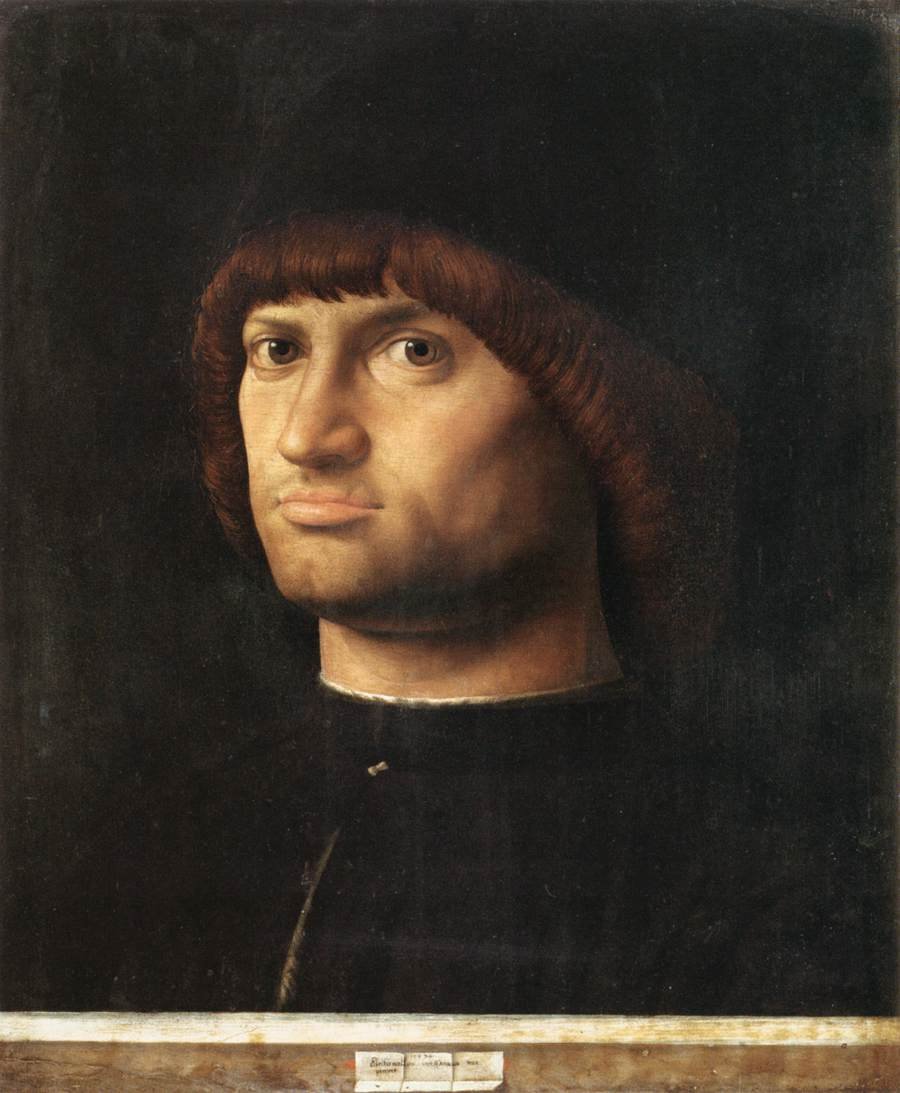
However, it was Antonello’s stay in Venice, from 1475 to 1476, which marked the definitive turning point in his artistic career and in fifteenth-century Italian art history. The encounter between Antonello’s art and the Venetian figurative environment, represented primarily by Giovanni Bellini, created the conditions necessary for his absolute masterpieces, such as Portrait of a Man known as The Condottiere and the Trivulzio Portrait of a Man.   In Venice, Antonello and his works of art were highly acclaimed and he received many commissions.  It is known that Antonello was still in Venice in the March of 1476 completing the S Cassiano Altarpiece commissioned by the church of San Cassiano in Venice.  From Venice there is speculation that he travelled to Milan to carry out a commission for Gian Sforza, Duke of Milan, but whether he did visit Milan it is known that by the end of 1476 he was back in his Sicilian home in Messina.  In his workshop he now had his son, Jacobello d’Antonio and his nephews Antonio and Pietro de Silba as his assistants.

In February 1479 Antonello made his will, and died shortly afterwards at the young age of forty-nine.  He had pre-deceased both of his parents as he made provision for them in the document.   Antonello was an extraordinary painter, one of the greatest of his time.  In his last years his son collaborated with him with Antonello planning the work and Jacobello executing the painting.  On one, Jacobello paid a fitting tribute to his father and signed the painting:

“…the son of Antonello, a painter of no human kind…”

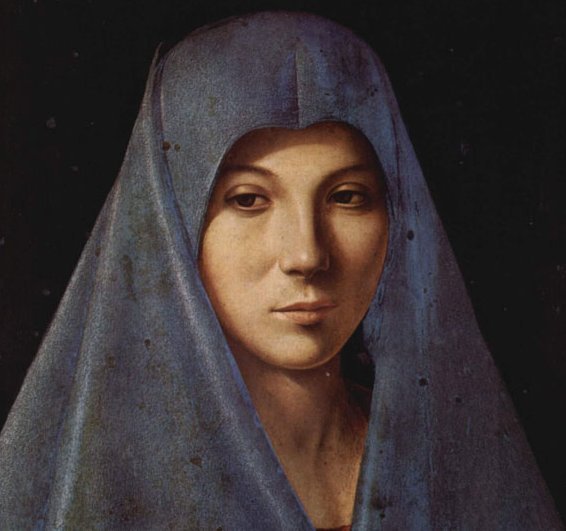
For my featured painting today I give you Virgin Annunciate which Antonello completed whilst in Venice around 1476 and is now housed in the Galleria Regionale della Sicilia in Palermo.  It is probably his most famous work.  The painting is a hauntingly beautiful image of an adolescent Mary at the time the angel Gabriel came to her to tell her that she would bear God’s son.  Look closely at her beauty as depicted in this bust length portrait by Antonello.  She sits before us dressed in a simple blue mantle.  She clasps her blue mantle closed and holds it modestly in front of her chest.  The background is plain and does not distract us from staring at the young woman.   She sits at a reading desk.  Before her, on the desk, is a book of devotions which she has been reading.  We have disturbed her.  She looks up at us.   The angel Gabriel as is the case in most Annunciation scenes, is not present.  It is simply implied.  Her right hand is raised in a blessing gesture to Gabriel but as he is not in the painting, it is as if she is greeting us, the viewer.  It is just her and us.

The face of young beauty

Would you say this is a religious painting?  That seems a silly question to ask as we know the story of the Annunciation is a religious story but although the subject is religious in nature, Antonello has deliberately selected a young, beautiful and humble Sicilian girl for the model of the Blessed Virgin. So was it in Antonello’s mind to simply paint a portrait of a devout young girl.  I suppose the answer lies in who commissioned the work and what they asked the artist to depict.  Whether it is a simple portrait or a religious painting, I challenge you to find another work depicting such an exquisite looking young.

Two Venetian Ladies by Vittore Carpaccio

Two Venetian Ladies by Carpaccio (C.1510)

We know Vittore Carpaccio was born in Venice but his precise birth date is not known but it is thought to be around 1460.  His father Piero Scarpazza, who came from nearby Istria, was a leather merchant.  Vittore is believed to have trained in the studio of the Jacopo Bellini family, which at that time after his death, was run by his two sons, Gentile and Giovanni Bellini.  Carpaccio’s art was very much influenced by the works of Gentile and Giovanni Bellini as well as Antonello da Messina, the Sicilian Renaissance painter who introduced the Netherlandish Renaissance art of Flanders and Holland to Venice.  Later he would work as an assistant to the Paduan artist, who had a studio in Venice, Lazzaro Bastiani

Carpaccio’s greatest work of art was his large nine painting series entitled The Legend of Saint Ursula, which was originally meant for the Scuola di sant’Orsola but can now be found in the Gallerie dell’Academia in Venice.   This work completed in 1497 is absolutely breathtaking and is one that should be a “must see” if you visit Venice.  I featured one of the large paintings in My Daily Art Display, March 22nd 2011.  During the first decade of the sixteenth century, Carpaccio worked on a series of paintings for the Hall of the Great Council in the Doge’s Palace along with his former tutor Giovanni Bellini. Unfortunately, like many other major works, the series was entirely lost in the disastrous fire of 1577.  This was the third serious fire to devastate rooms in that building.

Between 1502 and 1507 Carpaccio worked on a cycle of canvases for the Scuola di S.Giorgio degli Schiavoni, with the story of St. George and the dragon and episodes from the life of St. Jerome.   Following this Carpaccio started in 1511 to work on a series of paintings based on the life of St. Stephen in the Scuola di S. Stefano.  It took him three years to complete the works.  Carpaccio received many commissions including ones from the Venetian government.

His popularity in the ten years prior to his death in 1525 waned mainly due to a young artist who had arrived in Venice in 1500 and like Carpaccio went to work for the Bellini brothers.  His name was Tiziano Vecellio, better known simply as Titian and it was this young man who was to amass numerous commissions from the Venetian government and rich Venetian patrons.  Carpaccio ended his career back in the provinces where his somewhat out-dated approach to art still attracted many buyers.   After his death he was almost completely forgotten as an artist but now art historians look upon him as a fifteenth century Venetian artist, only bettered by Giovanni Bellini.

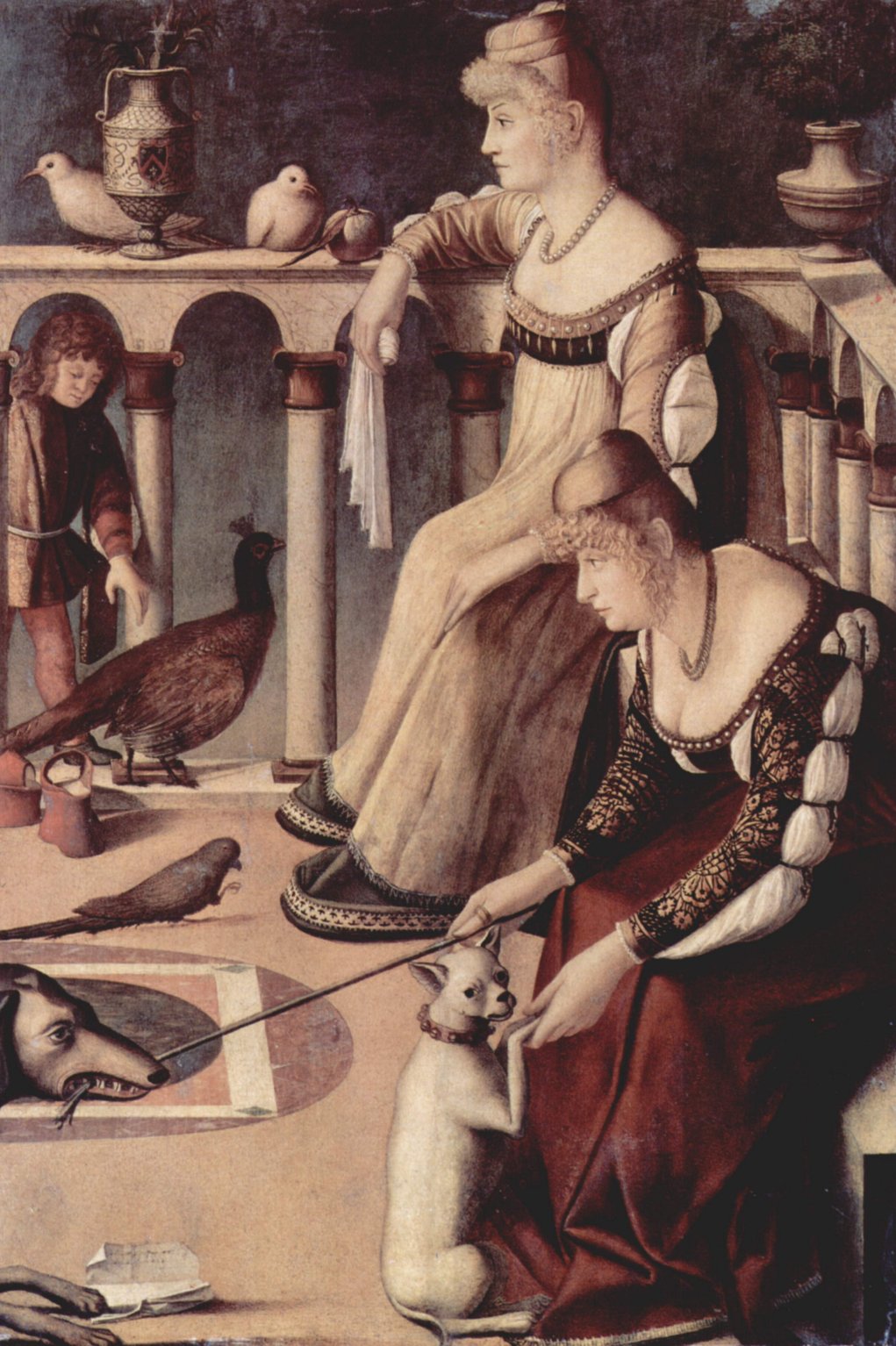
My Daily Art Display’s featured work today is a tempera and oil on wood panel painting entitled Two Venetian Ladies and can be found at the Correr Museum in Venice.  It was completed by Carpaccio around 1510.  Before us are two unknown Venetian ladies.  Who they were has never been agreed on by art historians.  They sit there with what can only be described as vacant and bored expressions.  Early scholars including the English art critic, John Ruskin, believed that the two ladies were high class courtesans, a polite term for high class prostitutes, and they were waiting for their rich clients. John Ruskin, who thought this work at the time was one of the finest in the world, actually referred to the painting as Two Courtesans.   The story of the two ladies was further embellished by stating that the small page we see to the left of the painting has just arrived with a message from a lover for one of the ladies.  Another reason Ruskin and other believers in the “courtesan” argument gave for their theory was that in front of the page, on the floor, are a pair of wedge platform sandals which were often worn by prostitutes to make themselves look taller.  Those who did not accept the “courtesan” theory pointed out that most women of the time wore such sandals.

However, those who did not accept the “courtesan scenario” would have us believe that because of their exquisite clothing and expensive jewelry, they were members of the aristocratic Torella family.  Another reason for believing that they were not courtesans, mistresses of rich men, is Carpaccio’s inclusion in the painting of a white handkerchief held by one of the ladies, strings of pearls worn around their necks of both women, and the white doves perched on the balustrade, which were known as the birds of the Goddess of Love, Venus, and all of which symbolized chastity.

Hunting on the Lagoon by Carpaccio (c.1510)

In 1944 all the speculation about the Two Venetian Ladies painting changed when the upper half of the painting was discovered.   Professor Pamela Fortini Brown of Princeton University may have solved the question regarding the two ladies as she wrote that this painting is part of a larger one, in fact the lower right hand section of a very large work.     The upper right half of the original work is now housed in the Paul Getty Museum in Los Angeles, and is entitled Hunting in the Lagoon.  This upper part depicts several boats in a lagoon.  Because of the way only half of the dog’s head is shown in the painting, suddenly cut off behind its ears, it is thought there is a complete missing left hand side of the work in which the rest of the dog is depicted.

So now we must rethink what we are seeing in the original painting.   One now must believe that the husbands of the two ladies seated are in this party of hunters and that the ladies are waiting their return.  We can see each boat has a group of three rowers and an archer who all stand in these shallow-bottomed craft and hunt the glossy black cormorants which they will sell or train to catch and retrieve fish from the lake.   Rather than bring the bird down with an arrow which would damage the plumage, the archers use clay pellets which will stun the birds. If we now consider the two paintings together it would explain the meaning of the paintings title, as the two women are awaiting their husbands’ return after a hunting and fishing expedition in the Venetian lagoon. Look closely at the two paintings.

Juxtaposition of the two paintings

So do you agree the two paintings are part of one original work?  Observe the majolica vase of flowers on the balustrade in the upper left background of the Two Venetian Ladies painting.  Note how the stalk of the flower is cut off at the top edge of the work.  Now look at the bottom left foreground of the Hunting on the Lagoon painting and you can see the stem and head of a lily which when looking at just that painting makes no sense, but if the two paintings are juxtaposed, one on top of the other, one can then see that the head of the lily in one painting is a continuation of the stem protruding from the vase in the other painting.  Add to this visual evidence the fact that when the two panels were examined, the wood grain of the two panels was found to be identical and this confirmed that they were once a single panel. It is thought that the two parts were probably sawed apart some time before the nineteenth century.

A Girl in a Kitchen (La chercheuse de puce) by Nicolas Lancret

A Girl in a Kitchen by Nicolas Lancret (c.1720-30)

Today I am featuring the French painter, draughtsman and art collector, Nicolas Lancret, who was born in Paris in 1690.  To begin with, Lancret trained as an engraver but soon afterwards became an apprentice to the history and religious painter Pierre Dulin.  Dulin was later to become a professor of art at  Académie royale de peinture et de sculpture in Paris.  Throughout his early artistic training Lancret was influenced by and greatly admired the works of the Jean-Antoine Watteau the late Baroque painter and one of the leading artists in the new Rococo style of artwork.  In 1708, at the age of eighteen, Lancret enrolled at the Académie royale de peinture and in 1711 he competed unsuccessfully for the Prix de Rome prize.  His stay at the Académie ended when he was expelled for quarrelling.    It was Lancret’s love of Watteau’s work that made him part from his tutor Dulin and serve under Claude Gillot, the French genre and decorative painter, who had Watteau as his assistant in 1703.  Once Lancret began to work in the studio of Gillot his artwork changed from the history painting he had learnt whilst with Dulin to the Rococo style with all its scenes of graceful figures at leisure in elegant garden settings similar to the works of Watteau whom Lancret met around 1712.

In 1719 he was the first painter to be accepted into the Académie Royale as a painter of fête galantes, a category that had been created by the Academy in 1717.  Fête galante, which means “courtship party”, is a French term used to describe a type of painting which first came very popular in the early eighteenth century France.  Watteau had submitted his reception piece, ‘The Embarkation for the Island of Cythera (See My Daily Art Display, February 22nd 2011)  to the Académie Royale in 1717 and the critics of the time described it as characterising une fête galante.  These fêtes galantes paintings were usually small in size and recorded the lives of stylishly dressed men and women engaged in amorous but well-mannered play in a garden or parkland surroundings.

Lancret’s art work became very popular and he received numerous commissions from wealthy patrons especially after the death of Watteau in 1721.  Frederick the Great owned more than twenty-six of his paintings but his main patron was the ruler of France, Louis XV,  who, from the 1725,  continued to buy Lancret’s work until the artist died almost twenty years later.  He was one of the most prolific and imaginative genre painters of the first half of the eighteenth century in France and he had the ability to insert lively genre images into an allegorical framework.  His portraiture work was different to many of the time as he liked to treat his portraits as genre scenes.  Lancret exhibited works regularly at the Paris Salon.

Lancret remained single for much of his life and did not marry until 1741 when he was fifty-one years of age.  He married the 18 year old grandchild of Edmé Boursault, the French dramatist and writer.  Although one may be dismayed by the age difference of the couple it is believed that Lancret decided to marry the young girl after finding her and her dying mother living in poverty in an attic room and on hearing that the daughter was soon to be compelled to enter a convent. The marriage was a short-lived as Lancret died of pneumonia in Paris in 1743, aged fifty three.

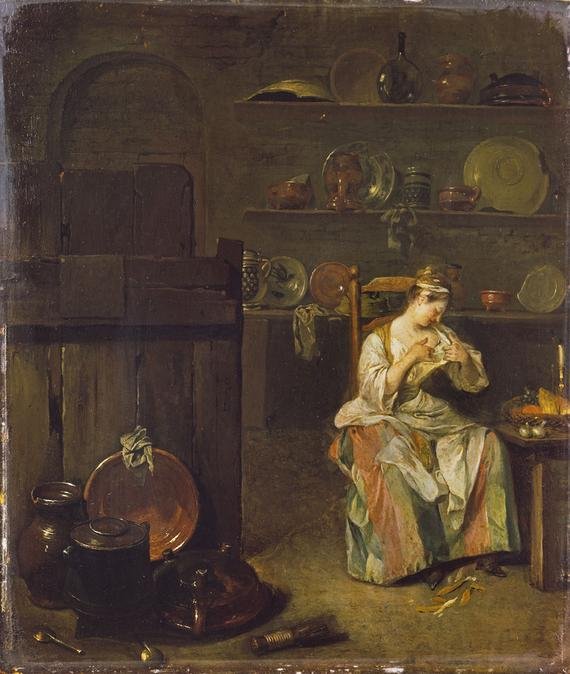
My Daily Art Display featured painting today is not a fête galante work but a genre piece which I saw recently at the Wallace Collection in London.  The painting is entitled A Girl in a Kitchen (La chercheuse de puce) which Lancret completed in the 1720’s.  It is very reminiscent of the Dutch genre paintings of the previous century.  We see before us a young woman seated in a kitchen.  The first question which comes to mind as we look at her is what is she doing?  The subtitle of the painting La chercheuse de puce, reveals all, as translated it means “the seeker out of fleas”.  Unbelievable as it may seem the girl is inspecting herself for fleas !!!   The reason for this activity was that during the eighteenth century, amongst the poorer classes, infestation in the household with fleas was quite common.  However the depiction of the girl touching her exposed breasts during her inspection was probably Lancret’s way of titillating the observer.  The girl sits before us with her corset unlaced, inspecting her body.  Kitchen scenes in poor and peasant households were popular with the Dutch art collectors but the addition of the bare-breasted girl with its erotic connotations adds a typical French flavour to the depiction.

In some ways this painting is a kind of plagiarism as it is thought that although Lancret painted the girl and the still-life on the table next to her, the interior was painted by a Dutch artist much earlier.    The erotic element of the painting is not the only “Frenchness” about the work of art.  She sits there in her French silk skirt, semi-laced corset and delicate pointed slippers and she has been added by Lancret to this Dutch seventeenth-century interior.  It is not known which Dutch artist had painted the interior.  There were many art collectors  in France who paid good money for these Dutch genre scenes.  However Lancret, the master of fêtes galantes paintings, wanted to add some colourful and picturesque feminine interest into those more dark and somber Dutch paintings and, as was the case in today’s work, he is known to have embellished works by the Dutch landscape and peasant scene painter, Herman Saftleven and the Dutch Golden Age and sill-life painter, Willem Kalf.

I will leave you to ponder over whether the original Dutch interior needed the little bit of colour and bare flesh that Nicolas Lancret has given us.

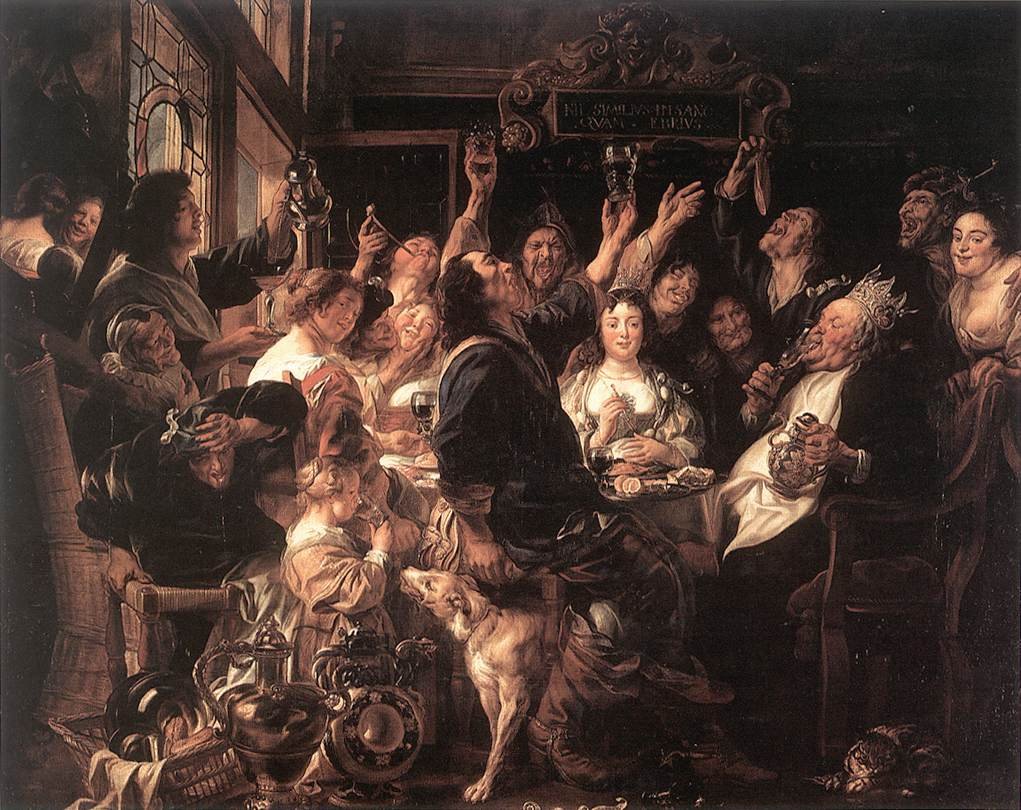
The Bean King by Jacob Jordaens

The Bean King by Jacob Jordaens (c.1665)
(Kunsthistoriches Museum Vienna)

My Daily Art Display today features the Flemish painter Jacob Jordaens.  He along with Peter Paul Rubens and Anthony van Dyck made up a triumvirate of great seventeenth century Flemish Baroque painters.  These three artists were in the forefront of the Antwerp School of painters, which was the artistic stronghold of Flemish Baroque art.

Jacob Jordaens was born in Antwerp in 1593.  He came from a very large family being the eldest of eleven children of his father Jacob Jordaens Senior, who was a wealthy linen merchant, and his mother Barbara van Wolschaten.  Coming from a wealthy family background it is assumed that young Jacob was afforded the best education.   This assumption is borne out by his clear handwriting and his competence in conversing in French.   In 1607, at the age of fourteen, he was apprenticed to the Antwerp painter Adam van Noort and he lived with van Noort and his family.  Fifteen years earlier, Rubens had been an apprentice of van Noort.   Adam van Noort was to be Jordaens only artistic tutor.  In 1615, aged twenty-two, and having completed his eight-year apprenticeship, Jordaens became a member of the Antwerp Guild of St Luke as a waterschilder.  A waterschilder was a painter of watercolours on canvas or paper which were then used as substitute tapestries.  A year later in 1616 Jordaens started to paint in oils.  His talent as an oil painter soon meant that he abandoned his watercolour work in favour of oil painting which was far more profitable.

In May 1616 Jacob Jordaens married Catherina van Noort, the eldest daughter of his tutor, and the couple went on to have three children, Elizabeth, Jacob and Anna Catharina.  Once married the couple moved from his father in law’s house to the Everdijstraat and two years later he had made sufficient money from his art to buy a house in the Hoogstraat, the very street in which he was born twenty five years earlier.   At the age of twenty-eight he was made the dean of the Guild of St Luke a post which he held for one year.

His father died in 1618 and his mother passed away in 1633.  On his mother’s death Jacob inherited Het Paradijs, the house in which he was born.  His artistic career at this point in time could not have been better.  Commissions for his work were flooding in and he became a leading light in Antwerp’s artistic circles.  Many of the commissions came from the authorities of the Catholic Church who wanted large altarpieces and he also designed several cycles of real, woven tapestries.

Between 1634 and 1638 he collaborated with Rubens on a number of commissions.  Jordaens continued to receive more and more commissions from wealthy patrons, including one for a series of twenty-two paintings from King Charles I of England in 1639.    His ever improving financial situation allowed him to have a new stylish home built next door to the one he had purchased in Hoogstraat and the two were combined to form one large residence affording him greater living space and studio work rooms.  Jordaens’ collaborator Rubens died in May 1640 and Rubens’ heirs approached Jordaens with a request for him to complete a commission for two paintings that Philip IV of Spain had given Rubens.  Jordaens fame as an artist grew throughout Europe and young aspiring painters came from many countries to study his techniques and work for him in his Antwerp studio.

In his later years, although a practicing Catholic, he clashed a number of times with the Catholic Church and his disagreement with some of the church’s beliefs.   In the 1650’s he was fined two hundred and forty pounds for publishing what the Catholic Church regarded as blasphemous and heretical writings.  In 1671, aged seventy-eight, Jordaens turned his back on the Catholic Church and was admitted into the Protestant faith, the Reformed congregation in Antwerp known as the Mount of Olives under the Cross.  As the Catholic Church was the only permitted religion in Flanders, which was under Spanish rule, the religious meetings of the Reformed Calvinist church were held secretly at worshipers’ homes, including the home of Jacob Jordaens.

Jacob Jordaens died on October 18th 1678, aged 85.  His death was from what has been termed a “mystery disease” and tragically, on that very day, this same disease struck and killed his unmarried daughter, Elizabeth, who lived with him.  Because Jordaens was now a Protestant he could not be buried in a Catholic cemetery in his home town of Antwerp and both father and daughter were buried together in the Protestant cemetery in Putte, a small village just north of the Dutch-Flemish border.  It is also in this cemetery that his wife, who died in 1659, was buried.

Have you ever heard the expression bean feast or beano?  My Daily Art Display featured painting today is all about the bean feast.  The term bean feast, often shortened to beano means a celebratory party with plentiful food and drink.  Today’s featured painting is entitled The Bean King and was completed by Jacob Jordaens around 1655 and was the fourth and last version he painted on this subject.  It is housed at the Kunsthistorisches Museum in Vienna.  The subject is the traditional Netherlandish feast held on January 6, the Day of the Three Kings or Magi, who came, according to the Gospels, to worship the Christ Child. Traditionally, a pie or cake containing a bean was baked for the festivities, and he who found the bean in his piece of pie or cake became Bean King. In this picture Jordaens showed the most joyful and noisy moment of the feast. Rich colouring and dynamic gestures emphasize the air of festivity.

King for the day !!!

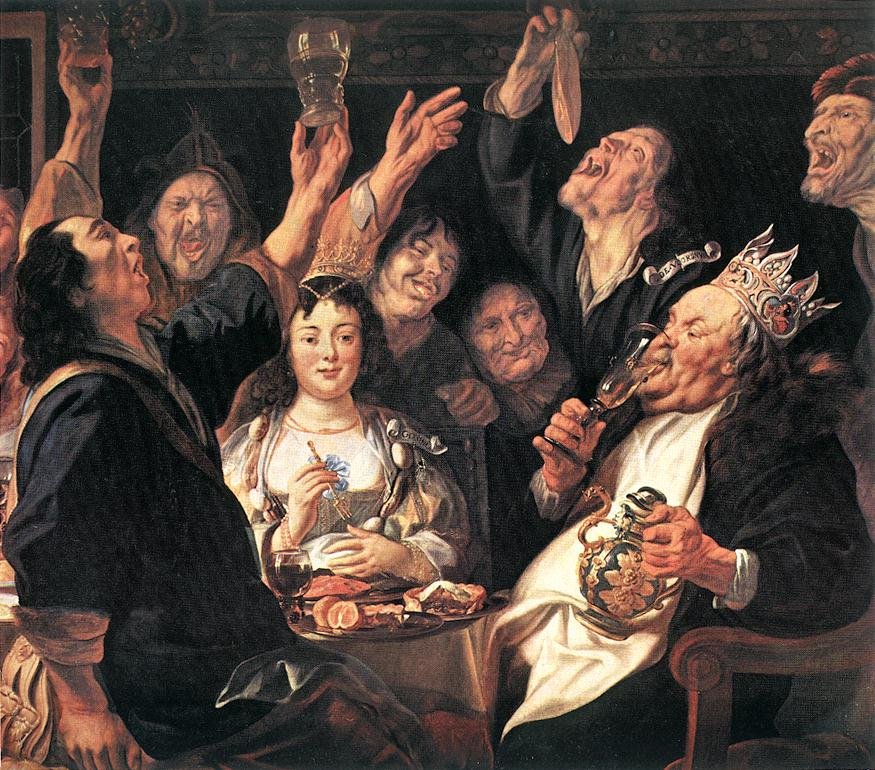
In the painting we can see a joyous and boisterous gathering sitting around a table, well stocked with food, and presided over by an old man with a crown on his head who, having found the bean in his slice of cake has been crowned the Bean King.  He has in turn chosen the prettiest lady in the gathering to be his Queen.  We see her as she sits demurely to the left of the king and seems to be overwhelmed by the whole occasion.  The rest of the group were appointed as the king’s courtiers by the newly crowned King.  The celebration meal would be punctuated at regular by the king raising his glass, as would the gathered merrymakers, and he would shout “The King drinks!”  at which time everybody else takes a swig of their drink.

There is an exuberant vitality about this work.  This painting is in the tradition of Pieter Bruegel the Elder and his tavern scenes, fairs and other over-indulgent festivities which were awash with unbridled merriment.  It is fascinating to look closely at the people in the gathering.   Take time and study the individual expressions on their faces.   On the left we see a man holding his head as he vomits.  Close by is a young child who has gained the unwanted attention of a large dog.  Whilst most of the men seem to be occupied in raising their glasses to the king, the one to the left of the queen grasps the chin of a young woman in a prelude to forcing a kiss upon her.   The cheeky looks we get from the women coupled with their low-cut neckline of their dresses would have us believe that they may be there to sell their wares to the highest bidders.  Old and young, sober and drunk are squashed together.  We are looking at a chaotic scene in a murky tavern atmosphere lit up solely by a shaft of light which streams through the window to the left of the painting.  This shaft of light seems to separate the revellers into distinct groups.   Jordaens has managed to depict an atmosphere of unrestrained emotion and merriment, giving each character expressive gestures and facial features.

In his interpretation, the everyday scene takes on a truly monumental character and can be read as an affirmation of life. The energetic composition with its warm golden-brown colouring marks out Jordaens as a follower of Rubens and one of the leading masters of the Flemish Baroque.  The final irony to this painting is a plaque on the wall above the heads of the revellers, on which is inscribed a moralizing Latin proverb:

 “No-one resembles the fool more than the drunkard”

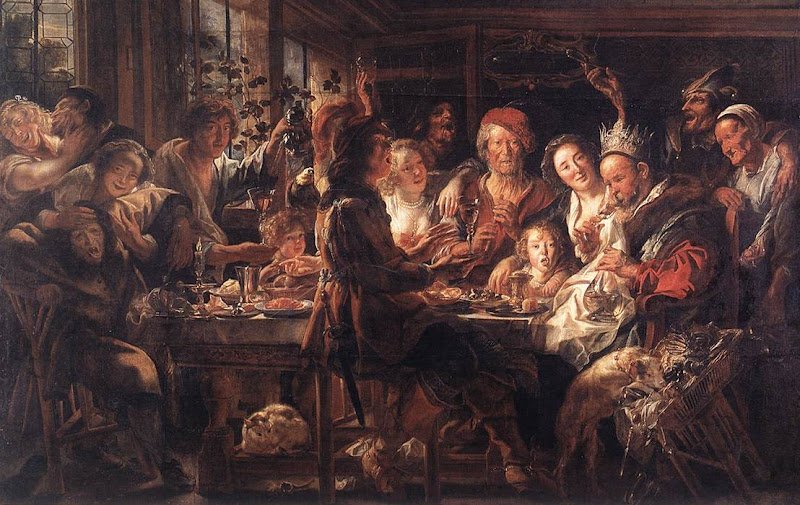
The painting below is the version of The Bean King by Jordaens which he painted around 1638 and which can be found in the Hermitage Museum in St Petersburg.

The Bean King by Jacob Jordaens (c.1638)
(The Hermitage, St Petersburg)

Another version of The Bean King by Jacob Jordaens (below) can be found at the Staatliche Museen, Kassel.

The Bean King by Jacob Jordaens (c.1635-55)
(Staatliche Museen, Kassel)

A View of the Westerkerk, Amsterdam by Jan van der Heyden

Today I am going to leave 19th century French art and Impressionism, which has featured in my recent blogs, and look at some 16th and 17th Dutch and Flemish art and artists.  Dutch art has always been very popular and admired for the realism it portrayed of everyday life and it has always proved to be highly collectible.  Before I look at some of the art of that time it may be interesting to look at a brief history of the region which has a bearing on the style of art.   I am probably laying myself open for criticism from Dutch historians for my understanding of this period of the history of the Netherlands and Holland but all I am trying to do is give you a brief insight into Flemish and Dutch art of the 16th and 17th centuries.

The Netherlands back in the fifteenth century was a conglomerate of the Seventeen Provinces often referred to as the Burgundian Netherlands, which included part of today’s Germany, Belgium, France and Luxembourg.  It was controlled from 1506 by Charles V who was the Holy Roman Emperor and also the King of Spain.   In 1556, Charles V abdicated and the power passed to his son, Philip II.  With Spanish rule came the imposition of the Catholic religion on the people of the Netherlands.  This policy of strict religious uniformity was imposed by the Inquisition with enormous amounts of brutality.  However the rise of the Protestantism in the forms of the Lutheran and Anabaptist movements and Calvinism were starting to gain ground with the populace.   The beginning of the break-up of Philip’s control of the Seventeen Provinces started with the Dutch people being unhappy at the high level of taxation levelled on them by Philip and his brutal repression of anti-Catholic movements.  To subdue the unrest, Philip sent his Spanish troops to the area under the leadership of the Duke of Alba and their presence and their cruelty further fanned the flames of rebellion.  Control of the vast area was becoming more of a problem for Philip, added to which there was now a threat coming from the French along the southern borders.  Philip II’s troops were moved from the north to the south leaving the north less well controlled and this led to the start of the Eighty Years’ War often termed as the Dutch War of Independence.   After the initial stages, Philip II deployed his armies and regained control over most of the rebelling provinces. However, under the leadership of the exiled William of Orange, the Northern provinces continued their resistance and managed to oust the Spanish armies, and established the Republic of the Seven United Netherlands, Holland, in 1609. The Dutch Revolt had officially ended and the Dutch republic of Holland was officially recognised by France and England. The end of the Eighty years War however did not end for another forty years.

The Netherlands was now split along an almost North/South divide.  The north, Holland, became a haven for Protestantism with Calvinism becoming the main religion.  There were no Catholic churches in this northern territory.   It soon became one of the world’s most economically powerful and wealthy maritime nations in the world and Amsterdam became its capital.   As far as far as art was concerned there was also a north/south divide.   The Spanish Catholic south, Flanders, with its capital Antwerp, still had most of its art commissioned by the Catholic Church or the Spanish Catholic rulers and would more often than not therefore depict religious scenes, whereas now the Dutch north where religion was mainly a Reformed Calvinistic one would not allow church’s money to be spent frivolously on the commissioning of art.   Dutch art had new patrons.  Now works were commissioned by the territory’s wealthy merchants and ship owners.  Often the subjects they commissioned had little to do with religion and more to do with their wealth and their status in society.

Today I want to feature an artist from the southern region, Flanders.  Jan van der Heyden was born in 1637 in Gorinchem, which now lies in south west Holland.  In 1650, when he was thirteen years old, the family moved to Amsterdam and lived in a house on Dam Square.   Sadly however, his father, who was a follower of the ethno-religious Mennonite group, died the year of their move.  Jan’s early artistic training began in Gorinchem with drawing lessons at his elder brother’s studio.  He also learnt, from a local artist, the reverse technique of glass painting.  Although we are looking at van der Heyden as an artist his overwhelming love was not art, although he continued to paint all his life, it was his love of engineering and inventions.   He was an artist but he also was an inventor and an engineer.  He designed many things such as the street lighting system in Amsterdam.  Shortly after he and his family moved to Amsterdam he witnessed a fire at the old town hall and the futile efforts that were made to hold back the flames.   He probably never forgot that incident for later, along with the help of his brother Nicolaes van der Heyden, a hydraulic engineer; he invented a fire engine fitted with pump driven hoses which was to change the effectiveness of fire fighting.

In 1661 Jan van der Heyden married and he and his wife moved to a house along the Herengracht, a fashionable area of Amsterdam.  As a painter, Jan van der Heyden, will always be remembered for his beautiful townscapes and his architectural designs certainly dominate these works.   Although he painted many townscapes he also painted scenes featuring village streets and country houses.  He loved to paint old and new buildings and paid particular attention to their facades.  He also completed more than forty landscapes although his landscape art was never in the same league as his contemporaries, Meindert Hobbema and Jacob van Ruisdael.   He worked in partnership with Adriaen van der Velde,  the Dutch animal and landscape painter, and Johannes Lingelbach, a Dutch Golden Age painter, who would often add figures to van der Heyden’ architectural scenes and add landscape effects as a finishing touch to the paintings.   His main subjects were Amsterdam and the region surrounding the Dutch-German border where he and his family visited on many occasions.

In 1672, Adriaen van de Velde died and Jan van der Heyden artistic output dwindled as he concentrated on his main employment that of superintendent of the lighting in Amsterdam and he also devoted much of his time as the director of the Amsterdam Fireman’s Guild.  He died a wealthy man in 1712, aged 75.

View of the Westerkerk, Amsterdam by Jan van der Heyden (c.1660)
(National Gallery, London)

My featured painting today is entitled View of the Westerkerk, Amsterdam.    The building work on the protestant church commenced in 1620 and was designed by the foremost architect of the time, Hendrick de Keyser, the father of the Dutch painter Thomas de Keyser.  The construction was completed eighteen years later and at the time its tower was the highest in the city.  Jan van der Heyden painting is of the church, seen from the east, across from the Keizersgracht, the new Emperor canal.  Buried within the church are the painters Nicolaes Berchem, Rembrandt and his son Titus.

There are two versions of this paintings housed in galleries in London.  Both were painted between 1660 and 1670.   In both cases these are, like many of his townscapes and landscapes, only loosely based on actual views as topographical accuracy was not in the forefront of his mind when he started to work on his paintings.  It was almost as if he wanted to bring into his painting all that was beautiful about the town, whether it be its landscape or its architecture.  It was simply an idealised townscape which I believe does not lessen the beauty of the finished work.  The difference between these paintings and others he did was that in View of Westerwerk, Amsterdam he has paid great attention to the detail of the buildings whereas in other townscapes the main buildings may look half finished with the emphasis being placed on surrounding structures and open spaces.

Let us look at the version which is at the National Gallery in London.  Look at the clarity of this work.  Marvel at the detail van der Heyden has put into this painting.  In the foreground we can see four wooden casings which protect the young tree saplings.  One can almost read the writing on the torn posters which have been affixed to the casings.   This version is much larger than the one in the Wallace Collection, measuring 91cms x 114cms and almost three times the normal size of van der Heyden’s previous works.  It is believed that it was commissioned by the governors of the Westerkerk, for their meeting room, where it remained until 1864.   I love the details of the red-brick buildings but look at the contrast in colour of them with how the artist has depicted the blue sky with all its luminosity, the yellow cobblestone path in the foreground which runs parallel to the stretch of the canal and the glass-like stillness of the water.  It is probable that another artist painted the people and animals shown in the work.

View of the Westerkerk, Amsterdam by Jan van der Heyden (c.1665-1670)
(Wallace Collection, London)

I went to the Wallace Collection last week and saw this other version of the painting.  It is much smaller in size, measuring just 41cms x 59cms.  The artist’s signature can be seen in the lower right on the coping of the canal wall.  To the left of the church is the Westmarkt and if you look carefully between the trees you can just make out the Westerhal, which housed a meat market on the ground floor and above it was a guard house.   The house which we see to the right of the church is Keizersgracht no, 198 and was at that time the residence of Lucas van Uffelen a wealthy Flemish merchant and art collector.  What is very striking about this small painting is the sharp contrasts of colour, light and texture with shadows slanting across the front of the church.  Look at the contrast between the angular roofs and the luminous blue sky.  See how the artist has contrasted the trees heavy in leaf with the red brick buildings and in the case of the house on the right of the painting, its whitewashed frontage.  In this painting, unlike the one at the National Gallery, the artist(s?) have depicted reflections in the still water of the canal.  It should be remembered that this painting was completed after the one which now hangs in the National Gallery and is probably a re-working of the scene.  It could be that Jan van der Heyden was not completely satisfied with his first effort and wanted to make some artistic improvements.

If you are in London, why not take a chance to visit both galleries and compare the two paintings and decide which you like the best.

Une loge aux Italiens (A Box at the Theatre des Italiens) by Eva Gonzalès

Une loge aux Italiens (A Box at the Theatre des Italiens) by Eva Gonzalès (1874)

I had intended this offering to be my previous blog but when I researched into today’s featured artist and her painting I saw there was a connection between this work of hers and a similar one completed by Renoir in that same year.  My Daily Art Display featured artist today is Eva Gonzalès and the work I want to look at is entitled Une loge aux Italiens (A Box at the Theatre des Italiens) which she completed in 1874.

Eva Gonzalès was born in Paris in 1849.  Her father was the novelist and playwright, Emmanuel Gonzalès, a Spaniard but naturalised French.  Her mother was a Belgian musician.  From her childhood she was immersed in the literary world as her parents house was often used as a meeting place for critics and writers.

Eva began her artistic career in 1865, at the age of sixteen, when she began to study art.  Initially she studied under Charles Joshua Chaplin, the French society portraitist, who ran art classes specifically for women in his atelier and who, the following year, would teach the American female artist Mary Cassatt.

Portrait of Eva Gonzalès by Manet

Just before her twentieth birthday in 1869 she became a pupil of Édouard Manet and also used to model for him and many of the other Impressionist artists.  It was whilst at his studio that she met Berthe Morisot who was also working with Manet and posing for some of his works.  There would seem to have been an intense  rivalry between the two females.  According to Anne Higonnet’s book Berthe Morisot, Morisot wrote to her sister about Gonzalès and Manet’s attitude towards her saying:

“… Manet preaches at me and offers me the inevitable Mlle Gonzalès as an example; she has bearing, perseverance, she knows how to carry something through, whereas I am not capable of anything.   In the meantime, he begins her portrait again for the twenty-fifth time; she poses every day, and every evening her head is washed out with black soap.  Now that’s encouraging when you ask people to model…”

Repose by Édouard Manet

One can easily detect Berthe Morisot’s jealousy of Eva Gonzalès in that passage.  The painting referred to by Berthe Morisot was entitled Portrait of Eva Gonzalès which Manet was working on and which he exhibited in the 1870 Salon.  It is now housed at the National Gallery, London.  At the same time that he was painting the portrait of Eva Gonzalès he was also painting a work entitled Repose which was a portrait of Morisot and which he also exhibited at the 1870 Salon, as almost a companion piece.  This portrait of Morisot can be seen in the Rhode Island School of Design, Museum of Art, Providence, Rhode Island.  As you can see by the passage above, Morisot was annoyed by Manet’s painting of Gonzalès.   What rankled Morisot the most was probably how Manet had portrayed the two young ladies.    So what could have annoyed Morisot about Manet’s depiction of her?  Look at the two paintings.  Both young women, both wear similar clothing, both have been portrayed as young and pretty but the one big difference is that Morisot is depicted half laying back on the sofa in what one could describe as a languid and idle pose whereas Eva is portrayed as a budding artist actively at work.   What also should be kept in mind is that Morisot did not look upon herself as merely a “pupil” of Manet.  For Morisot,  her relationship with Manet was almost as equals rather than master and pupil.  In her relationship with Manet, she was also much more forceful and self-confident than Gonzalès, who was more of a willing disciple of Manet and who would put up with Manet’s abrupt manner,  whilst continually absorbing his teaching.   Of course there was another significant difference between the two young women – age!   Eva was more than eight years younger than Morisot.

Unlike Morisot, but like her mentor Manet, Eva Gonzalès decided not to exhibit any of her work at the controversial Impressionist Exhibitions but she has always been grouped with them because of her painting style.   However, she did regularly have her work shown at the annual Salon exhibitions in the 1870’s.  Her works received mixed comments.  The critics who were supporters of the Impressionist artist liked her work.

Portrait of Jeanne Gonzalès in Profile by Eva Gonzalès

In 1869 Eva married Henri Charles Guérard, an etcher, lithographer  and printmaker, who was a close friend and sometime-model for Édouard Manet and who modelled for some of his wife’s paintings along with his sister-in-law Jeanne (La femme en rose, Jeanne Gonzelès).  In 1883, a month after her 34th birthday, she gave birth to a son, John.  Sadly, her life was cut short when she died following complications of childbirth.  It was believed to have been Puerperal Fever.    Her death came just six days after the death of her one-time mentor Édourad Manet.   Two years after her death a retrospective of Gonzalès’ work was held at the Salons de La Vie Moderne in Paris where over eighty of her paintings were put on display.

Five years later, in 1888, Henri-Charles Guérard  married Eva’s younger sister, Jeanne Gonzalès, also an artist.   My featured painting by Eva Gonzalès is entitled Une loge aux Italiens (A Box at the Theatre des Italiens) and you can obviously see the similarity between her painting and my previous offering entitled La Loge by Pierre-Auguste Renoir.  I decided to feature his first and then let you compare her painting with his.

As I discussed in my last blog, the auditorium of a  theatre and especially the theatre box were fashionable places for an exchange of society chit-chat and gave the theatregoers the opportunity to be seen at their best.  The subject of the theatre and theatre goers was a subject frequently chosen by the Impressionists, such as Cassatt and Degas but probably the most celebrated of this genre was Renoir’s La Loge (The Theatre Box) and it is interesting to compare it with this work by Eva Gonzalès which she completed in the same year, 1874.  This painting by Gonzalès was submitted to the Salon jurists for inclusion in the 1874 Salon but was refused.   Eva Gonzalès then made some changes to the painting and five years later submitted it to the 1879 Salon and this time it was accepted.  The critics loved the work.

There are some similarities to this painting of hers and that of her former tutor Édouard Manet in the way she, like him, chose to paint a modern-day subject and the way her painting, like some of his, shows a total contrast between the light colours of the clothing of the subject and the pale creamy skin of the female and the dark background.   In stark contrast to the dark velvet edge of the box , we see her white-gloved hand with its gold bracelet casually resting along it.   There is also an uncanny similarity between the bouquet of flowers that rests on the edge of the theatre box to the left of the woman in Gonzalès’ painting and the bouquet of flowers which Manet depicted in his painting, Olympia (see My Daily Art Display October 12th 2011).  The two people who were sitters for Eva’s painting were her husband, Henri Guérard and her sister Jeanne who as I said before was to become Henri’s second wife.

As was the case in Renoir’s painting we are left to our own devices as to what is going on within the theatre box. We need to make up our own minds as to what the relationship is between the man and the woman and to their social standing in society.  There is little symbolism to help us interpret the scene.  We just have to use our own imagination and sometimes that adds to the joy os looking at a work of art.