The Skagen Painters, Part 2 – Mr and Mrs Krøyer

Double Portrait of Maria and P.S. Krøyer by Maria and Peter Severin Krøyer (1890)

As promised in my last blog featuring the Skagen husband and wife painters, Michael and Anna Ancher, My Daily Art Display today features another married couple who resided in Skagen, Denmark and were leading lights of the Skagen artist commune.   Their names were Marie and Peder Severin Krøyer. 

Marie Martha Mathilde Triepcke was one of three children born to German parents in the Danish capital of Copenhagen in June 1867.   She developed an early love for art and following normal schooling she decided that her future lay as an artist.  For a female to train to become an artist in Denmark in those days was very difficult as women were not allowed to enrol on art courses at the Danish Royal Academy of Art and so she had to study drawing and painting at private schools.  One of these art schools was the Kunstnernes Frie Studieskoler,  a Copenhagen art school which had opened in 1882 as a protest against  the policies and rigid dictates of the Royal Danish Academy of Fine Arts  and by so doing offered an alternative to the Academy’s rigid educational program.  The artist who looked after the new students was the Danish painter, Kristian Zartman.  Another teacher at the art school when Maria attended was the young artist Peter Severin Krøyer.   During her time at these private art establishments she received tuition in model drawing as well as some landscape, still life and portraiture. She and other artists, both male and female, were encouraged to spend time in the countryside and paint en plein air.  In 1887, when she was twenty years of age she made her first trip to Skagen which had by this time become home to  a flourishing artist colony. 

Two years later in December 1888 at the age of twenty-one she left Denmark and travelled alone to Paris to live and further her artistic education.  She studied at a number of studios including those of the French painters, Gustave Courtois and Alfred Roll.  One of the studios she worked in was run by the French painter, Pierre Puvis de Chavannes and it was whilst working in his atelier she became great friends with a fellow co-worker Anna Ancher, who along with her husband Michael, featured in my last blog.  Marie soon became one of the Parisian “Scandinavian artistic-set” and one of these fellow artists was Peter Severin Krøyer whom she had met before in Copenhagen.   Who knows why, but suddenly the relationship between Peter and Marie intensified and they fell in love.  It was a whirlwind romance because in July 1889, within six months of their Paris meeting they were married. 

Peter Severin Krøyer was sixteen years older than Maria.   Although he is often looked upon as a Danish painter, in fact he was born in the Norwegian town of Stavanger in July 1851.   His entry into the world was not without trauma as when he was just a young baby; he was taken from his mother, Ellen, as she was considered unfit to look after her son due to being mentally ill.  Peter went to live in Copenhagen where he was brought up by his maternal aunt and her husband.  At the age of nine, because of his love of drawing, they arranged for him to attend art classes at a private school.  A year later, he was enrolled at the Copenhagen Technical Institute.  From there he attended the Royal Danish Academy of Art and in 1870, at the age of nineteen, he completed his formal studies.  He, like many aspiring artists, began exhibiting his work at the Charlottenborg Palace in Copenhagen and his big breakthrough came in 1874 when the tobacco magnate Heinrich Hirschsprung bought one of his works.  Hirschsprung would become one of Peter Krøyer’s patrons and funded his early European travels.   This connection with Hirschsprung also had a connection with his wife-to-be Marie, as her childhood school friend was Ida Hirschsprung whose uncle was Heinrich and it was through Ida that Marie came into social contact with the Hirschsprungs and their circle of friends including  Peter Krøyen. 

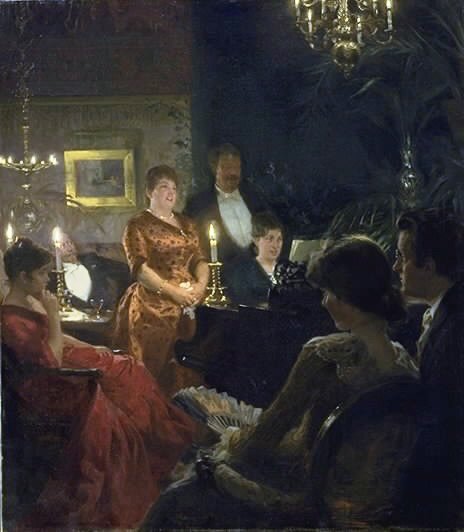
The Duet by Peter Krøyer (1877)

Marie Triepcke actually sat for Krøyen for his 1877 painting entitled The Duet.  She is the woman in red at the left of the painting.

For the next five years Krøyer travelled extensively visiting Spain and Italy as well as spending summer months in Brittany, all the time honing his artistic skills.  During the late 1870’s he would also come across the “new kids on the block” – the young French impressionists such as Monet, Sisley, Degas and Renoir.  However Krøyer was more attuned to the academic painters of the time.   After roaming for those five years he finally returned “home” to Denmark and in late 1881 and in the summer of 1882 he went to Skagen.  He was so enamoured by this area that he bought himself a home there and it was here that he spent his summers before returning to his Copenhagen apartment in the winter months to work in his studio.    Between 1882 and 1904 Krøyer was a leading figure at the newly founded Kunstnernes Frei Studieskoler where he oversaw the life drawing classes which allowed students to draw and paint images of live nudes, an art form which, at the time, was not allowed at the Royal Danish Academy of Fine Arts.

Marie Krøyer returned to Skagen with her husband Peter in 1891 and became part of the Skagen artists’ commune.  Once married, her artistic output lessened for she was concentrating on interior design and floral still-life painting which could be incorporated into interior design.  Another reason could have been her feeling artistically inferior in comparison to her husband, or maybe she was just overwhelmed by the burden of motherhood and looking after the house and her husband.  She was quite disheartened for she was quoted as once saying:

“…I sometimes think that the whole effort is in vain, we have far too much to overcome … what significance does it really have if I paint, I shall never, never achieve anything really great … I want to believe in our cause, even if at times it may be terribly difficult…”

    In 1895 she gave birth to a daughter, Vibeke and the family moved to a cottage in Skagen Vesterby where she spent time designing the interior of their home.  Her life with her husband became very challenging due to a decline in his mental health and his frequent incarceration in mental homes.   Her husband’s eyesight also began to gradually fail in 1900.      In 1902 during a journey to Italy Marie met the Swedish composer and violinist Hugo Alfvén.  She and Alfvén became lovers but Krøyer refused to give his wife a divorce.  This changed in 1905 when he found out that his wife was pregnant with Alfvén’s child.  Once divorced, Marie moved from Denmark and went to live with her husband and their baby daughter Margita in Tällberg, Sweden. 

The couple had a new home built there, which became known as Alfvénsgården, and Maria created the interior design and furnishings of the building.  The couple lived together unmarried for seven years before finally marrying in 1912 and their life together lasted twenty-four years until in 1936 they divorced.  Marie retained her beloved Alfvénsgården and remained there until she died in Stockholm in May 1940, a few weeks before her 73rd birthday.  On her death the house reverted to her daughter Margita and when Margita died the house went to Vibeke, Marie’s daughter from her marriage to Peter Krøyer. 

Peter Severin Krøyer died in November 1909, aged 58, at which time his sight had completely failed and he was blind. 

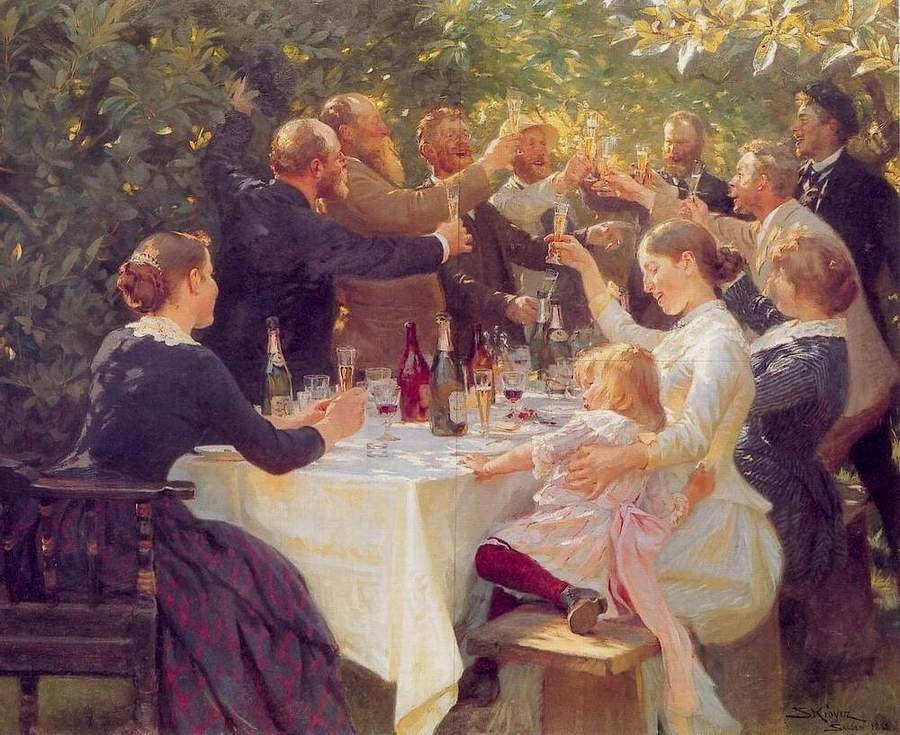
Hip, Hip Hurrah; An Artist's Party on Skagen by Peter Krøyer (1886)
Hip, Hip Hurra by Peter Krøyer (1886)

One of Krøyer’s best known works entitled Hip Hip Hurrah: An Artist’s Party on Skagen came about from his love of photography and his newly bought camera which he purchased in 1885.  It was during a garden party at the house of Michael and Anna Ancher that he took the photograph which captured the celebrating guests.  Delighted with the photograph, Krøyer decided to convert it into a large scale painting and wanted to bring in his models to Ancher’s garden so as to do some preliminary sketches.  Michael Ancher would not go along with the plan and would not countenance the intrusion of the artist and his models into his private garden so Krøyer had the table moved to his garden and set about the work.  It took him three years to complete the “stage-managed” work which in some ways resembles Renoir’s 1881 Luncheon of the Boating Party (see My Daily Art Display Aug 2nd 2011).  The garden party guests are seen celebrating and raising their glasses in a toast.  In the painting we have many of the leading members of the Skagen artist colony.  With her back to us is Martha Johansen who was along with Maria Triepcke and Anna Ancher one of the triumvirate of great female Skagen painter.  Standing on the far side of the table are the Skagen painters Viggo Johansen, the Norwegian Christian Krogh and dressed in brown Krøyer himself.  The man in the white suit is Degn Brøndum, Michale Ancher’s brother in law.  Next to him is Michael Ancher.  On this side of the table we have the Swedish painter Oscar Björck, and the Danish painter Thorvald Niss.  The lady leaning back is Helene Christensen, the local schoolteacher and wife of painter Karl Madsen and closest to us, dressed in white is Anna Ancher and her four year old daughter Helga.  As in many of the Skagen paintings the feature of this work is not the people but the Skagen sunlight which streams through the trees casting shadows on the white tablecloth and shimmers on the bottles and glasses. 

Self Portrait by Marie Krøyer (1889)

In contrast to Peter Krøyer’s depictions of his beautiful wife Marie, often seen strolling along the Skagen beaches, Marie’s 1889 Self Portrait is much more sombre and severe.  Half her face is in shadow in this work and it could reflect her state of mind at the time she painted the work. 

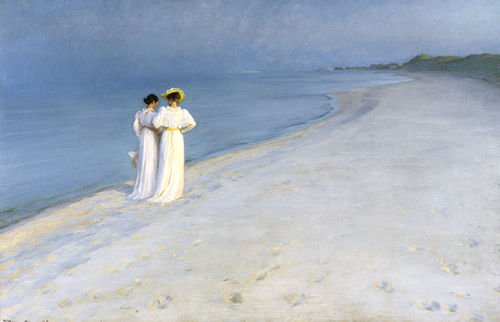
Summer Evening on Skagen's Southern Beach by Peter Krøyer (1893)
Summer Evening on Skagen’s Southern Beach by Peter Krøyer (1893)

In contrast to this dark portrait we have Peter Krøyer’s painting entitled Summer Evening on Skagen’s Southern Beach which he completed in 1893.  The idea for this work came to Krøyer during one of the many dinner parties he attended after which the diners would take twilight stroll along the shoreline.  It is an idyllic setting and we see Peter’s wife Marie.  Once again like paintings I featured by Michael Ancher and his wife the colour blue featured a lot in Krøyer’s painting during his stay in Skagen.  This twilight period when day starts to lose out to night was often referred to the “blue hour” which was how they say saw the sky and sea merge into one shade of blue.

Brøndum’s dining room with (left to right) Degn Brøndum (brother of Anna Ancher), Hulda Brøndum (sister of Anna Ancher), Anna Ancher, Marie Krøyer, P.S. Krøyer, and Michael Ancher, ca. 1890s; Image courtesy of Skagens Museum

I finish this blog with a photograph of my four Skagen artists, which I have featured in my last two blogs, sitting around a dining table at the Brondum hotel once owned by Anna Ancher’s parents

The Skagen Painters – Part 1: Mr and Mrs Ancher

Often in my blogs I have talked about artists’ colonies, places where artists congregated, visited and sometimes lived.  In England, I looked at some artists who lived and painted in Newlyn and St Ives.   In France there was the commune of Barbizon, close to the Fontainebleau Forest, just a short train ride from the French capital, which was home to the leaders of the Barbizon School, the painters Théodore Rousseau and Jean-François Millet.  There was also the artist colony in Brittany at Pont-Aven, where great artists such as Gaugin and Émile Bernard plied their trade.  In fact, in most countries, there were areas favoured by artists, usually because of the beautiful landscape and the special light which could be savoured by the en plein air painters during the long summer days.  Today and in my next blog, I am focusing on another artist commune and two husband and wife couples who were considered the leading figures of the artistic group.  Let me introduce you to four painters who formed part of the Skagen commune of artists.   They were Michael Peter Ancher and his wife Anna and Peder Severin Krøyer and his wife Marie.   

Skagen, Denmark
Skagen, Denmark

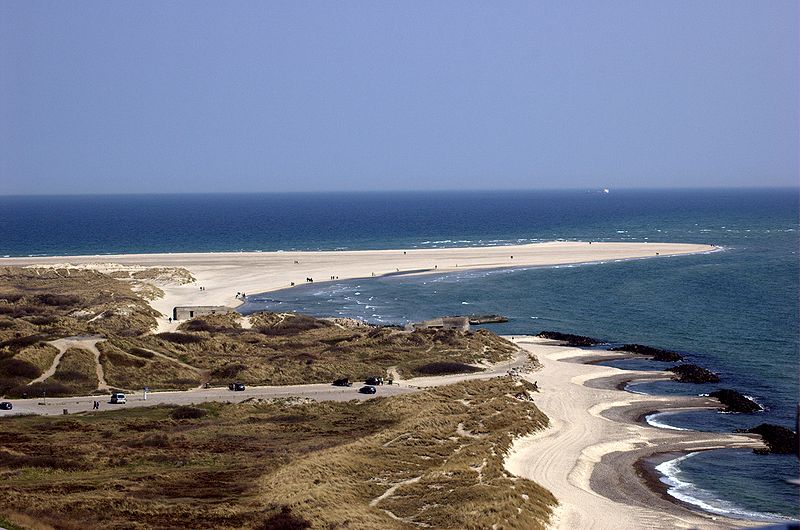
Skagen, which is part of Jutland, is at the most northerly tip of Denmark.  It is a finger of land, which juts out into the sea and is looked upon as the divider between the great waterways of the Skagerrak and Kattergat straits, the former connecting with the North Sea and the latter which leads in to the Baltic Sea.  It was at this place that the artists discovered an exclusive and exceptional quality of light.   The Norwegian naturalist painter and illustrator, Christian Krohg, best summed up the allure of Skagen for painters when he described the area:

 “…This country is mild, smiling, fantastic, mighty, wild, wonderful and awe-inspiring…it is Skagen – there is no other place on the face of this earth like it…”

This unspoilt area was a magnet to artists who flocked to this picturesque destination in the late 19th century in an attempt to escape city life.  For them it was a bolt-hole and an opportunity to artistically catalogue a beautiful untouched area, which they believed one day would vanish. 

My blog today focuses on Michael and Anna Ancher a talented couple of Skagen School painters. 

Michael Peter Ancher was born in June 1849 at Rutsker, a small Danish village on the island of Bornholm.  Once he had completed his classical education he set his sights on becoming an artist and in 1871, aged twenty-two, he enrolled on a four-year art course at the Royal Danish Academy of Art.  It was whilst on this course that he developed a liking for genre painting, paintings which depicted everyday life.   One of his fellow students at the Academy, who befriended him, was Karl Madsen and it was he who persuaded Ancher to accompany him to Skagen in 1874.  Ancher’s journey to Skagen with his friend was to influence both his future life as well as his art.  Ancher fell in love with Skagen and he decided to make it his home.  Skagen was not just a home to artists but was also one for many writers who loved the tranquility of the area and found it conducive in their quest to write a good book or poetry.  Hans Christian Andersen often visited Skagen but another writer who was to play a part in Michale Ancher’s paintings was the poet and dramatist, Holger Henrik Herholdt Drachmann who had come to Skagen to write and learn to paint.  Drachmann was in awe of the bravery shown by the local fishermen and sailors and often wrote about them in prose and verse. 

Will he round the point ? by Michael Ancher (c.1879)
Will he round the point ?
by Michael Ancher (c.1879)

In 1879, five years after settling down in Skagen Michael Ancher  painted one of his most famous works, a painting which featured the hazardous life of the local fishermen.  It was entitled Vil han klare pynten (Will he Round the Point?).  This work was to be Ancher’s great artistic breakthrough.   It was such a popular work that no fewer than two buyers were about to acquire the work before a third one stepped in and took the painting.  So who were the proposed buyers?   Initially the Copenhagen Art Association were going to buy the painting but agreed to relinquish their grip on the work when the Danish National Gallery stated that they wanted to purchase Ancher’s painting.  However they too had to step aside when the king, Christian IX, expressed a “wish” that he should own the work!  In the painting we see a dozen men, on Skagen’s southern shore, as the waves lap around their feet.  They are all dressed in fisherman’s garb and they are all staring worriedly out to sea worrying about the safe return of one of their comrade’s boats. 

The Lifeboat is Taken through the Dunes by Michael Ancher (1883)

As with many small fishing communities the fishermen also acted as lifeboatmen who put their lives on the line for those in peril on the high seas.  Ancher depicted such an occasion in his 1883 work entitled Redningsbåden køres gennem klitterne (The Lifeboat is Taken through the Dunes) in which we see the fishermen arduously hauling their horse-drawn lifeboat cart over the snow-covered sand dunes so that it can be launched into the dark and threatening sea.  It is mid-winter and the skies are dark and menacing and in the right background we catch glimpse of the stricken ship.  Two men at the tail of the line of fisherman shout to persons unknown, who are outside the picture, and this gesture adds to the sense of urgency and tension of the moment.   

The Drowned  by Michael Ancher (1896)
The Drowned
by Michael Ancher (1896)

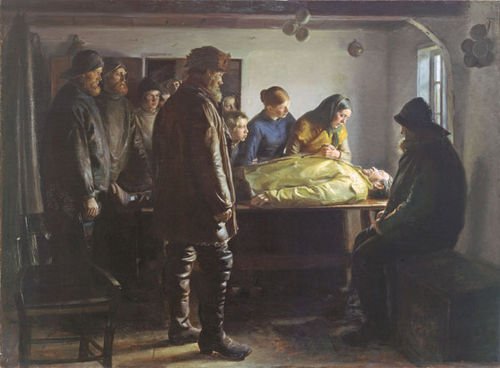
The final work by Michael Ancher featuring the heroism of the Skagen fishermen was completed in 1896 and entitled The Drowned FishermanThe painting is inspired by the death in 1894 of the Skagen fisherman and lifeboatman, Lars Kruse.    Kruse was famous throughout Denmark because of a book written by Holger Drachmann which told of Kruse’s heroism as a rescuer.  Michael Ancher had already painted a number of portraits of Kruse but this final painting of the Kruse will be the best remembered.  Kruse had become the chairman of the Skagen lifeboat and had, through the time as a rescuer, received many awards for the bravery he had shown during his rescue work.  An engraving on one of his awards summed up his courage stating:

  “…Humble in word, proud of his deed, Christian in deed,  Man in his boat…” 

Lars Kruse was killed in 1894 whilst trying to land his boat on Skagen’s North Shore in a winter storm.  Through Drachmann’s book and Ancher’s painting the name of Lars Kruse lives on in the memory of the Danish people.   After over almost twenty years of depictions of Skagen fishermen carrying out their perilous job, this painting of Kruse’s death was the last one by Michael Ancher to feature the local fishermen. 

Shortly after Michael Ancher first visited Skagen in 1874, he met fifteen year old Anna Kristine Brondum, a native of Skagen and one of six children of Erik Andersen Brøndum and his wife Ane Hedvig Møller, who ran a local grocery business and the Brondums Guesthouse.   He had been invited to Anna’s confirmation and from that first meeting friendship blossomed.   Anna, although still young, and Michael had one shared passion – art.   In 1875, at the age of sixteen, Anna began a three year drawing and painting course at the Vilhelm Kyhn College of Painting in Copenhagen.  This college, known as Tegneskolen for Kvinder (Painting School for Women) was started in 1865 by the Danish landscape painter, Vilhelm Khyn, at a time when women were not allowed to enrol on art courses at the Danish Academy of Art.  On returning to her family home in Skagen her friendship with Michael Ancher developed rapidly.  They were engaged in 1878 and in 1880 the couple were married.   Three years later, in 1883, their daughter Helga was born.  Anna was determined to buck the trend which seemed to decree that after the birth of a child the mother should give up all her dreams and solely concentrate her life on the upbringing of her children and the task of looking after her husband and house.  Anna refused to give up her art.   The following year Michael, Anna and their baby daughter, Helga went to live in a house in Markvej.    The family lived there for 30 years. In 1913 they had the house extended to make more space for Michael and Anna’s art.

Sunlight in the Blue Room by Anna Ancher (1891)

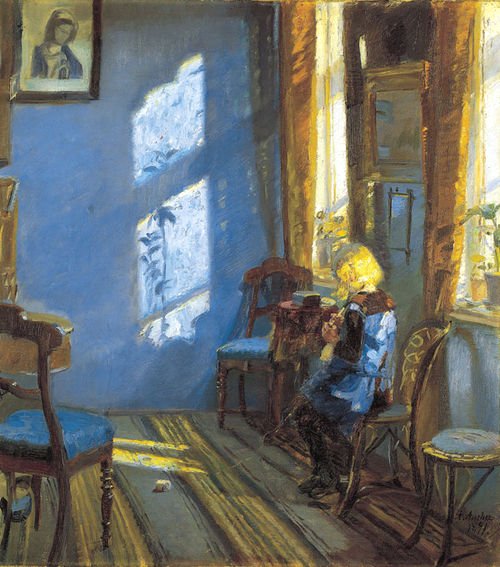
In 1891 Anna Ancher completed a beautiful painting which featured her eight year old daughter Helga.  It was entitled Sunlight in a Blue Room.   In the painting we see Helga sitting in the blue room of the Brøndum’s Hotel which was once run by Anna’s parents.  She actually completed a number of portraits of her mother, Ane, in this very room.   We see Helga sitting quietly drawing on a pad.  She too, like her mother and father before her, would study art in the Danish capital.   However, the beauty of this painting is the way in which Anna has captured the light which streams through the window.  It is a painting of the interior and only the shadows on the wall give us a hint about the exterior. 

Grief by Anna Ancher (1902)

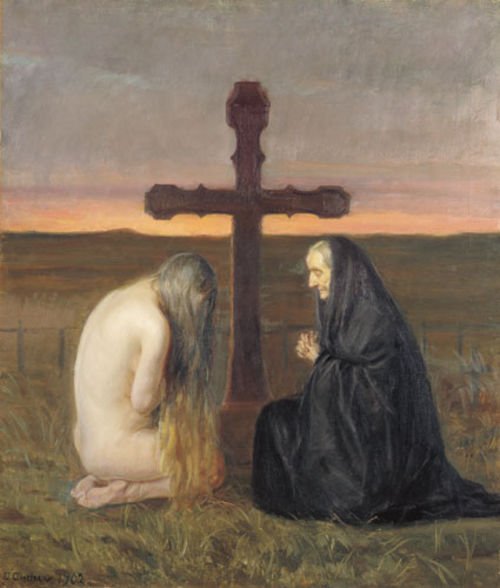
One of the most moving paintings I came across by Anna Ancher was one she completed in 1902 simply entitled Grief.   It was based on a dream she once had – or maybe it was a nightmare.  The old woman kneeling on the right is Anna’s mother, Ane Brøndum and it could be that the woman on the left is a self portrait.  Anna had been brought up in a very religious household although once away from the family environment and studying at art college, she questioned her religious beliefs especially as she had become surrounded by radical and often atheistic artists who formed the Skagen artistic commune.  In some ways this questioning of her early religious family background may have caused her to feel ill at ease and out of this could have come this dream which compares her with her mother.  One is old, one is young, one is fully clothed whist the other is naked.  The contrast is plain to see as the two people gather around a cross.  Is the younger girl praying for forgiveness for her loss of faith or just simply praying that she should be understood?  Is the old lady literally praying for the soul of her grow-up child?  Is that how Anna envisaged her relationship with her mother? 

Mrs Ane Brøndum in the Blue Room by Anna Ancher (1913)In 1913 Anna painted two portraits of her mother who was then 87 years old.  They are very intimate depictions of her elderly mother, and completed just three years before she died. 

Portrait of Anna Hedwig Brondum by Anna Ancher (1913)

Michael Ancher died in 1927, aged 78 and Anna Ancher died eight years later in 1935, and the house the lay empty.  However their daughter Helga Ancher, who died in 1964, stipulated in her will that any money that she left should be used to create a fund to be known as The Helga Ancher Foundation. The money in the Fund was to be used to renovate her parents’ house and it should house all the paintings by her mother and father that she owned.  In 1967, three years after Helga’s death her wish was fulfilled and the museum was opened.

In my next blog I will look at the works of two other Skagen painters, Peder Severin Krøyer and his wife Marie, who were also great friends of the Anchers.


Niels Ryberg with his Son Johan Christian and his Daughter-in-Law Engelke, née Falb by Jens Juel

Niels Ryberg with his Son Johan Christian and his Daughter-in-Law Engelke, née Falb by Jens Juel (1797)

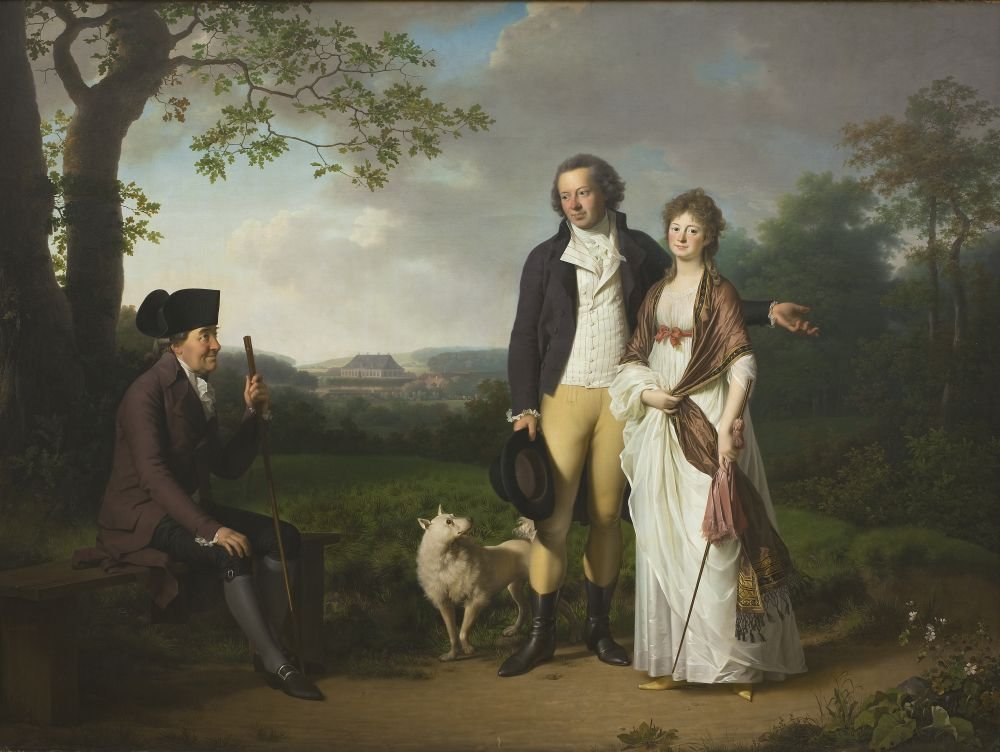
My featured painting today is one I saw when I was in Copenhagen last week.  It was a large scale work measuring 253 x 336cms, and was certainly very impressive.   The first thought which came into my mind when I stood before it was that it reminded me of the painting  Mr and Mrs Andrews by Thomas Gainsborough, which I had seen at the National Gallery in London and which I had featured in My Daily Art Display (May 5th 2011).  Today’s featured painting by the Danish painter Jens Juel, like Gainsborough’s work, is what is termed a conversation piece.  Conversation pieces were very popular in the 18th century.  They were informal portraits, usually depicting two or more full-length characters, often family members, who were seemingly engaged in conversation in domestic interiors or garden settings.   In many ways it was a means for the people depicted to show off their wealth and social status.  In some ways the people who commissioned the paintings were often depicted in the work, and wanted to stimulate a conversation about themselves.   Today’s painting also reminded me of the William Hogarth series of six works entitled Marriage à la Mode, which I featured in my blog (May 4th  –  9th 2011) that told the tale of a merchant desperate to be part of the aristocratic class.  My painting today is by the great Danish artist Jens Juel which he completed in 1797.  It is entitled  Niels Ryberg with his Son Johan Christian and his Daughter-in-Law Engelke, née Falb, often simply referred to as The Ryberg Family.   Jens Juel, who was mainly known for his portraiture, was active during the years preceding what was to become known as the Danish Golden Age, which followed the end of the Napoleonic Wars and lasted until around 1850.   

Jens Jorgensen Juel was born in May 1745 in Balslev on the Danish island of Funen.   It is said that he was born illegitimately, the son of Vilhelmine Elisabeth Juel.  She had been employed at the Wedellsborg estate.  Jens’ father is unknown.  Some believe he was a member of the Wedell family whilst others believe he could have been Lord Jens Juel, the Danish diplomat or that Jens was the son of the local vicar.   For the first year of his life Jens lived with his mother at the house owned by her brother, Johan Jørgensen, a schoolteacher.  When Jens was one year old his mother married Jørgen Jørgensen, also a school teacher who worked and lived in the nearby village of Gamborg and it was here that Jens Jorgensen Juel grew up. 

Like many artists, Jens showed an early fascination with drawing and his parents decided to encourage this interest by arranging for an apprenticeship for their son with the German painter Johann Michael Gehrmann, who had a studio in Hamburg, a city, which at the time was under Danish sovereignty.  He remained at Gehrman’s studio for five years, after which, in 1765, he returned to Denmark and attended the Royal Danish Academy of Art in Copenhagen and during his five-year stay at this establishment he won two gold awards for his paintings and a travel bursary.   One of Juel’s tutors at the Academy was Carl Gustaf Pilo, a Swedish painter, who had for twenty years been Court painter for King Frederik V of Denmark, and who was famous for his portraits of the Danish royal family.   It could well have been through Pilo’s influence that Juel received his first royal commission in 1769 for a portrait of the Queen of Denmark, Queen Caroline Mathilde, the wife of King Christian VII. 

With the prize money he received from the Academy, Juel left Denmark in November 1772 and set off on a European tour.  He wintered in Hamburg before going to Dresden where he remained until 1774.  From Dresden he went to Rome and it was here he met up with a fellow former Danish Academy art student, the Neo-Classical painter, Nikolai Abildgaard.  Juel remained in Rome for two years during which time he was able, for the first time, to draw directly from a nude model, a technique which was not available at the time in Denmark.   He left Rome in 1776 and went to Paris before moving to Geneva in the Spring of 1777.  It was in Geneva where he stayed with his friend, Charles Bonnet, the Swiss naturalist and philosopher and during his stay he helped illustrate some of Bonnet’s books.   Juel left Geneva in late 1779.  Throughout his European sojourn he completed many portraiture commissions and his reputation as a leading portraitist grew steadily.  Finally in March 1780, after eight years away from his homeland, he returned to Copenhagen via Hamburg.  Whilst living in the Danish capital, he received more royal commissions to paint the portraits of members of the royal family as well as portraiture commissions from leading members of the nobility.  He also completed some landscape works and the royal family were so impressed by his artwork that he was made court painter in 1780. 

In 1782 he was elected a member of the Royal Danish Academy of Art and two years later he became one of its professors.  Jens Juels married in 1790, a time which marked the height of his artistic career.  He held the post of Academy director for two periods during the 1790’s. Jens Juel died in December 1802, at the age of 57 and was buried at the Assistens Cemetery in Copenhagen. 

Having looked at the life of the artist it is time to turn our attention to the people in today’s featured painting.   The painting, which he completed in 1797, is considered to be his greatest landscape work.   We see before us three people and of course the title of the work, Niels Ryberg with his Son Johan Christian and his Daughter-in-Law Engelke, née Falbe, reveals their identity.   Seated on a park bench, to the left, is the corpulent gentleman, Niels Ryberg and standing before him is his son, Johann Christian and his son’s wife, Engelke.  In the background we have what was probably the most important aspect of the painting for Ryberg, the depiction of one of his vast estates – Hagenskov on the island of Funen.  As was the case in Gainsborough’s work, Mr and Mrs Andrews, which was commissioned by Robert Andrews at the time of his marriage to Frances Carter and featured their estate lands, Ryberg in a way, when he commissioned the painting from Juel, wanted to show everybody what his wealth had achieved.  It sounds as if he was simply a boastful person but his life story is an amazing rags-to-riches tale and you will begin to realise that he was in fact a very generous man who was simply and rightly proud of what he had achieved. 

Niels Ryberg was not always rich and did not come from an aristocratic background.   In fact he was born Niels Bertelsen (but later adopted the surname “Ryberg” after his birthplace) in 1725 in the village of Ryberg on the Salling peninsular of Jutland in north-west Denmark, the son of Bertel Christensen and Vibeke Nielsdatter.  His father was of peasant-class, a tenant farmer on the local estate and young Niels, who like his father, had the lowly status of a serf on the estate.  He left the estate when he was around eleven years of age and went to live with his mother’s brother Axel Moller.  Historians seem to be divided as to why he left his parents home.  Some say it was to avoid military service whilst others believed it was simply to cast off the shackles of serfdom which living with his uncle, who had bought his freedom from the squire and landowner, had achieved.  Axel Moller, who lived in Alborg, ran a successful grocery business and Niels soon became a willing assistant to his uncle.  He remained with him, learning the trade until 1750, when at the age of twenty-five, he moved to Copenhagen where he plied his trade as a merchant, first as a simple stall-holder and then managed to acquire his own fixed premises.  He also dabbled in insurance underwriting.  Still he had not made his fortune, money was tight and he lacked capital to expand.  However his big break came in 1755 when he entered into partnership with a very profitable trading company, Thygesen,  and so the Ryberg & Thygesen company was formed.  The company prospered and grew.  In 1764, Ryberg married Margaret Dorothea Eight, the daughter of a local businessman in Eckernförde. She gave birth to their son Johan Christian Ryberg in 1767 but sadly she died shortly after the birth, aged just 18.   In 1775 Ryberg went into business on his own until 1789 at which time he invited three family members to join him in his newly formed Ryberg & Co.  His business boomed so much so that he was employing more than a hundred and fifty staff.  From being a market stall trader he had now risen to become a prosperous merchant, shipowner, banker and insurance man. 

Ryberg never forgot his poor upbringing and when he bought the Hagenskov estate, now known as Frederiksgave, he did everything to help the life of his workers.  He provided them with finance and materials such as timber and stone to build their farms and provided the money to improve the growing ability of the soil.  He didn’t stop there as he also built them mills and schools for their children and provided them with medical care.  He did the same on another estate, Øbjerggård, on South Zealand,  which he bought, and on which he built a large linen factory in which his people were employed.  It was one of the first of its kind in Denmark.

My featured painting today was completed in 1797 at the height of Rybergs commercial success and at a time when he was about to hand over the control of his business to his son.   Maybe that he is seated symbolises that he was now going to take a rest from the business world.  His son stands with his left arm outstretched behind his wife’s back maybe indicating with some pride what his father had achieved.   Maybe now, knowing the care and time Niels Ryberg had given to his staff and workers, you will look upon him, not as a boastful person full of his own purpose, smug about his own wealth and desirous of being looked upon as being part of the aristocracy (like the merchant character in Hogarth’s Marriage à la Mode) but as a man who had, through hard work, had managed to provide a better quality of life for himself and for those around him. 

Niels Ryberg died peacefully in his sleep in August 1804, aged 59.   He was buried in his family chapel of the Dreslette church on Funen.  So what happened to his empire?   When Ryberg died his only surviving son, Johan headed up his father’s business empire but the success of his father was not upheld by his son as Ryberg & Co. went bankrupt in 1820.  Although the collapse of Ryberg’s empire was not caused directly by Denmark’s war with England, it had been supported by numerous loans given to it by the Danish government.  The collapse of the Danish economy culminating in Denmark’s declared State bankruptcy due to the cost of the war meant that they could no longer support the likes of Ryberg’s empire.  They called in their loans and the company eventually collapsed and Ryberg’s beloved estates were taken by the State.  

During my research into this painting I came across a very interesting website which gave me a lot of background information and one I recommend you should visit.   It is:

http://historyman.dk/the-story-behind-the-painting/

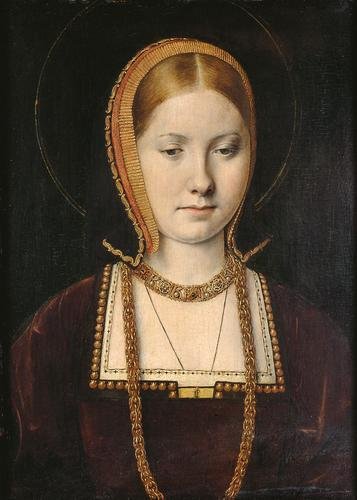
Portrait of an Infanta, Catherine of Aragon by Juan de Flandes

Portrait of an Infanta, Catherine of Aragon by Juan de Flandes (c.1496)

Today, as promised, I am featuring another beautiful and yet quite simple portrait that I came across when visiting the Thyssen-Bornemisza Museum in Madrid.  The work was one of many which hung amongst other fifteenth century paintings.   The reason it stood out for me was because of the beauty and innocence of the eleven-year old sitter whose life and future had been mapped out for her at the age of three.  She was born into an age when planned betrothals and marriages between royal houses was the norm.  Her life, like that of her mother, was to be a life of great turmoil.  The girl in my featured painting is Catherine of Aragon who was the daughter, and youngest surviving child of Queen Isabella I of Castile and her husband King Ferdinand II of Aragon. 

Catherine was born in December 1485 in the small town of Alcalá de Henares some twenty miles from Madrid.  She was the youngest of five children having one brother, John and three sisters, Isabella, Joanna and Maria.    Even at the tender age of three plans were being formulated by her parents to arrange a beneficial betrothal for her.  Not necessarily beneficial to her but beneficial to her country and her parents.  Catherine’s parents were cousins and belonged to the House of Trastámara, a powerful dynasty of kings in the Iberian Peninsula.  Isabella was the half sister and heiress to Henry IV of Castile and Ferdinand was the son of John II of Aragon.  The two of them were betrothed and went on to marry in 1469 in an attempt to consolidate two of the main royal houses, for in 1474 on the death of Isabella’s half brother Henry, she became Queen of Castile and through a prenuptial agreement based on jure uxoris (literally,by right of his wife”) Ferdinand became, not the Prince Regent, but the King of Castile.  Five years later when his father died Ferdinand also became King of Aragon and this unification became the basis of what we know as modern Spain.

According to two of her biographers, Alison Weir (The Six Wives of Henry VIII) and Antonia Fraser (The Wives of Henry VIII), Catherine was “quite short in stature with long red hair, wide blue eyes, a round face and a fair complexion”.   Catherine, through her mother’s side of the family, was connected to the English royal family and so her parents turned to the English royal house for a suitable husband for their daughter.   They also believed that an alliance with England would safeguard them against the predatory French.  Their efforts to find a husband for their daughter found favour with Henry VII the current ruler of England who believed a liaison with the Catholic rulers of Spain and the house of Trastámara would be very advantageous for the English House of Tudor.  And so, in 1488, when Catherine was just three years of age, she was betrothed to King Henry VII’s oldest son Arthur, the Prince of Wales, who at the time was two years of age !   In May 1499 Catherine and Arthur were married by proxy.  She was still six months away from her fourteenth birthday and he was a few months short of his thirteenth birthday.  It was not until 1501 that Catherine left Spain and travelled to London to meet her future husband Arthur although they had been corresponding for a number of years.  They married that November and went to live in Ludlow Castle but five months after the ceremony Arthur died of what was termed “sweating sickness” which was a highly virulent disease that had reached epidemic proportions in England at that time.  Catherine was also struck down by the illness but survived. 

The rest of Catherine of Aragon’s life, her marriage and divorce from Henry VIII, Arthur’s brother, has been well documented and I will not speak more about her life.  The portrait that I am featuring today is a painting of the young girl herself, entitled Portrait of an Infanta, Catherine of Aragon.  It was completed around 1496 when she was about eleven years old.  The artist was the Flemish painter, Juan de Flandes.  Little is known about the artist except that his name would indicate he was born in and spent his early life in Flanders.  It is not until 1496 that we have some documented evidence of his life for his name appears as a court painter in the royal household accounts of Queen Isabella of Castile.   It is thought that Juan de Flandes had, like many other European painters, come to Spain and to the royal household of Isabella and Ferdinand and along with them had worked on a number of religious paintings, including the forty-seven small (each approximately 21cms x 16cms) panelled polyptych entitled The Polyptych of Isabella the Catholic, which has since been split up into its many parts and which only twenty-seven survive. 

Juan de Flandes never returned to his homeland and worked for the royal Spanish household until Isabella died in 1504.  From there he moved to Salamanca where, for the next three years, he worked on the main altarpiece for the city’s university chapel.  During this period he also received commissions for work on an altarpiece for the Salamanca cathedral.   Then four years later, in 1509 he lived in Palencia with his wife.  In Palencia, he again completed a number of commissions for the Catholic Church.   Juan de Flandes is thought to have died in 1519 aged 54. 

My featured painting is a beautiful work which captures Catherine’s beauty and innocence and comes before the traumatic and sad life which she was to endure.   There is even some doubt that the portrait is of Catherine.  Some say that it could be of her sister Joanna but at the time of the painting (1496) Joanna would have been seventeen years of age and the girl in the painting does not look that old.   Also if we look at the work we can see she is delicately holding a rose and this is thought to symbolise her future intended connection with the English House of Tudor, the Tudor Rose.  Other art historians such as the Elisa Bermejo tend to believe that the rose is just symbolic of the youthfulness of the sitter whilst others believe that it is indeed Catherine and this painting was just a betrothal portrait. 

Portrait of Young Catherine of Aragon by Michael Sittow (C. 1504) Kunsthistoriches Museum, Vienna
Portrait of Young Catherine of Aragon
by Michael Sittow (c.1504)
Kunsthistoriches Museum, Vienna

One of the other Nertherlandish-style  painters who was at Queen Isabella’s court with Juan de Flandes was Michael Sittow and he too painted a portrait of the young Catherine, some seven years later, and one can see a definite likeness between his and Juan de Flandes’ portraits. 

I love Juan de Flandes’ portrait of the young Catherine and stood before it for many minutes contemplating what was going through the young girl’s mind as she sat before the artist, totally unaware of what life in the future held for her.

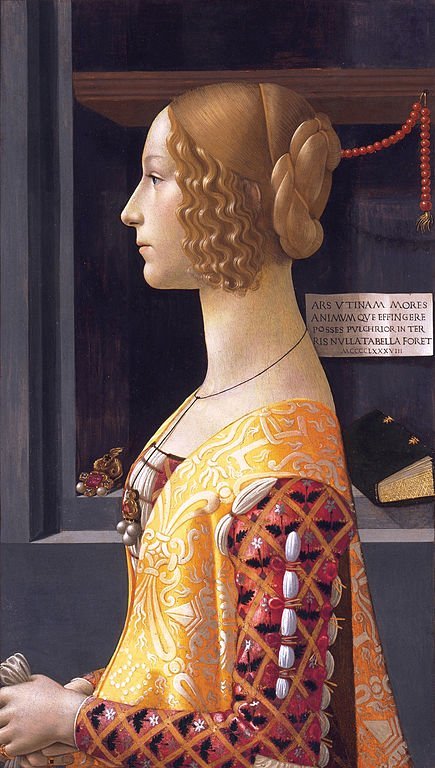
Portrait of Giovanna degli Albizzi Tornabuoni by Domenico Ghirlandaio

Portrait of Giovanna degli Albizzi Tornabuoni by Domenico Ghirlandaio (1488)

When you walk around an art gallery I wonder how long you spend in front of each painting.  I suppose it depends on the type of painting and whether it is part of a crowded special exhibition when you are jostled from one painting to the next by a crowded sea of viewers.  I suppose it also depends on your time management as if you are coming to the end of your allotted time you tend to jump from one picture to the next in a desperate attempt to not miss a single one, although in a way your hurried state probably means that the last few painting remain just a blur in your mind.   So why do I ask this question about time management and carefully appreciating the paintings before us?   The answer is that during a recent visit to the Thyssen-Bornemisza Museum in Madrid I had left the room, which housed the fifteenth century art collection till last and I was constantly aware that my time at the museum was running out.   I found myself flitting from one painting to another and I have to admit by doing so I failed to take in the beauty of the works in that section of the gallery.   That was until I came across two stunning works which I could hardly drag myself away from.  They were just such beautiful paintings.  Yes, I know beauty is in the eye of the beholder but for me they were truly exquisite.   I stood before them, totally mesmerised by their intrinsic charm and so I am dedicating my next two blogs to those two 15th century works. 

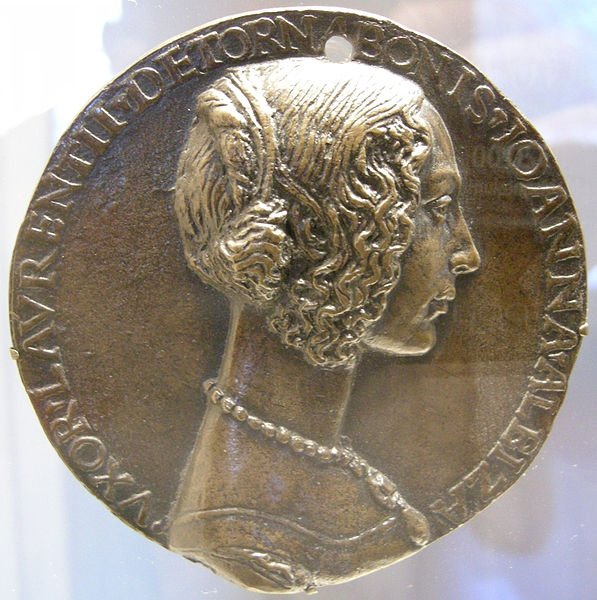
The Wdding Medalion
The Wdding Medalion

Today I want to offer you a beautifully crafted portrait by the 15th century Italian artist Domenico Ghirlandaio entitled Portrait of Giovanna degli Albizzi Tornabuoni which he completed in 1490 and which is now part of the permanent collection at Madrid’s Thyssen-Bornemisza Museum.   Giovanna was the wife of Lorenzo Tornabuoni who came from the wealthy Florentine banking family and whose father, Giovanni was Domenico Ghirlandaio’s patron.  We know this is the image of Giovanna as at the time of her marriage to Lorenzo a series of bronze portrait medals with her image were made to commemorate the event and the likeness of the figure on the medal and in the painting is undeniable.   Lorenzo and Giovanna married in June 1486 but sadly she died giving birth to her second son in 1488, at just twenty years of age.  As the portrait was completed after she died, it is thought that it could be looked upon as a kind of remembrance painting.   The painting hung in her husband’s private rooms in the Tornabuoni Palace.

We see Giovanna before us, half-length, in a somewhat rigid profile.  In her hands she clasps a handkerchief.  Giovanna is dressed in the most sumptuous way.  She wears a giornea which is an open-sided over-gown, which is brocaded.  The design on the brocade features the letter “L” and a diamond.   The “L” is her husband, Lorenzo’s initial and the diamond was the Tornabuoni family emblem.  There is no doubt that she is one of Florence’s élite by the way she wears her hair in the very latest Florentine fashion.  The jewels she wears around her neck comprise of two rings and pendant which were given to her by Lorenzo’s family as a wedding gift.  If you look closely at the pendant she wears you will also notice a matching brooch designed in the shape of a dragon which lies on a shelf behind her.   The jewel with its dragon, two pearls and a ruby formed a set with the pendant hanging from a silk cord around her neck.   Behind her, on the shelf, is a prayer book which is thought to be the libriccino da donna (little ladies’ book).  Above the book hangs a string of coral beads which have been identified as a rosary.   Ghirlandaio’s inclusion of this prayer book and the rosary in the painting was testament to Giovanna’s religious beliefs and her piety. 

What did Ghirlandaio think of his sitter?  Will we ever know?  Actually the answer lies within the painting itself because just behind Giovanna’s neck we can see attached to the shelf a cartellino.   A cartellino (Italian for small piece of paper) was a piece of parchment or paper painted illusionistically, often as though attached to a wall or parapet in a painting.  On the cartellino added by Ghirlandaio in this painting are the words:

ARS UTINAM MORES

ANIMUMQUE QUE EFFINGERE

POSSES PULCHRIOR IN TERRIS NULLA TABELLA FORET


which translates to:


“…Would that you, Art, could portray her character and spirit ;  for then there would be no fairer painting in the world..”.

At the bottom there is the date:

“MCCCCLXXXVIII”. (1488)

By these words there is no doubt Ghirlandaio is excusing himself to Giovanna for his belief that he has not been able to show her real inner beauty.  These are fine words from our artist but in fact they were not quite his own as they are a slight variation on the words of an epigram (a short and concise poem) of the Latin poet Marcus Galerius Martial, whose works were all the rage with the Florentine aristocracy of the day.

My featured artist today was born Domenico di Tommaso Curradi di Doffo Bigordi.  The name was derived in part from his father’s surname Curadi and the surname of his grandfather Bigordi.  He was born in Florence in 1449, the eldest child of Tommaso Bigordi and Antonia di ser Paolo Paoli.  His father was a goldsmith and was well-known for creating metallic garland-like necklaces which were worn by the ladies of Florence, and it was for that reason that Domenico was given the nickname Il Ghirlandaio (garland-maker).   Domenico worked in his father’s jewellery shop and it was during his time there that he started sketching portraits of customers and passers-by.   According to the famous biographer of artists, Giorgio Vasari, Domenico’s father decided to afford his son some formal artistic training and had him apprenticed to the Florentine painters, Alesso Baldovinetti and later Andrea del Verrocchio.

Domenico will always be remembered for his exquisite detailed narrative frescos in which he would incorporate portraits of the local aristocracy resplendent in their finery.  Many of his frescos appeared in local Florentine churches.  In 1482, he also completed a Vatican commission for Pope Sixtus IV – a fresco in the Sistine Chapel entitled Calling of the First Apostles.  The frescos he will probably be best remembered for were two major fresco cycles, which he completed with the help of his brothers, Davide and Benedetto along with his brother-in-law, Bastiano Mainardi, who was one of Domenico’s pupils.


The Resurrection of the Boy by St. Francis by Girlandaio
The Resurrection of the Boy by St. Francis by Ghirlandaio

The first of these frescos was for the Sassetti Chapel in the church of St Trinita in Florence.  It had been commissioned by Francesco Sassetti, a rich and powerful banker who worked for the Medici family.  This cycle of frescos was in six parts and depicted the life and times of St. Francis of Assisi, who was Sassetti’s patron saint. Seen within the frescos were a number of portraits of members of the Sassetti family along with some of the leading figures from the Medici family.  To look at the two families within the frescos one would be forgiven for coming to the conclusion that the Sassettis and the Medicis were very close, which of course was precisely the allusion Francesco Sassetti had wished to convey.  Alas for him, the close bond between the two families was all in his mind!

Visitation by Domenico Ghirlandaio

The second fresco cycle, Ghirlandaio’s last, and many art historians believe was his greatest, was commissioned to decorate the Capella Maggiore of the Santa Maria Novella Church in Florence by another banker, Giovanni Tornabuoni, who was related by marriage to the Medicis.   There was a connection between the two fresco cycles as Sassetti had the rights to decorate the Capella Maggiore of the Santa Maria Novella Church and he had wanted to have the frescos in the church depict the life of St Francis.   However the church was in trust to the Dominican order and they refused to allow such a design, so it was then that Sassetti decided to have the St Francis frescos painted instead in the Sassetti Chapel of the St Trinita Church in Florence and he sold the rite to decorating the Capella Maggiore to Giovanni Tornabuoni

 Ghirlandaio had not even completed the Sassetti fresco cycle when he was given this second large scale commission and he had to bring in most of the workers from his large Florentine studio to help him in this four-year project which was finally completed in 1490.  

The reason for talking about this fresco cycle is that I want you look closely at Ghirlandaio’s fresco, the part entitled Visitation.  Look at the third woman from the right.  Do you recognise her?   It is a full length portrait of Giovanna Tornabuoni who was the wife of Lorenzo Tornabuoni whose father, Giovanni was the commissioner of the fresco work and who was also my subject of today’s featured work.

The painting had a number of owners but in 1907 the American millionaire financier and philanthropist and founder of the J.P. Morgan bank,  J. Pierpont Morgan bought it in 1907.  It is believed that he adored the painting as it reminded him of his first wife, Amelia Sturgis, who like Giovanna had died very young.  She died of tuberculosis at the age of twenty-six, just four months after she and J.P. had married.   It entered the Thyssen-Bornemisza collection from the Morgan Library, New York, in 1935.

Whereas J.P. Morgan had his painting on view in his home to remind him of his wife I have a print of it on my breakfast room wall to remind me of Giovanna’s beauty as I serve guests with their breakfasts.

The Pastoral Scenes of Jan Siberechts

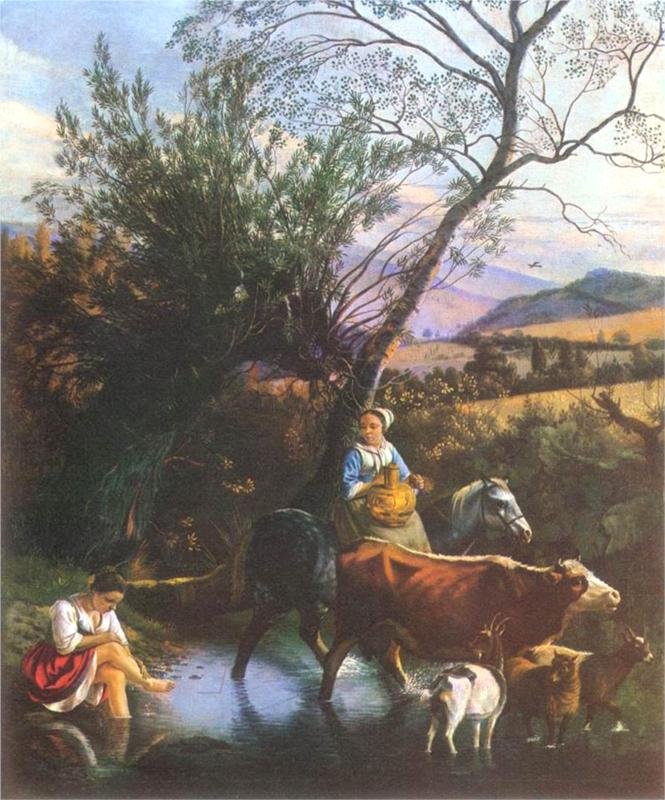
The Ford by Jan Sieberechts (1672) Szépmûvészeti Múzeum, Budapest
The Ford by Jan Sieberechts (1672)
Szépmûvészeti Múzeum, Budapest

My Daily Art Display today features the 17th century Flemish painter, Jan Siberechts.  I will also look at some of Siberechts works and look how his style of painting changed during his lifetime.  In today’s blog I will concentrate on his rural life paintings and in my next blog I will look at how his painting style changed when he went to England. 

Jan Siberechts was born into a family of artists in Antwerp in January 1627, first training with his father, who was a sculptor.  Little is known of his early life and upbringing except to say that in 1648, at the age of twenty-one, he became a master in the Guild of St Luke in Antwerp and four years later, in 1652, he married.   Siberechts’ early works, up until around 1660, were mainly landscapes which were heavily influenced by the Dutch Italianates.  The Dutch Italianates were a group of seventeenth-century Dutch artists who painted landscapes of Italy.  Many of these painters had travelled to and lived in Italy whilst others who had never made the journey to Italy were simply stimulated by the works of those who did.   Many young Dutch painters made the arduous journey, often by foot, over the Alps to Italy, whereas others travelled by sea. The favourite destination for these intrepid travellers was usually Rome, but some journeyed to Venice, and a few to Genoa. 

Many of these artists would make copious sketches during their sojourn in Italy and in the case of those who crossed the Alps on foot, they would pictorially record their arduous journey through the breathtaking mountain passes and then, once they arrived back home to their studios, they would produce this Italianate art.  Such works of art, which were extremely popular with the Dutch and were in great demand in what was then a booming Dutch art market. These Dutch Italianate painters enthused over the golden light of Mediterranean skies which they encountered in Italy.   The countryside around Rome (campagna) was a constant source of inspiration and featured in many of the works of the Dutch Italianates.   Some of the leading Dutch Italianate painters during the lifetime of Siberechts were artists, such as Nicolaes Berchem, Jan Both, Karel du Jardin, and Jan Weenix.  Because Siberechts’ early works reveal the influence of the Dutch Italianates some art historians believe that he may have made the journey to Italy but there is no firm proof of this assertion.   Many believe Siberechts remained in Antwerp until 1672 at which time he accepted an invitation to travel to England and so it could be that he was simply influenced by the finished works of the Dutch Italianate painters which were offered up for sale in Antwerp.  

Shepherdess by Jan Siberechts (1660's) Hermitage, Saint Petersburg, Russia
Shepherdess by Jan Siberechts (1660’s)
Hermitage, Saint Petersburg, Russia

Siberechts style changed around 1661 when he became interested in depicting scenes from the Flemish countryside and the rustic life of the peasants.  His initial landscape work with its occasional small figures changed and, in his work now, the figures in his landscape settings were larger and took on a paramount importance. 

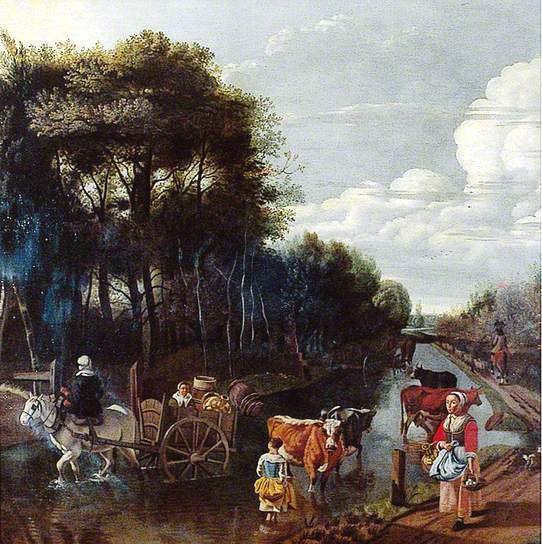
Landscape with a Road, a Cart and Figures by Jan Siberechts Norfolk Museums & Archaeology Service (Norwich Castle Museum & Art Gallery)
Landscape with a Road, a Cart and Figures by Jan Siberechts
Norfolk Museums & Archaeology Service (Norwich Castle Museum & Art Gallery)

Often the countryside scenes depicted in these paintings incorporated country roads which had been partly flooded forming fords and peasant women going about their daily routine, carrying goods, such as hay or vegetables, to or from market, often by horse and cart.  In other paintings we see the women tending to their livestock along a river bank.  

The Wager by Jan Siberechts (1665) Koninklijk Museum voor Schone Kunsten, Antwerp
The Wager by Jan Siberechts (1665)
Koninklijk Museum voor Schone Kunsten, Antwerp

In Siberechts’ countryside depictions his female figures were much larger than corresponding figures in most paintings of this genre. The female figures we see in Siberechts’ paintings are not willowy, weak women but strong robust females who were quite able to hold their own against their men-folk when it came to working on the farm.  The presence of water in Siberechts’ scenes gave him the chance to show off his artistic ability of depicting reflections on the water surface and the glittering of the light on moving water.  The inclusion of water into his peasant scenes also gave Siberechts an excuse for showing us a sensual glimpse of bare female thighs as they washed and cooled down their bare legs in the fords or streams.  The colours Siberechts used in these landscape works were often quite similar.  He would utilise whites, reds and yellows for the clothes of the women and these colours would contrast against the various greens he used to depict surrounding plants and vegetation.  Often there would be no background as such to these paintings as the dense foliage in the middle ground obscured our view of any background. 

I like these works.  There is a certain quaintness about them.  As you will see in my next blog the paintings Siberecht did whilst in England couldnt be more different.

The Mancorbo Canal in the Picos de Europa by Carlos de Haes (1876)

The Mancorbo Canal in the Picos de Europe by Carlos de Haes (1876)

My Daily Art Display blog today incorporates the two things I enjoy most in art; landscape paintings and discovering a painter I had, up till now, never heard of.   Today I am featuring the nineteenth century Belgian born Spanish landscape painter Carlos de Haes.

Carlos de Haes was born in Brussels in January 1826.  He was born into a dynasty of merchants and financiers and was the eldest of seven children.  When he was nine years old his family moved to Malaga where he grew up and went to school. His initial artistic training was under the tutelage of Luis de la Cruz y Ríos, the Spanish miniaturist painter, who had once been the court painter of King Ferdinand VII.    In 1850, at the age of twenty-four, he returned to Belgium and studied for five years under the Belgian landscape painter Joseph Quineaux.  It was the influence of Quineaux which drew de Haes into the world of landscape painting and sketching and painting en plein air.  During his five year stay in Brussels he managed to travel to France, Holland and Germany constantly sketching the varied landscapes he came across.  It was also around this time that he became interested in the works of the contemporary Realist artists.    In 1855 after completing his art course he returned to Spain and went to live in Madrid and became a naturalised Spaniard.   In 1856 he put forward a number of his landscape works for exhibition in Madrid’s Exposición Nacional, where they were very well received.   The following year, 1857, at the age of thirty-one, Carlos de Haes won the competition for the chair of landscape painting at theReal Academia de Bellas Artes de San Fernando (Royal Academyof Fine Arts of San Fernando), with his work entitled Royal Palace from the Casa de Campo.  The Academy was an establishment which would half a century later be home to the likes of Dalí and Picasso.   In 1861 de Haes was made Académico de mérito. 

During his tenure at the Academy, de Haes set about putting together a set of regulations for his students governing landscape painting and rules for future landscape competitions.  He was insistent that his students mastered the art of en plein air sketching and painting instead of just producing historical landscapes which they had conjured up in the studio.  This, he believed prevented the true study of nature, and he asserted that the en plein air aspect was of paramount importance when contemplating a landscape work.   Haes encouraged his students to interpret nature directly and by working out in the open he insisted that they understood how the changing light changed how they viewed the vegetation and the terrain.  He did however countenance using the studio to fine tune the painting and make final adjustments.  Haes’ insistence that his students should produce a truthful depiction of the landscape, captured by painting en plein air, points towards his interest in the new Realism form of art, which claimed that artists should represent the world as it was, even if it meant breaking artistic and social conventions.   
During the next ten years Haes spent most of his time painting landscapes which featured the Spanish Pyrenees and the Guadarama mountains in central Spain.  One of his students who accompanied him on his sketching journeys was Aureliano Berruete who would become one of the foremost Spanish painters.
Carlos de Haes became ill in 1890 and died in Madrid in 1898.  He bequeathed his mostly small-format paintings to his pupils, who gave them to Spanish museums, the majority of which are now housed in the Casón del Buen Retiro, part of the Prado Museum in Madrid.

My featured painting today by Carlos de Haes was one which I saw when I recently visited the Prado in Madrid.  It was completed by him in 1876, although the preparatory sketch for the work was dated in situ in 1874.  It was exhibited at that the 1876 National Exhibition in Madrid and was subsequently purchased by the Spanish state.  Carlos de Haes had been travelling with Aureliano Berruete around the wild and rugged Cantabrian rural area of Liébana when they came across this spectacular view.   The oil on canvas painting, measuring 168cms x 123cms is entitled The Mancorbo Canal in the Picos de EuropeThe Picos de Europa is a range of mountains 20 km inland from the northern coast of Spain and this landscape painting by de Haes depicts the awesome and craggy vista of the mountain range which was one of Carlos de Haes’ favourite type of spectacular and breathtaking views.   At the bottom of the painting, although it somewhat difficult to pick them out, there are three cows and their herder.

I stood before this beautiful painting and was awestruck by its beauty and its realistic quality.  So, if you ever make it to the Prado be sure to find this work.

Joaquín Sorolla (part 3)

In my final look at the Spanish artist Joaquín Sorolla I want to show you some of his portraiture work which featured his family and finally take a look at the house in which he and his family lived and which would later become a museum in his honour.

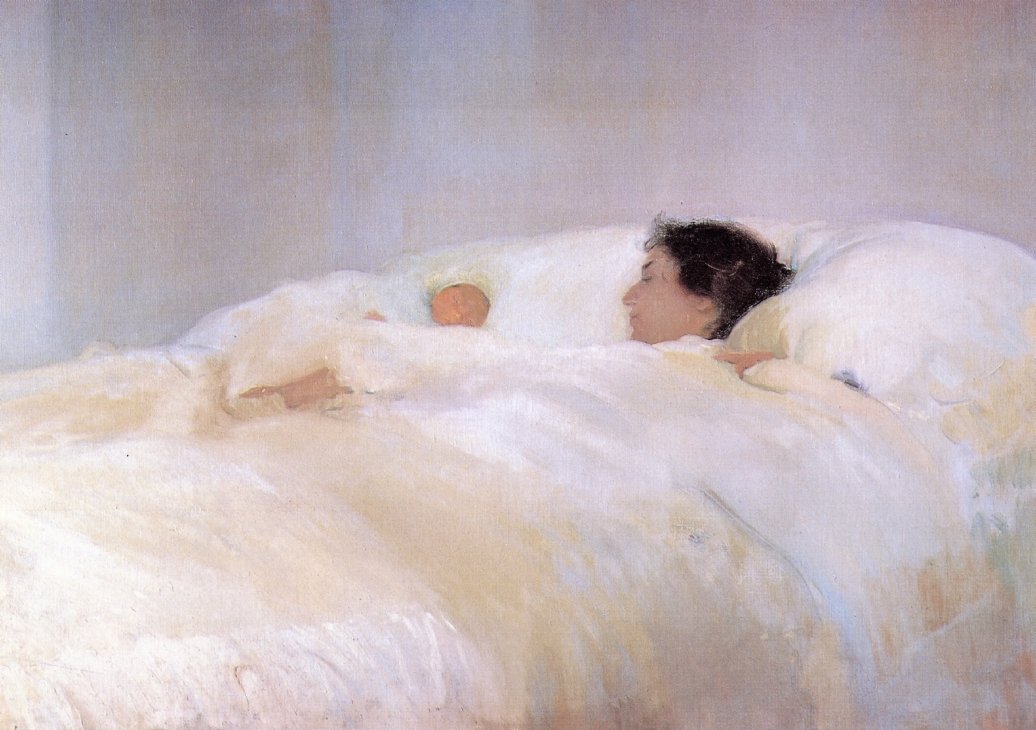
Mother by Joaquin Sorolla (1895)

One of the most moving family portraits by Sorolla was of his wife Clotilde, laying in bed with their new born baby, their youngest child, Elena.  The painting is simply entitled Mother and was completed in 1895.   His wife looks lovingly towards her daughter who is swaddled in a mass of white bedding contrasted by the artist’s yellow/green tonal shading of the bed clothes. 


My Family by Joaquín Sorolla (1901)

In 1901 Sorolla completed a portrait of his family entitled My Family, which somehow reminds us of Diego Velazquez’s Las Meninas, where the painter showed in the background a mirror that reflects the upper bodies of the king and queen. They appear to be placed outside the picture space in a position similar to that of the viewer.  In Sorolla’s painting we see his image, palette in hand, in a mirror in the background.  The main figures in the painting were those of his family.  His wife Clotilde stands to the left in a long red dress along with her children.   Elena, the youngest, sits on the chair was five years old at the time. Their nine-year old son Joaquín sits on a stool sketching a picture of his sister whilst their elder daughter, Maria, who would have been eleven when her father completed the work, holds the board which her brother is using to support his sketch.

Maria by Joaquín Sorolla (1900)

One of Sorolla’s favourite subjects was his eldest child, Maria and over the years he would capture her in many of his portraits.  In 1900 he captures her sitting on a chair dressed in a white tunic with her hands entwined on her lap.  The painting is entitled Maria.  The whiteness of her dress is enhanced by touches of blue.   In the background there is a wall with decorative and colourful tiles 

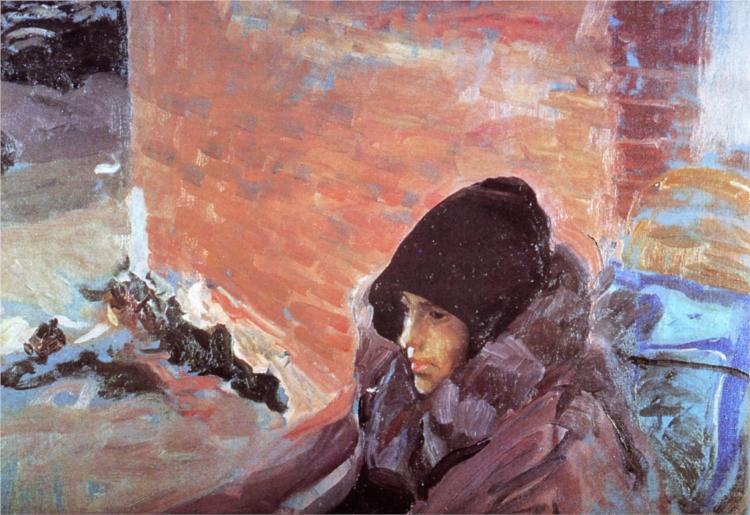
Maria Sick by Joaquín Sorolla (1907)

Six years later he completed another two portraits of Maria.  The first, entitled Maria Sick, completed in 1907 depicts his daughter sitting outside, well wrapped up in heavy but warm clothes.  She was recuperating in the mountains outside of Madrid having come down with an illness.   Sorolla himself was supposed to have been in Germany at this time, to be present at the one-man exhibition of his work at Berlin, Dusseldorf and Cologne organised by the Berlin gallery owner, Eduard Schulte.  However Sorolla refused to leave his daughter at a time when she was so unwell.


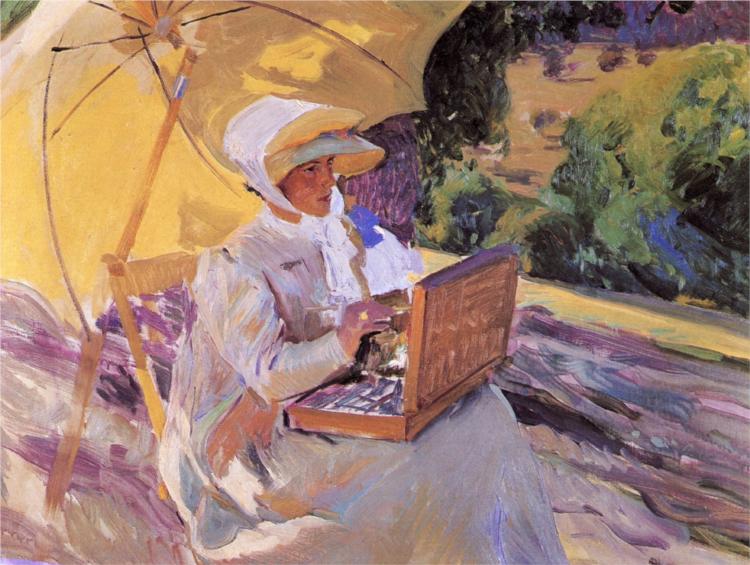
Maria painting in El Pardo by Joaquín Sorolla (1907)

That same year, following the recovery from her illness, her father painted another portrait of her, entitled Maria Painting in El Pardo.  The work depicts his daughter seated on a hill top, close to the royal palace, painting en plein air. 

Clotilde Sitting on the Sofa by Joaquín Sorolla (1910)

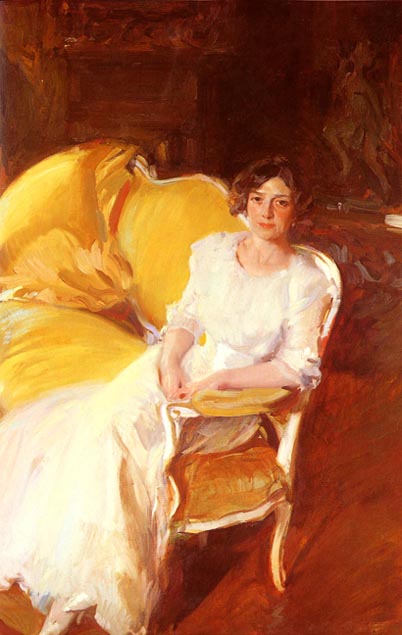
However Joaquín Sorolla’s favourite muse was his beloved wife Clotilde whom he had married in 1888.   She featured in a large number of his works.  I particularly like the one he painted in 1910 entitled Clotilde Sitting on the Sofa.  Art historians believe that the painting was influenced by the works of the American painter John Singer Sargent.  His wife leans against the arm of a sofa, dressed in a full length gown.


Clotilde in Evening Dress by Joaquín Sorolla (1910)

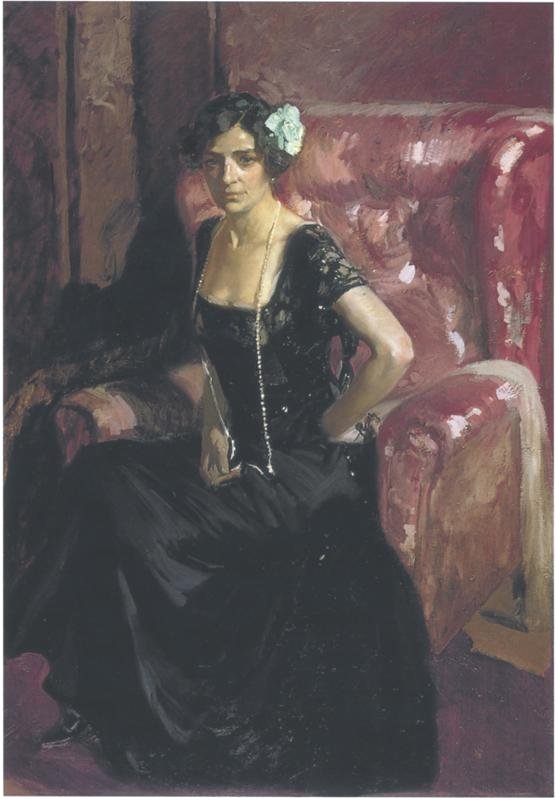
Another beautiful painting of his lovely wife was completed that same year entitled Clotilde in Evening Dress and from it, it is plain to see that Sorolla had married a beautiful and enchanting person.  We see her sitting upright in a plush, well upholstered red chair, dressed in a black evening dress with a blue flower tucked behind her ear.  She is the personification of a Spanish lady.

Sorolla had a one-man exhibition in the Grafton Galleries, London in 1908 and it is whilst in London that he met Archer Milton Huntington, who was the son of Arabella Huntington and the stepson of the American railroad tycoon and industrialist Collis Huntington.   Archer Huntington was a lover of the arts and the founder of the Hispanic Society of America which was based in New York.  The Hispanic Society of America was, and still is, a museum and reference library for the study of the arts and cultures of Spain and Portugal as well as those of Latin America.  Huntington arranges for Sorolla to have a major one-man exhibition at the Society in 1909 and it proved to be a resounding success so much so that the exhibition travelled to many American cities.  Huntington then commissioned Sorolla to paint 14 large scale mural paintings, oil on canvas, depicting the peoples and regions of Spain.  On receiving Huntington’s commission in 1911, Sorolla spent the next eight years travelling  throughout the regions of Spain making hundreds of preparatory sketches before completing what was to become known as Vision of Spain.   Sorolla was clear in his mind what Huntington expected and how he would achieve it, for he said:

“…I want to truthfully capture, clearly and without symbolism or literature, the psychology of the region.   Loyal to the truth of my school I seek to give a representative view of Spain, searching not for philosophies but for the picturesque aspects of the region…”

The fourteen murals were installed on December 1922 in the newly renovated western extension to the Hispanic Society’s Main Building, which is now known as the Sorolla Room. They were not officially inaugurated until January 1926. 

Panels from “Vision of Spain,” Joaquín Sorolla’s panoramic mural, during reinstallation at the Hispanic Society of America in New York City.

The Hispanic Society building had problems with their roof and it got so bad that in 2007 the museum had a full make-over and the picture above shows the re-installation of the fourteen paintings.

His eight years on this project was at the expense and detriment of his other work and sadly nearing the end of this project his health began to deteriorate and in June 1920 he suffered a stroke which ended his painting career.  One can only imagine how devastated Sorolla must have been not being able to paint.   Three years later in August 2010 Sorolla died in Cercedilla, a small town in the Sierra de Guadarrama, north-west of Madrid.  His body was taken and buried in the town of his birth, Valencia.

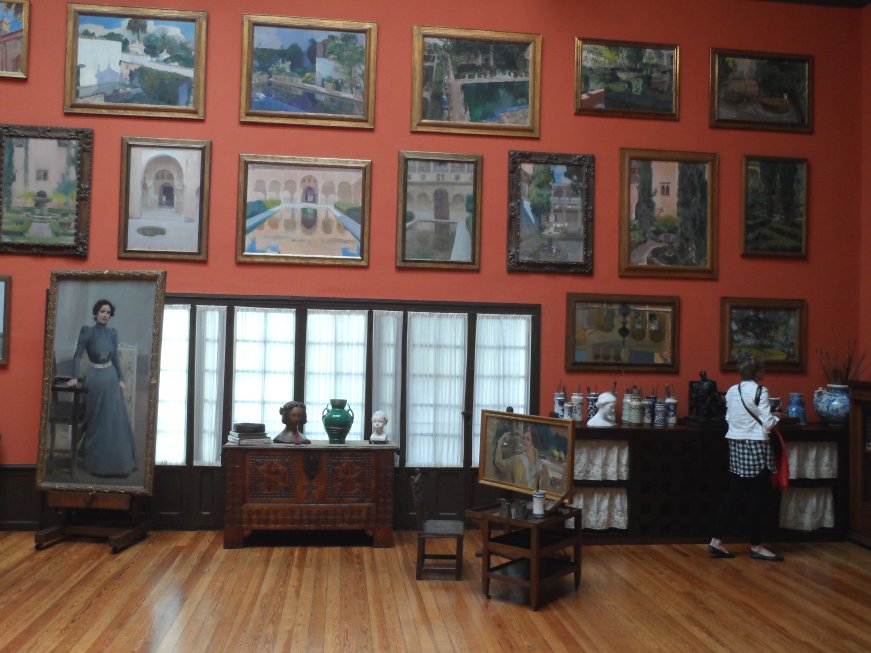
Room inside Sorolla Museum

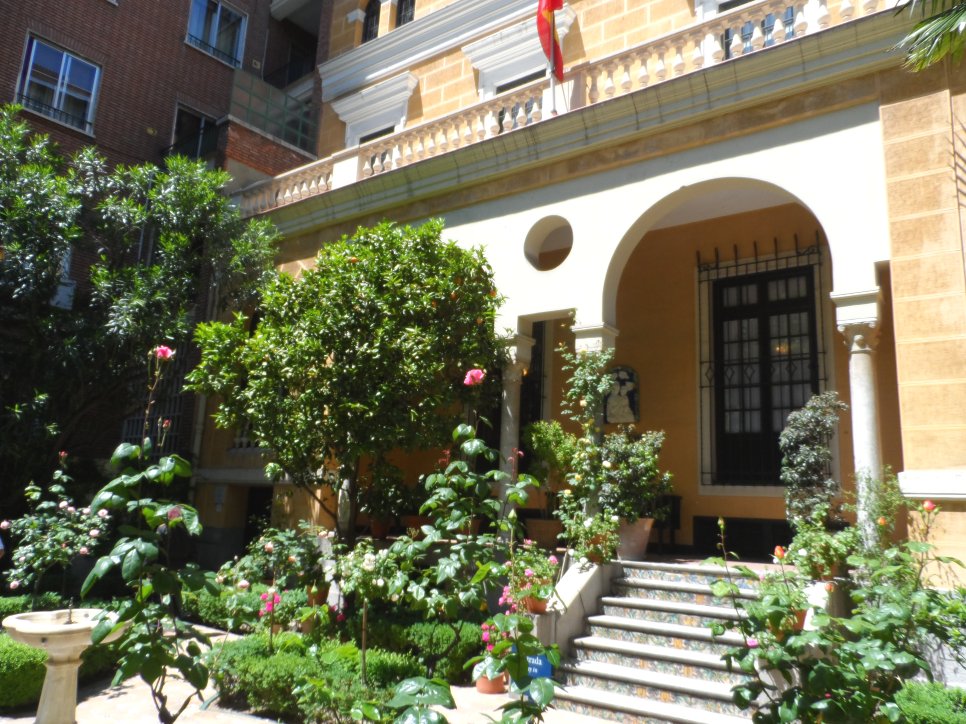
I cannot end this trilogy of blogs about Joaquín Sorolla without mentioning the Sorolla Museum which was the artist’s home from 1911. 

Room inside Sorolla Museum

It is a five minute walk from the Ruben Dario Metro station and I do urge you to visit it if you are in Madrid.  You will not be disappointed. 

Museum entrance
Museum entrance

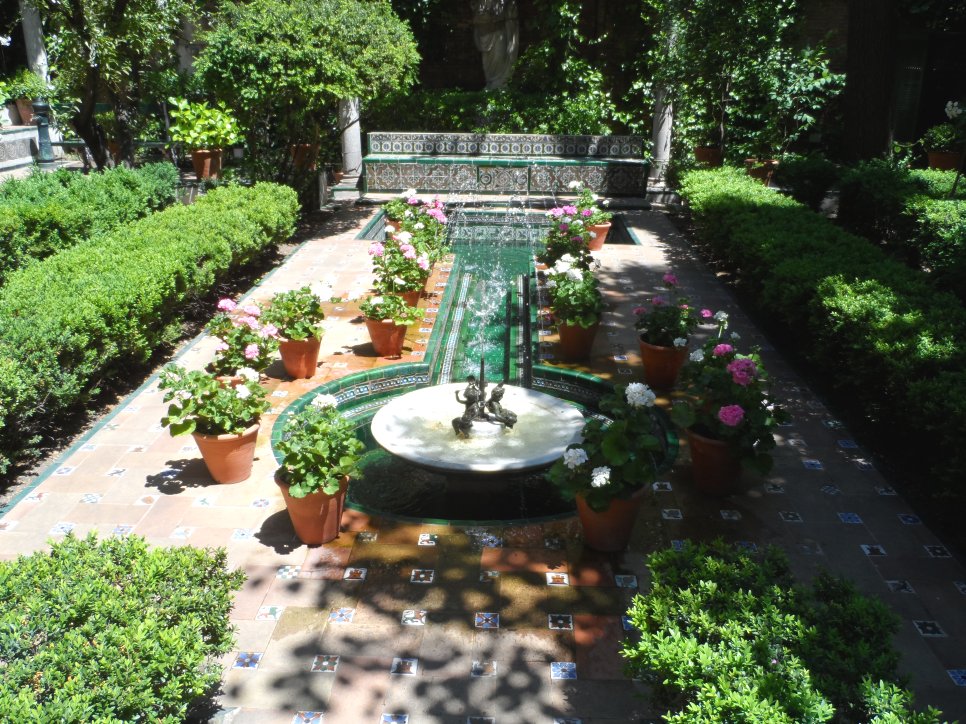
There are so many of the artist’s beautiful paintings on show and the gardens are a delight.

Museum Gardens
Museum Gardens

Joaquín Sorolla (part 2)

Portrait of Joaquín Sorolla by José Jiménez Aranda (1901)

By 1885, Joaquín Sorolla had settled down to life in Rome but during that year he also spent the spring and summer in Paris.  At this time in the French capital, the Impressionists were in the ascendancy after they and their art had been criticised and they had had to survive an initial period of ridicule, commercial failure and outright denunciation.    However, the Impressionists had now managed to establish their status some eleven years after they held their first Impressionist exhibition at Nadar’s studios and whilst Sorolla was in Paris he saw much of thire work but it was not the Impressionist painters who would influence him.   Whilst in the French capital he visited the retrospective exhibitions of two non-Impressionist painters, the French Naturalist painter, Jules Bastien-Lepage, who had died the previous year, and Adolf von Menzel the German painter who, along with Caspar Davisd Friedrich, was considered one of the two most prominent German artists of the 19th century and was also the most successful artist of his era in Germany.

Sorolla returned to his home town of Valencia on two occasions during the late 1880’s and on the second visit in 1888 he proposed to and married Clotilde Garcia del Castillo the daughter of his mentor, the photographer Antonio Garcia.  Joaquín and Clotilda had first met in 1879 when he had started work in her father’s workshop.   Joaquín finally returned from Italy and in 1890 the couple settled in Madrid.   Sorolla style of painting became more individualistic with him tending towards social realism works. 

Another Marguerite by Joaquín Sorolla (1892)
Another Margarita by Joaquín Sorolla (1892)

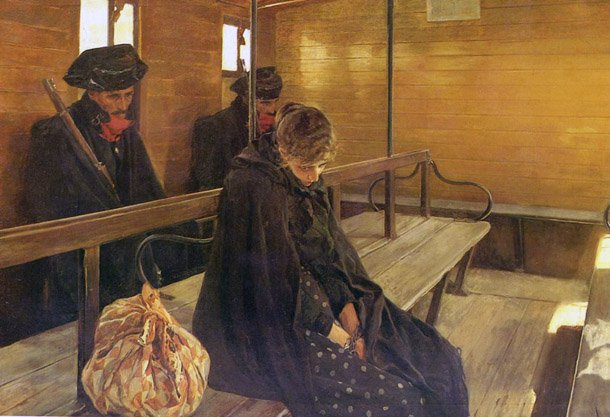
For a good example of a social realism work by Sorolla one only has to look at his beautifully executed painting entitled Another Margarita which he completed in 1892.  He exhibited the work at the Madrid National Exhibition that year and was awarded a first-class medal.  This was also Sorolla first major painting to be exhibited in America and it was awarded the first prize at the Chicago International Exhibition, where it was acquired and subsequently donated to the Washington University Museum in St Louis.    The story behind the depiction is of a woman who has been arrested for suffocating her small son and Sorolla actually witnessed the woman being transported to jail.  There is an air of gloom about the manacled woman as she sits slumped on the wooden bench of the train carriage being watched by her two guards who sit behind her.  In contrast to the dark and depressing depiction of the three individuals, the carriage itself is lit up by the warm light which streams through the windows at the rear of the compartment and which bathes the entire space.

The Return of the Catch by Joaquin Sorolla (1894)

His realist art also embraced what the Spanish termed costumbrismo, which was the pictorial interpretation of local everyday life, mannerisms, and customs.   This kind of art depicted particular times and places, rather than of humanity in an abstract form.   In many instances costumbrismo was often satirical and often moralizing, but it was careful not to offer or even imply any particular analysis of the society it depicted, unlike proper realism art.  In less satirical works costumbrismo took on a romantic folklore flavour.  A fine example of this type of work was a painting entitled The Return of the Catch which Sorolla completed in 1894 and which received critical acclaim when it was shown at the 1895 Paris Salon.   It was subsequently acquired by the Musée du Luxembourg.  He painted a number of similar pictures depicting Valencian fisherman at work bathed in the dazzling Mediterranean light such as his 1894 painting entitled Return from Fishing and his 1903 painting, Afternoon Sun.

Sad Inheritance by Joaquín Sorolla (1899)

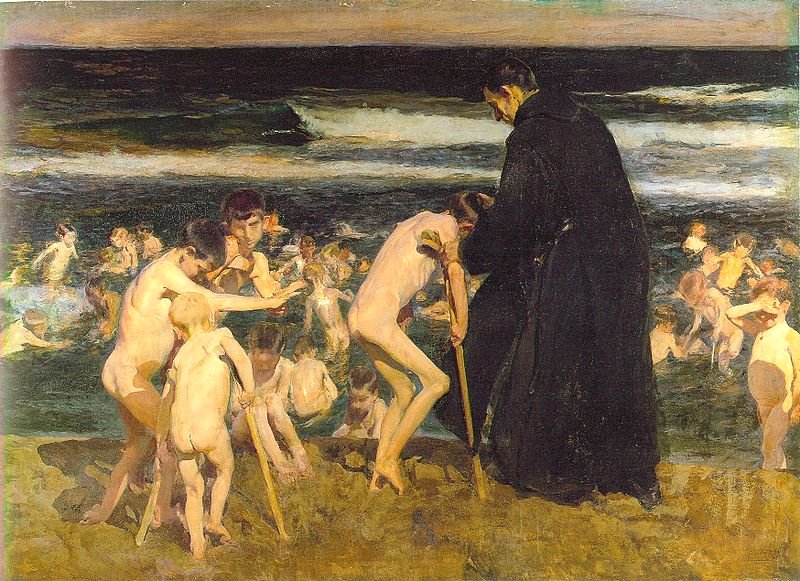
By 1895 Joaquín and Clotilda had three children.  Their daughter Maria was born in 1890, their son Joaquín in 1892 and their youngest child Elena in 1895.  In 1899 Sorolla painted what was to become his most famous and most moving picture.  It was entitled Sad Inheritance and I talked about this work in My Daily Art Display of Jan 31st 2011.  It is a poignant work featuring a monk and a group of children, crippled by polio, who are seen bathing in the sea at Valencia.   Sorolla received his greatest official recognition for this work of art, the Grand Prix and a medal of honour at the Universal Exhibition in Paris in 1900, and a year later he received the medal of honour at the National Exhibition in Madrid in 1901.

In my third and final blog about Joaquín Sorolla I will feature some of his family portraits, look at the Sorolla Museum in Madrid and conclude the life story of this wonderful Spanish artist.

Joaquín Sorolla (part 1)

Self Portrait by Joaquín Sorolla (1909)

I have said on a number of occasions that when one is in a large city which has one or maybe two famous large art museums, and when one is time-limited, one should search around and look for a smaller gallery which may have hidden treasures to offer.  The art on display in smaller museums can be taken in on one visit and there is no feeling of having to rush from room to room, constantly looking at ones watch to try and see as much as one can and ultimately seeing very little.  Madrid is famous for its three large art museums the Prado, the Thyssen-Bornemisza and the Queen Sophie but once again thanks to my daughter, who was my travelling companion on this trip, I discovered a pure gem of a museum – The Sorolla, which was just a few stops on the Metro from the city centre.  In my blogs I want to offer you a taste of what you would get if you visit the museum dedicated to one of Spain’s best loved artists, show you some of the Spanish painters work and look at his life story.

Joaquín Sorolla y Bastida was born into a humble household in Valencia in February 1863.  His parents were Joaquín Sorolla Gascón and Concepción Bastida who were retailers.  Joaquín and his younger sister Concha were orphaned in 1865 when both their parents died from the cholera epidemic which had swept through and ravaged the Spanish city.  Joaquín and Concha went to live with their maternal aunt, Isabel Bastida and her husband José Piqueres, a locksmith by trade.  Joaquín’s early schooling was not a success with the young boy being inattentive during lessons and was happy to doodle and draw in his exercise books to pass the time away.  His lack of progress at the school came to the attention of his uncle who withdrew him and took him on as an apprentice at his workshop.  However, owing to his love of drawing, when Joaquín was fourteen years old, his uncle arranged for him to attend drawing classes in the evening at the city’s Escuelade Artesanos where his artistic ability astounded his teachers, including the sculptor Cayetano Capuz.   The following year, 1878, he enrolled on a three-year course at Valencia’s prestigious Escuela de Bellas Artes de San Carlos.  It was whilst attending the art school that he met and became friends with a fellow student, Juan Antonio Perez.  He was soon introduced to Juan’s family.  Juan’s father, Antonio Garcia Perez was a photographer and was very impressed with Sorolla’s art work, so much so that he gave him a job at his photography studio as an illuminator.  This opportunity allowed Sorolla to leave his uncle’s workshop and concentrate on his artwork and discover the world of photography.  He learnt all about the framing of a subject and the manipulation of light which would prove a boon to him when he started to paint seaside and beach scenes.   This “new world” of photography fascinated many artists of the time and the likes of the French pair of Impressionists, Degas and Caillebotte were accomplished amateur photographers.

The Shout of the Palleter by Joaquín Sorolla (1881)

 Joaquín won many awards whilst studying at Escuela de Bellas Artes de San Carlos and at the end of his time there, and buoyed by his success, he sent off three seascapes to the Madrid National Exhibition.   He travelled to Madrid on a couple of occasions and visited the Prado where he painted copies of the great Masters.   In 1884, in the hope of attaining a monetary scholarship from the Valencia Provincial Council, he submitted a number of paintings to them, one of which was entitled The Shout of the Palleter, which was a historical painting recording the event in Valencia when one of its inhabitants Vincent Doménech in 1808, incensed by the French occupation of his country stood in the square urging people to rebel against the French tyranny.  He uttered his famous words:

“…Jo, Vicent Doménech, un pobre palleter, li declare la guerra a Napoleó. ¡Vixca Ferran sèptim! ¡Muiguen els traïdors!…”

(I, Vincent Doménech, a poor and simple worker, declare war against Napoleon.  Long live Ferdinand.  Death to the traitors.)

Sorolla painted the picture in the bullring of Valencia which he transformed into a huge studio and which was bathed in brilliant sunlight.  The stage-managed scene was a triumph and the Valencia Provincial Council awarded him a three-year scholarship to study art at the Spanish Academy in Rome. 

Father Jofré Protecting a Madman by JoachínSorolla (1887)

One of the conditions attached to the scholarship was that he regularly sent back work to the Council to prove that he was making good use of his time.   One of the paintings he duly sent back to Valencia was his 1887 work entitled Father Jofré Protecting a Madman.  This historical painting was based on the story of Father Joan-Gilabert Jofré, a friar of the Valencian Mercedarian Order, who, on  February 24, 1409, was on his way from the convent of the Plaza de la Merced to the Cathedral of Valencia.   On his way there he passed along the street of Martín Mengod,  the ancient street of the silver workers, next to the church of Santa Catalina.  On entering the street he was greeted with a great commotion.   Before him, he saw a group of children who were hitting and making fun of a mentally ill man who lay on the ground before them.   In those days it was believed by many that somebody who was mentally ill was possessed by the devil.  Father Jofré immediately berated the children and took the helpless man with him to the convent of the Order of Mercy, where he was given shelter and cure for his wounds.  Father Jofré would go on to found the world’s first lunatic asylum.

After his three year scholarship came to an end, Joaquín Sorolla continued to live in Rome and for a time in Assisi but on two occasions between 1885 and 1889 he returns to his home city of Valencia.


…….to be continued.