Arnold Böcklin. Part 2 – Die Toteninsel

Self Portrait by Arnold Böcklin (1885)

As I said in my previous blog there was a distinct change in the subject and style of Böcklin’s art in the middle of the nineteenth century.   Gone were the realist and naturalist landscape works which concentrated on the beauty of nature; depictions which included very few things, such as people or animals, which he believed would detract from nature’s magnificence.  Around 1854 Böcklin’s paintings began to become idealised with mythological connotations.  My original intention had been to look at the life and works of Böcklin in two parts.  Firstly, his early landscape paintings and secondly, his later symbolist paintings.  However I decided that his most famous painting, Die Toteninsel, should have a blog of its own.

Arnold Böcklin left Italy in 1857 and returned to Basel and the following year he accepted a commission to paint the dining hall of the merchant and Royal Hanoverian Consul, Karl  Wedekind in Hannover.  Wedekind also went on to purchase some of Böcklin’s paintings.  Financial and health issues began to blight Böcklin’s life around this time.  However his financial problems were to change when he and his family moved to Munich where he exhibited a number of his paintings at the Munich Kusnstverein.   It proved to be a tremendous success.  Fourteen of his paintings were purchased by Friedrich Graf von Schack, the Munich art collector, who also offered him the position of Professor of Landscape Painting at the newly founded Kunstschule in Weimar.  After completing four years of teaching art, Böcklin had managed to save some money, enough to return to his beloved Italy in 1862.

Isle of the Dead (Basel version) by Arnold Brocklin (1880)
Isle of the Dead (Kunstmuseum Basel, First version) by Arnold Brocklin (1880)

I now come to the painting by Böcklin which is his most famous and most talked about work of art, Die Toteninsel (Isle of the Dead).   According to Franz Zelger in his 1991 book, Arnold Böcklin: Die Toteninsel, Selbstheroisierung und Abgesang der abendländischen Kultur, the subject for this haunting composition came about in 1880 when  Böcklin received a commission to paint a “picture for dreaming”.

The commission came from Marie Berna, an American-born widow of a German diplomat, Georg von Berna, who had died of diphtheria in 1865. She was to later marry Count Waldermar von Oriola in 1880 and became Countess of Oriola.

 It all came about when she visited Böcklin’s studio in Florence.  Whilst at his studio she saw an unfinished first version of this evocative painting which is now housed in the Kunstmuseum Basel. This first version is an oil on canvas painting measuring 110 x 156cms, which was commissioned by Alexander Günther.  The title of the painting seems to have changed over time but Böcklin, on completion of the first version sent a letter to Gunther and wrote:

“…Endlich ist die Toteninsel soweit fertig, dass ich glaube, sie werde einigermaßen den Eindruck machen…”

(finally with the Toteninsel finished I think it will make quite the impression).

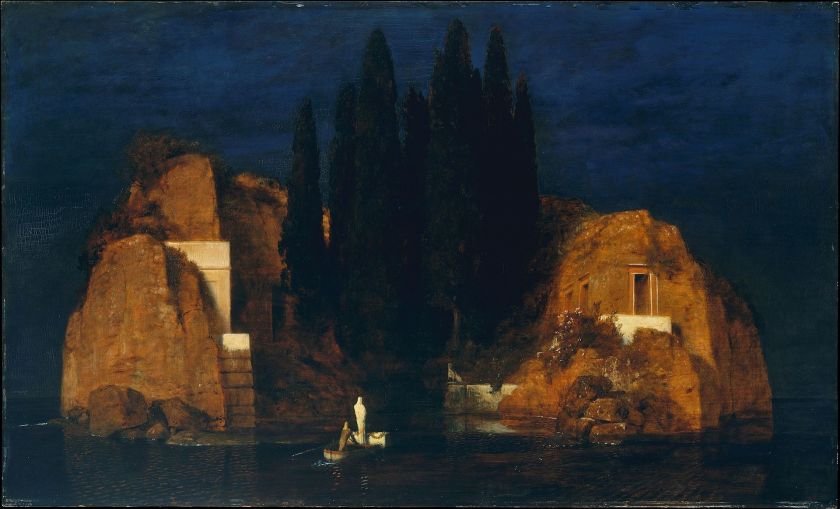
Isle of the Dead (Metropolitan Musum New York, Second version) by Arnold Böcklin (1880)
Isle of the Dead (Metropolitan Museum New York. Second version) by Arnold Böcklin (1880)

Marie Berna was fascinated by what she termed a dream image and immediately commissioned Böcklin to paint a version of this work.   Marie told Böcklin that it would be a painting in memory of her late husband and also be a “a picture for dreaming”.  She even made a special request that Böcklin should include in the work, besides the solitary figure who is rowing the boat, a draped coffin and a shrouded female figure standing up in the boat. Böcklin must have been persuaded that the additions Marie Berna had asked for would enhance the painting because he also added the shrouded female and draped coffin to the first version.  Although, to receive a commission was good news, Böcklin’s health, both physical and mental, was deteriorating.  His inability to have full use of his painting arm had lessened and that in itself caused him to have bouts of deep depression.

So what caused Böcklin to paint such a sombre picture, such as the Isle of the Dead?  Maybe the answer lies in a 1909 book his son, Carlo, co-wrote with Ferdinand Runkel, entitled Neben meiner Kunst. Flugstudien, Briefe und Persönliches von und über Arnold Böcklin.  His son wrote about his father’s physical and mental health at the time and the effort needed for him to carry on painting:

“…In the summer of 1880, the master’s painful afflictions precipitated a serious nervous depression. His lack of interest in working had been joined by fatigue and such a deep melancholy that those around him were seriously concerned about him. All manner of means were vainly sought to alleviate his bodily torments. …….. His heart and nerves had been adversely affected by an ample dose of salicylic acid that had become necessary. …..… As the last resort, his worried spouse hit upon the idea of a change of air, and Böcklin, who had always been a wanderer and derived his best artistic inspiration from the countryside, took up this idea with rapidly reviving spirits. In the company of (his pupil) Friedrich Albert Schmidt, he travelled to Ischia, the delightful island off the coast of Naples, in July, and sought the assuagement of his pains under the gleaming sun of the most beautiful summer sky and in the blue waves of the gulf. However, he was still with little hope on his departure, a downtrodden victim of his sufferings, and his final gloomy words to his wife were: “You will see me again in Florence either healthy or not at all.” …… Böcklin’s depressive mood at the time (was) so strong that, in his endless hours of agony, he seems often to have toyed with and considered the idea of taking his own life. The pain alone would not have disheartened this powerful man, but the rheumatic inflammation of his joints had also stricken his right shoulder, and, with his creative hand, with whose dexterity a new world had been created, Böcklin was only able to guide the brush in great pain and with great effort…”

Böcklin sent a letter to Marie Berna on June 29th 1880, in which he wrote:

“…The picture Die Gräberinsel (The Isle of Tombs) was dispatched to you last Wednesday. You will be able to dream yourself into the realm of the Shades until you believe you feel the soft, warm breeze that wrinkles the sea. Until you will shy from breaking the solemn silence with a spoken word….”

In this second version of the painting, which was given to Marie Berna, we see the figure of the widow dressed in white accompanying her husband’s draped coffin.  The boat heads towards a rocky isle with its high cliffs, into which are carved tomb chambers.  This second version, given to Marie Berna, was an oil on wood painting and slightly smaller than the first version, measuring 29 x 48in (74 x 122cms).  It was bought by the Metropolitan Museum of Art in New York in 1926

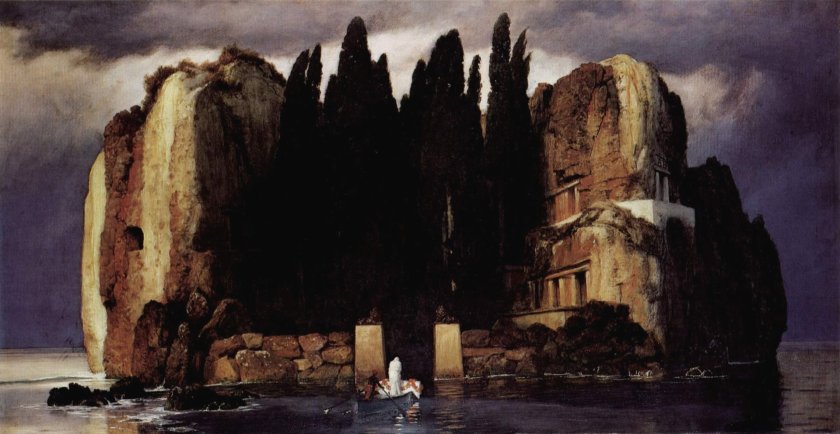
Isle of the Dead (Alte Nationalgalerie, Berlin. Third version) by Arnold Böcklin (1883)

Because of the success of the first two versions, Böcklin’s art dealer Fritz Gurlitt managed to persuade him to paint three more versions of Die Toteninsel but this time the suggestion was made that the sky should be much lighter.

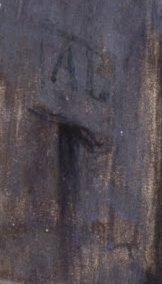
Initials A B on the Isle of the Dead (Third version) by Arnold Böcklin (1883)

If you look closely at the outer edge of the high rock on the right of the third version of the painting, you will see Böcklin’s initials, “A B”, over the lintel of the burial chamber. It is interesting to note that the provenance of this painting shows Gurlitt sold the painting in 1933 to one of Böcklin’s admirers – Adolph Hitler.  He had the painting hung at the Berghof in Obersalzburg and later moved it to the Reich Chancellery in Berlin.  This version is now housed at the Alte Nationalgalerie in Berlin.
Black and white photograph of the fourth version of Die Toteninsel (1844)

Böcklin painted the fourth version in 1884.  This work of art was bought by the entrepreneur and avid art collector Baron Heinrich Thyssen, the second son of the German industrialist August Thyssen, and it was kept in one of his banks.  Unfortunately it was destroyed during a World War II bombing raid and all that can be seen of this fourth version is a black-and-white photograph.

Die Toteninsel (Fifth version, Leipzig) by Arnold Bôcklin (1886)
Die Toteninsel (Museum der Bildenden Künste Leipzig. Fifth version) by Arnold Bôcklin (1886)

The fifth version of Böcklin’s painting, completed in 1886 resides at the Museum der Bildenden Künste in Leipzig.

In my third and final blog about Arnold Böcklin I will look at some of his portraiture as well as his Symbollst paintings.  Symbolism was a late 19th-century movement and thrived throughout Europe between 1886 and 1900 in almost every area of the arts. It began with literature, poetry and the theatre and later flourished in music and visual art.  There was a definite connection between Symbolism in art and Pre-Raphaelite and Romanticism and in some ways it was viewed as an antidote to realism and naturalism in which the artist sought to capture exactly what was before them, warts and all.  Symbolists, on the other hand try to find a profound reality from within their imagination, their dreams, and even their unconscious.  From being compartmentalised as being a realist landscape painter, Böcklin, because of his later works of art, was looked upon as a Symbolist.  In my final blog about Arnold Böcklin I will look at some of these works.

Vasily Perov. Part 2 – portraiture and humour

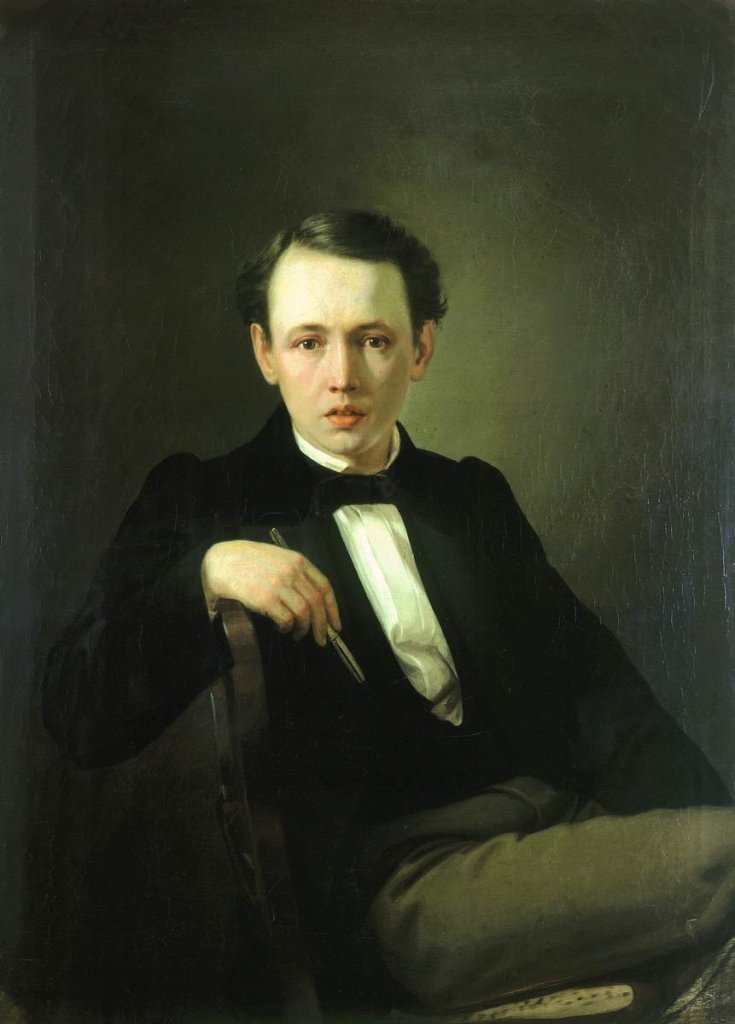
Self-Portrait (1851)

In my last blog I looked at Perov’s early life and his artwork which is often categorised as critical realism because of the way his paintings  focused on the peasants and how they had been let down by the Church, its clergy and the State.  For one of these works he was awarded the Gold Medal by the St Petersburg Imperial Academy of Arts and also a scholarship for him to travel to Europe and study European art.  He went to Paris where he spent a considerable amount of time but once again his art focused on poverty, this time, poverty in France.  Perov was now moving away from his anti-clerical depictions, and his barbed narrative works which poured scorn on the Church.  He now wanted to concentrate on the poor themselves and left the observer to decide on the reason for the poverty.

Savoyard by Vasily Perov (1863)

One of his most famous paintings, which he completed whilst in France, was one entitled Savoyard which he finished in 1863.  In Perov’s painting we see a young boy sat slumped on some stone steps.  The absence of any movement allows us to focus on the child without any distractions.  The child is asleep.  His feet stick out in front of him and this allows us to see the tattered hems of his trousers and because of the way is feet rest on the pavement we are given a view of the soles of his shoes, which are holed.  The painting itself is made up of dark sombre tones of smoky blue, green and grey.

Street Beggar by Gavarni

It is thought that Perov’s painting was influenced by the work of Paul Gavarni, a French engraver, who had his illustrations published in a collection of London sketches, featuring life in London at the time.  The sketches and accompanying illustrations were first published as a magazine series in 1848 and later they were collected in one volume, edited by essayist and journalist Albert Smith, which was first published in Paris, in 1862, a year before Perov’s arrival in the French capital.  It was entitled Londres et les Anglais.  One of the sketches was the Street Beggar and its thought that Perov had this in mind when he worked on the Savoyard.

Perov’s arrival in Paris in 1863 coincided with a great upheaval in French art.  The Hanging jury at that year’s Salon had been ruthless in their choice of paintings which could be admitted.  Those which were cast aside were ones deemed to have not been of the quality or type they wanted.  That year, the jury had been more ruthless than they had been in the past, rejecting two-thirds of paintings.  This resulted in vociferous protests from the artists who had had their works rejected.  It was so bad that Napoleon III stepped into the argument and placated the disgruntled artists by offering them a separate exhibition for their rejected works.  It became known as the Salon de Refusés (Exhibition of rejects) and that year this exhibition exhibited works by Pissarro, Fantin-Latour, Cezanne and included Manet’s Dejeuner sur l’herbe and Whistler’s Symphony in White,no. 1. 

The Arrival of the Governess at a Merchant's House by Vasily Perov (1866)
The Arrival of the Governess at a Merchant’s House by Vasily Perov (1866)

Perov returned home early from his European tour in 1865 and in 1866 produced a wonderful painting entitled The Arrival of the Governess at a Merchant’s House.  This was a move away from his focus on poverty and more to do with the fate of women.  In the painting we see a governess standing before the master of the house, a merchant who is to be her new employer.  This painting depicts the awkward encounter between the governess, who has probably graduated from a school for governesses, where they are taught to act like nobility, and the merchant who has no noble blood and is the face of the nouveau riche.   She presents herself well. She clutches a letter of introduction in her hands. She oozes an air of timidity and subservience, which is a trait that would be required if she was to become a member of the household.  However her demure stance with head bent down is befitting that of a lady.  She stands before, not only the master of the house, a bloated man, but behind him stands his family.  The children of the family are to be her pupils and by the looks of them she was going to be in for a difficult time.  The master of the house and his three children are dressed elegantly and the furnishings we see are fine and elegant and are part of merchant’s plan that they be elevated in status from mere merchants to something approaching nobility. Perov has changed the subject of his biting satire from the clergy of the Church to the oppressive merchant classes and the poor treatment they bestow on their employees.

Troika by Vasily Perov (1866)

The painting was purchased by thirty-four year old Pavel Tretyakov, a Russian businessman, patron of art, avid art collector, and philanthropist who gave his name to the Tretyakov Gallery in Moscow.   This work along with his Troika painting earned Perov the title of Academician.

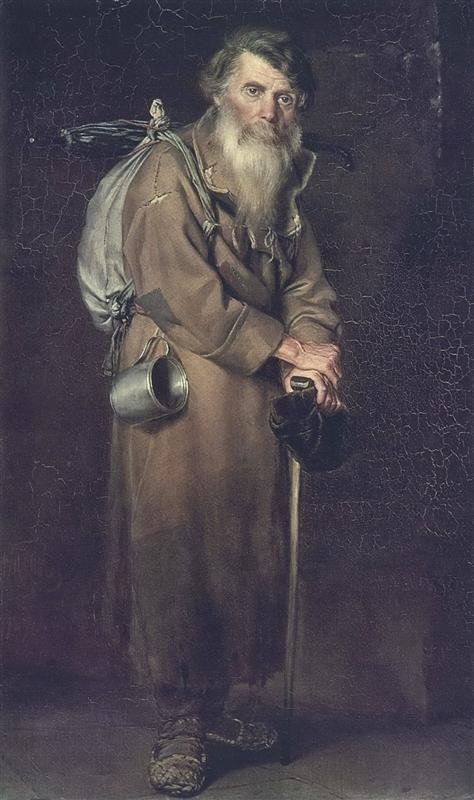
Wanderer by Vasily Perov (1870)

In the late 1860’s Perov began to concentrate on portraiture, initially of peasants and the title Wanderer was given to three of his works which featured peasants, all different and yet all emotive in their own way, one of which is shown above.  As Perov travelled around he came across a variety of fascinating characters and he was able present them on canvas and highlight their individualism and their way of life.

Portrait of the Author Feodor Dostoyevsky by Vasily Perov (1872)

In the early 1870’s Perov’s portraiture focused on cultural greats of Russia but it is interesting to note in these next two paintings they were totally devoid of any background accoutrements which would have added a sense of vanity in the sitter.  In 1872 he completed the Portrait of Dostoyevsky, a the Russian novelist, short story writer, essayist, journalist and philosopher. It was Dostoyevsky’s literary works which influenced Perov in the way they explored human psychology in the troubled political, social, and spiritual atmosphere in Russia during the 19th-century.

Portrait of the Playwright Alexander Ostrovsky by Vasily Perov (1871)

And in 1871 he finished his Portrait of Alexander Ostrovsky, a Russian playwright who was generally thought to have been the greatest writer of the Russian realistic period, which existed against the background social and political problems.  It started in the 1840’s under the rule of Nicholas I and lasted through to the end of the nineteenth century.   The painting is now housed in the Tretyakov Gallery, Moscow.

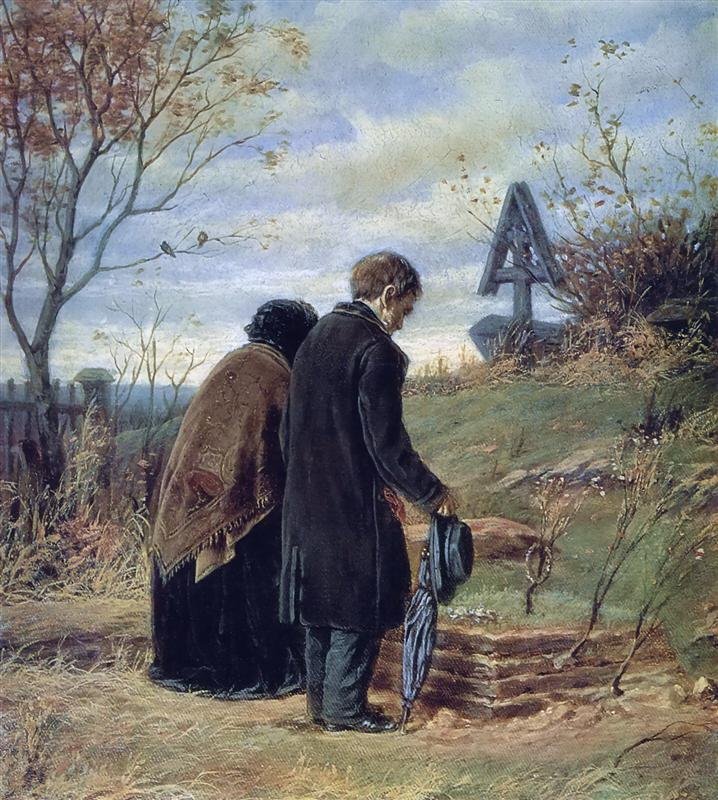
Old Parents Visiting the Grave of Their Son by Vasily Perov (1874)

In all his genre works he always managed to tug at your heart strings with his moving depictions.  Another of his heart-rending scenes was completed in 1874 and was entitled Old Parents Visiting the Grave of their Son.  It is said that nobody should suffer the agony of burying their children and in this work we feel the loss of the mother and father as they stand, heads bowed, at the side of the son’s grave.  This painting, like many of his other works, are to be found at the Tretyakov Gallery in Moscow.

Having received his academician’s degree in 1867, Perov went on in 1871 to gain the position of professor at Moscow School of Painting, Sculpture and Architecture.   It was through Perov’s teaching at Moscow School of Painting, Sculpture and Architecture that he managed to influence and nurture the young aspiring artists in his charge.  Many of the great Russian artists had been taught by him or were influenced by his style of painting

Amateur by Vasily Perov (1862)

As always I have the dilemma of which paintings to show you and which ones to leave out.  I just hope the blog will get you to search the internet for more of his works.   My final offering is one that features Perov’s sense of humour.  It is in complete contrast to his works which looked at poverty and the impoverished existence of the peasant classes.   It is a painting entitled Amateur which he completed in 1862.  It is both humorous and fascinating.   Before us we see a man slouched in a chair, chewing on the end of his maulstick, eyes narrowed as he looks at his work.  His wife stands beside him holding a baby.  She too is closely examining the canvas.    From the way the man is dressed along with the background details of the room we gather that this is an upper-middle class couple.  Another give away to the man’s social status is the way Perov has depicted him.  Well dressed, highly polished shoes and overweight.  Perov’s depiction of this man is similar to the master of the household, the merchant, whom he depicted in The Arrival of the Governess at a Merchant’s House- overweight, through all the food he had been able to buy and eat, whereas in most cases Perov portrayed the poor peasants as thin undernourished people.

Vasily Grigorevich Perov died of tuberculosis  in Kuzminki Village which is now part of Moscow and was laid to rest at Donskoe Cemetery.  He was fifty-eight years old.

Vasily Perov, Part 1 – the critical realist

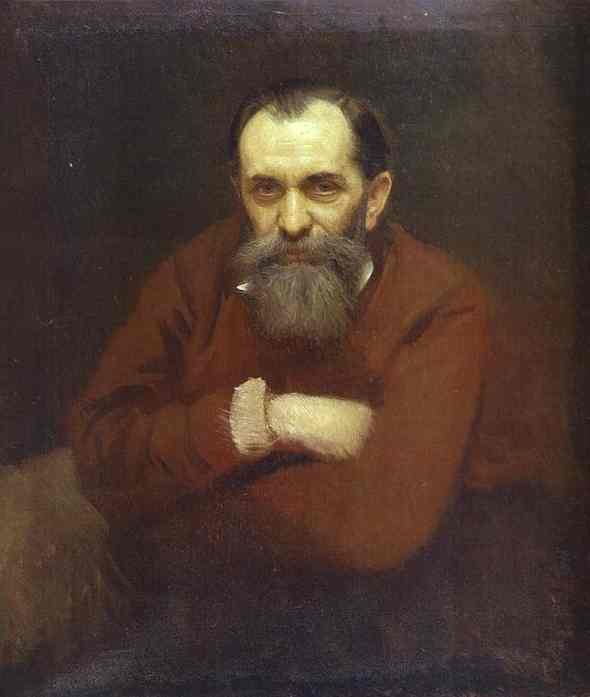
Portrait of Vasily Perov by Igor Kramskov (1881)

For my blog today, I am returning to Russia and featuring one of its greatest nineteenth century artists, Vasily Grigoryevich Perov.  He is known as one of the great critical realism artists of his time.

Perov was born in 1834 in the town of Tobolisk, a Siberian town, which lies east of the Urals.  Perov was the illegitimate child of Baron G K Kridiner, the provincial prosecutor for the region of Arzamas.  Perov, who was born prior to his mother and father’s marriage, was given the surname of his godfather, Vasilyev and yet, Perov himself disliked the name and had it changed to Perov, which was his nickname as a child as he was an excellent hand writer and a talented calligrapher.  Pero in Russian means pen.

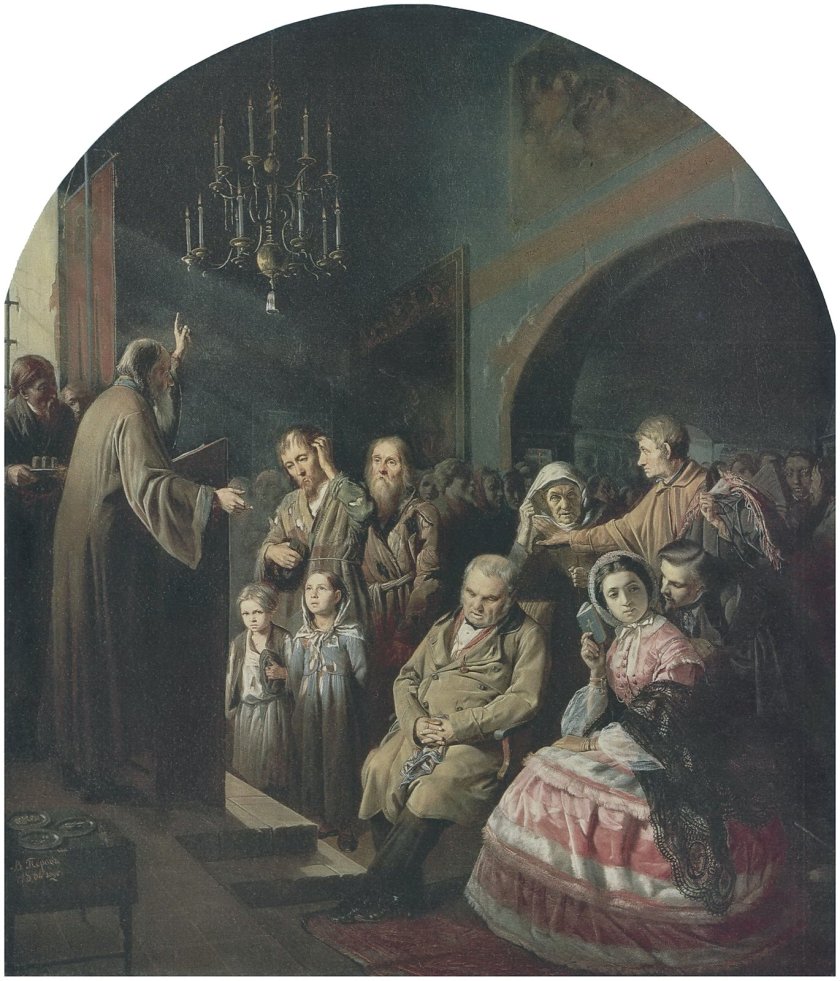
Sermon in a Village by Vasily Perov (1861)

In 1846, Vasily Perov received his first painting lessons, at the age of twelve, at the Alexander Stupin Art School in Arzamas. Stupin was a painter of the classicism genre, whose school was the first of its type in provincial Russia.  From there, in 1851, Perov moved to Moscow and entered the Moscow School of Painting, Sculpture and Architecture, which was one of the largest educational institutions in Russia.  It was here that he studied under Sergey Zaryanko, a Russian painter of Belarusian birth.   Whilst at the academy, he won a number of awards for his work from the St Petersburg Imperial Academy of Arts and his major award was when he won the Grand Gold medal for his diploma work in 1861.  The work was a set of preliminary sketches and the finished painting, Sermon in a Village.  He was also awarded a scholarship to travel abroad to enhance his knowledge of European art.

The Sermon in a Village is not simply a depiction of the congregation listening to a sermon.  In the centre foreground we see a nobleman asleep, head slumped forward on his chest.  He has no interest in the sermon.  He is just present to be seen.  Sitting next to him is his dutiful wife, prayer book in hand,  who plays coy as an admirer standing behind her flirts with her.  Look at the woman who stands behind the sleeping nobeleman.  She pulls her veil away from her ear and leans forward to try and hear the sermon.  Next to her one of the nobleman’s footmen tries to prevent her getting to close to his master. Earlier paintings depicting Russian clergy depicted them with veneration and the utmost respect so this mocking depiction of the church clergy by a young up and coming artist was frowned upon by the Establishment but it was accepted as an exhibit and won the artist, Perov, a European trip.

The Village Religious Procession at Easter by Vasily Perov (1861)

The preliminary sketches and painting, which won him the Gold Medal, were not his initial submission.  His original submissions were preliminary sketches for another of his works, The Village Religious Procession at Easter.  However the Academy rejected these because of their overt criticism of the Church and the clergy.  One needs to understand that Perov wanted to not only highlight the plight of the poor and the deprived, he wanted to condemn the role of the Church and its leaders who led a comfortable life and, in his mind, offered little comfort to the poor.  Despite the St Petersburg Academy’s rejection of his preliminary sketches for the The Village Religious Procession at Easter, he completed the work in 1861.

This oil on canvas work was his way of recording his belief that the clergy had forgotten their duty to parishioners.  It was blatantly an anti-clerical depiction.  The setting is a dull landscape.  The discordant movement of the participants in the procession together with the gloomy sunset accentuates the unattractiveness of the whole scene.  Before us, we see a drunken mix of clergy and their congregation embarking on a parade of icons through the village. Some of the people in the parade are carrying icons and gonfalons (a type of heraldic flag or banner, often pointed, swallow-tailed, or with several streamers, and suspended from a crossbar).  In the foreground of the painting, the peasants stagger past us towards a precipice with half-closed eyes.  It is as if they are all blind. We can make out a woman with an icon that has lost its face. A little further on, we observe the figure of a poor man carrying an icon upside down, albeit, we can still make out the “all-seeing” eye on the gonfalon and maybe Perov left it in to remind people that nobody can escape the Supreme Judgment.  The leader of this group is a drunken priest who we can see on the right, standing on the steps of the wooden building, hanging onto the upright structure to stop him falling.  We can also see, despite the desperate efforts of one of his helpers, that he has stepped on and crushed the Easter egg.  He has abandoned his “flock”.

Religious Procession in Kursk Province by Ilya Repin (1883)

The painting was exhibited at the Society for the Encouragement of Artists in St Petersburg but the curators were told to remove it on grounds that it was an “immoral” work, which criticised the Church and its clergy.  Even the press were banned from reproducing it in their newspapers; such was the power of the Church at the time.  Twenty years later Ilya Repin completed his famous work, Religious Procession in the Province of Kursk (See My Daily Art Display Aug 29th 2011), which again compared the lot of the downtrodden peasant class and the wealth of the clergy.

In 1862, Perov chose to go to France and also visited some German cities.  He returned home in 1864, even though his scholarship would have funded a longer stay in Europe.  Maybe he missed his homeland.

Perov lived through the 1860’s in Russia and was well aware of the social problems in his beloved country and he began to highlight the plight of the poor and downtrodden as well as contrast that to the wealth of the Russian church and its hierarchy.  Perov’s paintings carried strong social implication and thus his realistic depictions became an important landmark in the history of Russian painting.

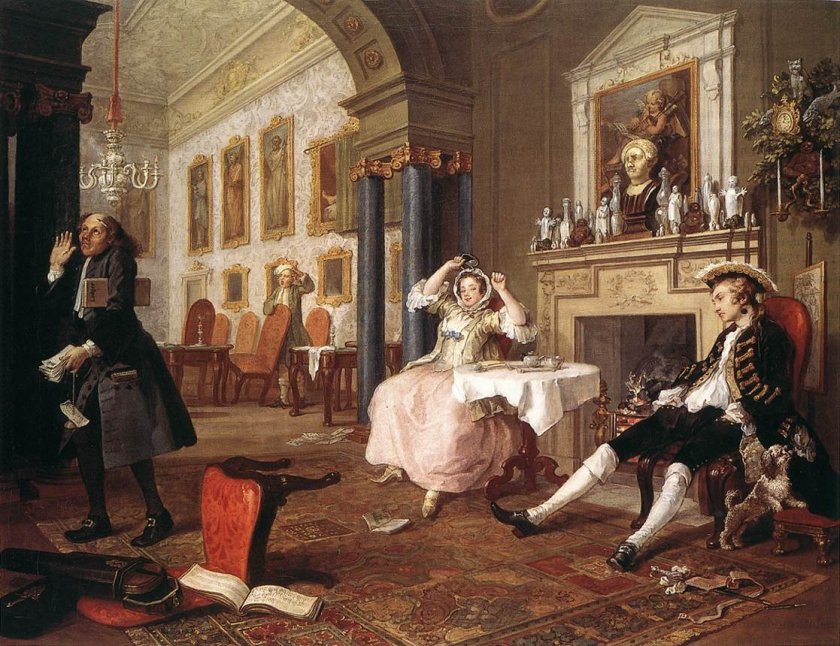
Marriage à la Mode by William Hogarth (c.1743)

Perov, at this time, had become influenced by the work of Pavel Fedotov,  who is now looked upon as the founder of critical realism in Russian art.  Perov was also aware of the genre scenes by the Old Dutch masters, often depicting poverty.  Another painter who influenced him was the English painter William Hogarth, the eighteenth century pictorial satirist and social critic whose work ranged from realistic portraiture to what is referred to as Sequential Art, which uses images arranged in sequence for graphic storytelling or to communicate information, a kind of narrative art. One example of this is Hogarth’s almost comic strip series which questioned the morals of the privileged (see – Marriage a la Mode – My Daily Art Display May 4th – 9th 2011).

On his return to Moscow he became one of the founder members of a group, known as the Peredvizhniki, often referred to as The Wanderers or The Itinerants.  This group of artists were influenced by the liberal ideas of the philosopher and critic, Nikolay Chernyshevsky and the philosopher, Vissarion Belinski.  They established the first Free Society of Artists in Russia. In a way it was a group, which felt it their duty to portray, through their art, the necessity of denouncing the social order in Tsarist Russia.  Other great Russian artists which were part of this group and have featured in My Daily Art Display were, Ilya Repin, Alexei Savrasov, Isaac Levitan and the landscape painter, Ivan Shishkin.  This group of young artists, who in protest at Academic restrictions formed themselves into a co-operative.  Perov’s influence on the art of the time, developing realism in art during the last five decades of the nineteenth century, cannot be underestimated.

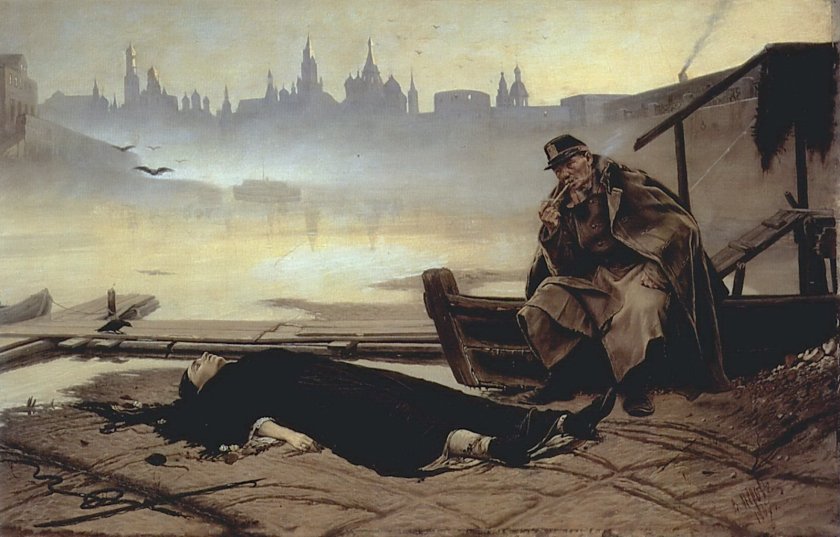
The Drowned Woman by Vasily Perov (1867)

The height of Perov’s success as a realist and genre painter came around the latter part of the 1860’s.  In 1867 Perov produced the highly emotive work entitled The Drowned Woman.    In Perov’s painting we see a policeman, who has just dragged the body from the river.  He is sitting, smoking his pipe, and looking down on the dead woman.  The artist wants us, like the policeman, to think what might have been the circumstances of the young woman’s death.  Had life been just too hard to bear?   The casualness of the policeman’s demeanour gives us the idea that the dragging of a lifeless body from the river was a common occurrence.  It should be remembered that what we see in Perov’s depictions of social inequality was mirrored in the literature of the time by the likes of Fyodor Dostoyevsky whose writing explored human psychology at a time of the difficult political and social mood of 19th-century Russia.

Found Drowned by George Frederic Watts (c.1850)

The subject of this work by Perov harks back to a work by the English realist painter, George Frederic Watts, and his 1855 work Found Drowned, a portrayal of a fallen woman, who drowned and whose body was discovered on the shores of the Thames.  (See My Daily Art Display July 4th 2011).

The Last Journey by Vasily Perov (1865)

In 1865 Perov produced another heart wrenching oil on canvas work entitled The Last Journey, which can now be seen in the Tretyakov Gallery in Moscow.  It is a depiction of both sorrow and condemnation.  There is an overwhelming sense of bereavement as we see a horse-drawn sleigh driven by an old woman.  We just see the back of her, hunched over, driving the horse.  She is taking the wooden coffin, which contains her recently deceased husband and breadwinner, to his final resting place.  Also on the sleigh are two children who, like the woman, face an uncertain future.  Their pet dog follows on.  The painting is gloomy matching the atmosphere of the story behind the depiction. Dark clouds are seen above the funeral cortege.  It is thought that Perov got the idea for this painting when he read the book, The Red Nose Frost, published in 1863 by Nikolai Nekrasov.  It is in two parts, the first part tells about a funeral of a young peasant and in the second part of the widow fight for survival in the forest. Nekrasov was a Russian poet, writer, critic and publisher.  His intensely empathetic poems about peasant life made him the hero of the freethinking and revolutionary circles of Russian intelligentsia.

Troika by Vasily Perov (1866)

I am completing this first part of my blog about Vasily Perov by featuring one of his greatest and certainly his largest genre painting (123 x 168 cms).  It has the simple title, Troika, which is the Russian word for “group of three”, and was completed in 1866 and now resides in the Tretyakov Gallery in Moscow.  It is a pictorial social commentary, which in this case, focuses on child labour.  We see children pulling a sled piled high with heavy barrels.  They face us.  Look at the way Perov has depicted their faces.  There is of course a child-like quality about them but one cannot fail to notice the pain and suffering their task is causing.  The air of gloom is added to by Perov’s background – The backdrop, the gloomy walls of the monastery create a mood of hopeless melancholy.  The children are being used and humiliated by this onerous task.
In my next blog I will showcase more of Perov’s paintings and look at the final years of his life.

Albert Joseph Moore. Part 3 – the conclusion.

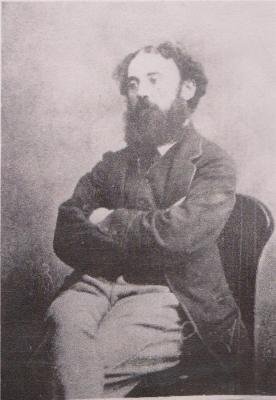
Albert Joseph Moore (c.1870)

The Aesthetic art movement thrived in Britain and America during the 1860s to the 1880s.   The movement started in a small way in the studios and houses of a radical group of artists and designers, including William Morris and Dante Gabriel Rossetti.  In works of art the leading British exponents of this aesthetic movement were J.M.Whistler, Frederic, Lord Leighton and Albert Joseph Moore.  This style of art was also known as Art for Art’s Sake.  The Oxford  Dictionary defines Aestheticism as:

“… the term applied to exaggerated expression of the doctrine that art is self-sufficient   and needs serve  no ulterior purpose, whether moral, political or religious…”

It was influenced by Japanese art and culture.  It was not universally loved and the art critic Walter Hamilton wrote a book in 1862, The Aesthetic Movement in England, in which he mounted a famous defence of the Aesthetic Movement and wrote about the key figures associated with the movement and provided descriptions of contemporary responses to it.

Albert Moore was one of the principal originators of the Aesthetic Art Movement, and was considered by Whistler as one of the most original artists of his generation.  His  decorative paintings, which were true to the Aesthetic movement, championed pure beauty in their depiction but  lacked messages whether overt or subtle, and this type of art became very popular with collectors.  His depiction of women, in what is termed a Hellenic style, draped in their diaphanous clothing, was one which will always be linked with Moore.  Following the success he had with his work entitled The Marble Seat, he followed it up with a series of purely decorative paintings.  In all of these, the allure of the works was Moore’s depiction of the female form and the harmonious use of colour.

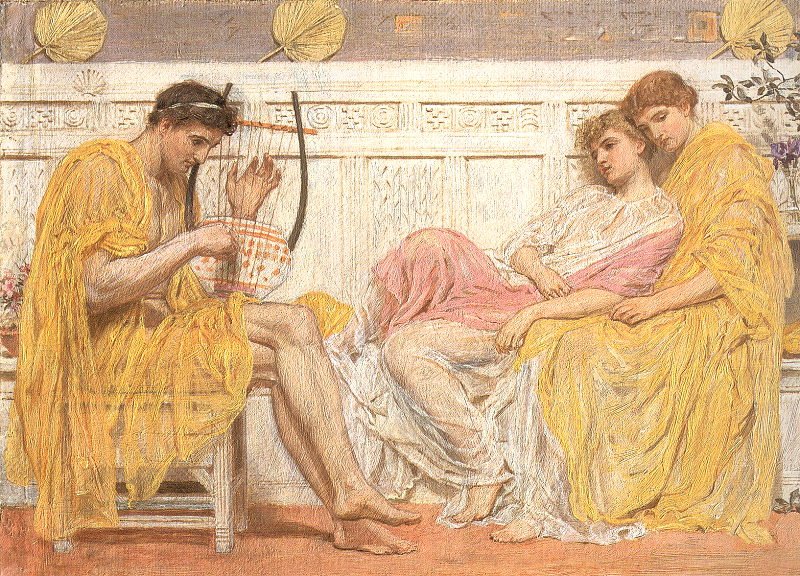
A Musician by Albert Moore (1865-6)

One of Albert Moore’s patrons, around this time, was James Leathart, a Newcastle lead manufacturer.  He had visited Moore at his studio in 1865 and whilst there saw an unfinished work by the artist entitled A Musician.  The work combines aspects of ancient Roman wall paintings, Greek sculpture and Japanese prints.  The figures in the painting are separated.  On the left side we have an active male musician playing the lyre and on the right we see his audience of two passive females.  This separation by gender was also present in his painting, The Marble Seat (see previous blog).

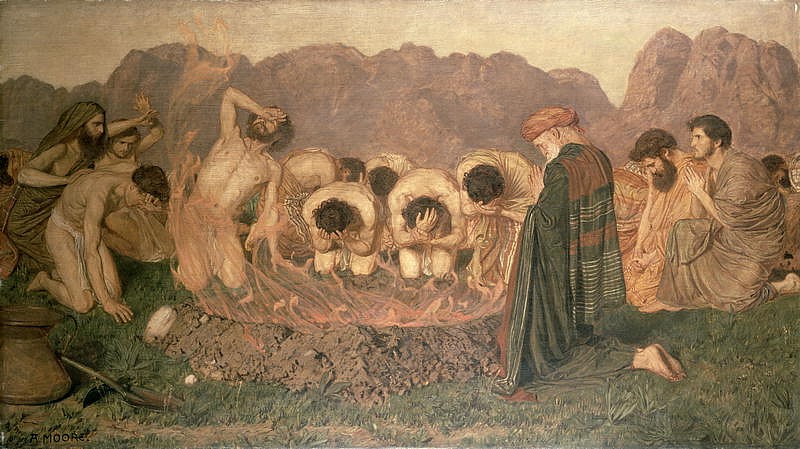
Leathart bought this work from Moore and It can now be seen at the Yale Centre for British Art, New Haven.  In 1867 he purchased from Moore his work Elijah’s Sacrifice.

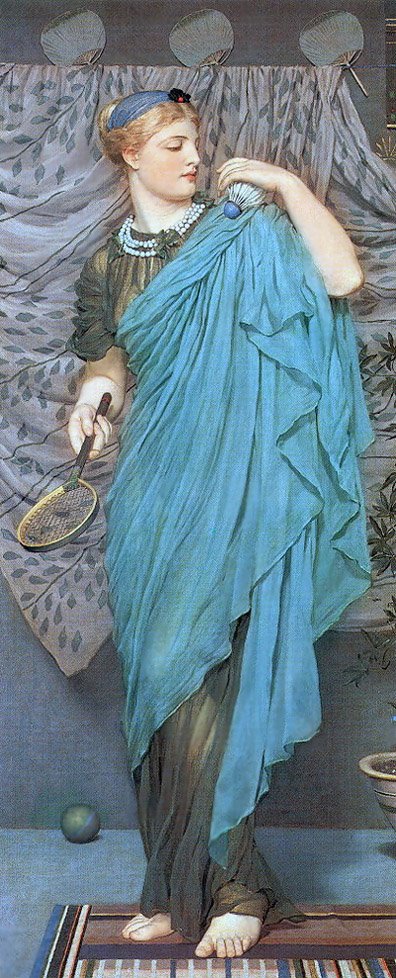
Battledore by Albert Moore (1870)

Leathart was so pleased with his acquisitions that he commissioned Moore to produce a pair of classically draped figures, each bearing a shuttlecock and racket.  The two commissioned paintings were to feature two ancient games played by both men and women.  It was the precursor to jeu de volant, which was itself the precursor to badminton.  The simple titles to his paintings were Battledore and Shuttlecock.

In a letter to Leathart in November 1868, Moore wrote:

“…now fairly at work on your two pictures and propose to go on with them continuously until they are finished…”

Leathart went to Moore’s studios to see what progress Moore had made and viewed the preparatory sketch.  However Moore had a change of heart with regards the colours and tones he would use and in February 1869 he again wrote to Leathart to tell him that he had:

“…hit upon combinations of colour darker in character than the little sketch you saw some time ago…”

Now, Moore had a dilemma.  He wanted to press ahead with the final paintings but had to be sure that Leathart agreed to his proposed changes to the colours and in his letter to Leathart, he gave his reasons for the change but to avoid problems with his patron hinted that Leathart had the final say.  Moore wrote:

“… I think it is best to learn your views on the subject.  That is to say, if you have any particular desire that the pictures should be kept light in character – as for instance, for the sake of their effect in your room – I shall of course be ready to recur to something like the original scheme: at the same time I have reason to believe that the latter combination would succeed – having tried them in small sketches and I may say I should not hesitate to carry them out, were I the only person concerned…”

Leathart agreed to the changes.

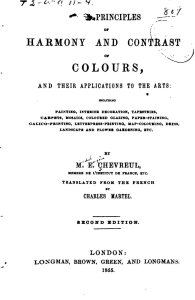
Principles of Harmony and Contrast of Colours by M.E.Chevreul
Principles of Harmony and Contrast of Colours
by M.E.Chevreul

Moore was fascinated by colour combinations and how some worked better than others.   Whilst studying at the School of Design in York he had studied this very issue and was inspired by Michel Eugène Chevreul who had published a book in 1855 entitled The Principles of Harmony and Contrast of Colour.  Chevreul based his ideas on the study of the coloured threads in the Gobelin tapestries.

Shuttlecock by Albert Joseph Moore (1870)

In his work, Shuttlecock , Moore brought together the colours of orange and blue which Chevreul had written were “harmonies of contrasts”.  Although chromatically opposites, orange and blue combined to produce grey.  Look at the colour combinations on the mat which the female stands upon.   When the two paintings were exhibited at the Royal Academy in 1871 Moore was praised for his depiction of the figures but those who detected Moore’s scientific approach to colour combinations were less happy.  Other critics were unhappy with the fact that there was no message within the painting, no historical or biblical connotation to the depiction

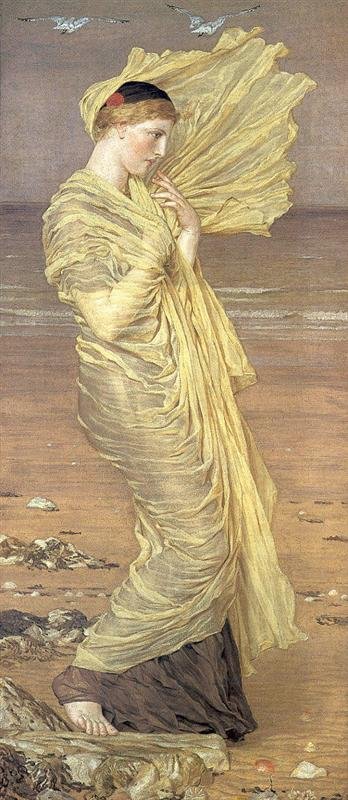
Sea-gulls by Albert Moore (1871)

Along with Battledore and Shuttlecock Moore had a third painting accepted for the 1871 Royal Academy Exhibition.  The title of this third work was Sea-gulls.  This painting eventually came to fruition but not without some controversy.  Moore’s friend James Whistler got to hear of, and later saw the preliminary sketches for this painting through their mutual friend and patron Frederic Leyland and Whistler was concerned that they were very similar to preliminary sketches he had made for his own painting.  After lots of discussions between the two artists and an intermediary, William Nesfield, an architect and amateur painter, and a  friend of both Whistler and Moore, it was amicably decided that Moore exhibiting his Sea-gulls painting would not have an adverse effect on Whistler’s works.  The painting was exhibited at the RA even though, according to Moore,  it was unfinished.  On receiving the work back from the exhibition, Moore completed the work and it was sold to his patron, Frederic Leyland.
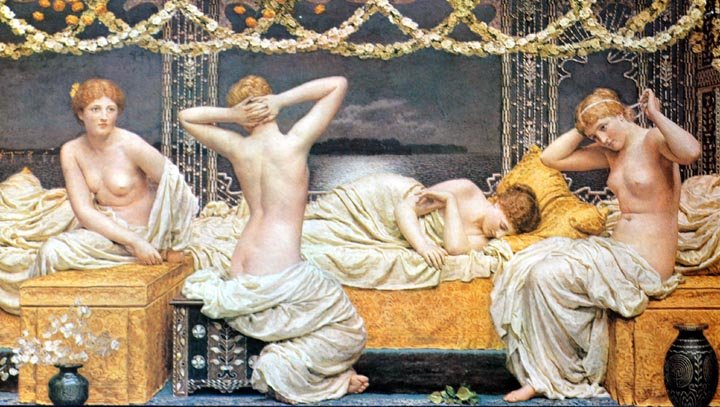
A Summer Night by Albert Moore (1864-90)

There are so many beautiful paintings done by Albert Moore that it is difficult to select a only a few for the blog.  However, the next painting by Albert Moore which I am featuring took almost six years to complete and it is a veritable beauty.  Moore started this large work (132 x 229 cms) in 1884 but did not complete it until 1890.  It was entitled A Summer Night.

The backdrop for this work was not Moore’s usual wall but a fascinating and beautiful display of floral garlands, all intertwined together.  In the far background, across the sea, we see the twinkling of shore lights of an island which has been lit up by moonlight.  Pale clouds can be seen in the dark sky.  In the upper left foreground, we can see orange-coloured ranunculus blooms weaved into the upper part of the silver filigree which is part of the open trellis-work.  The painting received a rapturous reception from the public when it was exhibited at the 1890 Royal Academy exhibition, despite the RA’s Hanging team banishing the work, high up on a wall in the fifth room, close by a door.

The fact that Moore’s work was often looked down upon by the art institution for his constant scientific manipulation of colours and for producing paintings without any hidden meanings was not lost on the forward-thinking art critic of the time, Claude Phillips, who had, for a long time been a great supporter of Moore.   In an article in the Academy in May 1890, he wrote:

“…no artist of purely British origins has the same mastery over the keyboard of tints and tones as this master of decoration and that such a painter should persistently be excluded from the ranks of the Academicians while that august body contains so many crude, perfunctory and unspeakably tiresome practitioners, is a riddle the solution of which had, perhaps, better not be attempted…”

The art critic George Moore (no relation to Albert Moore) castigated the Royal Academy for not electing to the Academy, either Albert Moore or his friend James Whistler.  In 1893, he caustically wrote:

“… Many Academicians will freely acknowledge that his [Albert Moore] non-election is a very grave scandal;  they will tell you that they have done everything to get him elected and have given up the task in despair……………..the two greatest artists living in England, will never be elected Academicians; and artistic England is asked to acquiesce in this grave scandal…”

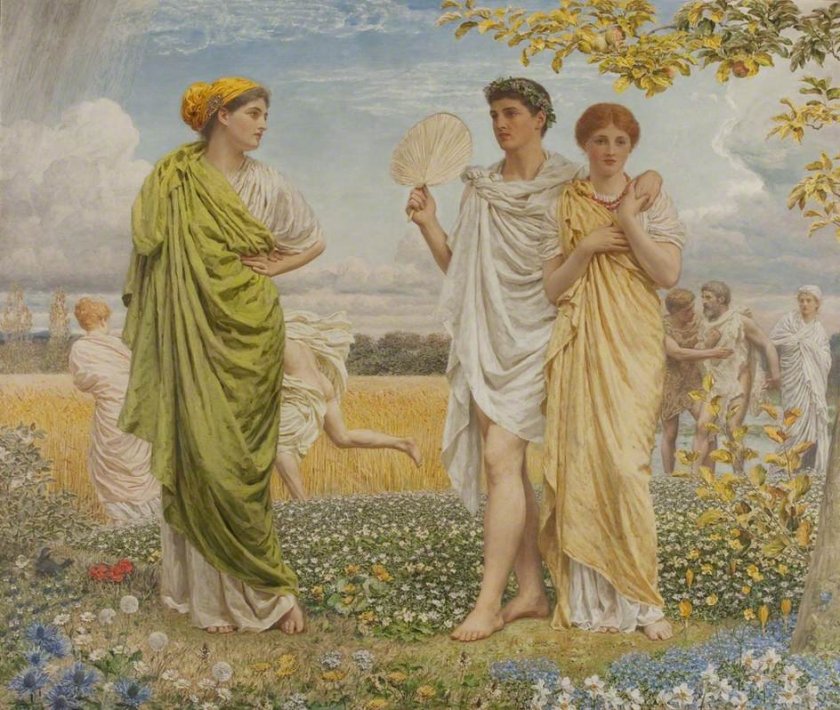
The Loves of the Winds and the Seasons by Albert Moore (1893)

The last painting I am showing you was the last painting Albert Moore completed.  It was entitled The Loves of the Winds and the Seasons, which he completed in 1893.  Moore’s financial situation at the start of the 1890’s was dire and to make things worse is health was starting to decline.    In August 1892 Moore had been taken seriously ill and despite a number of operations he was made to suffer from a painful and incurable illness.  Moore would not let his pain or his advancing death stop him from painting and this last painting which he started in 1890, was completed nine days before his death.  The painting depicts the courtship of the four male winds with the four female seasons.  The female figure on the left is Summer and she watches the courtship of the South Wind and Autumn.  In the right background of the painting we see the North and East Winds quarrelling over Winter whilst they are all stood in a patch of snow.

Albert Joseph Moore died at 3am in his London studio in Spenser Street, Westminster on September 25th 1893, three weeks after his fifty-second birthday.   The cause of death was given as a sarcoma of the thigh and a recurrent sarcoma of the abdomen.  He made his brother Henry sole heir to his estate which amounted to just £1,184.  He was buried in the family grave in Highgate Cemetery, which was already occupied by his mother and his brother, John Collingwood Moore.

———————————————————————————

Most of the information I have used in this and the next blog have come from  two books, biographies of Albert Joseoph Moore. They are:

Albert Moore, his life and works, by Alfred Lys Baldry (1894)

Albert Moore by Robin Asleson (published by Phaidon)

Albert Joseph Moore. Part 2 – his portrayal of women.

Albert Joseph Moore (c.1870)

At the end of my last blog I had reached the point in Albert Moore’s life with him travelling to Rome with his brother John Collingham Moore just after his twenty-first birthday.  Whilst travelling around the Roman Campagna he was able to observe the effects of colour which were presented to him under local conditions of light and atmosphere.  He travelled to Naples and Pompeii and throughout his stay he would copy classical statuary and Renaissance paintings.   His stay in Italy was cut short after five months when he received news about his mother’s death on the twenty-eighth of January 1863.  Albert returned to London in the Spring and set up home in a studio at 12 Newman Street in West London and immersed himself in the many commissions he received.

Elijah's Sacrifice by Albert Moore (1863)
Elijah’s Sacrifice by Albert Moore (1863)

It was also here that he held a one-man show featuring some of his works of art, including the newly completed Elijah’s Sacrifice (see previous blog).  One visitor to this show was Frederick George Stephens, an art critic, and one of the two ‘non-artistic’ members of the Pre-Raphaelite Brotherhood.  He gave his approval to Albert’s paintings and expressed the joy of discovering new young artists.  He wrote in the February 1864 issue of the London literary magazine, Athenaeum, in his regular review of the Arts, Fine-Art Gossip:

“…a critic’s pleasantest office is to call attention to works, from their nature, do not catch the eye of everyone…”

The small exhibition in his studio proved a great success.  It was unusual for an artist to show works in their own studio but Albert needed the money and needed to market himself and attract buyers but it was also a declaration of his own independence.  Albert Moore knew that he could not solely rely on the Royal Academy to show his work as he was only too well aware of the vagaries of the RA Selection Committee, who had a penchant of choosing works by its own Academicians rather than featuring young artists who were not RA members.   Albert had first-hand experience of this when, in 1864, the Selection Committee had rejected his work Elijah’s Sacrifice.

The Marble Seat by Albert Moore (1865)

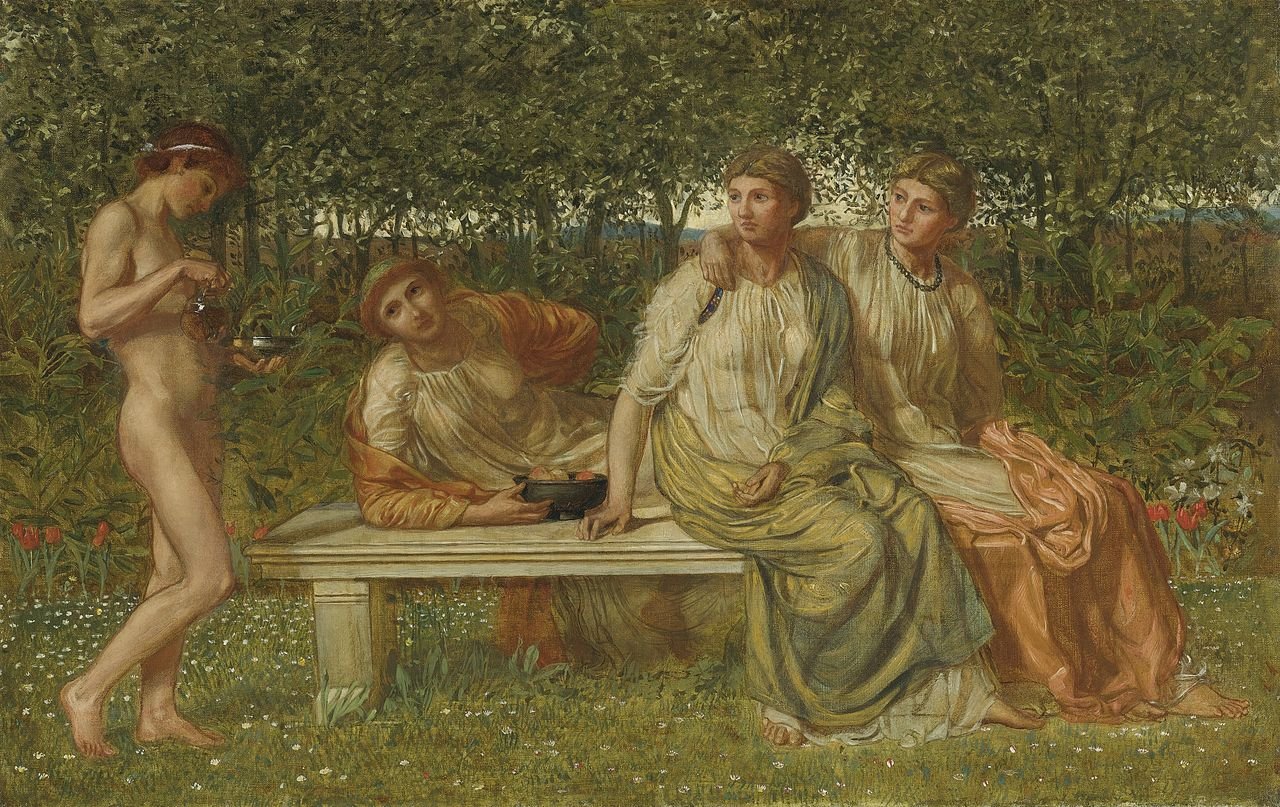
Whether Albert altered the painting is not known but in 1865 it was accepted by the RA Selection Committee!   Along with that work he also had accepted into that year’s Academy exhibition his painting entitled The Marble Seat.   It was a turning point in Moore’s career as the critics loved his two works.  The Marble Seat tells no story and does not illustrate any incident in history.  It is merely a composition of four figures, one male and three females, all of whom are grouped around a flat stone seat.    The background comprises of flowers including red tulips, trees and through the trees we are able to see a flat hinterland which leads to a range of blue hills.  The nude male stands to the right of the picture and we see him pouring wine into a cup.  The three girls, all dressed in almost transparent white draperies, over which are thicker orange, green and scarlet wraps, sit or lean against the marble seat.  The seat is positioned on green lawn which seems to twinkle with small white daisies.

Leading magazines raved about the works of this up and coming young artist.  According to the critics Moore and some other young painters were breaking new ground in modern British painting by treating the human figure on a monumental scale unlike other older and well established artists who preferred to stick to small-scale homely themes.

However not to be deterred by the vagaries of the R.A., Albert Moore joined a group of artists, which included his brother Henry Moore, the Jewish pre-Raphaelite painter, Simeon Solomon, John Everett Millais and the historical painter, Edward Poynter.  Ironically, both Millais and Poynter would later become presidents of the Royal Academy.  This group chose the Dudley Gallery in London as the venue for exhibiting their paintings.

Dancing Girl Resting by Albert Moore (1864)

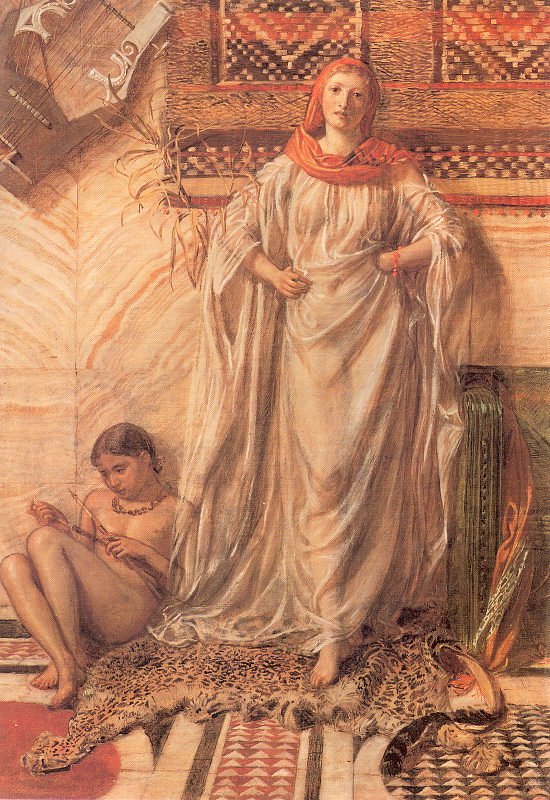
In 1864 Moore’s one-man show included his painting entitled Dancing Girl Resting.  It was noted that since returning from Rome, Albert Moore’s painting style and subject choice had changed.  The “new” Albert Moore can well be seen in this beautifully crafted 1864 painting.  Before us we see a tall girl, with a red scarf twisted around her head and shoulders, dressed in a full-length diaphanous shift standing on a leopard-skin rug which kept her feet away from the cold tiles.  She is leaning against a warm grey marble wall on which hangs a lyre and an ornamental woven mat.  The combination of the rug, the marble tiles and woven textiles adds an air of decadence.  The art critic, Frederick Stevens, in his Fine-Art Gossip column in the February 1864 edition of the Athenaeum described the girl’s somewhat erotic stance:

“…panting through parted lips, with heaving bust, her arms akimbo, and hands upon her hips…”

There is sensuousness and something erotic about this work.  Although she is not naked, we can see the contours of her naked body through the gossamer-like shift.  Look at the beautiful way Moore has executed the many folds of the shift which gives it a feeling of movement even though the dancer is at rest.  Although the title talks about the dancer resting, it is the small figure of the dark-skinned girl, who besides a strand of beads is naked.  She can be seen slumped limply on the floor besides the dancer who looks more at rest.

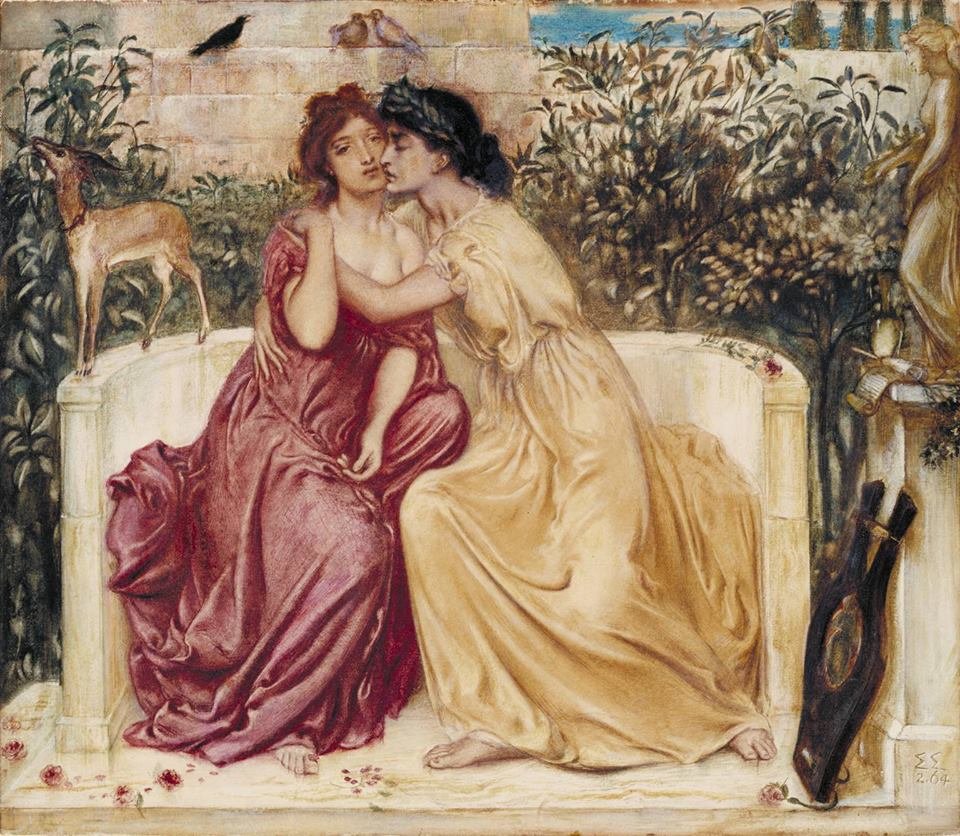
Sappho and Erinna in a Garden at Mytilene by Simeon Solomon (1864)

It is thought that Albert Moore was starting to be influenced by his friend Simeon Solomon whose paintings around this time showed a certain sensuousness such as in his 1864 painting, Sappho and Erinna in a Garden at Mytilene.  In that painting we see Sappho embracing her fellow poet Erinna in a garden at Mytilene on the island of Lesbos. According to legend, Sappho was born at Lesbos in about 612BC. After having been exiled to Sicily she returned to the island and was at the centre of a community of young women devoted to Aphrodite and the Muses.

The Shulamite by Albert Moore (c.1865)

Philip Henry Rathbone was a Liverpool insurance underwriter and Liberal Council member.  He came from a very wealthy family of merchants.  He was also an avid art collector and one time was a member of the Hanging Committee of the Liverpool Autumn Exhibition.  Amongst his friends was James McNeil Whistler.  Rathbone bought both The Marble Seat and my next featured work of Albert Moore, The Shulamite. A  Shulamite is a female name in Hebrew and means peaceful.  The name corresponds to Solomon as Julia does to Julius. It is the figurative name of the bride in Solomon’s Song and the bridegroom is represented by Solomon which also means peaceful.  The large oil painting, measuring 210 x 96cms is now housed in the Walker Art Gallery in Liverpool.  The painting appeared at the Royal Academy in 1866 but although it had been passed by the conservative Hanging Committee it, along with some other “audacious” paintings, were given an adverse hanging placement.  This and the other works, although placed in the prestigious North Room, were placed so high on the wall they were almost invisible to visitors.  Some would say a revengeful act by the Hanging Committee!  The May 22nd issue of the Times carried an article by the art correspondent, who reported on the exhibition and noted the poor positioning of Albert Moore’s work, writing:

“……..suffers more from its elevation, for its merits are of a more delicate and subtle kind……its exquisite draperies, clothing exquisite form [are] wholly out of sight…”

The Last Supper Wall painting by Albert Moore (1865-66)

In 1865, Albert Moore received a commission to carry out some wall paintings for the Church of St Alban in Rochdale.  The commission had come his way through good auspices of his friend, the architect William Eden Nesfield, whom he had travelled with to Northern France, five years earlier.  These wall painings were painted in oils directly on to the plaster surface of the walls.  The commission took most of 1865 and 1866 to complete and to complete the commission, Moore had to move a large quantity of his materials from London to Rochdale by train.  His biographer, Alfred Lys Baldry, tells the amusing anecdote of the start of this journey from Albert’s studio to Euston Station:

“…so heavily did he load the cab which was conveying him from his studio in Russell Place to Euston Station, that in mid-journey the bottom came out, and he and his brother Henry, who was going to see him off, had to run along inside for some distance, until the attention of the driver could be called to the mishap….”

The wall paintings in St Alban’s Church occupy the whole of the upper chancel and consist of several separate subjects, two being The Last Supper and The Feeding of the Five Thousand. 

In the final part of my look at the life and works of Albert Joseph Moore I will showcase more works of art dedicated to female beauty.

———————————————————————————–

Again, most of the information I have used in this and the previous blog have come from  two books, biographies of Albert Joseph Moore. They are:

Albert Moore, his life and works, by Alfred Lys Baldry (1894)

Albert Moore by Robin Asleson (published by Phaidon)

Eric Henri Kennington, Part 2 – the Second World War Artist

Eric Kennington (1926)

At the end of Part 1 of this blog about Eric Henri Kennington we had reached a point in his life when he had travelled to Arabia to prepare sketches which would later be used in his friend, T. E. Lawrence’s 1922 book entitled Seven Pillars of Wisdom.

In 1922, Eric Kennington first met Edith Cecil when he received a commission to paint a portrait of her husband, William Charles Frederick Hanbury-Tracy, 5th Baron Sudeley, whom she married in August 1905.  They had no children.  Kennington and Edith fell in love and in 1922 she and her husband divorced and in September 1922 she married Eric Kennington.  The couple went on to have a son, Christopher, in March 1925 and a daughter, Catherine in February 1927.  It is said that both Eric and Edith remained on friendly terms with Edith’s ex-husband.

The 1922 book Seven Pillars of Wisdom by T E Lawrence

Eric Henri Kennington, as well as having been a war artist during the Great War, was also a revered portrait painter.   During his time in Arabia sketching and working on paintings for T E Lawrence’s autobiographical book, Seven Pillars of Wisdom, he met Field Marshal Allenby.  Allenby, at that time, was the High Commissioner for Egypt and was based in Cairo.

Edmund Henry Hynman Allenby, 1st Viscount Allenby by Eric Kennington (1926)

In March 1921 Kennington met Allenby at the Semiramis Hotel in Cairo and produced a pastel portrait of Allenby.   It is remarkable to think that this pastel work was completed by Kennington in less than an hour.

Effigy of T.E. Lawrence - 'Lawrence of Arabia' in St. Martin's Church, Dorset by eric Kennington (1926)
Effigy of T.E. Lawrence – ‘Lawrence of Arabia’ in St. Martin’s Church, Dorset by eric Kennington (1926)

Kennington and T.E.Lawrence (Lawrence of Arabia) had an enduring friendship up until the day Lawrence was killed in a motorcycle accident in May 1935.  After his friend’s death, Kennington spent years completing a full-length reclining stone effigy of his friend dressed as an Arab sheikh.  This beautiful tomb effigy which was completed in 1939, and can now be found in the church of St Martin’s in Wareham in Dorset

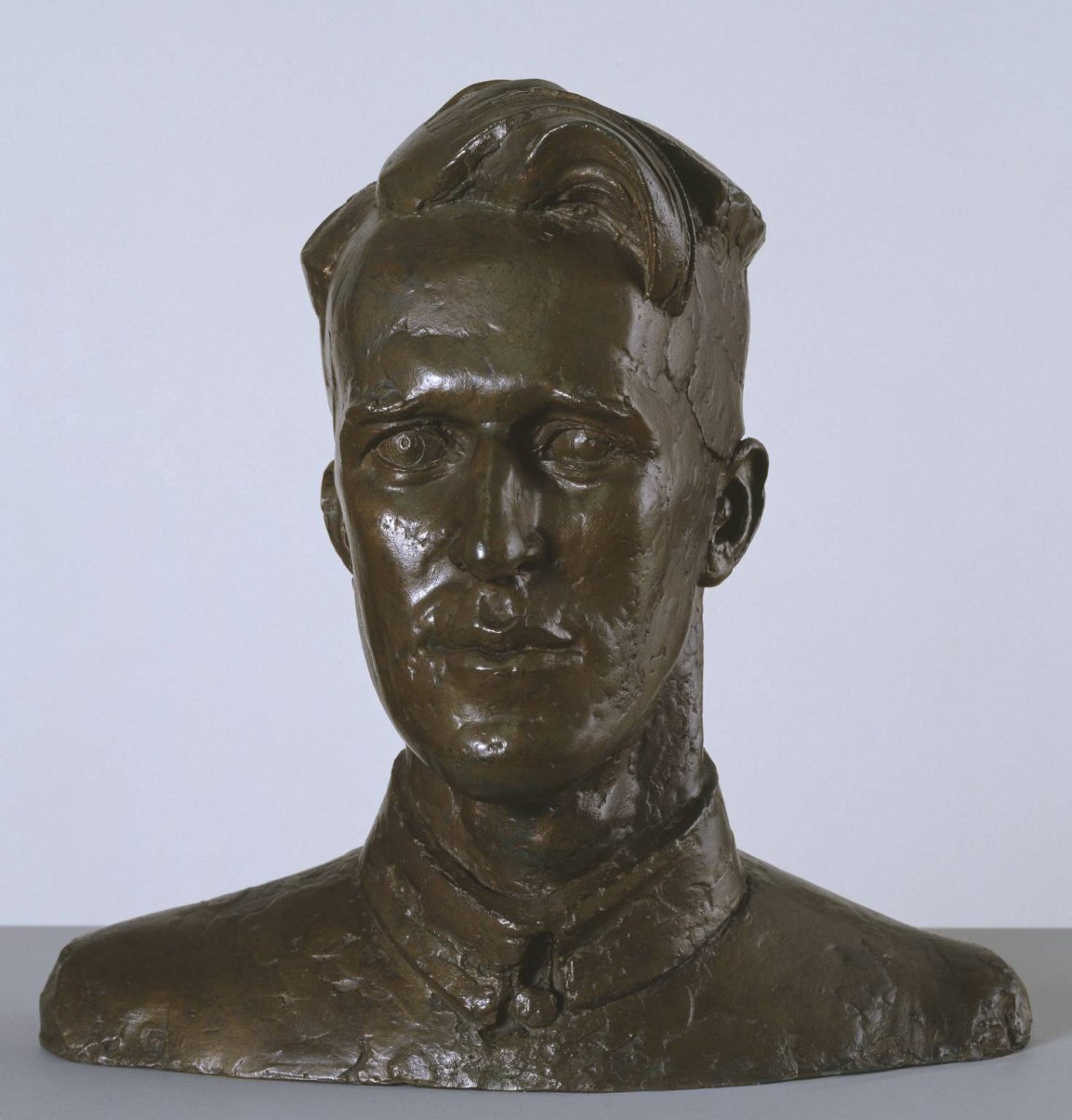
Head of T. E. Lawrence by Eric Kennington (1926)

Kennington also completed a bronze sculpture of the head of T.E.Lawrence in 1926 and the intrepid British archaeologist, military officer, and diplomat was delighted with the work.  He said:

“…Magnificent; there is no other word for it. It represents not me but my top moments, those few seconds when I succeed in thinking myself right out of things…”

At the outbreak of the Second World War in 1939 the War Artists Advisory Committee was formed as part of the Ministry of Information.  The chairman of the new committee was Sir Kenneth Clark.  Clark who had been a fine art curator at Oxford’s Ashmolean Museum,  had, in 1933 at age 30, become the director of the National Gallery and as such was, and still is, the youngest person ever to hold the post.   One of the artists he chose was Eric Kennington, as by this time, he had built up a reputation as a leading portrait artist.    Kennington became a war artist for the second time in December 1939.   His contract with the War Artists Advisory Committee was to produce pastel or charcoal portraits and for each one he would be paid 25 guineas.  Kennington agreed but said he would need a minimum of three hours per sitter.

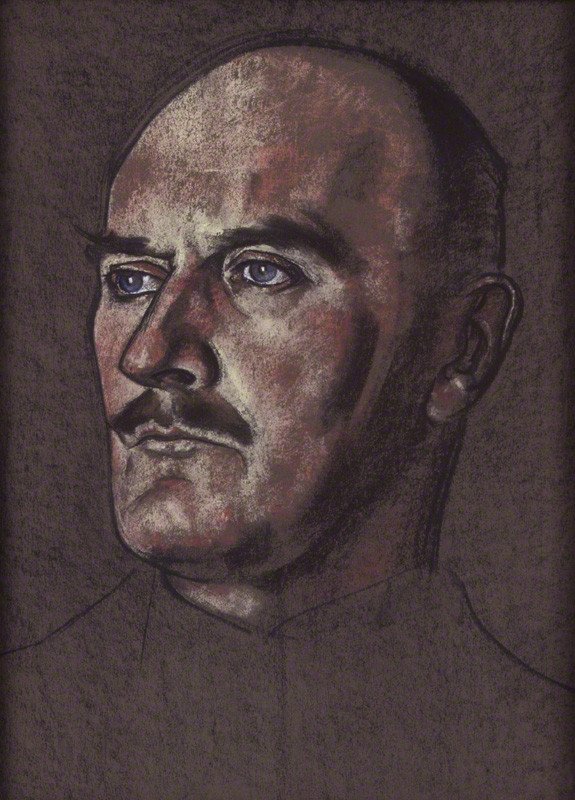
General Sir Edmund Ironside, General Officer Commanding-in-Chief, Home Forces, May-July, 1940. by Eric Kennington (1940)

One of his first sitters was the Chief of the Imperial Staff, General Sir Edmund Ironside.  He completed the portrait in January 1940

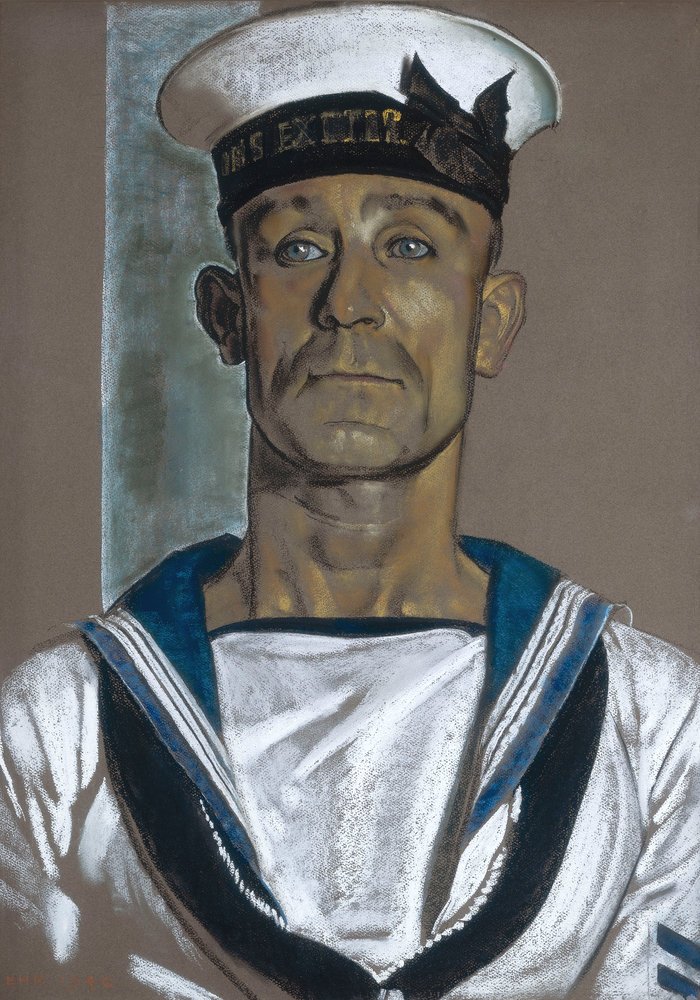
Portrait of Stoker A.Martin of HMS Exeter by Eric Kennington

In 1940 Kennington was sent to Plymouth to sketch portraits some of the seaman who had served in the great 1939 sea battle of the River Plate.  One such portrait, which he completed in the April of that year, was of Andrew Martin, a senior stoker aboard HMS Exeter during the River Plate battle.  Kennington wrote a small piece to accompany the portrait.  He wrote:

“…Man of Action: instantaneous: 100 per cent reliable: expert technician. Much humour under thorough camouflage. Very gentle, sensitive, and great physical strength…”

The painting found favour with the art critic, Herbert Granville-Fell who wrote:

“…Kennington’s harsh iron technique has a force admirably suited to conveying unflinching and dauntless resolution in the faces of his seamen and soldiers. I know of no other artist who can so convincingly depict the salt of the earth, and evoke palpably, in a portrait, the very essence and savour of courage…”

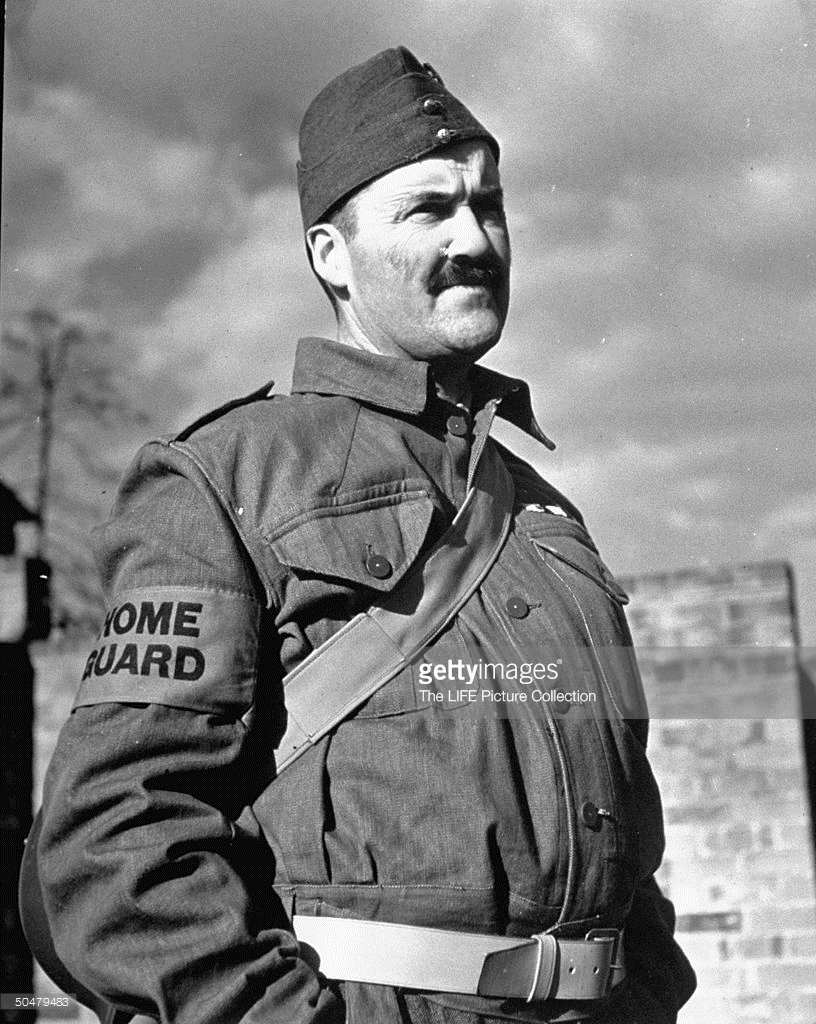
Kennington, as was the case during the First World War,  soon clashing with his “employer” the War Artists Advisory Committee principally because of his personal dislike of Colin Coote, a journalist, who was the War Office representative on the committee.  In May 1940 the Home Guard, the Local Defence Volunteers was formed and Kennington decided to leave his role as a war artist for the War Artists Advisory Committee and join the Home Guard.

In July 1940, shortly after Kennington left the War Artists Advisory Committee the Committee held an exhibition of official war art at the National Gallery.  The art critics and public were both pleased with what they saw and in particular the works of Eric Kennington which were said to have been the most popular.  In particular his works depicting the generals and the sailors received the most praise.

Eric Kennington in his Home Gurad uniform

Kennington rose in its ranks and in July 1940 he was put in charge of a section of six countrymen in the south Oxfordshire countryside, defending an observation post he had set up to the north of his home in Ipsden.   We are so use to thinking of the Home Guard as the people we see on the very popular TV comedy series, Dad’s Army or maybe we have a romantic view of the brave men who protected our homes.  Apparently Kennington did not view the Home Guard or his fellow Home Guardsmen in such an idealised and romantic manner.  Kennington was very vociferous in his criticism of the equipment they were given and was also critical with regards the senior officers, of whom he said were tied up in bureaucracy.   He wrote to his older brother William:

“…The men, if not suitably motivated, did not report for duty in the evenings, but sloped off after roll call to go poaching, fishing, or playing cards in the pub…”

Sergeant Bluett, Cornwall Home Guard by Eric Kennington

For all his criticism of some of his fellow volunteers he completed some wonderful portraits of them, such as Sergeant Bluett of the Cornwall Home Guard which he completed in 1943.

Corporal Robertson, City of Edinburgh Home Guard by Eric Kennington (1943)

….and Corporal Robertson of the City of Edinburgh Home Guard which he also completed in 1943.  Both these paintings are housed in the Imperial War Museum.

The War Artists Advisory Committee in August 1940 not wanting to have lost such a great artist approached Kennington and asked him to return to the fold as a war artist.  The War committee was delighted that Kennington agreed to return.  The secretary of the Committee, Edmund Montgomery O’Rourke Dickey, wrote to Kenneth Clark about how Kennington’s work instilled hope in those who saw his portraits.  He wrote:

“…The best of this artist’s [Kennington] portraits of sailors in the exhibition at the National Gallery have, in the eyes of the public, a nobility not shared by any other work that’s on display at the National Gallery. These portraits typify the fighting man who’s going to win the war for us…”

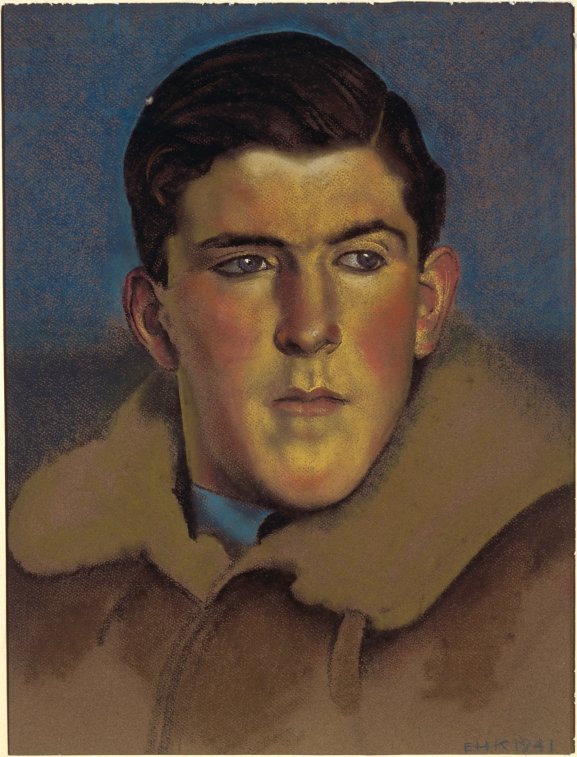
Pilot Officer M J Herrick, DFC, by Eric Kennington (1941)

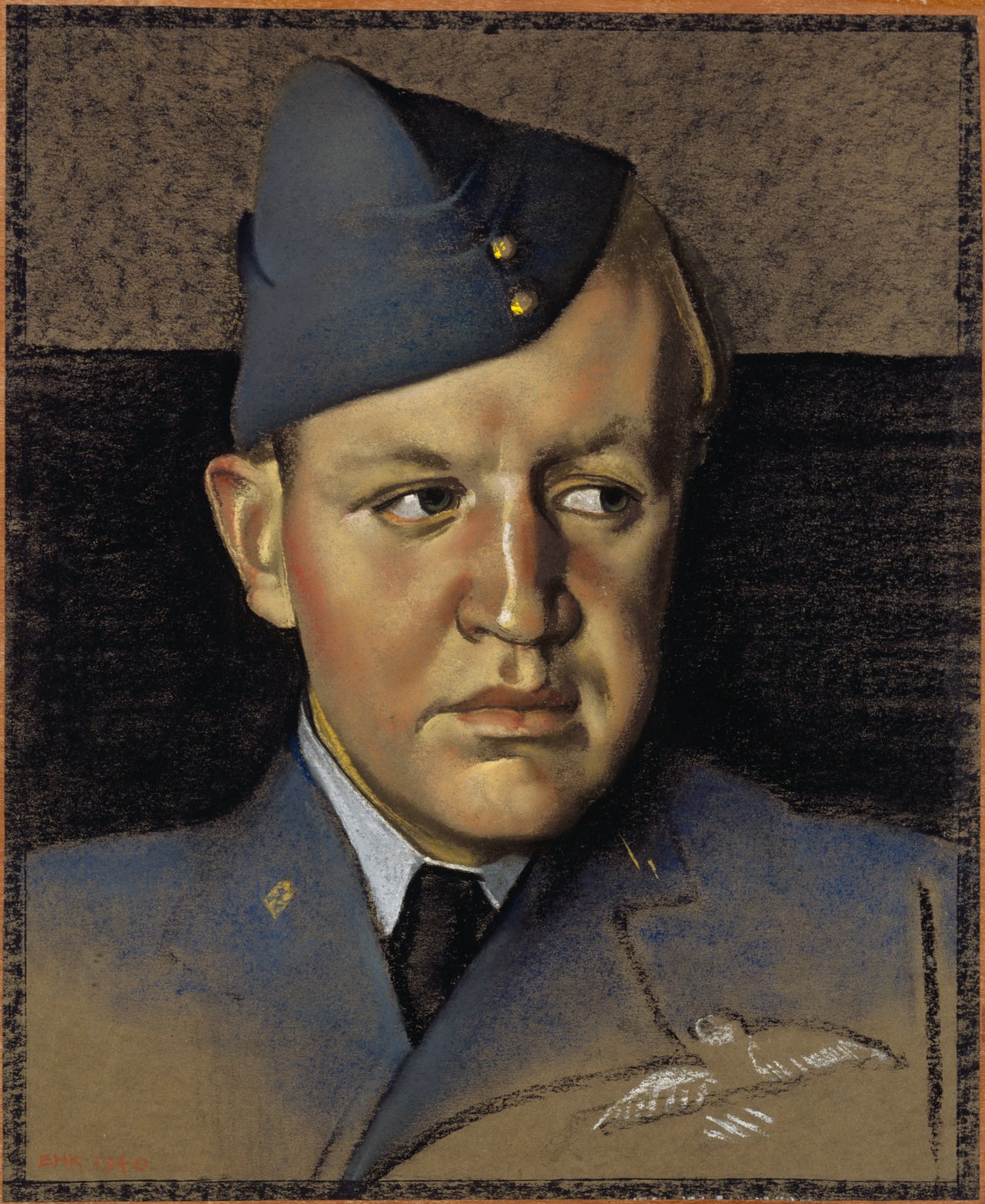
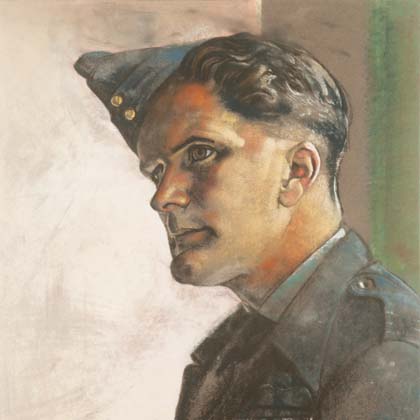
Kennington agreed to return as a war artist and the Committee offered him a commission to draw portraits of RAF personnel at a time when the Battle of Britain was at its fiercest and these men were often referred to as “fighting aces”.

Flight Lieutenant Lloyd Watt Coleman, DFC, by Eric Kennington (1940)

The pastel portraits were sensitive depictions of the air force heroes and many were used as illustrations in Kennington’s 1942 book Drawing the RAF.  There is a simplicity about these portraits but the underlying thought that these were some of the men who would fight for and save our country, was unmistakeable.

Air Chief Marshall Sir Charles Frederick Algernon Portal DSO & Bar by Eric Kenningtonn(1941)
Air Chief Marshall Sir Charles Frederick Algernon Portal DSO & Barn by Eric Kennington (1941)

One must remember that the War Arts Committee would give Kennington a list of people who were to appear in his portraits.  This caused a rift between Kennington and the Committee as Kennington believed that all the Committee wanted was portraits of senior officers and Kennington wanted to highlight some of the fighting men from the lower ranks.  Once again Kennington threatened to walk away from his position as a war artist but he was such a great portraitist that he was talked out of his impending resignation by none other than the Chief of the Air Staff, Sir Charles Portal.

Wing Commander Geoffrey William Tuttle OBE DFC by Eric Kennington (September 1941)

As he carried on with his portraiture commissions they were often exhibited at the National Gallery.  Previously they had been lauded as great works of art but occasionally they received some adverse criticism, such as piece written by the art critic of the Sunday Times, Eric Newton, who wrote:

“…Eric Kennington goes on and on with his over-life-size portraits of supermen. They are strident things whose assertiveness almost hurts the eyes.’ But then he did concede: ‘They do look like men who are going to win the war. Some are positively frightening. Dropped as leaflets over enemy country, I can imagine them being as effective as a bomb…”

Cover of Eric Kennington's book Tanks and Tank Folk
Cover of Eric Kennington’s book Tanks and Tank Folk

In November 1941, Eric Kennington was invited to Ripon, Yorkshire by Sir Percy Cleghorn Stanley Hobart, the General Officer Commanding of the 11th Armoured Division to sketch portraits of some of his men.  Whilst there Kennington completed over twenty portraits of the men and also this small (29 x 38cms) oil on board portrait of his host.  Many of the portraits Kennington did whilst at the Ripon barracks appeared in his 1942 book Tanks and Tank Folk and many featured in his solo exhibition held at the Leicester Galleries, London in September 1943

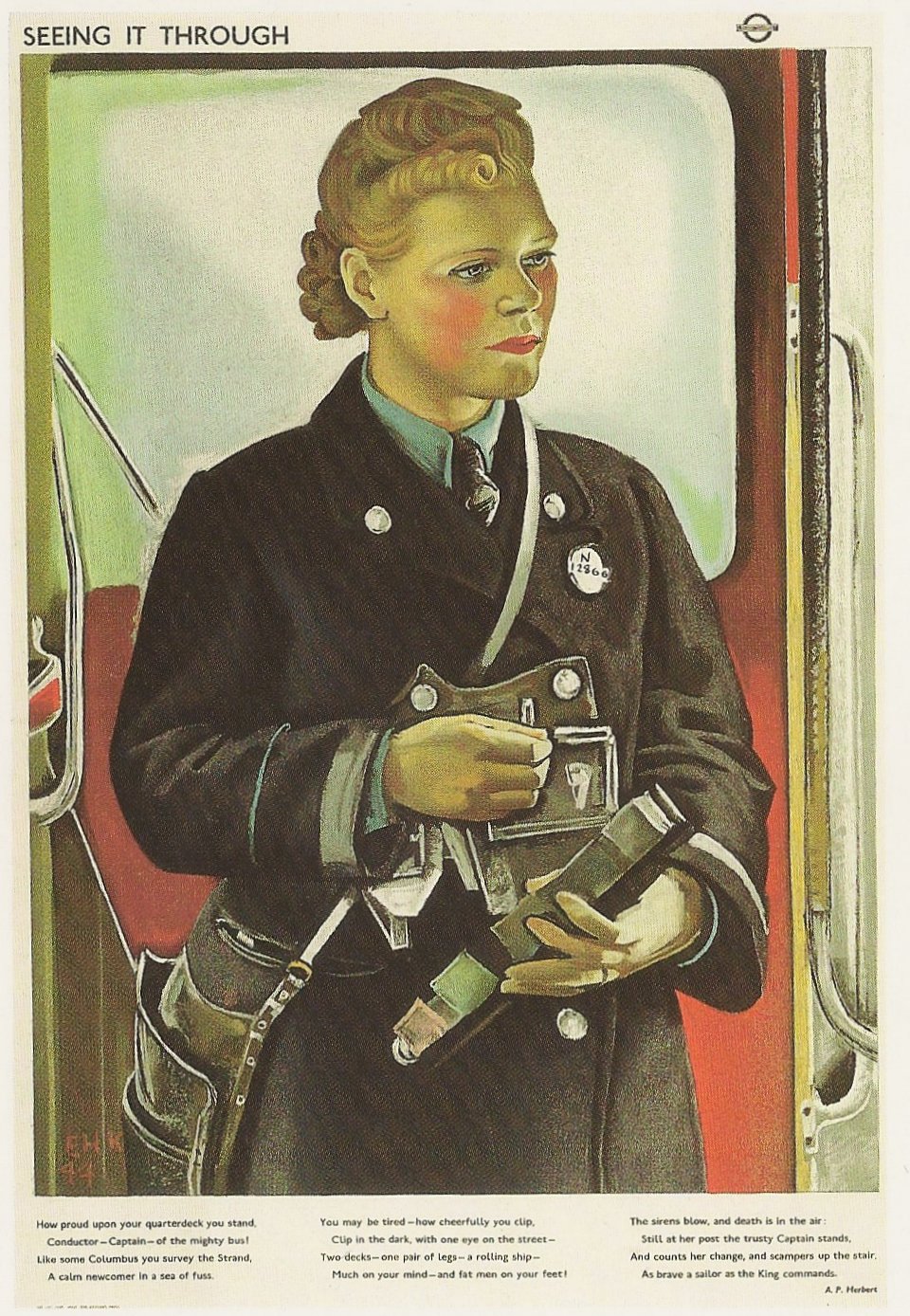
Seeing It Through, by Eric Kennington, (1944)

My final offering is a painting by Kennington which was used as one of the war posters in the series Seeing it Through.  It was not of  a fighting man or woman, but commemorated everyday heroism of normal people going about job in difficult and dangerous times.  Kennington preferred not to use models for this type of work and in this work he used the woman herself as the model.  It is of a young twenty year old woman, Mrs M.J. Morgan, who was a conductor on one London buses.  She had become one of the first generation of female bus conductors employed by London Transport in November 1940. She’d only just started her job as a “clippie” when the bus she was assigned to was caught in the blitz.  She became an instant heroine when she shielded with her own body two young children, and then helped passengers who’d been injured when the bus was riddled with shrapnel from a bomb exploding nearby.

Kennington remembered her well describing her:

 “…like a Rubens Venus’ and she had a complexion that was ‘edible as a peach…”

Beneath the portrait of the bus conductor was a short verse by the novelist and humorist, Alan Patrick Herbert:

“…How proud upon your quaterdeck you stand

Conductor- Captain  of the mighty bus!

Like some Columbus you survey the Strand

A calm newcomer in a sea of fuss

You may be tired – how cheerfully you clip

Clip in the dark with one eye on the street –

Two decks – one pair of legs – a rolling ship

Much on your mind and fat men on your feet !

The sirens blow, and death is in the air

Still at her post the trusty Captain stands

And counts her change, and scampers up the stair

As brave a sailor as the King commands.

A.P.Herbert


Eric Henri Kennington died in April 1960 aged 72.  He is buried in the churchyard in Checkendon, Oxfordshire, where he was once the churchwarden and he is commemorated on a memorial in Brompton Cemetery, London..

Eric Henri Kennington. Part 1 – World War I and T.E.Lawrence

Photo of Eric Kennington by Howard Coster (1936)

In my last blog I looked at the life and some of the paintings of Thomas Benjamin Kennington, the Victorian painter.  Today, in the first of two instalments, I want to look at the life and art of his son Eric Henri Kennington, who was an early twentieth century sculptor and artist.

Eric was born in Fulham in March 1888.  He was the second of two sons. His father was the Victorian artist Thomas Kennington and his mother, Elise Nilla Lindahl Steveni, was of Swedish origin.  His mother died when Eric was just seven years of age.

Eric was born into a middle-class professional household and received the best education possible, attending St Paul’s School, London, one of the original nine British public schools and from there he enrolled at the Lambeth School of Art.  He started exhibiting his works of art at the Royal Academy in 1908 and by the start of the Great War in 1914 he had gained a reputation as a skilful painter.

Costermongers (La Cuisine ambulante) by Eric Kennington (1914)

One of his pre-War paintings was entitled Costermongers (La cuisine ambulante) which was exhibited at the International Society in April 1914, and the work itself was actually bought by the then very famous society portraitist William Nicholson.  It is now owned by the Centre Pompidou, Musée national d’art moderne, Paris.  It is the depiction of street life in London and is a fascinating capture of the individual characters.  The art critic of the Daily Mail wrote in the August 24th 1914 edition of the newspaper describing the scene as:

 “…‘huge staring groups of life-size people, represented in a brutal airless way, though with a great deal of technical cleverness…”

 and went on to acknowledge that they were protests against the “namby-pambiness’ of the usual group compositions..”

 With the sale of the painting Kennington was able to set himself up in a studio in Kensington High Street.

The Great War broke out in Europe in July 1914 and in the next month, Kennington took himself down to the recruiting office which was close to his studio, off Kensington High Street, and enlisted with the 13th Battalion, The London Regiment, Princess Louise’s Own Kensingtons.    He was sent to the Hertfordshire village of Abbot’s Langley where he did his three months of basic training before being sent to France in November 1914.  His days fighting on the front line were numbered as in mid-January 1915 he suffered a wound to his left foot which resulted in the amputation of his middle toe and he was extremely lucky not to have lost the whole of his left foot through infection.  He was discharged from the army as being unfit for duty.

The Kensingtons at Laventie by Eric Kennington (1915)

It was during his time convalescing throughout the latter part of 1915, firstly in London, then Liverpool, that he painted one of his most famous works of art.  It was a portrait of some infantrymen entitled The Kensingtons at Laventie, Winter 1914, which is now housed in the Imperial War Museum, London.  The painting is extremely large measuring 140 x 152cms.  The picture is a complex reverse painting on glass, where exterior layers of paint are applied first, giving the oils a particular clarity.

In the painting, Kennington depicts part of his platoon standing around in a deserted street in Laventie, a small French village in the Pas-de-Calais region, close to the Belgium border.  The village had been almost destroyed by shell fire.  It is set in the winter of 1914 with snow on the ground.  The soldiers in this painting were comrades from his unit, Platoon no. 7, C Company of the Kensingtons, and he has even included a portrait of himself in the scene.  He is in the top left-hand corner wearing the balaclava.  The men have arrived at the village after a long and tiring four days and four sleepless nights of duty in the trenches having had to endure continuous snowfall and temperatures at night which fell to twenty below freezing.  It is a loose grouping of men, all but one standing.  What is strange about their depiction is that no two men look in the same direction.  The men seem disorientated and are awaiting their corporal to find out their next orders.  Soon they were going to have to set off and endure a five-mile march to reserve billets, which were out of range of the German artillery.

 The painting was first exhibited at the Goupil Gallery in 1916 and caused a sensation.  The exhibition was in aid of the Star and Garter Building Fund charity.  Kennington’s accompanying notes detailed the individual soldiers and their experiences. The notes about  “Who is who” stated:

“…The portraits are of Private A. ‘Sweeney’ Todd (foreground) and (left to right) Private H Bristol in the red scarf, Private A. McCafferty carrying two rifles, the artist in balaclava, Private W Harvey, Private P A Guy, known as ‘Good Little Guy’, Lance-Corporal H Wilson in balaclava, Private M Slade resting both hands on his rifle and Corporal J Kealey…”  . 

Kennington did not complete the painting until December 1915 and sadly by this time, ninety per cent of the once 700-strong battalion, which he had arrived with in France twelve months earlier, had become causalities.  Many had died or had been severely wounded  during the battles of Neuve-Chapelle in March 1915, and particularly Aubers Ridge in May 1915..

The painting, when exhibited at the Goupil Gallery between April and June 1916, received glowing revues.  Kennington was described by The Times art critic: :

 “…the painter who knew how to properly portray the stoically enduring British Tommy’. For example,………: ‘He [Kennington] has painted the real war for us in all its squalor and glory…”

So impressed with the unemotional depiction of the hardships and endurance of the British soldiers whilst fighting on the Front, the War Propaganda Bureau, in June 1917, offered Kennington the chance to become an official war artist.   He was sent off to France in August 1917, where he spent about seven months.  In fact he was only supposed to be visiting the battlefields for one month  but after the first month had expired, he didn’t want to return to England and simply refused to come back home.  He would continually write to his employers stating that he needed to be on the battlefield so that he could “learn the war

Gassed and Wounded by Eric Kennington (1917)

One of his first paintings as an official War artist was entitled  Gassed and Wounded which he completed in 1918 and can now also be found in the Imperial War Museum.  The setting is the interior of a field hospital.  Eric Kennington made many sketches when he was at Casualty Clearing Station at Tincourt, a village in the Picardy region, some thirty miles east of Amiens.  This point in time when Kennington made these sketches was at the time the German air force was bombarding the English lines, prior to their last big offensive.  In the painting we see wounded soldiers, who have been gassed, lying on stretchers.  Look at the way Kennington has depicted the agony of the man in the foreground.  He lies on the stretcher.  His head is bound with bandages.  His eyes which have been damaged by the gas are covered.  His face is contorted and his mouth is open as he cries out in pain.

Eventually Kennington was persuaded to return to England in March 1918 Four months later a large selection of his pastel and charcoal drawings and watercolours were exhibited in an exhibition at the Leicester Galleries.  The art critics and public alike were astounded by the quality of his work

The art critic and poet, Laurence Binyon wrote in the New Statesman:

“…Mr Kennington has a genius for reality. He has not only the gift of exact and faithful record, but the power of giving expression to the latent vehemence, energy and passion that make up the controlled strength of a man. If a foreigner wished to see the British soldier, he could not do better than see him with Mr Kennington’s eyes…”

Kennington, had his differences with the Ministry of Information and parted company in September 1918.  He was not unemployed for long as in November 1918, he signed up with the Canadian War Memorial Scheme.  This scheme was established by the newspaper magnate Lord Beaverbrook in 1916.  His aim was to commission official war artists to paint the Canadian war effort. The official war art programme would eventually employ close to 120 artists, most of them British or Canadian, who created nearly 1,000 works of art. Eric Kennington went back to France in November 1918 as a temporary first lieutenant attached to the Canadian Army and he attached himself to the 16th Battalion Highlanders of Canada, part of the 3rd Infantry Brigade of the 1st Canadian Division.

The Conquerors by Eric Kennington (1918) (Originally known as "The Victims")
The Conquerors by Eric Kennington (1918)
(Originally known as “The Victims”)

Kennington remained in France between November 1918 and March 1919, during which time he made a series of over 40 studies of individual soldiers from the battalion who fought their last major battle of the war in October 1918.  The next painting I am showing you is one entitled The Conquerors and featured men from the battalion of soldiers Kennington was assigned to as a war artist.  This was not the original title of the work as when the painting was shown in an exhibition in Canada, it was entitled The Victims but there was an objection to that title from the battalion’s commanding officer, Lieutenant-Colonel Cy Peck, Kennington who wanted it to be changed and be renamed The Conquerors.   Cyrus Wesley Peck objected to the title “The Victims” as it was a somewhat defeatist title for the work of art and so it was changed to a more acceptable title, The Conquerors. The painting depicts kilted Canadians of the 16th Battalion, marching through a battlefield littered with debris and informal graves.  Look at the faces of the soldiers.  Some have normal skin tones whilst others look much paler and these may represent the deceased.  The painting is housed in the Canadian War Museum in Ottawa.

The Conquerors was exhibited in Ottawa during the summer of 1920 and it was later returned to London where, in October and November of that year, it appeared at Kennington’s solo exhibition at the Alpine Club gallery in London.  Whilst Kennington was present at the exhibition he met and was befriended by T.E.Lawrence the British archaeologist, military officer, and diplomat.  Lawrence bought two of Kennington’s sketches depicting soldiers.  The intrepid Lawrence was a great influence on Kennington’s art and he even persuaded Kennington to come out to the Middle East to draw personalities who appeared in his account of the war with the Ottoman Turks that he was writing at the time, and which was eventually published as The Seven Pillars of Wisdom.  The book was the autobiographical account of the experiences T.E. Lawrence  had, while serving as a liaison officer with rebel forces during the Arab Revolt against the Ottoman Turks which lasted two years from 1916 to 1918.  T E Lawrence soon became known as Lawrence of Arabia.

Muttar il Hamoud min Beni Hassan by Eric Kennington (1920)

One such portrait was completed by Kennington in 1920 entitled Muttar il Hamoud min Beni Hassan who was one of Lawrence’s s chosen bodyguards.  This pastel on brown paper was painted by Kennington whilst he was at a war camp in Western Arabia.  Lawrence had wanted Kennington to go out to Arabia and come back with some portraits which could be used as illustrations for his autobiography but strangely he would not let Kennington read the book before he set off on his Arabian journey.  On returning back to London Kennington gave Lawrence his sketches and paintings.  Lawrence was delighted saying:

“…I first saw one and then another of the men whom I had known and at once I learned to know them better. This may point indirectly to the power of the drawings and it points without contest to their literary completeness. There is quite admirable character here…”

Abd-el Rahman by Eric Kennington (1921)

Another portrait by Kennington used in Lawrence’s autobiography was Abd-el-Rahman, a pastel on green-toned paper, which he completed in 1921.   Abd-el-Rahman was mentioned in Chapter LXXI of the book as Lawrence recalls:

“…I enrolled Showakh and Salem, two Sherari camel-herds, and Abd el Rahman, a runaway slave from Riadh, now freedman of Mohammed el Dheilan, the Toweihi…”

On Kennington’s return home he exhibited the sketches and paintings from his Arabian trip at the Leicester Galleries in London and the portraits of Arabs became known as the ‘Kennington Arabs’.   The illustrations which Kennington worked on for Lawrence did not appear in the first edition of the book published in 1922 but four years later in 1926, in the next edition of the autobiography Kennington’s illustrations appeared along with those done by other well-known artists of the time such as Augustus John, Paul Nash and John Singer Sargent

Head of T.E. Lawrence by Eric Kennington (1926)

Kennington also produced a bust of Lawrence  in 1926.  It was modelled partly from life and partly from drawings he made in December 1926.  It was also chosen by Lawrence’s mother and brother for the Crypt of St Paul’s. Kennington made three further casts of this head in bronze or brass, one of which can be found in the music room at Lawrence’s cottage, Clouds Hill, Moreton, Dorset.  Clouds Hill is an isolated cottage near Wareham, Dorset which Lawrence initially rented in 1923 but then bought it in 1925.  Lawrence himself loved the bust saying that it was:

“…magnificent; there is no other word for it. It represents not me but my top moments, those few seconds when I succeed in thinking myself right out of things…”

Sir William Rothenstein, an English painter, printmaker, draughtsman and writer on art. who was best known for his work as a war artist in both world wars and as a portrait artist wrote about Kennington’s relationship with T E Lawrence.  He wrote:

“…‘Kennington was devoting himself to Lawrence’s glorification – for him Lawrence was the perfect man who could do no wrong…”

Battersea Park Memorial. by Eric Kennington
Battersea Park Memorial.
by Eric Kennington

In 1924, Eric Kennington designed the War Memorial which can be seen in Battersea Park to commemorate the 24th London Division.

In the second part of my story of Eric Kennington I will look at his life between the world wars and also the paintings he completed as a war artist during the Second World War.

Thomas Benjamin Kennington

In my next two blogs I am going to look at the lives and works of two English painters, the father, Thomas Benjamin Kennington and his son, Eric.   Today I am going to concentrate and examine some of the works of the father and tomorrow, switch to look at the art of his son.

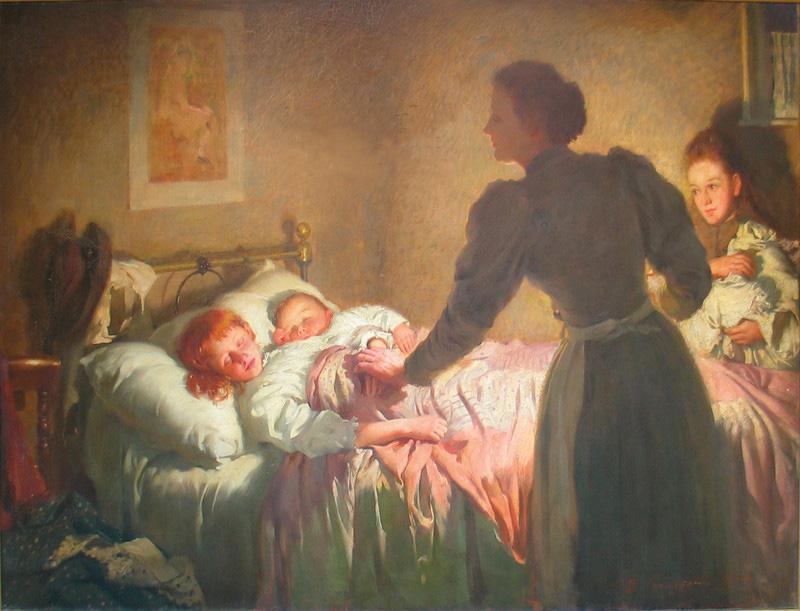
The Pinch of Poverty by Thomas Kennington (1891)

Often when we watch a tear-jerker type film or read a heartbreaking fictional novel, we tend to be critical of the sugary-sweet, heart-tugging subject.  My featured artist today produced many paintings which, although of the realism genre, also wanted us to be emotionally moved by what we saw before us.  His paintings were often studies of the problems which beset the poor in Victorian England.  Today let me introduce you to the Victorian social realism painter and master of portraiture, Thomas Benjamin Kennington.

Kennington was born in the Lincolnshire fishing port of Grimsby in April 1856.  As a young man he studied painting at the Liverpool School of Art, where he won a gold medal, and the Royal College of Art in London.  He also went to Paris where he enrolled at the Académie Julian and studied under William-Adolphe Bougereau and Tony Robert-Fleury.  Thomas Kennington lived at a time when there were a large number of families living on the “bread line”; a term used denoting the poorest condition in which it is acceptable to live, with some even dying of starvation on the city streets.  The population of Great Britain increased three-fold during the nineteenth century due to many factors, such as an influx of people from Ireland who were escaping the potato famine, life expectancy had increased and infant mortality had decreased.  Jobs were hard to find in the countryside so folks had flocked to the urbanized areas seeking work.  With such a pool of workers, owners and businessmen could pay low wages, often so low that workers could not afford to feed or house their families.  In the middle of the nineteenth century it was estimated that there were more than thirty thousand homeless children living on the streets of London.  However, many of the well-off folk were less than sympathetic with regards their plight and believed that any money given to the poor was simply squandered on drink and gambling and did not, in any way, solve the underlying social problems at all.

Homeless by Thomas Kennington (1890)

Thomas Kennington was a social activist who was disturbed by the poverty he saw around him and decided that, through his art, he would highlight the plight of the poor. The first painting I am showcasing is entitled Homeless which he completed in 1890, whilst living in London.   In 1892 it was sent to Melbourne for the large Anglo-German exhibition which was held in Melbourne’s exhibition centre and the painting is now housed in the Bendigo Art Gallery in Australia.

The setting for the work is unknown but presumed to be London.   In the background, partly hidden by the smog, we see a gas works and a tall chimney belching out smoke.  This is a scene of urban pollution; a gloomy streetscape.  In the foreground we see a woman dressed in widow’s garb supporting a young boy’s body, partly lifting him up from the wet pavement.   The young lad’s face is white and his head has lolled to the side.  He looks to be in a bad way, possibly close to death.  His eyes vacantly stare out but he seems unaware of his surroundings.  The artist has further depicted the depressing state of affairs by limiting the depiction of nature to a lifeless-looking tree at the right of the painting.  It is leaf-less with one of its lower branches broken off and the whole of it is encased in the concrete pavings which will inhibit its growth.

Critics praised Kennington’s painting when it was first exhibited.  The art critic of the Melbourne Argus described the work:

“…full of pathos … both a poem and a sermon…”

while another Melbourne newspaper, The Age, told its readers to study the face of the child and described the work as:

“…a chef d’œuvre of artistic power and human sympathy … a face … that expresses all the patient suffering of a whole class, amongst whom the inheritance of sorrow and privation is patiently accepted and endured…”

Widowed and Fatherless by Thomas Kennington (1888)

Another work of art which focused on how poverty can affect families was summed up in Kennington’s work entitled Widowed and Fatherless, 1888.  In this depiction we have a mother whose husband has died and she is left with the monumental task of rearing her children.  One child is lying on the bed.  Maybe she is asleep or maybe she is very ill. Her sister kneels at the bedside praying, maybe praying that her sister will recover from her illness.  The mother sits in a chair stitching clothes but she cannot take her eyes off her sick daughter.

Orphans by Thomas Kennington (1885)

A very moving painting depicting the plight of the poor is one Kennington completed in 1885 entitled Orphans.  There is a similarity in this depiction of poverty with the 1650 work by the great Spanish painter, Bartolomé Esteban Murillo in his work The Beggar Boy. (See My Daily Art Display January 25th 2011).  Before us we see two young boys.  They could be brothers.  Their clothes are no more than rags.  The older boy’s head is slumped to the side due to his tiredness.  He can hardly keep his eyes open but they stare down at the head of the younger boy who through circumstances beyond his control, is whom he has to look after.  The younger boy, with his rosy red cheeks, sits on the floor and leans against the older boy for comfort, his head and arm rest on the older boy’s thigh.  He stares out at us in a beseeching way.  What is he asking us?  Is it merely sustenance or does he want our love and our protection from the deprivation he is forced to suffer.  On the floor before the two boys is a plate with a piece of dried bread highlighting their plight. This is a prime example of Kennington’s depictions of the urban poor.  The painting was purchased by Henry Tate, the sugar merchant and philanthropist, who established the Tate Gallery in London.

Daily Bread by Thomas Benjamin Kennington (1883)

A crust of bread appears in another painting by Kennington, entitled Daily Bread which he completed in 1883.  The title probably derives from the words of the Lord’s Prayer, give us our daily bread.   This is a very emotional depiction of poverty and it was hoped that by depicting such dprivation things would change.  Alas, it was not to happen for many years and even now child poverty and child beggars exist in Great Britain.

In contrast to the abandoned children we saw depicted in the previous paintings, the next painting, simply entitled The Mother, was Kennington’s idea of what family life should be about and how children should be brought up in a safe and loving environment.  This large work (115 x 168cms), which was completed in 1895, depicts a moment in family life when a mother says goodnight to her children.

The Mother by Thomas Kennington

This is a form of narrative painting as from about the seventeenth century, genre painting showed scenes and narratives of everyday life. Later, during the Victorian age, narrative painting of everyday life subjects became very popular and such art was often considered as a category in itself termed Victorian Narrative painting.   This theme of what family life should be about was a recurrent theme in Victorian art.  Domesticity was the order of the day focusing on how children and adults should behave within a family environment.  It was hoped that families could learn by what they saw through the medium of visual art.    This huge painting of The Mother by Kennington depicts her as the foundation stone of the family, the person who underpins the family group. The painting also alludes to another idea regarding Victorian family group.   If you look carefully at the dead centre of the work you will see the wedding ring on the mother’s finger and this could be the way in which the artist want to share his belief that marriage was also very important part of the family structure and family values.

In this painting we see the mother tending two of her young children.  Although the mother is the focal point of the painting she is depicted with her back to us.  We do not see her face clearly.  She is being helped by an older daughter, who is learning about the role of motherhood. The lighting of the painting is interesting.  The darker silhouette of the mother is in contrast with the brighter area around the two sleeping children, which is lit up by the light emanating from the lamp held by the mother and which is hidden from our view.   Of course this view of the family is a romanticised view of life in Victorian days and maybe it was more to do with what Kennington believed family life should be rather than the actuality.  This painting belongs to the Aigantighe’s Gallery in Hobart, Tasmania

Thomas Kennington exhibited his works in the Royal Academy of Arts every year from  1880 until his death in 1916.  His paintings were also regularly on show at the Royal Society of British Artists (RBA) and the popular Grosvenor gallery in London.   Kennington was a founding member and became the first secretary of the New English Art Club which was founded in 1885 and was one of the founders of the Imperial League of Art in 1909.  This society was set up to protect and promote the interests of Artists and to inform, advise and assist Artists, who have enrolled as members, in matters of business connected with the practice of the Arts  Its role was to aid the artists and the protection of their interests.  Kennington exhibited internationally in Paris and Rome and so good was his work that he was chosen to exhibit at the Universal Expositions held in Paris in 1889, where he was awarded a bronze medal.

Portrait of Elise Kennington née Stevani

Besides his genre pieces which highlighted Victorian poverty, Kennington was an accomplished portraitist.  Many of his portraits featured family members.  In 1883, aged twenty-seven, Thomas Benjamin Kennington married twenty-two year old Swedish beauty, Elise Stevani, who was born in Lund a town in Southern Sweden 1861.

Anne as Alice in Wonderland by Thomas Benjamin Kennington

His daughter Ann also featured in a couple of his works.  One was with her as Alice in Wonderland.

Portrait of the Artist's Daughter Anne in Russian Costume Holding a Balilaika by Thomas Kennington
Portrait of the Artist’s Daughter Anne in Russian Costume Holding a Balilaika by Thomas Kennington

The other, when she was older, was of her, dressed as a Russian lady holding a balalaika.

My last offering is another interesting work by Kennington which he completed in 1882 and entitled The Ace of Hearts.  There is an element of trickery about this depiction.  We see the lady seated before us staring directly at us  But are we who she is looking at?   Look carefully at the mirror on the wall, above and behind her.

The Ace of Hearts by Thomas Kennington

The image in the mirror indicated that the lady is looking straight through us, and focusing upon a man who can be seen scratching his neck.  He seems perplexed by what the woman is doing with the cards.  Look at the expression on the lady’s face.  It is one of satisfied triumph as she points to the ace of hearts and we can thus deduce that she was performing a card trick for the gentleman.  He is amazed and she is exultant with her trickery.

Thomas Benjamin Kennington died in London in December 1916 aged 60.  His wife Elise died at the young age of 34 in 1895.  Their son Eric was to go on to be a famous artist and in my next blog I will look at some of his work.

Dosso Dossi. Part 2 – The tale of the young man who was a famous lady and the Ducal Palace of Ferrara

Dosso Dossi self portrait
Dosso Dossi
self portrait

The first painting of Dosso Dossi I want to showcase is one which is owned by the National Gallery of Victoria, Australia.  The gallery acquired the painting from a gallery in London in 1965 for £8000.  The title of the oval painting was then said to be Portrait of a Youth.  There was an element of mystery surrounding the art work as the artist of the work was said to be unknown.  It was only in the start of the twenty-first century that the gallery made a painstaking examination of the work during its restoration which would last several years.  The mystery to be solved was two-fold.  Firstly, who painted the work and secondly was the sex of the sitter a male.   The gallery staff looked for clues as to whether the sitter was a young man or a young woman.  In the background, behind the sitter, there is a myrtle bush and in art this was symbolic of Venus, the Roman Goddess of Love and symbolised feminine beauty.  Another clue to the sex of the sitter, according to the gallery’s conservator, Carl Villis, can be found in the inscription on the piece of paper which lies on the balustrade in the foreground.  The translation of which is:

“…brighter is the virtue reigning in this beautiful body…”

Portrait of a Young Man by Dosso Dossi

So in the opinion of the conservator the sitter was female.  The next questions to be answered were who was she and who painted the portrait.  After two years of intense scientific analysis and research in Italy, Australia and America the art curator and conservator, Villis came to the conclusion that the female was no other than a young Lucrezia Borgia, the daughter of Pope Alexander VI and brother of Cesare Borgia and furthermore the artist was Giovanni di Niccolo de Luteri, or as we now know him, Dosso Dossi.  So why Lucrezia Borgia?  Villis postulated that because the female figure in this painting is holding a dagger the depiction alludes to the Roman heroine Lucrezia, who after being raped by Tarquin, the son of the King of Rome, killed herself with a dagger so as to protect the honour of her family.

1502 coin featuring Lucrezia Borgia

They also likened the depiction to the 1502 coin which was adorned with Lucrezia’s profile.  Maybe these are good arguments to make Lucrezia the woman in the painting but what made them believe the artist who painted her portrait was Dossi?  The belief that he was the artist followed an analysis of the painting’s pigments and the artistic style which indicated that it was likely to have been painted by Dossi.  Dossi ,if you remember from Part 1 of this blog, came from Ferrara as did Lucrezia.  In 1502 the twenty-two year old Lucrezia married her third husband Alfonso I d’Este, Duke of Ferrara, who later employed Dosso Dossi as the court painter – a coincidence ?  Maybe, maybe not!

National Gallery of Victoria paintings conservator Karl Villis (right) and director Gerard Vaughan stand beside the painting

The gallery awaits authentication by external scholars and art history experts and are right to be wary of being too dogmatic with regards their discovery as in 2007 the National Gallery of Victoria was embarrassed after it was revealed that it had wrongly attributed a painting by an unknown Dutch painter to Vincent van Gogh !

Bacchus and Ariadne by Titian (1523)

Dosso Dossi was a contemporary of four great High Renaissance Italian artists, Raphael, Leonardo, Michelangelo and Titian and it is because of one of their famous works of art, Titian’s Bacchus and Ariadne that Dossi came to complete his own work, Bacchus in 1524.

In 1523, Titian finished his painting entitled Bacchus and Ariadne which is now housed in London’s National Gallery.  The commission for Titian’s work was one of a cycle of mythological works, which he and Giovanni completed for Alfonso I d’Este, Duke of Ferrara, and it was to be hung in the Camerini d’Alabastro, a private room in the ducal castle.  Originally this part of the commission was given to Raphael who had made plans and sketches for what was to be his Triumph of Bacchus but he died in 1520 and Titian was given the commission to complete.

In the left of the painting we see Ariadne who has been abandoned on this island of Naxos by her lover Theseus, who has sailed off.  The white sails of his boat can be seen in the extreme left background.  In the painting we see Bacchus, the god of wine, leaping energetically from his chariot which is drawn by two large cheetahs.  His followers and fellow revellers appear, emerging from the forest in the right of the picture.  Bacchus is immediately smitten by the sight of Ariadne, who steps back in fear of his sudden arrival.  He promises to turn her into an eight-star constellation, which we see halo-like in the sky, above her head.  This beautiful painting from the Venetian School painter Titian is awash with beautiful colours, blues, reds and browns which enhance the mythological scene.

Bacchus by Dosso Dossi (1524)

Dosso Dossi was a contemporary of four great High Renaissance Italian artists, Raphael, Leonardo, Michelangelo and Titian and it is probably due to the popularity of Titian’s work that he was commissioned to copy part of Bacchus and Ariadne, a commission he completed in 1524.  The painting was simply entitled Bacchus and is a copy of the central character in Titian’s painting, with just a few small changes to the background landscape.  The painting probably came about through a commission given to Dossi from an admirer of Titian’s work, which he or she saw when it arrived at Ferrara the year before.

A woman fleeing on a wooded path by Dosso Dossi (c.1542)

Another of Dossi’s paintings featuring Ariadne is entitled A Woman Fleeing on a Wooded Path.  This work at one time was thought to have been painted by Dosso Dossi’s younger brother Battista but now is generally believed to have been painted by Dosso himself because of the forms and the drapery, and the detail of the landscape, particularly the buildings in the upper right section.   The female figure has since been identified as being of Ariadne as noted in the lists of paintings by the influential scholar of the Italian Renaissance, the art historian Bernard Berenson.

The Three Ages of Man by Dosso Dossi (c.1515)

One of Dossi’s most accomplished landscape works was completed around 1515.  It was entitled The Three Ages of Man.   This motif has been painted by many artists including Titian and Giorgione and depicts three pairs of males in three particular stages of their life, infant, youth and old age.  It is an allegorical concept of the cycle of life with depictions of the wonderment of the young child to the earthly pleasures of youth and finally the forlorn and Vanitas-like depiction of ageing men contemplating the end of life.  However there is some doubt whether the painting by Dossi falls into this allegorical category.  It is true there are three pairs of humans of differing ages but in each pairing there appears to be one male and one female.   Look at the two children.  They are connected to the “youthful” pair simply because they are spying on them as they enjoy the pleasures of youth.  He could well be a goat herder as accompanying the amorous couple are a number of goats also watching them intently.  The Italian biographer, historian and contemporary of Dossi, Paolo Givio, wrote that the artist’s works fell into two categories – the ones with serious subjects which he termed justis operibus and his landscape works which he termed parerga, which he says:

“…contain embellishments, intended to simply delight the eye and refresh the spirit without implying any more serious message…”

This painting by Dossi seems to fit into this second category

Much has been said about the ducal palace of Alfonso I d’Este, the Duke of Ferrara and the art that graced the walls of his palace.  In fact, by 1529, he had managed to create the most magnificent private art gallery of his time, including several masterpieces by Titian, hung as an ensemble. The Duke’s gallery, known as the camerino d’alabastro with its alabaster walls and gilded ceiling, contained the finest sculpture and paintings that money could buy. The power and wealth of Duke Alfonso allowed him to commission paintings from the most famous artists of the day. The elderly Giovanni Bellini completed the Feast of the Gods in 1514, which was the last painting he completed before he died. Sadly both Fra Bartolommeo and Raphael died before completing Alfonso’s commissions and so as we saw with the painting Bacchus and Ariadne the Duke turned to Titian who was still only thirty years old and though he was a student of Bellini he was still not famous.

Aeneas at the Entrance to the Elysian Fields by Dosso Dossi (c.1514)

In 1514 Alfonso commissioned Dossi to produce ten paintings for his Camerino d’Alabstro.  These works were to illustrate scenes from the twelve books of Virgil’s epic poem, Aeneid and would be so hung, high up on the walls, so as to imitate a frieze.  The first painting I have featured from this set, which is part of the National Gallery of Canada collection, is entitled Aeneas in the Elysian Fields and it illustrates a scene from the sixth book of the Aeneid.   In the work of art, we see Aeneas in the far left of the painting with his plumed hat, carrying the golden bough, and accompanied by the Cumaean sibyl as they arrive at the Elysian Fields.

Aeneas and Achates on the Libyan Coast by Dosso Dossi (c.1520)

The second of the three surviving paintings from the “frieze” is entitled Aeneas and Achates on the Libyan Coast.  This work is housed in the National Gallery of Art in Washington.  The depiction is based on the first book of Virgil’s Aeneid which is all about the story of Aeneas, who after the fall of Troy and seven years wandering, founded a settlement on the Italian peninsula, establishing the Roman state. In Book 1, Aeneas and his faithful companion Achates, having only just started their journey, and are forced to take refuge on the Libyan coast after their ships are wrecked in a storm.

Dosso Dossi worked for the Dukes of Ferrara for almost three decades.  He died in 1542.  His brother Battista who had taken over the mantle of chief court painter to the Duke of Ferrara on his brother’s death, died six years later.

I will leave you with the words from a pre-exhibition write-up that accompanied the 1999 exhibition of Dossi’s works at the Metropolitan Museum of Art, New York

“…In Orlando Furioso — the most widely read epic poem of the 16th century — Dosso is listed alongside Leonardo da Vinci, Raphael, and Titian as one of the great figures of his age by the renowned Renaissance poet Ludovico Ariosto, who likely admired Dosso’s poetic and subtle — indeed enigmatic — representations of myth and allegory. Dosso’s paintings have long been appreciated as celebrations of pictorial freedom and artistic invention, characterized by a rich palette, brilliant contrasts of light and shadow, and by the enduring echoes of joyousness, wit, and sensual delight. With the devolution of the Ferrarese court into the papal states in 1598, virtually all of Dosso’s oil paintings were dispersed to collections in Rome and Modena, removing them from the elaborate context for which they were created…”

Dosso Dossi. Part 1 – The Constabili Polyptych

In my last blog I looked at the lives of two American landscape artists, Marion and Elmer Wachtel and for many people outside of America these painters may have been completely unknown.  Today in my blog I want to introduce you to a great painter who may also be unfamiliar to many.  Today let me introduce you to the Italian High Renaissance painter Giovanni di Niccolò de Luteri who became known as Dosso Dossi.

The Constabili Polyptych

Dossi was born in St Giovanni del Dosso, which is a small village thirty kilometres south west of Mantua.  His actual birth date is something of a mystery with various historical documents and biographers disagreeing, albeit a consensus of opinions puts it at around 1487.  His early upbringing is also somewhat shrouded in mystery.  However we do know Dossi had a younger brother, Battista, who was also a painter but said to be not as talented as his older brother.  We also know that his father, Niccolò de Luteri, was a native of Trentino, an autonomous northern province of Italy, close to the Austro-Italian border.  His father was a member of the Ferrara court of Duke Ercole I d’Este the Duke of Ferrara and later, after his death in 1505, his son Duke Alfonso I d’Este, the Duke of Ferrara.  His role was that of a spenditore, a bursar or land agent for the court and it was the name of the Duke’s property, Villa Dossi, which lent its name to his two sons.

Portrait of Alfonso I by Dosso Dossi (c.1530)

There is much conjecture about Dossi’s early training.  Giorgio Vasari believed Dossi studied under Lorenzo Costa in Ferrara whilst others say he studied in Venice.  Dossi’s seventeenth century biographer, the priest, poet and writer, Girolamo Bruffaldi, wrote in his 1704 book Vite de’ pittori e scultori ferraresi (Biogrpahy of Ferrara artists) that Dossi studied in Rome and Venice.   Records show that Dossi was working for the House of Gonzaga in Mantua in 1512 and two years later was working as a court painter in Ferrara at the court of Alfonso I d’Este, and later his son Ercole II d’Este.  As a court painter Dossi’s time would have been spent decorating the private residences of the Court with large frescoes and paintings, often detailing historical or mythological themes.  Court painters of the Renaissance, like Dossi, would have been asked to provide designs for elaborate tapestries and conjure up theatrical sets and backdrops.  There would have been many portraiture commissions to carry out featuring the Duke and his family as well as portraits of the family members of the wealthy courtiers.

In his early days at court Dossi was sent by the Duke to Venice, Florence and Mantua.  The Duke also sanctioned Dossi and his brother Battista to produce altarpieces and secular works for the local nobility and princely patrons, such as the Duke of Urbino and Cardinal Bernado Bles the prince-bishop of Trent.

Portrait of a Man in a Fur Collar (Antonio Constabili) by Dosso Dossi (c.1520)

One of Dossi’s first tasks as a court painter was a collaboration with the painter, Benvenuto Tisi, known as il Garofalo.  Garofalo, who had been living in Rome, where he had once studied under Raphael, received an invitation to come to Ferrara and complete a commission from the Duke of Ferrara to decorate a small chapel.  On completion of the commission he was approached by Antonio Costabili to decorate an altarpiece.  Antonio Costabili was a Ferrarese soldier, nobleman and diplomat and prominent figure at the court of Alphonso I and was a leading patron of the arts.  The commission taken on by Garofalo and Dossi was the polyptych, which became known as the Costabili Polyptych.  It was for the high altar, which stood at the rear of the chancel, raised above the choir stalls of the Augustinian church of Sant’ Andrea in Ferrara, which was home to the Ordo Eremitarum Sancti Augustini, the order of the Augustinian Hermit monks.   This was an order of monks accepted into the Roman Catholic family by Pope Alexander IV in 1256.

The completion date of this magnificent work is contested by art historians but one clue as to the date is that Vasari wrote that the polyptych was completed prior to the death of Raphael and he died in 1520.  It should be remembered that Vasari, on two occasions, met with Garofalo in the 1540’s and therefore should have had accurate knowledge with regards the completion date of the altarpiece.  Others narrow down the completion date to around 1514.

Constabili Polyptych in the Pinacoteca Nazionale of Ferrara

The altarpiece is now housed in the Pinacoteca Nazionale of Ferrara.  The paintings are still in the original altarpiece’s wooden frame but there has been much work on reconstructing it as it was badly damaged during World War II.  The altarpiece measures 31ft 6 inches high and 19 feet wide (9.6 x 5.8m).

Central Panel of the polyptych

The main central panel measures 174 inches x 96 inches (474 x 262cms) and features the Virgin Mary enthroned with the Christ Child.  Alongside her throne, on the right, is the infant Saint John the Baptist.

Angels and spiritelli

Above the throne, on either side there are angels and spiritelli.

John the Evangelist
John the Evangelist

On the steps below the throne sits John the Evangelist, cross-legged, pausing from his writing to look upwards towards the Virgin. On the floor besides him is a chalice.  The chalice is often associated with and symbolises John the Evangelist.  It alludes to John being put to the test by the high priest of the Temple of Diana at Ephesus. The high priest said to him:

“…If you want me to believe in your god, I will give you some poison to drink and, if it does not harm you, it means that your god is the true God…”

Saint John blessed the cup of poison, neutralizing it and was then able to drink the liquid.

Saint Jerome
Saint Jerome

In the right foreground of the central panel we have Saint Jerome holding an open book whilst his foot rests upon a skull.  In the left foreground of the central panel we have Saint Andrew, the titular head of the church, who holds a cross and points towards the Virgin.

The two side panels of the polyptych depict two further saints.  Saint George, the patron saint of Ferrara, is featured in the lower right side panel whilst Saint Sebastian, the popular saint who was looked upon as a protector of the people against the plague appears in the lower left side panel.

The Spandrels
The Spandrels

Above these side panels there are two spandrels.  A spandrel is the almost triangular space between the left or right exterior curve of an arch and the rectangular framework surrounding it.

Saint Augustine (right spandrel)

Saint Augustine, the patron of the Augustinian order can be seen in the right spandrel dressed as a hermit in the robes of an Eremitani friar with his bishop’s mitre on the floor by his feet and Saint Ambrose appears in the left spandrel with a manuscript resting on his lap.  His demeanour is one of contemplation as one hand rests on his breast as he studies the text.  Both spandrels have in the background an oculus window through which comes the light which illuminates the two saints.

The pediment
The pediment

The resurrected Christ is displayed within the pediment at the top of the polyptych.

This is a truly remarkable work of art.  At first sight it would appear that the Saints that have been depicted were just a random selection but having read Dosso Dossi, Garofalo, and the Costabili Polyptych: Imaging Spiritual Authority by Giancarlo Fiorenza he believes they were chosen very carefully and he goes into great detail in his article about the reasoning.  The article appeared in The Art Bulletin Volume 82, No.2 (June 2000).  It was from this complex article that I got most of my facts about this work but I decided to steer clear of the theories about the inclusion of the saints and other symbolic aspects of the polytypch and will leave you to seek out the article if you want to delve further.

In my next blog I will look at more of Dossi’s paintings and look at one of a young man which is now believed to be a portrait of a famous young woman !