Graham Clarke

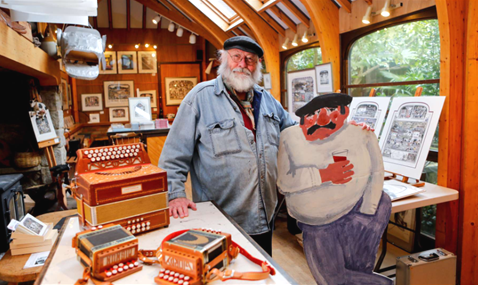
What is the reason behind you placing a paintings or prints on your walls at home?  Is it because it reminds you of somewhere you have visited or maybe it is a depiction of somewhere nearby?  Maybe it is a portrait of a loved one or somebody famous whom you admire.  In this period of our lives when there is so much suffering going on around us then sometimes the painting is a depiction which simply lifts our spirits and makes us smile.   Today I am looking at an artist and his work which fulfils that category.  Let me introduce you to the English author, illustrator and humourist Graham Clarke. He has created over five hundred images of his beloved English rural life. He has focused on how the ordinary Englishman viewed Europe. Through his quirky depictions, he brings his own unique brand of humour to his interpretation of past and present history through the eyes of the common man.

Graham Clarke

Graham Clarke was born on February 27th 1941 in a village in Oxfordshire during the Second World War.  His father Maurice was a Midland Bank employee.  He, his mother and his elder brother, Anthony, were evacuated there from their three-bedroomed semi-detached home in Hayes, Kent.  When Graham was two years old the family spent a couple of months at the Cornish village of Denabole, which lies close to Trebarwith with its large expanse of sandy beaches which was always remembered fondly by Graham.  In his teenage years Graham and the family would spend time at the coastal towns of Broadstairs and Looe and it was those holiday times on the coast that made a great impression on him. 

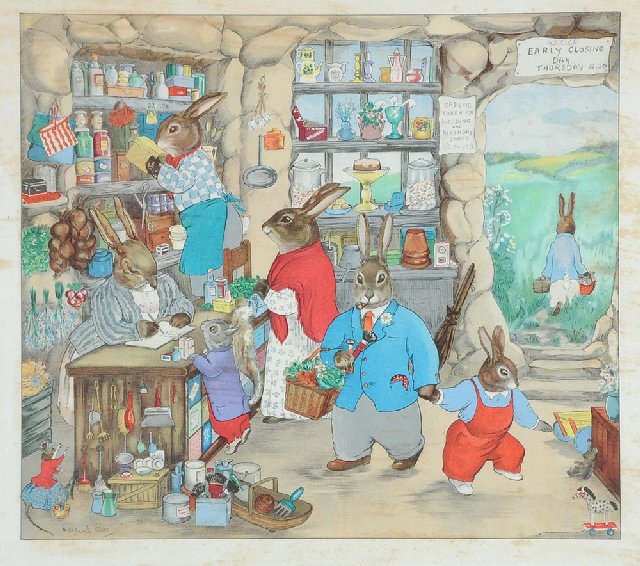
The Flippits.  A Story of the Rabbit, Fox and Badger by Margaret Ross.

On his fourth birthday in 1945, with the war at an end, back living in Kent, Graham received a birthday present which was to remain in his memory in the years that followed.  It was the children’s book, The Flippits.  A Story of the Rabbit, Fox and Badger by Margaret Ross.  It was a make-believe world, a world of peace unlike the threatening years that he and his family had experienced during the war.   It was an underground world of a warren with its cottagey interiors.  It was a book with illustrations which fuelled the imagination of four-year-old Graham.  Looking at many of Graham’s multi-figured depictions one can look back at the multi-figured illustrations from this book and realise the connection.

A la Carte by Graham Clarke

In 1949, when Graham was eight years old, the family left their home in Hayes and moved to a larger three-bedroomed semi-detached house. large enough to also accommodate Graham’s paternal grandfather  who had been widowed.  As a teenager, Graham was described as being an observant and sensitive child by his mother who would spend his free time cycling and exploring Hayes Common.  He and his brother would also help their parents with their love of amateur dramatics and their AmDram group, The Hayes Players.  Graham’s brother Anthony would help his parents by aiding with set building jobs and Graham would assist with painting stage portraits and stained glass windows.

Miss Jay’s Wood by Graham Clarke (1952)

One day Graham’s father came home and presented his son with a box of felt-tipped brushes and spirit-based inks and after the usual child-like sketches his artwork improved and he began to use watercolours for his countryside depictions.  The box of watercolour paints with sable brushes and a set of oils had been a Christmas gift from his aunt and uncle in 1952 and on that Boxing Day he completed his first oil painting entitled Misses Jay’s Wood, which was owned by a close-by neighbour.  The painting was bought by one of the neighbours for ten shillings.  Graham could immediately envision himself as becoming a professional artist !

Close Up Please by Graham Clarke

Meanwhile, Graham attended a small private school who fast-tracked their pupils’ education to be of a standard which would allow them to pass their 11+ exams.  Whilst attending this school Graham let it be known of his future aspirations as a professional artist.  However, he received no encouragement from his teachers, in fact, they told him it would be a pauper’s life for him if he were to realise his artistic dream.  Notwithstanding this, he clung to his ideas and passed the 11+ exams and entered the Beckenham and Penge Grammar School in 1952.  During his time there he enjoyed the geography and history lesson through his love of map-making and his fascination with castles and life for the working-class people of those times. 

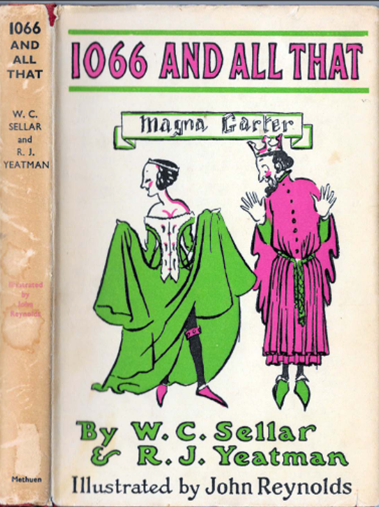
A book at the time which fascinated Graham was 1066 and All That, a tongue-in-cheek reworking of the history of England, written by W. C. Sellar and R. J. Yeatman and illustrated by John Reynolds.

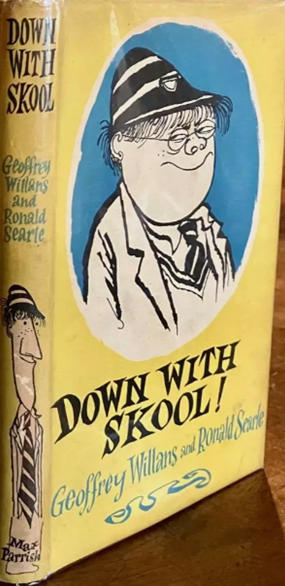
Another book which Graham loved was Down with Skool, by Ronald Searle which was one of his 1953 Christmas presents.  He became interested in caricature.  He excelled at art under Ronald Jewry, his art teacher who encouraged his students to use their imaginations when they painted.  Graham Clarke enjoyed his time in the art class.

Graham received an excellent grade for his GCSE ‘O’ level Art and managed to scrape through Maths and Science sufficient enough to enter the sixth form ‘A’ level on a Science course but he hated it.  His former art teacher, Jewry, approached his father and suggested that his son should abandon his A-level Science course and take up art instead.  No doubt Graham had already spoken with his father over his future.
Graham’s favourite artist at this time was Samuel Palmer, born in 1805, a British landscape painter, etcher and printmaker who was also a prolific writer. Palmer was a key figure in Romanticism in Britain and produced visionary pastoral paintings.  Graham believed that although he knew about the works of Palmer he realised that to get to really know him he had to visit the countryside around Shoreham, in west Kent, where Palmer had been so inspired.  During his studies at the Art College Graham had enrolled in the History of Art Course and went on a short train journey to Shoreham.  Graham was mesmerised by what he observed.  He later wrote:

“…Palmer loved this place and love it is that makes me walk here too.  Every lane is climbing up its hill [and] down again to the river, over the bridge and up and on again climbing and twisting. These are not mountains here there is no raging torrent, the trees are not giants and all is on a small scale, quiet and complete, Palmer decided God (and Nature) was at its best in this little valley of vision. Twenty miles from here is peace…”

Round and Round by Graham Clarke

One of his tutors as the Beckenham Art School was Wolf Cohen who Graham described as “small, fiercely energetic and a model of dedication” and it was he who instilled in Graham that art should be life-absorbing.  Although Graham’s figure drawing was not the best he managed to improve that during the time he spent in Susan Einzig’s life classes.  She introduced Graham to the Laurie Lees’ book Cider with Rosie, illustrated by John Ward.   It was these delicate and sensitive drawings that appealed to Graham.

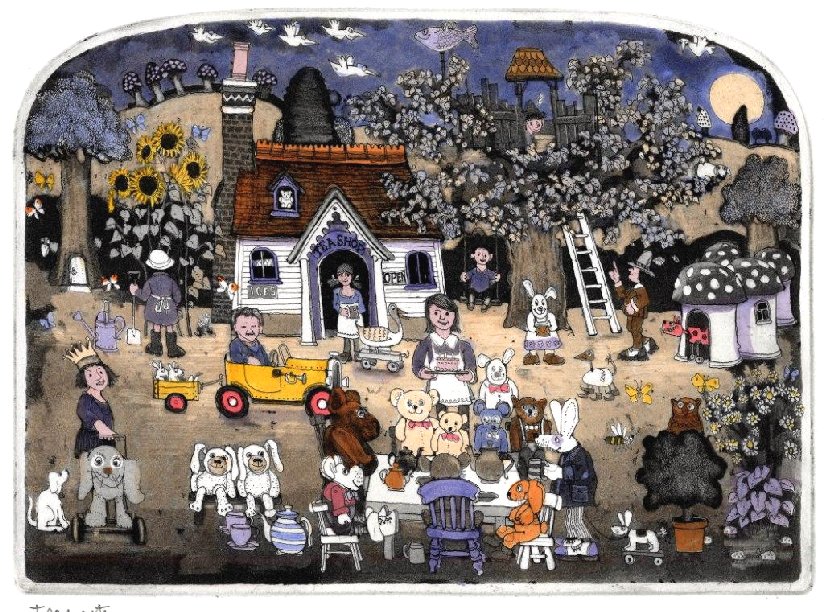
Tea Party by Graham Clarke

At the start of his final year at the art college, Graham Clarke had to make a decision about his future.  His tutor Wolf Cohen persuaded him to apply for a post-graduate position at The Royal College of Art and along with half a dozen of his fellow students he would spend weekends at Cohen’s studio building up his portfolio which would be needed when he applied to the college.  Graham succeeded in his entry interviews and portfolio submission and in 1961 he became a student at the prestigious Royal College of Art.
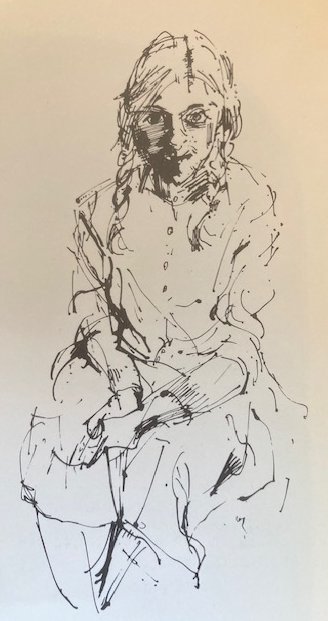
Wendy by Graham Clarke. Pen and ink drawing from his sketchbook.

In his late teens Graham had been a member of various Youth Clubs, one of which was the Bromley High Street Methodist Youth Club and it was here that eighteen year old Graham first met fifteen year old Wendy Hudd and the two of them became involved with the organising of plays, pageants and parties.

The Four Seasons by Graham Clarke

Graham’s first year at the Royal College of Art was a disaster.  He felt totally isolated from his fellow students and their interests in art.  Whereas they looked for their inspiration by studying modern American magazine depictions of pop stars and flashy cars and motorcycles, Graham clung to his love of all things rural or historical and soon realised that he was going to be isolated by such loves.  As he said, he was destined to “plough a lone furrow”.  He decided to stay with what he loved and he was proud of this sincere decision and when challenged about it, would just say that he did not need to “ride another horse”.  Graham described his first year as being a dark tunnel and yet he added he could just make out a light at the end of it.  Graham was fortunate to have the support of Wendy and her family during those difficult twelve months.

Serenata by Graham Clarke

At the Royal College of Art Graham specialised in illustration and printmaking and had the chance to follow his interest in calligraphy.

Billingsgate Market by Edward Bawden (1967)

During his time at the Royal College of Art he was greatly influenced by one of his tutors, Edward Bawden, an English painter, illustrator and graphic artist, who was known for his prints, book covers, posters, and garden metalwork furniture. 
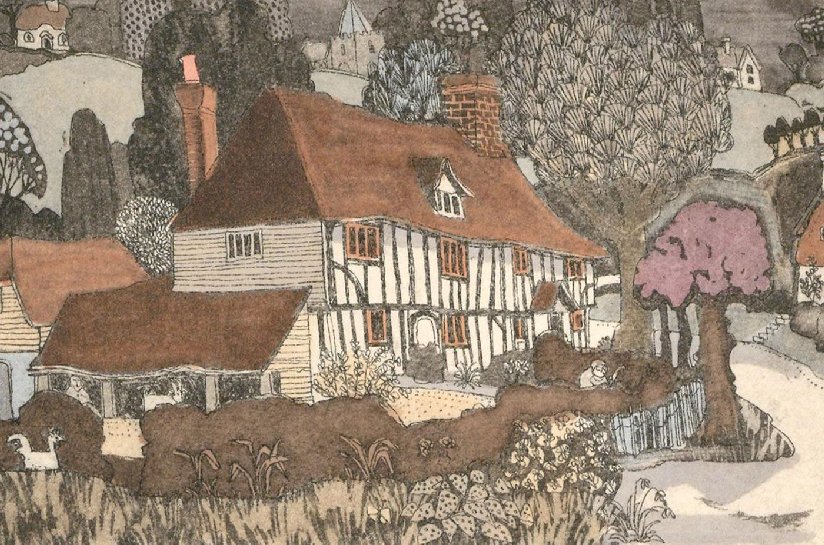
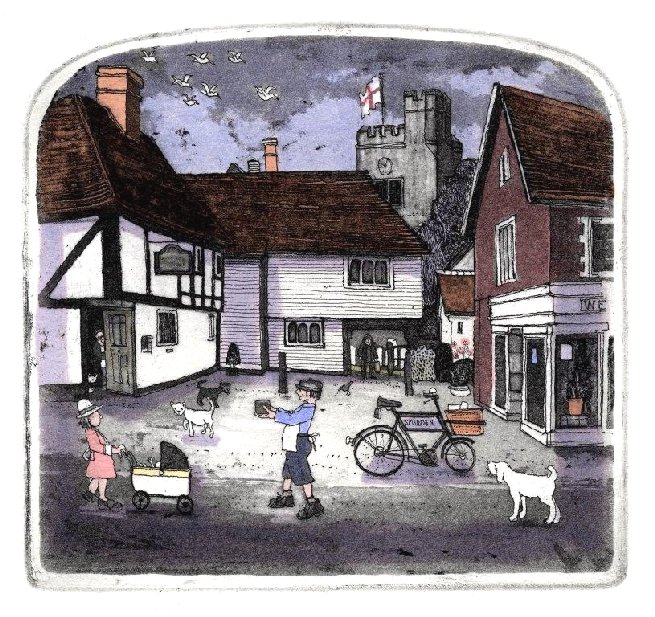
Yeomans by Graham Clarke

It was through Bawden’s influence that Graham took an interest in producing prints of traditional landscapes, the depictions of which highlighted local areas.  One such print featuring a rural scene was Yeomans which depicted a quaint English street scene featuring cottages and trees. 

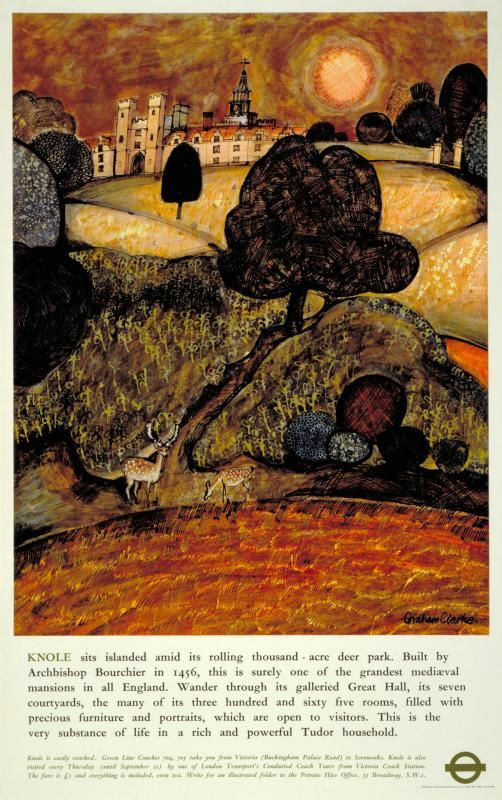
Graham finally graduated in 1964, which, fortunately for him, coincided with peoples’ interest in buying prints which resulted in a flourishing sale of them.  His artwork was admired and he soon received commissions for his depictions from the likes of Editions Alecto and London Transport Publicity Department and so a bright career for him began.

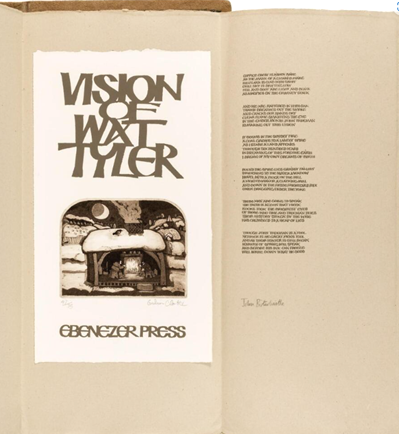
Vision of Wat Tyler by Graham Clarke

In 1969 Graham’s first hand-printed “livre d’artiste”, Balyn and Balan was published.  Another of his books was Vision of Wat Tyler which won recognition from the most influential patron and connoisseur of the day, Kenneth Clark. Lord Clark wrote enthusiastically in praise of Vision of Wat Tyler:

“…the whole book is a splendid assertion that craftsmen still exist and cannot be killed by materialism. A few idealists are the only hope for decent values…”

Dance by the Light of the Moon by Graham Clarke

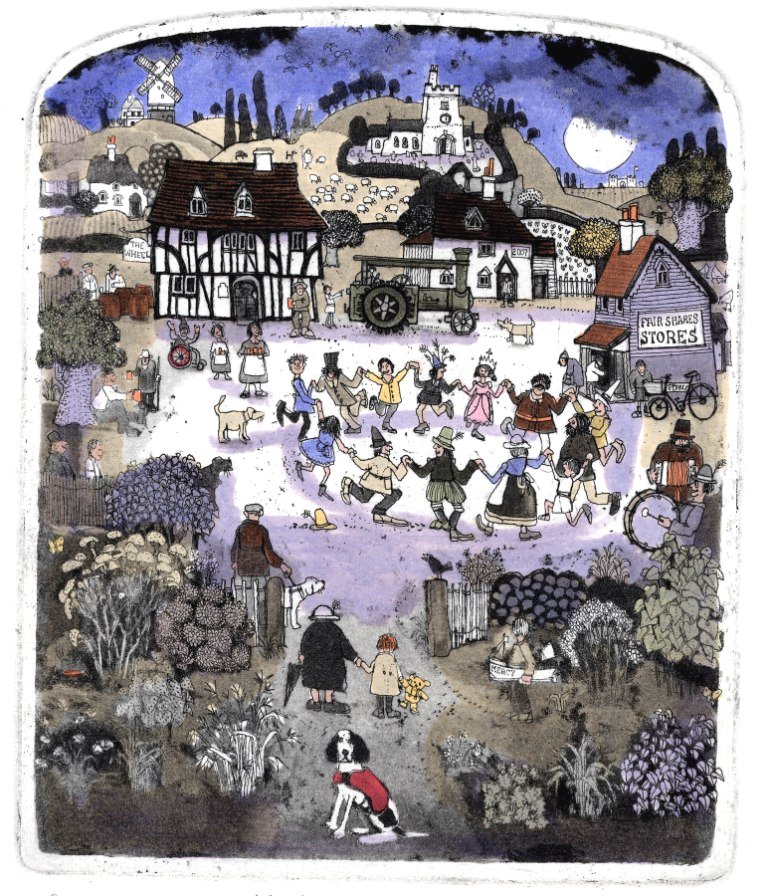
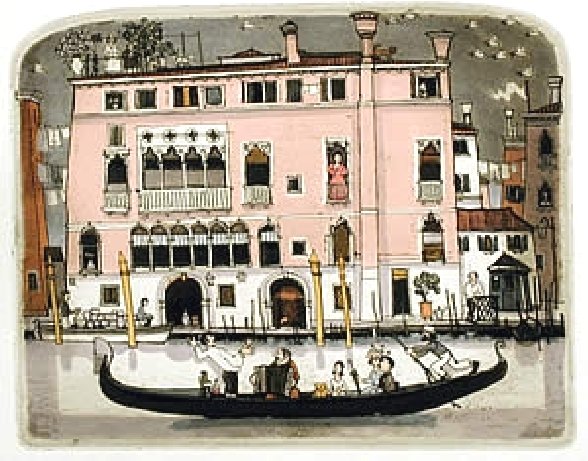
Graham’s famous ‘arched top’ etchings has established his widely successful reputation in Britain and overseas, and came to public attention in 1973 when the first of these, Dance by the Light of the Moon, was exhibited and sold in London at the Royal Academy of Arts Summer Show.

For you Madam by Graham Clarke

Examples of his work are held by Royal and public collections, including the Victoria and Albert Museum, the British Museum, the Tate Gallery and the National Library of Scotland in the United Kingdom, as well as by Trinity College, Dublin, the Library of Congress in Washington, D.C., the New York Public Library and the Hiroshima Peace Museum. Many more are to be found on the walls of private homes all over the world, collected systematically by devotees, as well as singly by ordinary art lovers who “know what they like”

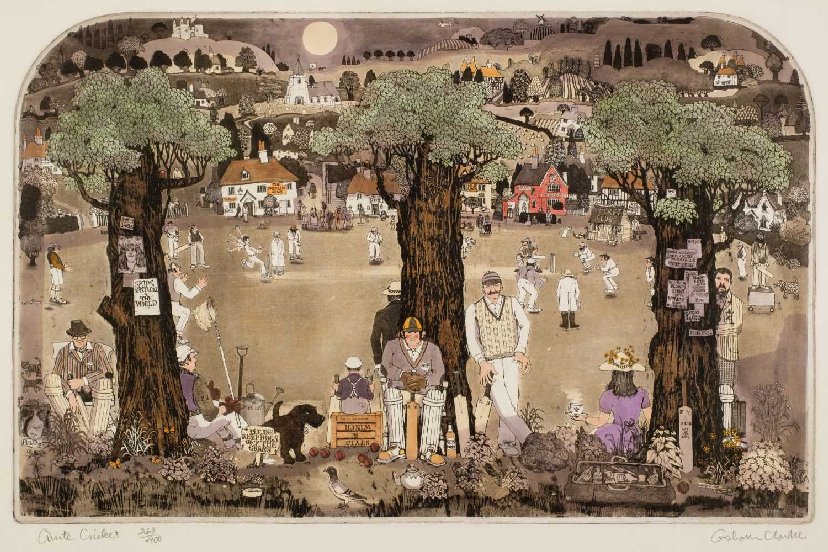
Quite Cricket by Graham Clarke

Graham Clarke, who prides himself as being a “Man of Kent” lives with his wife Wendy, four children, his animals and friends, in the village of Boughton Monchelsea in the county of Kent where he also has his studio. 

He offers open-days at his studio which gives visitors an opportunity to view his work including hand coloured limited edition etchings, watercolours, posters and greetings cards depicting English rural life and history, the Bible and the Englishman’s view of Europe, all of which are available for sale.


My blog has only scratched the surface of the life of this talented artist. The information for this blog came from two main sources:

Clare Sydneys’ 1985 book entitled Graham Clarke

and

Graham Clarke’s website

Amélie Beaury-Saurel and Rodolphe Julian.

Amélie Beaury-Saurel

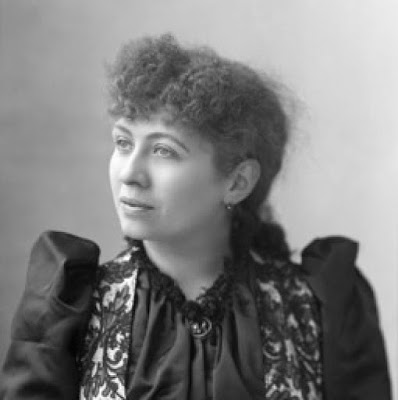
Amélie Beaury a French painter, was actually born in Barcelona on December 17th 1848.  Her family had previously lived in Spain and Corsica before moving to the Catalan city in 1845.  Her parents, Camille Georges Beaury and Irma Catalina Saurel owned a large carpet and tapestry factory with more than twenty looms, which they called Saurell, Beaury y Compañía. Amélie was their middle child.  She had an elder sister, Irmeta, also an artist, and a younger sibling, Dolores. Amélie later added “Saurel” to her name in recognition of her mother’s family who could trace their lineage to the Byzantine emperors of the 11th century.

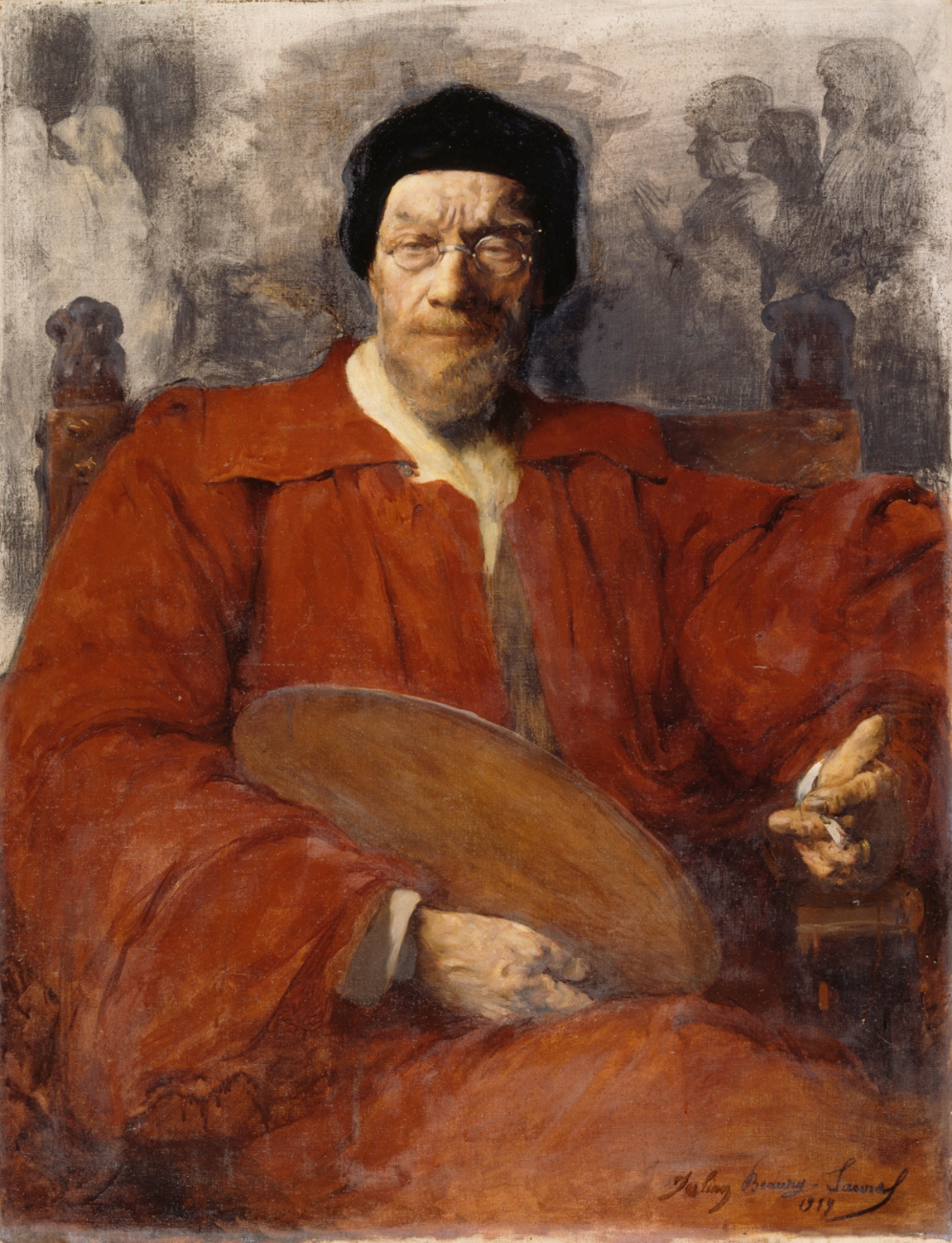
Portrait of the artist Jean-Paul Laurens by Amélie Beaury-Saurel (1919)

The happy family life was shattered in the late 1850s when Amélie’s father died and her mother decided to relocate with her three daughters to Paris.  Amélie recalled in an interview that she and her family lived in the French capital when she was ten years old and that her widowed mother, with little money, had to endure financial hardships.   Her mother instilled a love of art in her children and she would take them to the Louvre Museum to see the works of the Masters and encourage them to copy the works of the these great artists.

Portrait of Léonce Bénédite, curator of the Musée du Luxembourg,  by Amélie Beaury Saurel (1923)

Due to this family impoverishment, Amélie’s mother decided that her daughters should help with the financial burden and set about having them train as porcelain painting, a socially acceptable way of earning a living and eventually becoming financially independent. Amélie set to work as a painter of porcelainware but later said she considered what she was doing as commercial painting which in many ways damped down her creativity.  Her mother was very supportive of Amélie’s love of painting and, in 1874, initially paid for her nineteen-year-old daughter to study at the prestigious Académie Julian.  One of her first tutors was Pauline Coeffier, a French oil painter and pastelist, who specialized in the art of portraiture. Later many of the leading artists of the day would advise and tutor her, such as Tony Robert-Fleury, William Bouguereau, Jules Lefebvre, Benjamin-Constant, Jean-Paul Laurens and Pierre Auguste Cot.
Rodolphe Julian

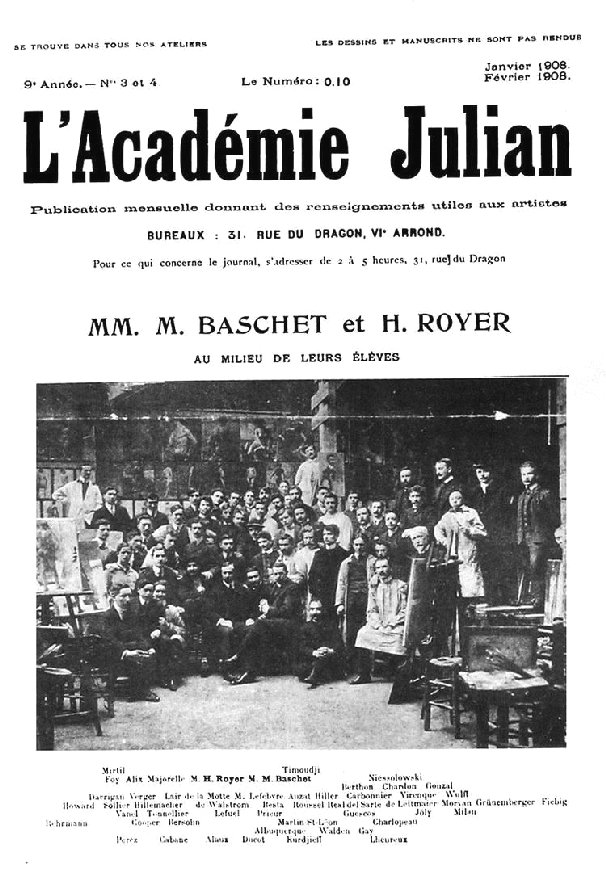
The Académie Julian was founded in 1868 by Rodolphe Julian. It was a private art school for painting and sculpture.  Paris was looked upon as the capital of the art world, and the centre of modern art.  This was one reason many young aspiring painters came to the French capital to discover all the latest trends in painting, like Impressionism and Post Impressionism, decorative art of various types, new forms of representational art such as expressionism, lithography and much more. Also with having a reputation as a forward-thinking art college the Académie Julian profited from the reputation of Paris.
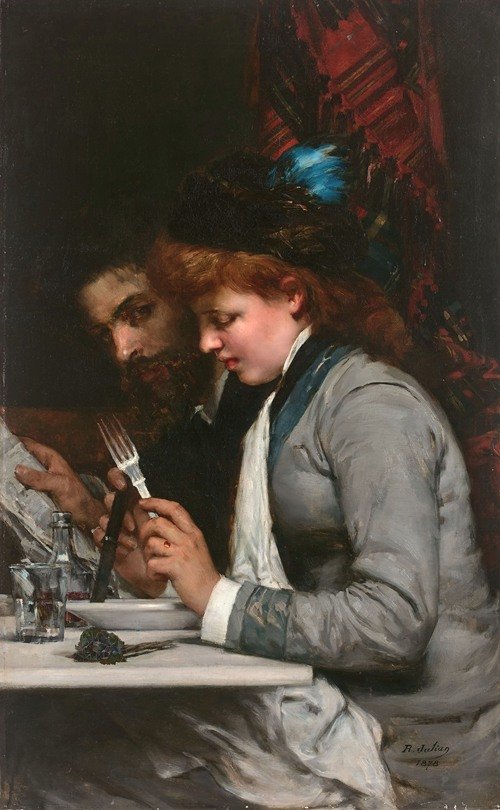
Chez Duval by Rodolphe Julian

Another reason for the popularity of Académie Julian was that it was the only art school in Paris to accept foreign students, many of whom struggled to pass the difficult French language exam, which was conditional on their acceptance into the Ecole des Beaux-Arts. Ambitious female painters were also barred from attending the official Ecole des Beaux-Arts until 1897 and even then, it was not considered suitable for women to study life drawing.  In contrast, Académie Julian was happy to offer them a full programme of education and training to women in fine art. They were offered the same classes as men, including the drawing of nude models. In fact, the Académie was one of the few schools to admit women to life-drawing classes. In fact, one of its four new branches was actually exclusively designed for female art students.

The Académie Julian was also regarded as a stepping stone to the prestigious École des Beaux-Arts by getting them prepared for the entrance exams and at the same time offered independent alternative education and training in arts.  Aspiring artists, both men and women, were welcome at the Académie Julian.   Men and women were trained separately, and women participated in the same studies as men, including drawing and painting of nude models.  The Académie Julian had no entrance requirements, was open from 8 a.m. until nightfall, and very soon became the most popular establishment of its type. Rodolphe Julian opened several branches throughout Paris, one of them especially for female artists, and by the 1880s the student population at these establishments reached six hundred.

Female Students at the Académie Julian in Paris, c. 1885

To ensure the success of the Académie, Rodolphe gathered together well-known and esteemed artists, such as Adolphe William Bouguereau, Jean-Paul Laurens, Tony Robert-Fleury, Jules Lefebvre and other foremost painters of that time trained in Academic art, to become tutors or visiting professors.  Académie Julian became recognised as a leading art establishment and its students were allowed to compete for the Prix de Rome, a prize awarded to promising young artists, and also show their work in the major Salons or art exhibitions.

So, who was Rudolphe Julian?

Rodolphe Julian was born in Lapalud, a commune in the Vaucluse department in the Provence-Alpes-Côte d’Azur region in southeastern France on June 13th 1839. He worked as an employee in a bookstore in Marseille but later moved to Paris, where he became a student of Léon Cogniet and Alexandre Cabanel, professor at the École des Beaux-Arts, albeit he never officially enrolled there.  Rodolphe was well aware of the struggles of artists who looked for artistic training once they had arrived in Paris and so, in 1863 he opened his own art school, Académie Julian.

Portrait of a Woman by Amélie Beaury-Saurel

Living in Paris, Amélie was determined to increase her knowledge of art and the Académie Julian offered her the best way of achieving that goal and eventually becoming a professional portrait artist.  However this course of action had to be funded so she approached Rodolphe Julian and proposed that in return to her helping out with the administrative and financial duties of the Académie, he would allow her to attend his classes free of charge.  He agreed. Rodolphe Julian had opened a women’s workshop in 1873 and in 1895 he put Amélie in charge of it.  As well as organising the workshop she had begun a very lucrative career as a portrait artist and received many commissions.

Académie by Amélie Beaury-Saurel (1890)

In 1890, Amelie completed one of her greatest paintings entitled Académie.  The title for the work refers to the art academy which at the time prohibited female painters from joining its ranks.  Her depiction conveys the compelling message to the viewer that she was not going to allow herself to be browbeaten by the male-dominated artistic establishment and she would not conform to their dictates.  The model in the painting exudes strength and determination as she stands grasping stalks of bamboo and stares out at us, challenging us.  It can be no coincidence that Amélie has depicted her model naked and this nude pose empathises the strong and defiant attitude women embraced as artists.

Deux vaincues (Two Defeated Women) by Amélie Beaury-Saurel (1892)

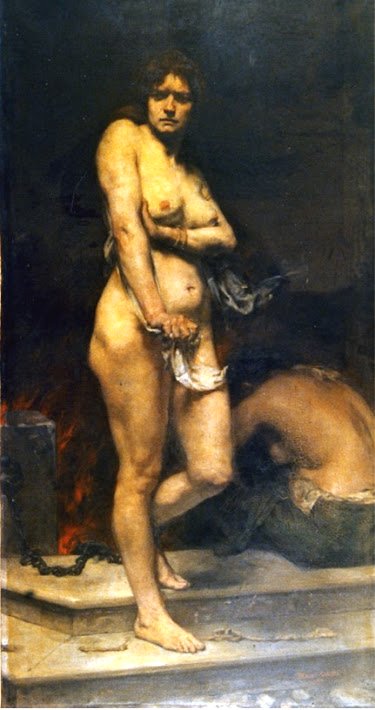
Two years later in 1892 Amelie produced another defiant depiction entitled Deux vaincues (Two Defeated Women).  It is looked upon as a rallying call to all female painters to be fearless as they travel through the unwelcoming and unforgiving world of art education and artistic professionalism and the many obstacles they had to overcome.  It was a plea to female artists to not allow themselves to be defeated in the face of the obstacles they would encounter.  The sketch depicts two women, both naked, chained to a wall.  Both face similar hardships but they have fared differently.  The one with her back to us is slumped forward in a defeated pose, while the other, in contrast, stands boldly upright, unrepentant and stares out defiantly.  The painting is a challenge to all women as to whether they give in or fight on. The work was exhibited at that year’s Salon.

 Portrait de Séverine by Amélie Beaury-Saurel (1893)

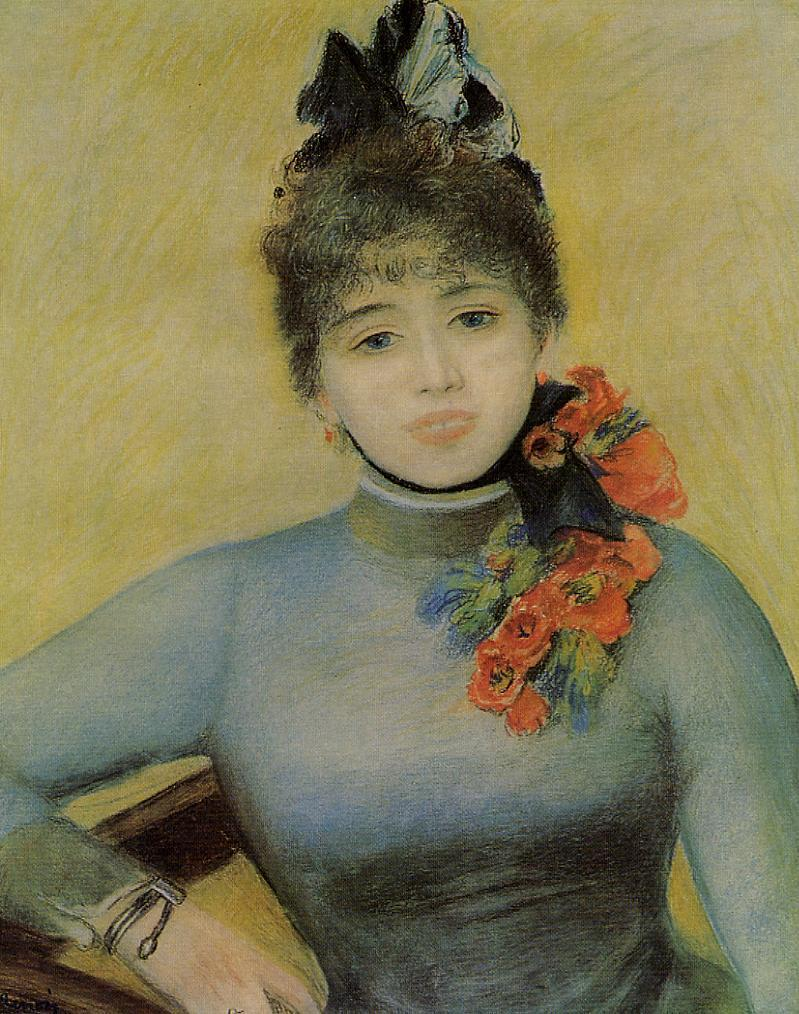
In 1893 Amelie completed a portrait of Caroline Rémy de Guebhard. She was a French journalist who held strong non-conformist views which labelled her as an anarchist, socialist, and communist.   She also was a great believer in feminist’s rights and opinions and this no doubt drew Amelie to paint the portrait.   Caroline Rémy de Guebhard would use the pen name Séverine, derived from the Latin severus which means “rigorous” or “brave”, for many of her newspaper articles.  When we look at the portrait, our eyes are immediately drawn to the vivid red flower on the sash of her dress.  The flower symbolizes Séverine’s leftist political views.  Look at her facial expression.  It is one that exudes strength, determination and tells you that this lady will not be moved.  Amelie’s ability as a great portraitist is borne out in this beautiful work.

Séverine by Renoir (c.1885)

A portrait of Caroline Rémy de Guebhard was also complted around 1885 by Renoir. It is in the permanent collection of the National Gallery of Washington.

Dans le bleu by Amélie Beaury-Saurel (1894)

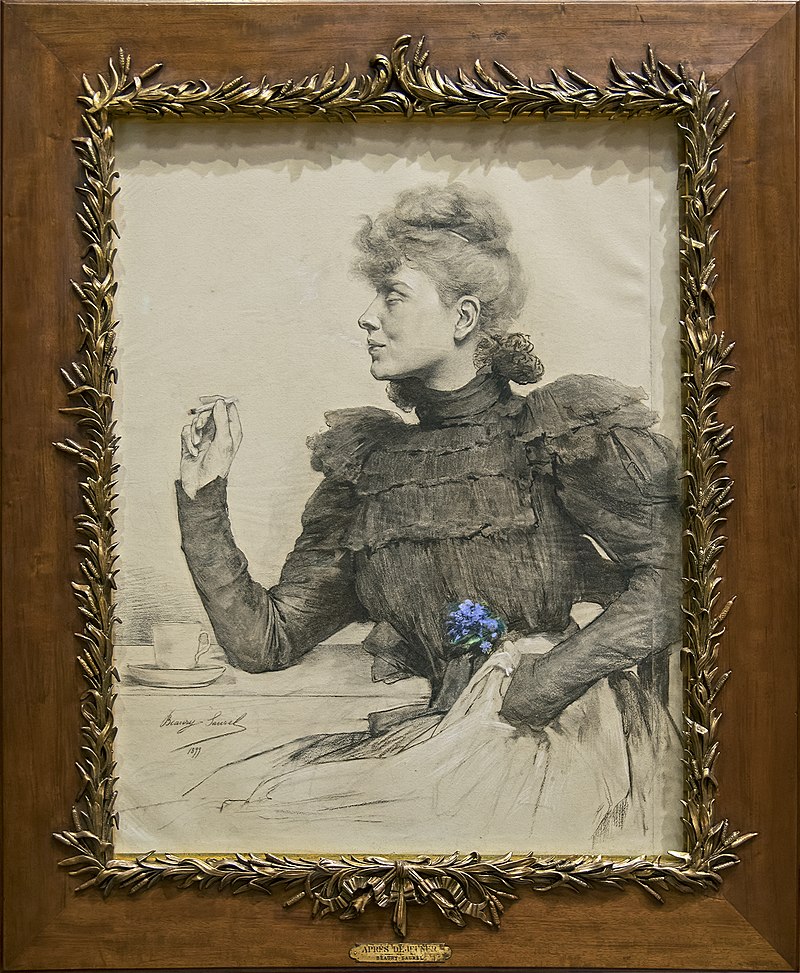
One of my favourite works by Amelie is her 1894 painting entitled Dans le bleu.  It is a pastel on canvas which depicts a young woman waking up in the morning and indulging in the gratification of smoking that first cigarette.  However that is not the point of the depiction.  It is all about feminist assertions. In this painting, we see a woman depicted in profile, boldly treating herself to the pleasures of escapism. It is a depiction of defiance as women at this time were not seen smoking, especially not in public.  It was a habit that was counter to the feminine conceptions of the time.  We should remember that Amélie Beaury-Saurel had dedicated a large part of her work to the female model and had always maintained the feminist cause.  She supported the right to arts education and artist status for women.  In 1894 when she was working on this painting her reputation in Paris as an artist was at its highest point and her paintings were exhibited all over the French capital.

The background of the work is very dark, predominantly blue and this allows the figure stand out in the work.   It is hard to know whether the scene takes place in a private dwelling such as a kitchen or a living room or whether the setting was in a public place, such as a café.  The woman in the depiction sits smoking a cigarette, chin in hand.  She appears to be daydreaming. She seems preoccupied as she watches the blue smoke unfurl from her lips, drifting upward. What is she thinking about?  Would she, like the smoke, like to drift away?  Some have suggested this might be a Beaury-Saurel self-portrait, as the model resembles the artist.  The depiction is simple and realistic and in no way staged.  Amelie’s depiction is all about everyday reality and is without any hint of idealization which would have weakened the work and it is this simplicity that has added to the beauty of the depiction and has expressed the woman’s femininity.

Our Girl Scouts by Amelie Beaury-Saurel

In this painting by Amelie, the seven women are represented in a compact group, around a table with a pile of books. On the left, holding his handlebars in his hand gloved, the Belgian cycling champion, Hélène Dutrieu; next to her, holding a paintbrush, the publisher Anna-Catherine Strebinger (Madame Henri Rochefort) who was also a student at the Académie Julian; then the collector Marguerite Roussel looks at the viewer; in the center, in professional attire and pointing to an article in a code, the lawyer Suzanne Grinberg, an eminent member of the French Union for the women’s suffrage, created in 1909; leaning on her, in the outfit that she had adopted to travel safely to the Middle East, archaeologist and explorer Jane Magre-Dieulafoy. Then comes the novelist and journalist Lucie Delarue-Mardrus and aviator Elise Deroche, First woman to obtain a pilot’s license.

After Lunch by Amelie Beaury-Saurel (1899)

In 1895, Amélie Beaury-Saurel, married Rodolphe Julian and he put her in charge of the women’s workshops which he had started in 1873.  Amélie managed the expenses for the women’s studio, served as an intermediary between instructors and students, and ran the women’s group but also continued her career as a portraitist. She earned a medal for her submissions to the 1885 Paris Salon and the bronze medal at the 1889 Exposition Universelle. 

Chateau Julian, Lapalud

Rodolphe Julian died on February 2nd 1907, aged 67, and two months later on April 10th, Amelie’s mother died.  Following the death of Julian, Amelie took on the role of director of the Académie Julian.  This was a mammoth task and so she received help from her nephews Gibert and Jacques Dupuis, the children of her sister Dolores.  Rodolphe Julian had bought a large house in the village of Lapalud, where he was born and on his death they were bequeathed to his nephews.  Amelie bought this large property from her nephews and transformed it to accommodate her family. It was called the “Mas” Julian.

Amélie Beaury-Saurel

During her last years, Amélie continued to paint but also fought for women’s rights and supported women artists and their fight against male-dominated art circles.  She participated in solidarity exhibitions for the benefit of institutions such as the Société des Artistes Français, the Société Nationale des Beaux- Arts or the Fraternité des Artistes.  Such commitment to the promotion of art and her endless creative activity were recognized in 1923, a year before her death, through her appointment as Chevalier de la Légiond’honneur.   

Amélie Beaury Saurel died on May 30th 1924 aged 75 at he Paris home which she had once shared with her late mother and sisters.


Information for this blog came from the ususal search engines plus:

Aware Women Artists

Elles-d-artistes blogspot

Musings on Art

Ville de Lapalud

The Funen Painters. Part 2.

Following the last blog regarding the early members of the Funen artists, this blog looks at some of the younger members and how they were often connected.

Peter Syrak Hansen

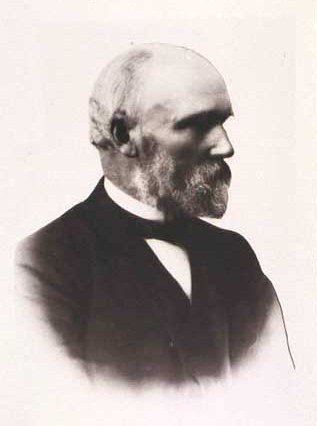
One of the leading figures of the Funen painters was Peter Syrak Hansen and it was his home and workshop, Mesterhuset, which became a cultural meeting place for the Funen painters. Syrak Hansen was born in Swanninge, a Danish village on South Funen, on September 10th 1853. He trained as a decorative painter at the Academy of Fine Arts in Copenhagen under George Hinkler.

The Double Portrait of Count Preben Bille-Braheand his second wife Johanne Caroline neé Falbe by Christoffer Eckersberg (1817)

After qualifying Syrak received many decorative work commissions in South Funen’s to decorate manor houses and churches. He was also given funds by the prominent and wealthy art collector and art patron, Count Bille-Brahe of Hvedholm, and continued his artistic studies in Germany, Austria and France, where he concentrated on studying church decorations. Following his European travels, he later settled down as a master painter and decorative painter in Faaborg in southern Funen and based himself in the building, which became known as the Mesterhuset. He bought Mesterhuset, situated at Lagonis Minde 7 in 1875, and he became a sought-after decorative painter working primarily in churches and manor houses on South Funen.

Sonnige Strandansicht by Peter Syrak Hansen

Syrak Hansen became so busy with all the commissions he received he had to look for some help and he hired a journeyman painter. The painter was Fritz Syberg who worked with Syrak in his workshop from 1882. It was here that Fritz Syberg got to know his future wives, Anna and Marie Hansen.

Faarborg Harbour by Karl Schou (1917)

Syrak Hansen married Marie Birgitte née Rasmussen and he and his wife had five children.  Marie Hansen, the eldest, was born in 1865 and became a parliamentary stenographer whose first husband was the painter Karl Schou. Schou was born in Copenhagen in 1870. After normal schooling he became a student at Valdemar Sichelkow’s painting school from 1884 to 1886 and then studied under Malthe Engelsted at The National Drawing Teacher Course, Copenhagen from 1886 to 1887, Finally he attended  Kristian Zahrtmann’s School from 1887 to 1900. During those three years at Zahrtmann’s school he became friends with the Funen painters.

Three persons in conversation at an evening party by Hans Nikolaj Syrak Hansen (1903)

A year after the birth of their first child, Marie Hansen gave birth to their first son, Hans Nikolaj Syrak Hansen who became apprenticed to his father. Hans attended Zahrtmann’s School in Copenhagen from about 1885 to the spring of 1887, but he had to give up his art studies and return home in order to take over the painting company from his father in 1891.

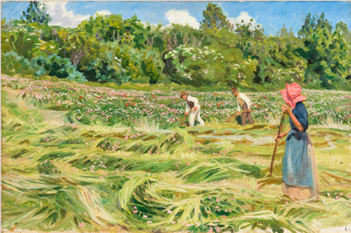
The Hay on the Meadow, South Funen by Peter Hansen

Syrak and Marie Hansen’s third child, their second son, Peter Marius Hansen was born on May 13th 1868. He attended the Copenhagen Technical School before studying under Kristian Zahrtmann at the Kunstnernes Frie Studieskoler between 1884 and 1890. 

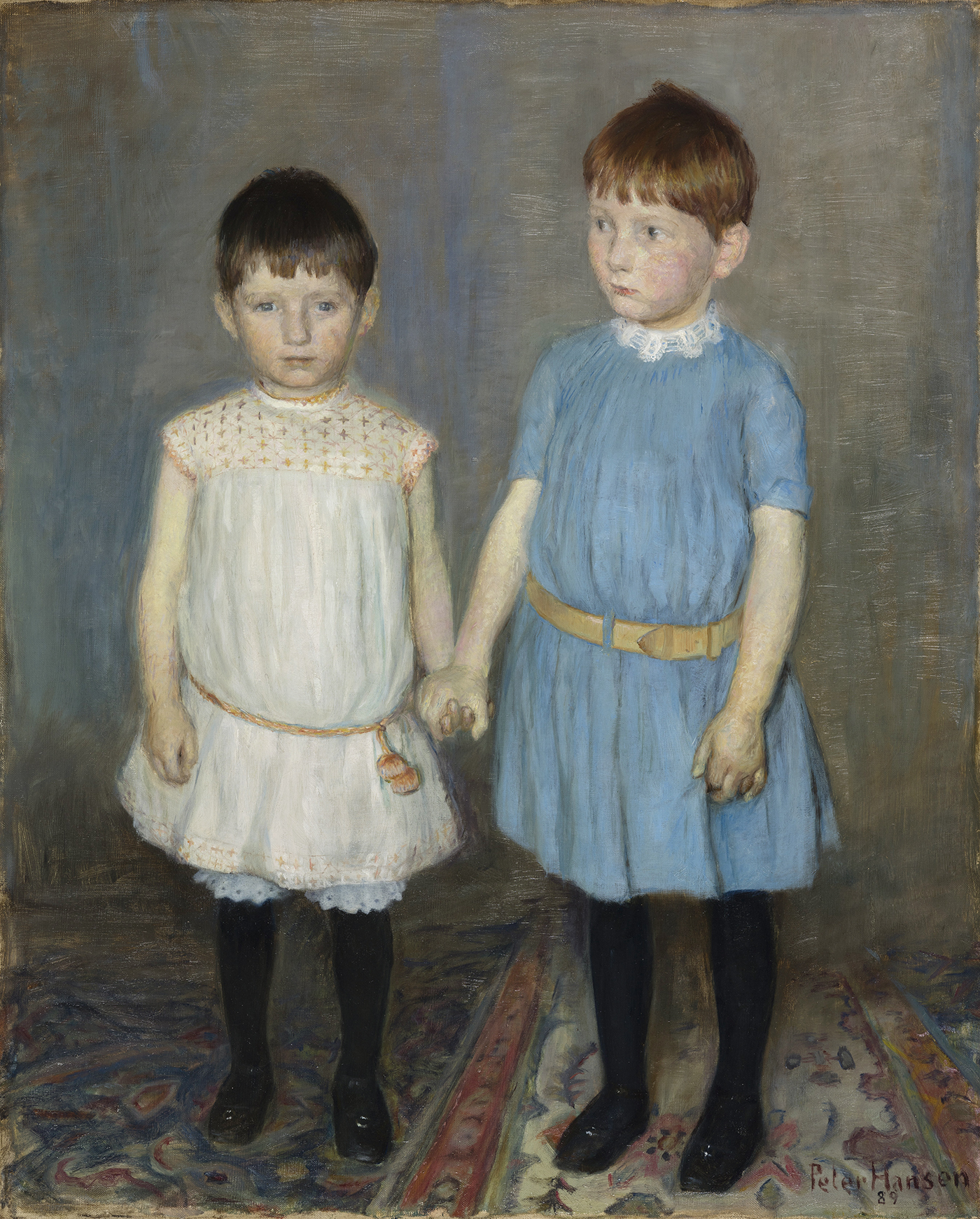
Double portrait of two children. The artist’s stepdaughters by Peter Hansen (1889)

Peter Hansen married Elisa Nikoline, who had previously been married to an engineer, Ludvig Conrad Neckelmann, whom she divorced. In 1898, shortly after the divorce, Peter and Elise married. Ludvig and his wife, Elisa, had had two daughters, Marie Christine and Elizabeth and Peter completed a double portrait of his stepchildren.

By the window. Double portrait of the artist’s daughter, Elena and stepdaughter, Marie Christine by Peter Hansen (1902)

Peter and Elisa went on to have their own two daughters, Elena Italia in 1899 and Anna Margrethe in 1906. In 1902 Hansen completed a double portrait of his twenty-year-old elder stepdaughter, Marie Christine and his own three-year-old child Elena Italia.

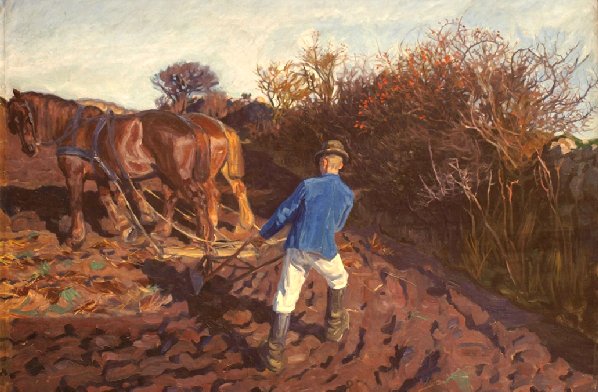
The Ploughman Turns by Peter Hansen (1902)

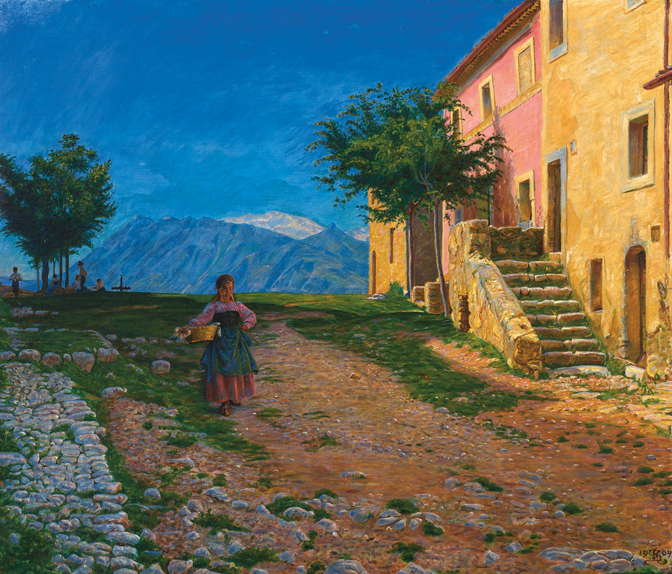
Peter Marius Hansen belonged to the group of Danish painters who were called the Funen Painters, since they came from and mainly worked on the island of Funen.  One of the important qualities Peter displayed was his respect for the steadily, busily working human being and he made it a key motif in his art. For him the Peasant was the epitome of this ideal, when he would depict local Danish farmers and the mountain farmers from around the Danish artists’ colony in the Italian village of Cività d’Antino in Abruzzi.

Fritz Syberg self portrait (1910)

Christian Friedrich Wilhelm Heinrich Syberg, generally known as Fritz Syberg, was born on July 28th 1862, in Faaborg.  He came from a poor background and was first apprenticed as a house painter under Syrak Hansen.  From there, in 1882, he attended the Copenhagen Technical School where Holger Grønvold taught him drawing. In the Spring of 1884 he enrolled for a short period at the Danish Academy but then attended the Kunstnernes Frie Studieskoler  where he became one of the first Fynboerne, along with Peter Hansen, Johannes Larsen, and Poul S. Christiansen to study under Kristian Zahrtmann.

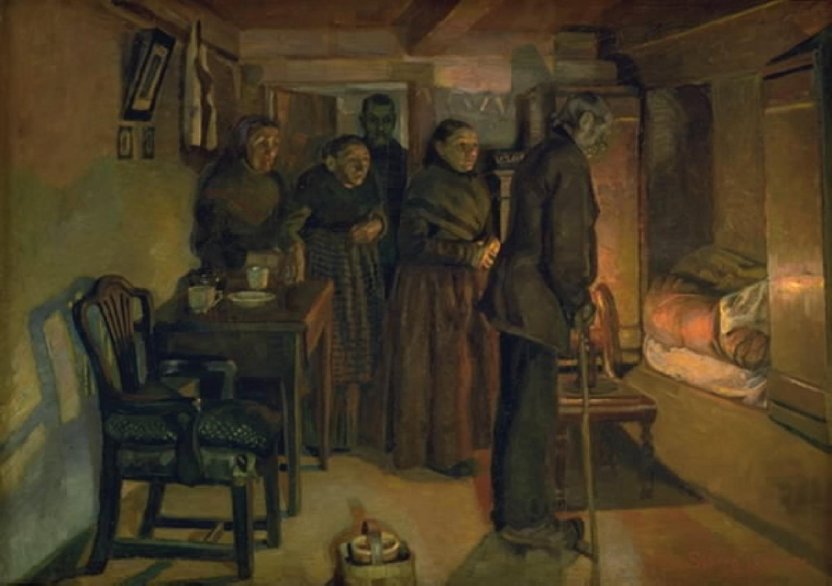
Dodsfald (Death) by Fritz Syberg (1881)

In the early 1890s may of Syberg’s paintings were dark and this can be seen in his 1892 work entitled Dodsfald (Death) which depicts his mother, Johanne Marie, on her death bed in 1881 in the Fåborg’s poorhouse.

Fritz Syberg “Jeg vil synge dem alle, alle!, sagde Moderen” (1898). Illustration for Hans Christian Andersen’s Historien om en moder. (I will sing them all, all of them!, said the mother) (1898). Illustration for Hans Christian Andersen’s The Story of a Mother by Fritz Syberg

In addition to the sale of his paintings, Syberg accepted many book illustration commissions, the most famous being his depictions for Hans Christian Andersen’s tragic tale, The Story of a Mother, which no doubt, Syberg could relate to his own childhood.  These depictions became one of the most celebrated collections of illustrations in Denmark’s history.

Spring by Fritz Syberg

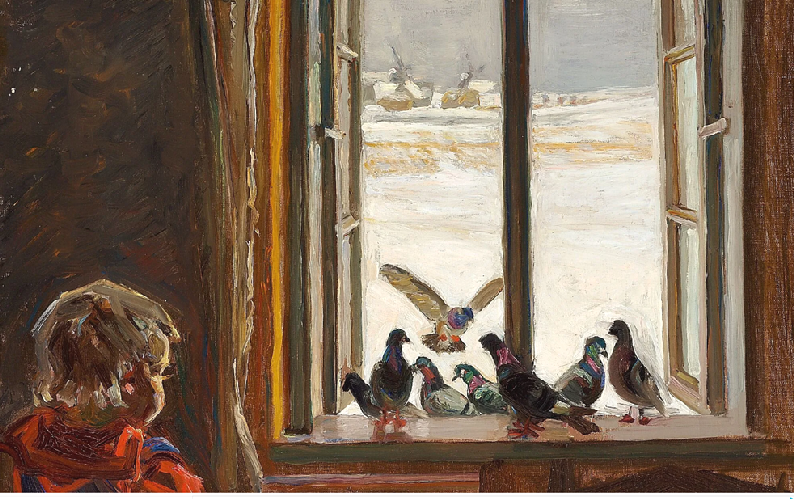
Watching Birds on the Windowsill by Fritz Syberg

Having struck up a close friendship with Syrak Hansen’s daughter Anna whilst working as Syrak’s apprentice, their friendship turned to love and the couple married in 1894. The couple went on to have seven children.   In the 1890s and the early decade of the twentieth century Fritz Syberg made a number of trips to other European countries such as Italy, The Netherlands, Germany and France, sometimes with his family.. 

Anna Syberg by her husband Fritz Syberg (1896)

Syrak and Marie Brigitte Hansen had their fourth child, a second daughter, Anna Louise Birgitte Hansen in January 1870 and she, like her brother Peter, became part of the Funen painters. Anna Syberg grew up amidst a very colourful and energetic artistic environment that differed from ordinary middle-class conventions. Her father, Peter Syrak Hansen, was a master painter, and a renowned figure in the town of Faaborg.  Fortunately for Anna, her parents believed that education was of prime importance to both their daughters as well as their sons.

Crocus, Hyacinths and Tulips by Anna Syberg (1898)

Anna loved to learn and one of her favourite pastimes was decorative painting.  In 1884 she enrolled on a two-year course at a technical school in Faaborg, and in 1889 she was receiving tuition in Copenhagen from the sculptor Ludvig Brandstrup and the painter Karl Jensen. Her artistic education was topped off when she received singing lessons, learnt to play the piano to a high standard and learnt to sing lieder and Danish songs.

Wild Roses by Anna Syberg (1898)

Anna Syberg became a key figure in the Funen Painters artists’ colony.  Her paintings, other than a few figure scenes, depicted flowers and plants, often in the vases and pots around her home, or in her garden and ones she saw when out walking in the countryside. She worked mainly in watercolours, using multiple layers that would often include sketched lines of pencil, transparent layers of watercolour and black ink contours ensuring the depiction of the floral was of the utmost accuracy.

Grapes in the Greenhouse by Anna Syberg (1903)

The subject of her depictions were often of stage-managed as she experimented with the floral arrangements.  In many of her works she would often let the depiction of her flowers and plants extend beyond the edge of the paper in a form of dynamic cropping.  Her floral painting were neither symbolic nor botanical studies.  In Anna Syberg’s pictures, flowers are not charged with symbolic significance, nor are they stringently restrained botanical studies with all its scientific accuracy. In her works, Anna Syberg portrays the simple beauty of the flowers, a testament to their beauty. In 1894 Anna Hansen married Fritz Syberg.

Fritz and Anna Syberg

So this life as a Funen painter amongst family and friends was to be part of much loved idyllic lifestyle for Anna Syberg.  What could possibly interrupt this peaceful and fulfilling way of life?   And yet………..

At the turn of the century in Denmark, like many other European countries and those across the other side of the Atlantic, the stature of women in art, and even in life itself, was continually being questioned by men.  For many men, including even some fellow artists, women simply painted as a hobby or to add to their social graces but for women in the early 1900s practicing art was problematic.  For Anna it was one thing to be a talented artist, it was another thing to have the same respect bestowed upon her for her work as that of the men.  Things came to a head in Faarborg when the town got their own museum and paintings had to be selected for display in the museum.

Mads Rasmussen

Mads Rasmussen, an important businessman in Faaborg, and his wife Kristine, held a party one evening and among the guests were the Funen Painters’ inner circle including amongst others Fritz Syberg, Peter Hansen and Jens Birkholm. Together with Johannes Larsen they were all to become part of the Museum’s purchasing committee which, in turn, came to act as the steering group for the Museum’s acquisitions, their curation and the fixtures and fittings for the gallery.  It was very unusual that the “money man” would let a group of artists dictate as to what works were to fill the gallery.

Artists hanging their works in the galleries of Faaborg Museum, May 1915. From the left: Peter Hansen, Peter Tom-Petersen, Johannes Larsen, Astrid Noack, Nicolaus Lützhøft, Christian Ernlund, Carl Petersen og Fritz Syberg.

Here was the problem – the purchasing committee for Faaborg Museum, made up of the Funen painters, were all  male artists from the group, and they didn’t believe in the quality of the works produced by the female members of the group. In the minutes of the meetings of the purchasing group, comments were recorded stating that

“…At the negotiations, Peter Hansen and Birkholm wanted to be recorded in the minutes that they voted against the acceptance of Mrs. A.(Alhed) Larsen and Miss Christine Larsen’s works. Peter Hansen also against Mrs. Syberg…”

Also in the minutes, Peter Hansen, Anna’s elder brother, noted:

“…AS (Anna Syberg) and the other ladies had no significance for Danish art…”

Gallery at the Faarborg Museum

No reasoning was ever recorded as to why they thought so little of the works of the female Funen painters but the damage was done.   Presumably, one has to recognise that at that time there was generally a reluctance for women to be able to produce an artistic work. The one thing to remember also is that flower painting traditionally had a lower rank in the art world and this could have been in the minds of the male purchasing committee.

Anna was horrified that her own brother would critique her work so harshly and the rift between siblings became bitter.  She wrote to her brother Peter:

“…Where you create yourself. You voted against me at the Faaborg Museum based on high idealistic notions of safeguarding the best interests of art in Denmark. “You did not want to hide from me”, you wrote that I and the other ladies had no significance for Danish art…”

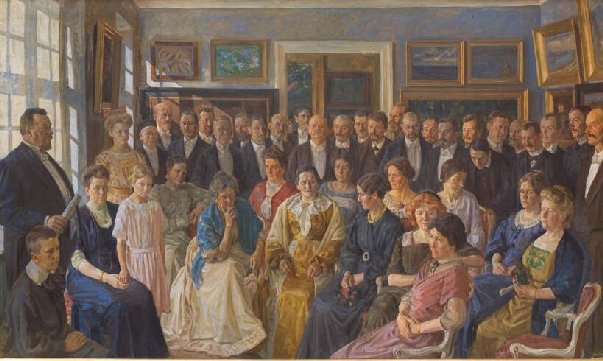
Faaborg Museum Inauguration (1910) by Peter Hansen

Anna Syberg is not in the picture of the artist group Fynbomalerne, despite her being a central part of the group. She should have supposedly sat on the empty chair in the bottom right corner.

The empty chair.

During the heated exchanges between Anna and Peter, he was working on a painting depicting the inauguration of the Faarborg Museum. The depiction was supposed to pay tribute to a group of artists who were both well-known and acclaimed painters. Anna Syberg’s outburst of anger over the words of her brother and members of the purchasing committee came while her brother was working on the painting, and it is believed that he deliberately chose not to paint his sister as part of the group and yet, to rub salt into the wounds, he provocatively indicated her absence with the empty chair, despite her being present at the inauguration and was said to have sat tanned and dressed in festive clothes with a large hat in the front row of the group. All the other female artists in the group are in the painting.

Anna Syberg (née Hansen) 1870-1914

Anne Syberg died on July 4th 1914 following a failed operation to treat a gallbladder infection.  She was just forty-four years of age.  Sadly the recognition she deserved as a gifted artist never came until after her death.  In 1915 a retrospective of her art was held and it was a success, and sales were high, including Faaborg Museum which purchased sixteen of her works. quite central in the country. After her death, Fritz Syberg married Anna’s elder sister Marie who he had known since the days of working for is father-in-law.

In 1873 Syrak Hansen’s youngest child, Poul Gerhardt, was born.  He did not follow his siblings into the world of art. He was married to Dagmar and the couple had two children: Helga and Louise.  Poul is believed to have died at the young age of 33 in 1906.


I could not have put together the two blogs about the Funen painters without the information I gleaned from various websites:

The Beauty of the Moment

Faarborg Museum

DR

The Hirschsprung Collection

arkivdk

The Funen Painters (Fynboerne)

The term Artists’ Colonies defines gatherings of artists in towns, villages and rural areas, who have assembled at places of natural beauty and where the cost of living is less than that of city life.  In the latter part of the nineteenth century, art colonies began to spring up as village movements with thousands of professional artists taking part in a mass exodus away from urban centres and heading for the idyllic countryside where they resided for varying lengths of time in artistic communities. Art colonies appeared on both sides of the Atlantic, forming on both the East and West coasts of America.  Many were also established in Europe such as Barbizon on the outskirts of Paris, Pont Aven in Brittany, Worpswede in Germany, Giverny in the northern French department of Eure, Lamorna and St Ives in Cornwall and the Newlyn School to name just a few.  Denmark had two important art colonies.  One was in Skagen in the north of the country, which I have written about on a number of occasions and the other was on the Danish Island of Funen.  In the following blogs I want to look at the Funen Art Colony and the artists who founded it and others who came later and were part of this artistic movement.

Self portrait by Kristian Zahrtmann (1915)

The Royal Danish Academy of Fine Arts was founded in 1754 and was the dominating force in the teaching of art to aspiring painters in that country.  In the first half of the nineteenth century during the era of the great Danish painting, Christoffer Eckersberg “ruled”, and the period became known as the Golden Age of Danish Painting.  At the centre of this movement was Copenhagen which although it had experienced fires, bombardment and national bankruptcy, the arts took on a new period of inspiration brought about by Romanticism, the dominant intellectual movement of German-speaking countries in the late 18th and early 19th centuries.  However, many artists began to rebel against the outdated way art was taught at the Academy and its policies. They wanted an alternative and this came in the form of  the Kunstnernes Frie Studieskoler, (Artists Studio School) an art school established in Copenhagen in 1882.  It became the central institution of the Modern Breakthrough in Danish art, the name given to the strong movement of naturalism and debating literature of Scandinavia which replaced Romanticism near the end of the 19th century.  Laurits Tuxen became the school’s first director and Peder Severin Krøyer one of its teachers.

The Funen Painters

One hundred years ago an exhibition took place when the Faaborg Museum building opened its doors back in 1915, the Funen artists curated their own work, as the Museum had been conceived and built solely to show their ‘home-grown’ art. In 1915 gallery convention required that paintings were hung closely together and so there was space for the 366 paintings, sculptures and drawings, which had been purchased by the Museum from 1910-15. The entrepreneur Mads Rasmussen had the idea for a museum to showcase work by the Funen artists and he set up a purchasing committee composed of artists which had free rein to select work

The Funen Painters group, similar to other artists’ colonies in the late 1800s, searched for an alternative to city life by setting up a colony which was not just about painting but also a new lifestyle. Their aim was to connect their art with the countryside and the everyday life of the rural community which they believed created an overall vision for a ‘lifestyle’ reflecting their artistic ideals.

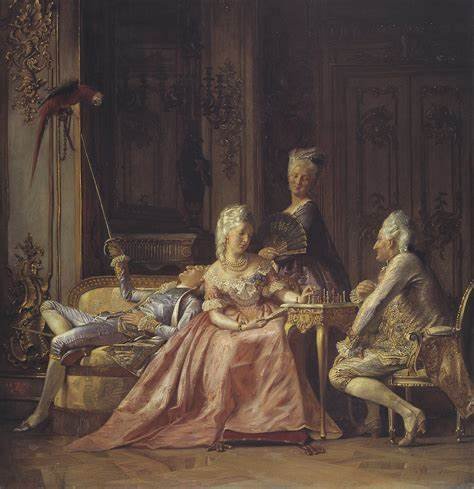
An oil painting recreating the frivolous court of Christian VII by Kristian Zahrtmann

In 1884 a preparatory class was added to the Kunstnernes Frie Studieskoler and in 1885 Kristian Zahrtmann became the head and, under him, it developed into an independent department.  Zahrtmann’s school became more avant-garde and innovative, due to his calls for radical experiments and strong use of colours.  By 1893 the preparatory class, which under his leadership,  turned into an independent department. He had some two hundred students from the Scandinavian countries and because of his stature as a teacher, the school was often simply referred to as “Zahrtmann’s School“.

A Family under Lamplight by Kristian Zahrtmann (1890)

Many of Zahrtmann’s students formed a group of painters who became known as Fynboerne (Funen Painters) due to their attachment to the island of Funen. His students included Peter Hansen, Fritz Syberg, Poul S. Christiansen, Johannes Larsen and Oluf Hartmann; and modern painters Karl Isakson; Edvard Weie, Harald Giersing and Olaf Rude. Zahrtmann travelled through Europe many times and his favourite country was Italy.

Piazza Santa Maria i Civita d´Antino by Kristian Zahrtmann (1904)

In June 1883, which was a very hot summer in Europe, Kristian Zahrtmann, travelled to the mountain town of Civita D’Antino in Italy, in search of cool temperatures as well as his love of good wine, and on the first afternoon in the town he decided that here was the ideal place for his summer painting school. His enduring fondness for Civita D’Antino lasted nearly 30 years and between 1890 and 1911 he spent every summer in the town living with the Cerroni family and gathering friends and students in an annual artist colony. He was named an honorary citizen of the town in 1902. This culminated in a vast production of portraits, landscapes, and scenes depicting an idyllic daily lifestyle around the mountain communit. His paintings are distinguished particularly by their realism and bold colour.

Johannes Larson, self portrait (1910)

Winter Day at the Zoo by Johannes Larson (1891)

One of the leading members of the Funen painters’ group was Johannes Larsen who was born in Kerteminde on the island of Funen on December 27th 1867. He was the son of Jeppe Andreas Larsen, a merchant and Vilhelmine Christine Bless.  During the 1880s, after regular schooling, Johannes studied art at the Free School in Copenhagen under Kristian Zahrtmann. It was whilst studying here that he met a number of aspiring painters who lived on Funen, notably Fritz Syberg and Peter Marius Hansen both of whom came from the southern port of Faaborg.  It was the coming together of these young artists that morphed into the Funen Painters group (Fynboerne).  Later they would create an art colony which would galvanise many Danish and Swedish artists to paint and exhibit their work.

Summer Sunshine and Wind by Johannes Larsen (1899)

After completing his studies with Kristian Zahrtmann, Johannes Larsen returned back home to his native Funen town of Kerteminde where he continued to paint working in oils, watercolour, woodcuts and drawing.  His depictions featured landscapes and other open-air scenes, and often included birds.  He received many commissions to illustrate books and paint large paintings for public buildings

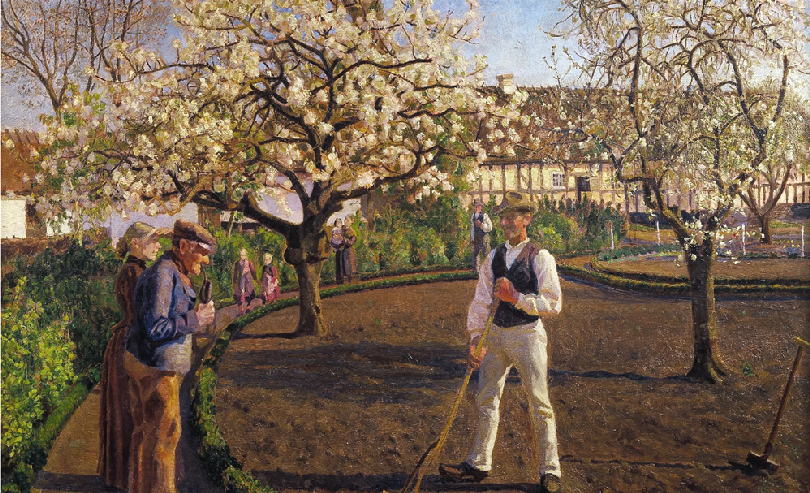
The Garden House with Blossoming Cherries by Alhed Maria Larsen (c.1920s)

In 1898, Johannes married the painter Alhed Maria Warberg.  She played a central role within the Funen Painters group and would often have the role as hostess at their events.

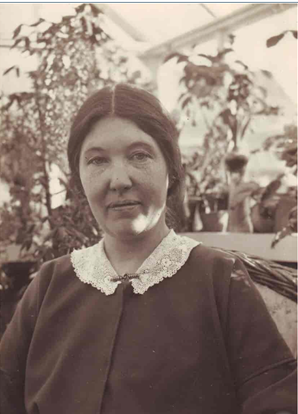
Alhed Larsen

Alhed Larsen was born on April 7th 1872.  She was the second eldest of eight children, Laura Maria and Albrecht Christopher Warberg.  She had six sisters and one brother.   Her father was the estate manager for a very large farmstead, Erikshåb, and he had an office help, a teacher for the children and six servants.  Alhed grew up in well-to-do circumstances on the estate.  It was said that the seven sisters would often shock the bourgeoisie neighbours by walking around the streets of the town without wearing gloves and by using newfangled bicycles !  Many young painters would gather at the farmstead and soon Alhed began to learn to paint and was guided by the painter, Fritz Syberg.  Later it was the task of her husband, Johannes Larsen to take the role of her artistic mentor.  Peter Hansen joined the group along with his sister Anna and Maria and Johannes’ sister Christine and it was Alhed who had the role of unifying these painters of Funen.

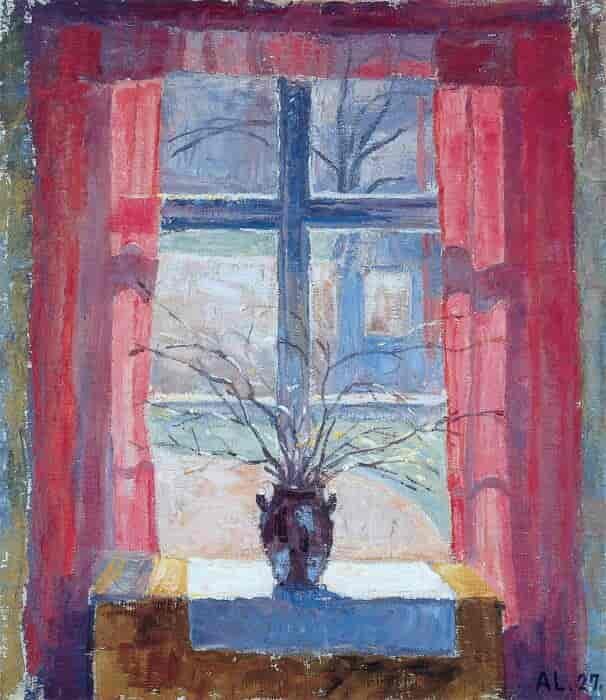
Beach Leaves in the Window, Båxhult by Alhed Larson (1927)

When she was seventeen, Alhed went to Copenhagen and lived with her maternal uncle, the sculptor, Ludvig Brandstrup.  Between 1890 and 1893. In 1893, Alhed worked at the Royal Porcelain Factory with underglaze painting, at the same time as she received drawing lessons from her maternal uncle.  In late 1893 she travelled to Italy with the Brandstrup family and during that long holiday she managed to master the Italian language.  Back home at Erikshåb she formed a close and romantic relationship with Johannes Larsen but her parents were not happy with the prospect of their daughter marrying an impoverished artist.  She finally overcame her parent’s reluctance to have Larson as their son-in-law and in 1898 the couple married and settled in Kerteminde. Three years after the wedding the couple had a new home built on Møllebakken, on the coastal slope on the outskirts of the town.   Alhed decided that she was not satisfied with simply being the wife of an artist and decided that she wanted to become a professional artist as well.

Rhododendrons by Alhed Larson

Alhed Larsen’s artwork primarily depicted flowers, still life, interiors and window views. In 1917, Alhed and Johannes’ house was expanded with a large studio added, spacious enough for each to have their own studio space.

Møllebakken home of Alhed and Johannes Larson

Between 1901 and 1902, the couple built their home on Møllebakken in Kerteminde. Their home became the gathering place in summer months for many painters, particularly younger artists from Zahrtmann’s school.

Landscape with birds by Johannes Larsen (1946)

The Funen painters guiding principle was to encourage plein air painting, not just sketching but painting, notwithstanding the weather. Following this principle led to paintings having a fresh purity and energy which was missing from studio painting. Their works were appreciated by the public and became very popular, so much so that the Symbolist painters of the time attacked their style and in 1907 in the midst of a newspaper debate on Danish art, the Symbolists derogatively called them “farmer painters”.  Instead of being browbeaten by this tirade the artist gained greater recognition.

Birds flying over a landscape by Johannes Larson (1929?)

A turning point for the group came in 1910 when businessman Mads Rasmussen, who operated a successful cooperative canning factory in Faaborg, proposed to help the group by creating a museum next to his canning factory at Møllebakken in Kerteminde. which would promote and exhibit Funish Art. This made it possible for the public to view and buy their paintings which gave the Funen artists financial support. Johannes and Alhed Larsen lived almost their entire lives at Møllebakken.

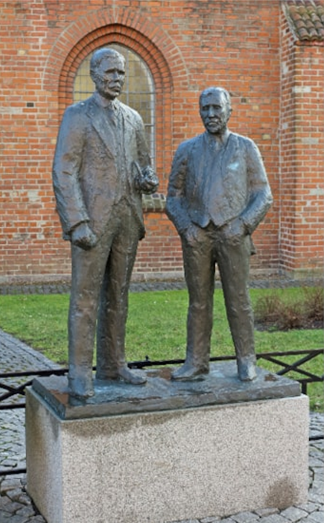
In the autumn of 2006, a sculpture by the city’s two great artists, Johannes Larsen (1867-1961) and Fritz Syberg (1862-1939), was unveiled on Nordre Kirkerist, Kerteminde, next to the parish church, executed by local sculptor Bjørn Nordahl.

Johannes Larsen is looked upon as one of the greatest painters of birds and a knowledgeable pictorial storyteller of nature. His knowledge, his role as a conservationist and his beautiful artwork earned him an honorary membership of the Danish Society for Nature Conservation. At the age of 92, he was named president of the Wildlife Foundation established by the prime minister’s department.
………to be continued.

Anna Richards Brewster. Part 1. 

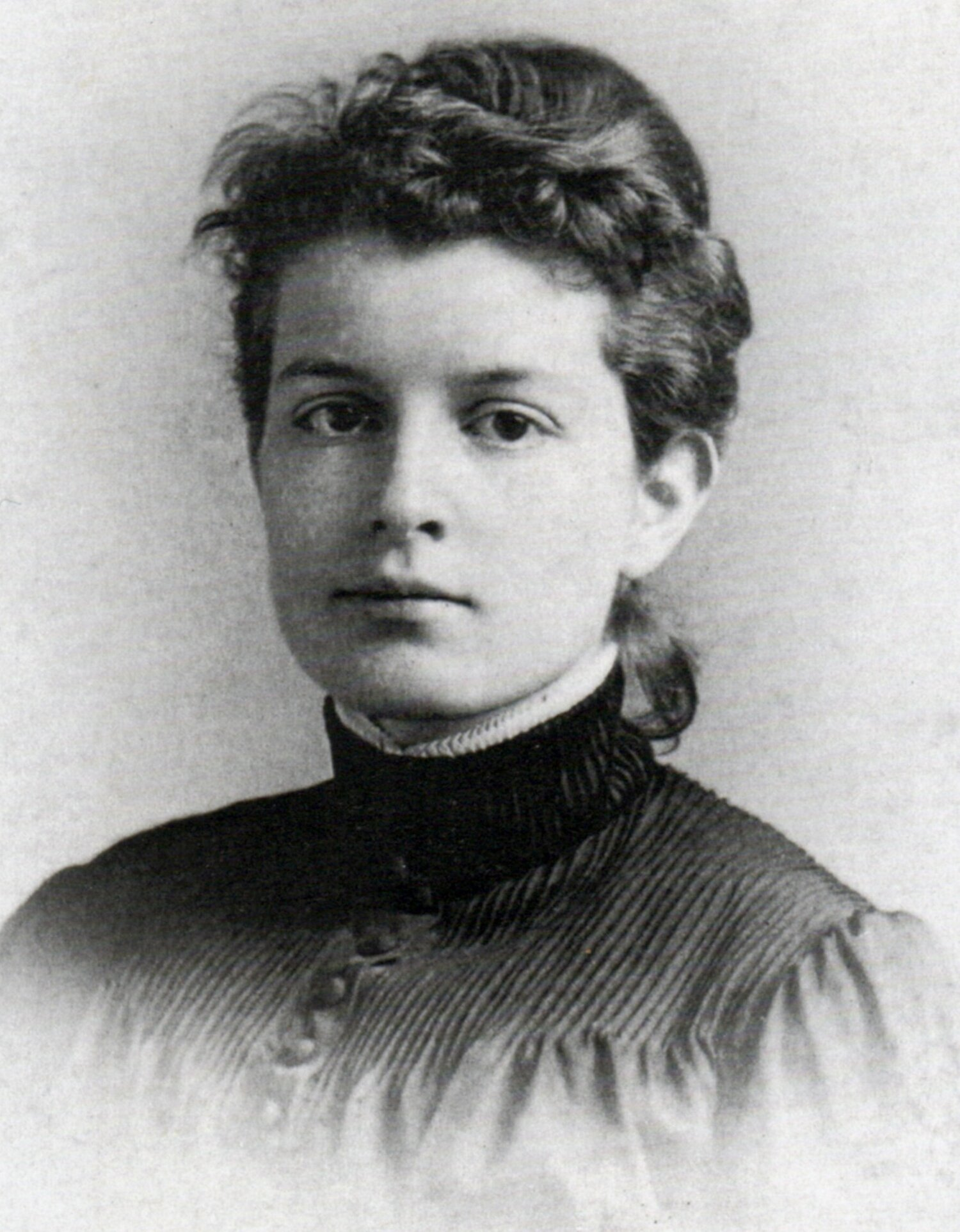
Anna Richards (c.1885)

My featured artist today is Anna Richards Brewster, the much-admired American Impressionist painter who was one of the most successful women artists of her time and yet her name has largely been forgotten. Anna was born in the Germantown neighbourhood of Philadelphia in 1870. She was the sixth of eight children of William and Anna Richards.

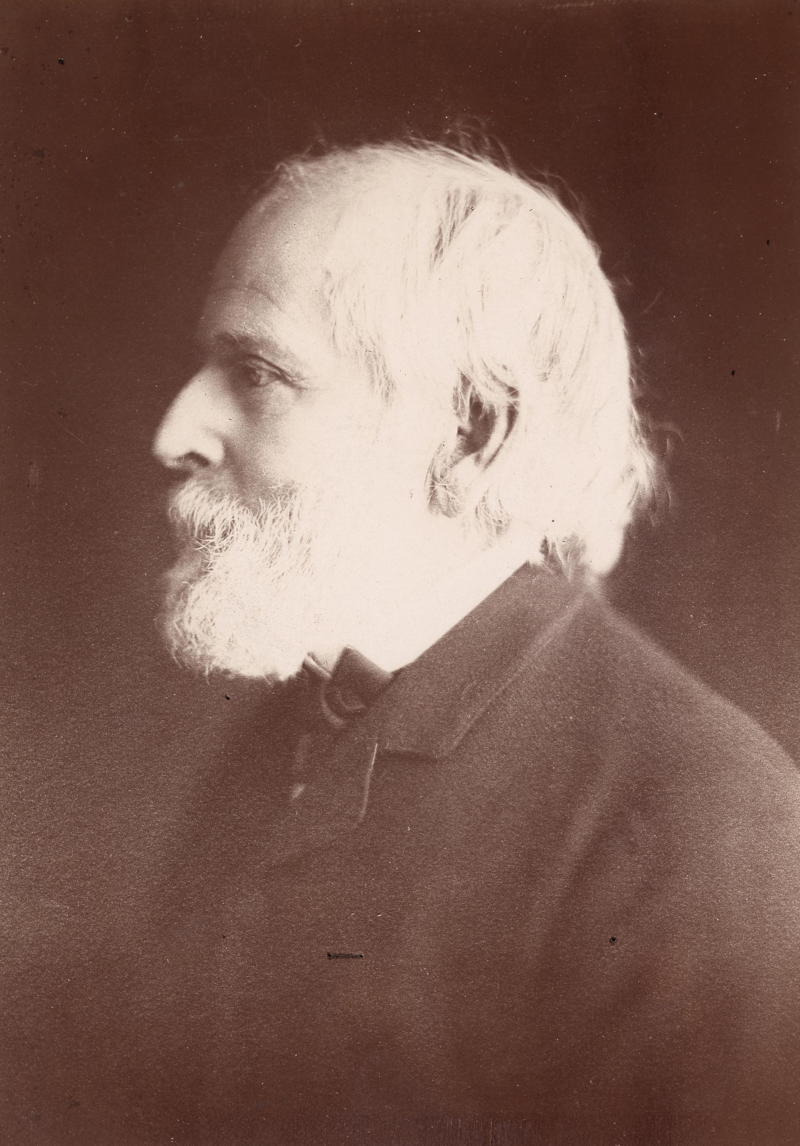
William Trost Richards 

Her father was William Trost Richards, the American landscape artist, who was associated with both the Hudson River School and the American Pre-Raphaelite movement. After living most of his life in Pennsylvania, William Trost Richards rented a summer home in Newport, Rhode Island, and later built a summer home, Gray Cliff, on Conanicut Island in 1881, so as to be closer to the ocean. Richards was recognized by his colleagues as one of America’s foremost marine painters.

A Rocky Coast by William Trost Richards (1877)

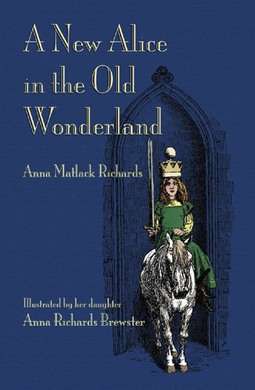
Anna’s mother was Anna Matlack Richards, an intellectual Quaker from a prominent Philadelphia family. She was a children’s author, poet and translator best known for her fantasy novel, A New Alice in the Old Wonderland. Anna Matlack and William Richards married in 1856.

The 2009 edition of Anna Matlack Brewster’s book, A New Alice in the Old Wonderland.

Anna Matlack, as a young woman published fictional works, plays, and poems, including a fictional autobiography by “Mrs. A. M. Richards” with the title Memories of a Grandmother in 1854.  After she married William Trost Richards they spent many years travelling abroad.  In the 1890s, she published comic poems for children in the popular children’s magazines Harper’s Young People and The St. Nicholas Magazine. The success of these comics led her to publish A New Alice in the Old Wonderland in 1895, which featured illustrations by her daughter Anna. It is recognised as one of the more important “Alice imitations”, or novels inspired by Lewis Carroll’s Alice books.

Landscape with a Canal by Anna Richards Brewster (1887)

Anna Matlack Richards educated their children at home to a pre-college level in the arts and sciences and her son-in-law later wrote about his wife and siblings gaining knowledge from their mother’s teachings:

“… Besides the usual subjects, all of them knew something about art, literature and music; each played a musical instrument; and each was encouraged to follow some special interest and to understand and to care for excellence…”

Mentome France by Anna Richards Brewster

Between 1878 and 1880, the family lived in England, mainly in Cornwall and London, and for a short time in Paris, where Anna’s father found subjects for his painting and Anna would often accompany her father during his painting trips. Having returned to America, the family lived in Boston from 1884 to 1888 so that their son, Theodore, was able to attend Harvard University.

Country House near Exeter, England by Anna Richards Brewster

At the age of fourteen Anna exhibited at the National Academy of Design.  Now living with her family in Boston, she studied with Dennis Miller Bunker at the Cowles Art School where he was the chief instructor of figure and cast drawing, artistic anatomy, and composition. In 1888 the school awarded her the first scholarship in Ladies Life classes.

Langdale Pikes by Anna Richards Brewster (1905)

From there, in 1890, Anna left Boston and went to New York to study at the Art Students League for a few months each winter beginning in 1889 and these annual trips continued until early 1894. Here she was tutored by William Merritt Chase, Henry Siddons Mowbray and John La Farge.  In 1889 she won the Dodge Prize, worth $300, awarded by the National Academy for the best picture painted by an American woman of any age. The winning painting was entitled An Interlude to Chopin.

Near Williamstown Ma. by Anna Richards Brewster

Whilst in New York, she rented a room at Mrs. Jacobs’s boarding house, and it was here that one day she met Annie Ware Winsor, who taught at the Brearley School, a private school for girls in New York City. Winsor was five years older than Anna but they became life-long friends and intellectual soulmates. Annie Winsor, through her family’s connections, was able to inroduce Anna to many important and prominent families, such as the Vanderbilts and Schuylers.

Moulin Huet, Guernsey by Anna Richards Brewster

Annie and Anna both became members of the Social Reform Club, an organization for improving the conditions of the poor, and the Louisa May Alcott Literary Circle, where they read books and poetry. This allowed Anna to break away from the insular life of living with her family and the lack of any social interaction when living at home.

Portrait of the Artist’s Father by Anna Richards Brewster

Between 1890 and 1895, Anna once again went to Europe with her father and, like him, she managed to capture what she saw on canvas and in numerous sketch books.  They travelled to various places in England, Ireland, Scotland and the Channel Islands.  She even went to Paris where she studied at the Académie Julian with the French painters, Jean-Joseph Benjamin-Constant and Jean-Paul Laurens.  Whilst at the family home in Boston she would receive private art lessons from LaFarge who was a friend of the family.  She recounted in a letter to her friend Annie Winsor one such session:

“…The whole afternoon I was wrapped in the pleasure of admiration for Mr. LaFarge. Father and I agree that no mortal could have acted with more perfect courtesy, quietness and charm. I am very glad he came, though it wasn’t much of a lesson…”

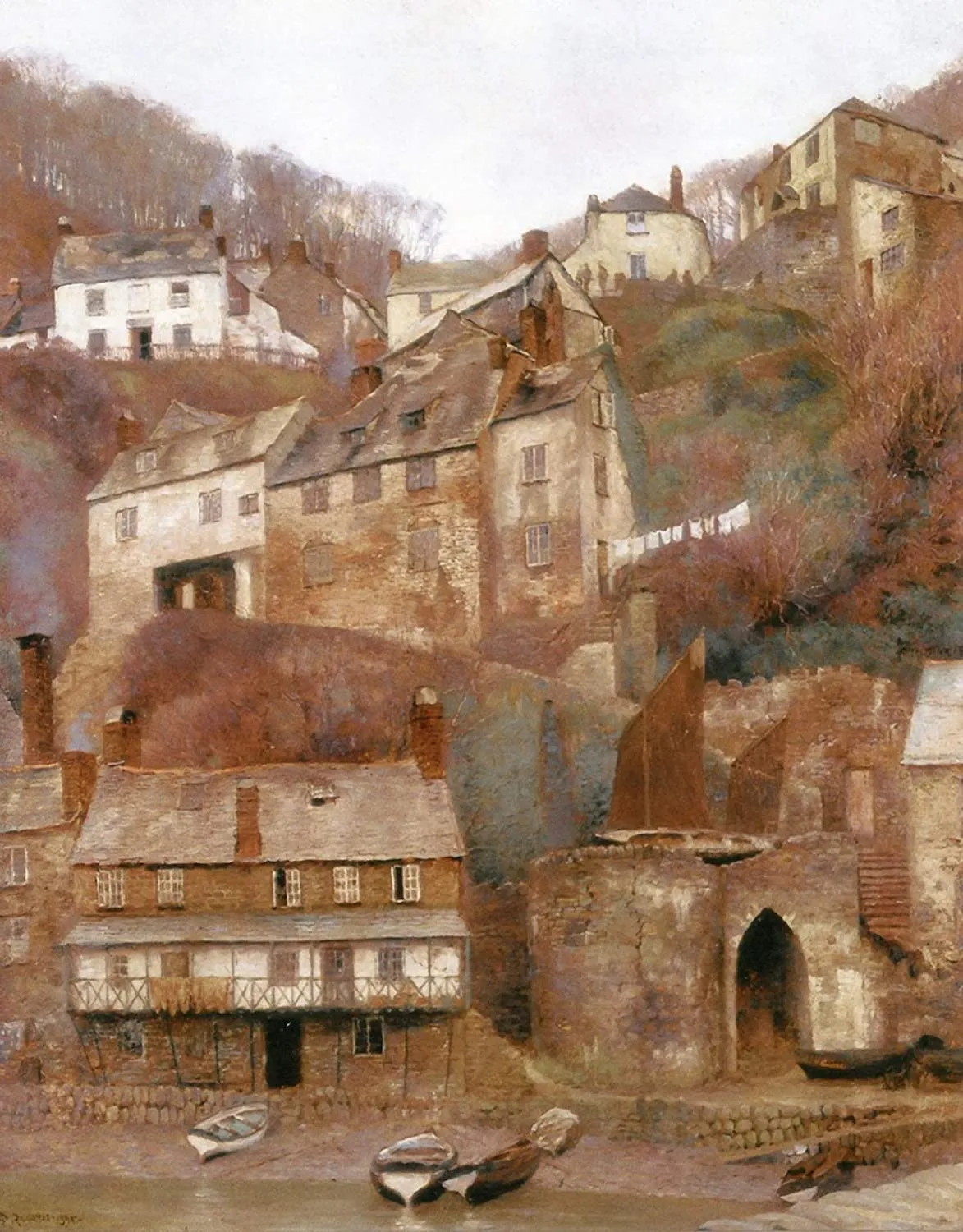
Clovelly by Anna Richards Brewster

Anna was now in her early twenties and both her parents who had been backing her financially began to wonder when she would become a professional painter and earn her own living and they began to pressurise her.   She had always had a difficult relationship with her father and mother.  She was much closer to her father.  Her father had been giving her lessons in art from an early age and had to critique her work which often led to many heated arguments.  Anna would also have heated discussions with her mother who was both a serious scholar and a formidable woman.  Her mother described Anna as “an uneasy household presence” and was tiring of her lack of future plans.  In a letter Anna wrote to her friend Annie Winsor in September 1893 in which she recounted the words of her mother:

“…Mother said that if I was good for anything I should never have a pencil out of my hand, (that I should draw everything, anything) and think of nothing else.  That I ought to read nothing, think nothing, write nothing…..Most people don’t have the physical strength or mental strength to concentrate themselves…….no other thing can attain perfection and perfection is the only thing that exists nothing else counts.  I reject that doctrine but nevertheless it is not without effect but I don’t believe, won’t believe that to be a painter one must be a fanatic…”

Clovelly Village, England by Anna Richards Brewster (1895)

Anna had some exhibiting success during the early 1890s.  She had exhibited and sold four of her paintings at the National Academy of Design in New York and in 1895 she illustrated two books for JD Lippinott, a family friend, who owned his own publication business. A decision was made in 1895 between twenty-five-year-old Anna and her parents.  It was time for her to leave home and make a life for herself as an artist.  She had made a number of trips to England with her father and he believed that it was there that his daughter could make a name for herself and make a living from her art.  It was decided that she should head for the small, picturesque Devon coastal village of Clovelly.

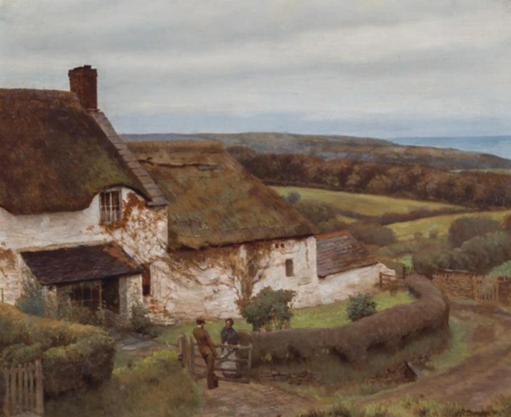
Devonshire Farm House by Anna Richards Brewster

Anna remained in Clovelly for a year and then in 1896 moved to London where she and her parents agreed it would be an ideal place to show and sell her work.  In 1896 she rented a studio and an apartment in Chelsea, where she lived for the next nine years. Whilst living in the English capital she sold a number of her paintings and exhibited four times at the Royal Academy. Thirteen of her paintings featuring life at Clovelly were even exhibited in Baltimore, Maryland.  Her works were also shown at the National Academy of Design and at Knoedler Gallery in New York; and at the Pennsylvania Academy of the Fine Arts in Philadelphia.  In England her work was on show at the Royal Society of Artists, in Birmingham and three times at the Royal Miniature Society.

Battersea Bridge at Twilight by Anna Richards Brewster

On an earlier trip to London, Anna’s parents had become friends with an elderly couple, Mary and Henry Kemp-Welch, who were leading lights in the London art world and Mrs. Kemp-Welch became Anna’s patron and introduced her to many socially prominent families and from these introductions Anna received some portrait commissions.

A Summer Morning in London by Anna Richards Brewster

Anna’s living expenses had been met by her father whose financial situation had been sound due to the sale of his own paintings.  He had also financially helped his other children.  Anna must have been very conscious and somewhat felt guilty, about relying on her  father for money and this is borne out in letter she wrote to her friend, Annie Winsor on August 28th 1900:

“…Money is the one thing I feel I have no control over whatsoever, and whose workings, bearings, laws, and significance I do not understand…”

And in another letter to Annie on November 29th 1900, she wrote:

“…My mind’s much occupied with the question of making money. I must … I shall never get any feeling of self-respect until I can support myself…”

Trafalgar Square London by Anna Richards Brewster

In 1900, Anna’s patron and friend Mrs Kemp Welch, now in old age, had become frail and she was advised by her doctors to leave England during the cold damp winter months and move to a warmer climate.  Anna had a lot to be thankful for the elderly lady’s support and so offered to accompany her to Italy as her chaperone.  She had a lot to do before she could leave London and one can tell the pressure she was under as one notes a letter she sent to Annie Winsor prior to her departure.  She wrote:
“…Next Tuesday, Mrs. K-W (who is far from well) and I start for Italy for her health; and before then I have to rent my flat . . . finish my academy pictures, ditto a portrait, ditto some work for Mr. Holiday [a stained-glass artist], give my five pupils their last lessons…”

Italian Gardens at Mount Vesuvius by Anna Richards Brewster

Anna and Mrs Kemp Welch did get to travel to Italy in December 1900.  That month had been a sad period for Anna as she received news of her mother’s death, aged 66.  It had not been altogether a shock to Anna as her mother had been diagnosed as having breast cancer two years earlier and she was later diagnosed as being terminally ill.  Anna’s mother was adamant that her daughter remained in England and not come back to America.  She had visited her daughter in London in October 1900, two months before her death.  On December 22nd 1900 Anne wrote to her friend Annie Wintor telling her about that last meeting she had with her mother:

“…Yes, it is a great happiness that – just lately, she and I got a restful feeling of mental understanding, more than ever before….I got to say what I had been longing to – that whatever happened I could always feel that now we understand each other, and that all misconceptions were past……She grew so much in those years from the moment when she learned of her mortal malady, and met the knowledge with all the bigness of her soul…. I felt nearer to her than I ever had.  She has grown more human and beautiful to the end…”

……….to be continued.


Some of the information was gleaned from the usual search engines but most came from a 2008 book entitled Anna Richards Brewster, American Impressionist which was a collection of essays edited by Judith Kafka Maxwell with contributions from Wanda Corn, Leigh Culver, Judith Kafka Maxwell, Susan Brewster McClatchy and Kirsten Swinth.

Maritime Art. Part 3.

Having looked at Marine Art with depictions of mighty sailing ships in Part 1., and the plight of fishermen and lifeboatmen battling raging seas in Part 2., this third and final part will concentrate on the tranquillity of the sea and the shoreline A and how people enjoy the elements.

When I was last in Madrid and had spent a few days and many hours in the main Museums of Art, such as the Prado, Thyssen-Bornemisza and the Museo Reina Sofia, I decided to visit the Sorolla Museum, featuring work by the Spanish artist Joaquin Sorolla as well as by members of his family such as his daughter Elena.

Strolling along the Seashore by Joaquin Sorolla (1909)

Sorolla completed a number of beautiful works featuring the serenity of simply walking along a beach.  It is an abnormally large square canvas (200 x 208cms) for a seascape work with life-sized figures.  The two figures are of his wife, Clotilde and his daughter Maria as they walk along the Playa de El Cabanyal beach in their hometown of Valencia.  Both women wear long white sundresses.  There is an air of elegance and sophistication regarding mother and daughter and they appear to be members of the upper class whiling away their time at the beach on a beautiful summer’s day.  Because of our viewpoint we do not see the horizon and the background is the sea with white foam atop the waves.  Sorolla has used many shades of blue to depict the shimmering sea.

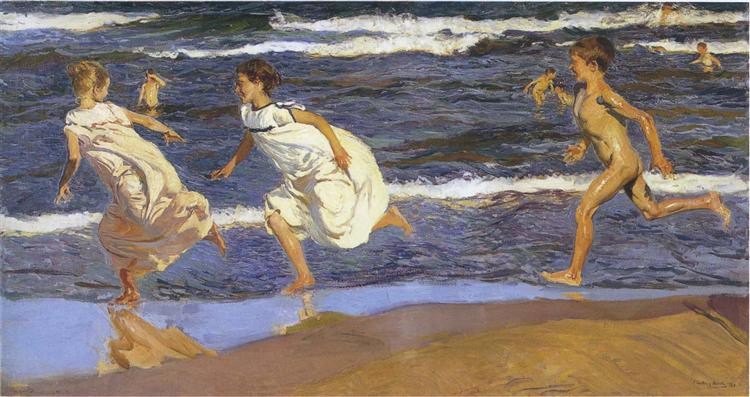
Running Along the Beach, Valencia by Joaquin Sorolla (1908)

Nothing expresses happiness and excitement more than children running along the shoreline without a care in the world. Sorolla’s painting entitled Running Along the Beach captures the energy and movement of the three children as they race along the water’s edge. The city of Valencia and its beaches were Sorolla’s great loves despite the fact that he resided in Madrid.  He spent many hours at the beach painting en plein air capturing the effects of the beautiful Mediterranean sunlight.

Summer’s Day on Skagen’s Southern Beach by Peder Severin Krøyer (1884)

Boys Bathing at Skagen, Summer’s Evening by Peder Severin Krøyer (1899)

From looking at the marine/seascape paintings they produced, life at Skagen in Denmark must have been an idyllic way for the artist colony painters and their families to relax and enjoy their lives.

Summer Evening on Skagen Beach, Portrait of the Artist’s Wife by Peder Severin Krøyer (c.1899)

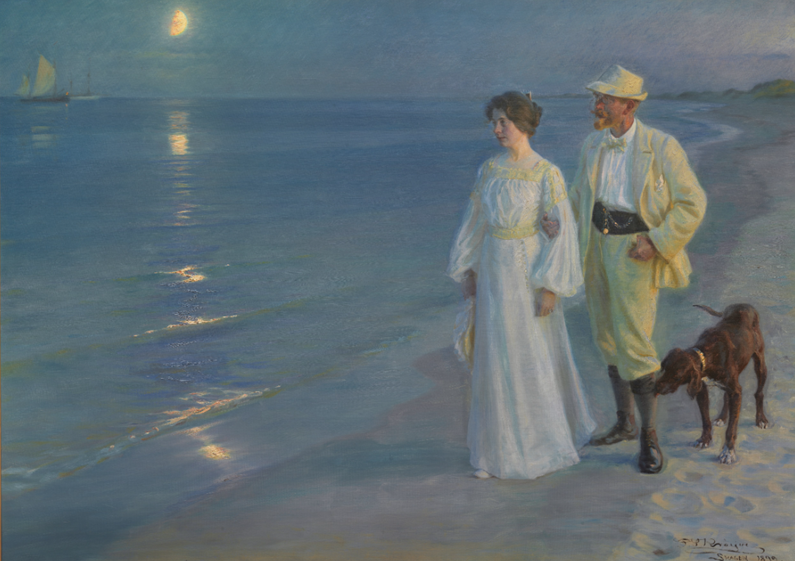
His painting, Summer Evening on Skagen Beach, Portrait of the Artist’s Wife, was part of Peder Severin Krøyer’s iconic, large scale ‘blue period’.  Krøyer arrived in Skagen for the first time in 1882.  Soon he became captivated by the light, the landscape and the simple lifestyle of the local community.   He returned every year during the summer months, whilst spending the rest of the year travelling or in Copenhagen where he had his studio. In the summer of 1889, around the time he completed this painting, he had married Marie Triepeke, a Danish painter, whom he had had met in Paris, shortly after she arrived in the French capital in December 1888. Marie ran into Krøyer at the Café de la Régence, a favourite with the many Danish artists living in the city at the end of the 1880s.  As Krøyer affection for Skagen grew, he began to take more of an interest in the vast expanses of sea, sand and sky.  In the painting the two figures are set into a blue half-light, which was a favourite with the artists of the Symbolist movement.

Anna Ancher and Marie Krøyer going for an Evening Walk along Sønderstrand by Michael Ancher (1897)

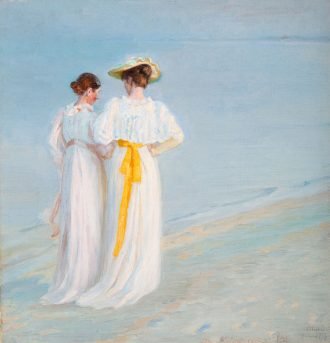
A Stroll on the Bach by Michael Ancher (1896)

Another Skagen painter, who depicted the sea and shoreline was the Dane, Michael Ancher.  He is renowned for his many works of Skagen’s fishermen and their battle with the harsh nature of the seas around Skagen, but he also produced paintings which highlighted the more tranquil side of life in the coastal town. When in the early 1890s Peder Krøyer painted his first blue-toned atmospheric pictures depicting Skagen South beach, Ancher was inspired by these images. In Ancher’s early paintings of Skagen from around the 1880s, the beach is first and foremost a place of work for the fishermen, but in the 1890s, Ancher saw the beach as becoming a promenade for the bourgeoisie, and in this work, this is just what Ancher has depicted. In the painting, A Stroll on the Beach, we see the merchant and counsellor, Lars Holst’s four daughters and a friend: In the front, Ida Holst, on the left, her sister, Anna Holst with her friend Elisabeth Bang, then Minne and on the right, Sophie Holst.

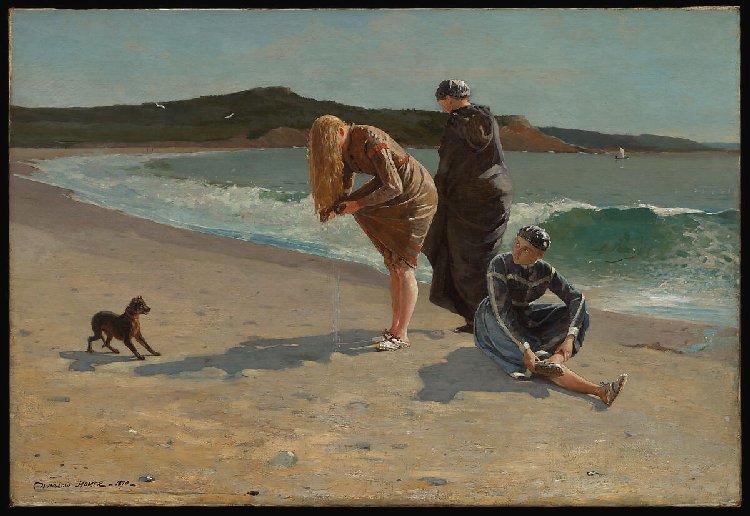
Eagle Head Massachusettes (High Tide} by Wilmslow Homer (1870)

Spending time at the beach can be a way of relaxing and clearing one’s mind of bustling city life.  It can also be a place when one can enjoy solitude and try and rid our minds of things we strive to forget.  This painting, Eagle Head Massachusetts (High Tide} was completed by American artist Wilmslow Homer in 1870.  In 1861 his employer, Harpers, sent him to the front lines of the American Civil War, where he sketched battle scenes and camp life, the quiet moments as well as the chaotic ones.  During his time as an illustrator for the magazine he witnesses the horrors of war and this painting was one of serene tranquillity which Homer had desired after his time at the Front.   After the long war, he turned his focus to lighter scenes and started concentrating on fashionable young women. The High Tide painting is believed to be Homer’s most daring subject.   It depicts three women on the beach having emerged from a swim in the sea.  The woman in the centre rings out her wet hair, startling the small dog which looks on.  The painting received mixed reviews with some focusing on issues of decorum and class, criticizing the women’s state of undress, despite the fact that they are wearing typical bathing costumes of the era.  Another criticised how Homer had depicted the women as “exceedingly red-legged and ungainly”.

At the Seaside by William Merritt Chase (c.1892)

William Merritt Chase was the most important teacher of American artists around the turn of the 20th century.  From 1891 to 1902, Chase served as the director of the Shinnecock Hills Summer School of Art in the town of Southampton, on Long Island, New York. The school and Chase’s stay on Long Island were organised by Mrs. Janet S. Hoyt, a wealthy patron of the arts and an artist who lived in the Shinnecock Hills.  Chase taught two days each week and spent the rest of his time painting and enjoying the company of his family. In his painting, At the Seaside, we see women and children enjoying themselves on the beach, along Shinnecock Bay. It is a depiction of genteel leisure on a perfect day, at a perfect location.   Chase has depicted a broad expanse of sky that fills the upper half of the canvas. We see the rushing clouds cleverly echoing the bright white forms of the children’s dresses and the Japanese-style parasols.

Crowd at the Seashore by William Glackens (1910)

William Glackens, known as an urban realist, favoured the crowded Coney Island beaches of New Jersey to depict the egalitarian throngs that came together there to relax and enjoy the sun and sea.  The mass of figures depicted in his painting Crowd at the Seashore, suggested that the folk from New York and New Jersey who came were of mixed socio-economic backgrounds.  Glackens desire to introduce liveliness into the work was achieved by using a vibrant palette.  To heighten the scene’s energy, Glackens used a vivid palette and vigorous brushstrokes, and he added saturated oranges and blues to conjure up the midday sun’s heat and glare. William Glackens painted many pictures featuring beach scenes which became very popular.

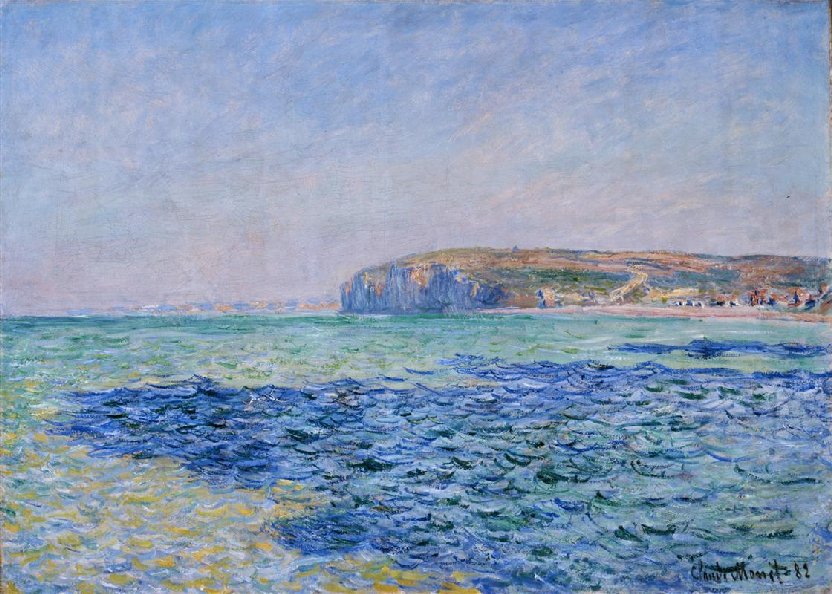
Shadows on the Sea. The Cliffs at Pourville by Monet (1882)

Monet’s painting entitled Shadows on the Sea is an excellent example of Impressionism and we are able to observe the individual brushstrokes of the wave.  Monet has depicted shadows, reflections and movements by a series of short, curved brushstrokes in pure, unmixed pigments.   It is interesting to note how Monet has used pure colours such as yellow and turquoise blue on parts of the wave and placed them next to each other.  Our eyes blend them from a distance and we begin to see green waves. The setting for the work is a hot summer day by the sea, and we note that the strong wind flowing across the water disturbs it, and it becomes a million small, flashing mirrors, which is exactly what Monet had hoped to convey.
Cliff Walk at Pourville by Claude Monet (1882)

The Cliff Walk at Pourville is an 1882 work by Claude Monet and is currently part of the Art Institute of Chicago collection.    Monet had a three-month stay between February and April 1882 at Pourville, a commune in the Seine-Maritime department in the Normandy region in northern France, in 1882.  He fell in love with the coastal town and the surrounding area and wrote to his future wife, Alice Hoschedé, extolling its merits:

“…How beautiful the countryside is becoming, and what joy it would be for me to show you all its delightful nooks and crannies…”

She was impressed by Monet’s enthusiasm and so they returned to Pourville in June that year.  The painting features two ladies on the cliff above the sea who could well be Alice and her daughter Blanche.   Many years later an X-ray of the painting indicated that the artist originally painted a third figure into the grouping, but later removed it. In John House’s 1986 book, Monet: Nature into Art, he talked about Monet’s marine art:

“…His cliff tops rarely show a single sweep of terrain. Instead, there are breaks in space; the eye progresses into depth by a succession of jumps; distance is expressed by planes overlapping each other and by atmospheric rather than linear perspective- by softening the focus and changes of colour…”

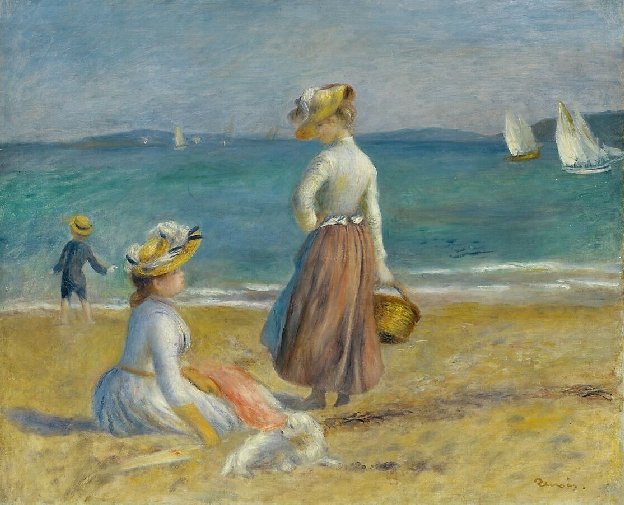
Figures on the Beach by Renoir (1890)

Another seaside scene I like was painted by Auguste Renoir in 1890 and entitled Figures on the Beach.  The setting is thought to have been a beach on the Cote d’Azur in southern France.  It is a sun-filled work in which we see two females at the beach, one shown in profile, sitting whilst holding a parasol on the sand, the other standing with her back to us holding a small wicker hamper.  Besides the two female we also have a small white dog lying in the sand next to the seated woman.  In the mid-ground we see a young boy dressed in blue standing by the water’s edge throwing stones into the sea.

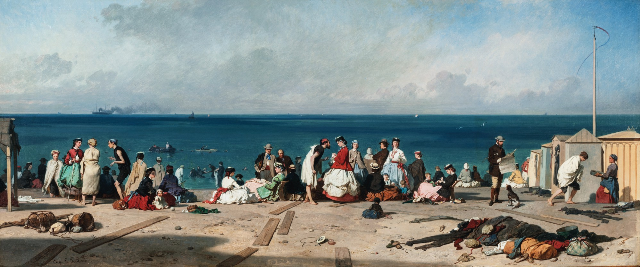
Sea Bathing, the Beach at Étretat by Eugène Lepoittevin, (1864)

Sea Bathing in Étretat by  Eugène Lepoittevin (1866)

My final two offerings featuring marine art and the way people enjoy their time on beaches and in the sea are from the French artist, Eugène Lepoittevin, who achieved an early and lifelong success as a landscape and maritime painter.  In the upper painting entitled Les Bains de Mer, Plage d’Étretat (Sea Bathing, the Beach at Étretat), completed in 1864, we see a large group of people enjoying their day at the seaside.  Of these figures some have been identified.   They include the prominent French author, Guy de Maupassant (in blue cap at left), Charles Landelle, the French portrait artist, (in red cap, centre), and the French illustrator, engraver, Bertall (reading newspaper at right). The painting  which was completed in 1864 was lost and only rediscovered  in the last decade and was sold at Sotheby’s in Paris, in December 2020, for €226,800, a record for a work by Lepoittevin.

Sea Bathing, the Beach at Étretat is also the title of another of Lepoittevin’s works and was completed in 1866.  The setting is the tranquil shores of Étretat, a place for plein air painting favoured by the artist.  It had everything he wanted – pristine beaches and dramatic cliffs with its natural arches carved by the relentless seas.  Add to this people enjoying the good weather and the opportunity to bathe in the clear water and the scene becomes idyllic. 

Maritime Art. Part 1.

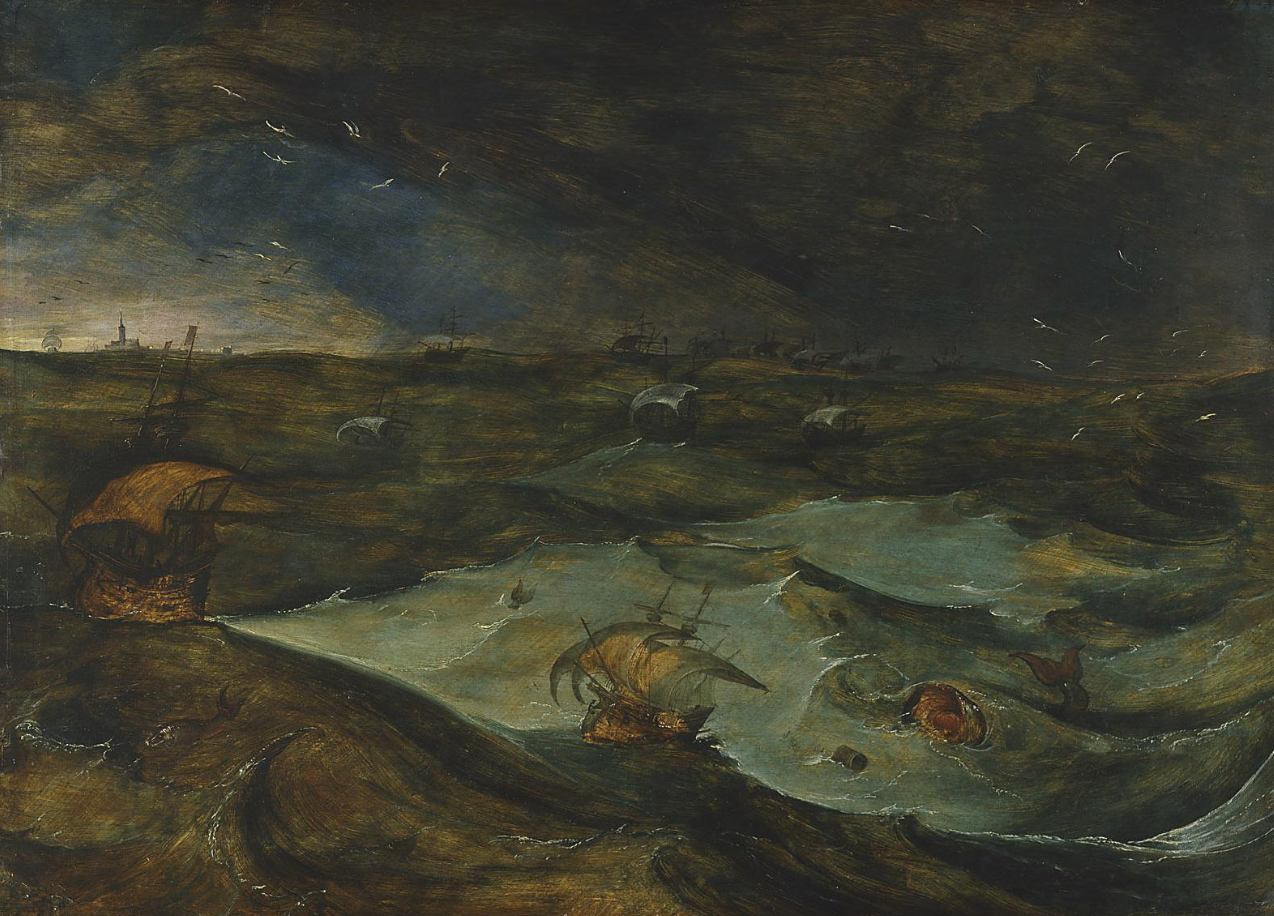
Storm at Sea by Pieter Bruegel the Elder (c.1569)

Maritime painting is an art genre that depicts ships and the sea.  Early examples of this genre were found in Greek vase paintings and the wall paintings of Pompeii.   Storm at Sea is one of earliest specific seascapes and was painted around 1569 by Pieter Bruegel the Elder’s and thought to be one of his last paintings. It is unfinished and, like so many of his works, defies unambiguous interpretation. On the one hand, we see ships threatened by a storm reminding us that man is not master of Nature, in fact man is often its victim. To try and save themselves from the stormy sea the sailors have poured oil onto the water.  They have also sacrificed a barrel from their cargo to distract the mighty whale who is attacking their vessel.

The Battle of Terheide (1657), commemorating the Battle of Scheveningen on 10 August 1653 by Willem van de Velde the Elder.

The greatest marine artists of the 17th century were Willem van de Velde the Elder and his son, Willem van de Velde the Younger.  They were best known for their spectacular depictions of storms at sea, and of nautical life, as well as their painstakingly drawn depictions of ships and naval battles. To commemorate the Dutch naval commander Maerten Harpertsz Tromp, his family commissioned a series of pen paintings of Tromp’s best-known battles from Willem van de Velde the Elder. The artist used pen and ink on canvas for these works, which which bear a resemblance to meticulous, accurate engravings. Van de Velde witnessed the Battle of Terheide in 1653 and he used the sketches that he produced on board as studies for this pen painting.

Men O’ War in Action by Willem van de Velde the Elder

Willem van de Velde the Elder was born in Leiden in 1611.  He was the son of the captain of a merchant vessel, Willem Willemsz van de Velde. When he was young, he would often accompany his father on sea voyages and this probably shaped his career as a marine artist.   Van de Velde married Judith van Leeuwen in Leiden in 1631 and the couple went on to have three children, a daughter, Magdalena, and two sons who would become renowned painters, Willem van de Velde the Younger, a marine artist and Adriaen van de Velde, a landscape painter.

Ships in a Stormy Sea by Willem van de Velde the Younger (c.1672)

The painting entitled Ships in a Stormy Sea by Willem van de Velde the Younger depicts the drama and the excitement of those who braved the seas in the 17th century.  Willie van de Velde the Younger had first-hand knowledge of sailing, and his marine paintings were appreciated for their realistic depictions of ships and sailing tactics. In this work the ship in the foreground is a kaag, a light fishing vessel.  The artist has depicted it as sailing close-hauled in the strong breeze, which is one of the most difficult sailing manoeuvres, in which the vessel sails into the wind as directly as it can without causing the sails to flap uselessly.

States Yacht and other vessels in a very light air by Willem van de Velde the Younger.

Whereas his father specialised in drawings and pen paintings, Van de Velde the Younger was best known for his oil paintings, which depicted life at sea in full colour.  He was born in Amsterdam in 1633 and trained as a painter with the Dutch artist Simon de Vlieger, who was known for his marine paintings, beach scenes, landscapes and genre work.  Unlike his father, Willem de Velde the Younger was a trained artist, unlike his father who was self-taught.  Van de Velde the Younger worked closely with his father and the pair brought their artistic visions to life. Often, he would use his father’s drawings as a guide to create his own masterpieces. The father was a master of detail whereas his son was a master of light.  It was this combination of artistic talents that was to lead to the success of their studio business.

The Home Fleet Saluting the State Barge by Jan van der Capelle (1650)

Shipping in a Calm at Flushing with a States General Yacht Firing a Salute by Jan van de Cappelle (1649)

Jan van de Cappelle was a Dutch Golden Age painter of seascapes and winter landscapes, also notable as an industrialist and art collector. He is now considered the outstanding marine painter of 17th century Holland. Jan van de Cappelle was wealthy and was occupied full-time running his father’s dyeing business. Though he painted some beach scenes and winter landscapes, most of his paintings represent the mouths of wide rivers or quiet inner harbours, where groups of ships at anchor were depicted in glassy calm waters. Many of his marine art works depict full cloud formations which hover over these tranquil waters and are mirrored in colourful reflections, often set in early morning or evening. When he died, aged fifty-three, in 1679, his estate was worth more than 90,000 guilders.

The Ships “Winged Arrow” and “Southern Cross” in Boston Harbour by Fitz Henry Lane (1853)

Fitz Henry Lane was born on December 19, 1804, in Gloucester, Massachusetts. Lane and was christened Nathaniel Rogers Lane three months later and would remain known as such until he was twenty-seven.  In March 1832, Lane requested that his name be changed to Fitz Henry Lane.  The reasons behind Lane’s decision to change his name, and for choosing the name he did, are still very unclear. Lane and his family lived on the outskirts of Gloucester close to the harbour’s working waterfront and so, growing up, Lane had contact with all the elements of maritime life.  Lane’s father, Jonathan Lane was a sailmaker and it was thought that his son would follow him into the business or become a seafarer.  Unfortunately, when only eighteen months of age he became ill and suffered a form of paralysis of the legs.  Growing up he was unable to join his friends in games and became withdrawn and stayed at home where, for amusement, he began to draw.  This developed into an amazing talent and living close to the sea and the harbour he began to sketch the ships and the harbour.

Salem Harbor by Fritz Henry Lane (1853)

For fifteen years, Lane was employed at Pendleton’s Lithography shop in Boston and during those years as a lithographer Lane honed his artistic skills.  He produced many works of marine art and was listed as a marine painter in the 1840 edition of the Boston Almanac.  His works became extremely popular and were in great demand.  Then despite living in Boston, it never prevented him returning on a number of occasions to his birthplace, Gloucester.  Aged forty-eight Lane left Boston and moved back to Gloucester where in 1849 he designed and had constructed his own granite house with seven gables and a studio on Duncan’s Point.  This house would remain his primary residence to the end of his life. Fitz Henry Lane died on August 14th, 1865, aged 60.

Rainbow at Sea with some cruising Ships by Christoffer Wilhelm Eckersberg (1836)

Christoffer Wilhelm Eckersberg, a Dutch painter, was born in Blåkrog in the Duchy of Schleswig on January 2nd 1783.  He was at the forefront of the Golden Age of Danish Painting, a period from 1800 to around 1850 and is often referred to as the “Father of Danish painting”.  After 1821 seascapes had become Eckersberg’s favourite subject.

The Russian Ship of the Line “Asow” and a Frigate at Anchor in the Roads of Elsinore by Christoffer Wilhelm Eckersberg (1828)

Eckersberg’s best loved maritime painting is his 1828 work entitled The Russian Ship of the Line “Asow” and a Frigate at Anchor in the Roads of Elsinore. This majestic work is not a true rendition of the scene but an idealised version as the setting of the scene is not Copenhagen where he had studied Russian ships of the line on two occasions.  We also know from his diaries that he had also studied the ship’s design from technical drawings he had borrowed from the naval dockyard.   However the backdrop is not Copenhagen but Elsinore where we can see Kronborg Castle in the background.  Kronborg is the castle and stronghold in the town of Helsingør, Denmark, which was immortalized as Elsinore in William Shakespeare’s play Hamlet.  The depiction is what the ship, Asow, would have looked like if viewed from a vantage point on the Øresund.

The Corvette Galathea in a Storm in the North Sea by Christoffer Wilhelm Eckersberg (1839)

Although he was known for his portraiture and historical paintings, marine paintings was another genre he developed.  Eckersberg developed a passion for ships, and, at the age of fifty-six, sailed around the Skagerrak, the Kattegat, the North Sea, and as far as the English Channel.  These sailing trips on the open seas brought home to Eckersberg that sea could be quite threatening and whereas many of his early work focused on cam seas, later works often depicted the ferocity of the sea.

If you would like to read more about the art of Christoffer Wilhelm Eckersberg then have a look at the five blogs I did focusing on his life life and paintings.

Northeaster by Wilmslow Homer (1895)

Winslow Homer was an American landscape painter and illustrator and is renowned for his marine subjects.  By many, he is considered one of the leading painters of 19th-century America.  His 1895 painting entitled Northeaster can be found in the collection of the Metropolitan Museum of Art, in New York City.   It depicts a wave crashing aggressively against a rocky Maine shoreline.  Homer loved the East coast of America around Maine and eventually settled down there in 1883, moving from New York to Prouts Neck, Maine where he lived at his family’s estate in the remodelled carriage house seventy-five feet from the ocean.  The title of the painting, Northeaster, does not refer to a location in America, but is a name given to a specific type of wind that occurs within the western North Atlantic Ocean. The painting depicts just a small section of rock seen in the lower left corner whilst, in the background, a spectacular section of sea is seen riding relentlessly towards the shore.

Early Morning, After A Storm At Sea By Winslow Homer (1900-1903)

Whilst living at Prouts Neck, Winslow Homer looked out upon the sea and once commented to a friend that painting was all about timing:

“…You must not paint everything you see. You must wait, and wait patiently until the exceptional, the wonderful effect or aspect comes. Then, if you have sense enough to see it—well . . . that is all there is to that…”

Homer began this seascape in 1900 and based it on a watercolour he had completed in 1883. He was proud of the finished work in oils stating that it was the best picture of the sea that he had painted but was totally dismayed when it was poorly received by the critics.   He just said of this dismissive reception that no one understood the work and besides that, the people never see the early morning effect. They don’t get up early enough.

View of Lac Léman by Gustave Courbet (1874)

Threatening grey clouds move across the sky above the calm Swiss lake but the cloud formation threatens an oncoming storm.  The depiction is set in the evening and on the horizon against the vivid orange and gold of the setting sun we can just barely make out a tiny boat.   Soft red reflections streak the surface of the water.   Courbet had left France in 1873  for political reasons and settled on the shores of Lac Léman in Switzerland where he painted a number of scenes featuring the lake at sunset.

Marine by Gustave Courbet

Four years earlier during the late summer of 1869 Courbet travelled to Étretat, a small fishing village which was famous for its towering coastal cliffs with their rock arches carved out by the relentless sea. Courbet was fascinated by the sea and completed twenty-nine works during his stay at Étretat.  His depictions of the sea would vary from the quiet tranquillity of the calm sea to the violence of crashing waves upon the rocks.  In the above work Courbet shows us the power of the sea with white-capped waves with foam fringes as they approaches us.  The painting has captured the feel of motion and the immense power of the relentless waves.

In Part 2, I will be looking at Marine paintings which feature those who enjoy relaxing by the sea and those whose living is connected with the sea.

Cyril & Renske Mann. Part 5.

― Pablo Neruda, 100 Love Sonnets


In April 1960, four months after Renske met Cyril, he was admitted to the Royal Free Hospital to have an operation on his perforated stomach ulcer. Renske wrote Cyril a letter to say that she was missing him and expressing her love for him. Note that even after being with him since January that year she still addressed him as “Mr Mann”.

Dear Mr Mann

How dreadful that I can’t come to see you tonight. You don’t like the evenings in hospital, do you? Well, I don’t like the evenings in Bevin Court. Why? Because 108 Bevin Court is not complete when you are not here. You are so much my man in body and soul that I simply cannot do without you.

When I am writing to you, and from time to time, I am looking at your paintings, I feel you are so near to me. I love you Mr Mann. I want to tell you over and over again I love you and I pray that i will be your woman for all your life. I realize that I have not much to offer you; no beauty, no money, only my love and I hope one day to prove to you that my love is worth more than beauty or money. You have everything I always wanted: you are an artist, you are my husband, you are my friend, my love, everything. When you leave hospital I will ask for a day off. I will stuff the flat with flowers for you.…..

Cyril and Renske (c.1962)

Life in the 60s was all about Cyril and Renske themselves and they were almost oblivious to what was going on around them. They were aware of their limited finances and spending on food was minimal. Cyril cooked and managed the menus. Renske went out to work. If there was a positive to Cyril’s stomach ulcers it was that they prevented him consuming large amounts of alcohol. Once he had recovered from his stomach operation he was once again able to consume alcohol and sadly, after excessive imbibing his mood would often blacken and change to one of being boorish and confrontational. If this alcohol consumption also coincided with his decision to miss taking his anti-psychotic pills then often hell broke loose.

Allotments with Stormy Sky, Walthamstow by Cyril Mann (1967)

Their small cramped council flat accommodation at 108 Bevin Court was not conducive to painting especially when using large canvases and so, after four years, in 1966, they moved. Renske had always wanted to live in a house and so with great determination and frugality they managed to save enough money for a deposit on a small house at 97 Lynmouth Road in Walthamstow, a town in the London Borough of Waltham Forest, around seven and a half miles (12 km) northeast of Central London. It was a semi-derelict Victorian cottage which cost £2,750.

Cyril and Renske’s home at 97 Lynmouth Road in Walthamstow.

Their savings for the house was boosted by money given to them by Cyril’s long term sponsor, Erica Marx. The house cost £2700 and they had to find a deposit of £700 which was their maximum budget. They struggled to get a mortgage as in those days the income of a wife was not looked upon as viable long-term earnings. However, Cyril was managing to sell his work and had a good credit score and they were finally given a mortgage. Finally, they managed to buy the small house and with it the luxury of having their own small bedroom.  The house came with two bedrooms but the larger second bedroom was designated as one were Cyril could store all his painting paraphernalia.   Renske said that the fact that we could exit the house into the small garden was something she had previously only dreamed about after having to suffer living in the claustrophobic atmosphere of a top-floor flat in Bevin Court.

Gas Cooling Towers

Gas Cooling Towers by Cyril Mann

A new location gave Cyril new opportunities to paint local scenes. Cyril was mesmerised by the massive wooden gas cooling towers which towered above the modern skyline and he would go out in all weather conditions to capture the iconic building.

The Boiling Fowl by Cyril Mann (1963)

One of the first visitors to their Lynmouth Road house was a Canadian actor and TV-game host, Ronan O’Casey and his British actress wife, Louie Ramsey.  They had come to see Cyril’s paintings. He fell in love with Cyril’s semi-abstract rendition of a boiling fowl. Renske recounted how they could not believe their luck when he bought it and the couple took it home with them.  Cyril liked to recount the story about how months later he and Renske were invited to a dinner party in O’Casey’s smart and chic flat in Hampstead. O’Casey pointed to the painting he had bought from them and hilariously announced that he now has Cyril’s cock on his wall.  Renske remembered thinking that it would have been better if O’Casey had purchased one of Cyril’s flower painting !!

Daffodils in a Brown Jug by Cyril Mann (1958)

The problem that arose from the purchase of the Lynmouth Road house in Walthamstow was that it was not quite habitable and so they had to also retain the Bevin Court flat and, so for a time, were paying rent on Bevin Court and a mortgage on the Walthamstow house. Cyril and Renske were given a grant to refurbish their new home and he and one of his ex-students set about renovating the property. They installed a canary-coloured bathroom suite, built units for the kitchen and laid quarry tiles on the floor. Cyril set about the tasks with great gusto and Renske said that her husband’s skills as a carpenter, bricklayer and decorator were amazing. Cyril was a great handyman, like his builder father and grandfather.

Christ Church Spitalfields seen across bombsites from Scrutton St by Cyril Mann

Renske loved her new home as it had a small garden with an apple tree and raspberry canes. To make ends meet, Renske began to work full-time. She had completed twelve months of temping at the advertising agency in their PR department and now became an assistant with a proper permanent job.  More importantly, Cyril began to boost her self-confidence and told her that she could achieve anything she put her mind to. Renske basked in Cyril’s confidence in her and deep down began to believe in herself. Although Dutch, she could write in English and began to put together articles on art which she submitted to art magazines and had them accepted. Soon she was getting paid for her submissions. This was indeed a happy time in Renske’s life. Cyril continued to stay at home and paint whilst Renske went out to work. He always had a meal waiting for her after she returned home from work. 

Sunlit Daffodils in a Blue Jug by Cyril Mann (1966)

On November 5th 1968 Amanda Mann was born.  She was Cyril Mann’s second child but the first born to Renske.  Cyril had been faithful to the promise he made to Renske that he would give her a baby whenever she felt the time was right.  The decision to have the baby was a maternal versus financial one as Renske knew that as the breadwinner it would mean a great financial sacrifice even though their finances had improved.  For Cyril it would also be a sacrifice as he was fifty-seven years old and had already brought up one child, Sylvia. 

Baby Amanda

However once Amanda was born, she was lavished with kindness and love by both her mother and father.  Cyril would walk the streets of Walthamstow and the local market with baby Amanda in her second-hand pram, all the time being admired by the stallholders.  Renske recalled that once when he returned home with Amanda, on lifting her out of her pram, he found a hoard of silver coins which the stallholders had surreptitiously slid under the blankets of the pram.  They later told Cyril that it was lucky to touch a baby’s head with silver.  Cyril could not believe such generosity existed and was moved to tears.   Having just given birth to their baby, Renske had very little bed rest as there was no such thing as maternity leave in those days and so for financial reasons, she had to return to work.

Cyril Mann with his daughter, Amanda.

Although the Walthamstow house was much roomier than Bevin Court it still just had one large bedroom and one small bedroom and Cyril had taken over the larger one for his art studio, leaving him and Renske to sleep in the smaller bedroom while Amanda slept on the landing in her pram.  Renske’s career in PR had rapidly progressed and she was beginning to earn a substantial wage and this upward turn in the family finances meant that late in 1969, Cyril, Renske and one-year-old Amanda moved a few miles down the road from their Walthamstow house and went to live in their newly purchased house in Leyton. 

Trolley Bus, Finsbury Park by Cyril Mann (c.1948)

This new residence at 23 Goldsmith Road, Leyton was a five-bedroom house with a 100ft garden and had all the studio space Cyril could dream of. Cyril would spend hours walking through the nearby Walthamstow Forest.

Walking through the forest

It was coming up to Cyril and Renske’s twentieth anniversary of their first meeting but relations between them had reached an all-time low.  Eventually things between Cyril and Renske got to a point when she could no longer bear the sadness of this total breakdown of their relationship and she knew she had to leave him.  Amanda, who was eleven years old had been safeguarded from this parental breakdown as she was at boarding school in Eastbourne having achieved an open scholarship.

Tubby Isaacs Shellfish Stall by Cyril Mann (c.1955)

One night in early December 1979, after a particularly heated and nasty argument Renske became physically scared of Cyril and made the momentous decision to leave him and, whilst he slept, she slipped out of the house and away, like his first wife, Mary had done some twenty-nine years earlier.  Renske went to stay with friends, who were horrified to see Renske in such a fragile mental and physical state.  She returned to Cyril for a visit just before Christmas but knew she would not remain with him.  She was shocked to see how he had deteriorated both physically and mentally.  At the short meeting she promised Cyril that she would continue to support him financially and that he could see Amanda whenever he wanted, providing his mental state was conducive to such a father/young daughter meeting. He pleaded with Renske to stay with him and was devastated when she refused.

Roses with Books by Cyril Mann (c.1971)

Renske along with Amanda travelled to the Netherlands to see her parents and returned early in the New Year.  On arriving back in London, Renske contacted one of Cyril’s neighbours in Leyton to find out how he was coping.  She was told that he had suffered a second and more serious heart attack and had been rushed to the local Whipps Cross hospital where he had been lying in a week-long coma.  Renske rushed to his bedside but he was still unconscious.  She held his hand as he took his last breath and quietly passed away peacefully, aged 68.  It was January 7th 1980, almost twenty years to the day that the middle-aged English artist met the beautiful young Dutch East Indies woman.

Railway Bridge over the Culvert, Walthamstow by Cyril Mann (c.1967)

I have spent many many hours putting together these five blogs on Cyril and Renske Mann. It has not simply been a look at the many paintings Cyril Mann completed during his lifetime.  It has been a long literary voyage looking at the lives of the middle-aged English painter and the beautiful young woman who remarkably dedicated her life to him.  It was not smooth sailing for either of them and I found myself wondering how they remained together for so long.  Why did Renske put up with a man who on many occasions had treated her badly. How did she manage to live with this middle-aged man who had suffered mentally for most of his life?  What made her fall passionately in love with an irritable, short-tempered impecunious artist who was thirty years her senior?  So many questions. 

Cyril and Renske during a visit to her family in Dordrecht. Her mother, Nina van Slooten on the far left along with an uncle and aunt.

Another question is why did Cyril continually crave recognition for his art and yet abuse those who could have given him such acknowledgement?  One of Cyril Mann’s favourite artists was Vincent van Gogh and he drew parallels with his life with that of the Dutch painter.  Both had great belief in their art, both in a way believed their skill as a painter was at genius level.  Neither received recognition during their lifetimes and both were embittered at their treatment.  As years passed and without the recognition, he believed he deserved, Cyril became unstable, frequently volatile and increasingly disillusioned by the unpardonable mistreatment he received from the artistic world.

Renske, who is alive and well, knows the answers to these conundrums and maybe she lets us into the secrets in her book, Girl in the Green Jumper, which I urge you to read.  What struck me most was the comment she made to Cyril at the start of their relationship that she would make him famous.  She had seen the talent and beauty of this middle-aged man and in a way, she was confident of her ability to mould him into the man she believed would be successful and with such success he would lead a much happier life.  After reading the account of her life, we know that she never quite succeeded in her aim.

Cyril and Renske in the 1960s.

What did Cyril take from his intense relationship with Renske?  I think the answer lies in a letter which Renske found in their house in Leyton shortly after his death.  Cyril had written:

My Dear Love,

I received your letter this morning and was afraid to open it for I was so filled with foreboding, which was justified on reading its contents.  When I saw the word solicitor, I knew my last bit of hope was gone.  I am not going to get upset for it won’t do me any good – harm in fact.

This in a way will be my last letter to you.  I do love you, Renske (oh Sweetheart) and always shall.  You can cease to love but you will never get rid of mine.  In all my pictures the evidence is there and will remain for people to see and realize.  You have been a dear and wonderful wife, giving me all and putting me first always.  I have been aware of it and have never taken it for granted.  Thank you for everything and all the happiness that went with it.  I shall always been grateful.  I am not bitter or angry even though you have truly broken my heart.

Every day I realize more the reason for taking the step you have.  It couldn’t have been easy of you but I now see that it was necessary and that you were really unhappy at home with me and had to take the final step.  So, love, don’t please feel guilty or self-reproachful for there is no need.  In all things I want is for you to be happy and to realize yourself and live fully.  You’ve done your twenty years chores on me.  Now think of yourself.  You’ve earned it.  So I say God Bless, take care of yourself.  Remember my heart and any help you may need is yours to call upon at any time…

There can be no doubt that Renske gained a lot of solace from his last words.  It gave her the will and the courage to live and continually bring his works to the attention of the public. 

Marion Matthews and Renske Mann (September 2022)

Renske, with Cyril’s encouragement, cleared her educational gaps by passing A-levels and then taking an Open University degree. Her PR career blossomed going from strength to strength.  She took on the role of director of Scholl, the international footcare-to-footwear company.  After Cyril’s death, Renske and her current partner, journalist Marion Mathews, converted a derelict dairy in Holland Park into an art gallery. They operated the venture as a charity, and she and Marion ran the Gallery on a charitable basis for 10 years, until 1993.  Their aim was to help unknown, but gifted artists like Cyril so as to reach that first difficult step on the exhibition ladder.  Now aged 84, Renske Mann continues to write articles and give talks on her late husband, Cyril, and his paintings, using skills acquired during her time as a PR executive. Her writings on social media attract thousands of followers and admirers.

Renske, you should be very proud of what you achieved.


It would not have been possible for me to put together all five blogs about the artist, Cyril Mann, without information gleaned from a number of sources:

The comprehensive biography of Cyril Mann, The Sun is God by John Russell Taylor

At the presentation of the Islington People’s Green Plaque in September 2013 : Renske Mann,her daughter Amanda next to her along with (far left) Islington Borough Counsellor Catherine West, elected Labour MP in 2015 and on the far right John Russell Taylor, art critic for The Times, who wrote Cyril’s monograph, The Sun is God.

The intimate autobiography of her and Cyril Mann’s life by his second wife Renske, entitled The Girl in the Green Jumper.

This autobiography has now been turned into a play which receives its World Premiere on Wednesday March 13th 2024 at the Playground Theatre, London, 8 Latimer Rd, London W10 6RQ.

Finally, and most importantly I owe many thanks to Renske Mann herself who provided me with information and photographs appertaining to her and her late husband Cyril.

Piano Nobile Gallery London for information and pictures.

Cyril and Renske Mann. Part 4.

Renske Mann from her book, The Girl in the Green Jumper

Renske was overjoyed by Cyril’s words. Although she didn’t believe his words were utterances of flattery and just simple facts, nevertheless the words made her happy and made her love him even more.

Cyril Mann (1960). Photograph by Edward Hutton.

Throughout his career Cyril painted many portraits, self-portraits and in the 1960s Cyril Mann completed a number of nude depictions using Renske as his model. 

Ecstasy by Cyril Mann (1963)

One such nude portrait, using her as a model, was completed in 1963 and entitled Ecstasy.  Renske remembers the morning he began this work. In her book, The Girl in the Green Jumper, she describes the setting:

“…Cyril mostly painted in the morning.  The minute he drew the curtains he knew when the weather was set to last.  As the sun rose, it cast shadows from the Crittall windows [steel framed windows] across my nude body on our single bed.  He stared at me, grunting and squinting ‘Stay put and take a comfortable pose’ he ordered.  I knew by then that there was no such thing: every pose would turn into agony in time…”

It was not just about her body or pose it was also about the sunlight streaming through the window. It was of the utmost importance to Cyril to capture the dynamic effects of the rays of the sun as they bounced off every surface, from walls on to Renske’s body and back.  He was like a man possessed.  Tables and chairs had to be moved out to make a working space.  He would shuffle around the tight spaces never lifting the gaze from Renske’s body.  She moved to get comfortable on the bed and started to doze off only to be woken abruptly by Cyril who rudely told her “not to go fucking asleep”.  Throughout painting Renske said he would not stop talking, all the while explaining what he was doing.  He was adamant that he had to block in the light areas first as they were more important, not the mid-tones or darks.  Cyril compared Renske to the RA models he had once used saying:

“…Models at the RA haven’t a clue.  They just sit on a chair.  Students have to group around a podium.  If you are in the wrong spot, you’re fucked.  At least you know how to make your body look interesting…”

Cyril had been introduced to the famous English television personality, Denis Norden, who on seeing the painting told Cyril that he should give it the title Ecstasy. Cyril and Renske had hoped that Norden would buy the painting but he didn’t but their mutual friend, Peter Davis, who had introduced Denis Norden to them suggested they just give Norden the painting for nothing as the celebrity owning one of Cyril’s paintings would be added kudos. However Cyril was appalled by the suggestion and simply said ‘to hell with that’.

Modern Venus (c.1963)

One morning Cyril Mann came into the bedroom where is wife, naked, had just risen from bed.. He flings back the curtains and the sunlight streams in, illuminating her. He screamed at her not to move and at the same time drags into the room a large canvas and starts to paint her portrait.  She remembers that her shadow was cast against the wall as she rose from the vey messy jumble of bedclothes strewn on the bed. She is standing facing him with her left arm above her head which in that posture soon becomes numb. She balanced by standing one foot in front. Their blue alarm clock on their round bedside table glistens in the sun. He told her that she was a Modern Venus. Not rising from a seashell but from the sheets and blankets. The painting Modern Venus is complete.

Reclining Nude in Sunlight by Cyril Mann (1962)

In Reclining Nude in Sunlight, Cyril Mann omits detail as he just wants to depict and render light as a dynamic force. He used large hog’s-hair paintbrushes so that he could rapidly cover the canvas, and so focus on the light and how the sunlight fell and reflected on Renske’s nude body as it swiftly crossed their room.

Golden Torso by Cyril Mann (1961)

Golden Torso was completed in 1961 and when the author and art critic John Berger saw it he immediately recommended it for the Granada TV Art Collection which was recognised as probably having the third best corporate collection in Britain. Unfortunately for Berger the painting had already been snapped up by another collector and Berger reluctantly chooses another picture for his sponsor.

Self portrait with Double Nude by Cyril Mann (1965)

Probably the best-known portraits Cyril completed of Renske was The Girl in the Green Jumper, one with her fully clothed.  His self-portrait can be seen in the background, hanging on the wall.

The Girl in the Green Jumper by Cyril Mann (1963)

In the painting, The Girl in the Green Jumper, we see Renske perched on the narrow wooden armrest of their red chair, which she recalled made sitting still very difficult and painful, much to Cyril’s annoyance. She said that posing for Cyril required a good deal of concentration and willpower. The depiction came about when Cyril was admiring the green of her jumper which he commented looked so much more intense, seen against the red upholstery of their newly-purchased G-Plan suite. Renske, like many, queried whether it is a portrait or a study of sunlight blazing on to her through the window, striking her face and bouncing all over the room. She commented to her husband that her hands were just fingerless smears of paint but he replied that that was true abstraction. Abstraction he said was “to leave out” and abstract art is not actually abstract at all and should be better termed as “non-figurative”.

Amanda Mann has followed in her father Cyril Mann’s footsteps and is now also a talented artist. Here Amanda is seen with the painting that inspired her mother Renske Mann’s memoir “The Girl In The Green Jumper: My life with Cyril Mann”.

Cyril Mann, besides the nude depictions of his wife and self-portraits, completed many portraits of his family and friends which highlight what, he as a talented portrait artist, could produce. There is no doubt that he could have been a wealthy portrait painter. Alas he only rarely painted portraits of people outside the family as he said he could not accept portraiture commissions where he was supposed to flatter his sitter, which he believed was often the prerequisite for being given the commission.

Portrait of Sylvia, aged 3, tearfully clutching her doll, by Cyril Mann (1943)

Sylvia, Cyril’s first daughter, would recount on a number of occasion the memory of sitting for her father for the portrait. She said the agony and boredom of sitting still for hours, clutching the doll still haunted her.

Portrait of Sylvia, by Cyril Mann (c.1957)                  Collection Gideon Dewhirst (Sylvia’s son and Cyril’s grandson)

Cyril Mann with his portrait of Sylvia Mann.

It is hard to judge the mood of the sitter. Sylvia was then aged seventeen and it was the time prior to her attending Keele University. It seems she is somewhat lost in her own thoughts. The depiction shows her holding a book, signifying her love of literature. After university she would go on to become a published author, poet and playwright. Sylvia died in 2006.

Amanda, aged 4, with Doll by Cyril Mann (1973)

Cyril and Renske’s four year old daughter, Amanda, was posed sitting on a chair holding her doll. It was a similar depiction to Cyril’s portrait of his first-born daughter, Sylvia, which he completed in 1943, also with a doll.

Portrait of David Hardisty by Cyril Mann (1966)

David Hardisty was a young lawyer working as a patent agent. He had seen and fell in love with one of Cyril’s floral paintings which were on display at the Rawinski Gallery in London. Hardisty, who had recently married, could not afford the £300 price tag. Not to be deterred he went to Bevin Court to ask Cyril if he could buy the painting in fifteen £20 instalments. Cyril agreed and during the following years David bought more of Cyril’s paintings. In the portrait, sunlight once again takes precedence over form in Cyril’s rendering. It plays across David’s features and on his suit, tie and hands. Time must have been at a premium for Cyril as the portrait was completed in only six two-hour sittings.

My Student, Vic Singh by Cyril Mann (1962)

When Renske went to the art class in December 1959 and met Cyril Mann for the frst time, one of his students that evening was Vic Singh. whom Renske remembered as being an extremely handsome young man,. His mother was Austrian and his father was an Indian politician. Singh went on to become a photographer. One day he called around to Bevin Court and Cyril persuaded him to pose for a portrait. He agreed and posed, one foot raised with his elbow resting across his knee while stretching one arm towards the bookcase in order to maintain his balance. He was exhausted by the time Cyril had completed the portrait.

Portrait of Ernest Groome (1971)

In 1960, Renske, like her husband, began to worry about the lack of sales of his paintings and suggested he took some of his work to Hyde Park Corner where many artists hung their work on the railings. Cyril was horrified with this idea saying that serious artists would not dream of hawking their wares in such a way. Renske, however, said that if he wouldn’t do it, she would. She arrived at Hyde Park Corner and found some spaces on the railings where she could hang Cyril’s artwork but she had forgotten to bring string or hooks to complete her task. She was rescued by a young Irishman, Ernest Groome, an aspiring young artist who had been working as a touring pub entertainer. He managed to find hooks and string and he and Renske hung Cyril’s paintings on the railings. 

Cyril first painted Ernest Groome’s portrait in 1961 shortly after the Hyde Park Corner meeting and ten years later completed another portrait of Groome. In this portrait Groome is in Renske and Cyril’s home. The red shade of the standard lamp picks up the colour of his shirt, casting a strong solid shadow against the wall behind him.

Self portrait by Cyril Mann

Cyril left behind many self-portraits which capture his many moods.

Self-Portrait with Hat by Cyril Mann (c.1968)

It is a very worried-looking Cyril Man who stares out at us in his 1968 Self-Portrait with Hat. He seems to have the cares of the world on his shoulders. It is 1968 and Renske is pregnant with her daughter Amanda, Renske, whose job was bringing financial stability to the household, was having to give up her job to have the baby. How were they going to cope? Could Cyril sell more of his work? All of these and many more questions were probably racing around Cyril’s head at the time of the self-portrait.

Self-Portrait with a Brush by Cyril Mann (1966)

The most controversial self-portrait came in 1978 under the title Ecce Homo. Ecce homo, meaning “behold the man” are, according to the Gospel of St John, the Latin words used by Pontius Pilate when he presented a scourged Jesus, bound and crowned with thorns, to a hostile crowd shortly before his Crucifixion. 

Ecce Homo by Cyril Mann (1978)

Ecce Homo was one of last self-portraits painted by Cyril Mann. He died a year later. His state of mind, at the time he painted his own portrait, was unstable but there was also a sense of defiance about this depiction. A sense that he was master of his own destiny. It is in a way a mirror of his great creative energy which throughout his life shone brightly and was never dimmed by his detractors.  Having given up smoking on doctor’s orders he had reverted to that habit and the portrait shows him defiantly holding a cigarette. It was another way of showing that he, and he alone, would make decisions about himself.  His rebellious posture and the title he gave the work was his way of reasoning that he, like Christ, had been persecuted and in a way crucified by art critics and gallery owners. He adamantly believed that the reason he never achieved the success he deserved during his life was due to others and not himself.   In the background, we see flanking him two earlier self-portraits and their positioning symbolises the thieves crucified on either side of Christ.

……. to be continued.


It would not have been possible for me to put together this and following blogs about the artist, Cyril Mann, without information gleaned from a number of sources:

The comprehensive biography of Cyril Mann, The Sun is God by John Russell Taylor

Renske Mann with her book The Girl in the Green Jumper, My life with the artist Cyril Mann

The intimate autobiography of Cyril Mann’s life by his second wife Renske, entitled The Girl in the Green Jumper.

Renske Mann and Natalie Ava Nasr, the lady playing the role of Renske in the play.

Peter Tate who plays Cyril Mann, Christian Holder, director of the play and Natalie Ava Nasr, who plays Renske in the play The Girl in the Green Jumper.

This autobiography has now been turned into a play which receives its World Premiere on Wednesday March 13th at the Playground Theatre, London, 8 Latimer Rd, London W10 6RQ. It runs until March 24th.

Finally, and most importantly I owe many thanks to Renske Mann herself who provided me with information and photographs appertaining to her late husband Cyril.

Piano Nobile Gallery London for information and pictures.

Cyril and Renske Mann. Part 3.

“…The very first moment I beheld him, my heart was irrevocably gone…”

– Jane Austen

Bread and Knife by Cyril Mann (c.1955)

Still Life of Bottle and Jug by Cyril Mann (c.1955)

In the mid-1950s Cyril Mann’s painting style changed and he entered what was known as his solid shadow period.  This was a complete change of style for him in comparison to his earlier works which had concentrated on the effects of direct sunlight and yet light came into play with these “shadow” works. They concentrated on shadows that were seen below objects when viewed under an overhead light source. In 2018 the Piano Nobile Gallery in London put on an exhibition of Cyril Mann’s work entitled The Solid Shadow Paintings.  The gallery wrote about the works on display:

…Undertaken between 1951 and 1957, Mann’s solid shadow paintings were a dazzling interjection in the subdued art world of fifties Britain. This was his most original period and it stands as his lasting contribution to the history of twentieth-century painting.  It is an explosive programme of work, representing ordinary objects with boldly outlined shadows and bright, sometimes luminous colour. A dazzling interjection in the subdued art world of fifties Britain, these works have never been displayed together and the exhibition offers an exciting insight into the artist’s radiant formal language…

After Mary walked out on Cyril in the middle of the night with her their daughter Sylvia, he had to fend for himself.  Fortunately for Cyril, his daughter maintained contact with him and visited him regularly.  Sylvia, who was a year younger than Renske, won a scholarship to the City of London School for Girls . After successfully completed her schooling she left London, aged eighteen, and went to Keele University to read English Literature and French.  Whilst there, Sylvia also took on some temping work to supplement her student grant.  Cyril was very proud of his daughter and what she had achieved although he had to admit they had, at times, a tempestuous relationship and he found her quite difficult at times.  On occasions, it would appear that Sylvia also found her relationship with her father equally problematic.  Renske got to know Sylvia and often said that she was everything she should have loved to have been herself: tall, a head taller than Cyril and Renske, blonde and beautiful. She also had Cyril’s violet-blue eyes and sensitive mouth and in some ways, Renske often felt pangs of jealousy.

Self portrait by Cyril Mann (1956)

Cyril struggled to survive financially as the sale of his paintings were not going well although this could have been more down to his obstinacy and the cantankerous ways he treated dealers and galleries, rather than the quality of his paintings. 

Ma, Just before she died by Cyril Mann

The years 1958 and 1959 proved to be a distressing time for Cyril Mann.  He had been suffering a great deal of pain and was seriously ill with stomach ulcers.  The discomfort had made him stop painting and teaching and the final straw to this misery was the death of his mother whom he had visited whilst she was in a Nottingham nursing home.  He had made a number of facial sketches of his mother in 1959 during her last days. She had outlived her husband, her daughter and two of her three sons.

Cyril and Renske

Things changed for Cyril at the end of 1959 when on the evening of December 18th Renske van Slooten came into his life.  Renske first met Cyril Mann at the Kingsway Day College in Holborn, London, where he was teaching students.  Her “boyfriend” and dancing partner at the time, who knew she was interested in art, took her to meet his former art teacher.  Renske remembers the moment well and, in her book, The Girl in the Green Jumper, she recalls that first sight of the artist:

“…As I stood on tiptoe peering through the window, I could see Cyril with his back to me, slumped at his desk in front of his students with their easels and drawing boards.  His hair, what there was of it was long and unkempt.  He wore a crumpled tweed jacket with leather elbow patches.  He wasn’t tall a bit over five foot at most.  To me, barely out of my teens and recently arrived from Holland, he looked old, at least fifty.  Yet before I’d even seen his face, I felt drawn to him…”

She also distinctly remembered the park warden’s prediction of meeting and marrying an “old” artist. At that first sighting of Cyril in his art class she was totally captivated by him.  Renske says of her first impression of Cyril:

“…A strange feeling came over me. This was it! I remembered the park warden’s prediction. I was mesmerised. I saw his hair was too long, his tweed jacket with leather elbow patches was tatty, he looked worn out, depressed. Didn’t take any notice of me.  I couldn’t care less what he looked like and how scruffy he was. I was attracted to him, not because he was older, but because I’m always attracted to people who are unusually gifted. And I sensed that he was…”

Cyril Mann painting in a small room in Bevin Court

After that first meeting, Cyril and Renske set up a date for the following evening. She was buoyed by the thought of being in the company of a professional artist.  Cyril was almost half an hour late at the rendezvous admitting he had fallen asleep whilst reading a book.  Fortunately for him Renske had waited patiently for him.  Cyril invited her back to his flat to look at some of his artwork.  At this time, he was renting a top-floor flat in a council housing block at Bevin Court in Islington.  Totally captivated by both Cyril and his painting, Renske admits she paid little attention to the flat itself, which was overflowing with his paintings, books and sculptures.  Renske remembers the artwork as being quite small, dark and gloomy and yet she says that they were among the most beautiful she had ever seen.  She told him that some reminded her of works by Turner.  He was delighted at that assertion as he looked upon the English artists as one of his great heroes.

St Paul’s from Bankside by Cyril Mann (c.1952)

One of the paintings which she really liked was his work entitled St Paul’s from Bankside.  It depicted the dome of St Paul’s looming above the rooftops from across the River Thames.  Nowadays at this point on the Thames, the Millenium Bridge spans the river besides the Tate Modern.  Renske said that at first glance at the work, she thought it was a monochrome depiction but on closer inspection she could see that the greys were shot through with blue, yellow and warm pink.  Cyril told her that the city should be viewed on a grey day. He went on to assert:

“…One day people will recognise my qualities as an artist purely on the strength of my ability to perceive greys in their infinite variety…”

It was this assertion that one day he would be acclaimed a great artist that would haunt him all his life as he never felt recognised as a truly great painter.

St Paul’s by Cyril Mann (1948)

It is interesting to compare the 1952 painting with the one he completed in 1948. The latter was painted in his favoured style at the time that of facing the sun and concentrating on the effect of direct sunlight. The view is from Moor Lane which dominates the foreground in which we see four people walking along the pavement, to the side of which is a low wall. A fifth figure crosses the road. Over the other side of the wall is a vast empty space, the result of heavy wartime bombings. In the midground we see multi storey buildings, churches and to the right, the familiar outline of St Paul’s Cathedral.

St Paul’s from Bevin Court by Cyril Mann (1961)

Another of Cyril Mann’s cityscapes featuring St Paul’s cathedral was his painting entitled St Paul’s from Bevin Court. 

A month had passed since their first meeting and Renske and Cyril were happy about how things were progressing.  Renske, however, was not happy with her communal living at the YWCA and told Cyril she needed another place to live.  He made a few suggestions, including sharing a flat with his ex-girlfriend, but Renske came straight out and asked if she could live with Cyril in his flat !   The problem was that Cyril’s home was a one-bed flat and he slept on a single bed in a room that was full of paintings, easels and other artistic paraphernalia. Renske was not put off by this and said that as they were both small, they could both sleep in the bed.  For Renske, it was nothing to be ashamed of, although her work colleagues at the Dutch-owned company, when they were told, were scandalised,  Scandalised that she was living with a man, scandalised that she was living with a married man twenty-eight years older than her and that his daughter, Sylvia, was only a year younger than her, and scandalised that she was living in a poor and rough council estate. 

Renske and Cyril Mann in the mid 1960s

However, Renske was passionately in love with “her” artist and was not going to listen to subtle and not-so-subtle warnings about what she had done.  News of Renske’s situation of living with a married man got back to her boss who contacted the Dutch embassy in London and asked that her parents be informed about their daughter’s living and romantic situation.  Her father and mother were horrified and she was summoned home.  She was still not twenty-one and therefore, by Dutch law, she remained under their control.  Despite their protestations Renske declared that she would marry Cyril with or without their permission.  One can just imagine the thoughts that were going through the parents’ heads having been told that she intended to marry a man who was a year older than Renske’s own mother.  What her parents failed to realise that it was not the older man who was grooming their young daughter, it was their young daughter who was the prime mover in forging this relationship.  Renske returned to London and moved in with Cyril.  She wanted to marry him but could not as he was still married to his first wife, Mary !

Having lived apart for ten years, the marriage between Cyril and his first wife Mary ended in divorce on August 24th 1960 and eight days later, on September 1st, one week after Renske’s twenty-first birthday, Cyril and Renske were married.

Mixed Flowers by Cyril Mann (1961)

Cyril had suffered stomach ulcers for years and had had to endure constant stomach pains after every meal which had weakened him and caused bouts of ill temper.  One day in April 1960, whilst out walking alone, he collapsed in the street and was rushed to the Royal Free Hospital where he underwent an emergency operation for a perforated stomach ulcer.  Following the operation and probably due to the pressures of having to earn a living from his teaching and the need to sell his artwork, both of which he was unable to do due to his physical illness, he suffered a serious mental breakdown.  Renske was upset by Cyril’s physical and mental decline and set about remedying the situation by putting Cyril’s life back on an even keel.  She believed that Cyril was not able to cope with having to teach, which he hated, and paint and so she maintained her job and became the breadwinner.  For Cyril this financial support from Renske liberated him from the drudgery of having to teach and the necessity of providing money to put food on the table.  After release from hospital Cyril went to convalesce at the Artists’ Rest Home in Rickmansworth, a town in south-west Hertfordshire, where he was allocated a comfortable room, painting facilities and three good meals a day.

Studio Corner by Cyril Mann (1961)

His operation had left Cyril pain-free and he went back to his painting with a noted added gusto, but all was not well.  Renske remembers one horrendous evening when a hyped-up Cyril had decided he was going to design, what he termed, “the greatest mural the world had ever seen”.  She had been sleeping badly and was desperate to go to bed but Cyril refused to let her sleep and demanded that she helped him plan this great mural, an extensive paper plan of which had been tacked to the carpeted floor of their bedroom/living room.  He flew into a rage when Renske just wanted to lay down and sleep and demanded she helped him.  It finally got too much for her and she, determined to have an uninterrupted sleep, took some tranquilizers and sleeping pills and collapsed on the bed.  The next thing she remembered was waking up in hospital.  When she had collapsed, Cyril couldn’t shake her awake, and so he called an ambulance. 

Cyril with black eye

The ambulance arrived along with some police. Cyril demanded that he should accompany her to the hospital in the ambulance but they refused him.  He was furious and lost control, attacking both the ambulance staff and the police and for his troubles received a black eye but worse still another ambulance was summoned and after consultation with a psychiatric nurse, he ordered him to be sectioned, taken to a mental unit, placed in a straitjacket, and then taken to a padded cell.  His passport photograph taken days after the incident shows Cyril with a black eye after his altercation with the ambulance men.

Interior with Red Chair by Cyril Mann (c.1961)

After a fortnight’s detention at the psychiatric hospital, Cyril was allowed home, heavily sedated, and having had to promise to take his medication every day.  Cyril was unhappy with the terms of his release as he believed the medication would threaten his libido.  Besides doing that, he asserted that the pills would also affect his creative artistic thoughts and to counteract this he unilaterally began to reduce the amount of medication he had been prescribed.  As often is the case, to raise spirits Renske decided to perform a deep-clean of the flat and buy some new furniture, including a garishly bright red upholstered chairs which Cyril loved and said that the new additions inspired him.

………..to be continued.


It would not have been possible for me to put together this and following blogs about the artist, Cyril Mann, without information gleaned from a number of sources:

The comprehensive biography of Cyril Mann, The Sun is God by John Russell Taylor

Renske Mann with her book The Girl in the Green Jumper, My life with the artist Cyril Mann

The intimate autobiography of Cyril Mann’s life by his second wife Renske, entitled The Girl in the Green Jumper.

This autobiography has now been turned into a play which receives its World Premiere on Wednesday March 13th at the Playground Theatre, London, 8 Latimer Rd, London W10 6RQ.

Finally, and most importantly I owe many thanks to Renske Mann herself who provided me with information and photographs appertaining to her late husband Cyril.

Piano Nobile Gallery London for information and pictures.