The Red Rose Girls. Part 5. The latter years.

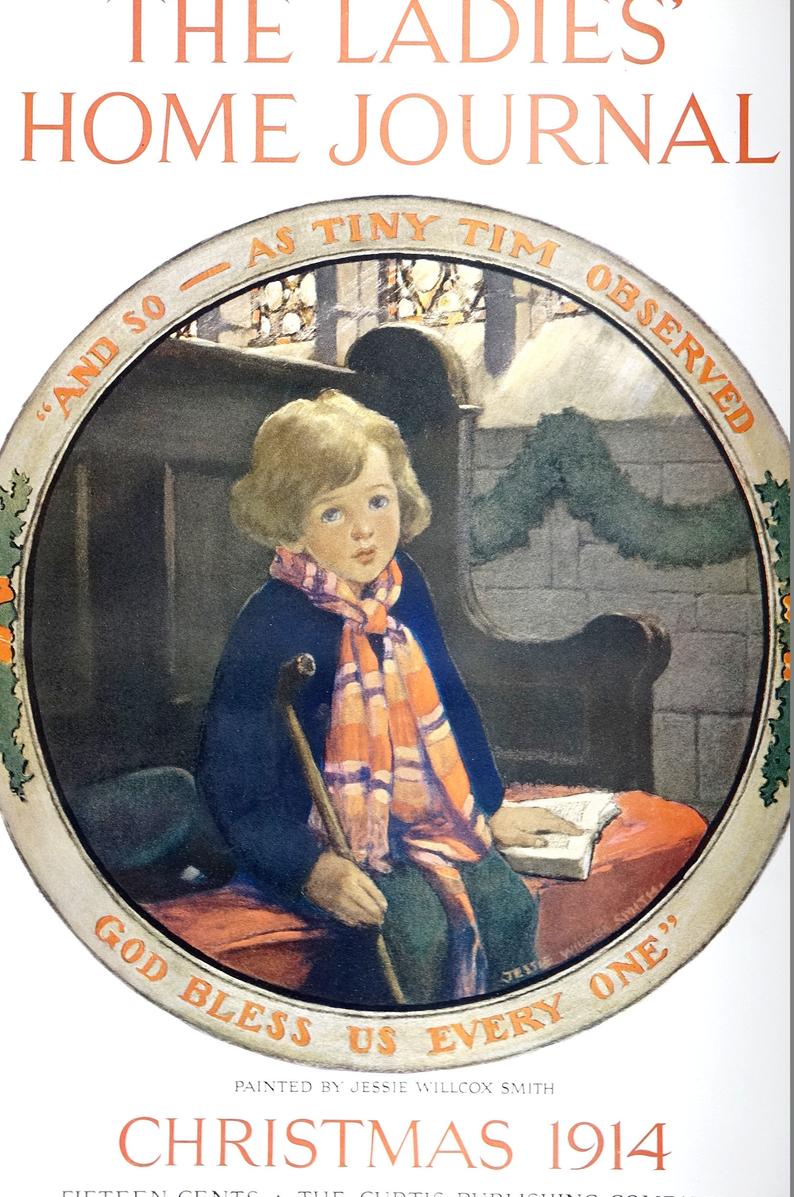
Front cover illustration of The Ladies Home Journal by Jessie Wilcox Smith

Jessie Willcox Smith rented a small studio space at 1334 Chestnut Street, in downtown Philadelphia.  The studio, although cramped and barely room enough for one artist, was in an ideal place for Jessie, as it was close to her job at Ladies Home Journal.

Violet Oakley and her family had returned from their European travels and relocated to Philadelphia to seek medical treatment for her father, Arthur Oakley.  She and her sister Hester rented a studio further down the street at number 1523, in the Love Building.   It was a three-room skylight space on the third floor.   It was a much larger space in comparison that of Jessie’s studio apartment.  The sisters managed to spruce up the space by furnishing it with items lent to them by their mother.  The walls of the studio were covered with prints of paintings by the Old Masters.  Hester Oakley, who was not particularly interested in art was concentrating on her writing and did not need a spacious studio and so vacated the premises, leaving her sister to find new tenants.  Eventually Hester’s place was taken up by Elizabeth Shippen Green, Jessie Willcox Smith, and Jessie Dodd, all fellow students of Violet at the Drexler Institute.

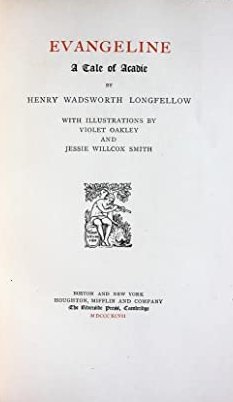
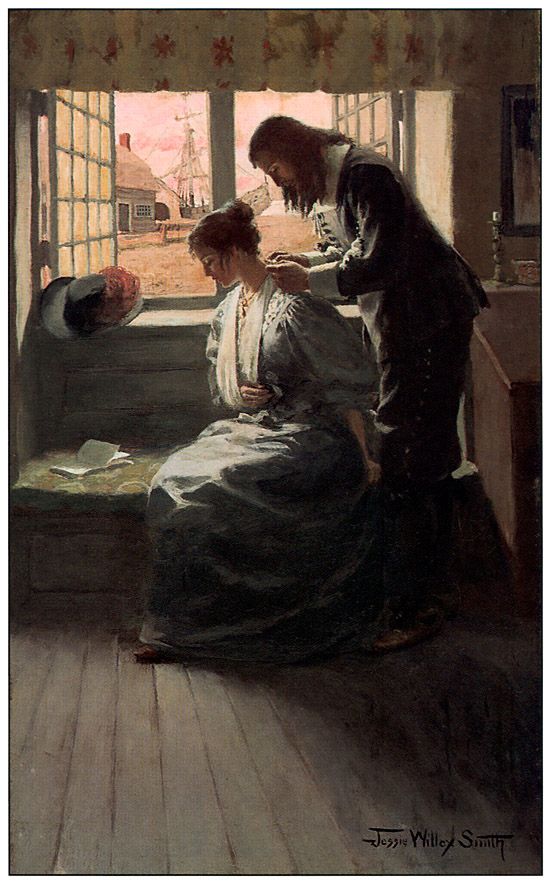
Living together, the ladies soon began working together on commissions.   Jessie Smith and Violet Oakley, with Howard Pyle acting as their mentor, began work on illustrations for a new edition of Evangeline, A Tale of Acadie, an epic poem by the American poet Henry Wadsworth Longfellow, which was first published in 1847.  The epic poem describes the betrothal of a fictional Acadian girl named Evangeline Bellefontaine to her beloved, Gabriel Lajeunesse.  The story tells of how the lovers are separated when the British deported the Acadians from Acadie in the Great Upheaval. The poem then follows Evangeline journey across America as she spends years in a search for him. Finally, Evangeline settles in Philadelphia and, as an old woman, works as a Sister of Mercy among the poor. While tending the dying during an epidemic she finds Gabriel among the sick, and he dies in her arms.  The commission was completed and the book was published in 1897.   Howard Pyle was delighted with the finished illustrations by Jessie and Violet saying:

“…There is a singular delight in beholding the lucid thoughts of a pupil growing into form and colour; the teacher enjoys a singular pleasure in beholding his instruction growing into definite shape.  Nevertheless, I venture to think that the drawings possess both grace and beauty…”

Illustration by Jessie Wilcox Smith for Maud Goodwin’s book The Head of the Hundred.

The illustrations that Smith and Oakley did for the book were a great success and this resulted in a number of new commissions including a commission for Jessie Smith to provide illustrations for a romantic novel, The Head of a Hundred by Maud Wilder Goodwin which was first published in 1897.  Violet Oakley meanwhile provided illustrative covers for The Century magazine and Collier’s Illustrated Weekly

The three women became part of Philadelphia’s vibrant artistic community and became founder members of The Plastic Club.   The art educator Emily Sartain founded the Plastic Club. Its raison d’être was as an arts organization for women to promote collaboration and exhibit members’ works.  It was partly in response to the Philadelphia Sketch Club, which was an exclusively male arts club.

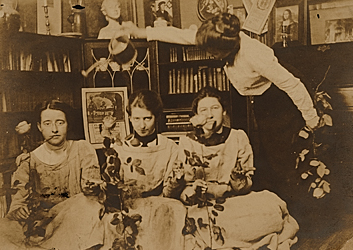
Photograph shows Green, Oakley, and Smith seated, each holding a rose, while Cozens holds a watering can over their heads, pretending to water them. Handwritten identification on verso: The Red Roses; Elizabeth Shippen Green, Violet Oakley, Jessie Willcox Smith, Henrietta Cozens; with Violet Oakley’s poster in the background for first exhibition at the Plastic Club.  Photograph taken at 1523 Chestnut Street, when they planned to move to “The Red Rose”, Villanova.

Jessie Dodd finally left the shared apartment as she was struggling to gain commissions, unlike the other three women.  She became very despondent and in 1899 she gave up artistic career and returned home to Ohio leaving just Violet Oakley, Jessie Wilcox Smith, and Elizabeth Shippen Green living at the Love Building.  The relationship between the three ladies was what was termed a “sympathetic companionship” but in fact was what we would now term a romantic friendship.  There was nothing scandalous about their relationship as in nineteenth century America romantic friendships was deemed a normal part of a woman’s life. The three women were very supportive of each other and shared their triumphs and failures.  There came a time when they had to decide the course their future would take.  Howard Pyle had warned them that combining an artistic career with marriage was not a viable option in an age when a woman was expected to manage a household, function as a hostess and bear children and of course in the minds of Jessie, Violet and Elizabeth, the words of Howard Pyle were sacrosanct.  Jessie Smith was very definite about her views on this subject, saying:

“…A woman’s sphere is as sharply defined as a man’s.  If she elects to be a housewife and mother – that is her sphere and no other.  Circumstances may, but volition should not, lead her from it.  If on the other hand she elects to go into business or the arts, she must sacrifice motherhood in order to fill successfully her chosen sphere…”

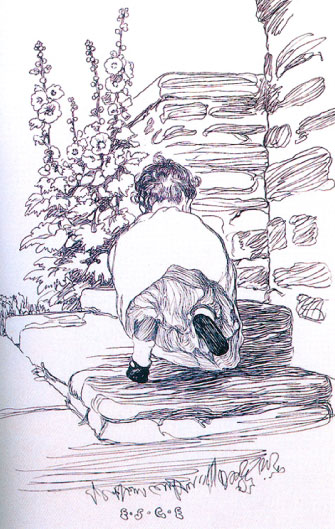
Elizabeth Shippen Green ink on paper illustration, Climbing the Steps.

Jessie Smith and Elizabeth Green were both busy working for The Ladies’ Home Journal and were soon being inundated with commissions resulting in that they could leave their staff jobs and work on a freelance basis.  Elizabeth Shippen Green was submitting a number of pen-and-ink drawings many of which appeared on the covers of the St Nicholas and The Scholar’s Magazine as well as appearing alongside short stories published in Curtis Publishing Company’s Saturday Evening Post.  One of the latter was reproduced in a volume published in London under the title:  The Studio’s 1900-1901 Modern Pen Drawings: European and American.  Her drawings featured in the volume alongside works by the renowned illustrators of the time, Edwin Austin Abbey, Maxwell Parrish, and her teacher Howard Pyle.  The editor, Charles Holme, wrote:

“…Miss Elizabeth Shippen Green though a newcomer, draws with force and has a nice regard for the decorative effect of lines and black masses…”

Madonna and Magi sketch for stained glass panel, by Violet Oakley (1902)

In 1900 Violet Oakley received a commission to paint two murals and create five stained-glass windows and an altarpiece in mosaic for All Angels Church in New York’s Upper West Side. The year 1900 was both a happy and unhappy year for Violet Oakley.  Her sister Heather had married her long-time friend Stanley Ward in 1898 and in 1900 the couple had their first child.  Birth and death are mechanisms of population balance and 1n 1900 Violet’s father Arthur died after a long and debilitating illness.

The three artists remained at their studio on Chestnut Avenue and whilst the winters were tolerable the heat and humidity of New York in the summer months was oppressive so much so that during the summer of 1900 they rented apartments in the Low dormitory on the Bryn Mawr College campus.  Jessie and Elizabeth even won a commission to illustrate the 1901 calendar for the college.

The Red Rose Inn , Villanova, Pennsylvania

In the Autumn of 1900, at the end of their summer stay at Bryn Mawr college, the three friends first visited the Red Rose Inn which was situated in the Philadelphia suburb of Villanova.  The friends had spent many a happy hour leafing through the pages of England Country Life magazines and hankered for a country lifestyle.  Violet Oakley in her handwritten autobiography remembered the time.  She wrote:

“…We became enamoured of the idea of living in the midst of beauty and order of such Gardens as those of England:  of having a country estate; of escaping from work in city studios…”


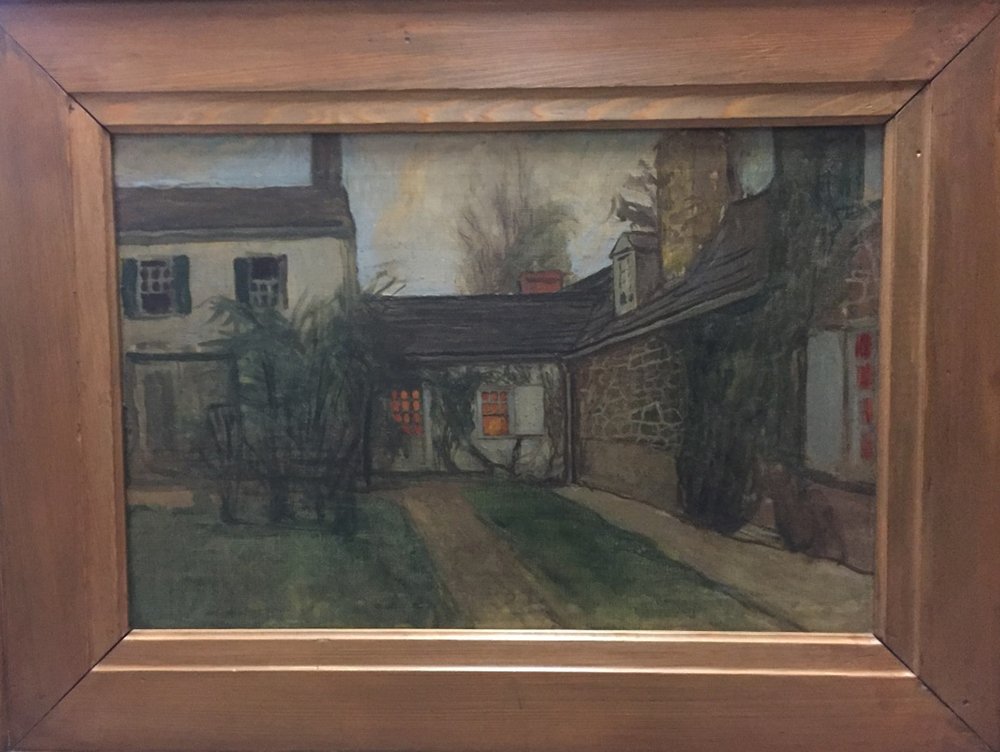
Red Rose Studio

On one of their last days at the college campus they drove out to Villanova to see the Red Rose Inn.  The inn had been in the local news for many years as the owner, Frederick Phillips, was rumoured to be turning it into an artist’s colony and subdivide the eight hundred plus acres into a number of building lots.  Unfortunately for Phillips he was not the sole owner and his co-owning siblings baulked on his expensive plans to renovate and build on the land as were his near neighbours who christened his plans, Phillip’s Whim.  The die was cast when Frederick Phillips died and his siblings wanted to sell the property.  It was eventually sold to the American banker, Anthony J Drexel for $200,000. 

After a lot of legal wrangling the three artists managed to arrange to rent the Inn and, in the Spring of 1901, they gave in their notice terminating the lease on the 1523 Chestnut Street studio and moved out.  They moved into the Inn in the late Spring of 1901 and with them came another female, their friend, forty-three-year-old Henrietta Cozens.  Henrietta, the daughter of a cotton broker, was not an artist but her role was to be responsible for managing the property, overseeing all the domestic chores, and looking after the upkeep of the gardens.  The monthly outgoings for the three artists had suddenly increased from the mere $125 per month they paid to the landlord for their studio in the Love Building to $500 per month for the rent for the Rose Inn and the wages of the servants and cook.  An although the three artists subsidised Henrietta’s share of the costs it was a financially binding situation and one which needed the three artists to remain together and so once again, they vowed to remain together and never marry.  It was this new home of theirs that led to Howard Pyle calling them The Red Rose Girls.

Bryn Mawr College 1902 calendar – illustration by Elizabeth Shippen Green

In February 1902, the three artists were offered their own three-woman show.  It was an exhibition of a variety of their work. It comprised of their book illustrations and Jessie Wilcox Smith’s designs for the Bryn Mawr calendars.   Elizabeth Green showed her illustrations for Harper’s Magazine and the Saturday Evening Post as well as her calendar illustrations.  Violet Oakley’s offerings for the exhibition comprised of two covers she completed for Collier’s Weekly, some charcoal drawings and her designs for the All Angels’ stained-glass windows and chancel decorations.  The exhibition was a great success and was an important step in the careers of the three artists.

The 1914 advert illustrated by  Jessie Willcox Smith for Procter Gamble Ivory Soap.  

At the exhibition Jessie Wilcox Smith submitted thirty of her illustrations some of which were advertisements for Procter & Gamble.

All good things have to come to an end and their time at The Red Rose Inn ended on January 25th 1906 when the three women were served with an eviction notice:

“…Anthony J. Drexel having leased to you the premises in Lower Merion Township, Montgomery County, Pennsylvania, known as the Red Rose Inn, by lease the terms of which expire on May 1st 1906, subject to three months’ notice, and the said Anthony J Drexel and Margarita, his wife, having granted, assigned and conveyed to me the said premises, with the lease, you and each of you are hereby notified and required to quit and deliver up to me possessions of the said premises, which you now hold as tenant under me, at the expiration of the said lease, namely the first day of May A.D. 1906 as I desire to have such possession…

Signed Henry S Kerbaugh…”

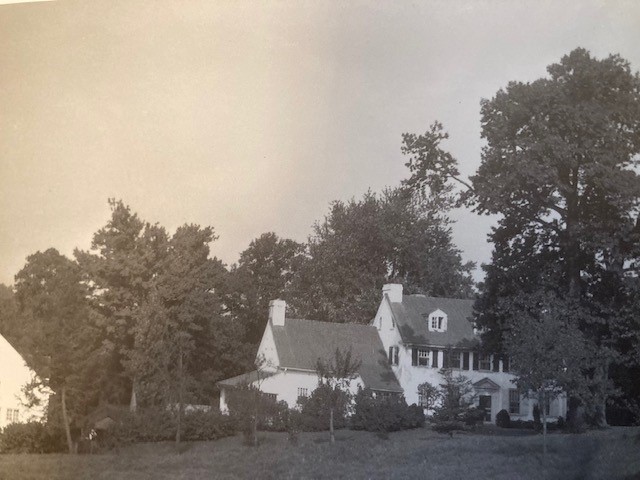
Cogslea, photographed by Elizabeth Shippen Green in 1907

Thanks to the benevolence of Dr. George Woodward, a wealthy relative of Elizabeth Shippen Green, the three artists managed to rent a renovated stone-walled house, adjacent barn, and carriage house at Hill Farm, located on Woodward’s estate at Cresheim Creek in Mt. Airy, some ten miles north of Philadelphia.  The three women named their new home Cogslea (C for Henrietta Cozens, O for Violet Oakley, G for Elizabeth Green and S for Jessie Smith) and “lea” for the sloping land of the new estate.

Photograph of Huger Elliot posing for Elizabeth Shippen Green at Cogslea

In 1909, Elizabeth Green’s mother died and the following March, her father Jasper Green passed away.  More change was to come in 1910.  Elizabeth Shippen Green had built up a friendship for a couple of years with Huger Elliott, a graduate of Columbia University’s school of architecture and the Ecole des Beaux Arts in Paris.  He was looking for more than just a friendship with Elizabeth, albeit the couple had become engaged, but Elizabeth was hesitant about their future considering she had, along with her two friends, “signed a pledge” to keep men out of their lives and just live for their art.  In October 1910, Huger Elliot visited Elizabeth at Cogslea and gave her an ultimatum – marry me now or break off the engagement!  One can only imagine the state of Elizabeth’s mind at this turn of events.   She had to try and think rationally.  She was now thirty-nine years of age and been with her friends for thirteen years and a decision to marry Elliot would violate their “agreement”.  On the other hand, she knew her friends were financially secure and had been given numerous commissions.  She also realised that the dynamics of the household were changing.  Jessie Smith and Henrietta Cozens, who were close in age, were becoming inseparable and both had a quiet temperament and an unbending sense of decorum which was polar opposite to Elizabeth’s exuberance.  Her other friend and housemate, Violet Oakley, was engrossed in her religion and impassioned about her dream of a utopian society and her aspiration to elevate the morals of the country though her art.  Maybe the deciding factor was that Elizabeth more than just liked Huger.  She made the decision to marry Huger Elliot and leave Cogslea and her friends.  Violet, Jessie, and Henrietta were stunned by her decision., Henrietta Cozens declared:

“…How can she love anyone more than she loves us?…”

Elizabeth Shippen Green and Huger Elliot on their honeymoon in Germany  in 1911

The die was cast and On June 3rd 1911 Elizabeth Shippen Green married Huger Elliott at Cogslea.   The couple left Cogslea that evening and went to stay in Philadelphia prior to their honeymoon in Germany.  Unfortunately for Elizabeth being in Philadelphia she saw the front page of the June 4th edition of the Philadelphia Press which announced:

“…Trio of Artist Friends Broken by Cupid…”

which went on to state:

“…a note of sadness was felt when the realization came that the trio of artists who had lived and worked together so long would be depleted by the absence of Mrs Elliott…”

 The Chestnut Hill Herald was even more sensational in its coverage stating that a heartbroken Violet Oakley broke down completely whilst trying to change Elizabeth’s mind.     After their honeymoon, Elizabeth and her husband Huger settled in Cambridge Massachusetts.  From 1912 to 1920 Huger was supervisor of educational work and director of the department of design at the Boston Museum of Fine Arts. For the next five years, he served as president of the Pennsylvania Museum and School of Industrial Art in Philadelphia. He was the Director of educational work in the Metropolitan Museum of Art in New Nork from 1925 to 1941, when he retired.  It was not until two years later, in July 1913, that Elizabeth was reunited with Violet, Jessie and Henrietta when she and her husband returned to Cogslea for a visit. 

Violet Oakley was desperate to have a much larger studio to accomodate her massive murals and so she decided to buy Cogslea for herself and to achieve that she had to sell all her assets.  Jessie Wilcox and Henrietta Cozens moved out of Cogslea, bought a quarter of the estate land, and built a house on it for themselves.  The Red Rose Girls had finally been separated.

Jessie Wilcox Smith died on May 3rd 1935, aged 71.

Elizabeth Shippen Green Elliott died on May 29th 1954, aged 82.  Her husband Huger had died of a heart attack on November 13th 1948, aged 71.

Violet Oakley was the last of the Red Rose Girls to die.  She passed away on February 25th 1961, aged 86.


The Red Rose Girls. Part 4. Howard Pyle.

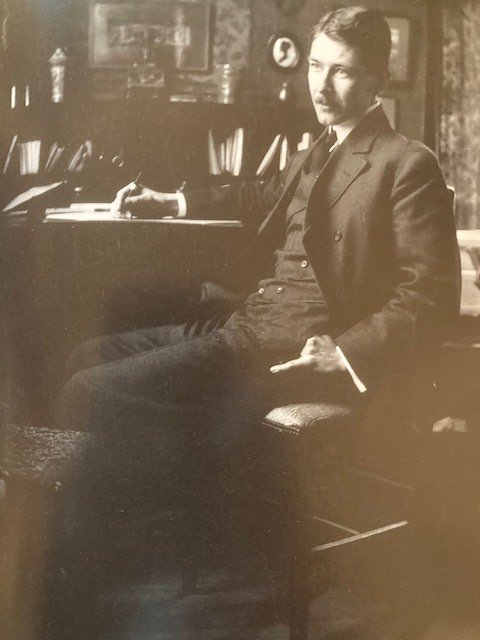
Howard Pyle

The story of The Rose Girls could not be told without talking about the American illustrator and author, primarily of books for young people, Howard Pyle, who gave the The Rose Girls soubriquet to the three young ladies he was mentoring.  He was a man of great talent and a patriotic missionary of Americanism and his illustrations were held in high esteem on both sides of the Atlantic..

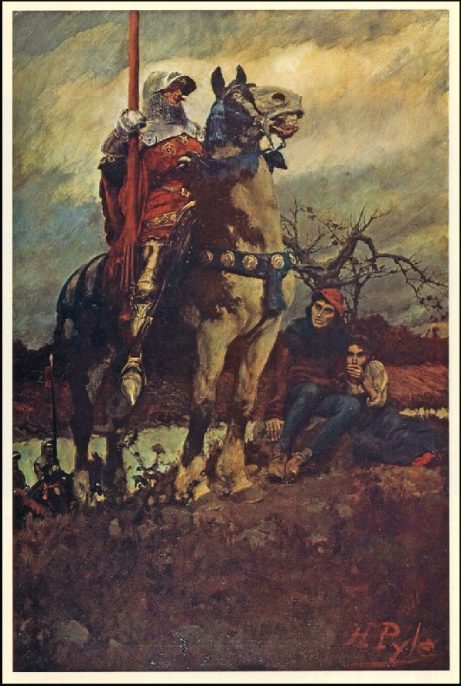
The Coming of Lancaster by Howard Pyle (1908).  Illustration from The Scabbard by James Branch Cabell, and illustrated by Howard Pyle which appeared in Harper’s Monthly Magazine, May 1908 and is a fictional retelling of the story of King Richard II of England, who was deposed by his cousin Henry who belonged to the Lancaster branch of British royalty

Howard Pyle was born in Wilmington, Delaware on March 5th 1853.   He was the son and eldest child of Quakers, William Pyle and Margaret Churchman Painter, an amateur artist.  Pyle remembered his childhood, with fondness, as being an idyllic time that was centred around the family’s wonderful old stone house and its garden, which he remembered as being filled with profuse blooms and hidden wonders. Mainly thanks to his mother, Pyle developed a love of reading and like many children of his age he loved the tales of Daniel Defoe’s,such as Robinson Crusoe, the Grimm’s Fairy Tales, and mystical stories from the Arabian Nights. all of which fired up his young imagination. He attended the Friend’s School in Wilmington followed by schooling at a small private institution. He was not a top student, and it was said that he wasted too much time daydreaming. His one love was art and he spent much of his free time drawing.  He also developed a love of writing his own stories.   Although it was the wish of Pyle’s parents that their son should attend college, Howard Pyle had other ideas about his future, which he saw as being a professional artist or writer.  Knowing that their son was never going to go to university his parents, especially his mother, decided to encourage him to study art.

The Mermaid by Howard Pyle (1910)

He studied for three years at the studio of Francis Van der Wielen in Philadelphia.  Van der Wielen was a Dutch artist who in 1872 had taught sixteen-year-old Cecilia Beaux.  Besides a few art lessons later at the Art Students League of New York, these three years tutoring by van der Wielen were Howard Pyle’s only formal training. Because of problems with his father’s leather business, Howard Pyle had to spend many years helping out in the family business. The artistic breakthrough for Howard Pyle came in 1876 when his mother sent an essay and sketches he had done while on holiday with his father on Chincoteague Island to Scribner’s Magazine.  The editor accepted the article and illustrations and told Pyle they were so good that they were being published in the November issue of the magazine.  Furthermore, the editor invited Howard Pyle to come to New York and work for the magazine as a writer and illustrator.

A Wolf Had Not Been Seen at Salem for Thirty Years by Howard Pyle.  Illustration for “The Salem Wolf”  a short story written and illustrated by Howard Pyle for Harper’s Monthly magazine, December 1909.  

Howard Pyle was now living in New York city in a small rented room at 250 West 38th Street (between Seventh and Eighth Avenues) and it was not long before he sold his first painting to Harpers Weekly, a magazine that would continue to buy his work for many years in the future. The publisher of Harper’s Weekly had assembled an exceptional group of professionals who were knowledgeable about illustration and trained in the newest methods of printing, and the House of Harper became an informal training ground for the likes of Howard Pyle to learn every aspect of the publishing process.  It was soon after settling in New York that Howard Pyle knew that he wanted to write and illustrate books for children. Pyle had both a wonderful imagination and he also was able to recollect stories from his childhood.  He set about putting those memories on paper and at the same time illustrated his prose.  He submitted many of his stories and illustrations to the St Nicholas magazine, a popular monthly American children’s magazine, founded by Scribner’s in 1873.    

An Attack on a Galleon, a 1905 illustration for the story, The Fate of a Treasure Town by Howard Pyle which appeared in the December edition of Harper’s Monthly magazine.

He drew upon his vivid childhood memories to contribute stories to the St. Nicholas magazine, and he read and studied many of the old folktales that he’d loved as a child, extending his reading to include less familiar tales from many nations. These folktales and the romances of his boyhood would become the central core of his work over his lifetime; and although he is primarily remembered today for his contributions to illustration, he was a writer of some skill. Indeed, he has been compared to Hans Christian Andersen in the way his unique voice and imagination shaped his traditional folklore and fantasy material.

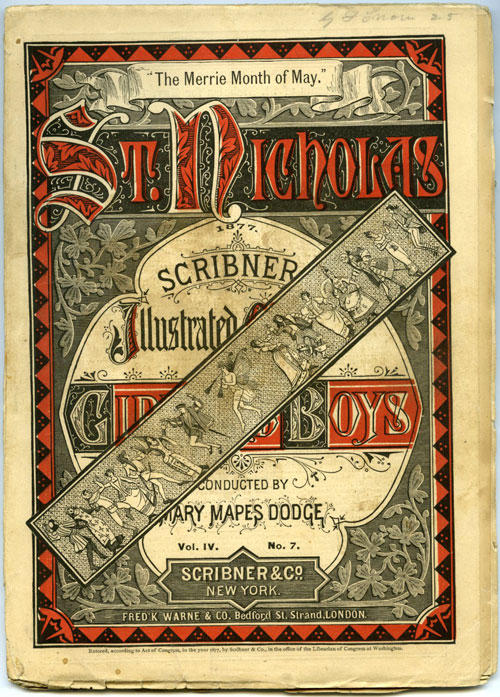
St Nicholas magazine cover. May 1875

According to Ian Schoenherr’s blog on Howard Pyle, one of the first magazine covers to feature an illustration by Howard Pyle is the May 1877 cover of St. Nicholas, Scribner’s Illustrated Magazine for Girls & Boys.  Pyle actually only designed the long rectangular illustration which runs diagonally across the cover.  In the magazine the publisher explained the illustration:

“…The beautiful tablet by Mr. Pyle, which adorns our cover this month, tells a true story in its own lively fashion. Its quaint costumes of successive centuries, showing how May-day rejoicings have been kept up from age to age, will send some of you a-Maying in encyclopedias and year-books, but it gives its real meaning at a glance – which is, that through all time people have welcomed the first coming of the spring. “Merrie May,” meaning pleasant May (for in old times “merry” simply meant pleasant), was as fresh and beautiful ages ago as it is to-day; and in one way or another the thought at the bottom of all the rejoicing is ever that of the old carol:


“A garland gay I’ve brought you here,

And at your door I stand;

It’s but a sprout, but it’s well budded out.

The work of our Lord’s hand.”

Howard Pyle remained in New York until 1879 at which time he returned home to Wilmington, by which time he had established a reputation as a leading writer and illustrator of children’s books. 

The Merry Adventures of Robin Hood of Great Renown in Nottinghamshire, published in 1883, is thought to have been Pyle’s first children’s book.  He wrote, illustrated and designed the book himself.  In all, he went on to do many more books for this audience including Pepper and Salt, The Wonder Clock and four volumes of the Legends of King Arthur

He completed Legend and Stories of King Arthur in 1903.  The book contains a compilation of various stories, adapted by Pyle, regarding the legendary King Arthur of Britain and select Knights of the Round Table. Pyle’s novel begins with King Arthur in his youth and continues through numerous tales of bravery, romance, battle, and knighthood.
The 1902 illustration by Howard Pyle “There is a time to fight, and that time has now come” for The Story of a Great-Grandfather by George Hibbard which appeared in Scribner’s Magazine January 1903

Howard Pyle believed that book illustration was the fundamental basis from which to produce painters.  His ideas with regards illustration were revolutionary and at odds with many of the beliefs of the day. Pyle was adamant that artists needed, to get beyond the stiff figures of the studio life class and let their figures and scenes come from the imagination rather than from a frozen pose.

For Pyle, the overall design of the book was of paramount importance and he helped his students learn how to incorporate their illustrations into the finished article. Pyle made it clear to his students that the role of the illustrator was to compliment and enhance the text in personal ways rather than merely mimic what the text expressed. Through his many books and his teaching, the influence of Howard Pyle on children’s literature is acknowledged by readers and artists to this day.

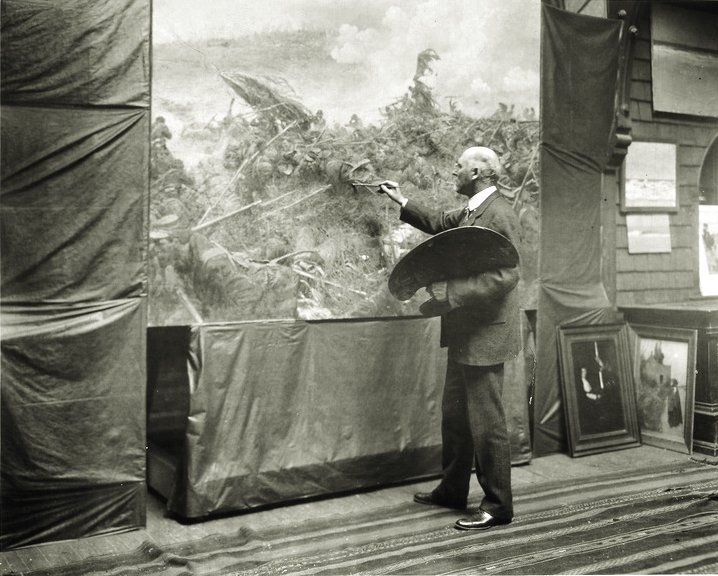
Howard Pyle working on mural depicting Battle of Nashville in his Franklin Street studio (c.1905).

Pyle decided to do something about giving art students a firmer foundation in illustrative art by offering his services to the Pennsylvania Academy of Fine Art as their Instructor of Illustration.  His offer was politely refused and he was told that the Academy school was for painters and sculptors and was a school for the fine arts only.  Pyle, having been rebuffed by the Academy, was not to be deterred and made  the  same  offer  to  the  Drexel  Institute.  His offer was promptly  accepted  and within  a short  time there  began  to appear  in the magazines new names of illustrators who had been students of Pyle.  Sensing that the Drexel Institute was the better option when it came to illustrative art, many of the Pennsylvania Academy students left and enrolled at the Drexel Institute.  The director of the Pennsylvania Academy, Harrison Morris, realised he had been wrong to rebuff Pyle’s offer, and asked him to come and teach at the Academy and name his own salary.  Pyle’s short reply was to the point:

“…He who will not when he may, when he will, he shall have nay…”

Howard Pyle commenced teaching at the Drexler Institute in October 1894. The catalogue of the Department of Fine and Applied Arts (1894-1895) announced:

“…A Course in Practical Illustration in Black and White, under the direction of Mr. Pyle.  The course will begin with a series of lectures illustrated before the class by Mr. Pyle. The lectures will be followed by systematic lessons in Composition and Practical Illustration, including Technique, Drawing from the Costumed Model, the Elaboration of Groups, treatment of Historical and other subjects with reference to their use in Illustrations.  The students’ work will be carefully examined and criticized by Mr. Pyle…”

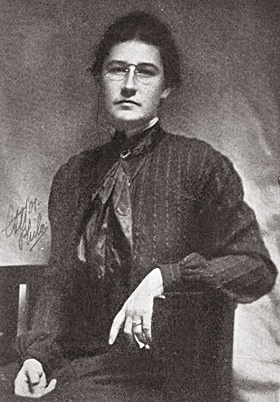
Within Howard Pyle’s first class that October, there were thirty-nine students, including three young people destined to become outstanding leaders in the field of illustration:  Maxfield Parrish, Jessie Willcox Smith, and Elizabeth Shippen Green.  Three years later, in 1897, Violet Oakley joined the class.

………..to be continued.


Most of the information I used for this blog came from an excellent book by Alice A. Carter entitled The Red Rose Girls, An Uncommon Story of Art and Love.


On a more personal note, it is ten years to the day that I started My Daily Art Display blog and this is 830th “edition”.  It started as a one-a-day blog but they were shorter blogs and I was finding I was putting too much pressure on myself to meet deadlines so I now do just one a week but have increased the number of words.  I do enjoy writing them and hopefully will carry on a little while longer.

The Red Rose Girls. Part 3. Jessie Willcox Smith.

The third of the Red Rose Girls was Jessie Willcox Smith.  She became one of the most prominent female illustrators in the United States, during the celebrated ‘Golden Age of Illustration‘.  Jessie was the eldest of the trio, born in the Mount Airy neighbourhood of Philadelphia, on September 6th 1863, the youngest of four children.  She was the youngest daughter of Charles Henry Smith, an investment broker, and Katherine DeWitt Willcox Smith.  Her father’s profession as an “investment broker” is often questioned as although there was an investment brokerage called Charles H. Smith in Philadelphia there is no record of it being run by anybody from Jessie Smith’s family.  In the 1880 city census, Jessie’s father’s occupation was detailed as a machinery salesman.  Jessie’s family was a middle-class family who always managed to make ends meet.  Her family originally came from New York and only moved to Philadelphia just prior to Jessie’s birth.  Despite not being part of the elite Philadelphia society, her family could trace their routes back to an old New England lineage.  Jessie, like her siblings, were instructed in the conventional social graces which were considered a necessity for progression in Victorian society.   It should be noted that there were no artists within the family and so as a youngster, painting and drawing were not of great importance to her.  Instead her enjoyment was gained from music and reading.  Jessie attended the Quaker Friends Central School in Philadelphia and when she was sixteen, she was sent to Cincinnati, Ohio to live with her cousins and finish her education.
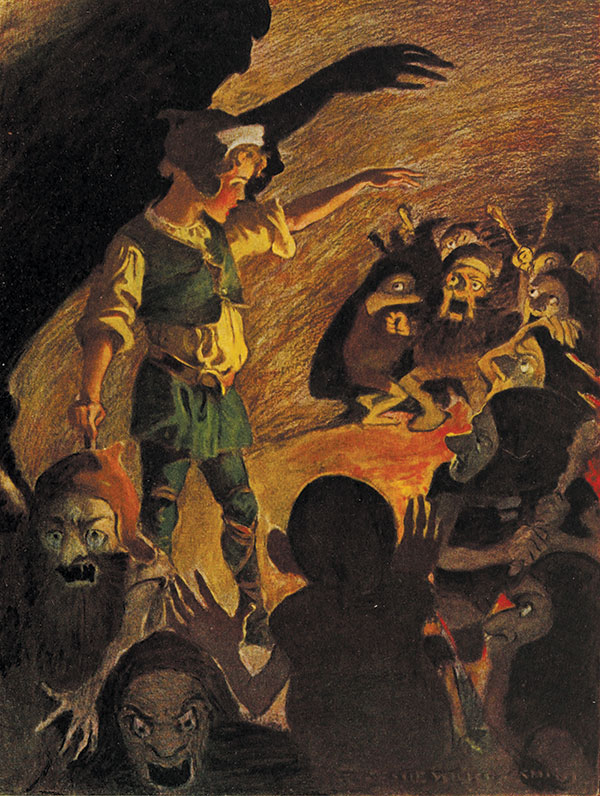
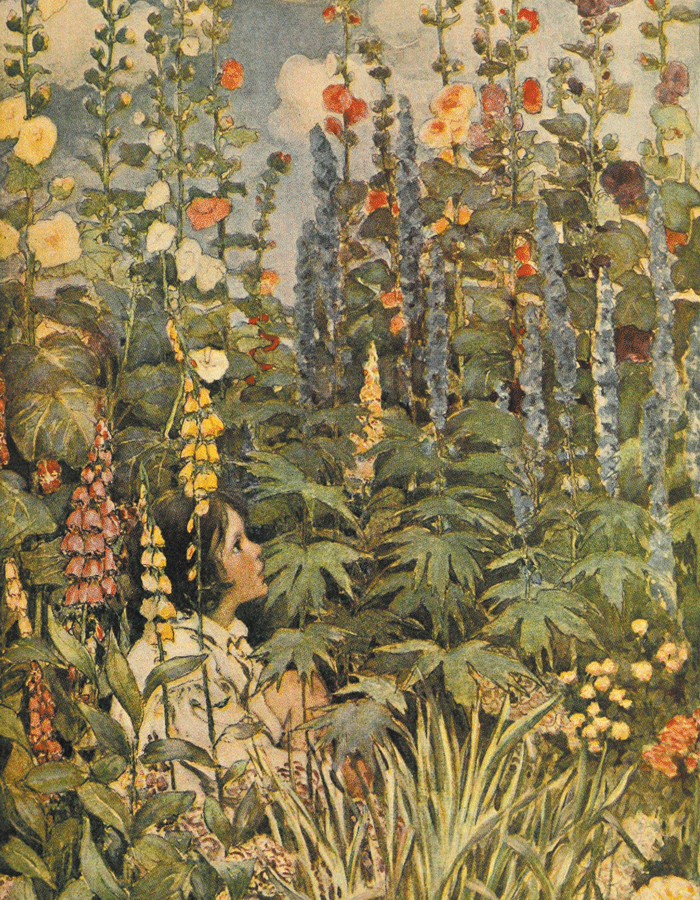
The Princess and the Goblin, by George McDonald, illustrated by Jessie Willcox Smith, (1920)

On completion of her education, instead of returning to the family in Philadelphia, she remained in Cincinnati to look for a job.  Jessie had always been fond of children and managed to secure a position as a kindergarten teacher which would fulfil her need for money whilst doing a job she loved.  However, the belief that all young children are angelic was soon dispelled and she found her charges obstreperous and ill-mannered and soon realised that teaching at a kindergarten was not for her.  One of her friends was interested in art and soon she had managed to inveigle Jessie into the pastime and soon she showed a certain amount of promise as a budding artist.  She remembered this change of direction writing:

“…I knew I wanted to do something with children but never thought of painting them, until an artist friend saw a sketch I had made and insisted I should stop teaching (at which I was an utter failure) and go to art school – which I did…”

John Rogers figurine

Jessie Smith returned to Philadelphia to look for some artistic training and initially wanted to study sculpture.  At the time there was a popular small table-top sculptures called Rogers Group which were relatively inexpensive, mass-produced figurines in the latter 19th which graced the parlours of homes in the United States.  These figurines, often selling for as little as $15 a piece were affordable to the middle class.  They were sculpted in more affordable plaster and painted the colour of putty to hide dust.  She did try her hand at sculpture but soon realised it needed a certain talent, one which she was lacking.  She wrote:

“…my career as a sculptor was brief for my clay had bubbles in it and burst when it was being fired. ‘Heavens’ I decided, ‘ being a sculptor is too expensive!  I will be a painter…’ ”

An illustration by Jessie Wilcox Smith from A Child’s Garden of Verses is a book written by Robert Louis Stevenson

However, Jessie realised that to become a painter she needed formal artistic training and it was difficult for that to happen for a woman in 1884.  It was the age-old story.  Men who wanted to train to become professional artists had academies and teachers to support them but for women, up until the 1850’s, there were few institutions which catered for women and anyway, it was generally thought to be totally ill-advised for a woman to contemplate or prepare for a professional career, art or otherwise.  Life was mapped out for women.  Acquire certain accomplishments which would attract a man, marry that man and give him children, and then be educated at home in the skills needed to look after one’s husband and children.  For women of the middle and upper-class who were interested in art, then a private tutor could be hired but studying in mixed life-drawing classes was deemed unsuitable for women as was sketching nude statuary.

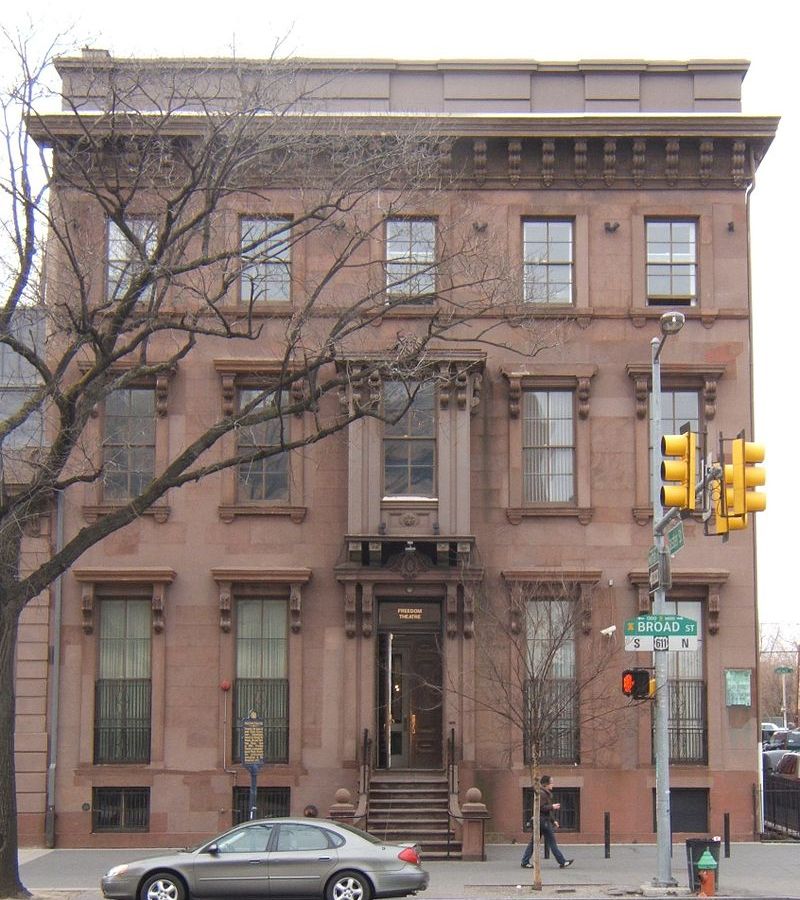
Edwin Forrest House, formerly the home of the Philadelphia School of Design for Women.

Despite this, twenty-one-year-old Jessie Willcox Smith, on October 2nd 1884, enrolled at The Philadelphia School of Design for Women, which was housed in a fashionable Philadelphia neighbourhood in an imposing mansion that had once been the home of actor, Edwin Forrest.  The School had begun when Sarah Worthington King Peter, the wife of the British consul in Philadelphia, established an industrial arts school in her home in 1848 so as to teach a trade to women, who were without a means of supporting themselves.  It was not in direct competition with the Pennsylvania Academy as its emphasis was on decorative pattern and ornament and until 1886 steered clear of controversial life-drawing classes.  After a year at the School of Design, Jessie hankered for more than it could offer her.  She wanted to study the techniques associated with Fine Art and so decided that she had to enrol at the Pennsylvania Academy of the Fine Arts. 

Thomas Eakins, circa 1882

She managed to persuade her parents to fund her tuition and in 1885 she enrolled in the class of the brilliant but controversial painter, Thomas Eakins.  Master and student were so different.  Jessie Willcox Smith was a conservative and shy young woman whilst her tutor was brash, carefree and provocative and cared little for the Academy’s attempt to reign him in.  Eakins represented an outrageous departure from the social norms which had structured Jessie Smith’s life.   Many complaints had been levelled at Eakins and his teaching methods especially those regarding female students.  The following year, 1886, forty-one-year-old Eakins was sacked by the Academy.   It is interesting to note that although there is no doubt her artistic ability flourished under the tutelage of Eakins she viewed him with disdain, once confiding in a friend that she thought he was a “madman”.  Jessie did attend Eakins’ life-drawing classes but of the life models used, once declared:

“…I always wished there were children in the life classes, the men and women were so flabby and fat…”

After Eakins was dismissed from the Academy, he held private classes at his studio and many of his former students attended them, but not Jessie.  She presumably did not agree with Eakins’ way of teaching and decided to remain at the Academy and study under Thomas Anshutz and James B. Kelly, two of Eakins’ former students.

Jessie Willcox Smith graduated from the Academy in June 1888.  She looked back on her time at the Academy with a certain amount of disappointment.  Although her technique had improved, she had hoped to be part of an artistic community in which artistic collaboration would be present but instead she found dissention, scandal and in the wake of the Eakins’ scandal, institutionalized isolation.  Jessie talked very little about her time at the Academy.  It had been a turbulent time and she had hated conflict as it unnerved her and made her extremely distressed.  This desperation to avoid any kind of conflict in her personal and professional life revealed itself in her idealistic and often blissful paintings.  Jessie wanted to believe life was just a period of happiness.

Illustration by Jessie Wilcox Smith for the book of verse, The Seven Ages of Childhood

In 1909 a book of verse entitled The Seven Ages of Childhood by Carolyn Wells with accompanying  illustrations by Jessie Wilcox was published.

After graduation, Jessie became interested in illustration and in 1889 took a job with the advertising department of Ladies’ Home Journal, one of the leading American women’s magazines.   In 1894, nearly six years after graduating, she learned that Howard Pyle, the noted illustrator, was starting a School of Illustration at the Drexel Institute and she was accepted into the inaugural class along with Violet Oakley and Elizabeth Shippen Green.

Jessie Wilcox Smith, cover for Good Housekeeping Magazine. May 1921.

Her illustrations appeared on the covers of Good Housekeeping  resulting in most people becoming familiar with her art. For over 15 years she painted the covers for one of America’s most popular magazines. Month after month, from December of 1917 through March of 1933, a new Jessie Willcox Smith image was on the newsstands and in countless homes.

The Red Rose Girls were finally together.  In my next blog I will look at their time at the Drexel Institute with Howard Pyle and their life together.

……………………to be continued


Most of the information I used for this blog came from an excellent book by Alice A. Carter entitled The Red Rose Girls, An Uncommon Story of Art and Love.

Jules Breton. Part 3. Rural Life and Religious Ceremonies.

Breton Peasant Woman Holding a Taper by Jules Breton (1869)

Besides his rural works of art, Jules Breton will also be remembered for his religious paintings.  One simple work was his 1869 painting entitled Breton Peasant Woman Holding a Taper, which can be seen at the Brooklyn Museum.  It is an intimate portrayal of an elderly lady in Breton costume.  Jules Breton made the background plain and dark so that her white headdress and the starched folds of her collar stand out.   In one hand she holds the long thin candle whilst the other hand clasps her rosary beads.  France may have been reeling from revolutions and turmoil with even worse to come but Breton was happy to focus on regional dress and religious tradition.  Since 1994, the painting has been housed at the Musée des Beaux-Arts in Quimper

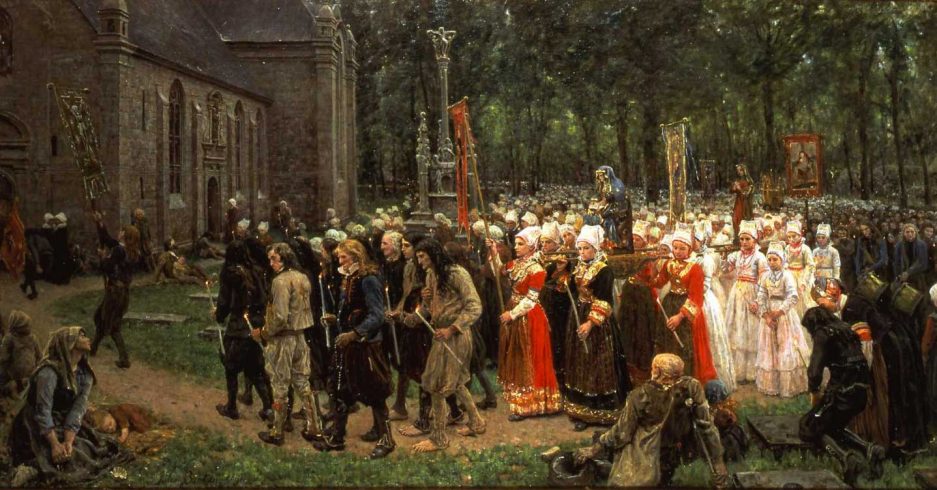
The Pardon in Kergoat by Jules Breton (1891).

One of his greatest religious works was his multi-figured depiction entitled The Pardon at the Chapel of Kergoat in Quéméneven.  A pardon occurs on the feast of the patron saint of a church or chapel, at which an indulgence is granted. Hence use of the word “pardon”. Pardons only occur in the traditionally Breton language speaking Western part of Brittany.   This “pardon” at the Chapel of Kergoat was one of the most popular pardons because of the virtues of the waters from the nearby fountain. The Chapelle Notre-Dame de Kergoat is a 16th century chapel in the hamlet Kergoat, in the commune Quéménéven, Finistère, in north-western France. People came from all over Cornouaille, as shown by the presence of people from the Bigouden area.  Jules Breton was moved by the number of beggars and the passion of the pilgrims.  His portrayal of the event lets us imagine the movement of this procession as it goes around the monumental chapel. 

Le pardon de Notre-Dame-des-Portes à Châteauneuf-du-Faou by Paul Sérusier (1894)

He, like many other artists such as Gaugin, Pascal Dagnan-Bouveret and the Pont-Aven School painter, Paul Sérusier, depicted similar scenes of devotion.

The Blessing of the Wheats in Artois by Jules Breton (1857)

Another religious procession featured in one of Jules Breton’s paintings.  It was his 1857 work The Blessing of the Wheats in Artois which he presented at the Salon that year and was awarded a second-class medal.  It was also the year that Jean-François Millet had his famous painting, The Gleaners, exhibited at the Salon.  Jules Breton’s painting was bought that year by the French State for the Luxembourg Museum.  The procession we see in the painting is a procession of the Rogations.  Rogation Days are days set aside to observe a change in the seasons. Rogation Days are tied to the spring planting. There is one Major Rogation, which falls on April 25, and three Minor Rogations, which are celebrated on the Monday, Tuesday, and Wednesday immediately before Ascension Thursday.  Around Jules Breton’s village of Courrières, the girls in their communion dresses, the clergy, and the local notables walk the countryside to attract the blessing of heaven to the coming crops. This painting reminds us of the important place of Christianity in French rural life.

Les Premières Communiantes à Courrières by Jules Breton (circa 1860,)

Jules Breton was the self-proclaimed “peasant who paints peasants.”   During his career, he would paint many pictures that focused on the religious traditions of rural communities, especially those in the towns and villages of Brittany and his birthplace and current home, Courrières.   One of the earliest paintings to study the theme of communicants, people who receive or are entitled to receive Communion, was his 1860 work, Les Premières Communiantes à Courrières which hangs in the Musée du Petit Palais, Paris.  This work depicts the ceremony of First Holy Communion being held in the village of Courrières, a ceremony during which a person, around the age of eight, first receives the Eucharist.  The young girls who are about to receive the sacrament usually wear beautiful white dresses.

Les Premières Communiantes à Courrières by Jules Breton (circa 1884,)

In 1884, twenty-four years after Breton completed Les Premières Communiantes à Courrières, he was given a commission by one of his patrons, Samuel Putnam Avery, to complete another work depicting the First Communion ceremony and offered him 50,000 francs for its completion.  He gave the artist freedom to choose a depiction of the ceremony.  Avery was a great supporter and fan of Breton’s work and in a letter from May 4th, 1882, after Breton had accepted the commission, he thanked him saying:

“…I have so much confidence in your genius I am convinced that you will create a masterpiece, and want to leave you free to do what interests you most…”

Breton set to work in the summer of 1883 making numerous sketches for the finished commission.  Avery became impatient as over a year had passed since the commission had been agreed upon and in November Breton wrote once more to Avery saying that the work was nearing completion and that he intended to submit it to the 1884 Salon.  Breton has depicted a much broader view of the Communion ceremony.  The setting is a Spring morning and the mauve lilac is in full bloom.  The “ruralness” of the depiction is enhanced by the inclusion of birds fluttering over the thatched roofs of the whitewashed cottages.  The bright sunlight shines down upon the procession and lights up the virginal white diaphanous veils of the young girls as they slowly walk through the village towards the church of Courrières.  The painting was hailed a great success and the art critic for the Art Journal who wrote about the 1884 Salon said:

“…Les communiantes is perhaps the finest work in the exhibition… In the detail, the characterization, the perfect technique, the harmonious and varied coloration, and above all in the feeling, this picture is especially fine…”

The work was the culmination of numerous sketches that Breton had taken.   

Élodie with a Sunshade, Baie de Douarnenez by Jules Breton (1871),

After the Salon closed, Avery purchased the painting for 50,000 francs, and then promptly sold it to the American art collector, Mary Jane Sexton Morgan, the widow of Charles Morgan, an American railroad and shipping magnate.  She paid $12,000 for the painting. Charles de Kay, a writer on art wrote in the Magazine of Art:

“…What the most fabulous art dealer, what the most self-important artist asked, she paid without wincing…

Mary died in 1885 and the following year at the auction of her collection in May 1886, the work was purchased by Donald Smith, Lord Strathcona, president of the Bank of Montreal, for $45,000, the highest price ever paid for a work by a living artist at the time.

La Communiante by Bastien-Lepage (1875)

Jules Breton’s decision to submit his work to the Salon jurists was not really a gamble as the Salon had shown a love for this type of depiction.  Bastien-Lepage’s La Communiante was favourably received by the Salon jurists in 1875.  In that work, the young girl at her First Holy Communion ceremony sits in front of us. Her hands are joined on her lap in a touch of reverence.  She fixes us with a steady gaze. Her eyes and hair are the only dark details of the canvas. The only colour is that on the face, wrists and arms which are covered under light gauze.  The rest of the work is bathed in tones of white and grey.

La première Communion à l’eglise de la Trinité by Henri Gretrix (1877)

Two years later, in 1877, the French artist Henri Gervex, had his painting, La première Communion à l’eglise de la Trinité, accepted into the 1877 Salon. 

Rolla by Henri Gervex (1878)

The interesting fact about Gervex and the Salon was his works later turned to more lascivious depictions of nude or semi-nude women and the submission of his painting, Rolla, to the Salon jurists of the 1878 Salon was rejected, on the grounds that it was too risqué and they wanted to avoid the furore which occurred with Manet’s 1865 Salon painting, Olympia, which was accepted into the exhibition but subsequently was condemned by many conservative critics as being “immoral” and “vulgar .

Summer by Jules Breton (1891),

Besides being a talented artist, Jules Breton was a poet and in 1880, had his poem Jeanne published.  His poetry was so good that it was awarded the Montyon Prize by the Académie Française.  However, he had little time to dedicate to his poetry as the demand for his artwork was escalating and he was now attracting considerable interest from the ever-expanding and lucrative market in America.

Last Flowers by Jules Breton (1890)

Samuel Putnam Avery was a critical part in exposing American audiences to European Art in the second half of the nineteenth century, importing major works by Ernest Meissonier, Charles-François Daubigny and William Bouguereau, among others, and he provided Breton with many sales and commissions on behalf of collectors.  The American public liked Breton’s depiction of rural labourers as one art historian, Madeleine Fiddell-Beaufort put it in her 1982 book, Jules Breton and the French Rural Tradition:

“…they [the Americans] appeared to exist in a harmonious and classless society that was appealing in a country that prided itself on a democratic tradition…”

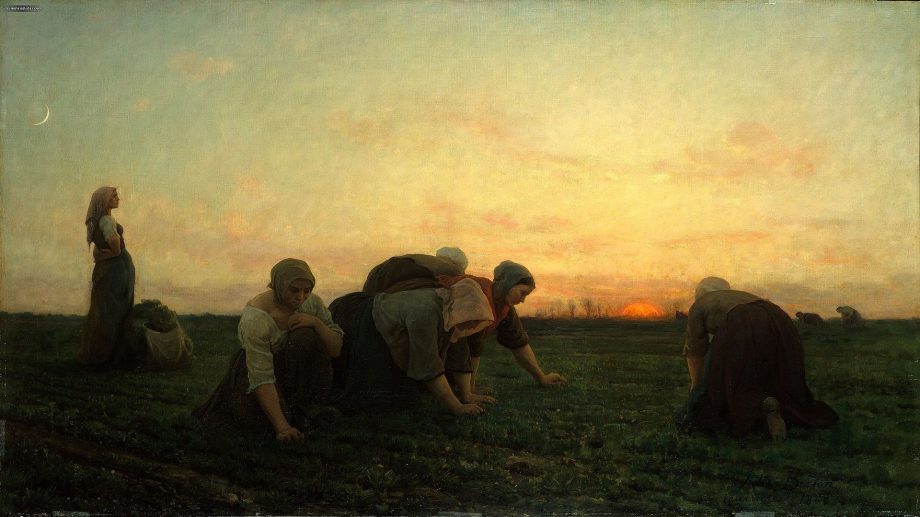
The Weeders by Jules Breton (1860)

The American market was also aware of Breton’s awards from the various Salons and realised that buying his works was a real investment.  Two examples of his work that went to America can be seen in the Joslyn Art Museum in Omaha.  The Weeders was completed in 1860.  The painting impeccably demonstrates Breton’s Academic approach to painting.  The depiction is a delicate blend of realistic observation and a romantic sentiment. Breton has managed to beautifully capture the delicate mauves and roses of the twilight sky and added the simplicity of these stooped figures, Breton has managed to convert the activity of common field labour into a less harsh scene, almost one of graceful contemplation.

The Vintage at Chateau Lagrange by Jules Breton (1864)

Another of his works at the museum is his 1864 work, The Vintage at Chateau Lagrange.  The setting of the work is not Brittany where a number of his paintings were set. The painting depicts a festival being held in the Médoc district of southern France just north of Bordeaux.  Breton decided to travel to the southern parts of France where he believed lay the “sublime landscapes with inhabitants embodying extraordinary beauty.”  It was fortuitous that Breton was invited by Count Charles Tenneguy Duchâtel, the owner of Chateau Legrange winery to visit him and paint a picture depicting the grape harvest at his estate.  The setting was ideal for Breton but the adverse weather on his first visit necessitated a second visit to complete his sketches.  The painting was then completed in his Paris studio.  It is interesting to note Breton’s portrayal of the grape pickers.  They seem well-dressed and happy and their work has afforded them a distinctly classical quality and the hard-working process of picking the grapes from the vine has been depicted as a noble task rather than a tiring and arduous chore by poorly dressed and unhappy peasants.  Could it be that the Count wanted the painting to depict his workers as well dressed, well fed, happy people who were pleased to serve him?

Planatation d’un Calvaire by Jules Breton (1858)

In his painting, Planatation d’un Calvaire, Jules Breton recounts an event, which he witnessed in his youth.   Before us, we see a group of monks carrying on a stretcher the statue of Christ that will be fixed to the wooden cross.  In the background of the painting, we can see the cross being erected in the grounds of the churchyard.   In front of monks, three young girls wear the symbols of the Passion (the crown of thorns, the nails, and the spear). Finally, behind them, comes the priest, the children’s choir and the parishioners who close the march. The group moves forward in a slow procession towards the great cross, which is in the process of being erected in the background.  Breton, through this depiction, reminds himself of the fervor and recollection of this village community. The palette he has used is dominated by grey and beige, and is warmed by colourful tones of yellow, red and blue.  Breton’s wife, Élodie de Vigne, is represented twice in this painting. She is both the character of the mother holding her two children by the hand and that of the girl in white carrying a cushion on which rests the crown of thorns.

Young Women Going to a Procession by Jules Breton (c 1890),

In 1861 Jules Breton was named Chevalier de la Légion d’Honneur.  In 1867 he exhibited ten paintings at the Exposition Universelle and was given a first-place medal. In 1872 he was given the Medal of Honour at the Salon. Jules continued exhibiting at the Salons and was promoted from Officer to Commander of the Légion d’Honneur in 1885, and in 1886 he was elected as a member of the Insitut de France. In 1889-1900 he was also a jury member of the Salon. Towards the end of his career his works often focused on a single figure within the composition.

Jules Breton died in Paris on July 5th 1906, aged 79.  His wife Elodie died three years later on July 30th 1909, aged 73.

If you have enjoyed reading about Jules Breton, I can thoroughly recommend you try and read his 1890 autobiography entitled The Life of an Artist which gives you an insight into the great man’s life and his thoughts.

The Red Rose Girls. Part 2. Violet Oakley


                                                          Violet Oakley

The second of the Red Rose Girls I am featuring is Violet Oakley.  Oakley was the youngest of the Red Rose Girls, almost three years younger than Elizabeth Shippen Green and eleven years younger than Jessie Wilcox Smith.    During the American Renaissance mural movement of the late nineteenth-century it produced one of the great female muralists – Violet Oakley. 

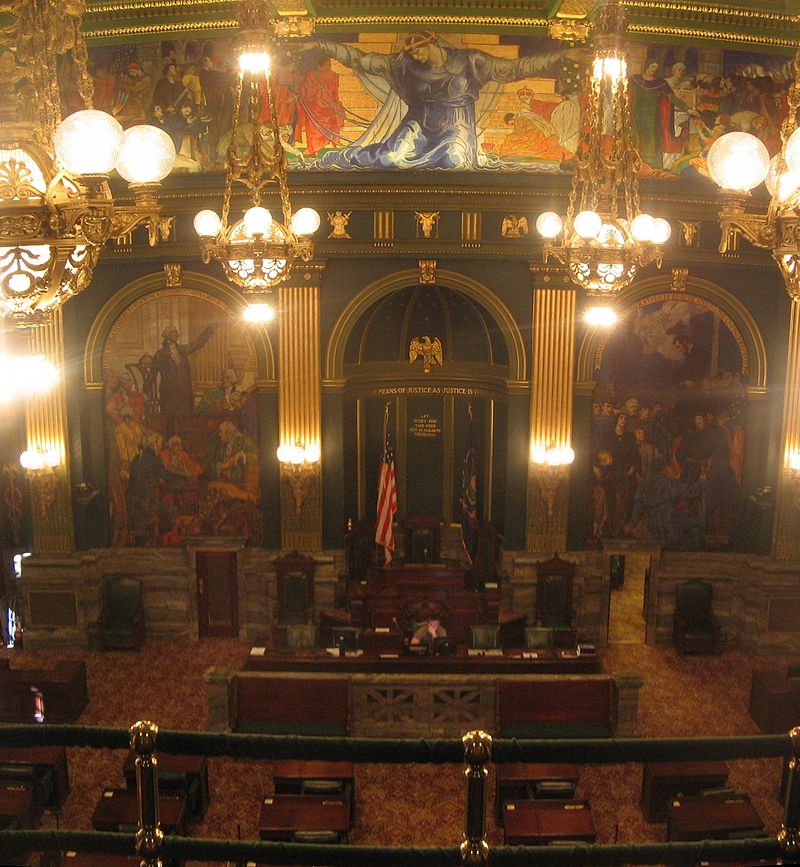
Pennsylvania State Capital murals by Violet Oakley

Violet is probably best known for her murals at the Pennsylvania State Capitol.  The paintings, done by Oakley, show scenes in the state’s history including Washington in Philadelphia in 1787 when the Constitution was written and Lincoln giving his address in Gettysburg in 1863.  Yet, these were only a part of her extraordinary output. Over half a century, Violet Oakley decked out the interiors of churches, schools, civic buildings, and private residences with murals and stained glass. She also illustrated books, magazines, and newspapers, and painted hundreds of portraits. Her Renaissance spirit of civic responsibility helped shape the culture of Philadelphia.


Violet (seated) and her sister Hester Oakley

Violet Oakley was born in New York on June 10th 1874, the youngest of three daughters of Arthur and Cornelia Oakley (née Swain) who had married in 1866.   Violet’s eldest sister was Cornelia, who sadly died of diphtheria at the age of six after a very short illness, and a middle-sister, Hester.  She and her family were brought up in Bergen Heights, New Jersey.  As a youngster showing a love for art, she was brought up in the perfect family environment.   In later life she quipped that her own interest in art was “hereditary and chronic” and that she had been born with a paintbrush in her mouth instead of a silver spoon.  At least twelve of her ancestors were artists.  Her paternal grandfather was George Oakley who came to America from London.  He was a talented artist and made many return trips to Europe to study and copy many of the major works of art and became an Associate of the National Academy of Design.  Violet’s father, Arthur, was taught to paint by his father but his business interests precluded him from making art his profession.  Violet’s maternal grandfather, William Swain was a successful portrait artist and his daughter, Violet’s mother, Cornelia set up her own painting studio but gave up her artistic ambitions when she married.  Other of Violet’s aunts, Juliana, and Isabel, became successful painters.

Violet Oakley, Self-Portrait (1919)

Violet was not a healthy child growing up as she suffered from asthma and an over-riding shyness.  Having lost her eldest child Violet’s mother over-cossetted Violet continually worrying about her ill health and fearing that she may lose her second child.  Her surviving sister, Hester, attended Vassar and Violet had hoped to follow her sister but her parents, ever concerned with their daughter’s health, decided to home-school her.  She spent a lot of her time copying paintings by the Old Masters, the prints of which had been brought home by her two grandfathers from their European vacations.  It was not until 1894, when Violet was twenty years of age, that the family allowed her to leave home to study.  She travelled with her father to New York city to attend classes at the Art Student’s league where she studied with Irving Wiles, who would become one of the most successful portrait painters in the United States, and who drew illustrations for magazines such as Harper’s and Scribner’s. Another of her tutors was Carroll Beckwith, an American portrait, genre, and landscape painter.

Penn’s Vision by Violet Oakley (oil paint over printed base) adorns the Governor’s Reception Room at the Pennsylvania State Capitol.

During the winter of 1895, the Oakley family travelled to France to visit relatives and both Hester and Violet decided to improve their artistic skills by enrolling at the Académie de Montparnasse where they studied at the atelier of the Symbolist painter, Edmond Aman-Jean.  It was an all-female studio and the students were a mix of those females who wanted to become professional artists and dilettantes who were merely bored with everyday life.   Violet fell into the former category whilst her older sister Hester, who had yet to decide whether to become an artist or writer, belonged to the latter and used the experience at the atelier to study people,  many of whom she incorporated into her 1898 novel, As Having Nothing.  The family’s European holiday was cut short when Violet’s father took ill.  It is thought that he suffered a nervous breakdown brought on by the failure of many of his business ventures.  Their father’s financial demise focused the minds of Hester and Violet in that they needed to earn money to support themselves and their family.  Hester managed to write and sell her novels and Violet decided that her art had to become financially viable.  Her family moved to Philadelphia to get medical advice for her father and so when Violet arrived in the city, she decided to enrol on two courses at the Pennsylvania Academy.  One was with Cecilia Beaux whose course was entitled Drawing and Painting from Head and focused on portraiture.  She also enrolled in the Day Life Drawing Class; a course run by Joseph de Camp.  However, art tuition cost money, add to that cost of materials and the commute to and from the Academy and Violet had now encountered financial problems.

Violet Oakley in front of the Unity panel that she painted for the Senate Chamber in the Pennsylvania State Capitol Building.

It was her sister, Hester, who saved the day.  Hester was continuing with writing her first novel and decided to enrol at the Drexel Institute where Howard Pyle, a writer and an illustrator was running an illustration class and Hester decided that he was just who she needed to teach her to become a novelist.  Buoyed by this find, Hester rushed home to tell her sister of the opportunity and persuaded her to leave the Academy after just one term and enrol at the Institute.  One could not just walk into to Howard Pyle’s course, one had to prove one’s worth and so Violet carefully organised her portfolio of work.   Howard Pyle examined Violet Oakley’s portfolio and accepted her onto his course, agreeing to help her progress.  Violet and Hester then set themselves up in a rented studio at 1523 Chestnut Street and their mother gave them some of the family’s furniture.  The two young ladies may have been sisters but they were as different as chalk and cheese.  Hester, the Vassar graduate, was outgoing, vivacious, and full of self-confidence whereas Violet was painfully shy and highly emotional and friends stated that she lacked a sense of humour.

Senate mural, Pennsylvania State Capitol by Violet Oakley.

That day in 1897 when Violet Oakley first walked into Howard Pyle’s illustration class she came face to face with the other two Red Rose Girls, Jessie Willcox Smith and Elizabeth Shippen Green ………………….

……………to be continued.


The information I used for my five blogs about the Red Rose Girls was mostly collected from the excellent book entitled The Red Rose Girls.  An Uncommon Story of Art and Love by Alice A. Carter.  I can highly recommend this biography.  You will not be disappointed.

The Red Rose Girls. Part 1. Elizabeth Shippen Green.

In my next series of blogs, I want to look at the lives of three talented women artists – Jessie Willcox Smith, Elizabeth Shippen Green and Violet Oakley.  These three artists enchanted and fascinated early twentieth century Philadelphia with their brilliant careers and somewhat uncommon lifestyle.  At one time the three women lived together in The Red Rose Inn, a picturesque estate in the affluent Philadelphia suburb of Villanova, a respected area known as the Main Line, an historical and social region of suburban Philadelphia, which was situated along the former Pennsylvania Railroad’s once prestigious Main Line.  The three women were joined by their friend, Henrietta Cozens, who took on the responsibility of managing their communal household.  Their mentor and tutor at the time was the famous American illustrator, Howard Pyle, who, because of their residence, nicknamed them The Red Rose Girls.  The four women forged an intense and emotional bond and vowed to live together for the rest of their lives.  They even adopted and acronymic surname, wanting to be known as the Cogs family – C for Cozens, O for Oakley, G for Green and S for Smith.  In the following blogs, I want to delve into the life of these three women and look at their backgrounds, their works and how they fought their way through a male-orientated world of art.  These three women were to become renowned for their illustrative work.

Red Rose Girls, Pictured left are Violet Oakley, Jesse Willcox Smith and Elizabeth Shippen Green (with Henrietta Cozens).

In my next series of five blogs, I want to look at the lives of three talented women artists – Jessie Willcox Smith, Elizabeth Shippen Green and Violet Oakley.  These three artists enchanted and fascinated early twentieth century Philadelphia with their brilliant careers and somewhat uncommon lifestyle.  At one time the three women lived together in The Red Rose Inn, a picturesque estate in the affluent Philadelphia suburb of Villanova, a respected area known as the Main Line, an historical and social region of suburban Philadelphia, which was situated along the former Pennsylvania Railroad’s once prestigious Main Line.  The three women were joined by their friend, Henrietta Cozens, who took on the responsibility of managing their communal household.  Their mentor and tutor at the time was the famous American illustrator, Howard Pyle, who, because of their residence, nicknamed them The Red Rose Girls.  The four women forged an intense and emotional bond and vowed to live together for the rest of their lives.  They even adopted and acronymic surname, wanting to be known as the Cogs family – C for Cozens, O for Oakley, G for Green and S for Smith.  In the following blogs, I want to delve into the life of these three women and look at their backgrounds, their works and how they fought their way through a male-orientated world of art.  The three women were to become renowned for their illustrative work.

Page from illuminated manuscript

Book illustrations can be traced back to the world of manuscript illuminations.  An illuminated manuscript is a manuscript in which the text is accompanied with decoration as initials, borders known as marginalia, and miniature illustrations.  The term illumination originally denoted the embellishment of the text of handwritten books with gold or, more rarely, silver, giving the impression that the page had been literally illuminated. 

Biblia Pauperum or Bible of the Poor, woodcut illustrations with manuscript text

Fast forward to the 18th and 19th centuries and the literature of the Western World and the birth of what we now know as the novel, in the form of adult fiction.  

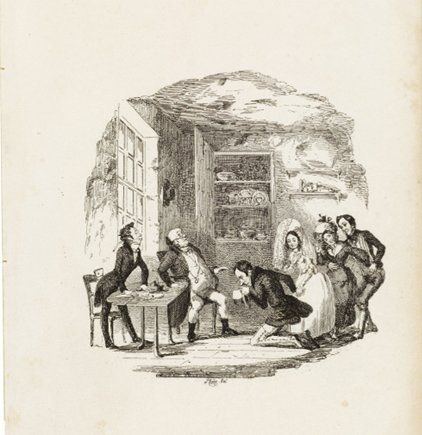
‘Mr Winkle Returns under Extraordinary Circumstances’, etched illustration by Hablot Knight Browne for The Posthumous Papers of the Pickwick Club by Charles Dickens

An example of this are the novels of Charles Dickens and the way in which he would collaborate with book illustrators.  How it worked was Dickens would give the illustrator an outline of the story line before he wrote the text and he carefully scrutinised the drawings to ensure that they complemented his own ideas.  In the case of Dickens, his favoured illustrator was Hablot Knight Browne who worked under the pen name “Phiz”. 

By the end of the twentieth century, Elizabeth Shippen Green, was to become a leading American illustrator.

 Elizabeth Shippen Green

Elisabeth “Bessie” Shippen Green was born into an old well-to-do Philadelphia family, on September 1st 1871.  She was the third child of Jasper Green and Elizabeth Shippen Boude. Her eldest sister died when aged two and, Katherine, her middle sister, was born a year before Elizabeth.  The family lived near the centre of Philadelphia at 1320 Spruce Street.  Although not very wealthy, the Green family had impeccable “old Philadelphia” connections through both the Shippen and Green ancestors and as such Elizabeth was able to access the elite social circles throughout her life.  It was this advantageous aspect of Elizabeth’s life that led her to become easy going and self-confident.  Elizabeth’s parents were determined that their daughters had every possible social advantage in life and to ensure a good start to Elizabeth’s life journey she was sent to private Philadelphia schools.  Initially she was enrolled at Miss Mary Hough’s School and later Miss Gordon’s School.

Jasper Green, Elizabeth’s father at the Red Rose Inn (1904). Elizabeth Shippen Boude, Elizabeth’s mother (1903)

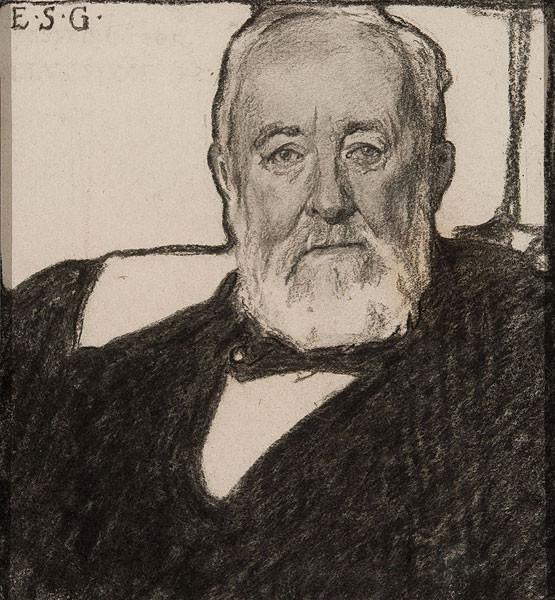
Elizabeth’s father imbued in his daughter a love of art as he was an amateur artist who had studied art at the Pennsylvania Academy of the Fine Arts and during the American Civil War, worked as an illustrator/correspondent for the Harper’s Weekly, an American political magazine based in New York City.   It was said that during her early schooldays Elizabeth took pleasure in illustrating her school notebooks. 

Portrait of the Artist’s Father, Jasper Green by Elizabeth Shippen Green (c.1900)

Elizabeth Shippen Green, self portrait

In October 1889, a month after that first publication of her work she enrolled at the Pennsylvania Academy of the Fine Arts.  She spent one year in the antique class, where she had to draw from plaster casts, and two years in the life class, working with live models.  During that period her teachers included Thomas Anshutz, Thomas Eakins, and Robert Vonnoh.  Elizabeth graduated from the Academy in 1893 and it was in that year that the Green family suffered a devastating loss.  Elizabeth’s sister, Katherine died on September 1st 1893, aged twenty-three.  This tragic death would haunt Elizabeth every year as it coincided with her birthday.  Elizabeth had now suffered the tragic loss of both of her sisters and one can only imagine the devastation felt by her parents.

Paper Doll Book #2 watercolour and charcoal by Elizabeth Shippen Green (1906)

Once her schooling was completed, eighteen-year-old Elizabeth enrolled at the Pennsylvania Academy of Fine Arts in 1888.  For Elizabeth the Fine Arts path was not for her as she was interested in her father’s branch of art, that of illustration and, in her father, she had the best illustrations tutor possible.  By the time she was seventeen years-old she had turned a corner of her bedroom into her studio and produced a series of drawings which she managed to sell to the Philadelphia Times and the first of these were printed by the newspaper on her eighteenth birthday.  The drawings accompanied a short but charming rhyme about a child and her doll, entitled, Naughty Lady Jane.   Although this was the only work of prose which she had published, the Philadelphia Times editors recognised her immense talent as an illustrator and in the September 8th 1889 edition of the Philadelphia Times the editor inserted this extended by-line:

“…You will see in another column today some very pretty verses called Naughty Lady Jane accompanied by six exquisite illustrations.  They are the work of Miss Bessie S. Green of Philadelphia who is only eighteen years old.  The lines are unpretending, of course, yet admirably suited to their purpose; but the illustrations show wonderful talent.  Indeed, they would do credit to an artist much older and more experienced than Miss Green…”

Elizabeth (“Bessie”) must have been delighted to have her work published although the payment of 5o cents for a one-column drawing was hardly going to give her financial independence.

Philadelphia Public Ledger

Elizabeth continued working hard and would regularly submit her illustrations to the Philadelphia Public Ledger, a daily Philadelphia newspaper which was, at the time, owned by George William Childs and Anthony J. Drexel.  Elizabeth received many assignments for fashion illustrations from the newspaper.  In 1897, Elizabeth Shippen Green enrolled at the Drexel Institute which had been founded by Anthony J Drexel, a Philadelphia financier and philanthropist in 1891.   He envisioned an institution of higher learning uniquely suited to the needs of a rapidly growing industrial society and of the young men and women seeking their place in it.

Enter Howard Pyle the leading American illustrator of the time and the two other Red Rose Girls…………………………

………………………………to be continued.


The information I used for my five blogs about the Red Rose Girls was mostly collected from the excellent book entitled The Red Rose Girls.  An Uncommon Story of Art and Love by Alice A. Carter.  I can highly recommend this biography.  You will not be disappointed.

Jules Breton. Part 2. Ruralism and Naturalism.

Jules Breton (1890)

Little did Jules know but this trip with his father to arrange his art tutoring was the last time they would be together as shortly after his father returned to Courrieres, he died.  On hearing of his father’s death, Jules returned home and he was alarmed to see on checking, that the finances of the family business were in a bad state, so much so, some of the family’s furniture had to be sold. Breton finally realised what it was like to be poor and suddenly was able to imagine how the local peasants must feel about their impoverished lifestyle.  He had always loved playing with and mixing with the young peasants but he had never really had to share their lifestyle or their social position in life.  With that in mind the depictions in his paintings began to be all about social realism and the predicament of the poor and the downtrodden.

Calling in the Gleaners by Jules Breton (1859)

Many of Breton’s paintings featured the peasant workers, mainly women, who were known as gleaners, gatherers of grain or other produce left behind in the fields after harvest. This was a charitable activity that allowed the poor and destitute members of a community to collect leftover material after a commercial harvest.   Jules Breton’s desire to depict the plight of the poor and oppressed, was sated with his many depiction of the gleaners.  A good example of this is his 1859 painting housed at the Musée d’Orsay entitled Le rappel des glaneuses [Calling in the Gleaners].  It is an ordinary scene of peasant life in his hometown of Courrières. 

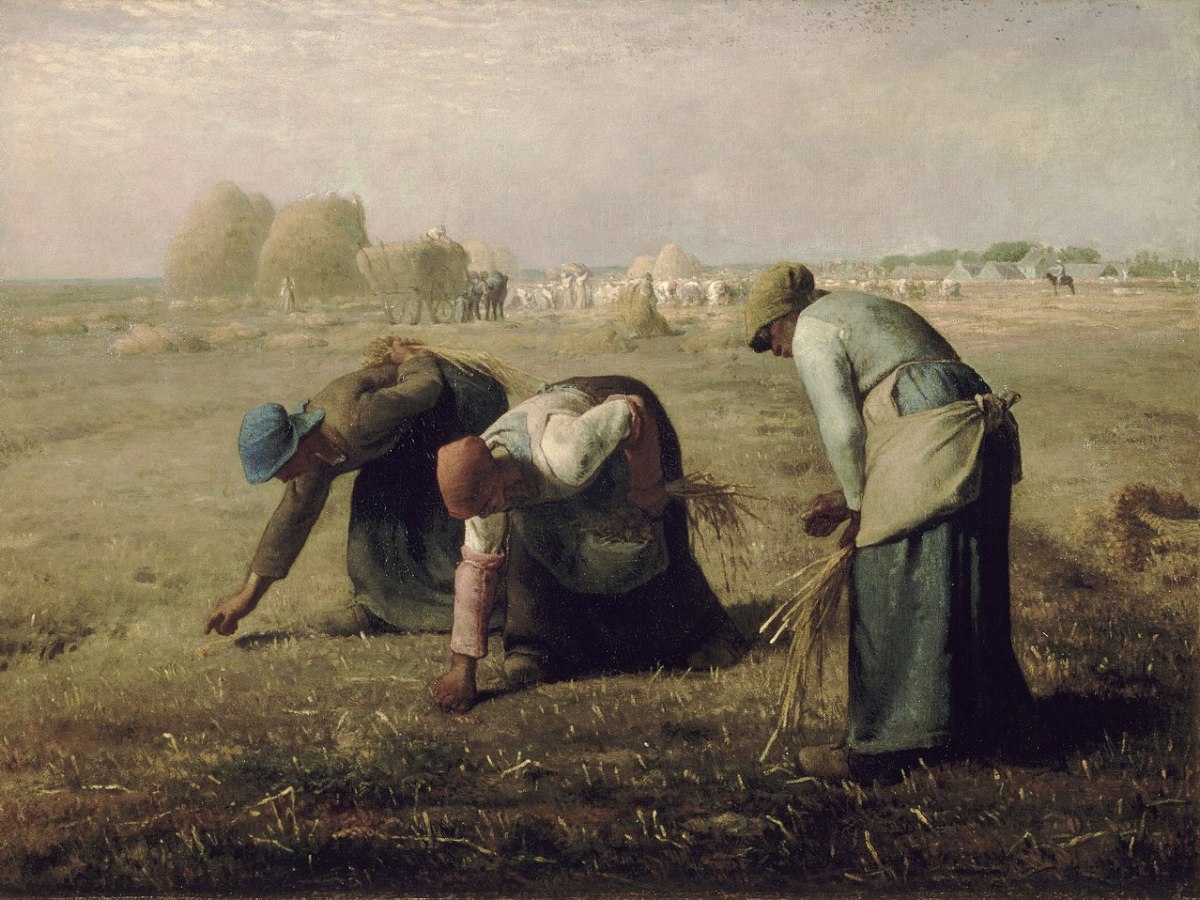
The Gleaners by Jean-François Millet completed in 1857.

Unlike Jean-François Millet’s famous depiction in which we see three women bent over picking up the grain, Jules Breton had portrayed the gleaners leaving the field in which they had been working.  It is the end of the day and the sun has set behind the trees which gives the painting the warm golden glow of late afternoon.  We see the crescent moon in the sky above and to the left and we catch sight of the rural policeman leaning against a milestone cupping his hands around his mouth like a speaking trumpet as he calls in the gleaners.  There are elements of realism in the way Breton has shown the female workers in threadbare, ragged clothes and barefooted but in a way this is also an idealised scene with the peasants walking out of the field with their heads held high in a noble and dignified pose and it was this idealistic and picturesque representation of the peasants and their working life which pleased both the critics and public. The painting was exhibited at the 1859 Salon and was much admired by those who saw it.  It even caught the eye of the Empress Eugenie, who arranged for it to be bought by the French state.  It was then exhibited at the Château de Saint Cloud, and three years later, it was given by the Emperor to the Musée du Luxembourg, which was then known as the Musée des Artistes Vivants.

The Last Gleanings by Jules Breton (1895)

Female gleaners also featured in Breton’s painting entitled The Last Gleanings which is part of the Huntington Art Museum collection in San Marino, California.

The Last Gleanings by Jules Breton (Detail)

In his painting. The Last Gleanings, there are three main characters in the foreground.  A young girl standing alongside a mature woman, both bare-footed, maybe mother and daughter, whilst, slightly behind them is an elderly woman.  This differing of ages, youth, maturity and old age, along with the sunset and the gathering of the remnants of the wheat harvest, can be seen as a metaphor for the passing of time.  The painting has a beautiful background featuring the setting sun, the rays of which wash over the low-lying clouds.  More gleaners follow behind the three in the foreground and to the left we can see a man with a raised stick, signalling the end of the working day.  Although Breton’s painting focuses on the practice of gleaning, we do not see the Millet-type women bent double picking up the remnant grains highlighting the back-breaking nature of the work.  In Breton’s depiction we see the mother and daughter adorned in their peasant attire look well fed and it does not suggest poverty and hardship so his depiction is offering us a mixed message.   On one hand we have a beautiful sunset and the two main characters wearing traditional costumes are carrying, with ease, bundles of wheat.  They look well nourished and yet on the other hand they are walking bare-footed amongst the sharp stubble of the wheat field and we also are aware that continually bending over to gather the wheat is a back-breaking task performed by poor peasants.  

 Catherine Hess, the chief curator of European Art at The Huntington, said we should be aware of the situation in France at the time.  She wrote:

“…In the late 19th century, the defeat of France in the Franco-Prussian War and the subsequent Paris Commune led to bloodshed and deprivation. And throughout the century, France remained a peasant nation, with three out of four men—many poverty-stricken—making their living by farming. Women, children, and the aged sought out gleaning to supplement their meagre provisions…”

The painting was bought by the American industrialist and art patron Henry Clay Frick.  He purchased the painting for $14,000 in 1895, immediately following its presentation at the Paris Salon. Jules Breton wrote to Frick and talked lovingly about the depiction:

“…it expresses a feeling I have frequently felt before the majestic simplicity and beauty of our rustic scenes, when bathed in the last rays of the sun. Those daughters of our fields seem then to be transfigured, the reflections of the heavens giving them the semblance of being surrounded by a natural halo…”

In 1905 Henry Frick returned the work to the art dealer as his taste in art had changed and in 1906 it was purchased by Henry Huntington for his collection.

The End of the Working Day by Jules Breton (1886-87)

Another of Jules Breton’s paintings featuring female peasants at the end of their working day was completed in 1887 and entitled Fin du travail (The End of the Working Day).  In this painting Breton has depicted three women returning from their day’s work in the potato fields.  The way they have been backlit by the sunset adds to the theatrics of the depiction.  Jules Breton had received Academic training and was well aware of the way historic paintings were very much the vogue when it came to teaching at the academy and maybe he remembered how the heroic betrayal of people in those paintings was thought to be currently  de rigueur.  Breton explained:

“… art was to do [the workers] the honour formerly reserved exclusively for the gods…”

The painting is part of the Brooklyn Museum collection.

The Wounded Sea Gull by Jules Breton (1878)

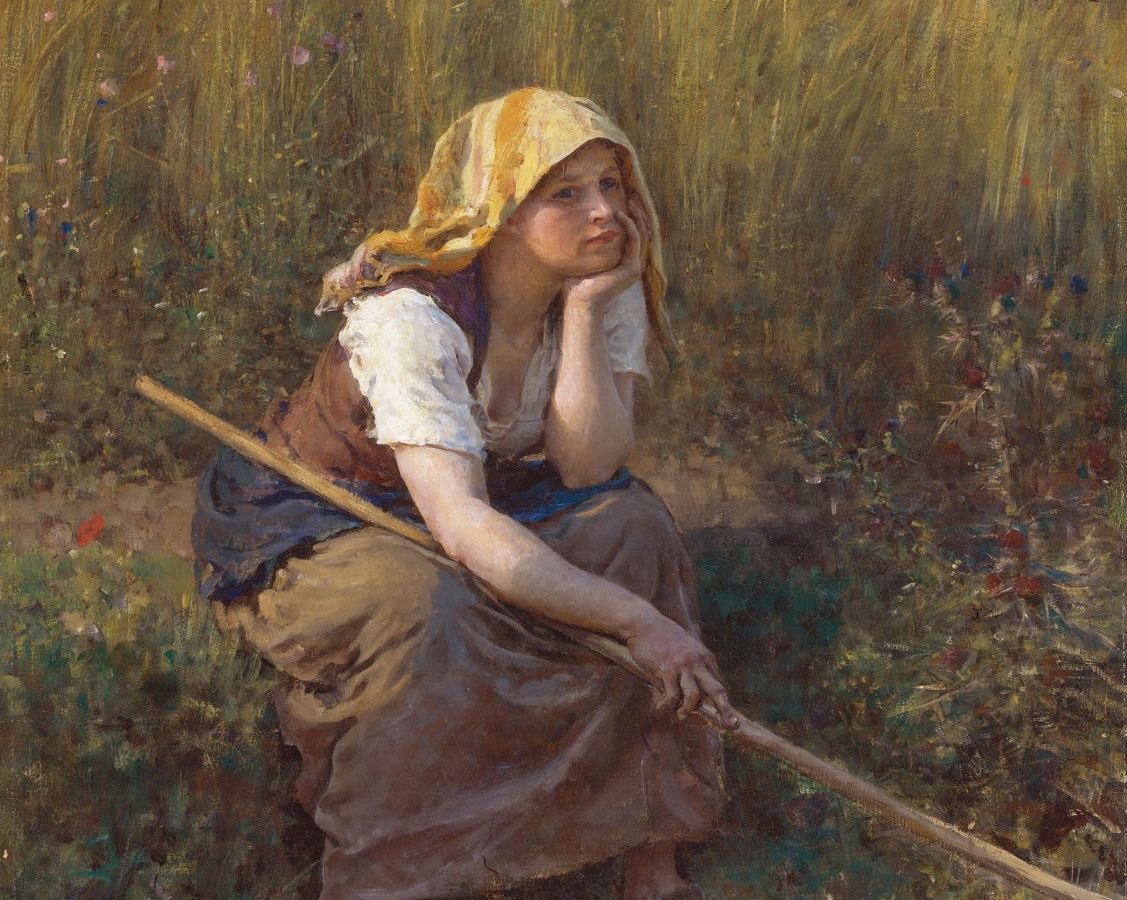
In the late 1870’s Breton completed a number of single-figure paintings of young females, mainly part of peasant families.  One example of this is his 1878 painting entitled The Wounded Seagull.  It depicts a young Breton peasant woman cradling and stroking a wounded gull whilst other gulls fly around in the background.  The strange thing about this depiction is that although tending to the bird she is not looking at it.  Her demeanour is one of pensiveness and it seems that her mind is concentrating on other things in her life.  This work was shown in 1881 at the first special exhibition at the newly founded St. Louis School and Museum of Fine Arts and remains part of the Saint Louis Art Museum.

A Fisherman’s Daughter b y Jules Breton (1878)

Another single-figure work by Breton is housed at the Musée de la Chartreuse de Douai and is entitled A Fisherman’s Daughter which he completed in 1878.  The painting depicts a girl wearing a red headband under a white cornette.  She is dressed in a blue wool petticoat and a tawny bodice. Around her neck, she wears a purple cotton handkerchief crossed on her chest.  On her arms there are false sleeves and in front of her an apron of grey canvas. She is barefoot, and leans against a rock as she repairs a fishing net for her father.  This was a traditional task that women did for their sea-going folk.   The setting is Port-Rhû near Douarnenez, in Brittany.

The Tired Gleaner by Jules Breton.(1880)

When Breton returned home to Courrières to help the family, he embarked on a number of figurative paintings of full-figure views against the flat fields.  One such work was his 1880 painting, The Tired Gleaner.  It portrays a young woman, stretching her arms, after a back-breaking day working in the fields, with a backdrop of the setting sun.  Breton repeated this backdrop in many of his rural works.

The Song of the Lark by Jules Breton (1884)

One of Breton’s best known and most successful single-figure work is Song of the Lark which he completed in 1884.  It was exhibited at the 1885 Salon where it was purchased by George A. Lucas a dealer from Paris, for his client, Samuel Putnam Avery, an American artist, art dealer, and philanthropist best remembered for his patronage of arts and letters.  It eventually came part of the Art Institute of Chicago collection in 1917. It was deemed the most popular painting in America in a poll conducted in 1934 by the Chicago Daily News  to find the “most beloved work of art in America”  The First Lady Eleanor Roosevelt unveiled The Song of the Lark as the winner and declared the painting as being her personal favourite.   It depicts a barefoot young peasant woman farm worker, sickle in hand, happily singing as she sets off to work in the fields near Courrières.  For this painting Breton’s model was a local woman, Marie Bidoul, who stood for him outdoors in the field at dawn and dusk until the artist was happy that he had captured her form.  

First edition cover of The Song of the Lark

Willa Cather’s 1915 novel The Song of the Lark takes its name from this painting.

…………………………..to be continued.

Jules Breton. Part 1. The beginning of an artistic journey.

Before the era of photography and mobile phones, paintings were often bought as  pictorial aide-mémoirs and I am sure it still happens nowadays.  It could be a portrait of a friend, relative or somebody one admires.  It could be a specific landscape or cityscape which one had once visited and wanted to be reminded of.  The completed painting would then adorn a wall in the room of one’s house and be looked at with pleasure every time we passed by it.  Sometimes a painting is placed on display to lift our mood.  Sometimes the painting may be there to remind us of a life we once had or a life we hanker for.  Whatever the reason, artists cater for our wishes to remember.  Of course, one has to decide whether the depiction in the landscape or cityscape painting is topographically accurate or is it an idealised version.  Maybe we want an idealized version, as over time, do we not conjure in our mind just that.

The Rest of the Haymakers by Jules Breton (1872)

When we look at paintings of rural scenes of the past and focus on the peasant workers, what are we wanting to see?  Do we want to have a painting on our wall which focuses on the difficult times the peasant labourers faced?  Do we want to see the folk poorly dressed, shoe-less and struggling to survive?  If that is what we want hanging on the wall of one of our rooms then we need to search for works by the social realism painters.  However, if we want to see depictions of happy smiling workers then we need to look for works by the rural naturalism painters such as today’s featured painter.  Let me introduce you to the nineteenth-century French painter, Jules Adolphe Aimé Louis Breton, one of the greatest artists who managed to convey the beauty and idyllic vision of rural existence, even if it was an idealised vision of peasant life.

Jules Breton

Jules Adolphe Breton was born on May 1st, 1827 to an important family in the small village of Courrieres situated in the Pas-de-Calais department in the Hauts-de-France region of Northern France.  His father, Marie-Louis Breton, oversaw land for a wealthy landowner. His mother died when Jules was four and he was brought up by his father. Other family members who lived in the same house were his maternal grandmother, his younger brother, Émile, and his uncle Boniface Breton.  Jules lived a contented life as a child despite losing his mother at that early age.    His home life was relaxed and was a happy environment, and he got great pleasure playing with the local children belonging to the local peasant farmers despite Jules and them having come from different social classes.

Young Mother nursing her Child, Courrières by Jules Breton (1873)


At the age of ten, Breton was sent to school at a Catholic seminary run by the Jesuits.  It was an unhappy experience for him.  His fellow pupils were unkind to him and he had many a run-in with the authoritarian Jesuits. In the summer of 1842, fifteen-year-old Breton met a man who would shape his future.  He, his father and uncle had been staying with friends at Muno, a Belgium town close to the French border and near the Amerois forest in the Ardennes.  One evening a visitor called on his uncle.  He introduced himself as Félix de Vigne, a painter and professor in the Academy in Ghent. He had come to examine four volumes of French costumes which had beautiful colour plates and belonged to Jules’ uncle.  Although Jules Breton was introduced to de Vigne, the boy’s bashfulness prohibited him from talking about his love of drawing and painting and his desire to become an artist.  When de Vigne left, Jules was devastated at missing the chance of confiding his artistic dreams with the painter.

La Petite Coutière by Jules Breton (1858)


In the autumn of 1842 Jules attended the College St. Bertin near Saint-Omer and it was here that he received his first artistic training.   A year later, in 1843, Breton’s uncle happened to be returning home from Lille in a coach and found himself sitting next to Felix De Vigne.  Knowing about his nephew’s disappointment with not conversing with de Vigne, he decided to arrange another meeting under the pretence that he would like the artist to come to their house in order to complete a portrait of my uncle.  The artist agreed.  Not to be wanting to miss another opportunity to talk about art to de Vigne, Jules presented him with sketches he had completed at the college.  Although not liking Jules’ copies of mythological busts he was impressed by his pencil portraits and landscapes.  In the summer of  1843, de Vigne then arranged with Breton’s father and uncle to allow Jules to live with his family and to study with him for three months at his atelier at no.8 Rue de la Line in a quiet quarter of the Belgium city of Ghent.  In his autobiography Jules remembered his first impressions of the city:

“…The city of Ghent seemed to me magnificent.  I felt proud and happy to be able to walk at will through the streets of this Flemish Venice, with its innumerable bridges, its old wharves crowded with merchandise, its ancient houses, some of which look down upon you from the middle ages and whose trembling images are reflected from the waters of the canals, where glide countless boats…”

Breton also remembered de Vigne’s eldest child, seven-year-old Elodie.  And in his autobiography, he described her, writing:

“The eldest, Elodie, was a gentle child, in whose blue eyes, shaded by long, silken lashes, there already shone a mysterious charm.   She went about the house silently, gliding rather than walking.  She held her fragile figure thrown slightly backward and her delicately outlined face, resembling that of one of the angels in a Gothic cathedral, inclined forward, as if bending under the weight of a prematurely thoughtful brow……She was about seven years old and I danced her on my knees…”

Portrait of Elodie de Vigne by Jules Breton (1853)


Unbeknown to the then sixteen-year-old Jules, he and Elodie would become man and wife fifteen years after that first meeting.  The couple married on April 29th, 1858.  Jules was thirty-one and his wife was twenty-two.  On July 26th 1859, their daughter Virginie was born.  She studied art under her father and, through her father, she was introduced to other painters, the most influential being Rosa Bonheur who became her role-model and mentor.

Virginie Demont-Breton c.1900, Photograph by Pierre Petit


Virginie was a very talented painter and by the age of twenty, she was exhibiting at the Salon where she received an Honourable Mention and, four years later, she won a Gold Medal at the Amsterdam Exposition.  Virginie travelled extensively and exhibited her work in Holland and France, often receiving medals and citations.  She became President of the Union of Women Painters and Sculptresses, and she was the second woman to receive the cross of the Legion of Honour, the first one going to Rosa Bonheur. Her paintings often featured motherhood or French fisherfolk themes. In 1880, she married artist Adrien Demont, once a student of her uncle, Emile, and the couple moved to Wissant, a small coastal village on the Côte d’Opale, midway between Calais and Boulogne.

Her Man is at Sea by Virginie Demont-Breton


Whilst living at Wissant, Virginie Élodie Marie Thérèse Demont-Breton began depicting the fishermen and their families in a Realist-style and one 0f her many paintings of that genre, which I particularly like is entitled Her Man is at Sea.  In it we see a mother cradling her baby as she sits by the open fire.  All her thoughts are about her husband who has left the home to go to sea with the local fishing fleet.

Her Man is at Sea (after Demont-Breton), by Vincent Van Gogh, (1889),


Obviously it was not just me that liked the work because in 1889 Van Gogh painted a work based on Virginie’s depiction!

Portrait of Félix de Vinge, by his student Lievin De Winne


Whilst in Ghent Jules Breton enrolled at the city’s Royal Academy of Fine Arts where de Vigne was once again, one of his tutors.  The director of the Academy at the time and another of Breton’s tutors was the Belgian portrait artist and sculptor, Henri van der Haert.  During his stay at the Academy, Jules Breton became great friends with a fellow art student, Liévin de Winne, who would later become one of the foremost Belgian portrait painters of his time.  The friendship between the two would last for many years.  Breton studied at the Academy for three years and during this time he would study the works of the great Flemish Masters.   

Jules Adolphe Breton – Jeune fille tricotant (Young girl knitting)


Jules Breton left Ghent midway through 1846 and travelled to Antwerp where he stayed for six weeks at the Hôtel Rubens in the Place Verte.  He enrolled at the Royal Academy of Fine Arts at which time the director and one of Breton’s tutors was Gustaf Wappers.  As a professor at the Academy Wappers had taught such well-known painters as Ford Madox Brown, and Lawrence Alma-Tadema.  Breton’s tenure at the Academy lasted a mere three months as he decided it would be more beneficial to spend his time at The Royal Museum of Fine Arts Antwerp where he studied and copied the paintings of Rubens.  Besides his love of the works of Rubens, Breton was influenced by the paintings by Memling, Van Eyck, Van der Weyden and Quentin-Matsys.  Nineteen-year-old Breton contracted chronic bronchitis at the end of 1846 and his father had to bring him home from Antwerp.  Jules was very surprised to see how old and ill his father looked and this, despite his own illness,  was of great concern to him.

A Peasant Girl Knitting under a Tree by Jules Breton (c.1870)


Eventually father and son got back to full health and Jules needed to decide upon his next step of his artistic journey,  He and his father had visited Paris in 1845 and Jules believed he should return to the French capital and hone his artistic skills.  The decision made, Jules returned to Paris in 1847 and took up residence in a small room on the third floor, at No. 5 Rue du Dragon, on Paris’s Left Bank.  Now the only decision left to be made was which atelier should he join.  After a recommendation Jules Breton went to study at the atelier of the neoclassic French painter, a painter of history and a portraitist, Michel Martin Drolling, who was a professor at the Ecole des Beaux Arts.  Breton remembered the moment he and his father knocked on the door of Drolling’s atelier:

“…I knocked timidly at the door of his studio, it was Drolling himself, his palette in his hand, who opened the door.   He wore a knitted woolen jacket and a red Greek cap, as he is represented in the portrait painted of him by his pupil Victor-Francois Biennourry.   His frank and simple manners, somewhat brusque, and his long white moustache, gave him the air rather of a retired officer than of an artist…”

……………………to be continued.

Laurits Ring. Part 2 – True love and happiness.

The Road at Mogenstrup, Zealand. Autumn, by Laurits Ring (1888)

In the later part of the nineteenth century, Ring concentrated on landscape painting.  For Ring, painting landscapes allowed him, through the works, to communicate and find expression in the world around him. One example of this is his 1888 landscape painting entitled The Road at Mogenstrup, Zealand. Autumn.  This depiction is evidence that he was fond of muted autumn colours and there is a definite hint of melancholia about the depiction which may have mirrored his mood at the time.

Thaw by Laurits Ring (1901)

A similar type of “drab” work is his 1901 painting entitled Thaw.  The dilapidated fence in the foreground renders the depiction even more gloomy as does the artist’s use of yellowish-brown colours.  It is yet another example of what one critic called Ring’s “landscapes of the soul”— a type of psychological painting with its own poetic soberness.  Ring landscapes project his personal emotions. His friend and biographer Peter Hertz, a Danish art historian and museum worker, wrote how Ring, especially in those periods from 1887 to 1893 when his depressive moods and melancholy were prevalent, discovered a way of liberating himself, by painting his many overcast and misty landscapes.  Hertz wrote:

“…With such weather he has closed himself up inside his own loneliness and found a resonance in nature, echoing his own mood… In these scenes of dull, overcast weather he reaches his highest pinnacle, giving most of himself…”

Laurits Rings was in a very bad place mentally in 1892.  He had broken off all contact with Alexander Wilde and his wife Johanne.  He had suffered the heartbreak of his mother dying and the sudden death of his brother, Ole.  These losses made him doubt his belief in God and with this doubt came another doubt, a doubt in his own artistic ability and is hope that the lot of the peasant workers would be addressed came to naught.

Herman Kähler in his Workshop by Laurits Ring (1890)

Salvation came to him in the form of a ceramicist, Henrik Kähler, who owned a Danish ceramics factory.  Kähler Keramik was based in Næstved on the island of Zealand.  He had started to experiment with more appealing designs with glazed finishes and in 1886, he succeeded in attracting a number of well-known artists to complement his designs.  Laurits Ring was one as was his friend Hans Andersen Brendekilde.  Through his relationship with Henrik Kähler, Laurits met his daughter, Sigrid who was also a painter as well as a ceramicist.  Sigrid Kähler was the third woman who took on a special importance in Rings’ life. 

The Artists Wife by Lamplight by Laurits Ring (1898)

She was literally his lifesaver.  Friendship between them soon changed to mutual love and the couple married on July 25th 1896. Laurits was 42 and Sigrid was 21.  The couple moved to a house in the harbour town of Karrebæksminde on the south-east coast of Zealand.

At the Breakfast Table by Laurits Ring

Sigrid featured in many of Laurits’ paintings.  In his paintings of Sigrid we can depict subtle symbols of love and affection and the use of soft hues are different from his more melancholic ones he used in his Realism works.  One depiction of Sigrid was his 1898 work entitled At the Breakfast Table.  We see his wife seated at the breakfast table reading Politiken, the Danish daily broadsheet newspaper, which is Laurits’ way of reminding us about the world outside.  The scene is lit up by the streams of sunlight which come in through the open door, and if we look outside, we can make out the lush green of summer.

In the Garden Door. The Artist’s Wife by Laurits Ring (1897).

Sigrid also featured in her husband’s 1897 work entitled In the Garden Door: The Artist’s Wife.  The painting is housed in the Statens Museum for Kunst (SMK), National Gallery of Denmark and has proved to be one of the most loved works on show.  Peter Nørgaard Larsen Chief Curator, Senior Researcher at SMK says of the work:

“…It’s one of my favourite pictures, and there are several reasons for that. It is fantastically nice painted and has a very crisp and delicate colour scheme. And then it’s a picture you’ll be happy to look at. This is the summer we dream of with a fertile garden and a beautiful woman. After all, this is the woman he just married, so he’s obviously interested in portraying her as part of a world he experiences as happy. A very positive picture…”

So, is this just a depiction of his wife, Sigrid, pregnant with their first child, Ghitta Johanne, who stands before a beautiful Spring garden scene which symbolises a consummated and fertile love between the artist and his wife?  Is this simply a painting honouring fertility and the up and coming new life?   Or is there something else we should be contemplating as we look at the painting.  Remember Laurits Ring was, besides a man dedicated to Social Realism depictions, also a Symbolist painter.  Let us look a little closer at the depiction.  His wife stands before us on the patio with her belly bulging with her unborn child.  This is about new life.   Compare that with the potted bush by her side.  It looks stunted being confined to the pot.  Its branches are gnarly and old.  In all, it looks as if it is coming to the end of its life.  The depiction is a comparison of new life and death.  It is a painting depicting transience and in some way a reminder that all things come to an end.  It is Ring’s appreciation that the opposite to life is death.  Ironically the painting is somewhat premature as Sigrid did not give birth to her daughter until January 5th 1899 !

The Artist’s Wife and Daughter by Laurits Ring (1901)

In 1901 Ring produced a painting featuring his wife, Sigrid and their two-year-old daughter Ghitta.

The Drunkard by Laurits Ring

For me, his Social Realism art is his best genre.  In 1890 he completed a work entitled The Drunkard.  It depicts a group of angry villagers, fist-waving and shouting at an elderly man with a walking cane, some distance from them.  He has been forced back to the edge of the village by the baying crowd.  He has been isolated.  It is a sign of rejection.  However, it is not what we perceive it to be.  The scene is actually part of a children’s social play.  It is all about rejection and isolation of a lone figure at the hands of an unsympathetic group.  The artist is testing us to think about times when we have shown little sympathy towards our fellow human beings.  He wants us to examine our own conscience.  The painting sadly verifies Ring’s pessimistic view of the human race.

A Waiting Horsecart on a Village Road by Ole Ring (1946)

On October 9th, 1900, Laurits and Sigrid’s second child was born, a son Anders Herman, who became a painter, silversmith and sculptor.  The family moved to the old school in Baldersbrønde near Hedehuse, where on August 6th, 1902, their third and final child, a son, Ole was born.  He like his father would become an accomplished artist and well-known for his local landscape works.

A Visit ot a Shoemakers Workshop by Laurits Ring (1885)

Laurits Ring’s interest in politics and social issues was an ever theme in his paintings.   An example of this is his 1895 painting entitled A Visit to the Shoemaker’s Shop.  It depicts a politician from the Social Democratic Party who has called on a pair of cobblers hoping that he would secure their support.  It was through Laurits’ political convictions and his social realism depictions of workers and peasants during the early industrialization in Denmark, that he played an important role in what was termed The Modern Breakthrough. Unlike many of his contemporary artists and writers, you have to remember that Laurits Ring was not from a comfortable middle-class or upper-class background but originated from an impoverished peasant farming background and as one reviewer noted in 1886:

“…One implicitly trusts that Ring truly knows the life he portrays…”

Drænrørsgraverne (Laying the drains) by Laurits Ring (1885),

Another of Ring’s painting, from that year, which highlights the hard work of the less well paid is his depiction of drain-layers in his 1885 work, Laying the Drains.   Laurits Ring was always sympathetic with the workers’ struggle for better living conditions and throughout his life he expressed respect for the poor. Ring was always careful to depict the everyday life among workers and rural people with dignity, and avoided sentimentality, choosing to highlight a realistic view of people’s lives, notwithstanding whether his subject was a poor farm couple or a pair of ditch diggers.

When the Train is Expected. Level Crossing at Roskilde Highway by Laurits Ring (1914)

My favourite three paintings by Ring are ones which show his innate ability to portray everyday life.  The first is his 1914 work entitled Waiting for the Train. Level Crossing by Roskilde Highway.

Has it stopped raining by Laurits Ring

The second is his true to life work entitled Has it stopped Raining

A Boy and a Girl Eating Lunch by Laurits Ring (1884),

And the third is his 1884 Social Realism painting entitled A Boy and Girl Eating Lunch in which we see two children sharing a bowl of broth which focuses on the plight of poor children who often struggled to get sufficient food.

Laurits Ring with his audience

Laurits Ring led a nomadic life during his single and married years.  He frequently moved house preferring to live in small Zealand villages which probably reminded him of Ring, his birthplace.  This life of wandering was interspersed by periods of calm and waiting. 

Looking at Laurits Ring’s work reveals the extent to which the themes of travel and waiting infuse his art. His paintings record the historical changes that took place in the decades around the turn of the century.  This was a period of great change with the coming of modern life and Ring tried to capture how it affected the less well-off.

The aging Laurits Ring, photographed in 1926 as a guest of the couple Johanne and Paul Buhl. Ring sits on the terrace in front of their summer residence on Egevangen on the outskirts of Randers.

In January 1914, Laurits and his family moved to a newly built house on Sankt Jørgensbjerg in Roskilde.  Nine years after that move Laurits’ wife was taken seriously ill and on May 9th, 1923, three days before her 49th birthday, Sigrid Ring died of lung cancer.  After his wife’s death Laurits, then sixty-nine, went to live with his twenty-one-year old son, Ole.  In September 1933, Laurits Ring suffered a brain haemorrhage with slight paralysis of his left arm. He died on Sunday, September 10th, 1933, aged 79.

Laurits Andersen Ring. Part 1. Death, unrequited love and depression.

Portrait of Laurits Andersen Ring by Knud Larsen

ecently I gave you five blogs which were devoted to one of the great Surrealist artists of the twentieth century but today I am reverting back to what I would irreverently term “ordinary” paintings.  However, there is nothing ordinary about the works of the Danish painter Laurits Andersen Ring, professionally known as L.R. Ring, one of Denmark’s foremost artists during the late nineteenth and early twentieth centuries. He was a pioneer of both symbolism and social realism.   I had not previously known anything about him or his work but I could not believe how beautiful his paintings were.

Tåget landskab med Mogenstrup Mølle (Foggy landscape with Mogenstrup Mill,) by Laurits Ring (1889)

Laurits Andersen Ring was born Laurits Andersen on August 15th, 1854 in the village of Ring, near Næstved, in the south of the Danish island of Zealand. His father was Anders Olsen and his mother was Johanne Andersdatter.  For several generations, the Anders Olsen family had been peasant farmers and Johanne was a farmer’s daughter and came from a family of smallholders.  When Anders and Johanne married, he took over his father-in-law’s house in the village of Ring.  However, due to his poor health, asthma, he was unable to work the land and so neighbours undertook the upkeep of the land whilst he established himself as a carpenter and wheelwright.  Anders and Johanne had their first child, a son, Ole Peter on January 6th 1850 and four and a half years later Johanne gave birth to Laurits on August 15th, 1854.  Laurits and his brother grew up in a family with cramped and impoverished conditions, and throughout his life Laurits was particularly concerned with the struggle of workers and peasants to get better living and working conditions.  As teenagers the two boys had to help in their father’s workshop as his health was deteriorating and he was unable to work for long periods of time.  Eventually Ole took over the family business.

Autumn Weather: A Man with a Wheelbarrow on a Path by Laurits Ring

With Ole was looking after the family business, Laurits was free to further his own ambitions, that of becoming a professional painter. In 1869, aged fifteen, Laurits became a painter’s apprentice.   In 1873, while working in Copenhagen Laurits decided to enrol in painting classes and, in 1875, following two years of private study, he gained entrance to the Royal Danish Academy of Arts.  It was around this time that Laurits decided to change his surname.  He and his friend, fellow painter Hans Andersen, who came from the village of Brændekilde, decided to change their last names, taking the names of their native villages, in order to avoid confusion at exhibitions when they both exhibited paintings.  Laurits Andersen became Laurits Ring and Hans Andersen became Hans Andersen Brendekilde.  As has been the case of many young artists I have profiled, Laurits fell out of love with academic teaching and the Academy set-up.  He was never satisfied with life at the Academy and loathed the strict training in classical disciplines.  In 1882 Laurits had his paintings shown at his exhibition debut.  It was a great triumph and through this and other exhibitions he slowly received critical acclaim for his work and within two years his artistic career had been launched successfully.

The Railroad Guard by Laurits Ring (1884)

In June 1884, Laurits Ring produced a painting which finally bestowed on him the artistic recognition he deserved.  The painting was entitled The Lineman.   Rail transport in Denmark began in 1847 with the opening of a railway line between Copenhagen and Roskilde and for Denmark, it was the great innovation of the middle and late nineteenth century.  Look at the figure in the painting.  He is the Lineman or Railway Guard.  He is dressed in his railway uniform.  He stands looking down the line at the on-coming train.  If we look more closely at the figure, we see a man whose clothes are ill-fitting.  He wears old wooden clogs.  His demeanour is one of tiredness with his slumped shoulders and there is a definite air of poverty about him.  Although the new railways might have benefited the country, they also allowed people the opportunity to escape impoverished rural communities and find work in the cities which further worsened the predicament of the rural communities which suffered the greatest poverty.

Evening. The Old Wife and Death by L.A. Ring

Sadly, just as Ring’s career was taking off, tragedy struck. On June 18th, 1883, his father, Anders, died, aged 66.  Laurits’ childhood home was dissolved, and his mother had to go and live with his brother. Worse was to happen three years later, on March 28th, 1886, when Laurits’ brother who had been looking after his mother, died after a short illness, aged 36.  Nine years later, in 1895, Laurits’ mother died aged 81.  These inevitable but tragic events occurred in a twelve-year period and greatly affected Laurits Ring.  Many of his works around this time focused on death, such as his 1887 painting entitled Evening: The Old Wife and Death.  Laurits, besides his Social Realism works, was also known as a symbolist painter, and depicted in this painting, we see before us an old woman resting by the roadside, exhausted after carrying her heavy burden.  Her arm hangs slack.  She can do no more. She is close to death.  She will not get to the end of the road.  She will not make it home.   The sun has set and the soft light of dusk characterizes the scene. The road symbolises her road of life on which she has made the final journey.  In the sky above her looms the Angel of Death.  He smiles and laughs knowing he is about to harvest yet another soul.

Three Skulls from Convento dei Cappuccini at Palerrmo by Laurits Ring (1894)

Ten years later Laurits Ring focused on another aspect of death following his visit to Sicily in 1894.  The Symbolist painting was entitled Three Skulls from Convento dei Cappucini at Palermo. It is a strange and haunting work based on the catacombs of the Cappuccin monastery in Palermo which has long placed their dead monks in catacombs, where their corpses slowly mummify.

Capuchin Catacombs of Palermo

Laurits Ring depicts just three of over eight thousand bodies there.  Just a point of interest: The last monk was buried in the Capuchin Catacombs of Palermo in 1871. The last non-clergymen that was added to the collection dates from 1920.

Churchyard at Fløng by Laurits Ring

Throughout Laurits Ring’s life he showed great empathy with the poor and their lot in life.  He was one of the most well-known ambassadors of Social Realism in Danish art. Throughout his life he never forgot his humble and impoverished upbringing and his family’s battle to survive and this could be seen in his art.  He was proud to change his surname to the name of his birthplace in the little south Zealand village and it was those surroundings and the people living in the area which became his constantly recurring subject.

Boy with a Crossbow at the Foot of a Hill by Laurits Ring

In Denmark, the term The Modern Breakthrough was given to the period between 1870 and 1890 which marked a period in Danish literature and arts which focused on naturalism and realism and replaced romanticism at the end of the nineteenth century.  Personal poverty, which Ring had witnessed first-hand in his family household, had inspired him to support the constant battle of peasants and workers for social and economic change. Laurits Ring was a champion of the weak and oppressed and, like many young people demanded change and even contemplated the need for a revolution.  In the 1880s, Ring was active in the Rifle Movement, a group that openly advocated  an armed uprising.

Harvest by Laurits Ring (1885)

Laurits never forgot the poverty his family had suffered and his Social Realism paintings confronted the hardship of life for the less well-off such as the peasant farmers.  There was a family connection in his 1885 painting entitled Harvest.    Laurits managed to persuade his elder brother Ole Peter to model for the painting.  We see his brother working on his Zealand farm near the village of Fakse.  The depiction shows endless swathes of wheat fields and Laurits’ brother vigorously swinging the heavy scythe.

The Gleaners by Laurits Ring (1887)

Another of Laurits’ rural depictions, The Gleaners, completed in 1887, is one used by many artists, and depicts the gathering of grain or other produce left behind in a field after harvest.  The best-known version of this subject is probably Jean-François Millet’s 1857 painting of the same name.

A young woman with a headscarf around her head (Johanne Wilde). by Laurits Ring (1887)

Laurits Ring had three women who took on a special importance in his life.  The first was his mother, Johanne Andersdatter, with whom he had a special and long-lasting bond.  Around 1887, a second woman came into Laurits’ life.  She was Olga Johanne Albertine Wilde, the wife of the lawyer and amateur painter, Alexander Wilde who had his studio next to that of Laurits’ residence in Frederiksberg, a district of Greater Copenhagen.  She was the mother to two sons and a daughter. With a mutual interest in painting Alexander and Laurits became great friends and Laurits almost became one of the family spending Christmas and the summers with them.   Despite his great friendship with Alexander, Laurits fell in love with his wife, Johanne.  It was a disastrous infatuation and an unrequited love as, despite a passing back and forth between Laurits and Johanne of recurrent intimate letters, she remained faithful to her husband.

Johanne Wilde at the loom in the summer residence, Hornbæk by Laurits Ring (1889.)

Finally, around 1892 Laurits realised that there could be no future with Johanne and he broke this circle of friendship with the Wilde family.  The end of this intimate relationship caused Laurits to experience a period of great depression at his lost love. It was a traumatic time in the life of Laurits Ring.  His father and only brother had died within three years of each other.  He was totally disillusioned with the political struggle to better the living conditions of the poor in urban and rural areas and he was now beginning to doubt his artistic ability.  In fact, he was losing faith in God and the deeper meaning of life at all.  It is thought that but for the fact that his mother was still alive, he may have contemplated suicide as a way out of his depression.  If that was not bad enough, his “friend” Henrik Pontoppidan, in his 1895 novel, Nattevagt (Night Watch), based his character Thorkild Drehling, a painter and failed revolutionary, who was in love with his best friend’s wife, on Laurits Ring.  Ring was horrified at his friend’s betrayal, especially the publicly divulging of Ring’s infatuation with Johanne Wilde.  Their friendship immediately ended.

Things had to change for Laurits, and they did, in the form of the third woman in the life of Laurits Ring.

…………………………………….to be continued.