Fourteenth Street School of Artists

“…I hope my work is recognizable as being by a woman, though I certainly would never deliberately make it feminine in any way, in subject or treatment.  But if I speak in a voice which is my own, it’s bound to be the voice of a woman…”

-Isabel Bishop
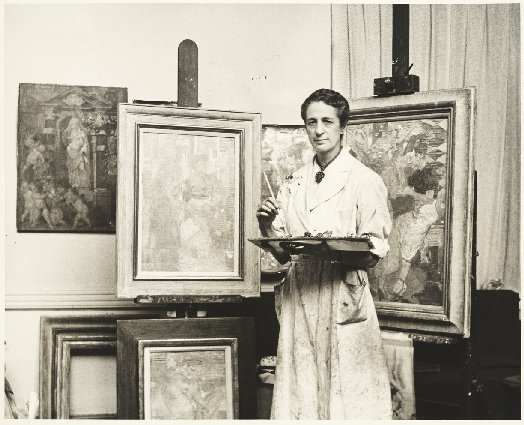
Isabel Bishop, 1959. Photo by Budd ( New York N.Y.). Archives of American Art, Smithsonian Institution.

The Ashcan School of painters was the artistic movement that depicted Urban Realism in America during the late 19th and early 20th century. A few decades later another group of American realist painters, who were also based in New York city, began to focus on everyday life in the city. For these artists, it was all about the bustling area which centred around 14th Street and Union Square in Lower Manhattan during the Depression era. They became known as the Fourteenth Street School of Artists. One of these artists was Isabel Bishop.
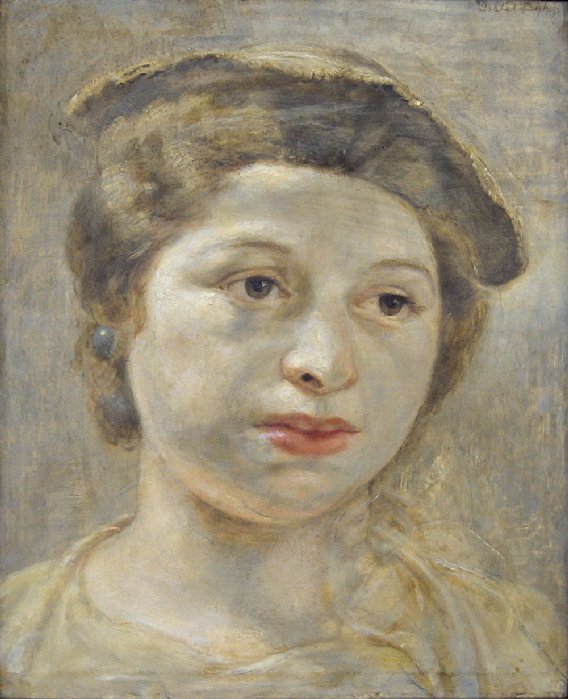
Female Head by Isabel Bishop

Isabel Bishop was the youngest of five children born on March 3rd 1902 in Cincinnati, Ohio, to John Renson Bishop and Anna Newbold Bishop. Her parents were descendants from East coast mercantile families but although they came from “old money” they were considered middle-class and often struggled financially. Isabel’s parents were both highly educated individuals. Her father was a Greek and Latin scholar and had a Ph.D in history. Her mother was a writer and an activist for women’s suffrage. The family frequently moved from town to town for financial reasons and to gain employment. Wherever they set up home, Isabel’s father, John, would find work at the local school where he often rose to become its principal and in some cases took ownership of the school.

Ice Cream Cones by Isabel Bishop

In 1887 the couple had their first children, twins, a boy and a girl, Mildred and Newbold and in 1890 another set of twins, once again a boy and a girl, was born, Remson and Anstice. This enlargement of the family caused financial hardship and her father had to continually look for better paying jobs. Isobel did not remember much about the two sets of twins as by the time she was born they were away at boarding school or college. According to Isabel her parents were very different in temperament. Her mother was a free spirit but very strong-willed and in her 1987 interview she recalls an incident that had repercussions on her father’s life:

“…It was hard on my father that she was strong. For one thing, in Detroit, Michigan, women were not supposed to be strong. She simply liked what she liked and that was it. One time she was asked to go down to the court and testify in some case. She went down, but she wouldn’t swear to be telling the truth. She was asked by the court why she wouldn’t and she said, “I don’t believe in God.” It was in the Detroit papers with the headline:


“SCHOOL PRINCIPAL’S WIFE DOESN’T BELIEVE IN GOD”


I really felt for my father. I mean, a school principal! His life was pretty impossible after that…”
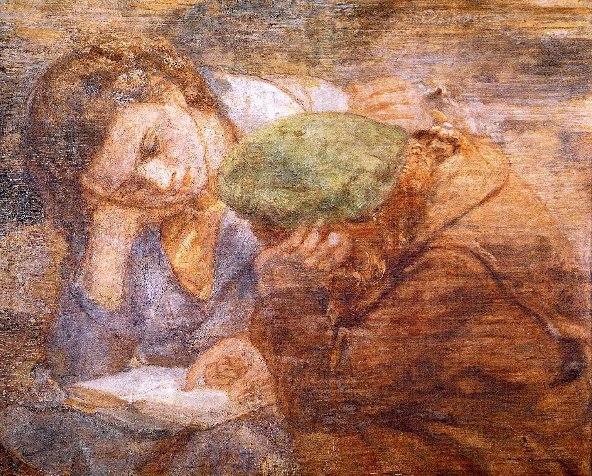
Two Girls with a Book by Isabel Bishop

Although born in Cincinatti Isobel and her parents moved to Detroit a year after she was born. In 1914, when she was twelve years of age, Isabel was enrolled in Saturday morning life drawing classes at the John Wicker Art School in Detroit. From there, at the age of sixteen, and once she had graduated from High School, she left Detroit and went to New York. It was here that she enrolled at the School of Applied Design for Women, where she studied illustration. In 1920, aged eighteen, Isabel, wanting to enhance her artistic knowledge and skills, attended the Art Students League where her first tutor was Max Weber, whom she disliked and who gave her a hard time. Later she was tutored by Kenneth Hayes Miller, another artist associated with the Fourteenth Street School who couldn’t be more different than Weber. Other tutors were Guy Pène du Bois, Robert Henri and Frank Vincent DuMond.
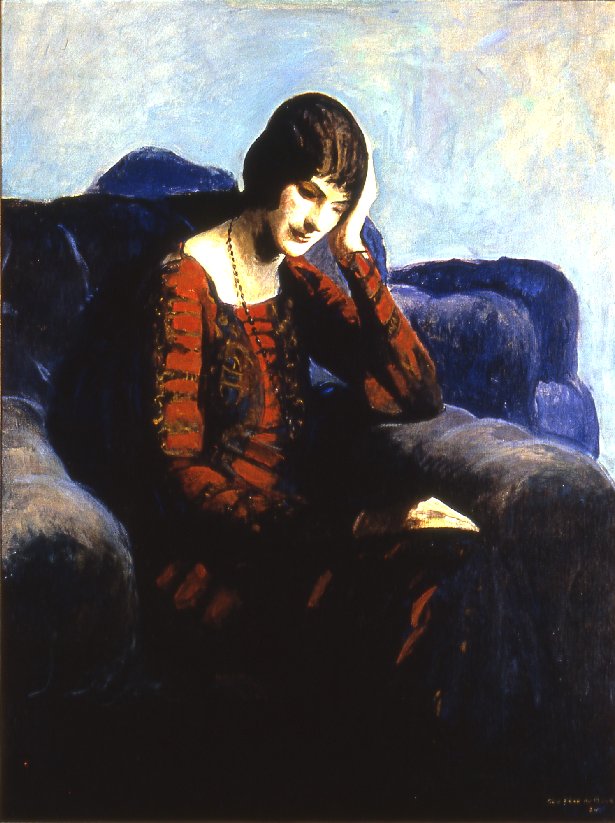
Portrait of Isabel Bishop by Guy Pene du Bois (1924)

According to Helen Yglesias’ 1989 biography Isabel Bishop, although Weber treated Isabel harshly and she felt intimidated by Robert Henri, in Kenneth Hayes Miller she found a mentor who, in her words, was “intellectually stimulating, not stultifying, a fascinating person who presented all sorts of new possibilities, new points of view.”

Isabel Bishop’s 9 West 14th Street Studio (no longer extant) highlighted in red, 14th Street, north side, west from Fifth Avenue. June 11, 1933.

Another friend she made at the Art Students League was Reginald Marsh, who made fleeting visits to the classes at the Art Students League whilst she was student there and this friendship led to her being witness to the working-class life of the city. In 1926, she went to live at 9 West Fourteenth Street, which was a short distance from where Marsh lived and it was in this vicinity that she kept her studio that overlooked Union Square at Broadway and East Fourteenth Street and remained there until 1982. From the windows of her studio she was able to witness the daily activities in Union Square. Fourteenth Street in the 20s and 30s was referred to as “The Poor Man’s Fifth Avenue.” It was a bustling center for bargain shopping and bawdy entertainment in the form of burlesque shows and movie theatres for everyday working-class New Yorkers. 
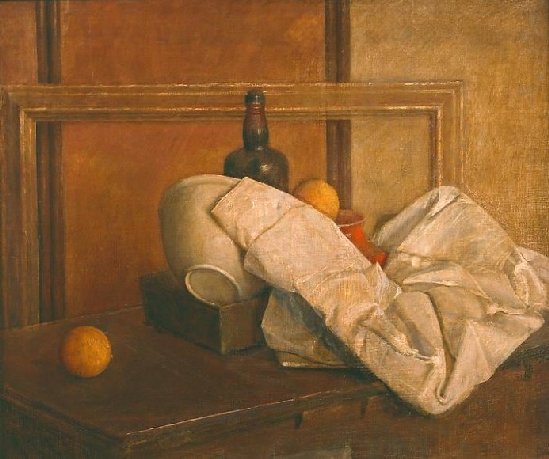
Still Life with Orange #1 by Isabel Bishop

Her friendship with fellow student, Reginald Marsh, encompassed many lunch or dinner dates when they discussed their day’s work. She affectionately recalled that they each paid for their own fifty cent meal and occasionally Marsh would take her to a Coney Island dance marathon or backstage at Minsky’s Burlesque. She recalled that it was great going with Reggie, and whilst there he would sketch the goings-on at the Burlesque show. She said that there were a number of occasions, the owner, Minsky bought Reggie’s work.

The Artist’s Table by Isabel Bishop

Isabel loved the area around Union Square and would regularly visit the Square itself, sketching for hours on end. She remembered those days saying:

“…I adored it. Drawing nourished my spirit; it was like eating. I got ideas there, for drawing is a way of finding out something, even though it might only be the discovery of a simple gesture…”

If she liked one of her sketches, she would turn it into an etching or make a painting from it. She soon became known for depicting urban life and was a leading member of the Fourteenth Street School of artists.

14th Street by Isabel Bishop

The Great Depression began in 1929 and nobody seemed to want to spend money buying the work of an unknown female artist, especially one who had not even had a solo show. Money was tight, people were losing their jobs and America had fallen into the grip of the worst depression in history and most Americans were worried about how they could survive the disaster that had befallen the nation. Isabel went from art gallery to art gallery hoping that they would accept her paintings but with little luck. It was a very depressing and frustrating time in Isabel’s life. A turning point came when Isabel met Alan Gruskin. Gruskin had hoped to become an artist, but while still a student realized that his talents were better suited to art administration than painting. On graduating from Harvard he worked at a New York gallery that specialized in the works of the Old Masters. He left there and returned home hoping to start a career as an author but that never came to fruition so he returned to Manhattan and, in 1932, opened the Midtown Galleries at 559 Fifth Avenue. He specialised in artwork by living American artists and in that year he staged a solo exhibition of Isabel’s paintings.
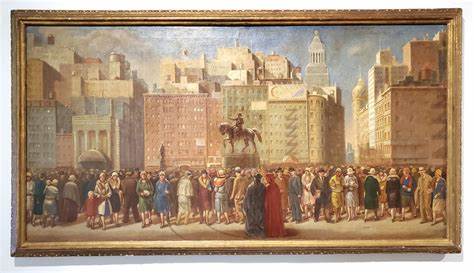
Dante and Virgil in Union Square by Isabel Bishop (1932)

Isabel Bishop’s paintings focused on the ordinary people of New York City, and in particular, those in her neighbourhood around Union Square and 14th Street. However, her 1932 painting entitled Dante and Virgil in Union Square was extraordinary with her inclusion of Dante, in the red cloak, and Virgil, with a laurel wreath on his head, which makes this work memorable. Isabel said she was motivated when she read the translation of Dante’s Inferno, the first part of Italian writer Dante Alighieri’s 14th-century narrative poem The Divine Comedy with its tales of life in the underworld. In her depiction, Isabel likened the hordes of poor souls that confronted Dante and Virgil in the various levels of hell with the hordes of human beings that daily passed through Union Square at rush hour. In the painting we see a crowd of people at Union Square, the equestrian statue of George Washington in the centre framed by the Union Square Savings Bank and other buildings in the background. It is a very busy scene a woman leading her child by the hand, pairs of women walking away from the crowd, and a number of working class men, portrayed in darker colours, facing into the Square seem completely unaware of the classical figures, who stand in the shadowed foreground of the sidewalk, as if embodying the evaluating gaze of another era.
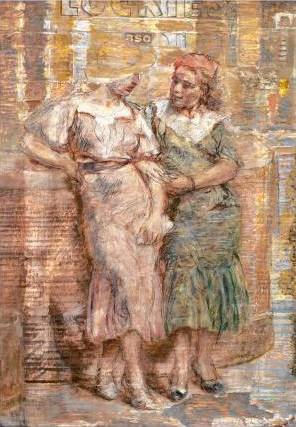
At the Noon Hour by Isabel Bishop (1936)

In Ellen Wiley Todd 1993 book, The “New Woman” Revised: Painting and Gender Politics on Fourteenth Street, she describes the New Woman of the 1920s and 1930s as:
“…being a moderate sort, who hoped to capitalize on new job possibilities and to make herself attractive with the mass-produced products of the clothing and cosmetics industry…”

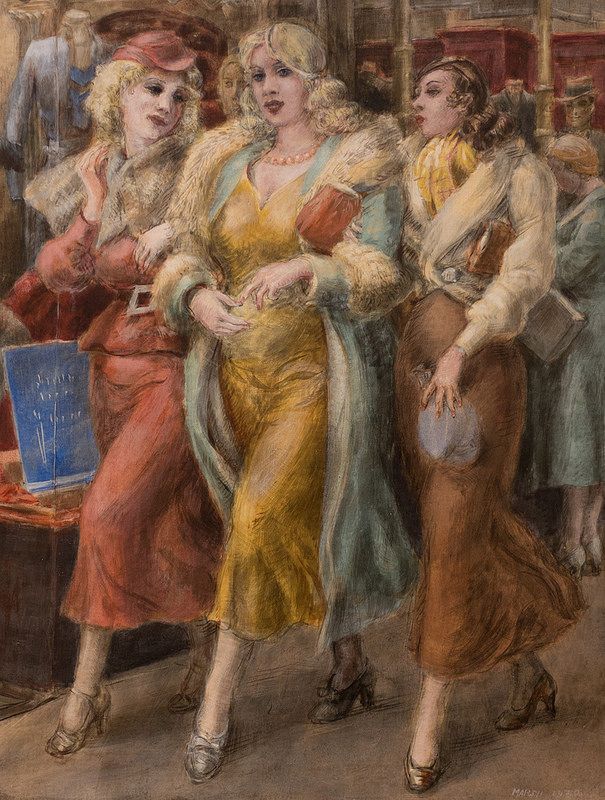
Hearn’s Department Store-Fourteenth Street Shoppers by Isabel Bishop (1927)

The entrance to Hearn’s Department Store was right across the street from Isabel Bishop’s studio and she realised that it was the perfect place to find and observe this “New Woman.” Isabel Bishop’s Hearn’s Department Store—Fourteenth Street Shoppers was completed in 1927, the same year that she enrolled in Kenneth Hayes Miller’s mural painting class at the Art Students League. It depicts the city’s middle-class shoppers who are wearing the latest fashions and who visit the shops around Union Square in order to pick up the latest bargains.
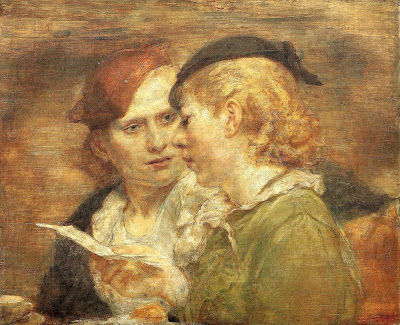
Two Girls by Isabel Bishop (1935)

In 1935 Isabel completed her painting entitled Two Girls. It was yet another of her works which depicted young working women. In this painting we see a close-up of two smartly dressed figures seemingly engaged discussing the contents of a letter. Isabel used two models for this depiction and for this work she used Rose Riggens, a server at a restaurant where Isabel often had breakfast, and Riggens’ friend Anna Abbott. The work exudes both warmth and tranquillity which counters the dire economic circumstances of the Great Depression in the 1930s. This painting which took her twelve months to complete was one of Isobel Bishop’s most well-known works and was originally shown at the Midtown Galleries in New York. It is now part of the city’s Metropolitan Museum of Art.
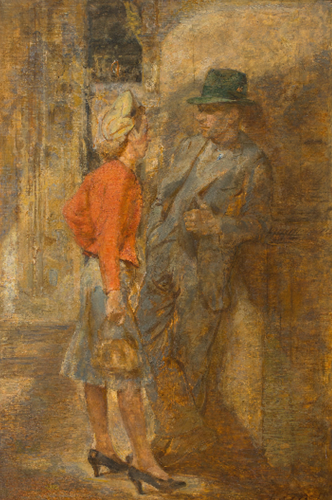
Encounter by Isabel Bishop (1940)

In her 1940 painting entitled Encounter we witness an exchange occurring between a man and a woman though the circumstance of this meeting remains unclear. From many of her paintings we can deduce that Isabel was an insightful observer of everyday activities of young women who visited offices and stores in her neighbourhood. Her works present working women as vivacious subjects for the American Art Scene, which centred on the daily lives of the city’s population. At a time of great unemployment Isabel found it easy to employ young unemployed clerical workers to pose for her. In this work, she depicts a young woman and her boyfriend, with whom she is having a rather stormy romance. The painting can be seen in the St Louis Art Museum.

Tidying Up by Isabel Bishop (1941)

In her 1941 painting Tidying Up, we see a woman, perhaps a secretary or salesperson, using a pocket mirror to check her teeth for lipstick smudges. Isabel liked to depict working-class women during their idle moments away from their jobs. She spent more than a decade depicting secretaries, salesclerks, and blue-collar workers who lived and often worked in and around Union Square. She favoured subjects of women who were simply going about their everyday lives, eating, talking, putting on makeup, and taking off their coats. It was these mundane actions along with facial expressions that Isabel Bishop believed divulged the character and temperament of the people she portrayed. This painting is part of the Indianapolis Museum of Art collection.
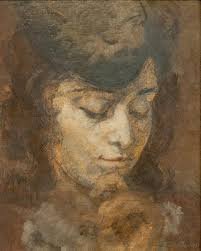
Girl Reading by Isabel Bishop (1935)

Bishop remained on Union Square, where she kept a studio until the end of her life. The area around Fourteenth Street and Union Square remained foremost as the subject matter for her paintings. She received many awards during her life and she was elected an associate member of the National Academy of Design in 1940 later in 1941 she was elevated to full Academician. She received a Benjamin Franklin Fellow at the Royal Society of Arts in London and was also elected a Member of the National Institute of Arts and Letters in 1944 and was the first woman to hold an executive position in the National Institute of Arts and Letters as vice-president. In 1979, she was awarded the Outstanding Achievement in the Arts Award presented to her by President Jimmy Carter.
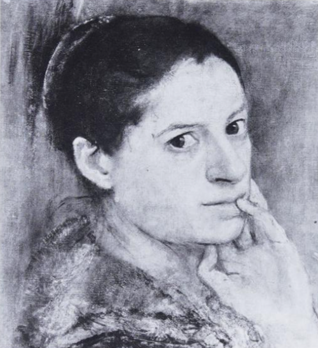
Self portrait by Isabel Bishop (1927)

Isabel Bishop died on February 19th 1988 two weeks before her eighty-sixth birthday.


Most of the information for this blog came from the following excellent websites:

The Art Story

incollect

Isabel Bishop

Hellenica World

Off the Grid

Oral history interview with Isabel Bishop,
1987 November 12-December 11

Annex Galleries

Reading and Art

The Fourteenth Street School. Part 1.

When talking about American Urban Realism in art one thinks of The Ashcan School, which was an artistic movement in America during the late 19th and early 20th century. The name given to the group originated from a criticism written in the graphically pioneering American magazine of socialist politics, The Masses, in March 1916 by the cartoonist Art Young, who asserted that there were too many “pictures of ashcans and girls hitching up their skirts on Horatio Street.” The artists associated with this school of painting that produced works portraying scenes of daily life in New York, especially in the city’s poorer neighbourhoods, were Robert Henri, George Luks, William James Glackens, Everett Shinn, George Bellows and John Sloan.

Today I want to look at another group of American realist painters who were also based in New York city and who also focused on everyday life in the city. For them it was all about the bustling area which centred around 14th Street and around Union Square in Lower Manhattan during the Depression era. During the 1920s and the 1930s, these artists continued the tradition established by the Ashcan School. They became known as the Fourteenth Street School of Artists. This group of painters were inspired by the legacy of the Ashcan School artists who depicted urban life and this new group established studios in the Fourteenth Street area and were inspired by the crowds that would daily swamp the nearby streets.

Reginald Marsh sketching on 14th Street, New York, 1941.

The first of the artists of the Fourteenth Street School I am looking at is Reginald Marsh. He was born on March 14th, 1898, in an apartment in Paris above the Café du Dome. He was the second son born to American parents who were both artists. His father was Frederick Dana Marsh, who attended the School of the Art Institute of Chicago, where he worked with artists preparing murals for the Chicago World’s Fair in 1893. He went to Paris where in 1895 he married Alice Randall, a fellow Chicago art student and miniature painter. Whilst living in Paris, the couple had two sons, James in 1896 and Reginald two years later. Reginald’s father was one of the earliest American painters to depict modern industrialisation in America. The family lived affluently due to Reginald’s paternal grandfather. James Marsh, who had made a fortune in the Chicago meat packing business.

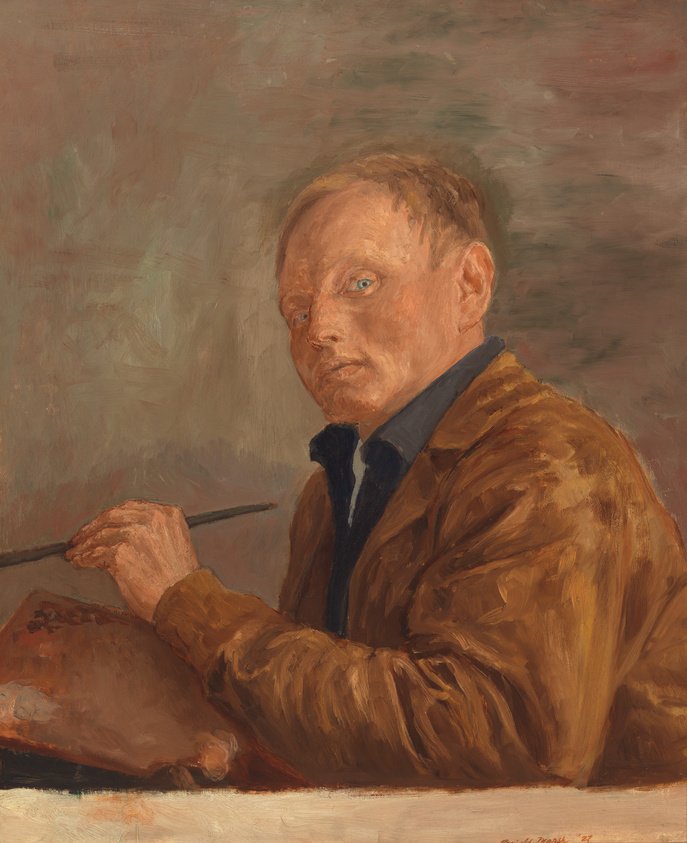
Self Portrait by Reginald Marsh (1927)

Reginald Marsh’s family moved to America in 1900 and relocated to Nutley, New Jersey where they set up a studio/home at No. 16 The Enclosure, a street that had been established as an artists’ colony some decades earlier by the American painter Frank Fowler, who had once owned their house. This resulted in Reginald being immersed in the world of art and painters who nurtured his love of painting and sketching. It was not just that art could be a good outlet for the teenager but it helped him to socialise with others and as he was a somewhat introverted and often tongue-tied boy, and so this was a bonus.

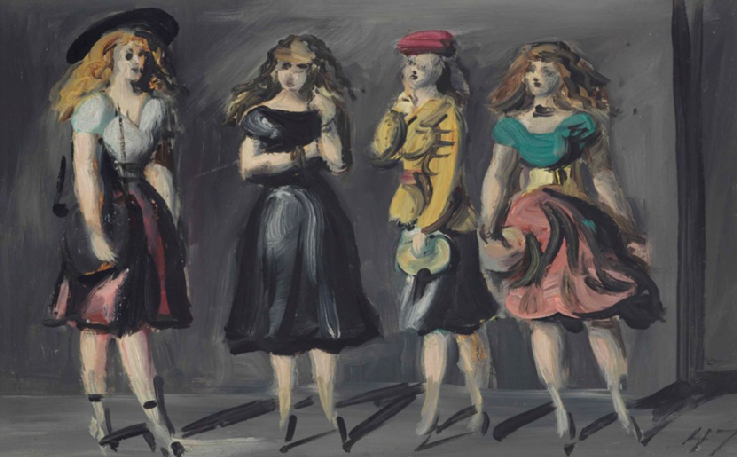
Four Women by Reginald Marsh (1947)

In 1914, the family moved to New Rochelle, in New York State. The family went on to buy an estate in Woodstock, New York, where they spent most of their summers. Reginald Marsh attended various schools including the Riverview Military Academy in Poughkeepsie and the Lawrenceville Preparatory School in New Jersey. After graduating from high school he enrolled at the Yale School of Art, the art school of Yale University, where he made a name for himself as an illustrator and cartoonist for the Art School’s humour magazine, The Yale Record

Figures on the Beach by Reginald Marsh (1921)

After graduating from Yale in 1920, Marsh re-located to New York, where, in 1922, he enrolled for a short period at the Art Students League. It was while studying art at this establishment that he gained a great deal of experience in painting and drawing from his skilled tutors, especially Kenneth Hayes Miller, an American painter and printmaker. Whilst at the Art Student League he became friends with fellow artist, Betty Burroughs. Their relationship grew and twelve months later, the couple married and as Betty’s father, Bryson Burroughs, was a curator at the Metropolitan Museum of Art he was able to introduce his son-in-law to important figures in the art world. Reginald Marsh was now the family’s breadwinner, and so he began painting seriously.

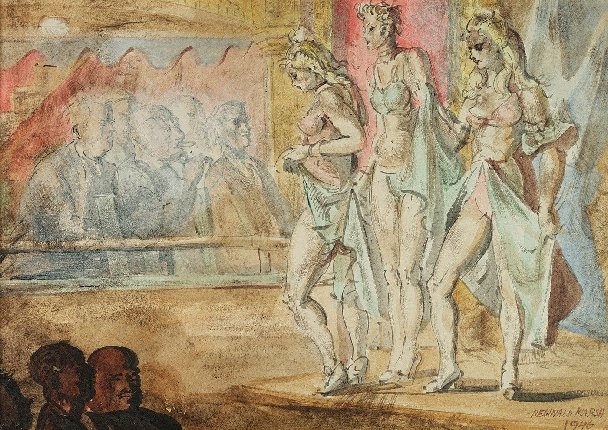
Burlesque by Reginald Marsh

Gaiety Burlesque by Reginald Marsh (1930)

Once Marsh had graduated from Yale School of Art he moved to New York in his search for employment as a freelance illustrator. His first opportunity came when the New York Daily News commissioned him to produce depictions of vaudeville and burlesque performers. Burlesque and vaudeville shows were at the height of their popularity and Marsh’s depictions of burlesque dancers, chorus girls and strippers. Although some people often criticised them for their raunchiness and vulgarity, others were delighted by the comedy and satire emanating from his portrayals. In Edward Laning’s 1973 book, The Sketchbooks of Reginald Marsh, he described burlesque as:

“… the theater of the common man; it expressed the humor, and fantasies of the poor, the old, and the ill-favored…”

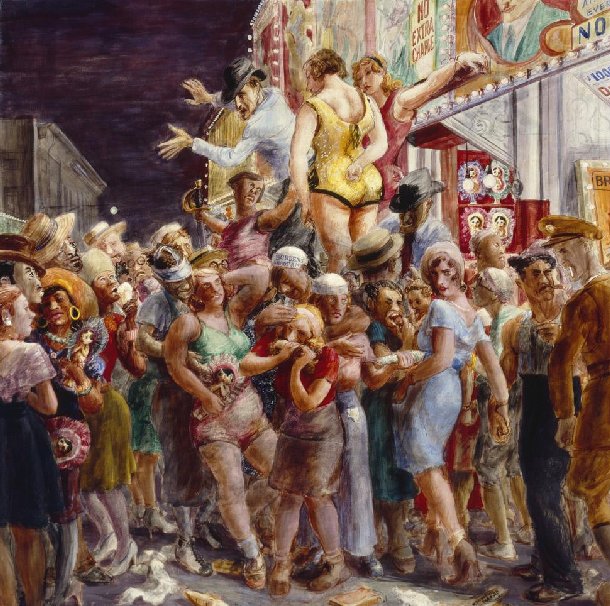
Wonderland Circus, Sideshow Coney Island by Reginald Marsh (1930)

Coney Island by Reginald Marsh (1933)

Mrsh’s job as a staff artist for the New York Daily News gave him the opportunity to explore the underbelly of society: He would wander the streets of Lower Manhattan, and gain inspiration from the burlesque shows along Bowery Street, the storefront windows and advertisements, and the beaches of Coney Island. Marsh also captured the throngs of theatre goers at these shows or outside the theatres and side-shows.

Ten Cents a Dance by Reginald Marsh

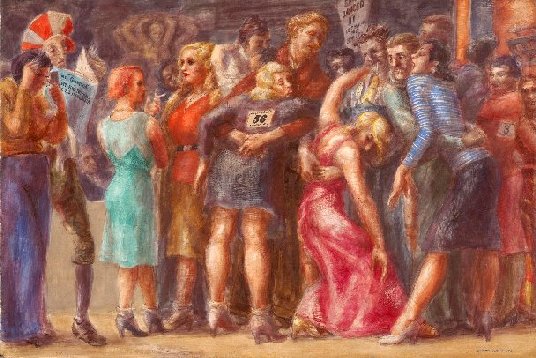
 Zeke Youngblood’s Dance Marathon by Reginald Marsh (1932)

And there was the ever-popular but brutal Dance Marathons !

The New Deal was formulated by President Franklin Delano Roosevelt’s administration which came up with ideas on how to alleviate the suffering of those who had neither jobs nor any money to support themselves. For the artistic community, Roosevelt came up with a number of schemes such as the Public Works of Art Project, the Treasury Section of Painting and Sculpture and the Treasury Relief Art Project. The Federal Art Project (FAP), which was created in 1935 as part of the Work Progress Administration (WPA), was one which directly funded visual artists and provided posters for other agencies like the Social Security Administration and the National Park Service. The William Jefferson Clinton Federal Building in Washington DC, which is a complex of several historic buildings, one of which was originally called the New Post Office, was completed in 1934. It housed the headquarters of the Post Office Department. The Clinton Federal Building was one of the initial locations that integrated various New Deal artworks that were originally commissioned and displayed in federally constructed buildings by the Treasury Department Section of Fine Arts during the 1930s and 1940s. In 1936, Reginald Marsh completed two murals for the interior of the building.

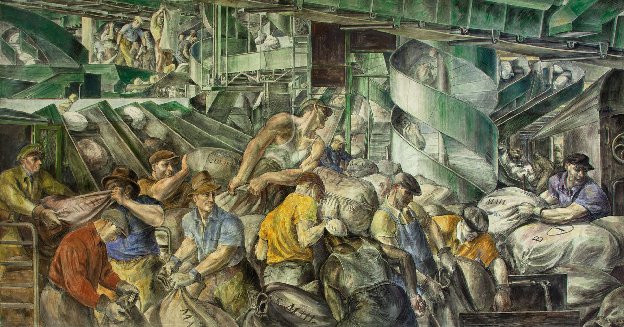
Sorting the Mail by Reginald Marsh (1936)   This mural was for the Ariel Rios Federal Building, Washington, D.C.

In preparation for his mural, Sorting the Mail, Marsh completed a number of preliminary sketches of the railway mail service which was located under the old Penn Station in New York, as well as the New York post office department building. He observed the new and modern technology, talked to the postal workers and watched them unloading and sorting the mail. Marsh’s depiction conveys the feverish dynamism of the workers. We see swarthy-skinned muscular men lifting and lugging large bags of mail. The various skin tones of the men allude to it being a diverse workforce of differing nationalities

Unloading the Mail by Reginald Marsh (1936)

Marsh’s other mural Unloading the Mail was also completed in 1936. The depiction in this mural was all about the international movement of mail from country to country. Marsh visited the Cunard liner RMS Berengaria which had docked in New York harbour. The Cunard line vessel, as well as carrying passengers across the Atlantic, brought mail to America from Europe and further afield. He made many sketches of the ship itself but the mural depicts the activities that occurred in the harbour boat which was used to bring the mail from the liner ashore for distribution. To the left we can catch a glimpse of the Manhattan shoreline whilst to the right we can see the officers of the liner handing the sacks of mail to the crew of the harbour tender. At the bottom left of the painting we can see a man, seated, tallying the sacks of mail that had been offloaded from the liner.

The Bowery by Reginald Marsh (1930)

By 1930, Reginald Marsh’s career was well established and thanks to inheriting some money from his late grandfather was comfortably well-off. Despite his wealth Marsh began to focus his work on depicting those who were less fortunate. It was his poignant depictions of the poverty suffered by the lower classes during the Great Depression that featured in many of his works, such as his 1930 work entitled The Bowery. In this painting Marsh has depicted the plight of the people hit hard by being out of work and in some cases, homeless. The scene before us has been created using a brown palette. We see large groups of men, who had suffered financially due to the financial crash, loitering along Bowery Street underneath many neon signs advertising cheap hotel accommodation. Above and to the right we catch a glimpse of the Third Avenue overhead railway.

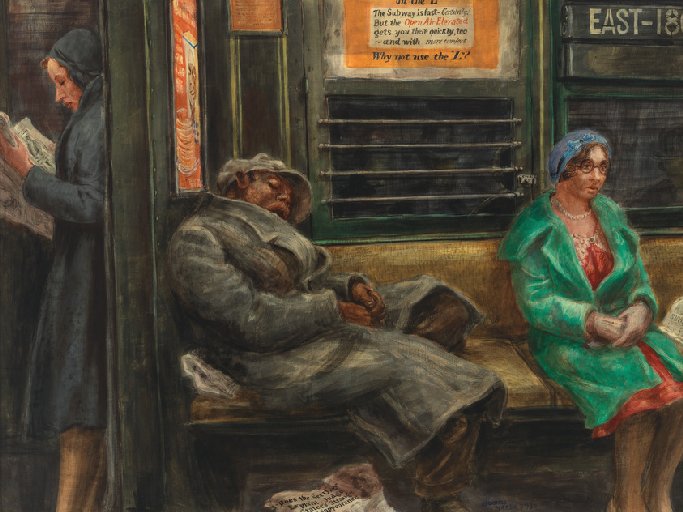
Why Not Use The L by Reginald Marsh (1930)

A fascinating painting with and equally fascinating title is Reginald Marsh’s 1930 work, Why Not Use the “L”. The “L”—or “el”, is an elevated train that rose above the city streets. The western end started at Eight Avenue and 14th Street, ran through Union Square to the opposite end of the line at Rockaway Parkway, Brooklyn. The painting depicts three people in the railway carriage during the Depression. The woman to the right looks out apprehensively whilst the man seems exhausted. A second women to the left seems oblivious to her surroundings as she reads the newspaper. There are a number of advertising posters attached to the wall of the carriage. Reginald Marsh had accurately copied the adverts into his sketch books and added them to his final work.

One such advert extols the joys of Buckwheat Pancakes while another asserts that this form of transport is the best, using the title of this painting:


“…The subway is fast—certainly! But the open Air Elevated gets you there quickly, too—and with more comfort. Why not use the “L”?…”

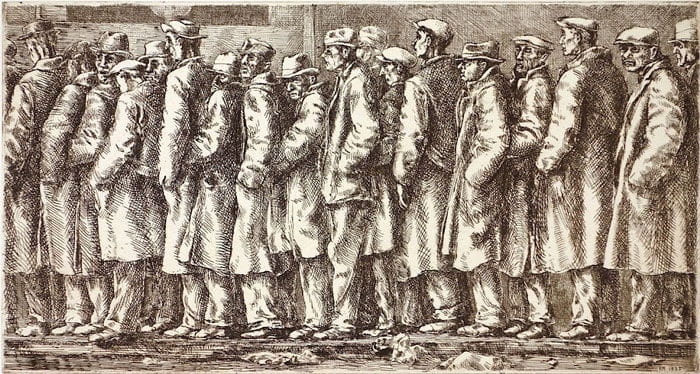
Bread Line – No One has Starved by Reginald Marsh (1932)

For my last offering of a Reginald Marsh work I am looking at his very poignant etching entitled Bread Line–No One Has Starved. He completed this in 1932, at the height of the Great American Depression. It depicts a line of destitute men as they stand waiting in resignation for some sort of public assistance. The men are crowded into the black and white depiction and there is little to differentiate them. It is a depiction that represents poverty in general rather than an individual’s poverty. Marsh favoured depictions of the poor and down-and-out people and dismissed depicting the affluent saying that well-bred people were no fun to paint.

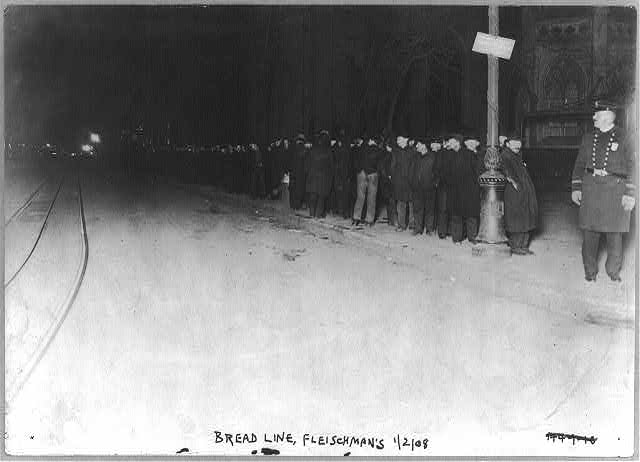
The Bread Line – the stark reality. Bowery men in bread line at Fleischman’s Restaurant, N.Y.C. – Thursday 2nd January 1908

By 1932, the unemployment figure in America had risen to unparalleled levels and President Herbert Hoover was forced to admit to a congressional committee that no one, not even the federal government, really knew how many people were unemployed. Nevertheless, President Hoover, who at the time was seeking re-election, insisted that the underlying conditions of the American economy were sound and that no one has starved, and this phrase was incorporated into the title of Marsh’s p[ainting.

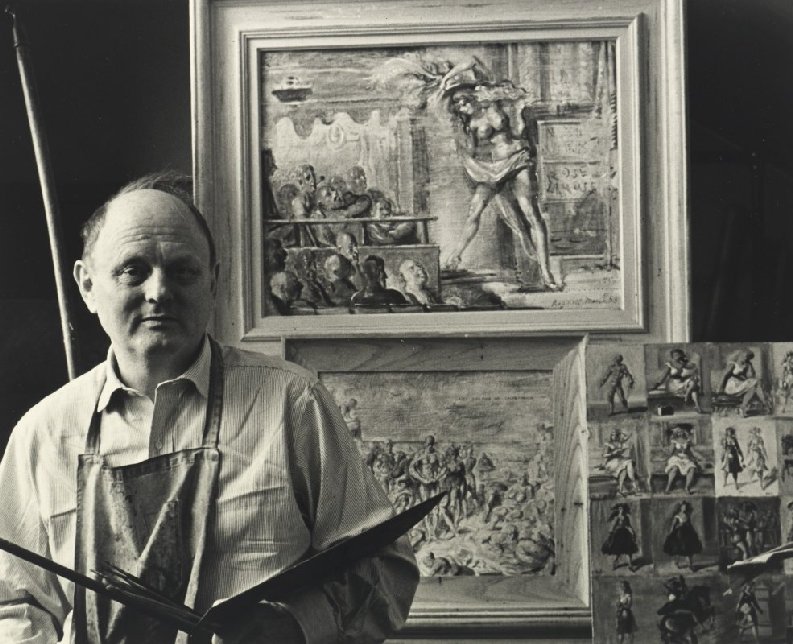
Reginald Marsh at work (1954)

In the 1940s Reginald, Marsh became an important teacher at the Art Students League of New York, whilst carrying on his work as a magazine illustrator for well-known magazines such as Life, Fortune, and Esquire. Sadly for Marsh his style of art became less appreciated and this affected him. Shortly before his death, he was awarded the Gold Medal for Graphic Arts by the American Academy and the National Institute for Arts and Letters. His disillusionment at the lack of appreciation of his art at that time became apparent when he received the award and said that I am not a man of this century.

Reginald Marsh died from a heart attack in Dorset, Vermont, on July 3rd, 1954, aged 56.


As usual, a great deal of information came from various Wikipedia sites but most came from the excellent sites below:

ART CONTRARIAN
incollect
ART HISTORY
QUEST ROYAL FINE ARTS
INSIDE THE APPLE

Unemployed by Ben Shahn

Unemployment by Ben Shahn

My featured artist today was quite unknown to me.  I came across him and his paintings when I was flicking through an art book looking for information regarding another painter.  One painting stood out from the rest and I have made it My Daily Art Display featured painting of today.  There was something very haunting about the picture with its great sense of realism and I had to find out more about the work and the artist, Ben Shahn.

Ben Shahn was at the forefront of the American Social Realist art movement of the 1930s, a grouping, which included the likes of artists of the Ashcan School, many of whom I have featured in earlier blogs.   Social Realism is a term used to describe visual and other realistic art works which record the everyday conditions of the working classes and mainly feature the life of the poor and deprived and how they had to live.  The works are a pictorial criticism of the social environment that brought about these conditions. Social Realism has its roots back in the mid-19th century and the Realist movement in French art.  Twentieth century Social Realism refers back to the works of the French artist such as Courbet and his painting Burial at Ornans or Millet’s great work The Gleaners.   Social Reailsm art became an important art movement in America during their Great Depression of the 1930’s.

The art of the Social Realist painters often depicted cityscapes homing in on the decaying state of mining villages or broken-down shacks alongside railroad tracks.  Their art is about poverty and the hardships endured by the ordinary but poor people.  Often the works would focus on the indignity suffered by the poor and how they would work hard for little recompense.  The depiction of this inequality of course implied a criticism of the capitalist society and capitalism itself.  The Social Realist painters of America did not want their works to focus on the beauty of their country as portrayed by the likes of the Hudson River School painters.  For them, to get their message across to the public, their works needed to depict the industrial suburbs with its grime and unpleasantness or the run-down farming communities with their broken-down buildings.  Occasionally these artists would depict the rich in their paintings but they were only included for satirical reasons.

Ben Shahn was born in Kovno, Lithuania in 1898 and was the eldest of five children of an Orthodox Jewish family.  His father, Joshua, was a woodcarver and cabinet maker.  In 1902, probably because of his revolutionary activities, his father was exiled to Siberia.  His mother, Gittel Lieberman, and her children moved to Vilkomir, which is now the Lithuanian town of Ukmerge.  Four years later, in 1906, Shahn’s mother and three of her offsprings emigrated to America and settled in Brooklyn with Joshua who had already fled there from Siberia.  Ben Shahn original artistic training was as a lithographer and then as a graphic artist.

At the age of twenty-one Shahn went to New York University and studied biology.  Two years later he transferred to City College of New York to study art and then moved on to the New York National Academy of Design which is now known as The National Academy Museum and School of Fine Arts.

In 1924 Shahn married Tillie Goldstein and the two set off on a long journey of discovery taking in North Africa and the traditional artist pilgrimage of the capital cities of Europe taking in the works of the great European modern artists of the time such as Matisse, Picasso and Klee.  He had not been won over by their art or the European Modernist art scene and soon felt less influenced by their work and preferred to follow the style of the Realists painters especially those who showed a concern for the plight of the downtrodden.  Shahn was inspired by the likes of the photographer Walker Evans, the Mexican communist painter Diego Rivera and the French Realist painters.   It was with Rivera that Shahn worked on the public mural at the Rockefeller Centre, which was to cause such controversy and had to be hidden from public view and eventually destroyed.

As a political activist Shahn became interested in newspaper photography.  Photography was to act as his source material for some of his paintings and satires. During the 1930’s he was engaged in street photography himself, recording the lives of the working-class and immigrant populations and the hardship of the unemployed.   Over the years Shahn, with his trusted 35mm Leica camera, built up a large collection of photographs which poignantly recorded the horror of unemployment and poverty during the Depression years.

My Daily Art Display featured painting is simply entitled Unemployment and was completed by Shahn in 1934.  Shahn exhibited many paintings and photographs which highlighted the plight of the unemployed and homeless especially during the time of the Great Depression.  Before us stand five men, all purported to be out of work.  They look down on their luck.  Their black eyes stare out at us.  They stand upright trying to muster a certain amount of dignity despite the hopelessness of their situation.  In some of their faces we see a look of desperation and fear of what their future may hold.  The man in the right foreground has his arms folded across his chest.  His look is more defiant almost questioning the viewer about what they intend to do about his plight.  One man has a makeshift patch on his eye which makes him look even more vulnerable.  I suppose Shahn and other Realist painters believed that through the moving nature of the subjects of their works it would help remind everybody of the horrors of life we could face and counsel us to avoid similar pitfalls in the future.  Sadly, as in the case of war with its tragedies and horrors, we rarely learn by our mistakes and seem to always repeat our mistakes.  There seems to be little we can do but shake our heads sympathetically as we view these Social Realist paintings and can only hope that we ourselves are never touched by similar tragedies.

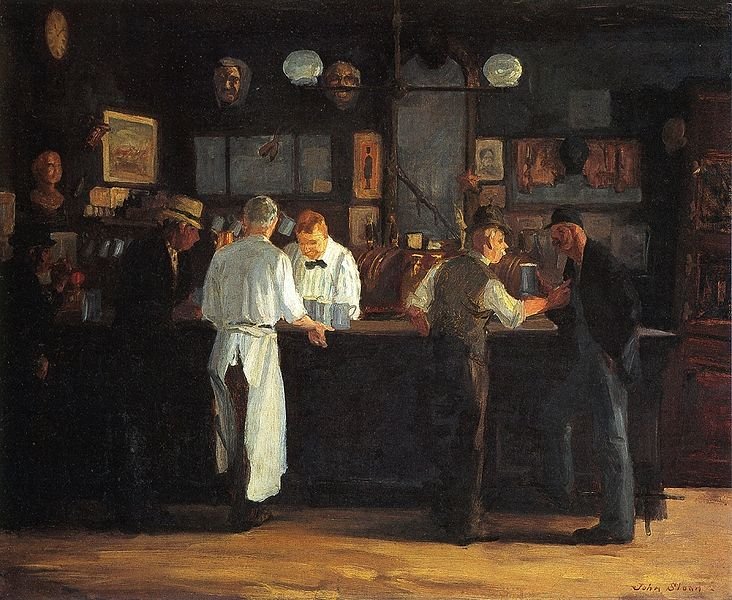
McSorley’s Bar by John Sloan

McSorley's Bar by John Sloan (1912)

I have looked at many paintings which have featured inns and taverns but they have been mainly been depictions of rural scenes with peasants in the Netherlands and Flanders and were painted by the Dutch and Flemish painters centuries ago.  Today, for a change, I am looking at a genre painting of a tavern scene but this is not really a tavern, more what we British would call a pub or Americans would term a bar or a saloon.  The title of the painting is McSorley’s Bar and was painted by the American artist John French Sloan.  Sloan was originally a member of a group of artists who had the strange collective name of The Eight and later he became a leading figure in the Ashcan School of realist artists.  I have featured works by these artists in earlier blogs and if you enter either Ashcan School or Robert Henri or George Bellows into the “Search” function at the right of this blog it will give you a little bit of history about these artist groups.

John French Sloan was born in New York in 1871.  His father James had had an interest in art, but as only as a hobby but he did encourage his children to draw and paint during their early years.  Sloan’s father struggled to find gainful employment moving from one job to another without ever making a fortune.  He married, Henrietta, a girl who had come from a much more financially prosperous family and who was a teacher.  James Sloan suffered a mental breakdown when John was seventeen years of age and consequently was unable to work and the burden of supporting the family fell on to the shoulders of the seventeen year old John.  For this reason, John Sloan had to leave school and find a job in order to bring in some money for the family.

Sloan was employed in a local bookstore as an assistant cashier.  The job was not very taxing and the young man had time to read the books that were on sale at the emporium and also spend time studying the artistic prints that it also held.  It was during this time that Sloan started to make pen and ink copies of some of the prints and the store owner liked them so much that he allowed Sloan to put them up for sale in the store.  Two years later in 1890 Sloan moved on to work in a stationery store where he used to design calendars and greeting cards.  Sloan had now found the joy of art and enrolled in an evening art class.  Buoyed by his artistic successes he left the stationers and set himself up as a commercial artist but his well-intentioned venture failed and he took a job as an illustrator at the local newspaper offices of The Philadelphia Enquirer, later he would work for the rival newspaper, The Philadelphia Press.    He continued his artistic tuition in the evenings by enrolling at the Pennsylvania Academy of Fine Arts.  It was here he met and became friends with fellow artists such as William Glackens and Robert Henri who became Sloan’s mentor, sending him reproductions of works by the French Impressionists and the leading European Renaissance painters, for him to copy.

When Sloan was twenty-seven he was introduced to a young woman with a somewhat chequered history, Anna Maria Wall, known affectionately as Dolly.  Sloan, who was very naive, very self-conscious and lacked the social graces which would gain him female companionship, met Anna at a brothel.  Although she worked in a department store during the day, she supplemented her meagre income by working in a brothel at night.  She needed the extra money to feed her other vice;  she was also an alcoholic but despite all this he fell in love with her and they started, what one can imagine, was a “challenging” relationship.

Their relationship did prove difficult as Anna not only suffered the effects of excessive and prolonged alcohol intake, she suffered from alcohol-related mental problems  and insecurity often believing Sloan was about to leave her.  In 1906 Sloan sought medical advice and was advised that he needed to constantly support Anna and show how much he needed her.  Between them they devised a plan by which Sloan would keep a dairy and in it he would write down each day how much he loved Anna and wanted to be with her and then leave the diary somewhere where she was bound to find it and surreptitiously read his journal entries and by doing so put her mind at rest.  He wrote daily entries for seven years until 1913.   Despite these problems, Sloan’s artistic work continued well and he was producing numerous oil paintings.  In 1904 he moved to New York and went to live in Greenwich Village and although relying on money he received from his freelance work for The Philadelphia Press newspaper, he supplemented that with money he earned for his book and magazine illustrations.   It was whilst living in New York, in 1912, that he painted today’s featured work McSorley’s Bar.  He exhibited it at the 1913 Armory Show, an exhibition of modern art which had been organised by the Association of American Painters and Sculptors.  This turned out to be a landmark exhibition which opened the eyes of the New Yorkers to this new modern art and the likes of cubism, who up till then had been accustomed to realistic art.   Sloan’s painting never sold and in fact remained unsold until 1932 when the Detroit Institute of Arts purchased it.  This was the first painting by Sloan to be part of a museum collection and was probably one of his best.

This painting was very typical of works by John Sloan in which he liked to depict the energy and life during the early years of the twentieth century of New York City and its inhabitants.  Sloan was a socialist and a member of the Socialist Party and had great empathy with the less well-off and their demanding and troubled existences.  His paintings would show the city’s people in different places and situations on the city streets and occasionally, like today’s painting, he would depict people in interior settings, such as cafés or bars as they discussed among themselves their everyday existence.

The painting today shows the interior of McSorley’s Bar with its clientele standing at the bar.  John Mc Sorley opened his Manhatten establishment on East Seventh Street in 1854 and during its existence in the nineteenth century, was an all-male bar.  From around 1912 it became a regular haunt of John Sloan and his Ashcan School artists.  The bar Sloan depicted was somewhat rough and inhospitable. It was always frequented by a great mix of people of various social classes and even today carpenters and mechanics rub shoulders with Wall Street brokers and local politicians.  John Sloan completed five paintings of the interior of the bar between 1912 and 1930 and these certainly increased the popularity of the establishment.   Today, McSorley’s bar draws visitors from around the world.    Its fame as New York’s oldest bar assures its survival and a 1970 court order guarantees that women are as welcome as men!   It’s a museum-like place. One can go there to drink a pint of ale and survey relics of a past era.

In 1943, Sloan’s  wife, Dolly, died of coronary heart disease. The next year, Sloan married Helen Farr, who is responsible for most of the preservation of his works. Part of this was the diary he wrote between 1907 and 1913 for his first wife, Dolly, to read and which were lovingly collated and published in 1965.  They gave a marvellous insight into Sloan’s life and his thoughts during those turbulent times.

On September 7, 1951 John Sloan died at the age of 80, of cancer in Hanover, New Hampshire.  John French Sloan was a leading figure in the Ashcan School of realist painters and was somebody who embraced the principles of socialism and allowed his artistic genius to be used to benefit those fervently upheld values.  His paintings sadly rarely sold during his lifetime and teaching at the Art Students’ League, of which he became its director in 1931, was his principal income.

To learn more about McSorley’s Bar why not go to their website:

http://www.mcsorleysnewyork.com/

Automat by Edward Hopper

Automat by Edward Hopper (1927)

“All the lonely people, where do they all belong? “

I am sure the words from the Beatles song Eleanor Rigby are known by most people.  Loneliness can be a terrible burden to have to bear and its often associated with the impersonality of a large city, which although teeming with people, they seem to remain as strangers, whereas within small village communities there is a sense of camaraderie and friendliness which ensures that with a minimum of effort your loneliness can be banished. 

 My Daily Art Display featured painting for today is entitled Automat by the American artist Edward Hopper, which he completed in 1927.  His theme of loneliness and the loneliness of city life was a constant theme in a number of his paintings.  Look back to My Daily Art Display of January 23rd when I featured his famous work entitled Nighthawks. 

In today’s painting we see a woman, with her cloche hat pulled low down over her forehead, staring into her coffee cup as she sits by herself, in what Hopper terms as an Automat.  I have to admit I had never heard of this term before  but I believe they were what we would now call fast food outlets,  which served simple food or drinks,  and which were served by coin-operated and bill-operated vending machines but I guess the machines have been removed an there is waitress service nowadays.   There is a starkness about the setting, almost but not quite minimalist.  Like the scene in Nighthawks there are just windows but no doors on view, giving a slight sense of entrapment.  Her look of preoccupation would suggest she may be, for some reason unknown to us, mentally entrapped.

The woman we see before us is pensive, her eyes are downcast and to my mind she seems a little sad.  She is well dressed with her warm winter coat with its fur collar and cuffs.  She wears makeup so maybe she is on her way for an evening out or looking how dark it is outside, maybe she is on her way back home.  Of course we are not really sure whether she is on her own or whether the empty chair at her table is for somebody else.  Maybe she is awaiting her companion or is her despondency due to the companion’s non-arrival.

Another strange thing about the woman is that she has only one glove on.  Could it be that this café is not only a lonely place but also a cold one and the one glove is all she wanted to remove so that she could hold the cup and yet still retain some warmth?  The dark window takes up a lot of space in the painting and its darkness adds to the atmosphere of the painting.  It is pitch-black outside and, along with the way the woman is dressed, gives us the feeling that this scene takes place on a cold autumn or winter night.  There is no sign of life outside, no people, no lights from other buildings and no headlights from cars.  This lack of outside lights works well and allows just the penetration of the blackness by the reflection of the café lights to be more effective and in so doing adds to the feeling of isolation. Does Hopper want to liken the woman’s mood and her life to this view of the window – dark with little going on in it?  She is in the middle of a deserted town which adds to the sense of her isolation and solitude.  Note how Hopper has painted the woman’s legs.  The brightness of his colouring of them draws our eyes to them even though they are under the table.  It adds a little bit of overt sensuality to the painting and makes us wonder how such a woman could feel sad and lonely.  We are now concerned about her vulnerability.  Is her pensiveness also due to her feeling vulnerable as she sits alone in this café?

Time Magazine, August 1995

Hopper’s painting and ones of a similar theme are linked with the perception of urban alienation, which by definition is the state of being withdrawn or isolated from the urban world, as through indifference or disaffection.  It is interesting to note that in August 1995 Time magazine used this painting on its front cover with its lead article dedicated to stress, anxiety and depression.

Loneliness is often the central subject matter in Hopper’s art. The people he depicts look as though they are far from the comfort and reassurance of home. We see clues as to their isolation in the way they stand reading a letter beside a hotel bed or drinking in a bar. They stare out of the window of a moving train or read a book in a hotel lobby. Their faces often have the look of vulnerability and introspection. They look like they may have just been jilted or have just broken up with someone. They often seem to be mentally searching for something or someone and have been cast adrift in transient settings. His paintings are often set at night, as this adds to the mood and evocatively all we see through the window is darkness.

Yet despite this bleakness we witness in Hopper’s paintings, they are not themselves bleak to look at – perhaps because they allow us, the viewer, to witness some of the artist’s grief and disappointments, and from that we feel less personally persecuted and beset by them.  It is as if we suddenly realise we are not the only person to feel sad or depressed, for isn’t it true that sometimes a sad book consoles us more when we feel sad.  Maybe we just need to realise we are not alone in our sufferings. 

In some ways Hopper has challenged us to make up our own mind about the story behind the painting.  There is no action going on to give us any clues.  Maybe the story we come up with will depend on our own state of mind.  If we are happy, we may well believe that the woman is thinking about the coming to the café of her beloved.  If we ourselves are feeling lonely and slightly depressed then maybe we empathize with the woman and share her isolation and vulnerability.  So what is to be?  What is your take on the scene in the painting?  Maybe it is at times like this, when we look at the painting and we perceive the loneliness and unhappiness of the woman that we should take time to be grateful for what we have.  Maybe we should not always desire something else.  Maybe we should want what we have.