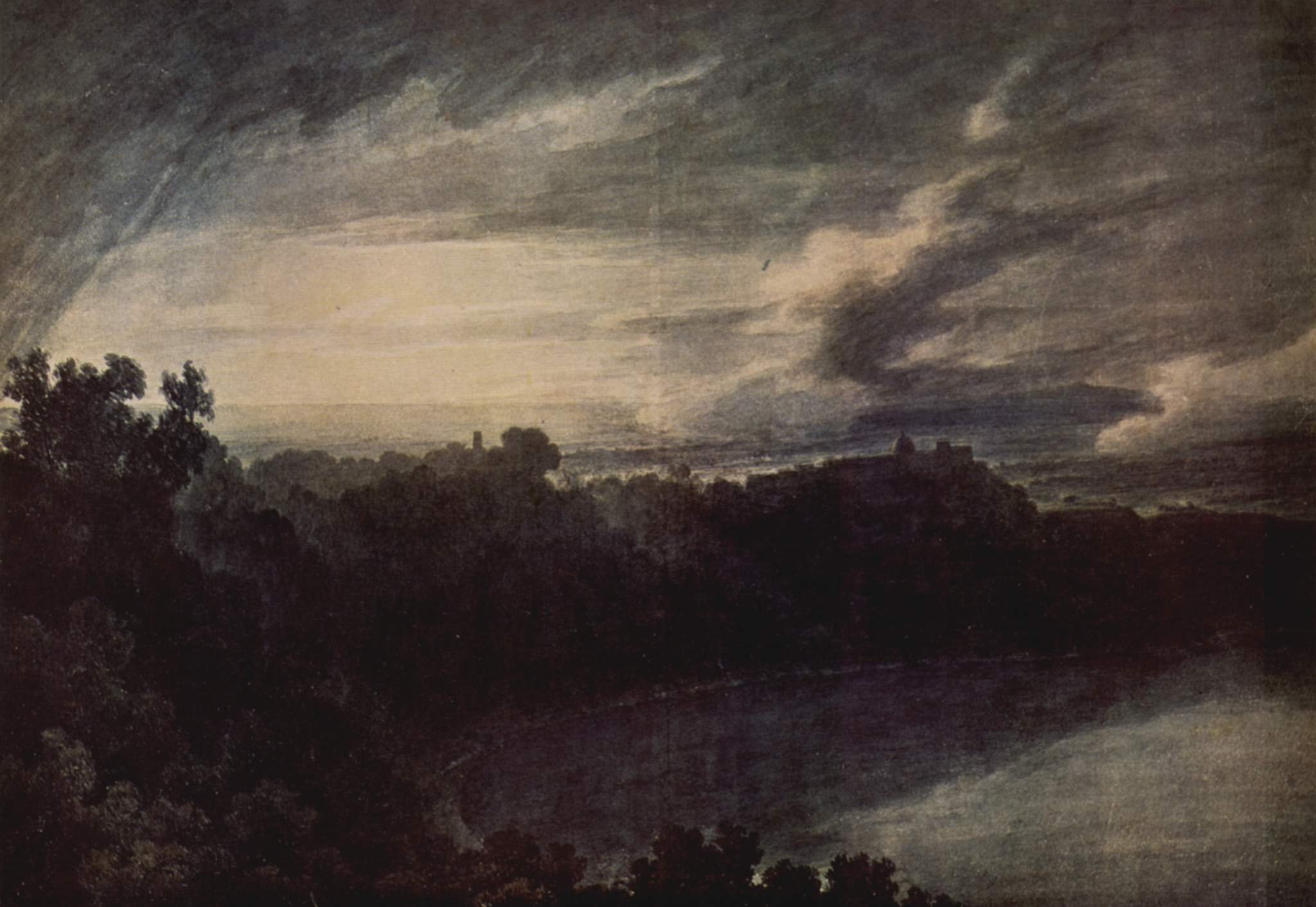
Holt Bridge on the River Dee by Richard Wilson

Holt Bridge on the River Dee by Richard Wilson (c.1762)

My Daily Art Display today features the 18th century Welsh landscape painter Richard Wilson.  He was born in 1714 in Penegoes, a small village in what is now the county of Powys.  His father was a rector at the local church and the family background could be considered as being well respected and of quite high social standing. It was through his father that his young son received a classical education.  The family was connected with some of the elite characters in the local society.  Wilson’s early artistic aspirations were encouraged by his mother’s nephew, Sir George Wynne, who had made his fortune out of lead mining and who supported Richard Wilson financially in London for many years from 1729.  Wilson was sent to London when he was sixteen years of age to take up a six year apprenticeship with a little known artist, Thomas Wright.  Wynne, besides arranging the apprenticeship, gave the young Wilson money to set up a studio in London and bankrolled the aspiring artist until he started selling some of his works.

In the 1740’s Wilson began to have success in selling his paintings and gained several wealthy patrons including the prominent Lyttleton Family who commissioned many family portraits.  This entry into “high society” led him to become a Society portrait painter and his many commissions brought him financial security, so much so he moved into a larger studio in the fashionable Convent Garden area of London.  In 1750 with financial help from a member of the Lyttleton family he set off on the Grand Tour.  This so-called Grand Tour, which was so popular in the 17th and 18th century, was the traditional trip of Europe undertaken by mainly upper-class young men from Europe, especially the British nobility and landed gentry.   Its aim was to be an educational rite of passage.

Wilson visited Venice in 1750 and stayed there for several months where he had the chance to study the works of the Old Masters such as Titian.  During hs soujorn in Venice, he met and became friends with the Venetian landscape artist and rococo painter, Francesco Zuccarelli.  It was Zuccarelli who persuaded Richard Wilson to move away from portraiture and concentrate more on landscape painting.  Wilson was also befriended by an English art collector, William Lock.   Lock and Wilson left Venice in 1751 and travelled through Italy eventually ending up in Rome where Wilson remained for six years.  His base was the Piazza di Spagna. This was a favourite meeting place for artists, both foreign and local and was also a popular haunt for the English Grand Tourists.  These tourists were extremely wealthy and were always looking to take home souvenirs from their great journey and as this was at a time before the invention of photography, what could be better than a painting of the Italian countryside and Richard Wilson was therefore in the ideal spot to sell his classical styled landscape works.  The artists, who most inspired Wilson, were the great French landscape painters Claude Lorrain and Gaspar (Dughet) Poussin.

Wilson returned to England in 1757 and, now quite wealthy, set himself up in a large studio in London.  He was the leading light, along with Sir Joshua Reynolds and Francis Hayman in establishing the Society of Artists in 1760 and later became one of the founding members of the Royal Academy of Art in 1768.  He staged many exhibitions of his work at the Academy and his reputation as a landscape artist grew and his works commanded very high prices.

Sadly, as in lots of cases of a rise to fame, there comes the inevitable fall and Richard Wilson and his reputation tumbled dramatically.  Sucked in by his increasing wealth and fame, Wilson became arrogant and rude.  He insulted a number of his wealthy patrons including George III and soon they deserted him.  His spectacular fall from grace made him turn to drink and soon he became an alcoholic, despite the help he received from the few friends who stayed loyal.  His career was over and he had no choice but to leave London and return to his family home in Wales, penniless.  Wilson spent the last years of his life at Colomendy Hall, the residence situated a few miles from Mold, which was owned by his aunt, Catherine Jones.  He died there in 1782 , a few months short of his 68th birthday, and was buried in the churchyard of St Mary’s  in Mold.

St Mary's Church, Mold

His grave, on the north side of the church, has the following Welsh inscription: (below is the English translation): 

From life’s first dawn his genius shed its rays,

And nature owned him in his earliest days

A willing suitor; skilled his lines to impart

With all the love and graces of his art;

His noble works are still admired and claim

The first reward of an enduring fame.

Richard Wilson's gravestone

My Daily Art Display featured painting today is Holt Bridge on the River Dee by Richard Wilson which he completed around 1762 and now hangs in the National Gallery in London.   This is an idealised landscape as it is not topographically accurate but notwithstanding that, it is a wonderful landscape painting.    Holt Bridge joins the village of Holt in Denbighshire to the village of Farndon in Cheshire. The tower of St Chad’s in Farndon is on the right and the outskirts of Holt on the extreme left.  It is strongly influenced by the works of Claude Lorrain as we know the artist was a great admirer of the French landscape artist.  However, for him there were two other landscape artists of note.  According to W.T.Whitley’s book Artists and their Friends in England 1700-1799, Wilson told a fellow artist William Beechey:

“…Why, sir, Claude for air and Gaspar for composition and sentiment; you may walk in Claude’s pictures and count the miles. But there are two painters whose merit the world does not yet know, who will not fail hereafter to be highly valued, Cuyp and Mompers…”

I have featured Albert Cuyp in a number of my blogs and you will know that he is one of my favourites painters and in the near future I will feature the beautiful work of Joos de Momper, the great Flemish landscape painter.

Road by the Edge of a Lake by Jan Both

Road by the Edge of a Lake by Jan Both (1637-41)

Today I am looking at a landscape painting by the Dutch painter and etcher Jan Dirksz Both.  The artist was born in Utrecht around 1618, the younger brother of Andries Both, who was one of a group of genre painters who worked in Rome in the 17th century and who brought to the Italians the sixteenth century Netherlandish art which depicted peasant subjects.  They were known as the bamboccianti.  The term came from the nickname Il Bamboccio, which translated means “ugly doll” or “ugly puppet”, and was a nickname given to the Dutch painter and leader of the group, Pieter van Laer, because of his physical deformity, as well as the puppet-like figures in his paintings.

It was whilst the two Both brothers were working in Rome that Jan Both met the French landscape artist Claude Lorrain and a fellow Dutch painter Herman van Swanevelt, and it was with these two painters that he collaborated on a series of landscape works.   It was from Claude that he acquired the skill of rendering effects of golden or silvery light and this technique was hugely influential after he returned to Holland in 1642.  Originally Jan Both produced the popular genre paintings and scenes from the everyday life of the streets of Rome but on his return to Utrecht he concentrated all his artistic efforts on Italianate landscape paintings, which were characterised by the golden glow of sunlight.  His brother Andries, on the other hand, preferred the genre painting in the manner of Pieter van Leer.   Like Jan and Andries Both, throughout the 17th century, a steady stream of Dutch painters made the long and demanding trek to Italy, which was, at that time, acknowledged as the home of art.  Aspiring artists from many European countries would descend on Rome in order to study the great masters of the Renaissance and the contemporary painters of the Baroque.  The Dutch who had come from a colder harsher climate with its gloomy and overcast skies were thrilled by the beauty of a sunny Italy.  They marveled at the light, and the myriad of colours offered by the Italian landscapes.   The Dutch artists depicted these wonderful Roman Campagna landscapes in their paintings along with the ruins of earlier civilizations which were dotted throughout the countryside.  This group of 17th century Netherlandish painters were known as the Dutch Italianates.

Jan returned to Utrecht around 1641.  He became the main pioneer of Italianate landscape painting in 17th-century Holland.   He introduced to Dutch landscape paintings a style based on the work of Claude Lorrain, which he had witnessed in Rome. Later this Italianate landscape style of his was developed by other artists such as Nicolaes Berchem and Aelbert Cuyp.  This Italianate style of landscape painting when transferred to the native Dutch landscapes was very popular and much in demand in Holland.  His landscape paintings became more refined over the years and he would often produce large works of idealised landscapes drenched in the golden light of the Mediterranean.

The painting of Jan Both, which I am featuring today, is entitled Road by the Edge of a Lake which he completed between 1637 and 1641 dating back to his Italian sojourn.  It currently hangs in the Dulwich Gallery, London.  The earth has a subtle red tinge to it which mirrors that found in Italy.  There is a tranquillity about this painting as we see the herdsman slowly weaving their way home towards the golden sunset.  The slanting light from the falling sun produces long shadows even from the smallest of molehills we see on the herdsmen’s trail.  This painting incorporates a typical golden sunset, which Jan Both probably learnt from Claude Lorrain when he was in Italy.  Look at the tones and colours of his sky.  Look how the artist has depicted the background, with its bright yellows and yet it also has a misty quality about it, which is what we would experience if we looked towards the setting sun on a clear day.  Move your eyes to the background on the right and the colour changes to a bluer tone and the mistiness gradually disappears.  The way the artist has depicted the background is a seamless continuity of the bright but misty yellowish haze to the clarity of blue sky.  I also like the way the artist has captured the way the sunlight falls on the leaves of the trees and even the individual blades of grass which borders on to the path to the left of the herdsman.

It is interesting to note that some art historians believe that Jan’s brother Andries may have had a hand in this painting.  They come to this conclusion when they studied the figures of the herdsme.  These reminded them of the figures seen in many of Pieter van Laer’s paintings and as I told you earlier, Andries Both was a dedicated follower on Il Bamboccio.

It is a magical painting and one can almost feel the warmth from the setting sun.  It is no wonder the Dutch liked to hang this type of painting on the walls of their houses as they sat inside by their fires and shivered with the cold of a Dutch winter’s day.

Man at the Window by Samuel van Hoogstraten

Man at the Window by Samuel van Hoogstraten (1653)

My Daily Art Display today enters the world of trompe l’oeil.  The term is French and literally means “trick of the eye”.  It is a kind of artistic illusionism which gives the appearance of three-dimensional realism.  This story of trompe l’oeil originated in ancient Greece.  Pliny the Elder records in his Natural Histories the famous confrontation between two Greek 5th Century BC painters, Zeuxis and Parrhasius who were involved in a painting contest. Each would try to make a picture that produced a more perfect illusion of the real world.   Zeuxis painted a likeness of grapes so natural that birds flew down to peck at them. Then his opponent, Parrhasius, brought in his picture covered in a cloth. Reaching out to lift the curtain, Zeuxis was stunned to discover he had lost the contest.  What had appeared to be a cloth was in reality his rival’s painting.

The early precursors of modern trompe l’oeil appeared during the Renaissance, with the discovery of mathematically correct perspective. But the fooling of the eye to the point of confusion with reality only emerged with the rise of still-life painting in the Netherlands in the l7th century.  Trompe l’oeil sets itself apart from ordinary decorative painting by its intent to mislead the observer, and it is this which sets it apart from ordinary still-life painting. The artist’s technical ability is meant to go undetected and, with use of perfect perspective, cleverly observed light and realistic colours, the ploy is to make the viewer believe that a flat surface is not actually flat, or that a space exists where there, in fact, is no space. A trompe l’oeil painting is one which shows apparently three dimensional objects and spaces in a way which the eye accepts as realism in the context of their surroundings.

The Staircase Group (Portrait of Raphaelle Peale and Titian Ramsay Peale), 1785

The new genre soon spread throughout Europe and America.   In American art, we have the Charles Willson Peale’s painting of 1795 entitled  The Staircase Group (Portrait of Raphaelle Peale and Titian Ramsay Peale), which is housed in the Philadelphia Museum of Art.   Peale executed this painting to prove that he was still one of the city’s preeminent artists. On a very large canvas, he made one of his rare full-length portraits, showing two of his sons on an enclosed spiral staircase. The high degree of detail and finish shows that the painting was undoubtedly intended to be a trompe l’oeil, an effect that Peale had never attempted before. To enhance the illusion, he set up the painting within a doorframe in his studio, with a real step in front. Rembrandt Peale, another son, recalled that his father’s friend George Washington, misled by Peale’s artifice, tipped his hat and greeted the two young men as he walked by!

Though highly regarded by collectors, from the beginning art theorists often rubbished trompe l’oeil as the lowest category of art.  These “wise” men regarded it as a mere technical tour-de-force that did not require invention or intellectual thought.  However in the l7th century, leading trompe l’oeil artists were not only receiving acclaim and acknowledgement from many quarters they were seen as also pushing the boundaries of the genre.  My Daily Art Display’s featured painter today,  Samuel van Hoogstraten was even  awarded a medal for his services to Art by the Emperor Ferdinand III, the Holy Roman Emperor, after being so impressed by one of his trompe l’oeil paintings.

My Daily Art Display featured painting today today is entitled Man at the Window which Hoogstraten completed in 1653 and now hangs in the Kunsthistoriches Museum in Vienna.   Look how the artist’s has splendidly portrayed the old man’s wrinkles and the graying of his beard.  The old man’s brow is furrowed and his head is slightly angled.  See how much detail the artist has given the window.   On the sill outside the window he has added a small vase which enhances and emphasizes the depth in the painting.  This window ledge is shaped by a stone wall surrounding the window.  Look at the amazing amount of detail Hoogstraten has put into his depiction of the texture and surface of the stonework.  You can almost believe that if you touched the surface of the painting it would feel like stone.  It is quite amazing.  Also on the windowsill, the artist has added a feather and a couple of leaves, one of which hangs over the side of the sill.  We see the man’s head protruding from one of the panes in the window and this gives the appearance that he is actually coming out towards our space.  Although it is a kind face there is something very haunting about it.  One can easily imagine that as an observer passes this painting and glances at it, they suddenly imagine that they are being watched by this elderly but real person. 

Today’s artist, besides his many trompe d’oeil works, completed many varied paintings and in a future blog I will look at the life of Samuel van Hoogstraten and another of his paintings.   He was not only a very talented painter but also a writer on art. He painted genre scenes in the style of de Hooch and Metsu, and completed many portraits, but maybe he will be best remembered as a specialist in perspective effect.

Still Life with Flowers and Fruit by Rachel Ruysch

Still Life with Flowers and Fruit by Rachael Ruysch (1703)

My Daily Art Display moves into unfamiliar territory on two counts.  My featured artist is a woman and up to now, I have showcased only a few paintings by women and secondly the work is a still-life painting, a genre which I have rarely selected for my daily blog.  I marvel at the intricacy of the painting and I have no doubt that the detailed work which goes into still-life paintings is equal if not greater than in other painting genres.

My featured artist today is the Dutch artist Rachel Ruysch.  Art historians who have studied the art of the Dutch Golden Age have placed her in the top three female artists of that period.  The other two being and Maria van Oosterwijk, another specialist in flower still-life paintings and Judith Leyster, the genre painter who painted a few portraits and who also produced a single still life work. Ruysch  is widely looked upon as the most talented female in the history of still-lifes of flowers and fruits and among the greatest exponents of either sex of this genre.  True praise indeed!!

 Rachel was born in The Hague in 1664.  She came from a wealthy family and was one of twelve children.  Her mother was the daughter of Pieter Post, a Dutch painter of landscapes and battle scenes, before becoming a talented classical-style architect.  Her father Frederick Ruysch, a talented amateur painter was also a renowned Dutch botanist and anatomist.  He accepted a professorship in Amsterdam and so when Rachel was just three years old the family all moved there.    Her father was an expert in anatomical preservation and the creation of dioramas,  three-dimensional full-size or miniature models, sometimes enclosed in a glass showcase, and which would house human parts which had first been preserved and embalmed in liquor balsamicum.   Rachel took an interest in her father’s work and would often help him to decorate the collection with flowers, fishes, seashells and the delicate body parts with lace.  With his trained scientific eye, Rachel’s father was able to observe and record nature with a high degree of accuracy, and it was a talent that he inspired in his daughter. This talent was to greatly influence her works of art in the future, for her still-life floral paintings would be characterized by realism.  Another reason for Rachel’s love of plants and flowers was that she and her family lived in a district of Amsterdam called Bloemgracht, which means “flower canal”. This area was of great natural beauty and was a favourite place of artists

In 1679, at the age of fifteen she had developed a love for art and was exceptionally talented even at that young age.  Recognising his daughter’s artistic aptitude, her father arranged an apprenticeship for her with William van Aelst, a renowned painter, who specialized in still-life works with flowers or game.  Van Aelst, who moved to Amsterdam in 1657, was famous for creating elaborate still-life paintings that featured spiralling compositions and avoided the convention of symmetrical arrangements of depicted bouquets.  Van Aelst taught her the necessary skill of composing a bouquet in a vase but in his less formal manner that produced a much more realistic and tangible effect. In their more realistic works, some flowers and leaves were allowed to droop over the sides of vases, while others were revealed from the back, and by so doing, produced a more rounded shape. Later in her artistic journey, Ruysch would build upon van Aelst’s compositional innovations and this would instil a vitality into her paintings.

Rachel remained a pupil of his until his death four years later in 1683.  Her earliest art works started to appear around 1680 and by the time she was eighteen years of age in 1682 she was producing a number of independently signed paintings and her successful artistic career had just begun.

 In 1693, aged twenty nine she married the lace dealer and portrait painter, Juriaen Pool.  The couple moved to The Hague where they both enrolled in the city’s Guild of St Luke, the professional artists’ organization which regulated the sales and handled the promotion of the artists’ works.  By all accounts their marriage was a happy one and the couple went on to have ten children.  Even though, as she claimed, she essentially raised her children on her own, her life of domesticity and all the chores that went with it coincided with her most creative artistic period. Her large family seemed in no way to get in the way of the quality of her work

In 1708, both Rachel and her husband were invited to Dusseldorf, where they became court painters to the Elector Palatine of Bavaria, Johann Wilhelm.   This proved to be a very successful period in their lives and they remained there and worked for him until his death in 1716, at which time they returned to Holland.  Flower painting emerged as part of the Baroque movement and was especially popular in the late 17th century.   The reason for its popular emergence was the increase in the number of more affluent merchants and middle classes, as well as the growing interest in plants that resulted from the developing science of botany.  It was also around this time in northern Europe, especially Holland, that there was a marked increase in the importation of many new and exotic plants. The Dutch had developed a wide variety of flowers and gardening became increasingly popular. Often, gardeners would commission artists to paint pictures of their best or rarest flowers.

In light of her situation, she was fairly productive throughout her lifetime. She finished her final painting in 1747, when she was 83. By the time she died, she had produced more than 250 pictures, an average of about five pictures a year, which was a considerable number of works for someone creating flower paintings in painstaking detail.

Rachel Ruysch had to overcome two problems which were common in the artistic world of northern Europe at the time.  Firstly she had to overcome the fact that she was a woman and artistic painting was considered a male province.  Secondly, during this period, art was divided into two categories – “greater” and “lesser”.  Into the “greater” category one found paintings of religious and historical themes and compartmentalised in the “lesser” category were portraits, landscapes and still-lifes.  It was this “lesser” category which was deemed fit for female artists.  Women artists who painted were considered to be just painting as a hobby and were completely incapable of artistic genius. However Rachel Ruysch triumphed and became a highly regarded artist who made her mark in the male world of the Dutch Old Masters, becoming one of the greatest flower painters in either gender.

Ruysch died in 1750 at age 86, and during her lifetime she gained widespread fame, and her artistic works were highly valued.   Despite the fact that flower paintings today is still  considered as a lesser form of artistic expression, Ruysch’s reputation as a great painter remains intact.   During the 20th century, there was great interest in her works and her paintings are still featured in major exhibitions in Europe.  She is thought to have produced over 250 paintings in her life but only about 100 are known to still exist, and most of these are in museums or private collections. When any of her paintings do come up for sale they make headlines. In France her 1710 painting Still Life of Fruit with a Birds Nest and Insects went for the equivalent of $508,000.

My Daily Art Display painting by Rachel Ruysch is entitled Still Life with Flowers and Fruit, which she painted in 1703.  This painting, which measures 85cms x 68cms, has an opulent arrangement of flowers and fruit but could never have existed in nature as the various flower specimens and fruit blossomed and bore fruit in different seasons.  This blossoming was simply a figment of the artist’s imagination.  There is a technical perfection about this painting which had come from Rachel’s extensive botanical training.  The painting now hangs in the Akademie der bildenden Künste, in Vienna

The Irish Girl and The English Boy by Ford Madox Brown

Manchester Art Gallery exhibition

The other day I went to Manchester to see the Ford Madox Brown exhibition at the Manchester Art Gallery.  The exhibition opened on September 24th and runs until January 29th 2012 and I strongly recommend you make the effort to visit the city and take in this superb show which displays 140 public and private works from this talented 19th century painter.  I have already  featured two of Ford Madox Brown’s paintings, The Last of England (June 15th) and Manfred on the Jungfrau (July 21st), the former I saw when I visited the Birmingham Art Gallery and the latter which I had hoped to view when I went to Manchester a few months ago had been withdrawn from the gallery for some restoration work prior to this new exhibition.   Both of these works are on show at the current Manchester Exhibition.

I will, in the coming months, review more of Ford Madox Brown’s works,  which I saw at the exhibition, but I need to space them out a little otherwise I will be accused of featuring one artist too often.

Like most people, I had seen many of Ford Madox Brown’s paintings before, in books or on the internet, but what I had not realized was that he had completed many portraits of which a number were on display at the exhibition.  However, there is nothing more true than the saying “you cannot please all the people all the time” for as I researched today’s blog and was still buoyed up with my admiration for Brown’s portraits,  I came across the Daily Telegraph’s art critic’s, Alastair Smart, view of the exhibition and his assessment of some of the paintings, especially his portraiture.  He wrote:

“…Despite the show’s claims to the contrary, Brown’s portraits and biblical dramas aren’t up to much either: his figures are just too awkward in facial gesture, one toothy contortion after another…”

How disappointing to read that when I was still so enthused with what I had seen.  I loved his small portraits.  I did get some consolation however when I re-read the opening line of his article which stated quite bluntly:

“….First, a confession: I utterly loathe the Pre-Raphaelites. Oh, what a mawkish, melodramatic and clichéd bunch…”

The journalist did however go on to qualify his bold statement by saying that he realized Ford Madox Brown was not a member of the Pre-Raphaelite Brotherhood but countered that by telling us that he did have a close association with the three founder members.  Guilty by association ?  Having said all that I will not be deflected from my proposed look at two of Brown’s small portraits, which I loved, even if the knowledgeable art critic disliked them. 

The Irish Girl by Ford Madox Brown (1860)

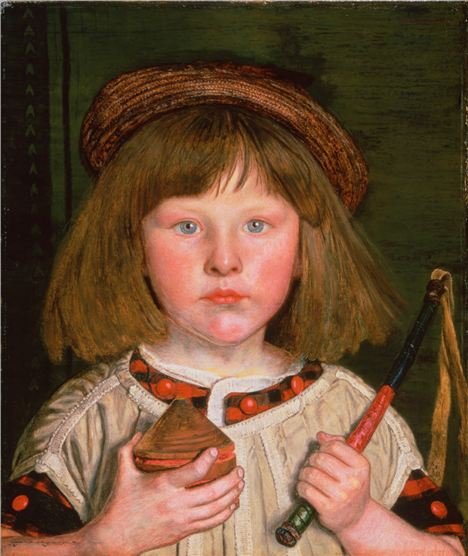
For My Daily Art Display today I am featuring two portraits, The Irish Girl and The English Boy as they were hung next to each other at the exhibition and in some ways they are connected.  It was the coming together of these “two old friends”, who were separated forty-seven years ago.  The man, who commissioned the paintings, was a Leeds stockbroker called Thomas Edward Plint, who was a patron of Ford Madox Brown, and an important Pre Raphaelite art collector.  In 1850, he had commissioned Brown to paint Work, and out of that commission came the painting, The Irish Girl, which also happens to be featured on all the exhibition publicity material.  To my mind this is a beautiful and haunting painting.  This small (almost 28cms square) oil on canvas work was completed by Brown in 1860 and is normally to be found exhibited at the Yale Centre of British Art.  The Yale Center for British Art, which is in New Haven, Connecticut, is a public art museum and research institute for the study of British art and culture. It was presented to Yale University by Paul Mellon who was in the Class of 1929 at Yale.  The Centre houses the largest collection of British art outside the United Kingdom.

In comparison to the portrait of the young English boy the young girl looks slightly nervous and somewhat troubled.  She has real beauty.  There is nothing idealized about this portrait.  Her haunting loveliness is plain to see and yet the difference between her and the English boy could not be starker.  Unlike the boy, she looks worldly–wise.  Her jet black hair, her dazzling brown eyes and her painted red lips are all part of her exquisiteness.   She has tilted her head a little to one side and her eyes focus on something off to the side.  When Ford Madox Brown was looking for Irish models for his painting Work he came across this young girl selling oranges and couldn’t pass up the opportunity to paint her portrait.   We see the fingers of her hand appearing from inside her red paisley shawl which is tightly wrapped around her and the colour of which complements the colour of her lips.  Between her fingers, she is gently holding a sprig of cornflowers. 

The English Boy by Ford Madox Brown (1860)

The portrait which hung next to the Irish Girl was entitled The English Boy and was the companion piece to the Irish Girl.  In this case the young child depicted was no stranger to Brown.  It was his five year old son, Oliver, and this too was painted in 1860.  It is slightly larger than the Irish Girl, measuring 39cms x 33cms.  This portrait is owned by the Manchester Art Gallery, which acquired it in 1932.  Although a companion piece to the Irish Girl they couldn’t be more different.  In this portrait,  the young child stares straight at us with a self-assured gaze.   It is a deadpan expression and we wonder what is going through his mind.   His cheeks are slightly flushed and this colouring in some way matches the red shawl and lips of the Irish Girl.   He wears a white smock over a red checked dress and on top of his head, sitting at a slightly jaunty angle, is a brown straw hat.  In his hands he clutches on tightly to the popular child’s toys of the time, a top and whip.  The way in which he holds the toys in some way reminds us of royal paintings where the subject holds a sceptre and orb.

Despite what our knowledgeable journalist would have us believe I don’t find these portraits in any way awkward in facial gesture.  I find them to be simply fascinating studies of two young children.

Flagellation of Christ by Piero della Francesca

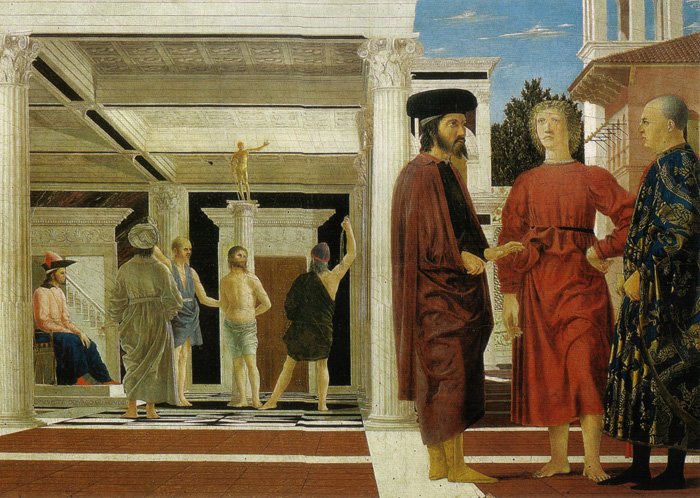
The Flagellation of Christ by Piero della Francesca (c.1460)

My Daily Art Display today has me in a quandary.  When I choose a painting for the day I have to spend a number of hours researching the artist, the painting and the subject of the painting and then try and collate all I have discovered into a meaningful and yet not too verbose blog.  Sometimes I struggle to find the information I need from the hundreds of art books I have hoarded, the internet and the local library.  On other occasions, like today, I was overwhelmed by the vast amount of information there was with regards the work of art and now I have the difficult task of trying to filter out what I don’t need.  In this case, I also have to contend with the many varied and conflicting interpretations of what we are actually looking at.  The one thing which is common to all that I have read about the work of art is the praise upon praise which has been heaped on it and yet when I look at it, I struggle to appreciate or understand its so-called “greatness”.  However I will let you decide and if you want to comment and tell me that like Kenneth Clarke, the art historian, who declared it to be the “Greatest Small Painting in the World”,  you also believe it to be one of the greatest paintings of all time, then tell me why you think that.

Before I talk about the painting, let me first look at the life of this Early Renaissance painter and mathematician, Piero della Francesca.   Yes, you read that correctly – mathematician, for as well as being a revered painter, he is now looked upon as the greatest mathematician of the 1400’s.   Piero was born in 1415 in the town of Borgo Santo Sepolcro, now Sansepolcro, eighty kilometres east of Florence.  His father Benedetto de’ Franceschi was a tradesman and his mother was Romana di Perino da Monterchi.  At an early age he began his artistic apprenticeship and at the age of fourteen he and another apprentice, Domenico Veneziano worked on frescoes for the Sant’ Egidio Church in Florence.  It was during this time spent in Florence that Piero would have probably come into contact with the great Florentine artists of the time such as Fra Angelico, Mantegna and the architect, Brunelleschi.

Records show that Piero had returned home to San Sepolcro by 1442 and three years later had received a large commission from the Compagnia della Misericordia, a confraternity of Borgo San Sepolcro, for a polyptych as an altarpiece for the local church, Church of the Misericordia,.  The confratentiy had asked Piero to complete the work in three years, setting the anticipated completion date as 1445.  Piero however did not feel constrained by this suggested timeline and any way he had many other projects on the go at the time and in the end did not complete the altarpiece until 1462, some seventeen years late!

Piero della Francesca travelled widely around Italy completing commissions for frescoes including some papal work in Rome.  At the age of fifty-four he moved to Urbino, where for almost the next twenty years he worked for Count Federico III da Montefeltro, the Lord of Urbino (see My Daily Art Display for March 23rd).  It was during his stay at Urbino that he completed today’s featured work, The Flagellation of Christ, somewhere between 1455 and 1460. 

In his later years, around 1482, Piero della Francesca was living in Rimini where he had a studio.  As he grew older he had given up painting, the artist biographer Vasari put this down to his failing eyesight but this has since been contradicted because it is known that he wrote and completed a mathematical treatise in 1485, when he was seventy years of age.  It could be that his love of mathematics had overtaken his love of painting.  He died in 1492, aged seventy seven at his home in San Sepolcro.

 The Flagellation of Christ is an oil on panel painting and one of the most famous paintings completed by Piero della Francesca.  It is one he painted during his first visit to Urbino.  Look closely at the painting.  The setting is the portico of Pontius Pilate’s palace in Jerusalem.  Are we looking at one scene divided into an outdoor and indoor location or are the two scenes we observe, depictions of two different times?    The latter is a popular theory.  It is generally agreed that the inner depiction of the flagellation is set at the time of Christ but the outdoor setting in the right foreground, with the three men, is set in the fifteenth century.  One pictorial argument favouring the time separation of the two scenes is that the background scene is illuminated from the right whilst the outdoor scene with the three men is illuminated from the left.

The whole scene is dominated by architecture with a stunning use of perspective which adds a sense of realism and manages to draw our eyes towards the small figure of Christ despite the fact that the actual flagellation takes place in an open gallery in the middle ground of the work.   Also in the flagellation scene, we have Pontius Pilate seated on the left and possibly King Herod with his back to us.   In the foreground on the right hand side we see three figures, who appear not to be paying any attention to what is happening behind them. So who are all the various people featured in the painting?  It would be great if there was a clear cut answer to that question but different experts have different ideas and so I had better offer you a few alternatives and let you pick which one sounds the most probable to you.

One theory put forward about the reason for the commissioning of this work is that that the painting was an attempt to favour the reconciliation between the two Christian churches, of the East and of the West, because of an impending attack by the Turks on Constantinople. Both the presence of the character in the centre, dressed after Greek fashion, and an inscription on the frame convenerunt in unum would seem to support this interpretation.

We know that the painting was commissioned by the then Duke of Urbino, Federico da Montefeltro.  The conventional interpretation of this painting and the one which is still upheld in Urbino as the true interpretation of the work, is that the three men in the right foreground of the painting are, in the centre, the Duke of Urbino, Oddo Antonio da Montefeltro, the predecessor of Federico, the commissioner of the work, and is flanked, on each side by his advisors, Manfredo dei Pio and Tommaso di Guido dell, Agnello.    All three were dead.  Oddo Antonio was assassinated a few months after coming to power because of the unpopularity of his laws and his advisors suffered a similar fate.  Another interpretation is that Oddo Antonio is in the centre and the characters either side of him were his assassins, Serafini and Riccardelli.  A third suggestion is that this is simply a dynastic painting commissioned by Federico in which he has his three predecessors depicted.

There are more possibilities and books and treatises have been written about the painting with various suggestions as to the identity of each of the characters  but I will leave it there and if you want to look deeper into the interpretation of the painting, do so and I will be interested to see what you find out.  So back to my original question which still puzzles me; why is this painting by Piero della Francesca look on as being “a great work”?    Is it the artistic quality of the painting or is it the mathematical quality of the perspective which has art historians tell us it is a gem?

Rebecca and Eleazar at the Well by Giovanni Battista Piazzetta

Rebecca and Elizear at the Well by Giovanni Battista Piazzetta (c.1740)

Today I am returning to Italy for My Daily Art Display painting.  It is a painting based on a biblical tale and one that features the work of the Venetian rococo painter of religious subjects, Giovanni Battista Piazzetta.  Piazzetta was born in Venice in 1682.   His father, Giacomo was a sculptor, and he gave his son his first artistic tuition, concentrating on wood sculpture.  Starting in 1697, at the age of fifteen Giovanni started studying painting under the auspices of the painter Antonio Molinari, an Italian artist of the Baroque era of Venice. Later in his early twenties he went to Bologna and studied under Giuseppe Mari Crespi, another Baroque painter, who was part of the Bolognese School of painting.   The Bolognese School of painting thrived in this capital city of Emilia Romagna during the 16th and 17th centuries and was considered the equal of Florence and Rome as the perceived centre of Italian painting.   It was probably Crespi who persuaded Piazzetta to take up genre subjects.   Piazzetta remained in Bologna for two years and was influenced by the works of another Bolognese artist, Giovanni Francesco Barbieri, who was the cross-eyed painter and who was better known by his nickname, Guernico, which in Italian means ‘squinter’!  Guernico was renowned for his religious paintings and altarpieces, with their rich colours and dramatic storytelling and his influence can be seen in some of Piazzetta’s own religious works.  Today’s featured painting is a great example of this aspect of his work.

Piazzetta returned to Venice in 1710 but struggled somewhat to get commissions in comparison with his artistic contemporary, Sebastiano Ricci and the young “newcomer on the block” Giovanni Tiepolo,  who had both begun to corner the market with their popular late Baroque/Rococo works.  However Piazzetta supplemented his income by illustrating books. His presentation drawings, portraits, and character heads, usually made in charcoal or white chalk, were also in wide demand from discerning collectors. He was a slow worker, and often painted the same subject several times with subtle modifications.  He was a perfectionist.  In 1750 Piazzetta became the first director of the newly founded Venice Academy of Fine Arts, which was established by the Senate and included courses of Academy Figure, Portrait, Landscape and Sculpture.  He devoted himself in the last few years of his life to teaching and although never wealthy he was always admired for his art work.   He died in Venice on April 28, 1754, aged 72.

My Daily Art Display featured painting today is by Piazzetta and is entitled Rebecca and Eleazar at the Well.  He completed this oil on canvas painting around 1740 and was one I saw when I visited the Brera Gallery in Milan.  As I said at the beginning, this painting is based on the Old Testament story in the Book of Genesis, (Chapter24).  For those of you are unfamiliar with the story let me give you a précis of the biblical tale.

Abraham who was  well advanced in years, had a son named Isaac and wanted to find a good wife for him.  He spoke to his trusted servant Eleazar and said:

“…Put your hand under my thigh, that I may make you swear by the Lord, the God of heaven and God of the earth, that you will not take a wife for my son from the daughters of the Canaanites, among whom I dwell, but will go to my country and to my kindred, and take a wife for my son Isaac…”

The servant Eleazar was concerned that the woman he chose for Abraham’s son would not want to come back with him and asked why he could not choose a local girl instead, but Abraham would have none of that idea and eased the mind of his servant:

“ … The servant said to him, ‘Perhaps the woman may not be willing to follow me to this land. Must I then take your son back to the land from which you came?’   Abraham said to him, ‘See to it that you do not take my son back there.  The Lord, the God of heaven, who took me from my father’s house and from the land of my kindred, and who spoke to me and swore to me, ‘To your offspring I will give this land,’ he will send his angel before you, and you shall take a wife for my son from there.  But if the woman is not willing to follow you, then you will be free from this oath of mine; only you must not take my son back there.”  So the servant put his hand under the thigh of Abraham his master and swore to him concerning this matter…”

And so Eleazar set off on his quest and he later relates the meeting with Rebekah:

“…Then the servant took ten of his master’s camels and departed, taking all sorts of choice gifts from his master; and he arose and went to Mesopotamia to the city of Nahor.  And he made the camels kneel down outside the city by the well of water at the time of evening, the time when women go out to draw water…”

So Eleazar had reached the well but was now concerned about how he would decide which woman he should choose for the wife-to-be of Isaac:   

 “…And he said, “O Lord, God of my master Abraham, please grant me success today and show steadfast love to my master Abraham.  Behold, I am standing by the spring of water, and the daughters of the men of the city are coming out to draw water. Let the young woman to whom I shall say, ‘Please let down your jar that I may drink,’ and who shall say, ‘Drink, and I will water your camels’—let her be the one whom you have appointed for your servant Isaac. By this I shall know that you have shown steadfast love to my master.”

 Before he had finished speaking, behold, Rebekah, who was born to Bethuel the son of Milcah, the wife of Nahor, Abraham’s brother, came out with her water jar on her shoulder. The young woman was very attractive in appearance, a maiden whom no man had known…”

 Then Rebecca’s brother and mother came to Eleazar, who was standing at the well:

 “…Then Laban and Bethuel answered and said, “The thing has come from the Lord; we cannot speak to you bad or good.  Behold, Rebekah is before you; take her and go, and let her be the wife of your master’s son, as the Lord has spoken.”    When Abraham’s servant heard their words, he bowed himself to the earth before the Lord.  And the servant brought out jewelry of silver and of gold, and garments, and gave them to Rebekah. He also gave to her brother and to her mother costly ornaments…”

 So it is at this point of the story that we can now look at today’s painting in which Piazzetta pictorially displays the meeting at the well of Eleazar, Abraham’s servant and messenger and Rebekah (Rebecca), Isaac’s future wife.  The characters in the painting are dressed in fashionable eighteenth century clothes.  Eleazar, dressed in brown with a rose-coloured sash around his waist, holds the jewellery which he is offering to Rebecca who clutches to her side a pitcher of water.   She looks slightly taken aback at the offering.  The half-figure composition painted with a light and luminous palette could almost be a pastoral scene with the cattle, camel and a dog squeezed into the left of the painting.

This meeting between Eleazar and Rebecca was the subject of many paintings including ones by Tiepolo, Poussin and Murillo.  However of the ones I have looked at I believe the painting by Giovanni Battista Piazzetta is the best.

Madonna of the Steps by Nicolas Poussin

Madonna on the Steps by Poussin (National Gallery of Art,Washington) 1648

“..Poussin is without question one of the greatest of all French painters whose influence on the development of European Art from the 17th Century onwards cannot be overstated. Like Titian before him and his contemporaries Caravaggio and Velazquez, he developed a personal, innovative and highly rigorous style of outstanding originality.  His work has been deeply influential on generations of artists up to the present day…”

Richard Knight, International Co-Head of Old Masters and 19th Century Art at Christie’s

My Daily Art Display today once again features a work, in fact two works, by the great French classical painter, Nicolas Poussin.  The two paintings in question are both entitled Holy Family on the Steps or sometimes referred to Madonna of the Steps and both were completed in 1648.  The painting is considered a masterpiece of 17th-century art and the pinnacle of the artists refined classical style.  One is housed in the Washington Gallery of Art and the other in the Cleveland Museum of Art.  They are similar paintings but the Washington version looks somewhat lighter in colour.  The big issue was which gallery had the original and which gallery had the copy.  The painting which is in the Cleveland collection and was purchased in 1981.   X-radiographs, published in 1982, proved that it was the original of the two versions, the other in the National Gallery of Art, Washington must then be the copy.   Up until then, the Washington picture was thought by some art historians to be the original.  The Washington Gallery was far from pleased with the adjudication and in 1994 Earl Powell  III, Director of the National Gallery of Art, Washington, DC, was embroiled in controversy when he delayed the public acknowledgement that the Museum’s  Madonna on the Steps” by Poussin was no longer thought by scholars to be by the master.  It should be said that Anthony Blunt the British historian, art expert and an authority on the works of Poussin believed that the Washington painting was the original.

However notwithstanding who is right and who is wrong the painting dating from Poussin’s mature period is a beautiful work of art.  The arrangement of the figures harks back to works by the High Renaissance artists such as Raphael Sanzio and Andrea del Sarto.  The painting is a merging of the Classical, with its architecture and the Christian with its religious theme.  The figures are placed in a triangular format with the heads of Mary and the Christ Child at its apex. Before us,  we see, seated on the steps, Mary, holding the Christ Child, Saint Elizabeth holding her son John the Baptist and seated behind them, Joseph.  Poussin has included some symbolic features to the painting.  To the left of the seated figures we see an urn overflowing with water which is symbolic of the stream of life and the passing of time and our inevitable death.   Behind the urn we have an orange tree which is regarded as a symbol of purity, chastity and generosity and is often depicted in paintings of the Virgin Mary.    On top of the walled side of the staircase we have a myrtle bush which has been, since early times, used as the symbol of love.  In Roman mythology the myrtle was considered sacred to Venus, the goddess of love.

At the front of the painting, on a lower step we see the gifts Mary has received from the three Magi at the time of the birth of the Christ child.  Usually when the Christ Child holds an apple it is symbolizes the fruit of salvation.  There is also a connection with Christ and Adam going back to the passage from the Song of Solomon (2:3):

 “…As the apple tree among the trees of the wood, so is my beloved among the sons. I sat down under his shadow with great delight, and his fruit was sweet to my taste…”

The passage has been interpreted as an allusion to Christ.  As Christ is the new Adam, so, in tradition the Virgin Mary is the new Eve and for this reason an apple being placed in the hands of Mary, symbolises salvation.

Joseph sits on the steps behind Mary.  He is almost completely lost in the shadows.  By Joseph’s foot we see a measuring stick which in some ways indicates that Joseph was not just a humble carpenter but more of an artisan.  The steps which they are all resting on can be interpreted as the stairway to heaven and the light of God is shining brightly above the summit of the steps.  There are actually a number of light sources in this painting which cast various shadows.

The Martyrdom of Saint Erasmus by Nicolas Poussin

The Martyrdom of Saint Erasmus by Nicolas Poussin (1629)

Today My Daily Art Display looks again at an artist who many believe was the greatest French painter and the leader and dominant inspiration of the classical tradition in French painting.  His name is Nicolas Poussin. 

 Poussin was born of a noble but impoverished peasant family in Les Andelys, small town in Normandy in 1594.  In his youth he studied Latin, and this was to have great influence in his future works of art.  In his late teenage years he met an artist, Quentin Vartin, who had come to Les Andelys to carry out a church commission.  It was then that Poussin showed the visiting artist some of his artistic work who then agreed to give the youngster some artistic tuition.  In 1612 Poussin left Les Andelys and went to Paris and studied art at the studios of the Flemish portrait painter Ferdinand Elle and the French painter George Lallemand.  French art and the way it was taught and learnt by young aspiring artists had yet to change and apprenticeships with established artists was still the only way young men would learn to become painters.  It would soon change in France when academic training for up and coming artists would supplant this old system.  It was not until 1648 that the Académie royale de peinture et de sculpture was founded by Cardinal Mazarin.  The purpose of this academy was to professionalize the artists working for the French court and give them a stamp of approval.

Around 1623 Poussin met Giovanni Battista Marino in Paris.  Marino was court poet to Marie de Medici at Lyon.  The poet was very impressed with Poussin’s work and urged him to travel to Rome to widen his artistic experience.  Poussin had already made two unsuccessful attempts to go to the Eternal City but in 1624, aged thirty, he made it to Rome and initially lodged with the French painter, Simon Vouet.  Life in the city proved difficult as Poussin was always short of money.  However he was befriended by Cassino dal Pozzo, a wealthy antiquarian and secretary to Cardinal Francesco Barberini, who were both to become Poussin’s earliest patrons.  It was in 1628 that Poussin received two major commissions; the first was from Barberini, for a pair of large history paintings, The Death of Germanicus and The Destruction of the Temple at Jerusalem.  The paintings were well received.  The following year a commission from the Vatican for an altarpiece resulted in The Martyrdom of Saint Erasmus which is My Daily Art Display featured painting today.   The work was not greeted with universal acclaim in fact it was a comparative failure with the art critics of Rome.   It could well have been the fact that Poussin was French and that the Italians did not take to his attempt to compete with the Italian masters of the Baroque style on their own ground.   After this Poussin ceased competing for large public commissions and would paint only for private patrons and even then would confine his work to formats which were seldom larger than five feet in length.   

In 1630 he became ill.  It is believed that he contracted venereal disease.  He was taken to the house of his friend Jacques Dughet, whose daughter Anna Maria cared for him.  Poussin and Anna Maria married in 1630 but the couple never had any children.   Anna’s brother, Gaspard Dughet studied art as a pupil of Poussin and was later to take Poussin’s surname as his own.

By now news of his achievements filtered back to his home country and the court of Louis XIII and the powerful Cardinal Richelieu.  He was summoned by the court to return and reluctantly he had to acquiesce to the royal command and in 1640 he returned to Paris.  He was offered commissions for types of work he was not used to nor really competent to carry out, including the decoration of the Grande Galérie of the Louvre palace.  Worse still, the works he did complete did not bring forth the admiration he had anticipated, so annoyed at the lack of acclaim, he left Paris in 1642 and returned to Rome.   Ironically after his death, Poussin’s style of painting was accepted and acknowledged and in the late seventeenth century it was glorified by the French Academy.

Poussin was never a well man and his health started to decline more rapidly when he was in his mid fifties and with it came problems with his hands which suffered from ever worsening tremors.    In his later paintings one could detect the unsteadiness of his hand. He died in Rome in 1665 aged seventy-one and was buried in the church of San Lorenzo in Lucina, his wife having predeceased him.

And so to today’s painting, The Martyrdom of Saint Erasmus, which Poussin completed in 1629.  Nicolas Poussin’s altarpiece depicting the Martyrdom of St. Erasmus was commissioned in 1628 for the for the altar of the right transept of Saint Peter’s Basilica, the Chapel of St. Erasmus, in which relics of the Saint are preserved.  It was part of the ongoing decoration of the great basilica.  The commission had been initially given to Pietro da Cortona but was then assigned to Poussin in 1628 who used the preparatory sketches of Cortona’s as a basis for the work.  Poussin was probably obliged to produce not only a preliminary compositional drawing but also a painted modello, a model, to give his patrons a clear idea of his intentions

In the painting of Saint Erasmus, also known by his Italian name, Saint Elmo, we see the subject in the foreground.   He was the bishop of Formiae, Campagna, Italy, and suffered martyrdom in 303 AD, during Diocletian’s persecution of the Christians.  The setting is a public square.  The painting shows the almost naked Erasmus being disembowelled.   To the left of him we see a priest dressed in white robes talking to Erasmus and pointing upwards to the statue of Hercules, a pagan idol that Erasmus had refused to worship and which resulted in his martyrdom.  In the left mid ground we see a Roman soldier on horseback who is overseeing the execution.  It is a horrific and gruesome scene.  We see Erasmus’ executioner, dressed in a red loin cloth, extracting the intestines of the martyr who is still alive, and they are being fed on to what looks like the rollers of a ship’s windlass, which is being slowly turned.  Above we see two angels descending, one of who is carrying a palm and crown which are the symbols of martyrdom.   

The painting remained in the basilica until the eighteenth century at which time it was replaced by a copy in mosaic and the original transferred to the pontifical palace of the Quirinal. It was then taken to Paris in 1797 following the Treaty of Tolentino between France and the Papal States during the French Revolutionary Wars.  It returned to Italy in 1820 and it became part of the Vatican Art Collection of Pius VI.

Let me end this blog with two pieces of trivia.   When a blue light appears at mastheads of ships before and after a storm, the seamen took it as a sign of Erasmus’s protection.   This phenomenon is known as “St. Elmo’s fire”.    Erasmus is also appealed to when suffering from stomach cramps and colic. This probably comes about due to the way the saint met his death!

For another of Poussin’s paintings, Rinaldo and Armida, look at my blog of March 8th.

The Exhibition Stare Case, Somerset House by Thomas Rowlandson

The Exhibition Stare Case, Somerset House by Thomas Rowlandson (c. 1800)

My Daily Art Display today is something different from the usual paintings I feature.  It is a print by the English artist and caricaturist, Thomas Rowlandson.  In some ways it reminds me of what is termed the “saucy” seaside postcards which were extremely popular twenty or thirty years ago and are still sold at seaside resorts in Britain.

Rowlandson was born in London in 1756.  His father was a successful local merchant.  It is said that Thomas Rowlandson learnt to draw before he learnt to write.  He was so enthralled in drawing that his early years were solely spent in drawing.  He attended Eton and after that enrolled to study art at the Royal Academy.

In 1772, at the age of sixteen he travelled to Paris where he remained for two years, during which time he was a student at a drawing school in Paris.  After his stay in France he returned to London and opened a studio in Wardour Street from where he sold his portraits.    At this early point in his artistic career he was looked upon as being somebody who would become a great portrait painter.  He had been awarded the Silver Medal by the Royal Academy in both 1777 and 1778 and was becoming known as a very fine watercolour portrait painter. In the 1780s Rowlandson’s output of his portraiture decreased and he concentrated most of his time on drawings.  These were much in demand and he had a lot of his work published in journals such as the English Review and The Poetical Magazine.   Rowlandson found another means of earning money; that of illustrating novels and many of the great novelists of the time, like Henry Fielding and Oliver Goldsmith had him produce illustrations for their famous works of literature. He also di d illustrations for Tobias George Smollett, whose radical books resulted in him being sent to prison for libel.  Some of Rowlandson’s political cartoons also got him in trouble and he was accused by his critics of being “coarse and indelicate”.
 However fate was to take a hand in changing his future life and lifestyle with the death of his French aunt and the inheritance of £7000 he received.  This was an exceptionally large sum of money at this time and unfortunately Rowlandson could not handle being wealthy and within a short time had gambled it all away and had become penniless.

Rowlandson needed to earn some money but instead of concentrating on his watercolour portraits he, because of his friendship with the great political satirist, James Gillray, decided to concentrate his artistic efforts on socially satirical caricatures.  There was a good market for such works at the time and he was aware that this was an excellent way to improve his finances.  Rowlandson preferred to use watercolours for his caricatures and he was so successful with what he produced that for the rest of his life he had no need to revert to watercolour portraiture.  His trademark for his caricatures was the lecherous old man and the buxom female and accompanying the picture he would add a title or the odd line of prose or verse which enlightened the viewer as to what the caricature was all about (if it was ever needed!).  The caricatures were often moralistic and were in some ways like the moralistic paintings of Hogarth.   Whereas the great caricaturists of Rowlandson’s time such as James Gillray and George Cruickshank concentrated mainly on political cartoons Rowlandson favoured the socio-cultural caricatures and their satirized morals. Although some of his caricatures were criticised for being crude and unseemly, this was nothing compared to the criticism he received for his erotic prints and woodcuts which even today would be met with censorship for their pornographic nature.  Rowlandson by any standards lived a hard lifestyle and eventually this was the cause of prolonged illnesses in later life.  He died in 1827 aged 71.

My Daily Art Display today features the caricature print entitled The Exhibition Stare Case, Somerset House which Thomas Rowlandson completed around 1800.  This print is based on a drawing which Rowlandson made earlier.   In his print he points fun at the people attending the art exhibition and the male penchant for caring more about the “living” pictures that provide additional, or even preferred, entertainment to the works on display at the Exhibition.  Look at the facial expression on the lecherous old men ogle the elegant ladies who have tumbled haplesslydown the staircase, limbs akimbo and tender parts exposed. It is interesting to note how Rowlandson has depicted the under-dress of the women.  He shows them wearing stockings but not much more beneath those gauzy muslins.  So are we to believe that females of that era wore few or no under-garments or is it Rowlandson’s way of adding a touch of erotica to his work.  

The setting for this work is the Royal Academy of Art, which was founded in 1768 and housed in Pall Mall, and then Old Somerset House before it moved to New Somerset House in 1780.  It remained there for almost ninety years when in 1868 it transferred to its present site, Burlington House, on Piccadilly.  The title of the work is a pun on the word stare (as in looking fixedly) and stair (part of a staircase) and the artist is poking fun at the people who have come to see the works exhibited at the Royal Academy exhibition.  In Rowlandson’s mind there were two kinds of viewers who came to Somerset House: those who wanted to see the paintings and sculptures, and those who came to ogle the ladies whose legs and ankles were exposed walking up those prominent stairs.  Of course with such lack of attention to what they are doing the inevitable accident happens as people trip over one another and fall down the stairs in a domino effect.  The print shows the large ornate staircase which leads to the Great Room at Somerset House.  This was a steep and winding staircase and at times when the Royal Academy was well attended it would have been difficult to negotiate a safe passage up and down it. 

In the alcove at the bottom of the staircase we have a statue of Venus.  This is a later print of Rowlandson’s work as in the original instead of the statue of Venus, there was just an urn.

Dian Kriz, the American art historian’s book “‘Stare Cases’: Engendering the Public’s Two Bodies at the Royal Academy of Arts.”  and in Art on the Line: The Royal Academy Exhibitions at Somerset House, 1780-1836 recounts a number of comments regarding the Exhibitions made in the reviews of the RA exhibitions at the time.  One commented on the exhibitions and the attendees describing it:

” …. as a place where art and female bodies vied for the male gaze…”

She quotes the Morning Post of May 3rd 1875 and its view on the visitors:

“…“there are two descriptions of persons who visit the Royal Academy some perambulate the rooms to view the heads others remain at the bottom of the stairs to contemplate the legs…”

Finally in the World, Fashionable Advertiser of May 8th 1787 it notes:

“….“Exhibitions are now the rage and though some may have more merit, yet certainly none has so much attraction as that at Somerset House; for, besides the exhibition of pictures living and inanimate, there is the raree-show [peep show] of neat ancles up the stair-case which is not less inviting…”

One can see that Rowlandson could well have got the idea for his caricature from these press releases.   What I love about this painting is that all the people are different.  They are all doing different things and it is a joy to scan each individual closely to see the facial expression and their role in the picture.  Look how absorbed they are in what is going on around them.  Note the lecherous looks on the faces of the old men as they gaze at the disheveled attire of the falling and fallen females.

When I was researching the works of Thomas Rowlandson I was astounded at the sexual nature of some of his caricatures.  I have talked on a number of occasions about the fine line in paintings between what is considered sensuous and what is considered erotic.  With some of Rowlandson’s caricatures there is a very fine line between what is erotic and what is pornographic.  I think that if ever there was an exhibition of his works the media would have a field day on discussing whether some of his works should be censored.  I will leave you to look at some of these works on the internet and decide for yourself.  Erotic/pornographic cartoons and caricatures of course are not just a thing of the past as in the present time we have the Japanese Hentai comics and Japanese Anime (animation).