The Tretyakov Portraits. – Part 2

The portraiture of Ilya Repin

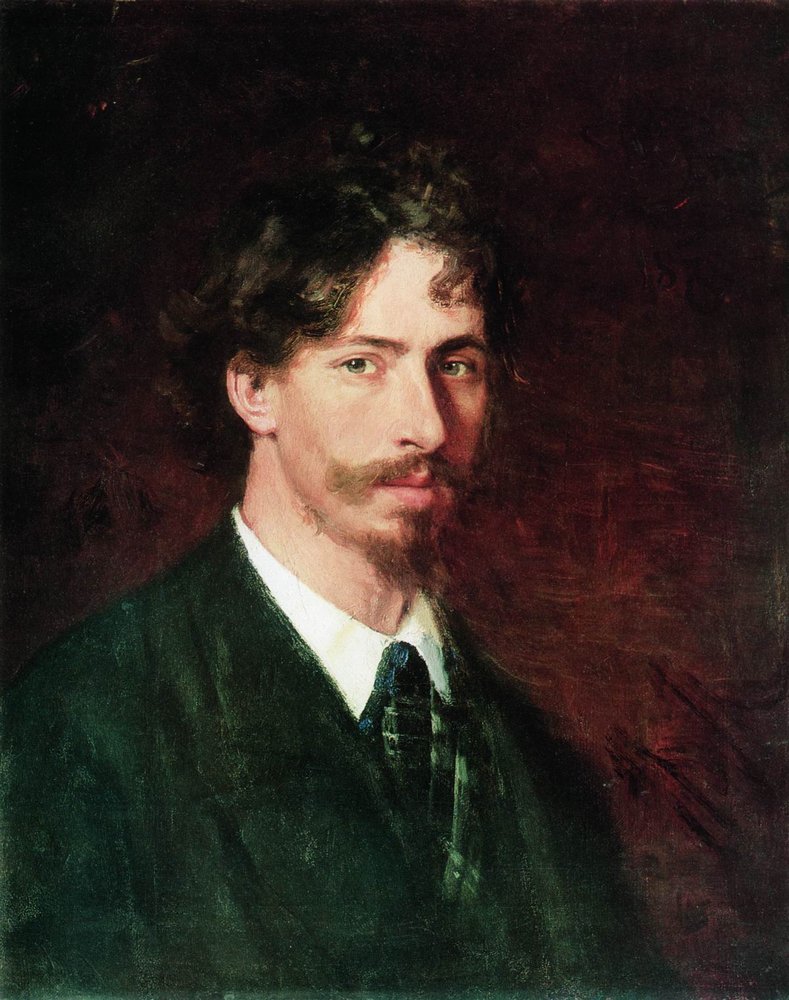
Self portrait by Ilya Repin (1878)

This is my first blog in a series which looks at Russian portraiture on display at the Tretyakov Gallery. As I wrote in my previous blog about the art gallery, the founder Pavel Tretyakov had wanted to have a large collection of portraits of famous Russians in his gallery. The first Russian artist I am featuring, who has paintings in Moscow’s Tretyakov Gallery, is Ilya Repin.
Ilya Yefimovich Repin was born in the southern Russian (now Chuhuiv, Eastern Ukraine) town of Chuguyev close to the Georgian border on July 24th, 1844. He was the fourth of six children of Efim Vasilievich Repin and his wife Tatyana Stepanovna Repina. His parents were a family of military settlers. Military Settlements in those days were places at which there was a combination of military service and agricultural employment. His father traded horses and his grandmother ran an inn. From the age of ten, Ilya studied at the Chuhuiv School of Military Topography and in 1857, Ilya studied art as an apprentice with the local icon painter, Ivan Bunakov. During his apprenticeship he would help paint icons and frescoes for the local churches. Throughout his life religious representations remained of great importance to him.

Portrait of A.S. Bocharova, the Artist’s Aunt by Ilya Repin (1859)

Even at the early age of fifteen, Repin demonstrated a rare talent for painting portraits which can be seen in his 1859 painting of his maternal aunt, Agrafena Stepanovna Bocharova, entitled Portrait of A.S. Bocharova, the Artist’s Aunt.

In 1863, at the age of nineteen, Repin moved to St Petersburg and enrolled for a one-year course at the School of Drawing of the Society for the Encouragement of Artists, a school which was created by a decree of Tsar Nicholas I in 1839 and was a preparatory school for the St. Petersburg Art Academy. Here he studied under the portrait painter Rudolf Zukowski and the Realist painter, Ivan Kramskoi, an intellectual leader of the Russian democratic art movement in 1860-1880.

It was whilst at that artistic establishment that the Rebellion of the Fourteen took place in September 1863. The rebellion consisted of fourteen young artists who left the Academy in protest against its rigid neoclassical dicta and who refused to use mythological subjects for their diploma works. The rebel artists insisted that art should be close to real life and they formed the Society of the Peredvizhniki to promote their own aesthetic ideals. In order to reach the widest audience possible, the society organized regular travelling exhibitions throughout the Russian Empire.

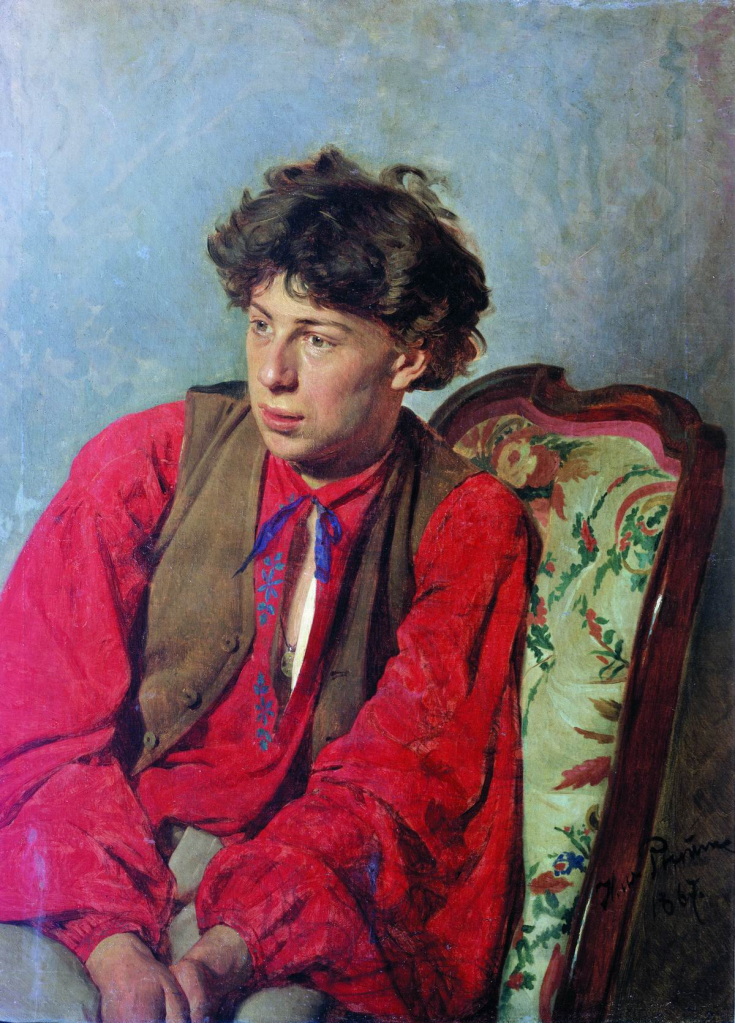
Portrait of V. E. Repin, the Artist’s Brother by Ilya Repin (1867)

In 1864, Repin, having completed his preparatory year, was accepted at the Imperial Academy of Arts. Repin completed another portrait of a family member in 1867. It was a painting featuring his younger brother, Vasily Efimovich Repin.

Later, Repin would be become a close friend and associate with some of rebel artists of the Society of the Peredvizhniki and fifteen years on after returning from Europe he would join the group. But for the time Repin remained at the Academy and in 1871 won the prestigious Major Gold Medal award and received a scholarship to study abroad.

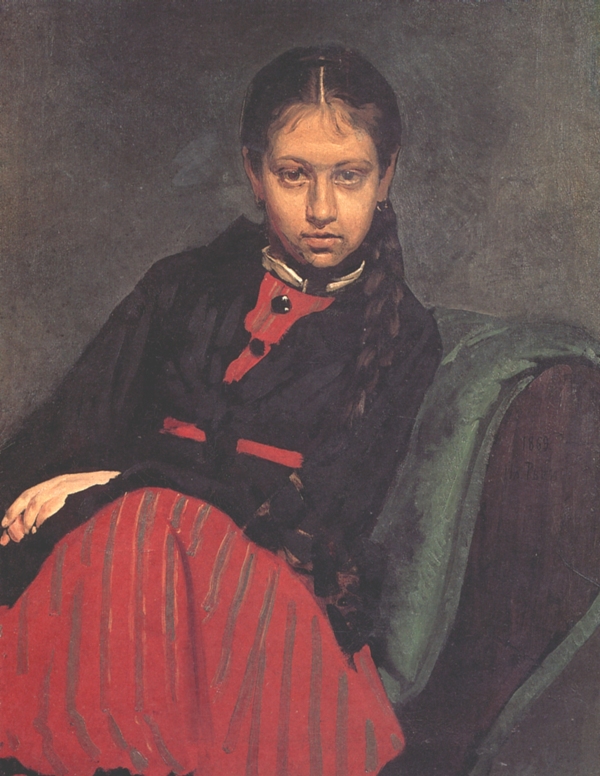
Portrait of Vera Shevtsova by Ilya Repin (1869)

In 1872 Repin married Vera Alekseevna Shevtsova and in 1873 they travelled to Paris where Repin exhibited work at the Salon. The marriage lasted ten years but ended in divorce in 1884, on the grounds of Repin’s infidelity.

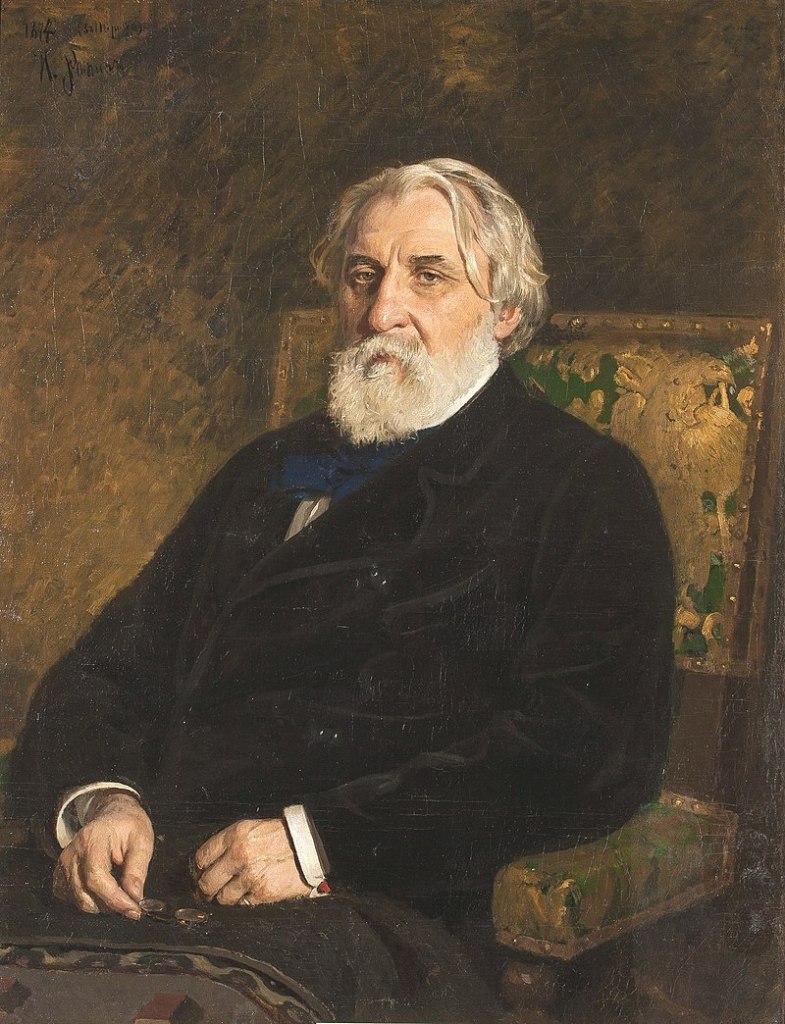
Turgenev, by Ilya Repin, 1874

In 1874 whilst living in Paris Repin was contacted by Pavel Tretyakov who offered him a commission to paint a portrait of Ivan Sergeyevich Turgenev, a popular Russian novelist, short story writer, poet, and playwright who at the time was also living in the French capital. Turgenev was at the time the undisputed figurehead of the Russian artistic community in France. Repin was delighted and proud to be asked to paint the portrait of such a famous and influential man and Turgenev in turn held Repin in high regard as can be seen in a letter he wrote to the writer and art critic, Vladamir Stasov in November 1871, praising the talent of Repin:

“…I was delighted to learn that the young man [Repin] is moving ahead so vigorously and rapidly. He has great talent and unquestionably the temperament of a painter, which is most important of all…”

Portrait of the Author Ivan Turgenev by Vasily Perov (1872)

Pavel Tretyakov planned to fill his museum with portraits of the “great and the good” of Russia and a portrait of Turgenev was a prime example of what he wanted. Vasily Perov, another Russian portrait artist, had already completed a portrait of Turgenev in 1872 but Tretyakov was unimpressed by it and so had approached Repin, who by this time had established a reputation as one of the most promising artists of his generation. Tretyakov was pleased with the Repin’s final portrait but Turgenev was less pleased with the result. Turgenev was a steadfast supporter of modern French painting which he considered should serve as a model for Russian artists. Repin disagreed and poured scorn on the French paintings Turgenev was buying. The portrait of Turgenev prompted such heated debate, with one side who believed Russian artists should follow the Western style of painting whilst the opposing view was one which believed Russian artists and their art should follow their own path. The extent to which Russian artists should look inward or outward for inspiration was becoming a highly controversial debate.

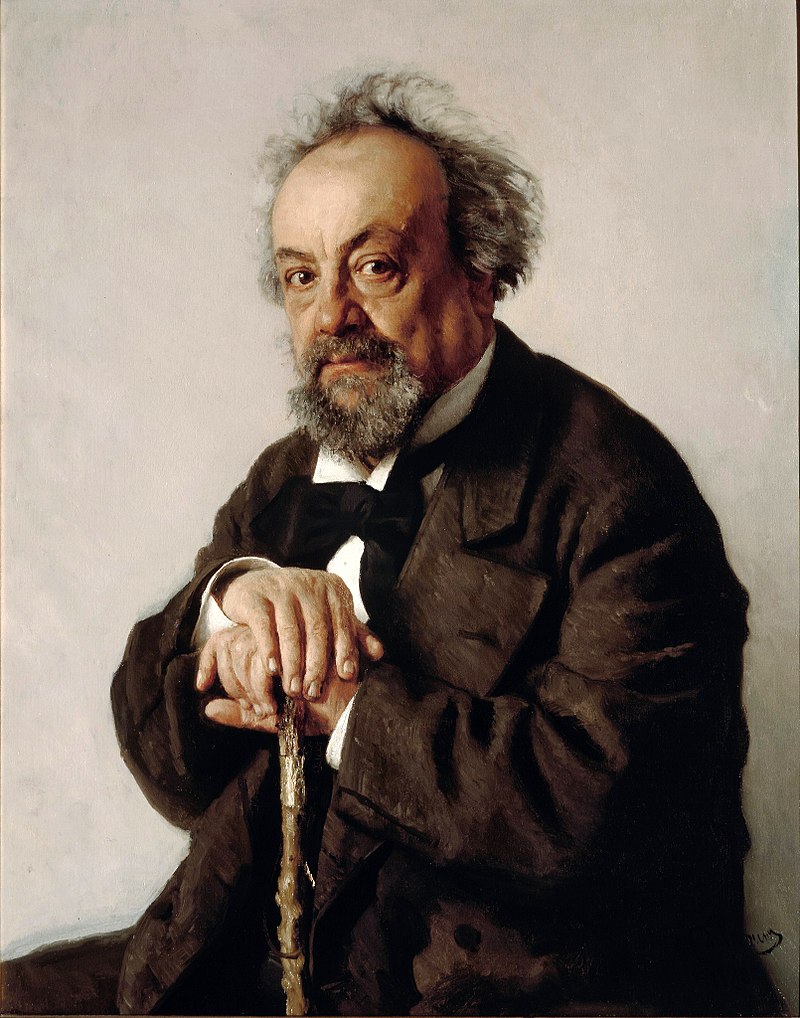
Portrait of Alexei Pisemsky by Ilya Repin (1880)

Alexei Pisemsky was a novelist and dramatist, who, in the late 1850’s was looked upon as an equal to Turgenev and Dostoyevsky and in the late 1850’s wrote two hard-hitting books, One Thosand Serfs and A Bitter Fate both of which were critical of the peasant/master relationship. Later in the 1870’s he wrote about the evils of Russia’s emergent capitalism but his later books were often ignored by the reading public. Despite his fall from grace Pavel Tretyakov wanted Pisemsky’s portrait in his Moscow gallery and commissioned Repin to complete the task. Repin’s 1880 portrait of the fifty-nine-year-old Pisemsky depicts him as an ageing man with pouchy eyes clutching a walking stick. His coat is rumpled and his bow-tie droops giving the impression that Pisemsky’s best days are well passed and yet he seems alert and looks at us with a fixed stare. Alexei Pisemsky died shortly after the portrait had been completed.

Ilya Repin’s celebrated portrait of Mussorgsky, painted 2–5 March 1881, only a few days before the composer’s death.

One of Repin’s most moving and beautiful portraits was of the Russian composer, Modest Petrovich Mussorgsky. He was, as well as working as a civil servant, a giant of Russian music and was therefore an ideal subject for one of Pavel Tretyakov’s paintings. Although a genius, Mussorgsky had one great failing; he was an alcoholic.  Mussorgsky’s decline in health became increasingly steep and he was increasingly unable to resist drinking. He was aware of the dangers of alcoholism and despite a succession of deaths among his closest associates which caused him great pain, he was unable to abstain. The decline could not be halted, and in 1880 he was finally dismissed from government service and through help from friends, managed to stave off destitution.

In early 1881 Mussorgsky suffered four seizures in rapid succession and was hospitalized. It was at this time that Tretyakov commissioned Repin to paint Mussorgsky’s portrait. Repin started the work on March 2nd 1881 in the ward of the Nikolaevsky Mlitary Hospital. It was the day after Emperor Alexander II was assassinated by, Ignacy Hryniewiecki, a young member of the Narodnaya Volya, a radical political organisation. Repin wrote about working on Mussorgsky’s portrait in the hospital ward:

“…When I painted M.P.’s [Mussorgsky’s] portrait in the Nikolaevsky Hospital, a terrible event had just occurred: the death of Alexander II; and during the breaks between sittings we read a mass of newspapers, all on one and the same terrible topic……[Mussorgsky] lived under a strict regime of sobriety and was in a particular fine sober mood….But as always, alcoholics are gnawed by the worm of Backus; and M.P. was already dreaming of rewarding himself for his long patience. Despite strict orders forbidding cognac…..an attendant obtained a full bottle of cognac for M.P.’s birthday…. My last session was planned for the next day. But when I arrived at the appointed hour, I did not find M.P. among the living…”

Mussorgsky died a week after his 42nd birthday. This beautiful portrait depicts the composer wearing a dressing gown. The striking burgundy decorative flap frames the florid features of this once-great man. We catch a glimpse of his highly decorative shirt between the folds of the dressing gown. His expression is one of rebelliousness but with a hint of feared inevitability. His eyes are turned away from us maybe in embarrassment at his parlous state. His hair and beard are unkempt. It is an uncompromising portrait but ever so poignant. Repin refused to keep the commission fee that Tretyakov gave him for the portrait and donated it to a memorial for the composer. Pavel Tretyakov was delighted with the finished work as he recognised it as one of the most passionate and emotional deathbed portraits of all time.

Portrait of Art Critic Vladimir Stasov by Ilya Repin (1873)

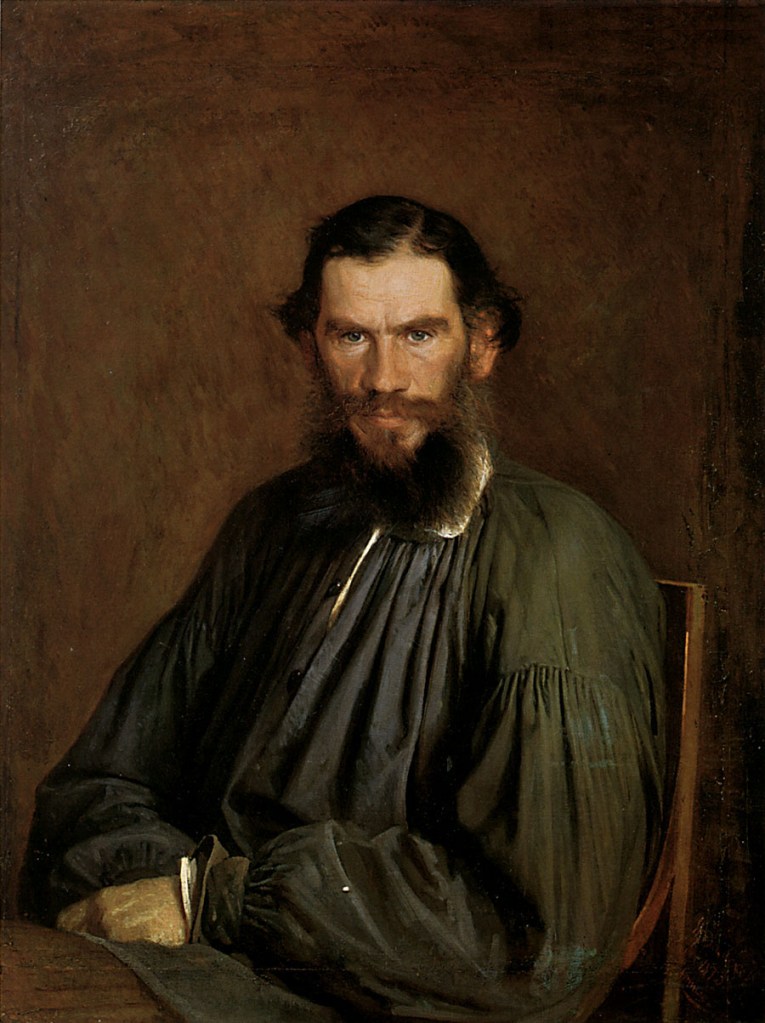
With Pavel Tretyakov’s desire to build a collection of portraits of famous Russians for his gallery, it was inevitable that he would want a painting depicting the great writer Leo Tolstoy who had cemented his position as one of the greatest writers of the century with his 1869 historical novel, War and Peace and his 1877 novel Anna Karenina. Through an introduction by Vladamir Stasov, the art critic, Repin and Tolstoy met in Moscow in 1880. Vladamir Stasov pointed out to Tolstoy that Repin’s exalted reputation  in painting was the same as Tolstoy reputation in literature. By 1880, despite Tolstoy being a prominent writer he began to renounce his earlier works and decided to devote himself to religious and philosophical enquiry. He was in a state of “spiritual quest”, re-evaluating the values and his achievements of his earlier years. He took to wearing peasant clothes and renounced earthly pleasures. That first meeting of the two great men took place at Repin’s studio and Repin often visited Leo Tolstoy at his house in Khamovniki in Moscow. A number of portraits of Tolstoy were completed by various artists in the 1870’s but Ilya Repin’s worked on the great man’s portraits in August 1887 when he stayed with Tolstoy for eight days at his estate, Yasnaya Polyana at Tula, some 120 miles south of Moscow. In all, Repin produced twelve portraits, twenty-five drawings, eight sketches of Tolstoy and his family members, as well as seventeen illustrations to enhance Tolstoy’s works.

Portrait of Leo Tolstoy as a Ploughman on a Field by Ilya Repin (1887)

One of the portraits entitled The Ploughman. Leo Tolstoy ploughing, depicts the fifty-nine-year-old artist guiding a plough in bright sunlight. Repin remembered his time at Yasnaya Polyana and watching Tolstoy move around his estate, talking to the peasants. Repin recalled one hot day in August when Tolstoy was in the field ploughing for six hours without a break. Repin said that he had his sketchbook with him and kept sketching each time Tolstoy with his horse-driven plough passed by. Lithographic prints depicting Tolstoy the Ploughman followed and they were popular throughout the whole world.

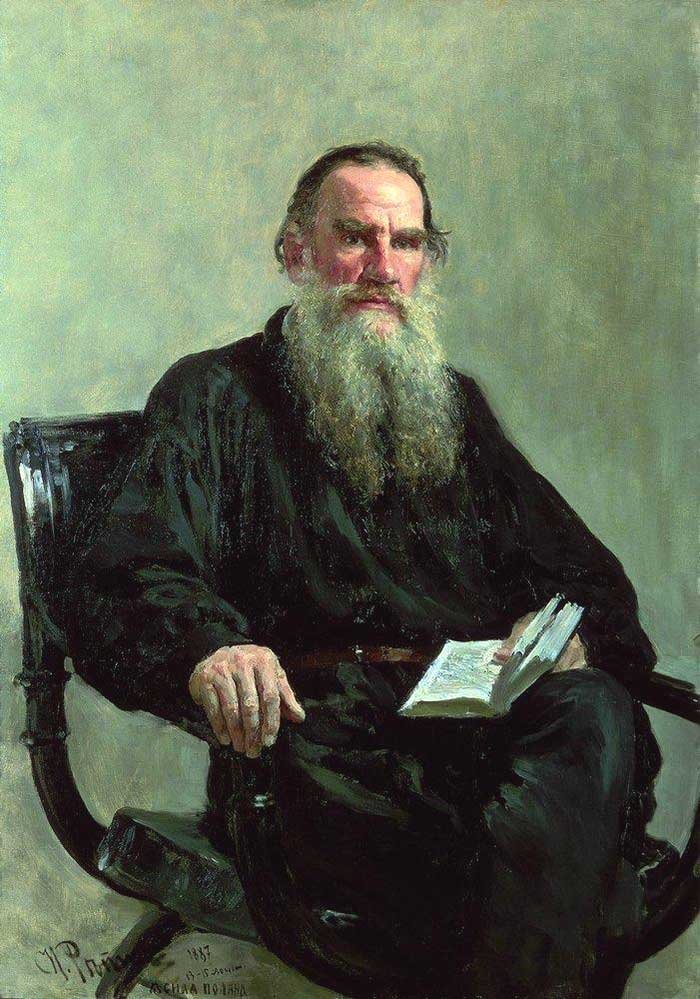
Ilya Repin, Portrait Of Leo Tolstoy, 1887

In that same year, 1887, Repin completed a large portrait of Tolstoy sitting in a chair dressed in a black robe. On his knee is a book which Tolstoy has marked in two places as if to emphasise his passion for reading.

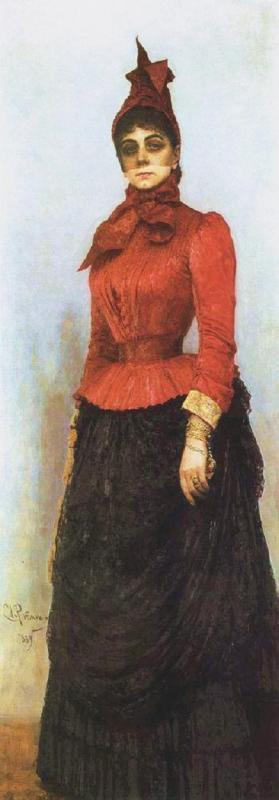
Baroness Varvara Ikskul von Hildebrandt by Ilya Repin (1889)

Another stunning portrait by Ilya Repin which hangs in the Tretyakov Gallery is entitled Portrait of Baroness Varvara Ikskul von Hildenbandt which he completed in 1889. It is a narrow oil on canvas work with unusual dimensions. It is 197cms tall and yet only 72cms wide and yet it skilfully depicts this beautiful slender woman. Baroness Varvara Ikskul von Hildenbandt was the wife of the Russian ambassador to Rome who hosted soirées at her home in Moscow during the 1880’s with eminent writers and artists as her guests, one of whom was Ilya Repin. She was the hostess of a noisy and motley literary salon, who herself used to write a lot in her youth. Pavel Tretyakov commissioned Repin to paint a portrait of the salonnière in 1889. On receiving this commission, Repin wrote to Tretyakov:

“…The Baroness is in rapture at the thought that her portrait will be in such a famous gallery……..She is an interesting model and poses like a statue…”

The almost life-size portrait is brought to life by Repin’s use of red and black. The artist has captured the detail of the lady’s attire with great skill, from the ruched skirt and tightly cinched blouse with its high-necked bow to the curious points and folds of the headdress. There is a concealment of flesh with just the hands and face bared and even the latter is partially veiled, partly concealing her eyes. Yes, the pose is quite static but one cannot deny it is a dynamic one. In 1917 following the Revolution, the baroness was forced to leave her mansion and flee to Finland and later Paris.

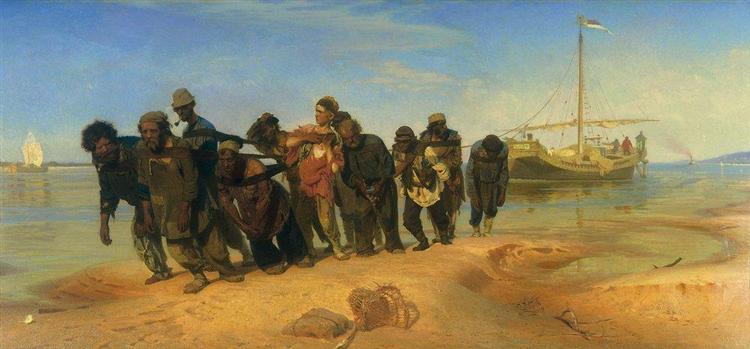
Ilya Yefimovich Repinwas was, without doubt, the most renowned Russian artist of the 19th century.  In this blog I have just concentrated on some of his portraiture which can be found at the Tretyakov Gallery in Moscow but he is probably best remembered for his realist paintings such as his 1873 work Barge Haulers on the Volga

https://mydailyartdisplay.wordpress.com/2012/07/05/barge-haulers-on-the-volga-by-ilya-repin/


The Tretyakov Gallery, Moscow.

The Tretyakov Gallery, Moscow.

If I was to ask you to name one famous museum of art in Russia I think most of you would give me the Hermitage in St Petersburg but actually the State Tretyakov Gallery in Moscow has the largest collection of paintings by Russian artists in the world and includes numerous portraits by them, some of who may be better known for their non-portraiture works. In the next few blogs I am going to look at the genre of portraiture and in particular Russian portraiture held at this great institution. To start, let me tell you a little about the Gallery itself.

Pavel Tretyakov (1871)

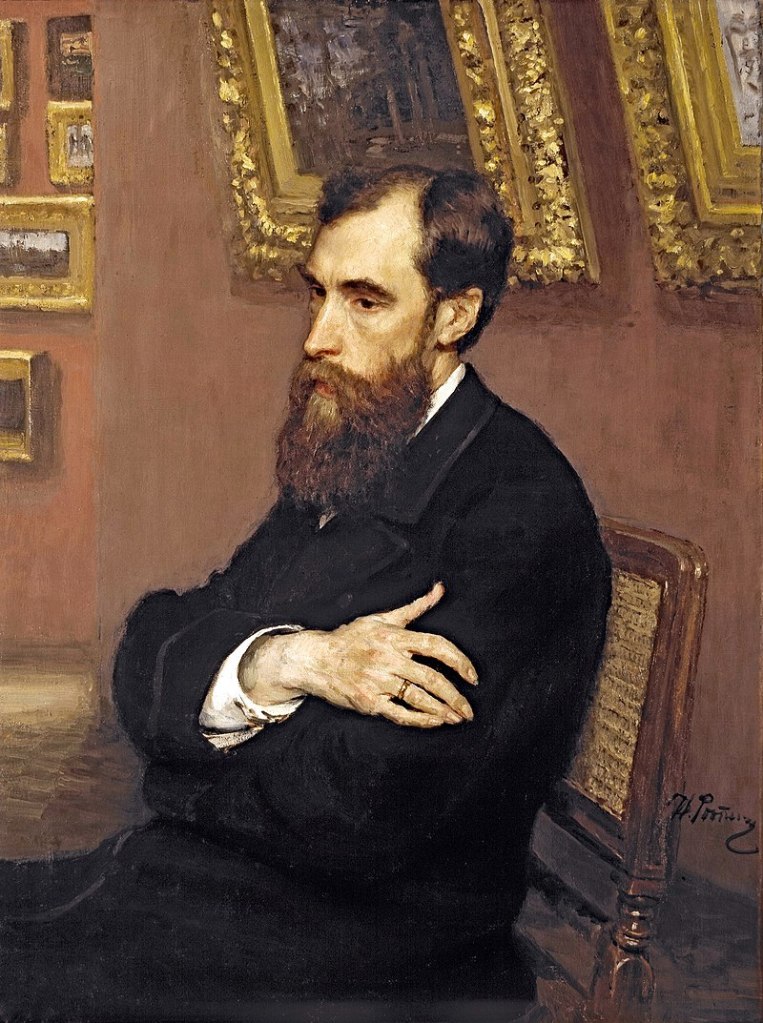
To talk about the Tretyakov Gallery one must first speak about its founder, Pavel Tretyakov. Pavel’s ancestors came from the town of Maloyaroslavets which lies sixty miles south-west of Moscow. His great grandfather was a merchant who had brought his family to Moscow in 1774. In 1801 Pavel Tretyakov’s father Mikhail was born. Mikhail turned out to be an astute and very successful businessman whose shops, which he ran with his brother Sergei, sold textiles. On his brother’s death in 1831, aged just twenty-five, Mikhail became the head of the family business. In the same year that his brother died, Mikhail married Alexandra Borisova, the daughter of a wealthy merchant and a year later, in 1832, the couple had the first of their eight children, a son Pavel. As a teenager Pavel helped his father in the shop. In 1850, when Pavel was eighteen years of age, his forty-nine-year-old father died. The business was then headed up by Mikhail’s widow who in 1859 relinquished control of it, making her sons Pavel and Sergei joint partners in the company and the brothers made their sister Elizaveta’s husband, Vladimir Konshin, the third partner. In August 1865 Pavel married Vera Nikolaevna and the couple went on to have six children.

Tretyakov’s portrait by Ilya Repin (1883)

The Tretyakov family bought a house on Lavrushinsky Pereulok in the Zamoskvoreche district of Moscow at the end of 1851. This was a district where merchants used to congregate during the nineteenth century. The following year, whilst visiting St Petersburg on a business trip, Pavel Tretyakov became fascinated with art and he decided to buy eleven simple drawings from a book shop at Sukhareva Market which he used to visit when he was in the city. This was followed by the purchase of oil paintings by Old Dutch Masters. Although not rich enough to buy paintings by contemporary Russian artists, in 1856, he raised enough money to buy two paintings which are, to this day, believed to be the first two paintings of the Tretyakov collection.

Skirmish with Finnish Smugglers by Basil Khudyakov

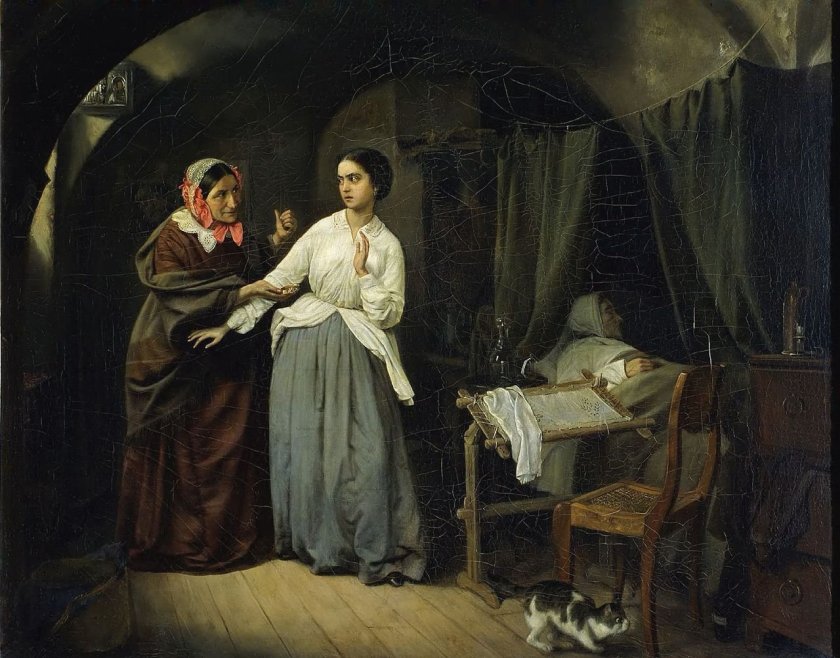
One was entitled Skirmish with Finnish Smugglers, painted by Vasily Khudyakov and the other was entitled Temptation by Nikolai Shilder.

The Temptation by Nikolai Schilder (1856)

Pavel was a tireless worker and secured his family financially but was always careful with his money. In a letter to his daughter he wrote:

“…Money should serve better purposes, than just be wasted for everyday needs………. Since my early age I knew, that acquired from the society should return to the society in some useful to it form. … Living conditions should never allow a person to live idle…”

Pavel’s art collection grew each year and he had special outbuildings added to the family’s main residence to house them. For the next four decades, he committed large amounts of money to develop and enlarge his collection. His dream was to house a collection of national portraits within his gallery to commemorate prominent Russians in public, intellectual and cultural life and to achieve that aim he commissioned Russia’s leading painters to portray them. Tretyakov donated the museum and his collection of almost two thousand works of art to the city of Moscow in 1892. The official opening of the museum called the Moscow City Gallery of Pavel and Sergei Tretyakov took place on August 15th, 1893. Pavel Tretyakov died in 1898 and four years later the residence in Lavrushinsky Pereulok was redesigned transforming the private house into the current great museum with its famous façade designed by the artist Viktor Vasnetsov.

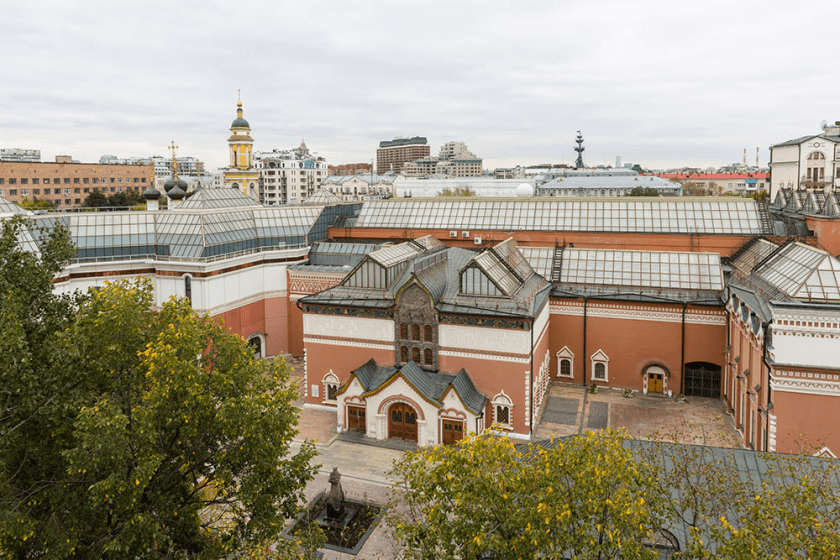
The State Tretyakov Gallery in Moscow

In June 1918, the Tretyakov Gallery was declared as being owned by the Russian Federated Soviet Republic and was named the State Tretyakov Gallery. Today, it forms the core of the State Tretyakov Gallery, Russia’s national gallery in Moscow and is acknowledged as the greatest collection of Russian art in the world. In total it houses more than 170,000 works of art ranging from early religious icons to modern art and it spans a period of a thousand years.

In my next blog I will start to look at some of the work by famous Russian artists whose works grace the walls of the Tretyakov.


John William Waterhouse. Part 5.

Sirens, mermaids, nudes and controversy

In my last look at John William Waterhouse’s life and artwork I am reverting to his love of mythological subjects and his love of women regaled in verse by well-known poets and story tellers. It was Waterhouse’s ability to depict beautiful women which made him popular with the public of the time.

Lamia by John William Waterhouse (1905)

In 1905 Waterhouse completed a work entitled Lamia. Although the name conjures up a gentle soul, it couldn’t be further from the truth. The word lamia means vampire, witch, sorceress, ghoul, or enchantress and the character emanates from Greek mythology. According to Greek myth, following the killing of Lamia’s children by the goddess, Hera, she sought vengeance by sucking the blood of men she seduced and devouring their children. Waterhouse was drawn to the subject through John Keats’ 1819 narrative poem Lamia. The poet however does not openly condemn the animal-woman as evil, but rather dwells on her beauty and the sexual excitement she offers. In the painting we see the foot of the soldier treading on the tail of the serpent Lamia and we see the scales she has shed wrapped around the back of her legs.  These colourful scales contrast with her pale arms which she holds out towards the soldier. In all, Waterhouse completed three versions of this work, all around the same size. The original one, which was exhibited at the 1905 Royal Academy Summer Exhibition, was purchased by Sir Alexander Henderson, Baron Faringdon, whose family members were keen patrons of Waterhouse.

La Belle Dame sans Merci by John William Waterhouse (1893)

Another of Keats’ maidens featured in a work by Waterhouse. In 1820 Keats penned his poem La Belle Dame Sans Merci (The Beautiful Woman without Mercy). It tells of a knight who meets a beautiful enchantress.

I met a lady in the meads,
Full beautiful—a faery’s child,
Her hair was long, her foot was light,
And her eyes were wild.

The knight has fallen in love with this beautiful delicate creature but is she all that she seems? The knight is besotted and falls into a sleep and dreams of how he first met the female. However, in the knight’s dreams he is warned against a liaison with this beautiful maiden.

She took me to her Elfin grot,
And there she wept and sighed full sore,
And there I shut her wild wild eyes
With kisses four.

And there she lullèd me asleep,
And there I dreamed—Ah! woe betide!—
The latest dream I ever dreamt
On the cold hill side.

I saw pale kings and princes too,
Pale warriors, death-pale were they all;
They cried—‘La Belle Dame sans Merci
Thee hath in thrall!

On waking from his sleep, he finds the maiden has gone and he is heartbroken. The setting for this work is a dense wood which symbolises both a sense of entanglement and moral confusion. Waterhouse’s painting is at the point in the poem when the knight meets the woman. He is depicted bending down towards her. He is totally bemused by her beauty as he looks at her upturned face. On the right sleeve of the woman there is a heart. She entraps the knight coiling her long hair around his neck like a serpent capturing its prey. She is tying her hair in a knot so as to entrap the knight. She pulls him towards her. She stares at him and he is lost, almost as if he has been hypnotised by her beauty. He has dropped his lance to the ground which metaphorically is a sign of his defencelessness, a powerlessness against her wiles and also symbolises a loss of his masculine virility. This beautiful sprite has emasculated him. It is a highly sensual work as we look upon the knight and the woman gazing into each other’s eyes. There is a tenseness about the depiction but as we know, once their lips meet, the knight will be lost. In a way Waterhouse’s depiction plays on the fears of men about their vulnerability at the hands of the fairer sex. It is also a statement regarding woman’s constant need to be loved.

Hylas and the Nymphs (1896) by John William Waterhouse

The interaction between males and females was of continuing interest to Waterhouse and he would often depict such interplay between the sexes by portraying mythological stories.  In his 1896 he completed a painting entitled Hylas and the Nymphs, the setting of which is somewhere deep in an overgrown woodland surrounding a murky pond with its clumps of reeds and lilies. It is very reminiscent of the setting in John Everett Millais’ 1852 painting Ophelia. The depiction comes from the story of Jason and the Argonauts. Hylas, a very handsome youth, was one of Jason’s crew. When Jason’s boat landed on an island during his search for the Golden Fleece, Hylas was sent ashore to bring back some fresh water for the men. Hylas found a pool in a clearing and he reached down and put his pitcher into the water but before he could raise his pitcher, he looked up to discover water nymphs encircling him and we know that he is doomed. They were enticed by his beauty, and one of the nymphs reached up to kiss him. Immediately Hylas disappeared without trace, never to be found again and after a protracted search for his missing crewman,  Jason decided to leave the island and continue with his travels.

Preliminary sketch for Hylas and the Nymphs by John William Waterhouse

The painting depicts the woodland pond in which we see the seven bare-breasted nymphs bathing, whilst, on the bank, we see Hylas kneeling down with his pitcher immersed in the water. There is a gentle sexuality about these captivating naked nymphs in the translucent water. Hylas’ olive skin tone is darker than that of the cream skin tones of the nymphs which contrasts with their dark hair. Although the legend describes Hylas as a very handsome man, our eyes immediately alight on the central nymph, who has hypnotised Hylas with her beauty and in some way has mesmerised us, the viewers of the painting. The painting was not complete by the time of the 1896 Royal Academy Summer Exhibition and instead, was shown at the Manchester Autumn Exhibition, and was, following the event, purchased by the Manchester Corporation. They then allowed it to be displayed at the Royal Academy Exhibition in 1897. The painting was later loaned to a number of international exhibitions including the 1900 Paris Exposition Universelle.

Hylas and the Nymphs (detail) by John William Waterhouse

The painting was the centre of a controversy in 2018 when the curator of the Manchester Art Gallery decided to remove the painting from the walls of the permanent collection. What triggered the removal? Some believed because of the nudity on display in the work. The official stance was that removal of the painting was part of an art project by British Afro-Caribbean artist Sonia Boyce inspired by the MeToo and Time’s Up campaigns. A film of the removal of the picture was screened at the gallery with the intention being to inspire debate about the presentation of women ! There was an instant backlash from the public with regards this removal and the national press had a field day when the curator had to reverse her decision. The Daily Mail of February 5th 2018 splashed the headline:

Offensive nymphs are back on display at Manchester Art Gallery after backlash when artwork was taken over fear it was offensive to women.

Waterhouse’s Hylas and the Nymphs was taken down, it was ‘offensive to women’.  A curator had claimed that the 1896 artwork perpetuated ‘outdated and damaging stories’ that ‘women are either femmes fatale or passive bodies’
A gallery accused of censorship after removing a pre-Raphaelite masterpiece for supposedly being offensive to women has made a humiliating U-turn.
After a furious backlash against Manchester Art Gallery for taking down John William Waterhouse’s Hylas and the Nymphs, the painting returned to pride of place over the weekend.

The Manchester Gallery had then to formulate a statement explaining the removal and subsequent return.  Amanda Wallace, Interim Director Manchester Art Gallery, said:

“…We’ve been inundated with responses to our temporary removal of Hylas and the Nymphs as part of the forthcoming Sonia Boyce exhibition, and it’s been amazing to see the depth and range of feelings expressed.  The painting is rightly acknowledged as one of the highlights of our Pre-Raphaelite collection, and over the years has been enjoyed by millions of visitors to the gallery.  We were hoping the experiment would stimulate discussion, and it’s fair to say we’ve had that in spades – and not just from local people but from art-lovers around the world.  Throughout the painting’s seven-day absence, it’s been clear that many people feel very strongly about the issues raised, and we now plan to harness this strength of feeling for some further debate on these wider issues…”

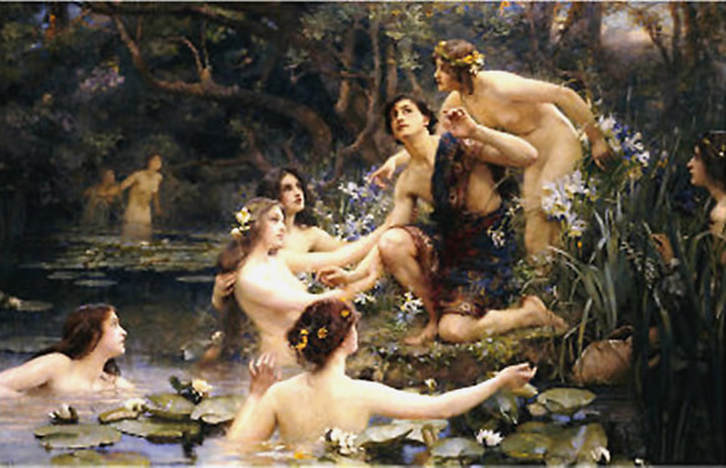
Hylas and the Water Nymphs by Henrietta Rae (1909)

It is ironic that such a supposed declaration by the Manchester gallery that the painting was somewhat sexist and against feminist principles in the way it depicted naked women as the great Victorian painter and staunch supporter of feminism and women’s suffrage, and organiser of an exhibition of female artists for the Jubilee of Queen Victoria, Henrietta Rae, produced a similar painting in 1909.

A Mermaid by John William Waterhouse (1900)

In traditional folklore, the mermaid was looked upon as being a traditional siren who lured unsuspecting sailors to their doom with her mesmerising songs. She was half fish, half human and longed for the company of men. It was these legendary figures that inspired Waterhouse to complete a number of paintings featuring mermaids and sirens. In 1900 he completed the painting entitled A Mermaid which is now part of the Royal Academy collection. Waterhouse’s interest in this subject was because of its mystical temptress whose beauty and charisma proved deadly to men. Yet it was the mermaid’s inability to form a meaningful relationship with a human being that was in itself a curse which fated her to live an unfulfilled life. It could be that Waterhouse’s interest in this aspect was more to do with how men became anxious when confronted by an enchanting female as capitulating to such feelings could have a tragic outcome. In the painting we see a mermaid combing out her long red hair whilst singing a hypnotic song and by combining these elements Waterhouse is making the connection between the narcissistic trait of females with man’s vulnerability when it comes to beautiful women. Before the mermaid, there is a large shell containing pearls, which legend has it are formed by the tears of dead sailors. The mermaid is perched on a rock and her tail has coiled around her, almost as if she is hugging herself. Once again Waterhouse’s depiction could have been influenced by Tennyson’s 1830 poem, The Mermaid, with the lines:

Who would be
A mermaid fair,
Singing alone,
Combing her hair
Under the sea,
In a golden curl
With a comb of pearl,
On a throne?

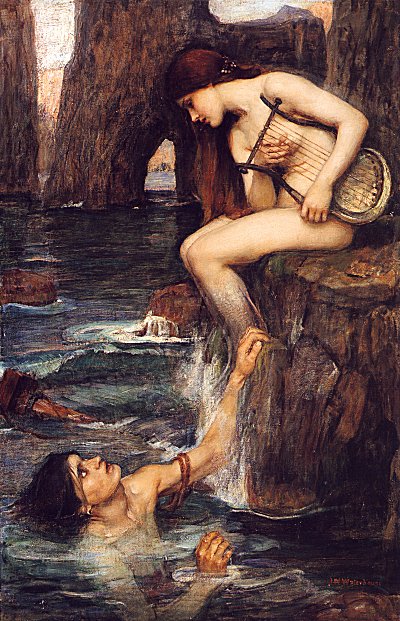
The Siren by John William Waterhouse (1900)

That same year, 1900, Waterhouse completed a similar work entitled The Siren. This was his belated (by five years) Royal Academy Diploma Picture after being elected a full Academician in 1895. In this work Waterhouse has the mermaid perched on a rock and the shell we saw in A Mermaid painting has been supplanted by a musical instrument, the lyre. In The Siren, Waterhouse has depicted the siren looking down upon the drowning sailor. The expression on the siren’s face is somewhat mystifying as it is one of inquisitiveness and not one would expect from a “creature” who is about to watch the sailor drown in the raging sea. It is almost a look of compassion. The expression on the sailor’s face is one of pleading to be saved.

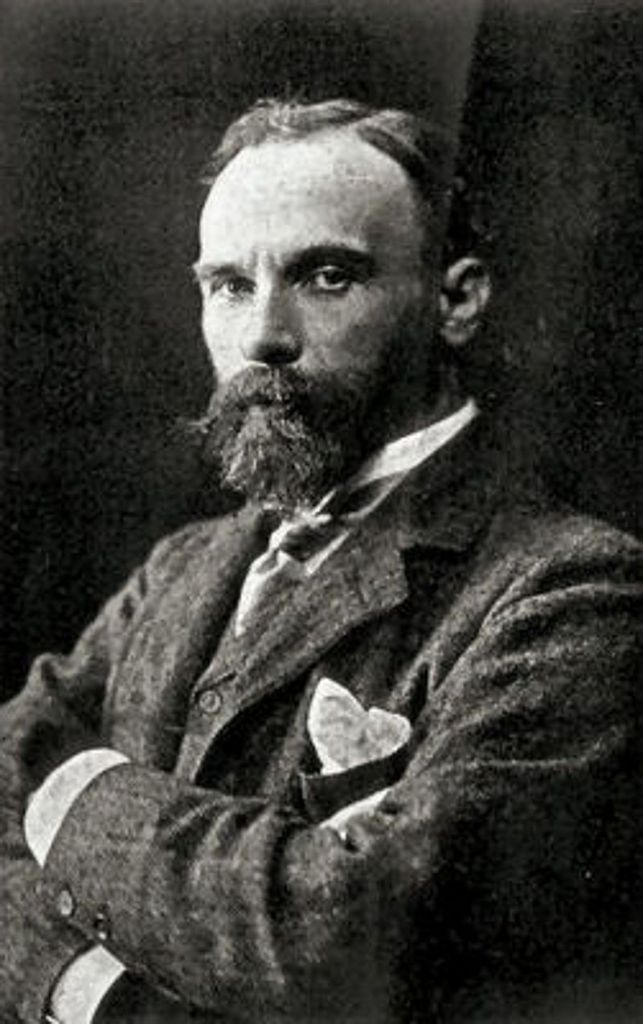
John William Waterhouse (c.1886)

In 1915, John William Waterhouse was diagnosed as having liver cancer and two years later, he died at home on February 10th 1917 at the age of 68, and was buried at Kensal Green Cemetery, London. Thirteen years after his death., his widow, through Christies, sold one hundred of her late husband’s works. Sadly, by that time, Waterhouse’s works had become unfashionable and his famous painting Ophelia was purchased for a meagre £450. However, by the 1960’s his work has become more popular and the postcard of his painting Lady of Shalott has become the Tate’s best-seller. His reputation was further enhanced in 2000 when his painting St Cecilia fetched £6.6 million at auction. It was the highest price ever paid for a Victorian painting. There was a major retrospective of his work at the Royal Academy in 2009 at which Waterhouse was described as:

“…one of Britain’s best-loved nineteenth century painters…”

In the exhibition catalogue which accompanied the exhibition, a biographer of Waterhouse wrote in the introduction:

“…Coursing through the pictures, across five decades, are Waterhouse’s fascination with melancholy, magic, and the thrilling dangers of love and beauty… they are lyrical in the truest sense of the word – imbued with the same hypnotic power possessed by the ancient poets who sang their stories. This was also a man particularly enthralled with female beauty and the power of women over men, over nature, over each other – no matter how sturdy or fragile they might appear physically…”

John William Waterhouse. Part 4.

Dolce Far Niente, Tennyson and Herrick

John William Waterhouse (c.1886)

In the last blog on John William Waterhouse I looked at his paintings which focused on sorcery, sorceresses and Homer’s famous work The Odyssey with tales of death and bloodshed. In the blog today I am taking a more relaxed and soothing road and consider the beautiful women who featured in some of his best loved works.

Dolce Far Niente by John William Godward

The phrase Dolce far Niente was the title of a number of eighteenth-century paintings by well-known artists of the time. The Italian phrase literally means “sweet doing nothing, or sweet idleness”. In essence it meant doing nothing and enjoying it. John William Godward was an English painter born in 1861 and lived during the end of the Neo-Classicist era. He was a protégé of Sir Lawrence Alma-Tadema but unfortunately his style of painting fell out of favour with the unstoppable progression of modern art. Saddened by this inexorable fact of life, he committed suicide at the age of 61 and purportedly wrote a suicide note in which he stated that the world is not big enough for [both] myself and a Picasso.

II Dolce ar Niente by William Holman Hunt (1866)

Another painter to have Dolce far Niente for the title of his work was William Holman Hunt with his 1867 painting, which was exhibited at that year’s Royal Academy Summer Exhibition. His friend and lover, the professional artist’s model, Annie Miller, sat for Hunt for this work but due to a falling-out with the artist half way through the painting Hunt had to enlist the help of Fanny Waugh, the daughter of a chemist whom he later married.

Dolce Far niente by Auguste Toulmouche (1877)

Before I look at Waterhouse’s two paintings which have the same title, I will show you one more. Auguste Toulmouche was a nineteenth century painter noted for his luxurious portraits of Parisian women and he completed his painting Dolce far Niente in 1877.

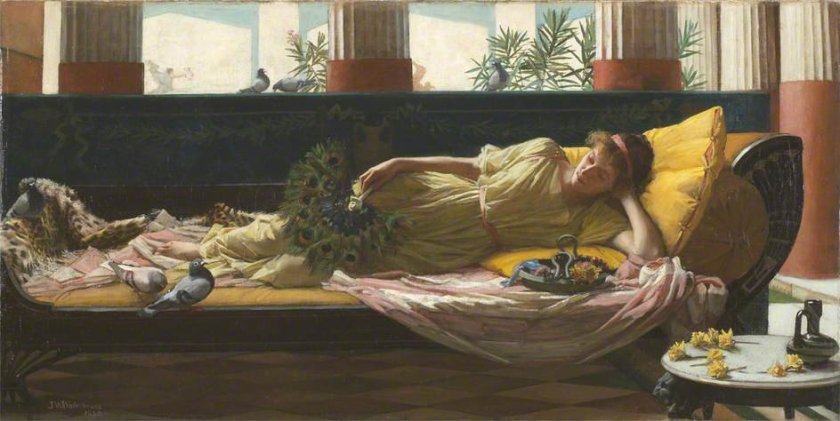
Dolce Far Niente by John William Waterhouse (1879)

However, this blog is all about John William Waterhouse so let us look at his two versions of the subject. His first work was completed in 1879 and is a depiction of a sensual and elaborately dressed female, lying on a rug with her head on green velvet pillow, whilst white feathers flutter down and stand out against the paler white of the wall. Waterhouse loved his painting and when it was exhibited that year at the Dudley Gallery, he put an 80 guineas price tag on the work, which was treble what he usually asked for his works on sale at that gallery. Waterhouse’s choice of title for the painting suggests that he wanted to associate himself with the light-hearted Italianate subjects of several of his contemporaries who chose settings of the island of Capri for their works. In just a few years Waterhouse’s reputation would eclipse these very painters. Once again, when the painting was exhibited, many commented on the similarity of the depiction and the setting to the works of Alma-Tadema, who was thirteen years older than Waterhouse and still better known. In the top right we can see a Pompeian-style light. On the floor, stands a deep-blue glass vase out of which emerges a sunflower.

Dolce Far Niente by John William Waterhouse (1880)

The following year, 1880, Waterhouse completed another work with the same title, Dolce Far Niente. This much larger work (50 x 96cms) is housed in the Kirkcaldy Museum and Art Gallery in Scotland. The painting depicts everyday life in the ancient world and is very much in the style of Alma-Tadema who often used a composition which was derived from ancient vase paintings which represented drinking parties, and often depicted women reclining on couches with small tables in front of them bearing vases of flowers, statuettes or drinking vessels. In this work by Waterhouse we see brilliant yellow daffodils and a small jug lying atop a marble and bronze table similar to what was found in Pompeii which Waterhouse would have seen when he visited the museum in Naples in 1877.

Scene at Pompeii by John William Waterhouse (1877)

Behind the couch there are a number of colonnades with their distinctive red and white colouring, examples of which were part of the interiors found at Pompeii. When Waterhouse returned to his birthplace, Italy, in 1877, it was the first time he had visited the country since his family left in 1854 when he was five years old. In 1860 the Italian archaeologist, Giuseppe Fiorelli, introduced new excavation techniques which concentrated on clearing rubble from the ruins of Pompeii and restoring architectural spaces of the town. Waterhouse saw the fruits of the archaeologist’s work when he visited the site and completed a number of watercolour paintings of the cleared areas. In his watercolour entitled Scene at Pompeii we once again see the red and white colonnades which were present in his Dolce Far Niente painting.

In Part 3, I looked at Waterhouse’s painting The Lady of Shallott and talked about how it was linked to Alfred, Lord Tennyson’s poem of that name. My next painting by Waterhouse is also linked to a Tennyson poem, his 1830 ode, Mariana. The poet was inspired by the character of Mariana in Shakespeare’s play, Measure for Measure which was first performed in 1604. Rejected by her fiancé, Angelo, after her dowry was lost in a shipwreck, Mariana leads an isolated existence in a moated grange for five years. Her feelings of loneliness and yearning are spiralling out of control. Her incarceration is a metaphor for unfulfilled sexual longing. However, despite her loneliness, she is still in love with Angelo who has become Deputy to the Duke of Vienna and she yearns to be reunited with him. The poem follows a common theme in much of Tennyson’s work—that of hopeless isolation. Mariana is a woman who endlessly bemoans her lack of connection with society. This isolation defines her existence, and her yearning for a relationship with people leaves her desperate and left her wishing for death which is stated at the end of every stanza in the poem. The one subtle difference between Shakespeare’s story and the tale encompassed within Tennyson’s poem is that Shakespeare has Mariana’s lover return to her whereas Tennyson’s work ends before Mariana’s lover returns.  The depiction we see before us is based on a stanza of the poem:

With blackest moss the flower-plots
Were thickly crusted, one and all:
The rusted nails fell from the knots
That held the pear to the gable-wall.
The broken sheds look’d sad and strange:
Unlifted was the clinking latch;
Weeded and worn the ancient thatch
Upon the lonely moated grange.
She only said, “My life is dreary,
He cometh not,” she said;
She said, “I am aweary, aweary,
I would that I were dead!”

Her tears fell with the dews at even;
Her tears fell ere the dews were dried;
She could not look on the sweet heaven,
Either at morn or eventide.
After the flitting of the bats,
When thickest dark did trance the sky,
She drew her casement-curtain by,
And glanced athwart the glooming flats.
She only said, “The night is dreary,
He cometh not,” she said;
She said, “I am aweary, aweary,
I would that I were dead!

Upon the middle of the night,
Waking she heard the night-fowl crow:
The cock sung out an hour ere light:
From the dark fen the oxen’s low
Came to her: without hope of change,
In sleep she seem’d to walk forlorn,
Till cold winds woke the gray-eyed morn
About the lonely moated grange.
She only said, “The day is dreary,
He cometh not,” she said;
She said, “I am aweary, aweary,
I would that I were dead!”

About a stone-cast from the wall
A sluice with blacken’d waters slept,
And o’er it many, round and small,
The cluster’d marish-mosses crept.
Hard by a poplar shook alway,
All silver-green with gnarled bark:
For leagues no other tree did mark
The level waste, the rounding gray.
She only said, “My life is dreary,
He cometh not,” she said;
She said “I am aweary, aweary
I would that I were dead!”

And ever when the moon was low,
And the shrill winds were up and away,
In the white curtain, to and fro,
She saw the gusty shadow sway.
But when the moon was very low
And wild winds bound within their cell,
The shadow of the poplar fell
Upon her bed, across her brow.
She only said, “The night is dreary,
He cometh not,” she said;
She said “I am aweary, aweary,
I would that I were dead!”

All day within the dreamy house,
The doors upon their hinges creak’d;
The blue fly sung in the pane; the mouse
Behind the mouldering wainscot shriek’d,
Or from the crevice peer’d about.
Old faces glimmer’d thro’ the doors
Old footsteps trod the upper floors,
Old voices called her from without.
She only said, “My life is dreary,
He cometh not,” she said;
She said, “I am aweary, aweary,
I would that I were dead!”

The sparrow’s chirrup on the roof,
The slow clock ticking, and the sound
Which to the wooing wind aloof
The poplar made, did all confound
Her sense; but most she loathed the hour
When the thick-moted sunbeam lay
Athwart the chambers, and the day
Was sloping toward his western bower.
Then said she, “I am very dreary,
He will not come,” she said;
She wept, “I am aweary, aweary,
Oh God, that I were dead!”

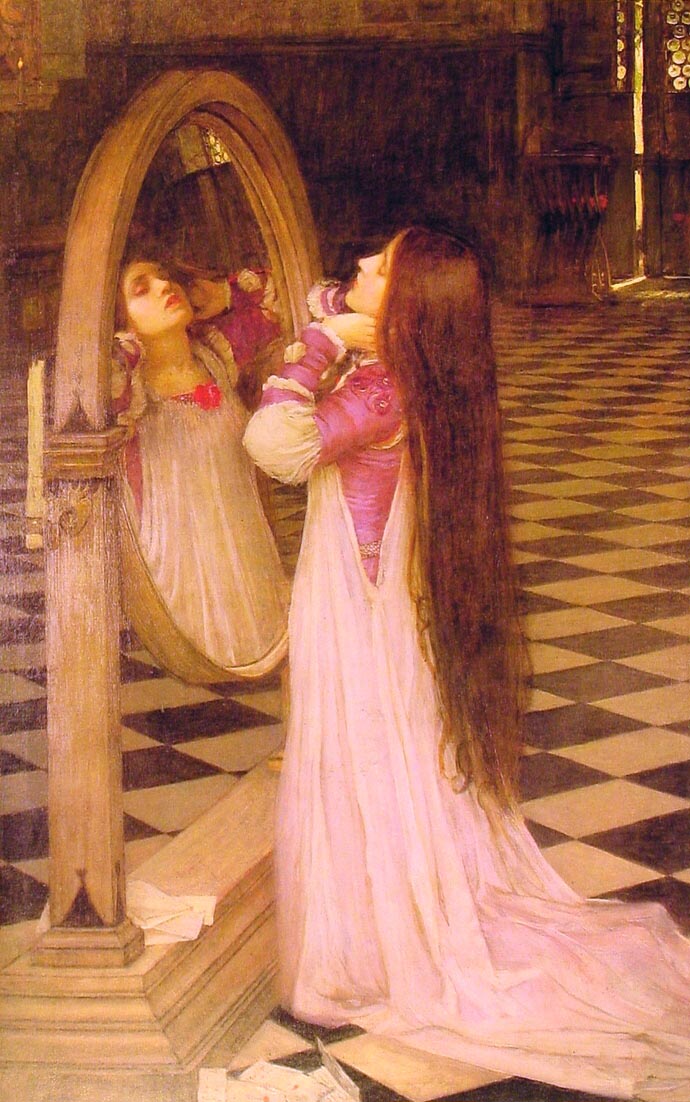
Mariana in the South by John William Waterhouse (1897)

Look how Waterhouse has painted the angled reflection of the oval mirror. The floor he has painted is made up of black and white tiles which stretch off towards the door giving a sense of emptiness and highlights Mariana’s solitude. Behind the mirror, at the top left of the painting, we can just make out the altar to the Madonna at which Mariana has been praying. In some ways Tennyson and Waterhouse seek to connect the imposed purity of Mariana with the purity of the Virgin.

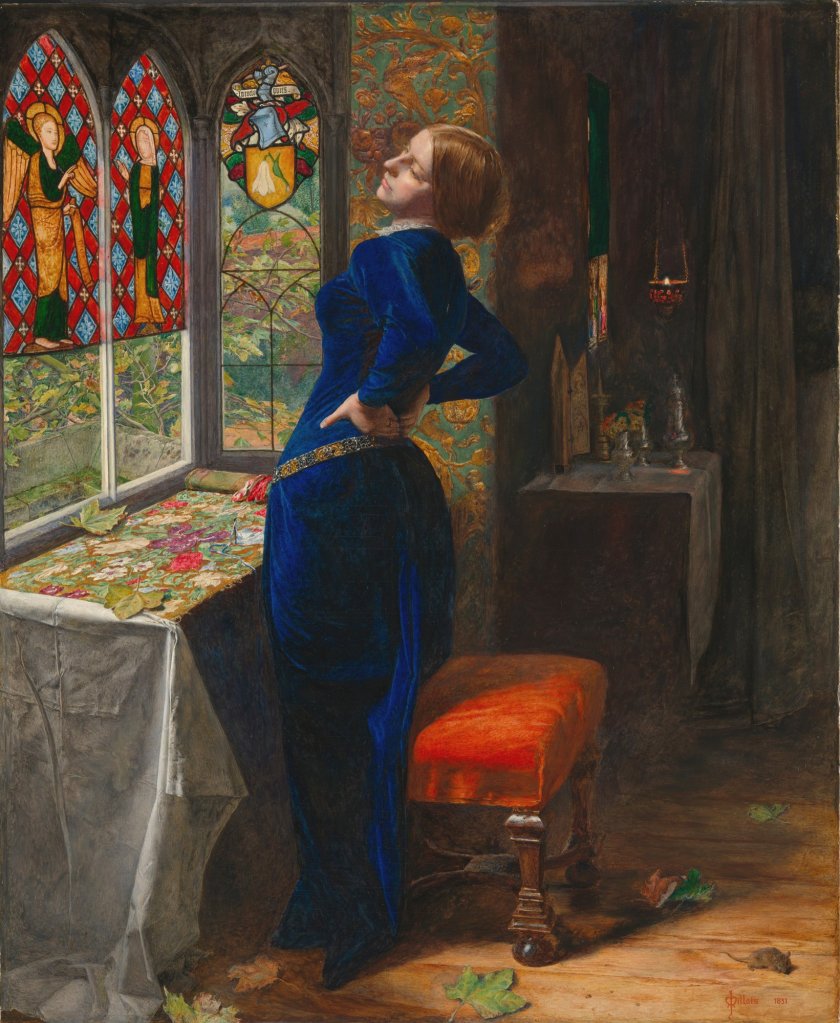
Mariana by John Everett Millais (1851)

As was the case with the Lady of Shalott, Waterhouse was probably influenced by another of John Everett Millais’ famous paintings, that of his 1851 portrayal of Mariana which appeared at that year’s Royal Academy exhibition. Waterhouse probably saw the work when it was displayed at an exhibition at the Grosvenor Gallery in 1886 and later in an exhibition held in Birmingham. Millais depicted Mariana, isolated in a remote farmhouse awaiting the return of her lover. She is standing before a table on which is her embroidery depicting the garden outside and behind that is a stained-glass window showing the Annunciation, which he copied from the window of the Chapel of Merton College, Oxford. The small stained-glass side window, to the right of the table, includes the motto In coelo quies which means In Heaven there is rest and this bears out the last line of each of Tennyson’s stanzas which refer to Mariana’s desire to be dead. It is Autumn and scattered around are fallen leaves symbolising the passing of time. Mariana in this painting is seen stretching her back after hours sitting working on her embroidery.

Gather Ye Rosebuds While Ye May, by John William Waterhouse (1909)

Waterhouse completed two works in the early 1900’s based on a verse of a poem written by the seventeenth century English poet and cleric, Robert Herrick, in 1684. The poem was entitled To the Virgins, to Make Much of Time and the first line is the title of two of Waterhouse’s paintings.

Gather ye rosebuds while ye may,
Old Time is still a-flying;
And this same flower that smiles today
Tomorrow will be dying.
The glorious lamp of heaven, the sun,
The higher he’s a-getting,
The sooner will his race be run,
And nearer he’s to setting.
That age is best which is the first,
When youth and blood are warmer;
But being spent, the worse, and worst
Times still succeed the former.
Then be not coy, but use your time,
And while ye may, go marry;
For having lost but once your prime,
You may forever tarry.

The poem is in the genre of carpe diem, which means “seize the day”, or “enjoy yourself while you have the chance”. The setting for this 1909 work is a warm sunny Spring day in the countryside, and a field full of wild flowers crossed by a small stream. In the foreground two women gracefully bend down to pick the flowers. One is dressed in blue/violet robes whilst the other, with bright red hair similar to that seen in many Pre-Raphaelite works, is dressed all in pink. In the background there is a distant mountain range depicted in various blue tones. In the mid-ground there is a wood and we can see two other women, standing amongst the trees, also collecting flowers. It is Waterhouse’s first in a series of works motivated by the story of the Greek goddess Persephone in which the virtuous young woman who had been out in the meadow picking flowers on the plain of Enna, is abducted by Pluto. Her mother, the harvest goddess Demeter, is so distressed and angered by the turn of events she curses the world with a long drawn out winter broken only by her daughter’s return to earth each Spring. The women have a seasonal time constraint for the picking of the flowers and so, as the painting’s title suggests, they are only able to gather ye rosebuds while ye may.

Gather Ye Rosebuds While Ye May by John William Waterhouse (1908)

A year earlier Waterhouse completed a painting with a similar title which showed a red-haired woman presenting a bowl of flowers. Her head is reflected in a mirror behind her. The flowers in the bowl are beautiful roses but as Herrick’s poem reminds us in his carpe diem poem:

“…And this same flower that smiles today
Tomorrow will be dying…”

The beautiful roses of today would be dying tomorrow.

..………..to be continued.


John William Waterhouse. Part 3

Sorceresses and a tale from Homer.

Despite Waterhouse marrying his wife Esther in a Church of England church and attending services there, he continued to be fascinated by the occult and magic rituals. Miracles, magic, and the capacity to prophesise were common motifs in many of Waterhouse’s paintings. His 1884 work entitled Consulting the Oracle was a depiction of one such ritual.

Consulting the Oracle by John William Waterhouse (1884)

The painting depicts a group of seven young women, all seated in a semicircle around a lamplit shrine. There is excitement in their facial expressions as they listen to the words of the priestess who is interpreting the words of the Oracle. The Oracle was sometimes referred to as the Teraph. A Teraph (plural Teraphim), according to the Targum Pseudo-Jonathan, a western translation of the Torah from the land of Israel, the Teraphim were originally human heads, taken from first born male adults who had been sacrificed. The head was then shaved salted and spiced. It was believed that Teraphic heads could talk and give guidance. In Waterhouse’s painting, the Teraph or Oracle was fixed against a wall and in front of it were lighted lamps. Such was the performance of the priestess that the fascinated female onlookers were although enthusiastic were also tense and became agitated, so much so, that they too believed that they had heard the Oracle’s low voice speaking of what was to happen in the future. The atmosphere in the room is intoxicating with presence of incense from the burning lamps. The priestess signals to the women to be quiet whilst she struggles to hear the Oracle’s words. She moves her ear close to the lips of the Teraph and, as we see in the depiction, she turns to the women with a spellbound expression, causing a tenseness in the demeanour of her followers as they await the pronouncements that have emanated from the mummified head.  Anthony Hobson in his 1980 book, The Art and Life of J.W. Waterhouse, RA, 1849-1917, compares the painting’s depiction to the shape of a keyhole:

“…This refers not to some telescopic view of the scene but to the keyhole shape of the figure grouping, in which a ring of spectators concentrate their attention upon another single figure…”

Study for ‘The Courtyard of the Coptic Patriarch’s House in Cairo’ by John Frederick Lewis (1864)

The background is made up of a series of arched windows and the painting’s setting was probably invented by Waterhouse but even knowing that, it still has an enigmatic Middle Eastern feeling and he could well have been influenced by the orientalist paintings of John Frederick Lewis.

The Illustrated London News featured the picture, Consulting the Oracle,  as one of the principal works of the year and reproduced it across two pages of the journal’s extra supplement. The painting was bought by Sir Henry Tate, the English sugar merchant and philanthropist, who included it in his founding bequest to the nation in 1894 and can be found in the Tate Britain collection.

The Magic Circle by John Willoiam Waterhouse (1886)

Two years later Waterhouse completed another painting in the same vein, entitled The Magic Circle. This was Waterhouse’s first painting since being elected as an Associate of the Royal Academy. Egyptian architecture acts as a backdrop to the painting. The main character is a dark-haired sorceress chanting invocations over a bubbling cauldron whilst simultaneously marking out in the ground the magic circle cited in the title of the work. As the stick drags along the earth it creates smoke and the circle starts to glow white. In her left hand she grasps a druidical boline, a sickle-like implement which was used by witches to harvest magical herbs, some of which can be seen tucked into a sash around her waist.

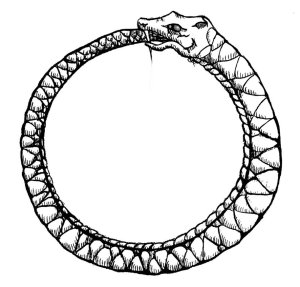
An Ouroboros

Around her neck is an Ouroboros, an ancient symbol depicting a serpent or dragon eating its own tail. This is one of the oldest mystical symbols in the world and appears in many cultures. It characterises the circle of life, conception out of destruction,  life out of death, in an everlasting cycle of renewal and was closely related to the Egyptian legend of Isis and Osiris, the first Pharaoh of Egypt, who married Isis, his one true love. In Britain in the 1880’s Egyptian legends and the occult were very popular. To add to this air of dark mystery we see the sorceress surrounded by a sinister group of ravens, which, in pagan belief, are portents and messengers of bad luck. If we should have any doubt about their symbolism look at the raven standing behind her. It is perched on a skull and cries out to the sorceress.

Medea by Frederick Sandys (1868)

Other paintings by his contemporaries may have influenced Waterhouse to complete such a work. There was Frederick Sandys’ famous 1868 work, Medea, which also depicted an evil dark-haired sorceress chanting over a simmering pot with her magic accoutrements set out on the table before her. This painting was submitted to the hanging jury of the Royal Academy for inclusion in the 1868 Summer Exhibition but it was rejected. Art historians talk about this rejection as having nothing to do with the quality of the work but the rejection was solely a matter of internal politics, and petty jealousies.

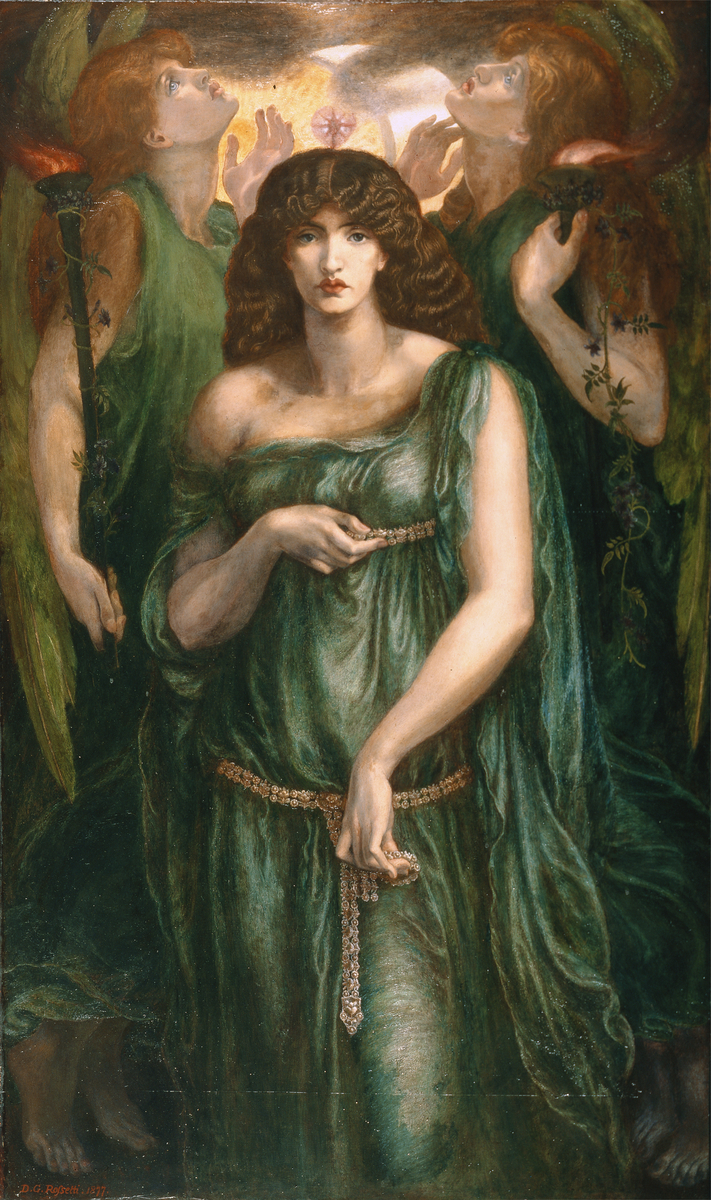
Astarte Syriaca by Dante Gabriel Rossetti (c.1878)

Another work thought to have influenced and inspired Waterhouse to paint The Magic Circle was Dante Rossetti’s 1878 painting, Astarte Syriaca, the ancient Syrian goddess of love.

Another sorceress who featured in Waterhouse’s paintings was Circe, a goddess of magic or sometimes a nymph, enchantress or sorceress in Greek mythology. Circe was famous for her extensive knowledge of potions and herbs. Through the use of these and a magic wand or staff, she would transform her enemies into animals.  Waterhouse did not exhibit any of his work at the 1890 Royal Academy Summer Exhibition. This was the first time he had failed to put forward a work for the exhibition since his first offering in 1874. It is thought the reason was two-fold. At the beginning of 1890 his father died and this was a very emotional time for Waterhouse. The second reason was that he spent much of his time in 1890 travelling around Italy. With the arrival of 1891 came the arrival of a turning point in Waterhouse’s art. He abandoned the series of subjects from ancient history and embarked on a project focused on myths and legends of pagan antiquity. It was a time when his work began to feature mythological subjects and Alfred Baldry, an English art critic and painter, wrote in his 1895 article for The Studio, an illustrated fine arts and decorative arts magazine, that he had observed that Waterhouse’s new conviction was a definite inclination towards a picturesque mysticism and that he was a painter of mystic suggestions.

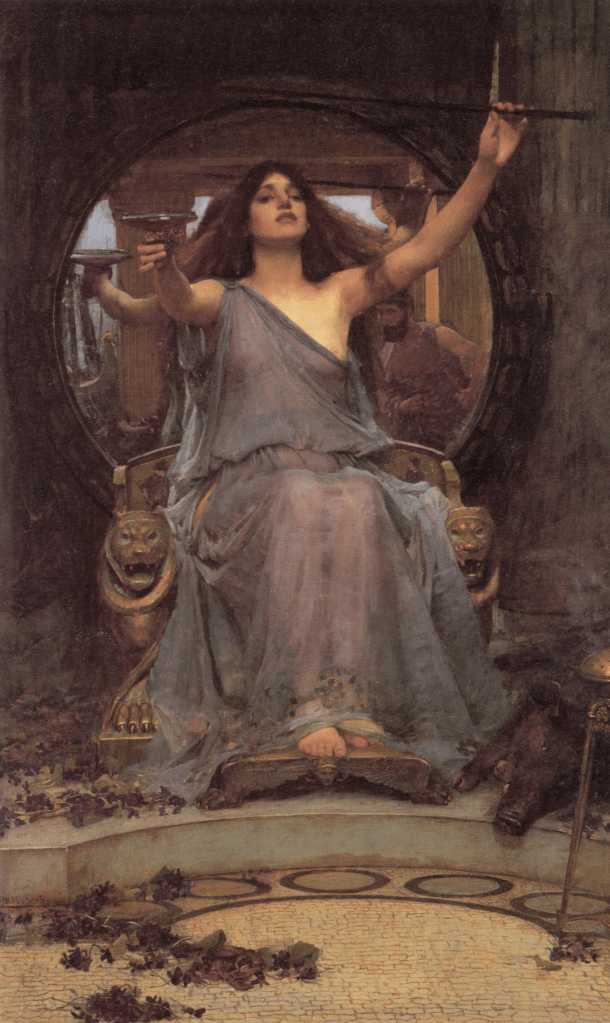
Circe Offering the Cup to Ulysses by John William Waterhouse (1891)

After not exhibiting at the Royal Academy the previous year, Waterhouse completed two paintings featuring Circe, both drawn from Homer’s Odyssey and the story of the wanderings of Ulysses to the mouth of the underworld. One painting was entitled Circe Offering the Cup to Ulysses which Waterhouse exhibited at the New Gallery in London, which had been founded in 1888. The New Gallery was an important venue for Pre-Raphaelite and Aesthetic movement artists. Many of the well-known artists of the time exhibited their work at this new gallery including Edward Burne-Jones, Lawrence Alma-Tadema, William Holman Hunt, George Frederic Watts and Lord Leighton. In the depiction we see the figure of Circe regally enthroned between two bronze lions.  Circe dominates the depiction as she towers above the observer. She has transformed Ulysses’ men into swine, two of which we see lying on the floor besides her throne. All we see of Ulysses is his small reflection in the circular mirror behind her. He is hesitant as he reaches for his sword. In Homer’s tale, Ulysses takes control and overpowers Circe but in Waterhouse’s depiction it is all about the power of the sorceress as she raises her magic wand and threatens the interloper. Circe is dressed in a transparent blue gauze, which has slipped down on one side revealing her breast. Through the gauze we see her limbs. She looks haughtily down at Ulysses who she intends to seduce.

Ulysses and the Sirens by John William Waterhouse (1891)

Waterhouse’s other painting, which he completed in 1891, was included in that year’s Royal Academy Summer Exhibition. The dramatic work was simply entitled Ulysses and the Sirens and is currently housed in the National Gallery of Victoria in Melbourne. It once again represented a passage from Homer’s Odyssey and the event comes after Ulysses had encountered Circe and was now on his way out of the Underworld. It is a pictorial account of his meeting with the Sirens, the bird women whose bewitching songs lure incautious sailors and their ships on to dangerous rocks and to their deaths. Waterhouse had a note appended to the painting when it was exhibited noting that it was Circe who had instructed Ulysses to resist the Siren’s baneful songs by stopping the ears of his men with wax and had himself bound to the mast of the ship and by adding this note Waterhouse had insured that people knew about Circe and her magic arts and reminded them of the connection between this work and the one he was exhibiting at the New Gallery. Waterhouse also wanted to remind people that it was not just through the bravery of Ulysses that his boat and crew had survived the Sirens but it was through the advice of Circe. It is interesting to note that Waterhouse depicted seven sirens whereas in Homer’s tale there were only two. Maybe it was because the number seven is looked upon as the “magic number”. Waterhouse has depicted each Siren with the body of a bird and the head of a beautiful woman and it is thought he had seen a similar depiction on an ancient Greek vase housed in the British Museum.

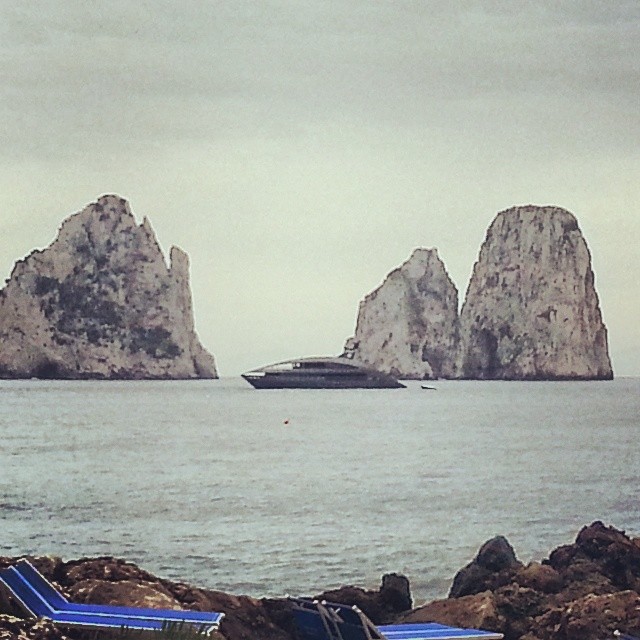
Marina piccola, Capri.

The imaginary setting of this work could have come from Waterhouse’s Italian travels especially the time he spent in Capri and what we see in the work is very similar to the rock formation of the Marina Piccola which lies below the town of Capri. The painting received enormous praise from the art critics of the time.  Marion Spielmann, the prolific Victorian art critic and scholar and who was the editor of The Connoisseur and Magazine of Art,  and looked upon as one of the most powerful figures in the late Victorian art world. Of Waterhouse’s painting, he declared it to be:

“…a very startling triumph … a very carnival of colour, mosaicked and balanced with a skill more consummate than even the talented artist was credited with … The quality of the painting is … a considerable advance upon all his antecedent work…”

The painting was bought by Sir Hubert von Herkomer for the National Gallery of Victoria, in June 1891, the Ulysses was only the second work by John William Waterhouse to be acquired for a public gallery.

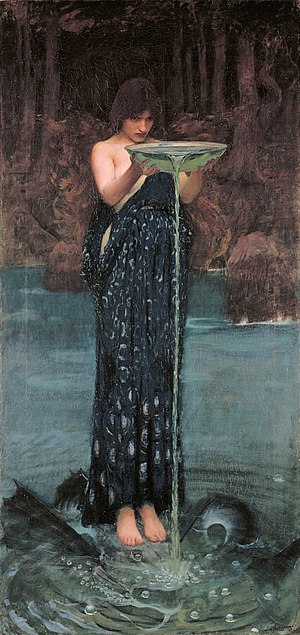
Circe Invidiosa: Circe Poisoning the Sea. by John William Waterhouse (1892)

A year later Circe is depicted in another of Waterhouse’s paintings. The 1892 work is entitled Circe Invidiosa: Circe Poisoning the Sea. It is a dramatic vertical format which only adds to the menacing storyline. The scene depicted by Waterhouse comes from Ovid’s Metamorphoses in which Circe is angered by the refusal of the fisherman turned sea god, Glaucus, to abandon his beloved Scylla and takes revenge by pouring a baneful of green poison into the pool where she knows Scylla often bathes. Circe took plants of poisonous powers and mixed them together, with incantations and charms and poured her poisonous mixture into the pool and muttered over it incantations of mighty power. Scylla came as usual and plunged into the water up to her waist. The poisoned water transformed the lower half of her body into barking dogs.

Circe by John William Waterhouse (1914)

Waterhouse returned to the Circe motif around 1914 when he completed two more oil sketches featuring the sorceress. In one we see Circe, in profile, with her hair swept back in a tight bun sitting forward in a marble chair with her elbows resting on a marble table. She wears a bright red shift dress. She is lost in contemplation. In front of her, on the table, is an open manuscript. To her right is a bottle containing a red potion. All around her are all her tools needed for her magic arts.

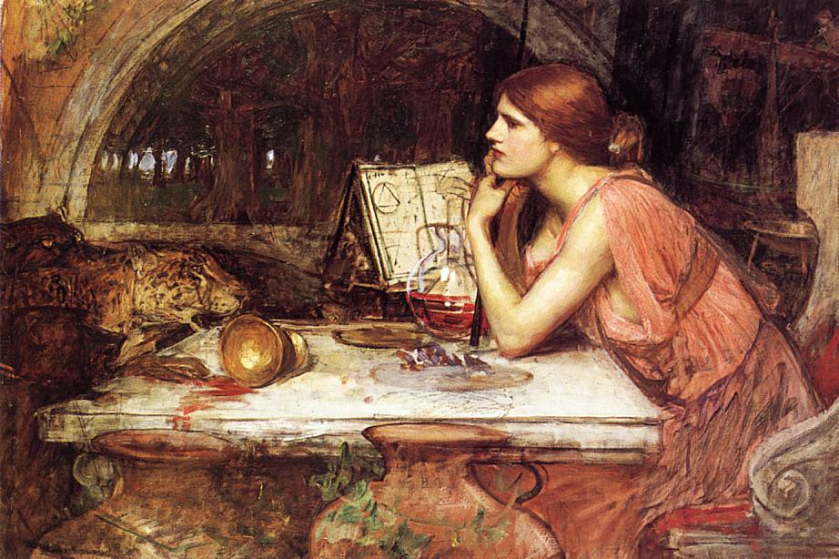
Sketch of Circe by John William Waterhouse (c.1914)

As in the previous work, in this second oil sketch, we see Circe resting her chin on her hands and in this version, we see her clasping her magic wand. The sketch is more detailed. To her right is a stone-arched window through which we glimpse a dense and dark forest. In front of the window we see a book of spells propped up for her to read. A flask containing a red potion sits on top of table and in front of her there is a gold chalice which has tipped up and a red liquid has spilt on the table. On the opposite side of the square table are three wild animals who stare at Circe.

..…………….to be continued.

John William Waterhouse. Part 2.

Marriage and women destined to suffer.

Portrait of the Artist’s Wife by John William Waterhouse (1885)

In 1883 John William Waterhouse married Esther Maria Kenworthy, a noted flower painter. She was the daughter of James Lee Kenworthy, an artist and schoolmaster from Ealing and Elizabeth Kenworthy who was also a schoolteacher. Waterhouse was thirty-four-years-old and Esther was eight years younger. The marriage took place at the Church of England parish church in Ealing, and thereafter Waterhouse’s wife used the name Esther Kenworthy Waterhouse. At the beginning of their married life the couple lived close by a purpose-built artistic colony in Primrose Hill, where the houses also had studios. Primrose Hill Studios, built in 1877, was a development of twelve artist houses around a quadrangle in a mews off Regent’s Park. Waterhouse already rented a studio at No. 3 Primrose Hill Studios, which he had leased since 1878, and later moved to a much bigger studio at No.6.

Self portrait by William Logsdail

One of the Waterhouses’ neighbours at the Primrose Hill Studios was the prolific Antwerp-trained English landscape, portrait, and genre painter, William Logsdail. The Primrose Hill Studios complex was, as Logsdail later recalled, a place that the artists around the courtyard ‘formed a happy family, in and out of each other’s studios during the day, and in the evening swapping stories over the cards and whisky or dining at “the Bull and Bush” on Hampstead Heath’.

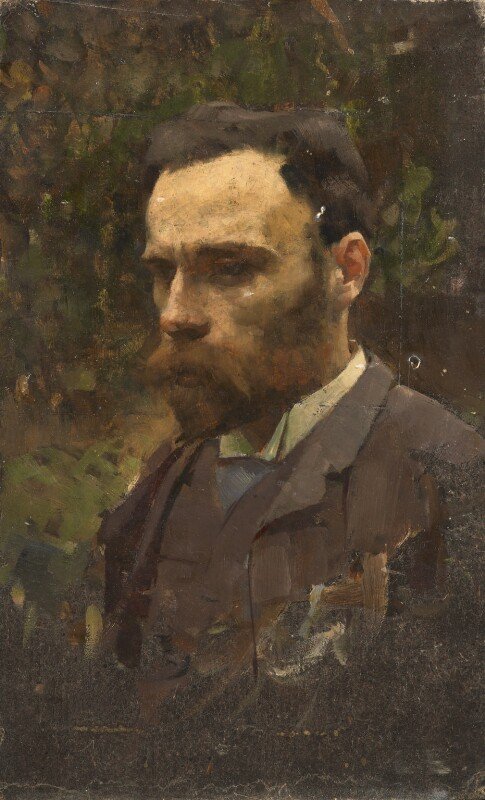
John William Waterhouse by William Logsdail (1887)

Logsdail recorded in 1917 that he used friends and colleagues from the Primrose Hill Studios – including four members of the Waterhouse family – to act as models for parts of his London cityscape paintings. It is the connection and friendship between Waterhouse and Logsdail, which brought about questions as to who painted the small oil on board portrait of Waterhouse in 1887. At first, it was looked upon as a self-portrait but in 2002 Peter Trippi, the leading authority on Waterhouse, questioned the attribution, suggesting that the sketch was not a self-portrait but in fact it had been painted by William Logsdail, In the painting we see that Waterhouse’s features half-hidden under a thick reddish-brown moustache and beard. The portrait went to auction, run by John Physick, Waterhouse’s great-nephew, at the Canterbury Auction Galleries, in May 2011. Even then, it was deemed as a self-portrait by Waterhouse.   However, in Trippi’s words this head is ‘absolutely a modern-life image made by a trusted colleague or friend’. It is the first example of Logsdail’s work to enter London’s National Portrait Gallery Collection. The attribution to Logsdail has now been established beyond doubt.

St Eulalia by John William Waterhouse (1885)

In 1885 John William Waterhouse was elected as an Associate of the Royal Academy. This election to full membership status came shortly after he exhibited a painting, the depiction of which was one that engendered great discussion with regards its depiction. The work was entitled Saint Eulalia, who was a twelve-year-old martyr. When the work was exhibited it came with a note from Waterhouse:

“…’Prudentius says that the body of St. Eulalia was shrouded “by the miraculous fall of snow when lying in the forum after her martyrdom…”

Aurelius Prudentius Clemens was a Roman Christian poet who was born in Northern Spain and who practiced law, as well as holding two provincial governorships.  He was awarded a high position by the Roman emperor Theodosius but tiring of court life, he devoted the rest of his time, from about 392, to writing poems on Christian themes.

Eulalia of Mérida was a devout Christian girl, aged between twelve and fourteen years old who lived in Mérida, Spain, and who was killed during the Persecution of Diocletian around 304AD. The Diocletianic persecutions, sometimes referred to as the Great Persecution, was the last and most severe persecution of Christians in the Roman Empire. In 303 AD, the four Roman Emperors, Diocletian, Maximian, Galerius, and Constantius set out a series of pronouncements withdrawing the legal rights of Christians and ordered them to observe the traditional religious practices. The story goes that Eulalia ran away to the law court of the governor Dacian at Emerita, and stubbornly professed herself a Christian. She then went on to insult the pagan gods and emperor Maximian, and defied the authorities challenging them to martyr her.

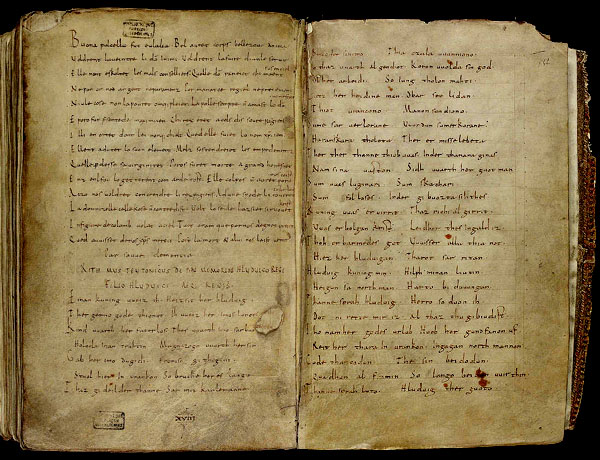
Manuscript of the Sequence of Saint Eulalia written in 880 AD.

The story is told in a book of twenty-nine verses, The Sequence of Saint Eulalia, also known as the Canticle of Saint Eulalia, which is a ninth century biography of Saint Eulalia and tells how she resisted pagan threats despite being tortured. Finally, she was executed and became a Christian martyr. Below is a translation of a passage of The Sequence of Saint Eulalia.

Eulalia was a good girl,
She had a beautiful body, a soul more beautiful still.
The enemies of God wanted to overcome her,
they wanted to make her serve the devil.
She does not listen to the evil counsellors,
(who want her) to deny God, who lives up in heaven.
Not for gold, nor silver, nor jewels,
not for the king’s threats or entreaties,
nothing could ever persuade the girl
not to love continually the service of God.
And for this reason she was brought before Maximian,
who was king in those days over the pagans.
He exhorts her — but she does not care —
to abandon the name of Christian;
She gathers up her strength.  And subsequently worship his god.
She would rather undergo persecution
Than lose her spiritual purity.
For these reasons she died in great honor.
They threw her into the fire so that she would burn quickly.
She had no sins, for this reason she did not burn.
The pagan king did not want to give in to this;
He ordered her head to be cut off with a sword.
The girl did not oppose that idea:
She wants to abandon earthly life, and she calls upon Christ.
In the form of a dove she flew to heaven.
Let us all pray that she will deign to pray for us
That Christ may have mercy on us
And may allow us to come to Him after death
Through His grace.

For some, this painting by Waterhouse the pictorial story was a too  gory and disturbing subject and for some it was too much to behold.  Many of the public who had never heard of Eulalia were shocked by the story and depiction. For Waterhouse it was all about women being subjected to a horrible and undeserved fate, some of whom we will see in later paintings. Before us we see the foreshortened body of Eulalia which in itself often received criticism from critics of the time. As we look along the body from her head to her feet, our eyes are led  to a void of snow which in a way underlines the young girls isolation. Her arms are outstretched forming a cross as if she has been taken down from a crucifixion and laid upon the floor which, of course, mirrors the fate of Christ. Hovering above her are white doves, one of which in the story of her martyrdom is said to have come from the dead girl’s mouth on its journey to heaven. This frightened away the soldiers from her body and allowed a miraculous snow to cover her nakedness, its whiteness indicating her sainthood. Look how Waterhouse has depicted Eulalia’s hair spread out like a fan. For Waterhouse, a woman’s hair was an object of male attraction. Although the painting shocked many who saw it at the 1885 Royal Academy Exhibition it secured Waterhouses election as a full member of the Academy. For all the painting recounts the martyrdom of a young virgin, Waterhouse was careful not to depict on her body the result of the savagery and butchery of her torture that preceded her death, instead he managed to secure the purity and innocence of her body.

Mariamne by John William Waterhouse (1887)

Waterhouse’s fascination with doomed women can be seen in his 1887 painting entitled Mariamne. The story comes from an account in Josephus’ book Jewish Antiquities. Josephus was a first-century Romano-Jewish historian who was born in Jerusalem. In his book, Josephus recounts the story of Mariamne the Hasmonean, who he describes as a magnificently beautiful and dignified Hasmonean princess and the second wife of Herod the Great and sister-in-law of Salome. Herod feared the power of the Hasmoneans which led him to execute all the leading Hasmonean family members, including his wife, Mariamne, whom Herod had executed at the behest of sister Salome on a trumped-up charge of infidelity. The painting by Waterhouse was the largest he ever made, measuring 259 x 180cms. It is a wonderful painting full of fascinating narratives. Art critics of the time likened it to a scene from a play. The main figure of the work is the white-robed figure of Marianme who we see descending a marble staircase. Her hands are chained having been condemned to death by a group of elders seen lurking in the shadows in the background. Their decision being based on their loyalty to their king and not because they believed the charge of infidelity. To the right we see a man in crimson robes seated, listening intently to the whisperings of the women by his side. There is one line of thought that the interior painted by Waterhouse is reminiscent of the interior of his contemporary, Alma-Tadema’s Grove End Road, St John’s Wood studio/house. The painting was exhibited in Paris, Chicago and Brussels over the next ten years and by the beginning of the twentieth century Waterhouse had become world renowned.

The Lady of Shalott by John William Waterhouse (1888)

Another of Waterhouse’s works featuring a doomed and maligned female is probably his best known. It is The Lady of Shalott which he completed in 1888. The Lady of Shalott is a character from Tennyson’s 1832 poem and recounts the story of a woman who is suffering under a curse of isolation. The woman’s home is a tower on a lonely island called Shalott. Running down past the island is a river which emanates from the castle of King Arthur’s and wends its way down to the town of Camelot. She had been incarcerated in her room, under a curse that barred her to go outside or even look directly out of the window in the tower. The curse forbids her to see the world other than that reflected images in her mirror.

She knows not what the curse may be,
And so she weaveth steadily,
And little other care hath she,
The Lady of Shalott.

 She would spend her time sitting below the mirror weaving a tapestry of scenes that she could only observe in the reflection of the mirror. One day she looks into the mirror and catches a glimpse of the reflected image of the handsome knight Lancelot.

All in the blue unclouded weather
Thick-jewell’d shone the saddle-leather,
The helmet and the helmet-feather
Burn’d like one burning flame together,
As he rode down to Camelot.

She is overwhelmed by his beauty and cannot resist looking at him directly. She is stricken by love and lust and turns to look out of her window. For her disobedient act the mirror cracks and she is cursed.

Out flew the web and floated wide—
The mirror crack’d from side to side;
“The curse is come upon me,” cried
The Lady of Shalott.

The lady leaves the tower and goes to the riverbank where she finds a boat. It is this point in the tale that is captured by Waterhouse’s painting. The lady is just about to slip the chain holding the boat to the shore. We see the lady in the boat, sitting on the tapestry she has just been weaving. There is a pensive air about her facial expression. She seems slightly fearful as she starts her journey. Her lips are parted as she sings, maybe to ward off her anxiety as she leaves the island and floats down the river towards Camelot.

And down the rivers dim expanse
Like some bold seer in a trance,
Seeing all his own mischance —
With a glassy countenance
Did she look to Camelot.
And at the closing of the day
She loosed the chain, and down she lay;
The broad stream bore her far away,
The Lady of Shalott.

At the front of the boat is a lantern and a crucifix. Besides the crucifix we see three candles. Candles symbolise life, and in this painting, we see two have blown out and one is flickering in the strong breeze, signifying that the lady has little time left. This is not just the starting point of the journey. It is almost her last moments before she dies never having reached Camelot.  Look at the sumptuous colours Waterhouse has used in the painting contrasting the stark white of her clothing. The painting was further enhanced by Waterhouse’s inclusion of naturalistic details such as the pied flycatcher which rests on the reed bed and the many water plants which were native to English rivers at the time.

The Lady of Shalott by John William Waterhouse (1894)

Waterhouse completed two further paintings with the motif of The Lady of Shalott. The one he painted in 1894 is part of the Leeds Art Gallery collection. In this work Waterhouse captures the moment as the lady turns and rises from her chair, clutching her weaving shuttle, hesitating before the sight of Lancelot as the curse begins to take place and the mirror starts to crack. The tip of Lancelot’s lance points to the crack. Behind her we see the cracked mirror and the reflection of the knight. Look at her facial expression. It is a piercing gaze. It is a combination of anxiety and yearning, a yearning to free herself from captivity. It is an act of defiance on her part. It is her assertion that she should be free. For Tennyson the poem was an allegorical tale about the transition from innocence, repression to sexual revelation. Look how the golden thread used in her weaving has wrapped around her torso and how she is breaking free of its restraints as if she is a white moth emerging from its silk cocoon, which metaphorically is her sexual awakening following her catching sight of the famous knight. Behind her, in the right background of the work Waterhouse has once again depicted candles being extinguished by the wind signifying the coming of her death.

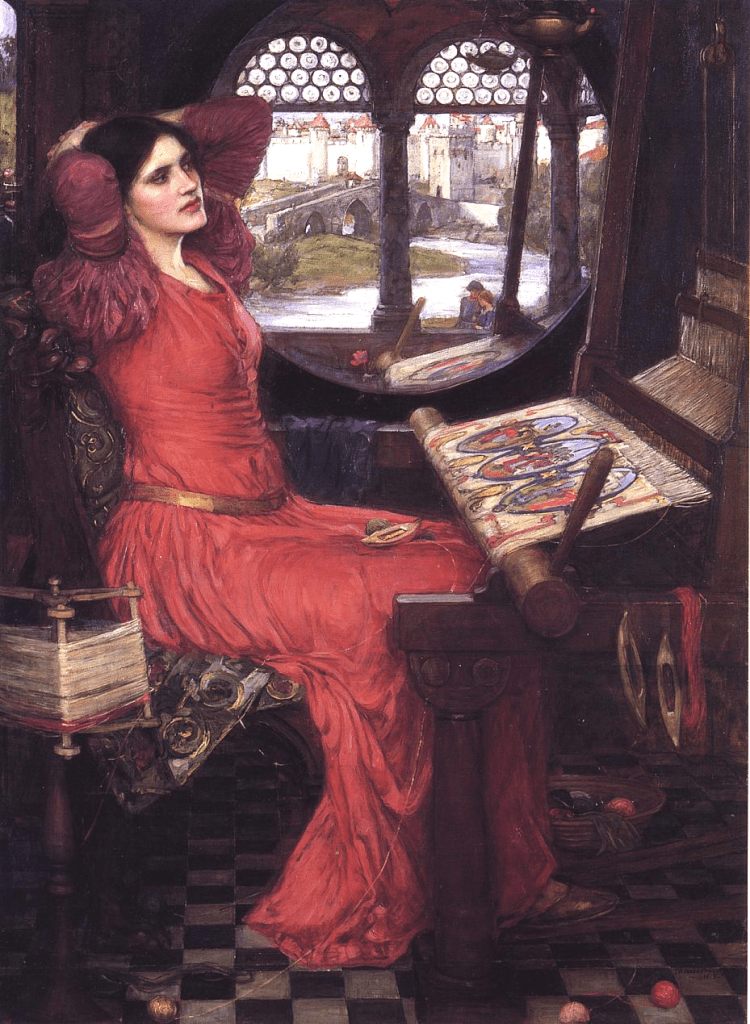
I am Half Sick of Shadows, said the Lady of Shalott by John William Waterhouse (1915)

Waterhouse’s final version of the Lady of Shalott was painted in 1915 entitled I am Half Sick of Shadows, said the Lady of Shalott. This is the point in the poem before Lancelot appears as a reflection in her mirror. It is from this stanza that the painting gets its sub-title:

But in her web she still delights
To weave the mirror’s magic sights,
For often thro’ the silent nights
A funeral, with plumes and lights
And music, came from Camelot:
Or when the moon was overhead
Came two young lovers lately wed;
‘I am half sick of shadows,’ said
The Lady of Shalott.

Again, we see the lady in solitary confinement in her tower. She is stretching upwards with her hands behind her head in a rather sensual pose. She is thinking about love and contemplating her dash for freedom. In preliminary sketches for this painting, Waterhouse had portrayed the lady sitting exasperatingly slumped in the chair with her hand covering her face. In front of her is her loom and to her left we see her large mirror.

It is important to look carefully at the mirror to see how Waterhouse has carefully chosen what is reflected in it. It reflects the arches of the tower’s windows creating a “heart” shape which symbolises what the lady dreams of – love and to be loved. But, like the mirror itself, this will soon be shattered. The river is reflected in the mirror reminding us that this is the ladies escape route. Camelot is also reflected in the mirror. This is where Sir Lancelot rides to and from. The reflection at the bottom of the mirror is of the two young lovers. There is a look of frustration on the lady’s face, no longer satisfied by her weaving. Frustrated by her lack of freedom. The sight of the two lovers in the mirror is frustrating her.  She realises she must escape captivity and does not fear the consequences.
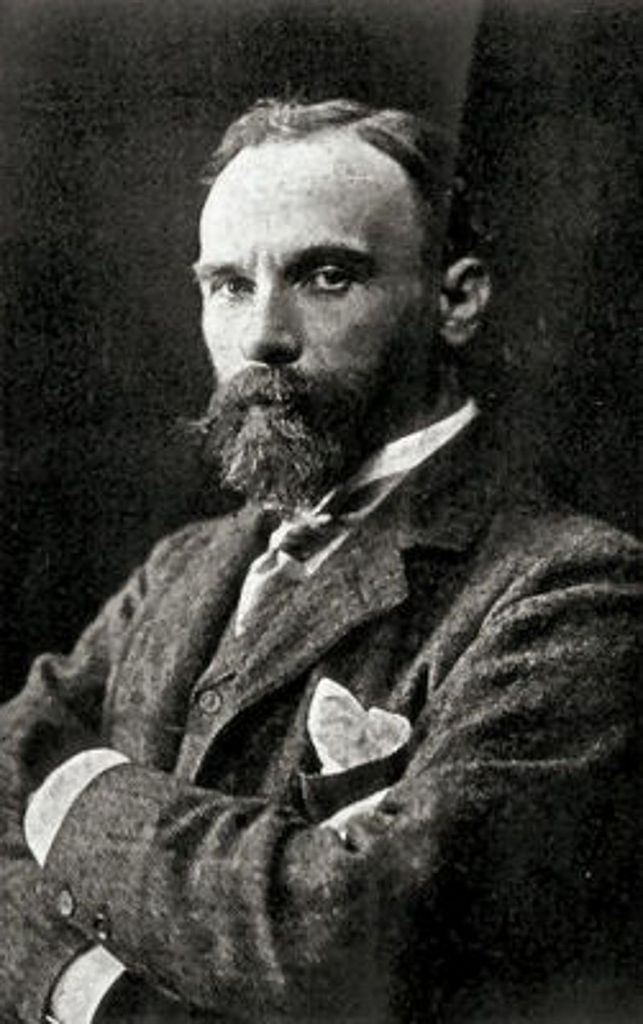
Waterhouse had been fascinated by Tennyson’s poem for almost thirty years and these three paintings are testament to him wanting to delve into the meaning of the work and express it pictorially.

..………………..to be continued.

John William Waterhouse. Part 1

John William Waterhouse (c.1886)

The artist I am looking at in my next series of blogs is the very popular late 19th and early 20th-century British painter, John William Waterhouse, who was best known for painting in the Pre-Raphaelite style, a style which became increasingly popular during the Pre-Raphaelite movement which began in 1848. Waterhouse was a man who, through his paintings, we can see was fascinated by unhappiness, magical worlds and the exciting perils brought about by love and beauty. He was captivated by female beauty and intrigued by the power the women held over men.

The Slave by John William Waterhouse (1872)

Waterhouse was born in Rome on April 6th 1849. The year 1849 was an important year in English art as it was the year that members of the Pre-Raphaelite Brotherhood, which included Dante Gabriel Rossetti, John Everett Millais and William Holman Hunt, were first causing a pandemonium in the London art scene. John William Waterhouse was the first-born child of William Waterhouse and his second wife Isabella Waterhouse (née McKenzie). Both his parents were artists who had exhibited at the Royal Academy and worked in Rome. Waterhouse was given the nickname of “Nino” by his parents. Nino was short for Giovannino or “little John” and this nickname would remain with him throughout his life. When he was five years old his parents left Italy and moved to the London, where they moved into a newly built house in South Kensington, which was near to the newly founded Victoria and Albert Museum.  Three years after moving back to England, his mother died of tuberculosis at the age of 36, a disease which, seventeen years later, would take the lives of two of his younger brothers.

Gone, But Not Forgotten by John William Waterhouse (1873)

Waterhouse’s father remarried in 1860 and at this time he, his new wife and his son lived in Leeds. Waterhouse attended the local school and despite his favourite subject being Roman history, he had hopes of becoming an engineer. By 1870 the family was once again living in London and his father was earning a living by painting portraits assisted by his son. In 1880, at the age of 21, Waterhouse entered the Royal Academy Schools as a probationer in sculpture. His probationary period just lasted for six months, after which he was admitted as a student but he had now begun to concentrate on painting rather than sculpting. It was around this time that he began to exhibit some of his work at the Dudley Gallery and the Society of British Artists.

Undine by John William Waterhouse (1882)

One of Waterhouse’s early paintings was his 1882 work entitled Undine. Undine was the main character in the German novelist and playwright Friedrich de la Motte Fouqué’s 1811 classic fairy tale, Undine, in which he tells the story of this elemental water spirit, who marries a human in order to gain a soul.   Undine’s hair and body shape replicate the vertical flume of water from the fountain we see behind her. This connection between women and water will be repeated many times in Waterhouse’s later works. The female, Undine, was also the one of the first of Waterhouse’s many young female figures.

The Unwelcome Companion A Street Scene in Cairo by John William Waterhouse (1873)

During the 1870’s Waterhouse completed a number of Orientalist works. One of these works, which he completed in 1873, was his painting, The Unwelcome Companion: A Street Scene in Cairo. The painting was exhibited at the gallery of the Society of British Artists the following year. In 1951, the work was donated it to Towneley Art Gallery in Burnley. Waterhouse later depicted the same woman in the same dress in his work, Dancing Girl.  At this time there was a great demand for paintings featuring Near Eastern images. The great French painter, Jean-Léon Gérôme had become a worldwide celebrity for his Orientalist works. Coincidentally, whilst Waterhouse was studying at the Royal Academy Schools in London, Gérôme was also in the city having taken refuge there during the 1870 Franco-Prussian War and had been elected as an Honorary Foreign Academician at the Royal Academy and it is thought that the two artists could have met.   The depiction of the woman featured in the painting is quite similar to the females we see in some of Gérôme’s painting featuring the women of Cairo. In this work the woman holds a tambourine and so we must conclude that she is a dancer but she is a mystery as we cannot tell what she is thinking. The architecture, as seen in Waterhouse’s depiction of the arch column we see in the background, derives from the Alhambra Palace in Granada. It is known that Waterhouse had not visited Spain but his family did live close to the South Kensington Museum which housed architectural models of the interior of the Spanish palace and it is here that he probably made sketches.

Sleep and his Half-brother Death by John William Waterhouse (1874)

In 1874, Waterhouse had his first painting accepted for the Royal Academy’s Summer Exhibition. The painting, entitled Sleep and his Half Brother Death refers to Greek mythology and the Greek gods Hypnos (sleep) and Thanatos (death) who were brothers. It is a painting which links sleep and death. Two young men are seen lying on a bed. As our eyes move from the foreground to the background we are moving from life to death. Hypnos in the foreground is bathed in light whereas his brother, Thanatos is enveloped in darkness and from the title of the painting we know that Hypnos represents sleep whereas Thanatos personifies death. Hypnos also can be seen clutching a bunch of poppies from which is derived laudanum and opium for inducing sleep and dreamlike states.

John Arthur Blaikie, a journalist gave a brief critique of this painting in The Magazine of Art in 1886, wrote :

“…The two figures recline side by side on a low couch, beyond which are the columns of a colonnade open to the night and touched with moonlight. The interior is lit by a lamp, whose light streams on the foremost figure, Sleep, whose head hangs in heavy stupor on his breast, and his right hand grasps some poppies. By his side lies Death in dusky shadow, with head thrown back, and the lines of the figure expressive of easeful lassitude. At his feet is an antique lyre, while immediately in the foreground is a low round table… The two figures are both young, and the beauty of youth belongs to one as much as to the other… the strange likeness and unlikeness of the recumbent figures…”

The reason why twenty-five-year-old Waterhouse decided to paint this disturbing scene was probably because it was shortly after his two younger brothers died of tuberculosis.

Miranda by John William Waterhouse (1875)

At the 1875 Royal Academy Exhibition Waterhouse submitted his work Miranda. This marked the first time he depicted a heroine from a Shakespeare play, a thing he would do on a number of occasions later in his life. Miranda was the daughter of Prospero in the play, The Tempest. She was banished to the Island along with her father at the age of three, and in the subsequent twelve years has lived with her father and their slave, Caliban, as her only company In the depiction we see the young women, seated gracefully on a rock, gazing out at a ship on the horizon which she hopes is bringing Ferdinand, her future lover and rescuer, to the land where she has been exiled. But then the storm comes……..

Miranda in Waterhouse’s painting is not dressed in Shakespearean costume but wears classical clothes replicated from ancient Greece sculpture. Cords cross between her breasts and encircle her waist with an overfold of rumpling fabric. The hairstyle Waterhouse has given his female is also of classical style with two bands of circling ribbon, the ends of which flutter in the strengthening winds of the approaching storm.

Miranda by John William Waterhouse (1916)

Forty-one years later, in 1916, a year before his death, Waterhouse once again depicts Miranda in a painting. Whereas the earlier painting has Miranda looking out at Ferdinand’s ship which is a mere dot on the horizon, this painting depicts a later part of the  Shakespearean story. The storm or tempest has come and Ferdinand’s ship is much bigger and closer to the rocky shoreline where Miranda sits upon the rock. The ship is being battered by huge green and purple waves topped with white foam. The gale force winds whip through Miranda’s clothes and hair. In this work Miranda’s clothes are no longer of classical Greek style but now resemble clothes worn at the time of Shakespeare’s 1612 play. There is something much stronger about this latter Miranda with her fiery red hair loosened and flowing and the vivid colouring of her clothes which give her a much bolder aura than her earlier reflective and inhibited counterpart of 1875.

After the Dance by John William Waterhouse (1876)

The third year Waterhouse had a painting accepted for the Royal Academy’s Summer Exhibition was 1876. His painting, entitled After the Dance, was given a favourable hanging position on the wall of the gallery, just above eye-level, often referred to as “on the line” as this was the level at which most observers could best see the works of art. To achieve this positioning was an acknowledgement that the hanging committee looked upon him as an up-and-coming talent. This is a work quite clearly influenced by the great Lawrence Alma-Tadema who also had a painting with the same title in that year’s exhibition, although his work depicted a voluptuous nude bacchante lying asleep after wild revelry.  This large work (76 x 127cms) depicts a Roman interior, in which we see part of the atrium and a glimpse into the court beyond. The main figures are a young boy and a young girl, both dancers who are very tired after dancing and are both resting on cushions, the boy is sitting up, clutching a wilting flower, and the girl is drowsily stretched on the tessellated floor with a tambourine lying alongside her. In the left background we can see a group of adult minstrels seated on a marble bench.

An aulios

One holds an aulos or tibia which was an ancient Greek double-piped wind instrument, while the other rests his arm upon his lyre. One has to question the mood of the painting. The title, After the Dance, suggests merriment and yet before us we see two exhausted children and as a backdrop there is a very dark painting depicting a funeral procession. The expression on the children’s faces is not one of joy and excitement but one of exhaustion and a hint of melancholy. Maybe Waterhouse wanted his painting to be a critical comment with regards child labour.

…………………………….to be continued

Eilert Adelsteen Norman – The Norwegian Fjord painter.

If you are a lover of landscape paintings. If you have ever been seduced by the dramatic beauty nature offers up. If you have ever dreamt about cruising along a Norwegian fjord then this blog is especially for you. Our guide to the mesmerising beauty of nature is the nineteenth-century Norwegian landscape painter Eilert Adelsteen Normann.

Eilert Adelsteen Normann as a Young Man (possibly a self-portrait)

Eilert Adelsteen Normann was born on May 1st 1848 in the northern Norwegian coastal town of Bodin which lies on a peninsular between the great fjords of Vestfjorden and Saltfjorden. It is at the heart of a rough mountainous area full of beauty but only readily reachable by sea. Eilert Adelsteen was the second of six children, having four brothers and a sister. His father was Johan Normann, a merchant and hunting skipper as well as being a part-time farmer. His mother was Catharina Weitgan, the daughter of a shoe and umbrella maker.

The Tanks senior secondary school at Bergen

When Adelsteen was twelve years old he was sent to school in the city of Trondheim which was over four hundred miles from his home. He later transferred to the Tanks Videregående Skole, a senior secondary school which had just opened in new premises in Bergen five years earlier. In 1869, when Adelsteen was twenty-one-years-old, tragedy struck the family when his eldest brother was killed at sea in a shipping accident in the Bay of Biscay. Adelsteen was now the oldest of his siblings and it fell on his shoulders to take up the mantle of heir to his father’s trading business which was based on the island of Vågøya. It was for this reason that he went to Copenhagen to study business practices which would stand him good stead when the time came to run the family business.

Trollfjord in Lofoten near Vesterålen by Adelsteen Normann

I have not been able to find out what happened in Copenhagen but all I know is that in that same year he arrived there to study business, 1869, he left and travelled to Düsseldorf and enrolled on a three-year course at the Kunstakademie Düsseldorf where he studied under Andreas Müller and later Albert Flamm and Eugen Dücker, the Baltic German romanticist painter, famed for his landscape and marine works.

Seashore at Tiskre by Eugen Ducker (1866)

Dücker headed up the landscape class at the Academy. Adelsteen Normann became part of the Düsseldorf School of Painting. The paintings of this School were typified by delicate and detailed landscapes, that were sometimes imaginary and often focused on a religious or allegorical story with a landscape setting.

From Hardanger by Adelsteen Normann

In 1872, despite only having studied art for three years at the Düsseldorf Academy Normann exhibited some of his landscape paintings, featuring Norwegian fjords, at an exhibition in Düsseldorf and some were purchased by the Düsseldorf Art Association. More were bought up by the art associations of Lubeck and Leipzig. In June 1872 he exhibited and sold more of his work at the Nordic Industrial and Art Exhibition in Copenhagen which was held between June and November. The Danish-Prussian War of 1864 was over, and the conservative Hojre political party had control of the Danish parliament and they wanted to join the world’s fair movement to show off the country’s progress in agricultural (which had suffered during recent years) industrial, and the arts. Visitors attending the Exhibition during the nearly five-month run was over six hundred thousand and once again many of Normann’s paintings of the Norwegian fjords were sold.

The Steamship by Adelsteen Norman

From 1869 until Adelsteen Normann lived in Germany but he and his family would return most summers to Western Norway, the northernmost parts of Nordland and the rugged area around Lyngen, a municipality in Troms county, where he would find more and more spectacular landscapes to paint. He would sketch and photograph the scenery and return to his studio in Dusseldorf and Berlin to complete the paintings.

A dragon style house on the Sognefjord

Adelsteen Normann left Dusseldorf in 1883 and went to live in Berlin. He continued to return each summer to Norway and in 1890, he bought a plot of land in Sjøtun,  an area nestling on the edge of Kattfjord, and set amongst the spectacular mountains on the island of Kvaløya.  This idyllic location was only 40 minutes from Tromsø and had a spectacular view overlooking the Sognefjord. The following year he then purchased his house which arrived in pre-fabricated kit form from a company in Trondheim who had their men erect the structure. It was a “dragon style” house with lots of wood carvings and dragon figures. Normann’s dragon-style villa  was the first to be built by an artist in this particular style, and it became the prototype for the ones that came later. These houses in Balestrand became a special talking point of the town and were to become very important for the town’s tourism and so have always been well preserved. Normann’s summer house at Balestrand remained with his heirs until 1934.

Norwegian fjord landscape by Hans Dahl

During his time at the Kunstakademie Düsseldorf Normann became friendly with fellow student Hans Dahl, a fellow Norwegian. Dahl’s Norwegian landscapes depicting the mountains and fjords were similar to Normann’s works but Dahl nearly always included figures in his landscapes.

Villa Strandheim

It was Adelsteen Normann who advised Dahl to build a villa in Balestrand and three years after Normann’s own residence was completed, Dahl had his own erected. It was called Villa Strandheim.

Kaiser Wilhelm II (left) with Hans Dah (centre) l in the garden of Villa Strandheim

Hans Dahl and Adelsteen Normann were close friends of Emperor Wilhelm II of Germany. Like Normann, Dahl returned to Balestrand from Germany each summer and Dahl organised large garden parties at Villa Strandheim. It was here that the Emperor was a regular guest. In 1910 the Dahl’s son Hans Andreas Dahl built a studio near his father’s villa.

Northern Norway fishing village by Eilert Adelsteen Normann (1880)

Whilst living in Germany, Normann married Catharina Hubertine Weitgan who came from the Rheinland. The couple had 4 children: Emma, Otto, Olga and Walter. When Catharina died in 1911, sixty-three-year-old Normann re-married that same year. His second wife was Luise Rostalski, who was thirty-five-years younger than her husband. Together they had a son called Adelsteen.

Sunset over the Fjord by Adelsteen Normann

Normann exhibited his works in a number of venues in Europe including the important Salon de Paris from as early as 1882. His works earned a ‘Mention Honorable’ in the 1884 Salon and he was awarded a bronze medal in 1889. In Berlin Normann became well-known both as an artist and as a board member of the Verein Berliner Künstler and he established a school for painters.

Evening. Melancholy, by Edvard Munch (1891). Oil, pencil and crayon on canvas.

During his annual visit back to Norway in 1891, Normann took the opportunity to exhibit some of his fjord landscapes in Oslo, at the Kristiania Art Society, at the same time that the young Edvard Munch was exhibiting some of his paintings in the city. including his work, Evening. Melancholy. Normann was so impressed that in 1892, on behalf of the Verein Berliner Künstler (Society of Berlin Artists), he invited Edvard Munch to present his work at the Society’s November exhibition. Twenty-eight-year-old Munch felt flattered by Normann’s invite and agreed to come. He felt honoured to put his work before famous and established artists and hopefully his work would be seen by more sophisticated and knowledgeable public in Berlin.

Evening on Karl Johan by Edvard Munch (1892)

Munch arrived in Berlin with more than fifty-five works. It was the Society’s first one-man exhibition. Munch and Normann collaborated in preparing the exhibition, which was held at the newly built Architektenhaus. Was the exhibition a success? No, in fact it was a disaster. It appears the Society was not ready for Munch’s Symbolist artistic style which some of the members hated. The society members either loved them or hated them. The majority of members described Munch’s images as being repugnant, ugly and mean, and they caused an outrage. The Verein (The Association of Berlin Artists) held an extraordinary meeting on November 11th, and in a vote of 120 to 105, it was decided to close the exhibition after just one week, leaving Munch perplexed as to why he had been invited in the first place. The row over the merit of Munch’s one-man exhibition and the scandal following the early closing of it caused a number of the younger Society members, who were not prepared to put up with such an insult to an invited guest, broke away from the traditionalist stance of the Verein and joined together to form what they termed a “free association for the organization of artistic exhibitions”. They organized an art exhibition in the spring of 1892 as Die Elf. They did not however leave the main Society, so as to ensure the opportunity to display their work at its future exhibitions.

The dispute regarding Munch and his artwork shattered the art society! So how did Munch look upon the disaster? In Arne Eggum’s 1984 book, Edvard Munch: Paintings, Sketches, and Studies, Munch was amused and was quoted as saying:

“…Never have I had such an amusing time—it’s incredible that something as innocent as painting should have created such a stir…”

August Strindberg by Edvard Munch (1892)

The exhibition went on to later showings in Düsseldorf and Cologne before returning to Berlin. During Munch’s four years in Berlin while fraternising with like-minded artists and writers, such as his close friend August Strindberg, at a bar called the Black Piglet, Munch created some of his major and best-known works, including The Scream, The Vampire and Madonna. The exhibition and the humiliating effect it had on the Verein Berliner Künstler was well documented at the time, but for Munch, it resulted in the start of his international fame.

Sognefjord by Adelsteen Normann

Adelsteen Normann was one of the favourite painters of Kaiser Wilhelm II, who loved his landscape works featuring the Norwegian fjords. Most of Normann’s paintings depicted Norwegian fjord landscapes as well as modern life in Norwegian fjord villages with steam-driven cargo ships and large tourist ships. Normann, through his landscape works, is credited with making Norwegian fjords a popular tourist destination, especially with the upper classes, who would also buy his paintings as a memento of their travels. In the early 1890s, whilst living in Berlin he was also doing good business selling his paintings to hotel owners

Fishing vessels on a Norwegian fjord by Adelsteen Norman

Adelsteen Normann was a regular exhibitor. He received recognition for his work and was awarded many medals and awards, for his paintings including the Prince of Wales Medal 1874, Médaille d’honneur at the Salon in 1884 and a gold medal in Lyon in 1889. In 1897, he was appointed Knight of the 1st Class of the St. Olav Order. He has many paintings in museums around the world as well as in private collections.

View of a Fjord by Adelsteen Normann

In his later life, Normann was afflicted with asthma and in 1917, on medical advice, he returned to Norway. Despite his illness he carried on painting. Unfortunately for Normann who was already suffering breathing problems due to his asthma he was ill equipped physically to withstand the Spanish flu epidemic which swept across Norway in 1918. In Norway the epidemic killed between 13,000-15,000 people, most of them during the autumn of 1918 and mostly from pneumonia or pulmonary complications.

Eilert Adelsteen Normann (1848 – 1918)

Adelsteen Norman died in Kristiania (Oslo) on December 26th 1918 aged 70. The urn containing his ashes was returned to the Stahnsdorfer Waldfriedhof, in Berlin.

Jean-Baptiste-Siméon Chardin. Part 5 – Finances and portraiture.

Portrait of Jean-Baptiste Chardin by Maurice Quentin de La Tour (1760)

Over the last few blogs about the French artist Jean-Baptiste-Siméon Chardin, I have looked at his still-life works which he partly abandoned for financial and artistic reasons around 1733 to concentrate on genre paintings, which once engraved provided him an income from the prints. Chardin never abandoned one genre in order to take up another, but from around 1748 onwards he produced fewer genre scenes and reverted to his beloved still life work of his early career. The number of his genre paintings that he once exhibited regularly dwindled whilst there was an increase in his still life works which were shown at various exhibitions. For many, Chardin will be remembered for his figurative paintings and his portraiture and in this final blog on the artist I will look at some of these works.

Portrait of the Painter Joseph Aved (also known as The Philosopher) by Chardin (1734)

One of Chardin’s earliest portraits was one which he completed in 1734 and was exhibited at the 1937 Salon with the title A Chemist in His Laboratory. Several years later, in 1744, the painting was engraved by François Bernard Lépicié and given the title Le soufleur, which, according to the seventeenth century, Dictionnaire de l’Académie, is a person using chemistry to search for the philosopher’s stone. It is again exhibited at the Salon in 1753 with the title A Philosopher Reading. It is now more commonly known as Portrait of the Painter Joseph Aved.  Aved was a good friend of Chardin and had just been elected to the Académie Royale de Peinture et de Sculpture. He had assisted Chardin in drawing up the estate inventory of Chardin’s first wife, Marguerite Saintard and had been a witness at Chardin’s second marriage to Françoise-Marguerite Pouget in 1744. It was one of Chardin’s first attempts at portraiture.

Boy building a House of Cards sometimes referred to as The Son of M. Le Noir Amusing Himself by Making a House of Cards by Chardin (1737)

In 1737 Chardin completed three paintings which featured young boys, two of which were sons of friends of Chardin. His painting The House of Cards sometimes referred to as The Son of M. Le Noir Amusing Himself by Making a House of Cards featured the son of his friend Jean-Jacques Le Noir, a furniture dealer and cabinet maker and one of Chardin’s patrons. He had been a witness at Chardin’s second wedding and had bought several of his paintings. The painting shows Le Noir’s son enjoying himself making a house of cards. The original work can be found at the National Gallery in London but as with many of Chardin’s paintings he painted a number of versions of it. François Bernard, Lépicié created an engraving of the work and added the following caption underneath, which in a way adds a meaning to the depiction:

Dear child all on pleasure
We hold your fragile work in jest
But think on’t, which will be more sound
Our adult plans or castles by you built

The Young Draughtsman (also known as Le jeune dessinateur) by Chardin (1737)

The Young Draughtsman was also a painting Chardin completed in 1737. It was a subject Chardin had used before. Remember the 1734 painting I highlighted in the previous blog which showed a view from behind of a draughtsman at work, sitting on the floor, face hidden from view. In this painting we clearly see the face of the young man. It is a smooth youthful face which has a look of one lost in the joy of his work. There is a look of pleasure on his face, satisfied with what he has achieved so far. He concentrates on the task ahead as he holds the chalk stick which holds the sharpened chalk. He is relaxed. This scene also gives the viewers of the painting a feeling of relaxation, of serene equanimity and this was a forte of Chardin. Chardin once again has used a subtle set of colours. Milky whites, the black patch of the tricorn hat, the rose colour of the lips and cheek, and various blues for the furnishings and the piece of drawing paper on which the draughtsman has drawn the head of an old man.

Portrait of the Son of M. Godefroy, Jeweller, Watching a Top Spin (also known as Child with Top) by Chardin (1738)

Chardin completed another painting of a son of a friend around 1737. It was entitled Portrait of the Son of M. Godefroy, Jeweller, Watching a Top Spin. This work is housed in The Louvre since its purchase from the Godefroy family in 1907. The painting depicts nine-year-old Augustine-Gabriel Godefroy who would later become the controller-general of the French Navy. The young boy smiles and stares at the top as it spins atop of a chiffonier, a low cupboard. The top has been cleared of the quill pen, books and papers which have been pushed to one side to make room for the spinning top. One of the drawers of the chiffonier is partly open in which we can see a chalk holder, similar to the one in the previous work.

Portrait of a Child by Chardin (1777)

Chardin’s financial situation had improved since he married his second wife, the wealthy widow, Françoise-Marguerite Pouget in 1744. She brought with her a house in rue Princesse which was close to the house in rue du Four where the Chardin family had lived for many years, although they did not own it. Chardin’s new wife also brought to the marriage a sizeable amount of wealth, estimated at in excess of thirty-thousand livres in the form of annuities and cash. Chardin brought about eight thousand livres to the marriage accrued from his share of his first wife’s and his mother’s estates. Chardin’s financial situation was further improved when, in 1752 Chardin was granted a pension of 500 livres by Louis XV. This was the first gratuity Chardin received.

Portrait of a Young Girl, by Chardin (1777)

Chardin rarely travelled far from his Left Bank home, just occasionally making the short trips to Versailles and Fontainebleau. In 1757 he finally moved to a new residence as Louis XV had granted him a studio and living quarters in the Louvre, saving Chardin several hundred livres. This apartment, Studio no. 12, which was opposite the church of Saint-Thomas, was vacant following the death of the previous occupant, the goldsmith, François-Joseph Marteau.

Soap Bubbles (also known as Young Man Blowing Bubbles) by Chardin (1734)

Chardin continued to work for the Académie and in 1761 he is given the role of tapissier, the academician tasked with designing the arrangement of the pictures on the walls of the Salon. In Ryan Whyte’s 2013 essay Exhibiting Enlightenment: Chardin as tapissier, he commented:

“… Chardin’s efforts had merited an observation that he had treated the Salon as both a totality and a collection of parts, recognition that the effect of the Salon arrangement was based on a unified design, Chardin’s ‘beauty of the whole’ and mattered as much as the quality of the individual works therein…”

In a 1763 pamphlet regarding that year’s Salon the author commented on Chardin’s masterful lay-out of the paintings at the exhibition:

“…One has never arranged the different parts of this collection with more intelligence, as much for the beauty of the whole as for the particular benefit of each of the artworks that make it up…”

In essence the author of the pamphlet suggested that the Salon space was a work of art itself.

In 1763, the Marquis de Marigny, the general Manager of the King’s buildings, awarded Chardin 200 livres increase to his pension for taking charge of hanging the exhibits at the Salons. In 1765 he was unanimously elected associate member of the Académie des Sciences, Belles-Lettres et Arts of Rouen, but there is no evidence that he left Paris to accept the honour.

Self Portrait (also known as Portrait of Chardin Wearing Spectacles) by Chardin (1771)

If I was to ask you what paintings by Chardin you have seen or read about, high on that list would be his three pastel self-portraits. Chardin had to turn to pastels around 1771 when he had been taken seriously ill. The cause of his illness was put down to his use of lead-based pigments and binders he used for his oil painting. These had, over time, burnt his eyes and brought on a condition known as amaurosis, a paralysis of the eye leading to deteriorating sight. Coincidentally, Degas suffered from the same ailment and he too had to turn to pastel painting. Chardin’s first pastel self-portrait often referred to as Portrait of Chardin wearing Spectacles was exhibited at the 1771 Salon and is now, since 1839, part of The Louvre collection. People were surprised by the exhibit as many believed that Chardin was too ill to paint. They were also surprised by the fact that it was a work of self-portraiture, not a genre he was known for. In 1771, the art correspondent of L’Année litéraire wrote:

“…This is a genre in which no one has seen him work and which, at first attempt, he mastered to the highest degree…”

Denis Diderot, the French philosopher, art critic, and writer praised Chardin and this work, writing:

“…the same confident hand and the same eyes accustomed to seeing nature – seeing nature clearly, and unravelling the magic of its effects…”

The spectacles are delicately perched upon the bridge of his nose. Chardin was forced to wear spectacles due to his failing eyesight and the pair he wears in the painting were made in England. Chardin is depicted in three quarter view. He has turned towards us with his probing brown eyes. How he has depicted himself is symbolic of his trade as an artist. He wears an elaborately entwined blue and white cap, together with a colourful, geometric-patterned scarf which because it has been lit up appears silk-like. The depiction of the artist shows him to be both knowledgeable and astute and the way he has used various tones on the face has made him look almost life-like.  Marcel Proust summed up the self-portrait commenting on the ageing artist:

“…Above the outsized pair of glasses that have slipped to the end of his nose and are pinching it between two brand new lenses, are his tired eyes with the dulled pupils; the yes look as if they have seen a lot, laughed a lot, loved a lot, and are saying in tender, boastful fashion: ‘Yes, I’m old!’ Behind the glimmer of sweetness dulled by age they still sparkle. But the eyelids are worn out, like an ancient clasp, and rimmed with red…”

Self Portrait with Eyeshade by Chardin (1775)

In 1775 Chardin completed another pastel self-portrait which was exhibited at the 1775 Salon. It was entitled Portrait of Chardin wearing an Eyeshade which is housed at The Louvre. In the painting Chardin has carefully fashioned his costume with the same care he once used when he depicted arrangements of fruit and objects in his still life works. The visor which shades the light from his eyes has an attached dusky pink ribbon. He has a scarf knotted around his head and neck and once again he wears a pair of spectacles. Every detail has been well thought out by Chardin. After seeing the self-portrait in 1904, the then elderly sixty-five-year-old Cezanne wrote about the work to his young friend, the painter and art critic, Emile Bernard:

“…You remember the fine pastel by Chardin, equipped with a pair of spectacles and a visor providing a shade. He’s an artful fellow, this painter. Haven’t you noticed that by letting a light plane ride across the bridge of the nose the tone values present themselves better to the eye? Verify this fact and tell me if I am wrong…”

Self Portrait (also known as Portrait of Chardin at His Easel) by Chardin (1779)

The third pastel self-portrait by Chardin, Portrait of Chardin at His Easel was completed in late 1779 but did not enter The Louvre collection until 1966. There are the odd similarities with his 1771 self-portrait in as much as he looks out at us and wears the same turban but in this work, it is decorated with an stylish blue bow. In this work we see Chardin sat in front of his easel, on which is a frame covered with a sheet of blue paper. Our eyes are drawn to his hand, in which he holds a red pastel crayon. His face is half hidden in shadow and it noticeably thinner and his features have taken on a sunken and hollow look, even his eyes have become duller and he looks tired. In his demeanour, we can witness his failing health and in fact this self-portrait was only completed just a few months before Chardin died at 9am on Monday, December 6th 1779, aged 80. He was buried the next day at Saint-Germain-l’Auxerrois, at 2 Place du Louvre, Paris.

Chardin had become quite wealthy in his latter years but never quite achieved the great wealth of his contemporaries such as the Rococo painter François Boucher, Nicolas de Largillièrre or the Baroque painter Hyacinthe Rigaud. This is probably due to his moderate output which according to some critics was due to the slowness of his painting which Chardin said was due to his perfectionist attitude to all his works. Other said it was down to his laziness!

I cannot end this look at Chardin’s life without telling you about the fate of his family members. As I previously recounted, Chardin’s two daughters, one from each of his wives died when they were still very young, but he also had a son from his marriage to his first wife, Marguerite Saintard.   Jean-Pierre Chardin was born in November 1731. He too studied to become a painter and in August 1754, won the Académie’s first prize for a painting on a historical subject. In 1757 Chardin and his son fell out over Marguerite Saintard’s will, Jean-Pierre believing he was not being given what was rightly his. In the September of that year Jean-Pierre received a scholarship from the Académie to study at the French Academy in Rome. On his return to France by sea from Italy Jean-Pierre is kidnapped by English pirates off the coast of Genoa, but later released. In 1767, aged 36, Jean-Pierre travelled to Venice, part of the French Ambassador to Venice’s entourage. On July 7th 1772, forty-year-old  Jean-Pierre was found drowned in a Venice canal. It is believed that he suffered from severe bouts of depression and committed suicide.

In December 1780, a year after Chardin’s death, his second wife Françoise-Marguerite Pouget, left their apartment at The Louvre and moved to her cousin’s house in rue du Renard-Saint Sauveur,  where she died on May 15th 1781, aged 84.

Jean-Baptiste-Siméon Chardin. Part 4. The second Mme. Chardin and scenes of domestic life.

Chardin was taken seriously ill, both physically and mentally in 1742. It was probable that his temporary decline in health was due to the extreme sadness he suffered due to the passing of his loved ones. Chardin and Marguerite Saintard were married in February 1731. Two months later, his father, Jean Chardin, died. Marguerite Saintard who had given birth to Chardin’s son and daughter died in April 1735 and a year later his daughter, Marguerite-Agnès, also died aged three. Chardin was appointed guardian to his son, Jean-Pierre in November 1737. Chardin and his son were now living in a Paris apartment in rue du Four, sub-let to him by his mother. Apart from the deaths of members of his family, the other aspect of his life which probably contributed to his illness was his dire financial situation. He owed his mother for the money she had loaned him after his wife died and he had run up debts with his supplier of painting materials. His financial position worsened even further when his mother, Jeanne-Françoise, died in November 1743.

Chardin needed to improve his financial position. He had already decided to move away from still-life paintings and concentrate on genre works which once made into engravings provide him with much-needed income from the popular prints. Still, money or lack of it, remained a problem for forty-five-year-old Chardin but this was all to change in 1744 when he married his second wife, Françoise-Marguerite Pouget at Saint-Sulpice Church on November 26th 1744. Françoise was the thirty-seven-year-old wealthy widow of Charles de Malnoé and eight years Chardin’s junior. Françoise was simply a God-send to Chardin. She saved him from abject poverty and helped him manage his correspondence and his responsibilities on behalf of the Salon, which included arranging the exhibitions and acting as treasurer, from 1755, during which time he was tasked to manage the Académie accounts. Françoise-Marguerite Pouget gave birth to Chardin’s daughter, Angélique-Françoise in October 1745 but sadly the baby died in April 1746.

The Serinette (also known as The Bird Organ) by Chardin (1751)

Françoise-Marguerite Chardin appeared in a number of her husband’s works, one being The Sertinette or The Bird Organ which he completed in 1751 and was exhibited at that year’s Salon as Lady Varying Her Amusements. A serinette was a small barrel organ originally designed for teaching cage birds to sing. The painting is housed at the Louvre which acquired it in 1985. It was the first Royal order passed to Chardin, originally commissioned by Le Normante de Tourneheim, keeper of the King’s estates, for Louis XV but two years later, was gifted by the king to the Marquis de Vandières, the brother of Mme de Pompadour, the king’s favourite. In the painting we see a lady, modelled by Chardin’s wife, Françoise, with the help of a “serinette”, teaching the caged bird to sing. The setting for the painting is a bourgeois interior. The woman wears a cap tied under neck and a delicate white scarf-like narrow piece of clothing, worn over her shoulders, similar to a stole and known as a tippet. The tippet she wears partially covers a dress embroidered with flowers. The lady is seated and on her knees is the serinette which she activates by turning the handle. At the left of the painting we see a bird’s cage resting on a pedestal. The pedestal has a crossbar which allows one to fix a screen to protect the serin, a small finch-like bird, from the light and from distractions which would hamper it from learning a tune. It was with the help of this salon instrument that the ladies of the “good” society taught their caged birds to sing. In front of the woman, we can see a large work bag which contains her embroidery.

The Geographer by Johannes Vermeer (1669)

Light streams into the room through the window to the left similar to depictions seen in seventeenth century Dutch paintings – think Vermeer for example, and they obviously had an influence on Chardin.

The Serinette (also known as The Bird Organ) by Chardin (1751)
The Frick Collection, New York

Another version of the painting is in the Frick Collection in New York, which came from the collection of Dominique-Vivant Denon, the director of the Musée Napoléon and bought by the New York gallery in 1926. There is one major difference between the two versions and I will leave you to spot it!

Domestic Pleasures by Chardin (1746)

Chardin’s 1746 painting Domestic Pleasures also featured his second wife. The painting was commissioned by Lvise Ulrike, the sister of Frederick the Great of Russia and the wife of Adolf Frederick the Crown Prince of Sweden and the country’s future king. However, the commissioning was far from straight forward. Lvise Ulrike was a great fan of Chardin’s paintings and wanted him to paint two works and she gave him the titles of them to be The Strict Upbringing and The Gentle, Subtle Upbringing. Unfortunately for her, Chardin was a slow painter which in a letter dated October 1746, he stated:

“…I take my time because I have developed the habit of not leaving my paintings until, to my eyes, there is nothing more to add…”

Chardin’s assertion that it was diligence and being a perfectionist were the reasons for the long time he took on each painting was challenged by others who put it down to his laziness. The princess was however not amused by this slow pace. Bizarrely Chardin finished the two paintings in 1746 but the subjects had nothing to do with the titles supplied by the princess. They appeared at the 1746 Salon entitled Domestic Pleasures and The Housekeeper and were subsequently given to Lvisa via the Swedish ambassador in Paris in February 1747.


Portrait of Françoise Marguerite Pouget by Chardin (1775)

My last offering of a Chardin painting, featuring his wife, Françoise-Marguerite Pouget, is his pastel work entitled Portrait of Madame Chardin, née Françoise-Marguerite Pouget which he completed in 1775 when he was seventy-six and which can now be seen in the Louvre. A year later he repeated the portrait, which is now housed in the Art Institute of Chicago. Before us we see the face of Chardin’s second wife, sixty-eight-year-old Marguerite Pouget. Her face is wrapped to the eyes in an almost nun-like headdress, a head covering which often featured in Chardin’s paintings. Her forehead has an ivory pallor. Look how a shadow is cast by the headdress and the daylight on her temple is filtered through its linen material. Her mouth is closed tightly and she is not smiling. Her gaze is frosty. There is a dullness about her eyes. We detect wrinkles around her eyes. Chardin has managed to create all the indicators of old age. Chardin’s use of colours is masterful. The whiteness of her face is achieved with pure yellow and the pallid face has no white in it at all. The pure white cap is made solely of blue. The art critics loved the portrait. The eighteenth-century writers, publishers, literary and art critics, the brothers Edmond, and Jules de Goncourt wrote:

“…it is in the portrait of his wife that he reveals all his ardour, his vitality, the strength and energy of his inspired execution. Never did the artist’s hand display more genus, more boldness, more felicity, more brilliance than in this pastel. With what a vigorous, dense touch, with what freedom and confidence he wields his crayon; liberated from the hatching that previously damped his voice or obscured his shadows. Chardin attacks the paper, scratches it, presses his chalk home……To have represented everything in its true colour without using the real shade, this is the tour de force, the miracle that the colourist has achieved…”

The Turnip Peeler (also known as Die Rübenputzerin) by Chardin (1738)

Chardin produced many genre paintings in the late 1730’s and early 1740’s which depicted female servants carrying out their household duties. There are three versions of The Turnip Peeler which he completed around 1738. One is housed in the National Gallery of Art in Washington whilst one can be found in the Bayerische Staatsgemäldesammlungen in Munich. The third version was previously in Berlin, acquired for Frederick II of Prussia but which is now lost. The Washington version was exhibited at the 1739 Salon by Chardin and bought around that time by the Austrian ambassador, Prince Joseph Wenzel of Liechenstein. It became part of the Washington National Gallery collection in 1952. Before us we see a large woman sitting slightly hunched on a chair, knife in hand, about to peel a turnip. She gazes out blankly, lost in thought. She is surrounded by other vegetables such as a large pumpkin, some cucumbers and a bowl of water which contains the previously scraped turnips. In front of her we see a copper cauldron and a saucepan which is leaning against a bloodstained butcher’s block, in which a meat clever has been driven. This genre piece by Chardin is not one which has an anecdotal element to it, neither has it any social comment about the plight of servants.

The Return from the Market by Chardin (1738) Ottawa’s National Gallery of Canada,

A painting which has connections with The Turnip Peeler is The Return from Market. Once again, three versions of this painting exist. One, dated 1738, is in Ottawa’s National Gallery of Canada, and was presented to the Salon in 1739. One is at Schloss Charlottenburg in Berlin and is dated 1738, and the third is housed in The Louvre. It is believed that the version held in Berlin was a companion piece to The Turnip Peeler, with the two being acquired by Frederick the Great in 1746. This painting unlike its companion piece still survives, but only just, as it was found in the park at Charlottenburg after the Schloss was pillaged by Austrian troops in 1760. Since that time this work by Chardin has never left Berlin. An engraving by François-Bernard Lépicié was made from the Louvre version. Lépicié made engravings of a number of Chardin’s paintings and prints from the engravings were a great source of income for the artist. When the painting was exhibited at the 1739 Salon it received great critical acclaim. The French literary brothers, Edmond de Goncourt and Jules de Goncourt, wrote about the work stating:

“…the colours placed side by side give the painting the appearance of a tapestry in gros point…”

While the writer Henri de Chennevières was even more enthusiastic when he wrote about Chardin’s use of colour:

“…the milky whites of the woman’s skirt, the unique faded blues of the apron….., the floury, golden crust on the loaves of bread. And the two bottles on the floor, the red seal on one of them echoing the ribbon on her sleeve…”

The Diligent Mother by Chardin (1740)

My final two paintings by Chardin in this blog are his small pendant works, (49 x 39cms), The Diligent Mother and Saying Grace, both of which were completed in 1740. Chardin gave both works to Louis XV in the November following their showing at the Salon and are now housed at The Louvre. The Diligent Mother was the less famous of the two works and depicts a young mother, wearing pink slippers and blue stockings, her scissors hanging at her waist as she and her daughter inspect a piece of embroidery. In the foreground, by her, we see a wool winder and skein with coloured balls of wool inside the base of it. A bobbin can be seen lying on the floor as well as a box which acts as a pin cushion, next to which is curled-up pug. To the extreme right we see a red fire screen, while behind the mother stands a large green folding screen which prevents the light from the half-open door entering the room. The work was considered to be a genre piece in which a well-to-do middle-class mother shows the daughter a mistake she has made in her tapestry. One other interesting fact about this work was when an engraving was made of it by the engraver François-Bernard Lépicié, he added lines of moralistic verse to it so as to explain what was depicted:

“…A trifle distracts you my girl
Yesterday this foliage was done
See from each stitch you have made
How distracted your mind is from work
Believe me, avoid laziness
Remember this one simple truth
That hard work and wisdom together
Are more valued than beauty and wealth…”

Were these salutary words approved by Chardin? Are they Chardin’s or Lépicié’s words?

Saying Grace by Chardin (1740)

The final Chardin painting for today’s blog is entitled Saying Grace and is one of his most celebrated and most popular of his works. The theme of the painting is prayer before meals and was one of the most famous works by Chardin but when it was shown at the 1740 Salon it received very little praise. However, along with its pendant piece, The Diligent Mother, it was given to Louis XV. It remained in the royal collections until the French Revolution; it then entered the Muséum Central des Arts, which would later become the Louvre, in 1793. It was largely forgotten until the nineteenth century when Chardin was “rediscovered”. It was then that the work was hailed as being emblematic of a morally upright, industrious social class and was often contrasted to the debauched, wasteful lifestyle of the aristocracy. Chardin in this tender work depicting a mother teaching her children to pray highlights commendable and hidden qualities and like many of his genre works, once again depicts the satisfied life which comes from a sense of duty, unlike the Rococo painters of the time, such as François Boucher, who depicted the dalliance and flirting of the nobility and upper-classes at their garden luncheons, and moonlit promenades.

In my final blog about Chardin I will be looking at his latter days and his works of portraiture.