Walker Art Gallery revisited.

The Walker Art Gallery in Liverpool has one of the most significant and famous collection of artworks in the UK, which includes European Renaissance paintings, masterpieces by Rubens, Rembrandt, Turner and Stubbs, Pre-Raphaelite artworks by Rossetti and Millais, Impressionist works by Monet and Degas and contemporary works by Hockney, Wylie and the winners of the John Moores Painting Prize.   I have covered many of the Pre-Raphaelite works exibited here in previous blogs and following a visit I made to the gallery last week I have chosen a few more paintings which impressed me.
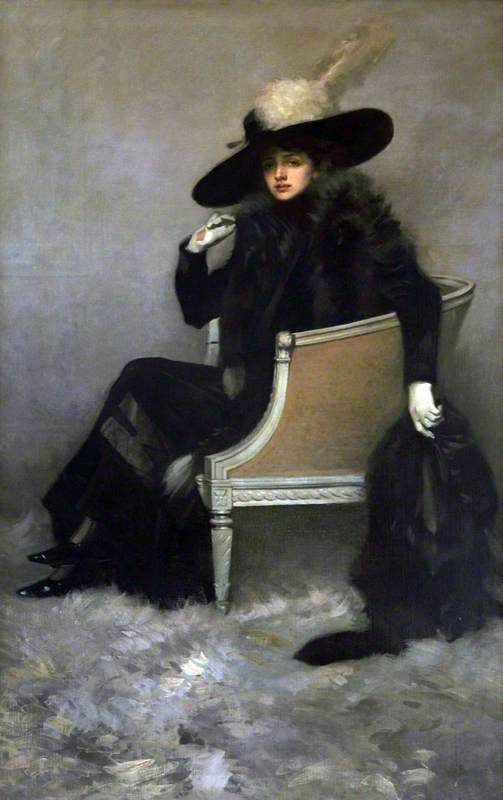
Lady in Black Furs by Pilade Bertieri (1912)

The first painting, I am showcasing is Lady in Black Furs, a work by the Italian painter Pilade Bertieri, which he completed around 1912.  Bertieri was born in Turin and exhibited in major cities in Italy, in New York and notably Manchester and Liverpool as well as Paris at the Salon from 1907 to 1931.  The painting depicts Bertieri’s wife Genevieve Wilson, the daughter of a wealthy New York socialite.  It was during a voyage in 1905 from Italy and America that they met and a year later they got married.  Bertieri said that he was first attracted to Genevieve when he saw seated on a deckchair.  For him, her graceful composure was just too much to resist and this depiction is a reconstruction of his first view of her but this time in a more fashionable chair.  The fact that she is wearing the very same furs, shoes and velvet and satin dress as she did aboard the ship in 1912 evokes memories for him of that first meeting.  At the time of the painting Genevieve was pregnant with their first child.

Fantine by Margaret Bernardine Hall (1886)

Margaret Bernadine Hall completed her painting entitled Fantine in 1886 and it depicts the character Fantine who was featured in Victor Hugo’s novel Les Misérables.  Fantine was dismissed from her job because of her illegitimate child and was forced into the life of a sex worker in order for her and her daughter to survive.  In the depiction we see Fantine protectively watching over her sleeping daughter.

Margaret Bernadine Hall was an English painter, born in 1863 in Wavertree, Liverpool.  Her father was Bernard Hall, a merchant, local politician and philanthropist, who was elected Mayor of Liverpool in 1879. Her mother was Margaret Calrow from Preston, who was Bernard Hall’s second wife. Margaret was their second child, and their oldest daughter.  In 1882 the family moved to London but at the end of that year nineteen-year-old Margaret went to live and study in Paris. Between 1888 and 1894 she travelled extensively to countries including Japan, China, Australia, North America, and North Africa, returning to live in the French capital in 1894. She moved back to England in 1907, where she died three years later.

River Scene with a Ferry Boat by Salomon van Riysdael (1650)

One of my favourite landscape painters is Salomon van Ruysdael and in his painting entitled River Scene with a Ferry Boat we see the kind of work he produced for the art-loving public. At this time, artists had mostly depicted religious subjects in their paintings and the Catholic Church used to be most artists’ best client, as they ordered altarpieces and other artworks to decorate churches and sacred places, but this came to an end with the Reformation as many Protestants refused to allow the presence of religious paintings or sculptures in churches.  This led to a great crisis for artists in Northwestern European countries as artists had only a few ways left to make money: painting portraits and illustrating books but there was also a revival of landscape paintings.  As well as the ever popular genre scenes, people began to buy landscape paintings to decorate their homes. Jacob Isaackszoon van Ruisdael, Salomon’s nephew, is generally considered the pre-eminent landscape painter of the Dutch Golden Age, a period of great wealth and cultural achievement when Dutch painting became highly popular. Jacob was best known for his atmospheric river scenes based upon the countryside around the city of Haarlem where he lived. He was also a merchant who dealt in the blue dye that was used in Haarlem’s famous cloth bleaching factories.

The Walker Art Gallery houses Salomon’s painting entitled River Scene with a Ferry Boat and we see a ferry crossing the river laden with people, livestock and even a small cart.  These ferries were an essential feature of the watery Dutch countryside, and a popular subject with landscape painters such as the Ruysdael family. This work is typical of much 17th-century Dutch landscape painting: naturalistic in its clear light and cloudy, rain-washed sky, but at the same time carefully organised to achieve a balanced composition. This work despite looking as though it was painted en plein air was not painted outdoors.  It is an idealised depiction and probably does not represent any particular place but is an amalgam of various details and features from a number of different places juxtaposed to form this vista.  Close to the riverbank we see a smaller boat with busy pulling in a fishing net. On the bank is a barn in which workers are salting fish and putting them into barrels. On top of the barn is a large dovecot. In a way the painting is a ‘foodscape’ as well as a landscape, highlighting what nature has to offer.  The Dutch patrons liked this kind of narrative painting.
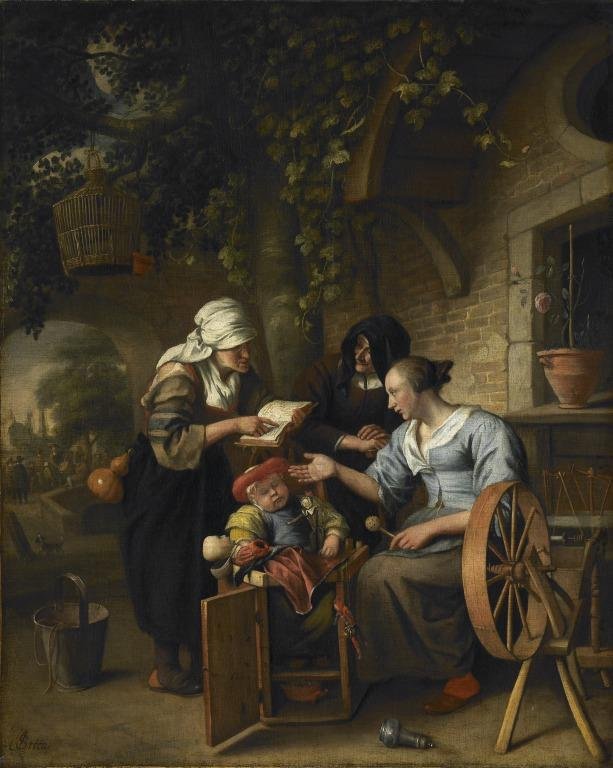
The Fortune Teller by Jan Steen (1663)

One of the greatest Dutch genre painters was Jan Steen. In Holland he ranks next to Rembrandt, Vermeer, and Hals in popularity.  He is best known for his humorous genre scenes, warm hearted and animated works in which he treats life as a vast comedy of manners.  Steen was born in Leiden and is said to have studied with Adriaen van Ostade in Haarlem and Jan van Goyen (who became his father-in-law) in The Hague. He worked in various towns – Leiden, The Hague, Delft, Warmond, and Haarlem and in 1672 he opened a tavern in Leiden.  In his painting The Fortune Teller we see a young woman sitting by her spinning wheel having her fortune told.  One interpretation of this depiction is that she is a sex worker, the old, black hooded lady is the brothel keeper and the soldiers in the background are her clients.  Fortune-telling was strongly associated with deceit, and therefore frowned upon in the seventeenth century.

The Epte in Giverny by Claude Monet (1864)
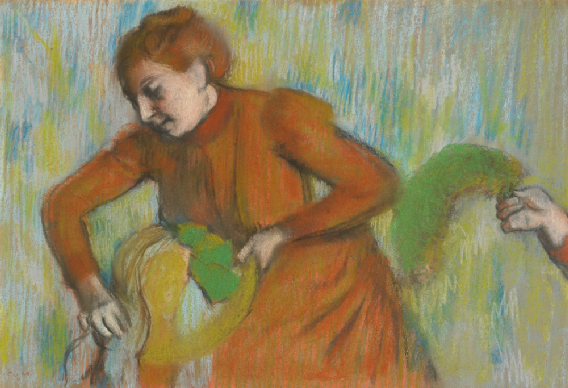
Modiste Decorating a Hat by Edgar Degas. (c.1895)

My next two offerings, The Epte in Giverny, by Monet and Modiste Decorating a Hat by Degas, are new arrivals at the gallery thanks to the beloved taxman. They have been acquired by National Museums Liverpool through the Government’s Acceptance in Lieu scheme which allows people, who have Inheritance tax bills to pay, to transfer important works of art and heritage objects into public ownership which are then allocated to museums, archives or libraries for people to enjoy.  Both the Monet and Degas artworks come from the collection of Mary Elliot-Blake and have been owned by the Montagu family by descent. Due to the family’s connection to Liverpool, the paintings were allocated to the Walker Art Gallery.

Monet completed the painting, The Epte in Giverny, in 1884, and it depicts the fast-flowing Epte river, which rises in Seine-Maritime in the Pays de Bray, near Forges-les-Eaux and empties into the Seine not far from Giverny where the artist painted his famous water lily series.

The second work is by Degas’ entitled Modiste Decorating a Hat and depicts a milliner adjusting a hat in a shop window.
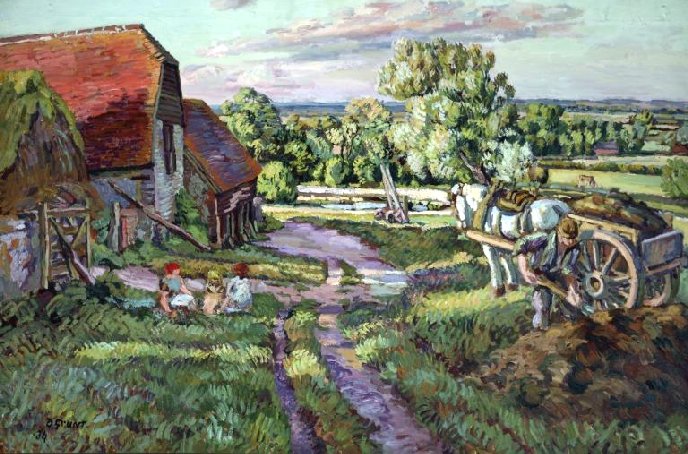
Farm in Sussex by Duncan Grant (1934)

The 1934 painting, entitled Farm in Sussex, is a depiction of Charleston Farm at Firle in Sussex is by the artist Duncan Grant. The picture was painted in his studio over a period of several years. The first thing that strikes you about the depiction is the unusually bright colours he has used and this is due to Duncan Grant’s great interest in Fauvism, which was popular between 1905 and 1910. The Fauves (the Beasts) used bright, clashing colours and fierce brushstrokes to express feelings and emotions.  In 1909, Grant met Henri Matisse, who was a leading light of this group.

He also saw more of the groups work in Roger Fry’s Post-Impressionist exhibition in London in November 1910, Fry had organised the exhibition Manet and the Post-Impressionists at the Grafton Galleries, London. This exhibition was the first to prominently feature Gauguin, Cézanne, Matisse, and Van Gogh in England and brought their art to the public.

Duncan Grant lived at Charleston Farm from 1916 with Vanessa Bell (neé Woolf), who was an artist and the sister of Virginia Woolf. They had met through the Bloomsbury Set, a London-based group of artists and writers who met regularly to discuss their work and ideas about modernism and art. Charleston Farm became a meeting place for the Bloomsbury Set outside of London.  The pair had moved to the countryside from London following the outbreak of World War I so that Grant could avoid conscription by working as a farm labourer. The couple each had their own studio at the farmhouse and decorated the entire building, including walls, fireplaces, door panels and furniture, with their paintings, fabrics and ceramics. They kept the house after the war and used it as a summer home. The painting highlights the bright colours that characterise Grant’s work. The painting was completed in 1934, the same year that Roger Fry died. Fry had been a close friend of both Duncan Grant and Vanessa Bell and was a regular visitor to Charleston. The painting reflects Grant’s affection for the Farm and the people he associated with it
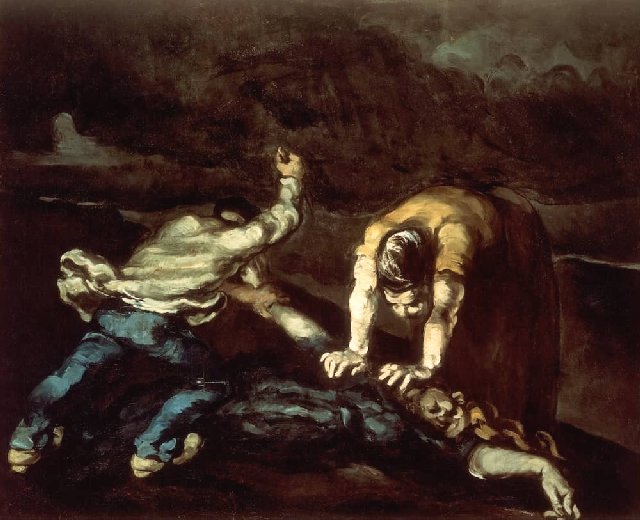
The Murder by Cezanne (c.1870)

The Murder is one of Cézanne’s early paintings which he completed around 1870.  It is a dark and highly melodramatic work which ably communicates the brutality of the act. In the depiction we see the murderer raising his hand and is about to give the final strike while his female conspirator forcefully holds down the rounded heavy-set body of the female victim whilst the fatal blow is struck.  Little can be made out of the figures; just the outline head and arms of the victim whose facial expression is contorted with pain.  The faces of her two assailants are blurred.  Cezanne was not interested with the identities of the murderers but the scene simply depicts the heinous act of anonymous violence.  The scene is made more frightening by the bleak surroundings and the dark sky overhead.  Close to the figures is a riverbank and we can deduce that the body of the dead woman will eventually be dumped into the dark waters.

Publicity Poster for Zola’s novel

The Murder was painted at a time when Cézanne was still influenced by the Old Masters such as Eugene Delacroix and Francisco Goya, and Diego Velazquez.  So after painting so many colourful landscapes why would he depict a brutal murder?  It is thought that Cezanne’s choice of depicting this brutal subject may have been inspired by Emile Zola’s novel Thérése Racquin which had been published in 1867, in which the heroine murders her husband. It was Zola’s third novel, though the first to earn wide fame. The novel’s adultery and murder were considered scandalous and famously described as “putrid” in a review in the newspaper Le Figaro. The painting’s subject could also be inspired by illustrations in the popular press.
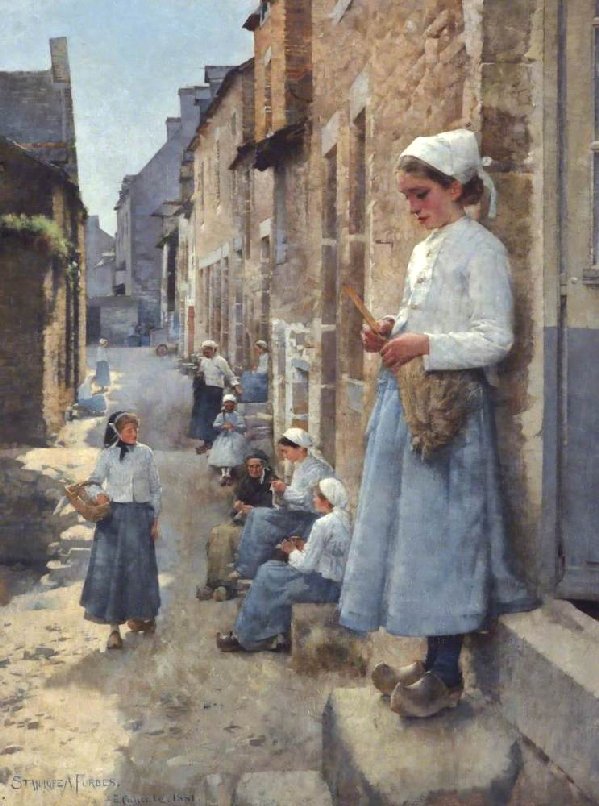
A Street in Britanny by Stanhope Forbes (1881)

My final painting is A Street in Brittany by Stanhope Alexander Forbes which he completed in 1881.  It is a depiction of figures in a narrow street: women in white headgear known as coiffes and blue petticoats.  They are grouped around their cottages, some are seated on their knitting blue jerseys for their fishermen husbands.

Stanhope Forbes was born in Dublin, the son of Juliette de Guise Forbes, a French woman, and William Forbes, an English railway manager, who was later transferred to London. He was educated at Dulwich College, and he studied art under John Sparkes at Lambeth College of Art, who later taught at South Kensington School of Art. Forbes then studied at the private atelier of Léon Bonnat in Clichy, Paris from 1880 to 1882.  It was in the French capital that Forbes met up with fellow artist, Henry Herbert La Thangue, who had also attended Dulwich College, Lambeth School of Art and the Royal Academy.

In 1881 Forbes and La Thangue went to Cancale, a village in Brittany, at the western end of the bay of Mont-Saint-Michel, fifteen kilometers east of Saint-Malo. It was here that Forbes began to paint en plein air and produced this painting. 
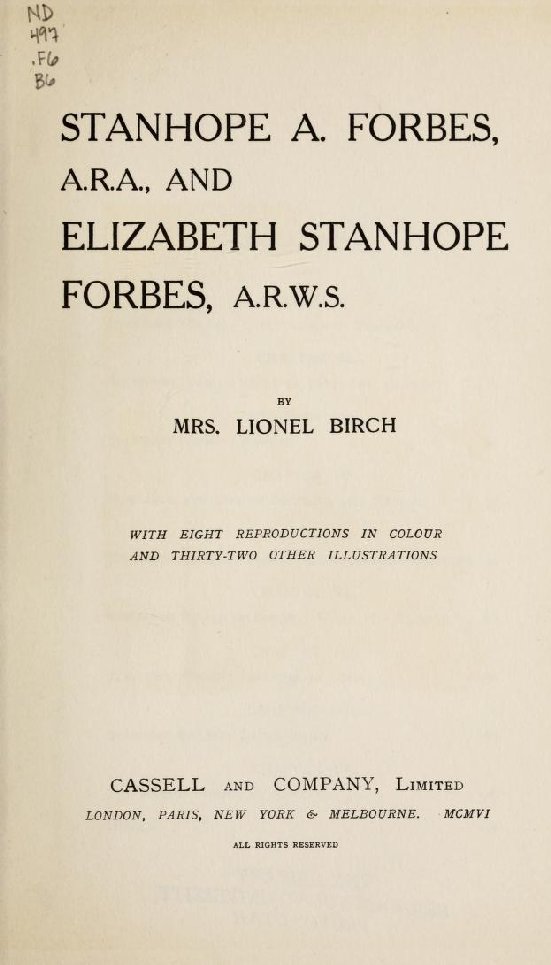
His biographer, Mrs. Lionel Birch in her 1906 book Stanhope A. Forbes, A. R. A., and Elizabeth Stanhope Forbes, A. R. W. S. recalled the setting of this work:

“..One of the first results of the visit to Cancale was a composition of figures in a narrow street: women in white coiffes and blue petticoats, grouped round their cottages and seated on their doorsteps engaged in their everlasting occupation of knitting blue jerseys for their fisher husbands…”

The biographer continues:

“…It was a very simple motif, but painted with great care and conscientiousness, and with a close and searching attention to those truths of lighting and that clear out-of-door aspect which the painter sought to betray. It was interesting, too, as the first attempt Stanhope Forbes had made in what might be termed figure composition, if, indeed, a picture in which there is so little of arrangement in the grouping of the figures can be termed a composition. But it was, at any rate, a great step from simple portraiture, and its success — for it brought the young painter a very signal one — had the most marked influence in determining his future. Exhibited at the Royal Academy of 1881, it attracted favourable attention, and when, later on, it was sent to Liverpool, the Committee of the Walker Art Gallery decided to purchase it for their permanent collection…”

Forbes left France and returned to London and exhibited the works he had made in Brittany at the 1883 Royal Academy and Royal Hibernian Academy shows.  In 1884 he moved to Newlyn in Cornwall, and soon became a leading figure in the growing colony of artists.

I hope this blog will tempt you to visit the Walker Art Gallery in Liverpool. You will not be disappointed.
Theodoor Rombouts

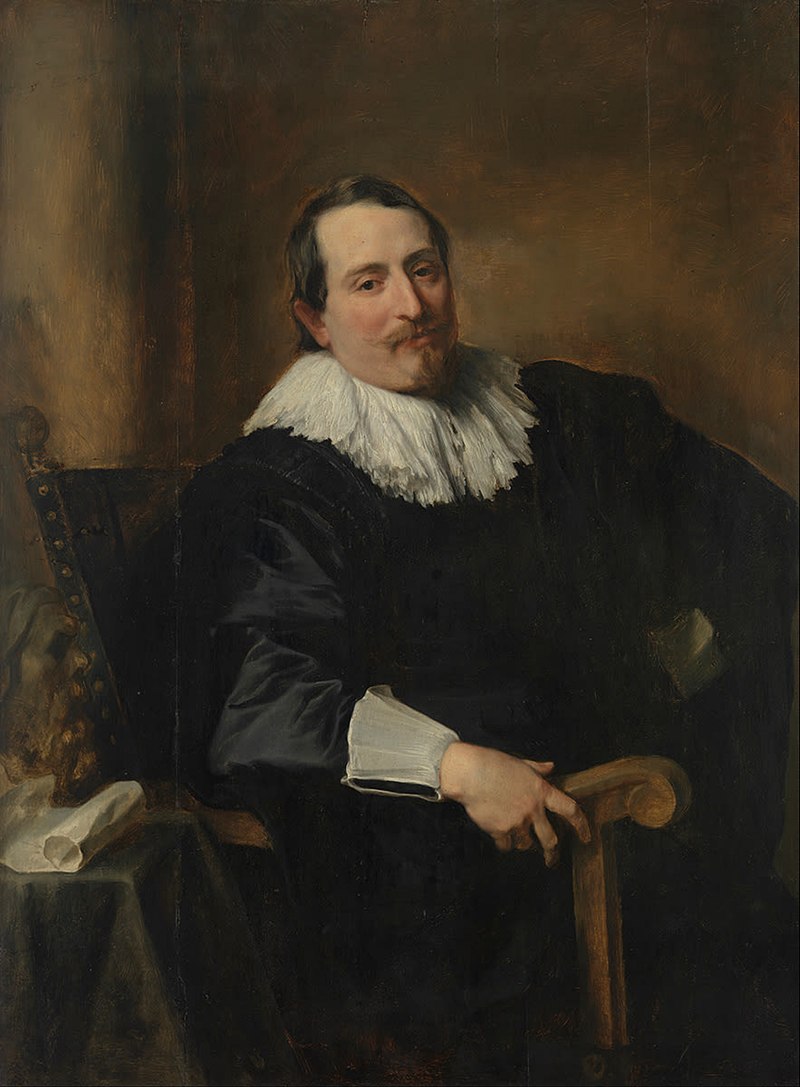
Portrait of Theodoor Rombouts by Anthony van Dyck

In my last two blogs regarding the Groeninge museum in Bruges, I looked at the works of the Flemish Primitive painters.  In this edition of the blog I want to showcase the life and works of an early seventeenth century Flemish painter known for his Caravaggesque genre scenes depicting lively dramatic gatherings.  Maybe because he lived in Antwerp at the same time as the great Rubens he and his artwork was overshadowed but I hope you will see that the man was an artistic genius.  Let me introduce you to Theodoor Rombouts.

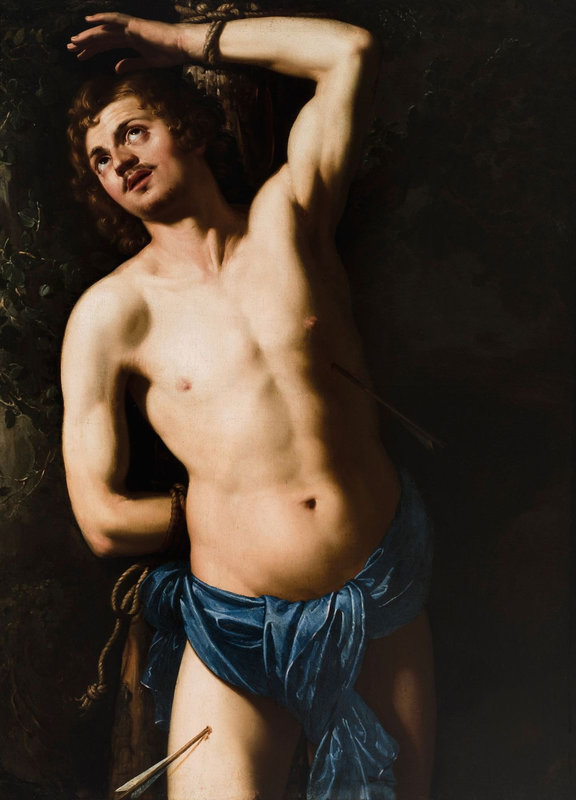
St Sebastian by Theodoor Rombouts (c.1626)

Rombouts was born in Antwerp on July 2nd 1597.  He was the son of Bartholomeus Rombouts, a wealthy tailor, and Barbara de Greve.  In 1608, at the age of eleven, Theodor studied art for a year as a pupil of Frans van Lanckvelt before being tutored by the Flemish artist, Abraham Janssens, the dean of the Antwerp Guild of St Luke and who had studied in Rome at the time of Caravaggio. He was one of the first Flemish followers of Caravaggio.

Young Soldier by Theodoor Rombouts (1624)

In 1616, aged nineteen, Theodore Rombouts also travelled to Rome where he remained until 1625.  He was recorded as living in the Roman parish of Sant’Andrea delle Fratte, along with two other Flemish painters, Francesco Tornelli  and Robert d’Orteil.  It is thought that while on a visit to Florence he met the Caravaggist Bartolomeo Manfredi and worked for Cosimo II de’ Medici. It was during his stay in the Italian capital that Rombouts was inspired by the revolutionary painter Michelangelo Merisi da Caravaggio and his most important follower Bartolomeo Manfredi and the two would influence Rombouts’ painting style.   In 1622 he also travelled to Pisa.

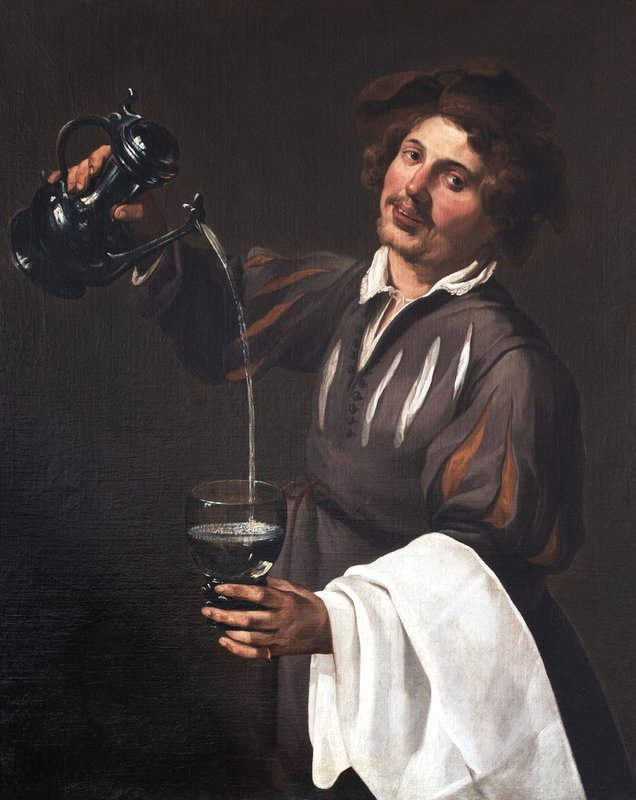
The Cup-bearer (Allegory of Temperance) by Theodoor Rombouts (c.1632)

In 1625, on his return to Flanders, Rombouts entered the Guild of St. Luke in Antwerp as an independent master. Now in Flanders, he concentrated on his genre painting which he could sell at the open market, in a style of strong contrasts of light, with figures of great articulacy, both evoking great energy and yet with natural movement.  The excellence of his work and its popularity resulted in him being looked upon as the leading Flemish Caravaggian of his time.

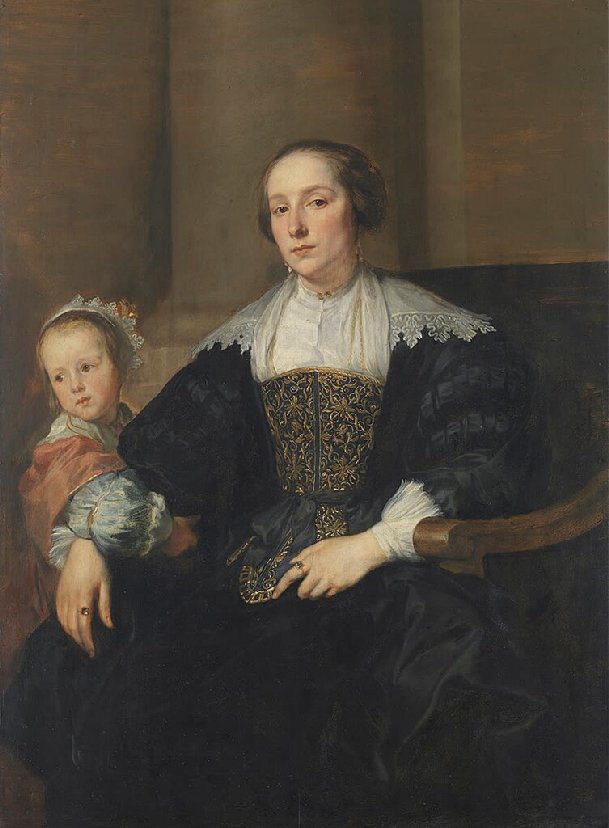
Portrait of Anna van Thielen, wife of the painter Theodor Rombouts with their daughter Anna Maria (c.1630)

In 1627 Rombouts married Anna van Thielen, who was from a noble family and the sister of Jan Philip van Thielen, who was the son of a minor nobleman by the name of Liebrecht van Thielen. Jan Philip became a well-known Flemish painter who specialized in flower and garland paintings.  He would eventually assume his father’s title of Lord of Couwenberch.  Jan Philip van Thielen became Rombout’s pupil in 1631 and became a talented still life painter.  There was a strange twist to Rombout’s marriage as Anna and her family were not from Antwerp but from the Mechelen area, and so he had to obtain, prior to the wedding ceremony, a dispensation from the Antwerp City Council to consummate the marriage outside Antwerp so that he would not forfeit his Antwerp citizenship rights.  In 1628 the couple had a daughter, Anna Maria.

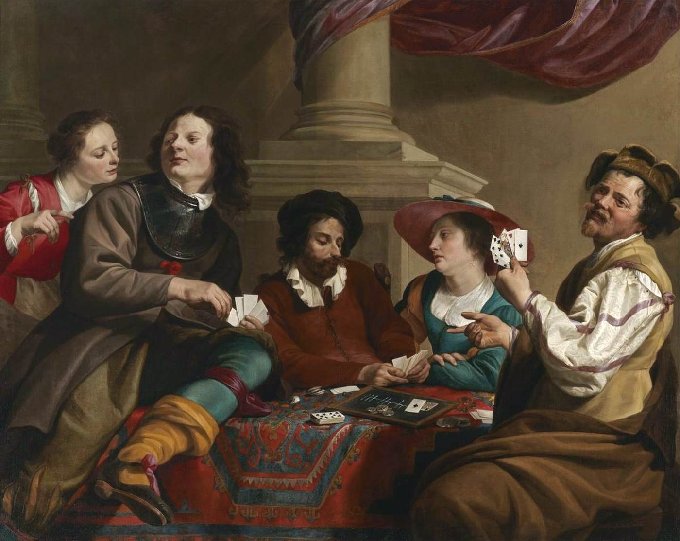
Card Players in an Interior by Theodoor Rombouts

Theodor Rombouts was the primary exponent of Flemish Caravaggism,that became a popular artistic phenomenon that reached its zenith in the 1620s. Besides his religious works, he is probably best known for his large-scale secular works which portrayed groups of cheerful folk partaking in musical merriment and card-playing characters who had often been affected by heavy drinking.  These people depicted wearing theatrical costumes were posed for best effect and set in chiaroscuro lighting typical of the Flemish Caravaggisti, also known as the Antwerp Tenebrosi.  Tenebrism, from Italian word tenebroso meaning dark, gloomy, and mysterious, also occasionally called dramatic illumination, is a style of painting using especially pronounced chiaroscuro, where there are violent contrasts of light and dark, and where darkness becomes a dominating feature of the image.

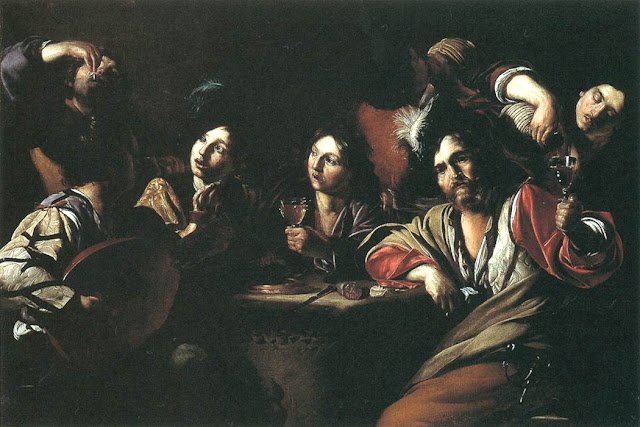
Tavern Scene with Lute Player by Bartolomeo Manfredi (c.1621)

Rombouts’ work entitled Card Players in an Interior, is a prime example of his Caravaggesque genre scenes. Recalling the jovial genre scenes of Bartolomeo Manfredi’s depiction of merriment in a tavern in his 1621 work, Tavern Scene with Lute Player, one can see a similar marked sense of monumentality to Rombouts’ five figures who are positioned around a carpeted table, engaged in a game of cards. The individuals are both realistic and expressive and the whole depiction has natural feel about it.

Rombouts introduces what is known in art terms as repoussoir to the depiction.  The word Repoussoir comes from the French verb répousser, which means “to push back” and it has been used for centuries by artists who want to focus attention and add interest to their art. They achieve this by placing certain types of objects or figures close to the painting’s edges, which guide the viewer’s eyes towards your central theme.  In this painting our eyes are being led towards the central bearded figure who stares down at his hand of cards, and it is thought to be a self-portrait of Rombouts. Rombouts also included a portrait of his wife, Anna, in the hatted figure seated beside him.

The Backgammon Players by Theodoor Rombouts (1634)

Rombout’s inclusion of self-portraits and portraits of family members in some of his paintings was not unusual as these additions were often seen in Dutch and Flemish genre painting.  In his 1634 painting entitled The Backgammon Players, which is part of the collection of the North Carolina Museum of Art, in Raleigh, Rombouts has included himself, the lavishly dressed soldier, his wife and his young daughter.

The Tooth Puller by Theodoor Rombouts (c.1625)

One of my favourite secular painting by Rombouts is his 1625 work entitled The Tooth Puller which can be seen at the Museo del Prado in Madrid. The depiction is of a tooth-puller who is treating a long-suffering patient surrounded by a large group of inquisitive onlookers who could well be the tooth-puller’s next patient.   They look on with a mixture of inquisitiveness and alarm, bordering on panic.  Like Caravaggio, Rombouts was interested in depicting ordinary folk enduring or enjoying everyday life.  The tooth-puller’s certificates lie on the table for his patients to see but his experience is substantiated by a collar of teeth worn around his neck.

The Lute Player by Theodoor Rombouts (c.1625)

One of Rombouts’ popular single figure painting is The Lute Player which is part of the John G. Johnson Collection at the Philadelphia Museum of Art.  It depicts a lute player tuning his instrument.  Lute players were often mocked for the undue amount of time they dedicated to tuning their instruments. Look how Rombouts has depicted the intensity of concentration on the face of the street musician which highlights the complexity of the task.  Some believe that this tuning of the instrument symbolises striving for harmony in love. The depiction of a stringed instruments could also symbolize temperance, especially when shown in the company of a tankard and a pipe, as depicted by Rombouts.

The Lute Player by Caravaggio (c.1596)

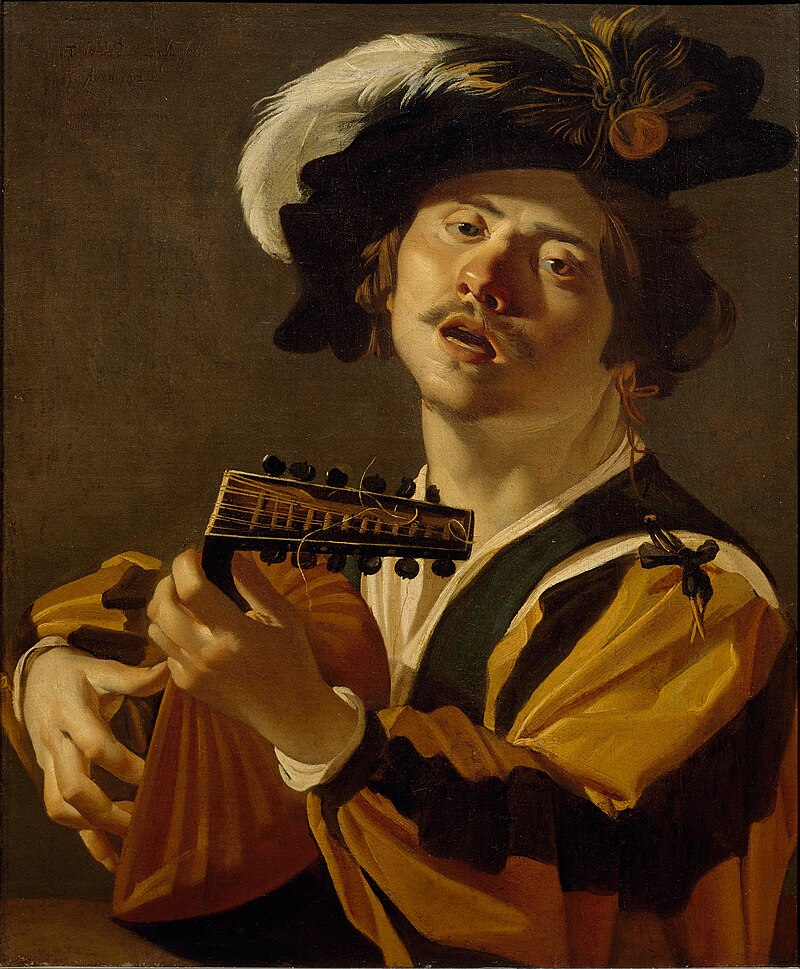
The subject of a lute player was very popular in the seventeenth century and was often depicted in a Caravaggio-style as can be seen in Dirck van Baburen’s 1622 painting entitled The Lute Player or Singing Man with Lute which is part of Centraal Museum in Utrecht collection. 

The Lute Player or Singing Man with Lute by Dirck van Baburen (1622)

Von Baburen, like Rombouts, had spent time in Rome and had seen many of Caravaggio’s works of art. 

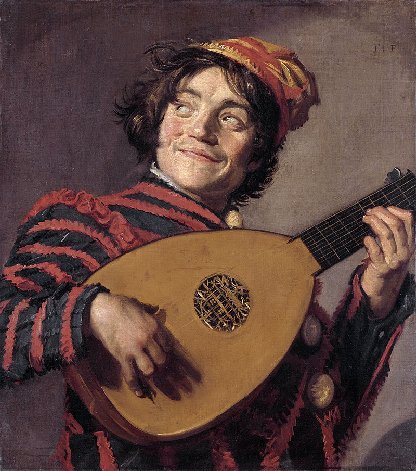
Lute Playing Jester by Frans Hals (1623/1624)

The half-figure image of a single musician became very popular in the Dutch Republic and other artists copied the style such as Frans Hals with his 1623 version of the Lute Playing Jester.

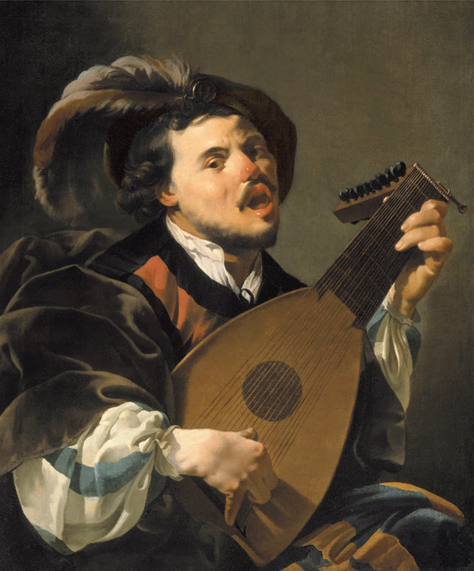
The Singing Lute Player by Hendrick Terbrugghen (1624)

and the Utrecht Caravaggesque painter Hendrick Terbrugghen with his 1624 painting entitled The Singing Lute Player.

Allegory of the Five Senses by Theodoor Rombauts (1632)

In 1632 Rombouts completed his multi-figured work entitled Allegory of the Five Senses which can be seen at the Museum voor Schone Kunsten in Ghent.  The art loving public in the 16th and 17th century were fascinated by symbolic works of art especially those where the artist has also displayed his or her virtuosity as a painter.  In the painting, Allegory of the Five Senses, we see five men depicted.  Each of them symbolizes one of the five senses. The elderly man on the left with glasses propping up a mirror represents Sight. Next to him is a man playing the chitarrone, a type of bass lute, and he symbolises Sound. The blind man in the centre of the painting represents the sense of Touch. Further to the right we see a jovial man with a glass of wine in his hand.  He portrays Taste.  At the far right we have an elegant young man smoking a pipe and holding a bag of garlic.  He represents Smell. The Ghent bishop, Antoon Triest, who also owned several paintings by Dutch masters, purchased this canvas from Rombouts.

The Denial of St. Peter by Theodoor Rombouts (c.1625)

Besides his genre paintings Theodoor Rombouts completed a number of large religious works during his lifetime.  Around 1625, after just returning from Rome, Rombouts completed his religious work entitled The Denial of St. Peter.  The narrative painting had a wide horizontal format (94 x 206cms) and the depiction was based on the biblical story about the testing of St Peter’s resolve in supporting Christ.  In the painting we see the servant girl questioning St Peter.  According to the bible Mark 14: 66-70:

“…While Peter was below in the courtyard, one of the servant-girls of the high priest came by. When she saw Peter warming himself, she stared at him and said, “You also were with Jesus, the man from Nazareth.” But he denied it, saying, “I do not know or understand what you are talking about.” And he went out into the forecourt. Then the cock crowed. And the servant-girl, on seeing him, began again to say to the bystanders, “This man is one of them.” But again, he denied it. Then after a little while the bystanders again said to Peter, “Certainly you are one of them; for you are a Galilean…”

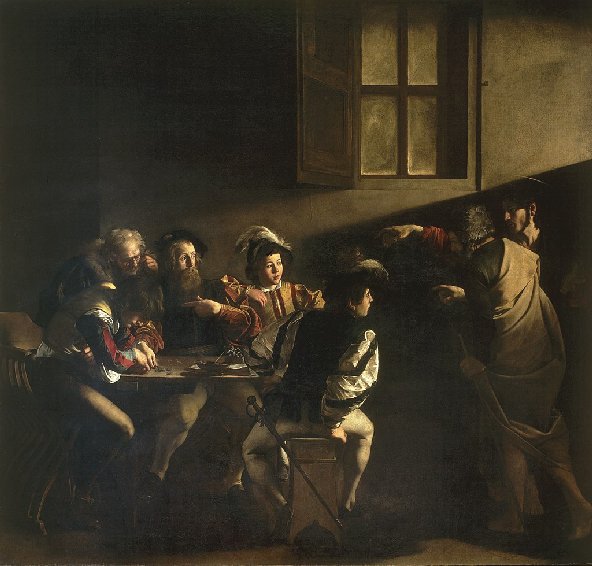
The Calling of St Matthew by Caravaggio (c.1600)

The influence of Caravaggio can be seen in this painting and the setting of the figures reminds one of Caravaggio’s  work The Calling of St Matthew which he completed around 1600 and is hanging in the Contarelli Chapel in San Luigi dei Francesi in Rome, and was probably seen by Rombouts.

Christ driving the Money-changers from the Temple by Theodoor Rombouts (c.1637)

Another of Rombouts’ religious works, Christ driving the Money-changers from the Temple, features the events in the Temple as related in Mark’s Gospel (Mark 11:15-17) in the New Testament:

“… On reaching Jerusalem, Jesus entered the temple courts and began driving out those who were buying and selling there. He overturned the tables of the money changers and the benches of those selling doves and would not allow anyone to carry merchandise through the temple courts. And as he taught them, he said, “Is it not written: ‘My house will be called a house of prayer for all nations’ But you have made it ‘a den of robbers…”

It depicts a furious Christ erupting in anger, his self-made whip in his hand, as he furiously attacks the merchants when he discovered that the holy site of the temple was being used as a market hall and money changer’s office.  Look at the wide range of emotions etched on the faces of the proponents.

Between 1628 and 1630 Rombouts was deacon of the Guild in Antwerp. In 1635, two years before his death, Rombouts collaborated with other artists on the programme of the decorations of the Joyous Entry of Cardinal-infante Ferdinand in Antwerp, which was led by Rubens. Theodoor Rombouts died in Antwerp on September 14th 1637, aged 40, shortly after the completion of this collaborative project.

Groeningen Museum Bruges. Part 2.

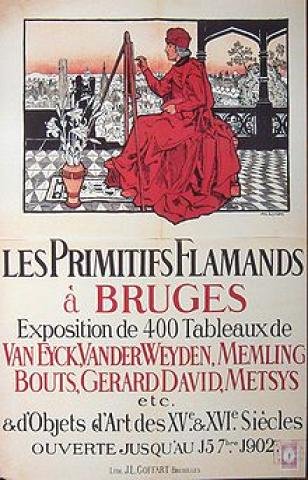
In 1902, a major exhibition of Flemish Primitive works entitled Les Primitifs flamands et l’art ancien was held in Bruges.  Almost four hundred paintings, including works by (or attributed to) Jan van Eyck, Rogier van der Weyden, Dieric Bouts, Hans Memling, Gerard David and Quentin Massijs, were on show. The exhibition drew in more than 35,000 visitors. It is believed that never before had so many Flemish paintings from the 15th and early 16th centuries been on display together.   If you manage to visit the Groeningen Museum in Bruges you will be able to see many works by the Flemish Primitives.

Portrait of a Theologian with his Secretary by Jacob van Oost the Elder (1686)

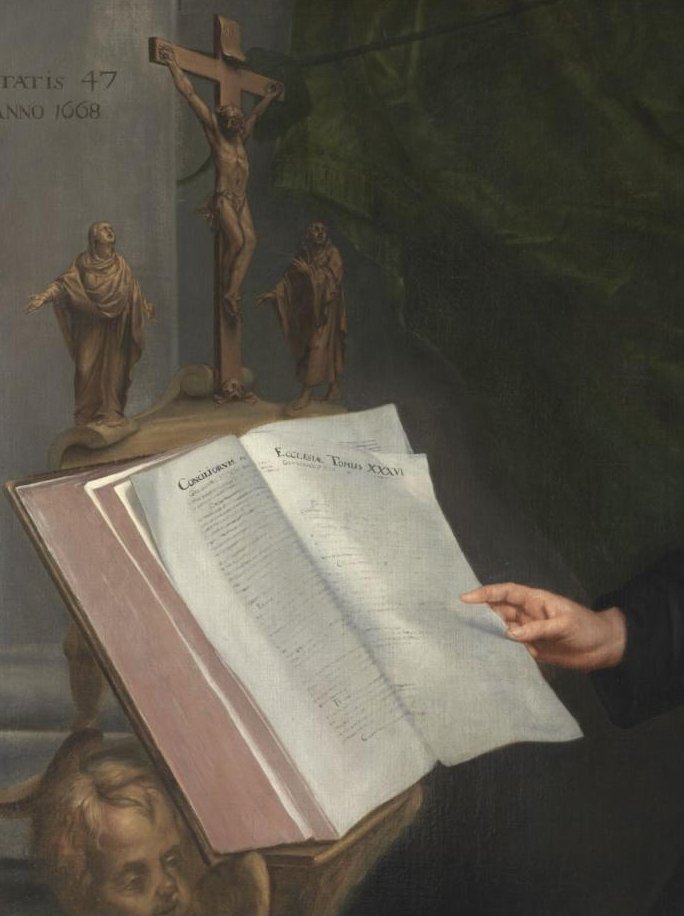
The first painting I am looking at in this blog is the dual portrait entitled Portrait of a Theologian and his Secretary by Jacob van Oost the Elder which he completed in 1668 and is part of the Groeninge Museum in Bruges.

Jacob van Oost the Elder was the leading artist of 17th-century Bruges. He painted many altarpieces in the churches of Bruges and he was also exceptionally gifted as a portrait painter as one can see in this work. Van Oost was born in Bruges, and trained there by his elder brother, Frans. He entered the Guild of Saint Luke in 1619, and became a Master two years later. He took a trip to Rome in the 1620s and on his return to Bruges in 1628, his work was influenced Caravaggio, albeit the depiction of his paintings were of a contemporary Netherlandish setting.

The work depicts a theologian, probably a Jesuit, reading the council’s decisions and comments on them to his secretary. His secular secretary takes notes. On the left of the painting we see a lectern, which is decorated with a sculpture of a Calvary group, and open on it is volume thirty-six of the collected Council Decrees. On the right of the painting we see a work table bedecked with a richly coloured tablecloth, at which the priest and the secretary are seated. On top of the table are study accoutrements, such as a globe and a book. Behind the two men is a bookcase with editions of the Bible and literature in the fields of theology and canon law.

Thomas Wentworth, Earl of Strafford, with Sir Philip Mainwaring by Anthony van Dyck

Once again, in this depiction we are reminded of the influence of Anthony van Dyck portraiture, such as his 1640 painting entitled Thomas Wentworth, Earl of Strafford, with Sir Philip Mainwaring, also the Caravaggesque treatment of the light, with its characteristically heavy contrasts between light and shade, in this case between the open book on the lectern and the black clothes of the English statesman and the lightness of his face in comparison to the dark background.

Portrait of a Bruges Family by Jakob van Oost the Elder (1645)

Portrait of a Bruges Family is another painting by the Bruges born painter Jakob van Oost.   He had been commissioned to paint a family portrait.  This work is regarded as a masterpiece of high Baroque painting. For the man who commissioned the work, it is a vanity painting in which he is asking the viewer to recognise his status, his wealth and his handsome family.  He stands before us his arm outstretched.  The focal point of this painting is the wealthy man who draws our attention to his assets. He points towards the estate he owns which stretches into the distance.  He is surrounded by his family and standing next to him is his wife.  We also see the children’s maid and the gardener and by catching a glimpse of the terrace he is standing on we know that his house will be palatial.  Van Oost has made his viewpoint low which adds to the imposing air of the central figure.  It is a painting which carefully exudes two facts for us to take in.  Firstly, the portrait is a glorification of family life based on love and fertility and secondly, it is a work of art which affirms the family’s social status.  In the seventeenth century the wealthy bourgeois yearned to be accepted into the realms of the aristocracy and one way of elevating themselves to that social status was to buy an estate that came with a title of nobility and we can clearly see the man in the portrait aspired to that elevated status.

What is fascinating about this painting, albeit you will probably not be able to see it clearly in the attached picture, is that the painting is signed and dated on the lower right on the parapet.  However, even more bizarre is that the painter has incorporated the age of the various figures in the work.  The man is 46 as we can see written on the heel of his shoe.  His wife is aged 26 and this figure appears on her fan and the boy who stands close to her is 3 as can be seen written on his hat.  The girl sitting on the steps sits on a cushion is 15 as shown on her basket and the young man is 17 as shown on his boot.  The baby who is being carried by the nursemaid has the figure 1 inscribed on his hand.   The ages of the various children suggest that there have been two separate marriages and the lady holding hands with the central figure is probably the mother of the two youngest children.  This work of art is considered to be one of van Oost’s greatest masterpieces.   It would be interesting to find out if anybody visits the museum and looks closely at the painting whether they can see the numbers inscribed in the painting

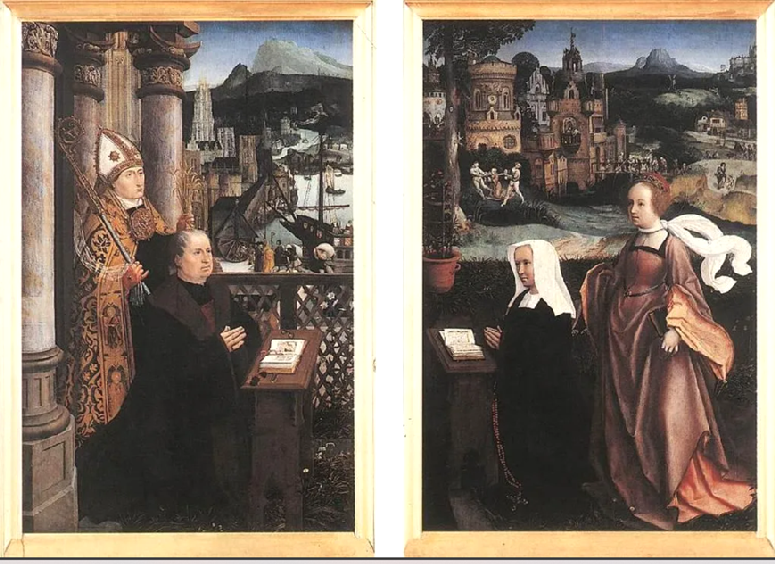
The next offering was once a triptych by the Belgian artist, Jan Provoost, and belonged to the former Dominican monastery in Bruges. Sometime before 1861 the front and back sides of the wing panels were separated by sawing them apart lengthwise.   The four panels are now displayed separately. The original central panel is missing. 

Jan Provoost was born in the Belgian town of Mons around 1463.  By 1491 he had married the widow of the miniaturist and painter, Simon Marmion and in 1494 he settled in Bruges.  He simultaneously headed up two workshops, one in Bruges, where he was made a burgher, the other in Antwerp, which was then the economic centre of the Low Countries. Provost was also a cartographer, engineer, and architect.

Inner wings of the original Triptych (c.1515)

The wealthy, but unknown, donors who commissioned the triptych are depicted on the original inner wing panels kneeling in prayer in a small, enclosed garden.  The background scenes include episodes in the lives of their patron saints, Nicholas of Myra and Godeliva who are also depicted in the panels.  Behind each of the saints are pictorial episodes from their lives.

The depiction in the background of the left hand panel we can just see men carrying sacks of food as they walk along the quayside next to a sailing vessel. When the people of Myra, a Lycian city in Ancient Greece in what is today the provinces of Antalya in Turkey, faced starvation, Bishop Nicholas had a shipload of grain that was destined for Alexandria distributed among the people. When the vessel completed its onward journey and arrived at Alexandria the cargo was found to have been miraculously replenished.

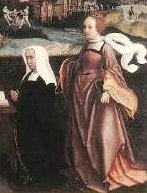
The right hand panel depicts the female donor along with her patron saint, Godeliva of Gistel and in the background we can see how the saint met her death. The story goes that she accepted an arranged marriage as was the custom, but her husband and family turned out to be abusive. Eventually he had her strangled by his servants. The large white scarf around the saint’s neck is to remind us of the manner of her death.

Outer (reverse)wings of the Triptych (c.1515)

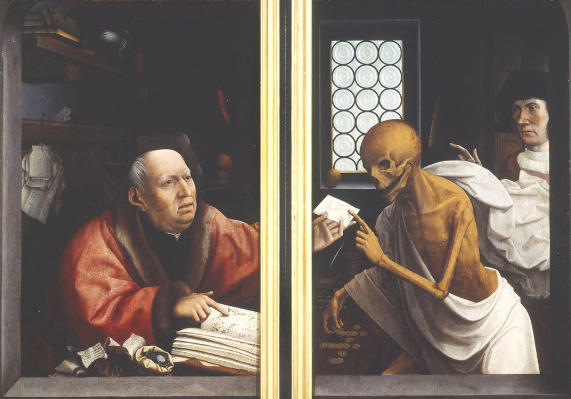
Originally when the triptych was closed it showed the images Death and the Miser. These two rear sides form a continuous scene and depict a moneychanger who points to a line in an accounting register. Death lays down some tokens and points to the text held out to him by the moneychanger, presumably a promissory note. It is possibly that the man in the doorway with a raised finger could be the artist himself.

The Pandreitje in Bruges by Jan Antoon Garemijn (1778)

The world of art constantly changed.  Leaving the 15th- and 16th-century Northern Renaissance period, once known as the Flemish Primitives and moving on a quarter of a century, through the bombastic art of the Baroque period we arrive at the time when light-hearted charming, themed art of the Rococo period had gained in popularity.  In France, Antoine Watteau, Jean Honoré Fragonard and François Boucher held centre stage and defined the French Rococo period spanning from the reign of Louis XIV “The Sun King” to that of Napoleon Bonaparte.  They created soft-coloured dreamworld paintings set in idyllic surroundings exuding a light poetic atmosphere.  The Flemish Rococo artists never attained the aristocratic elegance of their French counterparts although they did manage to produce fresh bourgeois drawing-room style works. 

Portrait of Jan Antoon Garemijn by Charles-Nikolas Noel (1771)

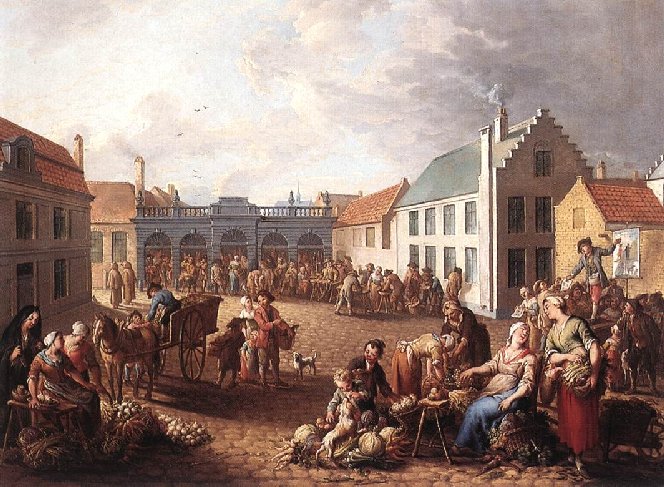
The most talented of these Flemish artists was Jan Antoon Garemijn.  The Groeningemuseum houses his portrait and also a number of his beautiful works including one entitled The Pandreitje in Bruges which he completed in 1778. The Pandreitje was a square in Bruges used as a vegetable market. In the foreground we see women who have come to town from their rural homes bringing with them their vegetables which they hope to sell.  In the background, occupying the porticos of the prison building are the butchers selling their wares. 

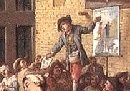
On the left of the square we see a street entertainer singing songs and cracking jokes to keep the marketgoers entertained.  He is also depicted selling mannekensbladen, a kind of 18th century Flemish illustrated paper which is full of sensational stories.  Behind him is an advert for the paper he is trying to sell which bears the incomplete inscription:

DERLYCKL VAN- 1778

(Wonderful stories of 1778)

Garemijn always paid attention to detail in his paintings of market scenes, such as this one, which offered an idealised image of the common people without the symbolism and moralising undertone that earlier artists would insert into their genre works.  There was no hint of social criticism in this work.

Another painting housed in the Groeningemuseum is one I featured in one of my early blogs of 2011 and so I won’t repeat it but I will give you a link to the page. The painting and the story behind it, The Judgement of Cambyses and the Flaying of Sisamnes by Gerard David, was one of my most popular posts and it is well worth a visit.

Following these last two blogs featuring works housed in the Groeningemuseum I hope you will be able to visit one day in the future.

Groeningemuseum Bruges. Part 1.

Groeningemuseum, Bruges

If you ever manage to travel to Belgium and visit the city of Brugge (Bruges) then I entreat you to drop in at the Groeninge Museum which lies in the heart of the historic city.  It is at this establishment that you will be able to see works of art by Jan van Eyck, Hans Memling, Hugo van der Goes, Gerard David, Hieronymus Bosch, Ambrosius Benson, Lancelot Blondeel, father Pourbus and his sons and their contemporaries. These Masters came from the Low Countries and often worked in Bruges and completed assignments there in the late 15th and early 16th centuries. This museum is a home for many beautiful pieces of art produced by the Flemish Primitives. The painting of the 15th and early 16th centuries in the Southern Netherlands is an important highlight in the history of art. These painters are commonly referred to as Flemish primitives. The Flemish Primitive period flourished especially in the cities of Bruges, Ghent, Mechelen, Leuven, Tournai and Brussels, all of which are in present day Belgium.   The period began around the 1420s with painters such as Robert Campin and Jan van Eyck and lasted until the death of Gerard David in 1523, although many art historians believe it did not end until around 1566 or 1568 with the advent of the Dutch Revolt. Moreover, the Flemish primitives emphasise a previously unseen religious eloquence that accompanies a new tradition in painting. The painting commissions of the time not only came from the various courts and religious institutions, but also from the towns and cities and their citizens. It was a time when artists, for the first time, had attained a very important standing in the society. Several of their works are looked upon as highpoints in the history of European art.  In this blog I will introduce you to some of these fabulous paintings which can be found in this wonderful museum.

The Virgin and Child with Canon Joris van der Paele by Jan van Eyck (c.1436)

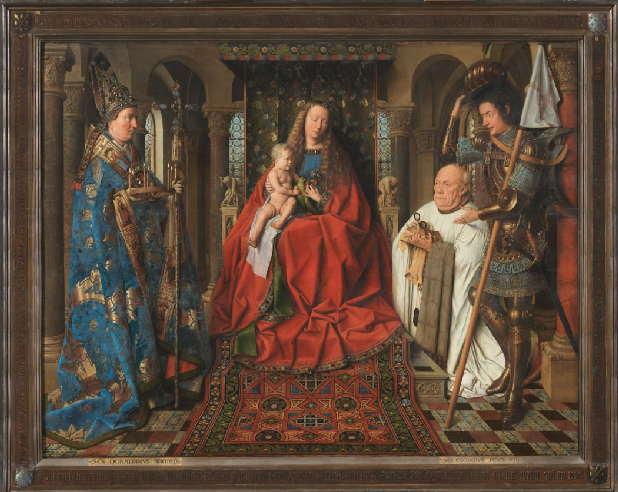
One of the great examples of early Netherlandish painting is the body of work by artists who were active in the Burgundian and Habsburg Netherlands during the 15th and 16th century Northern Renaissance period. The first work of art I am featuring is the large (122 x 158cms) oil on oak panel by Jan van Eyck entitled Virgin and Child with Canon Joris van der Paele which he completed around 1436. The painting depicts the the Virgin Mary enthroned at the centre of the semicircular space, which most likely represents a church interior, with the Christ Child on her lap. The Virgin’s throne is decorated with carved representations of Adam and Eve, Cain and Abel, prefigurations of the Crucifixion and Resurrection of Jesus, and scenes from the Old Testament. To the left in dark blue robes is Saint Donatian the patron saint of the church for which the panel was painted. The saint is dressed in brightly coloured vestments. This work is noted for the fine attire, including wonderful representations of furs, silks and brocades, and the detailed religious iconography. Kneeling down, as he piously reads from a book of hours, is Canon Joris van der Paele and standing behind him is St George, the canon’s patron saint.

Canon Joris van der Paele

Van der Paele had worked as a scriptor in the papal chancery in Rome.  From there he took up various posts in the Church before relocating to Bruges, his birthplace, in 1425.

Around the frame of the painting is a Latin inscription which once translated states:

“…Master Joris van der Paele, canon of this church, had the painting made by Johannes van Eyck, painter; and he founded two chantries, to be tended by the canons, 1434; the painting was, however, completed in 1436…”

The word “chantry” derives from Old French chanter and from the Latin cantare (to sing).   Its medieval derivative cantaria means “licence to sing mass”.  It is the prayer and liturgy in the Christian church for the benefit of the dead, as part of the search for atonement for sins committed during their lives.  In this case it indicates that Joris van der Paele donated a substantial amount of money to the authorities of St Donation’s Church in Bruges for them to dedicate an annual mass to his memory in perpetuity.  The painting would then have been hung alongside or above the church altar.

Death of the Virgin by Hugo van der Goes (c.1481)

The painting The Death of the Virgin is thought to have been the last work painted by Hugo van Goes before he died around 1482/1483.  It is thought that van der Goes was born in Ghent around 1442.  He enrolled in the city’s painter’s guild in 1467 and worked in the city for ten years during which time he received many lucrative commissions from the city, the Church and the Burgundian court.  In 1477 he left Ghent and went to live in Rouge-CloÎtre in the Forest of Soignes near Brussels.  Sadly, he suffered from many bouts of depression which culminated in a mental breakdown in 1481.  Following convalescence he returned to painting and completed this exquisite work of art which is believed to have been for Ter Duinen Abbey, a Cistercian monastery at Koksijde, in what is now Belgium.

Detail from Death of the Virgin by Hugo van der Goes

The depiction is the artist’s interpretation of the event with the vision of heaven above Mary’s deathbed.  The figures we see in the main picture are those filled with sorrow and the sense of despair at the death of the Virgin Mary.  Hugo van der Goes was looked upon as the most “modern” of the Flemish Primitive painters and this is borne out in this painting in which he has produced such realistic and expressive rendering of the figures and the movement and intensified feelings that pervade the composition.  The mystical, religious spirit along with the strong sense of emotion make this work one of the great masterpieces of 15th century painting.

Hans Memling was born in Germany, at Seligenstadt near Aschaffenburg, and it is thought that he received his first art education in Cologne.  He then travelled to the Netherlands but probably spent his early life in Mainz. By 1465 he had moved to Bruges and was the leading artist there for the rest of his life.  By 1480 he had bought himself a large stone house in the city and was taking on pupils.  Memling was listed among the wealthiest citizens on the city tax accounts. Sometime between 1470 and 1480 Memling married Anna de Valkenaere who bore him three children.

 Portrait of the family Moreel, 1482 by Hans Memling (Royal Museums of Fine Arts of Belgium, Brussels)

It is in the area of portraiture that Hans Memling appears to have been the most successful and had gained a vast number of aristocratic clientele who lived in Bruges. One of his lucrative commissions came from Willem Moreel, a prominent Bruges politician, merchant and banker and his wife Barbara van Vlaenderberch. He had painted their portraits in 1482. His figurative depictions are painted with an exactness, a precision and a concern for detail which bring them strongly to life.

The Triptych of Willem Moreel by Hans Memling (1484)

One such commissioned work of art was the Triptych of Willem Moreel. Moreel and his wife had commissioned Memling to paint a triptych altarpiece for the altar of the Saints Maurus and Giles in the Church of St. James in Bruges, a church in which Moreel and his wife wished eventually to be buried.

Central panel of the Moreel Triptych

The central panel of the triptych depicts the large figure of St. Christopher, who according to medieval legend, carried the Christ Child across a river on his shoulder. In the distance, up in the rocks in the left background we see the light from the hermit’s lamp guiding the saint. The two figures on either side of St Christopher do not belong in the legend but may have been added by Memling to balance the composition. To the left we see the former monk, St Maurus, holding his crook and open book and to the right is St Giles, a Benedictine hermit with an arrow in his arm and a deer at his side. It is interesting to note that the inclusion of the deer and the arrow which is in most depictions of the saint, as it harks back to the legend that Giles  finally withdrew deep into the forest near Nîmes, where, in the greatest solitude, he spent many years, his sole companion being his beloved deer, which in some stories sustained him on her milk.  His retreat was finally discovered by the king’s hunters, who had pursued the deer to its place of refuge. An arrow shot at the deer wounded the saint instead, who afterwards became a patron of the physically disabled.

The left hand panel of the Moreel Triptych

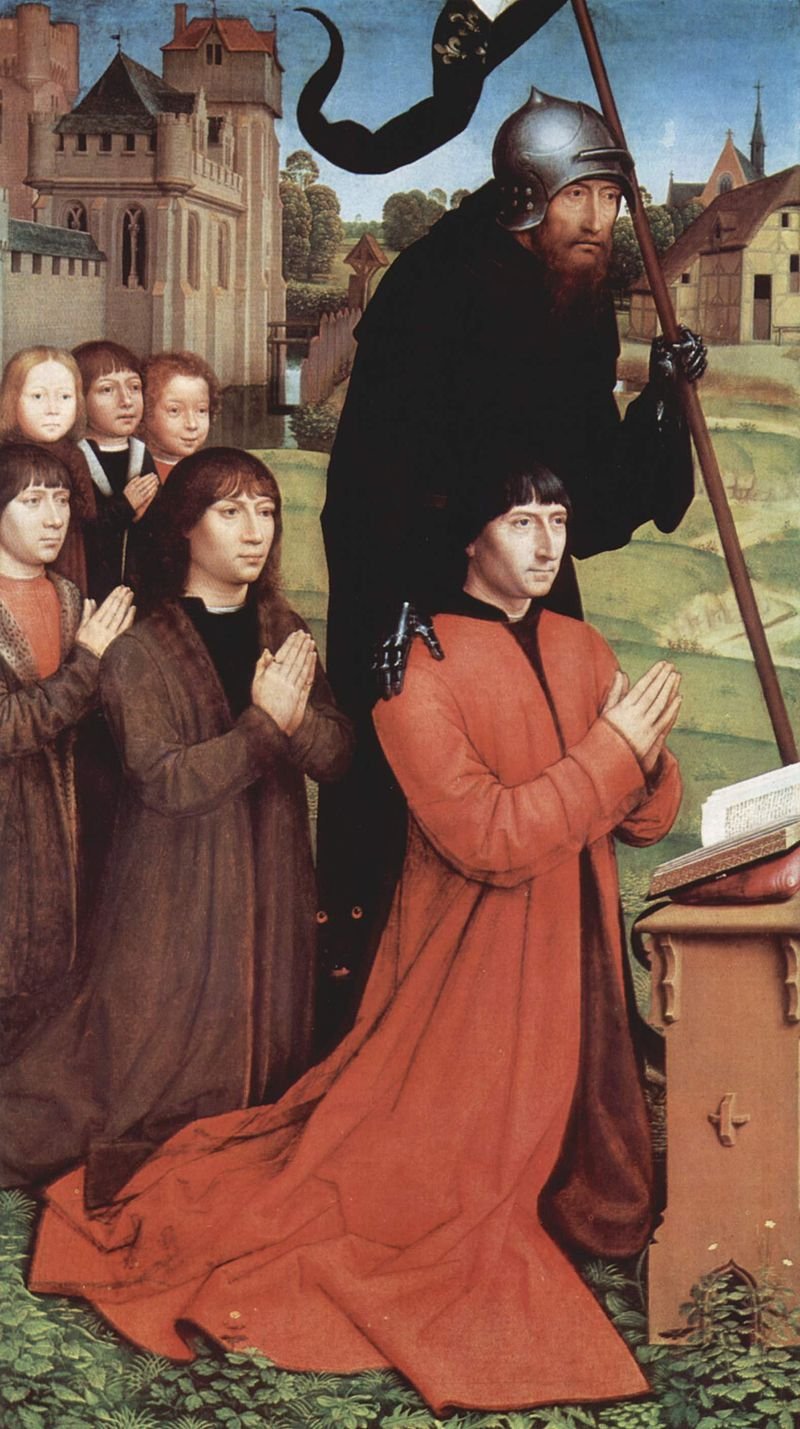
The left hand panel of the triptych continues with the magnificent landscape background. The depiction of the left hand panel has multiple figures. It depicts the Willem Moreel kneeling, hands clasped in prayer. His hair is short in a “bowl cut” and over his black jerkin, he wears a fur-lined tabard which is without a belt or fastenings, which was very fashionable in the 1480s. Behind him are his five male children, who are also shown kneeling. Of Moreel’s sons, two are known to have died in infancy leaving Willem the oldest, with his two remaining siblings, John and George. Moreel and his sons are being presented by Saint Wilhemus van Maleval, who stands among them, dressed in a fur-lined black coat over army clothing.   He places his hand on Willem’s shoulder as he directs and presents him to St.Christopher in the centre panel.

Right hand panel of the Moreel Triptych

On the right interior wing of the triptych is the depiction of Barbara Moreel with eleven of her thirteen daughters, who all kneel in prayer before an open book. Barbara wears an hennin, a headdress in the shape of a truncated cone, which was worn in the Late Middle Ages by European women of the nobility, a damask silk dress with a white collar, and a wide red belt with a golden buckle. The women are being presented by Saint Barbara, who was the patron saint of Moreel’s wife.  The saint is depicted standing before the tower where she was, according to legend, imprisoned and executed.

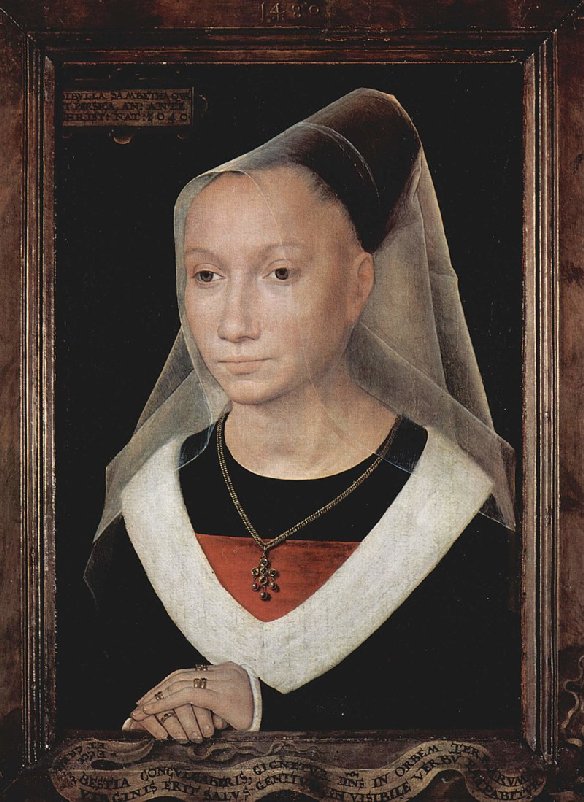
Sibylla Sambetha (Catherine Moreel ?) by Hans Memling (1480)

Barbara Moreel’s eldest daughter, Catherine, kneels directly behind her mother.  She also wears a black dress and it is known that later in her life she became a Dominican nun.  Besides completing portraits of Moreel and his wife, he had also painted a small oil on oak panel portrait entitled Sibyla Sambetha, in 1480.   The painting is now in the Hans Memling Museum at the Old St. John’s Hospital in Bruges. The girl in the light brown clothing, black V-neck and transparent veil has been identified as Maria from her name written in her headband, and is their second-born daughter, given her linear position in the painting.

Exterior panels of the Moreel Triptych when closed

The outer part of the two wings, seen when the triptych is closed has grisaille depictions of John the Baptist with his lamb and staff.  On the other wing we have Saint George in his full armour, slaying the dragon with a lance depicted on the right outer wing.  It is believed that these two panel paintings may have been completed much later around the time of the deaths of Willem and Barbara Moreel and dated as around 1504 by a number of art historians.  It was thought that Moreel’s sons, Jan (John) and Jaris (George), probably commissioned them as the final, successful, effort to have their parents interred within the chapel space.

One strange aspect to the Moreel Triptych is the fact that not all of the daughters depicted in the right hand panel were painted by Memling.   The art historian and former curator of the Groeningemuseum, Dirk De Vos, has identified at least six females who are later additions, layered over the original landscape. The explanation for these additions, which were probably added by members of Memling’s workshop, were that the daughters were born after the 1484 completion date of the triptych.   The left-hand panel depicting Moreel and his sons underwent a similar update.

………to be continued.