
In my last blog I told you about the William Etty art exhibition in York, entitled “William Etty: Art and Controversy and I ended his biography around 1807 at which time he had enrolled at the Royal Academy Schools where he studied under Henry Fuseli and received some private tuition from Sir Thomas Lawrence, a painter who influenced Etty’s early works. So to continue with his life story…….
In 1816 he made his first trip abroad and visited both Paris and Florence. Here he studied the works of the Italian masters and soon he became a great follower and admirer of their art. The subjects of his paintings are mainly classical and mythological, commonly depicting female nudes.
Six years later he made a longer European journey and spent a lot of time in Venice where he studied the Venetian masters and it was during this time he began to master the use of colour which can be seen throughout his paintings. The sensual nature of his paintings scandalized the Victorian public of the day and Etty was often accused of being indecent. Nineteenth century art was expected to elevate the mind of the viewer by offering a pure untainted vision of female beauty. However Etty’s portrayal of flesh was seen as too life-like and sensuous. His Diploma Piece Sleeping Nymph and Satyrs which he submitted to the Royal Academy following his election to Royal Academician in 1828 was criticized by the then Professor of Painting who described it as:
“…Objectionable and offensive with just a veneer of respectability…”
Etty however, was not deterred by the criticism as on the death of his uncle and wealthy benefactor in 1809 he had suddenly become financially independent and was able to choose his own subjects for his paintings and not be worried about the tongue lashings he regularly received from the art critics of the day. He spent most of his later life living in London but would regularly escape the pressures of the city and go back to the tranquillity of his birthplace and the rural areas of Givendale and Pocklington where he was brought up. It was during these times that he was inspired to paint completely different subjects and although he will probably just be remembered for his grand classical and mythological canvasses, and particularly for his paintings of nudes, he painted many small works of the Yorkshire landscapes and portraits of his friends and relatives.
In 1848, when his health started to deteriorate, he left London and returned to York. His crowning glory came just before his death, when there was a major exhibition of his work at the Society of Arts in London, when 133 of his paintings were displayed. Etty died a year later, in 1849 aged 62. His remains are buried in the grounds of the nearby St. Olaves Church, York. Unlike many artists, Etty did not die in poverty and left a considerable fortune of £17,000.
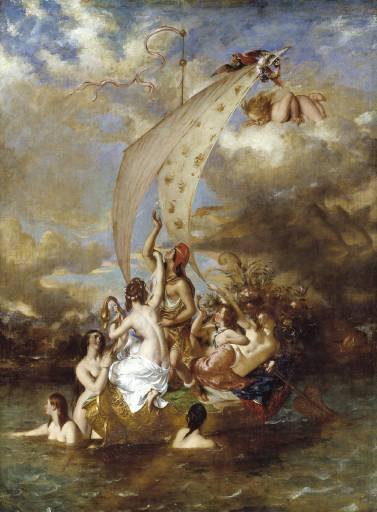
My Daily Art Display feature painting today is entitled Youth on the Prow, and Pleasure at the Helm, which he completed in 1832 and which, when not out on tour, is normally hung in the Tate Britain Gallery in London. The title of the painting comes from a line from the 1757 Pindaric Ode by Thomas Gray entitled The Bard.
Fair laughs the morn and soft the zephyr blows,
While proudly riding o’er the azure realm
In gallant trim the gilded vessel goes;
Youth on the prow, and Pleasure at the helm;
Regardless of the sweeping whirlwind’s sway,
That, hushed in grim repose, expects his evening prey
This poem fascinated many Romantics of the time, like Etty, and he illustrates the line in the poem in this work of his. Paying no attention to the rocking of the golden-prowed boat caused by the Zephyr’s sweeping whirlwind, the almost naked women, in a pyramidic formation, clamber to reach upwards, snatching at the “bubbles of pleasure as they float away.
Etty himself described the subject of the work in a letter to the art dealer C.W.Wass:
“…The view I took of it as a general allegory of Human Life, its empty vain pleasures – if not founded on the laws of Him who is the Rock of Ages…”
Art historians tend to believe the painting which shows the young women playing at catching bubbles despite the onset of a storm is all about Youth in its careless pursuit of pleasure is heedless of impending doom.
According to Leonard Robinson in his book, William Etty, the life and art, the painting was bought by Robert Vernon in 1832. Later that year Vernon bought John Constable’s work, Valley Farm. To house this new acquisition Vernon decided to move Etty’s painting to another position and replace it with Constable’s work. Constable on hearing this wrote to his friend and fellow painter Charles Leslie:
“…My picture is to go into the place – where Etty’s bumboat is at present – his picture with its precious freight is to be brought down nearer to the nose…”
Vernon bequeathed the painting to the National gallery in 1847 and later in 1949 it was transferred to the Tate gallery in London.
As I walked around the main exhibition gallery the majority of the paintings by Etty all included nudes, mainly women but some men and I can see how nineteenth century people were shocked by the works. Of course, for us today who are used to seeing semi-clad or naked women in our daily newspapers and television we are not shocked by the works of Etty and look with some amusement on the puritanical values of the Victorians. Now we tend to concentrate on the beauty of his painted figures. So does nothing shock us these days? I would have said nothing shocks me any more with regards nudity and yet when I stepped from the exhibition gallery to the next door gallery there was a live art performance by an almost naked woman who cavorted and shouted at the few people who had been brave enough to sit on a chair at the edge of her “stage”. Did I take my seat? No, as there seemed to be an element of audience participation I just didn’t have the courage to place myself face to face with the naked female performer. So maybe I can understand how the Victorian people were shocked by what they saw and maybe in another hundred years people will marvel at why I didn’t have the courage to go face to face with my almost naked female live art performer!

 my daily art display