
Laura Sylvia Gosse

Laura Sylvia Gosse (1881-1968)

For a number of years now, probably for centuries, many female artists have been discounted as hobby-painters or painting because art for many was like playing the piano, a social grace that every young woman should achieve.  It is even more annoying when a man and a woman work side by side and yet it is the reputation of the male artist that is remembered.  An example of this is looking at two Camden Town Group artists, one a founder, the other on the periphary as it was an all-male domain.  I am sure you have heard of Walter Sickert but what about his friend and contemporary, Laura Sylvia Gosse.  Sylvia who ?  Let me set the record straight.

The Artist’s Mother by Laura Sylvia Gosse

Sylvia Gosse was actually born Laura Sylvia Gosse but was always known by her Christian name, Sylvia.  She was born in London on February 14th 1881, the youngest of three children.  She had an elder sister, Teresa Emily and an elder brother, Philip Henry.  

Edmund Gosse by John Singer Sargent

Her father, Edmund Gosse was a poet, literary critic and librarian of the House of Lords.  Her mother was Ellen Gosse (née Epps), an artist in the Pre-Raphaelite circle who had studied under Ford Madox Brown, and whose sister, Laura Theresa, an aspiring artist, had married Lawrence Alma-Tadema.

Fountains at Pernes Les Fountaines, Provence by Laura Sylvia Gosse

Sylvia’s family home in Delamere Terrace was in the London borough of Paddington, and was always inundated with people from both the art and literary world with visitors such as the great writers of the time, such as Henry James, Thomas Hardy, Robert Louis Stevenson and Rudyard Kipling.  In early childhood, Sylvia loved to paint and draw and her favourite subject being her pets. At the age of thirteen, Gosse went to an art school in France, where she stayed for three years and she recounted that it was there that she felt she belonged.  She returned to England and studied at the St John’s Wood School of Art.  In 1906, aged fifteen, she enrolled at the Royal Academy Schools.
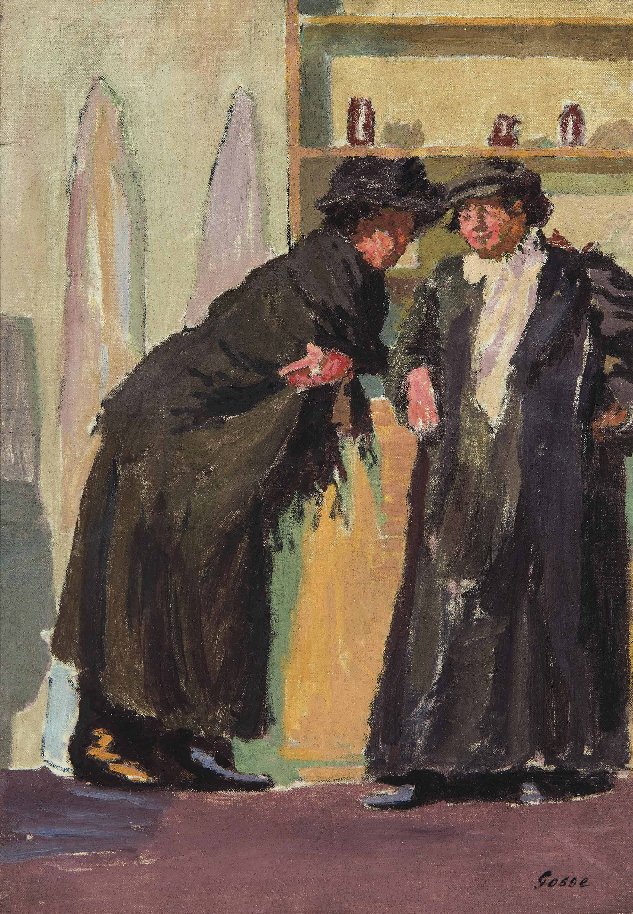
The Gossip by Laura Sylvia Gosse

One of the frequent visitors at the Grosse household was the artist Walter Sickert and it was during one of his visits that he began talking to Sylvia and looked at her artwork.  He was captivated by her work and obvious artistic talent and suggested she learn the art of etching.  Sylvia began to attend Sickert’s evening classes at the Westminster School of Art and in 1909 went as a pupil to his new art school, which he ran with Madeline Knox at 209 Hampstead Road, London.  Sickert’s dual role with Knox at the art school ended when Knox resigned following Sickert’s illness, and having had to run the school singlehandedly.  Sickert approached Sylvia Gosse, his pupil, to see if she would accept the position as associate director. 

Rowlandson House – Sunset by Walter Sickert (1911)

Walter Sickert rented Rowlandson House in Camden Town from 1910–14, during his time with the Camden Town Group. This summertime depiction of the building looks north up Hampstead Road from the back garden, the time of day nearing twilight, which Sickert has indicated by daubs of pink and mauve in the pale sky. The trees in the far background form the edge of Mornington Crescent Gardens. 

Walter Sickert by Sylvia Gosse (1923-25)

Sylvia was made co-director of the Rowlandson House School but did this position alongside Sickert put them on an equal footing?  As a woman in an artistic world which did not always value them, it became clear during her time at Rowlandson House, that her relationship with the Camden Town Group which she was ineligible to join, being a female, despite Sickert being its leader, was not even-handed.  According to Kathleen Fisher, Gosse’s biographer and friend, who wrote Conversations with Sylvia. Sylvia Gosse – Painter, 1881-1968, Sylvia Gosse taught the less-able students at Rowlandson House, as Sickert would grow bored and impatient and dismiss them. The School became known as the Sickert and Gosse School of Painting and Etching.  Silvia served as co-principal from 1910 until it closed in 1914 and during that period, she taught some of the classes and took over responsibility for the practical organisation and finances.  Sylvia Gosse had an independent income, and without her financial backing the school would have closed much sooner.

The school which Gosse and Sickert jointly ran until 1914 when it closed. During those years, Gosse’s own painting career also began to progress. Sylvia Gosse could be described as being slightly introverted (or was she just shy?) and was not known as a very sociable person.  One of her pupils, Marjorie Lilly recalled Sylvia, saying:

“…she might appear at Number 15 [Fitzroy Street] on At Home days, but rarely; being very shy, she always chose the most inconspicuous corner she could find, looking harassed and hunted, and hardly spoke…”

Despite this she was always very supportive of her fellow artists and completely dedicated to Sickert.

Chateau Dieppe by Layra Sylvia Gosse (c.1925)

La Place Saint Jacques by Laura Sylvia Gosse (c.1920)
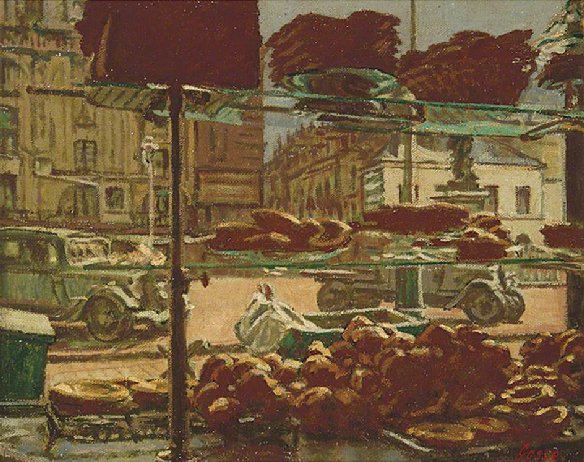
Grande patisserie, Place Nationale, Dieppe, France by Laura Sylvia Gosse (1930)

Walter Sickert had always loved visiting France and would regularly travel to the Normandy coastal town of Dieppe.  Sylvia often accompanied Sickert on his travels, notably when he stayed in Dieppe, and she had a small cottage near his home.  Many of her paintings featured the French town.

Envermeu, France by Laura Sylvia Gosse (c.1920s)

The small town of Envermeu which lies ten kilometres east of Dieppe also featured in many of Sylvia’s paintings.
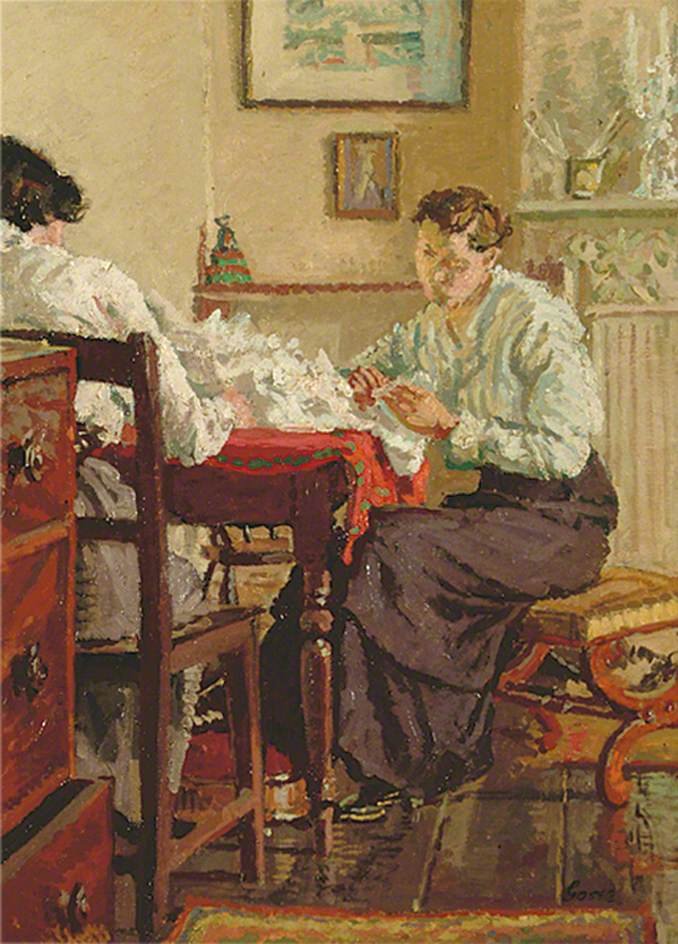
The Seamstress by Laura Sylvia Gosse

Many of the paintings of the Camden Town group focused on the subject of ordinary life, which often concentrated on the life of the poor and dispossessed, and how their life was one of boredom and squalor.  Gosse tended to focus more on the hard-working women, such as the seamstress and the printer.

The Printer by Laura Sylvia Gosse (c.1915)

Sylvia’s painting, The Printer, which she completed around 1915 shows a woman labouring at a press.
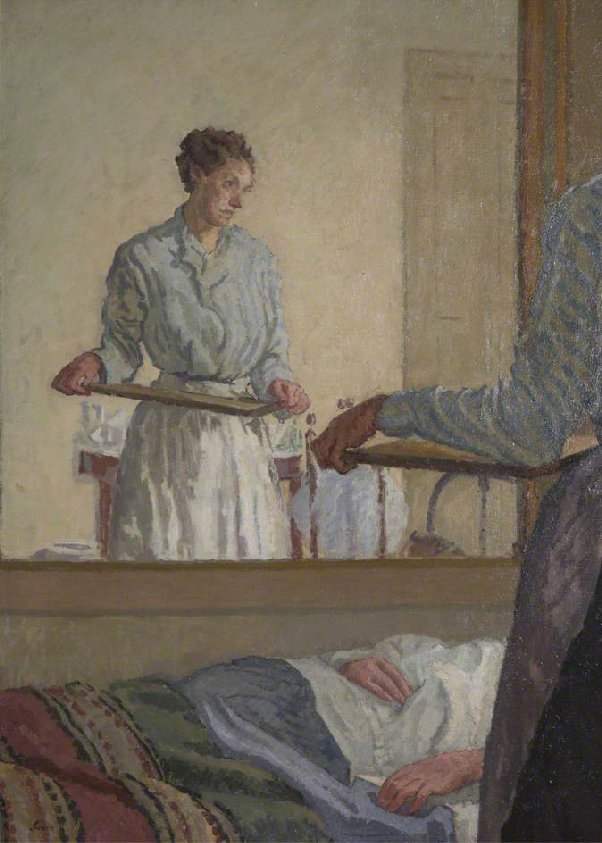
The Nurse by Laura Sylvia Gosse

In her painting, The Nurse, we see her approaching her patient.  In this depiction, we see her as she is reflected in a mirror above the sickbed.  This is not a depiction that beautifies the nursing profession it is simply one that shows us an unglamorous workaday appearance of a nurse tending the sick.
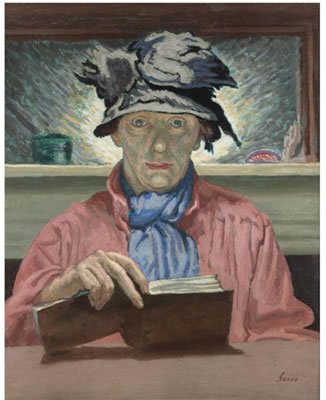
Mrs Alexandra Russell by Laura Sylvia Gosse

During the 1920s and 1930s Sylvia’s paintings were on display at many of best-known commercial galleries. She was elected to the Royal Society of British Artists in 1930 and continued to support Sickert loyally until his death in 1942.

In 1951 Sylvia bought a bungalow in Ore, a large village in the urban area of Hastings, in the county of East Sussex.  It was here that she planned to spend her last days painting, but alas, she suffered from cataracts, which made painting and sketching increasingly problematic.  However, it was her belief that every painter should die with a brush in their hand, so despite her severely reduced vision, she still managed to visit exhibitions and help inspire young artists. She died in the Buchanan Hospital, Hastings on June 6th 1968 at the age of 87.

Ethel Sands and Anna (Nan) Hope Hudson

The blog today is about two talented early twentieth century painters who became lifelong friends and companions despite them having different ideas as to what was a “perfect” life.  Ethel Sands preferred the life of a socialite and enjoyed lavish soirees and was reputed to be one of the most important hostesses in cultured English society in the early twentieth century. However, Nan (Anna Hope) Hudson was more introverted, and craved a quiet rural lifestyle in her beloved France and Sands and Hudson apportioned their time between England and France to accommodate their lifestyle preferences . The art historian Wendy Baron described them as:

“…two independent, individual women with many tastes and interests in common, whose mutual love and understanding rescued them from the loneliness of spinsterhood…”

Ethel Sands (c.1927)

Ethel Sands was born on July 6th 1873 in Newport, Rhode Island.  She was the first-born child of Mary Morton Hartpence and Mahlon Day Sands who married in 1872. It was Mahlon’s second wife.  His first wife Edith Mintum died of typhus in 1868 whilst on a sea voyage.  Mahlon Sands was secretary of the American Free Trade League, as well as being a partner of his deceased father’s pharmaceutical importing firm, A.B. Sands and Company.   Mary and Mahlon also had two young sons, Mahlon Alanson Sands and Morton Harcourt Sands, who were five and eleven years younger respectively than their sister Ethel.  The three children were brought up in a well-to-do upper-class family household.

Still Life with a View over a Cemetery by Ethel Sands (1923)

When Ethel was eleven-years-old the family left America for what was supposed to be a short trip to England but, once there, decided to base themselves in London which they thought was a good base for onward travelling to the European countries.  However, they kept their house in Rhode Island and would return there once every year

Tea with Sickert by Ethel Sands (1912)

Mary and Mahlon moved amongst the wealthy London society, such as the Rothschild family and politicians, such as Gladstone, the writer Henry James and the artist John Singer Sargent.  They were also part of Edward VII, the Prince of Wales’ “Malborough House” social circle. 

Mrs Mahlon Day Sands by John Singer Sargent (1894)

Ethel’s mother Mary was considered to be a famous Society beauty of the day who had her portrait painted by Sargent and Henry James based his heroic character “Madame de Mauves” on her in his novella which centred on the troubled marriage of a scrupulous American wife and a far from scrupulous French husband.  Ethel Sands inherited a taste for socialising from her American parents.

Nan Hudson playing Patience at Chateau d’Auppegarde

Ethel Sands’ happy family life came to a shuddering halt when she was thirteen for in May 1888, her father, whilst out riding through Hyde Park, was thrown from his horse and died, aged 46.  Ethel’s mother was now tasked with bringing up the family on her own.

Nan Hudson c.1908

John Singer Sargent had encouraged Ethel to concentrate on her art and she took his advice for in 1894 when she was twenty-one, she decided to go to spend time in Paris to study painting.  Ethel began her artistic education at the Académie Carrière in Paris. Her early paintings featured highly coloured still-life works and interior depictions. Sands first exhibited her work in an exhibition held at the Salon d’Automne, Paris in 1904.  It was in 1894, whilst an art student that she met her lifelong partner Anna (Nan) Hope Hudson.

The Lamb Inn, Wallingford by Nan Hudson (1912)

Anna Hudson, best known as Nan Hudson, was born on September 10th 1869 in New York City. Her father was Colonel Edward McKenny Hudson, who died in 1892 at the age of sixty-seven; her mother had died in 1878 when Nan was just 9 years old. Having lost both parents, twenty-three year old Nan was left a large inheritance which was the result of her grandfather’s success as a partner of a banknote engraving organization, which later merged to become the American Bank Note Company.  Now, a young woman of independent means, was able to choose her own future. She had developed a love of painting and decided to follow this love and decided that Paris offered the best opportunity to further her artistic knowledge.  In the early days of living in the French capital she met Ethel Sands, a fellow American and art student who became her lifelong friend and companion.

Nan and Ethel studied together in 1896 at the studio of the French painter Eugène Carrière and then from January 1897 Nan also took classes with the Flemish painter Henri Evenepoel.  The friendship between Ethel and Nan, which started as study friends, soon blossomed and before long, they became inseparable.  This closeness is somewhat astonishing as the two women had totally different personalities.  While Ethel Sands found life in London, with all its social distractions, irresistible, Nan Hudson preferred the quieter existence in Paris and the French countryside.  However, they managed to compromise, dividing their time between France and England to satisfy both their yearnings, alternating periods of painting with travelling, socialising and entertaining.

Miss Hudson at Rowlandson House by Walter Sickert (c.1910)

The writer Virginia Woolf, in her diaries, described Nan Hudson as being dour and upstanding who was always stylishly dressed while the artist Walter Sickert, in a letter to the pair, described Nan as being the radiant and dashing horsewoman of a young man’s dreams.  In 1910 Walter Sickert completed a portrait of Nan Hudson, standing hand on hip and looking directly at the viewer, and captures her independent spirit and flair.  The painting was given the title Miss Hudson at Rowlandson House.

Portrait of Ethel Sands by Walter Sickert (1914)

After Nan and Ethel had made a trip to Venice, Nan completed a painting entitled Giudecca Canal and she had it exhibited at the Salon d’Automne in 1906.  It was liked by the critics and greatly admired by Walter Sickert. At first, he did not realise that the work was by her but once he found out he contacted her offering her advice on painting for the future. This initial letter to her resulted in a long-running correspondence between them and genuine friendship that lasted for many years. In 1907 Sickert invited both Nan Hudson and Ethel Sands to join the Fitzroy Street Group, which he had just formed and meetings were held in his studio in Fitzroy Street, to the north of central London.  The reason for this invitation could be because he admired their work or cynics would say it was more to do with their financial and social status both of which Sickert wanted to “explore”.  Both women accepted the invitation. Their main purpose of the group was to explore contemporary styles and methods, which they believed would challenge the conventional traditions of the New England Art Club. It was to be the establishing of the first artists’ collective.

Ethel Sands by Lady Ottoline Morrell vintage snapshot print, 1909 NPG Ax140123 © National Portrait Gallery, London

In 1911 many of the Fitzroy Group Group’s members, including Walter Sickert, formed the nucleus of the new Camden Town Group, and by November 1913 the Fitzroy Street Group had ceased to exist.  Unfortunately for Ethel and Nan the Camden Town Group was only open to male artists and so neither Nan or Ethel were not invited to join this new group. However, in 1913, a new grouping was formed known as the London Group.  The London Group was formed by a merger of the Camden Town Group and the English Cubists, later known as the Vorticists. It was the coming together of radical young artists who were defying the stranglehold which the Royal Academy had on exhibiting new works of art. The group was open to both male and female artists and Ethel Sands and Nan Hudson became founder members.

The Visitor by Nan Hudson

Up till this time Nan Hudson had only exhibited her work in Paris at the Salon d’Automne but through Ethel Sand’s contacts within the London art scene she began to show her work in London and exhibited her work at the New English Art Club, the Allied Artists’ Association and the Leicester Galleries.

Château d’Auppegard by Nan Hudson

At the start of the First World War, Hudson and Sands went to France and helped set up a hospital for wounded soldiers near Dieppe. This was forced to close but Nan Hudson continued to nurse both in England and in France until autumn 1918.  During the spell in Normandy during the war Nan Hudson fell in love with the area and after the war in 1920, she bought the Château d’Auppegard.  It was a seventeenth-century house with a grey slate gabled roof which lay about ten miles inland from Dieppe in the Normandy countryside.  This became their dream home and she and Ethel Sands spent the summers together and devoted much time and energy in its restoration and decoration. The two women renovated the dilapidated dwelling, even commissioning murals from the Bloomsbury artists Vanessa Bell and Duncan Grant for the loggia.

A Dressing Room by Ethel Sands

Nan Hudson completed a painting depicting her beloved chateau which is now part of the Tate collection.  She used a restricted palette of cool tones.  The depiction is typical of her later works when she tended towards landscapes with an element of architectural interest.   From 1926 onwards Nan concentrated on depicting rural landscapes found around the outskirts of Dieppe and the commune of Auppegard.  Many other landscape works came from the extensive touring around France in the Spring and early Autumn done by her and Ethel Sands.

Honfleur Harbour by Nan Hudson

Very few of Ethel Sands and Nan Hudson’s paintings survived the Second World War. Ethel Sands’ house in London was destroyed following a direct hit on it during the Blitz which obliterated much of both of their work. As well as this, Château d’Auppegard itself sustained extensive damage from bombing and looting that followed, when many drawings and paintings, including a collection of works by Sickert and Augustus John, were stolen, never to be seen again. It is very likely that paintings by the Ethel and Nan were therefore lost too.  Ethel and Nan returned to Auppegard in May 1946 and were horrified to witness the devastation of their beloved home.   One visitor to the chateau was Vanessa Bell who visited them in that September and she wrote about what she witnessed first-hnd:

“…The house has been terribly damaged by a flying bomb which exploded near. They have managed to repair the worst things and when one drives up to it [it] is still very lovely. But inside only the dining room is usable, and they have hardly any furniture and just enough for themselves. Poor old things – as they say, they are too old to begin all over again and they certainly do look very aged and decrepit…”

Still Life with Picture of the Madonna by Ethel Sands

However. the two occupants of the chateau, both then in their seventies, would not be defeated by the devastation and set about trying to repair it.  Age finally defeated them as far as renovating the chateau and Nan began to worry about its fate once she and Ethel had died.  In the end they decided to give the house over to a young friend of theirs, an amateur painter, Louis le Breton, on the understanding that it would eventually be bequeathed to the French nation. He, like the two owners of the chateau, shared their passionate love of the house and they felt sure that after they had died, his love of the Auppegard property would be preserved and cherished. Hudson and Sands continued to live at the château within a specially adapted self-contained apartment but their careful planning for the future of the building came to naught when Louis le Breton pre-deceased both of them, dying suddenly in the garden at Auppegard in March 1957.

Still Life with Books and Flowers by Ethel Sands

Nan Hudson became too ill to live there and was cared for initially by her life-long companion, Ethel and latterly at a nursing home in Kilburn, London, dying just a few months later in September 1957 aged eighty-eight.

Auppegard Church from the Chateau by Ethel Sands

Her funeral was held at Auppegard and she was buried in the churchyard facing her beloved château.

Ethel Sands died on March 19th 1962, aged eighty-eight.

Ennui by Walter Richard Sickert

Ennui by Walter Sickert (c.1914)

Yesterday we looked at a painting by Robert Polhill Bevan and talked about the Camden Town Group of artists and its leading light the Munich-born Walter Sickert.  Today I want to look at the life of Sickert himself and at one of his best known paintings.

Walter Richard Sickert was born in Munich in 1860.  His father, Oswald Sickert, who was technically of Danish nationality, always considered himself German and did not speak Danish.  Oswald Sickert was a dramatic genre and landscape painter.  Walter’s mother was Eleanor Louise Moravia Sickert (née Henry) who was the illegitimate daughter of Richard Sheepshanks, the English astronomer, and his Irish lover.   Oswald and Eleanor had three children, two sons, Walter and Bernhard and a daughter Helena, who as Helena Swanick was to become a well-known suffragist and pacifist.  Walter Sickert’s parents had left Munich in 1851 and settled in London around the time of the Great Crystal Palace Exhibition.  At the age of ten, Walter was sent to the University College School in Hampstead, North West London and after a year he moved to the King’ College School at Wimbledon where he remained until the age of eighteen.  He applied to join the British Museum for a position in their department of coins and medals but was turned down.

Both Walter Sickert’s father, Oswald and his paternal grandfather, Johann were painters so one may have thought that Walter would follow their artistic trail but after his job application failure he decided to turn his attention to acting and his main ambition now was to become an actor.  In his early days he managed to play small parts in Sir Henry Irvine’s touring theatrical company using the pseudonym, Mr Nemo.   He soon realised that he was not going to make the grade as an actor and turned towards art.  He briefly attended the Slade in 1881 but left and began to work as an assistant to the American artist, James McNeill Whistler, who had been living in the English capital for a number of years.  Whilst working in Whistler’s studio, Whistler entrusted Sickert to travel to Paris with the painting, Portrait of the Artist’s Mother, which he had just completed and wanted to present it to the Paris Salon for their exhibition.   Whistler also gave Sickert two letters of introduction; one to Manet, but at the time Manet was seriously ill and could not see Sickert and one to Degas, whom he met.  Sickert was very impressed with Degas and his work and received much advice on his painting technique.  The works of Degas would greatly influence Sickert in the future.  Sickert was now twenty-three years of age and even at this young age he had already come upon the three greatest influences of his future artistic career, namely, the theatre, Whistler and Degas and the young Sickert from this point of his life, never looked back.  Whistler had instilled in Sickert the importance to constantly record what he saw and would often walk around with a copper plate and an etching needle in his pocket.  Sickert exhibited for the first time in 1884 at the Society of British Artists in London and signed himself simply as “pupil of Whistler”.  His early paintings were of life in London music halls highlighting the roles of the audience, musicians and actors, somewhat similar to Degas’ paintings of the dancers and café-concert entertainers.  There was an underlying sexual theme in a number of these paintings but it should be remembered that just as in Degas’ Paris,  female performers on London stages were looked upon as having similar morals to prostitutes of the London streets.

In 1885, aged twenty-five, he married the daughter of a Liberal politician and spent many of the ensuing summers in Dieppe. He also was a regular visitor to Venice. In 1893, with the help of James Whistler’s patronage, he opened an art school in London. He often exhibited his theatre and music hall-themed works at the New English Art Club, which had been founded in 1886 in opposition to the Royal Academy. He also took part in the exhibition of British Impressionists held in London in 1889.   One of his last trips to Venice was dogged by bad weather and Sickert’s desire to paint en plein air was dashed.  It is thought that the old adage “necessity is the mother of invention” happened for Sickert as he was forced to paint indoors  and it was at this point in time that he started to develop his own distinctive approach to the multiple figure tableau that would continue after he returned to England.  According to the author Robert Upstone in his 2009 book,  Sickert in Venice, Sickert would employ prostitutes to sit for his Venetian paintings, many of whom he would later have a physical relationship with.

Walter Sickert was fascinated with the under-belly of London life and based his studio in a working-class area of London.  In 1905 his studio could be found in Camden Town and this was to be the favoured location and meeting place for Post-Impressionist artists of the time.  It was here in 1911 that the Camden Town Group of artists was founded under Sickert’s leadership.  The list of artists who met there on a regular basis was like a Who’s Who of Post-Impressionists with the likes of August John, Lucien Pissarro, Henry Lamb and Wyndham Lewis just to name a few.  A couple of years later the Camden Town Group came together with the Vorticists, which was a short-lived modernist movement in British art and poetry along with other like minded artists’ associations which wanted to challenge the domination of the Royal Academy which they believed had become both unadventurous and conservative.  This newly founded artistic conglomerate was known simply as The London Group and still survives today.

Sickert became an associate of the Royal Academy in 1924 and an Academician ten years later.  Shortly afterwards, however,  he resigned in protest against the hostile attitude of the president toward the work of Jacob Epstein. Much of his later career was devoted to teaching and writing.  In 1941 Sickert was honoured with a one-man exhibition at the National Gallery in London. The next year he died in Bath, aged 82.

My Daily Art Display featured work today is entitled Ennui by Walter Sickert which he completed around 1914 and which can now be found in the Ashmoleon Museum in Oxford.  It was painted at Sickert’s London studio in Fitzroy Street.  The title of the painting is the French word for boredom and in the painting Sickert depicts a man and a woman, who despite being portrayed in close physical proximity, seem to have lost the art of communication, which in turn has led to a dislocated relationship.  One presumes it is a husband and wife but could also be a father and daughter but the sense of disarticulation is still the same.  They both gaze into space.  They face opposite directions.  Their thoughts are their own. Don’t you wonder what is passing through their minds?  Maybe they contemplate on what went wrong with their relationship and what would have been their future if they had never met.

On the chest of drawers which the woman is leaning against there is a bell jar which contains an array of stuffed birds.  Their entrapment under the glass dome is symbolic of the entrapment of the two humans in their relationship.  On the wall we see a painting which appears to be of a music hall diva and the melodrama which goes with her profession which of course is in complete contrast to the scene she looks down upon.  The model for the man in the painting was “Hubby” who was an old school friend of Sickert and who had fallen on hard times and whom Sickert gave shelter and kept in beer over a number of years.  The woman was Marie Hayes, a woman who had modelled for Sickert on a number of occasions

Virginia Woolf, who met Sickert in 1923 and 1933, argued that Sickert’s pictures could be classified as stories in their ability to stimulate and develop plots and dialogue. However Sickert disagreed saying that if the subject of a painting could be stated in words there would be no need to paint it.

So what do you think is going on in the painting?  I will leave you with Virginia Woolf’s description of what she saw in the painting:

“…the picture of the old publican, with his glass on the table before him and a cigar gone cold at his lips, looking out of his shrewd little pig’s eyes at the intolerable wastes of desolation in front of him. A fat woman lounges, her arm on a cheap yellow chest of drawers, behind him. It is all over with them, one feels. The accumulated weariness of innumerable days has discharged its burden on…”