Thérèse Schwartze

Thérèse Schwartze – self portrait (1917)

Therese Schwartze was a Dutch 20th century painter.  Such was a hugely talented portrait artist that was one of only a few females who had been honoured by receiving an invitation to contribute her self-portrait to the hall of painters at the Uffizi Gallery in Florence.  This genius of portraiture completed around a thousand works during her forty-year career, which means that she completed more than twenty paintings a year. Because many of her portraits were created to be treasured by family members, most of her work has remained in private collections.  About one hundred and fifteen of her paintings are in public collections in the Netherlands, and twelve are part of foreign public collections, which leaves the locations of nearly four hundred paintings still unknown. She became a millionaire in the process. Schwartze also established an international reputation, with countless exhibitions and commissions throughout Europe and the United States. 
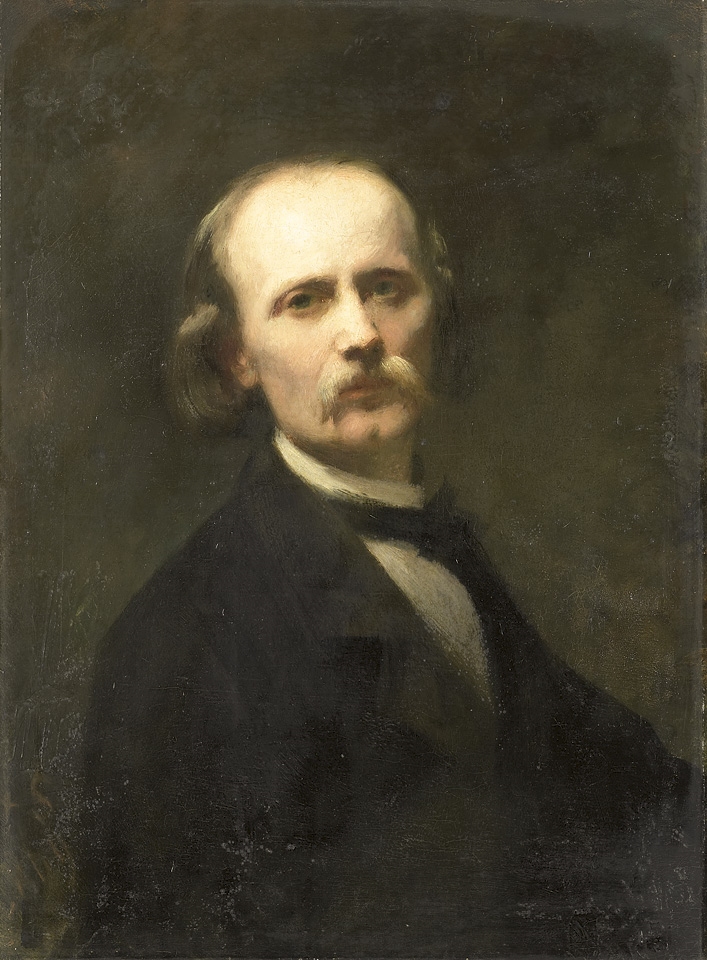
Self Portrait by Johan Georg Schwartze

Thérèse was born on December 20th 1852 in Amsterdam.  She was the daughter of Johan Georg Schwartze and Maria Elisabeth Therese Herrmann.  She was one of five children and had four sisters including Georgine, a sculptor, Clara Theresia, a painter and one brother, George Washington Schwartze, also a painter. 
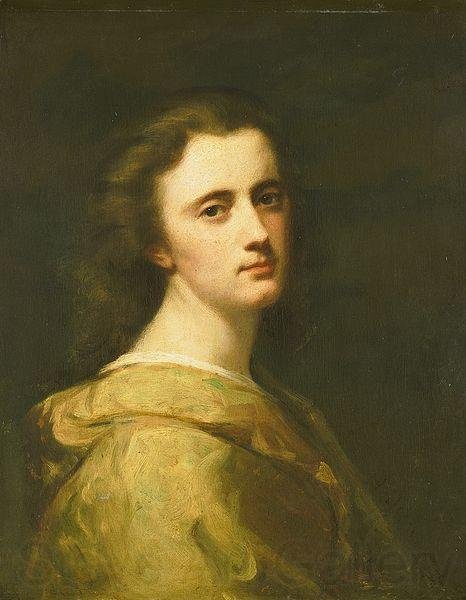
Portrait of Thérèse aged 16 by her father, Johan Georg Schwartze (1869)

Her father was a well-respected portrait painter and it was he who provided Thérèse with her first artistic training.   In 1869 her father completed a portrait of his daughter, Thérèse.

Three girls of the orphanage in Amsterdam by Thérèse Schwartze (1885)

At that time, there was the perception that teaching girls and young ladies to paint was seen simply as a part of a cultured upbringing rather than a profession for earning money which was viewed as the role of the man. But for Johann Schwartze he couldn’t care less about such conventions. He trained his daughter in painting and drawing from a very young age and intended that Thérèse would become his worthy successor. She started her professional career at the age of sixteen, working in her father’s studio which she eventually took over when she was twenty-one after his death in 1874. Schwartze wrote to her father in a birthday letter, writing:

“…I will apply myself more to everything, so as, with God’s blessing, to be able to earn my living by painting…”

Because the art academies were not yet open to girls, her father sent her to Munich for expensive private lessons for a year under Gabriel Max and Franz von Lenbach who was regarded as the leading German portraitist of his era. In 1879 she moved to Paris and continued her artistic studies under Jean-Jacques Henner, the Alsace-born portrait artist.
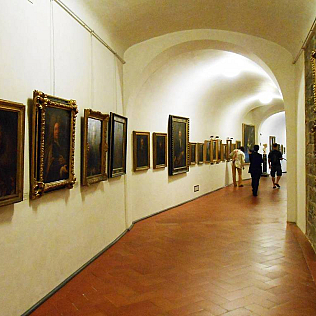
The Vasari Corridor at the Uffizi Gallery, Florence

Thérèse Schwartze’s portraits are truly remarkable and she was one of the few women painters, who had been honoured by an invitation to contribute her self-portrait to the Hall of Painters, the Vasari Corridor, at the Uffizi Gallery in Florence. The Uffizi collection is one of the most complete in all Europe, first started by Cardinal Leopoldo de’ Medici in the 17th century.  The passageway was designed and built in 1564 by Giorgio Vasari to allow Cosimo de’ Medici and other Florentine elite to walk safely through the city, from the seat of power in Palazzo Vecchio to their private residence, Palazzo Pitti.   The passageway used to contain over a thousand paintings, dating from the 17th and 18th centuries, including the largest and very important collection of self-portraits by some of the most famous masters of painting from the 16th to the 20th century, including Filippo Lippi, Rembrandt, Velazquez, Delacroix and Ensor.   While the Medici family bought the first paintings, after the collection started, the family started receiving the paintings as donations from the painters themselves. This has continued over the centuries and there were more paintings in the collection that did not have space to be exposed.  Things have now changed as from 1973 to 2016, some of the self-portraits which had been hung in the Vasari Corridor, were, however only visible during restricted and occasional visits because of the confined space, which, also lacked air conditioning and adequate lighting.  Most of the self portraits have been moved to other rooms at the Uffizi.
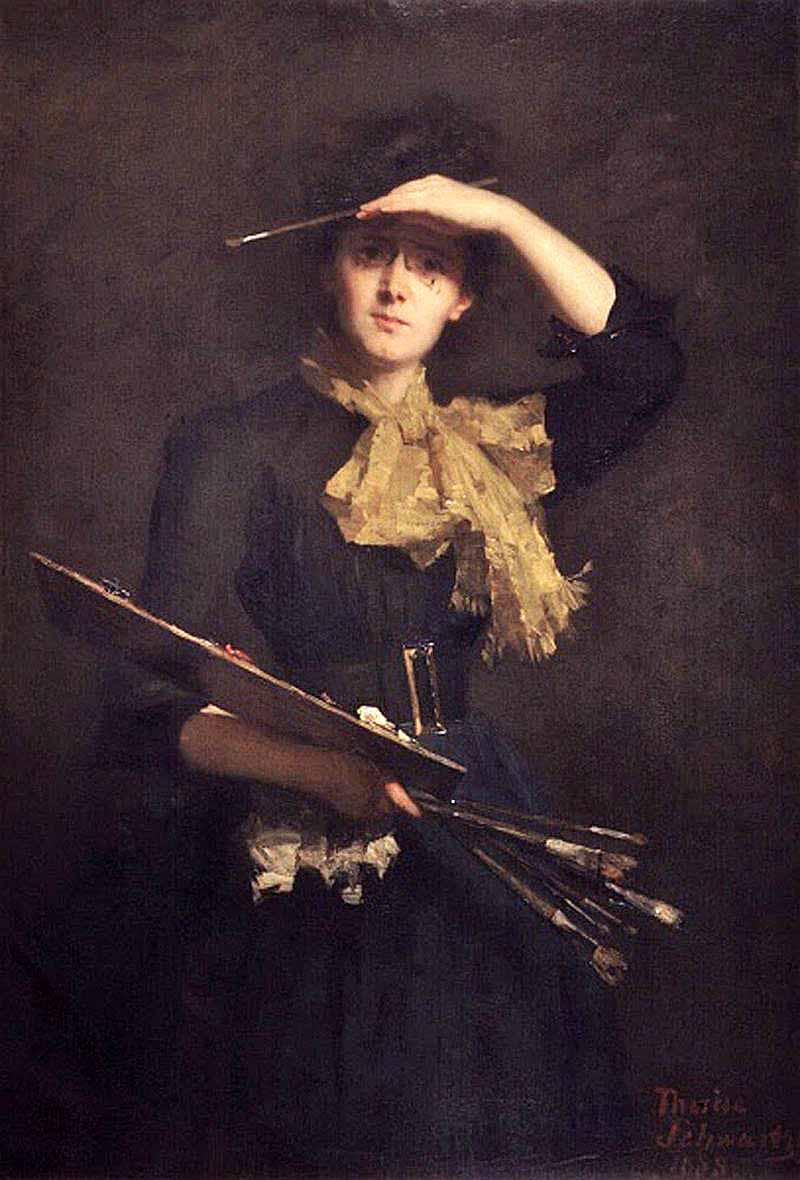
Self-portrait with Palette by Thérèse Scwartze (1888)

Only a handful of female portrait painters were active professionally in the 19th century, one of whom was Schwartze, who was nicknamed the ‘Queen of Dutch Painting’.  In the self portrait she contributed to the Uffizi entitled Self-portrait with Palette, she depicts herself staring out at us with a haunted look, paintbrush in one hand with the other looped through a paint-laden palette. The background of this canvas is bare, and our eyes are drawn to the painter’s tools: eyes, brush, pigments, and a rag at the ready. The painting was exhibited at the 1888 Paris Salon before being given to the Uffizi gallery in Florence.
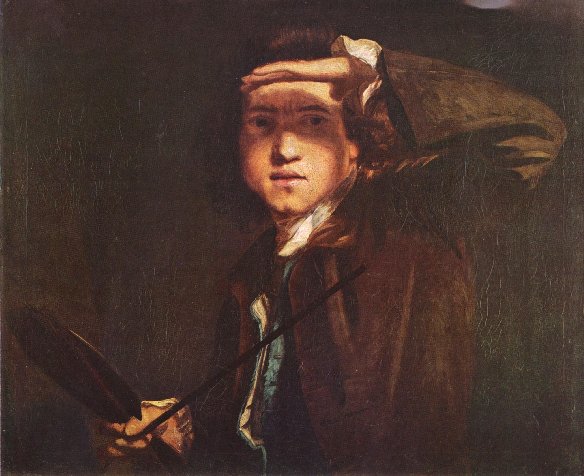
Sir Joshua Reynolds self portrait (c.1748)

Thérèse’s depiction of herself in her self-portrait could well have been inspired by Sir Joshua Reynold’s self-portrait which shows him similarly with his hand raised shielding his eyes from the bright light.
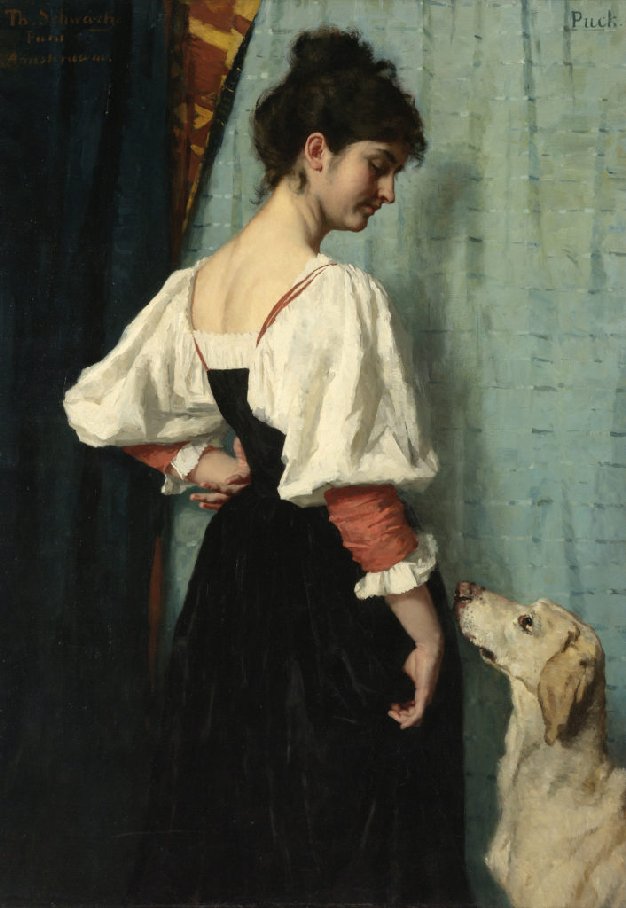
Young Italian Woman, with ‘Puck’ the Dog by Thérèse Schwartze, c. 1885)

Whilst living and studying in Paris, Thérèse completed her painting, Young Italian Woman, with ‘Puck’ the Dog.  The model she used for this painting was known as Fortunata.  She was one of the many professional Italian models working in Paris in the late 19th century. Schwartze started this painting in 1884 and exhibited it a year later in Amsterdam, having added the dog in the meanwhile.
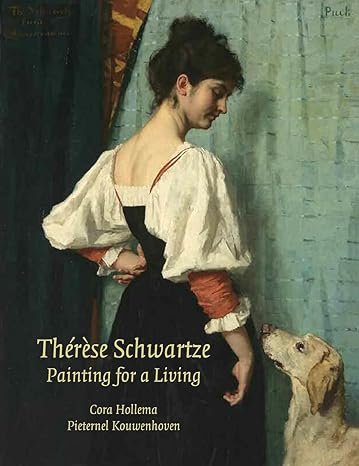
According the 2021 biography by Cora Hollema and Pieternel Kouwenhoven entitled Thérèse Schwartze: painting for a living. Thérèse’s career took off at a time when a new, wealthy Dutch class wanted to flaunt its status and what better way to achieve this than with a flattering portrait. Her biographer wrote:

“She was in demand because she produced a new elegant, un-Dutch, extravagant, flattering style of portraiture which was in demand by the upcoming ‘new money…….. The new entrepreneurs and industrialists in the second half of the 19th century…”

Portrait of Aleida Gijsberta van Ogtrop-Hanlo with her five children by Thérèse Schwartze (1906).

Schwartze was one of the leading society painters in the Netherlands around 1900. Her clientele came from the nobility and the bourgeois elite in Amsterdam and The Hague. Members of the royal family also sat for her.   A good example of her excellent portraiture is her 1906 group portrait of Aleida Gijsberta van Ogtrop-Hanlo with her five children.  In this work, Aleida van Ogtrop-Hanlo is surrounded by, from left to right: Adriënne (Zus), Pieter (Piet), Maria (Misel), Eugènie (Toetie) and Adèle (Kees). The youngest and sixth child, Joanna (Jennie) was not yet born.  Her husband was a wealthy stockbroker and founder of Amsterdam Royal Concertgebouw. The portrait of his wife and children has a dreamy quality, with rich clothing and poetic colours. It gives an excellent impression of the self-image of the Dutch upper classes at the beginning of the twentieth century.  Stylistically Thérèse Schwartze followed in the footsteps of the famous eighteenth-century English portrait painter, Thomas Gainsborough. 

 Portrait of the six Boissevain daughters by Thérèse Schwartze (1916)

An equally great group portrait by Thérèse Schwartze was her Boissevinfamily portrait but this a more decorous depiction.  It is entitled Portrait of the Six Boissevain Daughters and she completed it in 1916. According to Schwartze’s biography by art historian, Cora Hollema, this difference in style was not due to a development of the artist, but more to do with the wishes of her client. Mr. & Mrs. Boissevain, who were wealthy members of the Amsterdam upper class had ten children, six daughters and four sons. They were aware of the portrait of Aleida and her children by Thérèse but believed it to be far too modern.   So, when they commissioned Thérèse to paint the portrait in 1916 they asked her to produce a more time-honoured portrait of their daughters. Thérèse was now the breadwinner of the family and so sensibly adapted her style according to her client’s demands bearing in mind the adage: The client was king.

Thérèse Schwartze in her studio, Prinsengracht 1021, Amsterdam, 1903.

Thérèse’s great success as an artist became a point of reference for the young Dutch women painters who founded the Amsterdamse Joffers, a group of women artists who met weekly in Amsterdam at the end of the 19th and beginning of the 20th century. These “ladies of Amsterdam” met weekly, often at the Schwartze home, to update the glorious Dutch tradition of painting based on French Impressionist innovations.  They supported each other in their professional careers. Most of them were students of the Rijksakademie van beeldende kunsten and belonged to the movement of the Amsterdam Impressionists.

Woman wearing a hat (Portrait of Theresia Ansingh (Sorella)), by Thérèse Schwartze (after 1906).

Besides Schwartze’s commissioned portraits, which made her very wealthy, she still had time to complete portraits of her friends and relatives which were not commissioned and were often given as gifts.  A fine example in this regard is the portrait of Schwartze’s niece, Theresia Ansingh, who later became a member of the Amsterdam school of female painters known as The Joffers, many of them were inspired by Schwartze’s professional success. 
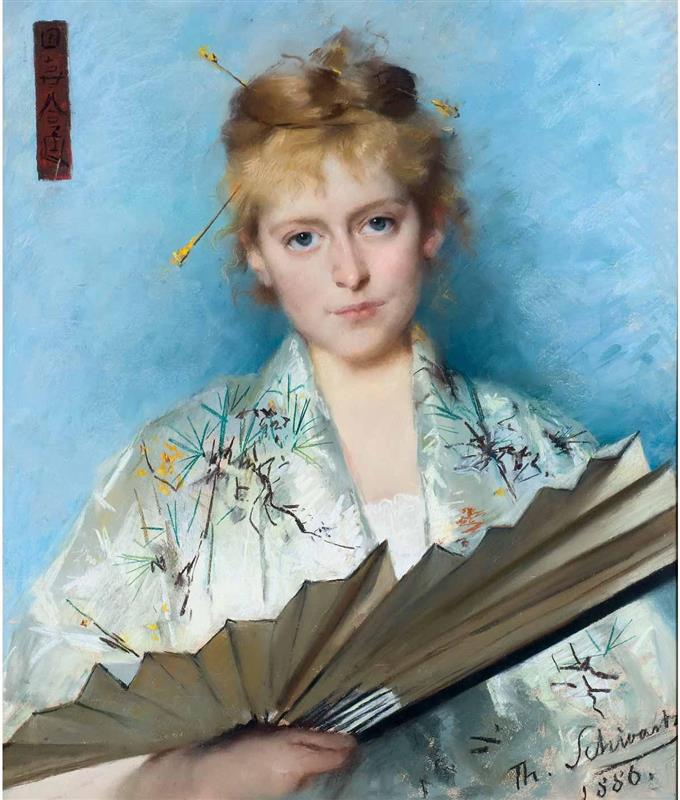
Maria Catharina Ursula (Mia) Cuypers by Thérèse Schwartze (1886)

One of my favourite portraits by Schwartze was her fascinating portrait of one of her friends, which is an amalgam of formal and informal portraiture and is entitled Portrait of Mia Cuypers.  She was a daughter of the architect Pierre Cuypers, who designed such famous buildings as the Rijksmuseum and Amsterdam’s Central Station. In 1883, she fell in love, to the dismay of her family and the astonishment of “high society,” with the Chinese-British merchant Frederick Taen-Err Toung from Berlin, who was in Amsterdam selling his Oriental merchandise at the International Colonial Exposition. Mia managed to overcome the social uproar and married Toung in 1886.  Being a close acquaintance of the Cuypers family, Thérèse was commissioned by the groom-to-be to make this wedding portrait, which is said to have only taken her one and a half days to complete.  There are Chinese characters in the upper left corner, which are not clear in my attached photo, which mean “rice field,” “longevity”/”delighted,” and “coming together.”
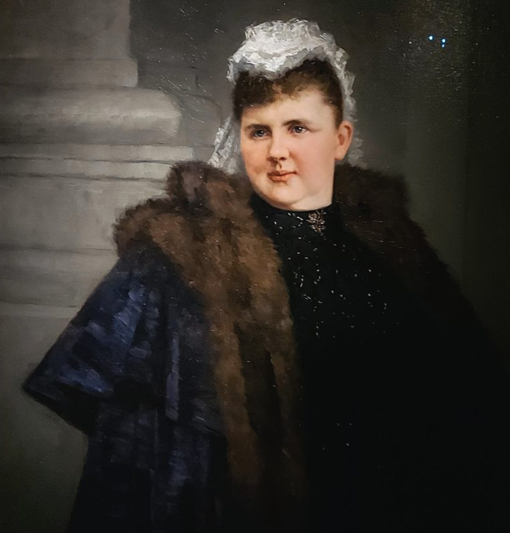
Portrait of Queen Emma by Thérèsa Schwartze (ca. 1881)

Soon after, she received a commission for a portrait of Queen Emma and the little princess Wilhelmina, who was born in 1880. In the single portrait of the young queen, she is dressed in dark colours against a neutral background, all is dark except her face. In this painting, one can already see the fine art of portraiture and the depicting of differing textures that Thérèse fully mastered. The fur stole, the lace cap on her head, as well as the brocade of the queen’s robe.
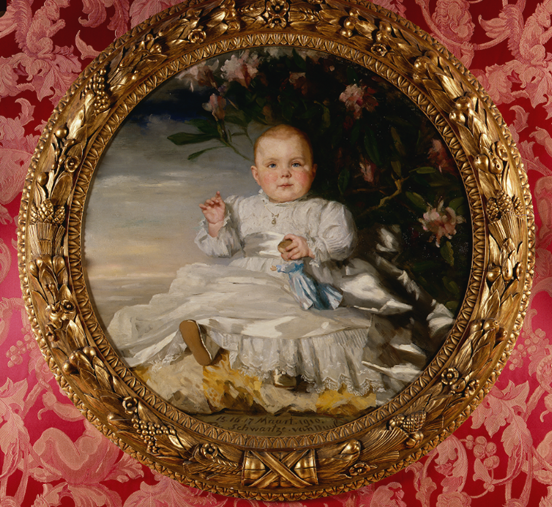
Portrait of Princess Juliana by Thérèsa Schwartze (1910)

Thérèse’s worked with the royal family of the Netherlands through a period of thirty-five years and in all they gave her six commissions that contributed greatly towards her fame and wealth. Most royal portraits were of Queen Wilhelmina.
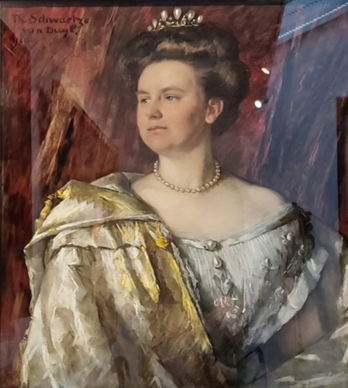
Portrait of Queen Wilhelmina by Thérèse Schwartze (1910)

The royal court had a habit of paying a little more than the average client, which meant that 1910 was a particularly profitable year for Thérèse.  She painted so many members of the royal family that she was almost deemed a member of their household.
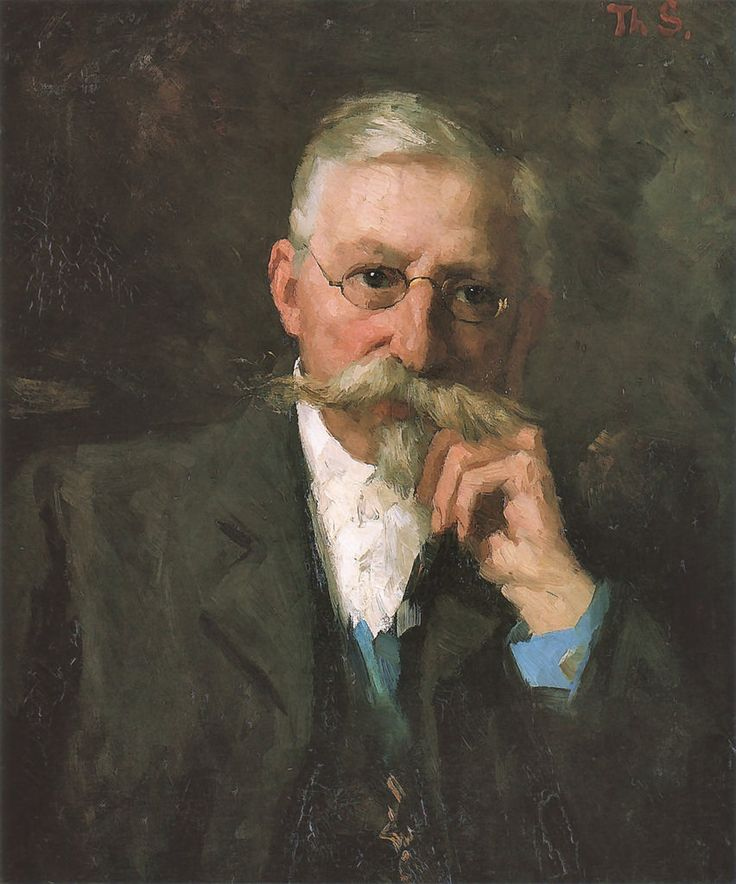
Portrait of Anton van Duyl by Thérèse Schwartze

In 1906, Thérèse Schwartze married the editor-in-chief of the Algemeen Handelsblad, Anton van Duyl. Twelve years after they married, Thérèse’s husband died on July 22nd 1918.  It was double blow for Thérèse as she herself had been very ill at the time and five months later, on December 23rd 1918, three days after her sixty-seventh birthday, she died in Amsterdam.  
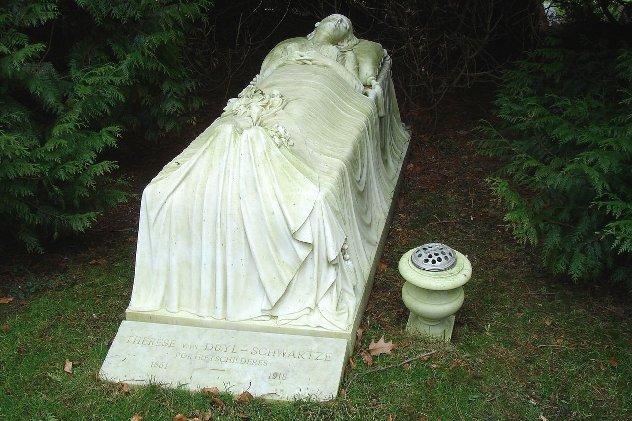
Grave of Thérèse Schwartze at the Nieuwe Ooster cemetery, Amsterdam.

She was buried at Zorgvlied cemetery in Amsterdam but was later reburied at the Nieuwe Ooster cemetery in Amsterdam, where her sister created a memorial to her, modelled after her death mask, which is now a rijksmonument.

Walter Langley the Social Realist painter and the Newlyn Art Colony

Walter Langley, from a chalk drawing by Hubert Vos. From Newlyn and the Newlyn School, Magazine of Art, 1890

In eighteenth century France, Rococo was the popular style of art. Painters such as Antoine Watteau, Jean-Honoré Fragonard and François Boucher had given art lovers a highly ornate and decorative form of art with its elegant, delightful, if somewhat voyeuristic, depictions of the good life. There was a playfulness about the depictions and all thoughts of seriousness was substituted by eroticism. The minority who were able to live the lifestyle shown in the Rococo paintings were pleased with what they saw but of course this was not real life for many of the citizens. Change had to come, and it did in the form of Realism. One of the leaders of this movement was the French artist, Gustave Courbet and he set out a manifesto, La Réalisme which stated that art should be about truth and depictions must be objective records. Realism was to be an art in which the painter put on his canvas what he saw, “warts and all” and not be concerned as to whether it was appropriate or inappropriate. This new form art was to move away from bourgeoise tastes.

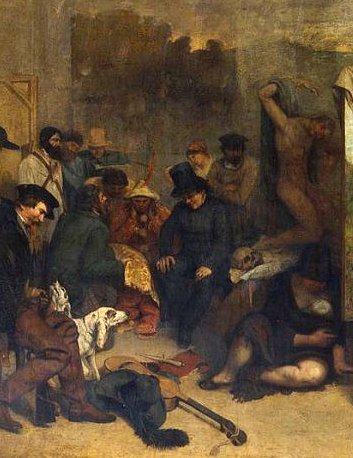
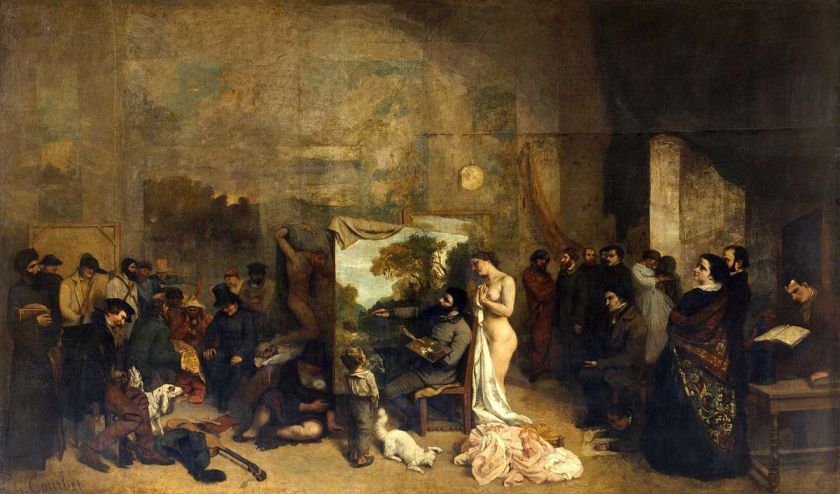
The Artist’s Studio by Gustave Courbet (1855)

Probably Courbet’s most famous painting was pure Realism. It was entitled The Artist’s Studio, which he completed in 1855. The work baffled many, so much so Courbet clarified the ideas behind the depiction, declaring:

“…It’s the whole world coming to me to be painted. On the right, all the shareholders, by that I mean friends, fellow workers, art lovers. On the left is the other world of everyday life, the masses, wretchedness, poverty, wealth, the exploited and the exploiters, people who make a living from death…”

The group to the right……..

The painting depicts two groups of men and women. In the first group on the right, there is the bearded profile of the art collector Alfred Bruyas, and behind him, facing us, the philosopher Proudhon. Jules François Felix Fleury-Husson, who wrote under the name Champfleury.  He was a French art critic and novelist, and a prominent supporter of the Realist movement in painting and fiction, and is seated on a stool, while the French poet and essayist Charles Baudelaire is absorbed in a book. In the right foreground we see a couple who exemplify a pair of art lovers, and in the background, near the window, we see a couple unashamedly wrapped in a loving embrace and they have been included to symbolise free love.

…………….and to the left

However, the group on the left symbolise the reality of life. There is a priest, a merchant, a hunter, and even an unemployed worker and a beggar girl symbolising poverty. These last two insertions were controversial. Look on the floor by the dog and you will see a dagger, a guitar and large hat with a black plumed feather. Courbet added these items alluding to what was often seen in Academic art.

Courbet and the landscape painting

In the centre, Courbet sits at his large-scale painting of a beautiful landscape with its blue sky and verdant background and this is in direct contrast to the depiction of his grimy and crowded studio. This is a reminder of the difference between real life and an idealised life. This work was destined to be exhibited at the 1855 Universal Exhibition but was rejected on the ground of it being too big but maybe it was because it was too controversial. Courbet, however, was determined that the work should be seen by the public and so, not to be deterred, Courbet, at his own expense, built a Pavilion of Realism close to the official Universal Exhibition site and showed this work and thirteen others including his famous A Burial at Ornans.

Hope by Frank Holl (1883)

From this eighteenth century Realist movement came Social Realism which developed to pictorially arouse concerns about the squalid living conditions suffered by urban poor, and farming and fishing communities. In Britain, artists such as Luke Fildes, Hubert von Herkomer, Frank Holl, and William Small were at the forefront of this movement. In America the beginnings of Social Realism started life with the Ashcan School painters, who in the early 20th century depicted through their art, the everyday, stark, and unglamorous truths of city life. Artists such as John Sloan, Robert Henri, George Bellows, and George Luks were prominent members of this diverse group who painted scenes from everyday life.

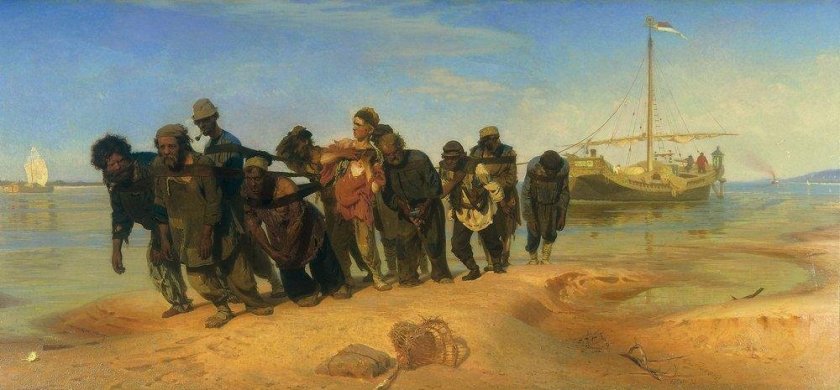
Barge Haulers on the Volga by Ilya Repin (1870-1873)

In Russia, Social Realism came in the form of paintings by Ilya Repin who declared that the reason for his art was to show and criticize all the monstrosities of our vile society of the Tsarist period.  One of his most famous Realist paintings was his 1883 work entitled Barge Haulers on the Volga.

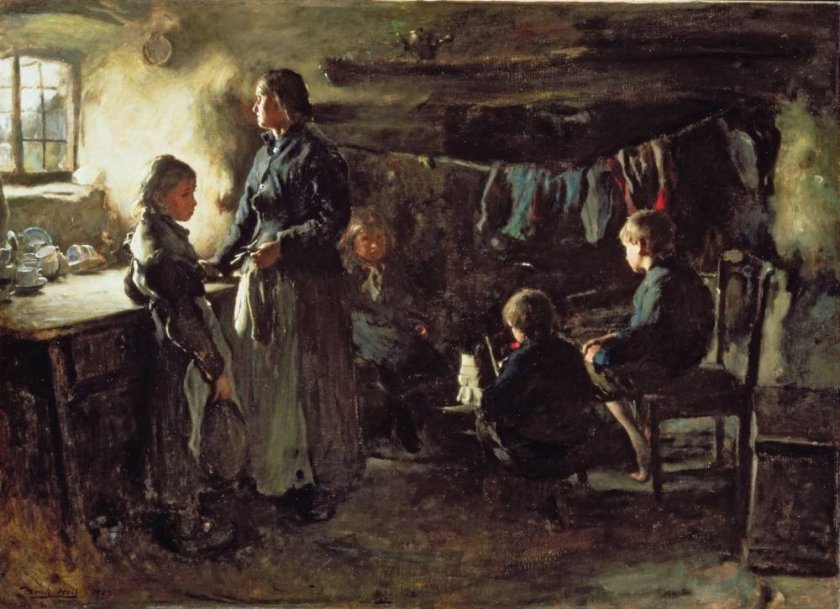
Waiting for the Boats by Walter Langley (1885)

The reason for this introduction regarding Realism and Social Realism is that the artist I am looking at today is an English Social Realist painter. His name is Walter Langley. He was born in Birmingham, England on June 8th, 1852. Although attending normal school, because of his interest in drawing and painting and artistic ability, at the age of ten, he was also enrolled for evening classes at the Birmingham School of Design. He left school at the age of fifteen and was taken on as an apprentice to a lithographer, August Heinrich Biermann, but still continued with his classes at the School of Design. Langley began to teach himself to paint, and first exhibited three water colours at the Royal Birmingham Society of Artists in 1873. His wish was to become a professional artist and that year, at the age of twenty-one, he won a scholarship to the National Art Training School in South Kensington, now known as the Royal College of Art. It was there that he took part in a two-year design course and began to exhibit his works of art.

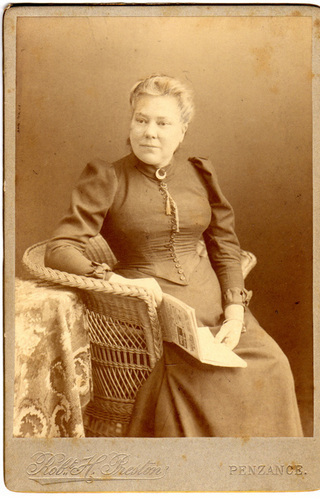
Photographic portrait of Clara, Walter Langley’s first wife, taken in the studio of Robert Preston photographer

It was also around this time that he married Clara Perkins, with whom he had four children.

Hard Times by Hurbert von Herkomer (1885)

In 1875, when his course had ended he had to decide whether to stay in London or return home. The decision was made for him as August Biermann, his former employer, offered Langley a partnership in his lithographer business and so he returned to Birmingham to resume his career as a lithographer. However, Langley did not give up his love of painting and, because he decided that he needed to make progress with his artwork, he enrolled in classes firstly at the Midland Art Guild and then at the Royal Birmingham Society of Artists. It was during this period that Langley became influenced by the works of Realist painters and one who had his works exhibited at the Birmingham Society  was the German-born British realist painter, Hubert Von Herkomer, who took a realistic approach to the conditions of life of the poor.

A Reverie by Walter Langley (1883)

Langley would have probably continued his career as a lithographer but in 1876 the demand for such items fell drastically and he soon realised that his artwork was needed to bring him a living wage. In 1877, Langley married Clara Perkins and the couple went on to have four children. In 1879 he left Biermann’s lithographer business and concentrated on his art. In his early years Walter Langley painted rural scenes close to his home in Birmingham and it was not until the summer of 1880 that he first visited Newlyn in Cornwall with his friend William Pope whilst on a sketching holiday.

Memories by Walter Langley (1906)

In 1881 he was elected an Associate of the Royal Birmingham Society of Artists, which is one of the oldest Art Societies in the United Kingdom. The Royal Birmingham Society of Artists played an important part in the Pre-Raphaelite movement and Sir John Everett Millais and Sir Edward Burne-Jones both served as presidents. Other eminent presidents were the painters, Lord Leighton and Sir Lawrence Alma-Tadema.

Between the Tides by Walter Langley (1901)

Whilst plying his artistic trade in Birmingham a well-known and wealthy Victorian photographer, Robert White Thrupp, approached him and offered him a commission of £500 to go to Cornwall and paint a series of twenty pictures of the local Newlyn scenes and so in 1881 Langley left his wife and family behind in Birmingham, and rented a property, Pembroke Lodge. The Penwith Local History Group wrote about Langley’s new home:

“…Pembroke Lodge was a grand house that had been home to bankers and gentry since it was built in 1791.Langley’s first year’s rent of £62 (payable in advance) gave him two parlours, two kitchens, a dairy, pantry, four good bedrooms, and a dressing room. It also had a studio in the garden. The house was a good size for Langley, his wife Clara and their four children who moved into their new home in March 1882. Clara had not long given birth to her fourth child, a son Cecil born in February that year. The other children were son Lorraine (born September 8, 1877), daughter Eleanor (born March 15, 1879) and son Gabriel (born November 21, 1881)…”

Thoughts Far Away by Walter Langley

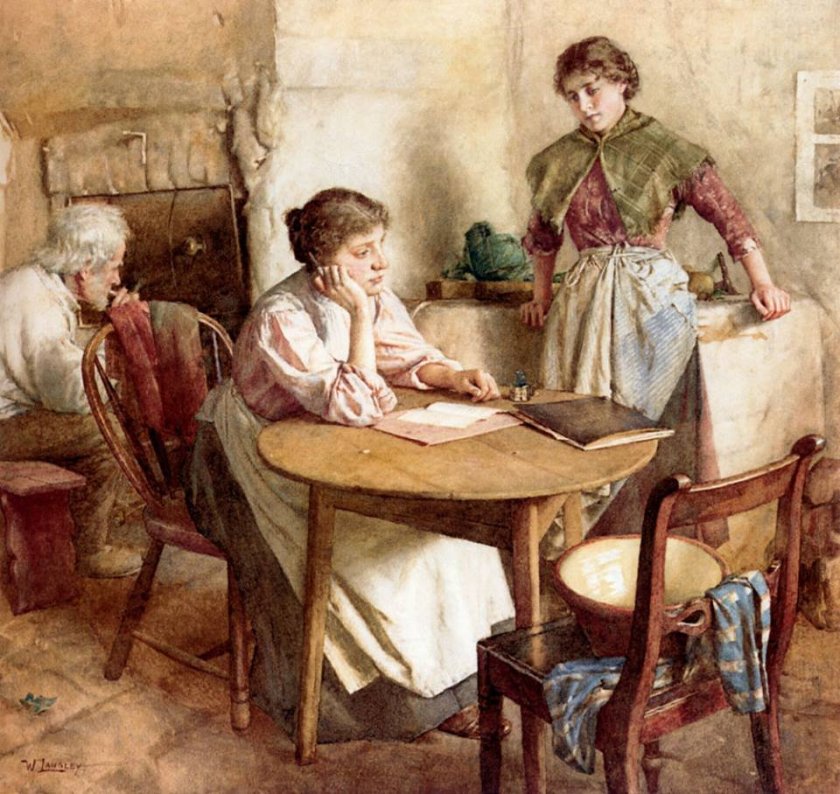
Once settled in, Langley began to paint local scenes and portraits featuring the people of Newlyn, most of which depicted the women and their role in the community. Langley could empathize with the plight of the fishermen and their families because 0f his own working-class origins in Birmingham and his socialist beliefs.

Time Moveth Not, Our Being ‘Tis That Moves, by Walter Langley (1882)

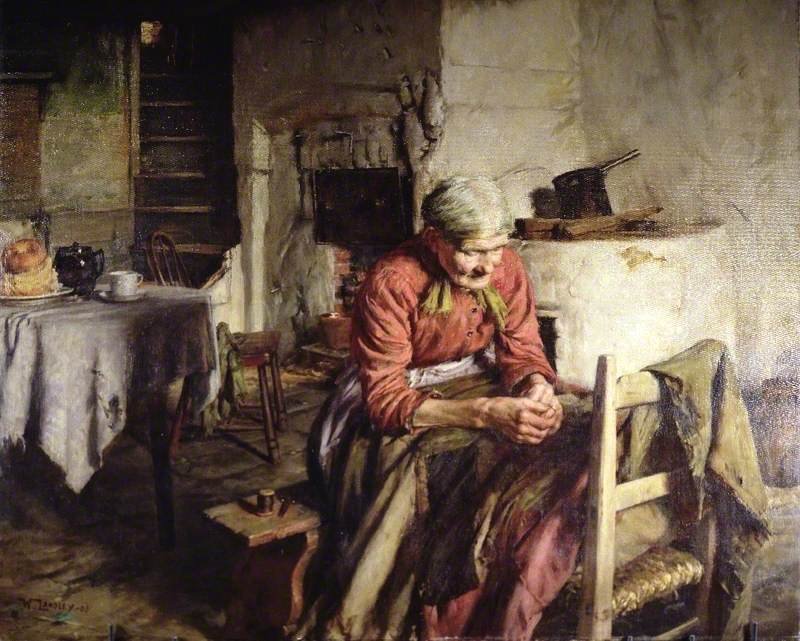
One of his first paintings he completed after his arrival at Newlyn was his 1882 watercolour work entitled Time Moveth Not, Our Being ‘Tis That Moves. It is a depiction of a local woman, believed to be Grace Kelynack. It is a portrait of great compassion and one that detects Langley’s understanding of the plight of the elderly. There is a sense of loneliness and solitude in this depiction of the woman as she ponders the hardships she has had to endure during her long life. In the painting we see her sitting at a table, with her right elbow on an open Bible. She rests her cheek on her fist as she gazes downwards, lost in her own thoughts. It was the first work that Langley exhibited in London and was widely acclaimed by both critics and the public. The watercolour painting led to Langley being elected to the prestigious Royal Institute of Painters in Watercolour.

The Fish Sale on a Cornish Beach by Stanhope Forbes (1885)

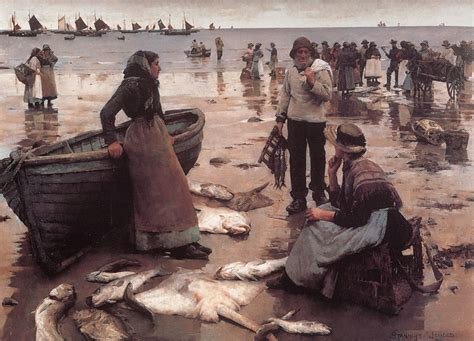
Walter Langley soon became a leading figure in the Newlyn School, which was an art colony of artists based in or near Newlyn. Another of the founding members of the Newlyn School was Stanhope Forbes who arrived at the Cornish fishing village in 1884.

Amongst the Missing by Walter Langley (1884)

Like other artist colonies such as the Barbizon and Skagen Schools, as well as the artist colonies scattered along the coast of Britany, the attraction of Newlyn was its fantastic light, and mild climate which made it an ideal location for plein air painters. It also provided many opportunities to paint seascapes, and for the Realist painters, the chance to record the harsh life endured by the fishing community. Another attraction was the ability to live there cheaply and employ local people as models at much lower rates than would have been the case in big cities. This magnetic pull towards Newlyn was summed up in the Victorian writer, Mrs Lionel Birch’s 1906 book, Stanhope A. Forbes, and Elizabeth Stanhope Forbes, in which she quotes Stanhope Forbes’ take on Newlyn:

“…I had come from France and, wandering down into Cornwall, came one spring morning along that dusty road by which Newlyn is approached from Penzance. Little did I think that the cluster of grey-roofed houses which I saw before me against the hillside would be my home for many years. What lode-some of artistic metal the place contains I know not; but its effects were strongly felt in the studios of Paris and Antwerp particularly, by a number of young English painters studying there, who just about then, by some common impulse, seemed drawn towards this corner of their native land… There are plenty of names amongst them which are still, and I hope will long by, associated with Newlyn, and the beauty of this fair district, which charmed us from the first, has not lost its power, and holds us still…”

The Old Book by Walter Langley

Walter Langley was always an advocate of the working class and was noted for his left-wing views. Whilst a young man in Birmingham, he was influenced by the stance taken by the firebrand politician and advocate of trade unionism, Charles Bradlaugh, a radical socialist who fought for the rights of the working class. It was these strong-held beliefs of Langley that ensured he empathized with the harsh life of the Newlyn fishing folk and their families. It was through his paintings depicting their hard life and their worries that classed him as a Social Realist painter.

For Men Must Work and Women Must Weep by Walter Langley (1882)

One of his most poignant paintings is a watercolour entitled For Men Must Work and Women Must Weep which he completed in 1883 and focuses on the plight of wives and mothers who are left behind when their husbands and sons head out to sea. The title of the painting comes from a line of a poem by Charles Kinsley, The Three Fishers:

Three fishers went sailing out into the West,
Out into the West as the sun went down;
Each thought on the woman who lov’d him the best;
And the children stood watching them out of the town;
For men must work, and women must weep,
And there’s little to earn, and many to keep,
Though the harbour bar be moaning.
Three wives sat up in the light-house tower,
And they trimm’d the lamps as the sun went down;
They look’d at the squall, and they look’d at the shower,
And the night wrack came rolling up ragged and brown!
But men must work, and women must weep,
Though storms be sudden, and waters deep,
And the harbour bar be moaning.
Three corpses lay out on the shining sands
In the morning gleam as the tide went down,
And the women are weeping and wringing their hands
For those who will never come back to the town;
For men must work, and women must weep,
And the sooner it’s over, the sooner to sleep—
And good-by to the bar and its moaning.

Old fisherman at Newlyn Harbour (c.1906)

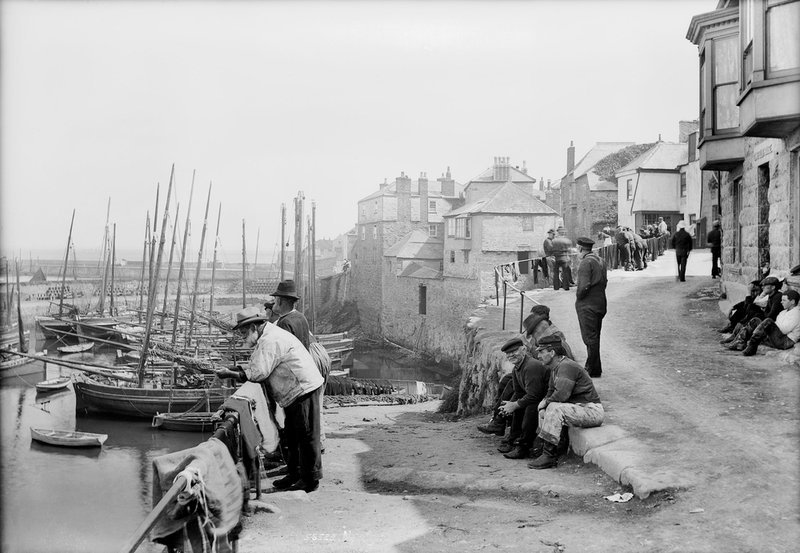
Newlyn was a mix of the good and the bad. The good was the picturesque landscape and the bad was the terrible poverty suffered by the local people who struggled to eke out a living from the fish they caught. Add to this the ferocious storms and tumultuous seas which brought death to many of the fishermen and made widows out of many of the women.

His one-year commission was completed at the end of 1885 and he moved back to Birmingham to be with his wife and children. He returned for a brief visit to Newlyn in 1886 to complete his unfinished watercolour which was shown at the Institute’s Spring Exhibition that year. In the Spring of 1887, Walter Langley, along with his family, moved permanently to Newlyn,

But O for the Touch of a Vanished Hand by Walter Langley (1888)

Another title of one of Langley’s paintings was based on a poem. His 1888 work, But O for the Touch of a Vanished Hand was a line from Tennyson’s poem Break, Break, Break which he wrote in 1835 and was about his sorrow at the death of his friend and fellow poet, Arthur Hallam, who tragically died at the age of twenty-two:

Break, break, break,
On thy cold grey stones, O Sea!
And I would that my tongue could utter
The thoughts that arise in me.
O well for the fisherman’s boy,
That he shouts with his sister at play!
O well for the sailor lad,
That he sings in his boat on the bay!
And the stately ships go on
To their haven under the hill;
But O for the touch of a vanish’d hand,
And the sound of a voice that is still!
Break, break, break,
At the foot of thy crags, O Sea!
But the tender grace of a day that is dead,
Will never come back to me.

Fradgan, Newlyn in 1906

On his return to Newlyn with his family, he was unable to secure suitable accommodation in Newlyn and decided to live in Penzance but as his work and models lived in Newlyn he bought a small cottage in Fragdan, the old part of the coastal village, which he converted into his studio.

Cornish Light, The Nottingham 1894 Exhibition

In June 1890, he brought his family back to Newlyn, and took a two-year lease on Pembroke Lodge. When the lease expired Langley moved his family to Penzance. In 1894, along with other Newlyn artists, he exhibited his work in the exhibition Painters of the Newlyn School at Nottingham Castle. In David Tovey and Sarah Skinner’s 2015 book, Cornish Light – the Nottingham 1894 Exhibition Revisited they discuss the exhibition:

“…The 1894 Nottingham Castle exhibition of Cornish painters was, in its way, ground-breaking. It brought a burgeoning new style and range of subjects to a much wider public and fostered awareness of painters from Newlyn, St Ives and Falmouth.
Much of the work was, in typical Victorian style, both art and social commentary and much of it is romanticised – craggy-faced fishermen gaze knowingly towards the horizon and the young women working on the shore have suspiciously lustrous complexions…”

This was the high-point of the Newlyn Colony’s achievements.

Self-portrait by Walter Langley
Courtesy of Archivi Alinari, Firenze

In 1895, forty-three-year-old Langley was invited, by the Uffizi Gallery in Florence, to contribute a self-portrait to hang alongside those of Raphael, Rubens, and Rembrandt in their Medici Collection of portraits of great artists.

That same year, Langley’s wife Clara died at the young age of 45. This left Langley a widower with four children. Two years later, Langley married his second wife Ethel Pengelly in St Johns Parish Church Penzance on June 24th, 1897. The couple went on to have one child. During 1904 and 1905, Langley made visits to Holland and a trip to Belgium in 1906.

Walter Langley in his studio

Walter Langley died in Penzance on March 22, 1922, a couple of months before what would have been his seventieth birthday. Today his work is described as being fundamental to the representation of the Newlyn School and he was, together with Stanhope Forbes, the most unswerving in style and his large output of works depicting life around Newlyn.


Besides the normal internet sources I gained a lot of information from the websites of the Penlee House Museum and the Penwith Local History Group.

The New Year Puzzle

I will start my first blog of 2018 with a question, a puzzle for you to solve.

What is the connection between an anonymous group of feminist, female artists dressed up as gorillas, the twentieth century American author, journalist, and philanthropist, Jane Fortunea and the sixteenth century nun and talented artist, Suor Plautilla Nelli ?

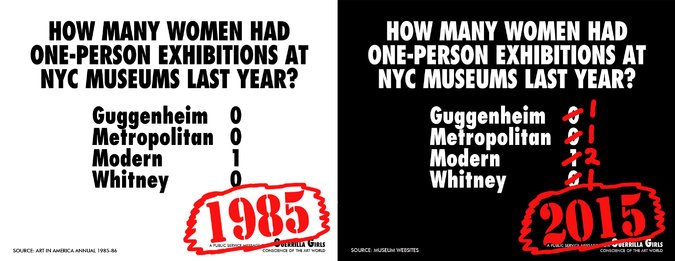
Guerilla Girls poster

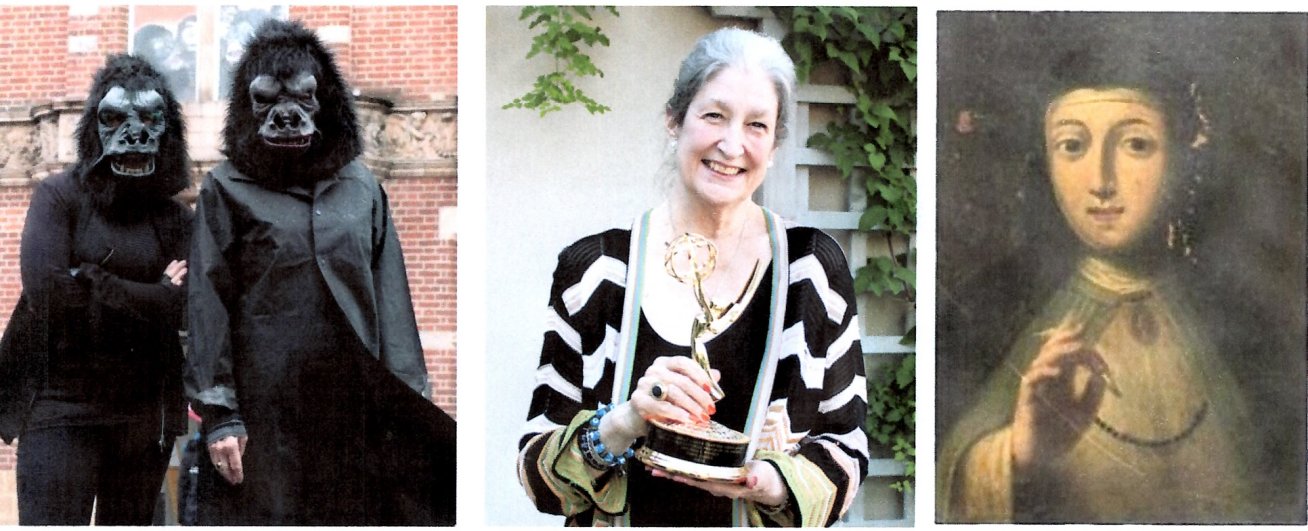
The Guerrilla Girls, a play on the word, gorilla, are an anonymous group of feminist activist artists who are dedicated to fighting sexism and racism in the art world. They want to bring to the attention of the public the domination of white males in the art establishment. They only appear in public wearing gorilla masks. It’s important for them to remain anonymous as most of them are practising artists and their use of pseudonyms, instead of using their own names, is so that people focus on what they stand for and not concentrate on their true identity. The group members adopt the names of dead female artists, including Frida Kahlo, Zubeida Agha, Diane Arbus, Georgia O’Keeffe and Rosalba Carriera.

An anniversary recount sticker showing numbers from 1985 and 2015

The Guerilla Girls was formed in New York in 1985, the year after the MOMA,  the Museum of Modern Art  in New York City held a large exhibition entitled An International Survey of Painting and Sculpture.  This international exhibition of contemporary painting and sculpture  inaugurated the newly-renovated and expanded Museum of Modern Art and intended to demonstrate the museum’s commitment to the work of living artists.  This exhibition had been organized by the curator Kynaston McShine, and, according to him, it presented the most important 169 artists in the world at that time. One prerequisite for selection in the survey was that an artist’s reputation had to have been established after 1975.  However, only 13 of them were women, and as for the ‘international’ part of the exhibition title, there wasn’t a single artist of colour due to have their work exhibited. According to the curator the exhibition presented a survey of contemporary art, but largely left female artists out of consideration. To make things worse, Kynaston McShine was quoted as saying:

“…Any artist who wasn’t in the show should rethink his career…”

This disparity and the fact nobody seemed to care, became the impetus for the formation of the Guerilla Girls.

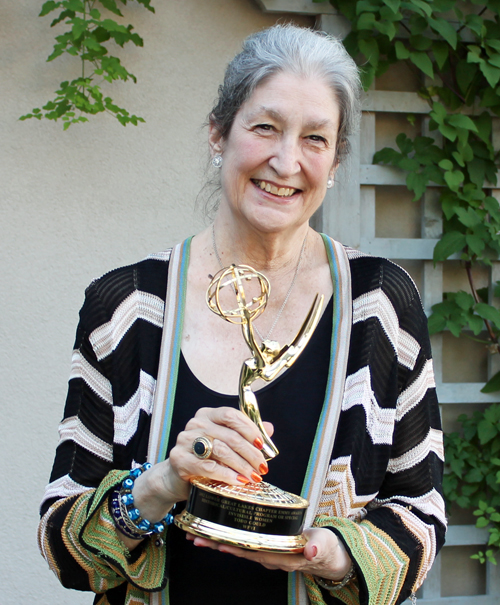
Jane Fortune with her 2013 Emmy Award

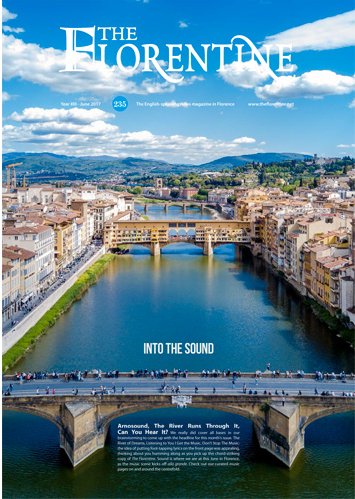
The second part of my puzzle was the name Jane Fortune. Jane was born in Indianapolis in 1942. She is a journalist, acting as cultural editor of The Florentine, an English-language newspaper in Tuscany in which she contributed many articles regarding the art and culture of the Tuscan city.

Of equal importance Jane was Founder and Chair of the Advancing Women Artists Foundation (AWA) which is an organisation committed to safeguarding art by women and rediscovering a vital part of Florence’s forgotten cultural and creative heritage. She is a tireless advocate for art preservation.
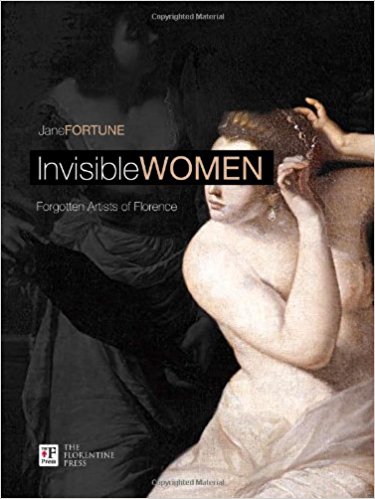
Invisible Women by Jane Fortune

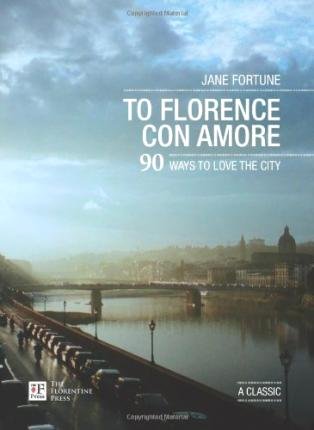
Jane is also an author of several books, having written about art and the city of Florence, including her very popular 2007 guidebook reflecting on Florentine culture, To Florence, Con Amore: 77 Ways to Love the City. In later books she championed art by female Florentine artists, such as her 2009 book, Invisible Women: Forgotten Artists of Florence, in which she talks about how the many paintings by Florentine women of the past lie languishing and deteriorating in basement storerooms of galleries.

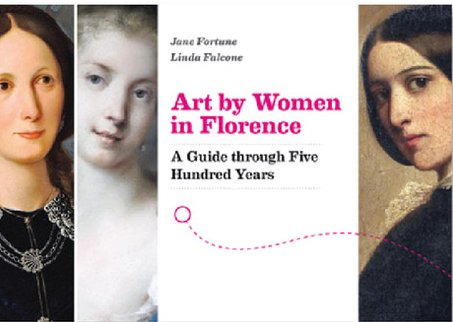
Art by Women in Florence by Jane Fortune and Linda Falcone

On a more proactive note, in 2012, she and Linda Falcone, a California-born university professor and member of the Advancing Women Artists Foundation, wrote a guidebook entitled Art by Women in Florence: A Guide through Five Hundred Years, which described where to view artworks by women artists in the public collections of Florence. From this book followed a five-part television documentary, which described the six-year project to research, restore, and exhibit works of art by women in Florence’s museums and storage covering the restoration of works by three artists: Plautilla Nelli, Artemisia Gentileschi, and Irene Parenti Duclos. On June 1, 2013, the documentary won an Emmy Award as Best Documentary in the Cultural/Historical Program category.

Of the award Jane said:

“…Winning the Emmy is a new boost to my project, which aims to restore and exhibit artworks by women in Florence. To achieve these goals, it takes technology and skill. It takes the commitment of the city’s museum directors, its restorers and its citizens in general, who are eager to finally learn more about these lesser-known works…”

To Florence Con Amore – 90 Ways to Love the City
by Jane Fortune

In Florence, she is also on the Board of Trustees of the Medici Archive Project (MAP), one of the world’s leading Digital Humanities research organizations for research on history, art, and material culture in the period of the Renaissance through the Enlightenment. Under the auspices of MAP she has endowed a pilot program dedicated to researching women artists in the age of the Medici. It is the world’s first archival research program dedicated to women artists.

The Florentine – an English language monthly arts magazine

As a philanthropist and art collector (particularly works of women artists), she has served on several museum boards and is currently a member of the Board of Governors of the Indianapolis Museum of Art, a member of the National Advisory Board of the National Museum of Women in the Arts (Washington D.C.), an honorary member of the Dean’s Advisory Board at Herron School of Art and Design, Indianapolis, a founding member of the Women’s Philanthropy Council, Indiana University, a National Advisory Board Member of the Indiana University Museum, Bloomington, IN.

And so, I come to the third piece of the puzzle – Sister Plautilla Nelli. How can a sixteenth century woman have a connection with the Guerilla Girls and Jane Fortune? To find the connection one needs to know more about Sister Plautilla Nelli.

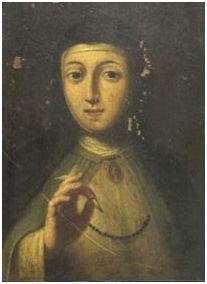
Possible portrait of Plautilla Nelli

Pulisena Margherita Nelli was born into a wealthy family in Florence in 1524. Her father was a prosperous fabric merchant. At the age of fourteen she became a nun at the convent of Santa Caterina da Siena, and took the name Suor Plautilla. Her older sister Costanza, also became a nun and took the name Suor Petronilla.

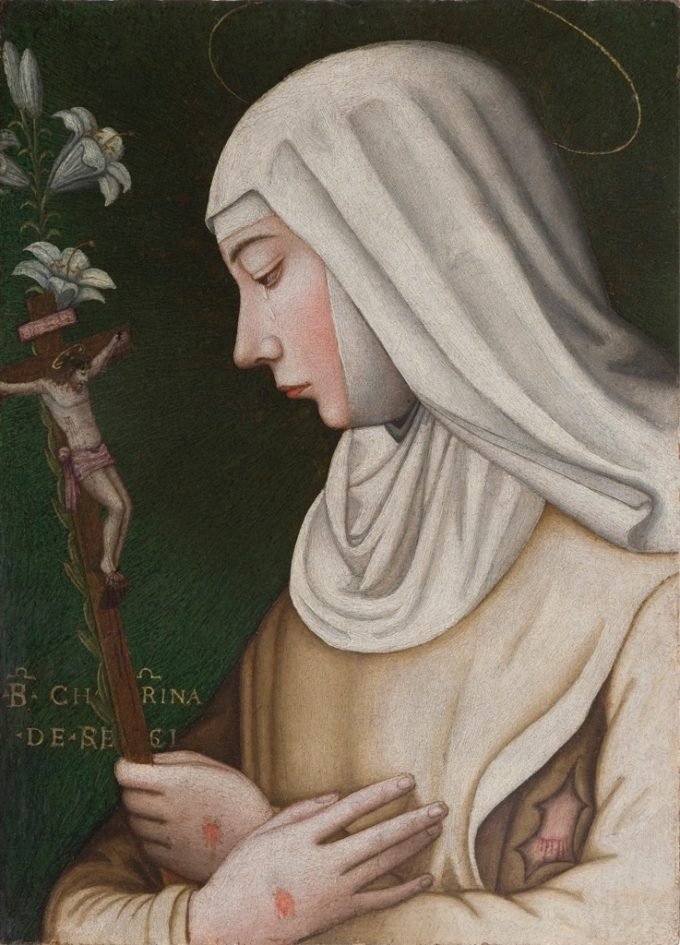
Saint Catherine by Plautilla Nelli

The convent was managed by the Dominican friars of San Marco, who were led by Girolamo Savonarola, the Italian Christian preacher, reformer, and martyr, who was renowned for his conflict with despotic rulers and a dishonest and immoral clergy. Nelli was heavily influenced by his teachings. Through the words of he encouraged devotional painting and drawing by religious women to avoid sloth and thus the convent Nelli was a member became a centre for artistically-inclined nuns. According to Jane Fortune in her 2010 book Invisible Women: Forgotten Artists of Florence, Nelli is looked upon as the first-known female Renaissance painter of Florence and one who was influenced by the work of Fra Bartolomeo.

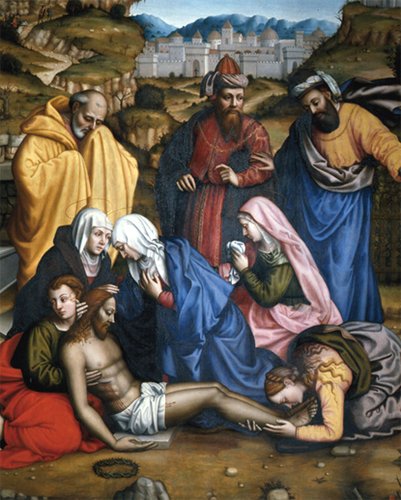
Lamentation with Saints by Plautilla Nelli

Dr. Catherine Turrill, the American art history professor and renowned expert on Plautilla Nelli, believed that many of the nuns at Santa Caterina were daughters of Florentine artisans, and the convent was known throughout Italy as a place where women could dedicate themselves to art, as well as serving God. Nelli was self-taught, and would spend time copying paintings by the mannerist painter Agnolo Bronzino and the high Renaissance painter Andrea del Sarto but the artist who influenced her the most was Fra Bartolomeo. She drew particular inspiration from the work of Fra Bartolommeo and his pupil Fra Paolino, both from the Dominican monastery of San Marco. After Fra Paolino’s death she was given his collection of drawings by Fra Bartolommeo.

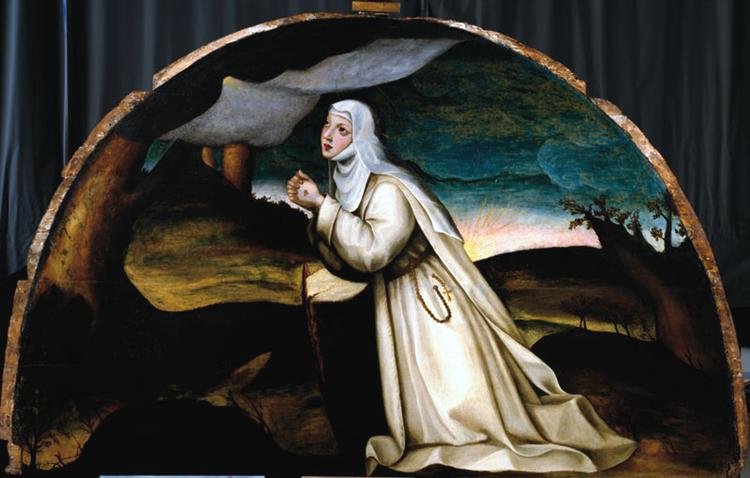
Saint Catherine Receives the Stigmata by Plautilla Nelli

So now you may be a little closer to solving the puzzle. The Guerilla Girls wants greater recognition of the work of female artists. Jane Fortune of the Advancing Women Artists, who has connections with Florence was of the same mind, and Plautilla Nelli was a sixteenth century forgotten painter but there is just one more piece needed to solve the puzzle.

In the March 18th, 2013 edition of the Harvard Art Museums Index magazine, Cheryl Pappas wrote:

“…She [Jane Fortune] heard the call to find works by “forgotten” women artists when she, with help from the Florence Committee of National Museum of Women in the Arts, funded the restoration of a painting by a self-taught 16th-century nun, Suor Plautilla Nelli, who is considered the first woman painter of Florence. When Fortune saw the figures in Lamentation with Saints come to life in the midst of its restoration, she was moved, especially by the women in the painting: “Their tear drops became visible and their emotion touched me. It was then that I knew—Plautilla Nelli deserves to be discovered, studied, and appreciated. I will do all I can to rediscover and protect the works of this incredible woman artist and others like her, who have yet to get their proper due…”

There are over 2,000 paintings, sculptures, and drawings by pioneering women artists, stored in the Florence museum storage facilities which have been overlooked for hundreds of years. They have deteriorated and in urgent need of restoration. The Advancing Women Artists Foundation is committed to safeguarding this art and by so doing, revive an essential part of Florence’s forgotten cultural and creative heritage.

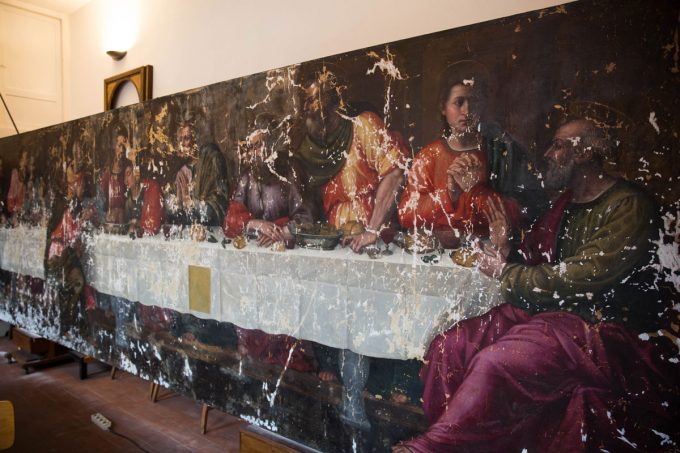
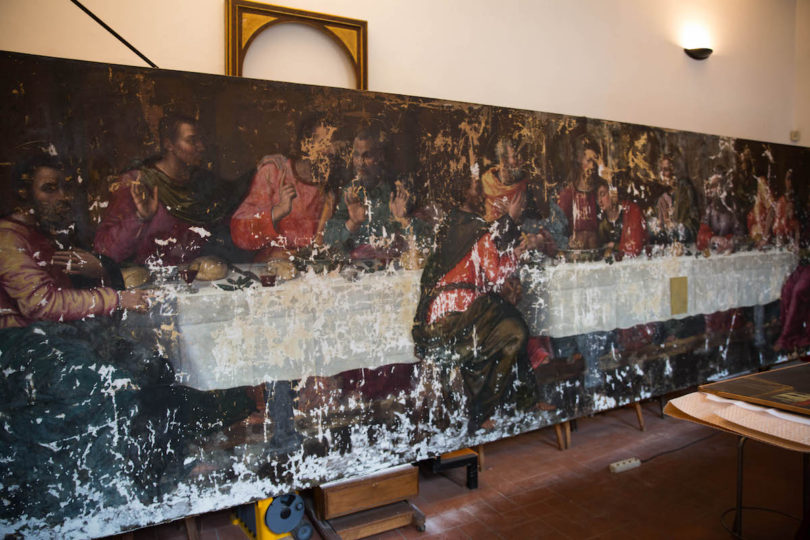
Plautilla Nelli’s painting Last Supper in the restoration lab

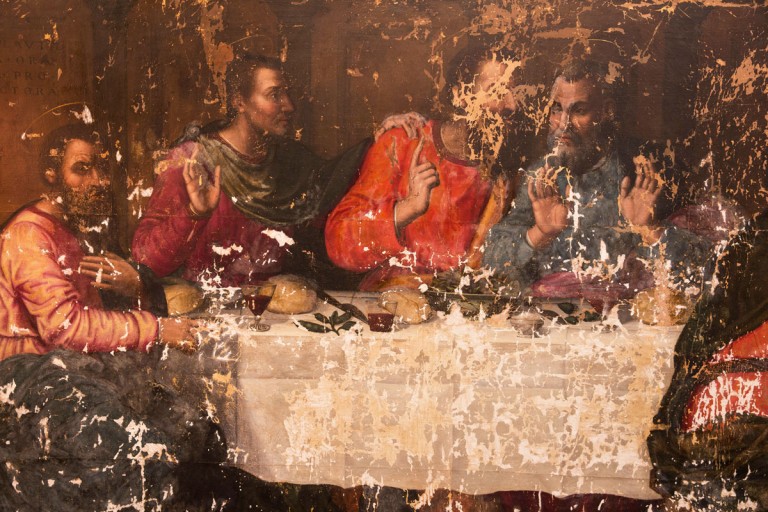
In the 1570’s Plautilla Nelli completed her large-scale (6.7metres long) masterpiece depicting the Last Supper. Her depiction of the event was the first done by any female artist and is the only signed work by Plautilla Nelli known to survive.

Detail of left-hand side of Last Supper canvas

Plautilla Nelli completed the work for the refectory of her own convent. However, in the early 1800’s, when Napoleon subjugated the monasteries and convents, the work was rolled up and put in storage for a while. Later it was hung back in the private (not open to the public) refectory at Santa Maria where a small group of Dominican friars would take their meals. However, the currents state of the painting, even after earlier restoration attempts, was causing concern. The Advancing Women Artists Foundation which regularly sponsors the restoration of works by women artists, has now taken on the task of organising the restoration of Nelli’s huge canvas which they hope will be completed in 2018. On completion people will be able to see the restored work at the Museum of Santa Maria Novella in Florence.

As for works by Plautilla Nelli and other female artists of the distant past, things are looking up. In March 2017, the Uffizi Galleries in Florence began a long-term strategy for promoting female artists. One of the first initiatives was the Uffizi exhibition, Sister Plautilla Nelli. Convent Art and Devotion in the Footsteps of Savonarola exhibit, curated by Dr. Fausta Navarro which is devoted to Sister Plautilla Nelli, considered the first female Florentine painter.

If you are still somewhat unconvinced about people’s knowledge of female artists of the past, ask a friend to name five artists of the past and see how many include the name of a female artist.


Happy New Year to you all.