Joaquín Sorolla (part 3)

In my final look at the Spanish artist Joaquín Sorolla I want to show you some of his portraiture work which featured his family and finally take a look at the house in which he and his family lived and which would later become a museum in his honour.
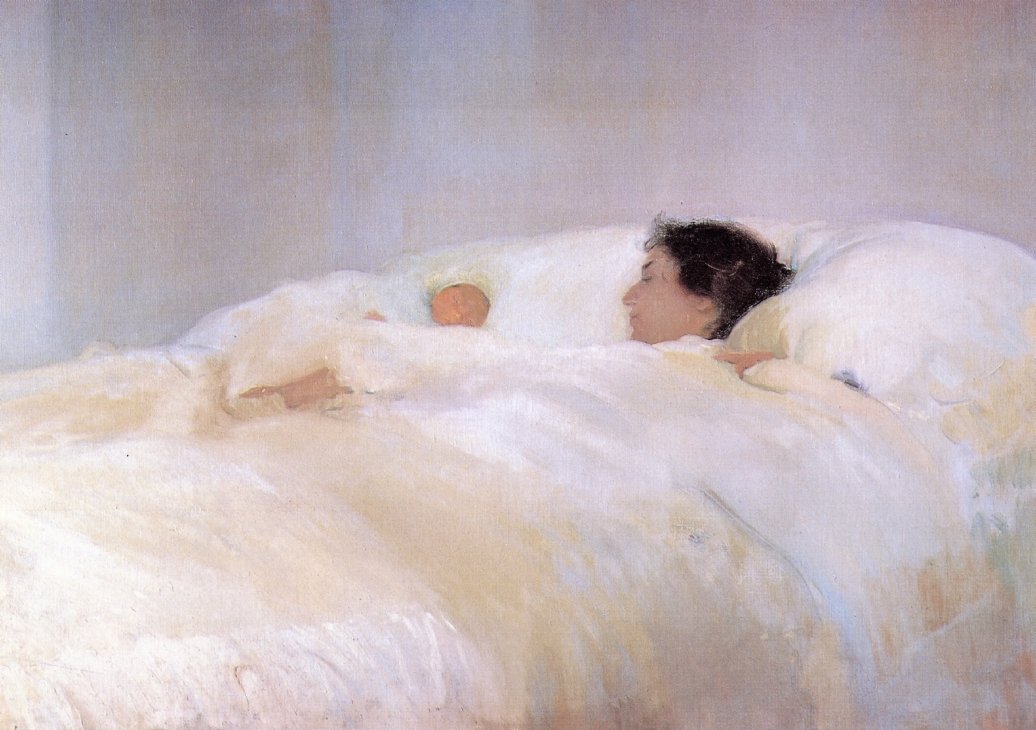
Mother by Joaquin Sorolla (1895)

One of the most moving family portraits by Sorolla was of his wife Clotilde, laying in bed with their new born baby, their youngest child, Elena.  The painting is simply entitled Mother and was completed in 1895.   His wife looks lovingly towards her daughter who is swaddled in a mass of white bedding contrasted by the artist’s yellow/green tonal shading of the bed clothes. 


My Family by Joaquín Sorolla (1901)

In 1901 Sorolla completed a portrait of his family entitled My Family, which somehow reminds us of Diego Velazquez’s Las Meninas, where the painter showed in the background a mirror that reflects the upper bodies of the king and queen. They appear to be placed outside the picture space in a position similar to that of the viewer.  In Sorolla’s painting we see his image, palette in hand, in a mirror in the background.  The main figures in the painting were those of his family.  His wife Clotilde stands to the left in a long red dress along with her children.   Elena, the youngest, sits on the chair was five years old at the time. Their nine-year old son Joaquín sits on a stool sketching a picture of his sister whilst their elder daughter, Maria, who would have been eleven when her father completed the work, holds the board which her brother is using to support his sketch.

Maria by Joaquín Sorolla (1900)

One of Sorolla’s favourite subjects was his eldest child, Maria and over the years he would capture her in many of his portraits.  In 1900 he captures her sitting on a chair dressed in a white tunic with her hands entwined on her lap.  The painting is entitled Maria.  The whiteness of her dress is enhanced by touches of blue.   In the background there is a wall with decorative and colourful tiles 
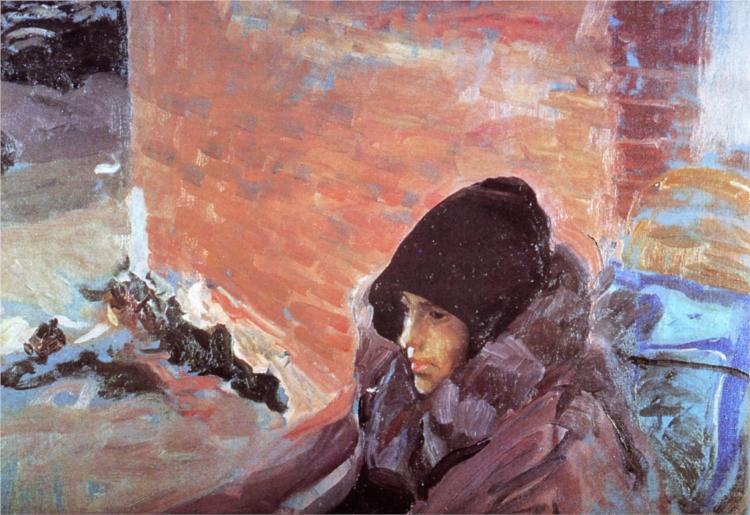
Maria Sick by Joaquín Sorolla (1907)

Six years later he completed another two portraits of Maria.  The first, entitled Maria Sick, completed in 1907 depicts his daughter sitting outside, well wrapped up in heavy but warm clothes.  She was recuperating in the mountains outside of Madrid having come down with an illness.   Sorolla himself was supposed to have been in Germany at this time, to be present at the one-man exhibition of his work at Berlin, Dusseldorf and Cologne organised by the Berlin gallery owner, Eduard Schulte.  However Sorolla refused to leave his daughter at a time when she was so unwell.
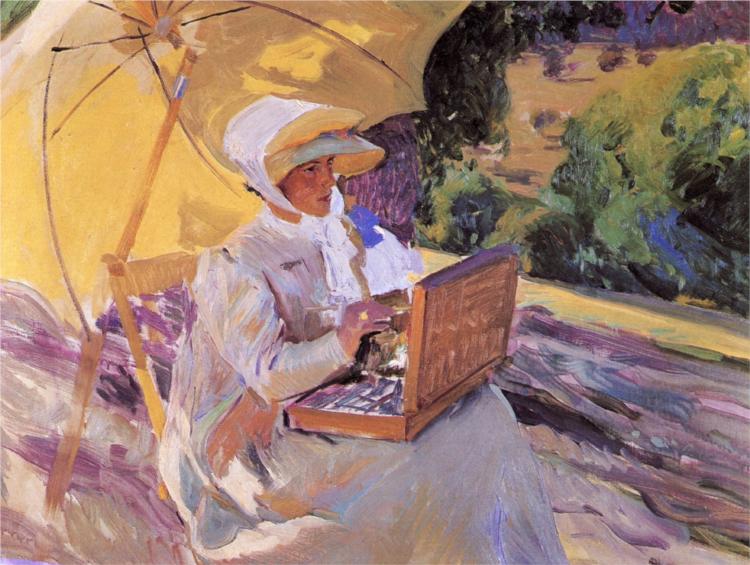
 

Maria painting in El Pardo by Joaquín Sorolla (1907)

That same year, following the recovery from her illness, her father painted another portrait of her, entitled Maria Painting in El Pardo.  The work depicts his daughter seated on a hill top, close to the royal palace, painting en plein air. 
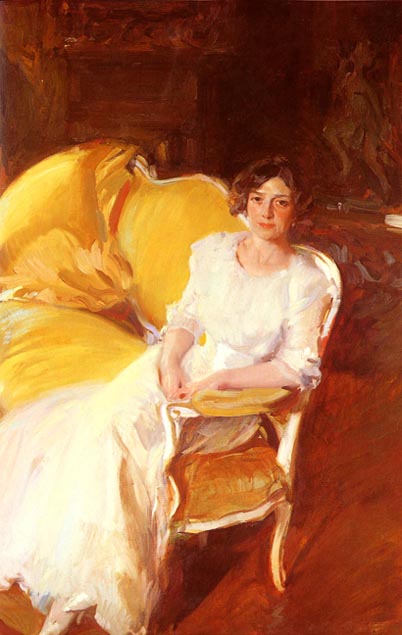
Clotilde Sitting on the Sofa by Joaquín Sorolla (1910)

However Joaquín Sorolla’s favourite muse was his beloved wife Clotilde whom he had married in 1888.   She featured in a large number of his works.  I particularly like the one he painted in 1910 entitled Clotilde Sitting on the Sofa.  Art historians believe that the painting was influenced by the works of the American painter John Singer Sargent.  His wife leans against the arm of a sofa, dressed in a full length gown.
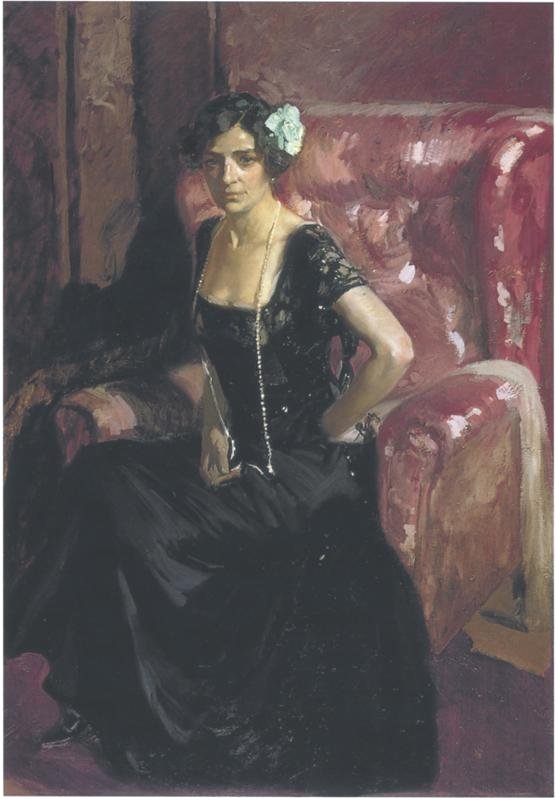
 

Clotilde in Evening Dress by Joaquín Sorolla (1910)

Another beautiful painting of his lovely wife was completed that same year entitled Clotilde in Evening Dress and from it, it is plain to see that Sorolla had married a beautiful and enchanting person.  We see her sitting upright in a plush, well upholstered red chair, dressed in a black evening dress with a blue flower tucked behind her ear.  She is the personification of a Spanish lady.

Sorolla had a one-man exhibition in the Grafton Galleries, London in 1908 and it is whilst in London that he met Archer Milton Huntington, who was the son of Arabella Huntington and the stepson of the American railroad tycoon and industrialist Collis Huntington.   Archer Huntington was a lover of the arts and the founder of the Hispanic Society of America which was based in New York.  The Hispanic Society of America was, and still is, a museum and reference library for the study of the arts and cultures of Spain and Portugal as well as those of Latin America.  Huntington arranges for Sorolla to have a major one-man exhibition at the Society in 1909 and it proved to be a resounding success so much so that the exhibition travelled to many American cities.  Huntington then commissioned Sorolla to paint 14 large scale mural paintings, oil on canvas, depicting the peoples and regions of Spain.  On receiving Huntington’s commission in 1911, Sorolla spent the next eight years travelling  throughout the regions of Spain making hundreds of preparatory sketches before completing what was to become known as Vision of Spain.   Sorolla was clear in his mind what Huntington expected and how he would achieve it, for he said:

“…I want to truthfully capture, clearly and without symbolism or literature, the psychology of the region.   Loyal to the truth of my school I seek to give a representative view of Spain, searching not for philosophies but for the picturesque aspects of the region…”

The fourteen murals were installed on December 1922 in the newly renovated western extension to the Hispanic Society’s Main Building, which is now known as the Sorolla Room. They were not officially inaugurated until January 1926. 

Panels from “Vision of Spain,” Joaquín Sorolla’s panoramic mural, during reinstallation at the Hispanic Society of America in New York City.

The Hispanic Society building had problems with their roof and it got so bad that in 2007 the museum had a full make-over and the picture above shows the re-installation of the fourteen paintings.

His eight years on this project was at the expense and detriment of his other work and sadly nearing the end of this project his health began to deteriorate and in June 1920 he suffered a stroke which ended his painting career.  One can only imagine how devastated Sorolla must have been not being able to paint.   Three years later in August 2010 Sorolla died in Cercedilla, a small town in the Sierra de Guadarrama, north-west of Madrid.  His body was taken and buried in the town of his birth, Valencia.
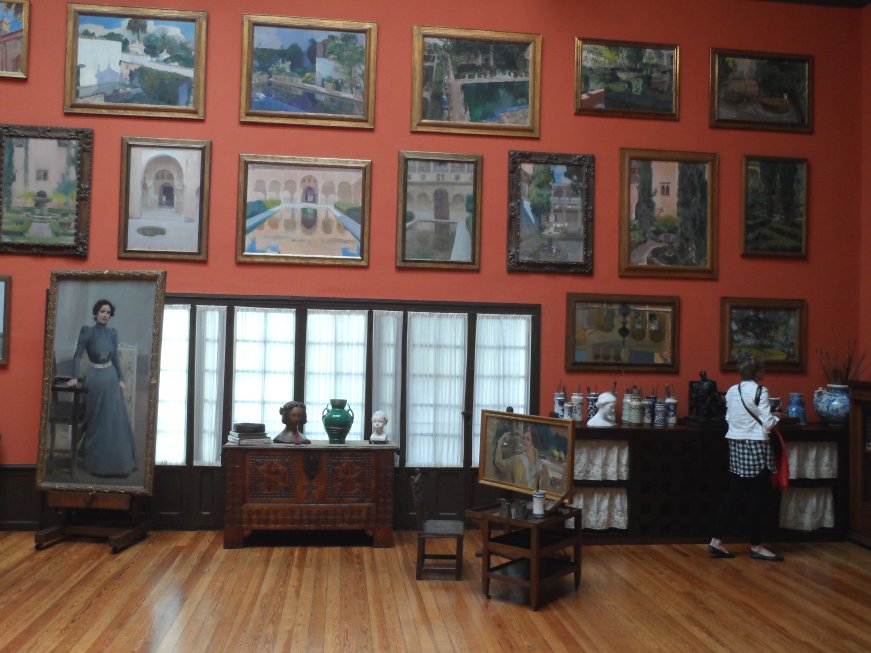
Room inside Sorolla Museum

I cannot end this trilogy of blogs about Joaquín Sorolla without mentioning the Sorolla Museum which was the artist’s home from 1911. 

Room inside Sorolla Museum

It is a five minute walk from the Ruben Dario Metro station and I do urge you to visit it if you are in Madrid.  You will not be disappointed. 
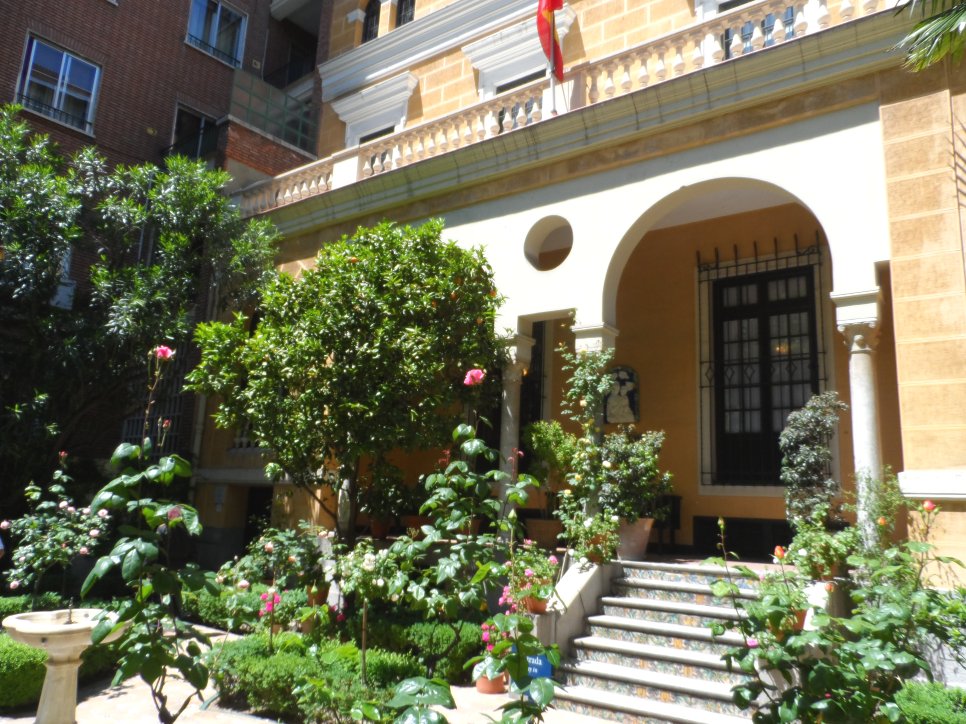
Museum entrance
Museum entrance

There are so many of the artist’s beautiful paintings on show and the gardens are a delight.
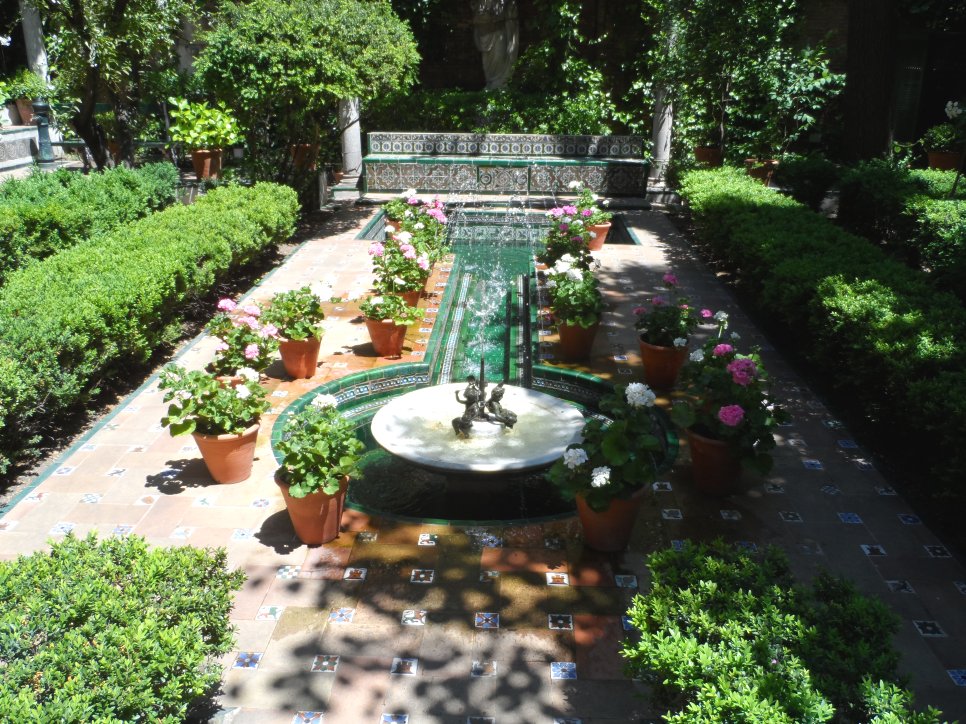
Museum Gardens
Museum Gardens

Joaquín Sorolla (part 2)

Portrait of Joaquín Sorolla by José Jiménez Aranda (1901)

By 1885, Joaquín Sorolla had settled down to life in Rome but during that year he also spent the spring and summer in Paris.  At this time in the French capital, the Impressionists were in the ascendancy after they and their art had been criticised and they had had to survive an initial period of ridicule, commercial failure and outright denunciation.    However, the Impressionists had now managed to establish their status some eleven years after they held their first Impressionist exhibition at Nadar’s studios and whilst Sorolla was in Paris he saw much of thire work but it was not the Impressionist painters who would influence him.   Whilst in the French capital he visited the retrospective exhibitions of two non-Impressionist painters, the French Naturalist painter, Jules Bastien-Lepage, who had died the previous year, and Adolf von Menzel the German painter who, along with Caspar Davisd Friedrich, was considered one of the two most prominent German artists of the 19th century and was also the most successful artist of his era in Germany.

Sorolla returned to his home town of Valencia on two occasions during the late 1880’s and on the second visit in 1888 he proposed to and married Clotilde Garcia del Castillo the daughter of his mentor, the photographer Antonio Garcia.  Joaquín and Clotilda had first met in 1879 when he had started work in her father’s workshop.   Joaquín finally returned from Italy and in 1890 the couple settled in Madrid.   Sorolla style of painting became more individualistic with him tending towards social realism works. 

Another Marguerite by Joaquín Sorolla (1892)
Another Margarita by Joaquín Sorolla (1892)

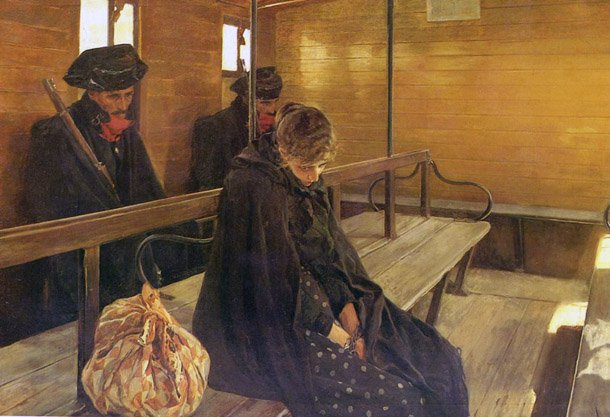
For a good example of a social realism work by Sorolla one only has to look at his beautifully executed painting entitled Another Margarita which he completed in 1892.  He exhibited the work at the Madrid National Exhibition that year and was awarded a first-class medal.  This was also Sorolla first major painting to be exhibited in America and it was awarded the first prize at the Chicago International Exhibition, where it was acquired and subsequently donated to the Washington University Museum in St Louis.    The story behind the depiction is of a woman who has been arrested for suffocating her small son and Sorolla actually witnessed the woman being transported to jail.  There is an air of gloom about the manacled woman as she sits slumped on the wooden bench of the train carriage being watched by her two guards who sit behind her.  In contrast to the dark and depressing depiction of the three individuals, the carriage itself is lit up by the warm light which streams through the windows at the rear of the compartment and which bathes the entire space.

The Return of the Catch by Joaquin Sorolla (1894)

His realist art also embraced what the Spanish termed costumbrismo, which was the pictorial interpretation of local everyday life, mannerisms, and customs.   This kind of art depicted particular times and places, rather than of humanity in an abstract form.   In many instances costumbrismo was often satirical and often moralizing, but it was careful not to offer or even imply any particular analysis of the society it depicted, unlike proper realism art.  In less satirical works costumbrismo took on a romantic folklore flavour.  A fine example of this type of work was a painting entitled The Return of the Catch which Sorolla completed in 1894 and which received critical acclaim when it was shown at the 1895 Paris Salon.   It was subsequently acquired by the Musée du Luxembourg.  He painted a number of similar pictures depicting Valencian fisherman at work bathed in the dazzling Mediterranean light such as his 1894 painting entitled Return from Fishing and his 1903 painting, Afternoon Sun.

Sad Inheritance by Joaquín Sorolla (1899)

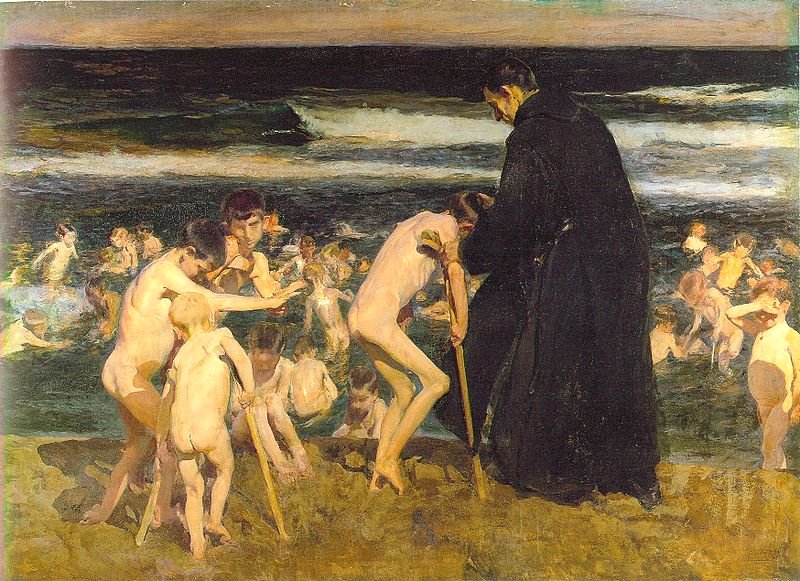
By 1895 Joaquín and Clotilda had three children.  Their daughter Maria was born in 1890, their son Joaquín in 1892 and their youngest child Elena in 1895.  In 1899 Sorolla painted what was to become his most famous and most moving picture.  It was entitled Sad Inheritance and I talked about this work in My Daily Art Display of Jan 31st 2011.  It is a poignant work featuring a monk and a group of children, crippled by polio, who are seen bathing in the sea at Valencia.   Sorolla received his greatest official recognition for this work of art, the Grand Prix and a medal of honour at the Universal Exhibition in Paris in 1900, and a year later he received the medal of honour at the National Exhibition in Madrid in 1901.

In my third and final blog about Joaquín Sorolla I will feature some of his family portraits, look at the Sorolla Museum in Madrid and conclude the life story of this wonderful Spanish artist.

Joaquín Sorolla (part 1)

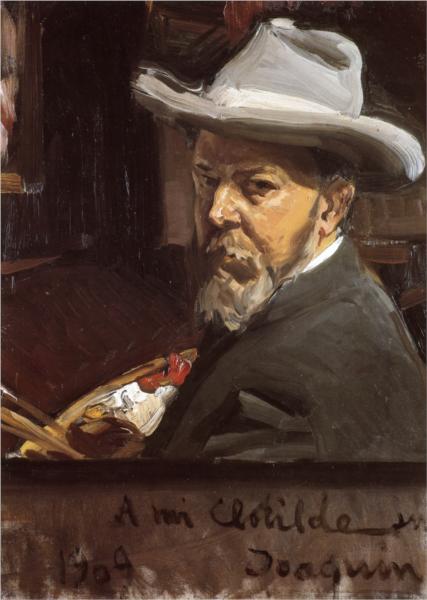
Self Portrait by Joaquín Sorolla (1909)

I have said on a number of occasions that when one is in a large city which has one or maybe two famous large art museums, and when one is time-limited, one should search around and look for a smaller gallery which may have hidden treasures to offer.  The art on display in smaller museums can be taken in on one visit and there is no feeling of having to rush from room to room, constantly looking at ones watch to try and see as much as one can and ultimately seeing very little.  Madrid is famous for its three large art museums the Prado, the Thyssen-Bornemisza and the Queen Sophie but once again thanks to my daughter, who was my travelling companion on this trip, I discovered a pure gem of a museum – The Sorolla, which was just a few stops on the Metro from the city centre.  In my blogs I want to offer you a taste of what you would get if you visit the museum dedicated to one of Spain’s best loved artists, show you some of the Spanish painters work and look at his life story.

Joaquín Sorolla y Bastida was born into a humble household in Valencia in February 1863.  His parents were Joaquín Sorolla Gascón and Concepción Bastida who were retailers.  Joaquín and his younger sister Concha were orphaned in 1865 when both their parents died from the cholera epidemic which had swept through and ravaged the Spanish city.  Joaquín and Concha went to live with their maternal aunt, Isabel Bastida and her husband José Piqueres, a locksmith by trade.  Joaquín’s early schooling was not a success with the young boy being inattentive during lessons and was happy to doodle and draw in his exercise books to pass the time away.  His lack of progress at the school came to the attention of his uncle who withdrew him and took him on as an apprentice at his workshop.  However, owing to his love of drawing, when Joaquín was fourteen years old, his uncle arranged for him to attend drawing classes in the evening at the city’s Escuelade Artesanos where his artistic ability astounded his teachers, including the sculptor Cayetano Capuz.   The following year, 1878, he enrolled on a three-year course at Valencia’s prestigious Escuela de Bellas Artes de San Carlos.  It was whilst attending the art school that he met and became friends with a fellow student, Juan Antonio Perez.  He was soon introduced to Juan’s family.  Juan’s father, Antonio Garcia Perez was a photographer and was very impressed with Sorolla’s art work, so much so that he gave him a job at his photography studio as an illuminator.  This opportunity allowed Sorolla to leave his uncle’s workshop and concentrate on his artwork and discover the world of photography.  He learnt all about the framing of a subject and the manipulation of light which would prove a boon to him when he started to paint seaside and beach scenes.   This “new world” of photography fascinated many artists of the time and the likes of the French pair of Impressionists, Degas and Caillebotte were accomplished amateur photographers.

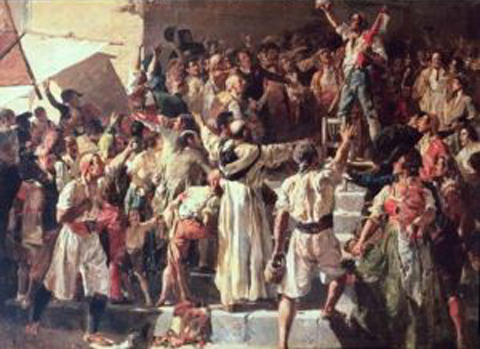
The Shout of the Palleter by Joaquín Sorolla (1881)

 Joaquín won many awards whilst studying at Escuela de Bellas Artes de San Carlos and at the end of his time there, and buoyed by his success, he sent off three seascapes to the Madrid National Exhibition.   He travelled to Madrid on a couple of occasions and visited the Prado where he painted copies of the great Masters.   In 1884, in the hope of attaining a monetary scholarship from the Valencia Provincial Council, he submitted a number of paintings to them, one of which was entitled The Shout of the Palleter, which was a historical painting recording the event in Valencia when one of its inhabitants Vincent Doménech in 1808, incensed by the French occupation of his country stood in the square urging people to rebel against the French tyranny.  He uttered his famous words:

“…Jo, Vicent Doménech, un pobre palleter, li declare la guerra a Napoleó. ¡Vixca Ferran sèptim! ¡Muiguen els traïdors!…”

(I, Vincent Doménech, a poor and simple worker, declare war against Napoleon.  Long live Ferdinand.  Death to the traitors.)

Sorolla painted the picture in the bullring of Valencia which he transformed into a huge studio and which was bathed in brilliant sunlight.  The stage-managed scene was a triumph and the Valencia Provincial Council awarded him a three-year scholarship to study art at the Spanish Academy in Rome. 

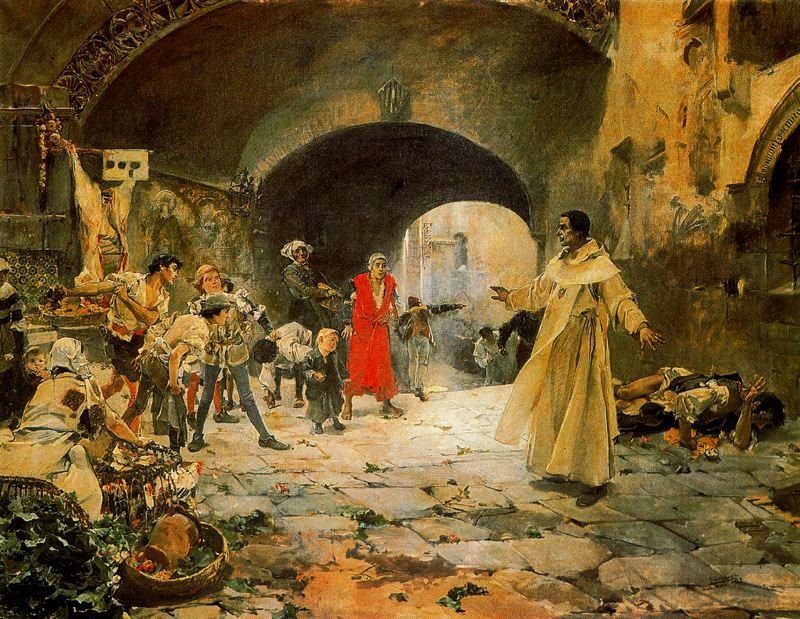
Father Jofré Protecting a Madman by JoachínSorolla (1887)

One of the conditions attached to the scholarship was that he regularly sent back work to the Council to prove that he was making good use of his time.   One of the paintings he duly sent back to Valencia was his 1887 work entitled Father Jofré Protecting a Madman.  This historical painting was based on the story of Father Joan-Gilabert Jofré, a friar of the Valencian Mercedarian Order, who, on  February 24, 1409, was on his way from the convent of the Plaza de la Merced to the Cathedral of Valencia.   On his way there he passed along the street of Martín Mengod,  the ancient street of the silver workers, next to the church of Santa Catalina.  On entering the street he was greeted with a great commotion.   Before him, he saw a group of children who were hitting and making fun of a mentally ill man who lay on the ground before them.   In those days it was believed by many that somebody who was mentally ill was possessed by the devil.  Father Jofré immediately berated the children and took the helpless man with him to the convent of the Order of Mercy, where he was given shelter and cure for his wounds.  Father Jofré would go on to found the world’s first lunatic asylum.

After his three year scholarship came to an end, Joaquín Sorolla continued to live in Rome and for a time in Assisi but on two occasions between 1885 and 1889 he returns to his home city of Valencia.


…….to be continued.

The Clothed Maja and The Nude Maja by Goya

La Maja Desnuda (The Naked Maja) by Goya (c.1797-1800)

I ended my last blog with the tantalising statement:

“…I will offer you a work by another famous Spanish artist, Francisco Goya, and tell you about the connection it has with myself, as a naughty schoolboy, and my first sighting of erotica !!!!…”

I suppose I will be accused of cynically employing cheap tactics in order to get people to read my blog but there is a connection between the two Goya paintings I am featuring in this blog with the dubious habits of a young school boy.   My early school days were back in the late 50’s and the first sight of what I loosely termed as “early erotica” came in the form of a pen.  It was not just any pen.  It was a pen which had a picture of a beautiful and fully clothed young woman.  However the titillating aspect about the pen was that if you  turned the pen upside-down the clothed lady slowly shed all her clothes !!!

La Maja Vestida (The Clothed Maja) by Goya (c.1800)

Today I am looking at, not one painting by Francisco Goya, but two, albeit as you will realise, they are almost the same except for one major exception.  His two paintings are entitled La maja vestida (The Clothed Maja) and La maja desnuda (The Nude Maja) were painted around 1800 and 1803 and the only difference between the two is that in one the woman is fully clothed whilst in the other she is naked.  I suppose the first question that comes to one’s mind is who is this lady and how come Goya painted her reclining portrait.  The question has never really been answered but the names of two ladies are often bandied about by historians as being this sultry temptress.  The two candidates are the 13th Duchess of Alba and Pepita Tudó.

The Duchess of Alba or to give her, her full title, Doña María del Pilar Teresa Cayetana de Silva-Álvarez de Toledo y Silva, the 13th Duchess of Alba de Tormes was a Spanish aristocrat who featured in a number of Goya’s paintings.  Francisco de Goya profited from wealthy patronage probably more than any other artist. He was without doubt the darling of the Spanish monarchy.  His first appointment as court painter came from King Charles IV of Spain. The King and his wife, Queen Maria Luisa, sat for the artist themselves many times.   For their portraits they would dress in the most colourful and showy costumes adorned with the royal regalia.  Besides the royal portraits Goya received many lucrative commissions from other high-ranking government officials as well as requests for altarpieces for churches and cathedrals.  However without doubt and notwithstanding his many prominent sitters, one stands out above all the others – the 13th Duchess of Alba.

The Duchess of Alba was not just any royal courtier.  She was a very wealthy and powerful woman in her own right.  She was a  member of Spanish nobility and held the title of 13th Duchess of Alba.  She married José María Alvarez de Toledo y Gonzaga, who was the 15th Duke of Medina-Sidonia, and she became the wealthiest woman in Spain. She was quite a character.  Besides her natural beauty, she was the height of eccentricity, and very strong-willed.  Goya was besotted by her and rumours had it that, at one time, the two were lovers.  He recounted the time she came to his studio and asked him to apply her make-up:

“…the Alba woman, who yesterday came to the studio to make me paint her face, and she got her way; I certainly enjoy it more than painting on canvas, and I still have to do a full-length portrait of her…”

It has been suggested that the two paintings were originally owned by the Duchess of Alba and later acquired by Manuel de Godoy after her death. Goya’s close and intimate relationship with the Duchess of Alba has made her the most popular candidate as a model for the Majas, or at least as a source of inspiration.  Another persuasive argument in favour of this candidate is the many drawings of herself and members of her household Goya made during his visits to the Duchess’s country estate. However the face of the Majas does not show a close resemblance to the facial qualities of the drawings of her but this could be put down to the need to conceal her identity.

The second candidate for the model in Goya’s two paintings was Pepita Tudó, whose full name was Josefa de Tudó, 1st Countess of Castillo Fiel.  Pepita being the diminutive of Josefa.    She was born in Cadiz.  When she was just sixteen years of age, she along with her mother and two sisters, were living in the household of Manuel de Godoy.  Five years later, aged twenty-one, she became the mistress of Godoy who was then Spanish Prime Minister and because of the influence he had with King Charles IV and his wife Queen Maria-Louisa he became one of the most powerful men in Spain.  In 1797, Queen Maria Luisa arranged a marriage for Godoy toMaría Teresa de Borbón y Vallabriga, 15th Countess of Chinchón, the granddaughter of Philip V of Spain, despite him still having Pepita as his mistress.  This was an arranged marriage, set up by the queen as the bride and groom had never met.  The Queen ensured that the partnership was financially advantageous to both bride and groom.  So what was in it for the Queen?  Historians would have us believe that the queen’s ulterior motive was two-fold.  Firstly she had hoped that the marriage was a way of ending Godoy’s dalliance with Pepita and secondly the marriage would act as a cover for her own relationship with Godoy. Godoy was pleased with the arrangement as it boosted his finances and despite what the queen had hoped for, he continued his liaison with his mistress Pepita,  who bizarrely lived in the same house as his wife.  In 1805, Godoy’s wife gave birth to a son, Manuel, and in 1807, she gave birth to another son, Luis.  His wife died in 1828 and Godoy married Pepita although rumour had it that they had married years earlier.  Godoy was a very amorous and amoral man and had many lovers but who was his one true love –the Duchess of Alba or Pepita?  According to the ninety-year old Pepita who died in 1869, Godoy had one, and only one true love, and that was Queen Maria Luisa.

The paintings I am featuring today were possibly first owned by Manuel de Godoy.   The Clothed Maja was hung in a room in his house and placed on top of The Naked Maja.  He had arranged a pulley mechanism to be attached to The Clothed Maja so that it could be raised, revealing the naked version which was behind it !!!

In 1807 Godoy was at the height of his power and as prime minister had negotiated the Treaty of Fontainebleau with Napoleon and the French, which in essence carved up Portugal and Godoy was awarded the “Principality of the Algarves”, under the protectorate of the King of Spain. However as is the case of most powerful men he had made a number of enemies, one of whom was the heir to the Spanish throne, Ferdinand VII.   Unfortunately for Godoy France did not keep to their non-aggression treaty with Spain and Godoy, along with King Charles IV and Queen Maria Louisa went into exile in Bayonne.  Charles IV was forced to abdicate and Ferdinand VII, Godoy’s enemy, became king of Spain.

The following year, in 1808, all Godoy’s fate was sealed.  His property was seized by the Spanish monarch and in 1813 the Spanish Inquisition confiscated both of the La Maja works considering them to be obscene.  In 1815 Goya was denounced to the Inquisition as being the artist who painted the two “obscene” works.  In May of that year he was summoned to appear before the Inquisition and pressure was brought to bear on him to reveal who had commissioned the works, who were the women and what were his intentions for such paintings.  Alas, it is not known what Goya told his inquisitors.

Las Majas at the Prado Museum, Madrid

The two paintings were eventually returned in 1836 and housed in the Academy of Fine Arts of San Fernando.   We will probably never be one hundred per cent sure as to who modelled for the two paintings.  Since 1901, both The Clothed Maja and  The Nude Maja have been exhibited side by side in the same room at the Prado Museum in Madrid.

Thankfully there was no Inquisition around when, as a pre-teenager, I giggled as I watched the woman’s clothes disappear with just a flick of my prized pen !!!!

I send this blog from a very hot Spain and I am reluctant to return to the cold and wet place I call my home.

The Waterseller of Seville by Velazquez

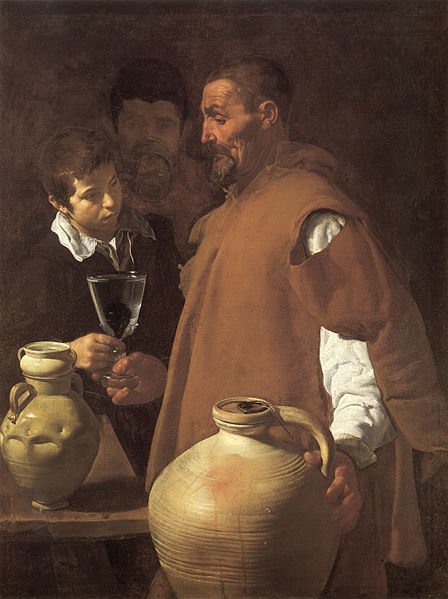
The Watersellerof Seville by Velazquez (1623)
Apsley House, London

At the end of this week we are off on a five-day jaunt to Spain to sample the delights of the Spanish Paradores and so I thought it would be fitting to have my next few blogs focus on Spanish painters.   Today I want to start by looking look at the connection between a famous Spanish painter and an English fighting hero.  I want to explore the connection between the talented Spanish artist Velazquez and the great British general, Arthur Wellesley, the Duke of Wellington.

My Daily Art Display today features not just one work but three very similar works, which were completed by the young aspiring Spanish artist in the early 1620’s and who was to become one of the greatest painters of all time.  His name was Diego Rodriguez da Silva Velazquez.  The works I want to look at today were all painted when he was in his early twenties. The paintings in which Velazquez specialised during his early career were known as “bodegones“.  The word derives from the Spanish word, bodegón which lierally means taven or public eating place.   In Spanish art, a bodegón is a still life painting depicting the preparation or eating of food, pantry items, such as victuals, game, and drink, often arranged on a simple stone slab, and also a painting with one or more figures, but significant still life elements, typically set in a kitchen or tavern. These works often depicted scenes of lowlife in earthy tones, and with a sense of sombre pathos, which were unlike similar works by the contemporary the highly-colourful Dutch and Flemish genre scenes by the likes of Jan Steen and Pieter Aertsen with their depictions of the happy, but poor, peasants.

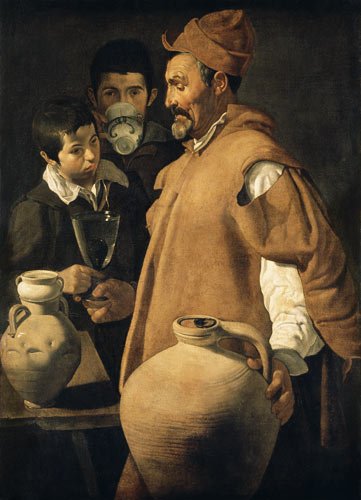
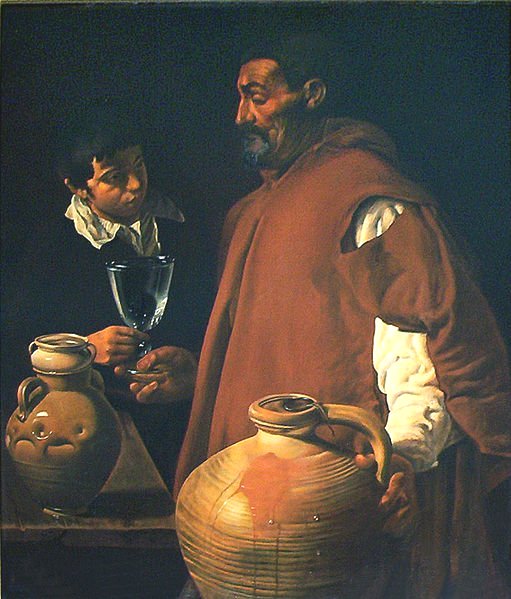
The title of Velazquez’s  three painting is The Waterseller of Seville.   Hecompleted these works during the period from 1618-1622.    Art historians would have us believe that these works were the greatest of all his Seville paintings.   Velazquez painted three versions of the work.  The one shown above can be seen in the Apsley House in London.  Another version of the painting, which was completed three years earlier, can be found in the Uffizi Gallery of Florence.  The third version of the work hangs in the Walters Art Museum  in Baltimore.

Let us take a look at the paintings in detail.  Before us Velazquez has portrayed a waterseller in the city of Seville. During the scorching heat of a Spanish day, to come across a waterseller would be a godsend.   The role of a waterseller in Spain in those days was a common trade for the lower classes in Seville.  The aguador was often mentioned in popular satirical Spanish literature, plays and popular imagery.  The aquador or waterseller was frequently portrayed as a scoundrel or pathetic peddler, who operated on the fringes of urban society and hawked his often dubious wares to an unsuspecting public.  This street water-seller was nicknamed the Corsican of Seville and who, according to accounts from the end of the 17th century, wore a smock with holes in it to show his scabs and sores to potential customers so as to eke out some sympathy whilst at the same time, boost trade.     In Velazquez’s painting we can see that the vendor of water has two customers.  One is a young boy and it is thought that the artist has used the same model for this work that he used in his earlier works, entitled The Lunch and Old Woman Cooking Eggs, a painting I will look at in my next blog.  In the background and somewhat harder to discern is another young man who has also purchased a small jug of water from the seller.

In the foreground of the painting we have very large jugs of water.  Rivulets and glistening water drops slowly run down the ridges of this massive jug.   Observe how Velazquez has cleverly depicted this main jug.  It appears so close to us.  It almost seems to bulge out of the painting.   The chalice-like goblet, held by the young boy, holds centre stage as the light falls on it.  Look carefully at the glass.  It is not just a simple glass of pure water but in it floats a fig.  This addition of the fruit was to act as a kind of perfumer with the intention of making the water taste fresher.

The Waterseller of Seville by Velazquez, (1618)
The Uffizi Gallery, Florence

The most striking aspect of this painting is how Velazquez has portrayed the water seller.   This is not a rich man.  This is a man who has had to eke out every peseta the hard way.    His facial expression is downcast. He has a look of resignation as he hands the boy the glass of water.  The man behind, who is shown full face, can be seen quaffing water from a lifted jar.  He has almost faded into the darkness of the background.   The features of the water seller, due to his days on end of standing out in the harsh sunlight, have taken its toll.  His face is rather haggard with age and ravaged and wrinkled by its exposure to the sun.  He has been plying his trade for many years, never able to accrue enough to retire.   The Apsley House version of the painting shows the seller bare-headed and in this version we can observe his short shaved hair.   Velazquez’s aged aguador stands in profile in the company of two of his clients.   He is dressed in coarse, monk-like robes.  Look at his eyes.  There is little or no eye contact between him and the boy.  He gazes blankly.  He seems to be lost in thought and has little or no regards to what is happening around him.   The offering of water seems to be just a mechanical movement.   The boy whose downcast, three-quarter glance is highlighted by a stream of light, hesitantly grasps the proffered goblet of water.  He does not make eye contact with the waterseller.  Is he too embarrassed by the plight of the old man?  Velazquez in his depiction of the man and the boy has highlighted the sharp contrast in their lives.  The battered and scarred face of the water seller contrasts greatly with the smooth white facial features of the young boy.

The Waterseller of Seville by Velazquez,(1620)
Walters Art Museum Baltimore

Velázquez’s portrayal of the waterseller is very profound.  One can see that he sympathises with the man and his terrible “lot in life”, by the way he has portrayed the man.  We can see that he shows consideration for  the poverty and age of the street-seller, and has, in some ways, given him an air of quiet dignity .  Velazquez by his depiction has represented a true-to life depiction of the waterseller and his trade.  His carefully crafted work encapsulates the imperfections of the seller’s pots, the saturations of dampness on their sides, the glistening of the light on the small drops of water and the glass, and the realistic expressions of the characters.

So what about the connection I mentioned in my introduction that this painting, the one which presently resides in Apsley House,  had a connection with Arthur Wellesley, 1st Duke of Wellington?   Apsley House, also known as ‘Number One, London’ stands on the north side of Hyde Park Corner. It is the magnificent former home of the Duke of Wellington and was granted to him by a grateful nation.

The “Waterseller” painting originally was a prized part of the Spanish royal collection.   In 1700 it figured in the inventory of the Buen Retiro Palace in Madrid.   By the late 18th century it hung in the Royal Palace in Madrid. There it struck the fancy of Napoleon’s brother Joseph Bonaparte, who was the commander of French forces in Spain during the Peninsular War and, who for a short time was the usurper of the Spanish throne.  When the French realized they were about to be driven from Spain by the Duke of Wellington, Joseph Bonaparte decided to leave Madrid but he was not going to leave the city empty-handed as he plundered numerous royal treasures before quickly retreating northward with his troops.  However Joseph Bonaparte was not able to reach the sanctuary of France as he was caught by Wellington and his troops just as he was about to cross the Pyrenees.  Wellington defeated Bonaparte at Vitoria and recovered from Bonaparte’s baggage train a number of Spanish paintings that had been cut from their frames, including the “Waterseller”.   Wellington wanted to return the artistic treasures to the Spanish nation but the restored Spanish monarch Ferdinand VII gave them all to Wellington as a gift from a grateful Spanish nation. In the dining room of Wellington’s magnificent London mansion, Apsley House, the Waterseller of Seville hangs today as a fitting tribute to its liberator.

Pablo Picasso – The early days, Part 1

Having returned home from a four-day vacation in Paris I need to catch up with writing my blog.  In my last blog I promised two entries with regards the life and works of Picasso and so, true to my word that is what I will give you.  Before I start I have a terrible admission to make.  I do not like the works of Picasso.  Yes, I know that is artistic anathema but at least I am honest.  I suppose the one caveat to that controversial assertion is that it is the later works of Picasso which I do not like and so my next two blogs will cover some of his earlier paintings and the fascinating beginnings to the Spanish artist’s life.

Pigeons by José Ruiz Blasco (Picasso's father) 1888

It was 11:15pm on Tuesday October 25th 1881 that Picasso was born in Malaga, Spain.  His father was Don José Ruiz y Blasco, a painter of birds in their natural habitat, especially pigeons, and who at the time was a professor of drawing at the Escuela Provincial de Bellas Artes in Malaga and a curator at the local art museum.  Picasso’s mother was Maria Picasso y Lopez.  He was the first-born of their children.  He was baptised Pablo Diego José Francisco de Paula Juan Nepomuceno María de los Remedios Crispiniano de la Santísima Trinidad, honouring a number of saints and some of his relatives.  To that already long name was added the names of his father “Ruiz” and his mother “Picasso” which was a requirement of Spanish law.  He was known simply as Pablo Ruiz.  Picasso’s father’s marriage to his wife was considered at the time as his father marrying beneath himself as he was from minor aristocracy and had a much higher standing in the community than that of his wife who was also without a dowry.  Although she brought no money into the relationship she did bring energy and thriftiness which was to serve her husband and family well.  Another thing Maria brought to the marital home was a bevy of females – her family, which consisted of her widowed mother and two unmarried sisters, Eladia and Eliodora along with a maidservant and so the young Pablo was brought up in a household full of women, all of whom were devoted to the little boy.

In late December 1884 Picasso’s sister, Lola was born, just three days after the devastating earthquake which destroyed large parts of the city of Malaga, killing almost eight hundred people and destroying 4000 homes.  The Picasso family fled the city and temporarily took refuge at the house of his father’s employer.  One wonders whether the young Picasso associated giving birth with the cataclysmic earthquake !   A second sister, Concepcion, was born when Pablo was six years old.  In 1891 the art museum which Picasso’s father had been its curator had closed down and as this was the main source of his income the father decided, for economic reasons, to uproot his family from Malaga an move everybody to La Corunna in the far north west of the country where he had gained employment as a teacher at the Guarda School of Fine Art.  By now, Picasso, aged almost eleven had developed a talent for drawing and his artistic skills blossomed to the detriment of his normal school work.  His father realised that his young son’s artistic talent would soon outshine his own and decided to transfer his own ambitions to those of his son and concentrated on getting his son, and now protégé, the very best artistic training.

In late 1894, when Picasso was barely thirteen years of age, tragedy struck the family with his four year old sister, Conchita, contracting diphtheria.  The young Picasso related years later that at this time he entered into a bargain with God that if he spared his sister’s life then he would give up all thoughts of painting again.   The fact that she was dying was concealed from Conchita and the family, for her benefit, celebrated the Christmas period as usual but sadly on January 10th 1895, she died.  Picasso was devastated by the death. In Arianna Stassinopoulos Huffington’s biography of Picasso entitled Picasso: Creator and Destroyer, she relates a conversation the artist had with his young lover Françoise Gilot, during which he tells her about his bargain with God with regards the life of his sister and his artistic career and the dilemma that had encompassed.  Huffington explains the thought process of the guilty Picasso regarding the prodigious bargain he had made with God saying:

“…he was torn between wanting her saved and wanting her dead so that his gift would be saved.  When she died, he decided that God was evil and destiny an enemy.   At the same time he was convinced that it was the ambivalence that had made it possible for God to kill Conchita.  His guilt was enormous, the other side of his belief in the enormous power to affect the world around him.    And it was his compounded by his primitive, almost magical conviction that his little sister’s death had released him to be a painter and follow the call of the power he had been given, whatever the consequences…”

In September 1895, the family made the sea passage from La Corunna to Barcelona, stopping off in Malaga to visit relatives.  Once in Barcelona, Pablo entered the local art academy, La Llojta School of Fine Arts, where his father had just gained the post as professor of drawing.   As far as Picasso and his father were concerned this was a great move as they were leaving the northern provincial town of La Corunna and moved to the great artistic centre of the Catalan capital.   Barcelona was the making of the adolescent Picasso.  It is in the Catalan city that Picasso starts to look into two utterly diverse worlds, the world of religion and the world of sex.  Pablo often received religious guidance from his wealthy and devout uncle, Doctor Salvador Ruiz, who would also aid him financially and who first met with young Pablo at his birth when he breathed life into what, at first, was considered to be a still-born baby.  His sex education comes to the fourteen year old Picasso by way of his frequent visits to the city brothels in the Barrios Chino.

First Communion by Pablo Picasso (1896)

In 1896, after a lot of persuasion from his father and probably through the good auspices of his father, Picasso entered a painting, entitled First Communion, into a major art competition, the Exposicion de Bellas Artes, in Barcelona, which was a means for young aspiring Catalan artists to exhibit their works of art.  His father posed as the model for the father in the painting and his sister Lola posed as the First Communicant.  The son of a friend of his father posed as the altar boy.  Picasso was just fourteen years of age when he painted this work.  He not only concentrated on the three individuals but spent a similar amount of time in depicting the still-life floral arrangement, the candelabra and the altar cloth.  The painting did not win a prize at the exhibition but for a fifteen year old having his work accepted into the exhibition with such aspiring artists was an honour in itself and his road to artistic fame had begun.

Science and Charity by Picasso (1897)

It was his father’s belief that his son would achieve success as an academic painter, and this heartfelt belief started to bear fruit in 1897 with Picasso’s painting entitled Science and Charity, which was awarded an honourable mention in Madrid at the General Fine Arts Exhibition.   Picasso’s father once again poses as the man in the painting, this time, the doctor whose skill and knowledge will determine the patient’s fate.  Picasso commented on the use of his father in his early paintings and how it remained with him all his life, saying:

“…Every time I draw a man, I think of my father.  To me, man is don José, and will be all my life…”

The painting did not win any medals but received an “Honorable Mention” albeit the critics were not happy with the way Picasso had depicted the woman’s hand which lies limply at the side of the bed.  The dark coated doctor at the bedside symbolises learning, literature and science whilst the religous nun symbolises all that is good, succour and charity.     Although put up for sale in Madrid the work was not sold and Picasso and his father presented the work as a gift to Picasso’s Uncle Don Salvador Ruiz whilst spending their summer vacation with his family.  The painting is now housed at the Picasso Museum in Barcelona.

It was during this summer sojourn that Don Salvador and Picasso’s father planned the next step in Picasso’s career and managed to gather together enough money from their relatives in Malaga to send Picasso to the Royal Academy in Madrid but as you will see in the next blog their plans failed.

My next blog will look at the adolescent Picasso developing an independent spirit, free of parental control.  I will also look at some of his early friendships and yet another tragedy which was to remain with him for the rest of his life.