
Marriage and travels.

Lucien Pissarro by Clara Klinghoffer (1928)
Clara continued to paint and produce beautiful works of art. She worked constantly at her easel from daybreak till sunset. She was awarded a bursary by the Slade allowing her to attend classes three days a week for a year and receive tuition from the Slade Professors of Art, Frederick Brown, and Henry Tonks. However, Clara only continued with this tuition for a few weeks, preferring to paint on her own at home. In 1921, the excessive workload she had given herself and her innate perfectionism finally took a toll on her health and she suffered a breakdown and suddenly the desire to paint had left her. She was suffering badly both mentally and physically, losing weight and becoming gaunt. She talked to nobody about her struggle and her parents could not understand why she spent little time painting. Clara recognised that she was ill and tried self-help but with little success. It was almost a year later when something strange happened to arrest this decline. At the rear of their large house, beyond their garden, there was a low border wall, on the other side of which was a set of newly constructed tennis courts. Clara and her sisters were fascinated and loved to watch the tennis players in action. The courts were owned by a good-looking young man in his early twenties, Julius Abrahams. A close friendship developed and Julius had strong feelings for Clara. Clara painted a full sized portrait of him but as Julius was engaged to another woman, Clara decided that a friendship was all she could offer Julius.

Upon Reflection by Clara Klinghoffer (1919)
Clara continued to build up a portfolio of her work and a number of her drawings were due to be exhibited at the Leicester Galleries in Central London in June 1923. Her drawings caught the attention of a certain Mr Smith who had contacted her and asked to see more of her work. Clara was requested to visit his house in Gordon Square in Central London’s Bloomsbury. Despite disliking trudging across London in wintry weather to visit a possible patron, she needed to sell work to fund her artistic materials and so on January 10th 1924, a Sunday afternoon, she headed towards Gordon Square and to her meeting with Mr Smith – a meeting which would change the course of her life.
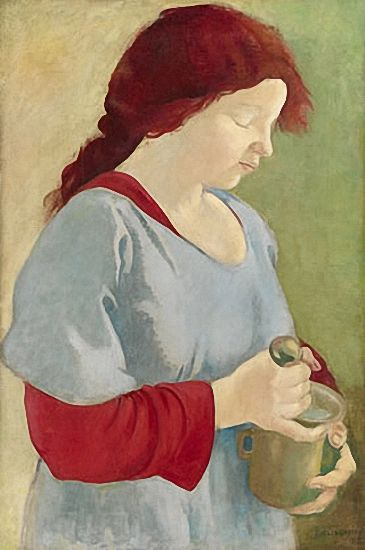
Rose with a Mortar and Pestle by Clara Klinghoffer (1919)
Unbeknown to Clara her meeting with Mr Smith was not a one-to-one meeting but she was heading to his house where he was hosting one of his artistic soiree. One of the regulars to these “parties” was an Italian journalist who lived in Hampstead with his fellow lodger, a Dutch freelance journalist, Joseph (Joop) Stoppleman. Joop was invited by his flatmate to come along to the party and reluctantly agreed, on the pretext that the experience might even make good copy for an article. On entering the drawing room of the opulent house the two journalists were greeted by raucous singing led by their host, Mr Smith. Midway through the party the doors to the Salon opened and Stoopleman in his biography, Clara Klinghoffer, The Life and Career of a Traditional Artist described what happened next:
“…the Study door was opened and a small girl with beautiful auburn hair, entered, carrying a portfolio much too large for her to hold with any comfort…”
The revellers were bemused by the sight of this small girl. Mr Smith, who was halfway through giving his rousing speech to his guests, stopped and rushed towards Clara, taking her portfolio from her and raising it in the air, whilst acclaiming:
“…”Now my young friends you will have the privilege to see art that is on a par with the work of the great Masters. And who has created it? This little girl–Clara Klinghoffer. Mark that name well, for one day it will be famous…”
The portfolio of Clara’s work was then placed on the large table at the centre of the Salon and Clara showed each of her paintings and drawings to the guests. They were all amazed by what she had created. When the party came to an end Joop Stoopleman offered to carry the heavy portfolio for Clara until she reached the trolleybus which would take her home. He wanted to see her again and was both surprised and delighted when Clara asked if he wanted to visit her at home and see more of her work. He avidly agreed and they exchanged telephone numbers and a date was set for the next meeting. This was the start of a long friendship which resulted in a love affair and which would eventually result in marriage. Joop was well received by the family but as a freelance journalist he knew he could not boast a regular steady income. As for Clara, she relied on the sale of her work so that their combined income was somewhat irregular.

Harriet Cohen by Clara Klinghoffer (1925)
The new year, 1925, was a very busy time for both Clara and Joop. Clara worked steadily on her drawings and paintings. One of her sitters was Harriet Cohen, the celebrated British concert pianist. At the same time, she was organising her work for a large-scale exhibition in the Redfern Gallery, in Old Bond Street, which was to begin in March of 1926. Clara had collected together twenty new paintings and some thirty new drawings. By the time she had put together sufficient work for the exhibition she was both exhausted and deflated. Her spirits were lifted when she was invited to accompany her friend Mabel Greenberg on a month-long holiday in the Pyrenees. Clara, on her return home at the end of April, was refreshed and was filled with ideas that could be used as depictions for her future paintings. In parallel to Clara’s busy schedule, Joop had to go on a trip to Holland visiting chief editors, to see if he could find new outlets for his writing.

Portrait of a Girl in a Fur Hat by Clara Klinghoffer
During the New year celebrations of 1926, Joop and Clara decided that they would marry once the Redfern Gallery exhibition had run its course. The exhibition which opened on March 9th was a great success and her paintings received much praise from the art critics. The art critic of The Times wrote:
“…It is perhaps being wise after the event to say that “work has feminine characteristics when an artist is known to be a woman. But this is certainly the case with Clara Klinghoffer’ s exhibition of paintings and dnawings at the Redfern Gallery. That is to say she has the power to imitate with great skill the manner of another painter and yet of toning it down and adapting it to her own less emphatic means of expression, as Berthe Morisot did with Manet. Her drawings and small pictures, rather than her larger oils, show that she has real talent. Her drawings are by far her best work and please at once, though, while they are reminiscent of Leonardo da Vinci, they leave out his emphasis and thus their correctness becomes apparent only after close examination. As is the modern custom, they are intended to be works of art in themselves, not studies of works of art, and they do not show the curiosity of an artist who draws to find something out, not to produce a finished effect. They are sensitive, but not profoundly sensitive. Mims Klinghoffer’s paintings are more under the influence of Renoir than of Leonardo, and in her biggest pictures she has tried to be more forcible than is in keeping with the character shown in her drawings…”

Portrait of the Artist’s Husband, aged 25 by Clara Klinghoffer
Once the Redfern Gallery Exhibition had completed, Clara felt utterly drained and Joop persuaded her to take a rest from painting and visit his homeland, Holland. She agreed to the change of scene despite Joop not being able to accompany her from the start as he was committed to leading a tour party to Europe. Joop arranged for her to stay with a family in the village of Voorthuizen and when, after six weeks, Joop finally arrived, the pair travelled north to his home town, Groningen and there she met Joop’s family. Clara and Joop finally returned to London in June 1926 and their marriage took place on July 29th at the Duke Street Great Synagogue of London. At the time of the wedding Clara’s youngest sister, Hilda had been very unwell. Joop and Clara decided that as they were going to the warm weather of Southern France for their honeymoon, Hilda should accompany them so as to help restore her health. All was agreed with the family and the three of them took the ferry to Calais and then the train south to Avignon for a short stay before arriving at their ultimate destination, the Côte d’Azur seaside town of Menton.
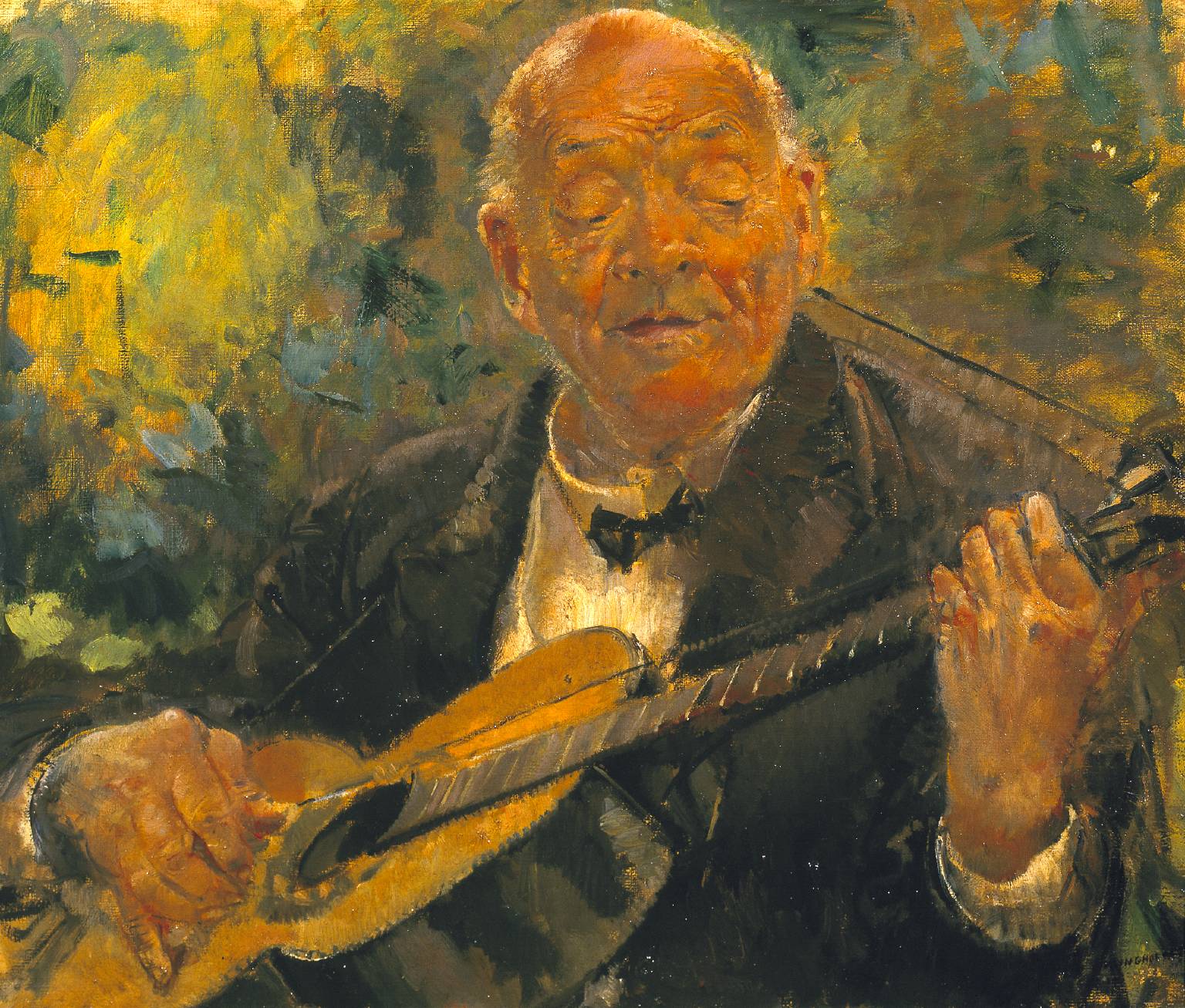
The Old Troubador by Clara Klinghoffer (1926)
The Menton pension they stayed in was very comfortable but quite expensive. In fact, it was too expensive for them as they planned to stay in Menton for six or seven weeks. Clara approached the pension owner and because they intended to stay a long time in Menton, he agreed to lease them a large house, Villa Aggridito, situated on the Boulevard de Garavan, on the outskirts of the town, and only charged them just four hundred francs a month. They took him up on his generous offer. One day whilst out walking they came across a man carrying a guitar. In Joops biography of his wife he recalls the moment:
“…we saw a little man with grey hair standing in the middle of the right-hand lane. He was neatly dressed in black linen trousers and jacket and carried a large guitar on a leather strap across his shoulders. He had a long egg-shaped face, burnt a red brown by the summer sun. His straight nose had wide, sensitive nostrils; his large eyes were of a melancholy brown. His forehead, wide and furrowed, blended into his high bald dome; and above both ears were thick tufts of snow-white hair. On his open shirt collar a neat dress tie had somehow found a foothold. All in all, he made the impression of a musician on the way to an appointment, transporting his instrument in a somewhat unorthodox way. As we approached, he quickly placed the guitar in position, and began to play. First a gay melody, then the popular ‘Valencia’ tune, of which he sang the words in a small, tremulous voice. We stopped and listened. There was nothing about him of the street singer. Rather, he seemed to be amusing himself and, accidentally, allowing us to share his enjoyment…”
The musician was Torquato Simoncelli and he came to their villa the next day and sat for Clara. It took half a dozen sittings for Clara to complete the portrait. On February 16th 1958, Clara wrote about that visit:
“…My husband and I spent the summer and autumn of 1926 in Menton-Garavan, close to the Italian border. It was there, at the border, that we met old Torquato Simoncelli, singing and playing on his guitar. This gentle and lovable old man came to sit for me on the terrace of our Villa, after his day’s work as a Troubadour was over (generally in the late afternoon). He sang, reminisced and played while I painted…. I did paint a second picture of him in another pose (this picture I still have)…”
………to be continued.
The information I used for this blog came from a variety of sources but the two main ones which would be of interest to you if you want a more in-depth look at Clara’s life are:
Clara Klinghoffer- 20th century English artist
and
Clara Klinghoffer: the girl who drew like Raphael and Leonardo


 One of her favourites was one she did of her three children.


 my daily art display