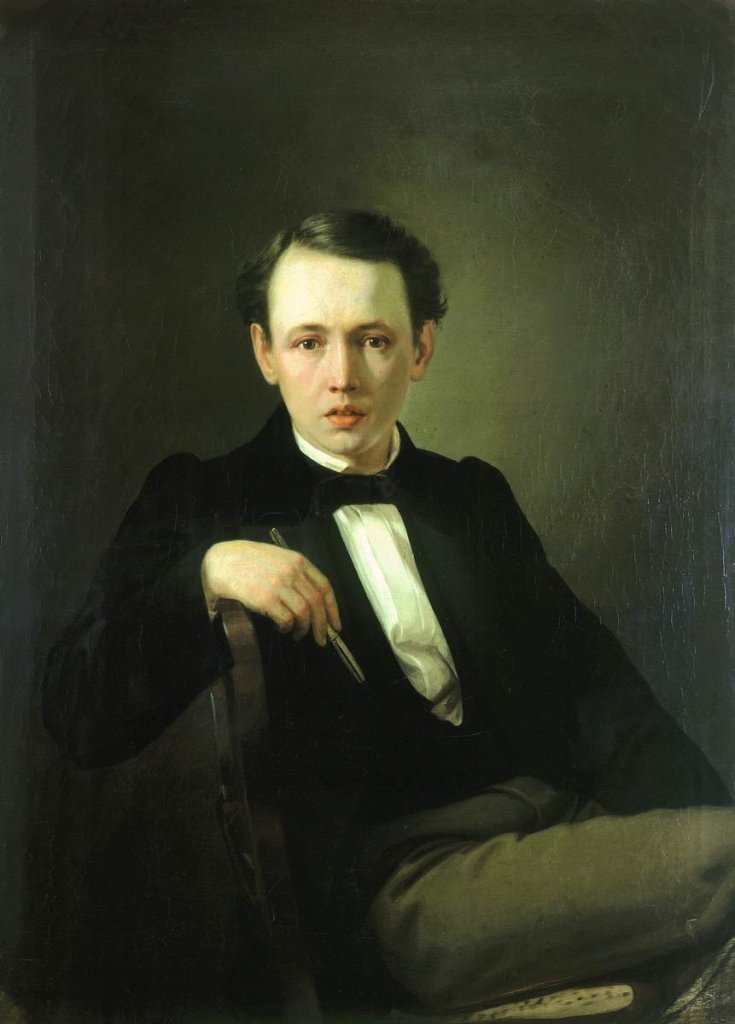
Vasily Perov. Part 2 – portraiture and humour

Self-Portrait (1851)

In my last blog I looked at Perov’s early life and his artwork which is often categorised as critical realism because of the way his paintings  focused on the peasants and how they had been let down by the Church, its clergy and the State.  For one of these works he was awarded the Gold Medal by the St Petersburg Imperial Academy of Arts and also a scholarship for him to travel to Europe and study European art.  He went to Paris where he spent a considerable amount of time but once again his art focused on poverty, this time, poverty in France.  Perov was now moving away from his anti-clerical depictions, and his barbed narrative works which poured scorn on the Church.  He now wanted to concentrate on the poor themselves and left the observer to decide on the reason for the poverty.

Savoyard by Vasily Perov (1863)

One of his most famous paintings, which he completed whilst in France, was one entitled Savoyard which he finished in 1863.  In Perov’s painting we see a young boy sat slumped on some stone steps.  The absence of any movement allows us to focus on the child without any distractions.  The child is asleep.  His feet stick out in front of him and this allows us to see the tattered hems of his trousers and because of the way is feet rest on the pavement we are given a view of the soles of his shoes, which are holed.  The painting itself is made up of dark sombre tones of smoky blue, green and grey.

Street Beggar by Gavarni

It is thought that Perov’s painting was influenced by the work of Paul Gavarni, a French engraver, who had his illustrations published in a collection of London sketches, featuring life in London at the time.  The sketches and accompanying illustrations were first published as a magazine series in 1848 and later they were collected in one volume, edited by essayist and journalist Albert Smith, which was first published in Paris, in 1862, a year before Perov’s arrival in the French capital.  It was entitled Londres et les Anglais.  One of the sketches was the Street Beggar and its thought that Perov had this in mind when he worked on the Savoyard.

Perov’s arrival in Paris in 1863 coincided with a great upheaval in French art.  The Hanging jury at that year’s Salon had been ruthless in their choice of paintings which could be admitted.  Those which were cast aside were ones deemed to have not been of the quality or type they wanted.  That year, the jury had been more ruthless than they had been in the past, rejecting two-thirds of paintings.  This resulted in vociferous protests from the artists who had had their works rejected.  It was so bad that Napoleon III stepped into the argument and placated the disgruntled artists by offering them a separate exhibition for their rejected works.  It became known as the Salon de Refusés (Exhibition of rejects) and that year this exhibition exhibited works by Pissarro, Fantin-Latour, Cezanne and included Manet’s Dejeuner sur l’herbe and Whistler’s Symphony in White,no. 1. 

The Arrival of the Governess at a Merchant's House by Vasily Perov (1866)
The Arrival of the Governess at a Merchant’s House by Vasily Perov (1866)

Perov returned home early from his European tour in 1865 and in 1866 produced a wonderful painting entitled The Arrival of the Governess at a Merchant’s House.  This was a move away from his focus on poverty and more to do with the fate of women.  In the painting we see a governess standing before the master of the house, a merchant who is to be her new employer.  This painting depicts the awkward encounter between the governess, who has probably graduated from a school for governesses, where they are taught to act like nobility, and the merchant who has no noble blood and is the face of the nouveau riche.   She presents herself well. She clutches a letter of introduction in her hands. She oozes an air of timidity and subservience, which is a trait that would be required if she was to become a member of the household.  However her demure stance with head bent down is befitting that of a lady.  She stands before, not only the master of the house, a bloated man, but behind him stands his family.  The children of the family are to be her pupils and by the looks of them she was going to be in for a difficult time.  The master of the house and his three children are dressed elegantly and the furnishings we see are fine and elegant and are part of merchant’s plan that they be elevated in status from mere merchants to something approaching nobility. Perov has changed the subject of his biting satire from the clergy of the Church to the oppressive merchant classes and the poor treatment they bestow on their employees.

Troika by Vasily Perov (1866)

The painting was purchased by thirty-four year old Pavel Tretyakov, a Russian businessman, patron of art, avid art collector, and philanthropist who gave his name to the Tretyakov Gallery in Moscow.   This work along with his Troika painting earned Perov the title of Academician.
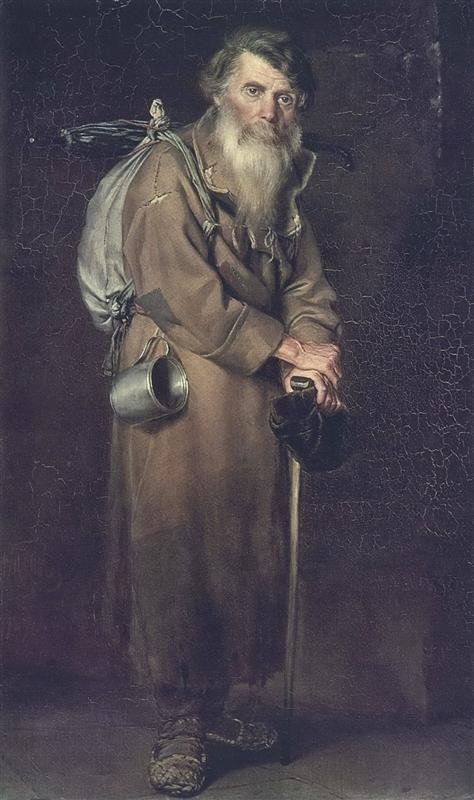
Wanderer by Vasily Perov (1870)

In the late 1860’s Perov began to concentrate on portraiture, initially of peasants and the title Wanderer was given to three of his works which featured peasants, all different and yet all emotive in their own way, one of which is shown above.  As Perov travelled around he came across a variety of fascinating characters and he was able present them on canvas and highlight their individualism and their way of life.

Portrait of the Author Feodor Dostoyevsky by Vasily Perov (1872)

In the early 1870’s Perov’s portraiture focused on cultural greats of Russia but it is interesting to note in these next two paintings they were totally devoid of any background accoutrements which would have added a sense of vanity in the sitter.  In 1872 he completed the Portrait of Dostoyevsky, a the Russian novelist, short story writer, essayist, journalist and philosopher. It was Dostoyevsky’s literary works which influenced Perov in the way they explored human psychology in the troubled political, social, and spiritual atmosphere in Russia during the 19th-century.

Portrait of the Playwright Alexander Ostrovsky by Vasily Perov (1871)

And in 1871 he finished his Portrait of Alexander Ostrovsky, a Russian playwright who was generally thought to have been the greatest writer of the Russian realistic period, which existed against the background social and political problems.  It started in the 1840’s under the rule of Nicholas I and lasted through to the end of the nineteenth century.   The painting is now housed in the Tretyakov Gallery, Moscow.
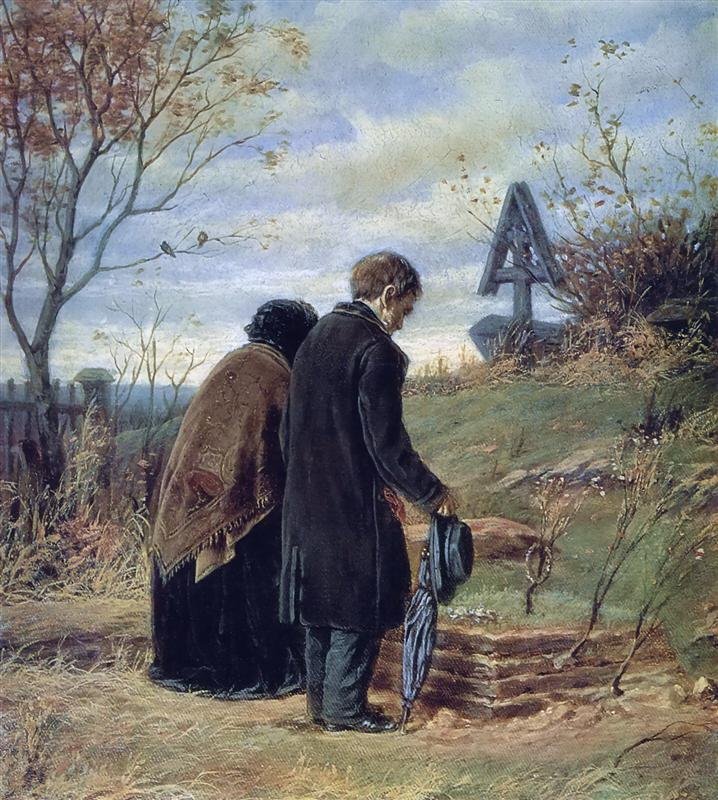
Old Parents Visiting the Grave of Their Son by Vasily Perov (1874)

In all his genre works he always managed to tug at your heart strings with his moving depictions.  Another of his heart-rending scenes was completed in 1874 and was entitled Old Parents Visiting the Grave of their Son.  It is said that nobody should suffer the agony of burying their children and in this work we feel the loss of the mother and father as they stand, heads bowed, at the side of the son’s grave.  This painting, like many of his other works, are to be found at the Tretyakov Gallery in Moscow.

Having received his academician’s degree in 1867, Perov went on in 1871 to gain the position of professor at Moscow School of Painting, Sculpture and Architecture.   It was through Perov’s teaching at Moscow School of Painting, Sculpture and Architecture that he managed to influence and nurture the young aspiring artists in his charge.  Many of the great Russian artists had been taught by him or were influenced by his style of painting

Amateur by Vasily Perov (1862)

As always I have the dilemma of which paintings to show you and which ones to leave out.  I just hope the blog will get you to search the internet for more of his works.   My final offering is one that features Perov’s sense of humour.  It is in complete contrast to his works which looked at poverty and the impoverished existence of the peasant classes.   It is a painting entitled Amateur which he completed in 1862.  It is both humorous and fascinating.   Before us we see a man slouched in a chair, chewing on the end of his maulstick, eyes narrowed as he looks at his work.  His wife stands beside him holding a baby.  She too is closely examining the canvas.    From the way the man is dressed along with the background details of the room we gather that this is an upper-middle class couple.  Another give away to the man’s social status is the way Perov has depicted him.  Well dressed, highly polished shoes and overweight.  Perov’s depiction of this man is similar to the master of the household, the merchant, whom he depicted in The Arrival of the Governess at a Merchant’s House- overweight, through all the food he had been able to buy and eat, whereas in most cases Perov portrayed the poor peasants as thin undernourished people.

Vasily Grigorevich Perov died of tuberculosis  in Kuzminki Village which is now part of Moscow and was laid to rest at Donskoe Cemetery.  He was fifty-eight years old.
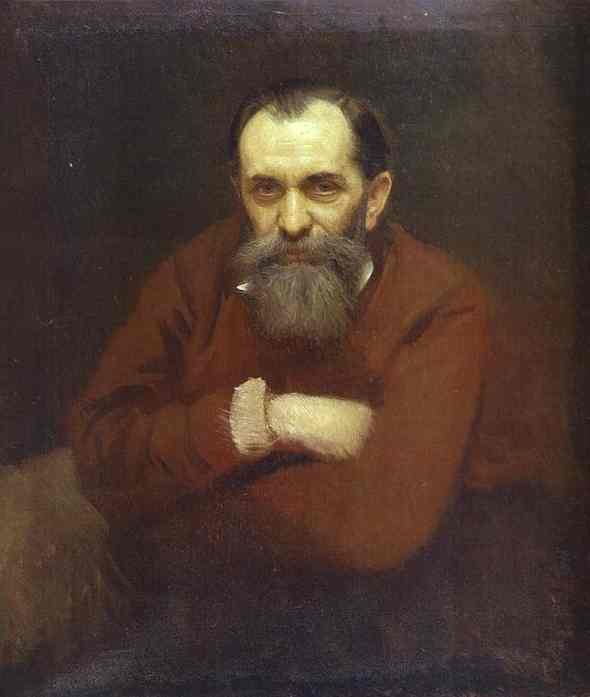
Vasily Perov, Part 1 – the critical realist

Portrait of Vasily Perov by Igor Kramskov (1881)

For my blog today, I am returning to Russia and featuring one of its greatest nineteenth century artists, Vasily Grigoryevich Perov.  He is known as one of the great critical realism artists of his time.

Perov was born in 1834 in the town of Tobolisk, a Siberian town, which lies east of the Urals.  Perov was the illegitimate child of Baron G K Kridiner, the provincial prosecutor for the region of Arzamas.  Perov, who was born prior to his mother and father’s marriage, was given the surname of his godfather, Vasilyev and yet, Perov himself disliked the name and had it changed to Perov, which was his nickname as a child as he was an excellent hand writer and a talented calligrapher.  Pero in Russian means pen.

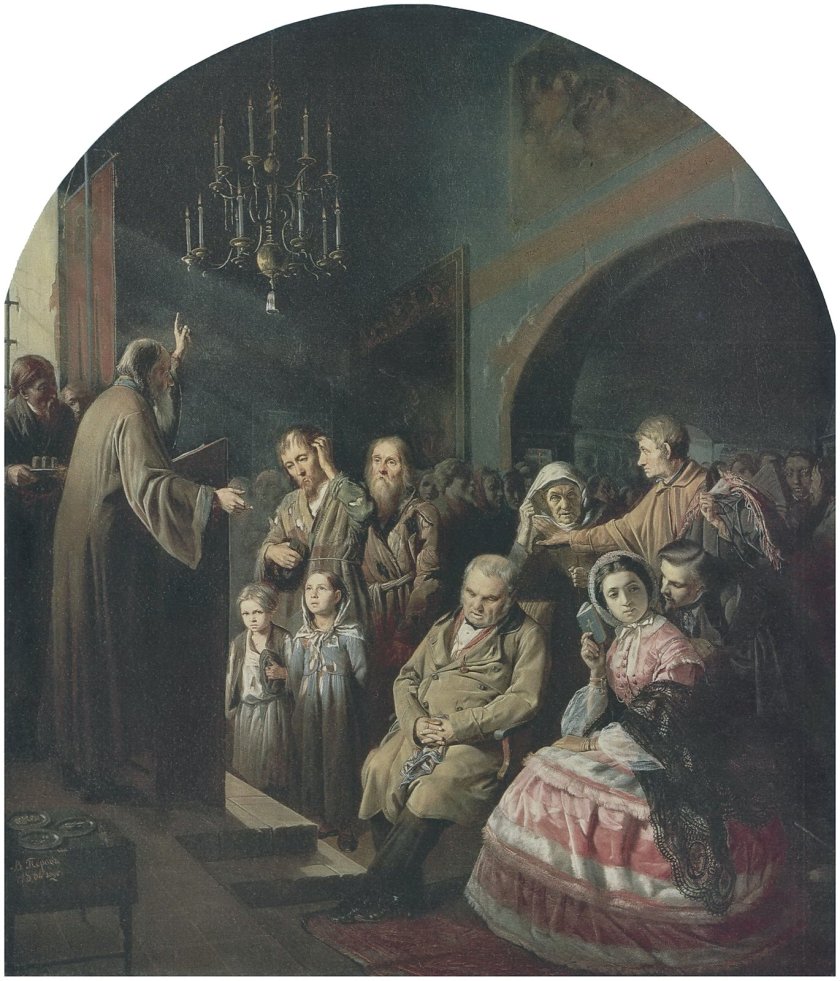
Sermon in a Village by Vasily Perov (1861)

In 1846, Vasily Perov received his first painting lessons, at the age of twelve, at the Alexander Stupin Art School in Arzamas. Stupin was a painter of the classicism genre, whose school was the first of its type in provincial Russia.  From there, in 1851, Perov moved to Moscow and entered the Moscow School of Painting, Sculpture and Architecture, which was one of the largest educational institutions in Russia.  It was here that he studied under Sergey Zaryanko, a Russian painter of Belarusian birth.   Whilst at the academy, he won a number of awards for his work from the St Petersburg Imperial Academy of Arts and his major award was when he won the Grand Gold medal for his diploma work in 1861.  The work was a set of preliminary sketches and the finished painting, Sermon in a Village.  He was also awarded a scholarship to travel abroad to enhance his knowledge of European art.

The Sermon in a Village is not simply a depiction of the congregation listening to a sermon.  In the centre foreground we see a nobleman asleep, head slumped forward on his chest.  He has no interest in the sermon.  He is just present to be seen.  Sitting next to him is his dutiful wife, prayer book in hand,  who plays coy as an admirer standing behind her flirts with her.  Look at the woman who stands behind the sleeping nobeleman.  She pulls her veil away from her ear and leans forward to try and hear the sermon.  Next to her one of the nobleman’s footmen tries to prevent her getting to close to his master. Earlier paintings depicting Russian clergy depicted them with veneration and the utmost respect so this mocking depiction of the church clergy by a young up and coming artist was frowned upon by the Establishment but it was accepted as an exhibit and won the artist, Perov, a European trip.

The Village Religious Procession at Easter by Vasily Perov (1861)

The preliminary sketches and painting, which won him the Gold Medal, were not his initial submission.  His original submissions were preliminary sketches for another of his works, The Village Religious Procession at Easter.  However the Academy rejected these because of their overt criticism of the Church and the clergy.  One needs to understand that Perov wanted to not only highlight the plight of the poor and the deprived, he wanted to condemn the role of the Church and its leaders who led a comfortable life and, in his mind, offered little comfort to the poor.  Despite the St Petersburg Academy’s rejection of his preliminary sketches for the The Village Religious Procession at Easter, he completed the work in 1861.

This oil on canvas work was his way of recording his belief that the clergy had forgotten their duty to parishioners.  It was blatantly an anti-clerical depiction.  The setting is a dull landscape.  The discordant movement of the participants in the procession together with the gloomy sunset accentuates the unattractiveness of the whole scene.  Before us, we see a drunken mix of clergy and their congregation embarking on a parade of icons through the village. Some of the people in the parade are carrying icons and gonfalons (a type of heraldic flag or banner, often pointed, swallow-tailed, or with several streamers, and suspended from a crossbar).  In the foreground of the painting, the peasants stagger past us towards a precipice with half-closed eyes.  It is as if they are all blind. We can make out a woman with an icon that has lost its face. A little further on, we observe the figure of a poor man carrying an icon upside down, albeit, we can still make out the “all-seeing” eye on the gonfalon and maybe Perov left it in to remind people that nobody can escape the Supreme Judgment.  The leader of this group is a drunken priest who we can see on the right, standing on the steps of the wooden building, hanging onto the upright structure to stop him falling.  We can also see, despite the desperate efforts of one of his helpers, that he has stepped on and crushed the Easter egg.  He has abandoned his “flock”.

Religious Procession in Kursk Province by Ilya Repin (1883)

The painting was exhibited at the Society for the Encouragement of Artists in St Petersburg but the curators were told to remove it on grounds that it was an “immoral” work, which criticised the Church and its clergy.  Even the press were banned from reproducing it in their newspapers; such was the power of the Church at the time.  Twenty years later Ilya Repin completed his famous work, Religious Procession in the Province of Kursk (See My Daily Art Display Aug 29th 2011), which again compared the lot of the downtrodden peasant class and the wealth of the clergy.

In 1862, Perov chose to go to France and also visited some German cities.  He returned home in 1864, even though his scholarship would have funded a longer stay in Europe.  Maybe he missed his homeland.

Perov lived through the 1860’s in Russia and was well aware of the social problems in his beloved country and he began to highlight the plight of the poor and downtrodden as well as contrast that to the wealth of the Russian church and its hierarchy.  Perov’s paintings carried strong social implication and thus his realistic depictions became an important landmark in the history of Russian painting.

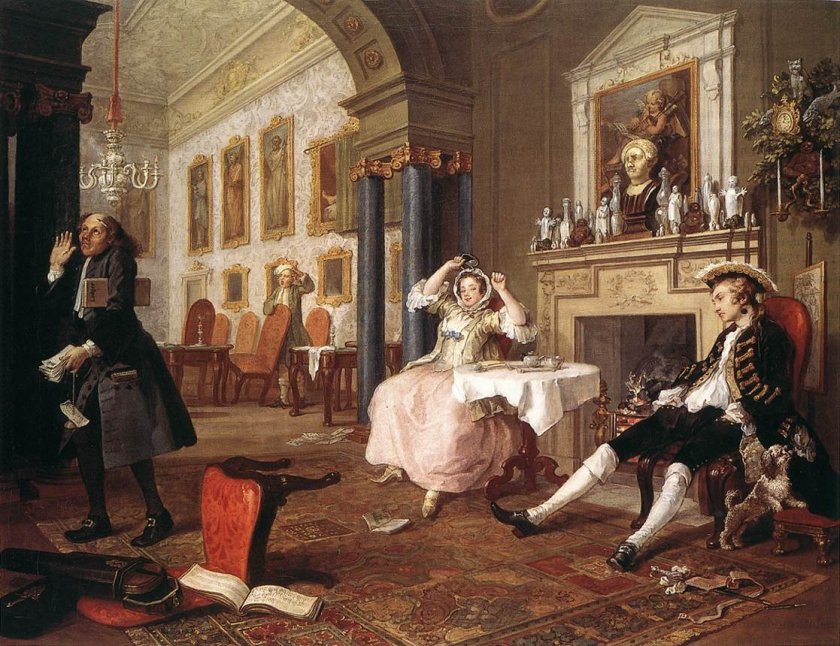
Marriage à la Mode by William Hogarth (c.1743)

Perov, at this time, had become influenced by the work of Pavel Fedotov,  who is now looked upon as the founder of critical realism in Russian art.  Perov was also aware of the genre scenes by the Old Dutch masters, often depicting poverty.  Another painter who influenced him was the English painter William Hogarth, the eighteenth century pictorial satirist and social critic whose work ranged from realistic portraiture to what is referred to as Sequential Art, which uses images arranged in sequence for graphic storytelling or to communicate information, a kind of narrative art. One example of this is Hogarth’s almost comic strip series which questioned the morals of the privileged (see – Marriage a la Mode – My Daily Art Display May 4th – 9th 2011).

On his return to Moscow he became one of the founder members of a group, known as the Peredvizhniki, often referred to as The Wanderers or The Itinerants.  This group of artists were influenced by the liberal ideas of the philosopher and critic, Nikolay Chernyshevsky and the philosopher, Vissarion Belinski.  They established the first Free Society of Artists in Russia. In a way it was a group, which felt it their duty to portray, through their art, the necessity of denouncing the social order in Tsarist Russia.  Other great Russian artists which were part of this group and have featured in My Daily Art Display were, Ilya Repin, Alexei Savrasov, Isaac Levitan and the landscape painter, Ivan Shishkin.  This group of young artists, who in protest at Academic restrictions formed themselves into a co-operative.  Perov’s influence on the art of the time, developing realism in art during the last five decades of the nineteenth century, cannot be underestimated.

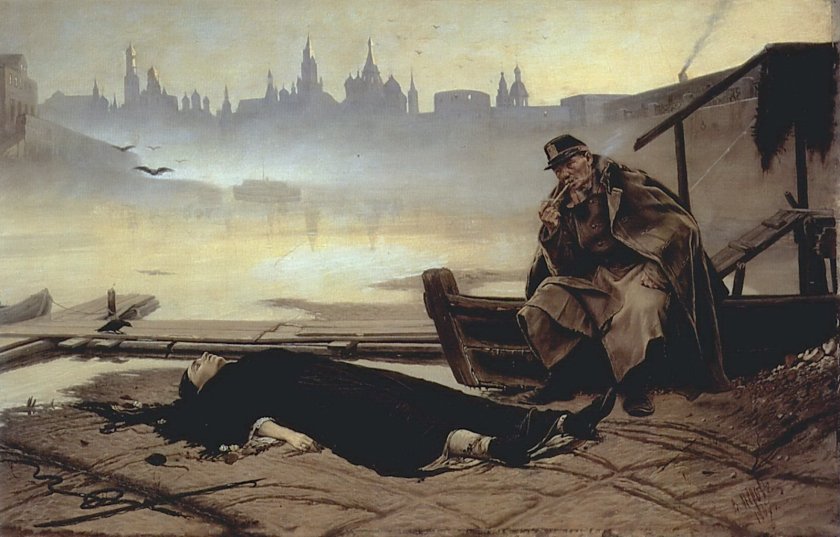
The Drowned Woman by Vasily Perov (1867)

The height of Perov’s success as a realist and genre painter came around the latter part of the 1860’s.  In 1867 Perov produced the highly emotive work entitled The Drowned Woman.    In Perov’s painting we see a policeman, who has just dragged the body from the river.  He is sitting, smoking his pipe, and looking down on the dead woman.  The artist wants us, like the policeman, to think what might have been the circumstances of the young woman’s death.  Had life been just too hard to bear?   The casualness of the policeman’s demeanour gives us the idea that the dragging of a lifeless body from the river was a common occurrence.  It should be remembered that what we see in Perov’s depictions of social inequality was mirrored in the literature of the time by the likes of Fyodor Dostoyevsky whose writing explored human psychology at a time of the difficult political and social mood of 19th-century Russia.

Found Drowned by George Frederic Watts (c.1850)

The subject of this work by Perov harks back to a work by the English realist painter, George Frederic Watts, and his 1855 work Found Drowned, a portrayal of a fallen woman, who drowned and whose body was discovered on the shores of the Thames.  (See My Daily Art Display July 4th 2011).

The Last Journey by Vasily Perov (1865)

In 1865 Perov produced another heart wrenching oil on canvas work entitled The Last Journey, which can now be seen in the Tretyakov Gallery in Moscow.  It is a depiction of both sorrow and condemnation.  There is an overwhelming sense of bereavement as we see a horse-drawn sleigh driven by an old woman.  We just see the back of her, hunched over, driving the horse.  She is taking the wooden coffin, which contains her recently deceased husband and breadwinner, to his final resting place.  Also on the sleigh are two children who, like the woman, face an uncertain future.  Their pet dog follows on.  The painting is gloomy matching the atmosphere of the story behind the depiction. Dark clouds are seen above the funeral cortege.  It is thought that Perov got the idea for this painting when he read the book, The Red Nose Frost, published in 1863 by Nikolai Nekrasov.  It is in two parts, the first part tells about a funeral of a young peasant and in the second part of the widow fight for survival in the forest. Nekrasov was a Russian poet, writer, critic and publisher.  His intensely empathetic poems about peasant life made him the hero of the freethinking and revolutionary circles of Russian intelligentsia.

Troika by Vasily Perov (1866)

I am completing this first part of my blog about Vasily Perov by featuring one of his greatest and certainly his largest genre painting (123 x 168 cms).  It has the simple title, Troika, which is the Russian word for “group of three”, and was completed in 1866 and now resides in the Tretyakov Gallery in Moscow.  It is a pictorial social commentary, which in this case, focuses on child labour.  We see children pulling a sled piled high with heavy barrels.  They face us.  Look at the way Perov has depicted their faces.  There is of course a child-like quality about them but one cannot fail to notice the pain and suffering their task is causing.  The air of gloom is added to by Perov’s background – The backdrop, the gloomy walls of the monastery create a mood of hopeless melancholy.  The children are being used and humiliated by this onerous task.

In my next blog I will showcase more of Perov’s paintings and look at the final years of his life.

Alexsei Savrasov – the lyrical landscape artist

Portrait of Alexei Savrasov by Vasily Perov (1878)

My last two blogs featured the life and works of the great nineteenth century landscape painter, Isaac Levitan.  Whilst I was researching his early life as a student at the Moscow School of Painting, Sculpture and Architecture I came across the name of Alexei Kondratyevich Savrasov who was one of Levitan’s tutors.  Having a rest from writing about Levitan, I had a look at some of the works of Savrasov, who had influenced Levitan and amongst them I came across the most exquisite painting and the one Savrasov was probably most famous for; but more about that later.

Alexei Savrasov was born on 12 May 1830 into the family of a Moscow merchant.  As a young boy he developed the love of drawing and by the age of twelve he was experimenting with painting gouache and watercolour landscapes and during his early years he managed to exchange his paintings with vendors for chicken feed.  He persuaded his father to let him study art and at the young of eight he attended the painting school.

In 1844, when Savrasov was fourteen years of age, and plans for his future career had to be discussed with the family.  His father was adamant that his son should follow him and become a merchant and thus end all the time his son spent painting which his father regarded as just a hobby.    However for Alexei, his heart was set on becoming an artist.  Alexei eventually had his way and enrolled at the Moscow School of Painting, Sculpture and Architecture and in 1848 he was fortunate to join the special studio of perspective and landscape painting which was run by Karl Rabus, who was the Professor of Landscape painting.  Alexei loved the genre of landscape painting and began to specialise in it. Soon he was widely acknowledged by the tutors as the best student of landscape painting in the School.    During the last years at the painting school, Savrasov, received a bursary from a well-known Moscow art patron and member of the Moscow Art Society, Likhachev, which enabled him to go on a painting and sketching trip to Odessa, where he captured the beauty of the local landscape.

View of the Kremlin from the Krymsky Bridge in Inclement Weather by Alexei Savrasov (1851)

In 1850 Savrasov graduated from the Moscow School of Painting receiving the official title of “unclassed artist”.  One of the first paintings Savrasov completed after leaving the art school was entitled View of the Kremlin from Krymski Bridge during Inclement Weather.  The storm clouds rush from the right to the left of the painting pushed relentlessly by the strong winds which have caused the branches of the trees to bend towards the river.  The sun has pierced the clouds and illuminated the Kremlin in the background of the painting.  In the foreground of the painting we see that the sun has lit up a small patch of land where the water from the Moskva River laps the sandy ground.  A woman, pail in hand, rushes past.  Her hand clutches her coat to hold it closed while  the wind whips at her skirt which is billowing in the gale.

View in the Neighbourhood of Oranienbaum by Alexei Savrasov (1854)

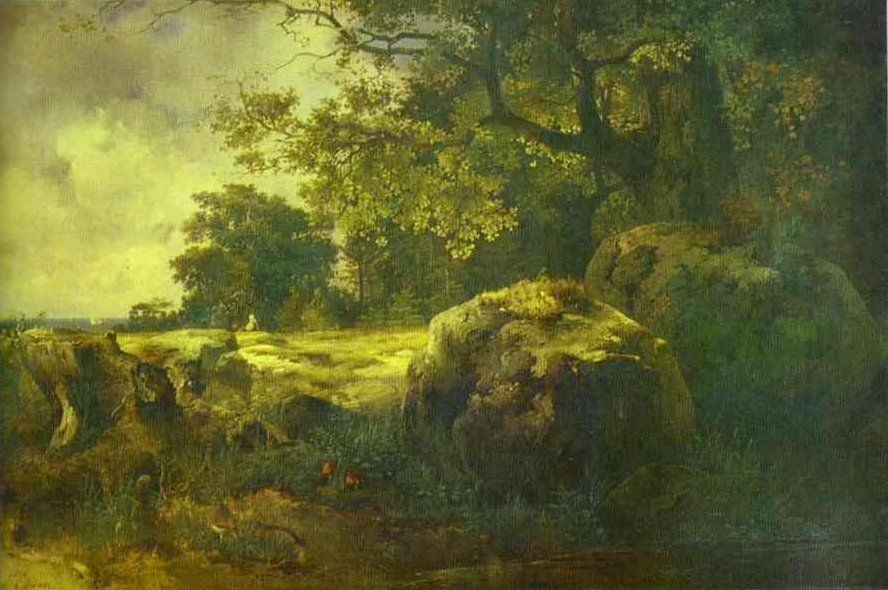
Savrasov travelled to the Ukraine in 1852 and steadily built up a portfolio of sketches and paintings and with them he started to develop a reputation as an up and coming artist.  Two years later, in 1854, he received a painting commission for several works of art for the Russian Art Academy from the Grand Duchess Maria Nikolayevna,   She was one of the daughters of Emperor Nicholas I of Russia.    She was an avid and well-known art collector and President of the Russian Academy of Arts in St Petersburg.  To carry out his commission, Savrasov moved from Moscow to the Gulf of Finland, close to St Petersburg.  Two of the paintings he produced, View in the Neighborhood of Oranienbaum and Seashore in the Neighborhood of Oranienbaum, are now looked upon as excellent examples of the genre known as romantic landscapes   These works of art by Savrasov allowed him to depict, with great fondness, the charm and appeal of a summer evening at the sea, with the moistness associated with the sea air in the shade of ancient rocks, whilst envisioning the twilight which we observe under the spread­ing branches of trees.  The works Savrasov produced during this period, and these two works in particular, earned him the title of Fellow of the Russian Art Academy.

Alexi Savrasov had studied at the Moscow School of Painting, Sculpture and Architecture for ten years from 1844 to 1854, some of the time under the tutorship of Karl Rabus.  When Rabus died in 1857 Savrasov was asked to take over Rabus’ landscape class which he did and remained in post until 1882.  During his tenure he took many students under his wing, including the subject of my last blog, Isaac Levitan.  Savrasov was an excellent teacher and much loved and admired by his students.  In 1857 Savrasov married Sophia Hertz, the sister of art historian and archaeologist, K. Hertz; the couple went on to have several children. In their home they entertained artists and collectors including the famous art collector and patron of the arts, Pavel Tretyakov, who gave his name to the Moscow Art Gallery.

After leaving the Moscow School of Art in 1862, Savrasov took up the suggestion made to him by the Art Amateurs’ Society and left Russia on a painting expedition of Europe.   He travelled to that year’s World Fair in London, where he exhibited his painting View of the Surroundings Oranienbaum, and was amazed by what he saw and was unstinting in his praise, writing:

“…no academies in the world could so advance an artist as the present world exhibition…”

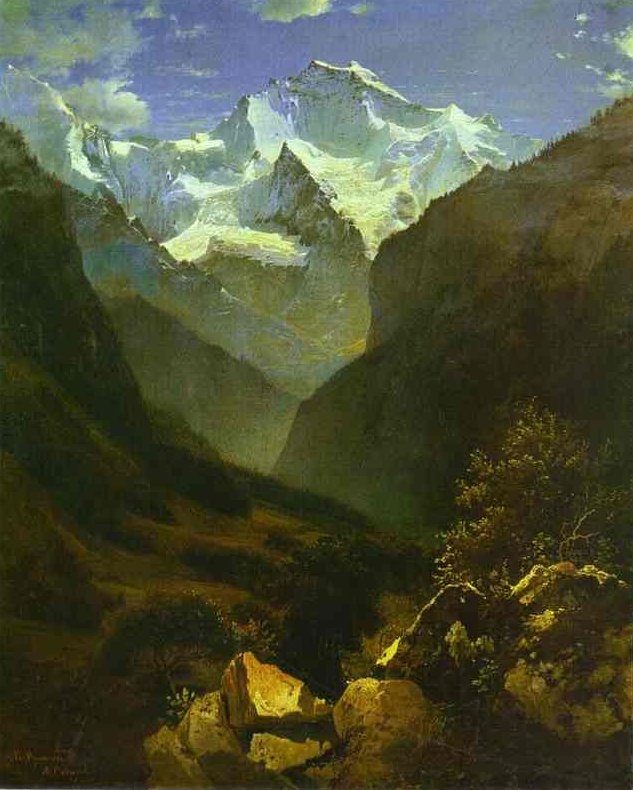
View of the Swiss Alps from Interlaken by Alexsei Savrasov (1862)

On the way back home he visited Paris, Switzerland, Copenhagen, Berlin, Dresden, Leipzig.  During his European travels the two landscape painter whom he admired the most were the English artist, John Constable and the Swiss landscape painter Alexandre Calame.   One of the paintings he completed in 1862 originated from his travels through Switzerland.  It was entitled View of the Swiss Alps from Interlaken and was completed in 1862.

Rafts by Alexei Savrasov (1868)

I particularly like his painting entitled Rafts which he painted in 1868.

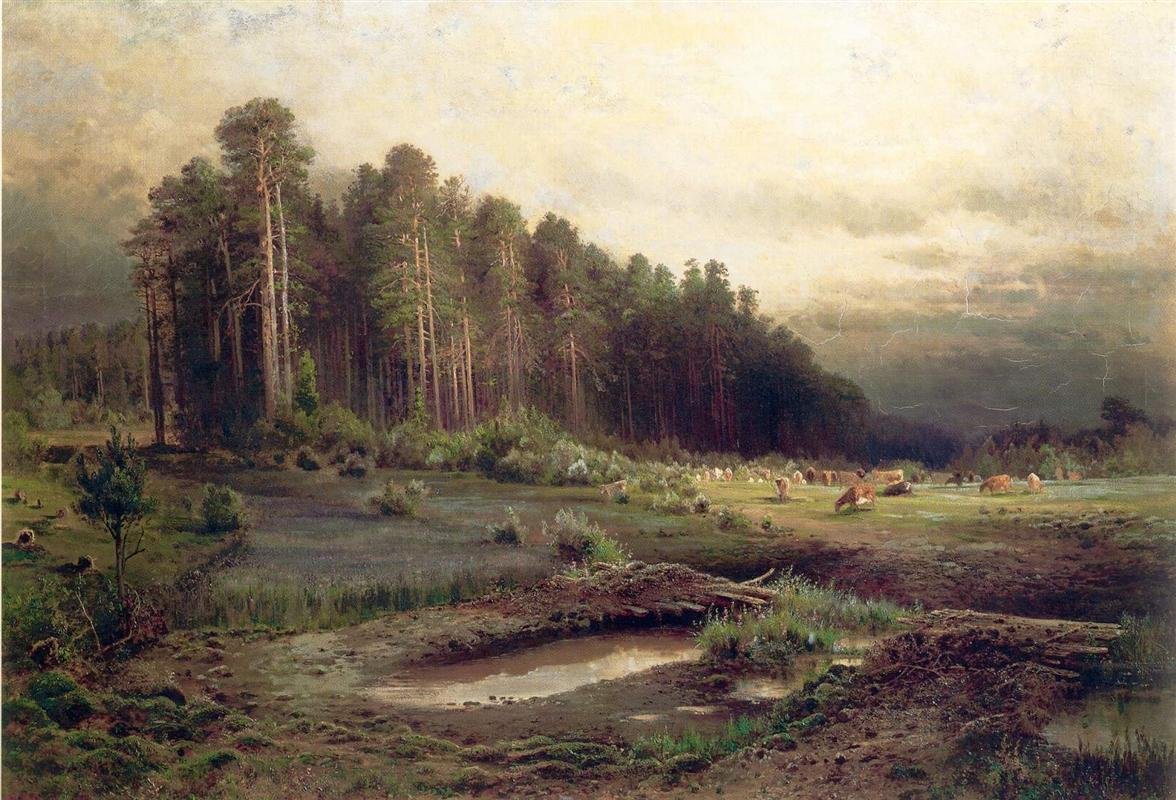
Elk Island in Sokolniki by Alexi Savrasov (1869)

However the painting of his which drew the most acclaim in this period was a beautiful landscape work entitled Elk Island in Sokolniki, which he finished in 1869 and for which he was awarded the first prize at a painting competition organised by the Moscow Art Amateurs’ Society.  Elk Island straddles the boundary between the centre of Moscow and its suburbs to the north of the city.  It is home to a remarkable variety of animal and plant life.  The area was believed to have been a favourite place for Ivan the Terrible to enjoy falconry and bear-hunting. The area was given the name Elk Island in the early 17th century, when documents say that the place was used for hunting “all manner of game birds, and especially elk”.

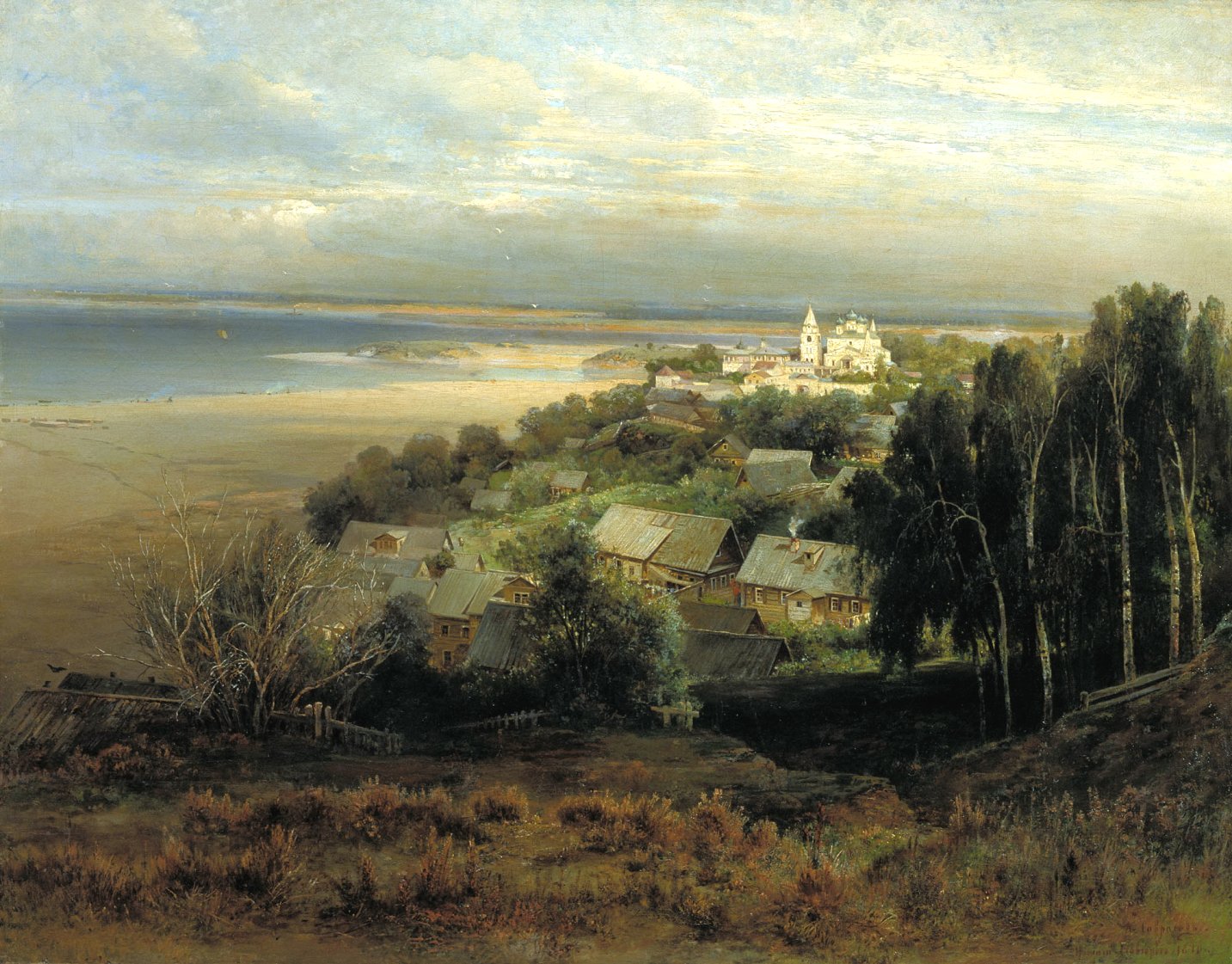
Caves Monastery near Nizhny Novgorod by Aklexei Savrasov  (1871)
Caves Monastery near Nizhny Novgorod by Aklexei Savrasov (1871)

In December 1870 Savrasov, his wife and family went to live in Yaroslavl which lies on the Volga, three hundred kilometres north of Moscow.   Whilst there he produced the beautiful work of art entitled  Caves Monastery near Nizhny Novgorod, which is now housed in the Gorky State Art Museum in Nizhny Novgorod.  It was one of the largest canvases Savrasov ever painted.    The left hand side of this wide panoramic view is taken up by the confluence of the Oka and Volga Rivers with the blue lagoons whilst the right hand side of the painting depicts the Pechersky Voznesensky monastery.  The original monastery is believed to have been founded around 1330 by St. Dionysius, who, along with several followers, arrived in Nizhny Novgorod from Kiev Pechersk Lavra also known as the Kiev Monastery of the Caves, (pechery meaning ‘caves), hence the title of the painting.  On arrival at Nizhny Novgorod they dug a cave on the shoreline of the Volga and later it became the site of a monastery and church.  The original monastery was destroyed by a landslide in 1597; but in the same year a new monastery was built a short distance upstream.

Detail from Caves Monastery near Nizhny Novgorod

In the right foreground, we see suburban homes with their small gardens awash with greenery which contrasts with the towering white stonework of the monastery.

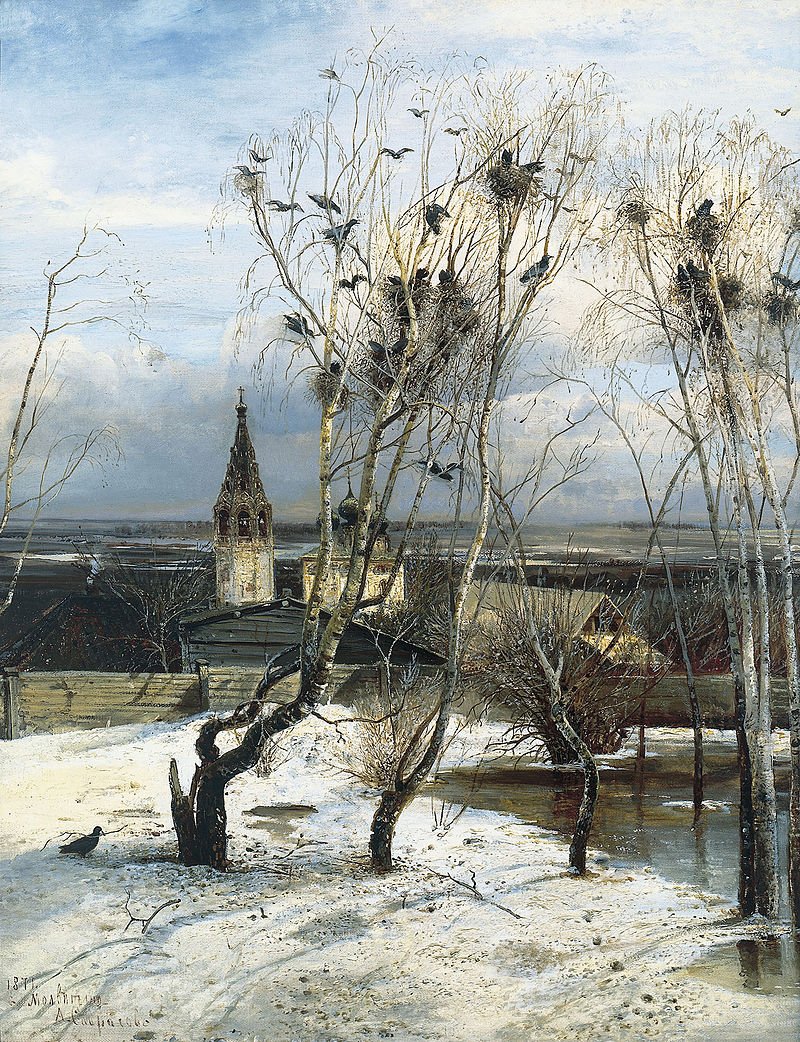
The Rooks have Come Back by Alexei Savrasov (1871)

The last work of Savrasov, which I am showcasing, is the one I talked about at the start of this blog.  Its beauty and simplicity immediately struck me and I was reminded of one of my favourite artists Pieter Breugel the Elder who had a propensity of including rooks or magpies in his winter scenes, such as his 1565 painting The Hunters in the Snow.  This painting by Savrasov entitled The Rooks have Come Back was completed in 1871 at the height of his artistic career.

Members of the Peredvizhniki group (Savrasov,with beard, standing, third from left)

A year earlier he had became a member of the Peredvizhniki group, often known as  The Wanderers or The Itinerants who were a group of Russian Realist artists, who like many artists throughout Europe railed against the Academic restrictions and decided to go off on their own and set up artists’ cooperative.   The Wanderers eventually evolved into the Society for Travelling Art Exhibitions.  It is a simple painting with an equally simple theme – the birds returning home in Spring.  It was a transitional depiction.  A transition of nature from winter to spring heralded by the return of the rooks. This landscape work with all its simplicity was termed a lyrical landscape painting later to be termed a mood landscape painting and Savrasov was one of the founding exponents of this type of landscape art.  His pupil Isaac Levitan would continue with this style.  Of this painting the artist, art critic and leader of the Russian Democratic Art movement, Ivan Kramskoi,  wrote:

“…The Rooks Have Come Back was the best he’d ever seen; and despite the fact that there were similar landscapes painted by other renowned Russian artists, only “The Rooks” mirrored the artist’s soul.

Savrasov’s former pupil and fellow landscape painter Isaac Levitan declared the painting:

“…to be “very simple, but beneath the simplicity there is the tender artist’s soul, who loves nature and values it…”

Although the year 1871 and this painting marked the height of Savrasov’s fame it also marked the beginning of the end of the great man for in  February 1871 Savrasov’s life took a tragic turn with the sudden death of his baby daughter.  This was the third child he and his wife had lost.  Maybe it was “the straw which broke the camel’s back” as Savrasov never recovered from this loss and descended into deep depression and despite friends who tried to help him he took to alcohol to ease the pain..  His work suffered and by 1882 he could no longer hold down the post of professor at the Moscow Art School and was sacked.   His wife eventually left him and took their children with her,  His bad manners and unpleasant demeanour caused friends and family to eventually desert him and his alcoholism and lack of sales of his work culminated  in the 1880’s with him living the life of a pauper.  In 1890 Savrasov went to live with Evdokiya Morgunova, and the couple had two children.

Savrasov's grave in Vagankovo Cemetery, Moscow
Savrasov’s grave in Vagankovo Cemetery, Moscow

Alexei Savrasov died in September 1897 in a city hospital, in a ward for paupers. When it came to his funeral, the doorkeeper of the Moscow School of Painting, Sculpture and Architecture and Pavel Tretyakov, who later founded the Tretyakov Gallery in Moscow, were the only people to attend Savrasov’s funeral .

I will leave you with a quote from his pupil Isaak Levitan, who wrote of his mentor:

“…One of the most profound Russian landscape-artists has passed away. With him, lyricism came to land­scape painting, and boundless love for one’s na­tive land. Yes, Savrasov was the father of Rus­sian landscape painting, and this undisputed merit of his will never be forgotten in the field of Russian art…”

Isaac Levitan. Part 2 – The later years

Portrait of Anton Chekhov by Isaac Levitan (1886)

Anton Chekhov, the writer and physician, was born in January 1860.  He was the third of six children and was brought up in the coastal town of Taganrog which lay on the north shore of the Sea of Azov in southern Russia.  In 1876, when he was sixteen years old his father, Pavel, was in the process of building a new house but ran out of money and was mired in a huge debt.  Rather than face the prospect of languishing in a debtors prison he escaped the town and moved to Moscow where his elder sons, Alexander and Nikolai were studying. Alexander was attending Moscow University and Nikolai was an art student at the Moscow School of Painting, Sculpture and Architecture.  Anton Chekhov remained behind in Taganrog to finish his studies at the local secondary school and was also charged with the task of selling the family’s possessions.  It was not until three years later in 1879 that Anton Chekhov joined the family in Moscow.

Anton Chekhov enrolled at the Moscow State Medical University and it was shortly after arriving in Moscow that he was introduced to Isaac Levitan by his brother Nikolai who was a fellow student of Levitan at the Moscow School of Painting.  Anton Chekhov was just eight months older than Levitan and the close friendship between the two great men of the Russian Arts steadily grew and it would last until the end of their lives.  This was a coming together of two Masters of Russian literature and the visual arts, and this close camaraderie led to a close style in the way the two considered and dealt with artistic challenges, so much so that their names are often quoted side by side both in specialized literature and popular writings.

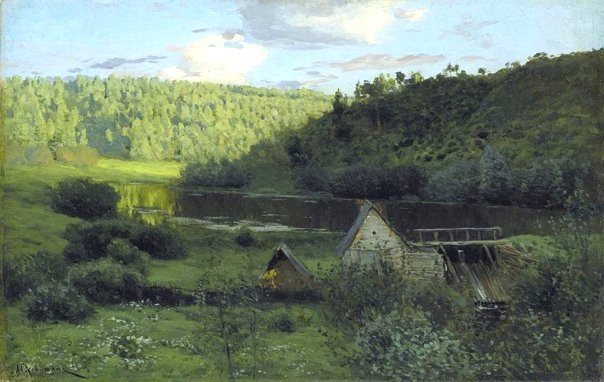
The Watermill, Sunset by Isaac Levitan (1880)

Levitan completed a beautiful but small landscape painting, The Watermill, Sunset.  It measured just 33cms x 52cms.  He painted this work in the summer of 1880 when he was spending time in the small riverside town of Plyos on the banks of the mighty Volga River.  Levitan loved the area and this period could be looked upon as one of the happiest times of his life. His friend Anton Chekhov said that when his artist friend and he were in Plyos he could detect a smile on Isaac’s face.  Sadly, because of family tragedies and his unending fight against poverty, Levitan rarely smiled and was often the victim of melancholia.

Isaac Levitan had developed a great love of nature which almost certainly originated from his time at the Moscow School of Painting and the time he spent with one of his tutors, the Russian landscape painter, Alexei Savrasov.  Savrasov was one of the most eminent of all 19th century Russian landscape artists and was renowned for his lyrical style and melancholic works of art.  He was looked upon as the creator of the lyrical landscape style.

In all, Levitan painted this view three times.  The first, which we see above, is housed in the Tretyakov Gallery in Moscow, and the other two, which were painted later, form part of two private Russian collections.  The scene is set at sunset and the mill is in shadow whilst the forest, on the opposite side of the river in the background is bathed in evening sunlight.  The light slants in from the right illuminating the far bank.  It is the ending of the day and although the blue skies suggest otherwise, the location will soon be cast in darkness.  In the foreground, the focal point is the wooden mill and the small rickety bridge which crosses over the small waterfall, the water of which powers the mill.  In many of Levitan’s paintings he depicts small bridges crossing over water along with jetties which often had boats moored to them.

Levitan’s moody landscapes and the artists and poets who had influenced this style of art were commented upon by Alexandre Benois in his 1916 book, The Russian School of Painting.  He wrote:

“…He brought to a summation that which Vasiliev, Savrasov and Polenov had foretold.  Levitan discovered the peculiar charm of Russian landscape “moods”; he found a distinctive style to Russian landscape art which would have been distinguished illustrations to the poetry of Pushkin, Koltzov, Gogol, Turgenyev and Tyutchev.  He rendered the inexplicable charm of our humble poverty, the shoreless breadth of our virginal expanses, the festal sadness of the Russian autumn, and the enigmatic call of the Russian spring.  There are no human beings in his paintings, but they are permeated with a deep emotion which floods the human heart…”
To supplement his income Levitan gave private painting lessons and he collaborated with the Chekhov brothers on the illustrated magazine “Moscow”.  Levitan also spent time spent time on the popular Russian magazines, “Raduga” (Rainbow) in1883) and “Volna” (Wave) in 1884, where he worked on graphics and lithographs for the publications.  He also collaborated with illustrations for Mikhail Fabritsius’ guide book, The Kremlin in Moscow.  During the summers of the mid and late 1880’s Levitan spent much of his time with the Chekhov family, who had a summer residence on the Babkino estate close to the banks of the Istra River.   The estate was owned by Alexsei Kiselev and he and his wife Marila would entertain artists and writers at their many soirees.  Levitan eventually moved into the Chekhovs home and set up his own studio.   One painting he completed in 1886, whilst staying with the Chekhovs was The Istra River.

In the Crimean Mountains by Isaac Levitan (1886)

His impoverished upbringing during which he often had no idea where or when his next meal would come from combined with the stress of being an artist trying to eke out a living had affected his health and he was diagnosed as having a degenerative heart disease and advised to move to a warmer climate further to the south of the country and so in late March 1886 Isaac Levitan visited the Crimea for the first time.  It was here that he completed more than sixty sketches and paintings during his two months sojourn including one entitled In the Crimean Mountains which depicted an area around the town of Feodosiya, in eastern Crimea.  It is a painting which manages to capture the bright sun and the intense heat of the mountainous setting.  Levitan exhibited all the sketches he had completed whilst staying in the Crimea at the Moscow Society of Art Lovers (MSAL).  All were purchased and with that success came financial stability for Isaac Levitan.

Evening on the Volga by Isaac Levitan (1888)

Between 1887 and 1890 Levitan would travel far and wide spending the long summer months in small towns along the Volga River, such as Plës (Plyos) and Vasil’sursk and two of his paintings of that time, Evening on the Volga (1888) and Evening: The Golden Plyos (1889) depicted the beauty of the river and the townships, which were situated on the banks of the great waterway, during the hours of sunset.

Evening: Golden Ples by Isaac Levitan (1889)

Levitan painted the Volga River scenes in various weather and light conditions and by doing so was able to convey associated moods.  The Volga series established Levitan as the painter of the landscape of mood and his style became popular with other Moscow landscape artists of the time.

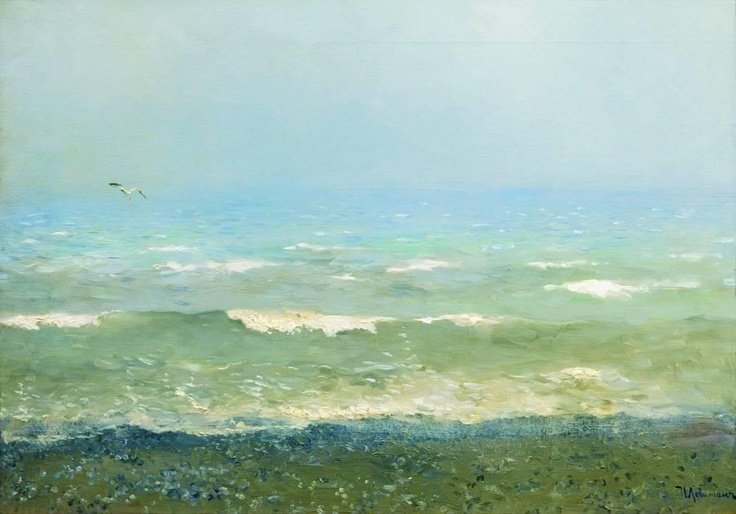
The Mediterranean Coast by Isaac Levitan (1890)

Levitan realised that much could be learnt from European artists and so, in March 1890, he embarked on a tour visiting Berlin and Paris and the Cote d’Azur towns of Nice and Menton.  From his visit to the south of France, he completed a work entitled The Mediterranean Coast which is a truly beautiful depiction of the multi-coloured sea and the pebbled shoreline.  He went on to Italy and visited Venice and Florence, Germany and Switzerland.  However Levitan was a true Russian and despite the lure of the artistic life in the European capitals he preferred to return to his homeland.

In March 1891 Isaac Levitan became a member of the Society of Travelling Art Exhibitions, and by the end of the year, displayed ten of his paintings at a Moscow Society of Art Lovers (MSAL) exhibition. His exhibits met with unreserved acclaim from both his fellow artists and the public.

Quiet Abode, The Silent Monastery by Isaac Levitan (1890)

Another of Levitan’s works of art I really like was completed in 1890, ten years after The Watermill painting, and was entitled Quiet Abode, The Silent Monastery.  The monastery in question is the Krivooserski Monastery which is close to the river town of Yuryevets, located at the confluence of the Unzha and the Volga Rivers, some 350 kilometres north east of Moscow.   Levitan had visited the area in the summer of 1890.  In the painting we see the monastery in the background nestled amongst the high trees with just the ornate cupolas peaking above the tree canopy.   In the foreground we can see a curved rickety wooden-planked bridge which traverses the slow-flowing river.  The surface of the river shimmers in the sunlight.  Look how beautifully Levitan has depicted the reflection of the monastery and the trees in this still expanse of water.

Anton Chekhov was so impressed with his friend’s painting that he introduced it into his 1895 novel, Three Years, in which he had the heroine of the story, Yulia Sergeievna, visit an Easter Week art exhibition and stand in front of what he described as

“…a small landscape… In the foreground was a stream, over it a little wooden bridge...”

Above the Eternal Peace by Isdaac Levitan (1894)

One of the most haunting works by Levitan was his painting entitled Above the Eternal Peace which he completed in 1894.  The first thing that strikes you about this evocative work is it is the depiction of an endless landscape.  In the background we have a beautiful depiction of threatening heavy grey clouds which are  intermingled with fluffy white ones, all of which are reflected on to the still waters of the lake below.  In the foreground, sitting isolated on a verdant promontory which juts into the lake, is a small church with its gleaming silver cupola.  Behind the church is the graveyard.  It is separated from the church by some birch trees which have been bent over by strong winds.  The graveyard looks abandoned and is rather overgrown and some of the crosses have lean over from the constant force of a strong wind which raced unhindered across the exposed promontory.  The picture was painted on the shore of Lake Udomlia in Tver province, 250 kilometres north of Moscow.

Vladimirka by Isaac Levitan (1892)

My final offering is another haunting work of art, not for its pictorial depiction but because where and what it is being depicted.   It was a depiction of a well-trodden road which led convicts towards their penal colonies in Siberia.  The painting is entitled The Vladimirka Road and Levitan completed it in 1892.  The Vladimir Highway familiarly known as the Vladimirka was a 190-kilometre road which went from Moscow to Vladimir and Nizhny Novgorod, Siberia in the east.  Siberia was at this time the customary place of exile, and this road depicted in the painting saw an endless movement of prisoners in shackles being marched from Moscow to the Siberian penal colonies.  Levitan’s work of art is not just another landscape painting it is a combination of his realistic vision with a message.  Before us is a somewhat desolate landscape but the point of the painting is to remind people, who look at the depiction, of the traumatic history of the road.  It was about exile but it was not just about the exile of prisoners to Siberia.  Levitan himself probably reflected on his own life at the time as in 1892 through to the beginning of 1893, by order of the Moscow governor-general, the Grand Duke Sergei Alexandrovich, about 20,000 Jews were deported from Moscow.  Isaac Levitan was among those forced from his home and this expulsion because of his religion had traumatised him.

Everything about the painting reflects his troubled mind.  Levitan has depicted the sky and the fields in dull and rather uninviting tones.  Before us we have a flat and almost lifeless landscape with just the odd trees in the background.  There is little or no vegetation and the path has been almost reduced to gravel due to the thousands of prisoners who had been marched along it over the years.   Look at the colours he has used.  Instead of bright greens and yellows he has gone for dull browns and lacklustre darker greens. The sky is grey with no hint of blue to uplift the painting.  There is no sign of the sun which would have brightened the landscape but that was not the intention of the artist.  There are no people depicted as he and many other realistic landscape artists believed the inclusion of people into a landscape painting  detracted from the surroundings.  Most of Levitan’s landscapes are without people.  This work of art was termed a mood landscape in which the artist has transferred his mood into the way he depicts the scene.  There is nothing uplifting about the view.  There is nothing in the scene that would raise one’s spirits but that is just as Levitan wanted it to be.  It was Levitan’s way of depicting hopelessness.  It was the historical hopelessness of those who trudged their way to what would simply be slave labour.  It was his own feeling of despair at his plight as a persecuted Jew.

To put a more uplifting spirit to this road the Bolsheviks, post-Russian Revolution, renamed it Shosse Entuziastov (“Enthusiasts’ Highway”) and many years later it became known as the Volga Motorway.

In March 1894 Levitan moved to the Tver Region, and later to Gorki.  His health was deteriorating and by 1895 the degenerative heart disease which had been diagnosed ten years earlier was making life more difficult for Levitan.  He was in constant pain and had little energy.  His physical ailment triggered mental health issues in the form of depression and it was known that on a number of occasions he attempted to end his life.  The only thing which gave him happiness was his love of nature.  In 1897, he had become world-renowned as a landscape painter and  he was elected to the Imperial Academy of Arts  and in 1898 he was named the head of the Landscape Studio at his alma mater, the Moscow School of Painting.

The Lake by Isaac Levitan (1890)

Levitan spent the last year of his life at Chekhov’s home in the Crimea.  Even though Levitan was aware that he was dying his last works were ones of brightness of colour.  An example of this is one which remained unfinished at the time of his death in 1890.  It was entitled The Lake although Levitan called it Rus’.  It is believed that he labelled the work thus as he believed the painting reflect ed tranquillity and the eternal beauty of Russian nature and embodied all that was good about his homeland –  its landscape, its people and its history.

Portrait of Isaac Levitan by Valentin Serov (1883)

In 1898 Levitan was given the title of academic of landscape painting. He still taught in the Moscow College of Art, Sculpture and Architecture. His paintings were constantly on display at Russia-wide exhibitions, at International exhibitions in Munich and the World Exhibition in Paris. He became internationally famous. His health started failing, his heart disease progressing quickly. He went abroad for some last-ditch medical treatment but any slight improvement was short lived.   Isaac Levitan completed over a thousand paintings, during his short life.  He died on 22 June 1900, just forty years of age. Levitan never married and had no children.   He was buried in the Jewish cemetery at Dorogomilovo, Moscow.   In April 1941 Levitan’s remains were moved to the Novodevichy Cemetery, close to the grave of his friend Anton Chekhov.

In August 2008 in the village of Eliseikovo, Petushinsky District near Vladimir – the Levitan House of Landscape was opened. Isaac Levitan first came to this area in May 1891, on invitation of the historian Vassily Kluchevsky, who had a summer home by the Peksha River. In 1892, Levitan returned, but on this occasion it was not from choice as it was the time when the Russian authorities banished Jews from Moscow.  The great Russain opera singer and friend of Levitan, Fyodor Shalyapin, spoke of the art of his friend:

“…It has brought me to realization that the most important thing in art is this feeling, this spirit, this prophetic word that sets people’s hearts on fire. And this prophetic word can be expressed not only in speech and gesture but also in line and colour…”

Compositions, Impressions and Improvisations by Kandinsky

Impression III (Concert) by Kandinsky (1911)

Impressions III (Concert) was painted by Kandinsky soon after he had attended a concert by Arnold Schonberg in Munich in 1911 and according to the exhibition catalogue notes the painting should be looked upon as:

 “…one of modern art’s most outstanding examples of synaesthesia, correspondences between music and painting that other early twentieth-century artists sought. A dynamic wave of yellow paint flows across the painting from left to right like a great swell of sound that seemingly reverberates to and fro. Above it in the upper half of the painting is an energetic black in a diagonal position. In the preparatory pencil sketches one can clearly decipher the scene with the open, black grand piano as well as the curved backs of the seated listeners and those standing along the wall…”

—————————————————————————————————————————————-

This is my final look at the later life of Wassily Kandinsky and some of his more abstract works of art.   In this blog I am featuring three of his these works, one from each of his three self-classified categories.   After 1910, Kandinsky decided to compartmentalise his work into three groups. The first he called Impressions and these paintings would still retain an element of naturalistic representation. They would be direct impressions of nature. The second category he deemed would be Improvisations and these paintings would convey spontaneous emotional reactions inspired by events of a spiritual type. The last category he termed Compositions. These were paintings which were not done spontaneously but put together carefully, over a period of time, following a number of preliminary studies. These were to be his most complicated works. Although the titles he gave to the three categories seems somewhat arbitrary in fact they harked back to his love of music and in the way he connected, in his own mind, art and music.  He would often add musical titles to his individual works such as Fugue, Opposing Chords or Funeral March.  By doing this, he wanted to evoke sound through sight and create the painterly equivalent of a symphony that would stimulate not just the eyes but the ears as well.

Kandinsky is believed to have had synaesthesia.   Synaesthesia comes from two Greek words Syn which means together and Aesthesis which means sensation.   It is a condition that allows a person to appreciate sounds, colours or words with two or more senses simultaneously. Kandinsky believed that colours and painted marks triggered particular sounds or musical notes and vice versa. Did Kandinsky have synaesthesia?  Maybe we will never know for sure but what we do know is that he was preoccupied all his life with the correlation between sound and colour. Following a performance of Wagner’s great opera Lohengrin in Moscow Kandinsky recalled:

“…I saw all my colours in spirit, before my eyes. Wild, almost crazy lines were sketched in front of me…”

Let me now return to his life story.  In my last blog we had reached the point when Kandinsky and some of his artist friends had set up Der Blaue Reiter group as a rival to their previous exhibiting association the NKVM (The Neue Künstlervereinigung München).    In the first exhibition held by the Der Blaue Reiter group, Kandinsky exhibited three of his works, entitled, Impression-Moscow, Improvisation 22 andthe painting which had been rejected by the NKVM jury, Composition V.  The exhibition came with a small almanac that Kandinsky and Franz Marc had been working on and the foreword of which set out to explain what visitors to the exhibition would see.  They wrote:

“…We are not seeking to propagate any precise or special form in this small exhibition.  Our purpose is to show, in the variety of forms here represented, how the inner wish of the artist takes shape in manifold forms…”

The exhibition which besides including works from artists, Kandinsky and Münter, included works from Franz Marc, Auguste Macke, Henri Rousseau to name but a few.  It also included strange sketches by the Austrian composer Arnold Schoenberg.  It was a confusing mish-mash of works, and artistic styles, which totally baffled and stunned both viewers and art critics alike. Even the most benevolent critics found great difficulty in finding some sort of common ground between the various artistic styles on show.   It was also around the time of this first exhibition that Kandinsky published his book Uber das Gestige in Kunst (Concerning the Spiritual in Art) in which he presented the reader with his thoughts about what he envisioned was the new purpose of art and his writing showed the great diversity of Kandinsky’s intellectual and artistic awareness.  In his book he discussed the spiritual foundations of art and the nature of artistic creation.  He also wrote an analysis of colour, form and the role of the object in art, as well as the question of abstraction.

Improvisation 19 by Kandinsky (1911)

Improvisation 19 was completed by Kandinsky in 1911.  Annegret Hoberg, the curator at the Städtische Galerie, Lenbachhaus, Munich, which houses many of Kandinsky’s paintings, including this one, wrote about the painting in the exhibition catalogue:

“…It seems as if an unknown ritual occurs in Improvisation 19, a kind of initiation and enlightenment of figures who can be understood as novices. One sees translucent figures outlined only in black. On the left is a procession of smaller form presses forward to the front, followed by shades of colour. The largest part of the painting, however, is filled with a wonderful, supernatural blue, which also shines through the group of figures shown in profile on the right, who seem to move toward a goal outside the painting. The spiritual impact of these long, totally incorporeal figures draws both on the uniformity (that is, they are all the same height, as in Byzantine pictures of saints) and on the fact that deep blue, almost violet shade in their heads may symbolize extinction or transition….This work underscores Kandinsky’s almost messianic expectation of salvation through painting…”

—————————————————————————————————————————————–

The onset of World War I in 1914 affected Kandinsky, as being a Russian citizen, he had to leave Munich immediately.  He along with Gabriele Münter left and went to Goldach in Switzerland, a small town on Lake Konstanz.  They remained there until December of that year when Kandinsky went to Moscow and Münter travelled to Stockholm where she would remain and wait for him.  Kandinsky did go to Stockholm and met with Münter for the last time.  Their close relationship which had started back in 1902 had recently being deteriorating and by March 1916, it had run its course and the one-time lovers parted for the final time.  Kandinsky returned to Moscow and soon after his arrival in the Russian capital he met a young woman, Nina von Andreyevskaya, the daughter of a Russian general, and in February 1917 the two were married.

Whilst in Moscow Kandinsky spent much of his time not only painting but working as a teacher, writer and administrator.  He immersed himself in the cultural politics of Russia and collaborated in the new reforms in art education. He was director of the theatre and film section of Narkompros, which was the Peoples Commissariat for Enlightenment.  In February 1919 the Museums of Painterly Culture were established in Moscow and St Petersburg and Kandinsky became the first director of the institutions and worked hard to expand the organization by setting up a further twenty-two museums in the Russian provinces.    In May 1920 Kandinsky helped set up Inkhuk, the Institute for Artistic Culture and he formulated a curriculum for the teaching of art which was based on his strongly held belief that there was an inter-relationship between art and music and looked closely at fundamental forms and colours.  His theories did not go down with many of the Russian avant-garde artists on the staff of the institute.  They firmly rejected any kind of irrationality in the creative process and because of such differing views between these leading artists and himself Kandinsky found his position weakened and ultimately untenable.

In the autumn of 1921 a road to salvation was offered to him by Walter Gropius, a German architect and founder of the Bauhaus School in Berlin, who invited Kandinsky and his wife to visit the school.  This was a different Germany from the one he left at the outbreak of war.  Many of his artist friends, such as Franz Marc and Auguste Macke, had been killed fighting in the war, whilst others had moved away.  The Berlin art scene had changed.  The Neue Sachlichkeit (New Objectivity) movement was now to the fore.   This grouping of German artists executed works in a realistic style, and they reflected what was characterized as the resignation and cynicism of the post-World War I period in Germany.   Leading protagonists of this style of art were George Grosz, Otto Dix and Max Beckman.  Also popular at the time were the works of the Expressionists and the cultural movement known as Dadaism.  This movement was, in the main, a protest against the brutality of the War and the members were also against what they believed was an oppressive intellectual rigidity in both German art and its everyday society. All of these artistic genres were diametrically opposed to all forms of abstract art, and so when, on arrival in Berlin, Gropius offered him a professorship in the Bauhaus in Weimar, Kandinsky jumped at the chance to start a new life in a new city.

In 1924, an artist friend from his Munich days, Paul Jawlensky, introduced Kandinsky to the German art collector and art dealer, Emmy Scheyer.  At that meeting she also met Kandinsky’s fellow Bauhaus faculty members, Lyonel Feininger and Paul Klee.   She formed the four artists into an exhibition group called Blaue Vier (The Blue Four) and Scheyer became their representative in America.  The four artists often toured, sometimes as far as America, giving lectures and staging Blaue Vier art exhibitions.

When Kandinsky left Russia he had to leave the majority of his paintings behind. They were sold but the return on them was poor due to the falling value of the Russian currency.   However during his eleven years at the Bauhaus he completed over three hundred paintings and several hundred watercolours, all of which he catalogued.  His time at the Bauhaus ended in 1932.  The previous year had marked the start of a vitriolic campaign against the Bauhaus by the Nazi party and the following year they had it shut down.  Kandinsky and his wife fled from Germany and went to Paris and settled in a new apartment in Neuilly-sur-Seine.  Kandinsky continued to paint and within twelve months living in Paris his output totaled an amazing 144 oil paintings and approximately 250 watercolours.   Kandinsky, although born in Russia, had been granted German citizenship in 1928 but when he tried to renew his passport in 1939, his request was declined.  That year, just before the start of World War II, Kandinsky managed to obtain French citizenship.

Composition IX by Kandinsky (1936)

Composition IX was completed by Kandinsky in 1936.  In the work we can make out multiple diagonal bands of colours and small shapes that resemble embryos as much as crustaceans.  This canvas earned Kandinsky criticism for not sufficiently articulating the background and the shapes. Nevertheless, it is one of the rare large format canvasses to which Kandinsky once again applied the name of Composition.  In his book, Concerning the Spiritual in art, he said that this one, of all his “Compositions”, was his most accomplished painting. In total, he completed only ten in all throughout his entire career. Sadly, when the French government purchased it for just 5000 francs rather than the 100,000 he had demanded, he felt quite humiliated.  This complex canvas is in fact one of the two works that the French State bought from Kandinsky during his lifetime.

—————————————————————————————————————————————–

His last known watercolours and drawings were completed in the summer of 1944 and he held his last exhibition at the Parisian gallery, Galerie L’Esquisse that same year.  Wassily Kandinsky died of arteriosclerosis in December 1944, aged 78.

I have to admit I have struggled with this blog, the third covering the life and times of Wassily Kandinsky.  I struggle to understand abstract art even though leading up to this offering I have read reams of information with regards this type of art.  I have included three of Kandinsky’s paintings, one from each of his designated “types”.   I will not insult those of you who are very knowledgeable about this form of art by trying to explain, interpret and analyse the works but have relied on exhibition catalogue descriptions of the works.   I would like to have ended this blog by saying how much I like the works of Kandinsky but to do so, would be extremely economic with the truth.  I will conclude this look at the life and works of Wassily Kandinsky with one of his quotes:

“…Lend your ears to music, open your eyes to painting, and… stop thinking! Just ask yourself whether the work has enabled you to ‘walk about’ into a hitherto unknown world. If the answer is yes, what more do you want?…”

Have you managed the “walk about” ?

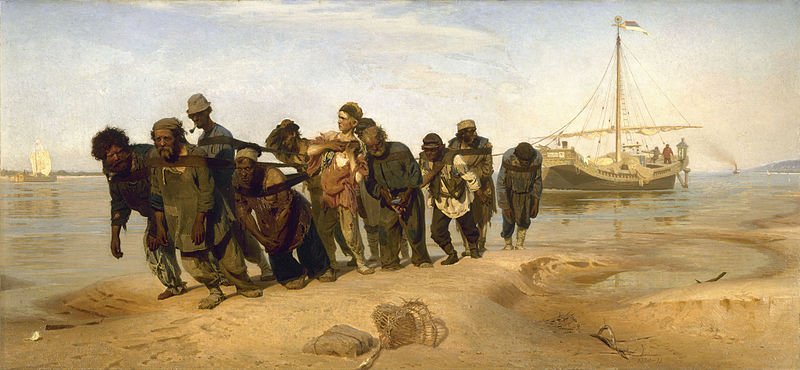
Barge-Haulers on the Volga by Ilya Repin

Barge-Haulers on the Volga by Ilia Repin (1873)

My blog today continues, as promised, with the Social Realism Movement in art.  Social Realism is a very broad term for painting or literature that comments on contemporary social political or economic conditions, usually from a left-wing viewpoint, in a realistic manner.  It was a way in which artists were able to draw attention to the everyday conditions of the working classes and the poor, and who were critical of the social structures that maintain these conditions.  As I am looking at a work by a Russian painter today it is important that we understand that Social Realism and Socialist Realism are quite different.  Social Realism evolved from the French Realism of the second half of the nineteenth century whereas Socialist Realism never came into being until the mid 1930’s when in 1934 Joseph Stalin made Socialist Realism the official art form of the USSR and later by the other Communist parties worldwide.  Socialist Realism demanded that all art must depict some aspect of man’s struggle toward socialist progress for a better life.   It was important to the communist regimes that Socialist Realism Art emphasized not just realism but the optimism and heroism of the people and the dictate was that all forms of experimentalism in art was to be looked upon as being degenerate and totally pessimistic.

One group of Soviet Realist artists, of which today’s featured painter was one, was the Peredvizhniki, which was also known as The Wanderers or The Itinerants in English.  This group of painters was formed in 1863 in St Petersburg as a protest at the academic restrictions of the official art center, the St Petersburg Academy of Arts.  Sounds familiar?  It should be, as in the past I have talked about the breakaway of artists from Academic control in both France and England.  The St Petersburg Academy, like other Academies in Western Europe, was associated with neoclassicism.   Neoclassicism was based on the ideal of beauty seen in ancient Greek and Roman art and looked to the Italian Renaissance.  The St Petersburg Academy of Arts was no different.  It wanted its student to depict not Russian subjects but more traditional art-historical themes: classical history, legends and myths.  In 1863, fourteen artists broke away from the Academy in protest of the proposed topic for the annual Gold Medal competition, which was to be the mythological subject of the Entrance of Odin into Valhalla. These fourteen painters believed that this subject was too remote from the real life of Russia and that the academic style of neoclassicism was much too constricting.   Having left the Academy, they organized themselves into a society on cooperative principles and developed their own educational program and in 1870 set up a touring group to exhibit their work known as the Society for Travelling Art Exhibitions. The Society maintained its independence from state support and their travelling exhibitions allowed them to take their art, which illustrated the contemporary life of the people from Moscow and Saint-Petersburg, to the provinces.

The artists adopted the style, which could be termed critical realism. Their aim was to depict their homeland and the life and history of their people from a truthful and democratic standpoint. The artists depicted the working class folk in a favourable and often heroic light but at the same time tore into their corrupt upper classes and aristocracy depicting them as oppressors and enemies of the workers.  Their paintings often highlighted the totally unacceptable and unbearable living conditions that the working class people had to endure.  It should be remembered that even though the first Russian Revolution was still more than 30 years away, and that unlike other Western European countries, Russia was a country where the political freedom to express oneself was strictly prohibited. However things were changing.  Tsar Nicholas I died in 1856 and a year later the Russian armies were defeated in the Crimea.  There was a hint of reform in the air but it was only in the arts, whether it be paintings, literature or the theatre that there was an opportunity to express one’s views.  With this in mind the members of the Peredvizhniki believed it was their duty to effect change to the living conditions of the working class. Our featured artist today, Ilya Repin wrote succinctly that artists come from the people and that the people expect art should reflect a clear understanding of conditions and nature.

Today’s featured work is second painting by Repin which I have looked at in a blog.   The first one was a painting, entitled Easter Procession in the Region of Kursk  (My Daily Art Display of August 29th 2011)   Today’s work is entitled Barge-Haulers on the Volga which he completed in 1873.   An alternative title is Burlacks on the Volga.   A burlak was a Russian nickname for a person who hauled barges and other vessels upstream from the 17th to 20th centuries. The word itself came from the Tatar word bujdak, ‘homeless’.  Before us is a river scene. The barge in the painting’s title is relegated to a minor role in the right background and if you look closely you will see in the distance, behind the barge, a small steam-powered boat, which makes us realise that at the time of the painting we were at the onset of the industrial age and the days of using human beings to haul barges was coming to an end.

The Barge Pullers

It is a magnificent portrayal of a group of eleven men, dressed in rags and bound with leather harnesses, who struggle with their backbreaking task at hand, the towing of a barge along the waters of the River Volga.  This painting is looked upon as being one of the best works of the Peredvizhniki movement.   The men we see before us are simply human pack mules.  This painting focuses on the difficult life endured by the peasantry at that time.  Look how Repin has portrayed the barge haulers.   It is a hot day and the men seem to be at the point of collapse and exhaustion as they lean forward in a desperate effort to keep the laden barge moving.   The painting is not just a testament to the peasant’s heroic efforts but it is a damning condemnation of the people that have set them this inhumane task.

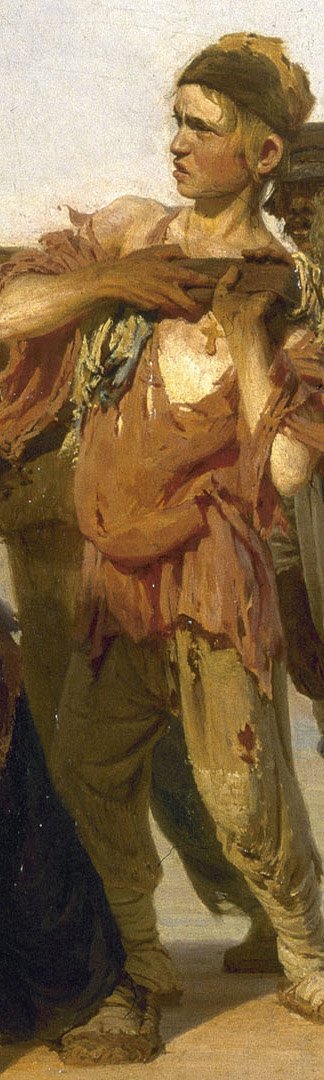
The young optimist

There is an added touch of heroism.  Look at the line of men.  All but one of them is dressed in drably-coloured clothes.  In the middle of the line one man stands out from the others.  He is a fair-haired young man, dressed in slightly brighter colours.  He is not exhausted and bent over like the others.  He stands upright and proud as he looks out over the river.  He is not humiliated by his menial  and backbreaking task.  His spirit, unlike the others, is not broken.  He scans the horizon and in this gesture we realise he is not just scanning the river, he is looking to the future – his future. 

Repin, who was twenty-six at the time he started this work, formulated the idea for this painting during a summer holiday he spent near Stavropol, close to the river Volga in 1870.  He had spent three months there with his brother Vasily and friends. During that time he took a boat trip down the Volga and watched the gangs of barge haulers. Initially he made many oil sketches of the area and the men working on the riverbanks and the people we see in the painting were real people.  One was a former soldier, one and artist and one a defrocked priest.  The former priest’s name was Kanin, who became a good friend of Repin, and he can be seen as the lead hauler of the group wearing a bandana.  From the dialogue Repin had with the barge haulers he was shocked to find that at one time most of them had held relatively important positions in society but had since fallen on hard times.  Although not shown in this painting, there would often be women employed as barge haulers and the number in a barge-hauling gang would normally be more than the eleven Repin has depicted.

Vladimir Vasilievich Stasov, who was looked upon as the most respected Russian critic during his lifetime, said of the way Repin depicted the barge haulers:

“…They are like a group of forest Hercules with their dishevelled heads, their sun-tanned chests, and their motionlessly hanging, strong-veined hands. What glances from untamed eyes, what distended nostrils, what iron muscles!…’

and of the painting itself, Stasov commented:

“….with a daring that is unprecedented amongst us [Repin] has abandoned all former conceptions of the ideal in art, and has plunged head first into the very heart of the people’s life, the people’s interests, and the people’s oppressive reality… no one in Russia has ever dared take on such a subject…”

Despite its critical message of how the upper classes badly treated its workers, the painting was bought by the Tsar’s second son.   After the Russian Revolution the art collection of the grand duke was nationalized and it is now housed in the State Russian Museum in St Petersburg.

Repin commented on the paintings of the Russian Social Realist artists and what they achieved, saying:

 “…The pictures of those days made the viewer blush, to shiver and carefully look into himself…. They upset the public and directed it into the path of humaneness…”