
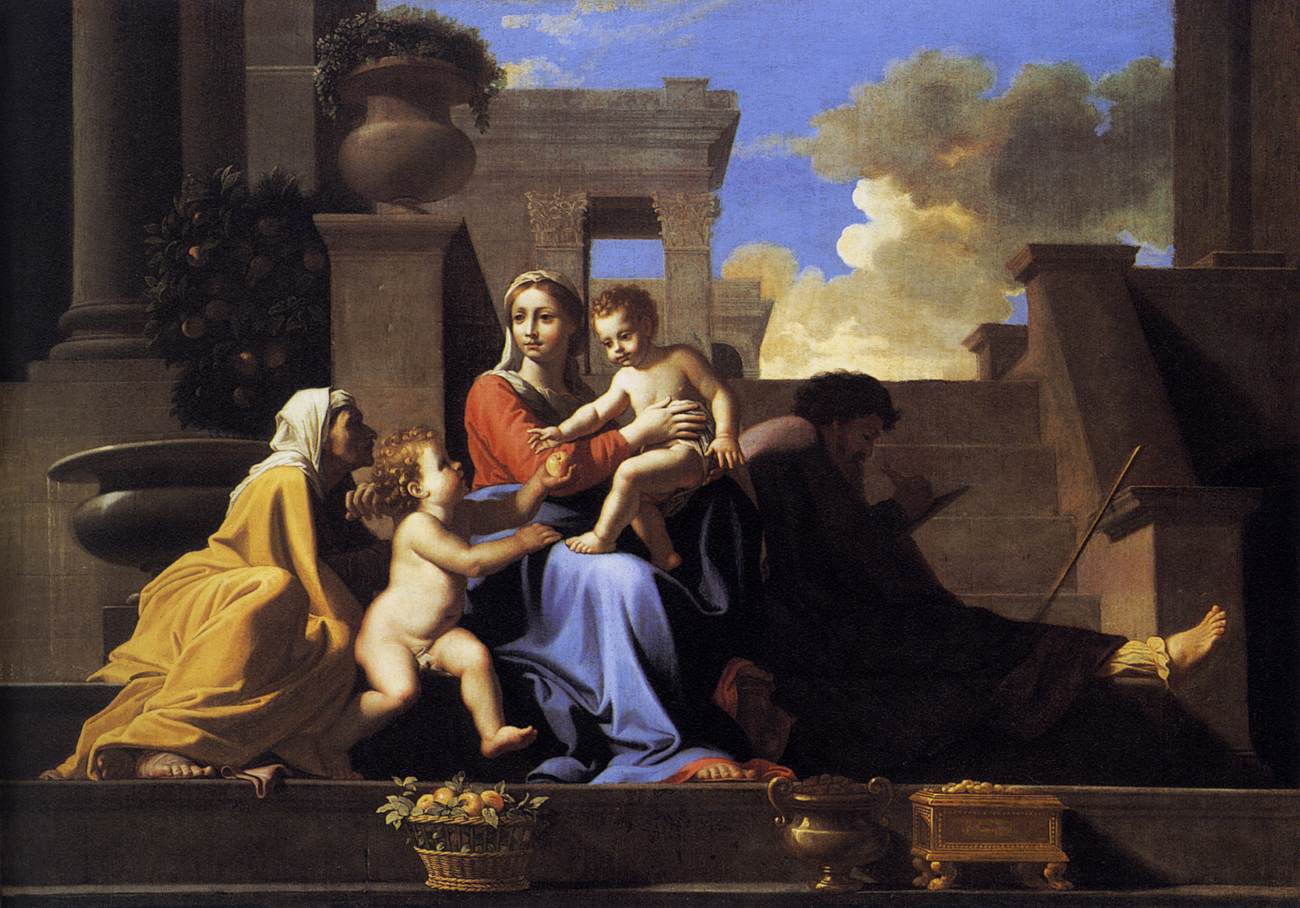
Madonna of the Steps by Nicolas Poussin

Madonna on the Steps by Poussin (National Gallery of Art,Washington) 1648

“..Poussin is without question one of the greatest of all French painters whose influence on the development of European Art from the 17th Century onwards cannot be overstated. Like Titian before him and his contemporaries Caravaggio and Velazquez, he developed a personal, innovative and highly rigorous style of outstanding originality.  His work has been deeply influential on generations of artists up to the present day…”

Richard Knight, International Co-Head of Old Masters and 19th Century Art at Christie’s

My Daily Art Display today once again features a work, in fact two works, by the great French classical painter, Nicolas Poussin.  The two paintings in question are both entitled Holy Family on the Steps or sometimes referred to Madonna of the Steps and both were completed in 1648.  The painting is considered a masterpiece of 17th-century art and the pinnacle of the artists refined classical style.  One is housed in the Washington Gallery of Art and the other in the Cleveland Museum of Art.  They are similar paintings but the Washington version looks somewhat lighter in colour.  The big issue was which gallery had the original and which gallery had the copy.  The painting which is in the Cleveland collection and was purchased in 1981.   X-radiographs, published in 1982, proved that it was the original of the two versions, the other in the National Gallery of Art, Washington must then be the copy.   Up until then, the Washington picture was thought by some art historians to be the original.  The Washington Gallery was far from pleased with the adjudication and in 1994 Earl Powell  III, Director of the National Gallery of Art, Washington, DC, was embroiled in controversy when he delayed the public acknowledgement that the Museum’s  Madonna on the Steps” by Poussin was no longer thought by scholars to be by the master.  It should be said that Anthony Blunt the British historian, art expert and an authority on the works of Poussin believed that the Washington painting was the original.

However notwithstanding who is right and who is wrong the painting dating from Poussin’s mature period is a beautiful work of art.  The arrangement of the figures harks back to works by the High Renaissance artists such as Raphael Sanzio and Andrea del Sarto.  The painting is a merging of the Classical, with its architecture and the Christian with its religious theme.  The figures are placed in a triangular format with the heads of Mary and the Christ Child at its apex. Before us,  we see, seated on the steps, Mary, holding the Christ Child, Saint Elizabeth holding her son John the Baptist and seated behind them, Joseph.  Poussin has included some symbolic features to the painting.  To the left of the seated figures we see an urn overflowing with water which is symbolic of the stream of life and the passing of time and our inevitable death.   Behind the urn we have an orange tree which is regarded as a symbol of purity, chastity and generosity and is often depicted in paintings of the Virgin Mary.    On top of the walled side of the staircase we have a myrtle bush which has been, since early times, used as the symbol of love.  In Roman mythology the myrtle was considered sacred to Venus, the goddess of love.

At the front of the painting, on a lower step we see the gifts Mary has received from the three Magi at the time of the birth of the Christ child.  Usually when the Christ Child holds an apple it is symbolizes the fruit of salvation.  There is also a connection with Christ and Adam going back to the passage from the Song of Solomon (2:3):

 “…As the apple tree among the trees of the wood, so is my beloved among the sons. I sat down under his shadow with great delight, and his fruit was sweet to my taste…”

The passage has been interpreted as an allusion to Christ.  As Christ is the new Adam, so, in tradition the Virgin Mary is the new Eve and for this reason an apple being placed in the hands of Mary, symbolises salvation.

Joseph sits on the steps behind Mary.  He is almost completely lost in the shadows.  By Joseph’s foot we see a measuring stick which in some ways indicates that Joseph was not just a humble carpenter but more of an artisan.  The steps which they are all resting on can be interpreted as the stairway to heaven and the light of God is shining brightly above the summit of the steps.  There are actually a number of light sources in this painting which cast various shadows.

The Martyrdom of Saint Erasmus by Nicolas Poussin

The Martyrdom of Saint Erasmus by Nicolas Poussin (1629)

Today My Daily Art Display looks again at an artist who many believe was the greatest French painter and the leader and dominant inspiration of the classical tradition in French painting.  His name is Nicolas Poussin. 

 Poussin was born of a noble but impoverished peasant family in Les Andelys, small town in Normandy in 1594.  In his youth he studied Latin, and this was to have great influence in his future works of art.  In his late teenage years he met an artist, Quentin Vartin, who had come to Les Andelys to carry out a church commission.  It was then that Poussin showed the visiting artist some of his artistic work who then agreed to give the youngster some artistic tuition.  In 1612 Poussin left Les Andelys and went to Paris and studied art at the studios of the Flemish portrait painter Ferdinand Elle and the French painter George Lallemand.  French art and the way it was taught and learnt by young aspiring artists had yet to change and apprenticeships with established artists was still the only way young men would learn to become painters.  It would soon change in France when academic training for up and coming artists would supplant this old system.  It was not until 1648 that the Académie royale de peinture et de sculpture was founded by Cardinal Mazarin.  The purpose of this academy was to professionalize the artists working for the French court and give them a stamp of approval.

Around 1623 Poussin met Giovanni Battista Marino in Paris.  Marino was court poet to Marie de Medici at Lyon.  The poet was very impressed with Poussin’s work and urged him to travel to Rome to widen his artistic experience.  Poussin had already made two unsuccessful attempts to go to the Eternal City but in 1624, aged thirty, he made it to Rome and initially lodged with the French painter, Simon Vouet.  Life in the city proved difficult as Poussin was always short of money.  However he was befriended by Cassino dal Pozzo, a wealthy antiquarian and secretary to Cardinal Francesco Barberini, who were both to become Poussin’s earliest patrons.  It was in 1628 that Poussin received two major commissions; the first was from Barberini, for a pair of large history paintings, The Death of Germanicus and The Destruction of the Temple at Jerusalem.  The paintings were well received.  The following year a commission from the Vatican for an altarpiece resulted in The Martyrdom of Saint Erasmus which is My Daily Art Display featured painting today.   The work was not greeted with universal acclaim in fact it was a comparative failure with the art critics of Rome.   It could well have been the fact that Poussin was French and that the Italians did not take to his attempt to compete with the Italian masters of the Baroque style on their own ground.   After this Poussin ceased competing for large public commissions and would paint only for private patrons and even then would confine his work to formats which were seldom larger than five feet in length.   

In 1630 he became ill.  It is believed that he contracted venereal disease.  He was taken to the house of his friend Jacques Dughet, whose daughter Anna Maria cared for him.  Poussin and Anna Maria married in 1630 but the couple never had any children.   Anna’s brother, Gaspard Dughet studied art as a pupil of Poussin and was later to take Poussin’s surname as his own.

By now news of his achievements filtered back to his home country and the court of Louis XIII and the powerful Cardinal Richelieu.  He was summoned by the court to return and reluctantly he had to acquiesce to the royal command and in 1640 he returned to Paris.  He was offered commissions for types of work he was not used to nor really competent to carry out, including the decoration of the Grande Galérie of the Louvre palace.  Worse still, the works he did complete did not bring forth the admiration he had anticipated, so annoyed at the lack of acclaim, he left Paris in 1642 and returned to Rome.   Ironically after his death, Poussin’s style of painting was accepted and acknowledged and in the late seventeenth century it was glorified by the French Academy.

Poussin was never a well man and his health started to decline more rapidly when he was in his mid fifties and with it came problems with his hands which suffered from ever worsening tremors.    In his later paintings one could detect the unsteadiness of his hand. He died in Rome in 1665 aged seventy-one and was buried in the church of San Lorenzo in Lucina, his wife having predeceased him.

And so to today’s painting, The Martyrdom of Saint Erasmus, which Poussin completed in 1629.  Nicolas Poussin’s altarpiece depicting the Martyrdom of St. Erasmus was commissioned in 1628 for the for the altar of the right transept of Saint Peter’s Basilica, the Chapel of St. Erasmus, in which relics of the Saint are preserved.  It was part of the ongoing decoration of the great basilica.  The commission had been initially given to Pietro da Cortona but was then assigned to Poussin in 1628 who used the preparatory sketches of Cortona’s as a basis for the work.  Poussin was probably obliged to produce not only a preliminary compositional drawing but also a painted modello, a model, to give his patrons a clear idea of his intentions

In the painting of Saint Erasmus, also known by his Italian name, Saint Elmo, we see the subject in the foreground.   He was the bishop of Formiae, Campagna, Italy, and suffered martyrdom in 303 AD, during Diocletian’s persecution of the Christians.  The setting is a public square.  The painting shows the almost naked Erasmus being disembowelled.   To the left of him we see a priest dressed in white robes talking to Erasmus and pointing upwards to the statue of Hercules, a pagan idol that Erasmus had refused to worship and which resulted in his martyrdom.  In the left mid ground we see a Roman soldier on horseback who is overseeing the execution.  It is a horrific and gruesome scene.  We see Erasmus’ executioner, dressed in a red loin cloth, extracting the intestines of the martyr who is still alive, and they are being fed on to what looks like the rollers of a ship’s windlass, which is being slowly turned.  Above we see two angels descending, one of who is carrying a palm and crown which are the symbols of martyrdom.   

The painting remained in the basilica until the eighteenth century at which time it was replaced by a copy in mosaic and the original transferred to the pontifical palace of the Quirinal. It was then taken to Paris in 1797 following the Treaty of Tolentino between France and the Papal States during the French Revolutionary Wars.  It returned to Italy in 1820 and it became part of the Vatican Art Collection of Pius VI.

Let me end this blog with two pieces of trivia.   When a blue light appears at mastheads of ships before and after a storm, the seamen took it as a sign of Erasmus’s protection.   This phenomenon is known as “St. Elmo’s fire”.    Erasmus is also appealed to when suffering from stomach cramps and colic. This probably comes about due to the way the saint met his death!

For another of Poussin’s paintings, Rinaldo and Armida, look at my blog of March 8th.