The Copley Family, by John Singleton Copley

The Copley Family by John Singleton Copley (1777)

In my last blog I looked at the English portraitist James Sharples and talked about how he took his family from England to America in search of patrons and their lucrative commissions.  He was just one of many European artists who decided that the way to make a fortune from their art was by crossing the Atlantic.  He of course had not only to compete against the new immigrant artists who had also made the journey but he also had to compete for work against America’s own painters.  Today in My Daily Art Display I am focusing my attention on of those great 18th century American artists, John Singleton Copley, who in fact moved across the Atlantic in the opposite direction, from Boston to London.

John Singleton Copley was born in 1738 in Boston, Massachusetts.  Both his parents, Richard and Marie were of Irish descent and had arrived in America just two years before he was born.  His mother ran a tobacco shop which was on the Long Wharf pier at the port.  His father, who was also a tobacconist, suffered from poor health and went to the West Indies around about the time of his son’s birth in the hope that the warmer climate may help,  but he died there in 1748, although the actual year of his death is contested.   His mother remarried when Copley was 10.  She married the engraver, painter, and schoolmaster Peter Pelham and it was believed that he gave young John Copley his first artistic tuition.   Pelham made his living by selling his portraits and engravings and even ran evening classes in arithmetic and writing as well as a dance class.  Another tutor of Copley was the Scottish born portrait painter John Smybert who had left his homeland and had come to America in 1826.  Both Copley’s tutors died when he was just thirteen years of age and so his artistic tuition was handed over to Joseph Blackburn, an English portrait painter, who had left home and worked in Bermuda and in colonial America.  Blackburn worked in Boston and eventually set up a studio in the town.  Although this master-student partnership started well it ended in acrimony.  The master (Blackburn) realised his student (Copley) was becoming a far better artist than himself and jealousy ended the arrangement. 

Boy with a Squirrel by John Singleton Copley (1765)

In 1776 Copley had sent his painting, entitled Boy with a Squirrel, to London, for the Society of Artists Exhibition.  The painting featured his step-brother, Henry Pelham with his pet squirrel.  It was the first work of art painted in America to be exhibited abroad and it was well received by the critics and on the strength of this work he was made a Fellow of the Society of Artists of Great Britain.  Benjamin West, the American artist who had moved to London in 1763,  invited Copley to do as he had done and move to Europe to continue his artistic studies.  For Copley, the invite was tempting and in some ways made him more unhappy with his present situation.  He was aware of his talent and the lack of artistic stimulation in Boston.  In the book Letters & Papers of John Singleton Copley and Henry Pelham, 1739-1776, there is one letter which Copley wrote to the American artist, Benjamin West:

“…In this Country as You rightly observe there is no examples of Art, except what is to [be] met with in a few prints indifferently executed, from which it is not possible to learn much…”

However although the invite to leave America was tempting Copley was aware that his portraiture was selling well and he had a good standard of living, mixing with the aristocracy who were his patrons and so he decided to stay in Boston and wrote back to Benjamin West in 1768 explaining his reasons:

“…I should be glad to go to Europe, but cannot think of it without a very good prospect of doing as well there as I can here. You are sensable that 300 Guineas a Year, which is my present income, is a pretty living in America. . . . And what ever my ambition may be to excel in our noble Art, I cannot think of doing it at the expence of not only my own happyness, but that of a tender Mother and a Young Brother whose dependance is intirely upon me…”

Susanna Farnham Clarke (Mrs Susanna Copley) by John Singleton Copley

However, although not wanting to move to England himself, he continued to send his art work to London where his artistic reputation was on the rise.   In 1769 John Copley married Susanna Farnham Clarke, whose father was one of the richest Boston merchants and a very wealthy and powerful business man, the Boston agent for the prestigious Honourable East India Company.   Copley and his wife were very happy and his wife’s beauty was portrayed in a number of her husband’s paintings.  The Copley’s marriage lasted for forty-five years and they went on to have six children.
Copley’s early works were in oils but he then began to dabble with pastels.  By the age of nineteen Copley had built up a reputation as an outstanding portraitist.  However Copley wanted to branch out and tackle historical paintings which at the time were very popular and the market for them was excellent.  Copley’s family connections and his wife’s relatives were Loyalists, staunch supporters of British Colonial rule.  Copley’s father-in-law was the merchant to whom the cargo of tea was consigned which sparked the infamous Boston Tea Party in December 1773 and this incident and what followed drove Susanna Clarke’s father to the brink of bankruptcy.

The unstable political climate worsened by the day, leading in 1774 to the rise of patriotism and the birth of the Patriots, the supporters of the colonists of the British Thirteen United Colonies who would within eighteen months rebel against British control.  Copley’s lucrative work started to dry up and it was because of his fear of an oncoming war that Copley decided to take up Benjamin West’s invitation to come to England.  His clear intention was to return to America as soon as the troubles were over, at a time when there would be a resurgence of his once-thriving art business and he would be looked upon once again as America’s leading portrait painter.  He set sail for England from Boston on June 1st 1774 leaving his mother, wife and children in the care of his step brother, Henry Pelham.  Copley had fully intended to return soon to America but the long and bloody War of Independence which eventually broke out in 1775 forced him to postpone his return. After the war ended, Copley financial situation no longer permitted a return, and the painter ended up staying in Britain forever.

On his arrival in England in 1774 Copley sought out Benjamin West who introduced him to Sir Joshua Reynolds both of whom were founder members of the Royal Academy of Art.  Copley set off in September of that year on a nine month European tour taking in Paris before moving to Italy and from there journeying north into Germany and the Low Countries.  In 1775 whilst still in Europe, Copley became alarmed at the deteriorating political situation in America and for the safety of his family.  In a letter to his step brother, Henry Pelham, he wrote:

“…if the Frost be severe and the Harbour frozen, the Town of Boston will be exposed to an attack;  and if it should be taken all that have remained in the town will be considered as enemies to the Country and ill treated or exposed to great distress…”   

Having also been alarmed about the situation at home, Copley’s wife and children, unbeknown to her husband,  had already left Boston at the end of May 1775 and arrived in London where they stayed with her brother-in-law.  Her father and her brothers followed shortly after.  Copley returned from his European trip and he and his wife set up home in London where Copley remained for the rest of his life.  By the start of the nineteenth century, life for Copley the artist, was becoming problematic.  He was still painting but sales were declining probably due to the Napoleonic Wars.  The house his family were living in was expensive to run and the cost of putting his son, John Jnr. through law school was proving costly.  The problem for Copley was that he couldn’t equate the fall of his earning power with the necessity to rein back his expenditure.  He became very depressed with life and by 1810 his health was concerning those around him.  At a dinner party in August 1815 Copley suffered a stroke and although he seemed to be recovering, he suffered a second seizure the following month and died in September 1815, aged 77.

On his death, Copley was deep in debt and his barrister son, John, who would later become Lord Lyndhurst and Lord Chancellor of Great Britain, had to settle his father’s financial affairs, maintain his parents home and look after his mother, Susanna, until she died in 1836.

In My Daily Art Display today I am featuring the large oil on canvas painting entitled The Copley Family, by John Singleton Copley, which he completed in 1777 and is now housed in the National Gallery of Art in Washington.  It measures 184cms x 229 cms (72 inches x 90 inches).  He started this group portrait painting a year after his family had arrived from America and settled in London and shortly after he himself had returned from his artistic tour of Europe.  Although an accomplished portraitist, this was the first time Copley had executed a group portrait.  The figures are almost life-size and his talent as a portraitist ensure that they all have a life-like appearance.

Copley himself is seen standing at the back of the family group grasping a sheaf of sketches and stares out at us in a manner which gives the impression that he is about to introduce the members of the Copley family to us.  Copley’s father-in-law, the once prosperous merchant, Richard Clarke is seated on the left of the painting, stern-faced avoiding our gaze, holding the youngest of his grand-daughters, Susanna.  To the right of the painting we see Copley’s wife Susanna, cradling her son John.  Look at how Copley has captured the look of love and tenderness in his wife’s face as she gazes down at her son.  On the far right of the painting and to his wife’s left, her daughter, Mary, vies for her attention.  Standing upright and in a formal pose is Copley’s eldest child, his daughter Elizabeth.  It is interesting to note that in those days boys wore dresses like their sisters until they were about six or seven years of age and old enough to wear breeches.

Copley had decided on the setting of the painting so as to give an air of classical refinement.  He has achieved that by the inclusion in the painting of elegant and fashionable furnishings and as we look over the shoulders of his sitters we see the ancient and classical Arcadian landscape à la Claude Lorrain and this background setting could well have come from paintings Copley had seen during his travel around Italy.  This group portrait of a family is of greater intimacy as it is the father who has lovingly depicted the scene.

Bronze statue of John Singleton Copley in Copley Park, Boston

John Singleton Copley’s hometown Boston has memorialised their artist by naming a city square after him, Copley Square, located in the Back Bay district of the city.  The square-shaped park at the centre is a mass of greenery and on the north side is the bronze statue of the artist.

The Sharples Family

My Daily Art Display today is not about a single painting but about a talented artistic family of English portrait painters.  This was a veritable dynasty of artists of the highest quality.  The head of the family was James Sharples who was born in Lancashire around 1751.  Originally his family had intended that James should study for the Catholic priesthood and he was sent to France for his initial training.   The theological path that his parents had wanted him to follow was not for James and he returned to England.    Instead James followed his chosen profession, that of an artist. At the age of twenty-eight, whilst living in Cambridge, he had four of his pictures accepted for the 1779 Royal Academy Exhibition.  Two years later he moved to Bath where he set himself up as a portrait painter and art teacher.

He and his first wife had a son, George.  Little is known of him but it is thought he could have also been an artist as in the 1815 Royal Academy Exhibition there was a painting by a “G Sharples of London”.  With his second wife James fathered a second son, Felix who eventually came to live with James and his third wife Ellen Wallace.  Ellen Wallace, who was of French extraction, lived in Bath and came from a Quaker family.   She was born in 1769 and was eighteen years younger than James.  They had met whilst she was attending one of his art classes.   James and Ellen Sharples married in 1787 and went on to have two children of their own, James Jnr. born in 1788 and Rolinda born in 1793, both of whom became artists.

George Washington by James Sharples (1796)

Around 1794 James, his wife Ellen and the three children, James, Felix and Rolinda set off for America.  It is thought that James believed that in America it would be possible to make a good living by painting portraits of the leading American figures of the time.  The sea voyage did not go to plan as their ship, according to Ellen Sharples’ diaries, was captured by a French privateer and James and the family were taken to Brest where they were kept prisoners for seven months.  The following year they were eventually released and continued on with their voyage to America, and eventually arrived in New York.   Sharples started working in New York and Philadelphia, which was the then seat of government and a place full of eminent people, including local and national politicians.  It is known that in the execution of his work Sharples  made us of an instrument known as a physiognotrace.  This was a device which was designed to trace a person’s profile in the form of a silhouette.

Slowly but surely, Sharples built up commissions for his portraiture.  The whole family then embarked on a painting tour of New England picking up lucrative commissions which often entailed making reasonably priced copies of his original portraits of American political leaders, such as George Washington, Thomas Jefferson, James Madison and John Adams.   Around 1797 when the family was living in Philadelphia, Ellen Sharples  began to draw portraits professionally.   At this time, there was a  great demand for reasonably priced copies and Ellen’s career of copying her husband’s original portraits on commission flourished and she could command virtually the same price for her miniatures as her husband charged for his mini-portraits. It was not just the mother and father who had artistic talents as their three children under their parents’ tutelage soon became accomplished artists in their own right and were soon able to contribute work for the family business.  Portraiture in America at that time was highly competitive not only because of home-grown American artists but more so from European painters who, like Sharples, had travelled to America in search of their fortune.   This intense competition made it necessary for artists to travel and look for clients rather than wait at home for clients to come knocking upon their doors.   James Sharples often had to drag his family from place to place in search of commissions.

James and Ellen Sharples soon built up reputations as talented portraitists who concentrated on small scale pastel portraits and whose work was in great demand and slowly but surely they became financially secure.  James Sharples died of heart trouble in 1811, aged 60 and Ellen and her two children, James and Rolinda returned to England.  Felix Sharples, who was at this time twenty-five years old, chose to stay in America, working as a portrait artist, where he died in 1830 aged 44.

Charles and Catherine Darwin by Ellen Sharples (1816)

Ellen, along with James and Rolinda settled down in Clifton, just outside Bristol and the three of them set up a family business producing small-scale pastel portraits for clients. Rolinda Sharples began to work in oils and she moved away from being a miniaturist and ventured into the highly competitive world of full-scale portraiture and history paintings depicting groups of people.  Rolinda was elected an honorary member of the Society of British Artists in 1927 and was one of the first female artists to attempt multi-figure compositions, which formed part of the pictorial historical records of the time.

The Stoppage of The Bank by Rolinda Sharples (1831)

The painting above entitled The Stoppage of the Bank by Rolinda Sharples was completed in 1831.   The background to this painting relates to the happenings in 1825 when England had just recovered from the Napoleonic Wars and the country’s economy started to boom.   In the euphoria of this boom, even the most clear-headed of  bankers made risky loans ( a familiar story ??).  The bubble burst in April 1825 and the stock market crashed.   By the autumn a number of country banks had failed causing panic.   It was a financial catastrophe, which led to widespread ruin and misery for the unfortunate people who had all their capital invested in the failed banks.  This is the setting, which Rolinda Sharples illustrates in her painting.   The scene before us takes place in a fictional street, called Guinea Street but which had a great similarity to the real Corn Street in Bristol.   On the right of the painting is a bank whose closure is causing shock and consternation to the people waiting outside attempting to get their money.  Behind, we see the famous Dutch House which stood on the corner of Wine Street and High Street until destroyed in the Blitz. The church in the centre background is All Saints Church.  Rolinda Sharples used some artistic licence when she placed the church in that position, one presumes it was for artistic effect.

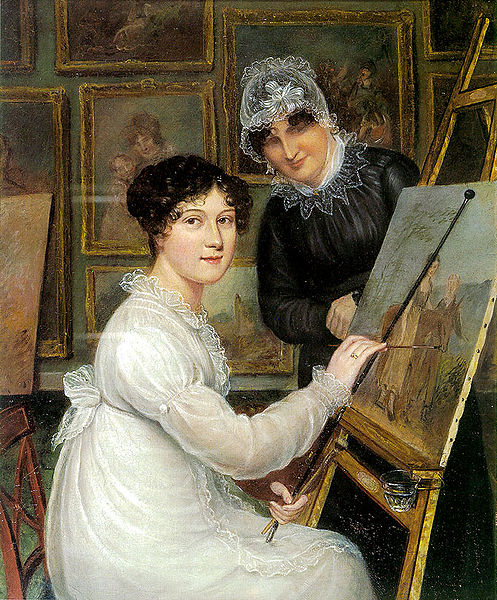
The Artist and her Mother by Rolinda Sharples (c.1820)

Both Rolinda and her brother James predeceased their mother.  Rolinda died of breast cancer in 1838, just forty-five years of age and James Jr. died of tuberculosis in 1839.  Ellen Sharples, the last of the Sharples family, died in 1849 aged 80.

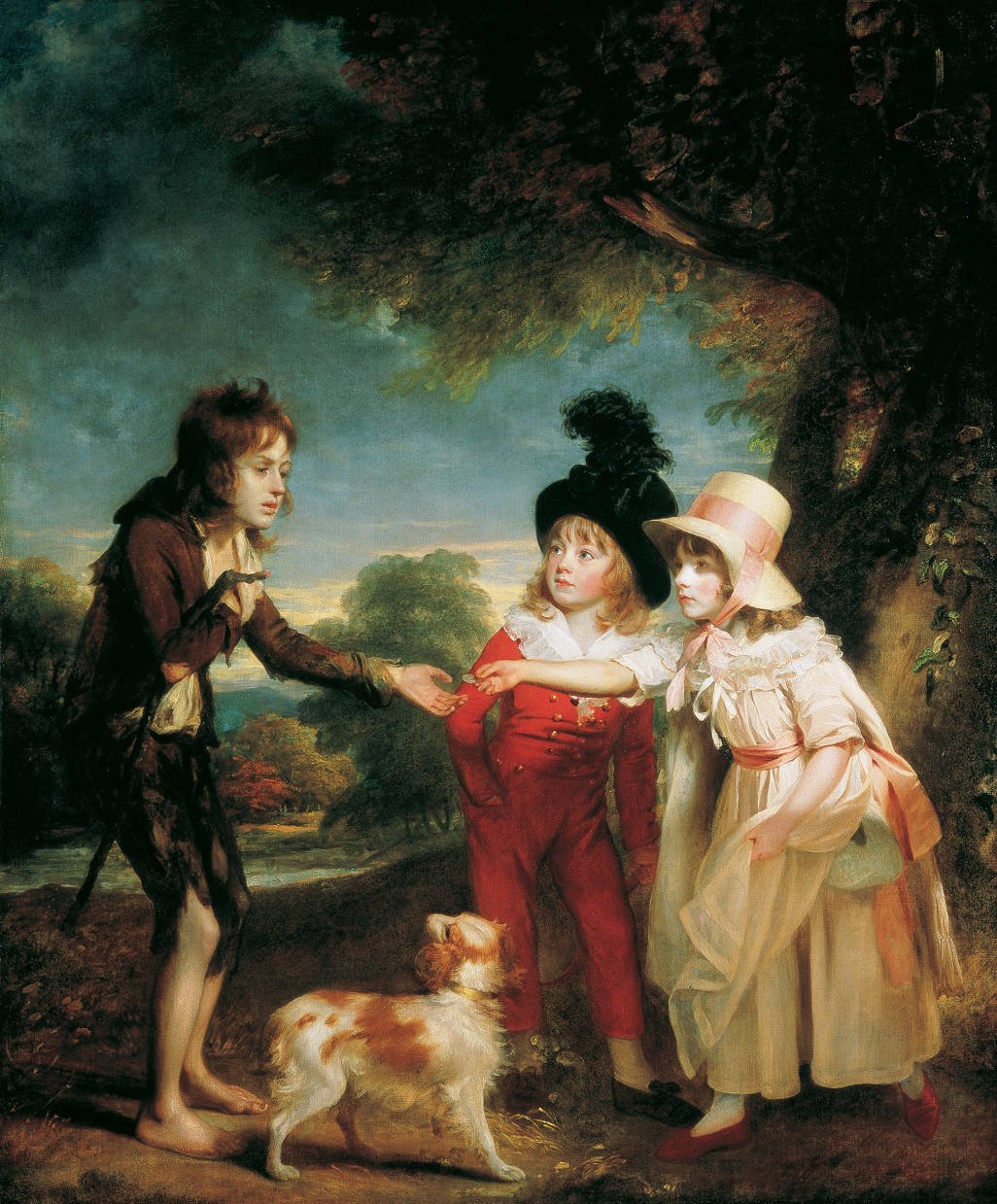
Portrait of Sir Francis Ford’s Children Giving a Coin to a Beggar Boy by Sir William Beechey

Portrait of Sir Francis Ford’s Children Giving a Coin to a Beggar Boy by Sir William Beechey (c.1793)

The artist I am featuring in My Daily Art Display today is the English portrait painter, Sir William Beechey.  William Beechey was born in Burford Oxfordshire in 1753.  He was the eldest of five children of William Beechey and Hannah Read who both came from Dublin.  Young William Beechey was not brought up by his mother and father but by his uncle Samuel Beechey who was a lawyer and it was his intention to have William study law and made arrangements for him to be articled to a solicitor in nearby Stow-on-the-Wold and later in London.  Whilst in London training to become a lawyer William made friends with some students from the Royal Academy Schools.  In 1772, despite the displeasure of his uncle, William managed to gain a release from the solicitor’s articles and achieved admission to the Royal Academy schools.

Some historical records of his life state that at around this time William Beechey married Mary Ann Jones and the  couple went on to have three daughters and two sons, one of whom was his son, Henry William Beechey who became an explorer and artist.  William Beechey first put forward paintings for inclusion at the Royal Academy Exhibition in 1776 and continued to submit works to their annual exhibitions for the next seven years.  At this time, most of his work consisted of what was then termed as “small portraiture”.

In 1772 he left London and moved to Norfolk, living in Norwich and for a short time, Great Yarmouth.  This move out of the capital city would appear to have been a strange one for London was an ideal place to sell his work but the author, William Roberts explained the reason for going to Norwich in his 1907 biography of the artist, entitled Sir William Beechey R.A.

 “…he was invited to spend a month in that city, where he found himself in the immediate receipt of so many commissions in that town and neighbourhood that he was induced to take up his abode there altogether…”

He was still submitting and having his works of art accepted  by the Royal Academy for their exhibitions but they received little mention.  However in 1788 he submitted two framed works which incorporated fifteen smaller portraits.  The Royal Academy jury, who decided on which paintings would be allowed to be exhibited at the Exhibition, rejected his two submissions because the R.A. rules stipulated that all paintings must be framed separately.  An art dealer Benjamin Vandergucht took the two works and exhibited them in his own gallery.  The phrase “there is no such thing as bad publicity” kicked in as the press heard about the R.A. rejection of Beechey’s works and wrote the story of the R.A.’s rebuff.  Beechey had managed to obtain free and excellent publicity for his art work.

Beechey had returned to live in London.  A number of his contemporary portraitist had died, such as Gainsborough or ceased painting, such as Joshua Reynolds and so there was a great demand for his portraiture.  It was at about this time that Beechey moved away from miniature portraiture and started to concentrate on life-sized portraits.  His first wife, Mary died in 1793 and that same year he remarried.  His second wife was a miniature painter, Anne Phyllis Jessop, a lady some eleven years his junior.  The couple went on to have eighteen children!  The final breakthrough for Beechey in his artistic career was receiving royal patronage which came in 1793.  King George III and his wife loved Beechey’s portraiture style.  In a round-about way, Beechey had the Royal Academy to thank for this for they rejected another of his works, a portrait of a courtier.  The nobleman was so incensed when he heard that his portrait was not to appear at the R.A. Exhibition that he took the painting and showed it to the king and queen.  They thought it was a magnificent work of art and a generation of royal patronage began and Beechey was made the queen’s portrait painter.   One will never know fully how this influenced the Royal Academy but by a strange coincidence the R.A. elected Beechey as an Associate of the Royal Academy that same year.  This was also the year that the R.A. conferred the same honour to his portraitist rival John Hoppner.

An art critic of the Monthly Mirror journal wrote about William Beechey’s work and that of his rivals of the time, John Hopper and Thomas Lawrence:

“…Beechey has fewer eccentricities than his competitors—for he never distorts his figures for the sake of extravagant attitude—he is less fantastic in his design and less exuberant in manner, in short, he has more nature than [Hoppner and Lawrence]. … Beechey, who is more fixed and determinate, both in his colouring and outline, studies only to be chaste…”

Beechey’s work was often described as being delicate and lacking extravagance and it was these very qualities that appealed to his patrons and clients who disliked the ostentation and flamboyance of his two main rivals.  It was also these virtues of Beechey that appealed to King George.  King George was vociferous in his praise of Beechey, much to the chagrin of John Hoppner.  William Beechey was elected as an Academician of the Royal Academy in 1798 and in that same year, on King George’s specific instructions, he exhibited his great and mammoth masterpiece, measuring 14ft x 17 feet, entitled His Majesty Reviewing the Third Dragoon Guards and the Tenth Light Dragoons in which he depicted King George reviewing his household troops.    Sadly this beautiful work of art was destroyed during the 1992 fire in Windsor Castle.  The king was so delighted with the work that in May 1798 he conferred a knighthood on Beechey.  The knighthood was the first such honour to go to an artist since Joshua Reynolds was knighted back in 1769.  Sir William Beechey’s artistic rivals were astounded by this royal award!  Beechey remained a favourite of King George III.

Sir William Beechey continued to exhibit work at the annual Royal Academy exhibitions until his death in January1839, aged 85.

The featured painting fo My Daily Art Display today is by Sir William Beechey and is entitled Portrait of Sir Francis Ford’s Children Giving a Coin to a Beggar Boy, which he completed around 1793 and is housed at the Tate Britain in London.  The beggar in the painting is not depicted as a dirty and scruffy sad-looking urchin as we have seen in works such as The Beggar Boy by Murillo (My Daily Art Display, January 25th 2011) as this would have upset the sensibilities of the Victorian public.  There were many portraits of beggars during the late 18th century, most of which could almost be considered as being “prettified” versions of reality.  Such pictures would be more likely to home in on, not the pathetic state of the begging child, but of the kindness of the charity givers.  So is this just another one of these charitable depictions.  Well actually I am not so sure but then maybe I am just a cynic. Why?

We have to suppose that  when a patron approaches an artist to paint a picture, they know what sort of painting they want.  They know not only who or what is to be depicted but they will make the decision as to how something or someone is to be portrayed.  They will know whether there is to be a certain reasoning behind the depiction other than what is visible at a first glance to the casual observer.  By now you must be used to looking at the paintings I have featured and together we have delved into the interpretations and symbolism of the works.  So now let us look a little closer at what William Beechey has painted and try and work out if there was a reason for such a portrayal.

The first thing to consider is who had commissioned the painting.  The client was Sir Francis Ford.  Ford was the heir of a Barbados planter of the third generation.  His family originally came from Devon. In 1793, he was elected as Member of Parliament for Newcastle-under-Lyme and the day he was elected he was given a baronetcy. He was now a member of William Pitt’s administration but was in favour of procrastination as far as the abolition of the slave trade was concerned.   He disagreed with the government over the slave trade question and did not seek re-election as an MP.

Besides being a politician he was a plantation owner with estates in Barbados and the Dutch colony of Essequibo.  Being a plantation owner he needed labour to work his estates and thus was a great advocate of slavery.  However in England in 1793, at the time of this painting, there was the start of a movement against slavery and a steady outcry with regards the terrible conditions of the plantation slaves, although it would be another forty years before slavery was abolished in the British Empire.

In the painting we see portraits of Thomas Ford’s son and daughter giving a coin to a beggar boy.  Could it be that Sir Francis Ford wanted to remind the people of Victorian England that there were beggars in their own country, who were in desperate need of food and lived in unacceptable conditions, and that the English public should show more concern about the fate of their own “home-grown” poor rather than worry about the living and working conditions of the plantation slaves in some far-off distant lands.  Could Sir Francis Ford be stating in a roundabout way that “only those without guilt have the right to cast the first stone”!  Was Thomas Ford using the artistic talents of Beechey as that of a spin doctor?

Sir Thomas Ford died in Barbados in 1801.

Girl with a White Dog by Lucian Freud

Girl with a White Dog by Lucian Freud (1950-51)

A few days ago I visited my two children in London and went on a few gallery visits.  I had managed to get tickets for my daughter and myself for the David Hockney Exhibition at the Royal Academy which was really a great experience and one which everybody should try and get to.  I will feature a painting from the exhibition later this week.  The other exhibition I had wanted to see and which had just opened was an exhibition of Lucian Freud’s Portraits which was being held at the National Portrait Gallery.  Unfortunately I could not get a ticket for the days I was in the capital so I have booked to go next month.  Today I am going to look at one of my favourite paintings of his entitled Girl with a White Dog, which he completed in 1951.  First let me tell you a little about Lucian’s early life and that of the sitter for this painting, his first wife, Kathleen Garman and look back on the famous, or maybe I should say, infamous Garman sisters.

Lucian Freud, who is the grandson of Sigmund Freud, the pioneer of psychoanalysis, was born in Berlin in 1922.  His father, Ernst Freud, an Austrian Jew, was an architect and his mother Lucie (née Brach) was the daughter of a grain merchant.  On the rise to power of Adolf Hitler in Germany in 1933, Lucian and his parents moved to Britain and lived in a house in St John’s Wood, London.  During his school years, he attended Dartington Hall Boarding School in Totnes Devon.    This was, at the time, an unusual seat of education.  It was a very progressive establishment in which there was a minimum of formal classroom activity and the children learnt by involvement in estate activities. From there he attended the Bryanston Independent School in Dorset.

In 1939 he became a British national and that year he enrolled at the Central School of Art and Design, which fifty years later would merge with the St Martins School of Art and become, as we know it today, the Central Saint Martins College of Arts and Design, which is widely regarded as one of the leading Art and Design institutions in the world.  His stay at the college was only brief as he moved on to the Cedric Morris’ East Anglican School of Painting and Drawing in Dedham.  This was a far more radical establishment which gave free rein to its students.  The school was destroyed by fire and a new location for the school was established in Benton End on the outskirts of Hadleigh in the county of Sussex.

Lucian Freud served as a merchant seaman in an Atlantic convoy in 1941 before being invalided out of service in 1942.  From 1942 to 1943 he attended Goldsmiths, University of London, an establishment which specialises in the arts, humanities and social sciences.  At the age of 24, Freud began his European travels, painting in France and Greece.  Some of his early work had already been published in the Horizon arts magazine and in 1944 the Alex Reid & Lefevre Gallery in London staged the first solo exhibition of his paintings.

In 1948 Lucian married Kitty Garman, the subject of today’s featured painting.   Kitty was the second illegitimate child of the distinguished British sculptor, Jacob Epstein’s and his lover Kathleen Garman.  Jacob Epstein and his wife Margaret (née Dunlop) did not have any children of their own but they looked after a young girl, Peggy Jean, the product of Jacob Epstein’s earlier affair with Dorothy (Meum) Lindsell Stewart.  Margaret Epstein and the young girl lived across London with Jacob, while Kathleen Garman lived with her younger sister, Helen, in an unheated studio in Bloomsbury and her and Jacob’s infant son, Theo.    Margaret Epstein was aware of her husband’s affair with Kathleen Garman and despite her husband’s numerous previous affairs with women which never lasted, she felt threatened by Kathleen.  She realised that Kathleen was more than a lover, she was almost a  parallel wife. From the beginning, Mrs Epstein disliked her intensely, realising  that she would be her greatest rival.   It came to a head in 1923 when according to Cressida Connolly in her book The Rare and the Beautiful: The Lives of the Garmans:

“…Mrs Epstein took Kathleen into a room and locked the door before producing a pearl-handled pistol from under her capacious skirts… and shot her. The bullet hit Kathleen just to the right of her left shoulder blade, whereupon Mrs Epstein panicked and ran out of the room, leaving the bloodied Kathleen to stagger out into the street alone…”

Jacob Epstein visited Kathleen in hospital and paid her medical bills. The bullet wound to her shoulder left  a large scar and Kathleen Garman was never afterwards able to wear sleeve-less dresses. To protect the reputation of Jacob Epstein, Kathleen Garman refused to press charges against his wife.

Despite this incident and the pleadings of his wife, Epstein refused to give up Kathleen, who remained in her one-room London studio as Epstein’s lover and bore him three illegitimate children; a son, Theo, in 1924, and two daughters,  Kitty in 1926 and Esther in 1929.  Epstein had another affair with one of his students, Isabel Nicholas, and this resulted in the birth of a son Jackie in 1934.  Isabel gave up her son to the Epsteins and he was also looked after by Margaret Epstein.   Kathleen Garman never knew about Epstein’s parallel affair with Isabel or about the boy Jackie until several years later.

The cramped conditions of the studio Kathleen Garman was living in proved unsuitable for bringing up young children and Kitty was sent to live with her maternal grandmother, Margaret (née Magill), in Herefordshire.  Esther, the youngest daughter was later dispatched to a family friend.   Kitty Garman stayed on with her grandmother Margaret when the household moved to South Harting, Sussex, and only went back to live with her mother in London when she was in her late teens.  She then enrolled at the Central School of Arts and Crafts to study painting under Bernard Meninsky. According to Kitty, her mother was constantly critical of her artistic efforts. Kitty recalled her mother’s attitude:

 “…I think she wanted her daughters to excel, but she didn’t want us to succeed, because she had to be the queen.   I was frightened of her because of her temper and she did say searingly sarcastic things…”

In 1949, Epstein’s wife, Margaret fractured her skull in a fall on the steps of her home and died.  This allowed Kathleen Garman to move into Epstein’s home in Hyde Park Gate.

By the early 1950’s Kitty Garman’s marriage to Lucian was in trouble and it ended abruptly after the artist’s affair with the society girl and writer Lady Caroline Blackwood was exposed.        Kitty Garman’s marriage to Lucian Freud ended in divorce in 1952 and Lady Caroline Blackwood became his second wife in 1957.  Shortly after the ending of her marriage to Lucian, Kitty was at a party where she met Wynne Godley, and economist, whom she married in 1955.

Lucian Michael Freud died aged 89 on July 20th 2011.  His first wife and sitter for today’s painting, Kathleen (Kitty) Eleonara Wishart (née Godley, née Freud) died aged 74 on January 11th 2011.

Kitty Garman, a brunette, was by all accounts, hauntingly beautiful and the subject of many paintings.  My Daily Art Display featured painting today is entitled Girl with a White Dog which Lucian Freud commenced in 1950 and  completed in 1951.  When not lent out to external exhibitions this work of art resides at the Tate Britain Gallery, London.  This is the last of the series of portraits of his first wife, Kitty, which Freud had started at the end of the 1940’s.  Kitty had given birth to Lucian and her first child, Annie in 1948 and their second child Annabel was born in 1952, the year the painting was purchased by the Tate.

One can only marvel at the way Freud has handled the contrast of the fabrics and textures.  On the one hand we have the smooth white hairs of the dog and on the other hand we have the fuller texture of the yellow dressing gown, which contrasts also with the smoothness of the  striped silk bedspread on which she sits.    In the painting we see Kitty Garman sitting curled up on what looks like a low settee dressed in a dressing gown with its long plaited and tasselled tie.   Lying next to her, with its head in her lap, is one of a pair of white bull terriers the couple were given as a wedding present.  Look at the wonderful amount of detail Freud has put into his depiction of the dog.  He would often use animals in his compositions and often they would feature both pet and owner.

Kitty left hand hangs down and her fingers rest on the settee and on one of the fingers  we can see her wedding ring.   Her right hand is pressed against the bathrobe, cupping her left breast.  Her right arm is strategically placed under her right breast with her wrist adding to its uplift and fullness.  Her expression is difficult to translate.  She seems somewhat frightened and concerned about something.  Her eyes are large and staring.  In some ways we feel a little uncomfortable when we look at her.  Her brow is narrow which adds to her look of anxiety and sadness.  It could well be that Freud’s liaison with Caroline Blackwood at the time of this painting was taking a toll on Kitty.  Is her look one of calmness or one of desolation?  I will let you decide.

Un atelier aux Batignolles (A Studio at Les Batignolles) by Henri Fantin-Latour

Un atelier aux Batignolles (A Studio at Les Batignolles)

Today I am looking at a work of art by the French painter, Henri Fantin-Latour, or to give him his full name, Ignace-Henri-Jean-Théodore Fantin-Latour.  The family was of Italian ancestry and the “Fantin” part of the name came from the fact that some of the ancestors hailed from the southern Italian town of San-Fantino.  In the 17th century, a Jean Fantin added “Latour” to the name of Fantin.

Henri was born in Grenoble in 1836.  His father, Theodore Fantin-Latour, originally from Metz, was a society portraitist painter.   In 1841 the family moved to Paris.  Having shown a liking for drawing at an early age, he received his initial artistic training from his father.  Then at the age of fourteen, he enrolled on a three-year course at the École de Dessin of the French artist and drawing instructor, Lecoq de Boisbaudran.  Following this, he spent a short time at the École des Beaux-Arts in Paris.  During his art student days he spent most of his time at the Louvre copying the painting of the old Masters as well as making many visits to the Musée de Luxembourg to study and copy the works of Eugene Delacroix.  In 1861, after he graduated from the art schools he worked for a time at the atelier of Gustave Courbet and supported himself by earning money as a copyist.

During his time copying paintings at the Louvre he came across and became friends with a number of the future Impressionists, such as Edgar Degas, Édouard Manet and Berthe Morisot.   In 1858, he struck up a special friendship with the American-born artist James Whistler and along with French-born English painter Alphonse Legros he founded the art group known as the Société des Trois.   Whistler, who had moved to London, invited Henri over for a visit which he accepted and through the good auspices of his two friends Whistler and Legros he was introduced to the art world of London.  This was the first of many trips to London made by Fantin-Latour.  One very important introduction whilst there was to Edwin Edwards, who had trained as a lawyer but also practiced as an artist and etcher.  He acted as Henri Fantin-Latour’s agent in England and found him many buyers for his floral paintings as well as a number of patrons.

Henri Fantin-Latour had started painting a number of works of art featuring floral still-lifes and these were well received in London although strangely enough never popular in France during his lifetime.  Henri Fantin-Latour exhibited a number of his works at the Paris Salon in 1861 and 1862  and later in 1863, at the Salon des Refusés, and  he exhibited regularly at the London Royal Academy.  Although he had been close friends to a number of the Impressionists, he never put up any of his paintings for their eight Impressionist Exhibitions.  The reason for that decision was probably due to the fact that although he counted them as friends, he disagreed with their artistic theories and philosophy.  His artistic style was more conservative.

Henri-Fantin Latour will always be remembered for his luxurious floral paintings but he was an artist who painted many group portraits and it through these works that we get an insight into the friendship between the now-famous artists, poets, musicians and writers of that era.  During his time as an artist he also completed no fewer than twenty three self-portraits.

In 1875, aged thirty nine, Henri Fantin-Latour married a fellow painter, Victoria Dubourg and the couple spent their summers at the country estate of his in-laws at Buré.  In 1879 Henri Fantin-Latour was awarded the Legion d’Honneur medal.  Henri Fantin Latour died in 1904, aged 68 and was buried in the Cimetière du Montparnasse in Paris.

The painting I am featuring today was not one of Fantin-Latour’s beautiful floral works of art but instead I am going to look at one of his group portraits. It is very like a painting I featured in My Daily Art Display on November 10th 2011 entitled Bazille’s Studio; rue de la Condamine by Frédéric Bazille, who also actually appears in today’s painting.

My painting today is entitled Un atelier aux Batignolles (A Studio at Les Batignolles) and he completed it in 1870.  Batignolles is part of the 17th arondissement of the city of Paris.  At the time of Fantin-Latour, this was a cultural hive of activity and served as a base for young painters such as Édouard Manet and many of his artist friends who, because of the locality, became known as Le groupe des Batignolles.  The painting today is a kind of “who’s who” of that group.   It is more than just that.  In some ways it is Henri Fantin-Latour paying homage to his friend Manet.

We are in the atelier of Édouard Manet and we see him sitting at his easel. He concentrates on the man sitting in the other chair, the subject of his painting, Zacharie Astruc.  Astruc was a painter, poet, sculptor and art critic who had rallied to support the likes of Courbet and Manet and the Impressionist group of painters when they were constantly being criticized.   Standing around and watching the artist at work are some of his friends.  At the far left of the painting, seen standing directly behind Manet is the German painter Otto Schölderer.  Next to him, wearing a hat, is Auguste Renoir.  Further to the right of the painting and almost in the background, are Emile Zola, the writer who also championed the cause of the Impressionists in their struggle with the Salon and its condemnation of this new grouping of artists, Edmond Maître another supporter of the Impressionist painters and who was, at the time, a civil servant at the town hall.  Almost hidden in the corner of the painting is Claude Monet.   Standing tall and upright behind the chair with a full beard is the twenty-six year old, Frédéric Bazille, who two months after this painting was completed was killed in the Franco-Prussian War.  There is a  formal air to this group portrait.  The men are all dressed in somber dark suits and their expressions are serious and unsmiling.   All these young artists had suffered at the hands of the art critics of the day.  They and their paintings were accused as being frivolous and contrary to what the art establishment was used to.  It is possibly for that reason that Henri Fantin-Latour decided to depict the gathering so formally and with an air of respectability.  Could this desire to show how these young artists had not completely put the antique traditions of the Academics of the Salon behind them be the reason why the artist has included a statuette of Minerva on the table at the left of the painting?  In my last blog regarding Monet and Camille Doncieux I mentioned that all things Japanese were the rage in Paris and France in the late nineteenth century.  Look how Fantin-Latour has positioned a Japanese stoneware vase next top Minerva in the painting.

This work by Henri Fantin-Latour is almost a historical painting.  It records for us a time in history when these characters were leaving their mark.  Each one of them is posing for posterity.  Zola once wrote about the struggle these artists had to endure and the way in which Édouard Manet tried to rally them when they became dispirited.  He wrote:
“…Around the painter so disparaged by the public has grown up a common front of painters and writers who claim him as a master…”

Henri Fantin-Latour put forward the painting to be exhibited at the 1870 Salon  The painting was accepted and he was awarded a  medal by the salon for this work of art.  In spite of his close relationship with the Impressionist painters he never followed their artistic techniques.  He remained a traditionalist and remained faithful to that traditional technique. In the latter part of his career he painted less and concentrated on lithography.

Did you wonder whether Manet was actually painting a picture of Zacharie Astruc as depicted in today’s featured work?  Who knows, but coincidentally, Manet did complete a portrait of Astruc four years earlier in 1866, which now hangs at the Kunsthalle in Bremen………………….

Portrait of Zacharie Astruc by Manet (1866)

Camille Doncieux and Claude Monet (Part 2)

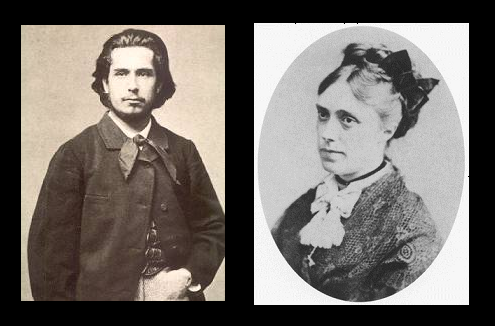
Claude Monet and Camille Doncieux

In my last blog I looked at the first meeting of Camille Doncieux and Monet.  It occurred in 1865 when Frédéric Bazille, a good friend of the twenty-five year old Monet, introduced him to Camille Doncieux who was still in her teens.  Camille, who was of humble origins, worked as an artist’s model.  Monet soon made her his number one model and shortly afterwards the two became lovers. The couple, because of the poor sales of Monet’s works of art, lived in depressing poverty.   Today I complete the story of Camille and Monet and look at a few more paintings the artist completed depicting Camille.

From the 1860’s till the end of that century, France was in love with all things Japanese.  This Japonisme as it was called had inspired both artists and the public.  Monet was not immune from this trend which swept his country.  Besides his art, he had two other hobbies.  He loved gardening and he loved to collect Japanese art, especially the Japanese woodblock prints.   In all he had built up a collection of over two hundred of these.  He had also accumulated a number of Japanese fans, kimonos and screens, some of which can still be seen at his house in Giverny.

 The most palpable and undeniable proof of Monet being influenced by the art and culture of Japan is his oil on canvas painting, Madame Monet en Costume Japonais (La Japonaise), which he completed in 1875 and which currently hangs in the Boston Museum of Fine Arts. This work was in complete contrast to his earlier works.   Large-scale figure paintings had usually been looked upon as a major challenge for an artist.  Camille is depicted dressed in an elaborate kimono, holding a Japanese fan in her hand.   It is interesting to note that Camille is wearing a blond wig so as to emphasize her Western identity. Her kimono is sumptuously embroidered and the background is adorned with numerous Japanese fans. These accoutrements could, at the time, be bought for a few centimes in many of the Parisian shops and even the larger department stores had exclusive sections for all things Japanese.

In the painting Camille’s pose is of a conventional style and it is believed that Monet did this so as to enhance the chance of selling the work.   Because of this, there is a somewhat loss of spontaneity about it.  The scene looks very contrived.   However the brilliance of the colours he used is breathtaking.   Monet exhibited this work at the Second Impressionist Exhibition in 1876, where it attracted much attention.  Maybe Monet was saddened and felt somewhat guilty by the compromise he had made with this work solely to make it more attractive to potential buyers.  He later described it as “trash” and “a concession to the popular taste of its time”.

On June 28th 1870, Camille and Claude were married in a civil ceremony performed at the town hall of the eighth arrondissement of Paris. The French painter Gustave Courbet was one of the witnesses. Although Camille’s parents were present at the ceremony, Monet’s family were horrified by their son’s choice of partner and would not accept Camille Doncieux as their daughter in law, nor would they acknowledge their grandchild, Jean-Armand-Claude who had been born in August 1867.   Monet’s parents even tried to bribe their son into leaving his wife with the threat of their allowance to him being stopped if he continued the liaison.  However Monet chose his wife over money and refused to abandon Camille and Jean.   As a result, his allowance was cut off and his financial situation worsened and the three of them suffered extreme financial hardship, sometimes unable to afford food and often unable to afford paint.   He carried this burden for many years, and struggled greatly with poverty and the stress caused by Camille’s poor health, and his inability to pay for her medical care.   After the wedding and just before the start of the Franco-Prussian War the family travelled to London and Zaandam before returning to France and setting up home in Argenteuil, a town to the west of Paris.

Camille Holding a Posy of Violets by Monet 1877

In 1876, Camille Monet fell ill with what is believed to have been the beginnings of cervical cancer.   In Monet’s 1877 painting Camille Holding a Posy of Violets, which he completed that year, one can see the toll the disease has had on her health. Her face looks pale and haggard.  She looks tired and older. It was around this time that Monet received a commission from a patron Ernest Hoschedé and for a short time his finances took a turn for the better.  However in 1877 all this changed when Hoschedé went bankrupt and his art collection was auctioned off. This was a blow to the Impressionists, whom Hoschedé had supported,  and especially Monet.   The bankrupted Hoschedé and his family moved to a house in Vétheuil with Monet, Camille and Jean. However Ernest Hoschedé spent most of his time in Paris before fleeing to Belgium to avoid his creditors.   There soon followed speculation that Monet may have been carrying on an affair with Alice Hoschedé.    Some art historians have translated the look on Camille’s face in this painting as one of disgust with her husband and his liaison with Alice Hoschedé.  This was the last painting Monet did of Camille whilst she was alive.

Camille on her Deathbed by Monet (1879)

On March 17th 1878, Camille gave birth to her second son, Michel.  The birth of Michel further weakened Camille.   Over the next twelve months Camille’s health deteriorated and on August 31 1879, a priest was called to the house to administer the last rites and to sanction her marriage to Monet, although they had been married in a civil ceremony nine years earlier.   Camille’s death on September 5th 1879 devastated Monet. She was just thirty-two years of age.   Monet painted a picture of his wife on her death bed and the work can be seen at the Musée d’Orsay.  Monet remembered the time well writing to a friend telling him of his urge to paint that last portrait of Camille:

“…I caught myself watching her tragic forehead, almost mechanically observing the sequence of changing colours that death was imposing on her rigid face. Blue, yellow, grey and so on… my reflexes compelled me to take unconscious action in spite of myself…”

Monet included lots of blue and gray in this painting, as well as yellow,orange and red and in some people’s opinion the use of these colours made the painting too light. Light, coming from the right hand side, shines on the face of his deceased wife.   We do not get a very clear view of Camille although we can just make out her face and that she is wearing a shroud.

After Camille Monet’s death in 1879, Monet and Alice along with the children from the two respective families continued living together at Poissy and later Giverny. Ernest Hoschedé died in 1891, and, in 1892, Alice and Claude Monet were married.   Little is known about Camille Doncieux Monet mainly because Monet’s alleged mistress and second wife, Alice Hoschedé, was so jealous of Camille that she demanded that all photographs, mementos and letters between Monet and Camille were destroyed.  She was determined that Camille’s very existence was denied.

Why did she hate Camille so much?    Maybe she realised that Camille Doncieux was the one and only true love of Claude Monet.

Claude and Camille by Stephanie Cowell

If you would like to read a fictional account of the relationship between Camille Doncieux and Claude Monet then I suggest you read:

Claude and Camille: A novel on Monet by Stephanie Cowell

Maria Bicknell, Mrs John Constable by John Constable

Maria Bicknall by John Constable (1816)

In My Daily Art Display blog yesterday I looked at the early life of John Constable,  up to the point in his life when at twenty-three years of age he was still hell-bent to become an artist.     Today I am going to conclude the story of his life and look at another of his paintings.  

In 1799,  Constable had finally convinced his father to let him pursue art and he enrols in the Royal Academy School as a probationer.  Although he finds inspiration in paintings by Peter Paul Rubens, Thomas Gainsborough, Claude Lorrain and Annibale Carracci, he becomes very homesick and yearns for the beautiful countryside of his Sussex home.  He is also becoming very disheartened with the way the Royal Academy, at that time, disdainfully viewed landscape art.  Landscape art was his passion but unfortunately for him, it was not held in high regard by the Academy, who only valued history painting and portraiture.  Whilst he attended the Academy he met Turner but the two never forged a friendship.

In 1802 Constable exhibited his first painting at the Royal Academy.  His landscape works were unfortunately not the traditional heavenly landscapes which depicted biblical or mythological stories, which were in vogue at the time, and so were not popular with the buying public.  His depictions of the countryside were far more realistic than those of the very popular Gainsborough and Claude.  If anything, his style was more akin to that of the Dutch landscape painters, such as Jacob van Ruysdael.   Constable fervently believed that landscape art was to be a true study and reflection of nature and that idealized landscapes, which had been painted from the artist’s own imagination were, in some ways, dishonest.  He left the Royal Academy in 1802 and was offered the position of drawing master at Great Marlow Military College, but he turned down the offer, which horrified the then master of the Royal Academy, Benjamin West, who told Constable in no uncertain terms that his refusal would probably mean the end of his artistic career.  However Constable was not deterred and chose to stay on his chosen course – that of a landscape artist.  Constable returned to East Bergholt.

In 1800, when he was aged twenty-four and whilst he was at home in East Bergholt, he had become friendly with a young girl who was some twelve years younger than him.  Her name was Maria Bicknell.  Now almost ten years later in 1809, John is aged thirty-three and Maria is twenty-one years of age and their relationship changed.  Slowly but surely, this one-time childhood friendship developed into a much more serious relationship and the two fell deeply in love.  Seven years later, in 1816,  the couple decided to get engaged but this was strongly opposed by Maria’s parents and her grandfather, Dr. Rhudde who was the rector of East Bergholt.  Both Maria’s father, Charles Bicknell, who held the prominent position as solicitor to the Admiralty, and her grandfather did not want her to be married to a penniless artist and they also believed that Constable and his family were socially inferior to them and not fit in-laws.  To force home their disquiet about such a proposed liaison they told Maria that she would be disinherited if she married Constable.  Constable’s parents Golding and Ann Constable, while somewhat sympathetic to the desires of their son, could also see no future in the proposed marriage as they would not in the position to financially support the couple and even Maria herself pointed out to Constable that if he was to succeed as an artist he did not want the distraction of a wife and the financial implications of such a match.  For the next seven years the couple were often parted and sometimes forbidden even to write to one another, but throughout their long, frustrating courtship they remained loyal to each other

The situation changed in 1816 when both Golding and Ann Constable died and Constable inherits a fifth of the family business.   Now with some money behind him and the fact that their daughter Maria is twenty-eight years old, her parents reluctantly agree to let her marry Constable.  John and Maria marry in that October at St Martin-in-the Fields, London and the two of them tour the south coast of England on honeymoon. 

Constable struggled to sell his paintings and it was not until 1819 that Constable made his first big sale, which was for his painting entitled The White Horse.  This sale spurred him on and it led to what are known as his “six footers”, a series of six large scale paintings, which included The Hay Wain and Stratford Lock.  The Hay Wain was exhibited at the Royal Academy in 1821 and was seen by the great French Romantic artist Théodore Géricault who on his return to Paris spread the word about Constable and his painting.   Three years later, the painting is bought by the art dealer John Arrowsmith and it is exhibited at the Paris Salon of 1824 where it wins a gold medal.

Four years on and it is 1828 and that January Maria gives birth to their seventh child.  Sadly that same year she falls ill and after a prolonged illness dies that November of tuberculosis, at the young age of forty-one.  Constable is devastated by his loss and in a letter to his elder brother Golding he wrote:

“….hourly do I feel the loss of my departed Angel—God only knows how my children will be brought up…the face of the World is totally changed to me…”

In his book, Memoirs of the Life of John Constable, Charles Leslie wrote that after the death of his wife, Constable was always dressed in black and was “a prey to melancholy and anxious thoughts”.  Constable had to, from then on, look after his seven children singlehandedly.    

The financial situation of his having to bring up all his children should not have been too burdensome as shortly before her death, Maria’s father had died, leaving her £20,000.  However Constable, instead of safeguarding this new wealth, speculated disastrously with this money.  A large proportion of the money was invested in the engraving of his landscape works which he believed would easily pay for themselves but he was sadly mistaken and the money raised did not cover the expenditure.

At the age of  fifty-two he was elected to the Royal Academy and two years later in 1831 was appointed Visitor at the Royal Academy, a part time teaching post which proved to be very successful and extremely fulfilling.  He regularly lectured on landscape art and once again regaled how works should depict real scenes and not idealized fantasies.  It is interesting to note that although he was not always happy with the art education he received at the Royal Academy thirty years earlier, one of the constant themes of his lectures was the way he praised the establishment calling it the “cradle of British Art” and he stated that no great artist was ever self-taught.

Constable died in 1837 a couple of months short of his sixty-first birthday and was buried besides his beloved Maria in the graveyard of St John-at-Hampstead in London.  Later the couple would be joined in the family tomb by two of their sons, John Charles Constable and Charles Golding Constable

My Daily Art Display featured painting today is not one of his famous “six-footers” but a beautiful painting of his wife which he completed a few months before they married in 1816.  On completing the portrait Constable wrote to his wife:

“…I would not be without your portrait for the world the sight of it soon calms my spirit under all trouble…”

Constable is primarily known for his beautiful landscape paintings but he was also an accomplished portraitist and before us we see his depiction of the woman he deeply loved.  What greater love could an artist bestow on his wife than to paint her portrait?  The marriage only lasted twelve years but one should remember that he had known and loved the young girl for sixteen years before they had been allowed to become man and wife.

The painting hangs at the Tate Britain Gallery in London.

.

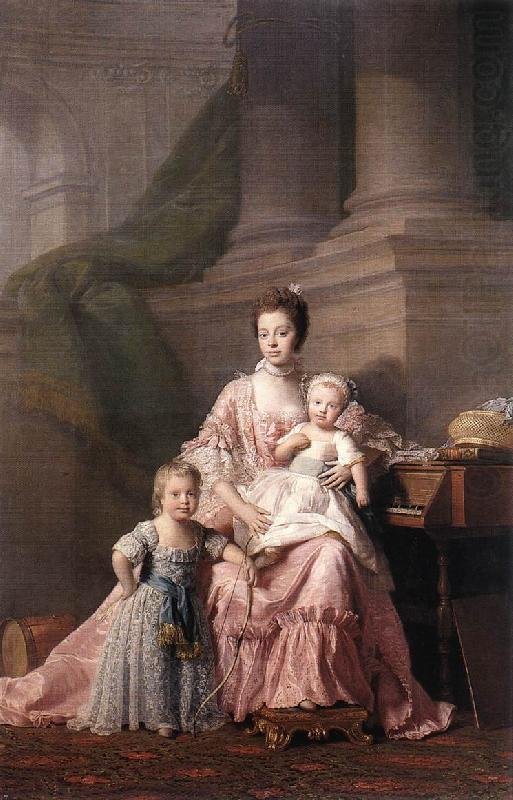
Queen Charlotte with her Two Eldest Sons by Allan Ramsay

Queen Charlotte with her Two Eldest Sons by Allan Ramsey (c.1764)

Britain is very fortunate to have so many art galleries.  Although if one lives in London I suppose one has the cream of the crop but dotted throughout the land there are some excellent art establishments.  One of the richest collection of art works is owned by the monarch and is held in trust for her successors and the nation.   There are more than 7000 paintings within the Royal Collection as well as thousands of watercolours, prints and drawings.  The collection is not held in just one place, Buckingham Palace, but is spread around the royal residences, such as Windsor Castle, Palace of Holyroodhouse in Edinburgh, Balmoral Castle, Hampton Court and Sandringham House.   The total collection is estimated to be worth around ten billion pounds.  My Daily Art Display today features a painting from the Royal Collection which hangs in Buckingham Palace.  It is entitled Queen Charlotte and her Two Eldest Sons by the Scottish portrait painter Allan Ramsay, which he completed around 1764.

Allan Ramsay was born in Edinburgh in 1713.  He was the eldest son of Allan Ramsay who was a poet and writer.  After completing his schooling in Scotland he moved to London when he was twenty years of age and studied art under the tutelage of Hans Hysing, the Swedish portrait painter and later was a student at the St Martin’s Lane Academy, which was the precursor to the present day Royal Academy.  In 1736, aged twenty-three he travelled to Rome and Naples to further his art education and he remained for almost three years.  On returning to Britain he went to Scotland and settled down in Edinburgh.

In 1739 he married his first wife, Anne Bayne, and the couple had three children but none survived childhood and his wife died during the birth of their third child in 1743.    Allan Ramsay supplemented his income from his paintings by teaching art and one of his pupils was Margaret Lindsay the eldest daughter of the nobleman Sir Alexander Lindsay of Evelick.  As a humble artist her parents frowned on their liaison outside of art tuition and knowing that, the couple eloped and were married in secret.  Her parents never forgave her for marrying lower than her station.  Allan Ramsey, in an attempt to ease their minds about how he would care for their daughter and that he had married their daughter for love and not for their money, wrote to them explaining that although he had to support his daughter from his first marriage along with his two sisters, he was well placed financially to look after their daughter.  Her parents were unmoved by his words.  The couple lived a happy life and went on to have two daughters and a son.

The devoted couple spent three years in Italy from 1754 to 1757, where they both spent time painting and copying old Masters and whilst there they would earn an income by painting portraits of the wealthy aristocratic travelers who were doing the Grand Tour of Europe.  They returned to Britain and went to live in London and in 1761, Allan Ramsey was appointed Principal Painter in Ordinary to George III.   The title of Principal Painter in Ordinary to the King or Queen of England was awarded to a number of artists, nearly all of whom were portraitists.  It was in this role that he completed many paintings of the royal couple and their children.  .

 So before us we have Queen Charlotte and two of her children but who was Charlotte and where did she come from?  Sophia Charlotte was born in 1744 and was the youngest daughter of Duke Charles Louis Frederick of Mecklenburg-Strelitz and his wife Princess Elizabeth Albertine of Saxe-Hildburghausen.  When King George III came to the throne it was decided that he should seek to marry someone of royal descent who would be use to life at court but would also have to be somebody who would be popular with the people of Britain.  Many of the ladies that George would have liked to have married were deemed, much to the monarch’s annoyance, unsuitable and inappropriate and he had to reluctantly agree to “look elsewhere” !    Eventually a royal match was made, when David Graeme, a British soldier, diplomat and courtier, who had visited many of the royal courts of Europe, reported back to the British that he had found an ideal marriage partner for George.   She was Princess Sophia Charlotte.

In 1761, when she seventeen years old, she married George III of England and at that young age became the queen consort of  the United Kingdom. With the marriage came stipulations which she had to agree to.  Firstly, she must become an Anglican and secondly, she had to promise not to become involved in the politics of the country.  George III bought Buckingham House in 1761 for his wife Queen Charlotte and it was here that fourteen of the fifteen children of theirs were born.  Charlotte was an extremely intelligent woman.     From her letters we can see that she was well read and loved the fine arts. The Queen was very musical and is known to have been taught music by Johann Christian Bach.   Wolfgang Amadeus Mozart, at aged eight, dedicated his Opus 3 piece to the Queen at her request.  She had a love of plants and trees and helped to establish Kew Gardens.       The Christmas tree was introduced to England by the Queen who had the first one in her house, in 1800.  The royal couple were very much in love with one another but sometimes for the young girl, suddenly having to take on the responsibility of queen consort, was trying but she always took her duties seriously.   In a letter to her younger brother, she wrote:

“…I find that the solitary and retiring life which I lead is not made for me. Having admitted this I assure you I shall not ignore my duty…”

My Daily Art Display today features one of Ramsay’s paintings of Queen Charlotte and her two eldest sons, George, who was Prince of Wales and was later to become George IV and Frederick, Duke of York.  As we have seen in other paintings despite the two children being male they were dressed in, what today, we would term girl’s clothing.  The elder son, George, stands with his bow in his hand and in the left side of the picture, we can see his drum.  These accoutrements have been added by the artist to symbolise George’s future soldierly spirit.  His mother Charlotte has her foot on a foot-stool and leans against a piano.  On the piano we have a sewing box and a copy of John Locke’s book Some Thoughts concerning Education.  At the time, this book, a treatise on education,  was considered the most important philosophical work on education in England and it was translated into almost all of the major written European languages during the eighteenth century.  The setting of this painting and the items depicted in it all add up to a compassionate relationship between a mother and her children and illustrate how she spent time with them whilst they were at play and how important family life was to them.

It is a lovely portrait of a mother and her children.  It is full of compassion and the smiles on their faces have put across the impression of happiness and fulfillment.

The Irish Girl and The English Boy by Ford Madox Brown

Manchester Art Gallery exhibition

The other day I went to Manchester to see the Ford Madox Brown exhibition at the Manchester Art Gallery.  The exhibition opened on September 24th and runs until January 29th 2012 and I strongly recommend you make the effort to visit the city and take in this superb show which displays 140 public and private works from this talented 19th century painter.  I have already  featured two of Ford Madox Brown’s paintings, The Last of England (June 15th) and Manfred on the Jungfrau (July 21st), the former I saw when I visited the Birmingham Art Gallery and the latter which I had hoped to view when I went to Manchester a few months ago had been withdrawn from the gallery for some restoration work prior to this new exhibition.   Both of these works are on show at the current Manchester Exhibition.

I will, in the coming months, review more of Ford Madox Brown’s works,  which I saw at the exhibition, but I need to space them out a little otherwise I will be accused of featuring one artist too often.

Like most people, I had seen many of Ford Madox Brown’s paintings before, in books or on the internet, but what I had not realized was that he had completed many portraits of which a number were on display at the exhibition.  However, there is nothing more true than the saying “you cannot please all the people all the time” for as I researched today’s blog and was still buoyed up with my admiration for Brown’s portraits,  I came across the Daily Telegraph’s art critic’s, Alastair Smart, view of the exhibition and his assessment of some of the paintings, especially his portraiture.  He wrote:

“…Despite the show’s claims to the contrary, Brown’s portraits and biblical dramas aren’t up to much either: his figures are just too awkward in facial gesture, one toothy contortion after another…”

How disappointing to read that when I was still so enthused with what I had seen.  I loved his small portraits.  I did get some consolation however when I re-read the opening line of his article which stated quite bluntly:

“….First, a confession: I utterly loathe the Pre-Raphaelites. Oh, what a mawkish, melodramatic and clichéd bunch…”

The journalist did however go on to qualify his bold statement by saying that he realized Ford Madox Brown was not a member of the Pre-Raphaelite Brotherhood but countered that by telling us that he did have a close association with the three founder members.  Guilty by association ?  Having said all that I will not be deflected from my proposed look at two of Brown’s small portraits, which I loved, even if the knowledgeable art critic disliked them. 

The Irish Girl by Ford Madox Brown (1860)

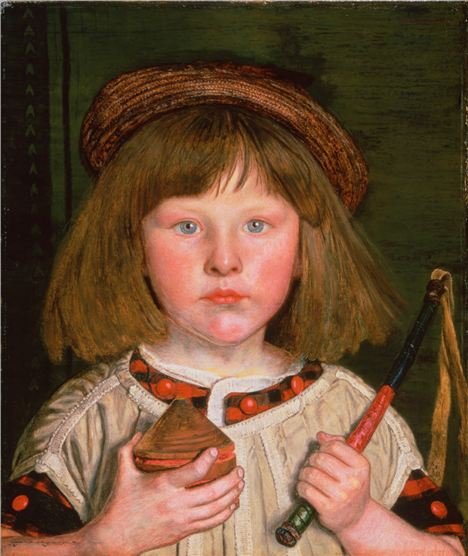
For My Daily Art Display today I am featuring two portraits, The Irish Girl and The English Boy as they were hung next to each other at the exhibition and in some ways they are connected.  It was the coming together of these “two old friends”, who were separated forty-seven years ago.  The man, who commissioned the paintings, was a Leeds stockbroker called Thomas Edward Plint, who was a patron of Ford Madox Brown, and an important Pre Raphaelite art collector.  In 1850, he had commissioned Brown to paint Work, and out of that commission came the painting, The Irish Girl, which also happens to be featured on all the exhibition publicity material.  To my mind this is a beautiful and haunting painting.  This small (almost 28cms square) oil on canvas work was completed by Brown in 1860 and is normally to be found exhibited at the Yale Centre of British Art.  The Yale Center for British Art, which is in New Haven, Connecticut, is a public art museum and research institute for the study of British art and culture. It was presented to Yale University by Paul Mellon who was in the Class of 1929 at Yale.  The Centre houses the largest collection of British art outside the United Kingdom.

In comparison to the portrait of the young English boy the young girl looks slightly nervous and somewhat troubled.  She has real beauty.  There is nothing idealized about this portrait.  Her haunting loveliness is plain to see and yet the difference between her and the English boy could not be starker.  Unlike the boy, she looks worldly–wise.  Her jet black hair, her dazzling brown eyes and her painted red lips are all part of her exquisiteness.   She has tilted her head a little to one side and her eyes focus on something off to the side.  When Ford Madox Brown was looking for Irish models for his painting Work he came across this young girl selling oranges and couldn’t pass up the opportunity to paint her portrait.   We see the fingers of her hand appearing from inside her red paisley shawl which is tightly wrapped around her and the colour of which complements the colour of her lips.  Between her fingers, she is gently holding a sprig of cornflowers. 

The English Boy by Ford Madox Brown (1860)

The portrait which hung next to the Irish Girl was entitled The English Boy and was the companion piece to the Irish Girl.  In this case the young child depicted was no stranger to Brown.  It was his five year old son, Oliver, and this too was painted in 1860.  It is slightly larger than the Irish Girl, measuring 39cms x 33cms.  This portrait is owned by the Manchester Art Gallery, which acquired it in 1932.  Although a companion piece to the Irish Girl they couldn’t be more different.  In this portrait,  the young child stares straight at us with a self-assured gaze.   It is a deadpan expression and we wonder what is going through his mind.   His cheeks are slightly flushed and this colouring in some way matches the red shawl and lips of the Irish Girl.   He wears a white smock over a red checked dress and on top of his head, sitting at a slightly jaunty angle, is a brown straw hat.  In his hands he clutches on tightly to the popular child’s toys of the time, a top and whip.  The way in which he holds the toys in some way reminds us of royal paintings where the subject holds a sceptre and orb.

Despite what our knowledgeable journalist would have us believe I don’t find these portraits in any way awkward in facial gesture.  I find them to be simply fascinating studies of two young children.

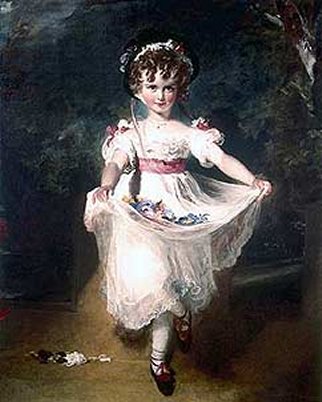
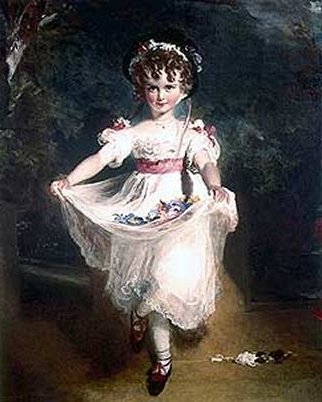
Miss Murray by Sir Thomas Lawrence

Miss Murray by Sir Thomas Lawrence

My Daily Art Display looks at a work by one of the greatest English portrait painters.  His name was Thomas Lawrence, later to become Sir Thomas Lawrence.   He was born in Bristol in 1769.  His father, also called Thomas, was a supervisor of excise and his mother Lucy was the daughter of a clergyman.  His mother had an amazing number of children – sixteen in all, albeit only five survived infancy.  It was around the time that Thomas was born that his father decided to give up his government job and become an innkeeper.  The initial move into running an inn failed and when Thomas was four years of age his father moved the whole family to the Wiltshire market town of Devizes and tried again at being a successful landlord of an inn.  The inn named the Black Bear was on the main route between London and Bath and was ideally situated to catch the London gentry who were on route to Bath in order to take the healing waters.

The father’s business acumen was lacking and he soon ran into debt and it was left to young Thomas to help with the family finances by selling his pastel portraits.  When Thomas was ten, his father was declared bankrupt and the family moved to Bath.  There was now more pressure on the young boy to stabilise the family’s finances through the sale of his portraits.  He concentrated on oval portraits measuring 3ocms x 25cm and he was able to charge three guineas for each half length portrait.   In 1787 Thomas Lawrence moved to London and in a very short time established his reputation as a portrait painter in oils.   It was primarily the portraiture of Britain’s growing aristocracy which was in great demand and Lawrence was able to command high fees for his work and it was into this aristocratic world that Lawrence was accepted.      In 1790, he received his first royal commission when he was asked to paint a portrait of Queen Charlotte, the wife of King George III.  The following year, aged just twenty two, he became an associate of the Royal Academy and three years later a full member of that society.  In 1792, Sir Joshua Reynolds the great English portrait artist, friend and mentor to Thomas Lawrence, died and this opened royal doors for his protégé.  George III, who had been delighted with Lawrence’s portrait of his wife, Queen Charlotte, appointed Thomas Lawrence as the Principal Court painter. He retained that position under the monarchy of George IV.   Lawrence was knighted in 1815 and five years later became the President of the Royal Academy.

So business was good for Lawrence the sale of his portraits went well and he could command higher and higher fees for the commissions he received and so he was rich.   Well, in fact no, he wasn’t wealthy and on a number of occasions was nearly bankrupt and only staved off financial disaster with help from friends and patrons.  So where did all the money go?  Lawrence was bemused by his lack of money, commenting:

“…I have never been extravagant nor profligate in the use of money. Neither gaming, horses, curricles, expensive entertainments, nor secret sources of ruin from vulgar licentiousness have swept it from me…”

Many biographers have sought the reason for his financial mess and it is now generally accepted that Thomas Lawrence could not handle his finances, rarely kept accounts and he spent a lot of money building up a collection of Old Master drawings.  He was also very generous when it came to his family – probably too generous.

Apart from financial problems he was also very unlucky in love.  He had come in contact with the well-known London stage actress Sarah Siddons and he became entangled with her two daughters, Maria and Sally.  He fell in love first with Sally, then transferred his affections on to her sister Maria, then broke with Maria and turned back to Sally again. Both the sisters had fragile health; Maria died in 1798, on her deathbed extracting a promise from her sister never to marry Lawrence.  Sally kept her promise and refused to see Lawrence again, dying in 1803. But Lawrence continued on friendly terms with their mother and painted several portraits of her.   Lawrence never married.  Sir Thomas Lawrence died in 1830, aged 60 and was the most fashionable portrait painter in Europe

My Daily Art Display today is a delightful portrait which Sir Thomas Lawrence completed in 1826, entitled Miss Murray, which can be found at Kenwood House in London.  It is an unusual portrait considering the wealthy and famous people he had painted.  The painting was commissioned by Sir George Murray, the Scottish soldier and politician, who fought with General Wellington in the Peninsular Wars.  Louise Georgina Murray was his daughter and was also the goddaughter of the Duke of Wellington.  The young girl dances towards us beribboned and utterly bewitching.  She reminds me of the very young girls we see in present day American child beauty pageants, all dressed up adult-like, performing little dances for their doting audience.  She is just like Shirley Temple.   We seem to be looking up at her from below as if she is performing her dance on a stage and we are merely part of her audience.  Lawrence has undoubtedly captured the little girl’s beauty whilst she was still young.  Lawrence realised that his portrait had in some ways captured a certain moment in her life, a moment of child-like innocence and beauty which would undoubtedly change.  He commented on this very fact to her father, writing:

“…All I can do will be to snatch this fleeting beauty and expression so singular in the child before the change takes place that some few months may bring…”

How many times have we looked back on our children’s photographs when they were young and wondered how things change so much over time?  Lawrence and undoubtedly Sir George Murray knew that the sweet innocence of the child as she proudly shows off her dress and performs her dance would inevitably change.

So what of little Miss Murray, what became of her?    In 1843, aged twenty-one, she married Captain Henry George Boyce, a grandson of the 1st Duke of Marlborough who sadly died in Rome, five years after they were married.  Louisa Georgina Augusta Anne Murray remained a widow for forty three years, dying in 1891 in the Italian coastal town of Bordighera.

Mirror image ?

As I said at the start of this blog, the painting can be found in Kenwood House, London which I believe is near to Hampstead Heath.  I have never been there and thus have never stood in front of the painting but when I was researching the work I came across two “versions” of the painting, the one you see at the begining, with the girl looking slightly to her left and the sprig of flowers on the floor on the left side of the painting and the other picture of the painting (on the right) I came across in another art history book which had the girl turning slightly to her right and the flowers were on the floor to the right of the painting.  One book must have had a mirror-image of the real painting but which is correct?  Next time you visit the gallery please let me know !