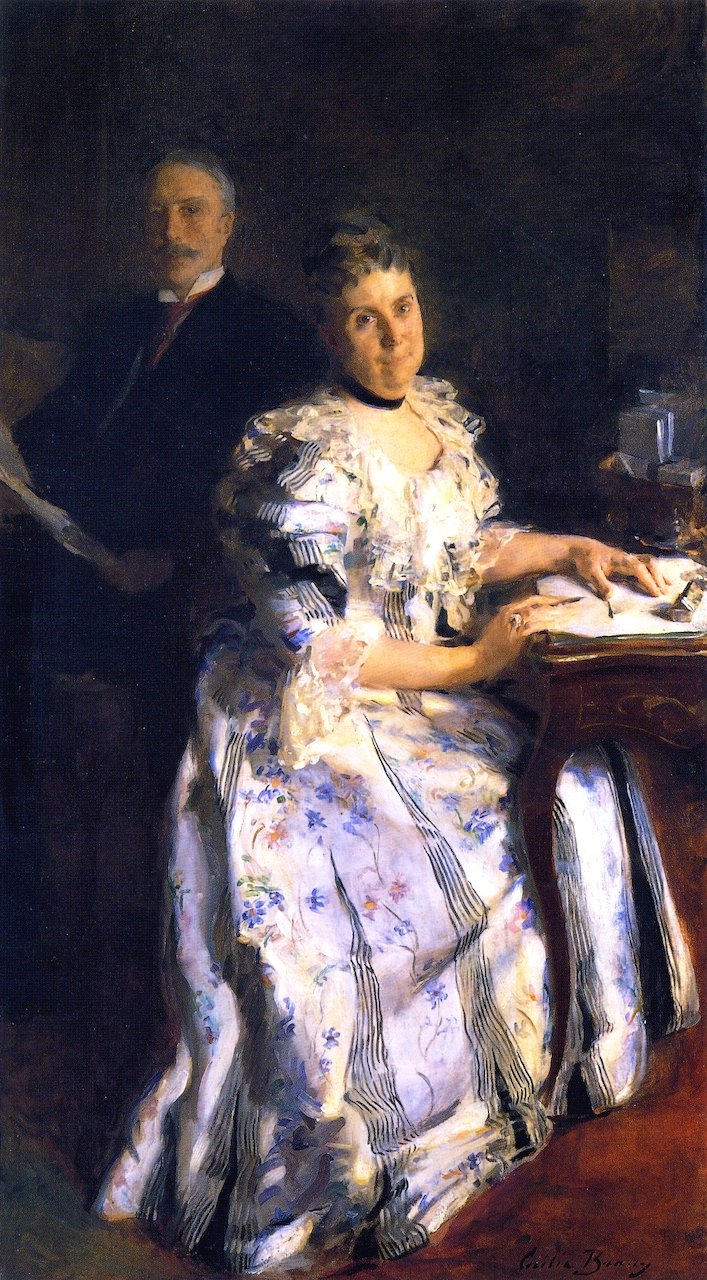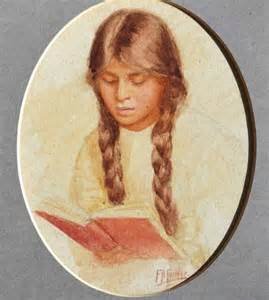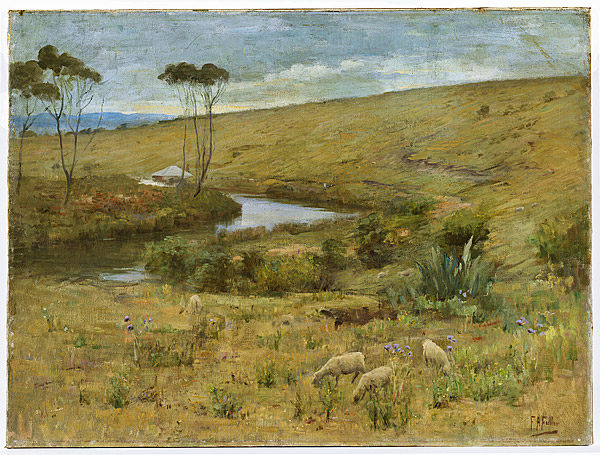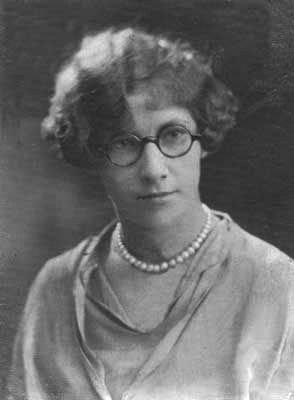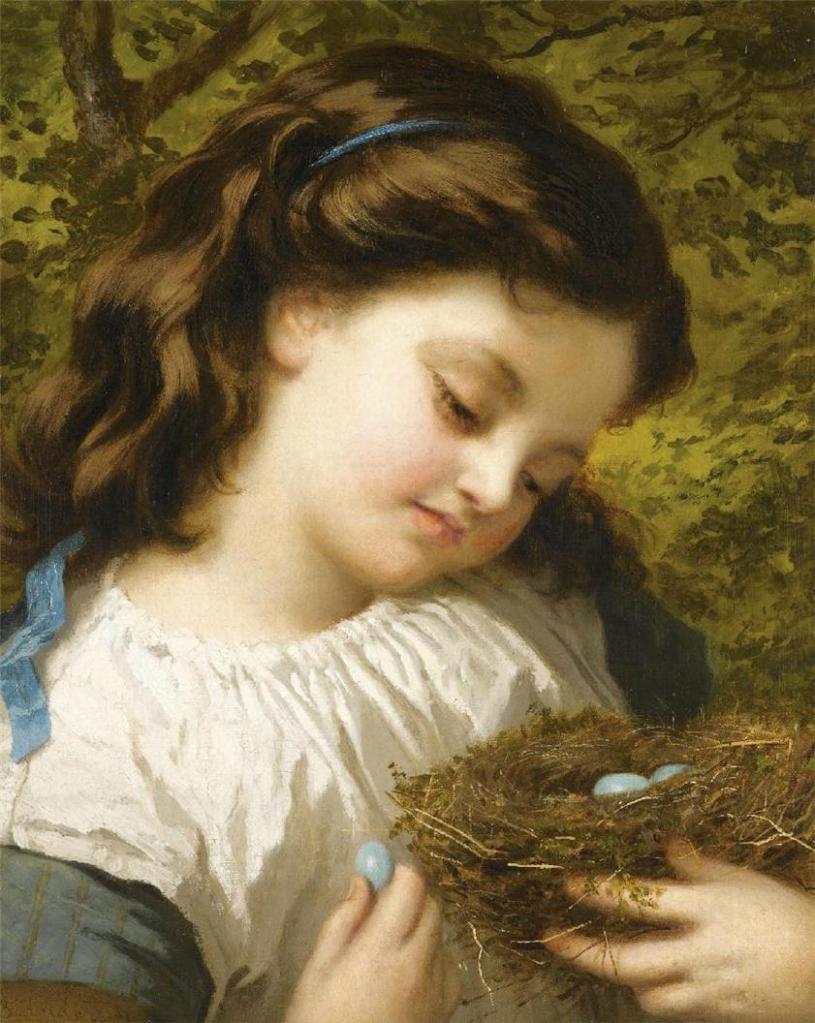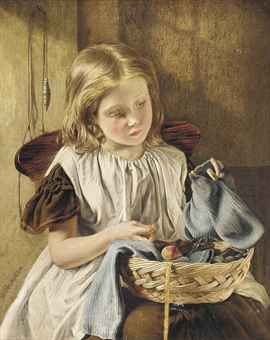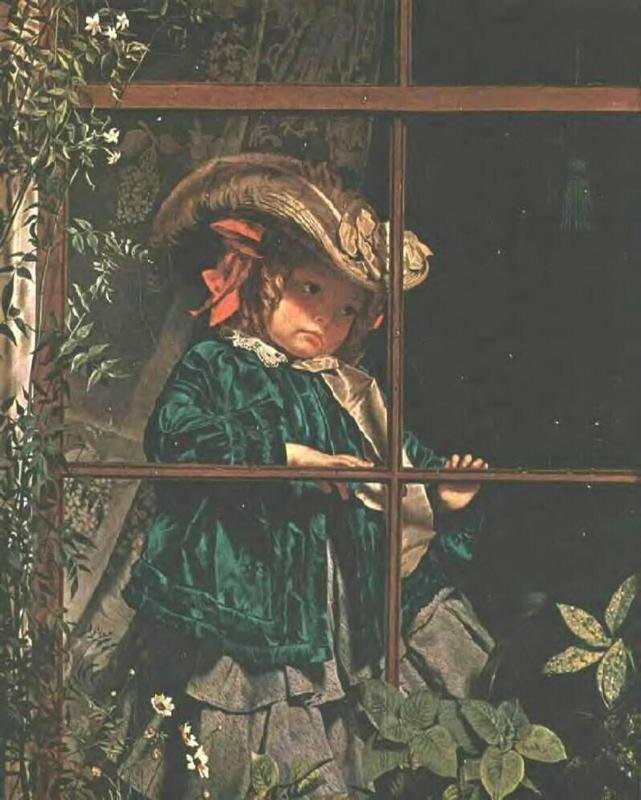
Charles Spencelayh – English genre painter and portraitist

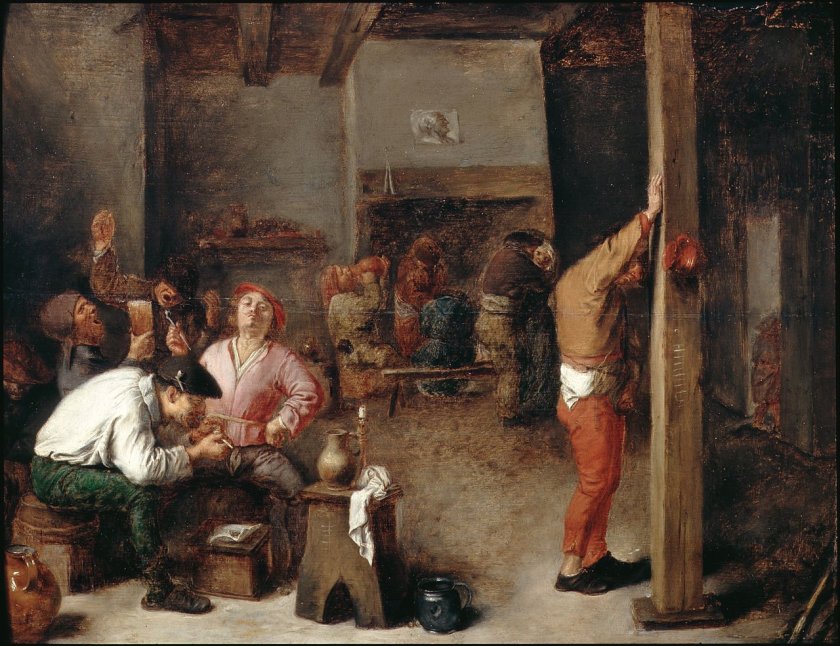
Interior of a Tavern by Adriaen Brouwer

The term genre painting relates to works depicting scenes of everyday life. Such depictions embrace scenes of ordinary people at work or enjoying their leisure time. This type of painting flourished in Protestant Northern Europe as an independent art form. The first great advocates of genre painting were the Dutch Realist artists of the 17th century, such as  Adriaen Brouwer with his riotous pub scenes, Adriaen Van Ostade, who painted genre scenes depicting peasants enjoying their home life or relaxing in an inn.

The Merry Family, by Jan Steen (1668)

My favourite has to be Jan Steen, who ran an inn and depicted people in their homes.

Woman Cleaning Turnips, by Jean-Baptiste-Siméon Chardin (ca. 1738)

In France there were genre paintings by the likes of Jean-Baptiste-Siméon Chardin who depicted servants and children. The harsher realities of working life featured in genre paintings of Jean-François Millet, Daumier, Courbet, van Gogh, and Degas whilst joyous life experienced in bars and cafés featured in works by Toulouse-Lautrec.

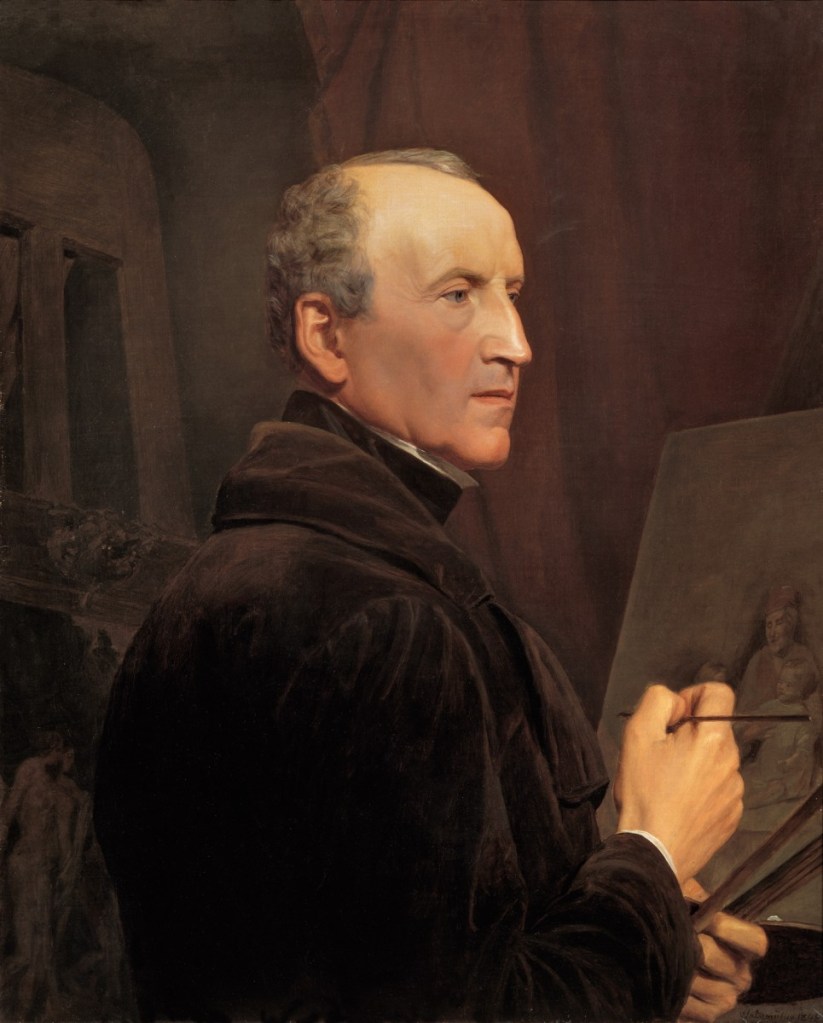
Charles Spencelayh at the Age of 33.

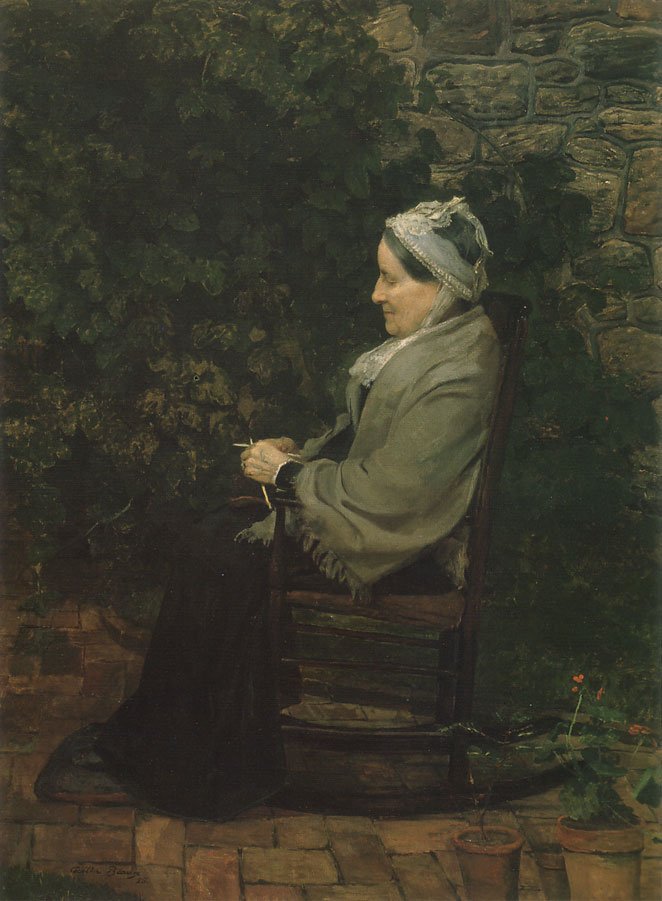
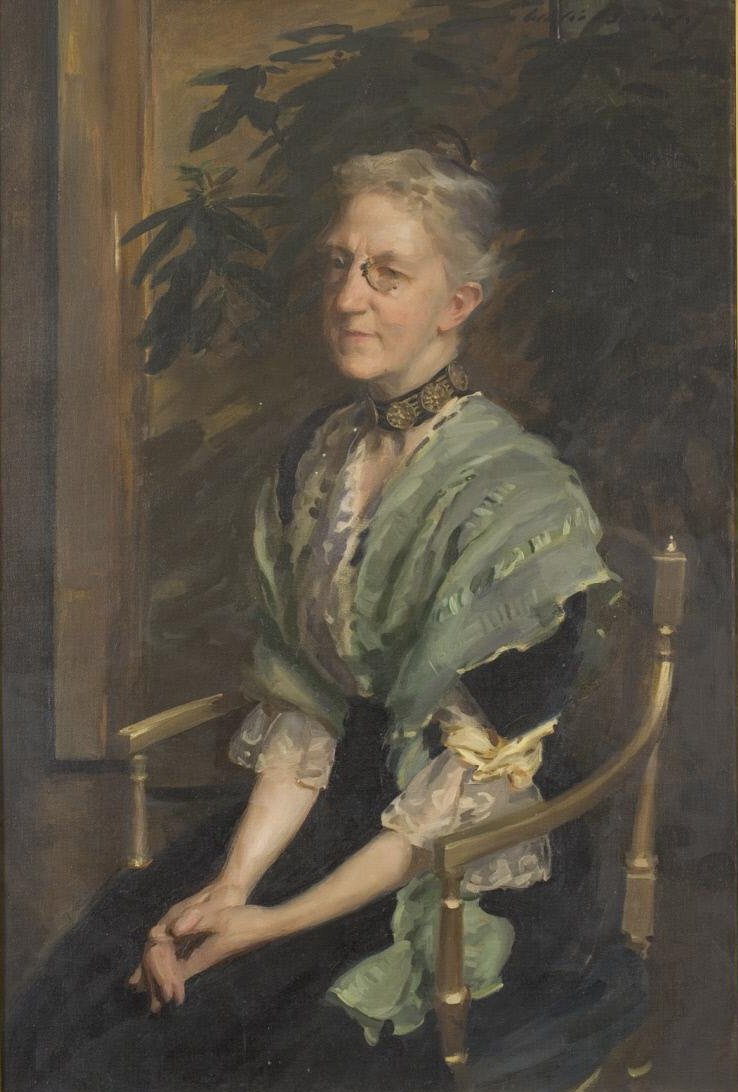
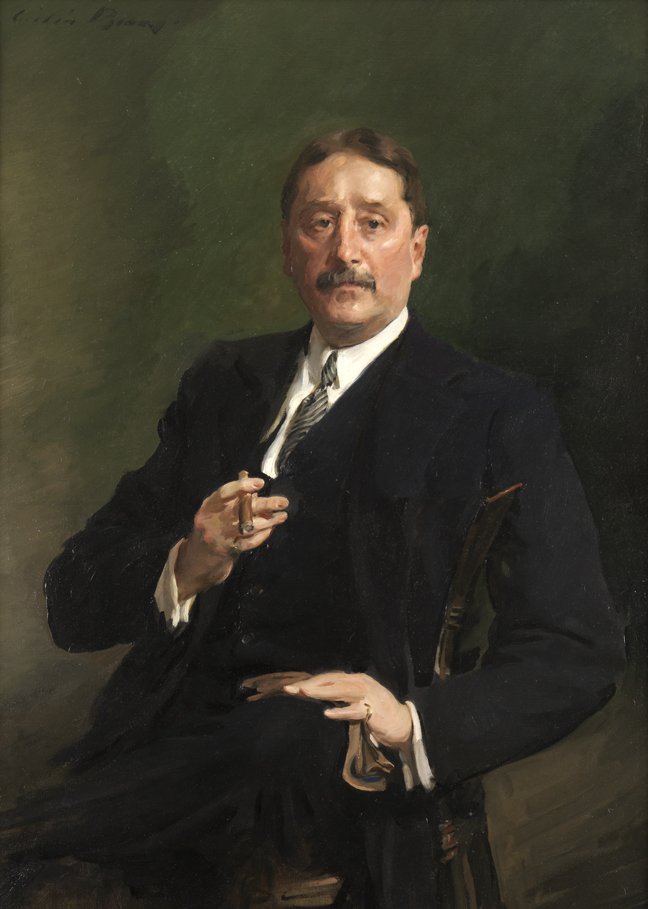
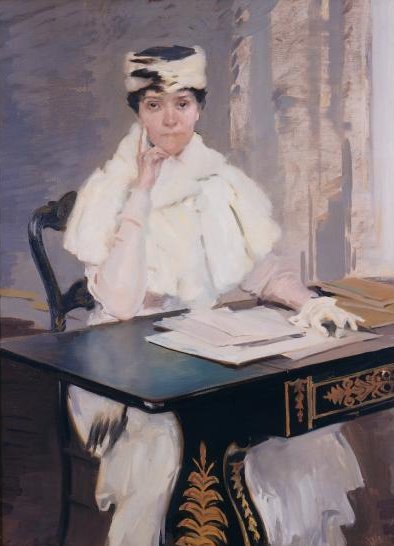
My featured artist today is the English genre painter and portrait painter Charles Spencelayh.   Genre paintings, as well as being a pleasure to observe, are an insight into everyday life before the era of cameras and television. The genre and Academic portrait paintings of Spencelayh looked at life during Victorian and Edwardian times and gives us a great insight into life and fashion in those times.

Boys Fishing by eight-year-old Charles Spencelayh (1873)

Charles Spencelayh was born in Rochester in Kent on October 27th 1865. He was the youngest of eleven children and was the son of Henry Spencelayh, an engineer and iron and brass founder who sadly died before his son was born. Charles’ first steps into the world of art came when he was given his first set of paints at the age of eight and he soon progressed to copying Old Masters. He studied art at the National Art Training School, South Kensington, which later became known as the Royal College of Art, where he won a prize for his figure drawing.
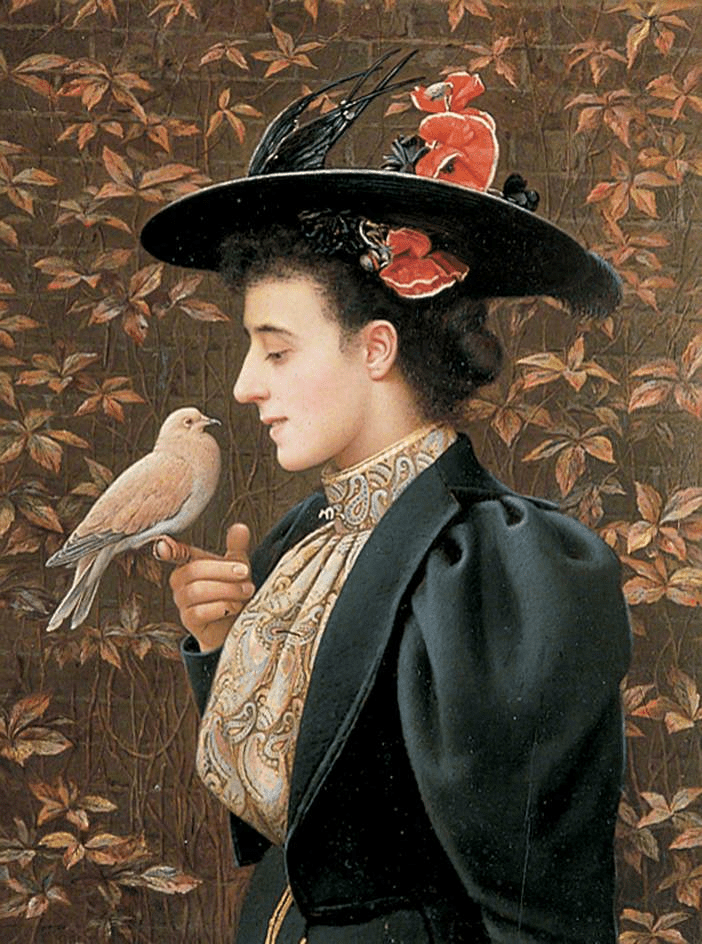
My Pet by Charles Spence;ayh (1890)

Charles Spencelayh married  Elizabeth Hodson Stowe, who worked as a governess, at St. Paul’s, Penge in 1890 and the couple started married life in Chatham.  According to the 1891 census Elizabeth’s occupation was given as a tobacconist. She appears in many of her husband’s paintings including My Pet which depicts Elizabeth, in profile, holding a dove.

Vernon Spencelayh by his father Charles

In 1891 the couple had their one and only child, a son, Vernon who went on to become a talented artist and ivory miniaturist, having been taught by his father. Vernon served as an officer in WW1 and was held as a prisoner of war in Germany. He, like his mother, appeared in a number of portraits by his father.

Private Vernon Spencelayh (1891-1980), West Yorkshire Regiment by Charles Spencelayh

Another fine portrait by Charles of his son, Vernon, in uniform is owned by The National Army Museum. This portrait by his father is a fond record of his son preparing to depart for war.   This Academic-style portrait of his son has an intensity and could almost be mistaken as a photograph.  Vernon Spencelayh’s regiment was the West Yorkshire Regiment, denoted by the motif of the white horse of Hanover on the cap badge. He was involved in a number of battles on the Western Front and at Gallipoli.

In 1896, Spencelayh became a founder member of the Royal Society of Miniature Painters, Sculptors and Gravers, a Society which was formed with the stated intention:

“…to esteem, protect and practice the traditional 16th Century art of miniature painting emphasising the infinite patience needed for its fine techniques…”

Queen Mary’s Doll House

During his lifetime Spencelayh exhibited 129 miniatures at their exhibitions. Probably one of his most famous miniatures was a postage stamp sized portrait of King George V for his wife, Queen Mary’s celebrated Doll’s House, designed by Edwin Lutyens, which was exhibited at the Wembley Exhibition of 1924 and now housed in Windsor Castle. Queen Mary’s and Princess Marie-Louise’s thank you letter was one of Spencelayh’s most treasured possessions.  Spencelayh was a favourite of Queen Mary, who was an avid collector of his work and she bought many of his paintings when they were exhibited at the Royal Academy Summer Exhibitions and she even commissioned one painting, which Spencelayh titled ‘The Unexpected’ due to his surprise at receiving such a request.
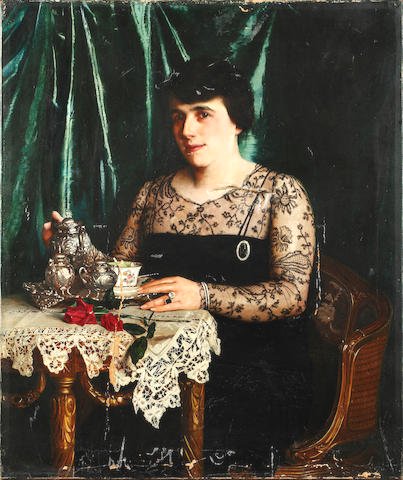
Rosie Levy taking afternoon tea at the Midland Hotel Manchester by Charles Spencerlayh (1925)

The high-points of Spencelayh’s artistic career were the years between the two World Wars. He had acquired a wealthy patron, Joseph Nissim Levy, a prosperous Manchester cotton merchant and during the 1920’s completed a number of portraits of Levy’s social circle. Mr. Levy’s admiration of the talented artist went so far as to give Spencelayh and his family use of a residence in Manchester. In 1924 Spencelayh painted an intimate portrait of Joseph’s wife titled Rosie Levy taking afternoon tea at the Midland Hotel Manchester. It is a masterpiece in the way Spencelayh has captured the folds of the rich fabric backdrop and the furnishings with their reflective surfaces.

The first Mrs Spencelayh (Elizabeth Hodson Stowe) by Charles Spencelayh

In the early 1930’s the Spencelayh’s moved south to Grove Park and Lee a suburb of south London, but sadly, his wife, Elizabeth died there in 1937 and was buried four miles away in Chislehurst Cemetery.

Why War? by Charles Spencelayh

Spencerlayh had his work exhibited at the Paris Salon, but most of his exhibitions were in Britain. For sixty years until his death in 1958 he exhibited more than 30 paintings at the Royal Academy, with his work entitled Why War winning the 1939 Royal Academy ‘Picture of the Year’. Spencelayh had fought in the First World War and in this painting, he depicts another veteran of that war in his darkened sitting room. He blankly stares into space. He is forlornly envisaging the onset of the Second World War. The artist has added so much detail in this painting that we can build up a picture of how the man lives. We see, on the table next to him, a new gas mask issued to him by Lewisham Council and lying on a chair is a newspaper, emblazoned across the front page is the story covering Chamberlain’s abortive mission to make peace with Hitler. Spencelayh’s talent as both a genre painter and portraitist and his training as a miniaturist allowed him to build up a pictorial story by his depiction of visual clues in painstaking detail.

It’s War by Charles Spencelayh (1942)

His 1942 painting It’s War brings home the hardship felt by many during the Second World War.  Painted in his studio with a large amount of props which he accumulated during his visits to bric-a-brac shops it depicts the hard times suffered by many during the conflict.  It is part portraiture, part genre and part still-life.  Its is testament to the genius of the man.
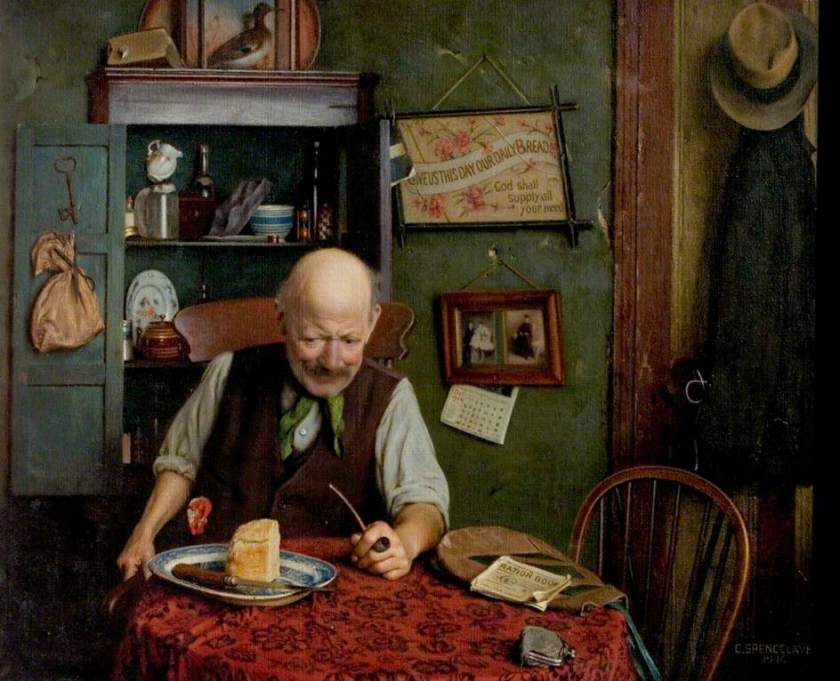
His Daily Ration by Charles Spencelayh

Although the War had ended and the Allies had been victors, Many in England had to suffer years of deprivation.  Food was rationed and hardships endured as is beautifully depicted in Spencelayh’s 1946 painting, His Daily Ration in which we see an elderly man staring at his meagre meal.

The Latest Addition by Charles Spencerlayh

One theme which appeared in many of Spencelayh’s paintings was of old men pottering around in junk shops or in cluttered rooms in their homes. These were classic Victorian genre works which were pictorial histories of the between-War days in England.

The Laughing Parson by Charles Spencelayh

Many of his subjects were of domestic scenes, painted with such definition that they are almost photographic. In his 1935 painting The Laughing Parson,  we see the parson dressed in a grey morning suit, resplendent with his “dog collar”. He is half slumped in his wing back armchair as he peruses the latest issue of the satirical Punch magazine. By the look on his face and his broad smile, something in the magazine has amused him.  Once again Spencelayh has added numerous items of furniture and accessories which tell us about life in those bygone days.
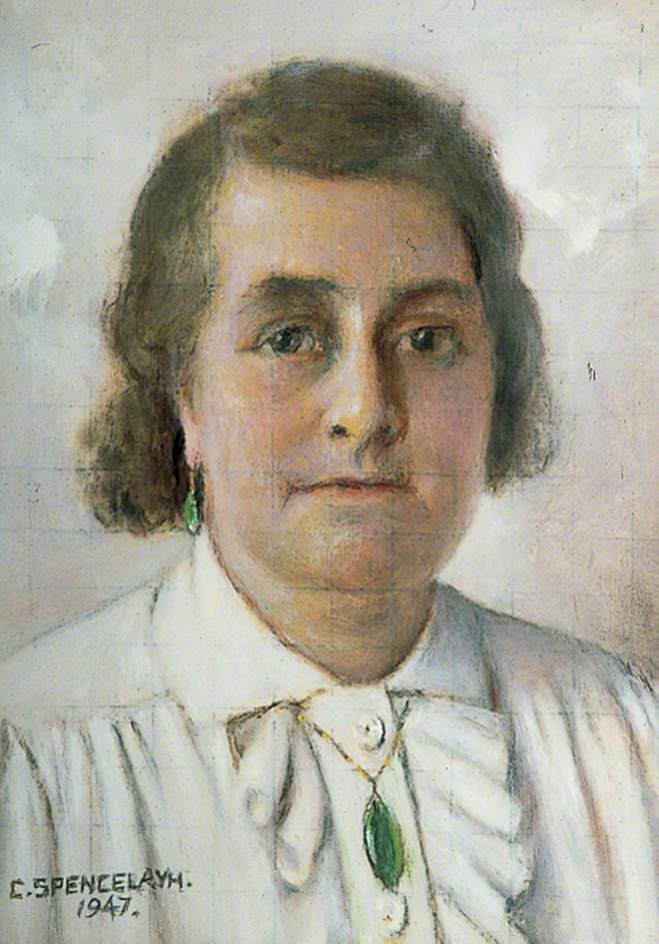
The Second Mrs Spencelayh by Charles Spencelayh

In 1940, Charles remarried, and his second wife, another Elizabeth and he continued to live in Lee but after a particularly fierce German bombing raid over London, they were rendered homeless. Worse still many of his paintings were destroyed. The couple then moved north to Olney were his wife’s family lived and soon after, setting up home in the Northamptonshire village of Bozeat where they remained for the rest of their lives. It was during those years at Bozeat that Spencerlayh produced some of his best loved paintings often featuring residents of the village who were often treated to a home-cooked meal as payment for modelling for one of his paintings.

A Lover of Dickens by Charles Spencelayh (1947)

Spencelayh set up his studio with room-sized screens bedecked with patterned wallpaper and had a chest, full of props, with which he would “dress” the room.  Charles  ‘dressed’ the room using “props” from his collection, such as Toby jugs, stuffed birds, Windsor chairs, clocks and cheap watches as well as patriotic framed pictures of Lord Nelson and members of the Royal Family.  Look at the background of his 1947 work A Lover of Dickens.  The props he used to add meaning to the painting were arranged haphazardly to give a sense of everyday clutter.  Maybe the man lived on his own and a regime of “tidiness” was not forced upon him !

Fingerprints by Charles Spencelayh (1953)

By the late 1950’s his eyesight began to fail but that did not deter him and he continued to paint and in 1958, three of his works were accepted into the Royal Academy Summer, including a poignant work titled The Faded Rose. Sixty-six years earlier he had his first work exhibited, a miniature entitled Mrs Robins and he is considered to be one of the most prolific artists to show at the Royal Academy. Notwithstanding this, he was never made an Associate of the Academy, which baffled many including himself. He wrote to his Canadian agent, George Nuttall in 1956 about this unforgiveable omission. He commented jokingly:

“…I do not know, unless I am not old enough, or work not sufficiently good, which is my aim to yet improve although I cannot wear glasses to paint eventually this will stop my efforts I’m sure of it…”
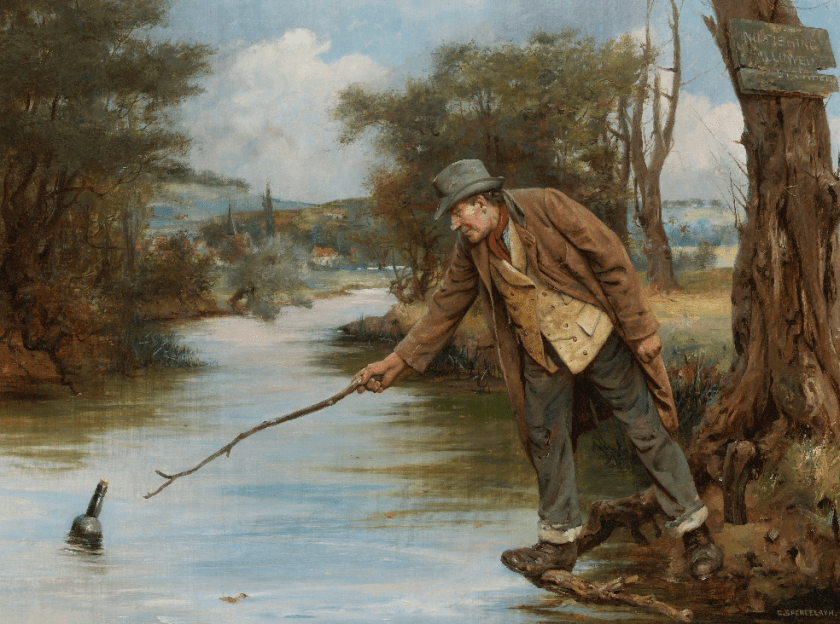
Taking the Risk by Charles Spencelayh

Charles Spencelayh died, aged 92, in St Andrews Hospital, Northampton on June 25th, 1958 and after a funeral service conducted by his friend and executor the Reverend W.C. Knight in the 12th century church of St Mary the Virgin, Bozeat, he made his final journey back to Kent and was buried with his first wife in Chislehurst Cemetery.


Most of the pictures came from ARC and Art UK and Spencelayh’s biography came from a number of websites of galleries which house some of his paintings and the Chislehurst Society website:

Click to access CharlesSpencelayh.pdf


Hannah Gluckstein (Gluck). Part 2 – Artistic success and acclaim

This portrait of Gluck in her artist’s smock, taken in 1926 when she was 31, was by Howard Coster, a self-styled “photographer of men.”

Hannah Gluckstein left her family home in 1916 to go to Lamorna a village in west Cornwall to paint with three of her fellow St John’s Wood art students, including her best friend, a female who simply wanted to be known as Craig. In the late nineteenth and early twentieth centuries Lamorna became well-liked by artists of the Newlyn School. Gluck was delighted to be amongst a group of fellow artists such as Samuel John Lamorna Birch who on the advice of his friend and fellow artist Stanhope Forbes adopted the soubriquet “Lamorna” to differentiate him from a contemporary artist of his, Lionel Birch.

Gluck on a Hilllside by Alfred Munnings (1916)

Other artists in residence at the time were Laura Knight and her husband Harold, and Alfred Munnings who completed a sketch of Gluck dressed in a gypsy costume smoking a pipe.

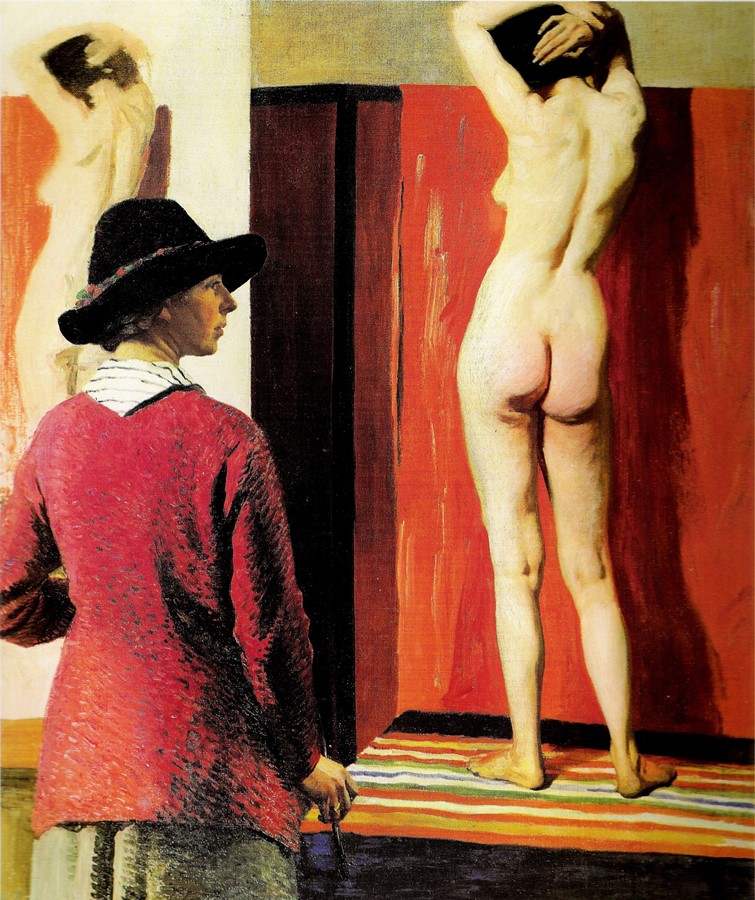
Self Portrait and Nude by Laura Knight (1913)

At Lamorna, Gluck soon made friends with Ella Naper, a thirty-year old jeweller, potter, designer, and painter. Ella was a friend of Laura and Harold Knight and was featured as a nude model in Laura’s 1913 painting, Self-portrait, and Nude. Laura described Ella in her 1936 book, Oil Paint and Grease Paint:

“…[Ella was] an adorably lovely creature who when she chose, wore workman’s trousers, smoked a clay pipe and bathed naked off the rocks…”

Dozmare Pool on Bodmin Moor

Gluck stayed for a time in an old hut close to Dozmare Pool on Bodmin Moor with Ella and maybe her demeanour and dress rubbed off on her. The moor was often a wild place during adverse weather and offered spectacular landscape painting opportunities.

Gluck stayed in Cornwall in the summers and she and Craig would return to a flat in London, which Gluck’s father had financed, during the winters. Slowly she built up a large collection of paintings, fifty-seven in all, which she showed in 1924 at her first solo exhibition at the Dorien Leigh Gallery in London. All were sold, and with the money raised she was able to move from her Earls Court studios to a larger studio in Tite Street in the borough of Chelsea, once used by the American artist James Abbott McNeill Whistler.

Peter, A Young English Girl – Portrait of Gluck by Romaine Brooks (1924)

It was around 1923 that Gluck and her good friend, the American artist Beatrice Romaine Brooks arranged to do portraits of each other. Romaine’s portrait of Gluck was entitled Peter, a Young English Girl. Why the title? Although Hannah Gluckstein worked under the name of Gluck she preferred to be called Peter within her circle of friends. Gluck’s androgynous persona is accentuated by her clothing. We see her with a short, boyish haircut wearing a stylish jacket.

Romaine Brooks, Self-Portrait, 1923

Both Brooks and Gluck were attracted to women and the current style of menswear-inspired fashion suited them. It was the wearing of such clothes that allowed upper class lesbians to identify one another while at the same time staying unobtrusive. Many looked upon this way of dressing as just a rich woman’s idiosyncratic take on wealth and fashion. Gluck’s portrait of Romaine Brooks was never finished. Gluck had set up a large canvas and invited Brooks round to her studio but things did not go well between sitter and artist. Gluck wrote a note about the sitting:

“…Romaine wasted so much sitting time in making a row that at last I was only left an hour in which to do what I did – but my rage and tension gave me almost superhuman powers…… she insisted I should do one of my little pictures. I refused so she left me with the unfinished portrait. However I had to give away many photographs of it to her friends…”

Gluck painted over the unfinished canvas !!

London Trocadero

One of the most popular night-spots in London between the wars was the London Trocadero. Originally opened in 1896 it was just a restaurant, owned by J.Lyons and Co., one of Gluck’s uncles’ businesses. In 1924 her uncle Montague Gluckstein asked Charles Cochran, an English theatrical manager and impresario, to stage a cabaret in the grill room of the restaurant. From then until the start of World War II cabarets ran continuously at this venue and one of the regular attendees was Gluck.

Three Nifty Nats by Gluck (1926)

In her 1926 painting, Gluck depicted one of Cochran’s song and dance acts, The Three Nifty Nats performing their dance routine. For Gluck this was one of her true art deco pieces. This along with forty-three other works by her featured in her Stage and Country exhibition which opened at the Fine Art Society in Bond Street in April 1926. The paintings on show were a mix of her life in Cornwall and her life in London. For the opening event Gluck had styled her hair in an Eton Crop, a haircut which often involved trimming off a woman’s flowing locks in favour of the tapered look sported by men. She was dressed in breeches, a man’s soft hat, and smoked a pipe. The art reviewer, Onlooker, for the Daily Graphic wrote about his initial encounter with Gluck at the opening of the exhibition:

“…I addressed him naturally as “Mr Gluck”……It was with considerable shock that I found myself being answered in a soft voice, essentially feminine. I do not know that I should altogether like my own wife or my daughters to adopt Miss Gluck’s style of dressing her hair or clothing her limbs, but I do know that I should be proud of them if they could paint as well as Miss Gluck paints…”

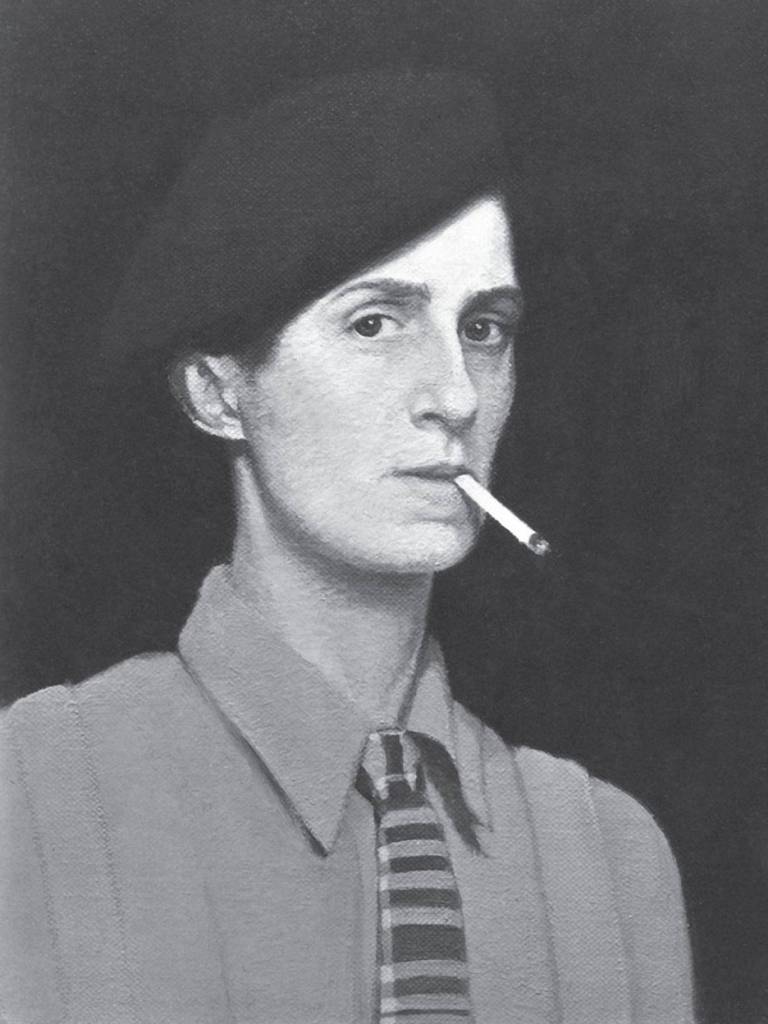
Self Portrait with Cigarette by Gluck (1925)

Another painting on show at the exhibition was her self-portrait, entitled Self-portrait with Cigarette which she had completed the previous year. The exhibition was a great success and her work was highly praised by the art critics of the day. She was lauded as a painter of her time and strangely no report gave mention of her connection with the prosperous and very wealthy Gluckstein family. It would be interesting to know what Gluck’s father thought of the exhibition with his daughter’s picture wearing men’s clothing splashed across many of the daily newspapers. Perhaps he was thankful that the Gluckstein name did not figure in the media outpourings! All Gluck’s works on show were sold. This prestigious London gallery was to become the home for all her future exhibitions.

Bolton House, Windmill Hill, Hampstead (1909) once owned by Joanna Baillie

In 1926, Gluck’s father gave his daughter twenty thousand pounds and bought her a new place to live – Bolton House, Windmill Hill in the heart of Hampstead Village. It had been the home of the poet and dramatist Joanna Baillie for the last fifty years of her life. It was a large three storey red-brick Georgian building with an impressive wide drive. Gluck went to live there along with a housekeeper, a maid, and a cook. She also had a car which gave her easy access to her beloved Cornwall and her “Letter Studio” in Lamorna which was once owned by Laura Knight.

Sir James Crichton-Browne by Gluck (c.1930)

Gluck did not remain alone in Bolton House for long as in 1928, Sybil Cookson, the granddaughter of Sir James Crichton-Bowne, a leading British psychiatrist, came with her two young children to live with Gluck. On visiting Bolton House to see his granddaughter he had seen Gluck’s paintings and commissioned her to paint his portrait which she completed that year. Sybil Cookson was a journalist and romantic novelist. She had left her husband, a well-known racing driver, to go and live with Gluck. She was fascinated and in awe of Gluck. She believed she was living with an artistic genius. Soon she was running Bolton House for Gluck. During the summers Gluck, Sybil and her two children would go and stay in Lamorna.

As a journalist, Sybil also wrote about boxing, and her stories of the ancient art form of pugilism induced Gluck to paint several boxing scenes, one of which was entitled Baldock versus Bell at the Albert Hall.  Teddy Baldock was a very popular Eastender, and one time world champion.  Whenever he fought numerous coaches carrying his supporters left Poplar in the East End of London to cheer him. When he met Archie Bell at the Albert Hall on 5 May, 1927, no less than 52 crowded coaches made their way out of the East End, heading for Kensington like an Army convoy.

Baldock versus Bell at the Royal Albert Hall by Gluck (1927)

Gluck’s brother Louis returned home from the war in 1918 and went to live with his parents. He stayed with them until he married in 1926. There was a major problem with Louis marriage to his wife Doreen as she neither got on with Gluck nor her mother-in-law. Gluck’s father died on November 30th, 1930 at the age of 74. Right up to the end Joseph Gluckstein hoped his daughter would change her ways. He must have realised his end was near as he was able to sort out all his financial affairs before he died. He also wrote a farewell letter to his wife Francesca.   In it he wrote poignantly about Gluck:

“…I hope that our dear Hannah may so develop as to be like her dear mother, which to my mind embraces the wish that she will be a model woman…”

At the same time, he wrote a letter to his son Louis:

“…And now my dear boy adieu. I am most grateful for all the happiness you have given me from the day of your birth. You have been a true model son and I can say that no son has ever given to his parents more happiness than you have to yours…”

He did not write a letter to his daughter.

Sadly, their father’s death marked the end of the very good relationship Gluck had had with her brother Louis who, along with his mother, had been made the main trustee of his sister’s finances and this upset and annoyed her to have her younger brother control the purse strings.

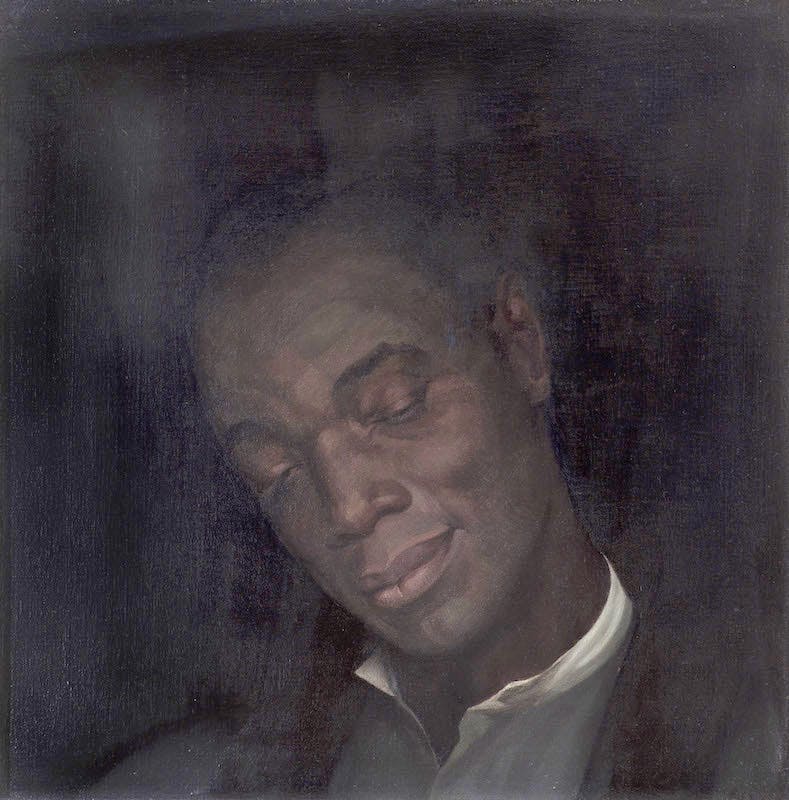
Spiritual (Study of a Negro Head) (1927) by Gluck.

In 1927 she completed a portrait entitled Spiritual which came into being because of a bet. At a party Gluck had been talking about painting and how light played a big part in any work. A friend of hers commented that it would be impossible to paint a black face against a black background. Gluck was up for the challenge and advertised in a newspaper for a black person to model and her picture of him successfully proved that she could portray a black person against a black background.

Gluck’s Studio at Bolton House

Gluck enjoyed life at Bolton House and converted a small outhouse at the bottom of her garden into her studio. It had once been home to a small pony. However, in 1931 the outhouse was demolished and in its place was built a magnificent new studio designed by her architect friend, Edward Maufe, later Sir Edward Brantwood Maufe. The new building cost Gluck £1500. To get from the house to the studio she had to walk over a Maufe-designed stone-paved garden flanked by flowerbeds and a central lily pond which received its water from a concrete fountain. Bolton House and the new studio gained a lot of media attention because of their beauty and in the House and Gardens magazine of July 1935 a three-page spread was set aside extolling the beauty of the two buildings:

“…Miss Gluck, the well-known painter, is the happy possessor of an unspoiled Georgian House and a completely modern and efficient studio, separated from it only by a paved courtyard, with flower beds reflected in a shallow lily pool…”

Sir Edward Maufe by Gluck (1945)

In 1945 Gluck completed a portrait of Maufe at work in his studio.

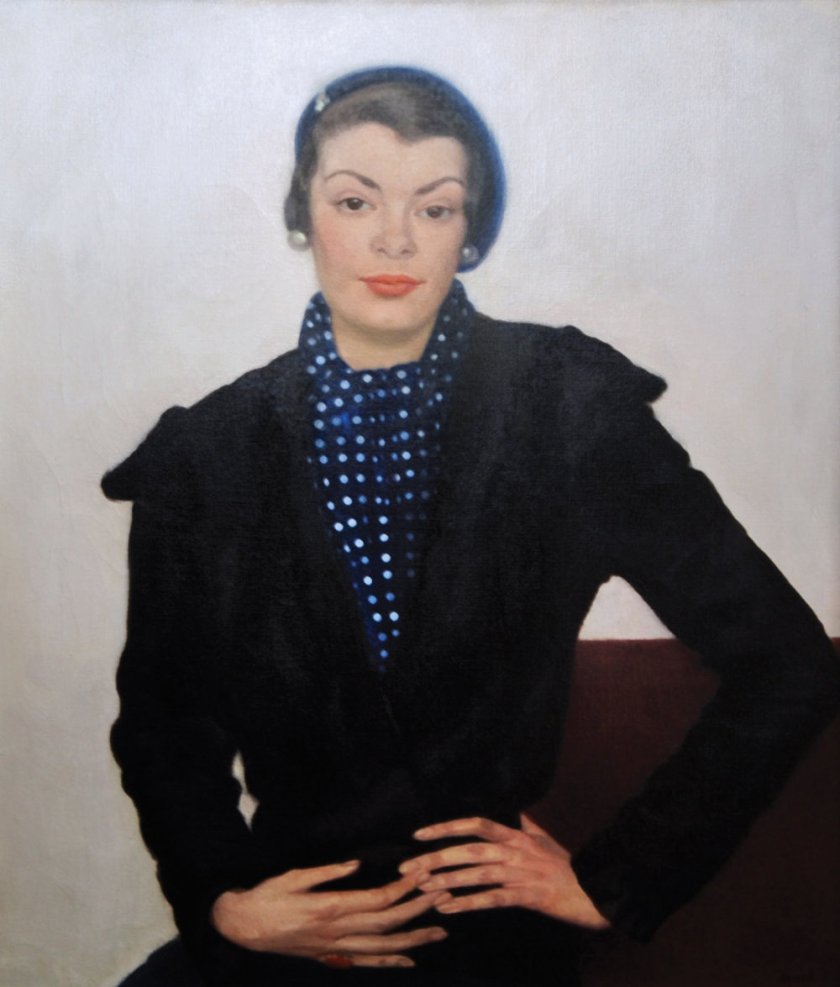
Portrait of Miss Margaret Watts by Gluck (c.1930)

Margaret Watts was the daughter of the illustrator Arthur Watts, who was a neighbour of Gluck’s in Hampstead. Gluck painted a portrait of Margaret Watts aged 21 depicting her as a fashionable young woman.  Margaret later became a costume designer.

……..to be continued

In the final part of my look at the life and art of Gluck I will be examining how two females she had affairs with influenced her work and how her love for one of them culminated in one of her best known and best loved works of art.


Most of the information for this blog came from the excellent book – Gluck: Her biography by Diana Souhami.
For a much fuller account of Hannah Gluckstein’s life, treat yourself to this biography.

Cecilia Beaux. Part 7 – The final years

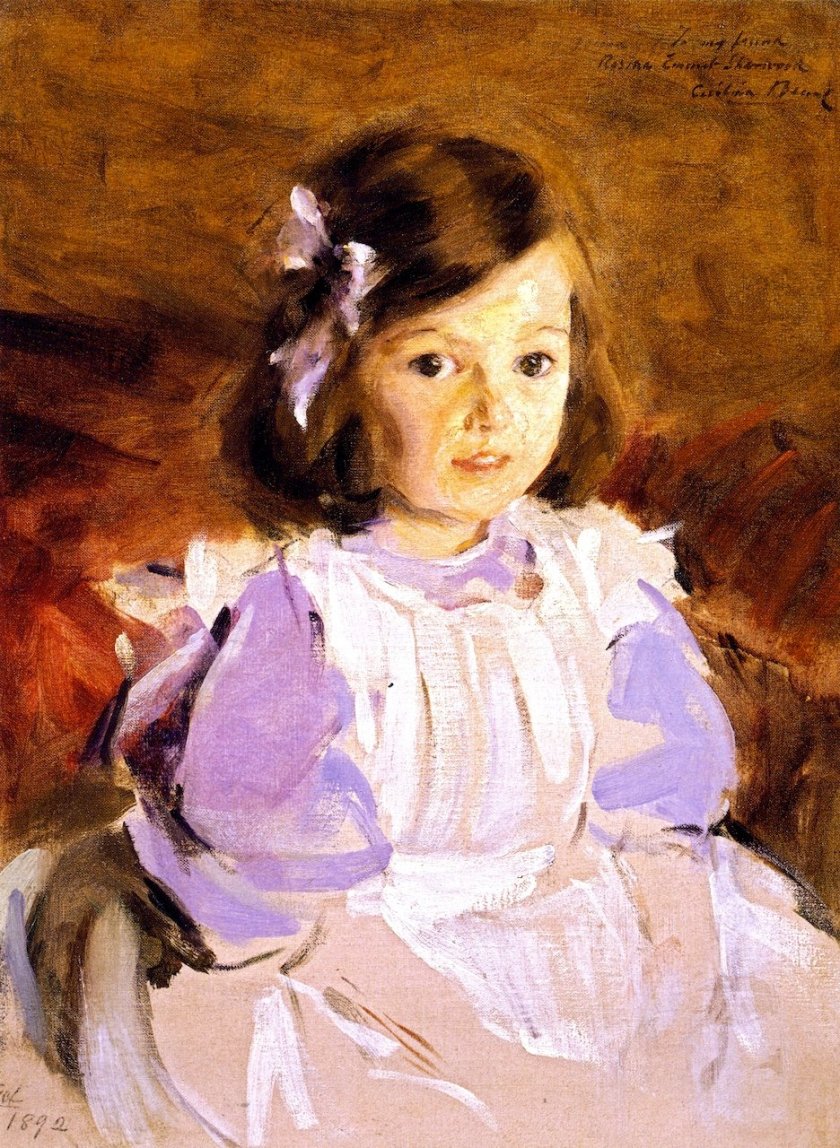
Cynthia Sherwood by Cecilia Beaux (1892)

Upon returning to the United States, Beaux became one of the most sought-after portraitists in Philadelphia and New York. One of the first paintings by Cecilia Beaux, which was acclaimed by the critics for its gentle innocence, was a portrait she did for her friend and fellow artist, Rosina Emmet Sherwood in 1892. It was a portrait of her friend’s daughter Cynthia Sherwood. Rosina Emmet Sherwood was a book illustrator and one of the foremost female painter of that time and was a close friend of Cecilia’s. The two women had met through their connection with the arts, and in 1892 they wanted to celebrate their friendship by swapping portraits. Cecilia gave Rosina a portrait depicting her second child and eldest daughter, three-year-old Cynthia. The painting is made up of a tonal mixture of lilacs, crimson, and whites. In the work we see Cynthia sitting on a red sofa. She has a white ribbon in her hair and is wearing a white pinafore over a blue-grey dress and her arms rest in her lap. Rosina was delighted with her daughter’s portrait which was exhibited at the 1895 Society of American Artists’ annual exhibition. In a letter to Cecilia, Rosina wrote about how her daughter’s portrait was well received by fellow artists and critics alike:

“…My dear — you and Cynthia were the lions of the Exhibition yesterday. Really, much as I admired the picture, I was startled at its brilliancy and force…. It never looked so like Cynthia before. The artists all moved about it…. Mr. Chase said he would give anything to own it and Robert Reid, after extravagantly praising the big picture [Sita and Sarita] said he liked Cynthia’s portrait much the best. Kenyon Cox said that for the sort of portrait painting you chose to do, you do it better than any man he knew except John Singer Sargent. So there Madame!…”

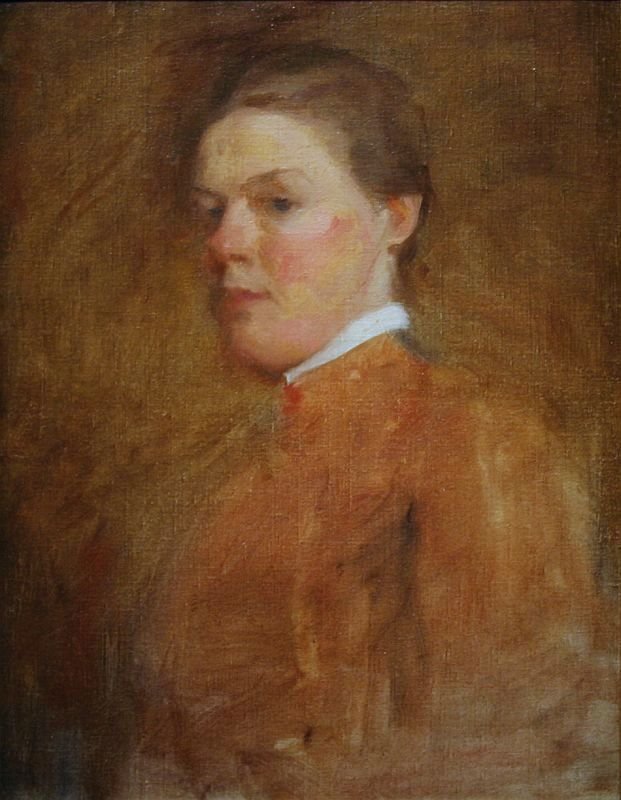
Cecilia by Rosina Emmet Sherwood (1892)

In return Rosina painted a portrait of her close friend. Cecilia was so enamoured with the portrait that she kept it all her life and, on her death, it passed down to her great-niece.

Ernesta (Child with Nurse) (1894)

Two years later, in 1894, Cecilia completed another portrait of a young girl, her two-year-old niece, Ernesta Drinker, entitled Ernesta (Child with Nurse). In the painting, we see the young girl holding the hand 0f her nurse, Mattie. The portrait of Cecilia’s young niece reveals the well-to-do world of the advantaged child. It is a sentimental portrait focusing on the first tentative steps of the young girl and if we look closely at the tightly clasped hands of adult and child, we see how Cecilia has depicted the partnership between the dependent child and the caring protective adult. We view the painting at the child’s eye-level. The figure of the nurse is cropped at the waist, and so we just see the arm and skirt of the nurse which makes us aware of the size of the diminutive child. From where we stand viewing the portrait, we soon realise that it is all about the world of the child. The portrait of young Ernesta was shown at the Society of American Artists in their spring exhibition in 1894. In 1896 the painting was awarded a third-place bronze medal at the Carnegie Art Institute’s first International exhibition.

Reverend Matthew Blackburne Grier by Cecilia Beaux (1892)

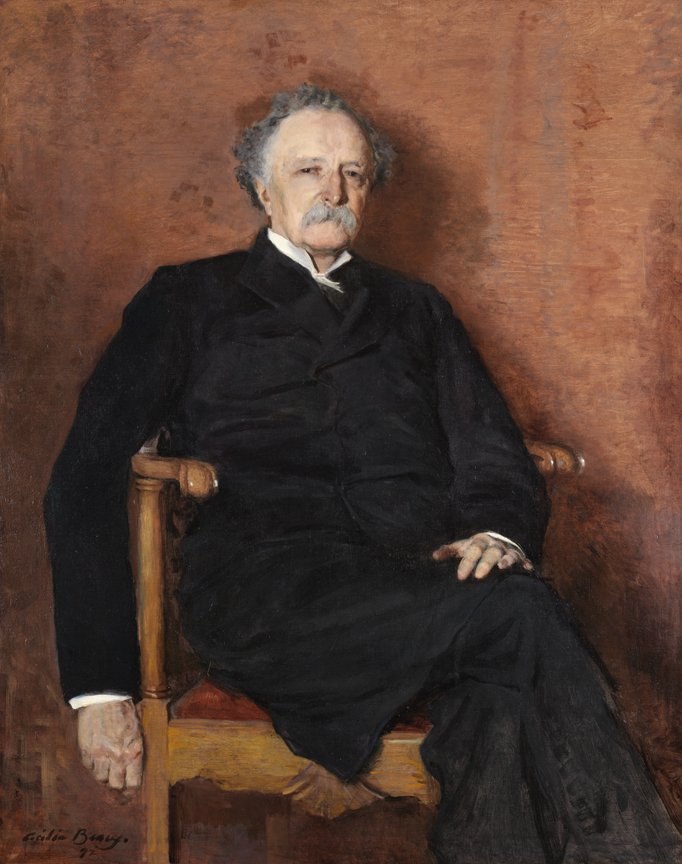
Cecilia Beaux’s child portraiture was very popular and in much demand, but this was just one “string to her bow”. During the year in which she completed the portrait of Cynthia Sherwood she completed a portrait of an eminent man, The Reverend Matthew Blackburne Grier, who lived just two doors away from Cecilia’s family home. The subject of the painting is the retired Presbyterian clergyman and former editor of The Presbyterian who had come to live in West Philadelphia. Cecilia had approached him and asked if he would sit for her. In the portrait, we see him sitting in the tricornered Chippendale chair which was a much-used accoutrement of her studio. Within a year of its completion the painting became a prize-winning portrait, winning her the Philadelphia Art Club’s Gold Medal in 1893.

Self portrait by Cecilia Beaux (1894)

In May 1894, Cecilia Beaux was elected an associate of the National Academy of Design. Admission to this academy was conditional on her agreement to the Academy’s Constitutional rule that she must submit a portrait of herself for the Academy’s permanent collection. For Cecilia it was a moment in time that she must decide how she wanted to portray herself. She was now thirty-nine years old and had the self-confidence to believe that she was both good-looking and cultured and she decided that those characteristics needed to be depicted in the finished portrait. The completed Self Portrait also shows off her beauty. Her lavender, beige and white striped silk dress accentuated her elegance appearance. This is not a depiction which in any way exudes her sexuality. It is all about her professionalism and serious dedication to her art. Nobody could question her beauty but for Cecilia, she wanted to be remembered not for her physical attributes but for her exceptional artistic talent.

In 1895 Cecilia was appointed the “Instructor of the Head Class of the Schools,” at the Pennsylvania Academy with a salary of $1,200 a year. This appointment given to a female was the talk of the local newspapers. One newspaper commented:

“…Never before, either in this country or abroad, has a woman been chosen as a member of the faculty in a famous art school. It is a legitimate source of pride to Philadelphia that one of its most cherished institutions has made this innovation…”

Beaux taught at the Academy for two decades in either a “Head Course” or a “Portrait Class”. Her classes were mixed, and she was constantly pressing her female students telling them that they had to work twice as hard as their male students if they wanted to achieve success.

At the height of her long career, Beaux painted the cream of the American elite. She received commissions to paint portraits of the “great and the good” including college presidents, businessmen, socialites, eminent medical men and women, and political notables.

Mrs. Thomas A. Scott (Anna Riddle) by Cecilia Beaux (1897)

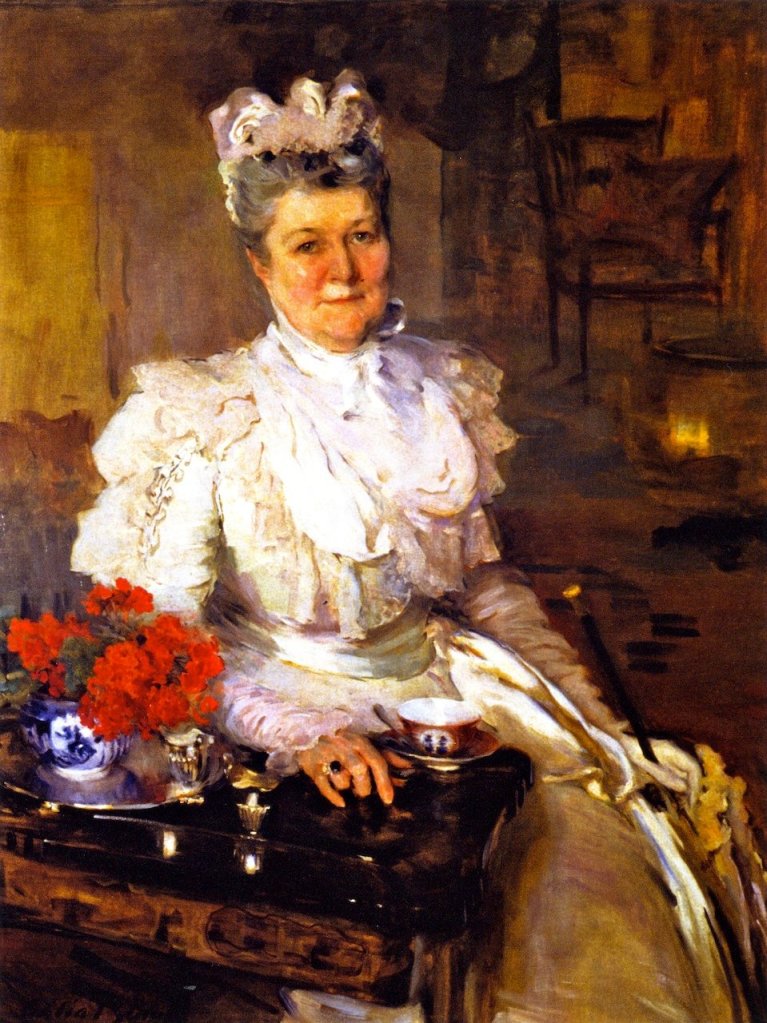
In 1897 she accepted a commission to paint a portrait of the former Anna Riddle, who was the wife of Thomas Alexander Riddle, an American businessman, railroad executive, and industrialist. He was the fourth president of the Pennsylvania Railroad.  In this sumptuous portrait we see the fifty-eight-year-old lady adorned in a shimmering ivory-satin gown and white-lace cap. Her left hand holds on to a parasol which rests against her knee. Her right hand, suitably bejewelled as was becoming for such a wealthy lady, rests on a marble side table. On top of the table we can see a silver tea tray, a blue bowl of red geraniums, and a brown porcelain Chinese export teacup all of which help to portray the status and wealth of the sitter and her family. In the background we can just make out a faint sketching of a round table and chair.

Mrs. Clement B. Newbold by Cecilia Beaux (1896)

Cecilia Beaux had received the commission to paint the portrait of Mrs Thomas Alexander Scott on the strength of her previous year’s bridal portrait of her daughter, Mary Dickinson Scott (Mrs. Clement B. Newbold), at the time of her wedding to Clement Buckley Newbold the wealthy banker and financier in 1896.

Portrait of Dr. John Shaw Billings by Cecilia Beaux (1895) in the National Library of Medicine

In the autumn of 1895 Cecilia was commissioned to paint a portrait of Dr. John Shaw Billings, a renowned surgeon and librarian, who had made significant contributions to the American medical profession. He sat for Cecilia at her Chestnut Street studio. It was his testimonial year and at a dinner honouring him he was presented with a silver box containing a check for $10,000, “in grateful recognition of his services to medical scholars”. The sum of money had been raised by 259 physicians of the United States and Great Britain. Money was also set aside for the commissioning of his portrait by Cecilia Beaux and it was later presented Beaux’s work to the Army Medical Museum and Library in Washington, D.C.

By 1900 the Cecilia Beaux’s work was in great demand and clients came from all over the east coast to sit for her and she decided she needed to base herself in New York. Richard and Helena Gilder were very close friends of Cecilia’s whom she had met through her former tutor Catherine Drinker and her husband Thomas Janvier. Richard Watson Gilder was a poet and editor of the periodicals Scribner’s Monthly and The Century Magazine, and the Gilders were leading lights of an artistic literary and music circle in New York and it was through Cecilia’s friendship with them that she had received many portrait commissions from the rich and famous. The Gilders lived in New York and during her protracted stays in the city she would stay with them. Eventually she got herself a studio on the corner of South Washington Square and Broadway, which was close to the Gilder’s house on East 8th Street.

Mrs. Theodore Roosevelt and Daughter Ethel by Cecilia Beaux (1902)

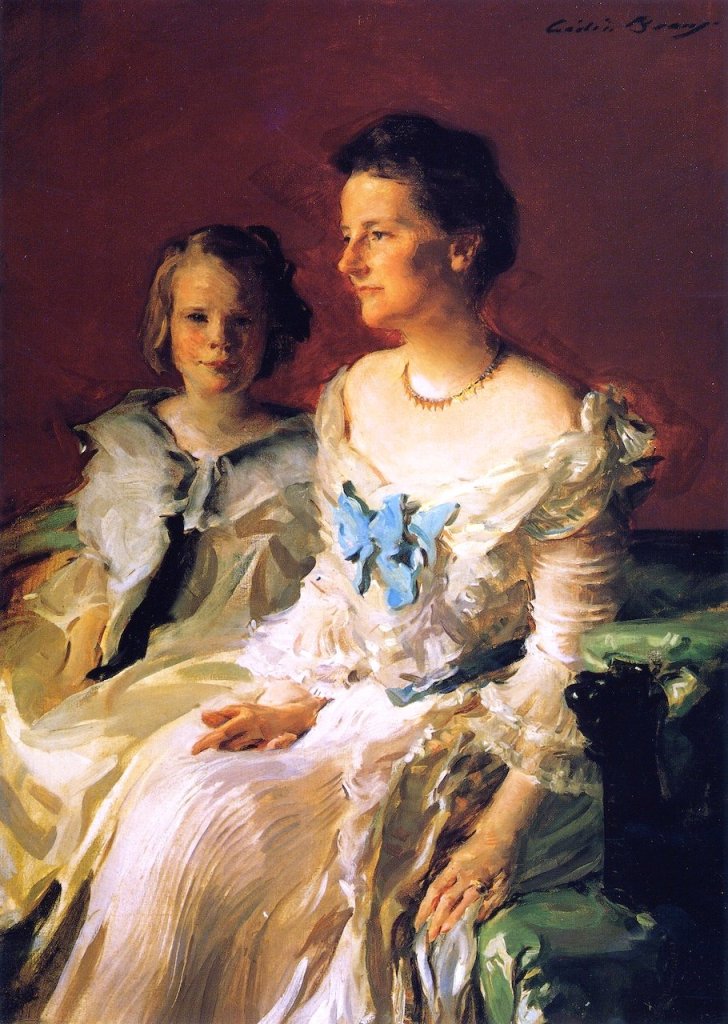
Cecilia’s portraiture was so popular that she could be very circumspect on which commissions she chose to accept. She was once quoted as saying that it doesn’t pay to paint everybody, and by adhering to that rule she ensured that she became one of the most famous late nineteenth century American portrait artists whose clientele was mainly drawn from the upper class. One of her most famous sitters was, Edith Roosevelt, the second wife of the United States president, Theodore Roosevelt who sat for Cecilia 1n 1902.
Cecilia recalled the sittings for the portrait:

“… A number of visits to Washington were needed for the work, and the portrait was painted in the White House. It was to have been of Mrs. Roosevelt only, but her daughter Ethel consented to literally ‘jump in,’ greatly enlivening, I hope, her mother’s hours of attention to posing. This attention was constant and sympathetic, but not static, and did not need to be. They generously devoted the Red Room to me for a studio……………..… I chose — and upholstered — a covering for the broad seat on which Mrs. Roosevelt and Ethel could dispose themselves easily; the warmth of the Red Room got somehow into the picture, and fortunately we proceeded without many changes. I understood from the first that it was not to be an official portrait, and I think every one was satisfied that, as it was created among intimate circumstances, its spirit might be the same…”

Cecilia Beaux and Thornton Oakley at Green Alley (1907)
Thornton Oakley was an American artist and illustrator

With all the pressure of work, Cecilia decided that she needed a sanctuary away from her hectic city life. In her biography, she wrote:

“…I began to dream of a change, of’ a pied-a-terre even then — of a shift of the year’s divisions — for work, and rest. Why not, I thought, have the summer for my working time, and take my rest in a short winter period? I had never looked on painting as toil, but I had sometimes felt that the city winter contained too much of everything, and that the summer, if considered as a holiday, was boring in being desœuvre [at a loose end]. Why not have long, unhurried bouts of painting, when off hours would be spent in delicious air — morning and evenings of thrilling loveliness — a long, long summer…”

Green Alley
Cecilia Beaux’s home at Eastern Point, Gloucester, Mass.
Photograph, ca., 1920, by T. E. Morr.

Cecilia decided to rent a place in East Gloucester on Cape Ann in Essex County, Massachusetts. She, along with her Aunt Eliza, Uncle Will, and other relatives first visited the idyllic New England fishing village in July 1887, staying at the Fairview Inn and returned there on a regular basis. In 1903, she decided not to stay at the inn but instead rented a cottage on Eastern Point for the summer. She used to refer to it as the Rock of Calif and whilst she spent the summers there her companion on her first Parisian trip, her cousin, May Whitlock, acted as her housekeeper, and would do so for almost forty years. Whilst at the cottage Cecilia looked for some land where she could build her own house. She finally found the perfect spot, a thickly wooded space on the harbour side of the road, part-way between the lighthouse and the town of Gloucester. She then commissioned the building of a house and studio on the plot of land and was finally able to move into her new house on August 7th, 1906. She named her house Green Alley.

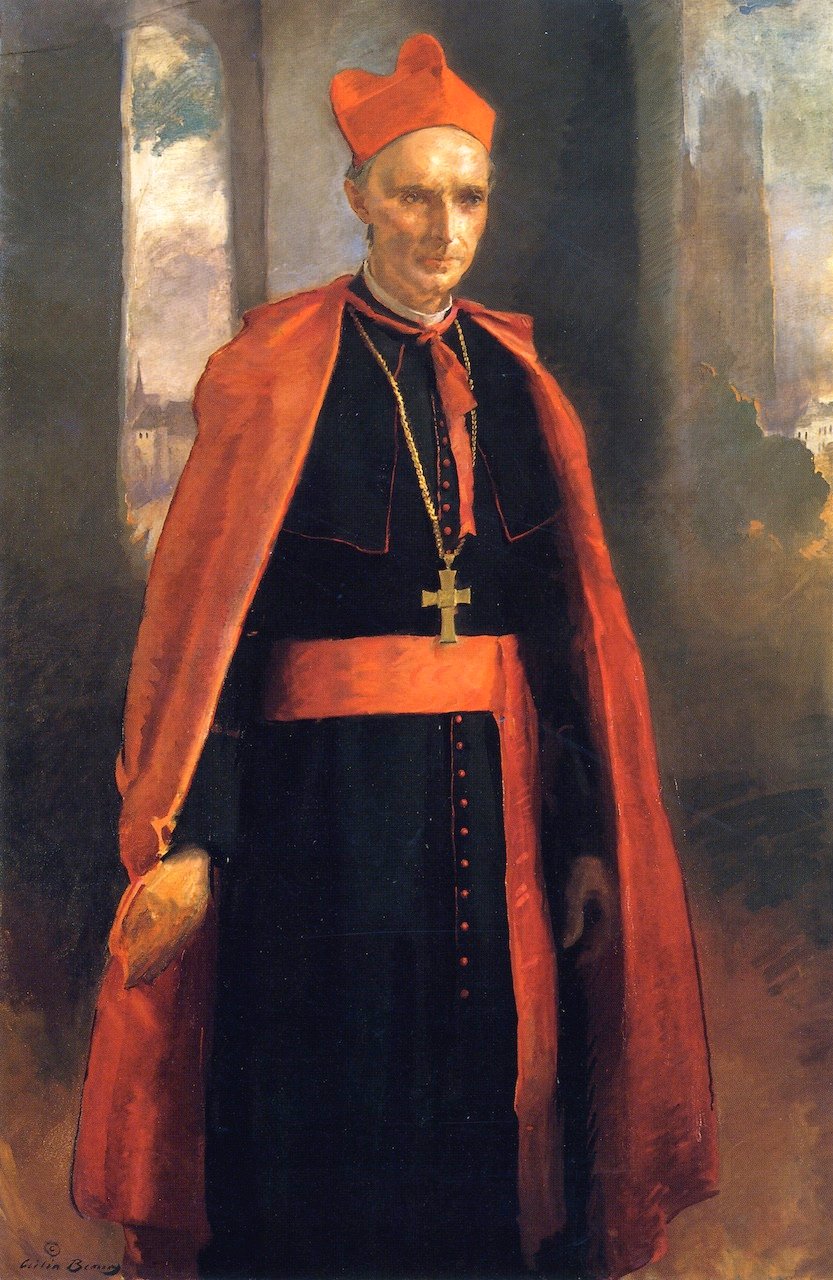
Cardinal Mercier by Cecilia Beaux (1919)

In 1910, her beloved Uncle Willie died. She was devastated by the loss, as William Biddle was the foremost male in her early life after her father left the family home after the death of his wife. William Biddle was just fifty-five years of age when he died.

Georges Clemenceau by Cecilia Beaux (1920)

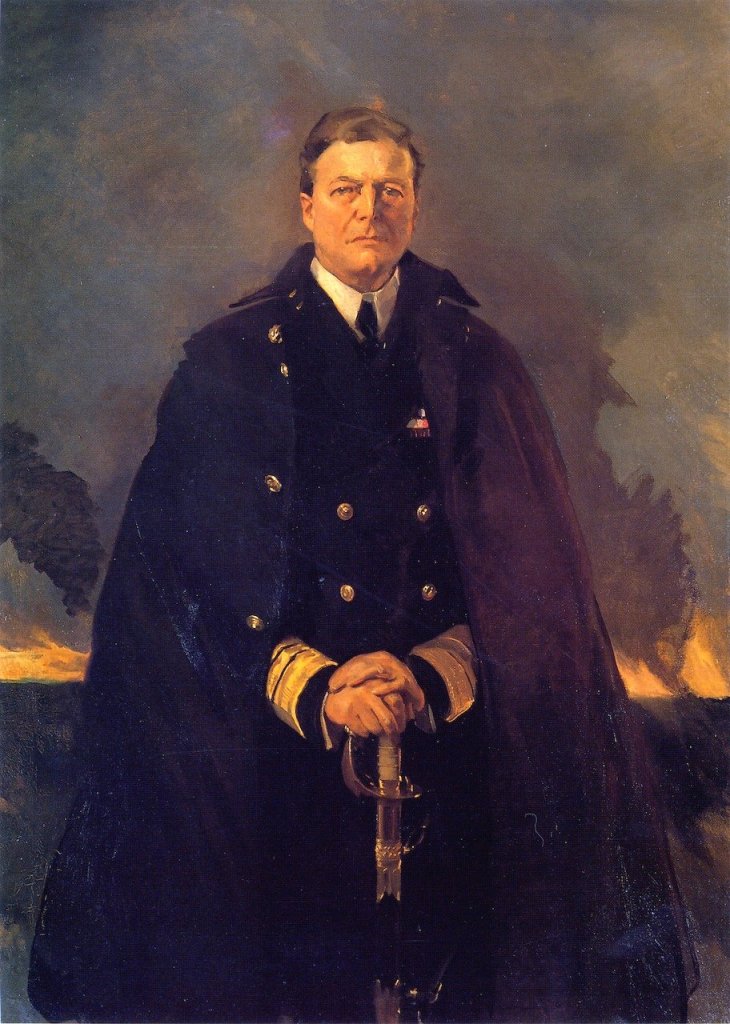
With the backing of the Smithsonian Institution in 1919, the National Art Committee devised, and were overseers of a project by which American artists would paint the portraits of prominent World War I leaders from America and the allied nations. The National Art Committee selected Cecilia as one of eight painters commissioned to execute portraits of the war heroes. The committee set aside $25,000 for each artist to paint three portraits. Cecilia’s task was to paint the portraits of Cardinal Désiré-Joseph Mercier, the Belgian Cardinal who was renowned for his staunch resistance to the German occupation of his country during the Great War. She was also to paint a portrait of Admiral Lord David Beatty, who led the 1st Battlecruiser Squadron during the First World War and Georges Benjamin Clemenceau, who was a French politician, physician, and journalist and who was Prime Minister of France during the First World War.

Admiral Sir David Beatty (also known as Lord Beatty) by Cecilia Beaux (1920)

Cecilia Beaux continued with her regular visits to Europe accompanied by various companions. One such trip in the summer of 1924, with a young Boston artist, Aimée Lamb, ended disastrously when Cecilia, who was sixty-nine-years-old at the time, whilst out walking in Paris along the rue St. Honoré, caught her heel on the pavement, fell and broke her hip. The accident  occurred on June 30th and after ten weeks in a clinic she still was not allowed to return home until November. The terrible accident was a devastating blow to Cecilia, as it crippled her for the rest of her life and necessitated her to wear a heavy steel brace and walk with a crutch. It badly affected how she was able to paint and her output dwindled.

Cecilia Beaux received numerous awards and accolades for her work which was exhibited many times in many countries. She died of coronary thrombosis at her beloved home, Green Alley, on September 17th, 1942. She was aged eighty-seven. Following her cremation in Boston, her ashes were buried in the West Laurel Hill Cemetery in Bala-Cynwyd, Pennsylvania.

This is my seventh and final blog looking at the life of this amazing artist. So much is missing from what I have written. So many of her paintings have not been shown and yet maybe it will tempt you to read her autobiography (Background with Figures) or read the many excellent essays written about Cecilia Beaux by Tara Leigh Tappert.


Most of the information for the blogs featuring Cecilia Beaux came from two books:

Background with Figures, the autobiography of Cecilia Beaux

Family Portrait by Catherine Drinker Bowen

and the e-book:
Out of the Background: Cecilia Beaux and the Art of Portraiture by Tara Leigh Tappert.

Extracts from letters to and from Cecilia Beaux came from The Beaux Papers held at the Smithsonian’s Archives of American Art

Information also came from the blog, American Girls Art Club In Paris. . . and Beyond, featuring Cecilia Beaux was also very informative and is a great blog, well worth visiting on a regular basis.:
https://americangirlsartclubinparis.com/

Photographs came from an article I found entitled The Only Miss Beaux, Photographs of Cecilia Beaux and her Circle by Cheryl Leibold of the Pennsylvania Academy of the Fine Arts.

Cecilia Beaux. Part 6 – Visits to England, the Return Home and Family Portraits.

Cecilia Beaux (c.1888)

……………….Cecilia Beaux finally returned to Paris in December 1888 after her summer in Concarneau and her six week European journey and the first thing she had to contend with was to find some new accommodation.  Her one priority was that her new “home” had to be better than the dismal and dire Pension Villeneuve which she and her cousin May Whitlock had had to put up with on their arrival from America in January. They eventually settled for a “room-only” fifth-floor attic apartment in a Latin Quarter maison meuble (furnished house) at 30 rue Vaugirard, situated in the 6th arondissement across the road from the Luxembourg Gardens.  Cecilia was delighted with her new home, writing:

“…There were five flights for us, but easy, broad, spotless, and without taint of late decades. I would like to boast openly that I have lived in an attic in Paris, a tiny chamber in the mansard, with a dormer window opening its croissee eastward and sunward. The window would hold a plant or two, and outside was the leaden ledge that took the rain on stormy days. Leaning out one could look down upon the Senate, grey and dignified, and the Luxembourg Gallery was very near. The iron railing of the garden was across the way…”

However, it was still winter, still cold and the accommodation was still damp so one of her first purchases was a stove, for which she paid four francs.

Portrait of Henry Sandwith Drinker by Cecilia Beaux (1901)
(Cecilia’s nephew)

Cecilia returned to the Académie Julian to study art but this time she attended  the original branch of the academy which was at the Passage des Panoramas, which meant she had to make the two-mile journey crossing the Seine each day. It is interesting to read in her 1930 autobiography, Background with Figures, that she was less than enamoured with the teaching at the academy and although she could have attached herself to an atelier headed up by a well-known artist she was not convinced of the benefit of such a move. She wrote:

“…I might have delivered myself, of course, to an individual master. There were several of high repute who admitted disciples. By an instinct I could not resist, I shrank from the committal, although there would have been contacts resulting from it of high value and interest. I saw no special direction in any exhibited work (I fear to say it), among the living, that I felt like joining…”

Cecil Kent Drinker by Cecilia Beaux (1891) (Four-year-old nephew of Cecilia Beaux)

Cecilia was also unhappy that there were few critiques by the tutors which would have given her some constructive criticism. All the tutors would tell her that she should just “keep on as I was going”. It was not that she was simply negative about the teaching at the Julian for she had definite ideas of how art should be taught and how the tutors should act:

“…What the student above all needs is to have his resources increased by the presence of a master whom he believes in, not perhaps as a prophet or adopted divinity, but one who is in unison with a living world, of various views, all of whose roots are deep, tried, and nourished by the truth, or rather the truths that Nature will reveal to the seeker. He is the present embodiment of performance in art, better called the one sent, representing all. He is serious, quiet, a personality that has striven…”

Cecilia’s room in rue Vaugirard was too small for it to be used as a studio and for her a studio was a primary requisite not just to carry out painting but it was a place for quiet contemplation. With that in mind she managed to secure a nearby small ground-floor working place at 15 rue Notre-Dame-des-Champs which was situated at the southern end of the Luxembourg Gardens. Later Cecilia and her cousin and companion, May Whitlock would give up their room at the rue Vaugirard house and move their belongings into the studio.

Newnham Grange in 1890

In May 1889 Cecilia made a solo trip to England. She had been invited by her one-time Philadelphia friend Martha Haskins “Maud” du Puy, now Mrs Maud Darwin, to come up to Cambridge and stay with her, her husband George Darwin, who was the eldest son of the naturalist, Charles Darwin, and their four children. George Darwin was the Plumian Professor of Astronomy and Experimental Philosophy at the University of Cambridge and the family lived at Newnham Grange, which was situated in an idyllic location perched on the banks of the River Cam. Cecilia had to endure a very rough Channel crossing from Dieppe to Newhaven and then a long train journey through London to Cambridge. However, despite the inauspicious start to her English adventure, her short stay at Newnham was all she could have hoped for. Beautiful house to stay in with a comfortable bed, a completely different scenario in comparison to her room in Paris. In her autobiography she remembered her first morning at Newnham Grange:

“…My first waking in the big, chintz-hung guest-room at Newnham Grange is one of the jewel-set markers of memory………… The sun poured in, and through its beams I could see across a meadow and under huge trees. Another window was hung, without, by a rich drapery of lilac wistaria, in full bloom, and when I sprang from my bed and put my head out, there was a cherry tree full of ‘ripe ones,’ just outside, also bird song; and a robin, making the best of the feast, superseded the cuckoo, and children of English voice and speech were in the garden below…”

She also had a taste of university and English countryside life with an invite to dinner at the Vice Chancellor’s Lodge, Sunday morning service at King’s Chapel and even a visit to Charles Darwin’s eighty-one-year-old widow, Emma, who was Cecilia’s friend’s mother-in-law. She even was invited to the hallowed Master of Trinity College Cambridge’s garden party, remembering the event well:

“…An English garden-party differs from all others especially in the domain of the University. The Master of Trinity, who is the King of Cambridge, has a garden which occupies one bank of the river for a long distance. Acacias in full bloom hang over the wall during May week, tall dark yews associating as background. The Master himself, large, brown-bearded, and urbane, looked his part to perfection, and I was proud to have a share of his gracious attention…”

Lady Geoge Darwin by Cecilia Beaux (1889)

Such was the frequency of invitations to lunches and dinners that Cecilia hardly had time to think about sketching and painting but she did complete one work, a pastel portrait of her host Maud. Maud’s husband George was made Knight Commander of the Bath in 1905, and so the title of this portrait is now known as Lady George Darwin.

Cecilia and May Whitlock cancelled their plans to return to America and instead went to Cambridge in June, where they were to have stayed as guests of George and Maud Darwin, not in the main house but in The Mill, a small residence at the end of the garden of Newnham Grange. However Cecilia decided as it may not have been big enough for two ladies Cecilia and Maud took lodgings, at Ashton House, a small brick dwelling in a shady street, only a stone’s throw from Newnham and used The Mill as her artistic studio.

After that second visit to Cambridge,  Cecilia left the comfort of Newnham Grange and returned to Paris only to find that her cousin had vacated their fifth-floor attic room and moved all their possessions and clothes into Cecilia’s small one-room studio with skylight. This was now to be their living quarters, their bedroom, as well as Cecilia’s studio. It was a terrible shock to the system for Cecilia who had just sampled the height of comfort in Cambridge. To make things worse for her and May, as summer approached, the once cool room had become a “hot-house” as the intense sunlight streamed through the skylight. Reading a passage in her biography, one can be in no doubt as to how Cecilia regarded her new “home”:

“…The circumstances of my return to Paris should be mentioned only by way of warning and contrast, and I shall always regret that I returned to the adored place, by way of my own blunder and a very squalid experiment. When I entered the shaky door of the studio, I found it filled with a helter-skelter collection of our belongings. There had been no preparatory cleaning or arranging. A bed had been put in. The toilet arrangements were simple, but for use required a complicated process. A tin basin, which I had used for washing brushes, was uncertainly disposed on the corner of the bookshelf, the soap saucer scarcely holding beside it. A chair-back was all there was for towels, and, if one wished to sit down, books and dresses had to be put somewhere else. It had become scorching hot. I insisted in rigging up some sort of Screen under the skylight for decency’s sake. Squalor, wretchedness, into which no gleam of fun entered; I sympathized with royalty and was ‘not amused.’…”

SS Anchoria

Cecilia and May’s time in Paris and England had come to an end in August 1889 and the pair boarded the steamship Anchoria at the Scottish port of Greenock Harbour on the River Clyde. On the twenty-second of August, the pair set sail ploughing their way through rough seas and a blanket fog. The intrepid pair finally arrived back in Philadelphia at the beginning of September 1889 after almost nineteen months away from home. Once home, her family bombarded Cecilia with questions about her European adventure and her plans for the future. Cecilia was unequivocal about her future life. It would be dedicated to her art and from the sale of her paintings she would shore up the family finances. She was also equally definite that her future life and plans would not be hampered by relationships with possible suitors. The family accepted her views and her plans for the future and set about trying to help her.

A photograph of Cecilia and Emma in the Chestnut Street studio (1890)

Her uncle, William Biddle, found a new studio for her at 1710 Chestnut Street, and then helped her arrange it so that she could set herself up as a professional artist. She and her cousin Emma shared the studio.  At the same time her family relieved her of all household duties. The sense of family loss was two-sided, for not only did her sister and aunts miss Cecilia, but she also missed her family despite the good times she experienced in Europe. Maybe it was the happiness of being back, once again, in the family fold that enticed her to complete many portraits of her sister’s family and other relatives. She also received many portraiture commissions from the Philadelphia “elite”. In the five years after her return home she completed over forty portraits.

Sita and Sarita by Cecilia Beaux (1894)

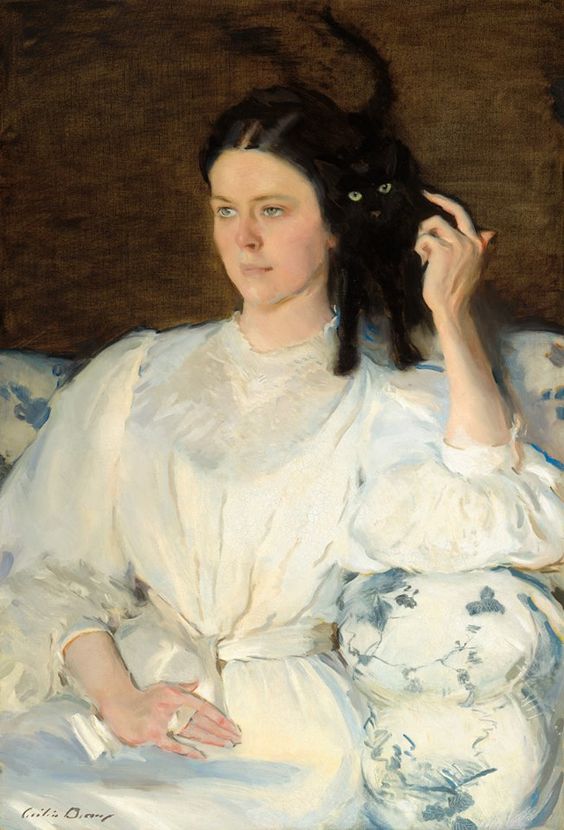
Probably her most famous family portrait was completed in 1894 and was entitled Sita and Sarita (Jeune Fille au Chat). It is a depiction of her cousin, Charles W. Leavitt’s wife Sarah (Allibone) Leavitt and the mysterious title of the painting comes from Beaux’s use of Spanish diminutives, Sarita for Sarah and Sita, meaning “little one,” for the cat. Sarah is dressed in white, with a small black cat perched precariously on her shoulder. The eyes of both the woman and the cat are green and almost lined up horizontally in the depiction. The combination of the whiteness of her dress and the palid complexion of her face are in direct contrast to the black furry animal standing on her shoulder. Both human and animal stare out enigmatically. Cecilia Beaux donated this painting to the Musée de Luxembourg and it is presently housed in the Musée d’Orsay. Twenty-seven years later she painted another version of the painting which is now housed in the National Gallery of Art in Washington, part of the Corcoran Collection.

Dorothea and Francesca by Cecilia Beaux (1898)

Another of her well-known portraits, Dorothea and Francesca, was that of the two eldest daughters of Helena de Kay and Richard Watson Gilder. Richard Watson Gilder was a poet and editor of the periodicals Scribner’s Monthly and The Century Magazine, and his wife Helena, who was artistically trained at The Cooper Union in Manhattan, was a portrait, still-life, and flower painter, and also a writer. The Gilders, who were very good friends of Cecilia, were leading lights of an artistic literary and music circle in New York and they played a central role in the founding of the Society of American Artists in 1877. Cecilia recalled in her biography the setting for the painting which took place in the Gilder’s Four Brooks Farm in Tyringham, Massachussets:

“…The big and little sisters, Dorothea and Francesca, used to execute a dance of the simplest and all too circumscribed design, invented by themselves, and adorned by their unconscious beauty alone. This was the subject. I built a platform with my own hands, as the girls could not move easily on the bare earth. When it rained hard, in September, the orchard let its surplus water run down the hill and under the barn-sill, so that, as my corner was rather low, I put on rubber boots and splashed in and out of my puddle, four inches deep. October was difficult, for it grew bitterly cold. But valiant posing went on, though the scenic effect of the group was changed by wraps. Summer, indeed, was over, when on a dark autumnal night, in the freezing barn, the picture was packed by the light of one or two candles and a lantern…”

Charles Wellford Leavitt by Cecilia Beaux (1911)

Cecilia Beaux’s cousin, Charles Wellford Leavitt, featured in another of her works. She completed the painting, Charles Welford Leavitt, the Artist’s Cousin in 1911. The sitter, who was forty at the time of the sitting, was a successful engineer and pioneer in the field of city planning. To acknowledge his profession Cecilia has added some of the tools of his trade on a table next to him. She has portrayed him with his arms crossed in front of him and his demeanour oozes a sense of importance and confidence.

In my final blog about the life of Cecilia Beaux I will look at her later years and the many portraits she did of the rich and famous.

…………………………………to be concluded.


Most of the information for the blogs featuring Cecilia Beaux came from two books:

Background with Figures, the autobiography of Cecilia Beaux

Family Portrait by Catherine Drinker Bowen

and the e-book:
Out of the Background: Cecilia Beaux and the Art of Portraiture by Tara Leigh Tappert.

Extracts from letters to and from Cecilia Beaux came from The Beaux Papers held at the Smithsonian’s Archives of American Art

Photograph from Pennsylvania Academy of the Fine Arts archive

Information also came from the blog, American Girls Art Club In Paris. . . and Beyond, featuring Cecilia Beaux was also very informative and is a great blog, well worth visiting on a regular basis.:
https://americangirlsartclubinparis.com/tag/catherine-ann-drinker/

Cecilia (Leilie) Beaux. Part 2 – the beginning of an artistic career.

Self-portrait, Cecilia Beaux (1885)

The early childhood and teenage years of Cecilia (Leilie) Beaux were challenging. She and her elder sister Etta lived with their maternal grandmother Cecilia Kent Leavitt and their maiden aunt Eliza. Leilie and Etta were completely different in character. Etta was the more placid and was happy to accept traditional domestic life and probably modelled herself on her grandmother who had nurtured her own eight children. Leilie, on the other hand, was both stormy and impassioned and hankered for her independence and believed that financial security would achieve that status. She would, like her late mother and aunt, Eliza, go out to work and earn money. Leilie was a perfectionist and suffered like all perfectionists tend to do. In her personal diary which she started at the age of fourteen, she wrote:

“…It seems to me that I haven’t progressed at all. I do believe that it is harder for some people to be good than others, a great deal harder. Some people seem to be good naturally like Etta…but as for poor me why I’m nothing absolutely nothing, able only to do wrong. Sometimes it seems to me as if I were tied in a spiritual way to a string of a certain length. I get on very well at first and feel so free and happy, feel as if I really was getting better, when suddenly I come to the end of my string, and am thrown back to the old place again…”

Leilie was often rebellious as a teenager, frustrated with her life and often aspiring to do something different. In her autobiography she remembered that in her teenage years she wrote a poem expressing her exasperation:

“…Lost hope, lost courage, lost ambition,
What’s left but shams of these to hide my true condition?
Feigned peace and joy, feigned happy effort,
False tongue, proclaiming, “Art’s my comfort.”
Nought’s left but bones, and stones and duty that’s not pleasure,
But grinding, ceaseless toil, whose end’s the measure
Of the short web of life the Fates have spun me.
What’s this… I’ve uttered words of treason.
What’s lost? My time, my daylight, and my reason…”

Leilie also suffered mentally from the departure of her father from the family home. Sadly, she blamed herself for his departure, as her mother had died giving birth to her.  She began to make excuses for him abandoning his daughters. Despite his untimely and devastating departure she still managed to put him on a pedestal, someone to be almost adored.

Little Lamerche by Cecilia Beaux (c.1900)

Leilie was brought up in a family environment where music was an essential part of life. Her aunt Eliza was a highly talented musician and earned money for the family by giving music lessons. The family owned a Chickering grand piano and there would be frequent family recitals in the evenings with performances given by Eliza and William Beadle, Emily’s husband, who also acted as organist at the local Presbyterian church the family attended. When Leilie was eleven years old, she learnt to play the piano but never reached a level of accomplishment which satisfied her and so, as a perfectionist, she gave it up.

Man with the Cat (Henry Sturgis Drinker) by Cecilia Beaux (1888)
Henry Sturgis Drinker, was Cecilia Beaux’s brother-in-law (Etta’s Leavitt’s husband). He was a railroad executive and president of Lehigh University in Pennsylvania.

Up to the age of fourteen Etta and Leilie were home-tutored, mainly because of the high cost of formal schooling.  Leilie’s early interest focused on literature and poetry and at one time she believed she would like to become a writer. William Biddle’s arrival on the scene as Emily Leavitt’s husband meant that the Leavitt’s finances improved, so much so, that it was decided that Etta and Leilie could afford to receive formal education at Misses Lymans’ School. It was an all-female school run by Catherine and Charlotte Lyman. This was the first time the two girls were able to absorb life outside the family. Leilie began to sketch and was pleased with her efforts. In her autobiography, Background with Figures, she wrote:

“…Long before it was discovered that I had more proficiency with a pencil than I had on the piano, I accompanied my aunts on visits to what picture galleries and special exhibitions there were…”

Henry James by Cecilia Beaux (1911)
The portrait depicts the America author Henry James during his final trip to the United States, when he was recovering from a nervous breakdown and the death of his brother, William.

Leilie began to develop and interest in the Arts and her aunts and uncles would take her to various art galleries to encourage her. It was during the 1870’s that there was a sudden desire of wealthy Americans to buy works of art especially by French painters. It was a status symbol for these wealthy households to have works by the emerging French masters hanging on the walls so that they would impress visiting dinner guests. One such person, a wealthy and successful businessman, was Henry C. Gibson, an art collector, banker, real estate developer, and distiller. His Philadelphia house on Walnut Street housed many works of art and Leilie’s uncle was fortunate to receive an invite to view the works of art and he took Leilie with him. They must have re-visited the house on several occasions for she wrote in her autobiography:

“…Very few of the pictures were large, and all could be easily seen. Of course, I knew nothing of these virtues of presentation; I knew nothing but my own happiness. I must have been taken several times to the gallery, for I had my favorites and was unembarrassed by the difference of schools…”

Harold and Mildred Colton by Cecilia Beaux (1887)

Her family decided that Leilie should pursue her interest in drawing and painting and needed to find someone who could nurture Leilie’s talent. The person chosen to guide Leilie was the talented artist, and painter of historical and biblical scenes, thirty-one-year-old Catherine Ann Drinker, who had a local studio. Coincidently, she would later become Etta’s sister-in-law in 1879 when Etta married her brother, Henry Sturgess Drinker. In 1871, sixteen-years-old Leilie remembered her first visit to Catherine Drinker’s Philadelphia studio which was at the top of an old house at Fifth and Walnut Streets on Independence Square. In her autobiography she wrote:

“…I am glad that the studio was typical, traditional, and not to be confused with any ordinary or domestic scene, for it was the first studio I ever entered. On its threshold, everyday existence dropped completely out of sight and memory. What windows there were, were covered with hangings, nondescript, as they were under the shadow of the skylight, which was upright, like a broad high window, and without glare. There was a vast sweeping curtain which partly shut off one side of the room, and this, with other dark corners, contributed to its mystery and suggestiveness. The place had long been a studio, and bore the signs of this in big, partly obliterated figures, outlines, drawn in chalk, upon its dusky wall, opposite the light. Miss Drinker had spent her early life in China, whence her family had brought many examples of Chinese art and furniture. The faded gold of a large seated Buddha gleamed from a dark corner. There was a lay figure, which was draped for a while in the rich robes that Miss Drinker had used for her ‘Daniel…”

Old-fashioned Music (Guitar Player) by Catherine Drinker (1880)

In 1880, Catherine Drinker won the prestigious Mary Smith Prize for her painting Old Fashioned Music.  This prize was awarded to women artists by the Pennsylvania Academy of Fine Arts. The award recognized the best work by a Philadelphia woman artist at the Pennsylvania Academy of the Fine Arts annual exhibition — a work that showed “the most originality of subject, beauty of design and drawing, and finesse of colour and skill of execution”.

Charles Sumner Bird and His Sister Edith Bird Bass by Cecilia Beaux (1907)
Many of Cecilia Beaux’s portraits were of New Englanders, including this elegant image of Charles Sumner Bird and his sister Edith.
The Bird family had made their fortune in the manufacture of paper, and they owned a 194-acre estate, called “Endean,” in East Walpole, Massachusetts, overlooking the Neponset River.

For Leilie, Catherine was not just an art teacher, she was a friend despite their fourteen-year age difference, a friendship which would last over fifty years. Leilie spent a year learning about art under the watchful eye of Catherine until Catherine decided that Leilie should move to a formal art school. She spoke to William Biddle, who, as the husband of Leilie’s aunt Emily, had been acting as Leilie’s unofficial guardian. Catherine suggested that the finest art school for his charge was the Van der Wielen School. It was run by a young Dutch-Flemish artist, Francis Adolf Van der Wielen, who had immigrated to Philadelphia in 1868 after he had trained at the Antwerp Academy of Fine Art. He opened his art school as a way of countering the fact that he had begun to find it difficult to paint due to his failing eyesight. In 1872, seventeen-year-old Leilie Beaux enrolled at the school.

Most of Van der Wielen’s female students had come to him to learn about art and looked upon it as a delightful hobby but some of his students, like Leilie, looked upon art as a skill that would eventually earn them money. Although Leilie had doubts about her tutor, due to his poor grasp of the English language and the fact that his eyesight was starting to fail him, thus making his visual criticism of his students’ work questionable. However, she remained at his school for almost two years gaining knowledge of linear and aerial perspective and the principles of light and shade. In 1873, Van der Wielen married one of his more mature students and the couple left America for a new life in Europe. His art school would have closed but for Catherine Drinker stepping in and taking over the teaching.

In 1873 Cecilia(Leilie) Beaux reached the age of eighteen and decided that it was time to put her artistic skills to work to earn money for herself and thus gain a modicum of independence and also to bolster the family’s finances. In her autobiography she wrote:

“…My grandmother’s house was my home, and in it I was the youngest born, but I wished to earn my living and to be perhaps some day a contributor to the family expenses…”

Plaque by Cecilia Beaux (1880)

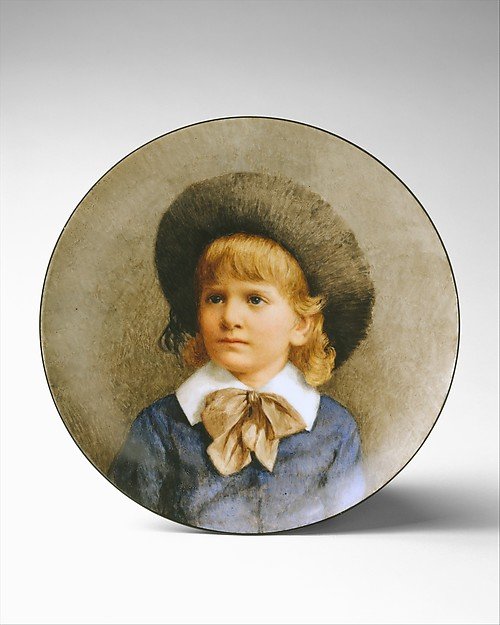
For a month she took lessons in china painting and found that in a short time she had mastered the delicate technique. She would produce portraits on large china plates. One of her early successes was a china plaque featuring a young gold-haired girl, the parents of the child were delighted.

Plaque painted by Cecilia Beaux (1883)

From this came many commissions featuring paintings of young children.  However, she never really took to this type of work saying:

“…Without knowing why, I am glad to say that I greatly despised these productions, and would have been glad to hear that, though they would never ‘wash off,’ some of them had worn out their suspending wires and been dashed to pieces. This was the lowest depth I ever reached in commercial art, and, although it was a period when youth and romance were in their first attendance on me, I remember it with gloom and record it with shame…”

Catherine Drinker had taught art at Miss Sanford’s School for young ladies for many years but now, with taking over at Van der Wielen’s school she had to give up her post at the Sanford School and she recommended her protégé, Leilie to take her place. Leilie was taken on as a part-time drawing instructor at the school, teaching two classes, one morning a week. She would teach her young pupils how to draw, how to enlarge and how to shade. She taught there for three years and this led to her also giving private art lessons which earned her more money. In 1874, William Biddle introduced Leilie to a printer, Thomas Sinclair, of Thomas Sinclair and Sons. He and the Leavitts knew each other as they were fellow members of the Woodland Presbyterian Church and she was offered her first professional illustration job. Leilie had now finally launched herself into the art world and she decided that she needed to have a definite artistic identity and chose to revert to using her mother’s name. From thenceforth she was to be known as Cecilia Beaux.

As an aspiring artists Cecilia wanted the best artistic tuition that she could receive, given by the most talented tutors, and for her, this meant attending the Pennsylvania Academy of the Fine Arts (P.A.F.A.) which was a museum and art school in Philadelphia, and was founded in 1805. In 1871 it had been closed for major reconstruction and was not re-opened until 1876. Another reason for Cecilia wanting to attend classes at this prestigious art academy was that in 1878 Catherine Drinker became the first woman to teach there. However, Cecilia’s uncle William was dead set against the idea of his “charge” attending the academy. Cecilia remembered her uncle’s argument for his decision:

“…I was a seemly girl and would probably marry. Why should I be thrown into a rabble of untidy and indiscriminate art students and no one knew what influence? So reasoned his chivalrous and also Quaker soul, which revolted against the life-class and everything pertaining to it. He put a strong and quiet arm between me and what he judged to be a more than doubtful adventure…”

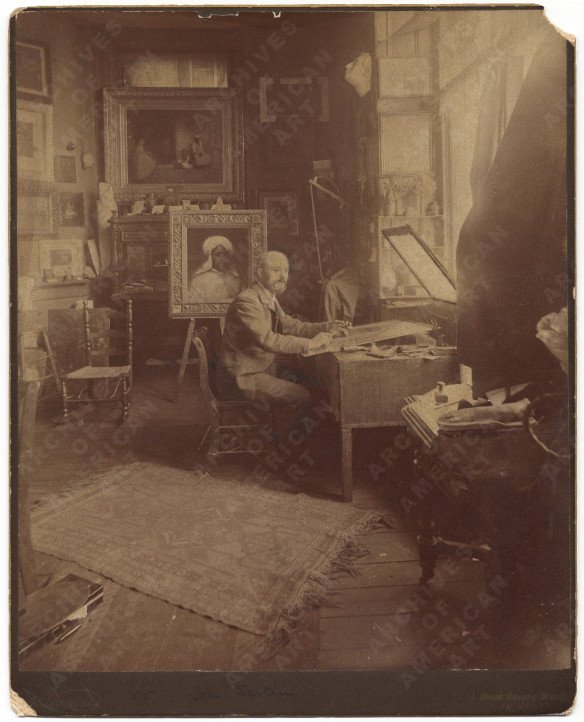
William Sartain in his studio

Cecilia’s next step on the artistic ladder came by way of a former school friend from Miss Lyman’s School. Her friend, who had come from a wealthy background had spent her years after finishing her schooling  “immersed in social gaiety” as a debutante but had now decided to take painting more seriously and had taken a studio and organised a class to be held three times a week to sketch and paint using a model. She invited Cecilia to join the class and her uncle, William Biddle thought this was a good idea and funded his wife’s niece participation. The work of all at the class was overseen on a fortnightly basis by the New York-based American painter William Sartain. Cecilia remembered the time well writing:

“…There were a few, only, in the class, all young, but all respectful toward what we were undertaking. It was my first conscious contact with the high and ancient demands of Art…”

…………………………to be continued


A lot of the information for the blogs featuring Cecilia Beaux came from two books:
Backgorund with Figures, the autobiography of Cecilia Beaux
Family Portrait by Catherine Drinker Bowen
and the e-book:
Out of the Background: Cecilia Beaux and the Art of Portraiture by Tara Leigh Tappert

Cecilia (Leilie) Beaux. Part 1 – Ancestors and the early years

Portrait of Cecilia Beaux by John Lambert (1905)

My featured artist today is looked upon as one of the greatest portrait painters of her time. Of her, the American painter, William Merritt Chase said:
“…[she is] the greatest woman painter that had ever lived…. She is a painter as Velasquez and Rembrandt were, and like them, she infuses the subtle quality of life into her work…”

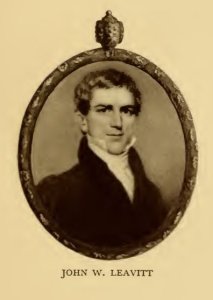
John Wheeler Leavitt

She is the nineteenth century American society portrait painter, Cecilia Beaux (née Leavitt). This initial blog looks on her life before she became a professional painter but maybe to understand her better, one must understand the trials and tribulations of her early life and one has also to go back to the turn of the eighteenth century and her maternal grandparents John Wheeler Leavitt and his wife Cecilia Kent Leavitt. John and Cecilia were both born in the last decade of the eighteenth century and were married in 1820. Their ancestral history could be traced

Cecilia Kent Leavitt

back to seventeenth-century New England and before that to England. John was a prosperous textile merchant who founded the New York based family firm John W. & Rufus Leavitt Company, and was one of the most prominent businessmen of his age. He and his wife had eight children and as the saying goes “money was no object” for this family. The children were all home-tutored in all the academic subjects and taught to play the piano at which the second youngest, Eliza became a brilliant musician.

Mrs. John Wheeler Leavitt by Cecilia Beaux (1885) Cecilia Beaux’s maternal grandmother.

However, the good times ended abruptly in 1846 with problems in the cotton industry and debts that could not be serviced, and the company filed for bankruptcy. The Leavitt family owed their creditors so much money they had to sell their New York town house and their country estate on the Palisades in Hoboken and John and Cecilia Kent Leavitt were forced to move to a small house in a “rough” suburb.  Their two eldest daughters, Cecilia (the mother of Cecilia Beaux) and Eliza had to go out to work to help with the family finances. Cecilia worked as a music teacher and Eliza worked as a governess. It is noted in Cecilia Beaux’s autobiography Background with Figures, that the sons were of little help. As she put it, they were dreamers and not doers!  As is often the case when one is subjected to financial pressure, John Leavitt’s health took a turn for the worse and his wife had to take over the running of the house and manage the family finances.

A Little Girl (Fanny Travis Cochran), by Cecilia Beaux (1887)

Cecilia and Eliza moved from the family home in New York to Philadelphia around 1848 where they had distant relatives. With the help of friends, they were soon socially accepted. Financial help for John Leavitt and his family materialised in the form of a foreigner, Jean Adolph Beaux. He came from the city of Nimes in France, in 1848 and was from a family of French Huguenots, long engaged in the silk manufacture business. In 1848, aged thirty-eight, he emigrated to Philadelphia to set up an American branch of his family’s business, J. P. Beaux & Co., Sewing Silks.

Head of a French Peasant Woman by Cecilia Beaux (1888)

Although there were many eligible women for the Frenchman to choose a companion, he had fallen desperately in love with Cecilia Leavitt, maybe partly because she had an excellent grasp of the French language, which certainly helped as John-Adolph’s grasp of the English language was poor. Cecilia also fell for the charming and handsome French gentleman and wrote home to her family in New York saying she had met a French gentleman with beautiful blue eyes. However, she made sure her relationship with Jean Adolphe progressed slowly and it was some time later that he headed to New York to meet her father and ask him for his daughter’s hand in marriage. Cecilia father was satisfied that Jean Adolph could provide for his eldest daughter and so agreed. John Adolph Beaux and Cecilia Leavitt were married in a society wedding at the Fifth Avenue Presbyterian Church in New York on April 3rd, 1850 and soon after a branch of the Beaux family silk business was set up in Pine Street, New York, which was managed by John Wheeler Leavitt and once again the Leavitt family finances were on an even keel.

Helen Bigelow Merriman by Cecilia Beaux (1908)
Painter and art collector, and one of the founders of the Worcester Art Museum, Massachusetts

It was not long before Cecilia and Jean-Adolph started a family. Their first child, a daughter, Alice Zepherine was born in February 1851 but sadly only lived for eleven months. The couple’s second child, Aimée Ernesta, nicknamed Etta, was born on October 26th, 1852, just ten months after the death of Alice. By 1854 Jean-Adolph, his wife Cecilia and their daughter Etta had moved to Philadelphia and on May 1st, the following year, a further addition to the family arrived – a daughter whom they named Eliza Cecilia, the names of her aunt and mother. This should have been a joyous time but in fact it was a traumatic and sad time with Jean-Adolph’s wife dying twelve days after giving birth due to puerperal fever, a bacterial infection following childbirth complications.

Clement B. Newbold by Cecilia Beaux (1912)

Jean-Adolph was devastated and inconsolable by his wife’s death, so much so, he could not endure the heartache and returned to the comfort of his family in Nimes, leaving his company to be run by his brother Edmund and left his two children to the care of his mother-in-law, Cecilia Kent Leavitt, who had also lost a dear one two years earlier, with the death of her husband, John Wheeler Leavitt. Can you imagine how this all affected the two children, Etta and Cecilia? Aimée Ernesta (Etta) Beaux had witnessed the birth of her sister, quickly followed by the death of her mother, and then the departure of her father back to France. Can you understand that the irrevocable change in the structure of her family must have been a frightening and confusing event? Jean-Adolph stayed away from his children for two years, not returning to Philadelphia until 1857, at which time Cecilia and Etta were two and five years of age and living with their maternal grandmother and her four remaining children, who hadn’t flown the nest, Eliza, Samuel, Charles, and Emily.  On his return to America, Jean-Adolph had much to repair in his relationship with his children and his mother-in-law as well as attempt to set himself in business, once again. He achieved little on both these fronts although he did work for his old family company, J.P. Beaux & Co., Sewing Silks. Although the company prospered his charm offensive with the Leavitt family failed. They never forgave this “foreigner” for abandoning his children and his mother-in-law whom he was living with never considered him a fit father to his children and slowly took charge of the future of her two grandchildren, despite having had to rear eight children of her own. Rightly or wrongly, Cecilia’s grandmother probably never held back on her adverse comments with regards her son-in-law and later in life,  Cecilia commented on this:

“…We didn’t love Papa very much, he was so foreign. We thought him peculiar…”

The relationship between Jean-Adolph and his third child Cecilia was a troubled one as he found his new-born daughter to be little more than a sad reminder and pale substitute for his cherished but sadly departed wife. One believes that when he looked upon her, he immediately thought about the death of her mother in childbirth. It had even reached the point that he could not bear to call her Cecilia (also his late wife’s name) as it brought up too many sad memories of deceased wife and so despite the family’s dislike of the idea, she was referred to as Leilie and not Cecilia. Although this may have comforted her father, in a way it stigmatised the child herself who as she grew older believed that in a way she had caused the death of her mother and was now unfit to bear her name.

Mrs. Clement B. Newbold by Cecilia Beaux (1896)

Things went from bad to worse for Jean-Adolph. His business was failing and finally collapsed in 1860. His brother and partner in the firm, Edmund, went back to France but Jean-Adolph stayed with his children and in-laws albeit they had to move to a smaller house. Now having no business and the bringing up of his children having been “usurped” by his mother-in-law, Jean Adolph believed there was nothing left for him in Philadelphia and so he went back to France in 1861 and did not return to America for twelve years, which gives one an idea for the regard he had for his children.

Portrait of Mrs. Samuel Hamilton Brooks by Cecilia Beaux (1911)
Founder of the Memphis Brooks Museum of Art

With the collapse of the J.P. Beaux Silk Company there was now little money coming into the Leavitt household. For Leilie it was a very sad time without a mother and father. Although she asked her grandmother and her family about her mother, their sadness meant that they were never forthcoming with information and so Leilie began to invent romantic images of her mother. Maybe her memory of her father was slightly tainted by the views of her grandmother and aunts.

Portrait of Mr. Samuel Hamilton Brooks by Cecilia Beaux (1911)

It must be said that Leilie and her sister Etta who lived with the Leavitt family received vast amounts of love from their grandmother and their two aunts Eliza and Emily. Both girls were also very fond of their uncle Charles but often found their uncle Samuel annoying.

In 1860, Emily Leavitt, Leilie’s favourite aunt, married William Foster Biddle, an engineer by profession, and the two of them set up home. She was twenty-one and he was twenty-five. A year after their marriage, Biddle left his wife and began his military service with the rank of captain and rather than live alone, Emily returned to living with her mother, her siblings and the two Beaux girls. After completing his military service at the end of the Civil War, William Biddle was employed as a mining engineer and he and his wife Emily moved back to their own home.

Cecilia Kent Levitt ran the Leavitt household which now just comprised of her maiden daughter Eliza, and her two grandchildren, Etta and Leilia Beaux. Their aunt Emily looked after her two nieces’ education and their grandmother saw to their religious needs ensuring both girls, when they reached twelve years of age, were confirmed in the Presbyterian faith.

Half-Tide, Annisquam River by Cecilia Beaux (c.1905)
A rare example of Cecilia Beaux’s landscape work.

Cecilia Kent Leavitt, her daughter Emily and the two Beaux girls re-located on several occasions. Their frequent moves were due to Leavitt family’s deteriorating financial situation. However, through the good auspices of the son-in-law William Beadle, who rose to become vice president of Lehigh Coal & Navigation Company, their financial situation improved and this in turn lifted the family spirits of the four females. In 1873 Cecilia Kent Leavitt finally settled her family down in a house in Spruce Street, West Philadelphia. In her 1930 autobiography, Background with Figures, Leilie remembered that as a young fourteen-year-old how her Aunt Emily had shaped her life. She wrote:

“…My aunt had assisted in my education, and my uncle [Emily’s husband Walter Biddle] was to be, after my grandmother, the strongest and most beneficent influence in my life. I know that my Aunt Emily’s contribution to my bringing up had several channels. My lessons, with her, took place in the dining-room, rather a gloomy spot by day, on winter mornings, and we sat at either end of the green-felt-covered table. I am sure she labored over the sums and geography we bent over, but what remains consciously of these hours are the periods devoted to dictation. The use of the pen did not trouble me. Spelling was not one of my difficulties, and the appearance of new words, and of phrases far from anything I could have dreamed of, were a delight. Above all, and the real source of the living word enduring in this episode, was the choice…”

Mr. and Mrs. Anson Phelps Stokes by Cecilia Beaux (1898)
He was a wealthy American merchant, property developer, banker, and philanthropist.

Later in life Leilie told how the two greatest influences on her life were her grandmother and William Biddle. For Leilie, William was the main man in her teenage years and she relied on him for guidance and William Biddle recognised the energy and creativity of Leilie and he believed it was his job to channel this dynamism…………………………………..

……..to be continued

Florence Ada Fuller

Florence Fuller (1867 – 1946)

The artist I am featuring today is the South African-born, Australian portrait and landscape artist Florence Ada Fuller.  She was born in Port Elizabeth, South Africa in 1867, one of several children of Louisa and John Hobson Fuller.  As a child, she emigrated with her family to Melbourne.  In 1883, aged sixteen years of age, Florence attended the National Gallery of Victoria Art School and for two years between 1884 and 1886 she worked part-time as a nanny.

Going Out with the Tide by Robert Hawker Dowling (c.1882)

During this period she received artistic tuition from her English-born uncle Robert Hawker Dowling, a painter of orientalist and Aboriginal subjects, as well as portraits and miniatures. He was Melbourne’s most sought-after portraitist of the early to mid 1880’s

Sir Henry Loch by Robert Hawker Dowling(1885)

One of his portraits was the 1885 one of Sir Henry Loch, later 1st Baron Loch of Drylaw, who was Governor of Victoria from1884 to 1889. This portrait was completed by 1885 and shown in exhibitions in that year.

Barak – last chief of the Yarra Yarra Tribe of Aborigines by Florence Fuller (1885)

In 1885, through the good auspice of her uncle, Florence, then eighteen years old, received a commission from Ann Fraser Bon, the Scottish-born philanthropist and a formidable woman who fought strenuously to protect the limited rights of Aboriginal people.  She asked Florence to complete a formal oil on canvas portrait of William Barak, the leader of the Wurundjeri people, who was also an artist, and who became an advocate and leader in the wider Aboriginal community.  The work was acquired by the State Library of Victoria.  It is interesting to note how two art critics viewed the finished portrait.  One complimented the way in which Fuller avoided romanticising Aboriginal people while another critic said that in his opinion the portrait was an idealisation of the man rather than a truthful portrait.

Amy, the Artist’s Sister by Florence Fuller

In 1886, Robert Dowling, returned to England and Florence gave up her work as a governess and decided to concentrate on her art, opening up her own studio in Melbourne.  For all aspiring artists, to get a wealthy patron is an ideal start to their artistic career and Florence Fuller procured one by a strange turn of fate.  Her uncle who had completed the portrait of Sir Henry Loch had started on a portrait of his wife but had not completed it by the time he went on his visit to London.  Sadly, in 1886, aged fifty-nine, he died shortly after arriving in England.  Florence was then asked by Sir Henry Loch to complete his wife’s portrait, which she did and Lady Loch was so pleased with the end result, she became Fuller’s patron.

Dawn Landscape by Florence Fuller (1905)

Florence later received tuition from the Australian landscape painter, Jane Sutherland.  Sutherland, who had been born in New York, emigrated to Sydney, Australia in 1864 when she was eleven years of age.  She was one of the founding members of the plein-air movement in Australia, and a member of the Heidelberg School, an Australian art movement which has often been described as Australian Impressionism.  Sutherland was also one of few professional female artists and had to constantly strive for equality and fought hard to further the professional reputation of female artists during the late nineteenth century.

Weary by Florence Fuller (1888)

In 1888, Fuller completed a pair of realism paintings featuring poverty.  They were entitled Weary and Desolate and both featured child poverty against the backdrop of a ship berthed at the docks in Melbourne. The powerful imagery of the painting, Weary,  depicting a homeless child was a potent declaration on the disadvantaged in sharp contrast to the booming economy of the Australian city and although similar paintings by English Victorian realist artists were common this artistic work of urban realism was a shaming of Australian society and its injustice and as such, was very unusual. Look how Fuller has included the tattered advertising hoarding, its message frayed and in shreds weathered by time and the elements almost making its messages unintelligible.  The title of the work is based on the poem, Weariness, by Longfellow with its opening lines:

“…O little feet! that such long years

Must wander on through hopes and fears,

Must ache and bleed beneath your load…”

Inseparables by Florence Fuller (1891)

At an exhibition of the Victorian Artists’ Society in 1889 Fuller won a prize for the best portrait by an artist under the age of 25. Another portrait of a child by Fuller which has a happier connotation is her 1890 work Inseparables which depicts a child reading her book.  The joy the child gets from reading is depicted in this warm painting.   One of the interesting things about studying a painting is our “take” on it.  A good example of this is how this painting was viewed by two very different experts.  The work was shown as part of The Edwardians exhibition at the National Gallery of Australia and the curator saw the depiction as a “love of reading”.  On the other hand, the Australian art historian Dr Catherine Speck looked upon the work as being all about “subversion” because it portrayed a young woman reading and by doing so “gaining knowledge” rather than the stereotypical role of a family and home maker.

Lady in a Wicker Chair by Florence Fuller

Another of Fuller’s paintings which focused on the enjoyment of reading was her work Lady in a Wicker Chair.  In the depiction, we see the lady leaning forward, as if someone is coming into the room where she is reading. She ensures that she doesn’t lose the place in her book by marking it with her hand. Look how Fuller has made sure the attention of the viewer is solely on the lady by darkening and blurring the detail of the background.

Sydney Harbour (View Across Double Bay from Darling Point) by Florence Fuller (c. 1920)

In 1892, she, accompanied by her married sister Christie, left Australia, and travelled to Cape Town to recuperate from an illness.  She and her sister were the guests of her uncle Sir Thomas Ekins Fuller, a member of the Parliament of the Cape of Good Hope and it was through him that she was introduced to Cecil Rhodes, the British businessman, mining magnate and South African politician, who served as Prime Minister of the Cape Colony from 1890 to 1896.   She left South Africa in 1894 but before she went she completed a painting depicting the home of Cecil Rhodes.  Fuller returned in 1899 and had a number of meetings with Rhodes in order to put together studies for five portraits of him.

Whilst Yet the Days are Wintry by Florence Fuller

In 1894 Florence travelled to Europe.  Her first port of call was Paris where she enrolled at the Académie Julian, where one of her tutors was William-Adolphe Bouguereau.  It was at a time when French art schools had just recently opened their doors to women.  This was not a popular move with many of the male artists, who felt threatened and the aspiring female painters were often held in contempt by some of the male tutors.  The female students at the Académie often suffered from lowly and congested conditions.  Whilst there, she exhibited her work at the Paris Salon in 1896 and again in 1897.  Her works were also exhibited at the Royal Academy in 1897 and later in 1904, as well as being hung at exhibitions at the Royal Institute of Oil Painters and the Manchester City Art Gallery.

The Swan River, Perth by Florence Fuller (c.1904)

She returned to Australia in 1904 and for the next five years lived in Perth, where her sister Amy lived.  Fuller held an exhibition of 41 works in Perth in 1905, and the newspaper proprietor Winthrop Hackett described one of her paintings, Early Morning, which was later purchased for the Art Gallery of Western Australia:

“…it is probably the greatest success in the domain of pure impressionism … because of its pure tone, its admirable perspective and its strongly vivid reproduction of that mysterious and evanescent but always brilliant colouring that is momentarily lent by the sunrise…”

A Golden Hour by Florence Fuller (1905)

In 1905, she completed a painting entitled A Golden Hour.  When the National Gallery of Australia bought the painting in 2013 they described it as:

“…a masterpiece … giving us a gentle insight into the people, places and times that make up our history…”

The depiction is of a tranquil early evening, the end of a beautiful day.  The sun is slowly setting and it gives off a warm glow over the xanthorrhoea, grasses and wildflowers, and lights up the trunks of the white gum trees. In the midground we see a couple walking side by side through the wildflowers towards the valley. Look at the mountains and the sky in the background which have been painted in many pink tones, adding tranquillity to the scene.  If we close our eyes we can sense this calmness, this serenity, and soon our imagination even allows us to hear the sound of birds as they circle the gum trees.  The setting of the landscape is the Darling Ranges in Western Australia, and the couple we see in the painting are John Winthrop Hackett, businessman, philanthropist and owner of the West Australian newspaper, and his new wife Deborah Vernon Hackett, née Drake-Brockman, who had married Hackett in 1905, when she was just eighteen years of age, much to the horror of her family. When exhibited in October 1905 the art critic for The Western Australian newspaper called the painting the pièce de résistance of Fuller’s exhibition. Many of the art critics of the time were also complimentary with regards to the work, citing the expertly balanced composition and the masterful way Fuller had depicted the hills and sky but most of all praised ‘the wonderful light effects which they referred to as ‘the golden glories of late afternoon’.

Deborah Vernon Hackett by Florence Fuller (c.1908)

The lady depicted in A Golden Hour also appeared in another painting by Florence Fuller, entitled Portrait of Deborah Vernon Hackett, which she completed around 1908.  Hackett was born in West Guildford, Western Australia, in 1887, she was the daughter of surveyor Frederick Slade Drake-Brockman and heroine Grace Vernon Bussell and younger sister of Edmund Drake-Brockman.  On August 3rd 1905, at the age of 18, she married Sir John Winthrop Hackett who was forty years her senior much to the annoyance of her family. He was a newspaper proprietor, newspaper editor, and prominent Western Australian politician.  Fuller depicted Hackett compassionately.  The portrayal capturing the young woman’s grace and charm. But she also conveyed the complexity of the twenty-one-year old woman’s character through the contrast between the femininity of her soft, pale-blue dress and the dramatic black hat.  She gazes directly at us.  It is a somewhat piercing expression questioning why we are staring at her.

Girl with a Doll by Florence Fuller (1890)

Florence Fuller joined the local theosophy society in Perth in May 1905, after attending a talk given by the enigmatic theosophist Charles Webster Leadbeater.  Fuller’s time was taken up by the local branch of the society variously holding the positions of secretary, treasurer, and librarian of the local branch.  She went on to paint many portraits of the leaders of the Theosophical Society.  In 1911, she travelled to London and three years later journeyed to India and visited Adyar, the headquarters of the Theosophical Society.

Florence Fuller in her Studio

Later that year Fuller returned to NSW and settled in Mosman where she mainly painted miniatures.  In 1920, the Society of Women Painters in New South Wales established a School of Fine and Applied Arts, with Florence Fuller appointed as the inaugural teacher of life classes.  Fuller began to suffer from mental illness, which deteriorated over time, and in 1927, at the age of sixty, she was committed to Gladesville Mental Asylum where she died nearly two decades later, on July 17th 1946, aged seventy-nine. She was buried at Rookwood Cemetery, New South Wales.

Sophie Gengembre Anderson

Sophie Gengembre Anderson

The art genre I am highlighting today gets very mixed responses from people  One either loves or hates the depictions. On one hand, the depictions are looked upon as delightful portraits of innocence and on the other they are viewed as mawkish, fluffy, and oversentimental.   As always, the choice is yours, for, as we know, beauty is in the eye of the beholder. Let me introduce you to a foremost exponent of child portraiture and one whose style has often been compared to the Pre-Raphaelite painters or the French artist William-Adolphe Bouguereau Today my featured artist is the French-born English Victorian nineteenth century painter Sophie Gengembre Anderson.

Landscape by Charles Gengembre

Sophie was born in Paris in 1823. She was the first-born child of Charles Antoine Colomb Gengembre, a French architect, engineer and landscape artist and his English wife. Gengembre’s career as an architect began at the age of nineteen and he worked primarily on municipal commissions, such as the Mint of the City of Cassel, which he designed and helped to build. In 1814, aged twenty-four, he won second place in the Architecture category of the Grand Prix de Rom. In 1830, during the three-day July Revolution (révolution de Juillet), which saw the overthrow of King Charles X, Gengembre suffered a bayonet wound to his leg. This harrowing event occurred on the same day his son and second child, Philip, was born. Following this incident, he decided to take his family out of France and they went to live in London where he worked as an architect for the French Utopian Socialist, Charles Fourier. Gengembre and his family did eventually return to his homeland and they went to live in a small town in a remote part of France with his family, but because of his participation in the earlier revolution he was always under threat.

Its Touch and Go to Laugh or No by Sophie Anderson (1857)

When she was seventeen years of age, Sophie Gengembre Anderson received some art lessons from an itinerant portrait artist who had visited the small town where she lived. In 1843, whilst staying with friends in Paris, she received some portraiture and figurative training from Baron Charles Auguste Steuben, the German-born French Romantic painter and lithographer, but mostly, she was self-taught. In 1845 her brother Henry was born.

The Bird’s Nest by Sophie Anderson

Three years later, in 1848 another French Revolution broke out – this one, sometimes known as the February Revolution, was one of a wave of revolutions that were happening  in Europe at the time and one which ended the Orleans monarchy and led to the creation of the French Second Republic. Fearing for his life and that of his family, the Gengembre family left France and went to live in Cincinnati. Once settled in America Sophie began to earn money by taking on portraiture commissions from well-to-do families around the neighbourhood. Her artistic talent was soon recognised and in 1849 she began to exhibit her work at the Western Art Union Gallery in Cincinnati.  It was while collaborating on an album of portraits of the Protestant Episcopal Bishops of the United States that she met the British artist Walter Anderson.
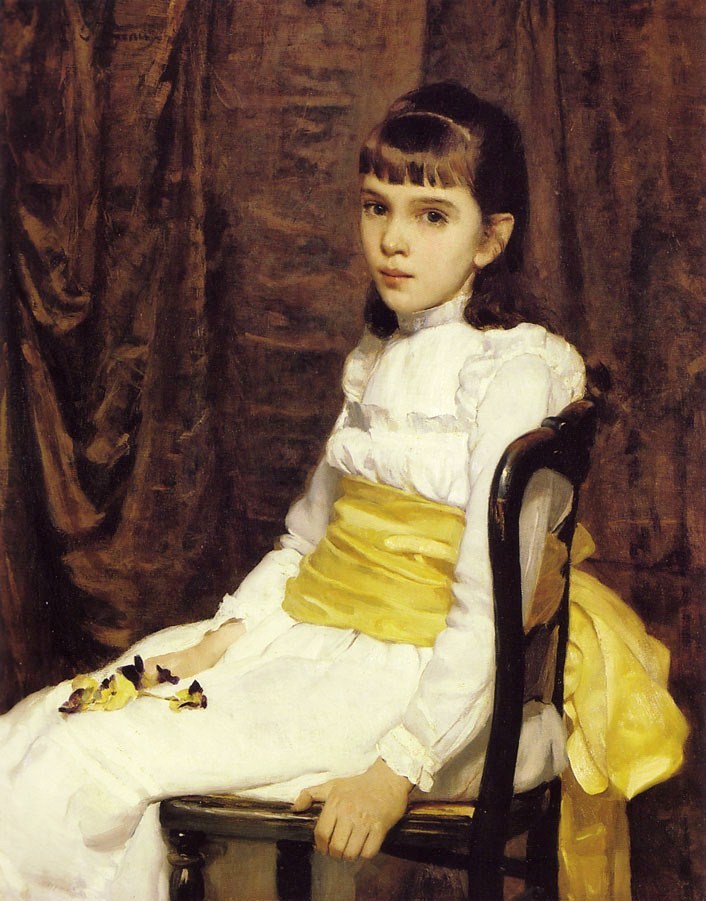
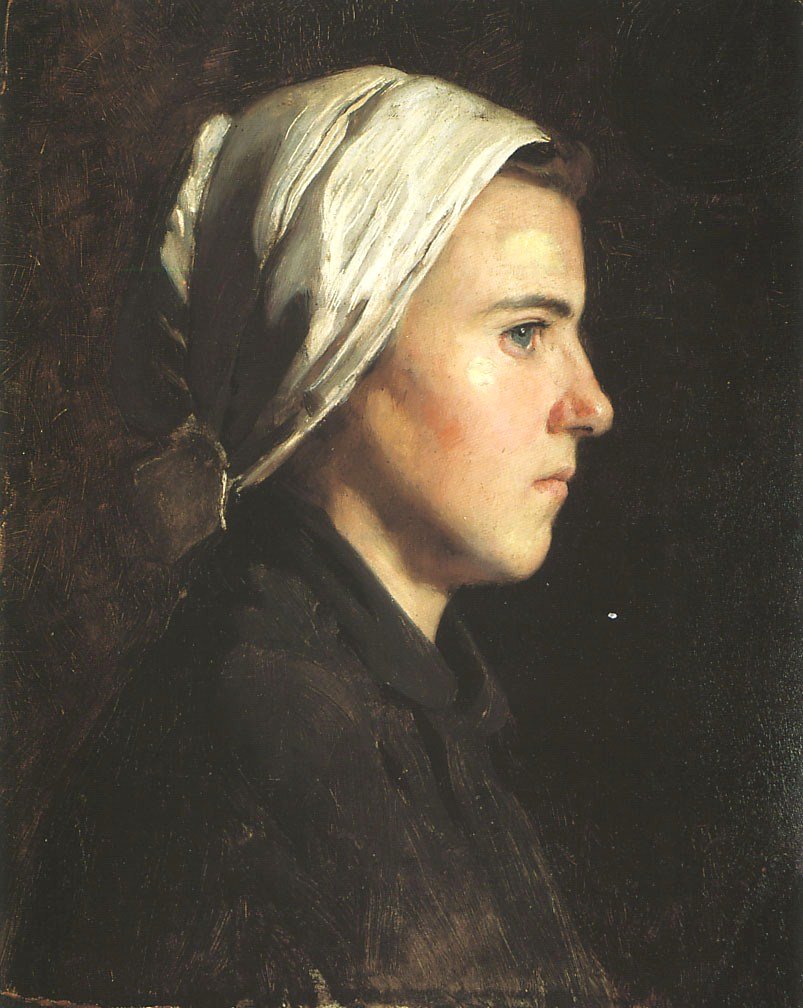
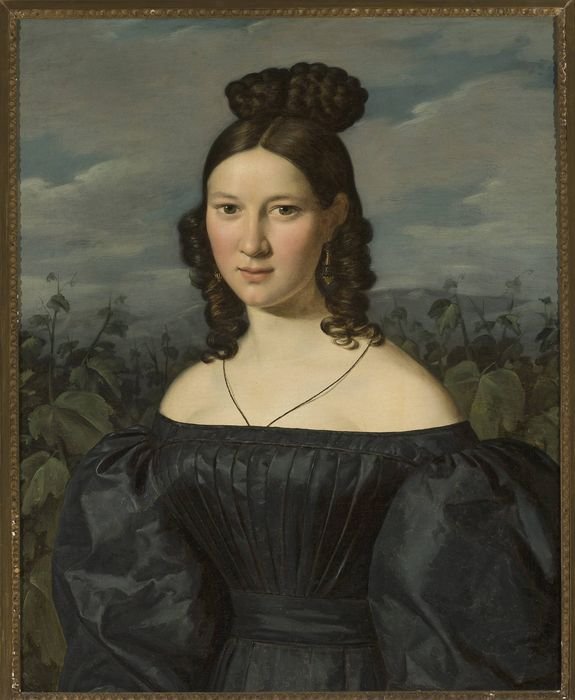
Historical Collections of the Great West by Henry Howe

Walter Anderson was an English painter, lithographer, and engraver. He was a painter of still lifes, landscapes and genre work and had moved to Cincinnati in 1849 where he met Sophie.   She and Walter collaborated on many illustrative commissions including her work on illustrations for Henry Howe’s Historical Collections of the Great West, which was published in 1851. She also worked for Louis Prang and Company which specialised in chromolithography, a technique for making multi-colour prints.

A Stitch in Time by Walter Anderson (1890)

 Sophie and her family left Cincinnati in 1853, closely followed by Walter Anderson who was by this time engaged to Sophie, and the couple settled down in Manchester, a neighbourhood of Allegheny just north of Pittsburgh. In 1854 Sophie and Walter travelled to England where they married. Whilst there she entered paintings into the exhibitions held by the Society of British Artists and later exhibitions at the Royal Academy of Arts.

No Walk Today by Sophie Anderson (1856)

In 1856 Sophie produced one of her best loved and most famous works, entitled No Walk Today. The work is testament to Sophie’s fine attention to detail. It is almost photographic in quality. One cannot help but be mesmerised by the amount of work she has put into the detail of the lace curtains we see behind the child. Look at the child. By the way she is dressed, she appears to be part of a wealthy family. She wears her outdoor clothes as a prelude to setting off on a walk but we can see by her facial expression, all is not well ! The inclement weather has curtailed any thoughts of going out of the house and the sullen and disappointed expression on her face perfectly sums up feelings.

Victorian Painting book cover

The painting was reproduced on the cover of Graham Reynolds’s important 1966 book Victorian Painting. The work was bought in 1926 by David Montagu Douglas Scott, a grandson of the 5th Duke of Buccleuch for fourteen guineas. It was an astute buy as this painting genre at the time had fallen out of favour, hence the low purchase price. In November 2008, the painting was sold at Sotheby’s, London for a world record price, for her work, of more than £1 million pounds.

The Children’s Story Book by Sophie Gengembre Anderson

Her painting Children’s Story Book was one of her works which depicts the joy of everyday life. In this work, we see a group of country children who are reading from a story book. By the way they are dressed and by the holes in the boy’s socks which he pokes his fingers through, we must deduce that they are poor. Despite such poverty we are left in no doubt that they are very happy. The boy fools around craving attention whilst the four female children are reading or listening to a story. I suppose this could be seen as a very stereotypical view ! The tallest and presumably the oldest of the girls is carrying a baby. This type of depiction was popular at the time. For many it was the stereotypical idyllic image of the English countryside, the innocence of childhood and the maintaining of old-fashioned standards. Such utopian ideas were clung to by many in the face of the onset of rapid industrialisation.

Young Girl with Pomegranates by Sophie Gengembre Anderson

The couple returned to Pennsylvania in 1858 for a long visit with Sophie’s family, during which time she exhibited at the Pittsburgh Artist’s Association in 1859 and 1860, and it was in that latter year that she and Walter both had work exhibited at the National Academy of Design. The couple returned to London in 1863 where they remained until 1871.

Take the Fair Face of Woman, and Gently Suspending, with Butterflies, Flowers, and Jewels Attending by Sophie Anderson (1869)

In 1869 Sophie Anderson completed a painting depicting a fairy and the title of the work, Take the Fair Face of Woman, and Gently Suspending, With Butterflies, Flowers, and Jewels Attending, Thus Your Fairy is Made of Most Beautiful Things,  which some believe was based on a passage from a poem by Charles Ede.

Elaine by Sophie Anderson (1870)

In 1870, Sophie completed a work entitled Elaine. The work is based on Tennyson’s cycle of twelve narrative poems by the English poet Alfred, Lord Tennyson, Idylls of the King which retells the legend of King Arthur, his knights, his love for Guinevere, her tragic betrayal of him, and the rise and fall of Arthur’s kingdom. In this depiction, it is all about Elaine who fell in love with Sir Lancelot but, sadly for her, he abandoned her in favour of Queen Guinevere. Elaine died of unrequited love and here we see her faithful dumb servant rowing her to King Arthur’s palace at Camelot. In her hand she clutches a lily, representing purity, and a letter expressing her undying love for Lancelot.  It is a large painting, measuring 158 x 241cms (62” x 95”) and it was very unusual in the late nineteenth century for female artists to paint such grand history paintings. The Liverpool City Council selected this painting for purchase at the first of their Autumn Exhibition.

Capri Girl with Flowers by Sophie Anderson (1881)

Because of Sophie’s health problems he and her husband decided to move to a warmer climate and in 1871 relocated to Capri and lived in Villa Castello, a beautiful house with an extensive garden which was an ideal setting for entertaining fellow artists. Capri was a popular location for artists and at some time was home to the likes of Frederic Leighton, John Singer Sargent, and the French artists, Edouard Alexandre Sain, and Jean Benner.

The Song by Sophie Gengembre Anderson (1881)

In 1881, whilst on Capri, she completed a work entitled The Song. In this painting, we see three young women dressed in roman costume in a wooded clearing. All the women are dressed in Greco-Roman style clothes. One is playing a lyre and singing while the others recline and listen attentively. This scene could have  a possible allegorical tone to it or may simply be a scene from every-day Roman life. Whichever is the case, this type of depiction was very popular in the nineteenth century especially with the middle classes who liked to show off their knowledge of Roman and Greek history. There is also a possibility that this depiction had moral connotations as during Victorian times the inclusion of the lyre or harp came to symbolise a faithful woman. The painting was exhibited the Liverpool Autumn Exhibition in 1881.

The Turtle Dove by Sophie Anderson

Walter and Sophie Anderson moved back to England in 1894 and settled into Wood Lane Cottage in the seaside town of Falmouth, Cornwall. They both continued to paint and exhibit their work in London. Sophie Gengembre Anderson died at home in Falmouth, aged eighty, on the 10th March 1903, just two months after the passing of her husband of thirty-nine years, Walter. Their bodies lie together in the same grave at Swanvale cemetery in Falmouth. It is not known for sure whether the couple had any children but it is often speculated that some of her child paintings were depiction of their daughters.

The Last Tribute Of Love by Sophie Anderson

In Victorian days ladies were not expected to have careers but with Walter Anderson’s support Sophie Anderson managed to do just that and, furthermore, was very successful.  So I return to my original question about her art – love it or hate it?

Alice Neel. Part 6. The latter years

 Alice Neel (1900-1984)
Alice Neel
(1900-1984)

Alice Neel had been receiving money for her involvement with the Works Project Administration (WPA).  The WPA was the largest and most ambitious American New Deal agency, employing millions of unemployed people, mostly unskilled men, to carry out public works projects.  The WPA employed musicians, artists, writers, actors and directors in large arts, drama, media, and literacy projects.  At its height in 1936, this federal project, the Federal Art Project employed over 5,300 artists. The Arts Service Division created illustrations and posters for the WPA writers, musicians, and theatres. However, with the onset of World War II, mass unemployment ended as millions of men joined the services and so President Roosevelt decided that there was no longer a need for such a national relief programme and the WPA was closed down at the end of 1942.  Alice was out of work and had then to turn to the state for public assistance which she kept drawing on for the next decade.

Photograph of Alice Neel sitting before her paintings which was used in the inviation to the exhibition

In March 1944 Alice held a solo exhibition at the New York Pinacotheca Gallery run by Rose Fried.  This was her first solo exhibition since 1938.  There were twenty-four of her works on display. The exhibition received mixed reviews.  An article in the prestigious art magazine, ArtNews, described her work:

“…Neel’s paintings at Pinacotheca have a kind of deliberate hideousness which make them hard to take even for persons who admire her creative independence … Nor does the intentional gaucherie of her figures lend them added expression. However, this is plainly serious, thoughtful work and in the one instance of The Walk, it comes off extremely well…”

As Bob Dylan once said The Times They are a-changin and this was the point in time that Alice Neel found herself.  After the 1944 Alice Neel’s retrospective exhibition at the Pinacotheca, gallery director Rose Fried never showed anything with a figure in it.  According to Neel, Rose had become a pure abstractionist and the works that Alice produced were no longer wanted.  The art world was changing; it had almost completely turned its back on Social Realism which had been the art form that had made Neel’s work so popular in the 1930’s.  So, Alice had to change but as another famous lady politician once said, “this lady is not for turning” and Alice likewise would not change her artistic style to suit others. In an interview with Eleanor Munro for her 1979 book Originals, American Women Artists, Neel is quoted as saying:

“…I never followed any school.  I never imitated any artist.  I never did any of that…”

Sam and Hartley By Alice Neel

For Alice Neel, she knew what she wanted to paint and nobody or nothing was going to alter her artistic desires even though New York was now awash with European émigré artists who were leaders in the world of Cubism, Dadaism and Surrealism such as Max Ernst, André Breton, Marcel Duchamp and Salvador Dali, all of who had fled across the Atlantic to avoid the rise of Nazism.  Alfred Barr had founded the MOMA and in October 1942, millionaire, Peggy Guggenheim, who was married to Max Ernst, had arrived in New York from war-torn Europe had opened a new gallery/museum.   It was called The Art of This Century Gallery.  The Art of This Century Gallery was situated at 30 West 57th Street in Manhattan and occupied two commercial spaces on the seventh floor of a building that was part of the midtown arts district which included the Museum of Modern Art, and three of the four galleries were dedicated to Cubist and Abstract art, Surrealism and Kinetic art, with only the fourth, the front room, being a commercial gallery.

During the 1950’s Alice Neel was kept under surveillance by the FBI.  In a memo from their Miami office based on a 1954 letter sent to them by an informant they concluded that Alice Neel was:

“…a muddled romantic, Bohemian type Communist idealist who will carry out loyally the Communist sympathiser type of assignment, including illegal work if ordered to do so…”

Their file on her and her activities remained open until the early 1960’s.

My Mother by Alice Neel (1952)

In March 1953, Alice’s mother comes to live with her in her Spanish Harlem apartment.  Sadly a year later Alice snr. aged 86, died from complications brought on by a broken hip.  For Alice, this was yet another traumatic moment in her life  She had always had to battle with depression and the death of her mother triggered the onset of the debilitating malaise for the next few years.  Physically she put on weight and sought the comfort of alcohol.

Alice often complained that she could not get any gallery space for her works of art.  She painted prolifically but still wanted to exhibit them.  The problem was that her genre of art had lost its appeal with the public.  She was going through a difficult period with mental health issues and was attending therapy sessions with a psychologist, Dr Anthony Sterrett.  He spent time with her trying to make her become more self-confident and self-assertive and it was he who persuaded Alice to contact Frank O’Hara to see if he would sit for her.  O’Hara was an American writer poet and art critic who was working as a reviewer for the prestigious art magazine, Artnews, and who, in 1960 was Assistant Curator of Painting and Sculpture Exhibitions for the Museum of Modern Art.  This position at the MOMA made him a prominent figure in New York City’s art world. He was looked upon as a leading figure in the New York School, which was an informal group of artists, writers and musicians who drew inspiration from jazz, surrealism, abstract expressionism, action painting and contemporary avant-garde art movements.

Frank O'Hara by Alice Neel (1960)
Frank O’Hara by Alice Neel (1960)

Alice completed two portraits of O’Hara in 1960 and they were looked upon as her breakthrough works.  In the painting, Frank O’Hara, Alice has beautifully and faithfully captured his distinguishing and unique profile.  The side view is hawk-like which is softened slightly by the bunch of lilac behind his head.

Frank O'Hara No.2 by Alice Neel (1960)
Frank O’Hara No.2 by Alice Neel (1960)

In stark contrast, the second portrait, Frank O’Hara No.2 is a more shocking depiction of the man.  Our eyes are immediately drawn to his bad teeth, which looked like tombstones, his sharp nose and somewhat wild eyes.  To be brutally honest, at first, he comes over as being ugly, even, dare I say, repulsive, but there is a vulnerability about Neel’s depiction of him.

Six years later, in the early morning hours of July 24, 1966, O’Hara was struck by a jeep on the Fire Island beach, after the beach taxi in which he had been riding with a group of friends broke down in the dark.  He died the following day.

Kate Millett by Alice Neel (1970)

In America, the 60’s was dominated by the Civil Rights movement and the Vietnam War with its protests which swept the country.  It was also a time when the second wave of the modern feminist movement emerged.  It was a time when there was the growing cry for equal opportunity for women and it soon became one which could not be ignored.   Enter Katherine Murray “Kate” Millett, best known as Kate Millett.  She was an American feminist writer, educator, artist, and activist. She attended Oxford University and was the first American woman to be awarded a postgraduate degree with first-class honours by St. Hilda’s.  She is probably best known for her ground-breaking 1970 book Sexual Politics, which was her doctoral dissertation at Columbia University.

Time magazine cover
Time magazine cover

This book became a bible for feminism and feminist protest was such a hot topic that in August 1970, Time magazine decided that Kate would be the face of the feminist movement and therefore should appear on the cover of their magazine.  Millet was unimpressed by the way she was heralded as the embodiment of the movement and refused to pose for a painting by Alice Neel which would be used for the cover.  She believed that no one person could presume to represent the objectives of the feminist movement.  Time magazine was not to be put off by her refusal and instead asked Neel to complete the portrait, using a photograph.  After the publication of the magazine Alice Neel and her art was always linked with the feminist movement but as Alice once quipped, she had been a feminist before there was feminism!

Andy Warhol by Alice Neel (1970)

The year 1970 was also the year that Alice Neel painted one of her most famous works, a depiction of Andy Warhol.  The painting can be found at the Whitney Museum of American Art, New York and rather than me trying to describe the painting I have reproduced the words of the museum’s audio-guide which was put together by Trevor Fairbrother, an independent curator and writer:

“…It’s an interesting year for both of these artists. Alice Neel was seventy years old when she painted it, and in a sense, was just hitting her stride as an important American realist. She’d had an incredible career since the thirties, but she hadn’t really had much recognition until the wave of feminist interest in the arts in the sixties. And suddenly she was a forebear for a whole new generation of feminist artists and writers.  The late sixties were much harder on Warhol. He’d been shot two years before Neel painted this portrait—an attempted assassination by a member of his artistic circle. In posing shirtless for Neel, he exposes the corset that he was required to wear for the rest of his life. He also bares his aging body, his chest sagging so that he almost appears to have breasts.  She shows him—I think it’s this kind of essence of loneliness and vulnerability, but at the same time I think she knows that he knows that everybody is looking at him. He was very much invested in famous artists. He wanted to be a kind of brand-name Pop artist, and he certainly is that now, long after his death. He, Warhol, in a sense is rising to her challenge to sit for her, to be painted and to take his clothes off. And so, in a sense, he’s doing a brave thing, but he’s also―he’s getting through it by shutting his eyes and being very focused internally.  I think part of the soulfulness of this picture is the fact that it might seem unfinished. I wouldn’t say it’s unfinished. I think she decided she had what she needed, and she stopped where she was ready to stop. The picture doesn’t need more…” 

Fame came to Alice Neel late in life and she believed she had the right to bask in the glory.  Her son Hartley recounted his mother’s feelings about this sudden fame:

“…She felt it was something she deserved.  She basked in it.  She really enjoyed it.  When we were young, she struggled, waiting around for some critic to review her work, up or down.  All of the sudden they were saying good things about her.  Her paintings were on the walls, and people were buying her work.  It was all different.  She wasn’t bitter.  She had a very upbeat attitude toward the whole thing…”

Self-portrait by Alice Neel (1980)

On October 14th 1980 at the Harald Reed Gallery on East 78th Street in New York a benefit dinner for the Third Street Music School Settlement was being held at which was the debut of an art exhibition entitled Selected 20th Century American Self Portraits, one of which was Alice Neel’s nude self-portrait which she had begun five years earlier.

She looks out at us completely oblivious or unconcerned about what we are thinking about why an eighty-year-old woman would want to depict herself naked.  Does she feel vulnerable?  There is no sign of that in her facial expression, in fact Neel’s steely gaze rivets us.  She exudes an air of self-confidence, despite her less than picture-perfect body.  We see her sitting regally in an upholstered chair with its hard vertical-striped arms which tend to accentuate her yielding and bounteous rolls of flesh.   It is a “warts and all” portrait.   She does not hide the visible signs of aging.  Instead she has decided to reveal herself with characteristic truthfulness and somewhat defencelessness. Yet there is also a sense of pride in this depiction.  In her right hand she holds a paintbrush whilst her left hand grasps a rag and, as we see no easel or canvas in the depiction, the two serve as artistic elements. The only personal accessory depicted is the presence of her eyeglasses which may have been added by her to remind us of her frailty and that she has passed her prime.

The painting was of course controversial and caused a stir but it also was testament that it was an audacious work by an artist who at the time was at the top of her form.  The other unusual aspect of this work was that beside a few pencil-sketched self-portraits, it was her first self-portrait painting.  The painting now resides at the National Portrait Gallery, Washington.

Loneliness by Alice Neel (1970)

In 1970 Alice completed a work entitled Loneliness, which she ironically referred to as a “self-portrait”.  It was about this time that her younger son Hartley had married Ginny and moved to Massachusetts.

Ginny in a Striped Shirt by Alice Neel (1969)

Throughout her life Alice continued with her portraits of her family.  Her future daughter-in-law, Hartley’s wife, Ginny featured in her 1969 work, Ginny in a Striped Shirt.  Ginny was a feminist who looked upon Alice as a role model and they became good friends even before she became involved with Hartley.

Pregnant Woman by Alice Neel (1971)

Her other daughter-in-law, Nancy, Richard’s wife and Alice’s assistant during the last two decades of her life, was depicted in Alice’s 1971 painting, Pregnant Woman.  In the work, we see an image of her husband looming in the background.

In 1980 Alice Neel’s physical health takes a turn for the worse and after a series of tests it is decided that she had to be fitted with a pacemaker to regulate her heart rate. Four years later in 1984, during a routine visit to the Massachusetts General Hospital to have her pacemaker checked, X-rays indicate that she has advanced colon cancer which has already spread to her liver. She immediately undergoes surgery and afterwards returns to Vermont to stay with Hartley, Ginny and their children while she recuperates.

From the Spring to the Summer of 1984 she returns to New York and Spring Lake. With the help of her son and his wife, Richard and Nancy, and despite her rapidly deteriorating health, she continues with her busy schedule including an appearance on the Johnny Carson Show

Among her many commitments, interviews for the ArtNews article continue, and, on June 19th, she makes a second appearance on ‘The Tonight Show’ during which she insists that Johnny Carson visit her in New York to sit for a portrait. In July, she had to receive chemotherapy which further weakened her.  Despite her weakened condition, she continues to paint.

Alice Neel died in her Upper West Side Manhattan apartment on October 13th 1984 surrounded by her family and was buried in a private burial ceremony at a cemetery near her studio in Vermont.  On February 7th 1985, a memorial service for her is held at the Whitney Museum of American Art.

My look at the life and works of Alice Neel has been a long journey stretching over six blogs and yet I know I have missed so much out about her life and because she was a prolific artist I know I have only scratched at the surface with regards her works of art.  I have been careful not to be judgemental with regards her lifestyle which probably added to her problems but she had a difficult and often sad life which often was beyond her endurance.  She however always wanted to do her own thing and I leave you with one of her quotes:

“…”I had a very hard life, and I paid the price for it, but I did as I wanted,” Miss Neel said then. ”I’m a high-powered person…”  

– – – – – – – – – – – – – – – – – – – – – – – – – – – – – –

I have used numerous internet sources to put together this and the other blogs on the life and art of Alice Neel and I am currently reading a fascinating book about the artist by Phoebe Hoban entitled Alice Neel: The Art of Not Sitting Pretty. It is a very interesting read and one I can highly recommend.

Alice Neel’s art is being shown at several exhibitions in America but there are also a series of exhibitions of her work travelling around Europe at the current time including one I am due to visit next month:

Gemeentemuseum, Den Haag, Holland

(November 5th, 2016 – February 12th 2017)

Ferdinand Georg Waldmüller and the Biedermeier era

Portrait of the fictitious character Gottlieb Biedermeier from the Munich Fliegende Blatter

My blog today starts with a caricature of Gottlieb Biedermeier.  Gottlieb is not the artist of the day.  He is just the lead-in to the star attraction.  Gottlieb Biedermeier, more commonly referred to as Papa Biedermeier, used to appear as a cartoon character in the popular newspaper, Fliegende Blätter, a German weekly non-political humour and satire magazine which appeared between 1845 and 1944 in Munich, and it is through his regular appearance that  this period was actually termed the Biedermeier era, an era which stretched between the defeat of Napoleon in 1815 and the Republican revolts against European monarchies of 1848, which began in Sicily, and spread to France, Germany, Italy, and the Austrian Empire.   Papa Biedermeier was a comic symbol of middle-class comfort. The art of the Biedermeier period came to be characterized by what art critics of the period termed “rigorous simplicity.”   The works of art often had an enamel-like finish that masked individual brushstrokes. Landscape and portraiture grew in importance while history painting declined.  In painting, the Biedermeier style reflected the bourgeois, simple, joyful, affable and conformist environment, enhanced the aesthetics of the natural beauty and has influence on contemporary art and design.

Early Spring in Vienna Forest by Ferdinand Waldmüller (1864)

In Austria painters during this time portrayed a sentimental and virtuous view of the world but in a realistic way. The German word best describing the emotions derived from the art is gemütlichkeit, which is a space or state of warmth, friendliness, and good cheer. Other qualities of gemütlichkeit include cosiness, peace of mind, belonging, and well-being.  In other words, a “feel good” factor and such comfort, as depicted, emphasized family life and private activities, especially letter writing and the pursuit of hobbies. No Biedermeier household was complete without a piano as an indispensable part of the popularized soiree. Soirees perpetuated the rising middle class’s cultural interests in books, writing, dance, and poetry readings—most subject matter for Biedermeier paintings was either genre or historical and most often sentimentally treated.  The leading Austrian exponent of this type of art is my artist of the day.  He is Ferdinand Georg Waldmüller.

The Girl Antonia Seemann by Ferdinand Waldmüller

Ferdinand Georg Waldmüller was born in Vienna in January 1793.  In 1807, at the age of fourteen, Waldmüller studied Fine Arts at the Academy of Fine Arts in Vienna under the Austrian painter, draughtsman, and well-respected teacher,  Hubert Maurer, who had been teaching art at the Academy since 1785. Waldmüller remained there until 1811. Waldmüller then went to Presburg in Hungary to study portraiture.  Following that he worked in Croatia as a drawing teacher for the children of the Count Gyulay, the governor of Croatia before returning to the Academy in 1813 to carry on with his artistic studies, this time concentrating on portraiture.

Whilst in Vienna Waldmüller would visit the court and municipal galleries where he would make copies of the Old Masters.

Martyrdom of St Andrew by Jusepe de Ribera (1628)

One example of this is his version of Juseppe de Ribera’s Martyrdom of St Anthony which the Spanish artist completed in 1628 which is now in the Szépmüvészeti Museum in Budapest.   St. Andrew was St Peter’s brother and preached around the Black Sea Area.  According to legend he was crucified on two pieces of wood which formed an “X” which has since become known as the cross of St Andrew.

Martyrdom of St Andrew by Ferdinand Waldmüller (1821)

Waldmüller’s copy of the painting can be seen in the Akademie der bildenden Künste in Vienna. Waldmüller had hoped to sell the copies he made of the paintings of the Old Masters but the income from this venture was insufficient for him to live and support himself.

Katharina Waldmüller (née Weidner) by Joseph Weidner

In 1814, Waldmüller  married a well-known Austrian opera singer, Katharina Weidner and he worked as a scenery designer at the various venues at which his wife was performing.   He took up the role as professor of art at the Academy of Fine Arts in Vienna and in 1823 exhibited for the first time at the Vienna Akademie.

Ferdinand Georg Waldmüller Kaiser Franz I (1827)

For the next decade he travelled around Europe, enhancing his reputation as a leading portraitist of his time and in 1827.  He received royal patronage following his portrait of the nineteen year old Franz I, who would become the Holy Roman Emperor in 1845.

Portrait of a Young Lady by Ferdinand Waldmüller (1820)

His art at the time concentrated on portraiture, an art genre in which Waldmüller excelled.  His portraits had a high smooth-finish and decorative detail and were often compared to the French Neo-classical painter Ingres.  One of his most beautiful portraits is entitled Portrait of a Lady, which he completed in 1820.

Portrait of Beethoven by Ferdinand Waldermüller (1823)

One of the most famous of his sitters was Ludwig van Beethoven who sat for him in 1823.  The portrait had been commissioned by the Leipzig publishers Breitkopf & Härtel.  According to notes and letters, it was a one-off sitting and even that was interrupted.  So in the short time he had, Waldmüller only portrayed Beethoven’s face, and it was later, back in his studio, that he added the clothes and probably also parts of his hair.  The original was destroyed in 1943 but fortunately, the portrait was so popular in the late nineteenth and early twentieth century that it was reproduced and copied many times.

Julia Comtesse Apraxin by Ferdinand Waldmüller (1835)

Perhaps, one may consider his portraits of children a little too “syrupy” but this should not detract from the excellent portraits.  In 1835, Waldmüller, whilst living in Vienna, completed a commission to paint the portrait of seven year old Julia Aspraxin, the daughter of  Count Alexandr Petrovich Aspraxia, a serving Russian in Vienna.

Portrait of the Future Emperor Franz Josef I of Austria as a Grenadier with Toy Soldiers by Ferdinand Waldmüller (1832)

In 1832 he painted a portrait of the two-year-old Franz Josef, the future Austrian Emperor entitled Portrait of the Future Emperor Franz Josef I of Austria as a Grenadier with Toy Soldiers.  The child posed for the artist in the uniform of a grenadier along with some similarly dressed Hungarian wooden figures.  It is like a state portrait on a miniature scale. The child, with his blue eyes, looks out innocently unaware of his future role and the disasters that would follow.

Old Elms In Prater by Ferdinand Waldmüller (1831)

Waldmüller painted pictures of all genres and had soon built up his standing as a talented landscape painter.  His beautiful landscape artistry was appreciated by the public and in the 1850’s he became very interested in the depiction of sunlight and the contrast between light and shadow which one realises was a pre-cursor to Impressionism.  I especially like his 1831 paintings featuring the elm trees in Prater, the large park in Vienna.   One was entitled Old Elms in Prater.  Look at the extraordinary detail.

Elms In Prater by Ferdinand Waldmüller (1831)

The other simply, Elms in the Prater.  His landscape artistry was based on his strong belief that art should be determined by the careful and meticulous examination of nature.  For Waldmüller, a talented colourist and someone who had a great knowledge of nature, it was all about natural observation achieved by plein air painting and not so much the way art was taught in academies. It was, like the Impressionists, fifty years later, about the effect of light.

View Of The Dachstein With The Hallstättersee From The Hütteneckalpe At Ischl by Ferdinand Waldmüller (1838)

Another beautiful landscape work was his 1838 painting entitled View Of The Dachstein With The Hallstättersee From The Hütteneckalpe At Ischl.

He became the curator of the Gemäldegalerie of the Academy of Fine Arts in 1829, a post he held for almost three decades.  However in 1849 and again in 1857,  he wrote critical papers with regards the Academy and academic teaching of art and,  at the age of sixty-four , was forced to resign from his position at the Academy.

Corpus Christi Morning by Ferdind Waldmüller (1857)

The third “string” to Waldmüller’s artistic bow was his great talent as a genre painter.  His genre paintings shied away from idealisation or pretentiousness and although he would often add historical and religious elements to his depictions he was never afraid to highlight social criticism in the paintings.   Through his depictions of life in the countryside his paintings extolled the virtue of rural life and at the same time highlighting the positivity of family life.  Such joyousness can be seen in his 1857 painting, Corpus Christi Morning.  Life for the peasant class may not all laughing and dancing but for that moment in time life could not be better.  It was a gemütlichkeit time.

Ferdinand Georg Waldmüller, Children decorating a Conscript's Hat (1854)
Ferdinand Georg Waldmüller, Children decorating a Conscript’s Hat (1854)

Ferdinand Georg Waldmüller completed his painting Children decorating a Conscript’s Hat in 1854. The painting depicts a very poignant moment.  It was an occasion of great importance to rural families.  We see a group of girls, maybe his sisters,  decorating the hat of a young man who has been called up to fight for his country during his compulsory military service. His hat is being decorated with flowers and ribbons. The decorating of the hat is a time of joy and merriment which masks the possible horrors the young man may encounter.  As far as art is concerned, it is a masterpiece of evocative genre painting and, the work is a testament to how Waldmüller depicts the intricate interplay of light and shadow.

The Departure of the Conscript by Ferdinand Waldmüller (1854)

Another work by Waldmüller, The Depature of the Conscript, shows the family of a conscript saying their farewells and wishing him a safe journey.  His mother places the decorated hat on the head of her son.  Look how the boy wraps one arm around his mother whilst his other hand is held lovingly by his father.  It is now that maybe they realise that the ceremony of decorating the hat will mean nought if their beloved son does not return home.  In the background we see women in tears.  A young man, maybe the conscript’s younger brother, looks back pensively at his older brother wondering when it will be his time to join the military.  The conscript’s young sisters try to cling hold of him, not wanting him to go.  This is not a scene of joy but one of realism, one of foreboding.

I have always loved genre paintings especially when there are numerous characters depicted.  Each time I look at painting like this I discover something different.

In 1851, Waldmüller, aged 58,  married his second wife, 25-year-old Anna Bayer. He carried on exhibiting his work at various exhibitions, including the prestigious World Exhibition in Paris and at the International Exhibition in London. In 1856 he travelled to London where he sold thirty one of his paintings to the royal household and court. By the 1860s, the Academy in Vienna had forgiven Waldmüller’s transgressions and outspoken views critical of their institute and their teaching methods and he was once again welcomed back to the Viennese artistic fold.  He was knighted in 1865, shortly before his death that August, aged 72.

Ferdinand Georg Waldmüller, Self-Portrait at the Easel, (1848)

Ferdinand Georg Waldmüller is looked upon as one of the most important Austrian painters of the Biedermeier period.  His superb artistic talent, as a landscape painter, was never questioned.  He was an advocate of plein air painting, putting down on canvas what the eye could see.  This to him was of greater importance than the art taught in academies.  The way in which he achieved an accurate characterisation of the human face took his portraiture to another level.  His genre works which depicted rural everyday life were outstanding.  The depictions, often moralising and socially judgemental would set a marker for future artists who favoured this genre.

I give you Ferdinand Georg Waldermüller.