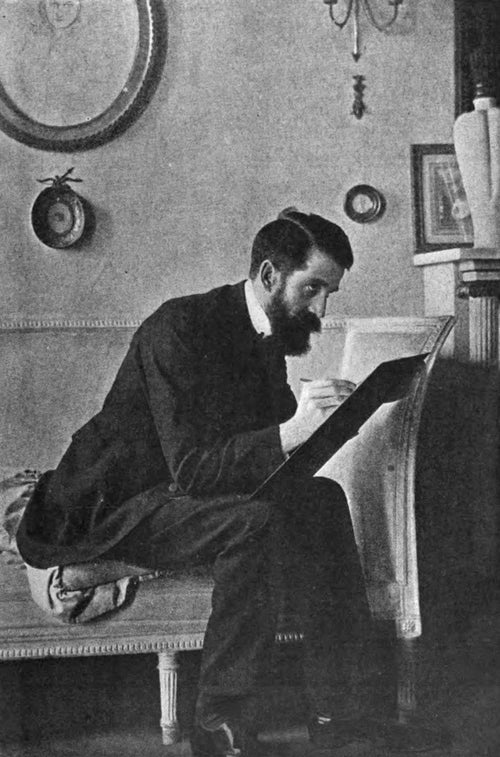
Paul César Helleu and Alice Guérin.

Paul César Helleu

At the end of my previous blog about the French artist Léon Bonnat, I talked about how he had bequeathed most of his art collection and the majority of his work to the local Bayonne museum and how the town named the Museum after him and yet it is now known as the Musée Bonnat-Helleu.. So who is “Helleu”?
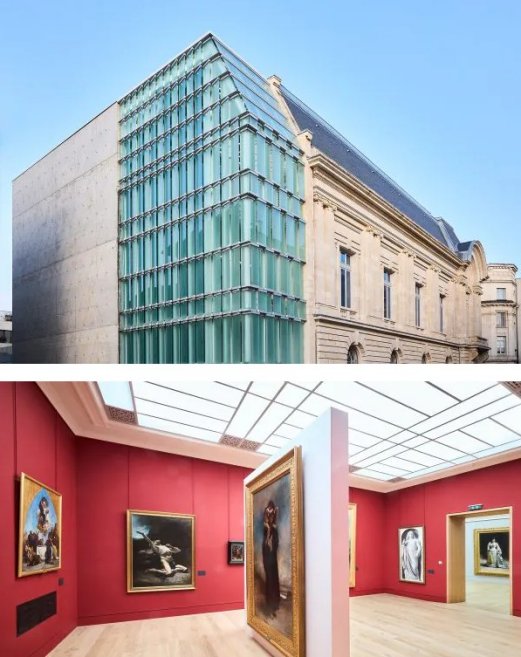
Musée Bonnat-Helleu, Bayonne

The donation of Paulette Howard-Johnston, the youngest child of Paul and Alice Helleu made the museum one of the places of reference for the works of Paul César Helleu from 1988 onwards. It houses his works thanks to his daughter’s donation, as well as the donations and bequests of Paulette Howard-Johnston’s nieces, Éliane Orosdi and Ghislaine de Kermaingant,  when in 2009, she died.  In her will,  the Bonnat Museum was designated as the heir to her collection of more than 300 new pieces.  In 2011, the museum closed its doors for a major renovation, while thanks to this last bequest made by the Helleu family, the museum became the Musée Bonnat-Helleu.
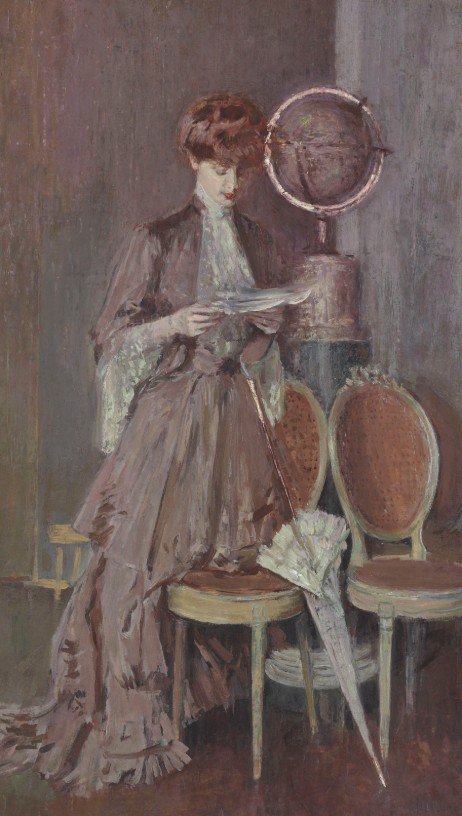
Portrait of Madame Helleu reading by Paul César Helleu

Paul César Helleu was born on December 11th, 1859, in the Brittany town of Vannes.  His mother, Marie Esther Guiot and his father, César Helleu, who was a customs receiver, were married in 1855 and had two sons Paul and his elder brother Édouard.   Paul took an interest in art when he was young. Following the death of his father when Paul was just a teenager, he decided he wanted to further his art studies by going to live in Paris.  His widowed mother was against this idea but Paul persisted and travelled to Paris to continue his schooling at the Lycée Chantal.  In 1876, at the age of sixteen Paul graduated and was admitted to the École des Beaux-Arts, at the atelier of Jean Leon Gerome, where he began his formal academic training in art.
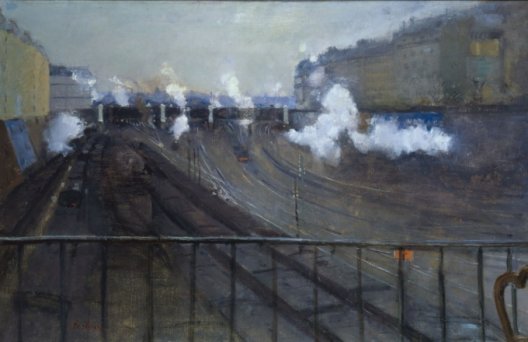
The Saint Lazare Train Station by Paul César Helleu (1885)

It was also in the Spring of 1876 that Helleu attended the Second Impressionist Exhibition at the Durand-Ruel Gallery in Paris. A total of nineteen artists participated in the exhibition, including prominent figures such as:  Degas, Monet. Morisot and Gustave Caillebot. Whilst in Paris,   Helleu made the acquaintance of John Singer Sargent, James McNeill Whistler, and Claude Monet. He was struck by their modern, bold alla  prima artistic technique, which was an approach to painting that involved applying layers of paint, also known as wet-on-wet, and completing a painting in a single sitting. This meant working with wet paint and not letting the layers dry, before applying the next layer. In Italian, the phrase alla prima translates to “at first attempt”.  Helleu was also impressed with their plein air style of painting.
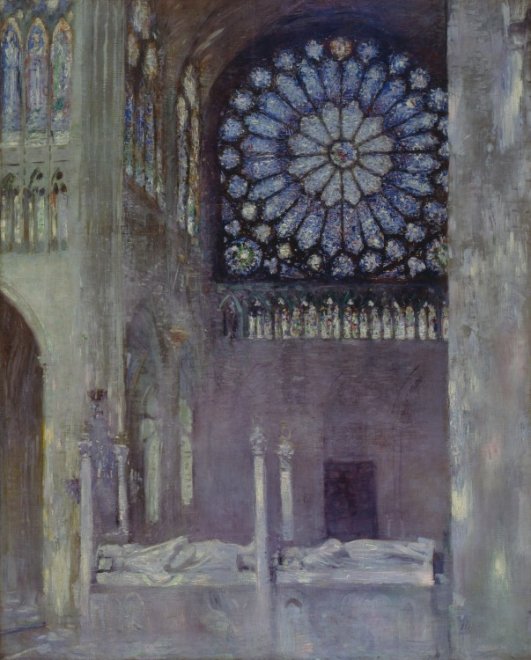
The Interior of the Abbey Church of Saint Denis by Paul César Helleu (c 1891)

Following graduation, Helleu found employment at the prestigious faience (earthenware) workshop, Joseph-Théodore Deck Ceramique Française.  Joseph-Théodore Deck was a 19th-century French potter, and an important figure in late 19th-century art pottery.  In 1856 he established his own earthenware workshop and began to experiment with styles from Islamic pottery, and particularly the Iznik style.  At the time Paul César Helleu joined the workshop, Japonisme, the popularity and influence of Japanese art and design following the forced reopening of foreign trade with Japan in 1858 was all the rage. Helleu created decorations for dishes.
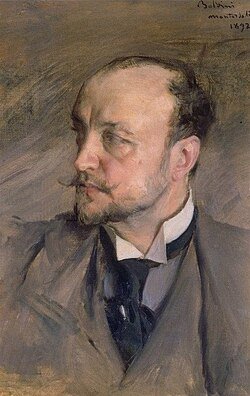
Giovanni Boldini self portrait (1892)
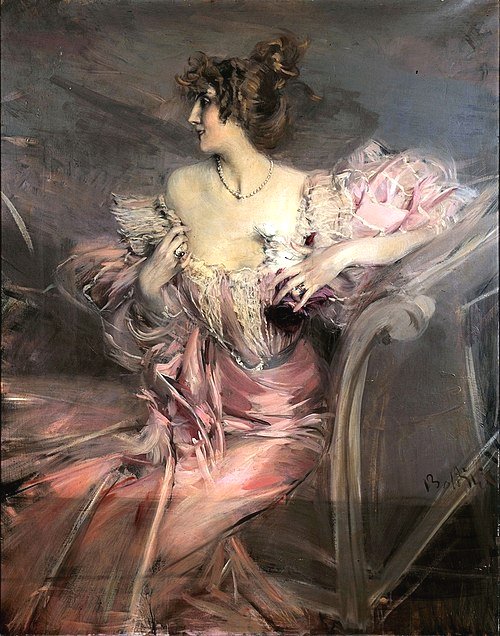
Portrait of Marthe de Florian, a French demi-mondaine and socialite,  by Giovanni Boldini (1898)

Around this time, Helleu met Giovanni Boldini, an Italian genre and portrait painter who lived and worked in Paris.   His portraiture focused on all the grandes dames of Paris, and for them to have their portrait painted by Boldini was looked upon as the crowning event of the social season. Boldini became a friend and mentor to Helleu, and his style of painting had a great influence on his artwork. The other great influence for Helleu was his friendship with John Singer Sargent, often referred to as the leader of “posh portraiture” in Britain, that majorly encouraged Helleu. Helleu even sold his first painting to Sargent. 

Portrait de Madame Chéruit by Paul César Helleu (1898) Madeleine Chéruit was a French fashion designer. She was among the foremost couturiers of her generation, and one of the first women to control a major French fashion house.

This time in Helleu’s life coincided with France’s Belle Époque era. The term, Belle Époque, literally means “Beautiful Age” and was a name given in France to the period between the end of the Franco-Prussian War in 1871 up to to the start of World War I in 1914. During those forty plus years of peace, the living standards for the upper and middle classes increased, (albeit the lower classes did not benefit in the same way, or to anywhere near the same extent).  It was the well-off who termed the phrase Belle Epoque labelling it a golden age in comparison to the humiliations that came with the Prussian invasion and what was to come, the devastation and occupation of the First World War.
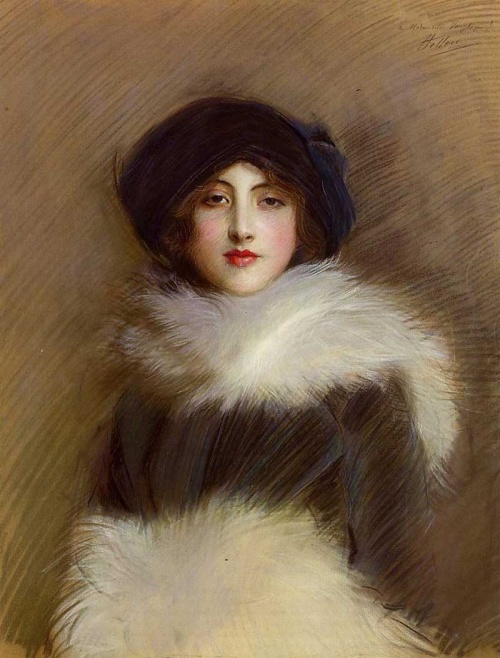
Mademoiselle Vaughan by Paul César Helleu (1905)

It was a time of booming progress and prosperity in Europe, with Paris the centre of the fast-flowing changes in economics, technology, and the arts. However, as the name denotes, beauty was a key element of this prosperous period.  The upper-class patrons would often commission artists to paint their portrait or one of a family member, in a luxurious and extravagant manner highlighting both their beauty and wealth.  The finished portraits heightened an artist’s reputation, ensuring more clients for the artists.

Alice Helleu by Paul César Helleu (1885)

This blog is not only about Paul César Helleu but also his muse, lover, and later his wife, Alice Louis-Guérin. Helleu met Alice in 1884 when her mother asked him to paint a portrait of her fourteen-year-old daughter, Alice. At the age of twenty-four, Helleu appears to have fallen in love with her during this first meeting.   Alice remained the artist’s favourite model throughout his life and she was also a muse for many other artists.  Her beauty and sophistication also helped introduce her husband into the elite circle of artists, writers and society figures of the French capital.  The Count de Montesquiou, who was a noted dandy and one of the leading figures in the artist’s group of friends, described her appearance as

“…La multiforme Alice, dont la rose chevelure illumine de son reflet tant de miroirs de cuivre…”

 (‘The multifaceted Alice, whose rosy hair illuminates so many copper mirrors with its reflection.’)
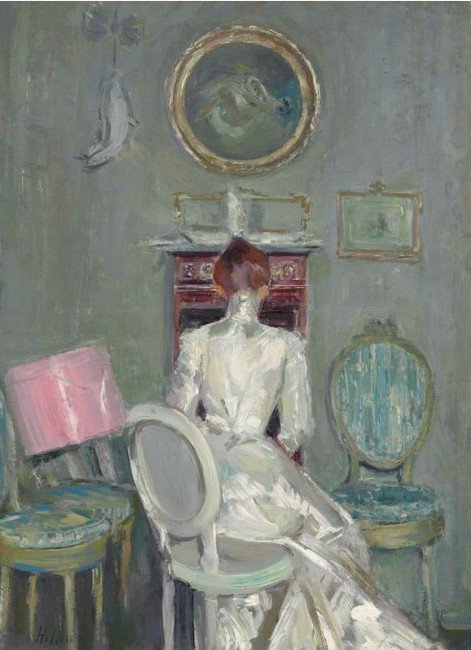
Madame Helleu à son bureau by Paul César Helleu.

Helleu often avoided standard conventional rules of portrait composition, and would frequently depict his sitters from behind – standing before a mirror, or sitting at a desk, as was the case of his painting entitled Madame Helleu à son bureau. Note the porcelain koi carp hanging in the upper left corner which was an example of Japonisme which was all the rage in Paris at the time.   The desk depicted in the painting and which appears in numerous works by Helleu is still in the artist’s family.  The painting hanging above it is Boldini’s Leda and the Swan.
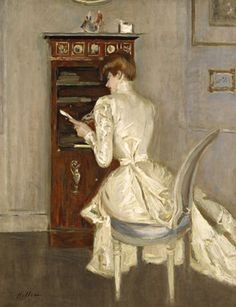
Madame Helleu assise à son bureau dans le salon de l’atelier de l’artiste, capturant une scène intérieure intime avec une élégance raffinée. (Madame Helleu seated at her desk in the artist’s studio salon, capturing an intimate interior scene with refined elegance.)

His painting entitled Mrs. Helleu sitting at her desk in the artist’s studio living room confirms Paul and Alice Helleu were had superb taste and these portraits depict Alice seated at a secrétaire in the couple’s drawing room of their Paris apartment, into which they moved in 1888. I suppose these two paintings cannot be considered as portraits in the conventional sense of the word, but rather as interior still life works, in which the furniture and surroundings are as vital as the sitter.
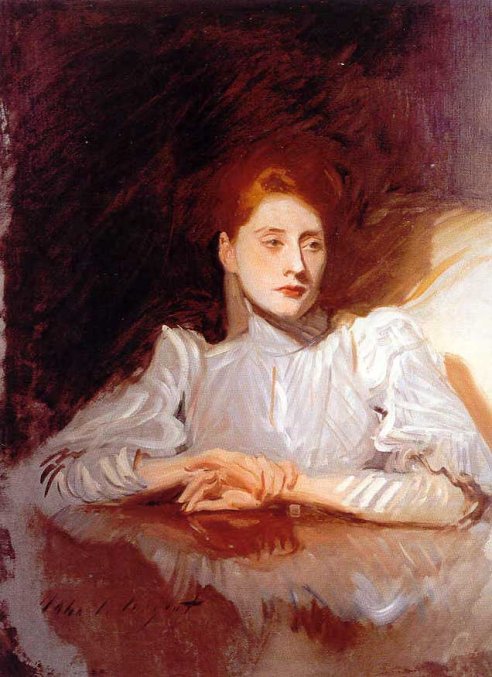
Madame Helleu by John Singer Sargent (1889)

Alice Guérin was depicted in a number of paintings by Paul Helleu’s friend John Singer Sargent.
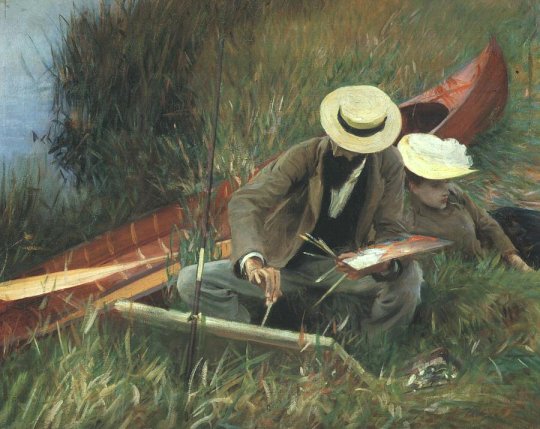
Paul Helleu Sketching with his Wife by John Singer Sargent (1889)

In his 1889 painting, Paul Helleu Sketching with his Wife, Sargent depicts a tranquil outdoor scene, portraying the French artist Paul Helleu engaged in the act of sketching. Alongside him, sits his wife Alice who appears happy and relaxed.  The figures of husband and wife are set against a lush, natural environment that suggests a calm and comforting ambiance. Sargent’s painting also manages to capture their fashionable clothing with Paul wearing a formal suit and Alice attired in an elegant dress.  Both wear wide-brimmed hats that both provide shade and stylishly adorn their heads.
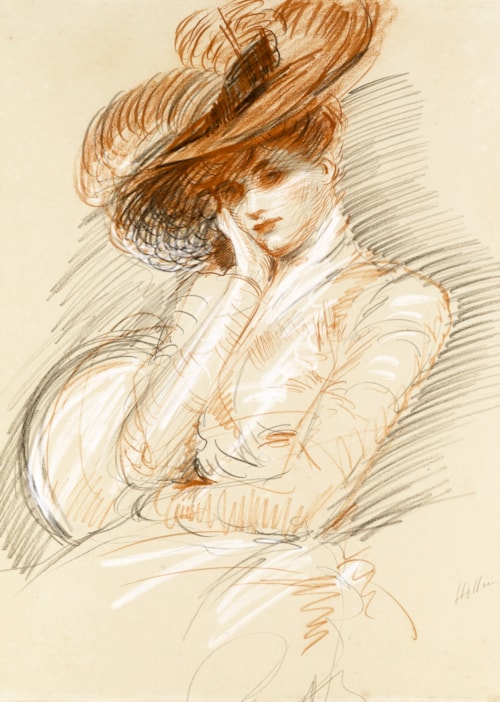
Portrait of Artist’s Wife by Paul César Helleu

Paul Helleu was one of Sargent’s closest friends.  Initially, they had met in Paris in 1878.  Paul was 18 years old and Sargent 22. Sargent’s artistic career had already taken off, and he was becoming known to the public as a great portraiture artist and was receiving many commissions for his work. However, on the other hand, Helleu was selling little of his work, and because of this, he was suffering from depression.  Paul Helleu was financially strapped with hardly enough money to even eat and had to leave his studies in art due to lack of funds.  Sargent, got to hear about the plight of his friend and visited him at his studio and although he never alluded to his friend’s dire financial difficulties, Sargent selected one of Helleu’s paintings, and commended it for its artistic merits. Helleu was so flattered that the successful Sargent would think so kindly of his work that he offered to give it to him.  The story goes that Sargent responded to Helleu’s offer, saying:

“…I shall gladly accept, Helleu, but not as a gift. I sell my own pictures, and I know what they cost me by the time they are out of my hand. I should never enjoy this pastel if I hadn’t paid you a fair and honest price for it…”

He paid Helleu one thousand francs for the painting.  Helleu never forgot Sargent’s generosity and moral support and later, when Sargent was suffering from depression after the death of his father, Paul and Alice Helleu went to stay with him in England.
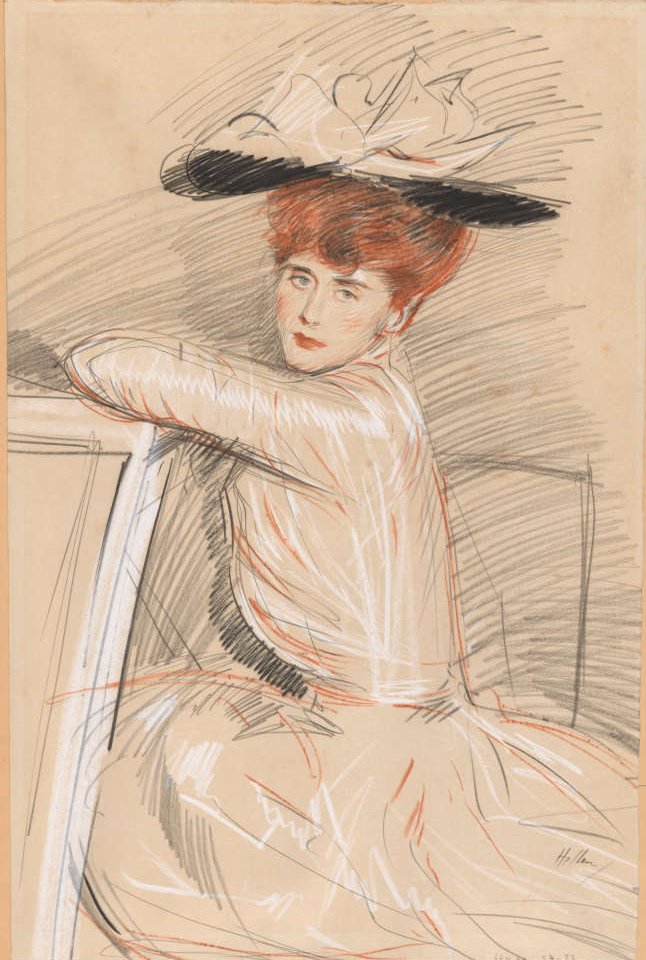
Portrait of Madame Helleu by Paul César Helleu.

Paul César Helleu and Alice Louis-Guérin married, two years after their first encounter, on July 29th, 1886, at Neuilly sur Seine.  She was two months away from her seventeenth birthday and Paul was twenty-six years old.  They went on to have four children, Hélène in 1887, Jean in 1894, Alice in 1896 and Paulette in 1904.
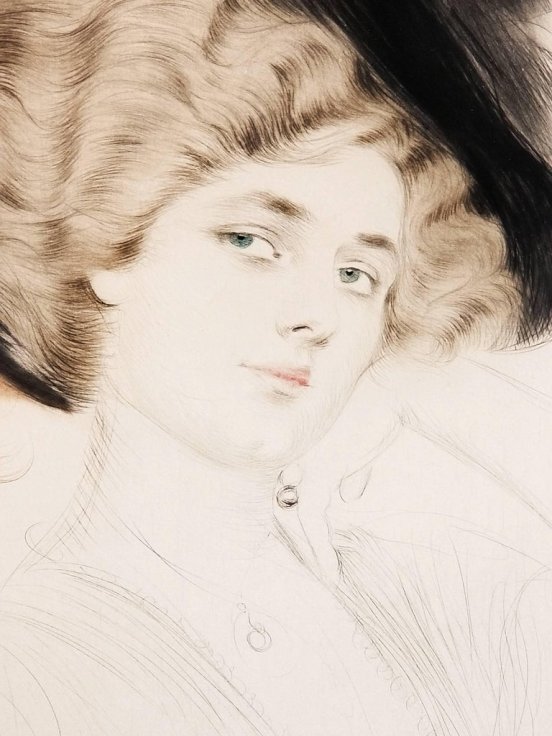
Details of Femme aux chapeau – Drypoint by Paul Helleu
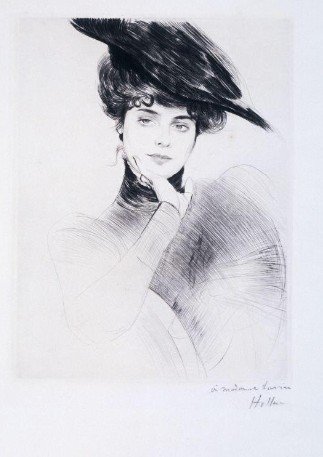
Drypoint Portrait of a Young Woman wearing a Hat by Paul César Helleu (c.1900)

It is believed that during a trip to London in 1885 Helleu once again met Whistler who introduced him to James Tissot a French society painter, illustrator, and caricaturist who was living in the English capital.  It was this established artist who taught Helleu the unique medium of etching.  Helleu became fascinated by drypoint etching.  Drypoint is a printing technique in which the printmaker scratches the lines on the printing plate with a sharp pointed tool. The printmaker holds the tool like a pencil and pushes the excess metal to either side of the furrow. It is this curl of rough metal, known as the ‘burr’, that gives the drypoint print its character. The ink is held in the burr as well as in the furrow and gives the edges of the printed line a soft, blurred quality. In Helleu’s work (above) the burr on the woman’s choker gives it a very velvety look.  Over the course of his career, Helleu produced more than 2,000 drypoint prints and he quickly mastered this technique, using the same flair with his stylus as he demonstrated with pastels.  It was the brilliance of his drypoint etchings that ensured Helleu’s place as one of the greats of the Belle Epoque, and he journeyed to Britain and America, and his artworks boosted his fame across both sides of the Atlantic.
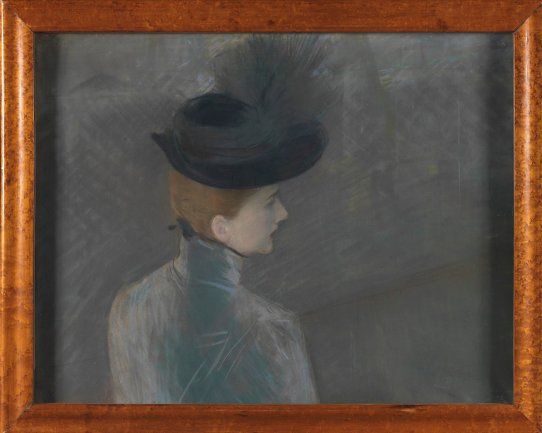
Alice au chapeau noir by Paul César Helleu

Helleu and his wife had made many friends in Paris including Countess Greffulhe, a French socialite, known as a renowned beauty and queen of the salons of the Faubourg Saint-Germain which allowed Helleu to successfully expand his career as a portrait artist to elegant women in the highest ranks of Paris society
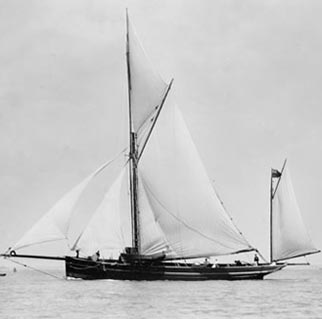
Paul Helleu’s yacht Étoile

Paul Helleu, wife Alice and baby daughter Paulette on L’Étoile (c.1904)

In 1904, Helleu was awarded the Légion d’honneur by the French president, Émile Loubet, and became one of the most celebrated artists of the Edwardian era in both Paris and London. He was an honorary member in important beaux-arts societies, including the Société Nationale des Beaux-Arts and the International Society of Painters, Sculptors, and Engravers, headed by Auguste Rodin. 
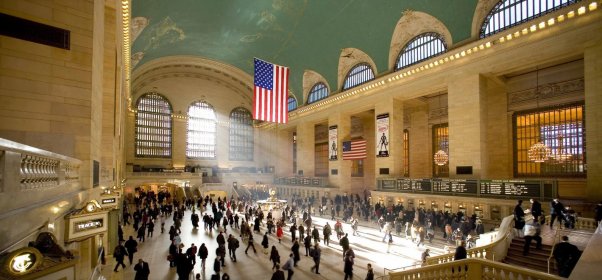
New York City’s Grand Central Terminal.

During his second trip to the United States in 1912, Helleu was awarded the commission to design the ceiling decoration in New York City’s Grand Central Terminal. Helleu decided on a mural of a blue-green night sky covered by the starry signs of the zodiac that cross the Milky Way.

Paul César Helleu (1859-1927)

Helleu made his last trip to New York in 1920 for an exhibition of his work, but he realized that the Belle Époque era was over. He sadly realised that he had lost touch with that vibrant era.   Shortly after his return to France, he destroyed nearly all of his copper plates.   While planning for a new exhibition with Jean-Louis Forain, a French Impressionist painter and printmaker, Helleu died of peritonitis following surgery in Paris, on March 23rd, 1927 at age 67.


Information needed for this blog came from Wikipedia and Facebook plus the following websites:

Brave Fine Art

Contessa Gallery

Stephen Ongpin Fine Art

John Singer Sargent Virtual Gallery

Sotheby’s

Jean-Jacques Henner

In my previous blog regarding the Dutch painter Thérèse Schwartze I mentioned that one of her early art tutors was Jean-Jacques Henner, the French painter famed for his portraiture.  Today I am going to focus on his life and his many artworks.

Jean-Jacques Henner

Henner was born on March 5th 1829 at the Alsatian town of Bernwiller.  Henner came from a family of Alsatian farmers who had settled in Bernwiller in the Haut-Rhin. He was the youngest of six siblings of George Guillaume Polycarpe Henner and Madeleine Henner (née Wadel).  He had two older sisters, Maria Anne and Madeleine and three older brothers, Séraphin, Grégoire and Ignace. He grew up in this farming community, but despite their modest financial situation, his parents sent him to the College of Altkirch where he studied drawing. His teacher was Charles Goutzwiller who noticed his rapid progress and encouraged him to move to Strasbourg and study at the studio of Gabriel-Christophe Guérin. His artistic studies continued when he enroled at the Ecole des Beaux-Arts in Paris as a pupil of Michel-Martin Drolling,  a neoclassic French painter noted especially as a history painter and portraitist. In 1851 he was tutored by another French artist, François-Édouard Picot, famed for his mythological, religious and historical paintings.   

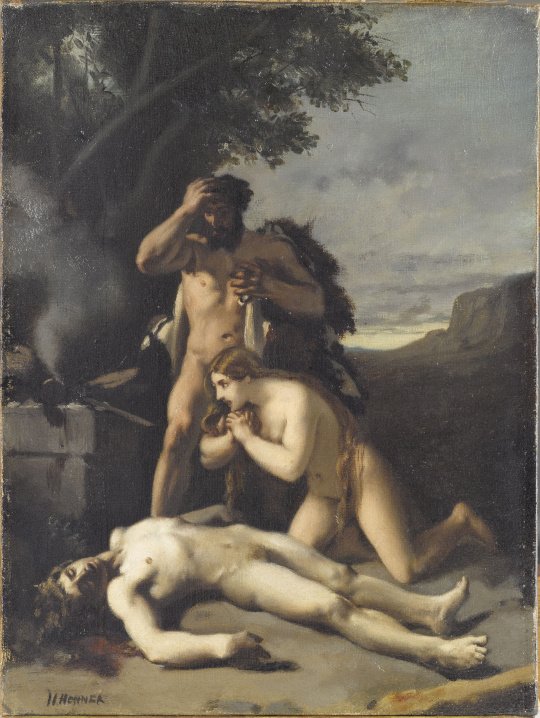
Adam and Eve find the Body of Abel by Jean-Jacques Henner (1858)

In 1848, he entered the École des Beaux Arts in Paris and in 1858 after two failed attempts he won the coveted Grand Prix de Rome award, which was a French scholarship for arts students.  His submission was his painting entitled Adam and Eve find the Body of Abel.  The prize for the winner was a bursary that allowed them to stay at the Villa Medici in Rome, for three to five years at the expense of the state. The painting can be seen at the Musée d’Orsay.

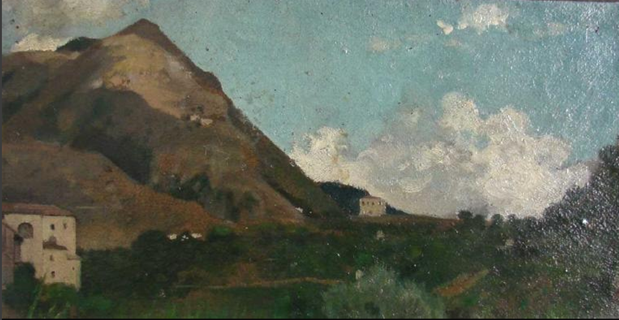
Mountains on the Outskirts of Rome by Jean-Jacques Henner (c.1861)

During his five-year stay in Rome, he was guided by Jean-Hippolyte Flandrin, a French Neoclassical painter.  Like many artists, Henner was captivated by Italy and spent many hours in museums reproducing the works of the painters that he respected. He also had plenty of time during his five-year stay to travel around the country, visiting Florence, Venice and Naples in which time he completed a number of small landscape paintings.  His works at that time showed his appreciation of past masters and it was Titian and Correggio who influenced him the most. In 1864 Henner returned to Paris and brought back copies of works by masters and a number of luminous landscapes.

Rome from the terrace of the Villa Medici by Jean-Jacques Henner (1860)

During those five years in Rome Henner painted this work at the Villa Medici where he stayed between 1859 and 1864. This is not simply a view of the Eternal City as observed from the villa. Once he had painted the garden, Henner then populated the terrace with groups of what he believed were “typical” characters, which he had often seen in real life and are simply identifiable by their clothes, monks, peasants, and elegant ladies. All are depicted in front of the classical panorama of the city, in which one can see the silhouette of Saint Peter’s Basilica in the background.

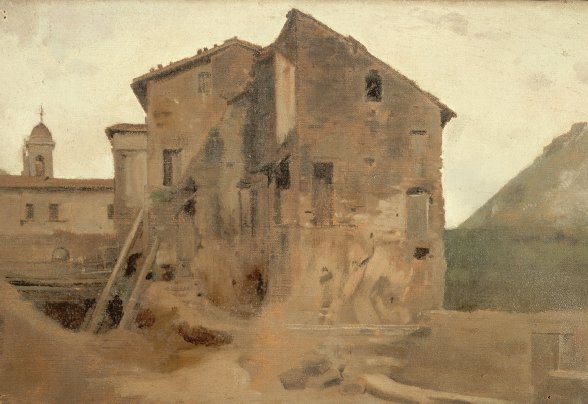
Masure dans la campagne de Rome (Dilapiated House in the Countryside of Rome) by Jean-Jacques Henner (c.1863)

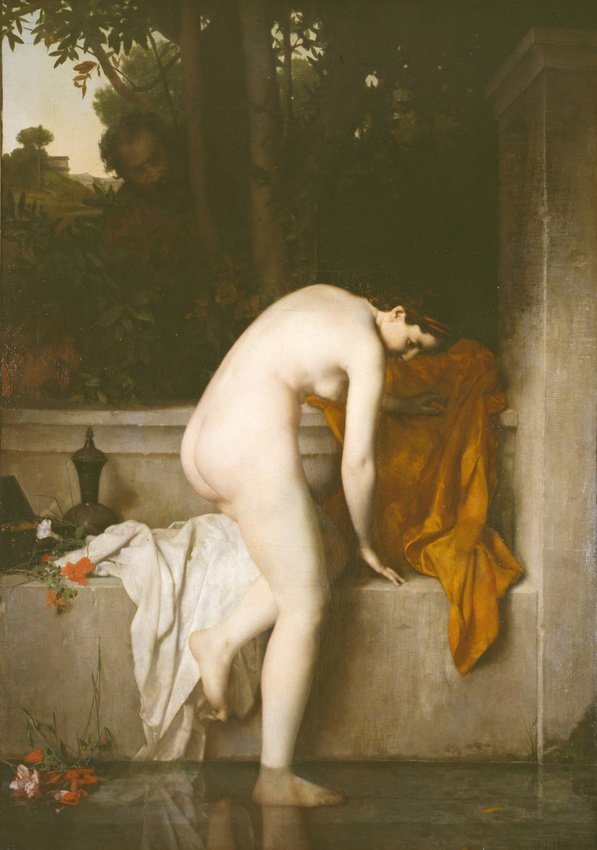
La Chaste Suzanne by Jean-Jacques Henner (1864)

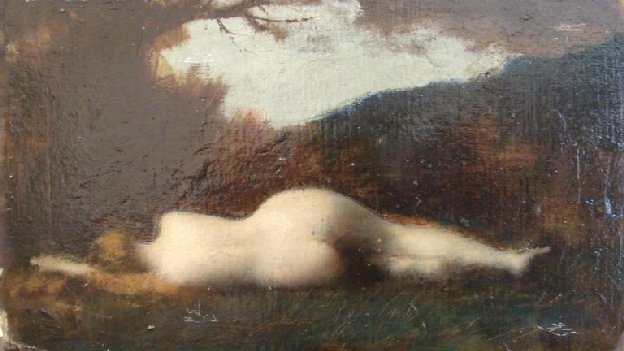
Henner had his painting Bather Asleep exhibited at the Salon in 1863 and at the following year’s Salon his painting La Chaste Suzanne was exhibited. The Biblical episode depicting Suzanne bathing was a popular one for painters and it was above all an opportunity for various artists to paint a beautiful nude. Jean-Jacques Henner sent back his version to the French Academy which he completed whilst in his last year of his residence at the Villa Medici in Rome. For Henner, this was a compulsory exercise, supposed to demonstrate the student’s progress and their skill in execution, and for the Academy to see if their prize winner was advancing artistically.

Sacred Love and Profane Love by Titian (1514)

Henner almost certainly took his inspiration from respected examples left by the great masters’ depiction of nudes which he had seen whilst in the Italian capital. It is thought that Henner was influenced Titian’s 1514 painting entitled Sacred Love and Profane Love which was at the Galleria Borghese in Rome. Henner’s work was not well-received and was harshly criticised for the heaviness and lack of graciousness in the model’s body. It was also criticised for the artificiality of the subject which although being put forward as a history/biblical painting offered little more than a depiction of a bather. However the propensity of ridding any narrative self-justification in painting the nude, and so giving it as a subject in itself, was becoming more common in the work of many contemporary artists, such as Courbet.

Séraphin Henner (brother) by Jean-Jacques Henner (c.1881)

Grégoir Henner (brother) by Jean-Jacques Henner (1889)

While a student in Paris Henner was particularly interested in portraiture, and during his frequent visits home to Alsace he would complete many portraits of his family as well as local dignitaries and scenes of Alsatian peasant life.

Eugénie and Jules Henner by Jean-Jacques Henner (c.1865)

Eugénie and Jules were two of the three children of his brother, Séraphin and his wife, Madeleine. Henner was very close to his nephew and niece and he paid for violin lessons for Jules and piano lessons for Eugenie when they were little. Henner had no children of his own, and on his death, he bequeathed them all that he possessed. Here, Eugénie and Jules are depicted together in their childhood.

Paul Henner by Jean-Jacques Henner (before 1867)

A rather sad portrait. Paul Henner was the third child of Séraphin and Madeleine Henner. He was born in 1860, but sadly died seven years later.

Byblis by Jean-Jacques Henner (c.1870)

In 1864 Henner returned to France and exhibited with great success at the Paris Salon between 1865 and 1903. During his early days back in France his works were of quasi-mythological subjects, such as his 1867 work entitled Byblis, which was exhibited at the 1867 Salon.

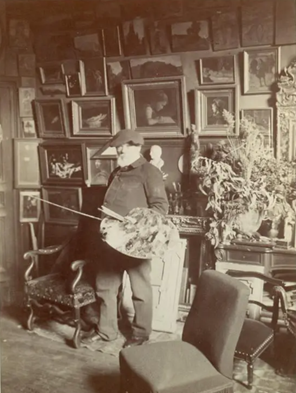
Jean-Jacques Henner in his Paris studio at 11 place Pigalle

Jean-Jacques Henner lived in rue La Bruyère and his studio was at 11 place Pigalle, where he lived from 1867.

L’Alsace. Elle Attend (Alsace, She Waits) by Jean-Jacques Henner (1871)

Jean-Jacques Henner’s birthplace was the region of Alsace and this north-east area of France borders Germany. With the defeat of France in the Franco-Prussian War in 1871, Alsace and northern Lorraine were annexed to the new German Empire. At the conclusion of the First World War, the defeat of Germany, and the Treaty of Versailles, Alsace once again came under French control. In 1940, during the Second World War Alsace–Lorraine was occupied by Germany during the Second World War. Although it was never formally annexed, Alsace–Lorraine was incorporated into the Greater German Reich. With the defeat of Germany in 1945 Alsace returned to French rule. Henner’s 1871 painting entitled L’Alsace. Elle Attend had political overtones. It depicts a young Alsatian woman in mourning and is a political comment on the German annexation of the province after the Franco-Prussian War. The patriotic image was very popular and achieved a wide circulation when it was engraved by Léopold Flameng.
L’Alsace. Elle Attend meaning Alsace, she awaits, was commissioned on the initiative of Eugénie Kestner, a member of the Thann industrial family from Alsace. On completion it was given Léon Gambetta, a French lawyer and republican politician, who was one of the fiercest opponents of the relinquishment of the Alsace-Lorraine region to the new German Empire following the war of 1870. Following the defeat of France by the Prussian armies a sense of fervent and heightened patriotism followed. Henner’s painting quickly became looked upon as a symbol of Alsace’s suffering, a pain shared by the painter who was very attached to the region of his birth. The painting depicts a young Alsatian woman in mourning, unassuming but gracious.

Donna sul divano nero (Woman on Black Divan) by Jean-Jacques Henner (1869)

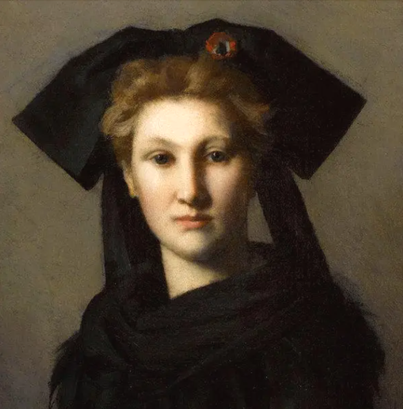
At that time, Henner had assumed a naturalistic style which can be seen in his painting entitled Woman on a Black Divan, which was exhibited at the Salon of 1869 and now is housed at the Mulhouse, Musée des Beaux-Arts. A smaller version of this painting also included a rosette in the red, white and blue colours of France, pinned onto the traditional black Alsatian bow, gives the painting its patriotic significance without being pompous or anecdotal.

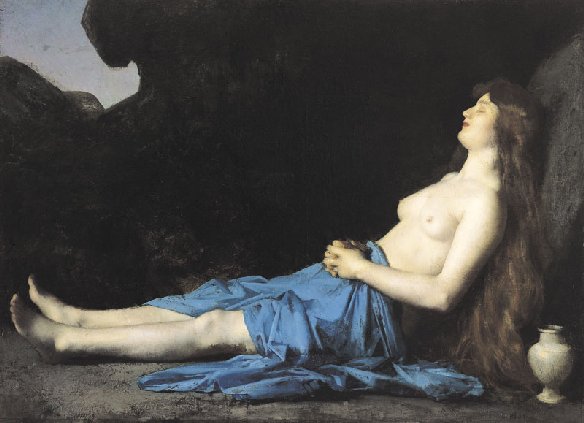
Magdalene in the Desert by Jean-Jacques Henner (1874)

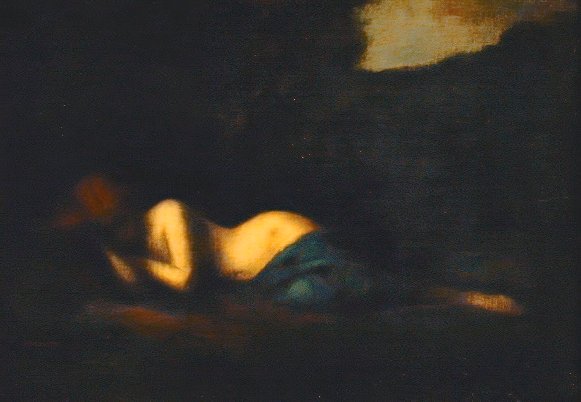
After 1870 Henner’s entire work became a deliberation on the theme of death in various appearances. There were the depictions of Mary Magdalene in what became known as the Magdalene Series, such as Magdalene in the Desert, which was exhibited at the 1874 Salon, and Magdalene Weeping, which he completed in 1885.

Die Magadalena by Jean-Jacques Henner (Exhibited at the 1878 Salon)

La Magdaleine by Jean-Jacques Henner

Henner complted many more Magdalene paintings.

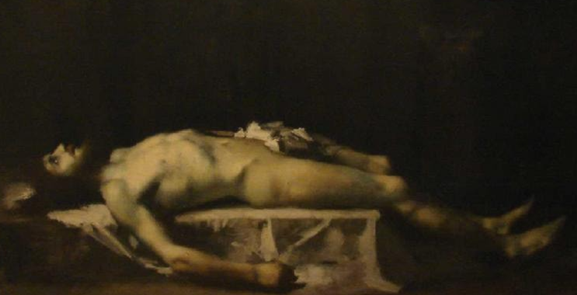
The Dead Christ by Jean-Jacques Henner (c.1884)

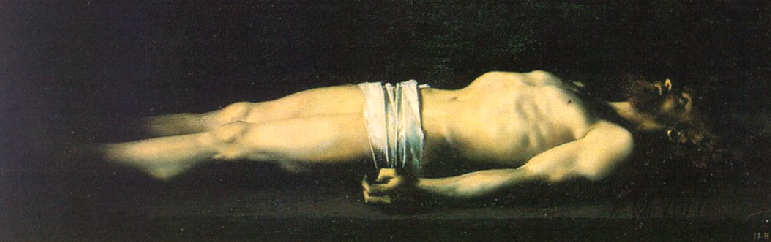
Jesus at the Tomb by Jean-Jacques Henner (c.1879)

There was also a number of works in Henner’s Dead Christ series with paintings such as Jesus at the Tomb, which was exhibited at the 1879 Salon and is now part of the Musée d’Orsay collection and the painting entitled Dead Christ which was exhibited at the 1884 Salon and now hangs at the Musée Beaux-Arts in Lille.

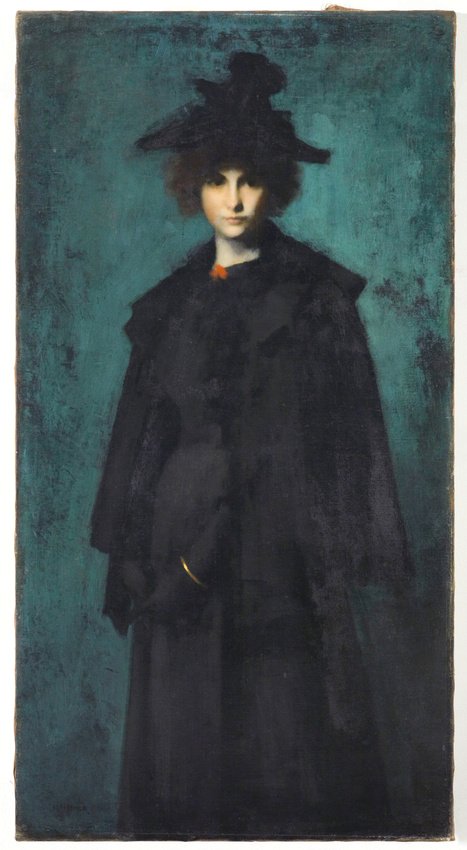
Portrait of Madame Laura Leroux by Jean-Jacques Henner

Jean-Jacques Henner will best be remembered for his portraiture which would provide him with financial stability. During his lifetime he completed many portraits of his family and famous people like his Portrait of Madame Laura Leroux. Laura Leroux-Revault was a French artist and painter. Her first teacher was her father, the painter Louis Hector Leroux and she later trained at the Académie Julian art school in Paris. She also trained under Jules Lefebvre and in Jean-Jacques Henner’s studio. The two artists were friends of her father.

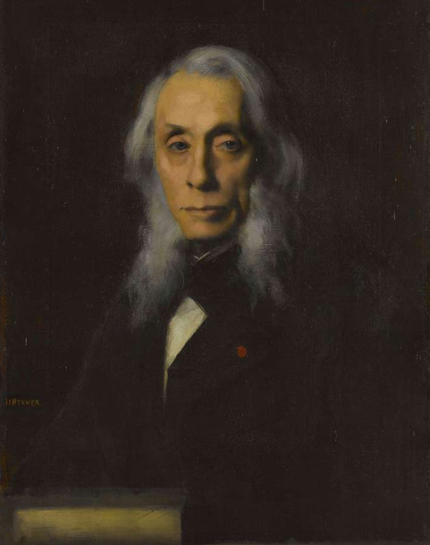
Portrait of Jean-Gaspard-Félix Laché Ravaisson-Mollien by Jean-Jacques Henner (1889)

Another famous person to be immortalised by Henner was Jean-Gaspard-Félix Laché Ravaisson-Mollien, a French philosopher, said to be France’s most influential philosopher in the second half of the nineteenth century.

The Reader by Jean-Jacques Henner

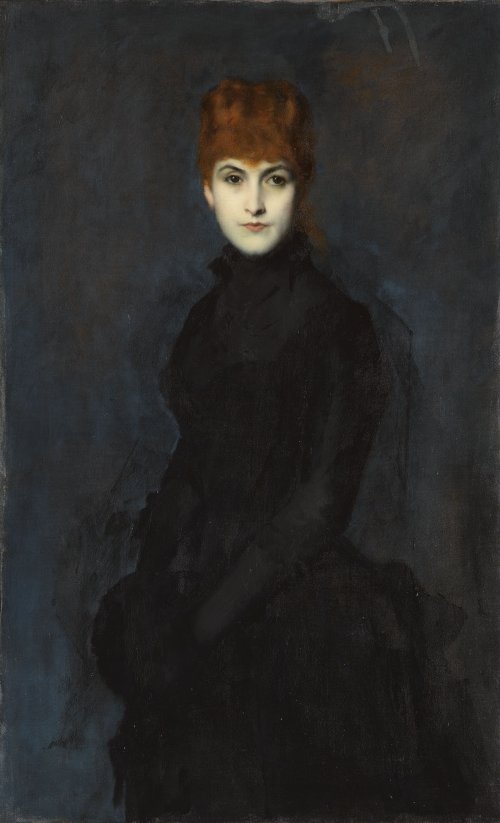
La comtesse Kessler by Jean-Jacques Henner (c.1886)

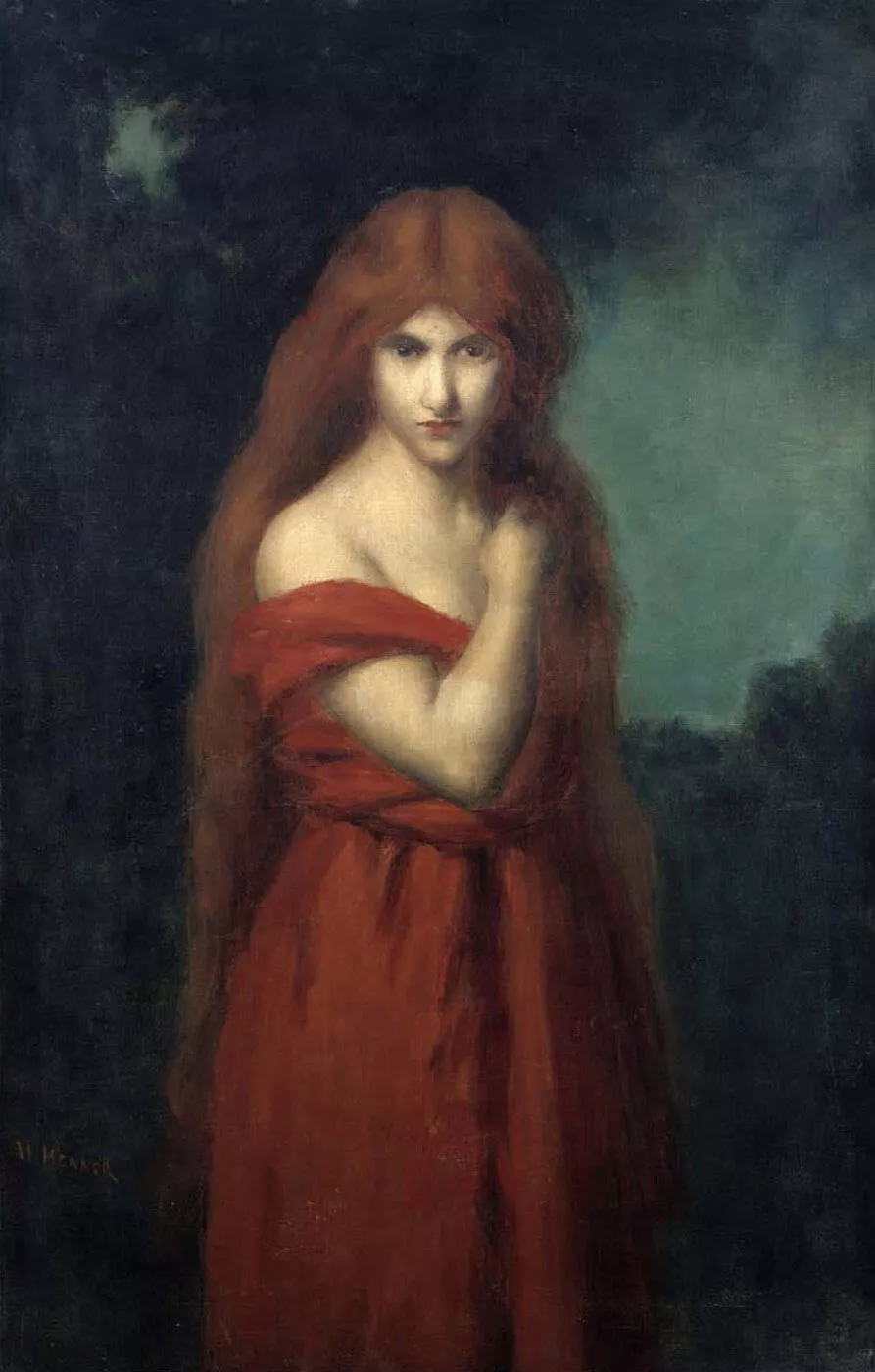
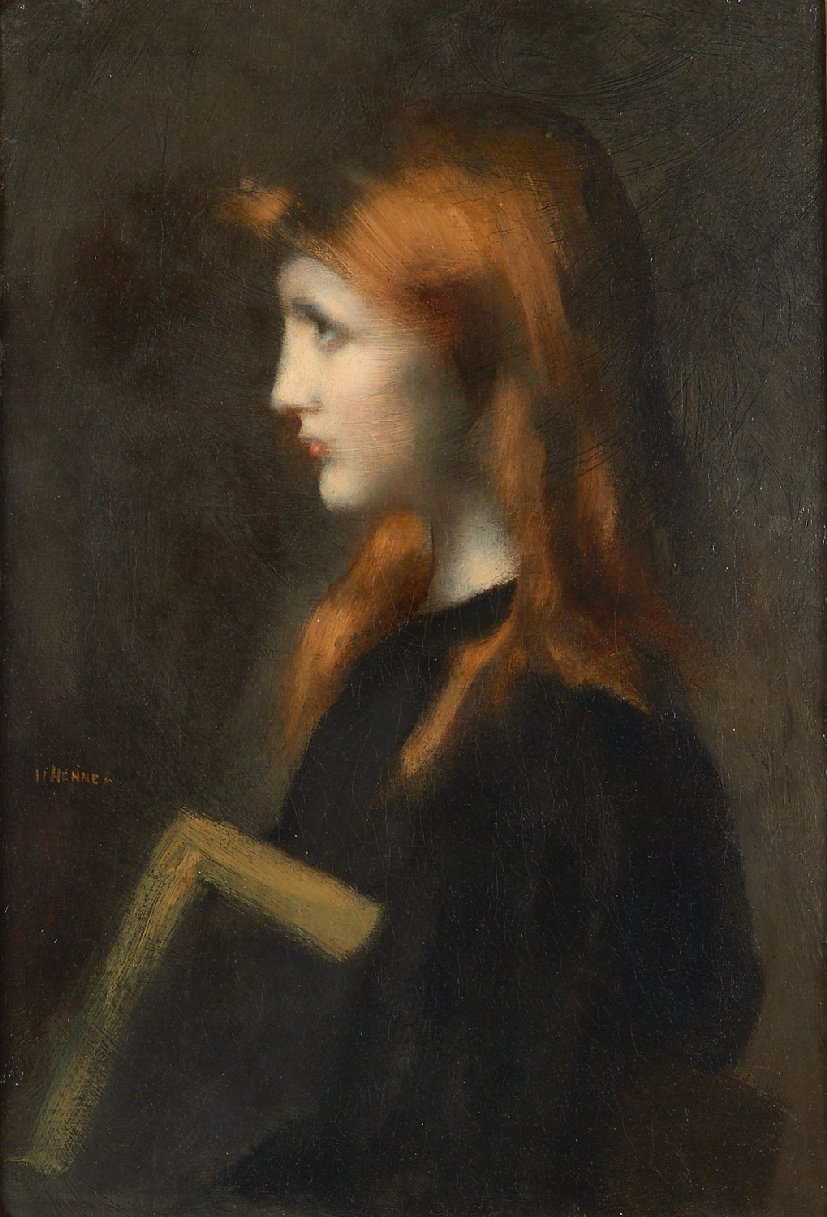
Henner’s love of portraying nudes in historical or mythological settings was not his only love. He had a passion for the colour red and of portraying women with red hair !

Woman in Red by Jean-Jacques Henner

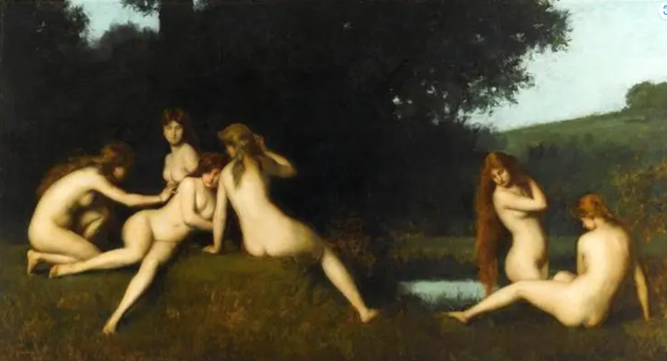
Les Naïades by Jean-Jacques Henner (1861). Painted for the Soyers’ dining room, 43 rue de Fauborg Saint-Honoré. Paris.

Alsatian Girl by Jean-Jacques Henner

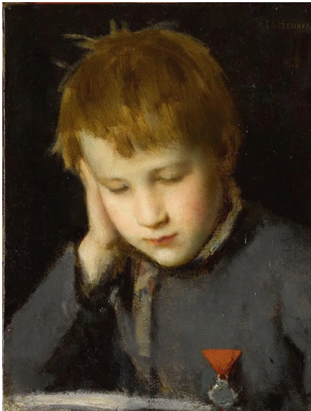
L’Ecoliere by Jean-Jacques Henner

Over the years Henner tutored many aspiring painters. Between 1874 and 1889 he taught at what was termed “the studio of the ladies”, which he organized with Carolus-Duran, during the time when women were not allowed entry to the École des Beaux-Arts. Some of these students also served as his models such as Dorothy Tennant, Suzanne Valadon and Laura Leroux-Revault, daughter of his close friend Hector Leroux; Henner’s full-length portrait of Laura Leroux (shown earlier) is now at the Musée d’Orsay having been shown at the Paris Salon of 1898 and purchased by the French State.

Jean-Jacques Henner (Photograph by Nadar c.1900)

Jean-Jacques Henner died in Paris on July 23rd 1905 aged 76.

Thérèse Schwartze

Thérèse Schwartze – self portrait (1917)

Therese Schwartze was a Dutch 20th century painter.  Such was a hugely talented portrait artist that was one of only a few females who had been honoured by receiving an invitation to contribute her self-portrait to the hall of painters at the Uffizi Gallery in Florence.  This genius of portraiture completed around a thousand works during her forty-year career, which means that she completed more than twenty paintings a year. Because many of her portraits were created to be treasured by family members, most of her work has remained in private collections.  About one hundred and fifteen of her paintings are in public collections in the Netherlands, and twelve are part of foreign public collections, which leaves the locations of nearly four hundred paintings still unknown. She became a millionaire in the process. Schwartze also established an international reputation, with countless exhibitions and commissions throughout Europe and the United States. 

Self Portrait by Johan Georg Schwartze

Thérèse was born on December 20th 1852 in Amsterdam.  She was the daughter of Johan Georg Schwartze and Maria Elisabeth Therese Herrmann.  She was one of five children and had four sisters including Georgine, a sculptor, Clara Theresia, a painter and one brother, George Washington Schwartze, also a painter. 

Portrait of Thérèse aged 16 by her father, Johan Georg Schwartze (1869)

Her father was a well-respected portrait painter and it was he who provided Thérèse with her first artistic training.   In 1869 her father completed a portrait of his daughter, Thérèse.

Three girls of the orphanage in Amsterdam by Thérèse Schwartze (1885)

At that time, there was the perception that teaching girls and young ladies to paint was seen simply as a part of a cultured upbringing rather than a profession for earning money which was viewed as the role of the man. But for Johann Schwartze he couldn’t care less about such conventions. He trained his daughter in painting and drawing from a very young age and intended that Thérèse would become his worthy successor. She started her professional career at the age of sixteen, working in her father’s studio which she eventually took over when she was twenty-one after his death in 1874. Schwartze wrote to her father in a birthday letter, writing:

“…I will apply myself more to everything, so as, with God’s blessing, to be able to earn my living by painting…”

Because the art academies were not yet open to girls, her father sent her to Munich for expensive private lessons for a year under Gabriel Max and Franz von Lenbach who was regarded as the leading German portraitist of his era. In 1879 she moved to Paris and continued her artistic studies under Jean-Jacques Henner, the Alsace-born portrait artist.

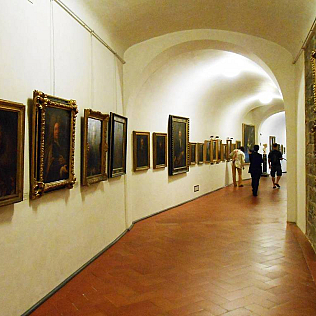
The Vasari Corridor at the Uffizi Gallery, Florence

Thérèse Schwartze’s portraits are truly remarkable and she was one of the few women painters, who had been honoured by an invitation to contribute her self-portrait to the Hall of Painters, the Vasari Corridor, at the Uffizi Gallery in Florence. The Uffizi collection is one of the most complete in all Europe, first started by Cardinal Leopoldo de’ Medici in the 17th century.  The passageway was designed and built in 1564 by Giorgio Vasari to allow Cosimo de’ Medici and other Florentine elite to walk safely through the city, from the seat of power in Palazzo Vecchio to their private residence, Palazzo Pitti.   The passageway used to contain over a thousand paintings, dating from the 17th and 18th centuries, including the largest and very important collection of self-portraits by some of the most famous masters of painting from the 16th to the 20th century, including Filippo Lippi, Rembrandt, Velazquez, Delacroix and Ensor.   While the Medici family bought the first paintings, after the collection started, the family started receiving the paintings as donations from the painters themselves. This has continued over the centuries and there were more paintings in the collection that did not have space to be exposed.  Things have now changed as from 1973 to 2016, some of the self-portraits which had been hung in the Vasari Corridor, were, however only visible during restricted and occasional visits because of the confined space, which, also lacked air conditioning and adequate lighting.  Most of the self portraits have been moved to other rooms at the Uffizi.

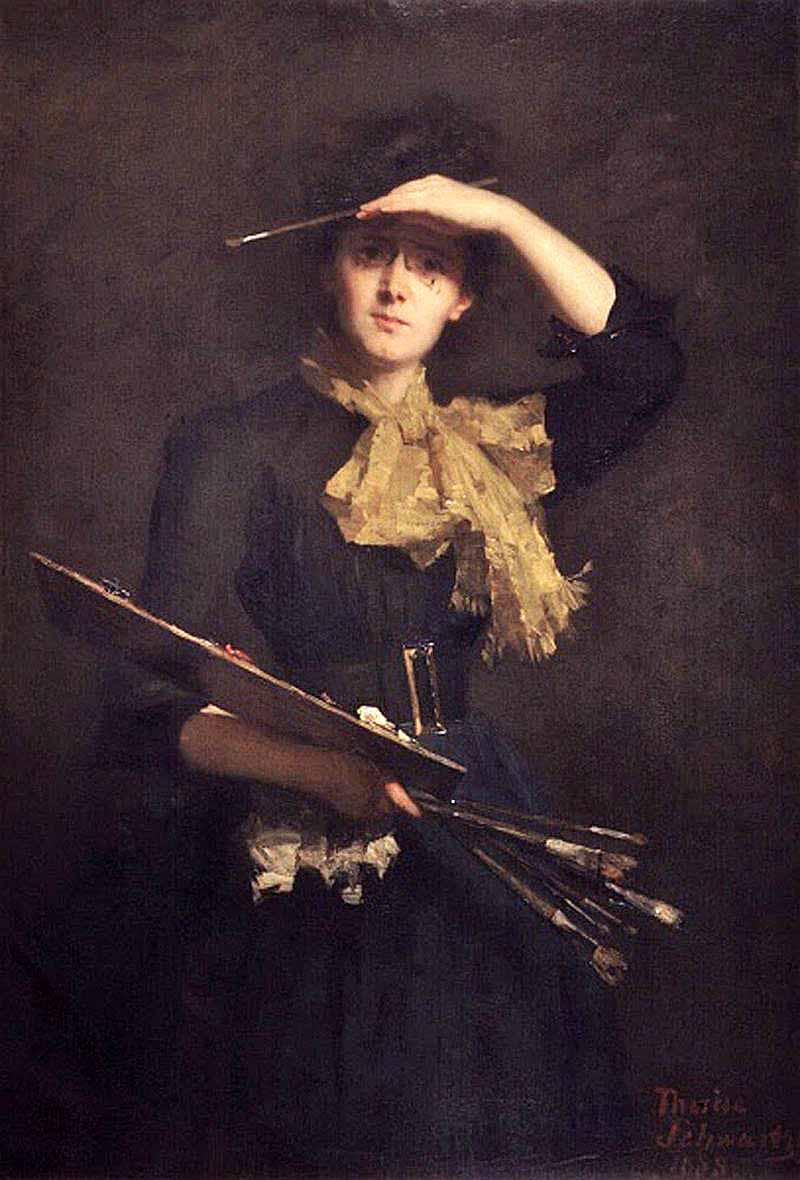
Self-portrait with Palette by Thérèse Scwartze (1888)

Only a handful of female portrait painters were active professionally in the 19th century, one of whom was Schwartze, who was nicknamed the ‘Queen of Dutch Painting’.  In the self portrait she contributed to the Uffizi entitled Self-portrait with Palette, she depicts herself staring out at us with a haunted look, paintbrush in one hand with the other looped through a paint-laden palette. The background of this canvas is bare, and our eyes are drawn to the painter’s tools: eyes, brush, pigments, and a rag at the ready. The painting was exhibited at the 1888 Paris Salon before being given to the Uffizi gallery in Florence.
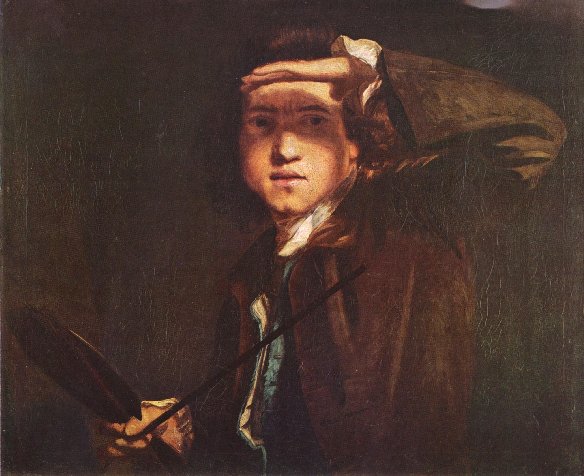
Sir Joshua Reynolds self portrait (c.1748)

Thérèse’s depiction of herself in her self-portrait could well have been inspired by Sir Joshua Reynold’s self-portrait which shows him similarly with his hand raised shielding his eyes from the bright light.

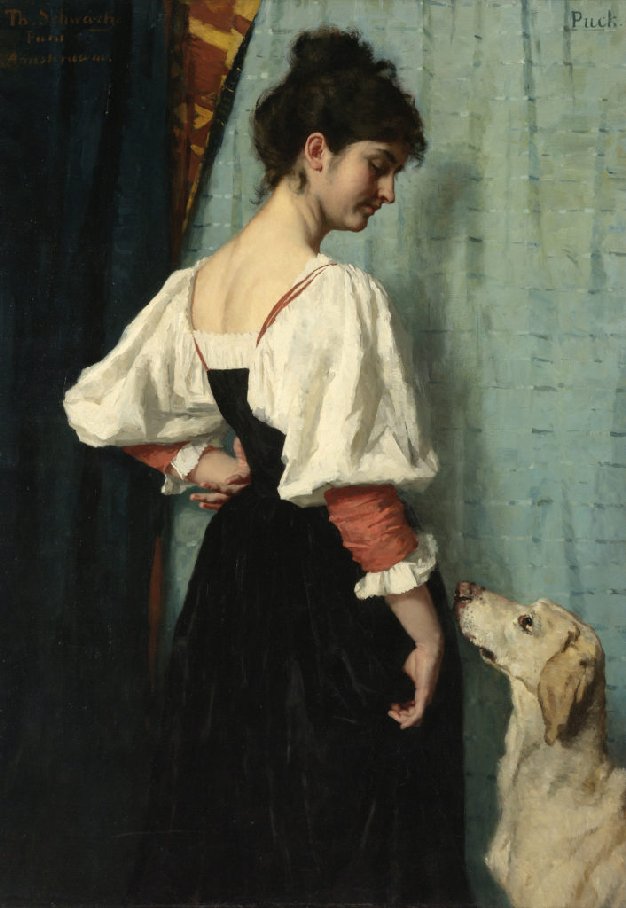
Young Italian Woman, with ‘Puck’ the Dog by Thérèse Schwartze, c. 1885)

Whilst living and studying in Paris, Thérèse completed her painting, Young Italian Woman, with ‘Puck’ the Dog.  The model she used for this painting was known as Fortunata.  She was one of the many professional Italian models working in Paris in the late 19th century. Schwartze started this painting in 1884 and exhibited it a year later in Amsterdam, having added the dog in the meanwhile.

According the 2021 biography by Cora Hollema and Pieternel Kouwenhoven entitled Thérèse Schwartze: painting for a living. Thérèse’s career took off at a time when a new, wealthy Dutch class wanted to flaunt its status and what better way to achieve this than with a flattering portrait. Her biographer wrote:

“She was in demand because she produced a new elegant, un-Dutch, extravagant, flattering style of portraiture which was in demand by the upcoming ‘new money…….. The new entrepreneurs and industrialists in the second half of the 19th century…”

Portrait of Aleida Gijsberta van Ogtrop-Hanlo with her five children by Thérèse Schwartze (1906).

Schwartze was one of the leading society painters in the Netherlands around 1900. Her clientele came from the nobility and the bourgeois elite in Amsterdam and The Hague. Members of the royal family also sat for her.   A good example of her excellent portraiture is her 1906 group portrait of Aleida Gijsberta van Ogtrop-Hanlo with her five children.  In this work, Aleida van Ogtrop-Hanlo is surrounded by, from left to right: Adriënne (Zus), Pieter (Piet), Maria (Misel), Eugènie (Toetie) and Adèle (Kees). The youngest and sixth child, Joanna (Jennie) was not yet born.  Her husband was a wealthy stockbroker and founder of Amsterdam Royal Concertgebouw. The portrait of his wife and children has a dreamy quality, with rich clothing and poetic colours. It gives an excellent impression of the self-image of the Dutch upper classes at the beginning of the twentieth century.  Stylistically Thérèse Schwartze followed in the footsteps of the famous eighteenth-century English portrait painter, Thomas Gainsborough. 

 Portrait of the six Boissevain daughters by Thérèse Schwartze (1916)

An equally great group portrait by Thérèse Schwartze was her Boissevinfamily portrait but this a more decorous depiction.  It is entitled Portrait of the Six Boissevain Daughters and she completed it in 1916. According to Schwartze’s biography by art historian, Cora Hollema, this difference in style was not due to a development of the artist, but more to do with the wishes of her client. Mr. & Mrs. Boissevain, who were wealthy members of the Amsterdam upper class had ten children, six daughters and four sons. They were aware of the portrait of Aleida and her children by Thérèse but believed it to be far too modern.   So, when they commissioned Thérèse to paint the portrait in 1916 they asked her to produce a more time-honoured portrait of their daughters. Thérèse was now the breadwinner of the family and so sensibly adapted her style according to her client’s demands bearing in mind the adage: The client was king.

Thérèse Schwartze in her studio, Prinsengracht 1021, Amsterdam, 1903.

Thérèse’s great success as an artist became a point of reference for the young Dutch women painters who founded the Amsterdamse Joffers, a group of women artists who met weekly in Amsterdam at the end of the 19th and beginning of the 20th century. These “ladies of Amsterdam” met weekly, often at the Schwartze home, to update the glorious Dutch tradition of painting based on French Impressionist innovations.  They supported each other in their professional careers. Most of them were students of the Rijksakademie van beeldende kunsten and belonged to the movement of the Amsterdam Impressionists.

Woman wearing a hat (Portrait of Theresia Ansingh (Sorella)), by Thérèse Schwartze (after 1906).

Besides Schwartze’s commissioned portraits, which made her very wealthy, she still had time to complete portraits of her friends and relatives which were not commissioned and were often given as gifts.  A fine example in this regard is the portrait of Schwartze’s niece, Theresia Ansingh, who later became a member of the Amsterdam school of female painters known as The Joffers, many of them were inspired by Schwartze’s professional success. 

Maria Catharina Ursula (Mia) Cuypers by Thérèse Schwartze (1886)

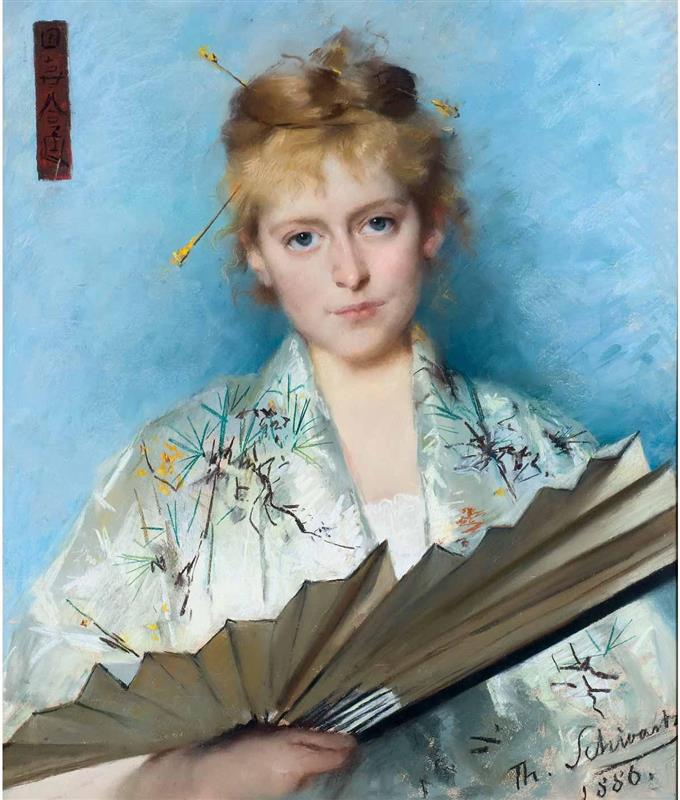
One of my favourite portraits by Schwartze was her fascinating portrait of one of her friends, which is an amalgam of formal and informal portraiture and is entitled Portrait of Mia Cuypers.  She was a daughter of the architect Pierre Cuypers, who designed such famous buildings as the Rijksmuseum and Amsterdam’s Central Station. In 1883, she fell in love, to the dismay of her family and the astonishment of “high society,” with the Chinese-British merchant Frederick Taen-Err Toung from Berlin, who was in Amsterdam selling his Oriental merchandise at the International Colonial Exposition. Mia managed to overcome the social uproar and married Toung in 1886.  Being a close acquaintance of the Cuypers family, Thérèse was commissioned by the groom-to-be to make this wedding portrait, which is said to have only taken her one and a half days to complete.  There are Chinese characters in the upper left corner, which are not clear in my attached photo, which mean “rice field,” “longevity”/”delighted,” and “coming together.”

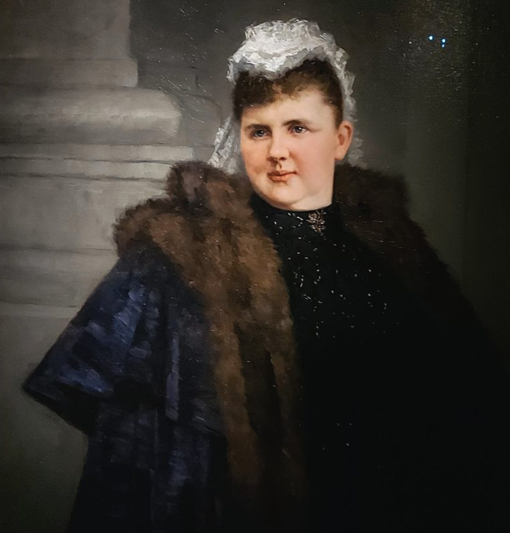
Portrait of Queen Emma by Thérèsa Schwartze (ca. 1881)

Soon after, she received a commission for a portrait of Queen Emma and the little princess Wilhelmina, who was born in 1880. In the single portrait of the young queen, she is dressed in dark colours against a neutral background, all is dark except her face. In this painting, one can already see the fine art of portraiture and the depicting of differing textures that Thérèse fully mastered. The fur stole, the lace cap on her head, as well as the brocade of the queen’s robe.

Portrait of Princess Juliana by Thérèsa Schwartze (1910)

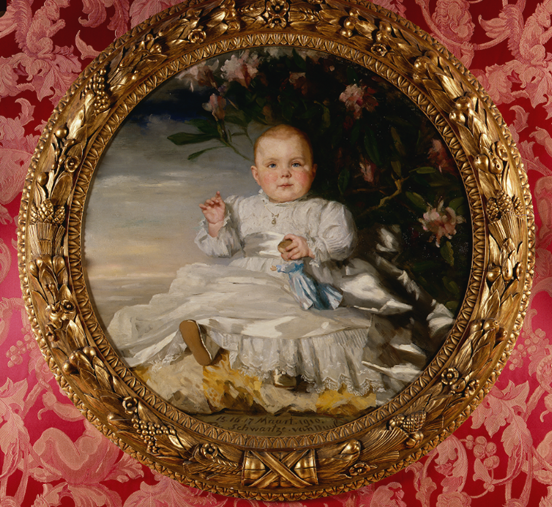
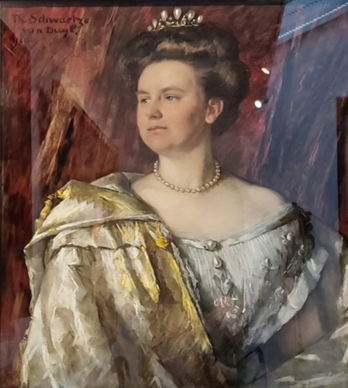
Thérèse’s worked with the royal family of the Netherlands through a period of thirty-five years and in all they gave her six commissions that contributed greatly towards her fame and wealth. Most royal portraits were of Queen Wilhelmina.

Portrait of Queen Wilhelmina by Thérèse Schwartze (1910)

The royal court had a habit of paying a little more than the average client, which meant that 1910 was a particularly profitable year for Thérèse.  She painted so many members of the royal family that she was almost deemed a member of their household.

Portrait of Anton van Duyl by Thérèse Schwartze

In 1906, Thérèse Schwartze married the editor-in-chief of the Algemeen Handelsblad, Anton van Duyl. Twelve years after they married, Thérèse’s husband died on July 22nd 1918.  It was double blow for Thérèse as she herself had been very ill at the time and five months later, on December 23rd 1918, three days after her sixty-seventh birthday, she died in Amsterdam.  

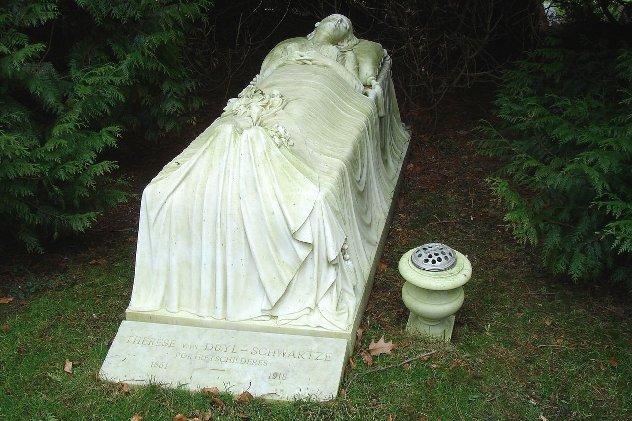
Grave of Thérèse Schwartze at the Nieuwe Ooster cemetery, Amsterdam.

She was buried at Zorgvlied cemetery in Amsterdam but was later reburied at the Nieuwe Ooster cemetery in Amsterdam, where her sister created a memorial to her, modelled after her death mask, which is now a rijksmonument.

Cornelius Johnson

Portraiture is an art form which goes back to ancient times and before the advent of photography it was the only way to chronicle the appearance of someone.  However the way the sitter was portrayed by the artist afforded them the illusion of power, importance, virtue, beauty, wealth, taste, learning or other qualities of the sitter. Often it was the artist’s “duty” to depict the sitter in a flattering way, although some portraitists, like William Hogarth, refused to flatter, and would often have their works rejected by the person who had commissioned the portrait.   The artist I am featuring in today’s blog was one of the leading portrait artists of the seventeenth century. He painted everything from miniatures to small scale royal portraits, portraying aristocracy, lawyers, gentry and merchants

Cornelius Johnson or Cornelis Janssens van Ceulen (Cologne) was born in October 1593 in London to a Flemish/German protestant family . He was baptised at the London Dutch Reform Church at Austin Friars much used by the Netherlandish community in London.  His father was Cornelius Johnson who had been a religious refugee from Antwerp and his paternal grandfather had come from Cologne.  His mother was Johanna le Grand.  It was thought that Cornelius could have received his first artistic training, whilst in the Netherlands, from Michiel Jansz. van Mierevelt.  It is known that Cornelius had definitely returned to England by 1619 for it is recorded that he was a witness at the baptism of his nephew, Theodore Russell.  During the 1620’s he lived and had his studio in the London parish of St Ann, Blackfriars, as did the other leading portraiture artist, Anthony van Dyck and the English father and son miniaturists, Isaac and Peter Oliver. 

Portrait of a Woman, Traditionally Identified as the Countess of Arundel  by Cornelius Johnson (1619)

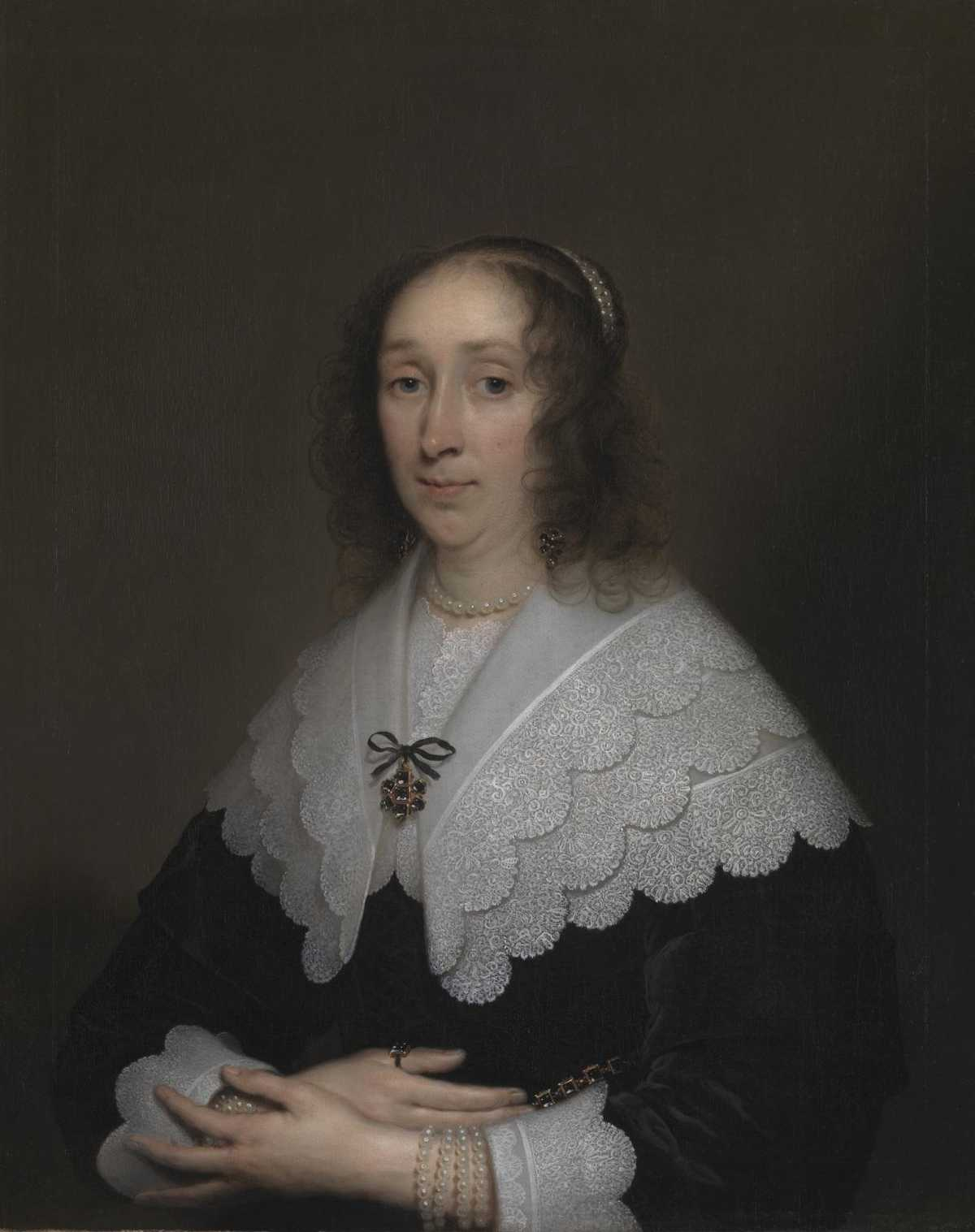
His earliest paintings date from 1619 and soon he had created a large number of portraits with his sitters coming from various upper levels of society.  One of his early works was a portrait of Alathea Talbot, Countess of Arundel, a famous patron and art collector, and one of England’s first published female scientists.  She was the third daughter of George Talbot, 7th Earl of Shrewsbury, K.G. and his step-sister Mary, daughter of Sir William Cavendish, who married in 1606 Thomas Howard, Earl of Arundel. Johnson has depicted the countess wearing a red dress trimmed with lace with a white lace collar and a gold earring with a blackbird pendant in her right ear.

On July 16th 1622 at the Dutch Church in London, Cornelius married Elizabeth Beke, a lady from a migrant family based in Colchester.  Their first son, James, was born on September 30th 1623 but died young.  Another son, Cornelius Junior, was born in London in August 1634 and went on to follow in his father’s footsteps, and become a painter.

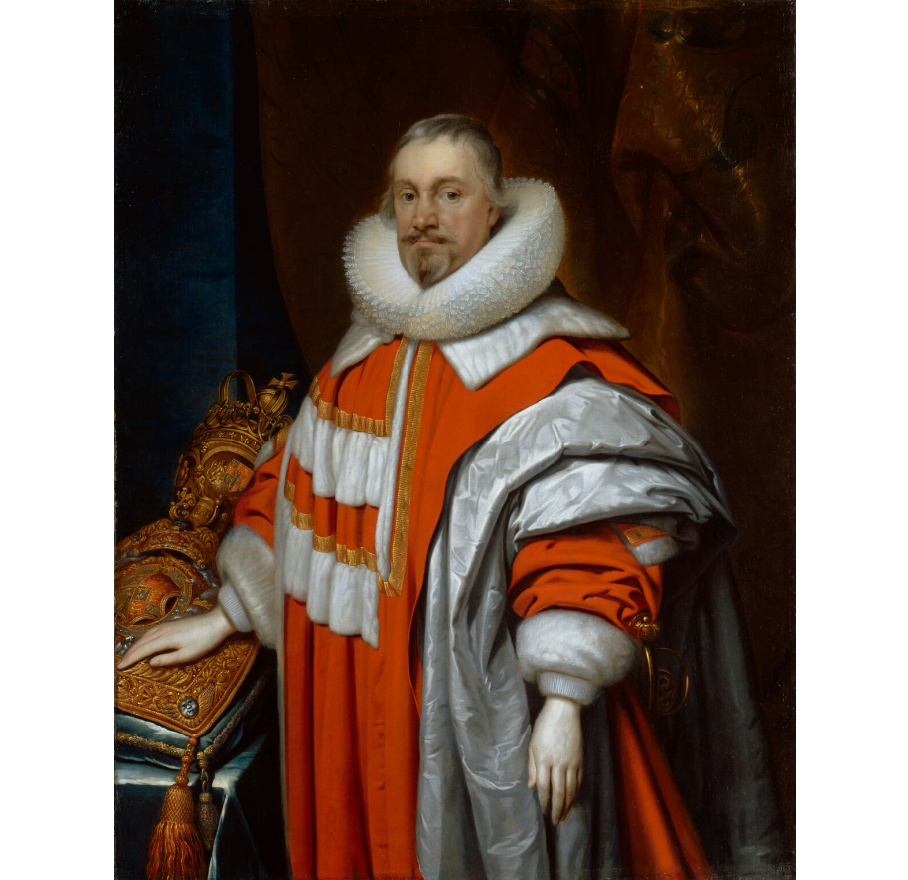
Thomas Coventry, 1st Baron Coventry by Cornelius Johnson ( 1639)

During the 1620’s his fame as an artist soon spread.  Johnson’s most constant client was a lawyer, Thomas, 1st Baron Coventry of Aylesborough, a prominent English lawyer, politician and judge.  He sat for Johnson on at least five different occasions during the 1620s and 1630s. This portrait, shows him with the bag of the Lord Keeper of the Great Seal, and the mace of the Speaker.

John Finch, Lord Finch of Fordwich, formerly known as Sir Nicholas Hyde by Cornelius Johnson

Cornelius Johnson painted the portraits of many senior legal figures including Sir John Finch. Finch was Speaker between 1628–1629. On 10 March 1629, as Speaker, he tried to adjourn the House of Commons on the King’s command, following a disagreement between the King and Members of Parliament over King Charles I’s belief that by the royal prerogative he could govern without the advice and consent of Parliament. Civil War was creeping ever closer.

Lady Margaret Hungerford by Cornelius Johnson (1631)

Another dignitary to sit for Johnson was Lady Margaret Hungerford, the daughter of a wealthy London alderman who had married Sir Edward Hungerford in 1621.  Her husband owned vast tracts of land in England and were spent much of their time at Corsham House in Wiltshire and Farleigh Hungerford Castle in Somerset.  We see the sitter wearing an orange patterned dress with a large white lace collar, a gold-and-black jewel necklace and an orange flower in her hair. In the top right-hand corner of the picture, there is a coat of arms. It is a sumptuous depiction of the details of the costly lace, her embroidered and spangled dress and silver braided ribbons, topped off with expensive jewellery. It must have taken Johnson many hours to perfect the depiction.

Charles I by Cornelius Johnson after Daniel Mytens (1632)

Cornelius Johnson collaborated with Daniel Mytens, a Dutch Golden Age portrait painter, in a full-length portrait of the monarch, Charles I, in 1631.  Mytens had moved from the Netherlands to London in 1618 and had become one of James I and Charles I’s court painters. In the background is a view of Windsor Castle and at the king’s feet is his trusty King Charles spaniel.

Charles I by Anthony van Dyke (1634)

In 1632 Johnson was appointed one of King Charles I’s court painters.  The appointment was termed

“…his Majesty’s servant in ye quality of Picture Drawer to his Majesty…”

Around 1634 Daniel Mytens returned to the Netherlands where he worked and continued to paint but also was an art dealer in The Hague.  This you may think gave Johnson the advantage as being the lead court painter but it was not to be as another artist came on to the scene.  Of all the Stuart kings, Charles I was the most passionate collector of art as he viewed paintings as a way of endorsing the lofty view of the monarchy.  Antwerp-born, Anthony van Dyke arrived in England in April 1632.  It was not van Dyke’s first time in London as he had spent six months there at the end of 1620 before heading off to Italy.  Although he was travelling around Italy Van Dyck remained constantly in touch with the courts of James I and Charles I’s and whilst travelling around Italy he helped King Charles’s agents in their search for paintings. He also sent to England some of his own works.  In April 1632 van Dyck returned to London and immediately became a court favourite as well as being welcomed by king Charles who knighted him in July and set out that van Dyke should receive a pension of £200 a year  The wording of the grant document referred to Van Dyke as principalle Paynter in ordinary to their majesties.  He was provided with a house on the River Thames at Blackfriars, then just outside the City of London, thus avoiding the monopoly of the Worshipful Company of Painter-Stainers.  Van Dyke’s Blackfriars studio was frequently visited by the King and Queen and later a special causeway was built to ease their access from the river. Charles rarely sat for another painter while van Dyck lived.

The artistic trajectory of Cornelius Johnson was stalled.

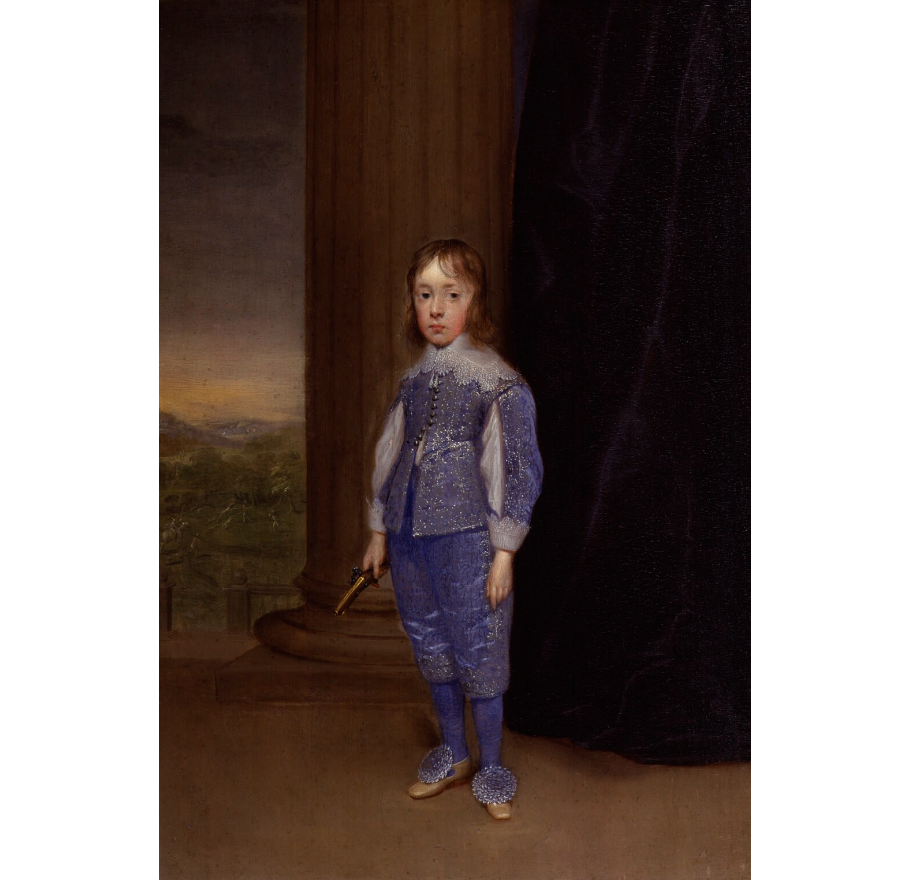
Charles II as a Boy by Cornelius Johnson (1639)

In 1639 Johnson received a royal commission to paint the three young children of Charles I and his French princess wife Henrietta Maria.  First was a portrait of Charles’ eldest son, Charles, who would later become Charles II.  It depicts the nine year-old-boy as a boy soldier, which appears to be a powerful piece of propaganda. Charles I was executed in January 1649 at the climax of the English Civil War and the country became a de facto republic led by Oliver Cromwell. When Cromwell died in 1658, the English monarchy was restored and Charles II became monarch on his thirtieth birthday on May 29th 1660.

James II as a Boy by Cornelius Johnson (1639)

Cornelius Johnson painted the portrait of Charles I’s second son, James, when he was six-years-old. It was not until forty-six years later, in 1685, on the death of his brother, Charles II, that he became king of England.

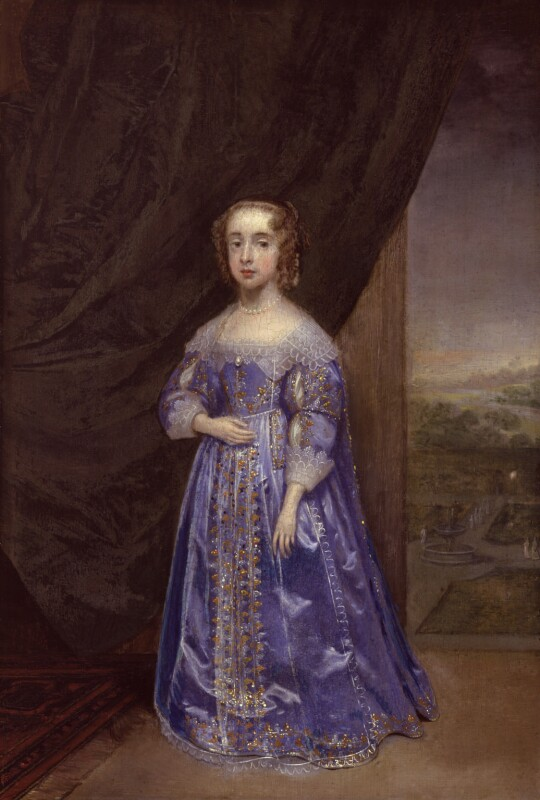
Princess Mary by Cornelius Johnson (1639)

The third 1639 royal portrait by Johnson was of the English princess, Mary, who was the eldest of Charles I’s children and the sister of Charles II and James I.  She was eight years old at the time of the painting.

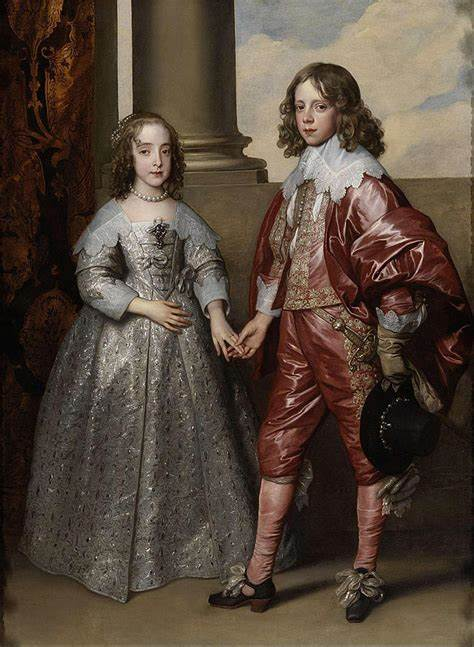
William II, Prince of Orange and his bride Mary Stuart by Anthony van Dyke (1641)

Two years later, in 1641, Mary who was just nine years of age was married to the future stadtholder of the Netherlands, fifteen-year-old William II of Orange. Eight days after her husband’s death in 1650, Mary gave birth to a son, William III of Orange, who later became King of England.  After the restoration of the monarchy in England in 1660, Mary left the Netherlands to join in the celebrations in London, where she fell ill with smallpox and died, aged 29.

Robert, Lord Bruce, later 2nd Earl of Elgin by Cornelius Johnson (1635)

Johnson painted many portraits of children, either individually or in pairs, and consequently was much in demand with English and Scottish clients.  An example of this genre was Johnson’s 1635 portrait entitled Robert, Lord Bruce, later 2nd Earl of Elgin and 1st Earl of Ailesbury.  We see before us a fashionably dressed young sitter, Robert, Lord Bruce, who was the only child and heir of the Scottish nobleman Thomas Bruce, 1st Earl of Elgin. As a young child, Bruce received little formal education, but once he became a teenager, he travelled to Europe and was one of the first Scots to embark on the Grand Tour. By 1659, twenty-three-year-old Bruce had become an active royalist conspirator and was involved in plans for an uprising against the government, which led to his arrest.  

Thomas Bruce, 1st Earl of Elgin by Cornelius Johnson (1638)

The portrait had been commissioned by the boy’s father, Thomas Bruce.  One must believe that Thomas Bruce was pleased with the resulting portrait of his son as three years later, in 1638, he commissioned Johnson to paint a full-length portrait of himself.

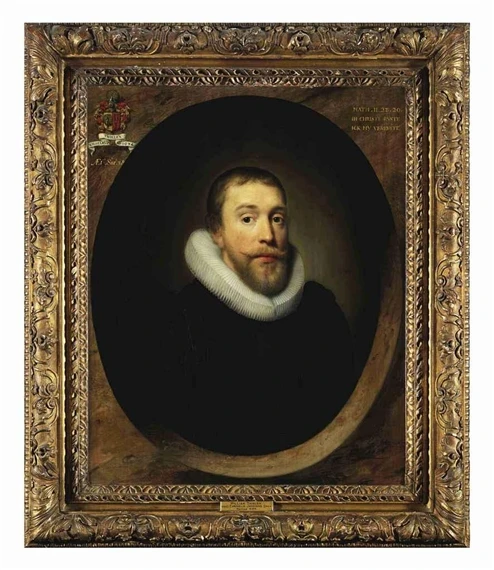
Portrait of Willem Thielen by Cornelius Johnson

The community that Cornelius Johnson lived among centred itself around the Austin Friars, the Dutch church in London.  At the time of the late sixteenth century the Dutch community was the largest group of expatriates living in London and numbered around five thousand out of the total population of one hundred thousand at the time. About half of the Dutch residing in London were Protestants who had fled the Flemish Low Countries due to religious persecution.   Others were skilled craftsman, including brewers, tile makers, weavers, artists, printers and engravers, who came to England for economic opportunities. Johnson was commissioned to paint portraits of many of these distinguished members of this Netherlandish community. 

Portrait of Madame Thielen by Cornelius Johnson

One such pair were Willem Thielen, the Minister of Austin Friars, and his wife Maria de Fraeye.

The 1st Baron Capel and his Family by Cornelius Johnson (c.1640)

From left to right: Arthur Capel 1st Earl of Essex (1631-1683), his father Arthur Capel 1st Baron Capel (1604-1649), Henry Capel 2nd Baron Capel (1638-1896), Elizabeth, Lady Capel (died 1661), Charles Capel (died 1657), Elizabeth Countess of Carnarvon (1633-1678), and Mary Duchess of Beaufort.

It was around 1640 that Cornelius John received the commission to paint a large family group portrait of the 1st Baron Capel and his wife and their five surviving children. It is a depiction which celebrates fecundity, good health, good looks and stylish elegance. Lord Capel was a diehard Royalist. Appropriately, given the horticultural interests of the Capels, the family are pictured here posing in front of their formal garden at Little Hadham Hall in Hertfordshire. The baron’s wife is dressed modestly and somewhat behind the times. She is seen wearing a two-tiered cape trimmed with lace to conceal her bodice, but her daughters wear lace collars that were démodé for about five years.

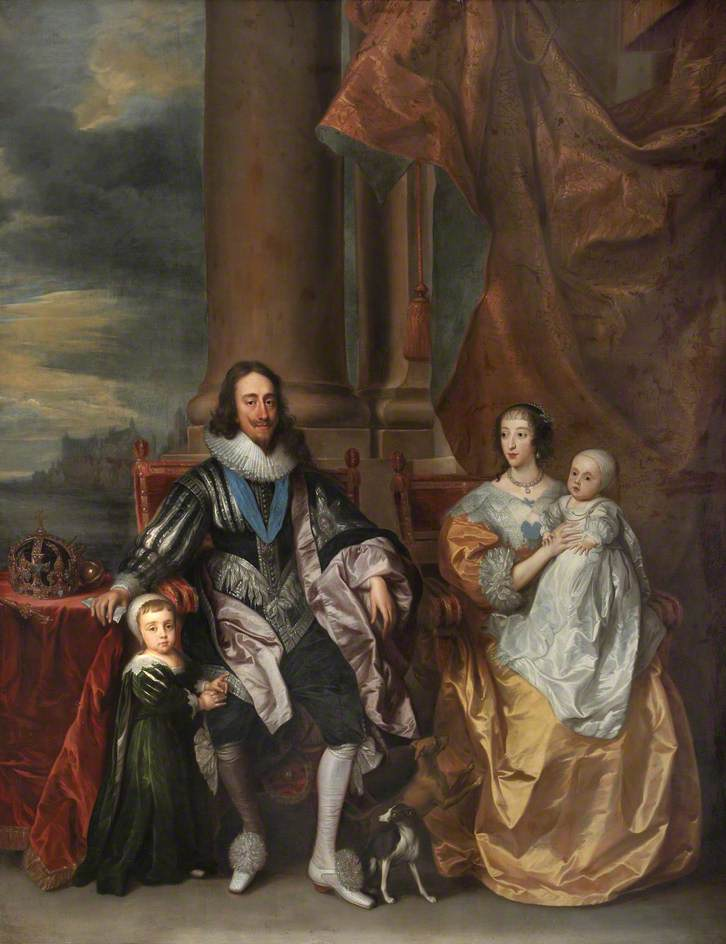
The Greet Peece by van Dyke (1632)

The set-up for Cornelius Johnson’s depiction of the Capel Family was thought to have come from van Dyke’s 1632 depiction of Charles I and his family.

Anthony van Dyke died in 1641 and this should have added to the opportunities for Johnson whose work and reputation had been overshadowed by van Dyke.  However, Johnson was not to have that boost in England because at the time of van Dyke’s death the political situation in England was fast deteriorating and by 1642 Charles I had fled from London.  George Vertue, an English engraver and antiquary, whose notebooks on British art of the first half of the 18th century are a valuable source for the period, in October 1843 he wrote of Cornelius Johnson’s predicament:

“…being terrifyd with those apprehensions & the constant perswasions of his wife, the family emigrated to the Netherlands…”

In Alexander Finberg’s 1922 book A Chronological List of Portraits by Cornelius Johnson he talks about Johnson’s “pass”, parliamentary permission to travel and leave England. Finberg wrote:

“…Cornelius Johnson, Picture Drawer, shall have Mr Speaker’s Warrant to pass beyond the seas with Emmanuel Pass and George Hawkins and to carry with him such pictures and colours, bedding, household stuff, pewter and brass as belonged to himself…”

On October 27th 1643 Johnson left London and sailed to Middelbourg, Zeeland, a city in Southwest Netherlands. Middlebourg was part of the The United Provinces often referred to as  Netherlands, or the Republic of the Seven United Netherlands.

Apolonius Veth by Cornelius Johnson (1644)

Once residing in Middelbourg Johnson joined the painter’s guild, The Guild of St Luke. One of Johnson’s first commissions was a lucrative and prestigious one. It came from Apolonius Veth, who was the burgomaster of Middelbourg.

Cornelia Veth by Cornelius Johnson (1644)

Apolonia Veth also commissioned Johnson to paint a portrait of his wife, Cornelia.

The Hague Magistrates by Cornelius Johnson (1647)

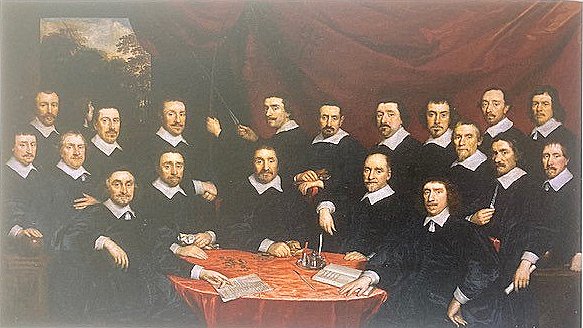
For a time, Cornelius Johnson and his family left Middelbourg and went to live in Amsterdam. Cornelius carried on with his portrait commissions but also took on multi-figure commissions. One such was his 1647 painting entitled The Hague Magistrates.

The Middelburg Archers’ Guild by Cornelius Johnson (1650)

Another of Johnson’s multi-figured civic portraits was his 1650 painting entitled The Middelburg Archers’ Guild. One presumes the Guild commissioned Johnson for the painting. Johnson’s old client Apolonius Veth was Deacon of the Guild the year Johnson worked on the painting so, as he appears in the depiction, maybe he was the person who commissioned the work.

Regulierskerk in Utrecht

During 1652 Johnson relocated his family to Utrecht and resided in the high-status address of Herrenstraat. Portrait commissions kept rolling in from the elite families of Utrecht and Johnson was soon regarded as a leading portrait painter. Cornelius Johnson sometimes known as Cornelis Jonson van Ceulen died on August 5th 1661, aged 67 and the funeral service was held in the Regulierskerk in Utrecht

Alois Heinrich Priechenfried

Settling the Accounts by Alois Heinrich Priechenfried

Today’s blog is a very short one.  I think I have mentioned before how I choose an artist to write about. There are two things I need before I can embark on the journey of looking at the life of an artist. Firstly, I need to have multiple sources which offer a biography of the painter. Why multiple? Because you would be amazed at how often I come across differing facts such as names of family members, educational information and simple dates and I have to work out what are the true facts. Secondly, I must have a wide range of pictures so as to be able to highlight the artist’s skill as a painter. Proceeding with the blog without both of these is very difficult.

Portrait of an Old Man by Alois Heinrich Priechenfried

However once in a while, and today is one of those occasions, I come across artwork which is so good that I just have to formulate a blog even though my knowledge about the artist’s life is severely limited. I scoured the internet and reference books and, as I was on a three-day visit to London on child-minding duties, I even went to the British Library but all to no avail as little seems to be written about today’s painter although the auction houses such as Bonhams, Christies and Sothebys offered samples of his art without a biography, which is somewhat unusual.  Let me introduce you to the nineteenth century Austrian portrait and genre painter Alois Heinrich Priechenfried.

Seated Rabbi by Alois Heinrich Priechenfried

Much of the Jewish art by Priechenfried focused on the quiet contemplation of the holy scriptures.

A Rabbi Studying the Torah by Alois Heinrich Priechenfried

Alois Michel Priechenfried, the artist’s father, was a gilder by trade. Gilding is the decorative technique for applying a very thin coating of gold to solid surfaces such as metal, wood, porcelain, or stone. He married Anna Hackensoellner and the couple had three children, August Franz, Georg and Alois. Alois Heinrich Priechenfried was born June 25th, 1867 in the Gumpendorf district of Vienna.

Seated Rabbi by Alois Priechenfried

Alois was brought up in the Catholic faith although when I first looked at his paintings I wrongly believed that he must have been Jewish.  Many of his paintings featured rabbis as is the one he painted entitled Seated Rabbi.  The quotation behind the rabbi is from Psalms 118:17, “I shall not die but live and proclaim the works of the Lord.”

Reading the Scriptures by Alois Heinrich Priechenfried

My favourite painting of his featuring people of the Jewish religion is one entitled Reading the Scriptures.  There is something very peaceful about this painting.  The rabbis, who are seen reading the holy book or quietly contemplating what they have just read, offers one a feeling of extreme serenity which many people get from their belief in their religion and their God.  I suppose, being a non-believer, I miss out on such times of peaceful contemplation.

A Cardinal Reading by Alois Heinrich Priechenfried

Not all Priechenfried’s paintings depicted aspects of the Jewish religion for one of his best paintings features a cleric from the Catholic religion.  It is simply entitled A Cardinal Reading.  Once again it is a portrayal of tranquil meditation.

Conversation in the Kitchen by Alois Heinrich Priechenfried

When young Alois was fourteen years old, he followed in his father’s footsteps and trained and worked as a gilder.  At the age of seventeen he enrolled for one year at the Vienna Academy of Fine Arts as a guest student.

Christian Griepenkerl (c.1907)

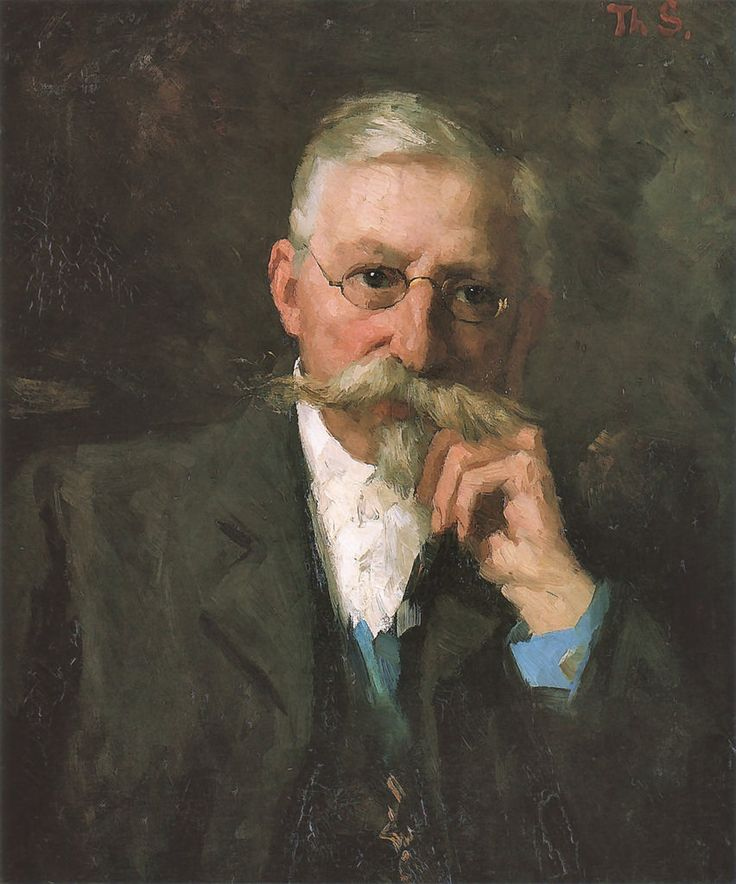
One of his professors at the Academy was the German painter, Christian Griepenkerl. Griepenkerl had been appointed a professor at the Academy of Fine Arts Vienna in 1874 and three years later he was the lead professor at the Academy’s special school for historical painting. Griepenkerl specialised in allegorical representation using themes from classical mythology and portraiture. He taught many of the foremost painters of the time including Egon Schiele and Anton Peschka but his teaching methodology and that of the Academy was looked upon by many young students as antiquated and overly-conservative and so many left the Academy and founded the Neukunstgruppe (New Art Group), which fostered its own style without Academic constraints.  Christian Griepenkerl later became famous for refusing Adolf Hitler’s application to join the Academy in 1907 stating that Hitler’s entrance submission piece was both unimaginative and unsatisfactory.

The Visit by Alois Heinrich Priechenfried

Alois married a Emile Aurelia Watzek, a Yugoslavian lady in 1890 and the couple went on to have eight children.  As can be seen in the above painting and the ones below, he also completed many genre works.

German Interior Scene by Alois Heinrich Priechenfried

Priechenfried spent many periods of his life in Munich but always returned to his beloved Vienna.

The Rehearsal by Alois Heinrich Priechenfried

Alois Heinrich Priechenfried died on May 24th 1953 at his home in Diefenbachgasse in the Rudolfsheim-Fünfhausdistrict of Vienna which lies on the northern bank of the River Wien. He was 85.


My apologies for the lack of biographical information but I am sure you will agree the paintings themselves are worth the blog.   If anybody knows more about Priechenfried I would love to hear from you and then I could update this blog.

Finally, Merry Christmas and a belated Happy Hanukkah to everyone.

Charles Spencelayh – English genre painter and portraitist

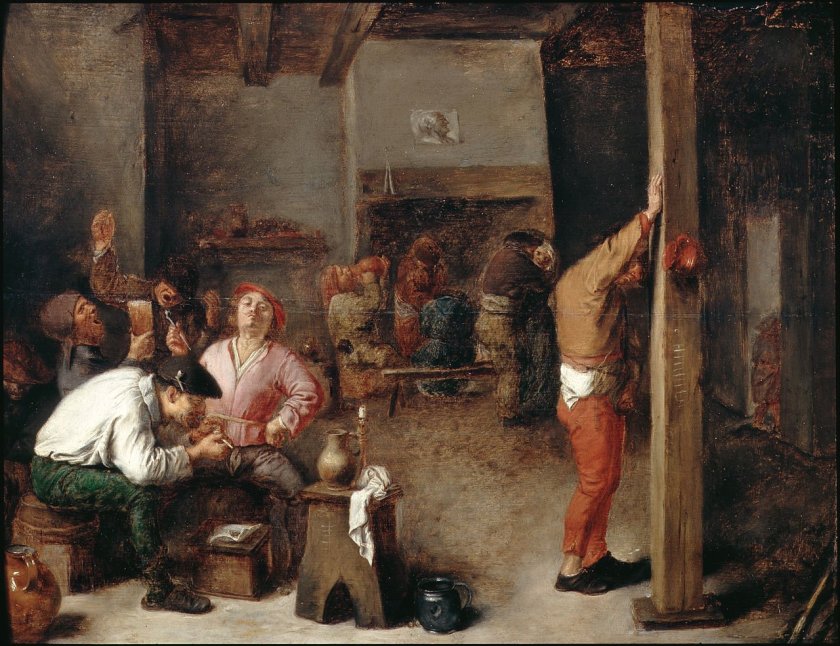
Interior of a Tavern by Adriaen Brouwer

The term genre painting relates to works depicting scenes of everyday life. Such depictions embrace scenes of ordinary people at work or enjoying their leisure time. This type of painting flourished in Protestant Northern Europe as an independent art form. The first great advocates of genre painting were the Dutch Realist artists of the 17th century, such as  Adriaen Brouwer with his riotous pub scenes, Adriaen Van Ostade, who painted genre scenes depicting peasants enjoying their home life or relaxing in an inn.

The Merry Family, by Jan Steen (1668)

My favourite has to be Jan Steen, who ran an inn and depicted people in their homes.

Woman Cleaning Turnips, by Jean-Baptiste-Siméon Chardin (ca. 1738)

In France there were genre paintings by the likes of Jean-Baptiste-Siméon Chardin who depicted servants and children. The harsher realities of working life featured in genre paintings of Jean-François Millet, Daumier, Courbet, van Gogh, and Degas whilst joyous life experienced in bars and cafés featured in works by Toulouse-Lautrec.

Charles Spencelayh at the Age of 33.

My featured artist today is the English genre painter and portrait painter Charles Spencelayh.   Genre paintings, as well as being a pleasure to observe, are an insight into everyday life before the era of cameras and television. The genre and Academic portrait paintings of Spencelayh looked at life during Victorian and Edwardian times and gives us a great insight into life and fashion in those times.

Boys Fishing by eight-year-old Charles Spencelayh (1873)

Charles Spencelayh was born in Rochester in Kent on October 27th 1865. He was the youngest of eleven children and was the son of Henry Spencelayh, an engineer and iron and brass founder who sadly died before his son was born. Charles’ first steps into the world of art came when he was given his first set of paints at the age of eight and he soon progressed to copying Old Masters. He studied art at the National Art Training School, South Kensington, which later became known as the Royal College of Art, where he won a prize for his figure drawing.

My Pet by Charles Spence;ayh (1890)

Charles Spencelayh married  Elizabeth Hodson Stowe, who worked as a governess, at St. Paul’s, Penge in 1890 and the couple started married life in Chatham.  According to the 1891 census Elizabeth’s occupation was given as a tobacconist. She appears in many of her husband’s paintings including My Pet which depicts Elizabeth, in profile, holding a dove.

Vernon Spencelayh by his father Charles

In 1891 the couple had their one and only child, a son, Vernon who went on to become a talented artist and ivory miniaturist, having been taught by his father. Vernon served as an officer in WW1 and was held as a prisoner of war in Germany. He, like his mother, appeared in a number of portraits by his father.

Private Vernon Spencelayh (1891-1980), West Yorkshire Regiment by Charles Spencelayh

Another fine portrait by Charles of his son, Vernon, in uniform is owned by The National Army Museum. This portrait by his father is a fond record of his son preparing to depart for war.   This Academic-style portrait of his son has an intensity and could almost be mistaken as a photograph.  Vernon Spencelayh’s regiment was the West Yorkshire Regiment, denoted by the motif of the white horse of Hanover on the cap badge. He was involved in a number of battles on the Western Front and at Gallipoli.

In 1896, Spencelayh became a founder member of the Royal Society of Miniature Painters, Sculptors and Gravers, a Society which was formed with the stated intention:

“…to esteem, protect and practice the traditional 16th Century art of miniature painting emphasising the infinite patience needed for its fine techniques…”

Queen Mary’s Doll House

During his lifetime Spencelayh exhibited 129 miniatures at their exhibitions. Probably one of his most famous miniatures was a postage stamp sized portrait of King George V for his wife, Queen Mary’s celebrated Doll’s House, designed by Edwin Lutyens, which was exhibited at the Wembley Exhibition of 1924 and now housed in Windsor Castle. Queen Mary’s and Princess Marie-Louise’s thank you letter was one of Spencelayh’s most treasured possessions.  Spencelayh was a favourite of Queen Mary, who was an avid collector of his work and she bought many of his paintings when they were exhibited at the Royal Academy Summer Exhibitions and she even commissioned one painting, which Spencelayh titled ‘The Unexpected’ due to his surprise at receiving such a request.

Rosie Levy taking afternoon tea at the Midland Hotel Manchester by Charles Spencerlayh (1925)

The high-points of Spencelayh’s artistic career were the years between the two World Wars. He had acquired a wealthy patron, Joseph Nissim Levy, a prosperous Manchester cotton merchant and during the 1920’s completed a number of portraits of Levy’s social circle. Mr. Levy’s admiration of the talented artist went so far as to give Spencelayh and his family use of a residence in Manchester. In 1924 Spencelayh painted an intimate portrait of Joseph’s wife titled Rosie Levy taking afternoon tea at the Midland Hotel Manchester. It is a masterpiece in the way Spencelayh has captured the folds of the rich fabric backdrop and the furnishings with their reflective surfaces.

The first Mrs Spencelayh (Elizabeth Hodson Stowe) by Charles Spencelayh

In the early 1930’s the Spencelayh’s moved south to Grove Park and Lee a suburb of south London, but sadly, his wife, Elizabeth died there in 1937 and was buried four miles away in Chislehurst Cemetery.

Why War? by Charles Spencelayh

Spencerlayh had his work exhibited at the Paris Salon, but most of his exhibitions were in Britain. For sixty years until his death in 1958 he exhibited more than 30 paintings at the Royal Academy, with his work entitled Why War winning the 1939 Royal Academy ‘Picture of the Year’. Spencelayh had fought in the First World War and in this painting, he depicts another veteran of that war in his darkened sitting room. He blankly stares into space. He is forlornly envisaging the onset of the Second World War. The artist has added so much detail in this painting that we can build up a picture of how the man lives. We see, on the table next to him, a new gas mask issued to him by Lewisham Council and lying on a chair is a newspaper, emblazoned across the front page is the story covering Chamberlain’s abortive mission to make peace with Hitler. Spencelayh’s talent as both a genre painter and portraitist and his training as a miniaturist allowed him to build up a pictorial story by his depiction of visual clues in painstaking detail.

It’s War by Charles Spencelayh (1942)

His 1942 painting It’s War brings home the hardship felt by many during the Second World War.  Painted in his studio with a large amount of props which he accumulated during his visits to bric-a-brac shops it depicts the hard times suffered by many during the conflict.  It is part portraiture, part genre and part still-life.  Its is testament to the genius of the man.

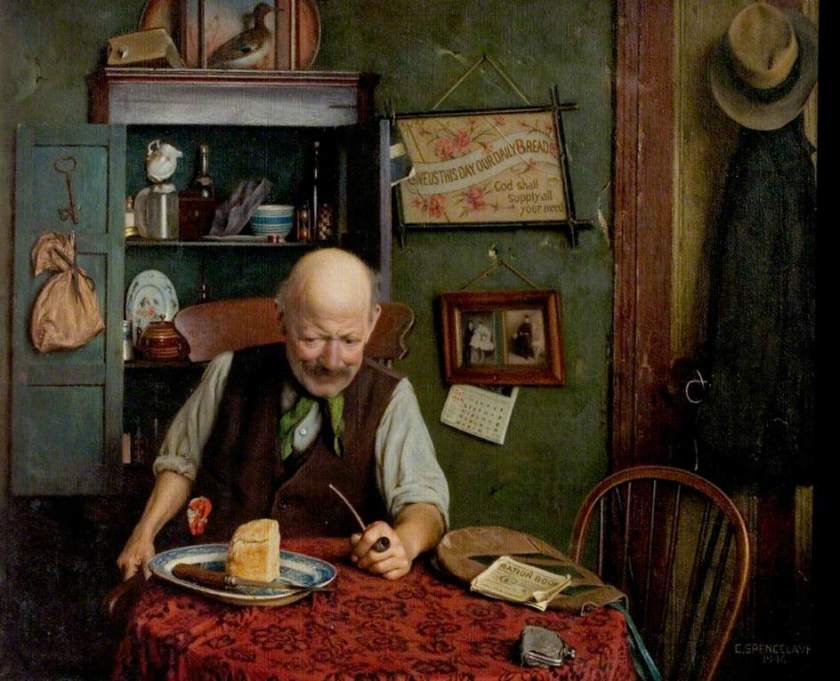
His Daily Ration by Charles Spencelayh

Although the War had ended and the Allies had been victors, Many in England had to suffer years of deprivation.  Food was rationed and hardships endured as is beautifully depicted in Spencelayh’s 1946 painting, His Daily Ration in which we see an elderly man staring at his meagre meal.

The Latest Addition by Charles Spencerlayh

One theme which appeared in many of Spencelayh’s paintings was of old men pottering around in junk shops or in cluttered rooms in their homes. These were classic Victorian genre works which were pictorial histories of the between-War days in England.

The Laughing Parson by Charles Spencelayh

Many of his subjects were of domestic scenes, painted with such definition that they are almost photographic. In his 1935 painting The Laughing Parson,  we see the parson dressed in a grey morning suit, resplendent with his “dog collar”. He is half slumped in his wing back armchair as he peruses the latest issue of the satirical Punch magazine. By the look on his face and his broad smile, something in the magazine has amused him.  Once again Spencelayh has added numerous items of furniture and accessories which tell us about life in those bygone days.

The Second Mrs Spencelayh by Charles Spencelayh

In 1940, Charles remarried, and his second wife, another Elizabeth and he continued to live in Lee but after a particularly fierce German bombing raid over London, they were rendered homeless. Worse still many of his paintings were destroyed. The couple then moved north to Olney were his wife’s family lived and soon after, setting up home in the Northamptonshire village of Bozeat where they remained for the rest of their lives. It was during those years at Bozeat that Spencerlayh produced some of his best loved paintings often featuring residents of the village who were often treated to a home-cooked meal as payment for modelling for one of his paintings.

A Lover of Dickens by Charles Spencelayh (1947)

Spencelayh set up his studio with room-sized screens bedecked with patterned wallpaper and had a chest, full of props, with which he would “dress” the room.  Charles  ‘dressed’ the room using “props” from his collection, such as Toby jugs, stuffed birds, Windsor chairs, clocks and cheap watches as well as patriotic framed pictures of Lord Nelson and members of the Royal Family.  Look at the background of his 1947 work A Lover of Dickens.  The props he used to add meaning to the painting were arranged haphazardly to give a sense of everyday clutter.  Maybe the man lived on his own and a regime of “tidiness” was not forced upon him !

Fingerprints by Charles Spencelayh (1953)

By the late 1950’s his eyesight began to fail but that did not deter him and he continued to paint and in 1958, three of his works were accepted into the Royal Academy Summer, including a poignant work titled The Faded Rose. Sixty-six years earlier he had his first work exhibited, a miniature entitled Mrs Robins and he is considered to be one of the most prolific artists to show at the Royal Academy. Notwithstanding this, he was never made an Associate of the Academy, which baffled many including himself. He wrote to his Canadian agent, George Nuttall in 1956 about this unforgiveable omission. He commented jokingly:

“…I do not know, unless I am not old enough, or work not sufficiently good, which is my aim to yet improve although I cannot wear glasses to paint eventually this will stop my efforts I’m sure of it…”

Taking the Risk by Charles Spencelayh

Charles Spencelayh died, aged 92, in St Andrews Hospital, Northampton on June 25th, 1958 and after a funeral service conducted by his friend and executor the Reverend W.C. Knight in the 12th century church of St Mary the Virgin, Bozeat, he made his final journey back to Kent and was buried with his first wife in Chislehurst Cemetery.


Most of the pictures came from ARC and Art UK and Spencelayh’s biography came from a number of websites of galleries which house some of his paintings and the Chislehurst Society website:

Click to access CharlesSpencelayh.pdf


Walter Frederick Osborne.

Walter Frederick Osborne

My featured artist today is Walter Frederick Osborne, the Irish impressionist and post-impressionist landscape and portrait painter. He was born on June 17th, 1859 at 5 Castlewood Avenue in Rathmines, an inner suburb on the southside of Dublin, about 3 kilometres south of the city centre. He had two brothers and a sister, Violet. He was the second of three sons of Anne Jane Woods and her husband, William Osborne, an acknowledged animal painter whose speciality was portraits of horses and dogs owned by wealthy landowners. Walter Frederick Osborne, known as Frederick Osborne for the first twenty-five years of his life, attended the local school at Rathmines.

A Glade in the Phoenix Park by Walter Frederick Osborne (1880 )

Having realised that money could be made from painting, Frederick wanted to follow in the footsteps of his father and become an artist. So, once he had completed his schooling in 1876, seventeen-year-old Frederick, enrolled on an art course at the Royal Hibernian Academy School. Osborne made an impact straight away, exhibiting in the RHA annual show in his first year. He won numerous medals and prizes including the Albert prize in 1880 with his painting, A Glade in the Phoenix Park.

In 1881 he attended Koninklijke Academie voor Schone Kunsten van Antwerpen (Royal Academy of Fine Arts Antwerp), where one of his tutors was the Belgian painter Michael Charles Verlat. Whilst studying there he won the Royal Dublin Society Taylor Art Award in 1881 and 1882, which awarded him an annual bursary. This was the highest student honour in Ireland of the time and given annually to a graduate of an Irish art college or an Irish art student graduating from an art college abroad to assist them with the development of their career as a visual artist.

A Flemish Farmstead by Walter Frederick Osborne (1882)

Osborne sent back to the Royal Hibernian Academy a number of paintings he completed whilst attending the Royal Academy of Fine Arts in Antwerp. One was his 1882 work, A Flemish Farmstead, and this exhibited by the Academy the following year, just after Osborne had been elected an Associate Member. From his earliest days, Osborne was interested in painting farmyards such as the one above. His scenes usually included one or two figures. However, this work is slightly subtler for he merely suggests that the farmyard is a working one by including the jacket that hangs on the open door and the clogs that stand against the wall. Being a great believer that detail is important, he has even depicted the clogs standing on end, suggesting that they are that way so as to allow them to drain after a wet morning in the fields.

Apple Gathering by Walter Frederick Osborne (1883)

He completed his studies in Antwerp in 1883 and travelled to the Breton artists’ colony at Quimperlé. Osborne soon realised that the most noteworthy modern painters were painting en plein air and were using ordinary local people as their models and the Breton fishing villages had a plethora of such willing characters. It was at Quimperlé that he completed his famous Apple Gathering painting which is now housed in the National Gallery of Ireland. The painting depicts a young girl dressed in a peasant costume holding a long stick, busily shaking branches of an apple tree to loosen the ripe fruit. Looking behind her, we see another young girl picking up the fallen apples which are scattered around the orchard. In the background we see the church of Quimperlé which was the subject of many of the artists residing at the town’s artist colony. The painting can now be found in the National Gallery of Ireland in Dublin.

Estuary at Walberswick by Walter Frederick Osborne (c.1885)

Walter Osborne along with two fellow Irish artists, who were part of the Quimperlé artist’s colony, Drogedha-born Nathaniel Hill and Galway-born Augustus Nicholas Burke eventually left the Breton town and returned to England and headed for another artist’s colony at the Suffolk coastal village of Walberswick, where one of the artists was Philip Wilson Steer, who had studied at the École des Beaux Arts under Alexandre Cabanel, during which time he became a follower of the Impressionist school. Steer would become a leading figure in the Impressionist movement in Britain.

Feeding the Chickens by Walter Frederick Osborne (1885)

At the start of 1884, Walter Osborne’s early paintings often featured young children accompanied by animals, often their pets. One of his most famous works of this genre came about whilst Walter Osborne along with his fellow young artists Nathaniel Hill and Edward Stott, another former École des Beaux Arts student, travelled through the English countryside, on sketching trips. That October, the trio had arrived at North Littleton, near Evesham, Worcestershire and the painting which evolved from his visit here was the work entitled Feeding the Chickens. The oil on canvas painting measured 36 x 28 inches (92 x 71cms). In the work, we see a young but confident girl, with her earnest expression, scattering corn for the chickens. She is Bessie Osborne, (no relation to the artist), the daughter or maybe a servant in the substantial house which we see in the background. In Osborne’s preparatory sketch for this work, there was another figure, a gardener with his wheelbarrow, but he was not transferred to the finished painting. Presumably Osborne thought his inclusion would detract from the main focus of the work, the girl.

The Irish art historian Jeanne Sheehy’s biography of Osborne quotes from his letter to his father, dated October 12th, 1884, about the details of the work. In a letter to his father he set the scene for the painting:

“…’The weather, I am sorry to say has been bitterly cold the last week, so much so that my model nearly fainted and I had to send her home … It will probably seem funny to you all that my model’s name should be Bessie Osborne …”

The young girl is wearing an embroidered bonnet and holding a basket of grain, surrounded by a brood of hens. A further insight into the making of this painting can be found in the letter:

“…Now I am pretty far advanced on a kit-kat of a girl in a sort of farmyard, a rough sketch on the opposite page will indicate the composition. The figure of the girl which is a little over two feet high is coming towards finish, but the immediate foreground with poultry is merely sketched in as yet. The fowl are very troublesome, and I have made some sketches but will have to do a lot more as they form rather an important part of the composition…”

Also, in the letter to his father Walter asks him to look through his sketches he had done whilst at Quimperlé and find any of chickens which may help with this painting.

Winter Work by George Clausen (1883)

During his travels around the English countryside, Rural Naturalism became his favoured genre. He had been influenced by the works of the French painter, Jules Bastien-Lepage, whose works were dominating the Paris Salon and it was this type of work which Osborne preferred to the themes from history or mythology which were taught in the Academies of Europe. Another influence on Osborne was another Naturalist painter, the English artist George Clausen.

The Return Of The Flock by Walter Frederick Osborne (1885)

From 1883 and for the next fifteen years Osborne spent the summers wandering around the South of England often visiting the area of the beautiful Berkshire Downs or the area around the Hampshire market town of Romsey or the Suffolk coastal villages. Once asked why he did not spend his summers in Ireland he said that it was cheaper to live in England and it rained less which was important as he wanted to paint en plein air. Osborne was not looking for spectacular landscape which he could have found in the West of Ireland, the Lake District or Scotland. His preference was for the sedate beauty of rural villages with their well-stocked picturesque cottage gardens, often his paintings would include farmyard animals such as sheep. Like the French Impressionists, Osborne was fascinated by the effect of light and how it changes during every hour of the day.

Portrait of Mrs Chadwyck-Healey and her Daughter by Walter Frederick Osborne (1900)

Walter Osborne was elected an associate of the Royal Hibernian Academy in 1883 and became a full member in 1886. Although Osborne spent the summers travelling around the southern English countryside he would return to the family home in Dublin during the winter months.  In 1886, following his election to the Royal Hibernian Academy he received many commissions for portraits and from 1892 onwards, Osborne’s main output changed from landscape work to portraiture. These portraiture commissions were essential to Osborne for his financial survival and that of his parents who relied heavily upon him. Osborne’s permanent move to Dublin in 1892 was prompted by the death of his sister Violet whose newly-born baby was given into the care of Osborne’s aged parents and he had to take on the task of looking after her daughter. His portraiture and landscape works had become so popular and because he received more and more commissions he decided that working from home was not feasible and so acquired his own studio in St Stephens Green in 1895.

Mrs. Noel Guinness And Her Daughter Margaret by Walter Frederick Osborne (1900)

One of his best-known portraits was entitled Mrs Noel Guinness and her Daughter Margaret and this was exhibited at the Paris Exposition Universelle in 1900 and which received the bronze medal. The painting depicts Mary Guinness (née Stokes), the wife of Richard Noel Guinness, and her four-year-old daughter Margaret.

The Old Fountain, Madrid by Walter Frederick Osborne (1895)

In 1895 he and his friend, the art historian and writer, Walter Armstrong, toured around Spain, where Walter completed a number of watercolour drawings and oil sketches. The following year the two men travelled to Holland where he completed a number of Amsterdam canal scenes.

Dublin Streets a Vendor of Book by Walter Frederick Osborne (1889)

During this time Walter Osborne put together a series of paintings depicting Dublin street scenes, which some time later were exhibited at the Royal Academy. Osborne made pencil sketches and took photographs of the street scenes and then completed the series in oils in his studio. Probably the most famous of the paintings in this series was Dublin Streets: A Vendor of Books which he completed in 1898.  The painting depicts a bookseller’s stall, set up on Eden Quay, looking eastwards towards the O’Connell Bridge. We see a mother leaning against the wall holding a very young child in her arms. She has a fatigued and nervous look about her. By her side, on the floor, there is a basket of daffodils. What is her story? Is she in any way connected to the bare-footed girl who has moved towards the customers who are perusing the books at the vendor’s stall? The little girl has a small bunch of daffodils in her hand which she is holding up to the customers. She has been sent by the lady, maybe her mother, to try and get a few pence for the flowers. It is a painting full of movement from the horse drawn carriages we see crossing the bridge to the barge making its way down the River Liffey about to pass under the bridge. These realistic paintings of street life in Dublin, although in great demand now and a good historical record of the times past, were not as successful then as his portraiture.

Greystones by Walter Frederick Osborne (1884)

Osborne did not forsake his landscape work completely and one his Impressionist-style works, completed around 1898, was entitled Greystones. It is a somewhat moody study 0f the quayside of Greystones, a small coastal fishing village in County Wicklow. In the painting we see a number of fishing boats tied up to the harbour quayside, some of which have the sails unfurled. In the background there are a number of cottages. His use of muted colours and tones such as his mauves, pinks, pale greys and browns induce a sense of soft light. Look how Osborne has cleverly depicted the diffused sunlight on the gable ends of the cottages and again with the way he has represented it with the silvery flickering of the water with its reflections.

Tea In The Garden by Walter Frederick Osborne (1902)

In 1900 Osborne was offered a Knighthood in recognition of his services to art and his distinction as a painter, but he refused the honour. His mother became ill in the early 1900s, and Walter spent long periods looking after her. In 1902 he started to paint what was to be his last picture, Tea in the Garden, which remained unfinished at the time of his death. It was a beautiful work, a juxtaposition of his favoured Impressionism and Naturalism.

Self-portrait by Walter Frederick Osborne

In 1903, after a strenuous time gardening, he became ill, which he tried to ignore but which developed into double pneumonia. He died aged forty-three, at the family home in Castlewood Avenue, Rathmines, Dublin, on April 24th 1903, and was buried in Mount Jerome cemetery. Walter Frederick Osborne never married and left considerable savings behind him. He was one of the most sought after and talented Irish artists of his time.