Théophile “Théo” van Rysselberghe Part 2.

Van Rysselberghe went to Haarlem in September 1883 to study the light in the works of Frans Hals. He was fascinated by the way the artist had rendered the light and this facet of painting would remain with him for the rest of his life. It was also in the Netherlands that he first met the American painter William Merritt Chase.

Fantasia Araba, by Théo Van Rysselberghe (1884)

Having returned from the Netherlands he remained at home for a short while before setting off on his second painting trip to the Moroccan town of Tangier in November 1883 along with Franz Charlet who had accompanied him on his previous trip. He remained in Morocco for twelve months and managed to put together a large number of paintings and sketches. The highlight of which was his large painting (300 x 170cms) entitled Fantasia Araba, which he completed in 1884. It can be seen at the Royal Museums of Fine Arts of Belgium in Brussels.

Even though he was in North Africa Théo remained in close contact with Octave Maus discussing the running of Les XX. Les XX was a group of twenty Belgian painters, designers and sculptors, formed in 1883 by the Brussels lawyer, publisher, and entrepreneur Octave Maus.

Les XX poster for their sixth exhibition in 1889

For ten years, Les XX held an annual exhibition of their art; each year twenty other international artists were also invited to participate in their exhibition. Théo would suggest names of artists to Maus who he believed should be invited to their first exhibition in 1884. In the first year’s show the foreign invitees included Auguste Rodin, John Singer Sargent, Max Liebermann, Whistler and William Merritt Chase

Abraham Sicsu (Consul de Belgique a Tanger) by Théo Van Rysselberghe (1884)

His long stay in North Africa ended in October 1884 when he ran out of money and had to return home to Belgium. Once again he had many completed paintings to exhibit, including Fantasia Araba, at the second Les XX exhibition in 1885. Another of van Rysselberghe’s paintings exhibited was his portrait of Abraham Sicsu who had entered the service of the Belgian legation in Tangier in 1864 as an interpreter. Many famous painters and members of the Belgian royal family had visited him. He was appointed Belgian consul and officer of the Order of Leopold on 8 April 1889 and finally obtained Belgian naturalisation.

Madame Edmond Picard in Her Box at Theatre de la Monnaie by Theo Rysselberghe (1886)

In the 1886 Les XX exhibition van Rysselberghe saw the works of the Impressionist, Claude Monet and Auguste Renoir. He was so enthralled by what he saw that he decided to experiment with this artistic technique. An example of this is his 1886 painting entitled Madame Edmond Picard in Her Box at Theatre de la Monnaie.

Madame Oscar Ghysbrecht by Théo van Ryssdalberghe (1886)

… and his Portrait of Madame Oscar Ghysbrecht in which he used a palette of bright colours.

Les Dunes du Zwin, Knokke, by Théo van Rysselberghe (1887)

…and the impressionist style of van Rysselberghe carried on through many of his landscape and seascape painting including his 1887 work entitled Les Dunes du Zwin, Knokke, a municipality of of West Flanders in  Belgium.

A Sunday Afternoon on the Island of La Grande Jatte by Georges Seurat (1886)

Van Rysselberghe had cultivated close ties with the Parisian art scene, so much so that Octave Maus asked Rysselberghe to go to Paris and search out up-and-coming new talent who would be able to take part in future exhibitions of Les XX. Whilst in Paris van Rysselberghe became aware of Pointilism, a technique of painting in which small, distinct dots of colour are applied in patterns to form an image. It was a hallmark of Neo-Impressionist painters. Théo first saw it when he visited the eighth impressionism exhibition in 1886 and Georges Seurat’s painting, A Sunday Afternoon on the Island of La Grande Jatte. Théo and some other Belgian artists brought the pointillism art form back to Belgium but not every art critic was impressed by this new technique. Seurat was invited to exhibit at the 1887 salon of Les XX in Brussels but it received a very unfavourable reception with many art critics labelling it as “incomprehensible gibberish applied to the noble art of painting”.

Anna Boch by Théo van Rysselberghe (c. 1889)

Not to be deterred by the art critics’ vitriolic comments Théo decided to change his painting style abandoning realism and became proficient at pointillism. In the summer of 1887, he spent a few weeks in Batignolles, near Paris with Eugène Boch, a brother of Anna Boch, a Belgian painter, art collector, and the only female member of the artistic group, Les XX. His 1889 painting of Anna Boch is a good example of Théo’s pointillism style. It was while with Eugène Bloc that he met several painters from the Parisian art scene such as Sisley, Signac, Degas and especially Henri de Toulouse-Lautrec. He took the opportunity to invite several of them, including Signac, Forain, and Toulouse-Lautrec to the next exhibition of Les XX.

View of Meknès by Théo van Rysselberghe (1888)

In December 1887 Théo was invited, together with Edmond Picard, to accompany a Belgian economic delegation to Meknès, one of the four Imperial cities of Morocco, located in northern central Morocco and the sixth largest city by population in the kingdom.

Encampment near a Moroccan Village by Théo van Rysselberghe (1888)

Encampment near a Moroccan Village by Théo van Rysselberghe (1888)

His third stay in Morocco lasted three months during which time he completed many coloured pencil sketches, made copious notes and took many photos all of which he used to complete paintings. When he had finished these paintings, he stopped completely with this “Moroccan period” in his life. He now turned to portraiture, resulting in a series of remarkable neo-impressionist portraits.

Portrait of Alice Sèthe by Théo van Rysselberghe (1888)

The portrait of Alice Sèthe was an early one of van Rysselberghe’s divisionist (or pointillist) works which juxtaposes small touches of pure tones on the canvas. Alice stands before us in a beautiful blue and white dress. Behind her are the accoutrements of a luxurious setting. Van Rysselberghe’s mixing of colours no longer takes place on his palette but in the eye of the observer. Théo Van Rysselberghe remains one of the few artists who have put this technique in his portraits. This blue and gold portrait, completed in 1888, would become a turning point in his artistic life.

Portrait of Irma Sèthe by Théo van Rysselberghe (1894)

Gérard Sèthe was a wealthy textile merchant from Brussels who belonged to Van Rysselberghe’s circle of friends. Van Rysselberghe portrayed the Sèthe daughters, Irma, Maria and Alice on several occasions. The portrait of Irma Sèthe depicts her playing the violin. The Sèthe family were very musical with Maria playing the harmonium and Irma was apprenticed to the “King of Violin” Eugène Ysaÿe, a violinist and teacher at the Royal Conservatory of Brussels. The Portrait of Irma Sèthe epitomises Van Rysselberghe’s pointillism. The satin of Irma’s dress lights up in full pink, comprised of thousands of dots of unmixed colours. The changing light and colour effects create a strong plastic effect over the folds on Irma’s sleeves and skirt. In Irma’s portrait we see her completely engrossed in playing her violin. Our eyes are fixed on her and yet, maybe unnoticed at first, we see that she is not alone as sitting in the room next to her is another woman sitting in a chair with one hand laid on her blue dress. Why was this other woman included in the portrait? Is Irma aware of her presence? Only van Rysselberghe knows the answers. The portrait was exhibited in 1895 at the Paris Salon des Indépendants, in 1898 at the salon of La Libre Esthétique, and in 1899 at the thirteenth exhibition of the Vienna Secession.

Marie Monnom by Fernand Khnopff  (1887)

Fernand Khnopff completed this Portrait of Marie Monnom in 1887. Her father, a publisher of L’Art moderne in Brussels, had commissioned the work. We see her in Khnopff’s studio sitting in an armchair and seen from the side. It shares a number of elements with several portraits of women painted by Khnopff such as the golden circle on the wall on the upper left, the gloves that Marie is wearing, the framing which slices off the subject’s feet. She does not hold our gaze and her face, although bathed in light, is expressionless. Nothing of her personality shows through.

Sunset at Ambleteuse by Théo van Rysselberghe (1899)

Cap Griz Nez by Théo van Rysselberghe (1900)

On September 16th 1889, Théo van Rysselberghe, a close friend of Khnopff’s, married Marie Monnom and they went on their honeymoon to the south of England and then to Brittany where he made many sketches that he would later turn into finished paintings. In October 1890 their daughter Élisabeth was born.

Élisabeth by Théo van Rysselberghe, (1916)

Madame Theo van Rysselberghe and Her Daughter by Théo van Rysselberghe (1899)

Élisabeth in Straw Hat by Théo van Rysselberghe (1901)

Van Rysselberghe’s wife and daughter featured in many of his portraits.

Olive Trees near Nice by Théo van Rysselberghe (1905)

As the years passed van Rysselberghe used his pointillist technique less frequently and by 1910, he had completely put aside pointillism. His brushstrokes became longer and he used more often vivid colours and more intense contrasts, or softened hues. He had mastered the application of light and heat in his paintings.

Female Bathers Under the Pines at Cavaliere by Théo van Rysselberghe (1905) 

He completed his painting entitled Olive Trees near Nice in 1905 and the technique he used for this work is similar to one used by Vincent van Gogh with its longer brushstrokes in red and mauve becoming prominent in his 1905 painting, Bathing ladies under the Pine Trees at Cavalière.

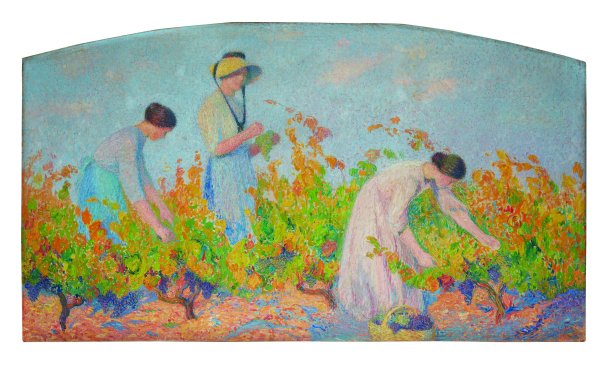
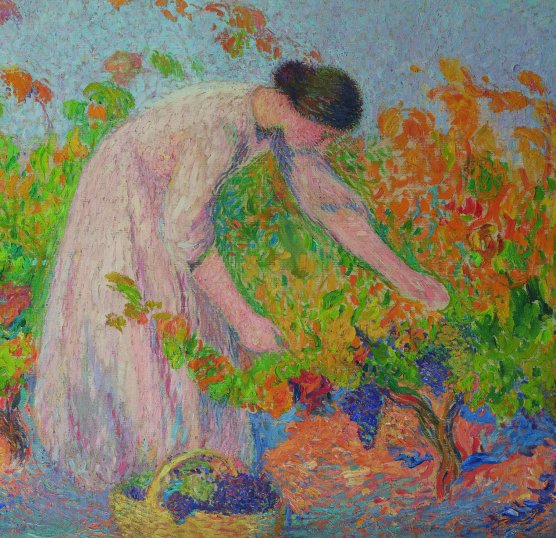
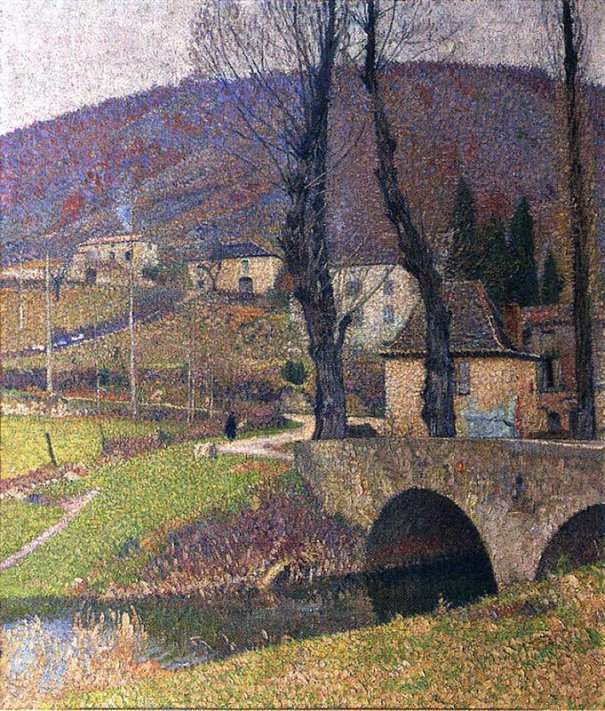
The Vines in Saint Clair by Théo van Rysselberghe (1912)

Van Rysselberghe was travelling along the Mediterranean coast with his friend, the French Neo-Impressionist painter, Henri-Edmond Cross, looking for a suitable place to live. Cross lived in Saint-Clair and van Rysselberghe immediately fell in love with this coastal location. Théo’s brother Octave, who lived nearby, was an architect and, in 1911, he built a house for his brother. Théo now living on the Côte d’Azur slowly extricated himself from the Brussels art scene.

Bathers by Théo van Rysselberghe (1920)

The Model’s Siesta by Théo van Rysselberghe (1920)

Nude from behind Fixing her Hair by Théo van Rysselberghe (1920)

Now living on the Mediterranean coast many of Théo’s painting featured nearby landscape and coastal scenes. He continu

ed with his portraiture mainly focusing on his family. However in the first two decades of the twentieth century he produced many works featuring female nudity.

Théophile van Rysselberghe died on December 14th 1926 aged 64 and was buried in the cemetery of Lavandou, next to his friend and painter Henri-Edmond Cross.


Once again most of the information for this blog came from various Wikipedia and associated sites.

Théophile “Théo” van Rysselberghe Part 1.

The artist I am looking at today is Théophile “Théo” van Rysselberghe a Belgian neo-impressionist painter, who was a major protagonist in the European art scene at the turn of the twentieth century.

Self-portrait in a Green Waistcoat (1924)

Théo was born in Ghent on November 23rd 1862, the youngest child of Jean-Baptiste and Melanie van Rysselberghe and had five bothers and a sister. He was brought up in a French-speaking middle-class home. His first art training occurred when he attended the Royal Academy of Fine Arts in Ghent studying under the Belgian painter, Theo Canneel.

Oriental Beauty by Jean-François Portaels

In 1879 he enrolled at the Académie Royale des Beaux-Arts in Brussels under the directorship of Jean-François Portaels, a Belgian painter of genre scenes, biblical stories, landscapes, portraits and orientalist subjects. Portaels is regarded as the founder of the Belgian Orientalist school and his North African paintings had started an orientalist fashion in Belgium. This aspect of Portaels’ work had a great influence on the young Théo van Rysselberghe, so much so that he made three extended painting trips to Morocco between 1882 and 1888.

Self-portrait with Pipe by Théophile “Théo” van Rysselberghe (1880)

In 1880, when Theo was eighteen years of age he submitted and had accepted two portraits to the Salon of Ghent and that year completed a self-portrait entitled Self Portrait with Pipe. In 1881, he exhibited for the first time at the Salon in Brussels.

Portrait of a Young Spanish Woman by Théophile “Théo” van Rysselberghe

Spanish Woman by Théophile “Théo” van Rysselberghe (1880)

In 1881 Theo made his first trip to Spain and Morocco, along with his friend Frantz Charlet, a Belgian painter, etcher, and lithographer and the Asturian painter Darío de Regoyos. It was Theo’s intention to follow in the footsteps of his mentor, Jean-François Portaels.

Descent from the Cross by Pedro Campaña (1547)

Whilst in Madrid he visited the Museo del Prado and later the trio visited Seville where Théo met Constantin Meunier, who had been commissioned by the Belgian government to copy Pedro Campaña’s Descent from the Cross which was mounted on the back wal of the Sacristia Mayor of Seville Cathedral.

Dario de Regoyos playing the guitar by Théo Van Rysselberghe (1882)

During Théo’s stay in Spain he made time to complete a portrait of his fellow traveller, Darío de Regoyos, playing his guitar.

Arabian Street Cobbler by Théo Van Rysselberghe

Moroccan Market by Théo Van Rysselberghe (1883)

Théo arrived in Tangier at the end of October 1882 and suddenly he realised that he had entered a “new” world, so different from the Europe he had come from. He stayed in the town for four months continually sketching and painting street scenes, the kasbah and the souk.

The Oyster Eater by James Ensor (1883)

In April 1883 he exhibited these scenes of everyday Mediterranean life at the Salon L’Essor, in Brussels. L’Essor was an association of visual artists in Brussels, which was active from 1876 to 1891. Its original aim was to rebel against the conservative tendencies of the art institutions and art circles in Brussels. However in 1883 some of the artists of this group were dissatisfied with the ruling body of the group with regards its admission policy, lack of direction and their controversial decision to reject Belgian Expressionist painter James Ensor’s The Oyster Eater in the 1883 L’Essor Salon. However, it has to be remembered that the previous year the Antwerp Salon jurists had rejected the same painting. It is thought that the rejection was because of the sexual overtones suggested by a single young woman eating oysters, which at the time was considered to be an aphrodisiac.

Portraits of or work by the 11 original founders of Les XX. Upper register, left to right: Darío de Regoyos y Valdés, Guillaume van Strydonck, Théo van Rysselberghe, Fernand Khnopff and a portrait of Willy Finch by Magnus Enckell. Bottom, left to right: La donna morta by Willy Schlobach, Rodolphe Wytsman, Le viatique qui passa (1884) by Charles Goethals, a medal made by Paul Du Bois, and a painting by Frantz Charlet. Right, larger image: James Ensor.

Portrait of Octave Maus by Théo Van Rysselberghe

Portrait of Octave Maus by Théo Van Rysselberghe (1885)

Van Rysselberghe and James Ensor were two of the eleven artists who left L’Essor and became founding members of the breakaway group, Les XX. Les XX became a group of twenty Belgian painters, designers and sculptors, formed by the Brussels lawyer, publisher, and entrepreneur Octave Maus, who, with his wife, featured in a number of van Rysselberghe’s portraits between 1883 and 1890, Each year twenty other international artists were also invited to participate in the Les XX exhibitions. Among the most notable members were James Ensor, Willy Finch, Fernand Khnopff, Félicien Rops, and later Auguste Rodin and Paul Signac.

Emile Verhaeren by Théo Van Rysselberghe

Emile Verhaeren by Théo Van Rysselberghe ((1892)

Rysselberghe completed many portraits and it was around 1882 that he struck up a close friendship with the poet and art critic Emile Verhaeren who featured in many of Théo’s portrait works. The lower work was viewed as a masterpiece of Neo-Impressionist drawing and aroused the passions of true connoisseurs. The sketch sold for 150,000 euros in 2006, it was offered at the same auction house, Christie’s Paris, on 21 October 2023 with an astonishing estimate of 60-80,000 euros. After a fierce bidding war, it sold for €240,000. This works out at €302,000, with the buyer paying the substantial sales costs.

Portrait of Marguerite van Mons by Théo Van Rysselberghe (1886)

Another of Rysselberge’s portraits featured the daughters of his friend Emile van Mons, a lawyer and well-known art lover. The June 1886 Portrait of Marguerite van Mons features ten-year-old Marguerite shortly after the death of her mother. She stands facing us wearing a simple black dress in front of a pastel blue door on which are a number of gilded ornaments. Her right hand holds the doorknob as if she had just entered or was about to leave the room. There is an air of mystery and melancholia about the depiction as the pale-faced girl stares absently out at us

Portrait of Camille van Mons by Théo Van Rysselberghe (1886)

Months earlier van Rysselberghe had completed a portrait of Marguerite’s elder sister, Camille.

……. to be continued

.


Most of this information for this blog came from various Wikipedia sites.

Peasant Girl Lighting a Fire. Frost, by Camille Pissarro

Peasant Girl Lighting a Fire. Frost by Camille Pissarro (1888)

My Daily Art Display’s featured painting today is entitled Peasant Girl Lighting a Fire. Frost, which was painted by Camille Pissarro in 1888 and can now be found in the Musée d’Orsay in Paris.  At this time Pissarro was still a leading light of the Impressionist movement, a movement he had helped to form.   However it was two years prior to this work that Pissarro began to become interested in the experimental work of young artists, who had adopted the fragmented brushstroke technique which Georges Seurat and Paul Signac were trying out, known as pointillism , a technique Pissarro used in parts of this painting.  For a more in depth look at pointillism see My Daily Art Display October 21st 2011 for a painting by Georges Seurat and November 29th 2011 for a painting by Paul Signac. Pissarro had been introduced to Seurat and Signac in 1885 and in the following years he began to work in the pointillist style which had then been adopted by the Neo-Impressionists.  By the time Pissarro was in his sixties he found that this pointillism technique too restricting and in the last ten years of his life he returned to a purer Impressionist style.
Camille Pissarro was fifty-eight years of age when he completed today’s featured work of art.  Ten years earlier his style of painting was such that he would portray nature in his landscapes by a myriad of smaller comma-like brushstrokes built up on the surface of the canvas such as his 1877 work, The Red Roofs (see My Daily Art Display of November 30th 2010).  Pissarro was concerned that these works lacked clarity and so he decided to change the way he worked.  He spent time working in collaboration with Degas, who was, of all the Impressionists, a great believer and advocate of figure painting and the primacy of the human figure at the expense of landscape background.  It was maybe the views of Degas that led to Pissarro to complete some works in which the human being(s) took pride of place in the painting, as is the case with today’s featured work.

The painting depicts two peasant girls working in a field in a cold and frosty winter morning and we see one of them tending a fire.  Pissarro often painted peasant women at work.  Two fine examples of this are his 1881 work entitled Girl with a Stick and the 1893 painting entitled Woman with a Green Shawl.  His portrayal of peasants received some criticism for copying the ideas of Jean-François Millet but Pissarro firmly contested such a notion.  However in general art critics looked upon his works as true representations of peasant life.  Look at the beautiful way in which Pissarro has depicted the landscape.  At the time of this painting Pissarro was extremely interested in the pointillism technique of Seurat and Signac and he used this method to present us with a sumptuous backdrop to the two girls.  The painting has a light and airy feel to it and there is a subtle delicate nature to the work.  The work was painted in Eragny just north-west of Paris where Pissarro and his family lived for a time.

In the far distance we can see the low hills topped by irregular spaced bushy trees.  In the middle ground, we observe grazing cows in the meadow, a line of poplar trees at the foot of the hills and possibly a hidden stream running horizontally across the mid ground.   Notwithstanding the backdrop, the focus of the painting is on the two girls in the foreground, who almost appear to stand next to us.  The scene is lit up by the sun, somewhere out of sight, to the left, which throws off long blue shadows across the field.  It is a wintry sun and still low in the sky, hence the long shadow of the girl in the foreground, which disappears off the painting to the right.    Although it emits light, the sun gives off little warmth and so our two young workers are wrapped up well.  The temperature is even colder due to the wind chill factor.  Look how the girls skirt and the smoke from her small fire are blown horizontally by the wind which comes from the left of the painting.  One can imagine how cold it is with the driving wind on a wintry day. We almost shiver as we look at this work of art.

The girls are both well wrapped up against the morning’s wintry chill.  The girl on the right, who seems no more than a child, is warming her hands by the fire.  She wears a blue dress and a thick dark brown coat.  She has a dark woolen hat on her head which is pulled down to protect her ears from the icy wind.   The older girl, who is closest to us and because of her height, is the main focus of our attention.  She has taken a branch from the pile behind her, and is about to break it up and add it to the fire.  She wears a pink skirt with a blue apron.  She too has protected her head, wearing a white scarf tied beneath her chin.  Her final layer of protection is a pink and white shawl from which emerge long black sleeves of her dress.

The colour combinations Pissarro uses to achieve the colour we see is fascinating.  The girls pink dress is made up of a combination of yellow, blue and pink.  The green grass of the meadow is achieved by using a combination green, blue, yellow, pink and white.  The only orange Pissarro used was for the flames of the fire.

Pissarro fled the traumas of the Franco-Prussian War in 1871 and, like Monet, went to live in London.   It was whilst in London that he saw a number of paintings by Turner.  Pissarro later commented on Turner’s works and was amazed by the way Turner succeeded in conveying the snow’s whiteness, not just by the use of white alone but by combining a host of multi-coloured strokes, dabbed in, one against the other, which when looked at from a distance, created the desired effect.  It is in this painting that Pissarro has, without the actual presence of snow, managed to give us a crystalline frost of a cold winter’s morning encapsulated in an aura of diamond blue.

Madame Hector France (Portrait of H.F.) by Henri Edmond Cross

Madame Hector France (Portrait of H.F.) by Henri Edmond Cross (1891)

Today I want to look at the life of Delacroix and a couple of his paintings.  However I am not talking about Eugène Delacroix but the artist Henri-Edmond-Joseph Delacroix who was born in Douai a commune in the Nord département in Northern France, in 1856, some fifty-eight years after the great French Romantic painter.

Henri-Edmond-Joseph Delacroix was the only surviving child of a French father, Alcide Delacroix and a British mother, Fanny Woollett.  The family moved to Lille when Henri was nine years of age.  He showed an interest in drawing when he was young and his parents sent him to Carolus-Duran, the Lille painter, for private drawing and painting lessons when he was just ten years of age. He was encouraged as a youth to develop his artistic talent by his father’s widowed cousin, Dr Auguste Soins, who paid for much of Henri’s artistic training.   He spent a short time in Paris when he was nineteen, studying under the tutelage of the French realist painter, François Bonvin before returning to Lille.  In 1878 he enrolled on a three-year course at the Écoles Académiques de Dessin et d’Architecture in Lille and studied under the painter, Alphonse Colas.  Three years later he returned to Paris and studied in the atelier of Émile Dupont-Zipcy.

Henri began exhibiting his work in 1881 but so that he and his work would not be confused with the late romantic artist Henri-Eugène Delacroix he decided to change his name to “Henri Cross” which was a reduced English version of his surname (croix).  In 1886 he changed the signature on his paintings to Henri Edmond Cross so that there would be no confusion between him and the glass paste sculptor Henri Cros.  Henri Cross’ artwork changed in 1883 after travelling south to Provence and meeting up with Claude Monet.  His early works which had been mainly realist portraiture and still-life works had been predominately dark in colour but suddenly it all changed and his paintings took on the lighter colours and tones of the Impressionists.

The following year, 1884, was a milestone in French art.  Up until then any artist wanting to progress in their chosen career relied completely on having their works exhibited at the Paris Salon and for that to happen they had to submit their paintings to the Salon jurists to see if they considered their works good enough to be exhibited.  The jurists were, at this time, increasingly conservative in their views of what art was acceptable and were not receptive to the works proffered by the Impressionist artists whose works had moved away from the traditional academic style.  The Impressionists would often have their paintings rejected by the Salon jurists or if they did manage to have a paintings accepted it would be hung in such a way that it was almost hidden from view.  In 1863 the jurists rejected a surprisingly high percentage of paintings and this caused a furore amongst the “discarded” artists.

The following summer a number of these disgruntled artists, such as Seurat, Signac,  Albert Dubois-Pillet, Odilon Redon and today’s featured painter, Henri Cross, got together and formed the Société des Artistes Indépendants (Society of Independent Artists) and based the society on the premise sans jury ni récompense, (No jury nor awards).  They held their own inaugural exhibition, Salon des Indépendants, in May 1884 and Henri Cross exhibited some of his paintings.  In 1888 he visits the Cote d’Azur for the first time and paints in Eze and Nice and it is in this year that he meets Irma Clare, the subject of today’s paintings.  In 1891 he became Vice-President of the Society.  He had by this time become one of the leading figures of the Neo-Impressionism movement.

Henri Cross’ health was poor and he suffered badly from rheumatism.  He decided to move to the warmer climes of the South of France.   He initially settled in a rented house in Cabasson, near Le Lavandou, but later went to live in Saint-Clair, a small hamlet just outside of St Tropez, where he stayed for the rest of his life, except for his two visits to Italy, when he journeyed to Tuscany and Umbria in 1903 and 1908 and his trips to Paris to the annual Salon des Indépendants.  Paul Signac followed him south the next year and settled in St TropezIt was during this period that Cross was introduced to the revolutionary artist, Henri Matisse.  Henri Cross’ close working relationship with Paul Signac, led to him being introduced to the artistic technique, known as pointillism.  Pointillism is the methodical and scientific technique which juxtaposed small dots of pure colour together to maximize luminosity. The dots appear to intermingle and blend in the observer’s eye.

My Daily Art Display featured painting today was completed by Henri Cross in 1891 and is housed in the Musée d’Orsay.  It is entitled Madame Hector France (Portrait of H.F.) and is a fine example of the artist’s use of the pointillism technique with its screen of small regular dots over a densely painted ground.   Henri Cross exhibited the work at the Salon de la Société des Artistes Indépendants in 1891 and was looked upon as his first major work which adopted the Neo-Impressionist style.

The subject of this impressive portrait is Irma Clare the wife of Hector France, a novelist who was best known for his 1886 French language collection of tales about European adventurers and veiled temptresses, under the marvellous title Musk, Hashish and Blood.  Irma appears to be on a terrace, having just escaped from a dazzling soiree which is the source of light emanating from the right.  This is almost a life-size portrait of the lady and the light of the summer’s night is suggested through the sparkling glow of the lamps which hang from the tree branches in the background.  It is a conventional society portrait.  Irma is adorned with the most sumptuous and elegant gown.  Wearing this full length gown she almost gives us the impression that she is gliding elegantly across the painting.  Her hair sparkles and its colouring almost merges with the night air which surrounds her

In the foreground we have a mottled pink and white rhododendron which, along with the way the artist has depicted the chair at an angle and the receding floor tiles, gives the painting added depth.  As we have seen in paintings I have featured by Monet and other Impressionists, the Japanese influence had taken hold in late nineteenth century France and it is more than likely that the floral display we see in this painting comes from the influence of Japanese prints which were all the rage in France as does the frieze of white Japanese fans we see in the middle-ground.

In May 1893, two years after the painting was exhibited, Mrs Hector France became Mrs Henri Edmond Cross, the wife of the artist.  For some people the coupling of the two was a coupling of opposites.  He was looked upon as a secretive man who was always serious whereas Irma was seen as more frivolous, high-spirited and somewhat shallow.  They lived in Saint-Clair and one of their neighbours was the Belgian Neo-Impressionist painter, Théo van Rysselberghe and his wife Maria.  She was unequivocally critical of Irma.  In the biography Henri-Edmond Cross: études et l’oeuvres sur papier by Françoise Baligand, Raphaël Dupouy, and Claire Maingon, she is quoted as describing Irma as “petty, base of nature and an idle gourmand”.  This was not the universal opinion of her as others such as the French artist and friend of the couple, Charles Angrand, found Irma very hospitable and during the latter part of Henri Cross’ life, a very caring person as far as her husband was concerned.

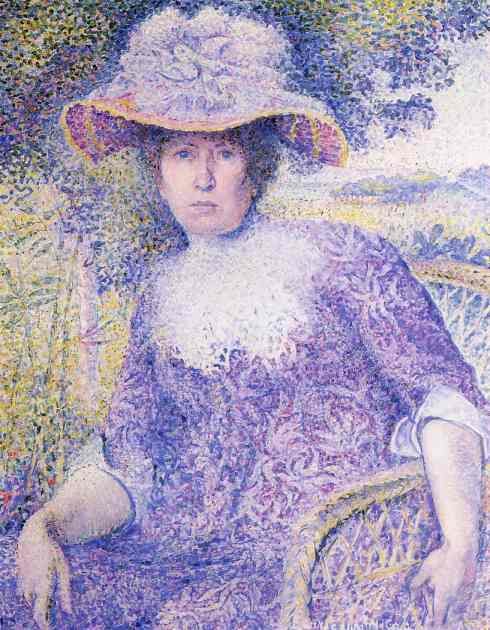
Portrait of Madame Cross by Henri Edmond Cross (1901)

Once settled and living around St Tropez, Henri Cross turned more and more to landscape painting using vivid colours but he would still complete the occasional portrait of his beloved wife as was the case in 1901 when he completed the work entitled Portrait of Madame Cross, seated in the garden, looking slightly older, bedecked in a large hat and a floral gown.  This painting is also housed at the Musée d’Orsay.

By 1907 Henri Cross’ health deteriorated.  His eyesight was being affected by the eye disease iritis and his arthritis was becoming more debilitating.  In 1909 whilst visiting Paris he was diagnosed as suffering from terminal cancer.  He returned home to Saint-Clair and died in May 1910 aged 54.  Henri Cross is buried in Le Lavandou.

The Dining Room by Paul Signac

The Dining Room by Paul Signac (c.1887)

On October 21st,  I looked at a work by the Neo-Impressionist painter Georges Seurat, which had been completed by him using the technique known as Pointillism or Divisionism.   For a brief explanation of those terms, please go and look at that earlier blog.  Today I want to look at a work by his contemporary and friend Paul Signac.

Paul Victor Jules Signac was born in Paris in 1863 and came from a prosperous family of shopkeepers.  Originally he trained to become an architect but at the age of eighteen, after visiting a Claude Monet Exhibition, he decided to set off on an artistic career and learn the technique of en plein air painting.  His earliest known works were landscapes or still-lifes and one can see in them an Impressionist influence, especially the works of Monet and Alfred Sisley.  At the age of twenty he was tutored by the Prix de Rome winner Emile-Jean-Baptiste Bin.  In 1884 he became a founder member of the Société des Artistes Indépendants and their Salon des Indépendants.   The Salon des Indépendants was an annual exhibition which started in 1884 and was held in Paris by the Société des Artistes Indépendants.  It was set up in direct competition to the Paris Salon.   Many artists as well as the public became increasingly unhappy with the rigid and exclusive jurist-based selection policies of the official Salon.  Just over twenty years earlier, in 1863 the first Salon des Refusés had been held for innovative artists whose works had been rejected by the official Salon.  The Société des Artistes Indépendants which Signac co-founded had the motto “Sans jury ni récompense” which meant “no jury, no awards”.  One of the other co-founders of this society was Georges Seurat and it was he who introduced the principles of Divisionism and the theory of colours to his friend Signac.

Signac, up until then, had been following the Impressionist style of painting but he became fascinated with Seurat’s technique, known as Pointillism.    He then decided to experiment with this newly acquired technique of scientifically juxtaposing small dots of pure color on the canvas which combined and blended them in the viewer’s eye instead of the artist blending the colours on a palette before putting the combination on to the canvas.  Signac was fascinated with this technique and was tireless in his attempts to convert others to Seurat’s methods. In 1885 Signac met Camille Pissarro, whom he introduced to Seurat. Pissarro realised that this technique was the answer to his desire to have a rational style and so adopted it with great fervour.  Pissarro, against the wishes of the other Impressionists, invited Signac to participate in their eighth and last Impressionist Exhibition in 1886.

Signac loved to sail and a large number of his paintings featured the French coast and its harbours.  He would progressively sail further afield, visiting various ports in the Mediterranean as well as the Dutch coast to the north.  During the summers he would head south to the Côte d’Azur and St Tropez where he had bought himself a house in 1892.  He would always return from his voyages with numerous sketches of the places he had visited and then back in his studio, turn them into beautifully coloured canvases that are carefully worked out in small, mosaic-like squares of colour, and which were quite different from the tiny, variegated dots previously used by Seurat.

He became friends with Vincent van Gogh and the two would spend time in Van Gogh’s Parisian home and his summer hide-away in Arles. From the mid-1880s Signac exhibited regularly. Apart from the Salon des Indépendants, in which he figured every year, he showed at the last Impressionist Exhibition (1886) at the invitation of Pissarro.   It was not until he was almost forty years of age that he had his first one-man exhibition which was held at the Paris gallery owned by Siegfried Bing.  However like his Neo-Impressionist friends he received little public acclaim for the first 20 years of his career.  On Seurat’s death in 1891, Paul Signac became the leader of the Neo-Impressionists

Signac was a great inspiration to the young and up-and-coming painters such as Henri Matisse and André Derian.  It was his support that played a vital role in the evolution of Fauvism.   Fauvism was the short-lived and loose group of early twentieth-century Modern artists whose works emphasised the artistic qualities of strong colour more than the representational or realistic values of the Impressionist painters.  Signac became president of the annual Salon des Independants in 1908 and retained that position until his death.   As such, Signac encouraged and supported younger artists such as Matisse by allowing their works and the controversial works of the Fauves and the Cubists to be exhibited.

Signac died in Paris in 1935, aged seventy-two.

My Daily Art Display featured oil on white primed canvas painting today is not one of Signac’s landscape or seascape although it does highlight the unusual Divisionism technique.  It is entitled Dining Room and was completed in 1887 and exhibited at the Paris Salon des Indépendants in 1887 that year.  It now hangs in the Rijksmuseum Kröller-Müller, in Otterlo, Netherlands.  Before us we see three people, a man and a woman seated at a table and a maidservant.  Although the setting looks like it has all the accoutrements of a well-to-do bourgeois household, the dining room is actually that of Signac’s family, and before us we have Signac’s mother, grandfather and housekeeper.   The room is lit from behind with light emanating from a window on the rear wall.  This illuminates the subjects vividly and creates silhouettes and strong contrasts of light and shade.  It gives a strong structure to the composition.  See how Signac has highlighted areas of the painting by the use of barely tinted yellowish whites.  The seated characters are rather wooden-like.  They sit at the lunch table in stony silence.  There appears to be no communication between Signac’s grandfather and mother and the setting is devoid of anecdote.  There is a stiffness of what we see before us.  There is a frozen solemnity about the scene and this may have been Signac’s way of pictorially criticising the strict and ritualistic sombreness of middle-class meal times.

I am not sure I like the Divisionism technique used in Signac’s indoor scenes.  I think it works much better in his coastal landscape works.  There is no doubt about it that it was a clever technique but it is just not for me.

Sunday Afternoon on the Island of La Grande Jatte by Georges Seurat

A Sunday Afternoon on the Island of La Grande Jatte by Georges Seurat (1884-86)

Today I am starting My Daily Art Display blog by introducing you to some new “isms” which have a connection with what is to follow.  They are Post-Impressionism, Neo-Impressionism, Pointillism and Divisionism and they all are connected in some way to today’s featured artist George Seurat.

By now you will have read many of my blogs that cover the works of the Impressionists such as Monet, Renoir, Degas and Caillebotte and so by now you are familiar with the term Impressionism.  Post Impressionism was a style of painting that grew out of Impressionism or maybe we could say it was a style of painting which was a reaction against Impressionism. The three main artists who were central to this new group of painters and who were termed Post Impressionists were Gaugin, Van Gogh and Cézanne.   Gaugin retained the intense light and colour of the Impressionists but discarded the idea of painting from nature.  He was totally against naturalism, where artists depict nature just as it is, and in its place he wanted his works to have more inventive subject matter and he also liked to experiment with colour.   On the other hand Van Gogh continued to paint from nature but developed a highly personal use of colour and brushwork which openly expressed his own expressive response to a subject.  Cézanne kept faith with the Impressionist’s principle of painting from nature but his works came across with a greater energy and vitality.

Today I am going to look at Neo-Impressionism and Neo-Impressionist artists who were a distinct group of painters within the Impressionist movement and in some ways formed a transition period between the Impressionists and the Post Impressionists.  The two leading figures of this trend were Georges Seurat and Paul Signac and they wanted to have a more scientific approach on how light was depicted in their paintings.  Their works were characterised by the use of a technique known as Divisionism or Pointillism.  Divisionism, also sometimes known as Chromolumanarism, was a method of painting in which colour effects were achieved by applying small areas of dots of pure unmixed colours on the canvas so that  an observer standing at an appropriate distance from the painting (suggested distance for best effect was three times the diagonal measurement of the work) the dots would appear to react together giving a greater luminosity and brilliance than if the same colours had been mixed together before putting them on the canvas. What these artists wanted to achieve was that the observer of the painting combines the colours, which are in the form of dots, optically instead of the artist pre-mixing them on a palette before putting them on the canvas.

Pointillism comes from the term peinture au point, which was used by the French art critic Félix Fénéon, when he described today featured painting by Seurat.   It can be defined specifically as the use of dots of paint and does not necessarily focus on the separation of colors.  Divisionism refers mainly to the underlying theory, pointillism describes the actual painting technique associated with the likes of Seurat, Signac and to a lesser extent Pissarro. Pointillism is related to Divisionism which is a more technical variant of the method. Divisionism is concerned with color theory, whereas pointillism is more focused on the specific style of brushwork used to apply the paint.

Enough is enough !!!!  I don’t want to get too bogged down with “isms” and their meanings and I am sure that there are many people out there who can give a much more expansive explanation of the differences between Divisionism and Pointillism .   My Daily Art Display today features what many believe is Georges-Pierre  Seurat’s greatest work.  It is entitled A Sunday Afternoon on the Island of La Grand Jatte.  It was the one of the first painting to be executed entirely in the Pointillist technique and the first to include a great many people playing a major role.   It caused a sensation when it was exhibited at the eighth and final Impressionist Exhibition in 1886.  It is thought that it was possibly intended as a pendant to Seurat’s other work, Bathers at Asnière,  which I will look at in a later blog.

He started the work in 1884 and did not complete it until 1886.  He spent two years making over sixty preparatory pencil and ink drawings, conté crayon studies and oil sketches on panel for this work.  He would alter the grouping of people, the number of people within a group and where each group or individual were positioned until he was satisfied that he had achieved the perfect balance.  There was a smaller version of the painting which can be found in the Metropolitan Museum of Art in New York.  There is also a version of the scene without the people which was once in the private collection of Mrs John Hay Whitney.   This painting we see today is massive in size measuring 207cms high by 308cms wide (almost 7ft tall and 10ft wide) and since 1924 has been housed in the Art Institute of Chicago.  Seurat completed the final version of this painting in his small Paris studio.

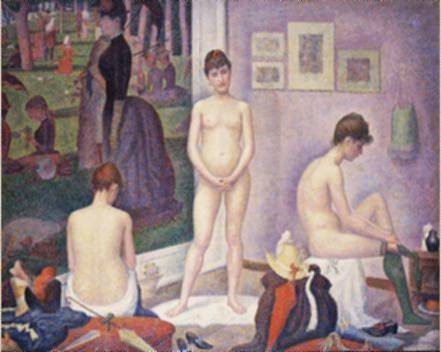
The Models by Seurat (1886-88)

In 1888, Seurat also completed another painting which was entitled The Models  using his pointillism technique, and which depicts models in his studio.  Included in the painting is a section of La Grande Jatte and art historians believe that by doing this painting, he was showing the world that this technique of Pointillism worked just as well for indoor scenes as outdoor ones.

The Île de la Grande Jatte is a small island in the River Seine, downriver from La Défense.  It is about 2 kilometers long and just 200 metres wide at its widest point.  At one time it was reduced to being an industrial site but now has public gardens and houses.   Living on the island are approximately 4000 inhabitants.  However in the days of Seurat it was a pastoral retreat where Parisians could come at weekends from their claustrophobic city existence and soak up the quiet and peace of this little idyll.

Before us we see Seurat’s idealized version of the Grand Jatte omitting both the cafés and restaurants and the nearby ugly shipyard and factories.  In the painting we see members of different social classes out for a stroll along the Grand Jatte by the side of the Seine.  The figures, shown mainly in profile or frontal position, have a peculiar formal and artificial feel to them.  As we look at the painting head-on, there seems to be a definite elongation of some of the people although I believe if you stand at a certain angle to the painting this is minimised.  Seurat would sketch individual groups or single characters and then return to his studio to decide if and where each group should be placed on the canvas.  He sketched people of different classes in society to give the idea that all types of people enjoyed promenading along La Grande Jatte.   Look at the trio in the right foreground.  Here we have the a man wearing a top hat and holding a cane who is more than likely from the upper classes of Paris society.  The man with the muscular arms, lying back with a cap on his head, smoking the pipe is probably a working-class boatman and finally we have the young genteel lady of an indeterminate class.  An unusual trio and who, although physically close in the painting, would be unlikely to have a closeness in that present-day society.  The faces of the people in the painting show little personality.  There is something very impersonal about them.  We must presume that this was a deliberate ploy by Seurat who seemingly did not want the painting to be sullied by observers of the painting trying to interpret facial expressions.  I don’t believe the artist ever intended this to be in any way a moralistic statement about the French culture and classes at the time. However, some would disagree.   Art historians like to interpret every painting and seek symbolic depictions within a work so let us have a look at a few that have been thrown up for consideration with regards this work of art.

In the left middle ground we see a lady dressed in gold and orange fishing in the river.  I suppose there is nothing strange about that albeit she is hardly dressed as a woman who was to go out on a fishing expedition.  Well consider what the French word is to fish – it is pêcher and some have suggested that Seurat has made a play on the word as the French word to sin is pécher.  So is Seurat secretly identifying her as a prostitute.  Again look at the woman in the right foreground accompanying the gentleman.  Look what she is holding in her left hand – a monkey on a leash.  That is certainly an unusual pet to take for a walk.   So why did Seurat include a monkey.  One possible reason is that a female monkey in French is une singesse.  The symbolists would have us believe that a monkey is a symbol of licentiousness and that is why the French slang for prostitute is singesse.  So again I ask the question is Seurat trying to tell us by symbolism that this woman is a prostitute who is out for a stroll with her client?

It is interesting to note and it is not shown in my attached picture, that later Seurat painted the border using parallel red, orange and blue dashes and dots.  He varied the combination of colours in different parts of this border in order to accentuate the adjacent colours in the painting itself.  Maybe if you go to see the painting in Chicago you can let me know if Seurat’s idea with this border really works.

Finally, I came across a poem about this painting which I was going to add to the blog but it was too long so instead I have added the URL where you can find it.  It is:

http://www.lamaquinadeltiempo.com/algode/delmore2.htm

The Pond at Montfoucault by Camille Pissarro

The Pond at Montfoucault by Camille Pissarro

As promised yesterday my blog today carries on looking at the life of Camille Pissarro and one of his later paintings.

In 1872 Pissarro returned to Pontoise, where he once again set up home.   His friendship with Cézanne was re-established and Pissarro mentored his friend in the technique of painting “patiently from nature”.   Cézanne was to later to comment about his relationship with Pissarro and how his mentoring made him change his artistic style saying:

“…As for old Pissarro, he was a father to me, a man to consult and something like the good Lord…”

Pissarro was determined to create an alternative to the Salon.  He wanted a society of artists who would work together and become a type of cooperative.  It took almost four years to achieve his aim .   Artists petitioned for a new Salon des Refusés in 1867, and again in 1872.  Both requests were denied and so during the latter part of 1873, Pissarro along with Monet, Sisley and Renoir organized the Société Anonyme Coopérative des Artistes Peintres, Sculpteurs, Graveurs (“Cooperative and Anonymous Association of Painters, Sculptors, and Engravers”).  Its purpose was to exhibit their works of art independently.   They soon had fellow artists like Cezanne, Berthe Morisot and Degas interested in the scheme and all agreed to boycott participation in the Salon in 1874 and exhibit only at their exhibition.  The exhibition took place in January 1874 at the studio of Gaspard-Félix Tournachon , known as Nadar,  in the Boulevard des Capucines and this exhibition of their work was later to become known as the First Impressionist Exhibition.  Works in this exhibition included five paintings from Pissarro.  The names of the other artists who exhibited works in this exhibition reads like a Who’s Who” of famous artists.  Included in the exhibition were works by Monet, Renoir, Guillaumin, Béliard, Sisley, Cézanne, Degas and Morisot.  This First Impressionist Exhibition was not received favourably by the critics and Pissarro was disheartened by their criticism.  He wrote to the art critic Théodore Duret, who was sympathetic to the Impressionist cause, expressing his disappointment with the adverse criticism:

“…Our exhibition goes well. It is a success. The critics destroy us and accuse us of not having studied; I am returning to my work, it is better than reading the reviews…”

So why did the majority of art critics hate the works on show?    One should remember that the critics were brought up on the art of the Salon with its accepted works portraying religious, historical any mythological settings and so the paintings put forward by the Impressionists, including Pissarro, depicted commonplace street life and people busying themselves in their daily routine and was considered by the critics as both facile and some even went further by declaring them vulgar.  The critics considered a lot of the Impressionist works as being “unfinished” in comparison to the works seen at the Salon.  They commented that the way the brushstrokes of the Impressionists works were visible which, to their mind,  meant it had been done in haste and often completed in a solitary sitting.  In comparison they praised the Salon painters who to them were the “real” artists and who spent hour after hour carefully perfecting each part of their works.

The year of this First Impressionist Exhibition in 1874 proved a bad year for Pissarro.  His artworks were not selling and he had to endure a personal tragedy with his nine year old daughter Jeanne dying the week the exhibition opened.  However,  Pissarro stuck to his belief in the Impressionist movement and exhibited no fewer than twelve works in their second exhibition in 1876.  Three years on the Impressionist grouping was starting to fall apart with Renoir, Sisley and Cézanne having left.  There was also now a split amongst the remainder of the group with Degas on one side who wanted to bring in new artists and Caillebotte and Pissarro on the other who wanted to maintain the status quo.  Degas also laid down the rule for the Impressionist group that any artist putting forward work to the Salon could not enter work in that year’s Impressionist exhibition.  This was a major dilemma for some of the group who believed that to become a respected artist and command a good price for their works they had to exhibit at the Salon.

The possible break-up of the Impressionists that had worried Pissarro showed itself in the sixth and seventh exhibitions with few of the initial contributors putting forward works for inclusion.  Pissarro continued to support the Impressionist Exhibitions, refusing to enter works at the Salon and in fact contributed to all eight Impressionist Exhibitions.  Times were still difficult for Pissarro and the collapse of the French economy at the start of the 1880’s  made it even more difficult for him to sell his work.   In 1884 he moved from Pontoise to the small village of Eragny sur Epte which lies north east of Paris.  It was whilst living here that he met the artists Georges Seurat and Paul Signac and he became a convert to their new approach to art which was known as Neo-Impressionism.  I will go more into Neo-Impressionism movement and the related “–isms” of pointillism and divisionism, both of which are relevant to Neo-Impressionism, when I feature the works of George Seurat.

By the time of the eighth and last Impressionist Exhibition in 1886 there was an apparent lack of harmony among the remaining Impressionist artists, and the work of the Neo-Impressionists was shown separately from that of the others.   It was noticeable that both Monet and Renoir were absent from this last exhibition.   Seurat showed his now famous, and very large work entitled A Sunday on La Grande Jatte which he had just completed and  which dominated the room.  The room also contained Pissarro’s own Neo-Impressionist submissions which consisted of nine oil paintings,  as well as gouaches, pastels, and etchings.

Pissarro’s love affair with Neo-Impressionism was short lived and in 1889 he began to move away from the style, believing that it made it “impossible to be true to my sensations and consequently to render life and movement”.  Impressionism at this point in time had run its course.   Pissarro carried on painting city scenes although his erstwhile colleagues Renoir, Sisley and Monet had abandoned such subjects.  Pissarro completed a number of works featuring the streets of Paris and the Gare Saint Lazare.

In his latter years Pissarro suffered from a recurring eye infection that prevented him from his en plein air work and any outdoor scenes he wanted to paint he did so whilst sitting by windows of hotel rooms he stayed at, always making sure he had a top floor room with a good view.  He carried on doing this when he toured around the northern French towns of Rouen, Dieppe and Le Havre  and also when he made trips to London.  Pissarro died in Paris in 1903, aged 73.  He was buried along with the other greats of French art, music and literature in the Père Lachaise Cemetery.

Camille’s descendents followed his path in the art world.   His granddaughter, the daughter of his son Lucien,  Orovida Pissarro is a painter in her own right.  His great-grandson, Joachim Pissarro, is former Head Curator of Drawing and Painting at the Museum of Modern Art in New York and is now a professor in Hunter College’s Art Department.  His great-granddaughter, Lélia, is an artist who lives in London.

My daily Art Display featured work of art today by Camille Pissaro is a painting he completed in 1875 entitled The Pond at Montfoucault.   In 1859, a few years after arriving in Paris, Pissarro,  whilst attending the Académie Suisse,  met some aspiring artists who would become very famous, such as Monet and Cézanne.  He also became great friends with a lesser known painter, Ludovic Piette.  Piette often exhibited at the Paris Salon  in the 1860’s and also some of his paintings were shown at the Third Impressionist Exhibition of 1877.  Piette’s home was in the small village of Montfoucault, which lies on the border between Normandy and Brittany.   Pissarro went to stay with Piette on a number of occasions and when the Franco-Prussian war broke out Pissarro and his family left their home and took refuge with Piette before crossing the Channel to England.

It was later in 1874 when Pissarro had come to Montfoucault to try and relax and get over the stress and disappointment of the First Impressionist Exhibition that he started to paint some local country scenes.  He especially liked to depict female workers engaged in their daily duties and this is what we see in today’s painting.  Before us we see a female herding  some cattle by the pond which lay on Piette’s property.  Pissarro enjoyed his visits to Montfoucault and he wrote to Theodore Duret, the French journalist, author and art critic about his work but you can sense an uneasiness and doubt in his mind about his art.  He wrote:

“…I haven’t worked badly here.  I have been tackling figures and animals.  I have several genre pictures.  I am rather chary about going in for a branch of art in which first-rate artists have so distinguished themselves.  It is a very bold thing to do and I am afraid of making a complete failure of it…”

There is a beautiful tranquillity about this painting and one can see how an artist like Pissarro would have liked basing himself in this area.