
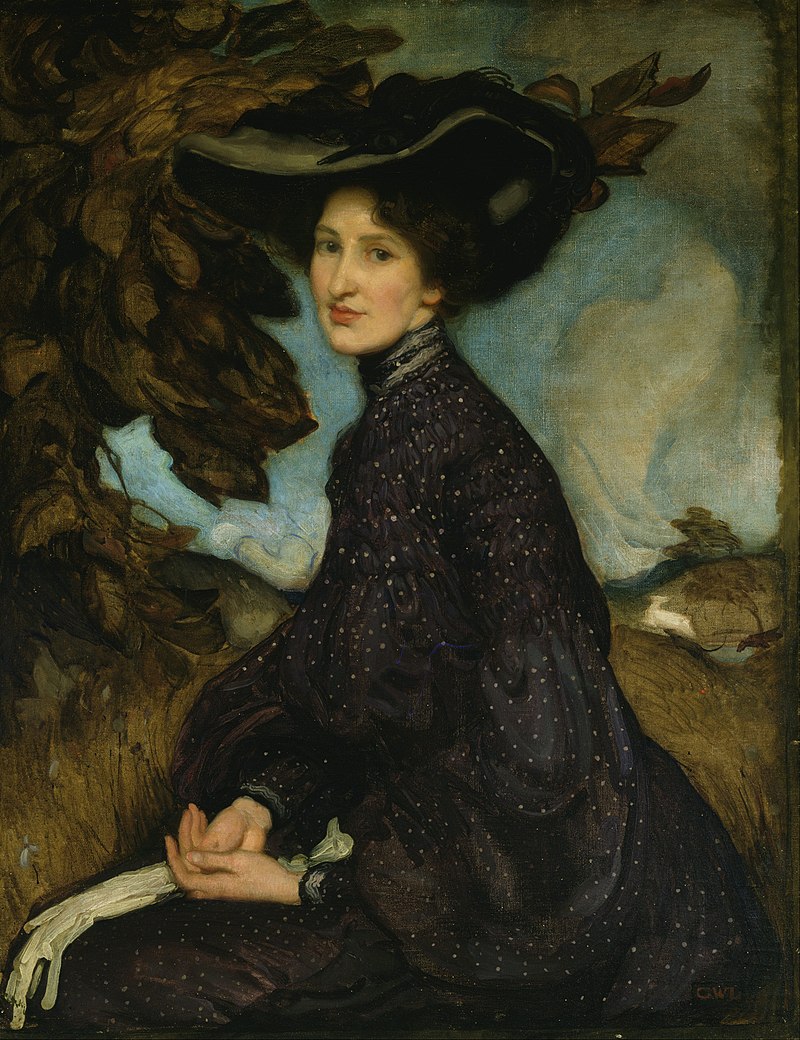
Alethea Proctor by George Lambert (1903)
The subject of today’s blog is the Australian painter, Alethea (Thea) Mary Proctor. Thea was born on October 2nd 1879 at Armidale, a town in the Northern Tablelands of New South Wales, two hundred and fifty miles north of Sydney. She was the elder child of William Consett Proctor, an English-born solicitor who was also a member of the Legislative Assembly and his Queensland-born wife Kathleen Janet Louisa Proctor, (née Roberts), who was a cousin of the artist John Peter Russell . Thea’s brother Frederick William was born three years later. She and her brother were brought up in what was considered as a financially comfortable lifestyle. During the 1880s the family lived at Hunters Hill, Sydney, and when she was ten years old, she was sent to boarding school at Armidale. Thea’s mother was determined that her children should succeed in life and arranged for them to take violin lessons from an early age.

Self portrait by Thea Proctor (1921)
In 1892, Thea’s parents separated and were finally divorced five years later. After the parent’s separation, Thea’s mother took her two children to live with her mother at Bowral, in the Southern Highlands of New South Wales, about ninety minutes southwest of Sydney and it was her maternal grandmother who encouraged and inspired Thea’s love of art. In 1894, at the age of fifteen, Thea attended Lynthorpe Ladies’ College, and at the end of the first school year she won a prize at the Bowral District Amateur Art Society’s exhibition. In 1896 she enrolled at the Julian Ashton’s art school, founded by Ashton, an English-born Australian artist. Thea also worked for a short time as an illustrator at the Australian Magazine.

The Bay by Thea Proctor (1927)
Thea’s mother Katherine, who was aware of her daughter’s artistic talent also realised that she would learn much more by visiting England and see what the art institutions had to offer her daughter. Kathleen Proctor and her twenty-two year-old daughter set sail from Australia in April 1903 and arrived in the English capital in early June. Once in London Thea studied at St John’s Wood Art Schools where she and George Washington Lambert once again became fellow students.
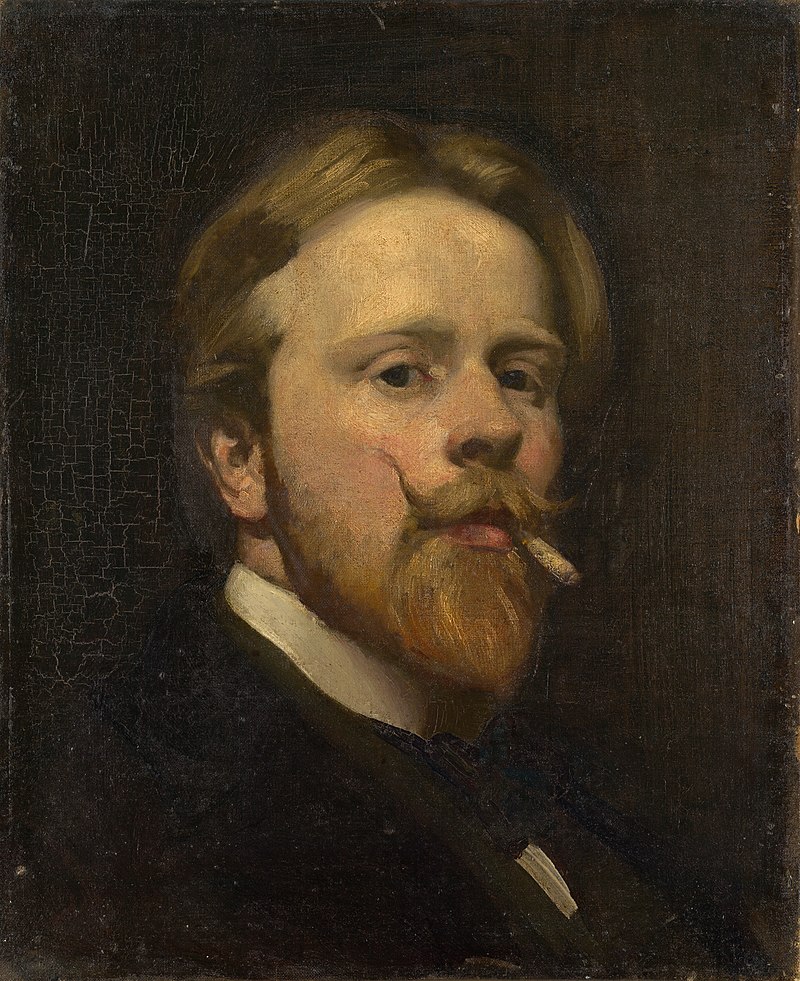
Self portrait by George Washington Lambert
Thea would often pose for George Lambert who once proclaimed that Thea was beautiful, tall, dark-haired, languorous and dignified. She in turn found Lambert to be intellectually stimulating and she was devoted to him and their friendship was to last a lifetime. Amongst the artist she met whilst in London were other expatriate Australians painters, Charles Conder, Arthur Streeton and Tom Roberts, all of who had been drawn to the opportunities London had to offer aspiring painters.

Fan by Thea Proctor (1906)
Charles Conder’s fan designs fascinated Thea as did the Japanese prints which were circulating the English capital at the time. Thea exhibited her decorative fans created in watercolours on silk at the Royal Academy of Arts and New English Art Club in London and they were deemed a great success. Thea’s favourite painting medium was watercolours and she completed many works drawing and painting in watercolours. She was also greatly interested in the costumes she saw worn by women at the Chelsea Arts Club Balls and the Ballet Russe which she went to see in 1911.

Yellow Cab, Hyde Park by Thea Proctor (1910)
Thea’s mother, Kathleen, returned to Australia during the summer of 1905 but her daughter decided to stay in England. Thea favoured the inspiring environment of London with all its cultural riches, and it offered her the chance to learn more about art and it was here that she was able to exhibit her work. The downside for her was it was an expensive place to live but she lasted out till October 1912 when she eventually returned to Australia. Once back home Thea exhibited her work in Sydney and Melbourne and both the National galleries of Victoria and New South Wales bought some of her works. The sale of her paintings was not as good as she had expected and the lure of England became too great to ignore and in late 1914, she returned to London.

Summer by Thea Proctor (1930)
Thea soon produced her first lithographs which, although she continued to paint, established her reputation when exhibited by the Senefelder Club, an organization formed in London in 1909 to promote the craft of art reproduction by the process of lithography. Later she exhibited with the International Society of Sculptors, Painters and Gravers and at the Goupil Gallery. In tandem with her love for art was her love of fashion and the theatre. This combined love of theatre and fashion was reflected in her work. This was brought home in an interview she gave in the March 1926 issue of The Home Magazine, a high quality Australian quarterly magazine published in Sydney. In the article Modifying the Mode by Selecting the Suitable Century, Thea talked about women’s fashion in England and was quoted as saying:
“…In London it is different. There quite a number of people dress to express their personalities. I don’t mean fancy dress or anything startling like Isadora Duncan’s brother who used to wear a Greek tunic and sandals on Chelsea Embankment in the chilliest weather, or one London authoress who generally attends dinner parties in hunting pink – the long topcoat looped back over an evening dress. But there are so many ways – almost imperceptible ways – in which a woman can modify the existing fashion so as to make a dress express her own personality rather than the personality of the shop from which it came. And her own period – it is a mistake to think that all women belong to the twentieth century simply because they were born in it…”

The Swing by Thea Proctor (1926)
Proctor eventually returned to Australia and went to live firstly in Melbourne in 1921 where she endeavoured to raise people’s interest in lithography, but unfortunately she found little interest and so she returned to Sydney.

The White Vase by Thea Proctor
Back on Australian soil Thea still promoted her lithographs and in 1925 Thea teamed up with Margaret Rose Preston, an Australian painter and printmaker, to stage a joint exhibition in Sydney and Melbourne. Both artists exhibited brightly coloured woodcuts in scarlet frames and despite Thea’s works being viewed in London as being comparatively conservative, many Australian critics thought them to be ‘dangerously modern’. In 1926, Thea Proctor and her long-standing friend, George Lambert, who had also returned from England in 1921 founded the Contemporary Group in Sydney in 1926 to encourage young avant-garde artists. Their annual exhibitions were held at various galleries including Macquarie Galleries, Farmer’s Blaxland Galleries, Grosvenor Galleries, David Jones’ Galleries.

Alethea Mary Proctor in 1964
Thea taught design at Ashton’s Sydney Art School and also took on the role of a private art tutor and in so doing, introduced many young budding artists to the world of linocut printing. In the 1940s Thea taught drawing for the Society of Arts and Crafts. Thea Proctor never married and died on July 29th 1966 at Potts Point, a small suburb in the inner-city of Sydney. She was 87. She was cremated with Anglican rites.

 Our hopes were soon dashed as we set about reading The History of Mr Polly which I remembered to be both turgid and depressing but there again I have to admit I was never an avid reader. The Shakespearean play was the Merchant of Venice which proved a lucky choice and one which I especially enjoyed when we looked at it in depth. Then came the poem. Poetry was anathema to sixteen year old boys and “boys don’t do poetry” was our class mantra and one needs to remember that our school was an all-boys one. Add to that the feeling of gloom about embarking on reading and learning lines of the poem for furthermore this chosen poem, which we had to study was not a short one with just a few stanzas but an extremely long one. It was The Rime of the Ancient Mariner, which was the longest major poem by the English poet Samuel Taylor Coleridge, and one he completed and had published in 1798. Unbelievably it proved to be my favourite part of the English Literature exam syllabus.


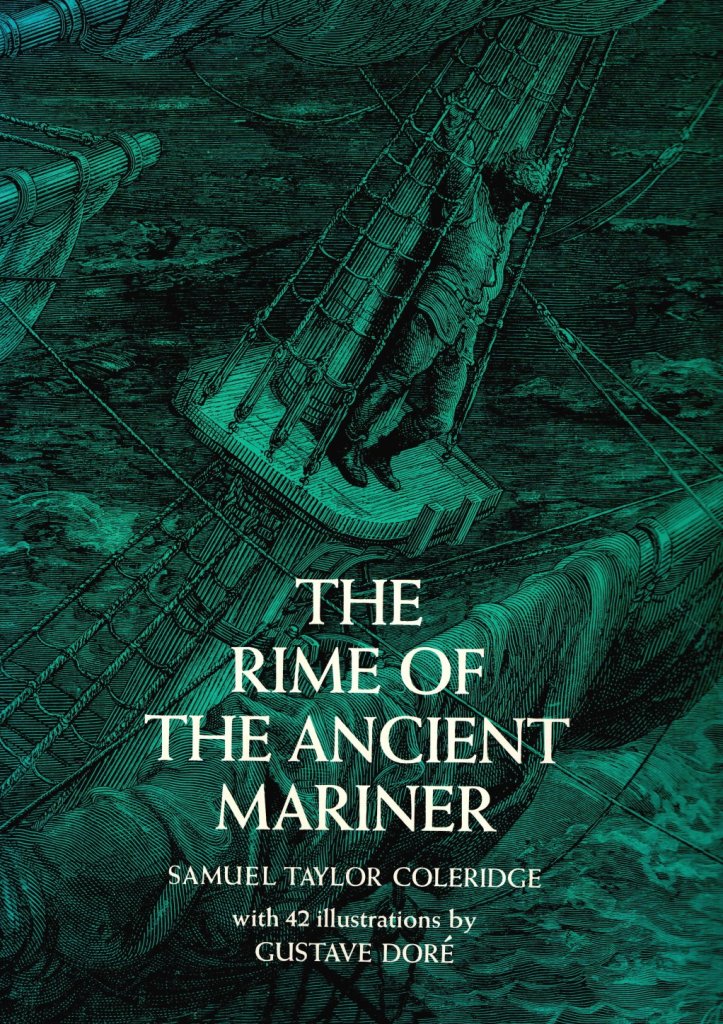 And so to the Samuel Coleridge Taylor poem, The Rime of the Ancient Mariner. Doré was excited about illustrating the poem, so much so he had completed the designs for the illustrations before a deal had been struck with the publisher. The wooden blocks he used for the illustrations were very large and cost Doré a lot of money and unlike previous engravings he took control of the supervision of them. Doré believed that this was his greatest work but unfortunately for him, its sales recouped him only slowly for his large initial outlay. It was first published in England and soon editions appeared in France, Germany and America.
 Samuel Coleridge Taylor did not set his poem in any one period but as an illustrator, Doré had to be more precise and he chose a medieval setting for the wedding feast at the start of the poem.
 It is an ancient Mariner,
 With sloping masts and dipping prow,
 And through the drifts the snowy clifts
 At length did cross an Albatross:
 However for some unknown reason the Ancient Mariner shot the albatross with his crossbow.
 Water, water, every where,
 There passed a weary time. Each throat
 The ghostly hulk approaches their ship and on board are two figures, a skeletal Death and a deathly pale female, Night-mare Life-in-Death and the two are playing dice for the souls of the crew members. Death wins the lives of all the crew members, all except for the Ancient Mariner, whose life is won by Night-mare Life-in-Death. It is the name of this character that allows us to know the fate of the Ancient Mariner – a fate worse than death, a living death, was to be his punishment for killing the albatross.
 The Ancient Mariner is the sole survivor of the ill-fated crew. The bodies of the dead crew members lay around the deck with their eyes staring at the Ancient Mariner. The Ancient Mariner recounts how he felt, how he wanted to die but was not allowed that luxury.
 my daily art display