Over the next two blogs I am going to take a look at two Flemish artists who besides being highly talented were brothers. They were the van Ostade brothers. Today I am going to feature Isack, who was the lesser known of the two, maybe because he only lived to the age of twenty-eight.
Isack van Ostade was born in Haarlem in 1621. He was a Dutch landscape and genre painter. Genre paintings were ones depicting scenes of daily life and were particularly popular in 17th century Holland. Isack and his brother Adriaen, who was eleven years older, were the sons of Jan Hendricx Ostade, a weaver from the town of Ostade, close to the city of Eindhoven. Despite being born in Haarlem both he and his brother took the name “van Ostade” as their family name. Isack studied painting under the guidance of his elder brother until he was almost twenty-one years of age at which time he independently set up his artistic business. He started off painting subjects similar to his brother and his work was always viewed as not as accomplished as the works of Adriaen van Ostade. Realising this, Isack decided to stop painting the genre scenes and concentrate more on landscape work in the fashion of Salomon van Ruysdael, the Dutch Golden Age landscape artist.
In his earlier paintings the figures were the key feature but in his later works his landscape becomes increasingly significant. His change to landscape painting paid off and this coupled with his skill at figure painting ensured the popularity of his winter scenes in which we would see groups of animated people in wintery landscape settings. These winter scenes like my featured painting today, Winter Scene, were his speciality. He painted this picture around 1645 and it now hangs in the National Gallery in London. It is quite similar to the painting, Winter Landscape with Wooden Bridge which another Dutch painter, Philips Wouwerman completed fifteen years later.
The painting we see before us is beautifully picturesque and we view the scene from low down which allows us to see the old rickety wooden bridge outlined against a silvery grey winter sky with its dark snow bearing cloud approaching the area. The scene is populated by peasants. Some, like the youngsters, are enjoying themselves sledging and skating on the frozen river whilst others, the adults, are hard at work as we see the man encouraging his old white horse to drag the laden cart up the riverbank and we watch old man as he slowly climbs the steps of the bridge, his back straining under his load of firewood.
Sadly fewer than three dozen winter landscapes of Isack van Ostade are known today. He died in 1649 at the early age of twenty-eight. He had few, if any, pupils yet his influence on the succeeding generation of Haarlem painters was great and the likes of Philips Wouwerman owed a lot to this young man.
Holt Bridge on the River Dee by Richard Wilson (c.1762)
My Daily Art Display today features the 18th century Welsh landscape painter Richard Wilson. He was born in 1714 in Penegoes, a small village in what is now the county of Powys. His father was a rector at the local church and the family background could be considered as being well respected and of quite high social standing. It was through his father that his young son received a classical education. The family was connected with some of the elite characters in the local society. Wilson’s early artistic aspirations were encouraged by his mother’s nephew, Sir George Wynne, who had made his fortune out of lead mining and who supported Richard Wilson financially in London for many years from 1729. Wilson was sent to London when he was sixteen years of age to take up a six year apprenticeship with a little known artist, Thomas Wright. Wynne, besides arranging the apprenticeship, gave the young Wilson money to set up a studio in London and bankrolled the aspiring artist until he started selling some of his works.
In the 1740’s Wilson began to have success in selling his paintings and gained several wealthy patrons including the prominent Lyttleton Family who commissioned many family portraits. This entry into “high society” led him to become a Society portrait painter and his many commissions brought him financial security, so much so he moved into a larger studio in the fashionable Convent Garden area of London. In 1750 with financial help from a member of the Lyttleton family he set off on the Grand Tour. This so-called Grand Tour, which was so popular in the 17th and 18th century, was the traditional trip of Europe undertaken by mainly upper-class young men from Europe, especially the British nobility and landed gentry. Its aim was to be an educational rite of passage.
Wilson visited Venice in 1750 and stayed there for several months where he had the chance to study the works of the Old Masters such as Titian. During hs soujorn in Venice, he met and became friends with the Venetian landscape artist and rococo painter, Francesco Zuccarelli. It was Zuccarelli who persuaded Richard Wilson to move away from portraiture and concentrate more on landscape painting. Wilson was also befriended by an English art collector, William Lock. Lock and Wilson left Venice in 1751 and travelled through Italy eventually ending up in Rome where Wilson remained for six years. His base was the Piazza di Spagna. This was a favourite meeting place for artists, both foreign and local and was also a popular haunt for the English Grand Tourists. These tourists were extremely wealthy and were always looking to take home souvenirs from their great journey and as this was at a time before the invention of photography, what could be better than a painting of the Italian countryside and Richard Wilson was therefore in the ideal spot to sell his classical styled landscape works. The artists, who most inspired Wilson, were the great French landscape painters Claude Lorrain and Gaspar (Dughet) Poussin.
Wilson returned to England in 1757 and, now quite wealthy, set himself up in a large studio in London. He was the leading light, along with Sir Joshua Reynolds and Francis Hayman in establishing the Society of Artists in 1760 and later became one of the founding members of the Royal Academy of Art in 1768. He staged many exhibitions of his work at the Academy and his reputation as a landscape artist grew and his works commanded very high prices.
Sadly, as in lots of cases of a rise to fame, there comes the inevitable fall and Richard Wilson and his reputation tumbled dramatically. Sucked in by his increasing wealth and fame, Wilson became arrogant and rude. He insulted a number of his wealthy patrons including George III and soon they deserted him. His spectacular fall from grace made him turn to drink and soon he became an alcoholic, despite the help he received from the few friends who stayed loyal. His career was over and he had no choice but to leave London and return to his family home in Wales, penniless. Wilson spent the last years of his life at Colomendy Hall, the residence situated a few miles from Mold, which was owned by his aunt, Catherine Jones. He died there in 1782 , a few months short of his 68th birthday, and was buried in the churchyard of St Mary’s in Mold.
St Mary's Church, Mold
His grave, on the north side of the church, has the following Welsh inscription: (below is the English translation):
From life’s first dawn his genius shed its rays,
And nature owned him in his earliest days
A willing suitor; skilled his lines to impart
With all the love and graces of his art;
His noble works are still admired and claim
The first reward of an enduring fame.
Richard Wilson's gravestone
My Daily Art Display featured painting today is Holt Bridge on the River Dee by Richard Wilson which he completed around 1762 and now hangs in the National Gallery in London. This is an idealised landscape as it is not topographically accurate but notwithstanding that, it is a wonderful landscape painting. Holt Bridge joins the village of Holt in Denbighshire to the village of Farndon in Cheshire. The tower of St Chad’s in Farndon is on the right and the outskirts of Holt on the extreme left. It is strongly influenced by the works of Claude Lorrain as we know the artist was a great admirer of the French landscape artist. However, for him there were two other landscape artists of note. According to W.T.Whitley’s book Artists and their Friends in England 1700-1799, Wilson told a fellow artist William Beechey:
“…Why, sir, Claude for air and Gaspar for composition and sentiment; you may walk in Claude’s pictures and count the miles. But there are two painters whose merit the world does not yet know, who will not fail hereafter to be highly valued, Cuyp and Mompers…”
I have featured Albert Cuyp in a number of my blogs and you will know that he is one of my favourites painters and in the near future I will feature the beautiful work of Joos de Momper, the great Flemish landscape painter.
Today I am looking at a landscape painting by the Dutch painter and etcher Jan Dirksz Both. The artist was born in Utrecht around 1618, the younger brother of Andries Both, who was one of a group of genre painters who worked in Rome in the 17th century and who brought to the Italians the sixteenth century Netherlandish art which depicted peasant subjects. They were known as the bamboccianti. The term came from the nickname Il Bamboccio, which translated means “ugly doll” or “ugly puppet”, and was a nickname given to the Dutch painter and leader of the group, Pieter van Laer, because of his physical deformity, as well as the puppet-like figures in his paintings.
It was whilst the two Both brothers were working in Rome that Jan Both met the French landscape artist Claude Lorrain and a fellow Dutch painter Herman van Swanevelt, and it was with these two painters that he collaborated on a series of landscape works. It was from Claude that he acquired the skill of rendering effects of golden or silvery light and this technique was hugely influential after he returned to Holland in 1642. Originally Jan Both produced the popular genre paintings and scenes from the everyday life of the streets of Rome but on his return to Utrecht he concentrated all his artistic efforts on Italianate landscape paintings, which were characterised by the golden glow of sunlight. His brother Andries, on the other hand, preferred the genre painting in the manner of Pieter van Leer. Like Jan and Andries Both, throughout the 17th century, a steady stream of Dutch painters made the long and demanding trek to Italy, which was, at that time, acknowledged as the home of art. Aspiring artists from many European countries would descend on Rome in order to study the great masters of the Renaissance and the contemporary painters of the Baroque. The Dutch who had come from a colder harsher climate with its gloomy and overcast skies were thrilled by the beauty of a sunny Italy. They marveled at the light, and the myriad of colours offered by the Italian landscapes. The Dutch artists depicted these wonderful Roman Campagna landscapes in their paintings along with the ruins of earlier civilizations which were dotted throughout the countryside. This group of 17th century Netherlandish painters were known as the Dutch Italianates.
Jan returned to Utrecht around 1641. He became the main pioneer of Italianate landscape painting in 17th-century Holland. He introduced to Dutch landscape paintings a style based on the work of Claude Lorrain, which he had witnessed in Rome. Later this Italianate landscape style of his was developed by other artists such as Nicolaes Berchem and Aelbert Cuyp. This Italianate style of landscape painting when transferred to the native Dutch landscapes was very popular and much in demand in Holland. His landscape paintings became more refined over the years and he would often produce large works of idealised landscapes drenched in the golden light of the Mediterranean.
The painting of Jan Both, which I am featuring today, is entitled Road by the Edge of a Lake which he completed between 1637 and 1641 dating back to his Italian sojourn. It currently hangs in the Dulwich Gallery, London. The earth has a subtle red tinge to it which mirrors that found in Italy. There is a tranquillity about this painting as we see the herdsman slowly weaving their way home towards the golden sunset. The slanting light from the falling sun produces long shadows even from the smallest of molehills we see on the herdsmen’s trail. This painting incorporates a typical golden sunset, which Jan Both probably learnt from Claude Lorrain when he was in Italy. Look at the tones and colours of his sky. Look how the artist has depicted the background, with its bright yellows and yet it also has a misty quality about it, which is what we would experience if we looked towards the setting sun on a clear day. Move your eyes to the background on the right and the colour changes to a bluer tone and the mistiness gradually disappears. The way the artist has depicted the background is a seamless continuity of the bright but misty yellowish haze to the clarity of blue sky. I also like the way the artist has captured the way the sunlight falls on the leaves of the trees and even the individual blades of grass which borders on to the path to the left of the herdsman.
It is interesting to note that some art historians believe that Jan’s brother Andries may have had a hand in this painting. They come to this conclusion when they studied the figures of the herdsme. These reminded them of the figures seen in many of Pieter van Laer’s paintings and as I told you earlier, Andries Both was a dedicated follower on Il Bamboccio.
It is a magical painting and one can almost feel the warmth from the setting sun. It is no wonder the Dutch liked to hang this type of painting on the walls of their houses as they sat inside by their fires and shivered with the cold of a Dutch winter’s day.
Ideal Landscape near Rocca Canterana by Carl Philipp Fohr
My Daily Art Display today looks again at a German painter who was born at the end of the 18th century and is acknowledged as one of the most significant landscape painters of German Romanticism. His name is Carl Philipp Fohr.
Fohr was born in Heidelberg in 1795. His first art tuition was under the tutelage of Carl Rottmann, the genre and veduta painter, when he was aged thirteen. It is said that when Fohr was fifteen years old the Darmstadt Court Councillor, Georg Wilhelm Issel, discovered him sketching at Stift Neuberg near Heidelberg and it was because of that and because Issel recognised the young man’s artistic potential, the following year Issel invited Fohr to come to Darmstadt and he provided him with both encouragement and financial support to continue with his artistic studies. From 1813 Fohr received a number of commissions for paintings for the Grand Duchess Wilhelmina of Hesse, and it was for her that Fohr produced the Sketchbook of the Neckar Region, which consisted of a collection of watercolours of views and historical subjects of the region and a year later produced a similar sketchbook of the Baden area. Such was the quality of his work that Fohr received an annual pension of 500 guilders from the Grand Princess.
In 1815 Fohr became a student of landscape painting at the Kunstakademie in Munich, and it was here that his breakthrough into an independent and original drawing style came about. He only remained at the Academy for a year as in 1816 he decided to embark on a walking adventure through Northern Italy which was to eventually take him to Rome. It was whilst there that he came in contact with the group of artists, known as the Nazarene Brotherhood. The brotherhood’s original members were six Vienna Academy students, four of whom, Friedrich Overbeck, Franz Pforr, Ludwig Vogel, and Johann Konrad Hottinger, moved to Rome in 1810, where they occupied the abandoned monastery of Sant’Isidoro. Later they were joined by Peter von Cornelius, Wilhelm von Schadow, and others who at various times were associated with the movement. The Nazarenes believed that all art should serve a moral or religious purpose; they admired painters of the late Middle Ages and early Renaissance and rejected most subsequent painting which were beloved by the European academies, believing that it abandoned religious ideals in favour of artistic virtuosity. They also thought that the mechanical routine of the academy system could be avoided by a return to the more intimate teaching situation of the medieval workshop. For this reason, they worked and lived together in an almost monastic existence. So where did the name, Nazarenes, come from? Actually it was a derisory nickname they acquired because of their affectation of biblical style of hair and dress. The main aim of the Nazarenes was to revive the medieval art of fresco painting. Fortune looked down favourably on the group as they received two important commissions to carry out the fresco decoration of the Casa Bartholdy in 1816 and a year later to carry out similar work in the Casino Massimo in Rome and their beautifully skilled work on the two projects brought their work to international attention. However by the time the second project had been completed the Nazarene Brotherhood had all but disbanded. The legacy of this group was that of honest expression of deeply felt ideals and it was to have an important influence on subsequent movements, particularly the English Pre-Raphaelites of the mid-19th century.
So where did Fohr go next for inspiration? Sadly, Fohr’s life ended in tragic circumstances when in 1818, at the young age of twenty-three he drowned whilst swimming in the River Tiber. Even sadder was the fact that his legacy to the world was only five oil paintings.
Today’s featured painting is The Ideal Landscape near Rocca Canterana and is one of Fohr’s best-known paintings, which he completed in 1818, the year of his death. The painting shows a rocky pastoral landscape in the central mountains of Italy. In the foreground, we can see a path which winds past craggy rocks and old, gnarled trees. On this path we see a country girl dressed in some sort of festive costume. In her arms she carries a young child, whilst hand in hand with another child, who is balancing a jug on her head. If you look to the right middle-ground, under the trees, we can see a group of pilgrims who are heading towards a distant and illuminated valley. The woman and children have just been passed by two shepherds who are heading for what Fohr has depicted as a peaceful, hilly region rimmed by steep mountains.
This painting is so like the old Arcadian landscape paintings of the past, which emerged in the Renaissance and which were inspirational to later artists who wanted to depict a “paradise on earth” theme to their works. Fohr’ paradise on earth is emphasised by his inclusion of the pilgrims which alludes to the Christian Heaven. The people in Fohr’s painting, who we see wandering around the landscape symbolise the journey we have to make on this earth before we die and Fohr, in a way, is trying to remind us of the transience of all earthly things and the journey into the future, which some believe is the true goal and reason for human existence.
The picture in some ways is very simplistic but I hope you like it.
I am returning today to an English Victorian artist whom I showcased back on June 25th. The featured artist in My Daily Art Display today is one of the greatest watercolour painters of his time, Thomas Girtin, and the painting I am featuring today is a work he completed in 1802 entitled Morpeth Bridge.
Thomas Girtin was born in Southwark, London in 1775. His father was a prosperous brush-maker but died when Thomas was still very young. His mother remarried and her husband, a Mr Vaughn, was a pattern-draughtsman. Girtin’s artistic training started when he was only eight years of age. He took drawing lessons from Thomas Malton, a painter of topographical and architectural views. Another of Malton’s pupils at the time was J M W Turner. It was around this time that he signed up to a seven year apprenticeship with Edward Daves, a watercolourist and mezzotint engraver. In 1794 and 1795 Girtin and his friend Turner were put to work copying Dr Thomas Munro’s collection of J R Cozen’s drawings and colouring prints with watercolours and slowly but surely both young men learnt their trade.
When Girtin was nineteen years of age he exhibited his first work at the Royal Academy and soon his reputation as a watercolourist grew. His style of watercolour painting was such that he has been recognised as being the originator of Romantic watercolour painting. With fame came commissions and patronage and Girtin acquired two very wealthy patrons, Lady Sutherland and Sir George Beaumont, who played a crucial part in the creation of London’s National Gallery by making the first bequest of paintings to that institution.
In 1800, Girtin married Mary Ann Borrett, the sixteen year old daughter of a well-to-do City goldsmith, and set up home in St George’s Row, Hyde Park. By 1801, his fame as an artist had spread and he was a prized houseguest at his patrons’ country houses. His work was in such demand that he could charge 20 guineas for a painting. In late 1801 to early 1802, he went to live in Paris. It was during his sojourn in Paris that he painted watercolours and made a series the pencil sketches which he engraved on his return to London. They were published as Twenty Views in Paris and its Environs after his death. In the spring and summer of 1802, Girtin produced what many believe was his greatest work, a 360 degree panorama of London, entitled the “Eidometropolis”. It was 18 feet high and 108 feet in circumference. It was hailed as his greatest masterpiece.
Sadly, his health was deteriorating and that November, Girtin died in his painting room; the cause was variously reported as asthma or “ossification of the heart.” Girtin’s early death reportedly caused his friend Turner to remark, “Had Tom Girtin lived I should have starved”
Today’s painting, Morpeth Bridge was completed around 1802, the year of Girtin’s death. He had travelled around Northumberland two years earlier and made a number of sketches of the countryside and towns. In the painting, we see the bridge silhouetted against a starkly lit building. Despite the gold and light brown hues of the buildings, there are dramatic contrasts of light and shade and the sky above is dark and threatening and there is an ominous, almost sinister, mood about the setting. The great clouds which pass overhead dramatically darken some of the buildings and water. There is just a hint of a break in the clouds where we catch a glimpse of blue sky which is reflected in the mirror-like surface of the still water and the arc of the bridge. Girtin was able to convey drama and tension in his paintings by his clever depiction of light.
The painting hangs in the Laing Gallery in Newcastle upon Tyne.
We are now at the height of the summer holiday season and work at my Bed & Breakfast place is becoming more hectic and I am finding that I have less free time on my hands to devote to the blog. I sometimes wonder whether my blog should have been entitled My Every Other Day Art Display! Having said that I spent yesterday afternoon walking around Betwys y Coed, a small town in a very scenic area of North Wales, and it was during this walk that I came across a very old, 14th century church. What was even more fascinating was its connection with an English mid-nineteenth century artist and a series of his painting. The artist in question is David Cox and the oil painting, which he completed in 1852, is entitled Funeral at Bettws Church.
David Cox was born in Birmingham in 1783. His father was a simple blacksmith and the family lived in a poor area of the city and were, as we would euphemistically put it these days, “financially challenged”. His first art tuition came from Joseph Barber, the English landscape painter, who as Birmingham’s first drawing master had set up an academy in the city to train aspiring artists. Cox eked out a small wage by working as a theatre scenery painter. At the age of twenty-one, Cox went to live in London and continued his artistic training, this time under the tutelage of the English watercolourist, John Varley. He made some visits to North Wales and started a job as a commercial artist; producing illustrations to accompany travel writer Thomas Roscoe’s two volumes of Wanderings and Excursions in Wales.
To survive financially, David Cox also took odd jobs in the art world’s Grub Street, as a scene painter, by selling views of London and the River Thames to booksellers at two guineas the dozen. Grub Street was famous for its concentration of impoverished writers, artists and aspiring poets. Its bohemian society was set amidst the impoverished neighborhood’s low-rent flophouses, brothels, and coffeehouses. Cox also enhanced his income by teaching art, spending some time as a teacher at a boarding school for young ladies. He even published a book on art.
He later moved south of the Thames and settled into life at Dulwich where he taught a number of art students. Cox exhibited at the Royal Academy for the first time in 1805. Four years after moving to London he married Mary Ragg who was the daughter of his landlady. A year later in 1809, the couple had their first child, a son, David Jnr. In 1814 to escape city life he and his family moved to rural Herefordshire and took up residence in the county town of Hereford where he taught at a girl’s school. In the late 1820’s he travelled extensively through Western Europe and in 1827 the family moved back to London. David Cox was now in his forties and had, by now, built up a reputation as a fine landscape painter and the sale of his works was increasing.
In 1841, Cox gave up teaching and moved back to his birthplace, Birmingham, this time to the small town of Harborne, a few miles south of the city. It was throughout the 1840’ and 1850’s that David Cox would make annual pilgrimages to North Wales where he enjoyed the beautiful rugged scenery and revelled in the many opportunities the area gave him for his landscape subjects. He fell in love with the Vale of Clwyd and the village of Betws-y-Coed in Conwy and his paintings of this area inspired the 19th Century Birmingham School of artists to follow in his footsteps. Soon artists from around the country descended on this small Welsh village. Many believe it was during this period that he completed some of his finest watercolours. Suprisingly enough it was until the mid 1850’s that Cox started painting in oils. David Cox died in Harborne in 1858, aged 75.
The sheer range of David Cox’s work is amazing and many considered him to be an equal to some of his more famous contemporaries such as Turner, Constable and Richard Bonnington. Cox was noted for his skill in encapsulating in his paintings the unpredictable British weather, which was no more apparent than in North Wales. He is probably best known for his many works associated with the small town of Betws y Coed which nestles at the edge of the Snowdonia National park and sits alongside the River Conwy.
With artists like Cox and their portrayal of the beautiful landscape around Betws y Coed, the village began to draw in artists from many parts and it became both an artist’s colony and a favourite tourist spot. Many of the artists flocked to Betws-y-Coed to learn more from David Cox, who made his home at the Royal Oak Hotel each summer. He actually painted the original pub sign. The surrounding area offered not only the remarkable scenery but it offered an insight into Welsh history as it was supposedly near the site of the massacre of the bards by King Edward I.
In the painting before us we see a group of mourners attending a funeral, standing outside the gates of St Michaels Church, Betwys y Coed. The original church would have been built in the latter part of the Celtic Church era around the eighth and ninth century. Nothing visible remains of that earliest ‘Bettws’ church which derives its name, Bettwys, meaning ‘Bede House’, as in rosary beads and thus meaning a “house of prayer”. The whole church seems to have been rebuilt during the 14th–15th century. This is still the oldest building in Betws y Coed today with parts surviving from the 14th or 15th century. It was mostly rebuilt and enlarged, with the addition of a vestry and north transept in 1843. However, even after enlargement, it still could not cope with the rising numbers of worshippers and it became redundant as a village church with the building of St Mary’s Church in 1873. Although the church is now officially closed for regular public worship, a service is normally held on St Michael’s Day (29th September) and a candle-lit Carol Service at Christmas tide. The Church houses an excellent quality 14th century stone effigy of Gruffydd ap Dafydd Goch – a close relative of the last Welsh Prince of Wales – Llewellyn ab Gruffydd. A rustic oak pulpit has the date 1697 upon it, but some say that date is graffiti, and that the pulpit dates to an earlier period. The Church font is dated from the 13th century, although the pillar is from a later date. In the churchyard there are many 18th century gravestones, some leaning against the church walls, and there are still even 17th century grave stones to be seen.
Many of the visitors to Betws-y-Coed in Victorian times were artists, and they were drawn to St Michael’s Church, which stands besides the river Conwy and was frequently the subject of paintings done by artists from the new artists’ colony, which thrived in the second half of the nineteenth century. Today’s featured oil painting by David Cox entitled Funeral at Bettws Church, which he painted in 1852, is a prime example. The painting is housed in the Bury Art Gallery. In it we see the small church of St Michael in the background framed by two massive yew trees. It is said to depict the funeral of the daughter of the landlord of the Royal Oak, where Cox used to stay. The death of this young girl would have affected the whole village. The sunset setting of this painting makes it very atmospheric. Cox was not known for his symbolism but this is very symbolic, with the setting of the sun and little children gathering poppies – symbolic of death.
Welsh Funeral by David Cox
David Cox painted a number of similar paintings, one, a watercolour, entitled The Welsh Funeral (1848), which is at Birmingham Art Gallery and there is the initial preparatory chalk sketch of the funeral painting at the Ashmolean Museum at Oxford.
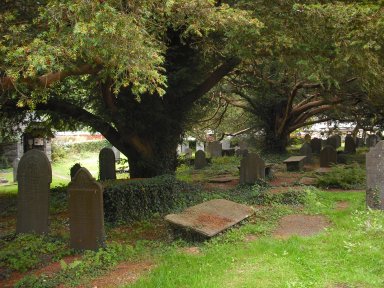
The massive yew trees
One noticeable change to the vista now is the fact that the yew trees have grown and spread even more and when you stand at the gated entrance to the church and graveyard, it is now almost impossible to see the church between the two enormous trees.
Present day church
So my walking trip yesterday did have artistic connotations but is also the reason for no blog. My thanks go to Anne Hammond who introduced me to this beautiful little church and its connection with today’s featured artist and who led our small party of intrepid walkers on this voyage of discovery.
Meindert Hobbema was thought to have been born in 1638 in Amsterdam but there are varied opinions on this fact. The name “Hobbema” was his own invention as his father’s name was Lubbert Meyndert. He was the great landscape painter of the Dutch Golden Age. The Dutch Golden age was that period in Dutch history which spanned the 17th century, at the time of, and following the Eighty Years War, which encompassed the struggle for Dutch independence. The newly formed Dutch Republic became the most prosperous nation in Europe, and led European trade, science, and art. The northern Netherlandish provinces that formed part of the new state had customarily been less significant as artistic centres in comparison with the Flemish cities in the south. The war caused tremendous disruption and resulted in the break with the old monarchist and Catholic cultural traditions. As a result, Dutch art needed to reinvent itself entirely, a task in which it was very largely successful and this re-birth was known as the Dutch Golden Age.
We know that Hobbema was active as an artist in Amsterdam and that he was a pupil of the great landscape painter Jacob van Ruisdael. Some of Hobbema’s work showed a distinct similarity to his master’s work and as Ruisdael’s paintings were in great demand, a number of Hobbema’s works were passed off as being works of his master. Strangely enough, in years to come when Hobbema’s flair as an artist and his artistic gift was established, the reverse would happen.
Hobbema married Eelije Vinck in 1668 who had been his serving maid. One of the witnesses at the ceremony was Jacob Ruisdael. The couple went on to have four children. It was about this time that Hobbema started to work for the Customs & Excise in Amsterdam supervising the weighing and measuring of imported wine. This was his full time job and from then on his artistic endeavours were reserved for his spare time. The output of his paintings from then on decreased and was somewhat erratic. In 1704 Eeltije died, and was buried in the pauper section of the Leiden cemetery at Amsterdam. Hobbema himself survived till December 1709, and he too was buried in a pauper’s grave in Amsterdam. It was a depressing fact of life that both van Ruisdael and Hobbema, looked upon as the two greatest Dutch landscape painters of the era, both died in poverty. Like the two great Dutch painters Hals and Rembrandt some fifty years earlier, despite the demand for their works and the sale of their paintings, they too died penniless. This sad fact has to be put down to either they let their paintings go too cheaply or simply their financial mismanagement which was brought on by them living a life they could not afford and as a result it was to prove to be their undoing.
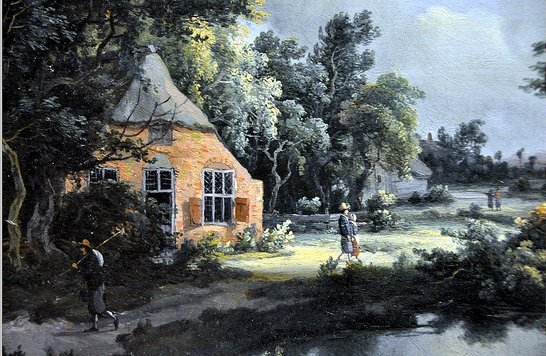
The Cottages and the passing walkers
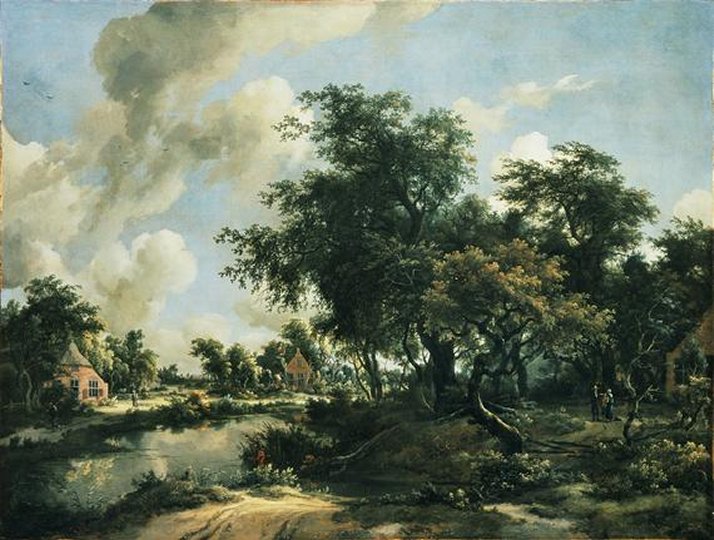
Hobbema was a master painter when it came to painting woods and hedges, or mills and pools. This talent was derived from his life in the countryside, where day after day he might study the branching and foliage of trees, cottages and mills, under every variety of light, in every shade of transparency, during the various seasons. His paintings had a characteristic rich texture to them. Today’s featured painting entitled A Stormy Landscape, which he completed in 1665, is a prime example of his extraordinary talent as a landscape painter. In it we can see his love of creating woodland scenes with various shaped trees which in turn gave him the opportunity to show off his talent in depicting illuminated clearings and patches of light randomly placed amongst the shaded areas caused by the massive trees and dense foliage.
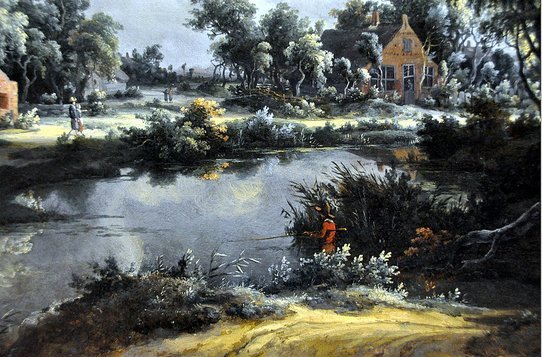
The Fisherman
In the foreground we have a fisherman with his line cast in the rippling waters of the river. In total there are nine figures dotted around the rural scene, all quite small but put there by the artist for a specific reason, that of directing our eyes through the landscape. There is no urgency in the movement of the water which adds to the tranquillity of the scene. To the man’s right we have a family strolling through the woods. Across the river stand two cottages nestling under the cover of the large trees. More people out for a stroll can be seen on that side of the river. The heavy clouds shown to the left of the painting warn us of a storm approaching but this appears to be of little concern to our fisherman or the walkers.
This is a beautifully crafted work of art and one of Meindert Hobbema’s masterpieces. It has a soothing quality to it. It is the type of picture you should look at when you feel stressed as its calm depiction of a country scene counteracts the stress of city life. It has a calming effect and in some ways standing in front of it offers you a chance to relax. Life alas can be hectic and I believe this painting offers one the perfect foil to our sometime chaotic existence.
The Jewish Cemetery by Jacob van Ruisdael (c.1660)
When I come to think about the painting I am going to use for My Daily Art Display I like to try and find one by an artist I haven’t featured before. I also like to showcase an artist I had not heard of previously so that when I research his or her life it is a learning curve for me. Today, however My Daily Art Display is a three-fold repeat which limits what I can say, without being accused of repeating myself.
Firstly I have offered you a painting by Jan van Ruisdael before (January 9th) but I will not apologise for that as he is an amazing painter and has completed many superb works of art. Secondly, the painting today is a Vanitas-type painting, a type of painting, which I talked about when I offered you the Still Life of Food and Drink by Willem Heda on February 11th, and lastly this painting resembles in many ways the painting by Arnold Böcklin which I gave you on January 5th. Having said all that, I have to tell you that when I was looking through some art books for my next presentation I was immediately taken aback by the strength of this painting and the aura that emanates from it.
My Daily Art Display today is The Jewish Cemetery by Jacob van Ruisdael which he completed around 1660 and now hangs in the Gemäldegalerie Alter Meister in Dresden with a larger version in the Detroit Institute of Arts. This is a Vanitas genre painting, which is a type of painting that depicts an object or collection of objects symbolizing the brevity of life and the transience of all earthly pleasures and achievements. In other words it is a painting which reminds us that we are not immortal and notwithstanding how rich or powerful we are – we will all die sooner or later.
There is a definite melancholic and depressing feeling about this painting. There is also that sense of foreboding which was present in Arthur Böcklin Island of the Dead which I gave you on January 5th. The ruins, the graves and the dark skies set the mood of the painting. Ruisdael had this uncanny talent to be able create such feelings in how and what he depicts. This is a painting of the Portugeuse-Jewish Cemetery at Ouderkerk on the Amstel River close to Amsterdam, however to be absolutely accurate, I must tell you that only some of the elements in the painting actually exist such as the three large tombs shown in the mid-ground, but that’s about it !
The backdrop to the cemetery bears no similarity to the place at Ouderkerk. There are no ruins overlooking the actual cemetery. The ruins Ruisdael painted were the remains of the Egmond Castle which is situated near Alkmaar some thirty miles away. There is no river running through the cemetery but Ruysdael just used it to portray the fact that the water like time rushes away from us. The landscape, the river and the “added-in” ruins were just figments of Ruysdael’s imagination but one has to admit they do lend themselves well to the atmosphere he wanted to project.
The three large tombs in the middle ground, which immediately catch one’s eye, the dead beech tree in the right foreground and the broken tree trunk overhanging the fast flowing river all indicate allegorically the fast approach of death. However, Ruisdael does offer us a glimmer of hope in the way we can see a shaft of light penetrating the black clouds. We can also see a rainbow and if we look carefully there are signs of flourishing growth amongst the dead trees, so he is telling us there may be a better life still to come after death. Art historians have interpreted this painting simply as a reminder that man lives in a transient world and that despite being beset by sinful temptations there is always hope for salvation and deliverance.
Today, Jacob van Ruisdael is my featured artist in My Daily Art Display. He was born in Haarlem in 1628 and was brought up in an artistic household. His father, Isaak van Ruysdael and his uncle, Salomon van Ruysdael were both landscape painters. Little is known about Jacob’s early artistic training but it is thought that his father probably taught him with guidance from his uncle. At the age of twenty he was admitted as a member of the Guild of St Luke in Haarlem. The Guild of Saint Luke was the most common name for a city guild for painters and other artists especially in the Low Countries. They were named in honor of the Evangelist Luke, who was the patron saint of artists.
Unfortunately during his lifetime Jacob van Ruisdael’s artistic talent was not appreciated and by all accounts he led a poverty-stricken existence. At the age of fifty three the Haarlem council was petitioned for his admission into the town’s almshouse. He died in Amsterdam a year later in 1682 and his body was brought back to be buried in Haarlem
Jacob van Ruisdael travelled considerably during his lifetime but seldom went outside his own country. He was a prolific painter with over seven hundred paintings and a hundred drawings attributed to him. His great love was to paint countryside scenes showing fields of corn and windmills as well as woodland scenes. He was also a renowned painter of trees and their foliage. Another favourite subject of his was seascapes and the neighbouring dune lands. He also liked to paint waterfalls based on the work of Allart van Everdingen, the Dutch painter, who had travelled extensively in Scandinavia.
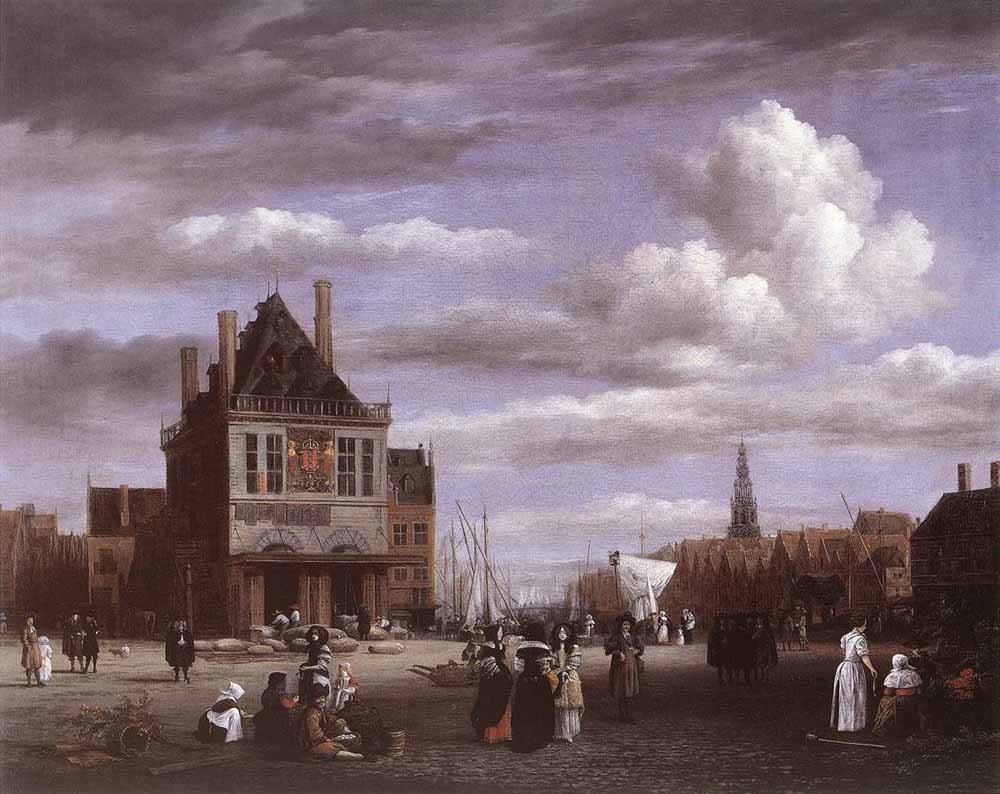
Today’s painting, The Dam Square in Amsterdam, completed in 1670 is neither a landscape nor a seascape. The subject is Dam Square in Amsterdam, a place which he was very familiar with as he lived on the south side of the square at this time. The square was dominated by the old Amsterdam municipal weighbridge and one can see several bales of goods under the canopy waiting to be weighed. On the right of the building one can see the Damark with its sailing boats and the tower of Oude Kerk. In the foreground of the painting there are a large number of figures. It is not thought that Ruisdael actually painted these as he was not an established figure specialist. Experts believe they may have been painted by the Rotterdam artist Gerard van Battem. The pale light from the left of the painting casting long shadows across the square suggests that it is daybreak.
His artistic works although not fully appreciated during his lifetime have since his death been highly praised and he is now often considered the greatest Dutch landscape painter of all time.





 my daily art display