New Hope Artist Colony. Part 2.

The second artist I am looking at who was an early member of the New Hope Artists Colony was Edward Redfield

Edward Willis Redfield

Edward Willis Redfield was born on December 18th 1869 in Bridgeville, Delaware, before moving to Philadelphia as a young child. He was the youngest son of Bradley Redfield, who owned plant nurseries and sold fruit and flowers, and Frances Gale Phillips. He had two older brothers, Eugene and Elma, an older sister Ada and a younger sister May. Even at the age of seven he showed a love and talent for art and aged seven he exhibited a drawing of a cow in a competition for school children at the Centennial Exposition in 1876. From an early age, he studied at the Spring Garden Institute and the Franklin Institute and continued to show artistic talent. It was Redfield’s aim to be accepted into the Pennsylvania Academy, so in preparation for studying there, he received training from a commercial artist, Henry Rolfe. In 1887 Edward’s dream came true when he was accepted on a two-year course at the Pennsylvania Academy of the Fine Arts in Philadelphia. At the Academy his tutors were Thomas Anshutz, James Kelly and Thomas Hovenden. Anshutz, like Thomas Eakins, focused on an intense study of the nude as well as on human anatomy. While a student at the Academy Redfield met Robert Henri, who would later become an important American painter and educator and he and Henri became lifelong friends with  Henri often spedingt weekends at the Redfield home.

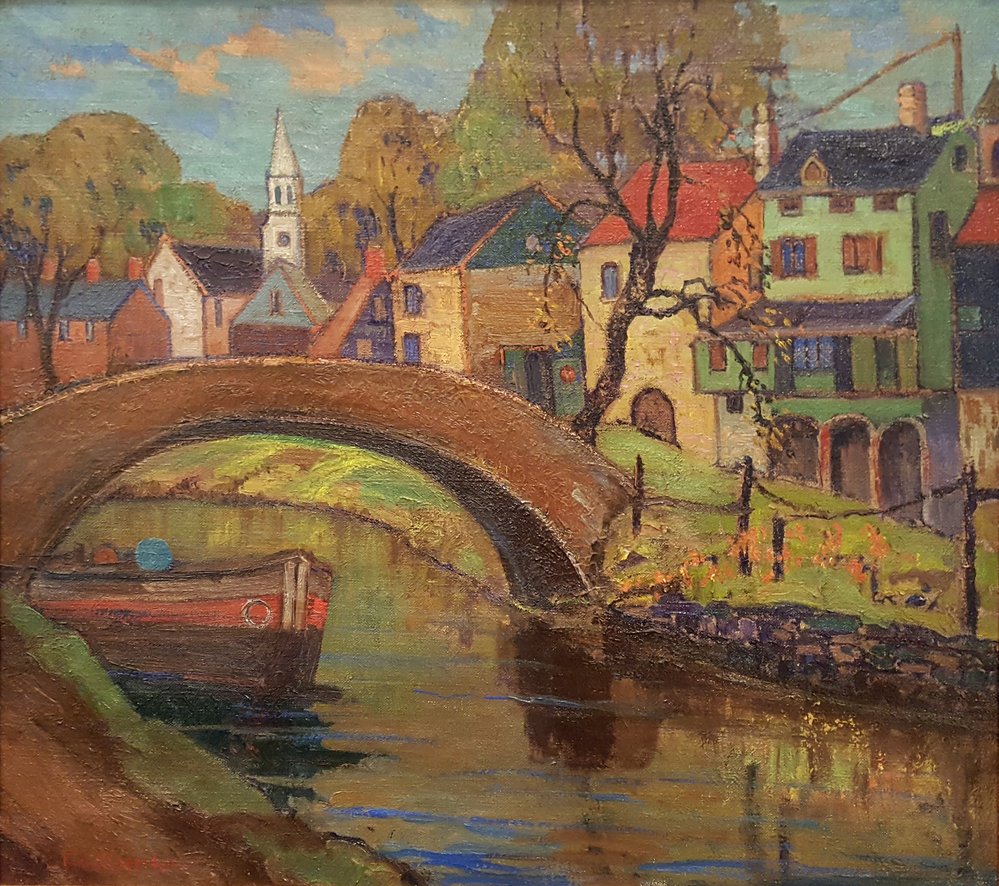
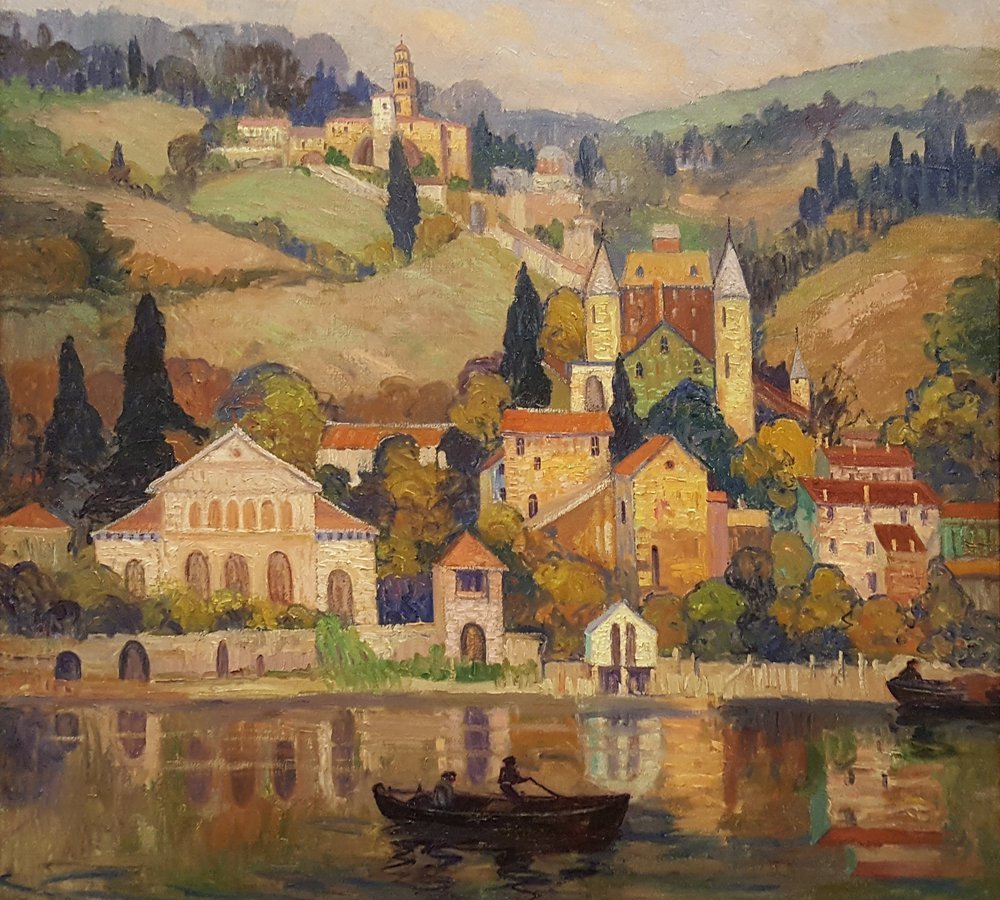
Village of Equihen, France by Edward Willis Redfield (1908)

Once he had completed his studies at the Academy in 1889, he approached his father for financial support for his proposde trip to study art in Paris. Redfield’s father agreed to send his son fifty dollars per month to finance a period of study in Europe and so Redfield left for Paris with the sculptor and former fellow student, Charles Grafly and they met up with Robert Henri in the French capital. Redfield and Henri attended classes at the Julian Academy, a school which provided art tuition to foreigners who had difficulty gaining entrance to the Ecole des Beaux-Arts. His instructors there were William Adolphe Bouguereau, one of the leading and best-known French academic painters and Tony Robert-Fleury. .Whilst residing in France Redfield became influenced by the work of the Impressionist painters Claude Monet, Camille Pissarro, and the Norwegian artist Fritz Thaulow.

Hotel Deligant in Bois-le-Roi-Brolles

It was while he was living in France that Redfield met Elise Devin Deligant, the daughter of the innkeeper of the Hotel Deligant in the village of Bois-le-Roi, a French commune located on the edge of the forest of Fontainebleau and along the Seine, 6km from Fontainebleau and 60km from Paris. The village inn became a meeting place for Redfield, Henri, Grafly, and they attracted other young artists who would come and the enlarged group would have long discussions about art and aesthetics. It was winter at the inn and Redfield became captivated by local snow scenes. Originally Redfield had set his heart on becoming a portrait artist but he abandoned this idea and decided to concentrate on landscape painting. He stated the reason for his decision:

“…With landscape, if I make it good enough, there are many who will appreciate it. Portrait painting must please the subject as a general thing – or no pay! It’s a hired man’s job…”

Canal en Hiver by Edward Willis Redfield

Many of those artists who used to meet at the inn submitted works to the Paris Salon of 1891. Redfield sent his painting entitled Canal en Hiver, one of his first winter snow scenes and it was accepted.

Redfield left France in 1892 to return to America where his one-man exhibition was being staged in Boston. The following year, 1893, Redfield returned to London where he married Elise Deligant. Sadly their first child died and this tragic event caused his wife to suffer from bouts of depression and mental illness, all her life. However, the couple went on to have five children, three sons, Laurent, Horace and George and two daughters, Louise and Frances.

1898 Historical Map of Center Bridge and Hendrick Island. Red arrow marks position of Redfield’s house.

On returning to America Redfield and his wife settled in Glenside, Pennsylvania but in 1898 they relocated to a home he had renovated in the Pennsylvania town of Center Bridge which was situated alongside the Delaware River towpath and several miles north of New Hope. They purchased a property that was situated between the Delaware River and the Delaware Canal in Center Bridge. The property included an island in the river, known then as Hendrick Island, where his father lived and farmed.

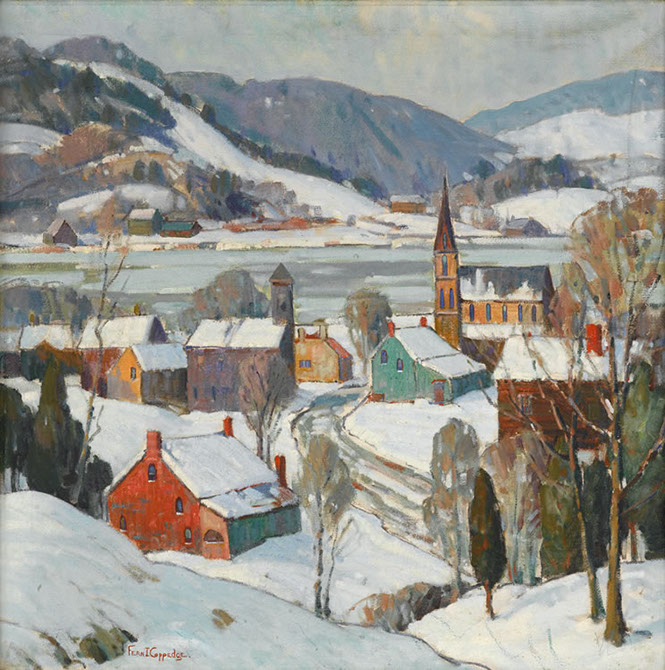
Center Bridge by Edward Willis Redfield (1926)

Redfield was one of the first painters to move to the area and is thought to have been a co-founder of the artist colony at New Hope along with William Langson Lathrop, who had taken up residence in New Hope that same year. Soon after settling in Center Bridge, Redfield began to produce a series of local snow scenes and soon his name became synonymous with the painter of the winter landscapes. Redfield completed his painting entitled Center Bridge in 1904 and it depicts a view of Redfield’s home town from a nearby hill. As expected the scene has changed nowadays since woods and new neighborhoods have grown over these hills. This painting is currently at The Art Institute of Chicago.

The Burning of Center Bridge” by Edward Willis Redfield

The large covered bridge across the river seen on the right of the picture no longer exists as it burned down in 1923 and was captured in Redfield’s painting entitled The Burning of Center Bridge.

New Hope by Edward Willis Redfield (1926)

Redfield’s works were, unlike many of his contemporary landscape painters, monumental in size, in contrast to the often-small sentimental works of the earlier nineteenth-century American landscape painters. He was a fast painter, as he had been taught in his early days, and often completed his 50 x 56 inch winter snow scenes, en plein air, in often harsh freezing conditions, in eight hours. Redfield stated:

“…What I wanted to do was to go outdoors and capture the look of a scene, whether it was a brook or a bridge, as it looked on a certain day…”

Redfield described his modus operandi for the plein air painting sessions saying that he would start by walking to his designated site often trudging through slush and snow with his gear weighing fifty pounds and his huge canvas balanced on his head. He said that he would start with almost no under-drawing and finish his painting in a single session using small brushes to cover the entire canvas with thick paint.

The Rock Garden, Monhegan Island, Maine by Edward Willis Redfield (1928)

Beginning in 1902 the Redfield family spent their summers at Booth Bay Harbor, Maine, due to the generosity of Dr. Samuel Woodward, who financed these annual vacations. In June 1903 the Redfields invited Robert Henri and his wife to spend part of their summer with them. During their stay Henri and Redfield sailed around the neighbouring islands constantly searching out suitable subject matter for their paintings. Henri was especially impressed by the beauty of Monhegan Island, an island in the Gulf of Maine. Redfield’s many paintings depicting New Hope landscapes were now supplemented with Maine seascapes. Other works would focus on the flora found on Monhegan Island, Maine. The Rock Garden, Monhegan Island, Maine by Edward Redfield is a study of peace and tranquillity during a warm summer’s afternoon painted in vibrant colours. In this painting Redfield builds up the paint with multiple layers of thick pigment, creating a rich impasto texture. The lively brushstrokes create a dynamic cross-hatching effect and a pattern of colour that brings the scene to life. In the foreground the vividly coloured and rigorously painted flower beds provide a dynamic contrast to the austere New England clapboard houses. A winding path runs diagonally through the scene, providing a sense of spatial recession to a distant shore. The painting sold for USD 750,000 at a 2015 Christies auction. Redfield was awarded the N. Howard Heinz Prize of $500 for The Rock Garden, Monhegan Island, Maine in 1928 at the Grand Central Art Galleries, New York. Redfield, like Henri, fell in love with the beauty of Monhegen Island so much so that he eventually purchased a house at Boothbay harbour and from then on spent nearly every summer vacation around the area.

Fleecydale Road by Edward Willis Redfield

Redfield completed his painting entitled Fleecydale Road in 1930. This road starts in the town of Lumberville on the Delaware River and ends in Carversville. Lumberville was once the home of another covered bridge across the river which was later replaced with a metal bridge that was restricted to pedestrian traffic. It connected walkers to a state park on the New Jersey side. This picture can be seen at the Michener Art Museum in Doylestown, PA.

Winter Reflections by Edward Willis Redfield (1935)

Another snow scene by Redfield was his 1935 painting, Winter Reflections. The painting depicts a view of the buildings in New Hope near the railroad station. The buildings backed on to the canal and you are still able to stand at this very spot on the towpath. New Hope’s railroad station is now just a tourist attraction which provides short rides on an old steam train. The painting is part of the collection of the Brandywine River Museum of Art in Chadds Ford, Pennsylvania.

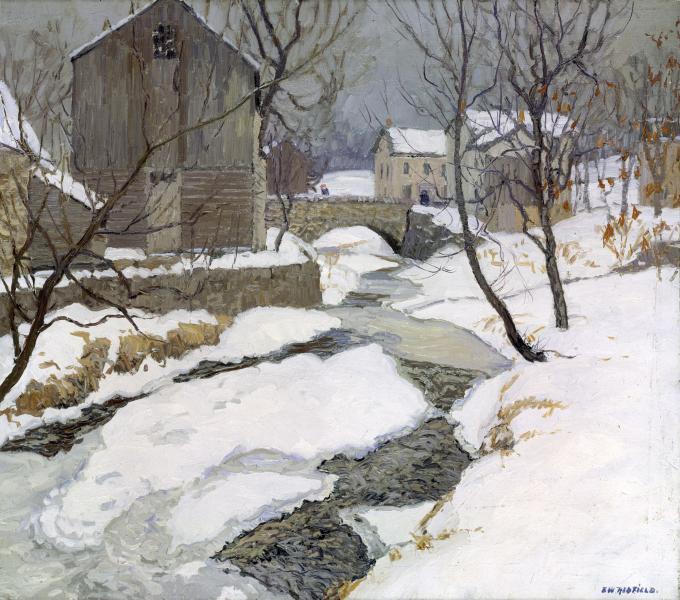
The Mill in Winter by Edward Willis Redfield (1921)

Another winter scene painting by Redfield was his The Mill In Winter which he completed in 1921. In the Redfield archive papers it was referred to as the Centreville Mill. Centreville was a small crossroads between New Hope and Doylestown but has since disappeared as such as an officially named location. This painting is at the National Gallery of Art in Washington DC.

Spring in the Harbour by Edward Willis Redfield (c.1927)

As Redfield’s international reputation increased, many young artists were attracted to New Hope as according to James Alterman in his book, New Hope for American Art, Redfield was a great inspiration and an iconic role model, and his work is among the most widely recognized of the Pennsylvania Impressionists.

Sadly, in later years, Redfield became disappointed with his early work. In 1947, the year his wife died, he burned a large number of his early works which he considered to be sub-standard. In 1953, at the age of 84, he gave up painting altogether. Redfield talked about his decision saying:

“…I was outside one day. My insteps started hurting. It was very windy and I had a hard time keeping my easel up. So I quit. The main reason though, was that I wasn’t good as I had been, and I didn’t want to be putting my name on an “old man’s stuff,” just to keep going…”

Redfield died on October 19, 1965. Today his paintings are in many major museums, including the Metropolitan Museum of Art in New York City and the Smithsonian American Art Museum in Washington, DC.

…..to be concluded.


Information for this blog came from numerous sources including:

New Hope Colony Foundation of the Arts

Edward Redfield – Champion of Winter’s Timeless and Seductive Beauty

Hollis Taggart Galleries

New Hope Artist Colony. Part 1.

In my last blog about the American Impressionist, M Elizabeth Price, I mentioned the New Hope Artist Colony and this name has cropped up in other of my blogs so I thought I would give you a more in-depth look at this artist colony and how it all began and the three artists who were part of its foundation.

William Langson Lathrop, Edward Willis Redfield and Daniel Garber

Dr. George Morley Marshall

The New Hope Artist’s Colony can be traced back to 1896 when a Philadelphia surgeon and laryngologist Dr. George Morley Marshall acquired the hamlet of Phillips’ Mill in Solebury Township, Pennsylvania from the Betts Family. The grist mill, originally built in 1756 by Aaron Phillips, was ideally positioned to serve the many surrounding family farms.

Four generations of the Phillips family ground locally-farmed grain until 1889, when the property was sold and the mill fell into disuse. The property included a grist mill with water rights and glen, a dam, a pond, the Primrose Creek and a 40-foot waterfall which fed the mill race to run the two waterwheels. The buildings which surrounded the mill soon became residences for summer tenants, including the new school of Impressionist landscape painters, who used the outbuildings as studios to capture the natural beauty of Solebury and its environs.

William Langson Lathrop – self portrait

In 1897, Dr. Marshall contacted his boyhood friend, the well-known landscape artist William Langson Lathrop, inviting him to come to New Hope to paint the magnificent landscapes which bordered Phillips Mill.

Ely’s Bridge by William Langson Lathrop

William Langson Lathrop was an American Impressionist landscape painter. He was born in Painesville, Ohio, a small town on the shores of Lake Erie, on March 29th 1859. It was on this vast lake that William learnt to sail, a hobby he would enjoy for the rest of his life and ultimately, was to be the death of him.

A Pennsylvania Farm by William Langson Lathrop

Once he had completed his formal education, Lathrop began his art career in New York City. He was largely self-taught until he traveled to New York for a brief period of study with William Merritt Chase at the Art Students League. In the early 1880’s Lathrop secured a job as a graphic artist with Charles Parsons at Harper’s Magazine but he found that the small amount of money he earned was barely enough to live on. In the 1880s he travelled to England, France and Holland and it was during his stay in the English city of Oxford that Lathrop met, and in 1888, married his wife, Annie Sarah Burt. They had five children, three daughters, Nancy, Elizabeth and Ellen and two sons Joseph and Julian. Lathrop returned to America with little money, depressed at the way his artistic journey had stalled and he decided to give up art as a profession. After several years of struggle and failure, his friends back home persuaded him to return to his art and try the medium of watercolour. Lathrop finally found fame as a painter when, with one his works, he won the prestigious Evans Prize at the American Watercolor Society’s annual exhibition in 1896.  More importantly, he received a fulsome review in The New York Times, and, buoyed by this success, Lathrop embarked on the re-launch of his artistic career. In 1902 he was elected to the National Academy of Design.

Landscape by William Langson Lathrop (1915)

Having received Dr. Marshall’s invitation to visit the New Hope area, Lathrop, along with his wife Annie Sarah and their three children, Nancy, Joseph and Julian, travelled to New Hope where they rented the miller’s house which once belonged to Aaron Phillips on Marshall’s property. William Lathrop would later buy the property together with the surrounding four acres of farmland.

Twilight after the Storm by William Langson Lathrop

Lathrop’s wife Annie became a beloved figure in the New Hope Arts community and she would host afternoon teas on a Sunday on the lawn of their home besides the canal. These Sunday afternoon tea parties featured lively discussion of aesthetic, philosophical, and political issues, and visitors to these teas would love to sample a feast of homemade sandwiches, jams, beverages, and pastries. Lathrop’s wife, Annie, was a gifted cook and an affable host who took a genuine interest in the students’ well-being. Annie would attend their every need, housing, feeding, and encouraging them in a warmly maternal fashion. Martha Candler Cheney, a writer on the arts, wrote about these Sunday afternoon events:

“…Sunday afternoons, the Lathrops’ lawn was a collecting place at tea-time and someone remembered nostalgically only the other day how the fine, almost lost art of conversation flourished there…”

Spring Landscape by William Langson Lathrop (c.1915)

It was Lathrop’s reputation as an artist and a teacher that attracted other artists such as Edward Redfield. Daniel Garber and Charles Rosen to come to New Hope and form the group known as the Pennsylvania Impressionists. Lathrop was often called the “dean” of the New Hope art colony, and regularly welcomed students into his home at Phillips Mill. Unlike some of his colleagues, he preferred to work in the studio, rather than outdoors, which distinguished him from other artists in the group. Known primarily as a tonalist, Lathrop created rustic, simplified landscapes with a muted palette.

Montauk by William Langson Lathrop (1938)

William Langson Lathrop’s loved sailing and always had a boat.

Wiliam Langson Lathrop and his boat The Widget

William Langson Lathrop’s greatest love besides his art was sailing and in 1927 Lathrop hand-built a wooden boat in his backyard and named it The Widge which would become the love of his life. He completed and launched it into the Delaware River in 1930. It subsequently became his painting studio. Lathrop, being a competent sailor, would take the boat on trips along the eastern seaboard of America during the summer months. A companion on one of these trips was Albert Einstein, who was teaching at Princeton. 

On September 21, 1938, whilst Lathrop was sailing his boat around eastern Mountauk Point in Long Island he received word of an approaching hurricane. He was miles away from a safe harbour and so decided to ride out the storm in a secluded bay. The boat survived the hurricane-whipped seas but Lathrop’s body was recovered along the shoreline a month later. It is thought that he had suffered a heart attack and been washed overboard. After his death, a painting, entitled Montauk, dated September 21, 1938 was discovered in the boat’s cabin, proving that until his poignant final moments, Lathrop drew inspiration from the sea.

His good friend and fellow Bucks County artist, Henry B Snell wrote:

“…He had no fear of meeting death as he did — facing one of nature’s greatest manifestations. I know he died as he would have wanted to…”

William Langso Lathrop was buried in Solebury Friends Graveyard, Solebury, Bucks County, Pennsylvania.

………to be continued.


Important information for this and subsequent blogs regarding the New Hope Artists Colony came from an assorted websites, some of which were:

New Hope Colony Foundation of the Arts

Google Arts and Culture

Solebury

Diversions – A Meandering Journey through the World of Art

Mitchener Art Museum, Doylestown PA.

Mary Elizabeth Price

Mary Elizabeth Price

Mary Elizabeth Price, sometimes simply known as M. Elizabeth Price, was born on March 1st 1877 near the town of Martinsburg, West Virginia. Her parents, Reuben Moore Price and Caroline Cooper Paxson Price were Quakers, who lived in Shenandoah, Virginia. She was one of five children, having a sister, Alice Price, and three brothers, Frederick Newlin Price, Rueben Moore Price and Carroll Price. During her early days she lived in Virginnia but the family moved to the Shenandoah Valley and later to New Hope, Pennsylvania where she grew up.

Pennsylvania Museum and School of Industrial Art, Philadelphia. 

Art classrooms at the Pennsylvania Museum and School of Industrial Art, (c. 1891)

According to the Friends Intelligencer and Journal, Elizabeth graduated from her Literary Course at the Friends’ Central School in 1896, aged nineteen, and she enrolled at the Pennsylvania Museum and School of Industrial Art, a museum and teaching institution which later split into the Philadelphia Museum of Art and University of the Arts.

Pennsylvania Academy of the Fine Arts building

In 1904, having completed her course, she enrolled at the Pennsylvania Academy of the Fine Arts and studied under Hugh Breckenridge an artist and educator who advocated the artistic movements from impressionism to modernism. Another of her tutors was Daniel Garber, an American Impressionist landscape painter and member of the art colony at New Hope, Pennsylvania. Elizabeth also took private art lessons from William Langson Lathrop, an American Impressionist landscape painter and who founded the art colony in New Hope, Pennsylvania, where he was an influential founder of Pennsylvania Impressionism.

Picking Flowers by M Elizabeth Price (1916)

In 1917 Elizabeth moved to New York and took part in the “Baby Art School,” which was a pioneering programme funded by Mrs. Harry Payne Whitney (Gertrude Vanderbilt) and previously known as the Neighbourhood Art School of the Greenwich House. Children from nearby public schools were taught the fine arts of drawing, painting, sculpting, pottery, and wood carving. This idea was so successful that Carnegie Institute of Technology in Pittsburgh asked Elizabeth to stage an exhibition of the children’s work in the winter of 1919-1920, in conjunction with an art education campaign for teachers and supervisors in art.

Delphinium Pattern by M Elizabeth Price (1933)

When looking at Elizabeth Price’s work, her floral painting are the ones that are best remembered. She often painted on wooden panels coated with a mixture of gesso and red clay. Then, gold or silver leaf was applied over that, followed by the painted image in oils. One example of this is her 1933 painting entitled Delphinium Pattern.

Summer Bouquet by M Elizabeth Price (c.1933)

Another such work was Summer Bouquet which she completed around 1933.

Elizabeth Price joined a group of female artists known as the Philadelphia Ten. This group exhibited together between 1917 and 1945, at first annually in Philadelphia and later, with traveling exhibitions at major museums and galleries on the east coast and in the Midwest. All the members had studied art in the schools of Philadelphia, most having been graduate students at the Philadelphia School of Design for Women (now Moore College of Art and Design). The aim of the group was to move beyond the perception that they were merely hobbyists, as they were commonly viewed in the early 20th century, and be accepted as professional artists. Price regularly exhibited with the group from 1921 until their last exhibition in 1945.

Pumpkinseed Cottage on the bank of the Delaware Canal

Elizabeth, having been brought up on a farmstead in a rural area around Martinsburg, West Virginnia, had always hoped to one day leave the hustle and bustle of New York city life and return to the quieter countryside. Around 1927 she had finished her teaching contract in New York and decided it was time to make that move. She had fallen in love with Bucks County and the area around the town of New Hope and took up residence in an old stone house on the banks of the Delaware Canal. Her house was known as Pumpkinseed Cottage due to its bold yellow colour and diminutive size. She spent much of her time in her home with its studio. She also had a garden where she grew irises, mallows, peonies, lilies, delphiniums, poppies, hollyhocks, and gladioliflowers which often provided her the focus of her many floral paintings. She loved living here and said of it:

“…When I first saw the original cottage it was painted such a vivid yellow that I instinctively thought of a pumpkin; and it was so small that I named it Pumpkin Seed more in derision than anything else. But the quaintness of the name grew on us so that we’ve learned to love it…”

Christmas Card by M. Elizabeth Price. Inside Reads: Christmas Greetings! Card of her studio in the “Pumpkinseed” she and her brother, Fredric Newlin Price, occupied on the Canal Bank – near Rabbit Run Bridge, New Hope, Pennsylvania

She remained living here for the rest of her life with her brother, Fredric Newlin Price, who owned a house, farm, and property in the New Hope area. Whilst living here, she took the opportunity to give talks on art to the New Hope Women’s Club, where she often exhibited her works of art and at the same time encouraged and inspired local artists.

Cheerful Barge 269 by M Elizabeth Price

Although Elizabeth may be best remembered for her floral art works she painted many other genres. One such painting was entitled Cheerful Barge 269, which depicts a bright orange barge sliding by the canal waters on a sunny day. In the painting we see the blue water of the canal seemingly covered by fallen leaves from the trees along the canal banks but in fact what we see on the water is the reflection of the leaves which remain on the overhanging trees. In the foreground we can see sets of stones, alongside a wooden building, which create a path along the canal bank. Strangely, at the bottom right of the painting, we see a single tall red flower, and wonder what made the artist depict such a solitary item.

Bucks County Landscape by M Elizabeth Price

A Country Lane by M Elizabeth Price

Many of her paintings were inspired by what she saw during her walks in the surrounding countryside.

57th Street Window by M Elizabeth Price

Back when she was living and teaching in New York she produced her urban landscape work entitled 57th Street Window.

Bathing in Yardley, Pennsylvania by M Elizabeth Price

Pennsylvania Impressionism, which the artwork of Elizabeth Price emulated, was an American Impressionist movement of the first half of the 20th century. It was characterised by an interest in the quality of colour, light, and the time of day. It was centred in and around Bucks County, Pennsylvania, and particularly the town of New Hope. The movement is sometimes referred to as the “New Hope School” or the “Pennsylvania School” of landscape painting. It all began when landscape artist, William Langson Lathrop moved to New Hope in 1898 and founded a summer art school. The mill town, New Hope, was located along the Delaware River, about forty miles from Philadelphia and seventy miles from Manhattan. It was a landscape artist’s paradise with its spectacular rolling hills, the picturesque river, its tributaries, and the Delaware Canal. An example of this is her painting, Bathing in Yardley, which is a riverside town about 10 miles southeast of New Hope.

Frederick Price, M. Elizabeth Price, Rae Bredin and Alice Price Bredin aboard ship.

M. Elizabeth Price was an untiring promoter of the arts and shared her passion with her talented siblings. One brother, Frederic Newlin Price, owned the successful Ferargil Art Gallery in New York City; another brother, R. Moore Price, was an art dealer and an accomplished frame maker, while his wife, Elizabeth Freedley Price, was a painter; and her brother-in-law, Rae Sloan Bredin, was a member of the New Hope Group. M. Elizabeth Price distinguished herself for her development of women’s and children’s involvement in the arts.

Mary Elizabeth Price died in Trenton, New Jersey on February 19th, 1965 at Mercer Hospital. At the time of her death, she was a member of the Solebury Friends Meeting and, at the age of 87, had been the last living of the Price children. She was survived by her nieces and nephews. Elizabeth Price was buried in the Solebury Friends Meeting House cemetery, Bucks County, Pennsylvania.


Information for this blog was sourced from

Hellenica World

Art Now and Then

Invaluable

Michener Museum

Jean-Baptiste Armand Guillaumin

Jean-Baptiste Armand Guillaumin, the French impressionist painter and lithographer, was born on February 16th 1841 in Paris.  He was brought up in a working-class family, the grandson of Jean Joseph Guillaumin who was a notary by trade.  He was sent to school in Moulins, where his family came from, and this period in central France, made him take note of the beautiful surroundings and the mountainous landscape which stimulated his interest in art and it was also in Moulins that he first met Eugéne Murer, a pastry chef, author, self-taught painter and collector of impressionist paintings, who became his life-long friend.

Farms in Janville by Armand Guillaumin (1878)

By 1857, at the age of sixteen, Guillaumin returned to Paris and began working as a clerk in his uncle’s lingerie shop awhile also studying art under the sculptor Louis Caillouet.  His interest in art and the time he spent studying it caused friction with his family and he left to hold a position in the French government railways. He then continued his art training at the Académie Suisse where he trained to draw from the models, in the mornings and evenings.  It was here that he first met with Courbet, and began more lasting friendships with painters such as Cézanne, Pissarro and Francisco Oller, a Puerto Rican Impressionist painter.

Garden in Janville in June by Armand Guillaumin (1886)

Now friendly with the artists associated with the Anonymous Society of Painters, Sculptors, Engravers, (later dubbed The Impressionists) he was able to exhibit with them at the first Salon des Refusés in 1863 and their first joint Impressionist Exhibitions in 1874 at the former studio of the photographer Nadar (at 35 Boulevard des Capucines) in Paris, and in total he submitted work to six of their eight annual exhibitions.  Still young, the art critics of the time judged him to be an accomplished draughtsman who completed amazing mature compositions.  He developed connections with Emile Zola and his circle of friends and was greatly influenced by the artwork of Manet and Courbet.

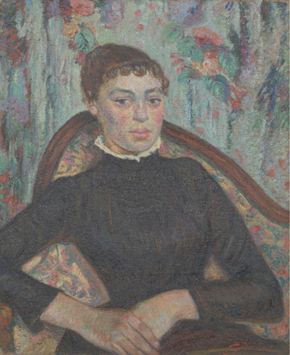
Portrait of a Young Woman by Armand Guillaumin (1876)

One of the problems Guillaumin soon encountered was financial as he had no private income to turn to and so he had to continue holding down a job to survive.  This situation was further exacerbated with the advent of the Franco-Prussian War in 1870.  Once the War and the Paris Commune fighting had ended there was some hope for Guillaumin who had managed to have himself included with the popular Impressionist movement.  Guillaumin and fellow Impressionist, Cézanne had met up with Dr Paul-Ferdinand Gachet, a French physician most famous for treating the painter Vincent van Gogh during his last weeks in Auvers-sur-Oise, and he bought a number of their works.  Guillaumin also sold a number of his works to his friend, Eugéne Murer who had recently established a successful café in Paris. Guillaumin and Cézanne began sharing a studio but both found themselves in precarious financial positions despite the sales of their work to Gachet and Murer who continued to be close friends of the pair.

Cottages in a Landscape by Armand Guillaumin (1896)

At the start of the 1880s the Impressionist group was beginning to break apart and it split into two camps.  One headed by Pissarro and the other by Degas.  Gaugin had vociferously supported Pissarro and he had allied himself with Guillaumin.  Although not initially supportive of the Impressionist group having misgivings about what its intentions were, Renoir and Monet joined the Impressionist Exhibition of 1882 with Guillaumin, Gauguin and Pissarro as well as Sisley, Morisot, Vignon and Caillebotte.  However, Degas was noticeably absent.

Moulins en Hollandee by Armand Guillaumin (1904)

It was somewhat surprising that Paul Gaugin, known for his irrational behaviour towards his fellow painters, continued to befriend Guillaumin and keep him in the Impressionist group despite its continued disintegration.  It was through Gaugin, that Guillaumin met many new young artists who had arrived on the Paris art scene such as the Symbolist painter, Odile Redon, and the Pointillists, Georges Seurat and Paul Signac. In the mid 1880s Guillaumin’ s studio had become a meeting place for the young group of painters.  By 1885, new styles of painting had come to the fore and this resulted in further rifts between the old guard of Impressionism resulting in the disintegration of the Impressionist Group. The other factor for the break-up of the Group was its leading man, Gaugin, became more and more temperamental and intolerant and was destroying the Movement from the inside.  Guillaumin decided it was time for him to exit the movement which he had been part of from the very start.  Guillaumin’s reputation had grown over the last decade and Paul Adam wrote in La Revue Contemporaine:

“…I was not aware of any other painter who has so correctly noted the corresponding values of the lights of the firmament and of the ground…. their unification in colour appears to be perfect…”

Again, Felix Feneon, the French art critic, gallery director, and writer reiterated this, writing about the same show Immense Skies and commented on Guillaumin’s work:

“… superheated skies where clouds jostle each other in a battle of greens and purples, of mauves and of yellows…”

Vue de Port by Armand Guillaumin (1880)

t was in 1886 that Guillaumin married.  His wife was his cousin Marie-Joséphine Charreton, a schoolteacher, who was able to support him financially.  They settled down at 13 quai d’Anjou in the Saint-Sulpice area of the 6th arrondissement of Paris. It had previously been the studio of the painter Charles-François Daubigny. Guillaumin’s relationship with Pissarro eventually ended with the latter beginning to concentrate on experimentation with pointillism while Guillaumin became progressively interested in romantic art. Guillaumin’s relationship with Gaugin also in due course ended as the latter being constantly away on his travels.

Agay Bay by Armand Guillaumin (1910)

From 1875 to 1880, Guillaumin was a frequent guest of Dr Gachet at Auvers, at a time when he was travelling in that area searching for views of the rural scenery of the Yonne valley to paint and, later, the Creuse valley and the countryside around the farming village of Crozant, where he spent most of his life. Around 1887 Guillaumin became a good friend and mentor to Vincent Van Gogh, who was twelve years his junior. Vincent’s letter to fellow painter Ermil Bernard in December 1887 shows how highly he thought of Guillaumin:

“… I believe that, as a man, Guillaumin has sounder ideas than the others [the Impressionists], and that if we were all like him we’d produce more good things and would have less time and inclination to be at each other’s throats.

Again in a letter to his brother Theo in June 1888, Van Gogh writes about a visit he made to Guillaumin’s house and how he was inspired by him:

“…Wasn’t it pleasant at Guillaumin’s last winter — finding the landing and even the stairs, not to mention the studio — chock-full of canvases? You understand since then that I have a certain ambition, not about the number of canvases, but that these canvases as a whole should, after all, represent a real labour on your part as well as mine…”

Neige by Armand Guillaumin (1876)

In the last decade of the nineteenth century Guillaumin’s circle of artist friends was dwindling.  Vincent van Gogh died in July 1890 and his brother Theo, the art dealer, died in the January of the following year.  Gaugin and Cézanne had left Paris and Guillaumin and Pissarro’s views on art had diverged so much that their friendship had gradually faded.  Despite all this Guillaumin’s life was to change rapidly when won he won the sum of 100,000 francs (about 400,000 euros in today’s money) in a state lottery.  This completely changed his life.  He no longer had to rely on commissions.  He no longer had to exude a subservience towards patrons.  He was now able to paint what he liked and strive for his own artistic goals.

Caves Prunal near Pontgibaud by Armand Guillaumin

With this newly found wealth Guillaumin set off travelling around France capturing on his canvases the beautiful views of the countryside, mountains and the coast, often during sunrise and sunset.  His continuous journeying around was brought to an end with the onset of The Great War of 1914.  Once the war came to an end he once again set off on his travels but by then he was seventy-seven and he, like his artistic output, was declining.   In 1926 a retrospective exhibition was held at the Salon d’Automne.  He died at the Chateau de Grignon in Orly, Val-de-Marne, just south of Paris, on June 26th 1927 aged 86. He was the last survivor of the Impressionist Group.

Crozant, Solitude by Armand Guillaumin (1915)

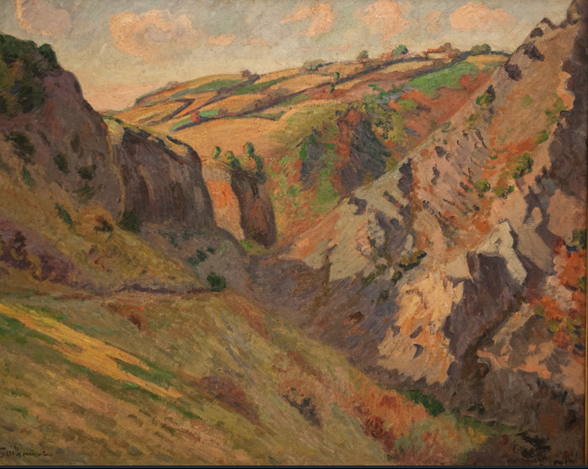
Guillaumin’s paintings are renowned  for their intense colours and can be found in major museums around the world. Most of all he is best remembered for his landscapes of Paris, the Creuse département, and the area around Les Adrets-de-l’Estérel near the Mediterranean coast in the Provence-Alpes-Côte d’Azur region of France. Guillaumin became known as the leader of the École de Crozant, a disparate group of painters who came to portray the landscape in the region of the Creuse around the village of Crozant.

Paysage à Crozant (1917)

One such depiction is entitled Landscape in Crozant, is part of the Art Institute of Chicago collection.

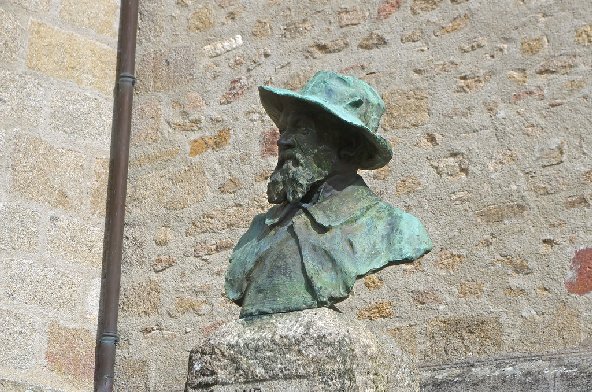
His bust is in the square near the village church in Crozant.

Adrien-Jean Le Mayeur de Merprès.

This blog is the second one requested by Barbara Matthias, a reader of my blogs, who had actually met the artist, and, like the previous one about Rudolf Bonnet, it is about the life and artwork of a painter who spent the latter half  of his life on the Indonesian island of Bali.  Let me introduce you to Adrien-Jean Le Mayeur de Merprès, a self-declared impressionist.

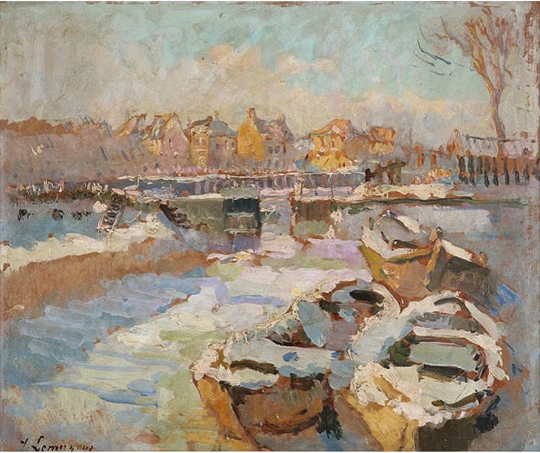
City view with boats in the canal by Adrien-Jean Le Mayeur de Merprès

Le Mayeur was born on February 9th 1880 in Ixelles, a municipality of Brussels which lies to the south-east of the Belgium capital.  He was the youngest of two brothers born to Andrien Le Mayeur De Merpres, a marine artist, and his wife Louise Di Bosch. During his early years Jean studied painting with the French artist, Ernest Blanc-Garin as well as being tutored by his father.  His father wanted his son to receive an all-round education and had him enrol at the Polytechnic College of The Université Libre de Bruxeles, where he studied Architecture and Civil Engineering.  However much to the horror of his family, Jean decided to forego all that he had learnt at the polytechnic and pursue his love of painting and his favoured genre of landscape painting in the Impressionistic style, depicting Belgian landscapes in hazy hues.

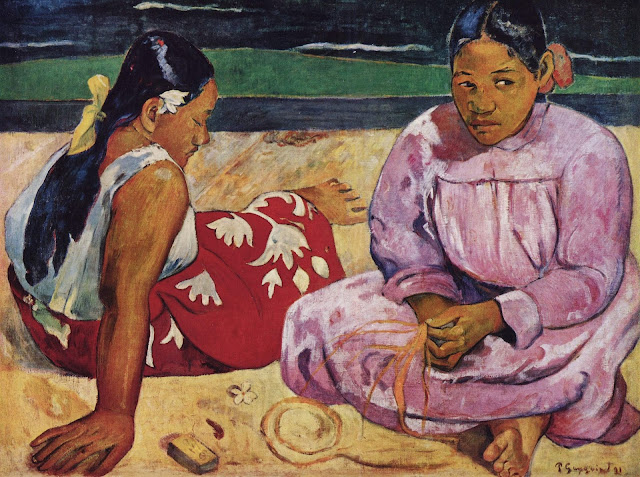
Tahitian Women on the Beach Gaugin’s Tahitian painting (1891)

In 1914, now in his thirties, with the outbreak in Europe of the Great War, Jean was enlisted as a war-time painter and photographer.  During the conflict he was affectedly badly by the carnage of the war and this could have been one of the reasons why he decided to leave Western “civilisation” and find solace in the exotic worlds which he had seen in the works of the French post-impressionist artist Paul Gauguin.

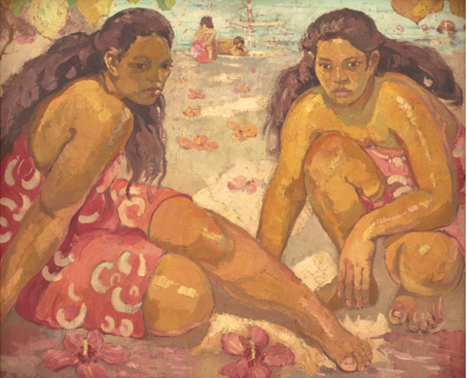
 Two Women on the Beach, Tahiti, by Adrien-Jean Le Mayeur de Merprès

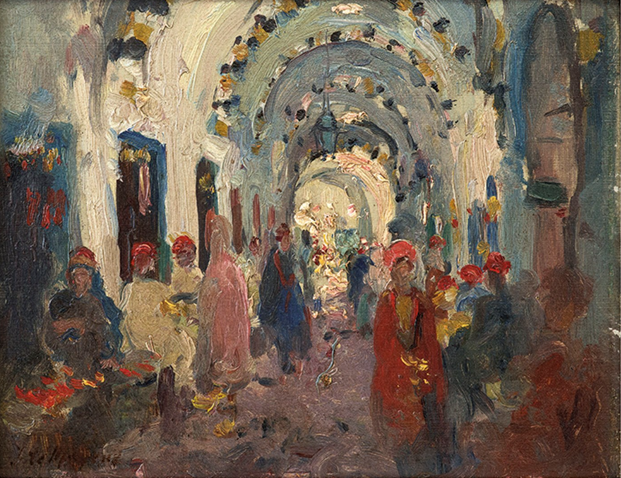
Jean had also acquired an insatiable appetite for travel.   In the early 1920s he visited Italy, North Africa, India, Cambodia, Burma, Madagascar and Turkey, all the time transferring his thoughts and what he saw onto canvas.  In a way these extensive travels were Jean’s way of searching for paradise and like Paul Gaugin, who had visited the Pacific island of Tahiti in June 1891, he too arrived on the Pacific island in 1929.  Jean Le Mayeur was disappointed with Tahiti as it was now far more commercialised than it was in Gaugin’s day and so Jean discounted Tahiti as being the promised land and instead decide to travel to south-east Asia and in 1932 he embarked on his first voyage to the “island of the Gods”, Bali.

An Arab Market by Adrien-Jean Le Mayeur de Merprès

After a long sea passage,   Le Majeur arrived at Singaraja, a port town in northern Bali.  From there he travelled south and rented a house in Banjar Kelandis, close to the northern part of Denpasar, the island’s main town. He was captivated by the Balinese people’s traditional way of life, the temple ceremonies and the local dances such as Legong, which is a form of Balinese dance that is characterized by intricate finger movements, complicated footwork, and expressive gestures and facial expressions.  For Le Mayeur, Bali was an ideal place to paint because of its light, colour and the exquisiteness of the surroundings in what was still a quite an unspoilt island.

Harbour of St Tropez by Adrien-Jean Le Mayeur de Merprès

From his love of watching the Legong dancers Le Majeur met a beautiful fifteen-year-old Legong performer, Ni Nyoman Pollok and he persuaded her to model for his paintings. In 1933 he had put together a collection of work featuring Ni Pollok, which he took to Singapore for an exhibition.  The exhibition was a great success and it resulted in him being more widely known.  On returning from Singapore, Le Mayeur purchased a plot of land at Sanur beach, a coastal stretch east of Denpasar in southeast Bali.  There, he built a house, which was also his studio and a beautiful garden. It was here that Ni Pollok along with her two friends worked every day as his models.

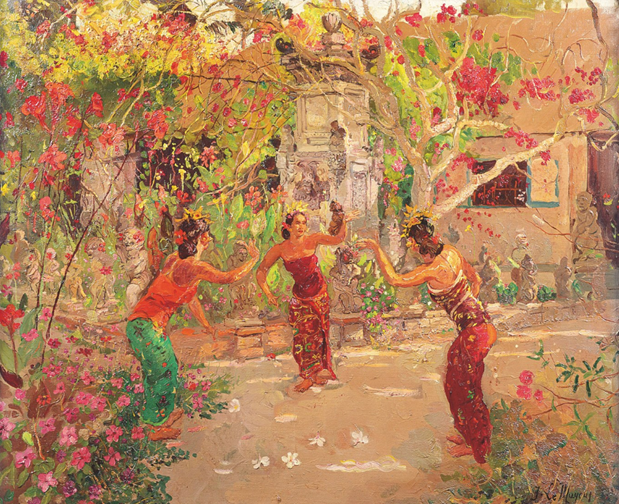
Three Dancers in the Garden by Le Mayeur by Adrien-Jean Le Mayeur de Merprès

In his painting entitled Three Dancers in the Garden we see three graceful dancers.  The setting of the depiction is in the garden in front of the house Le Mayeur and his wife Ni Pollok built on the beach of Sanur. Almost the whole of the background is taken up by the white house with its thatched roof and blue and white window shutters. 

Their house at Sanur was depicted on a number of occasions by Le Mayeur.  In one of his letters to a friend he recounts his love for the property:

“…I’ve evidently made all things serviceable to my art. All my actions have but one purpose: facilitating my work…”

 In another, he talks about how he is inspired by the house:

“…you will understand my paintings wherever you may see them, for everything in this little paradise which I created for myself was made to be painted”…”

Again, in yet another letter he writes about his love for the garden:

“…I organized my home exactly as I liked it. I intended to surround myself with nothing but beauty.  I planted a mass of bougainvillea, frangipani, hibiscus and all around the cottage I put groups of intertwining plants. I built little temples, completely made of white coral, dug little ponds in which the reflections of all the Gods of Hindu mythology can be seen among the sacred lotus flowers. The two temples are surrounded by approximately two hundred of these little sculptures, which have integrated with the flowers whose silhouettes are drawn on the purple and pink tropic skies…”

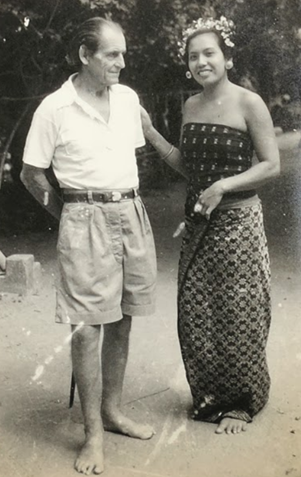
Le Mayeur and Ni Pollok

It is fair to say that Le Mayeur was smitten by the beauty of the island and the beauty of Ni Pollok. His original intention had been that he would just stay on the island for eight months but as that time came to an end he took the decision to remain in Bali for the rest of his life. After three years working together, in 1935, Le Mayeur and Ni Pollok got married. Le Mayeur kept on painting with his wife and her friends as his models during their married life. During the Japanese occupation of the Dutch East Indies in 1942, Le Mayeur was put under house arrest by the Japanese authorities.

Around the Lotus Pond by Adrien-Jean Le Mayeur de Merprès

Many of Le Mayeur’s paintings depicted scenes in and around their house.  The subjects were varied such as women at leisure on a daybed in the interior of the house; women weavers at the loom; women on the veranda or women dancing on a terrace; women in front of the house or in the garden picking flowers or making offerings but one of his favourite depictions was of women dancing around the lotus pond in his garden.  In this painting, Around the Lotus Pond, which Le Mayeur completed in the 1950s, we see the pond around which are six young women picking flowers.  It is thought that Ni Pollock posed for all the women.  Le Mayeur strived to make his paintings colourful and in this work the hues of red, purple, orange and pink dominate the painting and are in contrast with the darker colour of the pond and its water which we see in the lower left of the picture.

Ni Pollok with a friend enjoying the Afternoon Sun

by Adrien-Jean Le Mayeur de Merprès

During the war, tourism had totally disappeared but at the cessation of hostilities tourism to the island slowly returned.  The island’s tourists would often visit and look around Le Mayeur’s home and studio in Sanur and took the opportunity to buy his artwork.   Returning home with their purchasers enabled Le Mayeur’s works of art to become part of many collections. Although Bali was undoubtedly a scenic paradise, one of the downsides of living on the island was the possibility of contracting malaria and le Mayeur often suffered from bouts of the disease which weakened him.  A riding accident in 1948, resulted in the then sixty-eight years old artist to suffer a broken leg from a fall from his horse, Gypsy, and after that incident, probably because of his age, he never ever really recovered and had always, from then on, to use a cane when walking.  In 1951 the aging artist was attacked by a group of robbers and thanks to the effort of his wife Ni Pollok, they managed to fight off the intruders.  However Le Majeur received a large stab wound in the shoulder during the attack. Five years later he suffered with a hernia. Despite all these negative happenings, Le Mayeur managed to keep focused on his work and maybe the highly colourful works he produced radiated the sunny side of his and Ni Pollok’s life.
Five women on the Beach by Adrien-Jean Le Mayeur de Merprès

In 1958, seventy-year-old Le Mayeur had to travel to Brussels with his wife for treatment for cancer of his ear. Sadly, the illness was diagnosed as being terminal and the painter died on May 31st, 1958, aged 78. and was buried in Ixelles, Brussels. Ni Pollok later married an Italian physician who was living on the island but like many foreigners, during the troubles in Indonesia, he had his residence permit revoked and was obliged to leave the country. Ni Pollok stayed behind on Bali.

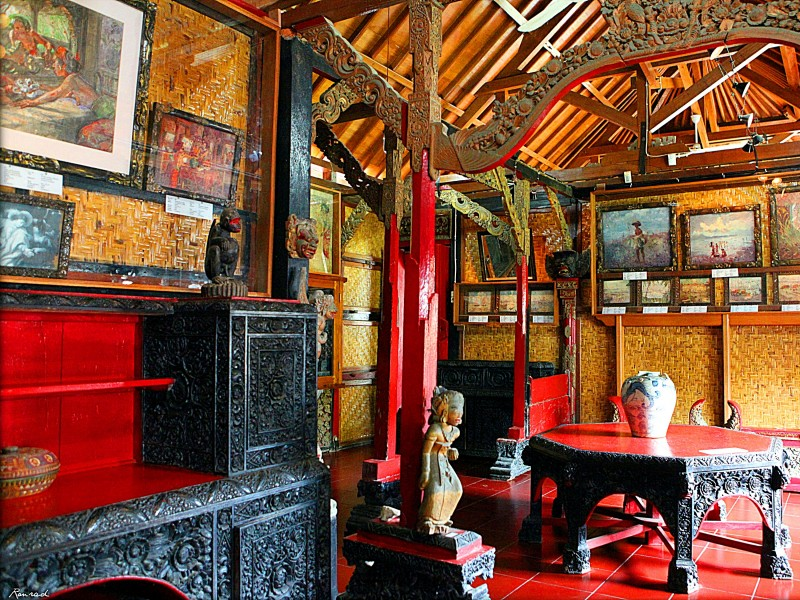
A room in Le Mayeur’s house, now a museum, in Sanur

The will of Le Mayeur had stated that Ni Pollok was allowed to live in the house in Sanur and she resided there up to her death in 1985. Subsequently, the house and its contents, including a hundred paintings by Le Mayeur, were then donated to the Indonesian government and the house was converted into a museum.

Alfred Sisley Revisited

The villages of the Seine and its tributaries

Sisley went tirelessly in search of motifs along the Seine and its tributaries, he looked no further. He concentrated on views of village streets, or of interesting groups of buildings, he would be drawn to an old stone bridge, the kind of subject that had fascinated painters since Corot. In what many would dismiss as unprepossessing patches of gardens or meadows, landscapes on the outskirts of towns or along river banks, Sisley could often discover the most arresting colour or light effects.

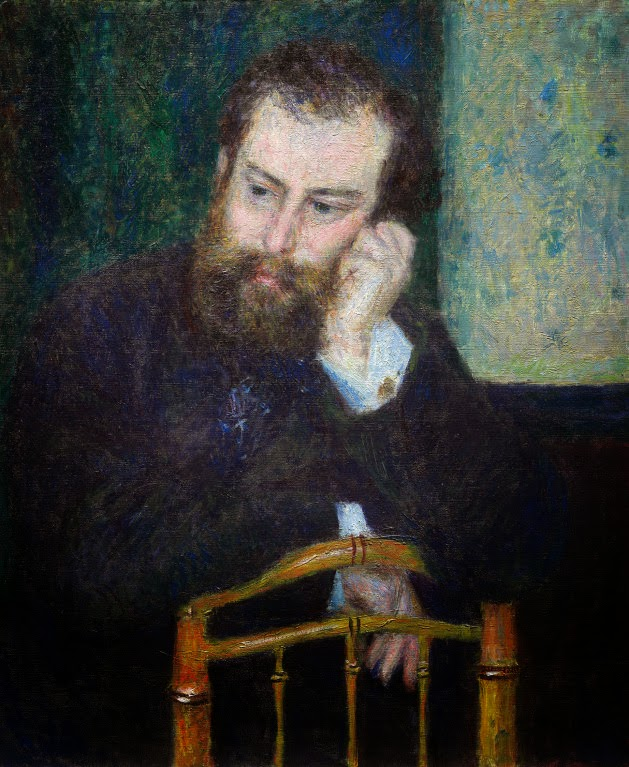
Alfred Sisley by Renoir (1876)

In 1866, Sisley began a relationship with Eugenie Lesouezec and shortly thereafter the couple had two children: a son, Pierre, in 1867 and daughter, Jeanne in 1869.  Although they remained together until Eugenie’s death in 1898, they didn’t marry until August 5, 1897.  In 1870, the Franco-Prussian War began and this precipitated the failure of Sisley’s father’s silk business which ended in his father’s bankruptcy and the financial devastation hastened his death.   Sisley had relied heavily on his father’s financial support because of the low prices being offered for his artwork, and this revenue stream had come to an end.

Louveciennes, above Marly by Alfred Sisley (1873)

To manage his financial difficulties and to avoid the Prussian War, Sisley gave up his home in Paris and moved to the countryside and the town of Louveciennes, a village west of Paris.  It is said that during the summer of 1871, Sisley, Renoir and Pissarro had watched Paris burn during the Prussian siege of the capital city. In his painting Louveciennes, above Marly, Sisley has depicted the view from Louveciennes, down over the forest and the riverside town of Marly.

Louveciennes: View of the Sèvrees Road by Alfred Sisley (1873)

Another of Sisley’s works featuring Louveciennes is his 1873 painting entitled Louveciennes: View of the Sèvres Road. It is a classic example of a perspective road which we see narrowing into the distance. He used this technique in many of his works as it allowed him to give movement to his depiction while also giving a feeling of space.

The Avenue at Middleharnis Meindert Hobbema (1689}

It is thought that Sisley’s depiction may have been influenced by Meindert Hobbema’s 1689 landscape painting, The Avenue at Middleharnis, which he would have seen at the National Gallery when he visited London.

Place du Chenil à Marly, effet de neige by Alfred Sisley (1876)

Two years later, in October 1874, after his four-month summer holiday spent in London, Sisley and his family moved to 2 avenue de l’Abreuvoir in Marly-le-Roi, a commune in the Île-de-France region, in north-central France, located in the western suburbs of Paris, 18 kilometres from the centre of the French capital. The two following winters were especially harsh with temperatures below zero and frequent heavy snowfall. I particularly like Sisley’s 1876 painting entitled Place du Chenil at Marly, and the depiction of snow. There is an eerie stillness about the depiction of the town’s main square which since Sisley’s time has been renamed Place du Général-de-Gaulle. We see that a heavy snowfall has occurred and the town has been covered by a thick blanket of snow. Look at how Sisley has depicted the snow. It is not just coloured white but a subtle blending of blues, greens, creams and greys. There is nothing spectacular about the scene but it is just a timeless realistic rendition. Place du Chenil in Marly, Snow Effect is now located in Musée des Beaux-Arts de Rouen which is an art museum in Normandy, France. It was given to Musée des Beaux-Arts de Rouen by François Depeaux, a French art collector, industrialist and patron. He gave the painting to the museum in 1909, just over 100 years after the Musée des Beaux-Arts de Rouen was built.

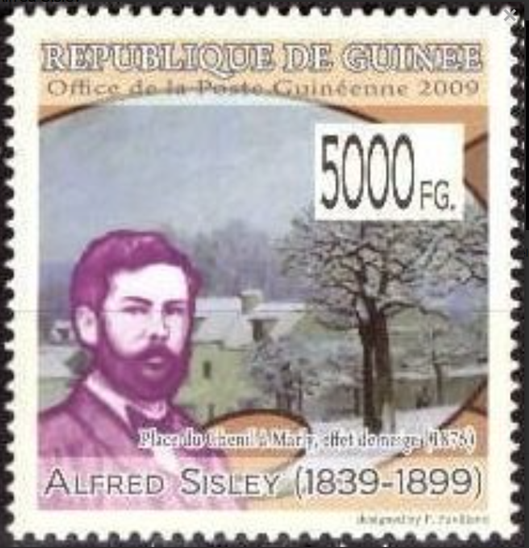
Postage stamp issued in 2009

Commemorative postage stamp issued by Republic of Guinea on October 1st 2009 depicted Sisley’s painting Place du Chenil à Marly, effet de neige.

Village by the Seine (Villeneuve-La-Garenne) by Alfred Sisley (1874)

The Villeneuve-la-Garenne painting depicts the village on the River Seine, a commune in the northern suburbs of Paris, which lies less than ten kilometres from centre of the French capital. In 1872 Alfred Sisley created his painting depicting the small village entitled Village by the Seine (Villeneuve-La-Garenne). After visiting the small village, Sisley was inspired by what he saw and was determined to produce a work so that he could share the beauty of the place.  The depiction oozes tranquillity.  The two trees in the foreground act as if they were theatre curtains on either side of a stage.  In this work Sisley has managed to encapsulate the beauty of nature.

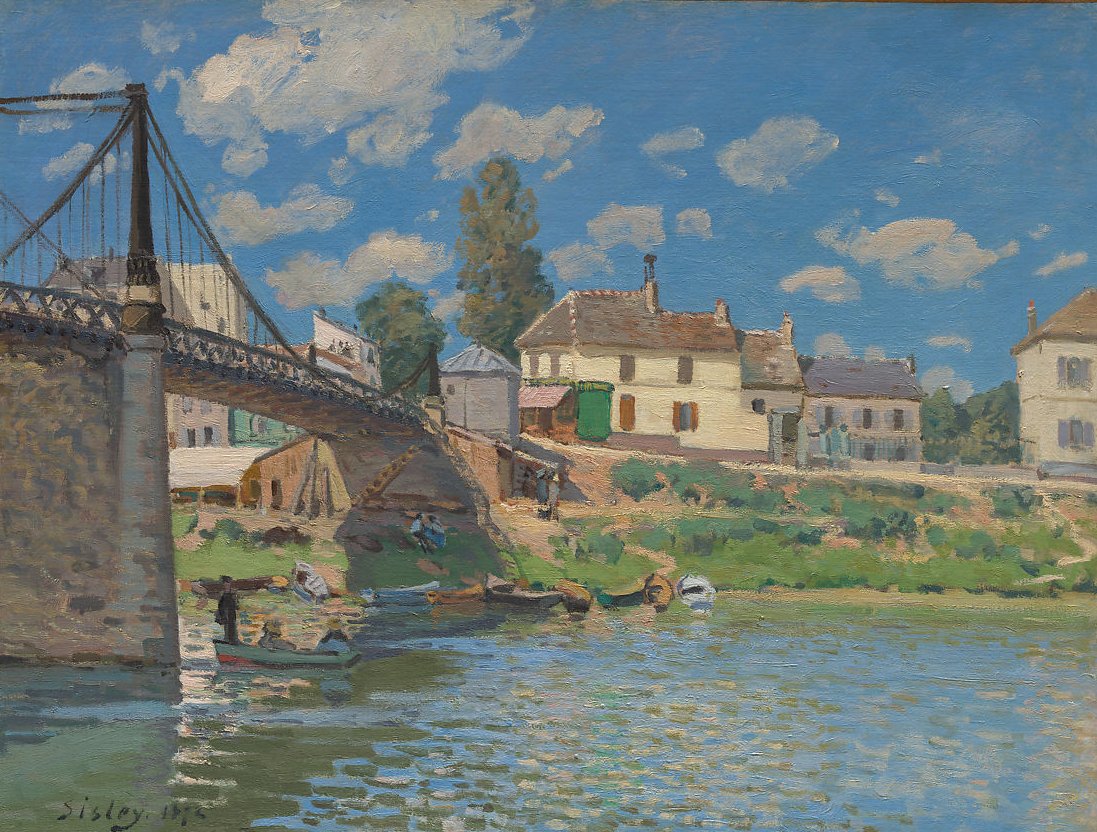
The Bridge at Villeneuve-la-Garenne by Alfred Sisley (1872)

Sisley completed a number of paintings featuring the village and just to the left of the previous painting, but out of view, is the bridge which crosses the river at Villeneuve-La-Garenne and this was the subject of Sisley’s 1872 painting, The Bridge at Villeneuve-la-Garenne. The cast-iron suspension bridge resting on stone abutments was built in 1844 to connect what had until then been a fishing village and small port with the Paris neighbourhood of Saint-Denis, on the other side of the river. The building of the bridge and the bridge itself was symbolic of French modernity, and the structure was depicted in a number of Sisley’s paintings of the 1870s and early 1880s. Sisley made the depiction somewhat livelier by including figures of holidaymakers on the riverbank and in a boat which is passing under the bridge.  Look how Sisley’s brushstrokes communicate the fleeting effect of sunlight on the water.

The Seine at Suresnes by Alfred Sisley (1877)

About six miles up-river from Villeneuve-La-Garenne is the town of Suresnes, a commune in the western suburbs of Paris, Île-de-France. In 1877 Sisley completed his painting entitled The Seine at Suresnes.  It is a typical work of Impressionism with its swirling clouds dominating his depiction of the sky.  His intention was to capture a fast-changing scene due to the approaching storm.  Look how he has depicted the river, no longer bathed in sunlight, now dimmed by the heavy clouds overhead.  Unlike many of Sisley’s best loved works which focus on tranquillity, this is more about doom-laden skies and what was to come to pass.  The painting was sold to fellow artist, Gustave Caillebotte, and along with Gustave’s other paintings he had amassed, it was later left to the French nation.

Canal de Loing by Alfred Sisley (1892)

With the canals from Briare and Orléans completed respectively in the second half of the seventeenth century, merchants started complaining about the poor navigability of the river Loing. The Duc d’Orléans ordered a survey and designs for the navigational route which would be part river and part canal.  The waterway was completed in 1723.  The Loing Canal is used by working barges and was the subject of many Sisley’s depictions.  In this painting we see a winding path, which follows the curve of the canal, alongside of which are poplar trees.  Our eyes, once we have taken in the house, follow the curve of the road and canal into the distance.  The inclusion of the winding road was one of Sisley’s favourite themes in which it plays a part in the perspective of the painting.  This painting, The Loing Canal, was offered to the Musée du Luxembourg after the painter died in 1899.  It was part of a gift from Sisley’s friends which was organised by Monet.

A Road in Seine et Marne by Alfred Sisley (1878)

Seine et Marne is a department in the Île-de-France region of northern France named after the rivers Seine and Marne and is on the eastern edge of the Ile de France.  It was to be Sisley’s countryside during the last twenty years of his life.  In 1880 he had moved to Veneux-Nadon, close to Moret-sur-Loing.  It was a “forced” move as Sisley had been evicted from his house in Sèvres for not paying his rent.  As some of his work prior to 1880 depicted scenes of Veneux-Nadon, it is clear that he had visited the area on a number of occasions.  This was an agriculturally rich and tranquil countryside with its woods and tiny hamlets.  It was a perfect venue for Sisley’s landscape work and allowed him to relax away from the chaos of Paris.  It worked for him as he produced many serene and beautiful paintings.

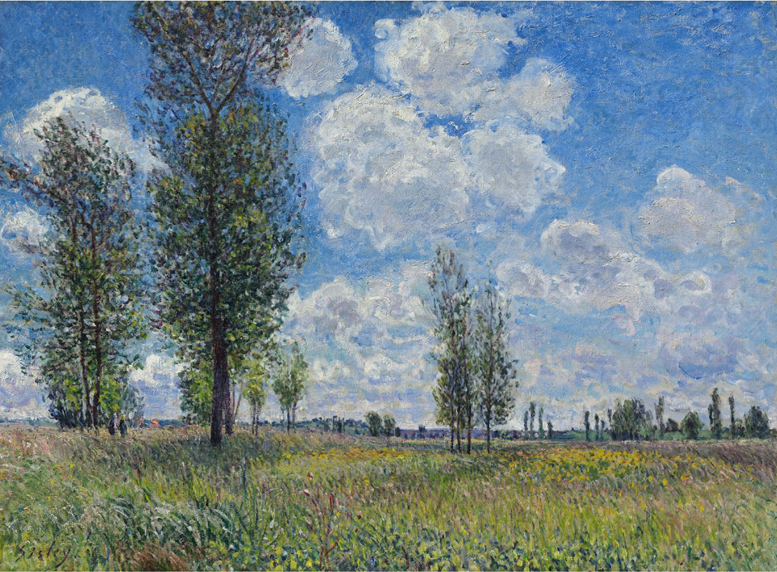
The Meadow at Veneux-Nadon by Alfred Sisley (1881)

Sisley’s painting, The Meadow at Veneux-Nadon, depicts the slender poplars with their delicate leaves and it leads our gaze into the depth of the picture space and gives it stability in this wide summer landscape. Through a juxtaposition of shimmering fields of colour and a reduction of motifs, Alfred Sisley lends an iridescent vitality and tension to the seemingly monotonous theme. Sisley exhibited the painting at the Seventh Impressionist Exhibition in 1882, in which the group focused on landscapes.

Le Bois des Roches Veneux Nadon, by Alfred Sisley (1880)

In his work, Le Bois des Roches Veneux Nadon, we see a windswept scene of a forest at the water’s edge . To the left we see a small rowing boat struggling in choppy waters.

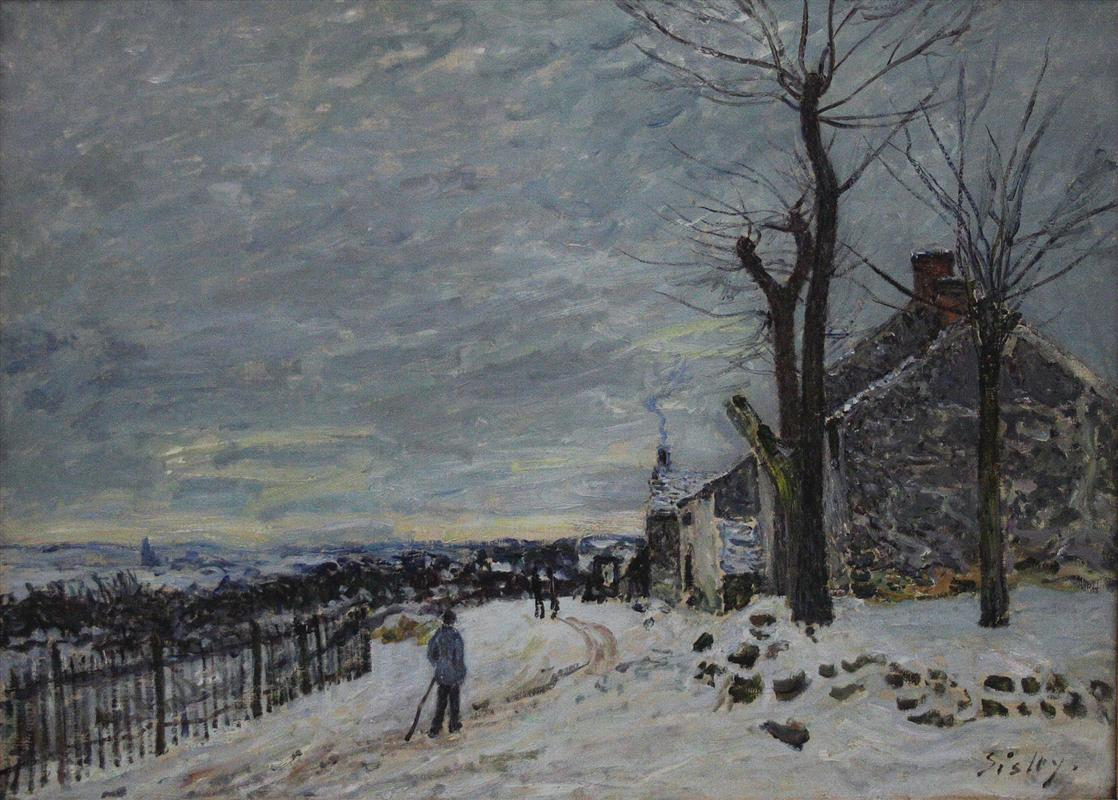
Snowy Weather at Veneux Nadon Alfred Sisley (1880)

This painting, Snowy Weather at Veneux Nadon, was completed during his first winter in Veneux- Narbon on the Loing in 1880. It is another of his snowscapes which this time is dominated by dark clouds with just a glimmer of the rising sun in the background. This was one of Sisley’s favourite depictions, often populated by workers heading for the mills, which were the village people’s primary source of employment. It is an atmospheric depiction of a cold early-morning scene and Sisley has used muted colours to ensure the contrast with the presence of the rising sun.

Veneux, August Afternoon by Alfred Sisley (1881)

Veneux, August Afternoon was painted by Alfred Sisley in 1881. Financially, it had not been a good year for him although he managed to afford to travel to the Isle of Wight in June. He had arranged for canvases to be sent to him on the island but they never arrived an he could not afford to pay for English canvases. When he arrived back in France in August he painted this work. It is a typical Sisley scene – quiet riverside setting with trees and picturesque sky. Our eyes are drawn to the creamy clouds in the upper left of the painting and then back down in a diagonal direction to the patch of sunlight we see falling on the pathway on the bottom right of the work.

Sailing Boats by Alfred Sisley (1885)

The painting Sailing Boats by Sisley depicts a scene of the boatyards at the riverside town of Saint-Mammès, sixty kilometres south-southeast of the French capital, at a point where the rivers Seine and Loing come together. Sisley has depicted a number of pleasure boats tied up next to a barge fitted with lifting gear. Sisley has used a familiar technique with the layout of his work – the subject is viewed head-on and the depiction is a series of wide horizontal bands, which, in this painting, is held together by the tall triangular shape of the lifting equipment. The scene is populated by a number of figures.

The Goose Girl by Alfred Sisley (1897)

Sisley’s favoured painting medium had always been oils but this late painting by him was a pastel. It is not known whether this pastel work was just a preliminary sketch that would later be used to complete the depiction in oils or whether Sisley was intrigued by the medium. Once again Sisley has used a winding path to give perspective to the depiction. The work is not simply a landscape but focuses on a girl looking after her flock of geese.

Alfred Sisley was born and spent most of his life in France, but retained British citizenship. In 1897, Sisley and his partner of over thirty years, Marie Eugénie Lescouezec, visited Britain and were finally married at the Cardiff Register Office on August 5th. On his return to France, in 1898, Sisley applied for French citizenship, but was refused. Later, a second application was made and on this occasion his application was supported by a police report, but Sisley became seriously ill and the process was halted. In October 1898 his wife died of cancer and four months later on January 29th 1899 Sisley died of throat cancer, aged 59. Sisley remained a British national until his death. He was buried with that of his wife at Moret-sur-Loing Cemetery.

Eugène Boudin. Part 2.

Picture2

       Sky, Setting Sun, Bushes in Foreground. by Eugène Boudin (ca. 1848-1853)

One of Boudin’s earlier paintings which featured his mastery of depicting skies is his work entitled Sky, Setting Sun, Bushes in Foreground which he completed in the early 1850’s. In this work, Boudin has gone for a very high frame and in fact, the sea does not appear in the composition. In this work and many similar ones, there is just the faint outline of a low horizon.  More often than not, the clouds are the main, sometimes the only motif. At times, the subject becomes so fine or abstract that Boudin specified its meaning on the back of the work.  His love of the paintings by the Dutch Masters made Boudin strive to achieve skies that he had seen in their works of art.  Between 1850 and 1870 Boudin completed many such depictions and a note in his personal diary refers to them:

“…To swim in the open sky. To achieve the tenderness of clouds. To suspend these masses in the distance, very far away in the grey mist, make the blue explode. I feel all this coming, dawning in my intentions. What joy and what torment! If the bottom were still, perhaps I would never reach these depths. Did they do better in the past? Did the Dutch achieve the poetry of clouds I seek? That tenderness of the sky which even extends to admiration, to worship: it is no exaggeration…”

On  January 14th,  1863,  Boudin married the 28-year-old Breton woman Marie-Anne Guédès in Le Havre and the couple set up home in Paris but would return to the Normandy coast in the summers.

Eugène Boudin - Sur la plage à Trouville.jpg

                        On the Beach at Trouville by Eugène Boudin (1863)

Boudin had started off his career painting seascapes, but he found his calling in the 1860’s depicting small beach scenes which he populated with affluent holidaymakers that had made the journey from Paris and outlying places.  These people spent summers sampling the health-giving benefits of sea bathing and the vibrant social life in the fast-emerging seaside resorts of Trouville and Deauville. Boudin created a few hundred examples of this type of painting, which enhanced his reputation.  He knew that genre was popular with the public once writing:

“…I shall do something else, but I shall always be a painter of beach scenes…”

On the Beach, Dieppe MET DT11491.jpg

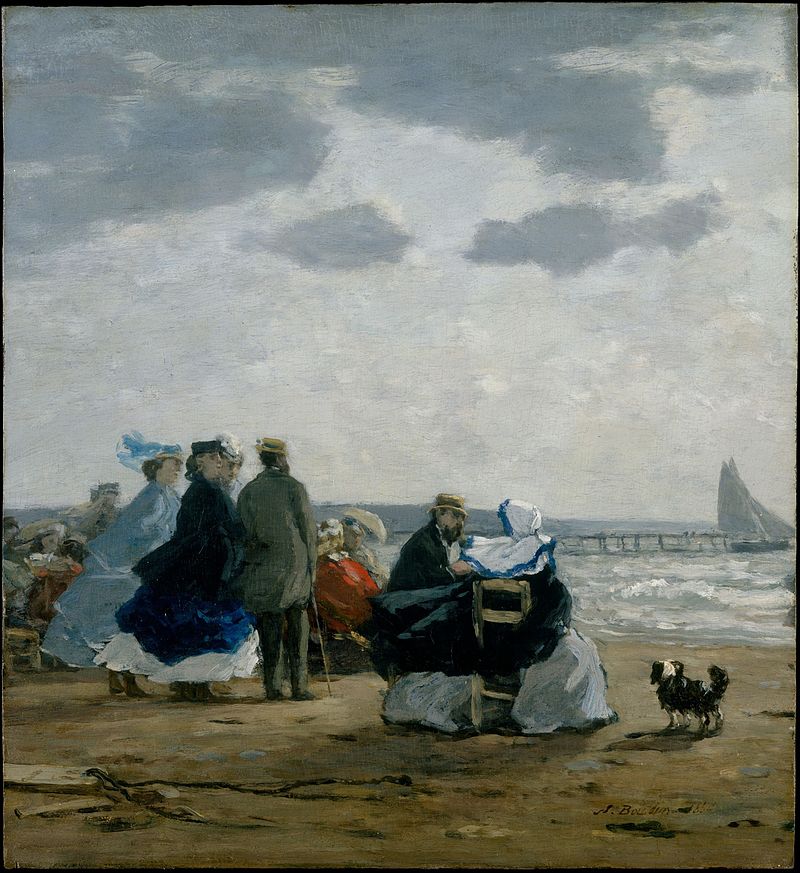
                                On the Beach, Dieppe by Eugène Boudin (1864)

An example of this type of work is his 1864 painting entitled On the Beach, Dieppe.   The setting is the beach of the Channel coastal town of Dieppe.

The changing skies of France’s Channel coast and the fashionable crowds on the resort beaches were Boudin’s lifelong subjects. These pictures were avidly collected, ensuring the artist’s success. In 1863 he commented:

“…They love my little ladies on the beach, and some people say that there’s a thread of gold to exploit there…”

On the Beach, Sunset MET DT1031.jpg

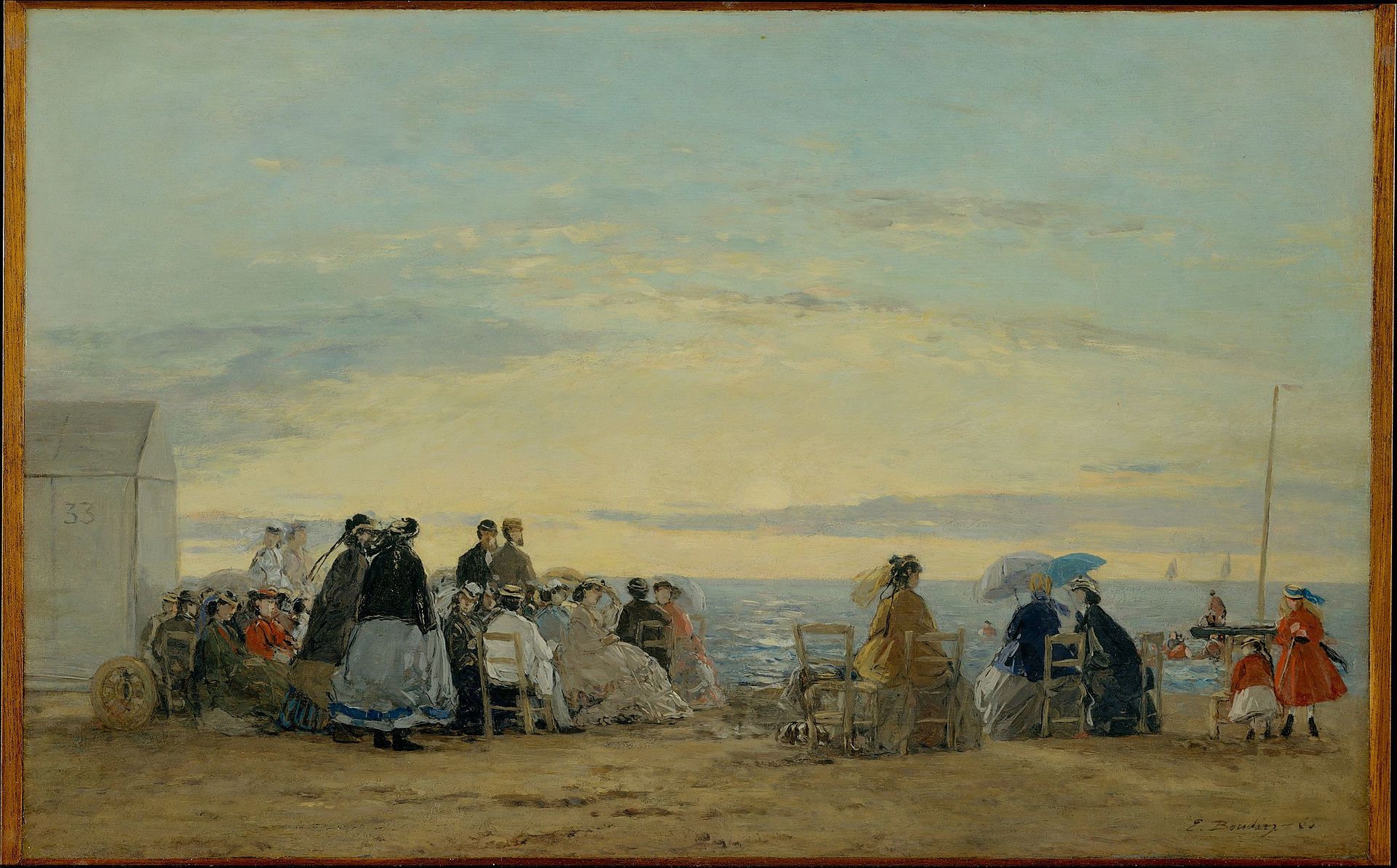
                                 On the Beach, Sunset by Eugène Boudin (1865)

Around 1865 Eugène Boudin spent time painting on the Normandy coast along with Monet, Courbet and Whistler.  It is around this time that Boudin began a series of depictions of fashionable beaches and this was to carry on for the whole of that decade.  In his 1865 painting, On the Beach, Sunset, we see the well-dressed upper-class holidaymakers who have gathered together to catch the final light of the day.  The seaside towns of Trouville and Deauville had not only their beautiful sandy beaches to inveigle tourists to their town but also had racetracks and casinos to satisfy those who liked the thrill of a wager. 

Princess Pauline Metternich (1836–1921) on the Beach MET DT4425.jpg

                    Princess Metternich on the Beach by Eugène Boudin (1867)

Visits by famous people to the Normandy beaches, such as Napoleon III’s wife, the Empress Eugénie also enhanced their reputation. Another dignitary to visit the Normandy beaches was Princess Metternich, the famous Austrian socialite, and wife of the Austrian ambassador to France and one of the most notable women at the court of Napoleon III.  She visited the seaside times on many occasions and was often accompanied by Princess Eugénie.  Her visit was captured by Boudin in his small 1867 painting entitled Princess Metternich on the Beach.  The Impressionistic style of the painting gives us little idea of the woman herself, which may be a relief to the Princess, as commentators of the time described her as small, very slight of build and as having “a turned-up nose, lips like a chamber pot and the pallor of a figure from a Venetian masque”.

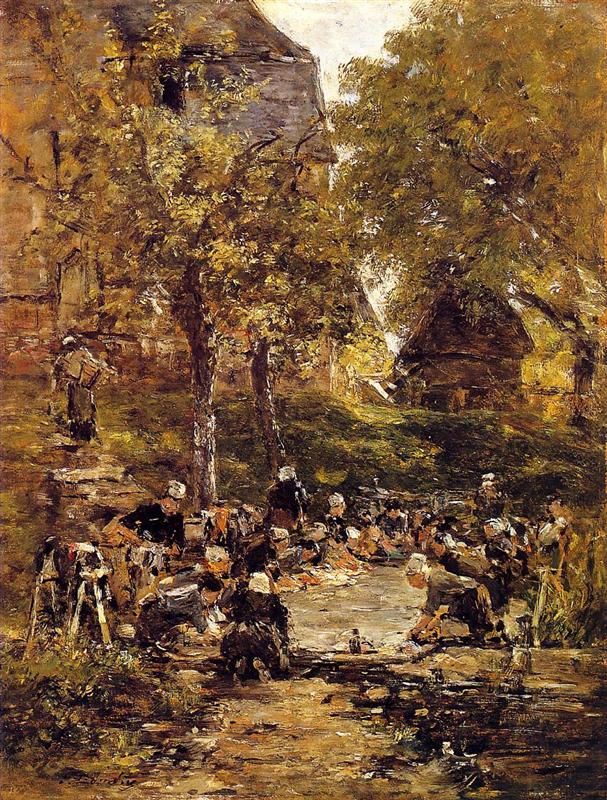
Laundresses by Eugène Boudin

For a period of time in 1867 Boudin left the beaches of Normandy and the luxurious lifestyle of the visiting rich and depicted the less well-off peasants and their daily routines.  Boudin could clearly see and understand the difference in the lives of the various social classes.  Did this bother him?  In a letter to his friend Ferdinand Martin, on August 28th, 1867, he condemned the social class system, writing:

“…I have a confession to make. When I came back to the beach at Trouville it seemed nothing more than a frightful masquerade.  If you have passed one month among the people condemned to hard work in the fields, with black bread and water, and you then find that gang of golden parasites with such a triumphant air, you can’t help feeling a bit of pity.  Fortunately, dear friend, the Creator has spread a little of his splendid and warming light everywhere, and what I reproduce is not so much this world as the element that envelops it…”

…….and yet in a letter to the same friend, Ferdinand Martin, a year later (September 3rd. 1868), he justifies his depictions of the wealthy on the Normandy beaches, writing:

“…The peasants have their painters, Millet, Jaque, Breton; and that is a good thing.  Well and good: but between you and me, the bourgeois walking along the jetty towards the sunset, has just as much right to be caught on canvas, ‘to be brought to the light’.  They too are often resting after a day’s hard work, these people who come from their offices and from behind their desks.  There’s a serious and irrefutable argument…”

Antwerp, Boats on the Scheldt by Eugène Louis Boudin, High Museum of Art.jpg
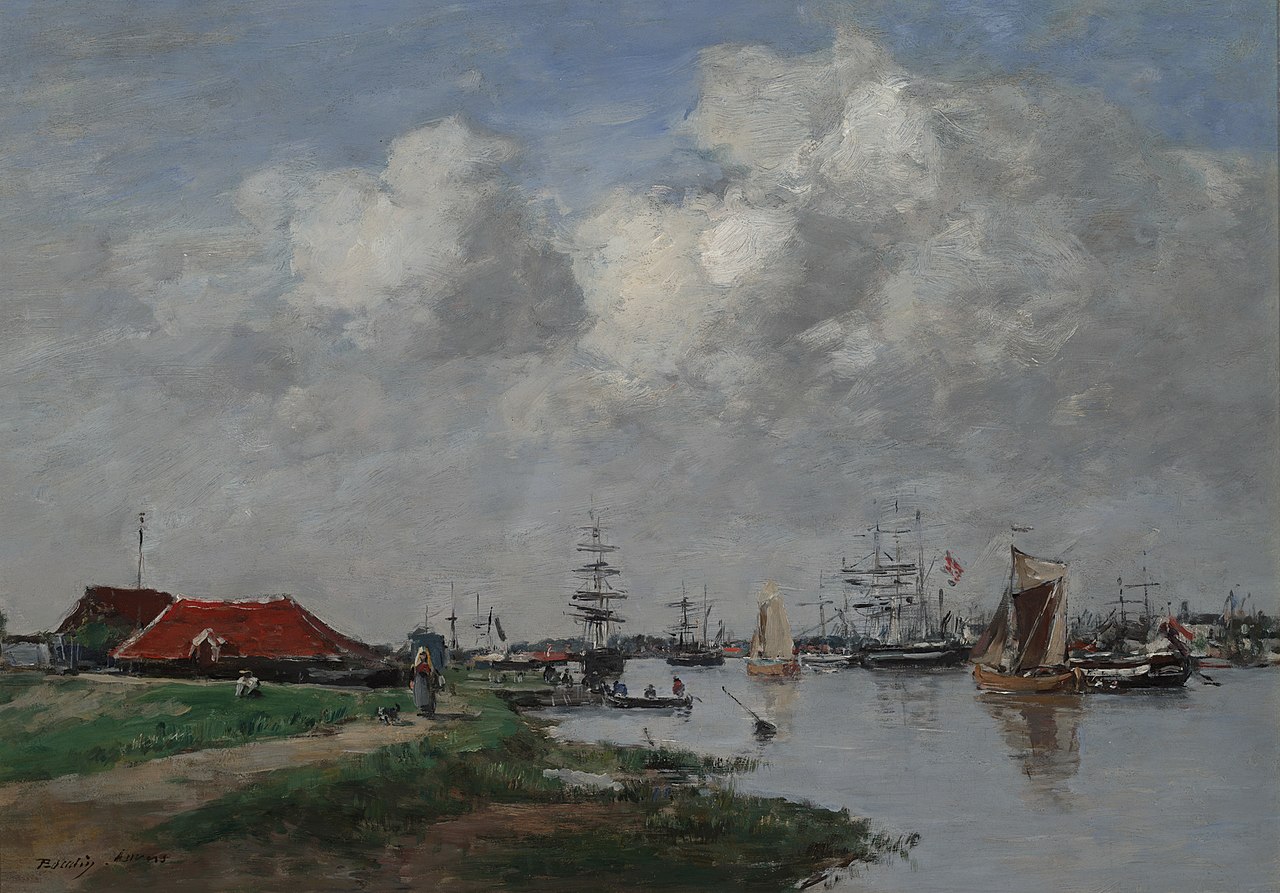
Antwerp, Boats on the Scheldt by Eugène Boudin (1871)

The Franco-Prussian War broke out in July 1870 and the Prussian army invaded the French capital the following month.  Both Boudin and Monet fled the country with Monet going to London whilst Boudin went north to Belgium and the city of Antwerp.  Whilst in Antwerp Boudin completed a number of maritime paintings, one of which was his 1871 work entitled Antwerp, Boats on the Scheldt.

Eugène Louis Boudin - The Escaut River in Antwerp - 1977.57 - Yale University Art Gallery.jpg
Antwerp, The Escaut River by Eugène Boudin (c.1871)

Another work around the same time was The Escaut River in Antwerp.

Low Tide. Portrieux by Eugène Boudin (1873)

With the Franco-Prussian war ending in 1871 and the bloody Paris Commune, which followed in the Spring of that year, coming to an end, it was safe to return to France.

Portrieux, in the bay of St. Brieuc, Côtes du Nord, was a popular village with painters and Boudin visited it on several of his trips to Brittany between 1865 and 1897.  His 1873 painting Low Tide, Portrieux depicts vessels he would have seen during his visits.  In this painting Boudin has focused on the fishing vessels from Newfoundland, the Terre-Neuvas, becalmed at low tide, and several of his paintings centred on this subject matter.   Boudin, who was the son of a ship’s captain, and who had worked as a cabin boy on ships sailing along the Channel coast, was well able to recognise, and record, the individual characteristics of the vessels he came across in the ports he visited.

The Dock at Deauville (1891)

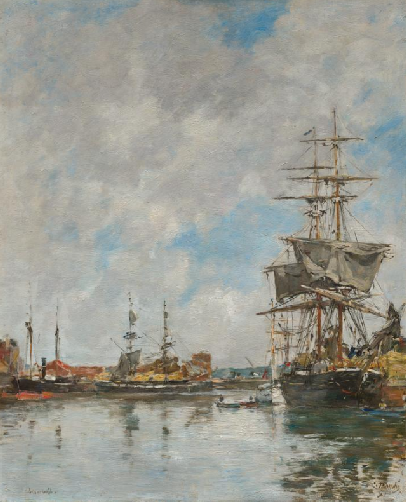
The Dock at Deauville by Eugène Boudin (1891)

One of Boudin’s paintings, The Dock of Deauville, which he completed in 1891, has a similar depiction, ships in a harbour.  This painting treats a common theme in Boudin’s later art, ships in harbours. For Boudin these paintings were all about tranquillity, harmony and the effect of natural light on subjects and, unlike other maritime painters, avoided depictions of busy dockside life and the arduous jobs carried out by dock workers.  In this work, one can see how he has combined lighter tones around the ships’ masts, often overlying the darker lines of the wood and rigging with white or grey tones as if to suggest the passing wind and ever-changing positions which were everyday aspects of nautical life.

Eugène Boudin - Voir d'Antibes au coucher du soleil.jpg

View of Antibes by Eugène Boudin (1893)

By the time the 1880’s came around Boudin had achieved widespread recognition as an accomplished painter and had finally achieved financial security once he had secured a contract with the art dealer Durand-Ruel.   Paul Durand-Ruel, who was a great supporter of Impressionism and the Impressionist artists. In 1883 he opened his new gallery on the Boulevard de la Madeleine in Paris with an exhibition of works by Boudin, comprising 150 paintings and other pastels and drawings.

Fair in Brittany by Eugène Boudin

In 1888 at an auction at Hôtel Drouot in Paris, a large auction house in Paris, known for fine art, antiques, and antiquities, which consisted of  sixteen halls hosting seventy independent auction firms, many of Boudin’s paintings were bought by avid collectors of his work. 

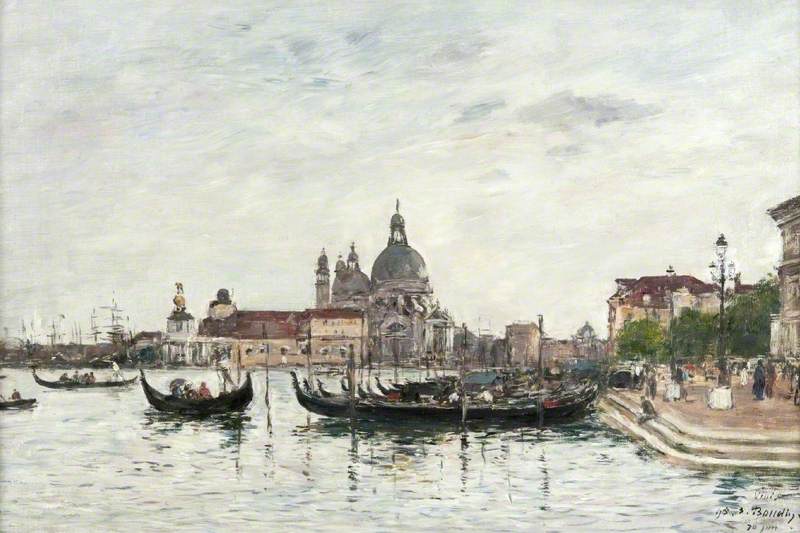
Venice: Santa Maria della Salute and the Dogana Seen from across the Grand Canal

Venice: Santa Maria della Salute and the Dogana seen from across the Grand Canal, by Eugène Boudin (1895)

In 1889, 1890, and 1891, more successful exhibitions were organized at Galerie Durand-Ruel, and in 1890 Boudin was elected a member of the Société des Beaux-Arts.  His paintings travelled across the Atlantic and were shown in exhibitions in Boston in 1890 and 1891.  He continued to exhibit at the Paris Salons until his death and received a third-place medal at the Paris Salon of 1881, and a gold medal at the 1889 Exposition Universelle in Paris.  In 1892 Boudin was made a knight of the Légion d’honneur.  His wealth allowed him to travel and he visited Belgium, the Netherlands, and southern France, and from 1892 to 1895 made regular trips to Venice.

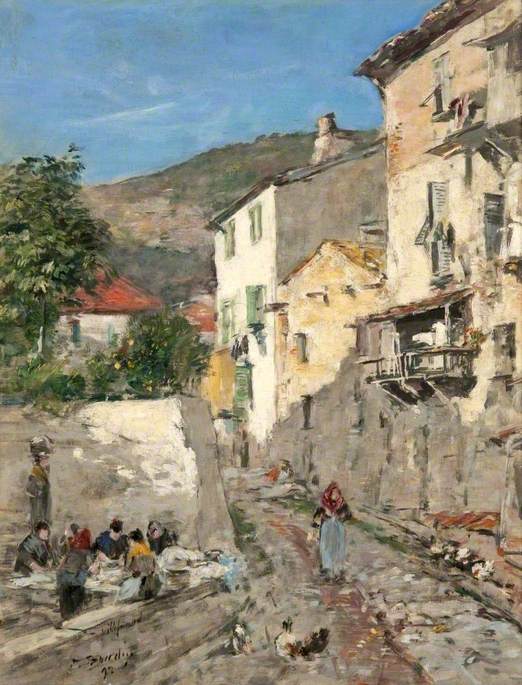
Villefranche

Villefranche by Eugène Boudin  (1892)

Boudin was now spending every winter in the south of France, returning to his beloved Normandy in the summer.  His wife died in 1889 and Boudin’s own health was in decline.  In 1898 Boudin must have realised he was dying as he decided to move back to his home in Deauville to die. 

Eugène Louis Boudin died on August 8th 1898 aged 74.  He was buried according to his wishes in the Saint-Vincent Cemetery in Montmartre, Paris.  Boudin was a very modest man  and once said:

“…I may well have had some small measure of influence on the movement that led painters to study actual daylight and express the changing aspects of the sky with the utmost sincerity…”

But I will leave the last words to Claude Monet who said of Boudin:

“…If I have become a painter, I owe it to Eugène Boudin…”

Lilla Cabot Perry. Part 2.

                                                 Portrait of Alice Frye Leach by Lilla Cabot Perry (c.1880)

It was in 1889 that Lilla Cabot Perry first encountered Claude Monet’s work at the prestigious Galerie Georges Petit in Paris which staged a Monet/Rodin collaboration exhibition (Claude Monet-Auguste Rodin, centenaire de l’exposition de 1889), that opened on June 21st.  It was also in that summer of 1889 that Lilla and her husband first met the great French painter.  According to an article written by Lilla, which appeared in the March 1927 edition of the American Magazine of Art, a young American sculptor who was living in Paris mentioned to her and her husband that he had a letter of introduction to meet Monet but he was very nervous and shy with going on his own to the great man’s house so asked the couple if they would accompany him on his visit.  Lilla and Thomas Perry were delighted to accept the invitation as they had greatly appreciated what they had seen at the Claude Monet-Auguste Rodin exhibition.

In the article Lilla recounts her first impressions of Monet.  She wrote:

“… The man himself with his rugged honesty, his disarming frankness, his warm and sensitive nature, was fully as impressive as his pictures and from this first visit dates a friendship which led us to spend ten summers at Giverny.  For some seasons, indeed, we had the house and garden next to his and he would sometimes stroll in and smoke his afternoon-luncheon cigarette in our garden before beginning on his afternoon work…”

The Impressionism style that Lilla encountered with the art of Monet was an epiphany moment for her. She immediately took to this style even though it was still rejected and scorned by the art world around her.  The way the Impressionists managed the colour and light was a great inspiration to her and during those summer days at Giverny she also worked with many American artists, who had found their way to the small French town to sample the joys of plein air painting in the rural surroundings, such as Theodore Robinson, John Breck, and Theodore Earl Butler.

                                               La Petite Angèle, II, by Lilla Cabot Perry (1889)

One of her painting during her time in Giverny was her 1889 work entitled La petite Angèle II.  It is impressionistic in style with its free form brushstrokes that capture the impression of light and colour.   Claude Monet, inspired Perry to work en plein air, and use impressionistic brushstrokes, soft colours, and poppy red. If you look through the window depicted in this work you should note the early stages of what would become Lilla’s love affair with the way the Impressionists treated landscape depictions.

Angela by Lilla Cabot Perry, 1891, High Museum of Art.jpg
                                                                  Angela by Lilla Cabot Perry, (1891)

A similar work by Lilla was entitled Angela.  It was a portrait of one of her favourite models in Giverny. The clearly defined figure posed in a freely brushed and light-filled setting typifies academic American Impressionism of the time.

A Little Girl in a Lane in Giverny - Lilla Cabot Perry Painting
                                            A Little Girl in a Lane in Giverny by Lilla Cabot Perry

In late 1889 Lilla Cabot Perry and her husband left Giverny and embarked on a tour of Belgium and the Netherlands.  In 1891 she returned to Boston with her family bringing home a painting by Monet and a number of landscapes works by John Breck.  Once back in Boston she began to spread the word of Impressionism especially the works of Monet.  However, like many art critics in France, Impressionism was not favoured by either the American critics or the buying public and Lilla had to begin with a hard-sell of his works.  She would exhibit his works at her home and give talks about him and the world of Impressionism to the Boston Art Students’ Association. 

                      Portrait of Baroness R by Lilla Cabot Perry, (1895)

Whether Bostonians accepted the merit of Monet’s work or not, the one thing for sure was that they appreciated the paintings of Lilla Cabot Perry, especially her portraiture.  Several of her paintings were exhibited at the 1893 World’s Columbian Exhibition in Chicago and were greeted with great acclaim.   In 1897 she exhibited work at the St Botolphs Club in Boston and the art critic of the Boston Evening Transcript wrote:

“…Mrs Perry is one of the most genuine, no-nonsense, natural painters that we known of………………Such work must be taken seriously…”

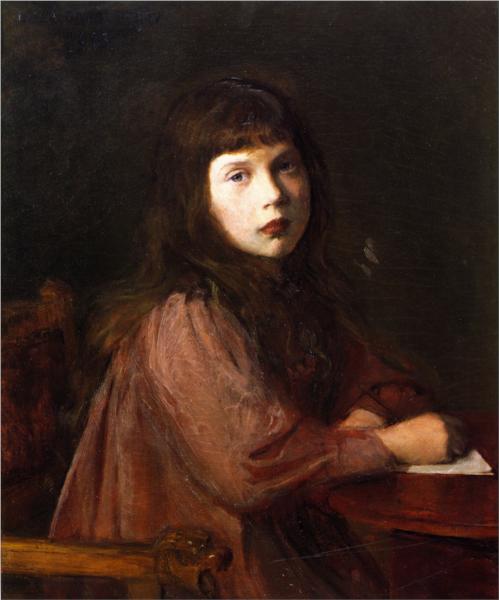
The Letter, 1893 - Lilla Cabot Perry
                                           The Letter (Alice Perry) by Lilla Cabot Perry (1893)

Lilla Perry’s artistic success in 1889 had made it possible for her to be one of the select few young artists to be admitted to Alfred Stevens’ class in Paris.  The works of Lilla Perry were often influenced by the time she spent with Stevens. A good example of this is her 1893 painting entitled The Letter [Alice Perry] and the way she has depicted the chair, especially the careful attention she has paid to  the colouration of the wood, and the way she has depicted her youngest daughter’s clothes in such detail.  It is a loving portrait of a nine-year-old daughter by her mother.

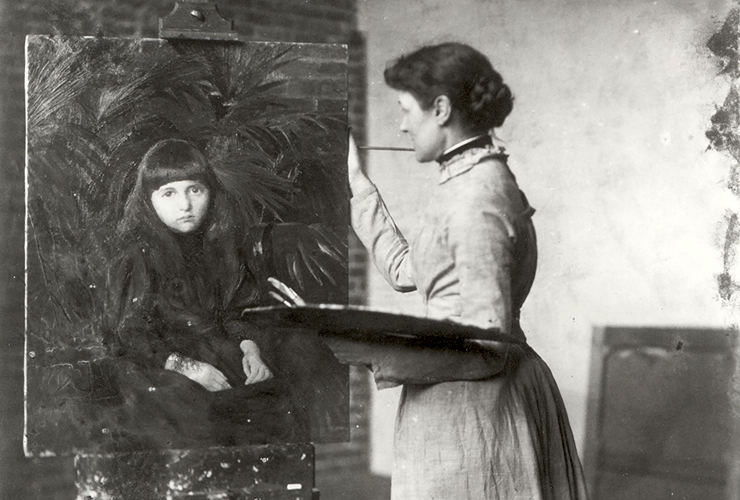
Black-and-white interior photograph of a light-skinned adult woman in profile with dark hair in a bun and a light-color dress. She stands in front of an easel and holds a palatte and brushes in her left hand. She rests her right hand on a painting of a light-skinned young girl.
                                                                       Lilla Cabot Perry at work (c.1890)
Lilla Cabot Perry, 1896 - Haystacks, Giverny.jpg
Haystacks, Giverny by Lilla Cabot Perry (1896)

In 1894, sheonce again exhibited her impressionism paintings at the St. Botolph Club in Boston together with other Impressionism artists, including Edmund Tarbell, Phillip Hale, Theodore Wendel, and the British-born painter Dawson-Watson. Three years later, and in the same gallery, Lilla held a solo exhibition.  On show were her Impressionist-style portraits and landscapes. 

Giverny Landscape, in Monet’s Garden by Lilla Cabot Perry (1897)

This proved to be a major turning point for Lilla Perry as it showed that her work was gaining the recognition of the American art world and that Impressionism was finally being acknowledged as a legitimate artistic expression. Lilla Perry was a devoted Impressionist painter and she loved the work of the Impressionists, especially the works of her friend Claude Monet.  Now back in America she took every opportunity to endorse French Impressionism and urged her friends to invest in their work.  She also gave many lectures and wrote essays for journals and magazines supporting this French art movement.

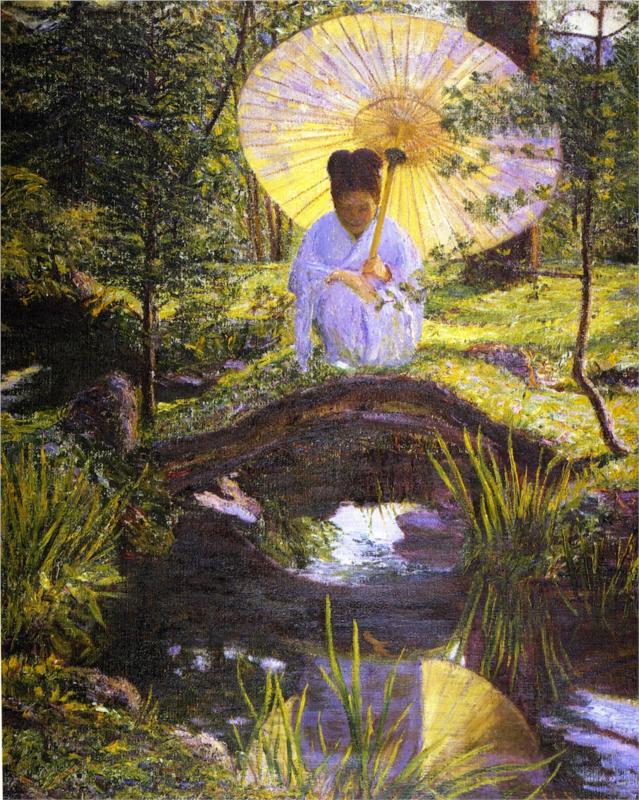
In a Japanese Garden by Lilla Cabot Perry (1901)

Between 1868 and 1872, Lilla’s husband, Thomas Perry, was a tutor in German at Harvard and from 1877 to 1881, he was an English instructor in English as well as being a lecturer in English literature from 1881 to 1882. Thomas Perry was offered a new challenge in 1897 when he was presented with the opportunity to take up a teaching position in Japan as an English professor at the Keio Gijuku University in Tokyo.  Lilla and her husband along with their three children left America and travelled to Japan.  Not only was this and exciting time for her husband it was also a stimulating time for Lilla and offered her new opportunities to paint.

In 1898, he became professor of English literature in the Keio University, in Tokyo, Japan.  The Perry family lived in Japan for three years and Lilla immersed herself in its artistic community.  Lilla Perry met Okakura Kakuzō, one of the Imperial Art School co-founders and became an honorary member of the Nippon Bijutsu-In Art Association, an artistic organization in Japan dedicated to a Japanese style painting known as Nihonga.

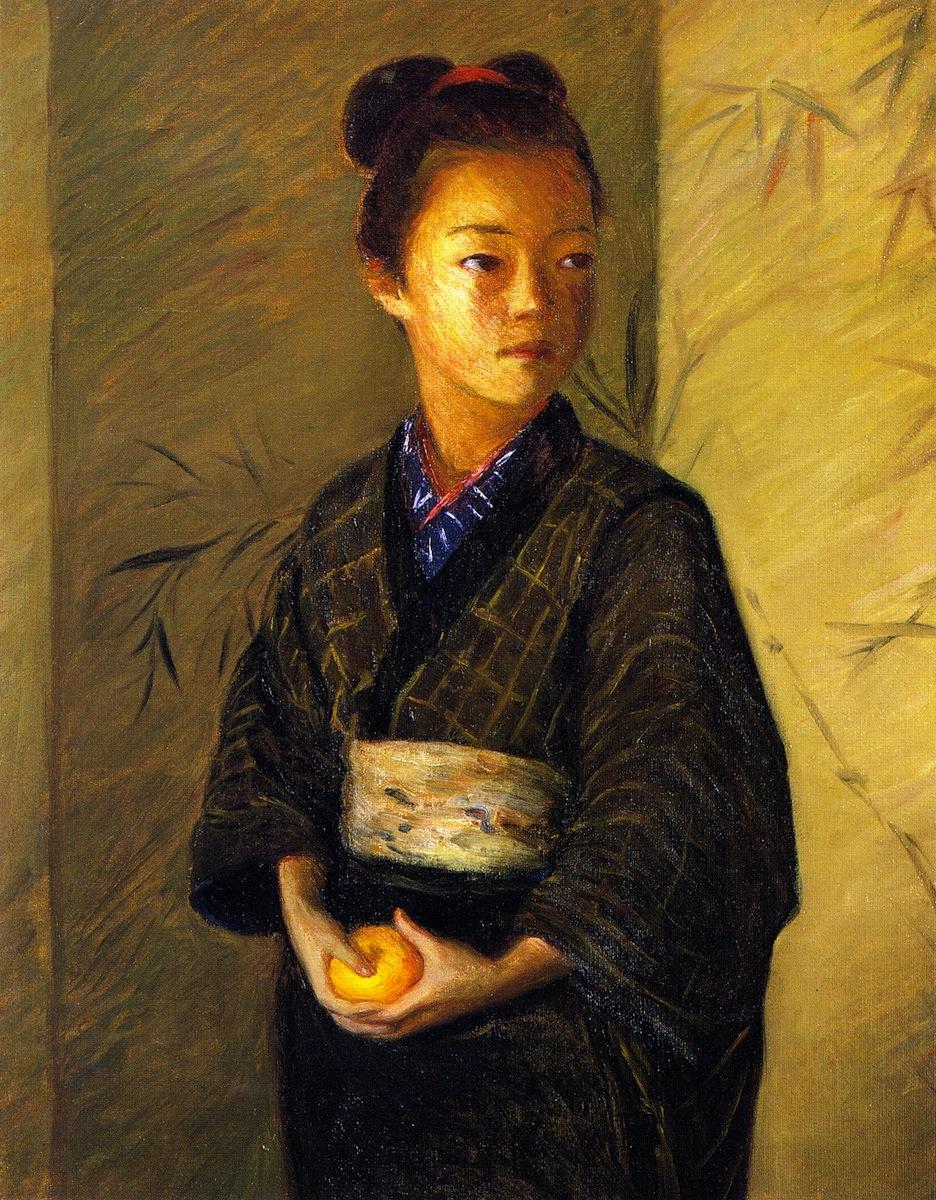
Portrait of a Young Girl with an Orange by Lilla Cabot Perry (1898-1901)

Such an involvement in the Japanese art and Asian art in general helped Lilla develop her unique style which fused western and eastern artistic traditions.

Child in Kimono by Lilla Cabot Perry (1898)

The result of this coming together of east and west can be seen in her Impressionist portraits.  

Lilla Cabot Perry, Mount Fuji with Gravestones, Harvard.jpg
Lilla Cabot Perry, Mount Fuji with Gravestones, 1898-1901

It was not just her portraiture that Lilla focused on during her three-year stay in Japan, she also completed a number of landscape works.  By far her most favoured subjects were ones depicting Mount Fuji.  Of about eighty paintings she completed whilst in Japan, thirty-five depicted the iconic mountain.

Open Air Concert by Lilla Cabot Perry (1890)

Lilla and her family left Japan for America in 1901 and settled back into their house in Boston.  Her three daughters were now all in their twenties and their mother had completed a number of paintings feature all of them or as individuals. In an early painting entitled Open Air Concert, which she completed in 1890, she depicts her three daughters in a garden setting with her eldest, Margaret, with her back to us, posed playing the violin.

The Trio, Tokyo, Japan by Lilla Cabot Perry (1901)

Almost ten years later Lilla’s three musically-talented daughters featured in her 1901 painting entitled The Trio, Tokyo, Japan (Alice, Edith and Margaret Perry).  In 1903 Lilla and Thomas Perry bought a farm in Hancock, New Hampshire.  She said she immediately fell in love with the area as it reminded her of Normandy, an area she knew well from her days at Giverny. 

Portrait of Mrs Joseph Clark Grew (Alice Perry) by Lilla Cabot Perry (1905)

Alice Perry, Lilla’s youngest daughter featured in her mother’s portrait entitled Portrait of Mrs. Joseph Clark Grew [Alice Perry].  Joseph Grew married Alice Perry on October 7th, 1905 and became her husband’s life partner and helper as promotions in the diplomatic service took them around the world.   The couple went on to have two daughters, Lilla Cabot in 1907 and Elizabeth Alice in 1912.  Lilla’s portrait of her daughter won her a bronze medal at the prestigious International Louisiana Purchase Exhibition in St. Louis.

Portrait of William Dean Howells by Lilla Cabot Perry (1912)

In the first decade of the twentieth century Lilla Cabot Perry divided her time between Boston and France but her health had started to deteriorate possibly due to all the travel she was doing but also because of financial problems.  Her inheritance had dwindled and she was the main source of the family income through the sale of her paintings.   The financial difficulties the family were experiencing meant that she had to spend a lot of her time completing portraiture commissions to make up for the money that her family was losing in investments.  She once declared that she had had to complete thirteen portraits in thirteen weeks, four sitters a day at two hours each.   It also rankled with her that she had to concentrate on portraiture as her Impressionistic landscapes were viewed as too experimental by her conservative patrons.  An example of her portraiture work around this time was her 1912 Portrait of William Dean Howells, the prolific American novelist, playwright and literary critic.

See the source image
Portrait of Edith Perry Ballantine and Edward Ballantine by Lilla Cabot Perry

In 1923 Lilla was struck down with diphtheria and at the same time she was struggling to support her middle daughter, Edith, who had suffered a mental breakdown and was admitted to a private mental health institution in Wellesley, Massachusetts.  Lilla spent two years convalescing in Charleston, South Carolina.

Lilla Perry, like many other nineteenth century painters, was unhappy with the new avant-garde trends in Modern art such as Fauvism led by Henri Matisse and André Derain and so in 1914 she, along with Edmund Tarbell, William Paxton and Frank Benson, helped form the ultra-conservative Guild of Boston Artists in order to oppose the art world’s avant-garde trends.  In 1920 Perry received a commemoration for giving six years of loyal service to the Guild.

A Snowy Monday by Lilla Cabot Perry

During her time convalescing she discovered a new inventiveness for her landscape works, what she termed as “snowscapes.” These beautiful winter landscapes laden with snow became a craving 0f Lilla’s and she would go to extreme lengths to capture winter scenes en plein air, even bundling herself up in blankets and hot water bottles in order to capture the beauty of a 4 a.m. sunrise. One of her most famous “snowscapes” was her 1926 work entitled A Snowy Monday.

Lilla Perry by Frederick A Bosley (1931)

Her summer home in Hancock soon became her main residence and she and her husband Thomas settled into village life in the picturesque New Hampshire foothills.   Thomas Perry died of pneumonia on May 7th 1928, aged 83.  Lilla Cabot Perry continued to paint prolifically until her death on February 28th, 1933.   Lilla and Thomas Perrys’ ashes are buried at Pine Ridge Cemetery in Hancock.

Hilda Rix Nicholas. Part 2. Morocco and many family tragedies

Morocco, marketplace with pile of oranges by Hilda Rix Nichols painted during one of her two trips to Tangier

It would have been almost impossible to actually paint plein air in oils in the chaotic marketplaces, so Hilda resorted to completing many outdoor pencil and crayon sketches and then later fashioned a completed work when she returned to her hotel.  Her painting style had changed and was now more in line with the Post Impressionists.  An example of this is her work entitled Morocco Marketplace with the Pile of Oranges.  It is a good example of the changes that her style underwent in Morocco. Now she is painting with flowing brush strokes in thick slabs of impasto, a technique used in painting, where paint is laid on an area of the surface in very thick layers, usually thick enough that the brush or painting-knife strokes are visible. The scene is framed by buildings in the background and strewn across the foreground we see a large pile of oranges. The mountain women are wearing red striped skirts and bright haiks, the large pieces of cotton, silk, or wool cloth worn as an outer garment by some Moroccan women.   

                            Men in the Marketplace by Hilda Rix (1914)

In 1914 she completed her painting entitled Men in the Market Place, Tangier.   It is set during the late afternoon once all the shops had closed and in front of us are a group of men deep in conversation.  She has cleverly used a much-reduced palette of pale blues, creams, browns, and yellows.  We do not see the facial feature of the men as they are bathed in a dark grey shadow whilst the buildings behind them are bathed in late afternoon light.  Hilda wrote a letter home describing how she had to endure the strong sunlight coming from the low sun.  She wrote:

“…’The sun has sunken down in a daffodil bed – feeling he has well earned his rest. (But I have a bone to pick with him – he burnt my arms while sketching till they positively hurt – next time I’ll fool him & put gloves over them). The Moors have turned around from their haggling & marketing, gossiping & dreaming & murmuring to face the setting sun, their lips moving in prayer, their eyes beautiful to look upon – The pale yellow light giving a weird pallidness to the sheet of faces …”

                                                       Grande Marché, Tangier by Hilda Rix (1916)

Hilda completed a pastel drawing, Grand Marche, Tangier, which she later copied in oils.  When it was exhibited in her show at Paris’ Galerie J. Chaine and Simonson in 1912 it was much admired and was bought by the French government for the collection of the Musée du Luxembourg.  Centre stage in the depiction we see two women wearing red-and-white-striped cotton dresses or skirts, covered by white robes.  Their legs are bare and they wear red shoes and socks. One of them pulls her white robe tighter across her upper body. The other, who has her back turned to the viewer, is carrying something on her back, which could be her young child.  The art critics for the French edition of the New York Herald was impressed by Hilda Rix’s realist art, stating that in his opinion the figures in her compositions must surely have been sketched and later added to the finished work.  He further commented:

“…’This artist has the ability to make lifelike images in remarkable compositions bringing outstanding realism and accurate impressions that capture the ‘types’ to be found among the Moroccan people…”

Not everybody loved the painting as the art critic of The Sydney Morning Herald commented that:
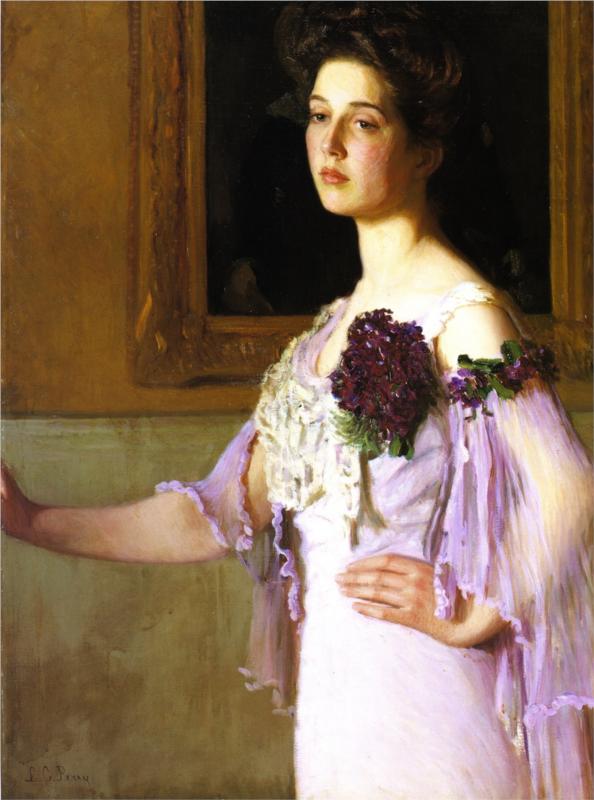
“…the drawing and colour are eccentric, after the post-impressionist manner” and described the central figure as “grotesque in its want of finish…”

 Moroccan Market Scene by Hilda Rix Nicholas (crayon and pastel on paper)

The paintings which she did during her periods in North Africa led art historians to compartmentalise her as an Orientalist, a term which referred to the depiction of people or places in present-day Greece, Turkey, North Africa or the Middle East, by painters from the West.  In addition to displaying the results of her trip at the Salon, she also had her Tangier works exhibited in 1913 and 1914 at the Société des Peintres Orientalistes Français, an art society which staged not only Orientalist paintings, but also encouraged the travel of French artists in the Far East. Her work was illustrated in the Notre Gazette, reflecting her emerging status as an important artist, and there were many column inches in the French about her exhibitions.

                           Moroccan Loggia by Hilda Rix Nicholas (1912-1914)

Her colourful paintings featuring life in Morocco highlighted the powerful North African light and concentrated on the people and their colourful clothing and sometimes the local architecture.  It could be levied against her that many of her depictions were idealised versions of life in Morocco and steered clear of the more squalid aspects of the poverty that pervades the area and yet in Jeanette Hoorn’s 2012 biography, Hilda Rix Nicholas and Elsie Rix’s Moroccan Idyll : Art and Orientalism, she takes the opposite view, writing:

“…She did not seek out or embellish her pictures with the “orientalist” stereotypes that she had learned while growing up in Melbourne…In her writing and painting, she actively campaigned against what she saw as the fakery of “orientalism”. Her pastel drawings and oils strive to present an accurate account of the dress, manners and appearance of her subjects…”

Hoorn believed that Rix and her sister were, to a significant extent, counter-orientalist as they endeavoured to portray everyday life in Tangier as they found it, rather than presenting generalised views of the orient.  Rix adopted a counter-orientalist position in lectures and articles upon her return to Australia.   There were some that viewed her North African depictions as being somewhat abstract and flat and that could well be due to the influence Matisse had on her. 

                             Hilda Rix painting in Tangier market place (1914)

Matisse returned to Morocco in October of that year while it was two years later that Rix returned to North Africa, this time accompanied by her sister, who also sketched and wrote but whose main function was to be company for her sister and provide assistance and protection from enquiring bystanders while Hilda painted.  Hilda was surrounded by spectators as she sketched and painted and her audience would, on occasions, halt the flow of the traffic

                                         The Arab Sheep Market Tangier by Hilda Rix Nicholas (1914)

Another of her works from her second trip to Morocco was her 1914 painting entitled The Arab Sheep Market, Tangier.   The searing North African sunlight illuminates the whitewashed buildings and the textured garments worn by the shepherds.  Hilda Rix has used a striking palette of pinks, purples and oranges which is an acknowledgement of the Fauvism style of painting.  Sadly, a house fire claimed many works from her African series of paintings.

                                Grandmère by Hilda Rix Nicholas (1914)

Hilda and Elise returned to France in 1914. Around this time, whilst she was in her studio at Étaples, she completed a work entitled Grandmère.  It is a plein air work which shows an elderly peasant woman in a beautiful garden setting affording the work a luminously colourful background.  Many of Hilda’s paintings were bought by the French government, exhibited in the Salon and the Société des Peintres Orientalistes Français, and she was elected an Associate of the Société Nationale des Beaux-Arts. 

                                           Hilda with her mother and sister during European trip.

Hilda still had studios in Paris and one for the summer months spent in Étaples.  The summer of 1914 she was at Étaples but the outbreak of World War I on July 28th 1914 resulted in Hilda, along with her sister Eliseand her mother evacuating to London.  If that upheaval was not enough, Hilda had to endure a number of family tragedies.  Her mother had been taken unwell during the Channel crossing and was admitted to hospital on arrival in England.  Although Hilda’s mother was not fully recovered, she left hospital and went to recuperate at a nursing home.  At the same time as the mother was extremely ill, Hilda’s sister Elise contracted typhoid and died on September 2nd 1914, aged 37.  Hilda kept the death of her sister a secret from her mother who she believed was too ill to receive such sad news.   Her mother slowly recovered and was later told of the death of her daughter.  For the next eighteen months Hilda Rix painted few paintings presumably because she spent all her time looking after her mother and was too tired to concentrate on her paintings.  She remembered the time saying:

“… I could scarcely put one foot in front of the other and walked like an old thing…”

 Finally, in March 1916 Hilda’s mother, Elizabeth died.

Hilda and Matson after the marriage

Enter onto the scene, Major George Matson Nicholas, a soldier from Melbourne.   George, usually referred to as Matson, was the eldest of six brothers.  Before he enlisted in the Australian army in April 1915, he had been a schoolteacher.  He fought at the Battle of Gallipoli and was wounded.  Once recovered he was sent to France where he was awarded a Distinguished Service Order at Pozieres, single-handedly capturing an enemy machine gun post.   His regiment was based in Étaples, and according to Hilda’s stories, he found her paintings which she had left behind when she had had to quickly abandon her Étaples studios.  Then, during his leave he travelled to London in pursuit of Hilda. They met in September 1916, love blossomed between the two, and on October 7th 1916 they married in St Saviour’s, Warwick Avenue in London.   

Major George Matson Nicholas charcoal and pastel drawing by Hilda Rix Nicholas drew this portrait of her new husband two days after their wedding on October 9th 1916

Two days after the wedding Hilda completed a sketch of her husband. Three days after the wedding Major George Matson Nicholas returned to the front and assumed command of the 24th Battalion,  He was shot and killed in action at the Normandy town of Flers on the Western Front on November 14th, aged 39.

                                           These Gave the World Away by Hilda Rix Nicholas, (1917)

Hilda was devastated and in a diary entry she wrote that she had lost the will to live.  In her grief Hilda Rix Nicholas painted morbid images, symbolic of death and sacrifice in war which contrast markedly with the light and life of her French and Moroccan works.  One such work was entitled These gave the world away which she completed in 1917.

                                               Central panel of Pro Humanitate by Hilda Rix Nicholas (1917)

Another of her war paintings was Pro Humanitate, the central panel of a triptych. It clearly depicts the futility of war and more personally for Hilda, the tragedy of her short marriage to Nicholas.  The work comprised of three panels.  The left-hand panel depicted an outdoor scene with a happy couple standing on top of a hill contemplating their future together; the central panel depicts a soldier husband giving his life for the cause of humanity.  Hilda Rix has depicted the soldier at the moment of his death with arms outstretched in a crucifixion pose.  The right-hand panel of the triptych portrays the heartbroken wife grieving and is watched over by the shadowy figure of her lost hero.  Rix Nicholas offered her triptych Pro Humanitate, which depicted Australian soldiers, to the  Australian War Memorial, which was building a collection of art commemorating the war, but it was rejected; the acquisitions committee described it as “of too intimate a character for inclusion in a public collection.

                                                           Desolation by Hilda Rix Nicholas (c.1917)

She painted a strange and moving painting around 1917 entitled Desolation.  This work depicts an emaciated woman crying.  She is shrouded in a black cloak and is squatted down staring at us.  The setting is a battle-scarred landscape which lacks any vegetation.   The National Gallery of Australia holds a charcoal drawing made as a study for the work.  In a review, the Arts correspondent for the Sydney Morning Herald, wrote:

“…Desolation is almost gruesome in the grim delineation of the figure typifying all the widowed world in one lone woman. There she sits, lost in an awful reverie, over the stricken battlefield.  The work is an epitome of wasteful ruin …”

Sadly, both Desolation and Pro Humanitate were destroyed in a fire.

…………………………….to be continued.

Fern Isabel Coppedge. Part 2.

                                                      The Coal Barge by Fern Isabel Coppedge

One of Fern Coppedge’s later paintings, The Coal Barge, which she completed around 1940, featured the Delaware Canal.  The sixty-mile canal and the coal barges, which ploughed their way down its length, were an important means of transporting anthracite coal from north-eastern Pennsylvania to Philadelphia.  This barge trade lasted a hundred years and started in 1932 and in its heyday, over three thousand mule drawn boats travelled up and down this waterway carrying more than one million tons of coal every year.  This mode of transport became obsolete with the transporting of coal by rail.  This depiction of the canal and towpaths was a favourite depiction of many artists at the time.  There was a connection between Fern and the mules, which were used to tow the barges, as her studio was in a barn which once housed the working animals.

                                            Evening Local, New Hope by Fern Isabel Coppedge (C.1930)

In 1933 Fern completed a painting entitled Evening Local, New Hope which originally had the title, Five O’clock Train, which pictorially presents historical documentation of the schoolhouses which were in the New Hope-Solebury School District.  The painting depicts New Hope Elementary School which can be seen on the hill off West Mechanic Street in New Hope.  The building is no longer a school but is now the home of the New Hope Jewish congregation Kehilat NaHanar known locally as the “Little Shul by the River.”

                                                         The Opalescent Sea by Fern Isabel Coppedge

Coppedge divided her time between her Boxwood home in Lumberville, her studio in the coastal town of Gloucester where she often spent summers, and a studio in Philadelphia which she used during exhibitions.  In 1916 Fern spoke about her plein air painting at the Massachusetts fishing town of Cape Ann, Gloucester, and how she had many ardent onlookers.  She wrote:

“…In the waters shown in my paintings, there were a number of lobster traps. The fishermen were so much interested in the development of the picture of this familiar scene that in order to have an excuse to see it they would bring me a freshly boiled lobster, and the old sea captains would entertain me with thrilling stories of stormy nights spent in their little fishing schooners on the Newfoundland Banks and the Georges…”

                                       The Philadelphia Ten.
                             Fern Coppedge, back row on left)

In 1922 Fern was accepted into the all-women art society known as the Philadelphia Ten and exhibited regularly with them through to 1935.   They were an exclusive and progressive group of female artists and sculptors who ignored society rules of the time by working and exhibiting together. 

Coppedge once talked about her favoured methodology of painting and how she favoured working plein air to capture the essence of nature, notwithstanding inclement weather conditions:

“…I may erase most of my sketch, but after I have it the way I want it in charcoal, then I work over the entire canvas with a large brush. I use thin paint in trying to get the right value. I test different spots to see whether the scene should be painted rich or pale. Then I proceed with the actual painting using paint right from the tube. I hold the brush at arm’s length and paint from the spine. That gives relaxation…”

                                            Winter Solitude, Lambertville by Fern Isabel Coppedge

Pennsylvania Impressionism was an American Impressionist movement of the first half of the 20th century that was centred in and around Bucks County, Pennsylvania, particularly the town of New Hope. The movement is sometimes referred to as the “New Hope School” or the “Pennsylvania School” of landscape painting. Fern Coppedge was the only female member of The New Hope School.  She was part of that art movement and devoted numerous pictures to her Bucks County environment especially her winter scenes and she would suffer for her art with her plein air painting in the sub-zero conditions.   She was fascinated with the beauty of the snow.  There is no doubt that the extreme cold winters challenged her devotion to plein air painting.   She tried to get round this and carry on painting as long as she could by removing the back seat of her car to paint from an enclosed warm area. In cold windy conditions she would often tie her canvases to trees to fight off the wind and would wear her unfashionable but fit-for-purpose bearskin coat.  It was said by a local art critic for The New Hope magazine in November 1933:

“…We remember seeing Mrs. Coppedge trudging through the deep snow wrapped in a bearskin coat, her sketching materials slung over her shoulder, her blue eyes sparkling with the joy of life…”.

                                              Carversville by Fern Isabel Coppedge

There was a difference between her paintings and the other New Hope Impressionists.  Unlike other New Hope Impressionists, Fern Coppedge looked at the landscape scenes she was to paint with different eyes than them.    Of course, the first thing she acknowledged was what the eyes saw or the true photographic image.  However, she would also want an input from her imagination and how the scene felt like to her, and it was this power of imagination that led her to paint scenes with colours and tones which did not exist in reality.

       The Brook at Carversville by Edward Redfield (ca. 1923), (Smithsonian American Art Museum)

An example of her differing style can be seen if you compare her depiction of Carversville with the depiction of the same place by her fellow New Hope School artist, Edward Redfield.

Often her scenes would not be topographically correct.  Again, it was down to her power of imagination which countered reality and the finished result was an idealised version of the scene which was all about pleasing the artist.  In her mind, the depiction was a battle between what was actually there in front of her against what she imagined should be there.  Instead of depicting building using true brown and grey colours, Fern preferred to use pink and turquoise to, as if by magic, brighten facades. A travesty of art ?  Maybe we should think of how nowadays we adjust photographs, using photo editing packages, to achieve, not a true result, but a result we find more pleasing !  The fact her paintings sold so well is testament that the buying public had no problem with her idealisation or colour shifts.

                                                 Back Road to Pipersville by Fern Isabel Coppedge

Fern joined “The Philadelphia Ten” in 1922 and exhibited regularly with them for the next thirteen through 1935. The Philadelphia Ten, which was founded in 1917, was both a unique and forward-thinking group of women artists and sculptors who ignored the rules of society and the art world by working and exhibiting together for almost thirty years. Their work was varied and included both urban and rural landscapes, portraiture, still life, and a variety of representational and myth-inspired sculpture.  The group of local female artists started with eleven founding members, who were all alumnae of either the Pennsylvania Academy of the Arts and the Philadelphia School of Design for Women (known today as Moore College of Art and Design), but over the years the membership rose to thirty artists, twenty three who were painters and seven who were sculptors.

                                               The Golden Arno by Fern Isabel Coppedge (c. 1926)

In the summer of 1925, Coppedge travelled to Italy and immersed herself in painting local scenes.  She stayed in the city of Florence, which was a base for her travels around Tuscany, ever recording pictorially the beauty of the Tuscan landscape.  It is thought that during her time in Tuscany Fern was inspired to change her painting style.  She began to simplify the natural elements she saw before her, often flattening them and she also became much more audacious when it came to her colour choices.  One of my favourite works from this period is Coppedge’s painting entitled The Golden Arno.  She had sketched views of the great Italian river as it passed through Tuscany and the painting was completed back in her home studio.  Coppedge talked about this painting and how it came about:

“…From my hotel, overlooking the Arno in Florence—looking from the balcony window—I saw the Arno River flowing gently like molten gold. It was late afternoon, and lazy Italian boatmen floated past in the dark, sturdy barges, wending their way down the river. Along the opposite bank were charming old stucco houses in colours of pale and rusty yellow, rose, pink, and old red. Tiled roofs, arched doorways and deeply recessed windows, balconies, towers and turrets against the background of cypress trees—all mirrored in the waters of the Arno. Church towers and ancient castle walls patterned against the hills inspired me and thrilled me with an irresistible desire to put on canvas my impressions…”

         The Literary Digest March 1st 1930 edition with Fern Coppedge’s picture on the front cover

In 1926, the painting of the Arno was included in an exhibition of The Philadelphia Ten.  It received great praise from both viewers and art critics. The painting was later exhibited in exhibitions in New York, Boston, and Philadelphia, and it is now regarded as one of her best works. It was also reproduced on the cover of The Literary Digest in March of 1930. The painting was acquired by her local high school, mostly likely after the school opened in 1931.  Around 1934, Fern stopped exhibiting with The Philadelphia Ten and instead focused on exhibiting at her studio,

                                                  Lamplighters Cottage by Fern Isabel Coppedge (1928)

During her artistic career she received several awards including the Shillard Medal in Philadelphia, a Gold Medal from the Exposition of Women’s Achievements, another Gold Medal from the Plastics Club of Philadelphia, and the Kansas City H.O. Dean Prize for Landscape.

Coppedge died at her New Hope home on April 21st, 1951 at the age of 67.  Her husband, Robert W. Coppedge, died in New Hope, Pennsylvania in 1948. The Coppedges, who were married in 1904, remained husband and wife for 44 years.  Fern Coppedge was one of America’s most prolific painters, having completed over five thousand works during her lifetime.  I will leave the last word on Fern Coppedge and her paintings to Arthur Edward Bye, an American landscape architect born in the Netherlands who grew up in Pennsylvania who said:

“…Man and his activities seem pleasantly remote but not absent in her landscapes. She fills them with houses and churches, lanes, bridges, and canals. They have therefore, that suggestion of human life, coloured with brightness, exuberant, which best answers the needs of most of us…”


Most of the information for this blog came from the website Pennsylvania through the eyes of Fern I Coppedge.