Peasant Girl Lighting a Fire. Frost, by Camille Pissarro

Peasant Girl Lighting a Fire. Frost by Camille Pissarro (1888)

My Daily Art Display’s featured painting today is entitled Peasant Girl Lighting a Fire. Frost, which was painted by Camille Pissarro in 1888 and can now be found in the Musée d’Orsay in Paris.  At this time Pissarro was still a leading light of the Impressionist movement, a movement he had helped to form.   However it was two years prior to this work that Pissarro began to become interested in the experimental work of young artists, who had adopted the fragmented brushstroke technique which Georges Seurat and Paul Signac were trying out, known as pointillism , a technique Pissarro used in parts of this painting.  For a more in depth look at pointillism see My Daily Art Display October 21st 2011 for a painting by Georges Seurat and November 29th 2011 for a painting by Paul Signac. Pissarro had been introduced to Seurat and Signac in 1885 and in the following years he began to work in the pointillist style which had then been adopted by the Neo-Impressionists.  By the time Pissarro was in his sixties he found that this pointillism technique too restricting and in the last ten years of his life he returned to a purer Impressionist style.
Camille Pissarro was fifty-eight years of age when he completed today’s featured work of art.  Ten years earlier his style of painting was such that he would portray nature in his landscapes by a myriad of smaller comma-like brushstrokes built up on the surface of the canvas such as his 1877 work, The Red Roofs (see My Daily Art Display of November 30th 2010).  Pissarro was concerned that these works lacked clarity and so he decided to change the way he worked.  He spent time working in collaboration with Degas, who was, of all the Impressionists, a great believer and advocate of figure painting and the primacy of the human figure at the expense of landscape background.  It was maybe the views of Degas that led to Pissarro to complete some works in which the human being(s) took pride of place in the painting, as is the case with today’s featured work.

The painting depicts two peasant girls working in a field in a cold and frosty winter morning and we see one of them tending a fire.  Pissarro often painted peasant women at work.  Two fine examples of this are his 1881 work entitled Girl with a Stick and the 1893 painting entitled Woman with a Green Shawl.  His portrayal of peasants received some criticism for copying the ideas of Jean-François Millet but Pissarro firmly contested such a notion.  However in general art critics looked upon his works as true representations of peasant life.  Look at the beautiful way in which Pissarro has depicted the landscape.  At the time of this painting Pissarro was extremely interested in the pointillism technique of Seurat and Signac and he used this method to present us with a sumptuous backdrop to the two girls.  The painting has a light and airy feel to it and there is a subtle delicate nature to the work.  The work was painted in Eragny just north-west of Paris where Pissarro and his family lived for a time.

In the far distance we can see the low hills topped by irregular spaced bushy trees.  In the middle ground, we observe grazing cows in the meadow, a line of poplar trees at the foot of the hills and possibly a hidden stream running horizontally across the mid ground.   Notwithstanding the backdrop, the focus of the painting is on the two girls in the foreground, who almost appear to stand next to us.  The scene is lit up by the sun, somewhere out of sight, to the left, which throws off long blue shadows across the field.  It is a wintry sun and still low in the sky, hence the long shadow of the girl in the foreground, which disappears off the painting to the right.    Although it emits light, the sun gives off little warmth and so our two young workers are wrapped up well.  The temperature is even colder due to the wind chill factor.  Look how the girls skirt and the smoke from her small fire are blown horizontally by the wind which comes from the left of the painting.  One can imagine how cold it is with the driving wind on a wintry day. We almost shiver as we look at this work of art.

The girls are both well wrapped up against the morning’s wintry chill.  The girl on the right, who seems no more than a child, is warming her hands by the fire.  She wears a blue dress and a thick dark brown coat.  She has a dark woolen hat on her head which is pulled down to protect her ears from the icy wind.   The older girl, who is closest to us and because of her height, is the main focus of our attention.  She has taken a branch from the pile behind her, and is about to break it up and add it to the fire.  She wears a pink skirt with a blue apron.  She too has protected her head, wearing a white scarf tied beneath her chin.  Her final layer of protection is a pink and white shawl from which emerge long black sleeves of her dress.

The colour combinations Pissarro uses to achieve the colour we see is fascinating.  The girls pink dress is made up of a combination of yellow, blue and pink.  The green grass of the meadow is achieved by using a combination green, blue, yellow, pink and white.  The only orange Pissarro used was for the flames of the fire.

Pissarro fled the traumas of the Franco-Prussian War in 1871 and, like Monet, went to live in London.   It was whilst in London that he saw a number of paintings by Turner.  Pissarro later commented on Turner’s works and was amazed by the way Turner succeeded in conveying the snow’s whiteness, not just by the use of white alone but by combining a host of multi-coloured strokes, dabbed in, one against the other, which when looked at from a distance, created the desired effect.  It is in this painting that Pissarro has, without the actual presence of snow, managed to give us a crystalline frost of a cold winter’s morning encapsulated in an aura of diamond blue.

Une loge aux Italiens (A Box at the Theatre des Italiens) by Eva Gonzalès

Une loge aux Italiens (A Box at the Theatre des Italiens) by Eva Gonzalès (1874)

I had intended this offering to be my previous blog but when I researched into today’s featured artist and her painting I saw there was a connection between this work of hers and a similar one completed by Renoir in that same year.  My Daily Art Display featured artist today is Eva Gonzalès and the work I want to look at is entitled Une loge aux Italiens (A Box at the Theatre des Italiens) which she completed in 1874.

Eva Gonzalès was born in Paris in 1849.  Her father was the novelist and playwright, Emmanuel Gonzalès, a Spaniard but naturalised French.  Her mother was a Belgian musician.  From her childhood she was immersed in the literary world as her parents house was often used as a meeting place for critics and writers.

Eva began her artistic career in 1865, at the age of sixteen, when she began to study art.  Initially she studied under Charles Joshua Chaplin, the French society portraitist, who ran art classes specifically for women in his atelier and who, the following year, would teach the American female artist Mary Cassatt.

Portrait of Eva Gonzalès by Manet

Just before her twentieth birthday in 1869 she became a pupil of Édouard Manet and also used to model for him and many of the other Impressionist artists.  It was whilst at his studio that she met Berthe Morisot who was also working with Manet and posing for some of his works.  There would seem to have been an intense  rivalry between the two females.  According to Anne Higonnet’s book Berthe Morisot, Morisot wrote to her sister about Gonzalès and Manet’s attitude towards her saying:

“… Manet preaches at me and offers me the inevitable Mlle Gonzalès as an example; she has bearing, perseverance, she knows how to carry something through, whereas I am not capable of anything.   In the meantime, he begins her portrait again for the twenty-fifth time; she poses every day, and every evening her head is washed out with black soap.  Now that’s encouraging when you ask people to model…”

Repose by Édouard Manet

One can easily detect Berthe Morisot’s jealousy of Eva Gonzalès in that passage.  The painting referred to by Berthe Morisot was entitled Portrait of Eva Gonzalès which Manet was working on and which he exhibited in the 1870 Salon.  It is now housed at the National Gallery, London.  At the same time that he was painting the portrait of Eva Gonzalès he was also painting a work entitled Repose which was a portrait of Morisot and which he also exhibited at the 1870 Salon, as almost a companion piece.  This portrait of Morisot can be seen in the Rhode Island School of Design, Museum of Art, Providence, Rhode Island.  As you can see by the passage above, Morisot was annoyed by Manet’s painting of Gonzalès.   What rankled Morisot the most was probably how Manet had portrayed the two young ladies.    So what could have annoyed Morisot about Manet’s depiction of her?  Look at the two paintings.  Both young women, both wear similar clothing, both have been portrayed as young and pretty but the one big difference is that Morisot is depicted half laying back on the sofa in what one could describe as a languid and idle pose whereas Eva is portrayed as a budding artist actively at work.   What also should be kept in mind is that Morisot did not look upon herself as merely a “pupil” of Manet.  For Morisot,  her relationship with Manet was almost as equals rather than master and pupil.  In her relationship with Manet, she was also much more forceful and self-confident than Gonzalès, who was more of a willing disciple of Manet and who would put up with Manet’s abrupt manner,  whilst continually absorbing his teaching.   Of course there was another significant difference between the two young women – age!   Eva was more than eight years younger than Morisot.

Unlike Morisot, but like her mentor Manet, Eva Gonzalès decided not to exhibit any of her work at the controversial Impressionist Exhibitions but she has always been grouped with them because of her painting style.   However, she did regularly have her work shown at the annual Salon exhibitions in the 1870’s.  Her works received mixed comments.  The critics who were supporters of the Impressionist artist liked her work.

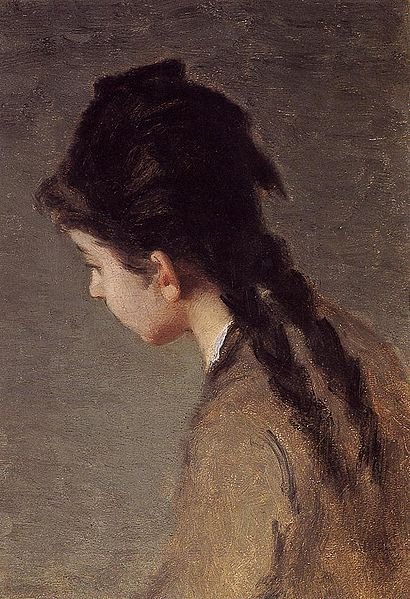
Portrait of Jeanne Gonzalès in Profile by Eva Gonzalès

In 1869 Eva married Henri Charles Guérard, an etcher, lithographer  and printmaker, who was a close friend and sometime-model for Édouard Manet and who modelled for some of his wife’s paintings along with his sister-in-law Jeanne (La femme en rose, Jeanne Gonzelès).  In 1883, a month after her 34th birthday, she gave birth to a son, John.  Sadly, her life was cut short when she died following complications of childbirth.  It was believed to have been Puerperal Fever.    Her death came just six days after the death of her one-time mentor Édourad Manet.   Two years after her death a retrospective of Gonzalès’ work was held at the Salons de La Vie Moderne in Paris where over eighty of her paintings were put on display.

Five years later, in 1888, Henri-Charles Guérard  married Eva’s younger sister, Jeanne Gonzalès, also an artist.   My featured painting by Eva Gonzalès is entitled Une loge aux Italiens (A Box at the Theatre des Italiens) and you can obviously see the similarity between her painting and my previous offering entitled La Loge by Pierre-Auguste Renoir.  I decided to feature his first and then let you compare her painting with his.

As I discussed in my last blog, the auditorium of a  theatre and especially the theatre box were fashionable places for an exchange of society chit-chat and gave the theatregoers the opportunity to be seen at their best.  The subject of the theatre and theatre goers was a subject frequently chosen by the Impressionists, such as Cassatt and Degas but probably the most celebrated of this genre was Renoir’s La Loge (The Theatre Box) and it is interesting to compare it with this work by Eva Gonzalès which she completed in the same year, 1874.  This painting by Gonzalès was submitted to the Salon jurists for inclusion in the 1874 Salon but was refused.   Eva Gonzalès then made some changes to the painting and five years later submitted it to the 1879 Salon and this time it was accepted.  The critics loved the work.

There are some similarities to this painting of hers and that of her former tutor Édouard Manet in the way she, like him, chose to paint a modern-day subject and the way her painting, like some of his, shows a total contrast between the light colours of the clothing of the subject and the pale creamy skin of the female and the dark background.   In stark contrast to the dark velvet edge of the box , we see her white-gloved hand with its gold bracelet casually resting along it.   There is also an uncanny similarity between the bouquet of flowers that rests on the edge of the theatre box to the left of the woman in Gonzalès’ painting and the bouquet of flowers which Manet depicted in his painting, Olympia (see My Daily Art Display October 12th 2011).  The two people who were sitters for Eva’s painting were her husband, Henri Guérard and her sister Jeanne who as I said before was to become Henri’s second wife.

As was the case in Renoir’s painting we are left to our own devices as to what is going on within the theatre box. We need to make up our own minds as to what the relationship is between the man and the woman and to their social standing in society.  There is little symbolism to help us interpret the scene.  We just have to use our own imagination and sometimes that adds to the joy os looking at a work of art.

La Loge by Pierre-Auguste Renoir

La Loge by Renoir (1874)

Today’s featured work of art was not my original intended offering.  That sounds somewhat strange but actually there is logic to my decision.  I was researching a painting when I came across today’s work and there seemed, at least in my mind, a good reason to offer you today’s painting before I showcased my original work.

The French word La Loge in the context of a theatre means the theatre box and it has been the subject of a number of paintings.  Today I want to look at La Loge by Pierre-Auguste Renoir which he completed in 1874 and now hangs at The Courtauld Gallery in London.  Today this work of art by the Impressionist painter is looked upon as one of the most significant works of the Impressionist movement.  At the time of this painting it was estimated that over 200,000 theatre tickets were sold every week in Paris.  However, going to a Parisian theatre in the nineteenth century was not just about taking in the latest plays by the likes of Victor Hugo or Alexandre Dumas or the less formal vaudeville shows which were also very popular at the time, it was about being seen by other theatregoers.  Men would accompany and flaunt their wives or lovers.  Proud fathers would show off their daughters and “out-of-towners” would take the opportunity of dressing up and sample the Parisian lifestyle.   It was an almost indoor form of promenading, which was the leisurely walking in public places dressed in one’s finery and carried out as a social activity.  Attending  the theatre was a chance to showcase one’s most expensive clothes and accoutrements as well as parading one’s latest beau.  What could be more satisfying than to flaunt one’s wealth or one’s new lover?  It was a question of seeing and being seen and going to the theatre dominated the cultural life of the city.  As well as seeing actors on the theatre stage the theatregoers were actually quietly performing on their own  social stage.

Being seen

The way Renoir has depicted the scene in the theatre box sums up this attitude.  We see a lady and gentleman seated in their box.  Take a look at their demeanour.  Are they depicted as locked in concentration at what is happening on the stage below?  No they are not.  The lady stares out at us with her gloved hand holding her opera glasses and resting it on the lavish velvet frontage of the box whilst her other hand clasps a black fan and a white lace handkerchief in her lap.  Protocol of the day demanded that ladies must wear gloves on formal occasions.

Her face is now not hidden from view by her opera glasses.  She is revealing her face to all who may wish to gaze at her.   So how would you describe her?  Is there a delicate elegance about her or does she look rather brash.  She is without doubt beautiful and has little trepidation about letting people admire her from afar.  She wears a lavish dress, one she has probably saved for this very outing.  This is her tenue de premiere or opening-night attire.  Her costume would often be referred to as a robe à la polonaise or polonaise which was popular in the late eighteenth century and saw a was revival a hundred years later in the 1870’s.  It consisted of a fitted overdress which extended into long panels over an underskirt.  The magic of Renoir’s painting is that from a far one can see the three dimensional form of the dress with all its folds and yet up close it was just a series of brushstrokes.  It is almost magical the way the artist has painted this work.

The elegant dress oozes a sense of wealth but that is not the only thing which advertises the financial situation of the couple.   The style of the dress also oozes the ladies sensuality.  Note the position of the rose which immediately draws our eyes to the décolletage which emphasizes her cleavage. The low-cut neckline was a popular feature of evening gowns of that era.   Another rose placed in her hair once again draws our eyes to her simple but elegant coiffure.

Look at her neck and the pearl necklace she is wearing.  Also we can just make out a pair of diamond earrings dangling from her ears and if we look at the hand which holds her opera glasses we note a gold bracelet around her slender wrist.  The wealth is there for us to see but more importantly it is there for the other theatregoers to note.

This is a summation of the “seen and being seen” philosophy.  She is wanting to be seen in all her finery whilst he is concentrating on seeing.  Renoir used one of his regular models, Nini Lopez, as the model for the lady.

Seeing

The sitter for her male companion in the theatre box was Edmund Renoir, the brother of the artist.  He, like the lady, is dressed elegantly in his formal clothes.  Renoir has depicted him wearing a white shirt with a starched cravat, black trousers and gold cufflinks.  His attire, which is typical of that of the wealthy male theatregoer also exudes a sense of affluence but its plainness and subdued colour allows the more colourful female to be the centre of attention.

The aspect of this painting which we cannot be sure about and I will leave you to decide is whether we are seeing a husband and wife out for an evening at the theatre or are we looking a wealthy man accompanied by an elegantly dressed courtesan.  Can we deduce the truth from looking at the painting but beware of falling into the trap of being too judgemental !!!

Renoir exhibited this painting in the First Impressionist Exhibition which was held in the former studio of the photographer Nadar at 35 boulevard des Capucines in Paris on April 15, 1874.  This work, which gives us an insight into Parisian life in the late nineteenth century, is now hailed as a masterpiece of art and one of the most significant works of the Impressionist movement.  At the time it was exhibited it helped establish the reputation of Renoir.  The painting gives us an insight into life in the French capital during the late nineteenth century.

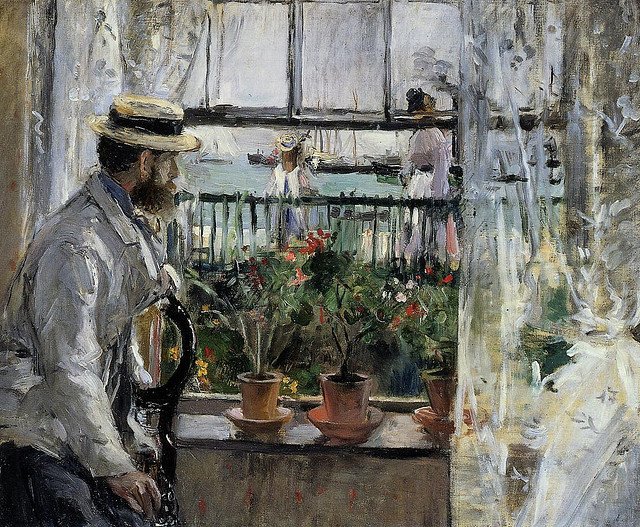
Eugène Manet on the Isle of Wight and Eugène Manet and His Daughter in the Garden by Berthe Morisot

Although I could write numerous blogs about Berthe Morisot and her works, this is not a Berthe Morisot site and therefore after today’s offering I will drag myself away from this talented artist and head for pastures new.  However today I want to focus on Berthe Morisot, her husband and her daughter and have a look at a couple of her paintings which portray the happy family.

As I wrote in my last blog, in 1868, Berthe Morisot had been introduced to Édouard Manet by Henri Fantin-Latour whilst she was working as a copyist at the Louvre.  Over time the Morisot and the Manet family became close friends and would exchange visits to each other’s houses and during this time Berthe became acquainted with Édouard Manet’s brothers, Gusatve and Eugène.

When her sister Edma married Adolphe Pontillon in 1869 she moved to Lorient and gave up painting.   For her, and despite having exhibited at four Salons, she considered her marriage was far more important than any thoughts she may have had of an artistic career. She was determined to channel all her energy into her marriage, playing the role of a supporting wife to her naval officer husband and being a loving and devoted mother to their children.  On the other hand, Berthe on her marriage to Eugène Manet in December 1874 was adamant that the change in her marital status would not affect her art.  She continued to paint as prolifically as before and kept signing her works in her maiden name.  In many ways she was fortunate that Eugène’s attitude to her work was one of support and often when Berthe set off on painting trips he would accompany her and dabble a little in art himself by making a few sketches.  Berthe was also fortunate not to have any money worries and this allowed her to pursue her artistic career without being anxious about where the next centime was coming from.

Eugène Manet on the Isle of Wight by Berthe Morisot (1875)

My Daily Art Display featured painting today, which is housed in the Musée Marmottan Monet in Paris, is entitled Eugène Manet on the Isle of Wight and is one which Berthe Morisot completed in 1875 when she and her husband spent the summer in Cowes on the Isle of Wight on their honeymoon.  This, at the time, was a favoured holiday destination for the English high society.  They visited the town of Rye several times before they moved on to London.  Whilst on the Isle of Wight Berthe spent most of her time painting.  Often she and Eugène would be seen leaving their lodgings carrying easels and paint boxes which they would position at some site of natural beauty and spend the day recording the beauty of the island.   Often Berthe would set up her easel in their hotel room and paint what they could see from their window.  Today’s work is an example of just that.  She managed to persuade Eugène, with some difficulty, to pose for her looking out of the window.   She wrote to Edma about the problems of getting her husband to pose, saying:

“…I began something in the sitting room with Eugène; poor Eugène is taking your place; but he is a much less accommodating model; he’s quickly had enough…”

The view from the window is of the port of Cowes but the painting is all about her husband Eugène Manet and the little cottage garden in front of the residence.  It is interesting to observe how Morisot has painted the window panes and the gauze curtains to convey transparency.  The flowers in the garden and the potted plants on the window sill add a dash of colour but in the main Morisot has used muted greys, blacks and blues in her work.  There is a grid-like structure to the painting with the vertical and horizontal lines of the window frame, window sill and garden fencing as well as Eugène’s boater.  Apparently Morisot found it quite difficult to paint this kind of picture and found the task both frustrating and in some ways depressing.  This again is an example of Morisot’s perfectionism and the problems inherent in that state of mind.  She wrote to Edma about the work saying:

“…The view from my window is very pretty to see, very ugly to paint; views from above are almost always incomprehensible; the upshot is that I am not doing very much, and the little I do looks frightful…”

Eugène Manet and His Daughter in the Garden by Berthe Morisot (1883)

In November 1878, almost four years after Eugène and Berthe married, Berthe gave birth to a daughter, Julie, who was to be their one and only child.  Berthe featured her daughter prominently in many of her future paintings as did her sisters and family members.  I particularly like the painting she did in 1883, entitled Eugène Manet and His Daughter in the Garden.  The setting is the garden on the Bougival estate where they were staying that summer.  Unlike some of her works which also featured her husband and daughter, this painting depicts a more private world of Eugène and Julie.  Eugène is dressed casually in an artist’s smock with a straw hat atop his head.  Julie, dressed in her light blue summer dress, sits by the pond watching her tiny red sailing boat drifting on the water.  There is no sign of their house in the painting but the natural setting enhances the loving father/daughter relationship.   Morisot had always intended the painting to be a private family work and no doubt for that very reason she never exhibited it during her lifetime.  It was not seen by the public until 1896, a year after her death.  The work was one of her daughter’s particular favourites,  as Julie commented on the scene with her father saying:

“..he gazes with a father’s eyes on the little blonde girl in a white dress who is intent on getting boats to move around the pond…”

I will now leave the life and paintings of Morisot for a little while but will undoubtedly return to showcase some of her other beautiful work at a later date.  If you are interested in Berthe Morisot and her life I suggest you read Berthe Morisot by Anne Higonnet, which gives a fascinating insight into Berthe Morisot’s life, her family and the people she mixes with.  It is a great read.

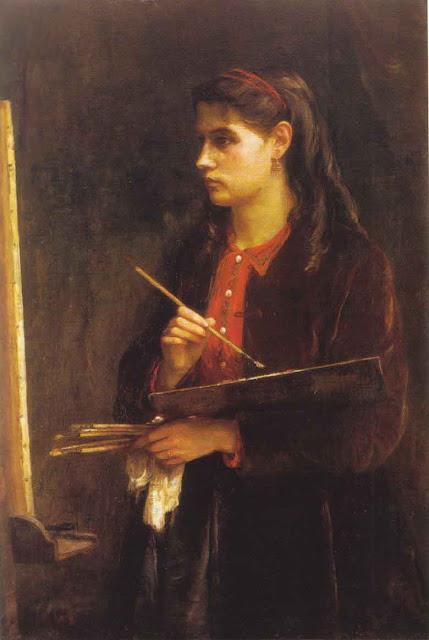
Berthe Morisot by Edma Morisot

Berthe Morisot by Edma Morisot (1865)

For the next few blogs I want to look at the life and works of Berthe Marie Pauline Morisot and some of the paintings other artists have done of her.  As I told you in my last offering I visited the Musée Marmottan Monet last week whilst in Paris and they were currently staging a retrospective of her work.  I have already featured one of her works, Le Bercau (The Cradle) in My Daily Art Display of August 10th 2011 and briefly told you about her life.  Today I am going to look again at her early life and feature a painting, not by the artist herself,  but a stunningly portrait of her, painted by her sister, Edma.

The world of French art between 1839 and 1841 was surely blessed as it was in that two-year period that the world witnessed the birth of four of the greatest French artists.  Paul Cezanne was born in January 1839, Claude Monet was born in November 1840 and Berthe Morisot and Pierre-Auguste Renoir were born in January and February 1841 respectively.  Berthe Morisot was born in Bourges, a city in central France.  She had distant roots in French art as she was an indirect and distant descendent on her father’s side of none other than the French Rococo painter Jean-Honoré Fragonard and the French 18th century female painter, Marguerite Gérard.  Berthe was one of four children.  She had two sisters, Marie-Elizabeth Yves born in 1838, known simply as Yves and Marie Edma Caroline born in 1839, known simply as Edma.  She also had a younger brother, Tiburce, born in1848.  Berthe was brought up in a successful and financially secure household.  Her mother was Marie-Cornélie Thomas, who came from a family of high level government officials, chief treasurers and paymasters of the province.   Her father was Edmé-Tiburce Morisot, who was an architectural graduate and who at the age of twenty-six founded an architectural journal.  However the venture collapsed when his co-founders absconded with all the money and left Tiburce to face the creditors.  He eventually had to hurriedly leave town, leaving all his furniture and possessions to his landlord in lieu of rent, and fled to Greece.  A year later in 1835 he returned to France penniless but his good looks and charm won him the hand of Marie-Cornélie in marriage.  She was sixteen years old and he was thirteen years older.   Marie’s father, who was the personnel director at the Ministry of Finance, managed to arrange employment for Tiburce Morisot as subprefect at the city of Yssingeaux, in the Haute-Loire region.  Tiburce worked hard and soon impressed his employers.  Promotions followed and at the time of his daughter Berthe’s birth, he was the prefect of the Department of Cher, the monarch’s chief administrator for the entire province.

In 1848 when Berthe was just seven years of age, because of the Third French Revolution which eventually led to the creation of the French Second Republic, Berthe’s father decided to move his family from Bourges to the Parisian suburb of Passy.   When Berthe was aged sixteen years of age, her mother, Marie-Cornélie Morisot decided to enrol her three daughters in private drawing classes.  At that time the prestigious École des Beaux-Arts would not admit female students and maintained that sexist doctrine until the last few years of the nineteenth century.  The sisters’ first tutor was Geoffroy-Alphonse Chocarne who taught the girls the fundamentals of drawing.  Yves love of art waned quickly and she gave up on her art tuition after a few months leaving just Edma and Berthe to carry on with their artistic studies.

Edma and Berthe then enrolled to study with Joseph Guichard, who had once been a student of Ingres and now lived in the same street in Passy as the Morisot family.  Guichard taught the girls all about classical art in the academic tradition.  He was there tutor from 1857 and 1860 and in 1858 Berthe registered as a copyist at the Louvre.  It was under the guidance of Guichard that Berthe Morisot first experimented in oil painting.  En plein-air,  painting outdoors in natural light,  became very important to the Impressionist painters and those from the Barbizon School and the two girls told Guichard that they wanted to learn more about that technique and so, in 1863, in consultation with Jean-Baptiste Camille Corot, a leader of the Barbizon School of painters it was arranged that the girls would study under Achille Oudinot, the French landscape painter.  In the spring of 1864 after seven years of intensive artistic training Berthe and Edma Morisot were admitted to the official Salon.  Berthe would exhibit at the Salon regularly and Edma would until her marriage in 1869 at which time she virtually gave up painting.

It is said that behind every great woman, there is another woman, often a close relative.  In nineteenth century England we saw it with the likes of the talented Bronte sisters who had each other for constructive critical support.  Although Morisot’s upbringing in a wealthy household bears no resemblance to the upbringing of the Bronte sisters,what she did have in her formative years, similar to the Bronte sisters, was the luxury of having a very loyal and supportive sister.  Standing unwaveringly behind Berthe was her sister Edma.  The sisters’ artistic collaboration came to an end in 1869, when Edma married her husband, Adolphe Pontillon, a naval officer.  In some ways Edma regretted the end of their artistic partnership and the close friendship which came with it.  They kept in contact by letter and in one Edma wrote:

“…I am often with you in thought, dear Berthe.  I’m in your studio and I like to slip away, if only for a quarter of an hour, to breathe that atmosphere that we shared for many years…”

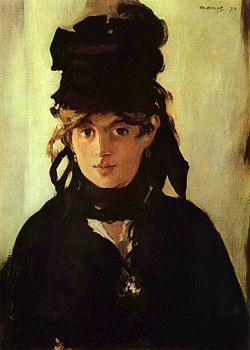
Berthe Morisot with a Bouquet of Violets by Édouard Manet (1872)

And so I come to today’s featured painting.  There have been many portraits painted of Berthe Morisot , probably the best known being the one of her entitled, Berthe Morisot with a Bouquet of Violets which was painted by her brother-in-law, Édouard Manet in 1872 and which is housed in the Musée d’Orsay.  I have always thought that his has made her look rather dowdy, so today I have featured one of my two favourite portraits of the artist.  This one is simply entitled Berthe Morisot and was painted by her sister Edma in 1865 and is held in a private collection.  This beautiful portrait in some ways bears out the close relationship between the sisters and reveals the shared interest both had in painting.  In this work Edma has depicted her sister Berthe holding her palette and brush concentrating earnestly at the picture she is painting.  Look how well Edma has captured the intensity in Berthe’s expression.  Our eyes are immediately drawn to the face of Berthe, which is bathed in light and which contrasts well with the darkened background and also echoes the whites of the side of the canvas and the rag she holds.  This painting of Berthe Morisot depicts her indisputable beauty which often other portraits fail to achieve.  This is indeed a portrait of an extremely delightful young woman in her mid-twenties and one I fell in love with when I first saw it.

Music in the Tuileries Gardens by Édouard Manet

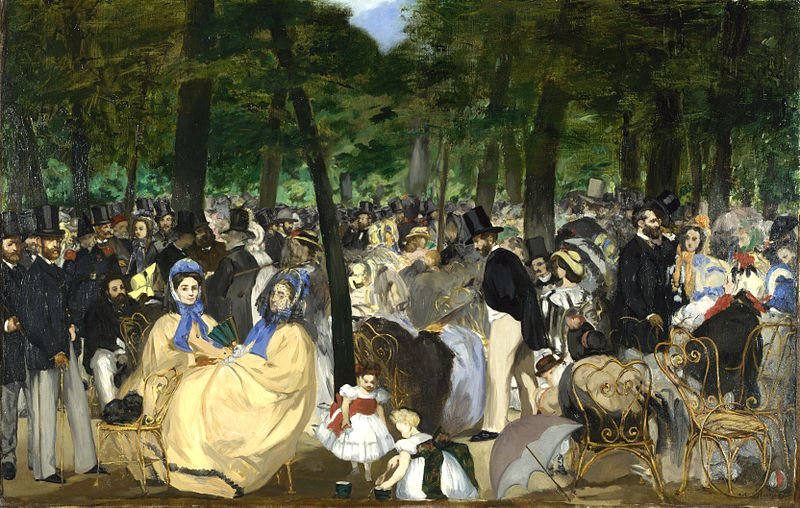
Music in the Tuileries by Édouard Manet (1862)

In my last blog I looked at the painting Afternoon at the Tuileries Garden by Adolph Menzel which he completed in 1867.  He had visited Paris that year and attended the second Exposition Universelle and it was during this stay that he completed a number of sketches of the Tuileries Gardens.  On returning to his home in Berlin he completed this  work.  When it was exhibited, he pointed out that the painting was all done from his memory of the times when he walked around the Gardens watching the weekend promenading of the bourgeois.  However,  there is a train of thought that believes his work was not just based on his memories but was very much influenced by a painting he saw, when in Paris, by Édouard Manet, which was completed in 1862 entitled Music in the Tuileries Gardens.  This is My Daily Art Display featured work today and I will let you decide whether Manet’s painting had any bearing on Menzel’s work.

Music in the Tuileries Garden,s like the Menzel work, hangs, in the National Gallery, London.  The work depicts a fashionable Parisian crowd promenading and socialising in the Gardens as they listen to music played by a band, albeit Manet has not included the musicians in the painting.  The Jardin des Tuileries lies between the Louvre and the Place de la Concorde, and it was the favourite place for people to idle away their leisure time.   The way in which people spent their free time in the capital became one of Manet’s favourite subjects for his paintings.  Manet’s close friend going back to his childhood,  Antonin Proust, the politician and journalist, often recalled the many times he witnessed Manet walking along the Parisian boulevards in search of interesting aspects of city life, which he could depict in his paintings. Manet and his companion, the poet, Charles Beaudelaire,  could often be seen in the afternoons, strolling through the Tuileries Gardens, a favoured gathering place for the beau monde, who wanted “to see and be seen”.  Manet completed numerous sketches of these “beautiful people” as well as the working nannies, who were spending a pleasant afternoon with their little charges.

This was Manet’s first major work on this theme.  The Tuileries Gardens were created for Catherine de Medici who, on the death of her husband King Henry II of France, decided to move her home to the Louvre Palace.  She then had built a separate new palace with gardens modelled after the gardens of her native Florence.  These were the Tuileries Gardens and were opened to the public in 1667 and became a public park following the French Revolution.  As we look at the people in the scene we can imagine the enjoyment they were having whilst they socialised and listened to the music.  Leisure time and recreational activities such as listening to music in a park on a Sunday afternoon was all part of this newly quoted term, modernity.

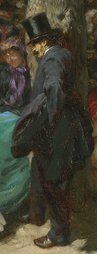
Manet's man
Menzel's man

Menzel’s work is far more detailed than Manet’s painting.  If we compare the two works there are some similarities but Menzel also maintained some differences.     Both depict families enjoying their leisure time.  Look at foreground and slightly right of centre of today’s painting by Manet.  There is a man with the top hat bending down in conversation with a lady.   He is almost the same character, in the same pose leaning against a tree, we saw yesterday in Menzel’s work.  The theme of both paintings is similar – bourgeois Parisians at leisure but as I have just said there are also some differences in the two works.  Menzel’s depiction of what is happening is somewhat more realistic.

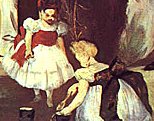
Manet's children
Menzel's children

In his work we saw children in the foreground playing with a bucket and spades but they are not dressed in their “Sunday best” clothes and look somewhat dirtied by their playing on the ground. Now compare that with the children in Manet’s painting.  They too have buckets and spades but these children,  like their adult counterparts , are dressed in their best clothes and are behaving much more demurely.   Also in Menzel’s work we witnessed a small child being dragged off screeching by a woman, probably her mother.  We also saw dogs skirmishing but in Manet’s work there is no such unsavoury incidents happening, which would otherwise shatter the beautiful tranquillity of the scene.

Manet has included the portraits of many of his friends into the lively social gathering, some of whom are fellow artists.  Manet has painted himself at the far left of the painting partly hidden by the figure of Comte Albert de Balleroy, the wildlife artist, seen here holding a walking stick, who shared a studio with Manet.  Another artist also included is Henri Fantin-Latour, best known for his flower paintings.  Manet has added portraits of his brother Eugène, who was the husband of the Impressionist painter, Berthe Morissot.  Several cultural figures of the time are featured in the painting such as the French poets Baudelaire and Théopile Gautier and the travel writer Baron Taylor.  Other intellectuals who have found their way into the painting are the art critic Champfleury and the bearded sculptor Zacharie Astruc who sits at the table and behind him stands the journalist Aurélien Scholl.  Two women sit facing us in the foreground.  The younger of the two, on the left, is Madame Lejosne, the wife of the Commandant in whose house Manet met Baudelaire and the fledgling painter Frederic Bazille.  The other lady is Heminie d’Alcain, the wife of Jacques Offenbach.  Offenbach is the bespectacled man with a moustache who sits in front of a tree to the right of centre of the middle ground, between Eugène Manet and the painter, Charles Monginot who we see doffing his hat to a lady .

Menzel’s work was far more detailed and with his painting your eyes darted from place to place surveying different incidents.  In some ways this painting, by Manet, as did Cezanne’s Large Bathers ( My Daily Art Display March 13th))have an “unfinished” look about them but this is all to do with their style of painting.  So what did the critics think of this work by Manet when it was first exhibited in 1863?   It received very mixed reviews.   On one hand, many of the artists who were soon to be known as the Impressionists, like Claude Monet and Frederic Bazille, were delighted with   Manet’s depiction of the Parisian scene.  However the conservatives among the art critics were less than complimentary.   Paul Mantz, the art historian and  art critic, who would later become Director General of Fine Arts and a member of Supreme Council of Fine Arts was particularly ruthless in his condemnation stating that Manet’s composition struck him as being disorganised and formless, while the broken play of light that animates its surface with such an eloquently restless quality roused him to declare that “this is not colour, but the caricature of colour”.

I have had a number of comments added to the Large Bathers blog strongly disagreeing with my assertion that Cezanne’s work had an unfinished look to it and therefore I will not dare comment about the finish of this work.   Emile Zola explained the “unfinished” look of Manet’s painting, countering such criticism, saying:

“…You are to imagine a crowd of people, a hundred characters perhaps, moving about in the sunlight under the trees in the Tuileries; every character is simply a blot of colour, hardly given form at all, and the details are only lines and black dots. If I had been there I should have asked the amateur [observer of the painting] to move away to a respectful distance; he would then have seen that the patches of colour were alive, that the crowd was speaking, and that the picture was one of the characteristic productions of the artist, the one picture in fact in which he had most loyally obeyed his eyes and his temperament…”

As with most of the Impressionist works of art, the best view you get is if you stand back from the work to see its exquisiteness.  Close up one just sees brushstrokes but at a distance one discovers the true beauty of the work.

So which painting do you like best, the one by Adolph Menzel or the one by Édouard Manet?

The Swineherd, Brittany, The Schuffenecker Family. Madame Gaugin by Paul Gaugin.

Life Story of Paul Gaugin (Part 2)

In my last blog I gave you a brief outline of Gaugin’s life up until April 1871 when Gauguin, having completed his military service, returned to his late mother’s home in St Cloud, only to find it had been destroyed during the year-long (July 1870 – May 1871) Franco-Prussian War.  He then moved back to Paris and takes an apartment close to where his former guardian Gustave Arosa lives with his family.  In 1872, through Arosa’s business connections with the owner of a stockbroker firm, Paul Bertin, Gaugin becomes a bookkeeper for the company.

The Schuffenecker Family by Paul Gaugin (1889)

It is whilst working here that Gauguin meets the part-time artist and his co-worker, Émile Schuffenecker, who joined the firm a few months earlier.  The friendship grew and they used to spend time in the Louvre studying the paintings of the Old Masters.  In December that year Gustave Arosa introduces Gauguin to a Danish woman Mette-Sophie Gad.  Mette was a judge’s daughter and formerly a governess to the children of a Danish Minister of State and she was in Paris with a friend to improve her cultural education.  Gaugin and Mette married in Paris in November 1873 and they became great friends with Emile Schuffenecker and his wife, Louise.  The Schuffeneckers who married seven years later in 1880 had two children, a daughter Jeanne born in 1882 and a son, named Paul after Gaugin, was born in 1884.   Gaugin and Mette’s first child, Emile (named after their friend Schuffenecker), was born in September 1874.  The couple at this time were experiencing a good standard of living derived from Gaugin’s earnings at the financial brokerage.

Mette Gad (Madame Gaugin) in an Evening Dress by Gaugin (1884)

Gauguin love of art blossomed, thanks mainly to two people.  Firstly from his former guardian Gustave Arosa who had, along with his brother, managed to build up an impressive collection of paintings from the likes of Gustave Courbet, Jean-Baptiste-Camille Corot, Eugène Delacroix and Jean-François Millet and it was Arosa who introduced Gaugin to Camille Pissarro who would occasionally tutor him.    The other person who encouraged Gaugin to paint was his friend and work colleague Émile Schuffenecker and the two of them would often go off on Sundays on painting trips.  The pair also spent the occasional evening at the life classes at the art school, Académie Colorossi.  To give one an idea of how quickly Gaugin learnt the art of painting, it should be noted that in 1876, within four years of starting to paint, Gaugin had a landscape Under the Tree Canopy at Viroflay accepted at that year’s Salon.  There was also a family connection with art as Mette’s sister Ingeborg had married the Norweigan painter Fritz Thaulow and when he and Gaugin got together they would discuss painting and Thaulow would offer critical advice to Gaugin about his works of art.

At the start of 1877, Gauguin decided to leave Paul Bertin’s stockbrokerage firm and move to André Bourdon’s bank. The job at the bank was better for Gaugin as it had regular business hours which meant that he could set aside regular periods for his painting.   Financially life was still good.  He received a regular salary from the bank and he had been very successful with his speculations on the Paris stock market.  Gaugin and his wife moved house and went to live to Vaugirard, a suburb in the south west of Paris, where they rented rooms in a property owned by the sculptor, Jules Bouillot and one of their neighbours was Jean-Paul Aubé.

In 1877 Gaugin’s daughter Aline was born and the following year there is an upturn in Gaugin’s financial situation as share prices rise and bank bonuses roll in.  Gaugin spends this money on buying contemporary art by the likes of Camille Pissarro and some of the other Impressionist painters.  In 1879 Gaugin is invited by Pissarro and Degas to exhibit some of his work at the Fourth Impressionist Exhibition.  That same year, Gaugin’s second son, Clovis, is born.  Life is good for Gaugin and his wife. They wanted for nothing. They are happily married; he is earning good money at the bank and is exhibiting more of his paintings at the Impressionist Exhibitions.  In April 1881 his third son Jean-René is born.

However, as in life, all good things come to an end.  For Gaugin the end came in January 1882, for it was then that the Paris Bourse (French stockmarket) crashed.  It caused the worst crisis in the French economy in the nineteenth century. The crash was triggered by the collapse of l’Union Générale Bank that month.  Around a quarter of the brokerage firms on the Bourse were on the brink of collapse and Gaugin lost most of his money he had riding on the stock market.   Now it was decision time for Gaugin; should he get out of the once lucrative world of finance altogether and concentrate on his art but by taking this course of action he risked the wrath of his wife?   That was his dilemma and despite having an ever expanding family to support (his fifth child Paul, often known as Pola was born in December 1883), he decided to turn his back on finance and commerce and become a full-time artist.    In January 1884 on the advice of Pissarro, Gaugin, now with little of his savings left and very little income coming in from the sale of his paintings,  moved his family from Paris to Rouen where the cost of living was less than in the capital.  Sales of his work were slow and he has to sell off some of his much loved art collection.  This life of poverty did not go down well with his wife Mette and the couple were constantly arguing and their marriage started to unravel.

In the summer of 1884 Mette had had enough of their impoverished lifestyle and along with the children sailed off to Copenhagen to be with her parents    She does return to Gaugin in Rouen and tells him that she has secured a position teaching French to Danish children but told him there was a great opportunity for him to sell his art work in Copenhagen as the Danes are showing an interest in Impressionism art.   In November 1884, Gaugin reluctantly joined his family and his in-laws, the Gad family, in Copenhagen and works for a while as a tarpaulin salesman for Dillies & Cie. on a commission-only basis.  Whereas his wife is very happy to be back home, he is extremely unhappy.  He could not speak the language, hated the job which he found demeaning and which got in the way of his one true love – his art.  However he persisted with his painting and in January 1885 wrote a somewhat upbeat letter to Shuffenecker in which he said:

“.. Here [in Copenhagen], I am more than ever tormented by art and although I have to worry about money and look for business, nothing can deter me…”

To make things worse the exhibition of his art work at the Academy of Art in Copenhagen proved to be a failure and is shut down after just five days.  Although he managed to paint a little he could not keep down a job and bring in money for his family and his attitude did not please his in-laws.  To Gaugin, his wife and her parents were holding him back and so in June 1885, he decided that enough was enough and returns to Paris with his favourite child, his second son Clovis.   Art historians have often discussed Gaugin’s split from his wife and many would have you believe it was not so much that he abandoned his wife but more the case that she threw him out.  Whatever the situation was Gaugin when he arrives back in Paris arranges to have six year old Clovis live with his sister Marie who is now married to a Chilean businessman Juan Uribe.   Between the years of 1883 and 1886, due to the many upheavals in his life, Gaugin paints very little.  In the summer of 1886, thanks to some financial assistance from his sister, his son Clovis attends a boarding school, leaving Gaugin free to travel to Pont-Aven, a picturesque Breton village and a centre for a community of artists.  He is happy here and is soon looked up to by his fellow artists.  In a letter to his wife in July 1886, Gaugin wrote:

“… I am respected as the best painter in Pont-Aven, although that does not put any more money in my pocket…”

Gaugin fell in love with Brittany and the Breton way of life. He lived for five months in the Pension Gloanec boarding house and struck up a friendship with the artists Charles Laval and Émile Bernard before returning to Paris in the autumn of that year.

Gaugin is unhappy with life in Paris and has once again developed a wanderlust,  maybe brought on by his days in the navy, and once again the desire to get out of the capital city and travel kicks in, as he explained in a letter to his wife Mette in January 1887:

“…what I want above all is to leave Paris which is a wasteland for a poor man… I am going to Panama to live the life of a native.  I know a little island called Tabogas a league off panama; it is virtually uninhabited, free and very fertile.  I shall take my paints and brushes and reinvigorate myself far from the company of men…”

I am wondering whether Gaugin occasionally feels pangs of guilt about leaving his wife in Copenhagen as in a letter to her in February 1887, he writes to her and tries to justify his departure and tries to get her to look on the bright side of their separation:

“…You are in your house, comfortably furnished, surrounded by your children, doing a tough job but one that you enjoy, you see people, and as you like the company of women and your compatriots you must be satisfied sometimes. You enjoy the comforts of married life without being bothered by a husband. What more do you want other than more money, like many others…”

I once again break off this life story of Gaugin at a point in his life when he looks forward to leaving France and enjoying a worry-free lifestyle in the Caribbean and Central America.  Was his journey a success and did it bring him the all that he desired.  I will tell you in the next blog.

The Swineherd, Britanny by Gaugin (1888)

One of the paintings Gaugin completed during his stay in Pont Avon was entitled The Swineherd, Britanny which he completed in 1888 and now hangs in the Los Angeles County Museum of Art.

This colourful work of art is much more realistic than his later works in the way the artists divides the various areas of the canvas.  There is a definite foreground in which we see the swineherd with his pigs.  There is a middle-ground partly separated from the foreground by a long low stone wall.  In the mid-ground there is the small village with its tall spired-church and a collection of houses and cottages with their black-tiled roofs.    There is a definite background in which we see the blue sky over rolling hills with its patchwork-quilt like fields.

Un atelier aux Batignolles (A Studio at Les Batignolles) by Henri Fantin-Latour

Un atelier aux Batignolles (A Studio at Les Batignolles)

Today I am looking at a work of art by the French painter, Henri Fantin-Latour, or to give him his full name, Ignace-Henri-Jean-Théodore Fantin-Latour.  The family was of Italian ancestry and the “Fantin” part of the name came from the fact that some of the ancestors hailed from the southern Italian town of San-Fantino.  In the 17th century, a Jean Fantin added “Latour” to the name of Fantin.

Henri was born in Grenoble in 1836.  His father, Theodore Fantin-Latour, originally from Metz, was a society portraitist painter.   In 1841 the family moved to Paris.  Having shown a liking for drawing at an early age, he received his initial artistic training from his father.  Then at the age of fourteen, he enrolled on a three-year course at the École de Dessin of the French artist and drawing instructor, Lecoq de Boisbaudran.  Following this, he spent a short time at the École des Beaux-Arts in Paris.  During his art student days he spent most of his time at the Louvre copying the painting of the old Masters as well as making many visits to the Musée de Luxembourg to study and copy the works of Eugene Delacroix.  In 1861, after he graduated from the art schools he worked for a time at the atelier of Gustave Courbet and supported himself by earning money as a copyist.

During his time copying paintings at the Louvre he came across and became friends with a number of the future Impressionists, such as Edgar Degas, Édouard Manet and Berthe Morisot.   In 1858, he struck up a special friendship with the American-born artist James Whistler and along with French-born English painter Alphonse Legros he founded the art group known as the Société des Trois.   Whistler, who had moved to London, invited Henri over for a visit which he accepted and through the good auspices of his two friends Whistler and Legros he was introduced to the art world of London.  This was the first of many trips to London made by Fantin-Latour.  One very important introduction whilst there was to Edwin Edwards, who had trained as a lawyer but also practiced as an artist and etcher.  He acted as Henri Fantin-Latour’s agent in England and found him many buyers for his floral paintings as well as a number of patrons.

Henri Fantin-Latour had started painting a number of works of art featuring floral still-lifes and these were well received in London although strangely enough never popular in France during his lifetime.  Henri Fantin-Latour exhibited a number of his works at the Paris Salon in 1861 and 1862  and later in 1863, at the Salon des Refusés, and  he exhibited regularly at the London Royal Academy.  Although he had been close friends to a number of the Impressionists, he never put up any of his paintings for their eight Impressionist Exhibitions.  The reason for that decision was probably due to the fact that although he counted them as friends, he disagreed with their artistic theories and philosophy.  His artistic style was more conservative.

Henri-Fantin Latour will always be remembered for his luxurious floral paintings but he was an artist who painted many group portraits and it through these works that we get an insight into the friendship between the now-famous artists, poets, musicians and writers of that era.  During his time as an artist he also completed no fewer than twenty three self-portraits.

In 1875, aged thirty nine, Henri Fantin-Latour married a fellow painter, Victoria Dubourg and the couple spent their summers at the country estate of his in-laws at Buré.  In 1879 Henri Fantin-Latour was awarded the Legion d’Honneur medal.  Henri Fantin Latour died in 1904, aged 68 and was buried in the Cimetière du Montparnasse in Paris.

The painting I am featuring today was not one of Fantin-Latour’s beautiful floral works of art but instead I am going to look at one of his group portraits. It is very like a painting I featured in My Daily Art Display on November 10th 2011 entitled Bazille’s Studio; rue de la Condamine by Frédéric Bazille, who also actually appears in today’s painting.

My painting today is entitled Un atelier aux Batignolles (A Studio at Les Batignolles) and he completed it in 1870.  Batignolles is part of the 17th arondissement of the city of Paris.  At the time of Fantin-Latour, this was a cultural hive of activity and served as a base for young painters such as Édouard Manet and many of his artist friends who, because of the locality, became known as Le groupe des Batignolles.  The painting today is a kind of “who’s who” of that group.   It is more than just that.  In some ways it is Henri Fantin-Latour paying homage to his friend Manet.

We are in the atelier of Édouard Manet and we see him sitting at his easel. He concentrates on the man sitting in the other chair, the subject of his painting, Zacharie Astruc.  Astruc was a painter, poet, sculptor and art critic who had rallied to support the likes of Courbet and Manet and the Impressionist group of painters when they were constantly being criticized.   Standing around and watching the artist at work are some of his friends.  At the far left of the painting, seen standing directly behind Manet is the German painter Otto Schölderer.  Next to him, wearing a hat, is Auguste Renoir.  Further to the right of the painting and almost in the background, are Emile Zola, the writer who also championed the cause of the Impressionists in their struggle with the Salon and its condemnation of this new grouping of artists, Edmond Maître another supporter of the Impressionist painters and who was, at the time, a civil servant at the town hall.  Almost hidden in the corner of the painting is Claude Monet.   Standing tall and upright behind the chair with a full beard is the twenty-six year old, Frédéric Bazille, who two months after this painting was completed was killed in the Franco-Prussian War.  There is a  formal air to this group portrait.  The men are all dressed in somber dark suits and their expressions are serious and unsmiling.   All these young artists had suffered at the hands of the art critics of the day.  They and their paintings were accused as being frivolous and contrary to what the art establishment was used to.  It is possibly for that reason that Henri Fantin-Latour decided to depict the gathering so formally and with an air of respectability.  Could this desire to show how these young artists had not completely put the antique traditions of the Academics of the Salon behind them be the reason why the artist has included a statuette of Minerva on the table at the left of the painting?  In my last blog regarding Monet and Camille Doncieux I mentioned that all things Japanese were the rage in Paris and France in the late nineteenth century.  Look how Fantin-Latour has positioned a Japanese stoneware vase next top Minerva in the painting.

This work by Henri Fantin-Latour is almost a historical painting.  It records for us a time in history when these characters were leaving their mark.  Each one of them is posing for posterity.  Zola once wrote about the struggle these artists had to endure and the way in which Édouard Manet tried to rally them when they became dispirited.  He wrote:
“…Around the painter so disparaged by the public has grown up a common front of painters and writers who claim him as a master…”

Henri Fantin-Latour put forward the painting to be exhibited at the 1870 Salon  The painting was accepted and he was awarded a  medal by the salon for this work of art.  In spite of his close relationship with the Impressionist painters he never followed their artistic techniques.  He remained a traditionalist and remained faithful to that traditional technique. In the latter part of his career he painted less and concentrated on lithography.

Did you wonder whether Manet was actually painting a picture of Zacharie Astruc as depicted in today’s featured work?  Who knows, but coincidentally, Manet did complete a portrait of Astruc four years earlier in 1866, which now hangs at the Kunsthalle in Bremen………………….

Portrait of Zacharie Astruc by Manet (1866)

Camille Doncieux and Claude Monet (Part 2)

Claude Monet and Camille Doncieux

In my last blog I looked at the first meeting of Camille Doncieux and Monet.  It occurred in 1865 when Frédéric Bazille, a good friend of the twenty-five year old Monet, introduced him to Camille Doncieux who was still in her teens.  Camille, who was of humble origins, worked as an artist’s model.  Monet soon made her his number one model and shortly afterwards the two became lovers. The couple, because of the poor sales of Monet’s works of art, lived in depressing poverty.   Today I complete the story of Camille and Monet and look at a few more paintings the artist completed depicting Camille.

From the 1860’s till the end of that century, France was in love with all things Japanese.  This Japonisme as it was called had inspired both artists and the public.  Monet was not immune from this trend which swept his country.  Besides his art, he had two other hobbies.  He loved gardening and he loved to collect Japanese art, especially the Japanese woodblock prints.   In all he had built up a collection of over two hundred of these.  He had also accumulated a number of Japanese fans, kimonos and screens, some of which can still be seen at his house in Giverny.

 The most palpable and undeniable proof of Monet being influenced by the art and culture of Japan is his oil on canvas painting, Madame Monet en Costume Japonais (La Japonaise), which he completed in 1875 and which currently hangs in the Boston Museum of Fine Arts. This work was in complete contrast to his earlier works.   Large-scale figure paintings had usually been looked upon as a major challenge for an artist.  Camille is depicted dressed in an elaborate kimono, holding a Japanese fan in her hand.   It is interesting to note that Camille is wearing a blond wig so as to emphasize her Western identity. Her kimono is sumptuously embroidered and the background is adorned with numerous Japanese fans. These accoutrements could, at the time, be bought for a few centimes in many of the Parisian shops and even the larger department stores had exclusive sections for all things Japanese.

In the painting Camille’s pose is of a conventional style and it is believed that Monet did this so as to enhance the chance of selling the work.   Because of this, there is a somewhat loss of spontaneity about it.  The scene looks very contrived.   However the brilliance of the colours he used is breathtaking.   Monet exhibited this work at the Second Impressionist Exhibition in 1876, where it attracted much attention.  Maybe Monet was saddened and felt somewhat guilty by the compromise he had made with this work solely to make it more attractive to potential buyers.  He later described it as “trash” and “a concession to the popular taste of its time”.

On June 28th 1870, Camille and Claude were married in a civil ceremony performed at the town hall of the eighth arrondissement of Paris. The French painter Gustave Courbet was one of the witnesses. Although Camille’s parents were present at the ceremony, Monet’s family were horrified by their son’s choice of partner and would not accept Camille Doncieux as their daughter in law, nor would they acknowledge their grandchild, Jean-Armand-Claude who had been born in August 1867.   Monet’s parents even tried to bribe their son into leaving his wife with the threat of their allowance to him being stopped if he continued the liaison.  However Monet chose his wife over money and refused to abandon Camille and Jean.   As a result, his allowance was cut off and his financial situation worsened and the three of them suffered extreme financial hardship, sometimes unable to afford food and often unable to afford paint.   He carried this burden for many years, and struggled greatly with poverty and the stress caused by Camille’s poor health, and his inability to pay for her medical care.   After the wedding and just before the start of the Franco-Prussian War the family travelled to London and Zaandam before returning to France and setting up home in Argenteuil, a town to the west of Paris.

Camille Holding a Posy of Violets by Monet 1877

In 1876, Camille Monet fell ill with what is believed to have been the beginnings of cervical cancer.   In Monet’s 1877 painting Camille Holding a Posy of Violets, which he completed that year, one can see the toll the disease has had on her health. Her face looks pale and haggard.  She looks tired and older. It was around this time that Monet received a commission from a patron Ernest Hoschedé and for a short time his finances took a turn for the better.  However in 1877 all this changed when Hoschedé went bankrupt and his art collection was auctioned off. This was a blow to the Impressionists, whom Hoschedé had supported,  and especially Monet.   The bankrupted Hoschedé and his family moved to a house in Vétheuil with Monet, Camille and Jean. However Ernest Hoschedé spent most of his time in Paris before fleeing to Belgium to avoid his creditors.   There soon followed speculation that Monet may have been carrying on an affair with Alice Hoschedé.    Some art historians have translated the look on Camille’s face in this painting as one of disgust with her husband and his liaison with Alice Hoschedé.  This was the last painting Monet did of Camille whilst she was alive.

Camille on her Deathbed by Monet (1879)

On March 17th 1878, Camille gave birth to her second son, Michel.  The birth of Michel further weakened Camille.   Over the next twelve months Camille’s health deteriorated and on August 31 1879, a priest was called to the house to administer the last rites and to sanction her marriage to Monet, although they had been married in a civil ceremony nine years earlier.   Camille’s death on September 5th 1879 devastated Monet. She was just thirty-two years of age.   Monet painted a picture of his wife on her death bed and the work can be seen at the Musée d’Orsay.  Monet remembered the time well writing to a friend telling him of his urge to paint that last portrait of Camille:

“…I caught myself watching her tragic forehead, almost mechanically observing the sequence of changing colours that death was imposing on her rigid face. Blue, yellow, grey and so on… my reflexes compelled me to take unconscious action in spite of myself…”

Monet included lots of blue and gray in this painting, as well as yellow,orange and red and in some people’s opinion the use of these colours made the painting too light. Light, coming from the right hand side, shines on the face of his deceased wife.   We do not get a very clear view of Camille although we can just make out her face and that she is wearing a shroud.

After Camille Monet’s death in 1879, Monet and Alice along with the children from the two respective families continued living together at Poissy and later Giverny. Ernest Hoschedé died in 1891, and, in 1892, Alice and Claude Monet were married.   Little is known about Camille Doncieux Monet mainly because Monet’s alleged mistress and second wife, Alice Hoschedé, was so jealous of Camille that she demanded that all photographs, mementos and letters between Monet and Camille were destroyed.  She was determined that Camille’s very existence was denied.

Why did she hate Camille so much?    Maybe she realised that Camille Doncieux was the one and only true love of Claude Monet.

Claude and Camille by Stephanie Cowell

If you would like to read a fictional account of the relationship between Camille Doncieux and Claude Monet then I suggest you read:

Claude and Camille: A novel on Monet by Stephanie Cowell

Camille Doncieux and Claude Monet

My next two blogs deal not with a particular painting but with the subject of a series of paintings completed lovingly by one artist.  The subject is Camille-Léonie Doncieux, who was the beloved model, mistress and wife of Claude Monet.  In 1861, Monet had enlisted as a soldier in the Chasseurs d’Afrique regiment and spent two years in Algeria.  His military life came to an end in 1863 because he had fallen ill with fever.  He went back to Paris where he studied at the atelier of the Swiss artist Charles Gleyre and it was during this time that he met up with the artists Sisley, Bazille and Renoir, who would later join together with others and become known as the Impressionists..

Camille Doncieux was born in 1846 and met the impoverished but talented painter, Claude Monet, for the first time in 1865 when she was just eighteen years of age.  She came from an ordinary unprivileged background.  She fell in love with him, leaving her home to live with the talented 25-year-old painter who struggled to sell his work. People called her La Monette.  Everyone she met fell under her spell.   It was recorded that she was a ravishingly good-looking girl with dark hair, very graceful, full of charm and kindness.  Monet, her future husband, was struck by her beauty and described her eyes as being wonderful.    It was not long after they met that she began modeling for him and soon became his favourite model.  His professional interest in her soon became personal and the two soon became lovers.   The first time we come across Camille in a painting by Monet was in a study for his ill-fated work Déjeuner sur l’Herbe.

Study for Le Déjeuner sur l'Herbe (1865/6)

In 1863, Édouard Manet had exhibited his painting Déjeuner sur l’Herbe at the Salon des Refusés (see My Daily Art Display, December 23rd 2010).   The critics and public were shocked by the work and Manet’s depiction of a nude woman seated with a pair of clothed men in a landscape setting.    Monet, who was known for his competitive streak decided to paint his own version of Déjeuner sur l’Herbe in the spring of 1865. This audacious venture would culminate in putting it forward for an exhibition at the Salon of 1866.  Following outdoor studies he made in the Forest of Fontainebleau, he immediately headed back to his nearby studio at Chaillyen-Bière and started to make preparatory sketches for what would be his mammoth canvas measuring an unbelievable 4.5 metres x 6 metres.  In one of his preparatory sketches, which he did in oil entitled Bazille and Camille (study for Déjeuner sur l’Herbe) we see Camille Doncieux and Monet’s fellow artist friend Frédéric Bazille.   Ultimately the painting was not a success. Monet was unable to finish it in time for the 1866 Salon and eventually abandoned the work. He left it, rolled up, with his landlord as part payment for rent he owed but it became damp and all that now remains are fragments of the work and some preparatory studies. The experience did, however, contribute to Monet’s realisation that to portray the brief moment in time, he would have to work on a much smaller scale.

La Femme à la Robe Verte by Monet (1866)

The next time we see Camille is in a painting Monet exhibited in the 1866 Salon.  The work was entitled Camille or Woman in a Green Dress and now hangs in the Kunsthalle, in Bremen.  After his disastrous attempt to emulate Manet with his painting of Déjeuner sur l’Herbe this work of his gained him critical acclaim.  Rumour had it that in his rush to meet the Salon deadline he completed the work in four days but one must doubt that assertion.  It is not strictly a portrait of Camille.  It is all about the dress.  She was simply his model for the painting.  The first thing which strikes one as we look at the work is the colour of the promenade dress which had probably been borrowed for the occasion.  Monet loved colour and the green he has used is awesome.  It dominates the painting and even detracts from the woman herself.  This is not about Camille but on the dress she wears and how it hangs.  The painting reminds one of a photograph out of a fashion shoot for a fashion magazine when the clothes are the important thing and not the model.  Look how the background is undefined.  It is simply plain and dark.  Monet had decided that nothing should deflect our gaze from the woman and her dress.  I like how Camille is just raising her right hand towards her face as if the picture has captured her just about to do something, a fleeting gesture, and we are left guessing as to what.  Maybe she is adjusting the ribbon of her bonnet.  The painting was accepted by the Salon jury and hung in their 1866 exhibition.    It was an immediate hit with both the art critics of the time and the public and the Paris newspapers called Camille the Parisian Queen.

One amusing anecdote about this painting was the story that Monet’s signature on the painting had been mistaken by many viewers for that of Manet, who had entered the Salon to a chorus of acclaim for his supposed work.  Monet told this story to the newspaper Le Temps:

“….imagine the consternation when he discovered that the picture about which he was being congratulated was actually by me !   The saddest part of all was that on leaving the Salon he came across a group which included Bazille and me.  ‘How goes it?’ one of them asked.  ‘Awful,’ replied Manet, ‘I am disgusted.  I have been complimented on a painting which is not mine’…….”

Camille au Petit Chien by Monet (1866)

That same year Monet produced a hauntingly beautiful and intimate portrait of his lover entitled Camille with a Little Dog, which is in a private collection.  We see Camille sitting side-on to us in quite a formal pose.  This is one of the few paintings of her by Monet that looks closely at her.  Once again as was the case in the Woman in a Green Dress, the background is plain and dark and in no way serves as a reason for taking our eyes off Camille.  We are not to be distracted from her beauty.  This painting is all about Camille.  It is interesting how Monet has painted the figure of the dog simply by thick brush strokes.  At a distance it looks like a dog but if you stand close up to the painting you can see it is just a mass of brush strokes.  However Monet has not treated the painting of Camille’s face with the same quick thick strokes of his brush.  She has been painted with delicate precision.  Monet did not want to depict the love of his life with hastily swishes of a brush. He took pains in her appearance.  This was a labour of love.

Luncheon by Monet (1868)

In 1867 Monet’s lover Camille gave birth to their son Jean.  A year later, during the winter of 1868, Monet started on his painting entitled Luncheon, which can be seen at the Städelsches Kunstinstitut in Franfurt.   This family, which now included their son Jean, were staying in Étretat at the house of a patron, where Monet had taken refuge from his Parisian creditors and critics.  It is a large highly detailed oil on canvas painting measuring 230cms x 150cms.   It is simplistic in its subject.  Before us we have sitting at the dining table Camille and her blonde-haired son.  She looks lovingly at him whilst he seems to only have eyes for the food.  A visitor stands with her back to the window and the maidservant is seen leaving the room.  A place is set out ready for her husband to join her at the meal table.  Look how Monet has painted a number of items overlapping the surfaces they are resting on.  On the table we have the loaf of bread, the newspaper and the serviette  all hanging over the cloth which Monet has depicted as being somewhat creased.  In the background we have two books overlapping the edge of the table.  All this in some ways adds to the realism of the painting.  Sunlight pours through the large window to the left of the painting and bathes the well-stocked table in light and by doing so brings it to life.  Monet submitted the painting to the 1870 Salon jury but it was rejected.  Four years later he included the work in the First Impressionist Exhibition in 1874.

to be concluded tomorrow………………………………